<?xml version="1.0" encoding="ISO-8859-1"?><article xmlns:mml="http://www.w3.org/1998/Math/MathML" xmlns:xlink="http://www.w3.org/1999/xlink" xmlns:xsi="http://www.w3.org/2001/XMLSchema-instance">
<front>
<journal-meta>
<journal-id>0370-5943</journal-id>
<journal-title><![CDATA[Revista latinoamericana de química]]></journal-title>
<abbrev-journal-title><![CDATA[Rev. latinoam. quím]]></abbrev-journal-title>
<issn>0370-5943</issn>
<publisher>
<publisher-name><![CDATA[Laboratorios Mixim S.A.]]></publisher-name>
</publisher>
</journal-meta>
<article-meta>
<article-id>S0370-59432010000200003</article-id>
<title-group>
<article-title xml:lang="en"><![CDATA[Antibacterial activity of Ibicella Lutea glycosides]]></article-title>
</title-group>
<contrib-group>
<contrib contrib-type="author">
<name>
<surname><![CDATA[García Da Rosa]]></surname>
<given-names><![CDATA[María E.]]></given-names>
</name>
<xref ref-type="aff" rid="A01"/>
</contrib>
<contrib contrib-type="author">
<name>
<surname><![CDATA[Olivaro]]></surname>
<given-names><![CDATA[Cristina]]></given-names>
</name>
<xref ref-type="aff" rid="A01"/>
</contrib>
<contrib contrib-type="author">
<name>
<surname><![CDATA[Cerdeiras]]></surname>
<given-names><![CDATA[María Pía]]></given-names>
</name>
<xref ref-type="aff" rid="A02"/>
</contrib>
<contrib contrib-type="author">
<name>
<surname><![CDATA[Vázquez]]></surname>
<given-names><![CDATA[Álvaro]]></given-names>
</name>
<xref ref-type="aff" rid="A01"/>
</contrib>
</contrib-group>
<aff id="A01">
<institution><![CDATA[,Universidad de la República Facultad de Química Departamento de Química Orgánica]]></institution>
<addr-line><![CDATA[Montevideo ]]></addr-line>
<country>Uruguay</country>
</aff>
<aff id="A02">
<institution><![CDATA[,Universidad de la República Facultad de Química Departamento de Biociencias]]></institution>
<addr-line><![CDATA[Montevideo ]]></addr-line>
<country>Uruguay</country>
</aff>
<pub-date pub-type="pub">
<day>10</day>
<month>08</month>
<year>2010</year>
</pub-date>
<pub-date pub-type="epub">
<day>10</day>
<month>08</month>
<year>2010</year>
</pub-date>
<volume>38</volume>
<numero>2</numero>
<fpage>98</fpage>
<lpage>102</lpage>
<copyright-statement/>
<copyright-year/>
<self-uri xlink:href="http://www.scielo.org.mx/scielo.php?script=sci_arttext&amp;pid=S0370-59432010000200003&amp;lng=en&amp;nrm=iso"></self-uri><self-uri xlink:href="http://www.scielo.org.mx/scielo.php?script=sci_abstract&amp;pid=S0370-59432010000200003&amp;lng=en&amp;nrm=iso"></self-uri><self-uri xlink:href="http://www.scielo.org.mx/scielo.php?script=sci_pdf&amp;pid=S0370-59432010000200003&amp;lng=en&amp;nrm=iso"></self-uri><abstract abstract-type="short" xml:lang="en"><p><![CDATA[In spite of the great advances in chemotherapeutics, infectious diseases are still one of the leading causes of death in the world. Amongst the most problematic clinically relevant pathogens at present, methicillin-resistant Staphylococcus aureus (MRSA) ranks as one of the most difficult bacteria to treat. Interest in plants with antimicrobial properties has revived as a consequence of current problems associated with the use of antibiotics. The objective: was to evaluate the antibacterial activity of a compound isolated from Ibicella lutea (Lindl.) Van Eselt. (Martyniaceae) and some of its derivatives, against methicillin-sensitive and MRSA. Compound 1 was isolated and identified as previously described and minimal inhibitory concentration (MIC) of 1 and simple analogs were determined by the microdilution technique. Compound 1 (11-hydroxystearic acid 11-0-(6-0-acetyl-&#946;-D-grucopyranoside) showed a MIC of 0.06 mM for S. aureus ATCC 6538p. All the synthetic analogs and precursors presented higher MIC values. Compound 1 showed antimicrobial activity against different strains of MRSA. These results suggest that the glycosidic and acidic moieties are necessary for the antimicrobial activity under study.]]></p></abstract>
<abstract abstract-type="short" xml:lang="es"><p><![CDATA[A pesar de los grandes avances en la quimioterapia de las enfermedades infecciosas estas están lejos de ser controladas y más aún erradicadas y son aun una de las principales causas de muerte en el mundo. En especial Staphylococcus aureus meticilino-resistente (MRSA) se ha mostrado como una bacteria extremadamente problemática desde el punto de vista terapéutico. A consecuencia de los problemas encontrados en la terapéutica con antibióticos, existe hoy en día un renovado interés en productos naturales antimicrobianos. En este trabajo se presentan los resultados del estudio de la actividad antibacteriana de compuestos aislados de Ibicella lutea (Lindl.) Van Eselt. (Martyniaceae) y algunos derivados sencillos del mismo contra cepas sensibles y resistentes de Staphylococcus aureus. El compuesto 1 fue aislado e identificado según las técnicas anteriormente descritas y la concentración mínima inhibitoria (MIC) de 1 y sus análogos fue determinada por una técnica de microdilución. El compuesto 1 (11-hydroxiestearil 11-0-(6-0-acetil-&#946;-D-glucopiranósido) mostró una MIC de 0.06 mM para S. aureus ATCC 6538p. También mostró actividad antibacteriana contra diferentes cepas de MRSA mientras que todos los análogos de 1 tuvieron MICs mayores que el producto natural. Estos resultados sugieren que tanto la función acido como la estructura glicosídica son necesarias para la actividad.]]></p></abstract>
<kwd-group>
<kwd lng="en"><![CDATA[Martyniaceae]]></kwd>
<kwd lng="en"><![CDATA[S. aureus]]></kwd>
<kwd lng="en"><![CDATA[MRSA]]></kwd>
<kwd lng="es"><![CDATA[Martyniaceae]]></kwd>
<kwd lng="es"><![CDATA[S. aureus]]></kwd>
<kwd lng="es"><![CDATA[MRSA]]></kwd>
</kwd-group>
</article-meta>
</front><body><![CDATA[ <p align="center"><font face="verdana" size="4"><b>Antibacterial activity of <i>Ibicella Lutea</i> glycosides</b></font></p>     <p align="center"><font face="verdana" size="2">&nbsp;</font></p>     <p align="center"><font face="verdana" size="2"><b>Mar&iacute;a E. Garc&iacute;a Da Rosa<sup>1</sup>, Cristina Olivaro<sup>1</sup>, Mar&iacute;a P&iacute;a Cerdeiras<sup>2</sup> and &Aacute;lvaro V&aacute;zquez<sup>1</sup>*</b></font></p>     <p align="justify"><font face="verdana" size="2">&nbsp;</font></p>     <p align="justify"><font face="verdana" size="2"><i><sup>1</sup> C&aacute;tedra de Farmacognosia, Departamento de Qu&iacute;mica Org&aacute;nica, Facultad de Qu&iacute;mica, Universidad de la Rep&uacute;blica (UDELAR), Montevideo, Uruguay. *Corresponding author: Dr. &Aacute;lvaro V&aacute;zquez, C&aacute;tedra de Farmacognosia, Facultad de Qu&iacute;mica, UDELAR, CC1157, Montevideo 11800, Uruguay. Phone: + 598 2 9244069 Fax: + 598 2 9241906 e&#150;mail:</i> <a href="mailto:avazquez@fq.edu.uy">avazquez@fq.edu.uy</a></font></p>     <p align="justify"><font face="verdana" size="2"><i><sup>2</sup> C&aacute;tedra de Microbiolog&iacute;a, Departamento de Biociencias, Facultad de Qu&iacute;mica, Universidad de la Rep&uacute;blica (UDELAR), Montevideo, Uruguay.</i></font></p>     <p align="justify"><font face="verdana" size="2">&nbsp;</font></p>     <p align="justify"><font face="verdana" size="2">Received March 2010.    <br>   Accepted August 2010.</font></p>     <p align="justify"><font face="verdana" size="2">&nbsp;</font></p>     ]]></body>
<body><![CDATA[<p align="justify"><font face="verdana" size="2"><b>ABSTRACT</b></font></p>     <p align="justify"><font face="verdana" size="2">In spite of the great advances in chemotherapeutics, infectious diseases are still one of the leading causes of death in the world. Amongst the most problematic clinically relevant pathogens at present, methicillin&#150;resistant <i>Staphylococcus aureus </i>(MRSA) ranks as one of the most difficult bacteria to treat. Interest in plants with antimicrobial properties has revived as a consequence of current problems associated with the use of antibiotics.</font></p>     <p align="justify"><font face="verdana" size="2">The objective: was to evaluate the antibacterial activity of a compound isolated from <i>Ibicella lutea </i>(Lindl.) Van Eselt. (Martyniaceae) and some of its derivatives, against methicillin&#150;sensitive and MRSA.</font></p>     <p align="justify"><font face="verdana" size="2">Compound <b>1 </b>was isolated and identified as previously described and minimal inhibitory concentration (MIC) of 1 and simple analogs were determined by the microdilution technique.</font></p>     <p align="justify"><font face="verdana" size="2">Compound <b>1 </b>(11&#150;hydroxystearic acid 11&#150;0&#150;(6&#150;0&#150;acetyl&#150;&#946;&#150;D&#150;grucopyranoside) showed a MIC of 0.06 mM for S. <i>aureus </i>ATCC 6538p. All the synthetic analogs and precursors presented higher MIC values. Compound <b>1 </b>showed antimicrobial activity against different strains of MRSA.</font></p>     <p align="justify"><font face="verdana" size="2">These results suggest that the glycosidic and acidic moieties are necessary for the antimicrobial activity under study.</font></p>     <p align="justify"><font face="verdana" size="2"><b>Keywords: </b>Martyniaceae, S. <i>aureus, </i>MRSA.</font></p>     <p align="justify"><font face="verdana" size="2">&nbsp;</font></p>     <p align="justify"><font face="verdana" size="2"><b>RESUMEN</b></font></p>     <p align="justify"><font face="verdana" size="2">A pesar de los grandes avances en la quimioterapia de las enfermedades infecciosas estas est&aacute;n lejos de ser controladas y m&aacute;s a&uacute;n erradicadas y son aun una de las principales causas de muerte en el mundo. En especial <i>Staphylococcus aureus </i>meticilino&#150;resistente (MRSA) se ha mostrado como una bacteria extremadamente problem&aacute;tica desde el punto de vista terap&eacute;utico.</font></p>     ]]></body>
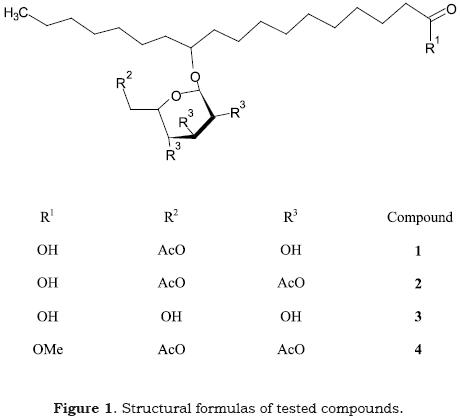
<body><![CDATA[<p align="justify"><font face="verdana" size="2">A consecuencia de los problemas encontrados en la terap&eacute;utica con antibi&oacute;ticos, existe hoy en d&iacute;a un renovado inter&eacute;s en productos naturales antimicrobianos.</font></p>     <p align="justify"><font face="verdana" size="2">En este trabajo se presentan los resultados del estudio de la actividad antibacteriana de compuestos aislados de <i>Ibicella lutea </i>(Lindl.) Van Eselt. (Martyniaceae) y algunos derivados sencillos del mismo contra cepas sensibles y resistentes de <i>Staphylococcus aureus.</i></font></p>     <p align="justify"><font face="verdana" size="2">El compuesto <b>1 </b>fue aislado e identificado seg&uacute;n las t&eacute;cnicas anteriormente descritas y la concentraci&oacute;n m&iacute;nima inhibitoria (MIC) de <b>1 </b>y sus an&aacute;logos fue determinada por una t&eacute;cnica de microdiluci&oacute;n.</font></p>     <p align="justify"><font face="verdana" size="2">El compuesto <b>1 </b>(11&#150;hydroxiestearil 11&#150;0&#150;(6&#150;0&#150;acetil&#150;&#946;&#150;D&#150;glucopiran&oacute;sido) mostr&oacute; una MIC de 0.06 mM para S. <i>aureus </i>ATCC 6538p. Tambi&eacute;n mostr&oacute; actividad antibacteriana contra diferentes cepas de MRSA mientras que todos los an&aacute;logos de <b>1 </b>tuvieron MICs mayores que el producto natural. Estos resultados sugieren que tanto la funci&oacute;n acido como la estructura glicos&iacute;dica son necesarias para la actividad.</font></p>     <p align="justify"><font face="verdana" size="2"><b>Palabras clave: </b>Martyniaceae, <i>S. aureus, </i>MRSA.</font></p>     <p align="justify"><font face="verdana" size="2">&nbsp;</font></p>     <p align="justify"><font face="verdana" size="2"><b>INTRODUCTION</b></font></p>     <p align="justify"><font face="verdana" size="2">Infectious diseases are still one of the leading causes of death in the world, in spite of the great advances in chemotherapeutics. The World Health Organization (2003) states that infectious and parasitic diseases accounted for nearly 11 million out of the total of 57 million deaths in 2003.</font></p>     <p align="justify"><font face="verdana" size="2">Although there are a great array of antibacterial and antifungal drugs in clinical use, the increase of resistant organisms sometimes makes them ineffective or allows disease recurrence (Michel and Gutmann, 1996).</font></p>     <p align="justify"><font face="verdana" size="2">Among the most problematic clinically relevant pathogens at present, methicillin&#150;resistant <i>Staphylococcus aureus </i>(MRSA) ranks as one of the most difficult bacteria to treat (Cosgrove <i>et al., </i>2003).</font></p>     ]]></body>
<body><![CDATA[<p align="justify"><font face="verdana" size="2">The use of higher plants and preparations made from them to treat infections is an age&#150;old practice in a large part of the world population, especially in developing countries, where traditional medicine is used for a variety of diseases. Interest in plants with antimicrobial properties has revived as a consequence of current problems associated with the use of antibiotics (Cherigo <i>et al., </i>2009; Po Shiu and Gibbons, 2006).</font></p>     <p align="justify"><font face="verdana" size="2"><i>Ibicella lutea </i>(Lindl.) Van Eselt. (Martyniaceae) is the sole species of the genus <i>Ibicella </i>from the small Martyniaceae family comprising just 3 genera <i>(Martynia, Proboscidea </i>and <i>Ibicella) </i>with 13 species (Van Eseltine, 1929; Bretting, 1984).</font></p>     <p align="justify"><font face="verdana" size="2">In Uruguay, where the plant grows freely, it is called "Cuerno del Diablo" (Devil's horn) and its infusion is used in popular medicine as an antimicrobial for the treatment of eyes and skin infections (Alonso Paz <i>et al., </i>1995 and references therein).</font></p>     <p align="justify"><font face="verdana" size="2">In previous work we studied the antimicrobial activity of aqueous and ethanol extracts of several Uruguayan medicinal plants. We found that <i>I. lutea </i>indeed has an important activity, deserving further study (Olano <i>et al., </i>1996), and we isolated one of the active principles, 11&#150;hydroxystearic acid 11&#150;0&#150;(6&#150;0&#150;acetyl&#150;&#946;&#150;D&#150;glucopyranoside) (Cerdeiras <i>et al., </i>2000).</font></p>     <p align="justify"><font face="verdana" size="2">In this paper we report the antibacterial activity of this compound along with some of its derivatives against methicillin&#150;sensitive and MRSA.</font></p>     <p align="justify"><font face="verdana" size="2">&nbsp;</font></p>     <p align="justify"><font face="verdana" size="2"><b>MATERIALS AND METHODS</b></font></p>     <p align="justify"><font face="verdana" size="2"><b>General analytical methods</b></font></p>     <p align="justify"><font face="verdana" size="2">Gas chromatography (GC) analysis was performed in a Shimadzu GC 14 apparatus with an SE&#150;52 column using a temperature program from 100&deg; C to 280&deg; C with a 5&deg; C min<sup>&#150;1</sup> gradient. A Brucker micrOTOF&#150;Q&#150;TOF with ESI source in positive mode was used for mass spectra (MS) and a Shimadzu QP 5050 with a SE 52 column was used for the GC&#150;MS analysis.</font></p>     <p align="justify"><font face="verdana" size="2"><sup>1</sup>H NMR spectra were obtained at 400MHz and <sup>13</sup>C NMR spectra at 100MHz on a Brucker Advance DPX 400 spectrometer, using CD<sub>3</sub>OD or CDCl<sub>3</sub> as solvents, and TMS (&#948;H 0.00) and acetone (&#948;C 31.00) as references. Two dimensional (different H, H&#150;COSY, H, C&#150;COSY, HMBC, HMQC and NOESY) experiments were carried out with programs available for the Brucker software.</font></p>     ]]></body>
<body><![CDATA[<p align="justify"><font face="verdana" size="2"><b>Plant material</b></font></p>     <p align="justify"><font face="verdana" size="2">Plant material was collected in Pajas Blancas, 6 Km outside Montevideo at . 34&deg; 51" 58.33"S, 56&deg; 2005.38" W. The material was identified by Lic. E. Alonso Paz, Botany Department, Facultad de Qu&iacute;mica, UDELAR and voucher specimens (Leg. Alonso Paz et Bassagoda N&deg; 2546) were kept in the MVFQ Herbarium, Montevideo.</font></p>     <p align="justify"><font face="verdana" size="2"><b>Compounds</b></font></p>     <p align="justify"><font face="verdana" size="2">Compound <b>1 </b>was isolated and identified as previously described (Cerdeiras <i>et al., </i>2000). Compound <b>2 </b>and <b>3 </b>were obtained by acetylation of <b>1 </b>with Ac<sub>2</sub>O/Pyridine and mild alkaline hydrolysis respectively. Compound <b>4 </b>was synthesized from &#945;&#150;bromo&#150;tetra&#150;acetyl&#150;glucose and methyl 11 &#150;hydroxyoctadecanoate by the classical Koenigs&#150;Knorr method using Ag<sub>2</sub>O as catalyst (Talley, 1963). The resulting compounds were identified by different GC&#150;MS, HRMS and NMR techniques. Compounds <b>5 </b>(12&#150;hydroxy&#150;9&#150;octadecenoic acid) and <b>6 </b>(methyl 11&#150;hydroxyoctadecanoate) were purchased from Sigma.</font></p>     <p align="justify"><font face="verdana" size="2"><b>Microbiological analysis</b></font></p>     <p align="justify"><font face="verdana" size="2">The strains used were <i>Staphylococcus aureus </i>ATCC 6538p and the clinical mul&#150;tiresistant isolates <i>S. aureus </i>CCMC (Colecci&oacute;n C&aacute;tedra Microbiolog&iacute;a Cl&iacute;nica) 15027, 16369 and 19016</font></p>     <p align="justify"><font face="verdana" size="2">Minimal inhibitory concentration (MIC) was determined for the extracts that inhibited growth by the microdilution technique according to Elloff (1998) using 100 &#956;l of Mueller&#150;Hinton broth (Difco), 100 &#124;il of twofold dilutions of the extracts (10 mgmL<sup>&#150;1</sup>) and 10 &#956;l of a suspension (10<sup>8</sup>/mL) of the microorganisms. The trays were incubated (24 h, 37C) and developed with <i>p</i>&#150;iodo&#150;nitrotetrazolium violet (INT) (Sigma) 0.1% solution. Bacterial growth was indicated by development of a red formazan color. Gentamicin was used as control.</font></p>     <p align="justify"><font face="verdana" size="2">&nbsp;</font></p>     <p align="justify"><font face="verdana" size="2"><b>RESULTS AND DISCUSSION</b></font></p>     <p align="justify"><font face="verdana" size="2">Compound <b>1 </b>had previously demonstrated very promising antimicrobial activity (Cerdeiras <i>et al., </i>2000) against reference strains, in particular against susceptible <i>S. aureus </i>ATCC 6538p.</font></p>     ]]></body>
<body><![CDATA[<p align="justify"><font face="verdana" size="2">To see if the antimicrobial activity could be enhanced by some simple structural modifications, we prepared derivatives <b>2, 3 </b>and <b>4 </b>(<a href="#f1">Fig. 1</a>). We also tested the free acid <b>5 </b>and the methyl ester <b>6.</b></font></p>     <p align="center"><font face="verdana" size="2"><a name="f1"></a></font></p>     <p align="center"><font face="verdana" size="2"><img src="/img/revistas/rlq/v38n2/a3f1.jpg"></font></p>     <p align="justify"><font face="verdana" size="2">The results of the antibacterial activity of the compounds against <i>S. aureus </i>ATCC 6538p are depicted in <a href="/img/revistas/rlq/v38n2/a3t1.jpg" target="_blank">Table 1</a>.</font></p>     <p align="justify"><font face="verdana" size="2">The analysis of these results suggests that both the free acid function and the glycosidic moiety are indispensable for the activity. Compounds <b>4 </b>and <b>6 </b>which are methyl esters lack any antibacterial activity. Also the free acid <b>5 </b>has a MIC that is more than 15&#150;fold greater (on a mol/L basis) than compound <b>1 </b>.</font></p>     <p align="justify"><font face="verdana" size="2">When MICs for compounds <b>1 </b>, <b>2 </b>and <b>3 </b>are compared it is also clearly seen that the natural monoacetyl compound is 10 times more active than the tetra&#150;acetyl and desacetyl derivatives.</font></p>     <p align="justify"><font face="verdana" size="2">More studies are needed to determine if this is due to solubility properties of the molecules or to a specific interaction with the bacterial target.</font></p>     <p align="justify"><font face="verdana" size="2">Compound <b>1 </b>was also tested against <i>S. aureus </i>clinical isolates that showed different antibiotic resistance profiles, but were all MRSA. The phenotypic susceptibility profile of these strains is shown in <a href="/img/revistas/rlq/v38n2/a3t2.jpg" target="_blank">Table 2</a>. Strain 16369 is a hospital acquired isolate and strains 15027 and 19016 are community acquired infection isolates. The MICs obtained with these strains were 250, 500 and 62.5 &#956;g/mL respectively.</font></p>     <p align="justify"><font face="verdana" size="2">&nbsp;</font></p>     <p align="justify"><font face="verdana" size="2"><b>CONCLUSIONS</b></font></p>     ]]></body>
<body><![CDATA[<p align="justify"><font face="verdana" size="2">The present work clearly shows that higher plants are still a primary source in the search of lead molecules for novel antimicrobial compounds.</font></p>     <p align="justify"><font face="verdana" size="2">The original compound <b>1 </b>was the one that presented the highest activity against the <i>S. aureus </i>ATCC 6538p strain. But, more studies are needed to determine if this action is due to solubility properties of the molecule or to a specific interaction with the bacterial target.</font></p>     <p align="justify"><font face="verdana" size="2">Even though the MIC results obtained with the MRSA strains were relatively high, compound <b>1 </b>is still of interest as a lead compound given that it is a simple and easily synthesized molecule.</font></p>     <p align="justify"><font face="verdana" size="2">&nbsp;</font></p>     <p align="justify"><font face="verdana" size="2"><b>REFERENCES</b></font></p>     <!-- ref --><p align="justify"><font face="verdana" size="2">Alonso Paz, E., Cerdeiras, M.P., Fern&aacute;ndez, J., Ferreira, F., Moyna,P., Soubes, M., V&aacute;zquez, A., Vero, S., Zunino, L: (1995) Screening of Uruguayan medicinal plants for antimicrobial activity. <i>Journal of Ethnopharmacology. </i><b>45: </b>67&#150;70.    &nbsp;&nbsp;&nbsp;&nbsp;&nbsp;&nbsp;&nbsp;&nbsp;[&#160;<a href="javascript:void(0);" onclick="javascript: window.open('/scielo.php?script=sci_nlinks&ref=7411138&pid=S0370-5943201000020000300001&lng=','','width=640,height=500,resizable=yes,scrollbars=1,menubar=yes,');">Links</a>&#160;]<!-- end-ref --></font></p>     <!-- ref --><p align="justify"><font face="verdana" size="2">Bretting, P.K. (1984) Folk names and uses for martyniaceous plants. <i>Economic Botany. </i><b>38: </b>452&#150;463.    &nbsp;&nbsp;&nbsp;&nbsp;&nbsp;&nbsp;&nbsp;&nbsp;[&#160;<a href="javascript:void(0);" onclick="javascript: window.open('/scielo.php?script=sci_nlinks&ref=7411140&pid=S0370-5943201000020000300002&lng=','','width=640,height=500,resizable=yes,scrollbars=1,menubar=yes,');">Links</a>&#160;]<!-- end-ref --></font></p>     <!-- ref --><p align="justify"><font face="verdana" size="2">Cerdeiras, M.P., Fern&aacute;ndez, J., Soubes, M., Vero, S., Ferreira, F., Moyna, P., Olano, I., V&aacute;zquez, A. (2000) A new antibacterial compound from <i>Ibicella lutea. Journal of Ethnopharmacology. </i><b>73: </b>521&#150;525.    &nbsp;&nbsp;&nbsp;&nbsp;&nbsp;&nbsp;&nbsp;&nbsp;[&#160;<a href="javascript:void(0);" onclick="javascript: window.open('/scielo.php?script=sci_nlinks&ref=7411142&pid=S0370-5943201000020000300003&lng=','','width=640,height=500,resizable=yes,scrollbars=1,menubar=yes,');">Links</a>&#160;]<!-- end-ref --></font></p>     <!-- ref --><p align="justify"><font face="verdana" size="2">Cherigo, L., Pereda&#150;Miranda,R., Gibbons, S. (2009) Bacterial resistance modifying tetrasaccharide agents from <i>Ipomoea murucoides. Phytochemistry. </i><b>70: </b>222&#150;227.    &nbsp;&nbsp;&nbsp;&nbsp;&nbsp;&nbsp;&nbsp;&nbsp;[&#160;<a href="javascript:void(0);" onclick="javascript: window.open('/scielo.php?script=sci_nlinks&ref=7411144&pid=S0370-5943201000020000300004&lng=','','width=640,height=500,resizable=yes,scrollbars=1,menubar=yes,');">Links</a>&#160;]<!-- end-ref --></font></p>     <!-- ref --><p align="justify"><font face="verdana" size="2">Cosgrove, S.E., Sakoulas, G., Perencevich, M.J., Schwaber, A.W., Karchmer, L., Carmeli, Y. (2003) Comparison of mortality associated with methicillin&#150;resistant and methicillin&#150;susceptible <i>Staphylococcus aureus </i>bacteremia: A meta&#150;analysis. <i>Clinical Infectious Diseases. </i><b>36: </b>53&#150;59.    &nbsp;&nbsp;&nbsp;&nbsp;&nbsp;&nbsp;&nbsp;&nbsp;[&#160;<a href="javascript:void(0);" onclick="javascript: window.open('/scielo.php?script=sci_nlinks&ref=7411146&pid=S0370-5943201000020000300005&lng=','','width=640,height=500,resizable=yes,scrollbars=1,menubar=yes,');">Links</a>&#160;]<!-- end-ref --></font></p>     <!-- ref --><p align="justify"><font face="verdana" size="2">Michel, M., Gutmann, L. (1996) Methicillin&#150;resistant <i>Staphylococcus aureus </i>and vancomycin&#150;resistant enterococci: Therapeutic realities and possibilities. <i>Lancet. </i><b>349: </b>1901&#150;1906.    &nbsp;&nbsp;&nbsp;&nbsp;&nbsp;&nbsp;&nbsp;&nbsp;[&#160;<a href="javascript:void(0);" onclick="javascript: window.open('/scielo.php?script=sci_nlinks&ref=7411148&pid=S0370-5943201000020000300006&lng=','','width=640,height=500,resizable=yes,scrollbars=1,menubar=yes,');">Links</a>&#160;]<!-- end-ref --></font></p>     <!-- ref --><p align="justify"><font face="verdana" size="2">Olano, I., Alonso Paz, E., Cerdeiras, M.P., Fern&aacute;ndez, J., Ferreira, F., Moyna, P., Soubes, M., V&aacute;zquez, A., Vero, S., Bassagoda, M.J. (1996) Screening of Uruguayan medicinal plants for antimicrobial activity. Part II. <i>Journal of Ethnopharmacology. </i><b>53: </b>111&#150;115.    &nbsp;&nbsp;&nbsp;&nbsp;&nbsp;&nbsp;&nbsp;&nbsp;[&#160;<a href="javascript:void(0);" onclick="javascript: window.open('/scielo.php?script=sci_nlinks&ref=7411150&pid=S0370-5943201000020000300007&lng=','','width=640,height=500,resizable=yes,scrollbars=1,menubar=yes,');">Links</a>&#160;]<!-- end-ref --></font></p>     <!-- ref --><p align="justify"><font face="verdana" size="2">Po Shiu, W.K., Gibbons, S. (2006) Anti&#150;staphylococcal acylphloroglucinols from <i>Hypericum beanii. Phytochemistry. </i><b>67: </b>2568&#150;2572.    &nbsp;&nbsp;&nbsp;&nbsp;&nbsp;&nbsp;&nbsp;&nbsp;[&#160;<a href="javascript:void(0);" onclick="javascript: window.open('/scielo.php?script=sci_nlinks&ref=7411152&pid=S0370-5943201000020000300008&lng=','','width=640,height=500,resizable=yes,scrollbars=1,menubar=yes,');">Links</a>&#160;]<!-- end-ref --></font></p>     <!-- ref --><p align="justify"><font face="verdana" size="2">Van Eseltine, G.P. (1929) <i>A preliminary study of the unicorn plants (Martyniaceae). </i>Technical Bulletin 149, NYS Agricultural Exp. Station Geneva, Switzerland pp. 3&#150;41.    &nbsp;&nbsp;&nbsp;&nbsp;&nbsp;&nbsp;&nbsp;&nbsp;[&#160;<a href="javascript:void(0);" onclick="javascript: window.open('/scielo.php?script=sci_nlinks&ref=7411154&pid=S0370-5943201000020000300009&lng=','','width=640,height=500,resizable=yes,scrollbars=1,menubar=yes,');">Links</a>&#160;]<!-- end-ref --> </font></p>     <!-- ref --><p align="justify"><font face="verdana" size="2">WHO. (2003) The world health report 2003&#150;Shaping the future. World Health Organization, Geneva, Switzerland pp. 3&#150;22.    &nbsp;&nbsp;&nbsp;&nbsp;&nbsp;&nbsp;&nbsp;&nbsp;[&#160;<a href="javascript:void(0);" onclick="javascript: window.open('/scielo.php?script=sci_nlinks&ref=7411156&pid=S0370-5943201000020000300010&lng=','','width=640,height=500,resizable=yes,scrollbars=1,menubar=yes,');">Links</a>&#160;]<!-- end-ref --></font></p>      ]]></body><back>
<ref-list>
<ref id="B1">
<nlm-citation citation-type="journal">
<person-group person-group-type="author">
<name>
<surname><![CDATA[Alonso Paz]]></surname>
<given-names><![CDATA[E.]]></given-names>
</name>
<name>
<surname><![CDATA[Cerdeiras]]></surname>
<given-names><![CDATA[M.P.]]></given-names>
</name>
<name>
<surname><![CDATA[Fernández]]></surname>
<given-names><![CDATA[J.]]></given-names>
</name>
<name>
<surname><![CDATA[Ferreira]]></surname>
<given-names><![CDATA[F.]]></given-names>
</name>
<name>
<surname><![CDATA[Moyna]]></surname>
<given-names><![CDATA[P.]]></given-names>
</name>
<name>
<surname><![CDATA[Soubes]]></surname>
<given-names><![CDATA[M.]]></given-names>
</name>
<name>
<surname><![CDATA[Vázquez]]></surname>
<given-names><![CDATA[A.]]></given-names>
</name>
<name>
<surname><![CDATA[Vero]]></surname>
<given-names><![CDATA[S.]]></given-names>
</name>
<name>
<surname><![CDATA[Zunino]]></surname>
<given-names><![CDATA[L]]></given-names>
</name>
</person-group>
<article-title xml:lang="en"><![CDATA[Screening of Uruguayan medicinal plants for antimicrobial activity]]></article-title>
<source><![CDATA[Journal of Ethnopharmacology]]></source>
<year>1995</year>
<volume>45</volume>
<page-range>67-70</page-range></nlm-citation>
</ref>
<ref id="B2">
<nlm-citation citation-type="journal">
<person-group person-group-type="author">
<name>
<surname><![CDATA[Bretting]]></surname>
<given-names><![CDATA[P.K.]]></given-names>
</name>
</person-group>
<article-title xml:lang="en"><![CDATA[Folk names and uses for martyniaceous plants]]></article-title>
<source><![CDATA[Economic Botany]]></source>
<year>1984</year>
<volume>38</volume>
<page-range>452-463</page-range></nlm-citation>
</ref>
<ref id="B3">
<nlm-citation citation-type="journal">
<person-group person-group-type="author">
<name>
<surname><![CDATA[Cerdeiras]]></surname>
<given-names><![CDATA[M.P.]]></given-names>
</name>
<name>
<surname><![CDATA[Fernández]]></surname>
<given-names><![CDATA[J.]]></given-names>
</name>
<name>
<surname><![CDATA[Soubes]]></surname>
<given-names><![CDATA[M.]]></given-names>
</name>
<name>
<surname><![CDATA[Vero]]></surname>
<given-names><![CDATA[S.]]></given-names>
</name>
<name>
<surname><![CDATA[Ferreira]]></surname>
<given-names><![CDATA[F.]]></given-names>
</name>
<name>
<surname><![CDATA[Moyna]]></surname>
<given-names><![CDATA[P.]]></given-names>
</name>
<name>
<surname><![CDATA[Olano]]></surname>
<given-names><![CDATA[I.]]></given-names>
</name>
<name>
<surname><![CDATA[Vázquez]]></surname>
<given-names><![CDATA[A.]]></given-names>
</name>
</person-group>
<article-title xml:lang="en"><![CDATA[A new antibacterial compound from Ibicella lutea]]></article-title>
<source><![CDATA[Journal of Ethnopharmacology]]></source>
<year>2000</year>
<volume>73</volume>
<page-range>521-525</page-range></nlm-citation>
</ref>
<ref id="B4">
<nlm-citation citation-type="journal">
<person-group person-group-type="author">
<name>
<surname><![CDATA[Cherigo]]></surname>
<given-names><![CDATA[L.]]></given-names>
</name>
<name>
<surname><![CDATA[Pereda-Miranda]]></surname>
<given-names><![CDATA[R.]]></given-names>
</name>
<name>
<surname><![CDATA[Gibbons]]></surname>
<given-names><![CDATA[S.]]></given-names>
</name>
</person-group>
<article-title xml:lang="en"><![CDATA[Bacterial resistance modifying tetrasaccharide agents from Ipomoea murucoides]]></article-title>
<source><![CDATA[Phytochemistry]]></source>
<year>2009</year>
<volume>70</volume>
<page-range>222-227</page-range></nlm-citation>
</ref>
<ref id="B5">
<nlm-citation citation-type="journal">
<person-group person-group-type="author">
<name>
<surname><![CDATA[Cosgrove]]></surname>
<given-names><![CDATA[S.E.]]></given-names>
</name>
<name>
<surname><![CDATA[Sakoulas]]></surname>
<given-names><![CDATA[G.]]></given-names>
</name>
<name>
<surname><![CDATA[Perencevich]]></surname>
<given-names><![CDATA[M.J.]]></given-names>
</name>
<name>
<surname><![CDATA[Schwaber]]></surname>
<given-names><![CDATA[A.W.]]></given-names>
</name>
<name>
<surname><![CDATA[Karchmer]]></surname>
<given-names><![CDATA[L.]]></given-names>
</name>
<name>
<surname><![CDATA[Carmeli]]></surname>
<given-names><![CDATA[Y.]]></given-names>
</name>
</person-group>
<article-title xml:lang="en"><![CDATA[Comparison of mortality associated with methicillin-resistant and methicillin-susceptible Staphylococcus aureus bacteremia: A meta-analysis]]></article-title>
<source><![CDATA[Clinical Infectious Diseases]]></source>
<year>2003</year>
<volume>36</volume>
<page-range>53-59</page-range></nlm-citation>
</ref>
<ref id="B6">
<nlm-citation citation-type="journal">
<person-group person-group-type="author">
<name>
<surname><![CDATA[Michel]]></surname>
<given-names><![CDATA[M.]]></given-names>
</name>
<name>
<surname><![CDATA[Gutmann]]></surname>
<given-names><![CDATA[L.]]></given-names>
</name>
</person-group>
<article-title xml:lang="en"><![CDATA[Methicillin-resistant Staphylococcus aureus and vancomycin-resistant enterococci: Therapeutic realities and possibilities]]></article-title>
<source><![CDATA[Lancet]]></source>
<year>1996</year>
<volume>349</volume>
<page-range>1901-1906</page-range></nlm-citation>
</ref>
<ref id="B7">
<nlm-citation citation-type="journal">
<person-group person-group-type="author">
<name>
<surname><![CDATA[Olano]]></surname>
<given-names><![CDATA[I.]]></given-names>
</name>
<name>
<surname><![CDATA[Alonso Paz]]></surname>
<given-names><![CDATA[E.]]></given-names>
</name>
<name>
<surname><![CDATA[Cerdeiras]]></surname>
<given-names><![CDATA[M.P.]]></given-names>
</name>
<name>
<surname><![CDATA[Fernández]]></surname>
<given-names><![CDATA[J.]]></given-names>
</name>
<name>
<surname><![CDATA[Ferreira]]></surname>
<given-names><![CDATA[F.]]></given-names>
</name>
<name>
<surname><![CDATA[Moyna]]></surname>
<given-names><![CDATA[P.]]></given-names>
</name>
<name>
<surname><![CDATA[Soubes]]></surname>
<given-names><![CDATA[M.]]></given-names>
</name>
<name>
<surname><![CDATA[Vázquez]]></surname>
<given-names><![CDATA[A.]]></given-names>
</name>
<name>
<surname><![CDATA[Vero]]></surname>
<given-names><![CDATA[S.]]></given-names>
</name>
<name>
<surname><![CDATA[Bassagoda]]></surname>
<given-names><![CDATA[M.J.]]></given-names>
</name>
</person-group>
<article-title xml:lang="en"><![CDATA[Screening of Uruguayan medicinal plants for antimicrobial activity. Part II]]></article-title>
<source><![CDATA[Journal of Ethnopharmacology]]></source>
<year>1996</year>
<volume>53</volume>
<page-range>111-115</page-range></nlm-citation>
</ref>
<ref id="B8">
<nlm-citation citation-type="journal">
<person-group person-group-type="author">
<name>
<surname><![CDATA[Po Shiu]]></surname>
<given-names><![CDATA[W.K.]]></given-names>
</name>
<name>
<surname><![CDATA[Gibbons]]></surname>
<given-names><![CDATA[S.]]></given-names>
</name>
</person-group>
<article-title xml:lang="en"><![CDATA[Anti-staphylococcal acylphloroglucinols from Hypericum beanii]]></article-title>
<source><![CDATA[Phytochemistry]]></source>
<year>2006</year>
<volume>67</volume>
<page-range>2568-2572</page-range></nlm-citation>
</ref>
<ref id="B9">
<nlm-citation citation-type="book">
<person-group person-group-type="author">
<name>
<surname><![CDATA[Van Eseltine]]></surname>
<given-names><![CDATA[G.P.]]></given-names>
</name>
</person-group>
<article-title xml:lang="en"><![CDATA[A preliminary study of the unicorn plants (Martyniaceae)]]></article-title>
<source><![CDATA[]]></source>
<year>1929</year>
<volume>149</volume>
<page-range>3-41</page-range><publisher-loc><![CDATA[Switzerland ]]></publisher-loc>
<publisher-name><![CDATA[NYS Agricultural Exp. Station Geneva]]></publisher-name>
</nlm-citation>
</ref>
<ref id="B10">
<nlm-citation citation-type="book">
<collab>WHO</collab>
<source><![CDATA[The world health report 2003-Shaping the future]]></source>
<year>2003</year>
<page-range>3-22</page-range><publisher-loc><![CDATA[Geneva ]]></publisher-loc>
<publisher-name><![CDATA[World Health Organization]]></publisher-name>
</nlm-citation>
</ref>
</ref-list>
</back>
</article>
