<?xml version="1.0" encoding="ISO-8859-1"?><article xmlns:mml="http://www.w3.org/1998/Math/MathML" xmlns:xlink="http://www.w3.org/1999/xlink" xmlns:xsi="http://www.w3.org/2001/XMLSchema-instance">
<front>
<journal-meta>
<journal-id>0301-7036</journal-id>
<journal-title><![CDATA[Problemas del desarrollo]]></journal-title>
<abbrev-journal-title><![CDATA[Prob. Des]]></abbrev-journal-title>
<issn>0301-7036</issn>
<publisher>
<publisher-name><![CDATA[Universidad Nacional Autónoma de México, Instituto de Investigaciones Económicas]]></publisher-name>
</publisher>
</journal-meta>
<article-meta>
<article-id>S0301-70362009000100007</article-id>
<title-group>
<article-title xml:lang="en"><![CDATA[Learning from the tigers-comparing innovation institutions in rapidly developing economies with Latin America]]></article-title>
</title-group>
<contrib-group>
<contrib contrib-type="author">
<name>
<surname><![CDATA[Hira]]></surname>
<given-names><![CDATA[Anil]]></given-names>
</name>
<xref ref-type="aff" rid="A01"/>
</contrib>
</contrib-group>
<aff id="A01">
<institution><![CDATA[,Simon Fraser University  ]]></institution>
<addr-line><![CDATA[Burnaby British Columbia]]></addr-line>
<country>Canadá</country>
</aff>
<pub-date pub-type="pub">
<day>00</day>
<month>03</month>
<year>2009</year>
</pub-date>
<pub-date pub-type="epub">
<day>00</day>
<month>03</month>
<year>2009</year>
</pub-date>
<volume>40</volume>
<numero>156</numero>
<fpage>125</fpage>
<lpage>149</lpage>
<copyright-statement/>
<copyright-year/>
<self-uri xlink:href="http://www.scielo.org.mx/scielo.php?script=sci_arttext&amp;pid=S0301-70362009000100007&amp;lng=en&amp;nrm=iso"></self-uri><self-uri xlink:href="http://www.scielo.org.mx/scielo.php?script=sci_abstract&amp;pid=S0301-70362009000100007&amp;lng=en&amp;nrm=iso"></self-uri><self-uri xlink:href="http://www.scielo.org.mx/scielo.php?script=sci_pdf&amp;pid=S0301-70362009000100007&amp;lng=en&amp;nrm=iso"></self-uri><abstract abstract-type="short" xml:lang="en"><p><![CDATA[This article compares innovation policies and institutions in Latin America (LA) with those of the tiger economies of East Asia and Europe. We find that there are clear differences in the resources, prioritization, and organization of science and technology policy between LA and the tigers, which may help to explain the disappointing economic performance of the region in recent decades. The article suggests that a systematic reorganization of innovation policy is needed in LA. The commonalities of the tigers suggest such a reevaluation should not only consider levels of resources, but also new institutional frameworks for prioritizing, coordinating, and commercializing new technologies for greater benefits throughout the economy and society.]]></p></abstract>
<abstract abstract-type="short" xml:lang="es"><p><![CDATA[Este artículo compara las políticas e instituciones de innovación en Latinoamérica con las economías e instituciones de los tigres de Asia Oriental y de Europa. Encontramos que hay nítidas diferencias en las políticas sobre recursos, priorización y organización de la ciencia y la tecnología entre Latinoamérica y las de los tigres, que tal vez ayuden a explicar el decepcionante desempeño económico de la región en las décadas recientes. El artículo sugiere que es necesaria una sistemática reorganización de la política de innovación en Latinoamérica. Las concordancias de los tigres sugieren que una similar reevaluación no solamente debe considerar niveles de recursos, sino también nuevos marcos institucionales para priorizar, coordinar y comercializar nuevas tecnologías generadoras de mayores beneficios para toda la economía y la sociedad.]]></p></abstract>
<abstract abstract-type="short" xml:lang="fr"><p><![CDATA[Cet article compare les politiques et institutions d'innovation en Amerique Latine avec les économies et institutions des tigres d'Asie orientale et d'Europe. Nous avons constaté qu'il existe de nettes différences entre les politiques menées par les tigres et celles pratiquées en Amérique latine en ce qui concerne les ressources ainsi que l'importance prépondérante et l'organisation de la science et de la technologie, différences qui peuvent peut-être nous aider à expliquer les déceptionnantes performances économiques de la région au cours des dernières décennies. L'article suggère qu'en Amérique latine, une systématique réorganisation de la politique d'innovation est nécessaire. Les concordances des tigres incitent à penser qu'une telle réévaluation ne doit pas seulement considérer des niveaux de ressources, mais aussi de nouveaux cadres institutionnels pour privilégier, coordonner et commercialiser de nouvelles technologies génératrices de majeurs profits pour toute l'économie et la société.]]></p></abstract>
<abstract abstract-type="short" xml:lang="pt"><p><![CDATA[Este artigo compara as políticas e instituições de inovação na América Latina com as economias e instituições dos Tigres da Ásia Oriental e da Europa. Encontramos que existem claras diferenças na política sobre recursos, priorização e organização da ciência e tecnologia entre a América Latina e os tigres, que talvez ajudem a explicar o decepcionante desempenho econômico da região nas décadas recentes. O artigo sugere que é necessária uma reorganização sistemática da política de inovação na América Latina. As concordâncias dos tigres sugerem que uma reavaliação semelhante não só deve considerar níveis de recursos, como também novos marcos institucionais para priorizar, coordenar e comercializar novas tecnologias geradoras de maiores benefícios para toda a economia e a sociedade.]]></p></abstract>
<kwd-group>
<kwd lng="en"><![CDATA[Science and technology]]></kwd>
<kwd lng="en"><![CDATA[research and development]]></kwd>
<kwd lng="en"><![CDATA[institutions]]></kwd>
<kwd lng="en"><![CDATA[Latin America]]></kwd>
<kwd lng="en"><![CDATA[economic growth]]></kwd>
<kwd lng="es"><![CDATA[ciencia y tecnología]]></kwd>
<kwd lng="es"><![CDATA[investigación y desarrollo]]></kwd>
<kwd lng="es"><![CDATA[instituciones]]></kwd>
<kwd lng="es"><![CDATA[Latinoamérica]]></kwd>
<kwd lng="es"><![CDATA[crecimiento económico]]></kwd>
<kwd lng="fr"><![CDATA[science et technologie]]></kwd>
<kwd lng="fr"><![CDATA[recherche et développement]]></kwd>
<kwd lng="fr"><![CDATA[institutions]]></kwd>
<kwd lng="fr"><![CDATA[Amérique latine]]></kwd>
<kwd lng="fr"><![CDATA[croissance économique]]></kwd>
<kwd lng="pt"><![CDATA[ciência e tecnologia]]></kwd>
<kwd lng="pt"><![CDATA[investigação e desenvolvimento]]></kwd>
<kwd lng="pt"><![CDATA[América Latina]]></kwd>
<kwd lng="pt"><![CDATA[crescimento ecônomico]]></kwd>
</kwd-group>
</article-meta>
</front><body><![CDATA[  	    <p align="justify"><font face="verdana" size="4">Art&iacute;culos</font></p>     <p align="justify">&nbsp;</p> 	    <p align="center"><font face="verdana" size="4"><b>Learning from the tigers&#45;comparing innovation institutions in rapidly developing economies with Latin America</b></font></p>  	    <p align="center">&nbsp;</p> 	    <p align="center"><font face="verdana" size="2"><b>Anil Hira *</b></font></p>  	    <p align="justify">&nbsp;</p>     <p align="justify"><font face="verdana" size="2"><i>* Assoc. Professor, Simon Fraser University</i>. Correo electr&oacute;nico: <a href="mailto:ahira@sfu.ca.">ahira@sfu.ca.</a></font></p>     <p align="justify">&nbsp;</p>     <p align="justify"><font face="verdana" size="2">Fecha de reception: 27 agosto de 2008.     ]]></body>
<body><![CDATA[<br>   Fecha de aceptacion: 24 noviembre de 2008.</font></p>  	    <p align="justify">&nbsp;</p> 	    <p align="justify"><font face="verdana" size="2"><b>Abstract</b></font></p>  	    <p align="justify"><font face="verdana" size="2">This article compares innovation policies and institutions in Latin America (LA) with those of the tiger economies of East Asia and Europe. We find that there are clear differences in the resources, prioritization, and organization of science and technology policy between LA and the tigers, which may help to explain the disappointing economic performance of the region in recent decades. The article suggests that a systematic reorganization of innovation policy is needed in LA. The commonalities of the tigers suggest such a reevaluation should not only consider levels of resources, but also new institutional frameworks for prioritizing, coordinating, and commercializing new technologies for greater benefits throughout the economy and society. </font></p> 	    <p align="justify"><font face="verdana" size="2"><b>Keywords:</b> Science and technology; research and development; institutions; Latin America; economic growth.</font></p>  	    <p align="justify">&nbsp;</p>  	    <p align="justify"><font face="verdana" size="2"><b>Resumen</b></font></p>  	    <p align="justify"><font face="verdana" size="2">Este art&iacute;culo compara las pol&iacute;ticas e instituciones de innovaci&oacute;n en Latinoam&eacute;rica con las econom&iacute;as e instituciones de los tigres de Asia Oriental y de Europa. Encontramos que hay n&iacute;tidas diferencias en las pol&iacute;ticas sobre recursos, priorizaci&oacute;n y organizaci&oacute;n de la ciencia y la tecnolog&iacute;a entre Latinoam&eacute;rica y las de los tigres, que tal vez ayuden a explicar el decepcionante desempe&ntilde;o econ&oacute;mico de la regi&oacute;n en las d&eacute;cadas recientes. El art&iacute;culo sugiere que es necesaria una sistem&aacute;tica reorganizaci&oacute;n de la pol&iacute;tica de innovaci&oacute;n en Latinoam&eacute;rica. Las concordancias de los tigres sugieren que una similar reevaluaci&oacute;n no solamente debe considerar niveles de recursos, sino tambi&eacute;n nuevos marcos institucionales para priorizar, coordinar y comercializar nuevas tecnolog&iacute;as generadoras de mayores beneficios para toda la econom&iacute;a y la sociedad. </font></p>     <p align="justify"><font face="verdana" size="2"><b>Palabras clave:</b> ciencia y tecnolog&iacute;a; investigaci&oacute;n y desarrollo; instituciones; Latinoam&eacute;rica; crecimiento econ&oacute;mico.</font></p>  	    <p align="justify">&nbsp;</p>     ]]></body>
<body><![CDATA[<p align="justify"><font face="verdana" size="2"><b>Resume</b></font></p>  	    <p align="justify"><font face="verdana" size="2">Cet article compare les politiques et institutions d'innovation en Amerique Latine avec les &eacute;conomies et institutions des tigres d'Asie orientale et d'Europe. Nous avons constat&eacute; qu'il existe de nettes diff&eacute;rences entre les politiques men&eacute;es par les tigres et celles pratiqu&eacute;es en Am&eacute;rique latine en ce qui concerne les ressources ainsi que l'importance pr&eacute;pond&eacute;rante et l'organisation de la science et de la technologie, diff&eacute;rences qui peuvent peut&#45;&ecirc;tre nous aider &agrave; expliquer les d&eacute;ceptionnantes performances &eacute;conomiques de la r&eacute;gion au cours des derni&egrave;res d&eacute;cennies. L'article sugg&egrave;re qu'en Am&eacute;rique latine, une syst&eacute;matique r&eacute;organisation de la politique d'innovation est n&eacute;cessaire. Les concordances des tigres incitent &agrave; penser qu'une telle r&eacute;&eacute;valuation ne doit pas seulement consid&eacute;rer des niveaux de ressources, mais aussi de nouveaux cadres institutionnels pour privil&eacute;gier, coordonner et commercialiser de nouvelles technologies g&eacute;n&eacute;ratrices de majeurs profits pour toute l'&eacute;conomie et la soci&eacute;t&eacute;. </font></p>     <p align="justify"><font face="verdana" size="2"><b>Mots cl&eacute;s:</b> science et technologie; recherche et d&eacute;veloppement; institutions; Am&eacute;rique latine; croissance &eacute;conomique.</font></p>      <p align="justify">&nbsp;</p> 	    <p align="justify"><font face="verdana" size="2"><b>Resumo</b></font></p>  	    <p align="justify"><font face="verdana" size="2">Este artigo compara as pol&iacute;ticas e institui&#231;</font><font face="verdana" size="2">&#245;</font><font face="verdana" size="2">es de inova&#231;</font><font face="verdana" size="2">&#227;</font><font face="verdana" size="2">o na Am&eacute;rica Latina com as economias e institui&#231;</font><font face="verdana" size="2">&#245;</font><font face="verdana" size="2">es dos Tigres da &Aacute;sia Oriental e da Europa. Encontramos que existem claras diferen&#231;as na pol&iacute;tica sobre recursos, prioriza&#231;</font><font face="verdana" size="2">&#227;</font><font face="verdana" size="2">o e organiza&#231;</font><font face="verdana" size="2">&#227;</font><font face="verdana" size="2">o da ci&ecirc;ncia e tecnologia entre a Am&eacute;rica Latina e os tigres, que talvez ajudem a explicar o decepcionante desempenho econ&ocirc;mico da regi&#227;o nas d&eacute;cadas recentes. O artigo sugere que &eacute; necess&aacute;ria uma reorganiza&#231;</font><font face="verdana" size="2">&#227;</font><font face="verdana" size="2">o sistem&aacute;tica da pol&iacute;tica de inova&#231;</font><font face="verdana" size="2">&#227;</font><font face="verdana" size="2">o na Am&eacute;rica Latina. As concord&acirc;ncias dos tigres sugerem que uma reavalia&#231;</font><font face="verdana" size="2">&#227;</font><font face="verdana" size="2">o semelhante n&#227;o s&oacute; deve considerar n&iacute;veis de recursos, como tamb&eacute;m novos marcos institucionais para priorizar, coordenar e comercializar novas tecnologias geradoras de maiores benef&iacute;cios para toda a economia e a sociedade.</font></p>      <p align="justify"><font face="verdana" size="2"><b>Palavras chave:</b> ci&ecirc;ncia e tecnologia; investiga&#231;</font><font face="verdana" size="2">&#227;</font><font face="verdana" size="2">o e desenvolvimento; Am&eacute;rica Latina; crescimento ec&ocirc;</font><font face="verdana" size="2">nomico.</font></p>      <p align="justify">&nbsp;</p>  	    <p align="justify"><font face="verdana" size="2"><b>Introduction</b></font></p>  	    <p align="justify"><font face="verdana" size="2">While the current commodity boom has led to improved growth in La has been problematic in terms of both unstable growth and a lack of improvement in income inequality. Rather than questioning the underlying premises of market liberalization (Kuczynski, 2003), neoliberals have been espousing a 2<sup>nd</sup> generation of reforms, primarily around public institutions, such as the justice system, to resolve these problems of market regulation (Krueger, 2000; Stein 2006). The lack of well&#45;functioning institutions may lead to poor performance in terms of its effect on what some consider the ultimate source of economic growth, namely improvements in productivity (rather than liberalization <i>per se)</i> (Loayza, 2005, 33; Solimano, 2006), but what is the source of productivity gains? The debate is made all the more interesting by the phenomenal growth of the Chinese and Indian economies, which include high&#45;tech goods and services.</font></p>  	    ]]></body>
<body><![CDATA[<p align="justify"><font face="verdana" size="2">Innovation policies and institutions lie at the heart of the connections between productivity, growth, and sectoral development and are particularly important in a developing context (Adeoti, 2002). The national innovation system (NIS) literature on science and technology (s&amp;t) policy provides the most useful perspective for understanding these links and is well&#45;explained elsewhere (Etzkowitz, Nelson). However, the NIS literature is heavy on description and weak on prescriptions. It does not tell us which aspects of s&amp;t policy, if any, should be pursued. There is no literature describing preferred governance arrangements for an NIS; in fact the most successful case, the us, has a decentralized system in contrast with the highly centralized system of Japan, which is also successful. By any number of indicators of performance in innovation, la has lagged behind other regions (Velho, 2004; Castanos&#45;Lomnitz, 2006).</font></p>  	    <p align="justify"><font face="verdana" size="2">This paper takes a first look at answering whether a prescriptive framework for institutional reforms exists by comparing the institutions for s&amp;t policy in recent tiger economies (Finland, Ireland, S. Korea, and China) with those of the large la economies (Argentina, Brazil, Chile, and Mexico), by addressing the following key questions:</font></p>  	    <blockquote> 	      <p align="justify"><font face="verdana" size="2">1) Is Latin America really lagging behind international competitors in terms of innovation?</font></p> 	      <p align="justify"><font face="verdana" size="2">2) Is there a difference in the capacity for long&#45;term planning and design of innovation systems?</font></p> 	      <p align="justify"><font face="verdana" size="2">3) Is there a difference in the way that innovation funds are allocated?</font></p> 	      <p align="justify"><font face="verdana" size="2">4) Is there a difference in the way that the 3 key actors in any NIS &#45;government, private, and academic &#45;cooperate in la compared with East Asia and Europe?</font></p> </blockquote>      <p align="justify"><font face="verdana" size="2">Evidently, part of the problem in studying this policy area is that there is no way to easily measure cause&#45;effect relationships. Moreover, both social and epistemic networks and culture and historical trajectory help to explain la's late start on scientific innovation (Schoijet, 2002). Nonetheless, this article can provide a good starting point for why la lags and what concrete changes can help it make up ground.</font></p>     <p align="justify">&nbsp;</p> 	    <p align="justify"><font face="verdana" size="2"><b><i>LA Lags Behind the Tigers in Innovation</i></b></font></p>  	    ]]></body>
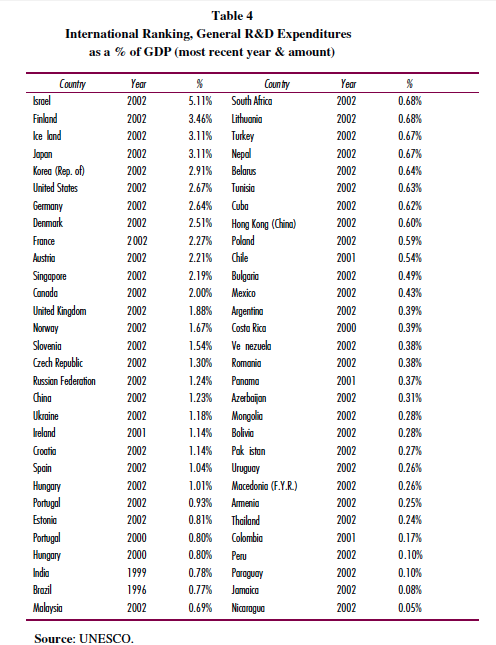
<body><![CDATA[<p align="justify"><font face="verdana" size="2">The set of indicators we presently have on innovation is highly limited in terms of concepts, coverage, and time; for example, there is little ability to track process&#45;oriented as opposed to product&#45;oriented innovation. Nonetheless, the indicators do give us a good idea of the relative performance of countries in this area at the international level. The United Nations created a Technology Achievement Index (TAI)</font> <font face="verdana" size="2">in 2001 to measure international progress in technology, attempting to address some of the criticisms of traditional measures of innovation. The TAI considered 4 dimensions: creation of technology; diffusion of new and of old innovations; and human skills. These were measured, respectively, by patents and royalty fees; internet hosts and the percentage of high and medium technology exports; the log of telephones and of electricity consumption; and the mean years of schooling and gross enrolment ratio at the tertiary level in science, math and engineering. All of the indicators except those for exports were divided by population. <i><a href="/img/revistas/prode/v40n156/html/a7t1.html" target="_blank">Table 1</a> shows that</i> <i>LA</i> <i>lags far behind competitors in terms of technological capability.</i></font></p>     <p align="justify"><font face="verdana" size="2">For countries with huge populations such as Brazil, China, and India, the TAI would be over&#45;critical. They have achieved large absolute numerical improvements in their technological capability, as demonstrated in <a href="#t2">Table 2</a>.</font></p> 	    <p align="center"><a name="t2"></a></p> 	    <p align="center"><img src="/img/revistas/prode/v40n156/a7t2.jpg"></p>      <p align="justify"><font face="verdana" size="2">When we examine different education systems, we notice that the achievements of the population giants of the developing world, namely China, India, and Brazil, appear much more clearly. China's absolute capacity for the educational foundation for innovation is on a par with developed countries. India's capacity is about half that of China's and Brazil's is less than a quarter. On the other hand, the fact that much smaller population base economies such as South Korea, Taiwan, Israel, Finland, Singapore and Thailand are producing significant numbers of graduates in sciences and engineering, at a speed comparable to countries with larger population bases such as Mexico, Iran, and Egypt is even more impressive, and both facts underscore la's inferior capacity.</font>	</p>     <p align="justify"><font face="verdana" size="2"><a href="#t3">Table 3</a> shows China, India, and South Korea far outpace Brazil, with Mexico and Argentina lagging distantly behind in terms of overall human capacity for s&t work. In terms of expenditures, no one comes close to the US, with Japan at less then half the total amount spent. In <a href="#t4">Table 4</a>, we reinforce the conclusion that LA has not allocated suffi cient funds for innovation.</font></p>     <p align="center"><a name="t3"></a></p>     <p align="center"><img src="/img/revistas/prode/v40n156/a7t3.jpg"></p>      <p align="center">&nbsp;</p>  	    <p align="center"><a name="t4"></a></p> 	    ]]></body>
<body><![CDATA[<p align="center"><img src="/img/revistas/prode/v40n156/a7t4.jpg"></p>  	    <p align="justify">&nbsp;</p>  	    <p align="justify"><font face="verdana" size="2">There appears to be a correlation between prosperity, competitiveness, and resources spent on innovation policy. At the same time, there are some weaknesses with commonly used innovation measures. First, they do not measure the <i>quality</i> of programmes, education, or research design/equipment. Second, they do not examine quality and coordination of institutions. Third, they do not look at the research expenditures or foundations for competitiveness in particular sectors, which could vary considerably. <a href="#t5">Table 5</a> helps us to begin to examine the difference between institutions, by revealing the distribution of R&amp;D funding to private, public, and educational outlets.</font></p> 	    <p align="center"><a name="t5"></a></p> 	    <p align="center"><img src="/img/revistas/prode/v40n156/a7t5.jpg"></p>      <p align="justify"><font face="verdana" size="2"><a href="#t5">Table 5</a> shows that the new tigers allocate much more of their R&amp;D budgets to the private sector. la countries spend reciprocally more in the public sector and in higher education. This reflects a weaker private sector, which in turn implies difficulties in applying research to new process or product technologies, vital to achieving international competitiveness. The allocation of funding in this regard undoubtedly has an effect on whether research is relevantly applied to process or product technology. As Amsden points out in the case of Korea, "learning" late industrializing economies will likely be better off focusing at first on improving process and quality control technologies, rather than innovating new products. This requires heavily applied "sho&#45;pfloor" research skills (Amsden 1989).</font></p>  	    <p align="justify"><font face="verdana" size="2">We have seen from a wide variety of measures that la's technological capability lags behind its competitors in East Asia and Eastern Europe, as well as those in the developed world. However, it is important to move beyond the exhortation&#45;orientation of much of the literature which seems focused on proving the importance of "knowledge" for development and particularly s&amp;t policy for development (World Bank 1999 &amp; 2003; United Nations 2001). We want to know why expenditures are so much lower in la and where new expenditures should be spent.</font></p>  	    <p align="justify">&nbsp;</p> 	    <p align="justify"><font face="verdana" size="2"><b><i>La Lacks Long&#45;term Innovation Planning Capacity</i></b></font></p>  	    <p align="justify"><font face="verdana" size="2">Comparing national innovation plans across the tigers and la is quite revealing. la does not have strong, unified, long&#45;term visions for national innovation. Nor do la plans seem to indicate interim goals that would act as measuring posts for how well a plan is executed. We begin with a description of the tigers and then move to la.</font></p>  	    ]]></body>
<body><![CDATA[<p align="justify">&nbsp;</p>     <p align="justify"><font face="verdana" size="2"><i>South Korea</i></font></p>  	    <p align="justify"><font face="verdana" size="2">A 1992 plan called HAN (Highly Advanced National Projects) is the precursor for much of Korea's s&amp;t vision. HAN created specific projects designed to increase the capabilities of Korean industry with inputs from a 400 person commission of academics, industry, and government (Rader, 2005). In 1999, the President announced the national task of creating a knowledge&#45;based economy. These efforts led to Korea announcing the "Long&#45;Term Vision for Science and Technology Investment Toward 2025" with targeted goals of increasing R&amp;D capacity, and improving infrastructure and regulations, backed by increased budgets. In this document, Korea announces its intention to be a major r&amp;D player in the Asia&#45;Pacific region by 2025 and to be competitive internationally with G&#45;7 countries by 2025. The Vision includes a desire "to transform the national innovation system from the government initiated, development&#45;oriented system into a market&#45;driven, diffusion&#45;oriented system, and also from an inward&#45;looking s&amp;t system into a globally&#45;networked system." &#91;most (no date), 18&#45;19&#93;.</font></p> 	    <p align="justify"><font face="verdana" size="2">Korea has several initiatives to reach the lofty goals set out in its national vision. These include the 21<sup>st</sup> Century Frontier R&amp;D Program, the National Research Laboratory Program and the Biotechnology Development Program. The 21<sup>st</sup> Century Program develops from the Highly Advanced National Project, and has funded more than 20 projects with $3.5 billion of funding in it, bioengineering, nanotechnology, and new materials. The National Research Laboratory Program began in 1999 and awards up to $250,000 per year to a research center for 5 years. In this program, over 350 centers, 150 academic, 90 public research, and 60 in the private sector have received funding. In terms of the Biotechnology Program, which began in 2001, the government has invested $270 million in genomics, proteomics, and bioinformatics (Wagner, <i>et al.,</i> 2003, 3).</font></p>     <p align="justify"><font face="verdana" size="2">In 2002, the Korean Government set up the National Technology Road Map, with 5 visions for s&amp;t policy. These included: building an information&#45;knowledge&#45;intelligence society, spreading the use of it; developing applications of it to bio&#45;health interests; advancing energy and environmental technologies; upgrading the value of major industries; and improving national safety and prestige, by improving national aerospace and food self&#45;sufficiency. The "Broadband it Korea Vision 2007" promotes 10 key projects for creating an information society by 2010, and "cyber Korea 21" is a blueprint for emerging as a global leader in this area (Rader 2005).</font></p>  	    <p align="justify"><font face="verdana" size="2">In 2004, the government identified 10 key technologies as priorities: digital tv and broadcasting; displays (lcd, led, etc); intelligent robots; new generation automobiles; next generation semiconductors; "intelligent home&#45;network"; "digital contents and solutions," next&#45;generation battery; and bio medicine (Korea, 2004).</font></p>  	    <p align="justify">&nbsp;</p> 	    <p align="justify"><font face="verdana" size="2"><i>China</i></font></p>  	    <p align="justify"><font face="verdana" size="2">China's overall s&amp;t planning comes from the high levels of the Communist Party. From the 1980s, s&amp;t policy has been a major priority of the Chinese Government.</font>	</p> 	    <p align="justify"><font face="verdana" size="2">Deng Xiaoping declared that 'science and technology is the primary productive force' in China's economic development. The 1995 Joint Decision by the Central Committee of the Chinese Communist Party and the State Council on Accelerating Scientific and Technological Progress is considered to be the key document for s&amp;t policy. The 1995 Decision led to rapid increases in R&amp;D, which included establishing the National Key Laboratories (NKL) and the National Engineering Centers (NEC), and educational funding. It also entailed major changes in the s&amp;t system, including introducing market mechanisms and explicitly discussing an nis. The "211 Project" created the 100 "Key Universities" by streamlining and merging existing universities, and provided funding of $1.81 billion from 1995&#45;2000 (Seong, 2005). In 2002, Jiang Zemin's report to the Party Congress set out the goal of 'rejuvenating the nation through science and education,' which was seen as the key vehicle for reaching its goal of quadrupling its gdp by 2020. China relies heavily on foreign technology imports; 90% of its hightech exports use imported materials. The 2002 report focused on improving quality and efficiency; strengthening basic research and property rights; and deepening education reforms so that it had closer ties to "practical productive forces" as part of an nis strategy (Seong, 2005). The China Technology Foresight 2003 report targeted key sectors and technologies for development, with particular focus on it; life sciences and biotechnology; and new materials, including nanotechnology.</font></p>  	    ]]></body>
<body><![CDATA[<p align="justify">&nbsp;</p> 	    <p align="justify"><font face="verdana" size="2"><i>Ireland</i></font></p>  	    <p align="justify"><font face="verdana" size="2">In the broadest sense, innovation policy is part of a wider strategy for development, promoted by the leading Industrial Development Authority (ida). ida, according to analysts, is highly coherent and effective, with a fair degree of autonomy.</font></p>  	    <p align="justify"><font face="verdana" size="2">An annual national plan is created for coordinating s&amp;t policy. The Science and Technology Act of 1987 marks the starting point for Ireland's active pursuit of high tech industrial policy (Collins and Pontikakis, 2006). Long&#45;term vision is set out in White Papers and reports, such as "Building Ireland's Knowledge Economy," which sets out a vision for innovation policy and clear goalposts to be achieved by 2010 (Ireland 2004). Ireland's government is particularly concerned with human capital development and foreign investment in knowledge&#45;based industries.</font></p>  	    <p align="justify">&nbsp;</p>     <p align="justify"><font face="verdana" size="2"><i>Finland</i></font></p>      <p align="justify"><font face="verdana" size="2">Since 1987, the Science and Technology Policy Council has created a triennial review that sets out a long&#45;range national vision for s&amp;t policy. The 2002 report, "Knowledge, Innovation, and Internationalization," discusses concerns with the need to continue to upgrade human capital and the need to identify clusters for targeting.The document sets out clear goalposts for achievement in the future (Finland, 2002). The Finnish government highlights information and communication technologies concerning its new wireless industries and technologies related to traditional resource&#45;based industries.</font></p>  	    <p align="justify">&nbsp;</p> 	    <p align="justify"><font face="verdana" size="2"><i>Latin America</i></font></p>  	    <p align="justify"><font face="verdana" size="2">A 2004 eclac Report notes that the period of import substitution industrialization (ISI) in la led in the 1950s to the setting up of the state R&amp;D councils as well as a number of technical institutes linked to state&#45;led initiatives in particular sectors (such as agriculture and energy). The report notes (204&#45;6) several weaknesses with this model, including a focus on the science rather than the viability of, and need for, fostering applications; poor interagency coordination; and weak linkages and flexibility with the actual needs of the sectors. The report suggests that a general policy shift has begun to take place, one that is more oriented towards "demand driven" needs as indicated by the market. Some of the new policies seek to respond to sectoral needs (eg Argentina, Chile, and Mexico), while others seek to match academic research centres with sectoral demands (Brazil). However, there remain serious institutional weaknesses throughout the region.</font></p>  	    ]]></body>
<body><![CDATA[<p align="justify">&nbsp;</p> 	    <p align="justify"><font face="verdana" size="2"><i>Argentina</i></font></p>  	    <p align="justify"><font face="verdana" size="2">Argentina created a National Multi&#45;Year Science and Technology Plan for 19982000. According to Chudnovsky, before 1990, there was no significant s&amp;t planing (Chudnovsky, 1999). The multi&#45;Year plan for 1998&#45;2000 was aimed at the development and strengthening of the national system of science, technology and innovation, for the first time openly adopting the nis approach (Chudnovsky, 1999).</font></p>  	    <p align="justify">&nbsp;</p> 	    <p align="justify"><font face="verdana" size="2"><i>Brazil</i></font></p>  	    <p align="justify"><font face="verdana" size="2">It is difficult to identify clearly a regular series of plans depicting the long&#45;term vision for leading sectors. There seems to be no focus in terms of priorities through a wide variety of planning documents. The 1997 mct (Ministry of Science and Technology) report to the federal government lists 18 different areas for s&amp;t "action" ranging from environment to space. A 2002 White Book on s&amp;t policy may be considered a more definitive long&#45;term document. On p.35, it lists 6 overall objectives: 1) create a favorable environment for innovation; 2) increase innovation capacity and expand the scientific and technological base; 3) consolidate, perfect, and modernize s&amp;t and innovation capacity; develop a wide base of support for the involvement of society; and transform s&amp;t policy into a strategic element of national development. Later, on p.49, a list of 9 other broad&#45;ranging objectives are given as are 10 others on p.50. Yet, nowhere in these and various other documents is there any clear set of priorities or overall plan per se. This may be related to the fact that in the 90s, Brazil moved towards the allocation of sectoral funds (eclac, 2004).</font></p>  	    <p align="justify">&nbsp;</p>     <p align="justify"><font face="verdana" size="2"><i>Chile</i></font></p>  	    <p align="justify"><font face="verdana" size="2">Chile's export miracle based on rapid growth in wines, fruits, and fishing, has well&#45;known roots in the activities of corfo, the government's industrial policy, financing, and development wing that goes back to 1939. Schurman (1996) argues strongly that in fact it was state developmental activity a la East Asia in targeting and supporting these export sectors over extended periods of time that is behind Chile's export success and its miracle. corfo was also partly responsible for increasing Chilean capacities over the course of the century to take over and run their economic mainstay, copper mining. corfo continues its activities in a variety of areas of industrial development, such as biotechnology (Nelson, 2007). But, what is the Chilean long&#45;term vision or plan for creating sectors with high employment and wages as well as export revenues? A World Bank report notes that there is neither a clear national vision for s&amp;t policy nor a high&#45;level government policy or institutional framework (Holm&#45;Nielsen, 2002).</font></p>  	    <p align="justify">&nbsp;</p>  	    ]]></body>
<body><![CDATA[<p align="justify"><font face="verdana" size="2"><i>Mexico</i></font></p>  	    <p align="justify"><font face="verdana" size="2">Previously, there seems to have been no clear vision for s&amp;t policy in Mexico. For example, the National Development Plan (1995&#45;2000) includes a section on s&amp;t policy. A new 2001&#45;2006 Special Program of Science and Technology attempts to create a new dynamic for s&amp;t policy in Mexico. This is buttressed by the Ley de Ciencia y Tecnologia (LcyT, Law of Science and Technology) passed in Apr. 2002. The main objectives of the new plan are to create a national policy on s&amp;t, increase local s&amp;t capacity; and to improve companies' competitiveness and innovation. In the LcyT, specific mention is also made of the need to coordinate within the government, with the states, and with universities and firms (Mexico, 2004).</font></p>  	    <p align="justify">&nbsp;</p>  	    <p align="justify"><font face="verdana" size="2"><b><i>Latin America Lacks Coherence in Budget Decision&#45;Making and Allocation</i></b></font></p>  	    <p align="justify"><font face="verdana" size="2">We noted in our first section to what extent la underfunds R&amp;D. We then pointed out that la countries lack a long&#45;term strategic plan with clearly measurable goals as part of a vision for national competitiveness. This problem is reinforced by the lack of a clear decision&#45;making structure with adequate resources to put this plan into motion. The tigers have greater resources, more centralized decision&#45;making, and, with the exception of Ireland, unified budget decision&#45;making for both industrial and educational R&amp;D. The la countries have a prolific number of agencies and ministries involved in innovation, while public agencies are oriented more towards academic than industrial innovation. These conclusions are summarized in <a href="/img/revistas/prode/v40n156/a7t6.jpg" target="_blank">Table 6</a>.</font></p>  	    <p align="justify"><font face="verdana" size="2">The qualitative evidence backs up these conclusions. Chudnovsky states that there is little evaluation or coordination of s&amp;t policy, and that projects tend to be very short&#45;term in nature (Chudnovsky, 1999). This opinion is backed up by a recent World Bank study by Thorn, who states that gactec goes on meeting sporadically and has not fulfilled its coordinating role (Thorn, 2005). Law 25.467 on Science, Technology and Innovation of 2001 placed new emphasis on s&amp;t policy. However, a change of institutional direction is still in process. Chudnovsky notes that 72% of the Argentine budget is concentrated in 4 areas: the national universities; conicet; the National Institute of Agroindustrial Technology (inta); and the National Atomic Energy Commission (cnea). Nuclear energy receives the most support, while manufacturing, through the National Institute of Industrial Technology receives less than 5% (Chudnovsky 1999). Moreover, competitive funds make up only about 10% of the total budget (Thorn, 2005). Meanwhile, Brazil's science and technology system is also incoherent, with competing programs by federal&#45;level institutions and with programs set up by the state of Sao Paulo, the industrial heartland.</font></p>  	    <p align="justify"><font face="verdana" size="2">According to Casalet, s&amp;t policy in Mexico during the 1970s&#45;80s took place in functional institutions, such as the imp (Mexican Institute for Petroleum); the iie (Electrical Research Institute); the inin (National Institute for Nuclear Research); and the imta (Mexican Institute on Water Technology). Unfortunately, they lacked "institutional and inter&#45;sectoral articulation." Moreover, "after two decades, it follows that this specialized infrastructure was developed through excessively bureaucratic self&#45;contained organizations, which had little concern for the actual outcomes of these initiatives and, furthermore, lacked any control over the institutions' achievements. Organizations had little concern for achieving any particular objectives since funding was secured <i>ex ante</i> and it was not necessary to carry out evaluations to monitor fund allocation" (Cimoli, 2000). These institutes were tied to the prevailing import substitution industrialization policy. nafin (Nacional Financiera) and Bancomext (Banco de Comercio Exterior) are the national development and foreign trade banks for Mexico, providing funding for industrial projects. CONACYT, established in 1991, is Mexico's National Council for Science and Technology and is in charge of promoting, implementing, and coordinating the s&amp;t policies for the government. CONACYT was until recently part of the sep (Secretariat of Public Education). The CONACYT system includes 28 public research and various other technology diffusion centres at the national and regional levels. Casas et al note that the Mexican NIS is highly decentralized, based around the regional scientific institutes and their specializations (Cimoli, 2000) CONACYT also runs the National Researchers System (SNI) which is a network of scientists in universities and public research centres.</font></p> 	    <p align="justify"><font face="verdana" size="2">The 2002 LcyT allows CONACYT to report directly to the President, rather than the Ministry of Education. It also created the General Council on Scientific Research and Technological Development, chaired by the President, several state Ministries, CONACYT, and vips at large, and the Scientific and Technological Forum as an independent advisory commission. It created an Inter&#45;ministerial Committee on the Budget, and a National Conference on Science and Technology to coordinate the states. Furthermore, new sectoral and "mixed funds" have been declared, with the latter going to state and municipal governments. Lastly, the law set up tax incentives for private industries upgrading technology.</font></p>     <p align="justify">&nbsp;</p> 	    <p align="justify"><font face="verdana" size="2"><b><i>Latin America has not Developed Adequate Coordination Mechanisms</i></b></font></p>  	    ]]></body>
<body><![CDATA[<p align="justify"><font face="verdana" size="2">The ultimate measure of success in innovation policy is the development of internationally&#45;competitive processes, products, and services. As follows from the NIS framework, this means that there must be a close coordination between the public sector, private sector, and academic institutions involved in the virtuous circle of relevant training, public funding of collective goods including information sharing, and marketplace efficiency discipline. It is in this area of coordinated linkages and application of research and development that we find the sharpest contrasts and greatest weaknesses of the la nics, except when compared with (??) China (except in the case of Chile??).</font></p>  	    <p align="justify">&nbsp;</p>  	    <p align="justify"><font face="verdana" size="2"><i>S. Korea</i></font></p>  	    <p align="justify"><font face="verdana" size="2">The government has explicit policies to promote linkages among gris, universities, and industry, including joint R&amp;D, sharing of facilities, and efforts to improve intellectual property rights. The Korean Institute of Science and Technology (kist) has played a crucial role as the center for scientific research since its founding in the early 1960s (Chung, 2002). A government report notes, nonetheless, that there are weaknesses, namely a "weak reliance of industries on scientific research for innovation and weak responsiveness of universities and gris to market changes.... (This) makes it hard for the private and public sectors to collaborate." In response, the government decided to include industry representatives in the nstc and in the boards of the Research Councils which govern the operation of government R&amp;D. The government also provides direct funding competitions to industries for national priorities. In 2004, the Korean government announced its intention of introducing funding competitions and promoting research spin&#45;offs in the public R&amp;D sector. For academics, the government has paid attention to curricula in industrial fields, increased funding for basic scientific research, setting up a "National Research Fellow" program to support top graduate students, and promoting the continual upgrading of scientists' and engineers' skills. The government also announced that at least 30% of all top policymaking positions in the public service would be filled by scientists and engineers; new "Research Officer" posts for science and engineering PhDs in the military; the development of "Human Resource Incubating Centers" to provide retraining for temporarily unemployed scientists and engineers; and a new "Women Into Science and Engineering" program to try to increase the proportion of women in gris to at least 25% (Korea, 2004).</font></p>  	    <p align="justify">&nbsp;</p>     <p align="justify"><font face="verdana" size="2"><i>Ireland</i></font></p>  	    <p align="justify"><font face="verdana" size="2">ida has created strong networks to promote ties between foreign investors and companies, educational institutions, domestic business and labor groups and other government institutions. The networks help to coordinate national strategy towards development (O Riain, 2004: 147&#45;8), though there is also criticism for the high level of dependence on foreign multinationals (Collins and Pontikakis, 2006). The networks also coordinate action for national competitiveness, such as wage restraint agreements to reduce costs during downturns; Kirby refers to the system generally as one of "social partnership" for national development (Kirby, 2003). The Irish model is premised on heavy courting of foreign direct investment in designated sectors, which are lured by both favorable tax and regulatory structures as well as a high quality and well&#45;educated workforce. In Ireland, Science Foundation Ireland (AFI) is the main funding agency of research in both academics and industry and therefore the coordinating agency. SFI was established in 2000 as part of the 6&#45;year National Development Plan. SFI is modeled after the us National Science Foundation (NSF). SFI targets certain sectors, such as it and pharmaceuticals in funding local research teams (Harris, 2005). O'Riaian points to a strong culture of evaluation which helps to create accountability among the public, private, and academic networks. Forfas usually draws upon external and international experts to evaluate public policies, and negative evaluations "can result in closure, sale, or reorganization" of programmes (O Riain, 2004: 160&#45;2).</font></p>  	    <p align="justify">&nbsp;</p> 	    <p align="justify"><font face="verdana" size="2"><i>Finland</i></font></p>  	    <p align="justify"><font face="verdana" size="2">The Science and Technology Policy Council ensures overall national coordination among actors in the pursuit of the national vision (Pelkonen, 2006). Lillrank states, "the relation between industry and academia has traditionally been smooth and intimate," with tekes playing the leading role. Academic research groups can apply for funding at any time, although they are expected to find industry partners who will match them with 40&#45;60% of the expenses (Lillrank, 2005: 174&#45;5). Moreover, there is a Finnish Cluster program designed to coordinate the public sector, academics, and industry around specific research programs with budget allocations.</font></p>  	    ]]></body>
<body><![CDATA[<p align="justify"><font face="verdana" size="2">As is well&#45;known, Nokia is at the heart of the Finnish innovation system. The links between Nokia and the public sector are complex and controversial. Some analysts claim that Nokia's success has little to do with direct State support (Palmberg, 2000). However, most of the literature sees a direct link between Nokia's success and the Finnish innovation system (Ali&#45;Yrkko, 2004). Castells and Himanen point to the multiple and dense network ties between public policy institutions and Nokia. Nokia not only provides tax revenues, but also training and direct funding to universities. Nokia develops technological expertise in direct contact with Finnish academics as well as its subcontractors. The government, meanwhile, supports basic research and development, technological diffusion, education, and aid in reaching foreign markets and finding foreign collaborators with a view specifically towards the ict sector (Castells, 2002: esp 48&#45;54 &amp; 59&#45;62). Thus, the Finnish cluster should be seen as a public&#45;private network. It is further noteworthy that Finland is the only case studied here with an extensive welfare system, which apparently has not impeded it from attaining international competitiveness at the highest levels.</font></p>  	    <p align="justify">&nbsp;</p>  	    <p align="justify"><font face="verdana" size="2"><i>China</i></font></p>  	    <p align="justify"><font face="verdana" size="2">The Chinese Government has its own set of R&amp;D institutes organized around the Chinese Academy of Sciences (cas). In 2003, CAS operated 89 institutes with 20 supporting units, one university, and 2 graduate schools. In that year, cas commanded a budget of $1.21 billion and a total staff of over 44,000 researchers; and was training 22,497 graduate students. cas Fellows are strongly tied to s&amp;t policy and to the private sector. By the end of 2003, cas had invested in 336 firms. Universities are also key players in Chinese R&amp;D according to a Rand study, which noted that 105 National Key Laboratories (or 2/3 of the total), 43 National Engineering Centers, 22 s&amp;t parks, and 6 technology transfer centers were affiliated with universities. The 100 Key Universities received 72% of funding between 1995 and 2000. The nkls are the basic R&amp;D infrastructure and the necs are designed around assimilation of foreign technologies and technology transfer to industry (Seong, 2005). However, the quality of those universities is quite uneven. Beijing and Tsinghua are the leaders in technology development.</font></p>  	    <p align="justify">&nbsp;</p> 	    <p align="justify"><font face="verdana" size="2"><i>Argentina</i></font></p>  	    <p align="justify"><font face="verdana" size="2">Chudnovsky notes that the interaction between university researchers and private industry is "very limited" and that almost all research personnel work in the public sector. Furthermore, "teaching has few links with research" and university researchers have a low level of collaboration. In order to improve technology diffusion, the Argentine government spun off this function from conicet and established the National Agency for the Promotion of Science and Technology. This agency administers two funds for research: foncyt for academic or non&#45;profit research and fontar for private industry upgrading. (Chudnovsky, 1999). Writing in 2005, Thorn notes that coordination problems continue to plague Argentina. Individual agencies, including conicet, also suffer from a lack of clear "strategic direction" and coordination (Thorn 2005).</font></p>  	    <p align="justify"><font face="verdana" size="2"><i>Brazil</i></font></p>     <p align="justify"><font face="verdana" size="2">The Council for the Improvement of Higher Education; (CAPES), part of the Ministry of Education and Culture, along with the National Council for Science and Technology Development (CNPQ), is the main policy agency for s&amp;t training. CAPES provides 40% of the federal graduate funding, while CNPQ provides the other 60% (Holm&#45;Nielsen, 1996). There are a number of other organizations involved in technical training, including: the Brazilian Academy of Sciences (ABC); several industry associations; the Centre for Management and Strategic Studies (CGEE) the National Confederation of Industry (CNI); and the government&#45;led National Services for Industrial Training (SENAI).</font></p>  	    <p align="justify"><font face="verdana" size="2">A number of sources point to the fundamental weakness of Brazilian s&amp;t policy, namely that there is a major disconnection between universities and industry, based on the heavy reliance on imports of key inputs which dates back to the end of World War II (Washington, no date). A World Bank Report notes that Brazil suffers from an inability to place its doctoral students in private industry, as most go into university positions, "in contrast with Korea." Furthermore, funding by CNPq tends to go to student grants, rather than research. (Holm&#45;Nielsen, 1996). Numerous studies note the deeper problems of Brazilian higher education &#45;a bifurcated system in which a handful of elite international&#45;level research universities exist alongside mostly teaching universities with mixed standards. This is exacerbated by high levels of volatility in funding (Schott, 1993).</font></p>  	    ]]></body>
<body><![CDATA[<p align="justify"><font face="verdana" size="2"><i>Chile</i></font></p>     <p align="justify"><font face="verdana" size="2">CONICYT, the National Council for Scientific and Technology Research, is the key s&amp;t policy institution. CONICYT administers the National Fund for Scientific and Technological Development (FONDECYT) which serves as the project funding agency. FONDECYT funds approximately 300 new projects per year, out of a total of around 1000. In addition, the Ministry of Economy runs the Technology Innovation Program. That program includes the National Fund for Fostering Scientific and Technological Research (FONDEF), which focuses on improving national R&amp;D institutions and promotes linkages between them and industry. FONDEF is also behind creating the Red Universitaria Nacional (the National University Network), which promotes internet activity. The Ministry also administers the National Fund for Productive Technological Development (FONTEC) and sector&#45;specific programs (US Dept. of Commerce, 2000). Holm&#45;Nielson (1996 and 2002) notes that public research institutes, producing basic research, dominate Chilean s&amp;t funding, and that there is little applied research or coordination with private industry.</font></p>  	    <p align="justify"><font face="verdana" size="2"><i>Mexico</i></font></p>  	    <p align="justify"><font face="verdana" size="2">CONACYT runs a specific program (PREAEM) to coordinate academic&#45;corporate linkages. R Casas <i>et. al,</i> in a comprehensive review of the question, state that university&#45;industry collaborations "are still very weak," but are improving. They note that university&#45;industry interactions seem to be most productive in personnel development and collaboration around scientific activity, but are not "centred around the development of technology (Cimoli, 2000)." In Cimoli's conclusion to his comprehensive review of the Mexican NIS, he states: "Most policy&#45;makers view the Mexican trade liberalization processes (under NAFTA) as a sufficient condition to support the acquisition of foreign technology and to capture and absorb locally the benefits from the internationalization of trade, investment and technology flows &#91;...&#93; In contrast &#91;...&#93; the effects from the stimuli that international demand generates are starting to wear off and, furthermore, the domestic networks between local firms and institutions are increasingly eroded &#91;...&#93; We can detect a structural dichotomy in the domestic manufacturing industry &#91;...&#93; a small group of modernized export firms &#91;...&#93; (and) a much larger group of companies that are much less competitive and not as successful (290)" Other weaknesses include a highly specialized niche in global production chains that limits technological development; inadequate budgets; low local spillover benefits from global firms and technological activities; weak corporate&#45;public research institution interaction; rigid university organization; and generally weak local networking among the different parties interested in technology development (27884). Lederman and Maloney, in "Innovation in Mexico: NAFTA is Not Enough," note that the quality of university research and university&#45;industry linkage are both very weak (Lederman, 2003).</font></p>  	    <p align="justify">&nbsp;</p>  	    <p align="justify"><font face="verdana" size="2"><b><i>Synthesizing Findings&#45;Comparing Winners and Losers in Global Innovation</i></b></font></p>  	    <p align="justify"><font face="verdana" size="2">The point of this article has <i>not</i> been to argue for a specific concentration of resources in high technology industries exclusively. Rather, we have reviewed Latin America's two&#45;paradigm debate with regard to innovation policy (Bastos, 1995: 24). Our examination of the fast growing economies in the world clearly reveals that strongly proactive innovation policies and institutions have accompanied growth. The lack of a clear national <i>system</i> of innovation, rather than entry into particular high tech sectors is at the root of this problem. As recent analyses have pointed out, in some sub&#45;sectors of agriculture in particular, la has had a fair degree of success in improving productivity (Bisang, 2005). Moreover, there are a number of world&#45;class institutions and companies in the region, such as the ITAM and the Tec de Monterrey in Mexico, the Brazilian University of Sao Paulo, Campinas, and the Federal University of Rio de Janeiro, and individual companies such as Embraer, Petrobras, and Techint. However, these tend to be isolated efforts, with limited effects on national competence in non agricultural sectors. Even Chile's success in fruit, wine and fresh fish has not led to a steady basis for increasing employment and social mobility; indeed its Gini coefficient reflects its place among the world's most unequal countries. The very isolation of these successes underscores the lack of a well&#45;functioning NIS in la countries. As Dutrenit and Katz state in a review of innovation in the region, "It is highly unrealistic to expect that without a major expansion and sophistication in their exports Latin American economies will be capable of paying higher wages to their populations, creating better jobs and reducing outward migration.. ..Without implementing active science, technology and innovation policies, and developing an incentives regime to induce firms to carry out innovative efforts, it is also unrealistic to expect firms to enhance their domestic technological capabilities" (Dutrenit 2005, 113). <a href="#t7">Table 7</a> summarizes some of the key points a clearly developed s&amp;t institutional architecture which plans, coordinates, and accounts for activities. There is no evidence of such organization in LA, which is instead heavy in academic research. In fairness, LA countries seem to be reacting to their general historical neglect of innovation policy. In every country, there have been major reforms in the sector. However, it is clear that the private sector relationships of LA NISs need serious attention. LA systems are too dominated by public sector funding of academic research, with accountability presumably being measured by number of publications rather than tangible benefits for the nation in terms of policy knowledge, process and product innovation, and international competitiveness. Moreover, the incoherence and lack of commitment to s&amp;t remain clear problems. The evidence here suggests that it may make sense to concentrate resources in the short&#45;term on a few sectoral areas and set out clear targets. Accountability mechanisms, while not part of this survey, are another area for consideration. They seem to be quite rare in s&amp;t policy generally. Arnold et. al's review of s&amp;t governance in Canada, Denmark, Finland, Ireland, the Netherlands, Sweden, and the UK revealed that evaluation of research institutes occurred on a regular basis only in Norway and Finland (49). Yet, transparent performance targets, based on national visions of achieving internationally competitive NISs and specific competencies, is able to create accountability that can lead to improvements in technological capability and international competitiveness in LA.</font></p>  	    <p align="center"><a name="t7"></a></p> 	    <p align="center"><img src="/img/revistas/prode/v40n156/a7t7.jpg"></p>     <p align="justify">&nbsp;</p>  	    ]]></body>
<body><![CDATA[<p align="justify"><font face="verdana" size="2"><b>References</b></font></p>  	    <p align="justify"><font face="verdana" size="2">Various Government web&#45;sites</font></p>  	    <!-- ref --><p align="justify"><font face="verdana" size="2">Adeoti, John Olatunji. 2002. "Building technological capability in the less developed countries: the role of a national system of innovation," <i>Science and Public Policy,</i> 29,2 (April):95&#45;104.    &nbsp;&nbsp;&nbsp;&nbsp;&nbsp;&nbsp;&nbsp;&nbsp;[&#160;<a href="javascript:void(0);" onclick="javascript: window.open('/scielo.php?script=sci_nlinks&ref=6339834&pid=S0301-7036200900010000700001&lng=','','width=640,height=500,resizable=yes,scrollbars=1,menubar=yes,');">Links</a>&#160;]<!-- end-ref --></font></p>  	    <!-- ref --><p align="justify"><font face="verdana" size="2">Ali&#45;Yrkko, Jyrki, and Raine Hermans. 2004. Nokia: A giant in the Finnish innovation system. In <i>Embracing the Knowledge Economy: The Dynamic Transformation of the Finnish Innovation System,</i> edited by G. Schienstock. Northampton, MA: Edward Elgar.    &nbsp;&nbsp;&nbsp;&nbsp;&nbsp;&nbsp;&nbsp;&nbsp;[&#160;<a href="javascript:void(0);" onclick="javascript: window.open('/scielo.php?script=sci_nlinks&ref=6339836&pid=S0301-7036200900010000700002&lng=','','width=640,height=500,resizable=yes,scrollbars=1,menubar=yes,');">Links</a>&#160;]<!-- end-ref --></font></p>  	    <!-- ref --><p align="justify"><font face="verdana" size="2">Amsden, Alice H. 1989. <i>Asia's Next Giant: South Korea and Late Industrialization.</i> NY: Oxford U. Press.    &nbsp;&nbsp;&nbsp;&nbsp;&nbsp;&nbsp;&nbsp;&nbsp;[&#160;<a href="javascript:void(0);" onclick="javascript: window.open('/scielo.php?script=sci_nlinks&ref=6339838&pid=S0301-7036200900010000700003&lng=','','width=640,height=500,resizable=yes,scrollbars=1,menubar=yes,');">Links</a>&#160;]<!-- end-ref --></font></p>  	    <!-- ref --><p align="justify"><font face="verdana" size="2">Arnold, Erik, et.al. 2002. <i>Innovation Structure and Strategy: International Best Practices. </i>Ottawa: PRIME&#45; U of Ottawa &amp; Technopolis&#45; Amsterdam &amp; Brighton.    &nbsp;&nbsp;&nbsp;&nbsp;&nbsp;&nbsp;&nbsp;&nbsp;[&#160;<a href="javascript:void(0);" onclick="javascript: window.open('/scielo.php?script=sci_nlinks&ref=6339840&pid=S0301-7036200900010000700004&lng=','','width=640,height=500,resizable=yes,scrollbars=1,menubar=yes,');">Links</a>&#160;]<!-- end-ref --></font></p>  	    ]]></body>
<body><![CDATA[<!-- ref --><p align="justify"><font face="verdana" size="2">Bastos, Maria Ines, and Charles Cooper. 1995. A political approach to science and technology policy in Latin America. In <i>Politics of Technology in Latin America,</i> edited by M. I. Bastos, and Charles Cooper. NY: Routledge, United Nations University Institute for New Technologies.    &nbsp;&nbsp;&nbsp;&nbsp;&nbsp;&nbsp;&nbsp;&nbsp;[&#160;<a href="javascript:void(0);" onclick="javascript: window.open('/scielo.php?script=sci_nlinks&ref=6339842&pid=S0301-7036200900010000700005&lng=','','width=640,height=500,resizable=yes,scrollbars=1,menubar=yes,');">Links</a>&#160;]<!-- end-ref --></font></p>  	    <!-- ref --><p align="justify"><font face="verdana" size="2">Bisang, Roberto and Graciela E. Gutman. 2005. The accumulation process and agrofood networks in Latin America. <i>ECLAC Review</i> 87:113&#45;27.    &nbsp;&nbsp;&nbsp;&nbsp;&nbsp;&nbsp;&nbsp;&nbsp;[&#160;<a href="javascript:void(0);" onclick="javascript: window.open('/scielo.php?script=sci_nlinks&ref=6339844&pid=S0301-7036200900010000700006&lng=','','width=640,height=500,resizable=yes,scrollbars=1,menubar=yes,');">Links</a>&#160;]<!-- end-ref --></font></p>  	    <!-- ref --><p align="justify"><font face="verdana" size="2">Casalet, Monica, Mario Cimoli, and Gabriel Yoguel, ed. 2005. <i>Redes, jerarquias y dinamicas productivas,</i> edited by F. Mexico, Buenos Aires: Mino y Davila.    &nbsp;&nbsp;&nbsp;&nbsp;&nbsp;&nbsp;&nbsp;&nbsp;[&#160;<a href="javascript:void(0);" onclick="javascript: window.open('/scielo.php?script=sci_nlinks&ref=6339846&pid=S0301-7036200900010000700007&lng=','','width=640,height=500,resizable=yes,scrollbars=1,menubar=yes,');">Links</a>&#160;]<!-- end-ref --></font></p>  	    <!-- ref --><p align="justify"><font face="verdana" size="2">Castanos&#45;Lomnitz, Heriberta. 2006. "Social sciences and science policy in Mexico," <i>Science and Public Policy.</i> 33,2 (March): 115&#45;123.    &nbsp;&nbsp;&nbsp;&nbsp;&nbsp;&nbsp;&nbsp;&nbsp;[&#160;<a href="javascript:void(0);" onclick="javascript: window.open('/scielo.php?script=sci_nlinks&ref=6339848&pid=S0301-7036200900010000700008&lng=','','width=640,height=500,resizable=yes,scrollbars=1,menubar=yes,');">Links</a>&#160;]<!-- end-ref --></font></p>  	    <!-- ref --><p align="justify"><font face="verdana" size="2">Castells, Manuel, and Pekka Himanen. 2002. <i>The Information Society and the Welfare State: The Finnish Model.</i> NY: Oxford U Press.    &nbsp;&nbsp;&nbsp;&nbsp;&nbsp;&nbsp;&nbsp;&nbsp;[&#160;<a href="javascript:void(0);" onclick="javascript: window.open('/scielo.php?script=sci_nlinks&ref=6339850&pid=S0301-7036200900010000700009&lng=','','width=640,height=500,resizable=yes,scrollbars=1,menubar=yes,');">Links</a>&#160;]<!-- end-ref --></font></p>  	    ]]></body>
<body><![CDATA[<!-- ref --><p align="justify"><font face="verdana" size="2">ECLAC (UN Economic Commission for Latin America and the Caribbean). 2004. <i>Productive Development in Open Economies</i>. Santiago.    &nbsp;&nbsp;&nbsp;&nbsp;&nbsp;&nbsp;&nbsp;&nbsp;[&#160;<a href="javascript:void(0);" onclick="javascript: window.open('/scielo.php?script=sci_nlinks&ref=6339852&pid=S0301-7036200900010000700010&lng=','','width=640,height=500,resizable=yes,scrollbars=1,menubar=yes,');">Links</a>&#160;]<!-- end-ref --></font></p>  	    <!-- ref --><p align="justify"><font face="verdana" size="2">Chudnovsky, Daniel. 1999. Science and Technology Policy and the National Innovation System in Argentina. <i>ECLAC Review</i> 67 (April):157&#45;77.    &nbsp;&nbsp;&nbsp;&nbsp;&nbsp;&nbsp;&nbsp;&nbsp;[&#160;<a href="javascript:void(0);" onclick="javascript: window.open('/scielo.php?script=sci_nlinks&ref=6339854&pid=S0301-7036200900010000700011&lng=','','width=640,height=500,resizable=yes,scrollbars=1,menubar=yes,');">Links</a>&#160;]<!-- end-ref --></font></p>  	    <!-- ref --><p align="justify"><font face="verdana" size="2">Chung, Sungchul. 2002. "Catching up through international linkages: science, technology and the Korean experience," <i>Science and Public Policy,</i> 29,6 (Dec): 431&#45;7.    &nbsp;&nbsp;&nbsp;&nbsp;&nbsp;&nbsp;&nbsp;&nbsp;[&#160;<a href="javascript:void(0);" onclick="javascript: window.open('/scielo.php?script=sci_nlinks&ref=6339856&pid=S0301-7036200900010000700012&lng=','','width=640,height=500,resizable=yes,scrollbars=1,menubar=yes,');">Links</a>&#160;]<!-- end-ref --></font></p>  	    <!-- ref --><p align="justify"><font face="verdana" size="2">Cimoli, M. 2000. Conclusions. In <i>Developing Innovation Systems: Mexico in a Global Context,</i> edited by M. Cimoli. NY: Continuum.    &nbsp;&nbsp;&nbsp;&nbsp;&nbsp;&nbsp;&nbsp;&nbsp;[&#160;<a href="javascript:void(0);" onclick="javascript: window.open('/scielo.php?script=sci_nlinks&ref=6339858&pid=S0301-7036200900010000700013&lng=','','width=640,height=500,resizable=yes,scrollbars=1,menubar=yes,');">Links</a>&#160;]<!-- end-ref --></font></p>  	    <!-- ref --><p align="justify"><font face="verdana" size="2">Collins, Patrick, and Dimitrios Pontikakis, "Innovation systems in the European periphery: the policy approaches of Ireland and Greece," <i>Science and Public Policy</i> 33,20 (Dec): 757&#45;69.    &nbsp;&nbsp;&nbsp;&nbsp;&nbsp;&nbsp;&nbsp;&nbsp;[&#160;<a href="javascript:void(0);" onclick="javascript: window.open('/scielo.php?script=sci_nlinks&ref=6339860&pid=S0301-7036200900010000700014&lng=','','width=640,height=500,resizable=yes,scrollbars=1,menubar=yes,');">Links</a>&#160;]<!-- end-ref --></font></p>  	    ]]></body>
<body><![CDATA[<!-- ref --><p align="justify"><font face="verdana" size="2">Dutrenit, Gabriela and Jorge Katz. 2005. Introduction: Innovation, growth and development in Latin America: Stylized facts and a policy agenda. <i>Innovation: management, policy &amp; practice</i> 7 (2&#45;3, Innovation and Economic Development: Lessons from Latin America, ed. Gabriela Dutrenit and Mark Dodgson):105&#45;30.    &nbsp;&nbsp;&nbsp;&nbsp;&nbsp;&nbsp;&nbsp;&nbsp;[&#160;<a href="javascript:void(0);" onclick="javascript: window.open('/scielo.php?script=sci_nlinks&ref=6339862&pid=S0301-7036200900010000700015&lng=','','width=640,height=500,resizable=yes,scrollbars=1,menubar=yes,');">Links</a>&#160;]<!-- end-ref --></font></p>  	    <!-- ref --><p align="justify"><font face="verdana" size="2">Finland, Government of. 2002. <i>Knowledge, innovation and internationalisation.</i> Helsinki: Science and Technology Policy Council.    &nbsp;&nbsp;&nbsp;&nbsp;&nbsp;&nbsp;&nbsp;&nbsp;[&#160;<a href="javascript:void(0);" onclick="javascript: window.open('/scielo.php?script=sci_nlinks&ref=6339864&pid=S0301-7036200900010000700016&lng=','','width=640,height=500,resizable=yes,scrollbars=1,menubar=yes,');">Links</a>&#160;]<!-- end-ref --></font></p>  	    <p align="justify"><font face="verdana" size="2">Harris, William C. 2005. Secrets of the Celtic Tiger: Act Two. <i>Issues in Science and Technology</i> Summer:23&#45;27.</font></p>  	    <!-- ref --><p align="justify"><font face="verdana" size="2">Holm&#45;Nielsen, Lauritz, and Natalia Agapitova. 2002. <i>Chile: Science, Technology and Innovation.</i> Edited by W. Bank, <i>LCSHD Paper.    &nbsp;&nbsp;&nbsp;&nbsp;&nbsp;&nbsp;&nbsp;&nbsp;[&#160;<a href="javascript:void(0);" onclick="javascript: window.open('/scielo.php?script=sci_nlinks&ref=6339867&pid=S0301-7036200900010000700017&lng=','','width=640,height=500,resizable=yes,scrollbars=1,menubar=yes,');">Links</a>&#160;]<!-- end-ref --></i></font></p>  	    <!-- ref --><p align="justify"><font face="verdana" size="2">Holm&#45;Nielsen, Lauritz, Michael Crawford, and Alcyone Saliba, eds. 1996. <i>Institutional and Entrepreneurial Leadership in the Brazilian Science and Technology Sector: Setting a New Agenda:</i> World Bank.    &nbsp;&nbsp;&nbsp;&nbsp;&nbsp;&nbsp;&nbsp;&nbsp;[&#160;<a href="javascript:void(0);" onclick="javascript: window.open('/scielo.php?script=sci_nlinks&ref=6339869&pid=S0301-7036200900010000700018&lng=','','width=640,height=500,resizable=yes,scrollbars=1,menubar=yes,');">Links</a>&#160;]<!-- end-ref --></font></p>  	    <!-- ref --><p align="justify"><font face="verdana" size="2">Ireland, Government of. 2004. <i>Building Ireland's Knowledge Economy: The Irish Action Plan for Promoting Investment in R&amp;D to 2010.    &nbsp;&nbsp;&nbsp;&nbsp;&nbsp;&nbsp;&nbsp;&nbsp;[&#160;<a href="javascript:void(0);" onclick="javascript: window.open('/scielo.php?script=sci_nlinks&ref=6339871&pid=S0301-7036200900010000700019&lng=','','width=640,height=500,resizable=yes,scrollbars=1,menubar=yes,');">Links</a>&#160;]<!-- end-ref --></i></font></p>  	    <!-- ref --><p align="justify"><font face="verdana" size="2">Kirby, Peadar. 2003. <i>Macroeconomic success and social vulnerability: lessons for Latin America from the Celtic Tiger.</i> Edited by E. UN Development Account, <i>Enchancing the economic and social development policy capabilities in the countries of Latin America and the Caribbean; financiamiento del desarrollo.</i> Santiago: ECLAC.    &nbsp;&nbsp;&nbsp;&nbsp;&nbsp;&nbsp;&nbsp;&nbsp;[&#160;<a href="javascript:void(0);" onclick="javascript: window.open('/scielo.php?script=sci_nlinks&ref=6339873&pid=S0301-7036200900010000700020&lng=','','width=640,height=500,resizable=yes,scrollbars=1,menubar=yes,');">Links</a>&#160;]<!-- end-ref --> </font></p> 	    <!-- ref --><p align="justify"><font face="verdana" size="2">Korea, Government of South. 2004. <i>Korea: Country Response to Policy Questionairre, OECD Science, Technology and Industry Outlook 2004.    &nbsp;&nbsp;&nbsp;&nbsp;&nbsp;&nbsp;&nbsp;&nbsp;[&#160;<a href="javascript:void(0);" onclick="javascript: window.open('/scielo.php?script=sci_nlinks&ref=6339875&pid=S0301-7036200900010000700021&lng=','','width=640,height=500,resizable=yes,scrollbars=1,menubar=yes,');">Links</a>&#160;]<!-- end-ref --></i> </font></p> 	    <!-- ref --><p align="justify"><font face="verdana" size="2">Krueger, Anne O., ed. 2000. <i>Economic policy reform: the second stage.</i> Chicago: U of Chicago Press.    &nbsp;&nbsp;&nbsp;&nbsp;&nbsp;&nbsp;&nbsp;&nbsp;[&#160;<a href="javascript:void(0);" onclick="javascript: window.open('/scielo.php?script=sci_nlinks&ref=6339877&pid=S0301-7036200900010000700022&lng=','','width=640,height=500,resizable=yes,scrollbars=1,menubar=yes,');">Links</a>&#160;]<!-- end-ref --> </font></p> 	    <!-- ref --><p align="justify"><font face="verdana" size="2">Kuczynski, Pedro&#45;Pablo, ed. 2003. <i>After the Washington Consensus: Restarting Growth and Reform in Latin America.</i> Washington: Institute for International Economics.    &nbsp;&nbsp;&nbsp;&nbsp;&nbsp;&nbsp;&nbsp;&nbsp;[&#160;<a href="javascript:void(0);" onclick="javascript: window.open('/scielo.php?script=sci_nlinks&ref=6339879&pid=S0301-7036200900010000700023&lng=','','width=640,height=500,resizable=yes,scrollbars=1,menubar=yes,');">Links</a>&#160;]<!-- end-ref --> </font></p> 	    <!-- ref --><p align="justify"><font face="verdana" size="2">Lederman, Daniel and William F. Maloney. 2003. <i>Innovation in Mexico: NAFTA is Not Enough.</i> Washington: World Bank.    &nbsp;&nbsp;&nbsp;&nbsp;&nbsp;&nbsp;&nbsp;&nbsp;[&#160;<a href="javascript:void(0);" onclick="javascript: window.open('/scielo.php?script=sci_nlinks&ref=6339881&pid=S0301-7036200900010000700024&lng=','','width=640,height=500,resizable=yes,scrollbars=1,menubar=yes,');">Links</a>&#160;]<!-- end-ref --> </font></p> 	    <!-- ref --><p align="justify"><font face="verdana" size="2">Leite, Marcelo. <i>Brazil's Lula is No Friend of Science</i> 2005 &#91;cited Nov. 7, 2005. Available from <a href="http://www.brazzil.com" target="_blank">www.brazzil.com</a>.    &nbsp;&nbsp;&nbsp;&nbsp;&nbsp;&nbsp;&nbsp;&nbsp;[&#160;<a href="javascript:void(0);" onclick="javascript: window.open('/scielo.php?script=sci_nlinks&ref=6339883&pid=S0301-7036200900010000700025&lng=','','width=640,height=500,resizable=yes,scrollbars=1,menubar=yes,');">Links</a>&#160;]<!-- end-ref --> </font></p> 	    <!-- ref --><p align="justify"><font face="verdana" size="2">Lillrank, Paul. 2005. The Evolution of Organizational Structures in a Networked Society. In <i>Digital Economy and Social Design,</i> edited by O. Sudoh. NY: Springer.    &nbsp;&nbsp;&nbsp;&nbsp;&nbsp;&nbsp;&nbsp;&nbsp;[&#160;<a href="javascript:void(0);" onclick="javascript: window.open('/scielo.php?script=sci_nlinks&ref=6339885&pid=S0301-7036200900010000700026&lng=','','width=640,height=500,resizable=yes,scrollbars=1,menubar=yes,');">Links</a>&#160;]<!-- end-ref --> </font></p> 	    <!-- ref --><p align="justify"><font face="verdana" size="2">Loayza, Norman. 2005. <i>Economic Growth in Latin America and the Caribbean: Stylized Facts, Explanations, and Forecasts.</i> Washington: World Bank.    &nbsp;&nbsp;&nbsp;&nbsp;&nbsp;&nbsp;&nbsp;&nbsp;[&#160;<a href="javascript:void(0);" onclick="javascript: window.open('/scielo.php?script=sci_nlinks&ref=6339887&pid=S0301-7036200900010000700027&lng=','','width=640,height=500,resizable=yes,scrollbars=1,menubar=yes,');">Links</a>&#160;]<!-- end-ref --> </font></p> 	    <!-- ref --><p align="justify"><font face="verdana" size="2">Malerba, Franco. 2005. Sectoral Systems of Innovation: A Framework for Linking Innovation to the Knowledge Base, Structure and Dynamics of Sectors. <i>Econ. Innov. New Techn.</i> 14 (1&#45;2): 63&#45;82.    &nbsp;&nbsp;&nbsp;&nbsp;&nbsp;&nbsp;&nbsp;&nbsp;[&#160;<a href="javascript:void(0);" onclick="javascript: window.open('/scielo.php?script=sci_nlinks&ref=6339889&pid=S0301-7036200900010000700028&lng=','','width=640,height=500,resizable=yes,scrollbars=1,menubar=yes,');">Links</a>&#160;]<!-- end-ref --> </font></p>     <!-- ref --><p align="justify"><font face="verdana" size="2">Mexico, Government of. 2004. <i>Country Response to Policy Questionnaire: OECD Science, Technology and Industry Outlook.    &nbsp;&nbsp;&nbsp;&nbsp;&nbsp;&nbsp;&nbsp;&nbsp;[&#160;<a href="javascript:void(0);" onclick="javascript: window.open('/scielo.php?script=sci_nlinks&ref=6339891&pid=S0301-7036200900010000700029&lng=','','width=640,height=500,resizable=yes,scrollbars=1,menubar=yes,');">Links</a>&#160;]<!-- end-ref --></i> </font></p> 	    <!-- ref --><p align="justify"><font face="verdana" size="2">Moen, Eli and Kari Lilja. 2005. Change and Coordinated Market Economies: The Case of Nokia and Finland. In <i>Changing Capitalisms? Internationalization, Institutional Change, and Systems of Economic Organization,</i> edited by G. Morgan, Richard Whitley, and Eli Moen. NY: Oxford U Press.    &nbsp;&nbsp;&nbsp;&nbsp;&nbsp;&nbsp;&nbsp;&nbsp;[&#160;<a href="javascript:void(0);" onclick="javascript: window.open('/scielo.php?script=sci_nlinks&ref=6339893&pid=S0301-7036200900010000700030&lng=','','width=640,height=500,resizable=yes,scrollbars=1,menubar=yes,');">Links</a>&#160;]<!-- end-ref --> </font></p> 	    <!-- ref --><p align="justify"><font face="verdana" size="2">MOST (S. Korean Ministry of Science and. <i>Science and Technology in Korea: Past, Present, and Future,</i> no date &#91;cited Oct. 31, 2005. Available from <a href="http://www.most.go.kr" target="_blank">www.most.go.kr</a>.    &nbsp;&nbsp;&nbsp;&nbsp;&nbsp;&nbsp;&nbsp;&nbsp;[&#160;<a href="javascript:void(0);" onclick="javascript: window.open('/scielo.php?script=sci_nlinks&ref=6339895&pid=S0301-7036200900010000700031&lng=','','width=640,height=500,resizable=yes,scrollbars=1,menubar=yes,');">Links</a>&#160;]<!-- end-ref --> </font></p>     <!-- ref --><p align="justify"><font face="verdana" size="2">Nelson, Roy C. 2007. Transnational Strategic Networks and Policymaking in Chile: CORFO's High Technology Investment Promotion Program. <i>Latin American Politics and Society.</i> 49, 2: 149&#45;81.    &nbsp;&nbsp;&nbsp;&nbsp;&nbsp;&nbsp;&nbsp;&nbsp;[&#160;<a href="javascript:void(0);" onclick="javascript: window.open('/scielo.php?script=sci_nlinks&ref=6339897&pid=S0301-7036200900010000700032&lng=','','width=640,height=500,resizable=yes,scrollbars=1,menubar=yes,');">Links</a>&#160;]<!-- end-ref --> </font></p>     <!-- ref --><p align="justify"><font face="verdana" size="2">O Riain, Sean. 2004. <i>The Politics of High&#45;Tech Growth: Developmental Network States in the Global Economy,</i> . NY: : Cambridge U Press.    &nbsp;&nbsp;&nbsp;&nbsp;&nbsp;&nbsp;&nbsp;&nbsp;[&#160;<a href="javascript:void(0);" onclick="javascript: window.open('/scielo.php?script=sci_nlinks&ref=6339899&pid=S0301-7036200900010000700033&lng=','','width=640,height=500,resizable=yes,scrollbars=1,menubar=yes,');">Links</a>&#160;]<!-- end-ref --></font></p>  	    <!-- ref --><p align="justify"><font face="verdana" size="2">Ocampo, Jose Antonio, ed. 2006. Overcoming Latin America's growth frustrations: The macro and mesoeconomic links. In <i>Seeking Growth Under Financial Volatility,</i> edited by R. Ffrench&#45;Davis. London: Palgrave MacMillan, ECLAC.    &nbsp;&nbsp;&nbsp;&nbsp;&nbsp;&nbsp;&nbsp;&nbsp;[&#160;<a href="javascript:void(0);" onclick="javascript: window.open('/scielo.php?script=sci_nlinks&ref=6339901&pid=S0301-7036200900010000700034&lng=','','width=640,height=500,resizable=yes,scrollbars=1,menubar=yes,');">Links</a>&#160;]<!-- end-ref --></font></p>  	    <!-- ref --><p align="justify"><font face="verdana" size="2">&#150;&#150;&#150;&#150;&#150;&#150;&#150;&#150;&#150;&#150;, 2005. <i>Beyond Reforms: Structural Dynamics and Macroeconomic Vulnerability.</i> Palo Alto: Stanford U. Press, World Bank.    &nbsp;&nbsp;&nbsp;&nbsp;&nbsp;&nbsp;&nbsp;&nbsp;[&#160;<a href="javascript:void(0);" onclick="javascript: window.open('/scielo.php?script=sci_nlinks&ref=6339903&pid=S0301-7036200900010000700035&lng=','','width=640,height=500,resizable=yes,scrollbars=1,menubar=yes,');">Links</a>&#160;]<!-- end-ref --></font></p>  	    <!-- ref --><p align="justify"><font face="verdana" size="2">Palmberg, C. 2000. Industrial Transformation through Public Technology Procurement? The Case of Nokia and the Finnish Telecommunications Industry. In <i>Public Technology Procurment and Innovation,</i> edited by C. Edquist, Leif Hommen, and Lena Tsipouri. Boston: Kluwer.    &nbsp;&nbsp;&nbsp;&nbsp;&nbsp;&nbsp;&nbsp;&nbsp;[&#160;<a href="javascript:void(0);" onclick="javascript: window.open('/scielo.php?script=sci_nlinks&ref=6339905&pid=S0301-7036200900010000700036&lng=','','width=640,height=500,resizable=yes,scrollbars=1,menubar=yes,');">Links</a>&#160;]<!-- end-ref --></font></p>  	    <!-- ref --><p align="justify"><font face="verdana" size="2">Rader, Michael. 2005. <i>Case Study: Korea.</i> Edited by F.&#45;F. o. I. S. T. i. t. E. R. Area, <i>Review and Analysis of National Foresight.    &nbsp;&nbsp;&nbsp;&nbsp;&nbsp;&nbsp;&nbsp;&nbsp;[&#160;<a href="javascript:void(0);" onclick="javascript: window.open('/scielo.php?script=sci_nlinks&ref=6339907&pid=S0301-7036200900010000700037&lng=','','width=640,height=500,resizable=yes,scrollbars=1,menubar=yes,');">Links</a>&#160;]<!-- end-ref --></i></font></p>  	    <!-- ref --><p align="justify"><font face="verdana" size="2">Schott, Thomas. 1993. <i>Performance, Specialization and International Integration of Science in Brazil: Changes and Comparisons with Other Latin America and Israel, Prepared for the Brazilian Ministry of Science and Technology and the World Bank.    &nbsp;&nbsp;&nbsp;&nbsp;&nbsp;&nbsp;&nbsp;&nbsp;[&#160;<a href="javascript:void(0);" onclick="javascript: window.open('/scielo.php?script=sci_nlinks&ref=6339909&pid=S0301-7036200900010000700038&lng=','','width=640,height=500,resizable=yes,scrollbars=1,menubar=yes,');">Links</a>&#160;]<!-- end-ref --></i></font></p>  	    <!-- ref --><p align="justify"><font face="verdana" size="2">Schurman, Rachel. 1996. Chile's new entrepreneurs and the "economic miracle": The invisible hand or a hand from the state? <i>Studies in Comparative International Development.</i> 31, 2: 83&#45;&#45;109.    &nbsp;&nbsp;&nbsp;&nbsp;&nbsp;&nbsp;&nbsp;&nbsp;[&#160;<a href="javascript:void(0);" onclick="javascript: window.open('/scielo.php?script=sci_nlinks&ref=6339911&pid=S0301-7036200900010000700039&lng=','','width=640,height=500,resizable=yes,scrollbars=1,menubar=yes,');">Links</a>&#160;]<!-- end-ref --></font></p>  	    <!-- ref --><p align="justify"><font face="verdana" size="2">Seong, Somi, Steven W. Popper, Kungang Zheng. 2005. <i>Strategic Choices in Science and Technology: Korea in a Rising China.</i> Santa Monica: Rand: Center for Asia Pacific Policy.    &nbsp;&nbsp;&nbsp;&nbsp;&nbsp;&nbsp;&nbsp;&nbsp;[&#160;<a href="javascript:void(0);" onclick="javascript: window.open('/scielo.php?script=sci_nlinks&ref=6339913&pid=S0301-7036200900010000700040&lng=','','width=640,height=500,resizable=yes,scrollbars=1,menubar=yes,');">Links</a>&#160;]<!-- end-ref --></font></p>  	    <!-- ref --><p align="justify"><font face="verdana" size="2">Solimano, Andres, ed. 2006. <i>Vanishing Growth in Latin America: The Twentieth Century Experience.</i> Northampton, MA: Edward Elgar.    &nbsp;&nbsp;&nbsp;&nbsp;&nbsp;&nbsp;&nbsp;&nbsp;[&#160;<a href="javascript:void(0);" onclick="javascript: window.open('/scielo.php?script=sci_nlinks&ref=6339915&pid=S0301-7036200900010000700041&lng=','','width=640,height=500,resizable=yes,scrollbars=1,menubar=yes,');">Links</a>&#160;]<!-- end-ref --></font></p>  	    <!-- ref --><p align="justify"><font face="verdana" size="2">Stein, Ernesto, et. al. 2006. <i>The Politics of Policies: Economic and Social Progress in Latin America: 2006 Report.</i> Washington: Inter&#45;American Development Bank.    &nbsp;&nbsp;&nbsp;&nbsp;&nbsp;&nbsp;&nbsp;&nbsp;[&#160;<a href="javascript:void(0);" onclick="javascript: window.open('/scielo.php?script=sci_nlinks&ref=6339917&pid=S0301-7036200900010000700042&lng=','','width=640,height=500,resizable=yes,scrollbars=1,menubar=yes,');">Links</a>&#160;]<!-- end-ref --></font></p>  	    <!-- ref --><p align="justify"><font face="verdana" size="2">Thorn, Kristian. 2005. <i>Science, Technology and Innovation in Argentina: A Profile of Issues and Practices.</i> Washington: World Bank: Latin America and Caribbean Region, Dept. for Human Development.    &nbsp;&nbsp;&nbsp;&nbsp;&nbsp;&nbsp;&nbsp;&nbsp;[&#160;<a href="javascript:void(0);" onclick="javascript: window.open('/scielo.php?script=sci_nlinks&ref=6339919&pid=S0301-7036200900010000700043&lng=','','width=640,height=500,resizable=yes,scrollbars=1,menubar=yes,');">Links</a>&#160;]<!-- end-ref --></font></p>  	    <!-- ref --><p align="justify"><font face="verdana" size="2">United Nations. 2001. <i>Human Development Report.</i> NY: UN.World.    &nbsp;&nbsp;&nbsp;&nbsp;&nbsp;&nbsp;&nbsp;&nbsp;[&#160;<a href="javascript:void(0);" onclick="javascript: window.open('/scielo.php?script=sci_nlinks&ref=6339921&pid=S0301-7036200900010000700044&lng=','','width=640,height=500,resizable=yes,scrollbars=1,menubar=yes,');">Links</a>&#160;]<!-- end-ref --></font></p>  	    <!-- ref --><p align="justify"><font face="verdana" size="2">US Dept. of Commerce, Technology Administration. 2000. International Science and Technology: Policies, Programs and Investments: Office of Technology Policy.    &nbsp;&nbsp;&nbsp;&nbsp;&nbsp;&nbsp;&nbsp;&nbsp;[&#160;<a href="javascript:void(0);" onclick="javascript: window.open('/scielo.php?script=sci_nlinks&ref=6339923&pid=S0301-7036200900010000700045&lng=','','width=640,height=500,resizable=yes,scrollbars=1,menubar=yes,');">Links</a>&#160;]<!-- end-ref --></font></p>  	    <!-- ref --><p align="justify"><font face="verdana" size="2">Velho, Lea, <i>Science and Technology in Latin America: an overview,</i> Maastricht: United Nations University INTECH, 2004.    &nbsp;&nbsp;&nbsp;&nbsp;&nbsp;&nbsp;&nbsp;&nbsp;[&#160;<a href="javascript:void(0);" onclick="javascript: window.open('/scielo.php?script=sci_nlinks&ref=6339925&pid=S0301-7036200900010000700046&lng=','','width=640,height=500,resizable=yes,scrollbars=1,menubar=yes,');">Links</a>&#160;]<!-- end-ref --></font></p>  	    <!-- ref --><p align="justify"><font face="verdana" size="2">Wagner, Caroline, Anny Wong, SungHo Lee, and Irene Brahmakulam. 2003. <i>Phase Transition in Korea&#45;U.S. Science and Technology Relations.</i> Santa Monica: Rand Corporation</font>&nbsp;&nbsp;&nbsp;&nbsp;&nbsp;&nbsp;&nbsp;&nbsp;[&#160;<a href="javascript:void(0);" onclick="javascript: window.open('/scielo.php?script=sci_nlinks&ref=6339927&pid=S0301-7036200900010000700047&lng=','','width=640,height=500,resizable=yes,scrollbars=1,menubar=yes,');">Links</a>&#160;]<!-- end-ref --><p align="justify"><font face="verdana" size="2">Washington, Brazilian Embassy in. <i>Policy (Science &amp; Technology)</i> no date &#91;cited Nov. 7, 2005. Available from...</font></p>  	    <!-- ref --><p align="justify"><font face="verdana" size="2">World Bank. 1999. <i>World Development Report: Knowledge for Development.</i> Washington: World Bank.    &nbsp;&nbsp;&nbsp;&nbsp;&nbsp;&nbsp;&nbsp;&nbsp;[&#160;<a href="javascript:void(0);" onclick="javascript: window.open('/scielo.php?script=sci_nlinks&ref=6339929&pid=S0301-7036200900010000700048&lng=','','width=640,height=500,resizable=yes,scrollbars=1,menubar=yes,');">Links</a>&#160;]<!-- end-ref --></font></p>  	    <!-- ref --><p align="justify"><font face="verdana" size="2">World Bank. 2003. <i>Strategic Approaches to Science and Technology in Development.</i> Washington: World Bank Human Development Network.    &nbsp;&nbsp;&nbsp;&nbsp;&nbsp;&nbsp;&nbsp;&nbsp;[&#160;<a href="javascript:void(0);" onclick="javascript: window.open('/scielo.php?script=sci_nlinks&ref=6339931&pid=S0301-7036200900010000700049&lng=','','width=640,height=500,resizable=yes,scrollbars=1,menubar=yes,');">Links</a>&#160;]<!-- end-ref --></font></p>      ]]></body><back>
<ref-list>
<ref id="B1">
<nlm-citation citation-type="journal">
<person-group person-group-type="author">
<name>
<surname><![CDATA[Adeoti]]></surname>
<given-names><![CDATA[John Olatunji]]></given-names>
</name>
</person-group>
<article-title xml:lang="en"><![CDATA[Building technological capability in the less developed countries: the role of a national system of innovation]]></article-title>
<source><![CDATA[Science and Public Policy]]></source>
<year>2002</year>
<month>Ap</month>
<day>ri</day>
<volume>29</volume>
<numero>2</numero>
<issue>2</issue>
<page-range>95-104</page-range></nlm-citation>
</ref>
<ref id="B2">
<nlm-citation citation-type="book">
<person-group person-group-type="author">
<name>
<surname><![CDATA[Ali-Yrkko]]></surname>
<given-names><![CDATA[Jyrki]]></given-names>
</name>
<name>
<surname><![CDATA[Hermans]]></surname>
<given-names><![CDATA[Raine]]></given-names>
</name>
</person-group>
<article-title xml:lang="en"><![CDATA[Nokia: A giant in the Finnish innovation system]]></article-title>
<person-group person-group-type="editor">
<name>
<surname><![CDATA[Schienstock]]></surname>
<given-names><![CDATA[G.]]></given-names>
</name>
</person-group>
<source><![CDATA[Embracing the Knowledge Economy: The Dynamic Transformation of the Finnish Innovation System]]></source>
<year>2004</year>
<publisher-loc><![CDATA[Northampton^eMA MA]]></publisher-loc>
<publisher-name><![CDATA[Edward Elgar]]></publisher-name>
</nlm-citation>
</ref>
<ref id="B3">
<nlm-citation citation-type="book">
<person-group person-group-type="author">
<name>
<surname><![CDATA[Amsden]]></surname>
<given-names><![CDATA[Alice H]]></given-names>
</name>
</person-group>
<source><![CDATA[Asia's Next Giant: South Korea and Late Industrialization]]></source>
<year>1989</year>
<publisher-loc><![CDATA[NY ]]></publisher-loc>
<publisher-name><![CDATA[Oxford U. Press]]></publisher-name>
</nlm-citation>
</ref>
<ref id="B4">
<nlm-citation citation-type="book">
<person-group person-group-type="author">
<name>
<surname><![CDATA[Arnold]]></surname>
<given-names><![CDATA[Erik]]></given-names>
</name>
</person-group>
<source><![CDATA[Innovation Structure and Strategy: International Best Practices]]></source>
<year>2002</year>
<publisher-loc><![CDATA[Ottawa ]]></publisher-loc>
<publisher-name><![CDATA[PRIMEU of Ottawa & TechnopolisAmsterdam & Brighton]]></publisher-name>
</nlm-citation>
</ref>
<ref id="B5">
<nlm-citation citation-type="book">
<person-group person-group-type="author">
<name>
<surname><![CDATA[Bastos]]></surname>
<given-names><![CDATA[Maria Ines]]></given-names>
</name>
<name>
<surname><![CDATA[Cooper]]></surname>
<given-names><![CDATA[Charles]]></given-names>
</name>
</person-group>
<article-title xml:lang="en"><![CDATA[A political approach to science and technology policy in Latin America]]></article-title>
<person-group person-group-type="editor">
<name>
<surname><![CDATA[Bastos]]></surname>
<given-names><![CDATA[M. I.]]></given-names>
</name>
<name>
<surname><![CDATA[Cooper]]></surname>
<given-names><![CDATA[Charles]]></given-names>
</name>
</person-group>
<source><![CDATA[Politics of Technology in Latin America]]></source>
<year>1995</year>
<publisher-loc><![CDATA[NY ]]></publisher-loc>
<publisher-name><![CDATA[RoutledgeUnited Nations University Institute for New Technologies]]></publisher-name>
</nlm-citation>
</ref>
<ref id="B6">
<nlm-citation citation-type="journal">
<person-group person-group-type="author">
<name>
<surname><![CDATA[Bisang]]></surname>
<given-names><![CDATA[Roberto]]></given-names>
</name>
<name>
<surname><![CDATA[Gutman]]></surname>
<given-names><![CDATA[Graciela E.]]></given-names>
</name>
</person-group>
<article-title xml:lang="en"><![CDATA[The accumulation process and agrofood networks in Latin America]]></article-title>
<source><![CDATA[ECLAC Review]]></source>
<year>2005</year>
<volume>87</volume>
<page-range>113-27</page-range></nlm-citation>
</ref>
<ref id="B7">
<nlm-citation citation-type="book">
<person-group person-group-type="author">
<name>
<surname><![CDATA[Casalet]]></surname>
<given-names><![CDATA[Monica]]></given-names>
</name>
<name>
<surname><![CDATA[Cimoli]]></surname>
<given-names><![CDATA[Mario]]></given-names>
</name>
<name>
<surname><![CDATA[Yoguel]]></surname>
<given-names><![CDATA[Gabriel]]></given-names>
</name>
</person-group>
<source><![CDATA[Redes, jerarquias y dinamicas productivas]]></source>
<year>2005</year>
<publisher-loc><![CDATA[Buenos Aires ]]></publisher-loc>
<publisher-name><![CDATA[Mino y Davila]]></publisher-name>
</nlm-citation>
</ref>
<ref id="B8">
<nlm-citation citation-type="journal">
<person-group person-group-type="author">
<name>
<surname><![CDATA[Castanos-Lomnitz]]></surname>
<given-names><![CDATA[Heriberta]]></given-names>
</name>
</person-group>
<article-title xml:lang="en"><![CDATA[Social sciences and science policy in Mexico]]></article-title>
<source><![CDATA[Science and Public Policy]]></source>
<year>2006</year>
<volume>33</volume>
<numero>2</numero>
<issue>2</issue>
<page-range>115-123</page-range></nlm-citation>
</ref>
<ref id="B9">
<nlm-citation citation-type="book">
<person-group person-group-type="author">
<name>
<surname><![CDATA[Castells]]></surname>
<given-names><![CDATA[Manuel]]></given-names>
</name>
<name>
<surname><![CDATA[Himanen]]></surname>
<given-names><![CDATA[Pekka]]></given-names>
</name>
</person-group>
<source><![CDATA[The Information Society and the Welfare State: The Finnish Model]]></source>
<year>2002</year>
<publisher-loc><![CDATA[NY ]]></publisher-loc>
<publisher-name><![CDATA[Oxford U Press]]></publisher-name>
</nlm-citation>
</ref>
<ref id="B10">
<nlm-citation citation-type="">
<collab>UN Economic Commission for Latin America and the Caribbean</collab>
<source><![CDATA[Productive Development in Open Economies]]></source>
<year>2004</year>
<publisher-loc><![CDATA[Santiago ]]></publisher-loc>
</nlm-citation>
</ref>
<ref id="B11">
<nlm-citation citation-type="journal">
<person-group person-group-type="author">
<name>
<surname><![CDATA[Chudnovsky]]></surname>
<given-names><![CDATA[Daniel]]></given-names>
</name>
</person-group>
<article-title xml:lang="en"><![CDATA[Science and Technology Policy and the National Innovation System in Argentina]]></article-title>
<source><![CDATA[ECLAC Review]]></source>
<year>1999</year>
<volume>67</volume>
<page-range>157-77</page-range></nlm-citation>
</ref>
<ref id="B12">
<nlm-citation citation-type="journal">
<person-group person-group-type="author">
<name>
<surname><![CDATA[Chung]]></surname>
<given-names><![CDATA[Sungchul]]></given-names>
</name>
</person-group>
<article-title xml:lang="en"><![CDATA[Catching up through international linkages: science, technology and the Korean experience]]></article-title>
<source><![CDATA[Science and Public Policy]]></source>
<year>2002</year>
<volume>29</volume>
<numero>6</numero>
<issue>6</issue>
<page-range>431-7</page-range></nlm-citation>
</ref>
<ref id="B13">
<nlm-citation citation-type="book">
<person-group person-group-type="author">
<name>
<surname><![CDATA[Cimoli]]></surname>
<given-names><![CDATA[M]]></given-names>
</name>
</person-group>
<article-title xml:lang="en"><![CDATA[Conclusions]]></article-title>
<person-group person-group-type="editor">
<name>
<surname><![CDATA[Cimoli]]></surname>
<given-names><![CDATA[M.]]></given-names>
</name>
</person-group>
<source><![CDATA[Developing Innovation Systems: Mexico in a Global Context]]></source>
<year>2000</year>
<publisher-loc><![CDATA[NY ]]></publisher-loc>
<publisher-name><![CDATA[Continuum]]></publisher-name>
</nlm-citation>
</ref>
<ref id="B14">
<nlm-citation citation-type="journal">
<person-group person-group-type="author">
<name>
<surname><![CDATA[Collins]]></surname>
<given-names><![CDATA[Patrick]]></given-names>
</name>
<name>
<surname><![CDATA[Pontikakis]]></surname>
<given-names><![CDATA[Dimitrios]]></given-names>
</name>
</person-group>
<article-title xml:lang="en"><![CDATA[Innovation systems in the European periphery: the policy approaches of Ireland and Greece]]></article-title>
<source><![CDATA[Science and Public Policy]]></source>
<year></year>
<volume>33</volume>
<numero>20</numero>
<issue>20</issue>
<page-range>757-69</page-range></nlm-citation>
</ref>
<ref id="B15">
<nlm-citation citation-type="">
<person-group person-group-type="author">
<name>
<surname><![CDATA[Dutrenit]]></surname>
<given-names><![CDATA[Gabriela]]></given-names>
</name>
<name>
<surname><![CDATA[Katz]]></surname>
<given-names><![CDATA[Jorge]]></given-names>
</name>
</person-group>
<article-title xml:lang="en"><![CDATA[Introduction: Innovation, growth and development in Latin America: Stylized facts and a policy agenda]]></article-title>
<person-group person-group-type="editor">
<name>
<surname><![CDATA[Dutrenit]]></surname>
<given-names><![CDATA[Gabriela]]></given-names>
</name>
<name>
<surname><![CDATA[Dodgson]]></surname>
<given-names><![CDATA[Mark]]></given-names>
</name>
</person-group>
<source><![CDATA[Innovation: management, policy & practice 7 (2-3, Innovation and Economic Development: Lessons from Latin America]]></source>
<year>2005</year>
<page-range>105-30</page-range></nlm-citation>
</ref>
<ref id="B16">
<nlm-citation citation-type="book">
<collab>Finland^dGovernment of</collab>
<source><![CDATA[Knowledge, innovation and internationalisation]]></source>
<year>2002</year>
<publisher-loc><![CDATA[Helsinki ]]></publisher-loc>
<publisher-name><![CDATA[Science and Technology Policy Council]]></publisher-name>
</nlm-citation>
</ref>
<ref id="B17">
<nlm-citation citation-type="book">
<person-group person-group-type="author">
<name>
<surname><![CDATA[Holm-Nielsen]]></surname>
<given-names><![CDATA[Lauritz]]></given-names>
</name>
<name>
<surname><![CDATA[Agapitova]]></surname>
<given-names><![CDATA[Natalia]]></given-names>
</name>
</person-group>
<source><![CDATA[Chile: Science, Technology and Innovation]]></source>
<year>2002</year>
<publisher-name><![CDATA[W. Bank]]></publisher-name>
</nlm-citation>
</ref>
<ref id="B18">
<nlm-citation citation-type="book">
<person-group person-group-type="author">
<name>
<surname><![CDATA[Holm-Nielsen]]></surname>
<given-names><![CDATA[Lauritz]]></given-names>
</name>
<name>
<surname><![CDATA[Crawford]]></surname>
<given-names><![CDATA[Michael]]></given-names>
</name>
<name>
<surname><![CDATA[Saliba]]></surname>
<given-names><![CDATA[Alcyone]]></given-names>
</name>
</person-group>
<source><![CDATA[Institutional and Entrepreneurial Leadership in the Brazilian Science and Technology Sector: Setting a New Agenda]]></source>
<year>1996</year>
<publisher-name><![CDATA[World Bank]]></publisher-name>
</nlm-citation>
</ref>
<ref id="B19">
<nlm-citation citation-type="">
<collab>Ireland^dGovernment of</collab>
<source><![CDATA[Building Ireland's Knowledge Economy: The Irish Action Plan for Promoting Investment in R&D to 2010]]></source>
<year>2004</year>
</nlm-citation>
</ref>
<ref id="B20">
<nlm-citation citation-type="book">
<person-group person-group-type="author">
<name>
<surname><![CDATA[Kirby]]></surname>
<given-names><![CDATA[Peadar]]></given-names>
</name>
</person-group>
<article-title xml:lang="en"><![CDATA[Macroeconomic success and social vulnerability: lessons for Latin America from the Celtic Tiger]]></article-title>
<collab>UN Development Account</collab>
<source><![CDATA[Enchancing the economic and social development policy capabilities in the countries of Latin America and the Caribbean]]></source>
<year>2003</year>
<publisher-loc><![CDATA[Santiago ]]></publisher-loc>
<publisher-name><![CDATA[ECLAC]]></publisher-name>
</nlm-citation>
</ref>
<ref id="B21">
<nlm-citation citation-type="">
<collab>Korea^dGovernment of South</collab>
<source><![CDATA[Korea: Country Response to Policy Questionairre, OECD Science, Technology and Industry Outlook 2004]]></source>
<year>2004</year>
</nlm-citation>
</ref>
<ref id="B22">
<nlm-citation citation-type="book">
<person-group person-group-type="author">
<name>
<surname><![CDATA[Krueger]]></surname>
<given-names><![CDATA[Anne O.]]></given-names>
</name>
</person-group>
<source><![CDATA[Economic policy reform: the second stage]]></source>
<year>2000</year>
<publisher-loc><![CDATA[Chicago ]]></publisher-loc>
<publisher-name><![CDATA[U of Chicago Press]]></publisher-name>
</nlm-citation>
</ref>
<ref id="B23">
<nlm-citation citation-type="book">
<person-group person-group-type="author">
<name>
<surname><![CDATA[Kuczynski]]></surname>
<given-names><![CDATA[Pedro-Pablo]]></given-names>
</name>
</person-group>
<source><![CDATA[After the Washington Consensus: Restarting Growth and Reform in Latin America]]></source>
<year>2003</year>
<publisher-loc><![CDATA[Washington ]]></publisher-loc>
<publisher-name><![CDATA[Institute for International Economics]]></publisher-name>
</nlm-citation>
</ref>
<ref id="B24">
<nlm-citation citation-type="book">
<person-group person-group-type="author">
<name>
<surname><![CDATA[Lederman]]></surname>
<given-names><![CDATA[Daniel]]></given-names>
</name>
<name>
<surname><![CDATA[Maloney]]></surname>
<given-names><![CDATA[William F.]]></given-names>
</name>
</person-group>
<source><![CDATA[Innovation in Mexico: NAFTA is Not Enough]]></source>
<year>2003</year>
<publisher-loc><![CDATA[Washington ]]></publisher-loc>
<publisher-name><![CDATA[World Bank]]></publisher-name>
</nlm-citation>
</ref>
<ref id="B25">
<nlm-citation citation-type="">
<person-group person-group-type="author">
<name>
<surname><![CDATA[Leite]]></surname>
<given-names><![CDATA[Marcelo]]></given-names>
</name>
</person-group>
<source><![CDATA[Brazil's Lula is No Friend of Science]]></source>
<year>2005</year>
</nlm-citation>
</ref>
<ref id="B26">
<nlm-citation citation-type="book">
<person-group person-group-type="author">
<name>
<surname><![CDATA[Lillrank]]></surname>
<given-names><![CDATA[Paul]]></given-names>
</name>
</person-group>
<article-title xml:lang="en"><![CDATA[The Evolution of Organizational Structures in a Networked Society]]></article-title>
<person-group person-group-type="editor">
<name>
<surname><![CDATA[Sudoh]]></surname>
<given-names><![CDATA[O.]]></given-names>
</name>
</person-group>
<source><![CDATA[Digital Economy and Social Design]]></source>
<year>2005</year>
<publisher-loc><![CDATA[NY ]]></publisher-loc>
<publisher-name><![CDATA[Springer]]></publisher-name>
</nlm-citation>
</ref>
<ref id="B27">
<nlm-citation citation-type="book">
<person-group person-group-type="author">
<name>
<surname><![CDATA[Loayza]]></surname>
<given-names><![CDATA[Norman]]></given-names>
</name>
</person-group>
<source><![CDATA[Economic Growth in Latin America and the Caribbean: Stylized Facts, Explanations, and Forecasts]]></source>
<year>2005</year>
<publisher-loc><![CDATA[Washington ]]></publisher-loc>
<publisher-name><![CDATA[World Bank]]></publisher-name>
</nlm-citation>
</ref>
<ref id="B28">
<nlm-citation citation-type="journal">
<person-group person-group-type="author">
<name>
<surname><![CDATA[Malerba]]></surname>
<given-names><![CDATA[Franco]]></given-names>
</name>
</person-group>
<article-title xml:lang="en"><![CDATA[Sectoral Systems of Innovation: A Framework for Linking Innovation to the Knowledge Base, Structure and Dynamics of Sectors]]></article-title>
<source><![CDATA[Econ. Innov. New Techn]]></source>
<year>2005</year>
<volume>14</volume>
<numero>1-2</numero>
<issue>1-2</issue>
<page-range>63-82</page-range></nlm-citation>
</ref>
<ref id="B29">
<nlm-citation citation-type="">
<collab>Mexico^dGovernment of</collab>
<source><![CDATA[Country Response to Policy Questionnaire: OECD Science, Technology and Industry Outlook]]></source>
<year>2004</year>
</nlm-citation>
</ref>
<ref id="B30">
<nlm-citation citation-type="book">
<person-group person-group-type="author">
<name>
<surname><![CDATA[Moen]]></surname>
<given-names><![CDATA[Eli]]></given-names>
</name>
<name>
<surname><![CDATA[Lilja]]></surname>
<given-names><![CDATA[Kari]]></given-names>
</name>
</person-group>
<article-title xml:lang="en"><![CDATA[Change and Coordinated Market Economies: The Case of Nokia and Finland]]></article-title>
<person-group person-group-type="editor">
<name>
<surname><![CDATA[Morgan]]></surname>
<given-names><![CDATA[G.]]></given-names>
</name>
<name>
<surname><![CDATA[Whitley]]></surname>
<given-names><![CDATA[Richard]]></given-names>
</name>
<name>
<surname><![CDATA[Moen]]></surname>
<given-names><![CDATA[Eli]]></given-names>
</name>
</person-group>
<source><![CDATA[Changing Capitalisms? Internationalization, Institutional Change, and Systems of Economic Organization]]></source>
<year>2005</year>
<publisher-loc><![CDATA[NY ]]></publisher-loc>
<publisher-name><![CDATA[Oxford U Press]]></publisher-name>
</nlm-citation>
</ref>
<ref id="B31">
<nlm-citation citation-type="">
<collab>S. Korean Ministry of Science and</collab>
<source><![CDATA[Science and Technology in Korea: Past, Present, and Future]]></source>
<year></year>
</nlm-citation>
</ref>
<ref id="B32">
<nlm-citation citation-type="journal">
<person-group person-group-type="author">
<name>
<surname><![CDATA[Nelson]]></surname>
<given-names><![CDATA[Roy C]]></given-names>
</name>
</person-group>
<article-title xml:lang="en"><![CDATA[Transnational Strategic Networks and Policymaking in Chile: CORFO's High Technology Investment Promotion Program]]></article-title>
<source><![CDATA[Latin American Politics and Society]]></source>
<year>2007</year>
<volume>49</volume>
<numero>2</numero>
<issue>2</issue>
<page-range>149-81</page-range></nlm-citation>
</ref>
<ref id="B33">
<nlm-citation citation-type="book">
<person-group person-group-type="author">
<name>
<surname><![CDATA[O Riain]]></surname>
<given-names><![CDATA[Sean]]></given-names>
</name>
</person-group>
<source><![CDATA[The Politics of High-Tech Growth: Developmental Network States in the Global Economy]]></source>
<year>2004</year>
<publisher-loc><![CDATA[NY ]]></publisher-loc>
<publisher-name><![CDATA[Cambridge U Press]]></publisher-name>
</nlm-citation>
</ref>
<ref id="B34">
<nlm-citation citation-type="book">
<person-group person-group-type="author">
<name>
<surname><![CDATA[Ocampo]]></surname>
<given-names><![CDATA[Jose Antonio]]></given-names>
</name>
</person-group>
<article-title xml:lang="en"><![CDATA[Overcoming Latin America's growth frustrations: The macro and mesoeconomic links]]></article-title>
<person-group person-group-type="editor">
<name>
<surname><![CDATA[Ffrench-Davis]]></surname>
<given-names><![CDATA[R]]></given-names>
</name>
</person-group>
<source><![CDATA[Seeking Growth Under Financial Volatility]]></source>
<year>2006</year>
<publisher-loc><![CDATA[London ]]></publisher-loc>
<publisher-name><![CDATA[Palgrave MacMillanECLAC]]></publisher-name>
</nlm-citation>
</ref>
<ref id="B35">
<nlm-citation citation-type="book">
<person-group person-group-type="author">
<name>
<surname><![CDATA[Ocampo]]></surname>
<given-names><![CDATA[Jose Antonio]]></given-names>
</name>
</person-group>
<person-group person-group-type="editor">
<name>
</name>
</person-group>
<source><![CDATA[Beyond Reforms: Structural Dynamics and Macroeconomic Vulnerability]]></source>
<year>2005</year>
<publisher-loc><![CDATA[Palo Alto ]]></publisher-loc>
<publisher-name><![CDATA[Stanford U. PressWorld Bank]]></publisher-name>
</nlm-citation>
</ref>
<ref id="B36">
<nlm-citation citation-type="book">
<person-group person-group-type="author">
<name>
<surname><![CDATA[Palmberg]]></surname>
<given-names><![CDATA[C]]></given-names>
</name>
</person-group>
<article-title xml:lang="en"><![CDATA[Industrial Transformation through Public Technology Procurement? The Case of Nokia and the Finnish Telecommunications Industry]]></article-title>
<person-group person-group-type="editor">
<name>
<surname><![CDATA[Edquist]]></surname>
</name>
<name>
<surname><![CDATA[Hommen]]></surname>
<given-names><![CDATA[Leif]]></given-names>
</name>
<name>
<surname><![CDATA[Tsipouri]]></surname>
<given-names><![CDATA[Lena]]></given-names>
</name>
</person-group>
<source><![CDATA[Public Technology Procurment and Innovation]]></source>
<year>2000</year>
<publisher-loc><![CDATA[Boston ]]></publisher-loc>
<publisher-name><![CDATA[Kluwer]]></publisher-name>
</nlm-citation>
</ref>
<ref id="B37">
<nlm-citation citation-type="">
<person-group person-group-type="author">
<name>
<surname><![CDATA[Rader]]></surname>
<given-names><![CDATA[Michael]]></given-names>
</name>
</person-group>
<article-title xml:lang="en"><![CDATA[Case Study: Korea]]></article-title>
<collab>F.-F. o. I. S. T. i. t. E. R.</collab>
<source><![CDATA[Area, Review and Analysis of National Foresight.]]></source>
<year>2005</year>
</nlm-citation>
</ref>
<ref id="B38">
<nlm-citation citation-type="">
<person-group person-group-type="author">
<name>
<surname><![CDATA[Schott]]></surname>
<given-names><![CDATA[Thomas]]></given-names>
</name>
</person-group>
<source><![CDATA[Performance, Specialization and International Integration of Science in Brazil: Changes and Comparisons with Other Latin America and Israel, Prepared for the Brazilian Ministry of Science and Technology and the World Bank]]></source>
<year>1993</year>
</nlm-citation>
</ref>
<ref id="B39">
<nlm-citation citation-type="journal">
<person-group person-group-type="author">
<name>
<surname><![CDATA[Schurman]]></surname>
<given-names><![CDATA[Rachel]]></given-names>
</name>
</person-group>
<article-title xml:lang="en"><![CDATA[Chile's new entrepreneurs and the "economic miracle": The invisible hand or a hand from the state?]]></article-title>
<source><![CDATA[Studies in Comparative International Development]]></source>
<year>1996</year>
<volume>31</volume>
<numero>2</numero>
<issue>2</issue>
<page-range>83--109</page-range></nlm-citation>
</ref>
<ref id="B40">
<nlm-citation citation-type="book">
<person-group person-group-type="author">
<name>
<surname><![CDATA[Seong]]></surname>
<given-names><![CDATA[Somi]]></given-names>
</name>
<name>
<surname><![CDATA[W. Popper]]></surname>
<given-names><![CDATA[Steven]]></given-names>
</name>
<name>
<surname><![CDATA[Zheng]]></surname>
<given-names><![CDATA[Kungang]]></given-names>
</name>
</person-group>
<source><![CDATA[Strategic Choices in Science and Technology: Korea in a Rising China]]></source>
<year>2005</year>
<publisher-loc><![CDATA[Santa Monica ]]></publisher-loc>
<publisher-name><![CDATA[Rand: Center for Asia Pacific Policy]]></publisher-name>
</nlm-citation>
</ref>
<ref id="B41">
<nlm-citation citation-type="book">
<person-group person-group-type="author">
<name>
<surname><![CDATA[Solimano]]></surname>
<given-names><![CDATA[Andres]]></given-names>
</name>
</person-group>
<source><![CDATA[Vanishing Growth in Latin America: The Twentieth Century Experience]]></source>
<year>2006</year>
<publisher-loc><![CDATA[Northampton^eMA MA]]></publisher-loc>
<publisher-name><![CDATA[Edward Elgar]]></publisher-name>
</nlm-citation>
</ref>
<ref id="B42">
<nlm-citation citation-type="book">
<person-group person-group-type="author">
<name>
<surname><![CDATA[Stein]]></surname>
<given-names><![CDATA[Ernesto]]></given-names>
</name>
</person-group>
<source><![CDATA[The Politics of Policies: Economic and Social Progress in Latin America: 2006 Report]]></source>
<year>2006</year>
<publisher-loc><![CDATA[Washington ]]></publisher-loc>
<publisher-name><![CDATA[Inter-American Development Bank]]></publisher-name>
</nlm-citation>
</ref>
<ref id="B43">
<nlm-citation citation-type="book">
<person-group person-group-type="author">
<name>
<surname><![CDATA[Thorn]]></surname>
<given-names><![CDATA[Kristian]]></given-names>
</name>
</person-group>
<source><![CDATA[Science, Technology and Innovation in Argentina: A Profile of Issues and Practices]]></source>
<year>2005</year>
<publisher-loc><![CDATA[Washington ]]></publisher-loc>
<publisher-name><![CDATA[World Bank: Latin America and Caribbean RegionDept. for Human Development]]></publisher-name>
</nlm-citation>
</ref>
<ref id="B44">
<nlm-citation citation-type="book">
<collab>United Nations</collab>
<source><![CDATA[Human Development Report]]></source>
<year>2001</year>
<publisher-loc><![CDATA[NY ]]></publisher-loc>
<publisher-name><![CDATA[UN.World]]></publisher-name>
</nlm-citation>
</ref>
<ref id="B45">
<nlm-citation citation-type="book">
<collab>US Dept. of Commerce, Technology Administration</collab>
<source><![CDATA[International Science and Technology: Policies]]></source>
<year>2000</year>
<publisher-name><![CDATA[Programs and Investments: Office of Technology Policy]]></publisher-name>
</nlm-citation>
</ref>
<ref id="B46">
<nlm-citation citation-type="book">
<person-group person-group-type="author">
<name>
<surname><![CDATA[Velho]]></surname>
<given-names><![CDATA[Lea]]></given-names>
</name>
</person-group>
<source><![CDATA[Science and Technology in Latin America: an overview]]></source>
<year>2004</year>
<publisher-loc><![CDATA[Maastricht ]]></publisher-loc>
<publisher-name><![CDATA[United Nations University INTECH]]></publisher-name>
</nlm-citation>
</ref>
<ref id="B47">
<nlm-citation citation-type="book">
<person-group person-group-type="author">
<name>
<surname><![CDATA[Wagner]]></surname>
<given-names><![CDATA[Caroline]]></given-names>
</name>
<name>
<surname><![CDATA[Wong]]></surname>
<given-names><![CDATA[Anny]]></given-names>
</name>
<name>
<surname><![CDATA[Lee]]></surname>
<given-names><![CDATA[SungHo]]></given-names>
</name>
<name>
<surname><![CDATA[Brahmakulam]]></surname>
<given-names><![CDATA[Irene]]></given-names>
</name>
</person-group>
<source><![CDATA[Phase Transition in Korea-U.S. Science and Technology Relations]]></source>
<year>2003</year>
<publisher-loc><![CDATA[Santa Monica ]]></publisher-loc>
<publisher-name><![CDATA[Rand Corporation]]></publisher-name>
</nlm-citation>
</ref>
<ref id="B48">
<nlm-citation citation-type="book">
<collab>World Bank</collab>
<source><![CDATA[World Development Report: Knowledge for Development]]></source>
<year>1999</year>
<publisher-loc><![CDATA[Washington ]]></publisher-loc>
<publisher-name><![CDATA[World Bank]]></publisher-name>
</nlm-citation>
</ref>
<ref id="B49">
<nlm-citation citation-type="book">
<collab>World Bank</collab>
<source><![CDATA[Strategic Approaches to Science and Technology in Development]]></source>
<year>2003</year>
<publisher-loc><![CDATA[Washington ]]></publisher-loc>
<publisher-name><![CDATA[World Bank Human Development Network]]></publisher-name>
</nlm-citation>
</ref>
</ref-list>
</back>
</article>