<?xml version="1.0" encoding="ISO-8859-1"?><article xmlns:mml="http://www.w3.org/1998/Math/MathML" xmlns:xlink="http://www.w3.org/1999/xlink" xmlns:xsi="http://www.w3.org/2001/XMLSchema-instance">
<front>
<journal-meta>
<journal-id>0188-9532</journal-id>
<journal-title><![CDATA[Revista mexicana de ingeniería biomédica]]></journal-title>
<abbrev-journal-title><![CDATA[Rev. mex. ing. bioméd]]></abbrev-journal-title>
<issn>0188-9532</issn>
<publisher>
<publisher-name><![CDATA[Sociedad Mexicana de Ingeniería Biomédica]]></publisher-name>
</publisher>
</journal-meta>
<article-meta>
<article-id>S0188-95322014000300002</article-id>
<title-group>
<article-title xml:lang="en"><![CDATA[Algorithm for brain extraction on Magnetic Resonance Images T1 using Morphological 3D Transformations]]></article-title>
<article-title xml:lang="es"><![CDATA[Algoritmo para la extracción de imágenes de resonancia magnética T1 usando transformaciones morfológicas en 3D]]></article-title>
</title-group>
<contrib-group>
<contrib contrib-type="author">
<name>
<surname><![CDATA[Mendiola-Santibañez]]></surname>
<given-names><![CDATA[J. D.]]></given-names>
</name>
<xref ref-type="aff" rid="A01"/>
</contrib>
<contrib contrib-type="author">
<name>
<surname><![CDATA[Santillán Méndez]]></surname>
<given-names><![CDATA[I. M]]></given-names>
</name>
<xref ref-type="aff" rid="A02"/>
</contrib>
<contrib contrib-type="author">
<name>
<surname><![CDATA[Paredes Orta]]></surname>
<given-names><![CDATA[C.]]></given-names>
</name>
<xref ref-type="aff" rid="A01"/>
</contrib>
<contrib contrib-type="author">
<name>
<surname><![CDATA[Terol Villalobos]]></surname>
<given-names><![CDATA[I. R]]></given-names>
</name>
<xref ref-type="aff" rid="A01"/>
</contrib>
</contrib-group>
<aff id="A01">
<institution><![CDATA[,Centro de Investigación y Desarrollo Tecnológico en Electroquímica  ]]></institution>
<addr-line><![CDATA[Querétaro ]]></addr-line>
<country>México</country>
</aff>
<aff id="A02">
<institution><![CDATA[,Universidad Autónoma de Querétaro Facultad de Ingeniería División de Investigación y Posgrado]]></institution>
<addr-line><![CDATA[Querétaro ]]></addr-line>
<country>México</country>
</aff>
<pub-date pub-type="pub">
<day>00</day>
<month>00</month>
<year>2014</year>
</pub-date>
<pub-date pub-type="epub">
<day>00</day>
<month>00</month>
<year>2014</year>
</pub-date>
<volume>35</volume>
<numero>3</numero>
<fpage>211</fpage>
<lpage>222</lpage>
<copyright-statement/>
<copyright-year/>
<self-uri xlink:href="http://www.scielo.org.mx/scielo.php?script=sci_arttext&amp;pid=S0188-95322014000300002&amp;lng=en&amp;nrm=iso"></self-uri><self-uri xlink:href="http://www.scielo.org.mx/scielo.php?script=sci_abstract&amp;pid=S0188-95322014000300002&amp;lng=en&amp;nrm=iso"></self-uri><self-uri xlink:href="http://www.scielo.org.mx/scielo.php?script=sci_pdf&amp;pid=S0188-95322014000300002&amp;lng=en&amp;nrm=iso"></self-uri><abstract abstract-type="short" xml:lang="en"><p><![CDATA[In this paper a 3D morphological composition of transformations for brain extraction on brain Magnetic Resonance Images T1 (MRI T1) is presented. The proposal makes use of two morphological connected transformations, the lower leveling and a family of the viscous alternating sequential filters (VASFs). The properties of these operators -which consist in the control of the reconstruction process of a marker into the original image-, are exploited to segment the brain in 20 volumes of MRI T1. The segmented brains are compared with respect to: i) the segmentations obtained from BET which is popular among the scientific community for segmenting the brain; and ii) manual segmentations. The computed indices indicate that the proposed transformation produces good results during its performance. The consumed time for the algorithm during the execution is acceptable and it can be implemented in Matlab.]]></p></abstract>
<abstract abstract-type="short" xml:lang="es"><p><![CDATA[En este artículo se presenta una composición de transformaciones morfológicas para la extracción del cerebro en imágenes de resonancia magnética T1 (MRI T1) en 3D. La propuesta hace uso de dos transformaciones morfológicas conexas, la nivelación inferior y una familia de filtros viscosos alternados secuenciales (VASFs). Las propiedades de estos operadores- las cuales consisten en el control del proceso de reconstrucción de un marcador dentro de la imagen original-, se explotan para segmentar el cerebro de 20 volúmenes de MRI T1. Los cerebros segmentados se comparan respecto a: i) segmentaciones obtenidas a partir del algoritmo BET, el cual es popular en la comunidad científica para la segmentación del cerebro; y ii) segmentaciones manuales. Los índices calculados indican que la transformación propuesta produce buenos resultados en su desempeño. El tiempo empleado por el operador durante su ejecución es aceptable además de que la propuesta puede ser implementada en Matlab]]></p></abstract>
<kwd-group>
<kwd lng="en"><![CDATA[brain segmentation]]></kwd>
<kwd lng="en"><![CDATA[connected transformations]]></kwd>
<kwd lng="en"><![CDATA[filtering]]></kwd>
<kwd lng="en"><![CDATA[viscous transformations]]></kwd>
<kwd lng="es"><![CDATA[segmentación del cerebro]]></kwd>
<kwd lng="es"><![CDATA[transformaciones conexas]]></kwd>
<kwd lng="es"><![CDATA[filtrado]]></kwd>
<kwd lng="es"><![CDATA[transformaciones viscosas]]></kwd>
</kwd-group>
</article-meta>
</front><body><![CDATA[  	    <p align="justify"><font face="verdana" size="4">Art&iacute;culos de investigaci&oacute;n original</font></p>  	    <p>&nbsp;</p>  	    <p align="center"><font face="verdana" size="4"><b>Algorithm for brain extraction on Magnetic Resonance Images T1 using Morphological 3D Transformations</b></font></p> 	    <p align="center">&nbsp;</p>      	    <p align="center"><font face="verdana" size="3"><b>Algoritmo para la extracci&oacute;n de im&aacute;genes de resonancia magn&eacute;tica T1 usando transformaciones morfol&oacute;gicas en 3D</b></font></p>  	    <p>&nbsp;</p>  	    <p align="center"><font face="verdana" size="2"><b>J. D. Mendiola&#45;Santiba&ntilde;ez* I. M Santill&aacute;n M&eacute;ndez ** C. Paredes Orta*** I. R Terol Villalobos <sup>****</sup></b></font></p>  	    <p>&nbsp;</p>  	    <p align="justify"><font face="verdana" size="2"><i>*,***,**** CIDETEQ Centro de Investigaci&oacute;n y Desarrollo Tecnol&oacute;gico en Electroqu&iacute;mica.</i></font></p>  	    ]]></body>
<body><![CDATA[<p align="justify"><font face="verdana" size="2"><i>*,** Divisi&oacute;n de Investigaci&oacute;n y Posgrado de la Facultad de Ingenier&iacute;a, Universidad Aut&oacute;noma de Quer&eacute;taro.</i></font></p>  	    <p>&nbsp;</p>  	    <p align="justify"><font face="verdana" size="2"><b>Correspondencia:</b>    <br> 	<i>J. D Mendiola Santiba&ntilde;ez    <br> 	Parque Tecnol&oacute;gico S/N, San    <br> 	Fandila&#45;Pedro Escobedo, CP    <br> 	76703, Quer&eacute;taro, M&eacute;xico. Tel.    <br> 	+52 442 2116027.</i>     <br> 	Correo electr&oacute;nico: <a href="mailto:mendijor@uaq.mx">mendijor@uaq.mx</a></font></p>  	    <p>&nbsp;</p>  	    ]]></body>
<body><![CDATA[<p align="justify"><font face="verdana" size="2">Fecha de recepci&oacute;n: 23 de junio de 2014    <br> 	Fecha de aceptaci&oacute;n: 1 de octubre de 2014</font></p>  	    <p>&nbsp;</p>  	    <p align="justify"><font face="verdana" size="2"><b>ABSTRACT</b></font></p>  	    <p align="justify"><font face="verdana" size="2">In this paper a 3D morphological composition of transformations for brain extraction on brain Magnetic Resonance Images T1 (MRI T1) is presented. The proposal makes use of two morphological connected transformations, the lower leveling and a family of the viscous alternating sequential filters (VASFs). The properties of these operators &#45;which consist in the control of the reconstruction process of a marker into the original image&#45;, are exploited to segment the brain in 20 volumes of MRI T1. The segmented brains are compared with respect to: i) the segmentations obtained from BET which is popular among the scientific community for segmenting the brain; and ii) manual segmentations. The computed indices indicate that the proposed transformation produces good results during its performance. The consumed time for the algorithm during the execution is acceptable and it can be implemented in Matlab.</font></p>  	    <p align="justify"><font face="verdana" size="2"><b>Keywords:</b> brain segmentation, connected transformations, filtering, viscous transformations.</font></p>  	    <p>&nbsp;</p>  	    <p align="justify"><font face="verdana" size="2"><b>RESUMEN</b></font></p>  	    <p align="justify"><font face="verdana" size="2">En este art&iacute;culo se presenta una composici&oacute;n de transformaciones morfol&oacute;gicas para la extracci&oacute;n del cerebro en im&aacute;genes de resonancia magn&eacute;tica T1 (MRI T1) en 3D. La propuesta hace uso de dos transformaciones morfol&oacute;gicas conexas, la nivelaci&oacute;n inferior y una familia de filtros viscosos alternados secuenciales (VASFs). Las propiedades de estos operadores&#45; las cuales consisten en el control del proceso de reconstrucci&oacute;n de un marcador dentro de la imagen original&#45;, se explotan para segmentar el cerebro de 20 vol&uacute;menes de MRI T1. Los cerebros segmentados se comparan respecto a: i) segmentaciones obtenidas a partir del algoritmo BET, el cual es popular en la comunidad cient&iacute;fica para la segmentaci&oacute;n del cerebro; y ii) segmentaciones manuales. Los &iacute;ndices calculados indican que la transformaci&oacute;n propuesta produce buenos resultados en su desempe&ntilde;o. El tiempo empleado por el operador durante su ejecuci&oacute;n es aceptable adem&aacute;s de que la propuesta puede ser implementada en Matlab.</font></p>  	    <p align="justify"><font face="verdana" size="2"><b>Palabras clave:</b> segmentaci&oacute;n del cerebro, transformaciones conexas, filtrado, transformaciones viscosas.</font></p>  	    ]]></body>
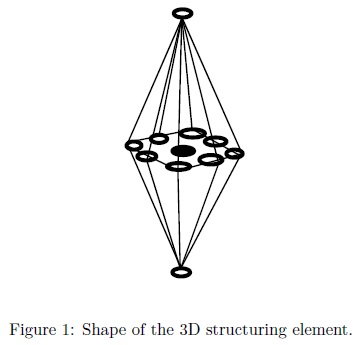
<body><![CDATA[<p>&nbsp;</p>  	    <p align="justify"><font face="verdana" size="2"><b>INTRODUCTION</b></font></p>  	    <p align="justify"><font face="verdana" size="2">Mathematical Morphology (MM) is a technique where the images can be analyzed from a structural point of view. A special field of application of the MM is the segmentation of medical imaging. In particular, in this paper a composition of two morphological transformations defined for the 3D case and capable of separating brain tissue from skull is presented as proposal. The composed transformation takes into consideration the lower leveling&#91;1&#93; and the viscous alternated sequential filters&#91;2&#93;. The lower leveling propagates a marker (the marker is a part of the original image obtained from an operator) at the interior of the original volume in a controlled manner. Hence, the output image is contained into the original one. While the viscous alternated sequential filter allows disconnecting and smoothing chained components&#91;2&#93;. The viscous name appears because when chained components are separated, the output image visually resembles with a viscous effect.</font></p>  	    <p align="justify"><font face="verdana" size="2">The proposal is tested on 20 volumes of MRI T1 taken from the IBSR database&#91;3&#93; to separate brain. In order to compare our results, the Brain Extraction Tool (BET) &#45;which is a popular skull&#45;stripping algorithm&#45; will be used. An important characteristic of BET is its quickness to separate the skull from MRI volumes of the brain. Other algorithms reported in the current literature used to carry out the same task can be found in references &#91;4,5,6,7,8,9,10,11,12&#93;. The composed operator provided in this paper is similar to that presented in &#91;12&#93;. However, there are two significant differences, i) here, the composition is obtained from the application of the lower leveling and the alternated sequential filters; while in &#91;12&#93;, the lower leveling and the viscous opening are utilized; and ii) the execution time to segment the brain is improved in this paper.</font></p>  	    <p align="justify"><font face="verdana" size="2">The computed segmentations will be compared using the Jaccard&#91;13&#93; and Dice&#91;14&#93; indices. It is noteworthy to mention that, in the literature, two problems are associated during the deskulling process, 1) time used to separate brain, and 2) the quality of the segmentation. For example, in &#91;12&#93;, the Jaccard and Dice indices have values around 0.93 and the proposal given to separate brain consumes around 15 minutes. In this paper it is introduced a morphological transformation capable of processing a MRI T1 in 3D with 60 slices in 83 seconds with Jaccard indices around 0.93.</font></p>  	    <p align="justify"><font face="verdana" size="2">This paper is organized as follows, in section Methodology some basic morphological transformations are defined which will be useful to introduce our proposal. In section Results and Discussion, a comparison is made between the segmented brains using our proposal and those obtained from: i) manual segmentations provided by the IBSR database&#91;3&#93;; and ii) BET algorithm implemented in the MRicro software&#91;15&#93;. In Discussion section, the advantages and disadvantages of our proposal are presented. The conclusions correspond to the last section.</font></p>  	    <p>&nbsp;</p>  	    <p align="justify"><font face="verdana" size="2"><b>METHODOLOGY</b></font></p>  	    <p align="justify"><font face="verdana" size="2"><b>Opening by reconstruction</b></font></p>  	    <p align="justify"><font face="verdana" size="2">In MM, the basic transformations are the erosion <i>&#949;<sub>&#956;B</sub></i>(<i>f</i>) and dilation <i>&#948;<sub>&#956;B</sub></i>(<i>f</i>) &#91;16&#93;, where <i>B</i> represents the 3D structuring element which contains its origin in the center. <a href="#f1">Figure 1</a> illustrates the shape of the structuring element used in this paper. <img src="/img/revistas/rmib/v35n3/a2b.jpg"> denotes the transposed set of <i>B</i> respect its origin, <img src="/img/revistas/rmib/v35n3/a2b.jpg"> = {&#151;<i>x : x &isin;</i> B}, <i>&#956;</i> is a size parameter, <i>f</i> is the input image defined on <i>Z</i><sup>3</sup>, <i>Z</i> represents the integer set and <i>x</i> is a point on the definition domain.</font></p>  	    ]]></body>
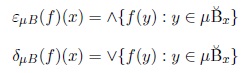
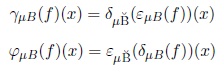
<body><![CDATA[<p align="center"><font face="verdana" size="2"><a name="f1"></a></font></p>  	    <p align="center"><font face="verdana" size="2"><img src="/img/revistas/rmib/v35n3/a2f1.jpg"></font></p>  	    <p align="justify"><font face="verdana" size="2">The morphological erosion and dilation are expressed as follows:</font></p>  	    <p align="center"><font face="verdana" size="2"><img src="/img/revistas/rmib/v35n3/a2i1.jpg"></font></p>  	    <p align="justify"><font face="verdana" size="2">where &#8743; and &#8744; are the <i>inf</i> and <i>sup</i> operators. The morphological erosion and dilation permit to build other type of transformations; these include the morphological opening<img src="/img/revistas/rmib/v35n3/a2r.jpg"><i><sub>&#956;B</sub>(f)</i> and closing <img src="/img/revistas/rmib/v35n3/a2p.jpg"><i><sub>&#956;B</sub>(f)</i>:</font></p>  	    <p align="center"><font face="verdana" size="2"><img src="/img/revistas/rmib/v35n3/a2i2.jpg"></font></p>  	    <p align="justify"><font face="verdana" size="2">In order to reduce the notation, consider that <i>&#956;B = &#956;</i>. The transformations having the characteristics of modifying the regional maxima or minima, without considerably affecting the remaining components, are the opening and closing by reconstruction. These operators use the geodesic transformations&#91;17&#93;. The geodesic dilation <i><img src="/img/revistas/rmib/v35n3/a2i3.jpg"></i>and erosion <i><img src="/img/revistas/rmib/v35n3/a2i4.jpg"></i>are expressed as <i><img src="/img/revistas/rmib/v35n3/a2i3.jpg">= f</i> &and; <i>&#948;<sub>B</sub></i> (<i>g</i>) with <i>g</i> &le; <i>f</i>, and <img src="/img/revistas/rmib/v35n3/a2i4.jpg">= <i>f</i> &or; &#949;<i><sub>B</sub></i> (<i>g</i>) considering <i>g</i> &ge; <i>f</i>, respectively. When function <i>g</i> is equal to the morphological erosion or dilation, and the basic geodesic transformations are iterated until stability, the opening <i><img src="/img/revistas/rmib/v35n3/a2i5.jpg"></i>or closing <i><img src="/img/revistas/rmib/v35n3/a2i6.jpg"></i>by reconstruction are obtained,</font></p>  	    <p align="center"><font face="verdana" size="2"><img src="/img/revistas/rmib/v35n3/a2i7.jpg"></font></p>  	    <p align="justify">&nbsp;</p> 	    <p align="justify"><font face="verdana" size="2"><b>Viscous opening and closing</b></font></p>  	    ]]></body>
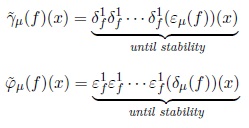
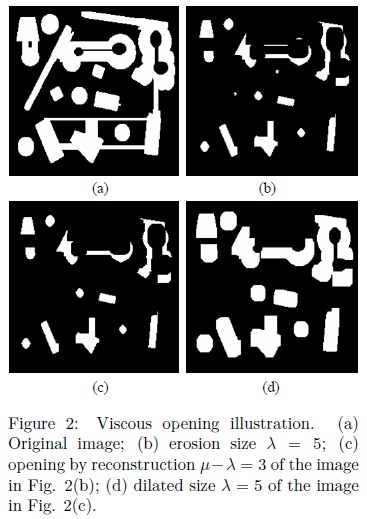
<body><![CDATA[<p align="justify"><font face="verdana" size="2">These transformations allow dealing with overlapped or chained components and provide a solution to disconnect them, formally&#91;2&#93;:</font></p>  	    <p align="center"><font face="verdana" size="2"><img src="/img/revistas/rmib/v35n3/a2e1.jpg"></font></p>  	    <p align="center"><font face="verdana" size="2"><img src="/img/revistas/rmib/v35n3/a2e2.jpg"></font></p>  	    <p align="justify"><font face="verdana" size="2">Viscous opening and closing utilize the parameters <i>&#955;</i> and <i>&#956;.</i> The <i>&#949;<sub>&#955;</sub></i>(<i>f</i>) and <i>&#948;<sub>&#955;</sub></i>(<i>f</i>) are used to detect those components that can be separated. To illustrate this situation consider the image in <a href="#f2">Fig. 2</a>. Original image is presented in <a href="#f2">Fig. 2(a)</a>. In <a href="#f2">Fig. 2(b)</a>, the erosion size <i>&#955; = 5</i> disconnects chained components; posteriorly in <a href="#f2">Fig. 2(c)</a> the opening by reconstruction eliminates the components of size minor than <i>&#956; &#151; &#955; = 3</i> while the remaining components are maintained unchanged. Finally, in <a href="#f2">Fig. 2(d)</a> the dilated image with <i>&#955; = 5</i> recover the size of the original components but now they are disconnected. The components that do not support the erosion and the opening by reconstruction are merged with the background.</font></p>  	    <p align="center"><font face="verdana" size="2"><a name="f2"></a></font></p>  	    <p align="center"><font face="verdana" size="2"><img src="/img/revistas/rmib/v35n3/a2f2.jpg"></font></p>  	    <p align="justify">&nbsp;</p> 	    <p align="justify"><font face="verdana" size="2"><b>Viscous Alternating Sequential Filters (VASFs)</b></font></p>  	    <p align="justify"><font face="verdana" size="2">Serra&#91;18&#93; defined and characterized four operators where the size of the structuring element <i>&#956;</i> is indexed over a size distribution with <i>1</i> &le; <i>&#956;</i> &le; <i>k.</i></font></p>  	    <p align="justify"><font face="verdana" size="2">Let us take one of these operators defined as follows in terms of connected viscous openings and closings&#91;2&#93;:</font></p>  	    ]]></body>
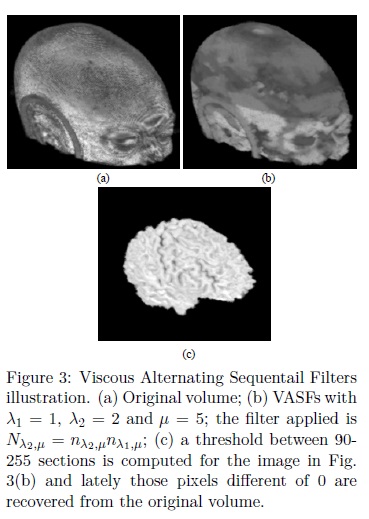
<body><![CDATA[<p align="center"><font face="verdana" size="2"><img src="/img/revistas/rmib/v35n3/a2i8.jpg"></font></p>  	    <p align="justify"><font face="verdana" size="2">For fixed parameters <i>&#955;</i><sub>1</sub>, <i>&#955;</i><sub>2</sub>, with <i>&#955;<sub>1</sub></i>&le; <i>&#955;<sub>2</sub></i> &le; <i>&#956;,</i></font></p>  	    <p align="center"><font face="verdana" size="2"><img src="/img/revistas/rmib/v35n3/a2i9.jpg"></font></p>  	    <p align="justify"><font face="verdana" size="2">From last equation and for a family {<i>&#955;</i><sub><i>i</i></sub>}, with <i>&#955;</i><sub><i>j</i></sub>&le; <i>&#955;<sub>k</sub></i> if <i>j &lt; k,</i> the following VASF is defined&#91;2&#93;:</font></p>  	    <p align="center"><font face="verdana" size="2"><img src="/img/revistas/rmib/v35n3/a2e3.jpg"></font></p>  	    <p align="justify"><font face="verdana" size="2">with the condition <i>&#955;<sub>n</sub></i> &le; <i>&#956;.</i></font></p>  	    <p align="justify"><font face="verdana" size="2">The VASFs will be used to segment some regions of interest. The segmentation process consist in flat the maxima and minima iteratively through the viscous opening and closing. At the end with a threshold is posible to recover the flatened zones under study. <a href="#f3">Fig. 3</a> illustrates the performance of <i>N<sub>&#955;n,&#956;</sub></i>. Notice that, the brain has been completely separated.</font></p>  	    <p align="center"><font face="verdana" size="2"><a name="f3"></a></font></p>  	    <p align="center"><font face="verdana" size="2"><img src="/img/revistas/rmib/v35n3/a2f3.jpg"></font></p>  	    <p align="justify"><font face="verdana" size="2">Nevertheless, the problem of Eq. 3 is that not always produces the same result and parts of the skull can be obtained in the final segmentation. Due to this situation, the VASFs will be used with the lower leveling1 to improve the final result. Lower leveling transformation is presented below.</font></p>     ]]></body>
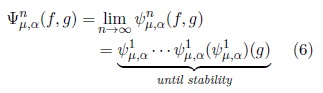
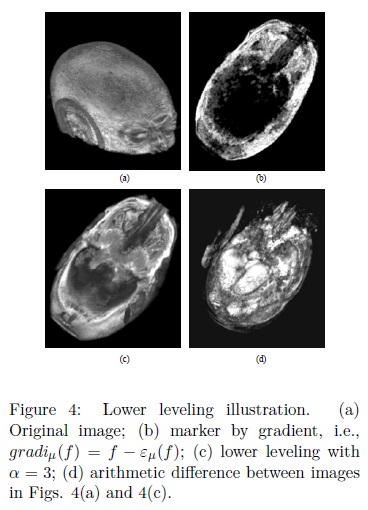
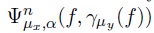
<body><![CDATA[<p align="justify">&nbsp;</p>  	    <p align="justify"><font face="verdana" size="2"><b>Lower Leveling</b></font></p>  	    <p align="justify"><font face="verdana" size="2">The extended lower leveling is expressed as follows&#91;1&#93;:</font></p>  	    <p align="center"><font face="verdana" size="2"><img src="/img/revistas/rmib/v35n3/a2e4.jpg"></font></p>  	    <p align="justify"><font face="verdana" size="2">where <i>f</i> is the reference image, <i>g</i> is a marker, <i>&#945; &isin; </i>&#91;<i>0, 255</i>&#93; is a positive scalar called slope, <i>&#956;</i> and <i>i</i> is the size of the structuring element. The marker <i>g</i> used in this paper corresponds to,</font></p>  	    <p align="center"><font face="verdana" size="2"><img src="/img/revistas/rmib/v35n3/a2e5.jpg"></font></p>  	    <p align="justify"><font face="verdana" size="2">The Eq. 5 is iterated until stability with the purpose of reconstructing the marker <i>g</i> at the interior of the original mask <i>f,</i> i.e.:</font></p>  	    <p align="center"><font face="verdana" size="2"><img src="/img/revistas/rmib/v35n3/a2e6.jpg"></font></p>  	    <p align="justify"><font face="verdana" size="2">The image in <a href="#f4">Fig. 4</a>, ilustrates the performance of Eq. 6. In <a href="#f4">Fig. 4(b)</a> a marker obtained from the internal gradient is shown. The internal gradient is defined as the arithmetic difference between the original image and the eroded one, i.e., <i>gradi<sub>&#956;</sub></i>(<i>f</i>)<i> = f &#151; &#949;<sub>&#956;</sub></i>(<i>f</i>). The internal gradient uniquely detects regions on the skull. The idea of applying Eq. 6 using as marker the internal gradient is to reconstruct precisely the skull. The output image after applying Eq. 6 with <i>&#945; = 3</i> is displayed in <a href="#f4">Fig. 4(c)</a>. In this image the skull has been separated and reconstructed. Hence the arithmetic difference <i>f &#151; <img src="/img/revistas/rmib/v35n3/a2i10.jpg"></i>(<i>f,g</i>), allows us to recover the remaining components, i.e., brain, dura matter, among others, as is illustrated in <a href="#f4">Fig. 4(d)</a>. The problem of separating brain in this way is that the intensity levels of the white matter are similar to the skull bringing as consequence that the marker cannot be obtained uniquely on the bone.</font></p>  	    <p align="center"><font face="verdana" size="2"><a name="f4"></a></font></p>  	    ]]></body>
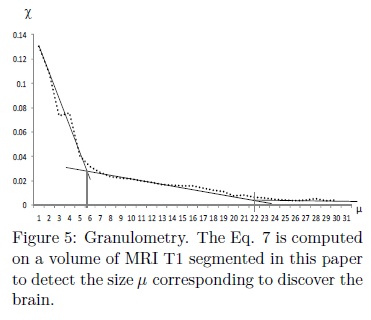
<body><![CDATA[<p align="center"><font face="verdana" size="2"><img src="/img/revistas/rmib/v35n3/a2f4.jpg"></font></p>  	    <p align="justify"><font face="verdana" size="2">On the other hand, the appropriated size of the structuring element to detect the marker utilized in this paper is found through a granulometric study. The granulometry definition is introduced below.</font></p>     <p align="justify">&nbsp;</p>  	    <p align="justify"><font face="verdana" size="2"><b>Granulometry</b></font></p>  	    <p align="justify"><font face="verdana" size="2">Granulometry is the distribution by sizes of particles that constitute an aggregate; it is employed in diverse areas to describe the qualities of size and shape of individual grains within a product. The concept of granulometry was introduced by G. Matheron at the end of the sixties and is presented as follows&#91;19&#93;.</font></p>  	    <p align="justify"><font face="verdana" size="2"><i>Definition (Granulometry). Let (&#968;<sub>&#955;&ge;0</sub>) <sub>&#955;&isin;Z+</sub> be a family of transformations depending on an unique positive parameter &#955;. This family constitutes a granulometry ifand only if the next three properties are verified: (i)&forall; positive &#955;, &#968;<sub>&#955;</sub> is increasing; (ii) &forall; positive &#955;, &#968;<sub>&#955;</sub> is antiextensive, and (iii) &forall; positive &#955; and &#956;, &#968;<sub>&#956;</sub>, = &#968;<sub>&#956;</sub>&#968;<sub>&#955;</sub> = &#968;<sub>max(&#955;,&#956;)</sub></i>.</font></p>  	    <p align="justify"><font face="verdana" size="2">The family of morphological openings and closings for the numerical case {<img src="/img/revistas/rmib/v35n3/a2r.jpg"><i><sub>&#956;</sub></i>}, {<img src="/img/revistas/rmib/v35n3/a2p.jpg"><sub><i>&#956;</i></sub>} with <i>&#956; = {1,...,n}</i> fulfills this last definition. The volume distribution <i>x</i> is computed with Eq. 7:</font></p>  	    <p align="center"><font face="verdana" size="2"><img src="/img/revistas/rmib/v35n3/a2e7.jpg"></font></p>  	    <p align="justify"><font face="verdana" size="2">where <i>vol</i> represents the volume of <i>f,</i> i.e., the sum of all intensity levels into the image. <a href="#f5">Figure 5</a> presents a granulometric study applied on a volume of MRI T1 segmented in this paper. Notice in this figure that, for sizes of <i>&#956;</i> between 1&#45;5 the openings detect a component corresponding to the skull while openings between sizes <i>&#956;</i> in the interval 5&#45;21 detect an important presence of the brain. From this analysis, appropiated sizes of <i>&#956;</i> to detect the marker of the brain using the morphological opening are within the interval <i>&#956; &isin; </i>&#91;6, 22&#93;.</font></p>  	    <p align="center"><font face="verdana" size="2"><a name="f5"></a></font></p>  	    ]]></body>
<body><![CDATA[<p align="center"><font face="verdana" size="2"><img src="/img/revistas/rmib/v35n3/a2f5.jpg"></font></p>  	    <p align="justify"><font face="verdana" size="2">The operators presented so far will be used to introduce a methodology to separate brain in volumes of MRI T1 for the 3D case.</font></p>     <p align="justify">&nbsp;</p>  	    <p align="justify"><font face="verdana" size="2"><b>Methodology to segment brain</b></font></p>  	    <p align="justify"><font face="verdana" size="2">The idea to separate brain and skull consists in combining Eq. 3 and Eq. 6 using as marker the Eq. 5. The separation of the brain consists in: i) to compute a marker of the brain using the morphological opening; ii) posteriorly, the lower leveling will reconstruct the portion of the brain into the head. However, the slope <i>&#945;</i> will avoid the complete reconstruction of the marker at the interior of the volume; and iii) to clean those regions adhered to the reconstructed brain, Eq. 3 will be applied together with a threshold operation.</font></p>  	    <p align="justify"><font face="verdana" size="2">Formally, next filter expresses the aforementioned in steps i, ii and iii,</font></p>  	    <p align="center"><font face="verdana" size="2"><img src="/img/revistas/rmib/v35n3/a2e8.jpg"></font></p>  	    <p align="justify"><font face="verdana" size="2">where <i><img src="/img/revistas/rmib/v35n3/a2r.jpg"><sub>&#956;</sub><sub>y</sub> (f)</i> indicates that a portion of the brain will be reconstruted into the head <i>f</i> through the transformation <img src="/img/revistas/rmib/v35n3/a2i11.jpg">, and lately all regions adhered to the brain are smoothed by applying the VASFs, i.e., <img src="/img/revistas/rmib/v35n3/a2i12.jpg">.</font></p>  	    <p align="justify"><font face="verdana" size="2">Equation 8 is in term of the parameters <i>&#955;<sub>n</sub>, &#956;<sub>z</sub></i>, <i>&#956;</i><sub>x</sub>, &#945; and <i>&#956;<sub>y</sub></i>. Now, an explanation of how selecting the values for these parameters is provided.</font></p>  	    <blockquote> 		    ]]></body>

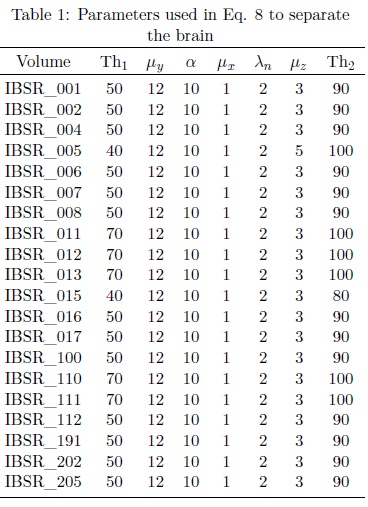
<body><![CDATA[<p align="justify"><font face="verdana" size="2"><i>&#956;<sub>y</sub></i>: This parameter represents the size of the structuring element of the morphological opening <i><img src="/img/revistas/rmib/v35n3/a2r.jpg"><sub>&#956;</sub><sub>y</sub> (f)</i> used to obtain an initial marker of the volume <i>f.</i> According to the granulometric study presented in <a href="#f5">Fig. 5</a> (see section Granulometry), adequate sizes for <i>&#956;<sub>y</sub></i> are contained in the interval <i>&#956;<sub>y</sub> &isin;</i> &#91;6, 22&#93;<i>.</i> In particular, in this paper, <i>&#956;<sub>y</sub>= 12</i> is utilized.</font></p>  		    <p align="justify"><font face="verdana" size="2"><i>&#956;</i><sub>x</sub>: In this paper, <i>&#956;</i><sub>x</sub> takes the value of 1 to reconstruct the marker<i><img src="/img/revistas/rmib/v35n3/a2r.jpg"><sub>&#956;</sub><sub>y</sub></i>(f) as close to the original volume <i>f.</i></font></p>  		    <p align="justify"><font face="verdana" size="2"><i>&#945;</i>: This parameter is used in Eq. 6 and its purpose is to control the propagation of the marker at the interior of the original volume <i>f.</i> When <i>&#945;</i> increases, less volume is reconstructed. In <a href="/img/revistas/rmib/v35n3/a2f6.jpg" target="_blank">Fig. 6</a> this effect is illustrated. Adequated values for <i>a</i> according to the image in Fig 6 are in the interval 6 to 12. With <i>a</i> in this interval, the skull component is almost eliminated. In our case <i>&#945; = 10</i> is considered.</font></p>  		    <p align="justify"><font face="verdana" size="2"><i>&#955;<sub>n</sub>, &#956;<sub>z</sub></i>: These parameters correspond to the VASFs. The task of the VASFs is smoothing the remaining components of the skull after the application of the lower leveling.</font></p>  		    <p align="justify"><font face="verdana" size="2">An example of this situation can be seen in <a href="/img/revistas/rmib/v35n3/a2f6.jpg" target="_blank">Fig. 6(g)</a> where the lower leveling is applied considering <i>&#945; = 9.</i> This example is important because it illustrates the approximate size of the remaining components of the skull that should be eliminated. As described before when the VASFs were introduced, once has been considered the dimension of the bone to be removed, the complete skull is supressed by applying the VASFs with <i>&#955;<sub>n</sub>= 2</i> and <i>&#956;<sub>z</sub>= 5</i> (see <a href="#f3">Fig. 3</a>). However, due to the volumes processed with the VASFs will contain less information after applying the lower leveling, then the <i>&#956;<sub>z</sub></i> parameter can be reduced to 3 instead of 5 with the purpose of reducing the execution time. If <i>&#955;<sub>n</sub> = 2,</i> the minimum value taken by <i>&#956;<sub>z</sub></i> is 3 because of next relation must be fulfilled, <i>&#955;<sub>1</sub></i> &le; <i>&#955;<sub>2</sub></i>&le; <i>&#956;<sub>z</sub></i>, see section of Viscous Alternating Sequential Filters.</font></p>  		    <p>&nbsp;</p> 	</blockquote>  	    <p align="justify"><font face="verdana" size="2"><b>RESULTS AND DISCUSSION</b></font></p>  	    <p align="justify"><font face="verdana" size="2">In this paper, 20 MRIs T1 (denoted as IBSR) of the head taken from the Centre for Morphometric Analysis (CMA) at the Massachusetts General Hospital (<a href="http://www.nitrc.org" target="_blank">http://www.nitrc.org</a>)&#91;3&#93; are processed with Eq. 8. The parameters utilized to separate the brain are shown in <a href="#t1">Table 1</a>. From <a href="#t1">Table 1</a> next comments are presented:</font></p>  	    <p align="center"><font face="verdana" size="2"><a name="t1"></a></font></p>  	    <p align="center"><font face="verdana" size="2"><img src="/img/revistas/rmib/v35n3/a2t1.jpg"></font></p>  	    ]]></body>
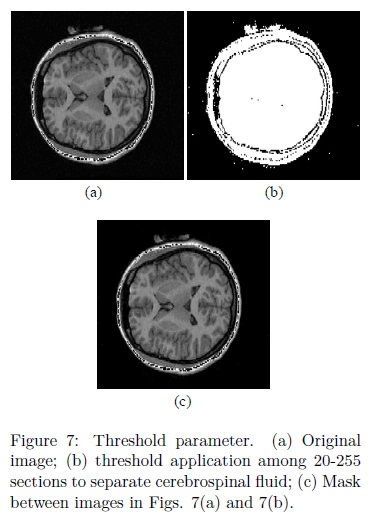
<body><![CDATA[<blockquote> 		    <p align="justify"><font face="verdana" size="2"><b>i.</b> The parameters <i>&#955;<sub>n</sub>, &#956;<sub>z</sub>, &#956;<sub>x</sub>, &#945;, &#956;<sub>y</sub></i> associated to Eq. 8 are similar for all segmented brains.</font></p>  		    <p align="justify"><font face="verdana" size="2"><b>ii.</b> The parameter Th<sub>1</sub> represents a threshold used to eliminate cerebrospinal fluid with the purpose of disconnecting several regions between the brain and skull. According to the results presented in 20, the cerebrospinal fluid is eliminated with threshold values among 20&#45;255 sections. <a href="#f7">Fig. 7</a> illustrates this situation. Original image is located in <a href="#f7">Fig. 7(a)</a>, whilst the threshold among 20&#45;255 sections is presented in <a href="#f7">Fig. 7(b)</a>. Notice that, several components among the brain and the skull have been merged with the background, while the remaining regions are maintained unchanged. In <a href="#f7">Fig. 7(c)</a> it is presented a mask between the original image (7(a)) and the image in <a href="#f7">Fig. 7(b)</a>. The image in <a href="#f7">Fig. 7(c)</a> is convenient during the processing because when the leveling transformation reaches the regions where cerebrospinal fluid was located (dark regions); the propagation of the marker will be slower, obtaining in this way almost the separated brain with the leveling transformation.</font></p>  		    <p align="center"><font face="verdana" size="2"><a name="f7"></a></font></p>  		    <p align="center"><font face="verdana" size="2"><img src="/img/revistas/rmib/v35n3/a2f7.jpg"></font></p>  		    <p align="justify"><font face="verdana" size="2"><b>iii.</b> The selected size of the opening to obtain a marker is <i>&#956;<sub>y</sub>= 12.</i> This value belongs to the interval 6 to 22 according to the graph in <a href="#f5">Fig. 5</a>.</font></p>  		    <p align="justify"><font face="verdana" size="2"><b>iv.</b> The parameter <i>&#955;<sub>n</sub>= 2</i> indicates that the following filter will be applied:</font></p>  		    <p align="center"><font face="verdana" size="2"><img src="/img/revistas/rmib/v35n3/a2e8a.jpg"></font></p>  		    <p align="justify"><font face="verdana" size="2">with <i>&#956;</i> fixed to 3.</font></p>  		    <p align="justify"><font face="verdana" size="2"><b>v.</b> The parameter Th<sub>2</sub> allows recovering the brain region. The threshold value is according to the information provided in &#91;20&#93;, to eliminate dark regions.</font></p> 	</blockquote>  	    ]]></body>
<body><![CDATA[<p align="justify"><font face="verdana" size="2">The algorithm utilized to separate the brain is given as follows. The notation .* , * and <i>&gt;</i> are similar that in Matlab. .* represents the arithmetic multiply of the elements of the matrices in the same positions, * the arithmetic multiply, while <i>&gt;</i> produces a logical image, true(1) for all values fulfilling the condition, and false(0) in other case. <i>Algorithm</i>:</font></p>  	    <blockquote> 	      <p align="justify"><font face="verdana" size="2">a. Load the 3D image and assign to <i>f</i></font></p> 	      <p align="justify"><font face="verdana" size="2">b. threshold1 =1*( f &gt;Th<sub>1</sub>)</font></p> 	      <p align="justify"><font face="verdana" size="2">c. <i>h = f</i> .* threshold11</font></p> 	      <p align="justify"><font face="verdana" size="2">d. <i>&#956;<sub>y</sub>= 12; &#945; = 10, &#955;<sub>n</sub>= 2; &#956;<sub>z</sub>= 3</i></font></p> 	      <p align="justify"><font face="verdana" size="2">e. Compute the marker <i>g = <img src="/img/revistas/rmib/v35n3/a2r.jpg"><sub>&#956;</sub><sub>y</sub></i> (h)</font></p> 	      <p align="justify"><font face="verdana" size="2">f. Iterate Eq. 6 using <i>g = <img src="/img/revistas/rmib/v35n3/a2r.jpg"><sub>&#956;y</sub></i> (h), the result is kept in <i>J</i> that represents <i><img src="/img/revistas/rmib/v35n3/a2i13.jpg">&#945;</i></font></p> 	      <p align="justify"><font face="verdana" size="2">g. Apply the filter <i>N<sub>&#955;n,&#956;</sub></i> to the image <i>J</i> and the resultant image is kept in <i>R</i> that represents &#958;<i><sub>&#955;n, &#956;z, &#956;x,</sub> <sub>&#945;, &#956;y</sub></i></font></p> 	      <p align="justify"><font face="verdana" size="2">h. threshold 2 =1*(R &gt;Th<i><sub>2</sub></i>)</font></p> 	      ]]></body>
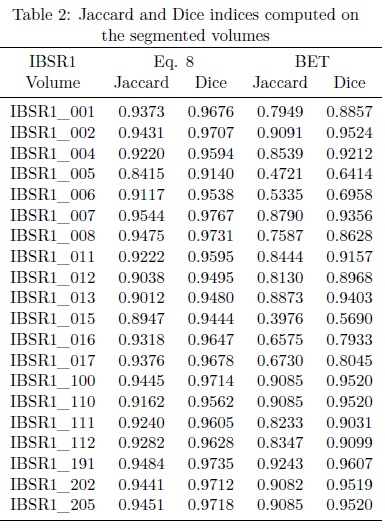
<body><![CDATA[<p align="justify"><font face="verdana" size="2">i. brain=h.* threshold 2</font></p> </blockquote>  	    <p align="justify"><font face="verdana" size="2">In <a href="/img/revistas/rmib/v35n3/a2f8.jpg" target="_blank">Fig. 8</a> several of the steps previously mentioned are illustrated. For implementing the step f of the algorithm, the condition used as stop criterion is the volume, i.e., when the volume of the processed image does not change then the idempotence or stability has been reached.</font></p>  	    <p align="justify"><font face="verdana" size="2">In <a href="/img/revistas/rmib/v35n3/html/a2f9.html" target="_blank">Fig. 9</a> some output images belonging to the volume IBSR_7 (see <a href="/img/revistas/rmib/v35n3/html/a2f9.html" target="_blank">Fig. 9(a)</a>) and processed with the algorithm aforementioned are exhibited, see <a href="/img/revistas/rmib/v35n3/html/a2f9.html" target="_blank">Fig. 9(c)</a>. In order to compare our results, the Jaccard and Dice indices are computed on: i) manual segmentations obtained from the IBSR volumes, and ii) segmentations obtained from the BET algorithm implemented in the MRicro software with default parameters.</font></p>  	    <p align="justify"><font face="verdana" size="2">Some slices of the manual segmentation corresponding to the volume IBSR_7 are presented in <a href="/img/revistas/rmib/v35n3/html/a2f9.html" target="_blank">Fig. 9(b)</a>, while a set of slices belonging to the volume segmented with the MRicro software are displayed in <a href="/img/revistas/rmib/v35n3/html/a2f9.html" target="_blank">Fig. 9(d)</a>. The Jaccard and Dice indices associated to the aforementioned segmentations are presented in <a href="#t2">Table 2</a>.</font></p>  	    <p align="center"><font face="verdana" size="2"><a name="t2"></a></font></p>  	    <p align="center"><font face="verdana" size="2"><img src="/img/revistas/rmib/v35n3/a2t2.jpg"></font></p>  	    <p align="justify"><font face="verdana" size="2">According to the computed indices, the Eq. 8 outperforms the BET algorithm. However there are some points to mention:</font></p>  	    <blockquote> 		    <p align="justify"><font face="verdana" size="2">1. BET algorithm is faster and only requires 2 seconds to segment the volume. Nevertheless, during the segmentation of the brain, this is cropped like a circle, due to this, the Jaccard and Dice indices have minor values than those computed with Eq. 8.</font></p>  		    <p align="justify"><font face="verdana" size="2">2. The proposed algorithm utilizes 83 seconds to segment a brain with 60 slices, and although the time is superior to the BET algorithm, the segmentations are better. In 12, the maximum time reported for other methodologies to separate brain is 35 minutes. Also in &#91;12&#93;, two expressions to segment brain are proposed, the Eq. 9 and Eq. 12. The results obtained in this paper outperform those obtained with Eq. 12 and the reduction of the execution time is considerable. Our algorithm utilizes 83 seconds while Eq. 9 and Eq. 12 employ 174 and 354 seconds to process a volume of 60 slices respectively.</font></p>  		    ]]></body>
<body><![CDATA[<p>&nbsp;</p> 	</blockquote>  	    <p align="justify"><font face="verdana" size="2"><b>CONCLUSIONS</b></font></p>  	    <p align="justify"><font face="verdana" size="2">In this paper a morphological transformation is presented to segment brain from MRI T1 of the head. The Jaccard and Dice indices indicate that our proposal provides better segmentations than those obtained from the BET algorithm which is very popular software among the scientific community. The time used to separate the brain with our proposal is adequate (83 seconds for a volume of 60 slices), in addition the algorithm can be implemented with Matlab because several of the required transformations are already implemented in such software.</font></p>  	    <p>&nbsp;</p>  	    <p align="justify"><font face="verdana" size="2"><b>REFERENCES</b></font></p>  	    <!-- ref --><p align="justify"><font face="verdana" size="2">1. Mendiola&#45;Santiba&ntilde;ez JD, Terol&#45;Villalobos IR, Jimenez Sanchez AR, Gallegos&#45;Duarte M, Rodriguez&#45;Res&eacute;ndiz J, Santill&aacute;n I. Application of morphological connected openings and levelings on magnetic resonance images of the brain. Int J Imaging Syst Technol, 2011; 21(4): 336&#45;348.    &nbsp;&nbsp;&nbsp;&nbsp;&nbsp;&nbsp;&nbsp;&nbsp;[&#160;<a href="javascript:void(0);" onclick="javascript: window.open('/scielo.php?script=sci_nlinks&ref=8563906&pid=S0188-9532201400030000200001&lng=','','width=640,height=500,resizable=yes,scrollbars=1,menubar=yes,');">Links</a>&#160;]<!-- end-ref --></font></p>  	    <!-- ref --><p align="justify"><font face="verdana" size="2">2. Santill&aacute;n I, Herrera&#45;Navarro AM, Mendiola&#45;Santib&aacute;&ntilde;ez JD, Terol&#45;Villalobos IR. Morphological Connected Filtering on Viscous Lattices. Journal of Mathematical Imaging and Vision, 2010; 36(3): 254&#45;269.    &nbsp;&nbsp;&nbsp;&nbsp;&nbsp;&nbsp;&nbsp;&nbsp;[&#160;<a href="javascript:void(0);" onclick="javascript: window.open('/scielo.php?script=sci_nlinks&ref=8563908&pid=S0188-9532201400030000200002&lng=','','width=640,height=500,resizable=yes,scrollbars=1,menubar=yes,');">Links</a>&#160;]<!-- end-ref --></font></p>  	    <!-- ref --><p align="justify"><font face="verdana" size="2">3. Center for Morphometric Analysis. Massachu setts General Hospital, The Internet Brain Segmentation Repository (<a href="http://www.nitrc.org/projects/ibsr" target="_blank">http://www.nitrc.org/projects/ibsr</a>), IBSR 2014.    &nbsp;&nbsp;&nbsp;&nbsp;&nbsp;&nbsp;&nbsp;&nbsp;[&#160;<a href="javascript:void(0);" onclick="javascript: window.open('/scielo.php?script=sci_nlinks&ref=8563910&pid=S0188-9532201400030000200003&lng=','','width=640,height=500,resizable=yes,scrollbars=1,menubar=yes,');">Links</a>&#160;]<!-- end-ref --></font></p>  	    <!-- ref --><p align="justify"><font face="verdana" size="2">4. Liu JX, Chen YS, Chen LF. Accurate and robust extraction of brain regions using a deformable model based on radial basis functions. Journal of Neuroscience Methods, 2009; 183(2):255&#45;266.    &nbsp;&nbsp;&nbsp;&nbsp;&nbsp;&nbsp;&nbsp;&nbsp;[&#160;<a href="javascript:void(0);" onclick="javascript: window.open('/scielo.php?script=sci_nlinks&ref=8563912&pid=S0188-9532201400030000200004&lng=','','width=640,height=500,resizable=yes,scrollbars=1,menubar=yes,');">Links</a>&#160;]<!-- end-ref --></font></p>  	    <!-- ref --><p align="justify"><font face="verdana" size="2">5. Smith SM. Fast robust automated brain extraction. Hum Brain Mapp, 2002; 17(3):143&#45;155.    &nbsp;&nbsp;&nbsp;&nbsp;&nbsp;&nbsp;&nbsp;&nbsp;[&#160;<a href="javascript:void(0);" onclick="javascript: window.open('/scielo.php?script=sci_nlinks&ref=8563914&pid=S0188-9532201400030000200005&lng=','','width=640,height=500,resizable=yes,scrollbars=1,menubar=yes,');">Links</a>&#160;]<!-- end-ref --></font></p>  	    <!-- ref --><p align="justify"><font face="verdana" size="2">6. Hahn H, Peitgen H&#45;O. The skull stripping problem in MRI solved by a single 3D watershed transform. In Proc MICCAI, LNCS, 2000; 1935:134&#45;143.    &nbsp;&nbsp;&nbsp;&nbsp;&nbsp;&nbsp;&nbsp;&nbsp;[&#160;<a href="javascript:void(0);" onclick="javascript: window.open('/scielo.php?script=sci_nlinks&ref=8563916&pid=S0188-9532201400030000200006&lng=','','width=640,height=500,resizable=yes,scrollbars=1,menubar=yes,');">Links</a>&#160;]<!-- end-ref --></font></p>  	    <!-- ref --><p align="justify"><font face="verdana" size="2">7. Beare R, Chen J, Christopher AL, Silk T, Thompson DK, Yang JYM, et al. Brain extraction using the watershed transform from markers. Frontiers in Neuroinformatics, 2013; 7(32):1&#45;15.    &nbsp;&nbsp;&nbsp;&nbsp;&nbsp;&nbsp;&nbsp;&nbsp;[&#160;<a href="javascript:void(0);" onclick="javascript: window.open('/scielo.php?script=sci_nlinks&ref=8563918&pid=S0188-9532201400030000200007&lng=','','width=640,height=500,resizable=yes,scrollbars=1,menubar=yes,');">Links</a>&#160;]<!-- end-ref --></font></p>  	    <!-- ref --><p align="justify"><font face="verdana" size="2">8. Dogdas B, Shattuck DW, Leahy RM. Segmentation of skull and scalp in 3&#45;D human MRI using mathematical morphology. Hum Brain Mapp, 2005; 26(4):273&#45;285.    &nbsp;&nbsp;&nbsp;&nbsp;&nbsp;&nbsp;&nbsp;&nbsp;[&#160;<a href="javascript:void(0);" onclick="javascript: window.open('/scielo.php?script=sci_nlinks&ref=8563920&pid=S0188-9532201400030000200008&lng=','','width=640,height=500,resizable=yes,scrollbars=1,menubar=yes,');">Links</a>&#160;]<!-- end-ref --></font></p>  	    <!-- ref --><p align="justify"><font face="verdana" size="2">9. Sandor S, Leahy R. Surface&#45;based labeling of cortical anatomy using a deformable database. IEEE Trans Med Imaging, 1997; 16(1):41&#45;54.    &nbsp;&nbsp;&nbsp;&nbsp;&nbsp;&nbsp;&nbsp;&nbsp;[&#160;<a href="javascript:void(0);" onclick="javascript: window.open('/scielo.php?script=sci_nlinks&ref=8563922&pid=S0188-9532201400030000200009&lng=','','width=640,height=500,resizable=yes,scrollbars=1,menubar=yes,');">Links</a>&#160;]<!-- end-ref --></font></p>  	    <!-- ref --><p align="justify"><font face="verdana" size="2">10. S&eacute;gonne F, Dale AM, Busa E, Glessner M, Salat D, Hahn HK, Fischl B. A hybrid approach to the skull stripping problem in MRI. NeuroImage, 2004, 22(3):1060&#45;1075.    &nbsp;&nbsp;&nbsp;&nbsp;&nbsp;&nbsp;&nbsp;&nbsp;[&#160;<a href="javascript:void(0);" onclick="javascript: window.open('/scielo.php?script=sci_nlinks&ref=8563924&pid=S0188-9532201400030000200010&lng=','','width=640,height=500,resizable=yes,scrollbars=1,menubar=yes,');">Links</a>&#160;]<!-- end-ref --></font></p>  	    <!-- ref --><p align="justify"><font face="verdana" size="2">11. Iglesias JE, Liu CY, Thompson PM, Tu Z. Robust Brain Extraction Across Datasets and Comparison With Publicly Available Methods. IEEE Transactions on Medical Imaging, 2011; 30(9): 1617&#45;1634.    &nbsp;&nbsp;&nbsp;&nbsp;&nbsp;&nbsp;&nbsp;&nbsp;[&#160;<a href="javascript:void(0);" onclick="javascript: window.open('/scielo.php?script=sci_nlinks&ref=8563926&pid=S0188-9532201400030000200011&lng=','','width=640,height=500,resizable=yes,scrollbars=1,menubar=yes,');">Links</a>&#160;]<!-- end-ref --></font></p>  	    <!-- ref --><p align="justify"><font face="verdana" size="2">12. Mendiola&#45;Santiba&ntilde;ez JD, Gallegos&#45;Duarte M, Arias&#45;Estrada MO, Santill&aacute;n&#45;M&eacute;ndez I, Rodr&iacute;guez&#45;Res&eacute;ndiz J, Terol&#45;Villalobos IT. Sequential application of viscous opening and lower leveling for three&#45;dimensional brain extraction on magnetic resonance imaging t1. J. Electron. Imaging. 0001; 23(3):033010. doi: 10.1117/1.JEI. 23.3. 033010, 2014.    &nbsp;&nbsp;&nbsp;&nbsp;&nbsp;&nbsp;&nbsp;&nbsp;[&#160;<a href="javascript:void(0);" onclick="javascript: window.open('/scielo.php?script=sci_nlinks&ref=8563928&pid=S0188-9532201400030000200012&lng=','','width=640,height=500,resizable=yes,scrollbars=1,menubar=yes,');">Links</a>&#160;]<!-- end-ref --></font></p>  	    <!-- ref --><p align="justify"><font face="verdana" size="2">13. Jaccard P. The distribution of the flora in the alpine zone. New Phytologist, 1912;11(2):37&#45;50.    &nbsp;&nbsp;&nbsp;&nbsp;&nbsp;&nbsp;&nbsp;&nbsp;[&#160;<a href="javascript:void(0);" onclick="javascript: window.open('/scielo.php?script=sci_nlinks&ref=8563930&pid=S0188-9532201400030000200013&lng=','','width=640,height=500,resizable=yes,scrollbars=1,menubar=yes,');">Links</a>&#160;]<!-- end-ref --></font></p>  	    <!-- ref --><p align="justify"><font face="verdana" size="2">14. Dice LR. Measures of the amount of ecologic association between species. Journal of Ecology, 1945; 26(3): 297&#45;302.    &nbsp;&nbsp;&nbsp;&nbsp;&nbsp;&nbsp;&nbsp;&nbsp;[&#160;<a href="javascript:void(0);" onclick="javascript: window.open('/scielo.php?script=sci_nlinks&ref=8563932&pid=S0188-9532201400030000200014&lng=','','width=640,height=500,resizable=yes,scrollbars=1,menubar=yes,');">Links</a>&#160;]<!-- end-ref --></font></p>  	    <!-- ref --><p align="justify"><font face="verdana" size="2">15. Rorden C, Brett M. Stereotaxic display of brain lesions. In Behavioural Neurology, 2000; 12(4): 191&#45;200.    &nbsp;&nbsp;&nbsp;&nbsp;&nbsp;&nbsp;&nbsp;&nbsp;[&#160;<a href="javascript:void(0);" onclick="javascript: window.open('/scielo.php?script=sci_nlinks&ref=8563934&pid=S0188-9532201400030000200015&lng=','','width=640,height=500,resizable=yes,scrollbars=1,menubar=yes,');">Links</a>&#160;]<!-- end-ref --></font></p>  	    <!-- ref --><p align="justify"><font face="verdana" size="2">16. Heijmans H. Morphological Image Operators. Academic Press (USA), 1994.    &nbsp;&nbsp;&nbsp;&nbsp;&nbsp;&nbsp;&nbsp;&nbsp;[&#160;<a href="javascript:void(0);" onclick="javascript: window.open('/scielo.php?script=sci_nlinks&ref=8563936&pid=S0188-9532201400030000200016&lng=','','width=640,height=500,resizable=yes,scrollbars=1,menubar=yes,');">Links</a>&#160;]<!-- end-ref --></font></p>  	    <!-- ref --><p align="justify"><font face="verdana" size="2">17. Vincent L. Morphological grayscale reconstruction in image analysis: applications and efficient algorithms. IEEE Transactions on Medical Imaging, 1993; 2(2):176&#45;201.    &nbsp;&nbsp;&nbsp;&nbsp;&nbsp;&nbsp;&nbsp;&nbsp;[&#160;<a href="javascript:void(0);" onclick="javascript: window.open('/scielo.php?script=sci_nlinks&ref=8563938&pid=S0188-9532201400030000200017&lng=','','width=640,height=500,resizable=yes,scrollbars=1,menubar=yes,');">Links</a>&#160;]<!-- end-ref --></font></p>  	    <!-- ref --><p align="justify"><font face="verdana" size="2">18. Serra J. Image Analysis and Mathematical Morphology. Theoretical Advances, vol. 2. Academic Press (San Diego), 1988.    &nbsp;&nbsp;&nbsp;&nbsp;&nbsp;&nbsp;&nbsp;&nbsp;[&#160;<a href="javascript:void(0);" onclick="javascript: window.open('/scielo.php?script=sci_nlinks&ref=8563940&pid=S0188-9532201400030000200018&lng=','','width=640,height=500,resizable=yes,scrollbars=1,menubar=yes,');">Links</a>&#160;]<!-- end-ref --></font></p>  	    <!-- ref --><p align="justify"><font face="verdana" size="2">19. Matheron G. Random sets and integral geometry. En: John Wiley and Sons (New York), 1975.    &nbsp;&nbsp;&nbsp;&nbsp;&nbsp;&nbsp;&nbsp;&nbsp;[&#160;<a href="javascript:void(0);" onclick="javascript: window.open('/scielo.php?script=sci_nlinks&ref=8563942&pid=S0188-9532201400030000200019&lng=','','width=640,height=500,resizable=yes,scrollbars=1,menubar=yes,');">Links</a>&#160;]<!-- end-ref --></font></p>  	    <!-- ref --><p align="justify"><font face="verdana" size="2">20. Mendiola&#45;Santib&aacute;&ntilde;ez JD, Terol&#45;Villalobos IR, Herrera&#45;Ruiz G, Fern&aacute;ndez&#45;Bouzas A. Morphological contrast measure and contrast enhancement: One application to the segmentation of brain MRI. Signal Processing, 2007, 87(9): 2125&#45;2150.    &nbsp;&nbsp;&nbsp;&nbsp;&nbsp;&nbsp;&nbsp;&nbsp;[&#160;<a href="javascript:void(0);" onclick="javascript: window.open('/scielo.php?script=sci_nlinks&ref=8563944&pid=S0188-9532201400030000200020&lng=','','width=640,height=500,resizable=yes,scrollbars=1,menubar=yes,');">Links</a>&#160;]<!-- end-ref --></font></p>      ]]></body><back>
<ref-list>
<ref id="B1">
<label>1</label><nlm-citation citation-type="journal">
<person-group person-group-type="author">
<name>
<surname><![CDATA[Mendiola-Santibañez]]></surname>
<given-names><![CDATA[JD]]></given-names>
</name>
<name>
<surname><![CDATA[Terol-Villalobos]]></surname>
<given-names><![CDATA[IR]]></given-names>
</name>
<name>
<surname><![CDATA[Jimenez Sanchez]]></surname>
<given-names><![CDATA[AR]]></given-names>
</name>
<name>
<surname><![CDATA[Gallegos-Duarte]]></surname>
<given-names><![CDATA[M]]></given-names>
</name>
<name>
<surname><![CDATA[Rodriguez-Reséndiz]]></surname>
<given-names><![CDATA[J]]></given-names>
</name>
<name>
<surname><![CDATA[Santillán]]></surname>
<given-names><![CDATA[I.]]></given-names>
</name>
</person-group>
<article-title xml:lang="en"><![CDATA[Application of morphological connected openings and levelings on magnetic resonance images of the brain]]></article-title>
<source><![CDATA[Int J Imaging Syst Technol]]></source>
<year>2011</year>
<volume>21</volume>
<numero>4</numero>
<issue>4</issue>
<page-range>336-348</page-range></nlm-citation>
</ref>
<ref id="B2">
<label>2</label><nlm-citation citation-type="journal">
<person-group person-group-type="author">
<name>
<surname><![CDATA[Santillán]]></surname>
<given-names><![CDATA[I]]></given-names>
</name>
<name>
<surname><![CDATA[Herrera-Navarro]]></surname>
<given-names><![CDATA[AM]]></given-names>
</name>
<name>
<surname><![CDATA[Mendiola-Santibáñez]]></surname>
<given-names><![CDATA[JD]]></given-names>
</name>
<name>
<surname><![CDATA[Terol-Villalobos]]></surname>
<given-names><![CDATA[IR.]]></given-names>
</name>
</person-group>
<article-title xml:lang="en"><![CDATA[Morphological Connected Filtering on Viscous Lattices]]></article-title>
<source><![CDATA[Journal of Mathematical Imaging and Vision]]></source>
<year>2010</year>
<volume>36</volume>
<numero>3</numero>
<issue>3</issue>
<page-range>254-269</page-range></nlm-citation>
</ref>
<ref id="B3">
<label>3</label><nlm-citation citation-type="book">
<collab>Massachu setts General Hospital^dCenter for Morphometric Analysis</collab>
<source><![CDATA[The Internet Brain Segmentation Repository]]></source>
<year></year>
<publisher-name><![CDATA[IBSR 2014]]></publisher-name>
</nlm-citation>
</ref>
<ref id="B4">
<label>4</label><nlm-citation citation-type="journal">
<person-group person-group-type="author">
<name>
<surname><![CDATA[Liu]]></surname>
<given-names><![CDATA[JX]]></given-names>
</name>
<name>
<surname><![CDATA[Chen]]></surname>
<given-names><![CDATA[YS]]></given-names>
</name>
<name>
<surname><![CDATA[Chen]]></surname>
<given-names><![CDATA[LF.]]></given-names>
</name>
</person-group>
<article-title xml:lang="en"><![CDATA[Accurate and robust extraction of brain regions using a deformable model based on radial basis functions]]></article-title>
<source><![CDATA[Journal of Neuroscience Methods]]></source>
<year>2009</year>
<volume>183</volume>
<numero>2</numero>
<issue>2</issue>
<page-range>255-266</page-range></nlm-citation>
</ref>
<ref id="B5">
<label>5</label><nlm-citation citation-type="journal">
<person-group person-group-type="author">
<name>
<surname><![CDATA[Smith]]></surname>
<given-names><![CDATA[SM.]]></given-names>
</name>
</person-group>
<article-title xml:lang="en"><![CDATA[Fast robust automated brain extraction]]></article-title>
<source><![CDATA[Hum Brain Mapp]]></source>
<year>2002</year>
<volume>17</volume>
<numero>3</numero>
<issue>3</issue>
<page-range>143-155</page-range></nlm-citation>
</ref>
<ref id="B6">
<label>6</label><nlm-citation citation-type="journal">
<person-group person-group-type="author">
<name>
<surname><![CDATA[Hahn]]></surname>
<given-names><![CDATA[H]]></given-names>
</name>
<name>
<surname><![CDATA[Peitgen]]></surname>
<given-names><![CDATA[H-O.]]></given-names>
</name>
</person-group>
<article-title xml:lang="en"><![CDATA[The skull stripping problem in MRI solved by a single 3D watershed transform]]></article-title>
<source><![CDATA[Proc MICCAI, LNCS]]></source>
<year>2000</year>
<volume>1935</volume>
<page-range>134-143</page-range></nlm-citation>
</ref>
<ref id="B7">
<label>7</label><nlm-citation citation-type="journal">
<person-group person-group-type="author">
<name>
<surname><![CDATA[Beare]]></surname>
<given-names><![CDATA[R]]></given-names>
</name>
<name>
<surname><![CDATA[Chen]]></surname>
<given-names><![CDATA[J]]></given-names>
</name>
<name>
<surname><![CDATA[Christopher]]></surname>
<given-names><![CDATA[AL]]></given-names>
</name>
<name>
<surname><![CDATA[Silk]]></surname>
<given-names><![CDATA[T]]></given-names>
</name>
<name>
<surname><![CDATA[Thompson]]></surname>
<given-names><![CDATA[DK]]></given-names>
</name>
<name>
<surname><![CDATA[Yang]]></surname>
<given-names><![CDATA[JYM]]></given-names>
</name>
</person-group>
<article-title xml:lang="en"><![CDATA[Brain extraction using the watershed transform from markers]]></article-title>
<source><![CDATA[Frontiers in Neuroinformatics]]></source>
<year>2013</year>
<volume>7</volume>
<numero>32</numero>
<issue>32</issue>
<page-range>1-15</page-range></nlm-citation>
</ref>
<ref id="B8">
<label>8</label><nlm-citation citation-type="journal">
<person-group person-group-type="author">
<name>
<surname><![CDATA[Dogdas]]></surname>
<given-names><![CDATA[B]]></given-names>
</name>
<name>
<surname><![CDATA[DW]]></surname>
<given-names><![CDATA[Shattuck]]></given-names>
</name>
<name>
<surname><![CDATA[Leahy]]></surname>
<given-names><![CDATA[RM]]></given-names>
</name>
</person-group>
<article-title xml:lang="en"><![CDATA[Segmentation of skull and scalp in 3-D human MRI using mathematical morphology]]></article-title>
<source><![CDATA[Hum Brain Mapp]]></source>
<year>2005</year>
<volume>26</volume>
<numero>4</numero>
<issue>4</issue>
<page-range>273-285</page-range></nlm-citation>
</ref>
<ref id="B9">
<label>9</label><nlm-citation citation-type="journal">
<person-group person-group-type="author">
<name>
<surname><![CDATA[Sandor]]></surname>
<given-names><![CDATA[S]]></given-names>
</name>
<name>
<surname><![CDATA[Leahy]]></surname>
<given-names><![CDATA[R.]]></given-names>
</name>
</person-group>
<article-title xml:lang="en"><![CDATA[Surface-based labeling of cortical anatomy using a deformable database]]></article-title>
<source><![CDATA[IEEE Trans Med Imaging]]></source>
<year>1997</year>
<volume>16</volume>
<numero>1</numero>
<issue>1</issue>
<page-range>41-54</page-range></nlm-citation>
</ref>
<ref id="B10">
<label>10</label><nlm-citation citation-type="journal">
<person-group person-group-type="author">
<name>
<surname><![CDATA[Ségonne]]></surname>
<given-names><![CDATA[F]]></given-names>
</name>
<name>
<surname><![CDATA[Dale]]></surname>
<given-names><![CDATA[AM]]></given-names>
</name>
<name>
<surname><![CDATA[Busa]]></surname>
<given-names><![CDATA[E]]></given-names>
</name>
<name>
<surname><![CDATA[Glessner]]></surname>
<given-names><![CDATA[M]]></given-names>
</name>
<name>
<surname><![CDATA[Salat]]></surname>
<given-names><![CDATA[D]]></given-names>
</name>
<name>
<surname><![CDATA[Hahn]]></surname>
<given-names><![CDATA[HK]]></given-names>
</name>
<name>
<surname><![CDATA[Fischl]]></surname>
<given-names><![CDATA[B.]]></given-names>
</name>
</person-group>
<article-title xml:lang="en"><![CDATA[A hybrid approach to the skull stripping problem in MRI]]></article-title>
<source><![CDATA[NeuroImage]]></source>
<year>2004</year>
<volume>22</volume>
<numero>3</numero>
<issue>3</issue>
<page-range>1060-1075</page-range></nlm-citation>
</ref>
<ref id="B11">
<label>11</label><nlm-citation citation-type="journal">
<person-group person-group-type="author">
<name>
<surname><![CDATA[Iglesias]]></surname>
<given-names><![CDATA[JE]]></given-names>
</name>
<name>
<surname><![CDATA[Liu]]></surname>
<given-names><![CDATA[CY]]></given-names>
</name>
<name>
<surname><![CDATA[Thompson]]></surname>
<given-names><![CDATA[PM]]></given-names>
</name>
<name>
<surname><![CDATA[Tu]]></surname>
<given-names><![CDATA[Z.]]></given-names>
</name>
</person-group>
<article-title xml:lang="en"><![CDATA[Robust Brain Extraction Across Datasets and Comparison With Publicly Available Methods]]></article-title>
<source><![CDATA[IEEE Transactions on Medical Imaging]]></source>
<year>2011</year>
<volume>30</volume>
<numero>9</numero>
<issue>9</issue>
<page-range>1617-1634</page-range></nlm-citation>
</ref>
<ref id="B12">
<label>12</label><nlm-citation citation-type="journal">
<person-group person-group-type="author">
<name>
<surname><![CDATA[Mendiola-Santibañez]]></surname>
<given-names><![CDATA[JD]]></given-names>
</name>
<name>
<surname><![CDATA[Gallegos-Duarte]]></surname>
<given-names><![CDATA[M]]></given-names>
</name>
<name>
<surname><![CDATA[Arias-Estrada]]></surname>
<given-names><![CDATA[MO]]></given-names>
</name>
<name>
<surname><![CDATA[Santillán-Méndez]]></surname>
<given-names><![CDATA[I]]></given-names>
</name>
<name>
<surname><![CDATA[Rodríguez-Reséndiz]]></surname>
<given-names><![CDATA[J]]></given-names>
</name>
<name>
<surname><![CDATA[Terol-Villalobos]]></surname>
<given-names><![CDATA[IT]]></given-names>
</name>
</person-group>
<article-title xml:lang="en"><![CDATA[Sequential application of viscous opening and lower leveling for three-dimensional brain extraction on magnetic resonance imaging t1]]></article-title>
<source><![CDATA[J. Electron. Imaging]]></source>
<year>2014</year>
<volume>23</volume>
<numero>3</numero>
<issue>3</issue>
<page-range>033010</page-range></nlm-citation>
</ref>
<ref id="B13">
<label>13</label><nlm-citation citation-type="journal">
<person-group person-group-type="author">
<name>
<surname><![CDATA[Jaccard]]></surname>
<given-names><![CDATA[P.]]></given-names>
</name>
</person-group>
<article-title xml:lang="en"><![CDATA[The distribution of the flora in the alpine zone]]></article-title>
<source><![CDATA[New Phytologist]]></source>
<year>1912</year>
<volume>11</volume>
<numero>2</numero>
<issue>2</issue>
<page-range>37-50</page-range></nlm-citation>
</ref>
<ref id="B14">
<label>14</label><nlm-citation citation-type="journal">
<person-group person-group-type="author">
<name>
<surname><![CDATA[Dice]]></surname>
<given-names><![CDATA[LR.]]></given-names>
</name>
</person-group>
<article-title xml:lang="en"><![CDATA[Measures of the amount of ecologic association between species]]></article-title>
<source><![CDATA[Journal of Ecology]]></source>
<year>1945</year>
<volume>26</volume>
<numero>3</numero>
<issue>3</issue>
<page-range>297-302</page-range></nlm-citation>
</ref>
<ref id="B15">
<label>15</label><nlm-citation citation-type="journal">
<person-group person-group-type="author">
<name>
<surname><![CDATA[Rorden]]></surname>
<given-names><![CDATA[C]]></given-names>
</name>
<name>
<surname><![CDATA[Brett]]></surname>
<given-names><![CDATA[M.]]></given-names>
</name>
</person-group>
<article-title xml:lang="en"><![CDATA[Stereotaxic display of brain lesions]]></article-title>
<source><![CDATA[Behavioural Neurology]]></source>
<year>2000</year>
<volume>12</volume>
<numero>4</numero>
<issue>4</issue>
<page-range>191-200</page-range></nlm-citation>
</ref>
<ref id="B16">
<label>16</label><nlm-citation citation-type="book">
<person-group person-group-type="author">
<name>
<surname><![CDATA[Heijmans]]></surname>
<given-names><![CDATA[H.]]></given-names>
</name>
</person-group>
<source><![CDATA[Morphological Image Operators]]></source>
<year>1994</year>
<publisher-name><![CDATA[Academic Press]]></publisher-name>
</nlm-citation>
</ref>
<ref id="B17">
<label>17</label><nlm-citation citation-type="journal">
<person-group person-group-type="author">
<name>
<surname><![CDATA[Vincent]]></surname>
<given-names><![CDATA[L.]]></given-names>
</name>
</person-group>
<article-title xml:lang="en"><![CDATA[Morphological grayscale reconstruction in image analysis: applications and efficient algorithms]]></article-title>
<source><![CDATA[IEEE Transactions on Medical Imaging]]></source>
<year>1993</year>
<volume>2</volume>
<numero>2</numero>
<issue>2</issue>
<page-range>176-201</page-range></nlm-citation>
</ref>
<ref id="B18">
<label>18</label><nlm-citation citation-type="book">
<person-group person-group-type="author">
<name>
<surname><![CDATA[Serra]]></surname>
<given-names><![CDATA[J.]]></given-names>
</name>
</person-group>
<source><![CDATA[Image Analysis and Mathematical Morphology. Theoretical Advances]]></source>
<year>1988</year>
<volume>2</volume>
<publisher-loc><![CDATA[San Diego ]]></publisher-loc>
<publisher-name><![CDATA[Academic Press]]></publisher-name>
</nlm-citation>
</ref>
<ref id="B19">
<label>19</label><nlm-citation citation-type="book">
<person-group person-group-type="author">
<name>
<surname><![CDATA[Matheron]]></surname>
<given-names><![CDATA[G]]></given-names>
</name>
</person-group>
<article-title xml:lang="en"><![CDATA[Random sets and integral geometry]]></article-title>
<source><![CDATA[]]></source>
<year>1975</year>
<publisher-loc><![CDATA[New York ]]></publisher-loc>
<publisher-name><![CDATA[John Wiley and Sons]]></publisher-name>
</nlm-citation>
</ref>
<ref id="B20">
<label>20</label><nlm-citation citation-type="journal">
<person-group person-group-type="author">
<name>
<surname><![CDATA[Mendiola-Santibáñez]]></surname>
<given-names><![CDATA[JD]]></given-names>
</name>
<name>
<surname><![CDATA[Terol-Villalobos]]></surname>
<given-names><![CDATA[IR]]></given-names>
</name>
<name>
<surname><![CDATA[Herrera-Ruiz]]></surname>
<given-names><![CDATA[G]]></given-names>
</name>
<name>
<surname><![CDATA[Fernández-Bouzas]]></surname>
<given-names><![CDATA[A.]]></given-names>
</name>
</person-group>
<article-title xml:lang="en"><![CDATA[Morphological contrast measure and contrast enhancement: One application to the segmentation of brain MRI]]></article-title>
<source><![CDATA[Signal Processing]]></source>
<year>2007</year>
<volume>87</volume>
<numero>9</numero>
<issue>9</issue>
<page-range>2125-2150</page-range></nlm-citation>
</ref>
</ref-list>
</back>
</article>