<?xml version="1.0" encoding="ISO-8859-1"?><article xmlns:mml="http://www.w3.org/1998/Math/MathML" xmlns:xlink="http://www.w3.org/1999/xlink" xmlns:xsi="http://www.w3.org/2001/XMLSchema-instance">
<front>
<journal-meta>
<journal-id>0188-9532</journal-id>
<journal-title><![CDATA[Revista mexicana de ingeniería biomédica]]></journal-title>
<abbrev-journal-title><![CDATA[Rev. mex. ing. bioméd]]></abbrev-journal-title>
<issn>0188-9532</issn>
<publisher>
<publisher-name><![CDATA[Sociedad Mexicana de Ingeniería Biomédica]]></publisher-name>
</publisher>
</journal-meta>
<article-meta>
<article-id>S0188-95322012000100005</article-id>
<title-group>
<article-title xml:lang="en"><![CDATA[Interactive simulators to study the passive properties of the axon and the dendritic tree]]></article-title>
<article-title xml:lang="es"><![CDATA[Simuladores interactivos para estudiar las propiedades pasivas del axón y del árbol dendrítico]]></article-title>
</title-group>
<contrib-group>
<contrib contrib-type="author">
<name>
<surname><![CDATA[Reyes Lazalde]]></surname>
<given-names><![CDATA[Arturo]]></given-names>
</name>
<xref ref-type="aff" rid="A01"/>
</contrib>
<contrib contrib-type="author">
<name>
<surname><![CDATA[Pérez Bonilla]]></surname>
<given-names><![CDATA[María Eugenia]]></given-names>
</name>
<xref ref-type="aff" rid="A01"/>
</contrib>
<contrib contrib-type="author">
<name>
<surname><![CDATA[Fuchs Gómez]]></surname>
<given-names><![CDATA[Olga Leticia]]></given-names>
</name>
<xref ref-type="aff" rid="A02"/>
</contrib>
<contrib contrib-type="author">
<name>
<surname><![CDATA[Reyes Monreal]]></surname>
<given-names><![CDATA[Marleni]]></given-names>
</name>
<xref ref-type="aff" rid="A03"/>
</contrib>
</contrib-group>
<aff id="A01">
<institution><![CDATA[,Benemérita Universidad Autónoma de Puebla Escuela de Biología Laboratorio de Biología Interactiva]]></institution>
<addr-line><![CDATA[Puebla ]]></addr-line>
<country>México</country>
</aff>
<aff id="A02">
<institution><![CDATA[,Benemérita Universidad Autónoma de Puebla Facultad de Ciencias Físico Matemáticas ]]></institution>
<addr-line><![CDATA[Puebla ]]></addr-line>
<country>México</country>
</aff>
<aff id="A03">
<institution><![CDATA[,Benemérita Universidad Autónoma de Puebla Facultad de Filosofía y Letras Maestría en Estética]]></institution>
<addr-line><![CDATA[Puebla ]]></addr-line>
<country>México</country>
</aff>
<pub-date pub-type="pub">
<day>00</day>
<month>00</month>
<year>2012</year>
</pub-date>
<pub-date pub-type="epub">
<day>00</day>
<month>00</month>
<year>2012</year>
</pub-date>
<volume>33</volume>
<numero>1</numero>
<fpage>29</fpage>
<lpage>40</lpage>
<copyright-statement/>
<copyright-year/>
<self-uri xlink:href="http://www.scielo.org.mx/scielo.php?script=sci_arttext&amp;pid=S0188-95322012000100005&amp;lng=en&amp;nrm=iso"></self-uri><self-uri xlink:href="http://www.scielo.org.mx/scielo.php?script=sci_abstract&amp;pid=S0188-95322012000100005&amp;lng=en&amp;nrm=iso"></self-uri><self-uri xlink:href="http://www.scielo.org.mx/scielo.php?script=sci_pdf&amp;pid=S0188-95322012000100005&amp;lng=en&amp;nrm=iso"></self-uri><abstract abstract-type="short" xml:lang="en"><p><![CDATA[In recent years, interactive media and tools, such as scientific simulators and simulation environments or dynamic data visualizations, have became established methods in the neural, medical, physiological and biophysical sciences. This article presents two simulators designed and developed for the study of the passive properties of the axon and dendritic tree: HR2 and Rall1. The HR2 is an interactive program that reproduces the classic experiments of Hodgkin and Rushton (1946)¹ to determine the electrical constants of a crustacean nerve fiber. Rall1 is an interactive program that enables the study of the Rall model by reducing the dendritic tree to an electrically equivalent cylinder². With these simulators, students can determine the time constant and electrotonic length in axons and dendrites. These simulators are powerful tools for exploring and analyzing the complexity of the passive properties in neural information processing.]]></p></abstract>
<abstract abstract-type="short" xml:lang="es"><p><![CDATA[En los últimos años, los medios y herramientas interactivas, como los simuladores científicos, las simulaciones de medio ambiente o visualizaciones de datos dinámicos se han convertido en métodos establecidos en las neurociencias, las ciencias médicas, fisiológicas y biofísicas. En este artículo se presentan dos simuladores diseñados y desarrollados para el estudio de las propiedades pasivas del axón y del árbol dendrítico: HR2 y Rall1. El HR2 es un programa interactivo que reproduce los experimentos clásicos de Hodgkin y Rushton (1946)² para determinar las constantes eléctricas de la fibra nerviosa de un crustáceo. Rall1 es un programa interactivo para estudiar el modelo de Rall, el cual reduce el árbol dendrítico a un cilindro equivalente eléctricamente². Con estos simuladores, los estudiantes podrán determinar la constante de tiempo y la longitud electrotónica en axones y dendritas. Los simuladores son una herramienta poderosa para explorar y analizar la complejidad de las propiedades pasivas en el procesamiento de la información neural.]]></p></abstract>
<kwd-group>
<kwd lng="en"><![CDATA[Neuroscience]]></kwd>
<kwd lng="en"><![CDATA[electrophysiological simulators]]></kwd>
<kwd lng="en"><![CDATA[passive properties]]></kwd>
<kwd lng="en"><![CDATA[educational simulation]]></kwd>
<kwd lng="es"><![CDATA[Neurociencias]]></kwd>
<kwd lng="es"><![CDATA[simuladores electrofisiológicos]]></kwd>
<kwd lng="es"><![CDATA[propiedades pasivas]]></kwd>
<kwd lng="es"><![CDATA[simulación educativa]]></kwd>
</kwd-group>
</article-meta>
</front><body><![CDATA[  	    <p align="justify"><font face="verdana" size="4">Art&iacute;culo de investigaci&oacute;n original</font></p>  	    <p align="justify"><font face="verdana" size="2">&nbsp;</font></p>  	     <p align="center"><font face="verdana" size="4"><b>Interactive simulators to study    the passive properties of the axon and the dendritic tree</b></font></p>     <p align="center">&nbsp;</p>     <p align="center"><b><font size="3" face="verdana">Simuladores interactivos para    estudiar las propiedades pasivas del ax&oacute;n y del &aacute;rbol dendr&iacute;tico</font></b></p>  	    <p align="center"><font face="verdana" size="2">&nbsp;</font></p>  	    <p align="center"><font face="verdana" size="2"><b>Arturo Reyes Lazalde*, Mar&iacute;a Eugenia P&eacute;rez Bonilla*, Olga Leticia Fuchs G&oacute;mez**, Marleni Reyes Monreal***</b></font></p>  	    <p align="justify"><font face="verdana" size="2">&nbsp;</font></p>  	    <p align="justify"><font face="verdana" size="2"><i>* Laboratorio de Biolog&iacute;a Interactiva, Escuela de Biolog&iacute;a. BUAP, Puebla, Pue.</i></font></p>  	    ]]></body>
<body><![CDATA[<p align="justify"><font face="verdana" size="2"><i>** Facultad de Ciencias F&iacute;sico Matem&aacute;ticas. BUAP, Puebla, Pue.</i></font></p>  	    <p align="justify"><font face="verdana" size="2"><i>*** Maestr&iacute;a en Est&eacute;tica, Facultad de Filosof&iacute;a y Letras. BUAP, Puebla, Pue.</i></font></p>  	    <p align="justify"><font face="verdana" size="2">&nbsp;</font></p>  	    <p align="justify"><font face="verdana" size="2"><b>Correspondence: </b>    <br>     <i>Arturo Reyes Lazalde    <br> 	Laboratorio de Biolog&iacute;a Interactiva. Esc. de Biolog&iacute;a.    <br> 	Bulevar. Valsequillo y Av. San Claudio Edificio 112&#45;A,    <br> Col. Jardines de San Manuel, 72570. BUAP, Puebla, Pue.    <br> 	Tel. (01 222) 2295500 Ext. 7072, Fax. (01 222) 2295500 Ext. 7083</i> <a href="mailto:arturoreyeslazalde@yahoo.com.mx">    <br> 	arturoreyeslazalde@yahoo.com.mx</a></font></p>  	    ]]></body>
<body><![CDATA[<p align="justify"><font face="verdana" size="2">&nbsp;</font></p>  	    <p align="justify"><font face="verdana" size="2">Received article: 09/november/2011    <br> 	Accepted article: 21/may/2012</font></p>  	    <p align="justify"><font face="verdana" size="2">&nbsp;</font></p>  	    <p align="justify"><font face="verdana" size="2"><b>Abstract</b></font></p>      <p align="justify"><font face="verdana" size="2">In recent years, interactive media and tools, such as scientific simulators and simulation environments or dynamic data visualizations, have became established methods in the neural, medical, physiological and biophysical sciences. This article presents two simulators designed and developed for the study of the passive properties of the axon and dendritic tree: HR2 and Rall1. The HR2 is an interactive program that reproduces the classic experiments of Hodgkin and Rushton (1946)<sup>1</sup> to determine the electrical constants of a crustacean nerve fiber. Rall1 is an interactive program that enables the study of the Rall model by reducing the dendritic tree to an electrically equivalent cylinder<sup>2</sup>. With these simulators, students can determine the time constant and electrotonic length in axons and dendrites. These simulators are powerful tools for exploring and analyzing the complexity of the passive properties in neural information processing.</font></p>  	    <p align="justify"><font face="verdana" size="2"><b>Key words:</b> Neuroscience, electrophysiological simulators, passive properties, educational simulation.</font></p>  	    <p align="justify"><font face="verdana" size="2">&nbsp;</font></p>  	    <p align="justify"><font face="verdana" size="2"><b>Resumen</b></font></p>      <p align="justify"><font face="verdana" size="2">En los &uacute;ltimos a&ntilde;os, los medios y herramientas interactivas, como los simuladores cient&iacute;ficos, las simulaciones de medio ambiente o visualizaciones de datos din&aacute;micos se han convertido en m&eacute;todos establecidos en las neurociencias, las ciencias m&eacute;dicas, fisiol&oacute;gicas y biof&iacute;sicas. En este art&iacute;culo se presentan dos simuladores dise&ntilde;ados y desarrollados para el estudio de las propiedades pasivas del ax&oacute;n y del &aacute;rbol dendr&iacute;tico: HR2 y Rall1. El HR2 es un programa interactivo que reproduce los experimentos cl&aacute;sicos de Hodgkin y Rushton (1946)<sup>2</sup> para determinar las constantes el&eacute;ctricas de la fibra nerviosa de un crust&aacute;ceo. Rall1 es un programa interactivo para estudiar el modelo de Rall, el cual reduce el &aacute;rbol dendr&iacute;tico a un cilindro equivalente el&eacute;ctricamente<sup>2</sup>. Con estos simuladores, los estudiantes podr&aacute;n determinar la constante de tiempo y la longitud electrot&oacute;nica en axones y dendritas. Los simuladores son una herramienta poderosa para explorar y analizar la complejidad de las propiedades pasivas en el procesamiento de la informaci&oacute;n neural.</font></p>  	    ]]></body>
<body><![CDATA[<p align="justify"><font face="verdana" size="2"><b>Palabras clave:</b> Neurociencias, simuladores electrofisiol&oacute;gicos, propiedades pasivas, simulaci&oacute;n educativa.</font></p>  	    <p align="justify"><font face="verdana" size="2">&nbsp;</font></p>  	    <p align="justify"><font face="verdana" size="2"><b>INTRODUCTION</b></font></p>  	    <p align="justify"><font face="verdana" size="2">The passive spread of electrical potential along the cell membrane underlies all types of electrical signaling in the neuron. It is thus the foundation for understanding the interactive substrate whereby the neuron can generate, receive, integrate, encode, and send signals.</font></p>  	    <p align="justify"><font face="verdana" size="2">Electrotonic spread shares properties with electrical transmission through electrical cables. The mathematical study of cable transmission has expressed these properties on a quantitative basis. The cable equation is the basic equation governing the dynamics of the membrane potential in thin and elongated neuronal structures, such as axon and dendrites. The study of partial differential equations describing the evolution of the electrical potential in these structures gave rise to a body of theoretical knowledge termed cable theory<sup>3</sup>.</font></p>  	    <p align="justify"><font face="verdana" size="2">In this work the nomenclature used was that proposed by Rall. <a href="/img/revistas/rmib/v33n1/a5t1.jpg" target="_blank">Table 1</a> shows the symbols used by Hodgkin and Rushton<sup>1</sup> and their equivalence in the Rall model<sup>2</sup>.</font></p>  	    <p align="justify"><font face="verdana" size="2"><b>A. Axon model</b></font></p>  	    <p align="justify"><font face="verdana" size="2">Cable theory was first applied successfully to nerve fibers by Hodgkin and Rushton. They used extracellular electrodes to measure the spread of applied current along lobster axons. Later, intracellular electrodes were used in a number of nerve and muscle fibers for similar studies. In Hodgkin and Rushton's work, the electrical measurements were made by applying rectangular pulses of current and recording the potential response<sup>1</sup>. Application of classical cable theory to neuronal processes assumes that the structures, in this case axons, are infinitely long<sup>4&#45;6</sup>. Davis and Lorente de No (1947)<sup>7</sup> proposed a similar mathematical model. A mathematical evaluation of the core conductor model has been done by Clark and Plonsey<sup>8</sup>, Kootsey<sup>9</sup>, and Arthurs and Arthurs<sup>10</sup>. The application of cable theory to passive spatially extended dendrites started in the late 1950s and blossomed in the 1960s and 1970s, primarily due to the work of Rall<sup>11,12</sup>.</font></p>  	    <p align="justify"><font face="verdana" size="2">The Hodgkin and Rushton's article<sup>1</sup> was very important for understanding the passive properties of the axon<sup>6,13</sup>. Theoretical equations which reproduce the response of the nerve fiber to a stimulus current were derived from their results. According to Hodgkin and Rushton<sup>1</sup> the most important reason for conducting an analysis of the passive properties of a nerve fiber is that such analysis is necessary for an understanding of the more complicated electrical changes which make up the nervous impulse itself<sup>6</sup>. The passive behavior of the fiber can be determined by four electrical constants: (1) The electrical resistance of the fluid outside the nerve fiber, (2) The electrical resistance of the axoplasm, (3) The electrical capacity of the surface membrane, and (4) the electrical resistance of the surface membrane<sup>1,4,7,8</sup>. The external resistance can be calculated from the volume and conductivity of the fluid bathing the nerve<sup>1</sup>. The cell interior appears to have a resistivity two or three times as great as that of the external fluid (50 &#937;cm, Rall<sup>2</sup>) and the surface membrane appears to have a capacity of about 1 &#956;F/cm<sup>2</sup> (0.7&#45;1.3 &#956;F/cm<sup>2</sup>, Genter et al<sup>4</sup>). Due to the inherent difficulties to measure the resistance of the membrane, Hodgkin and Rushton have proposed to combine their experimental data with a mathematical model (equation 12) in order to get such measurement<sup>1</sup>.</font></p>  	 	    <p align="justify"><font face="verdana" size="2">In order to evaluate the electrical constants, Hodgkin and Rushton<sup>1</sup> used the following methods: (1) The extent of the spread of potential in the extrapolar region (the extrapolar region is the axonal membrane outside of the stimulation electrodes; the electrotonic potential is measured here at different distances from the current source), (2) The rate of rise in potential in the extrapolar region, (3) The ratio of the applied current to the voltage recorded between cathode or anode and a distant extrapolar point, and (4) The voltage gradient at the midway point between two distant electrodes (interpolar region).</font></p>  	     ]]></body>
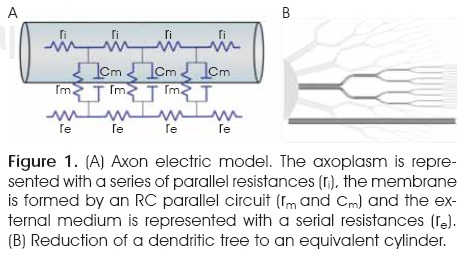
<body><![CDATA[<p align="justify"><font face="verdana" size="2">The extrapolar region method    is used to determine the time constant (<i>&#964;</i><sub>m</sub>) and the    space constant (&#955;). The interpolar region method allows the measurement    of input resistance equivalent (y) and the calculation of the parallel resistance    of the axis cylinder and external fluid (m), the specific resistivity of the    axoplasm (R<sub>i</sub>), and the specific resistance of the membrane (R<sub>m</sub>).</font></p>  	    <p align="justify"><font face="verdana" size="2">Hodgkin and Rushton derived all the equations necessary for the adequate reproduction of all of their experiments<sup>1,6</sup>.</font></p>  	    <p align="justify"><font face="verdana" size="2">Cable theory is useful in coordinating a wide range of experiments. The transient solution of the cable equation for an infinite cable at X = 0 above is extremely useful because it describes the charging curve at the site of current injection, the usual site of potential measurement<sup>13</sup>. It would also be useful, however, to know what the transient change in membrane potential would be at different sites from that of current injection<sup>1,13</sup>. The current flows longitudinally along the axon, and as it moves away from the electrode, some of it is lost on account of ion movements through the membrane<sup>1,6,13</sup>.</font></p>  	    <p align="justify"><font face="verdana" size="2">The equivalent circuit is a series of resistive elements, r<sub>m</sub> and r<sub>i</sub>, connected in a chain.<sup>1,6,7,13</sup>. The membrane resistance, r<sub>m</sub>, represents the resistance across the cylinder wall; the longitudinal resistance, r<sub>i</sub>, representthe internal resistance along the axoplasm (<a href="#f1">Figure 1A</a>). The distance the potential spreads along the axon depends on the resistance of the cell membrane relative to that of the axoplasm<sup>1,6,7,13,15</sup>. Because nerves in a recording chamber are normally bathed in a large volume of fluid, the extracellular longitudinal resistance along the cylinders is represented as zero. In Hodgkin and Rushton, r<sub>m</sub> /r<sub>i</sub> &gt; 0.</font></p>  	    <p align="center"><font face="verdana" size="2"><a name="f1"></a></font></p>  	    <p align="center"><font face="verdana" size="2"><img src="/img/revistas/rmib/v33n1/a5f1.jpg"></font></p>  	    <p align="justify"><font face="verdana" size="2"><b>B. Dendritic tree model</b></font></p>  	    <p align="justify"><font face="verdana" size="2">Shapes of dendrites are not only complex, but also highly variable from one neuronal type to another. This diverse shape of dendritic trees contributes to differential processing of inputs by different classes of neurons. Rall's theoretical model enables the simplification of the complex structure of a dendritic tree. The principal objective was to harness the equations derived from experiments in the axon. One of Rall's major contributions was to show how a complicated tree structure such as this could be reduced to a single equivalent cable. His aim was to provide a method for simplifying the complex geometry of a branching dendritic tree, while preserving its electrical properties. The method he used was a recursive calculation for the steady&#45;state input conductance of a finite length of a cylindrical dendrite which terminates with further branching. Each dendrite length was terminated by a conductance which constituted the input conductance of the subsequent branching. Repeated substitutions for the input conductance at each branch point led to a compact expression for the input conductance of a dendritic trunk. Rall makes the important observation that the diameter of dendritic branches obey the 3/2 power rule. Then, for passive dendritic trees fulfilling certain symmetry conditions, the reduction to an equivalent cable can be justified on theoretical grounds<sup>12,16,17</sup>.</font></p>  	    <p align="justify"><font face="verdana" size="2">The development of a mathematical model of dendritic neurons began due to the need to combine three different strands of knowledge into a coherent theory: (1) The anatomical concept of the neuron, together with the anatomical understanding that extensive dendritic branching is characteristic of many important neuron types, (2) The theoretical development of the nerve membrane models, (3) The detailed body of quantitative electrophysiological information that has been obtained from individual neurons by means of intracellular and extracellular microelectrodes<sup>15</sup>.</font></p>  	    <p align="justify"><font face="verdana" size="2">In dendritic neurons, the effective R<sub>m</sub> can vary, from valuesoflessthan 1,000 &#937;cm<sup>2</sup> to more than 1,000,000 &#937;cm<sup>2</sup> in different neurons<sup>18&#45;23</sup>. Traditionally, the value of Ri has been believed to be in the range of approximately 50 &#45; 100 &#937;cm based on muscle cells and the squid axon. In mammalian neurons, estimations now tend toward a value of 200 &#937;cm<sup>18,22&#45;26</sup>.</font></p>  	    ]]></body>
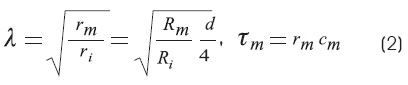
<body><![CDATA[<p align="justify"><font face="verdana" size="2">The Hodgkin and Rushton's model and that at Rall may be used as long as certain assumptions are taken into account. First of all, the geometric and passive electric properties of an axon and neuron with dendritic trees must be idealized to produce a formal theoretical model that is suitable for mathematical treatment<sup>18</sup>. The necessary assumptions and definitions for the two simulators are listed in <a href="/img/revistas/rmib/v33n1/a5t2.jpg" target="_blank">Table 2</a>.</font></p>  	    <p align="justify"><font face="verdana" size="2">&nbsp;</font></p>  	    <p align="justify"><font face="verdana" size="2"><b>DEVELOPMENT OF THE SIMULATOR</b></font></p>  	    <p align="justify"><font face="verdana" size="2">Microsoft Visual Basic<sup>&reg;</sup> version 5.0 for IBM PC or compatible was used to create the simulator. The minimal requirements for the software are: Pentium III, 350 MHz or higher, Windows 98 or higher, SuperVGA Monitor with a resolution of 1,024 x 768 pixels or higher, and at least 7 MB of free space on the hard drive.</font></p>  	    <p align="justify"><font face="verdana" size="2">The development of the simulators is based on cable theory. In the simulators x is distance along the axon in cm, t is time in seconds and i<sub>1</sub> is the current in amperes flowing through the external fluid.</font></p>  	    <p align="justify"><font face="verdana" size="2">The cable equation is:</font></p>  	    <p align="center"><font face="verdana" size="2"><img src="/img/revistas/rmib/v33n1/a5e1.jpg"></font></p>  	    <p align="left"><font face="verdana" size="2">Where:</font></p>  	    <p align="center"><font face="verdana" size="2"><img src="/img/revistas/rmib/v33n1/a5e2.jpg"></font></p>  	    <p align="justify"><font face="verdana" size="2"><i>&#955;,</i> has distance dimensions and is known as the space constant. It determines the tendency for current to flow along the cable. The space constant depends not only on the internal membrane resistance, but also on the diameter of the axon.</font></p>  	     ]]></body>
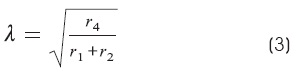
<body><![CDATA[<p align="justify"><font face="verdana" size="2"><i>&#964;<sub>m</sub></i> is    the membrane time constant.</font></p>  	    <p align="justify"><font face="verdana" size="2">In Hodgkin and Rushton's work:</font></p>  	    <p align="center"><font face="verdana" size="2"><img src="/img/revistas/rmib/v33n1/a5e3.jpg"></font></p>  	    <p align="justify"><font face="verdana" size="2">Where:</font></p>  	    <p align="justify"><font face="verdana" size="2">r<sub>1</sub> is the resistance per length of the external fluid    <br> 	r<sub>2</sub> is the resistance per length of the axis cylinder    <br> 	r<sub>4</sub> is the resistance per length of the surface membrane in the axon</font></p>  	    <p align="justify"><font face="verdana" size="2">The cable equation can be put into its most general and useful form by normalizing the length constant (space constant) and the time constant. Where X = x/&#955; and T = t/&#964;<sub>m</sub>, the equation becomes<sup>3,6,9</sup>:</font></p>  	    <p align="center"><font face="verdana" size="2"><img src="/img/revistas/rmib/v33n1/a5e4.jpg"></font></p>  	    <p align="justify"><font face="verdana" size="2">Where X and T are dimensionless</font></p>  	    ]]></body>
<body><![CDATA[<p align="justify">&nbsp;</p> 	    <p align="justify"><font face="verdana" size="2"><b>A. HR2 simulator</b></font></p>      <p align="justify"><font face="verdana" size="2">The solution of the cable equation for infinite cable for a step current at X = 0 is<sup>1,6</sup>:</font></p>  	    <p align="center"><font face="verdana" size="2"><img src="/img/revistas/rmib/v33n1/a5e5.jpg"></font></p>  	     <p align="justify"><font face="verdana" size="2">This equation corresponds to    boundary conditions of infinite cable.</font></p>     <p align="justify"><font face="verdana" size="2"> Where erfc(x) = complementary    error function and erf(x) = error function<sup>1,6</sup>:</font></p>  	    <p align="center"><font face="verdana" size="2"><img src="/img/revistas/rmib/v33n1/a5e6.jpg"></font></p>  	    <p align="justify"><font face="verdana" size="2">Where erf(0) = 0, erf(&#8734;) = 1, and erf(&#45;x) = &#45;erf(x) The steady&#45;state solution (T &#8594;&#8734;) is:</font></p>  	    <p align="center"><font face="verdana" size="2"><img src="/img/revistas/rmib/v33n1/a5e7.jpg"></font></p>  	    <p align="justify"><font face="verdana" size="2">The measurement of &laquo;y&raquo; (&#937;)</font></p>  	    ]]></body>
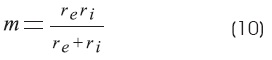
<body><![CDATA[<p align="justify"><font face="verdana" size="2">The constant y (R &#45; input equivalent) is given by the rate of the steady voltage at the cathode to the applied current, hence:</font></p>  	    <p align="center"><font face="verdana" size="2"><img src="/img/revistas/rmib/v33n1/a5e8.jpg"></font></p>  	    <p align="justify"><font face="verdana" size="2">Where</font></p>  	    <p align="justify"><font face="verdana" size="2">a is the recorded voltage (x = 0).    <br> 	b is the stimulus voltage.    <br> 	61,700 <b>&#937;</b> is the resistance of the external electrode.</font></p>  	    <p align="justify"><font face="verdana" size="2">The length constant (&#955;) is the reciprocal of the rate of decay voltage along the cable distance:</font></p>  	    <p align="center"><font face="verdana" size="2"><img src="/img/revistas/rmib/v33n1/a5e9.jpg"></font></p>  	    <p align="justify"><font face="verdana" size="2">The measurement of &laquo;m&raquo; (&#937;/cm):</font></p>  	    <p align="justify"><font face="verdana" size="2">m has been defined as the parallel resistance of core and external fluid. It was determined by measuring the voltage gradient midway between two distant electrodes and dividing the gradient by the current through the nerve (interpolar region):</font></p>  	    ]]></body>

<body><![CDATA[<p align="center"><font face="verdana" size="2"><img src="/img/revistas/rmib/v33n1/a5e10.jpg"></font></p>  	    <p align="justify"><font face="verdana" size="2">R<sub>i</sub> is the specific resistivity of the axoplasm:</font></p>  	    <p align="center"><font face="verdana" size="2"><img src="/img/revistas/rmib/v33n1/a5e11.jpg"></font></p>  	    <p align="justify"><font face="verdana" size="2">Where:</font></p>  	    <p align="justify"><font face="verdana" size="2"><i>&#945;</i> is the cylinder's radius in cm.</font></p>  	    <p align="justify"><font face="verdana" size="2">R<sub>m</sub> is the specific resistance of the membrane:</font></p>  	    <p align="center"><font face="verdana" size="2"><img src="/img/revistas/rmib/v33n1/a5e12.jpg"></font></p>  	    <p align="justify"><font face="verdana" size="2">The program follows Hodgkin and Rushton's experimental procedure:</font></p>  	    <blockquote> 		    <p align="justify"><font face="verdana" size="2">&bull;&nbsp;The user inputs the values (in this version this step can be omitted as the values are randomly generated by the program).</font></p>  		    ]]></body>
<body><![CDATA[<p align="justify"><font face="verdana" size="2">&bull;&nbsp;The extrapolar region is simulated: spread of potential along a lobster axon, recorded with a surface electrode. In this simulation <b>&#964;</b><sub>m</sub> at X = 0 is calculated.</font></p>  		    <p align="justify"><font face="verdana" size="2">&bull;&nbsp;The plot voltage <i>&#45; vs&#45;</i> distance is showed and &#955; is calculated.</font></p>  		    <p align="justify"><font face="verdana" size="2">&bull;&nbsp;The intrapolar region is simulated: This procedure measures the voltage gradient in the region midway between two distant electrodes. The program calculates the input resistance equivalent (y), m, R<sub>m</sub> and R<sub>i</sub>.</font></p>  	</blockquote>  	    <p align="justify">&nbsp;</p> 	    <p align="justify"><font face="verdana" size="2"><b>B. Rall1 simulator</b></font></p>      <p align="justify"><font face="verdana" size="2">In Rall's equivalent cylinder morphological to electrical transformation, neuronal arborizations are reduced to single unbranched core conductors. The conventional assumption that such an &laquo;equivalent&raquo; reconstructs the electrical properties of the dendritic tree is shown in the <a href="/img/revistas/rmib/v33n1/a5t2.jpg" target="_blank">Table 2</a>.</font></p>  	    <p align="justify"><font face="verdana" size="2">The model was based on a set of carefully chosen symmetries that simultaneously abstracted the neuron and simplified the mathematics (<a href="#f1">Figure 1B</a>).</font></p>  	    <p align="justify"><font face="verdana" size="2">The simulator Rall1 uses the general solution of the cable equation (equation 4) in terms of hyperbolic function. The cable equivalent has different end terminations, each of which has a different boundary condition.</font></p>  	    <p align="justify"><font face="verdana" size="2">The steady&#45;state solution of the cable equation for a finite&#45;length cable is<sup>13,18,24</sup>:</font></p>  	    <p align="center"><font face="verdana" size="2"><img src="/img/revistas/rmib/v33n1/a5e13.jpg"></font></p>  	    ]]></body>
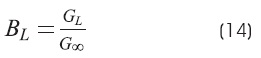
<body><![CDATA[<p align="justify"><font face="verdana" size="2">B<sub>L</sub> is the boundary condition for different end terminations:</font></p>  	    <p align="center"><font face="verdana" size="2"><img src="/img/revistas/rmib/v33n1/a5e14.jpg"></font></p>  	    <p align="justify"><font face="verdana" size="2">Where:</font></p>  	     <p align="justify"><font face="verdana" size="2">G<sub>L</sub> is the conductance    of the terminal membrane. </font></p>     <p align="justify"><font face="verdana" size="2">G<sub>&#8734;</sub> is the conductance    of semi&#45;infinite cable.</font></p>  	    <p align="justify"><font face="verdana" size="2">For the two types of terminations, G<sub>L</sub> will be zero for the sealed end and infinite for the open end. We will consider three cases:</font></p>  	    <p align="justify"><font face="verdana" size="2">Infinite cable extension: B<sub>L</sub> = 1 (that is G<sub>L</sub> = G<sub>&#8734;</sub>)</font></p>  	    <p align="center"><font face="verdana" size="2"><img src="/img/revistas/rmib/v33n1/a5e15.jpg"></font></p>  	    <p align="justify"><font face="verdana" size="2">Cable with sealed&#45;end condition: B<sub>L</sub> = 0 (G<sub>L</sub>&lt;&lt;G<sub>&#8734;</sub>)</font></p>  	    <p align="center"><font face="verdana" size="2"><img src="/img/revistas/rmib/v33n1/a5e16.jpg"></font></p>  	    ]]></body>
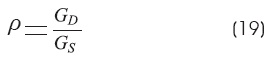
<body><![CDATA[<p align="justify"><font face="verdana" size="2">Cable with open&#45;end condition: B<sub>L</sub> = &#8734; (G<sub>L</sub> &gt;&gt; G<sub>&#8734;</sub>)</font></p>  	    <p align="center"><font face="verdana" size="2"><img src="/img/revistas/rmib/v33n1/a5e17.jpg"></font></p>  	    <p align="justify"><font face="verdana" size="2">The length of cylinder in terms of &#955; (dimensionless electrotonic length) is:</font></p>  	    <p align="center"><font face="verdana" size="2"><img src="/img/revistas/rmib/v33n1/a5e18.jpg"></font></p>  	     <p align="left"><font face="verdana" size="2">Dendritic to soma conductance ratio.</font></p>     <p align="left"><font face="verdana" size="2"> The rate of combined dendritic    input conductance to the soma membrane conductance is:</font></p>  	    <p align="center"><font face="verdana" size="2"><img src="/img/revistas/rmib/v33n1/a5e19.jpg"></font></p>  	    <p align="justify"><font face="verdana" size="2">Where:</font></p>  	     <p align="justify"><font face="verdana" size="2">G<sub>D</sub> is the dendritic    input conductance.</font></p>     <p align="justify"><font face="verdana" size="2"> G<sub>S</sub> is the soma membrane    conductance.</font></p>  	    ]]></body>
<body><![CDATA[<p align="justify"><font face="verdana" size="2">&nbsp;</font></p>  	    <p align="justify"><font face="verdana" size="2"><b>RESULTS</b></font></p>  	    <p align="justify"><font face="verdana" size="2"><b>Program installation</b></font></p>  	     <p align="justify"><font face="verdana" size="2">The simulator is installed through    the &laquo;setup&raquo; file, which guides the user step by step to correctly    install the software. By using the program HR2, the students may select a variety    of experimental conditions. The simulated experimental setup consists of an    oscilloscope, shown at the right side of the windows interface, and the nerve    preparation shown to the left (Figures <a href="/img/revistas/rmib/v33n1/a5f2.jpg" target="_blank">2    A</a> and <a href="/img/revistas/rmib/v33n1/a5f2.jpg" target="_blank">B</a>).</font></p>  	    <p align="justify"><font face="verdana" size="2">&nbsp;</font></p>  	    <p align="justify"><font face="verdana" size="2"><b>A. HR2 simulator: Interface and use</b></font></p>  	    <p align="justify"><font face="verdana" size="2">A Hodgkin and Rushton experimentiscarried out as follows:</font></p>  	    <p align="justify"><font face="verdana" size="2">Input windows interface: From top to bottom, the interface shows the values of the fiber diameter (60 to 87 &#956;m), external resistance per unit length (r<sub>i</sub>) (150 to 250 &#937;/cm), internal resistance per unit length (r<sub>e</sub>) (130 to 250 &#937;cm), membrane resistance per unit length (r<sub>m</sub>) (350 to 1,500 &#937;cm), membrane capacitance (c<sub>m</sub>) (400 to 3,240 nF/cm) and stimulus strength (2 to 9 &#956;A)<sup>1,6</sup>.</font></p>  	    <p align="justify"><font face="verdana" size="2">First step: The user selects the corresponding values for the simulation. A scrollbar is used to introduce each of the values.</font></p>  	    <p align="justify"><font face="verdana" size="2">Recording windows interface: The program HR2 version 2.0 has two options; extracellular or intracellular recording. This interface shows, on the left hand side, the schematic preparation of the axon. The scrollbar is used to move the recording electrode along the nerve. The button &laquo;STIMULUS&raquo; is used to apply the stimulus current. The right side shows the oscilloscope.</font></p>  	    ]]></body>
<body><![CDATA[<p align="justify"><font face="verdana" size="2">At the bottom left there are 4 buttons: &laquo;LENGTH CONSTANT&raquo; (which sends the user to the interface to calculate &#955;), &laquo;R&#45;input EQUIVALENT (y)&raquo; (which sends the user to the interface to calculate (y)), &laquo;INTERPOLAR REGION&raquo; and &laquo;INTRACELLULAR RECORD&raquo; (which sends the user to the recording corresponding windows). At the bottom right, there aretwobuttons: &laquo;reset&raquo; (clear the oscilloscope), and &laquo;TIME CONSTANT&raquo; (calculate the &#964;<sub>m</sub> at X = 0 &#956;m) (<a href="/img/revistas/rmib/v33n1/a5f2.jpg" target="_blank">Figure 2A</a>).</font></p>  	    <p align="justify"><font face="verdana" size="2">In this step, the student records along a lobster axon. The &#964;<sub>m</sub> is calculated at X = 0 (<a href="/img/revistas/rmib/v33n1/a5f2.jpg" target="_blank">Figure 2A</a>). A rectangular current pulse is applied at 0 mm, producing an electrotonic potential. With increasing distance from the site of current injection, the rise time of the potential change is slowed and the plateau attenuated (<a href="/img/revistas/rmib/v33n1/a5f3.jpg" target="_blank">Figure 3</a><a href="/img/revistas/rmib/v33n1/a5f3.jpg" target="_blank">A</a>)<sup>1</sup>. At any time, the user can change parameter values and observe the consequences.</font></p>      <p align="justify"><font face="verdana" size="2">Next step, the user presses the button &laquo;LENGTH CONSTANT&raquo;. The plot windows interface shows two boxes for the plotting results (<a href="/img/revistas/rmib/v33n1/a5f2.jpg" target="_blank">Figure 2E</a>). The bottom screen contains two buttons: &laquo;GO&raquo; and &laquo;R&#45;input EQUIVALENT (y)&raquo;. The button &laquo;GO&raquo; is used to show the steady state membrane potential as a function of distance in the axon in response to current injection at one end (X = 0 &#956;m). The &#955; is the reciprocal of the rate of voltage decay along the cable distance. The user obtains the &#955; values.</font></p>  	    <p align="justify"><font face="verdana" size="2">The R&#45;input EQUIVALENT interface shows the schematic preparation of the measurement of the voltage in the stimulus electrode. On the right side, there are three boxes showing the recorder voltage (X = 0 &#956;m), stimulus voltage and input resistance equivalent respectively. In this step, the user presses the button &laquo;STIMULUS&raquo; to calculate these values (<a href="/img/revistas/rmib/v33n1/a5f2.jpg" target="_blank">Figure 2C</a>). Next step, the user presses the button &laquo;INTERPOLAR REGION&raquo;.</font></p>  	    <p align="justify"><font face="verdana" size="2">The interpolar region interface presents, on the left side, the schematic preparation and in the right side the oscilloscope (<a href="/img/revistas/rmib/v33n1/a5f2.jpg" target="_blank">Figure 2D</a>). These windows presents the button &laquo;Reset&raquo; to clean the oscilloscope and &laquo;GRAPHIC&raquo; to go to the corresponding plot interface. In this step, constant &laquo;m&raquo; can be obtained from a measurement of the voltage gradient in the interpolar region at a large distance from either stimulus electrode (<a href="/img/revistas/rmib/v33n1/a5f3.jpg" target="_blank">Figure 3</a><a href="/img/revistas/rmib/v33n1/a5f3.jpg" target="_blank">B</a>). The user presses the button &laquo;Stimulus&raquo; and moves the scrollbar to simulate the movement of the electrode register at different points along the length of the axon.</font></p>  	    <p align="justify"><font face="verdana" size="2">There are three boxes in the window: The first is the distance in which the register was made, the second is the maximum voltage reached and the third is the resistance obtained with experimental data.</font></p>  	    <p align="justify"><font face="verdana" size="2">The &laquo;GRAPHIC&raquo; button takes us to the interface in which appears a chart for calculating resistance in the experiment versus the distance in which the register was made (<a href="/img/revistas/rmib/v33n1/a5f2.jpg" target="_blank">Figure 2F</a>). The user interface located from top to bottom on the right side, has three boxes showing the m, R<sub>i</sub> and R<sub>m</sub> respectively. On the bottom right side there are two buttons: &laquo;EXTRAPOLED REGION&raquo; and &laquo;GENERAL RESULT&raquo;.</font></p>  	    <p align="justify"><font face="verdana" size="2">At this stage, if we press the &laquo;GO&raquo; button, it creates a chart showing a linear process. The &laquo;m&raquo; parameter is the slope (<a href="/img/revistas/rmib/v33n1/a5f2.jpg" target="_blank">Figure 2F</a>). From &#955;, &laquo;y&raquo; and &laquo;m&raquo; parameters the corresponding R<sub>i</sub> y R<sub>m</sub> values (equations 11 and 12) can be calculated.</font></p>  	    <p align="justify"><font face="verdana" size="2">Finally, the final results are made to appear by pressing the &laquo;GENERAL RESULT&raquo; button. From top to bottom, the resistivity of the axoplasm (R<sub>i</sub>), specific membrane resistance (R<sub>m</sub>), the diameter of the axon, &laquo;y&raquo; parameter, &laquo;m&raquo; parameter, length constant &#955; and membrane time constant <b>&#964;</b><sub>m</sub> are shown.</font></p>  	    <p align="justify"><font face="verdana" size="2">As an example: (1) enter the following values: diameter = 65 &#956;m, r<sub>e</sub> = 160 and r<sub>i</sub> = 180 (&#937;/cm), r<sub>m</sub> = 850 &#937;cm, c<sub>m</sub> = 1,000 nF/cm and stimulus = 4 &#956;A. The <a href="/img/revistas/rmib/v33n1/a5f3.jpg" target="_blank">Figure 3</a><a href="/img/revistas/rmib/v33n1/a5f3.jpg" target="_blank">A</a> shows the registered voltage and how it decreases as the register electrode moves away from the stimulus point.</font></p>  	    ]]></body>
<body><![CDATA[<p align="justify"><font face="verdana" size="2">The results of this experiment are R<sub>i</sub> = 59.72 &#937;cm, R<sub>m</sub> = 1,735 &#937;cm<sup>2</sup>, diameter 65 &#956;m, input resistance = 59.52 k&#937;, &#955; = 1.58 mm and <b>&#964;</b><sub>m</sub> = 1.73 ms. These values are consistent with those obtained by Hodgkin and Rushton in <a href="/img/revistas/rmib/v33n1/a5t2.jpg" target="_blank">Table 2</a> of their paper<sup>1</sup>.</font></p>  	    <p align="justify"><font face="verdana" size="2">Another example: (2) go directly to the experiment. This condition emulates actual conditions because usually the researcher is unaware of the axon resistance and capacitance values. The goal is to calculate them from the experimental process. In this case the results were: R<sub>i</sub> = 73.12 &#937;cm, R<sub>m</sub> = 2,089 &#937;cm<sup>2</sup>, diameter 70 &#956;m, input resistance = 65.2 k&#937;, &#955; = 1.62 mm and &#964;<sub>m</sub> = 2.5 ms. Again it can be observed that these values are consistent with those obtained by Hodgkin and Rushton in their experiment<sup>1</sup>.</font></p>  	    <p align="justify"><font face="verdana" size="2">Each user interface has a menu in the upper left corner of the screen in which the user can access a help box to display a definition of each of the concepts involved in the experiment, the corresponding equations and their equivalence with the actual nomenclature (<a href="/img/revistas/rmib/v33n1/a5t1.jpg" target="_blank">Table 1</a>).</font></p>  	    <p align="justify">&nbsp;</p> 	    <p align="justify"><font face="verdana" size="2"><b>B. Rall1 simulator: Interface and use</b></font></p>      <p align="justify"><font face="verdana" size="2">This program simulates voltage response to a stimulus of subumbral current in an isopotential cell, in dendrites and neurons with dendrites<sup>13,18,24</sup>. Use of this program allows the student to become familiar with subjects which, because of the mathematics they entail, are not generally approached and are rarely understood. The synaptic integration in the neurons depends to a certain extent on the passive properties. Synaptic integration is fundamental to neural communication and thus fundamental to the function of the nervous system.</font></p>  	    <p align="justify"><font face="verdana" size="2">The simulator is installed through the &laquo;setup&raquo; file which guides the user step by step to correctly install the software. A file named Rall1.exe is opened to execute the program. The Start option of Microsoft Windows gives the option to open a window with the main menu which then gives the option of selecting from three modules: (1) isopotential cell, (2) equivalent cylinder models, (3) soma model + equivalent cylinder.</font></p>  	    <p align="justify"><font face="verdana" size="2">The isopotential cell module shows the case of ideal neurons without dendrites (as could be the case with some ganglionar neurons or bipolar cells). This case considers spherical cells in which the membrane potential is uniform at all points of the sphere. R<sub>m</sub> is constant and independent from voltage. The electrical model in these cells is an RC circuit in parallel.</font></p>  	    <p align="justify">&nbsp;</p> 	    <p align="justify"><font face="verdana" size="2"><b>1B. &laquo;Isopotential Cell&raquo; module: User interface</b></font></p>  	    ]]></body>
<body><![CDATA[<p align="justify"><font face="verdana" size="2"><a href="/img/revistas/rmib/v33n1/a5f4.jpg" target="_blank">Figure 4</a><a href="/img/revistas/rmib/v33n1/a5f4.jpg">A</a> shows the user interface for this module. On the upper left hand corner there are two boxes in which to input data for membrane potential and applied current amplitude (nA). Below, there is a diagram of the cell in which arrows indicate how current is distributed in a uniform way in every direction within the cell. The right half of the screen shows two boxes that represent the oscilloscope. The current pulses of the stimulus are displayed in the upper box and the charge curves that correspond to these stimuli are shown in the lower box. Underneath this box there are two buttons: &laquo;Start&raquo; which executes the simulation and &laquo;Erase&raquo; which clears the boxes. Bellow that there is the button &laquo;Back&raquo; which leads to the main menu (<a href="/img/revistas/rmib/v33n1/a5f4.jpg" target="_blank">Figure 4D</a>) and &laquo;Exit&raquo; to quit the program. A help menu appears in the upper part of the window.</font></p>  	     <p align="justify"><font face="verdana" size="2">Use: the student inputs the value    of the membrane potential and the amplitude of the stimulus. For instance: a    value of &#45;80 mv was given and the stimulus amplitude values as follows:    2, &#45;2, 3, &#45;3, 4, &#45;4 (nA). The curves of positive and negative charges    are shown in relation to the polarity of the stimulus pulse. The simulation    corresponds to <a href="/img/revistas/rmib/v33n1/a5f4.jpg" target="_blank">Figure 4</a>. 5 in    Johnston and Wu<sup>13</sup>. The appropriate moment to calculate the time constant    of the cell (<b>&#964;</b><sub>m</sub>), deduce the differential equation in    relation to the electric model and to solve the equation is considered. In the    &laquo;Help&raquo; menu one can find the corresponding mathematical information<sup>11&#45;13</sup>.</font></p>  	    <p align="justify">&nbsp;</p> 	    <p align="justify"><font face="verdana" size="2"><b>2B. &laquo;Equivalent cylinder model&raquo; module: User interface</b></font></p>  	    <p align="justify"><font face="verdana" size="2"><a href="/img/revistas/rmib/v33n1/a5f4.jpg" target="_blank">Figure 4</a><a href="/img/revistas/rmib/v33n1/a5f4.jpg" target="_blank">B</a> shows the interface window. The left half presents a diagram with circles that represent the channels of the membrane (these are not the usual channels which depend on voltage). A sliding bar appears next to it that allows us modify the electronic longitude value (L) with said values being shown in a box underneath. Further below there are three equivalent cylinders: the first is long and considered infinite, the next is short with open ends and the last is short with sealed ends. A corresponding button is found next to each cylinder to run the simulation in each case. On the right side of the window, a box shows the voltage decay in relation to distance. Below there are two buttons: &laquo;Erase&raquo; and &laquo;Back&raquo;.</font></p>  	     <p align="justify"><font face="verdana" size="2">Use: As was the case of the first    interface, the student can move the sliding bar to input a value of electronic    longitude (L). In the &laquo;Help&raquo; menu one can find a definition of L<sup>18</sup>.    This is useful to help the student understand the difference between physical    longitude and electronic longitude<sup>16,19,22,23</sup>. Later one can activate    the button for each of the equivalent cylinder conditions and the corresponding    voltage decay is shown. As an example: an electronic longitude of 1.7 was inputted    and simulations for each condition were run. The upper stroke represents the    short cylinder with sealed ends, the middle stroke represents the voltage decay    in the long infinite cylinder and the lower stroke denotes the short open ended    cylinder. <a href="/img/revistas/rmib/v33n1/a5f4.jpg" target="_blank">Figure 4B</a> shows the distributions of    electronic potential along unbranched cylinders for different terminal boundary    conditions and different lengths. It can be observed that the decay voltage    in a short open cylinder reaches zero, and the infinite cylinder also tends    to zero but over a longer distance, while with the sealed cylinder the voltage    remains high. This simulation is similar to <a href="/img/revistas/rmib/v33n1/a5f4.jpg" target="_blank">Figure    4</a>.15 in Johnston y Wu<sup>13</sup> and <a href="/img/revistas/rmib/v33n1/a5f3.jpg" target="_blank">Figure    3</a> in Rall<sup>16</sup>.</font></p>  	    <p align="justify">&nbsp;</p> 	    <p align="justify"><font face="verdana" size="2"><b>3B. &laquo;Soma model + equivalent cylinder&raquo; module: User interface</b></font></p>      <p align="justify"><font face="verdana" size="2">This module allows for the use of <i>p</i> as proposed by Rall, to determine the predominance of the dendritic tree in the neuron. To a higher value of <i>p</i> the neuron presents a more abundant dendritic tree. A value of zero corresponds to an isopotential neuron and an infinite value corresponds to a cylinder.</font></p>  	    <p align="justify"><font face="verdana" size="2"><a href="/img/revistas/rmib/v33n1/a5f4.jpg" target="_blank">Figure 4</a><a href="/img/revistas/rmib/v33n1/a5f4.jpg" target="_blank">C</a> shows the user interface. On the left side of the window one can find the oscilloscope, where the charge curves generated in response to a current stimulus are shown<sup>25</sup>. On the right side, there are three diagrams representing the simulation conditions. The lower diagram corresponds to an isopotential cell (<i>p</i> = 0), while the diagram above corresponds to a cylinder (the soma electrical characteristics are such that it can be merged to the dendritic tree and be considered whole as a cylinder (<i>p</i> = infinite))<sup>18,19</sup>. The diagram above the previous corresponds to a neuron with dendrites, in which the value of p can be adjusted and thus the curve charge of neurons with different dendritic abundance can be simulated. An illustration showing different values of p is shown in <a href="/img/revistas/rmib/v33n1/a5f4.jpg" target="_blank">Figure 4</a><a href="/img/revistas/rmib/v33n1/a5f4.jpg" target="_blank">D</a>, on the left side<sup>13,18</sup>.</font></p>  	    ]]></body>
<body><![CDATA[<p align="justify"><font face="verdana" size="2">&nbsp;</font></p>  	    <p align="justify"><font face="verdana" size="2"><b>DISCUSSION</b></font></p>  	    <p align="justify"><font face="verdana" size="2">Physiology, Biophysics or Neuroscience college courses have little to do with neuronal passive properties. Text books such as <i>The physiology of excitable cells</i> by Aidley<sup>26</sup>; <i>Biof&iacute;sica y fisiolog&iacute;a celular</i> by Latorre et al<sup>27</sup>; <i>From neuron to brain</i> by Nicholls et al<sup>15</sup> and <i>Principles of neural science</i> by Kandel et al<sup>28</sup> touch on this theme no more than summarily.</font></p>  	    <p align="justify"><font face="verdana" size="2">There is no specific simulation software dealing with the passive properties of the axon and the dendritic tree through analytical solutions using cable theory that can be used as a teaching tool.</font></p>  	    <p align="justify"><font face="verdana" size="2">This simulator reproduces Hodgkin and Rushton's experiments virtually using cable equations and their analytical solutions. Up to date, there is no other simulator that reproduces these experiments. The cable model has been widely used in order to determine the passive properties of several neurons and with enough symmetry to reduce it to an electrically equivalent cylinder<sup>19&#45;21,29</sup>. &laquo;The exponential peeling method&raquo; proposed by Rall<sup>18</sup> allows us calculate the passive parameters from experimental data using an analytical treatment from Rall's cable theory<sup>18</sup>.</font></p>  	    <p align="justify"><font face="verdana" size="2">While Rall's model is based on the assumption of an homogeneous R<sub>m</sub> other models have been developedconsideringa heterogeneous membrane (with the somatic resistance lower than the dendritic resistance) based on an equivalent cylinder<sup>29&#45;31</sup>.</font></p>  	    <p align="justify"><font face="verdana" size="2">The strength of the equivalent cylinder concept has been proved in Ohme and Schierwagen's<sup>32</sup> work, where they show several dendritic trees reduced to different equivalent cylinders with added active properties. In those cases where Rall's branching rule no longer functions, it can be reduced to a non uniform diameter cable.</font></p>  	    <p align="justify"><font face="verdana" size="2">Rall's paper<sup>33</sup> is one of the most significant landmarks in the modern era of computational neuroscience. Rall introduced the compartmental modeling method, which, in principle, allows the computation of voltage and current spread in no idealized, and hence, biologically realistic trees, with any specified voltage and with non&#45;linear active properties<sup>33</sup>.</font></p>  	    <p align="justify"><font face="verdana" size="2">Programs such as Genesis or Neuron work effectively to simulate specific neurons and provide corresponding anatomical data and electrophysiologic studies<sup>34</sup>. These programs have interactive computer tutorials that include concepts in neuroscience and neuronal modeling. For example the developers of GENESIS have published &laquo;The book of GENESIS&raquo;, including an outline of cable theory aimed at the development of passive compartmental models. However, they omit Rall's equivalent cylinder theory and Hodgkin and Rushton's<sup>1</sup> classic experiment simulations. From the point of view of the authors of this article, these experiments are fundamental to understanding cable theory principles. The simulations of virtual experiments, such as the interactive programs described in this paper, introduce students to this topic.</font></p>  	    <p align="justify"><font face="verdana" size="2">We recommend students to conduct the simulations in the classroom, and to explain and present the corresponding mathematical equations in every case as part of an intuitive approach. Additionally, the compartmental models from GENESIS<sup>34</sup> or Neuron<sup>35</sup> can be used to complement the topic.</font></p>  	    ]]></body>
<body><![CDATA[<p align="justify"><font face="verdana" size="2">It is important to mention that concepts involved in compartmental models originate in cable theory. Each compartment is represented by a differential equation. In general, cable theory and compart&#45;mental modeling provide a foundation for predicting the propagation of electrical signals in the dendrites and axons of neurons<sup>36,37</sup>.</font></p>  	    <p align="justify"><font face="verdana" size="2">For the HR2 simulator we recommend the user to follow Hodgkin and Rushton's experiment stages. It is desirable but not necessary to read these researchers' papers and simulate every part they describe.</font></p>  	    <p align="justify"><font face="verdana" size="2">Similarly, for the Rall1 simulator it is recommended, that the simulations begin in the order in which they appear in the main menu. The simulator design has been developed as a powerful didactic tool to be used alongside relevant and appropriate texts, such as Chapter 4 from &laquo;Foundations of cellular neurophysiology&raquo; by Johnston and Wu<sup>13</sup>.</font></p>  	    <p align="justify"><font face="verdana" size="2">These simulators have been used for the last three years in the Biophysics module in the Biology School at the Benem&eacute;rita Universidad Aut&oacute;noma de Puebla (BUAP), and have been constantly improved on based on the (unpublished) results obtained from a survey measuring student satisfaction. In general, feedback has been sought from students in terms of the usefulness of the software in two dimensions: (1) usability of the simulator, and (2) its facilitation of learning. In both cases, these elements are evaluated through closed answers (very adequate, adequate, slightly adequate and in no way adequate) and (very good, good, average, unsatisfactory) respectively.</font></p>  	    <p align="justify"><font face="verdana" size="2">Some of the applied questions are:</font></p>  	    <p align="justify"><font face="verdana" size="2">Did you learn how to obtain space constant?</font></p>  	    <p align="justify"><font face="verdana" size="2">Did you learn how to obtain time constant?</font></p>  	    <p align="justify"><font face="verdana" size="2">Can you predict what will happen to time constant when r<sub>m</sub> changes?</font></p>  	    <p align="justify"><font face="verdana" size="2">Did you identify the effect that produces the changes in the variables r<sub>m</sub> , r<sub>i</sub>, r<sub>e</sub> y C<sub>m</sub> , in the passive properties of the axon?</font></p>  	    <p align="justify"><font face="verdana" size="2">Finally, the program explores the students' perception of the utility of mathematical and computational tools in their professional formation.</font></p>  	    ]]></body>
<body><![CDATA[<p align="justify"><font face="verdana" size="2">The students consider that simulators are easy to use. All students changed their perception of neuroscience and discovered a new way of applying mathematics. The 96.5% now accept as valid the use of mathematics in their profession and are willing to learn more about this application, 30% of students indicated that the discipline they were inclined to study had changed from another discipline to neurosciences, and 3.5% of students had not adapted to the use of simulators.</font></p>  	    <p align="justify"><font face="verdana" size="2">In conclusion, these results show that using simulators as a didactic tool in the teaching of these apparently difficult topics may change student perception and stimulate their interest to study and use simulators.</font></p>  	    <p align="justify"><font face="verdana" size="2">&nbsp;</font></p>  	    <p align="justify"><font face="verdana" size="2"><b>ACKNOWLEDGEMENTS</b></font></p>  	    <p align="justify"><font face="verdana" size="2">We thank PIFI 2011 for the support given to this publication.</font></p>  	    <p align="justify"><font face="verdana" size="2">&nbsp;</font></p>  	    <p align="justify"><font face="verdana" size="2"><b>REFERENCES</b></font></p>  	    <!-- ref --><p align="justify"><font face="verdana" size="2">1.&nbsp;Hodgkin AL, Rushton WAH. The electrical constants of a crustacean nerve fibre. Proc Roy Soc Lond B 1946; 133(873): 444&#45;479.    &nbsp;&nbsp;&nbsp;&nbsp;&nbsp;&nbsp;&nbsp;&nbsp;[&#160;<a href="javascript:void(0);" onclick="javascript: window.open('/scielo.php?script=sci_nlinks&ref=8508761&pid=S0188-9532201200010000500001&lng=','','width=640,height=500,resizable=yes,scrollbars=1,menubar=yes,');">Links</a>&#160;]<!-- end-ref --></font></p>  	    <!-- ref --><p align="justify"><font face="verdana" size="2">2.&nbsp;Rall W. Branching dendritic trees and motoneuron membrane resistivity. Experimental Neurology 1959; 1: 491&#45;527.    &nbsp;&nbsp;&nbsp;&nbsp;&nbsp;&nbsp;&nbsp;&nbsp;[&#160;<a href="javascript:void(0);" onclick="javascript: window.open('/scielo.php?script=sci_nlinks&ref=8508763&pid=S0188-9532201200010000500002&lng=','','width=640,height=500,resizable=yes,scrollbars=1,menubar=yes,');">Links</a>&#160;]<!-- end-ref --></font></p>  	    <!-- ref --><p align="justify"><font face="verdana" size="2">3.&nbsp;Koch C. Biophysics of computation. Oxford University Press, New York, 1999; pp. 25&#45;48.    &nbsp;&nbsp;&nbsp;&nbsp;&nbsp;&nbsp;&nbsp;&nbsp;[&#160;<a href="javascript:void(0);" onclick="javascript: window.open('/scielo.php?script=sci_nlinks&ref=8508765&pid=S0188-9532201200010000500003&lng=','','width=640,height=500,resizable=yes,scrollbars=1,menubar=yes,');">Links</a>&#160;]<!-- end-ref --></font></p>  	    <!-- ref --><p align="justify"><font face="verdana" size="2">4.&nbsp;Clark JW, Plonsey R. The extracellular potential fied of the single active nerve fiber in a volume conductor. Biophys J 1968; 8: 842&#45;864.    &nbsp;&nbsp;&nbsp;&nbsp;&nbsp;&nbsp;&nbsp;&nbsp;[&#160;<a href="javascript:void(0);" onclick="javascript: window.open('/scielo.php?script=sci_nlinks&ref=8508767&pid=S0188-9532201200010000500004&lng=','','width=640,height=500,resizable=yes,scrollbars=1,menubar=yes,');">Links</a>&#160;]<!-- end-ref --></font></p>  	    <!-- ref --><p align="justify"><font face="verdana" size="2">5.&nbsp;Tuckwell HC. Introduction of theoretical neurobiology. Vol 1: Linear cable theory and dendritic structure. Cambridge University Press, 1988; pp. 124&#45;282.    &nbsp;&nbsp;&nbsp;&nbsp;&nbsp;&nbsp;&nbsp;&nbsp;[&#160;<a href="javascript:void(0);" onclick="javascript: window.open('/scielo.php?script=sci_nlinks&ref=8508769&pid=S0188-9532201200010000500005&lng=','','width=640,height=500,resizable=yes,scrollbars=1,menubar=yes,');">Links</a>&#160;]<!-- end-ref --></font></p>  	    <!-- ref --><p align="justify"><font face="verdana" size="2">6.&nbsp;Jack JJB, Noble D, Tsien RW. Electric current flow in excitable cells. Clarendon Press, Oxford, 1975; pp. 25&#45;82.    &nbsp;&nbsp;&nbsp;&nbsp;&nbsp;&nbsp;&nbsp;&nbsp;[&#160;<a href="javascript:void(0);" onclick="javascript: window.open('/scielo.php?script=sci_nlinks&ref=8508771&pid=S0188-9532201200010000500006&lng=','','width=640,height=500,resizable=yes,scrollbars=1,menubar=yes,');">Links</a>&#160;]<!-- end-ref --></font></p>  	    <!-- ref --><p align="justify"><font face="verdana" size="2">7.&nbsp;Davis L Jr., Lorente de No R. Contribution to the mathematical theory of the electrotonus. Stud Rockefeller Inst M Res, 1947;131: 442&#45;496.    &nbsp;&nbsp;&nbsp;&nbsp;&nbsp;&nbsp;&nbsp;&nbsp;[&#160;<a href="javascript:void(0);" onclick="javascript: window.open('/scielo.php?script=sci_nlinks&ref=8508773&pid=S0188-9532201200010000500007&lng=','','width=640,height=500,resizable=yes,scrollbars=1,menubar=yes,');">Links</a>&#160;]<!-- end-ref --></font></p>  	    <!-- ref --><p align="justify"><font face="verdana" size="2">8.&nbsp;Clark JW, Plonsey R. A mathematical evaluation of the core conductor model. Biophys J 1966; 6: 95&#45;112.    &nbsp;&nbsp;&nbsp;&nbsp;&nbsp;&nbsp;&nbsp;&nbsp;[&#160;<a href="javascript:void(0);" onclick="javascript: window.open('/scielo.php?script=sci_nlinks&ref=8508775&pid=S0188-9532201200010000500008&lng=','','width=640,height=500,resizable=yes,scrollbars=1,menubar=yes,');">Links</a>&#160;]<!-- end-ref --></font></p>  	    <!-- ref --><p align="justify"><font face="verdana" size="2">9.&nbsp;Kootsey JM. The steady&#45;state finite cable: numerical method for non&#45;linear membrane. J Theor Biol 197; 64: 413&#45;420.    &nbsp;&nbsp;&nbsp;&nbsp;&nbsp;&nbsp;&nbsp;&nbsp;[&#160;<a href="javascript:void(0);" onclick="javascript: window.open('/scielo.php?script=sci_nlinks&ref=8508777&pid=S0188-9532201200010000500009&lng=','','width=640,height=500,resizable=yes,scrollbars=1,menubar=yes,');">Links</a>&#160;]<!-- end-ref --></font></p>  	     <!-- ref --><p align="justify"><font face="verdana" size="2">10.&nbsp;Arthurs AM, Arthurs    WM. Pointwise bounds for the solution of a nonlinear problem in cell membrane    theory. Bull Math Biol 1983; 45: 155&#45;168.    &nbsp;&nbsp;&nbsp;&nbsp;&nbsp;&nbsp;&nbsp;&nbsp;[&#160;<a href="javascript:void(0);" onclick="javascript: window.open('/scielo.php?script=sci_nlinks&ref=8508779&pid=S0188-9532201200010000500010&lng=','','width=640,height=500,resizable=yes,scrollbars=1,menubar=yes,');">Links</a>&#160;]<!-- end-ref --></font></p>  	    <!-- ref --><p align="justify"><font face="verdana" size="2">11.&nbsp;Rall W. Cable theory for dendritic neurons. In: Methods in neuronal modeling. Koch C. and Segev I, editors. MIT Press, Cambridge, 1989; pp. 9&#45;12.    &nbsp;&nbsp;&nbsp;&nbsp;&nbsp;&nbsp;&nbsp;&nbsp;[&#160;<a href="javascript:void(0);" onclick="javascript: window.open('/scielo.php?script=sci_nlinks&ref=8508781&pid=S0188-9532201200010000500011&lng=','','width=640,height=500,resizable=yes,scrollbars=1,menubar=yes,');">Links</a>&#160;]<!-- end-ref --></font></p>  	    <!-- ref --><p align="justify"><font face="verdana" size="2">12.&nbsp;Segev I, Rinzel, J, Sheperd, GM. The theoretical foundation of dendritic function. The MIT Press, Cambridge, Massachusetts, 1995.    &nbsp;&nbsp;&nbsp;&nbsp;&nbsp;&nbsp;&nbsp;&nbsp;[&#160;<a href="javascript:void(0);" onclick="javascript: window.open('/scielo.php?script=sci_nlinks&ref=8508783&pid=S0188-9532201200010000500012&lng=','','width=640,height=500,resizable=yes,scrollbars=1,menubar=yes,');">Links</a>&#160;]<!-- end-ref --></font></p>  	    <!-- ref --><p align="justify"><font face="verdana" size="2">13.&nbsp;Johnston D, Miao&#45;Sin Wu S. Foundations of cellular neurophysiology. The MIT Press, Cambridge, Massachusetts, 1995; pp. 55&#45;120.    &nbsp;&nbsp;&nbsp;&nbsp;&nbsp;&nbsp;&nbsp;&nbsp;[&#160;<a href="javascript:void(0);" onclick="javascript: window.open('/scielo.php?script=sci_nlinks&ref=8508785&pid=S0188-9532201200010000500013&lng=','','width=640,height=500,resizable=yes,scrollbars=1,menubar=yes,');">Links</a>&#160;]<!-- end-ref --></font></p>  	    <!-- ref --><p align="justify"><font face="verdana" size="2">14.&nbsp;Genter LJ, Stuart GJ, Clements JD. Direct measurement of specific membrane capacitance in neurons. Biophys J 2000; 79: 314&#45;320.    &nbsp;&nbsp;&nbsp;&nbsp;&nbsp;&nbsp;&nbsp;&nbsp;[&#160;<a href="javascript:void(0);" onclick="javascript: window.open('/scielo.php?script=sci_nlinks&ref=8508787&pid=S0188-9532201200010000500014&lng=','','width=640,height=500,resizable=yes,scrollbars=1,menubar=yes,');">Links</a>&#160;]<!-- end-ref --></font></p>  	    <!-- ref --><p align="justify"><font face="verdana" size="2">15.&nbsp;Nicholls JG, Martin RA, Wallace BG, Fuchs PA. From neuron to brain. Sunderland, Massachusetts, 2001; pp. 113&#45;132.    &nbsp;&nbsp;&nbsp;&nbsp;&nbsp;&nbsp;&nbsp;&nbsp;[&#160;<a href="javascript:void(0);" onclick="javascript: window.open('/scielo.php?script=sci_nlinks&ref=8508789&pid=S0188-9532201200010000500015&lng=','','width=640,height=500,resizable=yes,scrollbars=1,menubar=yes,');">Links</a>&#160;]<!-- end-ref --></font></p>  	    <!-- ref --><p align="justify"><font face="verdana" size="2">16.&nbsp;Rall W. Membrane time constant of motoneurons. Science, 1957; 126:454&#45;493.    &nbsp;&nbsp;&nbsp;&nbsp;&nbsp;&nbsp;&nbsp;&nbsp;[&#160;<a href="javascript:void(0);" onclick="javascript: window.open('/scielo.php?script=sci_nlinks&ref=8508791&pid=S0188-9532201200010000500016&lng=','','width=640,height=500,resizable=yes,scrollbars=1,menubar=yes,');">Links</a>&#160;]<!-- end-ref --></font></p>  	    <!-- ref --><p align="justify"><font face="verdana" size="2">17.&nbsp;Schierwagen AK. A non&#45;uniform equivalent cable model of membrane voltage changes in a passive dendritic tree. J Theor Biol 1989; 141: 159&#45;179.    &nbsp;&nbsp;&nbsp;&nbsp;&nbsp;&nbsp;&nbsp;&nbsp;[&#160;<a href="javascript:void(0);" onclick="javascript: window.open('/scielo.php?script=sci_nlinks&ref=8508793&pid=S0188-9532201200010000500017&lng=','','width=640,height=500,resizable=yes,scrollbars=1,menubar=yes,');">Links</a>&#160;]<!-- end-ref --></font></p>  	    <!-- ref --><p align="justify"><font face="verdana" size="2">18.&nbsp;Rall W. Core conductor theory and cable properties of neurons. In Handbook of physiology. Sec. 1, The nervous system, vol. 1. Bethesda, MD: Am Physiol Soc 1977; pp.39&#45;97.    &nbsp;&nbsp;&nbsp;&nbsp;&nbsp;&nbsp;&nbsp;&nbsp;[&#160;<a href="javascript:void(0);" onclick="javascript: window.open('/scielo.php?script=sci_nlinks&ref=8508795&pid=S0188-9532201200010000500018&lng=','','width=640,height=500,resizable=yes,scrollbars=1,menubar=yes,');">Links</a>&#160;]<!-- end-ref --></font></p>  	    <!-- ref --><p align="justify"><font face="verdana" size="2">19.&nbsp;Brown TH, Perkel DH, Norris JC, Peacock JH. Electrotonic structure and specific membrane properties of mouse dorsal root ganglion neurons. J Neurophysiol 1981; 45(1): 1&#45;15.    &nbsp;&nbsp;&nbsp;&nbsp;&nbsp;&nbsp;&nbsp;&nbsp;[&#160;<a href="javascript:void(0);" onclick="javascript: window.open('/scielo.php?script=sci_nlinks&ref=8508797&pid=S0188-9532201200010000500019&lng=','','width=640,height=500,resizable=yes,scrollbars=1,menubar=yes,');">Links</a>&#160;]<!-- end-ref --></font></p>  	    <!-- ref --><p align="justify"><font face="verdana" size="2">20.&nbsp;Stafstrom CE, Schwindt PC, Crill WE. Cable properties of layer V neurons from cat sensorimotor cortex in vitro. J Neurophysiol 1984; 52(2): 278&#45;289.    &nbsp;&nbsp;&nbsp;&nbsp;&nbsp;&nbsp;&nbsp;&nbsp;[&#160;<a href="javascript:void(0);" onclick="javascript: window.open('/scielo.php?script=sci_nlinks&ref=8508799&pid=S0188-9532201200010000500020&lng=','','width=640,height=500,resizable=yes,scrollbars=1,menubar=yes,');">Links</a>&#160;]<!-- end-ref --></font></p>  	    <!-- ref --><p align="justify"><font face="verdana" size="2">21.&nbsp;Bargas J, Galarraga E, Aceves J. Electrotonic properties of neostriatal neurons are modulated by extracellular potassium. Exp Brain Res 1988; 72: 390&#45;398.    &nbsp;&nbsp;&nbsp;&nbsp;&nbsp;&nbsp;&nbsp;&nbsp;[&#160;<a href="javascript:void(0);" onclick="javascript: window.open('/scielo.php?script=sci_nlinks&ref=8508801&pid=S0188-9532201200010000500021&lng=','','width=640,height=500,resizable=yes,scrollbars=1,menubar=yes,');">Links</a>&#160;]<!-- end-ref --></font></p>  	    <!-- ref --><p align="justify"><font face="verdana" size="2">22.&nbsp;Iansek R, Redman SJ. An analysis of the cable properties of spinal motoneurones using a brief intracellular current pulse. J Physiol 1973; 234: 613&#45;636.    &nbsp;&nbsp;&nbsp;&nbsp;&nbsp;&nbsp;&nbsp;&nbsp;[&#160;<a href="javascript:void(0);" onclick="javascript: window.open('/scielo.php?script=sci_nlinks&ref=8508803&pid=S0188-9532201200010000500022&lng=','','width=640,height=500,resizable=yes,scrollbars=1,menubar=yes,');">Links</a>&#160;]<!-- end-ref --></font></p>  	    <!-- ref --><p align="justify"><font face="verdana" size="2">23.&nbsp;Burke RE, Fyffe REW, Moschovakis AK. Electrotonic architecture of cat gamma motoneurons. J Neurophysiol 1994, 72: 2302&#45;2316.    &nbsp;&nbsp;&nbsp;&nbsp;&nbsp;&nbsp;&nbsp;&nbsp;[&#160;<a href="javascript:void(0);" onclick="javascript: window.open('/scielo.php?script=sci_nlinks&ref=8508805&pid=S0188-9532201200010000500023&lng=','','width=640,height=500,resizable=yes,scrollbars=1,menubar=yes,');">Links</a>&#160;]<!-- end-ref --></font></p>  	    <!-- ref --><p align="justify"><font face="verdana" size="2">24.&nbsp;Rall W. Electrophysiology of a dendritic neuron model. Biophys J 1962; 2: 145&#45;167.    &nbsp;&nbsp;&nbsp;&nbsp;&nbsp;&nbsp;&nbsp;&nbsp;[&#160;<a href="javascript:void(0);" onclick="javascript: window.open('/scielo.php?script=sci_nlinks&ref=8508807&pid=S0188-9532201200010000500024&lng=','','width=640,height=500,resizable=yes,scrollbars=1,menubar=yes,');">Links</a>&#160;]<!-- end-ref --></font></p>  	    <!-- ref --><p align="justify"><font face="verdana" size="2">25.&nbsp;Rall W. Membrane potential transients and membrane time constant of motoneurons. Exptl Neurol 1960; 2: 503&#45;532.    &nbsp;&nbsp;&nbsp;&nbsp;&nbsp;&nbsp;&nbsp;&nbsp;[&#160;<a href="javascript:void(0);" onclick="javascript: window.open('/scielo.php?script=sci_nlinks&ref=8508809&pid=S0188-9532201200010000500025&lng=','','width=640,height=500,resizable=yes,scrollbars=1,menubar=yes,');">Links</a>&#160;]<!-- end-ref --></font></p>  	    <!-- ref --><p align="justify"><font face="verdana" size="2">26.&nbsp;Aidley JD. The physiology of excitable cells. 4th edition, Cambridge University Press. New York, USA. 1998.    &nbsp;&nbsp;&nbsp;&nbsp;&nbsp;&nbsp;&nbsp;&nbsp;[&#160;<a href="javascript:void(0);" onclick="javascript: window.open('/scielo.php?script=sci_nlinks&ref=8508811&pid=S0188-9532201200010000500026&lng=','','width=640,height=500,resizable=yes,scrollbars=1,menubar=yes,');">Links</a>&#160;]<!-- end-ref --></font></p>  	    <!-- ref --><p align="justify"><font face="verdana" size="2">27.&nbsp;Latorre R, L&oacute;pez&#45;Barneo J, Bezanilla F, Llin&aacute;s R. Biof&iacute;sica y fisiolog&iacute;a celular. Universidad de Sevilla, Santiago de Chile. 1986.    &nbsp;&nbsp;&nbsp;&nbsp;&nbsp;&nbsp;&nbsp;&nbsp;[&#160;<a href="javascript:void(0);" onclick="javascript: window.open('/scielo.php?script=sci_nlinks&ref=8508813&pid=S0188-9532201200010000500027&lng=','','width=640,height=500,resizable=yes,scrollbars=1,menubar=yes,');">Links</a>&#160;]<!-- end-ref --></font></p>  	    <!-- ref --><p align="justify"><font face="verdana" size="2">28.&nbsp;Kandel ER, Schwartz JH, Jessell TM. Principles of neural science. 4th edition, McGraw Hill, New York, 2000.    &nbsp;&nbsp;&nbsp;&nbsp;&nbsp;&nbsp;&nbsp;&nbsp;[&#160;<a href="javascript:void(0);" onclick="javascript: window.open('/scielo.php?script=sci_nlinks&ref=8508815&pid=S0188-9532201200010000500028&lng=','','width=640,height=500,resizable=yes,scrollbars=1,menubar=yes,');">Links</a>&#160;]<!-- end-ref --></font></p>  	    <!-- ref --><p align="justify"><font face="verdana" size="2">29.&nbsp;Reyes A, Galarraga E, Flores&#45;Hern&aacute;ndez J, Tapia D, Bargas J. Passive properties of neostriatal neurons during potassium conductance blockade. Exp Brain Res, 1998; 120(1): 70&#45;84.    &nbsp;&nbsp;&nbsp;&nbsp;&nbsp;&nbsp;&nbsp;&nbsp;[&#160;<a href="javascript:void(0);" onclick="javascript: window.open('/scielo.php?script=sci_nlinks&ref=8508817&pid=S0188-9532201200010000500029&lng=','','width=640,height=500,resizable=yes,scrollbars=1,menubar=yes,');">Links</a>&#160;]<!-- end-ref --></font></p>  	    <!-- ref --><p align="justify"><font face="verdana" size="2">30.&nbsp;Kawato M. Cable properties of a neuron model with non-uniform membrane resistivity. J Theor Biol 1984; 111: 149&#150;169.    &nbsp;&nbsp;&nbsp;&nbsp;&nbsp;&nbsp;&nbsp;&nbsp;[&#160;<a href="javascript:void(0);" onclick="javascript: window.open('/scielo.php?script=sci_nlinks&ref=8508819&pid=S0188-9532201200010000500030&lng=','','width=640,height=500,resizable=yes,scrollbars=1,menubar=yes,');">Links</a>&#160;]<!-- end-ref --></font></p>  	    <!-- ref --><p align="justify"><font face="verdana" size="2">31.&nbsp;Holmes WR, Rall W. Electrotonic length estimates in neurons with dendritic tapering or somatic shunt. J Neurophysiol 1992; 68(4): 1421&#45;1437.    &nbsp;&nbsp;&nbsp;&nbsp;&nbsp;&nbsp;&nbsp;&nbsp;[&#160;<a href="javascript:void(0);" onclick="javascript: window.open('/scielo.php?script=sci_nlinks&ref=8508821&pid=S0188-9532201200010000500031&lng=','','width=640,height=500,resizable=yes,scrollbars=1,menubar=yes,');">Links</a>&#160;]<!-- end-ref --></font></p>  	    <!-- ref --><p align="justify"><font face="verdana" size="2">32.&nbsp;Ohme M, Schierwagen A. An equivalent cable model for neuronal trees with active membrane. Biol Cybern 1998; 78: 227&#45;243.    &nbsp;&nbsp;&nbsp;&nbsp;&nbsp;&nbsp;&nbsp;&nbsp;[&#160;<a href="javascript:void(0);" onclick="javascript: window.open('/scielo.php?script=sci_nlinks&ref=8508823&pid=S0188-9532201200010000500032&lng=','','width=640,height=500,resizable=yes,scrollbars=1,menubar=yes,');">Links</a>&#160;]<!-- end-ref --></font></p>  	    <!-- ref --><p align="justify"><font face="verdana" size="2">33.&nbsp;Rall W. Theoretical significance of dendritic trees for neuronal input&#45;output relations. In Neural theory and modeling, ed. RF Reiss, Palo Alto, Stanford University Press, 1964.    &nbsp;&nbsp;&nbsp;&nbsp;&nbsp;&nbsp;&nbsp;&nbsp;[&#160;<a href="javascript:void(0);" onclick="javascript: window.open('/scielo.php?script=sci_nlinks&ref=8508825&pid=S0188-9532201200010000500033&lng=','','width=640,height=500,resizable=yes,scrollbars=1,menubar=yes,');">Links</a>&#160;]<!-- end-ref --></font></p>  	    <!-- ref --><p align="justify"><font face="verdana" size="2">34.&nbsp;Bower JM, Beeman D. The book of GENESIS. 2nd edition, Springer and Telos, New York, 1998.    &nbsp;&nbsp;&nbsp;&nbsp;&nbsp;&nbsp;&nbsp;&nbsp;[&#160;<a href="javascript:void(0);" onclick="javascript: window.open('/scielo.php?script=sci_nlinks&ref=8508827&pid=S0188-9532201200010000500034&lng=','','width=640,height=500,resizable=yes,scrollbars=1,menubar=yes,');">Links</a>&#160;]<!-- end-ref --></font></p>  	    <!-- ref --><p align="justify"><font face="verdana" size="2">35.&nbsp;Carnevale NT, Hines ML. The NEURON book. Cambridge University Press, 2005.    &nbsp;&nbsp;&nbsp;&nbsp;&nbsp;&nbsp;&nbsp;&nbsp;[&#160;<a href="javascript:void(0);" onclick="javascript: window.open('/scielo.php?script=sci_nlinks&ref=8508829&pid=S0188-9532201200010000500035&lng=','','width=640,height=500,resizable=yes,scrollbars=1,menubar=yes,');">Links</a>&#160;]<!-- end-ref --></font></p>  	    <!-- ref --><p align="justify"><font face="verdana" size="2">36.&nbsp;Hines ML. Efficient computation of branched nerve equations. Int J Biomed Comput 1984; 15: 69&#45;76.    &nbsp;&nbsp;&nbsp;&nbsp;&nbsp;&nbsp;&nbsp;&nbsp;[&#160;<a href="javascript:void(0);" onclick="javascript: window.open('/scielo.php?script=sci_nlinks&ref=8508831&pid=S0188-9532201200010000500036&lng=','','width=640,height=500,resizable=yes,scrollbars=1,menubar=yes,');">Links</a>&#160;]<!-- end-ref --></font></p>  	    <!-- ref --><p align="justify"><font face="verdana" size="2">37.&nbsp;Cannon RC, O'Donnell C, Nolan MF. Stochastic ion channel gating in dendritic neurons: Morphology dependence and probabilistic synaptic activation of dendritic spikes. Comp Biol 2010; 6(8): 1&#45;18.    &nbsp;&nbsp;&nbsp;&nbsp;&nbsp;&nbsp;&nbsp;&nbsp;[&#160;<a href="javascript:void(0);" onclick="javascript: window.open('/scielo.php?script=sci_nlinks&ref=8508833&pid=S0188-9532201200010000500037&lng=','','width=640,height=500,resizable=yes,scrollbars=1,menubar=yes,');">Links</a>&#160;]<!-- end-ref --></font></p>      ]]></body><back>
<ref-list>
<ref id="B1">
<label>1</label><nlm-citation citation-type="journal">
<person-group person-group-type="author">
<name>
<surname><![CDATA[Hodgkin]]></surname>
<given-names><![CDATA[AL]]></given-names>
</name>
<name>
<surname><![CDATA[Rushton]]></surname>
<given-names><![CDATA[WAH]]></given-names>
</name>
</person-group>
<article-title xml:lang="en"><![CDATA[The electrical constants of a crustacean nerve fibre]]></article-title>
<source><![CDATA[Proc Roy Soc Lond B]]></source>
<year>1946</year>
<volume>133</volume>
<numero>873</numero>
<issue>873</issue>
<page-range>444-479</page-range></nlm-citation>
</ref>
<ref id="B2">
<label>2</label><nlm-citation citation-type="journal">
<person-group person-group-type="author">
<name>
<surname><![CDATA[Rall]]></surname>
<given-names><![CDATA[W]]></given-names>
</name>
</person-group>
<article-title xml:lang="en"><![CDATA[Branching dendritic trees and motoneuron membrane resistivity.]]></article-title>
<source><![CDATA[Experimental Neurology]]></source>
<year>1959</year>
<volume>1</volume>
<page-range>491-527</page-range></nlm-citation>
</ref>
<ref id="B3">
<label>3</label><nlm-citation citation-type="book">
<person-group person-group-type="author">
<name>
<surname><![CDATA[Koch]]></surname>
<given-names><![CDATA[C]]></given-names>
</name>
</person-group>
<article-title xml:lang="en"><![CDATA[Biophysics of computation]]></article-title>
<source><![CDATA[]]></source>
<year>1999</year>
<page-range>25-48</page-range><publisher-loc><![CDATA[New York ]]></publisher-loc>
<publisher-name><![CDATA[Oxford University Press]]></publisher-name>
</nlm-citation>
</ref>
<ref id="B4">
<label>4</label><nlm-citation citation-type="journal">
<person-group person-group-type="author">
<name>
<surname><![CDATA[Clark]]></surname>
<given-names><![CDATA[JW]]></given-names>
</name>
<name>
<surname><![CDATA[Plonsey]]></surname>
<given-names><![CDATA[R]]></given-names>
</name>
</person-group>
<article-title xml:lang="en"><![CDATA[The extracellular potential fied of the single active nerve fiber in a volume conductor]]></article-title>
<source><![CDATA[Biophys J]]></source>
<year>1968</year>
<volume>8</volume>
<page-range>842-864</page-range></nlm-citation>
</ref>
<ref id="B5">
<label>5</label><nlm-citation citation-type="book">
<person-group person-group-type="author">
<name>
<surname><![CDATA[Tuckwell]]></surname>
<given-names><![CDATA[HC]]></given-names>
</name>
</person-group>
<source><![CDATA[Introduction of theoretical neurobiology. Vol 1: Linear cable theory and dendritic structure]]></source>
<year>1988</year>
<page-range>124-282</page-range><publisher-name><![CDATA[Cambridge University Press]]></publisher-name>
</nlm-citation>
</ref>
<ref id="B6">
<label>6</label><nlm-citation citation-type="journal">
<person-group person-group-type="author">
<name>
<surname><![CDATA[Jack]]></surname>
<given-names><![CDATA[JJB]]></given-names>
</name>
<name>
<surname><![CDATA[Noble]]></surname>
<given-names><![CDATA[D]]></given-names>
</name>
<name>
<surname><![CDATA[Tsien]]></surname>
<given-names><![CDATA[RW]]></given-names>
</name>
</person-group>
<source><![CDATA[Electric current flow in excitable cells]]></source>
<year>1975</year>
<page-range>25-82</page-range><publisher-loc><![CDATA[Oxford ]]></publisher-loc>
<publisher-name><![CDATA[Clarendon Press]]></publisher-name>
</nlm-citation>
</ref>
<ref id="B7">
<label>7</label><nlm-citation citation-type="journal">
<person-group person-group-type="author">
<name>
<surname><![CDATA[Davis]]></surname>
<given-names><![CDATA[L Jr]]></given-names>
</name>
<name>
<surname><![CDATA[Lorente de No]]></surname>
<given-names><![CDATA[R]]></given-names>
</name>
</person-group>
<article-title xml:lang="en"><![CDATA[Contribution to the mathematical theory of the electrotonus]]></article-title>
<source><![CDATA[Stud Rockefeller Inst M Res]]></source>
<year>1947</year>
<volume>131</volume>
<page-range>442-496</page-range></nlm-citation>
</ref>
<ref id="B8">
<label>8</label><nlm-citation citation-type="journal">
<person-group person-group-type="author">
<name>
<surname><![CDATA[Clark]]></surname>
<given-names><![CDATA[JW]]></given-names>
</name>
<name>
<surname><![CDATA[Plonsey]]></surname>
<given-names><![CDATA[R]]></given-names>
</name>
</person-group>
<article-title xml:lang="en"><![CDATA[A mathematical evaluation of the core conductor model]]></article-title>
<source><![CDATA[Biophys J]]></source>
<year>1966</year>
<volume>6</volume>
<page-range>95-112</page-range></nlm-citation>
</ref>
<ref id="B9">
<label>9</label><nlm-citation citation-type="journal">
<person-group person-group-type="author">
<name>
<surname><![CDATA[Kootsey]]></surname>
<given-names><![CDATA[JM]]></given-names>
</name>
</person-group>
<article-title xml:lang="en"><![CDATA[The steady-state finite cable: numerical method for non-linear membrane]]></article-title>
<source><![CDATA[Theor Biol]]></source>
<year></year>
<volume>64</volume>
<page-range>413-420</page-range></nlm-citation>
</ref>
<ref id="B10">
<label>10</label><nlm-citation citation-type="journal">
<person-group person-group-type="author">
<name>
<surname><![CDATA[Arthurs]]></surname>
<given-names><![CDATA[AM]]></given-names>
</name>
<name>
<surname><![CDATA[Arthurs]]></surname>
<given-names><![CDATA[WM]]></given-names>
</name>
</person-group>
<article-title xml:lang="en"><![CDATA[Pointwise bounds for the solution of a nonlinear problem in cell membrane theory]]></article-title>
<source><![CDATA[Bull Math Biol]]></source>
<year>1983</year>
<volume>45</volume>
<page-range>155-168</page-range></nlm-citation>
</ref>
<ref id="B11">
<label>11</label><nlm-citation citation-type="book">
<person-group person-group-type="author">
<name>
<surname><![CDATA[Rall]]></surname>
<given-names><![CDATA[W]]></given-names>
</name>
</person-group>
<article-title xml:lang="en"><![CDATA[Cable theory for dendritic neurons]]></article-title>
<person-group person-group-type="editor">
<name>
<surname><![CDATA[Koch]]></surname>
<given-names><![CDATA[C]]></given-names>
</name>
<name>
<surname><![CDATA[Segev]]></surname>
<given-names><![CDATA[I]]></given-names>
</name>
</person-group>
<source><![CDATA[Methods in neuronal modeling]]></source>
<year>1989</year>
<page-range>9-12</page-range><publisher-loc><![CDATA[Cambridge ]]></publisher-loc>
<publisher-name><![CDATA[MIT Press]]></publisher-name>
</nlm-citation>
</ref>
<ref id="B12">
<label>12</label><nlm-citation citation-type="book">
<person-group person-group-type="author">
<name>
<surname><![CDATA[Segev]]></surname>
<given-names><![CDATA[I]]></given-names>
</name>
<name>
<surname><![CDATA[Rinzel]]></surname>
<given-names><![CDATA[J]]></given-names>
</name>
<name>
<surname><![CDATA[Sheperd]]></surname>
<given-names><![CDATA[GM]]></given-names>
</name>
</person-group>
<article-title xml:lang="en"><![CDATA[The theoretical foundation of dendritic function]]></article-title>
<source><![CDATA[]]></source>
<year>1995</year>
<publisher-loc><![CDATA[Cambridge^eMassachusetts Massachusetts]]></publisher-loc>
<publisher-name><![CDATA[The MIT Press]]></publisher-name>
</nlm-citation>
</ref>
<ref id="B13">
<label>13</label><nlm-citation citation-type="book">
<person-group person-group-type="author">
<name>
<surname><![CDATA[Johnston]]></surname>
<given-names><![CDATA[D]]></given-names>
</name>
<name>
<surname><![CDATA[Miao-Sin Wu]]></surname>
<given-names><![CDATA[S]]></given-names>
</name>
</person-group>
<article-title xml:lang="en"><![CDATA[Foundations of cellular neurophysiology]]></article-title>
<source><![CDATA[]]></source>
<year>1995</year>
<page-range>55-120</page-range><publisher-loc><![CDATA[Cambridge^eMassachusetts Massachusetts]]></publisher-loc>
<publisher-name><![CDATA[The MIT Press]]></publisher-name>
</nlm-citation>
</ref>
<ref id="B14">
<label>14</label><nlm-citation citation-type="journal">
<person-group person-group-type="author">
<name>
<surname><![CDATA[Genter]]></surname>
<given-names><![CDATA[LJ]]></given-names>
</name>
<name>
<surname><![CDATA[Stuart]]></surname>
<given-names><![CDATA[GJ]]></given-names>
</name>
<name>
<surname><![CDATA[Clements]]></surname>
<given-names><![CDATA[JD]]></given-names>
</name>
</person-group>
<article-title xml:lang="en"><![CDATA[Direct measurement of specific membrane capacitance in neurons]]></article-title>
<source><![CDATA[Biophys J]]></source>
<year>2000</year>
<volume>79</volume>
<page-range>314-320</page-range></nlm-citation>
</ref>
<ref id="B15">
<label>15</label><nlm-citation citation-type="">
<person-group person-group-type="author">
<name>
<surname><![CDATA[Nicholls]]></surname>
<given-names><![CDATA[JG]]></given-names>
</name>
<name>
<surname><![CDATA[Martin]]></surname>
<given-names><![CDATA[RA]]></given-names>
</name>
<name>
<surname><![CDATA[Wallace]]></surname>
<given-names><![CDATA[BG]]></given-names>
</name>
<name>
<surname><![CDATA[Fuchs]]></surname>
<given-names><![CDATA[PA]]></given-names>
</name>
</person-group>
<article-title xml:lang="en"><![CDATA[From neuron to brain]]></article-title>
<source><![CDATA[]]></source>
<year>2001</year>
<page-range>113-132</page-range><publisher-loc><![CDATA[Sunderland^eMassachusetts Massachusetts]]></publisher-loc>
</nlm-citation>
</ref>
<ref id="B16">
<label>16</label><nlm-citation citation-type="journal">
<person-group person-group-type="author">
<name>
<surname><![CDATA[Rall]]></surname>
<given-names><![CDATA[W]]></given-names>
</name>
</person-group>
<article-title xml:lang="en"><![CDATA[Membrane time constant of motoneurons]]></article-title>
<source><![CDATA[Science]]></source>
<year>1957</year>
<volume>126</volume>
<page-range>454-493</page-range></nlm-citation>
</ref>
<ref id="B17">
<label>17</label><nlm-citation citation-type="journal">
<person-group person-group-type="author">
<name>
<surname><![CDATA[Schierwagen]]></surname>
<given-names><![CDATA[AK]]></given-names>
</name>
</person-group>
<article-title xml:lang="en"><![CDATA[A non-uniform equivalent cable model of membrane voltage changes in a passive dendritic tree]]></article-title>
<source><![CDATA[J Theor Biol]]></source>
<year>1989</year>
<volume>141</volume>
<page-range>159-179</page-range></nlm-citation>
</ref>
<ref id="B18">
<label>18</label><nlm-citation citation-type="">
<person-group person-group-type="author">
<name>
<surname><![CDATA[Rall]]></surname>
<given-names><![CDATA[W]]></given-names>
</name>
</person-group>
<article-title xml:lang="en"><![CDATA[Core conductor theory and cable properties of neurons]]></article-title>
<source><![CDATA[Handbook of physiology. Sec. 1, The nervous system]]></source>
<year></year>
<volume>1</volume>
<page-range>39-97</page-range><publisher-loc><![CDATA[Bethesda^eMD MD]]></publisher-loc>
</nlm-citation>
</ref>
<ref id="B19">
<label>19</label><nlm-citation citation-type="journal">
<person-group person-group-type="author">
<name>
<surname><![CDATA[Brown]]></surname>
<given-names><![CDATA[TH]]></given-names>
</name>
<name>
<surname><![CDATA[Perkel]]></surname>
<given-names><![CDATA[DH]]></given-names>
</name>
<name>
<surname><![CDATA[Norris]]></surname>
<given-names><![CDATA[JC]]></given-names>
</name>
<name>
<surname><![CDATA[Peacock]]></surname>
<given-names><![CDATA[JH]]></given-names>
</name>
</person-group>
<article-title xml:lang="en"><![CDATA[Electrotonic structure and specific membrane properties of mouse dorsal root ganglion neurons]]></article-title>
<source><![CDATA[J Neurophysiol]]></source>
<year>1981</year>
<volume>45</volume>
<numero>1</numero>
<issue>1</issue>
<page-range>1-15</page-range></nlm-citation>
</ref>
<ref id="B20">
<label>20</label><nlm-citation citation-type="journal">
<person-group person-group-type="author">
<name>
<surname><![CDATA[Stafstrom]]></surname>
<given-names><![CDATA[CE]]></given-names>
</name>
<name>
<surname><![CDATA[Schwindt]]></surname>
<given-names><![CDATA[PC]]></given-names>
</name>
<name>
<surname><![CDATA[Crill]]></surname>
<given-names><![CDATA[WE]]></given-names>
</name>
</person-group>
<article-title xml:lang="en"><![CDATA[Cable properties of layer V neurons from cat sensorimotor cortex in vitro]]></article-title>
<source><![CDATA[J Neurophysiol]]></source>
<year>1984</year>
<volume>52</volume>
<numero>2</numero>
<issue>2</issue>
<page-range>278-289</page-range></nlm-citation>
</ref>
<ref id="B21">
<label>21</label><nlm-citation citation-type="journal">
<person-group person-group-type="author">
<name>
<surname><![CDATA[Bargas]]></surname>
<given-names><![CDATA[J]]></given-names>
</name>
<name>
<surname><![CDATA[Galarraga]]></surname>
<given-names><![CDATA[E]]></given-names>
</name>
<name>
<surname><![CDATA[Aceves]]></surname>
<given-names><![CDATA[J]]></given-names>
</name>
</person-group>
<article-title xml:lang="en"><![CDATA[Electrotonic properties of neostriatal neurons are modulated by extracellular potassium]]></article-title>
<source><![CDATA[Exp Brain Res]]></source>
<year>1988</year>
<volume>72</volume>
<page-range>390-398</page-range></nlm-citation>
</ref>
<ref id="B22">
<label>22</label><nlm-citation citation-type="journal">
<person-group person-group-type="author">
<name>
<surname><![CDATA[Iansek]]></surname>
<given-names><![CDATA[R]]></given-names>
</name>
<name>
<surname><![CDATA[Redman]]></surname>
<given-names><![CDATA[SJ]]></given-names>
</name>
</person-group>
<article-title xml:lang="en"><![CDATA[An analysis of the cable properties of spinal motoneurones using a brief intracellular current pulse]]></article-title>
<source><![CDATA[J Physiol]]></source>
<year>1973</year>
<volume>234</volume>
<page-range>613-636</page-range></nlm-citation>
</ref>
<ref id="B23">
<label>23</label><nlm-citation citation-type="journal">
<person-group person-group-type="author">
<name>
<surname><![CDATA[Burke]]></surname>
<given-names><![CDATA[RE]]></given-names>
</name>
<name>
<surname><![CDATA[Fyffe]]></surname>
<given-names><![CDATA[REW]]></given-names>
</name>
<name>
<surname><![CDATA[Moschovakis]]></surname>
<given-names><![CDATA[AK]]></given-names>
</name>
</person-group>
<article-title xml:lang="en"><![CDATA[Electrotonic architecture of cat gamma motoneurons]]></article-title>
<source><![CDATA[J Neurophysiol]]></source>
<year>1994</year>
<volume>72</volume>
<page-range>2302-2316</page-range></nlm-citation>
</ref>
<ref id="B24">
<label>24</label><nlm-citation citation-type="journal">
<person-group person-group-type="author">
<name>
<surname><![CDATA[Rall]]></surname>
<given-names><![CDATA[W]]></given-names>
</name>
</person-group>
<article-title xml:lang="en"><![CDATA[Electrophysiology of a dendritic neuron model]]></article-title>
<source><![CDATA[Biophys J]]></source>
<year>1962</year>
<volume>2</volume>
<page-range>145-167</page-range></nlm-citation>
</ref>
<ref id="B25">
<label>25</label><nlm-citation citation-type="journal">
<person-group person-group-type="author">
<name>
<surname><![CDATA[Rall]]></surname>
<given-names><![CDATA[W]]></given-names>
</name>
</person-group>
<article-title xml:lang="en"><![CDATA[Membrane potential transients and membrane time constant of motoneurons]]></article-title>
<source><![CDATA[Exptl Neurol]]></source>
<year>1960</year>
<volume>2</volume>
<page-range>503-532</page-range></nlm-citation>
</ref>
<ref id="B26">
<label>26</label><nlm-citation citation-type="book">
<person-group person-group-type="author">
<name>
<surname><![CDATA[Aidley]]></surname>
<given-names><![CDATA[JD]]></given-names>
</name>
</person-group>
<source><![CDATA[The physiology of excitable cells]]></source>
<year>1998</year>
<edition>4</edition>
<publisher-loc><![CDATA[New York ]]></publisher-loc>
<publisher-name><![CDATA[Cambridge University Press]]></publisher-name>
</nlm-citation>
</ref>
<ref id="B27">
<label>27</label><nlm-citation citation-type="book">
<person-group person-group-type="author">
<name>
<surname><![CDATA[Latorre]]></surname>
<given-names><![CDATA[R]]></given-names>
</name>
<name>
<surname><![CDATA[López-Barneo]]></surname>
<given-names><![CDATA[J]]></given-names>
</name>
<name>
<surname><![CDATA[Bezanilla]]></surname>
<given-names><![CDATA[F]]></given-names>
</name>
<name>
<surname><![CDATA[Llinás]]></surname>
<given-names><![CDATA[R]]></given-names>
</name>
</person-group>
<source><![CDATA[Biofísica y fisiología celular]]></source>
<year>1986</year>
<publisher-loc><![CDATA[Santiago de Chile ]]></publisher-loc>
<publisher-name><![CDATA[Universidad de Sevilla]]></publisher-name>
</nlm-citation>
</ref>
<ref id="B28">
<label>28</label><nlm-citation citation-type="book">
<person-group person-group-type="author">
<name>
<surname><![CDATA[Kandel]]></surname>
<given-names><![CDATA[ER]]></given-names>
</name>
<name>
<surname><![CDATA[Schwartz]]></surname>
<given-names><![CDATA[JH]]></given-names>
</name>
<name>
<surname><![CDATA[Jessell]]></surname>
<given-names><![CDATA[TM]]></given-names>
</name>
</person-group>
<source><![CDATA[Principles of neural science]]></source>
<year>2000</year>
<edition>4</edition>
<publisher-loc><![CDATA[New York ]]></publisher-loc>
<publisher-name><![CDATA[McGraw Hill]]></publisher-name>
</nlm-citation>
</ref>
<ref id="B29">
<label>29</label><nlm-citation citation-type="journal">
<person-group person-group-type="author">
<name>
<surname><![CDATA[Reyes]]></surname>
<given-names><![CDATA[A]]></given-names>
</name>
<name>
<surname><![CDATA[Galarraga]]></surname>
<given-names><![CDATA[E]]></given-names>
</name>
<name>
<surname><![CDATA[Flores-Hernández]]></surname>
<given-names><![CDATA[J]]></given-names>
</name>
<name>
<surname><![CDATA[Tapia]]></surname>
<given-names><![CDATA[D]]></given-names>
</name>
<name>
<surname><![CDATA[Bargas]]></surname>
<given-names><![CDATA[J]]></given-names>
</name>
</person-group>
<article-title xml:lang="en"><![CDATA[Passive properties of neostriatal neurons during potassium conductance blockade]]></article-title>
<source><![CDATA[Exp Brain Res]]></source>
<year>1998</year>
<volume>120</volume>
<numero>1</numero>
<issue>1</issue>
<page-range>70-84</page-range></nlm-citation>
</ref>
<ref id="B30">
<label>30</label><nlm-citation citation-type="journal">
<person-group person-group-type="author">
<name>
<surname><![CDATA[Kawato]]></surname>
<given-names><![CDATA[M]]></given-names>
</name>
</person-group>
<article-title xml:lang="en"><![CDATA[Cable properties of a neuron model with non-uniform membrane resistivity]]></article-title>
<source><![CDATA[J Theor Biol]]></source>
<year>1984</year>
<volume>111</volume>
<page-range>149-169</page-range></nlm-citation>
</ref>
<ref id="B31">
<label>31</label><nlm-citation citation-type="journal">
<person-group person-group-type="author">
<name>
<surname><![CDATA[Holmes]]></surname>
<given-names><![CDATA[WR]]></given-names>
</name>
<name>
<surname><![CDATA[Rall]]></surname>
<given-names><![CDATA[W]]></given-names>
</name>
</person-group>
<article-title xml:lang="en"><![CDATA[Electrotonic length estimates in neurons with dendritic tapering or somatic shunt]]></article-title>
<source><![CDATA[J Neurophysiol]]></source>
<year>1992</year>
<volume>68</volume>
<numero>4</numero>
<issue>4</issue>
<page-range>1421-1437</page-range></nlm-citation>
</ref>
<ref id="B32">
<label>32</label><nlm-citation citation-type="journal">
<person-group person-group-type="author">
<name>
<surname><![CDATA[Ohme]]></surname>
<given-names><![CDATA[M]]></given-names>
</name>
<name>
<surname><![CDATA[Schierwagen]]></surname>
<given-names><![CDATA[A]]></given-names>
</name>
</person-group>
<article-title xml:lang="en"><![CDATA[An equivalent cable model for neuronal trees with active membrane]]></article-title>
<source><![CDATA[Biol Cybern]]></source>
<year>1998</year>
<volume>78</volume>
<page-range>227-243</page-range></nlm-citation>
</ref>
<ref id="B33">
<label>33</label><nlm-citation citation-type="book">
<person-group person-group-type="author">
<name>
<surname><![CDATA[Rall]]></surname>
<given-names><![CDATA[W]]></given-names>
</name>
</person-group>
<article-title xml:lang="en"><![CDATA[Theoretical significance of dendritic trees for neuronal input-output relations]]></article-title>
<person-group person-group-type="editor">
<name>
<surname><![CDATA[Reiss]]></surname>
<given-names><![CDATA[RF]]></given-names>
</name>
</person-group>
<source><![CDATA[Neural theory and modeling]]></source>
<year>1964</year>
<publisher-loc><![CDATA[Palo Alto ]]></publisher-loc>
<publisher-name><![CDATA[Stanford University Press]]></publisher-name>
</nlm-citation>
</ref>
<ref id="B34">
<label>34</label><nlm-citation citation-type="book">
<person-group person-group-type="author">
<name>
<surname><![CDATA[Bower]]></surname>
<given-names><![CDATA[JM]]></given-names>
</name>
<name>
<surname><![CDATA[Beeman]]></surname>
<given-names><![CDATA[D]]></given-names>
</name>
</person-group>
<source><![CDATA[The book of GENESIS]]></source>
<year>1998</year>
<edition>2</edition>
<publisher-loc><![CDATA[New York ]]></publisher-loc>
<publisher-name><![CDATA[Springer and Telos]]></publisher-name>
</nlm-citation>
</ref>
<ref id="B35">
<label>35</label><nlm-citation citation-type="book">
<person-group person-group-type="author">
<name>
<surname><![CDATA[Carnevale]]></surname>
<given-names><![CDATA[NT]]></given-names>
</name>
<name>
<surname><![CDATA[Hines]]></surname>
<given-names><![CDATA[ML]]></given-names>
</name>
</person-group>
<source><![CDATA[The NEURON book]]></source>
<year>2005</year>
<publisher-name><![CDATA[Cambridge University Press]]></publisher-name>
</nlm-citation>
</ref>
<ref id="B36">
<label>36</label><nlm-citation citation-type="journal">
<person-group person-group-type="author">
<name>
<surname><![CDATA[Hines]]></surname>
<given-names><![CDATA[ML]]></given-names>
</name>
</person-group>
<article-title xml:lang="en"><![CDATA[Efficient computation of branched nerve equations]]></article-title>
<source><![CDATA[Int J Biomed Comput]]></source>
<year>1984</year>
<volume>15</volume>
<page-range>69-76</page-range></nlm-citation>
</ref>
<ref id="B37">
<label>37</label><nlm-citation citation-type="journal">
<person-group person-group-type="author">
<name>
<surname><![CDATA[Cannon]]></surname>
<given-names><![CDATA[RC]]></given-names>
</name>
<name>
<surname><![CDATA[O'Donnell]]></surname>
<given-names><![CDATA[C]]></given-names>
</name>
<name>
<surname><![CDATA[Nolan]]></surname>
<given-names><![CDATA[MF]]></given-names>
</name>
</person-group>
<article-title xml:lang="en"><![CDATA[Stochastic ion channel gating in dendritic neurons: Morphology dependence and probabilistic synaptic activation of dendritic spikes]]></article-title>
<source><![CDATA[Comp Biol]]></source>
<year>2010</year>
<volume>6</volume>
<numero>8</numero>
<issue>8</issue>
<page-range>1-18</page-range></nlm-citation>
</ref>
</ref-list>
</back>
</article>