<?xml version="1.0" encoding="ISO-8859-1"?><article xmlns:mml="http://www.w3.org/1998/Math/MathML" xmlns:xlink="http://www.w3.org/1999/xlink" xmlns:xsi="http://www.w3.org/2001/XMLSchema-instance">
<front>
<journal-meta>
<journal-id>0188-8897</journal-id>
<journal-title><![CDATA[Hidrobiológica]]></journal-title>
<abbrev-journal-title><![CDATA[Hidrobiológica]]></abbrev-journal-title>
<issn>0188-8897</issn>
<publisher>
<publisher-name><![CDATA[Universidad Autónoma Metropolitana, División de Ciencias Biológicas y de la Salud]]></publisher-name>
</publisher>
</journal-meta>
<article-meta>
<article-id>S0188-88972012000300001</article-id>
<title-group>
<article-title xml:lang="en"><![CDATA[Trophic preferences of three allochthonous fishes in Bormida River (Alessandria, NW Italy)]]></article-title>
<article-title xml:lang="es"><![CDATA[Preferencias tróficas de tres especies alóctonas de peces en el río Bormida (Alejandría, Italia, NO)]]></article-title>
</title-group>
<contrib-group>
<contrib contrib-type="author">
<name>
<surname><![CDATA[Bo]]></surname>
<given-names><![CDATA[Tiziano]]></given-names>
</name>
<xref ref-type="aff" rid="A01"/>
</contrib>
<contrib contrib-type="author">
<name>
<surname><![CDATA[Cammarata]]></surname>
<given-names><![CDATA[Massimo]]></given-names>
</name>
<xref ref-type="aff" rid="A01"/>
</contrib>
<contrib contrib-type="author">
<name>
<surname><![CDATA[Candiotto]]></surname>
<given-names><![CDATA[Alessandro]]></given-names>
</name>
</contrib>
<contrib contrib-type="author">
<name>
<surname><![CDATA[Fenoglio]]></surname>
<given-names><![CDATA[Stefano]]></given-names>
</name>
<xref ref-type="aff" rid="A01"/>
</contrib>
</contrib-group>
<aff id="A01">
<institution><![CDATA[,Università del Piemonte Orientale Dipartimento di Scienze ed Innovazione Tecnologica ]]></institution>
<addr-line><![CDATA[Alessandria ]]></addr-line>
<country>Italy</country>
</aff>
<pub-date pub-type="pub">
<day>00</day>
<month>12</month>
<year>2012</year>
</pub-date>
<pub-date pub-type="epub">
<day>00</day>
<month>12</month>
<year>2012</year>
</pub-date>
<volume>22</volume>
<numero>3</numero>
<fpage>195</fpage>
<lpage>200</lpage>
<copyright-statement/>
<copyright-year/>
<self-uri xlink:href="http://www.scielo.org.mx/scielo.php?script=sci_arttext&amp;pid=S0188-88972012000300001&amp;lng=en&amp;nrm=iso"></self-uri><self-uri xlink:href="http://www.scielo.org.mx/scielo.php?script=sci_abstract&amp;pid=S0188-88972012000300001&amp;lng=en&amp;nrm=iso"></self-uri><self-uri xlink:href="http://www.scielo.org.mx/scielo.php?script=sci_pdf&amp;pid=S0188-88972012000300001&amp;lng=en&amp;nrm=iso"></self-uri><abstract abstract-type="short" xml:lang="en"><p><![CDATA[The introduction of alien species is currently one of the greatest threats to biodiversity conservation. This is particularly true in river systems, where in recent years the growth of allochtonous or non-native species has increased dramatically. Numerous studies have investigated the presence and the distribution of invasive species, but few focused on the trophic habits of fish species introduced into new lotic environments. This paper provides information on the diet of three alien species in the Bormida River, a lotic system previously altered by chemical pollution. Barbus barbus shows a wide trophic spectrum, feeding mostly on benthic invertebrates but also consuming terrestrial arthropods, coarse particulate organic matter, filamentous algae and, more rarely, fish. Feeding activity of Pseudorasbora parva was mostly based on aquatic invertebrates but also algae and fine particulate organic matter was frequently ingested. Regarding diet analysis of Rhodeus amarus, fine detritus and algae were the most important components in the examined guts. There are significant potential overlaps with the trophic spectrum of native species.]]></p></abstract>
<abstract abstract-type="short" xml:lang="es"><p><![CDATA[La introducción de especies exóticas es actualmente una de las mayores amenazas para la conservación de la biodiversidad. Esto es particularmente cierto en los sistemas fluviales, donde el crecimiento de especies alóctonas o no nativas, ha aumentado espectacularmente en los últimos años. Numerosos estudios han investigado la presencia y la distribución de las especies exóticas, pero pocos se han centrado en los hábitos tróficos de las especies de peces introducidas en nuevos ambientes lóticos. Este artículo ofrece información acerca de la dieta de tres especies exóticas en el Río Bormida (NO de Italia), un sistema lótico previamente alterado por la contaminación química. Barbus barbus mostró un espectro trófico amplio, alimentándose principalmente de invertebrados bentónicos, pero también consumiendo artrópodos terrestres, partículas gruesas de materia orgánica, algas filamentosas y, más raramente, peces. La actividad alimenticia de Pseudorasbora parva se basó principalmente en invertebrados acuáticos, pero también ingirió con frecuencia algas y materia orgánica particulada fina. En Rhodeus amarus, los detritos finos y las algas fueron los componentes más importantes en los contenidos estomacales examinados. Posiblemente existen importantes traslapes en el espectro trófico de estas especies exóticas con varias otras especies nativas.]]></p></abstract>
<kwd-group>
<kwd lng="en"><![CDATA[Exotic species]]></kwd>
<kwd lng="en"><![CDATA[freshwater fish]]></kwd>
<kwd lng="en"><![CDATA[NW Italy]]></kwd>
<kwd lng="en"><![CDATA[trophic preferences]]></kwd>
<kwd lng="es"><![CDATA[Especies exóticas]]></kwd>
<kwd lng="es"><![CDATA[NO de Italia]]></kwd>
<kwd lng="es"><![CDATA[peces de agua dulce]]></kwd>
<kwd lng="es"><![CDATA[preferencias tróficas]]></kwd>
</kwd-group>
</article-meta>
</front><body><![CDATA[  	    <p align="justify"><font face="verdana" size="4">Art&iacute;culos</font></p>  	    <p align="justify"><font face="verdana" size="2">&nbsp;</font></p>  	    <p align="center"><font face="verdana" size="4"><b>Trophic preferences of three allochthonous fishes in Bormida River (Alessandria, NW Italy)</b></font></p>  	    <p align="justify"><font face="verdana" size="2">&nbsp;</font></p>  	    <p align="center"><font face="verdana" size="3"><b>Preferencias tr&oacute;ficas de tres especies al&oacute;ctonas de peces en el r&iacute;o Bormida (Alejandr&iacute;a, Italia, NO)</b></font></p>  	    <p align="justify"><font face="verdana" size="2">&nbsp;</font></p>  	    <p align="center"><font face="verdana" size="2"><b>Tiziano Bo,<sup>1</sup> Massimo Cammarata,<sup>1</sup> Alessandro Candiotto<sup>2</sup> and Stefano Fenoglio<sup>1</sup></b></font></p>  	    <p align="justify"><font face="verdana" size="2">&nbsp;</font></p>  	    <p align="justify"><font face="verdana" size="2"><i><sup>1</sup> Dipartimento di Scienze ed Innovazione Tecnologica, Universit&agrave; del Piemonte Orientale, Via Teresa Michel 11, 15121, Alessandria, Italy</i></font></p>  	    ]]></body>
<body><![CDATA[<p align="justify"><font face="verdana" size="2"><sup><i>2</i></sup> <i>Via Della Grava 5, 15077 Predosa (AL), Italy.</i> E&#45;mail: <a href="mailto:tbo@unipmn.it">tbo@unipmn.it</a></font></p>  	    <p align="justify"><font face="verdana" size="2">&nbsp;</font></p>  	    <p align="justify"><font face="verdana" size="2">Recibido: 22 de marzo de 2012.    <br> 	Aceptado: 18 de agosto de 2012.</font></p>  	    <p align="justify"><font face="verdana" size="2">&nbsp;</font></p>  	    <p align="justify"><font face="verdana" size="2"><b>ABSTRACT</b></font></p>  	    <p align="justify"><font face="verdana" size="2">The introduction of alien species is currently one of the greatest threats to biodiversity conservation. This is particularly true in river systems, where in recent years the growth of allochtonous or non&#45;native species has increased dramatically. Numerous studies have investigated the presence and the distribution of invasive species, but few focused on the trophic habits of fish species introduced into new lotic environments. This paper provides information on the diet of three alien species in the Bormida River, a lotic system previously altered by chemical pollution. <i>Barbus barbus</i> shows a wide trophic spectrum, feeding mostly on benthic invertebrates but also consuming terrestrial arthropods, coarse particulate organic matter, filamentous algae and, more rarely, fish. Feeding activity of <i>Pseudorasbora parva</i> was mostly based on aquatic invertebrates but also algae and fine particulate organic matter was frequently ingested. Regarding diet analysis of <i>Rhodeus amarus</i>, fine detritus and algae were the most important components in the examined guts. There are significant potential overlaps with the trophic spectrum of native species.</font></p>  	    <p align="justify"><font face="verdana" size="2"><b>Key words:</b> Exotic species, freshwater fish, NW Italy, trophic preferences.</font></p>  	    <p align="justify"><font face="verdana" size="2">&nbsp;</font></p>  	    <p align="justify"><font face="verdana" size="2"><b>RESUMEN</b></font></p>  	    ]]></body>
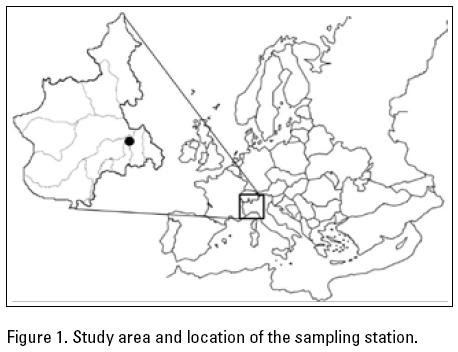
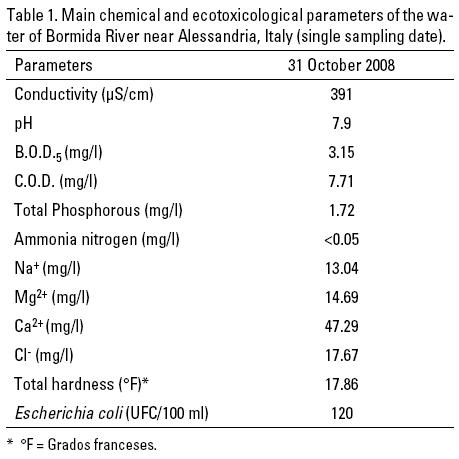
<body><![CDATA[<p align="justify"><font face="verdana" size="2">La introducci&oacute;n de especies ex&oacute;ticas es actualmente una de las mayores amenazas para la conservaci&oacute;n de la biodiversidad. Esto es particularmente cierto en los sistemas fluviales, donde el crecimiento de especies al&oacute;ctonas o no nativas, ha aumentado espectacularmente en los &uacute;ltimos a&ntilde;os. Numerosos estudios han investigado la presencia y la distribuci&oacute;n de las especies ex&oacute;ticas, pero pocos se han centrado en los h&aacute;bitos tr&oacute;ficos de las especies de peces introducidas en nuevos ambientes l&oacute;ticos. Este art&iacute;culo ofrece informaci&oacute;n acerca de la dieta de tres especies ex&oacute;ticas en el R&iacute;o Bormida (NO de Italia), un sistema l&oacute;tico previamente alterado por la contaminaci&oacute;n qu&iacute;mica. <i>Barbus barbus</i> mostr&oacute; un espectro tr&oacute;fico amplio, aliment&aacute;ndose principalmente de invertebrados bent&oacute;nicos, pero tambi&eacute;n consumiendo artr&oacute;podos terrestres, part&iacute;culas gruesas de materia org&aacute;nica, algas filamentosas y, m&aacute;s raramente, peces. La actividad alimenticia de <i>Pseudorasbora parva</i> se bas&oacute; principalmente en invertebrados acu&aacute;ticos, pero tambi&eacute;n ingiri&oacute; con frecuencia algas y materia org&aacute;nica particulada fina. En <i>Rhodeus amarus</i>, los detritos finos y las algas fueron los componentes m&aacute;s importantes en los contenidos estomacales examinados. Posiblemente existen importantes traslapes en el espectro tr&oacute;fico de estas especies ex&oacute;ticas con varias otras especies nativas.</font></p>  	    <p align="justify"><font face="verdana" size="2"><b>Palabras clave:</b> Especies ex&oacute;ticas, NO de Italia, peces de agua dulce, preferencias tr&oacute;ficas.</font></p>  	    <p align="justify"><font face="verdana" size="2">&nbsp;</font></p>  	    <p align="justify"><font face="verdana" size="2"><b>INTRODUCTION</b></font></p>  	    <p align="justify"><font face="verdana" size="2">Human activities have had a profound, and usually negative, influences on freshwater biota, from the smallest creeks to the largest rivers. Some negative effects are due to various contaminants, while others are associated with changes in watershed hydrology (Wellman <i>et al.</i>, 2000; Fenoglio <i>et al.</i>, 2007), habitat modifications (Bo <i>et al.</i>, 2007), alteration of energy sources upon which the aquatic biota depends, and introduction of alien species (Closs <i>et al.</i>, 2004). In fact, after habitat degradation, the introduction of invasive species is the second leading cause of biodiversity loss, particularly in freshwater ecosystems (Moyle <i>et al.</i>, 1986; Mack <i>et al.</i>, 2000; Clavero &amp; Garc&iacute;a&#45;Berthou, 2005; Fenoglio <i>et al.</i>, 2010). The invasion of exotic species in the lotic systems is a global phenomenon, and a subject of elevate interest. When exotic taxa invade communities of species that have co&#45;evolved over long periods, the equilibrium between native species may become seriously disrupted. This can take place through competition, predation, hybridization, or through the transfer of parasites and diseases (Giller &amp; Malmqvist, 1998). There are many examples of successful invasions in freshwaters, mostly because in these environments: i) many human activities, such as sport and commercial fishing, aquaculture practices, pet trade, and fur farming, have lead to allochtonous species import; ii) eradication of exotic taxa can be very difficult or quite impossible; iii) there is high connectivity among streams and lakes, because of drift and water flow. Among vertebrates, the fish fauna of lotic systems are probably the most vulnerable to this threat. Kottelat &amp; Freyhof (2007) report a total of 28 non native fish species established in European fresh waters. These species often compete, pass on diseases and parasites (Dezfuli <i>et al.</i>, 2011), predate upon or even hybridize with native species, and cause local native species extirpation (Baltz &amp; Moyle, 1993; Gido &amp; Brown, 1999; Kottelat &amp; Freyhof, 2007). Many species are intentionally introduced for sport fishing, orage species, food or aesthetic reasons, some have escaped from aquaculture or released by aquarists, but many others are invasive, expanding their range through canals connecting historically separated river basins (e.g. Copp <i>et al.</i>, 1993; Hickley &amp; Chare, 2002; Copp <i>et al.</i>, 2006). Actually, Italy is characterised by the presence of more than 20 exotic fish species, mostly arrived trough direct import, such as the pumpkinseed (<i>Lepomis gibbosus&#45;</i>Linnaeus, 1758) firstly introduced in the Varano Lake in 1900, and the Wels Catfish (<i>Silurus glanis &#45;</i> Linnaeus, 1758), which appeared in the 1957 and that, in these last years, experienced an impressive increase of distribution (Zerunian, 2002).</font></p>  	    <p align="justify"><font face="verdana" size="2">As stated Monakov (2003): "there is no discipline in hydrobiology that does not require a study of the feeding and nutrition of aquatic animals", and this statement is particularly proper regarding biological invasion studies. In fact, fishes represent a considerable proportion of the total freshwater biomass and their feeding interactions exercise a strong influence on all the biotic communities (Hynes, 1970), and provide an important links within aquatic, and between aquatic and terrestrial food webs (Gelwick &amp; Matthews, 1996; Sakano &amp; Iguchi, 2009). The aim of our study was to analyze the diet of three exotic fish species at present widespread in the hydrographic network of most Northern Italy, and especially in the Alessandria district (Provincia di Alessandria 2003, 2005) and to provide first data about their feeding composition. We investigate diet preferences of three cyprinids: European Barbel (<i>Barbus barbus</i> Linnaeus, 1758), a species that in Europe is locally threatened by water pollution and river regulation, but introduced and very abundant in freshwater systems of Northern Italy; Pseudorasbora (<i>Pseudorasbora parva</i> Temminck &amp; Schlegels, 1825), a species native from Amur to Zhujiang drainages (Siberia, Korea, China), introduced in Romania in 1961 (Kottelat &amp; Freyhof, 2007) and actually widespread in central and southern Europe; and Bitteling (<i>Rhodeus amarus</i> Bloch, 1782), a little cyprinid linked to mussels (<i>Unio</i> and <i>Anodonta</i>) for reproduction, and invasive in France, Great Britain and Italy.</font></p>  	    <p align="justify"><font face="verdana" size="2">&nbsp;</font></p>  	    <p align="justify"><font face="verdana" size="2"><b>MATERIALS AND METHODS</b></font></p>  	    <p align="justify"><font face="verdana" size="2">The study area was a reach of the Bormida River near Alessandria (NW&#45;Italy, 44&deg;52'20''N, 8&deg;36'12''E, elevation of 95 m., <a href="#f1">Fig. 1</a>). This river is desolately note because for many decade has been severely polluted by industrial chemical wastes, and it was a "dead river" (Hellmann, 2005). However, since 1990, water quality has rapidly improved, because of the limitation and then the closure of the polluting chemical factories of Cengio, so that macroinvertebrate and fish fauna returned in this lotic system. At present, fish assemblages is characterized by a massive presence of allochtonous species: apart the three studied species, the following exotic species are present in Bormida River: European catfish (<i>Silurus glanis</i>), Asp (<i>Aspius aspius</i> Linnaeus, 1758), pumpkinseed (<i>Lepomis gibbosus</i>), Crucian carp (<i>Carassius carassius</i> Linnaeus, 1758), Black Bullhead (<i>Ameiurus melas</i> Rafinesque, 1820; Badino <i>et al.</i>, 2007). In the sampling station, Bormida River is characterized by dense riparian vegetation, good morphological diversity, but poor and altered physical&#45;chemical quality (see <a href="#t1">Table 1</a>). In a single sampling date (31 October 2008), 182 specimens of allochtonous fishes were collected (68 <i>B. barbus</i>, 57 <i>P. parva</i> and 57 <i>R. amarus</i>; all specimens were in the adult stage). Fishes were caught by using a Scubla IG200/2 electro&#45;fishing device, and stored in ethanol 90%. In laboratory, each fish was measured with an accuracy of 0.1 mm (total length). Digestive tracts were removed and the contents were analyzed with a Nikon SMZ 1500 light microscope (60&#45;100 x) coupled with a Sony HD videocamera and a Samsung LCD Video. Identification of prey was based on sclerotized body parts, particularly head capsules, mouth parts and leg fragments. Organisms in guts were classified generally to genus or family level. Stewart and Stark (2002) stated that the count of sclerotized fragments (i.e. head capsules or legs) can give a reasonably accurate count of prey consumed. The other components of the fish diet are classified into five food items or categories: Algae, CPOM (Coarse particulate organic matter), FPOM (Fine particulate organic matter), undeterminable animal matter and sand. Gut contents were also compared with the natural composition and abundance of macroinvertebrate communities. In fact, using a Surber net (20 x 20 cm; mesh 250 &#956;m), 156 samples (with more than 20000 invertebrates) were collected in the same period (October 2008) in the study site to assess the availability of prey invertebrate taxa in the benthic environment. Samples were preserved in 90% ethanol. In the laboratory, all organisms were counted and identified to genus or species level, except for: Oligochaeta and larvae of some Trichoptera and Diptera, which were identified to family or sub&#45;family level. To investigate the existence of feeding preferences, we compared gut contents with natural composition and abundance of macroinvertebrate community in the riverbed using the trophic electivity index of Ivlev (1961):</font></p>  	    <p align="center"><font face="verdana" size="2"><a name="f1"></a></font></p>  	    ]]></body>
<body><![CDATA[<p align="center"><font face="verdana" size="2"><img src="/img/revistas/hbio/v22n3/a1f1.jpg"></font></p>  	    <p align="center"><font face="verdana" size="2"><a name="t1"></a></font></p>  	    <p align="center"><font face="verdana" size="2"><img src="/img/revistas/hbio/v22n3/a1t1.jpg"></font></p>  	    <p align="center"><font face="verdana" size="2"><b>E = (ri&#45;pi) / (ri+pi)</b></font></p>  	    <p align="justify"><font face="verdana" size="2">where</font></p>  	    <blockquote> 		    <p align="justify"><font face="verdana" size="2">ri = relative abundance of a particular taxon in the diet and</font></p>  		    <p align="justify"><font face="verdana" size="2">pi = relative abundance of the same taxon in the benthic community.</font></p> 	</blockquote>  	    <p align="justify"><font face="verdana" size="2">The formula considers the number of taxa (i) found in the diet. The index ranges from &minus;1 to 1. A value of &minus;1 means total avoidance, 1 indicates preference and 0 indicates indifference.</font></p>  	    <p align="justify"><font face="verdana" size="2">&nbsp;</font></p>  	    ]]></body>
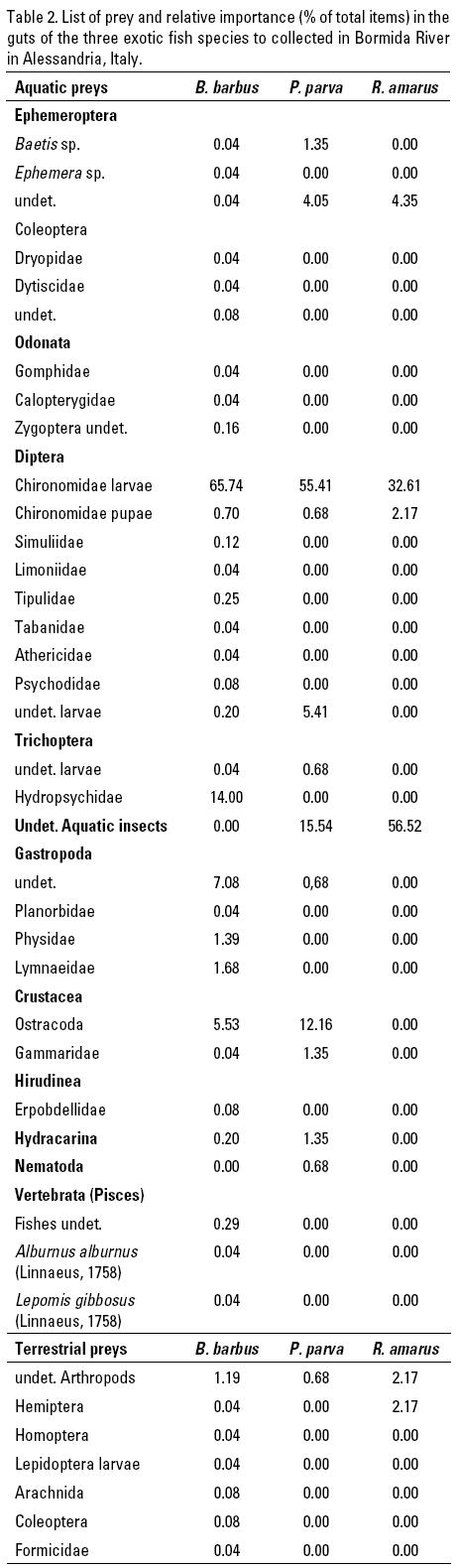
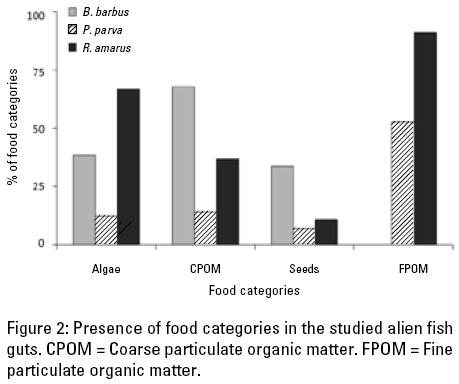
<body><![CDATA[<p align="justify"><font face="verdana" size="2"><b>RESULTS</b></font></p>  	    <p align="justify"><font face="verdana" size="2">In total we collected 182 specimens, but we analyzed data from gut contents of 171 specimens, because respectively two individuals of Barbel, six of Pseudorasbora and three of Bitteling had empty guts. The mean length of body was 16.03 mm &plusmn; 7.61 (SD) for Barbel, 5.07 mm &plusmn; 0.91 for Pseudorasbora and 5.35 mm &plusmn; 0.59 for Bitteling.</font></p>  	    <p align="justify"><font face="verdana" size="2">Regarding the diet composition, the aquatic macroinvertebrates constituted an important food for <i>B. barbus</i> and <i>P. parva</i> (in fact, the invertebrates were present in 89.7 % and 66.7 % of the analyzed guts, respectively), while <i>R. amarus</i> seems to prefer algae and detritus, the only invertebrates found in their guts were larvae of Chironomidae and Ephemeroptera (<a href="#t2">Table 2</a>).</font></p>  	    <p align="center"><font face="verdana" size="2"><a name="t2"></a></font></p>  	    <p align="center"><font face="verdana" size="2"><img src="/img/revistas/hbio/v22n3/a1t2.jpg"></font></p>  	    <p align="justify"><font face="verdana" size="2">In Bormida River, <i>B. barbus</i> showed a wide trophic spectrum, feeding not only on aquatic insects, but also on terrestrial arthropods (e.g. coleopterans, hemipterans, hymenopterans and arachnids as spiders) and, more rarely, on some fish (e.g. <i>Lepomis gibbosus</i> and <i>Alburnus alburnus</i> (Linnaeus 1758)<i>,</i> find in 8.82% of guts). Also coarse detritus (CPOM) and filamentous algae were ingested by analyzed specimens (<a href="#f2">Fig. 2</a>). Feeding activity of <i>P. parva</i> was mostly based on aquatic invertebrates (Chironomidae and Ostracoda), which constituted respectively 55.4% and 12.1% of all ingested prey items. Furthermore, both algae and fine detritus (FPOM) were frequently ingested.</font></p>  	    <p align="center"><font face="verdana" size="2"><a name="f2"></a></font></p>  	    <p align="center"><font face="verdana" size="2"><img src="/img/revistas/hbio/v22n3/a1f2.jpg"></font></p>  	    <p align="justify"><font face="verdana" size="2">In the diet composition of <i>R. amarus</i>, both fine detritus and algae were the most important food items in the examined guts: these trophic resources were found of respective manner in 91.2% and 66.6% of the total analyzed specimens. Also, coarse particulate organic matter (CPOM) and seeds constituted important trophic resources.</font></p>  	    <p align="justify"><font face="verdana" size="2">Sand was found frequently in the guts of the three examined alien fishes, probably ingested during the predation on benthic prey.</font></p>  	    ]]></body>
<body><![CDATA[<p align="justify"><font face="verdana" size="2">We performed a trophic electivity analysis using some selected benthic taxa,that exemplify the different niches and habits of local macrobenthic fauna. <i>B. barbus</i> select positively bottom&#45;living invertebrates, such as <i>Physa</i> sp. (Ivlev index = 0.97), <i>Hydropsyche</i> sp. (Ivlev index = 0.85), <i>Ephemera</i> sp. (Ivlev index = 0.42). Chironomidae were positively selected both by <i>B. barbus</i> (Ivlev index = 0.19) and <i>P. parva</i> (Ivlev index = 0.11). Simuliidae, despite their relative importance in the benthic community were not positively selected, also if they enter in the diet of the Barbel. <i>R.</i> <i>amarus</i> did not show any preference for some particular macrobenthic taxa.</font></p>  	    <p align="justify"><font face="verdana" size="2">&nbsp;</font></p>  	    <p align="justify"><font face="verdana" size="2"><b>DISCUSSION</b></font></p>  	    <p align="justify"><font face="verdana" size="2">Freshwater and estuarine biota is changing rapidly worldwide (Moyle &amp; Leidy, 1992; Allan &amp; Flecker, 1993; Fenoglio <i>et al.</i>, 2010). Human&#45;mediated invasions of aquatic organisms are associated with these changes, which commonly include extirpation of native organisms. In fact, invasive species have caused enormous disruption to ecosystems around the world (Lodge &amp; Shrader&#45;Frechette, 2003), and actually alien fish species have received considerable attention, given that the integrity of aquatic ecosystems is being increasingly challenged worldwide by species invasions (Moyle &amp; Light, 1996). Despite this, the effects of the vast majority of introductions have not been studied and their impacts on the native biota are poorly assessed therefore, studies on feeding behaviour and diet represent essential and fundamental elements to improve our knowledge about the effects of alien species on aquatic ecosystem. Recently many studies have focused their attention on particular invasive species such as the <i>Silurs glanis</i> (e.g. Czarnecki <i>et al.</i>, 2003; Riva <i>et al.</i>, 2004; Syv&auml;ranta <i>et al.</i>, 2009), or the worldwide distributed rainbow trout <i>Onchorhyncus mykiss</i> (Walbaum, 1972) (e.g. Angradi &amp; Griffith, 1990; Dedual &amp; Collier, 1995; Bernini <i>et al.</i>, 2006; Candiotto <i>et al.</i>, 2011).</font></p>  	    <p align="justify"><font face="verdana" size="2">This study is the first attempt to describe the diet of some invasive freshwater fish in a previously highly polluted river in Italy. The three species analyzed differ greatly in size, habitat preferences and thus to the diet. In the Bormida River, <i>B. barbus</i> is markedly carnivorous, although with a tendency to feed on plant material (CPOM, seeds): Diptera, Trichoptera and Gastropods constitute the vast majority of prey, testifying that this species usually feeds on the river bottom. <i>P. parva</i> feeds mainly on small invertebrates (Chironomidae but also Ostracoda) and late organic detritus. <i>R. amarus</i> is a microphagous that feeds primarily on fine detritus and algae.</font></p>  	    <p align="justify"><font face="verdana" size="2">Trophic spectrum of these three allocthonous species potentially overlap with some native taxa that are present in the study site: for example, the diet of the European Barbel can partly cover the trophic niche of <i>B. plebejus</i> Bonaparte, 1839, a northern Adriatic endemic species; the niche of <i>P. parva</i> can overlap those of some native Cyprinidae and <i>R. amarus</i> can compete with <i>A. alburnus</i>.</font></p>  	    <p align="justify"><font face="verdana" size="2">Many authors (e.g. Hobbs, 2000; Lozon &amp; MacIsaac, 1997) have pointed out that successful invasion by introduced organisms is widely regarded as being more probable in anthropogenically disturbed habitats. In particular introduced freshwater fish have commonly been documented to thrive in degraded aquatic habitats in many areas of the world (Brown, 2000; Meador <i>et al.</i>, 2003). An interesting element is that the fish fauna of the river Bormida mostly consists of alien species; we could suppose that the long history of pollution of this river has cleared the local fishing community, probably favoring the implantation of allocthonous taxa. Another problem related to alien fish species is that the removal of invasive taxa in the river systems of medium order is very hard and the effective eradication is virtually impossible.</font></p>  	    <p align="justify"><font face="verdana" size="2">&nbsp;</font></p>  	    <p align="justify"><font face="verdana" size="2"><b>ACKNOWLEDGEMENTS</b></font></p>  	    <p align="justify"><font face="verdana" size="2">We thank M. Bottaro for help during laboratory activity, we are also grateful to ARPA Piemonte &#45;Alessandria Dep., for water analysis. This study was supported by CRAL &#45; Cassa di Risparmio di Alessandria grants. Experiments comply with the Italian laws.</font></p>  	    ]]></body>
<body><![CDATA[<p align="justify"><font face="verdana" size="2">&nbsp;</font></p>  	    <p align="justify"><font face="verdana" size="2"><b>REFERENCES</b></font></p>  	    <!-- ref --><p align="justify"><font face="verdana" size="2">Allan, J. D. &amp; A. S. Flecker. 1993. Biodiversity conservation in running waters: identifying the major factors that affect destruction of riverine species and ecosystems. <i>BioScience</i> 43: 32&#45;43.    &nbsp;&nbsp;&nbsp;&nbsp;&nbsp;&nbsp;&nbsp;&nbsp;[&#160;<a href="javascript:void(0);" onclick="javascript: window.open('/scielo.php?script=sci_nlinks&ref=4118903&pid=S0188-8897201200030000100001&lng=','','width=640,height=500,resizable=yes,scrollbars=1,menubar=yes,');">Links</a>&#160;]<!-- end-ref --></font></p>  	    <!-- ref --><p align="justify"><font face="verdana" size="2">Angradi, T. R. &amp; J. S. Griffith. 1990. Diel feeding chronology and diet selection of Rainbow Trout (<i>Oncorhynchus mykiss</i>) in the Henry's Fork of the Snake River, Idaho. <i>Canadian Journal of Fisheries and Aquatic Sciences</i> 47: 199&#45;209.    &nbsp;&nbsp;&nbsp;&nbsp;&nbsp;&nbsp;&nbsp;&nbsp;[&#160;<a href="javascript:void(0);" onclick="javascript: window.open('/scielo.php?script=sci_nlinks&ref=4118905&pid=S0188-8897201200030000100002&lng=','','width=640,height=500,resizable=yes,scrollbars=1,menubar=yes,');">Links</a>&#160;]<!-- end-ref --></font></p>  	    <!-- ref --><p align="justify"><font face="verdana" size="2">Badino, G., F. Bona, A. Candiotto &amp; S. Fenoglio. 2007. Changes in fish assemblages of a previously highly polluted river: the role of the environmental recovery and alien fish invasion in the Bormida River (Italy). <i>Journal of freshwater Ecology</i> 22: 255&#45;260.    &nbsp;&nbsp;&nbsp;&nbsp;&nbsp;&nbsp;&nbsp;&nbsp;[&#160;<a href="javascript:void(0);" onclick="javascript: window.open('/scielo.php?script=sci_nlinks&ref=4118907&pid=S0188-8897201200030000100003&lng=','','width=640,height=500,resizable=yes,scrollbars=1,menubar=yes,');">Links</a>&#160;]<!-- end-ref --></font></p>  	    <!-- ref --><p align="justify"><font face="verdana" size="2">Baltz, D. M &amp; P. B. Moyle. 1993. Invasion resistance to introduced species by a native assemblage of California stream fishes. <i>Ecological Applications</i> 3: 246&#45;255.    &nbsp;&nbsp;&nbsp;&nbsp;&nbsp;&nbsp;&nbsp;&nbsp;[&#160;<a href="javascript:void(0);" onclick="javascript: window.open('/scielo.php?script=sci_nlinks&ref=4118909&pid=S0188-8897201200030000100004&lng=','','width=640,height=500,resizable=yes,scrollbars=1,menubar=yes,');">Links</a>&#160;]<!-- end-ref --></font></p>  	    ]]></body>
<body><![CDATA[<!-- ref --><p align="justify"><font face="verdana" size="2">Bernini, F., A. Candiotto, P. A. Nardi, S. Rossi &amp; E. Razzetti. 2006. Reptiles in the diet of a <i>Oncorhynchus mykiss</i> (Osteichthyes: Salmonidae) naturalized population in Piedmont (N Italy). <i>Acta Herpetologica</i> 1: 61&#45;63.    &nbsp;&nbsp;&nbsp;&nbsp;&nbsp;&nbsp;&nbsp;&nbsp;[&#160;<a href="javascript:void(0);" onclick="javascript: window.open('/scielo.php?script=sci_nlinks&ref=4118911&pid=S0188-8897201200030000100005&lng=','','width=640,height=500,resizable=yes,scrollbars=1,menubar=yes,');">Links</a>&#160;]<!-- end-ref --></font></p>  	    <!-- ref --><p align="justify"><font face="verdana" size="2">Bo, T., S. Fenoglio, G. Malacarne, M. Pessino &amp; F. Sgariboldi. 2007. Effect of clogging on stream macroinvertebrates: an experimental approach. <i>Limnologica</i> 37: 186&#45;192.    &nbsp;&nbsp;&nbsp;&nbsp;&nbsp;&nbsp;&nbsp;&nbsp;[&#160;<a href="javascript:void(0);" onclick="javascript: window.open('/scielo.php?script=sci_nlinks&ref=4118913&pid=S0188-8897201200030000100006&lng=','','width=640,height=500,resizable=yes,scrollbars=1,menubar=yes,');">Links</a>&#160;]<!-- end-ref --></font></p>  	    <!-- ref --><p align="justify"><font face="verdana" size="2">Brown, L. R. 2000. Fish communities and their associations with environmental variables, lower San Joaquin river drainage, California. <i>Environmental Biology of Fishes</i> 57: 251&#45;269.    &nbsp;&nbsp;&nbsp;&nbsp;&nbsp;&nbsp;&nbsp;&nbsp;[&#160;<a href="javascript:void(0);" onclick="javascript: window.open('/scielo.php?script=sci_nlinks&ref=4118915&pid=S0188-8897201200030000100007&lng=','','width=640,height=500,resizable=yes,scrollbars=1,menubar=yes,');">Links</a>&#160;]<!-- end-ref --></font></p>  	    <!-- ref --><p align="justify"><font face="verdana" size="2">Candiotto, A., T. Bo &amp; S. Fenoglio. 2011. Biological and ecological data on an established rainbow trout (<i>Oncorhynchus mykiss</i>) population in an Italian stream. <i>Fundamental and Applied Limnology</i> 179: 67&#45;76.    &nbsp;&nbsp;&nbsp;&nbsp;&nbsp;&nbsp;&nbsp;&nbsp;[&#160;<a href="javascript:void(0);" onclick="javascript: window.open('/scielo.php?script=sci_nlinks&ref=4118917&pid=S0188-8897201200030000100008&lng=','','width=640,height=500,resizable=yes,scrollbars=1,menubar=yes,');">Links</a>&#160;]<!-- end-ref --></font></p>  	    <!-- ref --><p align="justify"><font face="verdana" size="2">Clavero, M. &amp; W. Garc&iacute;a&#45;Berthou. 2005. Invasive species are a leading cause of animal extinctions. <i>Trends in Ecology and Evolution</i> 20:110.    &nbsp;&nbsp;&nbsp;&nbsp;&nbsp;&nbsp;&nbsp;&nbsp;[&#160;<a href="javascript:void(0);" onclick="javascript: window.open('/scielo.php?script=sci_nlinks&ref=4118919&pid=S0188-8897201200030000100009&lng=','','width=640,height=500,resizable=yes,scrollbars=1,menubar=yes,');">Links</a>&#160;]<!-- end-ref --></font></p>  	    ]]></body>
<body><![CDATA[<!-- ref --><p align="justify"><font face="verdana" size="2">Czarnecki, M., W. Andrzejewski, &amp; J. Masty&ntilde;ski. 2003. The feeding selectivity of wels (<i>Silurus glanis</i> L.) in lake G&oacute;reckie. <i>Archives of Polish Fisheries</i> 11: 141&#45;147.    &nbsp;&nbsp;&nbsp;&nbsp;&nbsp;&nbsp;&nbsp;&nbsp;[&#160;<a href="javascript:void(0);" onclick="javascript: window.open('/scielo.php?script=sci_nlinks&ref=4118921&pid=S0188-8897201200030000100010&lng=','','width=640,height=500,resizable=yes,scrollbars=1,menubar=yes,');">Links</a>&#160;]<!-- end-ref --></font></p>  	    <!-- ref --><p align="justify"><font face="verdana" size="2">Closs, G., B. Downes &amp; A. Boulton. 2004. <i>Freshwater Ecology. A Scientific Introduction</i>, Blackwell Publishing, Oxford. 221 p.    &nbsp;&nbsp;&nbsp;&nbsp;&nbsp;&nbsp;&nbsp;&nbsp;[&#160;<a href="javascript:void(0);" onclick="javascript: window.open('/scielo.php?script=sci_nlinks&ref=4118923&pid=S0188-8897201200030000100011&lng=','','width=640,height=500,resizable=yes,scrollbars=1,menubar=yes,');">Links</a>&#160;]<!-- end-ref --></font></p>  	    <!-- ref --><p align="justify"><font face="verdana" size="2">Copp, G. H., C. Vaughn &amp; A. C. Wheeler. 1993. First occurrence of the North American white sucker <i>Catostomus commersoni</i> in Great Britain. <i>Journal of Fish Biology</i> 42: 615&#45;617.    &nbsp;&nbsp;&nbsp;&nbsp;&nbsp;&nbsp;&nbsp;&nbsp;[&#160;<a href="javascript:void(0);" onclick="javascript: window.open('/scielo.php?script=sci_nlinks&ref=4118925&pid=S0188-8897201200030000100012&lng=','','width=640,height=500,resizable=yes,scrollbars=1,menubar=yes,');">Links</a>&#160;]<!-- end-ref --></font></p>  	    <!-- ref --><p align="justify"><font face="verdana" size="2">Copp, G. H., S. Stakenas &amp; P. Davison. 2006. The incidence of non&#45;native fishes in water courses: example of the United Kingdom. <i>Aquatic Invasions</i> 1: 72&#45;75.    &nbsp;&nbsp;&nbsp;&nbsp;&nbsp;&nbsp;&nbsp;&nbsp;[&#160;<a href="javascript:void(0);" onclick="javascript: window.open('/scielo.php?script=sci_nlinks&ref=4118927&pid=S0188-8897201200030000100013&lng=','','width=640,height=500,resizable=yes,scrollbars=1,menubar=yes,');">Links</a>&#160;]<!-- end-ref --></font></p>  	    <!-- ref --><p align="justify"><font face="verdana" size="2">Dedual, M. &amp; K. J. Collier. 1995. Aspects of juvenile Rainbow trout (<i>Oncorhynchus mykiss</i>) diet in relation to food supply during summer in the lower Tongariro River, New Zealand. <i>New Zealand Journal of Marine and Freshwater Research</i> 29: 381&#45;391.    &nbsp;&nbsp;&nbsp;&nbsp;&nbsp;&nbsp;&nbsp;&nbsp;[&#160;<a href="javascript:void(0);" onclick="javascript: window.open('/scielo.php?script=sci_nlinks&ref=4118929&pid=S0188-8897201200030000100014&lng=','','width=640,height=500,resizable=yes,scrollbars=1,menubar=yes,');">Links</a>&#160;]<!-- end-ref --></font></p>  	    ]]></body>
<body><![CDATA[<!-- ref --><p align="justify"><font face="verdana" size="2">Dezfuli, B. S., G. Castaldelli, T. Bo, M. Lorenzoni &amp; L. Giari. 2011. Intestinal immune response of <i>Silurus glanis</i> and <i>Barbus barbus</i> naturally infected with <i>Pomphorhynchus laevis</i> (Acanthocephala). <i>Parasite Immunology</i> 33: 116&#45;123.    &nbsp;&nbsp;&nbsp;&nbsp;&nbsp;&nbsp;&nbsp;&nbsp;[&#160;<a href="javascript:void(0);" onclick="javascript: window.open('/scielo.php?script=sci_nlinks&ref=4118931&pid=S0188-8897201200030000100015&lng=','','width=640,height=500,resizable=yes,scrollbars=1,menubar=yes,');">Links</a>&#160;]<!-- end-ref --></font></p>  	    <!-- ref --><p align="justify"><font face="verdana" size="2">Fenoglio, S., T. Bo, M. Cucco &amp; G. Malacarne. 2007. Response of benthic invertebrate assemblages to varying drought conditions in the Po river (NW Italy). <i>Italian Journal of Zoology</i> 74: 191&#45;201.    &nbsp;&nbsp;&nbsp;&nbsp;&nbsp;&nbsp;&nbsp;&nbsp;[&#160;<a href="javascript:void(0);" onclick="javascript: window.open('/scielo.php?script=sci_nlinks&ref=4118933&pid=S0188-8897201200030000100016&lng=','','width=640,height=500,resizable=yes,scrollbars=1,menubar=yes,');">Links</a>&#160;]<!-- end-ref --></font></p>  	    <!-- ref --><p align="justify"><font face="verdana" size="2">Fenoglio, S., T. Bo, M. Cucco, L. Mercalli &amp; G. Malacarne. 2010. Effects of global climate change on freshwater biota: A review with special emphasis on the Italian situation. <i>Italian Journal of Zoology</i> 77: 374&#45;383.    &nbsp;&nbsp;&nbsp;&nbsp;&nbsp;&nbsp;&nbsp;&nbsp;[&#160;<a href="javascript:void(0);" onclick="javascript: window.open('/scielo.php?script=sci_nlinks&ref=4118935&pid=S0188-8897201200030000100017&lng=','','width=640,height=500,resizable=yes,scrollbars=1,menubar=yes,');">Links</a>&#160;]<!-- end-ref --></font></p>  	    <!-- ref --><p align="justify"><font face="verdana" size="2">Gelwick, F. P. &amp; W. J. Matthews. 1996. Trophic relations of stream fishes. <i>In</i>: Hauer, F. R. &amp; V. H. Resh (Eds.). <i>Methods in Stream Ecology</i>. Academic Press, pp. 475&#45;492.    &nbsp;&nbsp;&nbsp;&nbsp;&nbsp;&nbsp;&nbsp;&nbsp;[&#160;<a href="javascript:void(0);" onclick="javascript: window.open('/scielo.php?script=sci_nlinks&ref=4118937&pid=S0188-8897201200030000100018&lng=','','width=640,height=500,resizable=yes,scrollbars=1,menubar=yes,');">Links</a>&#160;]<!-- end-ref --></font></p>  	    <!-- ref --><p align="justify"><font face="verdana" size="2">Gido, K. B. &amp; J. H. Brown. 1999. Invasion of North American drainages by alien fish species. <i>Freshwater Biology</i> 42: 387&#45;399.    &nbsp;&nbsp;&nbsp;&nbsp;&nbsp;&nbsp;&nbsp;&nbsp;[&#160;<a href="javascript:void(0);" onclick="javascript: window.open('/scielo.php?script=sci_nlinks&ref=4118939&pid=S0188-8897201200030000100019&lng=','','width=640,height=500,resizable=yes,scrollbars=1,menubar=yes,');">Links</a>&#160;]<!-- end-ref --></font></p>  	    ]]></body>
<body><![CDATA[<!-- ref --><p align="justify"><font face="verdana" size="2">Giller, P. S. &amp; B. Malmqvist. 1998. <i>The Biology of Streams and Rivers</i>, Oxford University Press, Oxford. 296 p.    &nbsp;&nbsp;&nbsp;&nbsp;&nbsp;&nbsp;&nbsp;&nbsp;[&#160;<a href="javascript:void(0);" onclick="javascript: window.open('/scielo.php?script=sci_nlinks&ref=4118941&pid=S0188-8897201200030000100020&lng=','','width=640,height=500,resizable=yes,scrollbars=1,menubar=yes,');">Links</a>&#160;]<!-- end-ref --></font></p>  	    <!-- ref --><p align="justify"><font face="verdana" size="2">Hellmann, A. 2005. <i>Cent'anni di veleno, Il Caso ACNA: l'ultima guerra civile italiana</i>, Stampa Alternativa, Viterbo. 128 p.    &nbsp;&nbsp;&nbsp;&nbsp;&nbsp;&nbsp;&nbsp;&nbsp;[&#160;<a href="javascript:void(0);" onclick="javascript: window.open('/scielo.php?script=sci_nlinks&ref=4118943&pid=S0188-8897201200030000100021&lng=','','width=640,height=500,resizable=yes,scrollbars=1,menubar=yes,');">Links</a>&#160;]<!-- end-ref --></font></p>  	    <!-- ref --><p align="justify"><font face="verdana" size="2">Hickley, P. &amp; S. Chare. 2002. Fisheries for non&#45;native species in England: angling or the environment? <i>Fisheries Management and Ecology</i> 11: 203&#45;212.    &nbsp;&nbsp;&nbsp;&nbsp;&nbsp;&nbsp;&nbsp;&nbsp;[&#160;<a href="javascript:void(0);" onclick="javascript: window.open('/scielo.php?script=sci_nlinks&ref=4118945&pid=S0188-8897201200030000100022&lng=','','width=640,height=500,resizable=yes,scrollbars=1,menubar=yes,');">Links</a>&#160;]<!-- end-ref --></font></p>  	    <!-- ref --><p align="justify"><font face="verdana" size="2">Hobbs, R. J. 2000. Land&#45;use changes and invasions. <i>In</i>: Mooney, H. A. &amp; R. J. Hobbs (Eds.). <i>Invasive Species in a Changing World</i>. Island Press, Washington D.C., pp. 55&#45;83.    &nbsp;&nbsp;&nbsp;&nbsp;&nbsp;&nbsp;&nbsp;&nbsp;[&#160;<a href="javascript:void(0);" onclick="javascript: window.open('/scielo.php?script=sci_nlinks&ref=4118947&pid=S0188-8897201200030000100023&lng=','','width=640,height=500,resizable=yes,scrollbars=1,menubar=yes,');">Links</a>&#160;]<!-- end-ref --></font></p>  	    <!-- ref --><p align="justify"><font face="verdana" size="2">Hynes, H. B. N. 1970. <i>The Ecology of Running Waters</i>, University of Toronto Press, Toronto. 555 p.    &nbsp;&nbsp;&nbsp;&nbsp;&nbsp;&nbsp;&nbsp;&nbsp;[&#160;<a href="javascript:void(0);" onclick="javascript: window.open('/scielo.php?script=sci_nlinks&ref=4118949&pid=S0188-8897201200030000100024&lng=','','width=640,height=500,resizable=yes,scrollbars=1,menubar=yes,');">Links</a>&#160;]<!-- end-ref --></font></p>  	    ]]></body>
<body><![CDATA[<!-- ref --><p align="justify"><font face="verdana" size="2">Kottelat, M. &amp; J. Freyhof. 2007. <i>Handbook of European freshwater fishes</i>. Kottelat, Cornol, Switzerland and Freyhof, Berlin, Germany. 646 p.    &nbsp;&nbsp;&nbsp;&nbsp;&nbsp;&nbsp;&nbsp;&nbsp;[&#160;<a href="javascript:void(0);" onclick="javascript: window.open('/scielo.php?script=sci_nlinks&ref=4118951&pid=S0188-8897201200030000100025&lng=','','width=640,height=500,resizable=yes,scrollbars=1,menubar=yes,');">Links</a>&#160;]<!-- end-ref --></font></p>  	    <!-- ref --><p align="justify"><font face="verdana" size="2">Ivlev, V. S. 1961. <i>Experimental ecology of the feeding of fishes</i>. Yale University Press. New Heaven, 322 p.    &nbsp;&nbsp;&nbsp;&nbsp;&nbsp;&nbsp;&nbsp;&nbsp;[&#160;<a href="javascript:void(0);" onclick="javascript: window.open('/scielo.php?script=sci_nlinks&ref=4118953&pid=S0188-8897201200030000100026&lng=','','width=640,height=500,resizable=yes,scrollbars=1,menubar=yes,');">Links</a>&#160;]<!-- end-ref --></font></p>  	    <!-- ref --><p align="justify"><font face="verdana" size="2">Lodge, D. M. &amp; K. Shraser&#45;Frechette. 2003. Nonindigenous species: ecological explanation, environmental ethics, and public policy. <i>Biological Conservation</i> 17: 31&#45;37.    &nbsp;&nbsp;&nbsp;&nbsp;&nbsp;&nbsp;&nbsp;&nbsp;[&#160;<a href="javascript:void(0);" onclick="javascript: window.open('/scielo.php?script=sci_nlinks&ref=4118955&pid=S0188-8897201200030000100027&lng=','','width=640,height=500,resizable=yes,scrollbars=1,menubar=yes,');">Links</a>&#160;]<!-- end-ref --></font></p>  	    <!-- ref --><p align="justify"><font face="verdana" size="2">Lozon, J. D. &amp; H. J. MacIsaac. 1997. Biological invasions: are they dependent on disturbance? <i>Environmental Reviews</i> 5: 131&#45;144.    &nbsp;&nbsp;&nbsp;&nbsp;&nbsp;&nbsp;&nbsp;&nbsp;[&#160;<a href="javascript:void(0);" onclick="javascript: window.open('/scielo.php?script=sci_nlinks&ref=4118957&pid=S0188-8897201200030000100028&lng=','','width=640,height=500,resizable=yes,scrollbars=1,menubar=yes,');">Links</a>&#160;]<!-- end-ref --></font></p>  	    <!-- ref --><p align="justify"><font face="verdana" size="2">Mack, R. N., D. Simberloff, W. M. Lonsdale, H. Evans, M. Clout &amp; F. A. Bazzaz. 2000. Biotic invasions: Causes, epidemiology, global consequences, and control. <i>Ecological Applications</i> 10: 689&#45;710.    &nbsp;&nbsp;&nbsp;&nbsp;&nbsp;&nbsp;&nbsp;&nbsp;[&#160;<a href="javascript:void(0);" onclick="javascript: window.open('/scielo.php?script=sci_nlinks&ref=4118959&pid=S0188-8897201200030000100029&lng=','','width=640,height=500,resizable=yes,scrollbars=1,menubar=yes,');">Links</a>&#160;]<!-- end-ref --></font></p>  	    ]]></body>
<body><![CDATA[<!-- ref --><p align="justify"><font face="verdana" size="2">Meador, M. R., L. R. Brown &amp; T. Short. 2003. Relations between introduced fish and environmental conditions at large geographic scales<i>. Ecological Indicators</i> 3: 81&#45;92.    &nbsp;&nbsp;&nbsp;&nbsp;&nbsp;&nbsp;&nbsp;&nbsp;[&#160;<a href="javascript:void(0);" onclick="javascript: window.open('/scielo.php?script=sci_nlinks&ref=4118961&pid=S0188-8897201200030000100030&lng=','','width=640,height=500,resizable=yes,scrollbars=1,menubar=yes,');">Links</a>&#160;]<!-- end-ref --></font></p>  	    <!-- ref --><p align="justify"><font face="verdana" size="2">Moyle, P. B., H. W. Li &amp; B. A. Barton. 1986. The Frankenstein effect: impact of introduced fishes on native fishes in North America. <i>In</i>: Stroud, R. H. (Ed.). <i>Fish culture</i> <i>in fisheries management</i>. American Fisheries Society, Bethesda, Maryland, pp. 415&#45;426.    &nbsp;&nbsp;&nbsp;&nbsp;&nbsp;&nbsp;&nbsp;&nbsp;[&#160;<a href="javascript:void(0);" onclick="javascript: window.open('/scielo.php?script=sci_nlinks&ref=4118963&pid=S0188-8897201200030000100031&lng=','','width=640,height=500,resizable=yes,scrollbars=1,menubar=yes,');">Links</a>&#160;]<!-- end-ref --></font></p>  	    <!-- ref --><p align="justify"><font face="verdana" size="2">Moyle, P. B. &amp; R. L. Leidy. 1992. Loss of biodiversity in aquatic ecosystems: evidence from fish faunas. <i>In</i>: Feidler, P. L. &amp; S. K. Jain (Eds.). <i>Conservation biology: the theory and practice of nature conservation, preservation, and management</i>. Chapman and Hall, New York, pp. 127&#45;170.    &nbsp;&nbsp;&nbsp;&nbsp;&nbsp;&nbsp;&nbsp;&nbsp;[&#160;<a href="javascript:void(0);" onclick="javascript: window.open('/scielo.php?script=sci_nlinks&ref=4118965&pid=S0188-8897201200030000100032&lng=','','width=640,height=500,resizable=yes,scrollbars=1,menubar=yes,');">Links</a>&#160;]<!-- end-ref --></font></p>  	    <!-- ref --><p align="justify"><font face="verdana" size="2">Moyle, P. B. &amp; T. Light. 1996. Biological invasions of fresh water: empirical rules and assembly theory. <i>Biological Conservation</i> 78: 149&#45;161.    &nbsp;&nbsp;&nbsp;&nbsp;&nbsp;&nbsp;&nbsp;&nbsp;[&#160;<a href="javascript:void(0);" onclick="javascript: window.open('/scielo.php?script=sci_nlinks&ref=4118967&pid=S0188-8897201200030000100033&lng=','','width=640,height=500,resizable=yes,scrollbars=1,menubar=yes,');">Links</a>&#160;]<!-- end-ref --></font></p>  	    <!-- ref --><p align="justify"><font face="verdana" size="2">Monakov, A. V. 2003. <i>Feeding of freshwater invertebrates</i>. Kenobi Productions, Ghent, Belgium. 373 p.    &nbsp;&nbsp;&nbsp;&nbsp;&nbsp;&nbsp;&nbsp;&nbsp;[&#160;<a href="javascript:void(0);" onclick="javascript: window.open('/scielo.php?script=sci_nlinks&ref=4118969&pid=S0188-8897201200030000100034&lng=','','width=640,height=500,resizable=yes,scrollbars=1,menubar=yes,');">Links</a>&#160;]<!-- end-ref --></font></p>  	    ]]></body>
<body><![CDATA[<!-- ref --><p align="justify"><font face="verdana" size="2">Provincia Di Alessandria. 2003. <i>Carta ittica della Provincia di Alessandria, la zona montana.</i> Assessorato tutela e valorizzazione ambientale. 143 p.    &nbsp;&nbsp;&nbsp;&nbsp;&nbsp;&nbsp;&nbsp;&nbsp;[&#160;<a href="javascript:void(0);" onclick="javascript: window.open('/scielo.php?script=sci_nlinks&ref=4118971&pid=S0188-8897201200030000100035&lng=','','width=640,height=500,resizable=yes,scrollbars=1,menubar=yes,');">Links</a>&#160;]<!-- end-ref --></font></p>  	    <!-- ref --><p align="justify"><font face="verdana" size="2">Provincia Di Alessandria. 2005. <i>Carta ittica della Provincia di Alessandria, la zona di pianura.</i> Assessorato tutela e valorizzazione ambientale. 143 p.    &nbsp;&nbsp;&nbsp;&nbsp;&nbsp;&nbsp;&nbsp;&nbsp;[&#160;<a href="javascript:void(0);" onclick="javascript: window.open('/scielo.php?script=sci_nlinks&ref=4118973&pid=S0188-8897201200030000100036&lng=','','width=640,height=500,resizable=yes,scrollbars=1,menubar=yes,');">Links</a>&#160;]<!-- end-ref --></font></p>  	    <!-- ref --><p align="justify"><font face="verdana" size="2">Riva, M., C. Puzzi &amp; S. Trasforini. 2004. Alimentazione ed accrescimento del siluro (<i>Silurus glanis</i> L.) in provincia di Mantova. <i>Biologia ambientale</i> 18: 139&#45;144.    &nbsp;&nbsp;&nbsp;&nbsp;&nbsp;&nbsp;&nbsp;&nbsp;[&#160;<a href="javascript:void(0);" onclick="javascript: window.open('/scielo.php?script=sci_nlinks&ref=4118975&pid=S0188-8897201200030000100037&lng=','','width=640,height=500,resizable=yes,scrollbars=1,menubar=yes,');">Links</a>&#160;]<!-- end-ref --></font></p>  	    <!-- ref --><p align="justify"><font face="verdana" size="2">Sakano, H. &amp; K. Iguchi. 2009. Food web structure composed of alien fishes in Okinawa island, Japan: a stable isotope approach. <i>Journal of Freshwater Ecology</i> 24: 357&#45;365.    &nbsp;&nbsp;&nbsp;&nbsp;&nbsp;&nbsp;&nbsp;&nbsp;[&#160;<a href="javascript:void(0);" onclick="javascript: window.open('/scielo.php?script=sci_nlinks&ref=4118977&pid=S0188-8897201200030000100038&lng=','','width=640,height=500,resizable=yes,scrollbars=1,menubar=yes,');">Links</a>&#160;]<!-- end-ref --></font></p>  	    <!-- ref --><p align="justify"><font face="verdana" size="2">Syv&auml;ranta, J., J. Cucherousset, D. Kopp, A. Martino, R. C&eacute;r&eacute;ghino &amp; F. Santoul. 2009. Contribution of anadromous fish to the diet of European catfish in a large river system. <i>Naturwissenschaften</i> 96: 631&#45;635.    &nbsp;&nbsp;&nbsp;&nbsp;&nbsp;&nbsp;&nbsp;&nbsp;[&#160;<a href="javascript:void(0);" onclick="javascript: window.open('/scielo.php?script=sci_nlinks&ref=4118979&pid=S0188-8897201200030000100039&lng=','','width=640,height=500,resizable=yes,scrollbars=1,menubar=yes,');">Links</a>&#160;]<!-- end-ref --></font></p>  	    ]]></body>
<body><![CDATA[<!-- ref --><p align="justify"><font face="verdana" size="2">Stewart, K. W., &amp; B. P. Stark. 2002. <i>Nymphs of North American Stonefly genera (Plecoptera).</i> Columbus: The Caddis Press. 476 p.    &nbsp;&nbsp;&nbsp;&nbsp;&nbsp;&nbsp;&nbsp;&nbsp;[&#160;<a href="javascript:void(0);" onclick="javascript: window.open('/scielo.php?script=sci_nlinks&ref=4118981&pid=S0188-8897201200030000100040&lng=','','width=640,height=500,resizable=yes,scrollbars=1,menubar=yes,');">Links</a>&#160;]<!-- end-ref --></font></p>  	    <!-- ref --><p align="justify"><font face="verdana" size="2">Zerunian, S. 2002. <i>Condannati all'estinzione? Biodiversit&agrave;, biologia, minacce e strategie di conservazione dei pesci d'acqua dolce indigeni in Italia.</i> Bologna: Il Sole 24 Ore Ed. Agricole. 220 p.    &nbsp;&nbsp;&nbsp;&nbsp;&nbsp;&nbsp;&nbsp;&nbsp;[&#160;<a href="javascript:void(0);" onclick="javascript: window.open('/scielo.php?script=sci_nlinks&ref=4118983&pid=S0188-8897201200030000100041&lng=','','width=640,height=500,resizable=yes,scrollbars=1,menubar=yes,');">Links</a>&#160;]<!-- end-ref --></font></p>  	    <!-- ref --><p align="justify"><font face="verdana" size="2">Wellman, J. C., D. L. Combs &amp; S. B. Cook. 2000. Long&#45;term impacts of bridge and culvert construction or replacement on fish communities and sediment characteristics of streams. <i>Journal of Freshwater Ecology</i> 15: 317&#45;328.    &nbsp;&nbsp;&nbsp;&nbsp;&nbsp;&nbsp;&nbsp;&nbsp;[&#160;<a href="javascript:void(0);" onclick="javascript: window.open('/scielo.php?script=sci_nlinks&ref=4118985&pid=S0188-8897201200030000100042&lng=','','width=640,height=500,resizable=yes,scrollbars=1,menubar=yes,');">Links</a>&#160;]<!-- end-ref --></font></p>      ]]></body><back>
<ref-list>
<ref id="B1">
<nlm-citation citation-type="journal">
<person-group person-group-type="author">
<name>
<surname><![CDATA[Allan]]></surname>
<given-names><![CDATA[J. D.]]></given-names>
</name>
<name>
<surname><![CDATA[Flecker]]></surname>
<given-names><![CDATA[A. S.]]></given-names>
</name>
</person-group>
<article-title xml:lang="en"><![CDATA[Biodiversity conservation in running waters: identifying the major factors that affect destruction of riverine species and ecosystems]]></article-title>
<source><![CDATA[BioScience]]></source>
<year>1993</year>
<volume>43</volume>
<page-range>32-43</page-range></nlm-citation>
</ref>
<ref id="B2">
<nlm-citation citation-type="journal">
<person-group person-group-type="author">
<name>
<surname><![CDATA[Angradi]]></surname>
<given-names><![CDATA[T. R.]]></given-names>
</name>
<name>
<surname><![CDATA[Griffith]]></surname>
<given-names><![CDATA[J. S.]]></given-names>
</name>
</person-group>
<article-title xml:lang="en"><![CDATA[Diel feeding chronology and diet selection of Rainbow Trout (Oncorhynchus mykiss) in the Henry's Fork of the Snake River, Idaho]]></article-title>
<source><![CDATA[Canadian Journal of Fisheries and Aquatic Sciences]]></source>
<year>1990</year>
<volume>47</volume>
<page-range>199-209</page-range></nlm-citation>
</ref>
<ref id="B3">
<nlm-citation citation-type="journal">
<person-group person-group-type="author">
<name>
<surname><![CDATA[Badino]]></surname>
<given-names><![CDATA[G.]]></given-names>
</name>
<name>
<surname><![CDATA[Bona]]></surname>
<given-names><![CDATA[F.]]></given-names>
</name>
<name>
<surname><![CDATA[Candiotto]]></surname>
<given-names><![CDATA[A.]]></given-names>
</name>
<name>
<surname><![CDATA[Fenoglio]]></surname>
<given-names><![CDATA[S.]]></given-names>
</name>
</person-group>
<article-title xml:lang="en"><![CDATA[Changes in fish assemblages of a previously highly polluted river: the role of the environmental recovery and alien fish invasion in the Bormida River (Italy)]]></article-title>
<source><![CDATA[Journal of freshwater Ecology]]></source>
<year>2007</year>
<volume>22</volume>
<page-range>255-260</page-range></nlm-citation>
</ref>
<ref id="B4">
<nlm-citation citation-type="journal">
<person-group person-group-type="author">
<name>
<surname><![CDATA[Baltz]]></surname>
<given-names><![CDATA[D. M]]></given-names>
</name>
<name>
<surname><![CDATA[Moyle]]></surname>
<given-names><![CDATA[P. B.]]></given-names>
</name>
</person-group>
<article-title xml:lang="en"><![CDATA[Invasion resistance to introduced species by a native assemblage of California stream fishes]]></article-title>
<source><![CDATA[Ecological Applications]]></source>
<year>1993</year>
<volume>3</volume>
<page-range>246-255</page-range></nlm-citation>
</ref>
<ref id="B5">
<nlm-citation citation-type="journal">
<person-group person-group-type="author">
<name>
<surname><![CDATA[Bernini]]></surname>
<given-names><![CDATA[F.]]></given-names>
</name>
<name>
<surname><![CDATA[Candiotto]]></surname>
<given-names><![CDATA[A.]]></given-names>
</name>
<name>
<surname><![CDATA[Nardi]]></surname>
<given-names><![CDATA[P. A.]]></given-names>
</name>
<name>
<surname><![CDATA[Rossi]]></surname>
<given-names><![CDATA[S.]]></given-names>
</name>
<name>
<surname><![CDATA[Razzetti]]></surname>
<given-names><![CDATA[E.]]></given-names>
</name>
</person-group>
<article-title xml:lang="en"><![CDATA[Reptiles in the diet of a Oncorhynchus mykiss (Osteichthyes: Salmonidae) naturalized population in Piedmont (N Italy)]]></article-title>
<source><![CDATA[Acta Herpetologica]]></source>
<year>2006</year>
<volume>1</volume>
<page-range>61-63</page-range></nlm-citation>
</ref>
<ref id="B6">
<nlm-citation citation-type="journal">
<person-group person-group-type="author">
<name>
<surname><![CDATA[Bo]]></surname>
<given-names><![CDATA[T.]]></given-names>
</name>
<name>
<surname><![CDATA[Fenoglio]]></surname>
<given-names><![CDATA[S.]]></given-names>
</name>
<name>
<surname><![CDATA[Malacarne]]></surname>
<given-names><![CDATA[G.]]></given-names>
</name>
<name>
<surname><![CDATA[Pessino]]></surname>
<given-names><![CDATA[M.]]></given-names>
</name>
<name>
<surname><![CDATA[Sgariboldi]]></surname>
<given-names><![CDATA[F.]]></given-names>
</name>
</person-group>
<article-title xml:lang="en"><![CDATA[Effect of clogging on stream macroinvertebrates: an experimental approach]]></article-title>
<source><![CDATA[Limnologica]]></source>
<year>2007</year>
<volume>37</volume>
<page-range>186-192</page-range></nlm-citation>
</ref>
<ref id="B7">
<nlm-citation citation-type="journal">
<person-group person-group-type="author">
<name>
<surname><![CDATA[Brown]]></surname>
<given-names><![CDATA[L. R.]]></given-names>
</name>
</person-group>
<article-title xml:lang="en"><![CDATA[Fish communities and their associations with environmental variables, lower San Joaquin river drainage, California]]></article-title>
<source><![CDATA[Environmental Biology of Fishes]]></source>
<year>2000</year>
<volume>57</volume>
<page-range>251-269</page-range></nlm-citation>
</ref>
<ref id="B8">
<nlm-citation citation-type="journal">
<person-group person-group-type="author">
<name>
<surname><![CDATA[Candiotto]]></surname>
<given-names><![CDATA[A.]]></given-names>
</name>
<name>
<surname><![CDATA[Bo]]></surname>
<given-names><![CDATA[T.]]></given-names>
</name>
<name>
<surname><![CDATA[Fenoglio]]></surname>
<given-names><![CDATA[S.]]></given-names>
</name>
</person-group>
<article-title xml:lang="en"><![CDATA[Biological and ecological data on an established rainbow trout (Oncorhynchus mykiss) population in an Italian stream]]></article-title>
<source><![CDATA[Fundamental and Applied Limnology]]></source>
<year>2011</year>
<volume>179</volume>
<page-range>67-76</page-range></nlm-citation>
</ref>
<ref id="B9">
<nlm-citation citation-type="journal">
<person-group person-group-type="author">
<name>
<surname><![CDATA[Clavero]]></surname>
<given-names><![CDATA[M.]]></given-names>
</name>
<name>
<surname><![CDATA[García-Berthou]]></surname>
<given-names><![CDATA[W.]]></given-names>
</name>
</person-group>
<article-title xml:lang="en"><![CDATA[Invasive species are a leading cause of animal extinctions]]></article-title>
<source><![CDATA[Trends in Ecology and Evolution]]></source>
<year>2005</year>
<volume>20</volume>
<page-range>110</page-range></nlm-citation>
</ref>
<ref id="B10">
<nlm-citation citation-type="journal">
<person-group person-group-type="author">
<name>
<surname><![CDATA[Czarnecki]]></surname>
<given-names><![CDATA[M.]]></given-names>
</name>
<name>
<surname><![CDATA[Andrzejewski]]></surname>
<given-names><![CDATA[W.]]></given-names>
</name>
<name>
<surname><![CDATA[Mastyñski]]></surname>
<given-names><![CDATA[J.]]></given-names>
</name>
</person-group>
<article-title xml:lang="en"><![CDATA[The feeding selectivity of wels (Silurus glanis L.)]]></article-title>
<source><![CDATA[lake Góreckie. Archives of Polish Fisheries]]></source>
<year>2003</year>
<volume>11</volume>
<page-range>141-147</page-range></nlm-citation>
</ref>
<ref id="B11">
<nlm-citation citation-type="book">
<person-group person-group-type="author">
<name>
<surname><![CDATA[Closs]]></surname>
<given-names><![CDATA[G.]]></given-names>
</name>
<name>
<surname><![CDATA[Downes]]></surname>
<given-names><![CDATA[B.]]></given-names>
</name>
<name>
<surname><![CDATA[Boulton]]></surname>
<given-names><![CDATA[A.]]></given-names>
</name>
</person-group>
<source><![CDATA[Freshwater Ecology. A Scientific Introduction]]></source>
<year>2004</year>
<page-range>221</page-range><publisher-loc><![CDATA[Oxford ]]></publisher-loc>
<publisher-name><![CDATA[Blackwell Publishing]]></publisher-name>
</nlm-citation>
</ref>
<ref id="B12">
<nlm-citation citation-type="journal">
<person-group person-group-type="author">
<name>
<surname><![CDATA[Copp]]></surname>
<given-names><![CDATA[G. H.]]></given-names>
</name>
<name>
<surname><![CDATA[Vaughn]]></surname>
<given-names><![CDATA[C.]]></given-names>
</name>
<name>
<surname><![CDATA[Wheeler]]></surname>
<given-names><![CDATA[A. C.]]></given-names>
</name>
</person-group>
<article-title xml:lang="en"><![CDATA[First occurrence of the North American white sucker Catostomus commersoni in Great Britain]]></article-title>
<source><![CDATA[Journal of Fish Biology]]></source>
<year>1993</year>
<volume>42</volume>
<page-range>615-617</page-range></nlm-citation>
</ref>
<ref id="B13">
<nlm-citation citation-type="journal">
<person-group person-group-type="author">
<name>
<surname><![CDATA[Copp]]></surname>
<given-names><![CDATA[G. H.]]></given-names>
</name>
<name>
<surname><![CDATA[Stakenas]]></surname>
<given-names><![CDATA[S.]]></given-names>
</name>
<name>
<surname><![CDATA[Davison]]></surname>
<given-names><![CDATA[P.]]></given-names>
</name>
</person-group>
<article-title xml:lang="en"><![CDATA[The incidence of non-native fishes in water courses: example of the United Kingdom]]></article-title>
<source><![CDATA[Aquatic Invasions]]></source>
<year>2006</year>
<volume>1</volume>
<page-range>72-75</page-range></nlm-citation>
</ref>
<ref id="B14">
<nlm-citation citation-type="journal">
<person-group person-group-type="author">
<name>
<surname><![CDATA[Dedual]]></surname>
<given-names><![CDATA[M.]]></given-names>
</name>
<name>
<surname><![CDATA[Collier]]></surname>
<given-names><![CDATA[K. J]]></given-names>
</name>
</person-group>
<article-title xml:lang="en"><![CDATA[Aspects of juvenile Rainbow trout (Oncorhynchus mykiss) diet in relation to food supply during summer in the lower Tongariro River, New Zealand]]></article-title>
<source><![CDATA[New Zealand Journal of Marine and Freshwater Research]]></source>
<year>1995</year>
<volume>29</volume>
<page-range>381-391</page-range></nlm-citation>
</ref>
<ref id="B15">
<nlm-citation citation-type="journal">
<person-group person-group-type="author">
<name>
<surname><![CDATA[Dezfuli]]></surname>
<given-names><![CDATA[B. S.]]></given-names>
</name>
<name>
<surname><![CDATA[Castaldelli]]></surname>
<given-names><![CDATA[G.]]></given-names>
</name>
<name>
<surname><![CDATA[Bo]]></surname>
<given-names><![CDATA[T.]]></given-names>
</name>
<name>
<surname><![CDATA[Lorenzoni]]></surname>
<given-names><![CDATA[M.]]></given-names>
</name>
<name>
<surname><![CDATA[Giari]]></surname>
<given-names><![CDATA[L.]]></given-names>
</name>
</person-group>
<article-title xml:lang="en"><![CDATA[Intestinal immune response of Silurus glanis and Barbus barbus naturally infected with Pomphorhynchus laevis (Acanthocephala)]]></article-title>
<source><![CDATA[Parasite Immunology]]></source>
<year>2011</year>
<volume>33</volume>
<page-range>116-123</page-range></nlm-citation>
</ref>
<ref id="B16">
<nlm-citation citation-type="journal">
<person-group person-group-type="author">
<name>
<surname><![CDATA[Fenoglio]]></surname>
<given-names><![CDATA[S.]]></given-names>
</name>
<name>
<surname><![CDATA[Bo]]></surname>
<given-names><![CDATA[T.]]></given-names>
</name>
<name>
<surname><![CDATA[Cucco]]></surname>
<given-names><![CDATA[M.]]></given-names>
</name>
<name>
<surname><![CDATA[Malacarne]]></surname>
<given-names><![CDATA[G.]]></given-names>
</name>
</person-group>
<article-title xml:lang="en"><![CDATA[Response of benthic invertebrate assemblages to varying drought conditions in the Po river (NW Italy)]]></article-title>
<source><![CDATA[Italian Journal of Zoology]]></source>
<year>2007</year>
<volume>74</volume>
<page-range>191-201</page-range></nlm-citation>
</ref>
<ref id="B17">
<nlm-citation citation-type="journal">
<person-group person-group-type="author">
<name>
<surname><![CDATA[Fenoglio]]></surname>
<given-names><![CDATA[S.]]></given-names>
</name>
<name>
<surname><![CDATA[Bo]]></surname>
<given-names><![CDATA[T.]]></given-names>
</name>
<name>
<surname><![CDATA[Cucco]]></surname>
<given-names><![CDATA[M.]]></given-names>
</name>
<name>
<surname><![CDATA[Mercalli]]></surname>
<given-names><![CDATA[L.]]></given-names>
</name>
<name>
<surname><![CDATA[Malacarne]]></surname>
<given-names><![CDATA[G.]]></given-names>
</name>
</person-group>
<article-title xml:lang="en"><![CDATA[Effects of global climate change on freshwater biota: A review with special emphasis on the Italian situation]]></article-title>
<source><![CDATA[Italian Journal of Zoology]]></source>
<year>2010</year>
<volume>77</volume>
<page-range>374-383</page-range></nlm-citation>
</ref>
<ref id="B18">
<nlm-citation citation-type="book">
<person-group person-group-type="author">
<name>
<surname><![CDATA[Gelwick]]></surname>
<given-names><![CDATA[F. P.]]></given-names>
</name>
<name>
<surname><![CDATA[Matthews]]></surname>
<given-names><![CDATA[W. J.]]></given-names>
</name>
</person-group>
<article-title xml:lang="en"><![CDATA[Trophic relations of stream fishes]]></article-title>
<person-group person-group-type="editor">
<name>
<surname><![CDATA[Hauer]]></surname>
<given-names><![CDATA[F. R.]]></given-names>
</name>
<name>
<surname><![CDATA[Resh]]></surname>
<given-names><![CDATA[V. H.]]></given-names>
</name>
</person-group>
<source><![CDATA[Methods in Stream Ecology]]></source>
<year>1996</year>
<page-range>475-492</page-range><publisher-name><![CDATA[Academic Press]]></publisher-name>
</nlm-citation>
</ref>
<ref id="B19">
<nlm-citation citation-type="journal">
<person-group person-group-type="author">
<name>
<surname><![CDATA[Gido]]></surname>
<given-names><![CDATA[K. B.]]></given-names>
</name>
<name>
<surname><![CDATA[Brown]]></surname>
<given-names><![CDATA[J. H.]]></given-names>
</name>
</person-group>
<article-title xml:lang="en"><![CDATA[Invasion of North American drainages by alien fish species]]></article-title>
<source><![CDATA[Freshwater Biology]]></source>
<year>1999</year>
<volume>42</volume>
<page-range>387-399</page-range></nlm-citation>
</ref>
<ref id="B20">
<nlm-citation citation-type="book">
<person-group person-group-type="author">
<name>
<surname><![CDATA[Giller]]></surname>
<given-names><![CDATA[P. S.]]></given-names>
</name>
<name>
<surname><![CDATA[Malmqvist]]></surname>
<given-names><![CDATA[B.]]></given-names>
</name>
</person-group>
<source><![CDATA[The Biology of Streams and Rivers]]></source>
<year>1998</year>
<page-range>296</page-range><publisher-loc><![CDATA[Oxford ]]></publisher-loc>
<publisher-name><![CDATA[Oxford University Press]]></publisher-name>
</nlm-citation>
</ref>
<ref id="B21">
<nlm-citation citation-type="book">
<person-group person-group-type="author">
<name>
<surname><![CDATA[Hellmann]]></surname>
<given-names><![CDATA[A.]]></given-names>
</name>
</person-group>
<source><![CDATA[Cent'anni di veleno, Il Caso ACNA: l'ultima guerra civile italiana]]></source>
<year>2005</year>
<page-range>128</page-range><publisher-loc><![CDATA[Viterbo ]]></publisher-loc>
<publisher-name><![CDATA[Stampa Alternativa]]></publisher-name>
</nlm-citation>
</ref>
<ref id="B22">
<nlm-citation citation-type="journal">
<person-group person-group-type="author">
<name>
<surname><![CDATA[Hickley]]></surname>
<given-names><![CDATA[P.]]></given-names>
</name>
<name>
<surname><![CDATA[Chare]]></surname>
<given-names><![CDATA[S.]]></given-names>
</name>
</person-group>
<article-title xml:lang="en"><![CDATA[Fisheries for non-native species in England: angling or the environment?]]></article-title>
<source><![CDATA[Fisheries Management and Ecology]]></source>
<year>2002</year>
<volume>11</volume>
<page-range>203-212</page-range></nlm-citation>
</ref>
<ref id="B23">
<nlm-citation citation-type="book">
<person-group person-group-type="author">
<name>
<surname><![CDATA[Hobbs]]></surname>
<given-names><![CDATA[R. J.]]></given-names>
</name>
</person-group>
<article-title xml:lang="en"><![CDATA[Land-use changes and invasions]]></article-title>
<person-group person-group-type="editor">
<name>
<surname><![CDATA[Mooney]]></surname>
<given-names><![CDATA[H. A.]]></given-names>
</name>
<name>
<surname><![CDATA[Hobbs]]></surname>
<given-names><![CDATA[R. J.]]></given-names>
</name>
</person-group>
<source><![CDATA[Invasive Species in a Changing World]]></source>
<year>2000</year>
<page-range>55-83</page-range><publisher-loc><![CDATA[Washington^eD.C. D.C.]]></publisher-loc>
<publisher-name><![CDATA[Island Press]]></publisher-name>
</nlm-citation>
</ref>
<ref id="B24">
<nlm-citation citation-type="book">
<person-group person-group-type="author">
<name>
<surname><![CDATA[Hynes]]></surname>
<given-names><![CDATA[H. B. N.]]></given-names>
</name>
</person-group>
<source><![CDATA[The Ecology of Running Waters]]></source>
<year>1970</year>
<page-range>555</page-range><publisher-loc><![CDATA[Toronto ]]></publisher-loc>
<publisher-name><![CDATA[University of Toronto Press]]></publisher-name>
</nlm-citation>
</ref>
<ref id="B25">
<nlm-citation citation-type="">
<person-group person-group-type="author">
<name>
<surname><![CDATA[Kottelat]]></surname>
<given-names><![CDATA[M.]]></given-names>
</name>
<name>
<surname><![CDATA[Freyhof]]></surname>
<given-names><![CDATA[J.]]></given-names>
</name>
</person-group>
<source><![CDATA[Handbook of European freshwater fishes]]></source>
<year>2007</year>
<page-range>646</page-range><publisher-loc><![CDATA[KottelatCornolSwitzerlandFreyhofBerlin ]]></publisher-loc>
</nlm-citation>
</ref>
<ref id="B26">
<nlm-citation citation-type="book">
<person-group person-group-type="author">
<name>
<surname><![CDATA[Ivlev]]></surname>
<given-names><![CDATA[V. S.]]></given-names>
</name>
</person-group>
<source><![CDATA[Experimental ecology of the feeding of fishes]]></source>
<year>1961</year>
<page-range>322</page-range><publisher-loc><![CDATA[New Heaven ]]></publisher-loc>
<publisher-name><![CDATA[Yale University Press]]></publisher-name>
</nlm-citation>
</ref>
<ref id="B27">
<nlm-citation citation-type="journal">
<person-group person-group-type="author">
<name>
<surname><![CDATA[Lodge]]></surname>
<given-names><![CDATA[D. M.]]></given-names>
</name>
<name>
<surname><![CDATA[Shraser-Frechette]]></surname>
<given-names><![CDATA[K.]]></given-names>
</name>
</person-group>
<article-title xml:lang="en"><![CDATA[Nonindigenous species: ecological explanation, environmental ethics, and public policy]]></article-title>
<source><![CDATA[Biological Conservation]]></source>
<year>2003</year>
<volume>17</volume>
<page-range>31-37</page-range></nlm-citation>
</ref>
<ref id="B28">
<nlm-citation citation-type="journal">
<person-group person-group-type="author">
<name>
<surname><![CDATA[Lozon]]></surname>
<given-names><![CDATA[J. D.]]></given-names>
</name>
<name>
<surname><![CDATA[MacIsaac]]></surname>
<given-names><![CDATA[H. J.]]></given-names>
</name>
</person-group>
<article-title xml:lang="en"><![CDATA[Biological invasions: are they dependent on disturbance?]]></article-title>
<source><![CDATA[Environmental Reviews]]></source>
<year>1997</year>
<volume>5</volume>
<page-range>131-144</page-range></nlm-citation>
</ref>
<ref id="B29">
<nlm-citation citation-type="journal">
<person-group person-group-type="author">
<name>
<surname><![CDATA[Mack]]></surname>
<given-names><![CDATA[R. N.]]></given-names>
</name>
<name>
<surname><![CDATA[Simberloff]]></surname>
<given-names><![CDATA[D.]]></given-names>
</name>
<name>
<surname><![CDATA[Lonsdale]]></surname>
<given-names><![CDATA[W. M.]]></given-names>
</name>
<name>
<surname><![CDATA[Evans]]></surname>
<given-names><![CDATA[H.]]></given-names>
</name>
<name>
<surname><![CDATA[Clout]]></surname>
<given-names><![CDATA[M.]]></given-names>
</name>
<name>
<surname><![CDATA[Bazzaz]]></surname>
<given-names><![CDATA[F. A.]]></given-names>
</name>
</person-group>
<article-title xml:lang="en"><![CDATA[Biotic invasions: Causes, epidemiology, global consequences, and control]]></article-title>
<source><![CDATA[Ecological Applications]]></source>
<year>2000</year>
<volume>10</volume>
<page-range>689-710</page-range></nlm-citation>
</ref>
<ref id="B30">
<nlm-citation citation-type="journal">
<person-group person-group-type="author">
<name>
<surname><![CDATA[Meador]]></surname>
<given-names><![CDATA[M. R.]]></given-names>
</name>
<name>
<surname><![CDATA[Brown]]></surname>
<given-names><![CDATA[L. R.]]></given-names>
</name>
<name>
<surname><![CDATA[Short]]></surname>
<given-names><![CDATA[T.]]></given-names>
</name>
</person-group>
<article-title xml:lang="en"><![CDATA[Relations between introduced fish and environmental conditions at large geographic scales]]></article-title>
<source><![CDATA[Ecological Indicators]]></source>
<year>2003</year>
<volume>3</volume>
<page-range>81-92</page-range></nlm-citation>
</ref>
<ref id="B31">
<nlm-citation citation-type="book">
<person-group person-group-type="author">
<name>
<surname><![CDATA[Moyle]]></surname>
<given-names><![CDATA[P. B.]]></given-names>
</name>
<name>
<surname><![CDATA[Li]]></surname>
<given-names><![CDATA[H. W.]]></given-names>
</name>
<name>
<surname><![CDATA[Barton]]></surname>
<given-names><![CDATA[B. A.]]></given-names>
</name>
</person-group>
<article-title xml:lang="en"><![CDATA[The Frankenstein effect: impact of introduced fishes on native fishes in North America]]></article-title>
<person-group person-group-type="editor">
<name>
<surname><![CDATA[Stroud]]></surname>
<given-names><![CDATA[R. H.]]></given-names>
</name>
</person-group>
<source><![CDATA[Fish culture in fisheries management]]></source>
<year>1986</year>
<page-range>415-426</page-range><publisher-loc><![CDATA[Bethesda^eMaryland Maryland]]></publisher-loc>
<publisher-name><![CDATA[American Fisheries Society]]></publisher-name>
</nlm-citation>
</ref>
<ref id="B32">
<nlm-citation citation-type="book">
<person-group person-group-type="author">
<name>
<surname><![CDATA[Moyle]]></surname>
<given-names><![CDATA[P. B.]]></given-names>
</name>
<name>
<surname><![CDATA[Leidy]]></surname>
<given-names><![CDATA[R. L.]]></given-names>
</name>
</person-group>
<article-title xml:lang="en"><![CDATA[Loss of biodiversity in aquatic ecosystems: evidence from fish faunas]]></article-title>
<person-group person-group-type="editor">
<name>
<surname><![CDATA[Feidler]]></surname>
<given-names><![CDATA[P. L.]]></given-names>
</name>
<name>
<surname><![CDATA[Jain]]></surname>
<given-names><![CDATA[S. K.]]></given-names>
</name>
</person-group>
<source><![CDATA[Conservation biology: the theory and practice of nature conservation, preservation, and management]]></source>
<year>1992</year>
<page-range>127-170</page-range><publisher-loc><![CDATA[New York ]]></publisher-loc>
<publisher-name><![CDATA[Chapman and Hall]]></publisher-name>
</nlm-citation>
</ref>
<ref id="B33">
<nlm-citation citation-type="journal">
<person-group person-group-type="author">
<name>
<surname><![CDATA[Moyle]]></surname>
<given-names><![CDATA[P. B.]]></given-names>
</name>
<name>
<surname><![CDATA[Light]]></surname>
<given-names><![CDATA[T.]]></given-names>
</name>
</person-group>
<article-title xml:lang="en"><![CDATA[Biological invasions of fresh water: empirical rules and assembly theory]]></article-title>
<source><![CDATA[Biological Conservation]]></source>
<year>1996</year>
<volume>78</volume>
<page-range>149-161</page-range></nlm-citation>
</ref>
<ref id="B34">
<nlm-citation citation-type="book">
<person-group person-group-type="author">
<name>
<surname><![CDATA[Monakov]]></surname>
<given-names><![CDATA[A. V.]]></given-names>
</name>
</person-group>
<source><![CDATA[Feeding of freshwater invertebrates]]></source>
<year>2003</year>
<page-range>373</page-range><publisher-loc><![CDATA[Ghent ]]></publisher-loc>
<publisher-name><![CDATA[Kenobi Productions]]></publisher-name>
</nlm-citation>
</ref>
<ref id="B35">
<nlm-citation citation-type="book">
<collab>Provincia Di Alessandria</collab>
<source><![CDATA[Carta ittica della Provincia di Alessandria, la zona montana]]></source>
<year>2003</year>
<page-range>143</page-range><publisher-name><![CDATA[Assessorato tutela e valorizzazione ambientale]]></publisher-name>
</nlm-citation>
</ref>
<ref id="B36">
<nlm-citation citation-type="book">
<collab>Provincia Di Alessandria</collab>
<source><![CDATA[Carta ittica della Provincia di Alessandria, la zona di pianura]]></source>
<year>2005</year>
<page-range>143</page-range><publisher-name><![CDATA[Assessorato tutela e valorizzazione ambientale]]></publisher-name>
</nlm-citation>
</ref>
<ref id="B37">
<nlm-citation citation-type="journal">
<person-group person-group-type="author">
<name>
<surname><![CDATA[Riva]]></surname>
<given-names><![CDATA[M.]]></given-names>
</name>
<name>
<surname><![CDATA[Puzzi]]></surname>
<given-names><![CDATA[C.]]></given-names>
</name>
<name>
<surname><![CDATA[Trasforini]]></surname>
<given-names><![CDATA[S.]]></given-names>
</name>
</person-group>
<article-title xml:lang="it"><![CDATA[Alimentazione ed accrescimento del siluro (Silurus glanis L.) in provincia di Mantova]]></article-title>
<source><![CDATA[Biologia ambientale]]></source>
<year>2004</year>
<volume>18</volume>
<page-range>139-144</page-range></nlm-citation>
</ref>
<ref id="B38">
<nlm-citation citation-type="journal">
<person-group person-group-type="author">
<name>
<surname><![CDATA[Sakano]]></surname>
<given-names><![CDATA[H.]]></given-names>
</name>
<name>
<surname><![CDATA[Iguchi]]></surname>
<given-names><![CDATA[K.]]></given-names>
</name>
</person-group>
<article-title xml:lang="en"><![CDATA[Food web structure composed of alien fishes in Okinawa island, Japan: a stable isotope approach]]></article-title>
<source><![CDATA[Journal of Freshwater Ecology]]></source>
<year>2009</year>
<volume>24</volume>
<page-range>357-365</page-range></nlm-citation>
</ref>
<ref id="B39">
<nlm-citation citation-type="journal">
<person-group person-group-type="author">
<name>
<surname><![CDATA[Syväranta]]></surname>
<given-names><![CDATA[J.]]></given-names>
</name>
<name>
<surname><![CDATA[Cucherousset]]></surname>
<given-names><![CDATA[J.]]></given-names>
</name>
<name>
<surname><![CDATA[Kopp]]></surname>
<given-names><![CDATA[D.]]></given-names>
</name>
<name>
<surname><![CDATA[Martino]]></surname>
<given-names><![CDATA[A.]]></given-names>
</name>
<name>
<surname><![CDATA[Céréghino]]></surname>
<given-names><![CDATA[R.]]></given-names>
</name>
<name>
<surname><![CDATA[Santoul]]></surname>
<given-names><![CDATA[F.]]></given-names>
</name>
</person-group>
<article-title xml:lang="en"><![CDATA[Contribution of anadromous fish to the diet of European catfish in a large river system]]></article-title>
<source><![CDATA[Naturwissenschaften]]></source>
<year>2009</year>
<volume>96</volume>
<page-range>631-635</page-range></nlm-citation>
</ref>
<ref id="B40">
<nlm-citation citation-type="book">
<person-group person-group-type="author">
<name>
<surname><![CDATA[Stewart]]></surname>
<given-names><![CDATA[K. W.]]></given-names>
</name>
<name>
<surname><![CDATA[Stark]]></surname>
<given-names><![CDATA[B. P.]]></given-names>
</name>
</person-group>
<source><![CDATA[Nymphs of North American Stonefly genera (Plecoptera)]]></source>
<year>2002</year>
<page-range>476</page-range><publisher-loc><![CDATA[Columbus ]]></publisher-loc>
<publisher-name><![CDATA[The Caddis Press]]></publisher-name>
</nlm-citation>
</ref>
<ref id="B41">
<nlm-citation citation-type="book">
<person-group person-group-type="author">
<name>
<surname><![CDATA[Zerunian]]></surname>
<given-names><![CDATA[S.]]></given-names>
</name>
</person-group>
<source><![CDATA[Condannati all'estinzione? Biodiversità, biologia, minacce e strategie di conservazione dei pesci d'acqua dolce indigeni in Italia]]></source>
<year>2002</year>
<page-range>220</page-range><publisher-loc><![CDATA[Bologna ]]></publisher-loc>
<publisher-name><![CDATA[Il Sole 24 Ore Ed. Agricole]]></publisher-name>
</nlm-citation>
</ref>
<ref id="B42">
<nlm-citation citation-type="journal">
<person-group person-group-type="author">
<name>
<surname><![CDATA[Wellman]]></surname>
<given-names><![CDATA[J. C.]]></given-names>
</name>
<name>
<surname><![CDATA[Combs]]></surname>
<given-names><![CDATA[D. L.]]></given-names>
</name>
<name>
<surname><![CDATA[Cook]]></surname>
<given-names><![CDATA[S. B.]]></given-names>
</name>
</person-group>
<article-title xml:lang="en"><![CDATA[Long-term impacts of bridge and culvert construction or replacement on fish communities and sediment characteristics of streams]]></article-title>
<source><![CDATA[Journal of Freshwater Ecology]]></source>
<year>2000</year>
<volume>15</volume>
<page-range>317-328</page-range></nlm-citation>
</ref>
</ref-list>
</back>
</article>