<?xml version="1.0" encoding="ISO-8859-1"?><article xmlns:mml="http://www.w3.org/1998/Math/MathML" xmlns:xlink="http://www.w3.org/1999/xlink" xmlns:xsi="http://www.w3.org/2001/XMLSchema-instance">
<front>
<journal-meta>
<journal-id>0188-8897</journal-id>
<journal-title><![CDATA[Hidrobiológica]]></journal-title>
<abbrev-journal-title><![CDATA[Hidrobiológica]]></abbrev-journal-title>
<issn>0188-8897</issn>
<publisher>
<publisher-name><![CDATA[Universidad Autónoma Metropolitana, División de Ciencias Biológicas y de la Salud]]></publisher-name>
</publisher>
</journal-meta>
<article-meta>
<article-id>S0188-88972011000300012</article-id>
<title-group>
<article-title xml:lang="en"><![CDATA[A review of non-native seaweeds from California, USA and Baja California, Mexico]]></article-title>
<article-title xml:lang="es"><![CDATA[Reseña de algas marinas no nativas de California, EUA y Baja California, México]]></article-title>
</title-group>
<contrib-group>
<contrib contrib-type="author">
<name>
<surname><![CDATA[Miller]]></surname>
<given-names><![CDATA[Kathy Ann]]></given-names>
</name>
<xref ref-type="aff" rid="A01"/>
</contrib>
<contrib contrib-type="author">
<name>
<surname><![CDATA[Aguilar-Rosas]]></surname>
<given-names><![CDATA[Luis Ernesto]]></given-names>
</name>
<xref ref-type="aff" rid="A02"/>
</contrib>
<contrib contrib-type="author">
<name>
<surname><![CDATA[Pedroche]]></surname>
<given-names><![CDATA[Francisco F.]]></given-names>
</name>
<xref ref-type="aff" rid="A03"/>
</contrib>
</contrib-group>
<aff id="A01">
<institution><![CDATA[,University of California.  ]]></institution>
<addr-line><![CDATA[Berkeley CA]]></addr-line>
<country>USA</country>
</aff>
<aff id="A02">
<institution><![CDATA[,Universidad Autónoma de Baja California. Instituto de Investigaciones Oceanológicas. ]]></institution>
<addr-line><![CDATA[Ensenada Baja California]]></addr-line>
<country>México</country>
</aff>
<aff id="A03">
<institution><![CDATA[,Universidad Autónoma Metropolitana. Departamento de Ciencias Ambientales. ]]></institution>
<addr-line><![CDATA[ Estado de México]]></addr-line>
<country>México</country>
</aff>
<pub-date pub-type="pub">
<day>00</day>
<month>12</month>
<year>2011</year>
</pub-date>
<pub-date pub-type="epub">
<day>00</day>
<month>12</month>
<year>2011</year>
</pub-date>
<volume>21</volume>
<numero>3</numero>
<fpage>365</fpage>
<lpage>379</lpage>
<copyright-statement/>
<copyright-year/>
<self-uri xlink:href="http://www.scielo.org.mx/scielo.php?script=sci_arttext&amp;pid=S0188-88972011000300012&amp;lng=en&amp;nrm=iso"></self-uri><self-uri xlink:href="http://www.scielo.org.mx/scielo.php?script=sci_abstract&amp;pid=S0188-88972011000300012&amp;lng=en&amp;nrm=iso"></self-uri><self-uri xlink:href="http://www.scielo.org.mx/scielo.php?script=sci_pdf&amp;pid=S0188-88972011000300012&amp;lng=en&amp;nrm=iso"></self-uri><abstract abstract-type="short" xml:lang="en"><p><![CDATA[The seaweed flora of California, USA and Baja California, Mexico is a world-class treasure. The magnificent diversity and abundance of seaweed populations reflect the dramatic sweep of these rich coastal environments and habitats, from the Pacific Northwest to the subtropics, including rocky shores and reefs, sandy beaches, and offshore islands. Novel species have joined the flora, mostly via unintentional introductions of non-indigenous species by humans. Most of the 29 non-native seaweed species recorded from this coast originated in Asia. Many have been "discovered" within the last 30 years. Although the vectors that bring these plants or their propagules to the California and Baja California coasts (international shipping and shellfish aquaculture) may or may not be increasing within that time span, the conditions for the establishment of non-native species seem to have improved. Climate change, including the frequency and severity of ENSO events, may be responsible for creating space, diminishing competition, and permitting the persistence and spread of non-native species. Here we review these non-native seaweed species and speculate on the link between their establishment and climate change.]]></p></abstract>
<abstract abstract-type="short" xml:lang="es"><p><![CDATA[La flora algal de California, EUA y Baja California, México representa un tesoro a nivel mundial. La esplendida diversidad y abundancia de las poblaciones de algas marinas son una manifestación de la riqueza impresionante en ambientes y hábitats de esta línea de costa, del Pacífico noroeste a los subtropical, incluyendo costas rocosas, arrecifes, playas arenosas e islas. Especies de reciente ingreso, no nativas, se han adicionado a esta flora regional, la mayoría por introducciones involuntarias por parte del ser humano. A la fecha, existen 29 especies de algas marinas con estas características para la costa mencionada. La mayoría originarias de Asia y muchas "descubiertas" en los Últimos 30 años. Aunque los vectores que acarrean estos organismos, o sus propágulos, a las costas de California y Baja California (entre ellos el movimiento internacional de barcos o la acuicultura de moluscos y crustáceos) pueden o no haberse incrementado en este periodo de tiempo, las condiciones para el establecimiento de estas especies no nativas parecen haber mejorado. El cambio climático, que incluye la frecuencia y fuerza de los eventos ENSO, puede ser el responsable de crear espacios libres y disminuir la competencia, permitiendo la persistencia y promoviendo la dispersión de estas especies. En el presente trabajo, se hace un recuento de las algas marinas no nativas de California y Baja California y se especula su relación con el cambio climático.]]></p></abstract>
<kwd-group>
<kwd lng="en"><![CDATA[Non-native]]></kwd>
<kwd lng="en"><![CDATA[seaweeds]]></kwd>
<kwd lng="en"><![CDATA[molecular identification]]></kwd>
<kwd lng="en"><![CDATA[vectors]]></kwd>
<kwd lng="es"><![CDATA[Introducción]]></kwd>
<kwd lng="es"><![CDATA[algas]]></kwd>
<kwd lng="es"><![CDATA[identificación molecular]]></kwd>
<kwd lng="es"><![CDATA[vectores]]></kwd>
</kwd-group>
</article-meta>
</front><body><![CDATA[  	    <p align="center"><font face="verdana" size="4"><b>A review of non&#45;native seaweeds from California, USA and Baja California, Mexico</b></font></p>  	    <p align="justify"><font face="verdana" size="2">&nbsp;</font></p>  	    <p align="center"><font face="verdana" size="3"><b>Rese&ntilde;a de algas marinas no nativas de California, EUA y Baja California, M&eacute;xico</b></font></p>  	    <p align="justify"><font face="verdana" size="2">&nbsp;</font></p>  	    <p align="center"><font face="verdana" size="2"><b>Kathy Ann Miller,<sup>1</sup> Luis Ernesto Aguilar&#45;Rosas<sup>2</sup> and Francisco F. Pedroche<sup>1,3</sup></b></font></p>  	    <p align="justify"><font face="verdana" size="2">&nbsp;</font></p>  	    <p align="justify"><font face="verdana" size="2"><i><sup>1</sup> University Herbarium, 1001 Valley Life Sciences Building 2465, University of California, Berkeley, CA. 94720. USA.</i> e&#45;mail: <a href="mailto:kathyannmiller@berkeley.edu">kathyannmiller@berkeley.edu</a></font></p>  	    <p align="justify"><font face="verdana" size="2"><i><sup>2</sup> Instituto de Investigaciones Oceanol&oacute;gicas, Universidad Aut&oacute;noma de Baja California, Apdo. Postal 453, Ensenada, Baja California, 22830. M&eacute;xico.</i></font></p>  	    <p align="justify"><font face="verdana" size="2"><i><sup>3</sup> Departamento de Ciencias Ambientales, Universidad Aut&oacute;noma Metropolitana&#45;Lerma, Lerma de Villada, Estado de M&eacute;xico, 52006. M&eacute;xico.</i></font></p>  	    ]]></body>
<body><![CDATA[<p align="justify"><font face="verdana" size="2">&nbsp;</font></p>  	    <p align="justify"><font face="verdana" size="2">Recibido: 27 mayo de 2011.    <br> 	Aceptado: 29 de agosto de 2011.</font></p>  	    <p align="justify"><font face="verdana" size="2">&nbsp;</font></p>  	    <p align="justify"><font face="verdana" size="2"><b>ABSTRACT</b></font></p>  	    <p align="justify"><font face="verdana" size="2">The seaweed flora of California, USA and Baja California, Mexico is a world&#45;class treasure. The magnificent diversity and abundance of seaweed populations reflect the dramatic sweep of these rich coastal environments and habitats, from the Pacific Northwest to the subtropics, including rocky shores and reefs, sandy beaches, and offshore islands. Novel species have joined the flora, mostly via unintentional introductions of non&#45;indigenous species by humans. Most of the 29 non&#45;native seaweed species recorded from this coast originated in Asia. Many have been "discovered" within the last 30 years. Although the vectors that bring these plants or their propagules to the California and Baja California coasts (international shipping and shellfish aquaculture) may or may not be increasing within that time span, the conditions for the establishment of non&#45;native species seem to have improved. Climate change, including the frequency and severity of ENSO events, may be responsible for creating space, diminishing competition, and permitting the persistence and spread of non&#45;native species. Here we review these non&#45;native seaweed species and speculate on the link between their establishment and climate change.</font></p>  	    <p align="justify"><font face="verdana" size="2"><b>Key words:</b> Non&#45;native, seaweeds, molecular identification, vectors.</font></p>  	    <p align="justify"><font face="verdana" size="2">&nbsp;</font></p>  	    <p align="justify"><font face="verdana" size="2"><b>RESUMEN</b></font></p>  	    <p align="justify"><font face="verdana" size="2">La flora algal de California, EUA y Baja California, M&eacute;xico representa un tesoro a nivel mundial. La esplendida diversidad y abundancia de las poblaciones de algas marinas son una manifestaci&oacute;n de la riqueza impresionante en ambientes y h&aacute;bitats de esta l&iacute;nea de costa, del Pac&iacute;fico noroeste a los subtropical, incluyendo costas rocosas, arrecifes, playas arenosas e islas. Especies de reciente ingreso, no nativas, se han adicionado a esta flora regional, la mayor&iacute;a por introducciones involuntarias por parte del ser humano. A la fecha, existen 29 especies de algas marinas con estas caracter&iacute;sticas para la costa mencionada. La mayor&iacute;a originarias de Asia y muchas "descubiertas" en los &Uacute;ltimos 30 a&ntilde;os. Aunque los vectores que acarrean estos organismos, o sus prop&aacute;gulos, a las costas de California y Baja California (entre ellos el movimiento internacional de barcos o la acuicultura de moluscos y crust&aacute;ceos) pueden o no haberse incrementado en este periodo de tiempo, las condiciones para el establecimiento de estas especies no nativas parecen haber mejorado. El cambio clim&aacute;tico, que incluye la frecuencia y fuerza de los eventos ENSO, puede ser el responsable de crear espacios libres y disminuir la competencia, permitiendo la persistencia y promoviendo la dispersi&oacute;n de estas especies. En el presente trabajo, se hace un recuento de las algas marinas no nativas de California y Baja California y se especula su relaci&oacute;n con el cambio clim&aacute;tico.</font></p>  	    ]]></body>
<body><![CDATA[<p align="justify"><font face="verdana" size="2"><b>Palabras clave:</b> Introducci&oacute;n, algas, identificaci&oacute;n molecular, vectores.</font></p>  	    <p align="justify"><font face="verdana" size="2">&nbsp;</font></p>  	    <p align="justify"><font face="verdana" size="2"><b>INTRODUCTION</b></font></p>  	    <p align="justify"><font face="verdana" size="2">Non&#45;native or exotic species, especially those that spread like weeds, are both familiar and newsworthy. Since the beginning of civilization, humans have moved plants and animals to serve them, either intentionally to provide food, shelter or companionship, or inadvertently, as hitchhikers. Many plant introductions in the terrestrial realm are familiar and well documented (Bossard <i>et al.,</i> 2000). But the state of knowledge of non&#45;native species in the marine realm is relatively recent because it is difficult to identify them, track their spread, and determine their impact on communities and ecosystems.</font></p>  	    <p align="justify"><font face="verdana" size="2"><b>Non&#45;native marine species.</b> Non&#45;native marine species are considered a threat to biodiversity because of their potential to compete with native species and pre&#45;empt their resources, to alter energy flow through communities, to facilitate the introduction of other non&#45;native species, and to homogenize regional biotic diversity (McKinney &amp; Lockwood, 1999; Grosholtz, 2005; Bulleri <i>et al.,</i> 2008). For a non&#45;native marine species to join a new community, it must have a means of transport (vector), it must be able to survive in its new habitat, and it must establish a population through persistence and reproduction. It is clear that the vast increase in global shipping has provided numerous vectors for moving thousands of species from port to port via ballast water or hull fouling (Carlton &amp; Geller, 1993; Aguilar&#45;Rosas <i>et al.,</i> 2007). Aquaculture, especially of shellfish, is another important source of intentional and unintentional introductions (Druehl, 1973; Mineur <i>et al.,</i> 2007). The aquarium industry is responsible for the introduction of <i>Caulerpa taxifolia</i> (M. Vahl) C. Agardh, and potentially other species, to temperate waters (Padilla &amp; Williams, 2004; Zaleski &amp; Murray, 2006). Some authors have attributed an increase in the frequency of introductions occurring at the end of the 20<sup>th</sup> century to an increase in global marine shipping (Carlton, 1996a, b; Cohen &amp; Carlton, 1998). Others have disputed evidence for a change in introduction rate, recognizing that instead our discovery rate may be increasing (Costello &amp; Solow, 2003; Wonham &amp; Pachepsky, 2006). Some authors, however, have postulated, for marine and terrestrial systems, that global climate change may be driving introductions of non&#45;native species and range expansions (Dukes &amp; Mooney, 1999; Carleton, 2000; Sorte <i>et al.,</i> 2010).</font></p>  	    <p align="justify"><font face="verdana" size="2"><b>Seaweed introductions.</b> Seaweeds are the engineers of near&#45;shore environments, providing primary production and habitat structure for intertidal and subtidal communities. Humans utilize more than 200 species as the basis of an international industry in food and phycocolloid products that has doubled since 1984 and was valued at U.S. $6.2 billion for 1994&#45;5 (Zemke&#45;White &amp; Ohno, 1999). Due the ecological and economic importance of seaweeds, attention has turned to the introduction of non&#45;native species and their impact on native communities (Williams &amp; Smith, 2007; Johnson &amp; Chapman, 2007). Williams and Smith (2007) estimate that the global number of introduced species is 227, including 165 red algae (Rhodophyta), 66 brown algae (Phaeophyceae) and 45 green algae (Chlorophyta), and tally up 408 separate introductions. The Mediterranean Sea, with 85 introduced seaweeds, including 9 that are considered invasive, is a hot spot for introductions (Ribera&#45;Siguan, 2002). At the Thau Lagoon, an aquaculture site on the southern coast of France, 45 species of seaweeds (23% of the flora) are exotics, probably introduced with the oyster <i>Crassostraea gigas</i> (Thunberg, 1793) from British Columbia, Canada and Japan (Verlaque, 2001).</font></p>  	    <p align="justify"><font face="verdana" size="2"><b>Seaweed diversity in the Californias.</b> The magnificent diversity and abundance of seaweed populations along the coast of California, USA, and Baja California, Mexico, reflect the dramatic sweep of this rich coastal environment, embracing rocky shores and reefs, sandy beaches, and offshore islands. The cold California Current, a branch of the Kuroshio Current, runs south along the coast, shifting offshore near Point Conception, where the coastline veers abruptly east. Northern California temperatures range from 9&#45;16&deg; C. In the southern California Bight, the warm Davidson Current flows northward in the late summer and autumn, bringing maximum temperatures of 20&deg; C, but is depressed during spring and early summer months when upwelling brings cold deeper water to the surface at headlands throughout California and Baja California, Mexico (Dawson, 1951). The eight California Channel Islands, in the southern California Bight, are particularly interesting because they are relatively free of coastal development and lie in this hydrographically complex region of warm and cold currents. California and Baja California host the junction of two great biogeographic provinces: the cold temperate Oregonian Province roughly to the north of the northern Channel Islands and Point Conception, and the warm temperate to subtropical Panamanian Province to the south. Thus, this coastline encompasses two worlds of species diversity.</font></p>  	    <p align="justify"><font face="verdana" size="2">Our scientific knowledge of California and Baja California seaweeds began with the Malaspina's 1791 expedition of discovery (Silva, 1996), grew through the long&#45;distance taxonomic efforts of European and American botanists on the east coast, and came of age with the collected works of W.A. Setchell and N.L. Gardner at the University of California at Berkeley (Setchell &amp; Gardner, 1903, 1920, 1925). More recently, G.M. Smith, W.R. Taylor, G.J. Hollenberg, I.A. Abbott and P.C. Silva have made inestimable contributions to our knowledge of the flora. E.Y. Dawson's work in Baja California and the Gulf of California was singularly significant (Dawson, 1961, 1962). Yet the delineation of species within our most common genera poses daunting challenges to phycologists, who continue to pursue field, culture and molecular studies to unravel relationships at every taxonomic level (Brodie &amp; Lewis, 2007).</font></p>  	    <p align="justify"><font face="verdana" size="2"><i>Marine Algae of California</i> (Abbott &amp; Hollenberg, 1976) lists 669 species of red, brown and green seaweeds. About 14% are endemic to California, 44% are restricted to the Pacific Coast of North America, 21% are restricted to southern California and adjacent Baja California and 21% are so&#45;called "cosmopolitan" species, with global distributions, that were described from other parts of the world (Abbott &amp; Hollenberg, 1976; Silva, 2004; Pedroche <i>et al.,</i> 2005, 2008). Because the native range of many of the species in this latter group is unknown, these species are known as "cryptogenic", with hidden origins (Carlton, 1996a). Many may be ancient introductions. The ships that brought early explorers to our coasts (and eager gold miners in the 1840s) were wooden reefs supporting organisms from many ports visited over multi&#45;year voyages, and were probably significant sources of introductions, long before scientists established a baseline for what is indigenous (Carlton, 1979). Organisms from our coast may have been introduced to other oceans by the same mechanism. We also share genera and species with the western Pacific, especially Japan and Korea (e.g., Aguilar&#45;Rosas <i>et al.,</i> 2004, 2006, 2007; Miller <i>et al.,</i> 2007, 2009; Hughey <i>et al.,</i> 2009; Kogishi <i>et al.,</i> 2010). These require critical investigation to determine whether they are identical or sister species.</font></p>  	    <p align="justify"><font face="verdana" size="2">When specimens from our coast were sent back to European specialists, vague collection notes ("in mare australe") and mistakes as simple as mislabeling were frequent, and have left a legacy of confusion. For example, it was recently discovered and confirmed with molecular data that the type locality (original collection) of a very common red seaweed known as <i>Iridaea cordata</i> (Turner) Bory de Saint&#45;Vincent was the tip of South America, not Vancouver Island, Canada, the provenance written on the herbarium sheet (Hommersand <i>et al.,</i> 1993). That species name is therefore not applicable to our west coast species (now known as <i>Mazzaella splendens</i> &#91;Setchell &amp; Gardner&#93; Fredericq, based on a California type specimen described by Setchell and Gardner). Similarly, the southern California rockweed <i>Hesperophycus californicus</i> P.C. Silva was once known as <i>H. harveyanus</i> (Decaisne) Setchell &amp; Gardner, based on a plant supposedly collected in Monterey in the 1830, but probably collected in France and not <i>Hesperophycus</i> at all (Silva, 1996). We must critically revisit nomenclatural history as well as species identity because the basis of our knowledge of seaweed distributions is cultural as well as biological.</font></p>  	    ]]></body>
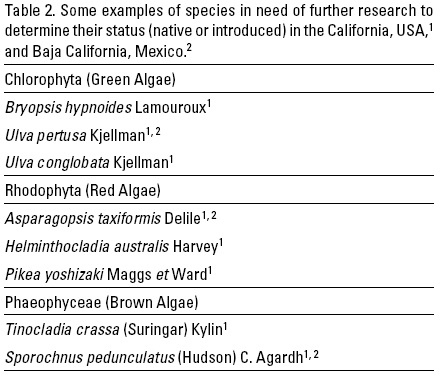
<body><![CDATA[<p align="justify"><font face="verdana" size="2">&nbsp;</font></p>  	    <p align="justify"><font face="verdana" size="2"><b>NON&#45;NATIVE SPECIES OF THE CAUFORNIAS</b></font></p>  	    <p align="justify"><font face="verdana" size="2">We consider organisms to be native when they occupy the area in which they evolved; usually there are natural barriers to the dispersal of a species. Sometimes these barriers shift through habitat or climate changes, allowing a species to expand its geographic range. Sometimes we are able to access new areas via new technologies, such as SCUBA or submersibles, and revise our records for the ranges of species. But to detect introduced species, we must rely upon the history of our taxonomic science and art to identify native species. Although some species are easily identified, others represent a challenge to confirm their name. Molecular tools are increasingly important to distinguish identify introduced species and to identify source populations (Booth <i>et al.,</i> 2007).</font></p>  	    <p align="justify"><font face="verdana" size="2">To date, 27 non&#45;native seaweed species have been reported from California, including 5 green (Chlorophyta), 7 brown (Pha&#45;eophyta) and 15 red (Rhodophyta) species, and 11 species, 9 of them common to both areas, from the coast of Baja California, including 1 green, 6 brown and 5 red species (<a href="#t1">Table 1</a>). Here we discuss the introduction history (if known) and the distribution of these introduced species.</font></p>         <p align="center"><font face="verdana" size="2"><a name="t1"></a></font></p>     <p align="center"><font face="verdana" size="2"><i><img src="/img/revistas/hbio/v21n3/a12t1.jpg"></i></font></p>     <p align="justify"><font face="verdana" size="2"><b>Inconspicuous, relatively rare introduced species.</b> These species are tiny, often filamentous, and are easily overlooked. Most have been reported only from a few localities. Their distribution in the Californias is unknown.</font></p>  	    <p align="justify"><font face="verdana" size="2"><i>Aglaothamnion tenuissimum</i> (Bonnemaison) Feldmann&#45;Mazoyer and <i>Polysiphonia denudata</i> (Dillwyn) Greville ex Harvey are both red filaments originating in England and detected in San Francisco Bay (Josselyn &amp; West, 1985). Nothing is known about the mode or timing of these introductions. More recently, another red filamentous species, <i>Neosiphonia harveyi</i> (J. Bailey) Kim, Choi, Guiry &amp; Saunders, once thought to be a native of the east coast of North America, has been traced through molecular methods as originating in Japan and spreading, via several introductions, to the Atlantic, including the British Isles, New Zealand, and U.S., including Monterey Bay, California, where it had been identified as <i>Polysiphonia acuminata</i> Gardner and in San Diego, as <i>P. simplex</i> Hollenberg (McIvor <i>et al.,</i> 2001). This species was reported a second time (Hughey <i>et al.,</i> 2009), collected in Humboldt Bay on floating docks and pilings. Identification of the Humboldt sample was confirmed by analyzing a portion of the rbcL gene, which was identical to a specimen of <i>N. harveyi</i> from Akkeshi, Hokkaido, Japan. Both the Humboldt and Akkeshi sequences contain a genetic marker that McIvor <i>et al.</i> (2001) defined as diagnostic for hap&#45;logroup B. These data support a second, unrelated introduction of <i>N. harveyi</i> to California.</font></p>  	    <p align="justify"><font face="verdana" size="2">Oyster culture is a likely vector for seaweed introductions (Mineur <i>et al.,</i> 2007). The history of oyster farming in California has been reviewed by Barrett (1963). Since 1902, the Pacific oyster, <i>C. gigas,</i> was imported from various sites in Japan to oyster farms in Puget Sound, Washington. According to Galtsoff (1930), oysters from Akkeshi Bay were deemed the best adapted for transplanting to North America. However, the decision to exclude Pacific oysters from Humboldt Bay, the largest California bay available for oyster culture, delayed the state's development of the industry. Importation of the Pacific oyster from Japan to Humboldt Bay was initiated in 1953, and in 1957&#45;58, Pacific oyster seed were imported from Willapa Bay, Washington to Humboldt Bay. Large scale production of Pacific oysters in Humboldt Bay began in 1955 and has continued to be an important industry. Although it is clear that <i>N. harveyi</i> in Humboldt Bay originated in Japan (Hughey <i>et al.,</i> 2009), the trajectory of the introduction is unknown. It may be primary (directly from Japan to California), secondary (from Japan to the east coast of the U.S. or to Washington, thence to California) or even tertiary, since oysters from San Francisco Bay were exported to Humboldt Bay (Barrett, 1963).</font></p>  	    <p align="justify"><font face="verdana" size="2"><i>Antithamnion nipponicum</i> Yamada &amp; Inagaki, a red filamentous species, was collected from Melpomene Cove, Isla Guadalupe, Baja California, Mexico in 1949 and described as <i>A. hubbsii</i> Dawson (Dawson, 1962). This species has been collected in the USA from Santa Catalina Island and Dana Point, both in southern California (Young, 1981), and more recently from Half Moon Bay, central California, and North Carolina (Cho <i>et al.,</i> 2005). It has also been reported, as <i>A. pectinatum</i> (Montagne) J. Brauner, from Italy (Cho <i>et al.,</i> 2005). Cho <i>et al.</i> (2005) suggest that this species became established in California, the Mediterranean and western Atlantic oceans via a recent introduction from Japan, possibly correlated with the introductions of <i>Undaria pinnatifida</i> (Harvey) Suringar and <i>Codium fragile</i> subsp. <i>fragile</i> (Suringar) Hariot (formerly known as <i>Codium fragile</i> subsp. <i>tomentosoides</i> &#91;van Goor&#93; P.C. Silva).</font></p>  	    ]]></body>
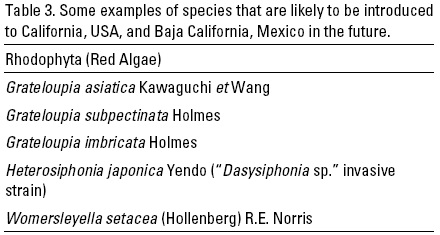
<body><![CDATA[<p align="justify"><font face="verdana" size="2"><i>Asparagopsis armata</i> Harvey, a red alga endemic to Australia and New Zealand, was introduced into the Mediterranean Sea and Atlantic Ocean in the 1920s (Feldmann &amp; Feldmann, 1942) and is now a conspicuous invasive species in North Atlantic Europe (Dixon, 1964; Farnham, 1994). The minute filamentous diploid phase of this species was collected in 1972 in San Diego, CA, maintained in culture and identified as <i>A. armata</i> by analysis of chloroplast DNA RFLPs (Nf Chualain <i>et al.,</i> 2004). Nf Chualain <i>et al.</i> (2004) speculate that the introduction from Australia is recent, and that there is a good possibility for the spread of this species northward, following the cool California Current. To date, this species (including the conspicuous haploid phase) has not been observed since the original collection.</font></p>  	    <p align="justify"><font face="verdana" size="2"><i>Ceramium kondoi</i> Yendo, a red corticated filamentous species, is native to China, Japan, Korea and eastern Russia, but has also been collected in Alaska, Vancouver Island, Canada and Oregon (Cho <i>et al.,</i> 2002). In 1999, a single specimen was collected at Bodega Bay, California in northern California (Cho <i>et al.,</i> 2002). In the eastern Pacific, this species occurs on docks and near oyster farms, suggesting that oyster mariculture is responsible for its spread (Cho <i>et al.,</i> 2002).</font></p>  	    <p align="justify"><font face="verdana" size="2"><i>Elachista nigra</i> Takamatsu is a small filamentous brown epiphyte on kelps, native to Japan. It was discovered on herbarium specimens of the kelp <i>Eisenia arborea</i> Areschoug from San Clemente Island, one of the southern California Channel Islands (Kitayama <i>et al.</i> 2005). This species, as <i>E. orbicularis</i> (Ohta) Skinner, has also been recorded as introduced to Australia; based on historical specimens of its host, this introduction took place after 1976 (Womersley, 1987).</font></p>  	    <p align="justify"><font face="verdana" size="2"><b>Introduced species with limited observations.</b> These are species that may be large and conspicuous, but have been collected infrequently, mostly at single sites.</font></p>  	    <p align="justify"><font face="verdana" size="2"><i>Gracilaria vermiculophylla</i> (Ohmi) Papenfuss is a red alga, native to Japan, that has been proved to be invasive in France, Spain, Netherlands, Portugal, Sweden and Denmark (Rueness, 2005; Thomsen <i>et al.,</i> 2007). An unidentified <i>Gracilaria</i> species from Elkhorn Slough, central California (Goff <i>et al.,</i> 1994) and Es&#45;tero from Punta Banda, Baja California (Bellorin <i>et al.,</i> 2002, 2004) were identified as this species using sequences from nuclear SSU rDNA and ITS (Bellorin <i>et al.,</i> 2002, 2004). Its distribution in California and Baja California is unknown, due to the difficulty of distinguishing <i>Gracilaria</i> species on this coast, but it is probably far more common than we realize. It has also been introduced to Virginia, on the east coast of the USA (Thomsen <i>et al.,</i> 2006).</font></p>  	    <p align="justify"><font face="verdana" size="2"><i>Gelidium vagum</i> Okamura is a red alga, native to Japan, China and Russia. It has a limited distribution in British Columbia, Canada (Renfew et al., 1989) and was collected in Tomales Bay, California in 1995 (Hughey et al., 1996). It has not been reported elsewhere. Because Tomales Bay is home to oyster mariculture, this species was probably introduced on oyster spat.</font></p>  	    <p align="justify"><font face="verdana" size="2">The brown alga <i>Ascophyllum nodosum</i> (Linnaeus) Le Jolis, the knotted wrack native to the Atlantic Ocean where it is used to steam clams and lobsters or pack bait, rarely establishes in San Francisco Bay. Mats of <i>A. nodosum</i> have been sighted floating in the Bay on many occasions over the years, introduced as discarded packing material but with no evidence of establishment (Silva, 1979; Josselyn &amp; West, 1985). In 2002, mats of <i>Ascophyllum</i> were observed in San Francisco Bay near Redwood City Marina (Miller <i>et al.,</i> 2004). It appeared to have been living unattached for some time. Although these mats were removed in 2002, substantial mats of <i>Ascophyllum</i> was again found at Bay Farm Island in San Francisco Bay and removed in 2008 (P.C. Silva, personal communication). It is clear that this species is introduced again and again to the Bay, but thus far manages only to thrive locally. It is unlikely to become invasive itself, but it is a vector for non&#45;native invertebrate species (Miller <i>et al.,</i> 2004).</font></p>  	    <p align="justify"><font face="verdana" size="2">Another rockweed species, the brown alga <i>Fucus spiralis</i> Linnaeus, has been collected from a population in Tomales Bay, northern California (Hughey <i>et al.,</i> 1996). This species is also present on the coasts of Attu Island, Alaska, British Columbia, Canada and northern Washington, USA (Norris &amp; Conway, 1975), where it is also likely to be an introduction from the Atlantic (Coyer <i>et</i> al., 2006, 2010). It has not been observed at any other locations in California or Baja California.</font></p>  	    <p align="justify"><font face="verdana" size="2">Oyster mariculture may be implicated in the dispersal of the green alga <i>Codium fragile</i> subsp. <i>fragile,</i> more commonly known by the epithet <i>Codium fragile</i> subsp. <i>tomentosoides,</i> a species adept at asexual reproduction. This invasive strain of <i>Codium</i> has spread from its native Japan to the northeast Atlantic (from the Netherlands to Spain), most of the Mediterranean, the northwest Atlantic (Nova Scotia, Canada to New England and North Carolina), New Zealand, Australia (Trowbridge, 1995, 1998), and to San Francisco and Tomales bays, California (Silva, 1979). <i>Codium</i> is a pest in New England, where it overgrows and dislodges shellfish (earning the name "oyster thief") and, with an introduced bryo&#45;zoan, has displaced native kelps (Levin <i>et al.,</i> 2002). This invasive strain has not been reported from Baja California, and in California, it is still rare, spreading slowly or remaining unrecognized, though the native <i>Codium fragile</i> subsp. <i>californicum</i> (J. Agardh) C.A. Maggs is well represented from Alaska to Baja California (Abbott &amp; Hollenberg, 1976; Pedroche <i>et al.,</i> 2002 as <i>Codium fragile).</i></font></p>  	    <p align="justify"><font face="verdana" size="2">In addition to the native green alga <i>Bryopsis corticulans</i> Setchell, three undetermined species in the genus <i>Bryopsis,</i> with different reproductive characteristics, are recorded from San Francisco Bay (Silva, 1979). One is entirely asexual, but little is known about these species beyond the original report. It is possible that one of these species goes under the name <i>Bryposis hypnoides</i> Lamouroux, which is itself cryptogenic (type locality: Mediterranean coast of France) (<a href="#t2">Table 2</a>).</font></p>         ]]></body>
<body><![CDATA[<p align="center"><font face="verdana" size="2"><a name="t2"></a></font></p>     <p align="center"><font face="verdana" size="2"><i><img src="/img/revistas/hbio/v21n3/a12t2.jpg"></i></font></p> 	    <p align="justify"><font face="verdana" size="2">The red alga <i>Dasya sessilis</i> Yamada is native to Japan and Korea. It was introduced to France via oyster importation (Verlaque, 2002), Spain via mussel cultivation (Pena &amp; Barbara, 2006), and Portugal, vector unknown (Araujo <i>et al.,</i> 2009). Specimens of <i>D. sessilis</i> were collected in 2008 on the floating docks in Coronado Bay, San Diego; unidentified herbarium specimens in the University of California at Berkeley's Herbarium (UC), collected from docks in Huntington (in 2006) and Long Beach (in 1976) harbors, proved to be <i>D. sessilis</i> as well (Hughey <i>et al.,</i> 2009). To confirm the identification, an analysis of part of the cytochrome oxidase subunit 2, the 5S RNA, and the cox2&#45;cox3 spacer of the mitochondrial genome was performed on one of the specimens from San Diego (Hughey <i>et al.,</i> 2009). The DNA sequence was compared to unpublished GenBank sequences from an introduced specimen of <i>D. sessilis</i> from Mediterranean France and from <i>D. baillouviana</i> (S. Gmelin) Montagne from Norway. <i>Dasya sessilis</i> from San Diego was found to be identical in sequence to the invasive Mediterranean specimen of <i>D. sessilis,</i> but differed from <i>D. baillouviana</i> by 12 bp (Hughey <i>et al.,</i> 2009). A sequence from a third <i>Dasya</i> specimen in UC, collected from Coyote Point, San Francisco Bay in 2005, was analyzed and found to differ from <i>D. sessilis</i> by 6 bp (Hughey <i>et al.,</i> 2009). This specimen <i>(Dasya</i> sp. in <a href="#t1">Table 1</a>) appears to be another non&#45;native species. The <i>rbc</i>L gene from the Huntington Beach and Long Beach specimens was identical to <i>D. sessilis</i> from San Diego (Hughey et al., 2009). This species will probably be discovered at other sites in California and Baja California.</font></p>  	    <p align="justify"><font face="verdana" size="2"><i>Scytosiphon gracilis</i> Kogame is a small tubular brown alga native to Japan and Korea. In January 2003, this species was first observed in Baja California in the intertidal zone at Playa Saldamando, about 25 km north of Ensenada (Aguilar&#45;Rosas <i>et al.,</i> 2006). It was identified by morphology and by RuBisCo sequence, both of which matched specimens from Korea (Cho <i>et al.,</i> 2001; Aguilar&#45;Rosas <i>et al.,</i> 2006). To date, this species has not been reported at other localities.</font></p>  	    <p align="justify"><font face="verdana" size="2">The tiny red alga <i>Porphyra suborbiculata</i> Kjellman, described from Japan, is broadly distributed in the Pacific and Atlantic oceans, but is native to the Pacific (Broom <i>et al.,</i> 2002). Molecular analysis of the nuclear small subunit rDNA (SSU) and internal transcribed spacers (ITS), which included material from Baja California, suggested that this species was probably introduced to the western Atlantic from the Pacific Ocean, and that the natural range of the species encompassed both sides of the Pacific coast (Broom <i>et al.,</i> 2002). However, Aguilar&#45;Rosas and Aguilar&#45;Rosas (2003) concluded that <i>P. suborbiculata</i> was in fact introduced to Baja California sometime after 1985, when it was first reported, since surveys prior to that time did not reveal its presence. To date, it has been observed at 7 sites in northwestern Baja California (Aguilar&#45;Rosas &amp; Aguilar&#45;Rosas, 2003), growing on rocks or epiphytic on upper intertidal seaweeds. In May 2011, Jeffery Hughey discovered <i>Porphyra suborbiculata</i> in Tomales Bay in northern California, growing on barnacles affixed to the pillars in the upper intertidal; he confirmed the identification by sequencing the large subunit of the RuBisCo gene (J. Hughey, personal communication of unpublished data).</font></p>  	    <p align="justify"><font face="verdana" size="2"><i>Ulva fasciata</i> Delile is a foliose green alga, originally described from Egypt but considered widely distributed in the Atlantic, Indian and Pacific oceans. It has been reported as introduced in Hawaii and Australia (Phillips, 1988). It was collected at Playa Santa Elena, on the coast of Oaxaca (Mateo&#45;Cid &amp; Mendoza&#45;Gonzalez, 2001) and, in 2002, from the intertidal zone on the eastern side of Todos Santos Bay (Playa Monalisa, Playa el Faro and Estero de Punta Banda), northwestern coast of Baja California (Aguilar&#45;Rosas <i>et al.,</i> 2005). The vegetative anatomy and phenology of Mexican plants matched those of collections from other parts of the world (Aguilar&#45;Rosas <i>et al.,</i> 2005). However, recent research indicates that <i>U. fasciata</i> could be conspecific to <i>U. lactuca</i> L. (O'Kelly <i>et al.,</i> 2010). We retain this record until there are detailed studies of <i>Ulva</i> species from the Californias.</font></p>  	    <p align="justify"><font face="verdana" size="2"><b>Well&#45;established introduced species.</b> These are introduced species that have been observed at many sites on many occasions in the Californias, but for which adverse ecological impacts and/or invasive spread have not been demonstrated.</font></p>  	    <p align="justify"><font face="verdana" size="2"><i>Lomentaria hakodatensis</i> Yendo is an inconspicuous red alga that has quietly spread from its native Japan, China and Korea to Italy, France, Spain, Russia, Philippines, Hawaiian Islands and Australia (Curiel <i>et al.,</i> 2006). It has been recorded on the eastern Pacific coast, from British Columbia, Canada (South, 1968), Washington (Hawkes &amp; Scagel, 1986) and Oregon (Hansen, 1997) to California (Dawson &amp; Neushul, 1966; Abbott &amp; Hollenberg, 1976), the Gulf of California (Dawson, 1944) and Pacific Mexico (Setchell &amp; Gardner, 1930; Dawson, 1950). It is considered exotic in the eastern Pacific because it was not observed in early surveys, e.g., E.Y. Dawson's surveys of the northern coast from Cape Mendocino to Crescent City. However, some of the California and Baja California species also occur in Japan, making it difficult to determine without good historical collections if a given species occurs naturally throughout the eastern and western north Pacific or if it is an introduction. Nevertheless, <i>L. hakodatensis</i> has increased in abundance on the northern California coast (e.g., Humboldt Bay) in the last two decades (Boyd <i>et al.,</i> 2002).</font></p>  	    <p align="justify"><font face="verdana" size="2">The subtidal brown alga <i>Cutleria cylindrica</i> Okamura is native to Japan and Korea and was first discovered on the west coast at Santa Catalina Island, California in 1973 (Hollenberg, 1978). It has subsequently been collected at La Jolla and San Clemente Island, in southern California, in the 1980s (Stewart, 1991), at Raul's in Baja California, in 1990 (Aguilar&#45;Rosas, 1994), and, in 2007, at Anacapa Island (K.A. Miller, personal communication). This species grows on pebbles in soft sediment, a habitat that is both less frequently colonized by native species and less frequently explored by marine botanists. It appears to be a winter&#45;spring annual in California. Molecular work has linked the California populations to a population in Tsugaru Strait, Japan, where parthenogenic female gametophytes dominate under a wide range of temperatures, from 6&#45;22&deg;C (Kitayama <i>et al.,</i> 1992; Kogishi <i>et al.,</i> 2010). This species is well established at warm water sites and is gradually extending its distribution at the warm water islands. The mode and timing of its introduction to California and Baja California are unknown.</font></p>  	    <p align="justify"><font face="verdana" size="2"><b>Invasive or potentially invasive introduced species.</b> These are species that have established rapidly and have the potential to compete with native species. Many are globally distributed.</font></p>  	    ]]></body>
<body><![CDATA[<p align="justify"><font face="verdana" size="2">Oysters have been the vector for many introduced species, including <i>Sargassum muticum</i> (Yendo) Fensholt, a species that can be considered truly invasive due to its rapid spread. Introduced to the west coast from Japan before World War II, it was detected in British Columbia, Canada in 1944, Oregon in 1947 (Scagel, 1956), Crescent City, California in 1963, Santa Catalina Island in southern California in 1970 (Nicholson, 1979), and San Francisco Bay in 1973 (Silva, 1979). Since 1973, <i>S. muticum</i> has been reported in several localities throughout Baja California (Nienhuis, 1982; Aguilar&#45;Rosas &amp; Aguilar&#45;Rosas, 1985; Riosmena&#45;Rodr&iacute;guez <i>et al.,</i> 1992). This species has become a conspicuous and abundant part of our intertidal and shallow subtidal communities with varying degrees of impact on native communities (Ambrose &amp; Nelson, 1982; Deysher &amp; Norton, 1982; Wilson, 2001; Britton&#45;Simmons, 2004).</font></p>  	    <p align="justify"><font face="verdana" size="2"><i>Undaria pinnatifida</i> (Harvey) Suringar, a 2 meter long kelp native to southeastern Russia, Japan, northern China and Korea, is an aggressive invasive species in the Mediterranean Sea, England, Atlantic Europe (where it was accidentally introduced with cultured oysters and then propagated as a crop), New Zealand, Australia, and Argentina (Silva <i>et al.,</i> 2002). A variety of dispersal events (single introductions, multiple introductions, local site&#45;to&#45;site dispersal) as well as various microevolutionary processes (founder's effect, bottlenecks, selection for novel, locally adapted gene combinations) are responsible for <i>U. pinnatifida's</i> worldwide success (Voisin <i>et al.,</i> 2005).</font></p>  	    <p align="justify"><font face="verdana" size="2"><i>Undaria</i> was discovered in Los Angeles Harbor in 2000, and rapidly spread to Santa Barbara Harbor. In 2001, it appeared in Monterey Harbor and a small cove on the leeside of Santa Catalina Island (Silva <i>et al.,</i> 2002; Thornber <i>et al.,</i> 2004). At these sites, it is a short&#45;lived annual, recruiting in the early spring, and with a smaller pulse of new sporophytes in the fall at some sites, and then disappearing for the winter (Thornber <i>et al.,</i> 2004). In 2009, this species was discovered in San Francisco and Half Moon bays (Zabin <i>et al.,</i> 2009), where it can be found throughout the year. Most of the California populations are limited to harbors and their artificial substrates, especially floats, piers and boat hulls. Santa Catalina Island is the only site in California at which it co&#45;occurs with native seaweeds in a relatively natural (non&#45;harbor) setting. However, the population at Santa Catalina Island is strictly subtidal, persisting at low densities in and around a <i>Macrocystis pyrifera</i> (Linnaeus) C. Agardh community. In 10 years of observation at Catalina, <i>Undaria</i> has spread within the site, moving into shallower depths, but it has not extended its range to other sites around the island or to other islands (Miller &amp; Engle, 2009). Similarly, in Baja California, this species is restricted to a small area on the protected side of Todos Santos Island and Punta Banda (Aguilar&#45;Rosas <i>et al.,</i> 2004). These populations, densest in the autumn, are mainly subtidal though in some years there are a few mature specimens in the intertidal zone. Uwai <i>et al.</i> (2006) traced the multiple Japanese origins of worldwide populations using molecular methods and speculated that the California and Baja California populations were introduced via shipping vectors.</font></p>  	    <p align="justify"><font face="verdana" size="2">The brown alga <i>Sargassum horneri </i>(Turner) C. Agardh, native to the warmer parts of Japan and Korea, has not been reported as an invasive species prior to its arrival in California. <i>Sargassum horneri</i> was first collected in 2003 by biologists conducting surveys in inner Long Beach Harbor, California (Marine Biological Consultants, personal communication). By October 2005, the population had spread within Long Beach Harbor. The Long Beach plants were attached to the substrate or epiphytic on <i>Sargassum muticum.</i> In Baja California, the first specimens of <i>S. horneri</i> were observed drifting in the intertidal zone at La Jolla in Todos Santos Bay in 2005. In 2008&#45;2010, sampling in the intertidal and subtidal zone (to 10 m depth) revealed a well&#45;established populations of <i>S. horneri</i> in several localities in Todos Santos Bay, Baja California, Mexico. In 2006, <i>S. horneri</i> was discovered near the western end of Santa Catalina Island. Samples from 3 sites shared the same cox3 sequence as samples from the Seto Inland Sea, Japan (Miller <i>et al.,</i> 2007). In one year, <i>S. horneri</i> spread rapidly along the entire lee side of the island, forming dense groves. In 2007, this species was documented on the windward side of Catalina Island and populations were discovered at 2 locations on the lee side of San Clemente Island, to the south (Miller &amp; Engle, 2008). Currently, <i>S. horneri</i> forms very dense but patchy populations on both sides of Catalina Island, the lee side of San Clemente Island, and the east end of Santa Cruz Island as well as at several sites on the southern California mainland coast, including Laguna Beach and Crystal Cove (K.A. Miller, personal observation).</font></p>  	    <p align="justify"><font face="verdana" size="2">Like <i>Sargassum muticum, S. horneri</i> is highly invasivebecause it is adapted for widespread dispersal and rapid colonization (Nyberg &amp; Valentinus, 2005), due to morphological and reproductive characteristics, such as buoyancy and high reproductive output (Aguilar&#45;Rosas &amp; Aguilar&#45;Rosas, 1993; Miller <i>et al.,</i> 2007). However, it will probably be limited to warm temperate/subtropical sites.</font></p>  	    <p align="justify"><font face="verdana" size="2">The red alga <i>Caulacanthus ustulatus</i> (Mertens ex Turner) Kutzing is a cosmopolitan, cryptogenic species, reported from Japan, Indonesia, South Africa, Spain, New Zealand &#45; all places where plants have been designated as types for species now considered synonyms of <i>C. ustulatus</i> (Zuccarello <i>et al.,</i> 2002). This small, turf species also occurs in Australia, Africa, India, Hawaii, and Mexico as well as British Columbia, Canada, Washington and California. In southern California, <i>Caulacanthus</i> has been observed at numerous sites during the last decade (S. Murray, personal communication), but was not recorded 30 years ago during extensive intertidal surveys sponsored by the government (Murray &amp; Littler, 1981) nor 40 years ago when E.Y. Dawson conducted intensive surveys (Dawson, 1959). It is also reported from central California (Santa Cruz, CA), San Francisco Bay (Miller, 2004), and Tomales Bay in northern California (specimens in UC). It appears to be spreading northward.</font></p>  	    <p align="justify"><font face="verdana" size="2">In contrast, there are few records of <i>C. ustulatus</i> in Baja California. Dawson (1944) published the first record in the Gulf of California at Punta San Pedro, Sonora and Bahia Agua Verde, Baja California Sur. On the Pacific coast, Dawson (1961) reported it at some localities between Cedros Island, Baja California and Bahia Magdalena, Baja California Sur. Since that time, although there have been several collecting trips it has not been observed in the Pacific coast of Baja California.</font></p>  	    <p align="justify"><font face="verdana" size="2">In 2000, the green alga <i>Caulerpa taxifolia</i> was discovered in southern California. <i>Caulerpa taxifolia</i> has proven itself to be a devastating plague in the Mediterranean (Meinesz <i>et al.,</i> 1993). Distasteful to herbivores, it has covered acres of seafloor, out&#45;competing native seagrasses and smothering native fauna. This escaped invasive aquarium strain, identified as originating in Australia and subsequently hybridizing with other strains, is tolerant of warm temperate waters (Meusnier <i>et al.,</i> 2002). During eelgrass surveys, <i>Caulerpa</i> was discovered in a shallow lagoon, Agua Hedionda, near San Diego, and in Huntington Harbor, California (Jousson <i>et al.,</i> 2000). Because the plant fragments and regenerates, it cannot be manually removed (Williams &amp; Grosholtz, 2002). <i>Caulerpa</i> patches were covered with tarp and bleach was injected beneath (Williams &amp; Schroeder, 2004). Several years of this treatment (and several million dollars) resulted in a victory; <i>Caulerpa taxifolia</i> was declared eradicated in 2004 (Merkel &amp; Associates, 2005). Because of this concerted effort, the dispersal of this species along the coast of California and Baja was stopped.</font></p>  	    <p align="justify"><font face="verdana" size="2"><b>Recent introductions.</b> A non&#45;native species recently identified in California is the Japanese red alga <i>Grateloupia lanceolata</i> (Okamura) Kawaguchi (Miller <i>et al.,</i> 2009). This species was discovered in southern California at Santa Catalina Island in spring 2003 and April 2008 and in central California at the mouth of the Elkhorn Slough in Moss Landing in May, June and July of 2008. It has since been reported from San Diego, Port Hueneme and San Francisco Bay, California (Hughey <i>et al.,</i> 2009). The morphology of thalli agrees with published figures, and both populations were abundantly reproductive. Sequences from the large subunit of the rbcL gene and the nuclear marker, ITS&#45;1 from Californian <i>G. lanceolata</i> were identical to those from two specimens of <i>G. lanceolata</i> introduced to the Thau Lagoon, Mediterranean France and a specimen from Japan (Miller <i>et al.,</i> 2009, Hughey <i>et al.,</i> 2009). This species has also been reported from the Canary Islands (Garc&iacute;a&#45;Jim&eacute;nez <i>et al.,</i> 2008). It is likely that the import of oysters for mariculture played a role in its introduction into California, and equally likely that this conspicuous species has been confused with other foliose red algae until now. We predict that this species will soon be discovered in Baja California.</font></p>  	    <p align="justify"><font face="verdana" size="2">Another recent addition to the California and Baja California flora is the red alga <i>Grateloupia turuturu</i> Yamada, a species native to Japan and Korea but widely invasive throughout the world. In 1973, it was first reported outside of its native range in Portsmouth, England (Farnham &amp; Irvine, 1973). <i>Grateloupia turuturu</i> spreads by spores contained in the ballast water of ships (Villalard&#45;Bohnsack &amp; Harlin, 1997). Based on the aggressiveness of this species, as well as its presence in major shipping ports, <i>G. turuturu</i> was predicted to spread throughout North America and the rest of the world (Simon <i>et al.,</i> 1999). Gavio and Fredericq (2002) were the first to show that <i>G. turuturu</i> was the correct name to apply to the invasive Atlantic North American species that was incorrectly identified as <i>G. doryphora</i> (Montagne) M. A. Howe.</font></p>  	    ]]></body>
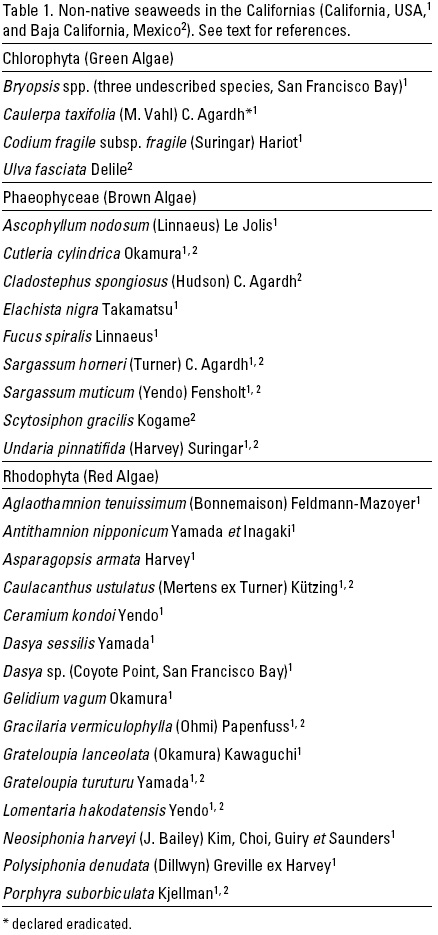
<body><![CDATA[<p align="justify"><font face="verdana" size="2">For the west coast of North America, <i>G. turuturu</i> was first observed in the port of Ensenada, Baja California in November 2008. The identification was confirmed by DNA sequence (Aguilar&#45;Rosas <i>et al.,</i> submitted). The population has not spread beyond this first observation. The first report of <i>G. turuturu</i> in California was from Santa Barbara Harbor in August 2009 (Hughey <i>et al.,</i> 2009).</font></p>  	    <p align="justify"><font face="verdana" size="2">To confirm the identification, molecular analyses on two of the Santa Barbara specimens using ITS&#45;1 and <i>rbc</i>L gene sequences were performed; DNA sequences were identical to previously published sequences of <i>G. turuturu</i> from Japan and Korea, and to introduced specimens from New Zealand, North America, Britain, and France (Hughey <i>et al.,</i> 2009). In Santa Barbara, <i>G. turuturu</i> was found attached growing on the docks in a 1,133 slip&#45;harbor that accommodates resident house and pleasure boats, and traveling sail boats and yachts. Since <i>G. turuturu</i> was growing in this small harbor, it is likely that this seaweed was introduced by traveling boaters, rather than by commercial shipping vessels. If this is the case, Santa Barbara is not likely the site of primary introduction. It is more probable that <i>G. turuturu</i> was first established in a larger shipping port, then secondarily introduced via sail boat by attachment to the hull, although an analysis of the latter mode of introduction by recreational yachts was found unlikely (Mineur <i>et al.,</i> 2008). However, this species was recently discovered (September 2010) at Pillar Point Marina in Half Moon Bay, San Mateo County (K.A. Miller, personal communication) and we expect to find it in San Francisco Bay.</font></p>  	    <p align="justify"><font face="verdana" size="2">A non&#45;native species recently reported from Baja California is the brown alga <i>Cladostephus spongiosus</i> (Hudson) C. Agardh (Mazariegos&#45;Villareal <i>et al.,</i> 2010), a brown alga native to England. It is widespread on temperate coasts mainly in Europe, Africa, Australia, New Zealand (Guiry &amp; Guiry, 2011) and eastern North America (Sears, 1998). Records from the Pacific coast include Argentina (Skottsberg, 1921), Chile (Ramfrez &amp; Santelices, 1991) and Baja California Sur (Mazariegos&#45;Villareal <i>et al.,</i> 2010). Mazariegos&#45;Villareal <i>et al.</i> (2010) reported several observations of this species in the mid&#45;intertidal zone to 6 m depth at the southern end of Bahfa Sebastian Vizcafno during a study of juvenile lobster habitat (Castaneda&#45;Fernandez de Lara <i>et al.,</i> 2005). Mazariegos&#45;Villareal <i>et al.</i> (2010) consider it an unintentional introduction, probably via shipping from Australia to Baja California.</font></p>  	    <p align="justify"><font face="verdana" size="2">&nbsp;</font></p>  	    <p align="justify"><font face="verdana" size="2"><b>PERSPECTIVES</b></font></p>  	    <p align="justify"><font face="verdana" size="2"><b>Future introductions?</b> There are many cryptogenic species in the Californias; a very few are listed in <a href="#t2">Table 2</a>. The genus <i>Bryopsis</i> needs critical study to establish the provenance of <i>Bryopsis hypnoides</i> and the undetermined, introduced species in this genus. The genus <i>Ulva</i> is largely unknown, although Hayden and Waaland (2004) analyzed several California specimens. <i>Ulva pertusa</i> Kjellman, considered an invasive in the Thau Lagoon (Verlaque <i>et al.,</i> 2002), has been reported from California (Hayden &amp; Waaland, 2004) and Baja California (Aguilar&#45;Rosas et al., 2008) but it is not known whether this species is native or introduced. <i>Ulva conglobata</i> Kjellman, also native to Japan, China and Korea, was identified at the Farallon Islands west of San Francisco (C. Tanner, personal communication), but its identity needs to be confirmed with molecular methods.</font></p>  	    <p align="justify"><font face="verdana" size="2">Maggs and Ward (1996) suggest that the Japanese species <i>Pikea yoshiyaki</i> Maggs &amp; Ward occurs in southern California; further collections and study are called for, especially since the native species in the genus needs further delineation (Maggs &amp; Ward, 1996). This list will continue to grow as more questions about species identities and ranges arise.</font></p>  	    <p align="justify"><font face="verdana" size="2">Based on patterns of introductions in other parts of the world, it is very probable that more seaweed species will be introduced to the Californias (<a href="#t3">Table 3</a>). Many of these <i>(Grateloupia asiatica</i> Kawaguchi &amp; Wang, <i>Grateloupia subpectinata</i> Holmes, <i>Grateloupia imbricata</i> Holmes) have been reported in the Thau Lagoon (Verlaque <i>et al.,</i> 2002; Verlaque <i>et al.,</i> 2005). <i>Grateloupia imbricata</i> has recently been identified in the Canary Islands (Garc&iacute;a&#45;Jim&eacute;nez <i>et al.,</i> 2008) as well. <i>Heterosiphonia japonica</i> Yendo <i>("Dasysiphonia</i> sp.") is an aggressive invasive species in Europe (Husa &amp; Sjotun, 2006) and, very recently, in Rhode Island (Schneider, 2010). While this species has been reported in California (Abbott &amp; Hollenberg, 1976), the aggressive strain is apparently absent.</font></p>         <p align="center"><font face="verdana" size="2"><a name="t3"></a></font></p>     <p align="center"><font face="verdana" size="2"><i><img src="/img/revistas/hbio/v21n3/a12t3.jpg"></i></font></p>     ]]></body>
<body><![CDATA[<p align="justify"><font face="verdana" size="2"><b>Introductions and climate changes.</b> It is also readily apparent that many of the introductions reported here are recent (this does not exclude the possibility of historical introductions of what we now consider cryptogenic species). Most introductions have occurred, or been detected, since the 1970s, and many in the last 10 years. Are the numbers of introductions higher than before? Are they a response to new climatic conditions?</font></p>  	    <p align="justify"><font face="verdana" size="2"><i>Lomentaria hakodatensis, Sargassum muticum</i> and perhaps <i>Cutleria cylindrica</i> are probably the earliest introductions to the Californias. It is impossible to trace the date of the introductions of most of these species, especially the tiny epiphytes and filaments. There is long tradition of oyster culture on the west coast of North America (Beattie, 1982; Mineur et al., 2007). Several introductions can be linked to oyster mariculture <i>(Sargassum muticum, Neosiphonia harveyi, Grateloupia lanceolata, Caulacanthus ustulatus, Gelidium vagum, Ceramium kondoi)</i> but we do not know if these are primary introductions from Asia or secondary ones from Washington or British Columbia, Canada or Europe. Presumably the rest of these introductions can be attributed to international shipping and subsequent spread via local craft or natural dispersal, especially those occurring at some distance from international ports (Wasson <i>et al.,</i> 2001; Zabin <i>et al.,</i> 2009).</font></p>  	    <p align="justify"><font face="verdana" size="2">The increase in international shipping in the 20<sup>th</sup> century and the opportunity for species to move via ballast water or hull fouling are well established (Carlton &amp; Geller, 1993). California's large international ports in San Francisco Bay and the Los Angeles area host a steady stream of ships from all over the world. Although the port of Ensenada, Baja California is not large, during the last two decades the traffic of cargo ships from Asian countries and large tourist boats from Los Angeles and San Diego has increased dramatically, as has the possibility of the introduction and establishment of nonnative species. The vectors are in place.</font></p>  	    <p align="justify"><font face="verdana" size="2">According to Carlton (1996b), several processes mediate invasions, including changes in donor and recipient regions, "invasion windows" in recipient regions when conditions are right (e.g., available niche) for the establishment of an introduced species, and stochastic inoculation events. Several authors have proposed that climate change has direct effects on these factors.</font></p>  	    <p align="justify"><font face="verdana" size="2">Occhipinti&#45;Ambrogi and Savini (2003), using examples from the Mediterranean and Black Sea region, emphasize the environmental status of the recipient area as a prerequisite for the successful establishment of non&#45;native species. The spread of <i>Caulerpa taxifolia</i> in the northwestern basin of the Mediterranean Sea was facilitated by the instability of the endemic <i>Posidonia oceanica</i> (L.) Delile community due to both natural and anthropogenic stressors. Similarly, the mainland coast in southern California has been severely stressed by development and pollution, very possibly allowing the bloom of <i>Caulacanthus ustulatus,</i> currently a dominant in the upper intertidal zone where it was historically absent.</font></p>  	    <p align="justify"><font face="verdana" size="2">Experiments with native and non&#45;native tunicates by Stachowicz <i>et al.</i> (2002) indicated that the greatest effects of climate change on biotic communities is due more to changing maximum and minimum temperatures rather than different annual means. Introduced species recruit and grow earlier relative to native species, shifting dominance to non&#45;native species. The series of ENSO (El Nino/La Nina&#45;Southern Oscillation) events along the west coast in the last 30 years was remarkable, with especially large swings in temperature in 1983&#45;4 and 1998&#45;9. These dramatic temperature shifts may have opened an "invasion window" for species that may have failed to establish in the past, and may account for the recent list of new introductions.</font></p>  	    <p align="justify"><font face="verdana" size="2">While temperature is one of the strongest signals of climate change, and may be predicted to influence species ranges by pushing cool temperate species north and encouraging the establishment of warm temperate non&#45;native species, Harley <i>et al.</i> (2006) predict that climate change will bring effects that are more complex and subtle. They cite changes in ocean chemistry that will affect the structure of many carbonatedependent species, changes in ocean circulation that will affect the transport of propagules, changes in community interactions, especially predators and herbivores that will affect food webs, and pressures on key species that will have community&#45;wide consequences. Along the west coast, alterations in the California Current and patterns of seasonal upwelling could negatively affect the kelps that depend on the nutrients characteristic of cold water. These ecosystem engineers provide habitat for whole communities. During strong ENSO events, even the relatively short&#45;term demise of kelp forests is stunning, and recovery can be slow, especially if herbivores, such as urchins, are common. The long&#45;term loss of key community players (kelps, coralline algae, important herbivores) combined with decimation of key predators due to overfishing, would surely open up opportunities for introduced species that have been unable to establish in the past. Currently in California and Baja California, the rich diversity and abundance of native species, especially on the wild open coast, may be inhibiting invasions (Wasson <i>et al.,</i> 2005), but this may change.</font></p>  	    <p align="justify"><font face="verdana" size="2">&nbsp;</font></p>  	    <p align="justify"><font face="verdana" size="2"><b>ACKNOWLEDGMENTS</b></font></p>  	    <p align="justify"><font face="verdana" size="2">This paper grew out of a presentation at Korea's National Institute of Biological Resources international symposium entitled "Climate Change and Biodiversity" in 2008. The first author is grateful to Byung&#45;Jin Kim, Chongwook Park, and especially Sung Min Boo for this opportunity. The authors wish to thank the Universidad Autonoma de Baja California and CONABIO (FB1389/GN007/09), and the California Department of Fish and Game/Office of Spill Prevention and Response's Introduced Species Study (P0875029) for their support of this research. We also thank 3 reviewers for comments that improved this manuscript.</font></p>  	    ]]></body>
<body><![CDATA[<p align="justify"><font face="verdana" size="2">&nbsp;</font></p>  	    <p align="justify"><font face="verdana" size="2"><b>REFERENCES</b></font></p>  	    <!-- ref --><p align="justify"><font face="verdana" size="2">Abbott, I. A. &amp; G. J. Hollenberg. 1976. <i>Marine Algae of California</i>. Stanford University Press. 827 p.    &nbsp;&nbsp;&nbsp;&nbsp;&nbsp;&nbsp;&nbsp;&nbsp;[&#160;<a href="javascript:void(0);" onclick="javascript: window.open('/scielo.php?script=sci_nlinks&ref=4170178&pid=S0188-8897201100030001200001&lng=','','width=640,height=500,resizable=yes,scrollbars=1,menubar=yes,');">Links</a>&#160;]<!-- end-ref --></font></p>  	    <!-- ref --><p align="justify"><font face="verdana" size="2">Ambrose, R. F. &amp; B. V. Nelson. 1982. Inhibition of giant kelp recruitment by an introduced brown alga. <i>Bot&aacute;nica Marina</i> 25: 265&#45;267.    &nbsp;&nbsp;&nbsp;&nbsp;&nbsp;&nbsp;&nbsp;&nbsp;[&#160;<a href="javascript:void(0);" onclick="javascript: window.open('/scielo.php?script=sci_nlinks&ref=4170180&pid=S0188-8897201100030001200002&lng=','','width=640,height=500,resizable=yes,scrollbars=1,menubar=yes,');">Links</a>&#160;]<!-- end-ref --></font></p>  	    <!-- ref --><p align="justify"><font face="verdana" size="2">Aguilar&#45;Rosas, R. 1994. Notas ficol&oacute;gicas. 1. Primer registro de Cutleria cylindrica Okamura (Cutleriaceae, Phaeophyta) para las costas del Pacifico de M&eacute;xico. <i>Acta Bot&aacute;nica Mexicana</i> 29: 55&#45;60.    &nbsp;&nbsp;&nbsp;&nbsp;&nbsp;&nbsp;&nbsp;&nbsp;[&#160;<a href="javascript:void(0);" onclick="javascript: window.open('/scielo.php?script=sci_nlinks&ref=4170182&pid=S0188-8897201100030001200003&lng=','','width=640,height=500,resizable=yes,scrollbars=1,menubar=yes,');">Links</a>&#160;]<!-- end-ref --></font></p>  	    <!-- ref --><p align="justify"><font face="verdana" size="2">Aguilar&#45;Rosas, R. &amp; L. E. Aguilar&#45;Rosas. 1985. Sargassum muticum (Yendo) Fensholt (Fucales, Phaeophyta) in Baja California coast, Mexico. <i>Ciencias Marinas</i> 11: 127&#45;129.    &nbsp;&nbsp;&nbsp;&nbsp;&nbsp;&nbsp;&nbsp;&nbsp;[&#160;<a href="javascript:void(0);" onclick="javascript: window.open('/scielo.php?script=sci_nlinks&ref=4170184&pid=S0188-8897201100030001200004&lng=','','width=640,height=500,resizable=yes,scrollbars=1,menubar=yes,');">Links</a>&#160;]<!-- end-ref --></font></p>  	    ]]></body>
<body><![CDATA[<!-- ref --><p align="justify"><font face="verdana" size="2">Aguilar&#45;Rosas, R. &amp; L. E. Aguilar&#45;Rosas. 1993. Cronolog&iacute;a de la colonizaci&oacute;n de Sargassum muticum (Phaeophyta) en las costas de la pen&iacute;nsula de Baja California, M&eacute;xico (1971&#45;1990) <i>Revista de Investigaci&oacute;n Cient&iacute;fica</i> 4: 41&#45;51.    &nbsp;&nbsp;&nbsp;&nbsp;&nbsp;&nbsp;&nbsp;&nbsp;[&#160;<a href="javascript:void(0);" onclick="javascript: window.open('/scielo.php?script=sci_nlinks&ref=4170186&pid=S0188-8897201100030001200005&lng=','','width=640,height=500,resizable=yes,scrollbars=1,menubar=yes,');">Links</a>&#160;]<!-- end-ref --></font></p>  	    <!-- ref --><p align="justify"><font face="verdana" size="2">Aguilar&#45;Rosas, R. &amp; L. E. Aguilar&#45;Rosas. 2003. El g&eacute;nero Porphyra (Bangiales, Rhodophyta) en la costa del Pac&iacute;fico de M&eacute;xico. I. Porphyra suborbiculata Kjellman. <i>Hidrobiol&oacute;gica</i> 13 (1): 51&#45;56.    &nbsp;&nbsp;&nbsp;&nbsp;&nbsp;&nbsp;&nbsp;&nbsp;[&#160;<a href="javascript:void(0);" onclick="javascript: window.open('/scielo.php?script=sci_nlinks&ref=4170188&pid=S0188-8897201100030001200006&lng=','','width=640,height=500,resizable=yes,scrollbars=1,menubar=yes,');">Links</a>&#160;]<!-- end-ref --></font></p>  	    <!-- ref --><p align="justify"><font face="verdana" size="2">Aguilar&#45;Rosas, R., L. E. Aguilar&#45;Rosas &amp; F. F. Pedroche. 2005. Ulva fasciata Delile (Ulvaceae, Chlorophycota): a species newly introduced into Pacific Mexico. Bot&aacute;nica Marina 48: 46&#45;51.    &nbsp;&nbsp;&nbsp;&nbsp;&nbsp;&nbsp;&nbsp;&nbsp;[&#160;<a href="javascript:void(0);" onclick="javascript: window.open('/scielo.php?script=sci_nlinks&ref=4170190&pid=S0188-8897201100030001200007&lng=','','width=640,height=500,resizable=yes,scrollbars=1,menubar=yes,');">Links</a>&#160;]<!-- end-ref --></font></p>  	    <!-- ref --><p align="justify"><font face="verdana" size="2">Aguilar&#45;Rosas, R., L. E. Aguilar&#45;Rosas &amp; S. Shimada. 2008. First record of Ulva pertusa Kjellman (Ulvales, Chlorophyta) in the Pacific coast of Mexico. <i>Algae</i> 23: 201&#45;207.    &nbsp;&nbsp;&nbsp;&nbsp;&nbsp;&nbsp;&nbsp;&nbsp;[&#160;<a href="javascript:void(0);" onclick="javascript: window.open('/scielo.php?script=sci_nlinks&ref=4170192&pid=S0188-8897201100030001200008&lng=','','width=640,height=500,resizable=yes,scrollbars=1,menubar=yes,');">Links</a>&#160;]<!-- end-ref --></font></p>  	    <!-- ref --><p align="justify"><font face="verdana" size="2">Aguilar&#45;Rosas, R., L. E. Aguilar&#45;Rosas, G. &Aacute;vila&#45;Serrano &amp; R. Marcos&#45;Ram&iacute;rez. 2004. First record of Undaria pinnatifida (Harvey) Suringar (Laminariales, Phaeophyta) on the Pacific coast of Mexico. <i>Botanica Marina</i> 47: 255&#45;258.    &nbsp;&nbsp;&nbsp;&nbsp;&nbsp;&nbsp;&nbsp;&nbsp;[&#160;<a href="javascript:void(0);" onclick="javascript: window.open('/scielo.php?script=sci_nlinks&ref=4170194&pid=S0188-8897201100030001200009&lng=','','width=640,height=500,resizable=yes,scrollbars=1,menubar=yes,');">Links</a>&#160;]<!-- end-ref --></font></p>  	    ]]></body>
<body><![CDATA[<!-- ref --><p align="justify"><font face="verdana" size="2">Aguilar&#45;Rosas, R., L. E. Aguilar&#45;Rosas, G. Y. Cho &amp; S. M. Boo. 2006. First record of Scytosiphon gracilis Kogame (Scytosiphonaceae, Phaeophyceae) for the Pacific coast of Mexico. <i>Algae</i> 21: 11&#45;13.    &nbsp;&nbsp;&nbsp;&nbsp;&nbsp;&nbsp;&nbsp;&nbsp;[&#160;<a href="javascript:void(0);" onclick="javascript: window.open('/scielo.php?script=sci_nlinks&ref=4170196&pid=S0188-8897201100030001200010&lng=','','width=640,height=500,resizable=yes,scrollbars=1,menubar=yes,');">Links</a>&#160;]<!-- end-ref --></font></p>  	    <!-- ref --><p align="justify"><font face="verdana" size="2">Aguilar&#45;Rosas, L. E., R. Aguilar&#45;Rosas, H. Kawai, S. Uwai &amp; E. Valenzuela&#45;Espinoza. 2007. New record of Sargassum filicinum Harvey (Fucales, Phaeophyceae) in the Pacific coast of Mexico. <i>Algae</i> 22: 17&#45;21.    &nbsp;&nbsp;&nbsp;&nbsp;&nbsp;&nbsp;&nbsp;&nbsp;[&#160;<a href="javascript:void(0);" onclick="javascript: window.open('/scielo.php?script=sci_nlinks&ref=4170198&pid=S0188-8897201100030001200011&lng=','','width=640,height=500,resizable=yes,scrollbars=1,menubar=yes,');">Links</a>&#160;]<!-- end-ref --></font></p>  	    <!-- ref --><p align="justify"><font face="verdana" size="2">Araujo, R., I. B&aacute;rbara, M. Tibaldo, E. Berecibar, P. D. Tapia, R. Pereira, R. Santos &amp; I.S. Pinto. 2009. Checklist of benthic marine algae and cyanobacteria of northern Portugal. <i>Bot&aacute;nica Marina</i> 52: 24&#45;46.    &nbsp;&nbsp;&nbsp;&nbsp;&nbsp;&nbsp;&nbsp;&nbsp;[&#160;<a href="javascript:void(0);" onclick="javascript: window.open('/scielo.php?script=sci_nlinks&ref=4170200&pid=S0188-8897201100030001200012&lng=','','width=640,height=500,resizable=yes,scrollbars=1,menubar=yes,');">Links</a>&#160;]<!-- end-ref --></font></p>  	    <!-- ref --><p align="justify"><font face="verdana" size="2">Barrett, E. M. 1963. Fish Bulletin 123. The California Oyster Industry. UC San Diego: Scripps Institution of Oceanography Library.    &nbsp;&nbsp;&nbsp;&nbsp;&nbsp;&nbsp;&nbsp;&nbsp;[&#160;<a href="javascript:void(0);" onclick="javascript: window.open('/scielo.php?script=sci_nlinks&ref=4170202&pid=S0188-8897201100030001200013&lng=','','width=640,height=500,resizable=yes,scrollbars=1,menubar=yes,');">Links</a>&#160;]<!-- end-ref --></font></p>  	    <!-- ref --><p align="justify"><font face="verdana" size="2">Beattie, J. H. 1982. Overview of oyster culture on the Pacific Coast. In: Proceedings of the North American Oyster Workshop, World Mariculture Society, Special Publication No. 1, Baton Rouge, USA, pp. 11&#45;15.    &nbsp;&nbsp;&nbsp;&nbsp;&nbsp;&nbsp;&nbsp;&nbsp;[&#160;<a href="javascript:void(0);" onclick="javascript: window.open('/scielo.php?script=sci_nlinks&ref=4170204&pid=S0188-8897201100030001200014&lng=','','width=640,height=500,resizable=yes,scrollbars=1,menubar=yes,');">Links</a>&#160;]<!-- end-ref --></font></p>  	    ]]></body>
<body><![CDATA[<!-- ref --><p align="justify"><font face="verdana" size="2">Bellorin, A. M., M. C. Oliveira &amp; E. C. Oliveira. 2002. Phylogeny and systematics of the marine algal family Gracilariaceae (Gracilariales, Rhodophyta) based on SSU rDNA and ITS sequences of Atlantic and Pacific species. <i>Journal of Phycology</i> 38: 551&#45;563.    &nbsp;&nbsp;&nbsp;&nbsp;&nbsp;&nbsp;&nbsp;&nbsp;[&#160;<a href="javascript:void(0);" onclick="javascript: window.open('/scielo.php?script=sci_nlinks&ref=4170206&pid=S0188-8897201100030001200015&lng=','','width=640,height=500,resizable=yes,scrollbars=1,menubar=yes,');">Links</a>&#160;]<!-- end-ref --></font></p>  	    <!-- ref --><p align="justify"><font face="verdana" size="2">Bellorin, A., M. C. Oliveira, &amp; E. C. Oliveira. 2004. Gracilaria vermiculophyl&#45;la: A western Pacific species of Gracilariaceae (Rhodophyta) first recorded from the eastern Pacific. <i>Phycological Research</i> 52: 69&#45;79.    &nbsp;&nbsp;&nbsp;&nbsp;&nbsp;&nbsp;&nbsp;&nbsp;[&#160;<a href="javascript:void(0);" onclick="javascript: window.open('/scielo.php?script=sci_nlinks&ref=4170208&pid=S0188-8897201100030001200016&lng=','','width=640,height=500,resizable=yes,scrollbars=1,menubar=yes,');">Links</a>&#160;]<!-- end-ref --></font></p>  	    <!-- ref --><p align="justify"><font face="verdana" size="2">Booth, D., J. Provan &amp; C. Maggs. 2007. Molecular approaches to the study of invasive seaweeds. <i>Botanica Marina</i> 50: 385&#45;396.    &nbsp;&nbsp;&nbsp;&nbsp;&nbsp;&nbsp;&nbsp;&nbsp;[&#160;<a href="javascript:void(0);" onclick="javascript: window.open('/scielo.php?script=sci_nlinks&ref=4170210&pid=S0188-8897201100030001200017&lng=','','width=640,height=500,resizable=yes,scrollbars=1,menubar=yes,');">Links</a>&#160;]<!-- end-ref --></font></p>  	    <!-- ref --><p align="justify"><font face="verdana" size="2">Bossard, C. C., J. M. Randall, &amp; M. C. Hoshovsky. 2000. Invasive Plants of California's Wildlands. University of California Press, Berkeley, CA. 360 p.    &nbsp;&nbsp;&nbsp;&nbsp;&nbsp;&nbsp;&nbsp;&nbsp;[&#160;<a href="javascript:void(0);" onclick="javascript: window.open('/scielo.php?script=sci_nlinks&ref=4170212&pid=S0188-8897201100030001200018&lng=','','width=640,height=500,resizable=yes,scrollbars=1,menubar=yes,');">Links</a>&#160;]<!-- end-ref --></font></p>  	    <!-- ref --><p align="justify"><font face="verdana" size="2">Boyd, M. J., T. J. Mulligan &amp; F. J. Shaughnessy. 2002. Non&#45;indigenous marine species of Humboldt Bay. California Department of Fish and Game. California. <a href="http://www.humboldtbay.org/conservation/exotic-species/non_indigenous_marine_boyd_etal_2002.pdf" target="_blank">http://www.humboldtbay.org/conservation/exotic&#45;species/non_indigenous_marine_boyd_etal_2002.pdf</a>.    &nbsp;&nbsp;&nbsp;&nbsp;&nbsp;&nbsp;&nbsp;&nbsp;[&#160;<a href="javascript:void(0);" onclick="javascript: window.open('/scielo.php?script=sci_nlinks&ref=4170214&pid=S0188-8897201100030001200019&lng=','','width=640,height=500,resizable=yes,scrollbars=1,menubar=yes,');">Links</a>&#160;]<!-- end-ref --></font></p>  	    ]]></body>
<body><![CDATA[<!-- ref --><p align="justify"><font face="verdana" size="2">Britton&#45;Simmons, K. H. 2004. Direct and indirect effects of the introduced alga Sargassum muticum on benthic, subtidal communities of Washington State, USA. <i>Marine Ecology Progress Series</i> 277: 61&#45;78.    &nbsp;&nbsp;&nbsp;&nbsp;&nbsp;&nbsp;&nbsp;&nbsp;[&#160;<a href="javascript:void(0);" onclick="javascript: window.open('/scielo.php?script=sci_nlinks&ref=4170216&pid=S0188-8897201100030001200020&lng=','','width=640,height=500,resizable=yes,scrollbars=1,menubar=yes,');">Links</a>&#160;]<!-- end-ref --></font></p>  	    <!-- ref --><p align="justify"><font face="verdana" size="2">Brodie, J. B. &amp; J. Lewis. 2007. Unravelling the algae: the past, present and future of algal systematics. CRC Press. 402 p.    &nbsp;&nbsp;&nbsp;&nbsp;&nbsp;&nbsp;&nbsp;&nbsp;[&#160;<a href="javascript:void(0);" onclick="javascript: window.open('/scielo.php?script=sci_nlinks&ref=4170218&pid=S0188-8897201100030001200021&lng=','','width=640,height=500,resizable=yes,scrollbars=1,menubar=yes,');">Links</a>&#160;]<!-- end-ref --></font></p>  	    <!-- ref --><p align="justify"><font face="verdana" size="2">Broom, J. E., W. A. Nelson, C. Yarish, W. A. Jones, R. Aguilar&#45;Rosas &amp; L. E. Aguilar&#45;Rosas. 2002. A reassessment of the taxonomic status of Porphyra suborbiculata, Porphyra carolinensisand Porphyra lilliputiana (Bangiales, Rhodophyta) based on molecular and morphological data. <i>European Journal of Phycology</i> 37: 227&#45;235.    &nbsp;&nbsp;&nbsp;&nbsp;&nbsp;&nbsp;&nbsp;&nbsp;[&#160;<a href="javascript:void(0);" onclick="javascript: window.open('/scielo.php?script=sci_nlinks&ref=4170220&pid=S0188-8897201100030001200022&lng=','','width=640,height=500,resizable=yes,scrollbars=1,menubar=yes,');">Links</a>&#160;]<!-- end-ref --></font></p>  	    <!-- ref --><p align="justify"><font face="verdana" size="2">Bulleri, F., J. F. Bruno &amp; L. Benedetti&#45;Cecchi. 2008. Beyond competition: incorporating positive interactions between species to predict ecosystem invasibility. <i>PLoS Biology</i> 6: e162.    &nbsp;&nbsp;&nbsp;&nbsp;&nbsp;&nbsp;&nbsp;&nbsp;[&#160;<a href="javascript:void(0);" onclick="javascript: window.open('/scielo.php?script=sci_nlinks&ref=4170222&pid=S0188-8897201100030001200023&lng=','','width=640,height=500,resizable=yes,scrollbars=1,menubar=yes,');">Links</a>&#160;]<!-- end-ref --></font></p>  	    <!-- ref --><p align="justify"><font face="verdana" size="2">Carlton, J. T. 1979. Introduced invertebrates of San Francisco Bay. In: Conomos, T. John (Ed.). San Francisco Bay: The Urbanized Estuary. Pacific Division, American Association for the Advancement of Science. San Francisco, CA, pp. 427&#45;444.    &nbsp;&nbsp;&nbsp;&nbsp;&nbsp;&nbsp;&nbsp;&nbsp;[&#160;<a href="javascript:void(0);" onclick="javascript: window.open('/scielo.php?script=sci_nlinks&ref=4170224&pid=S0188-8897201100030001200024&lng=','','width=640,height=500,resizable=yes,scrollbars=1,menubar=yes,');">Links</a>&#160;]<!-- end-ref --></font></p>  	    ]]></body>
<body><![CDATA[<!-- ref --><p align="justify"><font face="verdana" size="2">Carlton, J. T. 1996a. Biological invasions and cryptogenic species. Ecology 77: 1653&#45;1655.    &nbsp;&nbsp;&nbsp;&nbsp;&nbsp;&nbsp;&nbsp;&nbsp;[&#160;<a href="javascript:void(0);" onclick="javascript: window.open('/scielo.php?script=sci_nlinks&ref=4170226&pid=S0188-8897201100030001200025&lng=','','width=640,height=500,resizable=yes,scrollbars=1,menubar=yes,');">Links</a>&#160;]<!-- end-ref --></font></p>  	    <!-- ref --><p align="justify"><font face="verdana" size="2">Carlton, J. T. 1996b. Pattern, process, and prediction in marine invasion ecology. <i>Biological Conservation</i> 78: 97&#45;106.    &nbsp;&nbsp;&nbsp;&nbsp;&nbsp;&nbsp;&nbsp;&nbsp;[&#160;<a href="javascript:void(0);" onclick="javascript: window.open('/scielo.php?script=sci_nlinks&ref=4170228&pid=S0188-8897201100030001200026&lng=','','width=640,height=500,resizable=yes,scrollbars=1,menubar=yes,');">Links</a>&#160;]<!-- end-ref --></font></p>  	    <!-- ref --><p align="justify"><font face="verdana" size="2">Carlton, J. T. 2000. Global change and biological invasions in the oceans. In: Mooney, H. A. &amp; R. J. Hobbs (Eds.) Invasive species in a changing world. Island Press. Covelo, CA, pp. 31&#45;53.    &nbsp;&nbsp;&nbsp;&nbsp;&nbsp;&nbsp;&nbsp;&nbsp;[&#160;<a href="javascript:void(0);" onclick="javascript: window.open('/scielo.php?script=sci_nlinks&ref=4170230&pid=S0188-8897201100030001200027&lng=','','width=640,height=500,resizable=yes,scrollbars=1,menubar=yes,');">Links</a>&#160;]<!-- end-ref --></font></p>  	    <!-- ref --><p align="justify"><font face="verdana" size="2">Carlton, J. T. &amp; J. B. Geller. 1993. Ecological roulette: the global transport of non&#45;indigenous marine organisms. <i>Science</i> 261 (5117): 78&#45;82.    &nbsp;&nbsp;&nbsp;&nbsp;&nbsp;&nbsp;&nbsp;&nbsp;[&#160;<a href="javascript:void(0);" onclick="javascript: window.open('/scielo.php?script=sci_nlinks&ref=4170232&pid=S0188-8897201100030001200028&lng=','','width=640,height=500,resizable=yes,scrollbars=1,menubar=yes,');">Links</a>&#160;]<!-- end-ref --></font></p>  	    <!-- ref --><p align="justify"><font face="verdana" size="2">Casta&ntilde;eda&#45;Fern&aacute;ndez de Lara, v., M. J. Butler IV, S. Hern&aacute;ndez&#45;V&aacute;zquez, S. Guzm&aacute;n del Pr&oacute;o &amp; E. Serviere&#45;Zaragoza. 2005. Determination of preferred habitats of early benthic juvenile California spiny lobster, Panulirus interruptus, on the Pacific coast of Baja California Sur, Mexico. Marine &amp; Freshwater Research 56: 1&#45;9.    &nbsp;&nbsp;&nbsp;&nbsp;&nbsp;&nbsp;&nbsp;&nbsp;[&#160;<a href="javascript:void(0);" onclick="javascript: window.open('/scielo.php?script=sci_nlinks&ref=4170234&pid=S0188-8897201100030001200029&lng=','','width=640,height=500,resizable=yes,scrollbars=1,menubar=yes,');">Links</a>&#160;]<!-- end-ref --></font></p>  	    ]]></body>
<body><![CDATA[<!-- ref --><p align="justify"><font face="verdana" size="2">Cho, G. Y., H. S. Yoon, H.&#45;G. Choi, K. Kogame &amp; S. M. Boo. 2001. Phylogeny of the family Scytosiphonaceae (Phaeophyta) from Korea based on sequences of plastid&#45;encoded RuBisCo spacer region. <i>Algae</i> 16: 145&#45;150.    &nbsp;&nbsp;&nbsp;&nbsp;&nbsp;&nbsp;&nbsp;&nbsp;[&#160;<a href="javascript:void(0);" onclick="javascript: window.open('/scielo.php?script=sci_nlinks&ref=4170236&pid=S0188-8897201100030001200030&lng=','','width=640,height=500,resizable=yes,scrollbars=1,menubar=yes,');">Links</a>&#160;]<!-- end-ref --></font></p>  	    <!-- ref --><p align="justify"><font face="verdana" size="2">Cho, T. 0., S. M. Boo &amp; G. I. Hansen. 2002. Structure and reproduction of the genus Ceramium (Ceramiales, Rhodophyta) from Oregon, USA. <i>Phycologia</i> 40: 547&#45;571.    &nbsp;&nbsp;&nbsp;&nbsp;&nbsp;&nbsp;&nbsp;&nbsp;[&#160;<a href="javascript:void(0);" onclick="javascript: window.open('/scielo.php?script=sci_nlinks&ref=4170238&pid=S0188-8897201100030001200031&lng=','','width=640,height=500,resizable=yes,scrollbars=1,menubar=yes,');">Links</a>&#160;]<!-- end-ref --></font></p>  	    <!-- ref --><p align="justify"><font face="verdana" size="2">Cho, T. 0., B. Y. Won &amp; S. Fredericq. 2005. Antithamnion nipponicum (Ceramiaceae, Rhodophyta), incorrectly known as A. pectinatum in western Europe, is a recent introduction along the North Carolina and Pacific coasts of North America. <i>European Journal of Phycology</i> 40: 323&#45;335.    &nbsp;&nbsp;&nbsp;&nbsp;&nbsp;&nbsp;&nbsp;&nbsp;[&#160;<a href="javascript:void(0);" onclick="javascript: window.open('/scielo.php?script=sci_nlinks&ref=4170240&pid=S0188-8897201100030001200032&lng=','','width=640,height=500,resizable=yes,scrollbars=1,menubar=yes,');">Links</a>&#160;]<!-- end-ref --></font></p>  	    <!-- ref --><p align="justify"><font face="verdana" size="2">Cohen, A. N. &amp; J. T. Carlton. 1998. Accelerating invasion rate in a highly invaded estuary. <i>Science</i> 279 (5350): 555&#45;558.    &nbsp;&nbsp;&nbsp;&nbsp;&nbsp;&nbsp;&nbsp;&nbsp;[&#160;<a href="javascript:void(0);" onclick="javascript: window.open('/scielo.php?script=sci_nlinks&ref=4170242&pid=S0188-8897201100030001200033&lng=','','width=640,height=500,resizable=yes,scrollbars=1,menubar=yes,');">Links</a>&#160;]<!-- end-ref --></font></p>  	    <!-- ref --><p align="justify"><font face="verdana" size="2">Costello, C. J. &amp; A. R. Solow. 2003. On the pattern of discovery of introduced species. <i>Proceedings of the National Academy of Sciences</i> 100: 3321&#45;3323.    &nbsp;&nbsp;&nbsp;&nbsp;&nbsp;&nbsp;&nbsp;&nbsp;[&#160;<a href="javascript:void(0);" onclick="javascript: window.open('/scielo.php?script=sci_nlinks&ref=4170244&pid=S0188-8897201100030001200034&lng=','','width=640,height=500,resizable=yes,scrollbars=1,menubar=yes,');">Links</a>&#160;]<!-- end-ref --></font></p>  	    ]]></body>
<body><![CDATA[<!-- ref --><p align="justify"><font face="verdana" size="2">Coyer, J. A., G. Hoarau, M.&#45;P. Oudot&#45;LeSecq, W. T. Stam &amp; J. L. Olsen. 2006. A mtDNA&#45;based phylogeny of the brown algal genus Fucus (Hetero&#45;kontophyta; Phaeophyta). <i>Molecular Phylogenetics and Evolution</i> 39: 209&#45;222.    &nbsp;&nbsp;&nbsp;&nbsp;&nbsp;&nbsp;&nbsp;&nbsp;[&#160;<a href="javascript:void(0);" onclick="javascript: window.open('/scielo.php?script=sci_nlinks&ref=4170246&pid=S0188-8897201100030001200035&lng=','','width=640,height=500,resizable=yes,scrollbars=1,menubar=yes,');">Links</a>&#160;]<!-- end-ref --></font></p>  	    <!-- ref --><p align="justify"><font face="verdana" size="2">Coyer, J. A., G. Hoarau, J. van Schaik, P. Luijckz &amp; J. L. Olsen. 2010. Trans&#45;Pacific and trans&#45;Arctic pathways of the intertidal macroalga Fucus distichus reveal multiple glacial refugia and colonization from the North Pacific to the North Atlantic. <i>Journal of Biogeography</i> 38: 756-771.    &nbsp;&nbsp;&nbsp;&nbsp;&nbsp;&nbsp;&nbsp;&nbsp;[&#160;<a href="javascript:void(0);" onclick="javascript: window.open('/scielo.php?script=sci_nlinks&ref=4170248&pid=S0188-8897201100030001200036&lng=','','width=640,height=500,resizable=yes,scrollbars=1,menubar=yes,');">Links</a>&#160;]<!-- end-ref --></font></p>  	    <!-- ref --><p align="justify"><font face="verdana" size="2">Curiel, D., G. Bellemo, M. Scattolin &amp; M. Marzocchi. 2006. First report of Lomentaria hakodatensis (Lomentariaceae, Rhodophyta) from the lagoon of Venice. <i>Acta Adriatica</i> 47: 65&#45;72.    &nbsp;&nbsp;&nbsp;&nbsp;&nbsp;&nbsp;&nbsp;&nbsp;[&#160;<a href="javascript:void(0);" onclick="javascript: window.open('/scielo.php?script=sci_nlinks&ref=4170250&pid=S0188-8897201100030001200037&lng=','','width=640,height=500,resizable=yes,scrollbars=1,menubar=yes,');">Links</a>&#160;]<!-- end-ref --></font></p>  	    <!-- ref --><p align="justify"><font face="verdana" size="2">Dawson, E. Y. 1944. The marine algae of the Gulf of California. <i>Allan Hancock Pacific Expeditions</i> 3: 189&#45;432.    &nbsp;&nbsp;&nbsp;&nbsp;&nbsp;&nbsp;&nbsp;&nbsp;[&#160;<a href="javascript:void(0);" onclick="javascript: window.open('/scielo.php?script=sci_nlinks&ref=4170252&pid=S0188-8897201100030001200038&lng=','','width=640,height=500,resizable=yes,scrollbars=1,menubar=yes,');">Links</a>&#160;]<!-- end-ref --></font></p>  	    <!-- ref --><p align="justify"><font face="verdana" size="2">Dawson, E. Y. 1950. Notes on Pacific Coast Marine Algae. V. <i>American Journal of Botany</i> 37: 337&#45;344.    &nbsp;&nbsp;&nbsp;&nbsp;&nbsp;&nbsp;&nbsp;&nbsp;[&#160;<a href="javascript:void(0);" onclick="javascript: window.open('/scielo.php?script=sci_nlinks&ref=4170254&pid=S0188-8897201100030001200039&lng=','','width=640,height=500,resizable=yes,scrollbars=1,menubar=yes,');">Links</a>&#160;]<!-- end-ref --></font></p>  	    ]]></body>
<body><![CDATA[<!-- ref --><p align="justify"><font face="verdana" size="2">Dawson, E. Y. 1951. A further study of upwelling and associated vegetation along Pacific Baja California M&eacute;xico. <i>Journal of Marine Research</i> 10: 39&#45;58.    &nbsp;&nbsp;&nbsp;&nbsp;&nbsp;&nbsp;&nbsp;&nbsp;[&#160;<a href="javascript:void(0);" onclick="javascript: window.open('/scielo.php?script=sci_nlinks&ref=4170256&pid=S0188-8897201100030001200040&lng=','','width=640,height=500,resizable=yes,scrollbars=1,menubar=yes,');">Links</a>&#160;]<!-- end-ref --></font></p>  	    <!-- ref --><p align="justify"><font face="verdana" size="2">Dawson, E. Y. 1959. A preliminary report on the benthic marine flora of southern California. <i>California State Water Pollution Control Board Publications</i> 20: 169&#45;264.    &nbsp;&nbsp;&nbsp;&nbsp;&nbsp;&nbsp;&nbsp;&nbsp;[&#160;<a href="javascript:void(0);" onclick="javascript: window.open('/scielo.php?script=sci_nlinks&ref=4170258&pid=S0188-8897201100030001200041&lng=','','width=640,height=500,resizable=yes,scrollbars=1,menubar=yes,');">Links</a>&#160;]<!-- end-ref --></font></p>  	    <!-- ref --><p align="justify"><font face="verdana" size="2">Dawson, E. Y. 1961. Marine red algae of Pacific Mexico, Part 4: Gigartinales. <i>Pacific Naturalist</i> 2: 191&#45;343.    &nbsp;&nbsp;&nbsp;&nbsp;&nbsp;&nbsp;&nbsp;&nbsp;[&#160;<a href="javascript:void(0);" onclick="javascript: window.open('/scielo.php?script=sci_nlinks&ref=4170260&pid=S0188-8897201100030001200042&lng=','','width=640,height=500,resizable=yes,scrollbars=1,menubar=yes,');">Links</a>&#160;]<!-- end-ref --></font></p>  	    <!-- ref --><p align="justify"><font face="verdana" size="2">Dawson, E. Y. 1962. Marine red algae of Pacific Mexico . Part 7. Ceramiales: Ceramiaceae, Delesseriaceae. <i>Allan Hancock Pacific Expeditions</i> 26: 1&#45;207.    &nbsp;&nbsp;&nbsp;&nbsp;&nbsp;&nbsp;&nbsp;&nbsp;[&#160;<a href="javascript:void(0);" onclick="javascript: window.open('/scielo.php?script=sci_nlinks&ref=4170262&pid=S0188-8897201100030001200043&lng=','','width=640,height=500,resizable=yes,scrollbars=1,menubar=yes,');">Links</a>&#160;]<!-- end-ref --></font></p>  	    <!-- ref --><p align="justify"><font face="verdana" size="2">Dawson, E. Y. &amp; M. Neushul. 1966. New records of marine algae from Anacapa Island, California. <i>Nova Hedwigia</i> 12: 173&#45;187.    &nbsp;&nbsp;&nbsp;&nbsp;&nbsp;&nbsp;&nbsp;&nbsp;[&#160;<a href="javascript:void(0);" onclick="javascript: window.open('/scielo.php?script=sci_nlinks&ref=4170264&pid=S0188-8897201100030001200044&lng=','','width=640,height=500,resizable=yes,scrollbars=1,menubar=yes,');">Links</a>&#160;]<!-- end-ref --></font></p>  	    ]]></body>
<body><![CDATA[<!-- ref --><p align="justify"><font face="verdana" size="2">Deysher, L. &amp; T. A. Norton. 1982. Dispersal and colonization in Sargassum muticum (Yendo) Fensholt. <i>Journal of Experimental Marine Biology and Ecology</i> 56: 179&#45;195.    &nbsp;&nbsp;&nbsp;&nbsp;&nbsp;&nbsp;&nbsp;&nbsp;[&#160;<a href="javascript:void(0);" onclick="javascript: window.open('/scielo.php?script=sci_nlinks&ref=4170266&pid=S0188-8897201100030001200045&lng=','','width=640,height=500,resizable=yes,scrollbars=1,menubar=yes,');">Links</a>&#160;]<!-- end-ref --></font></p>  	    <!-- ref --><p align="justify"><font face="verdana" size="2">Dixon, P. S. 1964. Asparagopsisin Europe. <i>Nature</i>, London 201: 902.    &nbsp;&nbsp;&nbsp;&nbsp;&nbsp;&nbsp;&nbsp;&nbsp;[&#160;<a href="javascript:void(0);" onclick="javascript: window.open('/scielo.php?script=sci_nlinks&ref=4170268&pid=S0188-8897201100030001200046&lng=','','width=640,height=500,resizable=yes,scrollbars=1,menubar=yes,');">Links</a>&#160;]<!-- end-ref --></font></p>  	    <!-- ref --><p align="justify"><font face="verdana" size="2">Druehl, L. 1973. Marine transplantations. <i>Science</i> 179: 1&#45;12.    &nbsp;&nbsp;&nbsp;&nbsp;&nbsp;&nbsp;&nbsp;&nbsp;[&#160;<a href="javascript:void(0);" onclick="javascript: window.open('/scielo.php?script=sci_nlinks&ref=4170270&pid=S0188-8897201100030001200047&lng=','','width=640,height=500,resizable=yes,scrollbars=1,menubar=yes,');">Links</a>&#160;]<!-- end-ref --></font></p>  	    <!-- ref --><p align="justify"><font face="verdana" size="2">Dukes, J. S. &amp; H. A. Mooney. 1999. Does global change increase the success of biological invaders? <i>Trends in Ecology and Evolutio</i>n 14: 135-139.    &nbsp;&nbsp;&nbsp;&nbsp;&nbsp;&nbsp;&nbsp;&nbsp;[&#160;<a href="javascript:void(0);" onclick="javascript: window.open('/scielo.php?script=sci_nlinks&ref=4170272&pid=S0188-8897201100030001200048&lng=','','width=640,height=500,resizable=yes,scrollbars=1,menubar=yes,');">Links</a>&#160;]<!-- end-ref --></font></p>  	    <!-- ref --><p align="justify"><font face="verdana" size="2">Farnham, W. F. 1994. Introduction of marine benthic algae into Atlantic European waters. In: Boudouresque, C.&#45;F., F. Briand &amp; C. Nolan (Eds.). Introducedspecies in European coastal waters. Luxembourg: Office for Official Publication of the European Commission, pp. 32&#45;36.    &nbsp;&nbsp;&nbsp;&nbsp;&nbsp;&nbsp;&nbsp;&nbsp;[&#160;<a href="javascript:void(0);" onclick="javascript: window.open('/scielo.php?script=sci_nlinks&ref=4170274&pid=S0188-8897201100030001200049&lng=','','width=640,height=500,resizable=yes,scrollbars=1,menubar=yes,');">Links</a>&#160;]<!-- end-ref --></font></p>  	    ]]></body>
<body><![CDATA[<!-- ref --><p align="justify"><font face="verdana" size="2">Farnham, W. F. &amp; L. M. Irving. 1973. The addition of a foliose species of Grateloupia to the British marine flora. <i>British Phycological Journal</i> 8: 208&#45;209.    &nbsp;&nbsp;&nbsp;&nbsp;&nbsp;&nbsp;&nbsp;&nbsp;[&#160;<a href="javascript:void(0);" onclick="javascript: window.open('/scielo.php?script=sci_nlinks&ref=4170276&pid=S0188-8897201100030001200050&lng=','','width=640,height=500,resizable=yes,scrollbars=1,menubar=yes,');">Links</a>&#160;]<!-- end-ref --></font></p>  	    <!-- ref --><p align="justify"><font face="verdana" size="2">Feldmann, J. &amp; G. Feldmann. 1942. Recherches sur les Bonnemaisoniacees et leur alternance de generations. <i>Annales des Sciences Naturelles, Botanique</i> 11 (3): 75&#45;175.    &nbsp;&nbsp;&nbsp;&nbsp;&nbsp;&nbsp;&nbsp;&nbsp;[&#160;<a href="javascript:void(0);" onclick="javascript: window.open('/scielo.php?script=sci_nlinks&ref=4170278&pid=S0188-8897201100030001200051&lng=','','width=640,height=500,resizable=yes,scrollbars=1,menubar=yes,');">Links</a>&#160;]<!-- end-ref --></font></p>  	    <!-- ref --><p align="justify"><font face="verdana" size="2">Galtsoff, P. S. 1930. Oyster industry of the Pacific coast of the U.S. Report U.S. Commissioner Fisheries, pp. 367&#45;400.    &nbsp;&nbsp;&nbsp;&nbsp;&nbsp;&nbsp;&nbsp;&nbsp;[&#160;<a href="javascript:void(0);" onclick="javascript: window.open('/scielo.php?script=sci_nlinks&ref=4170280&pid=S0188-8897201100030001200052&lng=','','width=640,height=500,resizable=yes,scrollbars=1,menubar=yes,');">Links</a>&#160;]<!-- end-ref --></font></p>  	    <!-- ref --><p align="justify"><font face="verdana" size="2">Garc&iacute;a&#45;Jim&eacute;nez, P., J. L. Geraldino, S. M. Boo &amp; R. R. Robaina. 2008. Red alga Grateloupia imbricata (Halymeniaceae), a species introduced to the Canary Islands. <i>Phycological Research</i> 56: 166&#45;171.    &nbsp;&nbsp;&nbsp;&nbsp;&nbsp;&nbsp;&nbsp;&nbsp;[&#160;<a href="javascript:void(0);" onclick="javascript: window.open('/scielo.php?script=sci_nlinks&ref=4170282&pid=S0188-8897201100030001200053&lng=','','width=640,height=500,resizable=yes,scrollbars=1,menubar=yes,');">Links</a>&#160;]<!-- end-ref --></font></p>  	    <!-- ref --><p align="justify"><font face="verdana" size="2">Gavio, B. &amp; S. Fredericq. 2002. Grateloupia turuturu (Halymeniaceae, Rhodophyta) is the correct name of the non&#45;native species in the Atlantic known as Grateloupia doryphora. <i>European Journal of Phycology</i> 37: 349&#45;360.    &nbsp;&nbsp;&nbsp;&nbsp;&nbsp;&nbsp;&nbsp;&nbsp;[&#160;<a href="javascript:void(0);" onclick="javascript: window.open('/scielo.php?script=sci_nlinks&ref=4170284&pid=S0188-8897201100030001200054&lng=','','width=640,height=500,resizable=yes,scrollbars=1,menubar=yes,');">Links</a>&#160;]<!-- end-ref --></font></p>  	    ]]></body>
<body><![CDATA[<!-- ref --><p align="justify"><font face="verdana" size="2">Goff, L. J., D. A. Moon &amp; A. W. Coleman. 1994. Molecular delineation of species and species relationships in the red algal agarophytes Gracilariopsis and Gracilaria (Gracilariales). <i>Journal of Phycology</i> 30: 521&#45;537.    &nbsp;&nbsp;&nbsp;&nbsp;&nbsp;&nbsp;&nbsp;&nbsp;[&#160;<a href="javascript:void(0);" onclick="javascript: window.open('/scielo.php?script=sci_nlinks&ref=4170286&pid=S0188-8897201100030001200055&lng=','','width=640,height=500,resizable=yes,scrollbars=1,menubar=yes,');">Links</a>&#160;]<!-- end-ref --></font></p>  	    <!-- ref --><p align="justify"><font face="verdana" size="2">Grosholz, E. D. 2005. Recent biological invasion may hasten invasional meltdown by accelerating historical introductions. Proceedings of the National Academy of Sciences 102: 1088&#45;1091.    &nbsp;&nbsp;&nbsp;&nbsp;&nbsp;&nbsp;&nbsp;&nbsp;[&#160;<a href="javascript:void(0);" onclick="javascript: window.open('/scielo.php?script=sci_nlinks&ref=4170288&pid=S0188-8897201100030001200056&lng=','','width=640,height=500,resizable=yes,scrollbars=1,menubar=yes,');">Links</a>&#160;]<!-- end-ref --></font></p>  	    <!-- ref --><p align="justify"><font face="verdana" size="2">Guiry, M. D. &amp; G. M. Guiry. 2011. AlgaeBase. World&#45;wide electronic publication, National University of Ireland, Galway. <a href="http://www.algaebase.org" target="_blank">http://www.algaebase.org</a>; searched on 22 March 2011.    &nbsp;&nbsp;&nbsp;&nbsp;&nbsp;&nbsp;&nbsp;&nbsp;[&#160;<a href="javascript:void(0);" onclick="javascript: window.open('/scielo.php?script=sci_nlinks&ref=4170290&pid=S0188-8897201100030001200057&lng=','','width=640,height=500,resizable=yes,scrollbars=1,menubar=yes,');">Links</a>&#160;]<!-- end-ref --></font></p>  	    <!-- ref --><p align="justify"><font face="verdana" size="2">Hansen, G. I. 1997. A revised checklist and preliminary assessment of the macrobenthic marine algae and seagrasses of Oregon. In: Kaye, T. N., A. Liston, R. M. Love, D. L. Luoma, R. J. Meinke &amp; M. V. Wilson (Eds.). Conservation and Management of Native Flora and Fungi. Corvallis: Native Plant Society of Oregon, pp. 175&#45;200.    &nbsp;&nbsp;&nbsp;&nbsp;&nbsp;&nbsp;&nbsp;&nbsp;[&#160;<a href="javascript:void(0);" onclick="javascript: window.open('/scielo.php?script=sci_nlinks&ref=4170292&pid=S0188-8897201100030001200058&lng=','','width=640,height=500,resizable=yes,scrollbars=1,menubar=yes,');">Links</a>&#160;]<!-- end-ref --></font></p>  	    <!-- ref --><p align="justify"><font face="verdana" size="2">Harley, C., A. R. Hughes, K. M. Hultgren, B. Miner, C. J. B. Sorte, C. S. Thornber, L. F. Rodriguez, L. Tomanek &amp; S. L. Williams. 2006. The impacts of climate change in coastal marine systems. <i>Ecology Letters</i> 9: 228&#45;241.    &nbsp;&nbsp;&nbsp;&nbsp;&nbsp;&nbsp;&nbsp;&nbsp;[&#160;<a href="javascript:void(0);" onclick="javascript: window.open('/scielo.php?script=sci_nlinks&ref=4170294&pid=S0188-8897201100030001200059&lng=','','width=640,height=500,resizable=yes,scrollbars=1,menubar=yes,');">Links</a>&#160;]<!-- end-ref --></font></p>  	    ]]></body>
<body><![CDATA[<!-- ref --><p align="justify"><font face="verdana" size="2">Hawkes, M. W. &amp; R. F. Scagel. 1986. The marine algae of British Columbia and northern Washington: division Rhodophyta (red algae), class Rhodophyceae, order Rhodymeniales. <i>Canadian Journal of Botany</i> 64: 1549&#45;1580.    &nbsp;&nbsp;&nbsp;&nbsp;&nbsp;&nbsp;&nbsp;&nbsp;[&#160;<a href="javascript:void(0);" onclick="javascript: window.open('/scielo.php?script=sci_nlinks&ref=4170296&pid=S0188-8897201100030001200060&lng=','','width=640,height=500,resizable=yes,scrollbars=1,menubar=yes,');">Links</a>&#160;]<!-- end-ref --></font></p>  	    <!-- ref --><p align="justify"><font face="verdana" size="2">Hayden, H. S. &amp; J. R. Waaland. 2004. A molecular systematic study of Ulva (Ulvaceae, Ulvales) from the northeast Pacific. <i>Phycologia</i> 43: 364-382.    &nbsp;&nbsp;&nbsp;&nbsp;&nbsp;&nbsp;&nbsp;&nbsp;[&#160;<a href="javascript:void(0);" onclick="javascript: window.open('/scielo.php?script=sci_nlinks&ref=4170298&pid=S0188-8897201100030001200061&lng=','','width=640,height=500,resizable=yes,scrollbars=1,menubar=yes,');">Links</a>&#160;]<!-- end-ref --></font></p>  	    <!-- ref --><p align="justify"><font face="verdana" size="2">Hollenberg, G. J. 1978. Phycological notes VIII: Two brown algae (Phaeophyta) new to California. <i>Bulletin of the Southern California Academy of Sciences</i> 77: 28&#45;35.    &nbsp;&nbsp;&nbsp;&nbsp;&nbsp;&nbsp;&nbsp;&nbsp;[&#160;<a href="javascript:void(0);" onclick="javascript: window.open('/scielo.php?script=sci_nlinks&ref=4170300&pid=S0188-8897201100030001200062&lng=','','width=640,height=500,resizable=yes,scrollbars=1,menubar=yes,');">Links</a>&#160;]<!-- end-ref --></font></p>  	    <!-- ref --><p align="justify"><font face="verdana" size="2">Hommersand, M. H., M. D. Guiry, S. Fredericq &amp; G. L. Leister. 1993. New perspectives in the taxonomy of the Gigartinaceae (Gigartinales, Rhodophyta). <i>Proceedings of the International Seaweed Symposium</i> 14: 105&#45;120.    &nbsp;&nbsp;&nbsp;&nbsp;&nbsp;&nbsp;&nbsp;&nbsp;[&#160;<a href="javascript:void(0);" onclick="javascript: window.open('/scielo.php?script=sci_nlinks&ref=4170302&pid=S0188-8897201100030001200063&lng=','','width=640,height=500,resizable=yes,scrollbars=1,menubar=yes,');">Links</a>&#160;]<!-- end-ref --></font></p>  	    <!-- ref --><p align="justify"><font face="verdana" size="2">Hughey, J. R., C. K. Kieldsen, P. C. Silva, R. L. Moe &amp; T. C. DeCew. 1996. Noteworthy collections: California. <i>Madrono</i> 43: 432&#45;436.    &nbsp;&nbsp;&nbsp;&nbsp;&nbsp;&nbsp;&nbsp;&nbsp;[&#160;<a href="javascript:void(0);" onclick="javascript: window.open('/scielo.php?script=sci_nlinks&ref=4170304&pid=S0188-8897201100030001200064&lng=','','width=640,height=500,resizable=yes,scrollbars=1,menubar=yes,');">Links</a>&#160;]<!-- end-ref --></font></p>  	    ]]></body>
<body><![CDATA[<!-- ref --><p align="justify"><font face="verdana" size="2">Hughey, J. R., K. A. Miller &amp; A. Lyman. 2009. Noteworthy collections: California. <i>Madrono</i> 56: 293&#45;295.    &nbsp;&nbsp;&nbsp;&nbsp;&nbsp;&nbsp;&nbsp;&nbsp;[&#160;<a href="javascript:void(0);" onclick="javascript: window.open('/scielo.php?script=sci_nlinks&ref=4170306&pid=S0188-8897201100030001200065&lng=','','width=640,height=500,resizable=yes,scrollbars=1,menubar=yes,');">Links</a>&#160;]<!-- end-ref --></font></p>  	    <!-- ref --><p align="justify"><font face="verdana" size="2">Husa, V. &amp; K. Sjotun. 2006. Vegetative reproduction in 'Heterosiphonia japonica'(Dasyaceae, Ceramiales, Rhodophyta), an introduced red alga on European coasts. <i>Bot&aacute;nica Marina</i> 49: 191&#45;199.    &nbsp;&nbsp;&nbsp;&nbsp;&nbsp;&nbsp;&nbsp;&nbsp;[&#160;<a href="javascript:void(0);" onclick="javascript: window.open('/scielo.php?script=sci_nlinks&ref=4170308&pid=S0188-8897201100030001200066&lng=','','width=640,height=500,resizable=yes,scrollbars=1,menubar=yes,');">Links</a>&#160;]<!-- end-ref --></font></p>  	    <!-- ref --><p align="justify"><font face="verdana" size="2">Johnson, C. R. &amp; R. 0. Chapman. 2007. Seaweed invasions: introduction and scope. <i>Bot&aacute;nica Marina</i> 50: 321&#45;325.    &nbsp;&nbsp;&nbsp;&nbsp;&nbsp;&nbsp;&nbsp;&nbsp;[&#160;<a href="javascript:void(0);" onclick="javascript: window.open('/scielo.php?script=sci_nlinks&ref=4170310&pid=S0188-8897201100030001200067&lng=','','width=640,height=500,resizable=yes,scrollbars=1,menubar=yes,');">Links</a>&#160;]<!-- end-ref --></font></p>  	    <!-- ref --><p align="justify"><font face="verdana" size="2">Jousson, 0., J. Pawlowski, L. Zaninetti, F. W. Zechman, F. Dini, G. Di Guiseppe, R. Woodfield, A. Millar &amp; A. Meinesz. 2000. Invasive alga reaches California. <i>Nature</i> 408: 157.    &nbsp;&nbsp;&nbsp;&nbsp;&nbsp;&nbsp;&nbsp;&nbsp;[&#160;<a href="javascript:void(0);" onclick="javascript: window.open('/scielo.php?script=sci_nlinks&ref=4170312&pid=S0188-8897201100030001200068&lng=','','width=640,height=500,resizable=yes,scrollbars=1,menubar=yes,');">Links</a>&#160;]<!-- end-ref --></font></p>  	    <!-- ref --><p align="justify"><font face="verdana" size="2">Josselyn, M. &amp; J. A. West. 1985. The distribution and temporal dynamics of the estuarine macroalgal community of San Francisco Bay. <i>Hydrobiologia</i> 129: 139&#45;152.    &nbsp;&nbsp;&nbsp;&nbsp;&nbsp;&nbsp;&nbsp;&nbsp;[&#160;<a href="javascript:void(0);" onclick="javascript: window.open('/scielo.php?script=sci_nlinks&ref=4170314&pid=S0188-8897201100030001200069&lng=','','width=640,height=500,resizable=yes,scrollbars=1,menubar=yes,');">Links</a>&#160;]<!-- end-ref --></font></p>  	    ]]></body>
<body><![CDATA[<!-- ref --><p align="justify"><font face="verdana" size="2">Kitayama, T., H. Kawai &amp; T. Yoshida. 1992. Dominance of female gametophytes in field populations of Cutleria cylindrica (Cutleriales, Phaeophyceae) in the Tsugaru Strait, Japan. <i>Phycologia</i> 31: 449&#45;461.    &nbsp;&nbsp;&nbsp;&nbsp;&nbsp;&nbsp;&nbsp;&nbsp;[&#160;<a href="javascript:void(0);" onclick="javascript: window.open('/scielo.php?script=sci_nlinks&ref=4170316&pid=S0188-8897201100030001200070&lng=','','width=640,height=500,resizable=yes,scrollbars=1,menubar=yes,');">Links</a>&#160;]<!-- end-ref --></font></p>  	    <!-- ref --><p align="justify"><font face="verdana" size="2">Kitayama, T., K. A. Miller &amp; P. C. Silva. 2005. First record of Elachista nigra (Chordariales, Phaeophyceae) from California, North America. Bulletin of the National Science Museum 31: 57&#45;60.    &nbsp;&nbsp;&nbsp;&nbsp;&nbsp;&nbsp;&nbsp;&nbsp;[&#160;<a href="javascript:void(0);" onclick="javascript: window.open('/scielo.php?script=sci_nlinks&ref=4170318&pid=S0188-8897201100030001200071&lng=','','width=640,height=500,resizable=yes,scrollbars=1,menubar=yes,');">Links</a>&#160;]<!-- end-ref --></font></p>  	    <!-- ref --><p align="justify"><font face="verdana" size="2">Kogishi, K., T. Kitayama, T. Hanyuda, K. A. Miller &amp; H. Kawai. 2010. Phylogeography of Cutleria cylindrica (Cutleriales, Phaeophyceae) in northeastern Asia, and the identity of an introduced population in California. <i>Journal of Phycology</i> 46: 553&#45;558.    &nbsp;&nbsp;&nbsp;&nbsp;&nbsp;&nbsp;&nbsp;&nbsp;[&#160;<a href="javascript:void(0);" onclick="javascript: window.open('/scielo.php?script=sci_nlinks&ref=4170320&pid=S0188-8897201100030001200072&lng=','','width=640,height=500,resizable=yes,scrollbars=1,menubar=yes,');">Links</a>&#160;]<!-- end-ref --></font></p>  	    <!-- ref --><p align="justify"><font face="verdana" size="2">Levin, P. S., J. A. Coyer, R. Petrik &amp; T. P. Good. 2002. Communitywide effects of non&#45;indigenous species on temperate reefs. <i>Ecology</i> 83: 3182&#45;3193.    &nbsp;&nbsp;&nbsp;&nbsp;&nbsp;&nbsp;&nbsp;&nbsp;[&#160;<a href="javascript:void(0);" onclick="javascript: window.open('/scielo.php?script=sci_nlinks&ref=4170322&pid=S0188-8897201100030001200073&lng=','','width=640,height=500,resizable=yes,scrollbars=1,menubar=yes,');">Links</a>&#160;]<!-- end-ref --></font></p>  	    <!-- ref --><p align="justify"><font face="verdana" size="2">Maggs, C. A. &amp; B. A. Ward. 1996. The genus Pikea (Dumontiaceae, Rhodophyta) in England and the north Pacific: comparative morphological, life history and molecular studies. <i>Journal of Phycology</i> 32: 176-193.    &nbsp;&nbsp;&nbsp;&nbsp;&nbsp;&nbsp;&nbsp;&nbsp;[&#160;<a href="javascript:void(0);" onclick="javascript: window.open('/scielo.php?script=sci_nlinks&ref=4170324&pid=S0188-8897201100030001200074&lng=','','width=640,height=500,resizable=yes,scrollbars=1,menubar=yes,');">Links</a>&#160;]<!-- end-ref --></font></p>  	    ]]></body>
<body><![CDATA[<!-- ref --><p align="justify"><font face="verdana" size="2">Mateo&#45;Cid, L. E. &amp; C. A. Mendoza&#45;Gonz&aacute;lez. 2001. Algas marinas bent&oacute;nicas de la costa de Oaxaca, M&eacute;xico. <i>Anales de la Escuela Nacional de Ciencias Biol&oacute;gicas M&eacute;xico</i> 47: 11&#45;26.    &nbsp;&nbsp;&nbsp;&nbsp;&nbsp;&nbsp;&nbsp;&nbsp;[&#160;<a href="javascript:void(0);" onclick="javascript: window.open('/scielo.php?script=sci_nlinks&ref=4170326&pid=S0188-8897201100030001200075&lng=','','width=640,height=500,resizable=yes,scrollbars=1,menubar=yes,');">Links</a>&#160;]<!-- end-ref --></font></p>  	    <!-- ref --><p align="justify"><font face="verdana" size="2">Mazariegos&#45;Villareal, A., R. Riosmena&#45;Rodr&iacute;guez, A. R. Rivera&#45;Camacho &amp; E. Serviere&#45;Zaragoza. 2010. First report of Cladostephus spongiosus (Sphacelariales: Phaeophyta) from the Pacific coast of Mexico. <i>Bot&aacute;nica Marina</i> 53: 153&#45;157.    &nbsp;&nbsp;&nbsp;&nbsp;&nbsp;&nbsp;&nbsp;&nbsp;[&#160;<a href="javascript:void(0);" onclick="javascript: window.open('/scielo.php?script=sci_nlinks&ref=4170328&pid=S0188-8897201100030001200076&lng=','','width=640,height=500,resizable=yes,scrollbars=1,menubar=yes,');">Links</a>&#160;]<!-- end-ref --></font></p>  	    <!-- ref --><p align="justify"><font face="verdana" size="2">McIvor, L., C. Maggs, J. Provan &amp; M. J. Stanhope. 2001. rbcL sequences reveal multiple cryptic introductions of the Japanese red alga Polysiphonia harveyi. <i>Molecular Ecology</i> 10: 911&#45;919.    &nbsp;&nbsp;&nbsp;&nbsp;&nbsp;&nbsp;&nbsp;&nbsp;[&#160;<a href="javascript:void(0);" onclick="javascript: window.open('/scielo.php?script=sci_nlinks&ref=4170330&pid=S0188-8897201100030001200077&lng=','','width=640,height=500,resizable=yes,scrollbars=1,menubar=yes,');">Links</a>&#160;]<!-- end-ref --></font></p>  	    <!-- ref --><p align="justify"><font face="verdana" size="2">McKinney, M. L. &amp; J. L. Lockwood. 1999. Biotic homogenization: a few winners replacing many losers in the next mass extinction. <i>Trends in Evolution and Ecology</i> 14: 450&#45;453.    &nbsp;&nbsp;&nbsp;&nbsp;&nbsp;&nbsp;&nbsp;&nbsp;[&#160;<a href="javascript:void(0);" onclick="javascript: window.open('/scielo.php?script=sci_nlinks&ref=4170332&pid=S0188-8897201100030001200078&lng=','','width=640,height=500,resizable=yes,scrollbars=1,menubar=yes,');">Links</a>&#160;]<!-- end-ref --></font></p>  	    <!-- ref --><p align="justify"><font face="verdana" size="2">Meinesz, A., J. de Vaugelas, B. Hesse &amp; X. Mari. 1993. Spread of the introduced tropical green alga Caulerpa taxifolia in northern Mediterranean waters. Journal of Applied Phycology 5: 141&#45;147.    &nbsp;&nbsp;&nbsp;&nbsp;&nbsp;&nbsp;&nbsp;&nbsp;[&#160;<a href="javascript:void(0);" onclick="javascript: window.open('/scielo.php?script=sci_nlinks&ref=4170334&pid=S0188-8897201100030001200079&lng=','','width=640,height=500,resizable=yes,scrollbars=1,menubar=yes,');">Links</a>&#160;]<!-- end-ref --></font></p>  	    ]]></body>
<body><![CDATA[<!-- ref --><p align="justify"><font face="verdana" size="2">Merkel &amp; Associates. 2005. Eradication and surveillance of Caulerpa taxifolia within Agua Hedionda Lagoon, Carlsbad, California. Fourth Year Status Report. Report prepared for Southern California Caulerpa Action Team. 13 p.    &nbsp;&nbsp;&nbsp;&nbsp;&nbsp;&nbsp;&nbsp;&nbsp;[&#160;<a href="javascript:void(0);" onclick="javascript: window.open('/scielo.php?script=sci_nlinks&ref=4170336&pid=S0188-8897201100030001200080&lng=','','width=640,height=500,resizable=yes,scrollbars=1,menubar=yes,');">Links</a>&#160;]<!-- end-ref --></font></p>  	    <!-- ref --><p align="justify"><font face="verdana" size="2">Meusnier, I., M. Valero, C. Destombe, C. Gode, E. Desmarais, P. Bonhomme, W. T. Stam &amp; J. L. Olsen. 2002. Polymerase chain reaction&#45;single strand conformation polymorphism analyses of nuclear and chloroplast DNA provide evidence for recombination, multiple introductions and nascent speciation in the Caulerpa taxifolia complex. <i>Molecular Ecolog</i>y 11: 2317&#45;2325.    &nbsp;&nbsp;&nbsp;&nbsp;&nbsp;&nbsp;&nbsp;&nbsp;[&#160;<a href="javascript:void(0);" onclick="javascript: window.open('/scielo.php?script=sci_nlinks&ref=4170338&pid=S0188-8897201100030001200081&lng=','','width=640,height=500,resizable=yes,scrollbars=1,menubar=yes,');">Links</a>&#160;]<!-- end-ref --></font></p>  	    <!-- ref --><p align="justify"><font face="verdana" size="2">Miller, A. W., A. L. Chang, N. Cosentino&#45;Manning &amp; G. M. Ruiz. 2004. A new record and eradication of the northern Atlantic alga Ascophyllum nodosum (Phaeophyceae) from San Francisco Bay, California, USA. <i>Journal of Phycology</i> 40: 1028&#45;1031.    &nbsp;&nbsp;&nbsp;&nbsp;&nbsp;&nbsp;&nbsp;&nbsp;[&#160;<a href="javascript:void(0);" onclick="javascript: window.open('/scielo.php?script=sci_nlinks&ref=4170340&pid=S0188-8897201100030001200082&lng=','','width=640,height=500,resizable=yes,scrollbars=1,menubar=yes,');">Links</a>&#160;]<!-- end-ref --></font></p>  	    <!-- ref --><p align="justify"><font face="verdana" size="2">Miller, K. A. 2004. California's non&#45;native seaweeds. Fremontia, <i>A Journal of the California Native Plant Society</i> 32: 10&#45;15.    &nbsp;&nbsp;&nbsp;&nbsp;&nbsp;&nbsp;&nbsp;&nbsp;[&#160;<a href="javascript:void(0);" onclick="javascript: window.open('/scielo.php?script=sci_nlinks&ref=4170342&pid=S0188-8897201100030001200083&lng=','','width=640,height=500,resizable=yes,scrollbars=1,menubar=yes,');">Links</a>&#160;]<!-- end-ref --></font></p>  	    <!-- ref --><p align="justify"><font face="verdana" size="2">Miller, K. A., J. M. Engle, S. Uwai &amp; H. Kawai. 2007. First report of the Asian seaweed Sargassum filicinum Harvey (Fucales) in California, USA. <i>Biological Invasions</i> 9: 609&#45;613.    &nbsp;&nbsp;&nbsp;&nbsp;&nbsp;&nbsp;&nbsp;&nbsp;[&#160;<a href="javascript:void(0);" onclick="javascript: window.open('/scielo.php?script=sci_nlinks&ref=4170344&pid=S0188-8897201100030001200084&lng=','','width=640,height=500,resizable=yes,scrollbars=1,menubar=yes,');">Links</a>&#160;]<!-- end-ref --></font></p>  	    ]]></body>
<body><![CDATA[<!-- ref --><p align="justify"><font face="verdana" size="2">Miller, K. A., J. R. Hughey &amp; P. W. Gabrielson. 2009. First report of the Japanese species Grateloupia lanceolata (Halymeniaceae, Rhodophyta) from California, USA. <i>Phycological Research</i> 57: 238&#45;241.    &nbsp;&nbsp;&nbsp;&nbsp;&nbsp;&nbsp;&nbsp;&nbsp;[&#160;<a href="javascript:void(0);" onclick="javascript: window.open('/scielo.php?script=sci_nlinks&ref=4170346&pid=S0188-8897201100030001200085&lng=','','width=640,height=500,resizable=yes,scrollbars=1,menubar=yes,');">Links</a>&#160;]<!-- end-ref --></font></p>  	    <!-- ref --><p align="justify"><font face="verdana" size="2">Miller, K. A. &amp; J. M. Engle. 2009. The natural history of Undaria pinnatifida and Sargassum filicinum at the California Channel Islands: non&#45;native seaweeds with different invasion styles. In: Damiani, C. C. &amp; D. K. Garcelon (Eds.). Proceedings of the Seventh California Islands Symposium. Institute for Wildlife Studies, Arcata, CA, pp. 131&#45;140.    &nbsp;&nbsp;&nbsp;&nbsp;&nbsp;&nbsp;&nbsp;&nbsp;[&#160;<a href="javascript:void(0);" onclick="javascript: window.open('/scielo.php?script=sci_nlinks&ref=4170348&pid=S0188-8897201100030001200086&lng=','','width=640,height=500,resizable=yes,scrollbars=1,menubar=yes,');">Links</a>&#160;]<!-- end-ref --></font></p>  	    <!-- ref --><p align="justify"><font face="verdana" size="2">Mineur, F., T. Belsher, M. P. Johnson, C. A. Maggs &amp; M. Verlaque. 2007. Experimental assessment of oyster transfers as a vector for macroalgal introductions. <i>Biological Conservation</i> 137: 237&#45;247.    &nbsp;&nbsp;&nbsp;&nbsp;&nbsp;&nbsp;&nbsp;&nbsp;[&#160;<a href="javascript:void(0);" onclick="javascript: window.open('/scielo.php?script=sci_nlinks&ref=4170350&pid=S0188-8897201100030001200087&lng=','','width=640,height=500,resizable=yes,scrollbars=1,menubar=yes,');">Links</a>&#160;]<!-- end-ref --></font></p>  	    <!-- ref --><p align="justify"><font face="verdana" size="2">Mineur, F., M. P. Johnson &amp; C. A. Maggs. 2008. Macroalgal introductions by hull fouling on recreational vessels: seaweeds and sailors. <i>Environmental Management</i> 42: 667&#45;676.    &nbsp;&nbsp;&nbsp;&nbsp;&nbsp;&nbsp;&nbsp;&nbsp;[&#160;<a href="javascript:void(0);" onclick="javascript: window.open('/scielo.php?script=sci_nlinks&ref=4170352&pid=S0188-8897201100030001200088&lng=','','width=640,height=500,resizable=yes,scrollbars=1,menubar=yes,');">Links</a>&#160;]<!-- end-ref --></font></p>  	    <!-- ref --><p align="justify"><font face="verdana" size="2">Murray, S. N. &amp; M. M. Littler. 1981. Biogeographical analysis of intertidal macrophyte floras of southern California. <i>Journal of Biogeography</i> 8: 339&#45;351.    &nbsp;&nbsp;&nbsp;&nbsp;&nbsp;&nbsp;&nbsp;&nbsp;[&#160;<a href="javascript:void(0);" onclick="javascript: window.open('/scielo.php?script=sci_nlinks&ref=4170354&pid=S0188-8897201100030001200089&lng=','','width=640,height=500,resizable=yes,scrollbars=1,menubar=yes,');">Links</a>&#160;]<!-- end-ref --></font></p>  	    ]]></body>
<body><![CDATA[<!-- ref --><p align="justify"><font face="verdana" size="2">N&iacute; Chual&aacute;in, F., C. A. Maggs, G. W. Saunders &amp; M. D. Guiry. 2004. The invasive genus Asparagopsis (Bonnemaisoniaceae, Rhodophyta): molecular systematics, morphology, and ecophysiology of Falkenbergia isolates. <i>Journal of Phycology</i> 40: 1112&#45;1126.    &nbsp;&nbsp;&nbsp;&nbsp;&nbsp;&nbsp;&nbsp;&nbsp;[&#160;<a href="javascript:void(0);" onclick="javascript: window.open('/scielo.php?script=sci_nlinks&ref=4170356&pid=S0188-8897201100030001200090&lng=','','width=640,height=500,resizable=yes,scrollbars=1,menubar=yes,');">Links</a>&#160;]<!-- end-ref --></font></p>  	    <!-- ref --><p align="justify"><font face="verdana" size="2">Nicholson, N. L. 1979. Sargassum muticum: a Japanese seaweed continues moving into new waters. 2nd National Coastal Shallow Washington Research Conference. 167 p.    &nbsp;&nbsp;&nbsp;&nbsp;&nbsp;&nbsp;&nbsp;&nbsp;[&#160;<a href="javascript:void(0);" onclick="javascript: window.open('/scielo.php?script=sci_nlinks&ref=4170358&pid=S0188-8897201100030001200091&lng=','','width=640,height=500,resizable=yes,scrollbars=1,menubar=yes,');">Links</a>&#160;]<!-- end-ref --></font></p>  	    <!-- ref --><p align="justify"><font face="verdana" size="2">Nienhuis, P. H. 1982. Attached Sargassum muticum found in the Southwest Netherlands. <i>Aquatic Botany</i> 12: 189&#45;195.    &nbsp;&nbsp;&nbsp;&nbsp;&nbsp;&nbsp;&nbsp;&nbsp;[&#160;<a href="javascript:void(0);" onclick="javascript: window.open('/scielo.php?script=sci_nlinks&ref=4170360&pid=S0188-8897201100030001200092&lng=','','width=640,height=500,resizable=yes,scrollbars=1,menubar=yes,');">Links</a>&#160;]<!-- end-ref --></font></p>  	    <!-- ref --><p align="justify"><font face="verdana" size="2">Norris, R. E. &amp; E. Conway. 1975. Fucus spiralis L. in the northeast Pacific. <i>Syesis</i> 7: 79&#45;81.    &nbsp;&nbsp;&nbsp;&nbsp;&nbsp;&nbsp;&nbsp;&nbsp;[&#160;<a href="javascript:void(0);" onclick="javascript: window.open('/scielo.php?script=sci_nlinks&ref=4170362&pid=S0188-8897201100030001200093&lng=','','width=640,height=500,resizable=yes,scrollbars=1,menubar=yes,');">Links</a>&#160;]<!-- end-ref --></font></p>  	    <!-- ref --><p align="justify"><font face="verdana" size="2">Nyberg, C. D. &amp; I. Valentinus. 2005. Can species traits be used to predict marine macroalgal introduction? <i>Biological Invasions</i> 7: 265&#45;279.    &nbsp;&nbsp;&nbsp;&nbsp;&nbsp;&nbsp;&nbsp;&nbsp;[&#160;<a href="javascript:void(0);" onclick="javascript: window.open('/scielo.php?script=sci_nlinks&ref=4170364&pid=S0188-8897201100030001200094&lng=','','width=640,height=500,resizable=yes,scrollbars=1,menubar=yes,');">Links</a>&#160;]<!-- end-ref --></font></p>  	    ]]></body>
<body><![CDATA[<!-- ref --><p align="justify"><font face="verdana" size="2">Occhipinti&#45;Ambrogi, A. &amp; D. Savini. 2003. Biological invasions as a component of global change in stressed marine ecosystems. <i>Marine Pollution Bulleti</i>n 46: 542&#45;551.    &nbsp;&nbsp;&nbsp;&nbsp;&nbsp;&nbsp;&nbsp;&nbsp;[&#160;<a href="javascript:void(0);" onclick="javascript: window.open('/scielo.php?script=sci_nlinks&ref=4170366&pid=S0188-8897201100030001200095&lng=','','width=640,height=500,resizable=yes,scrollbars=1,menubar=yes,');">Links</a>&#160;]<!-- end-ref --></font></p>  	    <!-- ref --><p align="justify"><font face="verdana" size="2">O'Kelly, C. J., A. Kurihara, T. C. Shipley, &amp; A. R. Sherwood. 2010. Molecular assessment of Ulva spp. (Ulvophyceae, Chlorophyta) in the Hawaiian Islands. <i>Journal of Phycology</i> 46: 728&#45;735.    &nbsp;&nbsp;&nbsp;&nbsp;&nbsp;&nbsp;&nbsp;&nbsp;[&#160;<a href="javascript:void(0);" onclick="javascript: window.open('/scielo.php?script=sci_nlinks&ref=4170368&pid=S0188-8897201100030001200096&lng=','','width=640,height=500,resizable=yes,scrollbars=1,menubar=yes,');">Links</a>&#160;]<!-- end-ref --></font></p>  	    <!-- ref --><p align="justify"><font face="verdana" size="2">Padilla, D. K. &amp; S. L. Williams. 2004. Beyond ballast water: aquarium and ornamental trades as sources of invasive species in aquatic ecosystems. <i>Frontiers in Ecology and the Environment</i> 2: 131&#45;138.    &nbsp;&nbsp;&nbsp;&nbsp;&nbsp;&nbsp;&nbsp;&nbsp;[&#160;<a href="javascript:void(0);" onclick="javascript: window.open('/scielo.php?script=sci_nlinks&ref=4170370&pid=S0188-8897201100030001200097&lng=','','width=640,height=500,resizable=yes,scrollbars=1,menubar=yes,');">Links</a>&#160;]<!-- end-ref --></font></p>  	    <!-- ref --><p align="justify"><font face="verdana" size="2">Pedroche, F. F., P. C. Silva &amp; M. Chacana. 2002. El genero Codium (Codiaceae, Chlorophyta) en el Pac&iacute;fico de M&eacute;xico. In: Sentfes, A. &amp; K. M. Dreckmann (Eds.). Monograf&iacute;as ficol&oacute;gicas. UAM&#45;Iztapalapa y Red Latinoamericana de Bot&aacute;nica, M&eacute;xico, pp. 11&#45;74.    &nbsp;&nbsp;&nbsp;&nbsp;&nbsp;&nbsp;&nbsp;&nbsp;[&#160;<a href="javascript:void(0);" onclick="javascript: window.open('/scielo.php?script=sci_nlinks&ref=4170372&pid=S0188-8897201100030001200098&lng=','','width=640,height=500,resizable=yes,scrollbars=1,menubar=yes,');">Links</a>&#160;]<!-- end-ref --></font></p>  	    <!-- ref --><p align="justify"><font face="verdana" size="2">Pedroche, F. F., P. C. Silva, L. E. Aguilar&#45;Rosas, K. M. Dreckmann &amp; R. Aguilar&#45;Rosas. 2005. Cat&aacute;logo de las algas marinas bent&oacute;nicas del Pac&iacute;fico de M&eacute;xico. I. Chlorophycota. UABC., Ensenada. 135 p.    &nbsp;&nbsp;&nbsp;&nbsp;&nbsp;&nbsp;&nbsp;&nbsp;[&#160;<a href="javascript:void(0);" onclick="javascript: window.open('/scielo.php?script=sci_nlinks&ref=4170374&pid=S0188-8897201100030001200099&lng=','','width=640,height=500,resizable=yes,scrollbars=1,menubar=yes,');">Links</a>&#160;]<!-- end-ref --></font></p>  	    ]]></body>
<body><![CDATA[<!-- ref --><p align="justify"><font face="verdana" size="2">Pedroche, F. F., P. C. Silva, L. E. Aguilar&#45;Rosas, K. M. Dreckmann &amp; R. Aguilar&#45;Rosas. 2008. Catalogo de las algas marinas bent&oacute;nicas del Pac&iacute;fico de M&eacute;xico. II. Phaeophycota. UAM&#45;I, Ensenada. 146 p.    &nbsp;&nbsp;&nbsp;&nbsp;&nbsp;&nbsp;&nbsp;&nbsp;[&#160;<a href="javascript:void(0);" onclick="javascript: window.open('/scielo.php?script=sci_nlinks&ref=4170376&pid=S0188-8897201100030001200100&lng=','','width=640,height=500,resizable=yes,scrollbars=1,menubar=yes,');">Links</a>&#160;]<!-- end-ref --></font></p>  	    <!-- ref --><p align="justify"><font face="verdana" size="2">Pe&ntilde;a, V. &amp; I. B&aacute;rbara. 2006. Revision of the genus Dasya (Ceramiales, Rhodophyta) in Galicia (NW Spain) and the addition of a new alien species Dasya sessilis Yamada for the European Atlantic coasts. <i>An&aacute;les del Jard&iacute;n Bot&aacute;nico de Madrid</i> 63: 13&#45;26.    &nbsp;&nbsp;&nbsp;&nbsp;&nbsp;&nbsp;&nbsp;&nbsp;[&#160;<a href="javascript:void(0);" onclick="javascript: window.open('/scielo.php?script=sci_nlinks&ref=4170378&pid=S0188-8897201100030001200101&lng=','','width=640,height=500,resizable=yes,scrollbars=1,menubar=yes,');">Links</a>&#160;]<!-- end-ref --></font></p>  	    <!-- ref --><p align="justify"><font face="verdana" size="2">Phillips, J. A. 1988. Field, anatomical and developmental studies on Southern Australian species of Ulva (Ulvaceae, Chlorophyta). <i>Australian Systematic Botany</i> 1: 411&#45;456.    &nbsp;&nbsp;&nbsp;&nbsp;&nbsp;&nbsp;&nbsp;&nbsp;[&#160;<a href="javascript:void(0);" onclick="javascript: window.open('/scielo.php?script=sci_nlinks&ref=4170380&pid=S0188-8897201100030001200102&lng=','','width=640,height=500,resizable=yes,scrollbars=1,menubar=yes,');">Links</a>&#160;]<!-- end-ref --></font></p>  	    <!-- ref --><p align="justify"><font face="verdana" size="2">Ram&iacute;rez, M. E. &amp; B. Santelices. 1991. Cat&aacute;logo de las algas marinas bent&oacute;nicas de la costa temperada del Pac&iacute;fico de Sudam&eacute;rica. <i>Monograf&iacute;as Biol&oacute;gicas</i> 5: 1&#45;437.    &nbsp;&nbsp;&nbsp;&nbsp;&nbsp;&nbsp;&nbsp;&nbsp;[&#160;<a href="javascript:void(0);" onclick="javascript: window.open('/scielo.php?script=sci_nlinks&ref=4170382&pid=S0188-8897201100030001200103&lng=','','width=640,height=500,resizable=yes,scrollbars=1,menubar=yes,');">Links</a>&#160;]<!-- end-ref --></font></p>  	    <!-- ref --><p align="justify"><font face="verdana" size="2">Renfrew, D. E., P. W. Gabrielson &amp; R. F. Scagel. 1989. The marine algae of British Columbia, northern Washington, and southeast Alaska: division Rhodophyta (red algae), class Rhodophyceae, order Gelidiales. <i>Canadian Journal of Botany</i> 67: 3295&#45;3314.    &nbsp;&nbsp;&nbsp;&nbsp;&nbsp;&nbsp;&nbsp;&nbsp;[&#160;<a href="javascript:void(0);" onclick="javascript: window.open('/scielo.php?script=sci_nlinks&ref=4170384&pid=S0188-8897201100030001200104&lng=','','width=640,height=500,resizable=yes,scrollbars=1,menubar=yes,');">Links</a>&#160;]<!-- end-ref --></font></p>  	    ]]></body>
<body><![CDATA[<!-- ref --><p align="justify"><font face="verdana" size="2">Ribera&#45;Siguan, A. 2002. Review of non&#45;native marine plants in the Mediterranean Sea. In: Lepp&auml;koski, E., S. Gollasch &amp; S. Olenin (Eds.). Invasive Aquatic Species of Europe, Distribution, Impact and Management. Kluwer Academic Publishers, Dordrecht, NDL , pp. 291&#45;310.    &nbsp;&nbsp;&nbsp;&nbsp;&nbsp;&nbsp;&nbsp;&nbsp;[&#160;<a href="javascript:void(0);" onclick="javascript: window.open('/scielo.php?script=sci_nlinks&ref=4170386&pid=S0188-8897201100030001200105&lng=','','width=640,height=500,resizable=yes,scrollbars=1,menubar=yes,');">Links</a>&#160;]<!-- end-ref --></font></p>  	    <!-- ref --><p align="justify"><font face="verdana" size="2">Riosmena&#45;Rodr&iacute;guez, R., D. A. Siqueiros Beltrones, 0. Garc&iacute;a de la Rosa &amp; V. Rocha Ram&iacute;rez. 1992 &#91;1991&#93;. The extension geographic range of selected seaweeds on the Baja California Peninsula. <i>Revista de Investigaci&oacute;n Cient&iacute;fica</i> 2: 13&#45;20.    &nbsp;&nbsp;&nbsp;&nbsp;&nbsp;&nbsp;&nbsp;&nbsp;[&#160;<a href="javascript:void(0);" onclick="javascript: window.open('/scielo.php?script=sci_nlinks&ref=4170388&pid=S0188-8897201100030001200106&lng=','','width=640,height=500,resizable=yes,scrollbars=1,menubar=yes,');">Links</a>&#160;]<!-- end-ref --></font></p>  	    <!-- ref --><p align="justify"><font face="verdana" size="2">Rueness, J. 2005. Life history and molecular sequences of Gracilaria vermiculophylla (Gracilariales, Rhodophyta), a new introduction to European waters. <i>Phycologia</i> 44: 120&#45;128.    &nbsp;&nbsp;&nbsp;&nbsp;&nbsp;&nbsp;&nbsp;&nbsp;[&#160;<a href="javascript:void(0);" onclick="javascript: window.open('/scielo.php?script=sci_nlinks&ref=4170390&pid=S0188-8897201100030001200107&lng=','','width=640,height=500,resizable=yes,scrollbars=1,menubar=yes,');">Links</a>&#160;]<!-- end-ref --></font></p>  	    <!-- ref --><p align="justify"><font face="verdana" size="2">Scagel, R. F. 1956. Introduction of a Japanese alga Sargassum muticum into the northeast Pacific. Fisheries Research Paper Washington Department of Fisheries 1: 1&#45;10.    &nbsp;&nbsp;&nbsp;&nbsp;&nbsp;&nbsp;&nbsp;&nbsp;[&#160;<a href="javascript:void(0);" onclick="javascript: window.open('/scielo.php?script=sci_nlinks&ref=4170392&pid=S0188-8897201100030001200108&lng=','','width=640,height=500,resizable=yes,scrollbars=1,menubar=yes,');">Links</a>&#160;]<!-- end-ref --></font></p>  	    <!-- ref --><p align="justify"><font face="verdana" size="2">Schneider, C. W. 2010. Report of a new invasive alga in the Atlantic United States "Heterosiphonia" japonica in Rhode Island. <i>Journal of Phycology</i> 46: 653&#45;657.    &nbsp;&nbsp;&nbsp;&nbsp;&nbsp;&nbsp;&nbsp;&nbsp;[&#160;<a href="javascript:void(0);" onclick="javascript: window.open('/scielo.php?script=sci_nlinks&ref=4170394&pid=S0188-8897201100030001200109&lng=','','width=640,height=500,resizable=yes,scrollbars=1,menubar=yes,');">Links</a>&#160;]<!-- end-ref --></font></p>  	    ]]></body>
<body><![CDATA[<!-- ref --><p align="justify"><font face="verdana" size="2">Sears, J. R. (Ed.). 1998. NEAS keys to the benthic marine algae of the northeastern coast of North America from Long Island Sound to the Strait of Belle Isle. Northeast Algal Society. 163 p.    &nbsp;&nbsp;&nbsp;&nbsp;&nbsp;&nbsp;&nbsp;&nbsp;[&#160;<a href="javascript:void(0);" onclick="javascript: window.open('/scielo.php?script=sci_nlinks&ref=4170396&pid=S0188-8897201100030001200110&lng=','','width=640,height=500,resizable=yes,scrollbars=1,menubar=yes,');">Links</a>&#160;]<!-- end-ref --></font></p>  	    <!-- ref --><p align="justify"><font face="verdana" size="2">Setchell, W. A. &amp; N. L. Gardner. 1903. Algae of northwestern America. <i>University of California Publications in Botany</i> 1: 165&#45;418.    &nbsp;&nbsp;&nbsp;&nbsp;&nbsp;&nbsp;&nbsp;&nbsp;[&#160;<a href="javascript:void(0);" onclick="javascript: window.open('/scielo.php?script=sci_nlinks&ref=4170398&pid=S0188-8897201100030001200111&lng=','','width=640,height=500,resizable=yes,scrollbars=1,menubar=yes,');">Links</a>&#160;]<!-- end-ref --></font></p>  	    <!-- ref --><p align="justify"><font face="verdana" size="2">Setchell, W. A. &amp; N. L. Gardner. 1920. The marine algae of the Pacific coast of North America. Part II. Chlorophyceae. <i>University of California Publications in Botany</i> 8: 139&#45;374.    &nbsp;&nbsp;&nbsp;&nbsp;&nbsp;&nbsp;&nbsp;&nbsp;[&#160;<a href="javascript:void(0);" onclick="javascript: window.open('/scielo.php?script=sci_nlinks&ref=4170400&pid=S0188-8897201100030001200112&lng=','','width=640,height=500,resizable=yes,scrollbars=1,menubar=yes,');">Links</a>&#160;]<!-- end-ref --></font></p>  	    <!-- ref --><p align="justify"><font face="verdana" size="2">Setchell, W. A. &amp; N. L. Gardner. 1925. The marine algae of the Pacific coast of North America. Part III. Melanophyceae. <i>University of California Publications in Botany</i> 8: 383&#45;898.    &nbsp;&nbsp;&nbsp;&nbsp;&nbsp;&nbsp;&nbsp;&nbsp;[&#160;<a href="javascript:void(0);" onclick="javascript: window.open('/scielo.php?script=sci_nlinks&ref=4170402&pid=S0188-8897201100030001200113&lng=','','width=640,height=500,resizable=yes,scrollbars=1,menubar=yes,');">Links</a>&#160;]<!-- end-ref --></font></p>  	    <!-- ref --><p align="justify"><font face="verdana" size="2">Setchell, W. A. &amp; N. L. Gardner. 1930. Marine algae of the Revillagigedo Islands Expedition in 1925. <i>Proceeding of the California Academy of Science</i> 4 (19): 109&#45;215.    &nbsp;&nbsp;&nbsp;&nbsp;&nbsp;&nbsp;&nbsp;&nbsp;[&#160;<a href="javascript:void(0);" onclick="javascript: window.open('/scielo.php?script=sci_nlinks&ref=4170404&pid=S0188-8897201100030001200114&lng=','','width=640,height=500,resizable=yes,scrollbars=1,menubar=yes,');">Links</a>&#160;]<!-- end-ref --></font></p>  	    ]]></body>
<body><![CDATA[<!-- ref --><p align="justify"><font face="verdana" size="2">Silva, P. C. 1979. The benthic algal flora of central San Francisco Bay. In: Conomos, T. J. (Ed.). San Francisco Bay: The Urbanized Estuary. Pacific Division, American Association for the Advancement of Science. San Francisco, CA, pp. 287&#45;345.    &nbsp;&nbsp;&nbsp;&nbsp;&nbsp;&nbsp;&nbsp;&nbsp;[&#160;<a href="javascript:void(0);" onclick="javascript: window.open('/scielo.php?script=sci_nlinks&ref=4170406&pid=S0188-8897201100030001200115&lng=','','width=640,height=500,resizable=yes,scrollbars=1,menubar=yes,');">Links</a>&#160;]<!-- end-ref --></font></p>  	    <!-- ref --><p align="justify"><font face="verdana" size="2">Silva, P. C. 1996. California seaweeds collected by the Malaspina Expedition, especially Pelvetia (Fucales, Phaeophyceae). <i>Madrono</i> 43: 345&#45;354.    &nbsp;&nbsp;&nbsp;&nbsp;&nbsp;&nbsp;&nbsp;&nbsp;[&#160;<a href="javascript:void(0);" onclick="javascript: window.open('/scielo.php?script=sci_nlinks&ref=4170408&pid=S0188-8897201100030001200116&lng=','','width=640,height=500,resizable=yes,scrollbars=1,menubar=yes,');">Links</a>&#160;]<!-- end-ref --></font></p>  	    <!-- ref --><p align="justify"><font face="verdana" size="2">Silva, P. C. 2004. Distribution of California seaweeds. Fremontia, <i>A Journal of the California Native Plant Society</i> 32: 18&#45;26.    &nbsp;&nbsp;&nbsp;&nbsp;&nbsp;&nbsp;&nbsp;&nbsp;[&#160;<a href="javascript:void(0);" onclick="javascript: window.open('/scielo.php?script=sci_nlinks&ref=4170410&pid=S0188-8897201100030001200117&lng=','','width=640,height=500,resizable=yes,scrollbars=1,menubar=yes,');">Links</a>&#160;]<!-- end-ref --></font></p>  	    <!-- ref --><p align="justify"><font face="verdana" size="2">Silva, P. C., R. A. Woodfield, A. N. Cohen, L. Harris &amp; J. H. R. Goddard. 2002. First report of the Asian kelp Undaria pinnatifida in the northeastern Pacific Ocean. <i>Biological Invasions</i> 4: 333&#45;338.    &nbsp;&nbsp;&nbsp;&nbsp;&nbsp;&nbsp;&nbsp;&nbsp;[&#160;<a href="javascript:void(0);" onclick="javascript: window.open('/scielo.php?script=sci_nlinks&ref=4170412&pid=S0188-8897201100030001200118&lng=','','width=640,height=500,resizable=yes,scrollbars=1,menubar=yes,');">Links</a>&#160;]<!-- end-ref --></font></p>  	    <!-- ref --><p align="justify"><font face="verdana" size="2">Simon, C., E. ArGall, G. Levavasseur &amp; E. Deslandes. 1999. Effects of short&#45;term variations of salinity and temperature on the photosynthetic response of the red alga Grateloupia doryphora from Brittany, France. <i>Botanica Marina</i> 42: 437&#45;440.    &nbsp;&nbsp;&nbsp;&nbsp;&nbsp;&nbsp;&nbsp;&nbsp;[&#160;<a href="javascript:void(0);" onclick="javascript: window.open('/scielo.php?script=sci_nlinks&ref=4170414&pid=S0188-8897201100030001200119&lng=','','width=640,height=500,resizable=yes,scrollbars=1,menubar=yes,');">Links</a>&#160;]<!-- end-ref --></font></p>  	    ]]></body>
<body><![CDATA[<!-- ref --><p align="justify"><font face="verdana" size="2">Sorte, C. J. B., S. L. Williams &amp; J. T. Carleton. 2010. Marine range shifts and species introductions: comparative spread rates and community impacts. <i>Global Ecology and Biogeography</i> 19: 303&#45;316.    &nbsp;&nbsp;&nbsp;&nbsp;&nbsp;&nbsp;&nbsp;&nbsp;[&#160;<a href="javascript:void(0);" onclick="javascript: window.open('/scielo.php?script=sci_nlinks&ref=4170416&pid=S0188-8897201100030001200120&lng=','','width=640,height=500,resizable=yes,scrollbars=1,menubar=yes,');">Links</a>&#160;]<!-- end-ref --></font></p>  	    <!-- ref --><p align="justify"><font face="verdana" size="2">South, G. R. 1968. Observations on the occurrence of a species of Lomentaria in southern British Columbia and northern Washington. <i>Canadian Journal of Botany</i> 46: 727&#45;732.    &nbsp;&nbsp;&nbsp;&nbsp;&nbsp;&nbsp;&nbsp;&nbsp;[&#160;<a href="javascript:void(0);" onclick="javascript: window.open('/scielo.php?script=sci_nlinks&ref=4170418&pid=S0188-8897201100030001200121&lng=','','width=640,height=500,resizable=yes,scrollbars=1,menubar=yes,');">Links</a>&#160;]<!-- end-ref --></font></p>  	    <!-- ref --><p align="justify"><font face="verdana" size="2">Stachowicz, J. J., J. R. Terwin, R. B. Whitlatch &amp; R. W. Osman. 2002. Linking climate change and biological invasions: Ocean warming facilitates non&#45;indigenous species invasions. <i>Proceedings of the National Academy of Sciences of the United States of America</i> 99: 15497&#45;15500.    &nbsp;&nbsp;&nbsp;&nbsp;&nbsp;&nbsp;&nbsp;&nbsp;[&#160;<a href="javascript:void(0);" onclick="javascript: window.open('/scielo.php?script=sci_nlinks&ref=4170420&pid=S0188-8897201100030001200122&lng=','','width=640,height=500,resizable=yes,scrollbars=1,menubar=yes,');">Links</a>&#160;]<!-- end-ref --></font></p>  	    <!-- ref --><p align="justify"><font face="verdana" size="2">Skottsberg, C. 1921. Marine algae. I Phaeophyceae. In: Botanische Ergerbnisse der schwedischen Expedition nach Patagonien und dem Feuerlande 1907&#45;1909. VIII. <i>Kungliga Svenska Vetenskapsakademiens Handl</i> 61: 1&#45;56.    &nbsp;&nbsp;&nbsp;&nbsp;&nbsp;&nbsp;&nbsp;&nbsp;[&#160;<a href="javascript:void(0);" onclick="javascript: window.open('/scielo.php?script=sci_nlinks&ref=4170422&pid=S0188-8897201100030001200123&lng=','','width=640,height=500,resizable=yes,scrollbars=1,menubar=yes,');">Links</a>&#160;]<!-- end-ref --></font></p>  	    <!-- ref --><p align="justify"><font face="verdana" size="2">Stewart, J. G. 1991. Marine algae and seagrasses of San Diego County. California Sea Grant College, University of California, La Jolla, CA. Report No. T&#45;CSGCP&#45;020. 197 p.    &nbsp;&nbsp;&nbsp;&nbsp;&nbsp;&nbsp;&nbsp;&nbsp;[&#160;<a href="javascript:void(0);" onclick="javascript: window.open('/scielo.php?script=sci_nlinks&ref=4170424&pid=S0188-8897201100030001200124&lng=','','width=640,height=500,resizable=yes,scrollbars=1,menubar=yes,');">Links</a>&#160;]<!-- end-ref --></font></p>  	    ]]></body>
<body><![CDATA[<!-- ref --><p align="justify"><font face="verdana" size="2">Thomsen, M. S., C. F. D. Gurgel, S. Fredericq &amp; K. J. McGlathery. 2006. Gracilaria vermiculophylla (Rhodophyta, Gracilariales) in Hog Island Bay, Virginia: a cryptic alien and invasive macroalga and taxonomic correction. <i>Journal of Phycology</i> 42: 139&#45;141.    &nbsp;&nbsp;&nbsp;&nbsp;&nbsp;&nbsp;&nbsp;&nbsp;[&#160;<a href="javascript:void(0);" onclick="javascript: window.open('/scielo.php?script=sci_nlinks&ref=4170426&pid=S0188-8897201100030001200125&lng=','','width=640,height=500,resizable=yes,scrollbars=1,menubar=yes,');">Links</a>&#160;]<!-- end-ref --></font></p>  	    <!-- ref --><p align="justify"><font face="verdana" size="2">Thomsen, M. S., P. St&#198;hr, C. Nyberg, D. Krause&#45;Jensen, S. Schw/erter &amp; B. Silliman. 2007. Gracilaria vermiculophylla in northern Europe, with focus on Denmark, and what to expect in the future. <i>Aquatic Invasions</i> 2: 83&#45;94.    &nbsp;&nbsp;&nbsp;&nbsp;&nbsp;&nbsp;&nbsp;&nbsp;[&#160;<a href="javascript:void(0);" onclick="javascript: window.open('/scielo.php?script=sci_nlinks&ref=4170428&pid=S0188-8897201100030001200126&lng=','','width=640,height=500,resizable=yes,scrollbars=1,menubar=yes,');">Links</a>&#160;]<!-- end-ref --></font></p>  	    <!-- ref --><p align="justify"><font face="verdana" size="2">Thornber, C., B. Kinlan, M. Graham &amp; J. Stachowicz. 2004. Recruitment, survivorship, and thermal tolerances of populations of the invasive kelp Undaria pinnatifida in California. <i>Marine Ecology Progress Series</i> 268: 69&#45;80.    &nbsp;&nbsp;&nbsp;&nbsp;&nbsp;&nbsp;&nbsp;&nbsp;[&#160;<a href="javascript:void(0);" onclick="javascript: window.open('/scielo.php?script=sci_nlinks&ref=4170430&pid=S0188-8897201100030001200127&lng=','','width=640,height=500,resizable=yes,scrollbars=1,menubar=yes,');">Links</a>&#160;]<!-- end-ref --></font></p>  	    <!-- ref --><p align="justify"><font face="verdana" size="2">Trowbridge, C. D. 1995. Establishment of the green alga Codium fragile ssp. tomentosoides on New Zealand rocky shores: current distribution and invertebrate grazers. <i>Journal of Ecology</i> 83: 949&#45;965.    &nbsp;&nbsp;&nbsp;&nbsp;&nbsp;&nbsp;&nbsp;&nbsp;[&#160;<a href="javascript:void(0);" onclick="javascript: window.open('/scielo.php?script=sci_nlinks&ref=4170432&pid=S0188-8897201100030001200128&lng=','','width=640,height=500,resizable=yes,scrollbars=1,menubar=yes,');">Links</a>&#160;]<!-- end-ref --></font></p>  	    <!-- ref --><p align="justify"><font face="verdana" size="2">Trowbridge, C. D. 1998. Ecology of the green macroalga Codium fragile (Suringar) Hariot 1889: invasive and non&#45;invasive subspecies. Oceanography and Marine Biology Annual Review 36: 1&#45;64.    &nbsp;&nbsp;&nbsp;&nbsp;&nbsp;&nbsp;&nbsp;&nbsp;[&#160;<a href="javascript:void(0);" onclick="javascript: window.open('/scielo.php?script=sci_nlinks&ref=4170434&pid=S0188-8897201100030001200129&lng=','','width=640,height=500,resizable=yes,scrollbars=1,menubar=yes,');">Links</a>&#160;]<!-- end-ref --></font></p>  	    ]]></body>
<body><![CDATA[<!-- ref --><p align="justify"><font face="verdana" size="2">Uwai, S., W. Nelson, K. Neill, W. D. Wang, L. E. Aguilar&#45;Rosas, S. M. Boo, T. Kitayama &amp; H. Kawai. 2006. Genetic diversity in Undaria pinnatifida (Laminariales, Phaeophyceae) deduced from mitochondria genes &#45; origins and succession of introduced populations. <i>Phycologia</i> 45: 687&#45;695.    &nbsp;&nbsp;&nbsp;&nbsp;&nbsp;&nbsp;&nbsp;&nbsp;[&#160;<a href="javascript:void(0);" onclick="javascript: window.open('/scielo.php?script=sci_nlinks&ref=4170436&pid=S0188-8897201100030001200130&lng=','','width=640,height=500,resizable=yes,scrollbars=1,menubar=yes,');">Links</a>&#160;]<!-- end-ref --></font></p>  	    <!-- ref --><p align="justify"><font face="verdana" size="2">Verlaque, M. 2001. Checklist of the macroalgae of Thau Lagoon (Herault, France), a hot spot of marine species introduction in Europe. <i>Oceanologica Acta</i> 24: 29&#45;49.    &nbsp;&nbsp;&nbsp;&nbsp;&nbsp;&nbsp;&nbsp;&nbsp;[&#160;<a href="javascript:void(0);" onclick="javascript: window.open('/scielo.php?script=sci_nlinks&ref=4170438&pid=S0188-8897201100030001200131&lng=','','width=640,height=500,resizable=yes,scrollbars=1,menubar=yes,');">Links</a>&#160;]<!-- end-ref --></font></p>  	    <!-- ref --><p align="justify"><font face="verdana" size="2">Verlaque, M. 2002. Morphology and reproduction of Dasya sessilis (Ceramiales, Rhodophyta) &#45; an introduced Asiatic species thriving in Thau Lagoon (France, Mediterranean Sea). <i>Phycologia</i> 41: 612&#45;618.    &nbsp;&nbsp;&nbsp;&nbsp;&nbsp;&nbsp;&nbsp;&nbsp;[&#160;<a href="javascript:void(0);" onclick="javascript: window.open('/scielo.php?script=sci_nlinks&ref=4170440&pid=S0188-8897201100030001200132&lng=','','width=640,height=500,resizable=yes,scrollbars=1,menubar=yes,');">Links</a>&#160;]<!-- end-ref --></font></p>  	    <!-- ref --><p align="justify"><font face="verdana" size="2">Verlaque, M., T. Belsher &amp; J. M. Delous&#45;Paoli. 2002. Morphology and reproduction of Asiatic Ulva pertusa (Ulvales, Chlorophyta) in Thau Lagoon (France, Mediterranean Sea). <i>Cryptogamie Algologie</i> 23: 301&#45;310.    &nbsp;&nbsp;&nbsp;&nbsp;&nbsp;&nbsp;&nbsp;&nbsp;[&#160;<a href="javascript:void(0);" onclick="javascript: window.open('/scielo.php?script=sci_nlinks&ref=4170442&pid=S0188-8897201100030001200133&lng=','','width=640,height=500,resizable=yes,scrollbars=1,menubar=yes,');">Links</a>&#160;]<!-- end-ref --></font></p>  	    <!-- ref --><p align="justify"><font face="verdana" size="2">Verlaque, M., P. M. Brannock, T. Komatsu, M. Villalard&#45;Bohnsack &amp; M. Marston. 2005. The genus Grateloupia C. Agardh (Halymeniaceae, Rhodophyta) in the Thau Lagoon (France, Mediterranean): a case study of marine plurispecific introductions. <i>Phycologia</i> 44: 477&#45;496.    &nbsp;&nbsp;&nbsp;&nbsp;&nbsp;&nbsp;&nbsp;&nbsp;[&#160;<a href="javascript:void(0);" onclick="javascript: window.open('/scielo.php?script=sci_nlinks&ref=4170444&pid=S0188-8897201100030001200134&lng=','','width=640,height=500,resizable=yes,scrollbars=1,menubar=yes,');">Links</a>&#160;]<!-- end-ref --></font></p>  	    ]]></body>
<body><![CDATA[<!-- ref --><p align="justify"><font face="verdana" size="2">Villalard&#45;Bohnsack, M. &amp; M. M. Harlin. 1997. The appearance of Grateloupia doryphora (Halymeniaceae, Rhodophyta) on the northeast coast of North America. <i>Phycologia</i> 36: 324&#45;328.    &nbsp;&nbsp;&nbsp;&nbsp;&nbsp;&nbsp;&nbsp;&nbsp;[&#160;<a href="javascript:void(0);" onclick="javascript: window.open('/scielo.php?script=sci_nlinks&ref=4170446&pid=S0188-8897201100030001200135&lng=','','width=640,height=500,resizable=yes,scrollbars=1,menubar=yes,');">Links</a>&#160;]<!-- end-ref --></font></p>  	    <!-- ref --><p align="justify"><font face="verdana" size="2">Voisin, M., C. R. Engel &amp; F. Viard. 2005. Differential shuffling of native genetic diversity across introduced regions in a brown alga: Aquaculture vs. maritime traffic effects. <i>Proceedings of the National Academy of Sciences</i> 102: 5432&#45;5437.    &nbsp;&nbsp;&nbsp;&nbsp;&nbsp;&nbsp;&nbsp;&nbsp;[&#160;<a href="javascript:void(0);" onclick="javascript: window.open('/scielo.php?script=sci_nlinks&ref=4170448&pid=S0188-8897201100030001200136&lng=','','width=640,height=500,resizable=yes,scrollbars=1,menubar=yes,');">Links</a>&#160;]<!-- end-ref --></font></p>  	    <!-- ref --><p align="justify"><font face="verdana" size="2">Wasson, K., C. J. Zabin, L. Bedinger, C. M. Diaz &amp; J. S. Pearse. 2001. Biological invasions of estuaries without international shipping: the importance of intraregional transport. <i>Biological Conservation</i> 102: 143&#45;153.    &nbsp;&nbsp;&nbsp;&nbsp;&nbsp;&nbsp;&nbsp;&nbsp;[&#160;<a href="javascript:void(0);" onclick="javascript: window.open('/scielo.php?script=sci_nlinks&ref=4170450&pid=S0188-8897201100030001200137&lng=','','width=640,height=500,resizable=yes,scrollbars=1,menubar=yes,');">Links</a>&#160;]<!-- end-ref --></font></p>  	    <!-- ref --><p align="justify"><font face="verdana" size="2">Wasson, K., K. Fenn &amp; J. S. Pearse. 2005. Habitat differences in marine invasions of central California. <i>Biological Invasions</i> 7: 935&#45;948.    &nbsp;&nbsp;&nbsp;&nbsp;&nbsp;&nbsp;&nbsp;&nbsp;[&#160;<a href="javascript:void(0);" onclick="javascript: window.open('/scielo.php?script=sci_nlinks&ref=4170452&pid=S0188-8897201100030001200138&lng=','','width=640,height=500,resizable=yes,scrollbars=1,menubar=yes,');">Links</a>&#160;]<!-- end-ref --></font></p>  	    <!-- ref --><p align="justify"><font face="verdana" size="2">Williams, S. L. &amp; E. D. Grosholz. 2002. Preliminary reports from the Caulerpa taxifolia invasion in southern California. <i>Marine Ecology Progress Series</i> 233: 307&#45;310.    &nbsp;&nbsp;&nbsp;&nbsp;&nbsp;&nbsp;&nbsp;&nbsp;[&#160;<a href="javascript:void(0);" onclick="javascript: window.open('/scielo.php?script=sci_nlinks&ref=4170454&pid=S0188-8897201100030001200139&lng=','','width=640,height=500,resizable=yes,scrollbars=1,menubar=yes,');">Links</a>&#160;]<!-- end-ref --></font></p>  	    ]]></body>
<body><![CDATA[<!-- ref --><p align="justify"><font face="verdana" size="2">Williams, S. L. &amp; S. L. Schroeder. 2004. Eradication of the invasive seaweed Caulerpa taxifolia by chlorine bleach. <i>Marine Ecology Progress Series</i> 272: 69&#45;76.    &nbsp;&nbsp;&nbsp;&nbsp;&nbsp;&nbsp;&nbsp;&nbsp;[&#160;<a href="javascript:void(0);" onclick="javascript: window.open('/scielo.php?script=sci_nlinks&ref=4170456&pid=S0188-8897201100030001200140&lng=','','width=640,height=500,resizable=yes,scrollbars=1,menubar=yes,');">Links</a>&#160;]<!-- end-ref --></font></p>  	    <!-- ref --><p align="justify"><font face="verdana" size="2">Williams, S. L. &amp; J. E. Smith. 2007. A global review of the distribution, taxonomy, and impacts of introduced seaweeds. <i>Annual Review of Ecology, Evolution and Systematics</i> 38: 327&#45;359.    &nbsp;&nbsp;&nbsp;&nbsp;&nbsp;&nbsp;&nbsp;&nbsp;[&#160;<a href="javascript:void(0);" onclick="javascript: window.open('/scielo.php?script=sci_nlinks&ref=4170458&pid=S0188-8897201100030001200141&lng=','','width=640,height=500,resizable=yes,scrollbars=1,menubar=yes,');">Links</a>&#160;]<!-- end-ref --></font></p>  	    <!-- ref --><p align="justify"><font face="verdana" size="2">Wilson, M. 2001. Is Sargassum muticum a benign invader of tidepools on the Pacific coast of North America? M.S. Thesis, California State University Monterey Bay, Seaside. 50 p.    &nbsp;&nbsp;&nbsp;&nbsp;&nbsp;&nbsp;&nbsp;&nbsp;[&#160;<a href="javascript:void(0);" onclick="javascript: window.open('/scielo.php?script=sci_nlinks&ref=4170460&pid=S0188-8897201100030001200142&lng=','','width=640,height=500,resizable=yes,scrollbars=1,menubar=yes,');">Links</a>&#160;]<!-- end-ref --></font></p>  	    <!-- ref --><p align="justify"><font face="verdana" size="2">Womersley, H. B. S. 1987. The marine benthic flora of Southern Australia. Part II. Southern Australian Government Printing Division, Adelaide. 484 p.    &nbsp;&nbsp;&nbsp;&nbsp;&nbsp;&nbsp;&nbsp;&nbsp;[&#160;<a href="javascript:void(0);" onclick="javascript: window.open('/scielo.php?script=sci_nlinks&ref=4170462&pid=S0188-8897201100030001200143&lng=','','width=640,height=500,resizable=yes,scrollbars=1,menubar=yes,');">Links</a>&#160;]<!-- end-ref --></font></p>  	    <!-- ref --><p align="justify"><font face="verdana" size="2">Wonham, M. &amp; L. Pachepsky. 2006. A null model of temporal trends in biological invasion records. <i>Ecology Letters</i> 9: 663&#45;672.    &nbsp;&nbsp;&nbsp;&nbsp;&nbsp;&nbsp;&nbsp;&nbsp;[&#160;<a href="javascript:void(0);" onclick="javascript: window.open('/scielo.php?script=sci_nlinks&ref=4170464&pid=S0188-8897201100030001200144&lng=','','width=640,height=500,resizable=yes,scrollbars=1,menubar=yes,');">Links</a>&#160;]<!-- end-ref --></font></p>  	    ]]></body>
<body><![CDATA[<!-- ref --><p align="justify"><font face="verdana" size="2">Young, D. N. 1981. Taxonomic observations on eastern Pacific Antithamnion species (Rhodophyta: Ceramiaceae) described by E.Y. Dawson. <i>Proceedings of the Biological Society of Washington</i> 94: 94&#45;100.    &nbsp;&nbsp;&nbsp;&nbsp;&nbsp;&nbsp;&nbsp;&nbsp;[&#160;<a href="javascript:void(0);" onclick="javascript: window.open('/scielo.php?script=sci_nlinks&ref=4170466&pid=S0188-8897201100030001200145&lng=','','width=640,height=500,resizable=yes,scrollbars=1,menubar=yes,');">Links</a>&#160;]<!-- end-ref --></font></p>  	    <!-- ref --><p align="justify"><font face="verdana" size="2">Zabin, C. J., G. V. Ashton, C. W. Brown &amp; G. M. Ruiz. 2009. Northern range expansion of the Asian kelp Undaria pinnatifida (Harvey) Suringar (Laminariales, Phaeophyceae) in western North America. <i>Aquatic Invasions</i> 3: 429&#45;434.    &nbsp;&nbsp;&nbsp;&nbsp;&nbsp;&nbsp;&nbsp;&nbsp;[&#160;<a href="javascript:void(0);" onclick="javascript: window.open('/scielo.php?script=sci_nlinks&ref=4170468&pid=S0188-8897201100030001200146&lng=','','width=640,height=500,resizable=yes,scrollbars=1,menubar=yes,');">Links</a>&#160;]<!-- end-ref --></font></p>  	    <!-- ref --><p align="justify"><font face="verdana" size="2">Zaleski, S. F. &amp; S. N. Murray. 2006. Taxonomic diversity and geographic distributions of aquarium&#45;traded species of Caulerpa (Chlorophyta: Caulerpaceae) in southern California, USA. <i>Marine Ecology Progress Series</i> 314: 97&#45;108.    &nbsp;&nbsp;&nbsp;&nbsp;&nbsp;&nbsp;&nbsp;&nbsp;[&#160;<a href="javascript:void(0);" onclick="javascript: window.open('/scielo.php?script=sci_nlinks&ref=4170470&pid=S0188-8897201100030001200147&lng=','','width=640,height=500,resizable=yes,scrollbars=1,menubar=yes,');">Links</a>&#160;]<!-- end-ref --></font></p>  	    <!-- ref --><p align="justify"><font face="verdana" size="2">Zemke&#45;White, W. L. &amp; M. Ohno. 1999. World seaweed utilisation: An end&#45;of&#45;century summary. <i>Journal of Applied Phycology</i> 11: 369&#45;376.    &nbsp;&nbsp;&nbsp;&nbsp;&nbsp;&nbsp;&nbsp;&nbsp;[&#160;<a href="javascript:void(0);" onclick="javascript: window.open('/scielo.php?script=sci_nlinks&ref=4170472&pid=S0188-8897201100030001200148&lng=','','width=640,height=500,resizable=yes,scrollbars=1,menubar=yes,');">Links</a>&#160;]<!-- end-ref --></font></p>  	    <!-- ref --><p align="justify"><font face="verdana" size="2">Zuccarello, G. C., J. A. West &amp; J. Rueness. 2002. Phylogeography of the cosmopolitan red alga Caulacanthus ustulatus (Caulacanthaceae, Gigartinales). <i>Phycological Research</i> 50: 163&#45;172.    &nbsp;&nbsp;&nbsp;&nbsp;&nbsp;&nbsp;&nbsp;&nbsp;[&#160;<a href="javascript:void(0);" onclick="javascript: window.open('/scielo.php?script=sci_nlinks&ref=4170474&pid=S0188-8897201100030001200149&lng=','','width=640,height=500,resizable=yes,scrollbars=1,menubar=yes,');">Links</a>&#160;]<!-- end-ref --></font></p>     ]]></body>
<body><![CDATA[ ]]></body>
<back>
<ref-list>
<ref id="B1">
<nlm-citation citation-type="book">
<person-group person-group-type="author">
<name>
<surname><![CDATA[Abbott]]></surname>
<given-names><![CDATA[I. A.]]></given-names>
</name>
<name>
<surname><![CDATA[Hollenberg]]></surname>
<given-names><![CDATA[G. J.]]></given-names>
</name>
</person-group>
<source><![CDATA[Marine Algae of California]]></source>
<year>1976</year>
<page-range>827</page-range><publisher-name><![CDATA[Stanford University Press]]></publisher-name>
</nlm-citation>
</ref>
<ref id="B2">
<nlm-citation citation-type="journal">
<person-group person-group-type="author">
<name>
<surname><![CDATA[Ambrose]]></surname>
<given-names><![CDATA[R. F.]]></given-names>
</name>
<name>
<surname><![CDATA[Nelson]]></surname>
<given-names><![CDATA[B. V.]]></given-names>
</name>
</person-group>
<article-title xml:lang="en"><![CDATA[Inhibition of giant kelp recruitment by an introduced brown alga]]></article-title>
<source><![CDATA[Botánica Marina]]></source>
<year>1982</year>
<volume>25</volume>
<page-range>265-267</page-range></nlm-citation>
</ref>
<ref id="B3">
<nlm-citation citation-type="journal">
<person-group person-group-type="author">
<name>
<surname><![CDATA[Aguilar-Rosas]]></surname>
<given-names><![CDATA[R.]]></given-names>
</name>
</person-group>
<article-title xml:lang="es"><![CDATA[Notas ficológicas. 1. Primer registro de Cutleria cylindrica Okamura (Cutleriaceae, Phaeophyta) para las costas del Pacifico de México]]></article-title>
<source><![CDATA[Acta Botánica Mexicana]]></source>
<year>1994</year>
<volume>29</volume>
<page-range>55-60</page-range></nlm-citation>
</ref>
<ref id="B4">
<nlm-citation citation-type="journal">
<person-group person-group-type="author">
<name>
<surname><![CDATA[Aguilar-Rosas]]></surname>
<given-names><![CDATA[R.]]></given-names>
</name>
<name>
<surname><![CDATA[Aguilar-Rosas]]></surname>
<given-names><![CDATA[L. E.]]></given-names>
</name>
</person-group>
<article-title xml:lang="en"><![CDATA[Sargassum muticum (Yendo) Fensholt (Fucales, Phaeophyta) in Baja California coast, Mexico]]></article-title>
<source><![CDATA[Ciencias Marinas]]></source>
<year>1985</year>
<volume>11</volume>
<page-range>127-129</page-range></nlm-citation>
</ref>
<ref id="B5">
<nlm-citation citation-type="journal">
<person-group person-group-type="author">
<name>
<surname><![CDATA[Aguilar-Rosas]]></surname>
<given-names><![CDATA[R.]]></given-names>
</name>
<name>
<surname><![CDATA[Aguilar-Rosas]]></surname>
<given-names><![CDATA[L. E.]]></given-names>
</name>
</person-group>
<article-title xml:lang="es"><![CDATA[Cronología de la colonización de Sargassum muticum (Phaeophyta) en las costas de la península de Baja California, México (1971-1990)]]></article-title>
<source><![CDATA[Revista de Investigación Científica]]></source>
<year>1993</year>
<volume>4</volume>
<page-range>41-51</page-range></nlm-citation>
</ref>
<ref id="B6">
<nlm-citation citation-type="journal">
<person-group person-group-type="author">
<name>
<surname><![CDATA[Aguilar-Rosas]]></surname>
<given-names><![CDATA[R.]]></given-names>
</name>
<name>
<surname><![CDATA[Aguilar-Rosas]]></surname>
<given-names><![CDATA[L. E.]]></given-names>
</name>
</person-group>
<article-title xml:lang="es"><![CDATA[El género Porphyra (Bangiales, Rhodophyta) en la costa del Pacífico de México. I. Porphyra suborbiculata Kjellman]]></article-title>
<source><![CDATA[Hidrobiológica]]></source>
<year>2003</year>
<volume>13</volume>
<numero>1</numero>
<issue>1</issue>
<page-range>51-56</page-range></nlm-citation>
</ref>
<ref id="B7">
<nlm-citation citation-type="journal">
<person-group person-group-type="author">
<name>
<surname><![CDATA[Aguilar-Rosas]]></surname>
<given-names><![CDATA[R.]]></given-names>
</name>
<name>
<surname><![CDATA[Aguilar-Rosas]]></surname>
<given-names><![CDATA[L. E.]]></given-names>
</name>
<name>
<surname><![CDATA[Pedroche]]></surname>
<given-names><![CDATA[F. F.]]></given-names>
</name>
</person-group>
<article-title xml:lang="en"><![CDATA[Ulva fasciata Delile (Ulvaceae, Chlorophycota): a species newly introduced into Pacific Mexico]]></article-title>
<source><![CDATA[Botánica Marina]]></source>
<year>2005</year>
<volume>48</volume>
<page-range>46-51</page-range></nlm-citation>
</ref>
<ref id="B8">
<nlm-citation citation-type="journal">
<person-group person-group-type="author">
<name>
<surname><![CDATA[Aguilar-Rosas]]></surname>
<given-names><![CDATA[R.]]></given-names>
</name>
<name>
<surname><![CDATA[Aguilar-Rosas]]></surname>
<given-names><![CDATA[L. E.]]></given-names>
</name>
<name>
<surname><![CDATA[Shimada]]></surname>
<given-names><![CDATA[S.]]></given-names>
</name>
</person-group>
<article-title xml:lang="en"><![CDATA[First record of Ulva pertusa Kjellman (Ulvales, Chlorophyta) in the Pacific coast of Mexico]]></article-title>
<source><![CDATA[Algae]]></source>
<year>2008</year>
<volume>23</volume>
<page-range>201-207</page-range></nlm-citation>
</ref>
<ref id="B9">
<nlm-citation citation-type="journal">
<person-group person-group-type="author">
<name>
<surname><![CDATA[Aguilar-Rosas]]></surname>
<given-names><![CDATA[R.]]></given-names>
</name>
<name>
<surname><![CDATA[Aguilar-Rosas]]></surname>
<given-names><![CDATA[L. E.]]></given-names>
</name>
<name>
<surname><![CDATA[Ávila-Serrano]]></surname>
<given-names><![CDATA[G.]]></given-names>
</name>
<name>
<surname><![CDATA[Marcos-Ramírez]]></surname>
<given-names><![CDATA[R.]]></given-names>
</name>
</person-group>
<article-title xml:lang="en"><![CDATA[First record of Undaria pinnatifida (Harvey) Suringar (Laminariales, Phaeophyta) on the Pacific coast of Mexico]]></article-title>
<source><![CDATA[Botanica Marina]]></source>
<year>2004</year>
<volume>47</volume>
<page-range>255-258</page-range></nlm-citation>
</ref>
<ref id="B10">
<nlm-citation citation-type="journal">
<person-group person-group-type="author">
<name>
<surname><![CDATA[Aguilar-Rosas]]></surname>
<given-names><![CDATA[R.]]></given-names>
</name>
<name>
<surname><![CDATA[Aguilar-Rosas]]></surname>
<given-names><![CDATA[L. E.]]></given-names>
</name>
<name>
<surname><![CDATA[Cho]]></surname>
<given-names><![CDATA[G. Y.]]></given-names>
</name>
<name>
<surname><![CDATA[Boo]]></surname>
<given-names><![CDATA[S. M.]]></given-names>
</name>
</person-group>
<article-title xml:lang="en"><![CDATA[First record of Scytosiphon gracilis Kogame (Scytosiphonaceae, Phaeophyceae) for the Pacific coast of Mexico]]></article-title>
<source><![CDATA[Algae]]></source>
<year>2006</year>
<volume>21</volume>
<page-range>11-13</page-range></nlm-citation>
</ref>
<ref id="B11">
<nlm-citation citation-type="journal">
<person-group person-group-type="author">
<name>
<surname><![CDATA[Aguilar-Rosas]]></surname>
<given-names><![CDATA[L. E.]]></given-names>
</name>
<name>
<surname><![CDATA[Aguilar-Rosas]]></surname>
<given-names><![CDATA[R.]]></given-names>
</name>
<name>
<surname><![CDATA[Kawai]]></surname>
<given-names><![CDATA[H.]]></given-names>
</name>
<name>
<surname><![CDATA[Uwai]]></surname>
<given-names><![CDATA[S.]]></given-names>
</name>
<name>
<surname><![CDATA[Valenzuela-Espinoza]]></surname>
<given-names><![CDATA[E.]]></given-names>
</name>
</person-group>
<article-title xml:lang="en"><![CDATA[New record of Sargassum filicinum Harvey (Fucales, Phaeophyceae) in the Pacific coast of Mexico]]></article-title>
<source><![CDATA[Algae]]></source>
<year>2007</year>
<volume>22</volume>
<page-range>17-21</page-range></nlm-citation>
</ref>
<ref id="B12">
<nlm-citation citation-type="journal">
<person-group person-group-type="author">
<name>
<surname><![CDATA[Araujo]]></surname>
<given-names><![CDATA[R.]]></given-names>
</name>
<name>
<surname><![CDATA[Bárbara]]></surname>
<given-names><![CDATA[I.]]></given-names>
</name>
<name>
<surname><![CDATA[Tibaldo]]></surname>
<given-names><![CDATA[M.]]></given-names>
</name>
<name>
<surname><![CDATA[Berecibar]]></surname>
<given-names><![CDATA[E.]]></given-names>
</name>
<name>
<surname><![CDATA[Tapia]]></surname>
<given-names><![CDATA[P. D.]]></given-names>
</name>
<name>
<surname><![CDATA[Pereira]]></surname>
<given-names><![CDATA[R.]]></given-names>
</name>
<name>
<surname><![CDATA[Santos]]></surname>
<given-names><![CDATA[R.]]></given-names>
</name>
<name>
<surname><![CDATA[Pinto]]></surname>
<given-names><![CDATA[I.S.]]></given-names>
</name>
</person-group>
<article-title xml:lang="en"><![CDATA[Checklist of benthic marine algae and cyanobacteria of northern Portugal]]></article-title>
<source><![CDATA[Botánica Marina]]></source>
<year>2009</year>
<volume>52</volume>
<page-range>24-46</page-range></nlm-citation>
</ref>
<ref id="B13">
<nlm-citation citation-type="book">
<person-group person-group-type="author">
<name>
<surname><![CDATA[Barrett]]></surname>
<given-names><![CDATA[E. M]]></given-names>
</name>
</person-group>
<source><![CDATA[Fish Bulletin 123. The California Oyster Industry]]></source>
<year>1963</year>
<publisher-name><![CDATA[UC San DiegoScripps Institution of Oceanography Library]]></publisher-name>
</nlm-citation>
</ref>
<ref id="B14">
<nlm-citation citation-type="book">
<person-group person-group-type="author">
<name>
<surname><![CDATA[Beattie]]></surname>
<given-names><![CDATA[J. H.]]></given-names>
</name>
</person-group>
<article-title xml:lang="en"><![CDATA[Overview of oyster culture on the Pacific Coast]]></article-title>
<source><![CDATA[Proceedings of the North American Oyster Workshop]]></source>
<year>1982</year>
<page-range>11-15</page-range><publisher-loc><![CDATA[Baton Rouge ]]></publisher-loc>
<publisher-name><![CDATA[World Mariculture Society]]></publisher-name>
</nlm-citation>
</ref>
<ref id="B15">
<nlm-citation citation-type="journal">
<person-group person-group-type="author">
<name>
<surname><![CDATA[Bellorin]]></surname>
<given-names><![CDATA[A. M.]]></given-names>
</name>
<name>
<surname><![CDATA[Oliveira]]></surname>
<given-names><![CDATA[M. C.]]></given-names>
</name>
<name>
<surname><![CDATA[Oliveira]]></surname>
<given-names><![CDATA[E. C.]]></given-names>
</name>
</person-group>
<article-title xml:lang="en"><![CDATA[Phylogeny and systematics of the marine algal family Gracilariaceae (Gracilariales, Rhodophyta) based on SSU rDNA and ITS sequences of Atlantic and Pacific species]]></article-title>
<source><![CDATA[Journal of Phycology]]></source>
<year>2002</year>
<volume>38</volume>
<page-range>551-563</page-range></nlm-citation>
</ref>
<ref id="B16">
<nlm-citation citation-type="journal">
<person-group person-group-type="author">
<name>
<surname><![CDATA[Bellorin]]></surname>
<given-names><![CDATA[A.]]></given-names>
</name>
<name>
<surname><![CDATA[Oliveira]]></surname>
<given-names><![CDATA[M. C.]]></given-names>
</name>
<name>
<surname><![CDATA[Oliveira]]></surname>
<given-names><![CDATA[E. C.]]></given-names>
</name>
</person-group>
<article-title xml:lang="en"><![CDATA[Gracilaria vermiculophyl-la: A western Pacific species of Gracilariaceae (Rhodophyta) first recorded from the eastern Pacific]]></article-title>
<source><![CDATA[Phycological Research]]></source>
<year>2004</year>
<volume>52</volume>
<page-range>69-79</page-range></nlm-citation>
</ref>
<ref id="B17">
<nlm-citation citation-type="journal">
<person-group person-group-type="author">
<name>
<surname><![CDATA[Booth]]></surname>
<given-names><![CDATA[D.]]></given-names>
</name>
<name>
<surname><![CDATA[Provan]]></surname>
<given-names><![CDATA[J.]]></given-names>
</name>
<name>
<surname><![CDATA[Maggs]]></surname>
<given-names><![CDATA[C.]]></given-names>
</name>
</person-group>
<article-title xml:lang="en"><![CDATA[Molecular approaches to the study of invasive seaweeds]]></article-title>
<source><![CDATA[Botanica Marina]]></source>
<year>2007</year>
<volume>50</volume>
<page-range>385-396</page-range></nlm-citation>
</ref>
<ref id="B18">
<nlm-citation citation-type="book">
<person-group person-group-type="author">
<name>
<surname><![CDATA[Bossard]]></surname>
<given-names><![CDATA[C. C.]]></given-names>
</name>
<name>
<surname><![CDATA[Randall]]></surname>
<given-names><![CDATA[J. M.]]></given-names>
</name>
<name>
<surname><![CDATA[Hoshovsky]]></surname>
<given-names><![CDATA[M. C.]]></given-names>
</name>
</person-group>
<source><![CDATA[Invasive Plants of California's Wildlands]]></source>
<year>2000</year>
<page-range>360</page-range><publisher-loc><![CDATA[Berkeley^eCA CA]]></publisher-loc>
<publisher-name><![CDATA[University of California Press]]></publisher-name>
</nlm-citation>
</ref>
<ref id="B19">
<nlm-citation citation-type="book">
<person-group person-group-type="author">
<name>
<surname><![CDATA[Boyd]]></surname>
<given-names><![CDATA[M. J.]]></given-names>
</name>
<name>
<surname><![CDATA[Mulligan]]></surname>
<given-names><![CDATA[T. J.]]></given-names>
</name>
<name>
<surname><![CDATA[Shaughnessy]]></surname>
<given-names><![CDATA[F. J.]]></given-names>
</name>
</person-group>
<source><![CDATA[Non-indigenous marine species of Humboldt Bay]]></source>
<year>2002</year>
<publisher-loc><![CDATA[^eCalifornia California]]></publisher-loc>
<publisher-name><![CDATA[California Department of Fish and Game]]></publisher-name>
</nlm-citation>
</ref>
<ref id="B20">
<nlm-citation citation-type="journal">
<person-group person-group-type="author">
<name>
<surname><![CDATA[Britton-Simmons]]></surname>
<given-names><![CDATA[K. H]]></given-names>
</name>
</person-group>
<article-title xml:lang="en"><![CDATA[Direct and indirect effects of the introduced alga Sargassum muticum on benthic, subtidal communities of Washington State, USA]]></article-title>
<source><![CDATA[Marine Ecology Progress Series]]></source>
<year>2004</year>
<volume>277</volume>
<page-range>61-78</page-range></nlm-citation>
</ref>
<ref id="B21">
<nlm-citation citation-type="book">
<person-group person-group-type="author">
<name>
<surname><![CDATA[Brodie]]></surname>
<given-names><![CDATA[J. B.]]></given-names>
</name>
<name>
<surname><![CDATA[Lewis]]></surname>
<given-names><![CDATA[J.]]></given-names>
</name>
</person-group>
<source><![CDATA[Unravelling the algae: the past, present and future of algal systematics]]></source>
<year>2007</year>
<page-range>402</page-range><publisher-name><![CDATA[CRC Press]]></publisher-name>
</nlm-citation>
</ref>
<ref id="B22">
<nlm-citation citation-type="journal">
<person-group person-group-type="author">
<name>
<surname><![CDATA[Broom]]></surname>
<given-names><![CDATA[J. E.]]></given-names>
</name>
<name>
<surname><![CDATA[Nelson]]></surname>
<given-names><![CDATA[W. A.]]></given-names>
</name>
<name>
<surname><![CDATA[Yarish]]></surname>
<given-names><![CDATA[C.]]></given-names>
</name>
<name>
<surname><![CDATA[Jones]]></surname>
<given-names><![CDATA[W. A.]]></given-names>
</name>
<name>
<surname><![CDATA[Aguilar-Rosas]]></surname>
<given-names><![CDATA[R.]]></given-names>
</name>
<name>
<surname><![CDATA[Aguilar-Rosas]]></surname>
<given-names><![CDATA[L. E.]]></given-names>
</name>
</person-group>
<article-title xml:lang="en"><![CDATA[A reassessment of the taxonomic status of Porphyra suborbiculata, Porphyra carolinensisand Porphyra lilliputiana (Bangiales, Rhodophyta) based on molecular and morphological data]]></article-title>
<source><![CDATA[European Journal of Phycology]]></source>
<year>2002</year>
<volume>37</volume>
<page-range>227-235</page-range></nlm-citation>
</ref>
<ref id="B23">
<nlm-citation citation-type="journal">
<person-group person-group-type="author">
<name>
<surname><![CDATA[Bulleri]]></surname>
<given-names><![CDATA[F.]]></given-names>
</name>
<name>
<surname><![CDATA[Bruno]]></surname>
<given-names><![CDATA[J. F.]]></given-names>
</name>
<name>
<surname><![CDATA[Benedetti-Cecchi]]></surname>
<given-names><![CDATA[L.]]></given-names>
</name>
</person-group>
<article-title xml:lang="en"><![CDATA[Beyond competition: incorporating positive interactions between species to predict ecosystem invasibility]]></article-title>
<source><![CDATA[PLoS Biology]]></source>
<year>2008</year>
<volume>6</volume>
<page-range>e162</page-range></nlm-citation>
</ref>
<ref id="B24">
<nlm-citation citation-type="book">
<person-group person-group-type="author">
<name>
<surname><![CDATA[Carlton]]></surname>
<given-names><![CDATA[J. T]]></given-names>
</name>
</person-group>
<article-title xml:lang="en"><![CDATA[Introduced invertebrates of San Francisco Bay]]></article-title>
<person-group person-group-type="editor">
<name>
<surname><![CDATA[Conomos]]></surname>
<given-names><![CDATA[T. John]]></given-names>
</name>
</person-group>
<source><![CDATA[San Francisco Bay: The Urbanized Estuary]]></source>
<year>1979</year>
<page-range>427-444</page-range><publisher-loc><![CDATA[San Francisco^eCA CA]]></publisher-loc>
<publisher-name><![CDATA[Pacific Division, American Association for the Advancement of Science]]></publisher-name>
</nlm-citation>
</ref>
<ref id="B25">
<nlm-citation citation-type="journal">
<person-group person-group-type="author">
<name>
<surname><![CDATA[Carlton]]></surname>
<given-names><![CDATA[J. T]]></given-names>
</name>
</person-group>
<article-title xml:lang="en"><![CDATA[Biological invasions and cryptogenic species]]></article-title>
<source><![CDATA[Ecology]]></source>
<year>1996</year>
<volume>77</volume>
<page-range>1653-1655</page-range></nlm-citation>
</ref>
<ref id="B26">
<nlm-citation citation-type="journal">
<person-group person-group-type="author">
<name>
<surname><![CDATA[Carlton]]></surname>
<given-names><![CDATA[J. T]]></given-names>
</name>
</person-group>
<article-title xml:lang="en"><![CDATA[Pattern, process, and prediction in marine invasion ecology]]></article-title>
<source><![CDATA[Biological Conservation]]></source>
<year>1996</year>
<volume>78</volume>
<page-range>97-106</page-range></nlm-citation>
</ref>
<ref id="B27">
<nlm-citation citation-type="book">
<person-group person-group-type="author">
<name>
<surname><![CDATA[Carlton]]></surname>
<given-names><![CDATA[J. T]]></given-names>
</name>
</person-group>
<article-title xml:lang="en"><![CDATA[Global change and biological invasions in the oceans]]></article-title>
<person-group person-group-type="editor">
<name>
<surname><![CDATA[Mooney]]></surname>
<given-names><![CDATA[H. A.]]></given-names>
</name>
<name>
<surname><![CDATA[Hobbs]]></surname>
<given-names><![CDATA[R. J.]]></given-names>
</name>
</person-group>
<source><![CDATA[Invasive species in a changing world]]></source>
<year>2000</year>
<page-range>31-53</page-range><publisher-loc><![CDATA[Covelo^eCA CA]]></publisher-loc>
<publisher-name><![CDATA[Island Press]]></publisher-name>
</nlm-citation>
</ref>
<ref id="B28">
<nlm-citation citation-type="journal">
<person-group person-group-type="author">
<name>
<surname><![CDATA[Carlton]]></surname>
<given-names><![CDATA[J. T.]]></given-names>
</name>
<name>
<surname><![CDATA[Geller]]></surname>
<given-names><![CDATA[J. B.]]></given-names>
</name>
</person-group>
<article-title xml:lang="en"><![CDATA[Ecological roulette: the global transport of non-indigenous marine organisms]]></article-title>
<source><![CDATA[Science]]></source>
<year>1993</year>
<volume>261</volume>
<numero>5117</numero>
<issue>5117</issue>
<page-range>78-82</page-range></nlm-citation>
</ref>
<ref id="B29">
<nlm-citation citation-type="journal">
<person-group person-group-type="author">
<name>
<surname><![CDATA[Castañeda-Fernández de Lara]]></surname>
<given-names><![CDATA[v.]]></given-names>
</name>
<name>
<surname><![CDATA[Butler IV]]></surname>
<given-names><![CDATA[M. J.]]></given-names>
</name>
<name>
<surname><![CDATA[Hernández-Vázquez]]></surname>
<given-names><![CDATA[S.]]></given-names>
</name>
<name>
<surname><![CDATA[Guzmán del Próo]]></surname>
<given-names><![CDATA[S.]]></given-names>
</name>
<name>
<surname><![CDATA[Serviere-Zaragoza]]></surname>
<given-names><![CDATA[E.]]></given-names>
</name>
</person-group>
<article-title xml:lang="en"><![CDATA[Determination of preferred habitats of early benthic juvenile California spiny lobster, Panulirus interruptus, on the Pacific coast of Baja California Sur, Mexico]]></article-title>
<source><![CDATA[Marine & Freshwater Research]]></source>
<year>2005</year>
<volume>56</volume>
<page-range>1-9</page-range></nlm-citation>
</ref>
<ref id="B30">
<nlm-citation citation-type="journal">
<person-group person-group-type="author">
<name>
<surname><![CDATA[Cho]]></surname>
<given-names><![CDATA[G. Y.]]></given-names>
</name>
<name>
<surname><![CDATA[Yoon]]></surname>
<given-names><![CDATA[H. S.]]></given-names>
</name>
<name>
<surname><![CDATA[Choi]]></surname>
<given-names><![CDATA[H.-G.]]></given-names>
</name>
<name>
<surname><![CDATA[Kogame]]></surname>
<given-names><![CDATA[K.]]></given-names>
</name>
<name>
<surname><![CDATA[Boo]]></surname>
<given-names><![CDATA[S. M.]]></given-names>
</name>
</person-group>
<article-title xml:lang="en"><![CDATA[Phylogeny of the family Scytosiphonaceae (Phaeophyta) from Korea based on sequences of plastid-encoded RuBisCo spacer region]]></article-title>
<source><![CDATA[Algae]]></source>
<year>2001</year>
<volume>16</volume>
<page-range>145-150</page-range></nlm-citation>
</ref>
<ref id="B31">
<nlm-citation citation-type="journal">
<person-group person-group-type="author">
<name>
<surname><![CDATA[Cho]]></surname>
<given-names><![CDATA[T. 0.]]></given-names>
</name>
<name>
<surname><![CDATA[Boo]]></surname>
<given-names><![CDATA[S. M.]]></given-names>
</name>
<name>
<surname><![CDATA[Hansen]]></surname>
<given-names><![CDATA[G. I.]]></given-names>
</name>
</person-group>
<article-title xml:lang="en"><![CDATA[Structure and reproduction of the genus Ceramium (Ceramiales, Rhodophyta) from Oregon, USA]]></article-title>
<source><![CDATA[Phycologia]]></source>
<year>2002</year>
<volume>40</volume>
<page-range>547-571</page-range></nlm-citation>
</ref>
<ref id="B32">
<nlm-citation citation-type="journal">
<person-group person-group-type="author">
<name>
<surname><![CDATA[Cho]]></surname>
<given-names><![CDATA[T. 0.]]></given-names>
</name>
<name>
<surname><![CDATA[Won]]></surname>
<given-names><![CDATA[B. Y.]]></given-names>
</name>
<name>
<surname><![CDATA[Fredericq]]></surname>
<given-names><![CDATA[S.]]></given-names>
</name>
</person-group>
<article-title xml:lang="en"><![CDATA[Antithamnion nipponicum (Ceramiaceae, Rhodophyta), incorrectly known as A. pectinatum in western Europe, is a recent introduction along the North Carolina and Pacific coasts of North America]]></article-title>
<source><![CDATA[European Journal of Phycology]]></source>
<year>2005</year>
<volume>40</volume>
<page-range>323-335</page-range></nlm-citation>
</ref>
<ref id="B33">
<nlm-citation citation-type="journal">
<person-group person-group-type="author">
<name>
<surname><![CDATA[Cohen]]></surname>
<given-names><![CDATA[A. N.]]></given-names>
</name>
<name>
<surname><![CDATA[Carlton]]></surname>
<given-names><![CDATA[J. T.]]></given-names>
</name>
</person-group>
<article-title xml:lang="en"><![CDATA[Accelerating invasion rate in a highly invaded estuary]]></article-title>
<source><![CDATA[Science]]></source>
<year>1998</year>
<volume>279</volume>
<numero>5350</numero>
<issue>5350</issue>
<page-range>555-558</page-range></nlm-citation>
</ref>
<ref id="B34">
<nlm-citation citation-type="journal">
<person-group person-group-type="author">
<name>
<surname><![CDATA[Costello]]></surname>
<given-names><![CDATA[C. J.]]></given-names>
</name>
<name>
<surname><![CDATA[Solow]]></surname>
<given-names><![CDATA[A. R.]]></given-names>
</name>
</person-group>
<article-title xml:lang="en"><![CDATA[On the pattern of discovery of introduced species]]></article-title>
<source><![CDATA[Proceedings of the National Academy of Sciences]]></source>
<year>2003</year>
<volume>100</volume>
<page-range>3321-3323</page-range></nlm-citation>
</ref>
<ref id="B35">
<nlm-citation citation-type="journal">
<person-group person-group-type="author">
<name>
<surname><![CDATA[Coyer]]></surname>
<given-names><![CDATA[J. A.]]></given-names>
</name>
<name>
<surname><![CDATA[Hoarau]]></surname>
<given-names><![CDATA[G.]]></given-names>
</name>
<name>
<surname><![CDATA[Oudot-LeSecq]]></surname>
<given-names><![CDATA[M.-P.]]></given-names>
</name>
<name>
<surname><![CDATA[Stam]]></surname>
<given-names><![CDATA[W. T.]]></given-names>
</name>
<name>
<surname><![CDATA[Olsen]]></surname>
<given-names><![CDATA[J. L.]]></given-names>
</name>
</person-group>
<article-title xml:lang="en"><![CDATA[A mtDNA-based phylogeny of the brown algal genus Fucus (Hetero-kontophyta; Phaeophyta)]]></article-title>
<source><![CDATA[Molecular Phylogenetics and Evolution]]></source>
<year>2006</year>
<volume>39</volume>
<page-range>209-222</page-range></nlm-citation>
</ref>
<ref id="B36">
<nlm-citation citation-type="journal">
<person-group person-group-type="author">
<name>
<surname><![CDATA[Coyer]]></surname>
<given-names><![CDATA[J. A.]]></given-names>
</name>
<name>
<surname><![CDATA[Hoarau]]></surname>
<given-names><![CDATA[G.]]></given-names>
</name>
<name>
<surname><![CDATA[van Schaik]]></surname>
<given-names><![CDATA[J.]]></given-names>
</name>
<name>
<surname><![CDATA[Luijckz]]></surname>
<given-names><![CDATA[P.]]></given-names>
</name>
<name>
<surname><![CDATA[Olsen]]></surname>
<given-names><![CDATA[J. L.]]></given-names>
</name>
</person-group>
<article-title xml:lang="en"><![CDATA[Trans-Pacific and trans-Arctic pathways of the intertidal macroalga Fucus distichus reveal multiple glacial refugia and colonization from the North Pacific to the North Atlantic]]></article-title>
<source><![CDATA[Journal of Biogeography]]></source>
<year>2010</year>
<volume>38</volume>
<page-range>756-771</page-range></nlm-citation>
</ref>
<ref id="B37">
<nlm-citation citation-type="journal">
<person-group person-group-type="author">
<name>
<surname><![CDATA[Curiel]]></surname>
<given-names><![CDATA[D.]]></given-names>
</name>
<name>
<surname><![CDATA[Bellemo]]></surname>
<given-names><![CDATA[G.]]></given-names>
</name>
<name>
<surname><![CDATA[Scattolin]]></surname>
<given-names><![CDATA[M.]]></given-names>
</name>
<name>
<surname><![CDATA[Marzocchi]]></surname>
<given-names><![CDATA[M.]]></given-names>
</name>
</person-group>
<article-title xml:lang="en"><![CDATA[First report of Lomentaria hakodatensis (Lomentariaceae, Rhodophyta) from the lagoon of Venice]]></article-title>
<source><![CDATA[Acta Adriatica]]></source>
<year>2006</year>
<volume>47</volume>
<page-range>65-72</page-range></nlm-citation>
</ref>
<ref id="B38">
<nlm-citation citation-type="journal">
<person-group person-group-type="author">
<name>
<surname><![CDATA[Dawson]]></surname>
<given-names><![CDATA[E. Y]]></given-names>
</name>
</person-group>
<article-title xml:lang="en"><![CDATA[The marine algae of the Gulf of California]]></article-title>
<source><![CDATA[Allan Hancock Pacific Expeditions]]></source>
<year>1944</year>
<volume>3</volume>
<page-range>189-432</page-range></nlm-citation>
</ref>
<ref id="B39">
<nlm-citation citation-type="journal">
<person-group person-group-type="author">
<name>
<surname><![CDATA[Dawson]]></surname>
<given-names><![CDATA[E. Y.]]></given-names>
</name>
</person-group>
<article-title xml:lang="en"><![CDATA[Notes on Pacific Coast Marine Algae. V.]]></article-title>
<source><![CDATA[American Journal of Botany]]></source>
<year>1950</year>
<volume>37</volume>
<page-range>337-344</page-range></nlm-citation>
</ref>
<ref id="B40">
<nlm-citation citation-type="journal">
<person-group person-group-type="author">
<name>
<surname><![CDATA[Dawson]]></surname>
<given-names><![CDATA[E. Y]]></given-names>
</name>
</person-group>
<article-title xml:lang="en"><![CDATA[A further study of upwelling and associated vegetation along Pacific Baja California México]]></article-title>
<source><![CDATA[Journal of Marine Research]]></source>
<year>1951</year>
<volume>10</volume>
<page-range>39-58</page-range></nlm-citation>
</ref>
<ref id="B41">
<nlm-citation citation-type="journal">
<person-group person-group-type="author">
<name>
<surname><![CDATA[Dawson]]></surname>
<given-names><![CDATA[E. Y]]></given-names>
</name>
</person-group>
<article-title xml:lang="en"><![CDATA[A preliminary report on the benthic marine flora of southern California]]></article-title>
<source><![CDATA[California State Water Pollution Control Board Publications]]></source>
<year>1959</year>
<volume>20</volume>
<page-range>169-264</page-range></nlm-citation>
</ref>
<ref id="B42">
<nlm-citation citation-type="journal">
<person-group person-group-type="author">
<name>
<surname><![CDATA[Dawson]]></surname>
<given-names><![CDATA[E. Y]]></given-names>
</name>
</person-group>
<article-title xml:lang="en"><![CDATA[Marine red algae of Pacific Mexico, Part 4: Gigartinales]]></article-title>
<source><![CDATA[Pacific Naturalist]]></source>
<year>1961</year>
<volume>2</volume>
<page-range>191-343</page-range></nlm-citation>
</ref>
<ref id="B43">
<nlm-citation citation-type="journal">
<person-group person-group-type="author">
<name>
<surname><![CDATA[Dawson]]></surname>
<given-names><![CDATA[E. Y.]]></given-names>
</name>
</person-group>
<article-title xml:lang="en"><![CDATA[Marine red algae of Pacific Mexico . Part 7. Ceramiales: Ceramiaceae, Delesseriaceae]]></article-title>
<source><![CDATA[Allan Hancock Pacific Expeditions]]></source>
<year>1962</year>
<volume>26</volume>
<page-range>1-207</page-range></nlm-citation>
</ref>
<ref id="B44">
<nlm-citation citation-type="journal">
<person-group person-group-type="author">
<name>
<surname><![CDATA[Dawson]]></surname>
<given-names><![CDATA[E. Y.]]></given-names>
</name>
<name>
<surname><![CDATA[Neushul]]></surname>
<given-names><![CDATA[M.]]></given-names>
</name>
</person-group>
<article-title xml:lang="en"><![CDATA[New records of marine algae from Anacapa Island, California]]></article-title>
<source><![CDATA[Nova Hedwigia]]></source>
<year>1966</year>
<volume>12</volume>
<page-range>173-187</page-range></nlm-citation>
</ref>
<ref id="B45">
<nlm-citation citation-type="journal">
<person-group person-group-type="author">
<name>
<surname><![CDATA[Deysher]]></surname>
<given-names><![CDATA[L.]]></given-names>
</name>
<name>
<surname><![CDATA[Norton]]></surname>
<given-names><![CDATA[T. A.]]></given-names>
</name>
</person-group>
<article-title xml:lang="en"><![CDATA[Dispersal and colonization in Sargassum muticum (Yendo) Fensholt]]></article-title>
<source><![CDATA[Journal of Experimental Marine Biology and Ecology]]></source>
<year>1982</year>
<volume>56</volume>
<page-range>179-195</page-range></nlm-citation>
</ref>
<ref id="B46">
<nlm-citation citation-type="journal">
<person-group person-group-type="author">
<name>
<surname><![CDATA[Dixon]]></surname>
<given-names><![CDATA[P. S]]></given-names>
</name>
</person-group>
<article-title xml:lang="en"><![CDATA[Asparagopsisin Europe]]></article-title>
<source><![CDATA[Nature, London]]></source>
<year>1964</year>
<volume>201</volume>
<page-range>902</page-range></nlm-citation>
</ref>
<ref id="B47">
<nlm-citation citation-type="journal">
<person-group person-group-type="author">
<name>
<surname><![CDATA[Druehl]]></surname>
<given-names><![CDATA[L]]></given-names>
</name>
</person-group>
<article-title xml:lang="en"><![CDATA[Marine transplantations]]></article-title>
<source><![CDATA[Science]]></source>
<year>1973</year>
<volume>179</volume>
<page-range>1-12</page-range></nlm-citation>
</ref>
<ref id="B48">
<nlm-citation citation-type="journal">
<person-group person-group-type="author">
<name>
<surname><![CDATA[Dukes]]></surname>
<given-names><![CDATA[J. S.]]></given-names>
</name>
<name>
<surname><![CDATA[Mooney]]></surname>
<given-names><![CDATA[H. A.]]></given-names>
</name>
</person-group>
<article-title xml:lang="en"><![CDATA[Does global change increase the success of biological invaders?]]></article-title>
<source><![CDATA[Trends in Ecology and Evolution]]></source>
<year>1999</year>
<volume>14</volume>
<page-range>135-139</page-range></nlm-citation>
</ref>
<ref id="B49">
<nlm-citation citation-type="book">
<person-group person-group-type="author">
<name>
<surname><![CDATA[Farnham]]></surname>
<given-names><![CDATA[W. F]]></given-names>
</name>
</person-group>
<article-title xml:lang="en"><![CDATA[Introduction of marine benthic algae into Atlantic European waters]]></article-title>
<person-group person-group-type="editor">
<name>
<surname><![CDATA[Boudouresque]]></surname>
<given-names><![CDATA[C.-F.]]></given-names>
</name>
<name>
<surname><![CDATA[Briand]]></surname>
<given-names><![CDATA[F.]]></given-names>
</name>
<name>
<surname><![CDATA[Nolan]]></surname>
<given-names><![CDATA[C.]]></given-names>
</name>
</person-group>
<source><![CDATA[Introducedspecies in European coastal waters]]></source>
<year>1994</year>
<page-range>32-36</page-range><publisher-name><![CDATA[Office for Official Publication of the European Commission]]></publisher-name>
</nlm-citation>
</ref>
<ref id="B50">
<nlm-citation citation-type="journal">
<person-group person-group-type="author">
<name>
<surname><![CDATA[Farnham]]></surname>
<given-names><![CDATA[W. F.]]></given-names>
</name>
<name>
<surname><![CDATA[Irving]]></surname>
<given-names><![CDATA[L. M.]]></given-names>
</name>
</person-group>
<article-title xml:lang="en"><![CDATA[The addition of a foliose species of Grateloupia to the British marine flora]]></article-title>
<source><![CDATA[British Phycological Journal]]></source>
<year>1973</year>
<volume>8</volume>
<page-range>208-209</page-range></nlm-citation>
</ref>
<ref id="B51">
<nlm-citation citation-type="journal">
<person-group person-group-type="author">
<name>
<surname><![CDATA[Feldmann]]></surname>
<given-names><![CDATA[J.]]></given-names>
</name>
<name>
<surname><![CDATA[Feldmann]]></surname>
<given-names><![CDATA[G.]]></given-names>
</name>
</person-group>
<article-title xml:lang="en"><![CDATA[Recherches sur les Bonnemaisoniacees et leur alternance de generations]]></article-title>
<source><![CDATA[Annales des Sciences Naturelles, Botanique]]></source>
<year>1942</year>
<volume>11</volume>
<numero>3</numero>
<issue>3</issue>
<page-range>75-175</page-range></nlm-citation>
</ref>
<ref id="B52">
<nlm-citation citation-type="book">
<person-group person-group-type="author">
<name>
<surname><![CDATA[Galtsoff]]></surname>
<given-names><![CDATA[P. S]]></given-names>
</name>
</person-group>
<source><![CDATA[Oyster industry of the Pacific coast of the U.S.]]></source>
<year>1930</year>
<page-range>367-400</page-range><publisher-name><![CDATA[Commissioner Fisheries]]></publisher-name>
</nlm-citation>
</ref>
<ref id="B53">
<nlm-citation citation-type="journal">
<person-group person-group-type="author">
<name>
<surname><![CDATA[García-Jiménez]]></surname>
<given-names><![CDATA[P.]]></given-names>
</name>
<name>
<surname><![CDATA[Geraldino]]></surname>
<given-names><![CDATA[J. L.]]></given-names>
</name>
<name>
<surname><![CDATA[Boo]]></surname>
<given-names><![CDATA[S. M.]]></given-names>
</name>
<name>
<surname><![CDATA[Robaina]]></surname>
<given-names><![CDATA[R. R.]]></given-names>
</name>
</person-group>
<article-title xml:lang="en"><![CDATA[Red alga Grateloupia imbricata (Halymeniaceae), a species introduced to the Canary Islands]]></article-title>
<source><![CDATA[Phycological Research]]></source>
<year>2008</year>
<volume>56</volume>
<page-range>166-171</page-range></nlm-citation>
</ref>
<ref id="B54">
<nlm-citation citation-type="journal">
<person-group person-group-type="author">
<name>
<surname><![CDATA[Gavio]]></surname>
<given-names><![CDATA[B.]]></given-names>
</name>
<name>
<surname><![CDATA[Fredericq]]></surname>
<given-names><![CDATA[S.]]></given-names>
</name>
</person-group>
<article-title xml:lang="en"><![CDATA[Grateloupia turuturu (Halymeniaceae, Rhodophyta) is the correct name of the non-native species in the Atlantic known as Grateloupia doryphora]]></article-title>
<source><![CDATA[European Journal of Phycology]]></source>
<year>2002</year>
<volume>37</volume>
<page-range>349-360</page-range></nlm-citation>
</ref>
<ref id="B55">
<nlm-citation citation-type="journal">
<person-group person-group-type="author">
<name>
<surname><![CDATA[Goff]]></surname>
<given-names><![CDATA[L. J.]]></given-names>
</name>
<name>
<surname><![CDATA[Moon]]></surname>
<given-names><![CDATA[D. A.]]></given-names>
</name>
<name>
<surname><![CDATA[Coleman]]></surname>
<given-names><![CDATA[A. W.]]></given-names>
</name>
</person-group>
<article-title xml:lang="en"><![CDATA[Molecular delineation of species and species relationships in the red algal agarophytes Gracilariopsis and Gracilaria (Gracilariales)]]></article-title>
<source><![CDATA[Journal of Phycology]]></source>
<year>1994</year>
<volume>30</volume>
<page-range>521-537</page-range></nlm-citation>
</ref>
<ref id="B56">
<nlm-citation citation-type="journal">
<person-group person-group-type="author">
<name>
<surname><![CDATA[Grosholz]]></surname>
<given-names><![CDATA[E. D]]></given-names>
</name>
</person-group>
<article-title xml:lang="en"><![CDATA[Recent biological invasion may hasten invasional meltdown by accelerating historical introductions]]></article-title>
<source><![CDATA[Proceedings of the National Academy of Sciences]]></source>
<year>2005</year>
<volume>102</volume>
<page-range>1088-1091</page-range></nlm-citation>
</ref>
<ref id="B57">
<nlm-citation citation-type="book">
<person-group person-group-type="author">
<name>
<surname><![CDATA[Guiry]]></surname>
<given-names><![CDATA[M. D.]]></given-names>
</name>
<name>
<surname><![CDATA[Guiry]]></surname>
<given-names><![CDATA[G. M.]]></given-names>
</name>
</person-group>
<source><![CDATA[AlgaeBase. World-wide electronic publication]]></source>
<year>2011</year>
<publisher-loc><![CDATA[Galway ]]></publisher-loc>
<publisher-name><![CDATA[National University of Ireland]]></publisher-name>
</nlm-citation>
</ref>
<ref id="B58">
<nlm-citation citation-type="book">
<person-group person-group-type="author">
<name>
<surname><![CDATA[Hansen]]></surname>
<given-names><![CDATA[G. I]]></given-names>
</name>
</person-group>
<article-title xml:lang="en"><![CDATA[A revised checklist and preliminary assessment of the macrobenthic marine algae and seagrasses of Oregon]]></article-title>
<person-group person-group-type="editor">
<name>
<surname><![CDATA[Kaye]]></surname>
<given-names><![CDATA[T. N.]]></given-names>
</name>
<name>
<surname><![CDATA[Liston]]></surname>
<given-names><![CDATA[A.]]></given-names>
</name>
<name>
<surname><![CDATA[Love]]></surname>
<given-names><![CDATA[R. M.]]></given-names>
</name>
<name>
<surname><![CDATA[Luoma]]></surname>
<given-names><![CDATA[D. L.]]></given-names>
</name>
<name>
<surname><![CDATA[Meinke]]></surname>
<given-names><![CDATA[R. J.]]></given-names>
</name>
<name>
<surname><![CDATA[Wilson]]></surname>
<given-names><![CDATA[M. V.]]></given-names>
</name>
</person-group>
<source><![CDATA[Conservation and Management of Native Flora and Fungi]]></source>
<year>1997</year>
<page-range>175-200</page-range><publisher-name><![CDATA[Native Plant Society of Oregon]]></publisher-name>
</nlm-citation>
</ref>
<ref id="B59">
<nlm-citation citation-type="journal">
<person-group person-group-type="author">
<name>
<surname><![CDATA[Harley]]></surname>
<given-names><![CDATA[C.]]></given-names>
</name>
<name>
<surname><![CDATA[Hughes]]></surname>
<given-names><![CDATA[A. R.]]></given-names>
</name>
<name>
<surname><![CDATA[Hultgren]]></surname>
<given-names><![CDATA[K. M.]]></given-names>
</name>
<name>
<surname><![CDATA[Miner]]></surname>
<given-names><![CDATA[B.]]></given-names>
</name>
<name>
<surname><![CDATA[Sorte]]></surname>
<given-names><![CDATA[C. J. B.]]></given-names>
</name>
<name>
<surname><![CDATA[Thornber]]></surname>
<given-names><![CDATA[C. S.]]></given-names>
</name>
<name>
<surname><![CDATA[Rodriguez]]></surname>
<given-names><![CDATA[L. F.]]></given-names>
</name>
<name>
<surname><![CDATA[Tomanek]]></surname>
<given-names><![CDATA[L.]]></given-names>
</name>
<name>
<surname><![CDATA[Williams]]></surname>
<given-names><![CDATA[S. L.]]></given-names>
</name>
</person-group>
<article-title xml:lang="en"><![CDATA[The impacts of climate change in coastal marine systems]]></article-title>
<source><![CDATA[Ecology Letters]]></source>
<year>2006</year>
<volume>9</volume>
<page-range>228-241</page-range></nlm-citation>
</ref>
<ref id="B60">
<nlm-citation citation-type="journal">
<person-group person-group-type="author">
<name>
<surname><![CDATA[Hawkes]]></surname>
<given-names><![CDATA[M. W.]]></given-names>
</name>
<name>
<surname><![CDATA[Scagel]]></surname>
<given-names><![CDATA[R. F.]]></given-names>
</name>
</person-group>
<article-title xml:lang="en"><![CDATA[The marine algae of British Columbia and northern Washington: division Rhodophyta (red algae), class Rhodophyceae, order Rhodymeniales]]></article-title>
<source><![CDATA[Canadian Journal of Botany]]></source>
<year>1986</year>
<volume>64</volume>
<page-range>1549-1580</page-range></nlm-citation>
</ref>
<ref id="B61">
<nlm-citation citation-type="journal">
<person-group person-group-type="author">
<name>
<surname><![CDATA[Hayden]]></surname>
<given-names><![CDATA[H. S.]]></given-names>
</name>
<name>
<surname><![CDATA[Waaland]]></surname>
<given-names><![CDATA[J. R.]]></given-names>
</name>
</person-group>
<article-title xml:lang="en"><![CDATA[A molecular systematic study of Ulva (Ulvaceae, Ulvales) from the northeast Pacific]]></article-title>
<source><![CDATA[Phycologia]]></source>
<year>2004</year>
<volume>43</volume>
<page-range>364-382</page-range></nlm-citation>
</ref>
<ref id="B62">
<nlm-citation citation-type="journal">
<person-group person-group-type="author">
<name>
<surname><![CDATA[Hollenberg]]></surname>
<given-names><![CDATA[G. J]]></given-names>
</name>
</person-group>
<article-title xml:lang="en"><![CDATA[Phycological notes VIII: Two brown algae (Phaeophyta) new to California]]></article-title>
<source><![CDATA[Bulletin of the Southern California Academy of Sciences]]></source>
<year>1978</year>
<volume>77</volume>
<page-range>28-35</page-range></nlm-citation>
</ref>
<ref id="B63">
<nlm-citation citation-type="journal">
<person-group person-group-type="author">
<name>
<surname><![CDATA[Hommersand]]></surname>
<given-names><![CDATA[M. H.]]></given-names>
</name>
<name>
<surname><![CDATA[Guiry]]></surname>
<given-names><![CDATA[M. D.]]></given-names>
</name>
<name>
<surname><![CDATA[Fredericq]]></surname>
<given-names><![CDATA[S.]]></given-names>
</name>
<name>
<surname><![CDATA[Leister]]></surname>
<given-names><![CDATA[G. L.]]></given-names>
</name>
</person-group>
<article-title xml:lang="en"><![CDATA[New perspectives in the taxonomy of the Gigartinaceae (Gigartinales, Rhodophyta)]]></article-title>
<source><![CDATA[Proceedings of the International Seaweed Symposium]]></source>
<year>1993</year>
<volume>14</volume>
<page-range>105-120</page-range></nlm-citation>
</ref>
<ref id="B64">
<nlm-citation citation-type="journal">
<person-group person-group-type="author">
<name>
<surname><![CDATA[Hughey]]></surname>
<given-names><![CDATA[J. R.]]></given-names>
</name>
<name>
<surname><![CDATA[Kieldsen]]></surname>
<given-names><![CDATA[C. K.]]></given-names>
</name>
<name>
<surname><![CDATA[Silva]]></surname>
<given-names><![CDATA[P. C.]]></given-names>
</name>
<name>
<surname><![CDATA[Moe]]></surname>
<given-names><![CDATA[R. L.]]></given-names>
</name>
<name>
<surname><![CDATA[DeCew]]></surname>
<given-names><![CDATA[T. C.]]></given-names>
</name>
</person-group>
<article-title xml:lang="en"><![CDATA[Noteworthy collections: California]]></article-title>
<source><![CDATA[Madrono]]></source>
<year>1996</year>
<volume>43</volume>
<page-range>432-436</page-range></nlm-citation>
</ref>
<ref id="B65">
<nlm-citation citation-type="journal">
<person-group person-group-type="author">
<name>
<surname><![CDATA[Hughey]]></surname>
<given-names><![CDATA[J. R.]]></given-names>
</name>
<name>
<surname><![CDATA[Miller]]></surname>
<given-names><![CDATA[K. A.]]></given-names>
</name>
<name>
<surname><![CDATA[Lyman]]></surname>
<given-names><![CDATA[A.]]></given-names>
</name>
</person-group>
<article-title xml:lang="en"><![CDATA[Noteworthy collections: California]]></article-title>
<source><![CDATA[Madrono]]></source>
<year>2009</year>
<volume>56</volume>
<page-range>293-295</page-range></nlm-citation>
</ref>
<ref id="B66">
<nlm-citation citation-type="journal">
<person-group person-group-type="author">
<name>
<surname><![CDATA[Husa]]></surname>
<given-names><![CDATA[V.]]></given-names>
</name>
<name>
<surname><![CDATA[Sjotun]]></surname>
<given-names><![CDATA[K.]]></given-names>
</name>
</person-group>
<article-title xml:lang="en"><![CDATA[Vegetative reproduction in 'Heterosiphonia japonica'(Dasyaceae, Ceramiales, Rhodophyta), an introduced red alga on European coasts]]></article-title>
<source><![CDATA[Botánica Marina]]></source>
<year>2006</year>
<volume>49</volume>
<page-range>191-199</page-range></nlm-citation>
</ref>
<ref id="B67">
<nlm-citation citation-type="journal">
<person-group person-group-type="author">
<name>
<surname><![CDATA[Johnson]]></surname>
<given-names><![CDATA[C. R.]]></given-names>
</name>
<name>
<surname><![CDATA[Chapman]]></surname>
<given-names><![CDATA[R. 0.]]></given-names>
</name>
</person-group>
<article-title xml:lang="en"><![CDATA[Seaweed invasions: introduction and scope]]></article-title>
<source><![CDATA[Botánica Marina]]></source>
<year>2007</year>
<volume>50</volume>
<page-range>321-325</page-range></nlm-citation>
</ref>
<ref id="B68">
<nlm-citation citation-type="journal">
<person-group person-group-type="author">
<name>
<surname><![CDATA[Jousson]]></surname>
<given-names><![CDATA[0.]]></given-names>
</name>
<name>
<surname><![CDATA[Pawlowski]]></surname>
<given-names><![CDATA[J.]]></given-names>
</name>
<name>
<surname><![CDATA[Zaninetti]]></surname>
<given-names><![CDATA[L.]]></given-names>
</name>
<name>
<surname><![CDATA[Zechman]]></surname>
<given-names><![CDATA[F. W.]]></given-names>
</name>
<name>
<surname><![CDATA[Dini]]></surname>
<given-names><![CDATA[F.]]></given-names>
</name>
<name>
<surname><![CDATA[Di Guiseppe]]></surname>
<given-names><![CDATA[G.]]></given-names>
</name>
<name>
<surname><![CDATA[Woodfield]]></surname>
<given-names><![CDATA[R.]]></given-names>
</name>
<name>
<surname><![CDATA[Millar]]></surname>
<given-names><![CDATA[A.]]></given-names>
</name>
<name>
<surname><![CDATA[Meinesz]]></surname>
<given-names><![CDATA[A.]]></given-names>
</name>
</person-group>
<article-title xml:lang="en"><![CDATA[Invasive alga reaches California]]></article-title>
<source><![CDATA[Nature]]></source>
<year>2000</year>
<volume>408</volume>
<page-range>157</page-range></nlm-citation>
</ref>
<ref id="B69">
<nlm-citation citation-type="journal">
<person-group person-group-type="author">
<name>
<surname><![CDATA[Josselyn]]></surname>
<given-names><![CDATA[M.]]></given-names>
</name>
<name>
<surname><![CDATA[West]]></surname>
<given-names><![CDATA[J. A.]]></given-names>
</name>
</person-group>
<article-title xml:lang="en"><![CDATA[The distribution and temporal dynamics of the estuarine macroalgal community of San Francisco Bay]]></article-title>
<source><![CDATA[Hydrobiologia]]></source>
<year>1985</year>
<volume>129</volume>
<page-range>139-152</page-range></nlm-citation>
</ref>
<ref id="B70">
<nlm-citation citation-type="journal">
<person-group person-group-type="author">
<name>
<surname><![CDATA[Kitayama]]></surname>
<given-names><![CDATA[T.]]></given-names>
</name>
<name>
<surname><![CDATA[Kawai]]></surname>
<given-names><![CDATA[H.]]></given-names>
</name>
<name>
<surname><![CDATA[Yoshida]]></surname>
<given-names><![CDATA[T.]]></given-names>
</name>
</person-group>
<article-title xml:lang="en"><![CDATA[Dominance of female gametophytes in field populations of Cutleria cylindrica (Cutleriales, Phaeophyceae) in the Tsugaru Strait, Japan]]></article-title>
<source><![CDATA[Phycologia]]></source>
<year>1992</year>
<volume>31</volume>
<page-range>449-461</page-range></nlm-citation>
</ref>
<ref id="B71">
<nlm-citation citation-type="journal">
<person-group person-group-type="author">
<name>
<surname><![CDATA[Kitayama]]></surname>
<given-names><![CDATA[T.]]></given-names>
</name>
<name>
<surname><![CDATA[Miller]]></surname>
<given-names><![CDATA[K. A.]]></given-names>
</name>
<name>
<surname><![CDATA[Silva]]></surname>
<given-names><![CDATA[P. C.]]></given-names>
</name>
</person-group>
<article-title xml:lang="en"><![CDATA[First record of Elachista nigra (Chordariales, Phaeophyceae) from California, North America]]></article-title>
<source><![CDATA[Bulletin of the National Science Museum]]></source>
<year>2005</year>
<volume>31</volume>
<page-range>57-60</page-range></nlm-citation>
</ref>
<ref id="B72">
<nlm-citation citation-type="journal">
<person-group person-group-type="author">
<name>
<surname><![CDATA[Kogishi]]></surname>
<given-names><![CDATA[K.]]></given-names>
</name>
<name>
<surname><![CDATA[Kitayama]]></surname>
<given-names><![CDATA[T.]]></given-names>
</name>
<name>
<surname><![CDATA[Hanyuda]]></surname>
<given-names><![CDATA[T.]]></given-names>
</name>
<name>
<surname><![CDATA[Miller]]></surname>
<given-names><![CDATA[K. A.]]></given-names>
</name>
<name>
<surname><![CDATA[Kawai]]></surname>
<given-names><![CDATA[H.]]></given-names>
</name>
</person-group>
<article-title xml:lang="en"><![CDATA[Phylogeography of Cutleria cylindrica (Cutleriales, Phaeophyceae) in northeastern Asia, and the identity of an introduced population in California]]></article-title>
<source><![CDATA[Journal of Phycology]]></source>
<year>2010</year>
<volume>46</volume>
<page-range>553-558</page-range></nlm-citation>
</ref>
<ref id="B73">
<nlm-citation citation-type="journal">
<person-group person-group-type="author">
<name>
<surname><![CDATA[Levin]]></surname>
<given-names><![CDATA[P. S.]]></given-names>
</name>
<name>
<surname><![CDATA[Coyer]]></surname>
<given-names><![CDATA[J. A.]]></given-names>
</name>
<name>
<surname><![CDATA[Petrik]]></surname>
<given-names><![CDATA[R.]]></given-names>
</name>
<name>
<surname><![CDATA[Good]]></surname>
<given-names><![CDATA[T. P.]]></given-names>
</name>
</person-group>
<article-title xml:lang="en"><![CDATA[Communitywide effects of non-indigenous species on temperate reefs]]></article-title>
<source><![CDATA[Ecology]]></source>
<year>2002</year>
<volume>83</volume>
<page-range>3182-3193</page-range></nlm-citation>
</ref>
<ref id="B74">
<nlm-citation citation-type="journal">
<person-group person-group-type="author">
<name>
<surname><![CDATA[Maggs]]></surname>
<given-names><![CDATA[C. A.]]></given-names>
</name>
<name>
<surname><![CDATA[Ward]]></surname>
<given-names><![CDATA[B. A.]]></given-names>
</name>
</person-group>
<article-title xml:lang="en"><![CDATA[The genus Pikea (Dumontiaceae, Rhodophyta) in England and the north Pacific: comparative morphological, life history and molecular studies]]></article-title>
<source><![CDATA[Journal of Phycology]]></source>
<year>1996</year>
<volume>32</volume>
<page-range>176-193</page-range></nlm-citation>
</ref>
<ref id="B75">
<nlm-citation citation-type="journal">
<person-group person-group-type="author">
<name>
<surname><![CDATA[Mateo-Cid]]></surname>
<given-names><![CDATA[L. E.]]></given-names>
</name>
<name>
<surname><![CDATA[Mendoza-González]]></surname>
<given-names><![CDATA[C. A.]]></given-names>
</name>
</person-group>
<article-title xml:lang="es"><![CDATA[Algas marinas bentónicas de la costa de Oaxaca, México]]></article-title>
<source><![CDATA[Anales de la Escuela Nacional de Ciencias Biológicas México]]></source>
<year>2001</year>
<volume>47</volume>
<page-range>11-26</page-range></nlm-citation>
</ref>
<ref id="B76">
<nlm-citation citation-type="journal">
<person-group person-group-type="author">
<name>
<surname><![CDATA[Mazariegos-Villareal]]></surname>
<given-names><![CDATA[A.]]></given-names>
</name>
<name>
<surname><![CDATA[Riosmena-Rodríguez]]></surname>
<given-names><![CDATA[R.]]></given-names>
</name>
<name>
<surname><![CDATA[Rivera-Camacho]]></surname>
<given-names><![CDATA[A. R.]]></given-names>
</name>
<name>
<surname><![CDATA[Serviere-Zaragoza]]></surname>
<given-names><![CDATA[E.]]></given-names>
</name>
</person-group>
<article-title xml:lang="en"><![CDATA[First report of Cladostephus spongiosus (Sphacelariales: Phaeophyta) from the Pacific coast of Mexico]]></article-title>
<source><![CDATA[Botánica Marina]]></source>
<year>2010</year>
<volume>53</volume>
<page-range>153-157</page-range></nlm-citation>
</ref>
<ref id="B77">
<nlm-citation citation-type="journal">
<person-group person-group-type="author">
<name>
<surname><![CDATA[McIvor]]></surname>
<given-names><![CDATA[L.]]></given-names>
</name>
<name>
<surname><![CDATA[Maggs]]></surname>
<given-names><![CDATA[C.]]></given-names>
</name>
<name>
<surname><![CDATA[Provan]]></surname>
<given-names><![CDATA[J.]]></given-names>
</name>
<name>
<surname><![CDATA[Stanhope]]></surname>
<given-names><![CDATA[M. J.]]></given-names>
</name>
</person-group>
<article-title xml:lang="en"><![CDATA[rbcL sequences reveal multiple cryptic introductions of the Japanese red alga Polysiphonia harveyi]]></article-title>
<source><![CDATA[Molecular Ecology]]></source>
<year>2001</year>
<volume>10</volume>
<page-range>911-919</page-range></nlm-citation>
</ref>
<ref id="B78">
<nlm-citation citation-type="journal">
<person-group person-group-type="author">
<name>
<surname><![CDATA[McKinney]]></surname>
<given-names><![CDATA[M. L.]]></given-names>
</name>
<name>
<surname><![CDATA[Lockwood]]></surname>
<given-names><![CDATA[J. L.]]></given-names>
</name>
</person-group>
<article-title xml:lang="en"><![CDATA[Biotic homogenization: a few winners replacing many losers in the next mass extinction]]></article-title>
<source><![CDATA[Trends in Evolution and Ecology]]></source>
<year>1999</year>
<volume>14</volume>
<page-range>450-453</page-range></nlm-citation>
</ref>
<ref id="B79">
<nlm-citation citation-type="journal">
<person-group person-group-type="author">
<name>
<surname><![CDATA[Meinesz]]></surname>
<given-names><![CDATA[A.]]></given-names>
</name>
<name>
<surname><![CDATA[de Vaugelas]]></surname>
<given-names><![CDATA[J.]]></given-names>
</name>
<name>
<surname><![CDATA[Hesse]]></surname>
<given-names><![CDATA[B.]]></given-names>
</name>
<name>
<surname><![CDATA[Mari]]></surname>
<given-names><![CDATA[X.]]></given-names>
</name>
</person-group>
<article-title xml:lang="en"><![CDATA[Spread of the introduced tropical green alga Caulerpa taxifolia in northern Mediterranean waters]]></article-title>
<source><![CDATA[Journal of Applied Phycology]]></source>
<year>1993</year>
<volume>5</volume>
<page-range>141-147</page-range></nlm-citation>
</ref>
<ref id="B80">
<nlm-citation citation-type="">
<collab>Merkel & Associates</collab>
<source><![CDATA[Eradication and surveillance of Caulerpa taxifolia within Agua Hedionda Lagoon, Carlsbad, California]]></source>
<year>2005</year>
<page-range>13</page-range></nlm-citation>
</ref>
<ref id="B81">
<nlm-citation citation-type="journal">
<person-group person-group-type="author">
<name>
<surname><![CDATA[Meusnier]]></surname>
<given-names><![CDATA[I.]]></given-names>
</name>
<name>
<surname><![CDATA[Valero]]></surname>
<given-names><![CDATA[M.]]></given-names>
</name>
<name>
<surname><![CDATA[Destombe]]></surname>
<given-names><![CDATA[C.]]></given-names>
</name>
<name>
<surname><![CDATA[Gode]]></surname>
<given-names><![CDATA[C.]]></given-names>
</name>
<name>
<surname><![CDATA[Desmarais]]></surname>
<given-names><![CDATA[E.]]></given-names>
</name>
<name>
<surname><![CDATA[Bonhomme]]></surname>
<given-names><![CDATA[P.]]></given-names>
</name>
<name>
<surname><![CDATA[Stam]]></surname>
<given-names><![CDATA[W. T.]]></given-names>
</name>
<name>
<surname><![CDATA[Olsen]]></surname>
<given-names><![CDATA[J. L.]]></given-names>
</name>
</person-group>
<article-title xml:lang="en"><![CDATA[Polymerase chain reaction-single strand conformation polymorphism analyses of nuclear and chloroplast DNA provide evidence for recombination, multiple introductions and nascent speciation in the Caulerpa taxifolia complex]]></article-title>
<source><![CDATA[Molecular Ecology]]></source>
<year>2002</year>
<volume>11</volume>
<page-range>2317-2325</page-range></nlm-citation>
</ref>
<ref id="B82">
<nlm-citation citation-type="journal">
<person-group person-group-type="author">
<name>
<surname><![CDATA[Miller]]></surname>
<given-names><![CDATA[A. W.]]></given-names>
</name>
<name>
<surname><![CDATA[Chang]]></surname>
<given-names><![CDATA[A. L.]]></given-names>
</name>
<name>
<surname><![CDATA[Cosentino-Manning]]></surname>
<given-names><![CDATA[N.]]></given-names>
</name>
<name>
<surname><![CDATA[Ruiz]]></surname>
<given-names><![CDATA[G. M.]]></given-names>
</name>
</person-group>
<article-title xml:lang="en"><![CDATA[A new record and eradication of the northern Atlantic alga Ascophyllum nodosum (Phaeophyceae) from San Francisco Bay, California, USA]]></article-title>
<source><![CDATA[Journal of Phycology]]></source>
<year>2004</year>
<volume>40</volume>
<page-range>1028-1031</page-range></nlm-citation>
</ref>
<ref id="B83">
<nlm-citation citation-type="journal">
<person-group person-group-type="author">
<name>
<surname><![CDATA[Miller]]></surname>
<given-names><![CDATA[K. A]]></given-names>
</name>
</person-group>
<article-title xml:lang="en"><![CDATA[California's non-native seaweeds]]></article-title>
<source><![CDATA[Fremontia, A Journal of the California Native Plant Society]]></source>
<year>2004</year>
<volume>32</volume>
<page-range>10-15</page-range></nlm-citation>
</ref>
<ref id="B84">
<nlm-citation citation-type="journal">
<person-group person-group-type="author">
<name>
<surname><![CDATA[Miller]]></surname>
<given-names><![CDATA[K. A.]]></given-names>
</name>
<name>
<surname><![CDATA[Engle]]></surname>
<given-names><![CDATA[J. M.]]></given-names>
</name>
<name>
<surname><![CDATA[Uwai]]></surname>
<given-names><![CDATA[S.]]></given-names>
</name>
<name>
<surname><![CDATA[Kawai]]></surname>
<given-names><![CDATA[H.]]></given-names>
</name>
</person-group>
<article-title xml:lang="en"><![CDATA[First report of the Asian seaweed Sargassum filicinum Harvey (Fucales) in California, USA]]></article-title>
<source><![CDATA[Biological Invasions]]></source>
<year>2007</year>
<volume>9</volume>
<page-range>609-613</page-range></nlm-citation>
</ref>
<ref id="B85">
<nlm-citation citation-type="journal">
<person-group person-group-type="author">
<name>
<surname><![CDATA[Miller]]></surname>
<given-names><![CDATA[K. A.]]></given-names>
</name>
<name>
<surname><![CDATA[Hughey]]></surname>
<given-names><![CDATA[J. R.]]></given-names>
</name>
<name>
<surname><![CDATA[Gabrielson]]></surname>
<given-names><![CDATA[P. W.]]></given-names>
</name>
</person-group>
<article-title xml:lang="en"><![CDATA[First report of the Japanese species Grateloupia lanceolata (Halymeniaceae, Rhodophyta) from California, USA]]></article-title>
<source><![CDATA[Phycological Research]]></source>
<year>2009</year>
<volume>57</volume>
<page-range>238-241</page-range></nlm-citation>
</ref>
<ref id="B86">
<nlm-citation citation-type="book">
<person-group person-group-type="author">
<name>
<surname><![CDATA[Miller]]></surname>
<given-names><![CDATA[K. A.]]></given-names>
</name>
<name>
<surname><![CDATA[Engle]]></surname>
<given-names><![CDATA[J. M.]]></given-names>
</name>
</person-group>
<article-title xml:lang="en"><![CDATA[The natural history of Undaria pinnatifida and Sargassum filicinum at the California Channel Islands: non-native seaweeds with different invasion styles]]></article-title>
<person-group person-group-type="editor">
<name>
<surname><![CDATA[Damiani]]></surname>
<given-names><![CDATA[C. C.]]></given-names>
</name>
<name>
<surname><![CDATA[Garcelon]]></surname>
<given-names><![CDATA[D. K.]]></given-names>
</name>
</person-group>
<source><![CDATA[Proceedings of the Seventh California Islands Symposium]]></source>
<year>2009</year>
<page-range>131-140</page-range><publisher-loc><![CDATA[Arcata^eCA CA]]></publisher-loc>
<publisher-name><![CDATA[Institute for Wildlife Studies]]></publisher-name>
</nlm-citation>
</ref>
<ref id="B87">
<nlm-citation citation-type="journal">
<person-group person-group-type="author">
<name>
<surname><![CDATA[Mineur]]></surname>
<given-names><![CDATA[F.]]></given-names>
</name>
<name>
<surname><![CDATA[Belsher]]></surname>
<given-names><![CDATA[T.]]></given-names>
</name>
<name>
<surname><![CDATA[Johnson]]></surname>
<given-names><![CDATA[M. P.]]></given-names>
</name>
<name>
<surname><![CDATA[Maggs]]></surname>
<given-names><![CDATA[C. A.]]></given-names>
</name>
<name>
<surname><![CDATA[Verlaque]]></surname>
<given-names><![CDATA[M.]]></given-names>
</name>
</person-group>
<article-title xml:lang="en"><![CDATA[Experimental assessment of oyster transfers as a vector for macroalgal introductions]]></article-title>
<source><![CDATA[Biological Conservation]]></source>
<year>2007</year>
<volume>137</volume>
<page-range>237-247</page-range></nlm-citation>
</ref>
<ref id="B88">
<nlm-citation citation-type="journal">
<person-group person-group-type="author">
<name>
<surname><![CDATA[Mineur]]></surname>
<given-names><![CDATA[F.]]></given-names>
</name>
<name>
<surname><![CDATA[Johnson]]></surname>
<given-names><![CDATA[M. P.]]></given-names>
</name>
<name>
<surname><![CDATA[Maggs]]></surname>
<given-names><![CDATA[C. A.]]></given-names>
</name>
</person-group>
<article-title xml:lang="en"><![CDATA[Macroalgal introductions by hull fouling on recreational vessels: seaweeds and sailors]]></article-title>
<source><![CDATA[Environmental Management]]></source>
<year>2008</year>
<volume>42</volume>
<page-range>667-676</page-range></nlm-citation>
</ref>
<ref id="B89">
<nlm-citation citation-type="journal">
<person-group person-group-type="author">
<name>
<surname><![CDATA[Murray]]></surname>
<given-names><![CDATA[S. N.]]></given-names>
</name>
<name>
<surname><![CDATA[Littler]]></surname>
<given-names><![CDATA[M. M.]]></given-names>
</name>
</person-group>
<article-title xml:lang="en"><![CDATA[Biogeographical analysis of intertidal macrophyte floras of southern California]]></article-title>
<source><![CDATA[Journal of Biogeography]]></source>
<year>1981</year>
<volume>8</volume>
<page-range>339-351</page-range></nlm-citation>
</ref>
<ref id="B90">
<nlm-citation citation-type="journal">
<person-group person-group-type="author">
<name>
<surname><![CDATA[Ní Chualáin]]></surname>
<given-names><![CDATA[F.]]></given-names>
</name>
<name>
<surname><![CDATA[Maggs]]></surname>
<given-names><![CDATA[C. A.]]></given-names>
</name>
<name>
<surname><![CDATA[Saunders]]></surname>
<given-names><![CDATA[G. W.]]></given-names>
</name>
<name>
<surname><![CDATA[Guiry]]></surname>
<given-names><![CDATA[M. D.]]></given-names>
</name>
</person-group>
<article-title xml:lang="en"><![CDATA[The invasive genus Asparagopsis (Bonnemaisoniaceae, Rhodophyta): molecular systematics, morphology, and ecophysiology of Falkenbergia isolates]]></article-title>
<source><![CDATA[Journal of Phycology]]></source>
<year>2004</year>
<volume>40</volume>
<page-range>1112-1126</page-range></nlm-citation>
</ref>
<ref id="B91">
<nlm-citation citation-type="">
<person-group person-group-type="author">
<name>
<surname><![CDATA[Nicholson]]></surname>
<given-names><![CDATA[N. L]]></given-names>
</name>
</person-group>
<source><![CDATA[Sargassum muticum: a Japanese seaweed continues moving into new waters. 2nd National Coastal Shallow Washington Research Conference]]></source>
<year>1979</year>
<page-range>167</page-range></nlm-citation>
</ref>
<ref id="B92">
<nlm-citation citation-type="journal">
<person-group person-group-type="author">
<name>
<surname><![CDATA[Nienhuis]]></surname>
<given-names><![CDATA[P. H]]></given-names>
</name>
</person-group>
<article-title xml:lang="en"><![CDATA[Attached Sargassum muticum found in the Southwest Netherlands]]></article-title>
<source><![CDATA[Aquatic Botany]]></source>
<year>1982</year>
<volume>12</volume>
<page-range>189-195</page-range></nlm-citation>
</ref>
<ref id="B93">
<nlm-citation citation-type="journal">
<person-group person-group-type="author">
<name>
<surname><![CDATA[Norris]]></surname>
<given-names><![CDATA[R. E.]]></given-names>
</name>
<name>
<surname><![CDATA[Conway]]></surname>
<given-names><![CDATA[E.]]></given-names>
</name>
</person-group>
<article-title xml:lang="en"><![CDATA[Fucus spiralis L. in the northeast Pacific]]></article-title>
<source><![CDATA[Syesis]]></source>
<year>1975</year>
<volume>7</volume>
<page-range>79-81</page-range></nlm-citation>
</ref>
<ref id="B94">
<nlm-citation citation-type="journal">
<person-group person-group-type="author">
<name>
<surname><![CDATA[Nyberg]]></surname>
<given-names><![CDATA[C. D.]]></given-names>
</name>
<name>
<surname><![CDATA[Valentinus]]></surname>
<given-names><![CDATA[I.]]></given-names>
</name>
</person-group>
<article-title xml:lang="en"><![CDATA[Can species traits be used to predict marine macroalgal introduction?]]></article-title>
<source><![CDATA[Biological Invasions]]></source>
<year>2005</year>
<volume>7</volume>
<page-range>265-279</page-range></nlm-citation>
</ref>
<ref id="B95">
<nlm-citation citation-type="journal">
<person-group person-group-type="author">
<name>
<surname><![CDATA[Occhipinti-Ambrogi]]></surname>
<given-names><![CDATA[A.]]></given-names>
</name>
<name>
<surname><![CDATA[Savini]]></surname>
<given-names><![CDATA[D.]]></given-names>
</name>
</person-group>
<article-title xml:lang="en"><![CDATA[Biological invasions as a component of global change in stressed marine ecosystems]]></article-title>
<source><![CDATA[Marine Pollution Bulletin]]></source>
<year>2003</year>
<volume>46</volume>
<page-range>542-551</page-range></nlm-citation>
</ref>
<ref id="B96">
<nlm-citation citation-type="journal">
<person-group person-group-type="author">
<name>
<surname><![CDATA[O'Kelly]]></surname>
<given-names><![CDATA[C. J.]]></given-names>
</name>
<name>
<surname><![CDATA[Kurihara]]></surname>
<given-names><![CDATA[A.]]></given-names>
</name>
<name>
<surname><![CDATA[Shipley]]></surname>
<given-names><![CDATA[T. C.]]></given-names>
</name>
<name>
<surname><![CDATA[Sherwood]]></surname>
<given-names><![CDATA[A. R.]]></given-names>
</name>
</person-group>
<article-title xml:lang="en"><![CDATA[Molecular assessment of Ulva spp. (Ulvophyceae, Chlorophyta) in the Hawaiian Islands]]></article-title>
<source><![CDATA[Journal of Phycology]]></source>
<year>2010</year>
<volume>46</volume>
<page-range>728-735</page-range></nlm-citation>
</ref>
<ref id="B97">
<nlm-citation citation-type="journal">
<person-group person-group-type="author">
<name>
<surname><![CDATA[Padilla]]></surname>
<given-names><![CDATA[D. K.]]></given-names>
</name>
<name>
<surname><![CDATA[Williams]]></surname>
<given-names><![CDATA[S. L.]]></given-names>
</name>
</person-group>
<article-title xml:lang="en"><![CDATA[Beyond ballast water: aquarium and ornamental trades as sources of invasive species in aquatic ecosystems]]></article-title>
<source><![CDATA[Frontiers in Ecology and the Environment]]></source>
<year>2004</year>
<volume>2</volume>
<page-range>131-138</page-range></nlm-citation>
</ref>
<ref id="B98">
<nlm-citation citation-type="book">
<person-group person-group-type="author">
<name>
<surname><![CDATA[Pedroche]]></surname>
<given-names><![CDATA[F. F.]]></given-names>
</name>
<name>
<surname><![CDATA[Silva]]></surname>
<given-names><![CDATA[P. C.]]></given-names>
</name>
<name>
<surname><![CDATA[Chacana]]></surname>
<given-names><![CDATA[M.]]></given-names>
</name>
</person-group>
<article-title xml:lang="en"><![CDATA[El genero Codium (Codiaceae, Chlorophyta) en el Pacífico de México]]></article-title>
<person-group person-group-type="editor">
<name>
<surname><![CDATA[Sentfes]]></surname>
<given-names><![CDATA[A.]]></given-names>
</name>
<name>
<surname><![CDATA[Dreckmann]]></surname>
<given-names><![CDATA[K. M.]]></given-names>
</name>
</person-group>
<source><![CDATA[Monografías ficológicas]]></source>
<year>2002</year>
<page-range>11-74</page-range><publisher-loc><![CDATA[México ]]></publisher-loc>
<publisher-name><![CDATA[UAM-IztapalapaRed Latinoamericana de Botánica]]></publisher-name>
</nlm-citation>
</ref>
<ref id="B99">
<nlm-citation citation-type="book">
<person-group person-group-type="author">
<name>
<surname><![CDATA[Pedroche]]></surname>
<given-names><![CDATA[F. F.]]></given-names>
</name>
<name>
<surname><![CDATA[Silva]]></surname>
<given-names><![CDATA[P. C.]]></given-names>
</name>
<name>
<surname><![CDATA[Aguilar-Rosas]]></surname>
<given-names><![CDATA[L. E.]]></given-names>
</name>
<name>
<surname><![CDATA[Dreckmann]]></surname>
<given-names><![CDATA[K. M.]]></given-names>
</name>
<name>
<surname><![CDATA[Aguilar-Rosas]]></surname>
<given-names><![CDATA[R.]]></given-names>
</name>
</person-group>
<source><![CDATA[Catálogo de las algas marinas bentónicas del Pacífico de México. I. Chlorophycota]]></source>
<year>2005</year>
<page-range>135</page-range><publisher-loc><![CDATA[Ensenada ]]></publisher-loc>
<publisher-name><![CDATA[UABC]]></publisher-name>
</nlm-citation>
</ref>
<ref id="B100">
<nlm-citation citation-type="book">
<person-group person-group-type="author">
<name>
<surname><![CDATA[Pedroche]]></surname>
<given-names><![CDATA[F. F.]]></given-names>
</name>
<name>
<surname><![CDATA[Silva]]></surname>
<given-names><![CDATA[P. C.]]></given-names>
</name>
<name>
<surname><![CDATA[Aguilar-Rosas]]></surname>
<given-names><![CDATA[L. E.]]></given-names>
</name>
<name>
<surname><![CDATA[Dreckmann]]></surname>
<given-names><![CDATA[K. M.]]></given-names>
</name>
<name>
<surname><![CDATA[Aguilar-Rosas]]></surname>
<given-names><![CDATA[R.]]></given-names>
</name>
</person-group>
<source><![CDATA[Catalogo de las algas marinas bentónicas del Pacífico de México. II. Phaeophycota]]></source>
<year>2008</year>
<page-range>146</page-range><publisher-loc><![CDATA[Ensenada ]]></publisher-loc>
<publisher-name><![CDATA[UAM-I]]></publisher-name>
</nlm-citation>
</ref>
<ref id="B101">
<nlm-citation citation-type="journal">
<person-group person-group-type="author">
<name>
<surname><![CDATA[Peña]]></surname>
<given-names><![CDATA[V.]]></given-names>
</name>
<name>
<surname><![CDATA[Bárbara]]></surname>
<given-names><![CDATA[I.]]></given-names>
</name>
</person-group>
<article-title xml:lang="en"><![CDATA[Revision of the genus Dasya (Ceramiales, Rhodophyta) in Galicia (NW Spain) and the addition of a new alien species Dasya sessilis Yamada for the European Atlantic coasts]]></article-title>
<source><![CDATA[Análes del Jardín Botánico de Madrid]]></source>
<year>2006</year>
<volume>63</volume>
<page-range>13-26</page-range></nlm-citation>
</ref>
<ref id="B102">
<nlm-citation citation-type="journal">
<person-group person-group-type="author">
<name>
<surname><![CDATA[Phillips]]></surname>
<given-names><![CDATA[J. A]]></given-names>
</name>
</person-group>
<article-title xml:lang="en"><![CDATA[Field, anatomical and developmental studies on Southern Australian species of Ulva (Ulvaceae, Chlorophyta)]]></article-title>
<source><![CDATA[Australian Systematic Botany]]></source>
<year>1988</year>
<volume>1</volume>
<page-range>411-456</page-range></nlm-citation>
</ref>
<ref id="B103">
<nlm-citation citation-type="journal">
<person-group person-group-type="author">
<name>
<surname><![CDATA[Ramírez]]></surname>
<given-names><![CDATA[M. E.]]></given-names>
</name>
<name>
<surname><![CDATA[Santelices]]></surname>
<given-names><![CDATA[B.]]></given-names>
</name>
</person-group>
<article-title xml:lang="es"><![CDATA[Catálogo de las algas marinas bentónicas de la costa temperada del Pacífico de Sudamérica]]></article-title>
<source><![CDATA[Monografías Biológicas]]></source>
<year>1991</year>
<volume>5</volume>
<page-range>1-437</page-range></nlm-citation>
</ref>
<ref id="B104">
<nlm-citation citation-type="journal">
<person-group person-group-type="author">
<name>
<surname><![CDATA[Renfrew]]></surname>
<given-names><![CDATA[D. E.]]></given-names>
</name>
<name>
<surname><![CDATA[Gabrielson]]></surname>
<given-names><![CDATA[P. W.]]></given-names>
</name>
<name>
<surname><![CDATA[Scagel]]></surname>
<given-names><![CDATA[R. F.]]></given-names>
</name>
</person-group>
<article-title xml:lang="en"><![CDATA[The marine algae of British Columbia, northern Washington, and southeast Alaska: division Rhodophyta (red algae), class Rhodophyceae, order Gelidiales]]></article-title>
<source><![CDATA[Canadian Journal of Botany]]></source>
<year>1989</year>
<volume>67</volume>
<page-range>3295-3314</page-range></nlm-citation>
</ref>
<ref id="B105">
<nlm-citation citation-type="book">
<person-group person-group-type="author">
<name>
<surname><![CDATA[Ribera-Siguan]]></surname>
<given-names><![CDATA[A]]></given-names>
</name>
</person-group>
<article-title xml:lang="en"><![CDATA[Review of non-native marine plants in the Mediterranean Sea]]></article-title>
<person-group person-group-type="editor">
<name>
<surname><![CDATA[Leppäkoski]]></surname>
<given-names><![CDATA[E.]]></given-names>
</name>
<name>
<surname><![CDATA[Gollasch]]></surname>
<given-names><![CDATA[S.]]></given-names>
</name>
<name>
<surname><![CDATA[Olenin]]></surname>
<given-names><![CDATA[S.]]></given-names>
</name>
</person-group>
<source><![CDATA[Invasive Aquatic Species of Europe, Distribution, Impact and Management]]></source>
<year>2002</year>
<page-range>291-310</page-range><publisher-loc><![CDATA[Dordrecht ]]></publisher-loc>
<publisher-name><![CDATA[Kluwer Academic Publishers]]></publisher-name>
</nlm-citation>
</ref>
<ref id="B106">
<nlm-citation citation-type="journal">
<person-group person-group-type="author">
<name>
<surname><![CDATA[Riosmena-Rodríguez]]></surname>
<given-names><![CDATA[R.]]></given-names>
</name>
<name>
<surname><![CDATA[Siqueiros Beltrones]]></surname>
<given-names><![CDATA[D. A.]]></given-names>
</name>
<name>
<surname><![CDATA[García de la Rosa]]></surname>
<given-names><![CDATA[0.]]></given-names>
</name>
<name>
<surname><![CDATA[Rocha Ramírez]]></surname>
<given-names><![CDATA[V.]]></given-names>
</name>
</person-group>
<article-title xml:lang="en"><![CDATA[The extension geographic range of selected seaweeds on the Baja California Peninsula]]></article-title>
<source><![CDATA[Revista de Investigación Científica]]></source>
<year>1992</year>
<volume>2</volume>
<page-range>13-20</page-range></nlm-citation>
</ref>
<ref id="B107">
<nlm-citation citation-type="journal">
<person-group person-group-type="author">
<name>
<surname><![CDATA[Rueness]]></surname>
<given-names><![CDATA[J]]></given-names>
</name>
</person-group>
<article-title xml:lang="en"><![CDATA[Life history and molecular sequences of Gracilaria vermiculophylla (Gracilariales, Rhodophyta), a new introduction to European waters]]></article-title>
<source><![CDATA[Phycologia]]></source>
<year>2005</year>
<volume>44</volume>
<page-range>120-128</page-range></nlm-citation>
</ref>
<ref id="B108">
<nlm-citation citation-type="book">
<person-group person-group-type="author">
<name>
<surname><![CDATA[Scagel]]></surname>
<given-names><![CDATA[R. F.]]></given-names>
</name>
</person-group>
<source><![CDATA[Introduction of a Japanese alga Sargassum muticum into the northeast Pacific]]></source>
<year>1956</year>
<page-range>1-10</page-range><publisher-name><![CDATA[Fisheries Research Paper Washington Department of Fisheries]]></publisher-name>
</nlm-citation>
</ref>
<ref id="B109">
<nlm-citation citation-type="journal">
<person-group person-group-type="author">
<name>
<surname><![CDATA[Schneider]]></surname>
<given-names><![CDATA[C. W]]></given-names>
</name>
</person-group>
<article-title xml:lang="en"><![CDATA[Report of a new invasive alga in the Atlantic United States "Heterosiphonia" japonica in Rhode Island]]></article-title>
<source><![CDATA[Journal of Phycology]]></source>
<year>2010</year>
<volume>46</volume>
<page-range>653-657</page-range></nlm-citation>
</ref>
<ref id="B110">
<nlm-citation citation-type="">
<person-group person-group-type="author">
<name>
<surname><![CDATA[Sears]]></surname>
<given-names><![CDATA[J. R.]]></given-names>
</name>
</person-group>
<source><![CDATA[NEAS keys to the benthic marine algae of the northeastern coast of North America from Long Island Sound to the Strait of Belle Isle. Northeast Algal Society]]></source>
<year>1998</year>
<page-range>163</page-range></nlm-citation>
</ref>
<ref id="B111">
<nlm-citation citation-type="book">
<person-group person-group-type="author">
<name>
<surname><![CDATA[Setchell]]></surname>
<given-names><![CDATA[W. A.]]></given-names>
</name>
<name>
<surname><![CDATA[Gardner]]></surname>
<given-names><![CDATA[N. L.]]></given-names>
</name>
</person-group>
<source><![CDATA[Algae of northwestern America]]></source>
<year>1903</year>
<publisher-name><![CDATA[University of California Publications in Botany]]></publisher-name>
</nlm-citation>
</ref>
<ref id="B112">
<nlm-citation citation-type="book">
<person-group person-group-type="author">
<name>
<surname><![CDATA[Setchell]]></surname>
<given-names><![CDATA[W. A.]]></given-names>
</name>
<name>
<surname><![CDATA[Gardner]]></surname>
<given-names><![CDATA[N. L.]]></given-names>
</name>
</person-group>
<source><![CDATA[The marine algae of the Pacific coast of North America. Part II. Chlorophyceae]]></source>
<year>1920</year>
<page-range>139-374</page-range><publisher-name><![CDATA[University of California Publications in Botany]]></publisher-name>
</nlm-citation>
</ref>
<ref id="B113">
<nlm-citation citation-type="book">
<person-group person-group-type="author">
<name>
<surname><![CDATA[Setchell]]></surname>
<given-names><![CDATA[W. A.]]></given-names>
</name>
<name>
<surname><![CDATA[Gardner]]></surname>
<given-names><![CDATA[N. L.]]></given-names>
</name>
</person-group>
<source><![CDATA[The marine algae of the Pacific coast of North America. Part III. Melanophyceae]]></source>
<year></year>
<page-range>383-898</page-range><publisher-name><![CDATA[University of California Publications in Botany]]></publisher-name>
</nlm-citation>
</ref>
<ref id="B114">
<nlm-citation citation-type="journal">
<person-group person-group-type="author">
<name>
<surname><![CDATA[Setchell]]></surname>
<given-names><![CDATA[W. A.]]></given-names>
</name>
<name>
<surname><![CDATA[Gardner]]></surname>
<given-names><![CDATA[N. L.]]></given-names>
</name>
</person-group>
<article-title xml:lang="en"><![CDATA[Marine algae of the Revillagigedo Islands Expedition in 1925]]></article-title>
<source><![CDATA[Proceeding of the California Academy of Science]]></source>
<year>1930</year>
<volume>4</volume>
<numero>19</numero>
<issue>19</issue>
<page-range>109-215</page-range></nlm-citation>
</ref>
<ref id="B115">
<nlm-citation citation-type="book">
<person-group person-group-type="author">
<name>
<surname><![CDATA[Silva]]></surname>
<given-names><![CDATA[P. C]]></given-names>
</name>
</person-group>
<article-title xml:lang="en"><![CDATA[The benthic algal flora of central San Francisco Bay]]></article-title>
<person-group person-group-type="editor">
<name>
<surname><![CDATA[Conomos]]></surname>
<given-names><![CDATA[T. J.]]></given-names>
</name>
</person-group>
<source><![CDATA[San Francisco Bay: The Urbanized Estuary]]></source>
<year>1979</year>
<page-range>287-345</page-range><publisher-loc><![CDATA[San Francisco^eCA CA]]></publisher-loc>
<publisher-name><![CDATA[Pacific DivisionAmerican Association for the Advancement of Science]]></publisher-name>
</nlm-citation>
</ref>
<ref id="B116">
<nlm-citation citation-type="journal">
<person-group person-group-type="author">
<name>
<surname><![CDATA[Silva]]></surname>
<given-names><![CDATA[P. C]]></given-names>
</name>
</person-group>
<article-title xml:lang="en"><![CDATA[California seaweeds collected by the Malaspina Expedition, especially Pelvetia (Fucales, Phaeophyceae)]]></article-title>
<source><![CDATA[Madrono]]></source>
<year>1996</year>
<volume>43</volume>
<page-range>345-354</page-range></nlm-citation>
</ref>
<ref id="B117">
<nlm-citation citation-type="journal">
<person-group person-group-type="author">
<name>
<surname><![CDATA[Silva]]></surname>
<given-names><![CDATA[P. C]]></given-names>
</name>
</person-group>
<article-title xml:lang="en"><![CDATA[Distribution of California seaweeds]]></article-title>
<source><![CDATA[Fremontia, A Journal of the California Native Plant Society]]></source>
<year>2004</year>
<volume>32</volume>
<page-range>18-26</page-range></nlm-citation>
</ref>
<ref id="B118">
<nlm-citation citation-type="journal">
<person-group person-group-type="author">
<name>
<surname><![CDATA[Silva]]></surname>
<given-names><![CDATA[P. C.]]></given-names>
</name>
<name>
<surname><![CDATA[Woodfield]]></surname>
<given-names><![CDATA[R. A.]]></given-names>
</name>
<name>
<surname><![CDATA[Cohen]]></surname>
<given-names><![CDATA[A. N.]]></given-names>
</name>
<name>
<surname><![CDATA[Harris]]></surname>
<given-names><![CDATA[L.]]></given-names>
</name>
<name>
<surname><![CDATA[Goddard]]></surname>
<given-names><![CDATA[J. H. R.]]></given-names>
</name>
</person-group>
<article-title xml:lang="en"><![CDATA[First report of the Asian kelp Undaria pinnatifida in the northeastern Pacific Ocean]]></article-title>
<source><![CDATA[Biological Invasions]]></source>
<year>2002</year>
<volume>4</volume>
<page-range>333-338</page-range></nlm-citation>
</ref>
<ref id="B119">
<nlm-citation citation-type="journal">
<person-group person-group-type="author">
<name>
<surname><![CDATA[Simon]]></surname>
<given-names><![CDATA[C.]]></given-names>
</name>
<name>
<surname><![CDATA[ArGall]]></surname>
<given-names><![CDATA[E.]]></given-names>
</name>
<name>
<surname><![CDATA[Levavasseur]]></surname>
<given-names><![CDATA[G.]]></given-names>
</name>
<name>
<surname><![CDATA[Deslandes]]></surname>
<given-names><![CDATA[E.]]></given-names>
</name>
</person-group>
<article-title xml:lang="en"><![CDATA[Effects of short-term variations of salinity and temperature on the photosynthetic response of the red alga Grateloupia doryphora from Brittany, France]]></article-title>
<source><![CDATA[Botanica Marina]]></source>
<year>1999</year>
<volume>42</volume>
<page-range>437-440</page-range></nlm-citation>
</ref>
<ref id="B120">
<nlm-citation citation-type="journal">
<person-group person-group-type="author">
<name>
<surname><![CDATA[Sorte]]></surname>
<given-names><![CDATA[C. J. B.]]></given-names>
</name>
<name>
<surname><![CDATA[Williams]]></surname>
<given-names><![CDATA[S. L.]]></given-names>
</name>
<name>
<surname><![CDATA[Carleton]]></surname>
<given-names><![CDATA[J. T.]]></given-names>
</name>
</person-group>
<article-title xml:lang="en"><![CDATA[Marine range shifts and species introductions: comparative spread rates and community impacts]]></article-title>
<source><![CDATA[Global Ecology and Biogeography]]></source>
<year>2010</year>
<volume>19</volume>
<page-range>303-316</page-range></nlm-citation>
</ref>
<ref id="B121">
<nlm-citation citation-type="journal">
<person-group person-group-type="author">
<name>
<surname><![CDATA[South]]></surname>
<given-names><![CDATA[G. R]]></given-names>
</name>
</person-group>
<article-title xml:lang="en"><![CDATA[Observations on the occurrence of a species of Lomentaria in southern British Columbia and northern Washington]]></article-title>
<source><![CDATA[Canadian Journal of Botany]]></source>
<year>1968</year>
<volume>46</volume>
<page-range>727-732</page-range></nlm-citation>
</ref>
<ref id="B122">
<nlm-citation citation-type="journal">
<person-group person-group-type="author">
<name>
<surname><![CDATA[Stachowicz]]></surname>
<given-names><![CDATA[J. J.]]></given-names>
</name>
<name>
<surname><![CDATA[Terwin]]></surname>
<given-names><![CDATA[J. R.]]></given-names>
</name>
<name>
<surname><![CDATA[Whitlatch]]></surname>
<given-names><![CDATA[R. B.]]></given-names>
</name>
<name>
<surname><![CDATA[Osman]]></surname>
<given-names><![CDATA[R. W.]]></given-names>
</name>
</person-group>
<article-title xml:lang="en"><![CDATA[Linking climate change and biological invasions: Ocean warming facilitates non-indigenous species invasions]]></article-title>
<source><![CDATA[Proceedings of the National Academy of Sciences of the United States of America]]></source>
<year>2002</year>
<volume>99</volume>
<page-range>15497-15500</page-range></nlm-citation>
</ref>
<ref id="B123">
<nlm-citation citation-type="journal">
<person-group person-group-type="author">
<name>
<surname><![CDATA[Skottsberg]]></surname>
<given-names><![CDATA[C.]]></given-names>
</name>
</person-group>
<article-title xml:lang="en"><![CDATA[Marine algae. I Phaeophyceae. In: Botanische Ergerbnisse der schwedischen Expedition nach Patagonien und dem Feuerlande 1907-1909. VIII]]></article-title>
<source><![CDATA[Kungliga Svenska Vetenskapsakademiens Handl]]></source>
<year>1921</year>
<volume>61</volume>
<page-range>1-56</page-range></nlm-citation>
</ref>
<ref id="B124">
<nlm-citation citation-type="book">
<person-group person-group-type="author">
<name>
<surname><![CDATA[Stewart]]></surname>
<given-names><![CDATA[J. G]]></given-names>
</name>
</person-group>
<source><![CDATA[Marine algae and seagrasses of San Diego County]]></source>
<year>1991</year>
<page-range>197</page-range><publisher-loc><![CDATA[^eCA CA]]></publisher-loc>
<publisher-name><![CDATA[California Sea Grant CollegeUniversity of California]]></publisher-name>
</nlm-citation>
</ref>
<ref id="B125">
<nlm-citation citation-type="journal">
<person-group person-group-type="author">
<name>
<surname><![CDATA[Thomsen]]></surname>
<given-names><![CDATA[M. S.]]></given-names>
</name>
<name>
<surname><![CDATA[Gurgel]]></surname>
<given-names><![CDATA[C. F. D.]]></given-names>
</name>
<name>
<surname><![CDATA[Fredericq]]></surname>
<given-names><![CDATA[S.]]></given-names>
</name>
<name>
<surname><![CDATA[McGlathery]]></surname>
<given-names><![CDATA[K. J.]]></given-names>
</name>
</person-group>
<article-title xml:lang="en"><![CDATA[Gracilaria vermiculophylla (Rhodophyta, Gracilariales) in Hog Island Bay, Virginia: a cryptic alien and invasive macroalga and taxonomic correction]]></article-title>
<source><![CDATA[Journal of Phycology]]></source>
<year>2006</year>
<volume>42</volume>
<page-range>139-141</page-range></nlm-citation>
</ref>
<ref id="B126">
<nlm-citation citation-type="journal">
<person-group person-group-type="author">
<name>
<surname><![CDATA[Thomsen]]></surname>
<given-names><![CDATA[M. S.]]></given-names>
</name>
<name>
<surname><![CDATA[StÆhr]]></surname>
<given-names><![CDATA[P.]]></given-names>
</name>
<name>
<surname><![CDATA[Nyberg]]></surname>
<given-names><![CDATA[C.]]></given-names>
</name>
<name>
<surname><![CDATA[Krause-Jensen]]></surname>
<given-names><![CDATA[D.]]></given-names>
</name>
<name>
<surname><![CDATA[Schw/erter]]></surname>
<given-names><![CDATA[S.]]></given-names>
</name>
<name>
<surname><![CDATA[Silliman]]></surname>
<given-names><![CDATA[B.]]></given-names>
</name>
</person-group>
<article-title xml:lang="en"><![CDATA[Gracilaria vermiculophylla in northern Europe, with focus on Denmark, and what to expect in the future]]></article-title>
<source><![CDATA[Aquatic Invasions]]></source>
<year>2007</year>
<volume>2</volume>
<page-range>83-94</page-range></nlm-citation>
</ref>
<ref id="B127">
<nlm-citation citation-type="journal">
<person-group person-group-type="author">
<name>
<surname><![CDATA[Thornber]]></surname>
<given-names><![CDATA[C.]]></given-names>
</name>
<name>
<surname><![CDATA[Kinlan]]></surname>
<given-names><![CDATA[B.]]></given-names>
</name>
<name>
<surname><![CDATA[Graham]]></surname>
<given-names><![CDATA[M.]]></given-names>
</name>
<name>
<surname><![CDATA[Stachowicz]]></surname>
<given-names><![CDATA[J.]]></given-names>
</name>
</person-group>
<article-title xml:lang="en"><![CDATA[Recruitment, survivorship, and thermal tolerances of populations of the invasive kelp Undaria pinnatifida in California]]></article-title>
<source><![CDATA[Marine Ecology Progress Series]]></source>
<year>2004</year>
<volume>268</volume>
<page-range>69-80</page-range></nlm-citation>
</ref>
<ref id="B128">
<nlm-citation citation-type="journal">
<person-group person-group-type="author">
<name>
<surname><![CDATA[Trowbridge]]></surname>
<given-names><![CDATA[C. D.]]></given-names>
</name>
</person-group>
<article-title xml:lang="en"><![CDATA[Establishment of the green alga Codium fragile ssp. tomentosoides on New Zealand rocky shores: current distribution and invertebrate grazers]]></article-title>
<source><![CDATA[Journal of Ecology]]></source>
<year>1995</year>
<volume>83</volume>
<page-range>949-965</page-range></nlm-citation>
</ref>
<ref id="B129">
<nlm-citation citation-type="journal">
<person-group person-group-type="author">
<name>
<surname><![CDATA[Trowbridge]]></surname>
<given-names><![CDATA[C. D]]></given-names>
</name>
</person-group>
<article-title xml:lang="en"><![CDATA[Ecology of the green macroalga Codium fragile (Suringar) Hariot 1889: invasive and non-invasive subspecies]]></article-title>
<source><![CDATA[Oceanography and Marine Biology Annual Review]]></source>
<year>1998</year>
<volume>36</volume>
<page-range>1-64</page-range></nlm-citation>
</ref>
<ref id="B130">
<nlm-citation citation-type="journal">
<person-group person-group-type="author">
<name>
<surname><![CDATA[Uwai]]></surname>
<given-names><![CDATA[S.]]></given-names>
</name>
<name>
<surname><![CDATA[Nelson]]></surname>
<given-names><![CDATA[W.]]></given-names>
</name>
<name>
<surname><![CDATA[Neill]]></surname>
<given-names><![CDATA[K.]]></given-names>
</name>
<name>
<surname><![CDATA[Wang]]></surname>
<given-names><![CDATA[W. D.]]></given-names>
</name>
<name>
<surname><![CDATA[Aguilar-Rosas]]></surname>
<given-names><![CDATA[L. E.]]></given-names>
</name>
<name>
<surname><![CDATA[Boo]]></surname>
<given-names><![CDATA[S. M.]]></given-names>
</name>
<name>
<surname><![CDATA[Kitayama]]></surname>
<given-names><![CDATA[T.]]></given-names>
</name>
<name>
<surname><![CDATA[Kawai]]></surname>
<given-names><![CDATA[H.]]></given-names>
</name>
</person-group>
<article-title xml:lang="en"><![CDATA[Genetic diversity in Undaria pinnatifida (Laminariales, Phaeophyceae) deduced from mitochondria genes - origins and succession of introduced populations]]></article-title>
<source><![CDATA[Phycologia]]></source>
<year>2006</year>
<volume>45</volume>
<page-range>687-695</page-range></nlm-citation>
</ref>
<ref id="B131">
<nlm-citation citation-type="journal">
<person-group person-group-type="author">
<name>
<surname><![CDATA[Verlaque]]></surname>
<given-names><![CDATA[M]]></given-names>
</name>
</person-group>
<article-title xml:lang="en"><![CDATA[Checklist of the macroalgae of Thau Lagoon (Herault, France), a hot spot of marine species introduction in Europe]]></article-title>
<source><![CDATA[Oceanologica Acta]]></source>
<year>2001</year>
<volume>24</volume>
<page-range>29-49</page-range></nlm-citation>
</ref>
<ref id="B132">
<nlm-citation citation-type="journal">
<person-group person-group-type="author">
<name>
<surname><![CDATA[Verlaque]]></surname>
<given-names><![CDATA[M]]></given-names>
</name>
</person-group>
<article-title xml:lang="en"><![CDATA[Morphology and reproduction of Dasya sessilis (Ceramiales, Rhodophyta) - an introduced Asiatic species thriving in Thau Lagoon (France, Mediterranean Sea)]]></article-title>
<source><![CDATA[Phycologia]]></source>
<year>2002</year>
<volume>41</volume>
<page-range>612-618</page-range></nlm-citation>
</ref>
<ref id="B133">
<nlm-citation citation-type="journal">
<person-group person-group-type="author">
<name>
<surname><![CDATA[Verlaque]]></surname>
<given-names><![CDATA[M.]]></given-names>
</name>
<name>
<surname><![CDATA[Belsher]]></surname>
<given-names><![CDATA[T.]]></given-names>
</name>
<name>
<surname><![CDATA[Delous-Paoli]]></surname>
<given-names><![CDATA[J. M.]]></given-names>
</name>
</person-group>
<article-title xml:lang="en"><![CDATA[Morphology and reproduction of Asiatic Ulva pertusa (Ulvales, Chlorophyta) in Thau Lagoon (France, Mediterranean Sea)]]></article-title>
<source><![CDATA[Cryptogamie Algologie]]></source>
<year>2002</year>
<volume>23</volume>
<page-range>301-310</page-range></nlm-citation>
</ref>
<ref id="B134">
<nlm-citation citation-type="journal">
<person-group person-group-type="author">
<name>
<surname><![CDATA[Verlaque]]></surname>
<given-names><![CDATA[M.]]></given-names>
</name>
<name>
<surname><![CDATA[Brannock]]></surname>
<given-names><![CDATA[P. M.]]></given-names>
</name>
<name>
<surname><![CDATA[Komatsu]]></surname>
<given-names><![CDATA[T.]]></given-names>
</name>
<name>
<surname><![CDATA[Villalard-Bohnsack]]></surname>
<given-names><![CDATA[M.]]></given-names>
</name>
<name>
<surname><![CDATA[Marston]]></surname>
<given-names><![CDATA[M.]]></given-names>
</name>
</person-group>
<article-title xml:lang="en"><![CDATA[The genus Grateloupia C. Agardh (Halymeniaceae, Rhodophyta) in the Thau Lagoon (France, Mediterranean): a case study of marine plurispecific introductions]]></article-title>
<source><![CDATA[Phycologia]]></source>
<year>2005</year>
<volume>44</volume>
<page-range>477-496</page-range></nlm-citation>
</ref>
<ref id="B135">
<nlm-citation citation-type="journal">
<person-group person-group-type="author">
<name>
<surname><![CDATA[Villalard-Bohnsack]]></surname>
<given-names><![CDATA[M.]]></given-names>
</name>
<name>
<surname><![CDATA[Harlin]]></surname>
<given-names><![CDATA[M. M.]]></given-names>
</name>
</person-group>
<article-title xml:lang="en"><![CDATA[The appearance of Grateloupia doryphora (Halymeniaceae, Rhodophyta) on the northeast coast of North America]]></article-title>
<source><![CDATA[Phycologia]]></source>
<year>1997</year>
<volume>36</volume>
<page-range>324-328</page-range></nlm-citation>
</ref>
<ref id="B136">
<nlm-citation citation-type="">
<person-group person-group-type="author">
<name>
<surname><![CDATA[Voisin]]></surname>
<given-names><![CDATA[M.]]></given-names>
</name>
<name>
<surname><![CDATA[Engel]]></surname>
<given-names><![CDATA[C. R.]]></given-names>
</name>
<name>
<surname><![CDATA[Viard]]></surname>
<given-names><![CDATA[F.]]></given-names>
</name>
</person-group>
<source><![CDATA[Differential shuffling of native genetic diversity across introduced regions in a brown alga: Aquaculture vs. maritime traffic effects. Proceedings of the National Academy of Sciences 102]]></source>
<year>2005</year>
<page-range>5432-5437</page-range></nlm-citation>
</ref>
<ref id="B137">
<nlm-citation citation-type="journal">
<person-group person-group-type="author">
<name>
<surname><![CDATA[Wasson]]></surname>
<given-names><![CDATA[K.]]></given-names>
</name>
<name>
<surname><![CDATA[Zabin]]></surname>
<given-names><![CDATA[C. J.]]></given-names>
</name>
<name>
<surname><![CDATA[Bedinger]]></surname>
<given-names><![CDATA[L.]]></given-names>
</name>
<name>
<surname><![CDATA[Diaz]]></surname>
<given-names><![CDATA[C. M.]]></given-names>
</name>
<name>
<surname><![CDATA[Pearse]]></surname>
<given-names><![CDATA[J. S.]]></given-names>
</name>
</person-group>
<article-title xml:lang="en"><![CDATA[Biological invasions of estuaries without international shipping: the importance of intraregional transport]]></article-title>
<source><![CDATA[Biological Conservation]]></source>
<year>2001</year>
<volume>102</volume>
<page-range>143-153</page-range></nlm-citation>
</ref>
<ref id="B138">
<nlm-citation citation-type="journal">
<person-group person-group-type="author">
<name>
<surname><![CDATA[Wasson]]></surname>
<given-names><![CDATA[K.]]></given-names>
</name>
<name>
<surname><![CDATA[Fenn]]></surname>
<given-names><![CDATA[K.]]></given-names>
</name>
<name>
<surname><![CDATA[Pearse]]></surname>
<given-names><![CDATA[J. S.]]></given-names>
</name>
</person-group>
<article-title xml:lang="en"><![CDATA[Habitat differences in marine invasions of central California]]></article-title>
<source><![CDATA[Biological Invasions]]></source>
<year>2005</year>
<volume>7</volume>
<page-range>935-948</page-range></nlm-citation>
</ref>
<ref id="B139">
<nlm-citation citation-type="journal">
<person-group person-group-type="author">
<name>
<surname><![CDATA[Williams]]></surname>
<given-names><![CDATA[S. L.]]></given-names>
</name>
<name>
<surname><![CDATA[Grosholz]]></surname>
<given-names><![CDATA[E. D.]]></given-names>
</name>
</person-group>
<article-title xml:lang="en"><![CDATA[Preliminary reports from the Caulerpa taxifolia invasion in southern California]]></article-title>
<source><![CDATA[Marine Ecology Progress Series]]></source>
<year>2002</year>
<volume>233</volume>
<page-range>307-310</page-range></nlm-citation>
</ref>
<ref id="B140">
<nlm-citation citation-type="journal">
<person-group person-group-type="author">
<name>
<surname><![CDATA[Williams]]></surname>
<given-names><![CDATA[S. L.]]></given-names>
</name>
<name>
<surname><![CDATA[Schroeder]]></surname>
<given-names><![CDATA[S. L.]]></given-names>
</name>
</person-group>
<article-title xml:lang="en"><![CDATA[Eradication of the invasive seaweed Caulerpa taxifolia by chlorine bleach]]></article-title>
<source><![CDATA[Marine Ecology Progress Series]]></source>
<year>2004</year>
<volume>272</volume>
<page-range>69-76</page-range></nlm-citation>
</ref>
<ref id="B141">
<nlm-citation citation-type="journal">
<person-group person-group-type="author">
<name>
<surname><![CDATA[Williams]]></surname>
<given-names><![CDATA[S. L.]]></given-names>
</name>
<name>
<surname><![CDATA[Smith]]></surname>
<given-names><![CDATA[J. E.]]></given-names>
</name>
</person-group>
<article-title xml:lang="en"><![CDATA[A global review of the distribution, taxonomy, and impacts of introduced seaweeds]]></article-title>
<source><![CDATA[Annual Review of Ecology, Evolution and Systematics]]></source>
<year>2007</year>
<volume>38</volume>
<page-range>327-359</page-range></nlm-citation>
</ref>
<ref id="B142">
<nlm-citation citation-type="">
<person-group person-group-type="author">
<name>
<surname><![CDATA[Wilson]]></surname>
<given-names><![CDATA[M]]></given-names>
</name>
</person-group>
<source><![CDATA[Is Sargassum muticum a benign invader of tidepools on the Pacific coast of North America?]]></source>
<year>2001</year>
<page-range>50</page-range></nlm-citation>
</ref>
<ref id="B143">
<nlm-citation citation-type="book">
<person-group person-group-type="author">
<name>
<surname><![CDATA[Womersley]]></surname>
<given-names><![CDATA[H. B. S]]></given-names>
</name>
</person-group>
<source><![CDATA[The marine benthic flora of Southern Australia. Part II]]></source>
<year>1987</year>
<page-range>484</page-range><publisher-loc><![CDATA[Adelaide ]]></publisher-loc>
<publisher-name><![CDATA[Southern Australian Government Printing Division]]></publisher-name>
</nlm-citation>
</ref>
<ref id="B144">
<nlm-citation citation-type="journal">
<person-group person-group-type="author">
<name>
<surname><![CDATA[Wonham]]></surname>
<given-names><![CDATA[M.]]></given-names>
</name>
<name>
<surname><![CDATA[Pachepsky]]></surname>
<given-names><![CDATA[L.]]></given-names>
</name>
</person-group>
<article-title xml:lang="en"><![CDATA[A null model of temporal trends in biological invasion records]]></article-title>
<source><![CDATA[Ecology Letters]]></source>
<year>2006</year>
<volume>9</volume>
<page-range>663-672</page-range></nlm-citation>
</ref>
<ref id="B145">
<nlm-citation citation-type="journal">
<person-group person-group-type="author">
<name>
<surname><![CDATA[Young]]></surname>
<given-names><![CDATA[D. N.]]></given-names>
</name>
</person-group>
<article-title xml:lang="en"><![CDATA[Taxonomic observations on eastern Pacific Antithamnion species (Rhodophyta: Ceramiaceae) described by E.Y. Dawson]]></article-title>
<source><![CDATA[Proceedings of the Biological Society of Washington]]></source>
<year>1981</year>
<volume>94</volume>
<page-range>94-100</page-range></nlm-citation>
</ref>
<ref id="B146">
<nlm-citation citation-type="journal">
<person-group person-group-type="author">
<name>
<surname><![CDATA[Zabin]]></surname>
<given-names><![CDATA[C. J.]]></given-names>
</name>
<name>
<surname><![CDATA[Ashton]]></surname>
<given-names><![CDATA[G. V.]]></given-names>
</name>
<name>
<surname><![CDATA[Brown]]></surname>
<given-names><![CDATA[C. W.]]></given-names>
</name>
<name>
<surname><![CDATA[Ruiz]]></surname>
<given-names><![CDATA[G. M.]]></given-names>
</name>
</person-group>
<article-title xml:lang="en"><![CDATA[Northern range expansion of the Asian kelp Undaria pinnatifida (Harvey) Suringar (Laminariales, Phaeophyceae) in western North America]]></article-title>
<source><![CDATA[Aquatic Invasions]]></source>
<year>2009</year>
<volume>3</volume>
<page-range>429-434</page-range></nlm-citation>
</ref>
<ref id="B147">
<nlm-citation citation-type="journal">
<person-group person-group-type="author">
<name>
<surname><![CDATA[Zaleski]]></surname>
<given-names><![CDATA[S. F.]]></given-names>
</name>
<name>
<surname><![CDATA[Murray]]></surname>
<given-names><![CDATA[S. N.]]></given-names>
</name>
</person-group>
<article-title xml:lang="en"><![CDATA[Taxonomic diversity and geographic distributions of aquarium-traded species of Caulerpa (Chlorophyta: Caulerpaceae) in southern California, USA]]></article-title>
<source><![CDATA[Marine Ecology Progress Series]]></source>
<year>2006</year>
<volume>314</volume>
<page-range>97-108</page-range></nlm-citation>
</ref>
<ref id="B148">
<nlm-citation citation-type="journal">
<person-group person-group-type="author">
<name>
<surname><![CDATA[Zemke-White]]></surname>
<given-names><![CDATA[W. L.]]></given-names>
</name>
<name>
<surname><![CDATA[Ohno]]></surname>
<given-names><![CDATA[M.]]></given-names>
</name>
</person-group>
<article-title xml:lang="en"><![CDATA[World seaweed utilisation: An end-of-century summary]]></article-title>
<source><![CDATA[Journal of Applied Phycology]]></source>
<year>1999</year>
<volume>11</volume>
<page-range>369-376</page-range></nlm-citation>
</ref>
<ref id="B149">
<nlm-citation citation-type="journal">
<person-group person-group-type="author">
<name>
<surname><![CDATA[Zuccarello]]></surname>
<given-names><![CDATA[G. C.]]></given-names>
</name>
<name>
<surname><![CDATA[West]]></surname>
<given-names><![CDATA[J. A.]]></given-names>
</name>
<name>
<surname><![CDATA[Rueness]]></surname>
<given-names><![CDATA[J.]]></given-names>
</name>
</person-group>
<article-title xml:lang="en"><![CDATA[Phylogeography of the cosmopolitan red alga Caulacanthus ustulatus (Caulacanthaceae, Gigartinales)]]></article-title>
<source><![CDATA[Phycological Research]]></source>
<year>2002</year>
<volume>50</volume>
<page-range>163-172</page-range></nlm-citation>
</ref>
</ref-list>
</back>
</article>