<?xml version="1.0" encoding="ISO-8859-1"?><article xmlns:mml="http://www.w3.org/1998/Math/MathML" xmlns:xlink="http://www.w3.org/1999/xlink" xmlns:xsi="http://www.w3.org/2001/XMLSchema-instance">
<front>
<journal-meta>
<journal-id>0188-8897</journal-id>
<journal-title><![CDATA[Hidrobiológica]]></journal-title>
<abbrev-journal-title><![CDATA[Hidrobiológica]]></abbrev-journal-title>
<issn>0188-8897</issn>
<publisher>
<publisher-name><![CDATA[Universidad Autónoma Metropolitana, División de Ciencias Biológicas y de la Salud]]></publisher-name>
</publisher>
</journal-meta>
<article-meta>
<article-id>S0188-88972010000300003</article-id>
<title-group>
<article-title xml:lang="en"><![CDATA[Evidence of sexual transition in Leopard Grouper (Mycteroperca rosacea) individuals held in captivity]]></article-title>
<article-title xml:lang="es"><![CDATA[Evidencia de transición sexual en individuos de cabrilla sardinera (Mycteroperca rosacea) mantenidos en cautiverio]]></article-title>
</title-group>
<contrib-group>
<contrib contrib-type="author">
<name>
<surname><![CDATA[Kiewek-Martínez]]></surname>
<given-names><![CDATA[Margarita]]></given-names>
</name>
<xref ref-type="aff" rid="A01"/>
</contrib>
<contrib contrib-type="author">
<name>
<surname><![CDATA[Gracia-López]]></surname>
<given-names><![CDATA[Vicente]]></given-names>
</name>
<xref ref-type="aff" rid="A01"/>
</contrib>
<contrib contrib-type="author">
<name>
<surname><![CDATA[Rodríguez-Jaramillo]]></surname>
<given-names><![CDATA[Carmen]]></given-names>
</name>
<xref ref-type="aff" rid="A01"/>
</contrib>
</contrib-group>
<aff id="A01">
<institution><![CDATA[,Centro de Investigaciones Biológicas del Noroeste (CIBNOR)  ]]></institution>
<addr-line><![CDATA[La Paz B.C.S.]]></addr-line>
<country>México</country>
</aff>
<pub-date pub-type="pub">
<day>00</day>
<month>00</month>
<year>2010</year>
</pub-date>
<pub-date pub-type="epub">
<day>00</day>
<month>00</month>
<year>2010</year>
</pub-date>
<volume>20</volume>
<numero>3</numero>
<fpage>213</fpage>
<lpage>221</lpage>
<copyright-statement/>
<copyright-year/>
<self-uri xlink:href="http://www.scielo.org.mx/scielo.php?script=sci_arttext&amp;pid=S0188-88972010000300003&amp;lng=en&amp;nrm=iso"></self-uri><self-uri xlink:href="http://www.scielo.org.mx/scielo.php?script=sci_abstract&amp;pid=S0188-88972010000300003&amp;lng=en&amp;nrm=iso"></self-uri><self-uri xlink:href="http://www.scielo.org.mx/scielo.php?script=sci_pdf&amp;pid=S0188-88972010000300003&amp;lng=en&amp;nrm=iso"></self-uri><abstract abstract-type="short" xml:lang="en"><p><![CDATA[This study describes histological observations of the gonads of 12 captive leopard grouper, M. rosacea maintained in captivity. Monthly gonad samples during February to April 2003, were obtained by catheterization and analyzed to determine sex and degree of ovarian development. Oocytes were classified into 5 stages of development and the frequencies were obtained to describe the oocyte distribution in the ovary. Two fish that were females in February were in a bisexual stage in March and functional males in April. The transitional stage was observed during the reproductive season and included degeneration of primary oocytes and proliferation of spermatogonia.]]></p></abstract>
<abstract abstract-type="short" xml:lang="es"><p><![CDATA[Este estudio describe las observaciones histológicas del desarrollo gonadal de 12 individuos de la cabrilla sardinera, en condiciones de cautiverio. De febrero a abril del 2003 se obtuvieron muestras mensuales de la gónada mediante un catéter flexible, las cuales fueron analizadas para determinar el sexo del organismo y el estadio de desarrollo gonadal. Los ovocitos fueron clasificados en 5 etapas de desarrollo y se calcularon las frecuencias para determinar su distribución dentro del ovario. Dos individuos que fueron identificados como hembras en febrero, se encontraron en estadio bisexual en marzo y fueron machos funcionales en abril. Este estadio de transición se observó durante el periodo reproductor y se caracterizó por la degeneración de ovocitos primarios y la proliferación de espermatogonias.]]></p></abstract>
<kwd-group>
<kwd lng="en"><![CDATA[Gonad development]]></kwd>
<kwd lng="en"><![CDATA[leopard grouper]]></kwd>
<kwd lng="en"><![CDATA[captivity]]></kwd>
<kwd lng="es"><![CDATA[Cabrilla sardinera]]></kwd>
<kwd lng="es"><![CDATA[cautiverio]]></kwd>
<kwd lng="es"><![CDATA[desarrollo gonadal]]></kwd>
</kwd-group>
</article-meta>
</front><body><![CDATA[  	    <p align="justify"><font face="verdana" size="4">Art&iacute;culos</font></p> 	    <p align="center"><font face="verdana" size="2">&nbsp;</font></p> 	    <p align="center"><font face="verdana" size="4"><b>Evidence of sexual transition in Leopard Grouper <i>(Mycteroperca rosacea) </i>individuals held in captivity</b></font></p> 	    <p align="center"><font face="verdana" size="2">&nbsp;</font></p> 	    <p align="center"><font face="verdana" size="3"><b>Evidencia de transici&oacute;n sexual en individuos de cabrilla sardinera <i>(Mycteroperca rosacea)</i> mantenidos en cautiverio</b></font></p> 	    <p align="center"><font face="verdana" size="2">&nbsp;</font></p> 	    <p align="center"><font face="verdana" size="2"><b>Margarita Kiewek&#150;Mart&iacute;nez, Vicente Gracia&#150;L&oacute;pez and Carmen Rodr&iacute;guez&#150;Jaramillo</b></font></p> 	    <p align="center"><font face="verdana" size="2">&nbsp;</font></p> 	    <p align="justify"><font face="verdana" size="2"><i>Centro de Investigaciones Biol&oacute;gicas del Noroeste (CIBNOR), Mar Bermejo 195, Col. Playa Palo Sta. Rita, La Paz B.C.S. 23090, M&eacute;xico. E&#150;mail:</i> <a href="mailto:vinny@cibnor.mx">vinny@cibnor.mx</a></font></p> 	    ]]></body>
<body><![CDATA[<p align="justify"><font face="verdana" size="2">&nbsp;</font></p> 	    <p align="justify"><font face="verdana" size="2">Recibido: 15 de junio de 2009    <br>     Aceptado: 15 de noviembre de 2010</font></p> 	    <p align="justify"><font face="verdana" size="2">&nbsp;</font></p> 	    <p align="justify"><font face="verdana" size="2"><b>ABSTRACT</b></font></p> 	    <p align="justify"><font face="verdana" size="2">This study describes histological observations of the gonads of 12 captive leopard grouper, <i>M. rosacea</i> maintained in captivity. Monthly gonad samples during February to April 2003, were obtained by catheterization and analyzed to determine sex and degree of ovarian development. Oocytes were classified into 5 stages of development and the frequencies were obtained to describe the oocyte distribution in the ovary. Two fish that were females in February were in a bisexual stage in March and functional males in April. The transitional stage was observed during the reproductive season and included degeneration of primary oocytes and proliferation of spermatogonia.</font></p> 	    <p align="justify"><font face="verdana" size="2"><b>Key words:</b> Gonad development, leopard grouper, captivity.</font></p> 	    <p align="justify"><font face="verdana" size="2">&nbsp;</font></p> 	    <p align="justify"><font face="verdana" size="2"><b>RESUMEN</b></font></p> 	    <p align="justify"><font face="verdana" size="2">Este estudio describe las observaciones histol&oacute;gicas del desarrollo gonadal de 12 individuos de la cabrilla sardinera, en condiciones de cautiverio. De febrero a abril del 2003 se obtuvieron muestras mensuales de la g&oacute;nada mediante un cat&eacute;ter flexible, las cuales fueron analizadas para determinar el sexo del organismo y el estadio de desarrollo gonadal. Los ovocitos fueron clasificados en 5 etapas de desarrollo y se calcularon las frecuencias para determinar su distribuci&oacute;n dentro del ovario. Dos individuos que fueron identificados como hembras en febrero, se encontraron en estadio bisexual en marzo y fueron machos funcionales en abril. Este estadio de transici&oacute;n se observ&oacute; durante el periodo reproductor y se caracteriz&oacute; por la degeneraci&oacute;n de ovocitos primarios y la proliferaci&oacute;n de espermatogonias.</font></p> 	    ]]></body>
<body><![CDATA[<p align="justify"><font face="verdana" size="2"><b>Palabras clave:</b> Cabrilla sardinera, cautiverio, desarrollo gonadal.</font></p> 	    <p align="justify"><font face="verdana" size="2">&nbsp;</font></p> 	    <p align="justify"><font face="verdana" size="2"><b>INTRODUCTION</b></font></p> 	    <p align="justify"><font face="verdana" size="2">The leopard grouper <i>Mycteroperca rosacea</i> (Streets 1877) is one of five species of the genus <i>Mycteroperca</i> in the eastern Pacific (Rosenblatt &amp; Zahuranec, 1967; Heemstra &amp; Randall, 1993). <i>M. rosacea</i> is distributed throughout the Gulf of California as far south as the state of Jalisco, Mexico (Allen &amp; Robertson, 1998). It inhabits rocky areas and sargasso beds near the shore and islands in depths &lt; 50 m (Gracia&#150;L&oacute;pez <i>et al</i>., 2004a).</font></p> 	    <p align="justify"><font face="verdana" size="2">Over&#150;exploitation has led to listing as a vulnerable species in the "IUCN Red List of Threatened Species" (VU A1d+2d), high risk of extinction in the wild in medium&#150;term future (IUCN, 2006). In the last few years, some research about the biology, natural feeding habits and ecology has been carried out (Pel&aacute;ez&#150;Mendoza, 1997; D&iacute;az&#150;Uribe <i>et al.,</i> 2001; Mendoza&#150;Bustamante, 2002) being the first support for studies on reproduction technology and larval rearing (Gracia&#150;L&oacute;pez <i>et al.,</i> 2004a; Gracia&#150;L&oacute;pez <i>et al.,</i> 2004b; Gracia&#150;L&oacute;pez <i>et al.,</i> 2005; Kiewek&#150;Mart&iacute;nez, 2004) with a possibility of re&#150;population of natural stocks.</font></p> 	    <p align="justify"><font face="verdana" size="2">Groupers belong to Serranidae family (Subfamily Epinephelinae). They mainly inhabit coastal waters in tropical, subtropical and temperate seas (Abu&#150;Hakima, 1987; Brusle &amp; Brusle, 1975; Lee <i>et al.,</i> 2002). They primarily display protogynous hermaphroditism (Devlin &amp; Nagahama, 2002; Lee <i>etal.,</i> 2002; Sadovy <i>etal.,</i> 1994), but some have been described as gonochoric where juveniles pass through a bisexual stage of gonad development like <i>Epinephelus striatus</i> (Bloch, 1972) (Sadovy &amp; Colin, 1995) and most recently <i>M. rosacea</i> (Erisman <i>et al.,</i> 2006). Sex change is common among marine fish. The best&#150;known cases have been described for labrids, serranids and sparids (Robertson &amp; Justines, 1982; Warner, 1982), among others. It is part of some species life history and it seems to occur in one direction and in some serranid species it is socially controlled (Robertson, 1972; Ross <i>et al.,</i> 1983).</font></p> 	    <p align="justify"><font face="verdana" size="2">Most studies of gonad development and sex change using histological evidence were achieved with wild sacrificed fish (Abu&#150;Hakima, 1987; Bhandari <i>et al.,</i> 2003; Erisman <i>et al.,</i> 2008; McGovern <i>etal.,</i> 1998; Smith, 1965). Therefore, the sequence of gonad changes taking place during the sexual transition is described based on different individuals. In fish aquaculture, sex ratio in maturation tanks is essential to obtain fertilized eggs. Therefore, sex change of individuals has notable repercussions on stock configuration and reproduction of broodstock maintained in captivity (Hong <i>et al.,</i> 2006). Previous studies with tagged <i>M. rosacea</i> individuals that were maintained in captivity changed sex from female to male between breeding seasons (Gracia&#150;L&oacute;pez personal communication), but there were no observations or any histological evidence of the time required to achieve complete gonad transformation or if it occurred during the breeding season or out of it. Therefore, this study was carried on to describe gonad development of leopard grouper held in captivity and to identify individuals that could change sex under these conditions.</font></p> 	    <p align="justify"><font face="verdana" size="2">&nbsp;</font></p> 	    <p align="justify"><font face="verdana" size="2"><b>MATERIALS AND METHODS</b></font></p> 	    <p align="justify"><font face="verdana" size="2">During June 2002, twelve leopard groupers (0.32 to 0.84 Kg) were captured by hook and line with live bait and different types of lures at San Evaristo, B.C.S. (25.9&deg;N, 110.7&deg;W) and transferred to research facilities (CIBNOR) located in La Paz, Mexico. Fish were anesthetized with 100 mg/L tricaine (MS222, Western Chemical), tagged in the dorsal muscle with Spaghetti Floy Tags, and weighed. Fish were maintained during 13 months in a cylindrical 1&#150;m depth and 16&#150;m<sup>3</sup> capacity tank with filtered (&lt; 1 &micro;m) flow&#150;through seawater, supplemental aeration and natural photoperiod and temperature. Fish were fed frozen sardine, squid, or mackerel <i>ad libitum</i> on alternate days.</font></p> 	    ]]></body>
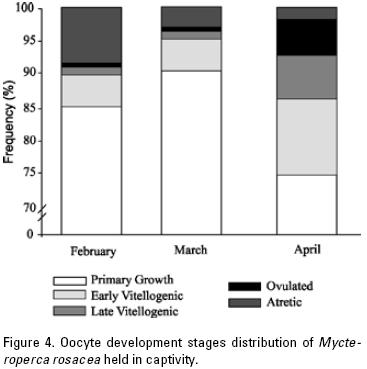
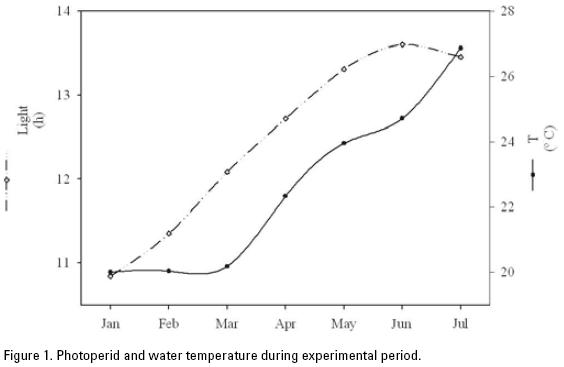
<body><![CDATA[<p align="justify"><font face="verdana" size="2">Temperature (Submersible Temperature Logger, HOBO TidbiT, WI), salinity (refractometer S/M1ll&#150;E, ATAGO CO. LTD.) and dissolved oxygen (YSI 85, OH) were daily measured. Photoperiod was calculated by the method described by Rodriguez <i>et al.,</i> (2001). Water temperature was between 25 and 29 &deg;C (<a href="#f1">Fig. 1</a>), salinity between 40 and 41 ppt. and dissolved oxygen 7.2&#150;7.6 mg/L.</font></p> 	    <p align="center"><font face="verdana" size="2"><a name="f1"></a></font></p> 	    <p align="center"><font face="verdana" size="2"><img src="/img/revistas/hbio/v20n3/a3f1.jpg"></font></p> 	    <p align="justify"><font face="verdana" size="2">From February to July 2003 gonad samples were obtained monthly, by gonad catheterization with a polyethylene catheter inserted into the gonoduct of anaesthetized individuals (Gracia&#150;L&oacute;pez <i>et al.,</i> 2004a; 2004b). Samples were fixed for 48 h in Karnovsky fixative (20% glutaraldehyde, 40% sacarose and 40% sterilized seawater) (Karnovsky, 1965), dehydrated, embedded in paraffin, sectioned (&lt; 5 um) and stained with Harris hematoxylineosin. Each sample was examined under an optical microscope (Olympus Bx&#150;41). Images were captured using a digital camera (Coolsnap&#150;Pro color MediaCybernetics, San Diego, CA, USA) and processed with Image&#150;Pro Plus software (version 5.0, MediaCybernetics), which is designed for high&#150;resolution image analysis.</font></p> 	    <p align="justify"><font face="verdana" size="2">Gonads of each female were classified into 5 development stages based on the description made by Kuo <i>etal.</i> (1988) and Carrillo <i>etal.</i> (1989) for teleost fish which is based on easily recognizable morphologic characters like primary growth (stage I), early vitellogenesis (stage II), late vitellogenesis (stage III), ovulation (stage IV) and atretic follicles (stage V). Oocyte frequency in each development category was obtained from the number of oocytes in each stage in relation to the total number of analyzed oocytes (<a href="/img/revistas/hbio/v20n3/a3f2.jpg" target="_blank">Fig. 2A&#150;H</a>; <a href="/img/revistas/hbio/v20n3/a3t1.jpg" target="_blank">Table 1</a>). Fish in sexual transition or bisexual (stage VI) were identified according to the description made for <i>Epinephelus fario</i> and males by the observation of testis in the histological slides or the presence of sperm when gentle abdominal pressure was applied (Kuo <i>et al.,</i> 1998).</font></p> 	    <p align="justify"><font face="verdana" size="2">Total length of individuals was calculated by the function y= a <i>x</i><sup>b</sup>, (y = weight; a = 1.43 &times; 10<sup>&#150;5</sup>; <i>x</i> = total length; b = 2.970) based on the study for wild leopard grouper, <i>M. rosacea</i> (D&iacute;az&#150;Uribe <i>et al.,</i> 2001).</font></p> 	    <p align="justify"><font face="verdana" size="2">&nbsp;</font></p> 	    <p align="justify"><font face="verdana" size="2"><b>RESULTS</b></font></p> 	    <p align="justify"><font face="verdana" size="2">Weight of broodstock during the study ranged from 0.34 to 1.00 Kg (<a href="/img/revistas/hbio/v20n3/a3f3.jpg" target="_blank">Fig. 3</a>).</font></p> 	    <p align="justify"><font face="verdana" size="2">Description of different ovarian stages, diameter of oocyte and germinal vesicle in each stage of development is shown in <a href="/img/revistas/hbio/v20n3/a3t1.jpg" target="_blank">Table 1</a>. Oocytes in primary growth were the most abundant throughout the study (66&#150;90%). In February, an increase in the percentage of oocytes at early vitellogenic stage occurred (7%) and in April, near the spawning season oocytes in primary growth decreased and an increase of the percentage of the oocytes in other stages of ovarian development was observed; the percentages of early vitellogenic, late vitellogenic, and ovulated oocytes increased to 12, 7 and 6%, respectively (<a href="#f4">Fig. 4</a>, <a href="/img/revistas/hbio/v20n3/a3t1.jpg" target="_blank">Table 1</a>).</font></p> 	    ]]></body>
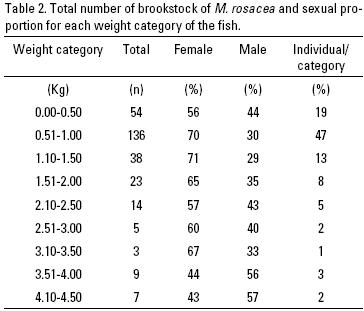
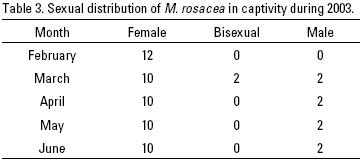
<body><![CDATA[<p align="center"><font face="verdana" size="2"><a name="f4"></a></font></p> 	    <p align="center"><font face="verdana" size="2"><img src="/img/revistas/hbio/v20n3/a3f4.jpg"></font></p> 	    <p align="justify"><font face="verdana" size="2">In February, ten females had oocytes in primary growth and two females had oocytes in every stage of development, including atretic oocytes. In March, the two females that had the most advanced stages of gonad development were found in sexual transition. The rest of the fish remained females. In April, there were no more transitionals individuals and this sex ratio was maintained throughout the experiment. (<a href="#t2">Table 2</a>). In March when the bisexual fish were observed, broodstock weight was from 0.32 to 1.02 Kg. The two transitional fish weighed 0.52 and 0.86 Kg (<a href="/img/revistas/hbio/v20n3/a3f2.jpg" target="_blank">Fig. 2</a>).</font></p> 	    <p align="center"><font face="verdana" size="2"><a name="t2"></a></font></p> 	    <p align="center"><font face="verdana" size="2"><img src="/img/revistas/hbio/v20n3/a3t2.jpg"></font></p> 	    <p align="justify"><font face="verdana" size="2">Individuals in sexual transition had ovaries with advanced stages of development in February (<a href="/img/revistas/hbio/v20n3/a3f5.jpg" target="_blank">Fig. 5A</a>) characterized mainly by primary oocytes in the perinucleolar stage 74%, early vitellogenesis 9%, late vitellogenesis 2%, ovulated 1% and atretic follicles 14% (<a href="#t3">Table 3</a>). In March, the analysis of the histological slides revealed the presence of ovotestis, gonad with both testicular and ovarian aspects (<a href="/img/revistas/hbio/v20n3/a3f5.jpg" target="_blank">Fig. 5B</a>). The transitional stage was characterized by the presence of oocytes in primary growth in the perinuleolar stage, followed by degenerated primary oocytes and the proliferation of spermatogonia, spermatocytes and spermatozoa with flagellum (<a href="/img/revistas/hbio/v20n3/a3f5.jpg" target="_blank">Fig. 5 B&#150;C</a>). At this stage, the differentiated male cysts proliferated to the interior of the lamellae as the primary oocytes degenerated and were reabsorbed.</font></p> 	    <p align="center"><font face="verdana" size="2"><a name="t3"></a></font></p> 	    <p align="center"><font face="verdana" size="2"><img src="/img/revistas/hbio/v20n3/a3t3.jpg"></font></p> 	    <p align="justify"><font face="verdana" size="2">Males were characterized by the presence of spermatogenesis. A large number of spermatogonia, spermatocytes, spermatids and spermatozoa were observed in functional testes in April (<a href="/img/revistas/hbio/v20n3/a3f5.jpg" target="_blank">Fig. 5C</a>).</font></p> 	    <p align="justify"><font face="verdana" size="2">&nbsp;</font></p> 	    ]]></body>
<body><![CDATA[<p align="justify"><font face="verdana" size="2"><b>DISCUSSION</b></font></p> 	    <p align="justify"><font face="verdana" size="2">In this study, the gonad development of the leopard grouper <i>M. rosacea</i> was described with the use of histological techniques. As observed in nature, broodstock had the most advanced go&#150;nad development in April (Erisman <i>et</i> al., 2008). Late vitellogenesis was observed in February indicating the beginning of gonad development and in April, the highest amount of oocytes in secondary growth was observed. The smallest mature individual was 3+ years (360 mm), coinciding with maturity of E <i>tauvina</i> (Abu&#150;Hakima, 1987).</font></p> 	    <p align="justify"><font face="verdana" size="2">It was recently demonstrated that wild leopard grouper, <i>M. rosacea</i> is a gonochoric specie that goes through a juvenile in&#150;mature bisexual stage in sizes smaller than 220 mm (2 years old) (Erisman <i>et al.,</i> 2008). In this study, the individuals that changed sex were older than 3 and 4 years, 351 and 416 mm respectively (the age was obtained based on a backward estimate (Diaz&#150;Uribe, 2001), and had mature ovaries with all the development stages one month prior to the sexual transition. There are some grouper species were the largest individual in a group is the one that changes sex. In other species, sex change could be observed in small size individuals like <i>Epinephelus tauvina</i> (Forsskal 1772) (Abu&#150;Hakima, 1987), <i>Epinephelus aeneus</i> (Geoffroy Saint&#150;Hilaire 1817) (Hassin <i>et al.,</i> 1997) and <i>Epinephelus merra</i> (Bloch 1793) (Bhandari <i>et al.,</i> 2003). However, it is usual that average female size in a population is smaller than mean size of males. This differs from <i>M. rosacea</i> were the size of females and males overlapped.</font></p> 	    <p align="justify"><font face="verdana" size="2">Individuals of <i>M. rosacea</i> changed sex to male eight months after their capture and the transition was complete in less than two months. These individuals had mature ovaries with every stage of development in February, later the presence of ovo&#150;testis was observed with ovarian tissue reminiscences one month previous the presence of sperm and the complete transformation to functional male in March. Captivity could influence the time for sex change, because in wild populations it is often observed out of the breeding season (Brusle &amp; Brusle, 1975; Bhandari <i>etal.,</i> 2003; Bhandari <i>etal.,</i> 2004a; McGovern <i>etal.,</i> 1998; Smith, 1965). The time required for a captive individual to change sex varies according to the specie like <i>E. coloides</i>that changed sex after 7 years of captivity (Yeh <i>et al.,</i> 2003). In studies of captive <i>E. merra,</i> sexual transition was completed in a shorter period during the reproductive season which related with the high levels of sex steroids produced during this period (Alam <i>et al.,</i> 2005; Alam <i>et al.,</i> 2006).</font></p> 	    <p align="justify"><font face="verdana" size="2">In some grouper species the social unit consist of several small individuals and a large dominant male, when the male disappears or no longer can maintain control of subordinates one of the largest females could change sex assuming the male roll (Yaron &amp; Sivan, 2005). In this study, the two sex transition fish were not the largest suggesting that captive <i>M. rosacea</i> has the potential to change sex in a wide size range. This has been reported in other captive grouper species like <i>E. akaara</i> where size of females that change sex is different to size found in wild populations (Tanaka <i>etal.,</i> 1990) and <i>E. striatus,</i> which is a species described as gonochorist with the potential of sex change under natural or controlled conditions (Sadovy &amp; Colin, 1995). There are also other species like <i>Bostrichthys sinensis</i> (Lacep&eacute;de, 1801) that have been characterized as gonochoric in wild populations, but in culture conditions 10 to 15 % of individuals are hermaphrodites suggesting that captivity conditions (high water temperature or chemicals introduced to rearing tanks) have an effect in sexual behavior (Hong <i>et al.,</i> 2006).</font></p> 	    <p align="justify"><font face="verdana" size="2">Some grouper species like <i>Epinephelus marginatus, E. coioides</i> and <i>E. merra</i> have hormonally induced to change sex with methiltestosterone (MT), a mixture of hormones or aromatase inhibitors (Alam <i>et al.,</i> 2006; Bhandari <i>et al.,</i> 2004a; Bhandari <i>et al.,</i> 2004b; Bhandari <i>et al.,</i> 2005; Glamuzina <i>et al.,</i> 1998; Yeh <i>et al.,</i> 2003) to obtain a higher sperm production. Induction of adult sex reversal of <i>E. merra</i> with aromatase inhibitor produced males in a period of two and a half months with larger testes than in wild males, a great sperm production and high egg fertilization rate (Bhandari <i>et al.,</i> 2004b; 2005) but the induction to sex reversal to juveniles of the same specie, produced males with small volume of sperm suggesting that sex reversal success could depend on the size and age of individuals (Candi <i>et al.,</i> 2004; Glamuzina <i>et al.,</i> 1998; Robertson &amp; Justines, 1982).</font></p> 	    <p align="justify"><font face="verdana" size="2">In this study, the same individuals identified by their tags, were repeatedly sampled and maintained in captivity as suggested by Bhandari <i>et al.</i> (2003), therefore we can assure that results presented here belong to the same individual. These findings must be considered in stock configuration of broodstock for aquaculture production. Further studies on reproductive behavior of females and males in captivity along with sex reversal induction trials are needed to corroborate leopard groupers reproductive behavior in captivity.</font></p> 	    <p align="justify"><font face="verdana" size="2">&nbsp;</font></p> 	    <p align="justify"><font face="verdana" size="2"><b>ACKNOWLEDGMENTS</b></font></p> 	    <p align="justify"><font face="verdana" size="2">Authors would like to thank J. Sandoval for technical assistance of broodstock in CIBNOR. This study was sponsored by Sistema de Investigaci&oacute;n del Mar de Cort&eacute;s (SIMAC), International Foundation of Science (IFS), Consejo Nacional de Pesca (CONAPESCA) and Consejo Nacional de Ciencia y Tecnolog&iacute;a (CONACYT scholarship 172897) granted to M. Kiewek. The editing of this paper was made by Ana G. Trasvina Moreno.</font></p> 	    ]]></body>
<body><![CDATA[<p align="justify"><font face="verdana" size="2">&nbsp;</font></p> 	    <p align="justify"><font face="verdana" size="2"><b>REFERENCES</b></font></p> 	    <!-- ref --><p align="justify"><font face="verdana" size="2">Abu&#150;Hakima, R. 1987. Aspects of the reproductive biology of the grouper, <i>Epinephelus tauvina</i> (Forsk&aacute;l), in Kuwaiti waters. <i>Journal of Fish Biology</i> 30: 213&#150;222.    &nbsp;&nbsp;&nbsp;&nbsp;&nbsp;&nbsp;&nbsp;&nbsp;[&#160;<a href="javascript:void(0);" onclick="javascript: window.open('/scielo.php?script=sci_nlinks&ref=4110345&pid=S0188-8897201000030000300001&lng=','','width=640,height=500,resizable=yes,scrollbars=1,menubar=yes,');">Links</a>&#160;]<!-- end-ref --></font></p> 	    <!-- ref --><p align="justify"><font face="verdana" size="2">Alam, M. S., H. Komuro, R. K. Bhandari, S. Nakamura, K. Soyano &amp; M. Nakamura. 2005. Immunohistochemical evidence identifying the site of androgen production in the ovary of the protogynous grouper <i>Epinephelus merra. Cell and Tissue Research</i> 320: 323&#150;329.    &nbsp;&nbsp;&nbsp;&nbsp;&nbsp;&nbsp;&nbsp;&nbsp;[&#160;<a href="javascript:void(0);" onclick="javascript: window.open('/scielo.php?script=sci_nlinks&ref=4110347&pid=S0188-8897201000030000300002&lng=','','width=640,height=500,resizable=yes,scrollbars=1,menubar=yes,');">Links</a>&#160;]<!-- end-ref --></font></p> 	    <!-- ref --><p align="justify"><font face="verdana" size="2">Alam, M.A., R.K. Bhandari, Y. Kobayashi, K. Soyano &amp; M. Nakamura. 2006. Induction of sex change within two full moons during breeding season and spawning in grouper. <i>Aquaculture</i> 255: 532&#150;535.    &nbsp;&nbsp;&nbsp;&nbsp;&nbsp;&nbsp;&nbsp;&nbsp;[&#160;<a href="javascript:void(0);" onclick="javascript: window.open('/scielo.php?script=sci_nlinks&ref=4110349&pid=S0188-8897201000030000300003&lng=','','width=640,height=500,resizable=yes,scrollbars=1,menubar=yes,');">Links</a>&#160;]<!-- end-ref --></font></p> 	    <!-- ref --><p align="justify"><font face="verdana" size="2">Allen, G.R. &amp; D.R. Robertson. 1998. <i>Peces del Pac&iacute;fico Oriental Tropical.</i> CONABIO, Agrupaci&oacute;n Sierra Madre and CEMEX, M&eacute;xico 327 p.    &nbsp;&nbsp;&nbsp;&nbsp;&nbsp;&nbsp;&nbsp;&nbsp;[&#160;<a href="javascript:void(0);" onclick="javascript: window.open('/scielo.php?script=sci_nlinks&ref=4110351&pid=S0188-8897201000030000300004&lng=','','width=640,height=500,resizable=yes,scrollbars=1,menubar=yes,');">Links</a>&#160;]<!-- end-ref --></font></p> 	    ]]></body>
<body><![CDATA[<!-- ref --><p align="justify"><font face="verdana" size="2">Baroiller, J.F., Y. Guiguen &amp; A. Fostier. 1999. Endocrine and environmental aspects of sex differentiation in fish. CMLS <i>Cellular and Molecular Life Sciences</i> 55: 910&#150;931.    &nbsp;&nbsp;&nbsp;&nbsp;&nbsp;&nbsp;&nbsp;&nbsp;[&#160;<a href="javascript:void(0);" onclick="javascript: window.open('/scielo.php?script=sci_nlinks&ref=4110353&pid=S0188-8897201000030000300005&lng=','','width=640,height=500,resizable=yes,scrollbars=1,menubar=yes,');">Links</a>&#160;]<!-- end-ref --></font></p> 	    <!-- ref --><p align="justify"><font face="verdana" size="2">Bhandari, R. K., H. Komuro, S. Nakamura, M. Higa &amp; M. Nakamura. 2003. Gonadal restructuring and correlative steroid hormone profiles during natural sex change in protogynous honeycomb grouper <i>(Epinephelus merra). Zoological Science</i> 20: 1399&#150;1404.    &nbsp;&nbsp;&nbsp;&nbsp;&nbsp;&nbsp;&nbsp;&nbsp;[&#160;<a href="javascript:void(0);" onclick="javascript: window.open('/scielo.php?script=sci_nlinks&ref=4110355&pid=S0188-8897201000030000300006&lng=','','width=640,height=500,resizable=yes,scrollbars=1,menubar=yes,');">Links</a>&#160;]<!-- end-ref --></font></p> 	    <!-- ref --><p align="justify"><font face="verdana" size="2">Bhandari, R. K., H. Komuro, M. Higa &amp; M. Nakamura. 2004a. Sex inversion of sexually immature Honeycomb Grouper <i>(Epinephelus merra)</i> by aromatase inhibitor. <i>Zoological Science</i> 21 (3): 305&#150;310.    &nbsp;&nbsp;&nbsp;&nbsp;&nbsp;&nbsp;&nbsp;&nbsp;[&#160;<a href="javascript:void(0);" onclick="javascript: window.open('/scielo.php?script=sci_nlinks&ref=4110357&pid=S0188-8897201000030000300007&lng=','','width=640,height=500,resizable=yes,scrollbars=1,menubar=yes,');">Links</a>&#160;]<!-- end-ref --></font></p> 	    <!-- ref --><p align="justify"><font face="verdana" size="2">Bhandari, R. K., M. Higa, S. Nakamura &amp; M. Nakamura. 2004b. Aromatase Inhibitor induces complete sex change in the protogynous honeycomb grouper <i>(Epinephelus merra). Molecular Reproduction and Development</i> 67: 303&#150;307.    &nbsp;&nbsp;&nbsp;&nbsp;&nbsp;&nbsp;&nbsp;&nbsp;[&#160;<a href="javascript:void(0);" onclick="javascript: window.open('/scielo.php?script=sci_nlinks&ref=4110359&pid=S0188-8897201000030000300008&lng=','','width=640,height=500,resizable=yes,scrollbars=1,menubar=yes,');">Links</a>&#160;]<!-- end-ref --></font></p> 	    <!-- ref --><p align="justify"><font face="verdana" size="2">Bhandari, R. K., M. A. Alam, M. Higa, K. Soyano &amp; M. Nakamura. 2005. Evidence that estrogen regulates the sex change of honeycomb grouper <i>(Epinephelus merra),</i> a protogynous hermaphrodite fish. <i>Journal of Experimental Zoology</i> 303 (A): 497&#150;503.    &nbsp;&nbsp;&nbsp;&nbsp;&nbsp;&nbsp;&nbsp;&nbsp;[&#160;<a href="javascript:void(0);" onclick="javascript: window.open('/scielo.php?script=sci_nlinks&ref=4110361&pid=S0188-8897201000030000300009&lng=','','width=640,height=500,resizable=yes,scrollbars=1,menubar=yes,');">Links</a>&#160;]<!-- end-ref --></font></p> 	    ]]></body>
<body><![CDATA[<!-- ref --><p align="justify"><font face="verdana" size="2">Brusl&eacute;, J. &amp; S. Brusl&eacute;. 1975. Ovarian and testicular intersexuality in two protogynous Mediterranean groupers, <i>Epinephelus aenus</i> and <i>Epinephelus guaza. In:</i> Reinboth R. &amp; Springer&#150;Verlag (Eds.). <i>Intersexuality in the animal kingdom,</i> New York pp. 222&#150;227.    &nbsp;&nbsp;&nbsp;&nbsp;&nbsp;&nbsp;&nbsp;&nbsp;[&#160;<a href="javascript:void(0);" onclick="javascript: window.open('/scielo.php?script=sci_nlinks&ref=4110363&pid=S0188-8897201000030000300010&lng=','','width=640,height=500,resizable=yes,scrollbars=1,menubar=yes,');">Links</a>&#160;]<!-- end-ref --></font></p> 	    <!-- ref --><p align="justify"><font face="verdana" size="2">Brusl&eacute;, S. 1987. Sex&#150;inversion of the hermaphroditic protogynous teleost <i>Coris julis</i> L. (Labridae). <i>Journal of Fish Biology</i> 30 (5): 605&#150;616.    &nbsp;&nbsp;&nbsp;&nbsp;&nbsp;&nbsp;&nbsp;&nbsp;[&#160;<a href="javascript:void(0);" onclick="javascript: window.open('/scielo.php?script=sci_nlinks&ref=4110365&pid=S0188-8897201000030000300011&lng=','','width=640,height=500,resizable=yes,scrollbars=1,menubar=yes,');">Links</a>&#160;]<!-- end-ref --></font></p> 	    <!-- ref --><p align="justify"><font face="verdana" size="2">Candi, G., L. Castriota, F. Andaloro, M. G. Finoia &amp; G. Marino. 2004. Reproductive cycle and sex inversion in razor fish, a protogynous labrid in the southern Mediterranean Sea. <i>Journal of Fish Biology</i> 64: 1498&#150;1513.    &nbsp;&nbsp;&nbsp;&nbsp;&nbsp;&nbsp;&nbsp;&nbsp;[&#160;<a href="javascript:void(0);" onclick="javascript: window.open('/scielo.php?script=sci_nlinks&ref=4110367&pid=S0188-8897201000030000300012&lng=','','width=640,height=500,resizable=yes,scrollbars=1,menubar=yes,');">Links</a>&#160;]<!-- end-ref --></font></p> 	    <!-- ref --><p align="justify"><font face="verdana" size="2">Carrillo, M., N. Bromage, S. Zanuy, R. Serrano &amp; F. Prat. 1989. The effect of modifications in photoperiod on spawning time, ovarian development and egg quality in the sea bass <i>(Dicentrarchus labrax</i> L.). <i>Aquaculture</i> 81: 351&#150;365.    &nbsp;&nbsp;&nbsp;&nbsp;&nbsp;&nbsp;&nbsp;&nbsp;[&#160;<a href="javascript:void(0);" onclick="javascript: window.open('/scielo.php?script=sci_nlinks&ref=4110369&pid=S0188-8897201000030000300013&lng=','','width=640,height=500,resizable=yes,scrollbars=1,menubar=yes,');">Links</a>&#160;]<!-- end-ref --></font></p> 	    <!-- ref --><p align="justify"><font face="verdana" size="2">Coleman, F., C. Koenig &amp; L. A. Collins. 1996. Reproductive styles of shallow&#150;water groupers (Pisces: Serranidae) in the eastern Gulf of Mexico, consequences of fishing spawning aggregations. <i>Environmental Biology of Fish</i> 47: 129&#150;141.    &nbsp;&nbsp;&nbsp;&nbsp;&nbsp;&nbsp;&nbsp;&nbsp;[&#160;<a href="javascript:void(0);" onclick="javascript: window.open('/scielo.php?script=sci_nlinks&ref=4110371&pid=S0188-8897201000030000300014&lng=','','width=640,height=500,resizable=yes,scrollbars=1,menubar=yes,');">Links</a>&#160;]<!-- end-ref --></font></p> 	    ]]></body>
<body><![CDATA[<!-- ref --><p align="justify"><font face="verdana" size="2">Devlin, R. H. &amp; Y. Nagahama. 2002. Sex determination and sex differentiation in fish: an overview of genetic, physiological, and environmental influences. Review article. <i>Aquaculture</i> 208: 191&#150;364.    &nbsp;&nbsp;&nbsp;&nbsp;&nbsp;&nbsp;&nbsp;&nbsp;[&#160;<a href="javascript:void(0);" onclick="javascript: window.open('/scielo.php?script=sci_nlinks&ref=4110373&pid=S0188-8897201000030000300015&lng=','','width=640,height=500,resizable=yes,scrollbars=1,menubar=yes,');">Links</a>&#160;]<!-- end-ref --></font></p> 	    <!-- ref --><p align="justify"><font face="verdana" size="2">Diaz&#150;Uribe, J. G., J. F. Elorduy&#150;Garay &amp; M. T. Gonzalez&#150;Valdovinos. 2001. Age and growth of the leopard grouper, <i>Mycteroperca rosacea,</i> in the southern gulf of California, Mexico. <i>Pacific Science</i> 55: 171&#150;182.    &nbsp;&nbsp;&nbsp;&nbsp;&nbsp;&nbsp;&nbsp;&nbsp;[&#160;<a href="javascript:void(0);" onclick="javascript: window.open('/scielo.php?script=sci_nlinks&ref=4110375&pid=S0188-8897201000030000300016&lng=','','width=640,height=500,resizable=yes,scrollbars=1,menubar=yes,');">Links</a>&#160;]<!-- end-ref --></font></p> 	    <!-- ref --><p align="justify"><font face="verdana" size="2">Erisman, B. E., J. A. Rosales&#150;Casi&aacute;n &amp; A. Hastings. 2008. Evidence of gonochorism in a grouper, <i>Mycteroperca rosacea</i> from the Gulf of California, Mexico. <i>Environmental Biology of Fish</i> 1573&#150;5133 (Online). doi:10.1007/s10641&#150;007&#150;9246&#150;1.    &nbsp;&nbsp;&nbsp;&nbsp;&nbsp;&nbsp;&nbsp;&nbsp;[&#160;<a href="javascript:void(0);" onclick="javascript: window.open('/scielo.php?script=sci_nlinks&ref=4110377&pid=S0188-8897201000030000300017&lng=','','width=640,height=500,resizable=yes,scrollbars=1,menubar=yes,');">Links</a>&#160;]<!-- end-ref --></font></p> 	    <!-- ref --><p align="justify"><font face="verdana" size="2">Glamuzina, B., N. Glavic, B. Skaramuca &amp; V. Kozul. 1998. Induced sex reversal of dusky grouper, <i>Epinephelus marginatus</i> (Lowe). <i>Aquaculture Research</i> 29: 563&#150;567.    &nbsp;&nbsp;&nbsp;&nbsp;&nbsp;&nbsp;&nbsp;&nbsp;[&#160;<a href="javascript:void(0);" onclick="javascript: window.open('/scielo.php?script=sci_nlinks&ref=4110379&pid=S0188-8897201000030000300018&lng=','','width=640,height=500,resizable=yes,scrollbars=1,menubar=yes,');">Links</a>&#160;]<!-- end-ref --></font></p> 	    <!-- ref --><p align="justify"><font face="verdana" size="2">Gracia&#150;L&oacute;pez, V., J. Rodr&iacute;guez&#150;Romero &amp; J. M. P&eacute;rez&#150;Ram&iacute;rez. 2004a. Induced spawning and embryonic development of the leopard grouper <i>Mycteroperca rosacea</i> (Streets, 1877). <i>Ciencias Marinas</i> 30 (2): 279&#150;284.    &nbsp;&nbsp;&nbsp;&nbsp;&nbsp;&nbsp;&nbsp;&nbsp;[&#160;<a href="javascript:void(0);" onclick="javascript: window.open('/scielo.php?script=sci_nlinks&ref=4110381&pid=S0188-8897201000030000300019&lng=','','width=640,height=500,resizable=yes,scrollbars=1,menubar=yes,');">Links</a>&#160;]<!-- end-ref --></font></p> 	    ]]></body>
<body><![CDATA[<!-- ref --><p align="justify"><font face="verdana" size="2">Gracia&#150;L&oacute;pez, V., M. Kiewek&#150;Mart&iacute;nez &amp; M. Maldonado&#150;Garc&iacute;a. 2004b. Effects of temperature and salinity on artificially reproduced eggs and larvae of leopard grouper <i>Mycteroperca rosacea. Aquaculture</i> 237: 485&#150;498.    &nbsp;&nbsp;&nbsp;&nbsp;&nbsp;&nbsp;&nbsp;&nbsp;[&#160;<a href="javascript:void(0);" onclick="javascript: window.open('/scielo.php?script=sci_nlinks&ref=4110383&pid=S0188-8897201000030000300020&lng=','','width=640,height=500,resizable=yes,scrollbars=1,menubar=yes,');">Links</a>&#160;]<!-- end-ref --></font></p> 	    <!-- ref --><p align="justify"><font face="verdana" size="2">Gracia&#150;L&oacute;pez, V., M. Kiewek&#150;Mart&iacute;nez, M. Maldonado&#150;Garc&iacute;a, P. Monsalvo&#150;Spencer, G. Portillo&#150;Clark, R. Civera&#150;Cerecedo, M. Linares&#150;Aranda, M. Robles&#150;Mungaray &amp; J. M. Maz&oacute;n&#150;Su&aacute;stegui. 2005. Larvae and juvenile production of the leopard grouper, <i>Mycteroperca rosacea</i> (Streets, 1877). <i>Aquaculture Research</i> 36 (1): 110&#150;112.    &nbsp;&nbsp;&nbsp;&nbsp;&nbsp;&nbsp;&nbsp;&nbsp;[&#160;<a href="javascript:void(0);" onclick="javascript: window.open('/scielo.php?script=sci_nlinks&ref=4110385&pid=S0188-8897201000030000300021&lng=','','width=640,height=500,resizable=yes,scrollbars=1,menubar=yes,');">Links</a>&#160;]<!-- end-ref --></font></p> 	    <!-- ref --><p align="justify"><font face="verdana" size="2">Hassin, S., D. Monbrison, Y. Hanin, A. Elizur, Y. Zohar &amp; D. M. Popper. 1997. Domestication of the white grouper, <i>E. aeneus:</i> 1. Growth and reproduction. <i>Aquaculture</i> 156 (3&#150;4): 305&#150;316.    &nbsp;&nbsp;&nbsp;&nbsp;&nbsp;&nbsp;&nbsp;&nbsp;[&#160;<a href="javascript:void(0);" onclick="javascript: window.open('/scielo.php?script=sci_nlinks&ref=4110387&pid=S0188-8897201000030000300022&lng=','','width=640,height=500,resizable=yes,scrollbars=1,menubar=yes,');">Links</a>&#160;]<!-- end-ref --></font></p> 	    <!-- ref --><p align="justify"><font face="verdana" size="2">Heemstra, P. C. &amp; J. E. Randall. 1993. FAO species catalogue. Groupers of the world (Family Serranidae, Subfamily Epinephelinae). <i>FAO Fish Synopsis</i> 125 (16): 1&#150;382.    &nbsp;&nbsp;&nbsp;&nbsp;&nbsp;&nbsp;&nbsp;&nbsp;[&#160;<a href="javascript:void(0);" onclick="javascript: window.open('/scielo.php?script=sci_nlinks&ref=4110389&pid=S0188-8897201000030000300023&lng=','','width=640,height=500,resizable=yes,scrollbars=1,menubar=yes,');">Links</a>&#160;]<!-- end-ref --></font></p> 	    <!-- ref --><p align="justify"><font face="verdana" size="2">Hong W. S., S. X. Chen, W. Y. Zheng, Y. Xiao &amp; Q. Y. Zhang. 2006. Hermaphroditism in cultured Chinese black sleeper <i>(Bostrichthys sinensis</i> L.). <i>Journal of the World Aquaculture Society</i> 37 (4): 363&#150;369.    &nbsp;&nbsp;&nbsp;&nbsp;&nbsp;&nbsp;&nbsp;&nbsp;[&#160;<a href="javascript:void(0);" onclick="javascript: window.open('/scielo.php?script=sci_nlinks&ref=4110391&pid=S0188-8897201000030000300024&lng=','','width=640,height=500,resizable=yes,scrollbars=1,menubar=yes,');">Links</a>&#160;]<!-- end-ref --></font></p> 	    ]]></body>
<body><![CDATA[<!-- ref --><p align="justify"><font face="verdana" size="2">IUCN (2006) 2006 IUCN Red List of Threatened Species. Available on line at: <a href="http://www.iucnredlist.org/" target="_blank">http://www.iucnredlist.org/</a>. (downloaded March 20, 2007).    &nbsp;&nbsp;&nbsp;&nbsp;&nbsp;&nbsp;&nbsp;&nbsp;[&#160;<a href="javascript:void(0);" onclick="javascript: window.open('/scielo.php?script=sci_nlinks&ref=4110393&pid=S0188-8897201000030000300025&lng=','','width=640,height=500,resizable=yes,scrollbars=1,menubar=yes,');">Links</a>&#160;]<!-- end-ref --></font></p> 	    <!-- ref --><p align="justify"><font face="verdana" size="2">Johnson, A. K., P. Thomas &amp; R. R. Jr. Wilson. 1998. Seasonal cycles of gonadal development and plasma sex steroid levels in <i>Epinephelus morio,</i> a protogynous grouper in the eastern Gulf of Mexico. <i>Journal of Fish Biology</i> 52: 502&#150;518.    &nbsp;&nbsp;&nbsp;&nbsp;&nbsp;&nbsp;&nbsp;&nbsp;[&#160;<a href="javascript:void(0);" onclick="javascript: window.open('/scielo.php?script=sci_nlinks&ref=4110395&pid=S0188-8897201000030000300026&lng=','','width=640,height=500,resizable=yes,scrollbars=1,menubar=yes,');">Links</a>&#160;]<!-- end-ref --></font></p> 	    <!-- ref --><p align="justify"><font face="verdana" size="2">Karnovsky, M. J. 1965. A formaldehyde&#150;glutaraldehyde fixative of high osmolarity for use in electron microscopy. <i>Journal of Cell Biology </i>27 A: 137&#150;138.    &nbsp;&nbsp;&nbsp;&nbsp;&nbsp;&nbsp;&nbsp;&nbsp;[&#160;<a href="javascript:void(0);" onclick="javascript: window.open('/scielo.php?script=sci_nlinks&ref=4110397&pid=S0188-8897201000030000300027&lng=','','width=640,height=500,resizable=yes,scrollbars=1,menubar=yes,');">Links</a>&#160;]<!-- end-ref --></font></p> 	    <!-- ref --><p align="justify"><font face="verdana" size="2">Kiewek&#150;Mart&iacute;nez, N. M. 2004. Contribuci&oacute;n al conocimiento de la reproducci&oacute;n en cautiverio de la cabrilla sardinera <i>Mycteroperca rosa</i>cea. Tesis de Maestr&iacute;a en Ciencias (Biolog&iacute;a) CIBNOR, Mexico. 107 pp.    &nbsp;&nbsp;&nbsp;&nbsp;&nbsp;&nbsp;&nbsp;&nbsp;[&#160;<a href="javascript:void(0);" onclick="javascript: window.open('/scielo.php?script=sci_nlinks&ref=4110399&pid=S0188-8897201000030000300028&lng=','','width=640,height=500,resizable=yes,scrollbars=1,menubar=yes,');">Links</a>&#160;]<!-- end-ref --></font></p> 	    <!-- ref --><p align="justify"><font face="verdana" size="2">Lee, Y. D., S. Ho Park, A. Takemura &amp; K. Takano. 2002. Histological observations of seasonal reproductive and lunar&#150;related spawning cycles in the female honeycomb grouper <i>Epinephelus merra</i> in Okinawan waters. <i>Fisheries Science</i> 68 (4): 872&#150;877.    &nbsp;&nbsp;&nbsp;&nbsp;&nbsp;&nbsp;&nbsp;&nbsp;[&#160;<a href="javascript:void(0);" onclick="javascript: window.open('/scielo.php?script=sci_nlinks&ref=4110401&pid=S0188-8897201000030000300029&lng=','','width=640,height=500,resizable=yes,scrollbars=1,menubar=yes,');">Links</a>&#160;]<!-- end-ref --></font></p> 	    ]]></body>
<body><![CDATA[<!-- ref --><p align="justify"><font face="verdana" size="2">McGovern, J. C., D. M. Wyanski, 0. Pashuk, C. S. II Manooch &amp; G. R. Sedberry. 1998. Changes in the sex ratio and size at maturity of gag, <i>Mycteroperca microlepis,</i> from the Atlantic coast of the southeastern United States during 1976&#150;1995. <i>Fisheries Bulletin</i> 96: 797&#150;807.    &nbsp;&nbsp;&nbsp;&nbsp;&nbsp;&nbsp;&nbsp;&nbsp;[&#160;<a href="javascript:void(0);" onclick="javascript: window.open('/scielo.php?script=sci_nlinks&ref=4110403&pid=S0188-8897201000030000300030&lng=','','width=640,height=500,resizable=yes,scrollbars=1,menubar=yes,');">Links</a>&#160;]<!-- end-ref --></font></p> 	    <!-- ref --><p align="justify"><font face="verdana" size="2">Mendoza&#150;Bustamante, J. A. 2002. Aspectos ecol&oacute;gicos del reclutamiento de la cabrilla sardinera <i>Mycteroperca rosacea</i> (Streets, 1877) (Pisces: Serranidae) en camas de sargazo, San Juan de la Costa, B.C.S., M&eacute;xico. Tesis de Licenciatura (Biolog&iacute;a) UABCS, Mexico.    &nbsp;&nbsp;&nbsp;&nbsp;&nbsp;&nbsp;&nbsp;&nbsp;[&#160;<a href="javascript:void(0);" onclick="javascript: window.open('/scielo.php?script=sci_nlinks&ref=4110405&pid=S0188-8897201000030000300031&lng=','','width=640,height=500,resizable=yes,scrollbars=1,menubar=yes,');">Links</a>&#160;]<!-- end-ref --></font></p> 	    <!-- ref --><p align="justify"><font face="verdana" size="2">Nakamura, M., T. F. Hourigan, K. Yamauchi, Y. Nagahama &amp; E. G. Grau. 1989. Histological and ultrastructural evidence for the role of gonadal steroid hormones in sex change in the protogynous wrasse <i>(Thalassoma duperrey). Environmental Biology of Fishes</i> 24: 117&#150;136.    &nbsp;&nbsp;&nbsp;&nbsp;&nbsp;&nbsp;&nbsp;&nbsp;[&#160;<a href="javascript:void(0);" onclick="javascript: window.open('/scielo.php?script=sci_nlinks&ref=4110407&pid=S0188-8897201000030000300032&lng=','','width=640,height=500,resizable=yes,scrollbars=1,menubar=yes,');">Links</a>&#160;]<!-- end-ref --></font></p> 	    <!-- ref --><p align="justify"><font face="verdana" size="2">Pel&aacute;ez&#150;Mendoza, A. K. 1997 H&aacute;bitos alimenticios de la cabrilla sardinera <i>Mycteroperca rosacea</i> Streets, 1877 (Pises: Serranidae) en la bah&iacute;a de La Paz B.C.S y zonas adyacentes. Tesis de Licenciatura (Biolog&iacute;a) UABCS, Mexico. 62 p.    &nbsp;&nbsp;&nbsp;&nbsp;&nbsp;&nbsp;&nbsp;&nbsp;[&#160;<a href="javascript:void(0);" onclick="javascript: window.open('/scielo.php?script=sci_nlinks&ref=4110409&pid=S0188-8897201000030000300033&lng=','','width=640,height=500,resizable=yes,scrollbars=1,menubar=yes,');">Links</a>&#160;]<!-- end-ref --></font></p> 	    <!-- ref --><p align="justify"><font face="verdana" size="2">Quinitio G.F., N. B. Caberoy &amp; D. M. Jr Reyes. 1997. Induction of sex change in female <i>Epinephelus coioides</i> by social control. <i>Israeli Journal of Aquaculture Bamidgeh</i> 49: 77&#150;83.    &nbsp;&nbsp;&nbsp;&nbsp;&nbsp;&nbsp;&nbsp;&nbsp;[&#160;<a href="javascript:void(0);" onclick="javascript: window.open('/scielo.php?script=sci_nlinks&ref=4110411&pid=S0188-8897201000030000300034&lng=','','width=640,height=500,resizable=yes,scrollbars=1,menubar=yes,');">Links</a>&#160;]<!-- end-ref --></font></p> 	    ]]></body>
<body><![CDATA[<!-- ref --><p align="justify"><font face="verdana" size="2">Robertson, D. R. 1972. Social control of sex reversal in a coral&#150;reef fish. <i>Science</i> 173: 1007&#150;1009.    &nbsp;&nbsp;&nbsp;&nbsp;&nbsp;&nbsp;&nbsp;&nbsp;[&#160;<a href="javascript:void(0);" onclick="javascript: window.open('/scielo.php?script=sci_nlinks&ref=4110413&pid=S0188-8897201000030000300035&lng=','','width=640,height=500,resizable=yes,scrollbars=1,menubar=yes,');">Links</a>&#160;]<!-- end-ref --></font></p> 	    <!-- ref --><p align="justify"><font face="verdana" size="2">Robertson, D. R. &amp; G. Justines. 1982. Protogynous hermaphroditism and gonochorism in four Caribbean reef gobies. <i>Environmental Biology of Fishes</i> 7 (2): 137&#150;142.    &nbsp;&nbsp;&nbsp;&nbsp;&nbsp;&nbsp;&nbsp;&nbsp;[&#160;<a href="javascript:void(0);" onclick="javascript: window.open('/scielo.php?script=sci_nlinks&ref=4110415&pid=S0188-8897201000030000300036&lng=','','width=640,height=500,resizable=yes,scrollbars=1,menubar=yes,');">Links</a>&#160;]<!-- end-ref --></font></p> 	    <!-- ref --><p align="justify"><font face="verdana" size="2">Rodr&iacute;guez, L., I. Begtashi, S. Zanuy, M. Shaw &amp; M. Carrillo. 2001. Changes in plasma levels of reproductive hormones during first sexual maturation in European male sea bass <i>(Dicentrarchus labrax</i> L.) under artificial day lengths. <i>Aquaculture</i> 202 (3&#150;4): 235&#150;248.    &nbsp;&nbsp;&nbsp;&nbsp;&nbsp;&nbsp;&nbsp;&nbsp;[&#160;<a href="javascript:void(0);" onclick="javascript: window.open('/scielo.php?script=sci_nlinks&ref=4110417&pid=S0188-8897201000030000300037&lng=','','width=640,height=500,resizable=yes,scrollbars=1,menubar=yes,');">Links</a>&#160;]<!-- end-ref --></font></p> 	    <!-- ref --><p align="justify"><font face="verdana" size="2">Rosenblatt, R. H. &amp; B. J. Zahuranec. 1967. The Eastern Pacific grouper of the genus <i>Mycteroperca,</i> including a new species. <i>California Fish and Game</i> 53: 228&#150;245.    &nbsp;&nbsp;&nbsp;&nbsp;&nbsp;&nbsp;&nbsp;&nbsp;[&#160;<a href="javascript:void(0);" onclick="javascript: window.open('/scielo.php?script=sci_nlinks&ref=4110419&pid=S0188-8897201000030000300038&lng=','','width=640,height=500,resizable=yes,scrollbars=1,menubar=yes,');">Links</a>&#160;]<!-- end-ref --></font></p> 	    <!-- ref --><p align="justify"><font face="verdana" size="2">Ross, R. M., G. S. Losey &amp; M. Diamond. 1983. Sex change in a coral&#150;reef fish: dependence of stimulation and inhibition on relative size. <i>Science</i> 221: 574&#150;575.    &nbsp;&nbsp;&nbsp;&nbsp;&nbsp;&nbsp;&nbsp;&nbsp;[&#160;<a href="javascript:void(0);" onclick="javascript: window.open('/scielo.php?script=sci_nlinks&ref=4110421&pid=S0188-8897201000030000300039&lng=','','width=640,height=500,resizable=yes,scrollbars=1,menubar=yes,');">Links</a>&#160;]<!-- end-ref --></font></p> 	    ]]></body>
<body><![CDATA[<!-- ref --><p align="justify"><font face="verdana" size="2">Sadovy, Y., P. L. Colin &amp; M. L. Domier. 1994. Aggregation and spawning in the tiger grouper <i>Mycteroperca tigris</i> (Pisces: Serranidae). <i>Copeia </i>2: 511&#150;516.    &nbsp;&nbsp;&nbsp;&nbsp;&nbsp;&nbsp;&nbsp;&nbsp;[&#160;<a href="javascript:void(0);" onclick="javascript: window.open('/scielo.php?script=sci_nlinks&ref=4110423&pid=S0188-8897201000030000300040&lng=','','width=640,height=500,resizable=yes,scrollbars=1,menubar=yes,');">Links</a>&#160;]<!-- end-ref --></font></p> 	    <!-- ref --><p align="justify"><font face="verdana" size="2">Sadovy, Y. &amp; P. L. Colin. 1995. Sexual development and sexuality in the Nassau grouper. <i>Journal of Fish Biology</i> 46: 961&#150;976.    &nbsp;&nbsp;&nbsp;&nbsp;&nbsp;&nbsp;&nbsp;&nbsp;[&#160;<a href="javascript:void(0);" onclick="javascript: window.open('/scielo.php?script=sci_nlinks&ref=4110425&pid=S0188-8897201000030000300041&lng=','','width=640,height=500,resizable=yes,scrollbars=1,menubar=yes,');">Links</a>&#160;]<!-- end-ref --></font></p> 	    <!-- ref --><p align="justify"><font face="verdana" size="2">Shapiro, D. Y. 1980. Serial female sex changes after simultaneous removal of males from social groups of coral reef fish. <i>Science</i> 209: 1136&#150;1137.    &nbsp;&nbsp;&nbsp;&nbsp;&nbsp;&nbsp;&nbsp;&nbsp;[&#160;<a href="javascript:void(0);" onclick="javascript: window.open('/scielo.php?script=sci_nlinks&ref=4110427&pid=S0188-8897201000030000300042&lng=','','width=640,height=500,resizable=yes,scrollbars=1,menubar=yes,');">Links</a>&#160;]<!-- end-ref --></font></p> 	    <!-- ref --><p align="justify"><font face="verdana" size="2">Shapiro, D. Y. 1987. Differentiation and evolution of sex change in fishes. <i>BioScience</i> 37: 490&#150;497.    &nbsp;&nbsp;&nbsp;&nbsp;&nbsp;&nbsp;&nbsp;&nbsp;[&#160;<a href="javascript:void(0);" onclick="javascript: window.open('/scielo.php?script=sci_nlinks&ref=4110429&pid=S0188-8897201000030000300043&lng=','','width=640,height=500,resizable=yes,scrollbars=1,menubar=yes,');">Links</a>&#160;]<!-- end-ref --></font></p> 	    <!-- ref --><p align="justify"><font face="verdana" size="2">Smith, C. L. 1965. The pattern of sexuality and the classification of serranid fishes. <i>American Museum Novitat</i>2207: 1&#150;20.    &nbsp;&nbsp;&nbsp;&nbsp;&nbsp;&nbsp;&nbsp;&nbsp;[&#160;<a href="javascript:void(0);" onclick="javascript: window.open('/scielo.php?script=sci_nlinks&ref=4110431&pid=S0188-8897201000030000300044&lng=','','width=640,height=500,resizable=yes,scrollbars=1,menubar=yes,');">Links</a>&#160;]<!-- end-ref --></font></p> 	    ]]></body>
<body><![CDATA[<!-- ref --><p align="justify"><font face="verdana" size="2">Tanaka, H., K. Hirose, K. Y. Nogami, K. Hattori &amp; N. Ishibashi. 1990. Sexual maturation and sex reversal in red spotted grouper, <i>Epinephelus akaara. Bulletin of Natural Research Institute of Aquaculture</i> 17: 1&#150;15.    &nbsp;&nbsp;&nbsp;&nbsp;&nbsp;&nbsp;&nbsp;&nbsp;[&#160;<a href="javascript:void(0);" onclick="javascript: window.open('/scielo.php?script=sci_nlinks&ref=4110433&pid=S0188-8897201000030000300045&lng=','','width=640,height=500,resizable=yes,scrollbars=1,menubar=yes,');">Links</a>&#160;]<!-- end-ref --></font></p> 	    <!-- ref --><p align="justify"><font face="verdana" size="2">Warner, R. R. 1982. Mating systems, sex change and sexual demography in the rainbow wrasse, <i>Thalassoma lucasanum. Copeia</i> 3: 653&#150;661.    &nbsp;&nbsp;&nbsp;&nbsp;&nbsp;&nbsp;&nbsp;&nbsp;[&#160;<a href="javascript:void(0);" onclick="javascript: window.open('/scielo.php?script=sci_nlinks&ref=4110435&pid=S0188-8897201000030000300046&lng=','','width=640,height=500,resizable=yes,scrollbars=1,menubar=yes,');">Links</a>&#160;]<!-- end-ref --></font></p> 	    <!-- ref --><p align="justify"><font face="verdana" size="2">Yaron, Z. &amp; B. Sivan. 2005. Reproduction. In: Evans D.H. &amp; J.B. Clairborne (Eds.). <i>The physiology of fishes.</i> Third edition, CRC Press, Boca Raton, Florida pp. 343&#150;386.    &nbsp;&nbsp;&nbsp;&nbsp;&nbsp;&nbsp;&nbsp;&nbsp;[&#160;<a href="javascript:void(0);" onclick="javascript: window.open('/scielo.php?script=sci_nlinks&ref=4110437&pid=S0188-8897201000030000300047&lng=','','width=640,height=500,resizable=yes,scrollbars=1,menubar=yes,');">Links</a>&#160;]<!-- end-ref --></font></p> 	    <!-- ref --><p align="justify"><font face="verdana" size="2">Yeh, S. L., C. M. Kuo, Y. Y. Ting &amp; C. F. Chang. 2003. Androgens stimulate sex change in protogynous grouper, <i>Epinephelus coioides:</i> spawning performance in sex&#150;changed males. <i>Comparative Biochemistry and Physiology</i> 135 C: 375&#150;38.    &nbsp;&nbsp;&nbsp;&nbsp;&nbsp;&nbsp;&nbsp;&nbsp;[&#160;<a href="javascript:void(0);" onclick="javascript: window.open('/scielo.php?script=sci_nlinks&ref=4110439&pid=S0188-8897201000030000300048&lng=','','width=640,height=500,resizable=yes,scrollbars=1,menubar=yes,');">Links</a>&#160;]<!-- end-ref --></font></p>      ]]></body><back>
<ref-list>
<ref id="B1">
<nlm-citation citation-type="journal">
<person-group person-group-type="author">
<name>
<surname><![CDATA[Abu-Hakima]]></surname>
<given-names><![CDATA[R]]></given-names>
</name>
</person-group>
<article-title xml:lang="en"><![CDATA[Aspects of the reproductive biology of the grouper, Epinephelus tauvina (Forskál), in Kuwaiti waters]]></article-title>
<source><![CDATA[Journal of Fish Biology]]></source>
<year>1987</year>
<volume>30</volume>
<page-range>213-222</page-range></nlm-citation>
</ref>
<ref id="B2">
<nlm-citation citation-type="journal">
<person-group person-group-type="author">
<name>
<surname><![CDATA[Alam]]></surname>
<given-names><![CDATA[M. S.]]></given-names>
</name>
<name>
<surname><![CDATA[Komuro]]></surname>
<given-names><![CDATA[H]]></given-names>
</name>
<name>
<surname><![CDATA[Bhandari]]></surname>
<given-names><![CDATA[R. K.]]></given-names>
</name>
<name>
<surname><![CDATA[Nakamura]]></surname>
<given-names><![CDATA[S]]></given-names>
</name>
<name>
<surname><![CDATA[Soyano]]></surname>
<given-names><![CDATA[K]]></given-names>
</name>
<name>
<surname><![CDATA[Nakamura]]></surname>
<given-names><![CDATA[M]]></given-names>
</name>
</person-group>
<article-title xml:lang="en"><![CDATA[Immunohistochemical evidence identifying the site of androgen production in the ovary of the protogynous grouper Epinephelus merra]]></article-title>
<source><![CDATA[Cell and Tissue Research]]></source>
<year>2005</year>
<volume>320</volume>
<page-range>323-329</page-range></nlm-citation>
</ref>
<ref id="B3">
<nlm-citation citation-type="journal">
<person-group person-group-type="author">
<name>
<surname><![CDATA[Alam]]></surname>
<given-names><![CDATA[M.A.]]></given-names>
</name>
<name>
<surname><![CDATA[Bhandari]]></surname>
<given-names><![CDATA[R.K.]]></given-names>
</name>
<name>
<surname><![CDATA[Kobayashi]]></surname>
<given-names><![CDATA[Y]]></given-names>
</name>
<name>
<surname><![CDATA[Soyano]]></surname>
<given-names><![CDATA[K]]></given-names>
</name>
<name>
<surname><![CDATA[Nakamura]]></surname>
<given-names><![CDATA[M]]></given-names>
</name>
</person-group>
<article-title xml:lang="en"><![CDATA[Induction of sex change within two full moons during breeding season and spawning in grouper]]></article-title>
<source><![CDATA[Aquaculture]]></source>
<year>2006</year>
<volume>255</volume>
<page-range>532-535</page-range></nlm-citation>
</ref>
<ref id="B4">
<nlm-citation citation-type="book">
<person-group person-group-type="author">
<name>
<surname><![CDATA[Allen]]></surname>
<given-names><![CDATA[G.R.]]></given-names>
</name>
<name>
<surname><![CDATA[Robertson]]></surname>
<given-names><![CDATA[D.R.]]></given-names>
</name>
</person-group>
<source><![CDATA[Peces del Pacífico Oriental Tropical]]></source>
<year>1998</year>
<page-range>327</page-range><publisher-name><![CDATA[CONABIOAgrupación Sierra Madre and CEMEX]]></publisher-name>
</nlm-citation>
</ref>
<ref id="B5">
<nlm-citation citation-type="journal">
<person-group person-group-type="author">
<name>
<surname><![CDATA[Baroiller]]></surname>
<given-names><![CDATA[J.F.]]></given-names>
</name>
<name>
<surname><![CDATA[Guiguen]]></surname>
<given-names><![CDATA[Y]]></given-names>
</name>
<name>
<surname><![CDATA[Fostier]]></surname>
<given-names><![CDATA[A]]></given-names>
</name>
</person-group>
<article-title xml:lang="en"><![CDATA[Endocrine and environmental aspects of sex differentiation in fish. CMLS]]></article-title>
<source><![CDATA[Cellular and Molecular Life Sciences]]></source>
<year>1999</year>
<volume>55</volume>
<page-range>910-931</page-range></nlm-citation>
</ref>
<ref id="B6">
<nlm-citation citation-type="journal">
<person-group person-group-type="author">
<name>
<surname><![CDATA[Bhandari]]></surname>
<given-names><![CDATA[R. K.]]></given-names>
</name>
<name>
<surname><![CDATA[Komuro]]></surname>
<given-names><![CDATA[H]]></given-names>
</name>
<name>
<surname><![CDATA[Nakamura]]></surname>
<given-names><![CDATA[S]]></given-names>
</name>
<name>
<surname><![CDATA[Higa]]></surname>
<given-names><![CDATA[M]]></given-names>
</name>
<name>
<surname><![CDATA[Nakamura]]></surname>
<given-names><![CDATA[M]]></given-names>
</name>
</person-group>
<article-title xml:lang="en"><![CDATA[Gonadal restructuring and correlative steroid hormone profiles during natural sex change in protogynous honeycomb grouper (Epinephelus merra)]]></article-title>
<source><![CDATA[Zoological Science]]></source>
<year>2003</year>
<volume>20</volume>
<page-range>1399-1404</page-range></nlm-citation>
</ref>
<ref id="B7">
<nlm-citation citation-type="journal">
<person-group person-group-type="author">
<name>
<surname><![CDATA[Bhandari]]></surname>
<given-names><![CDATA[R. K.]]></given-names>
</name>
<name>
<surname><![CDATA[Komuro]]></surname>
<given-names><![CDATA[H]]></given-names>
</name>
<name>
<surname><![CDATA[Higa]]></surname>
<given-names><![CDATA[M]]></given-names>
</name>
<name>
<surname><![CDATA[Nakamura]]></surname>
<given-names><![CDATA[M]]></given-names>
</name>
</person-group>
<article-title xml:lang="en"><![CDATA[Sex inversion of sexually immature Honeycomb Grouper (Epinephelus merra) by aromatase inhibitor]]></article-title>
<source><![CDATA[Zoological Science]]></source>
<year>2004</year>
<month>a</month>
<volume>21</volume>
<numero>3</numero>
<issue>3</issue>
<page-range>305-310</page-range></nlm-citation>
</ref>
<ref id="B8">
<nlm-citation citation-type="journal">
<person-group person-group-type="author">
<name>
<surname><![CDATA[Bhandari]]></surname>
<given-names><![CDATA[R. K.]]></given-names>
</name>
<name>
<surname><![CDATA[Higa]]></surname>
<given-names><![CDATA[M.]]></given-names>
</name>
<name>
<surname><![CDATA[Nakamura]]></surname>
<given-names><![CDATA[S.]]></given-names>
</name>
<name>
<surname><![CDATA[Nakamura]]></surname>
<given-names><![CDATA[M.]]></given-names>
</name>
</person-group>
<article-title xml:lang="en"><![CDATA[Aromatase Inhibitor induces complete sex change in the protogynous honeycomb grouper (Epinephelus merra)]]></article-title>
<source><![CDATA[Molecular Reproduction and Development]]></source>
<year>2004</year>
<month>b</month>
<volume>67</volume>
<page-range>303-307</page-range></nlm-citation>
</ref>
<ref id="B9">
<nlm-citation citation-type="journal">
<person-group person-group-type="author">
<name>
<surname><![CDATA[Bhandari]]></surname>
<given-names><![CDATA[R. K.]]></given-names>
</name>
<name>
<surname><![CDATA[Alam]]></surname>
<given-names><![CDATA[M. A.]]></given-names>
</name>
<name>
<surname><![CDATA[Higa]]></surname>
<given-names><![CDATA[M]]></given-names>
</name>
<name>
<surname><![CDATA[Soyano]]></surname>
<given-names><![CDATA[K]]></given-names>
</name>
<name>
<surname><![CDATA[Nakamura]]></surname>
<given-names><![CDATA[M]]></given-names>
</name>
</person-group>
<article-title xml:lang="en"><![CDATA[Evidence that estrogen regulates the sex change of honeycomb grouper (Epinephelus merra), a protogynous hermaphrodite fish]]></article-title>
<source><![CDATA[Journal of Experimental Zoology]]></source>
<year>2005</year>
<volume>303</volume>
<numero>A</numero>
<issue>A</issue>
<page-range>497-503</page-range></nlm-citation>
</ref>
<ref id="B10">
<nlm-citation citation-type="book">
<person-group person-group-type="author">
<name>
<surname><![CDATA[Bruslé]]></surname>
<given-names><![CDATA[J]]></given-names>
</name>
<name>
<surname><![CDATA[Bruslé]]></surname>
<given-names><![CDATA[S]]></given-names>
</name>
</person-group>
<article-title xml:lang="en"><![CDATA[Ovarian and testicular intersexuality in two protogynous Mediterranean groupers, Epinephelus aenus and Epinephelus guaza]]></article-title>
<person-group person-group-type="editor">
<name>
<surname><![CDATA[Reinboth]]></surname>
<given-names><![CDATA[R.]]></given-names>
</name>
</person-group>
<source><![CDATA[Intersexuality in the animal kingdom]]></source>
<year>1975</year>
<page-range>222-227</page-range><publisher-loc><![CDATA[New York ]]></publisher-loc>
<publisher-name><![CDATA[Springer-Verlag]]></publisher-name>
</nlm-citation>
</ref>
<ref id="B11">
<nlm-citation citation-type="journal">
<person-group person-group-type="author">
<name>
<surname><![CDATA[Bruslé]]></surname>
<given-names><![CDATA[S]]></given-names>
</name>
</person-group>
<article-title xml:lang="en"><![CDATA[Sex-inversion of the hermaphroditic protogynous teleost Coris julis L. (Labridae)]]></article-title>
<source><![CDATA[Journal of Fish Biology]]></source>
<year>1987</year>
<volume>30</volume>
<numero>5</numero>
<issue>5</issue>
<page-range>605-616</page-range></nlm-citation>
</ref>
<ref id="B12">
<nlm-citation citation-type="journal">
<person-group person-group-type="author">
<name>
<surname><![CDATA[Candi]]></surname>
<given-names><![CDATA[G]]></given-names>
</name>
<name>
<surname><![CDATA[Castriota]]></surname>
<given-names><![CDATA[L]]></given-names>
</name>
<name>
<surname><![CDATA[Andaloro]]></surname>
<given-names><![CDATA[F]]></given-names>
</name>
<name>
<surname><![CDATA[Finoia]]></surname>
<given-names><![CDATA[M. G.]]></given-names>
</name>
<name>
<surname><![CDATA[Marino]]></surname>
<given-names><![CDATA[G]]></given-names>
</name>
</person-group>
<article-title xml:lang="en"><![CDATA[Reproductive cycle and sex inversion in razor fish, a protogynous labrid in the southern Mediterranean Sea]]></article-title>
<source><![CDATA[Journal of Fish Biology]]></source>
<year>2004</year>
<volume>64</volume>
<page-range>1498-1513</page-range></nlm-citation>
</ref>
<ref id="B13">
<nlm-citation citation-type="journal">
<person-group person-group-type="author">
<name>
<surname><![CDATA[Carrillo]]></surname>
<given-names><![CDATA[M]]></given-names>
</name>
<name>
<surname><![CDATA[Bromage]]></surname>
<given-names><![CDATA[N]]></given-names>
</name>
<name>
<surname><![CDATA[Zanuy]]></surname>
<given-names><![CDATA[S]]></given-names>
</name>
<name>
<surname><![CDATA[Serrano]]></surname>
<given-names><![CDATA[R]]></given-names>
</name>
<name>
<surname><![CDATA[Prat]]></surname>
<given-names><![CDATA[F]]></given-names>
</name>
</person-group>
<article-title xml:lang="en"><![CDATA[The effect of modifications in photoperiod on spawning time, ovarian development and egg quality in the sea bass (Dicentrarchus labrax L.)]]></article-title>
<source><![CDATA[Aquaculture]]></source>
<year>1989</year>
<volume>81</volume>
<page-range>351-365</page-range></nlm-citation>
</ref>
<ref id="B14">
<nlm-citation citation-type="journal">
<person-group person-group-type="author">
<name>
<surname><![CDATA[Coleman]]></surname>
<given-names><![CDATA[F]]></given-names>
</name>
<name>
<surname><![CDATA[Koenig]]></surname>
<given-names><![CDATA[C]]></given-names>
</name>
<name>
<surname><![CDATA[Collins]]></surname>
<given-names><![CDATA[L. A]]></given-names>
</name>
</person-group>
<article-title xml:lang="en"><![CDATA[Reproductive styles of shallow-water groupers (Pisces: Serranidae) in the eastern Gulf of Mexico, consequences of fishing spawning aggregations]]></article-title>
<source><![CDATA[Environmental Biology of Fish]]></source>
<year>1996</year>
<volume>47</volume>
<page-range>129-141</page-range></nlm-citation>
</ref>
<ref id="B15">
<nlm-citation citation-type="journal">
<person-group person-group-type="author">
<name>
<surname><![CDATA[Devlin]]></surname>
<given-names><![CDATA[R. H.]]></given-names>
</name>
<name>
<surname><![CDATA[Nagahama]]></surname>
<given-names><![CDATA[Y]]></given-names>
</name>
</person-group>
<article-title xml:lang="en"><![CDATA[Sex determination and sex differentiation in fish: an overview of genetic, physiological, and environmental influences. Review article]]></article-title>
<source><![CDATA[Aquaculture]]></source>
<year>2002</year>
<volume>208</volume>
<page-range>191-364</page-range></nlm-citation>
</ref>
<ref id="B16">
<nlm-citation citation-type="journal">
<person-group person-group-type="author">
<name>
<surname><![CDATA[Diaz-Uribe]]></surname>
<given-names><![CDATA[J. G.]]></given-names>
</name>
<name>
<surname><![CDATA[Elorduy-Garay]]></surname>
<given-names><![CDATA[J. F.]]></given-names>
</name>
<name>
<surname><![CDATA[Gonzalez-Valdovinos]]></surname>
<given-names><![CDATA[M. T.]]></given-names>
</name>
</person-group>
<article-title xml:lang="en"><![CDATA[Age and growth of the leopard grouper, Mycteroperca rosacea, in the southern gulf of California, Mexico]]></article-title>
<source><![CDATA[Pacific Science]]></source>
<year>2001</year>
<volume>55</volume>
<page-range>171-182</page-range></nlm-citation>
</ref>
<ref id="B17">
<nlm-citation citation-type="journal">
<person-group person-group-type="author">
<name>
<surname><![CDATA[Erisman]]></surname>
<given-names><![CDATA[B. E.]]></given-names>
</name>
<name>
<surname><![CDATA[Rosales-Casián]]></surname>
<given-names><![CDATA[J. A.]]></given-names>
</name>
<name>
<surname><![CDATA[Hastings]]></surname>
<given-names><![CDATA[A]]></given-names>
</name>
</person-group>
<article-title xml:lang="en"><![CDATA[Evidence of gonochorism in a grouper, Mycteroperca rosacea from the Gulf of California, Mexico]]></article-title>
<source><![CDATA[Environmental Biology of Fish]]></source>
<year>2008</year>
<page-range>1573-5133</page-range></nlm-citation>
</ref>
<ref id="B18">
<nlm-citation citation-type="journal">
<person-group person-group-type="author">
<name>
<surname><![CDATA[Glamuzina]]></surname>
<given-names><![CDATA[B]]></given-names>
</name>
<name>
<surname><![CDATA[Glavic]]></surname>
<given-names><![CDATA[N]]></given-names>
</name>
<name>
<surname><![CDATA[Skaramuca]]></surname>
<given-names><![CDATA[B]]></given-names>
</name>
<name>
<surname><![CDATA[Kozul]]></surname>
<given-names><![CDATA[V]]></given-names>
</name>
</person-group>
<article-title xml:lang="en"><![CDATA[Induced sex reversal of dusky grouper, Epinephelus marginatus (Lowe)]]></article-title>
<source><![CDATA[Aquaculture Research]]></source>
<year>1998</year>
<volume>29</volume>
<page-range>563-567</page-range></nlm-citation>
</ref>
<ref id="B19">
<nlm-citation citation-type="journal">
<person-group person-group-type="author">
<name>
<surname><![CDATA[Gracia-López]]></surname>
<given-names><![CDATA[V]]></given-names>
</name>
<name>
<surname><![CDATA[Rodríguez-Romero]]></surname>
<given-names><![CDATA[J]]></given-names>
</name>
<name>
<surname><![CDATA[Pérez-Ramírez]]></surname>
<given-names><![CDATA[J. M]]></given-names>
</name>
</person-group>
<article-title xml:lang="en"><![CDATA[Induced spawning and embryonic development of the leopard grouper Mycteroperca rosacea (Streets, 1877)]]></article-title>
<source><![CDATA[Ciencias Marinas]]></source>
<year>2004</year>
<month>a</month>
<volume>30</volume>
<numero>2</numero>
<issue>2</issue>
<page-range>279-284</page-range></nlm-citation>
</ref>
<ref id="B20">
<nlm-citation citation-type="journal">
<person-group person-group-type="author">
<name>
<surname><![CDATA[Gracia-López]]></surname>
<given-names><![CDATA[V]]></given-names>
</name>
<name>
<surname><![CDATA[Kiewek-Martínez]]></surname>
<given-names><![CDATA[M]]></given-names>
</name>
<name>
<surname><![CDATA[Maldonado-García]]></surname>
<given-names><![CDATA[M]]></given-names>
</name>
</person-group>
<article-title xml:lang="en"><![CDATA[Effects of temperature and salinity on artificially reproduced eggs and larvae of leopard grouper Mycteroperca rosacea]]></article-title>
<source><![CDATA[Aquaculture]]></source>
<year>2004</year>
<month>b</month>
<volume>237</volume>
<page-range>485-498</page-range></nlm-citation>
</ref>
<ref id="B21">
<nlm-citation citation-type="journal">
<person-group person-group-type="author">
<name>
<surname><![CDATA[Gracia-López]]></surname>
<given-names><![CDATA[V]]></given-names>
</name>
<name>
<surname><![CDATA[Kiewek-Martínez]]></surname>
<given-names><![CDATA[M]]></given-names>
</name>
<name>
<surname><![CDATA[Maldonado-García]]></surname>
<given-names><![CDATA[M]]></given-names>
</name>
<name>
<surname><![CDATA[Monsalvo-Spencer]]></surname>
<given-names><![CDATA[P]]></given-names>
</name>
<name>
<surname><![CDATA[Portillo-Clark]]></surname>
<given-names><![CDATA[G]]></given-names>
</name>
<name>
<surname><![CDATA[Civera-Cerecedo]]></surname>
<given-names><![CDATA[R]]></given-names>
</name>
<name>
<surname><![CDATA[Linares-Aranda]]></surname>
</name>
<name>
<surname><![CDATA[Robles-Mungaray]]></surname>
<given-names><![CDATA[M]]></given-names>
</name>
<name>
<surname><![CDATA[Mazón-Suástegui]]></surname>
<given-names><![CDATA[J. M.]]></given-names>
</name>
</person-group>
<article-title xml:lang="en"><![CDATA[Larvae and juvenile production of the leopard grouper, Mycteroperca rosacea (Streets, 1877)]]></article-title>
<source><![CDATA[Aquaculture Research]]></source>
<year>2005</year>
<volume>36</volume>
<numero>1</numero>
<issue>1</issue>
<page-range>110-112</page-range></nlm-citation>
</ref>
<ref id="B22">
<nlm-citation citation-type="journal">
<person-group person-group-type="author">
<name>
<surname><![CDATA[Hassin]]></surname>
<given-names><![CDATA[S]]></given-names>
</name>
<name>
<surname><![CDATA[Monbrison]]></surname>
<given-names><![CDATA[D]]></given-names>
</name>
<name>
<surname><![CDATA[Hanin]]></surname>
<given-names><![CDATA[Y]]></given-names>
</name>
<name>
<surname><![CDATA[Elizur]]></surname>
<given-names><![CDATA[A]]></given-names>
</name>
<name>
<surname><![CDATA[Zohar]]></surname>
<given-names><![CDATA[Y]]></given-names>
</name>
<name>
<surname><![CDATA[Popper]]></surname>
<given-names><![CDATA[D. M.]]></given-names>
</name>
</person-group>
<article-title xml:lang="en"><![CDATA[Domestication of the white grouper, E. aeneus: 1. Growth and reproduction]]></article-title>
<source><![CDATA[Aquaculture]]></source>
<year>1997</year>
<volume>156</volume>
<numero>3-4</numero>
<issue>3-4</issue>
<page-range>305-316</page-range></nlm-citation>
</ref>
<ref id="B23">
<nlm-citation citation-type="journal">
<person-group person-group-type="author">
<name>
<surname><![CDATA[Heemstra]]></surname>
<given-names><![CDATA[P. C.]]></given-names>
</name>
<name>
<surname><![CDATA[Randall]]></surname>
<given-names><![CDATA[J. E.]]></given-names>
</name>
</person-group>
<article-title xml:lang="en"><![CDATA[FAO species catalogue. Groupers of the world (Family Serranidae, Subfamily Epinephelinae)]]></article-title>
<source><![CDATA[FAO Fish Synopsis]]></source>
<year>1993</year>
<volume>125</volume>
<numero>16</numero>
<issue>16</issue>
<page-range>1-382</page-range></nlm-citation>
</ref>
<ref id="B24">
<nlm-citation citation-type="journal">
<person-group person-group-type="author">
<name>
<surname><![CDATA[Hong]]></surname>
<given-names><![CDATA[W. S.]]></given-names>
</name>
<name>
<surname><![CDATA[Chen]]></surname>
<given-names><![CDATA[S. X.]]></given-names>
</name>
<name>
<surname><![CDATA[Zheng]]></surname>
<given-names><![CDATA[W. Y.]]></given-names>
</name>
<name>
<surname><![CDATA[Xiao]]></surname>
<given-names><![CDATA[Y]]></given-names>
</name>
<name>
<surname><![CDATA[Zhang]]></surname>
<given-names><![CDATA[Q. Y.]]></given-names>
</name>
</person-group>
<article-title xml:lang="en"><![CDATA[Hermaphroditism in cultured Chinese black sleeper (Bostrichthys sinensis L.)]]></article-title>
<source><![CDATA[Journal of the World Aquaculture Society]]></source>
<year>2006</year>
<volume>37</volume>
<numero>4</numero>
<issue>4</issue>
<page-range>363-369</page-range></nlm-citation>
</ref>
<ref id="B25">
<nlm-citation citation-type="">
<collab>IUCN</collab>
<source><![CDATA[2006 IUCN Red List of Threatened Species]]></source>
<year>2006</year>
</nlm-citation>
</ref>
<ref id="B26">
<nlm-citation citation-type="journal">
<person-group person-group-type="author">
<name>
<surname><![CDATA[Johnson]]></surname>
<given-names><![CDATA[A. K.]]></given-names>
</name>
<name>
<surname><![CDATA[Thomas]]></surname>
<given-names><![CDATA[P]]></given-names>
</name>
<name>
<surname><![CDATA[Wilson]]></surname>
<given-names><![CDATA[R. R.]]></given-names>
</name>
</person-group>
<article-title xml:lang="en"><![CDATA[Seasonal cycles of gonadal development and plasma sex steroid levels in Epinephelus morio, a protogynous grouper in the eastern Gulf of Mexico]]></article-title>
<source><![CDATA[Journal of Fish Biology]]></source>
<year>1998</year>
<volume>52</volume>
<page-range>502-518</page-range></nlm-citation>
</ref>
<ref id="B27">
<nlm-citation citation-type="journal">
<person-group person-group-type="author">
<name>
<surname><![CDATA[Karnovsky]]></surname>
<given-names><![CDATA[M. J.]]></given-names>
</name>
</person-group>
<article-title xml:lang="en"><![CDATA[A formaldehyde-glutaraldehyde fixative of high osmolarity for use in electron microscopy]]></article-title>
<source><![CDATA[Journal of Cell Biology]]></source>
<year>1965</year>
<volume>27 A</volume>
<page-range>137-138</page-range></nlm-citation>
</ref>
<ref id="B28">
<nlm-citation citation-type="">
<person-group person-group-type="author">
<name>
<surname><![CDATA[Kiewek-Martínez]]></surname>
<given-names><![CDATA[N. M.]]></given-names>
</name>
</person-group>
<source><![CDATA[Contribución al conocimiento de la reproducción en cautiverio de la cabrilla sardinera Mycteroperca rosacea]]></source>
<year>2004</year>
<page-range>107</page-range></nlm-citation>
</ref>
<ref id="B29">
<nlm-citation citation-type="journal">
<person-group person-group-type="author">
<name>
<surname><![CDATA[Lee]]></surname>
<given-names><![CDATA[Y. D.]]></given-names>
</name>
<name>
<surname><![CDATA[Ho Park]]></surname>
<given-names><![CDATA[S]]></given-names>
</name>
<name>
<surname><![CDATA[Takemura]]></surname>
<given-names><![CDATA[A]]></given-names>
</name>
<name>
<surname><![CDATA[Takano]]></surname>
<given-names><![CDATA[K]]></given-names>
</name>
</person-group>
<article-title xml:lang="en"><![CDATA[Histological observations of seasonal reproductive and lunar-related spawning cycles in the female honeycomb grouper Epinephelus merra in Okinawan waters]]></article-title>
<source><![CDATA[Fisheries Science]]></source>
<year>2002</year>
<volume>68</volume>
<numero>4</numero>
<issue>4</issue>
<page-range>872-877</page-range></nlm-citation>
</ref>
<ref id="B30">
<nlm-citation citation-type="journal">
<person-group person-group-type="author">
<name>
<surname><![CDATA[McGovern]]></surname>
<given-names><![CDATA[J. C.]]></given-names>
</name>
<name>
<surname><![CDATA[Wyanski]]></surname>
<given-names><![CDATA[D. M.]]></given-names>
</name>
<name>
<surname><![CDATA[Pashuk]]></surname>
<given-names><![CDATA[0]]></given-names>
</name>
<name>
<surname><![CDATA[Manooch]]></surname>
<given-names><![CDATA[C. S.]]></given-names>
</name>
<name>
<surname><![CDATA[Sedberry]]></surname>
<given-names><![CDATA[G. R.]]></given-names>
</name>
</person-group>
<article-title xml:lang="en"><![CDATA[Changes in the sex ratio and size at maturity of gag, Mycteroperca microlepis, from the Atlantic coast of the southeastern United States during 1976-1995]]></article-title>
<source><![CDATA[Fisheries Bulletin]]></source>
<year>1998</year>
<volume>96</volume>
<page-range>797-807</page-range></nlm-citation>
</ref>
<ref id="B31">
<nlm-citation citation-type="">
<person-group person-group-type="author">
<name>
<surname><![CDATA[Mendoza-Bustamante]]></surname>
<given-names><![CDATA[J. A.]]></given-names>
</name>
</person-group>
<source><![CDATA[Aspectos ecológicos del reclutamiento de la cabrilla sardinera Mycteroperca rosacea (Streets, 1877) (Pisces: Serranidae) en camas de sargazo]]></source>
<year>2002</year>
<publisher-loc><![CDATA[San Juan de la Costa^eB.C.S. B.C.S.]]></publisher-loc>
</nlm-citation>
</ref>
<ref id="B32">
<nlm-citation citation-type="journal">
<person-group person-group-type="author">
<name>
<surname><![CDATA[Nakamura]]></surname>
<given-names><![CDATA[M]]></given-names>
</name>
<name>
<surname><![CDATA[Hourigan]]></surname>
<given-names><![CDATA[T. F.]]></given-names>
</name>
<name>
<surname><![CDATA[Yamauchi]]></surname>
<given-names><![CDATA[K]]></given-names>
</name>
<name>
<surname><![CDATA[Nagahama]]></surname>
<given-names><![CDATA[Y]]></given-names>
</name>
<name>
<surname><![CDATA[Grau]]></surname>
<given-names><![CDATA[E. G.]]></given-names>
</name>
</person-group>
<article-title xml:lang="en"><![CDATA[Histological and ultrastructural evidence for the role of gonadal steroid hormones in sex change in the protogynous wrasse (Thalassoma duperrey)]]></article-title>
<source><![CDATA[Environmental Biology of Fishes]]></source>
<year>1989</year>
<volume>24</volume>
<page-range>117-136</page-range></nlm-citation>
</ref>
<ref id="B33">
<nlm-citation citation-type="">
<person-group person-group-type="author">
<name>
<surname><![CDATA[Peláez-Mendoza]]></surname>
<given-names><![CDATA[A. K.]]></given-names>
</name>
</person-group>
<source><![CDATA[Hábitos alimenticios de la cabrilla sardinera Mycteroperca rosacea Streets, 1877 (Pises: Serranidae) en la bahía de La Paz B.C.S y zonas adyacentes]]></source>
<year>1997</year>
<page-range>62</page-range></nlm-citation>
</ref>
<ref id="B34">
<nlm-citation citation-type="journal">
<person-group person-group-type="author">
<name>
<surname><![CDATA[Quinitio]]></surname>
<given-names><![CDATA[G.F.]]></given-names>
</name>
<name>
<surname><![CDATA[Caberoy]]></surname>
<given-names><![CDATA[N. B.]]></given-names>
</name>
<name>
<surname><![CDATA[Reyes]]></surname>
<given-names><![CDATA[D. M.]]></given-names>
</name>
</person-group>
<article-title xml:lang="en"><![CDATA[Induction of sex change in female Epinephelus coioides by social control]]></article-title>
<source><![CDATA[Israeli Journal of Aquaculture Bamidgeh]]></source>
<year>1997</year>
<volume>49</volume>
<page-range>77-83</page-range></nlm-citation>
</ref>
<ref id="B35">
<nlm-citation citation-type="journal">
<person-group person-group-type="author">
<name>
<surname><![CDATA[Robertson]]></surname>
<given-names><![CDATA[D. R.]]></given-names>
</name>
</person-group>
<article-title xml:lang="en"><![CDATA[Social control of sex reversal in a coral-reef fish]]></article-title>
<source><![CDATA[Science]]></source>
<year>1972</year>
<volume>173</volume>
<page-range>1007-1009</page-range></nlm-citation>
</ref>
<ref id="B36">
<nlm-citation citation-type="journal">
<person-group person-group-type="author">
<name>
<surname><![CDATA[Robertson]]></surname>
<given-names><![CDATA[D. R.]]></given-names>
</name>
<name>
<surname><![CDATA[Justines]]></surname>
<given-names><![CDATA[G.]]></given-names>
</name>
</person-group>
<article-title xml:lang="en"><![CDATA[Protogynous hermaphroditism and gonochorism in four Caribbean reef gobies]]></article-title>
<source><![CDATA[Environmental Biology of Fishes]]></source>
<year>1982</year>
<volume>7</volume>
<numero>2</numero>
<issue>2</issue>
<page-range>137-142</page-range></nlm-citation>
</ref>
<ref id="B37">
<nlm-citation citation-type="journal">
<person-group person-group-type="author">
<name>
<surname><![CDATA[Rodríguez]]></surname>
<given-names><![CDATA[L]]></given-names>
</name>
<name>
<surname><![CDATA[Begtashi]]></surname>
<given-names><![CDATA[I.]]></given-names>
</name>
<name>
<surname><![CDATA[Zanuy]]></surname>
<given-names><![CDATA[S]]></given-names>
</name>
<name>
<surname><![CDATA[Shaw]]></surname>
<given-names><![CDATA[M]]></given-names>
</name>
<name>
<surname><![CDATA[Carrillo]]></surname>
<given-names><![CDATA[M]]></given-names>
</name>
</person-group>
<article-title xml:lang="en"><![CDATA[Changes in plasma levels of reproductive hormones during first sexual maturation in European male sea bass (Dicentrarchus labrax L.) under artificial day lengths]]></article-title>
<source><![CDATA[Aquaculture]]></source>
<year>2001</year>
<volume>202</volume>
<numero>3-4</numero>
<issue>3-4</issue>
<page-range>235-248</page-range></nlm-citation>
</ref>
<ref id="B38">
<nlm-citation citation-type="journal">
<person-group person-group-type="author">
<name>
<surname><![CDATA[Rosenblatt]]></surname>
<given-names><![CDATA[R. H.]]></given-names>
</name>
<name>
<surname><![CDATA[Zahuranec]]></surname>
<given-names><![CDATA[B. J.]]></given-names>
</name>
</person-group>
<article-title xml:lang="en"><![CDATA[The Eastern Pacific grouper of the genus Mycteroperca, including a new species]]></article-title>
<source><![CDATA[California Fish and Game]]></source>
<year>1967</year>
<volume>53</volume>
<page-range>228-245</page-range></nlm-citation>
</ref>
<ref id="B39">
<nlm-citation citation-type="journal">
<person-group person-group-type="author">
<name>
<surname><![CDATA[Ross]]></surname>
<given-names><![CDATA[R. M.]]></given-names>
</name>
<name>
<surname><![CDATA[Losey]]></surname>
<given-names><![CDATA[G. S.]]></given-names>
</name>
<name>
<surname><![CDATA[Diamond]]></surname>
<given-names><![CDATA[M]]></given-names>
</name>
</person-group>
<article-title xml:lang="en"><![CDATA[Sex change in a coral-reef fish: dependence of stimulation and inhibition on relative size]]></article-title>
<source><![CDATA[Science]]></source>
<year>1983</year>
<volume>221</volume>
<page-range>574-575</page-range></nlm-citation>
</ref>
<ref id="B40">
<nlm-citation citation-type="journal">
<person-group person-group-type="author">
<name>
<surname><![CDATA[Sadovy]]></surname>
<given-names><![CDATA[Y.]]></given-names>
</name>
<name>
<surname><![CDATA[Colin]]></surname>
<given-names><![CDATA[P. L.]]></given-names>
</name>
<name>
<surname><![CDATA[Domier]]></surname>
<given-names><![CDATA[M. L.]]></given-names>
</name>
</person-group>
<article-title xml:lang="en"><![CDATA[Aggregation and spawning in the tiger grouper Mycteroperca tigris (Pisces: Serranidae)]]></article-title>
<source><![CDATA[Copeia]]></source>
<year>1994</year>
<volume>2</volume>
<page-range>511-516</page-range></nlm-citation>
</ref>
<ref id="B41">
<nlm-citation citation-type="journal">
<person-group person-group-type="author">
<name>
<surname><![CDATA[Sadovy]]></surname>
<given-names><![CDATA[Y]]></given-names>
</name>
<name>
<surname><![CDATA[Colin]]></surname>
<given-names><![CDATA[P. L.]]></given-names>
</name>
</person-group>
<article-title xml:lang="en"><![CDATA[Sexual development and sexuality in the Nassau grouper]]></article-title>
<source><![CDATA[Journal of Fish Biology]]></source>
<year>1995</year>
<volume>46</volume>
<page-range>961-976</page-range></nlm-citation>
</ref>
<ref id="B42">
<nlm-citation citation-type="journal">
<person-group person-group-type="author">
<name>
<surname><![CDATA[Shapiro]]></surname>
<given-names><![CDATA[D. Y.]]></given-names>
</name>
</person-group>
<article-title xml:lang="en"><![CDATA[Serial female sex changes after simultaneous removal of males from social groups of coral reef fish]]></article-title>
<source><![CDATA[Science]]></source>
<year>1980</year>
<volume>209</volume>
<page-range>1136-1137</page-range></nlm-citation>
</ref>
<ref id="B43">
<nlm-citation citation-type="journal">
<person-group person-group-type="author">
<name>
<surname><![CDATA[Shapiro]]></surname>
<given-names><![CDATA[D. Y.]]></given-names>
</name>
</person-group>
<article-title xml:lang="en"><![CDATA[Differentiation and evolution of sex change in fishes]]></article-title>
<source><![CDATA[BioScience]]></source>
<year>1987</year>
<volume>37</volume>
<page-range>490-497</page-range></nlm-citation>
</ref>
<ref id="B44">
<nlm-citation citation-type="journal">
<person-group person-group-type="author">
<name>
<surname><![CDATA[Smith]]></surname>
<given-names><![CDATA[C. L.]]></given-names>
</name>
</person-group>
<article-title xml:lang="en"><![CDATA[The pattern of sexuality and the classification of serranid fishes]]></article-title>
<source><![CDATA[American Museum Novitat]]></source>
<year>1965</year>
<volume>2207</volume>
<page-range>1-20</page-range></nlm-citation>
</ref>
<ref id="B45">
<nlm-citation citation-type="journal">
<person-group person-group-type="author">
<name>
<surname><![CDATA[Tanaka]]></surname>
<given-names><![CDATA[H.]]></given-names>
</name>
<name>
<surname><![CDATA[Hirose]]></surname>
<given-names><![CDATA[K]]></given-names>
</name>
<name>
<surname><![CDATA[Nogami]]></surname>
<given-names><![CDATA[K. Y.]]></given-names>
</name>
<name>
<surname><![CDATA[Hattori]]></surname>
<given-names><![CDATA[K]]></given-names>
</name>
<name>
<surname><![CDATA[Ishibashi]]></surname>
<given-names><![CDATA[N]]></given-names>
</name>
</person-group>
<article-title xml:lang="en"><![CDATA[Sexual maturation and sex reversal in red spotted grouper, Epinephelus akaara]]></article-title>
<source><![CDATA[Bulletin of Natural Research Institute of Aquaculture]]></source>
<year>1990</year>
<volume>17</volume>
<page-range>1-15</page-range></nlm-citation>
</ref>
<ref id="B46">
<nlm-citation citation-type="journal">
<person-group person-group-type="author">
<name>
<surname><![CDATA[Warner]]></surname>
<given-names><![CDATA[R. R.]]></given-names>
</name>
</person-group>
<article-title xml:lang="en"><![CDATA[Mating systems, sex change and sexual demography in the rainbow wrasse, Thalassoma lucasanum]]></article-title>
<source><![CDATA[Copeia]]></source>
<year>1982</year>
<volume>3</volume>
<page-range>653-661</page-range></nlm-citation>
</ref>
<ref id="B47">
<nlm-citation citation-type="book">
<person-group person-group-type="author">
<name>
<surname><![CDATA[Yaron]]></surname>
<given-names><![CDATA[Z]]></given-names>
</name>
<name>
<surname><![CDATA[Sivan]]></surname>
<given-names><![CDATA[B]]></given-names>
</name>
</person-group>
<article-title xml:lang="en"><![CDATA[Reproduction]]></article-title>
<person-group person-group-type="editor">
<name>
<surname><![CDATA[Evans]]></surname>
<given-names><![CDATA[D.H.]]></given-names>
</name>
<name>
<surname><![CDATA[Clairborne]]></surname>
<given-names><![CDATA[J.B.]]></given-names>
</name>
</person-group>
<source><![CDATA[The physiology of fishes]]></source>
<year>2005</year>
<edition>Third edition</edition>
<page-range>343-386</page-range><publisher-loc><![CDATA[Boca Raton^eFlorida Florida]]></publisher-loc>
<publisher-name><![CDATA[CRC Press]]></publisher-name>
</nlm-citation>
</ref>
<ref id="B48">
<nlm-citation citation-type="journal">
<person-group person-group-type="author">
<name>
<surname><![CDATA[Yeh]]></surname>
<given-names><![CDATA[S. L.]]></given-names>
</name>
<name>
<surname><![CDATA[Kuo]]></surname>
<given-names><![CDATA[C. M.]]></given-names>
</name>
<name>
<surname><![CDATA[Ting]]></surname>
<given-names><![CDATA[Y. Y.]]></given-names>
</name>
<name>
<surname><![CDATA[Chang]]></surname>
<given-names><![CDATA[C. F.]]></given-names>
</name>
</person-group>
<article-title xml:lang="en"><![CDATA[Androgens stimulate sex change in protogynous grouper, Epinephelus coioides: spawning performance in sex-changed males]]></article-title>
<source><![CDATA[Comparative Biochemistry and Physiology]]></source>
<year>2003</year>
<volume>135 C</volume>
<page-range>375-38</page-range></nlm-citation>
</ref>
</ref-list>
</back>
</article>