<?xml version="1.0" encoding="ISO-8859-1"?><article xmlns:mml="http://www.w3.org/1998/Math/MathML" xmlns:xlink="http://www.w3.org/1999/xlink" xmlns:xsi="http://www.w3.org/2001/XMLSchema-instance">
<front>
<journal-meta>
<journal-id>0188-8897</journal-id>
<journal-title><![CDATA[Hidrobiológica]]></journal-title>
<abbrev-journal-title><![CDATA[Hidrobiológica]]></abbrev-journal-title>
<issn>0188-8897</issn>
<publisher>
<publisher-name><![CDATA[Universidad Autónoma Metropolitana, División de Ciencias Biológicas y de la Salud]]></publisher-name>
</publisher>
</journal-meta>
<article-meta>
<article-id>S0188-88972010000100004</article-id>
<title-group>
<article-title xml:lang="en"><![CDATA[Lipid peroxidation and metallothionein induction by chromium and cadmium in Oyster Crassostrea virginica (Gmelin) from Mandinga Lagoon, Veracruz]]></article-title>
<article-title xml:lang="es"><![CDATA[Lipoperoxidación e inducción de metalotioneínas por cromo y cadmio en ostión Crassostrea virginica (Gmelin) de la Laguna de Mandinga, Veracruz]]></article-title>
</title-group>
<contrib-group>
<contrib contrib-type="author">
<name>
<surname><![CDATA[Barrera-Escorcia]]></surname>
<given-names><![CDATA[Guadalupe]]></given-names>
</name>
<xref ref-type="aff" rid="A01"/>
</contrib>
<contrib contrib-type="author">
<name>
<surname><![CDATA[Wong-Chang]]></surname>
<given-names><![CDATA[Irma]]></given-names>
</name>
<xref ref-type="aff" rid="A02"/>
</contrib>
</contrib-group>
<aff id="A01">
<institution><![CDATA[,Universidad Autónoma Metropolitana Unidad Iztapalapa División de Ciencias Biológicas]]></institution>
<addr-line><![CDATA[México D.F.]]></addr-line>
</aff>
<aff id="A02">
<institution><![CDATA[,Universidad Nacional Autónoma de México Instituto de Ciencias del Mar y Limnología Laboratorio de Contaminación Marina]]></institution>
<addr-line><![CDATA[México D.F.]]></addr-line>
</aff>
<pub-date pub-type="pub">
<day>00</day>
<month>04</month>
<year>2010</year>
</pub-date>
<pub-date pub-type="epub">
<day>00</day>
<month>04</month>
<year>2010</year>
</pub-date>
<volume>20</volume>
<numero>1</numero>
<fpage>31</fpage>
<lpage>40</lpage>
<copyright-statement/>
<copyright-year/>
<self-uri xlink:href="http://www.scielo.org.mx/scielo.php?script=sci_arttext&amp;pid=S0188-88972010000100004&amp;lng=en&amp;nrm=iso"></self-uri><self-uri xlink:href="http://www.scielo.org.mx/scielo.php?script=sci_abstract&amp;pid=S0188-88972010000100004&amp;lng=en&amp;nrm=iso"></self-uri><self-uri xlink:href="http://www.scielo.org.mx/scielo.php?script=sci_pdf&amp;pid=S0188-88972010000100004&amp;lng=en&amp;nrm=iso"></self-uri><abstract abstract-type="short" xml:lang="en"><p><![CDATA[Metallothionein and lipid peroxidation are associated to metals toxicity, it is possible that accumulation in tissue might as well be related to their increase. Both biomarkers under Cr and Cd exposure were evaluated in the American oyster Crassostrea virginica (Gmelin) by Semi-static bioassays, 96 h long. Metallothionein content was determined by silver saturation, lipid peroxidation by reactive components to thiobarbituric acid, and metals concentration by atomic absorption spectrophotometry. Metallothioneins increased in digestive gland and abductor muscle under Cr exposure, after 6 h. Under Cd exposure, metallothioneins showed variations, with high values after 48 h in digestive gland, abductor muscle and gill, and important dispersion of data. Lipid peroxidation under Cr exposure reached after 48 h. In Cd, values higher than controls were observed after 6 h exposure. Metallothioneins in gill and digestive gland were positively correlated with the Cr concentration in water and in oysters. In contrast, these proteins correlation turned out to be negative to the Cr Bioconcentration Factor in digestive gland and muscle. The higher peroxidation in oysters which accumulated less, suggests deterioration and a metabolic effort to control the Cr internal concentration. Under Cd exposure, metallothioneins showed positive correlations between water and oysters metal content, and with the Bioconcentration Factor. The correlations, indicates incapability to control the Cd stored levels. The results indicate that the protective role of metallothioneins was limited in the case of this non esencial metal, in oyster originated in native populations from Mandinga Lagoon.]]></p></abstract>
<abstract abstract-type="short" xml:lang="es"><p><![CDATA[Las metalotioneínas y la lipoperoxidación están asociadas a la toxicidad de los metales, su incremento posiblemente se relaciona también con su acumulación en tejido. Se evaluaron ambos biomarcadores en el ostión americano Crassostrea virginica (Gmelin), bajo exposición a Cr y Cd con bioensayos semiestáticos de 96 h. Las metalotioneínas se determinaron por saturación de plata, la lipoperoxidación por los componentes reactivos al ácido tiobarbitúrico, y la concentración de metales por espectrofotomería de absorción atómica. Las metalotioneínas se incrementaron en la glándula digestiva y músculo abductor, después de 6 h de exposición a Cr. En el caso de exposición a Cd las metalotioneínas mostraron variaciones, con valores elevados e importante dispersión de datos en glándula digestiva, músculo y branquia, posteriores a 48 h. La lipoperoxidación se incrementó después de 48 h bajo exposición a Cr. Valores superiores al control fueron observados después de 6 h de exposición a Cd. Las metalotioneínas en branquia y glándula digestiva se correlacionaron positivamente con la concentración de Cr en agua y ostión. En contraste, esta correlación fue negativa respecto al Factor de Bioconcentración de Cr en glándula digestiva y músculo. La mayor peroxidación en ostiones que acumularon menos Cr, sugiere deterioro y un esfuerzo metabólico para controlar la concentración interna. Las correlaciones positivas de las metalotioneínas con el Cd en agua y ostión, así como con el Factor de Bioconcentración, indica la incapacidad para controlar el Cd almacenado. Los resultados indican que el papel protector de las metalotioneínas fue limitado para este metal no esencial, en ostiones provenientes de poblaciones nativas de la Laguna de Mandinga.]]></p></abstract>
<kwd-group>
<kwd lng="en"><![CDATA[Metallothionein]]></kwd>
<kwd lng="en"><![CDATA[lipid peroxidation]]></kwd>
<kwd lng="en"><![CDATA[oyster]]></kwd>
<kwd lng="en"><![CDATA[chromium]]></kwd>
<kwd lng="en"><![CDATA[cadmium]]></kwd>
<kwd lng="es"><![CDATA[Metalotioneína]]></kwd>
<kwd lng="es"><![CDATA[lipoperoxidación]]></kwd>
<kwd lng="es"><![CDATA[ostión]]></kwd>
<kwd lng="es"><![CDATA[cromo]]></kwd>
<kwd lng="es"><![CDATA[cadmio]]></kwd>
</kwd-group>
</article-meta>
</front><body><![CDATA[ <p align="justify"><font face="verdana" size="4">Art&iacute;culos</font></p>     <p align="justify"><font face="verdana" size="4">&nbsp;</font></p>     <p align="center"><font face="verdana" size="4"><b>Lipid peroxidation and metallothionein induction by chromium and cadmium in Oyster <i>Crassostrea virginica </i>(Gmelin) from Mandinga Lagoon, Veracruz</b></font></p>     <p align="center"><font face="verdana" size="2">&nbsp;</font></p>     <p align="center"><font face="verdana" size="3"><b>Lipoperoxidaci&oacute;n e inducci&oacute;n de metalotione&iacute;nas por cromo y cadmio en osti&oacute;n <i>Crassostrea virginica </i>(Gmelin) de la Laguna de Mandinga, Veracruz</b></font></p>     <p align="center"><font face="verdana" size="2">&nbsp;</font></p>     <p align="center"><font face="verdana" size="2"><b>Guadalupe Barrera&#150;Escorcia<sup>1,* </sup>and Irma Wong&#150;Chang <sup>2</sup></b></font></p>     <p align="justify"><font face="verdana" size="2">&nbsp;</font></p>     <p align="justify"><font face="verdana" size="2"><i><sup>1 </sup>Laboratorio de Ecotoxicolog&iacute;a, Departamento de Hidrobiolog&iacute;a, Div. CBS, Universidad Aut&oacute;noma Metropolitana&#150;Iztapalapa, M&eacute;xico, D.F. A.P. 55 &#150;535. *E&#150;mail: </i><a href="mailto:gube@xanum.uam.mx">gube@xanum.uam.mx</a></font></p>     <p align="justify"><font face="verdana" size="2"><i><sup>2 </sup>Laboratorio de Contaminaci&oacute;n Marina, Instituto de Ciencias del Mar y Limnolog&iacute;a, Universidad Nacional Aut&oacute;noma de M&eacute;xico, M&eacute;xico, D.F., A.P. 70&#150;305.</i></font></p>     ]]></body>
<body><![CDATA[<p align="justify"><font face="verdana" size="2">&nbsp;</font></p>     <p align="justify"><font face="verdana" size="2">Recibido: 26 de julio de 2009.    <br> Aceptado: 06 de enero de 2010.</font></p>     <p align="justify"><font face="verdana" size="2">&nbsp;</font></p>     <p align="justify"><font face="verdana" size="2"><b>ABSTRACT</b></font></p>     <p align="justify"><font face="verdana" size="2">Metallothionein and lipid peroxidation are associated to metals toxicity, it is possible that accumulation in tissue might as well be related to their increase. Both biomarkers under Cr and Cd exposure were evaluated in the American oyster <i>Crassostrea virginica </i>(Gmelin) by Semi&#150;static bioassays, 96 h long. Metallothionein content was determined by silver saturation, lipid peroxidation by reactive components to thiobarbituric acid, and metals concentration by atomic absorption spectrophotometry. Metallothioneins increased in digestive gland and abductor muscle under Cr exposure, after 6 h. Under Cd exposure, metallothioneins showed variations, with high values after 48 h in digestive gland, abductor muscle and gill, and important dispersion of data. Lipid peroxidation under Cr exposure reached after 48 h. In Cd, values higher than controls were observed after 6 h exposure. Metallothioneins in gill and digestive gland were positively correlated with the Cr concentration in water and in oysters. In contrast, these proteins correlation turned out to be negative to the Cr Bioconcentration Factor in digestive gland and muscle. The higher peroxidation in oysters which accumulated less, suggests deterioration and a metabolic effort to control the Cr internal concentration. Under Cd exposure, metallothioneins showed positive correlations between water and oysters metal content, and with the Bioconcentration Factor. The correlations, indicates incapability to control the Cd stored levels. The results indicate that the protective role of metallothioneins was limited in the case of this non esencial metal, in oyster originated in native populations from Mandinga Lagoon.</font></p>     <p align="justify"><font face="verdana" size="2"><b>Key words: </b>Metallothionein, lipid peroxidation, oyster, chromium, cadmium.</font></p>     <p align="justify"><font face="verdana" size="2">&nbsp;</font></p>     <p align="justify"><font face="verdana" size="2"><b>RESUMEN</b></font></p>     <p align="justify"><font face="verdana" size="2">Las metalotione&iacute;nas y la lipoperoxidaci&oacute;n est&aacute;n asociadas a la toxicidad de los metales, su incremento posiblemente se relaciona tambi&eacute;n con su acumulaci&oacute;n en tejido. Se evaluaron ambos biomarcadores en el osti&oacute;n americano <i>Crassostrea virginica </i>(Gmelin), bajo exposici&oacute;n a Cr y Cd con bioensayos semiest&aacute;ticos de 96 h. Las metalotione&iacute;nas se determinaron por saturaci&oacute;n de plata, la lipoperoxidaci&oacute;n por los componentes reactivos al &aacute;cido tiobarbit&uacute;rico, y la concentraci&oacute;n de metales por espectrofotomer&iacute;a de absorci&oacute;n at&oacute;mica. Las metalotione&iacute;nas se incrementaron en la gl&aacute;ndula digestiva y m&uacute;sculo abductor, despu&eacute;s de 6 h de exposici&oacute;n a Cr. En el caso de exposici&oacute;n a Cd las metalotione&iacute;nas mostraron variaciones, con valores elevados e importante dispersi&oacute;n de datos en gl&aacute;ndula digestiva, m&uacute;sculo y branquia, posteriores a 48 h. La lipoperoxidaci&oacute;n se increment&oacute; despu&eacute;s de 48 h bajo exposici&oacute;n a Cr. Valores superiores al control fueron observados despu&eacute;s de 6 h de exposici&oacute;n a Cd. Las metalotione&iacute;nas en branquia y gl&aacute;ndula digestiva se correlacionaron positivamente con la concentraci&oacute;n de Cr en agua y osti&oacute;n. En contraste, esta correlaci&oacute;n fue negativa respecto al Factor de Bioconcentraci&oacute;n de Cr en gl&aacute;ndula digestiva y m&uacute;sculo. La mayor peroxidaci&oacute;n en ostiones que acumularon menos Cr, sugiere deterioro y un esfuerzo metab&oacute;lico para controlar la concentraci&oacute;n interna. Las correlaciones positivas de las metalotione&iacute;nas con el Cd en agua y osti&oacute;n, as&iacute; como con el Factor de Bioconcentraci&oacute;n, indica la incapacidad para controlar el Cd almacenado. Los resultados indican que el papel protector de las metalotione&iacute;nas fue limitado para este metal no esencial, en ostiones provenientes de poblaciones nativas de la Laguna de Mandinga.</font></p>     ]]></body>
<body><![CDATA[<p align="justify"><font face="verdana" size="2"><b>Palabras clave: </b>Metalotione&iacute;na, lipoperoxidaci&oacute;n, osti&oacute;n, cromo, cadmio.</font></p>     <p align="justify"><font face="verdana" size="2">&nbsp;</font></p>     <p align="justify"><font face="verdana" size="2"><b>INTRODUCTION</b></font></p>     <p align="justify"><font face="verdana" size="2">Metals, such as Cr and Cd, tend to increase in diverse coastal environments of the Mexican Gulf, hoarding in the sediment (Paez, 2005) and in filtering organisms, like oysters, where critical levels for consumption can be exceeded (Guzman <i>et al., </i>2005). The oyster <i>Crassostrea virginica </i>(Gmelin, 1791) is found in the Atlantic coast from North America and literature about its physiology is profuse (Roesijadi, 1996); it is considered an adequate indicator to assess the contaminants contributions, since the metals concentrations incorporated in tissue fluctuates reflecting the environmental concentration. In Mexico, they are also distributed in the Gulf coastal lagoons and there are some studies about Cr and Cd levels accumulated in organisms (Contreras &amp; Casta&ntilde;eda, 1995; Botello, 1994; Villanueva &amp; Botello, 1998). This specie represents a regionally important exploitable resource and it is extracted directly from the lagoons. It has been considered that metals concentrations collected in tissue, constitute potential biological impact indicator of environmental concentration, since the metals bioavailability is automatically considered (Borgmann, 2000). Wood <i>et al. </i>(1997) state that this kind of approach can be useful to predict the metals toxicity induced from water to benthonic organisms. In filtering organisms, such as <i>C. virginica, </i>tissue hoarding is particularly important since, even though there are several access routes for both metals into the animals, the main route is the water (Neff, 2002; Rebougas <i>et al., </i>2005).</font></p>     <p align="justify"><font face="verdana" size="2">Besides the accumulated metal, it is feasible to assess different biomarkers as specific reflections of its presence, under chronic or sublethal exposure conditions. Biomarkers are identifiable signs that provide early damage warnings (Koeman, 1991), and generate quantifiable responses. For instance, the metallothionein synthesis associated with the essential metals requirements (Simkiss et al., 1982; Klaasen &amp; Eaton, 1991). In <i>C. virginica </i>play an important role in the regulation of Zn, a metal which enters in large amounts and is promptly cleared out from the organism, which is related with the Ca fixation in valves and, therefore, with their resistance and, consequently, with the organism development, moreover, metallothionein regulate Cu levels (Savva, 1999). In presence of excessive Zn amounts, or other essential or non&#150;essential metals, such as a Cd, the metallothionein synthesis increase (Roesijadi, 1996). Due to its regulatory activity with essential&#150;metals, its production has also been correlated with detoxifying mechanisms linked with toxic metals, principally nonessential ones, in several species, including <i>C. virginica </i>(K&ouml;hler &amp; Riisgard 1982; Stegeman <i>et al., </i>1992; Roesijadi <i>et al., </i>1996).</font></p>     <p align="justify"><font face="verdana" size="2">Another important biomarker is the oxidative stress damage, a common phenomenon under physiological stress conditions. The production of unbound radicals manifests, amongst other effects, increase in the membrane lipids oxidation, event also known as lipid peroxidation. The peroxidative damage can also result from the action of electrophilic intermediaries which interact with nucleophilic sites in the cell, including glutathione and the thiol&#150;group proteins, producing oxidative stress in the entire cell. Moreover, due to the presence of nucleophilic sites in the nucleic acids, the production of unbound radicals is associated with mutagenesis and carcinogenesis (Goyer, 1991). The effect of Cd has been demonstrated in lipid peroxidation, however, the mechanisms are not entirely acknowledged (Souza <i>et al., </i>1996), on the other hand, albeit scant information about chromium exists, it is necessary to consider that Cr<sup>6+</sup>  is an oxidant and corrosive agent therefore, it can be associated with oxidative stress.</font></p>     <p align="justify"><font face="verdana" size="2">The purpose of this work was to determine the effects over metallothionein and lipid peroxidation in <i>Crassostrea virginica </i>native from a mexican coastal tropical lagoon under sublethal Cr and Cd exposure.</font></p>     <p align="justify"><font face="verdana" size="2">&nbsp;</font></p>     <p align="justify"><font face="verdana" size="2"><b>MATERIALS AND METHODS </b></font></p>     <p align="justify"><font face="verdana" size="2">Adult commercial&#150;size oysters (longer than 5 cm), extracted from Mandinga lagoon, located in Veracruz state, Mexico (19&deg; 03' N and 96&deg; 05' W) were selected. Measures <i>in situ </i>of: dissolved oxygen (&plusmn; 0.005 mg/L), temperature (&plusmn; 0.05 &deg;C), pH (&plusmn; 0.005), salinity (&plusmn; 0.05&permil;) and turbidity (0.5 UT), were taken with a Horiba U&#150;10 multianalyzer. Simultaneously, three water samples were taken for further Cd and Cr concentration analysis in the laboratory. These samples were placed in one&#150;litter plastic containers and titrated to pH &lt; 2 with nitric acid 0.5 mL as indicates the American Public Health Association (APHA, 1995), placed in ice chests for transportation and frozen at &#150; 20 &deg;C, until metal&#150;content analysis performance.</font></p>     ]]></body>
<body><![CDATA[<p align="justify"><font face="verdana" size="2">The oysters were transported at 4&deg;C temperature in plastic bags to the laboratory. After arrival, the organisms were washed according to the APHA method (1995) using plastic brushes, with abundant water, eliminating epibionts and mud that could interfere with results. Oysters were washed with alcohol 70% and ten minutes later with water again. Homogenous organisms (69 &plusmn; 8 mm length, mean standard deviation) were selected. Twelve specimens were used for metals determination.</font></p>     <p align="justify"><font face="verdana" size="2">A total of 144 oysters were introduced in a 600 L capacity maintenance system with closed water circulation, continuous air flow (&gt; 5 mg/L of dissolved oxygen), a carbon and anthracite particle filter and a wet/dry trickle biological filter. The salinity was similar to that registered in the field and it was adjusted by 0.5% per day, up to the bioassays selected value (22&permil;). Artificial salted water Instant Ocean (Shumway &amp; Kbehn, 1982), prepared and filtered a month earlier, was used. The temperature was maintained at 25 &deg;C and the air flow was continuous (&gt; 5 mg/L of dissolved oxygen). During the 23 days the organisms remained in the system, they were fed with <i>Tetraselmis suecica </i>Kylin (15 to 20 X 10<sup>6</sup> cells per organism per day, according to Castrejon <i>et al., </i>1994) and fasted 24 h prior the experimental phase.</font></p>     <p align="justify"><font face="verdana" size="2">Semi&#150;static bioassays, 96 h long, were carried out in these filtering organisms to provide an adequate water renewal in a relatively little space as recommends Buikema <i>et al. </i>(1982). System fixed conditions were 22&permil; salinity and 25 &deg;C temperature. The physicochemical parameters were monitored daily and 25% of the water volume was replaced, with reposition of metal in each concentration.</font></p>     <p align="justify"><font face="verdana" size="2">The metal concentrations chosen for the bioassays were lower than the LC<sub>1</sub> obtained for <i>C. virginica </i>of the Mandinga Lagoon (Barrera, 2006), lower than the Mexican legislation accepted limits for residual water (DOF, 1997), similar to those concentrations used in other investigations in sublethal bioas&#150;says with this species (Conners &amp; Ringwood, 1997) but higher than those detected in the lagoon. Five conditions were selected: control (without metals), 88 &#181;gCr/L, 144 &#181;gCr/L, 110 &#181;gCd/L and 210 &#181;gCd/L. A total of 140 specimens were used (120 for the selected biomarkers and 20 for metal accumulated), 28 per concentration, placed in 40 L glass water&#150;tanks, at the rate of 8 oysters per tank. After 6, 48 and 96 h of exposure, 8 organisms were extracted from each concentration, including controls. The remaining four animals were used to determine metals concentrations in gill, abductor muscle and digestive gland.</font></p>     <p align="justify"><font face="verdana" size="2">Metallothionein production (&#181;g/g of tissue) was determined by the silver saturation method as described by Scheuhammer &amp; Cherian (1991) in gill, abductor muscle and digestive gland. Oyster tissue samples were homogenized individually (360 samples) with four 0.25 M sucrose volumes and froze to &#150; 85 &deg;C for further processing. Metallothionein coupled to metal was replaced by silver in glycine buffer; a blood haemolyzed of lamb was used in order to drag unbound metal. Subsequently, unwanted molecules were cleared out through water bath (2 min) and 4,000 rpm centrifugation, recovering the over floating remanent, which was centrifuged at 13,000 rpm for 5 min. The metallothionein concentration (&#181;g/g of wet tissue) was determined through the remnant silver concentration.</font></p>     <p align="justify"><font face="verdana" size="2">Lipid peroxidation mediated damage was analysed only in the digestive gland (120 samples). This procedure was carried out straight after extracting the organisms from the water tanks. The thiobarbituric acid reactive components were expressed as malondialdehyde concentration equivalents (MDA nmol/mg protein), which represent more than 80% of the components associated to lipid peroxidation (Bucio <i>et al., </i>1995). A part of the sample was separated for protein determination. Tissue was immediately frozen at &#150; 20 &deg;C, in order to perform further analysis through the Lowry's technique (Cooper, 1997), based on colorimetric readings, indicated by the Folin's reactive, and on a bovine&#150;albumin curve&#150;pattern.</font></p>     <p align="justify"><font face="verdana" size="2">Metal levels were analysed in water and the organisms arriving at the end of the bioassay. The dissected tissues were dehydrated and subsequently grinded. Metals concentrations in the water were also determined at the beginning, the middle and the end of the assay. Tissue and water samples were titrated to pH &lt; 2 with nitric acid for further analysis. Samples digestion was carried out in a CEM&#150;MDS&#150;81D microwave oven for 10 minutes at 80% oven's power. The method proposed by Huan (1994) was used for tissue processing, using 0.25 g of dry weight (DW). Metals were determined with an atomic absorption spectropho&#150;tometer Varian AA20, equipped with acetylene&#150;air flame (three readings per sample). Reference samples from the Metrology National Centre (Centro Nacional de Metrolog&iacute;a) were used, with 4.0 &plusmn; 0.12 mgCr/L (where our reading was 4.02 mgCr/L) and with 1.45 mgCd/L &plusmn; 0.059 (where our reeding was 1.40 mgCd/L). The bioconcentration factor (BCF) of the analysed samples was determined (Buikema <i>et al., </i>1982).</font></p>     <p align="justify"><font face="verdana" size="2">For statistical analysis, the software used was: Windows environment Excel 95 and XP2000 version and Statistica software by Statsoft Ser. (1997). The Kruskal&#150;Wallis test and the Spearman's rank correlation coefficient (Marques de Cant&uacute;, 1991) were applied. The tests significance was <i>p </i>&lt; 0.05.</font></p>     <p align="justify"><font face="verdana" size="2">&nbsp;</font></p>     <p align="justify"><font face="verdana" size="2"><b>RESULTS</b></font></p>     ]]></body>
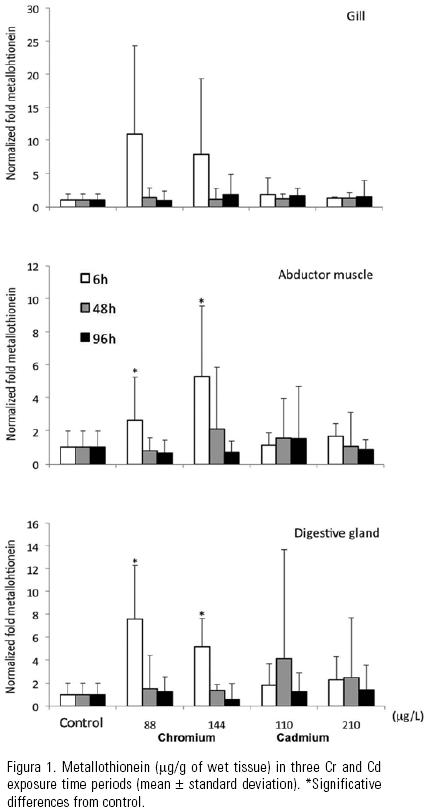
<body><![CDATA[<p align="justify"><font face="verdana" size="2"><b>Metallothionein. </b>Metallothionein levels were higher in digestive gland, than gill and abductor muscle. Significant statistical differences were confirmed, after 6 h the test began (<a href="#f1">Fig. 1</a>), in the control oysters digestive gland (33.0 &plusmn; 37.2 &#181;g/g, mean &plusmn; standard deviation) compared to Cr exposed animals (211.5 &plusmn; 132.8 &#181;g/g). Similarly, the control oysters abductor muscle (34.5 &plusmn; 21.3 &#181;g/g) had lower values than the exposed animals (137.3 &plusmn; 73.1 &#181;g/g). The gill did not show differences among control and organisms under both metals exposure. Metallothionein levels demonstrated variations amongst the analysed days in Cd exposed oysters, with high values after 48 h, nevertheless, no differences between groups were found.</font></p>     <p align="center"><font face="verdana" size="2"><a name="f1"></a></font></p>     <p align="center"><font face="verdana" size="2"><img src="/img/revistas/hbio/v20n1/a4f1.jpg"></font></p>     <p align="justify"><font face="verdana" size="2"><b>Lipid peroxidation. </b>During the assay, the mean value in the digestive gland of control organisms was 155.8 &plusmn; 42.2 MDA nmol/ mg of protein. The oysters under 88 &#181;gCr/L exposure reached significantly higher concentrations after 48 h (271.7 &plusmn; 98.3 MDA nmol/mg of protein). In 144 &#181;gCr/L exposure, values lower than controls were observed after 96 h (97.0 &plusmn; 14.5 MDA nmol/mg of protein). In Cd exposure oysters presented higher values than controls after 6 h exposure, 213.0 &plusmn; 111.6 and 262.6 &plusmn; 109.1 MDA nmol/mg of protein (<a href="#f2">Fig. 2</a>).</font></p>     <p align="center"><font face="verdana" size="2"><a name="f2"></a></font></p>     <p align="center"><font face="verdana" size="2"><img src="/img/revistas/hbio/v20n1/a4f2.jpg"></font></p>     <p align="justify"><font face="verdana" size="2"><b>Metal content. </b>Oysters from Mandinga lagoon presented 1.20 &plusmn; 0.63 &#181;gCr/g DW and 2.33 &plusmn; 1.11 &#181;gCd/g DW. In the water the concentrations were 80 &plusmn; 44 &#181;gCr/L and 77 &plusmn; 8 &#181;gCd/L. During the bioassay control oysters showed similar concentrations in the analysed tissues, with mean values of 6.3 &plusmn; 4.92 &#181;gCr/g DW and 1.7 &plusmn; 2.36 &#181;gCd/g DW (<a href="/img/revistas/hbio/v20n1/a4f3.jpg" target="_blank">Fig. 3</a>). These basal values implied high Cr BCF in control oysters.</font></p>     <p align="justify"><font face="verdana" size="2">In Cr exposed animals, the abductor muscle had similar Cr concentration to control specimens (10.76 &plusmn; 3.42 &#181;gCr/g DW). The rest of the tissues reported higher values: in gills of organisms exposed to 88 &#181;gCr/L and 144 ugCr/L the values were 27.47 &plusmn; 18.65 &#181;gCr/g DW and 19.41 &plusmn; 2.87 &#181;gCr/g DW, respectively. The levels reached in the digestive gland in oysters exposed to 144 &#181;gCr/L were 28.19 &plusmn; 12.85 &#181;gCr/g DW. These values 2&#150;folded the accumulation value under exposure to 88 &#181;gCr/L of 13.89 &plusmn; 5.69 &#181;gCr/g DW.</font></p>     <p align="justify"><font face="verdana" size="2">The gill and the digestive gland hoarded Cd in similar proportions. The registered values in gill were 34.54 &plusmn; 10.42 &#181;gCd/g DW and 47.51 &plusmn; 52.11 &#181;gCd/g DW, and the digestive gland were 39.84 &plusmn; 5.66 &#181;gCd/g DW and 48.69 &plusmn; 49.38 &#181;gCd/g DW. These concentrations contrasted with the ones registered in muscle (10.80 &plusmn; 2.93 &#181;gCd/g DW), once more, the lowest concentrations amongst the studied tissues.</font></p>     <p align="justify"><font face="verdana" size="2">The Cr BCF in gill and abductor muscle was higher under 88 ugCr/L than in 144 ug/L exposure. The Cd BCF was higher than Cr BCF and it was associated to the 110 &#181;gCd/L concentration. In the abductor muscle it implied lower accumulation compared to the rest of the tissues (<a href="/img/revistas/hbio/v20n1/a4f4.jpg" target="_blank">Fig. 4</a>).</font></p>     ]]></body>
<body><![CDATA[<p align="justify"><font face="verdana" size="2"><b>Biomarkers behaviour regarding the accumulated metal. </b>Significantly negative correlations between Cr water concentrations and BCF in the three tissues were found (<a href="/img/revistas/hbio/v20n1/a4t1.jpg" target="_blank">table 1</a>). In gill and digestive gland, the metallothionein production was directly correlated with the Cr concentration in water and in oysters. In contrast, the correlation turned out to be negative to the BCF in digestive gland and muscle. In other words, there was a higher metallothionein concentration in organisms with lower BCF. High levels of lipid peroxidation revealed a negative correlation (r = &#150; 0.75) with the oysters Cr concentration. This implies larger peroxidative damage in oysters with lower metal concentration.</font></p>     <p align="justify"><font face="verdana" size="2">Metallothionein production in organisms exposed to Cd showed positive metal content correlations between water and oysters, however, in contrast with Cr exposure, the BCF showed also a positive metallothionein production correlation in the digestive gland and in the gill. There were no relevant correlations observed in the abductor muscle. There was a positive correlation between the lipid peroxidation and the Cd concentration in water (r = 0.99), that is, there was larger peroxidative damage associated with the Cd exposure concentration.</font></p>     <p align="justify"><font face="verdana" size="2">&nbsp;</font></p>     <p align="justify"><font face="verdana" size="2"><b>DISCUSSION</b></font></p>     <p align="justify"><font face="verdana" size="2">A larger induction of metallothionein in the digestive gland, compared to other tissues, has been demonstrated in <i>Mytilus edulis </i>Linnaeus, 1758, <i>M. galloprovincialis </i>Lamark, 1819, <i>C. gigas </i>Thunberg, 1793 and other molluscs (Geret <i>et al., </i>1997; Geret &amp; Cosson, 2000; Mourgaud <i>et al., </i>2002). Our results were consistent with those reported by K&ouml;hler &amp; Riisgard (1982), where higher concentrations in the digestive gland, then in the gill and finally in the abductor muscle of <i>Mytilus edulis </i>exposed to Cd, were found. The hoarding in digestive gland, as consequence of Cd exposure, has been attributed to the fact that metal&#150;bound proteins are not functional and, consequently, they are stored in the tissue. The cells involved in metals transportation, such as digestive, hepatic and renal cells, are more affected (Goyer, 1991), therefore, deterioration in these tissues is expected. A relationship has been found between high levels of body Cd and atrophy of digestive gland in <i>C. virginica </i>(Gold&#150;Bouchot <i>et al., </i>1995).</font></p>     <p align="justify"><font face="verdana" size="2">Metallothionein induction in digestive gland and abductor muscle, as consequence of Cr exposure, was confirmed after 6 h with values 7.4&#150; and 5.4&#150;fold higher than controls, respectively. Cd exposure showed a different behavior, even though high concentrations were observed in Cd exposed specimens (810.1 &#181;g/g, in the digestive gland) after 48 h, the difference against the controls was not confirmed. Data dispersion was important and time variation was present in Cd exposed oysters. Apparently, in natural environments, and even in the contaminated ones, previous exposure to low cadmium concentrations are the underlying basis of raise in metallothionein, more than induction itself, due to Cd stabilization and accretion, while basal levels are synthesized (Roesijadi, 1999). The increase in metallothionein concentrations during the bioassay can be interpreted as a consequence of the presence of metals in the exposed organisms. Experiments with <i>Crassostrea gigas </i>have shown increases in the expression of metallothioneins mRNA in time, up eleven days (Choi <i>et al., </i>2008). But increase in control organisms can only be associated to a stress related to laboratory conditions. The metallothionein expression is regulated by a complex behaviour associated to essential metals, as Zn and Ca. Since the organisms were not fed during the experiment, it is possible that lack of food could have generated a metabolic unbalance (Roesijadi, 1999). This behaviour could be expected in all the organisms and prevents the possibility of demonstrating differences among controls and experimental animals after 48 and 96 h.</font></p>     <p align="justify"><font face="verdana" size="2">There are several works reporting metallothionein induction for Cd exposure in molluscs; as described in the Asiatic clamp <i>Corbicula fluminea, </i>(O. F. Muller, 1774), were concentrations 2.5 times higher than in controls were found (Baudrimont <i>et </i>al.,1997). Langston &amp; Zhou (1987), reported in <i>Macoma baltica </i>(Lannaeus, 1758) the increase from 35 ug/g in controls, to 450 ug/g in organisms under 100 &#181;gCd/L exposure. Viarengo <i>et al. </i>(1997), and Mourgaud <i>et al. </i>(2002) determined increase of metallothioneins associated to metals exposure including Cd in <i>Mytilus galloprovincialis. </i>In <i>Mytilus edulis, </i>exposed to levels from 200 &#181;gCd/L to 500 &#181;gCd/L the metallothioneins increased approximately up to 500 &#181;g/g (Bebiano &amp; Langston, 1991; K&ouml;hler &amp; Riisgard, 1982). Moreover, an increase has been observed in <i>C.gigas </i>larvae exposed to 200 &#181;gCd/L, approximately 2.5 times higher than in controls (Gautier <i>et al., </i>2006). Other studies have reported increases in metallothioneins in gill, mantle and abductor muscle of <i>C. virginica </i>after Cd exposure (Carpene, 1993; Roesijadi, 1994, 1996; Roesijadi &amp; Klerks, 1989; Roesijadi <i>et al., </i>1996). Although in these studies the metallothionein raise derived from Cd exposure is similar to the obtained values, the data can only be compared, strictly speaking, when it has been obtained through the same technique (Amiard <i>et al., </i>2006).</font></p>     <p align="justify"><font face="verdana" size="2">Metallothionein induction in Cr (an essential metal) exposed specimens was observed after 6 h. However, the values were low in further time periods. This finding might be the result of a toxic effect previous to a detoxifying process, as stated by Amiard <i>et al. </i>(2006).</font></p>     <p align="justify"><font face="verdana" size="2">Several results presented high data dispersion, heterocedasticity and the presence of extreme cases. The absence of normality and homocedasticity can influence the interpretation with parametrical techniques, therefore Kruskal&#150;Wallis test, a robust technique, was used (Tukey, 1977). The analysis must consider the biological specific features of this specie too, for instance, the valves closure, in <i>C. virginica </i>can last for up to 7 h under normal conditions (Shumway, 1982), and the valves closure duration proportionally increases according to the environment toxics concentration. This closure might produce the responses delay and, therefore, the broad dispersion of data. Furthermore, if closure is proportional to the toxic concentration, it is possible that the greater effect observed occasionally in lower concentrations in metallothionein, as well as in lipid peroxidation, could be related to this behavior. A narcotic effect has also been attributed to metals (Smith, 1985; Lin <i>et al., </i>1992), which might affect the organism activity, the slow valves closure could be an effect of metals exposure.</font></p>     <p align="justify"><font face="verdana" size="2">The dispersion of data could be a consequence of the origin of organisms too. The oysters came from the Mandinga lagoon, they were selected with commercial size and morphologically homogenous, but there is natural variability in organisms from native populations. The variability in results of bioassays using organisms from natural environments could be expected, but the evaluation of their responses is desirable because they can be related to a real situation. On the other hand, the oyster culture in Mexico does not handle the entire life cycle and it is not possible to obtain organisms from controlled laboratories or cultures.</font></p>     ]]></body>
<body><![CDATA[<p align="justify"><font face="verdana" size="2">Besides, the previous exposure must to be considered because, in natural environments as Mandinga, several pollutants could be present. It has been demonstrated that <i>Perna viridis </i>(Linnaeus 1758), is more sensitive and reacts faster to Cd, after it has been previously exposed to this metal. These findings are relevant due to the high levels detected in the Mandinga lagoon (77 &#181;gCd/L), which are far beyond those established by the Mexican regulations intended for the environment protection (0.2 &#181;gCd/L) as indicates Comisi&oacute;n Nacional del Agua (2003).</font></p>     <p align="justify"><font face="verdana" size="2">Due to the essential metals regulation activity in bivalve organisms, the metallothionein has been associated with cellular detoxification and protection mechanisms; furthermore, in some studies it is considered to play the same roles in presence of metals without known biological function, such as Cd (K&ouml;hler &amp; Riisgard, 1982; Stegeman <i>et al., </i>1992; Roesijadi <i>et al., </i>1996; Viarengo <i>et al., </i>1997; Romeo <i>et al., </i>1997). However, other studies specify that metallothionein&#150;Cd complexes are metabolized slower than complexes with essential metals (Simkiss &amp; Masson, 1983). Other protective roles of these proteins have been described, such as general antioxidative defence; e.g. it is considered that previously exposed organisms to Cd, might resist more effectively the oxidative stress catching the hydroxyl and superoxide radicals (Amiard <i>et al., </i>2006). However, metallothioneins are not able to intercept all of the molecules, therefore, ionic&#150;form metals are also able to bind to other sensitive cellular sites, namely enzymes and membranes, stimulating the production of free radicals, resulting in membrane destabilization (Roesijadi, 1996). Consequently, the protective role of these proteins seems to be limited.</font></p>     <p align="justify"><font face="verdana" size="2">Metallothionein induction, as result of Cr exposure in <i>C. virginica, </i>is a narrowly explored area. This metal is associated to a greater extent with oxidative stress, since it is involved in several enzymatic activations, for it bounds to the enzymes active sites in redox reactions with Fe and Cu; Cr<sup>3</sup><sup>+</sup> promotes insulin action and is an essential nutrient for the metabolism of sugars and lipids, performing several functions in vital processes. The organisms exposed to Cr<sup>6</sup><sup>+</sup> must transform it into Cr<sup>3</sup><sup>+</sup> within the cell. Cr<sup>6</sup><sup>+</sup> entry occurs through the sulphate transport system, and once inside, it is transformed through two routes: an enzymatic route, involving the cytochrome P450 and glutathione reductase, where Cr<sup>3+</sup> is the final product; and another non&#150;enzymatic route, which transforms Cr<sup>6</sup><sup>+</sup> in Cr<sup>5</sup><sup>+</sup> and Cr<sup>4</sup><sup>+</sup> by means of the ascorbic acid. These Cr&#150;forms produce reactive&#150;oxygen species (Moreno, 2003). The different Cr transformation routes could explain the reason why it accumulates less than Cd, and why the lipid peroxidation is larger with lower BCF values.</font></p>     <p align="justify"><font face="verdana" size="2">Nevertheless, the increase in lipid peroxidation could also be expected under Cd exposure, since this metal promotes equally the reactive&#150;oxygen species production. Other studies state that Cd exposure induces metallothionein production and peroxidative damage in the freshwater Asiatic clam <i>Corbicula fluminea </i>(Legeay <i>et al., </i>2005). Considering the time of expression of the cellular&#150;protection processes in response to exposure and the role played by lysosomes in metals detoxification (Amiard <i>et al., </i>2006), it is expected that metallothionein induction occurs first and the lipid peroxidation takes place later. The results obtained in <i>C. virginica </i>specimens exposed to Cr, sustain this theory, since the lipid peroxidation in the digestive gland occurred after 48 h exposure and the metallothionein induction ensued after 6 h. In contrast, the lipid peroxidation became evident after 6 h to Cd exposure; however, there was no evident association with the metallothionein increase. In other studies, significative correlations between Cd and Cu sedimentary levels and metallothionein, in juvenile <i>C. virginica </i>specimens, were found (Ringwood <i>et al., </i>1999); however, there was no correlation between these meals levels and peroxidative damage. The difficulty to incorporate the Cd into different metabolic routes could explain why the larger the lipid peroxidation is, the higher the Cd BCF becomes.</font></p>     <p align="justify"><font face="verdana" size="2">The metallothionein, as metals exposure biomarker, is considered highly useful for environmental protection (Goyer, 1991; Viarengo <i>et al., </i>1999); nonetheless, in order to corroborate if lipid peroxidation is associated to metallothionein induction, as result of Cd exposure, it would be suitable to consider the possible influence of previous exposure.</font></p>     <p align="justify"><font face="verdana" size="2">Water is the main route of exposure (Neff, 2002; Rebougas <i>et al., </i>2005), but not only water content is important, levels in sediment must be considered, due the possibility of metal transference to the water column under different environmental conditions associated to changes in pH, temperature and salinity. Mandinga sediment concentrations determined by Botello (1994) indicated values of 45.74 &#956;gCr/sDW and 1.22 &#956;gCd/gDW. Those values represent an increase to previous analysis (Rosas, <i>et al., </i>1983) and represent a risk to native organisms.</font></p>     <p align="justify"><font face="verdana" size="2">In that manner, the selected trial concentrations, slightly higher than those detected in water of the Mandinga lagoon, where the organisms were obtained, revealed answers in the analysed biomarkers. There was induction of metallothionein due to Cr exposure after 6 h in the digestive gland (where the highest concentrations were found) and in the abductor muscle, and lipid peroxidation in the digestive gland after 48 h exposure. The negative correlation amongst the metallothionein levels and the digestive gland BCF, suggests a metabolic effort to control the internal Cr concentration, however, higher peroxidation in oysters which accumulated less, suggests deterioration.</font></p>     <p align="justify"><font face="verdana" size="2">The higher Cd toxicity, a non essential metal, became evident due to lipid peroxidation after 6 h of exposure. The direct correlation amongst metallothioneins and the Cd BCF in the three analysed tissues, points out the organisms incapability to control the stored levels, therefore, the protective role of these proteins from this metal is very limited, which can be supported by the lipid peroxidation, which was proportional to the metal water concentration.</font></p>     <p align="justify"><font face="verdana" size="2">Mandinga native oysters had Cd pre&#150;exposure, this fact could involve a lower resistance to the posterior Cd exposure, and could explain the limited protective role of metallothioneins in oyster from Mandinga Lagoon.</font></p>     <p align="justify"><font face="verdana" size="2">&nbsp;</font></p>     ]]></body>
<body><![CDATA[<p align="justify"><font face="verdana" size="2"><b>ACKNOWLEDGEMENTS</b></font></p>     <p align="justify"><font face="verdana" size="2">To Ricardo Rosas Cedillo for his consultancy in the assemblage of techniques for the analysis of metals in water and tissues, and the access to the atomic absorption equipment. We thank to Cecilia Vanegas P&eacute;rez and Concepci&oacute;n Guti&eacute;rrez Ru&iacute;z for their valuable comments and advices.</font></p>     <p align="justify"><font face="verdana" size="2">&nbsp;</font></p>     <p align="justify"><font face="verdana" size="2"><b>REFERENCES</b></font></p>     <!-- ref --><p align="justify"><font face="verdana" size="2">American Public Health Association (APHA). 1995. Standard methods for the examination of water and wastewater. Eaton, A.D., L.S. Clesceri &amp; A.E. Greenberg (Eds.). American Public Health Association, American Waterworks Association, Water Environment Federation. Washington, D.C.: 8&#150;1 &#150; 8&#150;47.</font>&nbsp;&nbsp;&nbsp;&nbsp;&nbsp;&nbsp;&nbsp;&nbsp;[&#160;<a href="javascript:void(0);" onclick="javascript: window.open('/scielo.php?script=sci_nlinks&ref=4080935&pid=S0188-8897201000010000400001&lng=','','width=640,height=500,resizable=yes,scrollbars=1,menubar=yes,');">Links</a>&#160;]<!-- end-ref --><!-- ref --><p align="justify"><font face="verdana" size="2">Amiard, J. C., C. Amiard&#150;Triquet, S. Barka, J. Pellerin &amp; P. S. Rainbow. 2006. Metallothioneins in aquatic invertebrates: Their role in metal detoxification and their use as biomarkers. <i>Aquatic Toxicology </i>76: 160&#150;202.</font>&nbsp;&nbsp;&nbsp;&nbsp;&nbsp;&nbsp;&nbsp;&nbsp;[&#160;<a href="javascript:void(0);" onclick="javascript: window.open('/scielo.php?script=sci_nlinks&ref=4080936&pid=S0188-8897201000010000400002&lng=','','width=640,height=500,resizable=yes,scrollbars=1,menubar=yes,');">Links</a>&#160;]<!-- end-ref --><!-- ref --><p align="justify"><font face="verdana" size="2">Barrera, E.G. 2006. Toxicidad del cromo y cadmio en osti&oacute;n <i>Crassostrea virginica </i>de la Laguna de Mandinga, Veracruz. Tesis Doctorado en Ciencias Biol&oacute;gicas, UAM, M&eacute;xico, 229 p.</font>&nbsp;&nbsp;&nbsp;&nbsp;&nbsp;&nbsp;&nbsp;&nbsp;[&#160;<a href="javascript:void(0);" onclick="javascript: window.open('/scielo.php?script=sci_nlinks&ref=4080937&pid=S0188-8897201000010000400003&lng=','','width=640,height=500,resizable=yes,scrollbars=1,menubar=yes,');">Links</a>&#160;]<!-- end-ref --><!-- ref --><p align="justify"><font face="verdana" size="2">Baudrimont, M, J. Metivaud, R. F. Maury&#150;Brachet &amp; A. Boudou. 1997. Bioaccumulation and metallothionein response in the asiatic clam <i>(Corbicula fluminea) </i>after experimental exposure to cadmium and inorganic mercury. <i>Environmental Toxicology and Chemistry </i>16: 2096&#150;2105.</font>&nbsp;&nbsp;&nbsp;&nbsp;&nbsp;&nbsp;&nbsp;&nbsp;[&#160;<a href="javascript:void(0);" onclick="javascript: window.open('/scielo.php?script=sci_nlinks&ref=4080938&pid=S0188-8897201000010000400004&lng=','','width=640,height=500,resizable=yes,scrollbars=1,menubar=yes,');">Links</a>&#160;]<!-- end-ref --><!-- ref --><p align="justify"><font face="verdana" size="2">Bebianno; M. J. &amp; W. J. Langston. 1991. Metallothionein induction in <i>Mytilus edulis </i>exposed to cadmium. <i>Marine Biology </i>108: 91&#150;96.</font>&nbsp;&nbsp;&nbsp;&nbsp;&nbsp;&nbsp;&nbsp;&nbsp;[&#160;<a href="javascript:void(0);" onclick="javascript: window.open('/scielo.php?script=sci_nlinks&ref=4080939&pid=S0188-8897201000010000400005&lng=','','width=640,height=500,resizable=yes,scrollbars=1,menubar=yes,');">Links</a>&#160;]<!-- end-ref --><!-- ref --><p align="justify"><font face="verdana" size="2">Borgmann, U. 2000. Methods for assessing the toxicological significance of metals in aquatic ecosystems: Bioaccumulation&#150;toxicity relationships water concentrations and sediment spiking approaches. <i>Aquatic Ecosystems Health Management </i>3: 277&#150;289.</font>&nbsp;&nbsp;&nbsp;&nbsp;&nbsp;&nbsp;&nbsp;&nbsp;[&#160;<a href="javascript:void(0);" onclick="javascript: window.open('/scielo.php?script=sci_nlinks&ref=4080940&pid=S0188-8897201000010000400006&lng=','','width=640,height=500,resizable=yes,scrollbars=1,menubar=yes,');">Links</a>&#160;]<!-- end-ref --><!-- ref --><p align="justify"><font face="verdana" size="2">Botello, A. V. 1994. <i>Estudio geoqu&iacute;mico y diagn&oacute;stico ambiental de las lagunas de los alrededores de la Central Nucleoelectrica de Laguna Verde, Veracruz. Informe Final 1992&#150;1993. </i>Comisi&oacute;n Federal de Electricidad/ICMyL/UNAM, M&eacute;xico. 128 p.</font>&nbsp;&nbsp;&nbsp;&nbsp;&nbsp;&nbsp;&nbsp;&nbsp;[&#160;<a href="javascript:void(0);" onclick="javascript: window.open('/scielo.php?script=sci_nlinks&ref=4080941&pid=S0188-8897201000010000400007&lng=','','width=640,height=500,resizable=yes,scrollbars=1,menubar=yes,');">Links</a>&#160;]<!-- end-ref --><!-- ref --><p align="justify"><font face="verdana" size="2">Bucio, L., V. Souza, A. Albores, E. Ch&aacute;vez &amp; M. C. Guti&eacute;rrez. 1995. Cadmium and mercury toxicity in the WRL&#150;68 cells. <i>Toxicology </i>99: 153&#150;167.</font>&nbsp;&nbsp;&nbsp;&nbsp;&nbsp;&nbsp;&nbsp;&nbsp;[&#160;<a href="javascript:void(0);" onclick="javascript: window.open('/scielo.php?script=sci_nlinks&ref=4080942&pid=S0188-8897201000010000400008&lng=','','width=640,height=500,resizable=yes,scrollbars=1,menubar=yes,');">Links</a>&#160;]<!-- end-ref --><!-- ref --><p align="justify"><font face="verdana" size="2">Buikema, Jr. A.L., B. R. Niederlehner &amp; J. Cairns. 1982. Biological monitoring. Part IV Toxicity testing. <i>Water Research </i>16: 239&#150;262.</font>&nbsp;&nbsp;&nbsp;&nbsp;&nbsp;&nbsp;&nbsp;&nbsp;[&#160;<a href="javascript:void(0);" onclick="javascript: window.open('/scielo.php?script=sci_nlinks&ref=4080943&pid=S0188-8897201000010000400009&lng=','','width=640,height=500,resizable=yes,scrollbars=1,menubar=yes,');">Links</a>&#160;]<!-- end-ref --><!-- ref --><p align="justify"><font face="verdana" size="2">Carpen&eacute;, E. 1993. Metallothionein in marine molluscs. In: Dallinger, R. &amp; P. Dainbow (Eds.). <i>Ecotoxicology of metals in invertebrates proceedings. </i>Lewis Publishers, Boca Raton. 461 p.</font>&nbsp;&nbsp;&nbsp;&nbsp;&nbsp;&nbsp;&nbsp;&nbsp;[&#160;<a href="javascript:void(0);" onclick="javascript: window.open('/scielo.php?script=sci_nlinks&ref=4080944&pid=S0188-8897201000010000400010&lng=','','width=640,height=500,resizable=yes,scrollbars=1,menubar=yes,');">Links</a>&#160;]<!-- end-ref --><!-- ref --><p align="justify"><font face="verdana" size="2">Castrej&oacute;n, 0. L., D .D. Porras, &amp; S. Ch. Band. 1994. <i>Cultivo de alimento vivo para acuicultura. </i>Instituto Nacional Indigenista. Universidad del Mar, Oaxaca. 118 p.</font>&nbsp;&nbsp;&nbsp;&nbsp;&nbsp;&nbsp;&nbsp;&nbsp;[&#160;<a href="javascript:void(0);" onclick="javascript: window.open('/scielo.php?script=sci_nlinks&ref=4080945&pid=S0188-8897201000010000400011&lng=','','width=640,height=500,resizable=yes,scrollbars=1,menubar=yes,');">Links</a>&#160;]<!-- end-ref --><!-- ref --><p align="justify"><font face="verdana" size="2">Comisi&oacute;n Nacional del Agua. 2003. <i>Ley federal de derechos normas aplicables en materia de Aguas Nacionales y sus bienes p&uacute;blicos inherentes2003. </i>Diario Oficial de la Federaci&oacute;n, M&eacute;xico, D.F. diciembre 31. 259 p.</font>&nbsp;&nbsp;&nbsp;&nbsp;&nbsp;&nbsp;&nbsp;&nbsp;[&#160;<a href="javascript:void(0);" onclick="javascript: window.open('/scielo.php?script=sci_nlinks&ref=4080946&pid=S0188-8897201000010000400012&lng=','','width=640,height=500,resizable=yes,scrollbars=1,menubar=yes,');">Links</a>&#160;]<!-- end-ref --><!-- ref --><p align="justify"><font face="verdana" size="2">Conners, D. E. &amp; A. H. Ringwood. 1997. The effecs of glutathione depletion on copper cytotoxicity on oysters <i>(Crassostrea virginica). </i>18<sup>th </sup>Annual Meeting Society of Environmental Toxicology and Chemistry, San Francisco, Ca.: p. 327.</font>&nbsp;&nbsp;&nbsp;&nbsp;&nbsp;&nbsp;&nbsp;&nbsp;[&#160;<a href="javascript:void(0);" onclick="javascript: window.open('/scielo.php?script=sci_nlinks&ref=4080947&pid=S0188-8897201000010000400013&lng=','','width=640,height=500,resizable=yes,scrollbars=1,menubar=yes,');">Links</a>&#160;]<!-- end-ref --><!-- ref --><p align="justify"><font face="verdana" size="2">Contreras, E. F. &amp; C. 0. Casta&ntilde;eda. 1995. <i>Los ecosistemas costeros del Estado de Veracruz. </i>Gobierno Edo. De Veracruz/SEDAFP, M&eacute;xico: 81&#150;88.</font>&nbsp;&nbsp;&nbsp;&nbsp;&nbsp;&nbsp;&nbsp;&nbsp;[&#160;<a href="javascript:void(0);" onclick="javascript: window.open('/scielo.php?script=sci_nlinks&ref=4080948&pid=S0188-8897201000010000400014&lng=','','width=640,height=500,resizable=yes,scrollbars=1,menubar=yes,');">Links</a>&#160;]<!-- end-ref --><!-- ref --><p align="justify"><font face="verdana" size="2">Cooper, T. G. 1977. <i>Biochemistry. </i>John Wiley and Sons, New York: 53&#150;55.</font>&nbsp;&nbsp;&nbsp;&nbsp;&nbsp;&nbsp;&nbsp;&nbsp;[&#160;<a href="javascript:void(0);" onclick="javascript: window.open('/scielo.php?script=sci_nlinks&ref=4080949&pid=S0188-8897201000010000400015&lng=','','width=640,height=500,resizable=yes,scrollbars=1,menubar=yes,');">Links</a>&#160;]<!-- end-ref --><!-- ref --><p align="justify"><font face="verdana" size="2">Choi, Y. K., P.G. Jo &amp; Ch.Y. Choi. 2008. Cadmium affects the expression of heat shock protein 90 and metallothionein mRNA in the pacific oyster, <i>Crassostrea gigas. Comparative Biochemistry and Physiology, Part C </i>147: 286&#150;292.</font>&nbsp;&nbsp;&nbsp;&nbsp;&nbsp;&nbsp;&nbsp;&nbsp;[&#160;<a href="javascript:void(0);" onclick="javascript: window.open('/scielo.php?script=sci_nlinks&ref=4080950&pid=S0188-8897201000010000400016&lng=','','width=640,height=500,resizable=yes,scrollbars=1,menubar=yes,');">Links</a>&#160;]<!-- end-ref --><!-- ref --><p align="justify"><font face="verdana" size="2">Diario Oficial de la Federaci&oacute;n (DOF). 1997. Norma Oficial Mexicana NOM&#150;001&#150;ECOL&#150;1996 que establece los l&iacute;mites m&aacute;ximos permisibles de contaminantes en las descargas de aguas residuales en aguas y bienes nacionales. Secretar&iacute;a de Medio Ambiente Recursos naturales y Pesca, M&eacute;xico, enero 6: 68&#150;86.</font>&nbsp;&nbsp;&nbsp;&nbsp;&nbsp;&nbsp;&nbsp;&nbsp;[&#160;<a href="javascript:void(0);" onclick="javascript: window.open('/scielo.php?script=sci_nlinks&ref=4080951&pid=S0188-8897201000010000400017&lng=','','width=640,height=500,resizable=yes,scrollbars=1,menubar=yes,');">Links</a>&#160;]<!-- end-ref --><!-- ref --><p align="justify"><font face="verdana" size="2">Gautier, D., C. Mouneyrac, F. Quiniou, E. His, M. Gnassia&#150;Barelli &amp; M. Rom&eacute;o. 2006. Metal bioaccumulation and metallothionein concentrations in larvae of <i>Crassostrea gigas. Environmental Pollution </i>140: 492&#150;499.</font>&nbsp;&nbsp;&nbsp;&nbsp;&nbsp;&nbsp;&nbsp;&nbsp;[&#160;<a href="javascript:void(0);" onclick="javascript: window.open('/scielo.php?script=sci_nlinks&ref=4080952&pid=S0188-8897201000010000400018&lng=','','width=640,height=500,resizable=yes,scrollbars=1,menubar=yes,');">Links</a>&#160;]<!-- end-ref --><!-- ref --><p align="justify"><font face="verdana" size="2">Geret, F. &amp; R.P. Cosson. 2000. Utilisation des m&eacute;tallothion&eacute;ines comme biomarqueur de la contamination metallique: variabilit&eacute; entre sites et organes chez l'huitre <i>Crassostrea gigas. Oceanology Acta </i>23: 261&#150;271.</font>&nbsp;&nbsp;&nbsp;&nbsp;&nbsp;&nbsp;&nbsp;&nbsp;[&#160;<a href="javascript:void(0);" onclick="javascript: window.open('/scielo.php?script=sci_nlinks&ref=4080953&pid=S0188-8897201000010000400019&lng=','','width=640,height=500,resizable=yes,scrollbars=1,menubar=yes,');">Links</a>&#160;]<!-- end-ref --><!-- ref --><p align="justify"><font face="verdana" size="2">Geret, F., F. Rainglet &amp; R. P. Cosson . 1997. Comparison between two protocols for the asolation of metallothioneins within mussel <i>Mytilus edulis. Journal de la Recherce Oceanographique </i>22: 151&#150;156.</font>&nbsp;&nbsp;&nbsp;&nbsp;&nbsp;&nbsp;&nbsp;&nbsp;[&#160;<a href="javascript:void(0);" onclick="javascript: window.open('/scielo.php?script=sci_nlinks&ref=4080954&pid=S0188-8897201000010000400020&lng=','','width=640,height=500,resizable=yes,scrollbars=1,menubar=yes,');">Links</a>&#160;]<!-- end-ref --><!-- ref --><p align="justify"><font face="verdana" size="2">Gold&#150;Bouchot, G., R. Sim&aacute;&#150;&Aacute;lvarez, 0. Zapata&#150;P&eacute;rez, J. G. G&eacute;mez&#150;Ricalde. 1995. Histopatological effects of petroleum hydrocarbons and heavy metal on the American Oyster <i>(Crassostrea virginica) </i>from Tabasco, M&eacute;xico. <i>Marine Pollution Bulletin </i>31: 439&#150;445.</font>&nbsp;&nbsp;&nbsp;&nbsp;&nbsp;&nbsp;&nbsp;&nbsp;[&#160;<a href="javascript:void(0);" onclick="javascript: window.open('/scielo.php?script=sci_nlinks&ref=4080955&pid=S0188-8897201000010000400021&lng=','','width=640,height=500,resizable=yes,scrollbars=1,menubar=yes,');">Links</a>&#160;]<!-- end-ref --><!-- ref --><p align="justify"><font face="verdana" size="2">Goyer, R. A. 1991. Toxic effects of metals. <i>In: </i>Amdur, M.O., J. Doull &amp; C.D. Klaassen (Eds.). <i>Casarett and Doull's Toxicology. </i>Pergamon Press, New Cork, pp. 623&#150;680.</font>&nbsp;&nbsp;&nbsp;&nbsp;&nbsp;&nbsp;&nbsp;&nbsp;[&#160;<a href="javascript:void(0);" onclick="javascript: window.open('/scielo.php?script=sci_nlinks&ref=4080956&pid=S0188-8897201000010000400022&lng=','','width=640,height=500,resizable=yes,scrollbars=1,menubar=yes,');">Links</a>&#160;]<!-- end-ref --><!-- ref --><p align="justify"><font face="verdana" size="2">Guzm&aacute;n, A. P., F. S. Villanueva &amp; A. V. Botello . 2005. Metales en tres lagunas costeras del estado de Veracruz. In: Botello, A.V., J. Rend&oacute;n von Osten, G. Gold&#150;Bouchot &amp; C. Agraz&#150;Hern&aacute;ndez (Eds.). <i>Golfo de M&eacute;xico, contaminaci&oacute;n e impacto ambiental: diagn&oacute;stico y tendencias. </i>Universidad Aut&oacute;noma de Campeche, Universidad Nacional Aut&oacute;noma de M&eacute;xico, INE, Campeche, pp. 361&#150;372.</font>&nbsp;&nbsp;&nbsp;&nbsp;&nbsp;&nbsp;&nbsp;&nbsp;[&#160;<a href="javascript:void(0);" onclick="javascript: window.open('/scielo.php?script=sci_nlinks&ref=4080957&pid=S0188-8897201000010000400023&lng=','','width=640,height=500,resizable=yes,scrollbars=1,menubar=yes,');">Links</a>&#160;]<!-- end-ref --><!-- ref --><p align="justify"><font face="verdana" size="2">Huan, S.Ch.T. 1994. <i>General guidelines for the acid digestion offish and shellfish. Reference 83. Method number NIEA C303.01T. </i>Executive Yuan Environmental Protection Agency Republic of China Official Gazette 7: 1&#150;6.</font>&nbsp;&nbsp;&nbsp;&nbsp;&nbsp;&nbsp;&nbsp;&nbsp;[&#160;<a href="javascript:void(0);" onclick="javascript: window.open('/scielo.php?script=sci_nlinks&ref=4080958&pid=S0188-8897201000010000400024&lng=','','width=640,height=500,resizable=yes,scrollbars=1,menubar=yes,');">Links</a>&#160;]<!-- end-ref --><!-- ref --><p align="justify"><font face="verdana" size="2">Klaassen, C.D. &amp; D.L. Eaton. 1991. Principles of toxicology. In: Amdur, M.O., J. Doull &amp; C.D. Klaassen (Eds.). <i>Casarett and Doull's Toxicology. </i>Pergamon Press, Toronto, pp. 12&#150;49.</font>&nbsp;&nbsp;&nbsp;&nbsp;&nbsp;&nbsp;&nbsp;&nbsp;[&#160;<a href="javascript:void(0);" onclick="javascript: window.open('/scielo.php?script=sci_nlinks&ref=4080959&pid=S0188-8897201000010000400025&lng=','','width=640,height=500,resizable=yes,scrollbars=1,menubar=yes,');">Links</a>&#160;]<!-- end-ref --><!-- ref --><p align="justify"><font face="verdana" size="2">Koeman, J.H. 1991. From comparative physiology to toxicological risk assessment. <i>Comparative Biochemical Physiology </i>100C: 7&#150;10.</font>&nbsp;&nbsp;&nbsp;&nbsp;&nbsp;&nbsp;&nbsp;&nbsp;[&#160;<a href="javascript:void(0);" onclick="javascript: window.open('/scielo.php?script=sci_nlinks&ref=4080960&pid=S0188-8897201000010000400026&lng=','','width=640,height=500,resizable=yes,scrollbars=1,menubar=yes,');">Links</a>&#160;]<!-- end-ref --><!-- ref --><p align="justify"><font face="verdana" size="2">Kohler, K. &amp; H. U. Riisgard. 1982. Formation of metallothioneins in relation to accumulation of cadmium in the common mussel <i>Mytilus edulis. Marine Biology </i>66: 53&#150;58.</font>&nbsp;&nbsp;&nbsp;&nbsp;&nbsp;&nbsp;&nbsp;&nbsp;[&#160;<a href="javascript:void(0);" onclick="javascript: window.open('/scielo.php?script=sci_nlinks&ref=4080961&pid=S0188-8897201000010000400027&lng=','','width=640,height=500,resizable=yes,scrollbars=1,menubar=yes,');">Links</a>&#160;]<!-- end-ref --><!-- ref --><p align="justify"><font face="verdana" size="2">Langston, W. J. &amp; M. J. Zhou. 1987. Cadmium accumulation distribution and elimination in the bivalve <i>Macoma balthica: </i>neither metallothionein nor metallothionein&#150;like proteins are involved. <i>Marine Environmental </i>Research 21: 225&#150;237.</font>&nbsp;&nbsp;&nbsp;&nbsp;&nbsp;&nbsp;&nbsp;&nbsp;[&#160;<a href="javascript:void(0);" onclick="javascript: window.open('/scielo.php?script=sci_nlinks&ref=4080962&pid=S0188-8897201000010000400028&lng=','','width=640,height=500,resizable=yes,scrollbars=1,menubar=yes,');">Links</a>&#160;]<!-- end-ref --><!-- ref --><p align="justify"><font face="verdana" size="2">Legeay, A., M. Achard&#150;Joris, M. Baudrimont, J.Ch. Massabuau &amp; J.P. Bourdineaud. 2005. Impact of cadmium contamination and oxygenation levels on biochemical responses in the Asiatic clam <i>Corbicula fluminea. Aquatic Toxicology </i>74: 242&#150;253.</font>&nbsp;&nbsp;&nbsp;&nbsp;&nbsp;&nbsp;&nbsp;&nbsp;[&#160;<a href="javascript:void(0);" onclick="javascript: window.open('/scielo.php?script=sci_nlinks&ref=4080963&pid=S0188-8897201000010000400029&lng=','','width=640,height=500,resizable=yes,scrollbars=1,menubar=yes,');">Links</a>&#160;]<!-- end-ref --><!-- ref --><p align="justify"><font face="verdana" size="2">Lin, W., A. R. Mitchel &amp; P.K. Chien. 1992. The effects of copper, cadmium and zinc on particle filtration and uptake of glycine in the Pacific oyster <i>Crassostrea gigas. Comparative Biochemical Physiology </i>103C: 181&#150;187.</font>&nbsp;&nbsp;&nbsp;&nbsp;&nbsp;&nbsp;&nbsp;&nbsp;[&#160;<a href="javascript:void(0);" onclick="javascript: window.open('/scielo.php?script=sci_nlinks&ref=4080964&pid=S0188-8897201000010000400030&lng=','','width=640,height=500,resizable=yes,scrollbars=1,menubar=yes,');">Links</a>&#160;]<!-- end-ref --><!-- ref --><p align="justify"><font face="verdana" size="2">Marques de Cant&uacute;, M.J. 1991. <i>Probabilidad y estad&iacute;stica para ciencias qu&iacute;mico&#150;biol&oacute;gicas. </i>McGraw&#150;Hill, M&eacute;xico. 657 p.</font>&nbsp;&nbsp;&nbsp;&nbsp;&nbsp;&nbsp;&nbsp;&nbsp;[&#160;<a href="javascript:void(0);" onclick="javascript: window.open('/scielo.php?script=sci_nlinks&ref=4080965&pid=S0188-8897201000010000400031&lng=','','width=640,height=500,resizable=yes,scrollbars=1,menubar=yes,');">Links</a>&#160;]<!-- end-ref --><!-- ref --><p align="justify"><font face="verdana" size="2">Moreno, G.M. D. 2003. <i>Toxicolog&iacute;a ambiental. </i>McGraw Hill, M&eacute;xico. 370 p.</font>&nbsp;&nbsp;&nbsp;&nbsp;&nbsp;&nbsp;&nbsp;&nbsp;[&#160;<a href="javascript:void(0);" onclick="javascript: window.open('/scielo.php?script=sci_nlinks&ref=4080966&pid=S0188-8897201000010000400032&lng=','','width=640,height=500,resizable=yes,scrollbars=1,menubar=yes,');">Links</a>&#160;]<!-- end-ref --><!-- ref --><p align="justify"><font face="verdana" size="2">Mourgaud, Y., E. Martinez, A. Geffard, B. Andral, J. Y. Stanisiere &amp; J.C. Amiard. 2002. Metallothionein concentration in the mussel <i>Mytilus galloprovincialis </i>as a biomarker of response to metal contamination: validation in the field. <i>Biomarkers </i>7: 479&#150;490.</font>&nbsp;&nbsp;&nbsp;&nbsp;&nbsp;&nbsp;&nbsp;&nbsp;[&#160;<a href="javascript:void(0);" onclick="javascript: window.open('/scielo.php?script=sci_nlinks&ref=4080967&pid=S0188-8897201000010000400033&lng=','','width=640,height=500,resizable=yes,scrollbars=1,menubar=yes,');">Links</a>&#160;]<!-- end-ref --><!-- ref --><p align="justify"><font face="verdana" size="2">Neff, J. M. 2002. <i>Bioaccumulation in marine organisms. </i>Elsevier, New York. 452 p.</font>&nbsp;&nbsp;&nbsp;&nbsp;&nbsp;&nbsp;&nbsp;&nbsp;[&#160;<a href="javascript:void(0);" onclick="javascript: window.open('/scielo.php?script=sci_nlinks&ref=4080968&pid=S0188-8897201000010000400034&lng=','','width=640,height=500,resizable=yes,scrollbars=1,menubar=yes,');">Links</a>&#160;]<!-- end-ref --><!-- ref --><p align="justify"><font face="verdana" size="2">P&aacute;ez&#150;Osuna, F. 2005. Efectos de los metales. In: Botello, A.V., J. Rend&oacute;n von Osten, G. Gold&#150;Bouchot, C. Agraz&#150;Hern&aacute;ndez (Eds.). <i>Golfo de M&eacute;xico, contaminaci&oacute;n e impacto ambiental: diagn&oacute;stico y tendencias. </i>Univ. Aut&oacute;n. de Campeche, Univ. Nal. Auton. de M&eacute;xico, INE, Campeche, p.p. 343&#150;360.</font>&nbsp;&nbsp;&nbsp;&nbsp;&nbsp;&nbsp;&nbsp;&nbsp;[&#160;<a href="javascript:void(0);" onclick="javascript: window.open('/scielo.php?script=sci_nlinks&ref=4080969&pid=S0188-8897201000010000400035&lng=','','width=640,height=500,resizable=yes,scrollbars=1,menubar=yes,');">Links</a>&#160;]<!-- end-ref --><!-- ref --><p align="justify"><font face="verdana" size="2">Rebou&ccedil;as do Amaral, M. C., M. Freitas&#150;Rebelo, J. P. Machado&#150;Torres &amp; W.Ch. Pfeiffer. 2005. Bioaccumulation and depuration of Zn and Cd in mangrove oysters <i>(Crassostrea rhizophorae, </i>Guilding, 1828) Transplanted to and from a contaminated tropical coastal lagoon. Marine Environmental Research 59: 277&#150;285.</font>&nbsp;&nbsp;&nbsp;&nbsp;&nbsp;&nbsp;&nbsp;&nbsp;[&#160;<a href="javascript:void(0);" onclick="javascript: window.open('/scielo.php?script=sci_nlinks&ref=4080970&pid=S0188-8897201000010000400036&lng=','','width=640,height=500,resizable=yes,scrollbars=1,menubar=yes,');">Links</a>&#160;]<!-- end-ref --><!-- ref --><p align="justify"><font face="verdana" size="2">Ringwood, A. H., D. E. Conners, Ch. J. Keppler &amp; A. A. Dinovo. 1999. Biomarker studies with juvenile oysters <i>(Crassostrea virginica) </i>deployed <i>in&#150;situ. Biomarkers </i>4: 400&#150;414.</font>&nbsp;&nbsp;&nbsp;&nbsp;&nbsp;&nbsp;&nbsp;&nbsp;[&#160;<a href="javascript:void(0);" onclick="javascript: window.open('/scielo.php?script=sci_nlinks&ref=4080971&pid=S0188-8897201000010000400037&lng=','','width=640,height=500,resizable=yes,scrollbars=1,menubar=yes,');">Links</a>&#160;]<!-- end-ref --><!-- ref --><p align="justify"><font face="verdana" size="2">Roesijadi, G. 1994. Behavior of metallothionein&#150;bound metals in a natural population of an estuarine mollusc. <i>Marine Environmental Research </i>38: 147&#150;168.</font>&nbsp;&nbsp;&nbsp;&nbsp;&nbsp;&nbsp;&nbsp;&nbsp;[&#160;<a href="javascript:void(0);" onclick="javascript: window.open('/scielo.php?script=sci_nlinks&ref=4080972&pid=S0188-8897201000010000400038&lng=','','width=640,height=500,resizable=yes,scrollbars=1,menubar=yes,');">Links</a>&#160;]<!-- end-ref --><!-- ref --><p align="justify"><font face="verdana" size="2">Roesijadi, G. 1996. Environmental Factors: Response to Metals. In: Kennedy, V. S., R. I. E. Newell &amp; A.F. Eble (Eds.). <i>The eastern oyster Crassostrea virginica. </i>A Maryland Sea Grant Book College Park, Maryland, pp. 515&#150;537.</font>&nbsp;&nbsp;&nbsp;&nbsp;&nbsp;&nbsp;&nbsp;&nbsp;[&#160;<a href="javascript:void(0);" onclick="javascript: window.open('/scielo.php?script=sci_nlinks&ref=4080973&pid=S0188-8897201000010000400039&lng=','','width=640,height=500,resizable=yes,scrollbars=1,menubar=yes,');">Links</a>&#160;]<!-- end-ref --><!-- ref --><p align="justify"><font face="verdana" size="2">Roesijadi, G. 1999. The basis for increased metallothionein in a natural population of <i>Crassostrea virginica. Biomarkers </i>4: 467&#150;472.</font>&nbsp;&nbsp;&nbsp;&nbsp;&nbsp;&nbsp;&nbsp;&nbsp;[&#160;<a href="javascript:void(0);" onclick="javascript: window.open('/scielo.php?script=sci_nlinks&ref=4080974&pid=S0188-8897201000010000400040&lng=','','width=640,height=500,resizable=yes,scrollbars=1,menubar=yes,');">Links</a>&#160;]<!-- end-ref --><!-- ref --><p align="justify"><font face="verdana" size="2">Roesijadi, G. &amp; P.L. Klerks. 1989. Kinetic analysis of Cd binding to metallothionein and other intracellular ligands in oyster gills. <i>Journal of Experimental Zoology </i>251: 1&#150;12.</font>&nbsp;&nbsp;&nbsp;&nbsp;&nbsp;&nbsp;&nbsp;&nbsp;[&#160;<a href="javascript:void(0);" onclick="javascript: window.open('/scielo.php?script=sci_nlinks&ref=4080975&pid=S0188-8897201000010000400041&lng=','','width=640,height=500,resizable=yes,scrollbars=1,menubar=yes,');">Links</a>&#160;]<!-- end-ref --><!-- ref --><p align="justify"><font face="verdana" size="2">Roesijadi, G., K. M. Hansen &amp; E. Unger. 1996. Cadmium&#150;induced metallo&#150;thionein expression during embrionic and early larval development of the mollusc <i>Crassostrea virginica. Toxicological Applied Pharmacology 140: </i>356&#150;363.</font>&nbsp;&nbsp;&nbsp;&nbsp;&nbsp;&nbsp;&nbsp;&nbsp;[&#160;<a href="javascript:void(0);" onclick="javascript: window.open('/scielo.php?script=sci_nlinks&ref=4080976&pid=S0188-8897201000010000400042&lng=','','width=640,height=500,resizable=yes,scrollbars=1,menubar=yes,');">Links</a>&#160;]<!-- end-ref --><!-- ref --><p align="justify"><font face="verdana" size="2">Romeo, M. R., P. Cosson, M. Gnassia&#150;Barelli, Ch. Risso, X Stein &amp; M. Jafaurie. 1997. Metallothionein determination in the liver of the sea bass <i>Dicentrarchus labrax </i>treated with copper and B(a)P. <i>Marine Environmental Research </i>44: 275&#150;284.</font>&nbsp;&nbsp;&nbsp;&nbsp;&nbsp;&nbsp;&nbsp;&nbsp;[&#160;<a href="javascript:void(0);" onclick="javascript: window.open('/scielo.php?script=sci_nlinks&ref=4080977&pid=S0188-8897201000010000400043&lng=','','width=640,height=500,resizable=yes,scrollbars=1,menubar=yes,');">Links</a>&#160;]<!-- end-ref --><!-- ref --><p align="justify"><font face="verdana" size="2">Rosas, I., A. Baez, R. Belmont. 1983. Oyster <i>(Crassostrea virginica) </i>as an indicator of heavy metal pollution in some lagoons of the Gulf of Mexico. <i>Water Air and Soil Pollution </i>20: 127&#150;135.</font>&nbsp;&nbsp;&nbsp;&nbsp;&nbsp;&nbsp;&nbsp;&nbsp;[&#160;<a href="javascript:void(0);" onclick="javascript: window.open('/scielo.php?script=sci_nlinks&ref=4080978&pid=S0188-8897201000010000400044&lng=','','width=640,height=500,resizable=yes,scrollbars=1,menubar=yes,');">Links</a>&#160;]<!-- end-ref --><!-- ref --><p align="justify"><font face="verdana" size="2">Savva, D. 1999. Cloning and analysis of the metallothionein gene of the shore crab <i>Carcinus maenas. </i>Consiglio Nazionale della Recherche Universit&aacute; degli Studi di Siena, Italia, Siena, p. p. 92&#150;94.</font>&nbsp;&nbsp;&nbsp;&nbsp;&nbsp;&nbsp;&nbsp;&nbsp;[&#160;<a href="javascript:void(0);" onclick="javascript: window.open('/scielo.php?script=sci_nlinks&ref=4080979&pid=S0188-8897201000010000400045&lng=','','width=640,height=500,resizable=yes,scrollbars=1,menubar=yes,');">Links</a>&#160;]<!-- end-ref --><!-- ref --><p align="justify"><font face="verdana" size="2">Scheuhammer, A. M. &amp; M. G. Cherian. 1991. Quantification of metallothionein by silver saturation. <i>Methods in Enzimology </i>205: 78&#150;82.</font>&nbsp;&nbsp;&nbsp;&nbsp;&nbsp;&nbsp;&nbsp;&nbsp;[&#160;<a href="javascript:void(0);" onclick="javascript: window.open('/scielo.php?script=sci_nlinks&ref=4080980&pid=S0188-8897201000010000400046&lng=','','width=640,height=500,resizable=yes,scrollbars=1,menubar=yes,');">Links</a>&#160;]<!-- end-ref --><!-- ref --><p align="justify"><font face="verdana" size="2">Shumway, S.E. 1982. Oxygen Consumption in Oysters: An Overwiew. <i>Marine Biology Letters </i>3: 1&#150;23.</font>&nbsp;&nbsp;&nbsp;&nbsp;&nbsp;&nbsp;&nbsp;&nbsp;[&#160;<a href="javascript:void(0);" onclick="javascript: window.open('/scielo.php?script=sci_nlinks&ref=4080981&pid=S0188-8897201000010000400047&lng=','','width=640,height=500,resizable=yes,scrollbars=1,menubar=yes,');">Links</a>&#160;]<!-- end-ref --><!-- ref --><p align="justify"><font face="verdana" size="2">Shumway, S. E. &amp; R. K. Koehn. 1982. Oxygen consumption in the American oyster <i>Crassostrea virginica. Marine Ecology Progress Series </i>9: 59&#150;68.</font>&nbsp;&nbsp;&nbsp;&nbsp;&nbsp;&nbsp;&nbsp;&nbsp;[&#160;<a href="javascript:void(0);" onclick="javascript: window.open('/scielo.php?script=sci_nlinks&ref=4080982&pid=S0188-8897201000010000400048&lng=','','width=640,height=500,resizable=yes,scrollbars=1,menubar=yes,');">Links</a>&#160;]<!-- end-ref --><!-- ref --><p align="justify"><font face="verdana" size="2">Simkiss, K. &amp; Masson. 1983. Metal ions: Metabolic and toxic effects. <i>In: </i>Hochachka, P. W. J K. M. Wilbur (Eds.) <i>1. The Mollusca. 2. Environmental Biochemistry and Physiology. </i>Academic Press, San Diego, pp. 101&#150;164.</font>&nbsp;&nbsp;&nbsp;&nbsp;&nbsp;&nbsp;&nbsp;&nbsp;[&#160;<a href="javascript:void(0);" onclick="javascript: window.open('/scielo.php?script=sci_nlinks&ref=4080983&pid=S0188-8897201000010000400049&lng=','','width=640,height=500,resizable=yes,scrollbars=1,menubar=yes,');">Links</a>&#160;]<!-- end-ref --><!-- ref --><p align="justify"><font face="verdana" size="2">Simkiss, K., M. Taylor &amp; A.Z. Mason . 1982. Metal detoxification and bioac&#150;cumulation in molluscs. <i>Marine Biology Letters </i>3: 187&#150;201.</font>&nbsp;&nbsp;&nbsp;&nbsp;&nbsp;&nbsp;&nbsp;&nbsp;[&#160;<a href="javascript:void(0);" onclick="javascript: window.open('/scielo.php?script=sci_nlinks&ref=4080984&pid=S0188-8897201000010000400050&lng=','','width=640,height=500,resizable=yes,scrollbars=1,menubar=yes,');">Links</a>&#160;]<!-- end-ref --><!-- ref --><p align="justify"><font face="verdana" size="2">Smith, J.R. 1985. Copper exposure and ciliary function in gill tissue of <i>Mytilus californianus. Bulletin of Environmental Contamination and Toxicology </i>35: 556&#150;563.</font>&nbsp;&nbsp;&nbsp;&nbsp;&nbsp;&nbsp;&nbsp;&nbsp;[&#160;<a href="javascript:void(0);" onclick="javascript: window.open('/scielo.php?script=sci_nlinks&ref=4080985&pid=S0188-8897201000010000400051&lng=','','width=640,height=500,resizable=yes,scrollbars=1,menubar=yes,');">Links</a>&#160;]<!-- end-ref --><!-- ref --><p align="justify"><font face="verdana" size="2">Souza, V., L. Bucio, M. C. Guti&eacute;rrez &amp; E.Ch. Cossio. 1996. Acumulaci&oacute;n de cadmio y su efecto en el transporte de calcio en las c&eacute;lulas WRL&#150;68. In: Albert, A. L. &amp; L. A. Osorio (Eds.). <i>La toxicolog&iacute;a en M&eacute;xico. Estado actual y perspectivas. </i>Sociedad Mexicana de Toxicolog&iacute;a, M&eacute;xico, pp. 63&#150;66.</font>&nbsp;&nbsp;&nbsp;&nbsp;&nbsp;&nbsp;&nbsp;&nbsp;[&#160;<a href="javascript:void(0);" onclick="javascript: window.open('/scielo.php?script=sci_nlinks&ref=4080986&pid=S0188-8897201000010000400052&lng=','','width=640,height=500,resizable=yes,scrollbars=1,menubar=yes,');">Links</a>&#160;]<!-- end-ref --><!-- ref --><p align="justify"><font face="verdana" size="2">Stegeman, J. J., M. Browner, R. T. Giulio, L. Forlin, B. A. Fowler, B. M. Sanders &amp; P. A. Van Veld . 1992. Molecular responses to environmental contamination: Enzime and protein systems as indicators of chemical Exposure effect. <i>In: </i>Hugget, R. J., R .A. Kimerle, P. M. Mehrle &amp; H. L. Bergman (Eds.). <i>Biomarkers, biochemical, physiological and histological markers of antropogenic stress. </i>Lewis Publishers, Chelsea, pp. 235&#150;336.</font>&nbsp;&nbsp;&nbsp;&nbsp;&nbsp;&nbsp;&nbsp;&nbsp;[&#160;<a href="javascript:void(0);" onclick="javascript: window.open('/scielo.php?script=sci_nlinks&ref=4080987&pid=S0188-8897201000010000400053&lng=','','width=640,height=500,resizable=yes,scrollbars=1,menubar=yes,');">Links</a>&#160;]<!-- end-ref --><!-- ref --><p align="justify"><font face="verdana" size="2">Tuckey, J. W. 1977. Exploratory data analysis. Addison&#150;Wesley Co. Massachusetts, 688 p.</font>&nbsp;&nbsp;&nbsp;&nbsp;&nbsp;&nbsp;&nbsp;&nbsp;[&#160;<a href="javascript:void(0);" onclick="javascript: window.open('/scielo.php?script=sci_nlinks&ref=4080988&pid=S0188-8897201000010000400054&lng=','','width=640,height=500,resizable=yes,scrollbars=1,menubar=yes,');">Links</a>&#160;]<!-- end-ref --><!-- ref --><p align="justify"><font face="verdana" size="2">Viarengo, A., B. Burlando, F. Dondero, A. Marro &amp; R. Fabbri. 1999. Metallothionein as a tool in biomonitoring programmes. <i>Biomarkers </i>4: 455&#150;466.</font>&nbsp;&nbsp;&nbsp;&nbsp;&nbsp;&nbsp;&nbsp;&nbsp;[&#160;<a href="javascript:void(0);" onclick="javascript: window.open('/scielo.php?script=sci_nlinks&ref=4080989&pid=S0188-8897201000010000400055&lng=','','width=640,height=500,resizable=yes,scrollbars=1,menubar=yes,');">Links</a>&#160;]<!-- end-ref --><!-- ref --><p align="justify"><font face="verdana" size="2">Viarengo, A., E. Ponzano, F. Dondero &amp; R. Fabbri . 1997. A simple spectrophotometic method for metallothionein evaluation in marine organisms: An application to mediterranean and antartic molluscs. <i>Marine Environmental Research </i>44: 69&#150;84.</font>&nbsp;&nbsp;&nbsp;&nbsp;&nbsp;&nbsp;&nbsp;&nbsp;[&#160;<a href="javascript:void(0);" onclick="javascript: window.open('/scielo.php?script=sci_nlinks&ref=4080990&pid=S0188-8897201000010000400056&lng=','','width=640,height=500,resizable=yes,scrollbars=1,menubar=yes,');">Links</a>&#160;]<!-- end-ref --><!-- ref --><p align="justify"><font face="verdana" size="2">Villanueva, F.S. &amp; A. V. Botello. 1998. Metal pollution in coastal areas of Mexico. <i>Bulletin of Environmental Contamination and Toxicology </i>157: 53&#150;94.</font>&nbsp;&nbsp;&nbsp;&nbsp;&nbsp;&nbsp;&nbsp;&nbsp;[&#160;<a href="javascript:void(0);" onclick="javascript: window.open('/scielo.php?script=sci_nlinks&ref=4080991&pid=S0188-8897201000010000400057&lng=','','width=640,height=500,resizable=yes,scrollbars=1,menubar=yes,');">Links</a>&#160;]<!-- end-ref --><!-- ref --><p align="justify"><font face="verdana" size="2">Wood, Ch. M., W. J. Adams, D.R. DiBona, S.N. Luoma, R.C. Playle, W.A. Stubblefield, H. L. Bergman, R. J. Erickson, J. S. Mattice &amp; Ch. E. Schlekat. 1997. Environmental toxicology of metals. In: Bergman, H. L. &amp; E. J. Dorward&#150;King. (Eds.). <i>Reassessment of metals criteria for aquatic life protection. </i>SETAC Press, Pensacola, pp. 31&#150;56.</font>&nbsp;&nbsp;&nbsp;&nbsp;&nbsp;&nbsp;&nbsp;&nbsp;[&#160;<a href="javascript:void(0);" onclick="javascript: window.open('/scielo.php?script=sci_nlinks&ref=4080992&pid=S0188-8897201000010000400058&lng=','','width=640,height=500,resizable=yes,scrollbars=1,menubar=yes,');">Links</a>&#160;]<!-- end-ref --> ]]></body><back>
<ref-list>
<ref id="B1">
<nlm-citation citation-type="book">
<collab>American Public Health Association</collab>
<article-title xml:lang="en"><![CDATA[Standard methods for the examination of water and wastewater]]></article-title>
<person-group person-group-type="author">
<name>
<surname><![CDATA[Eaton]]></surname>
<given-names><![CDATA[A.D.]]></given-names>
</name>
<name>
<surname><![CDATA[Clesceri]]></surname>
<given-names><![CDATA[L.S.]]></given-names>
</name>
<name>
<surname><![CDATA[Greenberg]]></surname>
<given-names><![CDATA[A.E.]]></given-names>
</name>
</person-group>
<source><![CDATA[]]></source>
<year>1995</year>
<publisher-loc><![CDATA[Washington^eD.C. D.C.]]></publisher-loc>
<publisher-name><![CDATA[American Public Health AssociationAmerican Waterworks AssociationWater Environment Federation]]></publisher-name>
</nlm-citation>
</ref>
<ref id="B2">
<nlm-citation citation-type="journal">
<person-group person-group-type="author">
<name>
<surname><![CDATA[Amiard]]></surname>
<given-names><![CDATA[J. C.]]></given-names>
</name>
<name>
<surname><![CDATA[Amiard-Triquet]]></surname>
<given-names><![CDATA[C.]]></given-names>
</name>
<name>
<surname><![CDATA[Barka]]></surname>
<given-names><![CDATA[S.]]></given-names>
</name>
<name>
<surname><![CDATA[Pellerin]]></surname>
<given-names><![CDATA[J.]]></given-names>
</name>
<name>
<surname><![CDATA[Rainbow]]></surname>
<given-names><![CDATA[P. S.]]></given-names>
</name>
</person-group>
<article-title xml:lang="en"><![CDATA[Metallothioneins in aquatic invertebrates: Their role in metal detoxification and their use as biomarkers]]></article-title>
<source><![CDATA[Aquatic Toxicology]]></source>
<year>2006</year>
<volume>76</volume>
<page-range>160-202</page-range></nlm-citation>
</ref>
<ref id="B3">
<nlm-citation citation-type="">
<person-group person-group-type="author">
<name>
<surname><![CDATA[Barrera]]></surname>
<given-names><![CDATA[E.G.]]></given-names>
</name>
</person-group>
<source><![CDATA[Toxicidad del cromo y cadmio en ostión Crassostrea virginica de la Laguna de Mandinga, Veracruz]]></source>
<year>2006</year>
<page-range>229</page-range></nlm-citation>
</ref>
<ref id="B4">
<nlm-citation citation-type="journal">
<person-group person-group-type="author">
<name>
<surname><![CDATA[Baudrimont]]></surname>
<given-names><![CDATA[M]]></given-names>
</name>
<name>
<surname><![CDATA[Metivaud]]></surname>
<given-names><![CDATA[J.]]></given-names>
</name>
<name>
<surname><![CDATA[Maury-Brachet]]></surname>
<given-names><![CDATA[R. F.]]></given-names>
</name>
<name>
<surname><![CDATA[Boudou]]></surname>
<given-names><![CDATA[A.]]></given-names>
</name>
</person-group>
<article-title xml:lang="en"><![CDATA[Bioaccumulation and metallothionein response in the asiatic clam (Corbicula fluminea) after experimental exposure to cadmium and inorganic mercury]]></article-title>
<source><![CDATA[Environmental Toxicology and Chemistry]]></source>
<year>1997</year>
<volume>16</volume>
<page-range>2096-2105</page-range></nlm-citation>
</ref>
<ref id="B5">
<nlm-citation citation-type="journal">
<person-group person-group-type="author">
<name>
<surname><![CDATA[Bebianno]]></surname>
<given-names><![CDATA[M. J.]]></given-names>
</name>
<name>
<surname><![CDATA[Langston]]></surname>
<given-names><![CDATA[W. J.]]></given-names>
</name>
</person-group>
<article-title xml:lang="en"><![CDATA[Metallothionein induction in Mytilus edulis exposed to cadmium]]></article-title>
<source><![CDATA[Marine Biology]]></source>
<year>1991</year>
<volume>108</volume>
<page-range>91-96</page-range></nlm-citation>
</ref>
<ref id="B6">
<nlm-citation citation-type="journal">
<person-group person-group-type="author">
<name>
<surname><![CDATA[Borgmann]]></surname>
<given-names><![CDATA[U.]]></given-names>
</name>
</person-group>
<article-title xml:lang="en"><![CDATA[Methods for assessing the toxicological significance of metals in aquatic ecosystems: Bioaccumulation-toxicity relationships water concentrations and sediment spiking approaches]]></article-title>
<source><![CDATA[Aquatic Ecosystems Health Management]]></source>
<year>2000</year>
<volume>3</volume>
<page-range>277-289</page-range></nlm-citation>
</ref>
<ref id="B7">
<nlm-citation citation-type="book">
<person-group person-group-type="author">
<name>
<surname><![CDATA[Botello]]></surname>
<given-names><![CDATA[A. V.]]></given-names>
</name>
</person-group>
<source><![CDATA[Estudio geoquímico y diagnóstico ambiental de las lagunas de los alrededores de la Central Nucleoelectrica de Laguna Verde, Veracruz]]></source>
<year>1994</year>
<page-range>128</page-range><publisher-name><![CDATA[Comisión Federal de ElectricidadICMyLUNAM]]></publisher-name>
</nlm-citation>
</ref>
<ref id="B8">
<nlm-citation citation-type="journal">
<person-group person-group-type="author">
<name>
<surname><![CDATA[Bucio]]></surname>
<given-names><![CDATA[L.]]></given-names>
</name>
<name>
<surname><![CDATA[Souza]]></surname>
<given-names><![CDATA[V.]]></given-names>
</name>
<name>
<surname><![CDATA[Albores]]></surname>
<given-names><![CDATA[A.]]></given-names>
</name>
<name>
<surname><![CDATA[Chávez]]></surname>
<given-names><![CDATA[E.]]></given-names>
</name>
<name>
<surname><![CDATA[Gutiérrez]]></surname>
<given-names><![CDATA[M. C.]]></given-names>
</name>
</person-group>
<article-title xml:lang="en"><![CDATA[Cadmium and mercury toxicity in the WRL-68 cells]]></article-title>
<source><![CDATA[Toxicology]]></source>
<year>1995</year>
<volume>99</volume>
<page-range>153-167</page-range></nlm-citation>
</ref>
<ref id="B9">
<nlm-citation citation-type="journal">
<person-group person-group-type="author">
<name>
<surname><![CDATA[Buikema]]></surname>
<given-names><![CDATA[A.L.]]></given-names>
</name>
<name>
<surname><![CDATA[Niederlehner]]></surname>
<given-names><![CDATA[B. R.]]></given-names>
</name>
<name>
<surname><![CDATA[Cairns]]></surname>
<given-names><![CDATA[J.]]></given-names>
</name>
</person-group>
<article-title xml:lang="en"><![CDATA[Biological monitoring: Part IV Toxicity testing]]></article-title>
<source><![CDATA[Water Research]]></source>
<year>1982</year>
<volume>16</volume>
<page-range>239-262</page-range></nlm-citation>
</ref>
<ref id="B10">
<nlm-citation citation-type="book">
<person-group person-group-type="author">
<name>
<surname><![CDATA[Carpené]]></surname>
<given-names><![CDATA[E.]]></given-names>
</name>
</person-group>
<article-title xml:lang="en"><![CDATA[Metallothionein in marine molluscs]]></article-title>
<person-group person-group-type="editor">
<name>
<surname><![CDATA[Dallinger]]></surname>
<given-names><![CDATA[R.]]></given-names>
</name>
<name>
<surname><![CDATA[Dainbow]]></surname>
<given-names><![CDATA[P.]]></given-names>
</name>
</person-group>
<source><![CDATA[Ecotoxicology of metals in invertebrates proceedings]]></source>
<year>1993</year>
<page-range>461</page-range><publisher-loc><![CDATA[Boca Raton ]]></publisher-loc>
<publisher-name><![CDATA[Lewis]]></publisher-name>
</nlm-citation>
</ref>
<ref id="B11">
<nlm-citation citation-type="book">
<person-group person-group-type="author">
<name>
<surname><![CDATA[Castrejón]]></surname>
<given-names><![CDATA[0. L.]]></given-names>
</name>
<name>
<surname><![CDATA[Porras]]></surname>
<given-names><![CDATA[D .D.]]></given-names>
</name>
<name>
<surname><![CDATA[Band]]></surname>
<given-names><![CDATA[S. Ch.]]></given-names>
</name>
</person-group>
<source><![CDATA[Cultivo de alimento vivo para acuicultura]]></source>
<year>1994</year>
<page-range>118</page-range><publisher-loc><![CDATA[Oaxaca ]]></publisher-loc>
<publisher-name><![CDATA[Instituto Nacional Indigenista. Universidad del Mar]]></publisher-name>
</nlm-citation>
</ref>
<ref id="B12">
<nlm-citation citation-type="journal">
<collab>Comisión Nacional del Agua</collab>
<article-title xml:lang="es"><![CDATA[Ley federal de derechos normas aplicables en materia de Aguas Nacionales y sus bienes públicos inherentes2003]]></article-title>
<source><![CDATA[Diario Oficial de la Federación]]></source>
<year>2003</year>
<page-range>259</page-range><publisher-loc><![CDATA[México ]]></publisher-loc>
</nlm-citation>
</ref>
<ref id="B13">
<nlm-citation citation-type="confpro">
<person-group person-group-type="author">
<name>
<surname><![CDATA[Conners]]></surname>
<given-names><![CDATA[D. E.]]></given-names>
</name>
<name>
<surname><![CDATA[Ringwood]]></surname>
<given-names><![CDATA[A. H.]]></given-names>
</name>
</person-group>
<source><![CDATA[The effecs of glutathione depletion on copper cytotoxicity on oysters (Crassostrea virginica)]]></source>
<year>1997</year>
<conf-name><![CDATA[18 Annual Meeting Society of Environmental Toxicology and Chemistry]]></conf-name>
<conf-loc>San Francisco Ca.</conf-loc>
<page-range>327</page-range></nlm-citation>
</ref>
<ref id="B14">
<nlm-citation citation-type="book">
<person-group person-group-type="author">
<name>
<surname><![CDATA[Contreras]]></surname>
<given-names><![CDATA[E. F.]]></given-names>
</name>
<name>
<surname><![CDATA[Castañeda]]></surname>
<given-names><![CDATA[C. 0.]]></given-names>
</name>
</person-group>
<source><![CDATA[Los ecosistemas costeros del Estado de Veracruz]]></source>
<year>1995</year>
<page-range>81-88</page-range><publisher-name><![CDATA[Gobierno Edo. De VeracruzSEDAFP]]></publisher-name>
</nlm-citation>
</ref>
<ref id="B15">
<nlm-citation citation-type="book">
<person-group person-group-type="author">
<name>
<surname><![CDATA[Cooper]]></surname>
<given-names><![CDATA[T. G.]]></given-names>
</name>
</person-group>
<source><![CDATA[Biochemistry]]></source>
<year>1977</year>
<page-range>53-55</page-range><publisher-loc><![CDATA[New York ]]></publisher-loc>
<publisher-name><![CDATA[John Wiley and Sons]]></publisher-name>
</nlm-citation>
</ref>
<ref id="B16">
<nlm-citation citation-type="journal">
<person-group person-group-type="author">
<name>
<surname><![CDATA[Choi]]></surname>
<given-names><![CDATA[Y. K.]]></given-names>
</name>
<name>
<surname><![CDATA[Jo]]></surname>
<given-names><![CDATA[P.G.]]></given-names>
</name>
<name>
<surname><![CDATA[Choi]]></surname>
<given-names><![CDATA[Ch.Y.]]></given-names>
</name>
</person-group>
<article-title xml:lang="en"><![CDATA[Cadmium affects the expression of heat shock protein 90 and metallothionein mRNA in the pacific oyster, Crassostrea gigas]]></article-title>
<source><![CDATA[Comparative Biochemistry and Physiology]]></source>
<year>2008</year>
<volume>147</volume>
<page-range>286-292</page-range></nlm-citation>
</ref>
<ref id="B17">
<nlm-citation citation-type="journal">
<source><![CDATA[Diario Oficial de la Federación]]></source>
<year>1997</year>
<page-range>68-86</page-range></nlm-citation>
</ref>
<ref id="B18">
<nlm-citation citation-type="journal">
<person-group person-group-type="author">
<name>
<surname><![CDATA[Gautier]]></surname>
<given-names><![CDATA[D.]]></given-names>
</name>
<name>
<surname><![CDATA[Mouneyrac]]></surname>
<given-names><![CDATA[C.]]></given-names>
</name>
<name>
<surname><![CDATA[Quiniou]]></surname>
<given-names><![CDATA[F.]]></given-names>
</name>
<name>
<surname><![CDATA[His]]></surname>
<given-names><![CDATA[E.]]></given-names>
</name>
<name>
<surname><![CDATA[Gnassia-Barelli]]></surname>
<given-names><![CDATA[M.]]></given-names>
</name>
<name>
<surname><![CDATA[Roméo]]></surname>
<given-names><![CDATA[M.]]></given-names>
</name>
</person-group>
<article-title xml:lang="en"><![CDATA[Metal bioaccumulation and metallothionein concentrations in larvae of Crassostrea gigas]]></article-title>
<source><![CDATA[Environmental Pollution]]></source>
<year>2006</year>
<volume>140</volume>
<page-range>492-499</page-range></nlm-citation>
</ref>
<ref id="B19">
<nlm-citation citation-type="journal">
<person-group person-group-type="author">
<name>
<surname><![CDATA[Geret]]></surname>
<given-names><![CDATA[F.]]></given-names>
</name>
<name>
<surname><![CDATA[Cosson]]></surname>
<given-names><![CDATA[R.P.]]></given-names>
</name>
</person-group>
<article-title xml:lang="fr"><![CDATA[Utilisation des métallothionéines comme biomarqueur de la contamination metallique: variabilité entre sites et organes chez l'huitre Crassostrea gigas]]></article-title>
<source><![CDATA[Oceanology Acta]]></source>
<year>2000</year>
<volume>23</volume>
<page-range>261-271</page-range></nlm-citation>
</ref>
<ref id="B20">
<nlm-citation citation-type="journal">
<person-group person-group-type="author">
<name>
<surname><![CDATA[Geret]]></surname>
<given-names><![CDATA[F.]]></given-names>
</name>
<name>
<surname><![CDATA[Rainglet]]></surname>
<given-names><![CDATA[F.]]></given-names>
</name>
<name>
<surname><![CDATA[Cosson]]></surname>
<given-names><![CDATA[R. P.]]></given-names>
</name>
</person-group>
<article-title xml:lang="en"><![CDATA[Comparison between two protocols for the asolation of metallothioneins within mussel Mytilus edulis]]></article-title>
<source><![CDATA[Journal de la Recherce Oceanographique]]></source>
<year>1997</year>
<volume>22</volume>
<page-range>151-156</page-range></nlm-citation>
</ref>
<ref id="B21">
<nlm-citation citation-type="journal">
<person-group person-group-type="author">
<name>
<surname><![CDATA[Gold-Bouchot]]></surname>
<given-names><![CDATA[G.]]></given-names>
</name>
<name>
<surname><![CDATA[Simá-Álvarez]]></surname>
<given-names><![CDATA[R.]]></given-names>
</name>
<name>
<surname><![CDATA[Zapata-Pérez]]></surname>
<given-names><![CDATA[0.]]></given-names>
</name>
<name>
<surname><![CDATA[Gémez-Ricalde]]></surname>
<given-names><![CDATA[J. G.]]></given-names>
</name>
</person-group>
<article-title xml:lang="en"><![CDATA[Histopatological effects of petroleum hydrocarbons and heavy metal on the American Oyster (Crassostrea virginica) from Tabasco, México]]></article-title>
<source><![CDATA[Marine Pollution Bulletin]]></source>
<year>1995</year>
<volume>31</volume>
<page-range>439-445</page-range></nlm-citation>
</ref>
<ref id="B22">
<nlm-citation citation-type="book">
<person-group person-group-type="author">
<name>
<surname><![CDATA[Goyer]]></surname>
<given-names><![CDATA[R. A.]]></given-names>
</name>
</person-group>
<article-title xml:lang="en"><![CDATA[Toxic effects of metals]]></article-title>
<person-group person-group-type="editor">
<name>
<surname><![CDATA[Amdur]]></surname>
<given-names><![CDATA[M.O.]]></given-names>
</name>
<name>
<surname><![CDATA[Doull]]></surname>
<given-names><![CDATA[J.]]></given-names>
</name>
<name>
<surname><![CDATA[Klaassen]]></surname>
<given-names><![CDATA[C.D.]]></given-names>
</name>
</person-group>
<source><![CDATA[Casarett and Doull's Toxicology]]></source>
<year>1991</year>
<page-range>623-680</page-range><publisher-loc><![CDATA[New Cork ]]></publisher-loc>
<publisher-name><![CDATA[Pergamon Press]]></publisher-name>
</nlm-citation>
</ref>
<ref id="B23">
<nlm-citation citation-type="book">
<person-group person-group-type="author">
<name>
<surname><![CDATA[Guzmán]]></surname>
<given-names><![CDATA[A. P.]]></given-names>
</name>
<name>
<surname><![CDATA[Villanueva]]></surname>
<given-names><![CDATA[F. S.]]></given-names>
</name>
<name>
<surname><![CDATA[Botello]]></surname>
<given-names><![CDATA[A. V.]]></given-names>
</name>
</person-group>
<article-title xml:lang="es"><![CDATA[Metales en tres lagunas costeras del estado de Veracruz]]></article-title>
<person-group person-group-type="editor">
<name>
<surname><![CDATA[Botello]]></surname>
<given-names><![CDATA[A.V.]]></given-names>
</name>
<name>
<surname><![CDATA[Rendón von Osten]]></surname>
<given-names><![CDATA[J.]]></given-names>
</name>
<name>
<surname><![CDATA[Gold-Bouchot]]></surname>
<given-names><![CDATA[G.]]></given-names>
</name>
<name>
<surname><![CDATA[Agraz-Hernández]]></surname>
<given-names><![CDATA[C.]]></given-names>
</name>
</person-group>
<source><![CDATA[Golfo de México, contaminación e impacto ambiental: diagnóstico y tendencias]]></source>
<year>2005</year>
<page-range>361-372</page-range><publisher-loc><![CDATA[Campeche ]]></publisher-loc>
<publisher-name><![CDATA[Universidad Autónoma de CampecheUniversidad Nacional Autónoma de MéxicoINE]]></publisher-name>
</nlm-citation>
</ref>
<ref id="B24">
<nlm-citation citation-type="">
<person-group person-group-type="author">
<name>
<surname><![CDATA[Huan]]></surname>
<given-names><![CDATA[S.Ch.T.]]></given-names>
</name>
</person-group>
<source><![CDATA[General guidelines for the acid digestion offish and shellfish]]></source>
<year>1994</year>
</nlm-citation>
</ref>
<ref id="B25">
<nlm-citation citation-type="book">
<person-group person-group-type="author">
<name>
<surname><![CDATA[Klaassen]]></surname>
<given-names><![CDATA[C.D.]]></given-names>
</name>
<name>
<surname><![CDATA[Eaton]]></surname>
<given-names><![CDATA[D.L.]]></given-names>
</name>
</person-group>
<article-title xml:lang="en"><![CDATA[Principles of toxicology]]></article-title>
<person-group person-group-type="editor">
<name>
<surname><![CDATA[Amdur]]></surname>
<given-names><![CDATA[M.O.]]></given-names>
</name>
<name>
<surname><![CDATA[Doull]]></surname>
<given-names><![CDATA[J.]]></given-names>
</name>
<name>
<surname><![CDATA[Klaassen]]></surname>
<given-names><![CDATA[C.D.]]></given-names>
</name>
</person-group>
<source><![CDATA[Casarett and Doull's Toxicology]]></source>
<year>1991</year>
<page-range>12-49</page-range><publisher-loc><![CDATA[Toronto ]]></publisher-loc>
<publisher-name><![CDATA[Pergamon Press]]></publisher-name>
</nlm-citation>
</ref>
<ref id="B26">
<nlm-citation citation-type="journal">
<person-group person-group-type="author">
<name>
<surname><![CDATA[Koeman]]></surname>
<given-names><![CDATA[J.H.]]></given-names>
</name>
</person-group>
<article-title xml:lang="en"><![CDATA[From comparative physiology to toxicological risk assessment]]></article-title>
<source><![CDATA[Comparative Biochemical Physiology]]></source>
<year>1991</year>
<page-range>7-10</page-range></nlm-citation>
</ref>
<ref id="B27">
<nlm-citation citation-type="journal">
<person-group person-group-type="author">
<name>
<surname><![CDATA[Kohler]]></surname>
<given-names><![CDATA[K.]]></given-names>
</name>
<name>
<surname><![CDATA[Riisgard]]></surname>
<given-names><![CDATA[H. U.]]></given-names>
</name>
</person-group>
<article-title xml:lang="en"><![CDATA[Formation of metallothioneins in relation to accumulation of cadmium in the common mussel Mytilus edulis]]></article-title>
<source><![CDATA[Marine Biology]]></source>
<year>1982</year>
<volume>66</volume>
<page-range>53-58</page-range></nlm-citation>
</ref>
<ref id="B28">
<nlm-citation citation-type="journal">
<person-group person-group-type="author">
<name>
<surname><![CDATA[Langston]]></surname>
<given-names><![CDATA[W. J.]]></given-names>
</name>
<name>
<surname><![CDATA[Zhou]]></surname>
<given-names><![CDATA[M. J.]]></given-names>
</name>
</person-group>
<article-title xml:lang="en"><![CDATA[Cadmium accumulation distribution and elimination in the bivalve Macoma balthica: neither metallothionein nor metallothionein-like proteins are involved]]></article-title>
<source><![CDATA[Marine Environmental Research]]></source>
<year>1987</year>
<volume>21</volume>
<page-range>225-237</page-range></nlm-citation>
</ref>
<ref id="B29">
<nlm-citation citation-type="journal">
<person-group person-group-type="author">
<name>
<surname><![CDATA[Legeay]]></surname>
<given-names><![CDATA[A.]]></given-names>
</name>
<name>
<surname><![CDATA[Achard-Joris]]></surname>
<given-names><![CDATA[M.]]></given-names>
</name>
<name>
<surname><![CDATA[Baudrimont]]></surname>
<given-names><![CDATA[M.]]></given-names>
</name>
<name>
<surname><![CDATA[Massabuau]]></surname>
<given-names><![CDATA[J.Ch.]]></given-names>
</name>
<name>
<surname><![CDATA[Bourdineaud]]></surname>
<given-names><![CDATA[J.P.]]></given-names>
</name>
</person-group>
<article-title xml:lang="en"><![CDATA[Impact of cadmium contamination and oxygenation levels on biochemical responses in the Asiatic clam Corbicula fluminea]]></article-title>
<source><![CDATA[Aquatic Toxicology]]></source>
<year>2005</year>
<volume>74</volume>
<page-range>242-253</page-range></nlm-citation>
</ref>
<ref id="B30">
<nlm-citation citation-type="journal">
<person-group person-group-type="author">
<name>
<surname><![CDATA[Lin]]></surname>
<given-names><![CDATA[W.]]></given-names>
</name>
<name>
<surname><![CDATA[Mitchel]]></surname>
<given-names><![CDATA[A. R.]]></given-names>
</name>
<name>
<surname><![CDATA[Chien]]></surname>
<given-names><![CDATA[P.K.]]></given-names>
</name>
</person-group>
<article-title xml:lang="en"><![CDATA[The effects of copper, cadmium and zinc on particle filtration and uptake of glycine in the Pacific oyster Crassostrea gigas]]></article-title>
<source><![CDATA[Comparative Biochemical Physiology]]></source>
<year>1992</year>
<page-range>181-187</page-range></nlm-citation>
</ref>
<ref id="B31">
<nlm-citation citation-type="book">
<person-group person-group-type="author">
<name>
<surname><![CDATA[Marques de Cantú]]></surname>
<given-names><![CDATA[M.J.]]></given-names>
</name>
</person-group>
<source><![CDATA[Probabilidad y estadística para ciencias químico-biológicas]]></source>
<year>1991</year>
<page-range>657</page-range><publisher-name><![CDATA[McGraw-Hill]]></publisher-name>
</nlm-citation>
</ref>
<ref id="B32">
<nlm-citation citation-type="book">
<person-group person-group-type="author">
<name>
<surname><![CDATA[Moreno]]></surname>
<given-names><![CDATA[G.M. D.]]></given-names>
</name>
</person-group>
<source><![CDATA[Toxicología ambiental]]></source>
<year>2003</year>
<page-range>370</page-range><publisher-name><![CDATA[McGraw Hill]]></publisher-name>
</nlm-citation>
</ref>
<ref id="B33">
<nlm-citation citation-type="journal">
<person-group person-group-type="author">
<name>
<surname><![CDATA[Mourgaud]]></surname>
<given-names><![CDATA[Y.]]></given-names>
</name>
<name>
<surname><![CDATA[Martinez]]></surname>
<given-names><![CDATA[E.]]></given-names>
</name>
<name>
<surname><![CDATA[Geffard]]></surname>
<given-names><![CDATA[A.]]></given-names>
</name>
<name>
<surname><![CDATA[Andral]]></surname>
<given-names><![CDATA[B.]]></given-names>
</name>
<name>
<surname><![CDATA[Stanisiere]]></surname>
<given-names><![CDATA[J. Y.]]></given-names>
</name>
<name>
<surname><![CDATA[Amiard]]></surname>
<given-names><![CDATA[J.C.]]></given-names>
</name>
</person-group>
<article-title xml:lang="en"><![CDATA[Metallothionein concentration in the mussel Mytilus galloprovincialis as a biomarker of response to metal contamination: validation in the field]]></article-title>
<source><![CDATA[Biomarkers]]></source>
<year>2002</year>
<volume>7</volume>
<page-range>479-490</page-range></nlm-citation>
</ref>
<ref id="B34">
<nlm-citation citation-type="book">
<person-group person-group-type="author">
<name>
<surname><![CDATA[Neff]]></surname>
<given-names><![CDATA[J. M.]]></given-names>
</name>
</person-group>
<source><![CDATA[Bioaccumulation in marine organisms]]></source>
<year>2002</year>
<page-range>452</page-range><publisher-loc><![CDATA[New York ]]></publisher-loc>
<publisher-name><![CDATA[Elsevier]]></publisher-name>
</nlm-citation>
</ref>
<ref id="B35">
<nlm-citation citation-type="book">
<person-group person-group-type="author">
<name>
<surname><![CDATA[Páez-Osuna]]></surname>
<given-names><![CDATA[F.]]></given-names>
</name>
</person-group>
<article-title xml:lang="es"><![CDATA[Efectos de los metales]]></article-title>
<person-group person-group-type="editor">
<name>
<surname><![CDATA[Botello]]></surname>
<given-names><![CDATA[A.V.]]></given-names>
</name>
<name>
<surname><![CDATA[Rendón von Osten]]></surname>
<given-names><![CDATA[J.]]></given-names>
</name>
<name>
<surname><![CDATA[Gold-Bouchot]]></surname>
<given-names><![CDATA[G.]]></given-names>
</name>
<name>
<surname><![CDATA[Agraz-Hernández]]></surname>
<given-names><![CDATA[C.]]></given-names>
</name>
</person-group>
<source><![CDATA[Golfo de México, contaminación e impacto ambiental: diagnóstico y tendencias]]></source>
<year>2005</year>
<page-range>343-360</page-range><publisher-loc><![CDATA[Campeche ]]></publisher-loc>
<publisher-name><![CDATA[Univ. Autón. de CampecheUniv. Nal. Auton. de MéxicoINE]]></publisher-name>
</nlm-citation>
</ref>
<ref id="B36">
<nlm-citation citation-type="journal">
<person-group person-group-type="author">
<name>
<surname><![CDATA[Rebouças do Amaral]]></surname>
<given-names><![CDATA[M. C.]]></given-names>
</name>
<name>
<surname><![CDATA[Freitas-Rebelo]]></surname>
<given-names><![CDATA[M.]]></given-names>
</name>
<name>
<surname><![CDATA[Machado-Torres]]></surname>
<given-names><![CDATA[J. P.]]></given-names>
</name>
<name>
<surname><![CDATA[Pfeiffer]]></surname>
<given-names><![CDATA[W.Ch.]]></given-names>
</name>
</person-group>
<article-title xml:lang="en"><![CDATA[Bioaccumulation and depuration of Zn and Cd in mangrove oysters (Crassostrea rhizophorae, Guilding, 1828) Transplanted to and from a contaminated tropical coastal lagoon]]></article-title>
<source><![CDATA[Marine Environmental Research]]></source>
<year>2005</year>
<volume>59</volume>
<page-range>277-285</page-range></nlm-citation>
</ref>
<ref id="B37">
<nlm-citation citation-type="journal">
<person-group person-group-type="author">
<name>
<surname><![CDATA[Ringwood]]></surname>
<given-names><![CDATA[A. H.]]></given-names>
</name>
<name>
<surname><![CDATA[Conners]]></surname>
<given-names><![CDATA[D. E.]]></given-names>
</name>
<name>
<surname><![CDATA[Keppler]]></surname>
<given-names><![CDATA[Ch. J.]]></given-names>
</name>
<name>
<surname><![CDATA[Dinovo]]></surname>
<given-names><![CDATA[A. A.]]></given-names>
</name>
</person-group>
<article-title xml:lang="en"><![CDATA[Biomarker studies with juvenile oysters (Crassostrea virginica) deployed in-situ]]></article-title>
<source><![CDATA[Biomarkers]]></source>
<year>1999</year>
<volume>4</volume>
<page-range>400-414</page-range></nlm-citation>
</ref>
<ref id="B38">
<nlm-citation citation-type="journal">
<person-group person-group-type="author">
<name>
<surname><![CDATA[Roesijadi]]></surname>
<given-names><![CDATA[G.]]></given-names>
</name>
</person-group>
<article-title xml:lang="en"><![CDATA[Behavior of metallothionein-bound metals in a natural population of an estuarine mollusc]]></article-title>
<source><![CDATA[Marine Environmental Research]]></source>
<year>1994</year>
<volume>38</volume>
<page-range>147-168</page-range></nlm-citation>
</ref>
<ref id="B39">
<nlm-citation citation-type="book">
<person-group person-group-type="author">
<name>
<surname><![CDATA[Roesijadi]]></surname>
<given-names><![CDATA[G.]]></given-names>
</name>
</person-group>
<article-title xml:lang="en"><![CDATA[Environmental Factors: Response to Metals]]></article-title>
<person-group person-group-type="editor">
<name>
<surname><![CDATA[Kennedy]]></surname>
<given-names><![CDATA[V. S.]]></given-names>
</name>
<name>
<surname><![CDATA[Newell]]></surname>
<given-names><![CDATA[R. I. E.]]></given-names>
</name>
<name>
<surname><![CDATA[Eble]]></surname>
<given-names><![CDATA[A.F.]]></given-names>
</name>
</person-group>
<source><![CDATA[The eastern oyster Crassostrea virginica]]></source>
<year>1996</year>
<page-range>515-537</page-range><publisher-loc><![CDATA[^eMaryland Maryland]]></publisher-loc>
<publisher-name><![CDATA[A Maryland Sea Grant Book College Park]]></publisher-name>
</nlm-citation>
</ref>
<ref id="B40">
<nlm-citation citation-type="journal">
<person-group person-group-type="author">
<name>
<surname><![CDATA[Roesijadi]]></surname>
<given-names><![CDATA[G.]]></given-names>
</name>
</person-group>
<article-title xml:lang="en"><![CDATA[The basis for increased metallothionein in a natural population of Crassostrea virginica]]></article-title>
<source><![CDATA[Biomarkers]]></source>
<year>1999</year>
<volume>4</volume>
<page-range>467-472</page-range></nlm-citation>
</ref>
<ref id="B41">
<nlm-citation citation-type="journal">
<person-group person-group-type="author">
<name>
<surname><![CDATA[Roesijadi]]></surname>
<given-names><![CDATA[G.]]></given-names>
</name>
<name>
<surname><![CDATA[Klerks]]></surname>
<given-names><![CDATA[P.L.]]></given-names>
</name>
</person-group>
<article-title xml:lang="en"><![CDATA[Kinetic analysis of Cd binding to metallothionein and other intracellular ligands in oyster gills]]></article-title>
<source><![CDATA[Journal of Experimental Zoology]]></source>
<year>1989</year>
<volume>251</volume>
<page-range>1-12</page-range></nlm-citation>
</ref>
<ref id="B42">
<nlm-citation citation-type="journal">
<person-group person-group-type="author">
<name>
<surname><![CDATA[Roesijadi]]></surname>
<given-names><![CDATA[G.]]></given-names>
</name>
<name>
<surname><![CDATA[Hansen]]></surname>
<given-names><![CDATA[K. M.]]></given-names>
</name>
<name>
<surname><![CDATA[Unger]]></surname>
<given-names><![CDATA[E.]]></given-names>
</name>
</person-group>
<article-title xml:lang="en"><![CDATA[Cadmium-induced metallo-thionein expression during embrionic and early larval development of the mollusc Crassostrea virginica]]></article-title>
<source><![CDATA[Toxicological Applied Pharmacology]]></source>
<year>1996</year>
<volume>140</volume>
<page-range>356-363</page-range></nlm-citation>
</ref>
<ref id="B43">
<nlm-citation citation-type="journal">
<person-group person-group-type="author">
<name>
<surname><![CDATA[Romeo]]></surname>
<given-names><![CDATA[M. R.]]></given-names>
</name>
<name>
<surname><![CDATA[Cosson]]></surname>
<given-names><![CDATA[P.]]></given-names>
</name>
<name>
<surname><![CDATA[Gnassia-Barelli]]></surname>
<given-names><![CDATA[M.]]></given-names>
</name>
<name>
<surname><![CDATA[Risso]]></surname>
<given-names><![CDATA[Ch.]]></given-names>
</name>
<name>
<surname><![CDATA[Stein]]></surname>
<given-names><![CDATA[X]]></given-names>
</name>
<name>
<surname><![CDATA[Jafaurie]]></surname>
<given-names><![CDATA[M.]]></given-names>
</name>
</person-group>
<article-title xml:lang="en"><![CDATA[Metallothionein determination in the liver of the sea bass Dicentrarchus labrax treated with copper and B(a)P]]></article-title>
<source><![CDATA[Marine Environmental Research]]></source>
<year>1997</year>
<volume>44</volume>
<page-range>275-284</page-range></nlm-citation>
</ref>
<ref id="B44">
<nlm-citation citation-type="journal">
<person-group person-group-type="author">
<name>
<surname><![CDATA[Rosas]]></surname>
<given-names><![CDATA[I.]]></given-names>
</name>
<name>
<surname><![CDATA[Baez]]></surname>
<given-names><![CDATA[A.]]></given-names>
</name>
<name>
<surname><![CDATA[Belmont]]></surname>
<given-names><![CDATA[R.]]></given-names>
</name>
</person-group>
<article-title xml:lang="en"><![CDATA[Oyster (Crassostrea virginica) as an indicator of heavy metal pollution in some lagoons of the Gulf of Mexico]]></article-title>
<source><![CDATA[Water Air and Soil Pollution]]></source>
<year>1983</year>
<volume>20</volume>
<page-range>127-135</page-range></nlm-citation>
</ref>
<ref id="B45">
<nlm-citation citation-type="book">
<person-group person-group-type="author">
<name>
<surname><![CDATA[Savva]]></surname>
<given-names><![CDATA[D.]]></given-names>
</name>
</person-group>
<source><![CDATA[Cloning and analysis of the metallothionein gene of the shore crab Carcinus maenas]]></source>
<year>1999</year>
<page-range>92-94</page-range><publisher-loc><![CDATA[Siena ]]></publisher-loc>
<publisher-name><![CDATA[Consiglio Nazionale della Recherche Universitá degli Studi di Siena]]></publisher-name>
</nlm-citation>
</ref>
<ref id="B46">
<nlm-citation citation-type="journal">
<person-group person-group-type="author">
<name>
<surname><![CDATA[Scheuhammer]]></surname>
<given-names><![CDATA[A. M.]]></given-names>
</name>
<name>
<surname><![CDATA[Cherian]]></surname>
<given-names><![CDATA[M. G.]]></given-names>
</name>
</person-group>
<article-title xml:lang="en"><![CDATA[Quantification of metallothionein by silver saturation]]></article-title>
<source><![CDATA[Methods in Enzimology]]></source>
<year>1991</year>
<volume>205</volume>
<page-range>78-82</page-range></nlm-citation>
</ref>
<ref id="B47">
<nlm-citation citation-type="journal">
<person-group person-group-type="author">
<name>
<surname><![CDATA[Shumway]]></surname>
<given-names><![CDATA[S.E.]]></given-names>
</name>
</person-group>
<article-title xml:lang="en"><![CDATA[Oxygen Consumption in Oysters: An Overwiew]]></article-title>
<source><![CDATA[Marine Biology Letters]]></source>
<year>1982</year>
<volume>3</volume>
<page-range>1-23</page-range></nlm-citation>
</ref>
<ref id="B48">
<nlm-citation citation-type="journal">
<person-group person-group-type="author">
<name>
<surname><![CDATA[Shumway]]></surname>
<given-names><![CDATA[S. E.]]></given-names>
</name>
<name>
<surname><![CDATA[Koehn]]></surname>
<given-names><![CDATA[R. K.]]></given-names>
</name>
</person-group>
<article-title xml:lang="en"><![CDATA[Oxygen consumption in the American oyster Crassostrea virginica]]></article-title>
<source><![CDATA[Marine Ecology Progress Series]]></source>
<year>1982</year>
<volume>9</volume>
<page-range>59-68</page-range></nlm-citation>
</ref>
<ref id="B49">
<nlm-citation citation-type="book">
<person-group person-group-type="author">
<name>
<surname><![CDATA[Simkiss]]></surname>
<given-names><![CDATA[K.]]></given-names>
</name>
<name>
<surname><![CDATA[Masson]]></surname>
</name>
</person-group>
<article-title xml:lang="en"><![CDATA[Metal ions: Metabolic and toxic effects]]></article-title>
<person-group person-group-type="editor">
<name>
<surname><![CDATA[Hochachka]]></surname>
<given-names><![CDATA[P. W.]]></given-names>
</name>
<name>
<surname><![CDATA[Wilbur]]></surname>
<given-names><![CDATA[J K. M.]]></given-names>
</name>
</person-group>
<source><![CDATA[1. The Mollusca: 2. Environmental Biochemistry and Physiology]]></source>
<year>1983</year>
<page-range>101-164</page-range><publisher-loc><![CDATA[San Diego ]]></publisher-loc>
<publisher-name><![CDATA[Academic Press]]></publisher-name>
</nlm-citation>
</ref>
<ref id="B50">
<nlm-citation citation-type="journal">
<person-group person-group-type="author">
<name>
<surname><![CDATA[Simkiss]]></surname>
<given-names><![CDATA[K.]]></given-names>
</name>
<name>
<surname><![CDATA[Taylor]]></surname>
<given-names><![CDATA[M.]]></given-names>
</name>
<name>
<surname><![CDATA[Mason]]></surname>
<given-names><![CDATA[A.Z.]]></given-names>
</name>
</person-group>
<article-title xml:lang="en"><![CDATA[Metal detoxification and bioac-cumulation in molluscs]]></article-title>
<source><![CDATA[Marine Biology Letters]]></source>
<year>1982</year>
<volume>3</volume>
<page-range>187-201</page-range></nlm-citation>
</ref>
<ref id="B51">
<nlm-citation citation-type="journal">
<person-group person-group-type="author">
<name>
<surname><![CDATA[Smith]]></surname>
<given-names><![CDATA[J.R.]]></given-names>
</name>
</person-group>
<article-title xml:lang="en"><![CDATA[Copper exposure and ciliary function in gill tissue of Mytilus californianus]]></article-title>
<source><![CDATA[Bulletin of Environmental Contamination and Toxicology]]></source>
<year>1985</year>
<volume>35</volume>
<page-range>556-563</page-range></nlm-citation>
</ref>
<ref id="B52">
<nlm-citation citation-type="book">
<person-group person-group-type="author">
<name>
<surname><![CDATA[Souza]]></surname>
<given-names><![CDATA[V.]]></given-names>
</name>
<name>
<surname><![CDATA[Bucio]]></surname>
<given-names><![CDATA[L.]]></given-names>
</name>
<name>
<surname><![CDATA[Gutiérrez]]></surname>
<given-names><![CDATA[M. C.]]></given-names>
</name>
<name>
<surname><![CDATA[Cossio]]></surname>
<given-names><![CDATA[E.Ch.]]></given-names>
</name>
</person-group>
<article-title xml:lang="es"><![CDATA[Acumulación de cadmio y su efecto en el transporte de calcio en las células WRL-68]]></article-title>
<person-group person-group-type="editor">
<name>
<surname><![CDATA[Albert]]></surname>
<given-names><![CDATA[A. L.]]></given-names>
</name>
<name>
<surname><![CDATA[Osorio]]></surname>
<given-names><![CDATA[L. A.]]></given-names>
</name>
</person-group>
<source><![CDATA[La toxicología en México: Estado actual y perspectivas]]></source>
<year>1996</year>
<page-range>63-66</page-range><publisher-name><![CDATA[Sociedad Mexicana de Toxicología]]></publisher-name>
</nlm-citation>
</ref>
<ref id="B53">
<nlm-citation citation-type="book">
<person-group person-group-type="author">
<name>
<surname><![CDATA[Stegeman]]></surname>
<given-names><![CDATA[J. J.]]></given-names>
</name>
<name>
<surname><![CDATA[Browner]]></surname>
<given-names><![CDATA[M.]]></given-names>
</name>
<name>
<surname><![CDATA[Giulio]]></surname>
<given-names><![CDATA[R. T.]]></given-names>
</name>
<name>
<surname><![CDATA[Forlin]]></surname>
<given-names><![CDATA[L.]]></given-names>
</name>
<name>
<surname><![CDATA[Fowler]]></surname>
<given-names><![CDATA[B. A.]]></given-names>
</name>
<name>
<surname><![CDATA[Sanders]]></surname>
<given-names><![CDATA[B. M.]]></given-names>
</name>
<name>
<surname><![CDATA[Van Veld]]></surname>
<given-names><![CDATA[P. A.]]></given-names>
</name>
</person-group>
<article-title xml:lang="en"><![CDATA[Molecular responses to environmental contamination: Enzime and protein systems as indicators of chemical Exposure effect]]></article-title>
<person-group person-group-type="editor">
<name>
<surname><![CDATA[Hugget]]></surname>
<given-names><![CDATA[R. J.]]></given-names>
</name>
<name>
<surname><![CDATA[Kimerle]]></surname>
<given-names><![CDATA[R .A.]]></given-names>
</name>
<name>
<surname><![CDATA[Mehrle]]></surname>
<given-names><![CDATA[P. M.]]></given-names>
</name>
<name>
<surname><![CDATA[Bergman]]></surname>
<given-names><![CDATA[H. L.]]></given-names>
</name>
</person-group>
<source><![CDATA[Biomarkers, biochemical, physiological and histological markers of antropogenic stress]]></source>
<year>1992</year>
<page-range>235-336</page-range><publisher-name><![CDATA[Lewis]]></publisher-name>
</nlm-citation>
</ref>
<ref id="B54">
<nlm-citation citation-type="book">
<person-group person-group-type="author">
<name>
<surname><![CDATA[Tuckey]]></surname>
<given-names><![CDATA[J. W.]]></given-names>
</name>
</person-group>
<source><![CDATA[Exploratory data analysis]]></source>
<year>1977</year>
<page-range>688</page-range><publisher-loc><![CDATA[Massachusetts ]]></publisher-loc>
<publisher-name><![CDATA[Addison-Wesley Co]]></publisher-name>
</nlm-citation>
</ref>
<ref id="B55">
<nlm-citation citation-type="journal">
<person-group person-group-type="author">
<name>
<surname><![CDATA[Viarengo]]></surname>
<given-names><![CDATA[A.]]></given-names>
</name>
<name>
<surname><![CDATA[Burlando]]></surname>
<given-names><![CDATA[B.]]></given-names>
</name>
<name>
<surname><![CDATA[Dondero]]></surname>
<given-names><![CDATA[F.]]></given-names>
</name>
<name>
<surname><![CDATA[Marro]]></surname>
<given-names><![CDATA[A.]]></given-names>
</name>
<name>
<surname><![CDATA[Fabbri]]></surname>
<given-names><![CDATA[R.]]></given-names>
</name>
</person-group>
<article-title xml:lang="en"><![CDATA[Metallothionein as a tool in biomonitoring programmes]]></article-title>
<source><![CDATA[Biomarkers]]></source>
<year>1999</year>
<volume>4</volume>
<page-range>455-466</page-range></nlm-citation>
</ref>
<ref id="B56">
<nlm-citation citation-type="journal">
<person-group person-group-type="author">
<name>
<surname><![CDATA[Viarengo]]></surname>
<given-names><![CDATA[A.]]></given-names>
</name>
<name>
<surname><![CDATA[Ponzano]]></surname>
<given-names><![CDATA[E.]]></given-names>
</name>
<name>
<surname><![CDATA[Dondero]]></surname>
<given-names><![CDATA[F.]]></given-names>
</name>
<name>
<surname><![CDATA[Fabbri]]></surname>
<given-names><![CDATA[R.]]></given-names>
</name>
</person-group>
<article-title xml:lang="en"><![CDATA[A simple spectrophotometic method for metallothionein evaluation in marine organisms: An application to mediterranean and antartic molluscs]]></article-title>
<source><![CDATA[Marine Environmental Research]]></source>
<year>1997</year>
<volume>44</volume>
<page-range>69-84</page-range></nlm-citation>
</ref>
<ref id="B57">
<nlm-citation citation-type="journal">
<person-group person-group-type="author">
<name>
<surname><![CDATA[Villanueva]]></surname>
<given-names><![CDATA[F.S.]]></given-names>
</name>
<name>
<surname><![CDATA[Botello]]></surname>
<given-names><![CDATA[A. V.]]></given-names>
</name>
</person-group>
<article-title xml:lang="en"><![CDATA[Metal pollution in coastal areas of Mexico]]></article-title>
<source><![CDATA[Bulletin of Environmental Contamination and Toxicology]]></source>
<year>1998</year>
<volume>157</volume>
<page-range>53-94</page-range></nlm-citation>
</ref>
<ref id="B58">
<nlm-citation citation-type="book">
<person-group person-group-type="author">
<name>
<surname><![CDATA[Wood]]></surname>
<given-names><![CDATA[Ch. M.]]></given-names>
</name>
<name>
<surname><![CDATA[Adams]]></surname>
<given-names><![CDATA[W. J.]]></given-names>
</name>
<name>
<surname><![CDATA[DiBona]]></surname>
<given-names><![CDATA[D.R.]]></given-names>
</name>
<name>
<surname><![CDATA[Luoma]]></surname>
<given-names><![CDATA[S.N.]]></given-names>
</name>
<name>
<surname><![CDATA[Playle]]></surname>
<given-names><![CDATA[R.C.]]></given-names>
</name>
<name>
<surname><![CDATA[Stubblefield]]></surname>
<given-names><![CDATA[W.A.]]></given-names>
</name>
<name>
<surname><![CDATA[Bergman]]></surname>
<given-names><![CDATA[H. L.]]></given-names>
</name>
<name>
<surname><![CDATA[Erickson]]></surname>
<given-names><![CDATA[R. J.]]></given-names>
</name>
<name>
<surname><![CDATA[Mattice]]></surname>
<given-names><![CDATA[J. S.]]></given-names>
</name>
<name>
<surname><![CDATA[Schlekat]]></surname>
<given-names><![CDATA[Ch. E.]]></given-names>
</name>
</person-group>
<article-title xml:lang="en"><![CDATA[Environmental toxicology of metals]]></article-title>
<person-group person-group-type="editor">
<name>
<surname><![CDATA[Bergman]]></surname>
<given-names><![CDATA[H. L.]]></given-names>
</name>
<name>
<surname><![CDATA[Dorward-King]]></surname>
<given-names><![CDATA[E. J.]]></given-names>
</name>
</person-group>
<source><![CDATA[Reassessment of metals criteria for aquatic life protection]]></source>
<year>1997</year>
<page-range>31-56</page-range><publisher-loc><![CDATA[Pensacola ]]></publisher-loc>
<publisher-name><![CDATA[SETAC Press]]></publisher-name>
</nlm-citation>
</ref>
</ref-list>
</back>
</article>
