<?xml version="1.0" encoding="ISO-8859-1"?><article xmlns:mml="http://www.w3.org/1998/Math/MathML" xmlns:xlink="http://www.w3.org/1999/xlink" xmlns:xsi="http://www.w3.org/2001/XMLSchema-instance">
<front>
<journal-meta>
<journal-id>0188-8897</journal-id>
<journal-title><![CDATA[Hidrobiológica]]></journal-title>
<abbrev-journal-title><![CDATA[Hidrobiológica]]></abbrev-journal-title>
<issn>0188-8897</issn>
<publisher>
<publisher-name><![CDATA[Universidad Autónoma Metropolitana, División de Ciencias Biológicas y de la Salud]]></publisher-name>
</publisher>
</journal-meta>
<article-meta>
<article-id>S0188-88972010000100001</article-id>
<title-group>
<article-title xml:lang="en"><![CDATA[Shrimp postlarvae immigration during the high current velocity period of the flood tide in the Southern Gulf of Mexico]]></article-title>
<article-title xml:lang="es"><![CDATA[Inmigración de larvas de camarón durante el periodo de mayor velocidad de flujo de marea en el sur del Golfo de México]]></article-title>
</title-group>
<contrib-group>
<contrib contrib-type="author">
<name>
<surname><![CDATA[Flores-Coto]]></surname>
<given-names><![CDATA[César]]></given-names>
</name>
<xref ref-type="aff" rid="A01"/>
</contrib>
<contrib contrib-type="author">
<name>
<surname><![CDATA[Becerril-Martínez]]></surname>
<given-names><![CDATA[José A.]]></given-names>
</name>
<xref ref-type="aff" rid="A01"/>
</contrib>
<contrib contrib-type="author">
<name>
<surname><![CDATA[Zavala-García]]></surname>
<given-names><![CDATA[Faustino]]></given-names>
</name>
<xref ref-type="aff" rid="A01"/>
</contrib>
<contrib contrib-type="author">
<name>
<surname><![CDATA[Gracia]]></surname>
<given-names><![CDATA[Adolfo]]></given-names>
</name>
<xref ref-type="aff" rid="A01"/>
</contrib>
<contrib contrib-type="author">
<name>
<surname><![CDATA[Burke]]></surname>
<given-names><![CDATA[John S.]]></given-names>
</name>
<xref ref-type="aff" rid="A02"/>
</contrib>
</contrib-group>
<aff id="A01">
<institution><![CDATA[,Universidad Nacional Autónoma de México Instituto de Ciencias del Mar y Limnología ]]></institution>
<addr-line><![CDATA[México D.F.]]></addr-line>
<country>México</country>
</aff>
<aff id="A02">
<institution><![CDATA[,NOAA National Oceanic Service  ]]></institution>
<addr-line><![CDATA[ North Carolina]]></addr-line>
<country>USA</country>
</aff>
<pub-date pub-type="pub">
<day>00</day>
<month>04</month>
<year>2010</year>
</pub-date>
<pub-date pub-type="epub">
<day>00</day>
<month>04</month>
<year>2010</year>
</pub-date>
<volume>20</volume>
<numero>1</numero>
<fpage>1</fpage>
<lpage>12</lpage>
<copyright-statement/>
<copyright-year/>
<self-uri xlink:href="http://www.scielo.org.mx/scielo.php?script=sci_arttext&amp;pid=S0188-88972010000100001&amp;lng=en&amp;nrm=iso"></self-uri><self-uri xlink:href="http://www.scielo.org.mx/scielo.php?script=sci_abstract&amp;pid=S0188-88972010000100001&amp;lng=en&amp;nrm=iso"></self-uri><self-uri xlink:href="http://www.scielo.org.mx/scielo.php?script=sci_pdf&amp;pid=S0188-88972010000100001&amp;lng=en&amp;nrm=iso"></self-uri><abstract abstract-type="short" xml:lang="en"><p><![CDATA[The immigration pattern of shrimp postlarvae was analysed in the Santana inlet (Tabasco State, Mexico) during the high current velocity period of the flood tide at the time of the full Moon, throughout the period of greatest postlarvae abundance (April-November). Nets with a 50 cm diameter mouth, 1.5 m long, and a 505 µm mesh were used for simultaneous sampling at three depth levels: 1, surface (0.5 m), 2, mid-water (3.5 m) and 3, bottom (6.5 m). A total of 15,530 postlarvae of Farfantepenaeus duorarum and Litopenaeus setiferus were collected in 101 samples: 33 at level 1, 34 at level 2, and 34 at level 3. More than 75% of L. setiferus larvae were larger than 8 mm and more than 81% of F. duorarum were larger than 9 mm. Temperature and salinity varied only slightly, indicating that they do not play a strong role in postlarvae immigration. Postlarvae entered at all water depths. A larvae immigration pattern may be established for both species, with the greatest postlarvae density at the start of the high current velocity period of the flood tide, and a marked decrease towards the end of the period. It is assumed that this immigration pattern allows a deeper penetration into nursery areas and enhances the success of the process of recruitment into estuaries.]]></p></abstract>
<abstract abstract-type="short" xml:lang="es"><p><![CDATA[El patrón de inmigración de postlarvas de camarón en la Boca de Santana (Tabasco, México) fue analizado durante el lapso de alta velocidad de corriente del flujo de marea durante luna llena, en el periodo de mayor abundancia de larvas (abril-noviembre). Se emplearon redes de 50 cm de diámetro de boca, 1.5 m de largo y 505 µm de luz de malla, con muestreos simultáneos en tres niveles: 1, superficie (0.5 m), 2, media agua (3.5 m) y 3, fondo (6.5 m). Se colectaron 15,530 postlarvas de Farfantepenaeus duorarum y Litopenaeus setiferus en 101 muestras: 33 en el nivel 1, 34 en el nivel 2, y 34 en el nivel 3. Más del 75% de larvas de L. setiferus fueron mayores de 8 mm y más del 81% de F. duorarum fueron mayores de 9 mm. La temperatura y la salinidad tuvieron pequeñas fluctuaciones y no parecen tener un papel determinante en el proceso de inmigración. Las larvas entraron indistintamente por cualquier nivel de la columna de agua. Se determinó el patrón de inmigración de ambas especies, con la mayor densidad de postlarvas al inicio del periodo de alta velocidad de corriente del flujo y una densidad marcadamente menor hacia el final de dicho periodo. Puede asumirse que este patrón de inmigración permite una mayor penetración dentro del área de crianza y propicia el éxito del reclutamiento a los estuarios.]]></p></abstract>
<kwd-group>
<kwd lng="en"><![CDATA[Immigration]]></kwd>
<kwd lng="en"><![CDATA[Santana inlet]]></kwd>
<kwd lng="en"><![CDATA[Tabasco]]></kwd>
<kwd lng="es"><![CDATA[Inmigración]]></kwd>
<kwd lng="es"><![CDATA[Boca de Santana]]></kwd>
<kwd lng="es"><![CDATA[Tabasco]]></kwd>
</kwd-group>
</article-meta>
</front><body><![CDATA[ <p align="justify"><font face="verdana" size="4">Art&iacute;culos</font></p>     <p align="justify"><font face="verdana" size="4">&nbsp;</font></p>     <p align="center"><font face="verdana" size="4"><b>Shrimp postlarvae immigration during the high current velocity period of the flood tide in the Southern Gulf of Mexico</b></font></p>     <p align="center"><font face="verdana" size="2">&nbsp;</font></p>     <p align="center"><font face="verdana" size="3"><b>Inmigraci&oacute;n de larvas de camar&oacute;n durante el periodo de mayor velocidad de flujo de marea en el sur del Golfo de M&eacute;xico</b></font></p>     <p align="center"><font face="verdana" size="2">&nbsp;</font></p>     <p align="center"><font face="verdana" size="2"><b>C&eacute;sar Flores&#150;Coto<sup>1,*</sup>, Jos&eacute; A. Becerril&#150;Mart&iacute;nez<sup>1</sup>, Faustino Zavala&#150;Garc&iacute;a<sup>1</sup>, Adolfo Gracia<sup>1 </sup>and John S. Burke<sup>2</sup></b></font></p>     <p align="justify"><font face="verdana" size="2">&nbsp;</font></p>     <p align="justify"><font face="verdana" size="2"><i><sup>1</sup> Instituto de Ciencias del Mar y Limnolog&iacute;a. Universidad Nacional Aut&oacute;noma de M&eacute;xico. Ciudad Universitaria. Circuito Exterior. Apdo. Post. 70&#150;305. M&eacute;xico D.F. 04510, M&eacute;xico. *E.mail: </i><a href="mailto:coto@cmarl.unam.mx">coto@cmarl.unam.mx</a></font></p>     <p align="justify"><font face="verdana" size="2"><i><sup>2 </sup>NOAA National Oceanic Service. Center for Coastal Fisheries and Habitat Research. 101 Pivers Island Road. Beaufort, North Carolina, USA.</i></font></p>     ]]></body>
<body><![CDATA[<p align="justify"><font face="verdana" size="2">&nbsp;</font></p>     <p align="justify"><font face="verdana" size="2">Recibido: 20 de agosto de 2008.     <br> Aceptado: 15 de diciembre de 2009.</font></p>     <p align="justify"><font face="verdana" size="2">&nbsp;</font></p>     <p align="justify"><font face="verdana" size="2"><b>ABSTRACT</b></font></p>     <p align="justify"><font face="verdana" size="2">The immigration pattern of shrimp postlarvae was analysed in the Santana inlet (Tabasco State, Mexico) during the high current velocity period of the flood tide at the time of the full Moon, throughout the period of greatest postlarvae abundance (April&#150;November). Nets with a 50 cm diameter mouth, 1.5 m long, and a 505 &#181;m  mesh were used for simultaneous sampling at three depth levels: 1, surface (0.5 m), 2, mid&#150;water (3.5 m) and 3, bottom (6.5 m). A total of 15,530 postlarvae of <i>Farfantepenaeus duorarum </i>and <i>Litopenaeus setiferus </i>were collected in 101 samples: 33 at level 1, 34 at level 2, and 34 at level 3. More than 75% of <i>L. setiferus </i>larvae were larger than 8 mm and more than 81% of <i>F. duorarum </i>were larger than 9 mm. Temperature and salinity varied only slightly, indicating that they do not play a strong role in postlarvae immigration. Postlarvae entered at all water depths. A larvae immigration pattern may be established for both species, with the greatest postlarvae density at the start of the high current velocity period of the flood tide, and a marked decrease towards the end of the period. It is assumed that this immigration pattern allows a deeper penetration into nursery areas and enhances the success of the process of recruitment into estuaries.</font></p>     <p align="justify"><font face="verdana" size="2"><b>Key words: </b>Immigration, Santana inlet, Tabasco.</font></p>     <p align="justify"><font face="verdana" size="2">&nbsp;</font></p>     <p align="justify"><font face="verdana" size="2"><b>RESUMEN</b></font></p>     <p align="justify"><font face="verdana" size="2">El patr&oacute;n de inmigraci&oacute;n de postlarvas de camar&oacute;n en la Boca de Santana (Tabasco, M&eacute;xico) fue analizado durante el lapso de alta velocidad de corriente del flujo de marea durante luna llena, en el periodo de mayor abundancia de larvas (abril&#150;noviembre). Se emplearon redes de 50 cm de di&aacute;metro de boca, 1.5 m de largo y 505 &#181;m de luz de malla, con muestreos simult&aacute;neos en tres niveles: 1, superficie (0.5 m), 2, media agua (3.5 m) y 3, fondo (6.5 m). Se colectaron 15,530 postlarvas de <i>Farfantepenaeus duorarum </i>y <i>Litopenaeus setiferus </i>en 101 muestras: 33 en el nivel 1, 34 en el nivel 2, y 34 en el nivel 3. M&aacute;s del 75% de larvas de <i>L. setiferus </i>fueron mayores de 8 mm y m&aacute;s del 81% de <i>F. duorarum </i>fueron mayores de 9 mm. La temperatura y la salinidad tuvieron peque&ntilde;as fluctuaciones y no parecen tener un papel determinante en el proceso de inmigraci&oacute;n. Las larvas entraron indistintamente por cualquier nivel de la columna de agua. Se determin&oacute; el patr&oacute;n de inmigraci&oacute;n de ambas especies, con la mayor densidad de postlarvas al inicio del periodo de alta velocidad de corriente del flujo y una densidad marcadamente menor hacia el final de dicho periodo. Puede asumirse que este patr&oacute;n de inmigraci&oacute;n permite una mayor penetraci&oacute;n dentro del &aacute;rea de crianza y propicia el &eacute;xito del reclutamiento a los estuarios.</font></p>     ]]></body>
<body><![CDATA[<p align="justify"><font face="verdana" size="2"><b>Palabras clave: </b>Inmigraci&oacute;n, Boca de Santana, Tabasco.</font></p>     <p align="justify"><font face="verdana" size="2">&nbsp;</font></p>     <p align="justify"><font face="verdana" size="2"><b>INTRODUCTION</b></font></p>     <p align="justify"><font face="verdana" size="2">Many marine species of commercial importance are estuarine&#150;dependent (McHugh, 1975). In the southern Gulf of Mexico, there are several fish and shrimp species of which the larvae migrate from the spawning areas on the continental shelf to the estuaries and lagoons in the region. Among these species, the most relevant, from the fisheries point of view, are <i>Litopenaeus setiferus </i>(Linnaeus, 1767), <i>Farfantepenaeus duorarum </i>(Burkenroad, 1839) and <i>Farfantepenaeus aztecus </i>(Ives, 1891).</font></p>     <p align="justify"><font face="verdana" size="2">The mechanisms responsible for the movement of larvae from the spawning areas towards the estuaries and lagoons vary according to the location of the larvae and their developmental stage. However, the immigration of larvae through the estuarine inlets is regulated by the tidal currents, and these become the main mechanism for the recruitment of a variety of fish and shrimp (Rothlisberg <i>et al., </i>1995; Blanton <i>et al., </i>2001; Forward &amp; Tankersley, 2001).</font></p>     <p align="justify"><font face="verdana" size="2">Several aspects of the immigration process have been well documented. First, the number of larvae is generally greater during the flood tide than during the ebb tide (DeLancey <i>et al., </i>1994; Rothlisberg <i>et al., </i>1995; Burke <i>et al., </i>1998; Forward <i>et al., </i>1999; Jager &amp; Mulder, 1999). In the case of eels, these differences can be as big as eight to 30 times greater abundance during the flood tide compared with that during the ebb tide (McCleave &amp; Kleckner, 1982). However the number of larvae that migrate from coastal areas into estuaries aided by flood tide transport depends on the number that arrives at the inlet of the estuary (Blanton <i>et al., </i>1999; Forward &amp; Tankersley, 2001).</font></p>     <p align="justify"><font face="verdana" size="2">A second aspect is that many larvae of estuarine&#150;dependent species concentrate outside the inlets in an optimal position to insure the best transport during the next flood cycle (Young &amp; Carpenter, 1977; Calder&oacute;n&#150;P&eacute;rez &amp; Poli, 1987; Poli &amp; Calder&oacute;n&#150;P&eacute;rez, 1987; Rothlisberg <i>et al., </i>1995; Blanton <i>et al., </i>1999; Condie <i>et al., </i>1999).</font></p>     <p align="justify"><font face="verdana" size="2">A third issue is that larvae enter estuaries mainly during the time of greatest flood velocity (Young &amp; Carpenter, 1977; Rothlisberg <i>et al., </i>1995; Wenner <i>et al., </i>1998). Most of the research on shrimp migration involves recording a complete tidal cycle in order to allow this aspect to become evident; however, no study has focused specifically on immigration during the high flood tide velocity period. Thus, the main purpose of this study was to establish whether there is an immigration pattern during the high current velocity period of the flood tide during the full Moon, as well as to determine the possible relationship between postlarvae densities at different depths levels, and salinity, temperature and current velocity.</font></p>     <p align="justify"><font face="verdana" size="2">&nbsp;</font></p>     <p align="justify"><font face="verdana" size="2"><b>MATERIALS AND METHODS</b></font></p>     ]]></body>
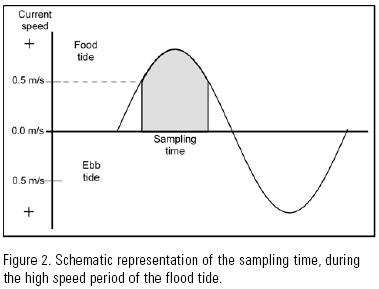
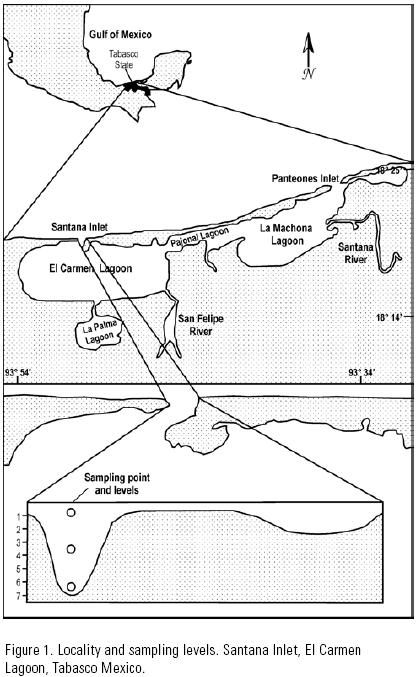
<body><![CDATA[<p align="justify"><font face="verdana" size="2"><b>Sampling site. </b>The Carmen&#150;Pajonal&#150;Machona lagoon system was chosen as it is the most important estuarine system in the state of Tabasco, in the southern Gulf of Mexico (18&deg;14'&#150;18&deg;25' N, 93&deg;34'&#150;93&deg;54' W). This lagoon complex receives freshwater from the San Felipe and Santana rivers. It has two inlets, the "Panteones inlet" that is an artificial inlet in the Machona lagoon to the east, and the Santana inlet to the west of the system (Guti&eacute;rrez&#150;Estrada &amp; Galaviz&#150;Sol&iacute;s, 1983). The latter, chosen as the sampling site, has a width of 170 m (V&aacute;zquez&#150;Guti&eacute;rrez, 1994) and a 7 m deep channel at its westernmost third section (<a href="#f1">Fig. 1</a>).</font></p>     <p align="center"><font face="verdana" size="2"><a name="f1"></a></font></p>     <p align="center"><font face="verdana" size="2"><img src="/img/revistas/hbio/v20n1/a1f1.jpg"></font></p>     <p align="justify"><font face="verdana" size="2"><b>Sample collections. </b>The biological material was collected considering the following: a) April&#150;November (1997) covers the main spawning period of the shrimp species in the study area (Yap <i>et al., </i>1987; Gracia, 1997), b) sea water enters the lagoon of El Carmen predominantly through the main channel of the Santana inlet (V&aacute;zquez&#150;Guti&eacute;rrez, 1994), and c) shrimp postlarvae enter the lagoon mainly during the high current velocity period of the flood tide (Rothlisberg <i>et al., </i>1995; Wenner <i>et al., </i>1998; Forward <i>et al., </i>1999). Thus, sampling was carried out from April to November, at the main channel of the Santana inlet, and only during the high current velocity period of the flood tide.</font></p>     <p align="justify"><font face="verdana" size="2">Sampling was initially to take place every month, however it was only possible to sample for six of the eight months that were planned. The sampling dates were: April 23, May 23, June 21, August 19, October 15 and November 15, 1997, and they corresponded to the full&#150;Moon phase. Samples were collected always at night, except for November. July was not sampled as abundant jellyfish filled and blocked the nets, and neither was September due to the strong norther winds that did not allow sampling to take place.</font></p>     <p align="justify"><font face="verdana" size="2">Each month, the height of the tide and the current velocity were measured a day ahead of sampling in order to anticipate the period of high current velocity. During sampling, the current velocity was measured with a electronic flow meter (General Oceanic Mod. 2031H) one meter below the surface, in order to determine when to begin and end sampling. Sampling began when the current velocity registered 0.5 m s<sup>&#150;1</sup>, and ended when it fell below this value (<a href="#f2">Fig. 2</a>).</font></p>     <p align="center"><font face="verdana" size="2"><a name="f2"></a></font></p>     <p align="center"><font face="verdana" size="2"><img src="/img/revistas/hbio/v20n1/a1f2.jpg"></font></p>     <p align="justify"><font face="verdana" size="2">On the other hand, current velocity data were also obtained at each cast (= sampling event), with a General Oceanic model 2030 flowmeter fixed to the mouth of the net.</font></p>     <p align="justify"><font face="verdana" size="2">Sampling was simultaneous at three levels: surface (0.5 m), mid&#150;water (3.5 m) and bottom (6.5 m). The sampling system consisted of three trapeze&#150;type nets, with a 50 cm mouth diameter, a 1.5 m length and a 505 &micro;m mesh size, without bridles, with a ballast down to the bottom, and parallel cables to attach the system to a bridge to enable fishing only during the tidal current (Flores&#150;Coto &amp; Zavala&#150;Garc&iacute;a, 1994).</font></p>     ]]></body>
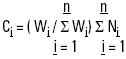
<body><![CDATA[<p align="justify"><font face="verdana" size="2">Each cast lasted 10&#150;15 minutes. Sampling frequency varied each month (minimum four, maximum eight), depending on the time taken to recover and prepare the equipment, and on the duration of the high current velocity period. This varied from 3 h 7 min to 4 h 17 min, measured from the start of the first to the last cast.</font></p>     <p align="justify"><font face="verdana" size="2">Water samples were obtained at each sampling from the three depth levels with 3&#150;liter van&#150;Dorn bottles, and temperature and salinity were measured with a field thermometer and a refractometer, respectively.</font></p>     <p align="justify"><font face="verdana" size="2">Samples were initially preserved in 4% formalin neutralised with sodium borate, and changed into 70% alcohol 48 h later. Penaeid shrimp postlarvae were separated in the laboratory, identified to species level and measured for total length. Density data were standardised as postlarvae per 100 m<sup>&#150;3</sup>.</font></p>     <p align="justify"><font face="verdana" size="2"><b>Data analysis. </b>Data analysis was carried out according to McCleave <i>et al. </i>(1987). Density of immigrating postlarvae was assumed to be uniform during the high current velocity period of the flood tide at all sampling depths. For each month, the expected values were calculated based on the filtered volume, and considering the total number of postlarvae (Ni) in each cast as the sum of the number of postlarvae in the three levels, or the sum of the number of postlarvae of all cast when the levels were analysed.</font></p>     <p align="justify"><font face="verdana" size="2">It was also assumed that the swimming of the organisms had an insignificant effect, i.e. that the shrimp postlarvae essentially float with the current, and the expected number of postlarvae in a particular cast or level is proportional to the total filtered water. Hence, the total number of expected postlarvae (C<sub><u>i</u></sub>, ) is:</font></p>     <p align="center"><font face="verdana" size="2"><img src="/img/revistas/hbio/v20n1/a1s1.jpg"></font></p>     <p align="justify"><font face="verdana" size="2">where:</font></p>     <p align="justify"><font face="verdana" size="2">C<sub><u>i</u></sub> = expected postlarvae in the cast or level <sub><u>i</u></sub></font></p>     <p align="justify"><font face="verdana" size="2">W<sub><u>i</u></sub>= amount of filtered water in the cast or level <sub><u>i</u></sub></font></p>     <p align="justify"><font face="verdana" size="2">&#931;W<sub><u>i</u></sub>= sum of the amount of water filtered in the cast or level <sub><u>i</u></sub></font></p>     ]]></body>
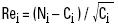
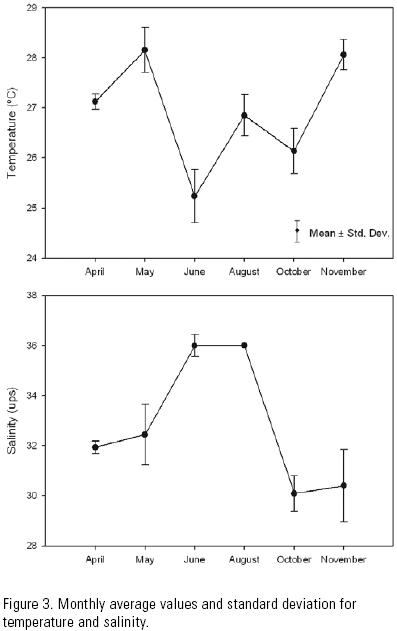
<body><![CDATA[<p align="justify"><font face="verdana" size="2">N<sub><u>i</u></sub> = number of organisms collected in the cast or level <sub><u>i</u></sub></font></p>     <p align="justify"><font face="verdana" size="2">The fraction <u>i</u>, is constituted, for the casts, by the sum of the three levels, and in the case of levels by the number of casts, which varied from month to month.</font></p>     <p align="justify"><font face="verdana" size="2">The values of the standardised residual were obtained with:</font></p>     <p align="justify"><font face="verdana" size="2"><img src="/img/revistas/hbio/v20n1/a1s2.jpg"></font></p>     <p align="justify"><font face="verdana" size="2">where:</font></p>     <p align="justify"><font face="verdana" size="2">Re<u>i</u>      = standardised residuals,</font></p>     <p align="justify"><font face="verdana" size="2">and from the standardised residuals values, the &#967;<sup>2</sup> is calculated as:</font></p>     <p align="center"><font face="verdana" size="2">&#967;<sup>2</sup> = &#931; Re<u>i</u><sup>2</sup></font></p>     <p align="justify"><font face="verdana" size="2"><b>RESULTS</b></font></p>     <p align="justify"><font face="verdana" size="2"><b>Temperature, salinity and current velocity. </b>The monthly average temperature during the sampling period varied from 25.2&deg;C in June to 29&deg;C in May. During sampling months the temperature variation ranged from a minimum of 0.5&deg;C in April to a maximum of 2.1&deg;C in June (<a href="#f3">Fig. 3</a>). Temperature was slightly higher during the first than during the last cast, all months. The monthly average salinity varied from 30 ups in October to 36 ups in June and August, with the values varying from a minimum of 0.1 in August to a maximum of 5.5 in May (<a href="#f3">Fig. 3</a>). Salinity was slightly lower most months during the first than during the last cast. Variations in temperature and salinity at the different depth levels throughout each sampling period were not statistically significant.</font></p>     ]]></body>
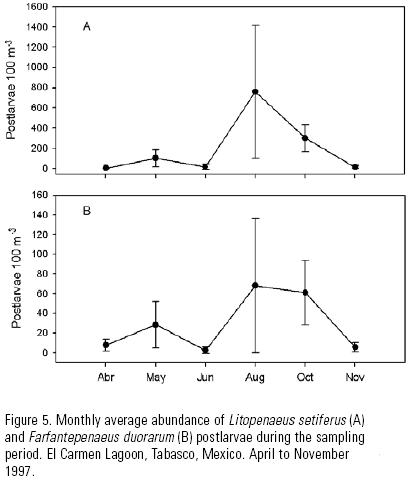
<body><![CDATA[<p align="center"><font face="verdana" size="2"><a name="f3"></a></font></p>     <p align="center"><font face="verdana" size="2"><img src="/img/revistas/hbio/v20n1/a1f3.jpg"></font></p>     <p align="justify"><font face="verdana" size="2">Current velocities recorded at each depth level throughout the study period varied from 0.26 to 1.14 m s<sup>&#150;1</sup> (<a href="/img/revistas/hbio/v20n1/a1f4.jpg" target="_blank">Fig. 4</a>). The highest average velocities were recorded in October and November with values of 0.82 and 0.65 m s<sup>&#150;1</sup> respectively, and the lowest was recorded in August with 0.41 m s<sup>&#150;1</sup>.</font></p>     <p align="justify"><font face="verdana" size="2">The tidal current in the water column presented a general pattern in April, June and November, with the greatest velocities at the bottom and the lowest at the surface. Differences among depth levels (surface, mid water and bottom) were significant (ANOVA; p&lt;0.05) only in April and May.</font></p>     <p align="justify"><font face="verdana" size="2">Correlation between postlarvae density of both species and temperature were positive but only statistically significant in June, August and November, moths of marked differences in abundance. Correlations with salinity varied from positive to negative values. These were statistically significant for both species only in June, and for <i>F. duorarum </i>only in November (<a href="/img/revistas/hbio/v20n1/a1t1.jpg" target="_blank">Table 1</a>). Correlations with current velocity fluctuated from positive to negative values. The values were generally low and not significant, except in the case of August for both species, of June for L. <i>setiferus, </i>and of November for <i>F. duorarum </i>(<a href="/img/revistas/hbio/v20n1/a1t1.jpg" target="_blank">Table 1</a>).</font></p>     <p align="justify"><font face="verdana" size="2"><b>Seasonal variation in composition and abundance. </b>Samples collected were 101: 33 at level 1 (0.5 m), 34 at level 2 (3.5 m) and 34 at level 3 (6.5 m). Cast number varied with six in April, May and November, four in August and October, and eight in June.</font></p>     <p align="justify"><font face="verdana" size="2">A total of 13,332 postlarvae of <i>L. setiferus </i>and 2,198 post&#150;larvae of <i>F. duorarum </i>were collected. Despite the difference in abundance, both species presented a similar pattern of variation during the sampling period (<a href="#f5">Fig. 5</a>). The lower values were recorded in April, June and November, and the higher values occurred in October and August, with the maximum variability in August (<a href="/img/revistas/hbio/v20n1/a1t2.jpg" target="_blank">Table 2</a>).</font></p>     <p align="center"><font face="verdana" size="2"><a name="f5"></a></font></p>     <p align="center"><font face="verdana" size="2"><img src="/img/revistas/hbio/v20n1/a1f5.jpg"></font></p>     <p align="justify"><font face="verdana" size="2"><b>Vertical distribution. </b>The &#967;<sup>2</sup> test revealed significant differences in postlarvae abundance of the two species among the three sampling levels (0.5, 3.5 and 6.5 m) throughout the flood periods (<a href="/img/revistas/hbio/v20n1/a1t3.jpg" target="_blank">Table 3</a>). The standardised residual values indicate that the largest immigration of postlarvae of both species occurred along the bottom during April and May, in mid&#150;water during August and October, and along the surface during June and November.</font></p>     ]]></body>
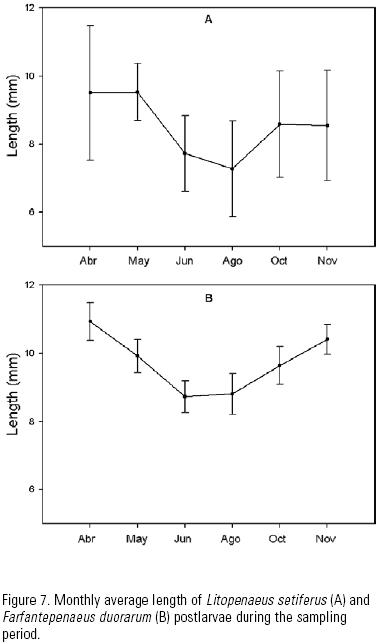
<body><![CDATA[<p align="justify"><font face="verdana" size="2">During June and November, when the abundance was the lowest, the largest immigration of postlarvae of both species occurred at the surface level, although the highest velocities were recorded along the bottom.</font></p>     <p align="justify"><font face="verdana" size="2">In August and October, when the greatest abundances are recorded, the largest immigration of postlarvae took place at the mid&#150;water level, whereas the highest velocities occurred at the surface.</font></p>     <p align="justify"><font face="verdana" size="2">It was only during April and May that the largest immigration of postlarvae and the greatest current velocities coincided along the bottom depth level, and the smaller values of both parameters occurred at the surface.</font></p>     <p align="justify"><font face="verdana" size="2"><b>Abundance pattern during the sampling period. </b>The &#967;<sup>2</sup> test also indicated that the abundance of postlarvae of both species was significantly different among cast in all months (<a href="/img/revistas/hbio/v20n1/a1t3.jpg" target="_blank">Table 3</a>). The postlarvae number was higher during the first cast and decreased towards the end of the high velocity period, except for <i>F. duorarum </i>in May (<a href="/img/revistas/hbio/v20n1/a1f6.jpg" target="_blank">Fig. 6</a>). In fact, during the months of highest abundance, August and October, the standardised residuals reveal that immigration occurred essentially at the beginning of the period. This pattern was practically the same, with some small exceptions, despite the differences in density of the two species.</font></p>     <p align="justify"><font face="verdana" size="2"><b>Size variation. </b>The monthly average size of both species increased in April and May, decreased in June and August, and increased again towards October and November (<a href="#f7">Fig. 7</a>). The average size of <i>F. duorarum </i>was bigger than that of <i>L. setiferus </i>throughout the sampling season. Immigration sizes ranged for <i>L. setiferus </i>and <i>F. duorarum </i>from 4.1&#150;12.6 mm and from 7&#150;12.5 mm, with averages of 8.76 and 9.71 mm total length, respectively. More than 75% of <i>L. setiferus </i>postlarvae were larger than 8 mm, and more than 81% of <i>F. duorarum </i>postlarvae were larger than 9 mm. There was little variation in specimen size between cast.</font></p>     <p align="center"><font face="verdana" size="2"><a name="f7"></a></font></p>     <p align="center"><font face="verdana" size="2"><img src="/img/revistas/hbio/v20n1/a1f7.jpg"></font></p>     <p align="justify"><font face="verdana" size="2">&nbsp;</font></p>     <p align="justify"><font face="verdana" size="2"><b>DISCUSSION</b></font></p>     <p align="justify"><font face="verdana" size="2"><b>Parameters affecting postlarvae immigration. </b>Correlations between larval abundance of both species, and salinity and temperature, were highly variable and mostly not statistically significant. The only significant values were recorded during the months that presented a marked difference in larvae abundance (<a href="/img/revistas/hbio/v20n1/a1t1.jpg" target="_blank">Table 1</a>).</font></p>     ]]></body>
<body><![CDATA[<p align="justify"><font face="verdana" size="2">These results make it possible to consider unlikely that salinity and temperature did play an important role in the immigration of shrimp postlarvae through the Santana inlet. This inlet is considered well mixed given the small variations recorded in salinity and temperature. The relative homogeneity in the water column may be due to a mixing process generated by the tidal currents, which is common in this type of coastal lagoon (Zijlstra, 1988).</font></p>     <p align="justify"><font face="verdana" size="2">Studies conducted in a variety of systems have indicated that neither salinity nor temperature seem to play a relevant role in the migration of postlarvae through the inlets (Pietrafesa &amp; Janowitz, 1988; Joyeux, 1999).</font></p>     <p align="justify"><font face="verdana" size="2">The main spawning period of <i>L. setiferus, F. duorarum </i>and <i>F. aztecus </i>in the southern Gulf of Mexico starts in March or April, and may last up to November or even December (Yap <i>et al., </i>1987; Gracia <i>et al., </i>1997). The period of greatest abundance recorded in this study was August to October, and it coincides with the largest discharges of continental waters in the area (July&#150;October), according to data from the Comisi&oacute;n Nacional del Agua (CNA, 1998). Also, it is possible to expect high postlarvae densities in July and September, months for which this study did not gather data.</font></p>     <p align="justify"><font face="verdana" size="2">The relationship between the high river discharge period and the main shrimp postlarvae immigration pulse supports the notion that salinity plays a more important role outside the inlet as a cue or stimulus for larvae to initiate migration towards the estuaries, as Boehlert &amp; Mundy (1988) and Pietrafesa &amp; Janowitz (1988) mentioned previously. However, this relationship is most likely due to a reproductive strategy that includes an optimal use of seasonally changing resources that ensures larval survival and recruitment to nursery areas, considering that river discharges play an important role through the promotion of offshore primary productivity that may benefit larval survival (Gracia, 1997).</font></p>     <p align="justify"><font face="verdana" size="2">Correlations between current velocity and larval density of both species were very irregular and changed from positive to negative, even during the months with statistically significant values (<a href="/img/revistas/hbio/v20n1/a1t1.jpg" target="_blank">Table 1</a>). This led to the conclusion that there is no correlation pattern or trend between these parameters.</font></p>     <p align="justify"><font face="verdana" size="2"><b>Sizes. </b>The average immigration size was largest during the first months, decreased in August and increased again in October and November, in agreement with the coastal circulation that is predominant in the study area. Zavala&#150;Hidalgo <i>et al. </i>(2003) have indicated that the currents on the continental shelf travel westward and northward along the coastline from May to August. In September, a coastal current develops in the state of Veracruz that flows south along the coastline. This current collides with an onshore flow and forms a front near the Carmen&#150;Machona lagoons, where our study site was located.</font></p>     <p align="justify"><font face="verdana" size="2">Under this circulation pattern, the larvae that migrate westwards from the spawning areas on the Campeche shelf, and perhaps also the Yucat&aacute;n shelf (Soto &amp; Gracia 1987), may reach the lagoon inlets at a smaller size. In contrast, in September, and once the circulation has changed eastward, the larvae require more time to reach the coastal areas in front of the lagoon inlets.</font></p>     <p align="justify"><font face="verdana" size="2">Alarc&oacute;n&#150;Daowz (1986) found a similar pattern of seasonal variation in the immigration size of shrimp larvae in the southern Gulf of Mexico, with the larger sizes in Spring and Fall and the smaller sizes in Summer.</font></p>     <p align="justify"><font face="verdana" size="2">Exactly the opposite has been recorded along the Atlantic coast of the United States for larvae of several fish species including <i>Leiostomus xanthurus, </i>with smaller sizes at the beginning of the season, that increase and then decrease again towards the end of the period (Warlen &amp; Burke, 1990). The spawning areas of these fish shift offshore as Winter sets in, and the advection of larvae towards the coast takes longer.</font></p>     <p align="justify"><font face="verdana" size="2">The consistent greater size of <i>F. duorarum </i>compared with <i>L. setiferus </i>may be attributed to differences is spawning localities, with these being farther away from the study inlet in the case of the first species. Gracia (1989) indicated that <i>L. setiferus </i>mainly spawns on the inner and mid shelf of the states of Campeche and Tabasco, whereas <i>F. duorarum </i>spawns on the outer shelf and further north&#150;east.</font></p>     ]]></body>
<body><![CDATA[<p align="justify"><font face="verdana" size="2"><b>Vertical distribution. </b>The data obtained suggests that <i>F. duorarum </i>and <i>L. setiferus </i>postlarvae may enter indistinctively throughout the whole water column. Statistical analyses indicate that the greatest immigration occurs along the surface in some months (0.5 m), in other months in mid&#150;water (3.5 m), and in still other months along the bottom (6.5 m). Other authors, including Blanton <i>et al. </i>(2001), have recorded a mean density of <i>L. setiferus </i>an order of magnitude greater at the surface than at the bottom during the night flood tides, as well as the opposite during the day.</font></p>     <p align="justify"><font face="verdana" size="2"><b>Abundance pattern during the high current velocity period of the flood tide. </b>Results for both species indicate that postlarvae density varies significantly throughout the high current velocity flood tide period. The largest immigration occurs at the beginning of the period and declines significantly over time.</font></p>     <p align="justify"><font face="verdana" size="2">These results are expected because larvae immigrations occur together with flood tide streams, and it is logical that the greater transport should occur at the time of the strongest tidal currents during the Spring tides (Forward &amp; Tankersley, 2001). Previous studies such as that of Wenner <i>et al. </i>(1998) that covered a full cycle of neap&#150;spring tides, found that an abundance peak coincided with an increase in water level of more than 0.2 m that induced an additional influx of water that reinforced the flood current.</font></p>     <p align="justify"><font face="verdana" size="2">Also, the greatest larval densities of several fish species occur when high speed currents are present. Jager (1999) for instance, observed that the highest concentration of flounder larvae were recorded in the fast moving surface layer during the flood tide, and Forward <i>et al. </i>(1999) observed the greatest larvae densities of several fish species during the periods of greater flood speed currents.</font></p>     <p align="justify"><font face="verdana" size="2">Two phases may be considered for the migration process of larvae of estuarine&#150;dependent species of fish and crustaceans from spawning to nursery areas. In the first phase, the larvae are typically planktonic and are subjected to a totally passive displacement towards the coast (Boehlert &amp; Mundy, 1988; Condie <i>et al., </i>1999; Jager, 1999; Rothlisberg <i>et al., </i>1995), and the second phase includes both a change in habitat when the larvae become epibenthic (Garcia &amp; LaReste, 1981) and a process of concentration of larvae near the estuary inlets (Boehlert &amp; Mundy, 1988; DeLancey <i>et al., </i>1994; Rothlisberg <i>et al., </i>1995; Blanton <i>et al., </i>1999).</font></p>     <p align="justify"><font face="verdana" size="2">The greater abundance at the beginning of the high current velocity period may be conditioned by the process of accumulation of postlarvae near the inlets at a place that is optimal for immigration with the aid of tidal currents. An immigration at the start of the high velocity period ensures a large dispersion into the nursery area that favours the movement of the postlarvae to safe sites before the ebb tide may return them to the ocean.</font></p>     <p align="justify"><font face="verdana" size="2">For many species, immigration into estuaries is not a purely passive process, their behaviour is related to the tidal stage and the result is a selective tidal stream transport (STST) of larvae into estuaries towards their nursery areas (Burke <i>et al., </i>1998; Forward <i>et al., </i>1998; Jager, 1999; Forward &amp; Tankersley, 2001; Blanton <i>et al., </i>2001). Calderon&#150;P&eacute;rez &amp; Poli (1987) considered that if postlarvae accumulation and immigration were merely passive phenomena, other penaeid larvae also present in the coastal area should be recorded inside the lagoon of their study area, and this has not been the case.</font></p>     <p align="justify"><font face="verdana" size="2">The results obtained here agree with previous findings, particularly with those of Rothlisberg <i>et al. </i>(1995) who studied the Nerang River estuary in Australia and found that the largest peaks of larvae appeared within 2 h of the start of the flood tide with both the new and the full Moon, and the abundance curves exhibited a rapid increase and a gradual decrease, similarly to the Santana inlet. Also, Young &amp; Carpenter (1977) mentioned that from the onset of the flood, enormous numbers of postlarvae entered the estuary, and the immigration was complete within the first half of the flood tide while the velocity of the water was still increasing. They also observed that most of the immigrants entered within the first 3 h of the night time flood tide.</font></p>     <p align="justify"><font face="verdana" size="2">Results indicate that the largest larval densities occurred 3&#150;4 hrs after the start of the flood tide. This longer time may be due to the tidal cycle being daily in our study area. It is possible to assume that the peaks in the Rothlisberg <i>et al. </i>(1995) study occurred during the period of greatest velocity.</font></p>     <p align="justify"><font face="verdana" size="2">This study also offers information for an adequate design of monitoring studies, considering that if the variations at the beginning and end of the high velocity period are not taken into account, the estimation of postlarvae densities that migrate into estuaries will be deficient. For example, the average densities of <i>L. setiferus </i>postlarvae caught in August during the first and last cast were 1409.7 and 193.4 per 100 m<sup>&#150;3</sup>, respectively.</font></p>     ]]></body>
<body><![CDATA[<p align="justify"><font face="verdana" size="2">This immigration pattern, with the largest densities of larvae occurring at the beginning of the high flow period and declining at the end of the period, does not exclude the possibility of some shrimp larvae entering during the low current velocity period at the beginning or end of the tidal flood period. It is assumed that this may occur in a very low proportion as in other areas (Rothlisberg <i>et al., </i>1995; Wenner <i>et al., </i>1998; Blanton <i>et al., </i>2001). Differences in this pattern may be expected from one area to another depending on several factors.</font></p>     <p align="justify"><font face="verdana" size="2">&nbsp;</font></p>     <p align="justify"><font face="verdana" size="2"><b>ACKNOWLEDGEMENTS</b></font></p>     <p align="justify"><font face="verdana" size="2">This study was financed by the Instituto de Ciencias del Mar y Limnolog&iacute;a, Universidad Nacional Aut&oacute;noma de M&eacute;xico.</font></p>     <p align="justify"><font face="verdana" size="2">&nbsp;</font></p>     <p align="justify"><font face="verdana" size="2"><b>REFERENCES</b></font></p>     <!-- ref --><p align="justify"><font face="verdana" size="2">Alarc&oacute;n&#150;Daowz, G. 1986. <i>Estratificaci&oacute;n de las postlarvas planct&oacute;nicas de camarones peneidos durante la inmigraci&oacute;n a trav&eacute;s de la Boca de Puerto Real, Laguna de T&eacute;rminos. </i>Tesis de Licenciatura (Biolog&iacute;a), Facultad de Ciencias, UNAM, M&eacute;xico. 78 p.</font>&nbsp;&nbsp;&nbsp;&nbsp;&nbsp;&nbsp;&nbsp;&nbsp;[&#160;<a href="javascript:void(0);" onclick="javascript: window.open('/scielo.php?script=sci_nlinks&ref=4080552&pid=S0188-8897201000010000100001&lng=','','width=640,height=500,resizable=yes,scrollbars=1,menubar=yes,');">Links</a>&#160;]<!-- end-ref --><!-- ref --><p align="justify"><font face="verdana" size="2">Blanton, J. O., F. E. Werner, A. Kapolnai, B. O. Blanton, D. Knott &amp; E. L. Wenner. 1999. Wind&#150;generated transport of fictitious passive larvae into shallow tidal estuaries. <i>Fisheries Oceanography </i>8 (2): 210&#150;223.</font>&nbsp;&nbsp;&nbsp;&nbsp;&nbsp;&nbsp;&nbsp;&nbsp;[&#160;<a href="javascript:void(0);" onclick="javascript: window.open('/scielo.php?script=sci_nlinks&ref=4080553&pid=S0188-8897201000010000100002&lng=','','width=640,height=500,resizable=yes,scrollbars=1,menubar=yes,');">Links</a>&#160;]<!-- end-ref --><!-- ref --><p align="justify"><font face="verdana" size="2">Blanton, J. O., P. G. Verity, J. Amft, E. L. wenner, C. A. Barans, D. M. B. Knott, W. Stender &amp; S. B. Wilde. 2001. <i>Key factors influencing transport of white shrimp postlarvae in southeastern U.S. estuaries. </i>Final Report to Georgia Sea Grant Program and South Carolina Sea Grant Consortium. 42 p.</font>&nbsp;&nbsp;&nbsp;&nbsp;&nbsp;&nbsp;&nbsp;&nbsp;[&#160;<a href="javascript:void(0);" onclick="javascript: window.open('/scielo.php?script=sci_nlinks&ref=4080554&pid=S0188-8897201000010000100003&lng=','','width=640,height=500,resizable=yes,scrollbars=1,menubar=yes,');">Links</a>&#160;]<!-- end-ref --><!-- ref --><p align="justify"><font face="verdana" size="2">Boehlert, G. W. &amp; B. C. Mundy. 1988. Roles of behavioral and physical factors in larval and juvenile fish recruitment to estuarine nursery areas. <i>In: </i>Weinstein M. P. (Ed.). <i>Larval fish and shellfish transport through inlets. </i>American Fisheries Society Symposium 3. Bethesda, Maryland, pp. 51&#150;67.</font>&nbsp;&nbsp;&nbsp;&nbsp;&nbsp;&nbsp;&nbsp;&nbsp;[&#160;<a href="javascript:void(0);" onclick="javascript: window.open('/scielo.php?script=sci_nlinks&ref=4080555&pid=S0188-8897201000010000100004&lng=','','width=640,height=500,resizable=yes,scrollbars=1,menubar=yes,');">Links</a>&#160;]<!-- end-ref --><!-- ref --><p align="justify"><font face="verdana" size="2">Burke, J. S., M. Ueno, Y. Tanaka, H. Walsh, T. Maeda, I. Kinoshita, T. Seikai, D. E. Hoss &amp; M. Tanaka. 1998. The influence of environmental factors on early life history patterns of flounders. <i>Journal of Sea Research </i>40 (1): 19&#150;32.</font>&nbsp;&nbsp;&nbsp;&nbsp;&nbsp;&nbsp;&nbsp;&nbsp;[&#160;<a href="javascript:void(0);" onclick="javascript: window.open('/scielo.php?script=sci_nlinks&ref=4080556&pid=S0188-8897201000010000100005&lng=','','width=640,height=500,resizable=yes,scrollbars=1,menubar=yes,');">Links</a>&#160;]<!-- end-ref --><!-- ref --><p align="justify"><font face="verdana" size="2">Calder&oacute;n&#150;P&eacute;rez, J. A. &amp; C. R. Poll 1987. A physical approach to the postlarval <i>Penaeus </i>immigration mechanism in a Mexican coastal lagoon (Crustacea: Decapoda: Penaeidae). <i>Anales del Instituto de Ciencias del Mar y Limnolog&iacute;a. Universidad Nacional Aut&oacute;noma de M&eacute;xico </i>14 (1): 147&#150;156.</font>&nbsp;&nbsp;&nbsp;&nbsp;&nbsp;&nbsp;&nbsp;&nbsp;[&#160;<a href="javascript:void(0);" onclick="javascript: window.open('/scielo.php?script=sci_nlinks&ref=4080557&pid=S0188-8897201000010000100006&lng=','','width=640,height=500,resizable=yes,scrollbars=1,menubar=yes,');">Links</a>&#160;]<!-- end-ref --><!-- ref --><p align="justify"><font face="verdana" size="2">Comisi&oacute;n Nacional Del Agua (CNA). 1998. <i>Bolet&iacute;n de datos hidrom&eacute;tricos. </i>M&eacute;xico D.F.</font>&nbsp;&nbsp;&nbsp;&nbsp;&nbsp;&nbsp;&nbsp;&nbsp;[&#160;<a href="javascript:void(0);" onclick="javascript: window.open('/scielo.php?script=sci_nlinks&ref=4080558&pid=S0188-8897201000010000100007&lng=','','width=640,height=500,resizable=yes,scrollbars=1,menubar=yes,');">Links</a>&#160;]<!-- end-ref --><!-- ref --><p align="justify"><font face="verdana" size="2">Condie, S. A., N. R. Lonerang &amp; D. J. Die. 1999. Modeling the recruitment of tiger prawns <i>Penaeus esculentus </i>and <i>P. semisulcatus </i>to nursery grounds in the Gulf of Carpentaria, northern Australia: Implications for assessing stock&#150;recruitment relationships. <i>Marine Ecology Progress Series </i>178: 55&#150;68.</font>&nbsp;&nbsp;&nbsp;&nbsp;&nbsp;&nbsp;&nbsp;&nbsp;[&#160;<a href="javascript:void(0);" onclick="javascript: window.open('/scielo.php?script=sci_nlinks&ref=4080559&pid=S0188-8897201000010000100008&lng=','','width=640,height=500,resizable=yes,scrollbars=1,menubar=yes,');">Links</a>&#160;]<!-- end-ref --><!-- ref --><p align="justify"><font face="verdana" size="2">DeLancey, L. B., J. E. Jenkins &amp; J. D. Whitaker. 1994. Result of long&#150;term, seasonal sampling for <i>Penaeus </i>postlarvae at Breach inlet, South Carolina. <i>Fishery Bulletin </i>92: 633&#150;640.</font>&nbsp;&nbsp;&nbsp;&nbsp;&nbsp;&nbsp;&nbsp;&nbsp;[&#160;<a href="javascript:void(0);" onclick="javascript: window.open('/scielo.php?script=sci_nlinks&ref=4080560&pid=S0188-8897201000010000100009&lng=','','width=640,height=500,resizable=yes,scrollbars=1,menubar=yes,');">Links</a>&#160;]<!-- end-ref --><!-- ref --><p align="justify"><font face="verdana" size="2">Flores&#150;Coto, C. &amp; F. Zavala&#150;Garc&iacute;a. 1994. Un nuevo sistema para muestreo simult&aacute;neo de zooplancton en varios niveles, para zonas someras. <i>Anales del Instituto de Ciencias del Mar y Limnolog&iacute;a. Universidad Nacional Aut&oacute;noma de M&eacute;xico </i>21 (1&#150;2):149&#150;153.</font>&nbsp;&nbsp;&nbsp;&nbsp;&nbsp;&nbsp;&nbsp;&nbsp;[&#160;<a href="javascript:void(0);" onclick="javascript: window.open('/scielo.php?script=sci_nlinks&ref=4080561&pid=S0188-8897201000010000100010&lng=','','width=640,height=500,resizable=yes,scrollbars=1,menubar=yes,');">Links</a>&#160;]<!-- end-ref --><!-- ref --><p align="justify"><font face="verdana" size="2">Forward, Jr., R. B., R. A Tankersley &amp; K. A. Reinsel. 1998. Selective tidal stream transport of spot <i>(Leiostomus xanthurus </i>Lacepede) and pinfish &#91;<i>Lagodon rhomboides </i>(Linnaeus)&#93; larvae: contributions of circatidal rhythms in activity. <i>Journal of Experimental Marine Biology and Ecology </i>226 (1): 19&#150;32.</font>&nbsp;&nbsp;&nbsp;&nbsp;&nbsp;&nbsp;&nbsp;&nbsp;[&#160;<a href="javascript:void(0);" onclick="javascript: window.open('/scielo.php?script=sci_nlinks&ref=4080562&pid=S0188-8897201000010000100011&lng=','','width=640,height=500,resizable=yes,scrollbars=1,menubar=yes,');">Links</a>&#160;]<!-- end-ref --><!-- ref --><p align="justify"><font face="verdana" size="2">Forward, R. B., K. A. Reinsel, D. Peters, R. A. Tankersley, J. H. Churchill, L. B. Crowder, W. F. Hettler, S. Warlen &amp; M. M. Green. 1999. Transport of fish larvae through a tidal inlet. Fisheries Oceanography 8 (2):153&#150;172.</font>&nbsp;&nbsp;&nbsp;&nbsp;&nbsp;&nbsp;&nbsp;&nbsp;[&#160;<a href="javascript:void(0);" onclick="javascript: window.open('/scielo.php?script=sci_nlinks&ref=4080563&pid=S0188-8897201000010000100012&lng=','','width=640,height=500,resizable=yes,scrollbars=1,menubar=yes,');">Links</a>&#160;]<!-- end-ref --><!-- ref --><p align="justify"><font face="verdana" size="2">Forward, Jr., R. B. &amp; R. A Tankersley. 2001. Selective tidal stream transport of marine animals. <i>Oceanography and Marine Biology. An Annual Review </i>39: 305&#150;353.</font>&nbsp;&nbsp;&nbsp;&nbsp;&nbsp;&nbsp;&nbsp;&nbsp;[&#160;<a href="javascript:void(0);" onclick="javascript: window.open('/scielo.php?script=sci_nlinks&ref=4080564&pid=S0188-8897201000010000100013&lng=','','width=640,height=500,resizable=yes,scrollbars=1,menubar=yes,');">Links</a>&#160;]<!-- end-ref --><!-- ref --><p align="justify"><font face="verdana" size="2">Garc&iacute;a, S. &amp; L. Lareste. 1981. <i>Life cycles, dynamics, exploration and management of coastal penaeid shrimp stocks. </i>FAO (Food and Agricultural Organization of the United Nations) Fisheries Technical paper 203. 215 p.</font>&nbsp;&nbsp;&nbsp;&nbsp;&nbsp;&nbsp;&nbsp;&nbsp;[&#160;<a href="javascript:void(0);" onclick="javascript: window.open('/scielo.php?script=sci_nlinks&ref=4080565&pid=S0188-8897201000010000100014&lng=','','width=640,height=500,resizable=yes,scrollbars=1,menubar=yes,');">Links</a>&#160;]<!-- end-ref --><!-- ref --><p align="justify"><font face="verdana" size="2">Gracia, A. 1989. <i>Ecolog&iacute;a y biolog&iacute;a del camar&oacute;n blanco Penaeus setiferus </i>(Linnaeus, 1767J <i>en la Laguna de T&eacute;rminos&#150;Sonda de Campeche. </i>Tesis de Doctorado en Ciencias (Biolog&iacute;a), Facultad de Ciencias, UNAM, M&eacute;xico. 127 p.</font>&nbsp;&nbsp;&nbsp;&nbsp;&nbsp;&nbsp;&nbsp;&nbsp;[&#160;<a href="javascript:void(0);" onclick="javascript: window.open('/scielo.php?script=sci_nlinks&ref=4080566&pid=S0188-8897201000010000100015&lng=','','width=640,height=500,resizable=yes,scrollbars=1,menubar=yes,');">Links</a>&#160;]<!-- end-ref --><!-- ref --><p align="justify"><font face="verdana" size="2">Gracia, A. 1997. Pesquer&iacute;a artesanal del camar&oacute;n. In: D. Flores&#150;Hern&aacute;ndez, P. S&aacute;nchez&#150;Gil, J. C. Seijo &amp; F. Arregu&iacute;n&#150;S&aacute;nchez (Eds). <i>An&aacute;lisis y Diagn&oacute;stico de los Recursos Pesqueros Cr&iacute;ticos del Golfo de M&eacute;xico. </i>Universidad Aut&oacute;noma de Campeche. EPOMEX. Campeche, pp. 173&#150;184.</font>&nbsp;&nbsp;&nbsp;&nbsp;&nbsp;&nbsp;&nbsp;&nbsp;[&#160;<a href="javascript:void(0);" onclick="javascript: window.open('/scielo.php?script=sci_nlinks&ref=4080567&pid=S0188-8897201000010000100016&lng=','','width=640,height=500,resizable=yes,scrollbars=1,menubar=yes,');">Links</a>&#160;]<!-- end-ref --><!-- ref --><p align="justify"><font face="verdana" size="2">Gracia, A., A. V&aacute;zquez&#150;Bader, F. Arreguin&#150;S&aacute;nchez, L. E. Schultz&#150;Rulz &amp; J. A. S&aacute;nchez. 1997. Ecolog&iacute;a de camarones peneidos. In: D. Flores&#150;Hern&aacute;ndez, P. S&aacute;nchez&#150;Gil, J. C. Seijo &amp; F. Arregu&iacute;n&#150;S&aacute;nchez (Eds). <i>An&aacute;lisis y Diagn&oacute;stico de los Recursos Pesqueros Cr&iacute;ticos del Golfo de M&eacute;xico. </i>Universidad Aut&oacute;noma de Campeche. EPOMEX. Campeche, pp. 127&#150;144.</font>&nbsp;&nbsp;&nbsp;&nbsp;&nbsp;&nbsp;&nbsp;&nbsp;[&#160;<a href="javascript:void(0);" onclick="javascript: window.open('/scielo.php?script=sci_nlinks&ref=4080568&pid=S0188-8897201000010000100017&lng=','','width=640,height=500,resizable=yes,scrollbars=1,menubar=yes,');">Links</a>&#160;]<!-- end-ref --><!-- ref --><p align="justify"><font face="verdana" size="2">Guti&eacute;rrez&#150;Estrada, M. &amp; A. Galaviz&#150;Solis. 1983. Morfolog&iacute;a y sedimentos recientes de las lagunas El Carmen, Pajonal y La Machona, Tabasco, M&eacute;xico. <i>Anales del Instituto de Ciencias del Mar y Limnolog&iacute;a. Universidad Nacional Aut&oacute;noma de M&eacute;xico </i>10: 249&#150;268.</font>&nbsp;&nbsp;&nbsp;&nbsp;&nbsp;&nbsp;&nbsp;&nbsp;[&#160;<a href="javascript:void(0);" onclick="javascript: window.open('/scielo.php?script=sci_nlinks&ref=4080569&pid=S0188-8897201000010000100018&lng=','','width=640,height=500,resizable=yes,scrollbars=1,menubar=yes,');">Links</a>&#160;]<!-- end-ref --><!-- ref --><p align="justify"><font face="verdana" size="2">Jager, Z. 1999. Selective tidal stream transport of flounder larvae <i>(Platichthys flesus </i>L.) in the Dollard (Ems Estuary). <i>Estuarine, Coastal and Shelf Science </i>49 (3): 347&#150;362.</font>&nbsp;&nbsp;&nbsp;&nbsp;&nbsp;&nbsp;&nbsp;&nbsp;[&#160;<a href="javascript:void(0);" onclick="javascript: window.open('/scielo.php?script=sci_nlinks&ref=4080570&pid=S0188-8897201000010000100019&lng=','','width=640,height=500,resizable=yes,scrollbars=1,menubar=yes,');">Links</a>&#160;]<!-- end-ref --><!-- ref --><p align="justify"><font face="verdana" size="2">Jager, Z. &amp; H. P. J Mulder. 1999. Transport velocity of flounder larvae <i>(Platichthys flesus L.) </i>in the Dollard (Ems Estuary). <i>Estuarine, Coastal and Shelf Science </i>49 (3): 327&#150;346.</font>&nbsp;&nbsp;&nbsp;&nbsp;&nbsp;&nbsp;&nbsp;&nbsp;[&#160;<a href="javascript:void(0);" onclick="javascript: window.open('/scielo.php?script=sci_nlinks&ref=4080571&pid=S0188-8897201000010000100020&lng=','','width=640,height=500,resizable=yes,scrollbars=1,menubar=yes,');">Links</a>&#160;]<!-- end-ref --><!-- ref --><p align="justify"><font face="verdana" size="2">Joyeux, J. C 1999. The abundance of fish larvae in estuaries: Within&#150;tide variability at inlet and immigration. <i>Estuaries </i>22 (44): 889&#150;904.</font>&nbsp;&nbsp;&nbsp;&nbsp;&nbsp;&nbsp;&nbsp;&nbsp;[&#160;<a href="javascript:void(0);" onclick="javascript: window.open('/scielo.php?script=sci_nlinks&ref=4080572&pid=S0188-8897201000010000100021&lng=','','width=640,height=500,resizable=yes,scrollbars=1,menubar=yes,');">Links</a>&#160;]<!-- end-ref --><!-- ref --><p align="justify"><font face="verdana" size="2">McCleave, J. D. &amp; R. C. Kleckner. 1982. Selective tidal stream transport in the estuarine migration of glass eels of the American eel <i>(Anguilla rostrata). Journal du Conseil International Pour L' Explotation de la Mer. </i>40: 262&#150;271.</font>&nbsp;&nbsp;&nbsp;&nbsp;&nbsp;&nbsp;&nbsp;&nbsp;[&#160;<a href="javascript:void(0);" onclick="javascript: window.open('/scielo.php?script=sci_nlinks&ref=4080573&pid=S0188-8897201000010000100022&lng=','','width=640,height=500,resizable=yes,scrollbars=1,menubar=yes,');">Links</a>&#160;]<!-- end-ref --><!-- ref --><p align="justify"><font face="verdana" size="2">McCleave, J. D., J. J. M. Bedaux, P. G. Doucet, J. C. Jager, J. T. L Jong, W. J. Van Der Steen, &amp; B. Voorzanger. 1987. Statistical methods for analysis of plankton and nekton distribution, with application to selective tidal stream transport of juvenile American eels <i>(Anguilla rostrata). Journal du Conseil International Pour L' Explotation de la Mer. </i>44: 90&#150;103.</font>&nbsp;&nbsp;&nbsp;&nbsp;&nbsp;&nbsp;&nbsp;&nbsp;[&#160;<a href="javascript:void(0);" onclick="javascript: window.open('/scielo.php?script=sci_nlinks&ref=4080574&pid=S0188-8897201000010000100023&lng=','','width=640,height=500,resizable=yes,scrollbars=1,menubar=yes,');">Links</a>&#160;]<!-- end-ref --><!-- ref --><p align="justify"><font face="verdana" size="2">McHugh, J. L. 1975. Estuarine Fisheries: are they doomed? In: M. Willey (Ed.). <i>Uses, Stresses and Adaptation to the Estuary. </i>New York Academic Press, pp. 15&#150;27.</font>&nbsp;&nbsp;&nbsp;&nbsp;&nbsp;&nbsp;&nbsp;&nbsp;[&#160;<a href="javascript:void(0);" onclick="javascript: window.open('/scielo.php?script=sci_nlinks&ref=4080575&pid=S0188-8897201000010000100024&lng=','','width=640,height=500,resizable=yes,scrollbars=1,menubar=yes,');">Links</a>&#160;]<!-- end-ref --><!-- ref --><p align="justify"><font face="verdana" size="2">Pietrafesa, L. J. &amp; G. S. Janowitz. 1988. Physical oceanographic processes affecting larval transport around and through North Carolina inlets. <i>In: </i>M. P Weinstein (Ed.). <i>Larval fish and shellfish transport through inlets. </i>Bethesda Maryland: American Fisheries Society Symposium 3. pp. 34&#150;50.</font>&nbsp;&nbsp;&nbsp;&nbsp;&nbsp;&nbsp;&nbsp;&nbsp;[&#160;<a href="javascript:void(0);" onclick="javascript: window.open('/scielo.php?script=sci_nlinks&ref=4080576&pid=S0188-8897201000010000100025&lng=','','width=640,height=500,resizable=yes,scrollbars=1,menubar=yes,');">Links</a>&#160;]<!-- end-ref --><!-- ref --><p align="justify"><font face="verdana" size="2">Poli, C. R. &amp; J. A. Calder&oacute;n&#150;P&eacute;rez. 1987. Efecto de los cambios hidrol&oacute;gicos en la boca del r&iacute;o Baluarte sobre la inmigraci&oacute;n de postlarvas de <i>Penaeus vannamei </i>(Boone) y <i>P. stylirostris </i>(Stimpson) al sistema lagunar Huizache&#150;Caimanero, Sinaloa, M&eacute;xico (Crustacea: Decapoda, Penaeidae). <i>Anales del Instituto de Ciencias del Mar y Limnolog&iacute;a. Universidad Nacional Aut&oacute;noma de M&eacute;xico </i>14 (1): 29&#150;44.</font>&nbsp;&nbsp;&nbsp;&nbsp;&nbsp;&nbsp;&nbsp;&nbsp;[&#160;<a href="javascript:void(0);" onclick="javascript: window.open('/scielo.php?script=sci_nlinks&ref=4080577&pid=S0188-8897201000010000100026&lng=','','width=640,height=500,resizable=yes,scrollbars=1,menubar=yes,');">Links</a>&#160;]<!-- end-ref --><!-- ref --><p align="justify"><font face="verdana" size="2">Rothlisberg, P. C., J. A. Church &amp; B. Fandry. 1995. A mechanism for near&#150;shore concentration and estuarine recruitment of post&#150;larval <i>Penaeus plebejus </i>Hess (Decapoda, Penaeidae). <i>Estuarine, Coastal and Shelf Science </i>40 (2): 115&#150;138.</font>&nbsp;&nbsp;&nbsp;&nbsp;&nbsp;&nbsp;&nbsp;&nbsp;[&#160;<a href="javascript:void(0);" onclick="javascript: window.open('/scielo.php?script=sci_nlinks&ref=4080578&pid=S0188-8897201000010000100027&lng=','','width=640,height=500,resizable=yes,scrollbars=1,menubar=yes,');">Links</a>&#160;]<!-- end-ref --><!-- ref --><p align="justify"><font face="verdana" size="2">Soto, L. A. &amp; A. Gracia. 1987. Evaluaci&oacute;n de los efectos de hidrocarburos f&oacute;siles sobre las poblaciones de camarones peneidos en el Banco de Campeche. <i>Anales del Instituto de Ciencias del Mar y Limnolog&iacute;a. Universidad Nacional Aut&oacute;noma de M&eacute;xico </i>14 (1): 133&#150;146.</font>&nbsp;&nbsp;&nbsp;&nbsp;&nbsp;&nbsp;&nbsp;&nbsp;[&#160;<a href="javascript:void(0);" onclick="javascript: window.open('/scielo.php?script=sci_nlinks&ref=4080579&pid=S0188-8897201000010000100028&lng=','','width=640,height=500,resizable=yes,scrollbars=1,menubar=yes,');">Links</a>&#160;]<!-- end-ref --><!-- ref --><p align="justify"><font face="verdana" size="2">V&aacute;zquez&#150;Guti&eacute;rrez, F. 1994. <i>El sistema lagunar El Carmen&#150;Pajonal&#150;la Machona del estado de Tabasco: Su hidrodin&aacute;mica, la estabilidad de sus bocas y de su l&iacute;nea de costa. </i>Universidad Nacional Aut&oacute;noma de M&eacute;xico, Instituto de Ciencias del Mar y Limnolog&iacute;a, M&eacute;xico. 132 p.</font>&nbsp;&nbsp;&nbsp;&nbsp;&nbsp;&nbsp;&nbsp;&nbsp;[&#160;<a href="javascript:void(0);" onclick="javascript: window.open('/scielo.php?script=sci_nlinks&ref=4080580&pid=S0188-8897201000010000100029&lng=','','width=640,height=500,resizable=yes,scrollbars=1,menubar=yes,');">Links</a>&#160;]<!-- end-ref --><!-- ref --><p align="justify"><font face="verdana" size="2">Warlen, S. M. &amp; J. S. Burke. 1990. Immigration of larvae of fall/winter spawning marine fishes into a North Carolina estuary. <i>Estuaries </i>13 (4): 453&#150;461.</font>&nbsp;&nbsp;&nbsp;&nbsp;&nbsp;&nbsp;&nbsp;&nbsp;[&#160;<a href="javascript:void(0);" onclick="javascript: window.open('/scielo.php?script=sci_nlinks&ref=4080581&pid=S0188-8897201000010000100030&lng=','','width=640,height=500,resizable=yes,scrollbars=1,menubar=yes,');">Links</a>&#160;]<!-- end-ref --><!-- ref --><p align="justify"><font face="verdana" size="2">Wenner, E., D. Knott, J. Blanton, C. Barans &amp; J. Amft . 1998. Roles of tidal and wind&#150;generated currents in transporting white shrimp <i>(Penaeus setiferus) </i>postlarvae through a South Carolina (USA) inlet. <i>Journal of Plankton Research </i>20: 2333&#150;2356.</font>&nbsp;&nbsp;&nbsp;&nbsp;&nbsp;&nbsp;&nbsp;&nbsp;[&#160;<a href="javascript:void(0);" onclick="javascript: window.open('/scielo.php?script=sci_nlinks&ref=4080582&pid=S0188-8897201000010000100031&lng=','','width=640,height=500,resizable=yes,scrollbars=1,menubar=yes,');">Links</a>&#160;]<!-- end-ref --><!-- ref --><p align="justify"><font face="verdana" size="2">Yap, W. G., F. D. Apud &amp; J. H. Primavera. 1987. Manual de cultivo de camar&oacute;n. Traducci&oacute;n de Publicaciones Direcci&oacute;n General de Comunicaci&oacute;n Social de la Secretaria de Pesca, M&eacute;xico. 49 p.</font>&nbsp;&nbsp;&nbsp;&nbsp;&nbsp;&nbsp;&nbsp;&nbsp;[&#160;<a href="javascript:void(0);" onclick="javascript: window.open('/scielo.php?script=sci_nlinks&ref=4080583&pid=S0188-8897201000010000100032&lng=','','width=640,height=500,resizable=yes,scrollbars=1,menubar=yes,');">Links</a>&#160;]<!-- end-ref --><!-- ref --><p align="justify"><font face="verdana" size="2">Young, P. C. &amp; S. M. carpenter. 1977. Recruitment of postlarval penaeid prawns to nursery areas in the Moreton Bay, Queensland. <i>Australian Journal of Marine and Freshwater Research </i>28: 745&#150;773.</font>&nbsp;&nbsp;&nbsp;&nbsp;&nbsp;&nbsp;&nbsp;&nbsp;[&#160;<a href="javascript:void(0);" onclick="javascript: window.open('/scielo.php?script=sci_nlinks&ref=4080584&pid=S0188-8897201000010000100033&lng=','','width=640,height=500,resizable=yes,scrollbars=1,menubar=yes,');">Links</a>&#160;]<!-- end-ref --><!-- ref --><p align="justify"><font face="verdana" size="2">Zavala&#150;Hidalgo, J., S. L. Morey &amp; J. J.O. Brien. 2003. Seasonal circulation on the western shelf of the Gulf of Mexico using a high&#150;resolution numerical model. <i>Journal of Geophysical Research </i>108 (C12): 3389, doi: 10.1029/2003JC001879.</font>&nbsp;&nbsp;&nbsp;&nbsp;&nbsp;&nbsp;&nbsp;&nbsp;[&#160;<a href="javascript:void(0);" onclick="javascript: window.open('/scielo.php?script=sci_nlinks&ref=4080585&pid=S0188-8897201000010000100034&lng=','','width=640,height=500,resizable=yes,scrollbars=1,menubar=yes,');">Links</a>&#160;]<!-- end-ref --><!-- ref --><p align="justify"><font face="verdana" size="2">Zijlstra, J. J. 1988. Fish migrations between coastal and offshore areas. <i>In: </i>Jansson B.O. (Ed.). <i>Coastal&#150;Offshore Ecosystem Interactions, Lecture Notes on Coastal and Estuarine Studies. </i>Germany, Springer&#150;Verlag, pp. 257&#150;272.</font>&nbsp;&nbsp;&nbsp;&nbsp;&nbsp;&nbsp;&nbsp;&nbsp;[&#160;<a href="javascript:void(0);" onclick="javascript: window.open('/scielo.php?script=sci_nlinks&ref=4080586&pid=S0188-8897201000010000100035&lng=','','width=640,height=500,resizable=yes,scrollbars=1,menubar=yes,');">Links</a>&#160;]<!-- end-ref --> ]]></body><back>
<ref-list>
<ref id="B1">
<nlm-citation citation-type="">
<person-group person-group-type="author">
<name>
<surname><![CDATA[Alarcón-Daowz]]></surname>
<given-names><![CDATA[G.]]></given-names>
</name>
</person-group>
<source><![CDATA[Estratificación de las postlarvas planctónicas de camarones peneidos durante la inmigración a través de la Boca de Puerto Real, Laguna de Términos]]></source>
<year>1986</year>
<page-range>78</page-range></nlm-citation>
</ref>
<ref id="B2">
<nlm-citation citation-type="journal">
<person-group person-group-type="author">
<name>
<surname><![CDATA[Blanton]]></surname>
<given-names><![CDATA[J. O.]]></given-names>
</name>
<name>
<surname><![CDATA[Werner]]></surname>
<given-names><![CDATA[F. E.]]></given-names>
</name>
<name>
<surname><![CDATA[Kapolnai]]></surname>
<given-names><![CDATA[A.]]></given-names>
</name>
<name>
<surname><![CDATA[Blanton]]></surname>
<given-names><![CDATA[B. O.]]></given-names>
</name>
<name>
<surname><![CDATA[Knott]]></surname>
<given-names><![CDATA[D.]]></given-names>
</name>
<name>
<surname><![CDATA[Wenner]]></surname>
<given-names><![CDATA[E. L.]]></given-names>
</name>
</person-group>
<article-title xml:lang="en"><![CDATA[Wind-generated transport of fictitious passive larvae into shallow tidal estuaries]]></article-title>
<source><![CDATA[Fisheries Oceanography]]></source>
<year>1999</year>
<volume>8</volume>
<numero>2</numero>
<issue>2</issue>
<page-range>210-223</page-range></nlm-citation>
</ref>
<ref id="B3">
<nlm-citation citation-type="">
<person-group person-group-type="author">
<name>
<surname><![CDATA[Blanton]]></surname>
<given-names><![CDATA[J. O.]]></given-names>
</name>
<name>
<surname><![CDATA[Verity]]></surname>
<given-names><![CDATA[P. G.]]></given-names>
</name>
<name>
<surname><![CDATA[Amft]]></surname>
<given-names><![CDATA[J.]]></given-names>
</name>
<name>
<surname><![CDATA[wenner]]></surname>
<given-names><![CDATA[E. L.]]></given-names>
</name>
<name>
<surname><![CDATA[Barans]]></surname>
<given-names><![CDATA[C. A.]]></given-names>
</name>
<name>
<surname><![CDATA[Knott]]></surname>
<given-names><![CDATA[D. M. B.]]></given-names>
</name>
<name>
<surname><![CDATA[Stender]]></surname>
<given-names><![CDATA[W.]]></given-names>
</name>
<name>
<surname><![CDATA[Wilde]]></surname>
<given-names><![CDATA[S. B.]]></given-names>
</name>
</person-group>
<source><![CDATA[Key factors influencing transport of white shrimp postlarvae in southeastern U.S]]></source>
<year>2001</year>
<page-range>42</page-range></nlm-citation>
</ref>
<ref id="B4">
<nlm-citation citation-type="confpro">
<person-group person-group-type="author">
<name>
<surname><![CDATA[Boehlert]]></surname>
<given-names><![CDATA[G. W.]]></given-names>
</name>
<name>
<surname><![CDATA[Mundy]]></surname>
<given-names><![CDATA[B. C.]]></given-names>
</name>
</person-group>
<article-title xml:lang="en"><![CDATA[Roles of behavioral and physical factors in larval and juvenile fish recruitment to estuarine nursery areas]]></article-title>
<person-group person-group-type="editor">
<name>
<surname><![CDATA[Weinstein]]></surname>
<given-names><![CDATA[M. P.]]></given-names>
</name>
</person-group>
<source><![CDATA[Larval fish and shellfish transport through inlets]]></source>
<year>1988</year>
<conf-name><![CDATA[3 American Fisheries Society Symposium]]></conf-name>
<conf-loc>Bethesda Maryland</conf-loc>
<page-range>51-67</page-range></nlm-citation>
</ref>
<ref id="B5">
<nlm-citation citation-type="journal">
<person-group person-group-type="author">
<name>
<surname><![CDATA[Burke]]></surname>
<given-names><![CDATA[J. S.]]></given-names>
</name>
<name>
<surname><![CDATA[Ueno]]></surname>
<given-names><![CDATA[M.]]></given-names>
</name>
<name>
<surname><![CDATA[Tanaka]]></surname>
<given-names><![CDATA[Y.]]></given-names>
</name>
<name>
<surname><![CDATA[Walsh]]></surname>
<given-names><![CDATA[H.]]></given-names>
</name>
<name>
<surname><![CDATA[Maeda]]></surname>
<given-names><![CDATA[T.]]></given-names>
</name>
<name>
<surname><![CDATA[Kinoshita]]></surname>
<given-names><![CDATA[I.]]></given-names>
</name>
<name>
<surname><![CDATA[Seikai]]></surname>
<given-names><![CDATA[T.]]></given-names>
</name>
<name>
<surname><![CDATA[Hoss]]></surname>
<given-names><![CDATA[D. E.]]></given-names>
</name>
<name>
<surname><![CDATA[Tanaka]]></surname>
<given-names><![CDATA[M.]]></given-names>
</name>
</person-group>
<article-title xml:lang="en"><![CDATA[The influence of environmental factors on early life history patterns of flounders]]></article-title>
<source><![CDATA[Journal of Sea Research]]></source>
<year>1998</year>
<volume>40</volume>
<numero>1</numero>
<issue>1</issue>
<page-range>19-32</page-range></nlm-citation>
</ref>
<ref id="B6">
<nlm-citation citation-type="journal">
<person-group person-group-type="author">
<name>
<surname><![CDATA[Calderón-Pérez]]></surname>
<given-names><![CDATA[J. A.]]></given-names>
</name>
<name>
<surname><![CDATA[Poll]]></surname>
<given-names><![CDATA[C. R.]]></given-names>
</name>
</person-group>
<article-title xml:lang="en"><![CDATA[A physical approach to the postlarval Penaeus immigration mechanism in a Mexican coastal lagoon (Crustacea: Decapoda: Penaeidae)]]></article-title>
<source><![CDATA[Anales del Instituto de Ciencias del Mar y Limnología]]></source>
<year>1987</year>
<numero>14</numero><numero>1</numero>
<issue>14</issue><issue>1</issue>
<page-range>147-156</page-range><publisher-name><![CDATA[Universidad Nacional Autónoma de México]]></publisher-name>
</nlm-citation>
</ref>
<ref id="B7">
<nlm-citation citation-type="">
<collab>Comisión Nacional Del Agua</collab>
<source><![CDATA[Boletín de datos hidrométricos]]></source>
<year>1998</year>
<publisher-loc><![CDATA[México^eD.F. D.F.]]></publisher-loc>
</nlm-citation>
</ref>
<ref id="B8">
<nlm-citation citation-type="journal">
<person-group person-group-type="author">
<name>
<surname><![CDATA[Condie]]></surname>
<given-names><![CDATA[S. A.]]></given-names>
</name>
<name>
<surname><![CDATA[Lonerang]]></surname>
<given-names><![CDATA[N. R.]]></given-names>
</name>
<name>
<surname><![CDATA[Die]]></surname>
<given-names><![CDATA[D. J.]]></given-names>
</name>
</person-group>
<article-title xml:lang="en"><![CDATA[Modeling the recruitment of tiger prawns Penaeus esculentus and P. semisulcatus to nursery grounds in the Gulf of Carpentaria, northern Australia: Implications for assessing stock-recruitment relationships]]></article-title>
<source><![CDATA[Marine Ecology Progress Series]]></source>
<year>1999</year>
<volume>178</volume>
<page-range>55-68</page-range></nlm-citation>
</ref>
<ref id="B9">
<nlm-citation citation-type="journal">
<person-group person-group-type="author">
<name>
<surname><![CDATA[DeLancey]]></surname>
<given-names><![CDATA[L. B.]]></given-names>
</name>
<name>
<surname><![CDATA[Jenkins]]></surname>
<given-names><![CDATA[J. E.]]></given-names>
</name>
<name>
<surname><![CDATA[Whitaker]]></surname>
<given-names><![CDATA[J. D.]]></given-names>
</name>
</person-group>
<article-title xml:lang="en"><![CDATA[Result of long-term, seasonal sampling for Penaeus postlarvae at Breach inlet, South Carolina]]></article-title>
<source><![CDATA[Fishery Bulletin]]></source>
<year>1994</year>
<volume>92</volume>
<page-range>633-640</page-range></nlm-citation>
</ref>
<ref id="B10">
<nlm-citation citation-type="journal">
<person-group person-group-type="author">
<name>
<surname><![CDATA[Flores-Coto]]></surname>
<given-names><![CDATA[C.]]></given-names>
</name>
<name>
<surname><![CDATA[Zavala-García]]></surname>
<given-names><![CDATA[F.]]></given-names>
</name>
</person-group>
<article-title xml:lang="es"><![CDATA[Un nuevo sistema para muestreo simultáneo de zooplancton en varios niveles, para zonas someras]]></article-title>
<source><![CDATA[Anales del Instituto de Ciencias del Mar y Limnología]]></source>
<year>1994</year>
<volume>21</volume>
<numero>1-2</numero>
<issue>1-2</issue>
<page-range>149-153</page-range><publisher-name><![CDATA[Universidad Nacional Autónoma de México]]></publisher-name>
</nlm-citation>
</ref>
<ref id="B11">
<nlm-citation citation-type="journal">
<person-group person-group-type="author">
<name>
<surname><![CDATA[Forward]]></surname>
<given-names><![CDATA[R. B.]]></given-names>
</name>
<name>
<surname><![CDATA[Tankersley]]></surname>
<given-names><![CDATA[R. A]]></given-names>
</name>
<name>
<surname><![CDATA[Reinsel]]></surname>
<given-names><![CDATA[K. A.]]></given-names>
</name>
</person-group>
<article-title xml:lang="en"><![CDATA[Selective tidal stream transport of spot (Leiostomus xanthurus Lacepede) and pinfish [Lagodon rhomboides (Linnaeus)] larvae: contributions of circatidal rhythms in activity]]></article-title>
<source><![CDATA[Journal of Experimental Marine Biology and Ecology]]></source>
<year>1998</year>
<volume>226</volume>
<numero>1</numero>
<issue>1</issue>
<page-range>19-32</page-range></nlm-citation>
</ref>
<ref id="B12">
<nlm-citation citation-type="journal">
<person-group person-group-type="author">
<name>
<surname><![CDATA[Forward]]></surname>
<given-names><![CDATA[R. B.]]></given-names>
</name>
<name>
<surname><![CDATA[Reinsel]]></surname>
<given-names><![CDATA[K. A.]]></given-names>
</name>
<name>
<surname><![CDATA[Peters]]></surname>
<given-names><![CDATA[D.]]></given-names>
</name>
<name>
<surname><![CDATA[Tankersley]]></surname>
<given-names><![CDATA[R. A.]]></given-names>
</name>
<name>
<surname><![CDATA[Churchill]]></surname>
<given-names><![CDATA[J. H.]]></given-names>
</name>
<name>
<surname><![CDATA[Crowder]]></surname>
<given-names><![CDATA[L. B.]]></given-names>
</name>
<name>
<surname><![CDATA[Hettler]]></surname>
<given-names><![CDATA[W. F.]]></given-names>
</name>
<name>
<surname><![CDATA[Warlen]]></surname>
<given-names><![CDATA[S.]]></given-names>
</name>
<name>
<surname><![CDATA[Green]]></surname>
<given-names><![CDATA[M. M.]]></given-names>
</name>
</person-group>
<article-title xml:lang="en"><![CDATA[Transport of fish larvae through a tidal inlet]]></article-title>
<source><![CDATA[Fisheries Oceanography]]></source>
<year>1999</year>
<volume>8</volume>
<numero>2</numero>
<issue>2</issue>
<page-range>153-172</page-range></nlm-citation>
</ref>
<ref id="B13">
<nlm-citation citation-type="journal">
<person-group person-group-type="author">
<name>
<surname><![CDATA[Forward]]></surname>
<given-names><![CDATA[R. B.]]></given-names>
</name>
<name>
<surname><![CDATA[Tankersley]]></surname>
<given-names><![CDATA[R. A]]></given-names>
</name>
</person-group>
<article-title xml:lang="en"><![CDATA[Selective tidal stream transport of marine animals]]></article-title>
<source><![CDATA[Oceanography and Marine Biology. An Annual Review]]></source>
<year>2001</year>
<volume>39</volume>
<page-range>305-353</page-range></nlm-citation>
</ref>
<ref id="B14">
<nlm-citation citation-type="book">
<person-group person-group-type="author">
<name>
<surname><![CDATA[García]]></surname>
<given-names><![CDATA[S.]]></given-names>
</name>
<name>
<surname><![CDATA[Lareste]]></surname>
<given-names><![CDATA[L.]]></given-names>
</name>
</person-group>
<source><![CDATA[Life cycles, dynamics, exploration and management of coastal penaeid shrimp stocks]]></source>
<year>1981</year>
<page-range>215</page-range><publisher-name><![CDATA[Food and Agricultural Organization of the United Nations]]></publisher-name>
</nlm-citation>
</ref>
<ref id="B15">
<nlm-citation citation-type="">
<person-group person-group-type="author">
<name>
<surname><![CDATA[Gracia]]></surname>
<given-names><![CDATA[A.]]></given-names>
</name>
</person-group>
<source><![CDATA[Ecología y biología del camarón blanco Penaeus setiferus (Linnaeus, 1767J en la Laguna de Términos-Sonda de Campeche]]></source>
<year>1989</year>
</nlm-citation>
</ref>
<ref id="B16">
<nlm-citation citation-type="book">
<person-group person-group-type="author">
<name>
<surname><![CDATA[Gracia]]></surname>
<given-names><![CDATA[A.]]></given-names>
</name>
</person-group>
<article-title xml:lang="es"><![CDATA[Pesquería artesanal del camarón]]></article-title>
<person-group person-group-type="editor">
<name>
<surname><![CDATA[Flores-Hernández]]></surname>
<given-names><![CDATA[D.]]></given-names>
</name>
<name>
<surname><![CDATA[Sánchez-Gil]]></surname>
<given-names><![CDATA[P.]]></given-names>
</name>
<name>
<surname><![CDATA[Seijo]]></surname>
<given-names><![CDATA[J. C.]]></given-names>
</name>
<name>
<surname><![CDATA[Arreguín-Sánchez]]></surname>
<given-names><![CDATA[F.]]></given-names>
</name>
</person-group>
<source><![CDATA[Análisis y Diagnóstico de los Recursos Pesqueros Críticos del Golfo de México]]></source>
<year>1997</year>
<page-range>173-184</page-range><publisher-loc><![CDATA[Campeche ]]></publisher-loc>
<publisher-name><![CDATA[Universidad Autónoma de CampecheEPOMEX]]></publisher-name>
</nlm-citation>
</ref>
<ref id="B17">
<nlm-citation citation-type="book">
<person-group person-group-type="author">
<name>
<surname><![CDATA[Gracia]]></surname>
<given-names><![CDATA[A.]]></given-names>
</name>
<name>
<surname><![CDATA[Vázquez-Bader]]></surname>
<given-names><![CDATA[A.]]></given-names>
</name>
<name>
<surname><![CDATA[Arreguin-Sánchez]]></surname>
<given-names><![CDATA[F.]]></given-names>
</name>
<name>
<surname><![CDATA[Schultz-Rulz]]></surname>
<given-names><![CDATA[L. E.]]></given-names>
</name>
<name>
<surname><![CDATA[Sánchez]]></surname>
<given-names><![CDATA[J. A.]]></given-names>
</name>
</person-group>
<article-title xml:lang="es"><![CDATA[Ecología de camarones peneidos]]></article-title>
<person-group person-group-type="editor">
<name>
<surname><![CDATA[Flores-Hernández]]></surname>
<given-names><![CDATA[D.]]></given-names>
</name>
<name>
<surname><![CDATA[Sánchez-Gil]]></surname>
<given-names><![CDATA[P.]]></given-names>
</name>
<name>
<surname><![CDATA[Seijo]]></surname>
<given-names><![CDATA[J. C.]]></given-names>
</name>
<name>
<surname><![CDATA[Arreguín-Sánchez]]></surname>
<given-names><![CDATA[F.]]></given-names>
</name>
</person-group>
<source><![CDATA[Análisis y Diagnóstico de los Recursos Pesqueros Críticos del Golfo de México]]></source>
<year>1997</year>
<page-range>127-144</page-range><publisher-loc><![CDATA[Campeche ]]></publisher-loc>
<publisher-name><![CDATA[Universidad Autónoma de CampecheEPOMEX]]></publisher-name>
</nlm-citation>
</ref>
<ref id="B18">
<nlm-citation citation-type="journal">
<person-group person-group-type="author">
<name>
<surname><![CDATA[Gutiérrez-Estrada]]></surname>
<given-names><![CDATA[M.]]></given-names>
</name>
<name>
<surname><![CDATA[Galaviz-Solis]]></surname>
<given-names><![CDATA[A.]]></given-names>
</name>
</person-group>
<article-title xml:lang="es"><![CDATA[Morfología y sedimentos recientes de las lagunas El Carmen, Pajonal y La Machona, Tabasco, México]]></article-title>
<source><![CDATA[Anales del Instituto de Ciencias del Mar y Limnología]]></source>
<year>1983</year>
<volume>10</volume>
<page-range>249-268</page-range><publisher-name><![CDATA[Universidad Nacional Autónoma de México]]></publisher-name>
</nlm-citation>
</ref>
<ref id="B19">
<nlm-citation citation-type="journal">
<person-group person-group-type="author">
<name>
<surname><![CDATA[Jager]]></surname>
<given-names><![CDATA[Z.]]></given-names>
</name>
</person-group>
<article-title xml:lang="en"><![CDATA[Selective tidal stream transport of flounder larvae (Platichthys flesus L.) in the Dollard (Ems Estuary)]]></article-title>
<source><![CDATA[Estuarine, Coastal and Shelf Science]]></source>
<year>1999</year>
<volume>49</volume>
<numero>3</numero>
<issue>3</issue>
<page-range>347-362</page-range></nlm-citation>
</ref>
<ref id="B20">
<nlm-citation citation-type="journal">
<person-group person-group-type="author">
<name>
<surname><![CDATA[Jager]]></surname>
<given-names><![CDATA[Z.]]></given-names>
</name>
<name>
<surname><![CDATA[Mulder]]></surname>
<given-names><![CDATA[H. P. J]]></given-names>
</name>
</person-group>
<article-title xml:lang="en"><![CDATA[Transport velocity of flounder larvae (Platichthys flesus L.) in the Dollard (Ems Estuary)]]></article-title>
<source><![CDATA[Estuarine, Coastal and Shelf Science]]></source>
<year>1999</year>
<volume>49</volume>
<numero>3</numero>
<issue>3</issue>
<page-range>327-346</page-range></nlm-citation>
</ref>
<ref id="B21">
<nlm-citation citation-type="journal">
<person-group person-group-type="author">
<name>
<surname><![CDATA[Joyeux]]></surname>
<given-names><![CDATA[J. C]]></given-names>
</name>
</person-group>
<article-title xml:lang="en"><![CDATA[The abundance of fish larvae in estuaries: Within-tide variability at inlet and immigration]]></article-title>
<source><![CDATA[Estuaries]]></source>
<year>1999</year>
<volume>22</volume>
<numero>44</numero>
<issue>44</issue>
<page-range>889-904</page-range></nlm-citation>
</ref>
<ref id="B22">
<nlm-citation citation-type="journal">
<person-group person-group-type="author">
<name>
<surname><![CDATA[McCleave]]></surname>
<given-names><![CDATA[J. D.]]></given-names>
</name>
<name>
<surname><![CDATA[Kleckner]]></surname>
<given-names><![CDATA[R. C.]]></given-names>
</name>
</person-group>
<article-title xml:lang="en"><![CDATA[Selective tidal stream transport in the estuarine migration of glass eels of the American eel (Anguilla rostrata)]]></article-title>
<source><![CDATA[Journal du Conseil International Pour L' Explotation de la Mer]]></source>
<year>1982</year>
<volume>40</volume>
<page-range>262-271</page-range></nlm-citation>
</ref>
<ref id="B23">
<nlm-citation citation-type="journal">
<person-group person-group-type="author">
<name>
<surname><![CDATA[McCleave]]></surname>
<given-names><![CDATA[J. D.]]></given-names>
</name>
<name>
<surname><![CDATA[Bedaux]]></surname>
<given-names><![CDATA[J. J. M.]]></given-names>
</name>
<name>
<surname><![CDATA[Doucet]]></surname>
<given-names><![CDATA[P. G.]]></given-names>
</name>
<name>
<surname><![CDATA[Jager]]></surname>
<given-names><![CDATA[J. C.]]></given-names>
</name>
<name>
<surname><![CDATA[Jong]]></surname>
<given-names><![CDATA[J. T. L]]></given-names>
</name>
<name>
<surname><![CDATA[Van Der Steen]]></surname>
<given-names><![CDATA[W. J.]]></given-names>
</name>
<name>
<surname><![CDATA[Voorzanger]]></surname>
<given-names><![CDATA[B.]]></given-names>
</name>
</person-group>
<article-title xml:lang="en"><![CDATA[Statistical methods for analysis of plankton and nekton distribution, with application to selective tidal stream transport of juvenile American eels (Anguilla rostrata)]]></article-title>
<source><![CDATA[Journal du Conseil International Pour L' Explotation de la Mer]]></source>
<year>1987</year>
<volume>44</volume>
<page-range>90-103</page-range></nlm-citation>
</ref>
<ref id="B24">
<nlm-citation citation-type="book">
<person-group person-group-type="author">
<name>
<surname><![CDATA[McHugh]]></surname>
<given-names><![CDATA[J. L.]]></given-names>
</name>
</person-group>
<article-title xml:lang="en"><![CDATA[Estuarine Fisheries: are they doomed?]]></article-title>
<person-group person-group-type="editor">
<name>
<surname><![CDATA[Willey]]></surname>
<given-names><![CDATA[M.]]></given-names>
</name>
</person-group>
<source><![CDATA[Uses, Stresses and Adaptation to the Estuary]]></source>
<year>1975</year>
<page-range>15-27</page-range><publisher-name><![CDATA[New York Academic Press]]></publisher-name>
</nlm-citation>
</ref>
<ref id="B25">
<nlm-citation citation-type="confpro">
<person-group person-group-type="author">
<name>
<surname><![CDATA[Pietrafesa]]></surname>
<given-names><![CDATA[L. J.]]></given-names>
</name>
<name>
<surname><![CDATA[Janowitz]]></surname>
<given-names><![CDATA[G. S.]]></given-names>
</name>
</person-group>
<article-title xml:lang="en"><![CDATA[Physical oceanographic processes affecting larval transport around and through North Carolina inlets]]></article-title>
<person-group person-group-type="editor">
<name>
<surname><![CDATA[Weinstein]]></surname>
<given-names><![CDATA[M. P]]></given-names>
</name>
</person-group>
<source><![CDATA[Larval fish and shellfish transport through inlets]]></source>
<year>1988</year>
<conf-name><![CDATA[3 American Fisheries Society Symposium]]></conf-name>
<conf-loc> </conf-loc>
<page-range>34-50</page-range><publisher-loc><![CDATA[Bethesda^eMaryland Maryland]]></publisher-loc>
</nlm-citation>
</ref>
<ref id="B26">
<nlm-citation citation-type="journal">
<person-group person-group-type="author">
<name>
<surname><![CDATA[Poli]]></surname>
<given-names><![CDATA[C. R.]]></given-names>
</name>
<name>
<surname><![CDATA[Calderón-Pérez]]></surname>
<given-names><![CDATA[J. A.]]></given-names>
</name>
</person-group>
<article-title xml:lang="es"><![CDATA[Efecto de los cambios hidrológicos en la boca del río Baluarte sobre la inmigración de postlarvas de Penaeus vannamei (Boone) y P. stylirostris (Stimpson) al sistema lagunar Huizache-Caimanero, Sinaloa, México (Crustacea: Decapoda, Penaeidae)]]></article-title>
<source><![CDATA[Anales del Instituto de Ciencias del Mar y Limnología]]></source>
<year>1987</year>
<volume>14</volume>
<numero>1</numero>
<issue>1</issue>
<page-range>29-44</page-range><publisher-name><![CDATA[Universidad Nacional Autónoma de México]]></publisher-name>
</nlm-citation>
</ref>
<ref id="B27">
<nlm-citation citation-type="journal">
<person-group person-group-type="author">
<name>
<surname><![CDATA[Rothlisberg]]></surname>
<given-names><![CDATA[P. C.]]></given-names>
</name>
<name>
<surname><![CDATA[Church]]></surname>
<given-names><![CDATA[J. A.]]></given-names>
</name>
<name>
<surname><![CDATA[Fandry]]></surname>
<given-names><![CDATA[B.]]></given-names>
</name>
</person-group>
<article-title xml:lang="en"><![CDATA[A mechanism for near-shore concentration and estuarine recruitment of post-larval Penaeus plebejus Hess (Decapoda, Penaeidae)]]></article-title>
<source><![CDATA[Estuarine, Coastal and Shelf Science]]></source>
<year>1995</year>
<volume>40</volume>
<numero>2</numero>
<issue>2</issue>
<page-range>115-138</page-range></nlm-citation>
</ref>
<ref id="B28">
<nlm-citation citation-type="journal">
<person-group person-group-type="author">
<name>
<surname><![CDATA[Soto]]></surname>
<given-names><![CDATA[L. A.]]></given-names>
</name>
<name>
<surname><![CDATA[Gracia]]></surname>
<given-names><![CDATA[A.]]></given-names>
</name>
</person-group>
<article-title xml:lang="es"><![CDATA[Evaluación de los efectos de hidrocarburos fósiles sobre las poblaciones de camarones peneidos en el Banco de Campeche]]></article-title>
<source><![CDATA[Anales del Instituto de Ciencias del Mar y Limnología]]></source>
<year>1987</year>
<volume>14</volume>
<numero>1</numero>
<issue>1</issue>
<page-range>133-146</page-range><publisher-name><![CDATA[Universidad Nacional Autónoma de México]]></publisher-name>
</nlm-citation>
</ref>
<ref id="B29">
<nlm-citation citation-type="book">
<person-group person-group-type="author">
<name>
<surname><![CDATA[Vázquez-Gutiérrez]]></surname>
<given-names><![CDATA[F.]]></given-names>
</name>
</person-group>
<source><![CDATA[El sistema lagunar El Carmen-Pajonal-la Machona del estado de Tabasco: Su hidrodinámica, la estabilidad de sus bocas y de su línea de costa]]></source>
<year>1994</year>
<page-range>132</page-range><publisher-name><![CDATA[Universidad Nacional Autónoma de México, Instituto de Ciencias del Mar y Limnología]]></publisher-name>
</nlm-citation>
</ref>
<ref id="B30">
<nlm-citation citation-type="journal">
<person-group person-group-type="author">
<name>
<surname><![CDATA[Warlen]]></surname>
<given-names><![CDATA[S. M.]]></given-names>
</name>
<name>
<surname><![CDATA[Burke]]></surname>
<given-names><![CDATA[J. S.]]></given-names>
</name>
</person-group>
<article-title xml:lang="en"><![CDATA[Immigration of larvae of fall/winter spawning marine fishes into a North Carolina estuary]]></article-title>
<source><![CDATA[Estuaries]]></source>
<year>1990</year>
<volume>13</volume>
<numero>4</numero>
<issue>4</issue>
<page-range>453-461</page-range></nlm-citation>
</ref>
<ref id="B31">
<nlm-citation citation-type="journal">
<person-group person-group-type="author">
<name>
<surname><![CDATA[Wenner]]></surname>
<given-names><![CDATA[E.]]></given-names>
</name>
<name>
<surname><![CDATA[Knott]]></surname>
<given-names><![CDATA[D.]]></given-names>
</name>
<name>
<surname><![CDATA[Blanton]]></surname>
<given-names><![CDATA[J.]]></given-names>
</name>
<name>
<surname><![CDATA[Barans]]></surname>
<given-names><![CDATA[C.]]></given-names>
</name>
<name>
<surname><![CDATA[Amft]]></surname>
<given-names><![CDATA[J.]]></given-names>
</name>
</person-group>
<article-title xml:lang="en"><![CDATA[Roles of tidal and wind-generated currents in transporting white shrimp (Penaeus setiferus) postlarvae through a South Carolina (USA) inlet]]></article-title>
<source><![CDATA[Journal of Plankton Research]]></source>
<year>1998</year>
<volume>20</volume>
<page-range>2333-2356</page-range></nlm-citation>
</ref>
<ref id="B32">
<nlm-citation citation-type="">
<person-group person-group-type="author">
<name>
<surname><![CDATA[Yap]]></surname>
<given-names><![CDATA[W. G.]]></given-names>
</name>
<name>
<surname><![CDATA[Apud]]></surname>
<given-names><![CDATA[F. D.]]></given-names>
</name>
<name>
<surname><![CDATA[Primavera]]></surname>
<given-names><![CDATA[J. H.]]></given-names>
</name>
</person-group>
<source><![CDATA[Manual de cultivo de camarón]]></source>
<year>1987</year>
<page-range>49</page-range></nlm-citation>
</ref>
<ref id="B33">
<nlm-citation citation-type="journal">
<person-group person-group-type="author">
<name>
<surname><![CDATA[Young]]></surname>
<given-names><![CDATA[P. C.]]></given-names>
</name>
<name>
<surname><![CDATA[carpenter]]></surname>
<given-names><![CDATA[S. M.]]></given-names>
</name>
</person-group>
<article-title xml:lang="en"><![CDATA[Recruitment of postlarval penaeid prawns to nursery areas in the Moreton Bay, Queensland]]></article-title>
<source><![CDATA[Australian Journal of Marine and Freshwater Research]]></source>
<year>1977</year>
<volume>28</volume>
<page-range>745-773</page-range></nlm-citation>
</ref>
<ref id="B34">
<nlm-citation citation-type="journal">
<person-group person-group-type="author">
<name>
<surname><![CDATA[Zavala-Hidalgo]]></surname>
<given-names><![CDATA[J.]]></given-names>
</name>
<name>
<surname><![CDATA[Morey]]></surname>
<given-names><![CDATA[S. L.]]></given-names>
</name>
<name>
<surname><![CDATA[Brien]]></surname>
<given-names><![CDATA[J. J.O.]]></given-names>
</name>
</person-group>
<article-title xml:lang="en"><![CDATA[Seasonal circulation on the western shelf of the Gulf of Mexico using a high-resolution numerical model]]></article-title>
<source><![CDATA[Journal of Geophysical Research]]></source>
<year>2003</year>
<volume>108</volume>
</nlm-citation>
</ref>
<ref id="B35">
<nlm-citation citation-type="book">
<person-group person-group-type="author">
<name>
<surname><![CDATA[Zijlstra]]></surname>
<given-names><![CDATA[J. J.]]></given-names>
</name>
</person-group>
<article-title xml:lang="en"><![CDATA[Fish migrations between coastal and offshore areas]]></article-title>
<person-group person-group-type="editor">
<name>
<surname><![CDATA[Jansson]]></surname>
<given-names><![CDATA[B.O.]]></given-names>
</name>
</person-group>
<source><![CDATA[Coastal-Offshore Ecosystem Interactions, Lecture Notes on Coastal and Estuarine Studies]]></source>
<year>1988</year>
<page-range>257-272</page-range><publisher-name><![CDATA[Springer-Verlag]]></publisher-name>
</nlm-citation>
</ref>
</ref-list>
</back>
</article>