<?xml version="1.0" encoding="ISO-8859-1"?><article xmlns:mml="http://www.w3.org/1998/Math/MathML" xmlns:xlink="http://www.w3.org/1999/xlink" xmlns:xsi="http://www.w3.org/2001/XMLSchema-instance">
<front>
<journal-meta>
<journal-id>0188-8897</journal-id>
<journal-title><![CDATA[Hidrobiológica]]></journal-title>
<abbrev-journal-title><![CDATA[Hidrobiológica]]></abbrev-journal-title>
<issn>0188-8897</issn>
<publisher>
<publisher-name><![CDATA[Universidad Autónoma Metropolitana, División de Ciencias Biológicas y de la Salud]]></publisher-name>
</publisher>
</journal-meta>
<article-meta>
<article-id>S0188-88972008000200009</article-id>
<title-group>
<article-title xml:lang="en"><![CDATA[Conspecificity of Eisenia desmarestioides and E. masonii (Laminariales, Phaeophyceae) from Isla Guadalupe, Baja California, Mexico]]></article-title>
<article-title xml:lang="es"><![CDATA[Conespecificidad de Eisenia desmarestioides y E. masonii (Laminariales, Phaeophyceae) de Isla Guadalupe, Baja California, México]]></article-title>
</title-group>
<contrib-group>
<contrib contrib-type="author">
<name>
<surname><![CDATA[Silva]]></surname>
<given-names><![CDATA[Paul C.]]></given-names>
</name>
<xref ref-type="aff" rid="A01"/>
</contrib>
</contrib-group>
<aff id="A01">
<institution><![CDATA[,University Herbarium  ]]></institution>
<addr-line><![CDATA[Berkeley ]]></addr-line>
<country>U.S.A.</country>
</aff>
<pub-date pub-type="pub">
<day>00</day>
<month>08</month>
<year>2008</year>
</pub-date>
<pub-date pub-type="epub">
<day>00</day>
<month>08</month>
<year>2008</year>
</pub-date>
<volume>18</volume>
<numero>2</numero>
<fpage>155</fpage>
<lpage>165</lpage>
<copyright-statement/>
<copyright-year/>
<self-uri xlink:href="http://www.scielo.org.mx/scielo.php?script=sci_arttext&amp;pid=S0188-88972008000200009&amp;lng=en&amp;nrm=iso"></self-uri><self-uri xlink:href="http://www.scielo.org.mx/scielo.php?script=sci_abstract&amp;pid=S0188-88972008000200009&amp;lng=en&amp;nrm=iso"></self-uri><self-uri xlink:href="http://www.scielo.org.mx/scielo.php?script=sci_pdf&amp;pid=S0188-88972008000200009&amp;lng=en&amp;nrm=iso"></self-uri><abstract abstract-type="short" xml:lang="es"><p><![CDATA[El examen de varios talos enteros de Eisenia de Isla Guadalupe, Baja California, México, mostró que E. desmarestioides y E. masonii, dos especies previamente descritas para la isla por Setchell y Gardner, representan formas de crecimiento de una sola especie, por lo que el nombre E. desmarestioides es retenido. Las frondas del tipo desmarestioides se desarollan inicialmente a partir de crecimientos en las partes basales de los pseudoestipes. Ellos encierran las frondas del tipo masonii, las cuales se desarollan a partir de crecimientos distales en los pseudoestipes a los desmarestioides iniciales. No se conoce el significado de este dimorfismo.]]></p></abstract>
<abstract abstract-type="short" xml:lang="en"><p><![CDATA[Examination of several entire thalli of Eisenia from Isla Guadalupe, Baja California, Mexico, shows that E. desmarestioides and E. masonii, two species previously described from that island by Setchell and Gardner, represent growth forms of a single species, for which the name E. desmarestioides is retained. Desmarestioides-type blades develop from outgrowths initiated basally from pseudostipes. They subtend masonii-type blades, which develop from outgrowths initiated from pseudostipes distal to the desmarestioides initials. The significance of this dimorphism is not known.]]></p></abstract>
<kwd-group>
<kwd lng="es"><![CDATA[Eisenia arborea]]></kwd>
<kwd lng="es"><![CDATA[E. desmarestioides]]></kwd>
<kwd lng="es"><![CDATA[E. masonii]]></kwd>
<kwd lng="es"><![CDATA[Isla Guadalupe]]></kwd>
<kwd lng="es"><![CDATA[dimorfismo]]></kwd>
<kwd lng="en"><![CDATA[Eisenia arborea]]></kwd>
<kwd lng="en"><![CDATA[E. desmarestioides]]></kwd>
<kwd lng="en"><![CDATA[E. masonii]]></kwd>
<kwd lng="en"><![CDATA[Isla Guadalupe]]></kwd>
<kwd lng="en"><![CDATA[dimorphism]]></kwd>
</kwd-group>
</article-meta>
</front><body><![CDATA[ <p align="justify"><font face="verdana" size="4">Notas cient&iacute;ficas</font></p>     <p align="justify"><font face="verdana" size="4">&nbsp;</font></p>     <p align="center"><font face="verdana" size="4"><b>Conspecificity of <i>Eisenia desmarestioides </i>and <i>E. masonii </i>(Laminariales, Phaeophyceae) from Isla Guadalupe, Baja California, Mexico</b></font></p>     <p align="center"><font face="verdana" size="2">&nbsp;</font></p>     <p align="center"><font face="verdana" size="3"><b>Conespecificidad de <i>Eisenia desmarestioides </i>y <i>E. masonii </i>(Laminariales, Phaeophyceae) de Isla Guadalupe, Baja California, M&eacute;xico</b></font></p>     <p align="center"><font face="verdana" size="2">&nbsp;</font></p>     <p align="center"><font face="verdana" size="2"><b>Paul C. Silva<sup>1</sup></b></font></p>     <p align="justify"><font face="verdana" size="2">&nbsp;</font></p>     <p align="justify"><font face="verdana" size="2"><i><sup>1</sup> University Herbarium, University of California, Berkeley, CA 94720&#150;2465, U.S.A. *E&#150;mail</i>: <a href="mailto:psilva@berkeley.edu">psilva@berkeley.edu</a></font></p>     <p align="justify"><font face="verdana" size="2">&nbsp;</font></p>     ]]></body>
<body><![CDATA[<p align="justify"><font face="verdana" size="2">Recibido: 27 de julio de 2007.    <br> Aceptado: 10 de julio de 2008.</font></p>     <p align="justify"><font face="verdana" size="2">&nbsp;</font></p>     <p align="justify"><font face="verdana" size="2"><b>RESUMEN</b></font></p>     <p align="justify"><font face="verdana" size="2">El examen de varios talos enteros de <i>Eisenia </i>de Isla Guadalupe, Baja California, M&eacute;xico, mostr&oacute; que <i>E. desmarestioides </i>y <i>E. masonii</i>, dos especies previamente descritas para la isla por Setchell y Gardner, representan formas de crecimiento de una sola especie, por lo que el nombre <i>E. desmarestioides </i>es retenido. Las frondas del tipo <i>desmarestioides </i>se desarollan inicialmente a partir de crecimientos en las partes basales de los pseudoestipes. Ellos encierran las frondas del tipo <i>masonii</i>, las cuales se desarollan a partir de crecimientos distales en los pseudoestipes a los <i>desmarestioides </i>iniciales. No se conoce el significado de este dimorfismo.</font></p>     <p align="justify"><font face="verdana" size="2"><b>Palabras clave: </b><i>Eisenia arborea, E. desmarestioides, E. masonii</i>, Isla Guadalupe, dimorfismo.</font></p>     <p align="justify"><font face="verdana" size="2">&nbsp;</font></p>     <p align="justify"><font face="verdana" size="2"><b>ABSTRACT</b></font></p>     <p align="justify"><font face="verdana" size="2">Examination of several entire thalli of <i>Eisenia </i>from Isla Guadalupe, Baja California, Mexico, shows that <i>E. desmarestioides </i>and <i>E. masonii</i>, two species previously described from that island by Setchell and Gardner, represent growth forms of a single species, for which the name <i>E. desmarestioides </i>is retained. <i>Desmarestioides</i>&#150;type blades develop from outgrowths initiated basally from pseudostipes. They subtend <i>masonii</i>&#150;type blades, which develop from outgrowths initiated from pseudostipes distal to the <i>desmarestioides </i>initials. The significance of this dimorphism is not known.</font></p>     <p align="justify"><font face="verdana" size="2"><b>Key words: </b><i>Eisenia arborea, E. desmarestioides, E. masonii</i>, Isla Guadalupe, dimorphism.</font></p>     ]]></body>
<body><![CDATA[<p align="justify"><font face="verdana" size="2">&nbsp;</font></p>     <p align="justify"><font face="verdana" size="2">In Silva and Chacana (2005) the suggestion was made that <i>Eisenia desmarestioides </i>and <i>E. masonii</i>, two species described from Isla Guadalupe in the same publication by Setchell and Gardner (1930), were conspecific. The documentation for this suggestion is presented here.</font></p>     <p align="justify"><font face="verdana" size="2">All specimens used in this study are housed in the Herbarium of the University of California, Berkeley (UC), having been placed there either directly or by transfer in 1972 of the algae from the California Academy of Sciences (CAS) or by acquisition in 2004 of the algae formerly housed first at the Allan Hancock Foundation Herbarium (AHFH) and later at the Herbarium of the Natural History Museum of Los Angeles County (LAM). Herbarium specimens were scanned with high resolution and manipulated in Photoshop.</font></p>     <p align="justify"><font face="verdana" size="2">In 1925, the California Academy of Sciences (San Francisco) mounted an expedition to explore the Revillagigedo Archipelago off the Pacific coast of Mexico (Hanna 1926). The U.S. Navy generously provided the ship, the U.S.Ortolan, a mine sweeper. The botanist on the scientific staff was Herbert L. Mason, at that time Professor of Botany at Mills College, Oakland, California.</font></p>     <p align="justify"><font face="verdana" size="2">En route to the Revillagigedo Archipelago, the expedition spent three days at Isla Guadalupe (19&#150;22 April 1925). On 20 April four dredge hauls were made from the sandy bottom of Caleta Melp&oacute;mene (28&ordm; 53.2'N, 118&ordm; 16.3' W), but no kelps were retrieved. When the anchor was hoisted, however, several fragmentary blades were entangled. These fragments show varying degrees of pinnate dissection. Setchell and Gardner (1930), when studying the algae obtained by this expedition, sorted the fragments and found that all but one formed a morphological cline, varying in degree of pinnate dissection but with the pinnae consistently broad. The exceptional fragment had primary and secondary pinnae that were consistently narrow. On the broadly pinnate blades, Setchell and Gardner found sori with sporangia and paraphyses typical of members of the Laminariales. The narrowly pinnate fragment was sterile. Setchell and Gardner decided that the fragmentary blades belonged to a kelp in the family Alariaceae, possibly <i>Eisenia</i>. They proceeded to describe the broadly pinnate fragments as <i>Eisenia </i>(?) <i>masonii </i>and the narrowly pinnate fragment as <i>Eisenia </i>(?) <i>desmarestioides</i>. The fragments selected by those authors to illustrate the new species are strikingly different.</font></p>     <p align="justify"><font face="verdana" size="2">The fragment representing <i>E. masonii </i>(<a href="#f1">Fig. 1</a>) is pinnately divided with broad dentate pinnae, the older of which are stipitate and bear small dentate pinnules. The fragment (and only representative) of <i>E. desmarestioides </i>(<a href="#f2">Fig. 2</a>) has abundant pinnate divisions, the primary pinnae being long and narrow, with an abundance of long and narrow dentate pinnules.</font></p>     <p align="center"><font face="verdana" size="2"><a name="f1"></a></font></p>     <p align="center"><font face="verdana" size="2"><img src="/img/revistas/hbio/v18n2/a9f1.jpg"></font></p>     <p align="center"><font face="verdana" size="2"><a name="f2"></a></font></p>     <p align="center"><font face="verdana" size="2"><img src="/img/revistas/hbio/v18n2/a9f2.jpg"></font></p>     ]]></body>
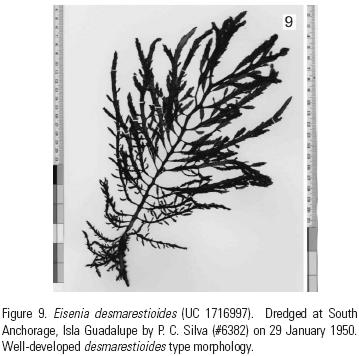
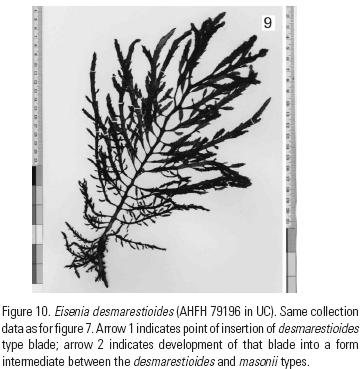
<body><![CDATA[<p align="justify"><font face="verdana" size="2">A fragmentary blade with very long and narrow simple pinnae was collected at the same site on Isla Guadalupe by Carl L. Hubbs in August 1946 while on the Flynn&#150;Zaca Expedition. This specimen (<a href="#f5">Fig. 5</a>) was identified by E. Yale Dawson as <i>E. desmarestioides</i>. Two additional fragmentary blades (<a href="#f3">Figs. 3</a>, <a href="#f4">4</a>) were collected by Hubbs in December 1946 while on the E. W. Scripps Expedition.</font></p>     <p align="center"><font face="verdana" size="2"><a name="f5"></a></font></p>     <p align="center"><font face="verdana" size="2"><img src="/img/revistas/hbio/v18n2/a9f5.jpg"></font></p>     <p align="center"><font face="verdana" size="2"><a name="f3"></a></font></p>     <p align="center"><font face="verdana" size="2"><img src="/img/revistas/hbio/v18n2/a9f3.jpg"></font></p>     <p align="center"><font face="verdana" size="2"><a name="f4"></a></font></p>     <p align="center"><font face="verdana" size="2"><img src="/img/revistas/hbio/v18n2/a9f4.jpg"></font></p>     <p align="justify"><font face="verdana" size="2">Both were referred to <i>E. masonii </i>by Dawson. The latter collection was the first to provide information on the depth of occurrence (24.5&#150;27 fms = 45&#150;49 m). Stewart and Stewart (1984) reported that <i>Eisenia </i>was the only conspicuous seaweed at depths of 20&#150;33 m in an unmarked inlet near Caleta Melp&oacute;mene that they named "Chaetodon Cove". A specimen from this collection, which was not used in this study, was deposited at CMMEX (Herbario, Facultad de Ciencias Marinas, Universidad Aut&oacute;noma de Baja California).</font></p>     <p align="justify"><font face="verdana" size="2">In cooperation with the San Diego Natural History Museum, the J. W. Sefton Foundation sponsored an expedition to the islands off the coast of Baja California in January 1950, operating with the R.V. Orca. As phycologist on that expedition, I collected entire thalli of <i>Eisenia </i>on rocks in the upper subtidal zone at West Anchorage, Isla Guadalupe, and several more from dredge hauls taken at Caleta Melp&oacute;mene. In addition, Conrad Limbaugh, the designated diver of the expedition, collected an entire thallus in Caleta Melp&oacute;mene at a depth of 4&#150;5 m. These collections confirmed that the generic placement of <i>E. masonii </i>and <i>E. desmarestioides </i>by Setchell and Gardner was correct, although the degree of dissection of the blades was unmatched in all other species of the genus.</font></p>     <p align="justify"><font face="verdana" size="2">Several entire thalli obtained by the Sefton Expedition were made into herbarium specimens. Although they pose no problem on the generic level, they raise serious questions regarding the biological validity of the two species described by Setchell and Gardner. In the development of the thallus of <i>Eisenia</i>, the primary blade erodes from the apex to the meristematic region, which then divides longitudinally to produce two pseudostipes. Setchell (1905) described the development of the blade of <i>Eisenia arborea </i>Areschoug as follows: "The basal margins of the blade begin to thicken and to turn in on one side of the frond... While this is going on the blade becomes shorter and wider, while the pinnules, or sporophylls, become longer and more toothed. After a time...the blade wears away gradually until it disappears almost entirely except for the small side pieces, ligules, each bearing a bunch of sporophylls. The bases of the ligules possess meristematic tissues. These arms may reach the length of 30 cm or more and become thickened so that they look like branches... As the arms increase in length they make a half twist, so that the portion of the ligule on which the young sporophylls are making their appearance as slight outgrowths, are pointing inward instead of outward...". In some complete thalli obtained by the Sefton Expedition (1950) and by John Hansen (1972) from Isla Guadalupe, the two pseudostipes appear to have produced very different blades, one resembling <i>E. masonii</i>, the other resembling <i>E. desmarestioides </i>(<a href="#f6">Fig. 6</a>). Close examination of these dimorphic thalli reveals that the <i>desmarestioides </i>blades are initiated at the base of the pseudostipes, subtending the mass of broader <i>masonii</i>&#150;type blades (<a href="#f7">Fig. 7</a>). The basal position of the <i>desmarestioides </i>initials is evident even on juvenile plants, before the formation of the pseudostipes (<a href="#f8">Fig. 8</a>). These <i>desmarestioides </i>initials develop either into fully <i>desmarestoides </i>blades (<a href="#f2">Figs. 2</a>, <a href="#f5">5</a>, <a href="#f9">9</a>) or into blades intermediate between the <i>masonii </i>and <i>desmarestioides </i>types (<a href="#f10">Fig. 10</a>), all with a stipe&#150;like base.</font></p>     ]]></body>
<body><![CDATA[<p align="center"><font face="verdana" size="2"><a name="f6"></a></font></p>     <p align="center"><font face="verdana" size="2"><img src="/img/revistas/hbio/v18n2/a9f6.jpg"></font></p>     <p align="center"><font face="verdana" size="2"><a name="f7"></a></font></p>     <p align="center"><font face="verdana" size="2"><img src="/img/revistas/hbio/v18n2/a9f7.jpg"></font></p>     <p align="center"><font face="verdana" size="2"><a name="f8"></a></font></p>     <p align="center"><font face="verdana" size="2"><img src="/img/revistas/hbio/v18n2/a9f8.jpg"></font></p>     <p align="center"><font face="verdana" size="2"><a name="f9"></a></font></p>     <p align="center"><font face="verdana" size="2"><img src="/img/revistas/hbio/v18n2/a9f9.jpg"></font></p>     <p align="center"><font face="verdana" size="2"><a name="f10"></a></font></p>     <p align="center"><font face="verdana" size="2"><img src="/img/revistas/hbio/v18n2/a9f10.jpg"></font></p>     ]]></body>
<body><![CDATA[<p align="justify"><font face="verdana" size="2">Fertile sori occur on <i>masonii</i>&#150;type blades (<a href="#f3">Figs. 3</a>, <a href="#f4">4</a>), but have not been observed on <i>desmarestioides </i>blades. Thus, despite their specific location at the base of the pseudostipes and their strong morphological differentiation, these blades are not specialized sporophylls. This blade dimorphism has not been observed in other species of <i>Eisenia</i>. While the basis of the morphological variability in <i>Eisenia </i>spp. on Isla Guadalupe cannot be deduced without further study, it is clear that only one species is involved, for which I choose to retain the name <i>Eisenia desmarestioides</i>.</font></p>     <p align="justify"><font face="verdana" size="2">&nbsp;</font></p>     <p align="justify"><font face="verdana" size="2"><b>ACKNOWLEDGEMENTS</b></font></p>     <p align="justify"><font face="verdana" size="2">I thank Kathy Ann Miller for her endearing support and invaluable help in preparing this manuscript. Relying on her extensive field experience with <i>Eisenia arborea </i>Areschoug in the Channel Islands of southern California, she contributed significantly to an interpretation of the complex morphological variability in <i>Eisenia desmarestioides. </i>Max Chacana kindly provided the Spanish summary. I also want to acknowledge the generosity of the late Joseph W. Sefton, Jr., who had faith in the scientific promise of graduate students. Lastly, I express my warm memories of Conrad Limbaugh, who died in a tragic diving accident off the French Mediterranean coast (Port&#150;Miou, near Marseilles) on 20 March 1960. Conrad introduced SCUBA diving to the west coast of the United States in 1949 and, ironically, had become an internationally known authority on underwater safety. His subtidal exploration during the Sefton Expedition was astonishing to those on board the Orca. Few of us envisioned the time when such activity was not only commonplace, but a requisite for marine biological research.</font></p>     <p align="justify"><font face="verdana" size="2">&nbsp;</font></p>     <p align="justify"><font face="verdana" size="2"><b>REFERENCES</b></font></p>     <!-- ref --><p align="justify"><font face="verdana" size="2">Hanna, G. D. 1926. Expedition to the Revillagigedo Islands, Mexico, in 1925. General report. <i>Proceedings of the California Academy of Sciences, </i>Ser. 4, 15: 1&#150;113.</font>&nbsp;&nbsp;&nbsp;&nbsp;&nbsp;&nbsp;&nbsp;&nbsp;[&#160;<a href="javascript:void(0);" onclick="javascript: window.open('/scielo.php?script=sci_nlinks&ref=4072289&pid=S0188-8897200800020000900001&lng=','','width=640,height=500,resizable=yes,scrollbars=1,menubar=yes,');">Links</a>&#160;]<!-- end-ref --><!-- ref --><p align="justify"><font face="verdana" size="2">Setchell, W. A. 1905. Post&#150;embryonal stages of the Laminariaceae. <i>University of California Publications in Botany </i>2: 115&#150;138.</font>&nbsp;&nbsp;&nbsp;&nbsp;&nbsp;&nbsp;&nbsp;&nbsp;[&#160;<a href="javascript:void(0);" onclick="javascript: window.open('/scielo.php?script=sci_nlinks&ref=4072290&pid=S0188-8897200800020000900002&lng=','','width=640,height=500,resizable=yes,scrollbars=1,menubar=yes,');">Links</a>&#160;]<!-- end-ref --><!-- ref --><p align="justify"><font face="verdana" size="2">Setchell, W. A. &amp; N.L. Gardner. 1930. Marine algae of the Revillagigedo Islands Expedition in 1925. <i>Proceedings of the California Academy of Sciences, Ser. 4, </i>19: 109&#150;215.</font>&nbsp;&nbsp;&nbsp;&nbsp;&nbsp;&nbsp;&nbsp;&nbsp;[&#160;<a href="javascript:void(0);" onclick="javascript: window.open('/scielo.php?script=sci_nlinks&ref=4072291&pid=S0188-8897200800020000900003&lng=','','width=640,height=500,resizable=yes,scrollbars=1,menubar=yes,');">Links</a>&#160;]<!-- end-ref --><!-- ref --><p align="justify"><font face="verdana" size="2">Silva, P. C. &amp; M. E. Chacana. 2005. Marine algae from Islas San F&eacute;lix y San Ambrosio (Chilean oceanic islands). <i>Cryptogamie: Algologie </i>26: 103&#150;118.</font>&nbsp;&nbsp;&nbsp;&nbsp;&nbsp;&nbsp;&nbsp;&nbsp;[&#160;<a href="javascript:void(0);" onclick="javascript: window.open('/scielo.php?script=sci_nlinks&ref=4072292&pid=S0188-8897200800020000900004&lng=','','width=640,height=500,resizable=yes,scrollbars=1,menubar=yes,');">Links</a>&#160;]<!-- end-ref --><!-- ref --><p align="justify"><font face="verdana" size="2">Stewart, J. G. &amp; J. R. Stewart. 1984. Marine algae of Guadalupe Island, Mexico, including a checklist. <i>Ciencias Marinas </i>10: 129&#150;148.</font>&nbsp;&nbsp;&nbsp;&nbsp;&nbsp;&nbsp;&nbsp;&nbsp;[&#160;<a href="javascript:void(0);" onclick="javascript: window.open('/scielo.php?script=sci_nlinks&ref=4072293&pid=S0188-8897200800020000900005&lng=','','width=640,height=500,resizable=yes,scrollbars=1,menubar=yes,');">Links</a>&#160;]<!-- end-ref --> ]]></body><back>
<ref-list>
<ref id="B1">
<nlm-citation citation-type="journal">
<person-group person-group-type="author">
<name>
<surname><![CDATA[Hanna]]></surname>
<given-names><![CDATA[G. D.]]></given-names>
</name>
</person-group>
<article-title xml:lang="en"><![CDATA[Expedition to the Revillagigedo Islands, Mexico, in 1925. General report]]></article-title>
<source><![CDATA[Proceedings of the California Academy of Sciences, Ser]]></source>
<year>1926</year>
<volume>4</volume>
<numero>15</numero>
<issue>15</issue>
<page-range>1-113</page-range></nlm-citation>
</ref>
<ref id="B2">
<nlm-citation citation-type="journal">
<person-group person-group-type="author">
<name>
<surname><![CDATA[Setchell]]></surname>
<given-names><![CDATA[W. A.]]></given-names>
</name>
</person-group>
<article-title xml:lang="en"><![CDATA[Post-embryonal stages of the Laminariaceae]]></article-title>
<source><![CDATA[University of California Publications in Botany]]></source>
<year>1905</year>
<volume>2</volume>
<page-range>115-138</page-range></nlm-citation>
</ref>
<ref id="B3">
<nlm-citation citation-type="journal">
<person-group person-group-type="author">
<name>
<surname><![CDATA[Setchell]]></surname>
<given-names><![CDATA[W. A.]]></given-names>
</name>
<name>
<surname><![CDATA[Gardner]]></surname>
<given-names><![CDATA[N.L.]]></given-names>
</name>
</person-group>
<article-title xml:lang="en"><![CDATA[Marine algae of the Revillagigedo Islands Expedition in 1925]]></article-title>
<source><![CDATA[Proceedings of the California Academy of Sciences, Ser]]></source>
<year>1930</year>
<volume>4</volume>
<numero>19</numero>
<issue>19</issue>
<page-range>109-215</page-range></nlm-citation>
</ref>
<ref id="B4">
<nlm-citation citation-type="journal">
<person-group person-group-type="author">
<name>
<surname><![CDATA[Silva]]></surname>
<given-names><![CDATA[P. C.]]></given-names>
</name>
<name>
<surname><![CDATA[Chacana]]></surname>
<given-names><![CDATA[M. E.]]></given-names>
</name>
</person-group>
<article-title xml:lang="en"><![CDATA[Marine algae from Islas San Félix y San Ambrosio (Chilean oceanic islands)]]></article-title>
<source><![CDATA[Cryptogamie: Algologie]]></source>
<year>2005</year>
<volume>26</volume>
<page-range>103-118</page-range></nlm-citation>
</ref>
<ref id="B5">
<nlm-citation citation-type="journal">
<person-group person-group-type="author">
<name>
<surname><![CDATA[Stewart]]></surname>
<given-names><![CDATA[J. G.]]></given-names>
</name>
<name>
<surname><![CDATA[Stewart]]></surname>
<given-names><![CDATA[J. R.]]></given-names>
</name>
</person-group>
<article-title xml:lang="en"><![CDATA[Marine algae of Guadalupe Island, Mexico, including a checklist]]></article-title>
<source><![CDATA[Ciencias Marinas]]></source>
<year>1984</year>
<volume>10</volume>
<page-range>129-148</page-range></nlm-citation>
</ref>
</ref-list>
</back>
</article>