<?xml version="1.0" encoding="ISO-8859-1"?><article xmlns:mml="http://www.w3.org/1998/Math/MathML" xmlns:xlink="http://www.w3.org/1999/xlink" xmlns:xsi="http://www.w3.org/2001/XMLSchema-instance">
<front>
<journal-meta>
<journal-id>0188-8897</journal-id>
<journal-title><![CDATA[Hidrobiológica]]></journal-title>
<abbrev-journal-title><![CDATA[Hidrobiológica]]></abbrev-journal-title>
<issn>0188-8897</issn>
<publisher>
<publisher-name><![CDATA[Universidad Autónoma Metropolitana, División de Ciencias Biológicas y de la Salud]]></publisher-name>
</publisher>
</journal-meta>
<article-meta>
<article-id>S0188-88972007000300010</article-id>
<title-group>
<article-title xml:lang="en"><![CDATA[Ecological data for Myxine circifrons Garman, 1899 (Myxiniformes: Myxinidae) in the gulf of California, Mexico]]></article-title>
<article-title xml:lang="es"><![CDATA[Información ecológica de Myxine circifrons Garman, 1899 (Myxiniformes: Myxinidae) en el golfo de California, México]]></article-title>
</title-group>
<contrib-group>
<contrib contrib-type="author">
<name>
<surname><![CDATA[Hendrickx]]></surname>
<given-names><![CDATA[Michel E.]]></given-names>
</name>
<xref ref-type="aff" rid="A01"/>
</contrib>
<contrib contrib-type="author">
<name>
<surname><![CDATA[Hastings]]></surname>
<given-names><![CDATA[Philip A.]]></given-names>
</name>
<xref ref-type="aff" rid="A02"/>
</contrib>
</contrib-group>
<aff id="A01">
<institution><![CDATA[,Universidad Nacional Autónoma de México Unidad Académica Mazatlán Instituto de Ciencias del Mar y Limnología]]></institution>
<addr-line><![CDATA[Mazatlán Sinaloa]]></addr-line>
<country>México</country>
</aff>
<aff id="A02">
<institution><![CDATA[,University of California at San Diego Scripps Institution of Oceanography Marine Biology Research Division]]></institution>
<addr-line><![CDATA[La Jolla California]]></addr-line>
<country>Estados Unidos de América</country>
</aff>
<pub-date pub-type="pub">
<day>00</day>
<month>00</month>
<year>2007</year>
</pub-date>
<pub-date pub-type="epub">
<day>00</day>
<month>00</month>
<year>2007</year>
</pub-date>
<volume>17</volume>
<numero>3</numero>
<fpage>273</fpage>
<lpage>276</lpage>
<copyright-statement/>
<copyright-year/>
<self-uri xlink:href="http://www.scielo.org.mx/scielo.php?script=sci_arttext&amp;pid=S0188-88972007000300010&amp;lng=en&amp;nrm=iso"></self-uri><self-uri xlink:href="http://www.scielo.org.mx/scielo.php?script=sci_abstract&amp;pid=S0188-88972007000300010&amp;lng=en&amp;nrm=iso"></self-uri><self-uri xlink:href="http://www.scielo.org.mx/scielo.php?script=sci_pdf&amp;pid=S0188-88972007000300010&amp;lng=en&amp;nrm=iso"></self-uri><abstract abstract-type="short" xml:lang="en"><p><![CDATA[Specimens of the hagfish Myxine circifrons Garman, 1899, were captured in traps in three sampling stations in the southern gulf of California, Mexico. There was no clear relation between oxygen concentration and hagfish abundance. This species appears to be tolerant of moderate (0.28-0.6 ml/l) hypoxia. Other species collected in the traps include Pandalus amplus (Bate, 1888) and Heterocarpus affinis Faxon, 1893, two relatively large species of Pandalidae, and Lebbeus scrippsi Wicksten and Méndez, 1982, a small-size Hippolytidae shrimp. Capture of pandalids was low when hagfish were abundant, thus indicating that competition between the fish and shrimps might prevent the latter to enter the trap.]]></p></abstract>
<abstract abstract-type="short" xml:lang="es"><p><![CDATA[Especimenes de mixínas (peces brujas), Myxine circifrons Garman, 1899, fueron capturados con trampas en tres estaciones de muestreo en el golfo de California, México. No se observó una relación clara entre la concentración de oxígeno y la abundancia de los especímenes. La especie parece ser tolerante a un ambiente moderadamente hipóxico (0.28-0.6 ml/L). Otras especies recolectadas con las trampas incluyeron los crustáceos Pandalus amplus (Bate, 1888) y Heterocarpus affinis Faxon, 1893, dos especies relativamente grandes de Pandalidae y a Lebbeus scrippsi Wicksten y Méndez, 1982, un camarón Hippolytidae de tamaño pequeño. La captura de pandálidos en las trampas fue baja cuando los peces bruja eran abundantes, indicando así que la competencia entre éstos y los camarones pudo impedir que estos últimos entraran en la trampa.]]></p></abstract>
<kwd-group>
<kwd lng="en"><![CDATA[Myxine circifrons]]></kwd>
<kwd lng="en"><![CDATA[Myxiniformes]]></kwd>
<kwd lng="en"><![CDATA[gulf of California]]></kwd>
<kwd lng="en"><![CDATA[Mexico]]></kwd>
<kwd lng="en"><![CDATA[new records]]></kwd>
<kwd lng="es"><![CDATA[Myxine circifrons]]></kwd>
<kwd lng="es"><![CDATA[Myxiniformes]]></kwd>
<kwd lng="es"><![CDATA[golfo de California]]></kwd>
<kwd lng="es"><![CDATA[México]]></kwd>
<kwd lng="es"><![CDATA[nuevos registros]]></kwd>
</kwd-group>
</article-meta>
</front><body><![CDATA[  	    <p align="justify"><font face="verdana" size="4">Notas cient&iacute;ficas</font></p>      <p>&nbsp;</p>  	    <p align="center"><font face="verdana" size="4"><b>Ecological data for <i>Myxine circifrons</i> Garman, 1899 (Myxiniformes: Myxinidae) in the gulf of California, Mexico</b></font></p>  	    <p>&nbsp;</p>  	    <p align="center"><font face="verdana" size="3"><b>Informaci&oacute;n ecol&oacute;gica de <i>Myxine circifrons</i> Garman, 1899 (Myxiniformes: Myxinidae) en el golfo de California, M&eacute;xico</b></font></p>  	    <p>&nbsp;</p>  	    <p align="center"><font face="verdana" size="2"><b>Michel E. Hendrickx<sup>1</sup> and Philip A. Hastings<sup>2</sup></b></font></p>  	    <p>&nbsp;</p>  	    <p align="justify"><font face="verdana" size="2"><i>(1) Unidad Acad&eacute;mica Mazatl&aacute;n, Laboratorio de Invertebrados Bent&oacute;nicos, Instituto de Ciencias del Mar y Limnolog&iacute;a, Universidad Nacional Aut&oacute;noma de M&eacute;xico, P. O. Box 811, Mazatl&aacute;n, 82000, Sinaloa.</i> <a href="mailto:michel@ola.icmyl.unam.mx">michel@ola.icmyl.unam.mx</a>)</font></p>  	    ]]></body>
<body><![CDATA[<p align="justify"><font face="verdana" size="2"><i>(2) Marine Biology Research Division, Scripps Institution of Oceanography, University of California San Diego, 9500 Gilman Dr., La Jolla, CA 92093&#45;0208.</i></font></p>  	    <p>&nbsp;</p>  	    <p align="justify"><font face="verdana" size="2">Recibido: 19 de octubre de 2006    <br> 	Aceptado: 5 de octubre de 2007</font></p>  	    <p>&nbsp;</p>  	    <p align="justify"><font face="verdana" size="2"><b>Abstract</b></font></p>  	    <p align="justify"><font face="verdana" size="2">Specimens of the hagfish <i>Myxine circifrons</i> Garman, 1899, were captured in traps in three sampling stations in the southern gulf of California, Mexico. There was no clear relation between oxygen concentration and hagfish abundance. This species appears to be tolerant of moderate (0.28&#45;0.6 ml/l) hypoxia. Other species collected in the traps include <i>Pandalus amplus</i> (Bate, 1888) and <i>Heterocarpus affinis</i> Faxon, 1893, two relatively large species of Pandalidae, and <i>Lebbeus scrippsi</i> Wicksten and M&eacute;ndez, 1982, a small&#45;size Hippolytidae shrimp. Capture of pandalids was low when hagfish were abundant, thus indicating that competition between the fish and shrimps might prevent the latter to enter the trap.</font></p>  	    <p align="justify"><font face="verdana" size="2"><b>Keywords:</b> <i>Myxine circifrons</i>, Myxiniformes, gulf of California, Mexico, new records.</font></p>  	    <p>&nbsp;</p>  	    <p align="justify"><font face="verdana" size="2"><b>Resumen</b></font></p>  	    ]]></body>
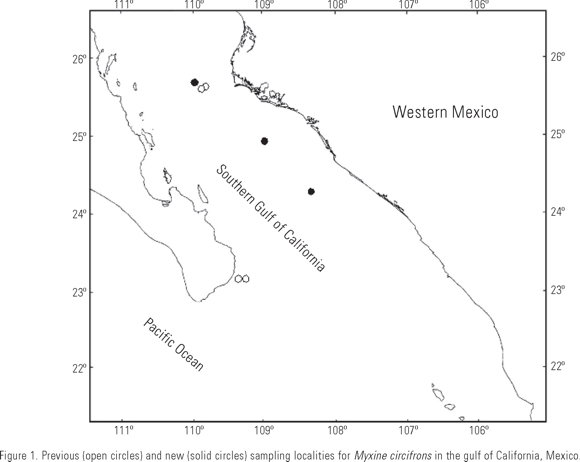
<body><![CDATA[<p align="justify"><font face="verdana" size="2">Especimenes de mix&iacute;nas (peces brujas), <i>Myxine circifrons</i> Garman, 1899, fueron capturados con trampas en tres estaciones de muestreo en el golfo de California, M&eacute;xico. No se observ&oacute; una relaci&oacute;n clara entre la concentraci&oacute;n de ox&iacute;geno y la abundancia de los espec&iacute;menes. La especie parece ser tolerante a un ambiente moderadamente hip&oacute;xico (0.28&#45;0.6 ml/L). Otras especies recolectadas con las trampas incluyeron los crust&aacute;ceos <i>Pandalus amplus</i> (Bate, 1888) y <i>Heterocarpus affinis</i> Faxon, 1893, dos especies relativamente grandes de Pandalidae y a <i>Lebbeus scrippsi</i> Wicksten y M&eacute;ndez, 1982, un camar&oacute;n Hippolytidae de tama&ntilde;o peque&ntilde;o. La captura de pand&aacute;lidos en las trampas fue baja cuando los peces bruja eran abundantes, indicando as&iacute; que la competencia entre &eacute;stos y los camarones pudo impedir que estos &uacute;ltimos entraran en la trampa.</font></p>  	    <p align="justify"><font face="verdana" size="2"><b>Palabras clave:</b> <i>Myxine circifrons</i>, Myxiniformes, golfo de California, M&eacute;xico, nuevos registros.</font></p>  	    <p>&nbsp;</p>  	    <p align="justify"><font face="verdana" size="2">Hagfishes include approximately 70 species of jawless, eel&#45;like chordates that are typically associated with muddy substrates and found in marine waters from a few meters to at least 2,700 m depth (Mincarone, 2001; Nelson, 2006). Their potential importance in marine communities is indicated by their often high biomass that has been estimated at over 8,000 kg km<sup>&#45;2</sup> for <i>Myxine glutinosa</i> Linnaeus, 1758 in the gulf of Maine (Martini <i>et al</i>., 1997). Increasing demand for hagfish skin in the South Korean market has brought increased pressure on the hagfish fishery in Canada and the USA, and revenues reached ca $100 million US in 1990 for this Asian country (Gorbman <i>et al.</i>, 1990; Grey <i>et al</i>., 2006).</font></p>  	    <p align="justify"><font face="verdana" size="2">During a survey in the SE gulf of California to evaluate the potential of benthic traps to capture the caridean shrimp <i>Heterocarpus affinis</i> Faxon, 1893, a commercially interesting species that had been collected previously in the area using a benthic sledge (see Hendrickx, 2004), the hagfish <i>Myxine circifrons</i> Garman, 1899 was caught in approximately 75% of the traps. The genus <i>Myxine</i> includes 22 species of hagfishes, of which six have been recorded in the East Pacific (Wisner &amp; McMillan, 1995; Mincarone, 2001; M&oslash;ller <i>et al</i>., 2005). Two of these are found in the northern hemisphere of the East Pacific: <i>M. circifrons</i> and <i>M. hubbsi</i> (Wisner &amp; McMillan, 1995). Herein we report on the abundance of <i>M. circifrons</i> and some environmental data measured during this survey.</font></p>  	    <p align="justify"><font face="verdana" size="2">A small series of deep&#45;water traps (three at each station) were deployed in three field stations in April 2002 during the PANDAL Cruise to the gulf of California, Mexico by the R/V "El Puma" of the Instituto de Ciencias del Mar y Limnolog&iacute;a, UNAM, using an anchor attached to 1.2 cm tick polyethylene cable and a double buoys system (King, 1987). Fish&#45;heads were used as bait. Traps remained on the bottom for different periods of time due to navigation time restrictions. At each station, a CTD&#45;O<sub>2</sub> probe (Seabird SBE probe) attached to a Rosette sampler was submerged to approximately 10 m above the bottom; water samples were simultaneously collected with opening&#45;closing bottles. Dissolved oxygen content was measured using duplicate samples following the Winkler method. Fish specimens were preserved onboard, measured in the laboratory (TL, total length &plusmn; 0.5 mm), and identified using the key in Wisner and McMillan (1995). Voucher material (SIO 05&#45;83; ICMYL&#45;353.01) was deposited at the Scripps Institution of Oceanography Marine Vertebrate Collection and the fish collection of the Unidad Acad&eacute;mica Mazatl&aacute;n, in Mazatlan, Mexico.</font></p>  	    <p align="justify"><font face="verdana" size="2">A total of 69 specimens of adult <i>Myxine circifrons</i> were captured in the 9 samples (3 traps at each of 3 stations). The smallest specimen was 312 mm TL and the largest 471 mm. Most specimens were found inside traps, but a few were found attached to the external walls when the traps were retrieved on deck. Collection details are as follows. Station 1 (24<sup>o</sup>17.36'N, 108<sup>o</sup>21.86'W), 1150 m, trap 1: 7 specimens (TL 312&#45;455 mm); Station 2 (24<sup>o</sup>51.33'N, 108<sup>o</sup>57.37'W), 850 m: trap 1, 17 specimens (TL 395&#45;472 mm), trap 2, 6 specimens (TL 378&#45;450 mm); Station 3 (25<sup>o</sup>40.83'N, 109<sup>o</sup>54.38'W), 1435 m: trap 1, 16 specimens (TL 330&#45;452 mm), trap 2, 6 specimens (TL 350&#45;435 mm), trap 3, 17 specimens (TL 360&#45;471 mm).</font></p>  	    <p align="justify"><font face="verdana" size="2">The number of specimens captured per trap varied considerably, from none (St. 1, two traps with no hagfish) to 17 specimens. Catch per station estimated for a standard 24&#45;hour period was 3.9 specimens (St. 1), 9.2 (St. 3) and 31.3 specimens (St. 2) (<a href="/img/revistas/hbio/v17n3/a10c1.jpg" target="_blank">Table 1</a>). Dissolved oxygen measured close to the bottom level does not indicate any clear relation between oxygen concentration and hagfish abundance. Thus this species, like other hagfishes (e.g., Hansen &amp; Sidell, 1983) appears to be tolerant of moderate (0.28&#45;0.6 ml/L) hypoxia, but was also found in water with a higher oxygen concentration (St. 3, 1.15 ml/L). The oxygen concentrations measured in the sampling area correspond well with previous records in the region, with a remarkable increase starting at depth &gt; 700&#45;800 m after an almost anoxic zone (MOZ, Minimum Oxygen Zone) that extended roughly from 150 to 750 m (Hendrickx, 2001). Epibenthic water temperatures (from 3.0 to 5.3<sup>o</sup> C) were in agreement with standard depth distribution of water masses between 850 and 1,435 m in the SE gulf of California (Alvarez&#45;Borrego, 1983).</font></p>  	      <p align="justify"><font face="verdana" size="2">Only a few other species were collected in the traps, including <i>Pandalus amplus</i> (Bate, 1888) and <i>H. affinis</i>, two relatively large species of Pandalidae with potentially high commercial market value (Holthuis, 1980; Hendrickx &amp; Wicksten, 1989). The third species that incidentally appeared in the traps was <i>Lebbeus scrippsi</i> Wicksten and M&eacute;ndez, 1982, a small&#45;size Hippolytidae shrimp. Capture of pandalids were low when hagfish were abundant, thus indicating that the presence of the fish on the trap walls might prevent the shrimp from gaining access to the entrance and the bait. Videos recorded near baits show that hagfish and pandalids are the first species to reach the remains of dead fish and competition among these two groups might be intense. Interestingly, a record of <i>M. circifrons</i> from off Colombia was recently reported from similar traps targeting a related species, <i>Heterocarpus hostilis</i> Faxon, 1893 (Rubio <i>et al</i>., 2005). The co&#45;occurrence of hagfishes with these targeted shrimp species indicates that development of these fisheries will need to take into account the interactions of hagfishes in the capture of these shrimp species.</font></p>  	    <p align="justify"><font face="verdana" size="2"><i>Myxine circifrons</i> is known from off San Francisco, USA, to Chile at depths between ca 700 and 1,860 m. Previous records for this species are provided by Wisner and McMillan (1995), and include four samples from the gulf of California obtained between 1,190 and 1,830 m depth (<a href="../../../../../img/revistas/hbio/v17n3/a10c2.jpg" target="_blank">Table 2</a>). Depth records obtained during this survey correspond to the known range. <i>Myxine hubbsi</i>, the second eastern Pacific species of the genus recorded in the northern hemisphere, is known from 33<sup>o</sup> N to 34<sup>o</sup> S, including two localities near Cabo San Lucas, Mexico, close to the western entrance of the gulf of California. The only other hagfish species recorded from the gulf of California are <i>Eptatretus sinus</i> (Wisner &amp; McMillan 1990), known from the midriff islands area in depths of 198 to 1,330 m, and <i>Eptatretus mcconnaugheyi</i> Wisner and McMillan, 1990, recorded from near Isla Carmen in depths of 177&#45;415 m (Wisner &amp; McMillan, 1990).</font></p>  	  	    ]]></body>
<body><![CDATA[<p>&nbsp;</p>  	    <p align="justify"><font face="verdana" size="2"><b>Acknowledgments</b></font></p>  	    <p align="justify"><font face="verdana" size="2">The authors thank the staff and crew of the R/V "El Puma" who assisted during the sampling, D. Serrano for operating the CTD&#45;O<sub>2</sub>, E. Zatarin and C. Esquer for providing Winkler measurements, H. J. Walker for curatorial assistance, S. Ibarra for measuring specimens and A. Galaviz for providing map of <a href="#f1">Figure 1</a>.</font></p>  	    <p align="center"><font face="verdana" size="2"><a name="f1"></a></font></p>  	    <p align="center"><font face="verdana" size="2"><img src="/img/revistas/hbio/v17n3/a10f1.jpg"></font></p>  	    <p>&nbsp;</p>  	    <p align="justify"><font face="verdana" size="2"><b>References</b></font></p>  	    <!-- ref --><p align="justify"><font face="verdana" size="2">ALVAREZ&#45;BORREGO, S. 1983. gulf of California. <i>In</i>: B. K. H. Ketchum (Ed.). <i>Ecosystems of the World</i>. 26. <i>Estuaries and enclosed seas</i>. Elsevier Scientific Publishing Company. pp. 427&#45;449.    &nbsp;&nbsp;&nbsp;&nbsp;&nbsp;&nbsp;&nbsp;&nbsp;[&#160;<a href="javascript:void(0);" onclick="javascript: window.open('/scielo.php?script=sci_nlinks&ref=4092664&pid=S0188-8897200700030001000001&lng=','','width=640,height=500,resizable=yes,scrollbars=1,menubar=yes,');">Links</a>&#160;]<!-- end-ref --></font></p>  	    <!-- ref --><p align="justify"><font face="verdana" size="2">GORBMAN, A., H. KOBAYASHI, Y. HONMA &amp; M. MATSUYAMA. 1990. The hagfishery of Japan. <i>Fisheries</i> 15: 12&#45;18.    &nbsp;&nbsp;&nbsp;&nbsp;&nbsp;&nbsp;&nbsp;&nbsp;[&#160;<a href="javascript:void(0);" onclick="javascript: window.open('/scielo.php?script=sci_nlinks&ref=4092666&pid=S0188-8897200700030001000002&lng=','','width=640,height=500,resizable=yes,scrollbars=1,menubar=yes,');">Links</a>&#160;]<!-- end-ref --></font></p>  	    <!-- ref --><p align="justify"><font face="verdana" size="2">GREY, M., A. BLAIS, B. HUNT &amp; A. C. J. VINCENT. 2006. The USA's international trade in fish leather, from a conservation perspective. <i>Environmental Conservation</i> 2006: 1&#45;9.    &nbsp;&nbsp;&nbsp;&nbsp;&nbsp;&nbsp;&nbsp;&nbsp;[&#160;<a href="javascript:void(0);" onclick="javascript: window.open('/scielo.php?script=sci_nlinks&ref=4092668&pid=S0188-8897200700030001000003&lng=','','width=640,height=500,resizable=yes,scrollbars=1,menubar=yes,');">Links</a>&#160;]<!-- end-ref --></font></p>  	    <!-- ref --><p align="justify"><font face="verdana" size="2">HANSEN, C. A. &amp; B. D. SIDELL. 1983. Atlantic hagfish cardiac muscle: metabolic basis of tolerance of anoxia. <i>American Journal of Physiology &#45; Regulatory Integrative and Comparative Physiology</i> 244: 356&#45;362.    &nbsp;&nbsp;&nbsp;&nbsp;&nbsp;&nbsp;&nbsp;&nbsp;[&#160;<a href="javascript:void(0);" onclick="javascript: window.open('/scielo.php?script=sci_nlinks&ref=4092670&pid=S0188-8897200700030001000004&lng=','','width=640,height=500,resizable=yes,scrollbars=1,menubar=yes,');">Links</a>&#160;]<!-- end-ref --></font></p>  	    <!-- ref --><p align="justify"><font face="verdana" size="2">HENDRICKX, M. E. 2001. Occurrence of a continental slope decapod crustacean community along the edge of the minimum oxygen zone in the southeastern gulf of California, Mexico. <i>Belgian Journal of Zoology</i> 131 (Suppl. 2): 95&#45;109.    &nbsp;&nbsp;&nbsp;&nbsp;&nbsp;&nbsp;&nbsp;&nbsp;[&#160;<a href="javascript:void(0);" onclick="javascript: window.open('/scielo.php?script=sci_nlinks&ref=4092672&pid=S0188-8897200700030001000005&lng=','','width=640,height=500,resizable=yes,scrollbars=1,menubar=yes,');">Links</a>&#160;]<!-- end-ref --></font></p>  	    <!-- ref --><p align="justify"><font face="verdana" size="2">HENDRICKX, M. E. 2004. Distribution and estimation of body size and weight of four species of deep water shrimps in the SE gulf of California, Mexico. <i>Crustaceana</i> 76: 1025&#45;1036.    &nbsp;&nbsp;&nbsp;&nbsp;&nbsp;&nbsp;&nbsp;&nbsp;[&#160;<a href="javascript:void(0);" onclick="javascript: window.open('/scielo.php?script=sci_nlinks&ref=4092674&pid=S0188-8897200700030001000006&lng=','','width=640,height=500,resizable=yes,scrollbars=1,menubar=yes,');">Links</a>&#160;]<!-- end-ref --></font></p>  	    <!-- ref --><p align="justify"><font face="verdana" size="2">HENDRICKX, M. E. &amp; M. K. WICKSTEN. 1989. Los Pandalidae (Crustacea: Caridea) del Pac&iacute;fico mexicano, con una clave para su identificaci&oacute;n. <i>Caldasia</i> (Colombia) 16: 71&#45;86.    &nbsp;&nbsp;&nbsp;&nbsp;&nbsp;&nbsp;&nbsp;&nbsp;[&#160;<a href="javascript:void(0);" onclick="javascript: window.open('/scielo.php?script=sci_nlinks&ref=4092676&pid=S0188-8897200700030001000007&lng=','','width=640,height=500,resizable=yes,scrollbars=1,menubar=yes,');">Links</a>&#160;]<!-- end-ref --></font></p>  	    <!-- ref --><p align="justify"><font face="verdana" size="2">HOLTHUIS, L. B. 1980. FAO species catalogue. Vol. I. Shrimps and prawns of the world. An annotated catalogue of species of interest to fisheries. <i>FAO Fisheries Synopses</i> 1: 1&#45;271.    &nbsp;&nbsp;&nbsp;&nbsp;&nbsp;&nbsp;&nbsp;&nbsp;[&#160;<a href="javascript:void(0);" onclick="javascript: window.open('/scielo.php?script=sci_nlinks&ref=4092678&pid=S0188-8897200700030001000008&lng=','','width=640,height=500,resizable=yes,scrollbars=1,menubar=yes,');">Links</a>&#160;]<!-- end-ref --></font></p>  	    <!-- ref --><p align="justify"><font face="verdana" size="2">KING, M. 1987. Distribution and ecology of deep&#45;water caridean shrimps (Crustacea, Natantia) near tropical Pacific islands. <i>Bulletin of Marine Science</i> 41: 192&#45;203.    &nbsp;&nbsp;&nbsp;&nbsp;&nbsp;&nbsp;&nbsp;&nbsp;[&#160;<a href="javascript:void(0);" onclick="javascript: window.open('/scielo.php?script=sci_nlinks&ref=4092680&pid=S0188-8897200700030001000009&lng=','','width=640,height=500,resizable=yes,scrollbars=1,menubar=yes,');">Links</a>&#160;]<!-- end-ref --></font></p>  	    <!-- ref --><p align="justify"><font face="verdana" size="2">MARTINI, F., M. LESSER &amp; J. B. HEISER. 1997. Ecology of the hagfish, <i>Myxine glutinosa</i> L., in the gulf of Maine: II. Potential impact on benthic communities and commercial fisheries. <i>Journal of Experimental Marine Biology and Ecology</i> 214: 97&#45;106.    &nbsp;&nbsp;&nbsp;&nbsp;&nbsp;&nbsp;&nbsp;&nbsp;[&#160;<a href="javascript:void(0);" onclick="javascript: window.open('/scielo.php?script=sci_nlinks&ref=4092682&pid=S0188-8897200700030001000010&lng=','','width=640,height=500,resizable=yes,scrollbars=1,menubar=yes,');">Links</a>&#160;]<!-- end-ref --></font></p>  	    <!-- ref --><p align="justify"><font face="verdana" size="2">MINCARONE, M. M. 2001. <i>Myxine sotoi</i>, a new species of hagfish (Agnatha, Myxinidae) from Brazil. <i>Bulletin of Marine Science</i> 68: 479&#45;483.    &nbsp;&nbsp;&nbsp;&nbsp;&nbsp;&nbsp;&nbsp;&nbsp;[&#160;<a href="javascript:void(0);" onclick="javascript: window.open('/scielo.php?script=sci_nlinks&ref=4092684&pid=S0188-8897200700030001000011&lng=','','width=640,height=500,resizable=yes,scrollbars=1,menubar=yes,');">Links</a>&#160;]<!-- end-ref --></font></p>  	    <!-- ref --><p align="justify"><font face="verdana" size="2">M&Oslash;LLER, P. R., T. K. FELD, I. H. POULSEN, P. F. THOMSEN &amp; J. G. THORMAR. 2005. <i>Myxine jespersenae</i>, a new species of hagfish (Myxiniformes: Myxinidae) from the North Atlantic Ocean. <i>Copeia</i> 2005: 374&#45;385.    &nbsp;&nbsp;&nbsp;&nbsp;&nbsp;&nbsp;&nbsp;&nbsp;[&#160;<a href="javascript:void(0);" onclick="javascript: window.open('/scielo.php?script=sci_nlinks&ref=4092686&pid=S0188-8897200700030001000012&lng=','','width=640,height=500,resizable=yes,scrollbars=1,menubar=yes,');">Links</a>&#160;]<!-- end-ref --></font></p>  	    <!-- ref --><p align="justify"><font face="verdana" size="2">NELSON, J. S. 2006. <i>Fishes of the World</i>. 4<sup>th</sup> Ed. John Wiley &amp; Sons, Hoboken, New Jersey. 601 p.    &nbsp;&nbsp;&nbsp;&nbsp;&nbsp;&nbsp;&nbsp;&nbsp;[&#160;<a href="javascript:void(0);" onclick="javascript: window.open('/scielo.php?script=sci_nlinks&ref=4092688&pid=S0188-8897200700030001000013&lng=','','width=640,height=500,resizable=yes,scrollbars=1,menubar=yes,');">Links</a>&#160;]<!-- end-ref --></font></p>  	    <!-- ref --><p align="justify"><font face="verdana" size="2">RUBIO, E. A., M. J. PEDRAZA &amp; L. A. ZAPATA. 2005. Primer hallazgo de <i>Myxine circifrons</i> Garman. 1899 (Agnatha: Myxinidae) en la Costa del Pac&iacute;fico de Colombia. <i>Gayana</i> 69: 118&#45;121.    &nbsp;&nbsp;&nbsp;&nbsp;&nbsp;&nbsp;&nbsp;&nbsp;[&#160;<a href="javascript:void(0);" onclick="javascript: window.open('/scielo.php?script=sci_nlinks&ref=4092690&pid=S0188-8897200700030001000014&lng=','','width=640,height=500,resizable=yes,scrollbars=1,menubar=yes,');">Links</a>&#160;]<!-- end-ref --></font></p>  	    <!-- ref --><p align="justify"><font face="verdana" size="2">WISNER, R. L. &amp; C. B. MCMILLAN. 1990. Three new species of hagfishes, genus <i>Eptatretus</i> (Cyclostomata, Myxinidae), from the Pacific coast of North America, with new data on <i>E. deani</i> and <i>E. stoutii</i>. <i>Fishery Bulletin</i> 88: 530&#45;550.    &nbsp;&nbsp;&nbsp;&nbsp;&nbsp;&nbsp;&nbsp;&nbsp;[&#160;<a href="javascript:void(0);" onclick="javascript: window.open('/scielo.php?script=sci_nlinks&ref=4092692&pid=S0188-8897200700030001000015&lng=','','width=640,height=500,resizable=yes,scrollbars=1,menubar=yes,');">Links</a>&#160;]<!-- end-ref --></font></p>  	    <!-- ref --><p align="justify"><font face="verdana" size="2">WISNER, R. L. &amp; C. B. MCMILLAN. 1995. Review of new world hagfishes of the genus <i>Myxine</i> (Agnatha, Myxinidae) with descriptions of nine new species. Fishery Bulletin 93: 530&#45;550.    &nbsp;&nbsp;&nbsp;&nbsp;&nbsp;&nbsp;&nbsp;&nbsp;[&#160;<a href="javascript:void(0);" onclick="javascript: window.open('/scielo.php?script=sci_nlinks&ref=4092694&pid=S0188-8897200700030001000016&lng=','','width=640,height=500,resizable=yes,scrollbars=1,menubar=yes,');">Links</a>&#160;]<!-- end-ref --></font></p>      ]]></body><back>
<ref-list>
<ref id="B1">
<nlm-citation citation-type="book">
<person-group person-group-type="author">
<name>
<surname><![CDATA[ALVAREZ-BORREGO]]></surname>
<given-names><![CDATA[S]]></given-names>
</name>
</person-group>
<article-title xml:lang="en"><![CDATA[gulf of California]]></article-title>
<person-group person-group-type="editor">
<name>
<surname><![CDATA[Ketchum]]></surname>
<given-names><![CDATA[B. K. H.]]></given-names>
</name>
</person-group>
<source><![CDATA[Ecosystems of the World. 26. Estuaries and enclosed seas]]></source>
<year>1983</year>
<page-range>427-449</page-range><publisher-name><![CDATA[Elsevier Scientific Publishing Company]]></publisher-name>
</nlm-citation>
</ref>
<ref id="B2">
<nlm-citation citation-type="journal">
<person-group person-group-type="author">
<name>
<surname><![CDATA[GORBMAN]]></surname>
<given-names><![CDATA[A.]]></given-names>
</name>
<name>
<surname><![CDATA[KOBAYASHI]]></surname>
<given-names><![CDATA[H.]]></given-names>
</name>
<name>
<surname><![CDATA[HONMA]]></surname>
<given-names><![CDATA[Y.]]></given-names>
</name>
<name>
<surname><![CDATA[MATSUYAMA]]></surname>
<given-names><![CDATA[M.]]></given-names>
</name>
</person-group>
<article-title xml:lang="en"><![CDATA[The hagfishery of Japan]]></article-title>
<source><![CDATA[Fisheries]]></source>
<year>1990</year>
<volume>15</volume>
<page-range>12-18</page-range></nlm-citation>
</ref>
<ref id="B3">
<nlm-citation citation-type="journal">
<person-group person-group-type="author">
<name>
<surname><![CDATA[GREY]]></surname>
<given-names><![CDATA[M.]]></given-names>
</name>
<name>
<surname><![CDATA[BLAIS]]></surname>
<given-names><![CDATA[A.]]></given-names>
</name>
<name>
<surname><![CDATA[HUNT]]></surname>
<given-names><![CDATA[B.]]></given-names>
</name>
<name>
<surname><![CDATA[VINCENT]]></surname>
<given-names><![CDATA[A. C. J.]]></given-names>
</name>
</person-group>
<article-title xml:lang="en"><![CDATA[The USA's international trade in fish leather, from a conservation perspective]]></article-title>
<source><![CDATA[Environmental Conservation]]></source>
<year>2006</year>
<volume>2006</volume>
<page-range>1-9</page-range></nlm-citation>
</ref>
<ref id="B4">
<nlm-citation citation-type="journal">
<person-group person-group-type="author">
<name>
<surname><![CDATA[HANSEN]]></surname>
<given-names><![CDATA[C. A.]]></given-names>
</name>
<name>
<surname><![CDATA[SIDELL]]></surname>
<given-names><![CDATA[B. D.]]></given-names>
</name>
</person-group>
<article-title xml:lang="en"><![CDATA[Atlantic hagfish cardiac muscle: metabolic basis of tolerance of anoxia]]></article-title>
<source><![CDATA[American Journal of Physiology - Regulatory Integrative and Comparative Physiology]]></source>
<year>1983</year>
<volume>244</volume>
<page-range>356-362</page-range></nlm-citation>
</ref>
<ref id="B5">
<nlm-citation citation-type="journal">
<person-group person-group-type="author">
<name>
<surname><![CDATA[HENDRICKX]]></surname>
<given-names><![CDATA[M. E]]></given-names>
</name>
</person-group>
<article-title xml:lang="en"><![CDATA[Occurrence of a continental slope decapod crustacean community along the edge of the minimum oxygen zone in the southeastern gulf of California, Mexico]]></article-title>
<source><![CDATA[Belgian Journal of Zoology]]></source>
<year>2001</year>
<volume>131</volume>
<numero>^s2</numero>
<issue>^s2</issue>
<supplement>2</supplement>
<page-range>95-109</page-range></nlm-citation>
</ref>
<ref id="B6">
<nlm-citation citation-type="journal">
<person-group person-group-type="author">
<name>
<surname><![CDATA[HENDRICKX]]></surname>
<given-names><![CDATA[M. E]]></given-names>
</name>
</person-group>
<article-title xml:lang="en"><![CDATA[Distribution and estimation of body size and weight of four species of deep water shrimps in the SE gulf of California, Mexico]]></article-title>
<source><![CDATA[Crustaceana]]></source>
<year>2004</year>
<volume>76</volume>
<page-range>1025-1036</page-range></nlm-citation>
</ref>
<ref id="B7">
<nlm-citation citation-type="journal">
<person-group person-group-type="author">
<name>
<surname><![CDATA[HENDRICKX]]></surname>
<given-names><![CDATA[M. E.]]></given-names>
</name>
<name>
<surname><![CDATA[WICKSTEN]]></surname>
<given-names><![CDATA[M. K.]]></given-names>
</name>
</person-group>
<article-title xml:lang="es"><![CDATA[Los Pandalidae (Crustacea: Caridea) del Pacífico mexicano, con una clave para su identificación]]></article-title>
<source><![CDATA[Caldasia]]></source>
<year>1989</year>
<volume>16</volume>
<page-range>71-86</page-range></nlm-citation>
</ref>
<ref id="B8">
<nlm-citation citation-type="journal">
<person-group person-group-type="author">
<name>
<surname><![CDATA[HOLTHUIS]]></surname>
<given-names><![CDATA[L. B]]></given-names>
</name>
</person-group>
<article-title xml:lang="en"><![CDATA[FAO species catalogue. Vol. I. Shrimps and prawns of the world. An annotated catalogue of species of interest to fisheries]]></article-title>
<source><![CDATA[FAO Fisheries Synopses]]></source>
<year>1980</year>
<volume>1</volume>
<page-range>1-271</page-range></nlm-citation>
</ref>
<ref id="B9">
<nlm-citation citation-type="journal">
<person-group person-group-type="author">
<name>
<surname><![CDATA[KING]]></surname>
<given-names><![CDATA[M]]></given-names>
</name>
</person-group>
<article-title xml:lang="en"><![CDATA[Distribution and ecology of deep-water caridean shrimps (Crustacea, Natantia) near tropical Pacific islands]]></article-title>
<source><![CDATA[Bulletin of Marine Science]]></source>
<year>1987</year>
<volume>41</volume>
<page-range>192-203</page-range></nlm-citation>
</ref>
<ref id="B10">
<nlm-citation citation-type="journal">
<person-group person-group-type="author">
<name>
<surname><![CDATA[MARTINI]]></surname>
<given-names><![CDATA[F.]]></given-names>
</name>
<name>
<surname><![CDATA[LESSER]]></surname>
<given-names><![CDATA[M.]]></given-names>
</name>
<name>
<surname><![CDATA[HEISER]]></surname>
<given-names><![CDATA[J. B.]]></given-names>
</name>
</person-group>
<article-title xml:lang="en"><![CDATA[Ecology of the hagfish, Myxine glutinosa L., in the gulf of Maine: II. Potential impact on benthic communities and commercial fisheries]]></article-title>
<source><![CDATA[Journal of Experimental Marine Biology and Ecology]]></source>
<year>1997</year>
<volume>214</volume>
<page-range>97-106</page-range></nlm-citation>
</ref>
<ref id="B11">
<nlm-citation citation-type="journal">
<person-group person-group-type="author">
<name>
<surname><![CDATA[MINCARONE]]></surname>
<given-names><![CDATA[M. M]]></given-names>
</name>
</person-group>
<article-title xml:lang="en"><![CDATA[Myxine sotoi, a new species of hagfish (Agnatha, Myxinidae) from Brazil]]></article-title>
<source><![CDATA[Bulletin of Marine Science]]></source>
<year>2001</year>
<volume>68</volume>
<page-range>479-483</page-range></nlm-citation>
</ref>
<ref id="B12">
<nlm-citation citation-type="journal">
<person-group person-group-type="author">
<name>
<surname><![CDATA[MØLLER]]></surname>
<given-names><![CDATA[P. R.]]></given-names>
</name>
<name>
<surname><![CDATA[FELD]]></surname>
<given-names><![CDATA[T. K.]]></given-names>
</name>
<name>
<surname><![CDATA[POULSEN]]></surname>
<given-names><![CDATA[I. H.]]></given-names>
</name>
<name>
<surname><![CDATA[THOMSEN]]></surname>
<given-names><![CDATA[P. F.]]></given-names>
</name>
<name>
<surname><![CDATA[THORMAR]]></surname>
<given-names><![CDATA[J. G.]]></given-names>
</name>
</person-group>
<article-title xml:lang="en"><![CDATA[Myxine jespersenae, a new species of hagfish (Myxiniformes: Myxinidae) from the North Atlantic Ocean]]></article-title>
<source><![CDATA[Copeia]]></source>
<year>2005</year>
<volume>2005</volume>
<page-range>374-385</page-range></nlm-citation>
</ref>
<ref id="B13">
<nlm-citation citation-type="book">
<person-group person-group-type="author">
<name>
<surname><![CDATA[NELSON]]></surname>
<given-names><![CDATA[J. S]]></given-names>
</name>
</person-group>
<source><![CDATA[Fishes of the World]]></source>
<year>2006</year>
<edition>4</edition>
<page-range>601</page-range><publisher-loc><![CDATA[Hoboken^eNew Jersey New Jersey]]></publisher-loc>
<publisher-name><![CDATA[John Wiley & Sons]]></publisher-name>
</nlm-citation>
</ref>
<ref id="B14">
<nlm-citation citation-type="journal">
<person-group person-group-type="author">
<name>
<surname><![CDATA[RUBIO]]></surname>
<given-names><![CDATA[E. A.]]></given-names>
</name>
<name>
<surname><![CDATA[PEDRAZA]]></surname>
<given-names><![CDATA[M. J.]]></given-names>
</name>
<name>
<surname><![CDATA[ZAPATA]]></surname>
<given-names><![CDATA[L. A.]]></given-names>
</name>
</person-group>
<article-title xml:lang="es"><![CDATA[Primer hallazgo de Myxine circifrons Garman. 1899 (Agnatha: Myxinidae) en la Costa del Pacífico de Colombia]]></article-title>
<source><![CDATA[Gayana]]></source>
<year>2005</year>
<volume>69</volume>
<page-range>118-121</page-range></nlm-citation>
</ref>
<ref id="B15">
<nlm-citation citation-type="journal">
<person-group person-group-type="author">
<name>
<surname><![CDATA[WISNER]]></surname>
<given-names><![CDATA[R. L.]]></given-names>
</name>
<name>
<surname><![CDATA[MCMILLAN]]></surname>
<given-names><![CDATA[C. B.]]></given-names>
</name>
</person-group>
<article-title xml:lang="en"><![CDATA[Three new species of hagfishes, genus Eptatretus (Cyclostomata, Myxinidae), from the Pacific coast of North America, with new data on E. deani and E. stoutii]]></article-title>
<source><![CDATA[Fishery Bulletin]]></source>
<year>1990</year>
<volume>88</volume>
<page-range>530-550</page-range></nlm-citation>
</ref>
<ref id="B16">
<nlm-citation citation-type="journal">
<person-group person-group-type="author">
<name>
<surname><![CDATA[WISNER]]></surname>
<given-names><![CDATA[R. L.]]></given-names>
</name>
<name>
<surname><![CDATA[MCMILLAN]]></surname>
<given-names><![CDATA[C. B.]]></given-names>
</name>
</person-group>
<article-title xml:lang="en"><![CDATA[Review of new world hagfishes of the genus Myxine (Agnatha, Myxinidae) with descriptions of nine new species]]></article-title>
<source><![CDATA[Fishery Bulletin]]></source>
<year>1995</year>
<volume>93</volume>
<page-range>530-550</page-range></nlm-citation>
</ref>
</ref-list>
</back>
</article>
