<?xml version="1.0" encoding="ISO-8859-1"?><article xmlns:mml="http://www.w3.org/1998/Math/MathML" xmlns:xlink="http://www.w3.org/1999/xlink" xmlns:xsi="http://www.w3.org/2001/XMLSchema-instance">
<front>
<journal-meta>
<journal-id>0188-8897</journal-id>
<journal-title><![CDATA[Hidrobiológica]]></journal-title>
<abbrev-journal-title><![CDATA[Hidrobiológica]]></abbrev-journal-title>
<issn>0188-8897</issn>
<publisher>
<publisher-name><![CDATA[Universidad Autónoma Metropolitana, División de Ciencias Biológicas y de la Salud]]></publisher-name>
</publisher>
</journal-meta>
<article-meta>
<article-id>S0188-88972007000300008</article-id>
<title-group>
<article-title xml:lang="en"><![CDATA[Growth and accessory pigments to chlorophyll a ratios of Thalassiosira pseudonana (Bacillariophyceae) cultured under different irradiances]]></article-title>
<article-title xml:lang="es"><![CDATA[Crecimiento y proporciones de pigmentos accesorios/clorofila a de Thalassiosira pseudonana (Bacillariophyceae) cultivada bajo diferentes irradianzas]]></article-title>
</title-group>
<contrib-group>
<contrib contrib-type="author">
<name>
<surname><![CDATA[Valenzuela-Espinoza]]></surname>
<given-names><![CDATA[Enrique]]></given-names>
</name>
<xref ref-type="aff" rid="A01"/>
</contrib>
<contrib contrib-type="author">
<name>
<surname><![CDATA[Millán-Núñez]]></surname>
<given-names><![CDATA[Roberto]]></given-names>
</name>
<xref ref-type="aff" rid="A02"/>
</contrib>
<contrib contrib-type="author">
<name>
<surname><![CDATA[Trees]]></surname>
<given-names><![CDATA[Charles C.]]></given-names>
</name>
<xref ref-type="aff" rid="A03"/>
</contrib>
<contrib contrib-type="author">
<name>
<surname><![CDATA[Santamaría-del-Ángel]]></surname>
<given-names><![CDATA[Eduardo]]></given-names>
</name>
<xref ref-type="aff" rid="A02"/>
</contrib>
<contrib contrib-type="author">
<name>
<surname><![CDATA[Núñez-Cebrero]]></surname>
<given-names><![CDATA[Filiberto]]></given-names>
</name>
<xref ref-type="aff" rid="A01"/>
</contrib>
</contrib-group>
<aff id="A01">
<institution><![CDATA[,Instituto de Investigaciones Oceanológicas  ]]></institution>
<addr-line><![CDATA[Ensenada Baja California]]></addr-line>
<country>México</country>
</aff>
<aff id="A02">
<institution><![CDATA[,Universidad Autónoma de Baja California Facultad de Ciencias Marinas ]]></institution>
<addr-line><![CDATA[Ensenada Baja California]]></addr-line>
<country>México</country>
</aff>
<aff id="A03">
<institution><![CDATA[,San Diego State University Center for Hydro-Optics and Remote Sensing ]]></institution>
<addr-line><![CDATA[San Diego California]]></addr-line>
<country>Estados Unidos de América</country>
</aff>
<pub-date pub-type="pub">
<day>00</day>
<month>00</month>
<year>2007</year>
</pub-date>
<pub-date pub-type="epub">
<day>00</day>
<month>00</month>
<year>2007</year>
</pub-date>
<volume>17</volume>
<numero>3</numero>
<fpage>249</fpage>
<lpage>255</lpage>
<copyright-statement/>
<copyright-year/>
<self-uri xlink:href="http://www.scielo.org.mx/scielo.php?script=sci_arttext&amp;pid=S0188-88972007000300008&amp;lng=en&amp;nrm=iso"></self-uri><self-uri xlink:href="http://www.scielo.org.mx/scielo.php?script=sci_abstract&amp;pid=S0188-88972007000300008&amp;lng=en&amp;nrm=iso"></self-uri><self-uri xlink:href="http://www.scielo.org.mx/scielo.php?script=sci_pdf&amp;pid=S0188-88972007000300008&amp;lng=en&amp;nrm=iso"></self-uri><abstract abstract-type="short" xml:lang="es"><p><![CDATA[Se estudió el efecto de diferentes irradianzas en el crecimiento y proporción de pigmentos accesorios/clorofila a en Thalassiosira pseudonana cultivada durante cinco días bajo cuatro irradianzas (50, 150, 300 y 750 µmol quanta m-2 s-1) en medio f/2. Se determinó diariamente el crecimiento y la composición de pigmentos para cada tratamiento. La densidad inicial promedio para los distintos tratamientos fue 1.15 ± 0.057 × 10(5) cél ml-1, la cual se incrementó a 1.21 ± 0.012 106 cél ml-1 en los primeros dos días de cultivo y no hubo cambios significativos entre irradianzas. Las tasas de crecimiento disminuyeron con los números finales de células siendo similares entre tratamientos a excepción de la irradiación más baja, que aumentó su densidad celular. Las concentraciones de clorofila a y fucoxantina mostraron diferencias estadísticas (p < 0.001) entre los diferentes niveles de luz. Estas concentraciones fueron siempre mayores en bajas irradianzas. La diadinoxantina disminuyó ante el incrementó de la irradianza, lo contrario ocurrió con la diatoxantina. Las proporciones fucoxantina/clorofila a no fueron significativamente afectadas por el nivel de irradianzas (p = 0.444), pero sí por el tiempo de cultivo (p = 0.003). Las proporciones diatoxantina/clorofila a se incrementan con la irradianza y tiempo de cultivo, con valores mayores en altas irradianzas, mientras que, las porporciones diadinoxantina/clorofila a sólo aumentaron en 750 µmol quanta m-2 s-1. Se concluye que variaciones en la intensidad de luz no modifican la densidad celular de T. pseudonana, pero si tienen un efecto significativo en proporciones de pigmentos accesorios/clorofila a.]]></p></abstract>
<abstract abstract-type="short" xml:lang="en"><p><![CDATA[This study investigated how different light conditions affect the growth and accessory pigment to chlorophyll a ratios in Thalassiosira pseudonana. The microalga was grown for five days under four irradiances (50, 150, 300 and 750 µmol quanta m-2 s-1) with f/2 medium. Daily growth and pigment composition were determined for each treatment. Initial mean cellular density for all treatment was 1.15 ± 0.057 × 10(5) cell ml-1, which increased the first two days of culture to 1.21 ± 0.012 x 10⁶ cell ml-1 on average and did not show significant changes among irradiances. Growth rates decreased with the final cell numbers being similar among treatments except for the lowest irradiance, which increased their cellular density. Chlorophyll a and fucoxanthin concentrations showed statistically significant differences (p < 0.001) among the different levels of light. These concentrations were always higher at low than at high irradiances. For diadinoxanthin the concentrations decreased as the irradiance increased, which was contrary to what occurred with diatoxanthin. Fucoxanthin to chlorophyll a ratio was not significantly affected by the irradiance level (p = 0.444), but did change during time under culture (p = 0.003). Diatoxanthin to chlorophyll a ratios increased among different irradiances and with time, with higher values at high irradiances, whereas, diadinoxanthin to chlorophyll a ratios only increased at 750 µmol quanta m-2 s-1. It is concluded that variations in light intensity did not change the cellular densities of T. pseudonana but did have significant effects on accessory pigment to chlorophyll a ratios.]]></p></abstract>
<kwd-group>
<kwd lng="es"><![CDATA[Crecimiento microalgal]]></kwd>
<kwd lng="es"><![CDATA[proporciones de pigmentos]]></kwd>
<kwd lng="es"><![CDATA[Thalassiosira pseudonana]]></kwd>
<kwd lng="es"><![CDATA[irradianzas]]></kwd>
<kwd lng="en"><![CDATA[Microalgal growth]]></kwd>
<kwd lng="en"><![CDATA[pigments ratios]]></kwd>
<kwd lng="en"><![CDATA[Thalassiosira pseudonana]]></kwd>
<kwd lng="en"><![CDATA[irradiance]]></kwd>
</kwd-group>
</article-meta>
</front><body><![CDATA[  	    <p align="justify"><font face="verdana" size="4">Art&iacute;culos</font></p>      <p>&nbsp;</p>  	    <p align="center"><font face="verdana" size="4"><b>Growth and accessory pigments to chlorophyll <i>a</i> ratios of <i>Thalassiosira pseudonana</i> (Bacillariophyceae) cultured under different irradiances</b></font></p>  	    <p>&nbsp;</p>  	    <p align="center"><font face="verdana" size="3"><b>Crecimiento y proporciones de pigmentos accesorios/clorofila <i>a</i> de <i>Thalassiosira pseudonana</i> (Bacillariophyceae) cultivada bajo diferentes irradianzas</b></font></p>  	    <p>&nbsp;</p>  	    <p align="center"><font face="verdana" size="2"><b>Enrique Valenzuela&#45;Espinoza<sup>1</sup>, Roberto Mill&aacute;n&#45;N&uacute;&ntilde;ez<sup>2*</sup>, Charles C. Trees<sup>3</sup>, Eduardo Santamar&iacute;a&#45;del&#45;&Aacute;ngel<sup>2</sup> and Filiberto N&uacute;&ntilde;ez&#45;Cebrero<sup>1</sup></b></font></p>  	    <p>&nbsp;</p>  	    <p align="justify"><font face="verdana" size="2"><i><sup>1</sup> Instituto de Investigaciones Oceanol&oacute;gicas.</i></font></p>  	    ]]></body>
<body><![CDATA[<p align="justify"><font face="verdana" size="2"><i><sup>2</sup> Facultad de Ciencias Marinas. Universidad Aut&oacute;noma de Baja California. Apartado postal 453, Ensenada, Baja California, M&eacute;xico.</i> *Corresponding author. e&#45;mail address: <a href="mailto:rmillan@uabc.mx">rmillan@uabc.mx</a></font></p>      <p align="justify"><font face="verdana" size="2"><i><sup>3</sup> Center for Hydro&#45;Optics and Remote Sensing. San Diego State University. San Diego, California 92120.</i></font></p>  	    <p>&nbsp;</p>  	    <p align="justify"><font face="verdana" size="2">Recibido: 8 de enero de 2007    <br> 	Aceptado: 14 de septiembre de 2007</font></p>  	    <p>&nbsp;</p>  	    <p align="justify"><font face="verdana" size="2"><b>Resumen</b></font></p>  	    <p align="justify"><font face="verdana" size="2">Se estudi&oacute; el efecto de diferentes irradianzas en el crecimiento y proporci&oacute;n de pigmentos accesorios/clorofila <i>a</i> en <i>Thalassiosira pseudonana</i> cultivada durante cinco d&iacute;as bajo cuatro irradianzas (50, 150, 300 y 750 &micro;mol quanta m<sup>&#45;2</sup> s<sup>&#45;1</sup>) en medio f/2. Se determin&oacute; diariamente el crecimiento y la composici&oacute;n de pigmentos para cada tratamiento. La densidad inicial promedio para los distintos tratamientos fue 1.15 &plusmn; 0.057 &times; 10<sup>5</sup> c&eacute;l ml<sup>&#45;1</sup>, la cual se increment&oacute; a 1.21 &plusmn; 0.012 106 c&eacute;l ml<sup>&#45;1</sup> en los primeros dos d&iacute;as de cultivo y no hubo cambios significativos entre irradianzas. Las tasas de crecimiento disminuyeron con los n&uacute;meros finales de c&eacute;lulas siendo similares entre tratamientos a excepci&oacute;n de la irradiaci&oacute;n m&aacute;s baja, que aument&oacute; su densidad celular. Las concentraciones de clorofila <i>a</i> y fucoxantina mostraron diferencias estad&iacute;sticas (<i>p</i> &lt; 0.001) entre los diferentes niveles de luz. Estas concentraciones fueron siempre mayores en bajas irradianzas. La diadinoxantina disminuy&oacute; ante el increment&oacute; de la irradianza, lo contrario ocurri&oacute; con la diatoxantina. Las proporciones fucoxantina/clorofila <i>a</i> no fueron significativamente afectadas por el nivel de irradianzas (<i>p</i> = 0.444), pero s&iacute; por el tiempo de cultivo (<i>p</i> = 0.003). Las proporciones diatoxantina/clorofila <i>a</i> se incrementan con la irradianza y tiempo de cultivo, con valores mayores en altas irradianzas, mientras que, las porporciones diadinoxantina/clorofila <i>a</i> s&oacute;lo aumentaron en 750 &micro;mol quanta m<sup>&#45;2</sup> s<sup>&#45;1</sup>. Se concluye que variaciones en la intensidad de luz no modifican la densidad celular de <i>T. pseudonana</i>, pero si tienen un efecto significativo en proporciones de pigmentos accesorios/clorofila <i>a</i>.</font></p>  	    <p align="justify"><font face="verdana" size="2"><b>Palabras clave:</b> Crecimiento microalgal, proporciones de pigmentos, <i>Thalassiosira pseudonana</i>, irradianzas.</font></p>  	    <p>&nbsp;</p>  	    ]]></body>
<body><![CDATA[<p align="justify"><font face="verdana" size="2"><b>Abstract</b></font></p>  	    <p align="justify"><font face="verdana" size="2">This study investigated how different light conditions affect the growth and accessory pigment to chlorophyll <i>a</i> ratios in <i>Thalassiosira pseudonana</i>. The microalga was grown for five days under four irradiances (50, 150, 300 and 750 &micro;mol quanta m<sup>&#45;2</sup> s<sup>&#45;1</sup>) with f/2 medium. Daily growth and pigment composition were determined for each treatment. Initial mean cellular density for all treatment was 1.15 &plusmn; 0.057 &times; 10<sup>5</sup> cell ml<sup>&#45;1</sup>, which increased the first two days of culture to 1.21 &plusmn; 0.012 x 10⁶ cell ml<sup>&#45;1</sup> on average and did not show significant changes among irradiances. Growth rates decreased with the final cell numbers being similar among treatments except for the lowest irradiance, which increased their cellular density. Chlorophyll <i>a</i> and fucoxanthin concentrations showed statistically significant differences (<i>p</i> &lt; 0.001) among the different levels of light. These concentrations were always higher at low than at high irradiances. For diadinoxanthin the concentrations decreased as the irradiance increased, which was contrary to what occurred with diatoxanthin. Fucoxanthin to chlorophyll <i>a</i> ratio was not significantly affected by the irradiance level (<i>p</i> = 0.444), but did change during time under culture (<i>p</i> = 0.003). Diatoxanthin to chlorophyll <i>a</i> ratios increased among different irradiances and with time, with higher values at high irradiances, whereas, diadinoxanthin to chlorophyll <i>a</i> ratios only increased at 750 &micro;mol quanta m<sup>&#45;2</sup> s<sup>&#45;1</sup>. It is concluded that variations in light intensity did not change the cellular densities of <i>T. pseudonana</i> but did have significant effects on accessory pigment to chlorophyll <i>a</i> ratios.</font></p>  	    <p align="justify"><font face="verdana" size="2"><b>Keys words:</b> Microalgal growth, pigments ratios, <i>Thalassiosira pseudonana</i>, irradiance.</font></p>  	    <p>&nbsp;</p>  	    <p align="justify"><font face="verdana" size="2"><b>Introduction</b></font></p>  	    <p align="justify"><font face="verdana" size="2"><i>Thallasiosira pseudonana</i> Hasle <i>et</i> Heimdal is a marine centric diatom with a cell width of 4&#45;5 &micro;m (Andersen <i>et al</i>., 1997) and frequently occurs in neritic waters. It has chlorophyll <i>a</i> and the unique accessory pigment fucoxanthin which can vary as a function of light, nutrient status and specific growth rate. This species is generally cultured to produce food for marine invertebrate larvae and often variations in nutrients modify the growth rate (Parslow <i>et al.</i>, 1984; Thompson, 1999), biochemical and pigment composition (Sciandra <i>et al</i>., 2000; Vonshak &amp; Torzillo, 2004). A better understanding of pigment composition of <i>T. pseudonana</i> under different culture conditions is needed in order to know their effect on total chlorophyll <i>a</i> and pigment ratios in this specific taxonomic group. It is also important to take into account that environmental changes in laboratory take place at different time scales with respect to natural environment systems, where seasonal cycles are varying according to the climatic and geographical location. These conditions not only affect pigment content of phytoplankton but also its taxonomic composition in the field.</font></p>  	    <p align="justify"><font face="verdana" size="2">Previous studies have examined the interaction between nitrogen and/or carbon limitation on specific growth rate of <i>T. pseudonana</i> and chlorophyll <i>a</i>: carbon ratio with changes in the cells nutritional status (Clark, 2001). Also, others have considered the effects of temperature on growth rate, cell composition, nitrogen metabolism, light limitation and influence of CO<sub>2</sub> in the cellular metabolism of <i>T. pseudonana</i> (Stramski, <i>et al.</i>, 2002; Berges <i>et al.</i>, 2002; Claquin <i>et al.</i>, 2002; Bucciarelli &amp; Sunda, 2003). In addition, chemotaxonomic studies have been done to understand the contribution of different algal groups to the accessory pigments to cholorophyll <i>a</i> ratios in light and nutrient limitation conditions (Goericke &amp; Montoya, 1998). Due to the importance of the phytoplankton dynamics in the face of abiotic factors, recent studies have evaluated the response of different phytoplankton taxa to total chlorophyll <i>a</i> in natural samples as well as in phytoplankton cultures (Stramski <i>et al.</i>, 2002; Henriksen <i>et al</i>., 2002; Platt <i>et al</i>., 2003). These studies showed that pigment composition is affected by nutrient and light regimes and so it can not be assumed that natural populations have similar responses to those found for species grown in culture. It is important to consider that in productive waters, the algae may be present at such concentrations that self&#45;shading may limit their growth, and this also modifies their pigment concentration (Kirk, 1994). In this respect, the present study evaluated the response of one algal species to variation of light conditions and their effect on the accessory pigments to chlorophyll <i>a</i> ratios under laboratory conditions.</font></p>  	    <p>&nbsp;</p>  	    <p align="justify"><font face="verdana" size="2"><b>Materials and methods</b></font></p>  	    <p align="justify"><font face="verdana" size="2"><b>Cultures</b>. The centric diatom <i>Thalassiosira pseudonana</i> was obtained from the culture collection of the Instituto de Investigaciones Oceanol&oacute;gicas of the Universidad Aut&oacute;noma de Baja California, M&eacute;xico and grown in f/2 medium (Guillard, 1975). Laboratory experiments were carried out with four different light conditions (50, 150, 300 and 750 &micro;mol quanta m<sup>&#45;2</sup> s<sup>&#45;1</sup>) and one concentration of NaNO<sub>3</sub>/NaH<sub>2</sub>PO<sub>4</sub> (883/36.3 &micro;M) to evaluate the effects of irradiance on growth and accessory pigments to chlorophyll <i>a</i> ratios of <i>T. pseudonana</i> in batch cultures.</font></p>  	    ]]></body>
<body><![CDATA[<p align="justify"><font face="verdana" size="2">Cultures were started in Erlenmeyer flasks, using 200 ml of media with duplicates for each treatment. Culture media were autoclaved at 120 &deg;C; 1.05 Kg cm<sup>&#45;2</sup> of pressure for 15 minutes and then each flask was inoculated with 10 ml of <i>T. pseudonana</i> with concentration of 1.48 &plusmn; 0.001 x 10<sup>6</sup> cells ml<sup>&#45;1</sup>. These cultures were grown at 150 &micro;mol quanta m<sup>&#45;2</sup> s<sup>&#45;1</sup>, with four transfers to new sterile medium, to acclimatize the cells to light and nutrient conditions. The light was provided by fluorescent lamps (day&#45;light 75 W). An experimental range of irradiances, varying from a minimum of 50 to a maximum of 750 &micro;mol quanta m<sup>&#45;2</sup> s<sup>&#45;1</sup> (measured with a PAR scalar irradiance meter model QSL&#45;100, and 4&#928; sensor from Biospherical Instruments were carried out in Fernbach flasks (2.9 L of medium, n = 2 for each treatment). These were sterilized in the same way as described above. A volume of 200 ml of culture from the previous level Erlenmeyer was added to each Fernbach under controlled conditions and initial average cell densities of 1.15 &plusmn; 0.057 x 10<sup>5</sup> cells ml<sup>&#45;1</sup>. The culture temperature was 21.7 &plusmn; 1 &deg;C, salinity was 33. The pH was measured daily with a pH meter (Altex) and adjusted within an interval of 7.3 to 8.5 by CO<sub>2</sub> addition with a flow rate of 270 ml min<sup>&#45;1</sup>. Cell density was assessed daily with a Coulter (Beckman Coulter) particle counter Multisizer 3 by duplicate. Specific growth rate (&#956;) day<sup>&#45;1</sup> was calculated as follows:</font></p>  	    <p align="center"><font face="verdana" size="2">&micro; = ln (N<sub>1</sub>) &#45; ln (N<sub>0</sub>) / t<sub>1</sub> &#45; t<sub>0</sub>,</font></p>  	    <p align="justify"><font face="verdana" size="2">Where &micro; is specific growth rate (day<sup>&#45;1</sup>), N<sub>1</sub> and N<sub>0</sub> are the final and initial cellular densities and t<sub>1</sub> and t<sub>0</sub> are the final and initial time, respectively.</font></p>  	    <p align="justify"><font face="verdana" size="2"><b>Pigment analysis</b>. For chlorophyll <i>a</i> and carotenoid pigment analysis 10 ml samples were filtered daily through 25 mm GF/F glass filters for all experimental conditions. Filters were frozen and stored in liquid nitrogen and analyzed at Center for Hydro&#45;Optics and Remote Sensing (CHORS) at San Diego State University. Prior to analysis, the filters were thawed, placed in 4 ml 100% acetone, sonicated for 10 seconds and stored in the freezer for 24 hours. After that, the samples were centrifuged to 2000&#45;x g for 5 minutes and then refiltered through 0.2 &micro;m filters. From the acetone extract 100 &micro;L were injected into a HPLC system according to the method described by Trees <i>et al</i>. (2000).</font></p>  	    <p align="justify"><font face="verdana" size="2"><b>Statistical analysis</b>. A two way analysis of variance was used to determine the effects of irradiance and culture time on pigment content and pigment ratios. To determine statistically significant differences of the independent variables (<i>p</i> &lt;0.05), multiple comparison procedures (Tukey test) were performed.</font></p>  	    <p>&nbsp;</p>  	    <p align="justify"><font face="verdana" size="2"><b>Results</b></font></p>  	    <p align="justify"><font face="verdana" size="2">Cellular density of <i>T. pseudonana</i> increased during the first two days of culture, although significant changes were not found among the different irradiances. During the experiments, differences in cellular density were observed, but they were not statistically significant different (<i>p</i> = 0.179) among the various light levels. Within each light condition, for the different days of culturing there was a statistically significant difference (<i>p</i> &le; 0.001). Likewise, the maximum average cellular densities were found for the fourth day in all light conditions, except for the 50 &micro;mol quanta m<sup>&#45;2</sup> s<sup>&#45;1</sup>, which registered an increase in their cellular density on the fifth day (<a href="#f1">Fig. 1</a>). The final cell numbers were similar in all treatments. At irradiances of 50 and 150 &micro;mol quanta m<sup>&#45;2</sup> s<sup>&#45;1</sup>, the growth rates were 1.5 and 1.4, respectively, but these declined the next day to average rates of 0.7 and 0.8 per day (<a href="#c1">Table 1</a>). The same responses were observed during these periods for 300 and 750 &micro;mol quanta m<sup>&#45;2</sup> s<sup>&#45;1</sup> and were essentially identical (1.6 for both treatments), decreasing to 0.7 per day (<a href="#c1">Table 1</a>). From the third to fourth day, specific growth rates decreased during the slower growth phase indicating that cultures were beginning their stationary growth phase. After that, cellular density decreased in all experiments except for the 50 &micro;mol quanta m<sup>&#45;2</sup> s<sup>&#45;1</sup> (<a href="#f1">Fig. 1</a>; <a href="#c1">Table 1</a>).</font></p>  	    <p align="center"><font face="verdana" size="2"><a name="f1"></a></font></p>  	    <p align="center"><font face="verdana" size="2"><img src="/img/revistas/hbio/v17n3/a8f1.jpg"></font></p>  	    ]]></body>
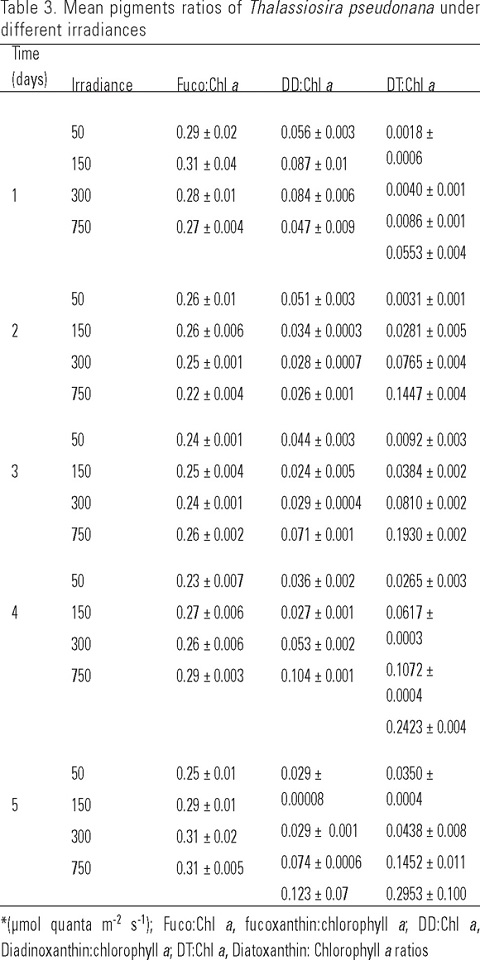
<body><![CDATA[<p align="center"><font face="verdana" size="2"><a name="c1"></a></font></p>  	    <p align="center"><font face="verdana" size="2"><img src="/img/revistas/hbio/v17n3/a8c1.jpg"></font></p>  	    <p align="justify"><font face="verdana" size="2">The pigments measured in <i>T. pseudonana</i> can be differentiated into photosynthetic and photoprotective in regard to their function in photosynthesis (Jeffrey &amp; Vesk, 1997). The pigment concentrations showed a wide range of variation, mainly related to irradiance levels. Both chlorophyll <i>a</i> and the photosynthetic carotenoid, fucoxanthin showed statistically significant differences (<i>p</i> &lt;0.001) among light levels and culture times. In addition, their concentrations were always higher at low irradiancies (<a href="/img/revistas/hbio/v17n3/a8c2.jpg" target="_blank">Table 2</a>) and increased with cellular densities and culture times. Maximum values of chlorophyll <i>a</i> (2265.9 &plusmn; 72.2 &micro;g L<sup>&#45;1</sup>) and fucoxanthin (544 &plusmn; 35.4 &micro;g L<sup>&#45;1</sup>) were generally observed during the fourth day of experiment. After this period, these pigment concentrations decreased. The photoprotective carotenoids, diadinoxanthin and diatoxanthin showed statistically significant differences (<i>p</i> &lt;0.001; <i>p</i> &lt;0.007) among the different light levels and culture times respectively. These carotenoids were found at smaller concentrations than the other pigments. The concentration of accessory pigment diadinoxanthin decreased when the irradiance increased, while the opposite trend occurred with diatoxanthin (<a href="/img/revistas/hbio/v17n3/a8c2.jpg" target="_blank">Table 2</a>).</font></p>  	  	    <p align="justify"><font face="verdana" size="2">When <i>T. pseudonana</i> was grown at four irradiances it was observed that the ratios of cellular fucoxanthin to total chlorophyll <i>a</i> content decreased in the second and third days of the experiments (<a href="#c3">Table 3</a>). Fucoxanthin to chlorophyll <i>a</i> ratios were not significantly affected by the level of irradiance (<i>p</i> =0.444). However, these ratios were significantly affected throughout the culturing period (<i>p</i> =0.003). The mean ratios at irradiances of 50 and 150 &micro;mol quanta m<sup>&#45;2</sup> s<sup>&#45;1</sup> were 0.26 &plusmn; 0.007 and 0.28 &plusmn; 0.009 whereas at 300 and 750 &micro;mol quanta m<sup>&#45;2</sup> s<sup>&#45;1</sup> their mean ratios were identical (0.27 &plusmn; 0.009). On the other hand, diatoxanthin to chlorophyll <i>a</i> ratios increased among different irradiances and with culture time, with higher values at high irradiances, whereas, diadinoxanthin to chlorophyll <i>a</i> ratios only increased at 750 &micro;mol quanta m<sup>&#45;2</sup> s<sup>&#45;1</sup> (<a href="#c3">Table 3</a>). Within the different light levels and culturing periods, diatoxanthin to chlorophyll <i>a</i> ratios showed significant differences (<i>p</i> &le;0.001). Their concentration increased (<a href="#c3">Table 3</a>) with higher values at high irradiances than those occurring at low irradiances.</font></p>  	    <p align="center"><font face="verdana" size="2"><a name="c3"></a></font></p>  	    <p align="center"><font face="verdana" size="2"><img src="/img/revistas/hbio/v17n3/a8c3.jpg"></font></p>  	    <p>&nbsp;</p>  	    <p align="justify"><font face="verdana" size="2"><b>Discussion</b></font></p>  	    <p align="justify"><font face="verdana" size="2">Growth rates of <i>T. pseudonana</i> indicated that irradiances did not have significant effects on growth during the first two days of the culture experiment (<a href="#f1">Fig. 1</a>, <a href="#c1">Table 1</a>). An explanation is that the irradiances in the cultures would have been attenuated due to the fast growth and increased turbidity of the cultures as cellular densities increase. Brown <i>et al</i>. (1996) showed that irradiances were reduced by 20&#45;25% at late&#45;logarithmic phase and by 30&#45;40% at stationary phase during the experiment. On the other hand, the highest growth rates of <i>T. pseudonana</i> grown under 24:0 h L:D have been documented to range from 1.9 to 2.1 at 125 and 330 &micro;mol photon m<sup>&#45;2</sup> s<sup>&#45;1</sup> and temperatures of 17.5&#45;15&deg;C respectively (Thompson <i>et al</i>., 1990; Sakshaug <i>et al</i>., 1987). In this study the highest mean growth rates were recorded in the first culture day and ranged from 1.4 to 1.6 among various irradiances (<a href="#c1">Table 1</a>). These results are consistent with the finding of Stramski <i>et al</i>. (2002) who observed that growth rate of <i>T. pseudonana</i> at low irradiance was reduced to 0.64 compared to second day at high irradiance. In addition, the cultures of <i>T. pseudonana</i> grown at 300 &micro;mol quanta m<sup>&#45;2</sup> s<sup>&#45;1</sup> had a faster growth rate than those cultures grown at other irradiances, even though the difference in the growth rate between low and high irradiances was relatively small. This indicates that <i>T. pseudonana</i> is an excellent microalga for the mass culture in aquaculture, because of their ability to tolerate a wide range of growth irradiances and generate high cellular density in a short period of time. In addition, in aquaculture culture it is necessary to take into account that chlorophyll <i>a</i> concentrations change with the irradiances and therefore modify the phytoplankton biomass.</font></p>  	    <p align="justify"><font face="verdana" size="2">At the level of the individual pigments, chlorophyll <i>a</i> concentrations were higher at low irradiances than at high irradiances (<a href="/img/revistas/hbio/v17n3/a8c2.jpg" target="_blank">Table 2</a>) due to the physiological response of <i>T. pseudonana</i> to light limitation (Goericke &amp; Montoya, 1998). Likewise the other major pigment, fucoxanthin, also increased at low irradiancies (<a href="/img/revistas/hbio/v17n3/a8c2.jpg" target="_blank">Table 2</a>), and the covariance of chlorophyll <i>a</i> and fucoxanthin throughout the culture time may be related to their similar physiological response to light conditions. Also, an increase in fucoxanthin is indicative of light limitation due to self&#45;shading and modification of their pigment concentration. In addition, this light&#45;harvesting pigment collects light from the prevailing field at specific wavelengths and transfers the absorbed energy to the reaction center of chlorophyll <i>a</i>, which directly participates in photosynthesis (Kirk, 1994).</font></p>  	    ]]></body>
<body><![CDATA[<p align="justify"><font face="verdana" size="2">Diadinoxanthin increased at the lowest irradiance, whereas in other irradiances it decreased (<a href="/img/revistas/hbio/v17n3/a8c2.jpg" target="_blank">Table 2</a>). Diatoxanthin was higher than diadinoxanthin at high irradiances and increased continuously up to the third day of culturing. The differences between diadinoxanthin and diatoxanthin content in <i>T. pseudonana</i> are to be attributed to the excessive light levels that could limit their photosynthesis rate by inducing photoinhibition. Cartotenoids participate in the photoadaptative response through diadino&#45;diatoxanthin xanthophyll cycle that is triggered by light causing changes in pigment concentrations in response to the prolonged light periods. This also have been observed by Rmiki <i>et al</i>. (1996) who found that diatoxanthin content of phytoplankton algae showed important variations along inshore&#45;offshore transects and their diatoxanthin to chlorophyll <i>a</i> ratios varied from 0.002 to 0.074 at irradiances of 300 and 550 &micro;E m<sup>&#45;2</sup> s<sup>&#45;1</sup> in inshore and offshore respectively. Another estimate of variations in the pigment content of <i>T. pseudonana</i> is the fucoxanthin to chlorophyll <i>a</i> ratio which showed a remarkable similarity among the different light intensities. This may be due to the fact that photosynthetically active pigments covary with chlorophyll <i>a</i> and possibly with irradiance as described by Goericke and Montoya (1998) and Schl&uuml;ter <i>et al</i>. (2006). In addition, when cultures of <i>T. pseudonana</i> were exposed to high irradiances the ratios of diadinoxanthin to chlorophyll <i>a</i> showed a decrease in the second day at the highest irradiance (<a href="#c3">Table 3</a>), while diatoxanthin to chlorophyll <i>a</i> ratio was almost three&#45;fold higher at higher irradiance (<a href="#c3">Table 3</a>). These changes in pigments ratios are related to protecting the cell against photo&#45;oxidation in response to high levels of oxygen which is an inhibitor of photosynthesis and can also cause photorespiration modifying the biochemical composition. The results presented here also have been observed by others (Schl&uuml;ter <i>et al</i>., 2000; Descy <i>et al</i>., 2000) and suggests that change in accessory pigments per cell is indicative of photoacclimatation processes as a response to the light climate and interconversion of pigment takes place depending on the culture irradiance level.</font></p>  	    <p align="justify"><font face="verdana" size="2">It is conclude that the concentration of individual pigments showed statistically significant differences (<i>p</i> &lt; 0.001) among the different light levels and culturing times. Fucoxanthin to chlorophyll <i>a</i> ratios were not significantly affected by the irradiance level, but these were significantly affected by the culture period. Diatoxanthin to chlorophyll <i>a</i> ratio s increased among different irradiances and with culture time, with higher values at high irradiances, whereas, diadinoxanthin to chlorophyll <i>a</i> ratios only increased at 750 &micro;mol quanta m<sup>&#45;2</sup> s<sup>&#45;1</sup>. Also, variations in light intensity did not change the cellular densities of <i>T. pseudonana</i> but did have significant effects on accessory pigment to chlorophyll <i>a</i> ratios.</font></p>  	    <p>&nbsp;</p>  	    <p align="justify"><font face="verdana" size="2"><b>Acknowledgements</b></font></p>  	    <p align="justify"><font face="verdana" size="2">This research comprised part of the project "Production of Microalgae" at the Instituto de Investigaciones Oceanol&oacute;gicas of the Universidad Aut&oacute;noma de Baja California, with support from the UABC. The authors are grateful to CONACYT for to the first author during his graduate studies. Special thank to the Center for Hydro&#45;Optics and Remote Sensing from San Diego State University for processing HPLC samples.</font></p>  	    <p>&nbsp;</p>  	    <p align="justify"><font face="verdana" size="2"><b>References</b></font></p>  	    <!-- ref --><p align="justify"><font face="verdana" size="2">ANDERSEN, R. A., S. L. MORTON &amp; J. P. SEXTON. 1997. CCMP&#45;Provasoli&#45;Guillard national center for culture of marine phytoplankton. <i>Journal of Phycology</i> 33 (6): 3&#45;74.    &nbsp;&nbsp;&nbsp;&nbsp;&nbsp;&nbsp;&nbsp;&nbsp;[&#160;<a href="javascript:void(0);" onclick="javascript: window.open('/scielo.php?script=sci_nlinks&ref=4067851&pid=S0188-8897200700030000800001&lng=','','width=640,height=500,resizable=yes,scrollbars=1,menubar=yes,');">Links</a>&#160;]<!-- end-ref --></font></p>  	    <!-- ref --><p align="justify"><font face="verdana" size="2">BERGES, J. A., D. E. VARELA &amp; P. J. HARRISON. 2002. Effects of temperature on growth rate, cell composition and nitrogen metabolism in the marine diatom <i>Thalassiosira pseudonana</i> (Bacillariophyceae). <i>Marine Ecology Progress Series</i> 225: 139&#45;146.    &nbsp;&nbsp;&nbsp;&nbsp;&nbsp;&nbsp;&nbsp;&nbsp;[&#160;<a href="javascript:void(0);" onclick="javascript: window.open('/scielo.php?script=sci_nlinks&ref=4067853&pid=S0188-8897200700030000800002&lng=','','width=640,height=500,resizable=yes,scrollbars=1,menubar=yes,');">Links</a>&#160;]<!-- end-ref --></font></p>  	    <!-- ref --><p align="justify"><font face="verdana" size="2">BROWN, M. R., G. A. DUSTAN, S. J. NORWOOD &amp; K. A. MILLER. 1996. Effects of harvest stage and light on the biochemical composition of the diatom <i>Thalassiosira pseudonana. Journal Phycology</i> 32: 64&#45;73.    &nbsp;&nbsp;&nbsp;&nbsp;&nbsp;&nbsp;&nbsp;&nbsp;[&#160;<a href="javascript:void(0);" onclick="javascript: window.open('/scielo.php?script=sci_nlinks&ref=4067855&pid=S0188-8897200700030000800003&lng=','','width=640,height=500,resizable=yes,scrollbars=1,menubar=yes,');">Links</a>&#160;]<!-- end-ref --></font></p>  	    <!-- ref --><p align="justify"><font face="verdana" size="2">BUCCIARELLI, E. &amp; W. G. SUNDA. 2003. Infuence of CO<sub>2</sub>, nitrate, phosphate, and silicate limitation on intracellular dimethylsulfoniopropionate in batch cultures of the coastal diatom <i>Thalassiosira pseudonana. Limnology and Oceanography</i> 48 (6): 2256&#45;2265.    &nbsp;&nbsp;&nbsp;&nbsp;&nbsp;&nbsp;&nbsp;&nbsp;[&#160;<a href="javascript:void(0);" onclick="javascript: window.open('/scielo.php?script=sci_nlinks&ref=4067857&pid=S0188-8897200700030000800004&lng=','','width=640,height=500,resizable=yes,scrollbars=1,menubar=yes,');">Links</a>&#160;]<!-- end-ref --></font></p>  	    <!-- ref --><p align="justify"><font face="verdana" size="2">CLAQUIN, P., V. MARTIN&#45;J&Eacute;Z&Eacute;QUEL, J. C. KROMKAMP, M. J. W. VELDHUIS &amp; G. W. KRAAY. 2002. Uncoupling of silicon compared with carbon and nitrogen metabolism and role of the cell cycle in continuous cultures of <i>Thalassiosira pseudonana</i> (Bacillariophyceae) under light, nitrogen, and phosphorus control. <i>Journal Phycology</i> 38: 922&#45;930.    &nbsp;&nbsp;&nbsp;&nbsp;&nbsp;&nbsp;&nbsp;&nbsp;[&#160;<a href="javascript:void(0);" onclick="javascript: window.open('/scielo.php?script=sci_nlinks&ref=4067859&pid=S0188-8897200700030000800005&lng=','','width=640,height=500,resizable=yes,scrollbars=1,menubar=yes,');">Links</a>&#160;]<!-- end-ref --></font></p>  	    <!-- ref --><p align="justify"><font face="verdana" size="2">CLARK, D. R. 2001. Growth rate relationships to physiological indices of nutrient status in marine diatoms. <i>Journal Phycology</i> 37: 249&#45;256.    &nbsp;&nbsp;&nbsp;&nbsp;&nbsp;&nbsp;&nbsp;&nbsp;[&#160;<a href="javascript:void(0);" onclick="javascript: window.open('/scielo.php?script=sci_nlinks&ref=4067861&pid=S0188-8897200700030000800006&lng=','','width=640,height=500,resizable=yes,scrollbars=1,menubar=yes,');">Links</a>&#160;]<!-- end-ref --></font></p>  	    <!-- ref --><p align="justify"><font face="verdana" size="2">DESCY, J. P., H. W. HIGGINS, D. J. MACKEY, J. P. HURLEY &amp; T. M. FROST. 2000. Pigment ratios and phytoplankton assessment in northern Wisconsin lakes. <i>Journal Phycology</i> 36: 274&#45;286.    &nbsp;&nbsp;&nbsp;&nbsp;&nbsp;&nbsp;&nbsp;&nbsp;[&#160;<a href="javascript:void(0);" onclick="javascript: window.open('/scielo.php?script=sci_nlinks&ref=4067863&pid=S0188-8897200700030000800007&lng=','','width=640,height=500,resizable=yes,scrollbars=1,menubar=yes,');">Links</a>&#160;]<!-- end-ref --></font></p>  	    <!-- ref --><p align="justify"><font face="verdana" size="2">GOERICKE, R. &amp; J. P. MONTOYA. 1998. Estimating the contribution of microalgal taxa to chlorophyll <i>a</i> in the field&#151;variations of pigments ratios under nutrient&#45;and light&#45;limited growth. <i>Marine Ecology Progress Series</i> 169: 97&#45;112.    &nbsp;&nbsp;&nbsp;&nbsp;&nbsp;&nbsp;&nbsp;&nbsp;[&#160;<a href="javascript:void(0);" onclick="javascript: window.open('/scielo.php?script=sci_nlinks&ref=4067865&pid=S0188-8897200700030000800008&lng=','','width=640,height=500,resizable=yes,scrollbars=1,menubar=yes,');">Links</a>&#160;]<!-- end-ref --></font></p>  	    <!-- ref --><p align="justify"><font face="verdana" size="2">GUILLARD, R. R. L. 1975. Culture of phytoplankton for feeding marine invertebrates. <i>In</i>: Smith, W.L. &amp; M.H. Chanley (Eds.). <i>Culture of marine invertebrates animals.</i> Plenum Publishing Corp. New York, pp. 29&#45;60.    &nbsp;&nbsp;&nbsp;&nbsp;&nbsp;&nbsp;&nbsp;&nbsp;[&#160;<a href="javascript:void(0);" onclick="javascript: window.open('/scielo.php?script=sci_nlinks&ref=4067867&pid=S0188-8897200700030000800009&lng=','','width=640,height=500,resizable=yes,scrollbars=1,menubar=yes,');">Links</a>&#160;]<!-- end-ref --></font></p>  	    <!-- ref --><p align="justify"><font face="verdana" size="2">HENRIKSEN, P., B. RIEMANN, H. KASS, H. MUNK S&Oslash;RENSEN &amp; H. L. S&Oslash;RENSEN. 2002. Effects of nutrient&#45;limitation and irradiance on marine phytoplankton pigments. <i>Journal of Plankton Research</i> 24 (9): 835&#45;858.    &nbsp;&nbsp;&nbsp;&nbsp;&nbsp;&nbsp;&nbsp;&nbsp;[&#160;<a href="javascript:void(0);" onclick="javascript: window.open('/scielo.php?script=sci_nlinks&ref=4067869&pid=S0188-8897200700030000800010&lng=','','width=640,height=500,resizable=yes,scrollbars=1,menubar=yes,');">Links</a>&#160;]<!-- end-ref --></font></p>  	    <!-- ref --><p align="justify"><font face="verdana" size="2">JEFFREY, S. W. &amp; M. VESK. 1997. Introduction to marine phytoplankton and their pigment signatures. <i>In</i>: S.W. Jeffrey, R.F.C. Mantoura &amp; S.W. Wright (Eds.). <i>Phytoplankton Pigments in Oceanography</i>. UNESCO, Paris, pp. 37&#45;84.    &nbsp;&nbsp;&nbsp;&nbsp;&nbsp;&nbsp;&nbsp;&nbsp;[&#160;<a href="javascript:void(0);" onclick="javascript: window.open('/scielo.php?script=sci_nlinks&ref=4067871&pid=S0188-8897200700030000800011&lng=','','width=640,height=500,resizable=yes,scrollbars=1,menubar=yes,');">Links</a>&#160;]<!-- end-ref --></font></p>  	    <!-- ref --><p align="justify"><font face="verdana" size="2">KIRK, J. T. O. 1994. New York, NY, USA. <i>Light and photosynthesis in aquatic ecosystems</i>. 2<sup>nd</sup> Ed. Cambridge University Press. 509 p.    &nbsp;&nbsp;&nbsp;&nbsp;&nbsp;&nbsp;&nbsp;&nbsp;[&#160;<a href="javascript:void(0);" onclick="javascript: window.open('/scielo.php?script=sci_nlinks&ref=4067873&pid=S0188-8897200700030000800012&lng=','','width=640,height=500,resizable=yes,scrollbars=1,menubar=yes,');">Links</a>&#160;]<!-- end-ref --></font></p>  	    <!-- ref --><p align="justify"><font face="verdana" size="2">PARSLOW, J. S., P. J. HARRISON &amp; P. A. THOMPSON. 1984. Satured uptake kinetics: trasient response of the marine diatom <i>Thalassiosira pseudonana</i> to ammonium, nitrate, silicate or phosphate starvation. <i>Marine Biology</i> 83: 51&#45;59.    &nbsp;&nbsp;&nbsp;&nbsp;&nbsp;&nbsp;&nbsp;&nbsp;[&#160;<a href="javascript:void(0);" onclick="javascript: window.open('/scielo.php?script=sci_nlinks&ref=4067875&pid=S0188-8897200700030000800013&lng=','','width=640,height=500,resizable=yes,scrollbars=1,menubar=yes,');">Links</a>&#160;]<!-- end-ref --></font></p>  	    <!-- ref --><p align="justify"><font face="verdana" size="2">PLATT, T., S. SATHYENDRANATH, A. M. EDWARS, D. S. BROOMHEAD &amp; O. ULLOA. 2003. Nitrate supply and demand in the mixed layer of the ocean. <i>Marine Ecology Progress Series</i> 254: 3&#45;9.    &nbsp;&nbsp;&nbsp;&nbsp;&nbsp;&nbsp;&nbsp;&nbsp;[&#160;<a href="javascript:void(0);" onclick="javascript: window.open('/scielo.php?script=sci_nlinks&ref=4067877&pid=S0188-8897200700030000800014&lng=','','width=640,height=500,resizable=yes,scrollbars=1,menubar=yes,');">Links</a>&#160;]<!-- end-ref --></font></p>  	    <!-- ref --><p align="justify"><font face="verdana" size="2">RMIKI, NOUR&#45;EDDINE, C. BRUNET, J. CABIOCH &amp; Y. LEMOINE. 1996. Xanthophyll&#45;cycle and photosynthetic adaptation to environment in macroalgae and microalgae. <i>Hydrobiologia</i> 326/327: 407&#45;413.    &nbsp;&nbsp;&nbsp;&nbsp;&nbsp;&nbsp;&nbsp;&nbsp;[&#160;<a href="javascript:void(0);" onclick="javascript: window.open('/scielo.php?script=sci_nlinks&ref=4067879&pid=S0188-8897200700030000800015&lng=','','width=640,height=500,resizable=yes,scrollbars=1,menubar=yes,');">Links</a>&#160;]<!-- end-ref --></font></p>  	    <!-- ref --><p align="justify"><font face="verdana" size="2">SAKSHAUG, E., S. DEMERS &amp; C. M. YENTSCH. 1987. <i>Thalassiosira oceanica</i> and <i>T. pseudonana</i>: two different photoadaptational responses. <i>Marine Ecology Progress Series</i> 41: 275&#45;282.    &nbsp;&nbsp;&nbsp;&nbsp;&nbsp;&nbsp;&nbsp;&nbsp;[&#160;<a href="javascript:void(0);" onclick="javascript: window.open('/scielo.php?script=sci_nlinks&ref=4067881&pid=S0188-8897200700030000800016&lng=','','width=640,height=500,resizable=yes,scrollbars=1,menubar=yes,');">Links</a>&#160;]<!-- end-ref --></font></p>  	    <!-- ref --><p align="justify"><font face="verdana" size="2">SCHL&Uuml;TER, L., F. M&Oslash;HLENBERG, H. HAVSKUM &amp; S. LARSEN. 2000. The use of phytoplankton pigments for identifying and quantifying phyto&#45;plankton groups in castal areas: testing the influence of light and nutrients on pigment/chlorophyll <i>a</i> ratios. <i>Marine Ecology Progress Series</i> 192: 49&#45;63.    &nbsp;&nbsp;&nbsp;&nbsp;&nbsp;&nbsp;&nbsp;&nbsp;[&#160;<a href="javascript:void(0);" onclick="javascript: window.open('/scielo.php?script=sci_nlinks&ref=4067883&pid=S0188-8897200700030000800017&lng=','','width=640,height=500,resizable=yes,scrollbars=1,menubar=yes,');">Links</a>&#160;]<!-- end-ref --></font></p>  	    <!-- ref --><p align="justify"><font face="verdana" size="2">SCHL&Uuml;TER, L., T. L. LAURIDSEN, G. KROGH &amp; T. J&Oslash;RGENSEN. 2006. Identification and quantification of phytoplankton groups in lakes using new pigment ratios &#45; a comparison between pigment analysis by HPLC and microscopy. <i>Freshwater Biology</i> 51: 1474&#45;1485.    &nbsp;&nbsp;&nbsp;&nbsp;&nbsp;&nbsp;&nbsp;&nbsp;[&#160;<a href="javascript:void(0);" onclick="javascript: window.open('/scielo.php?script=sci_nlinks&ref=4067885&pid=S0188-8897200700030000800018&lng=','','width=640,height=500,resizable=yes,scrollbars=1,menubar=yes,');">Links</a>&#160;]<!-- end-ref --></font></p>  	    <!-- ref --><p align="justify"><font face="verdana" size="2">SCIANDRA, A., L. LIZZARA, H. CLAUSTRE &amp; M. BABIN. 2000. Responses of growth rate, pigment composition and optical properties of <i>Cryptomonas</i> sp. to light and nitrogen stresses. <i>Marine Ecology Progress Series</i> 201: 107&#45;120.    &nbsp;&nbsp;&nbsp;&nbsp;&nbsp;&nbsp;&nbsp;&nbsp;[&#160;<a href="javascript:void(0);" onclick="javascript: window.open('/scielo.php?script=sci_nlinks&ref=4067887&pid=S0188-8897200700030000800019&lng=','','width=640,height=500,resizable=yes,scrollbars=1,menubar=yes,');">Links</a>&#160;]<!-- end-ref --></font></p>  	    <!-- ref --><p align="justify"><font face="verdana" size="2">STRAMSKI, D., A. SCIANDRA &amp; H. CLAUSTRE. 2002. Effects of temperature, nitrogen, and light limitation on the optical properties of the marine diatoms <i>Thalassiosira pseudonana. Limnology and Oceanography</i> 47 (2): 392&#45;403.    &nbsp;&nbsp;&nbsp;&nbsp;&nbsp;&nbsp;&nbsp;&nbsp;[&#160;<a href="javascript:void(0);" onclick="javascript: window.open('/scielo.php?script=sci_nlinks&ref=4067889&pid=S0188-8897200700030000800020&lng=','','width=640,height=500,resizable=yes,scrollbars=1,menubar=yes,');">Links</a>&#160;]<!-- end-ref --></font></p>  	    <!-- ref --><p align="justify"><font face="verdana" size="2">THOMPSON, P. 1999. The response of growth and biochemical composition to variations in daylength, temperature, and irradiance in the marine diatom <i>Thalassiosira pseudonana</i> (Bacillariophyceae). <i>Journal Phycology</i> 35: 1215&#45;1223.    &nbsp;&nbsp;&nbsp;&nbsp;&nbsp;&nbsp;&nbsp;&nbsp;[&#160;<a href="javascript:void(0);" onclick="javascript: window.open('/scielo.php?script=sci_nlinks&ref=4067891&pid=S0188-8897200700030000800021&lng=','','width=640,height=500,resizable=yes,scrollbars=1,menubar=yes,');">Links</a>&#160;]<!-- end-ref --></font></p>  	    <!-- ref --><p align="justify"><font face="verdana" size="2">THOMPSON, P. A., P. J. HARRISON &amp; J. N. C. WHYTE. 1990. Influence of irradiance on the fatty acid composition of phytoplankton. <i>Journal Phycology</i> 26: 278&#45;288.    &nbsp;&nbsp;&nbsp;&nbsp;&nbsp;&nbsp;&nbsp;&nbsp;[&#160;<a href="javascript:void(0);" onclick="javascript: window.open('/scielo.php?script=sci_nlinks&ref=4067893&pid=S0188-8897200700030000800022&lng=','','width=640,height=500,resizable=yes,scrollbars=1,menubar=yes,');">Links</a>&#160;]<!-- end-ref --></font></p>  	    <!-- ref --><p align="justify"><font face="verdana" size="2">TREES, C. C., R. R. BIGIDARE, D. N. KARL &amp; L. VAN HEUKELEM. 2000. Fluorometric chlorophyll <i>a</i>: sampling, laboratory methods, and data analysis protocols. <i>In</i>: G.S. Fargion &amp; J.L. Muller (Eds.). <i>Ocean Optics Protocols for Satellite Ocean Color Sensor Validation</i>. Revision 2, Chapter 14, NASA TM 2000&#45;209966, Goddard Space Fligth Center, Greenbelt, MD, pp. 162&#45;169.    &nbsp;&nbsp;&nbsp;&nbsp;&nbsp;&nbsp;&nbsp;&nbsp;[&#160;<a href="javascript:void(0);" onclick="javascript: window.open('/scielo.php?script=sci_nlinks&ref=4067895&pid=S0188-8897200700030000800023&lng=','','width=640,height=500,resizable=yes,scrollbars=1,menubar=yes,');">Links</a>&#160;]<!-- end-ref --></font></p>  	    <!-- ref --><p align="justify"><font face="verdana" size="2">VONSHAK, A. &amp; G. TORZILLO. 2004. Great Britain, United Kingdom. Environmental stress physiology. <i>In</i>: Amos Richmond (Ed.). <i>Handbook of microalgal culture: Biotechnology and Applied Phycology</i>. Blackwell Publishing Company. pp. 57&#45;82.    &nbsp;&nbsp;&nbsp;&nbsp;&nbsp;&nbsp;&nbsp;&nbsp;[&#160;<a href="javascript:void(0);" onclick="javascript: window.open('/scielo.php?script=sci_nlinks&ref=4067897&pid=S0188-8897200700030000800024&lng=','','width=640,height=500,resizable=yes,scrollbars=1,menubar=yes,');">Links</a>&#160;]<!-- end-ref --></font></p>      ]]></body><back>
<ref-list>
<ref id="B1">
<nlm-citation citation-type="journal">
<person-group person-group-type="author">
<name>
<surname><![CDATA[ANDERSEN]]></surname>
<given-names><![CDATA[R. A.]]></given-names>
</name>
<name>
<surname><![CDATA[MORTON]]></surname>
<given-names><![CDATA[S. L.]]></given-names>
</name>
<name>
<surname><![CDATA[SEXTON]]></surname>
<given-names><![CDATA[J. P.]]></given-names>
</name>
</person-group>
<article-title xml:lang="en"><![CDATA[CCMP-Provasoli-Guillard national center for culture of marine phytoplankton]]></article-title>
<source><![CDATA[Journal of Phycology]]></source>
<year>1997</year>
<volume>33</volume>
<numero>6</numero>
<issue>6</issue>
<page-range>3-74</page-range></nlm-citation>
</ref>
<ref id="B2">
<nlm-citation citation-type="journal">
<person-group person-group-type="author">
<name>
<surname><![CDATA[BERGES]]></surname>
<given-names><![CDATA[J. A.]]></given-names>
</name>
<name>
<surname><![CDATA[VARELA]]></surname>
<given-names><![CDATA[D. E.]]></given-names>
</name>
<name>
<surname><![CDATA[HARRISON]]></surname>
<given-names><![CDATA[P. J.]]></given-names>
</name>
</person-group>
<article-title xml:lang="en"><![CDATA[Effects of temperature on growth rate, cell composition and nitrogen metabolism in the marine diatom Thalassiosira pseudonana (Bacillariophyceae)]]></article-title>
<source><![CDATA[Marine Ecology Progress Series]]></source>
<year>2002</year>
<volume>225</volume>
<page-range>139-146</page-range></nlm-citation>
</ref>
<ref id="B3">
<nlm-citation citation-type="journal">
<person-group person-group-type="author">
<name>
<surname><![CDATA[BROWN]]></surname>
<given-names><![CDATA[M. R.]]></given-names>
</name>
<name>
<surname><![CDATA[DUSTAN]]></surname>
<given-names><![CDATA[G. A.]]></given-names>
</name>
<name>
<surname><![CDATA[NORWOOD]]></surname>
<given-names><![CDATA[S. J.]]></given-names>
</name>
<name>
<surname><![CDATA[MILLER]]></surname>
<given-names><![CDATA[K. A.]]></given-names>
</name>
</person-group>
<article-title xml:lang="en"><![CDATA[Effects of harvest stage and light on the biochemical composition of the diatom Thalassiosira pseudonana]]></article-title>
<source><![CDATA[Journal Phycology]]></source>
<year>1996</year>
<volume>32</volume>
<page-range>64-73</page-range></nlm-citation>
</ref>
<ref id="B4">
<nlm-citation citation-type="journal">
<person-group person-group-type="author">
<name>
<surname><![CDATA[BUCCIARELLI]]></surname>
<given-names><![CDATA[E.]]></given-names>
</name>
<name>
<surname><![CDATA[SUNDA]]></surname>
<given-names><![CDATA[W. G.]]></given-names>
</name>
</person-group>
<article-title xml:lang="en"><![CDATA[Infuence of CO2, nitrate, phosphate, and silicate limitation on intracellular dimethylsulfoniopropionate in batch cultures of the coastal diatom Thalassiosira pseudonana]]></article-title>
<source><![CDATA[Limnology and Oceanography]]></source>
<year>2003</year>
<volume>48</volume>
<numero>6</numero>
<issue>6</issue>
<page-range>2256-2265</page-range></nlm-citation>
</ref>
<ref id="B5">
<nlm-citation citation-type="journal">
<person-group person-group-type="author">
<name>
<surname><![CDATA[CLAQUIN]]></surname>
<given-names><![CDATA[P.]]></given-names>
</name>
<name>
<surname><![CDATA[MARTIN-JÉZÉQUEL]]></surname>
<given-names><![CDATA[V.]]></given-names>
</name>
<name>
<surname><![CDATA[KROMKAMP]]></surname>
<given-names><![CDATA[J. C.]]></given-names>
</name>
<name>
<surname><![CDATA[VELDHUIS]]></surname>
<given-names><![CDATA[M. J. W.]]></given-names>
</name>
<name>
<surname><![CDATA[KRAAY]]></surname>
<given-names><![CDATA[G. W.]]></given-names>
</name>
</person-group>
<article-title xml:lang="en"><![CDATA[Uncoupling of silicon compared with carbon and nitrogen metabolism and role of the cell cycle in continuous cultures of Thalassiosira pseudonana (Bacillariophyceae) under light, nitrogen, and phosphorus control]]></article-title>
<source><![CDATA[Journal Phycology]]></source>
<year>2002</year>
<volume>38</volume>
<page-range>922-930</page-range></nlm-citation>
</ref>
<ref id="B6">
<nlm-citation citation-type="journal">
<person-group person-group-type="author">
<name>
<surname><![CDATA[CLARK]]></surname>
<given-names><![CDATA[D. R.]]></given-names>
</name>
</person-group>
<article-title xml:lang="en"><![CDATA[Growth rate relationships to physiological indices of nutrient status in marine diatoms]]></article-title>
<source><![CDATA[Journal Phycology]]></source>
<year>2001</year>
<volume>37</volume>
<page-range>249-256</page-range></nlm-citation>
</ref>
<ref id="B7">
<nlm-citation citation-type="journal">
<person-group person-group-type="author">
<name>
<surname><![CDATA[DESCY]]></surname>
<given-names><![CDATA[J. P.]]></given-names>
</name>
<name>
<surname><![CDATA[HIGGINS]]></surname>
<given-names><![CDATA[H. W.]]></given-names>
</name>
<name>
<surname><![CDATA[MACKEY]]></surname>
<given-names><![CDATA[D. J.]]></given-names>
</name>
<name>
<surname><![CDATA[HURLEY]]></surname>
<given-names><![CDATA[J. P.]]></given-names>
</name>
<name>
<surname><![CDATA[FROST]]></surname>
<given-names><![CDATA[T. M.]]></given-names>
</name>
</person-group>
<article-title xml:lang="en"><![CDATA[Pigment ratios and phytoplankton assessment in northern Wisconsin lakes]]></article-title>
<source><![CDATA[Journal Phycology]]></source>
<year>2000</year>
<volume>36</volume>
<page-range>274-286</page-range></nlm-citation>
</ref>
<ref id="B8">
<nlm-citation citation-type="journal">
<person-group person-group-type="author">
<name>
<surname><![CDATA[GOERICKE]]></surname>
<given-names><![CDATA[R.]]></given-names>
</name>
<name>
<surname><![CDATA[MONTOYA]]></surname>
<given-names><![CDATA[J. P.]]></given-names>
</name>
</person-group>
<article-title xml:lang="en"><![CDATA[Estimating the contribution of microalgal taxa to chlorophyll a in the field-variations of pigments ratios under nutrient-and light-limited growth]]></article-title>
<source><![CDATA[Marine Ecology Progress Series]]></source>
<year>1998</year>
<volume>169</volume>
<page-range>97-112</page-range></nlm-citation>
</ref>
<ref id="B9">
<nlm-citation citation-type="book">
<person-group person-group-type="author">
<name>
<surname><![CDATA[GUILLARD]]></surname>
<given-names><![CDATA[R. R. L.]]></given-names>
</name>
</person-group>
<article-title xml:lang="en"><![CDATA[Culture of phytoplankton for feeding marine invertebrates]]></article-title>
<person-group person-group-type="editor">
<name>
<surname><![CDATA[Smith]]></surname>
<given-names><![CDATA[W.L.]]></given-names>
</name>
<name>
<surname><![CDATA[Chanley]]></surname>
<given-names><![CDATA[M.H.]]></given-names>
</name>
</person-group>
<source><![CDATA[Culture of marine invertebrates animals]]></source>
<year>1975</year>
<page-range>29-60</page-range><publisher-loc><![CDATA[New York ]]></publisher-loc>
<publisher-name><![CDATA[Plenum Publishing Corp.]]></publisher-name>
</nlm-citation>
</ref>
<ref id="B10">
<nlm-citation citation-type="journal">
<person-group person-group-type="author">
<name>
<surname><![CDATA[HENRIKSEN]]></surname>
<given-names><![CDATA[P.]]></given-names>
</name>
<name>
<surname><![CDATA[RIEMANN]]></surname>
<given-names><![CDATA[B.]]></given-names>
</name>
<name>
<surname><![CDATA[KASS]]></surname>
<given-names><![CDATA[H.]]></given-names>
</name>
<name>
<surname><![CDATA[MUNK SØRENSEN]]></surname>
<given-names><![CDATA[H.]]></given-names>
</name>
<name>
<surname><![CDATA[SØRENSEN]]></surname>
<given-names><![CDATA[H. L.]]></given-names>
</name>
</person-group>
<article-title xml:lang="en"><![CDATA[Effects of nutrient-limitation and irradiance on marine phytoplankton pigments]]></article-title>
<source><![CDATA[Journal of Plankton Research]]></source>
<year>2002</year>
<volume>24</volume>
<numero>9</numero>
<issue>9</issue>
<page-range>835-858</page-range></nlm-citation>
</ref>
<ref id="B11">
<nlm-citation citation-type="book">
<person-group person-group-type="author">
<name>
<surname><![CDATA[JEFFREY]]></surname>
<given-names><![CDATA[S. W.]]></given-names>
</name>
<name>
<surname><![CDATA[M.]]></surname>
<given-names><![CDATA[VESK]]></given-names>
</name>
</person-group>
<article-title xml:lang="en"><![CDATA[Introduction to marine phytoplankton and their pigment signatures]]></article-title>
<person-group person-group-type="editor">
<name>
<surname><![CDATA[Jeffrey]]></surname>
<given-names><![CDATA[S.W.]]></given-names>
</name>
<name>
<surname><![CDATA[Mantoura]]></surname>
<given-names><![CDATA[R.F.C.]]></given-names>
</name>
<name>
<surname><![CDATA[Wright]]></surname>
<given-names><![CDATA[S.W.]]></given-names>
</name>
</person-group>
<source><![CDATA[Phytoplankton Pigments in Oceanography]]></source>
<year>1997</year>
<page-range>37-84</page-range><publisher-loc><![CDATA[Paris ]]></publisher-loc>
<publisher-name><![CDATA[UNESCO]]></publisher-name>
</nlm-citation>
</ref>
<ref id="B12">
<nlm-citation citation-type="book">
<person-group person-group-type="author">
<name>
<surname><![CDATA[KIRK]]></surname>
<given-names><![CDATA[J. T. O.]]></given-names>
</name>
</person-group>
<source><![CDATA[Light and photosynthesis in aquatic ecosystems]]></source>
<year>1994</year>
<edition>2</edition>
<page-range>509</page-range><publisher-loc><![CDATA[New York^eNY NY]]></publisher-loc>
<publisher-name><![CDATA[Cambridge University]]></publisher-name>
</nlm-citation>
</ref>
<ref id="B13">
<nlm-citation citation-type="journal">
<person-group person-group-type="author">
<name>
<surname><![CDATA[PARSLOW]]></surname>
<given-names><![CDATA[J. S.]]></given-names>
</name>
<name>
<surname><![CDATA[HARRISON]]></surname>
<given-names><![CDATA[P. J.]]></given-names>
</name>
<name>
<surname><![CDATA[THOMPSON]]></surname>
<given-names><![CDATA[P. A.]]></given-names>
</name>
</person-group>
<article-title xml:lang="en"><![CDATA[Satured uptake kinetics: trasient response of the marine diatom Thalassiosira pseudonana to ammonium, nitrate, silicate or phosphate starvation]]></article-title>
<source><![CDATA[Marine Biology]]></source>
<year>1984</year>
<volume>83</volume>
<page-range>51-59</page-range></nlm-citation>
</ref>
<ref id="B14">
<nlm-citation citation-type="journal">
<person-group person-group-type="author">
<name>
<surname><![CDATA[PLATT]]></surname>
<given-names><![CDATA[T.]]></given-names>
</name>
<name>
<surname><![CDATA[SATHYENDRANATH]]></surname>
<given-names><![CDATA[S.]]></given-names>
</name>
<name>
<surname><![CDATA[EDWARS]]></surname>
<given-names><![CDATA[A. M.]]></given-names>
</name>
<name>
<surname><![CDATA[BROOMHEAD]]></surname>
<given-names><![CDATA[D. S.]]></given-names>
</name>
<name>
<surname><![CDATA[ULLOA]]></surname>
<given-names><![CDATA[O.]]></given-names>
</name>
</person-group>
<article-title xml:lang="en"><![CDATA[Nitrate supply and demand in the mixed layer of the ocean]]></article-title>
<source><![CDATA[Marine Ecology Progress Series]]></source>
<year>2003</year>
<volume>254</volume>
<page-range>3-9</page-range></nlm-citation>
</ref>
<ref id="B15">
<nlm-citation citation-type="journal">
<person-group person-group-type="author">
<name>
<surname><![CDATA[NOUR-EDDINE]]></surname>
<given-names><![CDATA[RMIKI]]></given-names>
</name>
<name>
<surname><![CDATA[BRUNET]]></surname>
<given-names><![CDATA[C.]]></given-names>
</name>
<name>
<surname><![CDATA[CABIOCH]]></surname>
<given-names><![CDATA[J.]]></given-names>
</name>
<name>
<surname><![CDATA[LEMOINE]]></surname>
<given-names><![CDATA[Y.]]></given-names>
</name>
</person-group>
<article-title xml:lang="en"><![CDATA[Xanthophyll-cycle and photosynthetic adaptation to environment in macroalgae and microalgae]]></article-title>
<source><![CDATA[Hydrobiologia]]></source>
<year>1996</year>
<volume>326/327</volume>
<page-range>407-413</page-range></nlm-citation>
</ref>
<ref id="B16">
<nlm-citation citation-type="journal">
<person-group person-group-type="author">
<name>
<surname><![CDATA[SAKSHAUG]]></surname>
<given-names><![CDATA[E.]]></given-names>
</name>
<name>
<surname><![CDATA[DEMERS]]></surname>
<given-names><![CDATA[S.]]></given-names>
</name>
<name>
<surname><![CDATA[YENTSCH]]></surname>
<given-names><![CDATA[C. M.]]></given-names>
</name>
</person-group>
<article-title xml:lang="en"><![CDATA[Thalassiosira oceanica and T. pseudonana: two different photoadaptational responses]]></article-title>
<source><![CDATA[Marine Ecology Progress Series]]></source>
<year>1987</year>
<volume>41</volume>
<page-range>275-282</page-range></nlm-citation>
</ref>
<ref id="B17">
<nlm-citation citation-type="journal">
<person-group person-group-type="author">
<name>
<surname><![CDATA[SCHLÜTER]]></surname>
<given-names><![CDATA[L.]]></given-names>
</name>
<name>
<surname><![CDATA[MØHLENBERG]]></surname>
<given-names><![CDATA[F.]]></given-names>
</name>
<name>
<surname><![CDATA[HAVSKUM]]></surname>
<given-names><![CDATA[H.]]></given-names>
</name>
<name>
<surname><![CDATA[LARSEN]]></surname>
<given-names><![CDATA[S.]]></given-names>
</name>
</person-group>
<article-title xml:lang="en"><![CDATA[The use of phytoplankton pigments for identifying and quantifying phyto-plankton groups in castal areas: testing the influence of light and nutrients on pigment/chlorophyll a ratios]]></article-title>
<source><![CDATA[Marine Ecology Progress Series]]></source>
<year>2000</year>
<volume>192</volume>
<page-range>49-63</page-range></nlm-citation>
</ref>
<ref id="B18">
<nlm-citation citation-type="journal">
<person-group person-group-type="author">
<name>
<surname><![CDATA[SCHLÜTER]]></surname>
<given-names><![CDATA[L.]]></given-names>
</name>
<name>
<surname><![CDATA[LAURIDSEN]]></surname>
<given-names><![CDATA[T. L.]]></given-names>
</name>
<name>
<surname><![CDATA[KROGH]]></surname>
<given-names><![CDATA[G.]]></given-names>
</name>
<name>
<surname><![CDATA[JØRGENSEN]]></surname>
<given-names><![CDATA[T.]]></given-names>
</name>
</person-group>
<article-title xml:lang="en"><![CDATA[Identification and quantification of phytoplankton groups in lakes using new pigment ratios - a comparison between pigment analysis by HPLC and microscopy]]></article-title>
<source><![CDATA[Freshwater Biology]]></source>
<year>2006</year>
<volume>51</volume>
<page-range>1474-1485</page-range></nlm-citation>
</ref>
<ref id="B19">
<nlm-citation citation-type="journal">
<person-group person-group-type="author">
<name>
<surname><![CDATA[SCIANDRA]]></surname>
<given-names><![CDATA[A.]]></given-names>
</name>
<name>
<surname><![CDATA[LIZZARA]]></surname>
<given-names><![CDATA[L.]]></given-names>
</name>
<name>
<surname><![CDATA[CLAUSTRE]]></surname>
<given-names><![CDATA[H.]]></given-names>
</name>
<name>
<surname><![CDATA[BABIN]]></surname>
<given-names><![CDATA[M.]]></given-names>
</name>
</person-group>
<article-title xml:lang="en"><![CDATA[Responses of growth rate, pigment composition and optical properties of Cryptomonas sp. to light and nitrogen stresses]]></article-title>
<source><![CDATA[Marine Ecology Progress Series]]></source>
<year>2000</year>
<volume>201</volume>
<page-range>107-120</page-range></nlm-citation>
</ref>
<ref id="B20">
<nlm-citation citation-type="journal">
<person-group person-group-type="author">
<name>
<surname><![CDATA[STRAMSKI]]></surname>
<given-names><![CDATA[D.]]></given-names>
</name>
<name>
<surname><![CDATA[SCIANDRA]]></surname>
<given-names><![CDATA[A.]]></given-names>
</name>
<name>
<surname><![CDATA[CLAUSTRE]]></surname>
<given-names><![CDATA[H.]]></given-names>
</name>
</person-group>
<article-title xml:lang="en"><![CDATA[Effects of temperature, nitrogen, and light limitation on the optical properties of the marine diatoms Thalassiosira pseudonana]]></article-title>
<source><![CDATA[Limnology and Oceanography]]></source>
<year>2002</year>
<volume>47</volume>
<numero>2</numero>
<issue>2</issue>
<page-range>392-403</page-range></nlm-citation>
</ref>
<ref id="B21">
<nlm-citation citation-type="journal">
<person-group person-group-type="author">
<name>
<surname><![CDATA[THOMPSON]]></surname>
<given-names><![CDATA[P.]]></given-names>
</name>
</person-group>
<article-title xml:lang="en"><![CDATA[The response of growth and biochemical composition to variations in daylength, temperature, and irradiance in the marine diatom Thalassiosira pseudonana (Bacillariophyceae)]]></article-title>
<source><![CDATA[Journal Phycology]]></source>
<year>1999</year>
<volume>35</volume>
<page-range>1215-1223</page-range></nlm-citation>
</ref>
<ref id="B22">
<nlm-citation citation-type="journal">
<person-group person-group-type="author">
<name>
<surname><![CDATA[THOMPSON]]></surname>
<given-names><![CDATA[P. A.]]></given-names>
</name>
<name>
<surname><![CDATA[HARRISON]]></surname>
<given-names><![CDATA[P. J.]]></given-names>
</name>
<name>
<surname><![CDATA[WHYTE]]></surname>
<given-names><![CDATA[J. N. C.]]></given-names>
</name>
</person-group>
<article-title xml:lang="en"><![CDATA[Influence of irradiance on the fatty acid composition of phytoplankton]]></article-title>
<source><![CDATA[Journal Phycology]]></source>
<year>1990</year>
<volume>26</volume>
<page-range>278-288</page-range></nlm-citation>
</ref>
<ref id="B23">
<nlm-citation citation-type="book">
<person-group person-group-type="author">
<name>
<surname><![CDATA[TREES]]></surname>
<given-names><![CDATA[C. C.]]></given-names>
</name>
<name>
<surname><![CDATA[R. R. BIGIDARE]]></surname>
<given-names><![CDATA[D. N. KARL]]></given-names>
</name>
<name>
<surname><![CDATA[L.]]></surname>
<given-names><![CDATA[VAN HEUKELEM]]></given-names>
</name>
</person-group>
<article-title xml:lang="en"><![CDATA[Fluorometric chlorophyll a: sampling, laboratory methods, and data analysis protocols]]></article-title>
<person-group person-group-type="editor">
<name>
<surname><![CDATA[Fargion]]></surname>
<given-names><![CDATA[G.S.]]></given-names>
</name>
<name>
<surname><![CDATA[Muller]]></surname>
<given-names><![CDATA[J.L.]]></given-names>
</name>
</person-group>
<source><![CDATA[Ocean Optics Protocols for Satellite Ocean Color Sensor Validation]]></source>
<year>2000</year>
<page-range>162-169</page-range><publisher-loc><![CDATA[Greenbelt^eMD MD]]></publisher-loc>
<publisher-name><![CDATA[Goddard Space Fligth Center]]></publisher-name>
</nlm-citation>
</ref>
<ref id="B24">
<nlm-citation citation-type="book">
<person-group person-group-type="author">
<name>
<surname><![CDATA[VONSHAK]]></surname>
<given-names><![CDATA[A.]]></given-names>
</name>
<name>
<surname><![CDATA[TORZILLO]]></surname>
<given-names><![CDATA[G.]]></given-names>
</name>
</person-group>
<article-title xml:lang="en"><![CDATA[Great Britain, United Kingdom. Environmental stress physiology]]></article-title>
<person-group person-group-type="editor">
<name>
<surname><![CDATA[Richmond]]></surname>
<given-names><![CDATA[Amos]]></given-names>
</name>
</person-group>
<source><![CDATA[Handbook of microalgal culture: Biotechnology and Applied Phycology]]></source>
<year>2004</year>
<page-range>57-82</page-range><publisher-name><![CDATA[Blackwell Publishing Company]]></publisher-name>
</nlm-citation>
</ref>
</ref-list>
</back>
</article>