<?xml version="1.0" encoding="ISO-8859-1"?><article xmlns:mml="http://www.w3.org/1998/Math/MathML" xmlns:xlink="http://www.w3.org/1999/xlink" xmlns:xsi="http://www.w3.org/2001/XMLSchema-instance">
<front>
<journal-meta>
<journal-id>0188-8897</journal-id>
<journal-title><![CDATA[Hidrobiológica]]></journal-title>
<abbrev-journal-title><![CDATA[Hidrobiológica]]></abbrev-journal-title>
<issn>0188-8897</issn>
<publisher>
<publisher-name><![CDATA[Universidad Autónoma Metropolitana, División de Ciencias Biológicas y de la Salud]]></publisher-name>
</publisher>
</journal-meta>
<article-meta>
<article-id>S0188-88972007000200002</article-id>
<title-group>
<article-title xml:lang="en"><![CDATA[Phytoplankton response to nutrient runoff in a large lagoon system in the Gulf of California]]></article-title>
<article-title xml:lang="es"><![CDATA[Respuesta del fitoplancton al aporte de nutrientes en un sistema lagunar del Golfo de California]]></article-title>
</title-group>
<contrib-group>
<contrib contrib-type="author">
<name>
<surname><![CDATA[Martínez-López]]></surname>
<given-names><![CDATA[Aída]]></given-names>
</name>
<xref ref-type="aff" rid="A01"/>
</contrib>
<contrib contrib-type="author">
<name>
<surname><![CDATA[Escobedo-Urías]]></surname>
<given-names><![CDATA[Diana]]></given-names>
</name>
<xref ref-type="aff" rid="A02"/>
</contrib>
<contrib contrib-type="author">
<name>
<surname><![CDATA[Reyes-Salinas]]></surname>
<given-names><![CDATA[Amada]]></given-names>
</name>
<xref ref-type="aff" rid="A01"/>
</contrib>
<contrib contrib-type="author">
<name>
<surname><![CDATA[Hernández-Real]]></surname>
<given-names><![CDATA[Ma. Teresa]]></given-names>
</name>
<xref ref-type="aff" rid="A02"/>
</contrib>
</contrib-group>
<aff id="A01">
<institution><![CDATA[,Instituto Politécnico Nacional Centro Interdisciplinario de Ciencias Marinas Laboratorio de Fitoplancton]]></institution>
<addr-line><![CDATA[La Paz Baja California Sur]]></addr-line>
<country>México</country>
</aff>
<aff id="A02">
<institution><![CDATA[,Centro Interdisciplinario de Investigación para el Desarrollo Integral Regional Departamento de Medio Ambiente ]]></institution>
<addr-line><![CDATA[Guasave Sinaloa]]></addr-line>
<country>México</country>
</aff>
<pub-date pub-type="pub">
<day>00</day>
<month>00</month>
<year>2007</year>
</pub-date>
<pub-date pub-type="epub">
<day>00</day>
<month>00</month>
<year>2007</year>
</pub-date>
<volume>17</volume>
<numero>2</numero>
<fpage>101</fpage>
<lpage>112</lpage>
<copyright-statement/>
<copyright-year/>
<self-uri xlink:href="http://www.scielo.org.mx/scielo.php?script=sci_arttext&amp;pid=S0188-88972007000200002&amp;lng=en&amp;nrm=iso"></self-uri><self-uri xlink:href="http://www.scielo.org.mx/scielo.php?script=sci_abstract&amp;pid=S0188-88972007000200002&amp;lng=en&amp;nrm=iso"></self-uri><self-uri xlink:href="http://www.scielo.org.mx/scielo.php?script=sci_pdf&amp;pid=S0188-88972007000200002&amp;lng=en&amp;nrm=iso"></self-uri><abstract abstract-type="short" xml:lang="en"><p><![CDATA[To evaluate changes in abundance and composition of phytoplankton in the San Ignacio-Navachiste-Macapule Lagoon Complex in the Gulf of California during the wet-dry transition months, 18 sampling sites were established. Samples were analyzed for abundance, chemical water composition, temperature, and Secchi disk measurements in September, October, and November 1998. The combined effects of rainfall, municipal wastewater, and agricultural drainage yielded runoff that generate low salinity, high concentration of nutrients, low pH, and high biochemical oxygen demand conditions. Temporal and spatial patterns of phytoplankton related to these drainage waters were mapped. The highest concentrations of chlorophyll (15 mg/m³), maximum phytoplankton abundance (3.7 × 10(6) cells/L), and dominance by microphytoplankton (cells &gt; 20 µm) occurred with the high runoff contribution of September. Phytoplankton concentrations (cells/L) decreased in October (1.6 × 10(6)) and November (2.3 × 10(6)), and the community was dominated by nannoplankton (cells < 20 µm). Cluster analysis showed the influence of runoff in the distribution of species, as well as abundance of cyanobacteria (5.5 × 10(5) cells/L), higher in the inner lagoon in September and October. The study clearly showed a relationship between the development of phytoplankton blooms and the input of nutrients.]]></p></abstract>
<abstract abstract-type="short" xml:lang="es"><p><![CDATA[Con el propósito de describir los cambios en abundancia y composición del fitoplancton durante la transición entre la temporada de lluvias a secas en el Sistema Costero San Ignacio-Navachiste en el Golfo de California, se establecieron 18 puntos de muestreo. En estos sitios se midieron la temperatura y profundidad de disco de Secchi y se colectaron muestras para la determinación de abundancia de fitoplancton y composición química de la columna de agua durante septiembre, octubre y noviembre de 1998. Los resultados obtenidos muestran que las aguas pluviales, municipales y agrícolas originan bajos valores de salinidad y pH, alta demanda bioquímica de oxígeno y concentraciones elevadas de nutrientes. Las distribuciones temporal y espacial se encontraron determinadas por la influencia de los aportes. Los valores máximos de clorofila (15 mg/m³) y de abundancia fitoplanctónica (3.7 × 10(6) células/L), con predominio del microfitoplancton (células &gt; 20 µm), estuvieron asociados al mayor aporte de agua de los drenes durante septiembre. En octubre y noviembre las concentraciones promedio de fitoplancton fueron menores (1.6 × 10(6) y 2.3 × 10(6) células/L, respectivamente) y la comunidad estuvo dominada por el nanoplancton (células < 20 µm). La influencia de los aportes de los drenes se denotó en la distribución de las especies, lo mismo que las altas abundancias de cianobacterias (5.5 × 10(5) células/L) en la parte más interna de la laguna durante septiembre y octubre. Los resultados del presente trabajo indican claramente la relación entre el desarrollo de la proliferación del fitoplancton y la entrada de nutrientes al sistema.]]></p></abstract>
<kwd-group>
<kwd lng="en"><![CDATA[Wastewater]]></kwd>
<kwd lng="en"><![CDATA[phytoplankton]]></kwd>
<kwd lng="en"><![CDATA[Gulf of California]]></kwd>
<kwd lng="en"><![CDATA[Navachiste]]></kwd>
<kwd lng="en"><![CDATA[nutrients]]></kwd>
<kwd lng="es"><![CDATA[Aguas residuales]]></kwd>
<kwd lng="es"><![CDATA[fitoplancton]]></kwd>
<kwd lng="es"><![CDATA[Golfo de California]]></kwd>
<kwd lng="es"><![CDATA[Navachiste]]></kwd>
<kwd lng="es"><![CDATA[nutrientes]]></kwd>
</kwd-group>
</article-meta>
</front><body><![CDATA[  	    <p align="justify"><font face="verdana" size="4">Art&iacute;culos</font></p>      <p>&nbsp;</p>  	    <p align="center"><font face="verdana" size="4"><b>Phytoplankton response to nutrient runoff in a large lagoon system in the Gulf of California</b></font></p>  	    <p>&nbsp;</p>  	    <p align="center"><font face="verdana" size="3"><b>Respuesta del fitoplancton al aporte de nutrientes en un sistema lagunar del Golfo de California</b></font></p>  	    <p>&nbsp;</p>  	    <p align="center"><font face="verdana" size="2"><b>A&iacute;da Mart&iacute;nez&#45;L&oacute;pez<sup>1</sup>, Diana Escobedo&#45;Ur&iacute;as<sup>2</sup>, Amada Reyes&#45;Salinas<sup>1</sup> and Ma. Teresa Hern&aacute;ndez&#45;Real<sup>2</sup></b></font></p>  	    <p>&nbsp;</p>  	    <p align="justify"><font face="verdana" size="2"><i><sup>1 </sup>Laboratorio de Fitoplancton, Centro Interdisciplinario de Ciencias Marinas&#45;Instituto Polit&eacute;cnico Nacional, Av. Instituto Polit&eacute;cnico Nacional s/n, Colonia Playa Palo de Santa Rita, La Paz, B.C.S. 23096, M&eacute;xico.</i> Email: <a href="mailto:amartin@ipn.mx">amartin@ipn.mx</a> <i>Fax: +52&#45;612&#45;122&#45;5322</i></font></p>      ]]></body>
<body><![CDATA[<p align="justify"><font face="verdana" size="2"><i><sup>2</sup> Departamento de Medio Ambiente, Centro Interdisciplinario de Investigaci&oacute;n para el Desarrollo Integral Regional&#45;Sinaloa, Blvd. Juan de Dios B&aacute;tiz Num. 250 Col. San Joach&iacute;n, Guasave, Sinaloa 81101, M&eacute;xico.</i></font></p>  	    <p>&nbsp;</p>  	    <p align="justify"><font face="verdana" size="2">Recibido: 2 de enero de 2006    <br> 	Aceptado: 13 de diciembre de 2006</font></p>  	    <p>&nbsp;</p>  	    <p align="justify"><font face="verdana" size="2"><b>Abstract</b></font></p>  	    <p align="justify"><font face="verdana" size="2">To evaluate changes in abundance and composition of phytoplankton in the San Ignacio&#45;Navachiste&#45;Macapule Lagoon Complex in the Gulf of California during the wet&#45;dry transition months, 18 sampling sites were established. Samples were analyzed for abundance, chemical water composition, temperature, and Secchi disk measurements in September, October, and November 1998. The combined effects of rainfall, municipal wastewater, and agricultural drainage yielded runoff that generate low salinity, high concentration of nutrients, low pH, and high biochemical oxygen demand conditions. Temporal and spatial patterns of phytoplankton related to these drainage waters were mapped. The highest concentrations of chlorophyll (15 mg/m<sup>3</sup>), maximum phytoplankton abundance (3.7 &times; 10<sup>6</sup> cells/L), and dominance by microphytoplankton (cells &gt; 20 &micro;m) occurred with the high runoff contribution of September. Phytoplankton concentrations (cells/L) decreased in October (1.6 &times; 10<sup>6</sup>) and November (2.3 &times; 10<sup>6</sup>), and the community was dominated by nannoplankton (cells &lt; 20 &micro;m). Cluster analysis showed the influence of runoff in the distribution of species, as well as abundance of cyanobacteria (5.5 &times; 10<sup>5</sup> cells/L), higher in the inner lagoon in September and October. The study clearly showed a relationship between the development of phytoplankton blooms and the input of nutrients.</font></p>  	    <p align="justify"><font face="verdana" size="2"><b>Key words</b>: Wastewater, phytoplankton, Gulf of California, Navachiste, nutrients.</font></p>  	    <p>&nbsp;</p>  	    <p align="justify"><font face="verdana" size="2"><b>Resumen</b></font></p>  	    ]]></body>
<body><![CDATA[<p align="justify"><font face="verdana" size="2">Con el prop&oacute;sito de describir los cambios en abundancia y composici&oacute;n del fitoplancton durante la transici&oacute;n entre la temporada de lluvias a secas en el Sistema Costero San Ignacio&#45;Navachiste en el Golfo de California, se establecieron 18 puntos de muestreo. En estos sitios se midieron la temperatura y profundidad de disco de Secchi y se colectaron muestras para la determinaci&oacute;n de abundancia de fitoplancton y composici&oacute;n qu&iacute;mica de la columna de agua durante septiembre, octubre y noviembre de 1998. Los resultados obtenidos muestran que las aguas pluviales, municipales y agr&iacute;colas originan bajos valores de salinidad y pH, alta demanda bioqu&iacute;mica de ox&iacute;geno y concentraciones elevadas de nutrientes. Las distribuciones temporal y espacial se encontraron determinadas por la influencia de los aportes. Los valores m&aacute;ximos de clorofila (15 mg/m<sup>3</sup>) y de abundancia fitoplanct&oacute;nica (3.7 &times; 10<sup>6</sup> c&eacute;lulas/L), con predominio del microfitoplancton (c&eacute;lulas &gt; 20 &micro;m), estuvieron asociados al mayor aporte de agua de los drenes durante septiembre. En octubre y noviembre las concentraciones promedio de fitoplancton fueron menores (1.6 &times; 10<sup>6</sup> y 2.3 &times; 10<sup>6</sup> c&eacute;lulas/L, respectivamente) y la comunidad estuvo dominada por el nanoplancton (c&eacute;lulas &lt; 20 &micro;m). La influencia de los aportes de los drenes se denot&oacute; en la distribuci&oacute;n de las especies, lo mismo que las altas abundancias de cianobacterias (5.5 &times; 10<sup>5</sup> c&eacute;lulas/L) en la parte m&aacute;s interna de la laguna durante septiembre y octubre. Los resultados del presente trabajo indican claramente la relaci&oacute;n entre el desarrollo de la proliferaci&oacute;n del fitoplancton y la entrada de nutrientes al sistema.</font></p>  	    <p align="justify"><font face="verdana" size="2"><b>Palabras clave:</b> Aguas residuales, fitoplancton, Golfo de California, Navachiste, nutrientes.</font></p>  	    <p>&nbsp;</p>  	    <p align="justify"><font face="verdana" size="2"><b>Introduction</b></font></p>  	    <p align="justify"><font face="verdana" size="2">Coastal ecosystems in the Gulf of California support diverse and important fisheries, and are reservoirs of great biological diversity. In northern Sinaloa, population growth and development, as well as increased use of these natural systems for recreation, has substantially increased the pressure placed upon marine resources. Discharge of untreated wastewaters generated by diverse human activities has been notably altered its health and integrity, principally along the lagoon's eastern shore (De la Lanza&#45;Espino, 1991; Escobedo&#45;Ur&iacute;as, 1997).</font></p>  	    <p align="justify"><font face="verdana" size="2">In the late 60s, agriculture moved into a dominant role in coastal northern Sinaloa. The coastal plain encompasses more than 200,000 hectares under cultivation that now introduces large amounts of organic material, pesticides, heavy metals, and fertilizers into the lagoon systems at drainage discharge points (Escobedo&#45;Ur&iacute;as <i>et al.</i>, 1999; Ayala&#45;Baldenegro, 2004). The municipality of Guasave discharges approximately 709,660 m<sup>3</sup>/year of wastewater into the tripartite lagoon of San Ignacio&#45;Navachiste&#45;Macapule (HAMG, 1996).</font></p>  	    <p align="justify"><font face="verdana" size="2">Nutrient runoff into the lagoon system can stimulate episodes of rapid phytoplankton growth. Some of the episodes may benefit the lagoon as an important source of food for bottom living organisms. However, proliferation of some planktonic species represents a risk to public health because they produce toxins eaten by consumable fish and shellfish. Certainly, for public health, it is essential to develop an inventory of the species in the lagoon and their dynamics in the ecosystem.</font></p>  	    <p align="justify"><font face="verdana" size="2">In Sinaloa, studies of phytoplankton dynamics have focused on the coastal waters around Mazatl&aacute;n, in the southern portion of the state (Caballasi&#45;Flores, 1985; Cort&eacute;s&#45;Altamirano &amp; Past&eacute;n&#45;Miranda, 1982; Cort&eacute;s&#45;Altamirano &amp; Nu&ntilde;ez&#45; Past&eacute;n, 1992; Cruz &amp; Calvario, 1994; Alonso&#45;Rodriguez <i>et al.</i>, 2000). In the northern coastal region, the few studies available have been of a descriptive nature, providing valuable information on phytoplankton composition (G&oacute;mez&#45;Aguirre, 1969; Licea&#45;Dur&aacute;n, 1971; Meraz&#45;Del Angel, 1997). For the tripartite lagoon system of San Ignacio&#45;Navachiste&#45;Macapule, the studies (Vicencio, 1979; P&aacute;ez&#45;Osuna <i>et al.</i>, 1991; Escobedo&#45;Ur&iacute;as <i>et al.</i>, 1999) do not include information about phytoplankton, even though this lagoon system is the second largest in the state and one of the most productive coastal habitats in terms of fish capture.</font></p>  	    <p align="justify"><font face="verdana" size="2">The impact of wastewater in the coastal zone on production and biomass varies among systems (NRC, 2000). However, to understand how the anthropogenic factors interact with the natural variations of phytoplankton biomass and, in turn, be able to assess their impact on coastal systems, it is necessary to document the seasonal variability of phytoplankton and their physical&#45;chemical environment. This study discusses the changes in abundance and composition of phytoplankton in the San Ignacio&#45;Navachiste&#45;Macapule lagoon complex during late summer and early autumn. The annual rainfall maximum in this region coincides with the start of the fall/winter agricultural cycle, the period of heaviest application of fertilizers and subsequently the period of highest nutrient input to the system.</font></p>  	    <p>&nbsp;</p>  	    ]]></body>
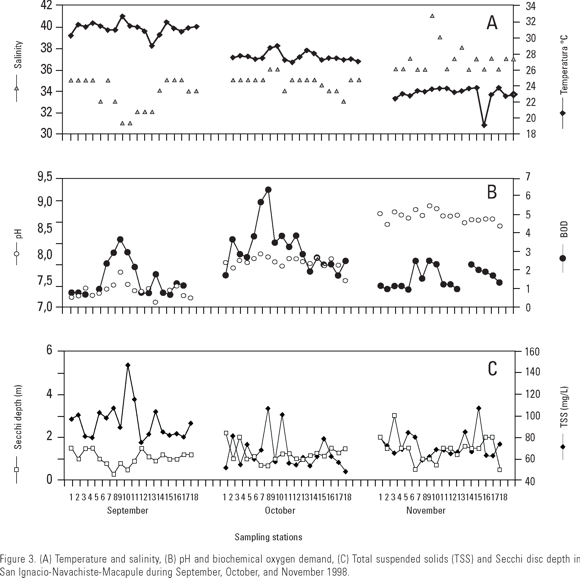
<body><![CDATA[<p align="justify"><font face="verdana" size="2"><b>Methods</b></font></p>  	    <p align="justify"><font face="verdana" size="2">The San Ignacio&#45;Navachiste&#45;Macapule Lagoon Complex (25&deg;15'&#45;25&deg;35' N, 108&deg;30'&#45;109&deg;03' W) covers an area of 220 km<sup>2</sup> (HAMG, 1996; Maga&ntilde;a&#45;&Aacute;lvarez, 2004). The lagoon complex has three entrances: Ajoro, Vasiquilla, and Bocanita (<a href="/img/revistas/hbio/v17n2/a2f1.jpg" target="_blank">Fig. 1</a>). Mean depth of the three lagoons is 2.5 m, with a range from 0.5 m to 5 m and the greatest depth at the Vasiquilla entrance (11 m). Annual precipitation averages about 300 mm, with the rainy season occurring in late summer and early fall (Vicencio, 1979; Escobedo&#45;Ur&iacute;as <i>et al.</i>, 1999). The tides in this lagoon complex have a strong semi&#45;diurnal component with two unequal flood and ebb cycles every 24.84 hours. Tidal amplitude is about 1.08 m, and maximum current speed during ebb tide is approximately 2.1 m/s at the Vasiquilla entrance (Escobedo&#45;Ur&iacute;as <i>et al.</i>, 2001). Circulation patterns indicate a major influence of continental shelf waters at the northern entrance (Ajoro) (Escobedo&#45;Ur&iacute;as <i>et al.</i>, 2001; Ulloa&#45;P&eacute;rez, 2005). Seasonal condition defines two periods, one cold season (December to March) and a warm season (May to September) (Maga&ntilde;a&#45;&Aacute;lvarez, 2004; De Silva&#45;D&aacute;vila <i>et al.</i>, 2006). The system is anti&#45;estuarine (annual mean = 36 psu) with higher average salinity during the wet season and lower average salinity during the dry season (30&#45;45 psu) (Escobedo&#45;Ur&iacute;as <i>et al</i>., 2001). Agricultural and municipal wastewater drains are the main source of freshwater, in addition to runoff during the wet season (De Silva&#45;D&aacute;vila <i>et al.</i>, 2006).</font></p>       <p align="justify"><font face="verdana" size="2">Data of pluvial precipitation, wind direction and speed were recorded every 15 minutes in the municipality of Guasave, about 20 km from the lagoon complex (Meteorological Station of the Comision Nacional del Agua; CNA). During September, October, and November 1998, field measurements at 18 sampling stations (<a href="/img/revistas/hbio/v17n2/a2f1.jpg" target="_blank">Fig. 1</a>) were taken over 5&#45;6 h of survey during flood tides, with the exception of November, when sampling was performed under ebb tidal condition. Surface temperature and salinity was obtained (Beckman salinometer) and pH measured (Corning potentiometer model 3D). Transparency of the water was estimated with the Secchi disk. Simultaneously, water samples were taken with a van Dorn bottle, filtered and frozen to determine dissolved inorganic nitrogen and phosphorus (NO<sub>3</sub><sup>&#45;</sup>+N, NO<sub>2</sub><sup>&#45;</sup>+N, NH<sub>4</sub><sup>&#45;</sup>+N and PO<sub>4</sub><sup>&#45;3</sup>+P) according to Strickland and Parsons (1972). Dissolved oxygen (DO), biochemical oxygen demand (BOD5), and total suspended solids (TSS) were measured according to Eaton <i>et al.</i> (1995). The effect of salinity and temperature on dissolved oxygen was normalized by estimating the percentage of saturation, according to Riley &amp; Chester (1971). N:P ratios were calculated from NO<sub>2</sub><sup>&#45;</sup>+ NO<sub>3</sub><sup>&#45;</sup>+ NH<sub>4</sub><sup>&#45;</sup> nitrogen and PO<sub>4</sub><sup>3&#45;</sup>phosphorus. Water samples for measuring chlorophyll were filtered through GF/F glass fiber filters (0.7 &micro;m nominal pore size). These filters were frozen at &#45;70&deg;C and later analyzed spectrophotometrically after extraction in 90% acetone (Venrick &amp; Hayward, 1984). Active chlorophyll <i>a</i> was calculated according to equations in Jeffrey &amp; Humphrey (1975). Additionally, water samples were collected to determine abundance and composition of phytoplankton. The enumeration of nannoplankton (2&#45;20 &micro;m) and microphytoplankton (&gt;20 &micro;m) was made using 1% Lugol's solution fixed samples with the standard technique of Uterm&ouml;hl (Hasle, 1978) under an inverted microscope (Olympus). Identification of microphytoplankton was performed at 400&times; by using several standard identification references (Tomas, 1997; Hustedt, 1959; Hustedt, 1961&#45;66), between others.</font></p>  	    <p align="justify"><font face="verdana" size="2">To obtain information on the degree of variability of the system using the phytoplankton assemblages, the species diversity index of Shannon&#45;Wiener was calculated (Pielou, 1966). A multivariate analysis was used to examine relationships in the microphytoplankton data set. Cyanobacteria (individuals are &lt; 20 &micro;m) were included in this category because they are organized in filaments. To reduce the number of variables included in the analysis, a selection of the most frequently observed species (occurring in at least 10% of the samples) was made. The matrices of sampling stations and species categories were used for a Q&#45;mode cluster analysis after a log (x+1) transformation.</font></p>  	    <p>&nbsp;</p>  	    <p align="justify"><font face="verdana" size="2"><b>Results</b></font></p>  	    <p align="justify"><font face="verdana" size="2">Monthly precipitation in the wet season of 1998, which occurs between June and October ranged from 360 mm in September and declined to 54 mm in October (<a href="#f2">Fig. 2A</a>). During this season, wind oscillates between its winter and summer/fall patterns. Southwest winds (average speed 6.1 m/s) prevail during September and oscillated during October and November between this direction and northwest (<a href="#f2">Figure 2B</a>).</font></p>  	    <p align="center"><font face="verdana" size="2"><a name="f2"></a></font></p>  	    <p align="center"><font face="verdana" size="2"><img src="/img/revistas/hbio/v17n2/a2f2.jpg"></font></p>  	    <p align="justify"><font face="verdana" size="2"><b>Physicochemical Variables</b>. The physicochemical variables showed distinct differences among the sampled months. Temperature declined, but salinity increased. Minimum salinity occurred at stations 8&#45;9 and the maximum was localized in the innermost part of the lagoon, farthest from the coast (station 6) (<a href="#f3">Fig. 3A</a>, <a href="../../../../../img/revistas/hbio/v17n2/a2c1.jpg" target="_blank">Table 1</a>). The pH increased from September to November, and BOD<sub>5</sub> values showed similar in September, and November, but were higher (6.32) in October, with maximum values in the innermost part of the lagoon (<a href="#f3">Fig. 3B</a>, <a href="../../../../../img/revistas/hbio/v17n2/a2c1.jpg" target="_blank">Table 1</a>). Transparency was inversely related to the concentration of total suspended solids, with higher suspended solids and lower transparency at sampling sites close to drains (<a href="#f3">Fig. 3C</a>, <a href="../../../../../img/revistas/hbio/v17n2/a2c1.jpg" target="_blank">Table 1</a>). A regression analysis of Kd (1.6/Secchi disc depth) vs TSS and chlorophyll <i>a</i> concentration showed strong effects of solids suspended on water transparency, resulting in 45.4% (<i>P</i> + 0.05) of the variance attributable to this parameter occurring in September, and declining in October and November (<a href="/img/revistas/hbio/v17n2/a2f4.jpg" target="_blank">Fig. 4</a>). During the study period, approximately 25% (<i>P</i> + 0.05) of the variance is attributable to chlorophyll <i>a</i> (<a href="/img/revistas/hbio/v17n2/a2f4.jpg" target="_blank">Fig. 4</a>).</font></p>  	    ]]></body>
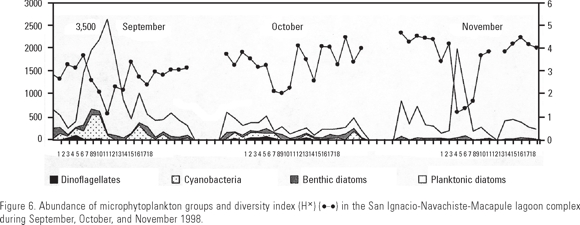
<body><![CDATA[<p align="center"><font face="verdana" size="2"><a name="f3"></a></font></p>  	    <p align="center"><font face="verdana" size="2"><img src="/img/revistas/hbio/v17n2/a2f3.jpg"></font></p>  	  	    <p align="justify"><font face="verdana" size="2">A marked influence of the input of residual wastewaters, such that the maximum values of all nutrients, occurred near the agricultural and municipal outlets in the three months (<a href="/img/revistas/hbio/v17n2/a2f5.jpg" target="_blank">Fig. 5A</a>). The lagoon complex was nutrient rich but the ratio of dissolved inorganic N to inorganic P was far below the Redfield ratio stechiometry of 16:1 (by atoms), with average values of 2.61, 0.99, and 2.77 for September, October, and November, respectively. This indicates N limitation condition for phytoplankton growth due to the fluctuations between N and P concentrations. The concentrations of all types of nitrogen were lowest in September and highest in November, while the average maximum concentration of orthophosphates occurred in October and was the case along the lagoon complex (<a href="../../../../../img/revistas/hbio/v17n2/a2c1.jpg" target="_blank">Table 1</a>, <a href="/img/revistas/hbio/v17n2/a2f5.jpg" target="_blank">Fig. 5A</a>). The major component of dissolved inorganic nitrogen was ammonium (average &gt; 78%), but nitrate and nitrite concentrations increased in November (<a href="/img/revistas/hbio/v17n2/a2f5.jpg" target="_blank">Fig. 5B</a>).</font>	</p>  	    <p align="justify"><font face="verdana" size="2">During the highest precipitation in September, there was a higher positive correlation between oxygen saturation with the abundance of phytoplankton, resulting in 44.3% (<i>P</i> &lt; 0.05) of the variance attributable to phytoplankton.</font></p>  	    <p align="justify"><font face="verdana" size="2"><b>Spatial&#45;temporal distribution of phytoplankton</b>. Phytoplankton abundance was highest in September, with a maximum concentration (6 &times; 10<sup>6</sup> cells/L) in front of the wastewater and agricultural discharge drains at Novobampo, and Batamote. The lowest phytoplankton concentrations in September (6 &times; 10<sup>5</sup> cells/L) occurred near the Ajoro entrance of Laguna San Ignacio. The mayor contributors to the maximum concentrations of chlorophyll <i>a</i> (15 mg Chl <i>a</i>/m<sup>3</sup>) (<a href="/img/revistas/hbio/v17n2/a2f5.jpg" target="_blank">Fig. 5D</a>) were nannophytoplankton, diatoms, and cyanobacteria (<a href="#f6">Fig. 6</a>). In October, phytoplankton declined (1.7 &times; 10<sup>6</sup> cells/L), but there were larger numbers of nannophytoplankton. November showed similar abundances as September, maximum of 3 &times; 10<sup>6</sup> cells/L and 5.73 mg Chl <i>a</i>/m<sup>3</sup>), but microphytoplankton was dominant.</font></p>  	    <p align="center"><font face="verdana" size="2"><a name="f6"></a></font></p>  	    <p align="center"><font face="verdana" size="2"><img src="/img/revistas/hbio/v17n2/a2f6.jpg"></font></p>  	    <p align="justify"><font face="verdana" size="2">A total of 376 species belonging to the microphytoplankton size were identified. The most common and abundant groups were diatoms, dinoflagellates, silicoflagellates, and cyanobacteria, in that order, with diatoms clearly more dominant than all other groups combined. The Shannon&#45;Wiener Diversity Index increased slightly from September to November except at stations located near the wastewater discharge (stations 7&#45;9) (<a href="#f6">Fig. 6</a>).</font></p>  	    <p align="justify"><font face="verdana" size="2"><b>Cluster analysis</b>. During September (S) and October (O), a similar phytoplankton assemblage was observed close to the drain outlets (clusters S1, S2, O1, and O2) (<a href="/img/revistas/hbio/v17n2/a2f7.jpg" target="_blank">Figs. 7</a> and <a href="/img/revistas/hbio/v17n2/a2f8.jpg" target="_blank">8</a>). In these areas, small cells, such as <i>Nitzschia longissima</i> (Br&eacute;bisson) Ralfs, 1861, Cyanobacteria sp 1, <i>Cylindrotheca closterium</i> (Ehrenberg) Reimer and Lewin 1964, and <i>Skeletonema costatum</i> (Greville) Cleve 1873, were dominant. In October, cluster group O3 was distinguished by the dominant species of <i>Chaetoceros lasciniosus</i> Sch&uuml;tt 1895, <i>S. costatum</i>, and <i>Campylosira cymbelliformis</i> (A. Schmidt) Grunow ex Van Heurck 1885 (<a href="/img/revistas/hbio/v17n2/a2f8.jpg" target="_blank">Fig. 8</a>). Cyanobacteria reached their highest concentrations (5 &times; 10<sup>5</sup> filaments/L) in September, declining to one&#45;fifth in October, when their distribution was more homogeneous in the lagoon complex. In November (N), there were three clusters (N1, N2, and N3) (<a href="/img/revistas/hbio/v17n2/a2f9.jpg" target="_blank">Fig. 9</a>). The separation of clusters N1 and N2 is based on the dominance of the diatom <i>Rhizosolenia setigera</i> Brightwell 1858. Noteworthy is that their density was one order of magnitude higher in N1 than in N2. A lesser component of these two clusters was <i>N. longissima</i> and <i>S. costatum</i>. Cluster N3 was dominated by <i>S. costatum</i> with lesser density of <i>R. setigera</i>. No cyanobacteria were present in this month.</font></p>  	    <p>&nbsp;</p>  	    ]]></body>
<body><![CDATA[<p align="justify"><font face="verdana" size="2"><b>Discussion</b></font></p>  	    <p align="justify"><font face="verdana" size="2">Our observations of the lagoon complex of San Ignacio&#45;Navachiste&#45;Macapule provided ample evidence of anthropogenic effects on phytoplankton. Nitrite and ammonium were high in comparison with other impacted lagoons in the region (Paredes &amp; L&oacute;pez, 1988; DGO, 1990; Castro&#45;Longoria &amp; Grijalva&#45;Chon, 1991; Escobedo&#45;Ur&iacute;as, 1997; Escobedo&#45;Ur&iacute;as <i>et al.</i>, 1999). This condition, as well as the high biological oxygen demand (2&#45;6.32 mg/L) located near the outlet drains indicate the role of domestic and agricultural wastes (De la Lanza&#45;Espino, 1984, 1994; Contreras&#45;Espinosa, 1993) passing into the lagoons, mainly in Navachiste Bay. Other indicators of anthropogenic influence include high levels of organic material and heavy metals with the highest concentrations near the drain outlets (Ayala&#45;Baldenegro, 2004).</font></p>  	    <p align="justify"><font face="verdana" size="2">Abundance of phytoplankton was in the range of previous studies in impacted southern lagoons in the state (Gilmartin &amp; Revelante, 1978; Alonso&#45;Rodriguez <i>et al.</i>, 2000), and for the Guaymas area (Gilbert &amp; Allen, 1943). However, are higher than had been reported for the nearby area of Bah&iacute;a Topolobampo and the central region of the Gulf of California (Gilbert &amp; Allen, 1943; &Aacute;lvarez&#45;Borrego &amp; Lara&#45;Lara, 1991). The dominance of nannoflagellates (2&#45;20 &micro;m) and small microphytoplankton (diatoms and cyanobacteria) is a major feature found in this lagoon complex. This is contrary to the situation found in Mazatlan Bay, Sinaloa during the 80s (Caballasi&#45;Flores, 1985) and for other nitrogenenriched coastal systems, such as the Bay of Brest (Del Amo <i>et al.</i>, 1997), where phytoplankton is dominated by microphytoplankton. The dominance of small&#45;sized phytoplankton does not seem to represent a response of the community structure to the nutrient loads of freshwater runoff because the phytoplankton are better adapted to low nutrient conditions (Riegman <i>et al.</i>, 1993). Nutrients often have major regulatory effects on phytoplankton abundance and composition; however, proportions of elements are particularly important. With the high precipitation (360 mm) in September, nutrient concentrations were lower than what is usually expected at the discharge sites, probably from phytoplankton growth (the highest concentration found, 6 &times; 10<sup>6</sup> cells/L, and oxygen saturation). These concentrations were six times higher than near the Ajoro entrance where water exchange with the gulf is most intense. In October, with only 54 mm of rainfall, runoff greatly declined and the concentration of phytoplankton, particularly diatoms, diminished approximately by 50%.</font></p>  	    <p align="justify"><font face="verdana" size="2">The ratio of dissolved inorganic nitrogen to phosphorus in surface water was lower than 16:1, indicating a nitrogen limitation on microphytoplankton growth, particularly in September and October, except in the areas close to the drain outlets, where the ratio fluctuated between 2 and 6 to1. Phosphorus as a limiting factor for growth was not observed. Phosphate concentrations were slightly higher in October, compared to the previous and following months. Higher values of DBO<sub>5</sub> indicated that high remineralization was occurring in this month. This condition as well a lower phytoplankton growth could explain phosphate concentrations, circumstance reported in other studies (Mee, 1977; Liss, 1976; Valiela, 1995; Maga&ntilde;a&#45;&Aacute;lvarez, 2004).</font></p>  	    <p align="justify"><font face="verdana" size="2">Under nitrogen&#45;limiting conditions, nannophytoplankton and the diatoms <i>N. longissima, Cylindrotheca closterium</i>, and <i>S. costatum</i>, can grow rapidly (Furnas, 1990). These species are apparently able to respond rapidly to reduction of limiting nutrient conditions (Harrison <i>et al.</i>, 1977). <i>S. costatum</i> in particular, has a preference for high ammonium and phosphorus environments (Sakshaug &amp; Andersen, 1986) with lower nitrogen to phosphorus ratios (Moisander <i>et al.</i>, 2003), as were the prevailing conditions in this lagoon complex.</font></p>  	    <p align="justify"><font face="verdana" size="2">In November, an increase of ammonium occurred, but the lack of significant correlation between phytoplankton density and oxygen saturation, as well as an increase in nitrate concentration, indicates high oxygen demand in the remineralization process. This process, in addition to the runoff of fertilizers at the beginning of the fall/winter agriculture cycle (Escobedo&#45;Ur&iacute;as, 1997; Escobedo&#45;Ur&iacute;as <i>et al.</i>, 1999; Maga&ntilde;a&#45;&Aacute;lvarez, 2004), promoted an increase in the dissolved inorganic nitrogen to phosphorus ratio, which occurred at the time of a bloom of larger&#45;sized diatoms dominated by <i>R. setigera.</i> The diatom bloom was most abundant where agricultural wastewater discharged into the lagoons and the nitrogen to phosphorus ratio was close to 6 to 1, indicating a minor nitrogen limitation.</font></p>  	    <p align="justify"><font face="verdana" size="2">Other elements besides N and P can have a major influence on the structure of the phytoplankton community and can affect the nature of their response to nutrient inputs. The availability of silica has little or no influence on the overall rate of algal growth in an aquatic system, but when silica is abundant, diatoms are one of the major components of the phytoplankton. Although silica analysis was not performed, concentrations of this nutrient in another study of Laguna de Macapule showed abundant silica, ranging from 24.4 to 37.4 &micro;M (Maga&ntilde;a&#45;&Aacute;lvarez, 2004). The relative availability of nitrogen and silica may influence the abundance of diatom species (Gilpin <i>et al.</i>, 2004), explaining why there was a diatom bloom in November.</font></p>  	    <p align="justify"><font face="verdana" size="2">Other indicators of wastewater influence were a low diversity index and a great concentration of cyanobacteria mainly during the rainy season (September/October). Particularly, cyanobacteria have been associated with these conditions at other sites around the world (Jones, 2000), as well as lagoons and estuaries along the eastern coast of the Gulf of California (G&oacute;mez&#45;Aguirre, 1969; Santoyo, 1972; G&oacute;mez&#45;Aguirre <i>et al.</i>, 1974).</font></p>  	    <p align="justify"><font face="verdana" size="2">For many years, there has been speculation that discharges from agricultural areas can stimulate the development of phytoplankton blooms from the considerable quantities of fertilizers used in agriculture in the state of Sinaloa (= 14 tons nitrogen/ month and 3 tons phosphorus/month incorporated into coastal lagoons, Calvario&#45;Mart&iacute;nez <i>et al.</i>, 2006). This study clearly shows a relationship between phytoplankton bloom development and the input of nutrients. However, comprehension of the dynamics will require long&#45;term time&#45;series biological and physical&#45;chemical studies, as well as physiological bioassays.</font></p>  	    <p>&nbsp;</p>  	    ]]></body>
<body><![CDATA[<p align="justify"><font face="verdana" size="2"><b>Acknowledgments</b></font></p>  	    <p align="justify"><font face="verdana" size="2">The Direcci&oacute;n de Estudios de Posgrado e Investigaci&oacute;n, Instituto Polit&eacute;cnico Nacional provided financial support for the project "Variabilidad espacio&#45;temporal de la calidad del agua del Sistema Lagunar San Ignacio&#45;Navachiste, Sinaloa" (CGPI 980071). AML, DEU, and MaTHR were supported by the Comisi&oacute;n de Operaci&oacute;n y Fomento de Actividades Acad&eacute;micas (COFAA&#45;IPN) and Est&iacute;mulos al Desempe&ntilde;o en Investigaci&oacute;n (EDI) fellowships, from the Instituto Polit&eacute;cnico Nacional.</font></p>  	    <p>&nbsp;</p>  	    <p align="justify"><font face="verdana" size="2"><b>References</b></font></p>  	    <!-- ref --><p align="justify"><font face="verdana" size="2">ALONSO&#45;RODR&Iacute;GUEZ, R., F. P&Aacute;EZ&#45;OSUNA &amp; R. CORT&Eacute;S&#45;ALTAMIRANO. 2000. Trophics conditions and stechiometry nutrient balance in subtropical waters influenced by municipal sewage effluents in Mazatl&aacute;n Bay (SE Gulf of California). <i>Marine Pollution Bulletin</i> 40 (4): 331&#45;339.    &nbsp;&nbsp;&nbsp;&nbsp;&nbsp;&nbsp;&nbsp;&nbsp;[&#160;<a href="javascript:void(0);" onclick="javascript: window.open('/scielo.php?script=sci_nlinks&ref=4065267&pid=S0188-8897200700020000200001&lng=','','width=640,height=500,resizable=yes,scrollbars=1,menubar=yes,');">Links</a>&#160;]<!-- end-ref --></font></p>  	    <!-- ref --><p align="justify"><font face="verdana" size="2">&Aacute;LVAREZ&#45;BORREGO, S. &amp; J. R. LARA&#45;LARA. 1991. The physical environmental and primary productivity of the Gulf of California. <i>In</i>: Simonett, B.R.T. &amp; Dauphim, J.P. (Eds.). The Gulf and Peninsular Province of the Californias. <i>American Association of Petroleum Geologists Memoir</i>. pp. 555&#45;567.    &nbsp;&nbsp;&nbsp;&nbsp;&nbsp;&nbsp;&nbsp;&nbsp;[&#160;<a href="javascript:void(0);" onclick="javascript: window.open('/scielo.php?script=sci_nlinks&ref=4065269&pid=S0188-8897200700020000200002&lng=','','width=640,height=500,resizable=yes,scrollbars=1,menubar=yes,');">Links</a>&#160;]<!-- end-ref --></font></p>  	    <!-- ref --><p align="justify"><font face="verdana" size="2">AYALA&#45;BALDENEGRO, L. 2004. Distribuci&oacute;n de la concentraci&oacute;n de metales pesados en sedimentos y su relaci&oacute;n con organismos indicadores (<i>Crassostrea</i> sp. y <i>Mytella</i> sp.) en el Sistema Lagunar del Municipio de Guasave, Sinaloa. <i>Tesis de Maestr&iacute;a en Recursos Naturales y Medio Ambiente.</i> IPN&#45;CIIDIR Sinaloa M&eacute;xico. 73 p.    &nbsp;&nbsp;&nbsp;&nbsp;&nbsp;&nbsp;&nbsp;&nbsp;[&#160;<a href="javascript:void(0);" onclick="javascript: window.open('/scielo.php?script=sci_nlinks&ref=4065271&pid=S0188-8897200700020000200003&lng=','','width=640,height=500,resizable=yes,scrollbars=1,menubar=yes,');">Links</a>&#160;]<!-- end-ref --></font></p>  	    ]]></body>
<body><![CDATA[<!-- ref --><p align="justify"><font face="verdana" size="2">CABALLASI&#45;FLORES, P. 1985. Comparaci&oacute;n fitoplanct&oacute;nica de la bah&iacute;a de Mazatl&aacute;n y estero de Ur&iacute;as, Sinaloa, M&eacute;xico. 1981. <i>Tesis Profesional.</i> UNAM&#45;ENEP&#45;Iztacala. M&eacute;xico 50 p.    &nbsp;&nbsp;&nbsp;&nbsp;&nbsp;&nbsp;&nbsp;&nbsp;[&#160;<a href="javascript:void(0);" onclick="javascript: window.open('/scielo.php?script=sci_nlinks&ref=4065273&pid=S0188-8897200700020000200004&lng=','','width=640,height=500,resizable=yes,scrollbars=1,menubar=yes,');">Links</a>&#160;]<!-- end-ref --></font></p>  	    <!-- ref --><p align="justify"><font face="verdana" size="2">CALVARIO&#45;MART&Iacute;NEZ, O., P. DOM&Iacute;NGUEZ&#45;JIM&Eacute;NEZ, D. ESCOBEDO&#45;UR&Iacute;AS, A. ULLOA&#45;P&Eacute;REZ, N. HERRERA&#45;MORENO, C. LECHUGA&#45;DEV&Eacute;ZE, M. ZARAIN&#45;HERZBERG &amp; M. PACHECO&#45;MARGES, 2006. <i>Estudio para determinar la capacidad de carga de los sistemas lagunares del norte y centro del Estado de Sinaloa para los proyectos de camar&oacute;n y peces en jaulas.</i> CONAPESCA. 100 p.    &nbsp;&nbsp;&nbsp;&nbsp;&nbsp;&nbsp;&nbsp;&nbsp;[&#160;<a href="javascript:void(0);" onclick="javascript: window.open('/scielo.php?script=sci_nlinks&ref=4065275&pid=S0188-8897200700020000200005&lng=','','width=640,height=500,resizable=yes,scrollbars=1,menubar=yes,');">Links</a>&#160;]<!-- end-ref --></font></p>  	    <!-- ref --><p align="justify"><font face="verdana" size="2">CASTRO&#45;LONGORIA, R. &amp; J. M. GRIJALVA&#45;CHON. 1991. Variabilidad espacio&#45;temporal de nutrientes y seston en la laguna costera de La Cruz, Sonora. <i>Ciencias Marinas</i> 17 (2): 83&#45;97.    &nbsp;&nbsp;&nbsp;&nbsp;&nbsp;&nbsp;&nbsp;&nbsp;[&#160;<a href="javascript:void(0);" onclick="javascript: window.open('/scielo.php?script=sci_nlinks&ref=4065277&pid=S0188-8897200700020000200006&lng=','','width=640,height=500,resizable=yes,scrollbars=1,menubar=yes,');">Links</a>&#160;]<!-- end-ref --></font></p>  	    <!-- ref --><p align="justify"><font face="verdana" size="2">CONTRERAS&#45;ESPINOSA, F. 1993. <i>Ecosistemas Costeros Mexicanos</i>. 1&ordf;. Edici&oacute;n. CONABIO&#45;UAM. M&eacute;xico. 415 p.    &nbsp;&nbsp;&nbsp;&nbsp;&nbsp;&nbsp;&nbsp;&nbsp;[&#160;<a href="javascript:void(0);" onclick="javascript: window.open('/scielo.php?script=sci_nlinks&ref=4065279&pid=S0188-8897200700020000200007&lng=','','width=640,height=500,resizable=yes,scrollbars=1,menubar=yes,');">Links</a>&#160;]<!-- end-ref --></font></p>  	    <!-- ref --><p align="justify"><font face="verdana" size="2">CORT&Eacute;S&#45;ALTAMIRANO, R. &amp; N. PAST&Eacute;N&#45;MIRANDA. 1982. Composici&oacute;n, abundancia y distribuci&oacute;n del fitoplancton del Estero Ur&iacute;as, Sin., M&eacute;xico. I. Per&iacute;odo primavera (1980). <i>Revista Latinoamericana de Microbiolog&iacute;a</i>. 24: 103&#45;114.    &nbsp;&nbsp;&nbsp;&nbsp;&nbsp;&nbsp;&nbsp;&nbsp;[&#160;<a href="javascript:void(0);" onclick="javascript: window.open('/scielo.php?script=sci_nlinks&ref=4065281&pid=S0188-8897200700020000200008&lng=','','width=640,height=500,resizable=yes,scrollbars=1,menubar=yes,');">Links</a>&#160;]<!-- end-ref --></font></p>  	    ]]></body>
<body><![CDATA[<!-- ref --><p align="justify"><font face="verdana" size="2">CORT&Eacute;S&#45;ALTAMIRANO, R. &amp; P. A. NU&Ntilde;EZ&#45; PAST&Eacute;N. 1992. Doce a&ntilde;os (1979&#45;1990) de registros de mareas rojas en la bah&iacute;a de Mazatl&aacute;n, Sinaloa, M&eacute;xico. <i>Anales del Instituto de Ciencias del Mar y Limnolog&iacute;a.</i> UNAM 19 (1): 113&#45;121.    &nbsp;&nbsp;&nbsp;&nbsp;&nbsp;&nbsp;&nbsp;&nbsp;[&#160;<a href="javascript:void(0);" onclick="javascript: window.open('/scielo.php?script=sci_nlinks&ref=4065283&pid=S0188-8897200700020000200009&lng=','','width=640,height=500,resizable=yes,scrollbars=1,menubar=yes,');">Links</a>&#160;]<!-- end-ref --></font></p>  	    <!-- ref --><p align="justify"><font face="verdana" size="2">CRUZ M. A. &amp; M. O. CALVARIO. 1994. Productividad acu&aacute;tica en la costa noroccidental del Pac&iacute;fico Mexicano. Determinaci&oacute;n, an&aacute;lisis y predicci&oacute;n. <i>Res&uacute;menes de X Simposium Internacional de Biolog&iacute;a Marina.</i> pp 63.    &nbsp;&nbsp;&nbsp;&nbsp;&nbsp;&nbsp;&nbsp;&nbsp;[&#160;<a href="javascript:void(0);" onclick="javascript: window.open('/scielo.php?script=sci_nlinks&ref=4065285&pid=S0188-8897200700020000200010&lng=','','width=640,height=500,resizable=yes,scrollbars=1,menubar=yes,');">Links</a>&#160;]<!-- end-ref --></font></p>  	    <!-- ref --><p align="justify"><font face="verdana" size="2">DE LA LANZA&#45;ESPINO, G. 1984. Calidad ambiental de la Laguna de Mezcaltit&aacute;n, Nayarit, M&eacute;xico, durante el estiaje. Nota Cient&iacute;fica. <i>Anales del Instituto de Ciencias del Mar y Limnolog&iacute;a.</i> UNAM. 18 p.    &nbsp;&nbsp;&nbsp;&nbsp;&nbsp;&nbsp;&nbsp;&nbsp;[&#160;<a href="javascript:void(0);" onclick="javascript: window.open('/scielo.php?script=sci_nlinks&ref=4065287&pid=S0188-8897200700020000200011&lng=','','width=640,height=500,resizable=yes,scrollbars=1,menubar=yes,');">Links</a>&#160;]<!-- end-ref --></font></p>  	    <!-- ref --><p align="justify"><font face="verdana" size="2">DE LA LANZA&#45;ESPINO, G. 1991. <i>Oceanograf&iacute;a de Mares Mexicanos.</i> AGT Editor. M&eacute;xico, D. F. 569 p.    &nbsp;&nbsp;&nbsp;&nbsp;&nbsp;&nbsp;&nbsp;&nbsp;[&#160;<a href="javascript:void(0);" onclick="javascript: window.open('/scielo.php?script=sci_nlinks&ref=4065289&pid=S0188-8897200700020000200012&lng=','','width=640,height=500,resizable=yes,scrollbars=1,menubar=yes,');">Links</a>&#160;]<!-- end-ref --></font></p>  	    <!-- ref --><p align="justify"><font face="verdana" size="2">DE LA LANZA&#45;ESPINO, G. 1994. Qu&iacute;mica de las Lagunas Costeras y el Litoral Mexicano. <i>In</i>: De la Lanza y C&aacute;ceres (Eds.). <i>Lagunas Costeras y el Litoral Mexicano.</i> UABCS. pp. 27&#45;198.    &nbsp;&nbsp;&nbsp;&nbsp;&nbsp;&nbsp;&nbsp;&nbsp;[&#160;<a href="javascript:void(0);" onclick="javascript: window.open('/scielo.php?script=sci_nlinks&ref=4065291&pid=S0188-8897200700020000200013&lng=','','width=640,height=500,resizable=yes,scrollbars=1,menubar=yes,');">Links</a>&#160;]<!-- end-ref --></font></p>  	    ]]></body>
<body><![CDATA[<!-- ref --><p align="justify"><font face="verdana" size="2">DEL AMO, Y., B. QU&Eacute;GUINER, P. TR&Eacute;GUER, H. BRETON &amp; L. LAMPERT. 1997. Impacts of high&#45;nitrate freshwater inputs on macrotidal ecosystems. II. Specific role of the silicate pump in the year&#45;round dominance of diatoms in the Bay of Brest (France). <i>Marine Ecology Progress Series</i> 161: 225&#45;237.    &nbsp;&nbsp;&nbsp;&nbsp;&nbsp;&nbsp;&nbsp;&nbsp;[&#160;<a href="javascript:void(0);" onclick="javascript: window.open('/scielo.php?script=sci_nlinks&ref=4065293&pid=S0188-8897200700020000200014&lng=','','width=640,height=500,resizable=yes,scrollbars=1,menubar=yes,');">Links</a>&#160;]<!-- end-ref --></font></p>  	    <!-- ref --><p align="justify"><font face="verdana" size="2">DE SILVA&#45;D&Aacute;VILA, R., R. PALOMARES&#45;GARC&Iacute;A, A. ZAVALA&#45;NORZAGARAY, &amp; D. C. ESCOBEDO&#45;UR&Iacute;AS. 2006. Ciclo anual de los grupos dominantes del zooplancton en Navachiste, Sinaloa. <i>In</i>: Hendrickx M.E. (<i>Ed</i>.). <i>Contributions to the Study of East Pacific Crustaceans</i> 4 (1). Instituto de Ciencias del Mar y Limnolog&iacute;a, M&eacute;xico. UNAM, pp. 25&#45;39.    &nbsp;&nbsp;&nbsp;&nbsp;&nbsp;&nbsp;&nbsp;&nbsp;[&#160;<a href="javascript:void(0);" onclick="javascript: window.open('/scielo.php?script=sci_nlinks&ref=4065295&pid=S0188-8897200700020000200015&lng=','','width=640,height=500,resizable=yes,scrollbars=1,menubar=yes,');">Links</a>&#160;]<!-- end-ref --></font></p>  	    <!-- ref --><p align="justify"><font face="verdana" size="2">DIRECCI&Oacute;N GENERAL DE OCEANOGRAF&Iacute;A NAVAL (DGO). 1990. <i>Estudio de calidad del agua del Puerto de Guaymas, Sonora y proximidades.</i>. Direcci&oacute;n de Prevenci&oacute;n de la Contaminaci&oacute;n Marina. DGO/DPCM/ GUAY/87.Secretar&iacute;a de Marina, M&eacute;xico. Folio variado.    &nbsp;&nbsp;&nbsp;&nbsp;&nbsp;&nbsp;&nbsp;&nbsp;[&#160;<a href="javascript:void(0);" onclick="javascript: window.open('/scielo.php?script=sci_nlinks&ref=4065297&pid=S0188-8897200700020000200016&lng=','','width=640,height=500,resizable=yes,scrollbars=1,menubar=yes,');">Links</a>&#160;]<!-- end-ref --></font></p>  	    <!-- ref --><p align="justify"><font face="verdana" size="2">EATON, A.D., L.S. CLESCERI &amp; A.E. GREENBERG (EDS.). 1995. <i>Standard methods for the examination of water and wastewater</i>. 19th Ed. American Public Health Associaton (APHA). Maryland. Folio variado.    &nbsp;&nbsp;&nbsp;&nbsp;&nbsp;&nbsp;&nbsp;&nbsp;[&#160;<a href="javascript:void(0);" onclick="javascript: window.open('/scielo.php?script=sci_nlinks&ref=4065299&pid=S0188-8897200700020000200017&lng=','','width=640,height=500,resizable=yes,scrollbars=1,menubar=yes,');">Links</a>&#160;]<!-- end-ref --></font></p>  	    <!-- ref --><p align="justify"><font face="verdana" size="2">ESCOBEDO&#45;UR&Iacute;AS, D. 1997. Hidrolog&iacute;a, nutrientes e influencia de las aguas residuales en la Laguna de Santa Mar&iacute;a, Sinaloa. <i>Tesis de Maestr&iacute;a</i>. CICIMAR&#45;IPN. B: C. S., M&eacute;xico. 87 p.    &nbsp;&nbsp;&nbsp;&nbsp;&nbsp;&nbsp;&nbsp;&nbsp;[&#160;<a href="javascript:void(0);" onclick="javascript: window.open('/scielo.php?script=sci_nlinks&ref=4065301&pid=S0188-8897200700020000200018&lng=','','width=640,height=500,resizable=yes,scrollbars=1,menubar=yes,');">Links</a>&#160;]<!-- end-ref --></font></p>  	    ]]></body>
<body><![CDATA[<!-- ref --><p align="justify"><font face="verdana" size="2">ESCOBEDO&#45;UR&Iacute;AS, D., M. T. HERN&Aacute;NDEZ&#45;REAL, N. HERRERA&#45;MORENO, A. ULLOA&#45;P&Eacute;REZ &amp; A. CHIQUETE&#45;OZONO. 1999. Calidad bacteriol&oacute;gica del sistema lagunar de San Ignacio&#45;Navachiste, Sinaloa. <i>Ciencia y Mar.</i> UMAR. Oaxaca, M&eacute;xico. pp. 17&#45;27.    &nbsp;&nbsp;&nbsp;&nbsp;&nbsp;&nbsp;&nbsp;&nbsp;[&#160;<a href="javascript:void(0);" onclick="javascript: window.open('/scielo.php?script=sci_nlinks&ref=4065303&pid=S0188-8897200700020000200019&lng=','','width=640,height=500,resizable=yes,scrollbars=1,menubar=yes,');">Links</a>&#160;]<!-- end-ref --></font></p>  	    <!-- ref --><p align="justify"><font face="verdana" size="2">ESCOBEDO&#45;UR&Iacute;AS, D., A. JIM&Eacute;NEZ&#45;ILLESCAS, A. MART&Iacute;NEZ&#45;L&Oacute;PEZ, A. REYES&#45;SALINAS, T. HERN&Aacute;NDEZ&#45;REAL, N. HERRERA&#45;MORENO, A. E. ULLOA&#45;P&Eacute;REZ, A. ZAVALA&#45;NORZAGARAY, &amp; P. &Aacute;LVAREZ&#45;RUIZ. 2001. Oceanograf&iacute;a de la Bah&iacute;a de Navachiste, Guasave, Sinaloa. Informe T&eacute;cnico IPN&#45;CIIDIR.Sinaloa. M&eacute;xico. 37 pp.    &nbsp;&nbsp;&nbsp;&nbsp;&nbsp;&nbsp;&nbsp;&nbsp;[&#160;<a href="javascript:void(0);" onclick="javascript: window.open('/scielo.php?script=sci_nlinks&ref=4065305&pid=S0188-8897200700020000200020&lng=','','width=640,height=500,resizable=yes,scrollbars=1,menubar=yes,');">Links</a>&#160;]<!-- end-ref --></font></p>  	    <!-- ref --><p align="justify"><font face="verdana" size="2">FURNAS, M. J. 1990. In situ growth rates of marine phytoplankton: approaches to measurement, community and species growth rates. <i>Journal of Plankton Research</i> 12: 1117&#45; 1157.    &nbsp;&nbsp;&nbsp;&nbsp;&nbsp;&nbsp;&nbsp;&nbsp;[&#160;<a href="javascript:void(0);" onclick="javascript: window.open('/scielo.php?script=sci_nlinks&ref=4065307&pid=S0188-8897200700020000200021&lng=','','width=640,height=500,resizable=yes,scrollbars=1,menubar=yes,');">Links</a>&#160;]<!-- end-ref --></font></p>  	    <!-- ref --><p align="justify"><font face="verdana" size="2">GILBERT, J. Y. &amp; W. E. ALLEN. 1943. The phytoplankton of the Gulf of California, obtained by the E. W. Scripps in 1939 and 1940. <i>Journal of Marine Research</i> 5: 89&#45;110.    &nbsp;&nbsp;&nbsp;&nbsp;&nbsp;&nbsp;&nbsp;&nbsp;[&#160;<a href="javascript:void(0);" onclick="javascript: window.open('/scielo.php?script=sci_nlinks&ref=4065309&pid=S0188-8897200700020000200022&lng=','','width=640,height=500,resizable=yes,scrollbars=1,menubar=yes,');">Links</a>&#160;]<!-- end-ref --></font></p>  	    <!-- ref --><p align="justify"><font face="verdana" size="2">GILMARTIN, M. &amp; N. REVELANTE. 1978. The phytoplankton characteristics of the barrier island lagoons of the Gulf of California. <i>Estuarine and Coastal Marine Science</i> 7 (1): 29&#45;47.    &nbsp;&nbsp;&nbsp;&nbsp;&nbsp;&nbsp;&nbsp;&nbsp;[&#160;<a href="javascript:void(0);" onclick="javascript: window.open('/scielo.php?script=sci_nlinks&ref=4065311&pid=S0188-8897200700020000200023&lng=','','width=640,height=500,resizable=yes,scrollbars=1,menubar=yes,');">Links</a>&#160;]<!-- end-ref --></font></p>  	    ]]></body>
<body><![CDATA[<!-- ref --><p align="justify"><font face="verdana" size="2">GILPIN, L. C., K. DAVIDSON &amp; E. ROBERTS. 2004. The influence of changes in nitrogen: silicon rates on diatom growth dynamics. <i>Journal of Sea Research</i> 51: 21&#45;35.    &nbsp;&nbsp;&nbsp;&nbsp;&nbsp;&nbsp;&nbsp;&nbsp;[&#160;<a href="javascript:void(0);" onclick="javascript: window.open('/scielo.php?script=sci_nlinks&ref=4065313&pid=S0188-8897200700020000200024&lng=','','width=640,height=500,resizable=yes,scrollbars=1,menubar=yes,');">Links</a>&#160;]<!-- end-ref --></font></p>  	    <!-- ref --><p align="justify"><font face="verdana" size="2">G&Oacute;MEZ&#45;AGUIRRE, S. 1969. Estudios del plancton de la laguna de Agiabampo, Son./Sin., M&eacute;xico (Resultados preliminares). <i>Resumenes IV Congreso Nacional de Oceanograf&iacute;a.</i> p. 84.    &nbsp;&nbsp;&nbsp;&nbsp;&nbsp;&nbsp;&nbsp;&nbsp;[&#160;<a href="javascript:void(0);" onclick="javascript: window.open('/scielo.php?script=sci_nlinks&ref=4065315&pid=S0188-8897200700020000200025&lng=','','width=640,height=500,resizable=yes,scrollbars=1,menubar=yes,');">Links</a>&#160;]<!-- end-ref --></font></p>  	    <!-- ref --><p align="justify"><font face="verdana" size="2">G&Oacute;MEZ&#45;AGUIRRE, S., H. SANTOYO &amp; A. MART&Iacute;NEZ. 1974. Plancton de lagunas costeras II. Ciclo anual en la laguna de Yavaros (1969&#45;1970). <i>Anales del Instituto de Biolog&iacute;a. UNAM. Serie Zoolog&iacute;a</i> 45 (1): 1&#45;30.    &nbsp;&nbsp;&nbsp;&nbsp;&nbsp;&nbsp;&nbsp;&nbsp;[&#160;<a href="javascript:void(0);" onclick="javascript: window.open('/scielo.php?script=sci_nlinks&ref=4065317&pid=S0188-8897200700020000200026&lng=','','width=640,height=500,resizable=yes,scrollbars=1,menubar=yes,');">Links</a>&#160;]<!-- end-ref --></font></p>  	    <!-- ref --><p align="justify"><font face="verdana" size="2">HONORABLE AYUNTAMIENTO DEL MUNICIPIO DE GUASAVE (HAMG). 1996. <i>Plan municipal de desarrollo de Guasave (1996&#45;1998).</i> H. Ayuntamiento del Municipio de Guasave.187 p.    &nbsp;&nbsp;&nbsp;&nbsp;&nbsp;&nbsp;&nbsp;&nbsp;[&#160;<a href="javascript:void(0);" onclick="javascript: window.open('/scielo.php?script=sci_nlinks&ref=4065319&pid=S0188-8897200700020000200027&lng=','','width=640,height=500,resizable=yes,scrollbars=1,menubar=yes,');">Links</a>&#160;]<!-- end-ref --></font></p>  	    <!-- ref --><p align="justify"><font face="verdana" size="2">HARRISON, P.J., H. L. CONWAY, R. W. HOLMES, &amp; C. O. DAVIS. 1977. Marine diatoms grown in chemostats under silicate or ammonium limitation. III. Cellular chemical composition and morphology of <i>Chaetoceros debilis</i>, <i>Skeletonema costatum</i> and <i>Thalassiosira gravida</i>. <i>Marine Biology</i> 43: 19&#45;31.    &nbsp;&nbsp;&nbsp;&nbsp;&nbsp;&nbsp;&nbsp;&nbsp;[&#160;<a href="javascript:void(0);" onclick="javascript: window.open('/scielo.php?script=sci_nlinks&ref=4065321&pid=S0188-8897200700020000200028&lng=','','width=640,height=500,resizable=yes,scrollbars=1,menubar=yes,');">Links</a>&#160;]<!-- end-ref --></font></p>  	    ]]></body>
<body><![CDATA[<!-- ref --><p align="justify"><font face="verdana" size="2">HASLE, G.R. 1978. Using the inverted microscope. <i>In</i>: Sournia, A. (Eds.). <i>Phytoplankton Manual</i>. UNESCO. Paris. 91&#45;196 pp.    &nbsp;&nbsp;&nbsp;&nbsp;&nbsp;&nbsp;&nbsp;&nbsp;[&#160;<a href="javascript:void(0);" onclick="javascript: window.open('/scielo.php?script=sci_nlinks&ref=4065323&pid=S0188-8897200700020000200029&lng=','','width=640,height=500,resizable=yes,scrollbars=1,menubar=yes,');">Links</a>&#160;]<!-- end-ref --></font></p>  	    <!-- ref --><p align="justify"><font face="verdana" size="2">HUSTEDT, F. 1959. Die Kieselalgen Deutschland, Osterreichs und der Schweiz. <i>In</i>: L. Rabenhorst (Ed.), Kryptogamen&#45;Flora von Deutschland, Osterreich un Schweiz, VII Band, II Teil. Koetz Scientific Books (Rep. 1991), Germany. 845 p.    &nbsp;&nbsp;&nbsp;&nbsp;&nbsp;&nbsp;&nbsp;&nbsp;[&#160;<a href="javascript:void(0);" onclick="javascript: window.open('/scielo.php?script=sci_nlinks&ref=4065325&pid=S0188-8897200700020000200030&lng=','','width=640,height=500,resizable=yes,scrollbars=1,menubar=yes,');">Links</a>&#160;]<!-- end-ref --></font></p>  	    <!-- ref --><p align="justify"><font face="verdana" size="2">HUSTEDT, F. 1961&#45;66. Die Kieselalgen Deutschland, Osterreichs und der Schweiz. <i>In</i>: L. Rabenhorst (Eds.), Kryptogamen&#45;Flora von Deutschland, Osterreich un Schweiz, VII Band, III Teil. Koeltz Scientific Books (Rep. 1991), Germany. 816 p.    &nbsp;&nbsp;&nbsp;&nbsp;&nbsp;&nbsp;&nbsp;&nbsp;[&#160;<a href="javascript:void(0);" onclick="javascript: window.open('/scielo.php?script=sci_nlinks&ref=4065327&pid=S0188-8897200700020000200031&lng=','','width=640,height=500,resizable=yes,scrollbars=1,menubar=yes,');">Links</a>&#160;]<!-- end-ref --></font></p>  	    <!-- ref --><p align="justify"><font face="verdana" size="2">JEFFREY, S. W. &amp; G. F. HUMPHREY. 1975. New spectrophotometric equations for the determining chlorophylls a, b, c<sub>1</sub> and c<sub>2</sub> in higher plants, algae and natural phytoplankton<i>. Biochemie und Physiologie der Pflanzen.</i> 167: 191&#45;194.    &nbsp;&nbsp;&nbsp;&nbsp;&nbsp;&nbsp;&nbsp;&nbsp;[&#160;<a href="javascript:void(0);" onclick="javascript: window.open('/scielo.php?script=sci_nlinks&ref=4065329&pid=S0188-8897200700020000200032&lng=','','width=640,height=500,resizable=yes,scrollbars=1,menubar=yes,');">Links</a>&#160;]<!-- end-ref --></font></p>  	    <!-- ref --><p align="justify"><font face="verdana" size="2">JONES, R. I. 2000. Mixotrophy in planktonic proteists: an overview. <i>Freshwater Biology.</i> 45: 219&#45;226.    &nbsp;&nbsp;&nbsp;&nbsp;&nbsp;&nbsp;&nbsp;&nbsp;[&#160;<a href="javascript:void(0);" onclick="javascript: window.open('/scielo.php?script=sci_nlinks&ref=4065331&pid=S0188-8897200700020000200033&lng=','','width=640,height=500,resizable=yes,scrollbars=1,menubar=yes,');">Links</a>&#160;]<!-- end-ref --></font></p>  	    ]]></body>
<body><![CDATA[<!-- ref --><p align="justify"><font face="verdana" size="2">LICEA&#45;DUR&Aacute;N, S. 1971<i>.</i> Sistem&aacute;tica, distribuci&oacute;n y variaci&oacute;n de diatomeas de la laguna de Agiabampo, Sonora/Sinaloa, M&eacute;xico. <i>Tesis Profesional</i>. Facultad de Ciencias. UNAM, M&eacute;xico. 31 p.    &nbsp;&nbsp;&nbsp;&nbsp;&nbsp;&nbsp;&nbsp;&nbsp;[&#160;<a href="javascript:void(0);" onclick="javascript: window.open('/scielo.php?script=sci_nlinks&ref=4065333&pid=S0188-8897200700020000200034&lng=','','width=640,height=500,resizable=yes,scrollbars=1,menubar=yes,');">Links</a>&#160;]<!-- end-ref --></font></p>  	    <!-- ref --><p align="justify"><font face="verdana" size="2">LISS, P. S. 1976. Conservative and non&#45;conservative behavior of dissolved constituents during estuarine mixing. <i>In:</i> Burton J. D. &amp; P. S. Liss (Eds.). <i>Estuarine Chemistry.</i> Academic Press. London, pp. 93&#45;130.    &nbsp;&nbsp;&nbsp;&nbsp;&nbsp;&nbsp;&nbsp;&nbsp;[&#160;<a href="javascript:void(0);" onclick="javascript: window.open('/scielo.php?script=sci_nlinks&ref=4065335&pid=S0188-8897200700020000200035&lng=','','width=640,height=500,resizable=yes,scrollbars=1,menubar=yes,');">Links</a>&#160;]<!-- end-ref --></font></p>  	    <!-- ref --><p align="justify"><font face="verdana" size="2">MAGA&Ntilde;A&#45;&Aacute;LVAREZ, M. E. 2004. Distribuci&oacute;n de nutrientes y su efecto en el nivel tr&oacute;fico de la laguna Macapule, Sinaloa<i>. Tesis de Maestr&iacute;a.</i> IPN&#45;CIIDIR, Sinaloa. M&eacute;xico. 105 p.    &nbsp;&nbsp;&nbsp;&nbsp;&nbsp;&nbsp;&nbsp;&nbsp;[&#160;<a href="javascript:void(0);" onclick="javascript: window.open('/scielo.php?script=sci_nlinks&ref=4065337&pid=S0188-8897200700020000200036&lng=','','width=640,height=500,resizable=yes,scrollbars=1,menubar=yes,');">Links</a>&#160;]<!-- end-ref --></font></p>  	    <!-- ref --><p align="justify"><font face="verdana" size="2">MEE, L. D. 1977. Coastal Lagoons. <i>In:</i> Riley &amp; Chester (Eds.). <i>Chemical Oceanography</i>. United States of America. 7: 441&#45;490.    &nbsp;&nbsp;&nbsp;&nbsp;&nbsp;&nbsp;&nbsp;&nbsp;[&#160;<a href="javascript:void(0);" onclick="javascript: window.open('/scielo.php?script=sci_nlinks&ref=4065339&pid=S0188-8897200700020000200037&lng=','','width=640,height=500,resizable=yes,scrollbars=1,menubar=yes,');">Links</a>&#160;]<!-- end-ref --></font></p>  	    <!-- ref --><p align="justify"><font face="verdana" size="2">MERAZ&#45;DEL ANGEL, J. C. 1997. An&aacute;lisis cualitativo del microfitoplancton en &eacute;poca de invierno de las Bah&iacute;as de Ohuira, Topolobampo y Santa Mar&iacute;a, Sinaloa, M&eacute;xico<i>. Informe T&eacute;cnico.</i> Secretar&iacute;a de Marina. Direcci&oacute;n General de Oceanograf&iacute;a Naval. Estaci&oacute;n de Investigaci&oacute;n Oceanogr&aacute;fica del Pac&iacute;fico Centro. Topolobampo, Sinaloa. 13 p.    &nbsp;&nbsp;&nbsp;&nbsp;&nbsp;&nbsp;&nbsp;&nbsp;[&#160;<a href="javascript:void(0);" onclick="javascript: window.open('/scielo.php?script=sci_nlinks&ref=4065341&pid=S0188-8897200700020000200038&lng=','','width=640,height=500,resizable=yes,scrollbars=1,menubar=yes,');">Links</a>&#160;]<!-- end-ref --></font></p>  	    ]]></body>
<body><![CDATA[<!-- ref --><p align="justify"><font face="verdana" size="2">MOISANDER, P. H., T. F. STEPPE, N. S. HALL, J. KUPARINEN &amp; H. W. PAERL. 2003. Variability in nitrogen and phosphorous limitation for Baltic Sea phytoplankton during nitrogen&#45;fixing cyanobacterial blooms. <i>Marine Ecology Progress Series</i> 262: 81&#45;95.    &nbsp;&nbsp;&nbsp;&nbsp;&nbsp;&nbsp;&nbsp;&nbsp;[&#160;<a href="javascript:void(0);" onclick="javascript: window.open('/scielo.php?script=sci_nlinks&ref=4065343&pid=S0188-8897200700020000200039&lng=','','width=640,height=500,resizable=yes,scrollbars=1,menubar=yes,');">Links</a>&#160;]<!-- end-ref --></font></p>  	    <!-- ref --><p align="justify"><font face="verdana" size="2">NATIONAL RESEARCH COUNCIL (NRC) (EDS.). 2000. <i>Clean Coastal Waters. Understanding and Reducing the Effects of Nutrient Pollution.</i> National Academy Press. pp 163&#45;175.    &nbsp;&nbsp;&nbsp;&nbsp;&nbsp;&nbsp;&nbsp;&nbsp;[&#160;<a href="javascript:void(0);" onclick="javascript: window.open('/scielo.php?script=sci_nlinks&ref=4065345&pid=S0188-8897200700020000200040&lng=','','width=640,height=500,resizable=yes,scrollbars=1,menubar=yes,');">Links</a>&#160;]<!-- end-ref --></font></p>  	    <!-- ref --><p align="justify"><font face="verdana" size="2">P&Aacute;EZ&#45;OSUNA, F., P. H. ZAZUETA &amp; F. G. IZAGUIRRE. 1991. Trace metals in bivalves from Navachiste Lagoon, M&eacute;xico. <i>Marine Pollution Bulletin</i> 22 (6): 305&#45;307.    &nbsp;&nbsp;&nbsp;&nbsp;&nbsp;&nbsp;&nbsp;&nbsp;[&#160;<a href="javascript:void(0);" onclick="javascript: window.open('/scielo.php?script=sci_nlinks&ref=4065347&pid=S0188-8897200700020000200041&lng=','','width=640,height=500,resizable=yes,scrollbars=1,menubar=yes,');">Links</a>&#160;]<!-- end-ref --></font></p>  	    <!-- ref --><p align="justify"><font face="verdana" size="2">PAREDES R. &amp; M. A. L&Oacute;PEZ. 1988. Comportamiento de par&aacute;metros hidrogr&aacute;ficos y de productividad org&aacute;nica en un sistema lagunar del Estado de Sonora<i>. Tesis Profesional.</i> Universidad de Sonora, Sonora. 165 p.    &nbsp;&nbsp;&nbsp;&nbsp;&nbsp;&nbsp;&nbsp;&nbsp;[&#160;<a href="javascript:void(0);" onclick="javascript: window.open('/scielo.php?script=sci_nlinks&ref=4065349&pid=S0188-8897200700020000200042&lng=','','width=640,height=500,resizable=yes,scrollbars=1,menubar=yes,');">Links</a>&#160;]<!-- end-ref --></font></p>  	    <!-- ref --><p align="justify"><font face="verdana" size="2">PIELOU, E. C. 1966. The measurement of diversity in different types of biological collections. <i>Journal Theoretical Biology</i>. 13: 131&#45;144.    &nbsp;&nbsp;&nbsp;&nbsp;&nbsp;&nbsp;&nbsp;&nbsp;[&#160;<a href="javascript:void(0);" onclick="javascript: window.open('/scielo.php?script=sci_nlinks&ref=4065351&pid=S0188-8897200700020000200043&lng=','','width=640,height=500,resizable=yes,scrollbars=1,menubar=yes,');">Links</a>&#160;]<!-- end-ref --></font></p>  	    ]]></body>
<body><![CDATA[<!-- ref --><p align="justify"><font face="verdana" size="2">RIEGMAN, R., B. R., KUIPERS, A. A. M.,NOORDELOOS &amp; H.J., WITTE. 1993. Size&#45;differential control of phytoplankton and the structure of plankton communities. Netherlands. <i>Journal of Sea Research</i> 31 (3): 255&#45;265.    &nbsp;&nbsp;&nbsp;&nbsp;&nbsp;&nbsp;&nbsp;&nbsp;[&#160;<a href="javascript:void(0);" onclick="javascript: window.open('/scielo.php?script=sci_nlinks&ref=4065353&pid=S0188-8897200700020000200044&lng=','','width=640,height=500,resizable=yes,scrollbars=1,menubar=yes,');">Links</a>&#160;]<!-- end-ref --></font></p>  	    <!-- ref --><p align="justify"><font face="verdana" size="2">RILEY, J. P. &amp; R. CHESTER. 1971. <i>Introduction to Marine Chemistry.</i> Academic Press. Nueva York. 465 p.    &nbsp;&nbsp;&nbsp;&nbsp;&nbsp;&nbsp;&nbsp;&nbsp;[&#160;<a href="javascript:void(0);" onclick="javascript: window.open('/scielo.php?script=sci_nlinks&ref=4065355&pid=S0188-8897200700020000200045&lng=','','width=640,height=500,resizable=yes,scrollbars=1,menubar=yes,');">Links</a>&#160;]<!-- end-ref --></font></p>  	    <!-- ref --><p align="justify"><font face="verdana" size="2">SANTOYO, H. 1972. Variaci&oacute;n estacional del fitoplancton y la hidrolog&iacute;a de la Laguna de Yavaros, Sonora<i>. Tesis Profesional.</i> Facultad de Ciencias. UNAM, M&eacute;xico. 71 p.    &nbsp;&nbsp;&nbsp;&nbsp;&nbsp;&nbsp;&nbsp;&nbsp;[&#160;<a href="javascript:void(0);" onclick="javascript: window.open('/scielo.php?script=sci_nlinks&ref=4065357&pid=S0188-8897200700020000200046&lng=','','width=640,height=500,resizable=yes,scrollbars=1,menubar=yes,');">Links</a>&#160;]<!-- end-ref --></font></p>  	    <!-- ref --><p align="justify"><font face="verdana" size="2">SAKSHAUG, E. &amp; K. ANDERSEN. 1986. Effect of light regime upon growth rate and chemical composition of a clone of <i>Skeletonema costatum</i> from the Trondheimsfjord, Norway. <i>Journal of Plankton Research</i> 8: 619&#45;637.    &nbsp;&nbsp;&nbsp;&nbsp;&nbsp;&nbsp;&nbsp;&nbsp;[&#160;<a href="javascript:void(0);" onclick="javascript: window.open('/scielo.php?script=sci_nlinks&ref=4065359&pid=S0188-8897200700020000200047&lng=','','width=640,height=500,resizable=yes,scrollbars=1,menubar=yes,');">Links</a>&#160;]<!-- end-ref --></font></p>  	    <!-- ref --><p align="justify"><font face="verdana" size="2">STRICKLAND, J.D. &amp; T. R. PARSONS. 1972. A practical handbook for the sea water analysis. <i>Fisheries Research Board of Canada. Bulletin</i> 167. Second Edition.    &nbsp;&nbsp;&nbsp;&nbsp;&nbsp;&nbsp;&nbsp;&nbsp;[&#160;<a href="javascript:void(0);" onclick="javascript: window.open('/scielo.php?script=sci_nlinks&ref=4065361&pid=S0188-8897200700020000200048&lng=','','width=640,height=500,resizable=yes,scrollbars=1,menubar=yes,');">Links</a>&#160;]<!-- end-ref --></font></p>  	    ]]></body>
<body><![CDATA[<!-- ref --><p align="justify"><font face="verdana" size="2">TOMAS, R. C.1997<i>. Identifying marine phytoplankton</i>. 2da ed. Academic Press Inc. London, U.K. 858 p.    &nbsp;&nbsp;&nbsp;&nbsp;&nbsp;&nbsp;&nbsp;&nbsp;[&#160;<a href="javascript:void(0);" onclick="javascript: window.open('/scielo.php?script=sci_nlinks&ref=4065363&pid=S0188-8897200700020000200049&lng=','','width=640,height=500,resizable=yes,scrollbars=1,menubar=yes,');">Links</a>&#160;]<!-- end-ref --></font></p>  	    <!-- ref --><p align="justify"><font face="verdana" size="2">ULLOA&#45;P&Eacute;REZ. A. E., 2005. Influencia de la disponibilidad de nutrientes sobre los cambios espacio&#45;temporales de la comunidad de fitoplancton en el litoral del Municipio de Guasave, Sinaloa. <i>Tesis de Maestr&iacute;a.</i> CIIDIR&#45;IPN. 89 p.    &nbsp;&nbsp;&nbsp;&nbsp;&nbsp;&nbsp;&nbsp;&nbsp;[&#160;<a href="javascript:void(0);" onclick="javascript: window.open('/scielo.php?script=sci_nlinks&ref=4065365&pid=S0188-8897200700020000200050&lng=','','width=640,height=500,resizable=yes,scrollbars=1,menubar=yes,');">Links</a>&#160;]<!-- end-ref --></font></p>  	    <!-- ref --><p align="justify"><font face="verdana" size="2">VALIELA, I., 1995. <i>Marine Ecology Processes</i>. Second Edition. Springer. New York, USA. 686 p.    &nbsp;&nbsp;&nbsp;&nbsp;&nbsp;&nbsp;&nbsp;&nbsp;[&#160;<a href="javascript:void(0);" onclick="javascript: window.open('/scielo.php?script=sci_nlinks&ref=4065367&pid=S0188-8897200700020000200051&lng=','','width=640,height=500,resizable=yes,scrollbars=1,menubar=yes,');">Links</a>&#160;]<!-- end-ref --></font></p>  	    <!-- ref --><p align="justify"><font face="verdana" size="2">VENRICK, E. &amp; T. HAYWARD. 1984. Determining chlorophyll on the 1984 CALCOFI surveys. <i>California Cooperative Oceanic Fisheries Investigations Report</i> 25: 74&#45;79.    &nbsp;&nbsp;&nbsp;&nbsp;&nbsp;&nbsp;&nbsp;&nbsp;[&#160;<a href="javascript:void(0);" onclick="javascript: window.open('/scielo.php?script=sci_nlinks&ref=4065369&pid=S0188-8897200700020000200052&lng=','','width=640,height=500,resizable=yes,scrollbars=1,menubar=yes,');">Links</a>&#160;]<!-- end-ref --></font></p>  	    <!-- ref --><p align="justify"><font face="verdana" size="2">VICENCIO, A. 1979. Estudio ictiol&oacute;gico de dos lagunas costeras de la zona norte de Sinaloa, M&eacute;xico. <i>Tesis Profesional</i>. Fac. Cienc. UNAM, M&eacute;xico. 116 p.    &nbsp;&nbsp;&nbsp;&nbsp;&nbsp;&nbsp;&nbsp;&nbsp;[&#160;<a href="javascript:void(0);" onclick="javascript: window.open('/scielo.php?script=sci_nlinks&ref=4065371&pid=S0188-8897200700020000200053&lng=','','width=640,height=500,resizable=yes,scrollbars=1,menubar=yes,');">Links</a>&#160;]<!-- end-ref --></font></p>     ]]></body>
<body><![CDATA[ ]]></body><back>
<ref-list>
<ref id="B1">
<nlm-citation citation-type="journal">
<person-group person-group-type="author">
<name>
<surname><![CDATA[ALONSO-RODRÍGUEZ]]></surname>
<given-names><![CDATA[R.]]></given-names>
</name>
<name>
<surname><![CDATA[PÁEZ-OSUNA]]></surname>
<given-names><![CDATA[F.]]></given-names>
</name>
<name>
<surname><![CDATA[CORTÉS-ALTAMIRANO]]></surname>
<given-names><![CDATA[R.]]></given-names>
</name>
</person-group>
<article-title xml:lang="en"><![CDATA[Trophics conditions and stechiometry nutrient balance in subtropical waters influenced by municipal sewage effluents in Mazatlán Bay (SE Gulf of California)]]></article-title>
<source><![CDATA[Marine Pollution Bulletin]]></source>
<year>2000</year>
<volume>40</volume>
<numero>4</numero>
<issue>4</issue>
<page-range>331-339</page-range></nlm-citation>
</ref>
<ref id="B2">
<nlm-citation citation-type="">
<person-group person-group-type="author">
<name>
<surname><![CDATA[ÁLVAREZ-BORREGO]]></surname>
<given-names><![CDATA[S.]]></given-names>
</name>
<name>
<surname><![CDATA[LARA-LARA]]></surname>
<given-names><![CDATA[J. R.]]></given-names>
</name>
</person-group>
<article-title xml:lang="en"><![CDATA[The physical environmental and primary productivity of the Gulf of California]]></article-title>
<person-group person-group-type="editor">
<name>
<surname><![CDATA[Simonett]]></surname>
<given-names><![CDATA[B.R.T.]]></given-names>
</name>
<name>
<surname><![CDATA[Dauphim]]></surname>
<given-names><![CDATA[J.P.]]></given-names>
</name>
</person-group>
<source><![CDATA[The Gulf and Peninsular Province of the Californias. American Association of Petroleum Geologists Memoir]]></source>
<year>1991</year>
<page-range>555-567</page-range></nlm-citation>
</ref>
<ref id="B3">
<nlm-citation citation-type="">
<person-group person-group-type="author">
<name>
<surname><![CDATA[AYALA-BALDENEGRO]]></surname>
<given-names><![CDATA[L]]></given-names>
</name>
</person-group>
<source><![CDATA[Distribución de la concentración de metales pesados en sedimentos y su relación con organismos indicadores (Crassostrea sp. y Mytella sp.) en el Sistema Lagunar del Municipio de Guasave, Sinaloa]]></source>
<year>2004</year>
<page-range>73</page-range></nlm-citation>
</ref>
<ref id="B4">
<nlm-citation citation-type="book">
<person-group person-group-type="author">
<name>
<surname><![CDATA[CABALLASI-FLORES]]></surname>
<given-names><![CDATA[P]]></given-names>
</name>
</person-group>
<source><![CDATA[Comparación fitoplanctónica de la bahía de Mazatlán y estero de Urías, Sinaloa, México. 1981]]></source>
<year>1985</year>
<page-range>50</page-range><publisher-name><![CDATA[UNAM-ENEP-Iztacala]]></publisher-name>
</nlm-citation>
</ref>
<ref id="B5">
<nlm-citation citation-type="book">
<person-group person-group-type="author">
<name>
<surname><![CDATA[CALVARIO-MARTÍNEZ]]></surname>
<given-names><![CDATA[O.]]></given-names>
</name>
<name>
<surname><![CDATA[DOMÍNGUEZ-JIMÉNEZ]]></surname>
<given-names><![CDATA[P.]]></given-names>
</name>
<name>
<surname><![CDATA[ESCOBEDO-URÍAS]]></surname>
<given-names><![CDATA[D.]]></given-names>
</name>
<name>
<surname><![CDATA[ULLOA-PÉREZ]]></surname>
<given-names><![CDATA[A.]]></given-names>
</name>
<name>
<surname><![CDATA[HERRERA-MORENO]]></surname>
<given-names><![CDATA[N.]]></given-names>
</name>
<name>
<surname><![CDATA[LECHUGA-DEVÉZE]]></surname>
<given-names><![CDATA[C.]]></given-names>
</name>
<name>
<surname><![CDATA[ZARAIN-HERZBERG]]></surname>
<given-names><![CDATA[M.]]></given-names>
</name>
<name>
<surname><![CDATA[PACHECO-MARGES]]></surname>
<given-names><![CDATA[M.]]></given-names>
</name>
</person-group>
<source><![CDATA[Estudio para determinar la capacidad de carga de los sistemas lagunares del norte y centro del Estado de Sinaloa para los proyectos de camarón y peces en jaulas]]></source>
<year>2006</year>
<page-range>100</page-range><publisher-name><![CDATA[CONAPESCA]]></publisher-name>
</nlm-citation>
</ref>
<ref id="B6">
<nlm-citation citation-type="journal">
<person-group person-group-type="author">
<name>
<surname><![CDATA[CASTRO-LONGORIA]]></surname>
<given-names><![CDATA[R.]]></given-names>
</name>
<name>
<surname><![CDATA[GRIJALVA-CHON]]></surname>
<given-names><![CDATA[J. M.]]></given-names>
</name>
</person-group>
<article-title xml:lang="en"><![CDATA[Variabilidad espacio-temporal de nutrientes y seston en la laguna costera de La Cruz, Sonora]]></article-title>
<source><![CDATA[Ciencias Marinas]]></source>
<year>1991</year>
<volume>17</volume>
<numero>2</numero>
<issue>2</issue>
<page-range>83-97</page-range></nlm-citation>
</ref>
<ref id="B7">
<nlm-citation citation-type="book">
<person-group person-group-type="author">
<name>
<surname><![CDATA[CONTRERAS-ESPINOSA]]></surname>
<given-names><![CDATA[F]]></given-names>
</name>
</person-group>
<source><![CDATA[Ecosistemas Costeros Mexicanos]]></source>
<year>1993</year>
<edition>1</edition>
<page-range>415</page-range><publisher-loc><![CDATA[México ]]></publisher-loc>
<publisher-name><![CDATA[CONABIOUAM]]></publisher-name>
</nlm-citation>
</ref>
<ref id="B8">
<nlm-citation citation-type="journal">
<person-group person-group-type="author">
<name>
<surname><![CDATA[CORTÉS-ALTAMIRANO]]></surname>
<given-names><![CDATA[R.]]></given-names>
</name>
<name>
<surname><![CDATA[PASTÉN-MIRANDA]]></surname>
<given-names><![CDATA[N.]]></given-names>
</name>
</person-group>
<article-title xml:lang="es"><![CDATA[Composición, abundancia y distribución del fitoplancton del Estero Urías, Sin., México. I. Período primavera (1980)]]></article-title>
<source><![CDATA[Revista Latinoamericana de Microbiología]]></source>
<year>1982</year>
<volume>24</volume>
<page-range>103-114</page-range></nlm-citation>
</ref>
<ref id="B9">
<nlm-citation citation-type="journal">
<person-group person-group-type="author">
<name>
<surname><![CDATA[CORTÉS-ALTAMIRANO]]></surname>
<given-names><![CDATA[R.]]></given-names>
</name>
<name>
<surname><![CDATA[NUÑEZ- PASTÉN]]></surname>
<given-names><![CDATA[P. A.]]></given-names>
</name>
</person-group>
<article-title xml:lang="en"><![CDATA[Doce años (1979-1990) de registros de mareas rojas en la bahía de Mazatlán, Sinaloa, México]]></article-title>
<source><![CDATA[Anales del Instituto de Ciencias del Mar y Limnología]]></source>
<year>1992</year>
<volume>19</volume>
<numero>1</numero>
<issue>1</issue>
<page-range>113-121</page-range><publisher-name><![CDATA[UNAM]]></publisher-name>
</nlm-citation>
</ref>
<ref id="B10">
<nlm-citation citation-type="">
<person-group person-group-type="author">
<name>
<surname><![CDATA[CRUZ]]></surname>
<given-names><![CDATA[M. A.]]></given-names>
</name>
<name>
<surname><![CDATA[CALVARIO]]></surname>
<given-names><![CDATA[M. O.]]></given-names>
</name>
</person-group>
<article-title xml:lang="es"><![CDATA[Productividad acuática en la costa noroccidental del Pacífico Mexicano]]></article-title>
<source><![CDATA[Determinación, análisis y predicción. Resúmenes de X Simposium Internacional de Biología Marina]]></source>
<year>1994</year>
<page-range>63</page-range></nlm-citation>
</ref>
<ref id="B11">
<nlm-citation citation-type="journal">
<person-group person-group-type="author">
<name>
<surname><![CDATA[DE LA LANZA-ESPINO]]></surname>
<given-names><![CDATA[G.]]></given-names>
</name>
</person-group>
<article-title xml:lang="es"><![CDATA[Calidad ambiental de la Laguna de Mezcaltitán, Nayarit, México, durante el estiaje]]></article-title>
<source><![CDATA[Anales del Instituto de Ciencias del Mar y Limnología]]></source>
<year>1984</year>
<page-range>18</page-range><publisher-name><![CDATA[UNAM]]></publisher-name>
</nlm-citation>
</ref>
<ref id="B12">
<nlm-citation citation-type="book">
<person-group person-group-type="author">
<name>
<surname><![CDATA[DE LA LANZA-ESPINO]]></surname>
<given-names><![CDATA[G]]></given-names>
</name>
</person-group>
<source><![CDATA[Oceanografía de Mares Mexicanos]]></source>
<year>1991</year>
<page-range>569</page-range><publisher-loc><![CDATA[México^eD. F. D. F.]]></publisher-loc>
<publisher-name><![CDATA[AGT]]></publisher-name>
</nlm-citation>
</ref>
<ref id="B13">
<nlm-citation citation-type="book">
<person-group person-group-type="author">
<name>
<surname><![CDATA[DE LA LANZA-ESPINO]]></surname>
<given-names><![CDATA[G]]></given-names>
</name>
</person-group>
<article-title xml:lang="es"><![CDATA[Química de las Lagunas Costeras y el Litoral Mexicano]]></article-title>
<person-group person-group-type="editor">
<name>
<surname><![CDATA[De la Lanza]]></surname>
</name>
<name>
<surname><![CDATA[Cáceres]]></surname>
</name>
</person-group>
<source><![CDATA[Lagunas Costeras y el Litoral Mexicano]]></source>
<year>1994</year>
<page-range>27-198</page-range><publisher-name><![CDATA[UABCS]]></publisher-name>
</nlm-citation>
</ref>
<ref id="B14">
<nlm-citation citation-type="">
<person-group person-group-type="author">
<name>
<surname><![CDATA[DEL AMO]]></surname>
<given-names><![CDATA[Y.]]></given-names>
</name>
<name>
<surname><![CDATA[QUÉGUINER]]></surname>
<given-names><![CDATA[B.]]></given-names>
</name>
<name>
<surname><![CDATA[TRÉGUER]]></surname>
<given-names><![CDATA[P.]]></given-names>
</name>
<name>
<surname><![CDATA[BRETON]]></surname>
<given-names><![CDATA[H.]]></given-names>
</name>
<name>
<surname><![CDATA[LAMPERT]]></surname>
<given-names><![CDATA[L.]]></given-names>
</name>
</person-group>
<article-title xml:lang="en"><![CDATA[Impacts of high-nitrate freshwater inputs on macrotidal ecosystems]]></article-title>
<source><![CDATA[II. Specific role of the silicate pump in the year-round dominance of diatoms in the Bay of Brest (France)]]></source>
<year>1997</year>
<page-range>225-237</page-range></nlm-citation>
</ref>
<ref id="B15">
<nlm-citation citation-type="book">
<person-group person-group-type="author">
<name>
<surname><![CDATA[DE SILVA-DÁVILA]]></surname>
<given-names><![CDATA[R.]]></given-names>
</name>
<name>
<surname><![CDATA[PALOMARES-GARCÍA]]></surname>
<given-names><![CDATA[R.]]></given-names>
</name>
<name>
<surname><![CDATA[ZAVALA-NORZAGARAY]]></surname>
<given-names><![CDATA[A.]]></given-names>
</name>
<name>
<surname><![CDATA[ESCOBEDO-URÍAS]]></surname>
<given-names><![CDATA[D. C.]]></given-names>
</name>
</person-group>
<article-title xml:lang="en"><![CDATA[Ciclo anual de los grupos dominantes del zooplancton en Navachiste, Sinaloa]]></article-title>
<person-group person-group-type="editor">
<name>
<surname><![CDATA[Hendrickx]]></surname>
<given-names><![CDATA[M.E.]]></given-names>
</name>
</person-group>
<source><![CDATA[Contributions to the Study of East Pacific Crustaceans 4 (1)]]></source>
<year>2006</year>
<page-range>25-39</page-range><publisher-loc><![CDATA[México ]]></publisher-loc>
<publisher-name><![CDATA[Instituto de Ciencias del Mar y LimnologíaUNAM]]></publisher-name>
</nlm-citation>
</ref>
<ref id="B16">
<nlm-citation citation-type="book">
<collab>DIRECCIÓN GENERAL DE OCEANOGRAFÍA NAVAL</collab>
<source><![CDATA[Estudio de calidad del agua del Puerto de Guaymas, Sonora y proximidades.. Dirección de Prevención de la Contaminación Marina]]></source>
<year>1990</year>
<publisher-loc><![CDATA[México ]]></publisher-loc>
<publisher-name><![CDATA[Secretaría de Marina]]></publisher-name>
</nlm-citation>
</ref>
<ref id="B17">
<nlm-citation citation-type="book">
<person-group person-group-type="author">
<name>
<surname><![CDATA[EATON]]></surname>
<given-names><![CDATA[A.D.]]></given-names>
</name>
<name>
<surname><![CDATA[L.S.]]></surname>
<given-names><![CDATA[CLESCERI]]></given-names>
</name>
<name>
<surname><![CDATA[A.E.]]></surname>
<given-names><![CDATA[GREENBERG]]></given-names>
</name>
</person-group>
<source><![CDATA[Standard methods for the examination of water and wastewater]]></source>
<year>1995</year>
<edition>19</edition>
<publisher-loc><![CDATA[Maryland ]]></publisher-loc>
<publisher-name><![CDATA[American Public Health Associaton]]></publisher-name>
</nlm-citation>
</ref>
<ref id="B18">
<nlm-citation citation-type="">
<person-group person-group-type="author">
<name>
<surname><![CDATA[ESCOBEDO-URÍAS]]></surname>
<given-names><![CDATA[D]]></given-names>
</name>
</person-group>
<source><![CDATA[Hidrología, nutrientes e influencia de las aguas residuales en la Laguna de Santa María, Sinaloa]]></source>
<year>1997</year>
<page-range>87</page-range></nlm-citation>
</ref>
<ref id="B19">
<nlm-citation citation-type="journal">
<person-group person-group-type="author">
<name>
<surname><![CDATA[ESCOBEDO-URÍAS]]></surname>
<given-names><![CDATA[D.]]></given-names>
</name>
<name>
<surname><![CDATA[HERNÁNDEZ-REAL]]></surname>
<given-names><![CDATA[M. T.]]></given-names>
</name>
<name>
<surname><![CDATA[HERRERA-MORENO]]></surname>
<given-names><![CDATA[N.]]></given-names>
</name>
<name>
<surname><![CDATA[ULLOA-PÉREZ]]></surname>
<given-names><![CDATA[A.]]></given-names>
</name>
<name>
<surname><![CDATA[CHIQUETE-OZONO]]></surname>
<given-names><![CDATA[A.]]></given-names>
</name>
</person-group>
<article-title xml:lang="es"><![CDATA[Calidad bacteriológica del sistema lagunar de San Ignacio-Navachiste, Sinaloa]]></article-title>
<source><![CDATA[Ciencia y Mar]]></source>
<year>1999</year>
<page-range>17-27</page-range><publisher-name><![CDATA[UMAR]]></publisher-name>
</nlm-citation>
</ref>
<ref id="B20">
<nlm-citation citation-type="book">
<person-group person-group-type="author">
<name>
<surname><![CDATA[ESCOBEDO-URÍAS]]></surname>
<given-names><![CDATA[D.]]></given-names>
</name>
<name>
<surname><![CDATA[JIMÉNEZ-ILLESCAS]]></surname>
<given-names><![CDATA[A.]]></given-names>
</name>
<name>
<surname><![CDATA[MARTÍNEZ-LÓPEZ]]></surname>
<given-names><![CDATA[A.]]></given-names>
</name>
<name>
<surname><![CDATA[REYES-SALINAS]]></surname>
<given-names><![CDATA[A.]]></given-names>
</name>
<name>
<surname><![CDATA[HERNÁNDEZ-REAL]]></surname>
<given-names><![CDATA[T.]]></given-names>
</name>
<name>
<surname><![CDATA[HERRERA-MORENO]]></surname>
<given-names><![CDATA[N.]]></given-names>
</name>
<name>
<surname><![CDATA[ULLOA-PÉREZ]]></surname>
<given-names><![CDATA[A. E.]]></given-names>
</name>
<name>
<surname><![CDATA[ZAVALA-NORZAGARAY]]></surname>
<given-names><![CDATA[A.]]></given-names>
</name>
<name>
<surname><![CDATA[ÁLVAREZ-RUIZ]]></surname>
<given-names><![CDATA[P.]]></given-names>
</name>
</person-group>
<source><![CDATA[Oceanografía de la Bahía de Navachiste, Guasave, Sinaloa]]></source>
<year>2001</year>
<page-range>37</page-range><publisher-loc><![CDATA[^eSinaloa Sinaloa]]></publisher-loc>
<publisher-name><![CDATA[IPN-CIIDIR]]></publisher-name>
</nlm-citation>
</ref>
<ref id="B21">
<nlm-citation citation-type="journal">
<person-group person-group-type="author">
<name>
<surname><![CDATA[FURNAS]]></surname>
<given-names><![CDATA[M. J]]></given-names>
</name>
</person-group>
<article-title xml:lang="en"><![CDATA[In situ growth rates of marine phytoplankton: approaches to measurement, community and species growth rates]]></article-title>
<source><![CDATA[Journal of Plankton Research]]></source>
<year>1990</year>
<volume>12</volume>
<page-range>1117- 1157</page-range></nlm-citation>
</ref>
<ref id="B22">
<nlm-citation citation-type="journal">
<person-group person-group-type="author">
<name>
<surname><![CDATA[GILBERT]]></surname>
<given-names><![CDATA[J. Y.]]></given-names>
</name>
<name>
<surname><![CDATA[ALLEN]]></surname>
<given-names><![CDATA[W. E.]]></given-names>
</name>
</person-group>
<article-title xml:lang="en"><![CDATA[The phytoplankton of the Gulf of California, obtained by the E. W. Scripps in 1939 and 1940]]></article-title>
<source><![CDATA[Journal of Marine Research]]></source>
<year>1943</year>
<volume>5</volume>
<page-range>89-110</page-range></nlm-citation>
</ref>
<ref id="B23">
<nlm-citation citation-type="journal">
<person-group person-group-type="author">
<name>
<surname><![CDATA[GILMARTIN]]></surname>
<given-names><![CDATA[M.]]></given-names>
</name>
<name>
<surname><![CDATA[REVELANTE]]></surname>
<given-names><![CDATA[N.]]></given-names>
</name>
</person-group>
<article-title xml:lang="en"><![CDATA[The phytoplankton characteristics of the barrier island lagoons of the Gulf of California]]></article-title>
<source><![CDATA[Estuarine and Coastal Marine Science]]></source>
<year>1978</year>
<volume>7</volume>
<numero>1</numero>
<issue>1</issue>
<page-range>29-47</page-range></nlm-citation>
</ref>
<ref id="B24">
<nlm-citation citation-type="journal">
<person-group person-group-type="author">
<name>
<surname><![CDATA[GILPIN]]></surname>
<given-names><![CDATA[L. C.]]></given-names>
</name>
<name>
<surname><![CDATA[DAVIDSON]]></surname>
<given-names><![CDATA[K.]]></given-names>
</name>
<name>
<surname><![CDATA[ROBERTS]]></surname>
<given-names><![CDATA[E.]]></given-names>
</name>
</person-group>
<article-title xml:lang="en"><![CDATA[The influence of changes in nitrogen: silicon rates on diatom growth dynamics]]></article-title>
<source><![CDATA[Journal of Sea Research]]></source>
<year>2004</year>
<volume>51</volume>
<page-range>21-35</page-range></nlm-citation>
</ref>
<ref id="B25">
<nlm-citation citation-type="">
<person-group person-group-type="author">
<name>
<surname><![CDATA[GÓMEZ-AGUIRRE]]></surname>
<given-names><![CDATA[S]]></given-names>
</name>
</person-group>
<source><![CDATA[Estudios del plancton de la laguna de Agiabampo, Son./Sin., México (Resultados preliminares)]]></source>
<year>1969</year>
<page-range>84</page-range></nlm-citation>
</ref>
<ref id="B26">
<nlm-citation citation-type="journal">
<person-group person-group-type="author">
<name>
<surname><![CDATA[GÓMEZ-AGUIRRE]]></surname>
<given-names><![CDATA[S.]]></given-names>
</name>
<name>
<surname><![CDATA[SANTOYO]]></surname>
<given-names><![CDATA[H.]]></given-names>
</name>
<name>
<surname><![CDATA[MARTÍNEZ]]></surname>
<given-names><![CDATA[A.]]></given-names>
</name>
</person-group>
<article-title xml:lang="es"><![CDATA[Plancton de lagunas costeras II. Ciclo anual en la laguna de Yavaros (1969-1970)]]></article-title>
<source><![CDATA[Anales del Instituto de Biología]]></source>
<year>1974</year>
<volume>45</volume>
<numero>1</numero>
<issue>1</issue>
<page-range>1-30</page-range><publisher-name><![CDATA[UNAM]]></publisher-name>
</nlm-citation>
</ref>
<ref id="B27">
<nlm-citation citation-type="book">
<person-group person-group-type="author">
<name>
<surname><![CDATA[HONORABLE]]></surname>
<given-names><![CDATA[AYUNTAMIENTO DEL MUNICIPIO DE GUASAVE]]></given-names>
</name>
</person-group>
<source><![CDATA[Plan municipal de desarrollo de Guasave (1996-1998)]]></source>
<year>1996</year>
<page-range>187</page-range><publisher-name><![CDATA[H. Ayuntamiento del Municipio de Guasave]]></publisher-name>
</nlm-citation>
</ref>
<ref id="B28">
<nlm-citation citation-type="journal">
<person-group person-group-type="author">
<name>
<surname><![CDATA[HARRISON]]></surname>
<given-names><![CDATA[P.J.]]></given-names>
</name>
<name>
<surname><![CDATA[CONWAY]]></surname>
<given-names><![CDATA[H. L.]]></given-names>
</name>
<name>
<surname><![CDATA[HOLMES]]></surname>
<given-names><![CDATA[R. W.]]></given-names>
</name>
<name>
<surname><![CDATA[DAVIS]]></surname>
<given-names><![CDATA[C. O.]]></given-names>
</name>
</person-group>
<article-title xml:lang="en"><![CDATA[Marine diatoms grown in chemostats under silicate or ammonium limitation. III. Cellular chemical composition and morphology of Chaetoceros debilis, Skeletonema costatum and Thalassiosira gravida]]></article-title>
<source><![CDATA[Marine Biology]]></source>
<year>1977</year>
<volume>43</volume>
<page-range>19-31</page-range></nlm-citation>
</ref>
<ref id="B29">
<nlm-citation citation-type="book">
<person-group person-group-type="author">
<name>
<surname><![CDATA[HASLE]]></surname>
<given-names><![CDATA[G.R]]></given-names>
</name>
</person-group>
<article-title xml:lang="en"><![CDATA[Using the inverted microscope]]></article-title>
<person-group person-group-type="editor">
<name>
<surname><![CDATA[Sournia]]></surname>
<given-names><![CDATA[A.]]></given-names>
</name>
</person-group>
<source><![CDATA[Phytoplankton Manual]]></source>
<year>1978</year>
<page-range>91-196</page-range><publisher-loc><![CDATA[Paris ]]></publisher-loc>
<publisher-name><![CDATA[UNESCO]]></publisher-name>
</nlm-citation>
</ref>
<ref id="B30">
<nlm-citation citation-type="book">
<person-group person-group-type="author">
<name>
<surname><![CDATA[HUSTEDT]]></surname>
<given-names><![CDATA[F]]></given-names>
</name>
</person-group>
<article-title xml:lang="de"><![CDATA[Die Kieselalgen Deutschland, Osterreichs und der Schweiz]]></article-title>
<person-group person-group-type="editor">
<name>
<surname><![CDATA[Rabenhorst]]></surname>
<given-names><![CDATA[L.]]></given-names>
</name>
</person-group>
<source><![CDATA[Kryptogamen-Flora von Deutschland, Osterreich un Schweiz, VII Band, II Teil]]></source>
<year>1959</year>
<month>19</month>
<day>91</day>
<page-range>845</page-range><publisher-name><![CDATA[Koetz Scientific Books]]></publisher-name>
</nlm-citation>
</ref>
<ref id="B31">
<nlm-citation citation-type="book">
<person-group person-group-type="author">
<name>
<surname><![CDATA[HUSTEDT]]></surname>
<given-names><![CDATA[F.]]></given-names>
</name>
</person-group>
<article-title xml:lang="de"><![CDATA[1961-66. Die Kieselalgen Deutschland, Osterreichs und der Schweiz]]></article-title>
<person-group person-group-type="editor">
<name>
<surname><![CDATA[Rabenhorst]]></surname>
<given-names><![CDATA[L.]]></given-names>
</name>
</person-group>
<source><![CDATA[Kryptogamen-Flora von Deutschland, Osterreich un Schweiz, VII Band, III Teil]]></source>
<year>1991</year>
<page-range>816</page-range><publisher-name><![CDATA[Koeltz Scientific Books]]></publisher-name>
</nlm-citation>
</ref>
<ref id="B32">
<nlm-citation citation-type="journal">
<person-group person-group-type="author">
<name>
<surname><![CDATA[JEFFREY]]></surname>
<given-names><![CDATA[S. W.]]></given-names>
</name>
<name>
<surname><![CDATA[HUMPHREY]]></surname>
<given-names><![CDATA[G. F.]]></given-names>
</name>
</person-group>
<article-title xml:lang="en"><![CDATA[New spectrophotometric equations for the determining chlorophylls a, b, c1 and c2 in higher plants, algae and natural phytoplankton]]></article-title>
<source><![CDATA[Biochemie und Physiologie der Pflanzen.]]></source>
<year>1975</year>
<volume>167</volume>
<page-range>191-194</page-range></nlm-citation>
</ref>
<ref id="B33">
<nlm-citation citation-type="journal">
<person-group person-group-type="author">
<name>
<surname><![CDATA[JONES]]></surname>
<given-names><![CDATA[R. I]]></given-names>
</name>
</person-group>
<article-title xml:lang="en"><![CDATA[Mixotrophy in planktonic proteists: an overview]]></article-title>
<source><![CDATA[Freshwater Biology]]></source>
<year>2000</year>
<volume>45</volume>
<page-range>219-226</page-range></nlm-citation>
</ref>
<ref id="B34">
<nlm-citation citation-type="">
<person-group person-group-type="author">
<name>
<surname><![CDATA[LICEA-DURÁN]]></surname>
<given-names><![CDATA[S]]></given-names>
</name>
</person-group>
<source><![CDATA[Sistemática, distribución y variación de diatomeas de la laguna de Agiabampo, Sonora/Sinaloa, México]]></source>
<year>1971</year>
<page-range>31</page-range></nlm-citation>
</ref>
<ref id="B35">
<nlm-citation citation-type="book">
<person-group person-group-type="author">
<name>
<surname><![CDATA[LISS]]></surname>
<given-names><![CDATA[P. S]]></given-names>
</name>
</person-group>
<article-title xml:lang="en"><![CDATA[Conservative and non-conservative behavior of dissolved constituents during estuarine mixing]]></article-title>
<person-group person-group-type="editor">
<name>
<surname><![CDATA[Burton]]></surname>
<given-names><![CDATA[J. D.]]></given-names>
</name>
<name>
<surname><![CDATA[Liss]]></surname>
<given-names><![CDATA[P. S.]]></given-names>
</name>
</person-group>
<source><![CDATA[Estuarine Chemistry]]></source>
<year>1976</year>
<page-range>93-130</page-range><publisher-loc><![CDATA[London ]]></publisher-loc>
<publisher-name><![CDATA[Academic]]></publisher-name>
</nlm-citation>
</ref>
<ref id="B36">
<nlm-citation citation-type="">
<person-group person-group-type="author">
<name>
<surname><![CDATA[MAGAÑA-ÁLVAREZ]]></surname>
<given-names><![CDATA[M. E]]></given-names>
</name>
</person-group>
<source><![CDATA[Distribución de nutrientes y su efecto en el nivel trófico de la laguna Macapule, Sinaloa]]></source>
<year>2004</year>
<page-range>105</page-range></nlm-citation>
</ref>
<ref id="B37">
<nlm-citation citation-type="">
<person-group person-group-type="author">
<name>
<surname><![CDATA[MEE]]></surname>
<given-names><![CDATA[L. D]]></given-names>
</name>
</person-group>
<article-title xml:lang="en"><![CDATA[Coastal Lagoons]]></article-title>
<person-group person-group-type="editor">
<name>
<surname><![CDATA[Riley]]></surname>
</name>
<name>
<surname><![CDATA[Chester]]></surname>
</name>
</person-group>
<source><![CDATA[Chemical Oceanography]]></source>
<year>1977</year>
<volume>7</volume>
<page-range>441-490</page-range></nlm-citation>
</ref>
<ref id="B38">
<nlm-citation citation-type="book">
<person-group person-group-type="author">
<name>
<surname><![CDATA[MERAZ-DEL ANGEL]]></surname>
<given-names><![CDATA[J. C]]></given-names>
</name>
</person-group>
<source><![CDATA[Análisis cualitativo del microfitoplancton en época de invierno de las Bahías de Ohuira, Topolobampo y Santa María, Sinaloa, México]]></source>
<year>1997</year>
<page-range>13</page-range><publisher-loc><![CDATA[Topolobampo^eSinaloa Sinaloa]]></publisher-loc>
<publisher-name><![CDATA[Secretaría de Marina. Dirección General de Oceanografía Naval. Estación de Investigación Oceanográfica del Pacífico Centro]]></publisher-name>
</nlm-citation>
</ref>
<ref id="B39">
<nlm-citation citation-type="journal">
<person-group person-group-type="author">
<name>
<surname><![CDATA[MOISANDER]]></surname>
<given-names><![CDATA[P. H.]]></given-names>
</name>
<name>
<surname><![CDATA[STEPPE]]></surname>
<given-names><![CDATA[T. F.]]></given-names>
</name>
<name>
<surname><![CDATA[HALL]]></surname>
<given-names><![CDATA[N. S.]]></given-names>
</name>
<name>
<surname><![CDATA[J.]]></surname>
<given-names><![CDATA[KUPARINEN]]></given-names>
</name>
<name>
<surname><![CDATA[PAERL]]></surname>
<given-names><![CDATA[H. W.]]></given-names>
</name>
</person-group>
<article-title xml:lang="en"><![CDATA[Variability in nitrogen and phosphorous limitation for Baltic Sea phytoplankton during nitrogen-fixing cyanobacterial blooms]]></article-title>
<source><![CDATA[Marine Ecology Progress Series]]></source>
<year>2003</year>
<volume>262</volume>
<page-range>81-95</page-range></nlm-citation>
</ref>
<ref id="B40">
<nlm-citation citation-type="book">
<collab>NATIONAL RESEARCH COUNCIL</collab>
<source><![CDATA[Clean Coastal Waters. Understanding and Reducing the Effects of Nutrient Pollution]]></source>
<year>2000</year>
<page-range>163-175</page-range><publisher-name><![CDATA[National Academy]]></publisher-name>
</nlm-citation>
</ref>
<ref id="B41">
<nlm-citation citation-type="journal">
<person-group person-group-type="author">
<name>
<surname><![CDATA[PÁEZ-OSUNA]]></surname>
<given-names><![CDATA[F.]]></given-names>
</name>
<name>
<surname><![CDATA[ZAZUETA]]></surname>
<given-names><![CDATA[P. H.]]></given-names>
</name>
<name>
<surname><![CDATA[IZAGUIRRE]]></surname>
<given-names><![CDATA[F. G.]]></given-names>
</name>
</person-group>
<article-title xml:lang="en"><![CDATA[Trace metals in bivalves from Navachiste Lagoon, México]]></article-title>
<source><![CDATA[Marine Pollution Bulletin]]></source>
<year>1991</year>
<volume>22</volume>
<numero>6</numero>
<issue>6</issue>
<page-range>305-307</page-range></nlm-citation>
</ref>
<ref id="B42">
<nlm-citation citation-type="">
<person-group person-group-type="author">
<name>
<surname><![CDATA[PAREDES]]></surname>
<given-names><![CDATA[R.]]></given-names>
</name>
<name>
<surname><![CDATA[LÓPEZ]]></surname>
<given-names><![CDATA[M. A.]]></given-names>
</name>
</person-group>
<source><![CDATA[Comportamiento de parámetros hidrográficos y de productividad orgánica en un sistema lagunar del Estado de Sonora]]></source>
<year>1988</year>
<page-range>165</page-range></nlm-citation>
</ref>
<ref id="B43">
<nlm-citation citation-type="journal">
<person-group person-group-type="author">
<name>
<surname><![CDATA[PIELOU]]></surname>
<given-names><![CDATA[E. C]]></given-names>
</name>
</person-group>
<article-title xml:lang="en"><![CDATA[The measurement of diversity in different types of biological collections]]></article-title>
<source><![CDATA[Journal Theoretical Biology]]></source>
<year>1966</year>
<volume>13</volume>
<page-range>131-144</page-range></nlm-citation>
</ref>
<ref id="B44">
<nlm-citation citation-type="journal">
<person-group person-group-type="author">
<name>
<surname><![CDATA[RIEGMAN]]></surname>
<given-names><![CDATA[R.]]></given-names>
</name>
<name>
<surname><![CDATA[KUIPERS]]></surname>
<given-names><![CDATA[B. R.]]></given-names>
</name>
<name>
<surname><![CDATA[NOORDELOOS]]></surname>
<given-names><![CDATA[A. A. M.]]></given-names>
</name>
<name>
<surname><![CDATA[WITTE]]></surname>
<given-names><![CDATA[H.J.]]></given-names>
</name>
</person-group>
<article-title xml:lang="en"><![CDATA[Size-differential control of phytoplankton and the structure of plankton communities. Netherlands]]></article-title>
<source><![CDATA[Journal of Sea Research]]></source>
<year>1993</year>
<volume>31</volume>
<numero>3</numero>
<issue>3</issue>
<page-range>255-265</page-range></nlm-citation>
</ref>
<ref id="B45">
<nlm-citation citation-type="book">
<person-group person-group-type="author">
<name>
<surname><![CDATA[RILEY]]></surname>
<given-names><![CDATA[J. P.]]></given-names>
</name>
<name>
<surname><![CDATA[CHESTER]]></surname>
<given-names><![CDATA[R.]]></given-names>
</name>
</person-group>
<source><![CDATA[Introduction to Marine Chemistry]]></source>
<year>1971</year>
<page-range>465</page-range><publisher-loc><![CDATA[Nueva York ]]></publisher-loc>
<publisher-name><![CDATA[Academic]]></publisher-name>
</nlm-citation>
</ref>
<ref id="B46">
<nlm-citation citation-type="">
<person-group person-group-type="author">
<name>
<surname><![CDATA[SANTOYO]]></surname>
<given-names><![CDATA[H]]></given-names>
</name>
</person-group>
<source><![CDATA[Variación estacional del fitoplancton y la hidrología de la Laguna de Yavaros, Sonora]]></source>
<year>1972</year>
<page-range>71</page-range></nlm-citation>
</ref>
<ref id="B47">
<nlm-citation citation-type="journal">
<person-group person-group-type="author">
<name>
<surname><![CDATA[SAKSHAUG]]></surname>
<given-names><![CDATA[E.]]></given-names>
</name>
<name>
<surname><![CDATA[ANDERSEN]]></surname>
<given-names><![CDATA[K.]]></given-names>
</name>
</person-group>
<article-title xml:lang="en"><![CDATA[Effect of light regime upon growth rate and chemical composition of a clone of Skeletonema costatum from the Trondheimsfjord, Norway]]></article-title>
<source><![CDATA[Journal of Plankton Research]]></source>
<year>1986</year>
<volume>8</volume>
<page-range>619-637</page-range></nlm-citation>
</ref>
<ref id="B48">
<nlm-citation citation-type="book">
<person-group person-group-type="author">
<name>
<surname><![CDATA[STRICKLAND]]></surname>
<given-names><![CDATA[J.D.]]></given-names>
</name>
<name>
<surname><![CDATA[PARSONS]]></surname>
<given-names><![CDATA[T. R.]]></given-names>
</name>
</person-group>
<source><![CDATA[A practical handbook for the sea water analysis]]></source>
<year>1972</year>
<edition>Second</edition>
<publisher-name><![CDATA[Fisheries Research Board of Canada]]></publisher-name>
</nlm-citation>
</ref>
<ref id="B49">
<nlm-citation citation-type="book">
<person-group person-group-type="author">
<name>
<surname><![CDATA[TOMAS]]></surname>
<given-names><![CDATA[R. C]]></given-names>
</name>
</person-group>
<source><![CDATA[Identifying marine phytoplankton]]></source>
<year>1997</year>
<edition>2</edition>
<page-range>858</page-range><publisher-loc><![CDATA[London ]]></publisher-loc>
<publisher-name><![CDATA[Academic]]></publisher-name>
</nlm-citation>
</ref>
<ref id="B50">
<nlm-citation citation-type="">
<person-group person-group-type="author">
<name>
<surname><![CDATA[ULLOA-PÉREZ.]]></surname>
<given-names><![CDATA[A. E.]]></given-names>
</name>
</person-group>
<source><![CDATA[Influencia de la disponibilidad de nutrientes sobre los cambios espacio-temporales de la comunidad de fitoplancton en el litoral del Municipio de Guasave, Sinaloa]]></source>
<year>2005</year>
<page-range>89</page-range></nlm-citation>
</ref>
<ref id="B51">
<nlm-citation citation-type="book">
<person-group person-group-type="author">
<name>
<surname><![CDATA[VALIELA]]></surname>
<given-names><![CDATA[I.]]></given-names>
</name>
</person-group>
<source><![CDATA[Marine Ecology Processes]]></source>
<year>1995</year>
<edition>Second</edition>
<page-range>686</page-range><publisher-loc><![CDATA[New York ]]></publisher-loc>
<publisher-name><![CDATA[Springer]]></publisher-name>
</nlm-citation>
</ref>
<ref id="B52">
<nlm-citation citation-type="journal">
<person-group person-group-type="author">
<name>
<surname><![CDATA[VENRICK]]></surname>
<given-names><![CDATA[E.]]></given-names>
</name>
<name>
<surname><![CDATA[T.]]></surname>
<given-names><![CDATA[HAYWARD]]></given-names>
</name>
</person-group>
<article-title xml:lang="en"><![CDATA[Determining chlorophyll on the 1984 CALCOFI surveys]]></article-title>
<source><![CDATA[California Cooperative Oceanic Fisheries Investigations Report]]></source>
<year>1984</year>
<volume>25</volume>
<page-range>74-79</page-range></nlm-citation>
</ref>
<ref id="B53">
<nlm-citation citation-type="book">
<person-group person-group-type="author">
<name>
<surname><![CDATA[VICENCIO]]></surname>
<given-names><![CDATA[A]]></given-names>
</name>
</person-group>
<source><![CDATA[Estudio ictiológico de dos lagunas costeras de la zona norte de Sinaloa, México]]></source>
<year>1979</year>
<page-range>116</page-range><publisher-name><![CDATA[Fac. Cienc. UNAM]]></publisher-name>
</nlm-citation>
</ref>
</ref-list>
</back>
</article>