<?xml version="1.0" encoding="ISO-8859-1"?><article xmlns:mml="http://www.w3.org/1998/Math/MathML" xmlns:xlink="http://www.w3.org/1999/xlink" xmlns:xsi="http://www.w3.org/2001/XMLSchema-instance">
<front>
<journal-meta>
<journal-id>0188-8897</journal-id>
<journal-title><![CDATA[Hidrobiológica]]></journal-title>
<abbrev-journal-title><![CDATA[Hidrobiológica]]></abbrev-journal-title>
<issn>0188-8897</issn>
<publisher>
<publisher-name><![CDATA[Universidad Autónoma Metropolitana, División de Ciencias Biológicas y de la Salud]]></publisher-name>
</publisher>
</journal-meta>
<article-meta>
<article-id>S0188-88972006000300008</article-id>
<title-group>
<article-title xml:lang="en"><![CDATA[Hematological parameters for the Brycon orbignyanus Valenciennes, 1850 (Osteichthyes: Characidae) intensively bred]]></article-title>
<article-title xml:lang="es"><![CDATA[Parámetros hematógicos para la piracanjuba Brycon orbignyanus Valenciennes, 1850 (Osteichthyes: Characidae) en cultivo intensivo]]></article-title>
</title-group>
<contrib-group>
<contrib contrib-type="author">
<name>
<surname><![CDATA[Tavares-Dias]]></surname>
<given-names><![CDATA[Marcos]]></given-names>
</name>
<xref ref-type="aff" rid="A01"/>
</contrib>
<contrib contrib-type="author">
<name>
<surname><![CDATA[Ruas de Moraes]]></surname>
<given-names><![CDATA[Flávio]]></given-names>
</name>
<xref ref-type="aff" rid="A02"/>
</contrib>
</contrib-group>
<aff id="A01">
<institution><![CDATA[,Universidade Federal do Amazonas Instituto de Ciências Biológicas Departamento de Ciências Fisiológicas]]></institution>
<addr-line><![CDATA[Manaus Amazonas]]></addr-line>
<country>Brasil</country>
</aff>
<aff id="A02">
<institution><![CDATA[,Universidade Estadual Paulista Julio de Mesquita Filho Faculdade de Ciências Agrárias e Veterinárias ]]></institution>
<addr-line><![CDATA[Jaboticabal Sao Paulo]]></addr-line>
<country>Brasil</country>
</aff>
<aff id="A03">
<institution><![CDATA[,Universidade Estadual Paulista Julio de Mesquita Filho Faculdade de Ciências Agrárias e Veterinárias Departmento de Patologia Animal]]></institution>
<addr-line><![CDATA[Jaboticabal Sao Paulo]]></addr-line>
<country>Brasil</country>
</aff>
<pub-date pub-type="pub">
<day>00</day>
<month>00</month>
<year>2006</year>
</pub-date>
<pub-date pub-type="epub">
<day>00</day>
<month>00</month>
<year>2006</year>
</pub-date>
<volume>16</volume>
<numero>3</numero>
<fpage>271</fpage>
<lpage>274</lpage>
<copyright-statement/>
<copyright-year/>
<self-uri xlink:href="http://www.scielo.org.mx/scielo.php?script=sci_arttext&amp;pid=S0188-88972006000300008&amp;lng=en&amp;nrm=iso"></self-uri><self-uri xlink:href="http://www.scielo.org.mx/scielo.php?script=sci_abstract&amp;pid=S0188-88972006000300008&amp;lng=en&amp;nrm=iso"></self-uri><self-uri xlink:href="http://www.scielo.org.mx/scielo.php?script=sci_pdf&amp;pid=S0188-88972006000300008&amp;lng=en&amp;nrm=iso"></self-uri><abstract abstract-type="short" xml:lang="en"><p><![CDATA[This paper determined red blood cell number, total thrombocyte count, and total leukocyte, and differential counts for young Brycon orbignyanus Valenciennes 1849 (Characidae) maintained in fish farming ponds. Mean values and range obtained were as follows: red blood cell count 3.283 (2.110-4.235) x 10(6)/µl, hemoglobin 10.7 (8.4-13.1) g/dl, hematocrit 40.2 (35.0-47.0) %, mean corpuscular volume 125.0 (91.5-199.1) fl, mean corpuscular hemoglobin concentration 26.9 (19.5-35.6) g/dl, total thrombocyte count 25,743.0 (11,228.0-54,152.0) µl, total leukocyte count 23,290.0 (9,601.0-37,520.0) µl, lymphocytes 3,642.0 (709.0-9,005.0) µl, neutrophils and heterophils 18,178.0 (7,488.0-29,783.0) µl and monocytes 1,471.0 (147.0-4,976.0) µl. These results found should be useful for evaluation of health status of this fish, when in intensive breeding or other cultivation forms, in addition to serving for comparison of this species in a natural environment.]]></p></abstract>
<abstract abstract-type="short" xml:lang="es"><p><![CDATA[Este trabajo determina los índices eritrocítários, el número de trombocitos y de leucocitos en especimenes jóvenes de piracanjuba, Brycon orbignyanus Valenciennes, 1849 (Characidae), cultivados intensivamente en viveros. Los valores medios y las variaciones son descritas a continuación: eritrocitos totales 3,283 (2,110-4,235) x 10(6)/µl, hemoglobina, 10,7 (8,4-13,1) g/dl, hematocrito 40,2 (35,0-47,0), volumen corpuscular medio 125,0 (91,5-199,1), concentración de hemoglobina corpuscular media 26,9 (19,5-35,6) g/dl, trombocitos totales 25.743,0 (11.228,0-54.152,0) µl, leucocitos totales 23.290,0 (9.601,0-37.520,0) µl, linfocitos 3.642,0 (709,0-9.005,0) µl, neutrofilos e heterofilos 18.178,0 (7.488,0-29.783,0) µl e monocitos 1.471,0 (147,0-4.976,0) µl. Estos resultados encontrados podrán ser útiles en la evaluación de la salud de este pez cultivado intensivamente o en otra forma de cultivo, además de servir para la comparación de la especie en ambiente natural.]]></p></abstract>
<kwd-group>
<kwd lng="en"><![CDATA[Brycon orbignyanus]]></kwd>
<kwd lng="en"><![CDATA[erythrocytes]]></kwd>
<kwd lng="en"><![CDATA[hematology]]></kwd>
<kwd lng="en"><![CDATA[leukocytes]]></kwd>
<kwd lng="en"><![CDATA[thrombocytes]]></kwd>
<kwd lng="es"><![CDATA[Brycon orbignyanus]]></kwd>
<kwd lng="es"><![CDATA[eritrocitos]]></kwd>
<kwd lng="es"><![CDATA[hematologia]]></kwd>
<kwd lng="es"><![CDATA[leucocitos]]></kwd>
<kwd lng="es"><![CDATA[trombocitos]]></kwd>
</kwd-group>
</article-meta>
</front><body><![CDATA[ <p align="justify"><font face="Verdana" size="4">Notas cient&iacute;ficas</font></p>     <p align="justify"><font face="Verdana" size="2">&nbsp;</font></p>     <p align="center"><font face="verdana" size="4"><b>Hematological parameters for the <i>Brycon orbignyanus</i> Valenciennes, 1850 (Osteichthyes: Characidae) intensively bred</b></font></p>     <p align="justify"><font face="Verdana" size="2">&nbsp;</font></p>     <p align="center"><font face="verdana" size="3"><b>Par&aacute;metros hemat&oacute;gicos para la piracanjuba <i>Brycon orbignyanus</i> Valenciennes, 1850 (Osteichthyes: Characidae) en cultivo intensivo</b></font></p>     <p align="justify"><font face="Verdana" size="2">&nbsp;</font></p>     <p align="center"><font face="verdana" size="2"><b>Marcos Tavares&#45;Dias<sup>1</sup> and Fl&aacute;vio Ruas de Moraes<sup>2,3</sup></b></font></p>     <p align="justify"><font face="Verdana" size="2">&nbsp;</font></p>     <p align="justify"><font face="verdana" size="2"><i><sup>1</sup> Departamento de Ci&ecirc;ncias Fisiol&oacute;gicas, Instituto de Ci&ecirc;ncias Biol&oacute;gicas, Universidade Federal do Amazonas (UFAM). Av. General Rodrigo Oct&aacute;vio Jord&atilde;o Ramos, 3000. Coroado I, 69077&#45;000. Manaus, AM, Brasil.</i></font></p>     <p align="justify"><font face="verdana" size="2"><i><sup>2</sup> Centro de Aquicultura. FCAV/UNESP. Via Prof. Paulo Donato Castellane, 14884&#45;900, Jaboticabal, S&atilde;o Paulo, Brasil.</i></font></p>     ]]></body>
<body><![CDATA[<p align="justify"><font face="verdana" size="2"><i><sup>3</sup> Departmento de Patologia Animal, FCAV/UNESP. Via Prof. Paulo Donato Castellane, 14884&#45;900, Jaboticabal, S&atilde;o Paulo, Brasil. Phone/Fax: 55 92 3647&#45;4229.</i> E&#45;mails: <a href="mailto:mtavaresdias@ufam.edu.br">mtavaresdias@ufam.edu.br</a> or <a href="mailto:tavares-dias@bol.com.br">tavares&#45;dias@bol.com.br</a></font></p>     <p align="justify"><font face="Verdana" size="2">&nbsp;</font></p>     <p align="justify"><font face="verdana" size="2">Recibido: 23 de septiembre de 2005    <br>Aceptado: 16 de mayo de 2006</font></p>     <p align="justify"><font face="Verdana" size="2">&nbsp;</font></p>     <p align="justify"><font face="verdana" size="2"><b>ABSTRACT</b></font></p>     <p align="justify"><font face="verdana" size="2">This paper determined red blood cell number, total thrombocyte count, and total leukocyte, and differential counts for young <i>Brycon orbignyanus</i> Valenciennes 1849 (Characidae) maintained in fish farming ponds. Mean values and range obtained were as follows: red blood cell count 3.283 (2.110&#45;4.235) x 10<sup>6</sup>/&micro;l, hemoglobin 10.7 (8.4&#45;13.1) g/dl, hematocrit 40.2 (35.0&#45;47.0) %, mean corpuscular volume 125.0 (91.5&#45;199.1) fl, mean corpuscular hemoglobin concentration 26.9 (19.5&#45;35.6) g/dl, total thrombocyte count 25,743.0 (11,228.0&#45;54,152.0) &micro;l, total leukocyte count 23,290.0 (9,601.0&#45;37,520.0) &micro;l, lymphocytes 3,642.0 (709.0&#45;9,005.0) &micro;l, neutrophils and heterophils 18,178.0 (7,488.0&#45;29,783.0) &micro;l and monocytes 1,471.0 (147.0&#45;4,976.0) &micro;l. These results found should be useful for evaluation of health status of this fish, when in intensive breeding or other cultivation forms, in addition to serving for comparison of this species in a natural environment.</font></p>     <p align="justify"><font face="verdana" size="2"><b>Key Words</b>: <i>Brycon orbignyanus</i>, erythrocytes, hematology, leukocytes, thrombocytes.</font></p>     <p align="justify"><font face="Verdana" size="2">&nbsp;</font></p>     <p align="justify"><font face="verdana" size="2"><b>RESUMEN</b></font></p>     ]]></body>
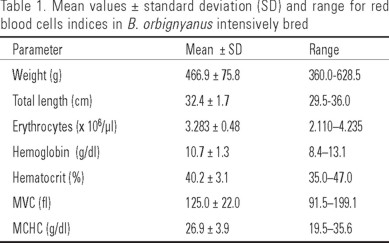
<body><![CDATA[<p align="justify"><font face="verdana" size="2">Este trabajo determina los &iacute;ndices eritroc&iacute;t&aacute;rios, el n&uacute;mero de trombocitos y de leucocitos en especimenes j&oacute;venes de piracanjuba, <i>Brycon orbignyanus</i> Valenciennes, 1849 (Characidae), cultivados intensivamente en viveros. Los valores medios y las variaciones son descritas a continuaci&oacute;n: eritrocitos totales 3,283 (2,110&#45;4,235) x 10<sup>6</sup>/&micro;l, hemoglobina, 10,7 (8,4&#45;13,1) g/dl, hematocrito 40,2 (35,0&#45;47,0), volumen corpuscular medio 125,0 (91,5&#45;199,1), concentraci&oacute;n de hemoglobina corpuscular media 26,9 (19,5&#45;35,6) g/dl, trombocitos totales 25.743,0 (11.228,0&#45;54.152,0) &micro;l, leucocitos totales 23.290,0 (9.601,0&#45;37.520,0) &micro;l, linfocitos 3.642,0 (709,0&#45;9.005,0) &micro;l, neutrofilos e heterofilos 18.178,0 (7.488,0&#45;29.783,0) &micro;l e monocitos 1.471,0 (147,0&#45;4.976,0) &micro;l. Estos resultados encontrados podr&aacute;n ser &uacute;tiles en la evaluaci&oacute;n de la salud de este pez cultivado intensivamente o en otra forma de cultivo, adem&aacute;s de servir para la comparaci&oacute;n de la especie en ambiente natural.</font></p>     <p align="justify"><font face="verdana" size="2"><b>Palabras clave:</b> <i>Brycon orbignyanus</i>, eritrocitos, hematologia, leucocitos, trombocitos.</font></p>     <p align="justify"><font face="Verdana" size="2">&nbsp;</font></p>     <p align="justify"><font face="verdana" size="2">The fish of the Characidae family belong to the Bryconinae sub&#45;family, which includes species of the <i>Brycon</i> genus, and are thoroughly distributed in Central and South America (Lima, 2003). In this sub&#45;family there is an important species for the Brazilian aquaculture, <i>Brycon orbignyanus</i>, popularly known as piracan&#45;juba, which is originally from the La Plata River basin (Argentina, Brazil and Uruguay). As this fish respond very well to hormonal induction for reproduction, its use in Brazilian fish farming began in the decade of 1930, with the studies of Rodolpho von Ihering. However, only in 1994 the studies for its viability in captivity were intensified, with the purpose of its reintroduction into areas threatened with extinction, and data concerning blood variables in this species are still incomplete.</font></p>     <p align="justify"><font face="verdana" size="2">Hematological data are used routinely in health care of humans and domestic mammals. Hematological evaluations are also gradually becoming a routine practice for determining health status in fish (Tavares&#45;Dias <i>et al</i>., 2003; Ranzaini&#45;Paiva <i>et al</i>., 2003; Cazenave <i>et al</i>., 2005). As the aquaculture industry expands, tools to monitor the health status of fish using standardized non&#45;lethal and expressive methods will be needed (Hrubec <i>et al</i>., 2000). Evaluation of hematologic analysis will enhance fish cultivation by facilitating early detection of situations of stress and/or diseases that could affect production performance (Tavares&#45;Dias <i>op.cit</i>.; Tavares&#45;Dias &amp; Moraes, 2004; Rehulka <i>et al</i>., 2004). This, in turn, will contribute to more specific, timely and effective disease treatments in the future. Thus, in previous studies we determined the glucose levels, protein total, sodium potassium, calcium, magnesium and chloride for <i>B. orbignyanus</i> and <i>B. amazonicus</i> (Tavares&#45;Dias, 2004) in intensive culture. In continuity, we proposed in the present study to determine red blood cell numbers, thrombogram, and leukogram of <i>B. orbignyanus</i> in fish farming ponds.</font></p>     <p align="justify"><font face="verdana" size="2">Forty clinically healthy young <i>B. orbignyanus</i>, 272 days of age, were obtained from a commercial fish farm (21<sup>o</sup> 07'45"S, 48<sup>o</sup>03'57"W), and transported to the Aquaculture Center/Caunesp, Jaboticabal, S&atilde;o Paulo, Brazil. They were maintained in three cement tanks (500 l) and acclimatized for 14 days, with a controlled flow&#45;through water system. They received pelleted fish meal (35% of crude protein) diets once a day. During the acclimatization, and study periods the fish were observed daily for any clinical signs of disease, including lack of appetite, increased opercular movements, or visible lesions of the skin, tail, and fins. Signs of disease were not apparent during any period of observation. At the fish farm, during their culture, the fish received pelleted and extruded fish diets with 42% and 28% of crude protein, respectively. After that, they were stocked in ponds of 1000 m<sup>2</sup> and received extruded ration with 28% of protein. During this period, the water temperature was 24.5 to 30.2<sup>o</sup>C; pH 6.7 to 6.9; dissolved oxygen 5.4 to 6.2 mg/l; electric conductivity 115.6 to 129.8 &micro;S/cm and pluviometric index 0.0 to 342.0 mm<sup>3</sup>.</font></p>     <p align="justify"><font face="verdana" size="2">From each specimen 0.5 ml of blood was collected by puncture of the caudal vein using a syringe containing EDTA (10%) for red blood cell number analysis. Then, as anesthetic substances may cause stress in fish (Tavares&#45;Dias &amp; Moraes, 2004), none of these products were used. After a rapid capture of the fish from the tanks by hand nets, they were immobilized and placed on a level surface, where the caudal puncture was performed rapidly.</font></p>     <p align="justify"><font face="verdana" size="2">The blood samples were used for determination of red blood cell (RBC) counts using an automatic blood cell counter (Celm, Model CC510). Hematocrit was determined by microhematocrit method, and hemoglobin concentration by cyanomethemoglobin method, being both methods usually well known. From these primary indicators resulted the secondary Wintrobe indices, such as mean corpuscular volume (MCV) and mean corpuscular hemoglobin concentration (MCHC).</font></p>     <p align="justify"><font face="verdana" size="2">The blood samples were used for the confection of blood smears for morphological observation, which were stained with May Gr&uuml;nwald&#45;Giemsa&#45;Wright (MGGW) according to the Tavares&#45;Dias &amp; Moraes (2003) method, and for thrombocyte and total leukocyte count (WBC), and differential leukocyte counts. Total leukocytes, and thrombocytes counts were performed in relation to the erythrocytes in randomly selected fields of stained blood smear, and recalculated per unit volume: leukocytes (&micro;l) = number of leukocytes in blood smear x RBC (&micro;l)/2,000 erythrocytes counted in smear, and thrombocytes (&micro;l)= number of thrombocytes in blood smear x RBC (&micro;l)/2,000 erythrocytes counted in blood smear.</font></p>     <p align="justify"><font face="verdana" size="2">The red blood cell indices for <i>B. orbignyanus</i> are summarized in <a href="#c1">Table 1</a>. Erythrocyte count showed a higher range while hemoglobin a smaller range, influencing thereby MVC, and MCHC.</font></p>     ]]></body>
<body><![CDATA[<p align="center"><font face="verdana" size="2"><a name="c1"></a></font></p>     <p align="center"><font face="verdana" size="2"><img src="/img/revistas/hbio/v16n3/a8c1.jpg"></font></p>     <p align="justify"><font face="verdana" size="2">Main values for thrombocyte counts were 25743.0 &micro;l. Lymphocytes, neutrophils/heterophils, and monocytes constituted the leukocyte populations observed (<a href="#c2">Table 2</a>). As heterophils, and neutrophils are granulocytes that possess equivalent functions, these were quantified together.</font></p>     <p align="center"><font face="verdana" size="2"><a name="c2"></a></font></p>     <p align="center"><font face="verdana" size="2"><img src="/img/revistas/hbio/v16n3/a8c2.jpg"></font></p>     <p align="justify"><font face="verdana" size="2">Changes in blood values are particularly important for diagnosis of disease and stress (Tavares&#45;Dias <i>et al</i>., 2003; Ranzani&#45;Paiva <i>et al</i>., 2003; Rehulka <i>et al.</i>, 2004; Cazenave <i>et al</i>., 2005). Evaluation of hematologic parameters will enhance fish cultivation by facilitating early detection of infective diseases (Rehulka <i>et al</i>., <i>op. cit</i>) and identification of subletal conditions (Cazenave<i> et al</i>., <i>op. cit</i>.) that affect production performance. However, data for <i>B. orbignyanus</i> were fragmented until the present moment since only glucose levels (47.7&#45;114.2 mg/dl), total protein (2.5&#45;6.2 g/dl), sodium (135.0&#45;153.5 mmol/l), potassium (2.0&#45;5.2 mmol/l), calcium (2.3&#45;3.1 mmol/l), magnesium (0.7&#45;2.0 mmol/l) and chloride levels (103.0&#45;127.0 mmol/l) were studied (Tavares&#45;Dias, 2004).</font></p>     <p align="justify"><font face="verdana" size="2">Our complemental studies in <i>B. orbignyanus</i> show that erythrocyte numbers varied from 2.110&#45;4.235 x 10<sup>6</sup>/&micro;l, hematocrit 35.0&#45;47.0%, hemoglobin 8.4&#45;13.1 g/dl, MCV 91.5&#45;199.1 fl and MCHC 19.5&#45;35.6 g/dl. These values are similar to those of young <i>B. amazonicus</i> (Tavares&#45;Dias <i>et al</i>., 1999) and fry of <i>B. cepahus</i> (Ar&eacute;valo &amp; Castellanos, 2003) also in artificial cultivation systems. On the other hand, when compared to the young <i>B. hilarii</i> (Tavares&#45;Dias <i>et al.</i>, <i>op. cit</i>), the hematocrit, hemoglobin and MCHC values were relatively alike, while that for young and adult <i>B. cepahus</i> the hemoglobin; MCV and MCHC values were different (Ar&eacute;valo &amp; Castellanos, <i>op.cit</i>.), as were the erythrocyte count and the MCV values for adult <i>Brycon</i> sp. (Ranzani&#45;Paiva, 1991). Inter&#45;specific variations in red blood cell parameters have been reported in different teleosts and been attributed to factors such as sex, genetic variation, stress caused by capture, and handling (Tavares&#45;Dias <i>et al</i>., 2003; Rehulka <i>et al</i>., 2004; Cazenave <i>et al.</i>, 2005), species, water temperature, and environment. Therefore, hematologic values frequently can be affected by various intrinsic, and extrinsic factors (Tavares&#45;Dias &amp; Moraes, 2004; Cazenave <i>et al</i>., <i>op. cit</i>) when comparing these values among different species, with results appearing differently than expected.</font></p>     <p align="justify"><font face="verdana" size="2">The aim of stringent health control values is to provide a fish pathologist with a choice of sensitive methods to enable early detection of physiological deviations from standard form, which may signal the on come of disease. The numbers, and proportions of leukocytes, and thrombocytes (organic defense cells) in circulation provide an important representation of defense cell distribution throughout the body. In <i>B. orbignyanus</i> there was intraspecific variation in total thrombocyte count, and the mean values were similar to those in <i>Cyprinus carpio</i> (Tavares&#45;Dias <i>et al</i>., 2004), however were lesser than those in the also characid <i>Piaractus mesopotamicus</i> (Tavares&#45;Dias &amp; Mataqueiro, 2004), and, as the counting method used was the same, these differences appear to be due to the species in question.</font></p>     <p align="justify"><font face="verdana" size="2">It was observed that the total leukocyte count in <i>B. orbignyanus</i> presented intraspecific variation, besides the fact that the mean values were much higher than in <i>B. cepahus</i> (Ar&eacute;valo &amp; Castellanos, 2003). However, this difference could be due to the counting method applied since the low values for <i>B. cepahus</i> suggest that this counting was probably done by direct method. Low leukocyte values obtained in these counts resulted from inefficient staining of these cells in the hemocytometer. Nevertheless, due to this factor, indirect methods can be considered more accurate that the direct methods (for details see Tavares&#45;Dias <i>et al.</i>, 2002) in spite of being a estimated count. This demonstrates the urgent need to develop a method that would allow more precision in leukocyte counting in fishes, preferably an automated method, as those already used for other vertebrates with anucleated erythrocytes.</font></p>     <p align="justify"><font face="verdana" size="2">Hine <i>et al.</i>, (1990) hypothesized that neutrophils, and heterophils represent cellular types of two different lines that evoluted, and they appear today as alternative types in lower vertebrates of the zoological scale, thus heterophils developed eosinophilic proprieties while neutrophils basophilic proprieties. Nevertheless, neutrophils, and heterophils were found in <i>B. orbignyanus</i>, and they exhibited both proprieties, eosinophilic, and basophilic. In addition, blood lymphocytes, and monocytes were observed in <i>B. orbignyanus.</i> Ar&eacute;valo and Castellanos,<i> op. cit</i>, also reported blood neutrophils, and heterophils in <i>B. cepahus</i> alevins, although in young, and adult fishes they found eosinophils, a granulocyte that was not seen here in peripheral blood of <i>B. orbignyanus.</i> The occurrence of granulocytes in fish has been subject of some controversy, including Bryconinae. Therefore, the granulocytes that have been described, as special granulocytic cells in <i>Brycon</i> sp. (Ranzani&#45;Paiva, 1996) and <i>B. amazonicus</i> (Tavares&#45;Dias <i>et al.</i>, 1999), are in fact heterophils. Such identification problems can be caused by inadequate Romanowsky staining (e.g. May Gr&uuml;nwal&#45;Giemsa), when used for staining blood smears of these species. These findings seem indicate that presence of both heterophil, and neutrophil seem be a characteristic of species from Bryconinae sub&#45;family.</font></p>     ]]></body>
<body><![CDATA[<p align="justify"><font face="verdana" size="2">In <i>B. orbignyanus</i> the neutrophil/heterophil number was found to be higher than that described for the characid <i>P. mesopotamicus</i> (Tavares&#45;Dias &amp; Mataqueiro, 2004), while lymphocyte numbers were smaller, and monocyte count very similar. However, when compared to <i>C. carpio</i> (Tavares&#45;Dias <i>et al.</i>, 2004), the number of these leukocytes was different. The methods used for counting were alike, but these are different species and from different environments, and other factors should be considered since the leukocytes are immune cells traveling between and through tissues to the bloodstream (Tavares&#45;Dias &amp; Mataqueiro, <i>op. cit</i>). Moreover, the response to different stimuli from the environment may vary among individuals of a same species, as well as among species. The presence of leukocytes relates to important characteristics of health status in fish and in many cases they are also helpful in immune system evaluation. Therefore, variations in the proportions of these defense cells in the blood are usually expected.</font></p>     <p align="justify"><font face="verdana" size="2">To conclude, as hematology assessment is gradually becoming routine practice for intensively bred fish, since intensive aquaculture needs accurate information for identification and control of stress situations and/or diseases in order to ensure healthy fish, the evaluation of blood parameters may be the quickest way to detect these symptoms. Therefore, there is an urgent need of reliable normal databases to be available for species of economic importance, as is the <i>B. orbignyanus</i>. Thus, we studied the hematological values for this species, and concluded that they are similar to those of other characids reported in literature. Moreover, other complemental studies will be done in this species, such as cytochemistry and ultrastructure, for concluding compilation of reference data for this Brazilian bryconin.</font></p>     <p align="justify"><font face="Verdana" size="2">&nbsp;</font></p>     <p align="justify"><font face="verdana" size="2"><b>REFERENCES</b></font></p>     <!-- ref --><p align="justify"><font face="verdana" size="2">AR&Eacute;VALO, M.B.B.G.H. &amp; CASTELLANOS, J.A. 2003. Hematology and sanguine chemistry of yam&uacute; <i>Brycon siebenthalae. In.</i> WORD AQUACULTURE 2003, Salvador, BA. <i>Anais.</i> Salvador Word Aquaculte Society, pp. 50.    &nbsp;&nbsp;&nbsp;&nbsp;&nbsp;&nbsp;&nbsp;&nbsp;[&#160;<a href="javascript:void(0);" onclick="javascript: window.open('/scielo.php?script=sci_nlinks&ref=4066085&pid=S0188-8897200600030000800001&lng=','','width=640,height=500,resizable=yes,scrollbars=1,menubar=yes,');">Links</a>&#160;]<!-- end-ref --></font></p>     <!-- ref --><p align="justify"><font face="verdana" size="2">CAZENAVE, J., WUNDERLIN, D.A., HUED, A.C. &amp; BISTONI, M.A. 2005. Haematological parameters in a neotropical fish, <i>Corydoras paleatus</i> (Jenys, 1842) (Pisces, Callichthydae), captured from pristine and polluted water. <i>Hidrobiologia</i> 537: 25&#45;33.    &nbsp;&nbsp;&nbsp;&nbsp;&nbsp;&nbsp;&nbsp;&nbsp;[&#160;<a href="javascript:void(0);" onclick="javascript: window.open('/scielo.php?script=sci_nlinks&ref=4066087&pid=S0188-8897200600030000800002&lng=','','width=640,height=500,resizable=yes,scrollbars=1,menubar=yes,');">Links</a>&#160;]<!-- end-ref --></font></p>     <!-- ref --><p align="justify"><font face="verdana" size="2">HINE, P.M., WAIN, J.M. &amp; LESTER, J.G. 1990. Observations on the blood of the Australian lungfish, <i>Neoceratodus forsteri</i> Klefft. I. Ultrastructure of granulocytes, monocytes and thrombocytes.<i> Australian Journal of Zoology</i> 38: 131&#45;144.    &nbsp;&nbsp;&nbsp;&nbsp;&nbsp;&nbsp;&nbsp;&nbsp;[&#160;<a href="javascript:void(0);" onclick="javascript: window.open('/scielo.php?script=sci_nlinks&ref=4066089&pid=S0188-8897200600030000800003&lng=','','width=640,height=500,resizable=yes,scrollbars=1,menubar=yes,');">Links</a>&#160;]<!-- end-ref --></font></p>     ]]></body>
<body><![CDATA[<!-- ref --><p align="justify"><font face="verdana" size="2">HRUBEC, T.C., CARDINALE, J.L. &amp; SMITH, S.A. 2000. Hematology and plasma chemistry reference intervals for cultured tilapia <i>(Oreochromis</i> hybrid). <i>Veterinary Clinical and Pathology</i> 29: 7&#45;12.    &nbsp;&nbsp;&nbsp;&nbsp;&nbsp;&nbsp;&nbsp;&nbsp;[&#160;<a href="javascript:void(0);" onclick="javascript: window.open('/scielo.php?script=sci_nlinks&ref=4066091&pid=S0188-8897200600030000800004&lng=','','width=640,height=500,resizable=yes,scrollbars=1,menubar=yes,');">Links</a>&#160;]<!-- end-ref --></font></p>     <!-- ref --><p align="justify"><font face="verdana" size="2">LIMA, F. C. T. 2003. Subfamily Bryconinae (Characins, Tetras). <i>In</i>: REIS, R.E; KULANDER, S. O; FERRARIS JR, C. J. Check List of the Freshwater Fishes of South and Central America. Porto Alegre EDPURCS, pp. 174&#45;181.    &nbsp;&nbsp;&nbsp;&nbsp;&nbsp;&nbsp;&nbsp;&nbsp;[&#160;<a href="javascript:void(0);" onclick="javascript: window.open('/scielo.php?script=sci_nlinks&ref=4066093&pid=S0188-8897200600030000800005&lng=','','width=640,height=500,resizable=yes,scrollbars=1,menubar=yes,');">Links</a>&#160;]<!-- end-ref --></font></p>     <!-- ref --><p align="justify"><font face="verdana" size="2">RANZANI&#45;PAIVA, M.J.T. 1991. Caracter&iacute;sticas sang&uuml;&iacute;neas da pirapitinga do sul, <i>Brycon</i> sp., sob condi&ccedil;&otilde;es experimentais de cria&ccedil;&atilde;o intensiva. <i>Brazilizan Journal of Veterinary Research and Animal Science</i> 28: 141&#45;153.    &nbsp;&nbsp;&nbsp;&nbsp;&nbsp;&nbsp;&nbsp;&nbsp;[&#160;<a href="javascript:void(0);" onclick="javascript: window.open('/scielo.php?script=sci_nlinks&ref=4066095&pid=S0188-8897200600030000800006&lng=','','width=640,height=500,resizable=yes,scrollbars=1,menubar=yes,');">Links</a>&#160;]<!-- end-ref --></font></p>     <!-- ref --><p align="justify"><font face="verdana" size="2">RANZANI&#45;PAIVA, M.J.T. 1996. C&eacute;lulas sang&uuml;&iacute;neas e contagem diferencial de leuc&oacute;citos em pirapitinga do sul, <i>Brycon</i> sp., sob condi&ccedil;&otilde;es experimentais de cria&ccedil;&atilde;o intensiva<i>. Revista Ceres</i> 43: 685&#45;696.    &nbsp;&nbsp;&nbsp;&nbsp;&nbsp;&nbsp;&nbsp;&nbsp;[&#160;<a href="javascript:void(0);" onclick="javascript: window.open('/scielo.php?script=sci_nlinks&ref=4066097&pid=S0188-8897200600030000800007&lng=','','width=640,height=500,resizable=yes,scrollbars=1,menubar=yes,');">Links</a>&#160;]<!-- end-ref --></font></p>     <!-- ref --><p align="justify"><font face="verdana" size="2">RANZANI&#45;PAIVA, M.J.T., RODRIGUES, E.L.. VEIGA, M.L., EIRAS, A.C. &amp; CAMPOS, B.E.S. 2003. Differential leukocytes counts in "dourado"<i>Salminus maxillous</i>" Valenciennes, 1840, from the Mogi&#45;Gua&ccedil;u River, Pirassiununga, SP. <i>Brazilian Journal of Biology</i> 63: 517&#45;525.    &nbsp;&nbsp;&nbsp;&nbsp;&nbsp;&nbsp;&nbsp;&nbsp;[&#160;<a href="javascript:void(0);" onclick="javascript: window.open('/scielo.php?script=sci_nlinks&ref=4066099&pid=S0188-8897200600030000800008&lng=','','width=640,height=500,resizable=yes,scrollbars=1,menubar=yes,');">Links</a>&#160;]<!-- end-ref --></font></p>     ]]></body>
<body><![CDATA[<!-- ref --><p align="justify"><font face="verdana" size="2">REHULKA, J., MINARIK, B. &amp; REHULKOV&Aacute;, E. 2004. Red blood cell indices of rainbow trout <i>Onchorhynchus mykiss</i> (Walbaum) in aquaculture. <i>Aquaculture Research</i> 35: 529&#45;546.    &nbsp;&nbsp;&nbsp;&nbsp;&nbsp;&nbsp;&nbsp;&nbsp;[&#160;<a href="javascript:void(0);" onclick="javascript: window.open('/scielo.php?script=sci_nlinks&ref=4066101&pid=S0188-8897200600030000800009&lng=','','width=640,height=500,resizable=yes,scrollbars=1,menubar=yes,');">Links</a>&#160;]<!-- end-ref --></font></p>     <!-- ref --><p align="justify"><font face="verdana" size="2">TAVARES&#45;DIAS, M. 2004. Caracter&iacute;sticas bioqu&iacute;micas de <i>Brycon cephalus</i> e <i>Brycon orbignyanus</i>, tele&oacute;steos dulciaq&uuml;&iacute;colas brasileiros de import&acirc;ncia econ&ocirc;mica. CIVA2004 (<a href="http://www.civa2004.org" target="_blank">http://www.civa2004.org</a>): 282&#45;285.    &nbsp;&nbsp;&nbsp;&nbsp;&nbsp;&nbsp;&nbsp;&nbsp;[&#160;<a href="javascript:void(0);" onclick="javascript: window.open('/scielo.php?script=sci_nlinks&ref=4066103&pid=S0188-8897200600030000800010&lng=','','width=640,height=500,resizable=yes,scrollbars=1,menubar=yes,');">Links</a>&#160;]<!-- end-ref --></font></p>     <!-- ref --><p align="justify"><font face="verdana" size="2">TAVARES&#45;DIAS, M. &amp; MORAES, F.R. 2003. Caracter&iacute;sticas hematol&oacute;gicas da <i>Tilapia rendalli</i> Boulenger, 1896 (Osteichthyes: Cichlidae) capturada em "Pesque&#45;Pague" de Franca, S&atilde;o Paulo, Brasil. <i>Bioscience Journal</i> 19: 103&#45;110.    &nbsp;&nbsp;&nbsp;&nbsp;&nbsp;&nbsp;&nbsp;&nbsp;[&#160;<a href="javascript:void(0);" onclick="javascript: window.open('/scielo.php?script=sci_nlinks&ref=4066105&pid=S0188-8897200600030000800011&lng=','','width=640,height=500,resizable=yes,scrollbars=1,menubar=yes,');">Links</a>&#160;]<!-- end-ref --></font></p>     <!-- ref --><p align="justify"><font face="verdana" size="2">TAVARES&#45;DIAS, M. &amp; MORAES, F.R. 2004. Hematologia de peixes tele&oacute;steos. M. Tavares&#45;Dias, Ribeir&atilde;o Preto, S&acirc;o Paulo. 144p.    &nbsp;&nbsp;&nbsp;&nbsp;&nbsp;&nbsp;&nbsp;&nbsp;[&#160;<a href="javascript:void(0);" onclick="javascript: window.open('/scielo.php?script=sci_nlinks&ref=4066107&pid=S0188-8897200600030000800012&lng=','','width=640,height=500,resizable=yes,scrollbars=1,menubar=yes,');">Links</a>&#160;]<!-- end-ref --></font></p>     <!-- ref --><p align="justify"><font face="verdana" size="2">TAVARES&#45;DIAS, M. &amp; MATAQUEIRO, M.I. 2004. Caracter&iacute;sticas hematol&oacute;gicas, bioqu&iacute;micas e biom&eacute;tricas de <i>Piaractus mesopotamicus</i> Holmberg, 1887 (Osteichthyes: Characidae) oriundos de cultivo intensivo. <i>Acta Scientiarum</i> 26: 157&#45;162.    &nbsp;&nbsp;&nbsp;&nbsp;&nbsp;&nbsp;&nbsp;&nbsp;[&#160;<a href="javascript:void(0);" onclick="javascript: window.open('/scielo.php?script=sci_nlinks&ref=4066109&pid=S0188-8897200600030000800013&lng=','','width=640,height=500,resizable=yes,scrollbars=1,menubar=yes,');">Links</a>&#160;]<!-- end-ref --></font></p>     ]]></body>
<body><![CDATA[<!-- ref --><p align="justify"><font face="verdana" size="2">TAVARES&#45;DIAS, M.; FRASC&Aacute;&#45;SCORVO, C. M.D.; MORAES, F.R. &amp; CAMPOS&#45;FILHO, E. 1999. Caracter&iacute;sticas hematol&oacute;gicas de tele&oacute;steos brasileiros. IV. Par&acirc;metros eritroleucom&eacute;tricos, trombom&eacute;tricos e glicemia do matrinx&atilde; <i>Brycon cephalus</i> G&uuml;nther, 1869 (Osteichthyes: Characidae). <i>Ars Veterinaria</i> 15:149&#45;153.    &nbsp;&nbsp;&nbsp;&nbsp;&nbsp;&nbsp;&nbsp;&nbsp;[&#160;<a href="javascript:void(0);" onclick="javascript: window.open('/scielo.php?script=sci_nlinks&ref=4066111&pid=S0188-8897200600030000800014&lng=','','width=640,height=500,resizable=yes,scrollbars=1,menubar=yes,');">Links</a>&#160;]<!-- end-ref --></font></p>     <!-- ref --><p align="justify"><font face="verdana" size="2">TAVARES&#45;DIAS, M.; MATAQUEIRO, M.I. &amp; PERECIN, D. 2002. Total leukocyte counts in fishes by direct or indirect methods? <i>Boletim do Instituo de Pesca</i> 28: 155&#45;161.    &nbsp;&nbsp;&nbsp;&nbsp;&nbsp;&nbsp;&nbsp;&nbsp;[&#160;<a href="javascript:void(0);" onclick="javascript: window.open('/scielo.php?script=sci_nlinks&ref=4066113&pid=S0188-8897200600030000800015&lng=','','width=640,height=500,resizable=yes,scrollbars=1,menubar=yes,');">Links</a>&#160;]<!-- end-ref --></font></p>     <!-- ref --><p align="justify"><font face="verdana" size="2">TAVARES&#45;DIAS, M.; SCHALCH, S.E.C. &amp; MORAES, F.R. 2003. Hematological characteristics of Brazilian teleosts. VII. Parameters of seven species collected in Guariba, S&atilde;o Paulo State, Brazil. <i>Boletim do Instituo de Pesca</i> 29: 109&#45;115.    &nbsp;&nbsp;&nbsp;&nbsp;&nbsp;&nbsp;&nbsp;&nbsp;[&#160;<a href="javascript:void(0);" onclick="javascript: window.open('/scielo.php?script=sci_nlinks&ref=4066115&pid=S0188-8897200600030000800016&lng=','','width=640,height=500,resizable=yes,scrollbars=1,menubar=yes,');">Links</a>&#160;]<!-- end-ref --></font></p>     <!-- ref --><p align="justify"><font face="verdana" size="2">TAVARES&#45;DIAS, M; BOZZO, F.R.; SANDRIN, E.F.S.; CAMPOS&#45;FILHO, E. &amp; MORAES, F.R. 2004. C&eacute;lulas sang&uuml;&iacute;neas, eletr&oacute;litos s&eacute;ricos, rela&ccedil;&atilde;o hepato e esplenosom&aacute;tica de carpacomum, <i>Cyprinus carpio</i> (Cyprinidae) na primeira matura&ccedil;&atilde;o gonadal. <i>Acta Scientiarum</i> 26: 73&#45;80.    &nbsp;&nbsp;&nbsp;&nbsp;&nbsp;&nbsp;&nbsp;&nbsp;[&#160;<a href="javascript:void(0);" onclick="javascript: window.open('/scielo.php?script=sci_nlinks&ref=4066117&pid=S0188-8897200600030000800017&lng=','','width=640,height=500,resizable=yes,scrollbars=1,menubar=yes,');">Links</a>&#160;]<!-- end-ref --></font></p>      ]]></body><back>
<ref-list>
<ref id="B1">
<nlm-citation citation-type="book">
<person-group person-group-type="author">
<name>
<surname><![CDATA[ARÉVALO]]></surname>
<given-names><![CDATA[M.B.B.G.H.]]></given-names>
</name>
<name>
<surname><![CDATA[CASTELLANOS]]></surname>
<given-names><![CDATA[J.A]]></given-names>
</name>
</person-group>
<source><![CDATA[Hematology and sanguine chemistry of yamú Brycon siebenthalae. In. WORD AQUACULTURE 2003, Salvador, BA. Anais]]></source>
<year>2003</year>
<page-range>50</page-range><publisher-name><![CDATA[Salvador Word Aquaculte Society]]></publisher-name>
</nlm-citation>
</ref>
<ref id="B2">
<nlm-citation citation-type="journal">
<person-group person-group-type="author">
<name>
<surname><![CDATA[CAZENAVE]]></surname>
<given-names><![CDATA[J.]]></given-names>
</name>
<name>
<surname><![CDATA[WUNDERLIN]]></surname>
<given-names><![CDATA[D.A.]]></given-names>
</name>
<name>
<surname><![CDATA[HUED]]></surname>
<given-names><![CDATA[A.C.]]></given-names>
</name>
<name>
<surname><![CDATA[BISTONI]]></surname>
<given-names><![CDATA[M.A]]></given-names>
</name>
</person-group>
<article-title xml:lang="en"><![CDATA[Haematological parameters in a neotropical fish, Corydoras paleatus (Jenys, 1842) (Pisces, Callichthydae), captured from pristine and polluted water]]></article-title>
<source><![CDATA[Hidrobiologia]]></source>
<year>2005</year>
<volume>537</volume>
<page-range>25-33</page-range></nlm-citation>
</ref>
<ref id="B3">
<nlm-citation citation-type="journal">
<person-group person-group-type="author">
<name>
<surname><![CDATA[HINE]]></surname>
<given-names><![CDATA[P.M.]]></given-names>
</name>
<name>
<surname><![CDATA[WAIN]]></surname>
<given-names><![CDATA[J.M.]]></given-names>
</name>
<name>
<surname><![CDATA[LESTER]]></surname>
<given-names><![CDATA[J.G]]></given-names>
</name>
</person-group>
<article-title xml:lang="en"><![CDATA[Observations on the blood of the Australian lungfish, Neoceratodus forsteri Klefft. I. Ultrastructure of granulocytes, monocytes and thrombocytes]]></article-title>
<source><![CDATA[Australian Journal of Zoology]]></source>
<year>1990</year>
<volume>38</volume>
<page-range>131-144</page-range></nlm-citation>
</ref>
<ref id="B4">
<nlm-citation citation-type="journal">
<person-group person-group-type="author">
<name>
<surname><![CDATA[HRUBEC]]></surname>
<given-names><![CDATA[T.C.]]></given-names>
</name>
<name>
<surname><![CDATA[CARDINALE]]></surname>
<given-names><![CDATA[J.L.]]></given-names>
</name>
<name>
<surname><![CDATA[SMITH]]></surname>
<given-names><![CDATA[S.A]]></given-names>
</name>
</person-group>
<article-title xml:lang="en"><![CDATA[Hematology and plasma chemistry reference intervals for cultured tilapia (Oreochromis hybrid)]]></article-title>
<source><![CDATA[Veterinary Clinical and Pathology]]></source>
<year>2000</year>
<volume>29</volume>
<page-range>7-12</page-range></nlm-citation>
</ref>
<ref id="B5">
<nlm-citation citation-type="book">
<person-group person-group-type="author">
<name>
<surname><![CDATA[LIMA]]></surname>
<given-names><![CDATA[F. C. T.]]></given-names>
</name>
</person-group>
<article-title xml:lang="en"><![CDATA[Subfamily Bryconinae (Characins, Tetras)]]></article-title>
<person-group person-group-type="editor">
<name>
<surname><![CDATA[REIS]]></surname>
<given-names><![CDATA[R.E]]></given-names>
</name>
<name>
<surname><![CDATA[KULANDER]]></surname>
<given-names><![CDATA[S. O]]></given-names>
</name>
<name>
<surname><![CDATA[FERRARIS]]></surname>
<given-names><![CDATA[JR, C. J.]]></given-names>
</name>
</person-group>
<source><![CDATA[Check List of the Freshwater Fishes of South and Central America]]></source>
<year>2003</year>
<page-range>174-181</page-range><publisher-loc><![CDATA[Porto Alegre ]]></publisher-loc>
<publisher-name><![CDATA[EDPURCS]]></publisher-name>
</nlm-citation>
</ref>
<ref id="B6">
<nlm-citation citation-type="journal">
<person-group person-group-type="author">
<name>
<surname><![CDATA[RANZANI-PAIVA]]></surname>
<given-names><![CDATA[M.J.T]]></given-names>
</name>
</person-group>
<article-title xml:lang="en"><![CDATA[Características sangüíneas da pirapitinga do sul, Brycon sp., sob condições experimentais de criação intensiva]]></article-title>
<source><![CDATA[Brazilizan Journal of Veterinary Research and Animal Science]]></source>
<year>1991</year>
<volume>28</volume>
<page-range>141-153</page-range></nlm-citation>
</ref>
<ref id="B7">
<nlm-citation citation-type="journal">
<person-group person-group-type="author">
<name>
<surname><![CDATA[RANZANI-PAIVA]]></surname>
<given-names><![CDATA[M.J.T]]></given-names>
</name>
</person-group>
<article-title xml:lang="pt"><![CDATA[Células sangüíneas e contagem diferencial de leucócitos em pirapitinga do sul, Brycon sp., sob condições experimentais de criação intensiva]]></article-title>
<source><![CDATA[Revista Ceres]]></source>
<year>1996</year>
<volume>43</volume>
<page-range>685-696</page-range></nlm-citation>
</ref>
<ref id="B8">
<nlm-citation citation-type="journal">
<person-group person-group-type="author">
<name>
<surname><![CDATA[RANZANI-PAIVA]]></surname>
<given-names><![CDATA[M.J.T.]]></given-names>
</name>
<name>
<surname><![CDATA[RODRIGUES]]></surname>
<given-names><![CDATA[E.L.]]></given-names>
</name>
<name>
<surname><![CDATA[VEIGA]]></surname>
<given-names><![CDATA[M.L.]]></given-names>
</name>
<name>
<surname><![CDATA[EIRAS]]></surname>
<given-names><![CDATA[A.C.]]></given-names>
</name>
<name>
<surname><![CDATA[CAMPOS]]></surname>
<given-names><![CDATA[B.E.S.]]></given-names>
</name>
</person-group>
<article-title xml:lang="en"><![CDATA[Differential leukocytes counts in "dourado"Salminus maxillous" Valenciennes, 1840, from the Mogi-Guaçu River, Pirassiununga, SP]]></article-title>
<source><![CDATA[Brazilian Journal of Biology]]></source>
<year>2003</year>
<volume>63</volume>
<page-range>517-525</page-range></nlm-citation>
</ref>
<ref id="B9">
<nlm-citation citation-type="journal">
<person-group person-group-type="author">
<name>
<surname><![CDATA[REHULKA]]></surname>
<given-names><![CDATA[J.]]></given-names>
</name>
<name>
<surname><![CDATA[MINARIK]]></surname>
<given-names><![CDATA[B.]]></given-names>
</name>
<name>
<surname><![CDATA[REHULKOVÁ]]></surname>
<given-names><![CDATA[E]]></given-names>
</name>
</person-group>
<article-title xml:lang="en"><![CDATA[Red blood cell indices of rainbow trout Onchorhynchus mykiss (Walbaum) in aquaculture]]></article-title>
<source><![CDATA[Aquaculture Research]]></source>
<year>2004</year>
<volume>35</volume>
<page-range>529-546</page-range></nlm-citation>
</ref>
<ref id="B10">
<nlm-citation citation-type="book">
<person-group person-group-type="author">
<name>
<surname><![CDATA[TAVARES-DIAS]]></surname>
<given-names><![CDATA[M.]]></given-names>
</name>
</person-group>
<source><![CDATA[Características bioquímicas de Brycon cephalus e Brycon orbignyanus, teleósteos dulciaqüícolas brasileiros de importância econômica]]></source>
<year>2004</year>
<page-range>282-285</page-range><publisher-name><![CDATA[CIVA2004]]></publisher-name>
</nlm-citation>
</ref>
<ref id="B11">
<nlm-citation citation-type="journal">
<person-group person-group-type="author">
<name>
<surname><![CDATA[TAVARES-DIAS]]></surname>
<given-names><![CDATA[M.]]></given-names>
</name>
<name>
<surname><![CDATA[MORAES]]></surname>
<given-names><![CDATA[F.R]]></given-names>
</name>
</person-group>
<article-title xml:lang="pt"><![CDATA[Características hematológicas da Tilapia rendalli Boulenger, 1896 (Osteichthyes: Cichlidae) capturada em "Pesque-Pague" de Franca, São Paulo, Brasil]]></article-title>
<source><![CDATA[Bioscience Journal]]></source>
<year>2003</year>
<volume>19</volume>
<page-range>103-110</page-range></nlm-citation>
</ref>
<ref id="B12">
<nlm-citation citation-type="book">
<person-group person-group-type="author">
<name>
<surname><![CDATA[TAVARES-DIAS]]></surname>
<given-names><![CDATA[M.]]></given-names>
</name>
<name>
<surname><![CDATA[MORAES]]></surname>
<given-names><![CDATA[F.R]]></given-names>
</name>
</person-group>
<source><![CDATA[Hematologia de peixes teleósteos]]></source>
<year>2004</year>
<page-range>144</page-range><publisher-loc><![CDATA[Ribeirão Preto^eSâo Paulo Sâo Paulo]]></publisher-loc>
<publisher-name><![CDATA[M. Tavares-Dias]]></publisher-name>
</nlm-citation>
</ref>
<ref id="B13">
<nlm-citation citation-type="journal">
<person-group person-group-type="author">
<name>
<surname><![CDATA[TAVARES-DIAS]]></surname>
<given-names><![CDATA[M.]]></given-names>
</name>
<name>
<surname><![CDATA[MATAQUEIRO]]></surname>
<given-names><![CDATA[M.I]]></given-names>
</name>
</person-group>
<article-title xml:lang="es"><![CDATA[Características hematológicas, bioquímicas e biométricas de Piaractus mesopotamicus Holmberg, 1887 (Osteichthyes: Characidae) oriundos de cultivo intensivo]]></article-title>
<source><![CDATA[Acta Scientiarum]]></source>
<year>2004</year>
<volume>26</volume>
<page-range>157-162</page-range></nlm-citation>
</ref>
<ref id="B14">
<nlm-citation citation-type="journal">
<person-group person-group-type="author">
<name>
<surname><![CDATA[TAVARES-DIAS]]></surname>
<given-names><![CDATA[M.]]></given-names>
</name>
<name>
<surname><![CDATA[FRASCÁ-SCORVO]]></surname>
<given-names><![CDATA[C. M.D.]]></given-names>
</name>
<name>
<surname><![CDATA[MORAES]]></surname>
<given-names><![CDATA[F.R.]]></given-names>
</name>
<name>
<surname><![CDATA[CAMPOS-FILHO]]></surname>
<given-names><![CDATA[E]]></given-names>
</name>
</person-group>
<article-title xml:lang="pt"><![CDATA[Características hematológicas de teleósteos brasileiros. IV. Parâmetros eritroleucométricos, trombométricos e glicemia do matrinxã Brycon cephalus Günther, 1869 (Osteichthyes: Characidae)]]></article-title>
<source><![CDATA[Ars Veterinaria]]></source>
<year>1999</year>
<volume>15</volume>
<page-range>149-153</page-range></nlm-citation>
</ref>
<ref id="B15">
<nlm-citation citation-type="journal">
<person-group person-group-type="author">
<name>
<surname><![CDATA[TAVARES-DIAS]]></surname>
<given-names><![CDATA[M.]]></given-names>
</name>
<name>
<surname><![CDATA[MATAQUEIRO]]></surname>
<given-names><![CDATA[M.I.]]></given-names>
</name>
<name>
<surname><![CDATA[PERECIN]]></surname>
<given-names><![CDATA[D.]]></given-names>
</name>
</person-group>
<article-title xml:lang="en"><![CDATA[Total leukocyte counts in fishes by direct or indirect methods?]]></article-title>
<source><![CDATA[Boletim do Instituo de Pesca]]></source>
<year>2002</year>
<volume>28</volume>
<page-range>155-161</page-range></nlm-citation>
</ref>
<ref id="B16">
<nlm-citation citation-type="journal">
<person-group person-group-type="author">
<name>
<surname><![CDATA[TAVARES-DIAS]]></surname>
<given-names><![CDATA[M.]]></given-names>
</name>
<name>
<surname><![CDATA[SCHALCH]]></surname>
<given-names><![CDATA[S.E.C.]]></given-names>
</name>
<name>
<surname><![CDATA[MORAES]]></surname>
<given-names><![CDATA[F.R]]></given-names>
</name>
</person-group>
<article-title xml:lang="en"><![CDATA[Hematological characteristics of Brazilian teleosts. VII. Parameters of seven species collected in Guariba, São Paulo State, Brazil]]></article-title>
<source><![CDATA[Boletim do Instituo de Pesca]]></source>
<year>2003</year>
<volume>29</volume>
<page-range>109-115</page-range></nlm-citation>
</ref>
<ref id="B17">
<nlm-citation citation-type="journal">
<person-group person-group-type="author">
<name>
<surname><![CDATA[TAVARES-DIAS]]></surname>
<given-names><![CDATA[M]]></given-names>
</name>
<name>
<surname><![CDATA[BOZZO]]></surname>
<given-names><![CDATA[F.R.]]></given-names>
</name>
<name>
<surname><![CDATA[SANDRIN]]></surname>
<given-names><![CDATA[E.F.S.]]></given-names>
</name>
<name>
<surname><![CDATA[CAMPOS-FILHO]]></surname>
<given-names><![CDATA[E.]]></given-names>
</name>
<name>
<surname><![CDATA[MORAES]]></surname>
<given-names><![CDATA[F.R]]></given-names>
</name>
</person-group>
<article-title xml:lang="pt"><![CDATA[Células sangüíneas, eletrólitos séricos, relação hepato e esplenosomática de carpacomum, Cyprinus carpio (Cyprinidae) na primeira maturação gonadal]]></article-title>
<source><![CDATA[Acta Scientiarum]]></source>
<year>2004</year>
<volume>26</volume>
<page-range>73-80</page-range></nlm-citation>
</ref>
</ref-list>
</back>
</article>
