<?xml version="1.0" encoding="ISO-8859-1"?><article xmlns:mml="http://www.w3.org/1998/Math/MathML" xmlns:xlink="http://www.w3.org/1999/xlink" xmlns:xsi="http://www.w3.org/2001/XMLSchema-instance">
<front>
<journal-meta>
<journal-id>0188-8897</journal-id>
<journal-title><![CDATA[Hidrobiológica]]></journal-title>
<abbrev-journal-title><![CDATA[Hidrobiológica]]></abbrev-journal-title>
<issn>0188-8897</issn>
<publisher>
<publisher-name><![CDATA[Universidad Autónoma Metropolitana, División de Ciencias Biológicas y de la Salud]]></publisher-name>
</publisher>
</journal-meta>
<article-meta>
<article-id>S0188-88972006000100010</article-id>
<title-group>
<article-title xml:lang="en"><![CDATA[Apparent dry matter and protein digestibility of vegetal and animal ingredients and diets for pre-adult Australian redclaw crayfish Cherax quadricarinatus (von Martens 1858)]]></article-title>
<article-title xml:lang="es"><![CDATA[Digestibilidad aparente de proteínas y de materia seca de dietas e ingredientes vegetales y animales para pre-adultos del acocil australiano Cherax quadricarinatus (von Martens 1858)]]></article-title>
</title-group>
<contrib-group>
<contrib contrib-type="author">
<name>
<surname><![CDATA[Campaña Torres]]></surname>
<given-names><![CDATA[Alfredo]]></given-names>
</name>
<xref ref-type="aff" rid="A01"/>
</contrib>
<contrib contrib-type="author">
<name>
<surname><![CDATA[Martínez Córdova]]></surname>
<given-names><![CDATA[Luis R.]]></given-names>
</name>
<xref ref-type="aff" rid="A01"/>
</contrib>
<contrib contrib-type="author">
<name>
<surname><![CDATA[Villarreal Colmenares]]></surname>
<given-names><![CDATA[Humberto]]></given-names>
</name>
<xref ref-type="aff" rid="A02"/>
</contrib>
<contrib contrib-type="author">
<name>
<surname><![CDATA[Civera Cerecedo]]></surname>
<given-names><![CDATA[Roberto]]></given-names>
</name>
<xref ref-type="aff" rid="A02"/>
</contrib>
</contrib-group>
<aff id="A01">
<institution><![CDATA[,Universidad de Sonora Departamento de Investigaciones Científicas y Tecnológicas de la Universidad de Sonora ]]></institution>
<addr-line><![CDATA[Hermosillo Sonora]]></addr-line>
<country>México</country>
</aff>
<aff id="A02">
<institution><![CDATA[,Centro de Investigaciones Biológicas del Noroeste S.C  ]]></institution>
<addr-line><![CDATA[La Paz Baja California Sur]]></addr-line>
<country>México</country>
</aff>
<pub-date pub-type="pub">
<day>00</day>
<month>00</month>
<year>2006</year>
</pub-date>
<pub-date pub-type="epub">
<day>00</day>
<month>00</month>
<year>2006</year>
</pub-date>
<volume>16</volume>
<numero>1</numero>
<fpage>103</fpage>
<lpage>106</lpage>
<copyright-statement/>
<copyright-year/>
<self-uri xlink:href="http://www.scielo.org.mx/scielo.php?script=sci_arttext&amp;pid=S0188-88972006000100010&amp;lng=en&amp;nrm=iso"></self-uri><self-uri xlink:href="http://www.scielo.org.mx/scielo.php?script=sci_abstract&amp;pid=S0188-88972006000100010&amp;lng=en&amp;nrm=iso"></self-uri><self-uri xlink:href="http://www.scielo.org.mx/scielo.php?script=sci_pdf&amp;pid=S0188-88972006000100010&amp;lng=en&amp;nrm=iso"></self-uri><abstract abstract-type="short" xml:lang="en"><p><![CDATA[Apparent dry matter and protein digestibility of four animal and three vegetal ingredients and diets with them included, were evaluated for pre-adult Cherax quadricarinatus. The ingredients were: two sardine meals (67% and 58% crude protein), squid meal, red crab meal, soy paste, textured wheat, and sorghum meal. A reference and seven experimental diets were formulated including 14.5% of each ingredient in the reference diet, and 0.5% of chromic oxide as a marker. Vegetal ingredients and the corresponding diets, had higher digestibility than animal ingredients. Textured wheat, soy paste, and sorghum meals showed an excellent dry matter/digestibility (> 86%). The digestibility of protein was better in textured wheat, and soy paste meals (> 87%). Some animal ingredients such as, squid meal, and sardine meal 67% CP, had acceptable dry matter digestibility (over 65%). It is concluded that pre-adult redclaw is omnivorous and able to efficiently consume vegetal and animal ingredients, but they can digest better the vegetal ingredients.]]></p></abstract>
<abstract abstract-type="short" xml:lang="es"><p><![CDATA[La digestibilidad aparente de proteínas y de materia seca de cuatro ingredientes animales y tres ingredientes vegetales, así como de las dietas en que se incluyeron, fueron evaluados para pre-adultos del acocil australiano Cherax quadricarinatus. Los ingredientes probados fueron: dos harinas de sardina (67% y 58% de proteína cruda), harina de calamar, harina de langostilla, pasta de soya, trigo texturizado y harina de sorgo. Una dieta de referencia y siete dietas experimentales fueron formuladas, incluyendo 14.5% de cada ingrediente en la dieta de referencia y 5% de óxido crómico como marcador. Los ingredientes vegetales y sus respectivas dietas, tuvieron más alta digestibilidad que los ingredientes animales y sus dietas. El trigo texturizado, la pasta de soya y la harina de sorgo, presentaron una excelente digestibilidad de materia seca (> 86%). La digestibilidad proteica fue mejor para el trigo texturizado y la pasta de soya (>87%). Algunos ingredientes animales como la harina de calamar y harina de sardina con 67% de proteína cruda, tuvieron una aceptable digestibilidad de materia seca (>65%). Se concluye que el acocil australiano, en su fase de pre-adulto, es un organismo omnívoro capaz de consumir eficientemente ingredientes de origen vegetal y animal, pero que digiere mejor los de origen vegetal.]]></p></abstract>
<kwd-group>
<kwd lng="en"><![CDATA[Crustacean nutrition]]></kwd>
<kwd lng="en"><![CDATA[Cherax quadricarinatus]]></kwd>
<kwd lng="en"><![CDATA[digestibility]]></kwd>
<kwd lng="en"><![CDATA[vegetal and animal ingredients]]></kwd>
<kwd lng="en"><![CDATA[diets]]></kwd>
<kwd lng="es"><![CDATA[Nutrición de crustáceos]]></kwd>
<kwd lng="es"><![CDATA[Cherax quadricarinatus]]></kwd>
<kwd lng="es"><![CDATA[digestibilidad]]></kwd>
<kwd lng="es"><![CDATA[ingredientes vegetales y animales]]></kwd>
<kwd lng="es"><![CDATA[dietas]]></kwd>
</kwd-group>
</article-meta>
</front><body><![CDATA[ <p align="justify"><font face="Verdana" size="4">Nota</font></p>     <p align="justify"><font face="Verdana" size="2">&nbsp;</font></p>     <p align="center"><font face="verdana" size="4"><b>Apparent dry matter and protein digestibility of vegetal and animal ingredients and diets for pre&#45;adult Australian redclaw crayfish <i>Cherax quadricarinatus</i> (von Martens 1858)</b></font></p>     <p align="justify"><font face="Verdana" size="2">&nbsp;</font></p>     <p align="center"><font face="verdana" size="3"><b>Digestibilidad aparente de prote&iacute;nas y de materia seca de dietas e ingredientes vegetales y animales para pre&#45;adultos del acocil australiano <i>Cherax quadricarinatus</i> (von Martens 1858)</b></font></p>     <p align="justify"><font face="Verdana" size="2">&nbsp;</font></p>     <p align="center"><font face="verdana" size="2"><b>Alfredo Campa&ntilde;a Torres<sup>1</sup>, Luis R. Mart&iacute;nez C&oacute;rdova<sup>1</sup>, Humberto Villarreal Colmenares<sup>2</sup>, Roberto Civera Cerecedo<sup>2</sup></b></font></p>     <p align="justify"><font face="Verdana" size="2">&nbsp;</font></p>     <p align="justify"><font face="verdana" size="2"><i><sup>1 </sup>Dictus, Universidad de Sonora, Apdo. Postal 1819, Hermosillo, Sonora, 83000, M&eacute;xico.</i></font></p>     <p align="justify"><font face="verdana" size="2"><i><sup>2</sup> Centro de Investigaciones Biol&oacute;gicas del Noroeste, S. C., La Paz, B.C.S. M&eacute;xico.</i></font></p>     ]]></body>
<body><![CDATA[<p align="justify"><font face="Verdana" size="2">&nbsp;</font></p>     <p align="justify"><font face="verdana" size="2">Recibido: 14 de febrero de 2005    <br> Aceptado: 6 de septiembre de 2005</font></p>     <p align="justify"><font face="Verdana" size="2">&nbsp;</font></p>     <p align="justify"><font face="verdana" size="2"><b>ABSTRACT</b></font></p>     <p align="justify"><font face="verdana" size="2">Apparent dry matter and protein digestibility of four animal and three vegetal ingredients and diets with them included, were evaluated for pre&#45;adult <i>Cherax quadricarinatus</i>. The ingredients were: two sardine meals (67% and 58% crude protein), squid meal, red crab meal, soy paste, textured wheat, and sorghum meal. A reference and seven experimental diets were formulated including 14.5% of each ingredient in the reference diet, and 0.5% of chromic oxide as a marker. Vegetal ingredients and the corresponding diets, had higher digestibility than animal ingredients. Textured wheat, soy paste, and sorghum meals showed an excellent dry matter/digestibility (&gt; 86%). The digestibility of protein was better in textured wheat, and soy paste meals (&gt; 87%). Some animal ingredients such as, squid meal, and sardine meal 67% CP, had acceptable dry matter digestibility (over 65%). It is concluded that pre&#45;adult redclaw is omnivorous and able to efficiently consume vegetal and animal ingredients, but they can digest better the vegetal ingredients.</font></p>     <p align="justify"><font face="verdana" size="2"><b>Key words</b>: Crustacean nutrition, <i>Cherax quadricarinatus</i>, digestibility, vegetal and animal ingredients, diets.</font></p>     <p align="justify"><font face="Verdana" size="2">&nbsp;</font></p>     <p align="justify"><font face="verdana" size="2"><b>RESUMEN</b></font></p>     <p align="justify"><font face="verdana" size="2">La digestibilidad aparente de prote&iacute;nas y de materia seca de cuatro ingredientes animales y tres ingredientes vegetales, as&iacute; como de las dietas en que se incluyeron, fueron evaluados para pre&#45;adultos del acocil australiano <i>Cherax quadricarinatus</i>. Los ingredientes probados fueron: dos harinas de sardina (67% y 58% de prote&iacute;na cruda), harina de calamar, harina de langostilla, pasta de soya, trigo texturizado y harina de sorgo. Una dieta de referencia y siete dietas experimentales fueron formuladas, incluyendo 14.5% de cada ingrediente en la dieta de referencia y 5% de &oacute;xido cr&oacute;mico como marcador. Los ingredientes vegetales y sus respectivas dietas, tuvieron m&aacute;s alta digestibilidad que los ingredientes animales y sus dietas. El trigo texturizado, la pasta de soya y la harina de sorgo, presentaron una excelente digestibilidad de materia seca (&gt; 86%). La digestibilidad proteica fue mejor para el trigo texturizado y la pasta de soya (&gt;87%). Algunos ingredientes animales como la harina de calamar y harina de sardina con 67% de prote&iacute;na cruda, tuvieron una aceptable digestibilidad de materia seca (&gt;65%). Se concluye que el acocil australiano, en su fase de pre&#45;adulto, es un organismo omn&iacute;voro capaz de consumir eficientemente ingredientes de origen vegetal y animal, pero que digiere mejor los de origen vegetal.</font></p>     ]]></body>
<body><![CDATA[<p align="justify"><font face="verdana" size="2"><b>Palabras clave</b>: Nutrici&oacute;n de crust&aacute;ceos, <i>Cherax quadricarinatus</i>, digestibilidad, ingredientes vegetales y animales, dietas.</font></p>     <p align="justify"><font face="Verdana" size="2">&nbsp;</font></p>     <p align="justify"><font face="verdana" size="2">Aquaculture in Mexico has focused on two marine groups, oysters and penaeid shrimp. It is important to diversify the activity in order to use continental waters for aquaculture, selecting species with the best aquacultural characteristics, such as a high growth rate, resistance to management and diseases, good food conversion rate, single nutritional requirements, and omnivorous feeding habits (Mart&iacute;nez&#45;C&oacute;rdova, 1999).</font></p>     <p align="justify"><font face="verdana" size="2">Redclaw, <i>Cherax quadricarinatus</i> can reach 70 to100 g in 6 to 8 months, has a good price and market, and most of the characteristics previously mentioned. These make the species an excellent candidate for farming in Mexico (Hutchings &amp; Villarreal, 1996).</font></p>     <p align="justify"><font face="verdana" size="2">Aquafeeds are formulated with animal and vegetal ingredients. Animal ingredients are mostly used to cover protein requirements. However they are more expensive, scarce, and less available than those from vegetal origin (Chamberlain, 1995).</font></p>     <p align="justify"><font face="verdana" size="2">Many studies on digestibility in crustaceans have been focused on the American lobster (Leavitt, 1983), and penaeid shrimp (Cousin <i>et al</i>.,1996; Sudriyono <i>et al</i>.,1996; &amp; Cruz&#45;Su&aacute;rez <i>et al</i>., 2000), and few on freshwater crustacean as <i>Procambarus clarkii</i> (Reigh <i>et al</i>.,1990), <i>Orconectes virilis</i> (Brown <i>et al</i>., 1990), <i>Cherax destructor</i> (Jones,1989; Jones &amp; De Silva,1997; Hern&aacute;ndez, 2001), and <i>C. quadricarinatus</i> (Castillo <i>et al</i>., 2002).</font></p>     <p align="justify"><font face="verdana" size="2">The objective of this study was to evaluate the dry matter and protein digestibility of four animal and three vegetal ingredients and corresponding diets on pre&#45;adult redclaw.</font></p>     <p align="justify"><font face="verdana" size="2">The experiment was made at CIBNOR, La Paz, B.C.S., Mexico. A single&#45;factor, completely randomized experimental design with five replicates was performed. Experimental units consisted of 60&#45;L plastic tanks with filtered and sterilized freshwater.</font></p>     <p align="justify"><font face="verdana" size="2">The seven ingredients evaluated were: two sardine meals (67% and 58% crude protein, C.P.), squid meal, red crab meal, soy paste, textured wheat, and sorghum meal.</font></p>     <p align="justify"><font face="verdana" size="2">A reference diet was formulated by means of the MIXIT&#45;4 (MS&#45;DOS software). Seven experimental diets were then made with 85 % of reference diet, 14.5 % of the ingredient to evaluate, and 0.5% chromic oxide as a marker (Leavitt, 1983).</font></p>     ]]></body>
<body><![CDATA[<p align="justify"><font face="verdana" size="2">Each experimental unit was stocked with 15 juveniles (3.6 &plusmn;1.3 g). Feeding was done <i>ad libitum</i> twice a day. Three hours after feeding, faeces were collected, washed with distilled water, frozen at &#45;70 &deg;C and lyophilised, for later analysis.</font></p>     <p align="justify"><font face="verdana" size="2">Proteins and chromic oxide in faeces and diets were evaluated simultaneously by a modified Bolin <i>et al</i>. (1952), and micro&#45;Kjieldahl method (Nieto <i>et al</i>., 1997).</font></p>     <p align="justify"><font face="verdana" size="2">The percentage of apparent dry matter (ADMD) and protein (APD) digestibility of diets were calculated as:</font></p>     <p align="center"><font face="verdana" size="2">%ADMD = 100 &#45; 100 * (% Cr in diet / % Cr in faeces)</font></p>     <p align="center"><font face="verdana" size="2">%APD = 100 &#45; 100 * (% Cr in diet / % CP in diet ) *(% CP in faeces / % Cr in faeces)</font></p>     <p align="justify"><font face="verdana" size="2">Where Cr is the concentration of chromic acid and CP is the content of protein.</font></p>     <p align="justify"><font face="verdana" size="2">The percentage of apparent dry matter (IADMD) and protein (IAPD) digestibility of ingredients was calculated as:</font></p>     <p align="center"><font face="verdana" size="2">%IADMD = (100 * % ADMD of TD) &#45; ((100&#45;%TI) * %ADMD of RD) / %TI</font></p>     <p align="center"><font face="verdana" size="2">%IAPD = (100 * %APD of TD * % CP in TD) &#45; ((100&#45;%TI) * %APD of RD * %CP in RD) / %TI * % CP in TI</font></p>     <p align="justify"><font face="verdana" size="2">Where ADMD of TD is apparent dry matter digestibility of the tested diet, TI is the tested item, ADMD of RD is the apparent dry matter digestibility of the reference diet.</font></p>     ]]></body>
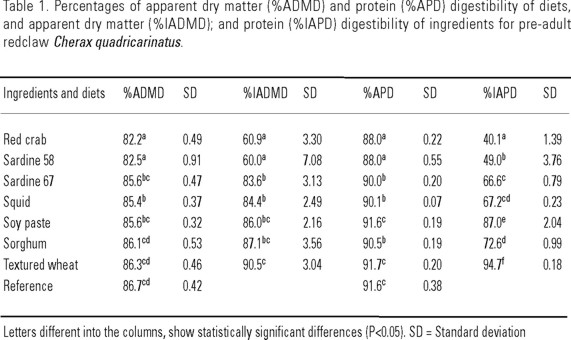
<body><![CDATA[<p align="justify"><font face="verdana" size="2">APD of TD is the apparent protein digestibility of the tested diet, CP in TD is concentration of protein in the tested diet, TI is the tested ingredient, APD of RD is the apparent protein digestibility of the reference diet, CP is the concentration of protein of the reference diet, and CP in TI is the concentration of protein in the tested ingredient.</font></p>     <p align="justify"><font face="verdana" size="2">Data were transformed to arcosen<sup>&#45;1</sup> EMBED Equation 3, and then a one&#45;way&#45;ANOVA parametric procedure and a multiple&#45;range test (Tukey P&lt;0.05) were used to compare and rank means.</font></p>     <p align="justify"><font face="verdana" size="2">Textured wheat, sorghum, and soy paste meals, and their respective diets, had the best dry matter digestibility. The lowest percentage was obtained with red crab meal and the corresponding diet (<a href="#c1">Table 1</a>).</font></p>     <p align="center"><font face="verdana" size="2"><a name="c1"></a></font></p>     <p align="center"><font face="verdana" size="2"><img src="/img/revistas/hbio/v16n1/a10c1.jpg"></font></p>     <p align="justify"><font face="verdana" size="2">Protein digestibility of diets and ingredients were greater for vegetal ingredients, the better was textured wheat (94.7%), following by soy paste (87.0%) and sorghum (72.6%) meals, and their corresponding diets. To equal that in dry matter digestibility, the lowest percentage of protein digestibility was obtained with red crab meal (40.1%), and the corresponding diet (<a href="#c1">Table 1</a>).</font></p>     <p align="justify"><font face="verdana" size="2">In general, tested vegetal ingredients and the corresponding diets had a higher dry matter and protein digestibility than animal ingredients and their diets.</font></p>     <p align="justify"><font face="verdana" size="2">These results agree with Reigh <i>et al</i>. (1990) who found that vegetal ingredients, such as cereals, had higher digestibility for <i>Procambarus clarkii</i> that animal constituent. Smith <i>et al</i>. (1985) reported that vegetal ingredients showed an excellent digestibility for <i>Litopenaeus vannamei</i>. Brunson <i>et al</i>. (1997) found that protein from vegetal origin has similar or higher digestibility for <i>Litopenaeus setiferus</i> than those from animal origin.</font></p>     <p align="justify"><font face="verdana" size="2">Differences between species in protein digestibility are partially related to their feeding habits. Carnivorous organisms (as some crustaceans) are able to degrade animal proteins more efficiently than herbivores or omnivorous organisms (Garcia&#45;Carre&ntilde;o <i>et al.</i>, 1994). <i>Cherax quadricarinatus</i> is an omnivorous that inhabits rivers and fed mostly on plants such as macrophytes (Brown <i>et al</i>., 1990). The species is able to digest cellulose (Xue <i>et al</i>., 1999). However, redclaw is also an opportunistic carnivore. These conditions make the organism able to efficiently consume vegetal and animal ingredients in its diet (Villarreal, 1996).</font></p>     <p align="justify"><font face="verdana" size="2">We would like to thank you all the technicians of the CIBNOR for their help in this study.</font></p>     ]]></body>
<body><![CDATA[<p align="justify"><font face="Verdana" size="2">&nbsp;</font></p>     <p align="justify"><font face="verdana" size="2"><b>REFERENCES</b></font></p>     <!-- ref --><p align="justify"><font face="verdana" size="2">BOLIN, W.D., R.P. KING &amp; E.W. KLOSTERMAN. 1952. Simplified method for the determination of chromic oxide in micro samples. <i>Science</i> 116 p.    &nbsp;&nbsp;&nbsp;&nbsp;&nbsp;&nbsp;&nbsp;&nbsp;[&#160;<a href="javascript:void(0);" onclick="javascript: window.open('/scielo.php?script=sci_nlinks&ref=4057513&pid=S0188-8897200600010001000001&lng=','','width=640,height=500,resizable=yes,scrollbars=1,menubar=yes,');">Links</a>&#160;]<!-- end-ref --></font></p>     <!-- ref --><p align="justify"><font face="verdana" size="2">BROWN, P.B., P.M. L.H. TAZIK, &amp; W.G. BLITHE. 1990. Consumption and apparent dry matter digestibility of aquatic macrophytes by male and female crayfish <i>Orconectes virirlis. Aquaculture</i> 86: 345&#45;349.    &nbsp;&nbsp;&nbsp;&nbsp;&nbsp;&nbsp;&nbsp;&nbsp;[&#160;<a href="javascript:void(0);" onclick="javascript: window.open('/scielo.php?script=sci_nlinks&ref=4057515&pid=S0188-8897200600010001000002&lng=','','width=640,height=500,resizable=yes,scrollbars=1,menubar=yes,');">Links</a>&#160;]<!-- end-ref --></font></p>     <!-- ref --><p align="justify"><font face="verdana" size="2">BRUNSON, J.F., R.P. ROMAIRE &amp; R.C. REIGH. 1997. Apparent digestibility of selected ingredients in diets for white shrimp <i>P. setiferus. Aquaculture Nutrition</i> 3: 9&#45;16</font>&nbsp;&nbsp;&nbsp;&nbsp;&nbsp;&nbsp;&nbsp;&nbsp;[&#160;<a href="javascript:void(0);" onclick="javascript: window.open('/scielo.php?script=sci_nlinks&ref=4057517&pid=S0188-8897200600010001000003&lng=','','width=640,height=500,resizable=yes,scrollbars=1,menubar=yes,');">Links</a>&#160;]<!-- end-ref --><!-- ref --><p align="justify"><font face="verdana" size="2">CASTILLO C. E., L. M. CISNEROS, S. L. ORTIZ, &amp; C. M. JOVER. 2002. Evaluaci&oacute;n de dietasproteicas en precr&iacute;as de langosta de agua dulce (<i>Cherax quadricarinatus</i>). <i>I Congreso Iberoamericano Virtual de Acuicultura CIVA 2002</i>. URL: <a href="http://www.revistaaquatic.com/civa2002/coms/listado.asp?cod=55" target="_blank">http://www.civa2002.org</a></font>&nbsp;&nbsp;&nbsp;&nbsp;&nbsp;&nbsp;&nbsp;&nbsp;[&#160;<a href="javascript:void(0);" onclick="javascript: window.open('/scielo.php?script=sci_nlinks&ref=4057518&pid=S0188-8897200600010001000004&lng=','','width=640,height=500,resizable=yes,scrollbars=1,menubar=yes,');">Links</a>&#160;]<!-- end-ref --><!-- ref --><p align="justify"><font face="verdana" size="2">CHAMBERLAIN, G. 1995. Frontiers in shrimp nutrition research. <i>In</i>: Browdy C. and Hopkins S. (Eds.). <i>Swimming Through Troubled Water Proceedings of the World Aquaculture Society</i>. February 1&#45;4, 1995, San Diego California, 108&#45;114</font>&nbsp;&nbsp;&nbsp;&nbsp;&nbsp;&nbsp;&nbsp;&nbsp;[&#160;<a href="javascript:void(0);" onclick="javascript: window.open('/scielo.php?script=sci_nlinks&ref=4057519&pid=S0188-8897200600010001000005&lng=','','width=640,height=500,resizable=yes,scrollbars=1,menubar=yes,');">Links</a>&#160;]<!-- end-ref --><!-- ref --><p align="justify"><font face="verdana" size="2">COUSIN, M., G. CUZON &amp; J. GUILLAUME. 1996. Digestibility of starch in <i>Litopenaeus vannamei</i>: in vivo and in vitro study on samples of various origin. <i>Aquaculture</i> 140: 361 &#45; 372.    &nbsp;&nbsp;&nbsp;&nbsp;&nbsp;&nbsp;&nbsp;&nbsp;[&#160;<a href="javascript:void(0);" onclick="javascript: window.open('/scielo.php?script=sci_nlinks&ref=4057520&pid=S0188-8897200600010001000006&lng=','','width=640,height=500,resizable=yes,scrollbars=1,menubar=yes,');">Links</a>&#160;]<!-- end-ref --></font></p>     <!-- ref --><p align="justify"><font face="verdana" size="2">CRUZ&#45;SU&Aacute;REZ, L.E., D. RICQUE, M. TAPIA&#45;SALAZAR, I.M. MCCALLUM, &amp; D. HICKLING. 2000. Assessment of differently processed feed pea (<i>Pisum sativum</i>) meals and canola meal (<i>Brassica sp.</i>) in diets for blue shrimp (<i>Litopenaeus stylirostris</i>). <i>Aquaculture</i> 196: 87&#45;104.    &nbsp;&nbsp;&nbsp;&nbsp;&nbsp;&nbsp;&nbsp;&nbsp;[&#160;<a href="javascript:void(0);" onclick="javascript: window.open('/scielo.php?script=sci_nlinks&ref=4057522&pid=S0188-8897200600010001000007&lng=','','width=640,height=500,resizable=yes,scrollbars=1,menubar=yes,');">Links</a>&#160;]<!-- end-ref --></font></p>     <!-- ref --><p align="justify"><font face="verdana" size="2">GARCIA&#45;CARRE&Ntilde;O, F.L., M.P. HERNANDEZ&#45;CORTEZ &amp; N.F. HAARD. 1994. Enzyme with peptidase and protease activity from the digestive systems of freswater and marine decapod. <i>Journal of Agricultural Food Chemical</i> 42: 1456&#45;1461.    &nbsp;&nbsp;&nbsp;&nbsp;&nbsp;&nbsp;&nbsp;&nbsp;[&#160;<a href="javascript:void(0);" onclick="javascript: window.open('/scielo.php?script=sci_nlinks&ref=4057524&pid=S0188-8897200600010001000008&lng=','','width=640,height=500,resizable=yes,scrollbars=1,menubar=yes,');">Links</a>&#160;]<!-- end-ref --></font></p>     <!-- ref --><p align="justify"><font face="verdana" size="2">HERN&Aacute;NDEZ V.M.P. 2001. <i>Contribuci&oacute;n al conocimiento de los requerimientos nutricionales del cangrejo de r&iacute;o, Cherax quadricarinatus von Martens</i>. Tesis Doctoral, Centro de Investigaci&oacute;n y Estudios Avanzados (CINVESTAV), Instituto Polit&eacute;cnico Nacional, Unidad M&eacute;rida, Yucat&aacute;n, M&eacute;xico. 89 pp.    &nbsp;&nbsp;&nbsp;&nbsp;&nbsp;&nbsp;&nbsp;&nbsp;[&#160;<a href="javascript:void(0);" onclick="javascript: window.open('/scielo.php?script=sci_nlinks&ref=4057526&pid=S0188-8897200600010001000009&lng=','','width=640,height=500,resizable=yes,scrollbars=1,menubar=yes,');">Links</a>&#160;]<!-- end-ref --></font></p>     <!-- ref --><p align="justify"><font face="verdana" size="2">HUTCHINGS, R.W. &amp; H. VILLARREAL. 1996. <i>Biolog&iacute;a y Cultivo de la langosta de agua dulce C. quadricarinatus</i>. Manual de Producci&oacute;n. Navimar, S. A. Guayaquil, Ecuador. 400 pp.    &nbsp;&nbsp;&nbsp;&nbsp;&nbsp;&nbsp;&nbsp;&nbsp;[&#160;<a href="javascript:void(0);" onclick="javascript: window.open('/scielo.php?script=sci_nlinks&ref=4057528&pid=S0188-8897200600010001000010&lng=','','width=640,height=500,resizable=yes,scrollbars=1,menubar=yes,');">Links</a>&#160;]<!-- end-ref --></font></p>     <!-- ref --><p align="justify"><font face="verdana" size="2">JONES, C.M. 1989. <i>Aquaculture potential of Cherax quadricarinatus</i>. Queensland Department of Primary Industries, Fisheries Branch. Queensland, Australia. 500 pp.    &nbsp;&nbsp;&nbsp;&nbsp;&nbsp;&nbsp;&nbsp;&nbsp;[&#160;<a href="javascript:void(0);" onclick="javascript: window.open('/scielo.php?script=sci_nlinks&ref=4057530&pid=S0188-8897200600010001000011&lng=','','width=640,height=500,resizable=yes,scrollbars=1,menubar=yes,');">Links</a>&#160;]<!-- end-ref --></font></p>     <!-- ref --><p align="justify"><font face="verdana" size="2">JONES, P.L. &amp; S.S. DE SILVA. 1997. Influence of differential movement of the marker chromic oxide and nutrients on digestibility estimations in the Australian freshwater crayfish <i>Cherax destructor. Aquaculture</i> 154: 323&#45;336.    &nbsp;&nbsp;&nbsp;&nbsp;&nbsp;&nbsp;&nbsp;&nbsp;[&#160;<a href="javascript:void(0);" onclick="javascript: window.open('/scielo.php?script=sci_nlinks&ref=4057532&pid=S0188-8897200600010001000012&lng=','','width=640,height=500,resizable=yes,scrollbars=1,menubar=yes,');">Links</a>&#160;]<!-- end-ref --></font></p>     <!-- ref --><p align="justify"><font face="verdana" size="2">LEAVITT, D.F. 1983. An assessment of cromic oxide as a digestibility marker in the American Lobster. <i>In</i>: G. D. Pruder, C. J. Langdon and D. E. Conklin (Eds). <i>Proceeding of the Second international Conference on Aquaculture Nutrition: Biochemical and Physiological Approaches to the Shellfish Nutrition</i>. Louisiana, State University, Baten Rouge, L. A. 418 p.    &nbsp;&nbsp;&nbsp;&nbsp;&nbsp;&nbsp;&nbsp;&nbsp;[&#160;<a href="javascript:void(0);" onclick="javascript: window.open('/scielo.php?script=sci_nlinks&ref=4057534&pid=S0188-8897200600010001000013&lng=','','width=640,height=500,resizable=yes,scrollbars=1,menubar=yes,');">Links</a>&#160;]<!-- end-ref --></font></p>     <!-- ref --><p align="justify"><font face="verdana" size="2">MART&Iacute;NEZ&#45;C&Oacute;RDOVA, L.R. 1999. <i>Cultivo de Camarones Peneidos</i>. AGT Editor, M&eacute;xico, D.F., M&eacute;xico. 189pp.    &nbsp;&nbsp;&nbsp;&nbsp;&nbsp;&nbsp;&nbsp;&nbsp;[&#160;<a href="javascript:void(0);" onclick="javascript: window.open('/scielo.php?script=sci_nlinks&ref=4057536&pid=S0188-8897200600010001000014&lng=','','width=640,height=500,resizable=yes,scrollbars=1,menubar=yes,');">Links</a>&#160;]<!-- end-ref --></font></p>     <!-- ref --><p align="justify"><font face="verdana" size="2">NIETO L.M., L.E. CRUZ&#45;SU&Aacute;REZ &amp; D. RICQUE. 1997. <i>Implementaci&oacute;n de un m&eacute;todo para la determinaci&oacute;n de &oacute;xido de cromo y prote&iacute;na en micromuestras de alimento y heces de camar&oacute;n</i>. Programa de Maricultura, Facultad de Ciencias Biol&oacute;gicas, Universidad Aut&oacute;noma de Nuevo Le&oacute;n, San Nicol&aacute;s de los Garza Nuevo Le&oacute;n, M&eacute;xico.    &nbsp;&nbsp;&nbsp;&nbsp;&nbsp;&nbsp;&nbsp;&nbsp;[&#160;<a href="javascript:void(0);" onclick="javascript: window.open('/scielo.php?script=sci_nlinks&ref=4057538&pid=S0188-8897200600010001000015&lng=','','width=640,height=500,resizable=yes,scrollbars=1,menubar=yes,');">Links</a>&#160;]<!-- end-ref --></font></p>     <!-- ref --><p align="justify"><font face="verdana" size="2">REIGH, R.C., S.L BRADEN &amp; R.J. CRAIG. 1990. Apparent Digestibility Coefficients for common Feedstuffs in Formulated Diets for red Swamp Crayfish <i>Procambarus clarkii. Aquaculture</i> 84: 321&#45;340.    &nbsp;&nbsp;&nbsp;&nbsp;&nbsp;&nbsp;&nbsp;&nbsp;[&#160;<a href="javascript:void(0);" onclick="javascript: window.open('/scielo.php?script=sci_nlinks&ref=4057540&pid=S0188-8897200600010001000016&lng=','','width=640,height=500,resizable=yes,scrollbars=1,menubar=yes,');">Links</a>&#160;]<!-- end-ref --></font></p>     <!-- ref --><p align="justify"><font face="verdana" size="2">SMITH, L.L., P.G. LEE, A.L. LAWRENCE &amp; K. STRAWN. 1985. Growth and digestibility of different sizes of <i>Penaeus vannamei</i> Boone: effects of dietary protein level and protein source. <i>Aquaculture</i> 45: 86&#45;96.    &nbsp;&nbsp;&nbsp;&nbsp;&nbsp;&nbsp;&nbsp;&nbsp;[&#160;<a href="javascript:void(0);" onclick="javascript: window.open('/scielo.php?script=sci_nlinks&ref=4057542&pid=S0188-8897200600010001000017&lng=','','width=640,height=500,resizable=yes,scrollbars=1,menubar=yes,');">Links</a>&#160;]<!-- end-ref --></font></p>     <!-- ref --><p align="justify"><font face="verdana" size="2">SUDRIYONO, A., E. TSUETNENKO &amp; L.H. EVANS. 1996. Digestibility studies on fisheries by &#45; products based diet for Penaeus monodon. Aquaculture 143: 331 &#45; 340.    &nbsp;&nbsp;&nbsp;&nbsp;&nbsp;&nbsp;&nbsp;&nbsp;[&#160;<a href="javascript:void(0);" onclick="javascript: window.open('/scielo.php?script=sci_nlinks&ref=4057544&pid=S0188-8897200600010001000018&lng=','','width=640,height=500,resizable=yes,scrollbars=1,menubar=yes,');">Links</a>&#160;]<!-- end-ref --></font></p>     <!-- ref --><p align="justify"><font face="verdana" size="2">VILLARREAL, H. 1996. <i>Evaluaci&oacute;n del potencial de cultivo de la langosta de agua dulce Australiana Cherax tenuimanus en funci&oacute;n de su eficiencia bioenerg&eacute;tica</i>. Memorias del 3er Simposium Internacional de Nutrici&oacute;n Acu&iacute;cola. Noviembre 11&#45;13, 1996. Universidad Aut&oacute;noma de Nuevo Le&oacute;n, Monterrey, N. L., M&eacute;xico. En prensa.    &nbsp;&nbsp;&nbsp;&nbsp;&nbsp;&nbsp;&nbsp;&nbsp;[&#160;<a href="javascript:void(0);" onclick="javascript: window.open('/scielo.php?script=sci_nlinks&ref=4057546&pid=S0188-8897200600010001000019&lng=','','width=640,height=500,resizable=yes,scrollbars=1,menubar=yes,');">Links</a>&#160;]<!-- end-ref --></font></p>     <!-- ref --><p align="justify"><font face="verdana" size="2">XUE, X.M., A.J. ANDERSON, N.A. RICHARDSON, A.J. ANDERSON, G.P. XUE &amp; P.B. MATHER. 1999. Characterization of cellulase activity in the digestive system of the redclaw crayfish (<i>Cherax quadricarinatus</i>). <i>Aquaculture</i> 180: 373&#45;386</font>&nbsp;&nbsp;&nbsp;&nbsp;&nbsp;&nbsp;&nbsp;&nbsp;[&#160;<a href="javascript:void(0);" onclick="javascript: window.open('/scielo.php?script=sci_nlinks&ref=4057548&pid=S0188-8897200600010001000020&lng=','','width=640,height=500,resizable=yes,scrollbars=1,menubar=yes,');">Links</a>&#160;]<!-- end-ref --> ]]></body><back>
<ref-list>
<ref id="B1">
<nlm-citation citation-type="book">
<person-group person-group-type="author">
<name>
<surname><![CDATA[BOLIN]]></surname>
<given-names><![CDATA[W.D.]]></given-names>
</name>
<name>
<surname><![CDATA[KING]]></surname>
<given-names><![CDATA[R.P.]]></given-names>
</name>
<name>
<surname><![CDATA[KLOSTERMAN]]></surname>
<given-names><![CDATA[E.W.]]></given-names>
</name>
</person-group>
<source><![CDATA[Simplified method for the determination of chromic oxide in micro samples]]></source>
<year>1952</year>
<page-range>116</page-range><publisher-name><![CDATA[Science]]></publisher-name>
</nlm-citation>
</ref>
<ref id="B2">
<nlm-citation citation-type="journal">
<person-group person-group-type="author">
<name>
<surname><![CDATA[BROWN]]></surname>
<given-names><![CDATA[P.B.]]></given-names>
</name>
<name>
<surname><![CDATA[TAZIK]]></surname>
<given-names><![CDATA[P.M. L.H.]]></given-names>
</name>
<name>
<surname><![CDATA[BLITHE]]></surname>
<given-names><![CDATA[W.G.]]></given-names>
</name>
</person-group>
<article-title xml:lang="en"><![CDATA[Consumption and apparent dry matter digestibility of aquatic macrophytes by male and female crayfish Orconectes virirlis]]></article-title>
<source><![CDATA[Aquaculture]]></source>
<year>1990</year>
<volume>86</volume>
<page-range>345-349</page-range></nlm-citation>
</ref>
<ref id="B3">
<nlm-citation citation-type="journal">
<person-group person-group-type="author">
<name>
<surname><![CDATA[BRUNSON]]></surname>
<given-names><![CDATA[J.F.]]></given-names>
</name>
<name>
<surname><![CDATA[ROMAIRE]]></surname>
<given-names><![CDATA[R.P.]]></given-names>
</name>
<name>
<surname><![CDATA[REIGH]]></surname>
<given-names><![CDATA[R.C.]]></given-names>
</name>
</person-group>
<article-title xml:lang="en"><![CDATA[Apparent digestibility of selected ingredients in diets for white shrimp P. setiferus]]></article-title>
<source><![CDATA[Aquaculture Nutrition]]></source>
<year>1997</year>
<volume>3</volume>
<page-range>9-16</page-range></nlm-citation>
</ref>
<ref id="B4">
<nlm-citation citation-type="">
<person-group person-group-type="author">
<name>
<surname><![CDATA[CASTILLO]]></surname>
<given-names><![CDATA[C. E.]]></given-names>
</name>
<name>
<surname><![CDATA[CISNEROS]]></surname>
<given-names><![CDATA[L. M.]]></given-names>
</name>
<name>
<surname><![CDATA[ORTIZ]]></surname>
<given-names><![CDATA[S. L.]]></given-names>
</name>
<name>
<surname><![CDATA[JOVER]]></surname>
<given-names><![CDATA[C. M.]]></given-names>
</name>
</person-group>
<source><![CDATA[Evaluación de dietasproteicas en precrías de langosta de agua dulce (Cherax quadricarinatus). I Congreso Iberoamericano Virtual de Acuicultura CIVA 2002]]></source>
<year>2002</year>
</nlm-citation>
</ref>
<ref id="B5">
<nlm-citation citation-type="">
<person-group person-group-type="author">
<name>
<surname><![CDATA[CHAMBERLAIN]]></surname>
<given-names><![CDATA[G.]]></given-names>
</name>
</person-group>
<article-title xml:lang="en"><![CDATA[Frontiers in shrimp nutrition research]]></article-title>
<person-group person-group-type="editor">
<name>
<surname><![CDATA[Browdy]]></surname>
<given-names><![CDATA[C.]]></given-names>
</name>
<name>
<surname><![CDATA[Hopkins]]></surname>
<given-names><![CDATA[S.]]></given-names>
</name>
</person-group>
<source><![CDATA[Swimming Through Troubled Water Proceedings of the World Aquaculture Society]]></source>
<year>1995</year>
<month>19</month>
<day>95</day>
<page-range>108-114</page-range><publisher-loc><![CDATA[San Diego^eCalifornia California]]></publisher-loc>
</nlm-citation>
</ref>
<ref id="B6">
<nlm-citation citation-type="journal">
<person-group person-group-type="author">
<name>
<surname><![CDATA[COUSIN]]></surname>
<given-names><![CDATA[M.]]></given-names>
</name>
<name>
<surname><![CDATA[CUZON]]></surname>
<given-names><![CDATA[G.]]></given-names>
</name>
<name>
<surname><![CDATA[GUILLAUME]]></surname>
<given-names><![CDATA[J.]]></given-names>
</name>
</person-group>
<article-title xml:lang="en"><![CDATA[Digestibility of starch in Litopenaeus vannamei: in vivo and in vitro study on samples of various origin]]></article-title>
<source><![CDATA[Aquaculture]]></source>
<year>1996</year>
<volume>140</volume>
<page-range>361 - 372</page-range></nlm-citation>
</ref>
<ref id="B7">
<nlm-citation citation-type="journal">
<person-group person-group-type="author">
<name>
<surname><![CDATA[CRUZ-SUÁREZ]]></surname>
<given-names><![CDATA[L.E.]]></given-names>
</name>
<name>
<surname><![CDATA[RICQUE]]></surname>
<given-names><![CDATA[D.]]></given-names>
</name>
<name>
<surname><![CDATA[TAPIA-SALAZAR]]></surname>
<given-names><![CDATA[M.]]></given-names>
</name>
<name>
<surname><![CDATA[MCCALLUM]]></surname>
<given-names><![CDATA[I.M.]]></given-names>
</name>
<name>
<surname><![CDATA[HICKLING]]></surname>
<given-names><![CDATA[D.]]></given-names>
</name>
</person-group>
<article-title xml:lang="en"><![CDATA[Assessment of differently processed feed pea (Pisum sativum) meals and canola meal (Brassica sp.) in diets for blue shrimp (Litopenaeus stylirostris)]]></article-title>
<source><![CDATA[Aquaculture]]></source>
<year>2000</year>
<volume>196</volume>
<page-range>87-104</page-range></nlm-citation>
</ref>
<ref id="B8">
<nlm-citation citation-type="journal">
<person-group person-group-type="author">
<name>
<surname><![CDATA[GARCIA-CARREÑO]]></surname>
<given-names><![CDATA[F.L.]]></given-names>
</name>
<name>
<surname><![CDATA[HERNANDEZ-CORTEZ]]></surname>
<given-names><![CDATA[M.P.]]></given-names>
</name>
<name>
<surname><![CDATA[HAARD]]></surname>
<given-names><![CDATA[N.F.]]></given-names>
</name>
</person-group>
<article-title xml:lang="en"><![CDATA[Enzyme with peptidase and protease activity from the digestive systems of freswater and marine decapod]]></article-title>
<source><![CDATA[Journal of Agricultural Food Chemical]]></source>
<year>1994</year>
<volume>42</volume>
<page-range>1456-1461</page-range></nlm-citation>
</ref>
<ref id="B9">
<nlm-citation citation-type="">
<person-group person-group-type="author">
<name>
<surname><![CDATA[HERNÁNDEZ]]></surname>
<given-names><![CDATA[V.M.P]]></given-names>
</name>
</person-group>
<source><![CDATA[Contribución al conocimiento de los requerimientos nutricionales del cangrejo de río, Cherax quadricarinatus von Martens]]></source>
<year>2001</year>
<page-range>89</page-range></nlm-citation>
</ref>
<ref id="B10">
<nlm-citation citation-type="book">
<person-group person-group-type="author">
<name>
<surname><![CDATA[HUTCHINGS]]></surname>
<given-names><![CDATA[R.W.]]></given-names>
</name>
<name>
<surname><![CDATA[VILLARREAL]]></surname>
<given-names><![CDATA[H.]]></given-names>
</name>
</person-group>
<source><![CDATA[Biología y Cultivo de la langosta de agua dulce C. quadricarinatus. Manual de Producción]]></source>
<year>1996</year>
<page-range>400</page-range><publisher-loc><![CDATA[Guayaquil ]]></publisher-loc>
<publisher-name><![CDATA[Navimar, S. A.]]></publisher-name>
</nlm-citation>
</ref>
<ref id="B11">
<nlm-citation citation-type="">
<person-group person-group-type="author">
<name>
<surname><![CDATA[JONES]]></surname>
<given-names><![CDATA[C.M]]></given-names>
</name>
</person-group>
<source><![CDATA[Aquaculture potential of Cherax quadricarinatus. Queensland Department of Primary Industries, Fisheries Branch]]></source>
<year>1989</year>
<page-range>500</page-range><publisher-loc><![CDATA[Queensland ]]></publisher-loc>
</nlm-citation>
</ref>
<ref id="B12">
<nlm-citation citation-type="journal">
<person-group person-group-type="author">
<name>
<surname><![CDATA[JONES]]></surname>
<given-names><![CDATA[P.L.]]></given-names>
</name>
<name>
<surname><![CDATA[DE SILVA]]></surname>
<given-names><![CDATA[S.S.]]></given-names>
</name>
</person-group>
<article-title xml:lang="en"><![CDATA[Influence of differential movement of the marker chromic oxide and nutrients on digestibility estimations in the Australian freshwater crayfish Cherax destructor]]></article-title>
<source><![CDATA[Aquaculture]]></source>
<year>1997</year>
<volume>154</volume>
<page-range>323-336</page-range></nlm-citation>
</ref>
<ref id="B13">
<nlm-citation citation-type="book">
<person-group person-group-type="author">
<name>
<surname><![CDATA[LEAVITT]]></surname>
<given-names><![CDATA[D.F.]]></given-names>
</name>
</person-group>
<article-title xml:lang="en"><![CDATA[An assessment of cromic oxide as a digestibility marker in the American Lobster]]></article-title>
<person-group person-group-type="editor">
<name>
<surname><![CDATA[Pruder]]></surname>
<given-names><![CDATA[G. D.]]></given-names>
</name>
<name>
<surname><![CDATA[Langdon]]></surname>
<given-names><![CDATA[C. J.]]></given-names>
</name>
<name>
<surname><![CDATA[Conklin]]></surname>
<given-names><![CDATA[D. E.]]></given-names>
</name>
</person-group>
<source><![CDATA[Proceeding of the Second international Conference on Aquaculture Nutrition: Biochemical and Physiological Approaches to the Shellfish Nutrition]]></source>
<year>1983</year>
<page-range>418</page-range><publisher-loc><![CDATA[Louisiana^eL. A. L. A.]]></publisher-loc>
<publisher-name><![CDATA[State UniversityBaten Rouge]]></publisher-name>
</nlm-citation>
</ref>
<ref id="B14">
<nlm-citation citation-type="book">
<person-group person-group-type="author">
<name>
<surname><![CDATA[MARTÍNEZ-CÓRDOVA]]></surname>
<given-names><![CDATA[L.R]]></given-names>
</name>
</person-group>
<source><![CDATA[Cultivo de Camarones Peneidos]]></source>
<year>1999</year>
<page-range>189</page-range><publisher-loc><![CDATA[México^eD.F. D.F.]]></publisher-loc>
<publisher-name><![CDATA[AGT]]></publisher-name>
</nlm-citation>
</ref>
<ref id="B15">
<nlm-citation citation-type="book">
<person-group person-group-type="author">
<name>
<surname><![CDATA[NIETO]]></surname>
<given-names><![CDATA[L.M.]]></given-names>
</name>
<name>
<surname><![CDATA[CRUZ-SUÁREZ]]></surname>
<given-names><![CDATA[L.E.]]></given-names>
</name>
<name>
<surname><![CDATA[RICQUE]]></surname>
<given-names><![CDATA[D.]]></given-names>
</name>
</person-group>
<source><![CDATA[Implementación de un método para la determinación de óxido de cromo y proteína en micromuestras de alimento y heces de camarón]]></source>
<year>1997</year>
<publisher-loc><![CDATA[San Nicolás de los Garza^eNuevo León Nuevo León]]></publisher-loc>
<publisher-name><![CDATA[Programa de Maricultura, Facultad de Ciencias Biológicas, Universidad Autónoma de Nuevo León]]></publisher-name>
</nlm-citation>
</ref>
<ref id="B16">
<nlm-citation citation-type="journal">
<person-group person-group-type="author">
<name>
<surname><![CDATA[REIGH]]></surname>
<given-names><![CDATA[R.C.]]></given-names>
</name>
<name>
<surname><![CDATA[BRADEN]]></surname>
<given-names><![CDATA[S.L]]></given-names>
</name>
<name>
<surname><![CDATA[CRAIG]]></surname>
<given-names><![CDATA[R.J.]]></given-names>
</name>
</person-group>
<article-title xml:lang="en"><![CDATA[Apparent Digestibility Coefficients for common Feedstuffs in Formulated Diets for red Swamp Crayfish Procambarus clarkii]]></article-title>
<source><![CDATA[Aquaculture]]></source>
<year>1990</year>
<volume>84</volume>
<page-range>321-340</page-range></nlm-citation>
</ref>
<ref id="B17">
<nlm-citation citation-type="journal">
<person-group person-group-type="author">
<name>
<surname><![CDATA[SMITH]]></surname>
<given-names><![CDATA[L.L.]]></given-names>
</name>
<name>
<surname><![CDATA[LEE]]></surname>
<given-names><![CDATA[P.G.]]></given-names>
</name>
<name>
<surname><![CDATA[LAWRENCE]]></surname>
<given-names><![CDATA[A.L.]]></given-names>
</name>
<name>
<surname><![CDATA[STRAWN]]></surname>
<given-names><![CDATA[K.]]></given-names>
</name>
</person-group>
<article-title xml:lang="en"><![CDATA[Growth and digestibility of different sizes of Penaeus vannamei Boone: effects of dietary protein level and protein source]]></article-title>
<source><![CDATA[Aquaculture]]></source>
<year>1985</year>
<volume>45</volume>
<page-range>86-96</page-range></nlm-citation>
</ref>
<ref id="B18">
<nlm-citation citation-type="journal">
<person-group person-group-type="author">
<name>
<surname><![CDATA[SUDRIYONO]]></surname>
<given-names><![CDATA[A.]]></given-names>
</name>
<name>
<surname><![CDATA[TSUETNENKO]]></surname>
<given-names><![CDATA[E.]]></given-names>
</name>
<name>
<surname><![CDATA[EVANS]]></surname>
<given-names><![CDATA[L.H.]]></given-names>
</name>
</person-group>
<article-title xml:lang="en"><![CDATA[Digestibility studies on fisheries by - products based diet for Penaeus monodon]]></article-title>
<source><![CDATA[Aquaculture]]></source>
<year>1996</year>
<volume>143</volume>
<page-range>331 - 340</page-range></nlm-citation>
</ref>
<ref id="B19">
<nlm-citation citation-type="book">
<person-group person-group-type="author">
<name>
<surname><![CDATA[VILLARREAL]]></surname>
<given-names><![CDATA[H]]></given-names>
</name>
</person-group>
<source><![CDATA[Evaluación del potencial de cultivo de la langosta de agua dulce Australiana Cherax tenuimanus en función de su eficiencia bioenergética]]></source>
<year>Novi</year>
<month>em</month>
<day>br</day>
<publisher-loc><![CDATA[Monterrey^eN. L. N. L.]]></publisher-loc>
<publisher-name><![CDATA[Universidad Autónoma de Nuevo León]]></publisher-name>
</nlm-citation>
</ref>
<ref id="B20">
<nlm-citation citation-type="journal">
<person-group person-group-type="author">
<name>
<surname><![CDATA[XUE]]></surname>
<given-names><![CDATA[X.M.]]></given-names>
</name>
<name>
<surname><![CDATA[ANDERSON]]></surname>
<given-names><![CDATA[A.J.]]></given-names>
</name>
<name>
<surname><![CDATA[RICHARDSON]]></surname>
<given-names><![CDATA[N.A.]]></given-names>
</name>
<name>
<surname><![CDATA[ANDERSON]]></surname>
<given-names><![CDATA[A.J.]]></given-names>
</name>
<name>
<surname><![CDATA[XUE]]></surname>
<given-names><![CDATA[G.P.]]></given-names>
</name>
<name>
<surname><![CDATA[MATHER]]></surname>
<given-names><![CDATA[P.B.]]></given-names>
</name>
</person-group>
<article-title xml:lang="en"><![CDATA[Characterization of cellulase activity in the digestive system of the redclaw crayfish (Cherax quadricarinatus)]]></article-title>
<source><![CDATA[Aquaculture]]></source>
<year>1999</year>
<volume>180</volume>
<page-range>373-386</page-range></nlm-citation>
</ref>
</ref-list>
</back>
</article>
