<?xml version="1.0" encoding="ISO-8859-1"?><article xmlns:mml="http://www.w3.org/1998/Math/MathML" xmlns:xlink="http://www.w3.org/1999/xlink" xmlns:xsi="http://www.w3.org/2001/XMLSchema-instance">
<front>
<journal-meta>
<journal-id>0188-8897</journal-id>
<journal-title><![CDATA[Hidrobiológica]]></journal-title>
<abbrev-journal-title><![CDATA[Hidrobiológica]]></abbrev-journal-title>
<issn>0188-8897</issn>
<publisher>
<publisher-name><![CDATA[Universidad Autónoma Metropolitana, División de Ciencias Biológicas y de la Salud]]></publisher-name>
</publisher>
</journal-meta>
<article-meta>
<article-id>S0188-88972005000200002</article-id>
<title-group>
<article-title xml:lang="en"><![CDATA[Wild-caught Hybrids Between Sailfin and Shortfin Mollies (Poeciliidae, Poecilia): Morphological and Molecular Verification]]></article-title>
<article-title xml:lang="es"><![CDATA[Híbridos silvestres entre molis de vela y de dorsal corta (Poeciliidae: Poecilia): verificación morfológica y molecular]]></article-title>
</title-group>
<contrib-group>
<contrib contrib-type="author">
<name>
<surname><![CDATA[Kittell]]></surname>
<given-names><![CDATA[Michele M.]]></given-names>
</name>
<xref ref-type="aff" rid="A01"/>
</contrib>
<contrib contrib-type="author">
<name>
<surname><![CDATA[Harvey]]></surname>
<given-names><![CDATA[Megan N.]]></given-names>
</name>
<xref ref-type="aff" rid="A01"/>
</contrib>
<contrib contrib-type="author">
<name>
<surname><![CDATA[Contreras-Balderas]]></surname>
<given-names><![CDATA[Salvador]]></given-names>
</name>
<xref ref-type="aff" rid="A02"/>
</contrib>
<contrib contrib-type="author">
<name>
<surname><![CDATA[Ptacek]]></surname>
<given-names><![CDATA[Margaret B.]]></given-names>
</name>
<xref ref-type="aff" rid="A01"/>
</contrib>
</contrib-group>
<aff id="A01">
<institution><![CDATA[,Clemson University Department of Biological Sciences ]]></institution>
<addr-line><![CDATA[Clemson Carolina del Sur]]></addr-line>
<country>Estados Unidos de América</country>
</aff>
<aff id="A02">
<institution><![CDATA[,Universidad Autónoma de Nuevo León Facultad de Ciencias Biológicas Laboratorio de Ictiología]]></institution>
<addr-line><![CDATA[Monterrey Nuevo León]]></addr-line>
<country>México</country>
</aff>
<pub-date pub-type="pub">
<day>00</day>
<month>00</month>
<year>2005</year>
</pub-date>
<pub-date pub-type="epub">
<day>00</day>
<month>00</month>
<year>2005</year>
</pub-date>
<volume>15</volume>
<numero>2</numero>
<fpage>131</fpage>
<lpage>137</lpage>
<copyright-statement/>
<copyright-year/>
<self-uri xlink:href="http://www.scielo.org.mx/scielo.php?script=sci_arttext&amp;pid=S0188-88972005000200002&amp;lng=en&amp;nrm=iso"></self-uri><self-uri xlink:href="http://www.scielo.org.mx/scielo.php?script=sci_abstract&amp;pid=S0188-88972005000200002&amp;lng=en&amp;nrm=iso"></self-uri><self-uri xlink:href="http://www.scielo.org.mx/scielo.php?script=sci_pdf&amp;pid=S0188-88972005000200002&amp;lng=en&amp;nrm=iso"></self-uri><abstract abstract-type="short" xml:lang="en"><p><![CDATA[This study documents four wild-caught, interspecific hybrids between sailfin mollies (Poecilia velifera or P. petenensis) and shortfin mollies (P. mexicana or P. orri) from the Yucatán peninsula and Isthmus of Tehuantepec regions of México. In canonical discriminant analysis of morphological data all four putative hybrid males were intermediate in shape between shortfin and sailfin molly species, falling well outside 95% confidence ellipses for those putative parental species. For two of the four hybrid individuals, we used allele size differences at the nuclear Xsrc gene between sailfin and shortfin species to determine that one was a first (F1) or early generation (F2, BC1) hybrid and the other was a later generation (>F1) hybrid. Sequences of the mtDNA control region (483 bp) and Xsrc nuclear gene (636 bp) indicated that the female parent of the early generation hybrid individual was P. mexicana and the male parent was P. velifera. Thus, while rare in the wild, interspecific hybridization and introgression between sailfin and shortfin mollies does occasionally occur despite the existence of behavioral pre-mating isolating mechanisms.]]></p></abstract>
<abstract abstract-type="short" xml:lang="es"><p><![CDATA[El presente estudio documenta registros de cuatro híbridos interespecíficos espontáneos entre molis de vela (Poecilia velifera o P. petenensis) y de dorsal corta (P. mexicana o P. orri) de las regiones de la Península de Yucatán y del Istmo de Tehuantepec en México. En el análisis discriminante de datos morfológicos los cuatro híbridos putativos entre molis de dorsal de vela y dorsal corta tuvieron morfología intermedia, cayendo bastante fuera de las elipses a 95% de confianza de las especies progenitoras putativas. En dos de los cuatro individuos híbridos, usamos diferencias en el tamaño de los alelos en el gene nuclear Xsrc entre los molis de vela y de dorsal corta para determinar que uno de estos dos individuos híbridos resultó de primera generación (F1) o híbridos de generación temprana (F2, BC1); el otro resultó ser híbrido de una generación posterior (>F1). Las secuencias de la región de control de mtDNA (483 bp) y el gene nuclear Xsrc (636 bp) indicaron que la madre progenitora del individuo de generación híbrida temprana era P. mexicana y el macho progenitor fue P. velifera. Por lo tanto, aunque rara en molys la hibridación e introgresión interespecífica entre molys de dorsal de vela y dorsal corta ocasionalmente se presenta, a pesar de la existencia de mecanismos de aislamiento precopulatorios en el comportamiento.]]></p></abstract>
<kwd-group>
<kwd lng="en"><![CDATA[Premating reproductive isolation]]></kwd>
<kwd lng="en"><![CDATA[naturally-occurring hybrids]]></kwd>
<kwd lng="en"><![CDATA[Poecilia velifera]]></kwd>
<kwd lng="en"><![CDATA[Poecilia petenensis]]></kwd>
<kwd lng="en"><![CDATA[Poecilia mexicana]]></kwd>
<kwd lng="en"><![CDATA[Poecilia orri]]></kwd>
<kwd lng="es"><![CDATA[Aislamiento reproductivo precopulatorio]]></kwd>
<kwd lng="es"><![CDATA[híbridos silvestres]]></kwd>
<kwd lng="es"><![CDATA[Poecilia velifera]]></kwd>
<kwd lng="es"><![CDATA[Poecilia petenensis]]></kwd>
<kwd lng="es"><![CDATA[Poecilia mexicana]]></kwd>
<kwd lng="es"><![CDATA[Poecilia orri]]></kwd>
</kwd-group>
</article-meta>
</front><body><![CDATA[ <p align="justify"><font face="Verdana" size="4">Art&iacute;culo</font></p>     <p align="justify"><font face="Verdana" size="2">&nbsp;</font></p>     <p align="center"><font face="verdana" size="4"><b>Wild&#45;caught Hybrids Between Sailfin and Shortfin Mollies (Poeciliidae, <i>Poecilia</i>): Morphological and Molecular Verification</b></font></p>     <p align="justify"><font face="Verdana" size="2">&nbsp;</font></p>     <p align="center"><font face="verdana" size="3"><b>H&iacute;bridos silvestres entre molis de vela y de dorsal corta (Poeciliidae: <i>Poecilia</i>): verificaci&oacute;n morfol&oacute;gica y molecular</b></font></p>     <p align="justify"><font face="Verdana" size="2">&nbsp;</font></p>     <p align="center"><font face="verdana" size="2"><b>Michele M. Kittell<sup>1</sup>, Megan N. Harvey<sup>1</sup>, Salvador Contreras&#45;Balderas<sup>2</sup> and Margaret B. Ptacek<sup>1</sup></b></font></p>     <p align="justify"><font face="Verdana" size="2">&nbsp;</font></p>     <p align="justify"><font face="verdana" size="2"><i><sup>1</sup> Department of Biological Sciences, Clemson University, Clemson, South Carolina, U.S.A.</i></font></p>     <p align="justify"><font face="verdana" size="2"><i><sup>2</sup> Laboratorio de Ictiolog&iacute;a, Facultad de Ciencias Biol&oacute;gicas, Universidad Aut&oacute;noma de Nuevo Le&oacute;n, Monterrey, Nuevo Le&oacute;n, M&eacute;xico.</i> E&#45;mail: <a href="mailto:mptacek@clemson.edu">mptacek@clemson.edu</a></font></p>     ]]></body>
<body><![CDATA[<p align="justify"><font face="Verdana" size="2">&nbsp;</font></p>     <p align="justify"><font face="verdana" size="2">Recibido: 4 de octubre de 2004.    <br>Aceptado: 16 de abril de 2005.</font></p>     <p align="justify"><font face="Verdana" size="2">&nbsp;</font></p>     <p align="justify"><font face="verdana" size="2"><b>Abstract</b></font></p>     <p align="justify"><font face="verdana" size="2">This study documents four wild&#45;caught, interspecific hybrids between sailfin mollies (<i>Poecilia velifera</i> or <i>P. petenensis</i>) and shortfin mollies (<i>P. mexicana or P. orri</i>) from the Yucat&aacute;n peninsula and Isthmus of Tehuantepec regions of M&eacute;xico. In canonical discriminant analysis of morphological data all four putative hybrid males were intermediate in shape between shortfin and sailfin molly species, falling well outside 95% confidence ellipses for those putative parental species. For two of the four hybrid individuals, we used allele size differences at the nuclear X<i>src</i> gene between sailfin and shortfin species to determine that one was a first (F1) or early generation (F2, BC1) hybrid and the other
was a later generation (&gt;F1) hybrid. Sequences of the mtDNA control region (483 bp) and X<i>src</i> nuclear gene (636 bp) indicated that the female parent of the early generation hybrid individual was <i>P. mexicana</i> and the male parent was <i>P. velifera</i>. Thus, while rare in the wild, interspecific hybridization and introgression between sailfin and shortfin mollies does occasionally occur despite the existence of behavioral pre&#45;mating isolating mechanisms.</font></p>     <p align="justify"><font face="verdana" size="2"><b>Key words:</b> Premating reproductive isolation, naturally&#45;occurring hybrids, <i>Poecilia velifera, Poecilia petenensis, Poecilia mexicana, Poecilia orri.</i></font></p>     <p align="justify"><font face="Verdana" size="2">&nbsp;</font></p>     <p align="justify"><font face="verdana" size="2"><b>Resumen</b></font></p>     <p align="justify"><font face="verdana" size="2">El presente estudio documenta registros de cuatro h&iacute;bridos interespec&iacute;ficos espont&aacute;neos entre molis de vela (<i>Poecilia velifera</i> o <i>P. petenensis</i>) y de dorsal corta (<i>P. mexicana</i> o <i>P. orri</i>) de las regiones de la Pen&iacute;nsula de Yucat&aacute;n y del Istmo de Tehuantepec en M&eacute;xico. En el an&aacute;lisis discriminante de datos morfol&oacute;gicos los cuatro h&iacute;bridos putativos entre molis de dorsal de vela y dorsal corta tuvieron morfolog&iacute;a intermedia, cayendo bastante fuera de las elipses a 95% de confianza de las especies progenitoras putativas. En dos de los cuatro individuos h&iacute;bridos, usamos diferencias en el tama&ntilde;o de los alelos en el gene nuclear Xsrc entre
los molis de vela y de dorsal corta para determinar que uno de estos dos individuos h&iacute;bridos result&oacute; de primera generaci&oacute;n (F1) o h&iacute;bridos de generaci&oacute;n temprana (F2, BC1); el otro result&oacute; ser h&iacute;brido de una generaci&oacute;n posterior (&gt;F1). Las secuencias de la regi&oacute;n de control de mtDNA (483 bp) y el gene nuclear <i>Xsrc</i> (636 bp) indicaron que la madre progenitora del individuo de generaci&oacute;n h&iacute;brida temprana era <i>P. mexicana</i> y el macho progenitor fue <i>P. velifera</i>. Por lo tanto, aunque rara en molys la hibridaci&oacute;n e introgresi&oacute;n interespec&iacute;fica entre molys de dorsal de vela y dorsal corta ocasionalmente se presenta, a pesar de la existencia de mecanismos de aislamiento precopulatorios
en el comportamiento.</font></p>     ]]></body>
<body><![CDATA[<p align="justify"><font face="verdana" size="2"><b>Palabras clave:</b> Aislamiento reproductivo precopulatorio, h&iacute;bridos silvestres, <i>Poecilia velifera</i>, <i>Poecilia petenensis, Poecilia mexicana, Poecilia orri</i>.</font></p>     <p align="justify"><font face="Verdana" size="2">&nbsp;</font></p>     <p align="justify"><font face="verdana" size="2"><b>Introduction</b></font></p>     <p align="justify"><font face="verdana" size="2">Information on the frequency and direction of interspecific hybridization in natural populations is critical to our understanding of the evolution of pre&#45;mating reproductive isolating mechanisms and the role of such mating signal divergence in speciation. Documenting mating mistakes in natural sympatric populations confirms a role for selection in the evolution of courtship signals and mating preferences for those signals (Gerhardt <i>et al</i>., 1994). In this paper, we confirm the existence of interspecific hybrids between sailfin and shortfin species of mollies (Poeciliidae, <i>Poecilia</i>), a group in which such hybrids are thought to be extremely rare as a result of pre&#45;mating behavioral isolation (Woodhead &amp; Armstrong, 1985;
Farr, 1989; Ptacek, 1998). Interspecific crosses readily produce fertile and viable offspring of both genders in the laboratory, suggesting that post&#45;mating isolation is weak in mollies (Hubbs &amp; Hubbs, 1946; Parzefall, 1989; Ptacek, 2002). However, a paucity of reports of wild&#45;caught hybrids (e.g., Contreras&#45;Balderas, 1990) persists despite numerous instances of sympatry between sailfin and shortfin species documented by intensive collecting efforts throughout the distribution of mollies in the Yucat&aacute;n region of M&eacute;xico (Miller 1975, 1983; Schmitter&#45;Soto, 1998; Cashner <i>et al</i>., 2003).</font></p>     <p align="justify"><font face="verdana" size="2">The one exception to the extreme rarity of naturally occurring molly hybrids is the Amazon molly (<i>P. formosa</i> (Girard, 1859)), an all&#45;female biotype found in northeastern M&eacute;xico. This gynogenetic form is descended from a hybridization event between the sailfin molly <i>P. latipinna</i> (Lesueur, 1821) and the shortfin molly <i>P. mexicana</i> (Steindachner, 1863) (Hubbs &amp; Hubbs, 1932; Hubbs, 1933; Avise <i>et al</i>., 1991) that occurred at least 100,000 years ago (Schartl <i>et al</i>., 1995; Dries, 2003).</font></p>     <p align="justify"><font face="verdana" size="2">Here, we document four male interspecific hybrids between sailfin and shortfin mollies found in the Yuc&aacute;tan peninsula and Isthmus of Tehuantepec regions of M&eacute;xico. These specimens, from three different localities, were all sexually mature with fully formed gonopodia, the specialized anal fin used for sperm transfer in poeciliids. They were first identified as putative hybrids on the basis of intermediate dorsal fin morphology (<a href="/img/revistas/hbio/v15n2/a2f1.jpg" target="_blank">Fig. 1</a>), which is characteristic of first generation and backcross hybrids from lab&#45;crossed sailfin and shortfin species (Parzefall, 1989; Ptacek, 2002). All four putative hybrid males were collected in areas of interspecific sympatry. Two came from an unusual
site where three species of mollies co&#45;occur, <i>P. petenensis</i> (G&uuml;nther, 1866), <i>P. velifer</i>a (Regan, 1914) and <i>P. mexicana</i>, one in a site where <i>P. petenensis</i> and <i>P. mexicana</i> co&#45;occur, and the fourth individual, from a site where <i>P. velifera</i> and <i>P. orri</i> (Fowler, 1943) co&#45;occur.</font></p>     <p align="justify"><font face="verdana" size="2">We used morphometric shape analyses to compare the four wild&#45;caught putative hybrids to males of all four potential parental species and to laboratory&#45;reared F1 hybrids of <i>P. velifera</i> and <i>P. mexicana</i>. For two of the putative hybrid individuals (V/M225 and V/M226) we used the X<i>src</i> nuclear gene region and the mitochondrial DNA control region to genetically determine whether they were first&#45; or later&#45;generation hybrid offspring and to determine which parental species produced them. The other two putative hybrids could not be verified using molecular analyses; one was preserved in formalin (P/M02), the other (V/O548) lacks species&#45;specific differences in length of the X<i>src</i> nuclear gene region for its
parental species, <i>P. velifera</i> and <i>P. orri</i> (Schartl <i>et al</i>., 1995).</font></p>     <p align="justify"><font face="Verdana" size="2">&nbsp;</font></p>     <p align="justify"><font face="verdana" size="2"><b>Materials and methods</b></font></p>     <p align="justify"><font face="verdana" size="2"><b>Collection of Fishes</b>. Four species of mollies are common in the Yucat&aacute;n peninsula, two sailfin species (<i>P. petenensis</i> and <i>P. velifera</i>) and two shortfin species (<i>P. mexicana</i> and <i>P. orri</i>), and there are numerous regions of sympatry where each sailfin species and one or the other shortfin species co&#45;occur including the three sites where the four putative hybrid males were collected (<a href="#f2">Fig. 2</a>). The Tabasco site was a creek (R&iacute;o Samaria) in the R&iacute;o Grijalva drainage, located at 18&infin; N and 94&infin; W, and was sympatric between <i>P. petenensis</i> and <i>P. mexicana</i>. This site was highly disturbed, and the density of fishes was low (52 <i>P. mexicana</i> , 21 <i>P.
petenensis</i> and 1 hybrid were collected) compared with collections at nearby sites. The single hybrid from this site (P/M02) was collected with a seine (3.1 m x 1.8 m, .0.95 cm mesh) by one of us (SCB) in August 1967 and deposited as voucher specimen (UANL 2402) in the fish collection at UANL. Specimens of males and females of both parental species were also deposited in the collection at UANL. The Campeche site was a small natural impoundment, enlarged by dredging, located at 19&infin; 14.23' N and 90&infin; 50.11' W (near Playa Guadalupe). This is the only reported site where both <i>P. petenensis</i> and <i>P. velifera</i> co&#45;occur along with <i>P. mexicana</i>. The two hybrids from this site (V/M225 and V/M226) were collected with a cast net (1.83 m diameter) by one of us (MBP) in
May 2001 and deposited as voucher specimens (V/M225: CUSC 7462 and V/M226: CUSC 7463) in the Campbell Museum of Natural History, Clemson University. The Quintana Roo site was a small cenote, located at 20&infin; 17.420' N and 87&infin; 22.666' W (near Punta Soliman), where <i>P. velifera</i> and <i>P. orri</i> were sympatric. The single hybrid male (V/O548) was collected with a cast net (1.83 m diameter) by one of us (MBP) in June 2003 and deposited as a voucher specimen (CUSC 7464) in the Campbell Museum of Natural History, Clemson University. Both males and females of all potential parental species from both the Campeche and Quintana Roo sites were collected at the same time as the putative hybrid males and have been deposited with the Campbell Museum of Natural History. One of the putative
hybrids (P/M02) was preserved in 10% formalin and later stored in 50% isopropanol; the other putative hybrid individuals were preserved in 95% ethanol and later stored in 70% ethanol.</font></p>     ]]></body>
<body><![CDATA[<p align="center"><font face="verdana" size="2"><a name="f2"></a></font></p>     <p align="center"><font face="verdana" size="2"><img src="/img/revistas/hbio/v15n2/a2f2.jpg"></font></p>     <p align="justify"><font face="verdana" size="2"><b>Morphological measurements</b>. Anesthetized (MS222, Sigma) males of <i>P. velifera</i> (N = 24), <i>P. petenensis</i> (N = 27), P. orri (N = 21) and <i>P. mexicana</i> (N = 21), as well as the four wild&#45;caught putative hybrid males, were photographed with a Sony DSC F707 Cybershot digital still camera. Males of <i>P. velifera</i>, <i>P. petenensis</i> and <i>P. mexicana</i> came from the Campeche site where V/M225 and V/M226 were collected. Males of <i>P. orri</i> came from the Quintana Roo site where V/O548 was collected. We also photographed known F1 hybrid males (N=21) from three different families (<i>P. velifera</i> sire X <i>P. mexicana</i> dam) that had been produced and reared in our laboratory for studies on inheritance patterns
of dorsal fin morphology and courtship behavior (Ptacek and Kittell, unpubl. data). For each individual, we used image analysis software (NIH Image 1.62, <a href="http://rs-b.info.nih.gov//nih-image/" target="_blank">http://rs&#45;b.info.nih.gov//nih&#45;image/</a>, and tpsDig, Version 1.28, <a href="http://life-.bio.sunysb.edu/morph/index.html" target="_blank">http://life&#45;.bio.sunysb.edu/morph/index.html</a>; F. J. Rohlf) to measure 14 morphological characters from the digital images: length of the dorsal fin at the base, length of the first dorsal fin ray, length of the last dorsal fin ray, area of the dorsal fin, length of the gonopodium, body depth at the caudal peduncle, body depth at mid&#45;body, length of the caudal fin, height of the caudal fin, caudal fin area, predorsal fin distance,
preanal fin distance, standard length and body area (see Ptacek, 1998 for specific locations of linear measures). All linear measures were natural log (ln) transformed and size&#45;adjusted (ln trait &#45; ln standard length). Fin areas (dorsal and caudal) were ln&#45;transformed and size&#45;adjusted with body area (ln fin area &#45; ln body area). Transformations and size adjustments resulted in normally distributed trait values for the pooled data set that included the four parental species and the F1 hybrids.</font></p>     <p align="justify"><font face="verdana" size="2">We classified individual specimens to one of six categories: <i>P. velifera, P. petenensis, P. orri, P. mexicana</i>, laboratory&#45;reared F1 hybrids, and unknowns (P/M02, V/M225, V/M226, and V/O548). Multivariate analysis of variance (MANOVA) was performed on the 12 morphological shape variables (excluding standard length and body area) to determine whether species and hybrids showed significant shape differences. Canonical discriminant analysis was used on the 12 ln&#45;transformed morphological shape variables to determine which best separated the six categories in multivariate morphological space.</font></p>     <p align="justify"><font face="verdana" size="2"><b>Molecular analyses</b>. We used the G'NOME DNA extraction kit (BIO 101 Lab, Carlsbad, CA) to obtain genomic DNA from the muscle tissue of a single individual each of <i>P. velifera, P. petenensis, P. mexicana, P. formosa</i>, and from the two putative hybrid individuals (V/M225, and V/M226). A single individual of <i>P. formosa</i> from a site in the R&iacute;o Tigre, Tamaulipas, M&eacute;xico was included as a hybrid control (see below). We PCR&#45;amplified a nuclear DNA region (X<i>src</i> proto&#45;oncogene) using the <i>Xiphophorus</i> primers <i>src</i>E and <i>src</i>F (Schartl <i>et al</i>., 1995) under standard PCR conditions (Palumbi, 1996 and as modified in Schartl <i>et al</i>., 1995). This gene region is known to differ in base
pair (bp) length between sailfin and some shortfin species of mollies (<i>P. mexicana</i> but not <i>P. orri</i>); the X<i>src</i> allele found in the shortfin molly <i>P. mexicana</i> is 50 bp shorter (650 bp) than the allele (700 bp) found in the sailfin mollies <i>P. latipinna</i>, <i>P. velifera</i> and <i>P. petenensis</i> (Schartl <i>et al</i>., 1995). Both alleles are present in the hybrid clonal species <i>P. formosa</i>, in which all individuals are the products of a first generation (F1) hybridization event (Schartl <i>et al</i>., 1995). Similarly, F1 or early generation (F2 or BC1: 50% of progeny are heterozygous) hybrid status could be tested in our putative hybrid individuals (V/M225 and V/M226). To compare the putative hybrid genotypes to those of the potential parental species
we amplified one individual each of <i>P. velifera</i> (<i>P. petenensis</i> has the same&#45;sized allele and thus, was not included) and <i>P. mexicana</i> and electrophoresed the products in 2% agarose gels, stained with 10% ethidium bromide and visualized with UV light. Gel images were captured and saved to computer file using a FujiFilm LAS1000 gel imager system.</font></p>     <p align="justify"><font face="verdana" size="2">Once early generation hybrid status was genetically verified for one of the hybrid males (V/M225), we amplified and sequenced an approximately 500&#45;bp segment of the mitochondrial DNA control region using primers L15926 (Kocher <i>et al</i>., 1989) and H16498 (Shields &amp; Kocher, 1991). This area was also sequenced for potential parental species of this individual: <i>P. mexicana, P. velifera</i>, and <i>P. petenensis</i> from the same locality as V/M225. Because in animals mtDNA is generally inherited maternally (Wilson <i>et al</i>., 1985), it provides an opportunity to determine direction in hybrid crosses (Avise &amp; Saunders, 1984). By comparing the sequence of V/M225 to that of the potential parental species we could determine the
species identity of its maternal parent. Once the maternal species was identified as the shortfin species, <i>P. mexicana</i>, we sequenced the 700 bp "sailfin" allele of the X<i>src</i> nuclear region for <i>P. velifera, P. petenensis</i>, and V/M225 to determine which sailfin species was the paternal parent. We compared sequences from V/M225 and the two, sailfin species, <i>P. velifera</i> and <i>P. petenensis</i> to the sequence of <i>P. mexicana mexicana</i> (GenBank Accession No. X79659; Schartl <i>et al</i>., 1995) to insure proper alignment of homologous base pair positions.</font></p>     <p align="justify"><font face="verdana" size="2">To sequence the "sailfin" band from V/M225, we excised it from a 2% agarose gel using a razor blade, then purified this PCR product using the QIAquick Gel Extraction Kit (Qiagen Inc., Valencia, CA). The other PCR products for the three parental species and V/M225 from the mtDNA control region and for the three parental species from the nuclear X<i>src</i> region were purified using Qiaquick PCR purification columns (Qiagen, Inc., Valencia, CA). All purified products were used in sequencing reactions using the BigDyeTM Terminator Cycle Sequencing Kit (Version 3.1, Applied Biosystems, Inc.) and sequences were generated on an Applied Biosystems Model 377 Automated DNA sequencer at Arizona State University. Sequences were aligned initially using
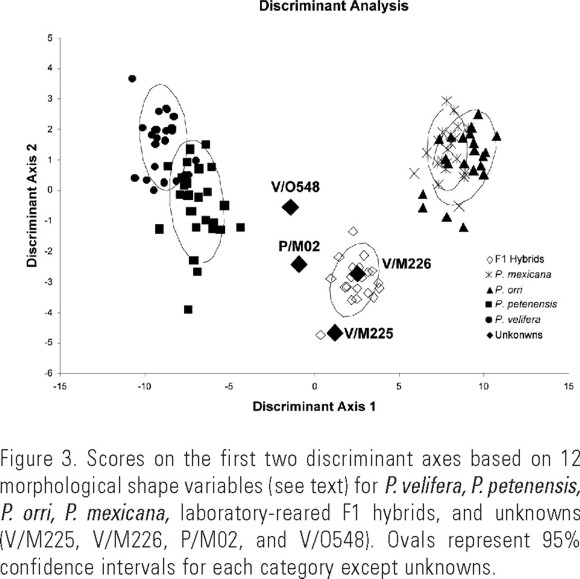
Sequencher (Version KS 5.0.1) and ambiguities were corrected manually. All sequences generated in this study are deposited in GenBank (mtDNA control region sequences, Accession No. AY599415 &#45;AY599417, AY660025; nuclear X<i>src</i> sequences, Accession No. AY599412 &#45; AY599414).</font></p>     <p align="justify"><font face="Verdana" size="2">&nbsp;</font></p>     <p align="justify"><font face="verdana" size="2"><b>Results</b></font></p>     <p align="justify"><font face="verdana" size="2"><b>Morphological verification of hybrids</b>. The overall MANOVA revealed that parental species and hybrids differed significantly (Wilks' _ = 0.0005, F60,476 = 32.60, P &lt; 0.0001) in morphological shape. Discriminant axis 1 of the discriminant analysis explained 89.9% of the variance and was most highly correlated with length of the dorsal fin at the base (<i>R =</i> 0.994, <i>P</i> &lt; 0.001), pre&#45;dorsal fin distance (<i>R</i> = &minus;0.981, <i>P</i> &lt; 0.001), and dorsal fin area (<i>R</i> = 0.901, <i>P</i> &lt; 0.001). This axis distinguished shortfin from sailfin mollies, and all hybrids were morphologically intermediate (<a href="#f3">Fig. 3</a>). Discriminant axis 2 of the discriminant analysis explained an additional 4.7% of
the variance and was most highly correlated with caudal fin area (<i>R</i> = &minus;0.504, <i>P</i> &lt; 0.001), caudal fin height (<i>R</i> = &minus;0.438, <i>P</i> &lt; 0.001), and length of the first dorsal fin ray (<i>R</i> = &minus;0.406, <i>P</i> &lt; 0.001). This axis showed considerable overlap between parental species with most of the wild&#45;caught and laboratory&#45;reared hybrids having somewhat smaller caudal fins than parental species (<a href="#f3">Fig. 3</a>). All four putative wild&#45;caught hybrids fell outside the 95% confidence intervals for each of the four potential parental species, and were intermediate in morphological shape between sailfin and shortfin species, as were the laboratory&#45;reared F1 hybrids (<a href="#f3">Fig. 3</a>).</font></p>     ]]></body>
<body><![CDATA[<p align="center"><font face="verdana" size="2"><a name="f3"></a></font></p>     <p align="center"><font face="verdana" size="2"><img src="/img/revistas/hbio/v15n2/a2f3.jpg"></font></p>     <p align="justify"><font face="verdana" size="2">The discriminant analysis used two canonical discriminant factors to correctly classify all 21 males (100%) of the laboratory&#45;reared F1 hybrids to their hybrid category. For males of the two sailfin species, 26 of 27 (96%) <i>P. petenenesis</i> were correctly classified (one was misclassified as <i>P. velifera</i>), and 23 of 24 (96%) <i>P. velifera</i> were correctly classified (one was misclassified as <i>P. petenensis</i>). There was more overlap between shapes of the two shortfin species. Nineteen of 21 (90%) male <i>P. mexicana</i> were correctly classified (two were misclassified as <i>P. orri</i>). For <i>P. orri</i>, 19 of 21 males (90%) were correctly classified (two were misclassified as <i>P. mexicana</i>). Of the four unknowns,
V/M225, V/O548, and P/M02 were correctly classified (75%), but V/M226 was misclassified as an F1 hybrid.</font></p>     <p align="justify"><font face="verdana" size="2"><b>Molecular verification of hybrids</b>. Fragment profiles for the X<i>src</i> region verified an early generation hybrid status (F1, F2 or BC1) for V/M225. The control, <i>P. formosa</i> and V/M225 both showed the sailfin allele (from either <i>P. velifera</i> or <i>P</i>. <i>petenensis</i> for V/M225) and the <i>P. mexicana</i> allele (<a href="#f4">Fig. 4</a>). V/M226 showed only the <i>P. mexicana</i> allele, suggesting that it arose from a backcross to <i>P. mexicana</i> (e.g., BC1: 50% of progeny are homozygous for backcross parental allele) based on its morphological intermediacy (<a href="#f3">Fig. 3</a>). The DNA sequence of the X<i>src</i> region of V/M225 was identical to that of <i>P. velifera</i>, demonstrating that species to be
its male parent (based upon mtDNA identification of <i>P. mexicana</i> as the female parent; see below). The two sailfin species, <i>P. velifera</i> and <i>P</i>. <i>petenensis</i> differed in DNA sequence from one another at 11 nucleotide positions. In addition, a 4&#45;bp deletion was found in <i>P. petenensis</i> but not in any of the other species or V/M225, further excluding it as the sailfin male parent.</font></p>     <p align="center"><font face="verdana" size="2"><a name="f4"></a></font></p>     <p align="center"><font face="verdana" size="2"><img src="/img/revistas/hbio/v15n2/a2f4.jpg"></font></p>     <p align="justify"><font face="verdana" size="2">The mtDNA control region sequence of V/M225 was identical to that of <i>P. mexicana</i> and differed from those of <i>P. petenensis</i> and <i>P. velifera</i> at 55 and 50 nucleotide positions, respectively. This confimed <i>P. mexicana</i> as the female parent of V/M225.</font></p>     <p align="justify"><font face="Verdana" size="2">&nbsp;</font></p>     <p align="justify"><font face="verdana" size="2"><b>Discussion</b></font></p>     <p align="justify"><font face="verdana" size="2">Our discovery of interspecific hybridization between sailfin and shortfin mollies in the Yucat&aacute;n region of M&eacute;xico is important for two reasons. First, despite intensive collecting efforts by us, and others (Miller 1975, 1983; Lozano&#45;Vilano &amp; Contreras&#45;Balderas, 1987; Obreg&oacute;n&#45;Barbosa <i>et al</i>., 1994; Schmitter&#45;Soto, 1998) for over 30 years, the four wild&#45;caught hybrids reported here are the first to be documented from this part of the geographic distribution of mollies in M&eacute;xico. It is possible that female hybrids, which are harder to detect morphologically, have gone unnoticed. However, the paucity of wild&#45;caught hybrids identified in collections from sympatric populations of sailfin
and shortfin mollies does support earlier suggestions that interspecific hybridization in mollies is rare, most likely due to strong pre&#45;mating reproductive isolation between sympatric species (Hubbs, 1955; Farr, 1989; Ptacek, 1998).</font></p>     ]]></body>
<body><![CDATA[<p align="justify"><font face="verdana" size="2">Second, though laboratory crosses between the sailfin species <i>P. latipinna</i> or <i>P. velifera</i> and the shortfin species <i>P. mexicana</i> have long been known (Hubbs &amp; Hubbs, 1946; Parzefall, 1989; Dries, 2000; Ptacek, 2002), our genetic verification of a wild backcross or &gt;F1 generation hybrid individual (V/M226) confirms that interspecific hybrids in nature are viable and fertile, and that introgression with <i>P. mexicana</i> is not only possible, but has occurred, at least at one site (Campeche).</font></p>     <p align="justify"><font face="verdana" size="2">Possible explanations for breakdown of pre&#45;mating behavioral isolation in certain sympatric situations include the observation that females of shortfin mollies showed weaker conspecific mating preferences in dichotomous laboratory choice tests (Ptacek, 1998) and, again in the lab, females of both <i>P. mexicana</i> and <i>P. orri</i> preferred males of the sailfin species <i>P. latipinna</i> to males of heterospecific, shortfin species. Thus, shortfin molly females may have a pre&#45;existing mating bias towards the overall larger size of sailfin males (conferred by the presence of the enlarged dorsal fin), which could potentially promote mating mistakes where <i>P. mexicana</i> or <i>P. orri</i> occur sympatrically with sailfin species.</font></p>     <p align="justify"><font face="verdana" size="2">Additionally, differences in the frequency of sailfins and shortfins in sympatric sites could favor interspecific hybridization. The so&#45;called Hubbs principle (Hubbs, 1955) suggests that when one species is rare at a site compared to another, the rare species is more likely to mate with more abundant heterospecifics (Mayr, 1963; Gerhardt <i>et al</i>., 1994; Grant &amp; Grant, 1997). Males of <i>P. velifera</i> at the Campeche site were outnumbered almost 3:1 by <i>P. petenensi</i>s and <i>P. mexicana</i> males and at the Quintana Roo site, <i>P. orri</i> was considerably less common than <i>P. velifera</i> (Ptacek, unpubl. data).</font></p>     <p align="justify"><font face="verdana" size="2">While we cannot definitively conclude the cause of hybridization in these three sympatric populations of mollies, our results provide both morphological and genetic verification that interspecific hybridization does occasionally occur in the wild between sailfin and shortfin molly species. To our knowledge, the only other report of a wild&#45;caught hybrid molly (excluding <i>P. formosa</i>) was that of a single hybrid (<i>P. latipunctata</i> x <i>P. mexicana</i>) in north&#45;central M&eacute;xico (collected in the R&iacute;o Tames&iacute; near Llera de Canales, Tamaulipas, M&eacute;xico (Contreras&#45;Balderas, 1990)). Future studies should focus on determining the frequency of hybridization and backcrossing in sympatric populations of mollies
and identifying the factors that promote such interbreeding. Regardless of the cause of hybridization, our discovery of interspecific hybrids at three different sympatric sites suggests that while selection does operate to promote interspecific divergence in mating signals in mollies, in some situations, such pre&#45;mating isolation can break down.</font></p>     <p align="justify"><font face="Verdana" size="2">&nbsp;</font></p>     <p align="justify"><font face="verdana" size="2"><b>Acknowledgments</b></font></p>     <p align="justify"><font face="verdana" size="2">We gratefully acknowledge the Mexican government for granting collecting permission to M.B.P. (Permit No. 10.04.01.613.03, 2001, No. 240103.613&#45;03, 2003) and S.C.B. (1967). We thank A. Aranguren, J. Barger, E. Harrison, J. Ramirez, C. Roelke, J. Schmitter&#45;Soto, M. Valtierra Vega, and El Colegio de la Frontera Sur (ECOSUR), Chetumal, Quintana Roo, Mexico for assistance and logistical support during field collections, M. Childress and S. Hankison for assistance with morphometric analyses, A. Rivera for help preparing Figure 1, C. Gabor for providing the specimen of <i>P. formosa</i>, and A. Kodric&#45;Brown, J. Schmitter&#45;Soto, G. Smith, J. Travis, and an anonymous reviewer for helpful comments on a previous draft of this paper. Animal
care of stock populations of parental species of mollies followed a protocol approved by the Clemson University Animal Research Committee (Protocol # 20044). Financial support was provided by the Howard Hughes Medical Institute through an Undergraduate Student Research Award (to MNH), by the National Science Foundation, Animal Behavior Program (to MBP; IBN 0296173), and by "Acuario Municipal Felipe de J. Benavides" at Monterrey, Mexico (to SCB).</font></p>     <p align="justify"><font face="Verdana" size="2">&nbsp;</font></p>     <p align="justify"><font face="verdana" size="2"><b>References</b></font></p>     <!-- ref --><p align="justify"><font face="verdana" size="2">AVISE, J.C. &amp; N.C. SAUNDERS. 1984. Hybridization and introgression among species of sunfish <i>Lepomis</i>: analysis by mitochondrial DNA and allozyme markers. <i>Genetics</i> 108 (1): 237&#45;256.    &nbsp;&nbsp;&nbsp;&nbsp;&nbsp;&nbsp;&nbsp;&nbsp;[&#160;<a href="javascript:void(0);" onclick="javascript: window.open('/scielo.php?script=sci_nlinks&ref=4076322&pid=S0188-8897200500020000200001&lng=','','width=640,height=500,resizable=yes,scrollbars=1,menubar=yes,');">Links</a>&#160;]<!-- end-ref --></font></p>     <!-- ref --><p align="justify"><font face="verdana" size="2">AVISE, J.C., J.C. TREXLER, J. TRAVIS &amp; W.S. NELSON. 1991. <i>Poecilia mexicana</i> is the recent female parent of the unisexual fish <i>P. formosa. Evolution</i> 45(6): 1530&#45;1533.    &nbsp;&nbsp;&nbsp;&nbsp;&nbsp;&nbsp;&nbsp;&nbsp;[&#160;<a href="javascript:void(0);" onclick="javascript: window.open('/scielo.php?script=sci_nlinks&ref=4076324&pid=S0188-8897200500020000200002&lng=','','width=640,height=500,resizable=yes,scrollbars=1,menubar=yes,');">Links</a>&#160;]<!-- end-ref --></font></p>     <!-- ref --><p align="justify"><font face="verdana" size="2">CASHNER, F.M., G.R. SMITH &amp; R.C. CASHNER. 2003. Robert Rush Miller and Francis Hubbs Miller. <i>Copeia</i> 2003 (4): 910&#45;916.    &nbsp;&nbsp;&nbsp;&nbsp;&nbsp;&nbsp;&nbsp;&nbsp;[&#160;<a href="javascript:void(0);" onclick="javascript: window.open('/scielo.php?script=sci_nlinks&ref=4076326&pid=S0188-8897200500020000200003&lng=','','width=640,height=500,resizable=yes,scrollbars=1,menubar=yes,');">Links</a>&#160;]<!-- end-ref --></font></p>     <!-- ref --><p align="justify"><font face="verdana" size="2">CONTRERAS&#45;BALDERAS, S. 1990. Nuevo h&iacute;brido natural, <i>Poecilia mexicana</i> X <i>P</i>. <i>latipunctata</i>, del r&iacute;o Tames&iacute;, Tamaulipas, Mexico (Pisces: Poeciliidae). <i>Universidad y Ciencia</i> 7 (14): 61&#45;64.    &nbsp;&nbsp;&nbsp;&nbsp;&nbsp;&nbsp;&nbsp;&nbsp;[&#160;<a href="javascript:void(0);" onclick="javascript: window.open('/scielo.php?script=sci_nlinks&ref=4076328&pid=S0188-8897200500020000200004&lng=','','width=640,height=500,resizable=yes,scrollbars=1,menubar=yes,');">Links</a>&#160;]<!-- end-ref --></font></p>     <!-- ref --><p align="justify"><font face="verdana" size="2">DRIES, L.A. 2000. <i>The evolutionary persistence of the gynogenetic Amazon molly</i>, <i>Poecilia formosa</i>. Doctoral Dissertation, University of Texas. Austin.    &nbsp;&nbsp;&nbsp;&nbsp;&nbsp;&nbsp;&nbsp;&nbsp;[&#160;<a href="javascript:void(0);" onclick="javascript: window.open('/scielo.php?script=sci_nlinks&ref=4076330&pid=S0188-8897200500020000200005&lng=','','width=640,height=500,resizable=yes,scrollbars=1,menubar=yes,');">Links</a>&#160;]<!-- end-ref --></font></p>     <!-- ref --><p align="justify"><font face="verdana" size="2">DRIES, L.A. 2003. Peering through the looking glass at a sexual parasite: Are Amazon mollies red queens? <i>Evolution</i> 57 (6): 1387&#45;1396.    &nbsp;&nbsp;&nbsp;&nbsp;&nbsp;&nbsp;&nbsp;&nbsp;[&#160;<a href="javascript:void(0);" onclick="javascript: window.open('/scielo.php?script=sci_nlinks&ref=4076332&pid=S0188-8897200500020000200006&lng=','','width=640,height=500,resizable=yes,scrollbars=1,menubar=yes,');">Links</a>&#160;]<!-- end-ref --></font></p>     <!-- ref --><p align="justify"><font face="verdana" size="2">FARR, J.A. 1989. Sexual selection and secondary sexual differentiation in poeciliids: Determinants of male mating success and the evolution of female choice. In: Meffe, G.K. &amp; F.F. Snelson, Jr. (Eds.). <i>Ecology and Evolution of Livebearing Fishes (Poeciliidae)</i>. Prentice Hall. Englewood Cliffs, pp. 91&#45;123.    &nbsp;&nbsp;&nbsp;&nbsp;&nbsp;&nbsp;&nbsp;&nbsp;[&#160;<a href="javascript:void(0);" onclick="javascript: window.open('/scielo.php?script=sci_nlinks&ref=4076334&pid=S0188-8897200500020000200007&lng=','','width=640,height=500,resizable=yes,scrollbars=1,menubar=yes,');">Links</a>&#160;]<!-- end-ref --></font></p>     <!-- ref --><p align="justify"><font face="verdana" size="2">GERHARDT, H.C., M.B. PTACEK, L. BARNETT &amp; K.G. TORKE. 1994. Hybridization in the diploid&#45;tetraploid treefrogs <i>Hyla chrysoscelis and H. versicolor</i>. <i>Copeia</i> 1994 (1): 51&#45;59.    &nbsp;&nbsp;&nbsp;&nbsp;&nbsp;&nbsp;&nbsp;&nbsp;[&#160;<a href="javascript:void(0);" onclick="javascript: window.open('/scielo.php?script=sci_nlinks&ref=4076336&pid=S0188-8897200500020000200008&lng=','','width=640,height=500,resizable=yes,scrollbars=1,menubar=yes,');">Links</a>&#160;]<!-- end-ref --></font></p>     <!-- ref --><p align="justify"><font face="verdana" size="2">GRANT, P.R. &amp; B.R. GRANT. 1997. Hybridization, sexual imprinting and mate choice. <i>American Naturalist</i> 149 (1): 1&#45;28.    &nbsp;&nbsp;&nbsp;&nbsp;&nbsp;&nbsp;&nbsp;&nbsp;[&#160;<a href="javascript:void(0);" onclick="javascript: window.open('/scielo.php?script=sci_nlinks&ref=4076338&pid=S0188-8897200500020000200009&lng=','','width=640,height=500,resizable=yes,scrollbars=1,menubar=yes,');">Links</a>&#160;]<!-- end-ref --></font></p>     <!-- ref --><p align="justify"><font face="verdana" size="2">HUBBS, C.L. 1933. Species and hybrids of <i>Mollienesia</i>. <i>The Aquarium</i> 1 (1): 263&#45;268, 277.    &nbsp;&nbsp;&nbsp;&nbsp;&nbsp;&nbsp;&nbsp;&nbsp;[&#160;<a href="javascript:void(0);" onclick="javascript: window.open('/scielo.php?script=sci_nlinks&ref=4076340&pid=S0188-8897200500020000200010&lng=','','width=640,height=500,resizable=yes,scrollbars=1,menubar=yes,');">Links</a>&#160;]<!-- end-ref --></font></p>     <!-- ref --><p align="justify"><font face="verdana" size="2">Hubbs, C.L. 1955. Hybridization between fish species in nature. <i>Systematic Zoology</i> 4 (1): 1&#45;20.    &nbsp;&nbsp;&nbsp;&nbsp;&nbsp;&nbsp;&nbsp;&nbsp;[&#160;<a href="javascript:void(0);" onclick="javascript: window.open('/scielo.php?script=sci_nlinks&ref=4076342&pid=S0188-8897200500020000200011&lng=','','width=640,height=500,resizable=yes,scrollbars=1,menubar=yes,');">Links</a>&#160;]<!-- end-ref --></font></p>     <!-- ref --><p align="justify"><font face="verdana" size="2">HUBBS, C.L. &amp; L.C. HUBBS. 1932. Apparent parthenogenesis in nature in a form of fish of hybrid origin. <i>Science</i> 76 (1983): 628&#45;630.    &nbsp;&nbsp;&nbsp;&nbsp;&nbsp;&nbsp;&nbsp;&nbsp;[&#160;<a href="javascript:void(0);" onclick="javascript: window.open('/scielo.php?script=sci_nlinks&ref=4076344&pid=S0188-8897200500020000200012&lng=','','width=640,height=500,resizable=yes,scrollbars=1,menubar=yes,');">Links</a>&#160;]<!-- end-ref --></font></p>     <!-- ref --><p align="justify"><font face="verdana" size="2">HUBBS, C.L. &amp; L.C. HUBBS. 1946. Experimental breeding of the Amazon molly. <i>Aquarium Journal</i> 17 (1): 4&#45;6.    &nbsp;&nbsp;&nbsp;&nbsp;&nbsp;&nbsp;&nbsp;&nbsp;[&#160;<a href="javascript:void(0);" onclick="javascript: window.open('/scielo.php?script=sci_nlinks&ref=4076346&pid=S0188-8897200500020000200013&lng=','','width=640,height=500,resizable=yes,scrollbars=1,menubar=yes,');">Links</a>&#160;]<!-- end-ref --></font></p>     <!-- ref --><p align="justify"><font face="verdana" size="2">KOCHER, T.D., W.K. THOMAS, A. MEYER, S.V. EDWARDS, S. P&Auml;&Auml;BO, F.X. VILLABLANCA &amp; A.C. WILSON. 1989. Dynamics of mitochondrial DNA evolution in animals: amplification and sequencing with conserved primers. <i>Proceedings of the National Academy of Sciences</i> 86 (16): 6196&#45;6200.    &nbsp;&nbsp;&nbsp;&nbsp;&nbsp;&nbsp;&nbsp;&nbsp;[&#160;<a href="javascript:void(0);" onclick="javascript: window.open('/scielo.php?script=sci_nlinks&ref=4076348&pid=S0188-8897200500020000200014&lng=','','width=640,height=500,resizable=yes,scrollbars=1,menubar=yes,');">Links</a>&#160;]<!-- end-ref --></font></p>     <!-- ref --><p align="justify"><font face="verdana" size="2">LOZANO&#45;VILANO, M.L. &amp; S. CONTRERAS&#45;BALDERAS. 1987. Lista zoogeogr&aacute;fica y ecol&oacute;gica de la ictiofauna continental de Chiapas, M&eacute;xico. <i>The Southwestern Naturalist</i> 32 (2): 223&#45;236.    &nbsp;&nbsp;&nbsp;&nbsp;&nbsp;&nbsp;&nbsp;&nbsp;[&#160;<a href="javascript:void(0);" onclick="javascript: window.open('/scielo.php?script=sci_nlinks&ref=4076350&pid=S0188-8897200500020000200015&lng=','','width=640,height=500,resizable=yes,scrollbars=1,menubar=yes,');">Links</a>&#160;]<!-- end-ref --></font></p>     <!-- ref --><p align="justify"><font face="verdana" size="2">MAYR, E. 1963. <i>Animal Species and Evolution</i>. Belknap. Cambridge, 811 p.    &nbsp;&nbsp;&nbsp;&nbsp;&nbsp;&nbsp;&nbsp;&nbsp;[&#160;<a href="javascript:void(0);" onclick="javascript: window.open('/scielo.php?script=sci_nlinks&ref=4076352&pid=S0188-8897200500020000200016&lng=','','width=640,height=500,resizable=yes,scrollbars=1,menubar=yes,');">Links</a>&#160;]<!-- end-ref --></font></p>     <!-- ref --><p align="justify"><font face="verdana" size="2">MILLER, R.R. 1975. Four new species of Mexican poeciliid fishes of the genera <i>Poecilia, Gambusia, and Poeciliopsis. Occasional Papers of the Museum of Zoology University of Michigan</i> 672: 1&#45;44.    &nbsp;&nbsp;&nbsp;&nbsp;&nbsp;&nbsp;&nbsp;&nbsp;[&#160;<a href="javascript:void(0);" onclick="javascript: window.open('/scielo.php?script=sci_nlinks&ref=4076354&pid=S0188-8897200500020000200017&lng=','','width=640,height=500,resizable=yes,scrollbars=1,menubar=yes,');">Links</a>&#160;]<!-- end-ref --></font></p>     <!-- ref --><p align="justify"><font face="verdana" size="2">MILLER, R.R. 1983. Checklist and key to the mollies of Mexico (Pisces: Poeciliidae: <i>Poecilia</i>, Subgenus <i>Mollienesia</i>). <i>Copeia</i> 1983 (3): 817&#45;822.    &nbsp;&nbsp;&nbsp;&nbsp;&nbsp;&nbsp;&nbsp;&nbsp;[&#160;<a href="javascript:void(0);" onclick="javascript: window.open('/scielo.php?script=sci_nlinks&ref=4076356&pid=S0188-8897200500020000200018&lng=','','width=640,height=500,resizable=yes,scrollbars=1,menubar=yes,');">Links</a>&#160;]<!-- end-ref --></font></p>     <!-- ref --><p align="justify"><font face="verdana" size="2">OBREG&Oacute;N&#45;BARBOSA, H., S. CONTRERAS&#45;BALDERAS &amp; M.L. LOZANO&#45;VILANO. 1994. The fishes of Northern and Central Veracruz, Mexico. <i>Hydrobiologia</i> 286 (1): 79&#45;95.    &nbsp;&nbsp;&nbsp;&nbsp;&nbsp;&nbsp;&nbsp;&nbsp;[&#160;<a href="javascript:void(0);" onclick="javascript: window.open('/scielo.php?script=sci_nlinks&ref=4076358&pid=S0188-8897200500020000200019&lng=','','width=640,height=500,resizable=yes,scrollbars=1,menubar=yes,');">Links</a>&#160;]<!-- end-ref --></font></p>     <!-- ref --><p align="justify"><font face="verdana" size="2">PALUMBI, S.R. 1996. PCR and molecular systematics. <i>In</i>: Hillis, D., C. Moritz, &amp; B. Mable (Eds.). <i>Molecular Systematics</i>. Sinauer. Sunderland, pp. 205&#45;247.    &nbsp;&nbsp;&nbsp;&nbsp;&nbsp;&nbsp;&nbsp;&nbsp;[&#160;<a href="javascript:void(0);" onclick="javascript: window.open('/scielo.php?script=sci_nlinks&ref=4076360&pid=S0188-8897200500020000200020&lng=','','width=640,height=500,resizable=yes,scrollbars=1,menubar=yes,');">Links</a>&#160;]<!-- end-ref --></font></p>     <!-- ref --><p align="justify"><font face="verdana" size="2">PARZEFALL, J. 1989. Sexual and aggressive behaviour in species hybrids of <i>Poecilia mexicana</i> and <i>Poecilia velifera</i>: (Pisces, Poeciliidae). <i>Ethology</i> 82 (2): 101&#45;115.    &nbsp;&nbsp;&nbsp;&nbsp;&nbsp;&nbsp;&nbsp;&nbsp;[&#160;<a href="javascript:void(0);" onclick="javascript: window.open('/scielo.php?script=sci_nlinks&ref=4076362&pid=S0188-8897200500020000200021&lng=','','width=640,height=500,resizable=yes,scrollbars=1,menubar=yes,');">Links</a>&#160;]<!-- end-ref --></font></p>     <!-- ref --><p align="justify"><font face="verdana" size="2">PTACEK, M.B. 1998. Interspecific mate choice in sailfin and shortfin species of mollies. <i>Animal Behaviour</i> 56 (5): 1145&#45;1154.    &nbsp;&nbsp;&nbsp;&nbsp;&nbsp;&nbsp;&nbsp;&nbsp;[&#160;<a href="javascript:void(0);" onclick="javascript: window.open('/scielo.php?script=sci_nlinks&ref=4076364&pid=S0188-8897200500020000200022&lng=','','width=640,height=500,resizable=yes,scrollbars=1,menubar=yes,');">Links</a>&#160;]<!-- end-ref --></font></p>     <!-- ref --><p align="justify"><font face="verdana" size="2">PTACEK, M.B. 2002. Patterns of inheritance of mating signals in interspecific hybrids between sailfin and shortfin mollies (Poeciliidae: <i>Poecilia</i>: <i>Mollienesia</i>). <i>Genetica</i> 116 (2&#45;3): 329&#45;342.    &nbsp;&nbsp;&nbsp;&nbsp;&nbsp;&nbsp;&nbsp;&nbsp;[&#160;<a href="javascript:void(0);" onclick="javascript: window.open('/scielo.php?script=sci_nlinks&ref=4076366&pid=S0188-8897200500020000200023&lng=','','width=640,height=500,resizable=yes,scrollbars=1,menubar=yes,');">Links</a>&#160;]<!-- end-ref --></font></p>     <!-- ref --><p align="justify"><font face="verdana" size="2">SCHARTL, M., B. WILDE, I. SCHLUPP &amp; J. PARZEFALL. 1995. Evolutionary origin of a parthenoform, the Amazon Molly <i>Poecilia formosa</i>, on the basis of a molecular genealogy. <i>Evolution</i> 49 (5): 827&#45;835.    &nbsp;&nbsp;&nbsp;&nbsp;&nbsp;&nbsp;&nbsp;&nbsp;[&#160;<a href="javascript:void(0);" onclick="javascript: window.open('/scielo.php?script=sci_nlinks&ref=4076368&pid=S0188-8897200500020000200024&lng=','','width=640,height=500,resizable=yes,scrollbars=1,menubar=yes,');">Links</a>&#160;]<!-- end-ref --></font></p>     <!-- ref --><p align="justify"><font face="verdana" size="2">SCHMITTER&#45;SOTO, J.J. 1998. <i>Cat&aacute;logo de los peces continentales de Quintana Roo</i>. ECOSUR. San Crist&oacute;bal de Las Casas, 239 p.    &nbsp;&nbsp;&nbsp;&nbsp;&nbsp;&nbsp;&nbsp;&nbsp;[&#160;<a href="javascript:void(0);" onclick="javascript: window.open('/scielo.php?script=sci_nlinks&ref=4076370&pid=S0188-8897200500020000200025&lng=','','width=640,height=500,resizable=yes,scrollbars=1,menubar=yes,');">Links</a>&#160;]<!-- end-ref --></font></p>     <!-- ref --><p align="justify"><font face="verdana" size="2">SHIELDS, G.L. &amp; T.D. KOCHER. 1991. Phylogenetic relationships of North American Ursids based on analysis of mitochondrial DNA. <i>Evolution</i> 45 (1): 218&#45;221.    &nbsp;&nbsp;&nbsp;&nbsp;&nbsp;&nbsp;&nbsp;&nbsp;[&#160;<a href="javascript:void(0);" onclick="javascript: window.open('/scielo.php?script=sci_nlinks&ref=4076372&pid=S0188-8897200500020000200026&lng=','','width=640,height=500,resizable=yes,scrollbars=1,menubar=yes,');">Links</a>&#160;]<!-- end-ref --></font></p>     <!-- ref --><p align="justify"><font face="verdana" size="2">WILSON, A.C., R.L. CANN, S. CARR, M. GEORGE, U. GYLLENSTEN, R.H.K. HELM&#45;BYCHOWSKI, S.R. PALUMBI, E. PRAGER, R.D. SAGE &amp; M. STONEKING. 1985. Mitochondrial DNA and two perspectives on evolutionary genetics. <i>Biological Journal of the Linnean Society</i> 26 (1985): 375&#45;400.    &nbsp;&nbsp;&nbsp;&nbsp;&nbsp;&nbsp;&nbsp;&nbsp;[&#160;<a href="javascript:void(0);" onclick="javascript: window.open('/scielo.php?script=sci_nlinks&ref=4076374&pid=S0188-8897200500020000200027&lng=','','width=640,height=500,resizable=yes,scrollbars=1,menubar=yes,');">Links</a>&#160;]<!-- end-ref --></font></p>     <!-- ref --><p align="justify"><font face="verdana" size="2">WOODHEAD, A. D. &amp; N. ARMSTRONG. 1985. Aspects of mating behaviour of male mollies (<i>Poecilia</i> spp.). <i>Journal of Fish Biology</i> 27 (1985): 593&#45;601.    &nbsp;&nbsp;&nbsp;&nbsp;&nbsp;&nbsp;&nbsp;&nbsp;[&#160;<a href="javascript:void(0);" onclick="javascript: window.open('/scielo.php?script=sci_nlinks&ref=4076376&pid=S0188-8897200500020000200028&lng=','','width=640,height=500,resizable=yes,scrollbars=1,menubar=yes,');">Links</a>&#160;]<!-- end-ref --></font></p>      ]]></body><back>
<ref-list>
<ref id="B1">
<nlm-citation citation-type="journal">
<person-group person-group-type="author">
<name>
<surname><![CDATA[AVISE]]></surname>
<given-names><![CDATA[J.C.]]></given-names>
</name>
<name>
<surname><![CDATA[N.C.]]></surname>
<given-names><![CDATA[SAUNDERS]]></given-names>
</name>
</person-group>
<article-title xml:lang="en"><![CDATA[Hybridization and introgression among species of sunfish Lepomis: analysis by mitochondrial DNA and allozyme markers]]></article-title>
<source><![CDATA[Genetics]]></source>
<year>1984</year>
<volume>108</volume>
<numero>1</numero>
<issue>1</issue>
<page-range>237-256</page-range></nlm-citation>
</ref>
<ref id="B2">
<nlm-citation citation-type="journal">
<person-group person-group-type="author">
<name>
<surname><![CDATA[AVISE]]></surname>
<given-names><![CDATA[J.C.]]></given-names>
</name>
<name>
<surname><![CDATA[TREXLER]]></surname>
<given-names><![CDATA[J.C.]]></given-names>
</name>
<name>
<surname><![CDATA[TRAVIS]]></surname>
<given-names><![CDATA[J.]]></given-names>
</name>
<name>
<surname><![CDATA[W.S.]]></surname>
<given-names><![CDATA[NELSON]]></given-names>
</name>
</person-group>
<article-title xml:lang="en"><![CDATA[Poecilia mexicana is the recent female parent of the unisexual fish P formosa]]></article-title>
<source><![CDATA[Evolution]]></source>
<year>1991</year>
<volume>45</volume>
<numero>6</numero>
<issue>6</issue>
<page-range>1530-1533</page-range></nlm-citation>
</ref>
<ref id="B3">
<nlm-citation citation-type="journal">
<person-group person-group-type="author">
<name>
<surname><![CDATA[CASHNER]]></surname>
<given-names><![CDATA[F.M.]]></given-names>
</name>
<name>
<surname><![CDATA[G.R.]]></surname>
<given-names><![CDATA[SMITH]]></given-names>
</name>
<name>
<surname><![CDATA[R.C.]]></surname>
<given-names><![CDATA[CASHNER]]></given-names>
</name>
</person-group>
<article-title xml:lang="en"><![CDATA[Robert Rush Miller and Francis Hubbs Miller]]></article-title>
<source><![CDATA[Copeia]]></source>
<year>2003</year>
<volume>2003</volume>
<numero>4</numero>
<issue>4</issue>
<page-range>910-916</page-range></nlm-citation>
</ref>
<ref id="B4">
<nlm-citation citation-type="journal">
<person-group person-group-type="author">
<name>
<surname><![CDATA[CONTRERAS-BALDERAS]]></surname>
<given-names><![CDATA[S.]]></given-names>
</name>
</person-group>
<article-title xml:lang="es"><![CDATA[Nuevo híbrido natural, Poecilia mexicana X P. latipunctata, del río Tamesí, Tamaulipas, Mexico (Pisces: Poeciliidae)]]></article-title>
<source><![CDATA[Universidad y Ciencia]]></source>
<year>1990</year>
<volume>7</volume>
<numero>14</numero>
<issue>14</issue>
<page-range>61-64</page-range></nlm-citation>
</ref>
<ref id="B5">
<nlm-citation citation-type="">
<person-group person-group-type="author">
<name>
<surname><![CDATA[DRIES]]></surname>
<given-names><![CDATA[L.A.]]></given-names>
</name>
</person-group>
<source><![CDATA[The evolutionary persistence of the gynogenetic Amazon molly, Poecilia formosa]]></source>
<year>2000</year>
</nlm-citation>
</ref>
<ref id="B6">
<nlm-citation citation-type="journal">
<person-group person-group-type="author">
<name>
<surname><![CDATA[DRIES]]></surname>
<given-names><![CDATA[L.A.]]></given-names>
</name>
</person-group>
<article-title xml:lang="en"><![CDATA[Peering through the looking glass at a sexual parasite: Are Amazon mollies red queens?]]></article-title>
<source><![CDATA[Evolution]]></source>
<year>2003</year>
<volume>57</volume>
<numero>6</numero>
<issue>6</issue>
<page-range>1387-1396</page-range></nlm-citation>
</ref>
<ref id="B7">
<nlm-citation citation-type="book">
<person-group person-group-type="author">
<name>
<surname><![CDATA[FARR]]></surname>
<given-names><![CDATA[J.A.]]></given-names>
</name>
</person-group>
<article-title xml:lang="en"><![CDATA[Sexual selection and secondary sexual differentiation in poeciliids: Determinants of male mating success and the evolution of female choice]]></article-title>
<person-group person-group-type="editor">
<name>
<surname><![CDATA[Meffe]]></surname>
<given-names><![CDATA[G.K.]]></given-names>
</name>
<name>
<surname><![CDATA[Snelson, Jr.]]></surname>
<given-names><![CDATA[F.F.]]></given-names>
</name>
</person-group>
<source><![CDATA[Ecology and Evolution of Livebearing Fishes (Poeciliidae)]]></source>
<year>1989</year>
<page-range>91-123</page-range><publisher-loc><![CDATA[Englewood Cliffs ]]></publisher-loc>
<publisher-name><![CDATA[Prentice Hall]]></publisher-name>
</nlm-citation>
</ref>
<ref id="B8">
<nlm-citation citation-type="journal">
<person-group person-group-type="author">
<name>
<surname><![CDATA[GERHARDT]]></surname>
<given-names><![CDATA[H.C.]]></given-names>
</name>
<name>
<surname><![CDATA[PTACEK]]></surname>
<given-names><![CDATA[M.B.]]></given-names>
</name>
<name>
<surname><![CDATA[BARNETT]]></surname>
<given-names><![CDATA[L.]]></given-names>
</name>
<name>
<surname><![CDATA[K.G.]]></surname>
<given-names><![CDATA[TORKE]]></given-names>
</name>
</person-group>
<article-title xml:lang="en"><![CDATA[Hybridization in the diploid-tetraploid treefrogs Hyla chrysoscelis and H versicolor]]></article-title>
<source><![CDATA[Copeia]]></source>
<year>1994</year>
<volume>1994</volume>
<numero>1</numero>
<issue>1</issue>
<page-range>51-59</page-range></nlm-citation>
</ref>
<ref id="B9">
<nlm-citation citation-type="journal">
<person-group person-group-type="author">
<name>
<surname><![CDATA[GRANT]]></surname>
<given-names><![CDATA[P.R.]]></given-names>
</name>
<name>
<surname><![CDATA[B.R.]]></surname>
<given-names><![CDATA[GRANT]]></given-names>
</name>
</person-group>
<article-title xml:lang="en"><![CDATA[Hybridization, sexual imprinting and mate choice]]></article-title>
<source><![CDATA[American Naturalist]]></source>
<year>1997</year>
<volume>149</volume>
<numero>1</numero>
<issue>1</issue>
<page-range>1-28</page-range></nlm-citation>
</ref>
<ref id="B10">
<nlm-citation citation-type="journal">
<person-group person-group-type="author">
<name>
<surname><![CDATA[HUBBS]]></surname>
<given-names><![CDATA[C.L.]]></given-names>
</name>
</person-group>
<article-title xml:lang="en"><![CDATA[Species and hybrids of Mollienesia]]></article-title>
<source><![CDATA[The Aquarium]]></source>
<year>1933</year>
<volume>1</volume>
<numero>1</numero>
<issue>1</issue>
<page-range>263-268</page-range><page-range>277</page-range></nlm-citation>
</ref>
<ref id="B11">
<nlm-citation citation-type="journal">
<person-group person-group-type="author">
<name>
<surname><![CDATA[Hubbs]]></surname>
<given-names><![CDATA[C.L.]]></given-names>
</name>
</person-group>
<article-title xml:lang="en"><![CDATA[Hybridization between fish species in nature]]></article-title>
<source><![CDATA[Systematic Zoology]]></source>
<year>1955</year>
<volume>4</volume>
<numero>1</numero>
<issue>1</issue>
<page-range>1-20</page-range></nlm-citation>
</ref>
<ref id="B12">
<nlm-citation citation-type="journal">
<person-group person-group-type="author">
<name>
<surname><![CDATA[HUBBS]]></surname>
<given-names><![CDATA[C.L.]]></given-names>
</name>
<name>
<surname><![CDATA[L.C.]]></surname>
<given-names><![CDATA[HUBBS]]></given-names>
</name>
</person-group>
<article-title xml:lang="en"><![CDATA[Apparent parthenogenesis in nature in a form of fish of hybrid origin]]></article-title>
<source><![CDATA[Science]]></source>
<year>1932</year>
<volume>76</volume>
<numero>1983</numero>
<issue>1983</issue>
<page-range>628-630</page-range></nlm-citation>
</ref>
<ref id="B13">
<nlm-citation citation-type="journal">
<person-group person-group-type="author">
<name>
<surname><![CDATA[HUBBS]]></surname>
<given-names><![CDATA[C.L.]]></given-names>
</name>
<name>
<surname><![CDATA[L.C.]]></surname>
<given-names><![CDATA[HUBBS]]></given-names>
</name>
</person-group>
<article-title xml:lang="en"><![CDATA[Experimental breeding of the Amazon molly]]></article-title>
<source><![CDATA[Aquarium Journal]]></source>
<year>1946</year>
<volume>17</volume>
<numero>1</numero>
<issue>1</issue>
<page-range>4-6</page-range></nlm-citation>
</ref>
<ref id="B14">
<nlm-citation citation-type="journal">
<person-group person-group-type="author">
<name>
<surname><![CDATA[KOCHER]]></surname>
<given-names><![CDATA[T.D.]]></given-names>
</name>
<name>
<surname><![CDATA[THOMAS]]></surname>
<given-names><![CDATA[W.K.]]></given-names>
</name>
<name>
<surname><![CDATA[MEYER]]></surname>
<given-names><![CDATA[A.]]></given-names>
</name>
<name>
<surname><![CDATA[EDWARDS]]></surname>
<given-names><![CDATA[S.V.]]></given-names>
</name>
<name>
<surname><![CDATA[PÄÄBO]]></surname>
<given-names><![CDATA[S.]]></given-names>
</name>
<name>
<surname><![CDATA[VILLABLANCA]]></surname>
<given-names><![CDATA[F.X.]]></given-names>
</name>
<name>
<surname><![CDATA[A.C.]]></surname>
<given-names><![CDATA[WILSON]]></given-names>
</name>
</person-group>
<article-title xml:lang="en"><![CDATA[Dynamics of mitochondrial DNA evolution in animals: amplification and sequencing with conserved primers]]></article-title>
<source><![CDATA[Proceedings of the National Academy of Sciences]]></source>
<year>1989</year>
<volume>86</volume>
<numero>16</numero>
<issue>16</issue>
<page-range>6196-6200</page-range></nlm-citation>
</ref>
<ref id="B15">
<nlm-citation citation-type="journal">
<person-group person-group-type="author">
<name>
<surname><![CDATA[LOZANO-VILANO]]></surname>
<given-names><![CDATA[M.L.]]></given-names>
</name>
<name>
<surname><![CDATA[CONTRERAS-BALDERAS]]></surname>
<given-names><![CDATA[S.]]></given-names>
</name>
</person-group>
<article-title xml:lang="es"><![CDATA[Lista zoogeográfica y ecológica de la ictiofauna continental de Chiapas, México]]></article-title>
<source><![CDATA[The Southwestern Naturalist]]></source>
<year>1987</year>
<volume>32</volume>
<numero>2</numero>
<issue>2</issue>
<page-range>223-236</page-range></nlm-citation>
</ref>
<ref id="B16">
<nlm-citation citation-type="book">
<person-group person-group-type="author">
<name>
<surname><![CDATA[MAYR]]></surname>
<given-names><![CDATA[E.]]></given-names>
</name>
</person-group>
<source><![CDATA[Animal Species and Evolution]]></source>
<year>1963</year>
<page-range>811</page-range><publisher-loc><![CDATA[Cambridge ]]></publisher-loc>
<publisher-name><![CDATA[Belknap]]></publisher-name>
</nlm-citation>
</ref>
<ref id="B17">
<nlm-citation citation-type="journal">
<person-group person-group-type="author">
<name>
<surname><![CDATA[MILLER]]></surname>
<given-names><![CDATA[R.R.]]></given-names>
</name>
</person-group>
<article-title xml:lang="en"><![CDATA[Four new species of Mexican poeciliid fishes of the genera Poecilia, Gambusia, and Poeciliopsis]]></article-title>
<source><![CDATA[Occasional Papers of the Museum of Zoology University of Michigan]]></source>
<year>1975</year>
<volume>672</volume>
<page-range>1-44</page-range></nlm-citation>
</ref>
<ref id="B18">
<nlm-citation citation-type="journal">
<person-group person-group-type="author">
<name>
<surname><![CDATA[MILLER]]></surname>
<given-names><![CDATA[R.R.]]></given-names>
</name>
</person-group>
<article-title xml:lang="en"><![CDATA[Checklist and key to the mollies of Mexico (Pisces: Poeciliidae: Poecilia, Subgenus Mollienesia)]]></article-title>
<source><![CDATA[Copeia]]></source>
<year>1983</year>
<volume>1983</volume>
<numero>3</numero>
<issue>3</issue>
<page-range>817-822</page-range></nlm-citation>
</ref>
<ref id="B19">
<nlm-citation citation-type="journal">
<person-group person-group-type="author">
<name>
<surname><![CDATA[OBREGÓN-BARBOSA]]></surname>
<given-names><![CDATA[H.]]></given-names>
</name>
<name>
<surname><![CDATA[CONTRERAS-BALDERAS]]></surname>
<given-names><![CDATA[S.]]></given-names>
</name>
<name>
<surname><![CDATA[LOZANO-VILANO]]></surname>
<given-names><![CDATA[M.L.]]></given-names>
</name>
</person-group>
<article-title xml:lang="en"><![CDATA[The fishes of Northern and Central Veracruz, Mexico]]></article-title>
<source><![CDATA[Hydrobiologia]]></source>
<year>1994</year>
<volume>286</volume>
<numero>1</numero>
<issue>1</issue>
<page-range>79-95</page-range></nlm-citation>
</ref>
<ref id="B20">
<nlm-citation citation-type="book">
<person-group person-group-type="author">
<name>
<surname><![CDATA[PALUMBI]]></surname>
<given-names><![CDATA[S.R.]]></given-names>
</name>
</person-group>
<article-title xml:lang="en"><![CDATA[PCR and molecular systematics]]></article-title>
<person-group person-group-type="editor">
<name>
<surname><![CDATA[Hillis]]></surname>
<given-names><![CDATA[D.]]></given-names>
</name>
<name>
<surname><![CDATA[Moritz]]></surname>
<given-names><![CDATA[C.]]></given-names>
</name>
<name>
<surname><![CDATA[Mable]]></surname>
<given-names><![CDATA[B.]]></given-names>
</name>
</person-group>
<source><![CDATA[Molecular Systematics]]></source>
<year>1996</year>
<page-range>205-247</page-range><publisher-loc><![CDATA[Sunderland ]]></publisher-loc>
<publisher-name><![CDATA[Sinauer]]></publisher-name>
</nlm-citation>
</ref>
<ref id="B21">
<nlm-citation citation-type="journal">
<person-group person-group-type="author">
<name>
<surname><![CDATA[PARZEFALL]]></surname>
<given-names><![CDATA[J.]]></given-names>
</name>
</person-group>
<article-title xml:lang="en"><![CDATA[Sexual and aggressive behaviour in species hybrids of Poecilia mexicana and Poecilia velifera: (Pisces, Poeciliidae)]]></article-title>
<source><![CDATA[Ethology]]></source>
<year>1989</year>
<volume>82</volume>
<numero>2</numero>
<issue>2</issue>
<page-range>101-115</page-range></nlm-citation>
</ref>
<ref id="B22">
<nlm-citation citation-type="journal">
<person-group person-group-type="author">
<name>
<surname><![CDATA[PTACEK]]></surname>
<given-names><![CDATA[M.B.]]></given-names>
</name>
</person-group>
<article-title xml:lang="en"><![CDATA[Interspecific mate choice in sailfin and shortfin species of mollies]]></article-title>
<source><![CDATA[Animal Behaviour]]></source>
<year>1998</year>
<volume>56</volume>
<numero>5</numero>
<issue>5</issue>
<page-range>1145-1154</page-range></nlm-citation>
</ref>
<ref id="B23">
<nlm-citation citation-type="journal">
<person-group person-group-type="author">
<name>
<surname><![CDATA[PTACEK]]></surname>
<given-names><![CDATA[M.B.]]></given-names>
</name>
</person-group>
<article-title xml:lang="en"><![CDATA[Patterns of inheritance of mating signals in interspecific hybrids between sailfin and shortfin mollies (Poeciliidae: Poecilia: Mollienesia)]]></article-title>
<source><![CDATA[Genetica]]></source>
<year>2002</year>
<volume>116</volume>
<numero>2-3</numero>
<issue>2-3</issue>
<page-range>329-342</page-range></nlm-citation>
</ref>
<ref id="B24">
<nlm-citation citation-type="journal">
<person-group person-group-type="author">
<name>
<surname><![CDATA[SCHARTL]]></surname>
<given-names><![CDATA[M.]]></given-names>
</name>
<name>
<surname><![CDATA[WILDE]]></surname>
<given-names><![CDATA[B.]]></given-names>
</name>
<name>
<surname><![CDATA[SCHLUPP]]></surname>
<given-names><![CDATA[I.]]></given-names>
</name>
<name>
<surname><![CDATA[J.]]></surname>
<given-names><![CDATA[PARZEFALL]]></given-names>
</name>
</person-group>
<article-title xml:lang="en"><![CDATA[Evolutionary origin of a parthenoform, the Amazon Molly Poecilia formosa, on the basis of a molecular genealogy]]></article-title>
<source><![CDATA[Evolution]]></source>
<year>1995</year>
<volume>49</volume>
<numero>5</numero>
<issue>5</issue>
<page-range>827-835</page-range></nlm-citation>
</ref>
<ref id="B25">
<nlm-citation citation-type="book">
<person-group person-group-type="author">
<name>
<surname><![CDATA[SCHMITTER-SOTO]]></surname>
<given-names><![CDATA[J.J.]]></given-names>
</name>
</person-group>
<source><![CDATA[Catálogo de los peces continentales de Quintana Roo]]></source>
<year>1998</year>
<page-range>239</page-range><publisher-loc><![CDATA[San Cristóbal de Las Casas ]]></publisher-loc>
<publisher-name><![CDATA[ECOSUR]]></publisher-name>
</nlm-citation>
</ref>
<ref id="B26">
<nlm-citation citation-type="journal">
<person-group person-group-type="author">
<name>
<surname><![CDATA[SHIELDS]]></surname>
<given-names><![CDATA[G.L.]]></given-names>
</name>
<name>
<surname><![CDATA[T.D.]]></surname>
<given-names><![CDATA[KOCHER]]></given-names>
</name>
</person-group>
<article-title xml:lang="en"><![CDATA[Phylogenetic relationships of North American Ursids based on analysis of mitochondrial DNA]]></article-title>
<source><![CDATA[Evolution]]></source>
<year>1991</year>
<volume>45</volume>
<numero>1</numero>
<issue>1</issue>
<page-range>218-221</page-range></nlm-citation>
</ref>
<ref id="B27">
<nlm-citation citation-type="journal">
<person-group person-group-type="author">
<name>
<surname><![CDATA[WILSON]]></surname>
<given-names><![CDATA[A.C.]]></given-names>
</name>
<name>
<surname><![CDATA[CANN]]></surname>
<given-names><![CDATA[R.L.]]></given-names>
</name>
<name>
<surname><![CDATA[CARR]]></surname>
<given-names><![CDATA[S.]]></given-names>
</name>
<name>
<surname><![CDATA[GEORGE]]></surname>
<given-names><![CDATA[M.]]></given-names>
</name>
<name>
<surname><![CDATA[GYLLENSTEN]]></surname>
<given-names><![CDATA[U.]]></given-names>
</name>
<name>
<surname><![CDATA[HELM-BYCHOWSKI]]></surname>
<given-names><![CDATA[R.H.K.]]></given-names>
</name>
<name>
<surname><![CDATA[PALUMBI]]></surname>
<given-names><![CDATA[S.R.]]></given-names>
</name>
<name>
<surname><![CDATA[PRAGER]]></surname>
<given-names><![CDATA[E.]]></given-names>
</name>
<name>
<surname><![CDATA[SAGE]]></surname>
<given-names><![CDATA[R.D.]]></given-names>
</name>
<name>
<surname><![CDATA[M.]]></surname>
<given-names><![CDATA[STONEKING]]></given-names>
</name>
</person-group>
<article-title xml:lang="en"><![CDATA[Mitochondrial DNA and two perspectives on evolutionary genetics]]></article-title>
<source><![CDATA[Biological Journal of the Linnean Society]]></source>
<year>1985</year>
<volume>26</volume>
<numero>1985</numero>
<issue>1985</issue>
<page-range>375-400</page-range></nlm-citation>
</ref>
<ref id="B28">
<nlm-citation citation-type="journal">
<person-group person-group-type="author">
<name>
<surname><![CDATA[WOODHEAD]]></surname>
<given-names><![CDATA[A. D.]]></given-names>
</name>
<name>
<surname><![CDATA[N.]]></surname>
<given-names><![CDATA[ARMSTRONG]]></given-names>
</name>
</person-group>
<article-title xml:lang="en"><![CDATA[Aspects of mating behaviour of male mollies (Poecilia spp.)]]></article-title>
<source><![CDATA[Journal of Fish Biology]]></source>
<year>1985</year>
<volume>27</volume>
<numero>1985</numero>
<issue>1985</issue>
<page-range>593-601</page-range></nlm-citation>
</ref>
</ref-list>
</back>
</article>