<?xml version="1.0" encoding="ISO-8859-1"?><article xmlns:mml="http://www.w3.org/1998/Math/MathML" xmlns:xlink="http://www.w3.org/1999/xlink" xmlns:xsi="http://www.w3.org/2001/XMLSchema-instance">
<front>
<journal-meta>
<journal-id>0188-8897</journal-id>
<journal-title><![CDATA[Hidrobiológica]]></journal-title>
<abbrev-journal-title><![CDATA[Hidrobiológica]]></abbrev-journal-title>
<issn>0188-8897</issn>
<publisher>
<publisher-name><![CDATA[Universidad Autónoma Metropolitana, División de Ciencias Biológicas y de la Salud]]></publisher-name>
</publisher>
</journal-meta>
<article-meta>
<article-id>S0188-88972003000400003</article-id>
<title-group>
<article-title xml:lang="en"><![CDATA[Further observations on a hypothecal pore in the genus Protoperidinium Bergh (Dinoflagellata)]]></article-title>
<article-title xml:lang="es"><![CDATA[Observaciones adicionales del poro hipotecal en el género Protoperidinium Bergh (Dinoflagellata)]]></article-title>
</title-group>
<contrib-group>
<contrib contrib-type="author">
<name>
<surname><![CDATA[Okolodkov]]></surname>
<given-names><![CDATA[Yuri B.]]></given-names>
</name>
<xref ref-type="aff" rid="A01"/>
</contrib>
</contrib-group>
<aff id="A01">
<institution><![CDATA[,Universidad Autónoma Metropolitana Departamento de Hidrobiología División Ciencias Biológicas y de la Salud]]></institution>
<addr-line><![CDATA[Iztapalapa Distrito Federal]]></addr-line>
<country>México</country>
</aff>
<pub-date pub-type="pub">
<day>00</day>
<month>00</month>
<year>2003</year>
</pub-date>
<pub-date pub-type="epub">
<day>00</day>
<month>00</month>
<year>2003</year>
</pub-date>
<volume>13</volume>
<numero>4</numero>
<fpage>263</fpage>
<lpage>269</lpage>
<copyright-statement/>
<copyright-year/>
<self-uri xlink:href="http://www.scielo.org.mx/scielo.php?script=sci_arttext&amp;pid=S0188-88972003000400003&amp;lng=en&amp;nrm=iso"></self-uri><self-uri xlink:href="http://www.scielo.org.mx/scielo.php?script=sci_abstract&amp;pid=S0188-88972003000400003&amp;lng=en&amp;nrm=iso"></self-uri><self-uri xlink:href="http://www.scielo.org.mx/scielo.php?script=sci_pdf&amp;pid=S0188-88972003000400003&amp;lng=en&amp;nrm=iso"></self-uri><abstract abstract-type="short" xml:lang="en"><p><![CDATA[The data on 21 Protoperidinium species (including 8 species assigned to the genus Peridinium, which supposedly also belong to the genus Protoperidinium) with a hypothecal pore on the first postcingular plate are summarized. The hypothecal pore is shown to be present not only in the species with the first apical plate of the para-type, but also in some species with the meta-type. It is confirmed that the pore is almost exclusively associated with the hexa second intercalary plate. The pore is thought to be present in closely related species and to be a reliable diagnostic feature to differentiate Protoperidinium species. At least five groups of morphologically similar and supposedly related taxa can be distinguished: (1) Protoperidinium affine, P. pallidum and P. pellucidum; (2) P. curvipes and P. variegatum; (3) P. diabolum and P. dodgei; (4) P. cruciferum, P. cf. cruciferum, Protoperidinium sp. 1 (meta-hexa) and Peridinium acutum; (5) P. ovum and Protoperidinium sp. 2 (para-penta).]]></p></abstract>
<abstract abstract-type="short" xml:lang="es"><p><![CDATA[Se presentan los datos resumidos de 21 especies de Protoperidinium (incluyendo 8 especies asignadas al género Peridinium, las cuales supuestamente también pertenecen al género Protoperidinium) con un poro hipotecal en la primera placa postcingular. El poro hipotecal se encuentra presente no sólo en las especies con la primera placa apical del tipo para, sino también en algunas especies con el tipo meta. Esto confirma que el poro está casi exclusivamente asociado siempre con la segunda placa intercalar hexa. El poro, sin embargo, puede presentarse en especies cercanamente relacionadas y es una característica diagnóstica confiable para diferenciar especies de Protoperidinium. Al menos cinco grupos, morfológicamente similares y taxa supuestamente relacionados, pueden ser distinguidos: (1) Protoperidinium affine, P. pallidum y P. pellucidum; (2) P. curvipes y P. variegatum; (3) P. diabolum y P. dodgei; (4) P. cruciferum, P. cf. cruciferum, Protoperidinium sp. 1 (meta-hexa) y Peridinium acutum; (5) P. ovum y Protoperidinium sp. 2 (para-penta).]]></p></abstract>
<kwd-group>
<kwd lng="en"><![CDATA[Dinoflagellates]]></kwd>
<kwd lng="en"><![CDATA[hypothecal pore]]></kwd>
<kwd lng="en"><![CDATA[Protoperidinium]]></kwd>
<kwd lng="en"><![CDATA[thecal morphology]]></kwd>
<kwd lng="es"><![CDATA[Dinoflagelados]]></kwd>
<kwd lng="es"><![CDATA[poro hipotecal]]></kwd>
<kwd lng="es"><![CDATA[Protoperidinium]]></kwd>
<kwd lng="es"><![CDATA[morfología tecal]]></kwd>
</kwd-group>
</article-meta>
</front><body><![CDATA[ <p align="justify"><font face="Verdana" size="4">Article</font></p>     <p align="justify"><font face="Verdana" size="2">&nbsp;</font></p>     <p align="center"><font face="verdana" size="4"><b>Further observations on a hypothecal pore in the genus <i>Protoperidinium</i> Bergh (Dinoflagellata)</b></font></p>     <p align="justify"><font face="Verdana" size="2">&nbsp;</font></p>     <p align="center"><font face="verdana" size="3"><b>Observaciones adicionales del poro hipotecal en el g&eacute;nero <i>Protoperidinium</i> Bergh (Dinoflagellata)</b></font></p>     <p align="justify"><font face="Verdana" size="2">&nbsp;</font></p>     <p align="center"><font face="verdana" size="2"><b>Yuri B. Okolodkov</b></font></p>     <p align="justify"><font face="Verdana" size="2">&nbsp;</font></p>     <p align="justify"><font face="verdana" size="2"><i>Laboratorio de Fitoplancton Marino y Salobre, Departamento de Hidrobiolog&iacute;a, Divisi&oacute;n CBS, Universidad Aut&oacute;noma Metropolitana&#45;Iztapalapa, Av. San Rafael Atlixco No. 186, Col. Vicentina, A.P. 55&#45;535, 09340 M&eacute;xico, D.F.</i></font></p>     <p align="justify"><font face="Verdana" size="2">&nbsp;</font></p>     ]]></body>
<body><![CDATA[<p align="justify"><font face="verdana" size="2">Recibido: 25 de noviembre de 2002.    <br> Aceptado: 28 de septiembre de 2003</font>.</p>     <p align="justify"><font face="Verdana" size="2">&nbsp;</font></p>     <p align="justify"><font face="verdana" size="2"><b>Abstract</b></font></p>     <p align="justify"><font face="verdana" size="2">The data on 21 <i>Protoperidinium</i> species (including 8 species assigned to the genus <i>Peridinium</i>, which supposedly also belong to the genus <i>Protoperidinium</i>) with a hypothecal pore on the first postcingular plate are summarized. The hypothecal pore is shown to be present not only in the species with the first apical plate of the <i>para</i>&#45;type, but also in some species with the <i>meta</i>&#45;type. It is confirmed that the pore is almost exclusively associated with the <i>hexa</i> second intercalary plate. The pore is thought to be present in closely related species and to be a reliable diagnostic feature to differentiate <i>Protoperidinium</i> species. At least five groups of morphologically similar and supposedly related taxa can be distinguished: (1) <i>Protoperidinium affine, P. pallidum</i> and <i>P. pellucidum</i>; (2) <i>P. curvipes</i> and <i>P. variegatum</i>; (3) <i>P. diabolum</i> and <i>P. dodgei</i>; (4) <i>P. cruciferum, P.</i> cf. <i>cruciferum, Protoperidinium</i> sp. 1 <i>(meta&#45;hexa)</i> and <i>Peridinium acutum</i>; (5) <i>P. ovum</i> and <i>Protoperidinium</i> sp. 2 <i>(para&#45;penta)</i>.</font></p>     <p align="justify"><font face="verdana" size="2"><b>Key words:</b> Dinoflagellates, hypothecal pore, <i>Protoperidinium</i>, thecal morphology.</font></p>     <p align="justify"><font face="Verdana" size="2">&nbsp;</font></p>     <p align="justify"><font face="verdana" size="2"><b>Resumen</b></font></p>     <p align="justify"><font face="verdana" size="2">Se presentan los datos resumidos de 21 especies de <i>Protoperidinium</i> (incluyendo 8 especies asignadas al g&eacute;nero <i>Peridinium</i>, las cuales supuestamente tambi&eacute;n pertenecen al g&eacute;nero <i>Protoperidinium</i>) con un poro hipotecal en la primera placa postcingular. El poro hipotecal se encuentra presente no s&oacute;lo en las especies con la primera placa apical del tipo <i>para</i>, sino tambi&eacute;n en algunas especies con el tipo <i>meta</i>. Esto confirma que el poro est&aacute; casi exclusivamente asociado siempre con la segunda placa intercalar <i>hexa</i>. El poro, sin embargo, puede presentarse en especies cercanamente relacionadas y es una caracter&iacute;stica diagn&oacute;stica confiable para diferenciar especies de <i>Protoperidinium</i>. Al menos cinco grupos, morfol&oacute;gicamente similares y taxa supuestamente relacionados, pueden ser distinguidos: (1) <i>Protoperidinium affine, P. pallidum</i> y <i>P. pellucidum</i>; (2) <i>P. curvipes</i> y <i>P. variegatum</i>; (3) <i>P. diabolum</i> y <i>P. dodgei</i>; (4) <i>P. cruciferum, P.</i> cf. <i>cruciferum, Protoperidinium</i> sp. 1 <i>(meta&#45;hexa)</i> y <i>Peridinium acutum</i>; (5) <i>P. ovum</i> y <i>Protoperidinium</i> sp. 2 <i>(para&#45;penta)</i>.</font></p>     <p align="justify"><font face="verdana" size="2"><b>Palabras clave:</b> Dinoflagelados, poro hipotecal, <i>Protoperidinium</i>, morfolog&iacute;a tecal.</font></p>     ]]></body>
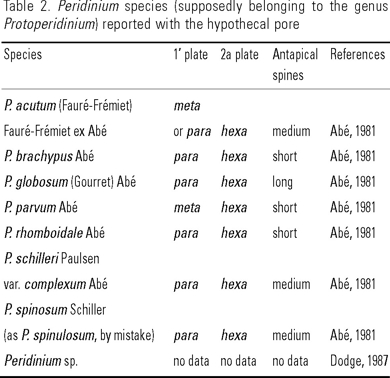
<body><![CDATA[<p align="justify"><font face="Verdana" size="2">&nbsp;</font></p>     <p align="justify"><font face="verdana" size="2"><b>Introduction</b></font></p>     <p align="justify"><font face="verdana" size="2">A hypothecal pore is a peculiar structure in the first postcingular plate (1"') in some species of the genus <i>Protoperidinium</i> Bergh. It was first described in <i>P. cruciferum</i> Balech by Balech (1971a). In this species, the hypothecal pore is formed by four big dots forming a cross or by three dots (Balech, 1971a, 1973, 1974, 1988). In other species in which the hypothecal pore has been found, the pore looks like an opening on the first postcingular plate. The first species with the hypothecal pore as an opening, <i>P. diabolus</i> (Cleve) Balech, was described by Balech (1976a). The presence of the hypothecal pore allowed Balech (1988) to describe a new subspecies, <i>P. pellucidum</i> Bergh subsp. <i>stellatum</i> Balech. Ab&eacute; (1981) reported the presence of the hypothecal pore under the name "ventral pore" in nine species ascribed to the group <i>Paraperidinium</i> of the section <i>Pellucida</i>. Dodge (1987) revised the results obtained by Balech and Ab&eacute;, finding the hypothecal pore in eight species, of which he identified seven. To avoid the confusion with the ventral pore characteristic of some species of the genera <i>Alexandrium</i> Halim and <i>Gonyaulax</i> Diesing, which is located on the first apical plate (1'), Dodge offered the term "hypothecal pore". With the use of the scanning electron microscopy, he showed that the hypothecal pore consists of 9&#45;16 small perforations of about 0.1 &micro;m diameter. Also, he stressed that all species possessing the hypothecal pore have a six&#45;sided, or the <i>para</i> type, first apical plate. Besides, the hypothecal pore was described in a new species from the NE Atlantic, <i>P. dodgei</i>, which is morphologically similar to <i>P. diabolus</i> and <i>P. longipes</i> (Karsten) Balech, and was reported for <i>P. affine</i> and <i>P. variegatum</i> (Peters) Balech (Okolodkov, 1997, 2002).</font></p>     <p align="justify"><font face="verdana" size="2">In this paper, new data on other <i>Protoperidinium</i> species, which have the hypothecal pore are presented, and the data on all species of the genera <i>Protoperidinium</i> and <i>Peridinium</i> (also supposedly belonging to the genus <i>Protoperidinium</i>) possessing the pore are summarized.</font></p>     <p align="justify"><font face="Verdana" size="2">&nbsp;</font></p>     <p align="justify"><font face="verdana" size="2"><b>Material and methods</b></font></p>     <p align="justify"><font face="verdana" size="2">Samples in which the thecal morphology of <i>Protoperidinium</i> species was studied came from the Eurasian Arctic (1980&#45;1997), the Ross Sea (1998), the NE Atlantic (1988&#45;1990), the Mexican Pacific (2000) and the Gulf of Mexico (1983). The material was collected by a plankton net, mesh 20 &micro;m or 70 &micro;m, and fixed with 2&#45;4% formalin. To examine the thecal morphology in detail, Trypan Blue was added to water mounts (Lebour, 1925). The following number of cells has been studied in detail: <i>Protoperidinium</i> sp. 1 <i>(meta&#45;hexa)</i> &#45; 10, <i>Protoperidinium</i> sp. 2 <i>(para&#45;hexa)</i> &#45; 7, <i>P. dodgei</i> Okolodkov &#45; 3, <i>P. pallidum</i> (Ostenfeld) Balech &#45; 5, <i>P. pellucidum</i> &#45; 7, <i>P. affine</i> (Balech) Balech &#45; 30, <i>P. variegatum</i> (Peters) Balech &#45; 15. A Zeiss Photomicroscope supplied with the objectives 10/0.22, 16/0.35, 25/0.45, Ph2 40/0.65 and the phase contrast was used in combination with a Sony color digital video camera ExwaveHAD and the program KS 300, version 3.0, Carl Zeiss Vision GmbH. The maximum magnification under which the cells were studied under the microscope reached 800. Measurements of the hypothecal pore size were performed in digital images based on the cell length and width measured during microscope observations.</font></p>     <p align="justify"><font face="Verdana" size="2">&nbsp;</font></p>     <p align="justify"><font face="verdana" size="2"><b>Results and discussion</b></font></p>     <p align="justify"><font face="verdana" size="2">Among 23 studied endemic Antarctic <i>Protoperidinium</i> species, only 2 of them were found to have the hypothecal pore, <i>P. affine</i> and <i>P. variegatum</i> (Okolodkov, 2002). Although the Antarctic <i>Protoperidinium</i> species were studied in much detail by Balech (1957, 1958, 1962, 1968, 1976b), it seems that he overlooked the hypothecal pore in these two species. Another four species with the hypothecal pore were found in the Mexican Pacific and the Gulf of Mexico (<a href="/img/revistas/hbio/v13n4/a3c1.jpg" target="_blank">Table 1</a>). The taxa assigned to the genus <i>Peridinium</i> Ehrenberg described by different authors, most likely, belong to the genus <i>Protoperidinium</i> which is predominant in the marine environment (<a href="#c2">Table 2</a>). Although Balech (1994) discusses the synonymy of <i>Peridinium brachypus</i> Ab&eacute;, <i>P. parvum</i> Ab&eacute; and <i>P. rhomboidale</i> Ab&eacute; mentioned in <a href="#c2">table 2</a>, he does not propose any nomenclatural changes. According to him, <i>P. brachypus</i> "es especie muy dif&iacute;cilmente separable de <i>Protoperidinium capurroi</i>" (Balech, 1994: 63), "hom&oacute;nimo posterior y, probablemente = <i>P. capurroi</i>" (Balech, 1994: 78); <i>Peridinium parvum</i> "parece ser mi <i>P. cruciferum</i>"(Balech, 1994: 64) and it is "casi seguro" synonymous to <i>Protoperidinium cruciferum</i> (Balech, 1994: 79); <i>Peridinium rhomboidale</i> "corresponde a mi <i>Protoperidinium pallidum daedalum</i> y <i>P. cerasiformis</i>" (Balech, 1994: 64). Besides, the problem is that to transfer the discussed <i>Peridinium</i> into the genus <i>Protoperidinium</i>, one should be sure that these <i>Peridinium</i> species have a certain number of the cingular plates &#45; the main diagnostic feature, which distinguishes the two genera. The original drawings and descriptions of the <i>Peridinium</i> species included into <a href="#c2">table 2</a> do not permit us to make comparison. Thus, based on the general external morphology of the theca, we can only suggest that all <i>Peridinium</i> species mentioned in <a href="#c2">table 2</a> belong to the genus <i>Protoperidinium</i>.</font></p>     ]]></body>
<body><![CDATA[<p align="center"><font face="verdana" size="2"><a name="c2"></a></font></p>     <p align="center"><font face="verdana" size="2"><img src="/img/revistas/hbio/v13n4/a3c2.jpg"></font></p>     <p align="justify"><font face="verdana" size="2">Most species with the hypothecal pore have the 1' plate of the <i>para</i> type, although six species with the <i>meta</i> first apical plate were observed. Thus, it seems unlikely that the hypothecal pore is exclusively or nearly exclusively associated with the <i>para</i> type, as was emphasized by Dodge (1987). Rather, the hypothecal pore is almost exclusively associated with the <i>hexa</i> second intercalary plate (<a href="/img/revistas/hbio/v13n4/a3c1.jpg" target="_blank">Tables 1</a> and <a href="#c2">2</a>). Within the <i>Protoperidinium</i> and <i>Peridinium</i> species with the hypothecal pore, at least five groups of morphologically similar and supposedly related taxa can be distinguished: (1) Species with the <i>para</i> 1' plate, the <i>hexa</i> 2a plate and short or medium antapical spines, cells are usually slightly longer than wide &#45; <i>Protoperidinium affine, P. pallidum</i> and <i>P. pellucidum</i>; (2) Species with the <i>para</i> or <i>meta</i> 1' plate, variable 2a plate, and short antapical spines, cells are slightly compressed apically&#45;antapically &#45; <i>P. curvipes</i> (Ostenfeld) Balech and <i>P. variegatum</i>; (3) Species with the <i>para</i> 1' plate, the <i>hexa</i> 2a plate and long antapical spines, cells are usually notice&#45;ably longer than wide &#45; <i>P. diabolum</i> and <i>P. dodgei</i>; (4) Species with the <i>meta</i> 1' plate and <i>hexa</i> 2a plate and short antapical spines, cells are slightly wider than long &#45; <i>P. cruciferum, P</i>. cf. <i>cruciferum, Protoperidinium</i> sp. 1 <i>(meta&#45;hexa)</i> and <i>Peridinium acutum</i> (Faur&eacute;&#45;Fr&eacute;miet) Faur&eacute;&#45;Fr&eacute;miet ex Ab&eacute;; (5) Species with the <i>para</i> 1' plate, the <i>hexa</i> 2a plate and one or two short or medium antapical spines and a prominent sulcal list formed by the right sulcal (Sp) plate, cells are slightly longer than wide &#45; <i>P. ovum</i> (Schiller) Balech and <i>Protoperidinium</i> sp. 2 <i>(para&#45;hexa)</i>. The latter is morphologically similar to <i>P. ovum</i>, however, it has only one (right) antapical spine, more displaced cingulum (usually about one&#45;width of the cingulum), more rounded cell shape, smaller size and the hypothecal pore located closer to the cingulum. The 1' and 2a plates are similar in these two species. In general, the features described above allow to ascribe our <i>Protoperidinium</i> sp. 2 <i>(para&#45;hexa)</i> to the species designated by Balech (1988: 122, pl. 52, fig. 13&#45;15) as <i>Protoperidinium</i> sp. K, although it is also very similar to <i>P. capurroi</i> (Balech) Balech subsp. <i>subpellucidum</i> Balech (Balech, 1971a: 155, pl. 33, fig. 240&#45;242) and <i>P. aequatoriale</i> (Balech) Balech (Balech, 1971b: 26, pl. 6, fig. 112&#45;114). However, in none of these species the hypothecal pore was described or illustrated, which makes correct identification of our specimens difficult.</font></p>     <p align="center"><font size="2" face="verdana"><a href="../img/revistas/hbio/v13n4/a3f1.jpg" target="_blank">Figure 1&#45;9</a></font></p>     <p align="center"><font face="verdana" size="2"><a href="../img/revistas/hbio/v13n4/a3f2.jpg" target="_blank">Figure 10&#45;21</a></font></p>     <p align="justify"><font face="verdana" size="2">The pore is thought to be present in closely related species and to be a reliable diagnostic feature to differentiate <i>Protoperidinium</i> species. Similarities in morphology of the sulcal plates, especially of the anterior (S<sub>a</sub>), left (S<sub>s</sub>) and right sulcal plates (S<sub>d</sub>) between species of group 1 (Balech, 1988) and to a lesser extent of group 2 (Balech, 1975) and group 5 (Balech, 1988) substantiate our suggestion. It is important to note that in all studied cells of the same species the hypothecal pore had the same location on the 1"' plate. Groups 1 and 2, which include the species inhabiting the regions north of the Antarctic Convergence or the Antarctic Ocean, to which they are endemic (<i>Protoperidinium affine</i> and <i>P. variegatum</i>), seem to represent the geographical vicariants (Okolodkov, 2000). Among all species given in <a href="/img/revistas/hbio/v13n4/a3c1.jpg" target="_blank">Tables 1</a> and <a href="#c2">2</a>, only <i>Protoperidinium pellucidum</i> subsp. <i>stellatum</i> sometimes demonstrates 2 or more hypothecal pores described as star&#45;like structures (Balech, 1978, 1988).</font></p>     <p align="justify"><font face="verdana" size="2">In our material, under the objective 40/0.65, the hypothecal pore was clearly seen in all species but <i>Protoperidinium ovum</i>, in which the pore was hardly discernible. However, it was easily distinguishable in the empty thecae of <i>P. ovum</i>, especially when the negative phase contrast was used. The pore size including a rim around the pore varied between species (1.0 to 3.5 &micro;m) and within the same species. For example, the pore size in <i>Protoperidinium variegatum</i> ranged from 1.8 to 3.0 &micro;m. The largest hypothecal pores were observed in <i>P. pallidum</i> and <i>P. variegatum</i>.</font></p>     <p align="justify"><font face="verdana" size="2">It is interesting to note that groups of dots on the first antapical plate (3 or 4 dots in <i>Protoperidinium cruciferum</i> and <i>Peridinium acutum</i>), which can be interpreted as the hypothecal pore, were observed by Balech (1971a) in <i>Protoperidinium mite</i> (Pavillard) Balech. For this species, two groups of 4 or 5 dots, similar to those in <i>P. cruciferum</i>, have been known (the pores are pictured but no comments are given).</font></p>     <p align="justify"><font face="verdana" size="2">In addition, there is another <i>Protoperidinium</i> species, <i>P.</i> cf. <i>retiferum</i> (Matzenauer) Balech, which has one or two rather large pores on the hypotheca (Balech, 1978, 1988). However, these are located at the base of the antapical horns, on the ventral side of the postcingular plates 1"' and 2"': on the left horn if only one pore is present and on each horn if two pores.</font></p>     <p align="justify"><font face="verdana" size="2">Ab&eacute; (1981) suggested a secretory function of the hypothecal pore such as that of connecting the pusule system to the exterior. However, Dodge (1987), who analyzed the possible connection, concluded that at present it was not possible to suggest any function for the hypothecal pore.</font></p>     ]]></body>
<body><![CDATA[<p align="justify"><font face="verdana" size="2">Apart from the hypothecal pore located on the 1"' plate, another structure consisting of a group of pores, designated as "a distinctive zone of honey&#45;combed pores" and located on the antapical plate (1"") of the hypotheca of the Peridiniales has been observed. Carbonell&#45;Moore (1994) described it in the three new genera of the family Podolampaceae, <i>Mysticella</i> Carbonell&#45;Moore, <i>Gaarderia</i> Carbonell&#45;Moore and <i>Heterobractum</i> Carbonell&#45;Moore (in the genus <i>Heterobractum</i>, a group of pores is pictured but no comments are given).</font></p>     <p align="justify"><font face="Verdana" size="2">&nbsp;</font></p>     <p align="justify"><font face="verdana" size="2"><b>Acknowledgements</b></font></p>     <p align="justify"><font face="verdana" size="2">I am grateful to Alain Cout&eacute;, who hosted my visit to the Natural History Museum in Paris to study the thecal morphology of Antarctic dinoflagellates. The present research was also supported by CONACyT in 2001&#45;2002 during my stay at the Department of Hydrobiology, UAM&#45;Iztapalapa. My thanks are extended to John D. Dodge, the Royal Holloway, the University of London, Ma. Esther Meave del Castillo of UAM&#45;Iztapalapa, Sergio Licea Dur&aacute;n of the Institute of Marine Sciences and Limnology, UNAM, and to David L. Garrison, the U.S. National Science Foundation, for making the collections available for studies and for laboratory facilities. Critical comments of the three referees and one of the editors are very much appreciated. My participation in the RVIB <i>Nathaniel B. Palmer</i> cruise 98&#45;03 and sampling phytoplankton in the Ross Sea was supported by an award from International Programs at the NSF given to me and by a grant from the NSF, Office of Polar Programs, to D.L.Garrison (OPP 9614201). Martin McLennan from the Technological Institute of Monterrey, Mexico City, kindly improved the writing style. Boris Y. Okolodkov is thanked for his technical assistance with the illustrations.</font></p>     <p align="justify"><font face="Verdana" size="2">&nbsp;</font></p>     <p align="justify"><font face="verdana" size="2"><b>References</b></font></p>     <!-- ref --><p align="justify"><font face="verdana" size="2">AB&Eacute;, T. 1981. Studies on the family Peridiniidae. An unfinished monograph of the armoured Dinoflagellata. <i>Special Publications of the Seto Marine Biological Laboratory, Special Publication Series</i> 6. viii+412 p.    &nbsp;&nbsp;&nbsp;&nbsp;&nbsp;&nbsp;&nbsp;&nbsp;[&#160;<a href="javascript:void(0);" onclick="javascript: window.open('/scielo.php?script=sci_nlinks&ref=4044333&pid=S0188-8897200300040000300001&lng=','','width=640,height=500,resizable=yes,scrollbars=1,menubar=yes,');">Links</a>&#160;]<!-- end-ref --></font></p>     <!-- ref --><p align="justify"><font face="verdana" size="2">BALECH, E. 1957. Dinoflagell&eacute;s et Tintinnides de la Terre Ad&eacute;lie, Secteur Fran&ccedil;ais Antarctique. <i>Vie et Milieu 8</i> (4): 382&#45;408.    &nbsp;&nbsp;&nbsp;&nbsp;&nbsp;&nbsp;&nbsp;&nbsp;[&#160;<a href="javascript:void(0);" onclick="javascript: window.open('/scielo.php?script=sci_nlinks&ref=4044335&pid=S0188-8897200300040000300002&lng=','','width=640,height=500,resizable=yes,scrollbars=1,menubar=yes,');">Links</a>&#160;]<!-- end-ref --></font></p>     ]]></body>
<body><![CDATA[<!-- ref --><p align="justify"><font face="verdana" size="2">BALECH, E. 1958. Plancton de la Campa&ntilde;a Ant&aacute;rtica Argentina 1954&#45;1955. <i>Physis 21</i> (60): 75&#45;108.    &nbsp;&nbsp;&nbsp;&nbsp;&nbsp;&nbsp;&nbsp;&nbsp;[&#160;<a href="javascript:void(0);" onclick="javascript: window.open('/scielo.php?script=sci_nlinks&ref=4044337&pid=S0188-8897200300040000300003&lng=','','width=640,height=500,resizable=yes,scrollbars=1,menubar=yes,');">Links</a>&#160;]<!-- end-ref --></font></p>     <!-- ref --><p align="justify"><font face="verdana" size="2">BALECH, E. 1962. Plancton de las campa&ntilde;as oceanogr&aacute;ficas Drake I y II. <i>Servicio de Hidrograf&iacute;a Naval, Buenos Aires, H 627</i>: 1&#45;57.    &nbsp;&nbsp;&nbsp;&nbsp;&nbsp;&nbsp;&nbsp;&nbsp;[&#160;<a href="javascript:void(0);" onclick="javascript: window.open('/scielo.php?script=sci_nlinks&ref=4044339&pid=S0188-8897200300040000300004&lng=','','width=640,height=500,resizable=yes,scrollbars=1,menubar=yes,');">Links</a>&#160;]<!-- end-ref --></font></p>     <!-- ref --><p align="justify"><font face="verdana" size="2">BALECH, E. 1968. Dinoflagellates. <i>In: Antarctic Map Folio Series</i>, Folio 10, American Geographic Society: 8&#45;9, pl. 11 and 12.    &nbsp;&nbsp;&nbsp;&nbsp;&nbsp;&nbsp;&nbsp;&nbsp;[&#160;<a href="javascript:void(0);" onclick="javascript: window.open('/scielo.php?script=sci_nlinks&ref=4044341&pid=S0188-8897200300040000300005&lng=','','width=640,height=500,resizable=yes,scrollbars=1,menubar=yes,');">Links</a>&#160;]<!-- end-ref --></font></p>     <!-- ref --><p align="justify"><font face="verdana" size="2">BALECH, E. 1971a. Microplancton de la Campa&ntilde;a Productividad III. Revista del Museo Argentino de Ciencias Naturales "Bernardino Rivadavia", <i>Hidrobiolog&iacute;a</i> 3(1): 1&#45;202, l&aacute;ms. 1&#45;39.    &nbsp;&nbsp;&nbsp;&nbsp;&nbsp;&nbsp;&nbsp;&nbsp;[&#160;<a href="javascript:void(0);" onclick="javascript: window.open('/scielo.php?script=sci_nlinks&ref=4044343&pid=S0188-8897200300040000300006&lng=','','width=640,height=500,resizable=yes,scrollbars=1,menubar=yes,');">Links</a>&#160;]<!-- end-ref --></font></p>     <!-- ref --><p align="justify"><font face="verdana" size="2">BALECH, E. 1971b. Microplancton del Atl&aacute;ntico Equatorial Oeste (Equalant I). <i>Servicio de Hidrograf&iacute;a Naval, Buenos Aires</i>, H 654: 1&#45;103, lams. 1&#45;12.    &nbsp;&nbsp;&nbsp;&nbsp;&nbsp;&nbsp;&nbsp;&nbsp;[&#160;<a href="javascript:void(0);" onclick="javascript: window.open('/scielo.php?script=sci_nlinks&ref=4044345&pid=S0188-8897200300040000300007&lng=','','width=640,height=500,resizable=yes,scrollbars=1,menubar=yes,');">Links</a>&#160;]<!-- end-ref --></font></p>     ]]></body>
<body><![CDATA[<!-- ref --><p align="justify"><font face="verdana" size="2">BALECH, E. 1973. Segunda contribuci&oacute;n al conocimiento del microplancton del Mar de Bellingshausen. <i>Contribuci&oacute;n del Instituto Ant&aacute;rtico Argentino</i> 107: 1&#45;63.    &nbsp;&nbsp;&nbsp;&nbsp;&nbsp;&nbsp;&nbsp;&nbsp;[&#160;<a href="javascript:void(0);" onclick="javascript: window.open('/scielo.php?script=sci_nlinks&ref=4044347&pid=S0188-8897200300040000300008&lng=','','width=640,height=500,resizable=yes,scrollbars=1,menubar=yes,');">Links</a>&#160;]<!-- end-ref --></font></p>     <!-- ref --><p align="justify"><font face="verdana" size="2">BALECH, E. 1974. El g&eacute;nero <i>Protoperidinium</i> Bergh, 1881 (<i>Peridinium</i> Ehr., 1831, partim). Revista del Museo Argentino de Ciencias Naturales "Bernardino Rivadavia", <i>Hidrobiolog&iacute;a</i> 4(1): 1&#45;78.    &nbsp;&nbsp;&nbsp;&nbsp;&nbsp;&nbsp;&nbsp;&nbsp;[&#160;<a href="javascript:void(0);" onclick="javascript: window.open('/scielo.php?script=sci_nlinks&ref=4044349&pid=S0188-8897200300040000300009&lng=','','width=640,height=500,resizable=yes,scrollbars=1,menubar=yes,');">Links</a>&#160;]<!-- end-ref --></font></p>     <!-- ref --><p align="justify"><font face="verdana" size="2">BALECH, E. 1975. Clave ilustrada de dinoflagelados ant&aacute;rticos. <i>Publicaci&oacute;n del Instituto Ant&agrave;rtico Argentino</i> No. 11, Buenos Aires. 99 p.    &nbsp;&nbsp;&nbsp;&nbsp;&nbsp;&nbsp;&nbsp;&nbsp;[&#160;<a href="javascript:void(0);" onclick="javascript: window.open('/scielo.php?script=sci_nlinks&ref=4044351&pid=S0188-8897200300040000300010&lng=','','width=640,height=500,resizable=yes,scrollbars=1,menubar=yes,');">Links</a>&#160;]<!-- end-ref --></font></p>     <!-- ref --><p align="justify"><font face="verdana" size="2">BALECH, E. 1976a. Sur quelques <i>Protoperidinium</i> (Dinoflagellata) du golfe de Lion. <i>Vie et Milieu</i> B26(1): 27&#45;46.    &nbsp;&nbsp;&nbsp;&nbsp;&nbsp;&nbsp;&nbsp;&nbsp;[&#160;<a href="javascript:void(0);" onclick="javascript: window.open('/scielo.php?script=sci_nlinks&ref=4044353&pid=S0188-8897200300040000300011&lng=','','width=640,height=500,resizable=yes,scrollbars=1,menubar=yes,');">Links</a>&#160;]<!-- end-ref --></font></p>     <!-- ref --><p align="justify"><font face="verdana" size="2">BALECH, E. 1976b. Clave ilustrada de dinoflagelados ant&aacute;rticos. <i>Publicaci&oacute;n del Instituto Ant&aacute;rtico Argentino</i> 11, Buenos Aires. 99 p.    &nbsp;&nbsp;&nbsp;&nbsp;&nbsp;&nbsp;&nbsp;&nbsp;[&#160;<a href="javascript:void(0);" onclick="javascript: window.open('/scielo.php?script=sci_nlinks&ref=4044355&pid=S0188-8897200300040000300012&lng=','','width=640,height=500,resizable=yes,scrollbars=1,menubar=yes,');">Links</a>&#160;]<!-- end-ref --></font></p>     ]]></body>
<body><![CDATA[<!-- ref --><p align="justify"><font face="verdana" size="2">BALECH, E. 1978. Microplancton de la Campa&ntilde;a Productividad IV. Revista del Museo Argentino de Ciencias Naturales "Bernardino Rivadavia", <i>Hidrobiolog&iacute;a</i> 5(7): 137&#45;201.    &nbsp;&nbsp;&nbsp;&nbsp;&nbsp;&nbsp;&nbsp;&nbsp;[&#160;<a href="javascript:void(0);" onclick="javascript: window.open('/scielo.php?script=sci_nlinks&ref=4044357&pid=S0188-8897200300040000300013&lng=','','width=640,height=500,resizable=yes,scrollbars=1,menubar=yes,');">Links</a>&#160;]<!-- end-ref --></font></p>     <!-- ref --><p align="justify"><font face="verdana" size="2">BALECH, E. 1988. Los dinoflagelados del Atl&aacute;ntico Sudoccidental. <i>Publicaci&oacute;n Especial del Instituto Espa&ntilde;ol de Oceanograf&iacute;a</i> 1, Madrid. 310 p.    &nbsp;&nbsp;&nbsp;&nbsp;&nbsp;&nbsp;&nbsp;&nbsp;[&#160;<a href="javascript:void(0);" onclick="javascript: window.open('/scielo.php?script=sci_nlinks&ref=4044359&pid=S0188-8897200300040000300014&lng=','','width=640,height=500,resizable=yes,scrollbars=1,menubar=yes,');">Links</a>&#160;]<!-- end-ref --></font></p>     <!-- ref --><p align="justify"><font face="verdana" size="2">BALECH, E. 1994. Contribuci&oacute;n a la taxonom&iacute;a y nomenclatura del g&eacute;nero <i>Protoperidinium</i> (Dinoflagellata). Revista del Museo Argentino de Ciencias Naturales "Bernardino Rivadavia", <i>Hidrobiolog&iacute;a</i> 7(4): 61&#45;80.    &nbsp;&nbsp;&nbsp;&nbsp;&nbsp;&nbsp;&nbsp;&nbsp;[&#160;<a href="javascript:void(0);" onclick="javascript: window.open('/scielo.php?script=sci_nlinks&ref=4044361&pid=S0188-8897200300040000300015&lng=','','width=640,height=500,resizable=yes,scrollbars=1,menubar=yes,');">Links</a>&#160;]<!-- end-ref --></font></p>     <!-- ref --><p align="justify"><font face="verdana" size="2">CARBONELL&#45;MOORE, M. C. 1994. On the taxonomy of the family Podolampaceae Lindemann (Dinophyceae) with descriptions of three new genera. <i>Review of Palaeobotany and Palynology</i> 84: 73&#45;99.    &nbsp;&nbsp;&nbsp;&nbsp;&nbsp;&nbsp;&nbsp;&nbsp;[&#160;<a href="javascript:void(0);" onclick="javascript: window.open('/scielo.php?script=sci_nlinks&ref=4044363&pid=S0188-8897200300040000300016&lng=','','width=640,height=500,resizable=yes,scrollbars=1,menubar=yes,');">Links</a>&#160;]<!-- end-ref --></font></p>     <!-- ref --><p align="justify"><font face="verdana" size="2">DODGE, J. D. 1987. A hypothecal pore in some species of <i>Protoperidinium</i> (Dinophyceae). <i>British Phycological Journal</i> 22: 335&#45;338.    &nbsp;&nbsp;&nbsp;&nbsp;&nbsp;&nbsp;&nbsp;&nbsp;[&#160;<a href="javascript:void(0);" onclick="javascript: window.open('/scielo.php?script=sci_nlinks&ref=4044365&pid=S0188-8897200300040000300017&lng=','','width=640,height=500,resizable=yes,scrollbars=1,menubar=yes,');">Links</a>&#160;]<!-- end-ref --></font></p>     ]]></body>
<body><![CDATA[<!-- ref --><p align="justify"><font face="verdana" size="2">LEBOUR, M. 1925. <i>The dinoflagellates of northern seas</i>. Marine Biological Association, Plymouth. vii+250 p. inc. pl. 1&#45;35.    &nbsp;&nbsp;&nbsp;&nbsp;&nbsp;&nbsp;&nbsp;&nbsp;[&#160;<a href="javascript:void(0);" onclick="javascript: window.open('/scielo.php?script=sci_nlinks&ref=4044367&pid=S0188-8897200300040000300018&lng=','','width=640,height=500,resizable=yes,scrollbars=1,menubar=yes,');">Links</a>&#160;]<!-- end-ref --></font></p>     <!-- ref --><p align="justify"><font face="verdana" size="2">OKOLODKOV, Y. B. 1997. A new combination and new species of <i>Gymnodinium, Gyrodinium</i> and <i>Protoperidinium</i> (Dinophyceae) from the Arctic and N. E. Atlantic. <i>Botanical Journal, Russian Academy of Sciences</i> 82(5): 97&#45;106.    &nbsp;&nbsp;&nbsp;&nbsp;&nbsp;&nbsp;&nbsp;&nbsp;[&#160;<a href="javascript:void(0);" onclick="javascript: window.open('/scielo.php?script=sci_nlinks&ref=4044369&pid=S0188-8897200300040000300019&lng=','','width=640,height=500,resizable=yes,scrollbars=1,menubar=yes,');">Links</a>&#160;]<!-- end-ref --></font></p>     <!-- ref --><p align="justify"><font face="verdana" size="2">OKOLODKOV, Y. B. 2002. The genus <i>Protoperidinium</i> Bergh in the Mexican Pacific. <i>Res&uacute;menes del XII Reuni&oacute;n Nacional de la Sociedad Mexicana de Planctolog&iacute;a y V International Meeting of the Mexican Society of Planktology</i>,    &nbsp;&nbsp;&nbsp;&nbsp;&nbsp;&nbsp;&nbsp;&nbsp;[&#160;<a href="javascript:void(0);" onclick="javascript: window.open('/scielo.php?script=sci_nlinks&ref=4044371&pid=S0188-8897200300040000300020&lng=','','width=640,height=500,resizable=yes,scrollbars=1,menubar=yes,');">Links</a>&#160;]<!-- end-ref --><!-- ref --> p. 68.    &nbsp;&nbsp;&nbsp;&nbsp;&nbsp;&nbsp;&nbsp;&nbsp;[&#160;<a href="javascript:void(0);" onclick="javascript: window.open('/scielo.php?script=sci_nlinks&ref=4044372&pid=S0188-8897200300040000300021&lng=','','width=640,height=500,resizable=yes,scrollbars=1,menubar=yes,');">Links</a>&#160;]<!-- end-ref --></font></p>      ]]></body><back>
<ref-list>
<ref id="B1">
<nlm-citation citation-type="book">
<person-group person-group-type="author">
<name>
<surname><![CDATA[ABÉ]]></surname>
<given-names><![CDATA[T]]></given-names>
</name>
</person-group>
<source><![CDATA[Studies on the family Peridiniidae. An unfinished monograph of the armoured Dinoflagellata]]></source>
<year>1981</year>
<page-range>412</page-range><publisher-name><![CDATA[Seto Marine Biological Laboratory]]></publisher-name>
</nlm-citation>
</ref>
<ref id="B2">
<nlm-citation citation-type="journal">
<person-group person-group-type="author">
<name>
<surname><![CDATA[BALECH]]></surname>
<given-names><![CDATA[E]]></given-names>
</name>
</person-group>
<article-title xml:lang="fr"><![CDATA[Dinoflagellés et Tintinnides de la Terre Adélie, Secteur Français Antarctique]]></article-title>
<source><![CDATA[Vie et Milieu]]></source>
<year>1957</year>
<volume>8</volume>
<numero>4</numero>
<issue>4</issue>
<page-range>382-408</page-range></nlm-citation>
</ref>
<ref id="B3">
<nlm-citation citation-type="journal">
<person-group person-group-type="author">
<name>
<surname><![CDATA[BALECH]]></surname>
<given-names><![CDATA[E]]></given-names>
</name>
</person-group>
<article-title xml:lang="es"><![CDATA[Plancton de la Campaña Antártica Argentina 1954-1955]]></article-title>
<source><![CDATA[Physis]]></source>
<year>1958</year>
<volume>21</volume>
<numero>60</numero>
<issue>60</issue>
<page-range>75-108</page-range></nlm-citation>
</ref>
<ref id="B4">
<nlm-citation citation-type="book">
<person-group person-group-type="author">
<name>
<surname><![CDATA[BALECH]]></surname>
<given-names><![CDATA[E]]></given-names>
</name>
</person-group>
<source><![CDATA[Plancton de las campañas oceanográficas Drake I y II]]></source>
<year>1962</year>
<page-range>1-57</page-range><publisher-loc><![CDATA[Buenos Aires ]]></publisher-loc>
<publisher-name><![CDATA[Servicio de Hidrografía Naval]]></publisher-name>
</nlm-citation>
</ref>
<ref id="B5">
<nlm-citation citation-type="book">
<person-group person-group-type="author">
<name>
<surname><![CDATA[BALECH]]></surname>
<given-names><![CDATA[E]]></given-names>
</name>
</person-group>
<article-title xml:lang="en"><![CDATA[Dinoflagellates]]></article-title>
<source><![CDATA[Antarctic Map Folio Series, Folio 10]]></source>
<year>1968</year>
<page-range>8-9</page-range><publisher-name><![CDATA[American Geographic Society]]></publisher-name>
</nlm-citation>
</ref>
<ref id="B6">
<nlm-citation citation-type="journal">
<person-group person-group-type="author">
<name>
<surname><![CDATA[BALECH]]></surname>
<given-names><![CDATA[E]]></given-names>
</name>
</person-group>
<article-title xml:lang="es"><![CDATA[Microplancton de la Campaña Productividad III]]></article-title>
<source><![CDATA[Revista del Museo Argentino de Ciencias Naturales "Bernardino Rivadavia", Hidrobiología]]></source>
<year>1971</year>
<volume>3</volume>
<numero>1</numero>
<issue>1</issue>
<page-range>1-202</page-range></nlm-citation>
</ref>
<ref id="B7">
<nlm-citation citation-type="book">
<person-group person-group-type="author">
<name>
<surname><![CDATA[BALECH]]></surname>
<given-names><![CDATA[E]]></given-names>
</name>
</person-group>
<source><![CDATA[Microplancton del Atlántico Equatorial Oeste (Equalant I)]]></source>
<year>1971</year>
<page-range>1-103</page-range><publisher-loc><![CDATA[Buenos Aires ]]></publisher-loc>
<publisher-name><![CDATA[Servicio de Hidrografía Naval]]></publisher-name>
</nlm-citation>
</ref>
<ref id="B8">
<nlm-citation citation-type="">
<person-group person-group-type="author">
<name>
<surname><![CDATA[BALECH]]></surname>
<given-names><![CDATA[E]]></given-names>
</name>
</person-group>
<source><![CDATA[Segunda contribución al conocimiento del microplancton del Mar de Bellingshausen]]></source>
<year>1973</year>
<page-range>1-63</page-range></nlm-citation>
</ref>
<ref id="B9">
<nlm-citation citation-type="journal">
<person-group person-group-type="author">
<name>
<surname><![CDATA[BALECH]]></surname>
<given-names><![CDATA[E]]></given-names>
</name>
</person-group>
<article-title xml:lang="es"><![CDATA[El género Protoperidinium Bergh, 1881 (Peridinium Ehr., 1831, partim)]]></article-title>
<source><![CDATA[Revista del Museo Argentino de Ciencias Naturales "Bernardino Rivadavia", Hidrobiología]]></source>
<year>1974</year>
<volume>4</volume>
<numero>1</numero>
<issue>1</issue>
<page-range>1-78</page-range></nlm-citation>
</ref>
<ref id="B10">
<nlm-citation citation-type="">
<person-group person-group-type="author">
<name>
<surname><![CDATA[BALECH]]></surname>
<given-names><![CDATA[E]]></given-names>
</name>
</person-group>
<source><![CDATA[Clave ilustrada de dinoflagelados antárticos]]></source>
<year>1975</year>
<page-range>99</page-range><publisher-loc><![CDATA[Buenos Aires ]]></publisher-loc>
</nlm-citation>
</ref>
<ref id="B11">
<nlm-citation citation-type="journal">
<person-group person-group-type="author">
<name>
<surname><![CDATA[BALECH]]></surname>
<given-names><![CDATA[E]]></given-names>
</name>
</person-group>
<article-title xml:lang="fr"><![CDATA[Sur quelques Protoperidinium (Dinoflagellata) du golfe de Lion]]></article-title>
<source><![CDATA[Vie et Milieu B]]></source>
<year>1976</year>
<volume>26</volume>
<numero>1</numero>
<issue>1</issue>
<page-range>27-46</page-range></nlm-citation>
</ref>
<ref id="B12">
<nlm-citation citation-type="">
<person-group person-group-type="author">
<name>
<surname><![CDATA[BALECH]]></surname>
<given-names><![CDATA[E]]></given-names>
</name>
</person-group>
<source><![CDATA[Clave ilustrada de dinoflagelados antárticos]]></source>
<year>1976</year>
<page-range>99</page-range><publisher-loc><![CDATA[Buenos Aires ]]></publisher-loc>
</nlm-citation>
</ref>
<ref id="B13">
<nlm-citation citation-type="journal">
<person-group person-group-type="author">
<name>
<surname><![CDATA[BALECH]]></surname>
<given-names><![CDATA[E]]></given-names>
</name>
</person-group>
<article-title xml:lang="es"><![CDATA[Microplancton de la Campaña Productividad IV]]></article-title>
<source><![CDATA[Revista del Museo Argentino de Ciencias Naturales "Bernardino Rivadavia", Hidrobiología]]></source>
<year>1978</year>
<volume>5</volume>
<numero>7</numero>
<issue>7</issue>
<page-range>137-201</page-range></nlm-citation>
</ref>
<ref id="B14">
<nlm-citation citation-type="">
<person-group person-group-type="author">
<name>
<surname><![CDATA[BALECH]]></surname>
<given-names><![CDATA[E]]></given-names>
</name>
</person-group>
<source><![CDATA[Los dinoflagelados del Atlántico Sudoccidental]]></source>
<year>1988</year>
<page-range>310</page-range><publisher-loc><![CDATA[Madrid ]]></publisher-loc>
</nlm-citation>
</ref>
<ref id="B15">
<nlm-citation citation-type="journal">
<person-group person-group-type="author">
<name>
<surname><![CDATA[BALECH]]></surname>
<given-names><![CDATA[E]]></given-names>
</name>
</person-group>
<article-title xml:lang="es"><![CDATA[Contribución a la taxonomía y nomenclatura del género Protoperidinium (Dinoflagellata)]]></article-title>
<source><![CDATA[Revista del Museo Argentino de Ciencias Naturales "Bernardino Rivadavia", Hidrobiología]]></source>
<year>1994</year>
<volume>7</volume>
<numero>4</numero>
<issue>4</issue>
<page-range>61-80</page-range></nlm-citation>
</ref>
<ref id="B16">
<nlm-citation citation-type="journal">
<person-group person-group-type="author">
<name>
<surname><![CDATA[CARBONELL-MOORE]]></surname>
<given-names><![CDATA[M. C]]></given-names>
</name>
</person-group>
<article-title xml:lang="en"><![CDATA[On the taxonomy of the family Podolampaceae Lindemann (Dinophyceae) with descriptions of three new genera]]></article-title>
<source><![CDATA[Review of Palaeobotany and Palynology]]></source>
<year>1994</year>
<volume>84</volume>
<page-range>73-99</page-range></nlm-citation>
</ref>
<ref id="B17">
<nlm-citation citation-type="journal">
<person-group person-group-type="author">
<name>
<surname><![CDATA[DODGE]]></surname>
<given-names><![CDATA[J. D]]></given-names>
</name>
</person-group>
<article-title xml:lang="en"><![CDATA[A hypothecal pore in some species of Protoperidinium (Dinophyceae)]]></article-title>
<source><![CDATA[British Phycological Journal]]></source>
<year>1987</year>
<volume>22</volume>
<page-range>335-338</page-range></nlm-citation>
</ref>
<ref id="B18">
<nlm-citation citation-type="book">
<person-group person-group-type="author">
<name>
<surname><![CDATA[LEBOUR]]></surname>
<given-names><![CDATA[M]]></given-names>
</name>
</person-group>
<source><![CDATA[The dinoflagellates of northern seas]]></source>
<year>1925</year>
<page-range>250</page-range><publisher-loc><![CDATA[Plymouth ]]></publisher-loc>
<publisher-name><![CDATA[Marine Biological Association]]></publisher-name>
</nlm-citation>
</ref>
<ref id="B19">
<nlm-citation citation-type="journal">
<person-group person-group-type="author">
<name>
<surname><![CDATA[OKOLODKOV]]></surname>
<given-names><![CDATA[Y. B]]></given-names>
</name>
</person-group>
<article-title xml:lang="en"><![CDATA[A new combination and new species of Gymnodinium, Gyrodinium and Protoperidinium (Dinophyceae) from the Arctic and N]]></article-title>
<source><![CDATA[E. Atlantic. Botanical Journal]]></source>
<year>1997</year>
<volume>82</volume>
<numero>5</numero>
<issue>5</issue>
<page-range>97-106</page-range><publisher-name><![CDATA[Russian Academy of Sciences]]></publisher-name>
</nlm-citation>
</ref>
<ref id="B20">
<nlm-citation citation-type="">
<person-group person-group-type="author">
<name>
<surname><![CDATA[OKOLODKOV]]></surname>
<given-names><![CDATA[Y. B]]></given-names>
</name>
</person-group>
<article-title xml:lang="en"><![CDATA[The genus Protoperidinium Bergh in the Mexican Pacific]]></article-title>
<source><![CDATA[Resúmenes del XII Reunión Nacional de la Sociedad Mexicana de Planctología]]></source>
<year>2002</year>
</nlm-citation>
</ref>
<ref id="B21">
<nlm-citation citation-type="">
<source><![CDATA[V International Meeting of the Mexican Society of Planktology]]></source>
<year></year>
<page-range>68</page-range></nlm-citation>
</ref>
</ref-list>
</back>
</article>
