<?xml version="1.0" encoding="ISO-8859-1"?><article xmlns:mml="http://www.w3.org/1998/Math/MathML" xmlns:xlink="http://www.w3.org/1999/xlink" xmlns:xsi="http://www.w3.org/2001/XMLSchema-instance">
<front>
<journal-meta>
<journal-id>0188-8897</journal-id>
<journal-title><![CDATA[Hidrobiológica]]></journal-title>
<abbrev-journal-title><![CDATA[Hidrobiológica]]></abbrev-journal-title>
<issn>0188-8897</issn>
<publisher>
<publisher-name><![CDATA[Universidad Autónoma Metropolitana, División de Ciencias Biológicas y de la Salud]]></publisher-name>
</publisher>
</journal-meta>
<article-meta>
<article-id>S0188-88972003000100004</article-id>
<title-group>
<article-title xml:lang="en"><![CDATA[On the occurrence of Laurencia caraibica (Ceramiales, Rhodophyta) in Atol das Rocas, Brazil]]></article-title>
<article-title xml:lang="es"><![CDATA[Presencia de Laurencia caraibica (Ceramiales, Rhodophyta) en Atol das Rocas, Brasil]]></article-title>
</title-group>
<contrib-group>
<contrib contrib-type="author">
<name>
<surname><![CDATA[Toyota Fuji]]></surname>
<given-names><![CDATA[Mutue]]></given-names>
</name>
<xref ref-type="aff" rid="A01"/>
</contrib>
<contrib contrib-type="author">
<name>
<surname><![CDATA[Villaça]]></surname>
<given-names><![CDATA[Roberto]]></given-names>
</name>
<xref ref-type="aff" rid="A01"/>
</contrib>
</contrib-group>
<aff id="A01">
<institution><![CDATA[,Instituto de Botanica Seção de Ficologia ]]></institution>
<addr-line><![CDATA[Sao Paulo ]]></addr-line>
<country>Brasil</country>
</aff>
<aff id="A02">
<institution><![CDATA[,Universidade Federal Fluminense Instituto de Biologia Departamento de Biologia Marinha]]></institution>
<addr-line><![CDATA[Niteroi Rio de Janeiro]]></addr-line>
<country>Brasil</country>
</aff>
<pub-date pub-type="pub">
<day>00</day>
<month>00</month>
<year>2003</year>
</pub-date>
<pub-date pub-type="epub">
<day>00</day>
<month>00</month>
<year>2003</year>
</pub-date>
<volume>13</volume>
<numero>1</numero>
<fpage>33</fpage>
<lpage>38</lpage>
<copyright-statement/>
<copyright-year/>
<self-uri xlink:href="http://www.scielo.org.mx/scielo.php?script=sci_arttext&amp;pid=S0188-88972003000100004&amp;lng=en&amp;nrm=iso"></self-uri><self-uri xlink:href="http://www.scielo.org.mx/scielo.php?script=sci_abstract&amp;pid=S0188-88972003000100004&amp;lng=en&amp;nrm=iso"></self-uri><self-uri xlink:href="http://www.scielo.org.mx/scielo.php?script=sci_pdf&amp;pid=S0188-88972003000100004&amp;lng=en&amp;nrm=iso"></self-uri><abstract abstract-type="short" xml:lang="en"><p><![CDATA[Laurencia caraibica P.C. Silva is being referred occurring in Atol das Rocas, a small island located about 147 miles off Brazilian northeastern coast. The specimens are characterized by the soft, reduced size thalli with four periaxial cells per each axial segment and tetrasporangia in parallel arrangement; presence of lenticular thickenings in the wall of the medullary cells; epidermal cells near the apex not projected beyond the surface of the thalli; presence of anastomose between branches and the occurrence of secondary pit connections between epidermal cells. In this paper, previously unknown detailed morphological characters are presented and compared to related species.]]></p></abstract>
<abstract abstract-type="short" xml:lang="es"><p><![CDATA[Se registra por primera vez Laurencia caraibica P.C. Silva en Atol das Rocas, el cual es una pequeña isla localizada a 237 km fuera de la costa del noreste de Brasil. Los especímenes se caracterizan por tener talos suaves, pequeños en talla, con cuatro células pericentrales por cada segmento axial; tetrasporangios en arreglo paralelo; presencia de engrosamientos lenticulares en la pared de las células medulares; células corticales cerca del ápice no proyectadas en la superficie del talo; presencia de anastomosis entre las ramas y con uniones intercelulares secundarias entre las células corticales. En este trabajo, se detallan algunos caracteres morfológicos y se comparan con especies relacionadas.]]></p></abstract>
<kwd-group>
<kwd lng="en"><![CDATA[Atol das Rocas]]></kwd>
<kwd lng="en"><![CDATA[Brazil]]></kwd>
<kwd lng="en"><![CDATA[Laurencia caraibica]]></kwd>
<kwd lng="en"><![CDATA[Rhodophyta]]></kwd>
<kwd lng="en"><![CDATA[taxonomy]]></kwd>
<kwd lng="es"><![CDATA[Atol das Rocas]]></kwd>
<kwd lng="es"><![CDATA[Brasil]]></kwd>
<kwd lng="es"><![CDATA[Laurencia caraibica]]></kwd>
<kwd lng="es"><![CDATA[Rhodophyta]]></kwd>
<kwd lng="es"><![CDATA[taxonomía]]></kwd>
</kwd-group>
</article-meta>
</front><body><![CDATA[ <p align="justify"><font face="Verdana" size="4">Article</font></p>     <p align="justify"><font face="Verdana" size="2">&nbsp;</font></p>     <p align="center"><font face="verdana" size="4"><b>On the occurrence of <i>Laurencia caraibica</i> (Ceramiales, Rhodophyta) in Atol das Rocas, Brazil</b></font></p>     <p align="justify"><font face="Verdana" size="2">&nbsp;</font></p>     <p align="center"><font face="verdana" size="3"><b>Presencia de <i>Laurencia caraibica</i> (Ceramiales, Rhodophyta) en Atol das Rocas, Brasil</b></font></p>     <p align="justify"><font face="Verdana" size="2">&nbsp;</font></p>     <p align="center"><font face="verdana" size="2"><b>Mutue Toyota Fujii<sup>1</sup> and Roberto Villa&ccedil;a<sup>2</sup></b></font></p>     <p align="justify"><font face="Verdana" size="2">&nbsp;</font></p>     <p align="justify"><font face="verdana" size="2"><i><sup>1</sup>Instituto de Bot&acirc;nica, Se&ccedil;&atilde;o de Ficologia, Caixa Postal 4005, 01061&#45;970 S&atilde;o Paulo, Brazil</i></font>.</p>     <p align="justify"><font face="verdana" size="2"><i><sup>2</sup>Instituto de Biologia, Departamento de Biologia Marinha, Universidade Federal Fluminense, 24001&#45;970 Niter&oacute;i, RJ, Brazil.</i></font></p>     ]]></body>
<body><![CDATA[<p align="justify"><font face="Verdana" size="2">&nbsp;</font></p>     <p align="justify"><font face="verdana" size="2">Recibido: 7 de julio de 2002.    <br> Aceptado: 15 de enero de 2003</font>.</p>     <p align="justify"><font face="Verdana" size="2">&nbsp;</font></p>     <p align="justify"><font face="verdana" size="2"><b>Abstract</b></font></p>     <p align="justify"><font face="verdana" size="2"><i>Laurencia caraibica</i> P.C. Silva is being referred occurring in Atol das Rocas, a small island located about 147 miles off Brazilian northeastern coast. The specimens are characterized by the soft, reduced size thalli with four periaxial cells per each axial segment and tetrasporangia in parallel arrangement; presence of lenticular thickenings in the wall of the medullary cells; epidermal cells near the apex not projected beyond the surface of the thalli; presence of anastomose between branches and the occurrence of secondary pit connections between epidermal cells. In this paper, previously unknown detailed morphological characters are presented and compared to related species.</font></p>     <p align="justify"><font face="verdana" size="2"><b>Key words:</b> Atol das Rocas, Brazil, <i>Laurencia caraibica</i>, Rhodophyta, taxonomy.</font></p>     <p align="justify"><font face="Verdana" size="2">&nbsp;</font></p>     <p align="justify"><font face="verdana" size="2"><b>Resumen</b></font></p>     <p align="justify"><font face="verdana" size="2">Se registra por primera vez <i>Laurencia caraibica</i> P.C. Silva en Atol das Rocas, el cual es una peque&ntilde;a isla localizada a 237 km fuera de la costa del noreste de Brasil. Los espec&iacute;menes se caracterizan por tener talos suaves, peque&ntilde;os en talla, con cuatro c&eacute;lulas pericentrales por cada segmento axial; tetrasporangios en arreglo paralelo; presencia de engrosamientos lenticulares en la pared de las c&eacute;lulas medulares; c&eacute;lulas corticales cerca del &aacute;pice no proyectadas en la superficie del talo; presencia de anastomosis entre las ramas y con uniones intercelulares secundarias entre las c&eacute;lulas corticales. En este trabajo, se detallan algunos caracteres morfol&oacute;gicos y se comparan con especies relacionadas.</font></p>     ]]></body>
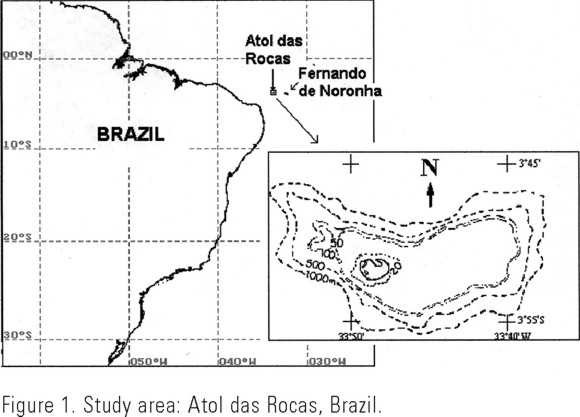
<body><![CDATA[<p align="justify"><font face="verdana" size="2"><b>Palabras clave:</b> Atol das Rocas, Brasil, <i>Laurencia caraibica</i>, Rhodophyta, taxonom&iacute;a.</font></p>     <p align="justify"><font face="Verdana" size="2">&nbsp;</font></p>     <p align="justify"><font face="verdana" size="2"><b>Introduction</b></font></p>     <p align="justify"><font face="verdana" size="2">Atol das Rocas Reef is a marine biological reserve in Northeast Brazil, and is considered the only atoll in the South Atlantic (Kikuchi and Le&atilde;o, 1996; Guerardi and Bosence 2001). The reef consists of a calcareous rock ring, measuring about 3 km in diameter and bathed by the Southern branch of the South Equatorial current, and is colonized by typical members of tropical algae communities (Oliveira Filho and Ugadim 1976).</font></p>     <p align="justify"><font face="verdana" size="2">The benthic marine flora has been known mainly since 70's by Oliveira Filho (1972), Oliveira Filho and Menezes (1972), and Oliveira Filho and Ugadim (1974, 1976). In the latest reference 22 species of Chlorophyceae, 18 of Phaeophyceae, and 53 of Rhodophyceae are listed. Among members of <i>Laurencia complex</i> (<i>Laurencia</i> J.V. Lamouroux, <i>Chondrophycus</i> (Tokida et Saito) Garbary et J. Harper, <i>Osmundea</i> Stackhouse) only <i>L. decumbens</i> K&uuml;tzing (as <i>L. pygmaea</i> Weber&#45;van Bosse) and <i>Chondrophycus papillosus</i> (C. Agardh) Garbary et J. Harper (as <i>Laurencia papillosa</i>) have been referred to Atol das Rocas (Oliveria Filho and Ugadim, 1974; 1976).</font></p>     <p align="justify"><font face="verdana" size="2">In the last two years, recent studies on the marine algae from the Atol das Rocas Reef are bringing out new information about the ecology and flora of this unique environment in Brazilian coast (Villa&ccedil;a <i>et al</i>., 2001).</font></p>     <p align="justify"><font face="verdana" size="2">In this paper, <i>Laurencia caraibica</i> P.C. Silva is being added to the rhodophycean algal list from Atol das Rocas, and from Brazil. Previously unknown detailed morphological characters of the species are presented, compared to related species, and its geographical distribution is discussed.</font></p>     <p align="justify"><font face="Verdana" size="2">&nbsp;</font></p>     <p align="justify"><font face="verdana" size="2"><b>Study area</b></font></p>     <p align="justify"><font face="verdana" size="2">Atol das Rocas is located in the Atlantic Ocean, at 3o51' S and 33&ordm;49' W, distant 150 miles from the city of Natal, Rio Grande do Norte State, in Northeast Brazil (<a href="#f1">Fig. 1</a>). The atoll has an oval shape with an internal area of about 7.5 km<sup>2</sup>. Its largest axis (E&#45;W) is 3.7 km long, and the shortest (N&#45;S) is 2.5 km long. An algal ridge limits the reef flat, which is dominated by a coralline algae&#45;vermetid gastropods association growing as small linear ridges. Internally, the atoll is composed of two sand cays, a big sand plain, several pools of different sizes and depths, a permanent lagoon and an internal algal ridge (exposed at low tide).</font></p>     ]]></body>
<body><![CDATA[<p align="center"><font face="verdana" size="2"><a name="f1"></a></font></p>     <p align="center"><font face="verdana" size="2"><img src="/img/revistas/hbio/v13n1/a4f1.jpg"></font></p>     <p align="justify"><font face="Verdana" size="2">&nbsp;</font></p>     <p align="justify"><font face="verdana" size="2"><b>Material and methods</b></font></p>     <p align="justify"><font face="verdana" size="2">Voucher specimens and materials for morphological studies were fixed in 4% Formalin/seawater or pressed as herbarium sheets. The specimens were collected manually on an internal ridge during low tide. Longitudinal and transverse hand sections were made with a stainless steel razor blade under a stereoscopic dissection microscope, and stained with 0.5% aqueous aniline blue solution, acidified with dilute HCl or in aqueous ruthenium red (ca. 0.02%). Photomicrographs were taken with an Olympus BH&#45;2 microscope. Voucher specimens are housed at the herbarium of the Instituto de Bot&acirc;nica at S&atilde;o Paulo, Brazil (SP). Herbarium abbreviations are as given in Holmgren <i>et al</i>., (1990).</font></p>     <p align="justify"><font face="Verdana" size="2">&nbsp;</font></p>     <p align="justify"><font face="verdana" size="2"><b>Results</b></font></p>     <p align="justify"><font face="verdana" size="2"><i><b>Laurencia caraibica</b></i> P.C. Silva 1972: 205. <a href="#f2">Figures 2</a>&#45;<a href="/img/revistas/hbio/v13n1/a4f3.jpg" target="_blank">11</a> (<a href="#f2">3</a>, <a href="/img/revistas/hbio/v13n1/a4f3.jpg" target="_blank">4</a>, <a href="/img/revistas/hbio/v13n1/a4f3.jpg" target="_blank">5</a>, <a href="/img/revistas/hbio/v13n1/a4f3.jpg" target="_blank">6</a>, <a href="/img/revistas/hbio/v13n1/a4f3.jpg" target="_blank">7</a>, <a href="/img/revistas/hbio/v13n1/a4f3.jpg" target="_blank">8</a>, <a href="/img/revistas/hbio/v13n1/a4f3.jpg" target="_blank">9</a>, <a href="/img/revistas/hbio/v13n1/a4f3.jpg" target="_blank">10</a>)</font></p>     <p align="center"><font face="verdana" size="2"><a name="f2"></a></font></p>     <p align="center"><font face="verdana" size="2"><img src="/img/revistas/hbio/v13n1/a4f2.jpg"></font></p>     ]]></body>
<body><![CDATA[<p align="justify"><font face="verdana" size="2">Basyonim: <i>Laurencia nana</i> Howe in Britton and Millspaugh 1920: 566, nom. illeg.</font></p>     <p align="justify"><font face="verdana" size="2">Type locality: Mariguana (Mayaguana), Bahamas. Type: Howe 5393. Isotype: US 68437!</font></p>     <p align="justify"><font face="verdana" size="2"><b>Habit:</b> Plants heavily entangled forming cushion&#45;like tufts, fixed to the substratum by mean of discoid holdfast or with numerous holdfasts originated by prostrate branches. Thalli are erect or decumbent, cylindrical, up to 1.6 cm high and 0.16&#45;0.21 mm in diameter, soft in texture, adhering well to herbarium paper when dried. Color is pinkish&#45;purple to garnet&#45;brown. Branching is unilateral to irregularly alternate, bearing long unramified or shortly ramified ultimate branchlets, up to 6 mm long and 120&#45;200 &micro;m in diameter. Branches slightly constricted at the basis and with truncate apex. Anastomose between branches are frequent (<a href="#f2">Figs. 2&#45;3</a>).</font></p>     <p align="justify"><font face="verdana" size="2"><b>Vegetative Structures:</b> In surface view, epidermal cells in the middle region of the thalli are elongate&#45;polygonal, 37&#45;57 &micro;m long x 20&#45;26 &micro;m wide, connected to one another by longitudinally oriented secondary pit connections (<a href="/img/revistas/hbio/v13n1/a4f3.jpg" target="_blank">Fig. 4</a>). Living material was not observed to check the occurrence of <i>"corps en cerise"</i>. In cross&#45;section of the thallus a layer of pigmented epidermal cells and three&#45;four layers of medullary cells (<a href="/img/revistas/hbio/v13n1/a4f3.jpg" target="_blank">Fig. 5</a>). Epidermal cells neither radially elongated nor arranged like palisade, 18&#45;21 &micro;m long and 20&#45;26 &micro;m wide. Secondary pit connections present between adjacent epidermal cells (<a href="/img/revistas/hbio/v13n1/a4f3.jpg" target="_blank">Figs. 4</a>, <a href="/img/revistas/hbio/v13n1/a4f3.jpg" target="_blank">6</a>). Medullary cells are large and slightly flattened. Each vegetative axial segment cuts off four periaxial cells, 26&#45;32 &micro;m in diameter, which are slightly larger than cells of surrounding layer (<a href="/img/revistas/hbio/v13n1/a4f3.jpg" target="_blank">Fig. 5</a>). Lenticular thickenings are abundant in the walls of the medullary cells (<a href="#f2">Figs. 3</a>, <a href="/img/revistas/hbio/v13n1/a4f3.jpg" target="_blank">7</a>). In median longitudinal sections through a branchlet, the outer walls of the epidermal cells do not project beyond the surface (<a href="/img/revistas/hbio/v13n1/a4f3.jpg" target="_blank">Fig. 8</a>).</font></p>     <p align="justify"><font face="verdana" size="2"><b>Reproductive Structures:</b> Tetrasporangial branches are clavate with truncate apex, simple, 1&#45;6 mm long. X 0.2 mm wide (<a href="#f2">Figs. 3</a>, <a href="/img/revistas/hbio/v13n1/a4f3.jpg" target="_blank">9</a>). Tetrasporangia are 53&#45;76 &micro;m in diameter, and display parallel arrangement on the fertile branches (<a href="#f2">Figs. 3</a>, <a href="/img/revistas/hbio/v13n1/a4f3.jpg" target="_blank">9&#45;11</a>). Male and female plants were not found.</font></p>     <p align="justify"><font face="verdana" size="2">Sterile and tetrasporangial plants were collected in July 1999 and June 2000, over the hard bottom of an internal algal ridge and over small corals that link a reef flat section to the sand cay. The specimens were found in very intricate small turfs, heavily entangled with other macroalage such as <i>Gelidiopsis intricata</i> (C. Agardh) Vickers, <i>Lomentaria rawitscheri</i> A.B. Joly, <i>Jania adhaerens</i> J.V. Lamouroux, and <i>Lophosiphonia obscura</i> (C. Agardh) Falkenberg.</font></p>     <p align="justify"><font face="verdana" size="2"><b>Geographical Distribution:</b> Atlantic ocean: Bahamas (Mariguana &#91;=Mayaguana&#93;, type locality) (Howe 1920 as <i>L. nana</i>; Littler and Littler 2000); Belize (Norris and Bucher, 1982); Mexico (Sent&iacute;es and Fujii, 2002); Jamaica (Taylor, 1960 as <i>L. nana</i>); Puerto Rico (Ballantine and Norris, 1989); Antigua (Taylor, 1969 as <i>L. nana</i>); Greater Antilles, Lesser Antilles, Western Caribbean, Gulf of Mexico (Littler and Littler 2000); Colombia (Bula&#45;Meyer, 1986); Brazil, Atol das Rocas, (Oliveira Filho and Ugadim, 1974; 1976, as <i>L. pygmaea</i> Weber&#45;van Bosse). Indic Ocean: India (Silva <i>et al</i>., 1986).</font></p>     <p align="justify"><font face="verdana" size="2">Material Examined: SPF 025561 (as <i>L. pygmaea</i>), Atol das Rocas, Feb. 1972, coll. E.C. Oliveira, det.: M.T. Fujii. SP 355383, Atol das Rocas, 21 Jul. 1999, coll.: R. Villa&ccedil;a, det.: M.T. Fujii. SP 355384, Atol das Rocas, 13 Jun. 2000, coll.: R. Villa&ccedil;a, det.: M.T.Fujii.</font></p>     <p align="justify"><font face="verdana" size="2">Additional Material Examined: US 68437 (isotype), on corals, near low&#45;water mark, Abraham bay, Mariguana, Bahamas, 6 Dec. 1907, coll. M.A. Howe.</font></p>     <p align="justify"><font face="Verdana" size="2">&nbsp;</font></p>     ]]></body>
<body><![CDATA[<p align="justify"><font face="verdana" size="2"><b>Discussion</b></font></p>     <p align="justify"><font face="verdana" size="2"><i>Laurencia nana</i> was proposed by Howe (1920) to include species proceeding from Mariguana (=Mayaguana), Bahamas, characterized by having 1&#45;2 cm high and densely caespitose to intricate thalli with 0.15&#45;0.45 mm in diameter, but without lenticular thickenings in the walls of medullary cells.</font></p>     <p align="justify"><font face="verdana" size="2">According to Silva (1972), <i>L. nana</i> Howe is a later homonym of <i>L. nana</i> (C. Agardh) Greville (1830), previously described as <i>Chondria nana</i> C. Agardh (1827). This species, which was found at Trieste, Italy, was considered a small form of <i>L. paniculata</i> (C. Agardh) J. Agardh (1863). The epithet <i>Laurencia caraibica</i> was provided by Silva (1972) as a substitute name for <i>L. nana</i> Howe.</font></p>     <p align="justify"><font face="verdana" size="2"><i>Laurencia caraibica</i> is a typical member of the genus showing four periaxial cells per each axial segment, and tetrasporangia cut&#45;off from a particular periaxial cell. The lenticular thickenings in the walls of the medullary cells were not reported either in the original description by Howe (1920) or later by Taylor (1960) in the specimens from Jamaica. However, lenticular thickenings were observed by Norris and Bucher (1982) and also by us in the isotype (US 68437) (<a href="#f4">Figs. 12&#45;13</a>). Norris and Bucher (1982), Ballantine and Norris (1989), and Sent&iacute;es and Fujii (2002) stated the occasional occurrence of lenticular thickening in the walls of the medullary cells in specimens proceeding from Belize, Puerto Rico, and Mexico, respectively. In specimens from Atol das Rocas reef, Brazil, lenticular thickenings are abundant in the walls of the medullary cells, and they are visible through the epidermal cells in surface view.</font></p>     <p align="center"><font face="verdana" size="2"><a name="f4"></a></font></p>     <p align="center"><font face="verdana" size="2"><img src="/img/revistas/hbio/v13n1/a4f4.jpg"></font></p>     <p align="justify"><font face="verdana" size="2">Mexican plants, reach up to 5 cm height and 1 mm in diameter of axis, resulting larger than our specimens. Sent&iacute;es and Fujii (2002) reported the presence of two (third and fourth) fertile periaxial cells per each axial segment producing tetrasporangia in specimens from Mexico. In Brazilian specimens, however, this feature is not clear enough but <a href="/img/revistas/hbio/v13n1/a4f3.jpg" target="_blank">figure 11</a> suggests that only the fourth periaxial cell produces tetrasporangium as in <i>L. similis</i> Nam and Saito (1991) and occasionally in <i>L. brongniartii</i> J. Agardh (Nam and Sohn 1994) and <i>L. filiformis</i> (C. Agardh) Montagne (Fujii 1998). In Puerto Rican plants the secondary pit&#45;connections between adjacent cortical cells are lacking and tetrasporangia display right&#45;angle arrangement, suggesting that it could belong to another taxon.</font></p>     <p align="justify"><font face="verdana" size="2">Baptista (1974) described <i>L. caraibica</i> (as <i>L. nana</i>) from Ilha dos Lobos, Rio Grande do Sul, Southern Brazil. Based on the habit, the larger size of thalli, and absence of lenticular thickenings in the walls of medullary cells, Baptista's specimens should be referred to as <i>L. intricata</i> J.V. Lamouroux. In the same paper, the author included an unidentified species of <i>Laurencia</i>, which is referable to <i>L. caraibica</i> on the basis of the habit and morphological characteristics, except for the absence of the lenticular thickening in the medullary cell walls.</font></p>     <p align="justify"><font face="verdana" size="2">Baptista's (1974) <i>Laurencia</i> sp. corresponds to <i>L. oliveirana</i> Yoneshigue, an other dwarf species described from Rio de Janeiro, Brazil, by Yoneshigue (1985) and later also reported from S&atilde;o Paulo (Fujii 1990). <i>L. caraibica</i> differs from <i>L. oliveirana</i> in both the presence of lenticular thickenings in the medullary cells and anastomose between branches.</font></p>     <p align="justify"><font face="verdana" size="2">The presence or absence of lenticular thickening as a character to distinguish species within the genus <i>Laurencia</i> is somewhat controversial since this feature is not always easily detectable, although it has been used to characterize members of <i>Laurencia</i> included into the section Forsterianae Yamada (Saito 1967). In <i>L. caraibica</i>, however, the lenticular thickenings are visible through the epidermal cells in surface view and useful as diagnostic character.</font></p>     ]]></body>
<body><![CDATA[<p align="justify"><font face="verdana" size="2">Oliveira Filho and Ugadim (1974; 1976) described <i>L. decumbens</i> (as <i>L. pygmaea</i>) from Atol das Rocas, Brazil. From the study of last material (SPF 025561), however, it resulted that it showed all the characters of <i>L. caraibica</i>.</font></p>     <p align="justify"><font face="verdana" size="2"><i>Laurencia pygmaea</i> was originally described from Chagos archipelago, Diego Garcia, Indian Ocean, an specimens collected by Mr. J. Stanley Gardiner during the "Sealark expedtion" (Weber&#45;van Bosse 1913). Later, based on the morphological similarity <i>L. pygmaea</i> was considered synonym of <i>L.</i> decumbens described from New Caledonia, Pacific Ocean, but also found in Mauritius, India (B&oslash;rgesen 1945).</font></p>     <p align="justify"><font face="verdana" size="2">Although the description of <i>L. decumbens</i> (as <i>L. pygmaea</i>) given by Weber&#45;van Bosse (1913) has shown a great resemblance to that of <i>L. caraibica</i> because both have small thalli growing as intricate tufts, according to Weber&#45;van Bosse (1913), the branches of <i>L. decumbens</i> can be easily teased out under a pocket&#45;lens, whereas in the case of <i>L. caraibica</i> this cannot be done without damaging the frond due to the presence of anastomose between contiguous branches (Weber&#45;van Bosse, 1913; Oliveira Filho and Ugadim, 1974).</font></p>     <p align="justify"><font face="verdana" size="2">As concerns the geographical distribution, it should be noted that <i>L. decumbens</i> occurs in Pacific and Indian Oceans whereas <i>L. caraibica</i> is more related to Atlantic Ocean, especially in Caribbean region, although it was reported also from India (Silva <i>et al.</i>, 1996).</font></p>     <p align="justify"><font face="verdana" size="2">Considering the morphological characteristics combined with geographical distribution, we propose that <i>L. decumbens sensu</i> Oliveira Filho and Ugadim (1974; 1976) be recognized as <i>L. caraibica</i> P.C. Silva.</font></p>     <p align="justify"><font face="verdana" size="2">Other two species of <i>Laurencia</i> described from Brazil that possess reduced thalli are <i>L. catarinensis</i> Cordeiro&#45;Marino et Fujii (1985) and <i>L. intricata</i> J. Agardh (Fujii, 1990). The former has greenish color and the latter is pink&#45;rose. Both species develop in densely intricate tufts with unilaterally or radially branched thalli, but their final gross morphology and the size are different from the present species, and the lenticular thickenings are lacking in both species.</font></p>     <p align="justify"><font face="verdana" size="2"><i>Laurencia caraibica</i> was collected in well&#45;illuminated habitats, emersed during the low tides, sometimes for a long period, but with no damages because of the closed association with other species of algae and some small invertebrates also supporting an internal wet environment. The reef section where <i>L. caraibica</i> was found is protected from direct wave impacts but it is regularly washed by the tide currents. <i>L. caraibica</i> is reported from some reefs in the Caribbean under the same environmental conditions (Littler and Littler, 2000).</font></p>     <p align="justify"><font face="Verdana" size="2">&nbsp;</font></p>     <p align="justify"><font face="verdana" size="2"><b>Acknowledgments</b></font></p>     <p align="justify"><font face="verdana" size="2">This work was supported by Funda&ccedil;&atilde;o O Botic&aacute;rio de Prote&ccedil;&atilde;o &agrave; Natureza and McArthur Foundation and in part by Conselho Nacional de Desenvolvimento Cient&iacute;fico e Tecnol&oacute;gico (CNPq), grant 520748/97&#45;2 and 300677/99&#45;5 to MTF. We are grateful to the Atol das Rocas Marine Biological Reserve &#45; IBAMA, especially Mauriz&eacute;lia Britto Silva for the field facilities and the travel to the atoll. To Dr. Abel Sent&iacute;es (UAM&#45;Iztapalapa, Mexico) for providing the Resumen of this paper.</font></p>     ]]></body>
<body><![CDATA[<p align="justify"><font face="Verdana" size="2">&nbsp;</font></p>     <p align="justify"><font face="verdana" size="2"><b>References</b></font></p>     <!-- ref --><p align="justify"><font face="verdana" size="2">AGARDH, C. A. 1827. Aufz&auml;hlung einiger in den &ouml;streichischen L&auml;ndern gefundenen neuen Gattungen und Arten von Algen, nebst ihrer Diagnostik und beigef&uuml;gten Bemerkungen. <i>Flora 10</i>: 625&#45;646.    &nbsp;&nbsp;&nbsp;&nbsp;&nbsp;&nbsp;&nbsp;&nbsp;[&#160;<a href="javascript:void(0);" onclick="javascript: window.open('/scielo.php?script=sci_nlinks&ref=4039339&pid=S0188-8897200300010000400001&lng=','','width=640,height=500,resizable=yes,scrollbars=1,menubar=yes,');">Links</a>&#160;]<!-- end-ref --></font></p>     <!-- ref --><p align="justify"><font face="verdana" size="2">AGARDH, J. 1863. <i>Species genera et ordines algarum</i>. Vol. 2, part 3. Lund. pp. 701&#45;1291.    &nbsp;&nbsp;&nbsp;&nbsp;&nbsp;&nbsp;&nbsp;&nbsp;[&#160;<a href="javascript:void(0);" onclick="javascript: window.open('/scielo.php?script=sci_nlinks&ref=4039341&pid=S0188-8897200300010000400002&lng=','','width=640,height=500,resizable=yes,scrollbars=1,menubar=yes,');">Links</a>&#160;]<!-- end-ref --></font></p>     <!-- ref --><p align="justify"><font face="verdana" size="2">BALLANTINE, D. and J. N. NORRIS. 1989.Notes on the marine algae of Puerto Rico. V. New additions to the flora. <i>Caribbean Journal of Science 25</i>(1/2): 1&#45;8.    &nbsp;&nbsp;&nbsp;&nbsp;&nbsp;&nbsp;&nbsp;&nbsp;[&#160;<a href="javascript:void(0);" onclick="javascript: window.open('/scielo.php?script=sci_nlinks&ref=4039343&pid=S0188-8897200300010000400003&lng=','','width=640,height=500,resizable=yes,scrollbars=1,menubar=yes,');">Links</a>&#160;]<!-- end-ref --></font></p>     <!-- ref --><p align="justify"><font face="verdana" size="2">BAPTISTA, L. R. 1974. Flora ilustrada do Rio Grande do Sul: Flora marinha de Torres. <i>Boletim do Instituto de Bioci&ecirc;ncias 37, s&eacute;rie Bot&acirc;nica 7</i>: 1&#45;244.    &nbsp;&nbsp;&nbsp;&nbsp;&nbsp;&nbsp;&nbsp;&nbsp;[&#160;<a href="javascript:void(0);" onclick="javascript: window.open('/scielo.php?script=sci_nlinks&ref=4039345&pid=S0188-8897200300010000400004&lng=','','width=640,height=500,resizable=yes,scrollbars=1,menubar=yes,');">Links</a>&#160;]<!-- end-ref --></font></p>     ]]></body>
<body><![CDATA[<!-- ref --><p align="justify"><font face="verdana" size="2">B&Oslash;RGESEN, F. 1945. Some marine algae from Mauritius. III. Rhodophyceae. Part 4. Ceramiales. <i>Kongelige Danske Videnskabernes Selskab, Biologiske Meddelelser 19</i>(10):.1&#45;68, 35 figs.    &nbsp;&nbsp;&nbsp;&nbsp;&nbsp;&nbsp;&nbsp;&nbsp;[&#160;<a href="javascript:void(0);" onclick="javascript: window.open('/scielo.php?script=sci_nlinks&ref=4039347&pid=S0188-8897200300010000400005&lng=','','width=640,height=500,resizable=yes,scrollbars=1,menubar=yes,');">Links</a>&#160;]<!-- end-ref --></font></p>     <!-- ref --><p align="justify"><font face="verdana" size="2">CORDEIRO&#45;MARINO, M. and M.T. FUJII, 1985. <i>Laurencia catarinensis</i> (Rhodomelaceae, Rhodophyta), a new species from Ilha de Santa Catarina, Brasil. <i>Revista Brasileira de Bot&acirc;nica 8</i>: 47&#45;53.    &nbsp;&nbsp;&nbsp;&nbsp;&nbsp;&nbsp;&nbsp;&nbsp;[&#160;<a href="javascript:void(0);" onclick="javascript: window.open('/scielo.php?script=sci_nlinks&ref=4039349&pid=S0188-8897200300010000400006&lng=','','width=640,height=500,resizable=yes,scrollbars=1,menubar=yes,');">Links</a>&#160;]<!-- end-ref --></font></p>     <!-- ref --><p align="justify"><font face="verdana" size="2">BULA&#45;MEYER, G. 1986. Las macroalgas de los arrecifes coralinos de las islas del Rosario, costa Caribe de Colombia. <i>Boletim Ecotropica 14</i>: 3&#45;20.    &nbsp;&nbsp;&nbsp;&nbsp;&nbsp;&nbsp;&nbsp;&nbsp;[&#160;<a href="javascript:void(0);" onclick="javascript: window.open('/scielo.php?script=sci_nlinks&ref=4039351&pid=S0188-8897200300010000400007&lng=','','width=640,height=500,resizable=yes,scrollbars=1,menubar=yes,');">Links</a>&#160;]<!-- end-ref --></font></p>     <!-- ref --><p align="justify"><font face="verdana" size="2">FUJII, M. T. 1990. G&ecirc;nero <i>Laurencia</i> (Rhodomelaceae, Rhodophyta) no Estado de S&atilde;o Paulo: aspectos biol&oacute;gicos e taxon&ocirc;micos. Unpublished Master Dissertation. Universidade Estadual Paulista, Rio Claro, 145 p.    &nbsp;&nbsp;&nbsp;&nbsp;&nbsp;&nbsp;&nbsp;&nbsp;[&#160;<a href="javascript:void(0);" onclick="javascript: window.open('/scielo.php?script=sci_nlinks&ref=4039353&pid=S0188-8897200300010000400008&lng=','','width=640,height=500,resizable=yes,scrollbars=1,menubar=yes,');">Links</a>&#160;]<!-- end-ref --></font></p>     <!-- ref --><p align="justify"><font face="verdana" size="2">FUJII, M. T. 1998. Estudos morfol&oacute;gicos, quimiotaxon&ocirc;micos e citogen&eacute;ticos em quatro esp&eacute;cies selecionadas de <i>Laurencia</i> (Ceramiales, Rhodophyta) do litoral brasileiro. Unpublished Doutor Thesis. Universidade Estadual Paulista, Rio Claro, 176 p.    &nbsp;&nbsp;&nbsp;&nbsp;&nbsp;&nbsp;&nbsp;&nbsp;[&#160;<a href="javascript:void(0);" onclick="javascript: window.open('/scielo.php?script=sci_nlinks&ref=4039355&pid=S0188-8897200300010000400009&lng=','','width=640,height=500,resizable=yes,scrollbars=1,menubar=yes,');">Links</a>&#160;]<!-- end-ref --></font></p>     ]]></body>
<body><![CDATA[<!-- ref --><p align="justify"><font face="verdana" size="2">GREVILLE, R. K. 1830. <i>Algae britannicae</i>. Edinburgh. Ixxxviii + 218 p., XIX pls.    &nbsp;&nbsp;&nbsp;&nbsp;&nbsp;&nbsp;&nbsp;&nbsp;[&#160;<a href="javascript:void(0);" onclick="javascript: window.open('/scielo.php?script=sci_nlinks&ref=4039357&pid=S0188-8897200300010000400010&lng=','','width=640,height=500,resizable=yes,scrollbars=1,menubar=yes,');">Links</a>&#160;]<!-- end-ref --></font></p>     <!-- ref --><p align="justify"><font face="verdana" size="2">GUERARDI, D. F. M. and D. W. BOSENCE. 2001. Composition and community structure of the coralline algal reefs from Atol das Rocas, South Atlantic, Brazil. <i>Coral Reefs 19</i>: 205&#45;219.    &nbsp;&nbsp;&nbsp;&nbsp;&nbsp;&nbsp;&nbsp;&nbsp;[&#160;<a href="javascript:void(0);" onclick="javascript: window.open('/scielo.php?script=sci_nlinks&ref=4039359&pid=S0188-8897200300010000400011&lng=','','width=640,height=500,resizable=yes,scrollbars=1,menubar=yes,');">Links</a>&#160;]<!-- end-ref --></font></p>     <!-- ref --><p align="justify"><font face="verdana" size="2">HOLMGREN, P. K., N. H. HOLMGREN and L. C. BARNETT. 1990. Index Herbariorum. 1. <i>The herbaria of the world. New York Botanical Garden</i>, Bronx, N.Y. (Regnum Vegetabile vol. 120). 693 p.    &nbsp;&nbsp;&nbsp;&nbsp;&nbsp;&nbsp;&nbsp;&nbsp;[&#160;<a href="javascript:void(0);" onclick="javascript: window.open('/scielo.php?script=sci_nlinks&ref=4039361&pid=S0188-8897200300010000400012&lng=','','width=640,height=500,resizable=yes,scrollbars=1,menubar=yes,');">Links</a>&#160;]<!-- end-ref --></font></p>     <!-- ref --><p align="justify"><font face="verdana" size="2">HOWE, M. A. 1920. <i>Algae</i>. <i>In:</i> N. L. BRITTON and C. F. MILLSPAUGH (Eds.). Bahama flora. New York. pp. 553&#45;631.    &nbsp;&nbsp;&nbsp;&nbsp;&nbsp;&nbsp;&nbsp;&nbsp;[&#160;<a href="javascript:void(0);" onclick="javascript: window.open('/scielo.php?script=sci_nlinks&ref=4039363&pid=S0188-8897200300010000400013&lng=','','width=640,height=500,resizable=yes,scrollbars=1,menubar=yes,');">Links</a>&#160;]<!-- end-ref --></font></p>     <!-- ref --><p align="justify"><font face="verdana" size="2">KIKUCHI, R. K. P. and Z. LE&Atilde;O. 1996. Rocas (Southwestern Equatorial Atlantic, Brazil): An Atoll Built Primarily by Coralline Alga. 8th International Coral Reef Symposium, Panama, Smithsonian Tropical Research Institute. Vol 1. pp. 731&#45;736.    &nbsp;&nbsp;&nbsp;&nbsp;&nbsp;&nbsp;&nbsp;&nbsp;[&#160;<a href="javascript:void(0);" onclick="javascript: window.open('/scielo.php?script=sci_nlinks&ref=4039365&pid=S0188-8897200300010000400014&lng=','','width=640,height=500,resizable=yes,scrollbars=1,menubar=yes,');">Links</a>&#160;]<!-- end-ref --></font></p>     ]]></body>
<body><![CDATA[<!-- ref --><p align="justify"><font face="verdana" size="2">LITTLER, D. S. and M. M. LITTLER. 2000. <i>Caribbean Reef Plants.</i> Offshore Graphics Inc. 542 p.    &nbsp;&nbsp;&nbsp;&nbsp;&nbsp;&nbsp;&nbsp;&nbsp;[&#160;<a href="javascript:void(0);" onclick="javascript: window.open('/scielo.php?script=sci_nlinks&ref=4039367&pid=S0188-8897200300010000400015&lng=','','width=640,height=500,resizable=yes,scrollbars=1,menubar=yes,');">Links</a>&#160;]<!-- end-ref --></font></p>     <!-- ref --><p align="justify"><font face="verdana" size="2">NAM, K. W. and Y. SAITO. 1991. <i>Laurencia similis</i> (Ceramiales, Rhodophyta), a new species from Queenland, Australia. <i>British Phycological Journal 26</i>: 375&#45;382.    &nbsp;&nbsp;&nbsp;&nbsp;&nbsp;&nbsp;&nbsp;&nbsp;[&#160;<a href="javascript:void(0);" onclick="javascript: window.open('/scielo.php?script=sci_nlinks&ref=4039369&pid=S0188-8897200300010000400016&lng=','','width=640,height=500,resizable=yes,scrollbars=1,menubar=yes,');">Links</a>&#160;]<!-- end-ref --></font></p>     <!-- ref --><p align="justify"><font face="verdana" size="2">NAM, K. W. and C. H. SOHN. 1994. <i>Laurencia kangjaewonii</i> sp. nov. (Ceramiales, Rhodophyta) from Korea. <i>Phycologia 33</i>: 397&#45;403.    &nbsp;&nbsp;&nbsp;&nbsp;&nbsp;&nbsp;&nbsp;&nbsp;[&#160;<a href="javascript:void(0);" onclick="javascript: window.open('/scielo.php?script=sci_nlinks&ref=4039371&pid=S0188-8897200300010000400017&lng=','','width=640,height=500,resizable=yes,scrollbars=1,menubar=yes,');">Links</a>&#160;]<!-- end-ref --></font></p>     <!-- ref --><p align="justify"><font face="verdana" size="2">NORRIS, J. N. and K. E. BUCHER. 1982. Marine algae and seagrasses from Carrie Bow Cay, Belize. <i>In:</i> K. RUTZLER and I. G. MACINTYRE (Eds.). <i>The Atlantic barrier reef ecosystem at Carrie Bow Cay, Belize. I: structure and communities. Smithsonian Contribution of Marine Science 12</i>: 167&#45;223.    &nbsp;&nbsp;&nbsp;&nbsp;&nbsp;&nbsp;&nbsp;&nbsp;[&#160;<a href="javascript:void(0);" onclick="javascript: window.open('/scielo.php?script=sci_nlinks&ref=4039373&pid=S0188-8897200300010000400018&lng=','','width=640,height=500,resizable=yes,scrollbars=1,menubar=yes,');">Links</a>&#160;]<!-- end-ref --></font></p>     <!-- ref --><p align="justify"><font face="verdana" size="2">OLIVEIRA FILHO, E. C. 1972. As algas marinhas bent&ocirc;nicas do Atol das Rocas. <i>Ci&ecirc;ncia e Cultura 24</i>(5) Suplemento: 328.    &nbsp;&nbsp;&nbsp;&nbsp;&nbsp;&nbsp;&nbsp;&nbsp;[&#160;<a href="javascript:void(0);" onclick="javascript: window.open('/scielo.php?script=sci_nlinks&ref=4039375&pid=S0188-8897200300010000400019&lng=','','width=640,height=500,resizable=yes,scrollbars=1,menubar=yes,');">Links</a>&#160;]<!-- end-ref --></font></p>     ]]></body>
<body><![CDATA[<!-- ref --><p align="justify"><font face="verdana" size="2">OLIVEIRA FILHO, E. C. and N. A. MENEZES. 1972. Notas biol&oacute;gicas sobre o Atol das Rocas. <i>Ci&ecirc;ncia e Cultura 24</i>(5) Suplemento: 361.    &nbsp;&nbsp;&nbsp;&nbsp;&nbsp;&nbsp;&nbsp;&nbsp;[&#160;<a href="javascript:void(0);" onclick="javascript: window.open('/scielo.php?script=sci_nlinks&ref=4039377&pid=S0188-8897200300010000400020&lng=','','width=640,height=500,resizable=yes,scrollbars=1,menubar=yes,');">Links</a>&#160;]<!-- end-ref --></font></p>     <!-- ref --><p align="justify"><font face="verdana" size="2">OLIVEIRA FILHO, E. C. and Y. UGADIM. 1974. New references of benthic marine algae to the Brazilian flora. <i>Boletim de Bot&acirc;nica da Universidade de S&atilde;o Paulo 2</i>: 71&#45;91.    &nbsp;&nbsp;&nbsp;&nbsp;&nbsp;&nbsp;&nbsp;&nbsp;[&#160;<a href="javascript:void(0);" onclick="javascript: window.open('/scielo.php?script=sci_nlinks&ref=4039379&pid=S0188-8897200300010000400021&lng=','','width=640,height=500,resizable=yes,scrollbars=1,menubar=yes,');">Links</a>&#160;]<!-- end-ref --></font></p>     <!-- ref --><p align="justify"><font face="verdana" size="2">OLIVEIRA FILHO, E. C. and Y. UGADIM. 1976. A survey of the marine algae of Atol das Rocas (Brazil). <i>Phycologia 15</i>: 41&#45;44.    &nbsp;&nbsp;&nbsp;&nbsp;&nbsp;&nbsp;&nbsp;&nbsp;[&#160;<a href="javascript:void(0);" onclick="javascript: window.open('/scielo.php?script=sci_nlinks&ref=4039381&pid=S0188-8897200300010000400022&lng=','','width=640,height=500,resizable=yes,scrollbars=1,menubar=yes,');">Links</a>&#160;]<!-- end-ref --></font></p>     <!-- ref --><p align="justify"><font face="verdana" size="2">SAITO, Y. 1967. Studies on Japanese species of <i>Laurencia</i>, with special reference to their comparative morphology. <i>Memoirs of the Faculty of Fisheries, Hokkaido University 15</i>: 1&#45;81.    &nbsp;&nbsp;&nbsp;&nbsp;&nbsp;&nbsp;&nbsp;&nbsp;[&#160;<a href="javascript:void(0);" onclick="javascript: window.open('/scielo.php?script=sci_nlinks&ref=4039383&pid=S0188-8897200300010000400023&lng=','','width=640,height=500,resizable=yes,scrollbars=1,menubar=yes,');">Links</a>&#160;]<!-- end-ref --></font></p>     <!-- ref --><p align="justify"><font face="verdana" size="2">SENT&Iacute;ES, G. A. AND M. T. FUJII. 2002. El complejo <i>Laurencia</i> (Rhodomelaceae, Rhodophyta) en el Caribe mexicano. <i>In</i>: A. SENT&Iacute;ES G. and K. M. DRECKMANN (Eds.). <i>Monograf&iacute;as Ficol&oacute;gicas</i>. Universidad Aut&oacute;noma Metropolitana. Iztapalapa. pp. 121&#45;192.    &nbsp;&nbsp;&nbsp;&nbsp;&nbsp;&nbsp;&nbsp;&nbsp;[&#160;<a href="javascript:void(0);" onclick="javascript: window.open('/scielo.php?script=sci_nlinks&ref=4039385&pid=S0188-8897200300010000400024&lng=','','width=640,height=500,resizable=yes,scrollbars=1,menubar=yes,');">Links</a>&#160;]<!-- end-ref --></font></p>     ]]></body>
<body><![CDATA[<!-- ref --><p align="justify"><font face="verdana" size="2">SILVA, P. C. 1972. Remarks on algal nomenclature V. <i>Taxon 21</i>: 199&#45;212.    &nbsp;&nbsp;&nbsp;&nbsp;&nbsp;&nbsp;&nbsp;&nbsp;[&#160;<a href="javascript:void(0);" onclick="javascript: window.open('/scielo.php?script=sci_nlinks&ref=4039387&pid=S0188-8897200300010000400025&lng=','','width=640,height=500,resizable=yes,scrollbars=1,menubar=yes,');">Links</a>&#160;]<!-- end-ref --></font></p>     <!-- ref --><p align="justify"><font face="verdana" size="2">SILVA, P .C., P. W. BASSON and R. L. MOE. 1996. Catalogue of the Benthic Marine Algae of the Indian Ocean. <i>University of California publications in Botany.</i> Vol. 79, xiv + 1259 p.    &nbsp;&nbsp;&nbsp;&nbsp;&nbsp;&nbsp;&nbsp;&nbsp;[&#160;<a href="javascript:void(0);" onclick="javascript: window.open('/scielo.php?script=sci_nlinks&ref=4039389&pid=S0188-8897200300010000400026&lng=','','width=640,height=500,resizable=yes,scrollbars=1,menubar=yes,');">Links</a>&#160;]<!-- end-ref --></font></p>     <!-- ref --><p align="justify"><font face="verdana" size="2">TAYLOR, W. R. 1960. <i>Marine algae of the eastern tropical and subtropical coasts of the Americas.</i> Ann Harbour: University of Michigan Press. xi + 870 p.    &nbsp;&nbsp;&nbsp;&nbsp;&nbsp;&nbsp;&nbsp;&nbsp;[&#160;<a href="javascript:void(0);" onclick="javascript: window.open('/scielo.php?script=sci_nlinks&ref=4039391&pid=S0188-8897200300010000400027&lng=','','width=640,height=500,resizable=yes,scrollbars=1,menubar=yes,');">Links</a>&#160;]<!-- end-ref --></font></p>     <!-- ref --><p align="justify"><font face="verdana" size="2">TAYLOR, W. R. 1969. Notes on the distribution of west Indian marine algae, particulary in the Lesser Antiles. <i>Contributions from the University of Michigan Herbarium 9</i>: 125&#45;203.    &nbsp;&nbsp;&nbsp;&nbsp;&nbsp;&nbsp;&nbsp;&nbsp;[&#160;<a href="javascript:void(0);" onclick="javascript: window.open('/scielo.php?script=sci_nlinks&ref=4039393&pid=S0188-8897200300010000400028&lng=','','width=640,height=500,resizable=yes,scrollbars=1,menubar=yes,');">Links</a>&#160;]<!-- end-ref --></font></p>     <!-- ref --><p align="justify"><font face="verdana" size="2">VILLA&Ccedil;A, R., A. C. FONSECA, C. A. PEZZELLA and V. K. JENSEN. 2001. Ecology of Macroalgae from the Atol das Rocas Reef, Brazil. <i>Phycologia 40</i>(4) suppl.: 113.    &nbsp;&nbsp;&nbsp;&nbsp;&nbsp;&nbsp;&nbsp;&nbsp;[&#160;<a href="javascript:void(0);" onclick="javascript: window.open('/scielo.php?script=sci_nlinks&ref=4039395&pid=S0188-8897200300010000400029&lng=','','width=640,height=500,resizable=yes,scrollbars=1,menubar=yes,');">Links</a>&#160;]<!-- end-ref --></font></p>     ]]></body>
<body><![CDATA[<!-- ref --><p align="justify"><font face="verdana" size="2">WEBER&#45;VAN BOSSE, A. 1913. Marine algae, Rhodophyceae, of the "Sealark" Expedition, collected by Mr. J. Stanley Gardiner, M.A. Transactions of the Linnean Society of London, Second Series, <i>Botany 8</i>: 105&#45;142, 1 fig., pls. 12&#45;14.    &nbsp;&nbsp;&nbsp;&nbsp;&nbsp;&nbsp;&nbsp;&nbsp;[&#160;<a href="javascript:void(0);" onclick="javascript: window.open('/scielo.php?script=sci_nlinks&ref=4039397&pid=S0188-8897200300010000400030&lng=','','width=640,height=500,resizable=yes,scrollbars=1,menubar=yes,');">Links</a>&#160;]<!-- end-ref --></font></p>     <!-- ref --><p align="justify"><font face="verdana" size="2">YONESHIGUE, Y. 1985. Taxonomie et ecologie des algues marines dans la r&eacute;gion de Cabo Frio (Rio de Janeiro, Bresil). Th&egrave;se present&eacute;e &agrave; l' Universit&eacute; d'Aix&#45;Marseille II, Facult&eacute; des Sciences de Luminy pour obtenir le grade de Docteur d'Etat&#45;Sciences, France, 466 p.    &nbsp;&nbsp;&nbsp;&nbsp;&nbsp;&nbsp;&nbsp;&nbsp;[&#160;<a href="javascript:void(0);" onclick="javascript: window.open('/scielo.php?script=sci_nlinks&ref=4039399&pid=S0188-8897200300010000400031&lng=','','width=640,height=500,resizable=yes,scrollbars=1,menubar=yes,');">Links</a>&#160;]<!-- end-ref --></font></p>      ]]></body><back>
<ref-list>
<ref id="B1">
<nlm-citation citation-type="journal">
<person-group person-group-type="author">
<name>
<surname><![CDATA[AGARDH]]></surname>
<given-names><![CDATA[C. A]]></given-names>
</name>
</person-group>
<article-title xml:lang="de"><![CDATA[Aufzählung einiger in den östreichischen Ländern gefundenen neuen Gattungen und Arten von Algen, nebst ihrer Diagnostik und beigefügten Bemerkungen]]></article-title>
<source><![CDATA[Flora]]></source>
<year>1827</year>
<volume>10</volume>
<page-range>625-646</page-range></nlm-citation>
</ref>
<ref id="B2">
<nlm-citation citation-type="book">
<person-group person-group-type="author">
<name>
<surname><![CDATA[AGARDH]]></surname>
<given-names><![CDATA[J]]></given-names>
</name>
</person-group>
<source><![CDATA[Species genera et ordines algarum]]></source>
<year>1863</year>
<volume>2</volume>
<page-range>701-1291</page-range><publisher-name><![CDATA[Lund.]]></publisher-name>
</nlm-citation>
</ref>
<ref id="B3">
<nlm-citation citation-type="journal">
<person-group person-group-type="author">
<name>
<surname><![CDATA[BALLANTINE]]></surname>
<given-names><![CDATA[D.]]></given-names>
</name>
<name>
<surname><![CDATA[NORRIS]]></surname>
<given-names><![CDATA[J. N.]]></given-names>
</name>
</person-group>
<article-title xml:lang="en"><![CDATA[Notes on the marine algae of Puerto Rico. V. New additions to the flora]]></article-title>
<source><![CDATA[Caribbean Journal of Science]]></source>
<year>1989</year>
<volume>25</volume>
<numero>1</numero><numero>2</numero>
<issue>1</issue><issue>2</issue>
<page-range>1-8</page-range></nlm-citation>
</ref>
<ref id="B4">
<nlm-citation citation-type="journal">
<person-group person-group-type="author">
<name>
<surname><![CDATA[BAPTISTA]]></surname>
<given-names><![CDATA[L. R]]></given-names>
</name>
</person-group>
<article-title xml:lang="pt"><![CDATA[Flora ilustrada do Rio Grande do Sul: Flora marinha de Torres]]></article-title>
<source><![CDATA[Boletim do Instituto de Biociências]]></source>
<year>1974</year>
<volume>37</volume><volume>7</volume>
<page-range>1-244</page-range></nlm-citation>
</ref>
<ref id="B5">
<nlm-citation citation-type="journal">
<person-group person-group-type="author">
<name>
<surname><![CDATA[BØRGESEN]]></surname>
<given-names><![CDATA[F]]></given-names>
</name>
</person-group>
<article-title xml:lang="de"><![CDATA[Some marine algae from Mauritius. III. Rhodophyceae. Part 4. Ceramiales. Kongelige Danske Videnskabernes Selskab]]></article-title>
<source><![CDATA[Biologiske Meddelelser]]></source>
<year>1945</year>
<volume>19</volume>
<numero>10</numero>
<issue>10</issue>
<page-range>1-68</page-range></nlm-citation>
</ref>
<ref id="B6">
<nlm-citation citation-type="journal">
<person-group person-group-type="author">
<name>
<surname><![CDATA[CORDEIRO-MARINO]]></surname>
<given-names><![CDATA[M.]]></given-names>
</name>
<name>
<surname><![CDATA[FUJII]]></surname>
<given-names><![CDATA[M.T.]]></given-names>
</name>
</person-group>
<article-title xml:lang="en"><![CDATA[Laurencia catarinensis (Rhodomelaceae, Rhodophyta), a new species from Ilha de Santa Catarina, Brasil]]></article-title>
<source><![CDATA[Revista Brasileira de Botânica]]></source>
<year>1985</year>
<volume>8</volume>
<page-range>47-53</page-range></nlm-citation>
</ref>
<ref id="B7">
<nlm-citation citation-type="journal">
<person-group person-group-type="author">
<name>
<surname><![CDATA[BULA-MEYER]]></surname>
<given-names><![CDATA[G]]></given-names>
</name>
</person-group>
<article-title xml:lang="es"><![CDATA[Las macroalgas de los arrecifes coralinos de las islas del Rosario, costa Caribe de Colombia]]></article-title>
<source><![CDATA[Boletim Ecotropica]]></source>
<year>1986</year>
<volume>14</volume>
<page-range>3-20</page-range></nlm-citation>
</ref>
<ref id="B8">
<nlm-citation citation-type="">
<person-group person-group-type="author">
<name>
<surname><![CDATA[FUJII]]></surname>
<given-names><![CDATA[M. T]]></given-names>
</name>
</person-group>
<source><![CDATA[Gênero Laurencia (Rhodomelaceae, Rhodophyta) no Estado de São Paulo: aspectos biológicos e taxonômicos]]></source>
<year>1990</year>
<page-range>145</page-range></nlm-citation>
</ref>
<ref id="B9">
<nlm-citation citation-type="">
<person-group person-group-type="author">
<name>
<surname><![CDATA[FUJII]]></surname>
<given-names><![CDATA[M. T]]></given-names>
</name>
</person-group>
<source><![CDATA[Estudos morfológicos, quimiotaxonômicos e citogenéticos em quatro espécies selecionadas de Laurencia (Ceramiales, Rhodophyta) do litoral brasileiro]]></source>
<year>1998</year>
<page-range>176</page-range></nlm-citation>
</ref>
<ref id="B10">
<nlm-citation citation-type="">
<person-group person-group-type="author">
<name>
<surname><![CDATA[GREVILLE]]></surname>
<given-names><![CDATA[R. K]]></given-names>
</name>
</person-group>
<source><![CDATA[Algae britannicae]]></source>
<year>1830</year>
<page-range>218</page-range><publisher-loc><![CDATA[Edinburgh ]]></publisher-loc>
</nlm-citation>
</ref>
<ref id="B11">
<nlm-citation citation-type="journal">
<person-group person-group-type="author">
<name>
<surname><![CDATA[GUERARDI]]></surname>
<given-names><![CDATA[D. F. M.]]></given-names>
</name>
<name>
<surname><![CDATA[BOSENCE]]></surname>
<given-names><![CDATA[D. W.]]></given-names>
</name>
</person-group>
<article-title xml:lang="en"><![CDATA[Composition and community structure of the coralline algal reefs from Atol das Rocas, South Atlantic, Brazil]]></article-title>
<source><![CDATA[Coral Reefs]]></source>
<year>2001</year>
<volume>19</volume>
<page-range>205-219</page-range></nlm-citation>
</ref>
<ref id="B12">
<nlm-citation citation-type="journal">
<person-group person-group-type="author">
<name>
<surname><![CDATA[HOLMGREN]]></surname>
<given-names><![CDATA[P. K.]]></given-names>
</name>
<name>
<surname><![CDATA[HOLMGREN]]></surname>
<given-names><![CDATA[N. H.]]></given-names>
</name>
<name>
<surname><![CDATA[BARNETT]]></surname>
<given-names><![CDATA[L. C.]]></given-names>
</name>
</person-group>
<article-title xml:lang="en"><![CDATA[Index Herbariorum. 1. The herbaria of the world. New York Botanical Garden, Bronx, N.Y.]]></article-title>
<source><![CDATA[Regnum Vegetabile]]></source>
<year>1990</year>
<volume>120</volume>
<page-range>693</page-range></nlm-citation>
</ref>
<ref id="B13">
<nlm-citation citation-type="">
<person-group person-group-type="author">
<name>
<surname><![CDATA[HOWE]]></surname>
<given-names><![CDATA[M. A]]></given-names>
</name>
</person-group>
<article-title xml:lang="la"><![CDATA[Algae]]></article-title>
<person-group person-group-type="editor">
<name>
<surname><![CDATA[BRITTON]]></surname>
<given-names><![CDATA[N. L.]]></given-names>
</name>
<name>
<surname><![CDATA[MILLSPAUGH]]></surname>
<given-names><![CDATA[C. F.]]></given-names>
</name>
</person-group>
<source><![CDATA[Bahama flora]]></source>
<year>1920</year>
<page-range>553-631</page-range><publisher-loc><![CDATA[New York ]]></publisher-loc>
</nlm-citation>
</ref>
<ref id="B14">
<nlm-citation citation-type="">
<person-group person-group-type="author">
<name>
<surname><![CDATA[KIKUCHI]]></surname>
<given-names><![CDATA[R. K. P.]]></given-names>
</name>
<name>
<surname><![CDATA[LEÃO]]></surname>
<given-names><![CDATA[Z.]]></given-names>
</name>
</person-group>
<article-title xml:lang="en"><![CDATA[Rocas (Southwestern Equatorial Atlantic, Brazil): An Atoll Built Primarily by Coralline Alga]]></article-title>
<source><![CDATA[8th International Coral Reef Symposium]]></source>
<year>1996</year>
<page-range>731-736</page-range><publisher-loc><![CDATA[Panama ]]></publisher-loc>
</nlm-citation>
</ref>
<ref id="B15">
<nlm-citation citation-type="book">
<person-group person-group-type="author">
<name>
<surname><![CDATA[LITTLER]]></surname>
<given-names><![CDATA[D. S.]]></given-names>
</name>
<name>
<surname><![CDATA[LITTLER]]></surname>
<given-names><![CDATA[M. M.]]></given-names>
</name>
</person-group>
<source><![CDATA[Caribbean Reef Plants]]></source>
<year>2000</year>
<page-range>542</page-range><publisher-name><![CDATA[Offshore Graphics Inc.]]></publisher-name>
</nlm-citation>
</ref>
<ref id="B16">
<nlm-citation citation-type="journal">
<person-group person-group-type="author">
<name>
<surname><![CDATA[NAM]]></surname>
<given-names><![CDATA[K. W.]]></given-names>
</name>
<name>
<surname><![CDATA[SAITO]]></surname>
<given-names><![CDATA[Y.]]></given-names>
</name>
</person-group>
<article-title xml:lang="en"><![CDATA[Laurencia similis (Ceramiales, Rhodophyta), a new species from Queenland, Australia]]></article-title>
<source><![CDATA[British Phycological Journal]]></source>
<year>1991</year>
<volume>26</volume>
<page-range>375-382</page-range></nlm-citation>
</ref>
<ref id="B17">
<nlm-citation citation-type="journal">
<person-group person-group-type="author">
<name>
<surname><![CDATA[NAM]]></surname>
<given-names><![CDATA[K. W.]]></given-names>
</name>
<name>
<surname><![CDATA[SOHN]]></surname>
<given-names><![CDATA[C. H.]]></given-names>
</name>
</person-group>
<article-title xml:lang="en"><![CDATA[Laurencia kangjaewonii sp. nov. (Ceramiales, Rhodophyta) from Korea]]></article-title>
<source><![CDATA[Phycologia]]></source>
<year>1994</year>
<volume>33</volume>
<page-range>397-403</page-range></nlm-citation>
</ref>
<ref id="B18">
<nlm-citation citation-type="">
<person-group person-group-type="author">
<name>
<surname><![CDATA[NORRIS]]></surname>
<given-names><![CDATA[J. N.]]></given-names>
</name>
<name>
<surname><![CDATA[BUCHER]]></surname>
<given-names><![CDATA[K. E.]]></given-names>
</name>
</person-group>
<article-title xml:lang="en"><![CDATA[Marine algae and seagrasses from Carrie Bow Cay, Belize]]></article-title>
<person-group person-group-type="editor">
<name>
<surname><![CDATA[RUTZLER]]></surname>
<given-names><![CDATA[K.]]></given-names>
</name>
<name>
<surname><![CDATA[MACINTYRE]]></surname>
<given-names><![CDATA[I. G.]]></given-names>
</name>
</person-group>
<source><![CDATA[The Atlantic barrier reef ecosystem at Carrie Bow Cay, Belize. I: structure and communities]]></source>
<year>1982</year>
<page-range>167-223</page-range></nlm-citation>
</ref>
<ref id="B19">
<nlm-citation citation-type="journal">
<person-group person-group-type="author">
<name>
<surname><![CDATA[OLIVEIRA FILHO]]></surname>
<given-names><![CDATA[E. C]]></given-names>
</name>
</person-group>
<article-title xml:lang="pt"><![CDATA[As algas marinhas bentônicas do Atol das Rocas]]></article-title>
<source><![CDATA[Ciência e Cultura]]></source>
<year>1972</year>
<volume>24</volume>
<numero>5</numero>
<issue>5</issue>
<page-range>328</page-range></nlm-citation>
</ref>
<ref id="B20">
<nlm-citation citation-type="journal">
<person-group person-group-type="author">
<name>
<surname><![CDATA[OLIVEIRA FILHO]]></surname>
<given-names><![CDATA[E. C.]]></given-names>
</name>
<name>
<surname><![CDATA[MENEZES]]></surname>
<given-names><![CDATA[N. A.]]></given-names>
</name>
</person-group>
<article-title xml:lang="pt"><![CDATA[Notas biológicas sobre o Atol das Rocas]]></article-title>
<source><![CDATA[Ciência e Cultura]]></source>
<year>1972</year>
<volume>24</volume>
<numero>5^s361</numero>
<issue>5^s361</issue>
<supplement>361</supplement>
</nlm-citation>
</ref>
<ref id="B21">
<nlm-citation citation-type="journal">
<person-group person-group-type="author">
<name>
<surname><![CDATA[OLIVEIRA FILHO]]></surname>
<given-names><![CDATA[E. C.]]></given-names>
</name>
<name>
<surname><![CDATA[UGADIM]]></surname>
<given-names><![CDATA[Y.]]></given-names>
</name>
</person-group>
<article-title xml:lang="en"><![CDATA[New references of benthic marine algae to the Brazilian flora]]></article-title>
<source><![CDATA[Boletim de Botânica da Universidade de São Paulo]]></source>
<year>1974</year>
<volume>2</volume>
<page-range>71-91</page-range></nlm-citation>
</ref>
<ref id="B22">
<nlm-citation citation-type="journal">
<person-group person-group-type="author">
<name>
<surname><![CDATA[OLIVEIRA FILHO]]></surname>
<given-names><![CDATA[E. C.]]></given-names>
</name>
<name>
<surname><![CDATA[UGADIM]]></surname>
<given-names><![CDATA[Y.]]></given-names>
</name>
</person-group>
<article-title xml:lang="en"><![CDATA[A survey of the marine algae of Atol das Rocas (Brazil)]]></article-title>
<source><![CDATA[Phycologia]]></source>
<year>1976</year>
<volume>15</volume>
<page-range>41-44</page-range></nlm-citation>
</ref>
<ref id="B23">
<nlm-citation citation-type="journal">
<person-group person-group-type="author">
<name>
<surname><![CDATA[SAITO]]></surname>
<given-names><![CDATA[Y]]></given-names>
</name>
</person-group>
<article-title xml:lang="en"><![CDATA[Studies on Japanese species of Laurencia, with special reference to their comparative morphology]]></article-title>
<source><![CDATA[Memoirs of the Faculty of Fisheries]]></source>
<year>1967</year>
<volume>15</volume>
<page-range>1-81</page-range><publisher-name><![CDATA[Hokkaido University]]></publisher-name>
</nlm-citation>
</ref>
<ref id="B24">
<nlm-citation citation-type="book">
<person-group person-group-type="author">
<name>
<surname><![CDATA[SENTÍES]]></surname>
<given-names><![CDATA[G. A.]]></given-names>
</name>
<name>
<surname><![CDATA[FUJII]]></surname>
<given-names><![CDATA[M. T.]]></given-names>
</name>
</person-group>
<article-title xml:lang="es"><![CDATA[El complejo Laurencia (Rhodomelaceae, Rhodophyta) en el Caribe mexicano]]></article-title>
<person-group person-group-type="editor">
<name>
<surname><![CDATA[SENTÍES G.]]></surname>
<given-names><![CDATA[A.]]></given-names>
</name>
<name>
<surname><![CDATA[DRECKMANN]]></surname>
<given-names><![CDATA[K. M.]]></given-names>
</name>
</person-group>
<source><![CDATA[Monografías Ficológicas]]></source>
<year>2002</year>
<page-range>121-192</page-range><publisher-name><![CDATA[Universidad Autónoma Metropolitana. Iztapalapa]]></publisher-name>
</nlm-citation>
</ref>
<ref id="B25">
<nlm-citation citation-type="journal">
<person-group person-group-type="author">
<name>
<surname><![CDATA[SILVA]]></surname>
<given-names><![CDATA[P. C]]></given-names>
</name>
</person-group>
<article-title xml:lang="en"><![CDATA[Remarks on algal nomenclature V]]></article-title>
<source><![CDATA[Taxon]]></source>
<year>1972</year>
<volume>21</volume>
<page-range>199-212</page-range></nlm-citation>
</ref>
<ref id="B26">
<nlm-citation citation-type="book">
<person-group person-group-type="author">
<name>
<surname><![CDATA[SILVA]]></surname>
<given-names><![CDATA[P .C.]]></given-names>
</name>
<name>
<surname><![CDATA[BASSON]]></surname>
<given-names><![CDATA[P. W.]]></given-names>
</name>
<name>
<surname><![CDATA[MOE]]></surname>
<given-names><![CDATA[R. L.]]></given-names>
</name>
</person-group>
<source><![CDATA[Catalogue of the Benthic Marine Algae of the Indian Ocean]]></source>
<year>1996</year>
<volume>79</volume>
<page-range>1259</page-range><publisher-name><![CDATA[University of California publications in Botany]]></publisher-name>
</nlm-citation>
</ref>
<ref id="B27">
<nlm-citation citation-type="book">
<person-group person-group-type="author">
<name>
<surname><![CDATA[TAYLOR]]></surname>
<given-names><![CDATA[W. R]]></given-names>
</name>
</person-group>
<source><![CDATA[Marine algae of the eastern tropical and subtropical coasts of the Americas]]></source>
<year>1960</year>
<page-range>870</page-range><publisher-loc><![CDATA[Ann Harbour ]]></publisher-loc>
<publisher-name><![CDATA[University of Michigan Press]]></publisher-name>
</nlm-citation>
</ref>
<ref id="B28">
<nlm-citation citation-type="journal">
<person-group person-group-type="author">
<name>
<surname><![CDATA[TAYLOR]]></surname>
<given-names><![CDATA[W. R]]></given-names>
</name>
</person-group>
<article-title xml:lang="en"><![CDATA[Notes on the distribution of west Indian marine algae, particulary in the Lesser Antiles]]></article-title>
<source><![CDATA[Contributions from the University of Michigan Herbarium]]></source>
<year>1969</year>
<volume>9</volume>
<page-range>125-203</page-range></nlm-citation>
</ref>
<ref id="B29">
<nlm-citation citation-type="journal">
<person-group person-group-type="author">
<name>
<surname><![CDATA[VILLAÇA]]></surname>
<given-names><![CDATA[R.]]></given-names>
</name>
<name>
<surname><![CDATA[FONSECA]]></surname>
<given-names><![CDATA[A. C.]]></given-names>
</name>
<name>
<surname><![CDATA[PEZZELLA]]></surname>
<given-names><![CDATA[C. A.]]></given-names>
</name>
<name>
<surname><![CDATA[JENSEN]]></surname>
<given-names><![CDATA[V. K.]]></given-names>
</name>
</person-group>
<article-title xml:lang="en"><![CDATA[Ecology of Macroalgae from the Atol das Rocas Reef, Brazil]]></article-title>
<source><![CDATA[Phycologia]]></source>
<year>2001</year>
<volume>40</volume>
<numero>4^s113</numero>
<issue>4^s113</issue>
<supplement>113</supplement>
</nlm-citation>
</ref>
<ref id="B30">
<nlm-citation citation-type="journal">
<person-group person-group-type="author">
<name>
<surname><![CDATA[WEBER-VAN BOSSE]]></surname>
<given-names><![CDATA[A]]></given-names>
</name>
</person-group>
<article-title xml:lang="en"><![CDATA[Marine algae, Rhodophyceae, of the "Sealark" Expedition, collected by Mr. J. Stanley Gardiner]]></article-title>
<source><![CDATA[Botany]]></source>
<year>1913</year>
<volume>8</volume>
<page-range>105-142</page-range></nlm-citation>
</ref>
<ref id="B31">
<nlm-citation citation-type="">
<person-group person-group-type="author">
<name>
<surname><![CDATA[YONESHIGUE]]></surname>
<given-names><![CDATA[Y]]></given-names>
</name>
</person-group>
<source><![CDATA[Taxonomie et ecologie des algues marines dans la région de Cabo Frio (Rio de Janeiro, Bresil)]]></source>
<year>1985</year>
<page-range>466</page-range></nlm-citation>
</ref>
</ref-list>
</back>
</article>
