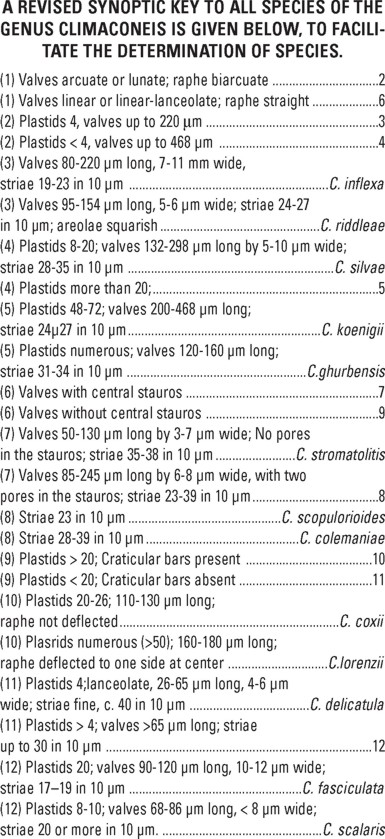
<?xml version="1.0" encoding="ISO-8859-1"?><article xmlns:mml="http://www.w3.org/1998/Math/MathML" xmlns:xlink="http://www.w3.org/1999/xlink" xmlns:xsi="http://www.w3.org/2001/XMLSchema-instance">
<front>
<journal-meta>
<journal-id>0188-8897</journal-id>
<journal-title><![CDATA[Hidrobiológica]]></journal-title>
<abbrev-journal-title><![CDATA[Hidrobiológica]]></abbrev-journal-title>
<issn>0188-8897</issn>
<publisher>
<publisher-name><![CDATA[Universidad Autónoma Metropolitana, División de Ciencias Biológicas y de la Salud]]></publisher-name>
</publisher>
</journal-meta>
<article-meta>
<article-id>S0188-88972003000100002</article-id>
<title-group>
<article-title xml:lang="en"><![CDATA[Fine structure and taxonomy of two species of the marine diatom genus Climaconeis (Berkeleyaceae, Bacillariophyta): C. silvae sp. nov. and C. riddleae sp. nov. from the Caribbean Sea and Florida bay, USA]]></article-title>
<article-title xml:lang="es"><![CDATA[Ultraestructura y taxonomía de dos especies de diatomeas marinos Climaconeis (Berkeleyaceae, Bacillariophyta): C. silvae sp. nov. y C. riddleae sp. nov. del Mar Caribe y de la Bahía de Florida, USA]]></article-title>
</title-group>
<contrib-group>
<contrib contrib-type="author">
<name>
<surname><![CDATA[Prasad]]></surname>
<given-names><![CDATA[A. K. S. K.]]></given-names>
</name>
<xref ref-type="aff" rid="A01"/>
</contrib>
</contrib-group>
<aff id="A01">
<institution><![CDATA[,Florida State University Department of Biological Science ]]></institution>
<addr-line><![CDATA[Tallahassee Florida]]></addr-line>
<country>Estados Unidos de América</country>
</aff>
<pub-date pub-type="pub">
<day>00</day>
<month>00</month>
<year>2003</year>
</pub-date>
<pub-date pub-type="epub">
<day>00</day>
<month>00</month>
<year>2003</year>
</pub-date>
<volume>13</volume>
<numero>1</numero>
<fpage>9</fpage>
<lpage>22</lpage>
<copyright-statement/>
<copyright-year/>
<self-uri xlink:href="http://www.scielo.org.mx/scielo.php?script=sci_arttext&amp;pid=S0188-88972003000100002&amp;lng=en&amp;nrm=iso"></self-uri><self-uri xlink:href="http://www.scielo.org.mx/scielo.php?script=sci_abstract&amp;pid=S0188-88972003000100002&amp;lng=en&amp;nrm=iso"></self-uri><self-uri xlink:href="http://www.scielo.org.mx/scielo.php?script=sci_pdf&amp;pid=S0188-88972003000100002&amp;lng=en&amp;nrm=iso"></self-uri><abstract abstract-type="short" xml:lang="en"><p><![CDATA[Two new species of marine biraphid diatoms of the genus Climaconeis, C. silvae, collected from several localities in Puerto Rico (Caribbean Sea), and C. riddleae, from two localities in Florida Bay, USA, are described by light and scanning electron microscopy. Climaconeis silvae is characterized by long arcuate cells (132-298 µm long and 5-10 µm wide) with extremely fine striae (28-35 in 10 µm), transapically elongated poroid areolae, biarcuate eccentric raphe, both polar and central raphe endings externally deflected toward the ventral side, 8-20 H-shaped plastids, and absence of central stauros and associated pores. Climaconeis riddleae is characterized by arcuate, asymmetrical cells, 4 plastids, valves measuring 82-182 µm long and 4-6 µm wide, transapical striae 24-27 in 10 µm, each stria composed of single row of squarish poroid areolae, and an almost central raphe. Climaconeis silvae and C. riddleae closely resemble only three other arcuate species, C. inflexa, C. ghurbensis and C. koenigii, in valve shape and in structure and arrangement of the striae but differ from them in stria density, number of plastids, valve dimensions, and some fine structural detail. They are compared with other members of the genus, including the generitype, C. lorenzii. A revised synoptic key to the 13 known species of Climaconeis is presented.]]></p></abstract>
<abstract abstract-type="short" xml:lang="es"><p><![CDATA[Se describen dos nuevas especies para la ciencia de diatomeas birafidas, ambas del género Climaconeis; C. silvae, recolectada en varias localidades de Puerto Rico (Mar Caribe) y C. riddleae, proveniente de dos localidades de la bahía de Florida, USA. Las descripciones se basan en microscopía de luz y electrónica. Climaconeis silvae está caracterizada por células largas y arqueadas (132-298 µm longitud y 5-10 µm anchura) con estrías extremadamente finas (28-35 en 10 µm), areolas poroides elongadas transapicalmente, rafe eccéntrico biarqueado, los extremos polar y central del rafe curvados hacia el lado ventral, de 8 a 20 plastos en forma de H. Ausencia de estauro central y de poros asociados. Climaconeis riddleae se caracteriza por células asimétricas y curvadas con 4 plastos, valvas de 82-182 µm de longitud y 4-6 µm de ancho, estrías transapicales, 24-27 en 10 µm, cada estría compuesta por una sola hilera de aereolas cuadradas y poradas, rafe casi central. Climaconeis silvae y C. riddleae se parecen solamente a otras tres especies arquedas, C. inflexa, C. ghurbensis y C. koenigii, en la forma de la valva y en la estructura y arreglo de las estrías pero difieren en la densidad de estrías, número de plastos, dimensiones de la valva y en algunos detalles estructurales finos. Estas especies son comparadas con otros miembros del género, incluyendo al tipo genérico, C. lorenzii. Se anexó una clave sinóptica para las 13 especies conocidas de Climaconeis.]]></p></abstract>
<kwd-group>
<kwd lng="en"><![CDATA[Biraphid diatoms]]></kwd>
<kwd lng="en"><![CDATA[Climaconeis]]></kwd>
<kwd lng="en"><![CDATA[C. silvae]]></kwd>
<kwd lng="en"><![CDATA[C. riddleae]]></kwd>
<kwd lng="en"><![CDATA[Florida Bay]]></kwd>
<kwd lng="en"><![CDATA[Caribbean Sea]]></kwd>
<kwd lng="en"><![CDATA[Berkeleyaceae]]></kwd>
<kwd lng="en"><![CDATA[fine structure]]></kwd>
<kwd lng="en"><![CDATA[taxonomy]]></kwd>
<kwd lng="es"><![CDATA[Diatomeas birafidas]]></kwd>
<kwd lng="es"><![CDATA[Climaconeis]]></kwd>
<kwd lng="es"><![CDATA[C. silvae]]></kwd>
<kwd lng="es"><![CDATA[C. riddleae]]></kwd>
<kwd lng="es"><![CDATA[Florida Bay]]></kwd>
<kwd lng="es"><![CDATA[Mar Caribe]]></kwd>
<kwd lng="es"><![CDATA[Berkeleyaceae]]></kwd>
<kwd lng="es"><![CDATA[ultraestructura]]></kwd>
<kwd lng="es"><![CDATA[taxonomía]]></kwd>
</kwd-group>
</article-meta>
</front><body><![CDATA[ <p align="justify"><font face="Verdana" size="4">Article</font></p>     <p align="justify"><font face="Verdana" size="2">&nbsp;</font></p>     <p align="center"><font face="verdana" size="4"><b>Fine structure and taxonomy of two species of the marine diatom genus <i>Climaconeis</i> (Berkeleyaceae, Bacillariophyta): <i>C. silvae</i> sp. nov. and <i>C. riddleae</i> sp. nov. from the Caribbean Sea and Florida bay, USA</b></font></p>     <p align="justify"><font face="Verdana" size="2">&nbsp;</font></p>     <p align="center"><font face="verdana" size="3"><b>Ultraestructura y taxonom&iacute;a de dos especies de diatomeas marinos <i>Climaconeis</i> (Berkeleyaceae, Bacillariophyta): <i>C. silvae</i> sp. nov. y <i>C. riddleae</i> sp. nov. del Mar Caribe y de la Bah&iacute;a de Florida, USA</b></font></p>     <p align="justify"><font face="Verdana" size="2">&nbsp;</font></p>     <p align="center"><font face="verdana" size="2"><b>A. K. S. K. Prasad</b></font></p>     <p align="justify"><font face="Verdana" size="2">&nbsp;</font></p>     <p align="justify"><font face="verdana" size="2"><i>Department of Biological Science. Florida State University. Tallahassee, FL 32306&#45;1100 USA. Fax: 1 850 644 9829</i> E&#45;mail: <a href="mailto:prasad@bio.fsu.edu">prasad@bio.fsu.edu</a></font></p>     <p align="justify"><font face="Verdana" size="2">&nbsp;</font></p>     ]]></body>
<body><![CDATA[<p align="justify"><font face="verdana" size="2">Recibido: 19 de julio de 2002.    <br>Aceptado: 30 de enero de 2003.</font></p>     <p align="justify"><font face="Verdana" size="2">&nbsp;</font></p>     <p align="justify"><font face="verdana" size="2"><b>Abstract</b></font></p>     <p align="justify"><font face="verdana" size="2">Two new species of marine biraphid diatoms of the genus <i>Climaconeis, C. silvae</i>, collected from several localities in Puerto Rico (Caribbean Sea), and <i>C. riddleae</i>, from two localities in Florida Bay, USA, are described by light and scanning electron microscopy. <i>Climaconeis silvae</i> is characterized by long arcuate cells (132&#45;298 &micro;m long and 5&#45;10 &micro;m wide) with extremely fine striae (28&#45;35 in 10 &micro;m), transapically elongated poroid areolae, biarcuate eccentric raphe, both polar and central raphe endings externally deflected toward the ventral side, 8&#45;20 H&#45;shaped plastids, and absence of central stauros and associated pores. <i>Climaconeis riddleae</i> is characterized by arcuate, asymmetrical cells, 4 plastids, valves measuring 82&#45;182 &micro;m long and 4&#45;6 &micro;m wide, transapical striae 24&#45;27 in 10 &micro;m, each stria composed of single row of squarish poroid areolae, and an almost central raphe. <i>Climaconeis silvae</i> and <i>C. riddleae</i> closely resemble only three other arcuate species, <i>C. inflexa, C. ghurbensis</i> and <i>C. koenigii</i>, in valve shape and in structure and arrangement of the striae but differ from them in stria density, number of plastids, valve dimensions, and some fine structural detail. They are compared with other members of the genus, including the generitype, <i>C. lorenzii</i>. A revised synoptic key to the 13 known species of <i>Climaconeis</i> is presented.</font></p>     <p align="justify"><font face="verdana" size="2"><b>Key words:</b> Biraphid diatoms, <i>Climaconeis, C. silvae, C. riddleae</i>, Florida Bay, Caribbean Sea, Berkeleyaceae, fine structure, taxonomy.</font></p>     <p align="justify"><font face="Verdana" size="2">&nbsp;</font></p>     <p align="justify"><font face="verdana" size="2"><b>Resumen</b></font></p>     <p align="justify"><font face="verdana" size="2">Se describen dos nuevas especies para la ciencia de diatomeas birafidas, ambas del g&eacute;nero <i>Climaconeis; C. silvae</i>, recolectada en varias localidades de Puerto Rico (Mar Caribe) y <i>C. riddleae</i>, proveniente de dos localidades de la bah&iacute;a de Florida, USA. Las descripciones se basan en microscop&iacute;a de luz y electr&oacute;nica. <i>Climaconeis silvae</i> est&aacute; caracterizada por c&eacute;lulas largas y arqueadas (132&#45;298 &micro;m longitud y 5&#45;10 &micro;m anchura) con estr&iacute;as extremadamente finas (28&#45;35 en 10 &micro;m), areolas poroides elongadas transapicalmente, rafe ecc&eacute;ntrico biarqueado, los extremos polar y central del rafe curvados hacia el lado ventral, de 8 a 20 plastos en forma de H. Ausencia de estauro central y de poros asociados. <i>Climaconeis riddleae</i> se caracteriza por c&eacute;lulas asim&eacute;tricas y curvadas con 4 plastos, valvas de 82&#45;182 &micro;m de longitud y 4&#45;6 &micro;m de ancho, estr&iacute;as transapicales, 24&#45;27 en 10 &micro;m, cada estr&iacute;a compuesta por una sola hilera de aereolas cuadradas y poradas, rafe casi central. <i>Climaconeis silvae</i> y <i>C. riddleae</i> se parecen solamente a otras tres especies arquedas, <i>C. inflexa, C. ghurbensis</i> y <i>C. koenigii</i>, en la forma de la valva y en la estructura y arreglo de las estr&iacute;as pero difieren en la densidad de estr&iacute;as, n&uacute;mero de plastos, dimensiones de la valva y en algunos detalles estructurales finos. Estas especies son comparadas con otros miembros del g&eacute;nero, incluyendo al tipo gen&eacute;rico, <i>C. lorenzii</i>. Se anex&oacute; una clave sin&oacute;ptica para las 13 especies conocidas de <i>Climaconeis</i>.</font></p>     <p align="justify"><font face="verdana" size="2"><b>Palabras clave:</b> Diatomeas birafidas, <i>Climaconeis, C. silvae, C. riddleae</i>, Florida Bay, Mar Caribe, Berkeleyaceae, ultraestructura, taxonom&iacute;a.</font></p>     ]]></body>
<body><![CDATA[<p align="justify"><font face="Verdana" size="2">&nbsp;</font></p>     <p align="justify"><font face="verdana" size="2"><b>Introduction</b></font></p>     <p align="justify"><font face="verdana" size="2">In 1868 (see Mereschkowsky, 1901:415), Eulenstein proposed in an unpublished manuscript, the diatom genus <i>Okedenia</i> to accommodate an arcuate marine diatom with biarcuate raphe system, <i>Amphipleura inflexa</i> Br&eacute;bisson ex K&uuml;tzing (1849:88). De Toni (1891:229) validated the generic name with a Latin description and placed three species in the genus, including <i>Okedenia inflexa</i> (Br&eacute;bisson) Eulenstein ex De Toni and two other questionable forms, <i>O?. japonica</i> (Suringar) De Toni and <i>O?. cretae</i> (Ehrenberg) De Toni. Mereschkowsky (1901:422) provided an emended description of the genus and included both arcuate, asymmetrical and straight, linear forms&#151;a total of eight taxa, including two new species. He resurrected the genus <i>Okedenia</i>, solely on the basis of plastid morphology, a character that could not be used satisfactorily in the identification of the species in the genus.</font></p>     <p align="justify"><font face="verdana" size="2">Grunow (1862:421) described the genus <i>Climaconeis</i> to accommodate two straight, linear diatoms collected from marine localities off the Italian coast and from the Red Sea: <i>C. lorenzii</i> Grunow and <i>C. frauenfeldii</i> Grunow. Cox (1982) reviewed the nomenclatural and taxonomic history of the genus. In an extensive and thorough analysis of original as well as other authentic material, she found many structural similarities between <i>Okedenia</i> and <i>Climaconeis</i> and proposed to unite them under one genus, <i>Climaconeis</i>, which has nomenclatural priority over <i>Okedenia</i>. She also provided emended descriptions for the combined genus <i>Climaconeis</i> and its generitype, <i>C. lorenzii</i>. Cox (1982) included five linear, straight forms and a single arcuate, asymmetric diatom, <i>C. inflexa</i> (Br&eacute;bisson) E. J. Cox. John (1991) described a new symmetrical, straight species, <i>C. scopulorioides</i> John from Australian waters. Prasad <i>et al</i>. (2000) added two new species, the arcuate <i>C. koenigii</i> Prasad and the straight, linear <i>C. colemaniae</i> Prasad, from several localities in Florida Bay, USA. Recently, Reid and Williams (2002) described two new species of the genus, the arcuate <i>C. ghurbensis</i> G. Reid and D.M. Williams and the straight, linear form <i>C. coxii</i> G. Reid and D. M. Williams collected from several localities in Abu Dhabi, the United Arab Emirates.</font></p>     <p align="justify"><font face="verdana" size="2">The present paper is the second of a series of contributions dealing with the previously recorded taxa ascribed to the genus <i>Climaconeis</i> as well as the interesting new members of the genus recognized from Florida's coastal waters and nearby localities. <i>Climaconeis silvae</i> sp. nov. is described from Puerto Rico, and <i>C. riddleae</i> sp. nov. from Florida marine habitats. Structural studies have been made by light microscopy (LM) and scanning electron microscopy (SEM). The morphology and taxonomy of the new species are discussed and compared with those of similar taxa. A revised synoptic key to the 11 known species is also presented.</font></p>     <p align="justify"><font face="Verdana" size="2">&nbsp;</font></p>     <p align="justify"><font face="verdana" size="2"><b>Materials and methods</b></font></p>     <p align="justify"><font face="verdana" size="2">The material of <i>C. silvae</i> came from several periphyton collections from artificial substrates made during a 12&#45;mo study of six different locations in Mayag&uuml;ez, Puerto Rico, Caribbean Sea, in 1990&#45;91. The material of <i>C. riddleae</i> came from coral&#45;reef&#45;associated sediment samples collected by K. A. Riddle from two different Florida Bay locations, Cotton Key (25&deg;02'N, 80&deg;37'W) and West Key (24&deg;59'N, 80&deg;38.9'W), in June 1993. Additional material was obtained from six other locations in Florida Bay, collected in October 1997, May 1998, and October 1998. (For further details, see Prasad <i>et al</i>. 2000, 2001). Samples were preserved in either seawater&#45;based formalin or Lugol's solution. Material for light microscopy (LM) and scanning electron microscopy (SEM) was prepared as described by Prasad and Fryxell (1991) and Prasad <i>et al</i>. (1990). LM observations were carried out with a Nikon Labophot&#45;II equipped with phase&#45;contrast optics, Nikon Micropot&#45;FX&#45;35 and Leica&#45;DMLB microscopes fitted with differential&#45;interference&#45;contrast (DIC) objectives, and a Leica MPS&#45;60 35&#45;mm camera. Acid&#45;cleaned material of <i>C. silvae</i> and <i>C. riddleae</i> mounted on aluminum stubs was sputter&#45;coated with gold&#45;palladium and examined in a JEOL&#45;840 scanning electron microscope using Polaroid 4"x5" film, operating at an accelerating voltage of 20 kV at the Florida State University's Biological Science Imaging Resource.</font></p>     <p align="justify"><font face="verdana" size="2">Terminology used is that of Anonymous (1975), Ross <i>et al</i>. (1979), Cox (1979a), and Cox and Ross (1981). Ross <i>et al.</i> (1979) defined an areola as a regular perforation through the basal siliceous layer and striae as rows of areolae, normally occluded by vela or cribra. Mann (1981) refined the terminology of pore occlusions and recommended that the delicate siliceous membrane across the entire pore be called a "hymen" (replacing the "rica" of Ross <i>et al</i>. 1979). Cox and Ross (1981; see also Cox 1999) introduced two terms to describe the structure of striae: "virgae" for the bars between the striae, to replace "interstriae" of Ross <i>et al</i>. (1979) and "costae," and "vimines" for the crossbars that separate areolae within a stria. They also suggested that striae with a single row of areolae be called uniseriate. In Cox (1977), Mann and Cox proposed the term "helictoglossae" for thickened internal polar raphe endings, replacing the "lipped endings" of Cox (1975) and "infundibulum" of Anonymous (1975).</font></p>     <p align="justify"><font face="Verdana" size="2">&nbsp;</font></p>     ]]></body>
<body><![CDATA[<p align="justify"><font face="verdana" size="2"><b>Observations</b></font></p>     <p align="justify"><font face="verdana" size="2">Order: Naviculales Bessey 1907</font></p>     <p align="justify"><font face="verdana" size="2">Family: Berkeleyaceae D. G. Mann in Round <i>et al</i>. 1990.</font></p>     <p align="justify"><font face="verdana" size="2">Genus: <i>Climaconeis</i> Cleve 1862 emend Cox 1982.</font></p>     <p align="justify"><font face="verdana" size="2"><i><b>Climaconeis silvae</b></i> A.K.S.K. Prasad <i>sp. nov.</i> (<a href="/img/revistas/hbio/v13n1/a2f1.jpg" target="_blank">Figs. 1</a>&#45;<a href="/img/revistas/hbio/v13n1/a2f3.jpg" target="_blank">25</a> (<a href="/img/revistas/hbio/v13n1/a2f1.jpg" target="_blank">2</a>, <a href="/img/revistas/hbio/v13n1/a2f1.jpg" target="_blank">3</a>, <a href="/img/revistas/hbio/v13n1/a2f1.jpg" target="_blank">4</a>, <a href="/img/revistas/hbio/v13n1/a2f1.jpg" target="_blank">5</a>, <a href="/img/revistas/hbio/v13n1/a2f1.jpg" target="_blank">6</a>, <a href="/img/revistas/hbio/v13n1/a2f1.jpg" target="_blank">7</a>, <a href="/img/revistas/hbio/v13n1/a2f1.jpg" target="_blank">8</a>, <a href="/img/revistas/hbio/v13n1/a2f1.jpg" target="_blank">9</a>, <a href="/img/revistas/hbio/v13n1/a2f2.jpg" target="_blank">10</a>, <a href="/img/revistas/hbio/v13n1/a2f2.jpg" target="_blank">11</a>, <a href="/img/revistas/hbio/v13n1/a2f2.jpg" target="_blank">12</a>, <a href="/img/revistas/hbio/v13n1/a2f2.jpg" target="_blank">13</a>, <a href="/img/revistas/hbio/v13n1/a2f2.jpg" target="_blank">14</a>, <a href="/img/revistas/hbio/v13n1/a2f2.jpg" target="_blank">15</a>, <a href="/img/revistas/hbio/v13n1/a2f2.jpg" target="_blank">16</a>, <a href="/img/revistas/hbio/v13n1/a2f2.jpg" target="_blank">17</a>, <a href="/img/revistas/hbio/v13n1/a2f3.jpg" target="_blank">18</a>, <a href="/img/revistas/hbio/v13n1/a2f3.jpg" target="_blank">19</a>, <a href="/img/revistas/hbio/v13n1/a2f3.jpg" target="_blank">20</a>, <a href="/img/revistas/hbio/v13n1/a2f3.jpg" target="_blank">21</a>, <a href="/img/revistas/hbio/v13n1/a2f3.jpg" target="_blank">22</a>, <a href="/img/revistas/hbio/v13n1/a2f3.jpg" target="_blank">23</a>, <a href="/img/revistas/hbio/v13n1/a2f3.jpg" target="_blank">24</a>)).</font></p>     <p align="justify"><font face="verdana" size="2">Description: <i>Cellulae solitariae, marinae, epipelicae vel epiphyticae, cum</i> 8&#45;18(20) <i>chloroplastes inter cytoplasma centralem et apices. Valvae biarcuatae vel leviter lunatae, angustatae, leviter asymmetricae secus axem apicalem, latiores et fere rectae ad centrum, gradatim decrescentes secus apicem; apices obtusi, rotundati, non&#45;capitati. Longitudo valvae</i> 132&#45;298 &micro;m, <i>latitudo</i> 5&#45;10 &micro;m; <i>valvae latiores ad centrum, angustiores ad apices. Valvae, aspecto valvae, planae; limbus non profundum cum margine distincto et hyalino. Striae transapicales parallelae</i>, 38&#45;35 <i>in</i> 10 &micro;m, <i>leviter radiantes super polos, in latis oppositis sterni raphis numero plus minusve aequales. Striae uniseriatae, cum poroideis areolis rectangularibus et elongatis transapicaliter. Virgae variabiles latitudine; vimines breves. Striae in lato ventrali sterni raphis cum</i> 9&#45;12 <i>areolis, in lato dorsali cum</i> 3&#45;6 <i>areolis. In aream centralem, striae in lato dorsali raphi longiores (9&#45;12 areolae), striae in lato ventrali raphi breviores</i> (3&#45;6 <i>areolae</i>). <i>Areolae amplitudine variabiles; areolae prope sternum raphis aliquando majorem. Raphe&#45;systema biarcuatum, proximum ad lato ventrali ad centrum, ad lato dorsali ad apicem. Area centralis</i> 3.0&#45;4.8 &micro;m <i>longitudine. Extrema raphis polaria centraliaque leviter ventraliter deflecta. Raphe internaliter et externaliter incrassatum ventraliter, externaliter non&#45;uniformiter, internaliter uniformiter pro longitudine raphis. Externaliter extrema polaria raphis leviter plus expansum quam extrema centralia et deflecta ventraliter manifeste.</i></font></p>     <p align="justify"><font face="verdana" size="2">Holotype: Slide BM100979(PC91103) is deposited in the Natural History Museum (BM), London. It bears several specimens; a specimen can be located on the slide at England Finder (Graticules, Ltd., UK) coordinates N&#45;47&#45;1.</font></p>     <p align="justify"><font face="verdana" size="2">Isotypes: Slide PC91103 is deposited in the Academy of Natural Sciences of Philadelphia (ANSP), USA. The other iso&#45;types are in the author's collection (PC, Prasad Collection): PC91102, PC91104, PC98085, PC98086, PC98087, and PC98088.</font></p>     <p align="justify"><font face="verdana" size="2">Type Locality: Mayag&uuml;ez, Puerto Rico, Station D. Periphyton (artificial substrate). Collected on 6&#45;18&#45;1990. Temperature 28&deg;C, salinity 35.2 parts per thousand.</font></p>     <p align="justify"><font face="verdana" size="2">Etymology: The species is named for Dr. Paul C. Silva, an eminent botanist, from University of California, Berkeley, California, USA, in recognition and appreciation of his outstanding contributions in phycology and botanical nomenclature.</font></p>     ]]></body>
<body><![CDATA[<p align="justify"><font face="verdana" size="2">Cells are solitary, free living, marine, epipelic (<a href="/img/revistas/hbio/v13n1/a2f1.jpg" target="_blank">Fig. 1</a>) or epiphytic on macroalgae, each with variable number of plastids, between 8 and 18 (rarely 20), depending on the cell size, distributed along the cell from the central cytoplasm to the cell apices (<a href="/img/revistas/hbio/v13n1/a2f1.jpg" target="_blank">Figs. 4&#45;8</a>). The valves are arcuate or slightly lunate, narrow, slightly asymmetrical along the apical axis, wider and almost straight at the center and gradually narrowing and curving along the obtuse apices (<a href="/img/revistas/hbio/v13n1/a2f1.jpg" target="_blank">Figs. 2&#45;9</a>), which are rounded and not capitate (<a href="/img/revistas/hbio/v13n1/a2f2.jpg" target="_blank">Figs. 12</a>, <a href="/img/revistas/hbio/v13n1/a2f2.jpg" target="_blank">14</a>). They measure 132&#45;298 &micro;m long in apical axis and are 5&#45;10 &micro;m wide; wider at the center and narrower at the apices. The valve face is flat, and the mantle is shallow and has a distinct hyaline rim (<a href="/img/revistas/hbio/v13n1/a2f3.jpg" target="_blank">Figs. 18</a>, <a href="/img/revistas/hbio/v13n1/a2f3.jpg" target="_blank">19</a>). The transapical striae, 28&#45;35 in 10 &micro;m, are parallel (<a href="/img/revistas/hbio/v13n1/a2f3.jpg" target="_blank">Figs. 18&#45;23</a>) throughout, except at the apices, where they become slightly radiating over the poles (<a href="/img/revistas/hbio/v13n1/a2f3.jpg" target="_blank">Figs. 18</a>, <a href="/img/revistas/hbio/v13n1/a2f3.jpg" target="_blank">19</a>, <a href="/img/revistas/hbio/v13n1/a2f3.jpg" target="_blank">24</a>, <a href="/img/revistas/hbio/v13n1/a2f3.jpg" target="_blank">25</a>). The density of the striae is almost uniform on both sides of the raphe sternum. They are uniseriate (<a href="/img/revistas/hbio/v13n1/a2f3.jpg" target="_blank">Figs. 18&#45;23</a>); each consists of rectangular poroid areolae, which are transapically elongated throughout except at the poles, where they are apically slightly radiating (<a href="/img/revistas/hbio/v13n1/a2f3.jpg" target="_blank">Figs. 18</a>, <a href="/img/revistas/hbio/v13n1/a2f3.jpg" target="_blank">19</a>, <a href="/img/revistas/hbio/v13n1/a2f3.jpg" target="_blank">22&#45;25</a>). The virgae ("inter&#45;striae") are of variable width, and the vimines (cross bars) separating the areolae are short. Because of the off&#45;center (eccentric) location of the raphe, striae are longer on the ventral side of the raphe sternum (9&#45;12 areolae; <a href="/img/revistas/hbio/v13n1/a2f3.jpg" target="_blank">Figs. 18</a>, <a href="/img/revistas/hbio/v13n1/a2f3.jpg" target="_blank">19</a>, <a href="/img/revistas/hbio/v13n1/a2f3.jpg" target="_blank">22</a>, <a href="/img/revistas/hbio/v13n1/a2f3.jpg" target="_blank">23</a>) than on the dorsal side (3&#45;6 areolae). In the central area, where the raphe is close to the ventral (concave) side, striae are longer on the dorsal (primary) side (9&#45;12 areolae) of the raphe than on the ventral side (3&#45;6 areolae). The areolae within each stria are variable in size; those adjacent to the raphe sternum are at times larger (<a href="/img/revistas/hbio/v13n1/a2f3.jpg" target="_blank">Figs. 18</a>, <a href="/img/revistas/hbio/v13n1/a2f3.jpg" target="_blank">19</a>, <a href="/img/revistas/hbio/v13n1/a2f3.jpg" target="_blank">20</a>, <a href="/img/revistas/hbio/v13n1/a2f3.jpg" target="_blank">21</a>) than elsewhere, as in other species of the genus examined by SEM. The raphe system, like the valves, is biarcuate (<a href="/img/revistas/hbio/v13n1/a2f2.jpg" target="_blank">Figs. 11</a>, <a href="/img/revistas/hbio/v13n1/a2f2.jpg" target="_blank">13</a>, <a href="/img/revistas/hbio/v13n1/a2f2.jpg" target="_blank">15</a>, <a href="/img/revistas/hbio/v13n1/a2f2.jpg" target="_blank">16</a>); unlike those of other arcuate species of the genus, it is not central but eccentric, much closer to the ventral (concave) side of the valve (<a href="/img/revistas/hbio/v13n1/a2f2.jpg" target="_blank">Figs. 11</a>, <a href="/img/revistas/hbio/v13n1/a2f2.jpg" target="_blank">13</a>, <a href="/img/revistas/hbio/v13n1/a2f2.jpg" target="_blank">15</a>, <a href="/img/revistas/hbio/v13n1/a2f2.jpg" target="_blank">16</a>), gradually running closer to the dorsal (convex) side near the apices (<a href="/img/revistas/hbio/v13n1/a2f2.jpg" target="_blank">Figs. 10</a>, <a href="/img/revistas/hbio/v13n1/a2f2.jpg" target="_blank">12&#45;14</a>, <a href="/img/revistas/hbio/v13n1/a2f2.jpg" target="_blank">17</a>). The length of the central area between the two central raphe endings is 3.0&#45;4.8 &micro;m. Both at the center (<a href="/img/revistas/hbio/v13n1/a2f3.jpg" target="_blank">Fig. 20</a>) and at the poles (<a href="/img/revistas/hbio/v13n1/a2f3.jpg" target="_blank">Figs. 18</a>, <a href="/img/revistas/hbio/v13n1/a2f3.jpg" target="_blank">19</a>), the external raphe fissures are deflected in the same direction, i.e. slightly toward the ventral (secondary) side. The raphe is not flush with the valve surface; both externally (<a href="/img/revistas/hbio/v13n1/a2f3.jpg" target="_blank">Figs. 18</a>, <a href="/img/revistas/hbio/v13n1/a2f3.jpg" target="_blank">19</a>) and internally (<a href="/img/revistas/hbio/v13n1/a2f3.jpg" target="_blank">Figs. 22</a>, <a href="/img/revistas/hbio/v13n1/a2f3.jpg" target="_blank">23</a>), additional thickening occurs on only one (i.e. the ventral) side of the raphe sternum. The raphe sternum is additionally thickened on the exterior, not uniformly but at intervals, whereas, internally, the additional thickening appears to be uniform throughout the length of the raphe. The additional thickening seems more evident on the secondary side of the raphe sternum. Externally, the polar raphe endings are more expanded than the central raphe endings, and the curvature toward the ventral side is evident. Internally, variation is apparent within the same valve; it is either straight (<a href="/img/revistas/hbio/v13n1/a2f3.jpg" target="_blank">Fig. 25</a>) or slightly deflected. The internal raphe fissures terminate at the poles into uniformly thickened, raised helictoglossae (<a href="/img/revistas/hbio/v13n1/a2f3.jpg" target="_blank">Figs. 22</a>, <a href="/img/revistas/hbio/v13n1/a2f3.jpg" target="_blank">23</a>, <a href="/img/revistas/hbio/v13n1/a2f3.jpg" target="_blank">24</a>, <a href="/img/revistas/hbio/v13n1/a2f3.jpg" target="_blank">25</a>) but not at the central raphe endings (<a href="/img/revistas/hbio/v13n1/a2f3.jpg" target="_blank">Fig. 22</a>). The axial areas and the terminal fissures are refractive. There is no hyaline area between the helictoglossae and the polar mantles (<a href="/img/revistas/hbio/v13n1/a2f3.jpg" target="_blank">Figs. 24</a>, <a href="/img/revistas/hbio/v13n1/a2f3.jpg" target="_blank">25</a>); the row of slits on the polar mantle usually seen in other species is also absent. Girdle bands are open, each     bearing two rows of poroid areolae.</font></p>     <p align="justify"><font face="verdana" size="2">Remarks: <i>Climaconeis silvae</i> was first noticed in epiphytic collections from station BRA, DPA in March&#45;May 1990 but found growing on artificial substrates in large numbers at Station C and Station D, Puerto Rico, and in surface sediment samples in June 1990. The diatom species that were dominant in the samples include <i>Toxarium undulatum</i> Bailey, <i>Toxarium kennedyarum</i> Grunow, <i>Ardissonia fulgens</i> var. <i>mediterranea</i> Grunow, and <i>Licmophora remulus</i> Grunow. The subdominants were <i>L. flabellata</i> (Carmichael) Agardh, <i>Climacosphenia moniligera</i> Ehrenberg, and <i>Haslea</i> sp. As far as I know, <i>C. silvae</i> is the first arcuate member of the genus ever recorded and only the second species of the genus for Puerto Rico and for the entire Caribbean (see Navarro and Hern&aacute;ndez&#45;Becerril 1997); <i>C. lorenzii</i> (as <i>Navicula scopulorum</i> Br&eacute;bisson) was known to be widely distributed from San Juan Bay, Puerto Rico (Hagelstein 1939).</font></p>     <p align="justify"><font face="verdana" size="2"><i>Climaconeis silvae</i> is characterized by its long, narrow arcuate cells, with 8&#45;20 plastids, fine uniseriate striae of poroid areolae that are transapically elongated, eccentric raphe sternum (closer to the valve margin rather than central), and deflection of both the external polar raphe fissures and central raphe fissures toward the same side of the valve. It differs sufficiently from the generitype, <i>C. lorenzii</i>, in being arcuate with a biarcuate raphe system, instead of straight, linear valves; in lacking craticular bars on the girdle; in having much finer (denser) striae (28&#45;35 rather than 21 in 10 &micro;m); and in having fewer plastids (8&#45;20 rather than 70). <i>Climaconeis silvae</i> differs sufficiently from all the four arcuate species of the genus known thus far, <i>C. ghurbensis</i> (Reid and Williams 2002), <i>C. inflexa, C. koenigii</i> (Prasad <i>et al</i>. 2000), and <i>C. riddleae</i> Prasad (this paper), in the number of plastids, density of striae, and valve measurements. <i>Climaconeis ghurbensis</i> shows greater resemblance to <i>C. silvae</i> in shape but differs in having a valve length of 120&#45;160 &micro;m, a width of 4&#45;5 &micro;m and in the presence of numerous plastids (Reid and Williams 2002). <i>C. silvae</i> resembles <i>C. riddleae</i> in many ways but can be distinguished from it by plastid number, valve dimensions, and most importantly, the eccentric raphe system, which runs closer to the valve margin, and the parallel uniseriate striae composed of transapically elongated poroid areolae rather than squarish areolae. Virgae and vimines are all of uniform thickness and length in <i>C. riddleae</i>, whereas in <i>C. silvae</i>, virgae are of variable width, and the vimines (crossbars) separating the areolae are shorter than those in <i>C. riddleae</i> and variable in length. Comparisons with the other members of the genus are presented in <a href="/img/revistas/hbio/v13n1/a2c1.jpg" target="_blank">Table 1</a>. The valves of <i>Climaconeis silvae</i> have a structure similar to that of <i>C. inflexa</i> (syn. <i>Okedenia inflexa</i> (Br&eacute;bisson) Eulenstein) and a species that Cox (1979a) had indicated as corresponding to <i>Okedenia scopulorum</i> sensu Mereschkowsky (1902) (see Cox 1979a <a href="/img/revistas/hbio/v13n1/a2f4.jpg" target="_blank">figs. 30</a>, <a href="/img/revistas/hbio/v13n1/a2f4.jpg" target="_blank">31</a>, 1979b).</font></p>     <p align="justify"><font face="verdana" size="2"><i><b>Climaconeis riddleae</b></i> A.K.S.K. Prasad <i>sp. nov.</i> (<a href="/img/revistas/hbio/v13n1/a2f4.jpg" target="_blank">Figs 26</a>&#45;<a href="/img/revistas/hbio/v13n1/a2f5.jpg" target="_blank">41</a> (<a href="/img/revistas/hbio/v13n1/a2f4.jpg" target="_blank">27</a>, <a href="/img/revistas/hbio/v13n1/a2f4.jpg" target="_blank">28</a>, <a href="/img/revistas/hbio/v13n1/a2f4.jpg" target="_blank">29</a>, <a href="/img/revistas/hbio/v13n1/a2f4.jpg" target="_blank">30</a>, <a href="/img/revistas/hbio/v13n1/a2f4.jpg" target="_blank">31</a>, <a href="/img/revistas/hbio/v13n1/a2f4.jpg" target="_blank">32</a>, <a href="/img/revistas/hbio/v13n1/a2f4.jpg" target="_blank">33</a>, <a href="/img/revistas/hbio/v13n1/a2f5.jpg" target="_blank">34</a>, <a href="/img/revistas/hbio/v13n1/a2f5.jpg" target="_blank">35</a>, <a href="/img/revistas/hbio/v13n1/a2f5.jpg" target="_blank">36</a>, <a href="/img/revistas/hbio/v13n1/a2f5.jpg" target="_blank">37</a>, <a href="/img/revistas/hbio/v13n1/a2f5.jpg" target="_blank">38</a>, <a href="/img/revistas/hbio/v13n1/a2f5.jpg" target="_blank">39</a>, <a href="/img/revistas/hbio/v13n1/a2f5.jpg" target="_blank">40</a>)).</font></p>     <p align="justify"><font face="verdana" size="2">Description: <i>Cellulae solitariae, marinae, cum sedimento e corallio consociatae, cum</i> (2)4 <i>chloroplastes in ambabus lateribus cytoplasmatis centralis. Valvae arcuatae;</i> 82&#45;182 &micro;m <i>longitudino</i>, 4&#45;6 &micro;m <i>latitudino</i>. <i>Valvae ad centrum latiores, gradatim decrescentes secus apicem; apices obtusi, rotundati. Valva c</i>. 4.0 &micro;m <i>in latitudine minima</i>. <i>Pagina valvae plana; limbus&#45;humile cum margine distincto et hyalino, praecipue ad polos. Striae transapicales parallelae</i>, 24&#45;27 <i>in</i> 10 &micro;m, <i>aliquando leviter radiantes super polos. Striae uniseriatae, cum poroideis areolis quadrangularibus vel sub&#45;rectangularibus in latis oppositis sterni raphis numero plus minusve aequales. Areolae aliquot striarum leviter elongatae, praecipue ad polos. Raphe&#45;systema biarcuatum, fere centrale. Area centralis</i> 3.0&#45;3.5 &micro;m <i>longitudine. Extrema raphis polaria centraliaque leviter ventraliter deflecta. Internaliter extrema centralia raphis habitu recta. Helictoglossae uniformiter incrassatae elevataeque ad polaria sed non ad centralia extrema raphis. Raphe internaliter et externaliter incrassatum ventraliter, externaliter non&#45;uniformiter, internaliter uniformiter pro longitudine raphis. Area hyalina inter helictoglossa et pallia polaria deest; pallium polare sine rimis. Taeniae cingulares apertae, cum</i> 2 <i>seriebus areolarum poroidearum variabilium. Internaliter extrema polaria raphis leviter deflecta vel recta. Helictoglossae uniformiter incrassatae elevataeque ad polaria sed non ad centralia extrema raphis. Areae axiales et rimae terminales refractivae. Area hyalina inter helictoglossa et pallia polaria deest; pallium polare sine rimis. Taeniae cingulares apertae, cum</i> 2+ <i>seriebus areolarum poroidium.</i></font></p>     <p align="justify"><font face="verdana" size="2">Holotype: Slide BM100980(PC93441) is deposited in the Natural History Museum, London, UK. A number of specimens are present on the slide. One specimen is marked on the slide, at England Finder coordinates M&#45;33.</font></p>     <p align="justify"><font face="verdana" size="2">Isotypes: Slide PC 93443 is deposited in the Academy of Natural Sciences (ANSP), and a specimen can be located on the slide between England Finder coordinates K&#45;42&#45;2 and K43&#45;1. The other isotype slides, PC93439, PC93440, PC93442, and PC93444, are in the Prasad Collection.</font></p>     <p align="justify"><font face="verdana" size="2">Type Locality: Captain's Key, Florida Bay, USA. Epipelon. Collected on 8&#45;3&#45;1993 by Kimberley A. Riddle. Temperature and salinity data are not available.</font></p>     <p align="justify"><font face="verdana" size="2">Etymology: The species is named for Kimberly A. Riddle, of Florida State University's Department of Biological Science Imaging Resource.</font></p>     ]]></body>
<body><![CDATA[<p align="justify"><font face="verdana" size="2">The cells are solitary, marine, associated with coral reef sediments, each with 4 (rarely 2) plastids distributed on both sides of the central cytoplasm (<a href="/img/revistas/hbio/v13n1/a2f4.jpg" target="_blank">Fig. 26</a>). The valves are arcuate, measuring 82&#45;182 mm in length and 4&#45;6 mm in width. They are wider in the center and gradually become narrower toward the poles, which are obtuse with rounded ends (<a href="/img/revistas/hbio/v13n1/a2f4.jpg" target="_blank">Figs. 26&#45;30</a>, <a href="/img/revistas/hbio/v13n1/a2f4.jpg" target="_blank">32</a>&#45;<a href="/img/revistas/hbio/v13n1/a2f5.jpg" target="_blank">34</a> (<a href="/img/revistas/hbio/v13n1/a2f4.jpg" target="_blank">33</a>)). The narrowest part of the valve is c. 4.0 mm wide. The valve face is flat and the valve mantle shallow, with a distinct hyaline rim, especially evident on the polar mantles (<a href="/img/revistas/hbio/v13n1/a2f5.jpg" target="_blank">Figs. 36</a>, <a href="/img/revistas/hbio/v13n1/a2f5.jpg" target="_blank">37</a>). The transapical striae are parallel almost throughout the valve except at the extremities of the valve, where they may be slightly radiating and sometimes appear almost parallel like rest of the valve face (<a href="/img/revistas/hbio/v13n1/a2f5.jpg" target="_blank">Figs. 36</a>,<a href="/img/revistas/hbio/v13n1/a2f5.jpg" target="_blank">37</a>, <a href="/img/revistas/hbio/v13n1/a2f5.jpg" target="_blank">40</a>, <a href="/img/revistas/hbio/v13n1/a2f5.jpg" target="_blank">41</a>), 24&#45;27 striae in 10 mm. They are uniseriate, composed of squarish or subrectangular poroid areolae (not transapically elongated as in <i>C. silvae</i>). Some striae show areolae that are slightly apically elongated, especially at the apices. The number of areolae per stria is mostly uniform on each side of the raphe sternum; striae are shorter, consisting of only 6 areolae, on the primary side of the raphe sternum, except at the apices, where 4&#45;5 areolae are seen, whereas longer striae, each consisting of 7&#45;8 areolae, are seen on the secondary side of the raphe sternum, except at the poles, where they have fewer areolae (5&#45;7). The virgae ("interstriae") and the vimines (cross bars) are of equal thickness; the vimines separating the uniform areolae are all of the same length. In the wider central area, each stria is composed of 7&#45;10 areolae (<a href="/img/revistas/hbio/v13n1/a2f5.jpg" target="_blank">Fig. 38</a>). The areolae adjacent to the raphe sternum are of the same size as elsewhere (<a href="/img/revistas/hbio/v13n1/a2f5.jpg" target="_blank">Figs. 38</a>, <a href="/img/revistas/hbio/v13n1/a2f5.jpg" target="_blank">39</a>) or slightly larger than those on the rest of the valve (<a href="/img/revistas/hbio/v13n1/a2f5.jpg" target="_blank">Fig. 41</a>). The raphe system is biarcuate as in other arcuate species and is almost central (<a href="/img/revistas/hbio/v13n1/a2f4.jpg" target="_blank">Fig. 33</a>). The central area between the two central raphe endings is 3.0&#45;3.5 mm in length (<a href="/img/revistas/hbio/v13n1/a2f5.jpg" target="_blank">Fig. 38</a>). The polar and central raphe endings on the exterior are dot&#45;like (<a href="/img/revistas/hbio/v13n1/a2f4.jpg" target="_blank">Figs. 28</a>, <a href="/img/revistas/hbio/v13n1/a2f4.jpg" target="_blank">33</a>, <a href="/img/revistas/hbio/v13n1/a2f5.jpg" target="_blank">36</a>, <a href="/img/revistas/hbio/v13n1/a2f5.jpg" target="_blank">38</a>). The polar raphe endings are slightly deflected in the same direction, toward the secondary side (<a href="/img/revistas/hbio/v13n1/a2f5.jpg" target="_blank">Figs. 36</a>, <a href="/img/revistas/hbio/v13n1/a2f5.jpg" target="_blank">37</a>). Internally, thick, raised helictoglossae (<a href="/img/revistas/hbio/v13n1/a2f5.jpg" target="_blank">Figs. 40</a>, <a href="/img/revistas/hbio/v13n1/a2f5.jpg" target="_blank">41</a>) occur at the poles but not at the central raphe endings (<a href="/img/revistas/hbio/v13n1/a2f5.jpg" target="_blank">Fig. 38</a>). The central raphe endings appear to be straight internally (<a href="/img/revistas/hbio/v13n1/a2f5.jpg" target="_blank">Fig. 38</a>). Externally, the raphe sternum is not flush with the valve surface on the ventral side but irregularly thickened at intervals (<a href="/img/revistas/hbio/v13n1/a2f5.jpg" target="_blank">Fig. 35</a>, <a href="/img/revistas/hbio/v13n1/a2f5.jpg" target="_blank">36</a>. <a href="/img/revistas/hbio/v13n1/a2f5.jpg" target="_blank">37</a>); internally the additional thickening on the ventral side of raphe sternum is uniform (<a href="/img/revistas/hbio/v13n1/a2f5.jpg" target="_blank">Figs. 38&#45;41</a>) throughout. At the apices, there is no hyaline area between the polar mantle and helictoglossa. No distinct row of slits on the polar mantle, as seen in other species of the genus <i>(C. koenigii, C. stromatolitis)</i>, was observed. Girdle bands are open, each bearing two rows of poroid areolae of variable size.</font></p>     <p align="justify"><font face="verdana" size="2">Remarks: <i>Climaconeis riddleae</i> was seen in sediment samples retrieved from the coral reef surface at Captain Key and West Key in Florida Bay, USA. It was common but not abundant at the sites indicated. The more abundant diatoms were <i>Rhabdonema adriaticum</i> K&uuml;tzing. and <i>Synedra bacillaris</i> (Grunow) Hustedt. Other diatoms present were straight and linear forms, <i>Climaconeis scopulorioides</i> Hustedt (1961) and <i>C. colemaniae. Climaconeis riddleae</i> is characterized by arcuate, asymmetrical cells, 4 plastids, valves measuring 82&#45;182 &micro;m long and 4&#45;6 &micro;m wide, transapical striae 24&#45;27 in 10 &micro;m, each stria composed of a single row of squarish poroid areolae, and an almost central raphe. The only report of the occurrence of <i>Climaconeis</i> species from Florida Bay is that of Prasad <i>et al.</i> (2000), and <i>C. riddleae</i> can be easily differentiated from the previously known species from Florida Bay, such as <i>C. lorenzii, C. colemaniae</i>, and <i>C. koenigii</i>, as follows: <i>C. riddleae</i> differs from the generitype, <i>C. lorenzii</i>, in having arcuate (rather than straight, linear) cells, only 8&#45;20 plastids (rather than 70), finer striae, and no craticular bars. It differs from <i>C. koenigii</i> in valve length, plastid number, and density of striae. <i>C. riddleae</i> bears greater resemblance to <i>C. ghurbensis</i> (Reid and Williams 2002) in shape, length, and width but differs sufficiently in having coarser striae of 24&#45;27 striae in 10 &micro;m, squarish poroid areolae and much fewer number of plastids (only four) per cell. <i>Climaconeis riddleae</i> differs from <i>C. colemaniae</i> in having arcuate, asymmetrical valves rather than straight, linear valves and in the lack of pores associated with the central area.</font></p>     <p align="justify"><font face="Verdana" size="2">&nbsp;</font></p>     <p align="justify"><font face="verdana" size="2"><b>Discussion</b></font></p>     <p align="justify"><font face="verdana" size="2">The systematics of <i>Climaconeis</i> has been controversial. Mereschkowsky (1901:422) considered plastid morphology in his redefined genus, <i>Okedenia</i>, to be "so peculiar and so different from all other naviculoid diatoms" that it seemed necessary for him to accord a familial status for the genus <i>Okedenia</i>, so he established the family Okedeniaceae Mereschkowsky (Mereschkowsky 1901:422; 1903:30, "Okedenieae"). Cox (1982), following Mereschkowsky, despite "noncorrelation of aspects of the raphe system and areola arrangement," considered plastid features an important criterion in placing both symmetrical and asymmetrical forms in <i>Climaconeis</i> but chose to assign the genus to the family Naviculaceae K&uuml;tzing (1844). The Naviculaceae, according to Hendey (1937; 1964), is restricted to biraphid diatom cells having bilateral symmetry on both apical and transapical axes. Thus, the position of <i>Climaconeis</i> in part (with asymmetrical, arcuate forms) is problematic or anomalous within the Naviculaceae. Valve symmetry (asymmetrical, arcuate forms) was probably the major criterion used by Eulenstein (see Mereschkowsky 1901) in establishing the genus <i>Okedenia</i>. Hendey (1964:58), relying on symmetry, placed <i>Okedenia</i> in the Cymbellaceae Greville 1833 ("Tribe xxv. Cymbelleae"), a family created to accommodate biraphid diatoms, whose valves are symmetrical on the transapical axis but asymmetrical on the apical axis. Mann in Round <i>et al</i>. (1990:659) established a separate family, Berkeleyaceae D. G. Mann, with <i>Berkeleya</i> Greville as the generitype, to accommodate <i>Berkeleya, Parlibellus</i> E. J. Cox (Cox 1988), and <i>Stenoneis</i> Cleve (all consisting of symmetrical forms) and <i>Climaconeis</i>, a genus of both asymmetrical and symmetrical forms. Round and Crawford (1989) recognized two genera in the Berkeleyaceae, <i>Berkeleya</i> and <i>Climaconeis</i>. Round <i>et al</i>. (1990) added <i>Parlibellus</i> and <i>Stenoneis</i> to the family. All four genera of the family occur in brackish and marine habitats. Mann's familial description (in Round <i>et al</i>. 1990), while retaining traditional elements like valve symmetry, also included nontraditional characters like habitat, plastid number and arrangement, fine structure of the raphe system, and girdle elements. The Berkeleyaceae is one example of their new system of classification, in which genera of different symmetries are placed together in the same family. The implication here is that shape and form have been subject to convergent and parallel evolution (Cox 1979a, Medlin 1991, Mann 1994). Members of the Berkeleyaceae are generally symmetrical along all major planes, but a few asymmetrical, arcuate forms are also known. Cleve (1896:99) argued that more or less asymmetrical forms occur that are so closely related to symmetrical ones that it would be artificial to separate them. For example, <i>Amphora clevei</i> Grunow is closely related to the genus <i>Trachyneis</i> Cleve; <i>Amphora elegans</i> is allied to the section <i>Navicula orthostichae</i> (see Cleve 1896 for more examples). In addition, Ross (1963a, b) described an unusual species with an amphoroid symmetry in <i>Capartogramma</i> Kufferath, as <i>C. amphoroides</i> Ross, even though other members of the genus have typical naviculoid symmetry, as in <i>Climaconeis</i>. Likewise, <i>Lyrella amphoroides</i> D. G. Mann and Stickle (Mann and Stickle 1997) is yet another unusual species; it has a dorsiventral frustule similar to that of <i>Amphora</i> but possesses valve, raphe, and plastid characteristics that show unambiguously that it belongs in <i>Lyrella</i>, where the majority of species are symmetrical across all major planes (naviculoid symmetry).</font></p>     <p align="justify"><font face="verdana" size="2">Despite leveling criticism over the use of symmetry in the generic and familial classification as proposed by Hendey (1937, 1964), Cox (1979a) clearly recognized its significance in the identification of species, as in <i>Climaconeis</i>. She argued that, for the classification to reflect evolutionary change, the two different types of plastid morphology (number and arrangement) must be recognized as the basis for separating <i>Berkeleya</i> and <i>Climaconeis</i> at the generic level. In view of the increasing evidence (Prasad <i>et al</i>. 2000, the present study) for greater diversity in asymmetrical forms (three additional species, viz. <i>C. koenigii, C. silvae</i>, and <i>C. riddleae</i>), it seems reasonable, for the present, to support the placement of <i>Climaconeis</i> in the Berkeleyaceae.</font></p>     <p align="justify"><font face="verdana" size="2">At the time of redefinition, Cox (1982) conceived the genus with six species, including five straight, linear species and one arcuate species. She considered two other marine, arcuate species, <i>Okedenia ponticola</i> Mereschkowsky and <i>O. granulata</i> Mereschkowsky to be questionable forms for want of critical examination. Recent studies have also demonstrated the occurrence of further diversity in the genus; symmetrical forms, such as <i>C. stromatolitis</i> (John 1991), <i>C. colemaniae</i> (Prasad <i>et al.</i> 2000) and <i>C. coxii</i> (Reid and Williams 2002) and arcuate asymmetrical forms like <i>C. koenigii</i> (Prasad <i>et al.</i> 2000) and <i>C. ghurbensis</i> (Reid and Williams 2002) have been described from several marine localities. With the discovery of two additional arcuate species, presented here, the genus now includes 13 species, five arcuate, asymmetrical forms and eight linear, straight, symmetrical forms. The linear, straight forms are <i>C. colemaniae, C. coxii, C. delicatula</i> (Cleve) E. J. Cox, <i>C. fasciculata</i> (Grunow ex Cleve) E. J. Cox, <i>C. lorenzii</i> Grunow, <i>C. scalaris</i> (Br&eacute;bisson) E. J. Cox, and <i>C. scopulorioides</i> Hustedt, and <i>C. stromatolitis</i>; the arcuate, asymmetrical forms are <i>C. ghurbensis, C. inflexa</i> (Br&eacute;bisson ex K&uuml;tzing) E. J. Cox, <i>C. koenigii, C. riddleae</i>, and <i>C. silvae.</i> The emergence of two cell&#45;symmetry subgroups within <i>Climaconeis</i> is becoming increasingly evident. Further it is also possible to resurrect <i>Okedenia</i> as a generic name for the arcuate taxa forming a natural group (Prasad <i>et al.</i> 2000; Reid and Williams 2002).</font></p>     <p align="justify"><font face="verdana" size="2"><i>Climaconeis</i>, with its long, narrow, linear, straight or curved, lunate asymmetric valves; straight and biarcuate raphe system; uniseriate striae of poroid areolae; and internal thickenings of raphe sterna, is clearly a member of the Berkeleyaceae (Cox 1982, Round and Crawford 1989, Round <i>et al.</i> 1990). Prasad <i>et al</i>. (2000) provided a discussion of generic characters of <i>Cliamconeis</i>. One important character that distinguished the other members of that family is plastid morphology, not a sufficient reason to separate it from the remaining three genera of the family at a higher level than genus. Reid and Williams (2002) also briefly discussed the usefulness of plastid morphology in differentiating <i>Climaconeis</i> from Berkeleya. Both subgroups of species within <i>Climaconeis</i> include both species with numerous plastids that are evenly distributed on either side of the central cytoplasm (<i>C. koenigii</i>, 48&#45;72; <i>C. coxii</i>, 20&#45;26; <i>C. lorenzii</i>, 20 or more) and species with few plastids (<i>C. inflexa</i>, 2; <i>C. stromatolitis</i>, 2).</font></p>     <p align="justify"><font face="verdana" size="2">Cox (1977) and Mann (1982) demonstrated the usefulness of raphe fissure endings in assessing relationships. In <i>C. silvae</i> and <i>C. riddleae</i>, the central and polar external raphe fissure endings curve in the same direction, reminiscent of the Type I of Cox (1977), seen in <i>Berkeleya rutilans</i> (Trentepohl) Grunow (Cox 1977, <a href="/img/revistas/hbio/v13n1/a2f1.jpg" target="_blank">fig. 5</a>). The internal polar raphe fissure endings in <i>C. silvae</i> and <i>C. riddleae</i> terminate in thickened helictoglossae, very much like those of <i>C. koenigii</i> (Prasad <i>et al.</i> 2000, <a href="/img/revistas/hbio/v13n1/a2f2.jpg" target="_blank">figs 13</a>, <a href="/img/revistas/hbio/v13n1/a2f2.jpg" target="_blank">14</a>; compare with <a href="/img/revistas/hbio/v13n1/a2f3.jpg" target="_blank">Figs 24</a>, <a href="/img/revistas/hbio/v13n1/a2f3.jpg" target="_blank">25</a> of <i>C. silvae</i> and <a href="/img/revistas/hbio/v13n1/a2f5.jpg" target="_blank">Figs 40</a>, <a href="/img/revistas/hbio/v13n1/a2f5.jpg" target="_blank">41</a> of <i>C. riddleae</i>), and the external polar endings in <i>C. silvae</i> and <i>C. riddleae</i> are also similar to those of <i>C. koenigii</i> (Prasad <i>et al</i>. 2000, <a href="/img/revistas/hbio/v13n1/a2f1.jpg" target="_blank">figs 3</a>, <a href="/img/revistas/hbio/v13n1/a2f1.jpg" target="_blank">6</a>, <a href="/img/revistas/hbio/v13n1/a2f1.jpg" target="_blank">7</a>, <a href="/img/revistas/hbio/v13n1/a2f1.jpg" target="_blank">8</a>; for <i>C. silvae</i>, see <a href="/img/revistas/hbio/v13n1/a2f2.jpg" target="_blank">Figs 10</a>, <a href="/img/revistas/hbio/v13n1/a2f2.jpg" target="_blank">12</a>, <a href="/img/revistas/hbio/v13n1/a2f3.jpg" target="_blank">18</a>, <a href="/img/revistas/hbio/v13n1/a2f3.jpg" target="_blank">19</a> in this paper, and for <i>C. riddleae</i>, see <a href="/img/revistas/hbio/v13n1/a2f4.jpg" target="_blank">Figs 29</a>, <a href="/img/revistas/hbio/v13n1/a2f4.jpg" target="_blank">33</a>, <a href="/img/revistas/hbio/v13n1/a2f5.jpg" target="_blank">36</a>, <a href="/img/revistas/hbio/v13n1/a2f5.jpg" target="_blank">37</a>), although external central raphe fissure endings are also curved in the same direction in <i>C. silvae</i> (<a href="/img/revistas/hbio/v13n1/a2f3.jpg" target="_blank">Fig. 20</a>) and <i>C. riddleae</i> (<a href="/img/revistas/hbio/v13n1/a2f2.jpg" target="_blank">Fig. 13</a>), rather than being straight as in <i>C. koenigii</i> (Prasad <i>et al.</i> 2000, <a href="/img/revistas/hbio/v13n1/a2f1.jpg" target="_blank">figs 5</a>, <a href="/img/revistas/hbio/v13n1/a2f1.jpg" target="_blank">9</a>).</font></p>     <p align="justify"><font face="Verdana" size="2">&nbsp;</font></p>     ]]></body>
<body><![CDATA[<p align="center"><font face="verdana" size="2"><img src="/img/revistas/hbio/v13n1/a2c2.jpg"></font></p>     <p align="justify"><font face="Verdana" size="2">&nbsp;</font></p>     <p align="justify"><font face="verdana" size="2"><b>Acknowledgements</b></font></p>     <p align="justify"><font face="verdana" size="2">Paul Silva was ungrudging in his help to others and there are many besides me who are indebted for his lucid explanation and simple solution for many of the complex issues of botanical nomenclature, that beset us in our profession. He has been my teacher and friend, professionally as well as personally for more than two decades. His help and encouragement throughout the years will always be remembered.</font></p>     <p align="justify"><font face="verdana" size="2">I am grateful to E. J. Cox of the Natural History Museum, London (UK), for her insightful comments (in 1990&#45;1991) and her helpful discussion at the International Phycological Congress at Duke University in August 1991 on <i>C. silvae</i>. I am thankful to Kimberley Riddle for the Florida Bay collections; to R. L. Moe for providing Latin diagnoses for the new taxa; to the curators at the Natural History Museum, London (UK), for arranging the loan of the type material of <i>Amphipleura inflexa</i> from the K&uuml;tzing Collection; to Anne B. Thistle for expert editing; and to Charles Badland and K. A. Riddle for preparing digitized images. I thank Dr. Francisco F. Pedroche for his patience and understanding as an editor.</font></p>     <p align="justify"><font face="Verdana" size="2">&nbsp;</font></p>     <p align="justify"><font face="verdana" size="2"><b>References</b></font></p>     <!-- ref --><p align="justify"><font face="verdana" size="2">ANONYMUS, 1975. Proposals for a standardization of diatom terminology and diagnosis. <i>Nova Hedwigia, Beiheft 53</i>: 323&#45;334.    &nbsp;&nbsp;&nbsp;&nbsp;&nbsp;&nbsp;&nbsp;&nbsp;[&#160;<a href="javascript:void(0);" onclick="javascript: window.open('/scielo.php?script=sci_nlinks&ref=4038907&pid=S0188-8897200300010000200001&lng=','','width=640,height=500,resizable=yes,scrollbars=1,menubar=yes,');">Links</a>&#160;]<!-- end-ref --></font></p>     <!-- ref --><p align="justify"><font face="verdana" size="2">BESSEY, C. E., 1907. A synopsis of plant phyla. <i>Nebraska University Studies 7</i>: 275&#45;373.    &nbsp;&nbsp;&nbsp;&nbsp;&nbsp;&nbsp;&nbsp;&nbsp;[&#160;<a href="javascript:void(0);" onclick="javascript: window.open('/scielo.php?script=sci_nlinks&ref=4038909&pid=S0188-8897200300010000200002&lng=','','width=640,height=500,resizable=yes,scrollbars=1,menubar=yes,');">Links</a>&#160;]<!-- end-ref --></font></p>     <!-- ref --><p align="justify"><font face="verdana" size="2">CLEVE, P. T., 1896. A synopsis of naviculoid diatoms II. <i>Kongliga Svenska Vetenskapsakademiens Handlingar, N. S. 27</i>(3): 1&#45;220.    &nbsp;&nbsp;&nbsp;&nbsp;&nbsp;&nbsp;&nbsp;&nbsp;[&#160;<a href="javascript:void(0);" onclick="javascript: window.open('/scielo.php?script=sci_nlinks&ref=4038911&pid=S0188-8897200300010000200003&lng=','','width=640,height=500,resizable=yes,scrollbars=1,menubar=yes,');">Links</a>&#160;]<!-- end-ref --></font></p>     <!-- ref --><p align="justify"><font face="verdana" size="2">COX, E. J., 1975. Further studies on the genus <i>Berkeleya</i> Grev. British <i>Phycological Journal 10</i>: 205&#45;217.    &nbsp;&nbsp;&nbsp;&nbsp;&nbsp;&nbsp;&nbsp;&nbsp;[&#160;<a href="javascript:void(0);" onclick="javascript: window.open('/scielo.php?script=sci_nlinks&ref=4038913&pid=S0188-8897200300010000200004&lng=','','width=640,height=500,resizable=yes,scrollbars=1,menubar=yes,');">Links</a>&#160;]<!-- end-ref --></font></p>     <!-- ref --><p align="justify"><font face="verdana" size="2">COX, E. J., 1977. Raphe structure in naviculoid diatoms as revealed by the scanning electron microscope. <i>Nova Hedwigia, Beiheft 54</i>: 261&#45;274.    &nbsp;&nbsp;&nbsp;&nbsp;&nbsp;&nbsp;&nbsp;&nbsp;[&#160;<a href="javascript:void(0);" onclick="javascript: window.open('/scielo.php?script=sci_nlinks&ref=4038915&pid=S0188-8897200300010000200005&lng=','','width=640,height=500,resizable=yes,scrollbars=1,menubar=yes,');">Links</a>&#160;]<!-- end-ref --></font></p>     <!-- ref --><p align="justify"><font face="verdana" size="2">COX, E. J., 1979a. Symmetry and valve structure in naviculoid diatoms. <i>Nova Hedwigia, Beiheft 64</i>: 193&#45;206.    &nbsp;&nbsp;&nbsp;&nbsp;&nbsp;&nbsp;&nbsp;&nbsp;[&#160;<a href="javascript:void(0);" onclick="javascript: window.open('/scielo.php?script=sci_nlinks&ref=4038917&pid=S0188-8897200300010000200006&lng=','','width=640,height=500,resizable=yes,scrollbars=1,menubar=yes,');">Links</a>&#160;]<!-- end-ref --></font></p>     <!-- ref --><p align="justify"><font face="verdana" size="2">COX, E. J., 1979b. Studies on the diatom genus <i>Navicula</i> Bory. <i>Navicula scopulorum</i> Br&eacute;b. and a further comment on the genus <i>Berkeleya</i> Grev. <i>British Phycological Journal 14</i>: 161&#45;174.    &nbsp;&nbsp;&nbsp;&nbsp;&nbsp;&nbsp;&nbsp;&nbsp;[&#160;<a href="javascript:void(0);" onclick="javascript: window.open('/scielo.php?script=sci_nlinks&ref=4038919&pid=S0188-8897200300010000200007&lng=','','width=640,height=500,resizable=yes,scrollbars=1,menubar=yes,');">Links</a>&#160;]<!-- end-ref --></font></p>     <!-- ref --><p align="justify"><font face="verdana" size="2">COX, E. J., 1982. Taxonomic studies on the diatom genus <i>Navicula</i> Bory. IV. <i>Climaconeis</i> Grun., a genus including <i>Okedenia inflexa</i> (Br&eacute;b.) Eulenst. ex De Toni and members of <i>Navicula</i> sect. Johnsoniae sensu Hustedt. <i>British Phycological Journal 17</i>: 147&#45;168.    &nbsp;&nbsp;&nbsp;&nbsp;&nbsp;&nbsp;&nbsp;&nbsp;[&#160;<a href="javascript:void(0);" onclick="javascript: window.open('/scielo.php?script=sci_nlinks&ref=4038921&pid=S0188-8897200300010000200008&lng=','','width=640,height=500,resizable=yes,scrollbars=1,menubar=yes,');">Links</a>&#160;]<!-- end-ref --></font></p>     <!-- ref --><p align="justify"><font face="verdana" size="2">COX, E. J., 1988. Taxonomic studies on the diatom genus <i>Navicula</i>. V. The establishment of <i>Parlibellus</i> gen. nov. for some members of <i>Navicula</i> Sect. Microstigmaticae. <i>Diatom Research 3</i>: 9&#45;38.    &nbsp;&nbsp;&nbsp;&nbsp;&nbsp;&nbsp;&nbsp;&nbsp;[&#160;<a href="javascript:void(0);" onclick="javascript: window.open('/scielo.php?script=sci_nlinks&ref=4038923&pid=S0188-8897200300010000200009&lng=','','width=640,height=500,resizable=yes,scrollbars=1,menubar=yes,');">Links</a>&#160;]<!-- end-ref --></font></p>     <!-- ref --><p align="justify"><font face="verdana" size="2">COX, E. J., 1999. Variation in patterns of valve morphogenesis between representatives of six biraphid diatom genera (Bacillariophyceae). <i>Journal of Phycology 35</i>: 1297&#45;1312.    &nbsp;&nbsp;&nbsp;&nbsp;&nbsp;&nbsp;&nbsp;&nbsp;[&#160;<a href="javascript:void(0);" onclick="javascript: window.open('/scielo.php?script=sci_nlinks&ref=4038925&pid=S0188-8897200300010000200010&lng=','','width=640,height=500,resizable=yes,scrollbars=1,menubar=yes,');">Links</a>&#160;]<!-- end-ref --></font></p>     <!-- ref --><p align="justify"><font face="verdana" size="2">COX, E. J. and R. ROSS, 1981. The striae of pennate diatoms. <i>In:</i> R. ROSS (Ed.). <i>Proceedings of the Sixth Symposium on Fossil and Recent Diatoms</i>. O. Koeltz, Koenigstein. pp. 267&#45;278.    &nbsp;&nbsp;&nbsp;&nbsp;&nbsp;&nbsp;&nbsp;&nbsp;[&#160;<a href="javascript:void(0);" onclick="javascript: window.open('/scielo.php?script=sci_nlinks&ref=4038927&pid=S0188-8897200300010000200011&lng=','','width=640,height=500,resizable=yes,scrollbars=1,menubar=yes,');">Links</a>&#160;]<!-- end-ref --></font></p>     <!-- ref --><p align="justify"><font face="verdana" size="2">DE TONI, G. B., 1891. <i>Sylloge algarum omnium hacusque cognitarum, Bacillarieae; Sectio I.&#45;Raphideae</i>. Typis Seminarii, Patavii, 2: 1&#45;490.    &nbsp;&nbsp;&nbsp;&nbsp;&nbsp;&nbsp;&nbsp;&nbsp;[&#160;<a href="javascript:void(0);" onclick="javascript: window.open('/scielo.php?script=sci_nlinks&ref=4038929&pid=S0188-8897200300010000200012&lng=','','width=640,height=500,resizable=yes,scrollbars=1,menubar=yes,');">Links</a>&#160;]<!-- end-ref --></font></p>     <!-- ref --><p align="justify"><font face="verdana" size="2">GREVILLE R. K., 1833. Div. IV. Diatomaceae. <i>In:</i> W. J. HOOKER (Ed.). <i>British Flora</i>, Vol. II, Part I. London. pp. 262&#45;263, 401&#45;415.    &nbsp;&nbsp;&nbsp;&nbsp;&nbsp;&nbsp;&nbsp;&nbsp;[&#160;<a href="javascript:void(0);" onclick="javascript: window.open('/scielo.php?script=sci_nlinks&ref=4038931&pid=S0188-8897200300010000200013&lng=','','width=640,height=500,resizable=yes,scrollbars=1,menubar=yes,');">Links</a>&#160;]<!-- end-ref --> </font></p>     <!-- ref --><p align="justify"><font face="verdana" size="2">GRUNOW, A., 1862. Die osterreichischen Diatomeen nebst Anschluss einiger neuen Arten von andern Lokalitaten und einer kritischen uebersicht der bisher bekannten Gattungen und Arten Erste Folge. Epithemieae, Meridioneae, Diatomeae, Entopyleae, Surirelleae, Amphiplereae. <i>Verhandlungen der kaiserlich&#45;koniglichen zoologisch&#45;botanischen Gesellschaft in Wien 12</i>: 315&#45;472.    &nbsp;&nbsp;&nbsp;&nbsp;&nbsp;&nbsp;&nbsp;&nbsp;[&#160;<a href="javascript:void(0);" onclick="javascript: window.open('/scielo.php?script=sci_nlinks&ref=4038933&pid=S0188-8897200300010000200014&lng=','','width=640,height=500,resizable=yes,scrollbars=1,menubar=yes,');">Links</a>&#160;]<!-- end-ref --></font></p>     <!-- ref --><p align="justify"><font face="verdana" size="2">HAGELSTEIN, R., 1938 (1939). Diatomaceae of Puerto Rico and the Virgin Islands. <i>Scientific Survey of Puerto Rico 8</i>: 313&#45;450.    &nbsp;&nbsp;&nbsp;&nbsp;&nbsp;&nbsp;&nbsp;&nbsp;[&#160;<a href="javascript:void(0);" onclick="javascript: window.open('/scielo.php?script=sci_nlinks&ref=4038935&pid=S0188-8897200300010000200015&lng=','','width=640,height=500,resizable=yes,scrollbars=1,menubar=yes,');">Links</a>&#160;]<!-- end-ref --></font></p>     <!-- ref --><p align="justify"><font face="verdana" size="2">HENDEY, N. I., 1937. The plankton diatoms of the Southern Seas. <i>Discovery Reports 16</i>: 151&#45;364.    &nbsp;&nbsp;&nbsp;&nbsp;&nbsp;&nbsp;&nbsp;&nbsp;[&#160;<a href="javascript:void(0);" onclick="javascript: window.open('/scielo.php?script=sci_nlinks&ref=4038937&pid=S0188-8897200300010000200016&lng=','','width=640,height=500,resizable=yes,scrollbars=1,menubar=yes,');">Links</a>&#160;]<!-- end-ref --></font></p>     <!-- ref --><p align="justify"><font face="verdana" size="2">HENDEY, N. I., 1964. <i>An introductory account of the smaller algae of British coastal waters</i>. Part V. Bacillariophyceae (Diatoms). Her Majesty's Stationery Office, London. 317 p.    &nbsp;&nbsp;&nbsp;&nbsp;&nbsp;&nbsp;&nbsp;&nbsp;[&#160;<a href="javascript:void(0);" onclick="javascript: window.open('/scielo.php?script=sci_nlinks&ref=4038939&pid=S0188-8897200300010000200017&lng=','','width=640,height=500,resizable=yes,scrollbars=1,menubar=yes,');">Links</a>&#160;]<!-- end-ref --></font></p>     <!-- ref --><p align="justify"><font face="verdana" size="2">HUSTEDT, F., 1961. Die Kieselalgen Deutschlands, &Ouml;sterreichs und der Schweiz unter Berucksichtigung der ubrigen Lander Europas sowie der angrengenden Meeresgebiete. <i>In:</i> Dr. L. Rabenhorst's <i>Kryptogamenflora von Deutschlands, &Ouml;sterreichs und der Scweiz 7</i>(3:1). Akademische Verlagsgesellschaft, Leipzig. 160 p.    &nbsp;&nbsp;&nbsp;&nbsp;&nbsp;&nbsp;&nbsp;&nbsp;[&#160;<a href="javascript:void(0);" onclick="javascript: window.open('/scielo.php?script=sci_nlinks&ref=4038941&pid=S0188-8897200300010000200018&lng=','','width=640,height=500,resizable=yes,scrollbars=1,menubar=yes,');">Links</a>&#160;]<!-- end-ref --></font></p>     <!-- ref --><p align="justify"><font face="verdana" size="2">JOHN, J., 1991. <i>Climaconeis stromatolitis</i> a new species of diatom from Shark Bay, Western Australia. <i>Diatom Research 6</i>: 49&#45;54.    &nbsp;&nbsp;&nbsp;&nbsp;&nbsp;&nbsp;&nbsp;&nbsp;[&#160;<a href="javascript:void(0);" onclick="javascript: window.open('/scielo.php?script=sci_nlinks&ref=4038943&pid=S0188-8897200300010000200019&lng=','','width=640,height=500,resizable=yes,scrollbars=1,menubar=yes,');">Links</a>&#160;]<!-- end-ref --></font></p>     <!-- ref --><p align="justify"><font face="verdana" size="2">K&Uuml;TZING, F. T., 1844. <i>Die Kieselschaligen Bacillarien oder Diatomeen.</i> Kohne, Nordhausen. 152 p.    &nbsp;&nbsp;&nbsp;&nbsp;&nbsp;&nbsp;&nbsp;&nbsp;[&#160;<a href="javascript:void(0);" onclick="javascript: window.open('/scielo.php?script=sci_nlinks&ref=4038945&pid=S0188-8897200300010000200020&lng=','','width=640,height=500,resizable=yes,scrollbars=1,menubar=yes,');">Links</a>&#160;]<!-- end-ref --></font></p>     <!-- ref --><p align="justify"><font face="verdana" size="2">K&Uuml;TZING, F. T., 1849. <i>Species Algarum</i>. Brockhaus, Leipzig. 922 p.    &nbsp;&nbsp;&nbsp;&nbsp;&nbsp;&nbsp;&nbsp;&nbsp;[&#160;<a href="javascript:void(0);" onclick="javascript: window.open('/scielo.php?script=sci_nlinks&ref=4038947&pid=S0188-8897200300010000200021&lng=','','width=640,height=500,resizable=yes,scrollbars=1,menubar=yes,');">Links</a>&#160;]<!-- end-ref --></font></p>     <!-- ref --><p align="justify"><font face="verdana" size="2">MANN, D. G., 1981. Sieves and flaps: siliceous minutiae in the pores of raphid diatoms. <i>In:</i> R. ROSS (Ed.). <i>Proceedings of the Sixth Symposium on Fossil and Recent Diatoms</i>. O. Koeltz, Koenigstein. p.p. 279&#45;300.    &nbsp;&nbsp;&nbsp;&nbsp;&nbsp;&nbsp;&nbsp;&nbsp;[&#160;<a href="javascript:void(0);" onclick="javascript: window.open('/scielo.php?script=sci_nlinks&ref=4038949&pid=S0188-8897200300010000200022&lng=','','width=640,height=500,resizable=yes,scrollbars=1,menubar=yes,');">Links</a>&#160;]<!-- end-ref --></font></p>     <!-- ref --><p align="justify"><font face="verdana" size="2">MANN, D. G., 1982. Raphe structure as a taxonomic character. <i>Plant Systematics and Evolution 139</i>: 143&#45;152.    &nbsp;&nbsp;&nbsp;&nbsp;&nbsp;&nbsp;&nbsp;&nbsp;[&#160;<a href="javascript:void(0);" onclick="javascript: window.open('/scielo.php?script=sci_nlinks&ref=4038951&pid=S0188-8897200300010000200023&lng=','','width=640,height=500,resizable=yes,scrollbars=1,menubar=yes,');">Links</a>&#160;]<!-- end-ref --></font></p>     <!-- ref --><p align="justify"><font face="verdana" size="2">MANN, D. G., 1994. The origins of shape and form in diatoms: the interplay between morphogenetic studies and systematics. <i>In:</i> D. S. INGRAM y A. HUDSON (Eds.). <i>Shape and form in plants and fungi</i>. Academic Press, London. pp. 17&#45;38.    &nbsp;&nbsp;&nbsp;&nbsp;&nbsp;&nbsp;&nbsp;&nbsp;[&#160;<a href="javascript:void(0);" onclick="javascript: window.open('/scielo.php?script=sci_nlinks&ref=4038953&pid=S0188-8897200300010000200024&lng=','','width=640,height=500,resizable=yes,scrollbars=1,menubar=yes,');">Links</a>&#160;]<!-- end-ref --></font></p>     <!-- ref --><p align="justify"><font face="verdana" size="2">MANN, D. G. and A. J. STICKLE, 1997. Sporadic evolution of dorsiventrality in raphid diatoms, with special reference to <i>Lyrella amphoroides</i> sp. nov. <i>Nova Hedwigia 65</i>(1&#45;4): 59&#45;77.    &nbsp;&nbsp;&nbsp;&nbsp;&nbsp;&nbsp;&nbsp;&nbsp;[&#160;<a href="javascript:void(0);" onclick="javascript: window.open('/scielo.php?script=sci_nlinks&ref=4038955&pid=S0188-8897200300010000200025&lng=','','width=640,height=500,resizable=yes,scrollbars=1,menubar=yes,');">Links</a>&#160;]<!-- end-ref --></font></p>     <!-- ref --><p align="justify"><font face="verdana" size="2">Medlin, L. K., 1991. Evidence for parallel evolution of frustule shape in two lines of pennate diatoms from epiphyton. <i>Diatom Research 6</i>: 125&#45;135.    &nbsp;&nbsp;&nbsp;&nbsp;&nbsp;&nbsp;&nbsp;&nbsp;[&#160;<a href="javascript:void(0);" onclick="javascript: window.open('/scielo.php?script=sci_nlinks&ref=4038957&pid=S0188-8897200300010000200026&lng=','','width=640,height=500,resizable=yes,scrollbars=1,menubar=yes,');">Links</a>&#160;]<!-- end-ref --></font></p>     <!-- ref --><p align="justify"><font face="verdana" size="2">MERESCHKOWSKY, C., 1901. On Okedenia Eul. <i>Annals and Magazine of Natural History 8</i>: 415&#45;423.    &nbsp;&nbsp;&nbsp;&nbsp;&nbsp;&nbsp;&nbsp;&nbsp;[&#160;<a href="javascript:void(0);" onclick="javascript: window.open('/scielo.php?script=sci_nlinks&ref=4038959&pid=S0188-8897200300010000200027&lng=','','width=640,height=500,resizable=yes,scrollbars=1,menubar=yes,');">Links</a>&#160;]<!-- end-ref --></font></p>     <!-- ref --><p align="justify"><font face="verdana" size="2">MERESCHKOWSKY, C., 1902. Sur la classification des Diatom&eacute;es. S<i>cripta Botanica Petropolitanae 18</i>: 87&#45;98.    &nbsp;&nbsp;&nbsp;&nbsp;&nbsp;&nbsp;&nbsp;&nbsp;[&#160;<a href="javascript:void(0);" onclick="javascript: window.open('/scielo.php?script=sci_nlinks&ref=4038961&pid=S0188-8897200300010000200028&lng=','','width=640,height=500,resizable=yes,scrollbars=1,menubar=yes,');">Links</a>&#160;]<!-- end-ref --></font></p>     <!-- ref --><p align="justify"><font face="verdana" size="2">MERESCHKOWSKY, C., 1903. Nouvelles recherches sur la structure et la division des Diatom&eacute;es. <i>Bulletin de la Soci&eacute;t&eacute; Imp&eacute;riale des Naturalistes de Moscou 17</i>: 149&#45;172.    &nbsp;&nbsp;&nbsp;&nbsp;&nbsp;&nbsp;&nbsp;&nbsp;[&#160;<a href="javascript:void(0);" onclick="javascript: window.open('/scielo.php?script=sci_nlinks&ref=4038963&pid=S0188-8897200300010000200029&lng=','','width=640,height=500,resizable=yes,scrollbars=1,menubar=yes,');">Links</a>&#160;]<!-- end-ref --></font></p>     <!-- ref --><p align="justify"><font face="verdana" size="2">NAVARRO, J. N. and D. U. HERN&Aacute;NDEZ&#45;BECERRIL, 1997. <i>Listados Flor&iacute;sticos de M&eacute;xico. XV. Checklist of marine diatoms from the Caribbean Sea</i>. Instituto de Biolog&iacute;a, Universidad Nacional Aut&oacute;noma de M&eacute;xico, M&eacute;xico. 48 p.    &nbsp;&nbsp;&nbsp;&nbsp;&nbsp;&nbsp;&nbsp;&nbsp;[&#160;<a href="javascript:void(0);" onclick="javascript: window.open('/scielo.php?script=sci_nlinks&ref=4038965&pid=S0188-8897200300010000200030&lng=','','width=640,height=500,resizable=yes,scrollbars=1,menubar=yes,');">Links</a>&#160;]<!-- end-ref --></font></p>     <!-- ref --><p align="justify"><font face="verdana" size="2">PRASAD, A. K. S. K. and G. A. FRYXELL, 1991. Habit, frustule morphology and distribution of the Antarctic marine benthic diatom <i>Entopyla australis</i> var. <i>gigantea</i> (Greville) Fricke (Entopylaceae). <i>British Phycological Journal 26</i>: 101&#45;122.    &nbsp;&nbsp;&nbsp;&nbsp;&nbsp;&nbsp;&nbsp;&nbsp;[&#160;<a href="javascript:void(0);" onclick="javascript: window.open('/scielo.php?script=sci_nlinks&ref=4038967&pid=S0188-8897200300010000200031&lng=','','width=640,height=500,resizable=yes,scrollbars=1,menubar=yes,');">Links</a>&#160;]<!-- end-ref --></font></p>     <!-- ref --><p align="justify"><font face="verdana" size="2">PRASAD, A. K. S. K., J. A. NIENOW and R. J. LIVINGSTON, 1990. The genus <i>Cyclotella</i> from Choctawhatchee Bay, Florida, with special reference to <i>C. striata</i> and <i>C. choctawhatcheeana</i> sp. nov. <i>Phycologia 29</i>: 418&#45;436.    &nbsp;&nbsp;&nbsp;&nbsp;&nbsp;&nbsp;&nbsp;&nbsp;[&#160;<a href="javascript:void(0);" onclick="javascript: window.open('/scielo.php?script=sci_nlinks&ref=4038969&pid=S0188-8897200300010000200032&lng=','','width=640,height=500,resizable=yes,scrollbars=1,menubar=yes,');">Links</a>&#160;]<!-- end-ref --></font></p>     <!-- ref --><p align="justify"><font face="verdana" size="2">PRASAD, A. K. S. K., K. A. RIDDLE and J. A. NIENOW, 2000. Marine diatom genus <i>Climaconeis</i> (Berkeleyaceae, Bacillariophyta): two new species, <i>Climaconeis koenigii</i> and <i>C. colemaniae</i> from Florida Bay, USA. <i>Phycologia 39</i>: 199&#45;211.    &nbsp;&nbsp;&nbsp;&nbsp;&nbsp;&nbsp;&nbsp;&nbsp;[&#160;<a href="javascript:void(0);" onclick="javascript: window.open('/scielo.php?script=sci_nlinks&ref=4038971&pid=S0188-8897200300010000200033&lng=','','width=640,height=500,resizable=yes,scrollbars=1,menubar=yes,');">Links</a>&#160;]<!-- end-ref --></font></p>     <!-- ref --><p align="justify"><font face="verdana" size="2">PRASAD, A. K. S. K., J. A. NIENOW and K. A. RIDDLE, 2001. Fine structure, taxonomy and systematics of <i>Reimerothrix</i> (Fragilariaceae: Bacillariophyta), a new genus of synedroid diatoms from Florida Bay, USA. <i>Phycologia 40</i>: 35&#45;46.    &nbsp;&nbsp;&nbsp;&nbsp;&nbsp;&nbsp;&nbsp;&nbsp;[&#160;<a href="javascript:void(0);" onclick="javascript: window.open('/scielo.php?script=sci_nlinks&ref=4038973&pid=S0188-8897200300010000200034&lng=','','width=640,height=500,resizable=yes,scrollbars=1,menubar=yes,');">Links</a>&#160;]<!-- end-ref --></font></p>     <!-- ref --><p align="justify"><font face="verdana" size="2">REID, G. and D. M. WILLIAMS 2002. The marine diatom genus <i>Climaconeis</i> (Berkelyaceae, Bacillariophyta): two new species from Abu dhabi, The United Arab Emirates. <i>Diatom Research 17</i>: 309&#45;318.    &nbsp;&nbsp;&nbsp;&nbsp;&nbsp;&nbsp;&nbsp;&nbsp;[&#160;<a href="javascript:void(0);" onclick="javascript: window.open('/scielo.php?script=sci_nlinks&ref=4038975&pid=S0188-8897200300010000200035&lng=','','width=640,height=500,resizable=yes,scrollbars=1,menubar=yes,');">Links</a>&#160;]<!-- end-ref --></font></p>     <!-- ref --><p align="justify"><font face="verdana" size="2">ROSS, R., 1963a. Ultrastructure research as an aid in the classification of diatoms. <i>Annals of the New York Academy of Sciences 108</i>: 396&#45;411.    &nbsp;&nbsp;&nbsp;&nbsp;&nbsp;&nbsp;&nbsp;&nbsp;[&#160;<a href="javascript:void(0);" onclick="javascript: window.open('/scielo.php?script=sci_nlinks&ref=4038977&pid=S0188-8897200300010000200036&lng=','','width=640,height=500,resizable=yes,scrollbars=1,menubar=yes,');">Links</a>&#160;]<!-- end-ref --></font></p>     <!-- ref --><p align="justify"><font face="verdana" size="2">ROSS, R., 1963b. The diatom genus <i>Capartogramma</i> and the identity of Schizostauron. B<i>ulletin of the British Museum (Natural History), Botany 3</i>: 49&#45;92.    &nbsp;&nbsp;&nbsp;&nbsp;&nbsp;&nbsp;&nbsp;&nbsp;[&#160;<a href="javascript:void(0);" onclick="javascript: window.open('/scielo.php?script=sci_nlinks&ref=4038979&pid=S0188-8897200300010000200037&lng=','','width=640,height=500,resizable=yes,scrollbars=1,menubar=yes,');">Links</a>&#160;]<!-- end-ref --></font></p>     <!-- ref --><p align="justify"><font face="verdana" size="2">ROSS, R., E. J. COX, N. I. KARAYEVA, D. G. MANN, T. B. B. PADDOCK R. SIMONSEN and P. A. SIMS, 1979. An amended terminology for the siliceous diatom cell. <i>Nova Hedwigia, Beiheft 64</i>: 513&#45;533.    &nbsp;&nbsp;&nbsp;&nbsp;&nbsp;&nbsp;&nbsp;&nbsp;[&#160;<a href="javascript:void(0);" onclick="javascript: window.open('/scielo.php?script=sci_nlinks&ref=4038981&pid=S0188-8897200300010000200038&lng=','','width=640,height=500,resizable=yes,scrollbars=1,menubar=yes,');">Links</a>&#160;]<!-- end-ref --></font></p>     <!-- ref --><p align="justify"><font face="verdana" size="2">ROUND F. and R. M. CRAWFORD, 1989. Phylum Bacillariophyta. pp. 574&#45;596. <i>In:</i> L. MARGULIS, J. O. CARLIS, M. MELCONIAN and D. J. CHAPMAN (Eds.). <i>Handbook of Protoctista</i>. Jones and Bartlett Publishers, Boston.    &nbsp;&nbsp;&nbsp;&nbsp;&nbsp;&nbsp;&nbsp;&nbsp;[&#160;<a href="javascript:void(0);" onclick="javascript: window.open('/scielo.php?script=sci_nlinks&ref=4038983&pid=S0188-8897200300010000200039&lng=','','width=640,height=500,resizable=yes,scrollbars=1,menubar=yes,');">Links</a>&#160;]<!-- end-ref --></font></p>     <!-- ref --><p align="justify"><font face="verdana" size="2">ROUND F., R. M. CRAWFORD and D. G. MANN, 1990. <i>Diatoms. Biology and morphology of the genera</i>. Cambridge University Press, Cambridge. 747 p.    &nbsp;&nbsp;&nbsp;&nbsp;&nbsp;&nbsp;&nbsp;&nbsp;[&#160;<a href="javascript:void(0);" onclick="javascript: window.open('/scielo.php?script=sci_nlinks&ref=4038985&pid=S0188-8897200300010000200040&lng=','','width=640,height=500,resizable=yes,scrollbars=1,menubar=yes,');">Links</a>&#160;]<!-- end-ref --></font></p>      ]]></body><back>
<ref-list>
<ref id="B1">
<nlm-citation citation-type="journal">
<person-group person-group-type="author">
<name>
</name>
<name>
</name>
</person-group>
<article-title xml:lang="en"><![CDATA[Proposals for a standardization of diatom terminology and diagnosis]]></article-title>
<source><![CDATA[Nova Hedwigia]]></source>
<year>1975</year>
<volume>53</volume>
<page-range>323-334</page-range></nlm-citation>
</ref>
<ref id="B2">
<nlm-citation citation-type="journal">
<person-group person-group-type="author">
<name>
<surname><![CDATA[BESSEY]]></surname>
<given-names><![CDATA[C. E.]]></given-names>
</name>
</person-group>
<article-title xml:lang="en"><![CDATA[A synopsis of plant phyla]]></article-title>
<source><![CDATA[Nebraska University Studies]]></source>
<year>1907</year>
<volume>7</volume>
<page-range>275-373</page-range></nlm-citation>
</ref>
<ref id="B3">
<nlm-citation citation-type="journal">
<person-group person-group-type="author">
<name>
<surname><![CDATA[CLEVE]]></surname>
<given-names><![CDATA[P. T.]]></given-names>
</name>
</person-group>
<article-title xml:lang="en"><![CDATA[A synopsis of naviculoid diatoms II]]></article-title>
<source><![CDATA[Kongliga Svenska Vetenskapsakademiens Handlingar, N. S.]]></source>
<year>1896</year>
<volume>27</volume>
<numero>3</numero>
<issue>3</issue>
<page-range>1-220</page-range></nlm-citation>
</ref>
<ref id="B4">
<nlm-citation citation-type="journal">
<person-group person-group-type="author">
<name>
<surname><![CDATA[COX]]></surname>
<given-names><![CDATA[E. J.]]></given-names>
</name>
</person-group>
<article-title xml:lang="en"><![CDATA[Further studies on the genus Berkeleya Grev]]></article-title>
<source><![CDATA[British Phycological Journal]]></source>
<year>1975</year>
<volume>10</volume>
<page-range>205-217</page-range></nlm-citation>
</ref>
<ref id="B5">
<nlm-citation citation-type="journal">
<person-group person-group-type="author">
<name>
<surname><![CDATA[COX]]></surname>
<given-names><![CDATA[E. J.]]></given-names>
</name>
</person-group>
<article-title xml:lang="en"><![CDATA[Raphe structure in naviculoid diatoms as revealed by the scanning electron microscope]]></article-title>
<source><![CDATA[Nova Hedwigia]]></source>
<year>1977</year>
<volume>54</volume>
<page-range>261-274</page-range></nlm-citation>
</ref>
<ref id="B6">
<nlm-citation citation-type="journal">
<person-group person-group-type="author">
<name>
<surname><![CDATA[COX]]></surname>
<given-names><![CDATA[E. J.]]></given-names>
</name>
</person-group>
<article-title xml:lang="en"><![CDATA[Symmetry and valve structure in naviculoid diatoms]]></article-title>
<source><![CDATA[Nova Hedwigia]]></source>
<year>1979</year>
<volume>64</volume>
<page-range>193-206</page-range></nlm-citation>
</ref>
<ref id="B7">
<nlm-citation citation-type="journal">
<person-group person-group-type="author">
<name>
<surname><![CDATA[COX]]></surname>
<given-names><![CDATA[E. J.]]></given-names>
</name>
</person-group>
<article-title xml:lang="en"><![CDATA[Studies on the diatom genus Navicula Bory. Navicula scopulorum Bréb. and a further comment on the genus Berkeleya Grev]]></article-title>
<source><![CDATA[British Phycological Journal]]></source>
<year>1979</year>
<volume>14</volume>
<page-range>161-174</page-range></nlm-citation>
</ref>
<ref id="B8">
<nlm-citation citation-type="journal">
<person-group person-group-type="author">
<name>
<surname><![CDATA[COX]]></surname>
<given-names><![CDATA[E. J.]]></given-names>
</name>
</person-group>
<article-title xml:lang="en"><![CDATA[Taxonomic studies on the diatom genus Navicula Bory. IV. Climaconeis Grun., a genus including Okedenia inflexa (Bréb.) Eulenst. ex De Toni and members of Navicula sect. Johnsoniae sensu Hustedt]]></article-title>
<source><![CDATA[British Phycological Journal]]></source>
<year>1982</year>
<volume>17</volume>
<page-range>147-168</page-range></nlm-citation>
</ref>
<ref id="B9">
<nlm-citation citation-type="journal">
<person-group person-group-type="author">
<name>
<surname><![CDATA[COX]]></surname>
<given-names><![CDATA[E. J.]]></given-names>
</name>
</person-group>
<article-title xml:lang="en"><![CDATA[Taxonomic studies on the diatom genus Navicula. V. The establishment of Parlibellus gen. nov. for some members of Navicula Sect. Microstigmaticae]]></article-title>
<source><![CDATA[Diatom Research]]></source>
<year>1988</year>
<volume>3</volume>
<page-range>9-38</page-range></nlm-citation>
</ref>
<ref id="B10">
<nlm-citation citation-type="journal">
<person-group person-group-type="author">
<name>
<surname><![CDATA[COX]]></surname>
<given-names><![CDATA[E. J.]]></given-names>
</name>
</person-group>
<article-title xml:lang="en"><![CDATA[Variation in patterns of valve morphogenesis between representatives of six biraphid diatom genera (Bacillariophyceae)]]></article-title>
<source><![CDATA[Journal of Phycology]]></source>
<year>1999</year>
<volume>35</volume>
<page-range>1297-1312</page-range></nlm-citation>
</ref>
<ref id="B11">
<nlm-citation citation-type="">
<person-group person-group-type="author">
<name>
<surname><![CDATA[COX]]></surname>
<given-names><![CDATA[E. J.]]></given-names>
</name>
<name>
<surname><![CDATA[ROSS]]></surname>
<given-names><![CDATA[R.]]></given-names>
</name>
</person-group>
<article-title xml:lang="en"><![CDATA[The striae of pennate diatoms]]></article-title>
<person-group person-group-type="editor">
<name>
<surname><![CDATA[R.]]></surname>
<given-names><![CDATA[ROSS]]></given-names>
</name>
</person-group>
<source><![CDATA[Proceedings of the Sixth Symposium on Fossil and Recent Diatoms. O. Koeltz, Koenigstein]]></source>
<year>1981</year>
<page-range>267-278</page-range></nlm-citation>
</ref>
<ref id="B12">
<nlm-citation citation-type="journal">
<person-group person-group-type="author">
<name>
<surname><![CDATA[DE TONI]]></surname>
<given-names><![CDATA[G. B.]]></given-names>
</name>
</person-group>
<article-title xml:lang="la"><![CDATA[Sylloge algarum omnium hacusque cognitarum, Bacillarieae; Sectio I.-Raphideae]]></article-title>
<source><![CDATA[Typis Seminarii, Patavii]]></source>
<year>1891</year>
<volume>2</volume>
<page-range>1-490</page-range></nlm-citation>
</ref>
<ref id="B13">
<nlm-citation citation-type="">
<person-group person-group-type="author">
<name>
<surname><![CDATA[GREVILLE]]></surname>
<given-names><![CDATA[R. K.]]></given-names>
</name>
</person-group>
<article-title xml:lang="en"><![CDATA[Div. IV. Diatomaceae]]></article-title>
<person-group person-group-type="editor">
<name>
<surname><![CDATA[HOOKER]]></surname>
<given-names><![CDATA[W. J.]]></given-names>
</name>
</person-group>
<source><![CDATA[British Flora]]></source>
<year>1833</year>
<volume>II</volume>
<page-range>262-263, 401-415</page-range><publisher-loc><![CDATA[London ]]></publisher-loc>
</nlm-citation>
</ref>
<ref id="B14">
<nlm-citation citation-type="">
<person-group person-group-type="author">
<name>
<surname><![CDATA[GRUNOW]]></surname>
<given-names><![CDATA[A.]]></given-names>
</name>
</person-group>
<article-title xml:lang="de"><![CDATA[Die osterreichischen Diatomeen nebst Anschluss einiger neuen Arten von andern Lokalitaten und einer kritischen uebersicht der bisher bekannten Gattungen und Arten Erste Folge. Epithemieae, Meridioneae, Diatomeae, Entopyleae, Surirelleae, Amphiplereae]]></article-title>
<source><![CDATA[Verhandlungen der kaiserlich-koniglichen zoologisch-botanischen Gesellschaft in Wien]]></source>
<year>1862</year>
<volume>12</volume>
<page-range>315-472</page-range></nlm-citation>
</ref>
<ref id="B15">
<nlm-citation citation-type="journal">
<person-group person-group-type="author">
<name>
<surname><![CDATA[HAGELSTEIN]]></surname>
<given-names><![CDATA[R.]]></given-names>
</name>
</person-group>
<article-title xml:lang="en"><![CDATA[Diatomaceae of Puerto Rico and the Virgin Islands]]></article-title>
<source><![CDATA[Scientific Survey of Puerto Rico]]></source>
<year>1938</year>
<volume>8</volume>
<page-range>313-450</page-range></nlm-citation>
</ref>
<ref id="B16">
<nlm-citation citation-type="journal">
<person-group person-group-type="author">
<name>
<surname><![CDATA[HENDEY]]></surname>
<given-names><![CDATA[N. I.]]></given-names>
</name>
</person-group>
<article-title xml:lang="en"><![CDATA[The plankton diatoms of the Southern Seas]]></article-title>
<source><![CDATA[Discovery Reports]]></source>
<year>1937</year>
<volume>16</volume>
<page-range>151-364</page-range></nlm-citation>
</ref>
<ref id="B17">
<nlm-citation citation-type="book">
<person-group person-group-type="author">
<name>
<surname><![CDATA[HENDEY]]></surname>
<given-names><![CDATA[N. I.]]></given-names>
</name>
</person-group>
<source><![CDATA[An introductory account of the smaller algae of British coastal waters. Part V. Bacillariophyceae (Diatoms)]]></source>
<year>1964</year>
<page-range>317</page-range><publisher-loc><![CDATA[London ]]></publisher-loc>
<publisher-name><![CDATA[Her Majesty's Stationery Office]]></publisher-name>
</nlm-citation>
</ref>
<ref id="B18">
<nlm-citation citation-type="book">
<person-group person-group-type="author">
<name>
<surname><![CDATA[HUSTEDT]]></surname>
<given-names><![CDATA[F.]]></given-names>
</name>
</person-group>
<article-title xml:lang="de"><![CDATA[Die Kieselalgen Deutschlands, Österreichs und der Schweiz unter Berucksichtigung der ubrigen Lander Europas sowie der angrengenden Meeresgebiete]]></article-title>
<source><![CDATA[Dr. L. Rabenhorst's Kryptogamenflora von Deutschlands]]></source>
<year>1961</year>
<page-range>160</page-range><publisher-loc><![CDATA[Leipzig ]]></publisher-loc>
<publisher-name><![CDATA[Akademische Verlagsgesellschaft]]></publisher-name>
</nlm-citation>
</ref>
<ref id="B19">
<nlm-citation citation-type="journal">
<person-group person-group-type="author">
<name>
<surname><![CDATA[JOHN]]></surname>
<given-names><![CDATA[J.]]></given-names>
</name>
</person-group>
<article-title xml:lang="en"><![CDATA[Climaconeis stromatolitis a new species of diatom from Shark Bay, Western Australia]]></article-title>
<source><![CDATA[Diatom Research]]></source>
<year>1991</year>
<volume>6</volume>
<page-range>49-54</page-range></nlm-citation>
</ref>
<ref id="B20">
<nlm-citation citation-type="book">
<person-group person-group-type="author">
<name>
<surname><![CDATA[KÜTZING]]></surname>
<given-names><![CDATA[F. T.]]></given-names>
</name>
</person-group>
<source><![CDATA[Die Kieselschaligen Bacillarien oder Diatomeen]]></source>
<year>1844</year>
<page-range>152</page-range><publisher-loc><![CDATA[Nordhausen ]]></publisher-loc>
<publisher-name><![CDATA[Kohne]]></publisher-name>
</nlm-citation>
</ref>
<ref id="B21">
<nlm-citation citation-type="book">
<person-group person-group-type="author">
<name>
<surname><![CDATA[KÜTZING]]></surname>
<given-names><![CDATA[F. T.]]></given-names>
</name>
</person-group>
<source><![CDATA[Species Algarum]]></source>
<year>1849</year>
<page-range>922</page-range><publisher-loc><![CDATA[Leipzig ]]></publisher-loc>
<publisher-name><![CDATA[Brockhaus]]></publisher-name>
</nlm-citation>
</ref>
<ref id="B22">
<nlm-citation citation-type="book">
<person-group person-group-type="author">
<name>
<surname><![CDATA[MANN]]></surname>
<given-names><![CDATA[D. G.]]></given-names>
</name>
</person-group>
<article-title xml:lang="en"><![CDATA[Sieves and flaps: siliceous minutiae in the pores of raphid diatoms]]></article-title>
<person-group person-group-type="editor">
<name>
<surname><![CDATA[R.]]></surname>
<given-names><![CDATA[ROSS]]></given-names>
</name>
</person-group>
<source><![CDATA[Proceedings of the Sixth Symposium on Fossil and Recent Diatoms]]></source>
<year>1981</year>
<page-range>279-300</page-range><publisher-loc><![CDATA[Koenigstein ]]></publisher-loc>
<publisher-name><![CDATA[O. Koeltz]]></publisher-name>
</nlm-citation>
</ref>
<ref id="B23">
<nlm-citation citation-type="journal">
<person-group person-group-type="author">
<name>
<surname><![CDATA[MANN]]></surname>
<given-names><![CDATA[D. G.]]></given-names>
</name>
</person-group>
<article-title xml:lang="en"><![CDATA[Raphe structure as a taxonomic character]]></article-title>
<source><![CDATA[Plant Systematics and Evolution]]></source>
<year>1982</year>
<volume>139</volume>
<page-range>143-152</page-range></nlm-citation>
</ref>
<ref id="B24">
<nlm-citation citation-type="book">
<person-group person-group-type="author">
<name>
<surname><![CDATA[MANN]]></surname>
<given-names><![CDATA[D. G.]]></given-names>
</name>
</person-group>
<article-title xml:lang="en"><![CDATA[The origins of shape and form in diatoms: the interplay between morphogenetic studies and systematics]]></article-title>
<person-group person-group-type="editor">
<name>
<surname><![CDATA[INGRAM]]></surname>
<given-names><![CDATA[D. S.]]></given-names>
</name>
<name>
<surname><![CDATA[HUDSON]]></surname>
<given-names><![CDATA[A.]]></given-names>
</name>
</person-group>
<source><![CDATA[Shape and form in plants and fungi]]></source>
<year>1994</year>
<page-range>17-38</page-range><publisher-loc><![CDATA[London ]]></publisher-loc>
<publisher-name><![CDATA[Academic Press]]></publisher-name>
</nlm-citation>
</ref>
<ref id="B25">
<nlm-citation citation-type="journal">
<person-group person-group-type="author">
<name>
<surname><![CDATA[MANN]]></surname>
<given-names><![CDATA[D. G.]]></given-names>
</name>
<name>
<surname><![CDATA[A.]]></surname>
<given-names><![CDATA[J. STICKLE]]></given-names>
</name>
</person-group>
<article-title xml:lang="en"><![CDATA[Sporadic evolution of dorsiventrality in raphid diatoms, with special reference to Lyrella amphoroides sp. nov]]></article-title>
<source><![CDATA[Nova Hedwigia]]></source>
<year>1997</year>
<volume>65</volume>
<numero>1-4</numero>
<issue>1-4</issue>
<page-range>59-77</page-range></nlm-citation>
</ref>
<ref id="B26">
<nlm-citation citation-type="journal">
<person-group person-group-type="author">
<name>
<surname><![CDATA[Medlin]]></surname>
<given-names><![CDATA[L. K.]]></given-names>
</name>
</person-group>
<article-title xml:lang="en"><![CDATA[Evidence for parallel evolution of frustule shape in two lines of pennate diatoms from epiphyton]]></article-title>
<source><![CDATA[Diatom Research]]></source>
<year>1991</year>
<volume>6</volume>
<page-range>125-135</page-range></nlm-citation>
</ref>
<ref id="B27">
<nlm-citation citation-type="journal">
<person-group person-group-type="author">
<name>
<surname><![CDATA[MERESCHKOWSKY]]></surname>
<given-names><![CDATA[C.]]></given-names>
</name>
</person-group>
<article-title xml:lang="en"><![CDATA[On Okedenia Eul]]></article-title>
<source><![CDATA[Annals and Magazine of Natural History]]></source>
<year>1901</year>
<volume>8</volume>
<page-range>415-423</page-range></nlm-citation>
</ref>
<ref id="B28">
<nlm-citation citation-type="journal">
<person-group person-group-type="author">
<name>
<surname><![CDATA[MERESCHKOWSKY]]></surname>
<given-names><![CDATA[C.]]></given-names>
</name>
</person-group>
<article-title xml:lang="fr"><![CDATA[Sur la classification des Diatomées]]></article-title>
<source><![CDATA[Scripta Botanica Petropolitanae]]></source>
<year>1902</year>
<volume>18</volume>
<page-range>87-98</page-range></nlm-citation>
</ref>
<ref id="B29">
<nlm-citation citation-type="journal">
<person-group person-group-type="author">
<name>
<surname><![CDATA[MERESCHKOWSKY]]></surname>
<given-names><![CDATA[C.]]></given-names>
</name>
</person-group>
<article-title xml:lang="fr"><![CDATA[Nouvelles recherches sur la structure et la division des Diatomées]]></article-title>
<source><![CDATA[Bulletin de la Société Impériale des Naturalistes de Moscou]]></source>
<year>1903</year>
<volume>17</volume>
<page-range>149-172</page-range></nlm-citation>
</ref>
<ref id="B30">
<nlm-citation citation-type="book">
<person-group person-group-type="author">
<name>
<surname><![CDATA[NAVARRO]]></surname>
<given-names><![CDATA[J. N.]]></given-names>
</name>
<name>
<surname><![CDATA[HERNÁNDEZ-BECERRIL]]></surname>
<given-names><![CDATA[D. U.]]></given-names>
</name>
</person-group>
<source><![CDATA[Listados Florísticos de México. XV. Checklist of marine diatoms from the Caribbean Sea]]></source>
<year>1997</year>
<page-range>48</page-range><publisher-name><![CDATA[Instituto de Biología, Universidad Nacional Autónoma de México]]></publisher-name>
</nlm-citation>
</ref>
<ref id="B31">
<nlm-citation citation-type="journal">
<person-group person-group-type="author">
<name>
<surname><![CDATA[PRASAD]]></surname>
<given-names><![CDATA[A. K. S. K.]]></given-names>
</name>
<name>
<surname><![CDATA[FRYXELL]]></surname>
<given-names><![CDATA[G. A.]]></given-names>
</name>
</person-group>
<article-title xml:lang="en"><![CDATA[Habit, frustule morphology and distribution of the Antarctic marine benthic diatom Entopyla australis var. gigantea (Greville) Fricke (Entopylaceae)]]></article-title>
<source><![CDATA[British Phycological Journal]]></source>
<year>1991</year>
<volume>26</volume>
<page-range>101-122</page-range></nlm-citation>
</ref>
<ref id="B32">
<nlm-citation citation-type="journal">
<person-group person-group-type="author">
<name>
<surname><![CDATA[PRASAD]]></surname>
<given-names><![CDATA[A. K. S. K.]]></given-names>
</name>
<name>
<surname><![CDATA[NIENOW]]></surname>
<given-names><![CDATA[J. A.]]></given-names>
</name>
<name>
<surname><![CDATA[LIVINGSTON]]></surname>
<given-names><![CDATA[R. J.]]></given-names>
</name>
</person-group>
<article-title xml:lang="en"><![CDATA[The genus Cyclotella from Choctawhatchee Bay, Florida, with special reference to C. striata and C. choctawhatcheeana sp. nov]]></article-title>
<source><![CDATA[Phycologia]]></source>
<year>1990</year>
<volume>29</volume>
<page-range>418-436</page-range></nlm-citation>
</ref>
<ref id="B33">
<nlm-citation citation-type="journal">
<person-group person-group-type="author">
<name>
<surname><![CDATA[PRASAD]]></surname>
<given-names><![CDATA[A. K. S. K.]]></given-names>
</name>
<name>
<surname><![CDATA[RIDDLE]]></surname>
<given-names><![CDATA[K. A.]]></given-names>
</name>
<name>
<surname><![CDATA[NIENOW]]></surname>
<given-names><![CDATA[J. A.]]></given-names>
</name>
</person-group>
<article-title xml:lang="en"><![CDATA[Marine diatom genus Climaconeis (Berkeleyaceae, Bacillariophyta): two new species, Climaconeis koenigii and C. colemaniae from Florida Bay, USA]]></article-title>
<source><![CDATA[Phycologia]]></source>
<year>2000</year>
<volume>39</volume>
<page-range>199-211</page-range></nlm-citation>
</ref>
<ref id="B34">
<nlm-citation citation-type="journal">
<person-group person-group-type="author">
<name>
<surname><![CDATA[PRASAD]]></surname>
<given-names><![CDATA[A. K. S. K.]]></given-names>
</name>
<name>
<surname><![CDATA[NIENOW]]></surname>
<given-names><![CDATA[J. A.]]></given-names>
</name>
<name>
<surname><![CDATA[RIDDLE]]></surname>
<given-names><![CDATA[K. A.]]></given-names>
</name>
</person-group>
<article-title xml:lang="en"><![CDATA[Fine structure, taxonomy and systematics of Reimerothrix (Fragilariaceae: Bacillariophyta), a new genus of synedroid diatoms from Florida Bay, USA]]></article-title>
<source><![CDATA[Phycologia]]></source>
<year>2001</year>
<volume>40</volume>
<page-range>35-46</page-range></nlm-citation>
</ref>
<ref id="B35">
<nlm-citation citation-type="journal">
<person-group person-group-type="author">
<name>
<surname><![CDATA[REID]]></surname>
<given-names><![CDATA[G.]]></given-names>
</name>
<name>
<surname><![CDATA[WILLIAM]]></surname>
<given-names><![CDATA[D. M.]]></given-names>
</name>
</person-group>
<article-title xml:lang="en"><![CDATA[The marine diatom genus Climaconeis (Berkelyaceae, Bacillariophyta): two new species from Abu dhabi, The United Arab Emirates]]></article-title>
<source><![CDATA[Diatom Research]]></source>
<year>2002</year>
<volume>17</volume>
<page-range>309-318</page-range></nlm-citation>
</ref>
<ref id="B36">
<nlm-citation citation-type="journal">
<person-group person-group-type="author">
<name>
<surname><![CDATA[ROSS]]></surname>
<given-names><![CDATA[R.]]></given-names>
</name>
</person-group>
<article-title xml:lang="en"><![CDATA[Ultrastructure research as an aid in the classification of diatoms]]></article-title>
<source><![CDATA[Annals of the New York Academy of Sciences]]></source>
<year>1963</year>
<volume>108</volume>
<page-range>396-411</page-range></nlm-citation>
</ref>
<ref id="B37">
<nlm-citation citation-type="journal">
<person-group person-group-type="author">
<name>
<surname><![CDATA[ROSS]]></surname>
<given-names><![CDATA[R.]]></given-names>
</name>
</person-group>
<article-title xml:lang="en"><![CDATA[The diatom genus Capartogramma and the identity of Schizostauron]]></article-title>
<source><![CDATA[Bulletin of the British Museum (Natural History)]]></source>
<year>1963</year>
<volume>3</volume>
<page-range>49-92</page-range></nlm-citation>
</ref>
<ref id="B38">
<nlm-citation citation-type="journal">
<person-group person-group-type="author">
<name>
<surname><![CDATA[ROSS]]></surname>
<given-names><![CDATA[R.]]></given-names>
</name>
<name>
<surname><![CDATA[COX]]></surname>
<given-names><![CDATA[E. J.]]></given-names>
</name>
<name>
<surname><![CDATA[KARAYEVA]]></surname>
<given-names><![CDATA[N. I.]]></given-names>
</name>
<name>
<surname><![CDATA[MANN]]></surname>
<given-names><![CDATA[D. G.]]></given-names>
</name>
<name>
<surname><![CDATA[PADDOCK]]></surname>
<given-names><![CDATA[T. B. B.]]></given-names>
</name>
<name>
<surname><![CDATA[SIMONSEN]]></surname>
<given-names><![CDATA[R.]]></given-names>
</name>
<name>
<surname><![CDATA[SIMS]]></surname>
<given-names><![CDATA[P. A.]]></given-names>
</name>
</person-group>
<article-title xml:lang="en"><![CDATA[An amended terminology for the siliceous diatom cell]]></article-title>
<source><![CDATA[Nova Hedwigia]]></source>
<year>1979</year>
<volume>64</volume>
<page-range>513-533</page-range></nlm-citation>
</ref>
<ref id="B39">
<nlm-citation citation-type="book">
<person-group person-group-type="author">
<name>
<surname><![CDATA[ROUND]]></surname>
<given-names><![CDATA[F.]]></given-names>
</name>
<name>
<surname><![CDATA[CRAWFORD]]></surname>
<given-names><![CDATA[R. M.]]></given-names>
</name>
</person-group>
<article-title xml:lang="en"><![CDATA[Phylum Bacillariophyta]]></article-title>
<person-group person-group-type="editor">
<name>
<surname><![CDATA[MARGULIS]]></surname>
<given-names><![CDATA[L.]]></given-names>
</name>
<name>
<surname><![CDATA[CARLIS]]></surname>
<given-names><![CDATA[J. O.]]></given-names>
</name>
<name>
<surname><![CDATA[MELCONIAN]]></surname>
<given-names><![CDATA[M.]]></given-names>
</name>
<name>
<surname><![CDATA[CHAPMAN]]></surname>
<given-names><![CDATA[D. J.]]></given-names>
</name>
</person-group>
<source><![CDATA[Handbook of Protoctista]]></source>
<year>1989</year>
<page-range>574-596</page-range><publisher-loc><![CDATA[Boston ]]></publisher-loc>
<publisher-name><![CDATA[Jones and Bartlett Publishers]]></publisher-name>
</nlm-citation>
</ref>
<ref id="B40">
<nlm-citation citation-type="book">
<person-group person-group-type="author">
<name>
<surname><![CDATA[ROUND]]></surname>
<given-names><![CDATA[F.]]></given-names>
</name>
<name>
<surname><![CDATA[CRAWFORD]]></surname>
<given-names><![CDATA[R. M.]]></given-names>
</name>
<name>
<surname><![CDATA[MANN]]></surname>
<given-names><![CDATA[D. G.]]></given-names>
</name>
</person-group>
<source><![CDATA[Diatoms. Biology and morphology of the genera]]></source>
<year>1990</year>
<page-range>747</page-range><publisher-loc><![CDATA[Cambridge ]]></publisher-loc>
<publisher-name><![CDATA[Cambridge University Press]]></publisher-name>
</nlm-citation>
</ref>
</ref-list>
</back>
</article>