<?xml version="1.0" encoding="ISO-8859-1"?><article xmlns:mml="http://www.w3.org/1998/Math/MathML" xmlns:xlink="http://www.w3.org/1999/xlink" xmlns:xsi="http://www.w3.org/2001/XMLSchema-instance">
<front>
<journal-meta>
<journal-id>0188-8897</journal-id>
<journal-title><![CDATA[Hidrobiológica]]></journal-title>
<abbrev-journal-title><![CDATA[Hidrobiológica]]></abbrev-journal-title>
<issn>0188-8897</issn>
<publisher>
<publisher-name><![CDATA[Universidad Autónoma Metropolitana, División de Ciencias Biológicas y de la Salud]]></publisher-name>
</publisher>
</journal-meta>
<article-meta>
<article-id>S0188-88972001000200007</article-id>
<title-group>
<article-title xml:lang="en"><![CDATA[Demography of genets of clonal red seaweeds: current limitations and proposed solutions using genetic markers from experimental populations]]></article-title>
</title-group>
<contrib-group>
<contrib contrib-type="author">
<name>
<surname><![CDATA[Scrosati]]></surname>
<given-names><![CDATA[Ricardo]]></given-names>
</name>
<xref ref-type="aff" rid="A01"/>
</contrib>
</contrib-group>
<aff id="A01">
<institution><![CDATA[,University of British Columbia  ]]></institution>
<addr-line><![CDATA[Vancouver Columbia Británica]]></addr-line>
<country>Canadá</country>
</aff>
<pub-date pub-type="pub">
<day>00</day>
<month>00</month>
<year>2001</year>
</pub-date>
<pub-date pub-type="epub">
<day>00</day>
<month>00</month>
<year>2001</year>
</pub-date>
<volume>11</volume>
<numero>2</numero>
<fpage>149</fpage>
<lpage>155</lpage>
<copyright-statement/>
<copyright-year/>
<self-uri xlink:href="http://www.scielo.org.mx/scielo.php?script=sci_arttext&amp;pid=S0188-88972001000200007&amp;lng=en&amp;nrm=iso"></self-uri><self-uri xlink:href="http://www.scielo.org.mx/scielo.php?script=sci_abstract&amp;pid=S0188-88972001000200007&amp;lng=en&amp;nrm=iso"></self-uri><self-uri xlink:href="http://www.scielo.org.mx/scielo.php?script=sci_pdf&amp;pid=S0188-88972001000200007&amp;lng=en&amp;nrm=iso"></self-uri><abstract abstract-type="short" xml:lang="en"><p><![CDATA[For clonal red seaweeds, the genet is defined as the thallus that develops from a single spore. The demography of genets for these organisms is poorly known. This results from the inability of visually detecting genets when ramets (fronds) are abundant, when separate thalli actually represent fragments of one original genet and when holdfast coalescence occurs between neighboring genets. The use of genetic markers, such as allozymes and certain DNA regions, has allowed for the identification of genets in natural populations of clonal terrestrial plants. However, this may not work for natural populations of clonal red seaweeds, because several genets may be produced by asexual spores from the same individual, rendering those genets unidentifiable with certain genetic markers. A useful approach could be to study experimental populations under controlled laboratory conditions. The position and shape of genets could be monitored as they develop from genetically distinct spores, selected as such on purpose. Once the visual identification of genets becomes impossible due to the increasing density of ramets, mapping the different ramet genotypes should allow for the continuous identification of genets. Some genetic variation could arise within genets through somatic mutation and genetic transposition. Rates of these processes are largely unknown for clonal seaweeds, so they should be first estimated to determine their potential effects on demographic studies based on genetic markers.]]></p></abstract>
<abstract abstract-type="short" xml:lang="es"><p><![CDATA[Para algas rojas clonales, defino el genet como el talo que se desarrolla a partir de una espora. La demografía de genets de estos organismos está muy poco estudiada. Esto se debe a nuestra incapacidad para diferenciar genets visualmente la densidad de ramets (frondas) es alta, cuando vemos talos distintos que, en realidad, son fragmentos de un mismo genet original y cuando algunos genets vecinos se fusionan. El mapeo del genotipo de ramets, usando marcadores genéticos como aloenzimas y ADN, ha permitido identificar a los genets de plantas clonales terrestres en poblaciones naturales. Sin embargo, esto no serviría para poblaciones naturales de algas rojas clonales, pues varios genets pueden derivar de un mismo individuo original mediante esporas asexuales, lo que determina que esos genets hijos sean genéticamente iguales para ciertos marcadores. La demografía de genets de algas rojas clonales podría estudiarse mejor en poblaciones experimentales de laboratorio. Por ejemplo, se podrían seleccionar esporas genéticamente distintas y monitorear la posición de los genets resultantes mientras crecen. Cuando su identificación visual se tornase imposible, al aumentar la densidad de ramets, el mapeo del genotipo de los ramets debería permitir identificar la posición de los genets y, por lo tanto, estudiar su demografía. Algún grado de variación genética podría ocurrir en algunos genets por mutación somática o por transposición genética. La frecuencia de estos fenómenos es generalmente desconocida para algas rojas, por lo que debería primeramente estimarse para determinar su posible efecto en estudios demográficos basados en marcadores genéticos.]]></p></abstract>
<kwd-group>
<kwd lng="en"><![CDATA[clonal]]></kwd>
<kwd lng="en"><![CDATA[demography]]></kwd>
<kwd lng="en"><![CDATA[Gelidiales]]></kwd>
<kwd lng="en"><![CDATA[genet]]></kwd>
<kwd lng="en"><![CDATA[genetic markers]]></kwd>
<kwd lng="en"><![CDATA[Gigartinales]]></kwd>
<kwd lng="en"><![CDATA[Gracilariales]]></kwd>
<kwd lng="en"><![CDATA[ramet]]></kwd>
<kwd lng="en"><![CDATA[Rhodophyta]]></kwd>
<kwd lng="es"><![CDATA[clonal]]></kwd>
<kwd lng="es"><![CDATA[demografía]]></kwd>
<kwd lng="es"><![CDATA[Gelidiales]]></kwd>
<kwd lng="es"><![CDATA[genet]]></kwd>
<kwd lng="es"><![CDATA[Gigartinales]]></kwd>
<kwd lng="es"><![CDATA[Gracilariales]]></kwd>
<kwd lng="es"><![CDATA[marcadores genéticos]]></kwd>
<kwd lng="es"><![CDATA[ramet]]></kwd>
<kwd lng="es"><![CDATA[Rhodophyta]]></kwd>
</kwd-group>
</article-meta>
</front><body><![CDATA[ <p align="justify"><font face="Verdana" size="4">Art&iacute;culos</font></p>     <p align="justify"><font face="Verdana" size="2">&nbsp;</font></p>     <p align="center"><font face="verdana" size="4"><b>Demography of genets of clonal red seaweeds: current limitations and proposed solutions using genetic markers from experimental populations</b></font></p>     <p align="center">&nbsp;</p>     <p align="center"><font face="verdana" size="2"><b>Ricardo Scrosati</b></font></p>     <p align="justify"><font face="Verdana" size="2">&nbsp;</font></p>     <p align="justify"><font face="verdana" size="2"><i>University of British Columbia, Department of Botany, Vancouver, British Columbia V6T 1Z4, Canada.</i> Email: <a href="mailto:scrosati@axion.net">scrosati@axion.net</a></font></p>     <p align="justify"><font face="Verdana" size="2">&nbsp;</font></p>     <p align="justify"><font face="verdana" size="2">Recibido: 18 de enero de 2001    <br>Aceptado: 24 de julio de 2001</font></p>     ]]></body>
<body><![CDATA[<p align="justify"><font face="Verdana" size="2">&nbsp;</font></p>     <p align="justify"><font face="verdana" size="2"><b>Abstract</b></font></p>     <p align="justify"><font face="verdana" size="2">For clonal red seaweeds, the genet is defined as the thallus that develops from a single spore. The demography of genets for these organisms is poorly known. This results from the inability of visually detecting genets when ramets (fronds) are abundant, when separate thalli actually represent fragments of one original genet and when holdfast coalescence occurs between neighboring genets. The use of genetic markers, such as allozymes and certain DNA regions, has allowed for the identification of genets in natural populations of clonal terrestrial plants. However, this may not work for natural populations of clonal red seaweeds, because several genets may be produced by asexual spores from the same individual, rendering those genets unidentifiable with certain genetic markers. A useful approach could be to study experimental populations under controlled laboratory conditions. The position and shape of genets could be monitored as they develop from genetically distinct spores, selected as such on purpose. Once the visual identification of genets becomes impossible due to the increasing density of ramets, mapping the different ramet genotypes should allow for the continuous identification of genets. Some genetic variation could arise within genets through somatic mutation and genetic transposition. Rates of these processes are largely unknown for clonal seaweeds, so they should be first estimated to determine their potential effects on demographic studies based on genetic markers.</font></p>     <p align="justify"><font face="verdana" size="2"><b>Key words:</b> clonal; demography; Gelidiales; genet; genetic markers; Gigartinales; Gracilariales; ramet; Rhodophyta.</font></p>     <p align="justify"><font face="Verdana" size="2">&nbsp;</font></p>     <p align="justify"><font face="verdana" size="2"><b>Resumen</b></font></p>     <p align="justify"><font face="verdana" size="2">Para algas rojas clonales, defino el genet como el talo que se desarrolla a partir de una espora. La demograf&iacute;a de genets de estos organismos est&aacute; muy poco estudiada. Esto se debe a nuestra incapacidad para diferenciar genets visualmente la densidad de ramets (frondas) es alta, cuando vemos talos distintos que, en realidad, son fragmentos de un mismo genet original y cuando algunos genets vecinos se fusionan. El mapeo del genotipo de ramets, usando marcadores gen&eacute;ticos como aloenzimas y ADN, ha permitido identificar a los genets de plantas clonales terrestres en poblaciones naturales. Sin embargo, esto no servir&iacute;a para poblaciones naturales de algas rojas clonales, pues varios genets pueden derivar de un mismo individuo original mediante esporas asexuales, lo que determina que esos genets hijos sean gen&eacute;ticamente iguales para ciertos marcadores. La demograf&iacute;a de genets de algas rojas clonales podr&iacute;a estudiarse mejor en poblaciones experimentales de laboratorio. Por ejemplo, se podr&iacute;an seleccionar esporas gen&eacute;ticamente distintas y monitorear la posici&oacute;n de los genets resultantes mientras crecen. Cuando su identificaci&oacute;n visual se tornase imposible, al aumentar la densidad de ramets, el mapeo del genotipo de los ramets deber&iacute;a permitir identificar la posici&oacute;n de los genets y, por lo tanto, estudiar su demograf&iacute;a. Alg&uacute;n grado de variaci&oacute;n gen&eacute;tica podr&iacute;a ocurrir en algunos genets por mutaci&oacute;n som&aacute;tica o por transposici&oacute;n gen&eacute;tica. La frecuencia de estos fen&oacute;menos es generalmente desconocida para algas rojas, por lo que deber&iacute;a primeramente estimarse para determinar su posible efecto en estudios demogr&aacute;ficos basados en marcadores gen&eacute;ticos.</font></p>     <p align="justify"><font face="verdana" size="2"><b>Palabras clave:</b> clonal; demograf&iacute;a; Gelidiales; genet; Gigartinales; Gracilariales; marcadores gen&eacute;ticos; ramet; Rhodophyta.</font></p>     <p align="justify"><font face="Verdana" size="2">&nbsp;</font></p>     <p align="justify"><font face="verdana" size="2"><b>Introduction</b></font></p>     ]]></body>
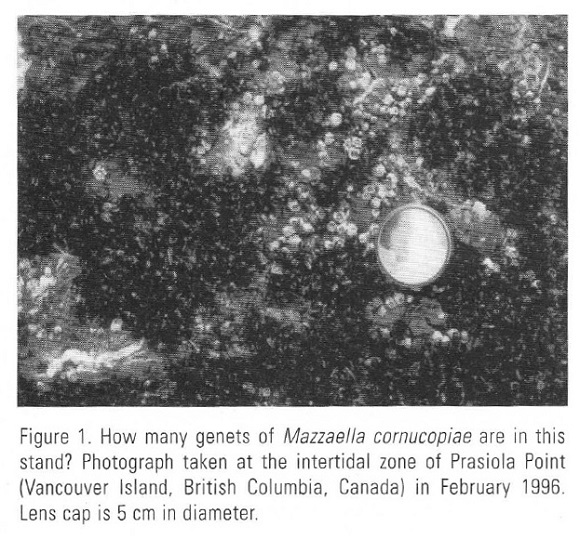
<body><![CDATA[<p align="justify"><font face="verdana" size="2">Clonal plants are those that vegetatively produce similar functional units (<i>e.g.</i>, shoots) that are potentially able to live on their own if physically separated from the parent plant. Such vegetative units are ramets, whereas the entire plant is termed genet (Harper and White, 1974). The demography of genets of clonal plants is less understood than those of nonclonal plants. Genets of clonal plants are difficult, and frequently impossible, to identify in the field, mainly because of their frequent fragmentation and of the difficulty in determining de association of ramets with their parent genet when they are produced by rhizomes or by intermingled stolons. These limitations seem to explain why research on plant demography has been principally done with nonclonal plants (Eriksson, 1993). Additionaly, these problems apparently resulted in demographic studies on clonal plants being mostly done at the ramet level (de Kroon, 1993; Hara, 1994; Peterson and Jones, 1997; Suzuki and Hutchings, 1997).</font></p>     <p align="justify"><font face="verdana" size="2">Although limiting a demographic study to the ramet level may seem enough to understand the population dynamics of clonal plants, there is essential information that results only from genet demography. The ecological and evolutionary dynamics of clonal plants depend on the interactions between their hierarchical levels of organization (Eriksson and Jerling, 1990; Vuorisalo <i>et al.</i>, 1997). For example, demographic rates of ramets may depend on the position of ramets within a genet, on their distance to a neighboring genet, on the dynamics of a disease within a genet, or on genet age or size. Genet identification is also important in making inferences about the evolution of foraging and reproductive strategies of clonal plants, especially when selection pressures act mainly on genets.</font></p>     <p align="justify"><font face="verdana" size="2">Seaweeds are important components of several coastal marine ecosystems. Many species are nonclonal, such as some kelps and fucoids (Phaeophyceae &#45;brown algae &#45;), and their individuals are usually easy to identify. Their basic density&#45;dependent patterns are similar to those for nonclonal terrestrial plants (Black, 1974; Chapman and Goudey, 1983; Dean <i>et al.</i>, 1989; Reed, 1990; Ang and DeWreede, 1992; Creed, 1995; Flores&#45;Moya <i>et al.</i>, 1997; Creed <i>et al.</i>, 1998; Arenas and Fern&aacute;ndez, 2000), with some special circumstances, such as the recruitment of intertidal fucoids (Ang and DeWreede, 1992). There are also several clonal seaweeds, which may be found among the Rhodophyta (red algae), the Chlorophyta (green algae), and the Phaeophyceae. This paper will focus on clonal red seaweeds, many of which are dominant in their communities and have economic value as well.</font></p>     <p align="justify"><font face="verdana" size="2">The genet of clonal red seaweeds is interpreted here as the entire thallus that develops from a single spore, whether a carpospore or a tetraspore. The word "genet" was originally used for clonal terrestrial plants to refer to the genetic individual that develops from a seed and that produces a number of ramets (Harper and White, 1974; Kays and Harper, 1974). Recent definitions of the genet refer specifically to the zygote as its initial cell (de Kroon and van Groenendael, 1997). The term "genetic individual" has been coined to mean that all of the parts of the genet are genetically identical. However, somatic mutations can occur during the growth of the genet (Klekowski, 1997), so such interpretation should be abandoned. On the other hand, considering the zygote as the only initial cell of the genet is perhaps too limiting. The main purpose of having a definition of genet is to make the distinction between individuals that develop from a single reproductive cell and individuals that result from the vegetative fragmentation (clonal fragments, sensu Eriksson and Jerling, 1990) of a single original individual. Thus, the genet may be better defined as the free&#45;living individual that develops from one zygote, parthenogenetic gamete, or spore and that produces ramets during growth. In this way, the definition of genet can be applied appropriately to the equivalent structure found in clonal seaweeds, bryophytes, and vascular plants. </font><font face="verdana" size="2">For more details on this discussion, see Scrosati (2002).</font></p>     <p align="justify"><font face="verdana" size="2">In many species of clonal red seaweeds, the genet is composed of a crustose (<i>e.g.</i>, Gigartinales) or stoloniferous (<i>e.g.</i>, Gelidiales) holdfast and of several fronds that vary greatly in form across species. Fronds can be considered as ramets, because of their capacity for independent life when separated from the parent thallus, provided that they remain attached to the substrate. Such separation could result from rock dislodgment, partial bleaching and subsequent death of certain regions of a genet, or partial herbivory on a genet. Despite the ecological and economic importance of these seaweeds, their genets have rarely been the subject of demographic studies, exceptions including those on the genus <i>Mazzaella</i>, in the Gigartinales (May, 1986; Dyck and DeWree&#45;de, 1995; Scrosati, 1998). As is the case for clonal terrestrial plants, for these seaweeds more is known about ramet demography, although for only a few species. There are important similarities with many clonal terrestrial plants, such as the general lack of self&#45;thinning among growing ramets of seasonal herbs (Suzuki and Hutchings, 1997), which was observed for the seaweeds <i>Gelidium sesquipedale</i> (Clemente) Bornet et Thuret (Gelidiales; Santos, 1995), <i>Mazzaella cornucopiae</i> (Postels <i>et</i> Ruprecht) Hommersand (Scrosati and DeWreede, 1997), <i>Chondrus crispus</i> Stackhouse (Gigartinales), and <i>Pterocladiella capillacea</i> (Gmelin) Santelices <i>et</i> Hommersand (Gelidiales; Scrosati and Servi&egrave;re&#45;Zaragoza, 2000).</font></p>     <p align="justify"><font face="Verdana" size="2">&nbsp;</font></p>     <p align="justify"><font face="verdana" size="2"><b>Current limitations</b></font></p>     <p align="justify"><font face="verdana" size="2">Why has genet demography been so poorly investigated for clonal red seaweeds? There seem to be three reasons. The first one is the difficulty of identifying neighboring genets when fronds are dense, up to 21 cm<sup>&#45;2</sup> for <i>Mazzaella cornucopiae</i> (Scrosati and Servi&egrave;re&#45;Zaragoza 2000) and up 20 22 cm<sup>&#45;2</sup> for <i>Pterocladiella capillacea</i> (Scrosati, 2000) for example. High frond densities generally prevent the accurate detection of boundaries of crustose holdfasts and especially of stoloniferous ones, which often intermingle. The second reason is that a genet may break up into clonal fragments (sensu Eriksson and Jerling, 1990), each one composed of two or more ramets. Even if such clonal fragments are distant one cannot tell whether they represent one or more genets without knowing their history (<a href="#f1">Fig. 1</a>). The third reason is holdfast coalescence: for some members of the Gigartinales and the Gracilariales, holdfast of young, neighboring genets may coalesce during growth (Tveter and Mathieson, 1976; Tveter&#45;Gallagher and Mathieson, 1980; Maggs and Cheney, 1980; Santelices <i>et al.</i>, 1996, 1999). At the adult stage, it is generally impossible to recognize the chimeric nature of a thallus after coalescence or in other words, that such a thallus is composed of different genotypes.</font></p>     <p align="center"><font face="verdana" size="2"><a name="f1"></a></font></p>     <p align="center"><font face="verdana" size="2"><img src="/img/revistas/hbio/v11n2/a7f1.jpg"></font></p>     ]]></body>
<body><![CDATA[<p align="justify"><font face="verdana" size="2">The extent of holdfast coalescence may be significant in natural populations (Santelices <i>et al.</i>, 1999). The demography of genets of coalescent clonal seaweeds may differ from that of nonclonal seaweeds and even clonal terrestrial plants, which normally do not coalesce. Would coalescing genets of clonal seaweeds grow according to density&#45;dependent patterns, as nonclonal plants generally do? Would a physical encounter between growing genets always result in coalescence? Or would it result in competition, depending on the life&#45;history phase or genet size, age, or genotype? To answer these questions, it is necessary to develop techniques to identify genets through time.</font></p>     <p align="justify"><font face="Verdana" size="2">&nbsp;</font></p>     <p align="justify"><font face="verdana" size="2"><b>Incorporating genetic markers</b></font></p>     <p align="justify"><font face="verdana" size="2">The basic technique, which has been used for the genus <i>Mazzaella</i> (May, 1986; Dyck and DeWreede, 1995; Scrosati, 1998), is the periodic mapping of genets while they are visually identifiable. For dense stands, additional techniques are needes. One approach might be to determine the genetic identity of ramets from a given area and thus, to gain the ability to identify genets and clonal fragments. From mosses to flowering plants, allozyme electrophoresis, the RAPD (random amplified polymorphic DNA) technique, and DNA finger&#45;printing have been applied to samples of ramets to distinguish different neighboring genets (Ellstrand and Roose, 1987; Schaal <i>et al.</i>, 1991; Wid&eacute;n <i>et al.</i>, 1994; Cronberg, 1996; Harada <i>et al.</i>, 1997; McLellan <i>et al.</i>, 1997; Mayes <i>et al.</i>, 1998; Reusch <i>et al.</i>, 1998; Sydes and Peakall, 1998; Tyson <i>et al.</i>, 1998; Bush and Mulcahy, 1999; Bushakra <i>et al.</i>, 1999; Davis <i>et al.</i>, 1999; Kudoh <i>et al.</i>, 1999; Reusch <i>et al.</i>, 1999; Sawada, 1999; Suzuki <i>et al.</i>, 1999; J&oacute;nsd&oacute;ttir <i>et al.</i>, 2000; Pappert <i>et al.</i>, 2000; Reusch <i>et al.</i> 2000). The level of resolution of these molecular techniques depends on the intraspecific variability of the enzyme system or DNA region selected for the study (Avise 1994; Parker <i>et al.</i>, 1998). At first glance, the analysis of the spatial distribution of ramet genotypes with a high&#45;resolution molecular technique would appear to be enough to identify the genets of a clonal seaweed population. However, there are certain restrictive factors.</font></p>     <p align="justify"><font face="verdana" size="2">As part of the life cycle of most red seaweeds, many carpospores are produced within a female gametophyte, each carpospore potentially giving rise to a tetrasporophyte (Hawkes, 1990; Hommersand and Fredericq, 1990). Carpospores are produced by a special reproductive phase referred to as the carposporophyte (gonimocarp, sensu van den Hoek <i>et al.</i>, 1995), which develops withing the female gametophyte after repeated mitotic events from a single zygote. Therefore, all of the tetrasporophytes that result from carpospores from a single carposporophyte would be genetically identical. As a consequence, even the most refined molecular technique will not be able to distinguish among these tetrasporophytes. This may result in the underestimation of genet density if these tetrasporophytes were wrongly intepreted as clonal fragments from one original genet. This problem may also occur when gametophytes are produced by other gametophytes directly through carpospores. Some gametophytes of <i>Mastocarpus papillatus</i> (C. Agardh) K&uuml;tzing (Gigartinales) are thought to produce carpospores through parthenogenesis from a single cell (Polanshek and West, 1977; Zupan and West, 1988) and some gametophytes of <i>Mastocarpus stellatus</i> (Stackhouse) Guiry are thought to produce carpospores from a zygote originated through self&#45;fertilization, lacking male&#45;determining alleles (Maggs, 1988). When coming from the same carposporophyte, both kinds of carpospores will likely produce genetically identical gametophytes, which may ultimatelly also result in unrealistically low numbers of genets identified. Additionally, a given tetrasporophyte may produce tetraspores that are genetically identical for certain markers even after meiotic of genet (each resulting gametophyte) density. The opposite situation, that is, the overestimation of genet density, could occur when clonal fragments of a genet are wrongly interpreted as sibling tetrasporophytes or parthenogenetically derived gametophytes. The possible under&#45; or overestimation of genet density may also weaken evolutionary considerations about reproductive strategies, since the relative importance of recruitment and clonal fragmentation would be incorrectly assessed.</font></p>     <p align="justify"><font face="verdana" size="2">Additional factors that may limit the accuracy of genet identification through spatio&#45;temporal mapping of ramet genotypes are somatic mutation, mitotic recombination, apomeiosis, and genetic transposition. These processes might induce genetic variation within a genet and result in an overestimation of genet density (not to be confused with overestimating genetic diversity, which would not occur) after sampling genetically different ramets from such a genet. Genetic mosaicism has been detected for a few species of clonal terrestrial plants (Gill <i>et al.</i>, 1995).</font></p>     <p align="justify"><font face="verdana" size="2">Mutations are thought to have little effect on allele frequencies in each generation of eukaryotic organisms (Gill <i>et al.</i>, 1995; Slatkin <i>et al.</i>, 1995). Spontaneous mutation rates are between 10<sup>&#45;4</sup> and 10<sup>&#45;6</sup> mutations per gene per generation (Hartl, 1988). However, mutation rates depend on the physicochemical properties of the DNA, among other factors (Cock&#45;burn, 1991). For example, in special areas of the genome termed VNTR (variable number of tandem repeats), mutation rates are particularly high, up to 10<sup>&#45;2</sup> per generation (Slatkin <i>et al.</i>, 1995). For seaweeds, mutation rates are largely unknown, although there is evidence suggesting that rates vary across taxonomic groups (Russell, 1986).</font></p>     <p align="justify"><font face="verdana" size="2">Mitotic recombination is common in <i>Gracilaria tikvahiae</i> McLachlan (Gracilariales) under laboratory conditions and is thought to occur in other red seaweeds as well (van der Meer and Todd, 1977; van der Meer, 1981). Using genetic markers for thallus color, recombinant areas within thalli of <i>G. tikvahiae</i> were identified as patches of different color on the surface of fertile areas, although never on juvenile fronds. Mitotic recombination is apparently uncommon in other red seaweeds: for example, the patterns of recombination described for <i>G. tikvahiae</i> were not detected in <i>Chondrus crispus</i> (van der Meer, 1981). For terrestrial plants, rates of mitotic recombination have been estimated between 10<sup>&#45;4</sup> and 10<sup>&#45;3</sup> per cell (Gill <i>et al.</i>, 1995).</font></p>     <p align="justify"><font face="verdana" size="2">Apomeiosis was observed in laboratory cultures of <i>Gracilaria tikvahiae</i>, for which cytokinetic failure during tetraspore formation resulted in bi&#45; and tetranucleate spores that could produce genets with both male and female fronds (van der Meer, 1977). Rates of natural occurrence of apomeiosis are unknown for red seaweeds.</font></p>     <p align="justify"><font face="verdana" size="2">Genetic transposition has been proposed, but not yet established, as an explanation for the dynamics of unstable color mutations for three members of the Gracilariales (van der Meer and Zhang, 1988). Nevertheless, the spontaneous reversion of color reported for parts of the same genet represents another case of genetic variability within genets.</font></p>     ]]></body>
<body><![CDATA[<p align="justify"><font face="Verdana" size="2">&nbsp;</font></p>     <p align="justify"><font face="verdana" size="2"><b>Experimental populations</b></font></p>     <p align="justify"><font face="verdana" size="2">The problems discussed above may discourage demographic studies on clonal algal genets when the history of a stand is unknown which is the case for most natural populations. However, genet demography may be studied under controlled conditions. For example, several aquaria could be seeded with spores that are all genetically different. By manipulating spore settlement densities, abiotic variables, and the proportion between carpospores and tetraspores, demographic patterns for genets could be studied by periodically mapping their shape and the position of ramet genotypes as genets grow. Mapping holdfast shape will be obviously easier for seaweeds that grow in hard substrates (<i>e.g.</i>, <i>Chondrus</i> and <i>Mazzaella</i>) than for those that grow in sand (<i>e.g.</i>, <i>Gracilaria</i>). Also, it will be easier for crustose holdfast (<i>e.g.</i>, <i>Chondrus</i> and <i>Mazzaella</i>) than for stoloniferous ones (<i>e.g.</i>, <i>Gelidium</i> and <i>Pterocladiella</i>).</font></p>     <p align="justify"><font face="verdana" size="2">The continuous spatial  mapping of ramet genotypes will enable one to determine if contact areas between neighboring genets remain static after contact or if overgrowth occurs. Possible coalescence between crustose holdfasts could be detected through microscopic observations on holdfast samples from contact areas. For coalescing genets, genetic sampling of ramets should be continuous to investigate if one genotype progressively prevails over the other within the chimeric thallus. For coalescing genets of <i>Gracilaria chilensis</i> Bird, McLachlan <i>et</i> Oliveira, different parts of a single frond may display the different original genotypes (Santelices <i>et al.</i>, 1996). Thus, it may be necessary to analyze more than one part per frond around coalescent areas to ensure an accurate genotype mapping. For species whose holdfasts do not coalesce, but intermingle, the periodical mapping of ramet genotypes should enable one to determine patterns of intermingling.</font></p>     <p align="justify"><font face="verdana" size="2">If a new allelic combination arises through mitotic recombination in a ramet from contact areas between neighboring genets, knowledge of the original genotypes may enable one to associate the ramet to its parent if neighboring genets are genetically different enough. The production of male and female fronds within a genet resulting from an apomeiotic spore should not compromise genet identification either if the original genotypes are known. Somatic mutation might still complicate genet identification if it occurs in ramets arising in contact areas, especially if one analyzes rapidly evolving DNA areas, such as microsatellites, located in VNTR loci (Avise, 1994; Jarne and Lagoda, 1995). Genetic transposition might also be a problem if it occurs in contact areas. Genetic differentiation within a genet occurs during the growth of <i>Gracilaria chilensis</i>, as detected with RAPD markers, although the nature of such changes is still unknown (Meneses <i>et al.</i>, 1999). Rates of somatic mutation and of genetic transposition should be estimated for red seaweeds, so their potential effects on the accuracy of genet identification using the methods suggested here can be assessed.</font></p>     <p align="justify"><font face="verdana" size="2">In conclusion, this paper proposes that determining the changing shpae of genets and the position of ramet genotypes from experimental populations with known initial genotypes is a potentially useful method to upgrade our understanding of genet demography for clonal red seaweeds. Rates of genetic change within genets should be previously estimated to design adequate experiments.</font></p>     <p align="justify"><font face="Verdana" size="2">&nbsp;</font></p>     <p align="justify"><font face="verdana" size="2"><b>Acknowledgements</b></font></p>     <p align="justify"><font face="verdana" size="2">I am grateful to Dr. Susan L. Williams and to two anonymous reviewers, for their valuable comments. Support from the Northwest Biological Research Center (CIBNOR; La Paz, Baja California Sur, M&eacute;xico), through research grant RM&#45;7, is also acknowledged. The Mexican Science and Technology Council (CONACYT) provided additional funds for the completion of this study through the "C&aacute;tedra Patrimonial de Excelencia" and the "Sistema Nacional de Investigadores" (SNI) programs.</font></p>     <p align="justify"><font face="Verdana" size="2">&nbsp;</font></p>     ]]></body>
<body><![CDATA[<p align="justify"><font face="verdana" size="2"><b>References</b></font></p>     <!-- ref --><p align="justify"><font face="verdana" size="2">ANG, P. O. and E. DE WREEDE, 1992. Density&#45;dependence in a population of <i>Fucus distichus</i>. <i>Marine Ecology Progress Series 90</i>: 169&#45;181.    &nbsp;&nbsp;&nbsp;&nbsp;&nbsp;&nbsp;&nbsp;&nbsp;[&#160;<a href="javascript:void(0);" onclick="javascript: window.open('/scielo.php?script=sci_nlinks&ref=4034356&pid=S0188-8897200100020000700001&lng=','','width=640,height=500,resizable=yes,scrollbars=1,menubar=yes,');">Links</a>&#160;]<!-- end-ref --></font></p>     <!-- ref --><p align="justify"><font face="verdana" size="2">ARENAS, F. and C. FERN&Aacute;NDEZ, 2000. Size structure and dynamics in a population of <i>Sargassum muticum</i> (Phaeophyceae). <i>Journal of Phycology 36</i>: 1012&#45;1020.    &nbsp;&nbsp;&nbsp;&nbsp;&nbsp;&nbsp;&nbsp;&nbsp;[&#160;<a href="javascript:void(0);" onclick="javascript: window.open('/scielo.php?script=sci_nlinks&ref=4034358&pid=S0188-8897200100020000700002&lng=','','width=640,height=500,resizable=yes,scrollbars=1,menubar=yes,');">Links</a>&#160;]<!-- end-ref --></font></p>     <!-- ref --><p align="justify"><font face="verdana" size="2">AVISE, J. C., 1994. <i>Molecular markers, natural history and evolution</i>. Chapman &amp; Hall, New York. 511 p.    &nbsp;&nbsp;&nbsp;&nbsp;&nbsp;&nbsp;&nbsp;&nbsp;[&#160;<a href="javascript:void(0);" onclick="javascript: window.open('/scielo.php?script=sci_nlinks&ref=4034360&pid=S0188-8897200100020000700003&lng=','','width=640,height=500,resizable=yes,scrollbars=1,menubar=yes,');">Links</a>&#160;]<!-- end-ref --></font></p>     <!-- ref --><p align="justify"><font face="verdana" size="2">BLACK, R., 1974. Some biological interactions affecting intertidal populations of the kelp <i>Egregia laevigata</i>. <i>Marine Biology 28</i>: 189&#45;198.    &nbsp;&nbsp;&nbsp;&nbsp;&nbsp;&nbsp;&nbsp;&nbsp;[&#160;<a href="javascript:void(0);" onclick="javascript: window.open('/scielo.php?script=sci_nlinks&ref=4034362&pid=S0188-8897200100020000700004&lng=','','width=640,height=500,resizable=yes,scrollbars=1,menubar=yes,');">Links</a>&#160;]<!-- end-ref --></font></p>     <!-- ref --><p align="justify"><font face="verdana" size="2">BUSH, S. P. and D. L. MULCAHY, 1999. The effects of regeneration by fragmentation upon clonal diversity in the tropical forest shrup <i>Poikilacanthus macranthus</i>: random amplified polymorphic DNA (RAPD) results. <i>Molecular Ecology 8</i>: 865&#45;870.    &nbsp;&nbsp;&nbsp;&nbsp;&nbsp;&nbsp;&nbsp;&nbsp;[&#160;<a href="javascript:void(0);" onclick="javascript: window.open('/scielo.php?script=sci_nlinks&ref=4034364&pid=S0188-8897200100020000700005&lng=','','width=640,height=500,resizable=yes,scrollbars=1,menubar=yes,');">Links</a>&#160;]<!-- end-ref --></font></p>     <!-- ref --><p align="justify"><font face="verdana" size="2">BUSHAKRA, J. M., S. A. HODGES, J. B. COOPER and D. D. KASKA, 1999. The extent of clonality and genetic diversity in the Santa Cruz Island ironwood, <i>Lyonothamnus floribundus</i>. <i>Molecular Ecology 8</i>: 471&#45;475.    &nbsp;&nbsp;&nbsp;&nbsp;&nbsp;&nbsp;&nbsp;&nbsp;[&#160;<a href="javascript:void(0);" onclick="javascript: window.open('/scielo.php?script=sci_nlinks&ref=4034366&pid=S0188-8897200100020000700006&lng=','','width=640,height=500,resizable=yes,scrollbars=1,menubar=yes,');">Links</a>&#160;]<!-- end-ref --></font></p>     <!-- ref --><p align="justify"><font face="verdana" size="2">CHAPMAN, A. R. O. and C. L. GOUDEY, 1983. Demographic study of the macrothallus of <i>Leathesia difformis</i> (Phaeophyta) in Nova Scotia. <i>Canadian Journal of Botany 61</i>: 319&#45;323.    &nbsp;&nbsp;&nbsp;&nbsp;&nbsp;&nbsp;&nbsp;&nbsp;[&#160;<a href="javascript:void(0);" onclick="javascript: window.open('/scielo.php?script=sci_nlinks&ref=4034368&pid=S0188-8897200100020000700007&lng=','','width=640,height=500,resizable=yes,scrollbars=1,menubar=yes,');">Links</a>&#160;]<!-- end-ref --></font></p>     <!-- ref --><p align="justify"><font face="verdana" size="2">COCKBURN, A., 1991. <i>An introduction to evolutionary ecology</i>. Blackwell Scientific Publications, Oxford. 370 p.    &nbsp;&nbsp;&nbsp;&nbsp;&nbsp;&nbsp;&nbsp;&nbsp;[&#160;<a href="javascript:void(0);" onclick="javascript: window.open('/scielo.php?script=sci_nlinks&ref=4034370&pid=S0188-8897200100020000700008&lng=','','width=640,height=500,resizable=yes,scrollbars=1,menubar=yes,');">Links</a>&#160;]<!-- end-ref --></font></p>     <!-- ref --><p align="justify"><font face="verdana" size="2">CREED, J. C., 1995. Spatial dynamics of a <i>Himanthalia elongata</i> (Fucales, Phaeophyta) population. <i>Journal of Phycology 31</i>: 851&#45;859.    &nbsp;&nbsp;&nbsp;&nbsp;&nbsp;&nbsp;&nbsp;&nbsp;[&#160;<a href="javascript:void(0);" onclick="javascript: window.open('/scielo.php?script=sci_nlinks&ref=4034372&pid=S0188-8897200100020000700009&lng=','','width=640,height=500,resizable=yes,scrollbars=1,menubar=yes,');">Links</a>&#160;]<!-- end-ref --></font></p>     <!-- ref --><p align="justify"><font face="verdana" size="2">CREED, J. C., J. M. KAIN (JONES) and T. A. NORTON, 1998. An experimental evaluation of density and plant size in two large brown seaweeds. <i>Journal of Phycology 34</i>: 39&#45;52.    &nbsp;&nbsp;&nbsp;&nbsp;&nbsp;&nbsp;&nbsp;&nbsp;[&#160;<a href="javascript:void(0);" onclick="javascript: window.open('/scielo.php?script=sci_nlinks&ref=4034374&pid=S0188-8897200100020000700010&lng=','','width=640,height=500,resizable=yes,scrollbars=1,menubar=yes,');">Links</a>&#160;]<!-- end-ref --></font></p>     <!-- ref --><p align="justify"><font face="verdana" size="2">CRONBERG, N., 1996. Clonal structure and fertility in a sympatric population on the peat mosses <i>Sphagnum rubellum</i> and <i>Sphagnum capillifolium</i>. <i>Canadian Journal of Botany 74</i>: 1375&#45;1385.    &nbsp;&nbsp;&nbsp;&nbsp;&nbsp;&nbsp;&nbsp;&nbsp;[&#160;<a href="javascript:void(0);" onclick="javascript: window.open('/scielo.php?script=sci_nlinks&ref=4034376&pid=S0188-8897200100020000700011&lng=','','width=640,height=500,resizable=yes,scrollbars=1,menubar=yes,');">Links</a>&#160;]<!-- end-ref --></font></p>     <!-- ref --><p align="justify"><font face="verdana" size="2">DAVIS, J. L., D. L. CHILDERS and D. N. KUHN, 1999. Clonal variation in a Florida Bay <i>Thalassia testudinum</i> meadow: molecular genetic assessment of population structure. <i>Marine Ecology Progress Series 186</i>: 127&#45;136.    &nbsp;&nbsp;&nbsp;&nbsp;&nbsp;&nbsp;&nbsp;&nbsp;[&#160;<a href="javascript:void(0);" onclick="javascript: window.open('/scielo.php?script=sci_nlinks&ref=4034378&pid=S0188-8897200100020000700012&lng=','','width=640,height=500,resizable=yes,scrollbars=1,menubar=yes,');">Links</a>&#160;]<!-- end-ref --></font></p>     <!-- ref --><p align="justify"><font face="verdana" size="2">DEAN, T. A., K. THIES and S. L. LAGOS, 1989. Survival of juvenile giant kelp: the effects of demographic factors, competitors, and grazers. <i>Ecology 70</i>: 483&#45;495.    &nbsp;&nbsp;&nbsp;&nbsp;&nbsp;&nbsp;&nbsp;&nbsp;[&#160;<a href="javascript:void(0);" onclick="javascript: window.open('/scielo.php?script=sci_nlinks&ref=4034380&pid=S0188-8897200100020000700013&lng=','','width=640,height=500,resizable=yes,scrollbars=1,menubar=yes,');">Links</a>&#160;]<!-- end-ref --></font></p>     <!-- ref --><p align="justify"><font face="verdana" size="2">DE KROON, H., 1993. Competition between shoots in stands of clonal plants. <i>Plant Species Biology 8</i>: 85&#45;94.    &nbsp;&nbsp;&nbsp;&nbsp;&nbsp;&nbsp;&nbsp;&nbsp;[&#160;<a href="javascript:void(0);" onclick="javascript: window.open('/scielo.php?script=sci_nlinks&ref=4034382&pid=S0188-8897200100020000700014&lng=','','width=640,height=500,resizable=yes,scrollbars=1,menubar=yes,');">Links</a>&#160;]<!-- end-ref --></font></p>     <!-- ref --><p align="justify"><font face="verdana" size="2">DE KROON, H. and J. VAN GROENENDAEL 1997. <i>The ecology and evolution of clonal plants</i>. Backhuys Publishers, Leiden. 453 p.    &nbsp;&nbsp;&nbsp;&nbsp;&nbsp;&nbsp;&nbsp;&nbsp;[&#160;<a href="javascript:void(0);" onclick="javascript: window.open('/scielo.php?script=sci_nlinks&ref=4034384&pid=S0188-8897200100020000700015&lng=','','width=640,height=500,resizable=yes,scrollbars=1,menubar=yes,');">Links</a>&#160;]<!-- end-ref --></font></p>     <!-- ref --><p align="justify"><font face="verdana" size="2">DYCK, L. J. and R. E. DE WREEDE, 1995. Patterns of seasonal demographic change in the alternate isomorphic stages of <i>Mazzaella splendens</i> (Gigartinales, Rhodophyta). <i>Phycologia 34</i>: 390&#45;395.    &nbsp;&nbsp;&nbsp;&nbsp;&nbsp;&nbsp;&nbsp;&nbsp;[&#160;<a href="javascript:void(0);" onclick="javascript: window.open('/scielo.php?script=sci_nlinks&ref=4034386&pid=S0188-8897200100020000700016&lng=','','width=640,height=500,resizable=yes,scrollbars=1,menubar=yes,');">Links</a>&#160;]<!-- end-ref --></font></p>     <!-- ref --><p align="justify"><font face="verdana" size="2">ELLSTRAND, N. C. and M. L. ROOSE, 1987. Patterns of genotypic diversity in clonal plant species. <i>American Journal of Botany 74</i>: 123&#45;131.    &nbsp;&nbsp;&nbsp;&nbsp;&nbsp;&nbsp;&nbsp;&nbsp;[&#160;<a href="javascript:void(0);" onclick="javascript: window.open('/scielo.php?script=sci_nlinks&ref=4034388&pid=S0188-8897200100020000700017&lng=','','width=640,height=500,resizable=yes,scrollbars=1,menubar=yes,');">Links</a>&#160;]<!-- end-ref --></font></p>     <!-- ref --><p align="justify"><font face="verdana" size="2">ERIKSSON, O., 1993. Dynamics of genets in clonal plants. <i>Trends in Ecology and Evolution 8</i>: 313&#45;316.    &nbsp;&nbsp;&nbsp;&nbsp;&nbsp;&nbsp;&nbsp;&nbsp;[&#160;<a href="javascript:void(0);" onclick="javascript: window.open('/scielo.php?script=sci_nlinks&ref=4034390&pid=S0188-8897200100020000700018&lng=','','width=640,height=500,resizable=yes,scrollbars=1,menubar=yes,');">Links</a>&#160;]<!-- end-ref --></font></p>     <!-- ref --><p align="justify"><font face="verdana" size="2">ERIKSSON, O. and L. JERLING, 1990. Hierarchical selection and risk spreading in clonal plants. pp. 79&#45;94. In: J VAN GROENENDAEL and H. DE KROON (Eds.). <i>Clonal growth in plants: regulation and function</i>. SPB Academic Publishers.    &nbsp;&nbsp;&nbsp;&nbsp;&nbsp;&nbsp;&nbsp;&nbsp;[&#160;<a href="javascript:void(0);" onclick="javascript: window.open('/scielo.php?script=sci_nlinks&ref=4034392&pid=S0188-8897200100020000700019&lng=','','width=640,height=500,resizable=yes,scrollbars=1,menubar=yes,');">Links</a>&#160;]<!-- end-ref --></font></p>     <!-- ref --><p align="justify"><font face="verdana" size="2">FLORES&#45;MOYA, A., J. A. FERN&Aacute;NDEZ and F. X. NIELL 1997. Growth pattern, reproduction and self&#45;thinning in seaweeds: a re&#45;evaluation in reply to Scrosati. <i>Journal of Phycology 33</i>: 1080&#45;1081.    &nbsp;&nbsp;&nbsp;&nbsp;&nbsp;&nbsp;&nbsp;&nbsp;[&#160;<a href="javascript:void(0);" onclick="javascript: window.open('/scielo.php?script=sci_nlinks&ref=4034394&pid=S0188-8897200100020000700020&lng=','','width=640,height=500,resizable=yes,scrollbars=1,menubar=yes,');">Links</a>&#160;]<!-- end-ref --></font></p>     <!-- ref --><p align="justify"><font face="verdana" size="2">GILL, D. E., L. CHAO, S. L. PERKINS and J. B. WOLF, 1995. Genetic mosaicism in plant and clonal animals. <i>Annual Review of Ecology and Systematics 26</i>: 423&#45;444.    &nbsp;&nbsp;&nbsp;&nbsp;&nbsp;&nbsp;&nbsp;&nbsp;[&#160;<a href="javascript:void(0);" onclick="javascript: window.open('/scielo.php?script=sci_nlinks&ref=4034396&pid=S0188-8897200100020000700021&lng=','','width=640,height=500,resizable=yes,scrollbars=1,menubar=yes,');">Links</a>&#160;]<!-- end-ref --></font></p>     <!-- ref --><p align="justify"><font face="verdana" size="2">HARA, T., 1994. Growth and competition in clonal plants &#45; Persistence of shoot populations and species diversity. <i>Folia Geobotanica &amp; Phytotaxonomica 29</i>: 181&#45;201.    &nbsp;&nbsp;&nbsp;&nbsp;&nbsp;&nbsp;&nbsp;&nbsp;[&#160;<a href="javascript:void(0);" onclick="javascript: window.open('/scielo.php?script=sci_nlinks&ref=4034398&pid=S0188-8897200100020000700022&lng=','','width=640,height=500,resizable=yes,scrollbars=1,menubar=yes,');">Links</a>&#160;]<!-- end-ref --></font></p>     <!-- ref --><p align="justify"><font face="verdana" size="2">HARADA, Y., S. KAWANO and Y. IWASA 1997. Probability of clonal identity: inferring the relative success of sexual versus clonal reproduction from spatial genetic patterns. <i>Journal of Ecology 85</i>: 591&#45;600.    &nbsp;&nbsp;&nbsp;&nbsp;&nbsp;&nbsp;&nbsp;&nbsp;[&#160;<a href="javascript:void(0);" onclick="javascript: window.open('/scielo.php?script=sci_nlinks&ref=4034400&pid=S0188-8897200100020000700023&lng=','','width=640,height=500,resizable=yes,scrollbars=1,menubar=yes,');">Links</a>&#160;]<!-- end-ref --></font></p>     <!-- ref --><p align="justify"><font face="verdana" size="2">HARPER, J. L. and J. WHITE, 1974. The demography of plants. <i>Annual Review of Ecology and Systematics 5</i>: 419&#45;463.    &nbsp;&nbsp;&nbsp;&nbsp;&nbsp;&nbsp;&nbsp;&nbsp;[&#160;<a href="javascript:void(0);" onclick="javascript: window.open('/scielo.php?script=sci_nlinks&ref=4034402&pid=S0188-8897200100020000700024&lng=','','width=640,height=500,resizable=yes,scrollbars=1,menubar=yes,');">Links</a>&#160;]<!-- end-ref --></font></p>     <!-- ref --><p align="justify"><font face="verdana" size="2">HARTL, D. L., 1988. <i>A primer of population genetics</i>. Second edition. Sinauer Associates, Suderland. 305 p.    &nbsp;&nbsp;&nbsp;&nbsp;&nbsp;&nbsp;&nbsp;&nbsp;[&#160;<a href="javascript:void(0);" onclick="javascript: window.open('/scielo.php?script=sci_nlinks&ref=4034404&pid=S0188-8897200100020000700025&lng=','','width=640,height=500,resizable=yes,scrollbars=1,menubar=yes,');">Links</a>&#160;]<!-- end-ref --></font></p>     <!-- ref --><p align="justify"><font face="verdana" size="2">HAWKES, M. W., 1990. Reproductive strategies, pp. 455&#45;476. <i>In:</i> K. M. COLE and R. G. SHEATH (Eds.). <i>Biology of the red algae</i>. Cambridge University Press.    &nbsp;&nbsp;&nbsp;&nbsp;&nbsp;&nbsp;&nbsp;&nbsp;[&#160;<a href="javascript:void(0);" onclick="javascript: window.open('/scielo.php?script=sci_nlinks&ref=4034406&pid=S0188-8897200100020000700026&lng=','','width=640,height=500,resizable=yes,scrollbars=1,menubar=yes,');">Links</a>&#160;]<!-- end-ref --></font></p>     <!-- ref --><p align="justify"><font face="verdana" size="2">HOMMERSAND, M. H. and S. FREDERICQ, 1990. Sexual reproduction and cystocarp development. pp. 305&#45;345. <i>In:</i> K. M. COLE and R. G. SHEATH (Eds.). <i>Biology of the red algae</i>. Cambridge University Press.    &nbsp;&nbsp;&nbsp;&nbsp;&nbsp;&nbsp;&nbsp;&nbsp;[&#160;<a href="javascript:void(0);" onclick="javascript: window.open('/scielo.php?script=sci_nlinks&ref=4034408&pid=S0188-8897200100020000700027&lng=','','width=640,height=500,resizable=yes,scrollbars=1,menubar=yes,');">Links</a>&#160;]<!-- end-ref --></font></p>     <!-- ref --><p align="justify"><font face="verdana" size="2">JARNE, P. and P. J. L. LAGODA, 1995. Microsatellites, from molecules to populations and back. <i>Trends in Ecology and Evolution 11</i>: 424&#45;429.    &nbsp;&nbsp;&nbsp;&nbsp;&nbsp;&nbsp;&nbsp;&nbsp;[&#160;<a href="javascript:void(0);" onclick="javascript: window.open('/scielo.php?script=sci_nlinks&ref=4034410&pid=S0188-8897200100020000700028&lng=','','width=640,height=500,resizable=yes,scrollbars=1,menubar=yes,');">Links</a>&#160;]<!-- end-ref --></font></p>     <!-- ref --><p align="justify"><font face="verdana" size="2">J&Oacute;NSD&Oacute;TTIR, I. S., M. AUGNER, T. FAGERSTR&Ouml;M, H. PERSSON and A. STENSTR&Ouml;M, 2000. Genet age in marginal populations of two clonal <i>Carex</i> species in the Siberian Arctic. <i>Ecography 23</i>: 402&#45;412.    &nbsp;&nbsp;&nbsp;&nbsp;&nbsp;&nbsp;&nbsp;&nbsp;[&#160;<a href="javascript:void(0);" onclick="javascript: window.open('/scielo.php?script=sci_nlinks&ref=4034412&pid=S0188-8897200100020000700029&lng=','','width=640,height=500,resizable=yes,scrollbars=1,menubar=yes,');">Links</a>&#160;]<!-- end-ref --></font></p>     <!-- ref --><p align="justify"><font face="verdana" size="2">KAYS, S. and J. L. HARPER, 1974. The regulation of plant and tiller density in a grass sward. <i>Journal of Ecology 62</i>: 97&#45;105.    &nbsp;&nbsp;&nbsp;&nbsp;&nbsp;&nbsp;&nbsp;&nbsp;[&#160;<a href="javascript:void(0);" onclick="javascript: window.open('/scielo.php?script=sci_nlinks&ref=4034414&pid=S0188-8897200100020000700030&lng=','','width=640,height=500,resizable=yes,scrollbars=1,menubar=yes,');">Links</a>&#160;]<!-- end-ref --></font></p>     <!-- ref --><p align="justify"><font face="verdana" size="2">KLEKOWSKI, E. J., 1997. Somatic mutation theory of clonality pp. 227&#45;241. <i>In</i>: H. DE KROON and J. VAN GROENENDAEL (Eds.). <i>The ecology and evolution of clonal plants</i>. Backhuys Publishers.    &nbsp;&nbsp;&nbsp;&nbsp;&nbsp;&nbsp;&nbsp;&nbsp;[&#160;<a href="javascript:void(0);" onclick="javascript: window.open('/scielo.php?script=sci_nlinks&ref=4034416&pid=S0188-8897200100020000700031&lng=','','width=640,height=500,resizable=yes,scrollbars=1,menubar=yes,');">Links</a>&#160;]<!-- end-ref --></font></p>     <!-- ref --><p align="justify"><font face="verdana" size="2">KUDOH, H., H. SHIBAIKE, H. TAKASU, D. F. WHIGHAM and S. KAWANGO, 1999. Genet structure and determinants of clonal structure in a temperate deciduous woodland herb, <i>Uvularia perfoliata. Journal of Ecology 87</i>: 244&#45;257.    &nbsp;&nbsp;&nbsp;&nbsp;&nbsp;&nbsp;&nbsp;&nbsp;[&#160;<a href="javascript:void(0);" onclick="javascript: window.open('/scielo.php?script=sci_nlinks&ref=4034418&pid=S0188-8897200100020000700032&lng=','','width=640,height=500,resizable=yes,scrollbars=1,menubar=yes,');">Links</a>&#160;]<!-- end-ref --></font></p>     <!-- ref --><p align="justify"><font face="verdana" size="2">MAGGS, C. A., 1988. Intraspecific life history variability in the Florideophycidae (Rhodophyta). <i>Botanica Marina 31</i>: 465&#45;490.    &nbsp;&nbsp;&nbsp;&nbsp;&nbsp;&nbsp;&nbsp;&nbsp;[&#160;<a href="javascript:void(0);" onclick="javascript: window.open('/scielo.php?script=sci_nlinks&ref=4034420&pid=S0188-8897200100020000700033&lng=','','width=640,height=500,resizable=yes,scrollbars=1,menubar=yes,');">Links</a>&#160;]<!-- end-ref --></font></p>     <!-- ref --><p align="justify"><font face="verdana" size="2">MAGGS, C. A. and D. P. CHENEY, 1980. Competition studies of marine macroalgae in laboratory culture. <i>Journal of Phycology 26</i>: 18&#45;24.    &nbsp;&nbsp;&nbsp;&nbsp;&nbsp;&nbsp;&nbsp;&nbsp;[&#160;<a href="javascript:void(0);" onclick="javascript: window.open('/scielo.php?script=sci_nlinks&ref=4034422&pid=S0188-8897200100020000700034&lng=','','width=640,height=500,resizable=yes,scrollbars=1,menubar=yes,');">Links</a>&#160;]<!-- end-ref --></font></p>     <!-- ref --><p align="justify"><font face="verdana" size="2">May, G., 1986. Life history variations in a predominantly gametophytic population of <i>Iridaea cordata</i> (Gigartinaceae, Rhodophyta). <i>Journal of Phycology 22</i>: 448&#45;455.    &nbsp;&nbsp;&nbsp;&nbsp;&nbsp;&nbsp;&nbsp;&nbsp;[&#160;<a href="javascript:void(0);" onclick="javascript: window.open('/scielo.php?script=sci_nlinks&ref=4034424&pid=S0188-8897200100020000700035&lng=','','width=640,height=500,resizable=yes,scrollbars=1,menubar=yes,');">Links</a>&#160;]<!-- end-ref --></font></p>     <!-- ref --><p align="justify"><font face="verdana" size="2">MAYES, S. G., M. A. MCGINLEY and C. R. WERTH, 1998. Clonal population structure and genetic variation in sand&#45;shinnery oak, <i>Quercus havardii</i> (Fagaceae). American Journal of Botany 85: 1609&#45;1617.    &nbsp;&nbsp;&nbsp;&nbsp;&nbsp;&nbsp;&nbsp;&nbsp;[&#160;<a href="javascript:void(0);" onclick="javascript: window.open('/scielo.php?script=sci_nlinks&ref=4034426&pid=S0188-8897200100020000700036&lng=','','width=640,height=500,resizable=yes,scrollbars=1,menubar=yes,');">Links</a>&#160;]<!-- end-ref --></font></p>     <!-- ref --><p align="justify"><font face="verdana" size="2">MCLELLAN, A. J., D. PRATI, O. KALTZ and B. SCHMID, 1987. Structure and analysis of phenotypic and genetic variation in clonal plants. pp. 185&#45;210. <i>In:</i> H. DE KROON and J. VAN GROENENDAEL (Eds.). <i>The ecology and evolution of clonal plants</i>. Backhuys Publishers.    &nbsp;&nbsp;&nbsp;&nbsp;&nbsp;&nbsp;&nbsp;&nbsp;[&#160;<a href="javascript:void(0);" onclick="javascript: window.open('/scielo.php?script=sci_nlinks&ref=4034428&pid=S0188-8897200100020000700037&lng=','','width=640,height=500,resizable=yes,scrollbars=1,menubar=yes,');">Links</a>&#160;]<!-- end-ref --></font></p>     <!-- ref --><p align="justify"><font face="verdana" size="2">MENESES, I., B. SANTELICES and P. S&Aacute;NCHEZ, 1999. Growth&#45;related intraclonal genetic changes in <i>Gracilaria chilensis</i> (Gracilariales: Rhodophyta). <i>Marine Biology 135</i>: 391&#45;397.    &nbsp;&nbsp;&nbsp;&nbsp;&nbsp;&nbsp;&nbsp;&nbsp;[&#160;<a href="javascript:void(0);" onclick="javascript: window.open('/scielo.php?script=sci_nlinks&ref=4034430&pid=S0188-8897200100020000700038&lng=','','width=640,height=500,resizable=yes,scrollbars=1,menubar=yes,');">Links</a>&#160;]<!-- end-ref --></font></p>     <!-- ref --><p align="justify"><font face="verdana" size="2">PAPPERT, R. A., J. L. HAMRICK and L. A. DONOVAN, 2000. Genetic variation in <i>Pueraria lobata</i> (Fabaceae), an introduced, clonal, invasive plant of the southeastern United States. <i>American Journal of Botany 87</i>: 1240&#45;1245.    &nbsp;&nbsp;&nbsp;&nbsp;&nbsp;&nbsp;&nbsp;&nbsp;[&#160;<a href="javascript:void(0);" onclick="javascript: window.open('/scielo.php?script=sci_nlinks&ref=4034432&pid=S0188-8897200100020000700039&lng=','','width=640,height=500,resizable=yes,scrollbars=1,menubar=yes,');">Links</a>&#160;]<!-- end-ref --></font></p>     <!-- ref --><p align="justify"><font face="verdana" size="2">PARKER, P. G., A. A. SNOW, M. D. SHUG, G. C. BOOTON and P. A. FUERST, 1998. What molecules can tell us about populations: choosing and using a molecular marker. <i>Ecology 79</i>: 361&#45;382.    &nbsp;&nbsp;&nbsp;&nbsp;&nbsp;&nbsp;&nbsp;&nbsp;[&#160;<a href="javascript:void(0);" onclick="javascript: window.open('/scielo.php?script=sci_nlinks&ref=4034434&pid=S0188-8897200100020000700040&lng=','','width=640,height=500,resizable=yes,scrollbars=1,menubar=yes,');">Links</a>&#160;]<!-- end-ref --></font></p>     <!-- ref --><p align="justify"><font face="verdana" size="2">PETERSON, C. J. and R. H. JONES, 1997. Clonality in woody plants: a review and comparison with clonal herbs. pp. 263&#45;289. <i>In:</i> H. DE KROON and J. VAN GROENENDAEL (Eds.). <i>The ecology and evolution of clonal plants</i>. Backhuys Publishers.    &nbsp;&nbsp;&nbsp;&nbsp;&nbsp;&nbsp;&nbsp;&nbsp;[&#160;<a href="javascript:void(0);" onclick="javascript: window.open('/scielo.php?script=sci_nlinks&ref=4034436&pid=S0188-8897200100020000700041&lng=','','width=640,height=500,resizable=yes,scrollbars=1,menubar=yes,');">Links</a>&#160;]<!-- end-ref --></font></p>     <!-- ref --><p align="justify"><font face="verdana" size="2">POLANSHEK, A. R. and J. A. WEST 1977. Culture and hybridization studies on <i>Gigartina papillata</i>. <i>Journal of Phycology 11</i>: 434&#45;439.    &nbsp;&nbsp;&nbsp;&nbsp;&nbsp;&nbsp;&nbsp;&nbsp;[&#160;<a href="javascript:void(0);" onclick="javascript: window.open('/scielo.php?script=sci_nlinks&ref=4034438&pid=S0188-8897200100020000700042&lng=','','width=640,height=500,resizable=yes,scrollbars=1,menubar=yes,');">Links</a>&#160;]<!-- end-ref --></font></p>     <!-- ref --><p align="justify"><font face="verdana" size="2">REED, D. C., 1990. An experimental evaluation of density dependence in a subtidal algal population. <i>Ecology 71:</i> 2286&#45;2296.    &nbsp;&nbsp;&nbsp;&nbsp;&nbsp;&nbsp;&nbsp;&nbsp;[&#160;<a href="javascript:void(0);" onclick="javascript: window.open('/scielo.php?script=sci_nlinks&ref=4034440&pid=S0188-8897200100020000700043&lng=','','width=640,height=500,resizable=yes,scrollbars=1,menubar=yes,');">Links</a>&#160;]<!-- end-ref --></font></p>     <!-- ref --><p align="justify"><font face="verdana" size="2">REUSCH, T. B. H., C. BOSTR&Ouml;M, W. T. STAM and J. L. OLSEN, 1999. An ancient eelgrass clone in the Baltic. <i>Marine Ecology Progress Series 183:</i> 301&#45;304.    &nbsp;&nbsp;&nbsp;&nbsp;&nbsp;&nbsp;&nbsp;&nbsp;[&#160;<a href="javascript:void(0);" onclick="javascript: window.open('/scielo.php?script=sci_nlinks&ref=4034442&pid=S0188-8897200100020000700044&lng=','','width=640,height=500,resizable=yes,scrollbars=1,menubar=yes,');">Links</a>&#160;]<!-- end-ref --></font></p>     <!-- ref --><p align="justify"><font face="verdana" size="2">REUSCH, T. B. H., W. T. STAM and J. L. OLSEN, 1998. Size and estimated age of genets in eelgrass, <i>Zostera marina</i>, assessed with microsatellite markers. <i>Marine Biology 133</i>: 519&#45;525.    &nbsp;&nbsp;&nbsp;&nbsp;&nbsp;&nbsp;&nbsp;&nbsp;[&#160;<a href="javascript:void(0);" onclick="javascript: window.open('/scielo.php?script=sci_nlinks&ref=4034444&pid=S0188-8897200100020000700045&lng=','','width=640,height=500,resizable=yes,scrollbars=1,menubar=yes,');">Links</a>&#160;]<!-- end-ref --></font></p>     <!-- ref --><p align="justify"><font face="verdana" size="2">REUSCH T. B. H., W. T. STAM and J. L. OLSEN, 2000. A microsatellite&#45;based estimation of clonal diversity and population subdivision in <i>Zostera Marina</i>, a marine flowering plant. <i>Molecular Ecology 9</i>: 127&#45;140.    &nbsp;&nbsp;&nbsp;&nbsp;&nbsp;&nbsp;&nbsp;&nbsp;[&#160;<a href="javascript:void(0);" onclick="javascript: window.open('/scielo.php?script=sci_nlinks&ref=4034446&pid=S0188-8897200100020000700046&lng=','','width=640,height=500,resizable=yes,scrollbars=1,menubar=yes,');">Links</a>&#160;]<!-- end-ref --></font></p>     <!-- ref --><p align="justify"><font face="verdana" size="2">RUSSELL, G., 1986. Variation and natural selection in marine macroalgae. <i>Oceanography and Marine Biology Annual Review 24</i>: 309&#45;377.    &nbsp;&nbsp;&nbsp;&nbsp;&nbsp;&nbsp;&nbsp;&nbsp;[&#160;<a href="javascript:void(0);" onclick="javascript: window.open('/scielo.php?script=sci_nlinks&ref=4034448&pid=S0188-8897200100020000700047&lng=','','width=640,height=500,resizable=yes,scrollbars=1,menubar=yes,');">Links</a>&#160;]<!-- end-ref --></font></p>     <!-- ref --><p align="justify"><font face="verdana" size="2">SANTELICES, B., J. A. CORREA, I. MENESES, D. AEDO and D. VARELA, 1996. Sporeling coalescence and intraclonal variation in <i>Gracilaria chilensis</i> (Gracilariales, Rhodophyta). <i>Journal of Phycology 32</i>: 313&#45;322.    &nbsp;&nbsp;&nbsp;&nbsp;&nbsp;&nbsp;&nbsp;&nbsp;[&#160;<a href="javascript:void(0);" onclick="javascript: window.open('/scielo.php?script=sci_nlinks&ref=4034450&pid=S0188-8897200100020000700048&lng=','','width=640,height=500,resizable=yes,scrollbars=1,menubar=yes,');">Links</a>&#160;]<!-- end-ref --></font></p>     <!-- ref --><p align="justify"><font face="verdana" size="2">SANTELICES, B., J. A. CORREA, D. AEDO, V. FLORES, M. HORMAZ&Aacute;BAL and P. S&Aacute;NCHEZ, 1999. Convergent biological processes in coalescing Rhodophyta. <i>Journal of Phycology 35</i>: 1127&#45;1149.    &nbsp;&nbsp;&nbsp;&nbsp;&nbsp;&nbsp;&nbsp;&nbsp;[&#160;<a href="javascript:void(0);" onclick="javascript: window.open('/scielo.php?script=sci_nlinks&ref=4034452&pid=S0188-8897200100020000700049&lng=','','width=640,height=500,resizable=yes,scrollbars=1,menubar=yes,');">Links</a>&#160;]<!-- end-ref --></font></p>     <!-- ref --><p align="justify"><font face="verdana" size="2">SANTOS, R., 1995. Size structure and inequality in a commercial stand of the seaweed <i>Gelidium sesquipedale</i>. <i>Marine Ecology Progress Series 119</i>: 253&#45;263.    &nbsp;&nbsp;&nbsp;&nbsp;&nbsp;&nbsp;&nbsp;&nbsp;[&#160;<a href="javascript:void(0);" onclick="javascript: window.open('/scielo.php?script=sci_nlinks&ref=4034454&pid=S0188-8897200100020000700050&lng=','','width=640,height=500,resizable=yes,scrollbars=1,menubar=yes,');">Links</a>&#160;]<!-- end-ref --></font></p>     <!-- ref --><p align="justify"><font face="verdana" size="2">SAWADA, H., 1999. Genetic variation in clonal traits of <i>Trifolium repens</i> and species interactions. <i>Plant Species Biology 14</i>: 19&#45;28.    &nbsp;&nbsp;&nbsp;&nbsp;&nbsp;&nbsp;&nbsp;&nbsp;[&#160;<a href="javascript:void(0);" onclick="javascript: window.open('/scielo.php?script=sci_nlinks&ref=4034456&pid=S0188-8897200100020000700051&lng=','','width=640,height=500,resizable=yes,scrollbars=1,menubar=yes,');">Links</a>&#160;]<!-- end-ref --></font></p>     <!-- ref --><p align="justify"><font face="verdana" size="2">SCHAAL, B. A., S. L. O'KANE and S. H. ROGSTAD, 1991. DNA variation in plant populations. <i>Trends in Ecology and Evolution 6</i>: 329&#45;333.    &nbsp;&nbsp;&nbsp;&nbsp;&nbsp;&nbsp;&nbsp;&nbsp;[&#160;<a href="javascript:void(0);" onclick="javascript: window.open('/scielo.php?script=sci_nlinks&ref=4034458&pid=S0188-8897200100020000700052&lng=','','width=640,height=500,resizable=yes,scrollbars=1,menubar=yes,');">Links</a>&#160;]<!-- end-ref --></font></p>     <!-- ref --><p align="justify"><font face="verdana" size="2">SCROSATI, R., 1998. Mechanisms of recolonization of the clonal intertidal alga <i>Mazzaella cornucopiae</i> (Rhodophyta, Gigartinaceae) after disturbances. <i>Canadian Journal of Botany 76</i>: 1717&#45;1724.    &nbsp;&nbsp;&nbsp;&nbsp;&nbsp;&nbsp;&nbsp;&nbsp;[&#160;<a href="javascript:void(0);" onclick="javascript: window.open('/scielo.php?script=sci_nlinks&ref=4034460&pid=S0188-8897200100020000700053&lng=','','width=640,height=500,resizable=yes,scrollbars=1,menubar=yes,');">Links</a>&#160;]<!-- end-ref --></font></p>     <!-- ref --><p align="justify"><font face="verdana" size="2">SCROSATI, R., 2000. The interspecific biomass&#45;density relationship for terrestrial plants: where do clonal red seaweeds stand and why? <i>Ecology Letters 3</i>: 191&#45;197.    &nbsp;&nbsp;&nbsp;&nbsp;&nbsp;&nbsp;&nbsp;&nbsp;[&#160;<a href="javascript:void(0);" onclick="javascript: window.open('/scielo.php?script=sci_nlinks&ref=4034462&pid=S0188-8897200100020000700054&lng=','','width=640,height=500,resizable=yes,scrollbars=1,menubar=yes,');">Links</a>&#160;]<!-- end-ref --></font></p>     <!-- ref --><p align="justify"><font face="verdana" size="2">SCROSATI, R., 2002. An updated definition of genet applicable to clonal seaweeds, bryophytes, and vascular plants. <i>Basic and Applied Ecology 3</i>, in press.    &nbsp;&nbsp;&nbsp;&nbsp;&nbsp;&nbsp;&nbsp;&nbsp;[&#160;<a href="javascript:void(0);" onclick="javascript: window.open('/scielo.php?script=sci_nlinks&ref=4034464&pid=S0188-8897200100020000700055&lng=','','width=640,height=500,resizable=yes,scrollbars=1,menubar=yes,');">Links</a>&#160;]<!-- end-ref --></font></p>     <!-- ref --><p align="justify"><font face="verdana" size="2">SCROSATI, R. and R. E. DE WREEDE, 1997. Dynamics of the biomass&#45;density relationship and frond biomass inequality for <i>Mazzaella cornucopiae</i> (Gigartinaceae, Rhodophyta): implications for the understanding of frond interactions. <i>Phycologia 36</i>: 506&#45;516.    &nbsp;&nbsp;&nbsp;&nbsp;&nbsp;&nbsp;&nbsp;&nbsp;[&#160;<a href="javascript:void(0);" onclick="javascript: window.open('/scielo.php?script=sci_nlinks&ref=4034466&pid=S0188-8897200100020000700056&lng=','','width=640,height=500,resizable=yes,scrollbars=1,menubar=yes,');">Links</a>&#160;]<!-- end-ref --></font></p>     <!-- ref --><p align="justify"><font face="verdana" size="2">SCROSATI, R. and E. SERVIERE&#45;ZARAGOZA, 2000. Ramet dynamics for the clonal seaweed <i>Pterocladiella capillacea</i> (Rhodophyta, Gelidiales): a comparison with <i>Mazzaella cornucopiae</i> and with <i>Chondrus crispus</i> (Gigartinales). <i>Journal of Phycology 36</i>: 1061&#45;1068.    &nbsp;&nbsp;&nbsp;&nbsp;&nbsp;&nbsp;&nbsp;&nbsp;[&#160;<a href="javascript:void(0);" onclick="javascript: window.open('/scielo.php?script=sci_nlinks&ref=4034468&pid=S0188-8897200100020000700057&lng=','','width=640,height=500,resizable=yes,scrollbars=1,menubar=yes,');">Links</a>&#160;]<!-- end-ref --></font></p>     <!-- ref --><p align="justify"><font face="verdana" size="2">SLATKIN, M., K. HINDAR and Y. MICHALAKIS, 1995. Processes of genetic diversification. pp. 213&#45;225. <i>In:</i> V. H. HEYWOOD (Eds.). <i>Global biodiversity assessment</i>. Cambridge University Press.    &nbsp;&nbsp;&nbsp;&nbsp;&nbsp;&nbsp;&nbsp;&nbsp;[&#160;<a href="javascript:void(0);" onclick="javascript: window.open('/scielo.php?script=sci_nlinks&ref=4034470&pid=S0188-8897200100020000700058&lng=','','width=640,height=500,resizable=yes,scrollbars=1,menubar=yes,');">Links</a>&#160;]<!-- end-ref --></font></p>     <!-- ref --><p align="justify"><font face="verdana" size="2">SUZUKI, J. I., T. HERBEN, F. KRAHULEC and T. HARA, 1999. Size and spatial pattern of <i>Festuca rubra</i> genets in a mountain grassland: its relevance to genet establishment and dynamics. <i>Journal of Ecology 87</i>: 942&#45;954.    &nbsp;&nbsp;&nbsp;&nbsp;&nbsp;&nbsp;&nbsp;&nbsp;[&#160;<a href="javascript:void(0);" onclick="javascript: window.open('/scielo.php?script=sci_nlinks&ref=4034472&pid=S0188-8897200100020000700059&lng=','','width=640,height=500,resizable=yes,scrollbars=1,menubar=yes,');">Links</a>&#160;]<!-- end-ref --></font></p>     <!-- ref --><p align="justify"><font face="verdana" size="2">SUZUKI, J. I. and M. J. HUTCHINGS, 1997. Interactions between shoots in clonal plants and the effects of stored resources on the structure of shoot populations. pp. 311&#45;329. <i>In:</i> H. DE KROON and J. VAN GROENENDAEL (Eds.). <i>The ecology and evolution of clonal plants</i>. Backhuys Publishers.    &nbsp;&nbsp;&nbsp;&nbsp;&nbsp;&nbsp;&nbsp;&nbsp;[&#160;<a href="javascript:void(0);" onclick="javascript: window.open('/scielo.php?script=sci_nlinks&ref=4034474&pid=S0188-8897200100020000700060&lng=','','width=640,height=500,resizable=yes,scrollbars=1,menubar=yes,');">Links</a>&#160;]<!-- end-ref --></font></p>     <!-- ref --><p align="justify"><font face="verdana" size="2">SYDES, M. A. and R. PEAKALL, 1998. Extensive clonality in the endangered shrub <i>Haloragodendron lucasii</i> (Haloragaceae) revealed by allozymes and RAPDs. <i>Molecular Ecology 7</i>: 87&#45;93.    &nbsp;&nbsp;&nbsp;&nbsp;&nbsp;&nbsp;&nbsp;&nbsp;[&#160;<a href="javascript:void(0);" onclick="javascript: window.open('/scielo.php?script=sci_nlinks&ref=4034476&pid=S0188-8897200100020000700061&lng=','','width=640,height=500,resizable=yes,scrollbars=1,menubar=yes,');">Links</a>&#160;]<!-- end-ref --></font></p>     <!-- ref --><p align="justify"><font face="verdana" size="2">TVETER, E. and A. C. MATHIESON, 1976. Sporeling coalescence in <i>Chondrus crispus</i> (Rhodophyceae). <i>Journal of Phycology 12</i>: 110&#45;118.    &nbsp;&nbsp;&nbsp;&nbsp;&nbsp;&nbsp;&nbsp;&nbsp;[&#160;<a href="javascript:void(0);" onclick="javascript: window.open('/scielo.php?script=sci_nlinks&ref=4034478&pid=S0188-8897200100020000700062&lng=','','width=640,height=500,resizable=yes,scrollbars=1,menubar=yes,');">Links</a>&#160;]<!-- end-ref --></font></p>     <!-- ref --><p align="justify"><font face="verdana" size="2">TVETER&#45;GALLAGHER, E. and A. C. MATHIESON, 1980. An electron microscopy study of sporeling coalescence in the red alga <i>Chondrus crispus</i>. <i>Scanning Electron Microscopy 3</i>: 571&#45;579.    &nbsp;&nbsp;&nbsp;&nbsp;&nbsp;&nbsp;&nbsp;&nbsp;[&#160;<a href="javascript:void(0);" onclick="javascript: window.open('/scielo.php?script=sci_nlinks&ref=4034480&pid=S0188-8897200100020000700063&lng=','','width=640,height=500,resizable=yes,scrollbars=1,menubar=yes,');">Links</a>&#160;]<!-- end-ref --></font></p>     <!-- ref --><p align="justify"><font face="verdana" size="2">TYSON, M., R. E. VAILLANCOURT and J. B. REID, 1998. Determination of clone size and age in a mallee eucalypt using RAPDs. <i>Australian Journal of Botany 46</i>: 161&#45;172.    &nbsp;&nbsp;&nbsp;&nbsp;&nbsp;&nbsp;&nbsp;&nbsp;[&#160;<a href="javascript:void(0);" onclick="javascript: window.open('/scielo.php?script=sci_nlinks&ref=4034482&pid=S0188-8897200100020000700064&lng=','','width=640,height=500,resizable=yes,scrollbars=1,menubar=yes,');">Links</a>&#160;]<!-- end-ref --></font></p>     <!-- ref --><p align="justify"><font face="verdana" size="2">VAN DEN HOEK, C., D. G. MANN and H. M. JAHNS, 1995. <i>Algae. An introduction to phycology</i>. Cambridge University Press, Cambridge. 623 p.    &nbsp;&nbsp;&nbsp;&nbsp;&nbsp;&nbsp;&nbsp;&nbsp;[&#160;<a href="javascript:void(0);" onclick="javascript: window.open('/scielo.php?script=sci_nlinks&ref=4034484&pid=S0188-8897200100020000700065&lng=','','width=640,height=500,resizable=yes,scrollbars=1,menubar=yes,');">Links</a>&#160;]<!-- end-ref --></font></p>     <!-- ref --><p align="justify"><font face="verdana" size="2">VAN DEN MEER, J. P., 1977. Genetics of <i>Gracilaria</i> sp. (Rhodophyceae, Gigartinales) II. The life history and genetic implications of cytokinetic failure during tetraspore formation. <i>Phycologia 16</i>: 367&#45;371.    &nbsp;&nbsp;&nbsp;&nbsp;&nbsp;&nbsp;&nbsp;&nbsp;[&#160;<a href="javascript:void(0);" onclick="javascript: window.open('/scielo.php?script=sci_nlinks&ref=4034486&pid=S0188-8897200100020000700066&lng=','','width=640,height=500,resizable=yes,scrollbars=1,menubar=yes,');">Links</a>&#160;]<!-- end-ref --></font></p>     <!-- ref --><p align="justify"><font face="verdana" size="2">VAN DEN MEER, J. P., 1981. Genetics of <i>Gracilaria tikvahiae</i> (Rhodophyceae). VII. Further observations on mitotic recombination and the construction of polyploids. <i>Canadian Journal of Botany 59</i>: 787&#45;792.    &nbsp;&nbsp;&nbsp;&nbsp;&nbsp;&nbsp;&nbsp;&nbsp;[&#160;<a href="javascript:void(0);" onclick="javascript: window.open('/scielo.php?script=sci_nlinks&ref=4034488&pid=S0188-8897200100020000700067&lng=','','width=640,height=500,resizable=yes,scrollbars=1,menubar=yes,');">Links</a>&#160;]<!-- end-ref --></font></p>     <!-- ref --><p align="justify"><font face="verdana" size="2">VAN DEN MEER, J. P. and E. R. TODD, 1977. Genetics of <i>Gracilaria</i> sp. (Rhodophyceae, Gigartinales). IV. Mitotic recombination and its relationship to mixed phases in the life history. <i>Canadian Journal of Botany 55</i>: 2810&#45;2817.    &nbsp;&nbsp;&nbsp;&nbsp;&nbsp;&nbsp;&nbsp;&nbsp;[&#160;<a href="javascript:void(0);" onclick="javascript: window.open('/scielo.php?script=sci_nlinks&ref=4034490&pid=S0188-8897200100020000700068&lng=','','width=640,height=500,resizable=yes,scrollbars=1,menubar=yes,');">Links</a>&#160;]<!-- end-ref --></font></p>     <!-- ref --><p align="justify"><font face="verdana" size="2">VAN DEN MEER, J. P. and X. ZHANG, 1988. Similar unstable mutations in three species of <i>Gracilaria</i> (Rhodophyta). <i>Journal of Phycology 24</i>: 198&#45;202.    &nbsp;&nbsp;&nbsp;&nbsp;&nbsp;&nbsp;&nbsp;&nbsp;[&#160;<a href="javascript:void(0);" onclick="javascript: window.open('/scielo.php?script=sci_nlinks&ref=4034492&pid=S0188-8897200100020000700069&lng=','','width=640,height=500,resizable=yes,scrollbars=1,menubar=yes,');">Links</a>&#160;]<!-- end-ref --></font></p>     <!-- ref --><p align="justify"><font face="verdana" size="2">VUORISALO, T., J. TUOMI, B. PEDERSEN and P. K&Auml;&Auml;R, 1997. Hierarchical selection in clonal plants. pp. 243&#45;261. <i>In</i>: H. DE KROON and J. VAN GROENENDAEL (Eds.). <i>The ecology and evolution of clonal plants</i>. Backhuys Publishers.    &nbsp;&nbsp;&nbsp;&nbsp;&nbsp;&nbsp;&nbsp;&nbsp;[&#160;<a href="javascript:void(0);" onclick="javascript: window.open('/scielo.php?script=sci_nlinks&ref=4034494&pid=S0188-8897200100020000700070&lng=','','width=640,height=500,resizable=yes,scrollbars=1,menubar=yes,');">Links</a>&#160;]<!-- end-ref --></font></p>     <!-- ref --><p align="justify"><font face="verdana" size="2">WID&Eacute;N, B., N. CRONBERG and M. WID&Eacute;N, 1994. Genotypic diversity, molecular markers and spatial distribution of genets in clonal plants, a literature survey. <i>Folia Geobotanica &amp; Phytotaxonmica 29</i>: 245&#45;263.    &nbsp;&nbsp;&nbsp;&nbsp;&nbsp;&nbsp;&nbsp;&nbsp;[&#160;<a href="javascript:void(0);" onclick="javascript: window.open('/scielo.php?script=sci_nlinks&ref=4034496&pid=S0188-8897200100020000700071&lng=','','width=640,height=500,resizable=yes,scrollbars=1,menubar=yes,');">Links</a>&#160;]<!-- end-ref --></font></p>     <!-- ref --><p align="justify"><font face="verdana" size="2">ZUPAN, J. R. and J. A. WEST, 1988. Geographic variation in the life history of <i>Mastocarpus papillatus</i> (Rhodophyta). <i>Journal of Phycology 24</i>: 223&#45;229.    &nbsp;&nbsp;&nbsp;&nbsp;&nbsp;&nbsp;&nbsp;&nbsp;[&#160;<a href="javascript:void(0);" onclick="javascript: window.open('/scielo.php?script=sci_nlinks&ref=4034498&pid=S0188-8897200100020000700072&lng=','','width=640,height=500,resizable=yes,scrollbars=1,menubar=yes,');">Links</a>&#160;]<!-- end-ref --></font></p>      ]]></body><back>
<ref-list>
<ref id="B1">
<nlm-citation citation-type="journal">
<person-group person-group-type="author">
<name>
<surname><![CDATA[ANG]]></surname>
<given-names><![CDATA[P. O.]]></given-names>
</name>
<name>
<surname><![CDATA[DE WREEDE]]></surname>
<given-names><![CDATA[E.]]></given-names>
</name>
</person-group>
<article-title xml:lang="en"><![CDATA[Density-dependence in a population of Fucus distichus]]></article-title>
<source><![CDATA[Marine Ecology Progress Series]]></source>
<year>1992</year>
<volume>90</volume>
<page-range>169-181</page-range></nlm-citation>
</ref>
<ref id="B2">
<nlm-citation citation-type="journal">
<person-group person-group-type="author">
<name>
<surname><![CDATA[ARENAS]]></surname>
<given-names><![CDATA[F.]]></given-names>
</name>
<name>
<surname><![CDATA[FERNÁNDEZ]]></surname>
<given-names><![CDATA[C.]]></given-names>
</name>
</person-group>
<article-title xml:lang="en"><![CDATA[Size structure and dynamics in a population of Sargassum muticum (Phaeophyceae)]]></article-title>
<source><![CDATA[Journal of Phycology]]></source>
<year>2000</year>
<volume>36</volume>
<page-range>1012-1020</page-range></nlm-citation>
</ref>
<ref id="B3">
<nlm-citation citation-type="book">
<person-group person-group-type="author">
<name>
<surname><![CDATA[AVISE]]></surname>
<given-names><![CDATA[J. C.]]></given-names>
</name>
</person-group>
<source><![CDATA[Molecular markers, natural history and evolution]]></source>
<year>1994</year>
<page-range>511</page-range><publisher-loc><![CDATA[New York ]]></publisher-loc>
<publisher-name><![CDATA[Chapman & Hall]]></publisher-name>
</nlm-citation>
</ref>
<ref id="B4">
<nlm-citation citation-type="journal">
<person-group person-group-type="author">
<name>
<surname><![CDATA[BLACK]]></surname>
<given-names><![CDATA[R.]]></given-names>
</name>
</person-group>
<article-title xml:lang="en"><![CDATA[Some biological interactions affecting intertidal populations of the kelp Egregia laevigata]]></article-title>
<source><![CDATA[Marine Biology]]></source>
<year>1974</year>
<volume>28</volume>
<page-range>189-198</page-range></nlm-citation>
</ref>
<ref id="B5">
<nlm-citation citation-type="journal">
<person-group person-group-type="author">
<name>
<surname><![CDATA[BUSH]]></surname>
<given-names><![CDATA[S. P.]]></given-names>
</name>
<name>
<surname><![CDATA[MULCAHY]]></surname>
<given-names><![CDATA[D. L.]]></given-names>
</name>
</person-group>
<article-title xml:lang="en"><![CDATA[The effects of regeneration by fragmentation upon clonal diversity in the tropical forest shrup Poikilacanthus macranthus: random amplified polymorphic DNA (RAPD) results]]></article-title>
<source><![CDATA[Molecular Ecology]]></source>
<year>1999</year>
<volume>8</volume>
<page-range>865-870</page-range></nlm-citation>
</ref>
<ref id="B6">
<nlm-citation citation-type="journal">
<person-group person-group-type="author">
<name>
<surname><![CDATA[BUSHAKRA]]></surname>
<given-names><![CDATA[J. M.]]></given-names>
</name>
<name>
<surname><![CDATA[HODGES]]></surname>
<given-names><![CDATA[S. A.]]></given-names>
</name>
<name>
<surname><![CDATA[COOPER]]></surname>
<given-names><![CDATA[J. B.]]></given-names>
</name>
<name>
<surname><![CDATA[KASKA]]></surname>
<given-names><![CDATA[D. D.]]></given-names>
</name>
</person-group>
<article-title xml:lang="en"><![CDATA[The extent of clonality and genetic diversity in the Santa Cruz Island ironwood, Lyonothamnus floribundus]]></article-title>
<source><![CDATA[Molecular Ecology]]></source>
<year>1999</year>
<volume>8</volume>
<page-range>471-475</page-range></nlm-citation>
</ref>
<ref id="B7">
<nlm-citation citation-type="journal">
<person-group person-group-type="author">
<name>
<surname><![CDATA[CHAPMAN]]></surname>
<given-names><![CDATA[A. R. O.]]></given-names>
</name>
<name>
<surname><![CDATA[GOUDEY]]></surname>
<given-names><![CDATA[C. L.]]></given-names>
</name>
</person-group>
<article-title xml:lang="en"><![CDATA[Demographic study of the macrothallus of Leathesia difformis (Phaeophyta) in Nova Scotia]]></article-title>
<source><![CDATA[Canadian Journal of Botany]]></source>
<year>1983</year>
<volume>61</volume>
<page-range>319-323</page-range></nlm-citation>
</ref>
<ref id="B8">
<nlm-citation citation-type="book">
<person-group person-group-type="author">
<name>
<surname><![CDATA[COCKBURN]]></surname>
<given-names><![CDATA[A.]]></given-names>
</name>
</person-group>
<source><![CDATA[An introduction to evolutionary ecology]]></source>
<year>1991</year>
<page-range>370</page-range><publisher-loc><![CDATA[Oxford ]]></publisher-loc>
<publisher-name><![CDATA[Blackwell Scientific Publications]]></publisher-name>
</nlm-citation>
</ref>
<ref id="B9">
<nlm-citation citation-type="journal">
<person-group person-group-type="author">
<name>
<surname><![CDATA[CREED]]></surname>
<given-names><![CDATA[J. C.]]></given-names>
</name>
</person-group>
<article-title xml:lang="en"><![CDATA[Spatial dynamics of a Himanthalia elongata (Fucales, Phaeophyta) population]]></article-title>
<source><![CDATA[Journal of Phycology]]></source>
<year>1995</year>
<volume>31</volume>
<page-range>851-859</page-range></nlm-citation>
</ref>
<ref id="B10">
<nlm-citation citation-type="journal">
<person-group person-group-type="author">
<name>
<surname><![CDATA[CREED]]></surname>
<given-names><![CDATA[J. C.]]></given-names>
</name>
<name>
<surname><![CDATA[KAIN (JONES)]]></surname>
<given-names><![CDATA[J. M.]]></given-names>
</name>
<name>
<surname><![CDATA[NORTON]]></surname>
<given-names><![CDATA[T. A.]]></given-names>
</name>
</person-group>
<article-title xml:lang="en"><![CDATA[An experimental evaluation of density and plant size in two large brown seaweeds]]></article-title>
<source><![CDATA[Journal of Phycology]]></source>
<year>1998</year>
<volume>34</volume>
<page-range>39-52</page-range></nlm-citation>
</ref>
<ref id="B11">
<nlm-citation citation-type="journal">
<person-group person-group-type="author">
<name>
<surname><![CDATA[CRONBERG]]></surname>
<given-names><![CDATA[N.]]></given-names>
</name>
</person-group>
<article-title xml:lang="en"><![CDATA[Clonal structure and fertility in a sympatric population on the peat mosses Sphagnum rubellum and Sphagnum capillifolium]]></article-title>
<source><![CDATA[Canadian Journal of Botany]]></source>
<year>1996</year>
<volume>74</volume>
<page-range>1375-1385</page-range></nlm-citation>
</ref>
<ref id="B12">
<nlm-citation citation-type="journal">
<person-group person-group-type="author">
<name>
<surname><![CDATA[DAVIS]]></surname>
<given-names><![CDATA[J. L.]]></given-names>
</name>
<name>
<surname><![CDATA[CHILDERS]]></surname>
<given-names><![CDATA[D. L.]]></given-names>
</name>
<name>
<surname><![CDATA[KUHN]]></surname>
<given-names><![CDATA[D. N.]]></given-names>
</name>
</person-group>
<article-title xml:lang="en"><![CDATA[Clonal variation in a Florida Bay Thalassia testudinum meadow: molecular genetic assessment of population structure]]></article-title>
<source><![CDATA[Marine Ecology Progress Series]]></source>
<year>1999</year>
<volume>186</volume>
<page-range>127-136</page-range></nlm-citation>
</ref>
<ref id="B13">
<nlm-citation citation-type="journal">
<person-group person-group-type="author">
<name>
<surname><![CDATA[DEAN]]></surname>
<given-names><![CDATA[T. A.]]></given-names>
</name>
<name>
<surname><![CDATA[THIES]]></surname>
<given-names><![CDATA[K.]]></given-names>
</name>
<name>
<surname><![CDATA[LAGOS]]></surname>
<given-names><![CDATA[S. L.]]></given-names>
</name>
</person-group>
<article-title xml:lang="en"><![CDATA[Survival of juvenile giant kelp: the effects of demographic factors, competitors, and grazers]]></article-title>
<source><![CDATA[Ecology]]></source>
<year>1989</year>
<volume>70</volume>
<page-range>483-495</page-range></nlm-citation>
</ref>
<ref id="B14">
<nlm-citation citation-type="journal">
<person-group person-group-type="author">
<name>
<surname><![CDATA[DE KROON]]></surname>
<given-names><![CDATA[H.]]></given-names>
</name>
</person-group>
<article-title xml:lang="en"><![CDATA[Competition between shoots in stands of clonal plants]]></article-title>
<source><![CDATA[Plant Species Biology]]></source>
<year>1993</year>
<volume>8</volume>
<page-range>85-94</page-range></nlm-citation>
</ref>
<ref id="B15">
<nlm-citation citation-type="book">
<person-group person-group-type="author">
<name>
<surname><![CDATA[DE KROON]]></surname>
<given-names><![CDATA[H.]]></given-names>
</name>
<name>
<surname><![CDATA[VAN GROENENDAEL]]></surname>
<given-names><![CDATA[J.]]></given-names>
</name>
</person-group>
<source><![CDATA[The ecology and evolution of clonal plants]]></source>
<year>1997</year>
<page-range>453</page-range><publisher-loc><![CDATA[Leiden ]]></publisher-loc>
<publisher-name><![CDATA[Backhuys Publishers]]></publisher-name>
</nlm-citation>
</ref>
<ref id="B16">
<nlm-citation citation-type="journal">
<person-group person-group-type="author">
<name>
<surname><![CDATA[DYCK]]></surname>
<given-names><![CDATA[L. J.]]></given-names>
</name>
<name>
<surname><![CDATA[DE WREEDE]]></surname>
<given-names><![CDATA[R. E.]]></given-names>
</name>
</person-group>
<article-title xml:lang="en"><![CDATA[Patterns of seasonal demographic change in the alternate isomorphic stages of Mazzaella splendens (Gigartinales, Rhodophyta)]]></article-title>
<source><![CDATA[Phycologia]]></source>
<year>1995</year>
<volume>34</volume>
<page-range>390-395</page-range></nlm-citation>
</ref>
<ref id="B17">
<nlm-citation citation-type="journal">
<person-group person-group-type="author">
<name>
<surname><![CDATA[ELLSTRAND]]></surname>
<given-names><![CDATA[N. C.]]></given-names>
</name>
<name>
<surname><![CDATA[ROOSE]]></surname>
<given-names><![CDATA[M. L.]]></given-names>
</name>
</person-group>
<article-title xml:lang="en"><![CDATA[Patterns of genotypic diversity in clonal plant species]]></article-title>
<source><![CDATA[American Journal of Botany]]></source>
<year>1987</year>
<volume>74</volume>
<page-range>123-131</page-range></nlm-citation>
</ref>
<ref id="B18">
<nlm-citation citation-type="journal">
<person-group person-group-type="author">
<name>
<surname><![CDATA[ERIKSSON]]></surname>
<given-names><![CDATA[O.]]></given-names>
</name>
</person-group>
<article-title xml:lang="en"><![CDATA[Dynamics of genets in clonal plants]]></article-title>
<source><![CDATA[Trends in Ecology and Evolution]]></source>
<year>1993</year>
<volume>8</volume>
<page-range>313-316</page-range></nlm-citation>
</ref>
<ref id="B19">
<nlm-citation citation-type="book">
<person-group person-group-type="author">
<name>
<surname><![CDATA[ERIKSSON]]></surname>
<given-names><![CDATA[O.]]></given-names>
</name>
<name>
<surname><![CDATA[JERLING]]></surname>
<given-names><![CDATA[L.]]></given-names>
</name>
</person-group>
<article-title xml:lang="en"><![CDATA[Hierarchical selection and risk spreading in clonal plants]]></article-title>
<person-group person-group-type="editor">
<name>
<surname><![CDATA[J]]></surname>
<given-names><![CDATA[VAN GROENENDAEL]]></given-names>
</name>
<name>
<surname><![CDATA[DE KROON]]></surname>
<given-names><![CDATA[H.]]></given-names>
</name>
</person-group>
<source><![CDATA[Clonal growth in plants: regulation and function]]></source>
<year>1990</year>
<page-range>79-94</page-range><publisher-name><![CDATA[SPB Academic Publishers]]></publisher-name>
</nlm-citation>
</ref>
<ref id="B20">
<nlm-citation citation-type="journal">
<person-group person-group-type="author">
<name>
<surname><![CDATA[FLORES-MOYA]]></surname>
<given-names><![CDATA[A.]]></given-names>
</name>
<name>
<surname><![CDATA[FERNÁNDEZ]]></surname>
<given-names><![CDATA[J. A.]]></given-names>
</name>
<name>
<surname><![CDATA[NIELL]]></surname>
<given-names><![CDATA[F. X.]]></given-names>
</name>
</person-group>
<article-title xml:lang="en"><![CDATA[Growth pattern, reproduction and self-thinning in seaweeds: a re-evaluation in reply to Scrosati]]></article-title>
<source><![CDATA[Journal of Phycology]]></source>
<year>1997</year>
<volume>33</volume>
<page-range>1080-1081</page-range></nlm-citation>
</ref>
<ref id="B21">
<nlm-citation citation-type="journal">
<person-group person-group-type="author">
<name>
<surname><![CDATA[GILL]]></surname>
<given-names><![CDATA[D. E.]]></given-names>
</name>
<name>
<surname><![CDATA[CHAO]]></surname>
<given-names><![CDATA[L.]]></given-names>
</name>
<name>
<surname><![CDATA[PERKINS]]></surname>
<given-names><![CDATA[S. L.]]></given-names>
</name>
<name>
<surname><![CDATA[WOLF]]></surname>
<given-names><![CDATA[J. B.]]></given-names>
</name>
</person-group>
<article-title xml:lang="en"><![CDATA[Genetic mosaicism in plant and clonal animals]]></article-title>
<source><![CDATA[Annual Review of Ecology and Systematics]]></source>
<year>1995</year>
<volume>26</volume>
<page-range>423-444</page-range></nlm-citation>
</ref>
<ref id="B22">
<nlm-citation citation-type="journal">
<person-group person-group-type="author">
<name>
<surname><![CDATA[HARA]]></surname>
<given-names><![CDATA[T.]]></given-names>
</name>
</person-group>
<article-title xml:lang="en"><![CDATA[Growth and competition in clonal plants - Persistence of shoot populations and species diversity]]></article-title>
<source><![CDATA[Folia Geobotanica & Phytotaxonomica]]></source>
<year>1994</year>
<volume>29</volume>
<page-range>181-201</page-range></nlm-citation>
</ref>
<ref id="B23">
<nlm-citation citation-type="journal">
<person-group person-group-type="author">
<name>
<surname><![CDATA[HARADA]]></surname>
<given-names><![CDATA[Y.]]></given-names>
</name>
<name>
<surname><![CDATA[KAWANO]]></surname>
<given-names><![CDATA[S.]]></given-names>
</name>
<name>
<surname><![CDATA[IWASA]]></surname>
<given-names><![CDATA[Y.]]></given-names>
</name>
</person-group>
<article-title xml:lang="en"><![CDATA[Probability of clonal identity: inferring the relative success of sexual versus clonal reproduction from spatial genetic patterns]]></article-title>
<source><![CDATA[Journal of Ecology]]></source>
<year>1997</year>
<volume>85</volume>
<page-range>591-600</page-range></nlm-citation>
</ref>
<ref id="B24">
<nlm-citation citation-type="journal">
<person-group person-group-type="author">
<name>
<surname><![CDATA[HARPER]]></surname>
<given-names><![CDATA[J. L.]]></given-names>
</name>
<name>
<surname><![CDATA[WHITE]]></surname>
<given-names><![CDATA[J.]]></given-names>
</name>
</person-group>
<article-title xml:lang="en"><![CDATA[The demography of plants]]></article-title>
<source><![CDATA[Annual Review of Ecology and Systematics]]></source>
<year>1974</year>
<volume>5</volume>
<page-range>419-463</page-range></nlm-citation>
</ref>
<ref id="B25">
<nlm-citation citation-type="book">
<person-group person-group-type="author">
<name>
<surname><![CDATA[HARTL]]></surname>
<given-names><![CDATA[D. L.]]></given-names>
</name>
</person-group>
<source><![CDATA[A primer of population genetics. Second edition]]></source>
<year>1988</year>
<page-range>305</page-range><publisher-loc><![CDATA[Suderland ]]></publisher-loc>
<publisher-name><![CDATA[Sinauer Associates]]></publisher-name>
</nlm-citation>
</ref>
<ref id="B26">
<nlm-citation citation-type="book">
<person-group person-group-type="author">
<name>
<surname><![CDATA[HAWKES]]></surname>
<given-names><![CDATA[M. W.]]></given-names>
</name>
</person-group>
<article-title xml:lang="en"><![CDATA[Reproductive strategies]]></article-title>
<person-group person-group-type="editor">
<name>
<surname><![CDATA[COLE]]></surname>
<given-names><![CDATA[K. M.]]></given-names>
</name>
<name>
<surname><![CDATA[SHEATH]]></surname>
<given-names><![CDATA[R. G.]]></given-names>
</name>
</person-group>
<source><![CDATA[Biology of the red algae]]></source>
<year>1990</year>
<page-range>455-476</page-range><publisher-name><![CDATA[Cambridge University Press]]></publisher-name>
</nlm-citation>
</ref>
<ref id="B27">
<nlm-citation citation-type="book">
<person-group person-group-type="author">
<name>
<surname><![CDATA[HOMMERSAND]]></surname>
<given-names><![CDATA[M. H.]]></given-names>
</name>
<name>
<surname><![CDATA[FREDERICQ]]></surname>
<given-names><![CDATA[S.]]></given-names>
</name>
</person-group>
<article-title xml:lang="en"><![CDATA[Sexual reproduction and cystocarp development]]></article-title>
<person-group person-group-type="editor">
<name>
<surname><![CDATA[K. M.]]></surname>
<given-names><![CDATA[COLE]]></given-names>
</name>
<name>
<surname><![CDATA[R. G.]]></surname>
<given-names><![CDATA[SHEATH]]></given-names>
</name>
</person-group>
<source><![CDATA[Biology of the red algae]]></source>
<year>1990</year>
<page-range>305-345</page-range><publisher-name><![CDATA[Cambridge University Press]]></publisher-name>
</nlm-citation>
</ref>
<ref id="B28">
<nlm-citation citation-type="journal">
<person-group person-group-type="author">
<name>
<surname><![CDATA[JARNE]]></surname>
<given-names><![CDATA[P.]]></given-names>
</name>
<name>
<surname><![CDATA[LAGODA]]></surname>
<given-names><![CDATA[P. J. L.]]></given-names>
</name>
</person-group>
<article-title xml:lang="en"><![CDATA[Microsatellites, from molecules to populations and back]]></article-title>
<source><![CDATA[Trends in Ecology and Evolution]]></source>
<year>1995</year>
<volume>11</volume>
<page-range>424-429</page-range></nlm-citation>
</ref>
<ref id="B29">
<nlm-citation citation-type="journal">
<person-group person-group-type="author">
<name>
<surname><![CDATA[JÓNSDÓTTIR]]></surname>
<given-names><![CDATA[I. S.]]></given-names>
</name>
<name>
<surname><![CDATA[AUGNER]]></surname>
<given-names><![CDATA[M.]]></given-names>
</name>
<name>
<surname><![CDATA[FAGERSTRÖM]]></surname>
<given-names><![CDATA[T.]]></given-names>
</name>
<name>
<surname><![CDATA[PERSSON]]></surname>
<given-names><![CDATA[H.]]></given-names>
</name>
<name>
<surname><![CDATA[STENSTRÖM]]></surname>
<given-names><![CDATA[A.]]></given-names>
</name>
</person-group>
<article-title xml:lang="en"><![CDATA[Genet age in marginal populations of two clonal Carex species in the Siberian Arctic]]></article-title>
<source><![CDATA[Ecography]]></source>
<year>2000</year>
<volume>23</volume>
<page-range>402-412</page-range></nlm-citation>
</ref>
<ref id="B30">
<nlm-citation citation-type="journal">
<person-group person-group-type="author">
<name>
<surname><![CDATA[KAYS]]></surname>
<given-names><![CDATA[S.]]></given-names>
</name>
<name>
<surname><![CDATA[HARPER]]></surname>
<given-names><![CDATA[J. L.]]></given-names>
</name>
</person-group>
<article-title xml:lang="en"><![CDATA[The regulation of plant and tiller density in a grass sward]]></article-title>
<source><![CDATA[Journal of Ecology]]></source>
<year>1974</year>
<volume>62</volume>
<page-range>97-105</page-range></nlm-citation>
</ref>
<ref id="B31">
<nlm-citation citation-type="book">
<person-group person-group-type="author">
<name>
<surname><![CDATA[KLEKOWSKI]]></surname>
<given-names><![CDATA[E. J.]]></given-names>
</name>
</person-group>
<article-title xml:lang="en"><![CDATA[Somatic mutation theory of clonality]]></article-title>
<person-group person-group-type="editor">
<name>
<surname><![CDATA[DE KROON]]></surname>
<given-names><![CDATA[H.]]></given-names>
</name>
<name>
<surname><![CDATA[VAN GROENENDAEL]]></surname>
<given-names><![CDATA[J.]]></given-names>
</name>
</person-group>
<source><![CDATA[The ecology and evolution of clonal plants]]></source>
<year>1997</year>
<page-range>227-241</page-range><publisher-name><![CDATA[Backhuys Publishers]]></publisher-name>
</nlm-citation>
</ref>
<ref id="B32">
<nlm-citation citation-type="journal">
<person-group person-group-type="author">
<name>
<surname><![CDATA[KUDOH]]></surname>
<given-names><![CDATA[H.]]></given-names>
</name>
<name>
<surname><![CDATA[SHIBAIKE]]></surname>
<given-names><![CDATA[H.]]></given-names>
</name>
<name>
<surname><![CDATA[TAKASU]]></surname>
<given-names><![CDATA[H.]]></given-names>
</name>
<name>
<surname><![CDATA[WHIGHAM]]></surname>
<given-names><![CDATA[D. F.]]></given-names>
</name>
<name>
<surname><![CDATA[KAWANGO]]></surname>
<given-names><![CDATA[S.]]></given-names>
</name>
</person-group>
<article-title xml:lang="en"><![CDATA[Genet structure and determinants of clonal structure in a temperate deciduous woodland herb, Uvularia perfoliata]]></article-title>
<source><![CDATA[Journal of Ecology]]></source>
<year>1999</year>
<volume>87</volume>
<page-range>244-257</page-range></nlm-citation>
</ref>
<ref id="B33">
<nlm-citation citation-type="journal">
<person-group person-group-type="author">
<name>
<surname><![CDATA[MAGGS]]></surname>
<given-names><![CDATA[C. A.]]></given-names>
</name>
</person-group>
<article-title xml:lang="en"><![CDATA[Intraspecific life history variability in the Florideophycidae (Rhodophyta)]]></article-title>
<source><![CDATA[Botanica Marina]]></source>
<year>1988</year>
<volume>31</volume>
<page-range>465-490</page-range></nlm-citation>
</ref>
<ref id="B34">
<nlm-citation citation-type="journal">
<person-group person-group-type="author">
<name>
<surname><![CDATA[MAGGS]]></surname>
<given-names><![CDATA[C. A.]]></given-names>
</name>
<name>
<surname><![CDATA[CHENEY]]></surname>
<given-names><![CDATA[D. P.]]></given-names>
</name>
</person-group>
<article-title xml:lang="en"><![CDATA[Competition studies of marine macroalgae in laboratory culture]]></article-title>
<source><![CDATA[Journal of Phycology]]></source>
<year>1980</year>
<volume>26</volume>
<page-range>18-24</page-range></nlm-citation>
</ref>
<ref id="B35">
<nlm-citation citation-type="journal">
<person-group person-group-type="author">
<name>
<surname><![CDATA[May]]></surname>
<given-names><![CDATA[G.]]></given-names>
</name>
</person-group>
<article-title xml:lang="en"><![CDATA[Life history variations in a predominantly gametophytic population of Iridaea cordata (Gigartinaceae, Rhodophyta)]]></article-title>
<source><![CDATA[Journal of Phycology]]></source>
<year>1986</year>
<volume>22</volume>
<page-range>448-455</page-range></nlm-citation>
</ref>
<ref id="B36">
<nlm-citation citation-type="journal">
<person-group person-group-type="author">
<name>
<surname><![CDATA[MAYES]]></surname>
<given-names><![CDATA[S. G.]]></given-names>
</name>
<name>
<surname><![CDATA[MCGINLEY]]></surname>
<given-names><![CDATA[M. A.]]></given-names>
</name>
<name>
<surname><![CDATA[WERTH]]></surname>
<given-names><![CDATA[C. R.]]></given-names>
</name>
</person-group>
<article-title xml:lang="en"><![CDATA[Clonal population structure and genetic variation in sand-shinnery oak, Quercus havardii (Fagaceae)]]></article-title>
<source><![CDATA[American Journal of Botany]]></source>
<year>1998</year>
<volume>85</volume>
<page-range>1609-1617</page-range></nlm-citation>
</ref>
<ref id="B37">
<nlm-citation citation-type="book">
<person-group person-group-type="author">
<name>
<surname><![CDATA[MCLELLAN]]></surname>
<given-names><![CDATA[A. J.]]></given-names>
</name>
<name>
<surname><![CDATA[PRATI]]></surname>
<given-names><![CDATA[D.]]></given-names>
</name>
<name>
<surname><![CDATA[KALTZ]]></surname>
<given-names><![CDATA[O.]]></given-names>
</name>
<name>
<surname><![CDATA[SCHMID]]></surname>
<given-names><![CDATA[B.]]></given-names>
</name>
</person-group>
<article-title xml:lang="en"><![CDATA[Structure and analysis of phenotypic and genetic variation in clonal plants]]></article-title>
<person-group person-group-type="editor">
<name>
<surname><![CDATA[DE KROON]]></surname>
<given-names><![CDATA[H.]]></given-names>
</name>
<name>
<surname><![CDATA[VAN GROENENDAEL]]></surname>
<given-names><![CDATA[J.]]></given-names>
</name>
</person-group>
<source><![CDATA[The ecology and evolution of clonal plants]]></source>
<year>1987</year>
<page-range>185-210</page-range><publisher-name><![CDATA[Backhuys Publishers]]></publisher-name>
</nlm-citation>
</ref>
<ref id="B38">
<nlm-citation citation-type="journal">
<person-group person-group-type="author">
<name>
<surname><![CDATA[MENESES]]></surname>
<given-names><![CDATA[I.]]></given-names>
</name>
<name>
<surname><![CDATA[SANTELICES]]></surname>
<given-names><![CDATA[B.]]></given-names>
</name>
<name>
<surname><![CDATA[SÁNCHEZ]]></surname>
<given-names><![CDATA[P.]]></given-names>
</name>
</person-group>
<article-title xml:lang="en"><![CDATA[Growth-related intraclonal genetic changes in Gracilaria chilensis (Gracilariales: Rhodophyta)]]></article-title>
<source><![CDATA[Marine Biology]]></source>
<year>1999</year>
<volume>135</volume>
<page-range>391-397</page-range></nlm-citation>
</ref>
<ref id="B39">
<nlm-citation citation-type="journal">
<person-group person-group-type="author">
<name>
<surname><![CDATA[PAPPERT]]></surname>
<given-names><![CDATA[R. A.]]></given-names>
</name>
<name>
<surname><![CDATA[HAMRICK]]></surname>
<given-names><![CDATA[J. L.]]></given-names>
</name>
<name>
<surname><![CDATA[DONOVAN]]></surname>
<given-names><![CDATA[L. A.]]></given-names>
</name>
</person-group>
<article-title xml:lang="en"><![CDATA[Genetic variation in Pueraria lobata (Fabaceae), an introduced, clonal, invasive plant of the southeastern United States]]></article-title>
<source><![CDATA[American Journal of Botany]]></source>
<year>2000</year>
<volume>87</volume>
<page-range>1240-1245</page-range></nlm-citation>
</ref>
<ref id="B40">
<nlm-citation citation-type="journal">
<person-group person-group-type="author">
<name>
<surname><![CDATA[PARKER]]></surname>
<given-names><![CDATA[P. G.]]></given-names>
</name>
<name>
<surname><![CDATA[SNOW]]></surname>
<given-names><![CDATA[A. A.]]></given-names>
</name>
<name>
<surname><![CDATA[SHUG]]></surname>
<given-names><![CDATA[M. D.]]></given-names>
</name>
<name>
<surname><![CDATA[BOOTON]]></surname>
<given-names><![CDATA[G. C.]]></given-names>
</name>
<name>
<surname><![CDATA[FUERST]]></surname>
<given-names><![CDATA[P. A.]]></given-names>
</name>
</person-group>
<article-title xml:lang="en"><![CDATA[What molecules can tell us about populations: choosing and using a molecular marker]]></article-title>
<source><![CDATA[Ecology]]></source>
<year>1998</year>
<volume>79</volume>
<page-range>361-382</page-range></nlm-citation>
</ref>
<ref id="B41">
<nlm-citation citation-type="book">
<person-group person-group-type="author">
<name>
<surname><![CDATA[PETERSON]]></surname>
<given-names><![CDATA[C. J.]]></given-names>
</name>
<name>
<surname><![CDATA[JONES]]></surname>
<given-names><![CDATA[R. H.]]></given-names>
</name>
</person-group>
<article-title xml:lang="en"><![CDATA[Clonality in woody plants: a review and comparison with clonal herbs]]></article-title>
<person-group person-group-type="editor">
<name>
<surname><![CDATA[DE KROON]]></surname>
<given-names><![CDATA[H.]]></given-names>
</name>
<name>
<surname><![CDATA[VAN GROENENDAEL]]></surname>
<given-names><![CDATA[J.]]></given-names>
</name>
</person-group>
<source><![CDATA[The ecology and evolution of clonal plants]]></source>
<year>1997</year>
<page-range>263-289</page-range><publisher-name><![CDATA[Backhuys Publishers]]></publisher-name>
</nlm-citation>
</ref>
<ref id="B42">
<nlm-citation citation-type="journal">
<person-group person-group-type="author">
<name>
<surname><![CDATA[POLANSHEK]]></surname>
<given-names><![CDATA[A. R.]]></given-names>
</name>
<name>
<surname><![CDATA[WEST]]></surname>
<given-names><![CDATA[J. A.]]></given-names>
</name>
</person-group>
<article-title xml:lang="en"><![CDATA[Culture and hybridization studies on Gigartina papillata]]></article-title>
<source><![CDATA[Journal of Phycology]]></source>
<year>1977</year>
<volume>11</volume>
<page-range>434-439</page-range></nlm-citation>
</ref>
<ref id="B43">
<nlm-citation citation-type="journal">
<person-group person-group-type="author">
<name>
<surname><![CDATA[REED]]></surname>
<given-names><![CDATA[D. C.]]></given-names>
</name>
</person-group>
<article-title xml:lang="en"><![CDATA[An experimental evaluation of density dependence in a subtidal algal population]]></article-title>
<source><![CDATA[Ecology]]></source>
<year>1990</year>
<volume>71</volume>
<page-range>2286-2296</page-range></nlm-citation>
</ref>
<ref id="B44">
<nlm-citation citation-type="journal">
<person-group person-group-type="author">
<name>
<surname><![CDATA[REUSCH]]></surname>
<given-names><![CDATA[T. B. H.]]></given-names>
</name>
<name>
<surname><![CDATA[BOSTRÖM]]></surname>
<given-names><![CDATA[C.]]></given-names>
</name>
<name>
<surname><![CDATA[STAM]]></surname>
<given-names><![CDATA[W. T.]]></given-names>
</name>
<name>
<surname><![CDATA[OLSEN]]></surname>
<given-names><![CDATA[J. L.]]></given-names>
</name>
</person-group>
<article-title xml:lang="en"><![CDATA[An ancient eelgrass clone in the Baltic]]></article-title>
<source><![CDATA[Marine Ecology Progress Series]]></source>
<year>1999</year>
<volume>183</volume>
<page-range>301-304</page-range></nlm-citation>
</ref>
<ref id="B45">
<nlm-citation citation-type="journal">
<person-group person-group-type="author">
<name>
<surname><![CDATA[REUSCH]]></surname>
<given-names><![CDATA[T. B. H.]]></given-names>
</name>
<name>
<surname><![CDATA[STAM]]></surname>
<given-names><![CDATA[W. T.]]></given-names>
</name>
<name>
<surname><![CDATA[OLSEN]]></surname>
<given-names><![CDATA[J. L.]]></given-names>
</name>
</person-group>
<article-title xml:lang="en"><![CDATA[Size and estimated age of genets in eelgrass, Zostera marina, assessed with microsatellite markers]]></article-title>
<source><![CDATA[Marine Biology]]></source>
<year>1998</year>
<volume>133</volume>
<page-range>519-525</page-range></nlm-citation>
</ref>
<ref id="B46">
<nlm-citation citation-type="journal">
<person-group person-group-type="author">
<name>
<surname><![CDATA[REUSCH T.]]></surname>
<given-names><![CDATA[B. H.]]></given-names>
</name>
<name>
<surname><![CDATA[STAM]]></surname>
<given-names><![CDATA[W. T.]]></given-names>
</name>
<name>
<surname><![CDATA[OLSEN]]></surname>
<given-names><![CDATA[J. L.]]></given-names>
</name>
</person-group>
<article-title xml:lang="en"><![CDATA[A microsatellite-based estimation of clonal diversity and population subdivision in Zostera Marina, a marine flowering plant]]></article-title>
<source><![CDATA[Molecular Ecology]]></source>
<year>2000</year>
<volume>9</volume>
<page-range>127-140</page-range></nlm-citation>
</ref>
<ref id="B47">
<nlm-citation citation-type="journal">
<person-group person-group-type="author">
<name>
<surname><![CDATA[RUSSELL]]></surname>
<given-names><![CDATA[G.]]></given-names>
</name>
</person-group>
<article-title xml:lang="en"><![CDATA[Variation and natural selection in marine macroalgae]]></article-title>
<source><![CDATA[Oceanography and Marine Biology Annual Review]]></source>
<year>1986</year>
<volume>24</volume>
<page-range>309-377</page-range></nlm-citation>
</ref>
<ref id="B48">
<nlm-citation citation-type="journal">
<person-group person-group-type="author">
<name>
<surname><![CDATA[SANTELICES]]></surname>
<given-names><![CDATA[B.]]></given-names>
</name>
<name>
<surname><![CDATA[CORREA]]></surname>
<given-names><![CDATA[J. A.]]></given-names>
</name>
<name>
<surname><![CDATA[MENESES]]></surname>
<given-names><![CDATA[I.]]></given-names>
</name>
<name>
<surname><![CDATA[AEDO]]></surname>
<given-names><![CDATA[D.]]></given-names>
</name>
<name>
<surname><![CDATA[VARELA]]></surname>
<given-names><![CDATA[D.]]></given-names>
</name>
</person-group>
<article-title xml:lang="en"><![CDATA[Sporeling coalescence and intraclonal variation in Gracilaria chilensis (Gracilariales, Rhodophyta)]]></article-title>
<source><![CDATA[Journal of Phycology]]></source>
<year>1996</year>
<volume>32</volume>
<page-range>313-322</page-range></nlm-citation>
</ref>
<ref id="B49">
<nlm-citation citation-type="journal">
<person-group person-group-type="author">
<name>
<surname><![CDATA[SANTELICES]]></surname>
<given-names><![CDATA[B.]]></given-names>
</name>
<name>
<surname><![CDATA[CORREA]]></surname>
<given-names><![CDATA[J. A.]]></given-names>
</name>
<name>
<surname><![CDATA[AEDO]]></surname>
<given-names><![CDATA[D.]]></given-names>
</name>
<name>
<surname><![CDATA[FLORES]]></surname>
<given-names><![CDATA[V.]]></given-names>
</name>
<name>
<surname><![CDATA[HORMAZÁBAL]]></surname>
<given-names><![CDATA[M.]]></given-names>
</name>
<name>
<surname><![CDATA[SÁNCHEZ]]></surname>
<given-names><![CDATA[P.]]></given-names>
</name>
</person-group>
<article-title xml:lang="en"><![CDATA[Convergent biological processes in coalescing Rhodophyta]]></article-title>
<source><![CDATA[Journal of Phycology]]></source>
<year>1999</year>
<volume>35</volume>
<page-range>1127-1149</page-range></nlm-citation>
</ref>
<ref id="B50">
<nlm-citation citation-type="journal">
<person-group person-group-type="author">
<name>
<surname><![CDATA[SANTOS]]></surname>
<given-names><![CDATA[R.]]></given-names>
</name>
</person-group>
<article-title xml:lang="en"><![CDATA[Size structure and inequality in a commercial stand of the seaweed Gelidium sesquipedale]]></article-title>
<source><![CDATA[Marine Ecology Progress Series]]></source>
<year>1995</year>
<volume>119</volume>
<page-range>253-263</page-range></nlm-citation>
</ref>
<ref id="B51">
<nlm-citation citation-type="journal">
<person-group person-group-type="author">
<name>
<surname><![CDATA[SAWADA]]></surname>
<given-names><![CDATA[H.]]></given-names>
</name>
</person-group>
<article-title xml:lang="en"><![CDATA[Genetic variation in clonal traits of Trifolium repens and species interactions]]></article-title>
<source><![CDATA[Plant Species Biology]]></source>
<year>1999</year>
<volume>14</volume>
<page-range>19-28</page-range></nlm-citation>
</ref>
<ref id="B52">
<nlm-citation citation-type="journal">
<person-group person-group-type="author">
<name>
<surname><![CDATA[SCHAAL]]></surname>
<given-names><![CDATA[B. A.]]></given-names>
</name>
<name>
<surname><![CDATA[O'KANE]]></surname>
<given-names><![CDATA[S. L.]]></given-names>
</name>
<name>
<surname><![CDATA[ROGSTAD]]></surname>
<given-names><![CDATA[S. H.]]></given-names>
</name>
</person-group>
<article-title xml:lang="en"><![CDATA[DNA variation in plant populations]]></article-title>
<source><![CDATA[Trends in Ecology and Evolution]]></source>
<year>1991</year>
<volume>6</volume>
<page-range>329-333</page-range></nlm-citation>
</ref>
<ref id="B53">
<nlm-citation citation-type="journal">
<person-group person-group-type="author">
<name>
<surname><![CDATA[SCROSATI]]></surname>
<given-names><![CDATA[R.]]></given-names>
</name>
</person-group>
<article-title xml:lang="en"><![CDATA[Mechanisms of recolonization of the clonal intertidal alga Mazzaella cornucopiae (Rhodophyta, Gigartinaceae) after disturbances]]></article-title>
<source><![CDATA[Canadian Journal of Botany]]></source>
<year>1998</year>
<volume>76</volume>
<page-range>1717-1724</page-range></nlm-citation>
</ref>
<ref id="B54">
<nlm-citation citation-type="journal">
<person-group person-group-type="author">
<name>
<surname><![CDATA[SCROSATI]]></surname>
<given-names><![CDATA[R.]]></given-names>
</name>
</person-group>
<article-title xml:lang="en"><![CDATA[The interspecific biomass-density relationship for terrestrial plants: where do clonal red seaweeds stand and why?]]></article-title>
<source><![CDATA[Ecology Letters]]></source>
<year>2000</year>
<volume>3</volume>
<page-range>191-197</page-range></nlm-citation>
</ref>
<ref id="B55">
<nlm-citation citation-type="">
<person-group person-group-type="author">
<name>
<surname><![CDATA[SCROSATI]]></surname>
<given-names><![CDATA[R.]]></given-names>
</name>
</person-group>
<source><![CDATA[An updated definition of genet applicable to clonal seaweeds, bryophytes, and vascular plants. Basic and Applied Ecology 3]]></source>
<year>2002</year>
</nlm-citation>
</ref>
<ref id="B56">
<nlm-citation citation-type="journal">
<person-group person-group-type="author">
<name>
<surname><![CDATA[SCROSATI]]></surname>
<given-names><![CDATA[R.]]></given-names>
</name>
<name>
<surname><![CDATA[DE WREEDE]]></surname>
<given-names><![CDATA[R. E.]]></given-names>
</name>
</person-group>
<article-title xml:lang="en"><![CDATA[Dynamics of the biomass-density relationship and frond biomass inequality for Mazzaella cornucopiae (Gigartinaceae, Rhodophyta): implications for the understanding of frond interactions]]></article-title>
<source><![CDATA[Phycologia]]></source>
<year>1997</year>
<volume>36</volume>
<page-range>506-516</page-range></nlm-citation>
</ref>
<ref id="B57">
<nlm-citation citation-type="journal">
<person-group person-group-type="author">
<name>
<surname><![CDATA[SCROSATI]]></surname>
<given-names><![CDATA[R.]]></given-names>
</name>
<name>
<surname><![CDATA[SERVIERE-ZARAGOZA]]></surname>
<given-names><![CDATA[E.]]></given-names>
</name>
</person-group>
<article-title xml:lang="en"><![CDATA[Ramet dynamics for the clonal seaweed Pterocladiella capillacea (Rhodophyta, Gelidiales): a comparison with Mazzaella cornucopiae and with Chondrus crispus (Gigartinales)]]></article-title>
<source><![CDATA[Journal of Phycology]]></source>
<year>2000</year>
<volume>36</volume>
<page-range>1061-1068</page-range></nlm-citation>
</ref>
<ref id="B58">
<nlm-citation citation-type="book">
<person-group person-group-type="author">
<name>
<surname><![CDATA[SLATKIN]]></surname>
<given-names><![CDATA[M.]]></given-names>
</name>
<name>
<surname><![CDATA[HINDAR]]></surname>
<given-names><![CDATA[K.]]></given-names>
</name>
<name>
<surname><![CDATA[MICHALAKIS]]></surname>
<given-names><![CDATA[Y.]]></given-names>
</name>
</person-group>
<article-title xml:lang="en"><![CDATA[Processes of genetic diversification]]></article-title>
<person-group person-group-type="editor">
<name>
<surname><![CDATA[V.]]></surname>
<given-names><![CDATA[H. HEYWOOD]]></given-names>
</name>
</person-group>
<source><![CDATA[Global biodiversity assessment]]></source>
<year>1995</year>
<page-range>213-225</page-range><publisher-name><![CDATA[Cambridge University Press]]></publisher-name>
</nlm-citation>
</ref>
<ref id="B59">
<nlm-citation citation-type="journal">
<person-group person-group-type="author">
<name>
<surname><![CDATA[SUZUKI]]></surname>
<given-names><![CDATA[J. I.]]></given-names>
</name>
<name>
<surname><![CDATA[HERBEN]]></surname>
<given-names><![CDATA[T.]]></given-names>
</name>
<name>
<surname><![CDATA[KRAHULEC]]></surname>
<given-names><![CDATA[F.]]></given-names>
</name>
<name>
<surname><![CDATA[HARA]]></surname>
<given-names><![CDATA[T.]]></given-names>
</name>
</person-group>
<article-title xml:lang="en"><![CDATA[Size and spatial pattern of Festuca rubra genets in a mountain grassland: its relevance to genet establishment and dynamics]]></article-title>
<source><![CDATA[Journal of Ecology]]></source>
<year>1999</year>
<volume>87</volume>
<page-range>942-954</page-range></nlm-citation>
</ref>
<ref id="B60">
<nlm-citation citation-type="book">
<person-group person-group-type="author">
<name>
<surname><![CDATA[SUZUKI]]></surname>
<given-names><![CDATA[J. I.]]></given-names>
</name>
<name>
<surname><![CDATA[HUTCHINGS]]></surname>
<given-names><![CDATA[M. J.]]></given-names>
</name>
</person-group>
<article-title xml:lang="en"><![CDATA[Interactions between shoots in clonal plants and the effects of stored resources on the structure of shoot populations]]></article-title>
<person-group person-group-type="editor">
<name>
<surname><![CDATA[DE KROON]]></surname>
<given-names><![CDATA[H.]]></given-names>
</name>
<name>
<surname><![CDATA[VAN GROENENDAEL]]></surname>
<given-names><![CDATA[J.]]></given-names>
</name>
</person-group>
<source><![CDATA[The ecology and evolution of clonal plants]]></source>
<year>1997</year>
<page-range>311-329</page-range><publisher-name><![CDATA[Backhuys Publishers]]></publisher-name>
</nlm-citation>
</ref>
<ref id="B61">
<nlm-citation citation-type="journal">
<person-group person-group-type="author">
<name>
<surname><![CDATA[SYDES]]></surname>
<given-names><![CDATA[M. A.]]></given-names>
</name>
<name>
<surname><![CDATA[PEAKALL]]></surname>
<given-names><![CDATA[R.]]></given-names>
</name>
</person-group>
<article-title xml:lang="en"><![CDATA[Extensive clonality in the endangered shrub Haloragodendron lucasii (Haloragaceae) revealed by allozymes and RAPDs]]></article-title>
<source><![CDATA[Molecular Ecology]]></source>
<year>1998</year>
<volume>7</volume>
<page-range>87-93</page-range></nlm-citation>
</ref>
<ref id="B62">
<nlm-citation citation-type="journal">
<person-group person-group-type="author">
<name>
<surname><![CDATA[TVETER]]></surname>
<given-names><![CDATA[E.]]></given-names>
</name>
<name>
<surname><![CDATA[MATHIESON]]></surname>
<given-names><![CDATA[A. C.]]></given-names>
</name>
</person-group>
<article-title xml:lang="en"><![CDATA[Sporeling coalescence in Chondrus crispus (Rhodophyceae)]]></article-title>
<source><![CDATA[Journal of Phycology]]></source>
<year>1976</year>
<volume>12</volume>
<page-range>110-118</page-range></nlm-citation>
</ref>
<ref id="B63">
<nlm-citation citation-type="journal">
<person-group person-group-type="author">
<name>
<surname><![CDATA[TVETER-GALLAGHER]]></surname>
<given-names><![CDATA[E.]]></given-names>
</name>
<name>
<surname><![CDATA[MATHIESON]]></surname>
<given-names><![CDATA[A. C.]]></given-names>
</name>
</person-group>
<article-title xml:lang="en"><![CDATA[An electron microscopy study of sporeling coalescence in the red alga Chondrus crispus]]></article-title>
<source><![CDATA[Scanning Electron Microscopy]]></source>
<year>1980</year>
<volume>3</volume>
<page-range>571-579</page-range></nlm-citation>
</ref>
<ref id="B64">
<nlm-citation citation-type="journal">
<person-group person-group-type="author">
<name>
<surname><![CDATA[TYSON]]></surname>
<given-names><![CDATA[M.]]></given-names>
</name>
<name>
<surname><![CDATA[VAILLANCOURT]]></surname>
<given-names><![CDATA[R. E.]]></given-names>
</name>
<name>
<surname><![CDATA[REID]]></surname>
<given-names><![CDATA[J. B.]]></given-names>
</name>
</person-group>
<article-title xml:lang="en"><![CDATA[Determination of clone size and age in a mallee eucalypt using RAPDs]]></article-title>
<source><![CDATA[Australian Journal of Botany]]></source>
<year>1998</year>
<volume>46</volume>
<page-range>161-172</page-range></nlm-citation>
</ref>
<ref id="B65">
<nlm-citation citation-type="book">
<person-group person-group-type="author">
<name>
<surname><![CDATA[VAN DEN HOEK]]></surname>
<given-names><![CDATA[C.]]></given-names>
</name>
<name>
<surname><![CDATA[MANN]]></surname>
<given-names><![CDATA[D. G.]]></given-names>
</name>
<name>
<surname><![CDATA[JAHNS]]></surname>
<given-names><![CDATA[H. M.]]></given-names>
</name>
</person-group>
<source><![CDATA[Algae. An introduction to phycology]]></source>
<year>1995</year>
<page-range>623</page-range><publisher-loc><![CDATA[Cambridge ]]></publisher-loc>
<publisher-name><![CDATA[Cambridge University Press]]></publisher-name>
</nlm-citation>
</ref>
<ref id="B66">
<nlm-citation citation-type="journal">
<person-group person-group-type="author">
<name>
<surname><![CDATA[VAN DEN MEER]]></surname>
<given-names><![CDATA[J. P.]]></given-names>
</name>
</person-group>
<article-title xml:lang="en"><![CDATA[Genetics of Gracilaria sp. (Rhodophyceae, Gigartinales) II. The life history and genetic implications of cytokinetic failure during tetraspore formation]]></article-title>
<source><![CDATA[Phycologia]]></source>
<year>1977</year>
<volume>16</volume>
<page-range>367-371</page-range></nlm-citation>
</ref>
<ref id="B67">
<nlm-citation citation-type="journal">
<person-group person-group-type="author">
<name>
<surname><![CDATA[VAN DEN MEER]]></surname>
<given-names><![CDATA[J. P.]]></given-names>
</name>
</person-group>
<article-title xml:lang="en"><![CDATA[Genetics of Gracilaria tikvahiae (Rhodophyceae). VII. Further observations on mitotic recombination and the construction of polyploids]]></article-title>
<source><![CDATA[Canadian Journal of Botany]]></source>
<year>1981</year>
<volume>59</volume>
<page-range>787-792</page-range></nlm-citation>
</ref>
<ref id="B68">
<nlm-citation citation-type="journal">
<person-group person-group-type="author">
<name>
<surname><![CDATA[VAN DEN MEER]]></surname>
<given-names><![CDATA[J. P.]]></given-names>
</name>
<name>
<surname><![CDATA[TODD]]></surname>
<given-names><![CDATA[E. R.]]></given-names>
</name>
</person-group>
<article-title xml:lang="en"><![CDATA[Genetics of Gracilaria sp. (Rhodophyceae, Gigartinales). IV. Mitotic recombination and its relationship to mixed phases in the life history]]></article-title>
<source><![CDATA[Canadian Journal of Botany]]></source>
<year>1977</year>
<volume>55</volume>
<page-range>2810-2817</page-range></nlm-citation>
</ref>
<ref id="B69">
<nlm-citation citation-type="journal">
<person-group person-group-type="author">
<name>
<surname><![CDATA[VAN DEN MEER]]></surname>
<given-names><![CDATA[J. P.]]></given-names>
</name>
<name>
<surname><![CDATA[ZHANG]]></surname>
<given-names><![CDATA[X.]]></given-names>
</name>
</person-group>
<article-title xml:lang="en"><![CDATA[Similar unstable mutations in three species of Gracilaria (Rhodophyta)]]></article-title>
<source><![CDATA[Journal of Phycology]]></source>
<year>1988</year>
<volume>24</volume>
<page-range>198-202</page-range></nlm-citation>
</ref>
<ref id="B70">
<nlm-citation citation-type="book">
<person-group person-group-type="author">
<name>
<surname><![CDATA[VUORISALO]]></surname>
<given-names><![CDATA[T.]]></given-names>
</name>
<name>
<surname><![CDATA[TUOMI]]></surname>
<given-names><![CDATA[J.]]></given-names>
</name>
<name>
<surname><![CDATA[PEDERSEN]]></surname>
<given-names><![CDATA[B.]]></given-names>
</name>
<name>
<surname><![CDATA[KÄÄR]]></surname>
<given-names><![CDATA[P.]]></given-names>
</name>
</person-group>
<article-title xml:lang="en"><![CDATA[Hierarchical selection in clonal plants]]></article-title>
<person-group person-group-type="editor">
<name>
<surname><![CDATA[DE KROON]]></surname>
<given-names><![CDATA[H.]]></given-names>
</name>
<name>
<surname><![CDATA[VAN GROENENDAEL]]></surname>
<given-names><![CDATA[J.]]></given-names>
</name>
</person-group>
<source><![CDATA[The ecology and evolution of clonal plants]]></source>
<year>1997</year>
<page-range>243-261</page-range><publisher-name><![CDATA[Backhuys Publishers]]></publisher-name>
</nlm-citation>
</ref>
<ref id="B71">
<nlm-citation citation-type="journal">
<person-group person-group-type="author">
<name>
<surname><![CDATA[WIDÉN]]></surname>
<given-names><![CDATA[B.]]></given-names>
</name>
<name>
<surname><![CDATA[CRONBERG]]></surname>
<given-names><![CDATA[N.]]></given-names>
</name>
<name>
<surname><![CDATA[WIDÉN]]></surname>
<given-names><![CDATA[M.]]></given-names>
</name>
</person-group>
<article-title xml:lang="en"><![CDATA[Genotypic diversity, molecular markers and spatial distribution of genets in clonal plants, a literature survey]]></article-title>
<source><![CDATA[Folia Geobotanica & Phytotaxonmica]]></source>
<year>1994</year>
<volume>29</volume>
<page-range>245-263</page-range></nlm-citation>
</ref>
<ref id="B72">
<nlm-citation citation-type="journal">
<person-group person-group-type="author">
<name>
<surname><![CDATA[ZUPAN]]></surname>
<given-names><![CDATA[J. R.]]></given-names>
</name>
<name>
<surname><![CDATA[WEST]]></surname>
<given-names><![CDATA[J. A.]]></given-names>
</name>
</person-group>
<article-title xml:lang="en"><![CDATA[Geographic variation in the life history of Mastocarpus papillatus (Rhodophyta)]]></article-title>
<source><![CDATA[Journal of Phycology]]></source>
<year>1988</year>
<volume>24</volume>
<page-range>223-229</page-range></nlm-citation>
</ref>
</ref-list>
</back>
</article>
