<?xml version="1.0" encoding="ISO-8859-1"?><article xmlns:mml="http://www.w3.org/1998/Math/MathML" xmlns:xlink="http://www.w3.org/1999/xlink" xmlns:xsi="http://www.w3.org/2001/XMLSchema-instance">
<front>
<journal-meta>
<journal-id>0188-6266</journal-id>
<journal-title><![CDATA[Acta universitaria]]></journal-title>
<abbrev-journal-title><![CDATA[Acta univ]]></abbrev-journal-title>
<issn>0188-6266</issn>
<publisher>
<publisher-name><![CDATA[Universidad de Guanajuato, Dirección de Investigación y Posgrado]]></publisher-name>
</publisher>
</journal-meta>
<article-meta>
<article-id>S0188-62662015000300003</article-id>
<article-id pub-id-type="doi">10.15174/au.2015.774</article-id>
<title-group>
<article-title xml:lang="en"><![CDATA[Design and simulation of an optimized electrothermal microactuator with Z-shaped beams]]></article-title>
<article-title xml:lang="es"><![CDATA[Diseño y simulación de un microactuador electrotérmico optimizado con brazos en forma Z]]></article-title>
</title-group>
<contrib-group>
<contrib contrib-type="author">
<name>
<surname><![CDATA[Tecpoyotl-Torres]]></surname>
<given-names><![CDATA[Margarita]]></given-names>
</name>
<xref ref-type="aff" rid="A01"/>
</contrib>
<contrib contrib-type="author">
<name>
<surname><![CDATA[Cabello-Ruiz]]></surname>
<given-names><![CDATA[Ramón]]></given-names>
</name>
<xref ref-type="aff" rid="A01"/>
</contrib>
<contrib contrib-type="author">
<name>
<surname><![CDATA[Vera-Dimas]]></surname>
<given-names><![CDATA[José Gerardo]]></given-names>
</name>
<xref ref-type="aff" rid="A01"/>
</contrib>
</contrib-group>
<aff id="A01">
<institution><![CDATA[,Universidad Autónoma del Estado de Morelos Centro de Investigación en Ingeniería y Ciencias Aplicadas ]]></institution>
<addr-line><![CDATA[Cuernavaca Morelos]]></addr-line>
<country>México</country>
</aff>
<pub-date pub-type="pub">
<day>00</day>
<month>06</month>
<year>2015</year>
</pub-date>
<pub-date pub-type="epub">
<day>00</day>
<month>06</month>
<year>2015</year>
</pub-date>
<volume>25</volume>
<numero>3</numero>
<fpage>19</fpage>
<lpage>24</lpage>
<copyright-statement/>
<copyright-year/>
<self-uri xlink:href="http://www.scielo.org.mx/scielo.php?script=sci_arttext&amp;pid=S0188-62662015000300003&amp;lng=en&amp;nrm=iso"></self-uri><self-uri xlink:href="http://www.scielo.org.mx/scielo.php?script=sci_abstract&amp;pid=S0188-62662015000300003&amp;lng=en&amp;nrm=iso"></self-uri><self-uri xlink:href="http://www.scielo.org.mx/scielo.php?script=sci_pdf&amp;pid=S0188-62662015000300003&amp;lng=en&amp;nrm=iso"></self-uri><abstract abstract-type="short" xml:lang="en"><p><![CDATA[The displacement of the central shuttle of a Z-shape chevron actuator can be calculated using a developed approach from other authors. Who demonstrated that the actuators with this geometry offer a larger displacement compared with V-shape actuators. Z-shape offers a larger stiffness and output force for the case of only one arm. This paper is focused on the optimization of the Z-shaped beams of a chevron actuator of eight beams, which seeks to increase the previously described response. The structure is designed in parametric solid modeling 3D software Autodesk Inventor, and simulated by finite element method in Ansys 15.0. These simulations were implemented considering several modifications on the length of the Z-shaped beams in order to choose the most appropriate length. The electric potential applied in all cases was from 0.2 V up to 5 V. The Z-shape length of the arms for the case of the optimized Z-shape actuator increases the shuttle's displacement in approximately 50% compared to V-shape actuator, and 38% compare to the original Z-shape. Analytical adjusted approach is extremely matched with the simulations results. Length of the Z-shape beam is the determinant factor of the displacement. The low stiffness of the optimized Z-shape actuator (89% lower than the original V-shape and 58% compared to Z-shape) can allow its use as load sensor.]]></p></abstract>
<abstract abstract-type="short" xml:lang="es"><p><![CDATA[El desplazamiento de la flecha central de un actuador chevrón con brazos basados en una geometría de forma Z puede ser calculado utilizando una aproximación desarrollada por otros autores, quienes probaron que los actuadores con un solo brazo ofrecen un mayor desplazamiento comparado con los actuadores en forma V convencionales, y que a su vez también ofrecen mayor rango de rigidez y fuerza de salida. Este artículo está enfocado en optimizar un actuador de ocho brazos en forma Z, buscando incrementar la respuesta anteriormente mencionada. La estructura fue diseñada en un paquete de modelado paramétrico de sólidos en 3D, Autodesk Inventor y simulada por el método de elemento finito en Ansys 15.0. Se implementaron varias longitudes en el largo de la forma Z, con la finalidad de seleccionar la longitud que proporcione el mayor desplazamiento. El potencial eléctrico aplicado en todos los casos fue de 0.2 V hasta 5 V. En los resultados se muestra que utilizando la longitud de la forma Z de los brazos del actuador Z optimizado se obtiene un incremento en el desplazamiento de la flecha de aproximadamente 50% comparado con el obtenido en el actuador V, y de un 38% en el actuador Z original. Además, se puede notar que estos resultados, empleando la aproximación analítica, son extremadamente cercanos a los resultados obtenidos mediante la simulación. La longitud total de los brazos con forma Z es el factor determinante del desplazamiento de la flecha. La baja rigidez mostrada por el actuador Z optimizado (89% menor que el actuador V y 58% comparado con el chevrón Z original) hace que pueda utilizarse como sensor de carga.]]></p></abstract>
<kwd-group>
<kwd lng="en"><![CDATA[MEMS]]></kwd>
<kwd lng="en"><![CDATA[chevron]]></kwd>
<kwd lng="en"><![CDATA[electrothermal]]></kwd>
<kwd lng="en"><![CDATA[displacement]]></kwd>
<kwd lng="es"><![CDATA[MEMS]]></kwd>
<kwd lng="es"><![CDATA[chevrón]]></kwd>
<kwd lng="es"><![CDATA[electrotérmico]]></kwd>
<kwd lng="es"><![CDATA[desplazamiento]]></kwd>
</kwd-group>
</article-meta>
</front><body><![CDATA[  	    <p align="justify"><font face="verdana" size="4">Ciencias exactas e ingenier&iacute;as</font></p>  	    <p>&nbsp;</p>  	    <p align="center"><font face="verdana" size="4"><b>Design and simulation of an optimized electrothermal microactuator with Z&#45;shaped beams</b></font></p>  	    <p>&nbsp;</p>  	    <p align="center"><font face="verdana" size="3"><b>Dise&ntilde;o y simulaci&oacute;n de un microactuador electrot&eacute;rmico optimizado con brazos en forma Z</b></font></p>  	    <p>&nbsp;</p>  	    <p align="center"><font face="verdana" size="2"><b>Margarita Tecpoyotl&#45;Torres*, Ram&oacute;n Cabello&#45;Ruiz*, Jos&eacute; Gerardo Vera&#45;Dimas*</b></font></p>  	    <p>&nbsp;</p>  	    <p align="justify"><font face="verdana" size="2"><i>*Centro de Investigaci&oacute;n en Ingenier&iacute;a y Ciencias Aplicadas, Universidad Aut&oacute;noma del Estado de Morelos. Av. Universidad n&uacute;m. 1001, Col. Chamilpa, Cuernavaca, Morelos, M&eacute;xico, C.P. 62209. Tel.: (52) 777&#45; 329 70 84, ext. 6224. Correos electr&oacute;nicos:</i> <a href="mailto:tecpoyotl@uaem.mx">tecpoyotl@uaem.mx</a>, <a href="mailto:ramon.cabello@uaem.mx">ramon.cabello@uaem.mx</a>, <a href="mailto:gvera@uaem.mx">gvera@uaem.mx</a>; <a href="http://www.uaem.mx" target="_blank">http://www.uaem.mx</a></font></p>  	    ]]></body>
<body><![CDATA[<p>&nbsp;</p>  	    <p align="justify"><font face="verdana" size="2">Recibido: 22 de abril de 2015    <br> 	Aceptado: 29 de mayo de 2015</font></p>  	    <p>&nbsp;</p>  	    <p align="justify"><font face="verdana" size="2"><b>Abstract</b></font></p>  	    <p align="justify"><font face="verdana" size="2">The displacement of the central shuttle of a Z&#45;shape chevron actuator can be calculated using a developed approach from other authors. Who demonstrated that the actuators with this geometry offer a larger displacement compared with V&#45;shape actuators. Z&#45;shape offers a larger stiffness and output force for the case of only one arm. This paper is focused on the optimization of the Z&#45;shaped beams of a chevron actuator of eight beams, which seeks to increase the previously described response. The structure is designed in parametric solid modeling 3D software Autodesk Inventor, and simulated by finite element method in Ansys 15.0. These simulations were implemented considering several modifications on the length of the Z&#45;shaped beams in order to choose the most appropriate length. The electric potential applied in all cases was from 0.2 V up to 5 V. The Z&#45;shape length of the arms for the case of the optimized Z&#45;shape actuator increases the shuttle's displacement in approximately 50% compared to V&#45;shape actuator, and 38% compare to the original Z&#45;shape. Analytical adjusted approach is extremely matched with the simulations results. Length of the Z&#45;shape beam is the determinant factor of the displacement. The low stiffness of the optimized Z&#45;shape actuator (89% lower than the original V&#45;shape and 58% compared to Z&#45;shape) can allow its use as load sensor.</font></p>  	    <p align="justify"><font face="verdana" size="2"><b>Keywords:</b> MEMS; chevron; electrothermal; displacement.</font></p>  	    <p>&nbsp;</p>  	    <p align="justify"><font face="verdana" size="2"><b>Resumen</b></font></p>  	    <p align="justify"><font face="verdana" size="2">El desplazamiento de la flecha central de un actuador chevr&oacute;n con brazos basados en una geometr&iacute;a de forma Z puede ser calculado utilizando una aproximaci&oacute;n desarrollada por otros autores, quienes probaron que los actuadores con un solo brazo ofrecen un mayor desplazamiento comparado con los actuadores en forma V convencionales, y que a su vez tambi&eacute;n ofrecen mayor rango de rigidez y fuerza de salida. Este art&iacute;culo est&aacute; enfocado en optimizar un actuador de ocho brazos en forma Z, buscando incrementar la respuesta anteriormente mencionada. La estructura fue dise&ntilde;ada en un paquete de modelado param&eacute;trico de s&oacute;lidos en 3D, Autodesk Inventor y simulada por el m&eacute;todo de elemento finito en Ansys 15.0. Se implementaron varias longitudes en el largo de la forma Z, con la finalidad de seleccionar la longitud que proporcione el mayor desplazamiento. El potencial el&eacute;ctrico aplicado en todos los casos fue de 0.2 V hasta 5 V. En los resultados se muestra que utilizando la longitud de la forma Z de los brazos del actuador Z optimizado se obtiene un incremento en el desplazamiento de la flecha de aproximadamente 50% comparado con el obtenido en el actuador V, y de un 38% en el actuador Z original. Adem&aacute;s, se puede notar que estos resultados, empleando la aproximaci&oacute;n anal&iacute;tica, son extremadamente cercanos a los resultados obtenidos mediante la simulaci&oacute;n. La longitud total de los brazos con forma Z es el factor determinante del desplazamiento de la flecha. La baja rigidez mostrada por el actuador Z optimizado (89% menor que el actuador V y 58% comparado con el chevr&oacute;n Z original) hace que pueda utilizarse como sensor de carga.</font></p>  	    ]]></body>
<body><![CDATA[<p align="justify"><font face="verdana" size="2"><b>Palabras clave:</b> MEMS; chevr&oacute;n; electrot&eacute;rmico; desplazamiento.</font></p>  	    <p>&nbsp;</p>  	    <p align="justify"><font face="verdana" size="2"><b>INTRODUCTION</b></font></p>  	    <p align="justify"><font face="verdana" size="2">The Micro Electro Mechanical System (MEMS) consists of mechanical structures, microsensors, microactuators and microelectronic devices. Microactuators convert electrical input to mechanical output. Vertical actuators are useful for many applications requiring out&#45;of&#45;plane displacements. Such applications include tunable parallel plate capacitors and other passive components, optical modulators, RF and optical switches, micromanipulators, devices inside of Scanning Electron Microscopes (SEM) (Cao, Chen, Filleter &amp; Sun, 2015); (Varona, Tecpoyotl&#45;Torres &amp; Hamoui, 2009). It has been demonstrated that electrothermal actuators are compact, stable, and high&#45;force devices under low actuation voltages (Chow &amp; Lai, 2009). Actuation is based on the thermal expansion caused by Joule heating. Usually, the heating is achieved by passing current through the beams to cause resistive heating. V&#45;shaped actuator or chevron is widely used due to its small footprint and high force (on the order of mN) (Zhu &amp; Espinoza, 2005; Zhu, Moheimani &amp; Yuce, 2012), but they cannot achieve large motion (typically up to a few &#956;m) (Zhu &amp; Espinoza, 2005). Two possible limitations exist for the V&#45;shaped actuators. The first limitation comes from the slanted beams. Slanted beams pose challenges for fabricating small features with smooth sidewall surfaces, which deteriorate as the beams width gets close to the resolution of photolithography (typically &#8764;2 &#956;m). Other limitation is due to the large stiffness of the V&#45;shaped actuator (on the order of thousands of N m&#8722;1 and above). As a result, the V&#45;shaped actuators cannot be used as load sensors and actuators simultaneously (Guan &amp; Zhu, 2010). Thus, additional load sensors are required for applications such as nanomechanical testing (Zhu &amp; Espinoza, 2005) and nanomanufacturing (Dong &amp; Ferreira, 2008). Z&#45;shape actuator unlike the previous, facilitates the fabrication due to not presents the slanted beams. Unique angles involves are present in Z&#45;shape and they are right angles (Guan &amp; Zhu, 2010). While the basic principle of operation is similar to the conventional actuator with V&#45;shaped beams, the configuration of the Z&#45;shaped beams means that the mechanism's mechanical stiffness in the reverse direction is similar to that in the direction of actuation. Thus, two actuators can be effectively coupled back&#45;to&#45;back to create a structure that possesses bidirectional motion (Rakotondrabe, Fowler &amp; Moheimani, 2014).</font></p>  	    <p align="justify"><font face="verdana" size="2">The objective of this paper is to present an electrothermal microactuator optimizing the length of the Z&#45;shaped beams based on the geometry presented in (Guan &amp; Zhu, 2010), which provides a larger displacement, compared to the V&#45;shape actuator. An analysis of the beam shape was realized to find the length providing the larger displacements of the central shuttle. Simulations require the application of an electrical potential in the anchors of the actuator to thereby obtain a displacement caused by the heating produced in the beams by the Joule effect. For the optimized structure, a comparative graph between the displacements obtained from both analytical and simulated calculations are presented.</font></p>  	    <p>&nbsp;</p>  	    <p align="justify"><font face="verdana" size="2"><b>MATERIALS AND METHODS</b></font></p>  	    <p align="justify"><font face="verdana" size="2"><a href="#f1">Figure 1</a>, shows the schematic of the V&#45;shaped, Z&#45;shaped and proposed Z&#45;shaped electrothermal actuators in order to compare them. Their elements are anchors, beams and shuttle.</font></p>  	    <p align="justify"><font face="verdana" size="2">The thermomechanical response was analytically derived on the base of the following assumptions: the central shuttle is rigid and its thermal expansion is neglected, <a href="#f2">figure 2</a> (Guan &amp; Zhu, 2010; Zhu, Corigliano &amp; Espinoza, 2006), where the authors divided the total length in three sections in order to obtain the displacement approximation.</font></p>  	    <p align="center"><font face="verdana" size="2"><a name="f1"></a></font></p>  	    ]]></body>
<body><![CDATA[<p align="center"><font face="verdana" size="2"><img src="/img/revistas/au/v25n3/a3f1.jpg"></font></p>  	    <p align="center"><font face="verdana" size="2"><a name="f2"></a></font></p>  	    <p align="center"><font face="verdana" size="2"><img src="/img/revistas/au/v25n3/a3f2.jpg"></font></p>  	    <p align="justify"><font face="verdana" size="2">The displacement in the shuttle can be obtained from equation (1) (Guan &amp; Zhu, 2010):</font></p>  	    <p align="center"><font face="verdana" size="2"><img src="/img/revistas/au/v25n3/a3e1.jpg"></font></p>  	    <p align="justify"><font face="verdana" size="2">where: <i>U<sub>y</sub></i> = displacement in y direction, &#945; = coefficient of thermal expansion, &#8710;<i>T</i> = temperature difference, <i>L</i> = length of the long arm beam, <i>L</i> = length of the central beam, and <i>w</i> = beam width.</font></p>  	    <p align="justify"><font face="verdana" size="2">The output force is given by the product of displacement and stiffness as it was established in (Guan &amp; Zhu, 2010), where the cases of one and two beams are considered in their analyses (2):</font></p>  	    <p align="center"><img src="/img/revistas/au/v25n3/a3e2.jpg"></p>      <p align="justify"><font face="verdana" size="2">Equation (2) can be generalized, considering <i>n</i> beams:</font></p>  	    <p align="center"><img src="/img/revistas/au/v25n3/a3e3.jpg"></p>      ]]></body>
<body><![CDATA[<p align="justify"><font face="verdana" size="2">In order to remain a symmetrical geometry in the entire arm, the lateral width of the arm, at the opposite endings of the Z&#45;shape, can be considered as:</font></p>  	    <p align="center"><img src="/img/revistas/au/v25n3/a3e4.jpg"></p>      <p align="justify"><font face="verdana" size="2">Where: <i>w</i><sub lang="en&#45;US">z&#45;modified</sub> corresponds to the Z&#45;shape width.</font></p>  	    <p align="justify"><font face="verdana" size="2">The stiffness <i>k</i> is provided by equation (5) (Guan &amp; Zhu, 2010):</font></p>  	    <p align="center"><font face="verdana" size="2"><img src="/img/revistas/au/v25n3/a3e5.jpg"></font></p>  	    <p align="justify"><font face="verdana" size="2">Where: <i>E</i> = Young's modulus, and <i>h</i> = beam thickness.</font></p>  	    <p align="justify"><font face="verdana" size="2">In this work, the arm modification is given using multiples of w from 1 w up to 66 w for the Z&#45;shape length. The total length of the beam remains constant at 2 L.</font></p>  	    <p>&nbsp;</p>  	    <p align="justify"><font face="verdana" size="2"><b>RESULTS AND DISCUSSION</b></font></p>  	    <p align="justify"><font face="verdana" size="2">The V&#45;shape actuator is based on the horizontal actuator originally proposed in (Cragun &amp; Howell, 1999). In general, this electrothermal actuator uses an array of beams facing each other in pairs to generate one&#45;directional displacement. Heating of the beam&#45;pairs causes them to expand and ultimately buckle. The beams are designed with a pre&#45;bend angle &#945;, so buckling has a tendency to move in&#45;plane (parallel to the substrate) as it is depicted in <a href="#f3">figure 3</a>. The basic principle of actuation is the same as the case of V&#45;shape actuator.</font></p>  	    ]]></body>
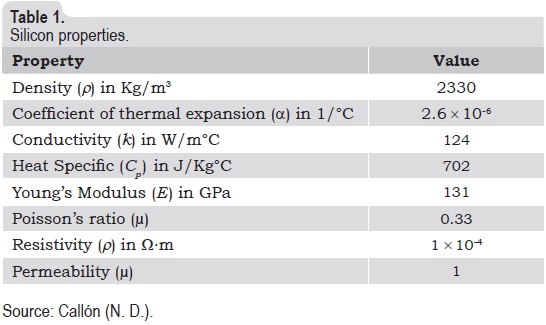
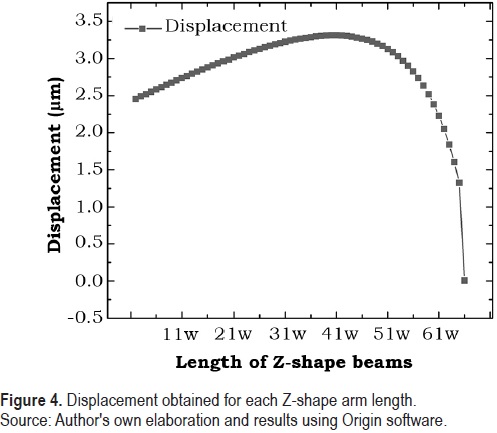
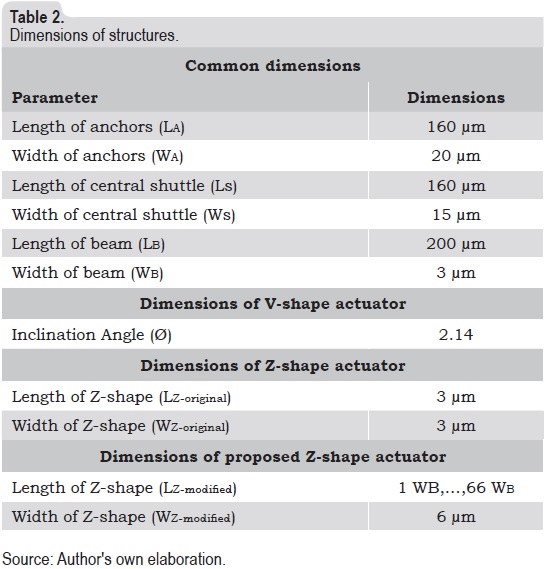
<body><![CDATA[<p align="justify"><font face="verdana" size="2">The structures were made of silicon, whose properties are shown in <a href="#t1">table 1</a>.</font></p>  	    <p align="center"><font face="verdana" size="2"><a name="f3"></a></font></p>  	    <p align="center"><font face="verdana" size="2"><img src="/img/revistas/au/v25n3/a3f3.jpg"></font></p>  	    <p align="center"><font face="verdana" size="2"><a name="t1"></a></font></p>  	    <p align="center"><font face="verdana" size="2"><img src="/img/revistas/au/v25n3/a3t1.jpg"></font></p>  	    <p align="justify"><font face="verdana" size="2">From the obtained results, it can be observed that the proposed Z&#45;shape actuator with <i>l<sub>z</sub></i> equal to 40<i><sub>W</sub><sub>B</sub></i> shows the largest displacement value on the considered voltage range applied. Initially, a linear response can be observed until the maximum point at 40<i><sub>W</sub><sub>B</sub></i> after it, the curved has a considerable drop. The optimized length of the Z&#45;shape actuator, which provides the largest displacement corresponds to <i>l<sub>z</sub></i> equal to 40<i><sub>WB</sub></i> (<a href="#f4">figure 4</a>).</font></p>  	    <p align="justify"><font face="verdana" size="2">The dimensions used are presented in <a href="#t2">table 2</a>.</font></p>  	    <p align="center"><font face="verdana" size="2"><a name="f4"></a></font></p>  	    <p align="center"><font face="verdana" size="2"><img src="/img/revistas/au/v25n3/a3f4.jpg"></font></p>  	    <p align="center"><font face="verdana" size="2"><a name="t2"></a></font></p>  	    ]]></body>
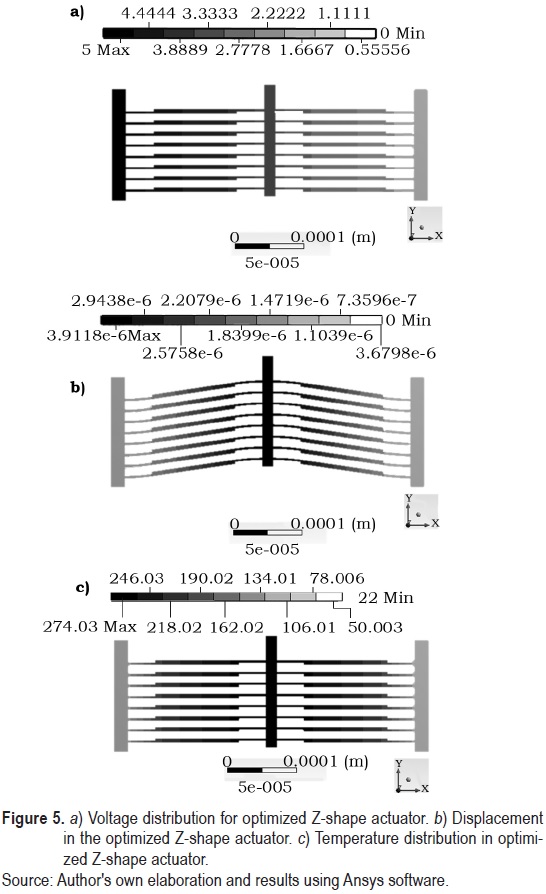
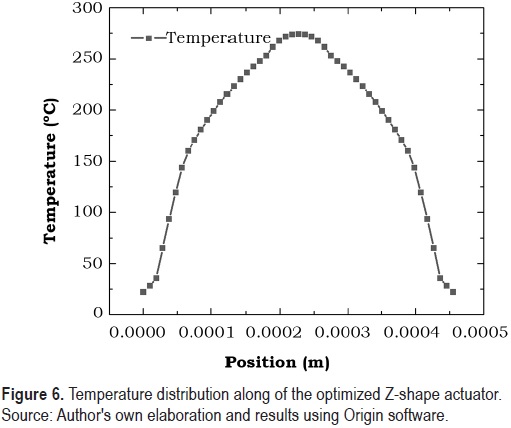
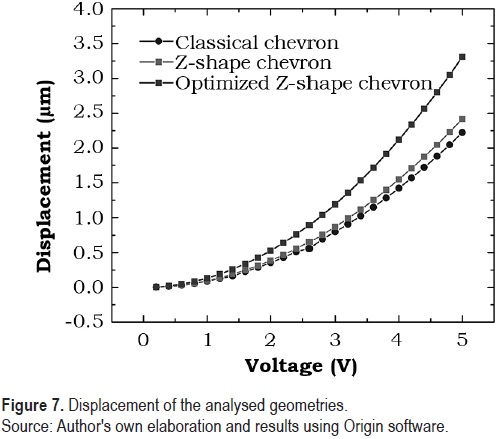
<body><![CDATA[<p align="center"><font face="verdana" size="2"><img src="/img/revistas/au/v25n3/a3t2.jpg"></font></p>  	    <p align="justify"><font face="verdana" size="2">The simulation involves electrothermal and mechanical analysis, which consisted of the application of voltage from 0.2 V up to 5 V in steps of 0.2 V applied at one of the anchors. The other one is fixed at 0 V. Temperature was considered at 22 &#176;C on them. The mechanical boundary conditions are given by fixing them.</font></p>  	    <p align="justify"><font face="verdana" size="2"><a href="#f5">Figures 5a</a> and <a href="#f5">5b</a> show the voltage distribution and the displacement results, respectively, under the mentioned conditions, for the proposed Z&#45;shape actuator.</font></p>  	    <p align="justify"><font face="verdana" size="2">In <a href="#f5">figure 5b</a>, a maximum displacement of 3.31 micrometers at 5 V is shown. The temperature distribution is given in <a href="#f5">figure 5c</a>, and the corresponding graph is shown <a href="#f6">figure 6</a>. A maximum temperature of 274 &#176;C is reached at 5 V.</font></p>  	    <p align="center"><font face="verdana" size="2"><a name="f5"></a></font></p>  	    <p align="center"><font face="verdana" size="2"><img src="/img/revistas/au/v25n3/a3f5.jpg"></font></p>  	    <p align="center"><font face="verdana" size="2"><a name="f6"></a></font></p>  	    <p align="center"><font face="verdana" size="2"><img src="/img/revistas/au/v25n3/a3f6.jpg"></font></p>     <p align="justify"><font face="verdana" size="2">In order to realize a behaviour comparison, <a href="#f7">figure 7</a> shows voltage&#45;displacement curves corresponding to classical, Z&#45;shape and optimized Z&#45;shaped actuators are depicted. The peak displacement at 5 V in the V&#45;shape actuator is 2.22 &#181;m, while in the optimized design, the displacement is of 3.31 &#181;m. That means, approximately 50% larger than the previous case. The maximum shuttle's displacement of the Z&#45;shape actuator was of 2.4 &#181;m, which is 38% lower than the displacement obtained in the optimized case.</font></p>     <p align="center"><font face="verdana" size="2"><a name="f7"></a></font></p>     ]]></body>
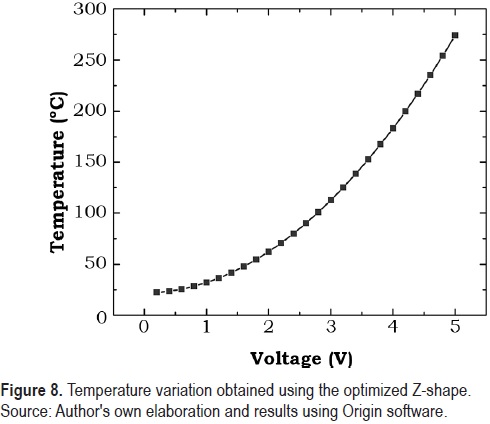
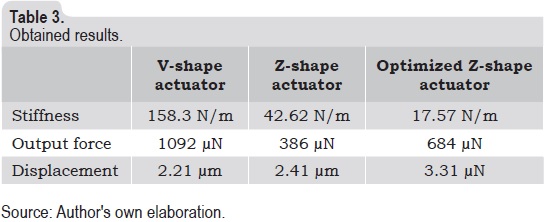
<body><![CDATA[<p align="center"><font face="verdana" size="2"><img src="/img/revistas/au/v25n3/a3f7.jpg"></font></p>     <p align="justify"><font face="verdana" size="2"><a href="#f8">Figure 8</a> shows the variation in temperature on central part of the optimized Z&#45;shape actuator with applied voltage. <a href="#f9">Figure 9</a> shows the displacements obtained by simulation and analytical calculation by means of equation 1. As it can be observed, they are almost identical.</font></p>  	    <p align="justify"><font face="verdana" size="2">For the case of Z&#45;shape actuator, a similar temperature distribution as the one shown in <a href="#f8">figure 8</a> was observed, so it was not added here.</font></p>  	    <p align="justify"><font face="verdana" size="2">On <a href="#t3">table 3</a>, a summary of the main results using geometries of eight beams is given.</font></p>  	    <p align="center"><font face="verdana" size="2"><a name="f8"></a></font></p>  	    <p align="center"><font face="verdana" size="2"><img src="/img/revistas/au/v25n3/a3f8.jpg"></font></p>  	    <p align="center"><font face="verdana" size="2"><a name="f9"></a></font></p>  	    <p align="center"><font face="verdana" size="2"><img src="/img/revistas/au/v25n3/a3f9.jpg"></font></p>  	    <p align="center"><font face="verdana" size="2"><a name="t3"></a></font></p>  	    <p align="center"><font face="verdana" size="2"><img src="/img/revistas/au/v25n3/a3t3.jpg"></font></p>  	    ]]></body>
<body><![CDATA[<p>&nbsp;</p>  	    <p align="justify"><font face="verdana" size="2"><b>CONCLUSIONS</b></font></p>  	    <p align="justify"><font face="verdana" size="2">Design and simulation of an optimized electrothermal actuator with Z&#45;shaped beams is developed. The shuttle's displacement value increases in approximately 50% compare to the V&#45;shape actuator, and of 38% compare to the original Z&#45;shape.</font></p>  	    <p align="justify"><font face="verdana" size="2">Furthermore, it can be noted that the adjusted analytical approach is extremely matched with the simulations results. As it can be observe, the total length of Z&#45;shape of the beam is the determinant factor on the displacement.</font></p>  	    <p align="justify"><font face="verdana" size="2">The low stiffness of the optimized Z&#45;shape actuator (89% lower than the original V&#45;shape and 58% compared to Z&#45;shape) can allow its use as load sensor.</font></p>  	    <p>&nbsp;</p>  	    <p align="justify"><font face="verdana" size="2"><b>ACKNOWLEDGMENT</b></font></p>  	    <p align="justify"><font face="verdana" size="2">R. Cabello&#45;Ruiz gratefully acknowledges financial support from Consejo Nacional de Ciencia y Tecnolog&iacute;a (Conacyt) scholarship under grant and J. G. Vera&#45;Dimas gratefully acknowledges financial support from Conacyt scholarship under grant 270210/219230.</font></p>  	    <p>&nbsp;</p>  	    <p align="justify"><font face="verdana" size="2"><b>REFERENCES</b></font></p>  	    ]]></body>
<body><![CDATA[<!-- ref --><p align="justify"><font face="verdana" size="2">Call&oacute;n, J. (N. D.). Silicio&#45;Propiedades del silicio. Recuperado en 2014 de <a href="http://elementos.org.es/silicio" target="_blank">http://elementos.org.es/silicio</a></font>&nbsp;&nbsp;&nbsp;&nbsp;&nbsp;&nbsp;&nbsp;&nbsp;[&#160;<a href="javascript:void(0);" onclick="javascript: window.open('/scielo.php?script=sci_nlinks&ref=252384&pid=S0188-6266201500030000300001&lng=','','width=640,height=500,resizable=yes,scrollbars=1,menubar=yes,');">Links</a>&#160;]<!-- end-ref --><!-- ref --><p align="justify"><font face="verdana" size="2">Cao, C., Chen, B., Filleter, T. &amp; Sun, Y. (2015). Mechanical Characterization Of Thin Films Using A Mems Device Inside Sem. IEEE. <i>Microelectromechanical Systems</i> (<i>MEMS</i>), 978, 381&#45;384. Retrieved from <a href="http://ieeexplore.ieee.org/stamp/stamp.jsp?arnumber=7050969&amp;tag=1" target="_blank">http://ieeexplore.ieee.org/stamp/stamp.jsp?arnumber=7050969&amp;tag=1</a></font>&nbsp;&nbsp;&nbsp;&nbsp;&nbsp;&nbsp;&nbsp;&nbsp;[&#160;<a href="javascript:void(0);" onclick="javascript: window.open('/scielo.php?script=sci_nlinks&ref=252385&pid=S0188-6266201500030000300002&lng=','','width=640,height=500,resizable=yes,scrollbars=1,menubar=yes,');">Links</a>&#160;]<!-- end-ref --><!-- ref --><p align="justify"><font face="verdana" size="2">Chow, J. &amp; Lai, Y. (2009). Displacement sensing of a micro&#45;electro&#45;thermal actuator using a monolithically integrated thermal sensor. <i>Sensors Actuators A, 150</i>(1), 137&#45;143.    &nbsp;&nbsp;&nbsp;&nbsp;&nbsp;&nbsp;&nbsp;&nbsp;[&#160;<a href="javascript:void(0);" onclick="javascript: window.open('/scielo.php?script=sci_nlinks&ref=252386&pid=S0188-6266201500030000300003&lng=','','width=640,height=500,resizable=yes,scrollbars=1,menubar=yes,');">Links</a>&#160;]<!-- end-ref --></font></p>  	    <!-- ref --><p align="justify"><font face="verdana" size="2">Cragun, R. &amp; Howell, L. L. (1999). Linear Thermomechanical Microactuators. Proccedings Of ASME International Mechanical Engineering Congress and Exposition, <i>Microelectromechanical Systems</i> (<i>MEMS</i>), <i>Nashville</i>, <i>TN</i>, <i>USA</i>, 1419,181&#45;188.    &nbsp;&nbsp;&nbsp;&nbsp;&nbsp;&nbsp;&nbsp;&nbsp;[&#160;<a href="javascript:void(0);" onclick="javascript: window.open('/scielo.php?script=sci_nlinks&ref=252388&pid=S0188-6266201500030000300004&lng=','','width=640,height=500,resizable=yes,scrollbars=1,menubar=yes,');">Links</a>&#160;]<!-- end-ref --></font></p>  	    <!-- ref --><p align="justify"><font face="verdana" size="2">Dong, J. &amp; Ferreira, P. M. (2008). Simultaneous actuation and displacement sensing for electrostatic drives. <i>Journal of Micromechanics and Microengineering</i>, <i>18</i>(3), 035011.    &nbsp;&nbsp;&nbsp;&nbsp;&nbsp;&nbsp;&nbsp;&nbsp;[&#160;<a href="javascript:void(0);" onclick="javascript: window.open('/scielo.php?script=sci_nlinks&ref=252390&pid=S0188-6266201500030000300005&lng=','','width=640,height=500,resizable=yes,scrollbars=1,menubar=yes,');">Links</a>&#160;]<!-- end-ref --></font></p>  	    <!-- ref --><p align="justify"><font face="verdana" size="2">Guan, C. &amp; Zhu, Y. (2010). An electrothermal microactuator with Z&#45;shaped beams. <i>Journal of Micromechanics and Microengineering</i>, <i>20</i>(8), 085014. <a href="http://elementos.org.es/silicio" target="_blank">http://elementos.org.es/silicio</a></font>&nbsp;&nbsp;&nbsp;&nbsp;&nbsp;&nbsp;&nbsp;&nbsp;[&#160;<a href="javascript:void(0);" onclick="javascript: window.open('/scielo.php?script=sci_nlinks&ref=252392&pid=S0188-6266201500030000300006&lng=','','width=640,height=500,resizable=yes,scrollbars=1,menubar=yes,');">Links</a>&#160;]<!-- end-ref --><!-- ref --><p align="justify"><font face="verdana" size="2">Rakotondrabe, M., Fowler, A. G. &amp; Moheimani, S. R. (2014). Control of a Novel 2&#45;DoF MEMS Nanopositioner With Electrothermal Actuation and Sensing. <i>IEEE Trasanctions On Control Systems Tecnology IEEE Transactions on</i>, <i>22</i>(4), 1486&#45;1497.    &nbsp;&nbsp;&nbsp;&nbsp;&nbsp;&nbsp;&nbsp;&nbsp;[&#160;<a href="javascript:void(0);" onclick="javascript: window.open('/scielo.php?script=sci_nlinks&ref=252393&pid=S0188-6266201500030000300007&lng=','','width=640,height=500,resizable=yes,scrollbars=1,menubar=yes,');">Links</a>&#160;]<!-- end-ref --></font></p>  	    <!-- ref --><p align="justify"><font face="verdana" size="2">Varona, J., Tecpoyotl&#45;Torres, M. &amp; Hamoui, A. A. (2009). Design of MEMS vertical&#45;horizontal chevron thermal actuators. <i>Sensors and Actuators A: Physical</i>, <i>153</i>(1), 127&#45;130.    &nbsp;&nbsp;&nbsp;&nbsp;&nbsp;&nbsp;&nbsp;&nbsp;[&#160;<a href="javascript:void(0);" onclick="javascript: window.open('/scielo.php?script=sci_nlinks&ref=252395&pid=S0188-6266201500030000300008&lng=','','width=640,height=500,resizable=yes,scrollbars=1,menubar=yes,');">Links</a>&#160;]<!-- end-ref --></font></p>  	    <!-- ref --><p align="justify"><font face="verdana" size="2">Zhu, Y. &amp; Espinoza, H. D. (2005). An electro&#45;mechanical material testing system for in situ electron microscopy and applications, <i>Proceedings of the National Academy of Sciences of the United States of America</i>, <i>102</i>(41), 14503&#45;14508.    &nbsp;&nbsp;&nbsp;&nbsp;&nbsp;&nbsp;&nbsp;&nbsp;[&#160;<a href="javascript:void(0);" onclick="javascript: window.open('/scielo.php?script=sci_nlinks&ref=252397&pid=S0188-6266201500030000300009&lng=','','width=640,height=500,resizable=yes,scrollbars=1,menubar=yes,');">Links</a>&#160;]<!-- end-ref --></font></p>  	    <!-- ref --><p align="justify"><font face="verdana" size="2">Zhu, Y., Corigliano, A. &amp; Espinoza, H. D. (2006). A thermal actuator for nanoscale in situ microscopy testing: design and characterization. <i>Journal of Micromechanics and Microengineering</i>, <i>16</i>(2), 242.    &nbsp;&nbsp;&nbsp;&nbsp;&nbsp;&nbsp;&nbsp;&nbsp;[&#160;<a href="javascript:void(0);" onclick="javascript: window.open('/scielo.php?script=sci_nlinks&ref=252399&pid=S0188-6266201500030000300010&lng=','','width=640,height=500,resizable=yes,scrollbars=1,menubar=yes,');">Links</a>&#160;]<!-- end-ref --></font></p>  	    <!-- ref --><p align="justify"><font face="verdana" size="2">Zhu, Y., Moheimani, S. R. &amp; Yuce, M. R. (2012). Bidirectional Electrothermal Actuator with Z&#45;Shaped Beams. <i>Sensors Journal</i>, <i>IEEE</i>, <i>12</i>(7), 2508&#45;2509.    &nbsp;&nbsp;&nbsp;&nbsp;&nbsp;&nbsp;&nbsp;&nbsp;[&#160;<a href="javascript:void(0);" onclick="javascript: window.open('/scielo.php?script=sci_nlinks&ref=252401&pid=S0188-6266201500030000300011&lng=','','width=640,height=500,resizable=yes,scrollbars=1,menubar=yes,');">Links</a>&#160;]<!-- end-ref --></font></p>      ]]></body><back>
<ref-list>
<ref id="B1">
<nlm-citation citation-type="">
<person-group person-group-type="author">
<name>
<surname><![CDATA[Callón]]></surname>
<given-names><![CDATA[J. (N. D.)]]></given-names>
</name>
</person-group>
<source><![CDATA[Silicio-Propiedades del silicio]]></source>
<year></year>
</nlm-citation>
</ref>
<ref id="B2">
<nlm-citation citation-type="journal">
<person-group person-group-type="author">
<name>
<surname><![CDATA[Cao]]></surname>
<given-names><![CDATA[C.]]></given-names>
</name>
<name>
<surname><![CDATA[Chen]]></surname>
<given-names><![CDATA[B.]]></given-names>
</name>
<name>
<surname><![CDATA[Filleter]]></surname>
<given-names><![CDATA[T.]]></given-names>
</name>
<name>
<surname><![CDATA[Sun]]></surname>
<given-names><![CDATA[Y.]]></given-names>
</name>
</person-group>
<article-title xml:lang="en"><![CDATA[Mechanical Characterization Of Thin Films Using A Mems Device Inside Sem]]></article-title>
<source><![CDATA[IEEE. Microelectromechanical Systems (MEMS)]]></source>
<year>2015</year>
<volume>978</volume>
<page-range>381-384</page-range></nlm-citation>
</ref>
<ref id="B3">
<nlm-citation citation-type="journal">
<person-group person-group-type="author">
<name>
<surname><![CDATA[Chow]]></surname>
<given-names><![CDATA[J.]]></given-names>
</name>
<name>
<surname><![CDATA[Lai]]></surname>
<given-names><![CDATA[Y.]]></given-names>
</name>
</person-group>
<article-title xml:lang="en"><![CDATA[Displacement sensing of a micro-electro-thermal actuator using a monolithically integrated thermal sensor]]></article-title>
<source><![CDATA[Sensors Actuators A]]></source>
<year>2009</year>
<volume>150</volume>
<numero>1</numero>
<issue>1</issue>
<page-range>137-143</page-range></nlm-citation>
</ref>
<ref id="B4">
<nlm-citation citation-type="">
<person-group person-group-type="author">
<name>
<surname><![CDATA[Cragun]]></surname>
<given-names><![CDATA[R.]]></given-names>
</name>
<name>
<surname><![CDATA[Howell]]></surname>
<given-names><![CDATA[L. L.]]></given-names>
</name>
</person-group>
<article-title xml:lang="en"><![CDATA[Linear Thermomechanical Microactuators]]></article-title>
<source><![CDATA[Proccedings Of ASME International Mechanical Engineering Congress and Exposition, Microelectromechanical Systems (MEMS)]]></source>
<year>1999</year>
<page-range>181-188</page-range><publisher-loc><![CDATA[Nashville^eTN TN]]></publisher-loc>
</nlm-citation>
</ref>
<ref id="B5">
<nlm-citation citation-type="journal">
<person-group person-group-type="author">
<name>
<surname><![CDATA[Dong]]></surname>
<given-names><![CDATA[J.]]></given-names>
</name>
<name>
<surname><![CDATA[Ferreira]]></surname>
<given-names><![CDATA[P. M.]]></given-names>
</name>
</person-group>
<article-title xml:lang="en"><![CDATA[Simultaneous actuation and displacement sensing for electrostatic drives]]></article-title>
<source><![CDATA[Journal of Micromechanics and Microengineering]]></source>
<year>2008</year>
<volume>18</volume>
<numero>3</numero>
<issue>3</issue>
<page-range>035011</page-range></nlm-citation>
</ref>
<ref id="B6">
<nlm-citation citation-type="journal">
<person-group person-group-type="author">
<name>
<surname><![CDATA[Guan]]></surname>
<given-names><![CDATA[C.]]></given-names>
</name>
<name>
<surname><![CDATA[Zhu]]></surname>
<given-names><![CDATA[Y.]]></given-names>
</name>
</person-group>
<article-title xml:lang="en"><![CDATA[An electrothermal microactuator with Z-shaped beams]]></article-title>
<source><![CDATA[Journal of Micromechanics and Microengineering]]></source>
<year>2010</year>
<volume>20</volume>
<numero>8</numero>
<issue>8</issue>
<page-range>085014</page-range></nlm-citation>
</ref>
<ref id="B7">
<nlm-citation citation-type="journal">
<person-group person-group-type="author">
<name>
<surname><![CDATA[Rakotondrabe]]></surname>
<given-names><![CDATA[M.]]></given-names>
</name>
<name>
<surname><![CDATA[Fowler]]></surname>
<given-names><![CDATA[A. G.]]></given-names>
</name>
<name>
<surname><![CDATA[Moheimani]]></surname>
<given-names><![CDATA[S. R.]]></given-names>
</name>
</person-group>
<article-title xml:lang="en"><![CDATA[Control of a Novel 2-DoF MEMS Nanopositioner With Electrothermal Actuation and Sensing]]></article-title>
<source><![CDATA[IEEE Trasanctions On Control Systems Tecnology IEEE Transactions on]]></source>
<year>2014</year>
<volume>22</volume>
<numero>4</numero>
<issue>4</issue>
<page-range>1486-1497</page-range></nlm-citation>
</ref>
<ref id="B8">
<nlm-citation citation-type="journal">
<person-group person-group-type="author">
<name>
<surname><![CDATA[Varona]]></surname>
<given-names><![CDATA[J.]]></given-names>
</name>
<name>
<surname><![CDATA[Tecpoyotl-Torres]]></surname>
<given-names><![CDATA[M.]]></given-names>
</name>
<name>
<surname><![CDATA[Hamoui]]></surname>
<given-names><![CDATA[A. A.]]></given-names>
</name>
</person-group>
<article-title xml:lang="en"><![CDATA[Design of MEMS vertical-horizontal chevron thermal actuators]]></article-title>
<source><![CDATA[Sensors and Actuators A: Physical]]></source>
<year>2009</year>
<volume>153</volume>
<numero>1</numero>
<issue>1</issue>
<page-range>127-130</page-range></nlm-citation>
</ref>
<ref id="B9">
<nlm-citation citation-type="journal">
<person-group person-group-type="author">
<name>
<surname><![CDATA[Zhu]]></surname>
<given-names><![CDATA[Y.]]></given-names>
</name>
<name>
<surname><![CDATA[Espinoza]]></surname>
<given-names><![CDATA[H. D.]]></given-names>
</name>
</person-group>
<article-title xml:lang="en"><![CDATA[An electro-mechanical material testing system for in situ electron microscopy and applications]]></article-title>
<source><![CDATA[Proceedings of the National Academy of Sciences of the United States of America]]></source>
<year>2005</year>
<volume>102</volume>
<numero>41</numero>
<issue>41</issue>
<page-range>14503-14508</page-range></nlm-citation>
</ref>
<ref id="B10">
<nlm-citation citation-type="journal">
<person-group person-group-type="author">
<name>
<surname><![CDATA[Zhu]]></surname>
<given-names><![CDATA[Y.]]></given-names>
</name>
<name>
<surname><![CDATA[Corigliano]]></surname>
<given-names><![CDATA[A.]]></given-names>
</name>
<name>
<surname><![CDATA[Espinoza]]></surname>
<given-names><![CDATA[H. D.]]></given-names>
</name>
</person-group>
<article-title xml:lang="en"><![CDATA[A thermal actuator for nanoscale in situ microscopy testing: design and characterization]]></article-title>
<source><![CDATA[Journal of Micromechanics and Microengineering]]></source>
<year>2006</year>
<volume>16</volume>
<numero>2</numero>
<issue>2</issue>
<page-range>242</page-range></nlm-citation>
</ref>
<ref id="B11">
<nlm-citation citation-type="journal">
<person-group person-group-type="author">
<name>
<surname><![CDATA[Zhu]]></surname>
<given-names><![CDATA[Y.]]></given-names>
</name>
<name>
<surname><![CDATA[Moheimani]]></surname>
<given-names><![CDATA[S. R.]]></given-names>
</name>
<name>
<surname><![CDATA[Yuce]]></surname>
<given-names><![CDATA[M. R.]]></given-names>
</name>
</person-group>
<article-title xml:lang="en"><![CDATA[Bidirectional Electrothermal Actuator with Z-Shaped Beams]]></article-title>
<source><![CDATA[Sensors Journal, IEEE]]></source>
<year>2012</year>
<volume>12</volume>
<numero>7</numero>
<issue>7</issue>
<page-range>2508-2509</page-range></nlm-citation>
</ref>
</ref-list>
</back>
</article>