<?xml version="1.0" encoding="ISO-8859-1"?><article xmlns:mml="http://www.w3.org/1998/Math/MathML" xmlns:xlink="http://www.w3.org/1999/xlink" xmlns:xsi="http://www.w3.org/2001/XMLSchema-instance">
<front>
<journal-meta>
<journal-id>0188-6266</journal-id>
<journal-title><![CDATA[Acta universitaria]]></journal-title>
<abbrev-journal-title><![CDATA[Acta univ]]></abbrev-journal-title>
<issn>0188-6266</issn>
<publisher>
<publisher-name><![CDATA[Universidad de Guanajuato, Dirección de Investigación y Posgrado]]></publisher-name>
</publisher>
</journal-meta>
<article-meta>
<article-id>S0188-62662015000100003</article-id>
<article-id pub-id-type="doi">10.15174/au.2014.676</article-id>
<title-group>
<article-title xml:lang="en"><![CDATA[Soil irrigation frequencies, compaction, air porosity and shear stress effects on soybean root development]]></article-title>
<article-title xml:lang="es"><![CDATA[Frecuencias de riego, compactación, porosidad aerífera y tensión cortante del suelo relacionadas con el desarrollo radical de soya]]></article-title>
</title-group>
<contrib-group>
<contrib contrib-type="author">
<name>
<surname><![CDATA[Hossne]]></surname>
<given-names><![CDATA[G. A.]]></given-names>
</name>
<xref ref-type="aff" rid="A01"/>
</contrib>
<contrib contrib-type="author">
<name>
<surname><![CDATA[Méndez]]></surname>
<given-names><![CDATA[J.]]></given-names>
</name>
<xref ref-type="aff" rid="A01"/>
</contrib>
<contrib contrib-type="author">
<name>
<surname><![CDATA[Trujillo]]></surname>
<given-names><![CDATA[M.]]></given-names>
</name>
<xref ref-type="aff" rid="A01"/>
</contrib>
<contrib contrib-type="author">
<name>
<surname><![CDATA[Parra]]></surname>
<given-names><![CDATA[F.]]></given-names>
</name>
<xref ref-type="aff" rid="A01"/>
</contrib>
</contrib-group>
<aff id="A01">
<institution><![CDATA[,Universidad de Oriente Núcleo de Monagas Departamento de Ingeniería Agrícola]]></institution>
<addr-line><![CDATA[Maturín Monagas]]></addr-line>
<country>Venezuela</country>
</aff>
<pub-date pub-type="pub">
<day>00</day>
<month>02</month>
<year>2015</year>
</pub-date>
<pub-date pub-type="epub">
<day>00</day>
<month>02</month>
<year>2015</year>
</pub-date>
<volume>25</volume>
<numero>1</numero>
<fpage>22</fpage>
<lpage>30</lpage>
<copyright-statement/>
<copyright-year/>
<self-uri xlink:href="http://www.scielo.org.mx/scielo.php?script=sci_arttext&amp;pid=S0188-62662015000100003&amp;lng=en&amp;nrm=iso"></self-uri><self-uri xlink:href="http://www.scielo.org.mx/scielo.php?script=sci_abstract&amp;pid=S0188-62662015000100003&amp;lng=en&amp;nrm=iso"></self-uri><self-uri xlink:href="http://www.scielo.org.mx/scielo.php?script=sci_pdf&amp;pid=S0188-62662015000100003&amp;lng=en&amp;nrm=iso"></self-uri><abstract abstract-type="short" xml:lang="en"><p><![CDATA[Effect of soil compaction on the root development of soybean plants (Glycine max L. Merrill cv. San Baiba), subjected to different treatments of irrigation frequencies, air porosity and shear stress of a sandy loam soil were performed. Soybeans are important agricultural crop of the area, where the soil is incompressible and easy deformable. The objectives were to determine: (a) Consequences of water content, compaction and air porosity over the root length, root volume, and root fresh mass; and (b) Results of air content, shear stress and normal strain on root growth. The methods used were the Proctor test, triaxial, water meters, watering frequency and 30 cm x 30 cm x 1.5 cm plastic cylinders. The randomized block was used in simple factorial arrangement with four levels of compaction per layer (0, 12, 24, 36) and four soil water content through four irrigation frequencies (daily, inter-day, every two days and each three days). The findings were: (a) Root length between 24 cm and 79.5 cm; (b) Root volume from 2 cm³ to 40 cm³; (c) Root fresh mass between 7.58 g and 34.04 g, with a higher values tendency for daily and inter-day irrigation frequencies. The daily and inter day irrigation frequencies average results were above the grand mean (52.31 cm) of root length for the four levels of compaction. It was concluded that the soybeans root system was positively influenced by water content, more than compaction and the other variables under study.]]></p></abstract>
<abstract abstract-type="short" xml:lang="es"><p><![CDATA[Se estudió el efecto de la compactación del suelo en el desarrollo de la raíz de plantas de soya (Glycine max L. Merrill cv. San Baiba) sometidas a diferentes tratamientos de frecuencias de riego, porosidad aerífera y tensión cortante de un suelo franco arenoso de sabana. La soya es de importancia agrícola en la zona, donde el suelo es incompresible y de fácil deformación. Los objetivos fueron determinar (a) el efecto del contenido de humedad y porosidad aerífera sobre la longitud, el volumen radical y la masa fresca radical, y (b) la relación del contenido aerífero, tensión cortante y tensión normal con el crecimiento radical. Se utilizó el método Proctor, triaxial, medidores de humedad, frecuencia de riego y cilindros plásticos de 30 cm x 30 cm x 1.5 cm. Se emplearon bloques al azar en arreglo factorial simple con cuatro niveles de compactación por capa (0, 12, 24, 36) y cuatro de humedad a través de cuatro frecuencias de riego (todos los días, interdiario, cada dos días y cada tres días). Entre los resultados: (a) la longitud radical entre 24 cm y 79.5 cm; (b) el volumen radical entre 2 cm³ y 40 cm³; (c) la masa fresca radical entre 7.58 g y 34.04 g, con tendencia de los valores mayores para los tratamientos con frecuencias de riego diaria e interdiaria que produjeron resultados promedios por encima de la gran media (52.31 cm) de la longitud radical para los efectos de los cuatro niveles de compactación. Se concluyó que el sistema radical fue más positivamente influenciado por la humedad que por los efectos de las otras variables estudiadas.]]></p></abstract>
<kwd-group>
<kwd lng="en"><![CDATA[Savanna soil]]></kwd>
<kwd lng="en"><![CDATA[compaction]]></kwd>
<kwd lng="en"><![CDATA[irrigation]]></kwd>
<kwd lng="en"><![CDATA[morphological characters]]></kwd>
<kwd lng="es"><![CDATA[Suelos de sabana]]></kwd>
<kwd lng="es"><![CDATA[compactación]]></kwd>
<kwd lng="es"><![CDATA[riego]]></kwd>
<kwd lng="es"><![CDATA[caracteres morfológicos]]></kwd>
</kwd-group>
</article-meta>
</front><body><![CDATA[  	    <p align="center"><font face="verdana" size="4"><b>Soil irrigation frequencies, compaction, air porosity and shear stress effects on soybean root development</b></font></p>  	    <p align="center"><font face="verdana" size="2">&nbsp;</font></p>  	    <p align="center"><font face="verdana" size="3"><b>Frecuencias de riego, compactaci&oacute;n, porosidad aer&iacute;fera y tensi&oacute;n cortante del suelo relacionadas con el desarrollo radical de soya</b></font></p>  	    <p align="center"><font face="verdana" size="2">&nbsp;</font></p>  	    <p align="center"><font face="verdana" size="2"><b>G. A. Hossne*, J. M&eacute;ndez*, M. Trujillo*, F. Parra*</b></font></p>  	    <p align="center"><font face="verdana" size="2">&nbsp;</font></p>  	    <p align="justify"><font face="verdana" size="2"><i>* Departamento de Ingenier&iacute;a Agr&iacute;cola, N&uacute;cleo de Monagas, Universidad de Oriente. Apartado postal n&uacute;m. 414, Matur&iacute;n, Estado Monagas, Venezuela.</i> Correos electr&oacute;nicos: <a href="mailto:americohossnegarcia@gmail.com">americohossnegarcia@gmail.com</a>; <a href="mailto:americohossne@cantv.net">americohossne@cantv.net</a></font></p>  	    <p align="justify"><font face="verdana" size="2">&nbsp;</font></p>  	    <p align="justify"><font face="verdana" size="2">Recibido: 8 de septiembre de 2014    ]]></body>
<body><![CDATA[<br> 	Aceptado: 7 de noviembre de 2014</font></p>  	    <p align="justify"><font face="verdana" size="2">&nbsp;</font></p>  	    <p align="justify"><font face="verdana" size="2"><b>Abstract</b></font></p>  	    <p align="justify"><font face="verdana" size="2">Effect of soil compaction on the root development of soybean plants (<i>Glycine max</i> L. Merrill cv. San Baiba), subjected to different treatments of irrigation frequencies, air porosity and shear stress of a sandy loam soil were performed. Soybeans are important agricultural crop of the area, where the soil is incompressible and easy deformable. The objectives were to determine: (<i>a</i>) Consequences of water content, compaction and air porosity over the root length, root volume, and root fresh mass; and (<i>b</i>) Results of air content, shear stress and normal strain on root growth. The methods used were the Proctor test, triaxial, water meters, watering frequency and 30 cm x 30 cm x 1.5 cm plastic cylinders. The randomized block was used in simple factorial arrangement with four levels of compaction per layer (0, 12, 24, 36) and four soil water content through four irrigation frequencies (daily, inter&#45;day, every two days and each three days). The findings were: (<i>a</i>) Root length between 24 cm and 79.5 cm; (<i>b</i>) Root volume from 2 cm<sup>3</sup> to 40 cm<sup>3</sup>; (<i>c</i>) Root fresh mass between 7.58 g and 34.04 g, with a higher values tendency for daily and inter&#45;day irrigation frequencies. The daily and inter day irrigation frequencies average results were above the grand mean (52.31 cm) of root length for the four levels of compaction. It was concluded that the soybeans root system was positively influenced by water content, more than compaction and the other variables under study.</font></p>  	    <p align="justify"><font face="verdana" size="2"><b>Keywords:</b> Savanna soil; compaction; irrigation; morphological characters.</font></p>  	    <p align="justify"><font face="verdana" size="2">&nbsp;</font></p>  	    <p align="justify"><font face="verdana" size="2"><b>Resumen</b></font></p>  	    <p align="justify"><font face="verdana" size="2">Se estudi&oacute; el efecto de la compactaci&oacute;n del suelo en el desarrollo de la ra&iacute;z de plantas de soya (<i>Glycine max</i> L. Merrill cv. San Baiba) sometidas a diferentes tratamientos de frecuencias de riego, porosidad aer&iacute;fera y tensi&oacute;n cortante de un suelo franco arenoso de sabana. La soya es de importancia agr&iacute;cola en la zona, donde el suelo es incompresible y de f&aacute;cil deformaci&oacute;n. Los objetivos fueron determinar (<i>a</i>) el efecto del contenido de humedad y porosidad aer&iacute;fera sobre la longitud, el volumen radical y la masa fresca radical, y (<i>b</i>) la relaci&oacute;n del contenido aer&iacute;fero, tensi&oacute;n cortante y tensi&oacute;n normal con el crecimiento radical. Se utiliz&oacute; el m&eacute;todo Proctor, triaxial, medidores de humedad, frecuencia de riego y cilindros pl&aacute;sticos de 30 cm x 30 cm x 1.5 cm. Se emplearon bloques al azar en arreglo factorial simple con cuatro niveles de compactaci&oacute;n por capa (0, 12, 24, 36) y cuatro de humedad a trav&eacute;s de cuatro frecuencias de riego (todos los d&iacute;as, interdiario, cada dos d&iacute;as y cada tres d&iacute;as). Entre los resultados: (<i>a</i>) la longitud radical entre 24 cm y 79.5 cm; (<i>b</i>) el volumen radical entre 2 cm<sup>3</sup> y 40 cm<sup>3</sup>; (<i>c</i>) la masa fresca radical entre 7.58 g y 34.04 g, con tendencia de los valores mayores para los tratamientos con frecuencias de riego diaria e interdiaria que produjeron resultados promedios por encima de la gran media (52.31 cm) de la longitud radical para los efectos de los cuatro niveles de compactaci&oacute;n. Se concluy&oacute; que el sistema radical fue m&aacute;s positivamente influenciado por la humedad que por los efectos de las otras variables estudiadas.</font></p>  	    <p align="justify"><font face="verdana" size="2"><b>Palabras clave:</b> Suelos de sabana; compactaci&oacute;n; riego; caracteres morfol&oacute;gicos.</font></p>  	    <p align="justify"><font face="verdana" size="2">&nbsp;</font></p>  	    ]]></body>
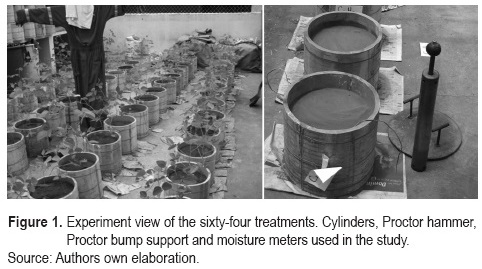
<body><![CDATA[<p align="justify"><font face="verdana" size="2"><b>INTRODUCTION</b></font></p>  	    <p align="justify"><font face="verdana" size="2">Compaction approaches soil particles, dry or wet, reducing the air space and the soil ability to adequately preserve enough amounts of air. The soil pore space needed to ensure the gas exchange required by a healthy root system should be between 10% and 20% of air. According to Kozlowski (1985) and Costello, MacDonald &amp; Jacobs (1991), the roots work best with a level above 10% oxygen, levels below 4%&#45;5% highly inhibit root growth. The soil structure is changed by compaction, reducing size and pore continuity, causing increased soil density. It is conceived that the soil compaction, usually measured by evaluation of the dry density, creates root growth inhibition of plants, such as in soybeans which is agriculturally important for the area. It has been considered that compaction increases the soil resistance. According to Ponder (2004), the mechanism that compacted soil supported better growth more than not compacted is not completely understood. Much of the better growth is likely owing to better soil physical changes that caused better soil moisture conditions for growth. Severely compacted layer below the depth of tillage is a special problem of soil compaction in many farmlands. This severely compacted layer restricts root growth and water available for plant roots. Taylor &amp; Burnett (1964) and Taylor (1974) reported on the excessive strength of plow pans when were dry; dryness was the main restriction hindering root growth, due that soil resistance diminished with rain or irrigation. The soil resistance critical value, at which plant roots do not elongate, is produced by soil moisture and stages of plant development. Comparison of the measures of compaction in the literature is quite difficult because of a lack of information on moisture and development status.</font></p>  	    <p align="justify"><font face="verdana" size="2">Compaction, by definition, is the reduction of air&#45;filled pores of the soil. It is common to provide the soil bulk density measurements unreferenced with the values of moisture content of the soil. Miller, Scott &amp; Hazard (1996), and Cochran &amp; Brock (1985) reported existing ample evidence supporting the reduction in growth caused by soil compaction, it has not always produced negative growth effects. Gomez, Powers, Singer &amp; Horwath (2002) specified that the effect of compaction varied with the texture and soil moisture. These authors also reported that compaction reduced the growth of young ponderosa pine in California on fine textured soils attributable to increased soil strength, but soil compaction increased growth on a sandy textured soil owing to increased water holding capacity. Rahman, Hara &amp; Hoque (2005) conducted a greenhouse experiment, with sandy loam andisols soil, to evaluate the cause of different levels of compaction on soybean. Root dry weight, root shoot ratio and shoot dry weight decreased significantly with the increased energy levels and decreased with increased levels of compaction. Hossne <i>et al</i>. (2003); Hossne (2008) showed that soil bulk densities varied inversely with soil water content and that soil shear stress was an inverse function of soil moisture, close to zero as it approached the soil liquid limit. Hossne (2004) reported that the action of root growth increased its axial stress for soil shear stress with a critical value of 2343.2 kPa for 20.78% soil moisture content, these soils exerted a shear strength is lower 500 kPa within the range of field capacity. Smucker &amp; Erickson (1987) informed that plants subject to soil compaction are more susceptible to water stress. And according to Schumacher &amp; Smucker (1984), root development may be damaged by lack of oxygen in compacted soils. The objectives of this study were to evaluate: (<i>a</i>) The influence of moisture content and air porosity levels of a sandy loam soil of savanna on the length, volume and fresh root mass of soybean; and (<i>b</i>) the relationship among soybean root growth and air porosity, shear strength and normal stress of the studied soil.</font></p>  	    <p align="justify"><font face="verdana" size="2">&nbsp;</font></p>  	    <p align="justify"><font face="verdana" size="2"><b>MATERIALS AND METHODS</b></font></p>  	    <p align="justify"><font face="verdana" size="2">A greenhouse cultivation of Soybeans (<i>Glycine max</i> L. Merrill cv. San Baiba) in sandy loam soil of savanna of the Monagas state, with the characteristics shown in <a href="#t1">table 1</a>, was used in the study.</font></p>  	    <p align="center"><font face="verdana" size="2"><a name="t1"></a></font></p>  	    <p align="center"><font face="verdana" size="2"><img src="/img/revistas/au/v25n1/a3t1.jpg"></font></p>  	    <p align="justify"><font face="verdana" size="2">The Proctor method was used to determine the dry bulk density. The Proctor test is a geotechnical engineering test to find out the maximum density that may be practically achieved for a soil or similar substance. The Proctor soil compaction test is done by measuring the density, or dry unit weight of the soil being tested at different moisture content points. The aim of the soil test is usually to determine the optimum moisture content for the soil. In addition to soils, other substances, such as aggregate, gravel, or sand, may be measured. In this scenario, compacting the soil means increasing its density by forcing air out of the soil. By compacting the soil or aggregate at different moisture contents, an engineer may determine what the optimum moisture content and compaction level are of the soil or aggregate for a specific use in a particular engineering project. The Proctor test was invented in 1933 by Ralph R. Proctor (1933). Both the original and the modified Proctor tests also allow the use of a larger mold for measuring substances that contain larger particles, such as gravel. The air porosity (Ea) was determined using Equation 1, as a function of the total porosity (n), the volumetric water content (&#952;), dry bulk density (&#961;S), particle density (&#961;P), gravimetric water content (w) and the water density (&#961;W). Moisture soil meters and frequencies of irrigation were employed. The interaction of four compaction levels (Proctor strokes) per layer: (0, 12, 24, 36) and four soil water content through irrigation frequencies: (daily, inter&#45;day, every two days and every three days) were studied. For determination of soil strength, &#964; = C + &#963;* tan (&#966;), the triaxial apparatus was utilized. Sixty&#45;four polymers cylinders 30 cm diameter, 30 cm height and 1.5 cm thick were employed, cut longitudinally into two halves at the center and fastened shown in <a href="#f1">figure 1</a>.</font></p>  	    <p align="center"><font face="verdana" size="2"><img src="/img/revistas/au/v25n1/a3e1.jpg"></font></p>  	    ]]></body>
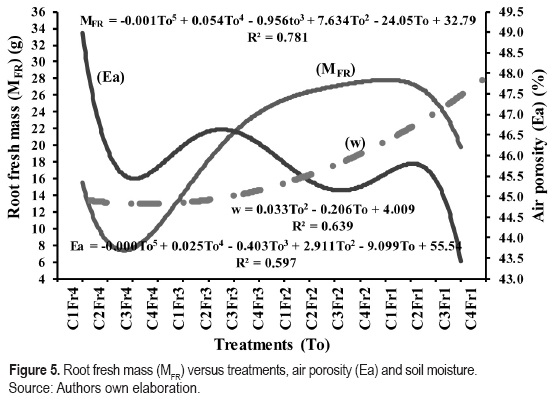
<body><![CDATA[<p align="center"><font face="verdana" size="2"><a name="f1"></a></font></p>  	    <p align="center"><font face="verdana" size="2"><img src="/img/revistas/au/v25n1/a3f1.jpg"></font></p>  	    <p align="justify"><font face="verdana" size="2">The harvest took place between seventy&#45;two (72) and seventy&#45;five (75) days. 24.57 kg (8.19 kg/layer) of soil per cylinder were utilized. Fertilizer application of 2.74 g/cylinder of 25 kg/ha&#45;100 kg/ha&#45;120 kg/ha of NPK was performed. One liter of water per irrigation frequency was applied. A randomized blocks experimental design (4&#8226;4) with simple factorial with sixteen (16) treatments (To) with four replications for a total of sixty&#45;four (64) experimental units was applied. Irrigation were established: every day (Fr1), inter&#45;day (Fr2), every two days (Fr3) and every three days (Fr4) and compaction levels: 0 drops/layer (C1), 12 drops/layer (C2), 24 drops/layer (C3) and 36 drops/layer (C4). Statistically regression analysis of variance (ANOVA), the least significant difference (LSD), the best subset regression method, and with multiple regressions it was introduced a cubic polynomial with the dependent variable root length (L) and the independent variables: compaction, represented by air porosity (Ea) and irrigation frequencies (Fr) were used.</font></p>  	    <p align="justify"><font face="verdana" size="2">&nbsp;</font></p>  	    <p align="justify"><font face="verdana" size="2"><b>RESULTS</b></font></p>  	    <p align="justify"><font face="verdana" size="2">By applying multiple regression, a third degree polynomial with thirteen terms was optimized, of which the terms Fr, Ea&#8226;Fr, Ea<sup>2</sup>&#8226;Fr, Ea<sup>2</sup>&#8226;Fr<sup>2</sup>, Ea<sup>3</sup>&#8226;Fr, Ea<sup>3</sup>&#8226;Fr<sup>2</sup> and Ea<sup>3</sup>&#8226;Fr<sup>3</sup> were eliminated with <i>p</i> values greater than 0.05 in the ANOVA, to forge a third degree polynomial with six terms shown in equation 2, with R<sup>2</sup> of 92.33, adjusted R<sup>2</sup> of 87.21, standard error of 2.83 and absolute minimum error 1.56. The ANOVA <i>p</i> value of 0.0002 showed a statistically significant relationship between variables in a high level of significance. <a href="#f2">Figure 2</a> shows the response surface plot for the model of equation 2.</font></p>  	    <p align="center"><font face="verdana" size="2"><img src="/img/revistas/au/v25n1/a3e2.jpg"></font></p>  	    <p align="center"><font face="verdana" size="2"><a name="f2"></a></font></p>  	    <p align="center"><font face="verdana" size="2"><img src="/img/revistas/au/v25n1/a3f2.jpg"></font></p>  	    <p align="justify"><font face="verdana" size="2"><a href="/img/revistas/au/v25n1/a3f3.jpg" target="_blank">Figure 3</a> shows the results of the root length, shear stress and air porosity versus treatments and soil moisture recorded during the process of soybean root growth. <a href="/img/revistas/au/v25n1/a3f4.jpg" target="_blank">Figure 4</a> evidence the results of root length, porosity and moisture versus the experiment treatments. <a href="#f5">Figure 5</a> indicates the results of radical fresh weight, air porosity and moisture versus the treatments. <a href="#f6">Figure 6</a> graphically displays the results of the rooting volume, air porosity and moisture versus treatments.</font></p>  	    ]]></body>
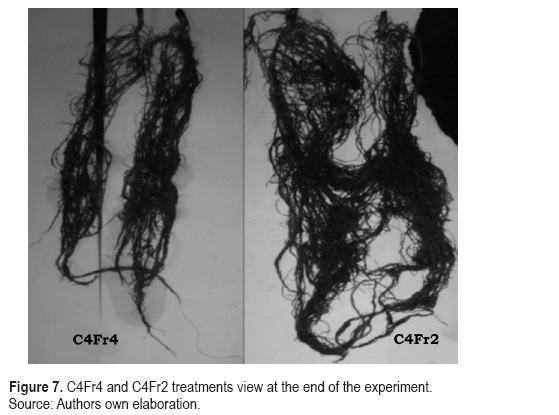
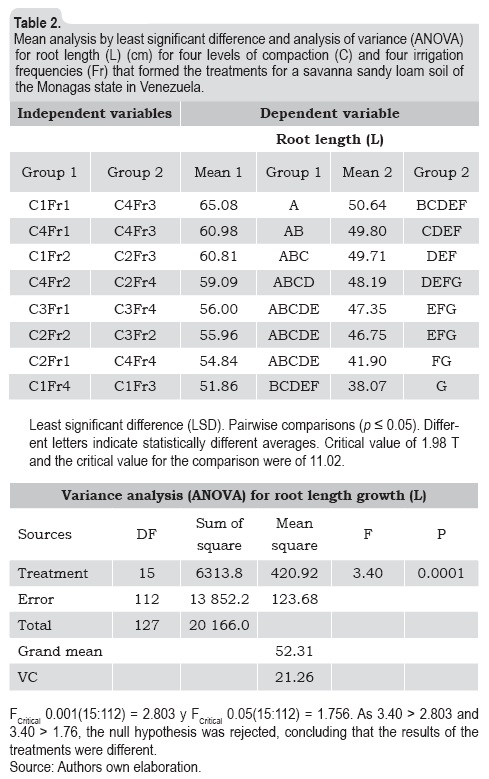
<body><![CDATA[<p align="center"><font face="verdana" size="2"><a name="f5"></a></font></p>  	    <p align="center"><font face="verdana" size="2"><img src="/img/revistas/au/v25n1/a3f5.jpg"></font></p>  	    <p align="center"><font face="verdana" size="2"><a name="f6"></a></font></p>  	    <p align="center"><font face="verdana" size="2"><img src="/img/revistas/au/v25n1/a3f6.jpg"></font></p>  	    <p align="justify"><font face="verdana" size="2"><a href="#f7">Figure 7</a> presents the root volume obtained with the treatments C4Fr4 (36 drops/layer with watering every three days) and C4Fr2 (36 drops/layer and inter&#45;day watering). This supports the results presented in graphs and statistical analysis. According to Fageria, Balingar &amp; Clark (2006), Grzesiak, Hura, Grzesiak &amp; Pienkowski (1999), Iijima &amp; Kono (1991), Masle (2002) and Yamauchi (1993) the inhibition of plant growth is attributed mainly to reduced rooting volume.</font></p>  	    <p align="center"><font face="verdana" size="2"><a name="f7"></a></font></p>  	    <p align="center"><font face="verdana" size="2"><img src="/img/revistas/au/v25n1/a3f7.jpg"></font></p>  	    <p align="justify"><font face="verdana" size="2"><a href="#t2">Table 2</a> presents the statistical results obtained from the least significant difference analysis and analysis of variance.</font></p>  	    <p align="center"><font face="verdana" size="2"><a name="t2"></a></font></p>  	    <p align="center"><font face="verdana" size="2"><img src="/img/revistas/au/v25n1/a3t2.jpg"></font></p>  	    ]]></body>
<body><![CDATA[<p align="center"><font face="verdana" size="2">&nbsp;</font></p>  	    <p align="justify"><font face="verdana" size="2"><b>DISCUSSION</b></font></p>  	    <p align="justify"><font face="verdana" size="2">Root length versus irrigation period and air porosity, shown in response surface of <a href="#f2">figure 2</a>, demonstrates that soil moisture was the variable almost influential for plant root development. The air porosity, with accepted percentage product of soil compacting effect, did not inhibited root growth, but fewer prevalent than water application as it is the intense blue shadow path seen adjacent to the irrigation frequency coordinate that exhibits the greatest root length assessments as noted in the palette values.</font></p>  	    <p align="justify"><font face="verdana" size="2"><a href="/img/revistas/au/v25n1/a3f3.jpg" target="_blank">Figure 3</a>, that presents the curves of shear stress (&#964;) for different chamber pressures, shows that the resistance of the studied soil under satisfactory soil moisture conditions (Fr1 and Fr2), became imperceptible. In this analysis, the graphs for the results of fresh mass and root volume are not shown attributable to the same trends obtained. It is seen that soil moisture was the almost influential upon root growth. At the highest levels of resistance of the soil, the roots are more sensitive to water deficit (Davis, 1984).</font></p>  	    <p align="justify"><font face="verdana" size="2"><a href="/img/revistas/au/v25n1/a3f3.jpg" target="_blank">Figures 3</a>, <a href="/img/revistas/au/v25n1/a3f4.jpg" target="_blank">4</a>, <a href="#f5">5</a>, <a href="#f6">6</a> and <a href="#f7">7</a>, show that the best root expansion of root length, fresh mass and root volume were for every day and inter&#45;day irrigation periods, increasing with soil moisture increments. This coincides with the statistical results already presented.</font></p>  	    <p align="justify"><font face="verdana" size="2">It is observed in table 2 that the longest root length was achieved with the daily watering frequency for compaction (C1) and maximum compaction (C4). There were seven treatment groups without significant difference; this was expected, since the four levels of compaction (C1, C2, C3 and C4) did not produce an effect on the two soil water content levels: inter&#45;day and daily irrigation. Also, the use of both frequencies were indifferent one another. This indicates that moisture was the parameter that most influenced the root growth. Thereon; Ehlers, K&ouml;phe, Hesse &amp; B&ouml;hm (1983) reported that mechanical impediments increased as dry bulk density increased and decreased by amplifying the water content. Similar results were reported by Blouin, Schmidt, Bulmer &amp; Krzic (2004) and Coile (1948). According to Blackwell, Ward, Lefevre &amp; Cowan (1985), and Boone, De Smet &amp; van Loon (1985), soil wetness may produce an effect the rootability of pores smaller than the root diameter. It was observed that in compacted soil some roots were able to widen pore spaces by deforming the space with root expansion. Such deformation is easier for roots when soil is wet (low soil strength) than when it is dry (high soil strength). This was notified by Hossne (2004).</font></p>  	    <p align="justify"><font face="verdana" size="2">By using the best subsets regression analysis applied through the origin with independent variables moisture (w), dry bulk density (&#961;S) and treatment (To) as forced independent variables, and soil resistance (&#964;) and air porosity (Ea) as not enforced; the best models, in the order of influence, for root length (L) were w, &#961;S, To (R<sup>2</sup> 0.946) and w &#961;S To Ea (R<sup>2</sup> 0.949). This strengthens that soil water content was the crucial component that influenced root growth.</font></p>  	    <p align="justify"><font face="verdana" size="2">According to Smucker &amp; Erickson (1987) plants subject to compaction are more susceptible to water stress. Schumacher &amp; Smucker (1984) specified that root development may be damaged by lack of oxygen in compacted soils. The lack of air porosity may cause harmful effects on plant growth (Drew, 1990; Grichko &amp; Glick, 2001; He, Finlayson, Drew, Jordan &amp; Morgan, 1996; Voorhees, Farrel &amp; Larson, 1975 and Zou, Penfold, Sands, Misra &amp; Hudson, 2001). When the proportion of oxygen diffusion decreases to 10% or less, it causes root injuries disabling its ability to function. Engelaar &amp; Yoneyama (2000) and Beutler, Centurion &amp; Da Silva (2005), found that the air porosity tightening was much larger than the field capacity, thus causing little restriction on soybean root development during the period; also, they found that the smallest value of penetrometer resistance caused reduction in soybean production was probably attributable to the large variation of soil water content during the cycle of soybeans. In this work the air porosity was much above 10%. These results are supported by Blouin <i>et al</i>. (2004); Hossne <i>et al</i>. (2003); Hossne (2004).</font></p>  	    <p align="justify"><font face="verdana" size="2">Soybean roots appear to grow in soil under conditions of low water stress (Boyer, Johnson &amp; Saupe, 1980; Garay &amp; Wilhelmy 1983; Sivakumar, Taylor &amp; Shaw, 1977). Taylor, Roberson &amp; Parker (1967) established relationships between soil strength, water content, the emergence of seedlings and root growth. These studies indicated that the growth of plants and roots were reduced when soil resistance reached critical levels consequential to natural or provoked compaction, concluding that the resistance should be considered as a main factor of impact. In this experiment for the studied soil, strength (&#964;) in humid conditions near field capacity was not influential. Compaction may affect the rate of elongation of roots. Taylor &amp; Ratliff (1969) showed that an increased penetration resistance of 1.9 MPa decreased the speed of peanut root elongation to 50% of the maximum rate (2.7 mm per hour) through loose loamy sand. The same reduction was noted for cotton root with only an increased resistance of 0.72 MPa. Using spring wheat, Collis&#45;George &amp; Yoganathan (1985) showed that increasing shear strength of a fine sand seed bed from 19 kPa to 52 kPa reduced seminal root elongation from 43.5 cm to 0.2 cm per day. The limiting root strengths at low densities were achieved when the soil remained in a state of dryness. At 2.96 MPa no penetration occurred, caused by low water content or apparent density. According to Carter (1989) and Salter &amp; Goode (1967) water stress was the most important soil factor limiting agricultural production in the world.</font></p>  	    <p align="justify"><font face="verdana" size="2">Savanna sandy soils large pores contain kaolinitic clays that are considered inexpansible but suitable farm machine processes. In this regard, Goldsmith, Silva &amp; Fischenich (2001) reported that sandy soils have large continuous pore, clays have small pores that transmit water slowly. Clays, however, contain more pore space than sandy soils. For growing plants, pore sizes are more important than total pore space. Therefore, plants will have a better environment in sandy soils if porosity is reduced because of the increase in water retention. The converse is true for clays. High porosity clays have a high macro movement that provides high infiltration and more water available for plants. Consequently, the plants will have a better environment in sandy soils if the porosity is decreased, then increasing moisture retention. According to Kim (2000) roots survive and grow where the water needed is available, temperatures are warm, and oxygen is present. The ability of primary root tips to enter, open and extend through the pores of the soil depends on the force generated by the root and penetration resistance. The atmosphere of the soil should contain an air space between 12% and 60%, oxygen content between 3% and 21% for root growth. Tokunaga (2006) concluded in his study that biomass production was greatest when water was readily available. In field work, where water availability may be very variable, when the compaction affects the availability of water may be more important than physical impediments. Using cotton planted in a fine sandy loam, Taylor &amp; Gardner (1963) found that soil strength was critical in stopping root growth. They did not find a critical root limiting bulk density because root penetration at each bulk density was affected by soil water content. Root&#45;limiting resistances were reached at lower bulk densities when soils were dry. Higher strength decreased root growth rate. No penetration occurred at 2.96 MPa regardless caused by low water content or bulk density.</font></p>  	    ]]></body>
<body><![CDATA[<p align="justify"><font face="verdana" size="2">&nbsp;</font></p>  	    <p align="justify"><font face="verdana" size="2"><b>CONCLUSIONS</b></font></p>  	    <p align="justify"><font face="verdana" size="2">The results were: (<i>a</i>) The root length varied between 24 cm and 79.5 cm; (<i>b</i>) The root volume between 2 cm<sup>3</sup> and 40 cm<sup>3</sup>; (<i>c</i>) The radical fresh mass between 7.58 g and 34.04 g; (<i>d</i>) The soil rooted volume between of 83.0 cm<sup>3</sup> 99 cm<sup>3</sup>, with a tendency of higher values for treatments with daily and inter&#45;day irrigation frequencies. For daily and inter&#45;day irrigation frequencies, root length mean scores were above the grand mean (52.31 cm) for four levels of compaction.</font></p>  	    <p align="justify"><font face="verdana" size="2">Root development was largely influenced by the soil moisture content. The consequence of the compaction attributable to the volume change caused by the Proctor hammer drops showed their influence, but possibly owing to reduced air availability and not favored by soil compaction. Soil resistance, that is an inverse function of the moisture, had no influence when applied irrigation frequencies that produced the greatest soil moisture.</font></p>  	    <p align="justify"><font face="verdana" size="2">The root volume, root fresh weight and soil rooted volume conserved the tendency of higher values for treatments with daily and inter&#45;day irrigation frequencies.</font></p>  	    <p align="justify"><font face="verdana" size="2">&nbsp;</font></p>  	    <p align="justify"><font face="verdana" size="2"><b>ACKNOWLEDGMENTS</b></font></p>  	    <p align="justify"><font face="verdana" size="2">The authors is grateful to the Research Council of the Universidad de Oriente in Venezuela for its support and funding for this research.</font></p>  	    <p align="justify"><font face="verdana" size="2">&nbsp;</font></p>  	    <p align="justify"><font face="verdana" size="2"><b>REFERENCES</b></font></p>  	    ]]></body>
<body><![CDATA[<!-- ref --><p align="justify"><font face="verdana" size="2">Beutler, A. N., J. F. Centurion &amp; Da Silva, A. Pi (2005). Soil Resistance to Penetration and Least Limiting Water Range for Soybean Yield in a Haplustox from Brazil. <i>Brazilian Archives of Biology and Technology Journal, 48</i>(6), 863&#45;871.    &nbsp;&nbsp;&nbsp;&nbsp;&nbsp;&nbsp;&nbsp;&nbsp;[&#160;<a href="javascript:void(0);" onclick="javascript: window.open('/scielo.php?script=sci_nlinks&ref=250138&pid=S0188-6266201500010000300001&lng=','','width=640,height=500,resizable=yes,scrollbars=1,menubar=yes,');">Links</a>&#160;]<!-- end-ref --></font></p>  	    <!-- ref --><p align="justify"><font face="verdana" size="2">Blackwell, P. S., Ward, M. A., Lefevre, R. N. &amp; Cowan, D. J. (1985). Compaction of a swelling clay soil by agricultural traffic, effects upon conditions for growth of winter cereals and evidence for some recovery of structure. <i>Journal Soil Science</i>, 36, 633&#45;636.    &nbsp;&nbsp;&nbsp;&nbsp;&nbsp;&nbsp;&nbsp;&nbsp;[&#160;<a href="javascript:void(0);" onclick="javascript: window.open('/scielo.php?script=sci_nlinks&ref=250140&pid=S0188-6266201500010000300002&lng=','','width=640,height=500,resizable=yes,scrollbars=1,menubar=yes,');">Links</a>&#160;]<!-- end-ref --></font></p>  	    <!-- ref --><p align="justify"><font face="verdana" size="2">Blouin, V., Schmidt, M., Bulmer, C. &amp; Krzic, C. (december, 2004). Soil compaction and water content effects on lodgepole pine seedling growth in British Columbia. <i>SuperSoil 2004: 3rd Australian New Zealand Soils Conference, University of Sydney, Australia</i>. Published on CDROM. Retrieved january 15, 2014, from <a href="http://www.regional.org.au/au/asssi/" target="_blank">www.regional.org.au/au/asssi/</a></font>&nbsp;&nbsp;&nbsp;&nbsp;&nbsp;&nbsp;&nbsp;&nbsp;[&#160;<a href="javascript:void(0);" onclick="javascript: window.open('/scielo.php?script=sci_nlinks&ref=250142&pid=S0188-6266201500010000300003&lng=','','width=640,height=500,resizable=yes,scrollbars=1,menubar=yes,');">Links</a>&#160;]<!-- end-ref --><!-- ref --><p align="justify"><font face="verdana" size="2">Boone, F. R., De Smet, L. A. H. &amp; van Loon, C. D. (1985). The effect of ploughpan in marine loam soils on potato growth I. Physical properties and rooting patterns. <i>Potato Research,</i> 28, 295&#45;314.    &nbsp;&nbsp;&nbsp;&nbsp;&nbsp;&nbsp;&nbsp;&nbsp;[&#160;<a href="javascript:void(0);" onclick="javascript: window.open('/scielo.php?script=sci_nlinks&ref=250143&pid=S0188-6266201500010000300004&lng=','','width=640,height=500,resizable=yes,scrollbars=1,menubar=yes,');">Links</a>&#160;]<!-- end-ref --></font></p>  	    <!-- ref --><p align="justify"><font face="verdana" size="2">Boyer, J. S., Johnson, R. R. &amp; Saupe, S. G. (1980). Afternoon water deficits and grain yields in old and new soybean cultivars. <i>Agron</i>omy <i>Journal</i>, 72, 981&#45;982.    &nbsp;&nbsp;&nbsp;&nbsp;&nbsp;&nbsp;&nbsp;&nbsp;[&#160;<a href="javascript:void(0);" onclick="javascript: window.open('/scielo.php?script=sci_nlinks&ref=250145&pid=S0188-6266201500010000300005&lng=','','width=640,height=500,resizable=yes,scrollbars=1,menubar=yes,');">Links</a>&#160;]<!-- end-ref --></font></p>  	    <!-- ref --><p align="justify"><font face="verdana" size="2">Carter, T. E. (march, 1989). Breeding for drought tolerance in soybean: where do we stand? World Research Conference IV. Asociaci&oacute;n Argentina De La Soja, Buenos Aires, Argentina.    &nbsp;&nbsp;&nbsp;&nbsp;&nbsp;&nbsp;&nbsp;&nbsp;[&#160;<a href="javascript:void(0);" onclick="javascript: window.open('/scielo.php?script=sci_nlinks&ref=250147&pid=S0188-6266201500010000300006&lng=','','width=640,height=500,resizable=yes,scrollbars=1,menubar=yes,');">Links</a>&#160;]<!-- end-ref --></font></p>  	    <!-- ref --><p align="justify"><font face="verdana" size="2">Cochran, P. H. &amp; Brock, T. (1985). <i>Soil compaction and initial height growth of planted ponderosa pine. Res. Note PNW&#45;434</i>. Portland, OR: U.S. Department of Agriculture, Forest Service, Pacific Northwest Research Station.    &nbsp;&nbsp;&nbsp;&nbsp;&nbsp;&nbsp;&nbsp;&nbsp;[&#160;<a href="javascript:void(0);" onclick="javascript: window.open('/scielo.php?script=sci_nlinks&ref=250149&pid=S0188-6266201500010000300007&lng=','','width=640,height=500,resizable=yes,scrollbars=1,menubar=yes,');">Links</a>&#160;]<!-- end-ref --></font></p>  	    <!-- ref --><p align="justify"><font face="verdana" size="2">Coile, T. S. (1948). Relation of soil characteristics to site index of loblolly and shortleaf pines in the Lower Piedmont region of North Carolina. <i>Duke University School of Forestry Bulletin,</i> 13, 78.    &nbsp;&nbsp;&nbsp;&nbsp;&nbsp;&nbsp;&nbsp;&nbsp;[&#160;<a href="javascript:void(0);" onclick="javascript: window.open('/scielo.php?script=sci_nlinks&ref=250151&pid=S0188-6266201500010000300008&lng=','','width=640,height=500,resizable=yes,scrollbars=1,menubar=yes,');">Links</a>&#160;]<!-- end-ref --></font></p>  	    <!-- ref --><p align="justify"><font face="verdana" size="2">Collis&#45;George, N. &amp; Yoganathan, P. (1985). The effect of soil strength on germination and emergence of wheat (<i>Triticum aestivum</i> L.) I. Low shear strength conditions. <i>Australian Journal of Soil Researc</i>h, 23, 577&#45;587.    &nbsp;&nbsp;&nbsp;&nbsp;&nbsp;&nbsp;&nbsp;&nbsp;[&#160;<a href="javascript:void(0);" onclick="javascript: window.open('/scielo.php?script=sci_nlinks&ref=250153&pid=S0188-6266201500010000300009&lng=','','width=640,height=500,resizable=yes,scrollbars=1,menubar=yes,');">Links</a>&#160;]<!-- end-ref --></font></p>  	    <!-- ref --><p align="justify"><font face="verdana" size="2">Costello, L. R., MacDonald, J. D. &amp; Jacobs, K. A. (1991). Soil Aeration and tree health: correlating soil oxygen measurements with the decline of established oaks. <i>USDA Forest Service General Technical Report</i> PSW&#45;126, 295&#45;299.    &nbsp;&nbsp;&nbsp;&nbsp;&nbsp;&nbsp;&nbsp;&nbsp;[&#160;<a href="javascript:void(0);" onclick="javascript: window.open('/scielo.php?script=sci_nlinks&ref=250155&pid=S0188-6266201500010000300010&lng=','','width=640,height=500,resizable=yes,scrollbars=1,menubar=yes,');">Links</a>&#160;]<!-- end-ref --></font></p>  	    <!-- ref --><p align="justify"><font face="verdana" size="2">Davis, G. R. (1984). Effect of soil compaction on root growth of <i>Pinus radiata</i> D. Don. <i>Proceeding Symposium Site and Productivity of Fast Growing Plantations</i>, 2, 871&#45;877.    &nbsp;&nbsp;&nbsp;&nbsp;&nbsp;&nbsp;&nbsp;&nbsp;[&#160;<a href="javascript:void(0);" onclick="javascript: window.open('/scielo.php?script=sci_nlinks&ref=250157&pid=S0188-6266201500010000300011&lng=','','width=640,height=500,resizable=yes,scrollbars=1,menubar=yes,');">Links</a>&#160;]<!-- end-ref --></font></p>  	    <!-- ref --><p align="justify"><font face="verdana" size="2">Drew, M. C. (1990). Sensing soil oxygen. <i>Plant, Cell, and Environment</i>, 13, 681&#45;693.    &nbsp;&nbsp;&nbsp;&nbsp;&nbsp;&nbsp;&nbsp;&nbsp;[&#160;<a href="javascript:void(0);" onclick="javascript: window.open('/scielo.php?script=sci_nlinks&ref=250159&pid=S0188-6266201500010000300012&lng=','','width=640,height=500,resizable=yes,scrollbars=1,menubar=yes,');">Links</a>&#160;]<!-- end-ref --></font></p>  	    <!-- ref --><p align="justify"><font face="verdana" size="2">Ehlers, W., K&ouml;phe, U. Hesse, F. &amp; B&ouml;hm, W. (1983). Penetration resistance and root growth of oats in tilled and untilled loess soils. <i>Soil &amp; Tillage Research</i>, 3, 261&#45;275.    &nbsp;&nbsp;&nbsp;&nbsp;&nbsp;&nbsp;&nbsp;&nbsp;[&#160;<a href="javascript:void(0);" onclick="javascript: window.open('/scielo.php?script=sci_nlinks&ref=250161&pid=S0188-6266201500010000300013&lng=','','width=640,height=500,resizable=yes,scrollbars=1,menubar=yes,');">Links</a>&#160;]<!-- end-ref --></font></p>  	    <!-- ref --><p align="justify"><font face="verdana" size="2">Engelaar, W. M. H. G. &amp; Yoneyama, T. (2000). Combined effects of soil waterlogging and compaction on rice (<i>Oryza sativa</i> L.) growth, soil aeration, soil N transformations and N discrimination. <i>Biology and Fertility of Soils</i>, 32, 484&#45;493.    &nbsp;&nbsp;&nbsp;&nbsp;&nbsp;&nbsp;&nbsp;&nbsp;[&#160;<a href="javascript:void(0);" onclick="javascript: window.open('/scielo.php?script=sci_nlinks&ref=250163&pid=S0188-6266201500010000300014&lng=','','width=640,height=500,resizable=yes,scrollbars=1,menubar=yes,');">Links</a>&#160;]<!-- end-ref --></font></p>  	    <!-- ref --><p align="justify"><font face="verdana" size="2">Fageria, N. K., Balingar, V. C. &amp; Clark, R. B. (2006). <i>Physiology of crop production</i>. New York, London, Oxford: The Haworth Press Inc.    &nbsp;&nbsp;&nbsp;&nbsp;&nbsp;&nbsp;&nbsp;&nbsp;[&#160;<a href="javascript:void(0);" onclick="javascript: window.open('/scielo.php?script=sci_nlinks&ref=250165&pid=S0188-6266201500010000300015&lng=','','width=640,height=500,resizable=yes,scrollbars=1,menubar=yes,');">Links</a>&#160;]<!-- end-ref --></font></p>  	    <!-- ref --><p align="justify"><font face="verdana" size="2">Garay, A. F. &amp; Wilhelmy, W. (1983). <i>Root System Characteristics of Two Soybean Isolines Undergoing Water Stress Condition</i>. Nebraska: USDA Agricultural Research Service. USDA&#45;ARS / UNL Faculty. University of Nebraska. Retrieved january 15, 2014, from <a href="http://digitalcommons.unl.edu/usdaarsfacpub" target="_blank">http://digitalcommons.unl.edu/usdaarsfacpub</a>.    &nbsp;&nbsp;&nbsp;&nbsp;&nbsp;&nbsp;&nbsp;&nbsp;[&#160;<a href="javascript:void(0);" onclick="javascript: window.open('/scielo.php?script=sci_nlinks&ref=250167&pid=S0188-6266201500010000300016&lng=','','width=640,height=500,resizable=yes,scrollbars=1,menubar=yes,');">Links</a>&#160;]<!-- end-ref --></font></p>  	    <!-- ref --><p align="justify"><font face="verdana" size="2">Goldsmith, W., Silva, M. &amp; Fischenich, C. (2001). <i>Determining optimal degree of soil compaction for balancing mechanical stability and plant growth capacity</i>. ERDC TN&#45;EMRRP&#45;SR&#45;26. U.S. Army Engineer Research and Development Center, Vicksburg, MS.    &nbsp;&nbsp;&nbsp;&nbsp;&nbsp;&nbsp;&nbsp;&nbsp;[&#160;<a href="javascript:void(0);" onclick="javascript: window.open('/scielo.php?script=sci_nlinks&ref=250169&pid=S0188-6266201500010000300017&lng=','','width=640,height=500,resizable=yes,scrollbars=1,menubar=yes,');">Links</a>&#160;]<!-- end-ref --></font></p>  	    <!-- ref --><p align="justify"><font face="verdana" size="2">Gomez, A., Powers, R. F., Singer, M. J. &amp; Horwath, W.R. (2002). Soil compaction effects on growth of young ponderosa pine following litter removal in California's Sierra Nevada. <i>Soil Science Society of America</i>, 66, 1334&#45;1343.    &nbsp;&nbsp;&nbsp;&nbsp;&nbsp;&nbsp;&nbsp;&nbsp;[&#160;<a href="javascript:void(0);" onclick="javascript: window.open('/scielo.php?script=sci_nlinks&ref=250171&pid=S0188-6266201500010000300018&lng=','','width=640,height=500,resizable=yes,scrollbars=1,menubar=yes,');">Links</a>&#160;]<!-- end-ref --></font></p>  	    <!-- ref --><p align="justify"><font face="verdana" size="2">Grichko, V. P. &amp; Glick, B. R. (2001). Ethylene and flooding stress in plants. <i>Plant Physiology</i>, 39, 1&#45;9.    &nbsp;&nbsp;&nbsp;&nbsp;&nbsp;&nbsp;&nbsp;&nbsp;[&#160;<a href="javascript:void(0);" onclick="javascript: window.open('/scielo.php?script=sci_nlinks&ref=250173&pid=S0188-6266201500010000300019&lng=','','width=640,height=500,resizable=yes,scrollbars=1,menubar=yes,');">Links</a>&#160;]<!-- end-ref --></font></p>  	    <!-- ref --><p align="justify"><font face="verdana" size="2">Grzesiak, S., Hura, T., Grzesiak, M. T. &amp; Pie&#324;kowski, S. (1999). The impact of limited soil moisture and waterlogging stress conditions on morphological and anatomical root traits in maize (<i>Zea mays</i> L.) hybrids of different drought tolerance. <i>Acta Physiologiae Plantarum</i>, 21, 305&#45;315.    &nbsp;&nbsp;&nbsp;&nbsp;&nbsp;&nbsp;&nbsp;&nbsp;[&#160;<a href="javascript:void(0);" onclick="javascript: window.open('/scielo.php?script=sci_nlinks&ref=250175&pid=S0188-6266201500010000300020&lng=','','width=640,height=500,resizable=yes,scrollbars=1,menubar=yes,');">Links</a>&#160;]<!-- end-ref --></font></p>  	    <!-- ref --><p align="justify"><font face="verdana" size="2">He, C., Finlayson, S. A., Drew, M. C., Jordan, W. R. &amp; Morgan, P. W. (1996). Ethylene biosynthesis during aerenchyma formation in roots of maize subjected to mechanical impedance and hypoxia. <i>Plant Physiology</i>, 112, 1679&#45;1685.    &nbsp;&nbsp;&nbsp;&nbsp;&nbsp;&nbsp;&nbsp;&nbsp;[&#160;<a href="javascript:void(0);" onclick="javascript: window.open('/scielo.php?script=sci_nlinks&ref=250177&pid=S0188-6266201500010000300021&lng=','','width=640,height=500,resizable=yes,scrollbars=1,menubar=yes,');">Links</a>&#160;]<!-- end-ref --></font></p>  	    <!-- ref --><p align="justify"><font face="verdana" size="2">Hossne, G. A. (2004). Evaluaci&oacute;n terramec&aacute;nica del crecimiento radical en un suelo Ultisol de sabana del estado Monagas, Venezuela. <i>UDO Agr&iacute;cola</i>, <i>4</i>(1), 45&#45;52.    &nbsp;&nbsp;&nbsp;&nbsp;&nbsp;&nbsp;&nbsp;&nbsp;[&#160;<a href="javascript:void(0);" onclick="javascript: window.open('/scielo.php?script=sci_nlinks&ref=250179&pid=S0188-6266201500010000300022&lng=','','width=640,height=500,resizable=yes,scrollbars=1,menubar=yes,');">Links</a>&#160;]<!-- end-ref --></font></p>  	    <!-- ref --><p align="justify"><font face="verdana" size="2">Hossne, G. A. (2008). La densidad aparente y sus implicaciones agr&iacute;colas en el proceso expansi&oacute;n/contracci&oacute;n del suelo. <i>Terra Latinoamericana</i>, 26, 195&#45;202.    &nbsp;&nbsp;&nbsp;&nbsp;&nbsp;&nbsp;&nbsp;&nbsp;[&#160;<a href="javascript:void(0);" onclick="javascript: window.open('/scielo.php?script=sci_nlinks&ref=250181&pid=S0188-6266201500010000300023&lng=','','width=640,height=500,resizable=yes,scrollbars=1,menubar=yes,');">Links</a>&#160;]<!-- end-ref --></font></p>  	    <!-- ref --><p align="justify"><font face="verdana" size="2">Hossne, G. A., Christopher, J., Paredes, G., Carvajal, E., Santaella, E., Malaver, J. &amp; Cova, A. (2003). Resistencia terramec&aacute;nica en funci&oacute;n de la humedad ed&aacute;fica de un suelo ultisol de sabana del estado Monagas, Venezuela. <i>Bioagro, 15</i>(3), 173&#45;181.    &nbsp;&nbsp;&nbsp;&nbsp;&nbsp;&nbsp;&nbsp;&nbsp;[&#160;<a href="javascript:void(0);" onclick="javascript: window.open('/scielo.php?script=sci_nlinks&ref=250183&pid=S0188-6266201500010000300024&lng=','','width=640,height=500,resizable=yes,scrollbars=1,menubar=yes,');">Links</a>&#160;]<!-- end-ref --></font></p>  	    <!-- ref --><p align="justify"><font face="verdana" size="2">Iijima, M. &amp; Kono, Y. (1991). Inter specific differences of the root system structures of four cereal species as affected by soil compaction. <i>Japanese Journal Crop Science</i>, 60, 130&#45;138.    &nbsp;&nbsp;&nbsp;&nbsp;&nbsp;&nbsp;&nbsp;&nbsp;[&#160;<a href="javascript:void(0);" onclick="javascript: window.open('/scielo.php?script=sci_nlinks&ref=250185&pid=S0188-6266201500010000300025&lng=','','width=640,height=500,resizable=yes,scrollbars=1,menubar=yes,');">Links</a>&#160;]<!-- end-ref --></font></p>  	    <!-- ref --><p align="justify"><font face="verdana" size="2">Kim, K. D. (2000). <i>The root growth requirements</i>. EUA: University of Georgia Warnell School of Forest Resources. Extension Publication FOR00&#45;5. Retrieved november 25, 2013, from <a href="http://www.forestry.uga.edu/efr" target="_blank">www.forestry.uga.edu/efr</a></font>&nbsp;&nbsp;&nbsp;&nbsp;&nbsp;&nbsp;&nbsp;&nbsp;[&#160;<a href="javascript:void(0);" onclick="javascript: window.open('/scielo.php?script=sci_nlinks&ref=250187&pid=S0188-6266201500010000300026&lng=','','width=640,height=500,resizable=yes,scrollbars=1,menubar=yes,');">Links</a>&#160;]<!-- end-ref --><!-- ref --><p align="justify"><font face="verdana" size="2">Kozlowski, T. T. (1985). Soil aeration, flooding and tree growth. <i>Journal of Arboriculture,</i> 11, 85&#45;96.    &nbsp;&nbsp;&nbsp;&nbsp;&nbsp;&nbsp;&nbsp;&nbsp;[&#160;<a href="javascript:void(0);" onclick="javascript: window.open('/scielo.php?script=sci_nlinks&ref=250188&pid=S0188-6266201500010000300027&lng=','','width=640,height=500,resizable=yes,scrollbars=1,menubar=yes,');">Links</a>&#160;]<!-- end-ref --></font></p>  	    <!-- ref --><p align="justify"><font face="verdana" size="2">Masle, J. (2002). High soil strength: mechanical forces at play on root morphogenesis and in root:shoot signaling. In Y. Waisel, A. Eshel &amp; U. Kafkafi U (Eds.), <i>Plant Roots the Hidden Half</i> (pp. 807&#45;819). New York / Basel: Marcel Dekker Inc.    &nbsp;&nbsp;&nbsp;&nbsp;&nbsp;&nbsp;&nbsp;&nbsp;[&#160;<a href="javascript:void(0);" onclick="javascript: window.open('/scielo.php?script=sci_nlinks&ref=250190&pid=S0188-6266201500010000300028&lng=','','width=640,height=500,resizable=yes,scrollbars=1,menubar=yes,');">Links</a>&#160;]<!-- end-ref --></font></p>  	    <!-- ref --><p align="justify"><font face="verdana" size="2">Miller, R. E., Scott, W. &amp; Hazard, J. W. (1996). Soil compaction and conifer growth after tractor yarding at three coastal Washington locations. <i>Canadian Journal of Forest Research</i>, 26, 225&#45;236.    &nbsp;&nbsp;&nbsp;&nbsp;&nbsp;&nbsp;&nbsp;&nbsp;[&#160;<a href="javascript:void(0);" onclick="javascript: window.open('/scielo.php?script=sci_nlinks&ref=250192&pid=S0188-6266201500010000300029&lng=','','width=640,height=500,resizable=yes,scrollbars=1,menubar=yes,');">Links</a>&#160;]<!-- end-ref --></font></p>  	    <!-- ref --><p align="justify"><font face="verdana" size="2">Ponder, F. (2004). Soil compaction affects growth of young shortleaf pine following litter removal and weed control in the Missouri Ozarks. <i>Proceedings of the 14th Central Hardwoods Forest Conference</i> (pp. 255&#45;264).    &nbsp;&nbsp;&nbsp;&nbsp;&nbsp;&nbsp;&nbsp;&nbsp;[&#160;<a href="javascript:void(0);" onclick="javascript: window.open('/scielo.php?script=sci_nlinks&ref=250194&pid=S0188-6266201500010000300030&lng=','','width=640,height=500,resizable=yes,scrollbars=1,menubar=yes,');">Links</a>&#160;]<!-- end-ref --></font></p>  	    <!-- ref --><p align="justify"><font face="verdana" size="2">Proctor, R. (1933). Fundamental principles of soil compaction. <i>Engineering News Record</i>, <i>111</i>(9), 245&#45;248.    &nbsp;&nbsp;&nbsp;&nbsp;&nbsp;&nbsp;&nbsp;&nbsp;[&#160;<a href="javascript:void(0);" onclick="javascript: window.open('/scielo.php?script=sci_nlinks&ref=250196&pid=S0188-6266201500010000300031&lng=','','width=640,height=500,resizable=yes,scrollbars=1,menubar=yes,');">Links</a>&#160;]<!-- end-ref --></font></p>  	    ]]></body>
<body><![CDATA[<!-- ref --><p align="justify"><font face="verdana" size="2">Rahman, M. H., Hara, M. &amp; Hoque, S. (2005). Growth and nutrient uptake of grain legumes as affected by induced compaction in andisols. <i>International</i> <i>Journal of Agriculture and Biology</i>, 7, 740&#45;743.    &nbsp;&nbsp;&nbsp;&nbsp;&nbsp;&nbsp;&nbsp;&nbsp;[&#160;<a href="javascript:void(0);" onclick="javascript: window.open('/scielo.php?script=sci_nlinks&ref=250198&pid=S0188-6266201500010000300032&lng=','','width=640,height=500,resizable=yes,scrollbars=1,menubar=yes,');">Links</a>&#160;]<!-- end-ref --></font></p>  	    <!-- ref --><p align="justify"><font face="verdana" size="2">Salter, P. J. &amp; Goode, J. E. (1967). Crop response to water at different stage of growth. <i>Commonwealth Agricultural Bureaux</i>. Farham Royal, Bucks England, 246.    &nbsp;&nbsp;&nbsp;&nbsp;&nbsp;&nbsp;&nbsp;&nbsp;[&#160;<a href="javascript:void(0);" onclick="javascript: window.open('/scielo.php?script=sci_nlinks&ref=250200&pid=S0188-6266201500010000300033&lng=','','width=640,height=500,resizable=yes,scrollbars=1,menubar=yes,');">Links</a>&#160;]<!-- end-ref --></font></p>  	    <!-- ref --><p align="justify"><font face="verdana" size="2">Schumacher, T. E. &amp; Smucker, A. J. M. (1984). Effect of soil compaction on root growth and uptake of phosphorus. <i>Plant and Soil</i>, 77, 15&#45;28.    &nbsp;&nbsp;&nbsp;&nbsp;&nbsp;&nbsp;&nbsp;&nbsp;[&#160;<a href="javascript:void(0);" onclick="javascript: window.open('/scielo.php?script=sci_nlinks&ref=250202&pid=S0188-6266201500010000300034&lng=','','width=640,height=500,resizable=yes,scrollbars=1,menubar=yes,');">Links</a>&#160;]<!-- end-ref --></font></p>  	    <!-- ref --><p align="justify"><font face="verdana" size="2">Sivakumar, M. V. K., Taylor, H. M. &amp; Shaw, R. H. (1977). Top and root relations of field grown soybeans. <i>Agronomy Journal</i>, 69, 470&#45;473.    &nbsp;&nbsp;&nbsp;&nbsp;&nbsp;&nbsp;&nbsp;&nbsp;[&#160;<a href="javascript:void(0);" onclick="javascript: window.open('/scielo.php?script=sci_nlinks&ref=250204&pid=S0188-6266201500010000300035&lng=','','width=640,height=500,resizable=yes,scrollbars=1,menubar=yes,');">Links</a>&#160;]<!-- end-ref --></font></p>  	    <!-- ref --><p align="justify"><font face="verdana" size="2">Smucker, A. J. M. &amp; Erickson, A. E. (1987). Anaerobic stimulation of root exudates and diseases of peas. <i>Plant Soil</i>, 99, 423&#45;433.    &nbsp;&nbsp;&nbsp;&nbsp;&nbsp;&nbsp;&nbsp;&nbsp;[&#160;<a href="javascript:void(0);" onclick="javascript: window.open('/scielo.php?script=sci_nlinks&ref=250206&pid=S0188-6266201500010000300036&lng=','','width=640,height=500,resizable=yes,scrollbars=1,menubar=yes,');">Links</a>&#160;]<!-- end-ref --></font></p>  	    ]]></body>
<body><![CDATA[<!-- ref --><p align="justify"><font face="verdana" size="2">Taylor, H. M. (1974). Root behavior as affected by soil structure and strength. In <i>The Plant Root and Its Environment</i> (pp. 271&#45;291). Carson, E.W.: Ed. Univ. Press of Virginia, Charlottesville.    &nbsp;&nbsp;&nbsp;&nbsp;&nbsp;&nbsp;&nbsp;&nbsp;[&#160;<a href="javascript:void(0);" onclick="javascript: window.open('/scielo.php?script=sci_nlinks&ref=250208&pid=S0188-6266201500010000300037&lng=','','width=640,height=500,resizable=yes,scrollbars=1,menubar=yes,');">Links</a>&#160;]<!-- end-ref --></font></p>  	    <!-- ref --><p align="justify"><font face="verdana" size="2">Taylor, H. M. &amp; Burnett, E. (1964). Influence of soil strength on root&#45;growth habits of plants. <i>Soil Science</i>, 98, 174&#45;180.    &nbsp;&nbsp;&nbsp;&nbsp;&nbsp;&nbsp;&nbsp;&nbsp;[&#160;<a href="javascript:void(0);" onclick="javascript: window.open('/scielo.php?script=sci_nlinks&ref=250210&pid=S0188-6266201500010000300038&lng=','','width=640,height=500,resizable=yes,scrollbars=1,menubar=yes,');">Links</a>&#160;]<!-- end-ref --></font></p>  	    <!-- ref --><p align="justify"><font face="verdana" size="2">Taylor, H. M. &amp; Gardner, H. R. (1963). Penetration of cotton seedling taproots as influenced by bulk density, moisture content, and strength of soil. <i>Soil Science</i>, 96, 153&#45;156</font>&nbsp;&nbsp;&nbsp;&nbsp;&nbsp;&nbsp;&nbsp;&nbsp;[&#160;<a href="javascript:void(0);" onclick="javascript: window.open('/scielo.php?script=sci_nlinks&ref=250212&pid=S0188-6266201500010000300039&lng=','','width=640,height=500,resizable=yes,scrollbars=1,menubar=yes,');">Links</a>&#160;]<!-- end-ref --><!-- ref --><p align="justify"><font face="verdana" size="2">Taylor, H. M. &amp; Ratliff, L. F. (1969). Root elongation rates of cotton and peanuts as a function of soil strength and soil water content. <i>Soil Science</i>, 108, 113&#45;115.    &nbsp;&nbsp;&nbsp;&nbsp;&nbsp;&nbsp;&nbsp;&nbsp;[&#160;<a href="javascript:void(0);" onclick="javascript: window.open('/scielo.php?script=sci_nlinks&ref=250213&pid=S0188-6266201500010000300040&lng=','','width=640,height=500,resizable=yes,scrollbars=1,menubar=yes,');">Links</a>&#160;]<!-- end-ref --></font></p>  	    <!-- ref --><p align="justify"><font face="verdana" size="2">Taylor, H. M., Roberson, G. M. &amp; Parker, J. J. (1967). Cotton seedling taproot elongation as affected by soil strength changes induced by slurrying and water extraction. <i>Soil Science Society of American Proceedings</i>, 31, 700&#45;704.    &nbsp;&nbsp;&nbsp;&nbsp;&nbsp;&nbsp;&nbsp;&nbsp;[&#160;<a href="javascript:void(0);" onclick="javascript: window.open('/scielo.php?script=sci_nlinks&ref=250215&pid=S0188-6266201500010000300041&lng=','','width=640,height=500,resizable=yes,scrollbars=1,menubar=yes,');">Links</a>&#160;]<!-- end-ref --></font></p>  	    <!-- ref --><p align="justify"><font face="verdana" size="2">Tokunaga, A. A. (2006). Effects of bulk density and soil strength on the growth of Blue wildrye (<i>Elymus glaucus</i> buckl) (Thesis of master). Humboldt State University, USA.    &nbsp;&nbsp;&nbsp;&nbsp;&nbsp;&nbsp;&nbsp;&nbsp;[&#160;<a href="javascript:void(0);" onclick="javascript: window.open('/scielo.php?script=sci_nlinks&ref=250217&pid=S0188-6266201500010000300042&lng=','','width=640,height=500,resizable=yes,scrollbars=1,menubar=yes,');">Links</a>&#160;]<!-- end-ref --></font></p>  	    <!-- ref --><p align="justify"><font face="verdana" size="2">Voorhees, D., Farrel, D. A. &amp; Larson, W. E. (1975). Soil strength and aeration effects on root elongation. <i>Soil Science Society of America Journal</i>, 39, 948&#45;953.    &nbsp;&nbsp;&nbsp;&nbsp;&nbsp;&nbsp;&nbsp;&nbsp;[&#160;<a href="javascript:void(0);" onclick="javascript: window.open('/scielo.php?script=sci_nlinks&ref=250219&pid=S0188-6266201500010000300043&lng=','','width=640,height=500,resizable=yes,scrollbars=1,menubar=yes,');">Links</a>&#160;]<!-- end-ref --></font></p>  	    <!-- ref --><p align="justify"><font face="verdana" size="2">Yamauchi, A. (1993). Significance of root system structure in relation to stress tolerance in cereal crop. In <i>Low&#45;input sustainable crop production system in Asia</i> (pp. 347&#45;360). Korea: Ksorean Society for Crop Science.    &nbsp;&nbsp;&nbsp;&nbsp;&nbsp;&nbsp;&nbsp;&nbsp;[&#160;<a href="javascript:void(0);" onclick="javascript: window.open('/scielo.php?script=sci_nlinks&ref=250221&pid=S0188-6266201500010000300044&lng=','','width=640,height=500,resizable=yes,scrollbars=1,menubar=yes,');">Links</a>&#160;]<!-- end-ref --></font></p>  	    <!-- ref --><p align="justify"><font face="verdana" size="2">Zou, C., Penfold, C., Sands, R., Misra, R. K. &amp; Hudson, I. (2001). Effects of soil air&#45;filled porosity, matric potential and soil strength on primary root growth of radiata pine seedlings. <i>Plant and Soil</i>, 236, 105&#45;115.    &nbsp;&nbsp;&nbsp;&nbsp;&nbsp;&nbsp;&nbsp;&nbsp;[&#160;<a href="javascript:void(0);" onclick="javascript: window.open('/scielo.php?script=sci_nlinks&ref=250223&pid=S0188-6266201500010000300045&lng=','','width=640,height=500,resizable=yes,scrollbars=1,menubar=yes,');">Links</a>&#160;]<!-- end-ref --></font></p>      ]]></body><back>
<ref-list>
<ref id="B1">
<nlm-citation citation-type="journal">
<person-group person-group-type="author">
<name>
<surname><![CDATA[Beutler]]></surname>
<given-names><![CDATA[A. N.]]></given-names>
</name>
<name>
<surname><![CDATA[Centurion]]></surname>
<given-names><![CDATA[J. F.]]></given-names>
</name>
<name>
<surname><![CDATA[Da Silva]]></surname>
<given-names><![CDATA[A. Pi]]></given-names>
</name>
</person-group>
<article-title xml:lang="en"><![CDATA[Soil Resistance to Penetration and Least Limiting Water Range for Soybean Yield in a Haplustox from Brazil]]></article-title>
<source><![CDATA[Brazilian Archives of Biology and Technology Journal]]></source>
<year>2005</year>
<volume>48</volume>
<numero>6</numero>
<issue>6</issue>
<page-range>863-871</page-range></nlm-citation>
</ref>
<ref id="B2">
<nlm-citation citation-type="journal">
<person-group person-group-type="author">
<name>
<surname><![CDATA[Blackwell]]></surname>
<given-names><![CDATA[P. S.]]></given-names>
</name>
<name>
<surname><![CDATA[Ward]]></surname>
<given-names><![CDATA[M. A.]]></given-names>
</name>
<name>
<surname><![CDATA[Lefevre]]></surname>
<given-names><![CDATA[R. N.]]></given-names>
</name>
<name>
<surname><![CDATA[Cowan]]></surname>
<given-names><![CDATA[D. J.]]></given-names>
</name>
</person-group>
<article-title xml:lang="en"><![CDATA[Compaction of a swelling clay soil by agricultural traffic, effects upon conditions for growth of winter cereals and evidence for some recovery of structure]]></article-title>
<source><![CDATA[Journal Soil Science]]></source>
<year>1985</year>
<volume>36</volume>
<page-range>633-636</page-range></nlm-citation>
</ref>
<ref id="B3">
<nlm-citation citation-type="book">
<person-group person-group-type="author">
<name>
<surname><![CDATA[Blouin]]></surname>
<given-names><![CDATA[V.]]></given-names>
</name>
<name>
<surname><![CDATA[Schmidt]]></surname>
<given-names><![CDATA[M.]]></given-names>
</name>
<name>
<surname><![CDATA[Bulmer]]></surname>
<given-names><![CDATA[C.]]></given-names>
</name>
<name>
<surname><![CDATA[Krzic]]></surname>
<given-names><![CDATA[C.]]></given-names>
</name>
</person-group>
<article-title xml:lang="en"><![CDATA[Soil compaction and water content effects on lodgepole pine seedling growth in British Columbia]]></article-title>
<source><![CDATA[SuperSoil 2004: 3rd Australian New Zealand Soils Conference]]></source>
<year>dece</year>
<month>mb</month>
<day>er</day>
<publisher-name><![CDATA[University of Sydney]]></publisher-name>
</nlm-citation>
</ref>
<ref id="B4">
<nlm-citation citation-type="journal">
<person-group person-group-type="author">
<name>
<surname><![CDATA[Boone]]></surname>
<given-names><![CDATA[F. R.]]></given-names>
</name>
<name>
<surname><![CDATA[De Smet]]></surname>
<given-names><![CDATA[L. A. H.]]></given-names>
</name>
<name>
<surname><![CDATA[van Loon]]></surname>
<given-names><![CDATA[C. D.]]></given-names>
</name>
</person-group>
<article-title xml:lang="en"><![CDATA[The effect of ploughpan in marine loam soils on potato growth I. Physical properties and rooting patterns]]></article-title>
<source><![CDATA[Potato Research]]></source>
<year>1985</year>
<volume>28</volume>
<page-range>295-314</page-range></nlm-citation>
</ref>
<ref id="B5">
<nlm-citation citation-type="journal">
<person-group person-group-type="author">
<name>
<surname><![CDATA[Boyer]]></surname>
<given-names><![CDATA[J. S.]]></given-names>
</name>
<name>
<surname><![CDATA[Johnson]]></surname>
<given-names><![CDATA[R. R.]]></given-names>
</name>
<name>
<surname><![CDATA[Saupe]]></surname>
<given-names><![CDATA[S. G.]]></given-names>
</name>
</person-group>
<article-title xml:lang="en"><![CDATA[Afternoon water deficits and grain yields in old and new soybean cultivars]]></article-title>
<source><![CDATA[Agronomy Journal]]></source>
<year>1980</year>
<volume>72</volume>
<page-range>981-982</page-range></nlm-citation>
</ref>
<ref id="B6">
<nlm-citation citation-type="book">
<person-group person-group-type="author">
<name>
<surname><![CDATA[Carter]]></surname>
<given-names><![CDATA[T. E.]]></given-names>
</name>
</person-group>
<article-title xml:lang="en"><![CDATA[Breeding for drought tolerance in soybean: where do we stand?]]></article-title>
<source><![CDATA[World Research Conference IV]]></source>
<year>marc</year>
<month>h,</month>
<day> 1</day>
<publisher-loc><![CDATA[Buenos Aires ]]></publisher-loc>
<publisher-name><![CDATA[Asociación Argentina De La Soja]]></publisher-name>
</nlm-citation>
</ref>
<ref id="B7">
<nlm-citation citation-type="book">
<person-group person-group-type="author">
<name>
<surname><![CDATA[Cochran]]></surname>
<given-names><![CDATA[P. H.]]></given-names>
</name>
<name>
<surname><![CDATA[Brock]]></surname>
<given-names><![CDATA[T.]]></given-names>
</name>
</person-group>
<source><![CDATA[Soil compaction and initial height growth of planted ponderosa pine. Res. Note PNW-434]]></source>
<year>1985</year>
<publisher-loc><![CDATA[Portland^eOR OR]]></publisher-loc>
<publisher-name><![CDATA[U.S. Department of Agriculture, Forest Service, Pacific Northwest Research Station]]></publisher-name>
</nlm-citation>
</ref>
<ref id="B8">
<nlm-citation citation-type="journal">
<person-group person-group-type="author">
<name>
<surname><![CDATA[Coile]]></surname>
<given-names><![CDATA[T. S.]]></given-names>
</name>
</person-group>
<article-title xml:lang="en"><![CDATA[Relation of soil characteristics to site index of loblolly and shortleaf pines in the Lower Piedmont region of North Carolina]]></article-title>
<source><![CDATA[Duke University School of Forestry Bulletin]]></source>
<year>1948</year>
<volume>13</volume>
<page-range>78</page-range></nlm-citation>
</ref>
<ref id="B9">
<nlm-citation citation-type="journal">
<person-group person-group-type="author">
<name>
<surname><![CDATA[Collis-George]]></surname>
<given-names><![CDATA[N.]]></given-names>
</name>
<name>
<surname><![CDATA[Yoganathan]]></surname>
<given-names><![CDATA[P.]]></given-names>
</name>
</person-group>
<article-title xml:lang="en"><![CDATA[The effect of soil strength on germination and emergence of wheat (Triticum aestivum L.) I. Low shear strength conditions]]></article-title>
<source><![CDATA[Australian Journal of Soil Research]]></source>
<year>1985</year>
<volume>23</volume>
<page-range>577-587</page-range></nlm-citation>
</ref>
<ref id="B10">
<nlm-citation citation-type="">
<person-group person-group-type="author">
<name>
<surname><![CDATA[Costello]]></surname>
<given-names><![CDATA[L. R.]]></given-names>
</name>
<name>
<surname><![CDATA[MacDonald]]></surname>
<given-names><![CDATA[J. D.]]></given-names>
</name>
<name>
<surname><![CDATA[Jacobs]]></surname>
<given-names><![CDATA[K. A.]]></given-names>
</name>
</person-group>
<source><![CDATA[Soil Aeration and tree health: correlating soil oxygen measurements with the decline of established oaks]]></source>
<year>1991</year>
<page-range>295-299</page-range></nlm-citation>
</ref>
<ref id="B11">
<nlm-citation citation-type="">
<person-group person-group-type="author">
<name>
<surname><![CDATA[Davis]]></surname>
<given-names><![CDATA[G. R.]]></given-names>
</name>
</person-group>
<article-title xml:lang="en"><![CDATA[Effect of soil compaction on root growth of Pinus radiata D. Don]]></article-title>
<source><![CDATA[Proceeding Symposium Site and Productivity of Fast Growing Plantations]]></source>
<year>1984</year>
<volume>2</volume>
<page-range>871-877</page-range></nlm-citation>
</ref>
<ref id="B12">
<nlm-citation citation-type="journal">
<person-group person-group-type="author">
<name>
<surname><![CDATA[Drew]]></surname>
<given-names><![CDATA[M. C.]]></given-names>
</name>
</person-group>
<article-title xml:lang="en"><![CDATA[Sensing soil oxygen]]></article-title>
<source><![CDATA[Plant, Cell, and Environment]]></source>
<year>1990</year>
<volume>13</volume>
<page-range>681-693</page-range></nlm-citation>
</ref>
<ref id="B13">
<nlm-citation citation-type="journal">
<person-group person-group-type="author">
<name>
<surname><![CDATA[Ehlers]]></surname>
<given-names><![CDATA[W.]]></given-names>
</name>
<name>
<surname><![CDATA[Köphe]]></surname>
<given-names><![CDATA[U.]]></given-names>
</name>
<name>
<surname><![CDATA[Hesse]]></surname>
<given-names><![CDATA[F.]]></given-names>
</name>
<name>
<surname><![CDATA[Böhm]]></surname>
<given-names><![CDATA[W.]]></given-names>
</name>
</person-group>
<article-title xml:lang="en"><![CDATA[Penetration resistance and root growth of oats in tilled and untilled loess soils]]></article-title>
<source><![CDATA[Soil & Tillage Research]]></source>
<year>1983</year>
<volume>3</volume>
<page-range>261-275</page-range></nlm-citation>
</ref>
<ref id="B14">
<nlm-citation citation-type="journal">
<person-group person-group-type="author">
<name>
<surname><![CDATA[Engelaar]]></surname>
<given-names><![CDATA[W. M. H. G.]]></given-names>
</name>
<name>
<surname><![CDATA[Yoneyama]]></surname>
<given-names><![CDATA[T.]]></given-names>
</name>
</person-group>
<article-title xml:lang="en"><![CDATA[Combined effects of soil waterlogging and compaction on rice (Oryza sativa L.) growth, soil aeration, soil N transformations and N discrimination]]></article-title>
<source><![CDATA[Biology and Fertility of Soils]]></source>
<year>2000</year>
<volume>32</volume>
<page-range>484-493</page-range></nlm-citation>
</ref>
<ref id="B15">
<nlm-citation citation-type="book">
<person-group person-group-type="author">
<name>
<surname><![CDATA[Fageria]]></surname>
<given-names><![CDATA[N. K.]]></given-names>
</name>
<name>
<surname><![CDATA[Balingar]]></surname>
<given-names><![CDATA[V. C.]]></given-names>
</name>
<name>
<surname><![CDATA[Clark]]></surname>
<given-names><![CDATA[R. B.]]></given-names>
</name>
</person-group>
<source><![CDATA[Physiology of crop production]]></source>
<year>2006</year>
<publisher-loc><![CDATA[New YorkLondonOxford ]]></publisher-loc>
<publisher-name><![CDATA[The Haworth Press Inc]]></publisher-name>
</nlm-citation>
</ref>
<ref id="B16">
<nlm-citation citation-type="book">
<person-group person-group-type="author">
<name>
<surname><![CDATA[Garay]]></surname>
<given-names><![CDATA[A. F.]]></given-names>
</name>
<name>
<surname><![CDATA[Wilhelmy]]></surname>
<given-names><![CDATA[W.]]></given-names>
</name>
</person-group>
<source><![CDATA[Root System Characteristics of Two Soybean Isolines Undergoing Water Stress Condition]]></source>
<year>1983</year>
<publisher-loc><![CDATA[Nebraska ]]></publisher-loc>
<publisher-name><![CDATA[USDA Agricultural Research ServiceUSDA-ARS / UNL Faculty. University of Nebraska]]></publisher-name>
</nlm-citation>
</ref>
<ref id="B17">
<nlm-citation citation-type="book">
<person-group person-group-type="author">
<name>
<surname><![CDATA[Goldsmith]]></surname>
<given-names><![CDATA[W.]]></given-names>
</name>
<name>
<surname><![CDATA[Silva]]></surname>
<given-names><![CDATA[M.]]></given-names>
</name>
<name>
<surname><![CDATA[Fischenich]]></surname>
<given-names><![CDATA[C.]]></given-names>
</name>
</person-group>
<source><![CDATA[Determining optimal degree of soil compaction for balancing mechanical stability and plant growth capacity]]></source>
<year>2001</year>
<publisher-loc><![CDATA[Vicksburg^eMS MS]]></publisher-loc>
<publisher-name><![CDATA[U.S. Army Engineer Research and Development Center]]></publisher-name>
</nlm-citation>
</ref>
<ref id="B18">
<nlm-citation citation-type="journal">
<person-group person-group-type="author">
<name>
<surname><![CDATA[Gomez]]></surname>
<given-names><![CDATA[A.]]></given-names>
</name>
<name>
<surname><![CDATA[Powers]]></surname>
<given-names><![CDATA[R. F.]]></given-names>
</name>
<name>
<surname><![CDATA[Singer]]></surname>
<given-names><![CDATA[M. J.]]></given-names>
</name>
<name>
<surname><![CDATA[Horwath]]></surname>
<given-names><![CDATA[W.R.]]></given-names>
</name>
</person-group>
<article-title xml:lang="en"><![CDATA[Soil compaction effects on growth of young ponderosa pine following litter removal in California's Sierra Nevada]]></article-title>
<source><![CDATA[Soil Science Society of America]]></source>
<year>2002</year>
<volume>66</volume>
<page-range>1334-1343</page-range></nlm-citation>
</ref>
<ref id="B19">
<nlm-citation citation-type="journal">
<person-group person-group-type="author">
<name>
<surname><![CDATA[Grichko]]></surname>
<given-names><![CDATA[V. P.]]></given-names>
</name>
<name>
<surname><![CDATA[Glick]]></surname>
<given-names><![CDATA[B. R.]]></given-names>
</name>
</person-group>
<article-title xml:lang="en"><![CDATA[Ethylene and flooding stress in plants]]></article-title>
<source><![CDATA[Plant Physiology]]></source>
<year>2001</year>
<volume>39</volume>
<page-range>1-9</page-range></nlm-citation>
</ref>
<ref id="B20">
<nlm-citation citation-type="journal">
<person-group person-group-type="author">
<name>
<surname><![CDATA[Grzesiak]]></surname>
<given-names><![CDATA[S.]]></given-names>
</name>
<name>
<surname><![CDATA[Hura]]></surname>
<given-names><![CDATA[T.]]></given-names>
</name>
<name>
<surname><![CDATA[Grzesiak]]></surname>
<given-names><![CDATA[M. T.]]></given-names>
</name>
<name>
<surname><![CDATA[Pie&#324;kowski]]></surname>
<given-names><![CDATA[S.]]></given-names>
</name>
</person-group>
<article-title xml:lang="en"><![CDATA[The impact of limited soil moisture and waterlogging stress conditions on morphological and anatomical root traits in maize (Zea mays L.) hybrids of different drought tolerance]]></article-title>
<source><![CDATA[Acta Physiologiae Plantarum]]></source>
<year>1999</year>
<volume>21</volume>
<page-range>305-315</page-range></nlm-citation>
</ref>
<ref id="B21">
<nlm-citation citation-type="journal">
<person-group person-group-type="author">
<name>
<surname><![CDATA[He]]></surname>
<given-names><![CDATA[C.]]></given-names>
</name>
<name>
<surname><![CDATA[Finlayson]]></surname>
<given-names><![CDATA[S. A.]]></given-names>
</name>
<name>
<surname><![CDATA[Drew]]></surname>
<given-names><![CDATA[M. C.]]></given-names>
</name>
<name>
<surname><![CDATA[Jordan]]></surname>
<given-names><![CDATA[W. R.]]></given-names>
</name>
<name>
<surname><![CDATA[Morgan]]></surname>
<given-names><![CDATA[P. W.]]></given-names>
</name>
</person-group>
<article-title xml:lang="en"><![CDATA[Ethylene biosynthesis during aerenchyma formation in roots of maize subjected to mechanical impedance and hypoxia]]></article-title>
<source><![CDATA[Plant Physiology]]></source>
<year>1996</year>
<volume>112</volume>
<page-range>1679-1685</page-range></nlm-citation>
</ref>
<ref id="B22">
<nlm-citation citation-type="journal">
<person-group person-group-type="author">
<name>
<surname><![CDATA[Hossne]]></surname>
<given-names><![CDATA[G. A.]]></given-names>
</name>
</person-group>
<article-title xml:lang="es"><![CDATA[Evaluación terramecánica del crecimiento radical en un suelo Ultisol de sabana del estado Monagas, Venezuela]]></article-title>
<source><![CDATA[UDO Agrícola]]></source>
<year>2004</year>
<volume>4</volume>
<numero>1</numero>
<issue>1</issue>
<page-range>45-52</page-range></nlm-citation>
</ref>
<ref id="B23">
<nlm-citation citation-type="journal">
<person-group person-group-type="author">
<name>
<surname><![CDATA[Hossne]]></surname>
<given-names><![CDATA[G. A.]]></given-names>
</name>
</person-group>
<article-title xml:lang="es"><![CDATA[La densidad aparente y sus implicaciones agrícolas en el proceso expansión/contracción del suelo]]></article-title>
<source><![CDATA[Terra Latinoamericana]]></source>
<year>2008</year>
<volume>26</volume>
<page-range>195-202</page-range></nlm-citation>
</ref>
<ref id="B24">
<nlm-citation citation-type="journal">
<person-group person-group-type="author">
<name>
<surname><![CDATA[Hossne]]></surname>
<given-names><![CDATA[G. A.]]></given-names>
</name>
<name>
<surname><![CDATA[Christopher]]></surname>
<given-names><![CDATA[J.]]></given-names>
</name>
<name>
<surname><![CDATA[Paredes]]></surname>
<given-names><![CDATA[G.]]></given-names>
</name>
<name>
<surname><![CDATA[Carvajal]]></surname>
<given-names><![CDATA[E.]]></given-names>
</name>
<name>
<surname><![CDATA[Santaella]]></surname>
<given-names><![CDATA[E.]]></given-names>
</name>
<name>
<surname><![CDATA[Malaver]]></surname>
<given-names><![CDATA[J.]]></given-names>
</name>
<name>
<surname><![CDATA[Cova]]></surname>
<given-names><![CDATA[A.]]></given-names>
</name>
</person-group>
<article-title xml:lang="es"><![CDATA[Resistencia terramecánica en función de la humedad edáfica de un suelo ultisol de sabana del estado Monagas, Venezuela]]></article-title>
<source><![CDATA[Bioagro]]></source>
<year>2003</year>
<numero>3</numero>
<issue>3</issue>
<page-range>173-181</page-range><publisher-name><![CDATA[15]]></publisher-name>
</nlm-citation>
</ref>
<ref id="B25">
<nlm-citation citation-type="journal">
<person-group person-group-type="author">
<name>
<surname><![CDATA[Iijima]]></surname>
<given-names><![CDATA[M.]]></given-names>
</name>
<name>
<surname><![CDATA[Kono]]></surname>
<given-names><![CDATA[Y.]]></given-names>
</name>
</person-group>
<article-title xml:lang="en"><![CDATA[Inter specific differences of the root system structures of four cereal species as affected by soil compaction]]></article-title>
<source><![CDATA[Japanese Journal Crop Science]]></source>
<year>1991</year>
<volume>60</volume>
<page-range>130-138</page-range></nlm-citation>
</ref>
<ref id="B26">
<nlm-citation citation-type="book">
<person-group person-group-type="author">
<name>
<surname><![CDATA[Kim]]></surname>
<given-names><![CDATA[K. D.]]></given-names>
</name>
</person-group>
<source><![CDATA[The root growth requirements]]></source>
<year>2000</year>
<publisher-name><![CDATA[University of Georgia Warnell School of Forest Resources]]></publisher-name>
</nlm-citation>
</ref>
<ref id="B27">
<nlm-citation citation-type="journal">
<person-group person-group-type="author">
<name>
<surname><![CDATA[Kozlowski]]></surname>
<given-names><![CDATA[T. T.]]></given-names>
</name>
</person-group>
<article-title xml:lang="en"><![CDATA[Soil aeration, flooding and tree growth]]></article-title>
<source><![CDATA[Journal of Arboriculture]]></source>
<year>1985</year>
<volume>11</volume>
<page-range>85-96</page-range></nlm-citation>
</ref>
<ref id="B28">
<nlm-citation citation-type="book">
<person-group person-group-type="author">
<name>
<surname><![CDATA[Masle]]></surname>
<given-names><![CDATA[J.]]></given-names>
</name>
</person-group>
<article-title xml:lang="en"><![CDATA[High soil strength: mechanical forces at play on root morphogenesis and in root:shoot signaling]]></article-title>
<person-group person-group-type="editor">
<name>
<surname><![CDATA[Waisel]]></surname>
<given-names><![CDATA[Y.]]></given-names>
</name>
<name>
<surname><![CDATA[Eshel]]></surname>
<given-names><![CDATA[A.]]></given-names>
</name>
<name>
<surname><![CDATA[Kafkafi U]]></surname>
<given-names><![CDATA[U.]]></given-names>
</name>
</person-group>
<source><![CDATA[Plant Roots the Hidden Half]]></source>
<year>2002</year>
<page-range>807-819</page-range><publisher-loc><![CDATA[New YorkBasel ]]></publisher-loc>
<publisher-name><![CDATA[Marcel Dekker Inc]]></publisher-name>
</nlm-citation>
</ref>
<ref id="B29">
<nlm-citation citation-type="journal">
<person-group person-group-type="author">
<name>
<surname><![CDATA[Miller]]></surname>
<given-names><![CDATA[R. E.]]></given-names>
</name>
<name>
<surname><![CDATA[Scott]]></surname>
<given-names><![CDATA[W.]]></given-names>
</name>
<name>
<surname><![CDATA[Hazard]]></surname>
<given-names><![CDATA[J. W.]]></given-names>
</name>
</person-group>
<article-title xml:lang="en"><![CDATA[Soil compaction and conifer growth after tractor yarding at three coastal Washington locations]]></article-title>
<source><![CDATA[Canadian Journal of Forest Research]]></source>
<year>1996</year>
<volume>26</volume>
<page-range>225-236</page-range></nlm-citation>
</ref>
<ref id="B30">
<nlm-citation citation-type="">
<person-group person-group-type="author">
<name>
<surname><![CDATA[Ponder]]></surname>
<given-names><![CDATA[F.]]></given-names>
</name>
</person-group>
<article-title xml:lang="en"><![CDATA[Soil compaction affects growth of young shortleaf pine following litter removal and weed control in the Missouri Ozarks]]></article-title>
<source><![CDATA[Proceedings of the 14th Central Hardwoods Forest Conference]]></source>
<year>2004</year>
<page-range>255-264</page-range></nlm-citation>
</ref>
<ref id="B31">
<nlm-citation citation-type="journal">
<person-group person-group-type="author">
<name>
<surname><![CDATA[Proctor]]></surname>
<given-names><![CDATA[R.]]></given-names>
</name>
</person-group>
<article-title xml:lang="en"><![CDATA[Fundamental principles of soil compaction]]></article-title>
<source><![CDATA[Engineering News Record]]></source>
<year>1933</year>
<volume>111</volume>
<numero>9</numero>
<issue>9</issue>
<page-range>245-248</page-range></nlm-citation>
</ref>
<ref id="B32">
<nlm-citation citation-type="journal">
<person-group person-group-type="author">
<name>
<surname><![CDATA[Rahman]]></surname>
<given-names><![CDATA[M. H.]]></given-names>
</name>
<name>
<surname><![CDATA[Hara]]></surname>
<given-names><![CDATA[M.]]></given-names>
</name>
<name>
<surname><![CDATA[Hoque]]></surname>
<given-names><![CDATA[S.]]></given-names>
</name>
</person-group>
<article-title xml:lang="en"><![CDATA[Growth and nutrient uptake of grain legumes as affected by induced compaction in andisols]]></article-title>
<source><![CDATA[International Journal of Agriculture and Biology]]></source>
<year>2005</year>
<volume>7</volume>
<page-range>740-743</page-range></nlm-citation>
</ref>
<ref id="B33">
<nlm-citation citation-type="">
<person-group person-group-type="author">
<name>
<surname><![CDATA[Salter]]></surname>
<given-names><![CDATA[P. J.]]></given-names>
</name>
<name>
<surname><![CDATA[Goode]]></surname>
<given-names><![CDATA[J. E.]]></given-names>
</name>
</person-group>
<article-title xml:lang="en"><![CDATA[Crop response to water at different stage of growth]]></article-title>
<source><![CDATA[Commonwealth Agricultural Bureaux]]></source>
<year>1967</year>
<page-range>246</page-range></nlm-citation>
</ref>
<ref id="B34">
<nlm-citation citation-type="journal">
<person-group person-group-type="author">
<name>
<surname><![CDATA[Schumacher]]></surname>
<given-names><![CDATA[T. E.]]></given-names>
</name>
<name>
<surname><![CDATA[Smucker]]></surname>
<given-names><![CDATA[A. J. M.]]></given-names>
</name>
</person-group>
<article-title xml:lang="en"><![CDATA[Effect of soil compaction on root growth and uptake of phosphorus]]></article-title>
<source><![CDATA[Plant and Soil]]></source>
<year>1984</year>
<volume>77</volume>
<page-range>15-28</page-range></nlm-citation>
</ref>
<ref id="B35">
<nlm-citation citation-type="journal">
<person-group person-group-type="author">
<name>
<surname><![CDATA[Sivakumar]]></surname>
<given-names><![CDATA[M. V. K.]]></given-names>
</name>
<name>
<surname><![CDATA[Taylor]]></surname>
<given-names><![CDATA[H. M.]]></given-names>
</name>
<name>
<surname><![CDATA[Shaw]]></surname>
<given-names><![CDATA[R. H.]]></given-names>
</name>
</person-group>
<article-title xml:lang="en"><![CDATA[Top and root relations of field grown soybeans]]></article-title>
<source><![CDATA[Agronomy Journal]]></source>
<year>1977</year>
<volume>69</volume>
<page-range>470-473</page-range></nlm-citation>
</ref>
<ref id="B36">
<nlm-citation citation-type="journal">
<person-group person-group-type="author">
<name>
<surname><![CDATA[Smucker]]></surname>
<given-names><![CDATA[A. J. M.]]></given-names>
</name>
<name>
<surname><![CDATA[Erickson]]></surname>
<given-names><![CDATA[A. E.]]></given-names>
</name>
</person-group>
<article-title xml:lang="en"><![CDATA[Anaerobic stimulation of root exudates and diseases of peas]]></article-title>
<source><![CDATA[Plant Soil]]></source>
<year>1987</year>
<volume>99</volume>
<page-range>423-433</page-range></nlm-citation>
</ref>
<ref id="B37">
<nlm-citation citation-type="book">
<person-group person-group-type="author">
<name>
<surname><![CDATA[Taylor]]></surname>
<given-names><![CDATA[H. M.]]></given-names>
</name>
</person-group>
<article-title xml:lang="en"><![CDATA[Root behavior as affected by soil structure and strength]]></article-title>
<person-group person-group-type="editor">
<name>
<surname><![CDATA[Carson]]></surname>
<given-names><![CDATA[E.W.]]></given-names>
</name>
</person-group>
<source><![CDATA[The Plant Root and Its Environment]]></source>
<year>1974</year>
<page-range>271-291</page-range><publisher-loc><![CDATA[Charlottesville ]]></publisher-loc>
<publisher-name><![CDATA[Univ. Press of Virginia]]></publisher-name>
</nlm-citation>
</ref>
<ref id="B38">
<nlm-citation citation-type="journal">
<person-group person-group-type="author">
<name>
<surname><![CDATA[Taylor]]></surname>
<given-names><![CDATA[H. M.]]></given-names>
</name>
<name>
<surname><![CDATA[Burnett]]></surname>
<given-names><![CDATA[E.]]></given-names>
</name>
</person-group>
<article-title xml:lang="en"><![CDATA[Influence of soil strength on root-growth habits of plants]]></article-title>
<source><![CDATA[Soil Science]]></source>
<year>1964</year>
<volume>98</volume>
<page-range>174-180</page-range></nlm-citation>
</ref>
<ref id="B39">
<nlm-citation citation-type="journal">
<person-group person-group-type="author">
<name>
<surname><![CDATA[Taylor]]></surname>
<given-names><![CDATA[H. M.]]></given-names>
</name>
<name>
<surname><![CDATA[Gardner]]></surname>
<given-names><![CDATA[H. R.]]></given-names>
</name>
</person-group>
<article-title xml:lang="en"><![CDATA[Penetration of cotton seedling taproots as influenced by bulk density, moisture content, and strength of soil]]></article-title>
<source><![CDATA[Soil Science]]></source>
<year>1963</year>
<volume>96</volume>
<page-range>153-156</page-range></nlm-citation>
</ref>
<ref id="B40">
<nlm-citation citation-type="journal">
<person-group person-group-type="author">
<name>
<surname><![CDATA[Taylor]]></surname>
<given-names><![CDATA[H. M.]]></given-names>
</name>
<name>
<surname><![CDATA[Ratliff]]></surname>
<given-names><![CDATA[L. F.]]></given-names>
</name>
</person-group>
<article-title xml:lang="en"><![CDATA[Root elongation rates of cotton and peanuts as a function of soil strength and soil water content]]></article-title>
<source><![CDATA[Soil Science]]></source>
<year>1969</year>
<volume>108</volume>
<page-range>113-115</page-range></nlm-citation>
</ref>
<ref id="B41">
<nlm-citation citation-type="journal">
<person-group person-group-type="author">
<name>
<surname><![CDATA[Taylor]]></surname>
<given-names><![CDATA[H. M.]]></given-names>
</name>
<name>
<surname><![CDATA[Roberson]]></surname>
<given-names><![CDATA[G. M.]]></given-names>
</name>
<name>
<surname><![CDATA[Parker]]></surname>
<given-names><![CDATA[J. J.]]></given-names>
</name>
</person-group>
<article-title xml:lang="en"><![CDATA[Cotton seedling taproot elongation as affected by soil strength changes induced by slurrying and water extraction]]></article-title>
<source><![CDATA[Soil Science Society of American Proceedings]]></source>
<year>1967</year>
<volume>31</volume>
<page-range>700-704</page-range></nlm-citation>
</ref>
<ref id="B42">
<nlm-citation citation-type="">
<person-group person-group-type="author">
<name>
<surname><![CDATA[Tokunaga]]></surname>
<given-names><![CDATA[A. A.]]></given-names>
</name>
</person-group>
<source><![CDATA[Effects of bulk density and soil strength on the growth of Blue wildrye (Elymus glaucus buckl)]]></source>
<year>2006</year>
</nlm-citation>
</ref>
<ref id="B43">
<nlm-citation citation-type="journal">
<person-group person-group-type="author">
<name>
<surname><![CDATA[Voorhees]]></surname>
<given-names><![CDATA[D.]]></given-names>
</name>
<name>
<surname><![CDATA[Farrel]]></surname>
<given-names><![CDATA[D. A.]]></given-names>
</name>
<name>
<surname><![CDATA[Larson]]></surname>
<given-names><![CDATA[W. E.]]></given-names>
</name>
</person-group>
<article-title xml:lang="en"><![CDATA[Soil strength and aeration effects on root elongation]]></article-title>
<source><![CDATA[Soil Science Society of America Journal]]></source>
<year>1975</year>
<volume>39</volume>
<page-range>948-953</page-range></nlm-citation>
</ref>
<ref id="B44">
<nlm-citation citation-type="book">
<person-group person-group-type="author">
<name>
<surname><![CDATA[Yamauchi]]></surname>
<given-names><![CDATA[A.]]></given-names>
</name>
</person-group>
<article-title xml:lang="en"><![CDATA[Significance of root system structure in relation to stress tolerance in cereal crop]]></article-title>
<source><![CDATA[Low-input sustainable crop production system in Asia]]></source>
<year>1993</year>
<page-range>347-360</page-range><publisher-loc><![CDATA[Korea ]]></publisher-loc>
<publisher-name><![CDATA[Ksorean Society for Crop Science]]></publisher-name>
</nlm-citation>
</ref>
<ref id="B45">
<nlm-citation citation-type="journal">
<person-group person-group-type="author">
<name>
<surname><![CDATA[Zou]]></surname>
<given-names><![CDATA[C.]]></given-names>
</name>
<name>
<surname><![CDATA[Penfold]]></surname>
<given-names><![CDATA[C.]]></given-names>
</name>
<name>
<surname><![CDATA[Sands]]></surname>
<given-names><![CDATA[R.]]></given-names>
</name>
<name>
<surname><![CDATA[Misra]]></surname>
<given-names><![CDATA[R. K.]]></given-names>
</name>
<name>
<surname><![CDATA[Hudson]]></surname>
<given-names><![CDATA[I.]]></given-names>
</name>
</person-group>
<article-title xml:lang="en"><![CDATA[Effects of soil air-filled porosity, matric potential and soil strength on primary root growth of radiata pine seedlings]]></article-title>
<source><![CDATA[Plant and Soil]]></source>
<year>2001</year>
<volume>236</volume>
<page-range>105-115</page-range></nlm-citation>
</ref>
</ref-list>
</back>
</article>