<?xml version="1.0" encoding="ISO-8859-1"?><article xmlns:mml="http://www.w3.org/1998/Math/MathML" xmlns:xlink="http://www.w3.org/1999/xlink" xmlns:xsi="http://www.w3.org/2001/XMLSchema-instance">
<front>
<journal-meta>
<journal-id>0188-6266</journal-id>
<journal-title><![CDATA[Acta universitaria]]></journal-title>
<abbrev-journal-title><![CDATA[Acta univ]]></abbrev-journal-title>
<issn>0188-6266</issn>
<publisher>
<publisher-name><![CDATA[Universidad de Guanajuato, Dirección de Investigación y Posgrado]]></publisher-name>
</publisher>
</journal-meta>
<article-meta>
<article-id>S0188-62662015000100002</article-id>
<article-id pub-id-type="doi">10.15174/au.2014.658</article-id>
<title-group>
<article-title xml:lang="en"><![CDATA[Synthesis, characterization and in vitro santimicrobial evaluation of sulphonyl urea derivatives as potential inhibitors of beta-ketoacyl-acyl carrier protein synthase III (FabH)]]></article-title>
<article-title xml:lang="es"><![CDATA[Síntesis, caracterización y evaluación antimicrobiana in vitro de derivados de sulfonilurea como inhibidores potenciales de la beta-cetoacil-proteína portadora de acilo III sintasa (FabH)]]></article-title>
</title-group>
<contrib-group>
<contrib contrib-type="author">
<name>
<surname><![CDATA[Santosh Kumar]]></surname>
<given-names><![CDATA[Badampudi]]></given-names>
</name>
<xref ref-type="aff" rid="A01"/>
</contrib>
<contrib contrib-type="author">
<name>
<surname><![CDATA[Raveendra Reddy]]></surname>
<given-names><![CDATA[Papammagari]]></given-names>
</name>
<xref ref-type="aff" rid="A01"/>
</contrib>
<contrib contrib-type="author">
<name>
<surname><![CDATA[Ravindranath]]></surname>
<given-names><![CDATA[Lakshmana Rao Krishna Rao]]></given-names>
</name>
<xref ref-type="aff" rid="A01"/>
</contrib>
<contrib contrib-type="author">
<name>
<surname><![CDATA[Guru Prasad]]></surname>
<given-names><![CDATA[Aluru Raghavendra]]></given-names>
</name>
<xref ref-type="aff" rid="A02"/>
</contrib>
<contrib contrib-type="author">
<name>
<surname><![CDATA[Mallika]]></surname>
<given-names><![CDATA[Alvala]]></given-names>
</name>
<xref ref-type="aff" rid="A03"/>
</contrib>
</contrib-group>
<aff id="A01">
<institution><![CDATA[,Sri Krishnadevaraya University Department of Chemistry ]]></institution>
<addr-line><![CDATA[Anantapur Andhra Pradesh]]></addr-line>
<country>India</country>
</aff>
<aff id="A02">
<institution><![CDATA[,Foundation for Higher Education Faculty of Science and Technology ]]></institution>
<addr-line><![CDATA[Hyderabad Andhra Pradesh]]></addr-line>
<country>India</country>
</aff>
<aff id="A03">
<institution><![CDATA[,National Institute of Pharmaceutical Education and Research  ]]></institution>
<addr-line><![CDATA[Hyderabad ]]></addr-line>
</aff>
<pub-date pub-type="pub">
<day>00</day>
<month>02</month>
<year>2015</year>
</pub-date>
<pub-date pub-type="epub">
<day>00</day>
<month>02</month>
<year>2015</year>
</pub-date>
<volume>25</volume>
<numero>1</numero>
<fpage>12</fpage>
<lpage>21</lpage>
<copyright-statement/>
<copyright-year/>
<self-uri xlink:href="http://www.scielo.org.mx/scielo.php?script=sci_arttext&amp;pid=S0188-62662015000100002&amp;lng=en&amp;nrm=iso"></self-uri><self-uri xlink:href="http://www.scielo.org.mx/scielo.php?script=sci_abstract&amp;pid=S0188-62662015000100002&amp;lng=en&amp;nrm=iso"></self-uri><self-uri xlink:href="http://www.scielo.org.mx/scielo.php?script=sci_pdf&amp;pid=S0188-62662015000100002&amp;lng=en&amp;nrm=iso"></self-uri><abstract abstract-type="short" xml:lang="en"><p><![CDATA[A series of 15 sulphonyl urea derivatives (7a-7o) containing various heterocyclic substituents were synthesized, characterized by elemental analysis, IR, ¹H NMR and 13C NMR spectra and evaluated for in vitro antibacterial and antifungal activity. Molecular docking studies were performed to calculate docking scores and to propose the binding mode of sulphonyl urea derivatives with E. coli beta-ketoacyl-acp synthase III, a key enzyme that catalyzes the initial step of fatty acid biosynthesis via a type II dissociated fatty acid synthase. The results from this study revealed that the derivatives 7g, vj, 7l and 7o can become possible lead molecules for antimicrobial drug discovery. In vitro antimicrobial studies confirmed that the derivatives 7g, 7j, 7l and 7o have demonstrated better activity than the others.]]></p></abstract>
<abstract abstract-type="short" xml:lang="es"><p><![CDATA[Se sintetizó una serie de 15 derivados de sulfonilurea (7a-7o) que contiene diversos sustituyentes heterocíclicos, caracterizados por análisis elemental, IR, RMN de ¹H y de 13C espectros RMN, y se evaluaron in vitro para actividad antibacteriana y antifúngica. Se realizaron estudios de acoplamiento molecular para calcular las puntuaciones de conexión y proponer el modo de unión de derivados de sulfonilurea con E. coli beta-cetoacil-ACP sintasa III, una enzima clave que cataliza la etapa inicial de la biosíntesis de ácidos grasos a través de un tipo II disociado ácido graso sintasa. Los resultados de este estudio revelaron que los derivados de 7 g, vj, 7l y 7o pueden convertirse en posibles moléculas de plomo para el descubrimiento de fármacos antimicrobianos. Los estudios in vitro confirmaron que los derivados de 7g, 7j, 7l y 7o han demostrado una mejor actividad antimicrobiana que los otros.]]></p></abstract>
<kwd-group>
<kwd lng="en"><![CDATA[&#946;-ketoacyl-acyl carrier protein synthase III (FabH)]]></kwd>
<kwd lng="en"><![CDATA[sulphonyl urea derivatives characterization]]></kwd>
<kwd lng="en"><![CDATA[antimicrobial activity]]></kwd>
<kwd lng="en"><![CDATA[in vitro]]></kwd>
<kwd lng="en"><![CDATA[in silico]]></kwd>
<kwd lng="es"><![CDATA[Sintasa &#946;-cetoacil-ACP III (FabH)]]></kwd>
<kwd lng="es"><![CDATA[caracterización de derivados de sulfonilurea]]></kwd>
<kwd lng="es"><![CDATA[actividad antimicrobiana]]></kwd>
<kwd lng="es"><![CDATA[in vitro]]></kwd>
<kwd lng="es"><![CDATA[in silico]]></kwd>
</kwd-group>
</article-meta>
</front><body><![CDATA[  	    <p align="center"><font face="verdana" size="4"><b>Synthesis, characterization and <i>in vitro</i> santimicrobial evaluation of sulphonyl urea derivatives as potential inhibitors of beta&#45;ketoacyl&#45;acyl carrier protein synthase III (FabH)</b></font></p>  	    <p align="justify"><font face="verdana" size="2">&nbsp;</font></p>  	    <p align="center"><font face="verdana" size="3"><b>S&iacute;ntesis, caracterizaci&oacute;n y evaluaci&oacute;n antimicrobiana <i>in vitro</i> de derivados de sulfonilurea como inhibidores potenciales de la beta&#45;cetoacil&#45;prote&iacute;na portadora de acilo III sintasa (FabH)</b></font></p>  	    <p align="justify"><font face="verdana" size="2">&nbsp;</font></p>  	    <p align="center"><font face="verdana" size="2"><b>Badampudi Santosh Kumar*, Papammagari Raveendra Reddy*, Lakshmana Rao Krishna Rao Ravindranath*, Aluru Raghavendra Guru Prasad**, Alvala Mallika***</b></font></p>  	    <p align="justify"><font face="verdana" size="2">&nbsp;</font></p>  	    <p align="justify"><font face="verdana" size="2"><i>* Department of Chemistry, Sri Krishnadevaraya University. Itukalapalli, Anantapuramu, AP. India, 515003.</i></font></p>  	    <p align="justify"><font face="verdana" size="2"><i>** Faculty of Science and Technology, ICFAI University of Higher Education. Donthanapally, Sankarpally Road, Hyderabad, Telangan, India, 501504.</i></font></p>  	    <p align="justify"><font face="verdana" size="2"><i>*** National Institute of Pharmaceutical Education and Research. Balanagar, Hyderabad. Phone: (+91) 98496 94428; (+91) 9441117803.</i> E&#45;mails: <a href="mailto:guruprasadar@yahoo.co.in">guruprasadar@yahoo.co.in</a>; <a href="mailto:mallikaalvala@yahoo.in">mallikaalvala@yahoo.in</a></font></p>  	    ]]></body>
<body><![CDATA[<p align="justify"><font face="verdana" size="2">&nbsp;</font></p>  	    <p align="justify"><font face="verdana" size="2">Recibido: 5 de agosto de 2014    <br> 	Aceptado: 14 de octubre de 2014</font></p>  	    <p align="justify"><font face="verdana" size="2">&nbsp;</font></p>  	    <p align="justify"><font face="verdana" size="2"><b>Abstract</b></font></p>  	    <p align="justify"><font face="verdana" size="2">A series of 15 sulphonyl urea derivatives (7a&#45;7o) containing various heterocyclic substituents were synthesized, characterized by elemental analysis, IR, <sup>1</sup>H NMR and <sup>13</sup>C NMR spectra and evaluated for <i>in vitro</i> antibacterial and antifungal activity. Molecular docking studies were performed to calculate docking scores and to propose the binding mode of sulphonyl urea derivatives with <i>E. coli</i> beta&#45;ketoacyl&#45;acp synthase III, a key enzyme that catalyzes the initial step of fatty acid biosynthesis via a type II dissociated fatty acid synthase. The results from this study revealed that the derivatives 7g, vj, 7l and 7o can become possible lead molecules for antimicrobial drug discovery. <i>In vitro</i> antimicrobial studies confirmed that the derivatives 7g, 7j, 7l and 7o have demonstrated better activity than the others.</font></p>  	    <p align="justify"><font face="verdana" size="2"><b>Keywords:</b> &#946;&#45;ketoacyl&#45;acyl carrier protein synthase III (FabH); sulphonyl urea derivatives characterization; antimicrobial activity; <i>in vitro</i>; <i>in silico</i>.</font></p>  	    <p align="justify"><font face="verdana" size="2">&nbsp;</font></p>  	    <p align="justify"><font face="verdana" size="2"><b>Resumen</b></font></p>  	    <p align="justify" lang="es&#45;ES"><font face="verdana" size="2">Se sintetiz&oacute; una serie de 15 derivados de sulfonilurea (7a&#45;7o) que contiene diversos sustituyentes heteroc&iacute;clicos, caracterizados por an&aacute;lisis elemental, IR, RMN de <sup>1</sup>H y de <sup>13</sup>C espectros RMN, y se evaluaron <i>in vitro</i> para actividad antibacteriana y antif&uacute;ngica. Se realizaron estudios de acoplamiento molecular para calcular las puntuaciones de conexi&oacute;n y proponer el modo de uni&oacute;n de derivados de sulfonilurea con <i>E. coli</i> beta&#45;cetoacil&#45;ACP sintasa III, una enzima clave que cataliza la etapa inicial de la bios&iacute;ntesis de &aacute;cidos grasos a trav&eacute;s de un tipo II disociado &aacute;cido graso sintasa. Los resultados de este estudio revelaron que los derivados de 7 g, vj, 7l y 7o pueden convertirse en posibles mol&eacute;culas de plomo para el descubrimiento de f&aacute;rmacos antimicrobianos. Los estudios <i>in vitro</i> confirmaron que los derivados de 7g, 7j, 7l y 7o han demostrado una mejor actividad antimicrobiana que los otros.</font></p>  	    ]]></body>
<body><![CDATA[<p align="justify" lang="es&#45;ES"><font face="verdana" size="2"><b>Palabras clave:</b> Sintasa &#946;&#45;cetoacil&#45;ACP III (FabH); caracterizaci&oacute;n de derivados de sulfonilurea; actividad antimicrobiana; <i>in vitro</i>; <i>in silico</i>.</font></p>  	    <p align="justify" lang="es&#45;ES"><font face="verdana" size="2">&nbsp;</font></p>  	    <p align="justify"><font face="verdana" size="2"><b>INTRODUCTION</b></font></p>  	    <p align="justify"><font face="verdana" size="2">Pyrrolidine and thiophene moieties are key components of heterocycles that exhibit various therapeutic characteristics. Diverse therapeutic applications of compounds containing these moieties are reported in the literature (Alsaid, El&#45;Gazzar &amp; Ghorab, 2013; Bespalove, Sedavkina &amp; Kulikova, 1989; Cheng, Wang, Fang, Tang &amp; Xu, 2008; Dzhuraev, Karimkulov &amp; Makhsulov&#45;Amanov, 1992; Huang <i>et al</i>., 2013; Kumar &amp; Krishnan, 2012; Malmstr&ouml;m <i>et al</i>., 2013; Min <i>et al</i>., 2013; Oh <i>et al</i>., 2014; Omaima &amp; Fatma,1992; Yu, Detistov &amp; Orlov, 2008; Zareef, Iqbal &amp; Arfan, 2008). The sulfonamide (SO<sub>2</sub>&#45;NH&#45;) group (Camargo&#45;Ordonez <i>et al</i>., 2011) also has great importance in medicinal chemistry. Efficient chemical synthetic strategies of biologically active compounds play a crucial role in the advancement of life sciences. Inspired by this widely agreed perspective, the authors have undertaken the simple strategies for the synthesis of novel compounds containing all these pharmacologically active centers.</font></p>  	    <p align="justify"><font face="verdana" size="2">The biosynthesis of fatty acid is an essential process for the survival of the organism (Magnuson, Jackowski, Rock &amp; Cronan, 1993; White, Zheng, Zhang &amp; Rock, 2005). The enzymes involved in the fatty acid biosynthesis pathway provide a set of targets for the discovery of antibiotics. &#946;&#45;ketoacyl&#45;&#91;acyl&#45;carrier&#45;protein&#93; synthase III is an enzyme that participates in fatty acid biosynthesis of bacterial membrane. Fatty acid synthesis is initiated by the condensation of acetyl&#45;coenzyme with malonyl&#45;acyl carrier protein by &#946;&#45;ketoacyl&#45;&#91;acyl&#45;carrier&#45;protein&#93; synthase III (Jackowski, Murphy &amp; Cronan, 1989; Jackowski &amp; Rock, 1987). The crucial role of this enzyme, its unique structural features combined with its ubiquitous occurrence in bacteria, has made it novel and attractive target for the development of antibacterial drugs. Crystal structures of FabH have been reported from <i>Mycobacterium tuberculosis</i> (Davies, Heath, White &amp; Rock, 2000; Qiu <i>et al</i>., 2001; Scarsdale, Kazanina, He, Reynolds &amp; Wright, 2001), <i>Staphylococcus aureus</i> (Qiu <i>et al</i>., 2005) and <i>Escherichia coli</i> (Qiu <i>et al</i>., 1999). It was reported that FabH is critical in the initiation of Type II fatty acid biosynthesis (consists of series of discrete proteins that catalyze various reactions in fatty acid biosynthetic pathway) in both Gram positive and Gram negative bacteria (Lai &amp; Cronan, 2003). The present study is aimed to synthesize and characterize novel sulphonyl urea derivatives and evaluate for their antimicrobial activity. It is <i>in silico</i> demonstrated that the inhibition of FabH enzymes is responsible for the antimicrobial activity of compounds under study.</font></p>  	    <p align="justify"><font face="verdana" size="2">&nbsp;</font></p>  	    <p align="justify"><font face="verdana" size="2"><b>MATERIALS AND METHODS</b></font></p>  	    <p align="justify"><font face="verdana" size="2">All chemicals and reagents were procured from Merck India limited. The standard bacterial and fungal stains were procured from National Centre for Cell Science, Pune, India. Melting points were determined using X&#45;6 digital display binocular microscope. Infrared spectra were taken on a nicolet nexus 470 FT&#45;IR spectrometer using smear KBr crystals. NMR spectra were recorded on a Bruker Avance (300 MHz) spectrometer. All molecules were docked into binding pocket by using Grid&#45;based Ligand Docking with Energetics (GLIDE) module of Schrodinger. A total of 10 ligand conformations were allowed and finally top score conformation was selected as active conformation. Molecules were analyzed based on docking score, interacting amino acids and hydrogen bonds.</font></p>  	    <p align="justify"><font face="verdana" size="2">The synthesized ligands were sketched and geometry was optimized using Maestro workspace of Schrodinger Suite 2012. Ligands for docking were prepared by using Ligprep, a versatile program to generate three dimensional module of Schrodinger and minimized using OPLS&#45;2005 force field. Crystal coordinates of <i>E. coli</i> beta&#45;ketoacyl&#45;acp synthase III (FabH) were taken from PDB ID 1HNJ. Protein for docking studies was prepared using protein preparation wizard of Schrodinger (Maestro, v9.3 Schrodinger, LLC, New York, NY). Bond orders and formal charges were added for hetero groups and hydrogens were added to all atoms in the system. Water molecules with in 5A<sup>0</sup> distance were removed. Glide energy grid with coordinates of X: 28.56; Y: 8.86; Z: 33.83 around malonyl&#45;coA binding site were generated for the prepared protein.</font></p>  	    <p align="justify"><font face="verdana" size="2">&nbsp;</font></p>  	    ]]></body>
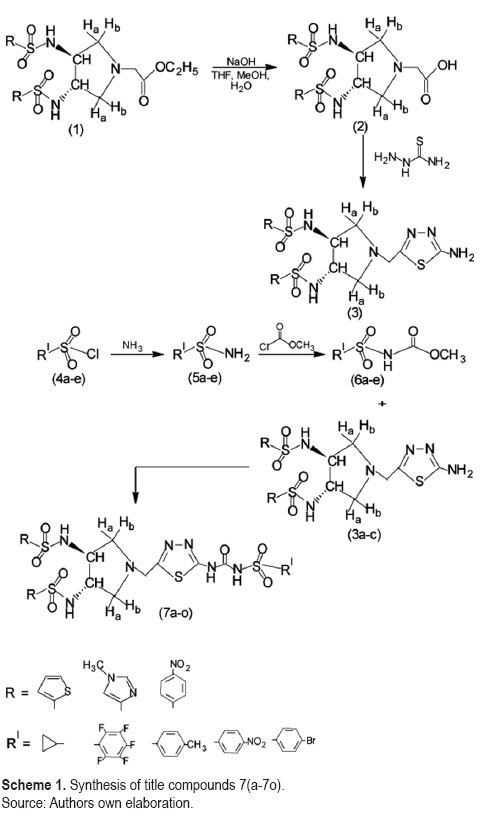
<body><![CDATA[<p align="justify"><font face="verdana" size="2"><b>Synthesis of title compounds (7a&#45;7e)</b></font></p>  	    <p align="justify"><font face="verdana" size="2">Ethyl 2&#45;((3S, 4S)&#45;3, 4&#45;disubstituted&#45;sulfonamido)pyrrolidinyl&#45;N&#45;acetate derivatives (1a&#45;1c) were synthesized by the procedure reported in the literature (Santosh, Raveendra, Madhu &amp; Ravindranath, 2012).</font></p>  	    <p align="justify"><font face="verdana" size="2">Synthesis of &#91;3, 4&#45;Bis&#45;(thiophene&#45;2&#45;sulfonylamino)&#45;pyrrolidin&#45;1&#45;yl&#93;&#45;acetic acid (2a)</font></p>  	    <p align="justify"><font face="verdana" size="2">An arqueous solution of NaOH (2N, 30 mL) was added to the solution of ester 1a (5 mmol, 2.398 g) in tetrahydrofuran / MeOH / H<sub>2</sub>0 (1:1:1) and stirred at room temp. The excess of solvent was evaporated under vacuum to give crude residue. The residue was washed with EtOAc, acidified with 1N HCl to a pH 2 and was filtered under vacuum to get fine solid. In case a solid is not obtained, the solution was extracted with two 100 mL portions of EtOAc. The organic layer was collected, washed with water, brine, dried over anhydrous Na<sub>2</sub>SO<sub>4</sub>, filtered and evaporated under vacuum to give crude acid product. The crude product was purified by column chromatography (60 mesh&#45;silica gel &#45;120 mesh&#45;silica gel, Eluent: 70% EtOAc&#45;30% petroleum ether). Similar procedure was followed for the synthesis of other compounds of the series.</font></p>  	    <p align="justify"><font face="verdana" size="2">Synthesis of N,N'&#45;((3S, 4S)&#45;1&#45;((5&#45;amino&#45;1, 3, 4&#45;thiadiazol&#45;2&#45;yl)methyl) pyrrolidine&#45;3, 4&#45;diyl)bis(thiophene&#45;2&#45;sulfonamide) (3a)</font></p>  	    <p align="justify"><font face="verdana" size="2">Concentrated H<sub>2</sub>SO<sub>4</sub> (12 mL) was added slowly to a mixture of carboxylic acid 2a (10 mmol, 4.515 g) and thiosemicarbazide (12 mmol, 1.093 g) in a three necked round bottom flask fitted with a reflux condenser. The reaction mixture was refluxed on a water bath for 3 h, poured into crushed ice and neutralized with ammonia solution. The yellow colored solid separated was filtered, washed with saturated sodium bicarbonate solution and water, dried and recrystallized from ethanol. Similar procedure was adopted for the synthesis of other compounds (3b &amp; 3c) of the series.</font></p>  	    <p align="justify"><font face="verdana" size="2">Synthesis of Cyclopropanesulfonyl chloride (5a)</font></p>  	    <p align="justify"><font face="verdana" size="2">A mixture of cyclopropanesulfonylchloride (10 mmol, 1.906 g) and 20% aqueous ammonia solution was taken in a four necked round bottom flask fitted with a reflux condenser. The reaction mixture was heated at 75 &#186;C &#45; 80 &#186;C for 3 h. The reaction mixture was allowed to stand for 1 h at 15 &#186;C, the solid that separated was filtered, washed with large quantity of water and dried to get 4&#45;methyl benzenesulfonamide. Similar procedure was adopted for the synthesis of other compounds (5a&#45;5e) of the series.</font></p>  	    <p align="justify"><font face="verdana" size="2">Synthesis of methyl cyclopropylsulfonylcarbamate (6a)</font></p>  	    <p align="justify"><font face="verdana" size="2">A mixture of cyclopropanesulfonylchloride (10 mmol, 1.21 g), ethyl methyl ketone (8 mL) and potassium carbonate was taken in a four necked round bottom flask and heated to 80 &#186;C for 30 min. Methyl chloroformate (10 mL) was added drop wise at 45 &#186;C. The mixture was heated for 8 h at 50 &#186;C. After the completion of reaction (monitored by TLC), the reaction mixture was poured into ice cold water and extracted with ethyl acetate. The pH of the aqueous layer was adjusted to a 2.5 by the addition of hydrochloric acid and extracted with ethyl acetate. The organic layer was dried over anhydrous sodium sulfate and the solution was concentrated to dryness. The solid thus obtained was recrystallized from ethanol. Similar procedure was adopted for the synthesis of other compounds (6b&#45;6e) of the series.</font></p>  	    ]]></body>
<body><![CDATA[<p align="justify"><font face="verdana" size="2">Synthesis of N,N'&#45;((3S, 4S)&#45;1&#45;((5&#45;(3&#45;(cyclopropylsulfonyl)ureido)&#45;1, 3, 4&#45;thiadiazol&#45;2&#45;yl)methyl)pyrrolidine&#45;3, 4&#45;diyl)bis(thiophene&#45;2&#45;sulfonamide) (7a)</font></p>  	    <p align="justify"><font face="verdana" size="2">A mixture of 6a (10 mmol, 1.409 g) and amine 3a (10 mmol, 1.79 g) in toluene (50 mL) was taken in a three necked round bottom flask fitted with a reflux condenser and a mechanical stirrer. The reaction mixture was refluxed for 4 h, cooled to room temperature, resulting solid was filtered, dried and recrystallized from methanol to obtain 7a. Similar procedure was adopted for the synthesis of other compounds (7b&#45;7o) of the series. The sequence of reactions is given in the <a href="#e1">scheme 1</a>.</font></p>  	    <p align="center"><font face="verdana" size="2"><a name="e1" id="e1"></a></font></p>  	    <p align="center"><font face="verdana" size="2"><img src="/img/revistas/au/v25n1/a2e1.jpg"></font></p>  	    <p align="justify"><font face="verdana" size="2">Characterization of compounds 2(a&#45;c)</font></p>  	    <p align="justify"><font face="verdana" size="2">Compound; R; Molecular formula; Yield (%); m.p. (&#186;C); Element Found% (calculated%); IR (Group)&#957;<sub>max</sub> in cm<sup>&#150;1</sup>; <sup>1</sup>H NMR (300MHz, DMSO&#45;D<sub>6</sub>) &#948; ppm.</font></p>  	    <p align="justify"><font face="verdana" size="2">2a: Thiophene; C<sub>14</sub>H<sub>17</sub>N<sub>3</sub>O<sub>6</sub>S<sub>4</sub>;76;191&#45;3; C 37.21 (37.24), H 3.77 (3.79), N 9.33 (9.31); (C&#45;N Cyclic)1100, (C&#45;N exo)1117, (O = S = O)1320 and 1185, (C&#45;N imidazole)1550, (C = N)1615, (C = O Acid)1755, (N&#45;H) 3210; 7.65&#45;7.22 (m, 6H, of thiophene), 7.47 (s, 2H, SO<sub>2</sub>&#45;NH&#45;), 4.22(s,1H, &#45;COOH), 3.50 (m, 2H, &#45;SO<sub>2</sub>&#45;N&#45;CH&#45;), 3.25 (s, 2H, &#45;N&#45;CH<sub>2</sub>&#45;CO), 2.88(m, 2H, &#45;CH<sub>a</sub>&#45; protons of pyrrolidine), 2.29 (m, 2H, &#45;CH<sub>b</sub>&#45; protons of pyrrolidine).</font></p>  	    <p align="justify"><font face="verdana" size="2">2b: 1&#45;Methyl&#45;1H&#45;imidazole; C<sub>14</sub>H<sub>21</sub>N<sub>7</sub>O<sub>6</sub>S<sub>2</sub>;71;197&#45;9; C 37.55 (37.58), 4.69 (4.73), N 21.89 (21.91); (C&#45;N Cyclic)1116, (C&#45;N exo)1120, (O = S = O)1326 and 1186, (C&#45;N imidazole)1559, (C = N)1617, (C = O Acid)1757, (N&#45;H) 3215; 7.90 (2H, &#45;N&#45;CH&#45;N&#45; of imidazole), 7.47 (s, 2H, SO<sub>2</sub>&#45;NH&#45;), 6.93 (s, 2H, N&#45;CH&#45; of two imidazole), 4.22 (s, 1H, &#45;COOH), 3.65 (s, 6H, N&#45; CH<sub>3</sub> of imidazole), 3.50 (m, 2H, &#45;SO<sub>2</sub>&#45;N&#45;CH&#45;), 3.25 (s, 2H, &#45;N&#45;CH<sub>2</sub>&#45;CO&#45;), 2.88(m, 2H, &#45;CH<sub>a</sub>&#45; protons of pyrrolidine), 2.29 (m, 2H, &#45;CH<sub>b</sub>&#45; protons of pyrrolidine).</font></p>  	    <p align="justify"><font face="verdana" size="2">2c: <i>p</i>&#45;Nitro phenyl; C<sub>18</sub>H<sub>19</sub>N<sub>5</sub>O<sub>10</sub>S<sub>2</sub>;82;182&#45;4; C 40.81 (40.83), H 3.63 (3.62), N 13.28 (13.23); (C&#45;N Cyclic)1122, (C&#45;N exo)1125, (O = S = O)1323 and 1189, (C&#45;N imidazole)1557, (C = N)1619, (C = O Acid)1762, (N&#45;H) 3217; 8.12&#45;8.39 (m, 8H, aromatic protons), 7.47 (s, 2H, SO<sub>2</sub>&#45;NH&#45;), 4.22 (s, 1H, &#45;COOH), 3.50 (m, 2H, &#45;SO<sub>2</sub>&#45;N&#45;CH&#45;), 3.25 (s, 2H, &#45;N&#45;CH<sub>2</sub>&#45;CO&#45;), 2.88(m, 2H, &#45;CH<sub>a</sub>&#45; protons of pyrrolidine), 2.29 (m, 2H, &#45;CH<sub>b</sub>&#45; protons of pyrrolidine).</font></p>  	    <p align="justify"><font face="verdana" size="2">Characterization of compounds 3(a&#45;c)</font></p>  	    ]]></body>
<body><![CDATA[<p align="justify"><font face="verdana" size="2">Compound; R; Molecular formula; Yield (%); m.p. (&#186;C); Element Found% (calculated%); IR (Group)&#957;<sub>max</sub> in cm<sup>&#150;1</sup>; <sup>1</sup>H NMR (300MHz, DMSO&#45;D<sub>6</sub>) &#948; ppm.</font></p>  	    <p align="justify"><font face="verdana" size="2">3a: Thiophene; C<sub>15</sub>H<sub>18</sub>N<sub>6</sub>O<sub>4</sub>S<sub>5</sub>;79;197&#45;9; C 35.55 (35.56), H 3.52 (3.58), N 16.53 (16.59); (C&#45;S&#45;C thiadiazole) 695, (O = S = O)1323 and 1185, (C = N thiadiazole)1670, (&#45;NH<sub>2</sub>)3356 and 3263, (NH sulphonamide)3421; 7.65&#45;7.22 (m, 6H, of thiophene), 7.47 (s, 2H, SO<sub>2</sub>&#45;NH&#45;), 3.62 (s, 2H, &#45;N&#45;CH<sub>2</sub>&#45;), 3.33 (s, 2H, &#45;NH<sub>2</sub>), 3.11 (m, 2H, &#45;SO<sub>2</sub>&#45;N&#45;CH&#45;), 2.61(m, 2H, &#45;CH<sub>a</sub>&#45; protons of pyrrolidine), 2.55 (m, 2H, &#45;CH<sub>b</sub>&#45; protons of pyrrolidine).</font></p>  	    <p align="justify"><font face="verdana" size="2">3b: 1&#45;Methyl&#45;1H&#45;imidazole; C<sub>15</sub>H<sub>22</sub>N<sub>10</sub>O<sub>4</sub>S<sub>3</sub>;68;202&#45;4; C 35.81 (35.85), H 4.44 (4.41), N 27.82 (27.87); (C&#45;S&#45;C thiadiazole)705, (O = S = O)1326 and 1187, (C = N thiadiazole)1673, (&#45;NH<sub>2</sub>)3359 and 3268, (NH sulphonamide)3420; 7.90(2H, &#45;N&#45;CH&#45;N&#45; of imidazole), 7.47 (s, 2H, SO<sub>2</sub>&#45;NH&#45;), 6.93 (s, 2H, N&#45;CH&#45; of two imidazole), 3.65 (s, 6H, N&#45; CH<sub>3</sub> of imidazole), 3.59 (s, 2H, &#45;N&#45;CH<sub>2</sub>&#45;), 3.35 (s, 2H, &#45;NH<sub>2</sub>), 3.17 (m, 2H, &#45;SO<sub>2</sub>&#45;N&#45;CH&#45;), 2.88(m, 2H, &#45;CH<sub>a</sub>&#45; protons of pyrrolidine), 2.52 (m, 2H, &#45;CH<sub>b</sub>&#45; protons of pyrrolidine).</font></p>  	    <p align="justify"><font face="verdana" size="2">3c: <i>p</i>&#45;Nitro phenyl; C<sub>19</sub>H<sub>20</sub>N<sub>8</sub>O<sub>8</sub>S<sub>3</sub>;73;192&#45;4; C 39.09 (39.04), H 3.42 (3.45), N 19.15 (19.17); (C&#45;S&#45;C thiadiazole)728, (O = S = O)1337 and 1199, (&#45;NH<sub>2</sub>)3367 and 3279, (C = N thiadiazole)1680, (NH sulphonamide)3422; 8.12&#45;8.39 (m, 8H, aromatic protons), 7.47 (s, 2H, SO<sub>2</sub>&#45;NH&#45;), 3.69 (s, 2H, &#45;N&#45;CH<sub>2</sub>&#45;), 3.50 (m, 2H, &#45;SO<sub>2</sub>&#45;N&#45;CH&#45;), 3.39 (s, 2H, &#45;NH<sub>2</sub>), 2.97(m, 2H, &#45;CH<sub>a</sub>&#45; protons of pyrrolidine), 2.33 (m, 2H, &#45;CH<sub>b</sub>&#45; protons of pyrrolidine).</font></p>  	    <p align="justify"><font face="verdana" size="2">Characterization of compounds 6(a&#45;e)</font></p>  	    <p align="justify"><font face="verdana" size="2">Compound; R; Molecular formula; Yield (%); m.p. (&#186;C); Element Found% (calculated%); IR (Group)&#957;<sub>max</sub> in cm<sup>&#150;1</sup>; <sup>1</sup>H NMR (300MHz, DMSO&#45;D6) &#948; ppm.</font></p>  	    <p align="justify"><font face="verdana" size="2">6a: Cyclopropyl; C<sub>5</sub>H<sub>9</sub>NO<sub>4</sub>S;61;205&#45;7; C 33.53 (33.51), H 5.09 (5.06), N 7.81 (7.82); (C&#45;O)1254, (&#45;CH<sub>3</sub>)1342 and 1265, (C = O)1640, (&#45;CH<sub>3</sub>)2915 and 2875, (N&#45;H)3212; 9.22 (s, 1H, SO<sub>2</sub>&#45;NH&#45;), 3.67 (s, 3H, &#45;OCOCH<sub>3</sub>), 1.75(m, 1H, &#45;SO<sub>2</sub>&#45;CH), 0.79(m, 4H, cyclopropyl &#45;CH<sub>2</sub>&#45;).</font></p>  	    <p align="justify"><font face="verdana" size="2">6b: Pentafluorophenyl; C<sub>8</sub>H<sub>4</sub>F<sub>5</sub>NO<sub>4</sub>S; 59; 186&#45;8; C 31.45(31.48), H 1.35 (1.32), N 4.52 (4.59); (C&#45;O)1269, (&#45;CH<sub>3</sub>)1358 and 1279, (C = O)1648, (&#45;CH<sub>3</sub>)2915 and 2875, (N&#45;H)3215; 9.22 (s, 1H, SO<sub>2</sub>&#45;NH&#45;), 3.69 (s, 3H, &#45;OCOCH<sub>3</sub>).</font></p>  	    <p align="justify"><font face="verdana" size="2">6c: <i>p</i>&#45;Tolyl; C<sub>9</sub>H<sub>11</sub>NO<sub>4</sub>S;69;192&#45;4; C 47.19 (47.15), H 4.83 (4.84), N 6.15 (6.11); (C&#45;O)1257, (&#45;CH<sub>3</sub>)1347 and 1264, (C = O)1650, (&#45;CH<sub>3</sub>)2915 and 2875, (N&#45;H)3214; 8.86 (s, 1H, SO<sub>2</sub>&#45;NH&#45;), 7.83 (d, 2H, Ar&#45;H meta to methyl), 7.34 (d, 2H, Ar&#45;H ortho to methyl), 3.57 (s, 3H, &#45;OCOCH<sub>3</sub>).</font></p>  	    <p align="justify"><font face="verdana" size="2">6d: <i>p</i>&#45;Bromo phenyl; C<sub>8</sub>H<sub>8</sub>BrNO<sub>4</sub>S;62;180&#45;2; C 32.67 (32.67), H 2.77 (2.74), N 4.73 (4.76); (C&#45;O)1259, (&#45;CH<sub>3</sub>)1349 and 1268, (C = O)1654, (&#45;CH<sub>3</sub>)2915 and 2875, (N&#45;H)3203; 8.89 (s, 1H, SO<sub>2</sub>&#45;NH&#45;), 7.87 (d, 2H, Ar&#45;H meta to bromo), 7.77 (d, 2H, Ar&#45;H ortho to bromo), 3.59(s, 3H, &#45;OCOCH<sub>3</sub>).</font></p>  	    ]]></body>
<body><![CDATA[<p align="justify"><font face="verdana" size="2">6e: <i>p</i>&#45;Nitro phenyl; C<sub>8</sub>H<sub>8</sub>N<sub>2</sub>O<sub>6</sub>S;67;196&#45;8; C 36.89 (36.92), H 3.12 (3.10), N 10.73 (10.77); (C&#45;O)1263, (&#45;CH<sub>3</sub>)1352 and 1273, (C = O)1666, (&#45;CH<sub>3</sub>)2915 and 2875, (N&#45;H)3217; 8.97(s, 1H, SO<sub>2</sub>&#45;NH&#45;), 8.49 (d, 2H, Ar&#45;H ortho to nitro), 8.21 (d, 2H, Ar&#45;H meta to nitro), 3.65(s, 3H, &#45;OCOCH<sub>3</sub>).</font></p>  	    <p align="justify"><font face="verdana" size="2">Characterization of compounds 7(a&#45;o)</font></p>  	    <p align="justify"><font face="verdana" size="2">Compound; R; R<sup>1</sup>; Molecular formula; Yield (%); m.p. (&#186;C); Element Found% (calculated%); IR Group&#957;<sub>max</sub> in cm<sup>&#150;1</sup>; <sup>1</sup>H NMR (300MHz, DMSO&#45;D<sub>6</sub>) &#948; ppm; <sup>13</sup>C&#45;NMR (300MHz, DMSO&#45;D<sub>6</sub>) (&#948; ppm).</font></p>  	    <p align="justify"><font face="verdana" size="2">7a: Thiophene; Cyclopropyl; C<sub>19</sub>H<sub>23</sub>N<sub>7</sub>O<sub>8</sub>S<sub>6</sub>;61;212&#45;4; C 34.09 (34.07), H 3.43 (3.46), N 14.61 (14.64); (N&#45;N)1052, (O = S = O)1362 and 1183, (C&#45;N urea)1310, (C = O urea)1640, (NH sulphonamide)3319; 9.01 (s, 1H, SO<sub>2</sub>&#45;NH&#45;), 7.45&#45;7.01 (m, 6H, of thiophene), 7.37 (s, 2H, SO<sub>2</sub>&#45;NH&#45;), 5.94 (s, 1H, NH, D<sub>2</sub>O&#45;exchange, disappear), 3.45 (s, 2H, &#45;N&#45;CH<sub>2</sub>&#45;), 3.01 (m, 2H, &#45;SO<sub>2</sub>&#45;N&#45;CH&#45;), 2.54(m, 2H, &#45;CH<sub>a</sub>&#45; protons of pyrrolidine), 2.35 (m, 2H, &#45;CH<sub>b</sub>&#45; protons of pyrrolidine), 1.54 (m, 1H, &#45;SO<sub>2</sub>&#45;CH), 0.67(m, 4H, cyclopropyl &#45;CH<sub>2</sub>&#45;); 62.3, 64.1, 137.2, 128.7, 132.6, 135.9,57.8, 64.1, 66.1, 157.5, 48.9, 12.5, corresponding to C<sub>2</sub> and C<sub>2</sub>, C<sub>3</sub> and C<sub>3</sub><sup>,</sup>, C<sub>4</sub> and C<sub>4</sub><sup>,</sup>, C<sub>5</sub> and C<sub>5</sub><sup>,</sup>, C<sub>6</sub> and C<sub>6</sub><sup>,</sup>, C<sub>7</sub> and C<sub>7</sub><sup>,</sup>, C<sub>8</sub>, C<sub>9</sub>, C<sub>10</sub>, C<sub>11</sub>, C<sub>12</sub>, C<sub>13</sub> and C<sub>13</sub><sup>,</sup> respectively.</font></p>  	    <p align="justify"><font face="verdana" size="2">7b: Thiophene; Pentafluorophenyl; C<sub>22</sub>H<sub>18</sub>F<sub>5</sub>N<sub>7</sub>O<sub>8</sub>S<sub>6</sub>; 59;192&#45;4; C 33.22 (33.20), H 2.25 (2.28), N 12.29 (12.32); (N&#45;N) 1033, (O = S = O)1352 and 1165, (C&#45;N urea)1301, (C = O urea)1631, (NH sulphonamide)3311; 9.14 (s, 1H, SO<sub>2</sub>&#45;NH&#45;), 7.71&#45;7.12 (m, 6H, of thiophene), 7.45 (s, 2H, SO<sub>2</sub>&#45;NH&#45;), 5.97 (s, 1H, NH, D<sub>2</sub>O&#45;exchange, disappear), 3.65 (s, 2H, &#45;N&#45;CH<sub>2</sub>&#45;), 3.03 (m, 2H, &#45;SO<sub>2</sub>&#45;N&#45;CH&#45;), 2.60 (m, 2H, &#45;CH<sub>a</sub>&#45; protons of pyrrolidine), 2.59 (m, 2H, &#45;CH<sub>b</sub>&#45; protons of pyrrolidine).</font></p>  	    <p align="justify"><font face="verdana" size="2">7c: Thiophene; <i>p</i>&#45;Tolyl; C<sub>23</sub>H<sub>25</sub>N<sub>7</sub>O<sub>7</sub>S<sub>6</sub>;69;209&#45;11; C 39.21 (39.25), H 3.56 (3.58), N 13.90 (13.93); (N&#45;N) 1049, (O = S = O)1359 and 1179, (C&#45;N urea)1308, (C = O urea)1641, (NH sulphonamide)3318; 8.86 (s, 1H, SO<sub>2</sub>&#45;NH&#45;), 7.83 (d, 2H, Ar&#45;H meta to methyl), 7.62&#45;7.24 (m, 6H, of thiophene), 7.32 (s, 2H, SO<sub>2</sub>&#45;NH&#45;), 7.34 (d, 2H, Ar&#45;H ortho to methyl), 6.11 (s, 2H, NH, D<sub>2</sub>O&#45;exchange, disappear), 3.45 (s, 2H, &#45;N&#45;CH<sub>2</sub>&#45;), 3.08 (m, 2H, &#45;SO<sub>2</sub>&#45;N&#45;CH&#45;), 2.67(m, 2H, &#45;CH<sub>a</sub>&#45; protons of pyrrolidine), 2.51 (m, 2H, &#45;CH<sub>b</sub>&#45; protons of pyrrolidine), 1.90(s, 3H, &#45;CH<sub>3</sub>, ArCH<sub>3</sub>).</font></p>  	    <p align="justify"><font face="verdana" size="2">7d: Thiophene; <i>p</i>&#45;Bromo phenyl; C<sub>22</sub>H<sub>22</sub>BrN<sub>7</sub>O<sub>7</sub>S<sub>6</sub>; 68;201&#45;3; C 34.33 (34.37), H 2.90 (2.88), N 12.74 (12.75); (N&#45;N) 1045, (O = S = O)1357 and 1174, (C&#45;N urea)1306, (C = O urea)1639, (NH sulphonamide)3316; 8.91 (s, 1H, SO<sub>2</sub>&#45;NH&#45;), 7.85 (d, 2H, Ar&#45;H meta to bromo), 7.78 (d, 2H, Ar&#45;H ortho to bromo), 7.41&#45;7.16 (m, 6H, of thiophene), 7.44 (s, 2H, SO<sub>2</sub>&#45;NH&#45;), 5.71 (s, 2H, NH, D<sub>2</sub>O&#45;exchange, disappear), 3.67 (s, 2H, &#45;N&#45;CH<sub>2</sub>&#45;), 3.15 (m, 2H, &#45;SO<sub>2</sub>&#45;N&#45;CH&#45;), 2.66 (m, 2H, &#45;CH<sub>a</sub>&#45; protons of pyrrolidine), 2.71 (m, 2H, &#45;CH<sub>b</sub>&#45; protons of pyrrolidine).</font></p>  	    <p align="justify"><font face="verdana" size="2">7e: Thiophene; <i>p</i>&#45;Nitro phenyl; C<sub>22</sub>H<sub>22</sub>N<sub>8</sub>O<sub>9</sub>S<sub>6</sub>;71; 189&#45;91; C 35.16 (35.19), H 2.91 (2.95), N 14.89 (14.92); (N&#45;N) 1040, (O = S = O)1354 and 1169, (C&#45;N urea)1303, (C = O urea)1636, (NH sulphonamide)3313; 9.12 (s, 1H, SO<sub>2</sub>&#45;NH&#45;), 8.58 (d, 2H, Ar&#45;H ortho to nitro), 8.28 (d, 2H, ArH meta to nitro), 7.50&#45;7.01 (m, 6H, of thiophene), 7.52 (s, 2H, SO<sub>2</sub>&#45;NH&#45;), 6.27 (s, 2H, NH, D<sub>2</sub>O&#45;exchange, disappear), 3.69 (s, 2H, &#45;N&#45;CH<sub>2</sub>&#45;), 3.18 (m, 2H, &#45;SO<sub>2</sub>&#45;N&#45;CH&#45;), 2.71(m, 2H, &#45;CH<sub>a</sub>&#45; protons of pyrrolidine), 2.67 (m, 2H, &#45;CH<sub>b</sub>&#45; protons of pyrrolidine).</font></p>  	    <p align="justify"><font face="verdana" size="2">7f: 1&#45;Methyl&#45;1H&#45;imidazole; Cyclopropyl; C<sub>19</sub>H<sub>27</sub>N<sub>11</sub> O<sub>7</sub>S<sub>4</sub>; 67;209&#45;11; C 35.11 (35.12), H 4.15 (4.19), N 23.69 (23.71); (N&#45;N)1058, (O = S = O)1379 and 1189, (C&#45;N urea)1316, (C = O urea)1642, (NH sulphonamide)3325; 9.25 (s, 1H, SO<sub>2</sub>&#45;NH&#45;), 7.91 (2H, &#45;N&#45;CH&#45;N&#45; of imidazole), 7.48 (s, 2H, SO<sub>2</sub>&#45;NH&#45;), 6.87 (s, 2H, N&#45;CH&#45; of two imidazole), 5.98 (s, 2H, NH, D<sub>2</sub>O&#45;exchange, disappear), 3.62 (s, 6H, N&#45;CH<sub>3</sub> of imidazole), 3.51 (s, 2H, &#45;N&#45;CH<sub>2</sub>&#45;), 3.23 (m, 2H, &#45;SO<sub>2</sub>&#45;N&#45;CH&#45;), 2.76 (m, 2H, &#45;CH<sub>a</sub>&#45; protons of pyrrolidine), 2.39 (m, 2H, &#45;CH<sub>b</sub>&#45; protons of pyrrolidine), 1.68(m, 1H, &#45;SO<sub>2</sub>&#45;CH), 0.65 (m, 4H, cyclopropyl &#45;CH<sub>2</sub>&#45;).</font></p>  	    <p align="justify"><font face="verdana" size="2">7g: 1&#45;Methyl&#45;1H&#45;imidazole; Pentafluorophenyl; C<sub>22</sub>H<sub>38</sub>F<sub>5</sub>N<sub>11</sub>O<sub>7</sub>S<sub>4</sub>;58;198&#45;200; C 37.15 (37.18), H 4.55 (4.56), N 18.31 (18.34); (N&#45;N) 1035, (O = S = O)1359 and 1171, (C&#45;N urea)1306, (C = O urea)1633, (NH sulphonamide)3316; 9.27 (s, 1H, SO<sub>2</sub>&#45;NH&#45;), 7.83 (2H, &#45;N&#45;CH&#45;N&#45; of imidazole), 7.41 (s, 2H, SO<sub>2</sub>&#45;NH&#45;), 6.81 (s, 2H, N&#45;CH&#45; of two imidazole), 6.10 (s, 2H, NH, D<sub>2</sub>O&#45;exchange, disappear), 3.65 (s, 6H, N&#45;CH<sub>3</sub> of imidazole), 3.53 (s, 2H, &#45;N&#45;CH<sub>2</sub>&#45;), 3.15 (m, 2H, &#45;SO<sub>2</sub>&#45;N&#45;CH&#45;), 2.83 (m, 2H, &#45;CH<sub>a</sub>&#45; protons of pyrrolidine), 2.47 (m, 2H, &#45;CH<sub>b</sub>&#45; protons of pyrrolidine); 62.7, 64.6, 143.2, 127.2, 122.8, 35.5, 58.8, 65.1, 66.9, 156.8, 125.1, 151.9, 139.1, 148.7 corresponding to C<sub>2</sub> and C<sub>2</sub>, C<sub>3</sub> and C<sub>3'</sub>, C<sub>4</sub> and C<sub>4'</sub>, C<sub>5</sub> and C<sub>5'</sub>, C<sub>6</sub> and C<sub>6'</sub>, C<sub>7</sub> and C<sub>7'</sub>, C<sub>8</sub>, C<sub>9</sub>, C<sub>10</sub>, C<sub>11</sub>, C<sub>12</sub>, C<sub>13</sub> and C<sub>13'</sub>, C<sub>14</sub> and C<sub>14'</sub>, C<sub>15</sub> respectively.</font></p>  	    ]]></body>
<body><![CDATA[<p align="justify"><font face="verdana" size="2">7h: 1&#45;Methyl&#45;1H&#45;imidazole; <i>p</i>&#45;Tolyl; C<sub>23</sub>H<sub>29</sub>N<sub>11</sub>O<sub>7</sub> S<sub>4</sub>;59;201&#45;3; C 39.45 (39.47), H 4.16 (4.18), N 22.00 (22.02); (N&#45;N) 1055, (O = S = O)1376 and 1186, (C&#45;N urea)1314, (C = O urea)1640, (NH sulphonamide)3323; 8.89 (s, 1H, SO<sub>2</sub>&#45;NH&#45;), 7.97 (2H, &#45;N&#45;CH&#45;N&#45; of imidazole), 7.84 (d, 2H, ArH meta to methyl), 7.58 (s, 2H, SO<sub>2</sub>&#45;NH&#45;), 7.39 (d, 2H, Ar&#45;H ortho to methyl), 6.97 (s, 2H, N&#45;CH&#45; of two imidazole), 6.17 (s, 2H, NH, D<sub>2</sub>O&#45;exchange, disappear), 3.65 (s, 6H, N&#45;CH<sub>3</sub> of imidazole), 3.69 (s, 2H, &#45;N&#45;CH<sub>2</sub>&#45;), 3.25 (m, 2H, &#45;SO<sub>2</sub>&#45;N&#45;CH&#45;), 2.78(m, 2H, &#45;CH<sub>a</sub>&#45; protons of pyrrolidine), 2.45 (m, 2H, &#45;CH<sub>b</sub>&#45;protons of pyrrolidine).</font></p>  	    <p align="justify"><font face="verdana" size="2">7i: 1&#45;Methyl&#45;1H&#45;imidazole; <i>p</i>&#45;Bromo phenyl; C<sub>22</sub>H<sub>26</sub> BrN<sub>11</sub>O<sub>7</sub>S<sub>4</sub>; 71; 199&#45;201; C 34.51 (34.56), H 3.39 (3.43), N 21.11 (20.15); (N&#45;N)1050, (O = S = O)1372 and 1183, (C&#45;N urea)1313, (C = O urea)1638, (NH sulphonamide)3322; 8.97 (s, 1H, SO<sub>2</sub>&#45;NH&#45;), 7.89 (2H, &#45;N&#45;CH&#45;N&#45; of imidazole), 7.89 (d, 2H, Ar&#45;H meta to bromo), 7.67 (d, 2H, Ar&#45;H otho to bromo), 7.47 (s, 2H, SO<sub>2</sub>&#45;NH&#45;), 6.93 (s, 2H, N&#45;CH&#45; of two imidazole), 6.12 (s, 2H, NH, D<sub>2</sub>O&#45;exchange, disappear), 3.65 (s, 6H, N&#45;CH<sub>3</sub> of imidazole), 3.64 (s, 2H, &#45;N&#45;CH<sub>2</sub>&#45;), 3.28 (m, 2H, &#45;SO<sub>2</sub>&#45;N&#45;CH&#45;), 2.67(m, 2H, &#45;CH<sub>a</sub>&#45; protons of pyrrolidine), 2.54 (m,2H, &#45;CH<sub>b</sub>&#45; protons of pyrrolidine).</font></p>  	    <p align="justify"><font face="verdana" size="2">7j: 1&#45;Methyl&#45;1H&#45;imidazole; <i>p</i>&#45;Nitro phenyl; C<sub>22</sub>H<sub>26</sub> N<sub>12</sub>O<sub>9</sub>S<sub>4</sub>;70;207&#45;9; 36.15 (36.16), H 3.55 (3.59), N 23.05 (23.00); (N&#45;N)1046, (O = S = O)1365 and 1175, (C&#45;N urea)1310, (C = O urea)1635, (NH sulphonamide)3319; 8.76 (s, 1H, SO<sub>2</sub>&#45;NH&#45;), 8.35 (d, 2H, Ar&#45;H ortho to nitro), 8.02 (d, 2H, Ar&#45;H meta to nitro), 7.91 (2H, &#45;N&#45;CH&#45;N&#45; of imidazole), 7.37 (s, 2H, SO<sub>2</sub>&#45;NH&#45;), 6.93 (s, 2H, N&#45;CH&#45; of two imidazole), 6.16 (s, 2H, NH, D<sub>2</sub>O&#45;exchange, disappear), 3.65 (s, 6H, N&#45;CH<sub>3</sub> of imidazole), 3.44 (s, 2H, &#45;N&#45;CH<sub>2</sub>&#45;), 3.17 (m, 2H, &#45;SO<sub>2</sub>&#45;N&#45;CH&#45;), 2.71 (m, 2H, &#45;CH<sub>a</sub>&#45; protons of pyrrolidine), 2.44 (m, 2H, &#45;CH<sub>b</sub>&#45; protons of pyrrolidine).</font></p>  	    <p align="justify"><font face="verdana" size="2">7k: <i>p</i>&#45;Nitro phenyl; Cyclopropyl; C<sub>23</sub>H<sub>25</sub>N<sub>9</sub>O<sub>11</sub>S<sub>4</sub>; 69;202&#45;4; C 37.71 (37.75), H 3.40 (3.44), N 15.19 (17.23); (N&#45;N)1039, (O = S = O)1356 and 1165, (C&#45;N urea)1321, (C = O urea)1645, (NH sulphonamide)3316; 9.21 (s, 1H, SO<sub>2</sub>&#45;NH&#45;), 8.14&#45;8.38 (m, 8H, aromatic protons), 7.41 (s, 2H, SO<sub>2</sub>&#45;NH&#45;), 6.13 (s, 2H, NH, D<sub>2</sub>O&#45;exchange, disappear), 3.65 (s, 2H, &#45;N&#45;CH<sub>2</sub>&#45;), 3.54 (m, 2H, &#45;SO<sub>2</sub>&#45;N&#45;CH&#45;), 2.87(m, 2H, &#45;CH<sub>a</sub>&#45; protons of pyrrolidine), 2.37 (m, 2H, &#45;CH<sub>b</sub>&#45; protons of pyrrolidine), 1.71 (m, 1H, &#45;SO<sub>2</sub>&#45;CH), 0.74 (m, 4H, cyclopropyl &#45;CH<sub>2</sub>&#45;).</font></p>  	    <p align="justify"><font face="verdana" size="2">7l: <i>p</i>&#45;Nitro phenyl; Pentafluorophenyl; C<sub>26</sub>H<sub>20</sub>F<sub>5</sub>N<sub>9</sub> O<sub>11</sub>S<sub>4</sub>;61;204&#45;6; C 36.38 (36.41), H 2.31 (2.35), N 14.68 (14.70); (N&#45;N) 1025, (O = S = O)1339 and 1152, (C&#45;N urea)1311, (C = O urea)1631, (NH sulphonamide)3309; 9.16 (s, 1H, SO<sub>2</sub>&#45;NH&#45;), 8.22&#45;8.32 (m, 8H, aromatic protons), 7.48 (s, 2H, SO<sub>2</sub>&#45;NH&#45;), 6.13 (s, 2H, NH, D<sub>2</sub>O&#45;exchange, disappear), 3.70 (s, 2H, &#45;N&#45;CH<sub>2</sub>&#45;), 3.51 (m, 2H, &#45;SO<sub>2</sub>&#45;N&#45;CH&#45;), 2.87(m, 2H, &#45;CH<sub>a</sub>&#45;protons of pyrrolidine), 2.43 (m, 2H, &#45;CH<sub>b</sub>&#45; protons of pyrrolidine).</font></p>  	    <p align="justify"><font face="verdana" size="2">7m: <i>p</i>&#45;Nitro phenyl; <i>p</i>&#45;Tolyl; C<sub>27</sub>H<sub>27</sub>N<sub>9</sub>O<sub>11</sub>S<sub>4</sub>;62;212&#45;4; C 41.46 (41.48), H 3.47 (3.48), N 16.09 (16.12); (N&#45;N) 1035, (O = S = O)1353 and 1161, (C&#45;N urea)1319, (C = O urea)1641, (NH sulphonamide) 3315; 8.94 (s, 1H, SO<sub>2</sub>&#45;NH&#45;), 8.19&#45;8.32 (m, 8H, aromatic protons), 7.88 (d, 2H, Ar&#45;H meta to methyl ), 7.43 (s, 2H, SO<sub>2</sub>&#45;NH&#45;), 7.34 (d, 2H, Ar&#45;H ortho to methyl ), 6.16 (s, 2H, NH, D<sub>2</sub>O&#45;exchange, disappear), 3.67 (s, 2H, &#45;N&#45;CH<sub>2</sub>&#45;), 3.63 (m, 2H, &#45;SO<sub>2</sub>&#45;N&#45;CH&#45;), 2.96 (m, 2H, &#45;CH<sub>a</sub>&#45; protons of pyrrolidine), 2.45 (m, 2H, &#45;CH<sub>b</sub>&#45; protons of pyrrolidine), 2.06(s, 3H, &#45;CH<sub>3</sub>, ArCH<sub>3</sub>).</font></p>  	    <p align="justify"><font face="verdana" size="2">7n: <i>p</i>&#45;Nitro phenyl; <i>p</i>&#45;Bromo phenyl; C<sub>26</sub>H<sub>24</sub>BrN<sub>9</sub>O<sub>11</sub> S<sub>4</sub>;69;219&#45;21; C 36.85 (36.88), H 2.83 (2.86), N 14.81 (14.89); (N&#45;N) 1032, (O = S = O)1350 and 1158, (C&#45;N urea)1317, (C = O urea)1638 (NH sulphonamide)3313; 8.92 (s, 1H, SO<sub>2</sub>&#45;NH&#45;), 8.12&#45;8.39 (m, 8H, aromatic protons), 7.79 (d, 2H, Ar&#45;H meta to bromo), 7.63 (d, 2H, Ar&#45;H ortho to bromo), 7.45 (s, 2H, SO<sub>2</sub>&#45;NH&#45;), 6.16 (s, 2H, NH, D<sub>2</sub>O&#45;exchange, disappear), 3.75 (s, 2H, &#45;N&#45;CH<sub>2</sub>&#45;), 3.50 (m, 2H, &#45;SO<sub>2</sub>&#45;N&#45;CH&#45;), 3.01 (m, 2H, &#45;CH<sub>a</sub>&#45; protons of pyrrolidine), 2.36 (m, 2H, &#45;CH<sub>b</sub>&#45; protons of pyrrolidine).</font></p>  	    <p align="justify"><font face="verdana" size="2">7o: <i>p</i>&#45;Nitro phenyl; <i>p</i>&#45;Nitro phenyl; C<sub>26</sub>H<sub>24</sub>N<sub>10</sub>O<sub>13</sub>S<sub>4</sub>; 76; 206&#45;8; C 38.41 (38.42), H 2.95 (2.98), N 17.19 (17.23); (N&#45;N) 1028, (O = S = O)1344 and 1155, (C&#45;N urea)1314, (C = O urea)1634, (NH sulphonamide)3311; 8.97(s, 1H, SO<sub>2</sub>&#45;NH&#45;), 8.51 (d, 2H, Ar&#45;H ortho to nitro), 8.17&#45;8.35 (m, 10H, aromatic protons), 7.47 (s, 2H, SO<sub>2</sub>&#45;NH&#45;), 6.02 (s, 2H, NH, D<sub>2</sub>O&#45;exchange, disappear), 3.55 (s, 2H, &#45;N&#45;CH<sub>2</sub>&#45;), 3.52 (m, 2H, &#45;SO<sub>2</sub>&#45;N&#45;CH&#45;), 2.92 (m, 2H, &#45;CH<sub>a</sub>&#45; protons of pyrrolidine), 2.29 (m, 2H, &#45;CH<sub>b</sub>&#45; protons of pyrrolidine); 62.4, 63.5, 146.2, 128.5, 124.1, 151.3, 65.0, 157.4, 59.1, 65.8, 65.1, 155.5, 147.8, 139.6, 136.5, 159.6 corresponding to C<sub>2</sub> and C<sub>2</sub>, C<sub>3</sub> and C<sub>3'</sub>, C<sub>4</sub> and C<sub>4'</sub>, C<sub>5</sub> and C<sub>5'</sub>, C<sub>6</sub> and C<sub>6'</sub>, C<sub>7</sub> and C<sub>7'</sub>, C<sub>8</sub>, C<sub>9</sub>, C<sub>10</sub>, C<sub>11</sub>, C<sub>12</sub>, C<sub>13</sub>, C<sub>14</sub>, C<sub>15</sub> and C<sub>15'</sub>, C<sub>16</sub> and C<sub>16'</sub>, C<sub>17</sub> respectively.</font></p>  	    <p align="justify"><font face="verdana" size="2">&nbsp;</font></p>  	    <p align="justify"><font face="verdana" size="2"><b>RESULTS AND DISCUSSION</b></font></p>  	    ]]></body>
<body><![CDATA[<p align="justify"><font face="verdana" size="2">The title compounds (7a&#45;7o) were synthesized and characterized by elemental, IR and NMR spectral analysis. The compounds were screened for antibacterial and antifungal activity. The bacteria screened were <i>Staphylococus aureus</i> NCCS 2079, <i>Bacillus cereus</i> NCCS 2106, <i>Escherichia coli</i> NCCS 2065 and fungi screened were <i>Aspergillus niger</i> NCCS 1196 and <i>Candida albicans</i> NCCS 2106. &#946;&#45;Ketoacyl acyl carrier protein synthase III initiates fatty acid synthesis in bacteria and is a key target enzyme to assess the antimicrobial activity. Using the series of sulfonamides under study, we conducted biological assays as well as docking study to find potent inhibitors of <i>E. coli</i> beta&#45;ketoacyl&#45;acp synthase III with specificities against <i>E. coli</i>. The antimicrobial activity was expressed in terms Minimum Inhibitory Concentration (MIC). MIC was found out by broth dilution method (Wiegand, Hilpert &amp; Hancock, 2008). The activity in each case was compared with that standards. The results are given in the <a href="/img/revistas/au/v25n1/a2t1.jpg" target="_blank">table 1</a>.</font></p>  	    <p align="justify"><font face="verdana" size="2">The compounds were docked with <i>E. coli</i> beta&#45;ketoacyl&#45;acp synthase III using Schrodinger software. The docking score (<a href="#t2">table 2</a>) and binding site details were analyzed based on interacting amino acids, and hydrogen bonds. Four sulfonamide derivatives (g, j, l, o) showed comparable docking scores as that of malonyl CoA.</font></p>  	    <p align="center"><font face="verdana" size="2"><a name="t2"></a></font></p>  	    <p align="center"><font face="verdana" size="2"><img src="/img/revistas/au/v25n1/a2t2.jpg"></font></p>  	    <p align="justify"><font face="verdana" size="2">A comparison of the data obtained from <i>in vitro</i> antimicrobial studies and <i>in silico</i> screening studies indicate that the compound bearing nitro substituent in each series I, II and III namely e, j and o exhibits better antimicrobial activity, while that with cyclopropyl substituent namely a, f and k exhibits least activity than the other compounds of the series. A careful comparison of <a href="/img/revistas/au/v25n1/a2t1.jpg" target="_blank">table 1</a> and <a href="#t2">table 2</a> indicate that the results obtained from both the studies were of the same order of activity i.e. j &gt; o &gt; l &gt; g &gt; n &gt; m &gt; e &gt; k. It can also be inferred from <a href="/img/revistas/au/v25n1/a2t1.jpg" target="_blank">table 1</a> and <a href="#t2">table 2</a> that the compounds j, o, l and g bearing nitro and pentafluorophenyl substituents demonstrated comparable activity to that of standards.</font></p>  	    <p align="justify"><font face="verdana" size="2">&nbsp;</font></p>  	    <p align="justify"><font face="verdana" size="2"><b>Binding mode</b></font></p>  	    <p align="justify"><font face="verdana" size="2">Binding site analysis of most active compound 7j showed strong hydrogen bonding interactions. Amino hydrogen of ARG151 forms hydrogen bond with one of the sulfonyl oxygen at a distance of 1.59 A&#186;. Amino group of ASN 247 forms hydrogen bond with the other sulfonyl oxygen of 7j at a distance of 1.91 A&#186;. Amino groups of ARG 36 are involved in a hydrogen bonding interaction with nitryl oxygen and pyridyl nitrogen moieties at distances of 2.08 A&#186; and 2.40 A&#186; respectively. Nitrophenyl moiety of 7j was involved in &#960;&#45; &#960; stacking with Arg 36 and Trp 32 residues. Thiadiazole ring showed &#960;&#45;cation interaction with Arg 36 residue. We have observed a salt bridge formation between Arg 151 and sulfonamide nitrogen bridging nitrophenyl and thiadiazole ring. Also it is forming strong hydrophobic interactions with Met 207, Phe 213, Trp 32, Ile 156 and Phe 204 residues. Surface diagram of 7j and interacting amino acids with in 5 A&#186; distance were shown in <a href="#f1">figure 1</a>. Qiu <i>et al</i>. (2001) reported that <i>E. coli</i>. FabH has disordered residues and were located in four loops, at 84&#45;86, 146&#45;152, 185&#45;217 and 305&#45;307 residues. All the four loops were either involved in ligand binding or in the formation of the active site. Further, except the Cys 146 &#45; Gly 152 loop, the other three loops were known to involve in the formation of FabH dimer interface. The Apo structure of FabH contains Tyr 185&#45;Val 217 loop which includes a large hairpin loop (Leu 189&#45;Met 207) and a portion of the Ca1 helix (Gly 209 &#45; Ala 230). The hairpin loop interacts with CoA using the side&#45;chains of Leu 189 and Met 207. Similar observations were reported in the literature (Huan&#45;Qiu <i>et al</i>., 2009; Yang <i>et al</i>., 2012). Qiu <i>et al</i>. 2001,s had also reported the degradation of malonyl moiety in the active site of CoA and appearance of CoA at binding site of <i>E. coli</i> FabH (Qiu <i>et al</i>., 2001). Hence molecular docking studies for FabH and malonyl&#45;CoA was carried out to identify a plausible malonyl&#45;binding model and shown in the <a href="/img/revistas/au/v25n1/a2f2.jpg" target="_blank">figure 2</a>.</font></p>  	    <p align="center"><font face="verdana" size="2"><a name="f1"></a></font></p>  	    <p align="center"><font face="verdana" size="2"><img src="/img/revistas/au/v25n1/a2f1.jpg"></font></p>  	    ]]></body>
<body><![CDATA[<p align="justify"><font face="verdana" size="2">The enhanced biological activity of 7j over the other derivatives has been attributed to the hydrophobic interaction with Met 207 and same was not observed in the case of other derivatives. As is evident from the <a href="/img/revistas/au/v25n1/a2f2.jpg" target="_blank">figure 2(b)</a> and as reported in the literature, the interaction of malonyl CoA with Met 207 is important for substrate binding and activity (Qiu <i>et al</i>., 2001).</font></p>  	    <p align="justify"><font face="verdana" size="2">&nbsp;</font></p>  	    <p align="justify"><font face="verdana" size="2"><b>CONCLUSION</b></font></p>  	    <p align="justify"><font face="verdana" size="2">Series of sulphonyl urea derivatives containing heterocyclic moieties namely pyrrolidine, thiophene and imidazole were synthesized and characterized. The compounds were <i>in vitro</i> screened against certain selected bacteria and fungi. We tried to correlate these results with those obtained in the docking studies of compounds under study with <i>E. coli</i> beta&#45;ketoacyl&#45;acp synthase III. The molecular docking results along with the antimicrobial assays suggested that compounds bearing nitro and pentafluorophenyl groups were potential inhibitors of FabH enzyme than the other members of the series.</font></p>  	    <p align="justify"><font face="verdana" size="2">&nbsp;</font></p>  	    <p align="justify"><font face="verdana" size="2"><b>REFERENCES</b></font></p>  	    <!-- ref --><p align="justify"><font face="verdana" size="2">Alsaid, M. S., El&#45;Gazzar, M. G. &amp; Ghorab, M. M. (2013). Anticancer activity of novel thiophenes containing a biological active diphenylsulfone, diazepin, piperidine, oxazepine, acryladehyde and sulfonamide moieties. <i>Drug Research</i> (<i>Stuttg</i>), <i>63</i>(05), 263&#45;269.    &nbsp;&nbsp;&nbsp;&nbsp;&nbsp;&nbsp;&nbsp;&nbsp;[&#160;<a href="javascript:void(0);" onclick="javascript: window.open('/scielo.php?script=sci_nlinks&ref=249983&pid=S0188-6266201500010000200001&lng=','','width=640,height=500,resizable=yes,scrollbars=1,menubar=yes,');">Links</a>&#160;]<!-- end-ref --></font></p>  	    <!-- ref --><p align="justify"><font face="verdana" size="2">Bespalove, G. V., Sedavkina, V. A. &amp; Kulikova, L. K. (1989). Synthesis and antimicrobial activity of 5&#45;substituted &#45;2&#45;imino&#45;pyrrolidines. <i>Khimiko&#45;farmatsevticheskii Zhurnal</i>, <i>23</i>(8), 949&#45;952.    &nbsp;&nbsp;&nbsp;&nbsp;&nbsp;&nbsp;&nbsp;&nbsp;[&#160;<a href="javascript:void(0);" onclick="javascript: window.open('/scielo.php?script=sci_nlinks&ref=249985&pid=S0188-6266201500010000200002&lng=','','width=640,height=500,resizable=yes,scrollbars=1,menubar=yes,');">Links</a>&#160;]<!-- end-ref --></font></p>  	    ]]></body>
<body><![CDATA[<!-- ref --><p align="justify"><font face="verdana" size="2">Camargo&#45;Ordonez, A., Moreno&#45;Reyes, C., Olazar&aacute;n&#45;Santibanez, F., Mart&iacute;nez&#45;Hern&aacute;ndez, S., Bocanegra&#45;Garc&iacute;a, V. &amp; Riveral, G. (2011). Efficient synthesis of sulfonamide derivatives on solid supportscatalyzed using solvent&#45;free and microwave&#45;assisted methods. <i>Qu&iacute;mica Nova</i>, <i>34</i>(5), 787&#45;791.    &nbsp;&nbsp;&nbsp;&nbsp;&nbsp;&nbsp;&nbsp;&nbsp;[&#160;<a href="javascript:void(0);" onclick="javascript: window.open('/scielo.php?script=sci_nlinks&ref=249987&pid=S0188-6266201500010000200003&lng=','','width=640,height=500,resizable=yes,scrollbars=1,menubar=yes,');">Links</a>&#160;]<!-- end-ref --></font></p>  	    <!-- ref --><p align="justify"><font face="verdana" size="2">Cheng, X. C., Wang, Q., Fang, H., Tang, W. &amp; Xu, W. F. (2008). Design, synthesis and preliminary evaluation of novel pyrrolidine derivatives as matrix metalloproteinase inhibitors. <i>European Journal of Medicinal Chemistry</i>, <i>43</i>(10), 2130&#45;2139.    &nbsp;&nbsp;&nbsp;&nbsp;&nbsp;&nbsp;&nbsp;&nbsp;[&#160;<a href="javascript:void(0);" onclick="javascript: window.open('/scielo.php?script=sci_nlinks&ref=249989&pid=S0188-6266201500010000200004&lng=','','width=640,height=500,resizable=yes,scrollbars=1,menubar=yes,');">Links</a>&#160;]<!-- end-ref --></font></p>  	    <!-- ref --><p align="justify"><font face="verdana" size="2">Davies, C., Heath, R. J., White, S. W. &amp; Rock, C. O. (2000). The 1.8 A crystal structure and active&#45;site architecture of beta&#45;ketoacyl&#45;acyl carrier protein synthase III (FabH) from. <i>Escherichia coli</i>. <i>Structure</i>, <i>8</i>(2), 185&#45;195.    &nbsp;&nbsp;&nbsp;&nbsp;&nbsp;&nbsp;&nbsp;&nbsp;[&#160;<a href="javascript:void(0);" onclick="javascript: window.open('/scielo.php?script=sci_nlinks&ref=249991&pid=S0188-6266201500010000200005&lng=','','width=640,height=500,resizable=yes,scrollbars=1,menubar=yes,');">Links</a>&#160;]<!-- end-ref --></font></p>  	    <!-- ref --><p align="justify"><font face="verdana" size="2">Dzhuraev, A. D., Karimkulov, A. M. &amp; Makhsulov&#45;Amanov, N. (1992). Antimicrobial properties of novel thiophene derivatives. <i>Khimiko&#45;farmatsevticheskii Zhurnal</i>, <i>26</i>(1), 73&#45;75.    &nbsp;&nbsp;&nbsp;&nbsp;&nbsp;&nbsp;&nbsp;&nbsp;[&#160;<a href="javascript:void(0);" onclick="javascript: window.open('/scielo.php?script=sci_nlinks&ref=249993&pid=S0188-6266201500010000200006&lng=','','width=640,height=500,resizable=yes,scrollbars=1,menubar=yes,');">Links</a>&#160;]<!-- end-ref --></font></p>  	    <!-- ref --><p align="justify"><font face="verdana" size="2">Huan&#45;Qiu, L., Lei, S., Qing&#45;Shan, L., Peng&#45;Gang, L., Yin, L., Jing, Z. &amp; Hai&#45;Liang, Z. (2009). Synthesis of C(7) modified chrysin derivatives designing to inhibit &#946;&#45;ketoacyl&#45;acyl carrier protein synthase III (FabH) as antibiotics. <i>Bioorganic &amp; Medicinal Chemistry</i>, 17, 6264&#45;6269.    &nbsp;&nbsp;&nbsp;&nbsp;&nbsp;&nbsp;&nbsp;&nbsp;[&#160;<a href="javascript:void(0);" onclick="javascript: window.open('/scielo.php?script=sci_nlinks&ref=249995&pid=S0188-6266201500010000200007&lng=','','width=640,height=500,resizable=yes,scrollbars=1,menubar=yes,');">Links</a>&#160;]<!-- end-ref --></font></p>  	    ]]></body>
<body><![CDATA[<!-- ref --><p align="justify"><font face="verdana" size="2">Huang, S. M., Cheng, Y. Y., Chen, M. H., Huang, C. H., Huang, L. J., Hsu, M. H., Kuo, S. C. &amp; Lee, K. H. (2013). Design and synthesis of 2&#45;(3&#45;alkylaminophenyl)&#45;6&#45;(pyrrolidin&#45;1&#45;yl)quinolin&#45;4&#45;ones as potent antitumor agents. <i>Bioinorganic and Medicinal chemistry Letters</i>, <i>23</i>(3), 699&#45;701.    &nbsp;&nbsp;&nbsp;&nbsp;&nbsp;&nbsp;&nbsp;&nbsp;[&#160;<a href="javascript:void(0);" onclick="javascript: window.open('/scielo.php?script=sci_nlinks&ref=249997&pid=S0188-6266201500010000200008&lng=','','width=640,height=500,resizable=yes,scrollbars=1,menubar=yes,');">Links</a>&#160;]<!-- end-ref --></font></p>  	    <!-- ref --><p align="justify"><font face="verdana" size="2">Jackowski, S., Murphy, C. M. &amp; Cronan, Jr. J. E. (1989). A cetoacetyl&#45;acyl carrier protein synthase; A target for antibioticthiolactamycin. <i>Journal of Biological Chemistry</i>, <i>264</i>(13), 7624&#45;7629.    &nbsp;&nbsp;&nbsp;&nbsp;&nbsp;&nbsp;&nbsp;&nbsp;[&#160;<a href="javascript:void(0);" onclick="javascript: window.open('/scielo.php?script=sci_nlinks&ref=249999&pid=S0188-6266201500010000200009&lng=','','width=640,height=500,resizable=yes,scrollbars=1,menubar=yes,');">Links</a>&#160;]<!-- end-ref --></font></p>  	    <!-- ref --><p align="justify"><font face="verdana" size="2">Jackowski, S. &amp; Rock, C. O. (1987). Acetoacetyl&#45;acyl carrier protein synthase, A potential regulator for fatty acid biosynthesis in bacteria. <i>Journal of Biological Chemistry</i>, <i>262</i>(16), 7627&#45;7631.    &nbsp;&nbsp;&nbsp;&nbsp;&nbsp;&nbsp;&nbsp;&nbsp;[&#160;<a href="javascript:void(0);" onclick="javascript: window.open('/scielo.php?script=sci_nlinks&ref=250001&pid=S0188-6266201500010000200010&lng=','','width=640,height=500,resizable=yes,scrollbars=1,menubar=yes,');">Links</a>&#160;]<!-- end-ref --></font></p>  	    <!-- ref --><p align="justify"><font face="verdana" size="2">Kumar, S. &amp; Krishnan, K. (2012). Cytotoxicity and antioxidant activity of 5&#45;(2,4&#45;dimethylbenzyl)pyrrolidin&#45;2&#45;one extracted from marine <i>Streptomyces</i> VITSVK5 spp. <i>Saudi Journal of Biological Sciences</i>, <i>19</i>(1), 81&#45;86.    &nbsp;&nbsp;&nbsp;&nbsp;&nbsp;&nbsp;&nbsp;&nbsp;[&#160;<a href="javascript:void(0);" onclick="javascript: window.open('/scielo.php?script=sci_nlinks&ref=250003&pid=S0188-6266201500010000200011&lng=','','width=640,height=500,resizable=yes,scrollbars=1,menubar=yes,');">Links</a>&#160;]<!-- end-ref --></font></p>  	    <!-- ref --><p align="justify"><font face="verdana" size="2">Lai, C. Y. &amp; Cronan, J. E. (2003). Beta&#45;ketoacyl&#45;acyl carrier protein synthase III (FabH) is essential for bacterial fatty acid synthesis. <i>Journal of Biological Chemistry</i>, 278(51), 51494&#45;51503.    &nbsp;&nbsp;&nbsp;&nbsp;&nbsp;&nbsp;&nbsp;&nbsp;[&#160;<a href="javascript:void(0);" onclick="javascript: window.open('/scielo.php?script=sci_nlinks&ref=250005&pid=S0188-6266201500010000200012&lng=','','width=640,height=500,resizable=yes,scrollbars=1,menubar=yes,');">Links</a>&#160;]<!-- end-ref --></font></p>  	    ]]></body>
<body><![CDATA[<!-- ref --><p align="justify"><font face="verdana" size="2">Magnuson, K., Jackowski, S., Rock, C. O. &amp; Cronan, Jr. J. E. (1993). Regulation of fatty acid biosynthesis, <i>Escherichia coli</i>. <i>Microbiological Reviews</i>, <i>57</i>(3), 522&#45;542.    &nbsp;&nbsp;&nbsp;&nbsp;&nbsp;&nbsp;&nbsp;&nbsp;[&#160;<a href="javascript:void(0);" onclick="javascript: window.open('/scielo.php?script=sci_nlinks&ref=250007&pid=S0188-6266201500010000200013&lng=','','width=640,height=500,resizable=yes,scrollbars=1,menubar=yes,');">Links</a>&#160;]<!-- end-ref --></font></p>  	    <!-- ref --><p align="justify"><font face="verdana" size="2">Malmstr&ouml;m, J., Jonsson, M., Cotgreave, I. A. Hammarstr&ouml;m, L., Sj&ouml;din, M. &amp; Engman, L. (2001). The antioxidant profile of 2,3&#45;dihydrobenzo&#91;b&#93;furan&#45;5&#45;ol and its 1&#45;thio, 1&#45;seleno and 1&#45;telluroanalogues. <i>Journal of American Chemical Society</i>, <i>123</i>(15), 3434&#45;3440.    &nbsp;&nbsp;&nbsp;&nbsp;&nbsp;&nbsp;&nbsp;&nbsp;[&#160;<a href="javascript:void(0);" onclick="javascript: window.open('/scielo.php?script=sci_nlinks&ref=250009&pid=S0188-6266201500010000200014&lng=','','width=640,height=500,resizable=yes,scrollbars=1,menubar=yes,');">Links</a>&#160;]<!-- end-ref --></font></p>  	    <!-- ref --><p align="justify"><font face="verdana" size="2">Min, J., Wang, P., Srinivasan, S., Nwachukwu, J. C., Guo, P., Huang, M., Carlson, K. E., Katzenellenbogen, J. A., Nettles, K. W. &amp; Zhou, H. B. (2013). Thiophene&#45;Core Estrogen Receptor Ligands Having Superagonist Activity. <i>Journal of Medical Chemistry</i>, <i>56</i>(8), 3346&#45;3366.    &nbsp;&nbsp;&nbsp;&nbsp;&nbsp;&nbsp;&nbsp;&nbsp;[&#160;<a href="javascript:void(0);" onclick="javascript: window.open('/scielo.php?script=sci_nlinks&ref=250011&pid=S0188-6266201500010000200015&lng=','','width=640,height=500,resizable=yes,scrollbars=1,menubar=yes,');">Links</a>&#160;]<!-- end-ref --></font></p>  	    <!-- ref --><p align="justify"><font face="verdana" size="2">Oh, S., Kwon, B., Kong, S., Yang, G., Lee, N., Han, D., Goo, J., Siqueira&#45;Neto, J. L., Freitas&#45;Junior, L. H., Liuzzi, M., Lee, J. &amp; Song, R. (2014). Synthesis and biological evaluation of 2&#45;acetamidothiophene&#45;3&#45;carboxamide derivatives against <i>Leishmania donovani</i>. <i>Medical Chemistry Communications</i>, <i>5</i>(2), 142&#45;146.    &nbsp;&nbsp;&nbsp;&nbsp;&nbsp;&nbsp;&nbsp;&nbsp;[&#160;<a href="javascript:void(0);" onclick="javascript: window.open('/scielo.php?script=sci_nlinks&ref=250013&pid=S0188-6266201500010000200016&lng=','','width=640,height=500,resizable=yes,scrollbars=1,menubar=yes,');">Links</a>&#160;]<!-- end-ref --></font></p>  	    <!-- ref --><p align="justify"><font face="verdana" size="2">Omaima, M. A. &amp; Fatma, A. G. B. (1992). Benzo&#91;b&#93;thiophenes, Part I: Synthesis and Antimicrobial Activity of Benzo&#91;b&#93;thienyl&#45;1,3,4&#45;oxadiazole, &#45;1,2,4&#45;triazoline, and &#45;thiazoline Derivatives. <i>Archiv der Pharmazie</i>, <i>325</i>(2), 123&#150;127.    &nbsp;&nbsp;&nbsp;&nbsp;&nbsp;&nbsp;&nbsp;&nbsp;[&#160;<a href="javascript:void(0);" onclick="javascript: window.open('/scielo.php?script=sci_nlinks&ref=250015&pid=S0188-6266201500010000200017&lng=','','width=640,height=500,resizable=yes,scrollbars=1,menubar=yes,');">Links</a>&#160;]<!-- end-ref --></font></p>  	    ]]></body>
<body><![CDATA[<!-- ref --><p align="justify"><font face="verdana" size="2">Qiu, X., Choudhry, A. E., Janson, C. A. Grooms, M., Daines, R. A., Lonsdale, J. T. &amp; Khandekar, S. S. (2005). Crystal structure and substrate specificity of the &#946;&#45;ketoacyl&#45;acyl carrier protein synthase III (FabH), from <i>Staphylococcus aureus</i>. <i>Protein Science</i>, <i>14</i>(8), 2087&#45;2094.    &nbsp;&nbsp;&nbsp;&nbsp;&nbsp;&nbsp;&nbsp;&nbsp;[&#160;<a href="javascript:void(0);" onclick="javascript: window.open('/scielo.php?script=sci_nlinks&ref=250017&pid=S0188-6266201500010000200018&lng=','','width=640,height=500,resizable=yes,scrollbars=1,menubar=yes,');">Links</a>&#160;]<!-- end-ref --></font></p>  	    <!-- ref --><p align="justify"><font face="verdana" size="2">Qiu, X., Janson, C. A., Konstantinidis, A. K., Nwagwu, S., Silverman, C., Smith, W. W., Khandekar, S., Lonsdale, J. &amp; Abdel&#45;Meguid, S. S. (1999). Crystal structure of beta&#45;ketoacyl&#45;acyl carrier protein synthase III. A key condensing enzyme in bacterial fatty acid biosynthesis. <i>Journal of Biological Chemistry</i>, <i>274</i>(51), 36465&#150;36471.    &nbsp;&nbsp;&nbsp;&nbsp;&nbsp;&nbsp;&nbsp;&nbsp;[&#160;<a href="javascript:void(0);" onclick="javascript: window.open('/scielo.php?script=sci_nlinks&ref=250019&pid=S0188-6266201500010000200019&lng=','','width=640,height=500,resizable=yes,scrollbars=1,menubar=yes,');">Links</a>&#160;]<!-- end-ref --></font></p>  	    <!-- ref --><p align="justify"><font face="verdana" size="2">Qiu, X., Janson, C. A., Smith, W. W., Head, M., Lonsdale, J. &amp; Konstantinidis, A. K. (2001). Refined structures of beta&#45;ketoacyl&#45;acyl carrier protein synthase III. <i>Journal of Molecular Biology</i>, <i>307</i>(1), 341&#45;356.    &nbsp;&nbsp;&nbsp;&nbsp;&nbsp;&nbsp;&nbsp;&nbsp;[&#160;<a href="javascript:void(0);" onclick="javascript: window.open('/scielo.php?script=sci_nlinks&ref=250021&pid=S0188-6266201500010000200020&lng=','','width=640,height=500,resizable=yes,scrollbars=1,menubar=yes,');">Links</a>&#160;]<!-- end-ref --></font></p>  	    <!-- ref --><p align="justify"><font face="verdana" size="2">Santosh Kumar, B., Raveendra Reddy P., Madhu G. &amp; Ravindranath L. K. (2012). Synthesis, characterization and biological evaluation of chiral pyrrolidine sulphonamide mannich bases from tartaricacid. <i>Der Chimica Sinica</i>, <i>3</i>(5), 1124&#45;1134.    &nbsp;&nbsp;&nbsp;&nbsp;&nbsp;&nbsp;&nbsp;&nbsp;[&#160;<a href="javascript:void(0);" onclick="javascript: window.open('/scielo.php?script=sci_nlinks&ref=250023&pid=S0188-6266201500010000200021&lng=','','width=640,height=500,resizable=yes,scrollbars=1,menubar=yes,');">Links</a>&#160;]<!-- end-ref --></font></p>  	    <!-- ref --><p align="justify"><font face="verdana" size="2">Scarsdale, J. N., Kazanina, G., He, X., Reynolds, K. A. &amp; Wright, H. T. (2001). Crystal structure of the <i>Mycobacterium tuberculosis</i> beta&#45;ketoacyl&#45;acyl carrier protein synthase III. <i>Journal of Biological Chemistry</i>, <i>276</i>(26), 20516&#45;20522.    &nbsp;&nbsp;&nbsp;&nbsp;&nbsp;&nbsp;&nbsp;&nbsp;[&#160;<a href="javascript:void(0);" onclick="javascript: window.open('/scielo.php?script=sci_nlinks&ref=250025&pid=S0188-6266201500010000200022&lng=','','width=640,height=500,resizable=yes,scrollbars=1,menubar=yes,');">Links</a>&#160;]<!-- end-ref --></font></p>  	    ]]></body>
<body><![CDATA[<!-- ref --><p align="justify"><font face="verdana" size="2">White., S. W., Zheng, J., Zhang, Y. M. &amp; Rock, C. O. (2005). The structural biology of type II fatty acid biosynthesis. <i>Annual Review of Biochemistry</i>, 74, 791&#45;831.    &nbsp;&nbsp;&nbsp;&nbsp;&nbsp;&nbsp;&nbsp;&nbsp;[&#160;<a href="javascript:void(0);" onclick="javascript: window.open('/scielo.php?script=sci_nlinks&ref=250027&pid=S0188-6266201500010000200023&lng=','','width=640,height=500,resizable=yes,scrollbars=1,menubar=yes,');">Links</a>&#160;]<!-- end-ref --></font></p>  	    <!-- ref --><p align="justify"><font face="verdana" size="2">Wiegand, I., Hilpert, K. &amp; Hancock, R. E. (2008). Agar and broth dilution methods to determine the minimal inhibitory concentration (MIC) of antimicrobial substances. <i>Nature Protocols</i>, <i>3</i>(2), 163&#45;175.    &nbsp;&nbsp;&nbsp;&nbsp;&nbsp;&nbsp;&nbsp;&nbsp;[&#160;<a href="javascript:void(0);" onclick="javascript: window.open('/scielo.php?script=sci_nlinks&ref=250029&pid=S0188-6266201500010000200024&lng=','','width=640,height=500,resizable=yes,scrollbars=1,menubar=yes,');">Links</a>&#160;]<!-- end-ref --></font></p>  	    <!-- ref --><p align="justify"><font face="verdana" size="2">Yang, Y. S., Zhang, F., Gao, C., Zhang, Y. B., Wang, X. L., Tang, J. F., Sun, J., Gong, H. B., &amp; Zhu, H. L. (2012). Discovery and modification of sulfur&#45;containing heterocyclic pyrazoline derivatives as potential novel class of &#946;&#45;ketoacyl&#45;acyl carrier protein synthase III (FabH) inhibitors. <i>Bioorganic &amp; Medicinal Chemistry Letters, 22</i>(14), 4619&#45;4624.    &nbsp;&nbsp;&nbsp;&nbsp;&nbsp;&nbsp;&nbsp;&nbsp;[&#160;<a href="javascript:void(0);" onclick="javascript: window.open('/scielo.php?script=sci_nlinks&ref=250031&pid=S0188-6266201500010000200025&lng=','','width=640,height=500,resizable=yes,scrollbars=1,menubar=yes,');">Links</a>&#160;]<!-- end-ref --></font></p>  	    <!-- ref --><p align="justify"><font face="verdana" size="2">Yu, V. K., Detistov, O. S. &amp; Orlov, V. D. (2008). Polycyclic systems containing 1,2,4&#45;oxadiazole ring 2. 4&#45;(1,2,4&#45;Oxadiazol&#45;5&#45;yl)pyrrolidin&#45;2&#45;ones: Synthesis and prediction of biological activity. <i>Chemistry of Heterocyclic Compounds</i>, <i>44</i>(5), 600&#45;605.    &nbsp;&nbsp;&nbsp;&nbsp;&nbsp;&nbsp;&nbsp;&nbsp;[&#160;<a href="javascript:void(0);" onclick="javascript: window.open('/scielo.php?script=sci_nlinks&ref=250033&pid=S0188-6266201500010000200026&lng=','','width=640,height=500,resizable=yes,scrollbars=1,menubar=yes,');">Links</a>&#160;]<!-- end-ref --></font></p>  	    <!-- ref --><p align="justify"><font face="verdana" size="2">Zareef, M., Iqbal, R. &amp; Arfan, M. A. (2008). A novel synthesis and antimicrobial activity of 1&#45;&#91;(Substituted&#45;phenyl) sulfonyl&#93;pyrrolidin&#45;2&#45;ones. <i>Journal of Enzyme Inhibition and Medical Chemistry</i>, <i>23</i>(1), 82&#45;86.    &nbsp;&nbsp;&nbsp;&nbsp;&nbsp;&nbsp;&nbsp;&nbsp;[&#160;<a href="javascript:void(0);" onclick="javascript: window.open('/scielo.php?script=sci_nlinks&ref=250035&pid=S0188-6266201500010000200027&lng=','','width=640,height=500,resizable=yes,scrollbars=1,menubar=yes,');">Links</a>&#160;]<!-- end-ref --></font></p>     ]]></body>
<body><![CDATA[ ]]></body><back>
<ref-list>
<ref id="B1">
<nlm-citation citation-type="journal">
<person-group person-group-type="author">
<name>
<surname><![CDATA[Alsaid]]></surname>
<given-names><![CDATA[M. S.]]></given-names>
</name>
<name>
<surname><![CDATA[El-Gazzar]]></surname>
<given-names><![CDATA[M. G.]]></given-names>
</name>
<name>
<surname><![CDATA[Ghorab]]></surname>
<given-names><![CDATA[M. M.]]></given-names>
</name>
</person-group>
<article-title xml:lang="en"><![CDATA[Anticancer activity of novel thiophenes containing a biological active diphenylsulfone, diazepin, piperidine, oxazepine, acryladehyde and sulfonamide moieties]]></article-title>
<source><![CDATA[Drug Research (Stuttg)]]></source>
<year>2013</year>
<volume>63</volume>
<numero>5</numero>
<issue>5</issue>
<page-range>263-269</page-range></nlm-citation>
</ref>
<ref id="B2">
<nlm-citation citation-type="journal">
<person-group person-group-type="author">
<name>
<surname><![CDATA[Bespalove]]></surname>
<given-names><![CDATA[G. V.]]></given-names>
</name>
<name>
<surname><![CDATA[Sedavkina]]></surname>
<given-names><![CDATA[V. A.]]></given-names>
</name>
<name>
<surname><![CDATA[Kulikova]]></surname>
<given-names><![CDATA[L. K.]]></given-names>
</name>
</person-group>
<article-title xml:lang="en"><![CDATA[Synthesis and antimicrobial activity of 5-substituted -2-imino-pyrrolidines]]></article-title>
<source><![CDATA[Khimiko-farmatsevticheskii Zhurnal]]></source>
<year>1989</year>
<volume>23</volume>
<numero>8</numero>
<issue>8</issue>
<page-range>949-952</page-range></nlm-citation>
</ref>
<ref id="B3">
<nlm-citation citation-type="journal">
<person-group person-group-type="author">
<name>
<surname><![CDATA[Camargo-Ordonez]]></surname>
<given-names><![CDATA[A.]]></given-names>
</name>
<name>
<surname><![CDATA[Moreno-Reyes]]></surname>
<given-names><![CDATA[C.]]></given-names>
</name>
<name>
<surname><![CDATA[Olazarán-Santibanez]]></surname>
<given-names><![CDATA[F.]]></given-names>
</name>
<name>
<surname><![CDATA[Martínez-Hernández]]></surname>
<given-names><![CDATA[S.]]></given-names>
</name>
<name>
<surname><![CDATA[Bocanegra-García]]></surname>
<given-names><![CDATA[V.]]></given-names>
</name>
<name>
<surname><![CDATA[Riveral]]></surname>
<given-names><![CDATA[G.]]></given-names>
</name>
</person-group>
<article-title xml:lang="en"><![CDATA[Efficient synthesis of sulfonamide derivatives on solid supportscatalyzed using solvent-free and microwave-assisted methods]]></article-title>
<source><![CDATA[Química Nova]]></source>
<year>2011</year>
<volume>34</volume>
<numero>5</numero>
<issue>5</issue>
<page-range>787-791</page-range></nlm-citation>
</ref>
<ref id="B4">
<nlm-citation citation-type="journal">
<person-group person-group-type="author">
<name>
<surname><![CDATA[Cheng]]></surname>
<given-names><![CDATA[X. C.]]></given-names>
</name>
<name>
<surname><![CDATA[Wang]]></surname>
<given-names><![CDATA[Q.]]></given-names>
</name>
<name>
<surname><![CDATA[Fang]]></surname>
<given-names><![CDATA[H.]]></given-names>
</name>
<name>
<surname><![CDATA[Tang]]></surname>
<given-names><![CDATA[W.]]></given-names>
</name>
<name>
<surname><![CDATA[Xu]]></surname>
<given-names><![CDATA[W. F.]]></given-names>
</name>
</person-group>
<article-title xml:lang="en"><![CDATA[Design, synthesis and preliminary evaluation of novel pyrrolidine derivatives as matrix metalloproteinase inhibitors]]></article-title>
<source><![CDATA[European Journal of Medicinal Chemistry]]></source>
<year>2008</year>
<volume>43</volume>
<numero>10</numero>
<issue>10</issue>
<page-range>2130-2139</page-range></nlm-citation>
</ref>
<ref id="B5">
<nlm-citation citation-type="journal">
<person-group person-group-type="author">
<name>
<surname><![CDATA[Davies]]></surname>
<given-names><![CDATA[C.]]></given-names>
</name>
<name>
<surname><![CDATA[Heath]]></surname>
<given-names><![CDATA[R. J.]]></given-names>
</name>
<name>
<surname><![CDATA[White]]></surname>
<given-names><![CDATA[S. W.]]></given-names>
</name>
<name>
<surname><![CDATA[Rock]]></surname>
<given-names><![CDATA[C. O.]]></given-names>
</name>
</person-group>
<article-title xml:lang="en"><![CDATA[The 1.8 A crystal structure and active-site architecture of beta-ketoacyl-acyl carrier protein synthase III (FabH) from. Escherichia coli]]></article-title>
<source><![CDATA[Structure]]></source>
<year>2000</year>
<volume>8</volume>
<numero>2</numero>
<issue>2</issue>
<page-range>185-195</page-range></nlm-citation>
</ref>
<ref id="B6">
<nlm-citation citation-type="journal">
<person-group person-group-type="author">
<name>
<surname><![CDATA[Dzhuraev]]></surname>
<given-names><![CDATA[A. D.]]></given-names>
</name>
<name>
<surname><![CDATA[Karimkulov]]></surname>
<given-names><![CDATA[A. M.]]></given-names>
</name>
<name>
<surname><![CDATA[Makhsulov-Amanov]]></surname>
<given-names><![CDATA[N.]]></given-names>
</name>
</person-group>
<article-title xml:lang="en"><![CDATA[Antimicrobial properties of novel thiophene derivatives]]></article-title>
<source><![CDATA[Khimiko-farmatsevticheskii Zhurnal]]></source>
<year>1992</year>
<volume>26</volume>
<numero>1</numero>
<issue>1</issue>
<page-range>73-75</page-range></nlm-citation>
</ref>
<ref id="B7">
<nlm-citation citation-type="journal">
<person-group person-group-type="author">
<name>
<surname><![CDATA[Huan-Qiu]]></surname>
<given-names><![CDATA[L]]></given-names>
</name>
<name>
<surname><![CDATA[Lei]]></surname>
<given-names><![CDATA[S.]]></given-names>
</name>
<name>
<surname><![CDATA[Qing-Shan]]></surname>
<given-names><![CDATA[L.]]></given-names>
</name>
<name>
<surname><![CDATA[Peng-Gang]]></surname>
<given-names><![CDATA[L.]]></given-names>
</name>
<name>
<surname><![CDATA[Yin]]></surname>
<given-names><![CDATA[L.]]></given-names>
</name>
<name>
<surname><![CDATA[Jing]]></surname>
<given-names><![CDATA[Z.]]></given-names>
</name>
<name>
<surname><![CDATA[Hai-Liang]]></surname>
<given-names><![CDATA[Z.]]></given-names>
</name>
</person-group>
<article-title xml:lang="en"><![CDATA[Synthesis of C(7) modified chrysin derivatives designing to inhibit &#946;-ketoacyl-acyl carrier protein synthase III (FabH) as antibiotics]]></article-title>
<source><![CDATA[Bioorganic & Medicinal Chemistry]]></source>
<year>2009</year>
<volume>17</volume>
<page-range>6264-6269</page-range></nlm-citation>
</ref>
<ref id="B8">
<nlm-citation citation-type="journal">
<person-group person-group-type="author">
<name>
<surname><![CDATA[Huang]]></surname>
<given-names><![CDATA[S. M.]]></given-names>
</name>
<name>
<surname><![CDATA[Cheng]]></surname>
<given-names><![CDATA[Y. Y.]]></given-names>
</name>
<name>
<surname><![CDATA[Chen]]></surname>
<given-names><![CDATA[M. H.]]></given-names>
</name>
<name>
<surname><![CDATA[Huang]]></surname>
<given-names><![CDATA[C. H.]]></given-names>
</name>
<name>
<surname><![CDATA[Huang]]></surname>
<given-names><![CDATA[L. J.]]></given-names>
</name>
<name>
<surname><![CDATA[Hsu]]></surname>
<given-names><![CDATA[M. H.]]></given-names>
</name>
<name>
<surname><![CDATA[Kuo]]></surname>
<given-names><![CDATA[S. C.]]></given-names>
</name>
<name>
<surname><![CDATA[Lee]]></surname>
<given-names><![CDATA[K. H.]]></given-names>
</name>
</person-group>
<article-title xml:lang="en"><![CDATA[Design and synthesis of 2-(3-alkylaminophenyl)-6-(pyrrolidin-1-yl)quinolin-4-ones as potent antitumor agents]]></article-title>
<source><![CDATA[Bioinorganic and Medicinal chemistry Letters]]></source>
<year>2013</year>
<volume>23</volume>
<numero>3</numero>
<issue>3</issue>
<page-range>699-701</page-range></nlm-citation>
</ref>
<ref id="B9">
<nlm-citation citation-type="journal">
<person-group person-group-type="author">
<name>
<surname><![CDATA[Jackowski]]></surname>
<given-names><![CDATA[S.]]></given-names>
</name>
<name>
<surname><![CDATA[Murphy]]></surname>
<given-names><![CDATA[C. M.]]></given-names>
</name>
<name>
<surname><![CDATA[Cronan]]></surname>
<given-names><![CDATA[Jr. J. E.]]></given-names>
</name>
</person-group>
<article-title xml:lang="en"><![CDATA[A cetoacetyl-acyl carrier protein synthase; A target for antibioticthiolactamycin]]></article-title>
<source><![CDATA[Journal of Biological Chemistry]]></source>
<year>1989</year>
<volume>264</volume>
<numero>13</numero>
<issue>13</issue>
<page-range>7624-7629</page-range></nlm-citation>
</ref>
<ref id="B10">
<nlm-citation citation-type="journal">
<person-group person-group-type="author">
<name>
<surname><![CDATA[Jackowski]]></surname>
<given-names><![CDATA[S.]]></given-names>
</name>
<name>
<surname><![CDATA[Rock]]></surname>
<given-names><![CDATA[C. O.]]></given-names>
</name>
</person-group>
<article-title xml:lang="en"><![CDATA[Acetoacetyl-acyl carrier protein synthase, A potential regulator for fatty acid biosynthesis in bacteria]]></article-title>
<source><![CDATA[Journal of Biological Chemistry]]></source>
<year>1987</year>
<volume>262</volume>
<numero>16</numero>
<issue>16</issue>
<page-range>7627-7631</page-range></nlm-citation>
</ref>
<ref id="B11">
<nlm-citation citation-type="journal">
<person-group person-group-type="author">
<name>
<surname><![CDATA[Kumar]]></surname>
<given-names><![CDATA[S.]]></given-names>
</name>
<name>
<surname><![CDATA[Krishnan]]></surname>
<given-names><![CDATA[K.]]></given-names>
</name>
</person-group>
<article-title xml:lang="en"><![CDATA[Cytotoxicity and antioxidant activity of 5-(2,4-dimethylbenzyl)pyrrolidin-2-one extracted from marine Streptomyces VITSVK5 spp]]></article-title>
<source><![CDATA[Saudi Journal of Biological Sciences]]></source>
<year>2012</year>
<volume>19</volume>
<numero>1</numero>
<issue>1</issue>
<page-range>81-86</page-range></nlm-citation>
</ref>
<ref id="B12">
<nlm-citation citation-type="journal">
<person-group person-group-type="author">
<name>
<surname><![CDATA[Lai]]></surname>
<given-names><![CDATA[C. Y.]]></given-names>
</name>
<name>
<surname><![CDATA[Cronan]]></surname>
<given-names><![CDATA[J. E.]]></given-names>
</name>
</person-group>
<article-title xml:lang="en"><![CDATA[Beta-ketoacyl-acyl carrier protein synthase III (FabH) is essential for bacterial fatty acid synthesis]]></article-title>
<source><![CDATA[Journal of Biological Chemistry]]></source>
<year>2003</year>
<volume>278</volume>
<numero>51</numero>
<issue>51</issue>
<page-range>51494-51503</page-range></nlm-citation>
</ref>
<ref id="B13">
<nlm-citation citation-type="journal">
<person-group person-group-type="author">
<name>
<surname><![CDATA[Magnuson]]></surname>
<given-names><![CDATA[K.]]></given-names>
</name>
<name>
<surname><![CDATA[Jackowski]]></surname>
<given-names><![CDATA[S.]]></given-names>
</name>
<name>
<surname><![CDATA[Rock]]></surname>
<given-names><![CDATA[C. O.]]></given-names>
</name>
<name>
<surname><![CDATA[Cronan]]></surname>
<given-names><![CDATA[Jr. J. E.]]></given-names>
</name>
</person-group>
<article-title xml:lang="en"><![CDATA[Regulation of fatty acid biosynthesis, Escherichia coli]]></article-title>
<source><![CDATA[Microbiological Reviews]]></source>
<year>1993</year>
<volume>57</volume>
<numero>3</numero>
<issue>3</issue>
<page-range>522-542</page-range></nlm-citation>
</ref>
<ref id="B14">
<nlm-citation citation-type="journal">
<person-group person-group-type="author">
<name>
<surname><![CDATA[Malmström]]></surname>
<given-names><![CDATA[J.]]></given-names>
</name>
<name>
<surname><![CDATA[Jonsson]]></surname>
<given-names><![CDATA[M.]]></given-names>
</name>
<name>
<surname><![CDATA[Cotgreave]]></surname>
<given-names><![CDATA[I. A.]]></given-names>
</name>
<name>
<surname><![CDATA[Hammarström]]></surname>
<given-names><![CDATA[L.]]></given-names>
</name>
<name>
<surname><![CDATA[Sjödin]]></surname>
<given-names><![CDATA[M.]]></given-names>
</name>
<name>
<surname><![CDATA[Engman]]></surname>
<given-names><![CDATA[L.]]></given-names>
</name>
</person-group>
<article-title xml:lang="en"><![CDATA[The antioxidant profile of 2,3-dihydrobenzo[b]furan-5-ol and its 1-thio, 1-seleno and 1-telluroanalogues]]></article-title>
<source><![CDATA[Journal of American Chemical Society]]></source>
<year>2001</year>
<volume>123</volume>
<numero>15</numero>
<issue>15</issue>
<page-range>3434-3440</page-range></nlm-citation>
</ref>
<ref id="B15">
<nlm-citation citation-type="journal">
<person-group person-group-type="author">
<name>
<surname><![CDATA[Min]]></surname>
<given-names><![CDATA[J.]]></given-names>
</name>
<name>
<surname><![CDATA[Wang]]></surname>
<given-names><![CDATA[P.]]></given-names>
</name>
<name>
<surname><![CDATA[Srinivasan]]></surname>
<given-names><![CDATA[S.]]></given-names>
</name>
<name>
<surname><![CDATA[Nwachukwu]]></surname>
<given-names><![CDATA[J. C.]]></given-names>
</name>
<name>
<surname><![CDATA[Guo]]></surname>
<given-names><![CDATA[P.]]></given-names>
</name>
<name>
<surname><![CDATA[Huang]]></surname>
<given-names><![CDATA[M.]]></given-names>
</name>
<name>
<surname><![CDATA[Carlson]]></surname>
<given-names><![CDATA[K. E.]]></given-names>
</name>
<name>
<surname><![CDATA[Katzenellenbogen]]></surname>
<given-names><![CDATA[J. A.]]></given-names>
</name>
<name>
<surname><![CDATA[Nettles]]></surname>
<given-names><![CDATA[K. W.]]></given-names>
</name>
<name>
<surname><![CDATA[Zhou]]></surname>
<given-names><![CDATA[H. B.]]></given-names>
</name>
</person-group>
<article-title xml:lang="en"><![CDATA[Thiophene-Core Estrogen Receptor Ligands Having Superagonist Activity]]></article-title>
<source><![CDATA[Journal of Medical Chemistry]]></source>
<year>2013</year>
<volume>56</volume>
<numero>8</numero>
<issue>8</issue>
<page-range>3346-3366</page-range></nlm-citation>
</ref>
<ref id="B16">
<nlm-citation citation-type="journal">
<person-group person-group-type="author">
<name>
<surname><![CDATA[Oh]]></surname>
<given-names><![CDATA[S.]]></given-names>
</name>
<name>
<surname><![CDATA[Kwon]]></surname>
<given-names><![CDATA[B.]]></given-names>
</name>
<name>
<surname><![CDATA[Kong]]></surname>
<given-names><![CDATA[S.]]></given-names>
</name>
<name>
<surname><![CDATA[Yang]]></surname>
<given-names><![CDATA[G.]]></given-names>
</name>
<name>
<surname><![CDATA[Lee]]></surname>
<given-names><![CDATA[N.]]></given-names>
</name>
<name>
<surname><![CDATA[Han]]></surname>
<given-names><![CDATA[D.]]></given-names>
</name>
<name>
<surname><![CDATA[Goo]]></surname>
<given-names><![CDATA[J.]]></given-names>
</name>
<name>
<surname><![CDATA[Siqueira-Neto]]></surname>
<given-names><![CDATA[J. L.]]></given-names>
</name>
<name>
<surname><![CDATA[Freitas-Junior]]></surname>
<given-names><![CDATA[L. H.]]></given-names>
</name>
<name>
<surname><![CDATA[Liuzzi]]></surname>
<given-names><![CDATA[M.]]></given-names>
</name>
<name>
<surname><![CDATA[Lee]]></surname>
<given-names><![CDATA[J.]]></given-names>
</name>
<name>
<surname><![CDATA[Song]]></surname>
<given-names><![CDATA[R.]]></given-names>
</name>
</person-group>
<article-title xml:lang="en"><![CDATA[Synthesis and biological evaluation of 2-acetamidothiophene-3-carboxamide derivatives against Leishmania donovani]]></article-title>
<source><![CDATA[Medical Chemistry Communications]]></source>
<year>2014</year>
<volume>5</volume>
<numero>2</numero>
<issue>2</issue>
<page-range>142-146</page-range></nlm-citation>
</ref>
<ref id="B17">
<nlm-citation citation-type="journal">
<person-group person-group-type="author">
<name>
<surname><![CDATA[Omaima]]></surname>
<given-names><![CDATA[M. A.]]></given-names>
</name>
<name>
<surname><![CDATA[Fatma]]></surname>
<given-names><![CDATA[A. G. B.]]></given-names>
</name>
</person-group>
<article-title xml:lang="en"><![CDATA[Benzo[b]thiophenes, Part I: Synthesis and Antimicrobial Activity of Benzo[b]thienyl-1,3,4-oxadiazole, -1,2,4-triazoline, and -thiazoline Derivatives]]></article-title>
<source><![CDATA[Archiv der Pharmazie]]></source>
<year>1992</year>
<volume>325</volume>
<numero>2</numero>
<issue>2</issue>
<page-range>123-127</page-range></nlm-citation>
</ref>
<ref id="B18">
<nlm-citation citation-type="journal">
<person-group person-group-type="author">
<name>
<surname><![CDATA[Qiu]]></surname>
<given-names><![CDATA[X.]]></given-names>
</name>
<name>
<surname><![CDATA[Choudhry]]></surname>
<given-names><![CDATA[A. E.]]></given-names>
</name>
<name>
<surname><![CDATA[Janson]]></surname>
<given-names><![CDATA[C. A.]]></given-names>
</name>
<name>
<surname><![CDATA[Grooms]]></surname>
<given-names><![CDATA[M.]]></given-names>
</name>
<name>
<surname><![CDATA[Daines]]></surname>
<given-names><![CDATA[R. A.]]></given-names>
</name>
<name>
<surname><![CDATA[Lonsdale]]></surname>
<given-names><![CDATA[J. T.]]></given-names>
</name>
<name>
<surname><![CDATA[Khandekar]]></surname>
<given-names><![CDATA[S. S.]]></given-names>
</name>
</person-group>
<article-title xml:lang="en"><![CDATA[Crystal structure and substrate specificity of the &#946;-ketoacyl-acyl carrier protein synthase III (FabH), from Staphylococcus aureus]]></article-title>
<source><![CDATA[Protein Science]]></source>
<year>2005</year>
<volume>14</volume>
<numero>8</numero>
<issue>8</issue>
<page-range>2087-2094</page-range></nlm-citation>
</ref>
<ref id="B19">
<nlm-citation citation-type="journal">
<person-group person-group-type="author">
<name>
<surname><![CDATA[Qiu]]></surname>
<given-names><![CDATA[X.]]></given-names>
</name>
<name>
<surname><![CDATA[Janson]]></surname>
<given-names><![CDATA[C. A.]]></given-names>
</name>
<name>
<surname><![CDATA[Konstantinidis]]></surname>
<given-names><![CDATA[A. K.]]></given-names>
</name>
<name>
<surname><![CDATA[Nwagwu]]></surname>
<given-names><![CDATA[S.]]></given-names>
</name>
<name>
<surname><![CDATA[Silverman]]></surname>
<given-names><![CDATA[C.]]></given-names>
</name>
<name>
<surname><![CDATA[Smith]]></surname>
<given-names><![CDATA[W. W.]]></given-names>
</name>
<name>
<surname><![CDATA[Khandekar]]></surname>
<given-names><![CDATA[S.]]></given-names>
</name>
<name>
<surname><![CDATA[Lonsdale]]></surname>
<given-names><![CDATA[J.]]></given-names>
</name>
<name>
<surname><![CDATA[Abdel-Meguid]]></surname>
<given-names><![CDATA[S. S.]]></given-names>
</name>
</person-group>
<article-title xml:lang="en"><![CDATA[Crystal structure of beta-ketoacyl-acyl carrier protein synthase III. A key condensing enzyme in bacterial fatty acid biosynthesis]]></article-title>
<source><![CDATA[Journal of Biological Chemistry]]></source>
<year>1999</year>
<volume>274</volume>
<numero>51</numero>
<issue>51</issue>
<page-range>36465-36471</page-range></nlm-citation>
</ref>
<ref id="B20">
<nlm-citation citation-type="journal">
<person-group person-group-type="author">
<name>
<surname><![CDATA[Qiu]]></surname>
<given-names><![CDATA[X.]]></given-names>
</name>
<name>
<surname><![CDATA[Janson]]></surname>
<given-names><![CDATA[C. A.]]></given-names>
</name>
<name>
<surname><![CDATA[Smith]]></surname>
<given-names><![CDATA[W. W.]]></given-names>
</name>
<name>
<surname><![CDATA[Head]]></surname>
<given-names><![CDATA[M.]]></given-names>
</name>
<name>
<surname><![CDATA[Lonsdale]]></surname>
<given-names><![CDATA[J.]]></given-names>
</name>
<name>
<surname><![CDATA[Konstantinidis]]></surname>
<given-names><![CDATA[A. K.]]></given-names>
</name>
</person-group>
<article-title xml:lang="en"><![CDATA[Refined structures of beta-ketoacyl-acyl carrier protein synthase III]]></article-title>
<source><![CDATA[Journal of Molecular Biology]]></source>
<year>2001</year>
<volume>307</volume>
<numero>1</numero>
<issue>1</issue>
<page-range>341-356</page-range></nlm-citation>
</ref>
<ref id="B21">
<nlm-citation citation-type="journal">
<person-group person-group-type="author">
<name>
<surname><![CDATA[Santosh Kumar]]></surname>
<given-names><![CDATA[B.]]></given-names>
</name>
<name>
<surname><![CDATA[Raveendra Reddy]]></surname>
<given-names><![CDATA[P.]]></given-names>
</name>
<name>
<surname><![CDATA[Madhu]]></surname>
<given-names><![CDATA[G.]]></given-names>
</name>
<name>
<surname><![CDATA[Ravindranath]]></surname>
<given-names><![CDATA[L. K.]]></given-names>
</name>
</person-group>
<article-title xml:lang="en"><![CDATA[Synthesis, characterization and biological evaluation of chiral pyrrolidine sulphonamide mannich bases from tartaricacid]]></article-title>
<source><![CDATA[Der Chimica Sinica]]></source>
<year>2012</year>
<volume>3</volume>
<numero>5</numero>
<issue>5</issue>
<page-range>1124-1134</page-range></nlm-citation>
</ref>
<ref id="B22">
<nlm-citation citation-type="journal">
<person-group person-group-type="author">
<name>
<surname><![CDATA[Scarsdale]]></surname>
<given-names><![CDATA[J. N.]]></given-names>
</name>
<name>
<surname><![CDATA[Kazanina]]></surname>
<given-names><![CDATA[G.]]></given-names>
</name>
<name>
<surname><![CDATA[He]]></surname>
<given-names><![CDATA[X.]]></given-names>
</name>
<name>
<surname><![CDATA[Reynolds]]></surname>
<given-names><![CDATA[K. A.]]></given-names>
</name>
<name>
<surname><![CDATA[Wright]]></surname>
<given-names><![CDATA[H. T.]]></given-names>
</name>
</person-group>
<article-title xml:lang="en"><![CDATA[Crystal structure of the Mycobacterium tuberculosis beta-ketoacyl-acyl carrier protein synthase III]]></article-title>
<source><![CDATA[Journal of Biological Chemistry]]></source>
<year>2001</year>
<volume>276</volume>
<numero>26</numero>
<issue>26</issue>
<page-range>20516-20522</page-range></nlm-citation>
</ref>
<ref id="B23">
<nlm-citation citation-type="journal">
<person-group person-group-type="author">
<name>
<surname><![CDATA[White]]></surname>
<given-names><![CDATA[S. W.]]></given-names>
</name>
<name>
<surname><![CDATA[Zheng]]></surname>
<given-names><![CDATA[J.]]></given-names>
</name>
<name>
<surname><![CDATA[Zhang]]></surname>
<given-names><![CDATA[Y. M.]]></given-names>
</name>
<name>
<surname><![CDATA[Rock]]></surname>
<given-names><![CDATA[C. O.]]></given-names>
</name>
</person-group>
<article-title xml:lang="en"><![CDATA[The structural biology of type II fatty acid biosynthesis]]></article-title>
<source><![CDATA[Annual Review of Biochemistry]]></source>
<year>2005</year>
<volume>74</volume>
<page-range>791-831</page-range></nlm-citation>
</ref>
<ref id="B24">
<nlm-citation citation-type="journal">
<person-group person-group-type="author">
<name>
<surname><![CDATA[Wiegand]]></surname>
<given-names><![CDATA[I.]]></given-names>
</name>
<name>
<surname><![CDATA[Hilpert]]></surname>
<given-names><![CDATA[K.]]></given-names>
</name>
<name>
<surname><![CDATA[Hancock]]></surname>
<given-names><![CDATA[R. E.]]></given-names>
</name>
</person-group>
<article-title xml:lang="en"><![CDATA[Agar and broth dilution methods to determine the minimal inhibitory concentration (MIC) of antimicrobial substances]]></article-title>
<source><![CDATA[Nature Protocols]]></source>
<year>2008</year>
<volume>3</volume>
<numero>2</numero>
<issue>2</issue>
<page-range>163-175</page-range></nlm-citation>
</ref>
<ref id="B25">
<nlm-citation citation-type="journal">
<person-group person-group-type="author">
<name>
<surname><![CDATA[Yang]]></surname>
<given-names><![CDATA[Y. S.]]></given-names>
</name>
<name>
<surname><![CDATA[Zhang]]></surname>
<given-names><![CDATA[F.]]></given-names>
</name>
<name>
<surname><![CDATA[Gao]]></surname>
<given-names><![CDATA[C.]]></given-names>
</name>
<name>
<surname><![CDATA[Zhang]]></surname>
<given-names><![CDATA[Y. B.]]></given-names>
</name>
<name>
<surname><![CDATA[Wang]]></surname>
<given-names><![CDATA[X. L.]]></given-names>
</name>
<name>
<surname><![CDATA[Tang]]></surname>
<given-names><![CDATA[J. F.]]></given-names>
</name>
<name>
<surname><![CDATA[Sun]]></surname>
<given-names><![CDATA[J.]]></given-names>
</name>
<name>
<surname><![CDATA[Gong]]></surname>
<given-names><![CDATA[H. B.]]></given-names>
</name>
<name>
<surname><![CDATA[Zhu]]></surname>
<given-names><![CDATA[H. L.]]></given-names>
</name>
</person-group>
<article-title xml:lang="en"><![CDATA[Discovery and modification of sulfur-containing heterocyclic pyrazoline derivatives as potential novel class of &#946;-ketoacyl-acyl carrier protein synthase III (FabH) inhibitors]]></article-title>
<source><![CDATA[Bioorganic & Medicinal Chemistry Letters]]></source>
<year>2012</year>
<volume>22</volume>
<numero>14</numero>
<issue>14</issue>
<page-range>4619-4624</page-range></nlm-citation>
</ref>
<ref id="B26">
<nlm-citation citation-type="journal">
<person-group person-group-type="author">
<name>
<surname><![CDATA[Yu]]></surname>
<given-names><![CDATA[V. K.]]></given-names>
</name>
<name>
<surname><![CDATA[Detistov]]></surname>
<given-names><![CDATA[O. S.]]></given-names>
</name>
<name>
<surname><![CDATA[Orlov]]></surname>
<given-names><![CDATA[V. D.]]></given-names>
</name>
</person-group>
<article-title xml:lang="en"><![CDATA[Polycyclic systems containing 1,2,4-oxadiazole ring 2. 4-(1,2,4-Oxadiazol-5-yl)pyrrolidin-2-ones: Synthesis and prediction of biological activity]]></article-title>
<source><![CDATA[Chemistry of Heterocyclic Compounds]]></source>
<year>2008</year>
<volume>44</volume>
<numero>5</numero>
<issue>5</issue>
<page-range>600-605</page-range></nlm-citation>
</ref>
<ref id="B27">
<nlm-citation citation-type="journal">
<person-group person-group-type="author">
<name>
<surname><![CDATA[Zareef]]></surname>
<given-names><![CDATA[M.]]></given-names>
</name>
<name>
<surname><![CDATA[Iqbal]]></surname>
<given-names><![CDATA[R.]]></given-names>
</name>
<name>
<surname><![CDATA[Arfan]]></surname>
<given-names><![CDATA[M. A.]]></given-names>
</name>
</person-group>
<article-title xml:lang="en"><![CDATA[A novel synthesis and antimicrobial activity of 1-[(Substituted-phenyl) sulfonyl]pyrrolidin-2-ones]]></article-title>
<source><![CDATA[Journal of Enzyme Inhibition and Medical Chemistry]]></source>
<year>2008</year>
<volume>23</volume>
<numero>1</numero>
<issue>1</issue>
<page-range>82-86</page-range></nlm-citation>
</ref>
</ref-list>
</back>
</article>
