<?xml version="1.0" encoding="ISO-8859-1"?><article xmlns:mml="http://www.w3.org/1998/Math/MathML" xmlns:xlink="http://www.w3.org/1999/xlink" xmlns:xsi="http://www.w3.org/2001/XMLSchema-instance">
<front>
<journal-meta>
<journal-id>0188-4999</journal-id>
<journal-title><![CDATA[Revista internacional de contaminación ambiental]]></journal-title>
<abbrev-journal-title><![CDATA[Rev. Int. Contam. Ambient]]></abbrev-journal-title>
<issn>0188-4999</issn>
<publisher>
<publisher-name><![CDATA[Universidad Nacional Autónoma de México, Instituto de Ciencias de la Atmósfera y Cambio Climático]]></publisher-name>
</publisher>
</journal-meta>
<article-meta>
<article-id>S0188-49992015000400007</article-id>
<title-group>
<article-title xml:lang="en"><![CDATA[Acute toxity and sublethal effects on macromolecules concentration, caloric content, and lipid peroxidation during exogenous-feeding of Danio rerio larvae exposed to Cu2+]]></article-title>
<article-title xml:lang="es"><![CDATA[Toxicidad aguda y efectos subletales en la concentración de macromoléculas, contenido calórico y lipoperoxidación en larvas de Danio rerio con alimentación exógena expuestas a Cu2+]]></article-title>
</title-group>
<contrib-group>
<contrib contrib-type="author">
<name>
<surname><![CDATA[Rodríguez-Estrada]]></surname>
<given-names><![CDATA[Jesús]]></given-names>
</name>
<xref ref-type="aff" rid="A01"/>
</contrib>
<contrib contrib-type="author">
<name>
<surname><![CDATA[Sobrino-Figueroa]]></surname>
<given-names><![CDATA[Alma Socorro]]></given-names>
</name>
<xref ref-type="aff" rid="A02"/>
</contrib>
<contrib contrib-type="author">
<name>
<surname><![CDATA[Martínez-Jerónimo]]></surname>
<given-names><![CDATA[Fernando]]></given-names>
</name>
<xref ref-type="aff" rid="A01"/>
</contrib>
</contrib-group>
<aff id="A01">
<institution><![CDATA[,Instituto Politécnico Nacional Escuela Nacional de Ciencias Biológicas Laboratorio de Hidrobiología Experimental]]></institution>
<addr-line><![CDATA[México Distrito Federal]]></addr-line>
<country>México</country>
</aff>
<aff id="A02">
<institution><![CDATA[,Universidad Autónoma Metropolitana Departamento de Hidrobiología Laboratorio Alejandro Villalobos]]></institution>
<addr-line><![CDATA[Iztapalapa Distrito Federal]]></addr-line>
<country>México</country>
</aff>
<pub-date pub-type="pub">
<day>00</day>
<month>00</month>
<year>2015</year>
</pub-date>
<pub-date pub-type="epub">
<day>00</day>
<month>00</month>
<year>2015</year>
</pub-date>
<volume>31</volume>
<numero>4</numero>
<fpage>397</fpage>
<lpage>404</lpage>
<copyright-statement/>
<copyright-year/>
<self-uri xlink:href="http://www.scielo.org.mx/scielo.php?script=sci_arttext&amp;pid=S0188-49992015000400007&amp;lng=en&amp;nrm=iso"></self-uri><self-uri xlink:href="http://www.scielo.org.mx/scielo.php?script=sci_abstract&amp;pid=S0188-49992015000400007&amp;lng=en&amp;nrm=iso"></self-uri><self-uri xlink:href="http://www.scielo.org.mx/scielo.php?script=sci_pdf&amp;pid=S0188-49992015000400007&amp;lng=en&amp;nrm=iso"></self-uri><abstract abstract-type="short" xml:lang="en"><p><![CDATA[Copper is an essential micronutrient, involved as coenzyme in different metabolic processes. Due to its toxic effect, copper is also used as algicide and herbicide. Residual concentrations of this metal are released into aquatic environments as effluents from mining activities, industrial applications, and other sources, producing toxic effects on the aquatic biota. Although Danio rerio (zebrafish) embryos and larvae have been broadly used as surrogate species to assess toxic effects in water, scarce information exists on copper's effects on fish larvae starting to feed exogenously (after yolk sac depletion). For this reason, the toxic effect of Cu on exogenous feeding larvae was assessed. Acute toxicity (96 h) was determined in 10 and 20 day post-fertilization (dpf) larvae. Additionally, the effect of sublethal Cu concentrations on the main macromolecules concentration, caloric content, and lipid peroxidation was also determined in 10 dpf larvae, as these were the most sensitive during acute exposure. The median lethal concentration (LC50) and confidence limit values (P = 95 %) were 148.52 ± 13.5 and 274.20 ± 40.21 &#956;g/L for 10 and 20 dpf larvae, respectively. The caloric content, glycogen, and lipid concentration were markedly reduced in the 10 dpf larvae exposed to Cu. The malondialdehyde concentration was significantly modified in D. rerio larvae exposed during 48 h to the toxicant. Cu2+ concentrations as low as 16.04 and 32.08 &#956;g/L produced biochemical impairment in D. rerio exogenous feeding larvae. Our results warn about harmful effects on the aquatic biota exposed to Cu2+, because its concentrations in polluted waters can be higher than those assayed here.]]></p></abstract>
<abstract abstract-type="short" xml:lang="es"><p><![CDATA[El cobre es un micronutriente esencial involucrado en diferentes procesos metabólicos. Sin embargo, debido a que en concentraciones superiores a las requeridas tiene efecto tóxico, se usa como alguicida y herbicida, por lo que residuos de este metal son liberados en ambientes acuáticos, así como a efluentes de actividades mineras y aplicaciones industriales, causando efectos negativos en la biota acuática. Aunque los embriones y larvas de Danio rerio (pez cebra) han sido ampliamente utilizados para evaluar la toxicidad en el agua, existe poca información sobre los efectos del cobre en larvas que han iniciado su alimentación exógena (después de que las larvas han agotado el vitelo), por lo cual en el presente estudio se evaluó la toxicidad del Cu2+ en esta fase crítica del desarrollo. Se determinó la toxicidad aguda (96 h) en larvas de 10 y 20 días post fertilización (dpf) y se evaluó el efecto de concentraciones subletales sobre la concentración de macromoléculas, contenido calórico y peroxidación de lípidos en larvas de 10 dpf, debido a que fueron las más sensibles durante la exposición aguda. Los valores de CL50 e intervalos de confianza (P = 95 %) fueron 148.52 ± 13.5 y 274.29 ± 31.15 &#956;g/L, para larvas de 10 y 20 dpf, respectivamente. El contenido calórico y la concentración de glucógeno y lípidos disminuyeron significativamente en las larvas expuestas a cobre, asimismo, se observó peroxidación de lípidos. La concentración de malondihaldeído se modificó significativamente en las larvas de D. rerio expuestas durante 48 h al tóxico. Concentraciones de Cu2+ tan bajas como 16.04 y 32.08 &#956;g/L, produjeron efectos negativos en las larvas de D. rerio, por lo que se pueden presuponer efectos nocivos en la biota expuesta a este metal, debido a que las concentraciones en ambientes contaminados pueden ser más altas que las aquí ensayadas.]]></p></abstract>
<kwd-group>
<kwd lng="en"><![CDATA[zebrafish]]></kwd>
<kwd lng="en"><![CDATA[toxic metals]]></kwd>
<kwd lng="en"><![CDATA[oxidative stress]]></kwd>
<kwd lng="en"><![CDATA[biomarkers]]></kwd>
<kwd lng="en"><![CDATA[early life stages]]></kwd>
<kwd lng="es"><![CDATA[pez cebra]]></kwd>
<kwd lng="es"><![CDATA[metales tóxicos]]></kwd>
<kwd lng="es"><![CDATA[estrés oxidativo]]></kwd>
<kwd lng="es"><![CDATA[biomarcadores]]></kwd>
<kwd lng="es"><![CDATA[estadios tempranos de desarrollo]]></kwd>
</kwd-group>
</article-meta>
</front><body><![CDATA[  	    <p align="center"><font face="verdana" size="4"><b>Acute toxity and sublethal effects on macromolecules concentration, caloric content, and lipid peroxidation during exogenous&#45;feeding of</b> <b><i>Danio rerio</i> larvae exposed to Cu<sup>2</sup><sup>+</sup></b></font></p>  	    <p align="center"><font face="verdana" size="2">&nbsp;</font></p>  	    <p align="center"><font face="verdana" size="3"><b>Toxicidad aguda y efectos subletales en la concentraci&oacute;n de macromol&eacute;culas, contenido cal&oacute;rico y lipoperoxidaci&oacute;n en larvas de <i>Danio rerio</i> con alimentaci&oacute;n ex&oacute;gena expuestas a Cu<sup>2</sup></b></font><font face="verdana" size="3"><b><sup>+</sup></b></font></p>      <p align="center"><font face="verdana" size="2">&nbsp;</font></p>  	    <p align="center"><font face="verdana" size="2"><b>Jes&uacute;s Rodr&iacute;guez&#45;Estrada<sup>1,2,3</sup>, Alma Socorro Sobrino&#45;Figueroa<sup>2</sup> and Fernando Mart&iacute;nez&#45;Jer&oacute;nimo<sup>1</sup>*</b></font></p>  	    <p align="center"><font face="verdana" size="2">&nbsp;</font></p>  	    <p align="justify"><font face="verdana" size="2"><sup><i>1</i></sup><i>&nbsp;Laboratorio de Hidrobiolog&iacute;a Experimental, Escuela Nacional de Ciencias Biol&oacute;gicas, Instituto Polit&eacute;cnico Nacional, Prolongaci&oacute;n Carpio y Plan de Ayala s/n. Colonia Santo Tom&aacute;s, M&eacute;xico, D. F., M&eacute;xico, C.P.11340</i>*Corresponding author: <a href="mailto:fjeroni@ipn.mx" target="_blank">fjeroni@ipn.mx</a>; <a href="mailto:ferjeronimo@hotmail.com" target="_blank">ferjeronimo@hotmail.com</a></font></p>  	    <p align="justify"><font face="verdana" size="2"><i><sup>2</sup>&nbsp;Laboratorio Alejandro Villalobos, Departamento de Hidrobiolog&iacute;a, Universidad Aut&oacute;noma Metropolitana Iztapalapa, Avenida San Rafael Atlixco No. 186, Colonia Vicentina, M&eacute;xico, D.F, M&eacute;xico, C.P. 09340</i></font></p>  	    <p align="justify"><font face="verdana" size="2"><i><sup>3</sup>&nbsp;Programa de Doctorado en Ciencias Biol&oacute;gicas y de la Salud, Universidad Aut&oacute;noma Metropolitana, Iztapalapa, Avenida San Rafael Atlixco No. 186, Colonia Vicentina, M&eacute;xico, D.F, M&eacute;xico, C.P. 09340</i></font></p>  	    ]]></body>
<body><![CDATA[<p align="justify"><font face="verdana" size="2">&nbsp;</font></p>  	    <p align="justify"><font face="verdana" size="2"><i>Received January 2015;    <br> 	accepted April 2015</i></font></p>  	    <p align="justify"><font face="verdana" size="2">&nbsp;</font></p>  	    <p align="justify"><font face="verdana" size="2"><b>Abstract</b></font></p>  	    <p align="justify"><font face="verdana" size="2">Copper is an essential micronutrient, involved as coenzyme in different metabolic processes. Due to its toxic effect, copper is also used as algicide and herbicide. Residual concentrations of this metal are released into aquatic environments as effluents from mining activities, industrial applications, and other sources, producing toxic effects on the aquatic biota. Although <i>Danio rerio</i> (zebrafish) embryos and larvae have been broadly used as surrogate species to assess toxic effects in water, scarce information exists on copper's effects on fish larvae starting to feed exogenously (after yolk sac depletion). For this reason, the toxic effect of Cu on exogenous feeding larvae was assessed. Acute toxicity (96 h) was determined in 10 and 20 day post&#45;fertilization (dpf) larvae. Additionally, the effect of sublethal Cu concentrations on the main macromolecules concentration, caloric content, and lipid peroxidation was also determined in 10 dpf larvae, as these were the most sensitive during acute exposure. The median lethal concentration (LC<sub>50</sub>) and confidence limit values (P = 95 %) were 148.52 &plusmn; 13.5 and 274.20 &plusmn; 40.21 &#956;g/L for 10 and 20 dpf larvae, respectively. The caloric content, glycogen, and lipid concentration were markedly reduced in the 10 dpf larvae exposed to Cu. The malondialdehyde concentration was significantly modified in <i>D. rerio</i> larvae exposed during 48 h to the toxicant. Cu<sup>2</sup></font><font face="verdana" size="2"><sup>+</sup></font><font face="verdana" size="2"> concentrations as low as 16.04 and 32.08 &#956;g/L produced biochemical impairment in <i>D. rerio</i> exogenous feeding larvae. Our results warn about harmful effects on the aquatic biota exposed to Cu<sup>2</sup><sup>+</sup>, because its concentrations in polluted waters can be higher than those assayed here.</font></p>      <p align="justify"><font face="verdana" size="2"><b>Key words</b>: zebrafish, toxic metals, oxidative stress, biomarkers, early life stages.</font></p>  	    <p align="justify"><font face="verdana" size="2">&nbsp;</font></p>  	    <p align="justify"><font face="verdana" size="2"><b>Resumen</b></font></p>  	    <p align="justify"><font face="verdana" size="2">El cobre es un micronutriente esencial involucrado en diferentes procesos metab&oacute;licos. Sin embargo, debido a que en concentraciones superiores a las requeridas tiene efecto t&oacute;xico, se usa como alguicida y herbicida, por lo que residuos de este metal son liberados en ambientes acu&aacute;ticos, as&iacute; como a efluentes de actividades mineras y aplicaciones industriales, causando efectos negativos en la biota acu&aacute;tica. Aunque los embriones y larvas de <i>Danio rerio</i> (pez cebra) han sido ampliamente utilizados para evaluar la toxicidad en el agua, existe poca informaci&oacute;n sobre los efectos del cobre en larvas que han iniciado su alimentaci&oacute;n ex&oacute;gena (despu&eacute;s de que las larvas han agotado el vitelo), por lo cual en el presente estudio se evalu&oacute; la toxicidad del Cu<sup>2</sup><sup>+</sup> en esta fase cr&iacute;tica del desarrollo. Se determin&oacute; la toxicidad aguda (96 h) en larvas de 10 y 20 d&iacute;as post fertilizaci&oacute;n (dpf) y se evalu&oacute; el efecto de concentraciones subletales sobre la concentraci&oacute;n de macromol&eacute;culas, contenido cal&oacute;rico y peroxidaci&oacute;n de l&iacute;pidos en larvas de 10 dpf, debido a que fueron las m&aacute;s sensibles durante la exposici&oacute;n aguda. Los valores de CL<sub>50</sub> e intervalos de confianza (P = 95 %) fueron 148.52 &plusmn; 13.5 y 274.29 &plusmn; 31.15 &#956;g/L, para larvas de 10 y 20 dpf, respectivamente. El contenido cal&oacute;rico y la concentraci&oacute;n de gluc&oacute;geno y l&iacute;pidos disminuyeron significativamente en las larvas expuestas a cobre, asimismo, se observ&oacute; peroxidaci&oacute;n de l&iacute;pidos. La concentraci&oacute;n de malondihalde&iacute;do se modific&oacute; significativamente en las larvas de <i>D. rerio</i> expuestas durante 48 h al t&oacute;xico. Concentraciones de Cu<sup>2</sup><sup>+</sup> tan bajas como 16.04 y 32.08 &#956;g/L, produjeron efectos negativos en las larvas de <i>D.</i> <i>rerio,</i> por lo que se pueden presuponer efectos nocivos en la biota expuesta a este metal, debido a que las concentraciones en ambientes contaminados pueden ser m&aacute;s altas que las aqu&iacute; ensayadas.</font></p>      ]]></body>
<body><![CDATA[<p align="justify"><font face="verdana" size="2"><b>Palabras clave</b>: pez cebra, metales t&oacute;xicos, estr&eacute;s oxidativo, biomarcadores, estadios tempranos de desarrollo.</font></p>  	    <p align="justify"><font face="verdana" size="2">&nbsp;</font></p>  	    <p align="justify"><font face="verdana" size="2"><b>INTRODUCTION</b></font></p>  	    <p align="justify"><font face="verdana" size="2">Copper (Cu<sup>2</sup><sup>+</sup>) is considered a persistent contaminant that enters the environment as a byproduct or residue from different anthropogenic activities such as the use of pesticides, Cu mining activities, and derived from industrial or municipal wastes (WHO 2004, Kiaune and Singhasemanon 2011). Cu is an essential micronutrient required at low concentrations by organisms to perform some vital functions (Kamunde <i>et al.</i> 2002). However, at levels above those required, it becomes toxic, causing alterations in membrane permeability, interfering with oxygen transport, and affecting energetic metabolism in fish (Carvalho and Fernandes 2008, Kiaune and Singhasemanon 2011). In the zebrafish <i>(Danio rerio),</i> Cu delays or avoids hatching of embryos and produces malformations and mortality. Besides, at low concentrations, it tends to accumulate in larvae, its excess causes oxidative stress and can damage gills, liver, intestine, and the nervous system (Craig <i>et al.</i> 2007, Hern&aacute;ndez and Allende 2008). Zhang <i>et al.</i> (2012) assessed the effect of Cu on <i>D. rerio</i> embryos, reporting 9.49 % mortality at a concentration of 100 &#956;g/L. According to Luzio <i>et al.</i> (2013), Cu<sup>2+</sup> produces apoptosis in <i>D.</i> <i>rerio's</i> gill epithelium at concentrations of 12 and 100 &#956;g/L.</font></p>      <p align="justify"><font face="verdana" size="2">Copper can produce free hydroxyl radicals (OH<sup><strong>.</strong></sup>) by decomposing H<sub>2</sub>O<sub>2</sub> through the Fenton reaction (Valko <i>et al.</i> 2005). The OH<sup><strong>.</strong></sup> radical is highly reactive and attacks fatty acids of cell membranes, causing changes in their structure and functions. The damage caused by oxidant radicals on lipids under oxidative stress conditions is known as lipid peroxidation. Malondialdehyde (MDA) is one of the main released byproducts that can be determined by the thiobarbituric acid reactive substances (TBARS) method to measure the affectation lipids of cell membranes (Devasagayam <i>et al.</i> 2003).</font></p>  	    <p align="justify"><font face="verdana" size="2">Exogenous feeding in fish larvae is required to obtain energy to be allocated to vital functions, such as maintenance, growth and storage during growth. When larvae are exposed to toxic substances, energy is used to face the detoxification process, causing imbalances in homeostasis and threatening the metabolic status, growth, and reproduction (Augustine <i>et al.</i> 2011, Sokolova <i>et al.</i> 2012). Results by Jezierska <i>et al.</i> (2009) confirm that toxic metals affect embryonic development of fish through energetic expenditure during detoxification, leaving less energy available for growth.</font></p>  	    <p align="justify"><font face="verdana" size="2">The main macromolecules affected during the detoxification process are carbohydrates, lipids, and proteins, which are important reserves during long periods of energy expenditure (Sokolova <i>et al.</i> 2012) or fasting. In fish, glycogen is one of the main energetic reserves mobilized during detoxification (Smolders <i>et al.</i> 2003).</font></p>  	    <p align="justify"><font face="verdana" size="2">Although <i>D. rerio</i> is a species frequently used as test organism in aquatic toxicological studies (Gerhard 2003, Hsu <i>et al.</i> 2007, Ulloa <i>et al.</i> 2008, Belyaeva <i>et al.</i> 2009, He <i>et al.</i> 2014), information related to the biochemistry in larvae starting exogenous feeding is limited, because most of the toxicity studies with early life stages have been performed in embryos or yolk&#45;sac larvae (Flynn <i>et al.</i> 2009), probably because the change to exogenous feeding is usually a period of high mortality in fish (Sloman and McNeil 2012, Viegas <i>et al.</i> 2012). <i>D. rerio</i> adults have also been used as test organisms in studies on genotoxic effects of arsenic (Baez&#45;Ram&iacute;rez and Prieto Garc&iacute;a 2005, Prieto&#45;Garc&iacute;a <i>et al.</i> 2006).</font></p>  	    <p align="justify"><font face="verdana" size="2">The United States Environmental Protection Agency (USEPA 2007) establishes that Cu occurs naturally in surface waters at values ranging from 0.2 to 30 &#956;g/L, but Seker and Kutlu (2014) reported 0.95 and 1.37 mg/L in two rivers that they studied. The Official Mexican Norm NOM&#45;001&#45;SEMAR&#45;NAT&#45;1996 (SEMARNAT 1996) establishes the maximal permissible limits of Cu for the protection of aquatic life at 4 mg/L (monthly average) to 6 mg/L (daily average). These values indicate its high toxic potential, yet they can be easily exceeded reaching risk levels for aquatic biota. For example, in the Sonora River in Mexico, Cu concentrations in the range of 0.21 to 50.0 mg/L have been reported, but it is argued that these values are related to the mining activities in that area (G&oacute;mez&#45;&Aacute;lvarez <i>et</i> <i>al.</i> 2004).</font></p>  	    <p align="justify"><font face="verdana" size="2">Cu is an essential metal for life, but it is also used in numerous industrial applications and as a biocide, reaching toxic concentrations in aquatic environments. The larval stage is considered critical in oviparous fish, mainly when larvae start their exogenous feeding (after yolk sac reserves have been consumed), and this stage is, in nature, a high mortality phase due to alimentary limitations. Based on the aforementioned, the objective of the present study was to evaluate the acute toxicity of Cu<sup>2</sup><sup>+</sup>, as well as the effects of its sublethal concentrations on the energetic balance (macromolecules concentration and caloric content) and lipid peroxidation in exogenous&#45;feeding <i>D. rerio</i> larvae.</font></p>      ]]></body>
<body><![CDATA[<p align="justify"><font face="verdana" size="2">&nbsp;</font></p>  	    <p align="justify"><font face="verdana" size="2"><b>MATERIALS AND METHODS</b></font></p>  	    <p align="justify"><font face="verdana" size="2"><b>Production of exogenous&#45;feeding <i>Danio rerio</i> larvae</b></font></p>  	    <p align="justify"><font face="verdana" size="2"><i>D. rerio</i> adults were obtained from the Laboratory of Experimental Hydrobiology of the Escuela Nacional de Ciencias Biol&oacute;gicas (National School of Biological Sciences), from Instituto Polit&eacute;cnico Nacional (National Polytechnic Institute). To obtain embryos, mature females and males were placed in 40 L aquaria at a 1:2 proportion. The fertilized eggs were separated and placed in reconstituted hard water (192 mg/ L NaHCO<sub>3</sub>, 120 mg/L CaSO<sub>4</sub> 2H<sub>2</sub>O, 120 mg/L MgSO<sub>4</sub>, 8 mg/L KCl) (USEPA 2002) supplemented with methylene blue to prevent infections, before being incubated in environmental chambers at 25 &deg;C with a 16:8 (light:darkness) photoperiod. Newly hatched larvae were transferred to aquaria, and before the yolk sac was fully consumed (at around the 5<sup>th</sup> day), larvae were fed <i>ad libitum</i> with the rotifer <i>Brachionus angularis.</i> Afterwards they were fed twice daily with rotifers and a micropellet of balanced food. In this way, we obtained 10 and 20 day post fertilization (dpf) larvae that were used in all the bioassays.</font></p>  	    <p align="justify"><font face="verdana" size="2"><b>Acute toxicity bioassays</b></font></p>  	    <p align="justify"><font face="verdana" size="2">A Cu<sup>2</sup><sup>+</sup> concentrated solution was prepared from CuSO<sub>4</sub>&#8226;5H<sub>2</sub>O (J. T. Baker, purity of 98.9 %) dissolved in deionized water, and seven Cu nominal concentrations were assayed: 80, 160, 240, 320, 400, 480, and 560 &#956;g/L plus control. The actual Cu concentration determined in the stock solution was less than 5 %, below the nominal value (HACH Bicinchoninate method 8506). Reconstituted hard water (USEPA 2002) was used as dilution water in all tests. Each toxicant concentration was tested in triplicate, exposing five 10 or 20 dpf larvae in each replicate (15 organisms for each concentration in total) and at least three bioassays were performed. Test volume was 100 mL in 150 mL flasks. Bioassays were incubated in a bioclimatic chamber with a 16:8 (light:darkness) photoperiod and at 25 &deg;C.</font></p>      <p align="justify"><font face="verdana" size="2">The assessed response was immobility or mortality at 96 h. Test organisms were not fed during the exposure time. Mortality data recorded at the end of the test (96 h) were used to determine the median lethal concentration (LC<sub>50</sub>) through the Probit method using the Risk Assessment version 1.0 software package.</font></p>  	    <p align="justify"><font face="verdana" size="2"><b>Lipids, proteins, carbohydrates, and glycogen content</b></font></p>  	    <p align="justify"><font face="verdana" size="2">From the LC<sub>50</sub> values obtained from the acute toxicity bioassays, three sublethal concentrations were established, corresponding to 1/25, 1/10, and 1/3 of the previously determined LC<sub>50</sub>. In this case, 10 dpf larvae were exposed for 24 h to 6.42, 16.04, and 53.46 &#956;g Cu<sup>+</sup><sup>2</sup>/L.</font></p>      <p align="justify"><font face="verdana" size="2">After the 24 h exposure, five larvae were placed in 1.5 mL Eppendorftubes and homogenized with 500 &#956;L of 2 % sodium sulfate. From this homogenate, 200 &#956;L were taken to determine lipids, carbohydrates, and glycogen, and 150 &#956;L were used to quantify protein.</font></p>  	    ]]></body>
<body><![CDATA[<p align="justify"><font face="verdana" size="2">The concentrations of lipids, carbohydrates, and glycogen were determined according to Dubois, as described in G&uuml;nd&uuml;z <i>et al.</i> (2010), with slight modifications. Briefly, to 200 &#956;L of the homogenate, 450 &#956;L of 2:1 (v/v) chloroform:methanol were added, vortexed, and 50 &#956;L of deionized water were incorporated to separate the phases. The organic phase was removed to quantify lipids, whereas the aqueous phase was used to quantify total carbohydrates. The white precipitate in the tubes was used to determine the amount of glycogen. The carbohydrates fraction and the white precipitate were supplemented each with 200 &#956;L of 5 % phenol + 500 &#956;L of concentrated H<sub>2</sub>SO<sub>4</sub>. The amount of carbohydrates and glycogen was determined by interpolating the absorbance values (490 nm) in a dextrose curve (Arzate&#45;C&aacute;rdenas and Mart&iacute;nez&#45;Jer&oacute;nimo 2012a).</font></p>  	    <p align="justify"><font face="verdana" size="2">The fraction with lipids was dried at 80 &deg;C, then supplemented with 40 &#956;L of H<sub>2</sub>SO<sub>4</sub> and heated at 70 &deg;C for 2 min. Afterwards, samples were cooled on ice to add 960 &#956;L of vanillin reagent. Tubes were vortexed and absorbance was read at 525 nm, a standard cholesterol curve was used for quantification (Cheng <i>et al.</i> 2011).</font></p>  	    <p align="justify"><font face="verdana" size="2">The amount of protein was determined by the Bradford method, taking 150 &#956;L of the homogenate + 450 &#956;L of Bradford's reagent. Absorbance was read at 595 nm, a standard curve of bovine serum albumin was used for quantification (Arzate&#45;C&aacute;rdenas and Mart&iacute;nez&#45;Jer&oacute;nimo 2012b).</font></p>  	    <p align="justify"><font face="verdana" size="2"><b>Caloric content</b></font></p>  	    <p align="justify"><font face="verdana" size="2">The amounts of lipids, protein, and glycogen were used to calculate the caloric content in <i>D</i>. <i>rerio</i> larvae. The amount of macromolecules was multiplied by the following factors: 9.45 cal/mg for lipids, 5.65 cal/mg for total proteins, and 4.10 cal/mg for glycogen (Arzate&#45;C&aacute;rdenas and Mart&iacute;nez&#45;Jer&oacute;nimo 2012a). Results are expressed as millicalories per larva (mcal/larva).</font></p>  	    <p align="justify"><font face="verdana" size="2"><b>Lipid peroxidation</b></font></p>  	    <p align="justify"><font face="verdana" size="2">One of the main products of lipid peroxidation is the formation of malondialdehyde (MDA), which was determined by the TBARS method (Devasagayam <i>et al.</i> 2003). We distributed 21 larvae of 10 dpf per concentration in three replicates that were exposed for 24 and 48 h to two sublethal concentrations equivalent to 1/25 and 1/5 of the LC<sub>50</sub> of Cu (6.42 and 32.08 &#956;g/L). After the exposure period, seven larvae for each replicate were homogenized in 2.5 mL of potassium phosphate buffer (0.2 mM) pH = 7.2, using a tissue homogenizer. Homogenates were centrifuged at 1000 <i>g</i> for 15 min, at 4 &deg;C. Two mL of the thiobarbituric acid (TBA) reagent (15 % trichloroacetic acid &#91;w/v&#93;, 0.5 N TBA, and 0.25 N HCl) were added to 1 mL of the supernatant; samples were incubated at 70 &deg;C during 25 min to develop a pink color. Finally, the samples were ice&#45;cooled and absorbance (532 nm) was determined. The amount of MDA was calculated using the molar extinction coefficient, 1.56 x 10<sup>5</sup>/M/cm.</font></p>  	    <p align="justify"><font face="verdana" size="2"><b>Statistical analysis</b></font></p>  	    <p align="justify"><font face="verdana" size="2">Student's t&#45;test was used to determine significant differences in the LC<sub>50</sub> values between the two larva ages assessed (10 and 20 dpf).</font></p>  	    <p align="justify"><font face="verdana" size="2">Protein, lipids, carbohydrates, and glycogen content, as well as the caloric content, were evaluated with one&#45;way analysis of variance (ANOVA) and Dunnett's tests.</font></p>  	    ]]></body>
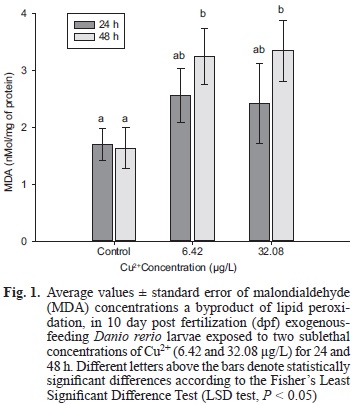
<body><![CDATA[<p align="justify"><font face="verdana" size="2">MDA levels were analyzed with two&#45;way ANOVA (taking as factors the exposure time and the toxicant's concentration), and the Fisher's Least Significant Difference (LSD) test was used to determine differences among treatments. All statistical analyses were performed with the Statistica ver. 7.0 software for Windows.</font></p>  	    <p align="justify"><font face="verdana" size="2">&nbsp;</font></p>  	    <p align="justify"><font face="verdana" size="2"><b>RESULTS</b></font></p>  	    <p align="justify"><font face="verdana" size="2">The average LC<sub>50</sub> and the 95 % confidence limit values obtained in three bioassays with Cu<sup>2</sup><sup>+</sup> for the 10 dpf <i>D. rerio</i> larvae was 148.52 &plusmn; 13.5 pg/L, whereas in the five bioassays for the 20 dpf larvae was 274.29 &plusmn; 31.15 &#956;g/L. Student t&#45;test revealed statistically significant differences in the LC<sub>50</sub> between both larval ages <i>(P =</i> 0.0011), the 10 dpf individuals corresponded to the most sensitive stage.</font></p>      <p align="justify"><font face="verdana" size="2"><b><a href="/img/revistas/rica/v31n4/a7t1.jpg" target="_blank">Table I</a></b> shows that larvae exposed to Cu exhibited a significant reduction in the amount of lipids and in caloric content as compared to the control (<i>P</i> <i>&lt;</i> 0.01). Glycogen concentration was also lower in the exposed organisms, but the differences were only significant at the 6.42 and 53.46 &#956;g/L concentrations, because of this, it was not possible to establish a pattern between the observed effect and the toxicant's concentration. The concentration of protein and carbohydrates did not differ in any of the treatments as compared to the control.</font></p>  	    <p align="justify"><font face="verdana" size="2">MDA concentration was not modified in control larvae during the experiment, but at 48 h of Cu<sup>2</sup><sup>+</sup> exposure an increase in MDA levels was observed as compared to the control group at the two tested concentrations (LSD test, <i>P</i> &lt; 0.05; <b><a href="#f1">Fig. 1</a></b>).</font></p>     <p align="center"><a name="f1"></a></p> 	    <p align="center"><img src="/img/revistas/rica/v31n4/a7f1.jpg"></p>  	    <p align="justify"><font face="verdana" size="2">&nbsp;</font></p>  	    <p align="justify"><font face="verdana" size="2"><b>DISCUSSION</b></font></p>  	    ]]></body>
<body><![CDATA[<p align="justify"><font face="verdana" size="2">The 10 dpf larvae were more sensitive to Cu, which could be because at this age individuals are still undergoing anatomical and physiological development, and metabolic changes are fast (Parichy <i>et al.</i> 2009), since larvae complete their full development to juveniles in around 26 days (Augustine <i>et al.</i> 2011). It is also possible that the 20 dpf larvae were less sensitive to Cu<sup>2+</sup> because they were able to retain a larger amount of energy reserves obtained from the exogenous food, which would allow them to tolerate larger concentrations of the toxicant. In addition, older larvae might have a more complete enzymatic system, including some of the enzymes required for the detoxification process.</font></p>  	    <p align="justify"><font face="verdana" size="2">The difference in copper sensitivity with respect to age in <i>D. rerio</i> was also observed by Alsop and Wood (2011), who exposed yolk&#45;sac larvae, as well as adults, and found LC<sub>50</sub> values of 148.4 and 212.1 &#956;g/L, respectively. On the other hand, Hernandez <i>et al.</i> (2011) reported that yolk&#45;sac larvae exposed to Cu were less sensitive than adults (LC<sub>50</sub> = 878.20 &#956;g/L and 120.74 &#956;g/L, respectively), but Freiry <i>et al.</i> (2014) observed that 10 day <i>D. rerio</i> larvae were more sensitive to Cu than 60 day adults. Results obtained herein indicate that, in individuals that have started their exogenous feeding, the younger larvae (10 dpf) are more sensitive to Cu than the older individuals (20 dpf). It can be hypothesized that the 20 dpf larvae developed metabolic mechanisms of physiological tolerance related to a better use of nutrients obtained from food than the 10 dpf larvae, which have an incipient enzymatic system, with oral and feeding structures still under development.</font></p>  	    <p align="justify"><font face="verdana" size="2">Johnson <i>et al.</i> (2007) found, in <i>D</i>. <i>rerio</i> embryos, that Cu at 93 to 464 &#956;g/L concentrations causes a decrease in larval length, and the yolk sac increases in size, which could hypothetically mean an increase in energetic reserves, but this is an anomalous condition with probable negative effects on development.</font></p>  	    <p align="justify"><font face="verdana" size="2">According to Campagna <i>et al.</i> (2008), exposure to toxic copper concentrations affects survival and growth, and produces damage in the gills of <i>D. rerio</i> larvae. In this respect, Kamunde <i>et al.</i> (2002) mention that the juvenile stages of fish are probably more susceptible to suffer the effects of intoxication because they have an immature excretion system and high energetic demands directed to growth.</font></p>  	    <p align="justify"><font face="verdana" size="2">Oliveira&#45;Filho <i>et al.</i> (2004) assessed in <i>D. rerio</i> adults the effect of different pesticides containing Cu and reported LC<sub>50</sub> values of 95, 75, and 38 &#956;g/L, which are lower than those obtained in our study for larval stages. These differences in sensitivity could be because they used soft water (hardness of 40 to 48 mg/L as CaCO<sub>3</sub>), whereas we used reconstituted hard water as dilution medium (hardness of 160 to 180 mg/L as CaCO<sub>3</sub>), it has been documented that Ca and Mg ions reduce metal toxicity (Ebrahimpour <i>et al.</i> 2010). According to the aforementioned, only exceptionally, results in fish could indicate a higher sensitivity in adults with respect to their early developmental stages.</font></p>  	    <p align="justify"><font face="verdana" size="2">In <i>D</i>. <i>rerio</i> adults exposed to HgCl<sub>2</sub> (0.07 mg/L), a decrease in the amount of glycogen and protein has been recorded in gills, muscle, and viscera (Vutukuru and Basani 2012). In our study, glycogen content was also significantly reduced with the highest and lowest Cu concentrations. Sokolova <i>et al.</i> (2012) determined that under normal conditions, organisms allocate energy to maintenance, growth and reproduction. Part of this energy is stored but, under stress conditions the energy stored in lipids, carbohydrates, and proteins is used to maintain basal activities and survival. We observed that, compared to the control, the lipid content decreased significantly when Cu concentration increased. This result demonstrates that exogenous&#45;feeding larvae use mainly lipids as the main energy reserve under stress conditions to cope with the negative effect of this toxic element, a similar situation occurs during starvation periods in <i>D. rerio</i> larvae (Flynn <i>et al.</i> 2009)</font></p>  	    <p align="justify"><font face="verdana" size="2">In copper&#45;exposed larvae, peroxidation of lipids (measured as MDA concentrations) increased with respect to the toxicant's concentration, and also with exposure time, being significantly higher at 48 h. Similar results have been found in other fish, but at higher copper concentrations than those tested herein. In this regard, Trivedi <i>et al.</i> (2012) observed increased MDA levels in the liver of <i>Carassius auratus</i> exposed to Cu<sup>2</sup><sup>+</sup> (0.1 to 1.5 mg/L), while Kong <i>et al.</i> (2013) observed, in embryos and larvae of this same species, an increase in MDA levels at Cu concentrations of 0.4 to 1 mg/L. These results confirm the cell membrane damage produced by Cu exposure, revealing the negative physiological effects exerted by this metal.</font></p>      <p align="justify"><font face="verdana" size="2">&nbsp;</font></p>  	    <p align="justify"><font face="verdana" size="2"><b>CONCLUSIONS</b></font></p>  	    <p align="justify"><font face="verdana" size="2">In conclusion, the main energetic reserves mobilized during the intoxication process in larvae exposed to Cu were lipids and glycogen. Cu effects were observed starting at the 16 &#956;g/L concentration, which is a value below the one reported as safety limit for the aquatic environment. In Mexico, the maximum allowable limit to protect aquatic life is 6 mg/L of Cu<sup>2</sup><sup>+</sup> (daily average) (SEMARNAT 1996), which is much higher than the values that produce lethal and sublethal effects in exogenous&#45;feeding <i>D. rerio</i> larvae, as observed herein. According to the latter, negative effects could be expected on aquatic biota, which indicates the need to review and correct the safety Cu levels to allow for the protection of freshwater environments.</font></p>      ]]></body>
<body><![CDATA[<p align="justify"><font face="verdana" size="2">&nbsp;</font></p>  	    <p align="justify"><font face="verdana" size="2"><b>ACKNOWLEDGMENTS</b></font></p>  	    <p align="justify"><font face="verdana" size="2">J. Rodr&iacute;guez&#45;Estrada is a student of the PhD program "Doctorado en Ciencias Biol&oacute;gicas y de la Salud" at the Universidad Aut&oacute;noma Metropolitana (UAM), sponsored by a fellowship granted from the Consejo Nacional de Ciencia y Tecnolog&iacute;a (CONACYT, No. 227293). A. S. Sobrino&#45;Figueroa thanks the C. B. S. Division of UAM&#45;Iztapalapa for financing the project entitled: Evaluaci&oacute;n del estado de salud de organismos de importancia ecol&oacute;gica y/o econ&oacute;mica presentes en sistemas acu&aacute;ticos. F. Mart&iacute;nez&#45;Jer&oacute;nimo thanks to the Instituto Polit&eacute;cnico Nacional (IPN)&#45;Secretar&iacute;a de Investigaci&oacute;n y Posgrado, and COFAA and EDI (IPN) for their support to this project. Finally, we thank the two anonymous reviewers whose comments and critical evaluation helped to improve this paper.</font></p>  	    <p align="justify"><font face="verdana" size="2">&nbsp;</font></p>  	    <p align="justify"><font face="verdana" size="2"><b>REFERENCES</b></font></p>  	    <!-- ref --><p align="justify"><font face="verdana" size="2">Alsop D. and Wood C.M. (2011). Metal uptake and acute toxicity in zebrafish: common mechanisms across multiple metals. Aquat. Toxicol. 105, 385&#45;393.    &nbsp;&nbsp;&nbsp;&nbsp;&nbsp;&nbsp;&nbsp;&nbsp;[&#160;<a href="javascript:void(0);" onclick="javascript: window.open('/scielo.php?script=sci_nlinks&ref=7239930&pid=S0188-4999201500040000700001&lng=','','width=640,height=500,resizable=yes,scrollbars=1,menubar=yes,');">Links</a>&#160;]<!-- end-ref --></font></p>  	    <!-- ref --><p align="justify"><font face="verdana" size="2">Arzate&#45;C&aacute;rdenas M.A. and Mart&iacute;nez&#45;Jer&oacute;nimo F. (2012a). Energy reserve modification in different age groups of <i>Daphnia schoedleri</i> (Anomopoda: Daphniidae) exposed to hexavalent chromium. Environ. Toxicol. Parmacol. 34, 106&#45;116.    &nbsp;&nbsp;&nbsp;&nbsp;&nbsp;&nbsp;&nbsp;&nbsp;[&#160;<a href="javascript:void(0);" onclick="javascript: window.open('/scielo.php?script=sci_nlinks&ref=7239932&pid=S0188-4999201500040000700002&lng=','','width=640,height=500,resizable=yes,scrollbars=1,menubar=yes,');">Links</a>&#160;]<!-- end-ref --></font></p>  	    <!-- ref --><p align="justify"><font face="verdana" size="2">Arzate&#45;C&aacute;rdenas M.A. and Mart&iacute;nez&#45;Jer&oacute;nimo F. (2012b). Energy resource reallocation in <i>Daphnia schodleri</i> (Anomopoda: Daphniide) reproduction induced by exposure to hexavalent chromium. Chemosphere 87, 326&#45;332.    &nbsp;&nbsp;&nbsp;&nbsp;&nbsp;&nbsp;&nbsp;&nbsp;[&#160;<a href="javascript:void(0);" onclick="javascript: window.open('/scielo.php?script=sci_nlinks&ref=7239934&pid=S0188-4999201500040000700003&lng=','','width=640,height=500,resizable=yes,scrollbars=1,menubar=yes,');">Links</a>&#160;]<!-- end-ref --></font></p>  	    <!-- ref --><p align="justify"><font face="verdana" size="2">Augustine S., Gagnaire B., Adam&#45;Guillermin C. and Kooijman S.A.L.M. (2011). Developmental energetics of zebrafish, <i>Danio rerio.</i> Comp. Biochem. Physiol. Part A 159, 275&#45;283.    &nbsp;&nbsp;&nbsp;&nbsp;&nbsp;&nbsp;&nbsp;&nbsp;[&#160;<a href="javascript:void(0);" onclick="javascript: window.open('/scielo.php?script=sci_nlinks&ref=7239936&pid=S0188-4999201500040000700004&lng=','','width=640,height=500,resizable=yes,scrollbars=1,menubar=yes,');">Links</a>&#160;]<!-- end-ref --></font></p>  	    <!-- ref --><p align="justify"><font face="verdana" size="2">B&aacute;ez&#45;Ram&iacute;rez O.A. and Prieto&#45;Garc&iacute;a F. (2005). Genotoxic damage in zebra fish <i>(Danio rerio)</i> by arsenic in waters from Zimap&aacute;n, Hidalgo, Mexico. Mutagenesis 20, 291&#45;295.    &nbsp;&nbsp;&nbsp;&nbsp;&nbsp;&nbsp;&nbsp;&nbsp;[&#160;<a href="javascript:void(0);" onclick="javascript: window.open('/scielo.php?script=sci_nlinks&ref=7239938&pid=S0188-4999201500040000700005&lng=','','width=640,height=500,resizable=yes,scrollbars=1,menubar=yes,');">Links</a>&#160;]<!-- end-ref --></font></p>  	    <!-- ref --><p align="justify"><font face="verdana" size="2">Belyaeva N.F., Kashirtseva V.N., Medvedeva N.V., Khudoklinova Y.Y., Ipatova O.M. and Archakov A.I. (2009). Zebrafish as model system for biomedical studies. Biochemistry (Moscov) suppl. series B: Biomed. Chem. 3, 343&#45;350.    &nbsp;&nbsp;&nbsp;&nbsp;&nbsp;&nbsp;&nbsp;&nbsp;[&#160;<a href="javascript:void(0);" onclick="javascript: window.open('/scielo.php?script=sci_nlinks&ref=7239940&pid=S0188-4999201500040000700006&lng=','','width=640,height=500,resizable=yes,scrollbars=1,menubar=yes,');">Links</a>&#160;]<!-- end-ref --></font></p>  	    <!-- ref --><p align="justify"><font face="verdana" size="2">Campagna A.F., Frac&aacute;cio R., Rodrigues B.K., Eler M.N., Fenerich&#45;Verani N. and Esp&iacute;ndola E.L.G. (2008). Effects of the copper in the survival, growth and gill morphology of <i>Danio rerio</i> (Cypriniformes, Cyprini&#45;dae). Acta Limnol. Bras. 20, 253&#45;259.    &nbsp;&nbsp;&nbsp;&nbsp;&nbsp;&nbsp;&nbsp;&nbsp;[&#160;<a href="javascript:void(0);" onclick="javascript: window.open('/scielo.php?script=sci_nlinks&ref=7239942&pid=S0188-4999201500040000700007&lng=','','width=640,height=500,resizable=yes,scrollbars=1,menubar=yes,');">Links</a>&#160;]<!-- end-ref --></font></p>  	    <!-- ref --><p align="justify"><font face="verdana" size="2">Carvalho C.S. and Fernandes M.N. (2008). Effects of copper on liver key enzymes of anaerobic glucose metabolism from freshwater tropical fish <i>Prochilodus lineatus.</i> Comp. Biochem. Physiol. A. 151, 437&#45;442.    &nbsp;&nbsp;&nbsp;&nbsp;&nbsp;&nbsp;&nbsp;&nbsp;[&#160;<a href="javascript:void(0);" onclick="javascript: window.open('/scielo.php?script=sci_nlinks&ref=7239944&pid=S0188-4999201500040000700008&lng=','','width=640,height=500,resizable=yes,scrollbars=1,menubar=yes,');">Links</a>&#160;]<!-- end-ref --></font></p>  	    <!-- ref --><p align="justify"><font face="verdana" size="2">Cheng Y. S., Zheng Y., Jean S. and Gheynst. (2011). Rapid quantitative analysis of lipids using a colorimetric method in a microplate format. Lipids 46, 95&#45;103.    &nbsp;&nbsp;&nbsp;&nbsp;&nbsp;&nbsp;&nbsp;&nbsp;[&#160;<a href="javascript:void(0);" onclick="javascript: window.open('/scielo.php?script=sci_nlinks&ref=7239946&pid=S0188-4999201500040000700009&lng=','','width=640,height=500,resizable=yes,scrollbars=1,menubar=yes,');">Links</a>&#160;]<!-- end-ref --></font></p>  	    <!-- ref --><p align="justify"><font face="verdana" size="2">Craig P.M., Wood C.M. and McClelland G.B. (2007). Oxidative stress response and gene expression with acute copper exposure in zebrafish <i>(Danio rerio).</i> Am. J. Physiol. Regul. Integr. Comp. Physiol. 293, R1882&#45;R1892.    &nbsp;&nbsp;&nbsp;&nbsp;&nbsp;&nbsp;&nbsp;&nbsp;[&#160;<a href="javascript:void(0);" onclick="javascript: window.open('/scielo.php?script=sci_nlinks&ref=7239948&pid=S0188-4999201500040000700010&lng=','','width=640,height=500,resizable=yes,scrollbars=1,menubar=yes,');">Links</a>&#160;]<!-- end-ref --></font></p>  	    <!-- ref --><p align="justify"><font face="verdana" size="2">Devasagayam T.P.A., Boloor K.K. and Ramasarma T. (2003). Methods for estimating lipid peroxidation: an analysis of merits and demerits. Indian J. Biochem. Biophys. 40, 300&#45;308.    &nbsp;&nbsp;&nbsp;&nbsp;&nbsp;&nbsp;&nbsp;&nbsp;[&#160;<a href="javascript:void(0);" onclick="javascript: window.open('/scielo.php?script=sci_nlinks&ref=7239950&pid=S0188-4999201500040000700011&lng=','','width=640,height=500,resizable=yes,scrollbars=1,menubar=yes,');">Links</a>&#160;]<!-- end-ref --></font></p>  	    <!-- ref --><p align="justify"><font face="verdana" size="2">Ebrahimpour M., Alipour H. and Rakhshah S. (2010). Influence of water hardness on acute toxicity of copper and zinc on fish. Toxicol. Ind. Health 26, 361&#45;365.    &nbsp;&nbsp;&nbsp;&nbsp;&nbsp;&nbsp;&nbsp;&nbsp;[&#160;<a href="javascript:void(0);" onclick="javascript: window.open('/scielo.php?script=sci_nlinks&ref=7239952&pid=S0188-4999201500040000700012&lng=','','width=640,height=500,resizable=yes,scrollbars=1,menubar=yes,');">Links</a>&#160;]<!-- end-ref --></font></p>  	    <!-- ref --><p align="justify"><font face="verdana" size="2">Flynn III E.J., Trent C.M. and Rawls J.F. (2009). Ontogeny and nutritional control of adipogenesis in zebrafish <i>(Danio rerio).</i> J. Lipid Res. 50, 1641&#45;1652.    &nbsp;&nbsp;&nbsp;&nbsp;&nbsp;&nbsp;&nbsp;&nbsp;[&#160;<a href="javascript:void(0);" onclick="javascript: window.open('/scielo.php?script=sci_nlinks&ref=7239954&pid=S0188-4999201500040000700013&lng=','','width=640,height=500,resizable=yes,scrollbars=1,menubar=yes,');">Links</a>&#160;]<!-- end-ref --></font></p>  	    <!-- ref --><p align="justify"><font face="verdana" size="2">Freiry R., Stelzer J.A.A., Maltchik L. and Arenzon A. (2014). Sensitivity of <i>Danio rerio</i> (Teleostei, Cyprinidae) during two stages of development based on acute toxicity test. Bull. Environ. Contam. Toxicol. 93, 442&#45;445.    &nbsp;&nbsp;&nbsp;&nbsp;&nbsp;&nbsp;&nbsp;&nbsp;[&#160;<a href="javascript:void(0);" onclick="javascript: window.open('/scielo.php?script=sci_nlinks&ref=7239956&pid=S0188-4999201500040000700014&lng=','','width=640,height=500,resizable=yes,scrollbars=1,menubar=yes,');">Links</a>&#160;]<!-- end-ref --></font></p>  	    <!-- ref --><p align="justify"><font face="verdana" size="2">Gerhard G.S. (2003). Comparative aspects of zebrafish <i>(Danio rerio)</i> as a model for aging research. Exp. Geront. 38, 1333&#45;1341.    &nbsp;&nbsp;&nbsp;&nbsp;&nbsp;&nbsp;&nbsp;&nbsp;[&#160;<a href="javascript:void(0);" onclick="javascript: window.open('/scielo.php?script=sci_nlinks&ref=7239958&pid=S0188-4999201500040000700015&lng=','','width=640,height=500,resizable=yes,scrollbars=1,menubar=yes,');">Links</a>&#160;]<!-- end-ref --></font></p>  	    <!-- ref --><p align="justify"><font face="verdana" size="2">G&oacute;mez&#45;&Aacute;lvarez A., Villalba&#45;Atondo A., Acosta&#45;Ru&iacute;z., Casta&ntilde;eda&#45;Olivares G. and Kamp D. (2004). Metales pesados en el agua superficial del r&iacute;o San Pedro durante los a&ntilde;os 1997 y 1999. Rev. Int. Contam. Ambie. 20, 1&#45;8.    &nbsp;&nbsp;&nbsp;&nbsp;&nbsp;&nbsp;&nbsp;&nbsp;[&#160;<a href="javascript:void(0);" onclick="javascript: window.open('/scielo.php?script=sci_nlinks&ref=7239960&pid=S0188-4999201500040000700016&lng=','','width=640,height=500,resizable=yes,scrollbars=1,menubar=yes,');">Links</a>&#160;]<!-- end-ref --></font></p>  	    <!-- ref --><p align="justify"><font face="verdana" size="2">G&uuml;nd&uuml;z E.A., G&uuml;lel A., Isitan V.&Ouml;., Boz A. and Cesur &Ouml;. (2010). Effect of sugar feeding on lipid, glycogen, and total sugar levels of a female parasitoid, <i>Bracon hebetor</i> (Say) (Hymenoptera: Braconidae). Turk. J. Agric. For. 34, 343&#45;347.    &nbsp;&nbsp;&nbsp;&nbsp;&nbsp;&nbsp;&nbsp;&nbsp;[&#160;<a href="javascript:void(0);" onclick="javascript: window.open('/scielo.php?script=sci_nlinks&ref=7239962&pid=S0188-4999201500040000700017&lng=','','width=640,height=500,resizable=yes,scrollbars=1,menubar=yes,');">Links</a>&#160;]<!-- end-ref --></font></p>  	    <!-- ref --><p align="justify"><font face="verdana" size="2">He J.H., Gao J.M., Huang C.J. and Li C.Q. (2014). Zebrafish models for development and reproductive toxicity. Neurotoxicol. Teratol. 42, 35&#45;42.    &nbsp;&nbsp;&nbsp;&nbsp;&nbsp;&nbsp;&nbsp;&nbsp;[&#160;<a href="javascript:void(0);" onclick="javascript: window.open('/scielo.php?script=sci_nlinks&ref=7239964&pid=S0188-4999201500040000700018&lng=','','width=640,height=500,resizable=yes,scrollbars=1,menubar=yes,');">Links</a>&#160;]<!-- end-ref --></font></p>  	    <!-- ref --><p align="justify"><font face="verdana" size="2">Hernandez P., Undurraga C., Gallardo V.E., Mackerzie N., Allende M.L. and Reyes A.E. (2011). Sublethal concentrations of waterborne copper induce cellular stress and cell death in zebrafish embryos and larvae. Biol. Res. 44, 7&#45;15.    &nbsp;&nbsp;&nbsp;&nbsp;&nbsp;&nbsp;&nbsp;&nbsp;[&#160;<a href="javascript:void(0);" onclick="javascript: window.open('/scielo.php?script=sci_nlinks&ref=7239966&pid=S0188-4999201500040000700019&lng=','','width=640,height=500,resizable=yes,scrollbars=1,menubar=yes,');">Links</a>&#160;]<!-- end-ref --></font></p>  	    <!-- ref --><p align="justify"><font face="verdana" size="2">Hern&aacute;ndez P.P. and Allende M.L. (2008). Zebrafish <i>(Danio rerio)</i> as a model for studying the genetic basis of copper toxicity, deficiency, and metabolism. Am. J. Clin. Nutr. 88, 835S&#45;839S.    &nbsp;&nbsp;&nbsp;&nbsp;&nbsp;&nbsp;&nbsp;&nbsp;[&#160;<a href="javascript:void(0);" onclick="javascript: window.open('/scielo.php?script=sci_nlinks&ref=7239968&pid=S0188-4999201500040000700020&lng=','','width=640,height=500,resizable=yes,scrollbars=1,menubar=yes,');">Links</a>&#160;]<!-- end-ref --></font></p>  	    <!-- ref --><p align="justify"><font face="verdana" size="2">Hsu C.H., Wen Z.H., Lin C.S. and Chakraborty C. (2007). The zebrafish model: use in studying cellular mechanisms for a spectrum of clinical disease entities. Curr. Neurovas. Res. 4, 111&#45;120.    &nbsp;&nbsp;&nbsp;&nbsp;&nbsp;&nbsp;&nbsp;&nbsp;[&#160;<a href="javascript:void(0);" onclick="javascript: window.open('/scielo.php?script=sci_nlinks&ref=7239970&pid=S0188-4999201500040000700021&lng=','','width=640,height=500,resizable=yes,scrollbars=1,menubar=yes,');">Links</a>&#160;]<!-- end-ref --></font></p>  	    <!-- ref --><p align="justify"><font face="verdana" size="2">Jezierska B., Lugowska K. and Witeska M. (2009). The effects of heavy metals on embryonic development of fish (a review). Fish Physiol. Biochem. 35, 625&#45;640.    &nbsp;&nbsp;&nbsp;&nbsp;&nbsp;&nbsp;&nbsp;&nbsp;[&#160;<a href="javascript:void(0);" onclick="javascript: window.open('/scielo.php?script=sci_nlinks&ref=7239972&pid=S0188-4999201500040000700022&lng=','','width=640,height=500,resizable=yes,scrollbars=1,menubar=yes,');">Links</a>&#160;]<!-- end-ref --></font></p>  	    <!-- ref --><p align="justify"><font face="verdana" size="2">Johnson A., Carew E. and Sloman K.A. (2007). The effects of copper on the morphological and functional development of zebrafish embryos. Aquat. Toxicol. 84, 431&#45;438.    &nbsp;&nbsp;&nbsp;&nbsp;&nbsp;&nbsp;&nbsp;&nbsp;[&#160;<a href="javascript:void(0);" onclick="javascript: window.open('/scielo.php?script=sci_nlinks&ref=7239974&pid=S0188-4999201500040000700023&lng=','','width=640,height=500,resizable=yes,scrollbars=1,menubar=yes,');">Links</a>&#160;]<!-- end-ref --></font></p>  	    <!-- ref --><p align="justify"><font face="verdana" size="2">Kamunde C., Grosell M., Higgs D. and Wood C.M. (2002). Copper metabolism in actively growing rainbow trout <i>(Oncorhynchus mykiss):</i> interactions between dietary and waterborne copper uptake. J. Exp. Biol. 205, 279&#45;290.    &nbsp;&nbsp;&nbsp;&nbsp;&nbsp;&nbsp;&nbsp;&nbsp;[&#160;<a href="javascript:void(0);" onclick="javascript: window.open('/scielo.php?script=sci_nlinks&ref=7239976&pid=S0188-4999201500040000700024&lng=','','width=640,height=500,resizable=yes,scrollbars=1,menubar=yes,');">Links</a>&#160;]<!-- end-ref --></font></p>  	    <!-- ref --><p align="justify"><font face="verdana" size="2">Kiaune L. and Singhasemanon N. (2011). Pesticidal copper (I) oxide: environmental fate and aquatic toxicity. Rev. Environ. Contam. Toxicol. 213, 1&#45;26.    &nbsp;&nbsp;&nbsp;&nbsp;&nbsp;&nbsp;&nbsp;&nbsp;[&#160;<a href="javascript:void(0);" onclick="javascript: window.open('/scielo.php?script=sci_nlinks&ref=7239978&pid=S0188-4999201500040000700025&lng=','','width=640,height=500,resizable=yes,scrollbars=1,menubar=yes,');">Links</a>&#160;]<!-- end-ref --></font></p>  	    <!-- ref --><p align="justify"><font face="verdana" size="2">Kong X., Jiang H., Wang S., Wu X., Fei W., Li L., Nie G. and Li X. (2013). Effects of copper exposure on the hatching status and antioxidant defense at different developmental stages of embryos and larvae of goldfish <i>Carassius auratus.</i> Chemosphere 92, 1458&#45;1464.    &nbsp;&nbsp;&nbsp;&nbsp;&nbsp;&nbsp;&nbsp;&nbsp;[&#160;<a href="javascript:void(0);" onclick="javascript: window.open('/scielo.php?script=sci_nlinks&ref=7239980&pid=S0188-4999201500040000700026&lng=','','width=640,height=500,resizable=yes,scrollbars=1,menubar=yes,');">Links</a>&#160;]<!-- end-ref --></font></p>  	    <!-- ref --><p align="justify"><font face="verdana" size="2">Luzio A., Monteiro S.M., Fonta&iacute;nhas&#45;Fernandes A.A., Pinto&#45;Carnide O., Matos M. and Coimbra A.M. (2013). Copper induced upregulation of apoptosis related genes in zebrafish <i>(Danio rerio)</i> gill. Aquatic. Toxicol. 128129, 183&#45;189.    &nbsp;&nbsp;&nbsp;&nbsp;&nbsp;&nbsp;&nbsp;&nbsp;[&#160;<a href="javascript:void(0);" onclick="javascript: window.open('/scielo.php?script=sci_nlinks&ref=7239982&pid=S0188-4999201500040000700027&lng=','','width=640,height=500,resizable=yes,scrollbars=1,menubar=yes,');">Links</a>&#160;]<!-- end-ref --></font></p>  	    <!-- ref --><p align="justify"><font face="verdana" size="2">Oliveira&#45;Filho E.C., Lopes R.M. and Paumgartten R.J.F. (2004). Comparative study on the susceptibility of freshwater species to copper&#45;based pesticides. Chemosphere 56, 369&#45;374.    &nbsp;&nbsp;&nbsp;&nbsp;&nbsp;&nbsp;&nbsp;&nbsp;[&#160;<a href="javascript:void(0);" onclick="javascript: window.open('/scielo.php?script=sci_nlinks&ref=7239984&pid=S0188-4999201500040000700028&lng=','','width=640,height=500,resizable=yes,scrollbars=1,menubar=yes,');">Links</a>&#160;]<!-- end-ref --></font></p>  	    <!-- ref --><p align="justify"><font face="verdana" size="2">Parichy D.M., Elizondo M.R., Mills M.G., Gordon T.N. and Engeszer R.E. (2009) Normal table of post&#45;embryonic zebrafish development: staging by externally visible anatomy of the living fish. Dev. Dynam. 238, 2975&#45;3015.    &nbsp;&nbsp;&nbsp;&nbsp;&nbsp;&nbsp;&nbsp;&nbsp;[&#160;<a href="javascript:void(0);" onclick="javascript: window.open('/scielo.php?script=sci_nlinks&ref=7239986&pid=S0188-4999201500040000700029&lng=','','width=640,height=500,resizable=yes,scrollbars=1,menubar=yes,');">Links</a>&#160;]<!-- end-ref --></font></p>  	    <!-- ref --><p align="justify"><font face="verdana" size="2">Prieto&#45;Garc&iacute;a F., B&aacute;ez&#45;Ram&iacute;rez O.A., Scott W., Gayt&aacute;n&#45;Oyarz&uacute;n J.C. and Z&uacute;&ntilde;iga&#45;Estrada A. (2006). Acumulaci&oacute;n, toxicidad y teratog&eacute;nesis provocada por presencia de ars&eacute;nico en aguas en el pez cebra <i>(Danio</i> <i>rerio).</i> AquaTIC 24, 72&#45;85.    &nbsp;&nbsp;&nbsp;&nbsp;&nbsp;&nbsp;&nbsp;&nbsp;[&#160;<a href="javascript:void(0);" onclick="javascript: window.open('/scielo.php?script=sci_nlinks&ref=7239988&pid=S0188-4999201500040000700030&lng=','','width=640,height=500,resizable=yes,scrollbars=1,menubar=yes,');">Links</a>&#160;]<!-- end-ref --></font></p>  	    <!-- ref --><p align="justify"><font face="verdana" size="2">Seker S. and Kutlu B. (2014). Determination of copper (Cu) levels for rivers in Tunceli, Turkey. World Environment 4, 168&#45;171.    &nbsp;&nbsp;&nbsp;&nbsp;&nbsp;&nbsp;&nbsp;&nbsp;[&#160;<a href="javascript:void(0);" onclick="javascript: window.open('/scielo.php?script=sci_nlinks&ref=7239990&pid=S0188-4999201500040000700031&lng=','','width=640,height=500,resizable=yes,scrollbars=1,menubar=yes,');">Links</a>&#160;]<!-- end-ref --></font></p>  	    <!-- ref --><p align="justify"><font face="verdana" size="2">SEMARNAT (1996). Norma Oficial Mexicana NOM&#45;001&#45;SEMARNAT&#45;1996 que establece los l&iacute;mites m&aacute;ximos permisibles de contaminantes en las descargas de aguas residuales en aguas y bienes nacionales. Secretar&iacute;a de Medio Ambiente, Recursos Naturales y Pesca. Diario Oficial de la Federaci&oacute;n. 6 de enero de 1997. M&eacute;xico. 29 pp.    &nbsp;&nbsp;&nbsp;&nbsp;&nbsp;&nbsp;&nbsp;&nbsp;[&#160;<a href="javascript:void(0);" onclick="javascript: window.open('/scielo.php?script=sci_nlinks&ref=7239992&pid=S0188-4999201500040000700032&lng=','','width=640,height=500,resizable=yes,scrollbars=1,menubar=yes,');">Links</a>&#160;]<!-- end-ref --></font></p>  	    <!-- ref --><p align="justify"><font face="verdana" size="2">Sloman K.A. and MacNeil P.L. (2012). Using physiology and behaviour to understand the responses of fish early life stages to toxicants. J. Fish Biol. 81, 2175&#45;2198.    &nbsp;&nbsp;&nbsp;&nbsp;&nbsp;&nbsp;&nbsp;&nbsp;[&#160;<a href="javascript:void(0);" onclick="javascript: window.open('/scielo.php?script=sci_nlinks&ref=7239994&pid=S0188-4999201500040000700033&lng=','','width=640,height=500,resizable=yes,scrollbars=1,menubar=yes,');">Links</a>&#160;]<!-- end-ref --></font></p>  	    <!-- ref --><p align="justify"><font face="verdana" size="2">Smolders R., De Boeck G. and Blust R. (2003) Changes in cellular energy budget as a measure of whole effluent toxicity in zebrafish <i>(Danio rerio).</i> Environ. Toxicol. Chem. 22, 890&#45;899.    &nbsp;&nbsp;&nbsp;&nbsp;&nbsp;&nbsp;&nbsp;&nbsp;[&#160;<a href="javascript:void(0);" onclick="javascript: window.open('/scielo.php?script=sci_nlinks&ref=7239996&pid=S0188-4999201500040000700034&lng=','','width=640,height=500,resizable=yes,scrollbars=1,menubar=yes,');">Links</a>&#160;]<!-- end-ref --></font></p>  	    <!-- ref --><p align="justify"><font face="verdana" size="2">Sokolova I.M., Frederich M., Bagwe R., Lannig G. and Sukhotin A.A. (2012). Energy homeostasis as an integrative tool for assessing limits of environmental stress tolerance in aquatic invertebrates. Mar. Environ. Res. 79, 1&#45;15.    &nbsp;&nbsp;&nbsp;&nbsp;&nbsp;&nbsp;&nbsp;&nbsp;[&#160;<a href="javascript:void(0);" onclick="javascript: window.open('/scielo.php?script=sci_nlinks&ref=7239998&pid=S0188-4999201500040000700035&lng=','','width=640,height=500,resizable=yes,scrollbars=1,menubar=yes,');">Links</a>&#160;]<!-- end-ref --></font></p>  	    <!-- ref --><p align="justify"><font face="verdana" size="2">Trivedi M.H., Sangai N.P. and Renuka A. (2012). Assessment of toxicity of copper sulphate pentahydrate on oxidative stress indicators on liver of gold fish <i>(Carassius auratus).</i> Bull. Environ. Pharmacol. Life Sci. 1, 52&#45;57.    &nbsp;&nbsp;&nbsp;&nbsp;&nbsp;&nbsp;&nbsp;&nbsp;[&#160;<a href="javascript:void(0);" onclick="javascript: window.open('/scielo.php?script=sci_nlinks&ref=7240000&pid=S0188-4999201500040000700036&lng=','','width=640,height=500,resizable=yes,scrollbars=1,menubar=yes,');">Links</a>&#160;]<!-- end-ref --></font></p>  	    <!-- ref --><p align="justify"><font face="verdana" size="2">Ulloa P.E., Iturra P., Neira R. and Araneda C. (2011) Zebrafish as a model organism for nutrition and growth: toward comparative studies of nutritional genomics applied to aquacultured fishes. Rev. Fish Biol. Fisher. 21, 649&#45;666.    &nbsp;&nbsp;&nbsp;&nbsp;&nbsp;&nbsp;&nbsp;&nbsp;[&#160;<a href="javascript:void(0);" onclick="javascript: window.open('/scielo.php?script=sci_nlinks&ref=7240002&pid=S0188-4999201500040000700037&lng=','','width=640,height=500,resizable=yes,scrollbars=1,menubar=yes,');">Links</a>&#160;]<!-- end-ref --></font></p>  	    <!-- ref --><p align="justify"><font face="verdana" size="2">USEPA (2002). Methods for measuring the acute toxicity of effluents and receiving waters to freshwater and marine organisms, 5<sup>th</sup>. ed. United States Environmental Protection Agency, Office of Water (4303T). NW. Washington, D.C., USA, 20640. EPA&#45;821&#45;R&#45;02&#45;012, 266 p.    &nbsp;&nbsp;&nbsp;&nbsp;&nbsp;&nbsp;&nbsp;&nbsp;[&#160;<a href="javascript:void(0);" onclick="javascript: window.open('/scielo.php?script=sci_nlinks&ref=7240004&pid=S0188-4999201500040000700038&lng=','','width=640,height=500,resizable=yes,scrollbars=1,menubar=yes,');">Links</a>&#160;]<!-- end-ref --></font></p>  	    <!-- ref --><p align="justify"><font face="verdana" size="2">USEPA (2007). Aquatic life ambient freshwater quality criteria copper. U. S. Environmental Protection Agency, Office Water (4304T), Office of Science and Technology. Washington, D.C., USA, EPA&#45;822&#45;R&#45;07&#45;001, 204 p.    &nbsp;&nbsp;&nbsp;&nbsp;&nbsp;&nbsp;&nbsp;&nbsp;[&#160;<a href="javascript:void(0);" onclick="javascript: window.open('/scielo.php?script=sci_nlinks&ref=7240006&pid=S0188-4999201500040000700039&lng=','','width=640,height=500,resizable=yes,scrollbars=1,menubar=yes,');">Links</a>&#160;]<!-- end-ref --></font></p>  	    <!-- ref --><p align="justify"><font face="verdana" size="2">Valko M., Morris H. and Cronin M.T.D. (2005). Metals, toxicity and oxidative stress. Curr. Med. Chem. 12, 1161&#45;1208.    &nbsp;&nbsp;&nbsp;&nbsp;&nbsp;&nbsp;&nbsp;&nbsp;[&#160;<a href="javascript:void(0);" onclick="javascript: window.open('/scielo.php?script=sci_nlinks&ref=7240008&pid=S0188-4999201500040000700040&lng=','','width=640,height=500,resizable=yes,scrollbars=1,menubar=yes,');">Links</a>&#160;]<!-- end-ref --></font></p>  	    <!-- ref --><p align="justify"><font face="verdana" size="2">Viegas I., Carvahlo R.A., Pardal M.A. and Jones J.G. (2012) Advances and application of tracer measurements of carbohydrates metabolism in fish &#91;online&#93;. <a href="http://www.intechopen.com/books/new&#45;advances&#45;and&#45;contributions&#45;to&#45;fish&#45;biology/advances&#45;and&#45;applications&#45;of&#45;tracer&#45;measurements&#45;of&#45;carbohydrate&#45;metabolism&#45;in&#45;fish" target="_blank">http://www.intechopen.com/books/new&#45;advances&#45;and&#45;contributions&#45;to&#45;fish&#45;biology/advances&#45;and&#45;applications&#45;of&#45;tracer&#45;measurements&#45;of&#45;carbohydrate&#45;metabolism&#45;in&#45;fish</a></font>&nbsp;&nbsp;&nbsp;&nbsp;&nbsp;&nbsp;&nbsp;&nbsp;[&#160;<a href="javascript:void(0);" onclick="javascript: window.open('/scielo.php?script=sci_nlinks&ref=7240010&pid=S0188-4999201500040000700041&lng=','','width=640,height=500,resizable=yes,scrollbars=1,menubar=yes,');">Links</a>&#160;]<!-- end-ref --><!-- ref --><p align="justify"><font face="verdana" size="2">Vutukuru S.S. and Bassani K. (2012). Acute effects of mercuric chloride on glycogen and protein content of zebrafish, <i>Danio rerio.</i> J. Environ. Biol. 34, 277&#45;281.    &nbsp;&nbsp;&nbsp;&nbsp;&nbsp;&nbsp;&nbsp;&nbsp;[&#160;<a href="javascript:void(0);" onclick="javascript: window.open('/scielo.php?script=sci_nlinks&ref=7240011&pid=S0188-4999201500040000700042&lng=','','width=640,height=500,resizable=yes,scrollbars=1,menubar=yes,');">Links</a>&#160;]<!-- end-ref --></font></p>  	    <!-- ref --><p align="justify"><font face="verdana" size="2">WHO (2004). Cooper in drinking&#45;water. Background document for development of WHO guidelines for drinking&#45;water quality. World Health Organization, Geneva, Switzerland, 23 pp. &#91;online&#93;<a href="http://www.who.int/water_sanitation_health/dwq/chemicals/copper.pdf" target="_blank">http://www.who.int/water_sanitation_health/dwq/chemicals/copper.pdf</a>.    &nbsp;&nbsp;&nbsp;&nbsp;&nbsp;&nbsp;&nbsp;&nbsp;[&#160;<a href="javascript:void(0);" onclick="javascript: window.open('/scielo.php?script=sci_nlinks&ref=7240013&pid=S0188-4999201500040000700043&lng=','','width=640,height=500,resizable=yes,scrollbars=1,menubar=yes,');">Links</a>&#160;]<!-- end-ref --></font></p>  	    ]]></body>
<body><![CDATA[<!-- ref --><p align="justify"><font face="verdana" size="2">Zhang W., Sun X., Chen L., Lin K.F., Dong Q.X., Huang C.J., Fu R.B. and Zhu J. (2012). Toxicological effect of joint cadmium selenium quantum dots and copper ion exposure on zebrafish. Environ. Toxicol. Chem. 31, 2117&#45;2123.    &nbsp;&nbsp;&nbsp;&nbsp;&nbsp;&nbsp;&nbsp;&nbsp;[&#160;<a href="javascript:void(0);" onclick="javascript: window.open('/scielo.php?script=sci_nlinks&ref=7240015&pid=S0188-4999201500040000700044&lng=','','width=640,height=500,resizable=yes,scrollbars=1,menubar=yes,');">Links</a>&#160;]<!-- end-ref --></font></p>      ]]></body><back>
<ref-list>
<ref id="B1">
<nlm-citation citation-type="journal">
<person-group person-group-type="author">
<name>
<surname><![CDATA[Alsop]]></surname>
<given-names><![CDATA[D.]]></given-names>
</name>
<name>
<surname><![CDATA[Wood]]></surname>
<given-names><![CDATA[C.M.]]></given-names>
</name>
</person-group>
<article-title xml:lang="en"><![CDATA[Metal uptake and acute toxicity in zebrafish: common mechanisms across multiple metals]]></article-title>
<source><![CDATA[Aquat. Toxicol]]></source>
<year>2011</year>
<volume>105</volume>
<page-range>385-393</page-range></nlm-citation>
</ref>
<ref id="B2">
<nlm-citation citation-type="journal">
<person-group person-group-type="author">
<name>
<surname><![CDATA[Arzate-Cárdenas]]></surname>
<given-names><![CDATA[M.A.]]></given-names>
</name>
<name>
<surname><![CDATA[Martínez-Jerónimo]]></surname>
<given-names><![CDATA[F.]]></given-names>
</name>
</person-group>
<article-title xml:lang="en"><![CDATA[Energy reserve modification in different age groups of Daphnia schoedleri (Anomopoda: Daphniidae) exposed to hexavalent chromium]]></article-title>
<source><![CDATA[Environ. Toxicol. Parmacol]]></source>
<year>2012</year>
<volume>34</volume>
<page-range>106-116</page-range></nlm-citation>
</ref>
<ref id="B3">
<nlm-citation citation-type="journal">
<person-group person-group-type="author">
<name>
<surname><![CDATA[Arzate-Cárdenas]]></surname>
<given-names><![CDATA[M.A.]]></given-names>
</name>
<name>
<surname><![CDATA[Martínez-Jerónimo]]></surname>
<given-names><![CDATA[F.]]></given-names>
</name>
</person-group>
<article-title xml:lang="en"><![CDATA[Energy resource reallocation in Daphnia schodleri (Anomopoda: Daphniide) reproduction induced by exposure to hexavalent chromium]]></article-title>
<source><![CDATA[Chemosphere]]></source>
<year>2012</year>
<volume>87</volume>
<page-range>326-332</page-range></nlm-citation>
</ref>
<ref id="B4">
<nlm-citation citation-type="journal">
<person-group person-group-type="author">
<name>
<surname><![CDATA[Augustine]]></surname>
<given-names><![CDATA[S.]]></given-names>
</name>
<name>
<surname><![CDATA[Gagnaire]]></surname>
<given-names><![CDATA[B.]]></given-names>
</name>
<name>
<surname><![CDATA[Adam-Guillermin]]></surname>
<given-names><![CDATA[C.]]></given-names>
</name>
<name>
<surname><![CDATA[Kooijman]]></surname>
<given-names><![CDATA[S.A.L.M.]]></given-names>
</name>
</person-group>
<article-title xml:lang="en"><![CDATA[Developmental energetics of zebrafish, Danio rerio]]></article-title>
<source><![CDATA[Comp. Biochem. Physiol. Part A]]></source>
<year>2011</year>
<volume>159</volume>
<page-range>275-283</page-range></nlm-citation>
</ref>
<ref id="B5">
<nlm-citation citation-type="journal">
<person-group person-group-type="author">
<name>
<surname><![CDATA[Báez-Ramírez]]></surname>
<given-names><![CDATA[O.A.]]></given-names>
</name>
<name>
<surname><![CDATA[Prieto-García]]></surname>
<given-names><![CDATA[F.]]></given-names>
</name>
</person-group>
<article-title xml:lang="en"><![CDATA[Genotoxic damage in zebra fish (Danio rerio) by arsenic in waters from Zimapán, Hidalgo, Mexico]]></article-title>
<source><![CDATA[Mutagenesis]]></source>
<year>2005</year>
<volume>20</volume>
<page-range>291-295</page-range></nlm-citation>
</ref>
<ref id="B6">
<nlm-citation citation-type="journal">
<person-group person-group-type="author">
<name>
<surname><![CDATA[Belyaeva]]></surname>
<given-names><![CDATA[N.F.]]></given-names>
</name>
<name>
<surname><![CDATA[Kashirtseva]]></surname>
<given-names><![CDATA[V.N.]]></given-names>
</name>
<name>
<surname><![CDATA[Medvedeva]]></surname>
<given-names><![CDATA[N.V.]]></given-names>
</name>
<name>
<surname><![CDATA[Khudoklinova]]></surname>
<given-names><![CDATA[Y.Y.]]></given-names>
</name>
<name>
<surname><![CDATA[Ipatova]]></surname>
<given-names><![CDATA[O.M.]]></given-names>
</name>
<name>
<surname><![CDATA[Archakov]]></surname>
<given-names><![CDATA[A.I.]]></given-names>
</name>
</person-group>
<article-title xml:lang="en"><![CDATA[Zebrafish as model system for biomedical studies]]></article-title>
<source><![CDATA[Biochemistry]]></source>
<year>2009</year>
<volume>3</volume>
<numero>^sseries B</numero>
<issue>^sseries B</issue>
<supplement>series B</supplement>
<page-range>343-350</page-range><publisher-loc><![CDATA[Moscov ]]></publisher-loc>
</nlm-citation>
</ref>
<ref id="B7">
<nlm-citation citation-type="journal">
<person-group person-group-type="author">
<name>
<surname><![CDATA[Campagna]]></surname>
<given-names><![CDATA[A.F.]]></given-names>
</name>
<name>
<surname><![CDATA[Fracácio]]></surname>
<given-names><![CDATA[R.]]></given-names>
</name>
<name>
<surname><![CDATA[Rodrigues]]></surname>
<given-names><![CDATA[B.K.]]></given-names>
</name>
<name>
<surname><![CDATA[Eler]]></surname>
<given-names><![CDATA[M.N.]]></given-names>
</name>
<name>
<surname><![CDATA[Fenerich-Verani]]></surname>
<given-names><![CDATA[N.]]></given-names>
</name>
<name>
<surname><![CDATA[Espíndola]]></surname>
<given-names><![CDATA[E.L.G.]]></given-names>
</name>
</person-group>
<article-title xml:lang="en"><![CDATA[Effects of the copper in the survival, growth and gill morphology of Danio rerio (Cypriniformes, Cyprini-dae)]]></article-title>
<source><![CDATA[Acta Limnol. Bras]]></source>
<year>2008</year>
<volume>20</volume>
<page-range>253-259</page-range></nlm-citation>
</ref>
<ref id="B8">
<nlm-citation citation-type="journal">
<person-group person-group-type="author">
<name>
<surname><![CDATA[Carvalho]]></surname>
<given-names><![CDATA[C.S.]]></given-names>
</name>
<name>
<surname><![CDATA[Fernandes]]></surname>
<given-names><![CDATA[M.N.]]></given-names>
</name>
</person-group>
<article-title xml:lang="en"><![CDATA[Effects of copper on liver key enzymes of anaerobic glucose metabolism from freshwater tropical fish Prochilodus lineatus]]></article-title>
<source><![CDATA[Comp. Biochem. Physiol. A]]></source>
<year>2008</year>
<volume>151</volume>
<page-range>437-442</page-range></nlm-citation>
</ref>
<ref id="B9">
<nlm-citation citation-type="journal">
<person-group person-group-type="author">
<name>
<surname><![CDATA[Cheng]]></surname>
<given-names><![CDATA[Y. S.]]></given-names>
</name>
<name>
<surname><![CDATA[Zheng]]></surname>
<given-names><![CDATA[Y.]]></given-names>
</name>
<name>
<surname><![CDATA[Jean]]></surname>
<given-names><![CDATA[S.]]></given-names>
</name>
<name>
<surname><![CDATA[Gheynst]]></surname>
</name>
</person-group>
<article-title xml:lang="en"><![CDATA[Rapid quantitative analysis of lipids using a colorimetric method in a microplate format]]></article-title>
<source><![CDATA[Lipids]]></source>
<year>2011</year>
<volume>46</volume>
<page-range>95-103</page-range></nlm-citation>
</ref>
<ref id="B10">
<nlm-citation citation-type="journal">
<person-group person-group-type="author">
<name>
<surname><![CDATA[Craig]]></surname>
<given-names><![CDATA[P.M.]]></given-names>
</name>
<name>
<surname><![CDATA[Wood]]></surname>
<given-names><![CDATA[C.M.]]></given-names>
</name>
<name>
<surname><![CDATA[McClelland]]></surname>
<given-names><![CDATA[G.B.]]></given-names>
</name>
</person-group>
<article-title xml:lang="en"><![CDATA[Oxidative stress response and gene expression with acute copper exposure in zebrafish (Danio rerio)]]></article-title>
<source><![CDATA[Am. J. Physiol. Regul. Integr. Comp. Physiol.]]></source>
<year>2007</year>
<volume>293</volume>
<page-range>R1882-R1892</page-range></nlm-citation>
</ref>
<ref id="B11">
<nlm-citation citation-type="journal">
<person-group person-group-type="author">
<name>
<surname><![CDATA[Devasagayam]]></surname>
<given-names><![CDATA[T.P.A.]]></given-names>
</name>
<name>
<surname><![CDATA[Boloor]]></surname>
<given-names><![CDATA[K.K.]]></given-names>
</name>
<name>
<surname><![CDATA[Ramasarma]]></surname>
<given-names><![CDATA[T.]]></given-names>
</name>
</person-group>
<article-title xml:lang="en"><![CDATA[Methods for estimating lipid peroxidation: an analysis of merits and demerits]]></article-title>
<source><![CDATA[Indian J. Biochem. Biophys]]></source>
<year>2003</year>
<volume>40</volume>
<page-range>300-308</page-range></nlm-citation>
</ref>
<ref id="B12">
<nlm-citation citation-type="journal">
<person-group person-group-type="author">
<name>
<surname><![CDATA[Ebrahimpour]]></surname>
<given-names><![CDATA[M.]]></given-names>
</name>
<name>
<surname><![CDATA[Alipour]]></surname>
<given-names><![CDATA[H.]]></given-names>
</name>
<name>
<surname><![CDATA[Rakhshah]]></surname>
<given-names><![CDATA[S.]]></given-names>
</name>
</person-group>
<article-title xml:lang="en"><![CDATA[Influence of water hardness on acute toxicity of copper and zinc on fish]]></article-title>
<source><![CDATA[Toxicol. Ind. Health]]></source>
<year>2010</year>
<volume>26</volume>
<page-range>361-365</page-range></nlm-citation>
</ref>
<ref id="B13">
<nlm-citation citation-type="journal">
<person-group person-group-type="author">
<name>
<surname><![CDATA[Flynn III]]></surname>
<given-names><![CDATA[E.J.]]></given-names>
</name>
<name>
<surname><![CDATA[Trent]]></surname>
<given-names><![CDATA[C.M.]]></given-names>
</name>
<name>
<surname><![CDATA[Rawls]]></surname>
<given-names><![CDATA[J.F.]]></given-names>
</name>
</person-group>
<article-title xml:lang="en"><![CDATA[Ontogeny and nutritional control of adipogenesis in zebrafish (Danio rerio)]]></article-title>
<source><![CDATA[J. Lipid Res]]></source>
<year>2009</year>
<volume>50</volume>
<page-range>1641-1652</page-range></nlm-citation>
</ref>
<ref id="B14">
<nlm-citation citation-type="journal">
<person-group person-group-type="author">
<name>
<surname><![CDATA[Freiry]]></surname>
<given-names><![CDATA[R.]]></given-names>
</name>
<name>
<surname><![CDATA[Stelzer]]></surname>
<given-names><![CDATA[J.A.A.]]></given-names>
</name>
<name>
<surname><![CDATA[Maltchik]]></surname>
<given-names><![CDATA[L.]]></given-names>
</name>
<name>
<surname><![CDATA[Arenzon]]></surname>
<given-names><![CDATA[A.]]></given-names>
</name>
</person-group>
<article-title xml:lang="en"><![CDATA[Sensitivity of Danio rerio (Teleostei, Cyprinidae) during two stages of development based on acute toxicity test]]></article-title>
<source><![CDATA[Bull. Environ. Contam. Toxicol]]></source>
<year>2014</year>
<volume>93</volume>
<page-range>442-445</page-range></nlm-citation>
</ref>
<ref id="B15">
<nlm-citation citation-type="journal">
<person-group person-group-type="author">
<name>
<surname><![CDATA[Gerhard]]></surname>
<given-names><![CDATA[G.S.]]></given-names>
</name>
</person-group>
<article-title xml:lang="en"><![CDATA[Comparative aspects of zebrafish (Danio rerio) as a model for aging research]]></article-title>
<source><![CDATA[Exp. Geront]]></source>
<year>2003</year>
<volume>38</volume>
<page-range>1333-1341</page-range></nlm-citation>
</ref>
<ref id="B16">
<nlm-citation citation-type="journal">
<person-group person-group-type="author">
<name>
<surname><![CDATA[Gómez-Álvarez]]></surname>
<given-names><![CDATA[A.]]></given-names>
</name>
<name>
<surname><![CDATA[Villalba-Atondo]]></surname>
<given-names><![CDATA[A.]]></given-names>
</name>
<name>
<surname><![CDATA[Acosta-Ruíz]]></surname>
</name>
<name>
<surname><![CDATA[Castañeda-Olivares]]></surname>
<given-names><![CDATA[G.]]></given-names>
</name>
<name>
<surname><![CDATA[Kamp]]></surname>
<given-names><![CDATA[D.]]></given-names>
</name>
</person-group>
<article-title xml:lang="en"><![CDATA[Metales pesados en el agua superficial del río San Pedro durante los años 1997 y 1999]]></article-title>
<source><![CDATA[Rev. Int. Contam. Ambie]]></source>
<year>2004</year>
<volume>20</volume>
<page-range>1-8</page-range></nlm-citation>
</ref>
<ref id="B17">
<nlm-citation citation-type="journal">
<person-group person-group-type="author">
<name>
<surname><![CDATA[Gündüz]]></surname>
<given-names><![CDATA[E.A.]]></given-names>
</name>
<name>
<surname><![CDATA[Gülel]]></surname>
<given-names><![CDATA[A.]]></given-names>
</name>
<name>
<surname><![CDATA[Isitan]]></surname>
<given-names><![CDATA[V.Ö.]]></given-names>
</name>
<name>
<surname><![CDATA[Boz]]></surname>
<given-names><![CDATA[A.]]></given-names>
</name>
<name>
<surname><![CDATA[Cesur]]></surname>
<given-names><![CDATA[Ö.]]></given-names>
</name>
</person-group>
<article-title xml:lang="en"><![CDATA[Effect of sugar feeding on lipid, glycogen, and total sugar levels of a female parasitoid, Bracon hebetor (Say) (Hymenoptera: Braconidae)]]></article-title>
<source><![CDATA[Turk. J. Agric. For]]></source>
<year>2010</year>
<volume>34</volume>
<page-range>343-347</page-range></nlm-citation>
</ref>
<ref id="B18">
<nlm-citation citation-type="journal">
<person-group person-group-type="author">
<name>
<surname><![CDATA[He]]></surname>
<given-names><![CDATA[J.H.]]></given-names>
</name>
<name>
<surname><![CDATA[Gao]]></surname>
<given-names><![CDATA[J.M.]]></given-names>
</name>
<name>
<surname><![CDATA[Huang]]></surname>
<given-names><![CDATA[C.J.]]></given-names>
</name>
<name>
<surname><![CDATA[Li]]></surname>
<given-names><![CDATA[C.Q.]]></given-names>
</name>
</person-group>
<article-title xml:lang="en"><![CDATA[Zebrafish models for development and reproductive toxicity]]></article-title>
<source><![CDATA[Neurotoxicol. Teratol]]></source>
<year>2014</year>
<volume>42</volume>
<page-range>35-42</page-range></nlm-citation>
</ref>
<ref id="B19">
<nlm-citation citation-type="journal">
<person-group person-group-type="author">
<name>
<surname><![CDATA[Hernandez]]></surname>
<given-names><![CDATA[P.]]></given-names>
</name>
<name>
<surname><![CDATA[Undurraga]]></surname>
<given-names><![CDATA[C.]]></given-names>
</name>
<name>
<surname><![CDATA[Gallardo]]></surname>
<given-names><![CDATA[V.E.]]></given-names>
</name>
<name>
<surname><![CDATA[Mackerzie]]></surname>
<given-names><![CDATA[N.]]></given-names>
</name>
<name>
<surname><![CDATA[Allende]]></surname>
<given-names><![CDATA[M.L.]]></given-names>
</name>
<name>
<surname><![CDATA[Reyes]]></surname>
<given-names><![CDATA[A.E.]]></given-names>
</name>
</person-group>
<article-title xml:lang="en"><![CDATA[Sublethal concentrations of waterborne copper induce cellular stress and cell death in zebrafish embryos and larvae]]></article-title>
<source><![CDATA[Biol. Res]]></source>
<year>2011</year>
<volume>44</volume>
<page-range>7-15</page-range></nlm-citation>
</ref>
<ref id="B20">
<nlm-citation citation-type="journal">
<person-group person-group-type="author">
<name>
<surname><![CDATA[Hernández]]></surname>
<given-names><![CDATA[P.P.]]></given-names>
</name>
<name>
<surname><![CDATA[Allende]]></surname>
<given-names><![CDATA[M.L.]]></given-names>
</name>
</person-group>
<article-title xml:lang="en"><![CDATA[Zebrafish (Danio rerio) as a model for studying the genetic basis of copper toxicity, deficiency, and metabolism]]></article-title>
<source><![CDATA[Am. J. Clin. Nutr.]]></source>
<year>2008</year>
<volume>88</volume>
<page-range>835S-839S</page-range></nlm-citation>
</ref>
<ref id="B21">
<nlm-citation citation-type="journal">
<person-group person-group-type="author">
<name>
<surname><![CDATA[Hsu]]></surname>
<given-names><![CDATA[C.H.]]></given-names>
</name>
<name>
<surname><![CDATA[Wen]]></surname>
<given-names><![CDATA[Z.H.]]></given-names>
</name>
<name>
<surname><![CDATA[Lin]]></surname>
<given-names><![CDATA[C.S.]]></given-names>
</name>
<name>
<surname><![CDATA[Chakraborty]]></surname>
<given-names><![CDATA[C.]]></given-names>
</name>
</person-group>
<article-title xml:lang="en"><![CDATA[The zebrafish model: use in studying cellular mechanisms for a spectrum of clinical disease entities]]></article-title>
<source><![CDATA[Curr. Neurovas. Res]]></source>
<year>2007</year>
<volume>4</volume>
<page-range>111-120</page-range></nlm-citation>
</ref>
<ref id="B22">
<nlm-citation citation-type="journal">
<person-group person-group-type="author">
<name>
<surname><![CDATA[Jezierska]]></surname>
<given-names><![CDATA[B.]]></given-names>
</name>
<name>
<surname><![CDATA[Lugowska]]></surname>
<given-names><![CDATA[K.]]></given-names>
</name>
<name>
<surname><![CDATA[Witeska]]></surname>
<given-names><![CDATA[M.]]></given-names>
</name>
</person-group>
<article-title xml:lang="en"><![CDATA[The effects of heavy metals on embryonic development of fish (a review)]]></article-title>
<source><![CDATA[Fish Physiol. Biochem]]></source>
<year>2009</year>
<volume>35</volume>
<page-range>625-640</page-range></nlm-citation>
</ref>
<ref id="B23">
<nlm-citation citation-type="journal">
<person-group person-group-type="author">
<name>
<surname><![CDATA[Johnson]]></surname>
<given-names><![CDATA[A.]]></given-names>
</name>
<name>
<surname><![CDATA[Carew]]></surname>
<given-names><![CDATA[E.]]></given-names>
</name>
<name>
<surname><![CDATA[Sloman]]></surname>
<given-names><![CDATA[K.A.]]></given-names>
</name>
</person-group>
<article-title xml:lang="en"><![CDATA[The effects of copper on the morphological and functional development of zebrafish embryos]]></article-title>
<source><![CDATA[Aquat. Toxicol]]></source>
<year>2007</year>
<volume>84</volume>
<page-range>431-438</page-range></nlm-citation>
</ref>
<ref id="B24">
<nlm-citation citation-type="journal">
<person-group person-group-type="author">
<name>
<surname><![CDATA[Kamunde]]></surname>
<given-names><![CDATA[C.]]></given-names>
</name>
<name>
<surname><![CDATA[Grosell]]></surname>
<given-names><![CDATA[M.]]></given-names>
</name>
<name>
<surname><![CDATA[Higgs]]></surname>
<given-names><![CDATA[D.]]></given-names>
</name>
<name>
<surname><![CDATA[Wood]]></surname>
<given-names><![CDATA[C.M.]]></given-names>
</name>
</person-group>
<article-title xml:lang="en"><![CDATA[Copper metabolism in actively growing rainbow trout (Oncorhynchus mykiss): interactions between dietary and waterborne copper uptake]]></article-title>
<source><![CDATA[J. Exp. Biol]]></source>
<year>2002</year>
<volume>205</volume>
<page-range>279-290</page-range></nlm-citation>
</ref>
<ref id="B25">
<nlm-citation citation-type="journal">
<person-group person-group-type="author">
<name>
<surname><![CDATA[Kiaune]]></surname>
<given-names><![CDATA[L.]]></given-names>
</name>
<name>
<surname><![CDATA[Singhasemanon]]></surname>
<given-names><![CDATA[N.]]></given-names>
</name>
</person-group>
<article-title xml:lang="en"><![CDATA[Pesticidal copper (I) oxide: environmental fate and aquatic toxicity]]></article-title>
<source><![CDATA[Rev. Environ. Contam. Toxicol]]></source>
<year>2011</year>
<volume>213</volume>
<page-range>1-26</page-range></nlm-citation>
</ref>
<ref id="B26">
<nlm-citation citation-type="journal">
<person-group person-group-type="author">
<name>
<surname><![CDATA[Kong]]></surname>
<given-names><![CDATA[X.]]></given-names>
</name>
<name>
<surname><![CDATA[Jiang]]></surname>
<given-names><![CDATA[H.]]></given-names>
</name>
<name>
<surname><![CDATA[Wang]]></surname>
<given-names><![CDATA[S.]]></given-names>
</name>
<name>
<surname><![CDATA[Wu]]></surname>
<given-names><![CDATA[X.]]></given-names>
</name>
<name>
<surname><![CDATA[Fei]]></surname>
<given-names><![CDATA[W.]]></given-names>
</name>
<name>
<surname><![CDATA[Li]]></surname>
<given-names><![CDATA[L.]]></given-names>
</name>
<name>
<surname><![CDATA[Nie]]></surname>
<given-names><![CDATA[G.]]></given-names>
</name>
<name>
<surname><![CDATA[Li]]></surname>
<given-names><![CDATA[X.]]></given-names>
</name>
</person-group>
<article-title xml:lang="en"><![CDATA[Effects of copper exposure on the hatching status and antioxidant defense at different developmental stages of embryos and larvae of goldfish Carassius auratus]]></article-title>
<source><![CDATA[Chemosphere]]></source>
<year>2013</year>
<volume>92</volume>
<page-range>1458-1464</page-range></nlm-citation>
</ref>
<ref id="B27">
<nlm-citation citation-type="journal">
<person-group person-group-type="author">
<name>
<surname><![CDATA[Luzio]]></surname>
<given-names><![CDATA[A.]]></given-names>
</name>
<name>
<surname><![CDATA[Monteiro]]></surname>
<given-names><![CDATA[S.M.]]></given-names>
</name>
<name>
<surname><![CDATA[Fontaínhas-Fernandes]]></surname>
<given-names><![CDATA[A.A.]]></given-names>
</name>
<name>
<surname><![CDATA[Pinto-Carnide]]></surname>
<given-names><![CDATA[O.]]></given-names>
</name>
<name>
<surname><![CDATA[Matos]]></surname>
<given-names><![CDATA[M.]]></given-names>
</name>
<name>
<surname><![CDATA[Coimbra]]></surname>
<given-names><![CDATA[A.M.]]></given-names>
</name>
</person-group>
<article-title xml:lang="en"><![CDATA[Copper induced upregulation of apoptosis related genes in zebrafish (Danio rerio) gill]]></article-title>
<source><![CDATA[Aquatic. Toxicol]]></source>
<year>2013</year>
<volume>128-129</volume>
<page-range>183-189</page-range></nlm-citation>
</ref>
<ref id="B28">
<nlm-citation citation-type="journal">
<person-group person-group-type="author">
<name>
<surname><![CDATA[Oliveira-Filho]]></surname>
<given-names><![CDATA[E.C.]]></given-names>
</name>
<name>
<surname><![CDATA[Lopes]]></surname>
<given-names><![CDATA[R.M.]]></given-names>
</name>
<name>
<surname><![CDATA[Paumgartten]]></surname>
<given-names><![CDATA[R.J.F.]]></given-names>
</name>
</person-group>
<article-title xml:lang="en"><![CDATA[Comparative study on the susceptibility of freshwater species to copper-based pesticides]]></article-title>
<source><![CDATA[Chemosphere]]></source>
<year>2004</year>
<volume>56</volume>
<page-range>369-374</page-range></nlm-citation>
</ref>
<ref id="B29">
<nlm-citation citation-type="journal">
<person-group person-group-type="author">
<name>
<surname><![CDATA[Parichy]]></surname>
<given-names><![CDATA[D.M.]]></given-names>
</name>
<name>
<surname><![CDATA[Elizondo]]></surname>
<given-names><![CDATA[M.R.]]></given-names>
</name>
<name>
<surname><![CDATA[Mills]]></surname>
<given-names><![CDATA[M.G.]]></given-names>
</name>
<name>
<surname><![CDATA[Gordon]]></surname>
<given-names><![CDATA[T.N.]]></given-names>
</name>
<name>
<surname><![CDATA[Engeszer]]></surname>
<given-names><![CDATA[R.E.]]></given-names>
</name>
</person-group>
<article-title xml:lang="en"><![CDATA[Normal table of post-embryonic zebrafish development: staging by externally visible anatomy of the living fish]]></article-title>
<source><![CDATA[Dev. Dynam]]></source>
<year>2009</year>
<volume>238</volume>
<page-range>2975-3015</page-range></nlm-citation>
</ref>
<ref id="B30">
<nlm-citation citation-type="journal">
<person-group person-group-type="author">
<name>
<surname><![CDATA[Prieto-García]]></surname>
<given-names><![CDATA[F.]]></given-names>
</name>
<name>
<surname><![CDATA[Báez-Ramírez]]></surname>
<given-names><![CDATA[O.A.]]></given-names>
</name>
<name>
<surname><![CDATA[Scott]]></surname>
<given-names><![CDATA[W.]]></given-names>
</name>
<name>
<surname><![CDATA[Gaytán-Oyarzún]]></surname>
<given-names><![CDATA[J.C.]]></given-names>
</name>
<name>
<surname><![CDATA[Zúñiga-Estrada]]></surname>
<given-names><![CDATA[A.]]></given-names>
</name>
</person-group>
<article-title xml:lang="es"><![CDATA[Acumulación, toxicidad y teratogénesis provocada por presencia de arsénico en aguas en el pez cebra (Danio rerio)]]></article-title>
<source><![CDATA[AquaTIC]]></source>
<year>2006</year>
<volume>24</volume>
<page-range>72-85</page-range></nlm-citation>
</ref>
<ref id="B31">
<nlm-citation citation-type="journal">
<person-group person-group-type="author">
<name>
<surname><![CDATA[Seker]]></surname>
<given-names><![CDATA[S.]]></given-names>
</name>
<name>
<surname><![CDATA[Kutlu]]></surname>
<given-names><![CDATA[B.]]></given-names>
</name>
</person-group>
<article-title xml:lang="en"><![CDATA[Determination of copper (Cu) levels for rivers in Tunceli, Turkey]]></article-title>
<source><![CDATA[World Environment]]></source>
<year>2014</year>
<volume>4</volume>
<page-range>168-171</page-range></nlm-citation>
</ref>
<ref id="B32">
<nlm-citation citation-type="journal">
<collab>SEMARNAT</collab>
<article-title xml:lang="es"><![CDATA[Norma Oficial Mexicana NOM-001-SEMARNAT-1996 que establece los límites máximos permisibles de contaminantes en las descargas de aguas residuales en aguas y bienes nacionales. Secretaría de Medio Ambiente, Recursos Naturales y Pesca]]></article-title>
<source><![CDATA[Diario Oficial de la Federación]]></source>
<year>1996</year>
<month>6 </month>
<day>de</day>
<page-range>29</page-range><publisher-loc><![CDATA[México ]]></publisher-loc>
</nlm-citation>
</ref>
<ref id="B33">
<nlm-citation citation-type="journal">
<person-group person-group-type="author">
<name>
<surname><![CDATA[Sloman]]></surname>
<given-names><![CDATA[K.A.]]></given-names>
</name>
<name>
<surname><![CDATA[MacNeil]]></surname>
<given-names><![CDATA[P.L.]]></given-names>
</name>
</person-group>
<article-title xml:lang="en"><![CDATA[Using physiology and behaviour to understand the responses of fish early life stages to toxicants]]></article-title>
<source><![CDATA[J. Fish Biol]]></source>
<year>2012</year>
<volume>81</volume>
<page-range>2175-2198</page-range></nlm-citation>
</ref>
<ref id="B34">
<nlm-citation citation-type="journal">
<person-group person-group-type="author">
<name>
<surname><![CDATA[Smolders]]></surname>
<given-names><![CDATA[R.]]></given-names>
</name>
<name>
<surname><![CDATA[De Boeck]]></surname>
<given-names><![CDATA[G.]]></given-names>
</name>
<name>
<surname><![CDATA[Blust]]></surname>
<given-names><![CDATA[R.]]></given-names>
</name>
</person-group>
<article-title xml:lang="en"><![CDATA[Changes in cellular energy budget as a measure of whole effluent toxicity in zebrafish (Danio rerio)]]></article-title>
<source><![CDATA[Environ. Toxicol. Chem]]></source>
<year>2003</year>
<volume>22</volume>
<page-range>890-899</page-range></nlm-citation>
</ref>
<ref id="B35">
<nlm-citation citation-type="journal">
<person-group person-group-type="author">
<name>
<surname><![CDATA[Sokolova]]></surname>
<given-names><![CDATA[I.M.]]></given-names>
</name>
<name>
<surname><![CDATA[Frederich]]></surname>
<given-names><![CDATA[M.]]></given-names>
</name>
<name>
<surname><![CDATA[Bagwe]]></surname>
<given-names><![CDATA[R.]]></given-names>
</name>
<name>
<surname><![CDATA[Lannig]]></surname>
<given-names><![CDATA[G.]]></given-names>
</name>
<name>
<surname><![CDATA[Sukhotin]]></surname>
<given-names><![CDATA[A.A.]]></given-names>
</name>
</person-group>
<article-title xml:lang="en"><![CDATA[Energy homeostasis as an integrative tool for assessing limits of environmental stress tolerance in aquatic invertebrates]]></article-title>
<source><![CDATA[Mar. Environ. Res]]></source>
<year>2012</year>
<volume>79</volume>
<page-range>1-15</page-range></nlm-citation>
</ref>
<ref id="B36">
<nlm-citation citation-type="journal">
<person-group person-group-type="author">
<name>
<surname><![CDATA[Trivedi]]></surname>
<given-names><![CDATA[M.H.]]></given-names>
</name>
<name>
<surname><![CDATA[Sangai]]></surname>
<given-names><![CDATA[N.P.]]></given-names>
</name>
<name>
<surname><![CDATA[Renuka]]></surname>
<given-names><![CDATA[A.]]></given-names>
</name>
</person-group>
<article-title xml:lang="en"><![CDATA[Assessment of toxicity of copper sulphate pentahydrate on oxidative stress indicators on liver of gold fish (Carassius auratus)]]></article-title>
<source><![CDATA[Bull. Environ. Pharmacol. Life Sci]]></source>
<year>2012</year>
<volume>1</volume>
<page-range>52-57</page-range></nlm-citation>
</ref>
<ref id="B37">
<nlm-citation citation-type="journal">
<person-group person-group-type="author">
<name>
<surname><![CDATA[Ulloa]]></surname>
<given-names><![CDATA[P.E.]]></given-names>
</name>
<name>
<surname><![CDATA[Iturra]]></surname>
<given-names><![CDATA[P.]]></given-names>
</name>
<name>
<surname><![CDATA[Neira]]></surname>
<given-names><![CDATA[R.]]></given-names>
</name>
<name>
<surname><![CDATA[Araneda]]></surname>
<given-names><![CDATA[C.]]></given-names>
</name>
</person-group>
<article-title xml:lang="en"><![CDATA[Zebrafish as a model organism for nutrition and growth: toward comparative studies of nutritional genomics applied to aquacultured fishes]]></article-title>
<source><![CDATA[Rev. Fish Biol. Fisher]]></source>
<year>2011</year>
<volume>21</volume>
<page-range>649-666</page-range></nlm-citation>
</ref>
<ref id="B38">
<nlm-citation citation-type="book">
<collab>USEPA</collab>
<source><![CDATA[Methods for measuring the acute toxicity of effluents and receiving waters to freshwater and marine organisms]]></source>
<year>2002</year>
<edition>5th</edition>
<page-range>266</page-range><publisher-loc><![CDATA[Washington^eD.C. D.C.]]></publisher-loc>
<publisher-name><![CDATA[United States Environmental Protection Agency, Office of Water]]></publisher-name>
</nlm-citation>
</ref>
<ref id="B39">
<nlm-citation citation-type="book">
<collab>USEPA</collab>
<source><![CDATA[Aquatic life ambient freshwater quality criteria copper]]></source>
<year>2007</year>
<publisher-loc><![CDATA[Washington^eD.C. D.C.]]></publisher-loc>
<publisher-name><![CDATA[U. S. Environmental Protection Agency, Office WaterOffice of Science and Technology]]></publisher-name>
</nlm-citation>
</ref>
<ref id="B40">
<nlm-citation citation-type="journal">
<person-group person-group-type="author">
<name>
<surname><![CDATA[Valko]]></surname>
<given-names><![CDATA[M.]]></given-names>
</name>
<name>
<surname><![CDATA[Morris]]></surname>
<given-names><![CDATA[H.]]></given-names>
</name>
<name>
<surname><![CDATA[Cronin]]></surname>
<given-names><![CDATA[M.T.D.]]></given-names>
</name>
</person-group>
<article-title xml:lang="en"><![CDATA[Metals, toxicity and oxidative stress]]></article-title>
<source><![CDATA[Curr. Med. Chem]]></source>
<year>2005</year>
<volume>12</volume>
<page-range>1161-1208</page-range></nlm-citation>
</ref>
<ref id="B41">
<nlm-citation citation-type="">
<person-group person-group-type="author">
<name>
<surname><![CDATA[Viegas]]></surname>
<given-names><![CDATA[I.]]></given-names>
</name>
<name>
<surname><![CDATA[Carvahlo]]></surname>
<given-names><![CDATA[R.A.]]></given-names>
</name>
<name>
<surname><![CDATA[Pardal]]></surname>
<given-names><![CDATA[M.A.]]></given-names>
</name>
<name>
<surname><![CDATA[Jones]]></surname>
<given-names><![CDATA[J.G.]]></given-names>
</name>
</person-group>
<source><![CDATA[Advances and application of tracer measurements of carbohydrates metabolism in fish]]></source>
<year>2012</year>
</nlm-citation>
</ref>
<ref id="B42">
<nlm-citation citation-type="journal">
<person-group person-group-type="author">
<name>
<surname><![CDATA[Vutukuru]]></surname>
<given-names><![CDATA[S.S.]]></given-names>
</name>
<name>
<surname><![CDATA[Bassani]]></surname>
<given-names><![CDATA[K.]]></given-names>
</name>
</person-group>
<article-title xml:lang="en"><![CDATA[Acute effects of mercuric chloride on glycogen and protein content of zebrafish, Danio rerio]]></article-title>
<source><![CDATA[J. Environ. Biol]]></source>
<year>2012</year>
<volume>34</volume>
<page-range>277-281</page-range></nlm-citation>
</ref>
<ref id="B43">
<nlm-citation citation-type="book">
<collab>WHO</collab>
<source><![CDATA[Cooper in drinking-water. Background document for development of WHO guidelines for drinking-water quality]]></source>
<year>2004</year>
<page-range>23</page-range><publisher-loc><![CDATA[Geneva ]]></publisher-loc>
<publisher-name><![CDATA[World Health Organization]]></publisher-name>
</nlm-citation>
</ref>
<ref id="B44">
<nlm-citation citation-type="journal">
<person-group person-group-type="author">
<name>
<surname><![CDATA[Zhang]]></surname>
<given-names><![CDATA[W.]]></given-names>
</name>
<name>
<surname><![CDATA[Sun]]></surname>
<given-names><![CDATA[X.]]></given-names>
</name>
<name>
<surname><![CDATA[Chen]]></surname>
<given-names><![CDATA[L.]]></given-names>
</name>
<name>
<surname><![CDATA[Lin]]></surname>
<given-names><![CDATA[K.F.]]></given-names>
</name>
<name>
<surname><![CDATA[Dong]]></surname>
<given-names><![CDATA[Q.X.]]></given-names>
</name>
<name>
<surname><![CDATA[Huang]]></surname>
<given-names><![CDATA[C.J.]]></given-names>
</name>
<name>
<surname><![CDATA[Fu]]></surname>
<given-names><![CDATA[R.B.]]></given-names>
</name>
<name>
<surname><![CDATA[Zhu]]></surname>
<given-names><![CDATA[J.]]></given-names>
</name>
</person-group>
<article-title xml:lang="en"><![CDATA[Toxicological effect of joint cadmium selenium quantum dots and copper ion exposure on zebrafish]]></article-title>
<source><![CDATA[Environ. Toxicol. Chem]]></source>
<year>2012</year>
<volume>31</volume>
<page-range>2117-2123</page-range></nlm-citation>
</ref>
</ref-list>
</back>
</article>
