<?xml version="1.0" encoding="ISO-8859-1"?><article xmlns:mml="http://www.w3.org/1998/Math/MathML" xmlns:xlink="http://www.w3.org/1999/xlink" xmlns:xsi="http://www.w3.org/2001/XMLSchema-instance">
<front>
<journal-meta>
<journal-id>0188-4999</journal-id>
<journal-title><![CDATA[Revista internacional de contaminación ambiental]]></journal-title>
<abbrev-journal-title><![CDATA[Rev. Int. Contam. Ambient]]></abbrev-journal-title>
<issn>0188-4999</issn>
<publisher>
<publisher-name><![CDATA[Universidad Nacional Autónoma de México, Instituto de Ciencias de la Atmósfera y Cambio Climático]]></publisher-name>
</publisher>
</journal-meta>
<article-meta>
<article-id>S0188-49992013000100003</article-id>
<title-group>
<article-title xml:lang="en"><![CDATA[Oxidative stress responses and histological hepatic alterations in barbel, Barbus bocagei, from Vizela river, Portugal]]></article-title>
<article-title xml:lang="es"><![CDATA[Respuestas al estrés oxidativo y alteraciones hepáticas en el barbo común, Barbus bocagei, del río Vizela, Portugal]]></article-title>
</title-group>
<contrib-group>
<contrib contrib-type="author">
<name>
<surname><![CDATA[PEIXOTO]]></surname>
<given-names><![CDATA[Francisco P.]]></given-names>
</name>
<xref ref-type="aff" rid="A01"/>
</contrib>
<contrib contrib-type="author">
<name>
<surname><![CDATA[CARROLA]]></surname>
<given-names><![CDATA[João]]></given-names>
</name>
<xref ref-type="aff" rid="A01"/>
<xref ref-type="aff" rid="A02"/>
</contrib>
<contrib contrib-type="author">
<name>
<surname><![CDATA[COIMBRA]]></surname>
<given-names><![CDATA[Ana Maria]]></given-names>
</name>
<xref ref-type="aff" rid="A01"/>
<xref ref-type="aff" rid="A02"/>
</contrib>
<contrib contrib-type="author">
<name>
<surname><![CDATA[FERNANDES]]></surname>
<given-names><![CDATA[Conceição]]></given-names>
</name>
<xref ref-type="aff" rid="A03"/>
</contrib>
<contrib contrib-type="author">
<name>
<surname><![CDATA[TEIXEIRA]]></surname>
<given-names><![CDATA[Paulo]]></given-names>
</name>
<xref ref-type="aff" rid="A01"/>
<xref ref-type="aff" rid="A02"/>
</contrib>
<contrib contrib-type="author">
<name>
<surname><![CDATA[COELHO]]></surname>
<given-names><![CDATA[Luís]]></given-names>
</name>
<xref ref-type="aff" rid="A01"/>
<xref ref-type="aff" rid="A04"/>
</contrib>
<contrib contrib-type="author">
<name>
<surname><![CDATA[CONCEIÇÃO]]></surname>
<given-names><![CDATA[Ivo]]></given-names>
</name>
<xref ref-type="aff" rid="A01"/>
<xref ref-type="aff" rid="A04"/>
</contrib>
<contrib contrib-type="author">
<name>
<surname><![CDATA[OLIVEIRA]]></surname>
<given-names><![CDATA[Maria Manuel]]></given-names>
</name>
<xref ref-type="aff" rid="A01"/>
<xref ref-type="aff" rid="A04"/>
</contrib>
<contrib contrib-type="author">
<name>
<surname><![CDATA[FONTAÍNHAS-FERNANDES]]></surname>
<given-names><![CDATA[António]]></given-names>
</name>
<xref ref-type="aff" rid="A01"/>
<xref ref-type="aff" rid="A02"/>
</contrib>
</contrib-group>
<aff id="A01">
<institution><![CDATA[,School of Environment and Life Sciences University of Trás-os-Montes e Alto Douro ]]></institution>
<addr-line><![CDATA[Vila Real ]]></addr-line>
<country>Portugal</country>
</aff>
<aff id="A02">
<institution><![CDATA[,Center for the Research and Technology of Agro-Environmental and Biological Sciences Centro de Investigação e de Tecnologias Agro-Ambientais e Biológicas ]]></institution>
<addr-line><![CDATA[ ]]></addr-line>
</aff>
<aff id="A03">
<institution><![CDATA[,Instituto Politécnico de Bragança Centro de Investigação de Montanha ]]></institution>
<addr-line><![CDATA[Bragança ]]></addr-line>
<country>Portugal</country>
</aff>
<aff id="A04">
<institution><![CDATA[,Chemistry Research Center of Vila Real Universidade de Trás-os-Montes e Alto Douro ]]></institution>
<addr-line><![CDATA[ ]]></addr-line>
</aff>
<pub-date pub-type="pub">
<day>00</day>
<month>02</month>
<year>2013</year>
</pub-date>
<pub-date pub-type="epub">
<day>00</day>
<month>02</month>
<year>2013</year>
</pub-date>
<volume>29</volume>
<numero>1</numero>
<fpage>29</fpage>
<lpage>38</lpage>
<copyright-statement/>
<copyright-year/>
<self-uri xlink:href="http://www.scielo.org.mx/scielo.php?script=sci_arttext&amp;pid=S0188-49992013000100003&amp;lng=en&amp;nrm=iso"></self-uri><self-uri xlink:href="http://www.scielo.org.mx/scielo.php?script=sci_abstract&amp;pid=S0188-49992013000100003&amp;lng=en&amp;nrm=iso"></self-uri><self-uri xlink:href="http://www.scielo.org.mx/scielo.php?script=sci_pdf&amp;pid=S0188-49992013000100003&amp;lng=en&amp;nrm=iso"></self-uri><abstract abstract-type="short" xml:lang="en"><p><![CDATA[Barbel (Barbus bocagei) a common species in Portuguese rivers was studied to assess the impact of water contamination on hepatic oxidative stress response, lipid peroxidation and histology. The Vizela River is a tributary of the Ave River, located in one of the most industrialized areas of Portugal. The oxidative stress biomarkers analyzed included superoxide dismutase, catalase, glutathione S-transferase, glutathione reductase, glucose 6-phosphate dehydrogenase and xanthine oxidase activities. Levels of reduced glutathione and lipid peroxidation were also evaluated. Except xanthine oxidase activity, that did not show any alteration, all the other enzymatic activities were increased in the liver of barbel captured in the Vizela River when compared with reference barbel. While, no differences were observed for glutathione reductase content, lipid peroxidation was higher in barbel from the Vizela River. Liver histological alterations were determined and their severity scored. Though lymphocyte foci were only observed in Vizela River barbel, macrophage aggregates were also present in reference barbel, although the severity score was higher in Vizela fish. The results of this study show that barbel liver oxidative stress responses, lipid peroxidation and histology are sensitive to the contaminants present in Vizela River water and are valuable biomarkers for monitoring purposes.]]></p></abstract>
<abstract abstract-type="short" xml:lang="es"><p><![CDATA[Barbos (Barbus bocagei), una especie común en los ríos portugueses, se utilizó para evaluar el impacto de la contaminación del agua en la respuesta hepática al estrés oxidativo, en la peroxidación lipídica y en la histología del órgano. El río Vizela es un afluente del río Ave, situado en una de las regiones más industrializadas de Portugal. Los biomarcadores de estrés oxidativo analizados fueron la actividad de las enzimas superóxido dismutasa, catalasa, glutatión S-transferasa, glutation reductasa, glucosa 6 fosfato deshidrogenasa y de la xantina oxidasa. Los niveles de glutatión reducido y de la peroxidación lipídica también fueron evaluados. Excepto la xantina oxidasa, que no mostró ninguna alteración, todas las otras actividades enzimáticas han sufrido incrementos en el hígado de los barbos capturados en el río Vizela, cuando se comparan con los barbos de referencia. No se observaron diferencias para el contenido de glutatión reductasa, pero la peroxidación lipídica fue mayor en los barbos del río Vizela. Las alteraciones en la histología hepática fueron identificadas y clasificadas de acuerdo con su gravedad. Mientras que los linfocitos de focos se observaron sólo en barbos del Río Vizela, los agregados de macrófagos también estuvieron presentes en barbos locales de referencia, aunque la gravedad de las alteraciones fue mayor en los peces del río Vizela. Los resultados de este estudio muestran que las respuestas de estrés oxidativo, la peroxidación lipídica y la histología hepática son sensibles a los contaminantes presentes en el agua del Río Vizela, demonstrando ser biomarcadores valiosos para propósitos de monitoreo.]]></p></abstract>
<kwd-group>
<kwd lng="en"><![CDATA[Oxidative stress enzymes]]></kwd>
<kwd lng="en"><![CDATA[lipid peroxidation]]></kwd>
<kwd lng="en"><![CDATA[fish]]></kwd>
<kwd lng="en"><![CDATA[freshwater]]></kwd>
<kwd lng="en"><![CDATA[liver histopathology]]></kwd>
<kwd lng="es"><![CDATA[Enzimas de estrés oxidativo]]></kwd>
<kwd lng="es"><![CDATA[peroxidación lipídica]]></kwd>
<kwd lng="es"><![CDATA[peces]]></kwd>
<kwd lng="es"><![CDATA[agua dulce]]></kwd>
<kwd lng="es"><![CDATA[histopatología hepática]]></kwd>
</kwd-group>
</article-meta>
</front><body><![CDATA[  	    <p align="justify"><font face="verdana" size="4">Art&iacute;culos</font></p>  	    <p align="justify"><font face="verdana" size="2">&nbsp;</font></p>  	    <p align="center"><font face="verdana" size="4"><b>Oxidative stress responses and histological hepatic alterations in barbel, <i>Barbus bocagei</i>, from Vizela river, Portugal</b></font></p>  	    <p align="center"><font face="verdana" size="2">&nbsp;</font></p>  	    <p align="center"><font face="verdana" size="3"><b>Respuestas al estr&eacute;s oxidativo y alteraciones hep&aacute;ticas en el barbo com&uacute;n, <i>Barbus bocagei</i>, del r&iacute;o Vizela, Portugal</b></font></p>  	    <p align="center"><font face="verdana" size="2">&nbsp;</font></p>  	    <p align="center"><font face="verdana" size="2"><b>Francisco P. PEIXOTO<sup>1,2</sup>, Jo&atilde;o CARROLA<sup>1,2</sup>, Ana Maria COIMBRA<sup>1,2</sup>*, Concei&#231;&atilde;o FERNANDES<sup>3</sup>, Paulo TEIXEIRA<sup>1,2</sup>, Lu&iacute;s COELHO<sup>1,4</sup>, Ivo CONCEI&#199;&Atilde;O<sup>1,4</sup>, Maria Manuel OLIVEIRA<sup>1,4</sup> and Ant&oacute;nio FONTA&Iacute;NHAS&#45;FERNANDES<sup>1,2</sup></b></font></p>  	    <p align="justify"><font face="verdana" size="2">&nbsp;</font></p>  	    <p align="justify"><font face="verdana" size="2"><sup><i>1</i></sup><i> School of Environment and Life Sciences (Escola de Ci&ecirc;ncias da Vida e do Ambiente&#45;ECVA), University of Tr&aacute;s&#45;os&#45;Montes e Alto Douro (UTAD), Apartado 1013, 5001&#45;801 Vila Real, Portugal.</i></font></p>  	    ]]></body>
<body><![CDATA[<p align="justify"><font face="verdana" size="2"><i><sup>2</sup> Center for the Research and Technology of Agro&#45;Environmental and Biological Sciences (Centro de Investiga&#231;&atilde;o e de Tecnologias Agro&#45;Ambientais e Biol&oacute;gicas&#45;CITAB), UTAD</i>. *Corresponding author: <a href="mailto:acoimbra@utad.pt">acoimbra@utad.pt</a></font></p>      <p align="justify"><font face="verdana" size="2"><i><sup>3</sup> Agrarian Superior School (Escola Superior Agr&aacute;ria, Instituto Polit&eacute;cnico de Bragan&#231;a, Centro de Investiga&#231;&atilde;o de Montanha CIMO), Campus de Santa Apol&oacute;nia, Apartado 1038, 5301&#45;854 Bragan&#231;a, Portugal.</i></font></p>  	    <p align="justify"><font face="verdana" size="2"><i><sup>4</sup> Chemistry Research Center of Vila Real (Centro de Qu&iacute;mica de Vila Real&#45;CQVR), UTAD.</i></font></p>  	    <p align="justify">&nbsp;</p>  	    <p align="justify"><font face="verdana" size="2">&nbsp;</font></p>  	    <p align="justify"><font face="verdana" size="2">Recibido agosto 2011,    <br> 	Aceptado octubre 2012</font></p>  	    <p align="justify"><font face="verdana" size="2">&nbsp;</font></p>  	    <p align="justify"><font face="verdana" size="2"><b>ABSTRACT</b></font></p>  	    <p align="justify"><font face="verdana" size="2">Barbel <i>(Barbus bocagei)</i> a common species in Portuguese rivers was studied to assess the impact of water contamination on hepatic oxidative stress response, lipid peroxidation and histology. The Vizela River is a tributary of the Ave River, located in one of the most industrialized areas of Portugal. The oxidative stress biomarkers analyzed included superoxide dismutase, catalase, glutathione <i>S</i>&#45;transferase, glutathione reductase, glucose 6&#45;phosphate dehydrogenase and xanthine oxidase activities. Levels of reduced glutathione and lipid peroxidation were also evaluated. Except xanthine oxidase activity, that did not show any alteration, all the other enzymatic activities were increased in the liver of barbel captured in the Vizela River when compared with reference barbel. While, no differences were observed for glutathione reductase content, lipid peroxidation was higher in barbel from the Vizela River. Liver histological alterations were determined and their severity scored. Though lymphocyte foci were only observed in Vizela River barbel, macrophage aggregates were also present in reference barbel, although the severity score was higher in Vizela fish. The results of this study show that barbel liver oxidative stress responses, lipid peroxidation and histology are sensitive to the contaminants present in Vizela River water and are valuable biomarkers for monitoring purposes.</font></p>  	    ]]></body>
<body><![CDATA[<p align="justify"><font face="verdana" size="2"><b>Key words:</b> Oxidative stress enzymes, lipid peroxidation, fish, freshwater, liver histopathology.</font></p>  	    <p align="justify"><font face="verdana" size="2">&nbsp;</font></p>  	    <p align="justify"><font face="verdana" size="2"><b>RESUMEN</b></font></p>  	    <p align="justify"><font face="verdana" size="2">Barbos <i>(Barbus bocagei),</i> una especie com&uacute;n en los r&iacute;os portugueses, se utiliz&oacute; para evaluar el impacto de la contaminaci&oacute;n del agua en la respuesta hep&aacute;tica al estr&eacute;s oxidativo, en la peroxidaci&oacute;n lip&iacute;dica y en la histolog&iacute;a del &oacute;rgano. El r&iacute;o Vizela es un afluente del r&iacute;o Ave, situado en una de las regiones m&aacute;s industrializadas de Portugal. Los biomarcadores de estr&eacute;s oxidativo analizados fueron la actividad de las enzimas super&oacute;xido dismutasa, catalasa, glutati&oacute;n <i>S</i>&#45;transferasa, glutation reductasa, glucosa 6 fosfato deshidrogenasa y de la xantina oxidasa. Los niveles de glutati&oacute;n reducido y de la peroxidaci&oacute;n lip&iacute;dica tambi&eacute;n fueron evaluados. Excepto la xantina oxidasa, que no mostr&oacute; ninguna alteraci&oacute;n, todas las otras actividades enzim&aacute;ticas han sufrido incrementos en el h&iacute;gado de los barbos capturados en el r&iacute;o Vizela, cuando se comparan con los barbos de referencia. No se observaron diferencias para el contenido de glutati&oacute;n reductasa, pero la peroxidaci&oacute;n lip&iacute;dica fue mayor en los barbos del r&iacute;o Vizela. Las alteraciones en la histolog&iacute;a hep&aacute;tica fueron identificadas y clasificadas de acuerdo con su gravedad. Mientras que los linfocitos de focos se observaron s&oacute;lo en barbos del R&iacute;o Vizela, los agregados de macr&oacute;fagos tambi&eacute;n estuvieron presentes en barbos locales de referencia, aunque la gravedad de las alteraciones fue mayor en los peces del r&iacute;o Vizela. Los resultados de este estudio muestran que las respuestas de estr&eacute;s oxidativo, la peroxidaci&oacute;n lip&iacute;dica y la histolog&iacute;a hep&aacute;tica son sensibles a los contaminantes presentes en el agua del R&iacute;o Vizela, demonstrando ser biomarcadores valiosos para prop&oacute;sitos de monitoreo.</font></p>  	    <p align="justify"><font face="verdana" size="2"><b>Palabras clave:</b> Enzimas de estr&eacute;s oxidativo, peroxidaci&oacute;n lip&iacute;dica, peces, agua dulce, histopatolog&iacute;a hep&aacute;tica.</font></p>  	    <p align="justify"><font face="verdana" size="2">&nbsp;</font></p>  	    <p align="justify"><font face="verdana" size="2"><b>INTRODUCTION</b></font></p>  	    <p align="justify"><font face="verdana" size="2">The hydrographical basin of the Ave River is located in Minho region (northwest of Portugal) and comprises an area of about 1390 km<sup>2</sup>, being limited up north by the Cavado River, east by the Douro River and south by the basin of Le&#231;a River. The Ave River has two main tributaries, the Este River on the right edge and the Vizela River on left edge. About 80 % of this basin is overpopulated. Textile industry is one of the most important economic activities in this region, with around 200 industrial units, that include both manufacturing and tanning units (Alves <i>et al.</i> 2009). For many decades both urban and industrial effluents were discharged directly into the river basin and the presence of heavy metals in sediments have already been reported. Soares <i>et al.</i> (1999) observed high values of Cr (0.36&#45;0.67 g/kg volatile matter dry weight (DW)), Cu (0.46&#45;1.03 g/kg volatile matter DW) and Zn (0.75&#45;3.70 g/kg volatile matter DW). Ten years later, Alves <i>et al.</i> (2009) found values of Cr (2.85&#45;4.45), Cu (0.62&#45;0.69) and Zn (0.53&#45;1.87). Recently, due to the European legal requirements and the increasing public awareness, Portugal has started to control the quality of industrial discharges. As result, norms, like ISO 14000 family, and legal contamination standards, such as the EU Water Framework Directive, are being implemented in Portugal. Despite this, several industrial effluents are still being discharged directly into streams without any treatment, and several heavy metals are present and can still be found in sediments (Alves <i>et al.</i> 2009).</font></p>  	    <p align="justify"><font face="verdana" size="2">Heavy metals are non&#45;degradable and may bio&#45;accumulate in organisms, possibly reaching toxic levels. This can constitute a threat to public and/or aquatic organisms' health due to chronic exposure to high concentrations (Fernandes <i>et al.</i> 2007, Fernandes <i>et al.</i> 2008a, Vieira <i>et al.</i> 2011).</font></p>  	    <p align="justify"><font face="verdana" size="2">Due to the high degree of pollution of the Ave River basin, the biota in this aquatic ecosystem has been progressively degraded. The Iberian barbel <i>(Barbus bocagei)</i> is one of the few fish species still widely distributed in this basin, being benthopelagic and with a versatile diet (Magalh&atilde;es 1992), and thus susceptible to both, sediment and water column, contaminants.</font></p>  	    ]]></body>
<body><![CDATA[<p align="justify"><font face="verdana" size="2">The evaluation of biochemical and histological changes in fish liver has become an important tool to monitor the environmental exposure of fish to contaminants (Hinton &amp; Lauren 1990, Deviller <i>et al.</i> 2005, Fernandes <i>et al.</i> 2008b, Carrola <i>et al.</i> 2009). Fish liver plays an important role in vital functions and is the major organ for accumulation, biotransformation, and excretion of contaminants in fish (Triebskorn <i>et al.</i> 1994, Triebskorn <i>et al.</i> 1997). Histopathology of fish liver is a monitoring tool, which allows the assessment of the environmental stressors effects, in fish. Indeed, it is one of the most reliable indicators of the health impairment induced by anthropogenic stressors in aquatic organisms (Fernandes <i>et al.</i> 2008b, Leonardi <i>et al.</i> 2009).</font></p>  	    <p align="justify"><font face="verdana" size="2">Heavy metal exposure, in aquatic ecosystems, is described as an enhancer of intracellular formation of reactive oxygen species (ROS), which can give rise to oxidative damage, as observed in flathead grey mullet <i>(Mugil cephalus),</i> flounder <i>(Platichthys flesus)</i> and Nile tilapia <i>(Oreochromis niloticus)</i> (Ferreira <i>et al.</i> 2005, Figueiredo&#45;Fernandes <i>et al.</i> 2006). Thus, oxidative stress biomarkers can be employed in environmental monitoring programs (McCarthy and Shugart 1990, Fernandes <i>et al.</i> 2008c). Lipid peroxidation and protein oxidation are manifestations of oxidative damage induced by heavy metals (Livingstone <i>et al.</i> 1993, Ercal <i>et al.</i> 2001), and have a predictive importance as biomarkers of pollution (Collen <i>et al.</i> 2003, Bl&aacute;ha <i>et al.</i> 2004, Almroth <i>et al.</i> 2005). In addition, both antioxidant enzymes and non&#45;enzymatic antioxidants have been successfully employed in aquatic monitoring studies (Figueiredo&#45;Fernandes <i>et al.</i> 2006, Peixoto <i>et al.</i> 2006). ROS can be detoxified by an enzymatic defence system, comprising superoxide dismutase (SOD), catalase (CAT), and selenium&#45;dependent glutathione peroxidase; or by a non&#45;enzymatic system, with the scavenging action of reduced glutathione. Moreover, organic peroxides can be detoxified by the activity of glutathione S&#45;transferase (GST) (Halliwell and Gutteridge 1999).</font></p>  	    <p align="justify"><font face="verdana" size="2">The aim of this study was to assess biochemical and histological biomarkers of exposure in the liver of the Iberian barbel <i>(Barbus bocagei)</i> captured in Vizela River. The values obtained will serve as base for future surveys on barbel populations in the Vizela River and evaluation of the impact of management policies. Lipid peroxidation in liver and hepatic activities of superoxide dismutase, catalase, glutathione S&#45;transferase, glutathione reductase, glucose 6&#45;phosphate dehydrogenase, xantine oxidase, and the amount of reduced glutathione were measured and compared with the respective activities in reference barbel. The biochemical evaluation was complemented with hepatic histological analyses and possible accumulation of metals in this organ was assessed.</font></p>  	    <p align="justify"><font face="verdana" size="2">&nbsp;</font></p>  	    <p align="justify"><font face="verdana" size="2"><b>MATERIALS AND METHODS</b></font></p>  	    <p align="justify"><font face="verdana" size="2"><b>Fish sampling</b></font></p>  	    <p align="justify"><font face="verdana" size="2">Twenty&#45;four barbel <i>(Barbus bocagei)</i> were captured in the Vizela River (41&deg;22'16.85"N; 8&deg;18'17.86'W) near the city of Caldas de Vizela. Fish were captured in the autumn of 2009 using pulsed DC backpack electrofishing equipment with a DC&#45;500 V generator. Reference barbel were captured in Corgo River (41&deg;17'14.62"N; 7&deg;44'57.55'W), a low contaminated stream. Barbels, from both locations, were sacrificed at the same time, after being anaesthetized with 3&#45;aminobenzoic acid ethyl ester.</font></p>  	    <p align="justify"><font face="verdana" size="2">Liver sections were frozen in liquid nitrogen and stored at &#45;80 &deg;C for biochemical analysis, or fixed in 10 % buffered formalin during 24&#45;48 h for histology.</font></p>  	    <p align="justify"><font face="verdana" size="2">In addition, a pool of13 Vizela barbel was randomly selected and the livers sub&#45;sampled and stored in eppendorfs at &#45;20 &deg;C, for metals analysis.</font></p>  	    <p align="justify"><font face="verdana" size="2">&nbsp;</font></p>  	    ]]></body>
<body><![CDATA[<p align="justify"><font face="verdana" size="2"><b>Biochemical analysis</b></font></p>  	    <p align="justify"><font face="verdana" size="2">All chemicals used in the enzymatic activity were of analytical purity from Sigma Chemical Co, except when indicated.</font></p>  	    <p align="justify"><font face="verdana" size="2">One gram of liver tissue was homogenized in 5 ml of ice&#45;cold sodium phosphate buffer (100 mM, pH 7.4) and post&#45;mitochondrial supernatant (PMS) was obtained after centrifugation at 10 500xg for 20 min at 4 &deg;C.</font></p>  	    <p align="justify"><font face="verdana" size="2">Superoxide dismutase (SOD) activity was assayed according to Paya <i>et al.</i> (1992) with minor modifications (Peixoto <i>et al.</i> 2006). Nitrotetrazolium blue chloride (NBT) was used as detection molecule instead of cytochrome c. Assays were conducted in the presence of potassium phosphate buffer (100 mM, pH 7.0), hypoxanthine (10 mM), and NBT (10 mM). The reaction was initiated by the addition of xanthine oxidase (0.023 U/mol) to enzymatic extract at 25 &deg;C. Activity was reported by its ability to inhibit 50 % reduction of NBT and the result is expressed as U/min/mg/protein.</font></p>  	    <p align="justify"><font face="verdana" size="2">Catalase (CAT) activity was assayed by the method Claiborne (1985). The reaction mixture consisted in potassium phosphate buffer 50 mM, pH 7.4, hydrogen peroxide19 mM and PMS 10 %. The reaction was carried out at 25 &deg;C and the change in absorbance was recorded at 240 nm. CAT activity was calculated in terms of (&#956;mol H<sub>2</sub>O<sub>2</sub> consumed/ min/mg/protein. Glutathione reductase (GR) activity was assayed by the method of Carlberg and Mannervik (1975) as modified by Mohandas <i>et al.</i> (1984). The reaction system consisted of potassium phosphate buffer (100 M, pH 7.4), EDTA 0.5 mM, oxidized glutathione (GSSG) 1 mM, NADPH 0.1 mM and PMS 10 %. Enzyme activity was quantified at 25 &deg;C by measuring the disappearance of NADPH at 340 nm and expressed as nmol NADPH oxidized/min/ mg/protein.</font></p>  	    <p align="justify"><font face="verdana" size="2">The activity of glucose 6&#45;phosphate dehydrogenase (G6PD) was assayed by the method of Zaheer <i>et al.</i> (1965). The reaction mixture consisted of Tris&#45;HCl buffer 50 mM, pH 7.6, nicotinamide adenine dinucleotide phosphate (NADP) 0.1 mM, glucose 6&#45;phosphate 0.8 mM, MgCl<sub>2</sub> 8 mM (Merck, Mumbai), PMS 10 % and 2.1 mL distilled water. The change in absorbance at 25 &deg;C was recorded at 340 nm and the enzyme activity was expressed as nmol NADP reduced/min/mg/protein.</font></p>  	    <p align="justify"><font face="verdana" size="2">Glutathione <i>S</i>&#45;transferase (GST) activity was measured according to Habig <i>et al.</i> (1974) with minor modification. Reaction mixture contained 2 mL of potassium phosphate buffer 100 mM, triton X&#45;100 10 %, 1&#45;chloro&#45;2, 4&#45;dinitrobenzene (CDNB) 100 mM, and GSH 100 mM. Reaction was started at 25 &deg;C by adding the sample and the absorbance was monitored at 340 nm. The GST activity was expressed in nmol CDNB/min/mg/protein (Uguz <i>et al.</i> 2003).</font></p>  	    <p align="justify"><font face="verdana" size="2">Xanthine oxidase (XOD) activity was assayed as described by Stirpe and Dellacor (1969). The reaction mixture containing 0.2 mL PMS diluted to 1 mL with phosphate buffer and was incubated for 5 min at 25 &deg;C. The reaction was started by adding xanthine, kept at 25 &deg;C for 20 min and stopped by the addition of ice&#45;cold perchloric acid (10 %). After 10 min, 2.5 mL distilled water was added to it and the mixture was centrifuged at 4000 rpm for 10 min. The optical density of the supernatant was read at 290 nm. The activity of XOD was expressed as (mol uric acid formed/mg/protein.</font></p>  	    <p align="justify"><font face="verdana" size="2">Reduced glutathione (GSH) was determined by using the method of Jollow <i>et al.</i> (1974). PMS 10 % was precipitated with sulfosalicylic acid 4 % in 1:1 ratio. The samples were kept at 4 &deg;C for 1 h and centrifuged at 1500 rpm for 15 min at 4 &deg;C. The supernatant was used for GSH estimation. The assay mixture contained supernatant, phosphate buffer (100 mM, pH 7.4) and 5&#45;5'&#45;dithiobis&#45;2&#45;nitrobenzoic acid, DTNB (stocks 100 mM in 100 mM sodium phosphate buffer, pH 7.4) in total volume of 3 mL. GSH activity was determined spectrophotometrically by measuring reaction product at 412 nm and expressed as nmol of GSH consumed/mg/protein.</font></p>  	    <p align="justify"><font face="verdana" size="2">Peroxidative damage of lipids was determined according to the method of Utley <i>et al.</i> (1967) with some modifications proposed by Fatima <i>et al.</i> (2000). The liver, 1 g, was homogenized in 5 mL of chilled 100 mM potassium chloride solution. The assay mixture contained 0.67 % thiobarbituric acid (TBA), 10 % chilled trichloroacetic acid (TCA) and liver homogenate (10 %). The rate of LPO is expressed as nmol of thiobarbituric acid reactive substance (TBARS) formed per gram of tissue using a molar extinction coefficient of 1.56=10<sup>5</sup> M/cm and wavelength of 532 nm.</font></p>  	    ]]></body>
<body><![CDATA[<p align="justify"><font face="verdana" size="2">The protein content was determined according to Lowry <i>et al.</i> (1951), with bovine serum albumin as standard.</font></p>  	    <p align="justify"><font face="verdana" size="2">&nbsp;</font></p>  	    <p align="justify"><font face="verdana" size="2"><b>Liver histology</b></font></p>  	    <p align="justify"><font face="verdana" size="2">A liver sample/slice, 3 to 4 mm thick, from each barbel was fixed in 10 % buffered formalin during 24&#45;48 h, at room temperature and processed for paraffin embedding. Then, 5 (im sections were cut in a rotary microtome (Leica RM 2135), stained with haematoxylin&#45;eosin (H&amp;E) and mounted for light microscopy (LM) scrutiny. Sections sampled from diverse blocks were studied. Microphotographies were taken with a Nikon 4500 Coolpix digital camera coupled to a Nikon Eclipse E 600 microscope. For each fish 20 fields were evaluated using a 200 x magnification.</font></p>  	    <p align="justify"><font face="verdana" size="2">The hepatic lesions/alterations were identified according to general diagnostic categories (Kohler <i>et al.</i> 2002, Lang <i>et al.</i> 2006).</font></p>  	    <p align="justify"><font face="verdana" size="2">The hepatic lesions (structures/cells that do not appear in healthy tissues) and alterations (changes in the number of structures/cells usually present in the tissue) were scored according to a scale of 8 grades, based on Matos <i>et al.</i> (2007), as described by Pinto <i>et al.</i> (2010). Briefly, each lesion/alteration score was assessed as a function of lesion/alteration frequency and its severity (extension of the lesion/alteration on each field), from zero to seven. Therefore, score zero is a tissue without any lesion/ alteration, score one represents a lesion/alteration with very low frequency and a low severity, while score seven represents extremely high frequency and severity.</font></p>  	    <p align="justify"><font face="verdana" size="2">&nbsp;</font></p>  	    <p align="justify"><font face="verdana" size="2"><b>Liver metal content</b></font></p>  	    <p align="justify"><font face="verdana" size="2">Liver metal content was assayed using the methodology described in Fernandes <i>et al.</i> (2008c). Briefly, for Al, Cr, Cu and Zn quantification, the tissue was lyophilized and digested overnight with nitric acid (supra pure grade) at 60 &deg;C. Samples were analyzed in a graphite furnace atomic absorption spectrophotometer (UNICAMP 939 AA &#45; GF90).</font></p>  	    <p align="justify"><font face="verdana" size="2">Blank determinations were done using the same procedure with Milli&#45;Q50 water. Results were expressed in mg/kg dry weight (DW). The analytical accuracy and precision were checked using certified reference materials, i.e DOLT&#45;3 and DORM&#45;2 (National Research Council of Canada). The analyses of the reference materials were always within the certified intervals.</font></p>  	    ]]></body>
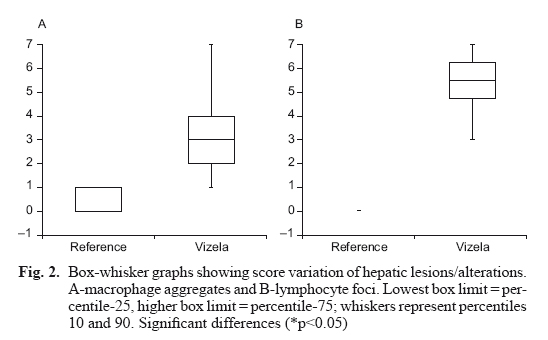
<body><![CDATA[<p align="justify"><font face="verdana" size="2">&nbsp;</font></p>  	    <p align="justify"><font face="verdana" size="2"><b>Statistical analysis</b></font></p>  	    <p align="justify"><font face="verdana" size="2">All statistical analyses were performed with SPSS statistical program. Quantitative differences for histological lesion/alteration score and enzymatic activities, between barbel from Vizela River and reference barbel, were tested by non&#45;parametric Mann&#45;Whitney U&#45;Test. A 5 % significance level was employed throughout.</font></p>  	    <p align="justify"><font face="verdana" size="2">&nbsp;</font></p>  	    <p align="justify"><font face="verdana" size="2"><b>RESULTS</b></font></p>  	    <p align="justify"><font face="verdana" size="2"><b>Enzyme profile and stress indicators</b></font></p>  	    <p align="justify"><font face="verdana" size="2">Hepatic enzymes activities and lipid peroxidation in fish liver are presented in <b><a href="/img/revistas/rica/v29n1/a3t1.jpg" target="_blank">Table I</a>.</b> Generally the higher activities were observed in fish collected from Vizela River, when compared to reference fish liver, with a 23 % increased of SOD, 31 % of CAT, 150 % of glutathione reductase activity and 47 % of glutathione <i>S</i>&#45;transferase. Glucose 6&#45;phosphate dehydrogenase showed an increase of 8 %. Xantine oxidase activity was similar in both groups of barbel.</font></p>  	    <p align="justify"><font face="verdana" size="2">In the same way, GSH content did not differed between the two groups <b>(<a href="/img/revistas/rica/v29n1/a3t1.jpg" target="_blank">Table I</a>).</b> As for lipid peroxidation fish captured in Vizela River exhibited an increase of 41 % relative to the reference barbel <b>(<a href="/img/revistas/rica/v29n1/a3t1.jpg" target="_blank">Table I</a>)</b>.</font></p> 	    <p align="justify"><font face="verdana" size="2"><b> Histology</b></font></p>      <p align="justify"><font face="verdana" size="2">Two hepatic lesions were observed and identified <b>(<a href="/img/revistas/rica/v29n1/a3f1.jpg" target="_blank">Fig. 1</a>):</b> macrophage aggregates, which were present on both groups (79 % of Vizela River barbel and 40 % of reference barbel), and lymphocyte foci that was only observed in Vizela River barbel (100 %). Regarding the lesions scores <b>(<a href="#f2">Fig. 2</a>),</b> the macrophage aggregates and the lymphocytes foci showed significant differences between the reference and Vizela River barbels (p&lt;0.05). In reference barbel, the median score for both macrophage aggregates and lymphocyte foci, was zero, while Vizela River barbel presented a score of three for macrophage aggregates and of five for lymphocyte foci (p&lt;0.05).</font></p>  	    ]]></body>
<body><![CDATA[<p align="center"><font face="verdana" size="2"><a name="f2"></a></font></p>  	    <p align="center"><font face="verdana" size="2"><img src="/img/revistas/rica/v29n1/a3f2.jpg"></font></p>  	    <p align="center"><font face="verdana" size="2">&nbsp;</font></p>  	    <p align="justify"><font face="verdana" size="2"><b>Tissue metal content</b></font></p>  	    <p align="justify"><font face="verdana" size="2">Metals content in liver of barbel captured in the Vizela River ranged between 9&#45;15 mg/kg DW for Al and 1.8&#45;3.5 mg/kg DW for Cu and it was less than the detection limits of 0.026 mg/kg DW for Zn and 0.006 mg/kg DW for Cr. The liver metals content of the reference barbel were all below the detection limits (0.011 mg/kg DW for Al and 0.003 mg/kg DW for Cu).</font></p>  	    <p align="justify"><font face="verdana" size="2">&nbsp;</font></p>  	    <p align="justify"><font face="verdana" size="2"><b>DISCUSSION</b></font></p>  	    <p align="justify"><font face="verdana" size="2">In Portugal, there are frequent surveys on freshwater fish populations dynamic, including the Iberian barbel (Santos <i>et al.</i> 2004), and on ecosystems health and integrity (eg: Pinto <i>et al.</i> 2010, Varandas and Cortes 2010, Carvalho <i>et al.</i> 2011). However, the studies of exposure biomarkers, in freshwater species, are inexistent being almost exclusive of estuarine species (eg: Ferreira <i>et al.</i> 2005, Cunha <i>et al.</i> 2007, Gravato <i>et al.</i> 2010). The present study aimed to evaluate hepatic biochemical and histological biomarkers in barbel captured in a polluted river, as a base for future evaluation of the impact of management policies.</font></p>  	    <p align="justify"><font face="verdana" size="2">Many classes of environmental pollutants are known to increase the intracellular formation of ROS and several authors have already reported physiological alterations induced by ROS, in fish (Baker <i>et al.</i> 1997, 1998, Valavanidis <i>et al.</i> 2006).</font></p>  	    <p align="justify"><font face="verdana" size="2">Since induction of antioxidants represents a cellular defense mechanism to counteract toxicity of ROS, they have been extensively used in several field studies to assess the extent of pollution in rivers, lakes and coastal waters (Ferreira <i>et al.</i> 2005, Fernandes <i>et al.</i> 2008c).</font></p>  	    ]]></body>
<body><![CDATA[<p align="justify"><font face="verdana" size="2">SODs are a group of metalloenzymes that play a crucial antioxidant role and constitute the primary defense mechanism against the toxic effect of oxygen, in aerobic organisms. SOD catalyzes the dismutation of the superoxide anion radical to water and hydrogen peroxide, which afterwards is detoxified by CAT. Therefore, a simultaneous activity induction of SOD and CAT is usually an expected response. However, this relation is not always observed (Peixoto <i>et al.</i> 2006) and it is known to be species dependent (Ferreira <i>et al.</i> 2005). In the present study, the liver of barbel captured in the Vizela River presented high activity values of both, SOD and CAT, suggesting a "cooperative" mechanism of the two enzymatic systems.</font></p>  	    <p align="justify"><font face="verdana" size="2">In addition to SOD and CAT, which are considered the major antioxidant enzymes, there are others that may be useful biomarkers. These enzymes serve as a backup function by replenishing GSH from glutathione disulfide (GSSG) through the enzyme GR and the reducing equivalent is provided by the enzyme G6PD.</font></p>  	    <p align="justify"><font face="verdana" size="2">In the present study, higher values of GR and G6PD were observed in the liver of barbel captured in the contaminated location. Several authors reported that fish exposed to pollutants present higher GR activity due to higher peroxidative components (Peixoto <i>et al.</i> 2006, Sturve <i>et al.</i> 2008). Equally, the increase of G6PD activity should be related to the increase of NADPH production, an important cofactor necessary to recycle reduced glutathione through glutathione reductase activity, in order to minimize the oxidative stress condition. Thus, reflecting an adaptation to oxidative conditions to which fish has been exposed to (Lenartova <i>et al.</i> 1997).</font></p>  	    <p align="justify"><font face="verdana" size="2">Furthermore, detoxification enzymes, and especially GST, help to eliminate reactive compounds by conjugation with glutathione and subsequent elimination; thereby protecting cells against ROS induced damage (Matos <i>et al.</i> 2007). GST catalyzes the conjugation of electrophilic compounds with the tri&#45;peptide glutathione and is a determinant enzyme for herbicide detoxification (Villarini <i>et al.</i> 1995, Peixoto <i>et al.</i> 2008). In Vizela barbel, GST activity was double compared to the one in reference barbel, this may indicate that in Vizela River fish are exposed to a higher load of compounds, present in textile industry effluents.</font></p>  	    <p align="justify"><font face="verdana" size="2">GSH is an effective protector, capable of quenching oxyradicals, and is an essential cofactor for GPx and GST activity (Ross 1988). Despite the observed increase in GST and GR activities in liver of barbel captured in Vizela River, GSH content was not increased. However, even if GSH was being synthesized <i>de novo</i> in barbel captured in Vizela River, since the oxidative stress condition were higher in these fish, GSH could be being used by GSH, GR and oxidized to GSSG, which would result in a decrease on GSH content. This situation could justify the similar GST content observed between the two barbel populations.</font></p>  	    <p align="justify"><font face="verdana" size="2">Xanthine oxidase (XO) catalyzes the conversion of xanthine to uric acid. Uric acid, an excretory product of purine catabolism, can act as a scavenger of ROS such as OH<sup>&#8901;</sup> and O<sub>2</sub><sup>&#45;</sup>. Therefore uric acid can protect DNA and cellular membranes from ROS&#45;mediated damage (Stinefelt <i>et al.</i> 2005). In the present work XO activity was similar in the liver of both groups of barbel.</font></p>  	    <p align="justify"><font face="verdana" size="2">When fish are submitted to oxidative stress conditions, fatty acid peroxidation can occur. Indeed, increased ROS production and subsequent oxidative damage has been associated with pollutant&#45;mediated mechanisms of toxicity in fish liver (Livingstone <i>et al.</i> 1993). Malondialdehyde (MDA) production is a well&#45;known oxidation product of polyunsaturated fatty acids, influencing cell membrane fluidity as well as the integrity of biomembranes (Ercal <i>et al.</i> 2001, Almroth <i>et al.</i> 2005), and can be used as an indicator of lipid peroxidation. The present study revealed high levels of lipid peroxidation, measured as MDA, suggesting that antioxidant enzymes stimulation was not capable of preventing hepatic lipid peroxidation, probably induced by water contamination.</font></p>  	    <p align="justify"><font face="verdana" size="2">This study also put in evidence the histopatological liver alterations observed in barbel from Vizela River: macrophage aggregates and foci of lymphocytes. Liver lesions have been classified and scored, according to their relative importance, as indicators of contaminant exposure. Macrophage aggregates are related to storage of foreign material, such as parasitic infestations, and although it can be observed in fish living in low contaminated sites (Stentiford <i>et al.</i> 2003), their prevalence and intensity can be used as a potential biomarker to environmental contamination (Couillard and Hodson 1996). In the present study, prevalence of macrophage aggregates in Vizela River barbel was higher than the one observed in reference barbel. Furthermore, when looking to macrophage aggregates median score in barbel, there is a clear difference between the two groups of barbel, probably related to water contamination.</font></p>  	    <p align="justify"><font face="verdana" size="2">The hepatic foci of lymphocites, observed only in fish from Vizela River, could be the result of chronic inflammatory conditions, by both, infectious and non&#45;infectious causes. This may reflect a depleted immunological status due to contaminated water exposure.</font></p>  	    <p align="justify"><font face="verdana" size="2">Several studies have established a causal relationship between metals concentrations and fish liver histopathological alterations (Au 2004). The injuries are often dependent upon time of exposure to metals (Yang and Chen 2003, Au 2004, Olojo <i>et al.</i> 2005).</font></p>  	    ]]></body>
<body><![CDATA[<p align="justify"><font face="verdana" size="2">Metal accumulation in fish organs reflects bio&#45;availability and exposure. In the present study, liver of barbel captured in Vizela River presented low metals levels. This could be due to the low bioavailability of metals and/or occasional effluent discharges from the textile factories. Furthermore, the textile effluents carry other contaminants rather than metals and, although Portugal is required to control industrial discharges, several effluents, located in the study area, are still discharging in the river bed without any type of treatment.</font></p>  	    <p align="justify"><font face="verdana" size="2">Several studies showed a growing interest in the use of bioindicators and biomarkers for assessment and monitoring of the ecological systems (Braunbeck and V&otilde;lkl 1993, Vethaak and Wester 1996) in addition to traditional biomonitoring studies, as a way to understand the real bio&#45;effects of pollution in wildlife (Burger <i>et al.</i> 2007), namely in fish (Kirby <i>et al.</i> 2007).</font></p>  	    <p align="justify"><font face="verdana" size="2">In conclusion, although being non specific responses, antioxidant enzymes activity and liver histopathology are useful tools to evaluate the impact of industry wastewater. Therefore, these exposure biomarkers can be used to assess the future impact of management policies on Vizela River fish.</font></p>  	    <p align="justify"><font face="verdana" size="2">&nbsp;</font></p>  	    <p align="justify"><font face="verdana" size="2"><b>REFERENCES</b></font></p>  	    <!-- ref --><p align="justify"><font face="verdana" size="2">Almroth B.C., Sturve J., Berglund A. and Forlin L. (2005). Oxidative damage in eelpout <i>(Zoarces viviparus),</i> measured as protein carbonyls and TBARS, as biomarkers. Aquat. Toxicol. 73, 171&#45;180.    &nbsp;&nbsp;&nbsp;&nbsp;&nbsp;&nbsp;&nbsp;&nbsp;[&#160;<a href="javascript:void(0);" onclick="javascript: window.open('/scielo.php?script=sci_nlinks&ref=7217832&pid=S0188-4999201300010000300001&lng=','','width=640,height=500,resizable=yes,scrollbars=1,menubar=yes,');">Links</a>&#160;]<!-- end-ref --></font></p>  	    <!-- ref --><p align="justify"><font face="verdana" size="2">Alves C.M., Boaventura R.R.A.R. and Soares H.M.VM. (2009). Evaluation of heavy metals pollution loadings in the sediments of the Ave River Basin (Portugal). Soil Sediment Contam. 18, 603&#45;618.    &nbsp;&nbsp;&nbsp;&nbsp;&nbsp;&nbsp;&nbsp;&nbsp;[&#160;<a href="javascript:void(0);" onclick="javascript: window.open('/scielo.php?script=sci_nlinks&ref=7217834&pid=S0188-4999201300010000300002&lng=','','width=640,height=500,resizable=yes,scrollbars=1,menubar=yes,');">Links</a>&#160;]<!-- end-ref --></font></p>  	    <!-- ref --><p align="justify"><font face="verdana" size="2">Au D.W.T. (2004). The application of histo&#45;cytopathological biomarkers in marine pollution monitoring: areview. Mar. Pollut. Bull. 48, 817&#45;834.    &nbsp;&nbsp;&nbsp;&nbsp;&nbsp;&nbsp;&nbsp;&nbsp;[&#160;<a href="javascript:void(0);" onclick="javascript: window.open('/scielo.php?script=sci_nlinks&ref=7217836&pid=S0188-4999201300010000300003&lng=','','width=640,height=500,resizable=yes,scrollbars=1,menubar=yes,');">Links</a>&#160;]<!-- end-ref --></font></p>  	    <!-- ref --><p align="justify"><font face="verdana" size="2">Baker R.T.M., Handy R.D., Davies S.J. and Snook J.C. (1998). Chronic dietary exposure to copper affects growth, tissue lipid peroxidation, and metal composition of the grey mullet, <i>Chelon labrosus.</i> Mar. Environ. Res. 45, 357&#45;365.    &nbsp;&nbsp;&nbsp;&nbsp;&nbsp;&nbsp;&nbsp;&nbsp;[&#160;<a href="javascript:void(0);" onclick="javascript: window.open('/scielo.php?script=sci_nlinks&ref=7217838&pid=S0188-4999201300010000300004&lng=','','width=640,height=500,resizable=yes,scrollbars=1,menubar=yes,');">Links</a>&#160;]<!-- end-ref --></font></p>  	    <!-- ref --><p align="justify"><font face="verdana" size="2">Baker R.T.M., Martin P. and Davies S.J. (1997). Ingestion of sub&#45;lethal levels of iron sulphate by African catfish affects growth and tissue lipid peroxidation. Aquat. Toxicol. 40, 51&#45;61.    &nbsp;&nbsp;&nbsp;&nbsp;&nbsp;&nbsp;&nbsp;&nbsp;[&#160;<a href="javascript:void(0);" onclick="javascript: window.open('/scielo.php?script=sci_nlinks&ref=7217840&pid=S0188-4999201300010000300005&lng=','','width=640,height=500,resizable=yes,scrollbars=1,menubar=yes,');">Links</a>&#160;]<!-- end-ref --></font></p>  	    <!-- ref --><p align="justify"><font face="verdana" size="2">Bl&aacute;ha L., Kopp R., Simkov&aacute; K. and Mares J. (2004). Oxidative stress biomarkers are modulated in silver carp <i>(Hypophthalmichthys molitrix</i> Val.) exposed to microcystin&#45;producing cyanobacterial water bloom. Acta Vet. Brno. 73, 477&#45;482.    &nbsp;&nbsp;&nbsp;&nbsp;&nbsp;&nbsp;&nbsp;&nbsp;[&#160;<a href="javascript:void(0);" onclick="javascript: window.open('/scielo.php?script=sci_nlinks&ref=7217842&pid=S0188-4999201300010000300006&lng=','','width=640,height=500,resizable=yes,scrollbars=1,menubar=yes,');">Links</a>&#160;]<!-- end-ref --></font></p>  	    <!-- ref --><p align="justify"><font face="verdana" size="2">Braunbeck T. and V&ouml;lkl A. (1993). Toxicant&#45;induced cytological alterations in fish liver as biomarkers of environmental pollution? A case study on hepatocellular effects of dinitro&#45;o&#45;cresol in golden ide <i>(Leuciscus idus melanotus).</i> In: <i>Fish &#45; ecotoxicology and ecophysiology</i> (H.W. Braunbeck T., H. Segner Eds.). VCH, Weinheim, pp. 55&#45;80.    &nbsp;&nbsp;&nbsp;&nbsp;&nbsp;&nbsp;&nbsp;&nbsp;[&#160;<a href="javascript:void(0);" onclick="javascript: window.open('/scielo.php?script=sci_nlinks&ref=7217844&pid=S0188-4999201300010000300007&lng=','','width=640,height=500,resizable=yes,scrollbars=1,menubar=yes,');">Links</a>&#160;]<!-- end-ref --></font></p>  	    <!-- ref --><p align="justify"><font face="verdana" size="2">Burger J., Fossi C., McClellan&#45;Green P. and Orlando E.F. (2007). Methodologies, bioindicators, and biomarkers for assessing gender&#45;related differences in wildlife exposed to environmental chemicals. Environ. Res. 104, 135&#45;152.    &nbsp;&nbsp;&nbsp;&nbsp;&nbsp;&nbsp;&nbsp;&nbsp;[&#160;<a href="javascript:void(0);" onclick="javascript: window.open('/scielo.php?script=sci_nlinks&ref=7217846&pid=S0188-4999201300010000300008&lng=','','width=640,height=500,resizable=yes,scrollbars=1,menubar=yes,');">Links</a>&#160;]<!-- end-ref --></font></p>  	    <!-- ref --><p align="justify"><font face="verdana" size="2">Carlberg I. and Mannervik B. (1975). Purification and characterization of the flavoenzyme glutathione reductase from rat liver. J. Biol. Chem. 250, 5475&#45;5480.    &nbsp;&nbsp;&nbsp;&nbsp;&nbsp;&nbsp;&nbsp;&nbsp;[&#160;<a href="javascript:void(0);" onclick="javascript: window.open('/scielo.php?script=sci_nlinks&ref=7217848&pid=S0188-4999201300010000300009&lng=','','width=640,height=500,resizable=yes,scrollbars=1,menubar=yes,');">Links</a>&#160;]<!-- end-ref --></font></p>  	    <!-- ref --><p align="justify"><font face="verdana" size="2">Carrola J., Fontainhas&#45;Fernandes A., Matos P. and Rocha E. (2009). Liver histopathology in brown trout <i>(Salmo trutta f.fario)</i> from the Tinhela River, subjected to mine drainage from the abandoned Jales Mine (Portugal). Bull. Environ. Contam. Tox. 83, 35&#45;41.    &nbsp;&nbsp;&nbsp;&nbsp;&nbsp;&nbsp;&nbsp;&nbsp;[&#160;<a href="javascript:void(0);" onclick="javascript: window.open('/scielo.php?script=sci_nlinks&ref=7217850&pid=S0188-4999201300010000300010&lng=','','width=640,height=500,resizable=yes,scrollbars=1,menubar=yes,');">Links</a>&#160;]<!-- end-ref --></font></p>  	    <!-- ref --><p align="justify"><font face="verdana" size="2">Carvalho L., Cortes R. and Bordalo A. (2011). Evaluation of the ecological status of an impaired watershed by using a multi&#45;index approach. Environ. Monit. Assess. 174, 493&#45;508.    &nbsp;&nbsp;&nbsp;&nbsp;&nbsp;&nbsp;&nbsp;&nbsp;[&#160;<a href="javascript:void(0);" onclick="javascript: window.open('/scielo.php?script=sci_nlinks&ref=7217852&pid=S0188-4999201300010000300011&lng=','','width=640,height=500,resizable=yes,scrollbars=1,menubar=yes,');">Links</a>&#160;]<!-- end-ref --></font></p>  	    <!-- ref --><p align="justify"><font face="verdana" size="2">Claiborne A. (1985). Catalase activity. In: <i>Handbook of methods for oxygen radical research</i> (R. A. Greenwald, Ed). Boca Raton, FL, pp. 283&#45;284.    &nbsp;&nbsp;&nbsp;&nbsp;&nbsp;&nbsp;&nbsp;&nbsp;[&#160;<a href="javascript:void(0);" onclick="javascript: window.open('/scielo.php?script=sci_nlinks&ref=7217854&pid=S0188-4999201300010000300012&lng=','','width=640,height=500,resizable=yes,scrollbars=1,menubar=yes,');">Links</a>&#160;]<!-- end-ref --></font></p>  	    <!-- ref --><p align="justify"><font face="verdana" size="2">Collen J., Pinto E., Pedersen M. and Colepicolo P. (2003). Induction of oxidative stress in the red macroalga <i>Gracilaria tenuistipitata</i> by pollutant metals. Arch. Environ. Con. Tox. 45, 337&#45;342.    &nbsp;&nbsp;&nbsp;&nbsp;&nbsp;&nbsp;&nbsp;&nbsp;[&#160;<a href="javascript:void(0);" onclick="javascript: window.open('/scielo.php?script=sci_nlinks&ref=7217856&pid=S0188-4999201300010000300013&lng=','','width=640,height=500,resizable=yes,scrollbars=1,menubar=yes,');">Links</a>&#160;]<!-- end-ref --></font></p>  	    <!-- ref --><p align="justify"><font face="verdana" size="2">Couillard C.M. and Hodson P.V. (1996). Pigmented macrophage aggregates: A toxic response in fish exposed to bleached&#45;kraft mill effluent? Environ. Toxicol. Chem. 15, 1844&#45;1854.    &nbsp;&nbsp;&nbsp;&nbsp;&nbsp;&nbsp;&nbsp;&nbsp;[&#160;<a href="javascript:void(0);" onclick="javascript: window.open('/scielo.php?script=sci_nlinks&ref=7217858&pid=S0188-4999201300010000300014&lng=','','width=640,height=500,resizable=yes,scrollbars=1,menubar=yes,');">Links</a>&#160;]<!-- end-ref --></font></p>  	    <!-- ref --><p align="justify"><font face="verdana" size="2">Cunha I., Neuparth T., Caeiro S., Costa M.H. and Guilhermino L. (2007). Toxicity ranking of estuarine sediments on the basis of <i>Sparus aurata</i> biomarkers. Environ. Toxicol. Chem. 26, 444&#45;453.    &nbsp;&nbsp;&nbsp;&nbsp;&nbsp;&nbsp;&nbsp;&nbsp;[&#160;<a href="javascript:void(0);" onclick="javascript: window.open('/scielo.php?script=sci_nlinks&ref=7217860&pid=S0188-4999201300010000300015&lng=','','width=640,height=500,resizable=yes,scrollbars=1,menubar=yes,');">Links</a>&#160;]<!-- end-ref --></font></p>  	    <!-- ref --><p align="justify"><font face="verdana" size="2">Deviller G., Palluel O., Aliaume C., Asanthi H., Sanchez W., Nava M.A.F., Blancheton J.P. and Casellas C. (2005). Impact assessment of various rearing systems on fish health using multibiomarker response and metal accumulation. Ecotox. Environ. Safe. 61, 89&#45;97.    &nbsp;&nbsp;&nbsp;&nbsp;&nbsp;&nbsp;&nbsp;&nbsp;[&#160;<a href="javascript:void(0);" onclick="javascript: window.open('/scielo.php?script=sci_nlinks&ref=7217862&pid=S0188-4999201300010000300016&lng=','','width=640,height=500,resizable=yes,scrollbars=1,menubar=yes,');">Links</a>&#160;]<!-- end-ref --></font></p>  	    <!-- ref --><p align="justify"><font face="verdana" size="2">Ercal N., Gurer&#45;Orhan H. and Aykin&#45;Burns N. (2001). Toxic metals and oxidative stress Part I: Mechanisms involved in metal&#45;induced oxidative damage. Current Topics in Medicinal Chemistry. 1, 529&#45;539.    &nbsp;&nbsp;&nbsp;&nbsp;&nbsp;&nbsp;&nbsp;&nbsp;[&#160;<a href="javascript:void(0);" onclick="javascript: window.open('/scielo.php?script=sci_nlinks&ref=7217864&pid=S0188-4999201300010000300017&lng=','','width=640,height=500,resizable=yes,scrollbars=1,menubar=yes,');">Links</a>&#160;]<!-- end-ref --></font></p>  	    <!-- ref --><p align="justify"><font face="verdana" size="2">Fatima M., Ahmad I., Sayeed I., Athar M. and Raisuddin S. (2000). Pollutant&#45;induced over&#45;activation of phagocytes is concomitantly associated with peroxidative damage in fish tissues. Aquat. Toxicol. 49, 243&#45;250.    &nbsp;&nbsp;&nbsp;&nbsp;&nbsp;&nbsp;&nbsp;&nbsp;[&#160;<a href="javascript:void(0);" onclick="javascript: window.open('/scielo.php?script=sci_nlinks&ref=7217866&pid=S0188-4999201300010000300018&lng=','','width=640,height=500,resizable=yes,scrollbars=1,menubar=yes,');">Links</a>&#160;]<!-- end-ref --></font></p>  	    <!-- ref --><p align="justify"><font face="verdana" size="2">Fernandes C., Fontainhas&#45;Fernandes A., Peixoto F. and Salgado M.A. (2007). Bioaccumulation of heavy metals in <i>Liza saliens</i> from the Esmoriz&#45;Paramos coastal lagoon, Portugal. Ecotoxicol. Environ. Saf. 66, 426&#45;431.    &nbsp;&nbsp;&nbsp;&nbsp;&nbsp;&nbsp;&nbsp;&nbsp;[&#160;<a href="javascript:void(0);" onclick="javascript: window.open('/scielo.php?script=sci_nlinks&ref=7217868&pid=S0188-4999201300010000300019&lng=','','width=640,height=500,resizable=yes,scrollbars=1,menubar=yes,');">Links</a>&#160;]<!-- end-ref --></font></p>  	    <!-- ref --><p align="justify"><font face="verdana" size="2">Fernandes C., Fontainhas&#45;Fernandes A., Cabral D. and Salgado M.A. (2008a). Heavy metals in water, sediment and tissues of <i>Liza saliens</i> from Esmoriz&#45;Paramos lagoon, Portugal. Environ. Monit. Assess. 136, 267&#45;275.    &nbsp;&nbsp;&nbsp;&nbsp;&nbsp;&nbsp;&nbsp;&nbsp;[&#160;<a href="javascript:void(0);" onclick="javascript: window.open('/scielo.php?script=sci_nlinks&ref=7217870&pid=S0188-4999201300010000300020&lng=','','width=640,height=500,resizable=yes,scrollbars=1,menubar=yes,');">Links</a>&#160;]<!-- end-ref --></font></p>  	    <!-- ref --><p align="justify"><font face="verdana" size="2">Fernandes C., Fontainhas&#45;Fernandes A., Rocha E. and Salgado M.A. (2008b). Monitoring pollution in Esmoriz&#45;Paramos lagoon, Portugal: Liver histological and biochemical effects in <i>Liza saliens.</i> Environ. Monit. Assess. 145, 315&#45;322.    &nbsp;&nbsp;&nbsp;&nbsp;&nbsp;&nbsp;&nbsp;&nbsp;[&#160;<a href="javascript:void(0);" onclick="javascript: window.open('/scielo.php?script=sci_nlinks&ref=7217872&pid=S0188-4999201300010000300021&lng=','','width=640,height=500,resizable=yes,scrollbars=1,menubar=yes,');">Links</a>&#160;]<!-- end-ref --></font></p>  	    <!-- ref --><p align="justify"><font face="verdana" size="2">Fernandes C., Fontainhas&#45;Fernandes A., Ferreira M. and Salgado M.A. (2008c). Oxidative stress response in gill and liver of <i>Liza saliens,</i> from the Esmoriz&#45;Paramos coastal lagoon, Portugal. Arch. Environ. Contam. Toxicol. 55, 262&#45;269.    &nbsp;&nbsp;&nbsp;&nbsp;&nbsp;&nbsp;&nbsp;&nbsp;[&#160;<a href="javascript:void(0);" onclick="javascript: window.open('/scielo.php?script=sci_nlinks&ref=7217874&pid=S0188-4999201300010000300022&lng=','','width=640,height=500,resizable=yes,scrollbars=1,menubar=yes,');">Links</a>&#160;]<!-- end-ref --></font></p>  	    <!-- ref --><p align="justify"><font face="verdana" size="2">Ferreira M., Moradas&#45;Ferreira P. and Reis&#45;Henriques M.A. (2005). Oxidative stress biomarkers in two resident species, mullet <i>(Mugil cephalus)</i> and flounder <i>(Platichthysflesus),</i> from a polluted site in River Douro Estuary, Portugal. Aquat. Toxicol. 71, 39&#45;48.    &nbsp;&nbsp;&nbsp;&nbsp;&nbsp;&nbsp;&nbsp;&nbsp;[&#160;<a href="javascript:void(0);" onclick="javascript: window.open('/scielo.php?script=sci_nlinks&ref=7217876&pid=S0188-4999201300010000300023&lng=','','width=640,height=500,resizable=yes,scrollbars=1,menubar=yes,');">Links</a>&#160;]<!-- end-ref --></font></p>  	    <!-- ref --><p align="justify"><font face="verdana" size="2">Figueiredo&#45;Fernandes A., Fontainhas&#45;Fernandes A., Peixoto F., Rocha E. and Reis&#45;Henriques M.A. (2006). Effects of gender and temperature on oxidative stress enzymes in Nile tilapia <i>Oreochromis niloticus</i> exposed to paraquat. Pest. Biochem. Phys. 85, 97&#45;103.    &nbsp;&nbsp;&nbsp;&nbsp;&nbsp;&nbsp;&nbsp;&nbsp;[&#160;<a href="javascript:void(0);" onclick="javascript: window.open('/scielo.php?script=sci_nlinks&ref=7217878&pid=S0188-4999201300010000300024&lng=','','width=640,height=500,resizable=yes,scrollbars=1,menubar=yes,');">Links</a>&#160;]<!-- end-ref --></font></p>  	    <!-- ref --><p align="justify"><font face="verdana" size="2">Gravato C., Guimar&atilde;es L., Santos J., Faria M., Alves A. and Guilhermino L. (2010). Comparative study about the effects of pollution on glass and yellow eels <i>(Anguilla anguilla)</i> from the estuaries of Minho, Lima and Douro Rivers (NW Portugal). Ecotox. Environ. Safe. 73, 524&#45;533.    &nbsp;&nbsp;&nbsp;&nbsp;&nbsp;&nbsp;&nbsp;&nbsp;[&#160;<a href="javascript:void(0);" onclick="javascript: window.open('/scielo.php?script=sci_nlinks&ref=7217880&pid=S0188-4999201300010000300025&lng=','','width=640,height=500,resizable=yes,scrollbars=1,menubar=yes,');">Links</a>&#160;]<!-- end-ref --></font></p>  	    <!-- ref --><p align="justify"><font face="verdana" size="2">Habig W.H., Pabst M.J. and Jakoby W.B. (1974). Glutathione S&#45;transferases &#45; First enzymatic step in mercapturic acid formation. J. Biol. Chem. 249, 7130&#45;7139.    &nbsp;&nbsp;&nbsp;&nbsp;&nbsp;&nbsp;&nbsp;&nbsp;[&#160;<a href="javascript:void(0);" onclick="javascript: window.open('/scielo.php?script=sci_nlinks&ref=7217882&pid=S0188-4999201300010000300026&lng=','','width=640,height=500,resizable=yes,scrollbars=1,menubar=yes,');">Links</a>&#160;]<!-- end-ref --></font></p>  	    <!-- ref --><p align="justify"><font face="verdana" size="2">Halliwell B. and Gutteridge H. (1999). Free radicals in biology and medicine. University Press, Oxford, 936 p.    &nbsp;&nbsp;&nbsp;&nbsp;&nbsp;&nbsp;&nbsp;&nbsp;[&#160;<a href="javascript:void(0);" onclick="javascript: window.open('/scielo.php?script=sci_nlinks&ref=7217884&pid=S0188-4999201300010000300027&lng=','','width=640,height=500,resizable=yes,scrollbars=1,menubar=yes,');">Links</a>&#160;]<!-- end-ref --></font></p>  	    <!-- ref --><p align="justify"><font face="verdana" size="2">Hinton D.E. and Lauren D.J. (1990). Liver structural alterations accompanying chronic toxicity in fishes: Potential biomarkers of exposure. In: <i>Biomarkers of environmental contamination</i> (J.F. McCarthy and L.R. Shugart, Eds.). Lewis Publishers, Boca Raton FL, pp. 17&#45;57.    &nbsp;&nbsp;&nbsp;&nbsp;&nbsp;&nbsp;&nbsp;&nbsp;[&#160;<a href="javascript:void(0);" onclick="javascript: window.open('/scielo.php?script=sci_nlinks&ref=7217886&pid=S0188-4999201300010000300028&lng=','','width=640,height=500,resizable=yes,scrollbars=1,menubar=yes,');">Links</a>&#160;]<!-- end-ref --></font></p>  	    <!-- ref --><p align="justify"><font face="verdana" size="2">Jollow D.J., Mitchell J.R., Zampaglione N. and Gillette J.R. (1974). Bromobenzene&#45;induced liver necrosis. Protective role of glutathione and evidence for 3,4&#45;bromobenzene oxide as the hepatotoxic metabolite. Pharmacol. 11, 151&#45;169.    &nbsp;&nbsp;&nbsp;&nbsp;&nbsp;&nbsp;&nbsp;&nbsp;[&#160;<a href="javascript:void(0);" onclick="javascript: window.open('/scielo.php?script=sci_nlinks&ref=7217888&pid=S0188-4999201300010000300029&lng=','','width=640,height=500,resizable=yes,scrollbars=1,menubar=yes,');">Links</a>&#160;]<!-- end-ref --></font></p>  	    <!-- ref --><p align="justify"><font face="verdana" size="2">Kirby M.F., Smith A.J., Rooke J., Neall P., Scott A.P. and Katsiadaki I. (2007). Ethoxyresorufin&#45;O&#45;deethylase (EROD) and vitellogenin (VTG) in flounder <i>(Platich&#45;thysflesus):</i> System interaction, crosstalk and implications for monitoring. Aquat. Toxicol. 81, 233&#45;244.    &nbsp;&nbsp;&nbsp;&nbsp;&nbsp;&nbsp;&nbsp;&nbsp;[&#160;<a href="javascript:void(0);" onclick="javascript: window.open('/scielo.php?script=sci_nlinks&ref=7217890&pid=S0188-4999201300010000300030&lng=','','width=640,height=500,resizable=yes,scrollbars=1,menubar=yes,');">Links</a>&#160;]<!-- end-ref --></font></p>  	    <!-- ref --><p align="justify"><font face="verdana" size="2">Kohler A., Wahl E. and Soffker K. (2002). Functional and morphological changes of lysosomes as prognostic biomarkers of toxic liver injury in a marine flatfish <i>(Platichthys flesus</i> (L.)). Environ. Toxicol. Chem. 21, 2434&#45;2444.    &nbsp;&nbsp;&nbsp;&nbsp;&nbsp;&nbsp;&nbsp;&nbsp;[&#160;<a href="javascript:void(0);" onclick="javascript: window.open('/scielo.php?script=sci_nlinks&ref=7217892&pid=S0188-4999201300010000300031&lng=','','width=640,height=500,resizable=yes,scrollbars=1,menubar=yes,');">Links</a>&#160;]<!-- end-ref --></font></p>  	    <!-- ref --><p align="justify"><font face="verdana" size="2">Lang T., Wosniok W., Barsiene J., Broeg K., Kopecka J. and Parkkonen J. (2006). Liver histopathology in Baltic flounder <i>(Platichthysflesus)</i> as indicator of biological effects of contaminants. Mar. Pollut. Bull. 53, 488&#45;496.    &nbsp;&nbsp;&nbsp;&nbsp;&nbsp;&nbsp;&nbsp;&nbsp;[&#160;<a href="javascript:void(0);" onclick="javascript: window.open('/scielo.php?script=sci_nlinks&ref=7217894&pid=S0188-4999201300010000300032&lng=','','width=640,height=500,resizable=yes,scrollbars=1,menubar=yes,');">Links</a>&#160;]<!-- end-ref --></font></p>  	    <!-- ref --><p align="justify"><font face="verdana" size="2">Lenartova V, Holovska K., Pedrajas J.R., Martinez Lara E., Peinado J., Lopez Barea J., Rosival I. and Kosuth P. (1997). Antioxidant and detoxifying fish enzymes as biomarkers of river pollution. Biomarkers 2, 247&#45;252.    &nbsp;&nbsp;&nbsp;&nbsp;&nbsp;&nbsp;&nbsp;&nbsp;[&#160;<a href="javascript:void(0);" onclick="javascript: window.open('/scielo.php?script=sci_nlinks&ref=7217896&pid=S0188-4999201300010000300033&lng=','','width=640,height=500,resizable=yes,scrollbars=1,menubar=yes,');">Links</a>&#160;]<!-- end-ref --></font></p>  	    <!-- ref --><p align="justify"><font face="verdana" size="2">Leonardi M., Tarifeno E. and Vera J. (2009). Diseases of the Chilean flounder, <i>Paralichthys adspersus</i> (Steindachner, 1867), as a biomarker of marine coastal pollution near the Itata River (Chile): Part II. Histopathological lesions. Arch. Environ. Contam. Toxicol. 56, 546&#45;556.    &nbsp;&nbsp;&nbsp;&nbsp;&nbsp;&nbsp;&nbsp;&nbsp;[&#160;<a href="javascript:void(0);" onclick="javascript: window.open('/scielo.php?script=sci_nlinks&ref=7217898&pid=S0188-4999201300010000300034&lng=','','width=640,height=500,resizable=yes,scrollbars=1,menubar=yes,');">Links</a>&#160;]<!-- end-ref --></font></p>  	    <!-- ref --><p align="justify"><font face="verdana" size="2">Livingstone D.R., Lemaire P., Matthews A., Peters L., Bucke D. and Law R.J. (1993). Prooxidant, antioxidant and 7&#45;Ethoxyresorufin O&#45;Deethylase (EROD) activity responses in liver of Dab <i>(Limanda limanda)</i> exposed to sediment contaminated with hydrocarbons and other chemicals. Mar. Pollut. Bull. 26, 602&#45;606.    &nbsp;&nbsp;&nbsp;&nbsp;&nbsp;&nbsp;&nbsp;&nbsp;[&#160;<a href="javascript:void(0);" onclick="javascript: window.open('/scielo.php?script=sci_nlinks&ref=7217900&pid=S0188-4999201300010000300035&lng=','','width=640,height=500,resizable=yes,scrollbars=1,menubar=yes,');">Links</a>&#160;]<!-- end-ref --></font></p>  	    <!-- ref --><p align="justify"><font face="verdana" size="2">Lowry O.H., Rosebrough N.J., Farr A.L. and Randall R.J. (1951). Protein measurement with the folin phenol reagent. J. Biol. Chem. 193, 265&#45;275.    &nbsp;&nbsp;&nbsp;&nbsp;&nbsp;&nbsp;&nbsp;&nbsp;[&#160;<a href="javascript:void(0);" onclick="javascript: window.open('/scielo.php?script=sci_nlinks&ref=7217902&pid=S0188-4999201300010000300036&lng=','','width=640,height=500,resizable=yes,scrollbars=1,menubar=yes,');">Links</a>&#160;]<!-- end-ref --></font></p>  	    <!-- ref --><p align="justify"><font face="verdana" size="2">Magalh&atilde;es M.F. (1992). Feeding ecology of the Iberian cyprinid <i>Barbus bocagei</i> Steindachner, 1865 in a lowland river. J. Fish Biol. 40, 123&#45;133.    &nbsp;&nbsp;&nbsp;&nbsp;&nbsp;&nbsp;&nbsp;&nbsp;[&#160;<a href="javascript:void(0);" onclick="javascript: window.open('/scielo.php?script=sci_nlinks&ref=7217904&pid=S0188-4999201300010000300037&lng=','','width=640,height=500,resizable=yes,scrollbars=1,menubar=yes,');">Links</a>&#160;]<!-- end-ref --></font></p>  	    <!-- ref --><p align="justify"><font face="verdana" size="2">Matos P., Fontainhas&#45;Fernandes A., Peixoto F., Carrola J. and Rocha E. (2007). Biochemical and histological hepatic changes of Nile tilapia <i>Oreochromis niloticus</i> exposed to carbaryl. Pest. Biochem. Phys. 89, 73&#45;80.    &nbsp;&nbsp;&nbsp;&nbsp;&nbsp;&nbsp;&nbsp;&nbsp;[&#160;<a href="javascript:void(0);" onclick="javascript: window.open('/scielo.php?script=sci_nlinks&ref=7217906&pid=S0188-4999201300010000300038&lng=','','width=640,height=500,resizable=yes,scrollbars=1,menubar=yes,');">Links</a>&#160;]<!-- end-ref --></font></p>  	    <!-- ref --><p align="justify"><font face="verdana" size="2">McCarthy J.F. and Shugart L.R. (1990). Biological markers of environmental contamination. In: <i>Biomarkers of environmental contamination</i> (J.F. McCarthy and L.R. Shugart, Eds.). Lewis Publishers, Boca Raton FL, pp. 3&#45;14.    &nbsp;&nbsp;&nbsp;&nbsp;&nbsp;&nbsp;&nbsp;&nbsp;[&#160;<a href="javascript:void(0);" onclick="javascript: window.open('/scielo.php?script=sci_nlinks&ref=7217908&pid=S0188-4999201300010000300039&lng=','','width=640,height=500,resizable=yes,scrollbars=1,menubar=yes,');">Links</a>&#160;]<!-- end-ref --></font></p>  	    <!-- ref --><p align="justify"><font face="verdana" size="2">Mohandas J., Marshall J.J., Duggin G.G., Horvath J.S. and Tiller D.J. (1984). Differential distribution of glutathione and glutathione&#45;related enzymes in rabbit kidney &#45; possible implications in analgesic nephropathy. Biochem. Pharmacol. 33, 1801&#45;1807.    &nbsp;&nbsp;&nbsp;&nbsp;&nbsp;&nbsp;&nbsp;&nbsp;[&#160;<a href="javascript:void(0);" onclick="javascript: window.open('/scielo.php?script=sci_nlinks&ref=7217910&pid=S0188-4999201300010000300040&lng=','','width=640,height=500,resizable=yes,scrollbars=1,menubar=yes,');">Links</a>&#160;]<!-- end-ref --></font></p>  	    <!-- ref --><p align="justify"><font face="verdana" size="2">Olojo E.A.A., Olurin K.B., Mbaka G. and Oluwemimo A.D. (2005). Histopathology of the gill and liver tissues of the African catfish <i>Clarias gariepinus</i> exposed to lead. Afr. J. Biotechnol. 4, 117&#45;122.    &nbsp;&nbsp;&nbsp;&nbsp;&nbsp;&nbsp;&nbsp;&nbsp;[&#160;<a href="javascript:void(0);" onclick="javascript: window.open('/scielo.php?script=sci_nlinks&ref=7217912&pid=S0188-4999201300010000300041&lng=','','width=640,height=500,resizable=yes,scrollbars=1,menubar=yes,');">Links</a>&#160;]<!-- end-ref --></font></p>  	    <!-- ref --><p align="justify"><font face="verdana" size="2">Paya M., Halliwell B. and Hoult J.R. (1992). Interactions of a series of coumarins with reactive oxygen species. Scavenging of superoxide, hypochlorous acid and hydroxyl radicals. Biochem. Pharmacol. 44, 205&#45;214.    &nbsp;&nbsp;&nbsp;&nbsp;&nbsp;&nbsp;&nbsp;&nbsp;[&#160;<a href="javascript:void(0);" onclick="javascript: window.open('/scielo.php?script=sci_nlinks&ref=7217914&pid=S0188-4999201300010000300042&lng=','','width=640,height=500,resizable=yes,scrollbars=1,menubar=yes,');">Links</a>&#160;]<!-- end-ref --></font></p>  	    <!-- ref --><p align="justify"><font face="verdana" size="2">Peixoto F., Alves&#45;Fernandes D., Santos D. and Fontainhas&#45;Fernandes A. (2006). Toxicological effects of oxyfluorfen on oxidative stress enzymes in tilapia <i>Oreochromis niloticus.</i> Pest. Biochem. Phys. 85, 91&#45;96.    &nbsp;&nbsp;&nbsp;&nbsp;&nbsp;&nbsp;&nbsp;&nbsp;[&#160;<a href="javascript:void(0);" onclick="javascript: window.open('/scielo.php?script=sci_nlinks&ref=7217916&pid=S0188-4999201300010000300043&lng=','','width=640,height=500,resizable=yes,scrollbars=1,menubar=yes,');">Links</a>&#160;]<!-- end-ref --></font></p>  	    <!-- ref --><p align="justify"><font face="verdana" size="2">Peixoto F.P., Gomes&#45;Laranjo J., Vicente J.A. y Madeira V.M.C. (2008). Comparative effects of the herbicides dicamba, 2,4&#45;D and paraquat on non&#45;green potato tuber calli. J. Plant Physiol. 165, 1125&#45;1133.    &nbsp;&nbsp;&nbsp;&nbsp;&nbsp;&nbsp;&nbsp;&nbsp;[&#160;<a href="javascript:void(0);" onclick="javascript: window.open('/scielo.php?script=sci_nlinks&ref=7217918&pid=S0188-4999201300010000300044&lng=','','width=640,height=500,resizable=yes,scrollbars=1,menubar=yes,');">Links</a>&#160;]<!-- end-ref --></font></p>  	    <!-- ref --><p align="justify"><font face="verdana" size="2">Pinto A., Varandas S., Coimbra A., Carrola J. and Fonta&iacute;nhas&#45;Fernandes A. (2010). Mullet and gudgeon liver histopathology and macroinvertebrate indexes and metrics upstream and downstream from a wastewater treatment plant (Febros River&#45;Portugal). Environ. Monit. Assess. 169, 569&#45;585.    &nbsp;&nbsp;&nbsp;&nbsp;&nbsp;&nbsp;&nbsp;&nbsp;[&#160;<a href="javascript:void(0);" onclick="javascript: window.open('/scielo.php?script=sci_nlinks&ref=7217920&pid=S0188-4999201300010000300045&lng=','','width=640,height=500,resizable=yes,scrollbars=1,menubar=yes,');">Links</a>&#160;]<!-- end-ref --></font></p>  	    <!-- ref --><p align="justify"><font face="verdana" size="2">Ross D. (1988). Glutathione, free&#45;radicals and chemo&#45;therapeutic agents. Mechanisms of free&#45;radical induced toxicity and glutathione&#45;dependent protection. Pharmacol. Therapeut. 37, 231&#45;249.    &nbsp;&nbsp;&nbsp;&nbsp;&nbsp;&nbsp;&nbsp;&nbsp;[&#160;<a href="javascript:void(0);" onclick="javascript: window.open('/scielo.php?script=sci_nlinks&ref=7217922&pid=S0188-4999201300010000300046&lng=','','width=640,height=500,resizable=yes,scrollbars=1,menubar=yes,');">Links</a>&#160;]<!-- end-ref --></font></p>  	    <!-- ref --><p align="justify"><font face="verdana" size="2">Santos J.M., Godinho F., Ferreira M.T. and Cortes R. (2004). The organisation of fish assemblages in the regulated Lima basin, Northern Portugal. Limnologica 34, 224&#45;235.    &nbsp;&nbsp;&nbsp;&nbsp;&nbsp;&nbsp;&nbsp;&nbsp;[&#160;<a href="javascript:void(0);" onclick="javascript: window.open('/scielo.php?script=sci_nlinks&ref=7217924&pid=S0188-4999201300010000300047&lng=','','width=640,height=500,resizable=yes,scrollbars=1,menubar=yes,');">Links</a>&#160;]<!-- end-ref --></font></p>  	    <!-- ref --><p align="justify"><font face="verdana" size="2">Soares H.M.V.M., Boaventura R.A.R., Machado A.A.S.C. and da Silva J.C.G.E. (1999). Sediments as monitors of heavy metal contamination in the Ave river basin (Portugal): multivariate analysis of data. Environ. Pollut. 105, 311&#45;323.    &nbsp;&nbsp;&nbsp;&nbsp;&nbsp;&nbsp;&nbsp;&nbsp;[&#160;<a href="javascript:void(0);" onclick="javascript: window.open('/scielo.php?script=sci_nlinks&ref=7217926&pid=S0188-4999201300010000300048&lng=','','width=640,height=500,resizable=yes,scrollbars=1,menubar=yes,');">Links</a>&#160;]<!-- end-ref --></font></p>  	    <!-- ref --><p align="justify"><font face="verdana" size="2">Stentiford G.D., Longshaw M., Lyons B.P., Jones G., Green M. and Feist S.W. (2003). Histopathological biomarkers in estuarine fish species for the assessment of biological effects of contaminants. Mar. Environ. Res. 55, 137&#45;159.    &nbsp;&nbsp;&nbsp;&nbsp;&nbsp;&nbsp;&nbsp;&nbsp;[&#160;<a href="javascript:void(0);" onclick="javascript: window.open('/scielo.php?script=sci_nlinks&ref=7217928&pid=S0188-4999201300010000300049&lng=','','width=640,height=500,resizable=yes,scrollbars=1,menubar=yes,');">Links</a>&#160;]<!-- end-ref --></font></p>  	    <!-- ref --><p align="justify"><font face="verdana" size="2">Stinefelt B., Leonard S.S., Blemings K.P., Shi X.L. and Klandorf H. (2005). Free radical scavenging, DNA protection, and inhibition of lipid peroxidation mediated by uric acid. Ann. Clin. Lab. Sci. 35, 37&#45;45.    &nbsp;&nbsp;&nbsp;&nbsp;&nbsp;&nbsp;&nbsp;&nbsp;[&#160;<a href="javascript:void(0);" onclick="javascript: window.open('/scielo.php?script=sci_nlinks&ref=7217930&pid=S0188-4999201300010000300050&lng=','','width=640,height=500,resizable=yes,scrollbars=1,menubar=yes,');">Links</a>&#160;]<!-- end-ref --></font></p>  	    <!-- ref --><p align="justify"><font face="verdana" size="2">Stirpe F. and Dellacor E. (1969). The regulation of rat liver xanthine oxidase. Conversion in vitro of enzyme activity from dehydrogenase (Type D) to oxidase (Type O). J. Biol. Chem. 244, 3855&#45;3863.    &nbsp;&nbsp;&nbsp;&nbsp;&nbsp;&nbsp;&nbsp;&nbsp;[&#160;<a href="javascript:void(0);" onclick="javascript: window.open('/scielo.php?script=sci_nlinks&ref=7217932&pid=S0188-4999201300010000300051&lng=','','width=640,height=500,resizable=yes,scrollbars=1,menubar=yes,');">Links</a>&#160;]<!-- end-ref --></font></p>  	    <!-- ref --><p align="justify"><font face="verdana" size="2">Sturve J., Almroth B.C. and Forlin L. (2008). Oxidative stress in rainbow trout <i>(Oncorhynchus mykiss)</i> exposed to sewage treatment plant effluent. Ecotox. Environ. Safe. 70, 446&#45;452.    &nbsp;&nbsp;&nbsp;&nbsp;&nbsp;&nbsp;&nbsp;&nbsp;[&#160;<a href="javascript:void(0);" onclick="javascript: window.open('/scielo.php?script=sci_nlinks&ref=7217934&pid=S0188-4999201300010000300052&lng=','','width=640,height=500,resizable=yes,scrollbars=1,menubar=yes,');">Links</a>&#160;]<!-- end-ref --></font></p>  	    <!-- ref --><p align="justify"><font face="verdana" size="2">Triebskorn R., K&ouml;hler H.&#45;R., Honnen W., Schramm M., Adams S.M. and M&uuml;ller E.F. (1997). Induction of heat shock proteins, changes in liver ultrastructure, and alterations of fish behavior: are these biomarkers related and are they useful to reflect the state of pollution in the field? J. Aquat. Ecosyst. Stress Rec. (Formerly Journal of Aquatic Ecosystem Health). 6, 57&#45;73.    &nbsp;&nbsp;&nbsp;&nbsp;&nbsp;&nbsp;&nbsp;&nbsp;[&#160;<a href="javascript:void(0);" onclick="javascript: window.open('/scielo.php?script=sci_nlinks&ref=7217936&pid=S0188-4999201300010000300053&lng=','','width=640,height=500,resizable=yes,scrollbars=1,menubar=yes,');">Links</a>&#160;]<!-- end-ref --></font></p>  	    <!-- ref --><p align="justify"><font face="verdana" size="2">Triebskorn R., Kohler H.R., Flemming J., Braunbeck T., Negele R.D. and Rahmann H. (1994). Evaluation of bis(tri&#45;n&#45;butyltin)oxide (Tbto) neurotoxicity in rainbow&#45;trout <i>(Oncorhynchus mykiss).</i> 1. Behavior, weight increase, and tin content. Aquat. Toxicol. 30, 189&#45;197.    &nbsp;&nbsp;&nbsp;&nbsp;&nbsp;&nbsp;&nbsp;&nbsp;[&#160;<a href="javascript:void(0);" onclick="javascript: window.open('/scielo.php?script=sci_nlinks&ref=7217938&pid=S0188-4999201300010000300054&lng=','','width=640,height=500,resizable=yes,scrollbars=1,menubar=yes,');">Links</a>&#160;]<!-- end-ref --></font></p>  	    <!-- ref --><p align="justify"><font face="verdana" size="2">Uguz C., Iscan M., Erguven A., Isgor B. and Togan I. (2003). The bioaccumulation of nonyphenol and its adverse effect on the liver of rainbow trout <i>(Onchorynchus mykiss).</i> Environ. Res. 92, 262&#45;270.    &nbsp;&nbsp;&nbsp;&nbsp;&nbsp;&nbsp;&nbsp;&nbsp;[&#160;<a href="javascript:void(0);" onclick="javascript: window.open('/scielo.php?script=sci_nlinks&ref=7217940&pid=S0188-4999201300010000300055&lng=','','width=640,height=500,resizable=yes,scrollbars=1,menubar=yes,');">Links</a>&#160;]<!-- end-ref --></font></p>  	    <!-- ref --><p align="justify"><font face="verdana" size="2">Utley H.G., Bernheim F. and Hochstei. P (1967). Effect of sulfhydryl reagents on peroxidation in microsomes. Arch. Biochem. Biophys. 118, 29&#45;32.    &nbsp;&nbsp;&nbsp;&nbsp;&nbsp;&nbsp;&nbsp;&nbsp;[&#160;<a href="javascript:void(0);" onclick="javascript: window.open('/scielo.php?script=sci_nlinks&ref=7217942&pid=S0188-4999201300010000300056&lng=','','width=640,height=500,resizable=yes,scrollbars=1,menubar=yes,');">Links</a>&#160;]<!-- end-ref --></font></p>  	    <!-- ref --><p align="justify"><font face="verdana" size="2">Valavanidis A., Vlahogianni T., Dassenakis M. and Scoullos M. (2006). Molecular biomarkers of oxidative stress in aquatic organisms in relation to toxic environmental pollutants. Ecotox. Environ. Safe. 64, 178&#45;189.    &nbsp;&nbsp;&nbsp;&nbsp;&nbsp;&nbsp;&nbsp;&nbsp;[&#160;<a href="javascript:void(0);" onclick="javascript: window.open('/scielo.php?script=sci_nlinks&ref=7217944&pid=S0188-4999201300010000300057&lng=','','width=640,height=500,resizable=yes,scrollbars=1,menubar=yes,');">Links</a>&#160;]<!-- end-ref --></font></p>  	    <!-- ref --><p align="justify"><font face="verdana" size="2">Varandas S.G. and Cortes R.M. (2010). Evaluating mac&#45;roinvertebrate biological metrics for ecological assessment of streams in northern Portugal. Environ. Monit. Assess. 166, 201&#45;221.    &nbsp;&nbsp;&nbsp;&nbsp;&nbsp;&nbsp;&nbsp;&nbsp;[&#160;<a href="javascript:void(0);" onclick="javascript: window.open('/scielo.php?script=sci_nlinks&ref=7217946&pid=S0188-4999201300010000300058&lng=','','width=640,height=500,resizable=yes,scrollbars=1,menubar=yes,');">Links</a>&#160;]<!-- end-ref --></font></p>  	    <!-- ref --><p align="justify"><font face="verdana" size="2">Vethaak A.D. and Wester P.W. (1996). Diseases of flounder <i>Platichthys flesus</i> in Dutch coastal and estuarine waters, with particular reference to environmental stress factors. 2. Liver histopathology. Dis. Aquat. Organ. 26, 99&#45;116.    &nbsp;&nbsp;&nbsp;&nbsp;&nbsp;&nbsp;&nbsp;&nbsp;[&#160;<a href="javascript:void(0);" onclick="javascript: window.open('/scielo.php?script=sci_nlinks&ref=7217948&pid=S0188-4999201300010000300059&lng=','','width=640,height=500,resizable=yes,scrollbars=1,menubar=yes,');">Links</a>&#160;]<!-- end-ref --></font></p>  	    <!-- ref --><p align="justify"><font face="verdana" size="2">Vieira C., Morais S., Ramos S., Delerue&#45;Matos C. and Oliveira M.B. (2011). Mercury, cadmium, lead and arsenic levels in three pelagic fish species from the Atlantic Ocean: intra&#45; and inter&#45;specific variability and human health risks for consumption. Food Chem. Toxicol. 49, 923&#45;932.    &nbsp;&nbsp;&nbsp;&nbsp;&nbsp;&nbsp;&nbsp;&nbsp;[&#160;<a href="javascript:void(0);" onclick="javascript: window.open('/scielo.php?script=sci_nlinks&ref=7217950&pid=S0188-4999201300010000300060&lng=','','width=640,height=500,resizable=yes,scrollbars=1,menubar=yes,');">Links</a>&#160;]<!-- end-ref --></font></p>  	    <!-- ref --><p align="justify"><font face="verdana" size="2">Villarini M., Moretti M., Scassellati&#45;Sforzolini G., Monarca S., Pasquini R., Crea M.G. and Leonardis C. (1995). Studies on hepatic xenobiotic&#45;metabolizing enzymes in rats treated with insecticide deltamethrin. J. Environ. Pathol. Toxicol. Oncol. 14, 45&#45;52.    &nbsp;&nbsp;&nbsp;&nbsp;&nbsp;&nbsp;&nbsp;&nbsp;[&#160;<a href="javascript:void(0);" onclick="javascript: window.open('/scielo.php?script=sci_nlinks&ref=7217952&pid=S0188-4999201300010000300061&lng=','','width=640,height=500,resizable=yes,scrollbars=1,menubar=yes,');">Links</a>&#160;]<!-- end-ref --></font></p>  	    <!-- ref --><p align="justify"><font face="verdana" size="2">Yang J.L. and Chen H.C. (2003). Serum metabolic enzyme activities and hepatocyte ultrastructure of common carp after gallium exposure. Zool. Stud. 42, 455&#45;461.    &nbsp;&nbsp;&nbsp;&nbsp;&nbsp;&nbsp;&nbsp;&nbsp;[&#160;<a href="javascript:void(0);" onclick="javascript: window.open('/scielo.php?script=sci_nlinks&ref=7217954&pid=S0188-4999201300010000300062&lng=','','width=640,height=500,resizable=yes,scrollbars=1,menubar=yes,');">Links</a>&#160;]<!-- end-ref --></font></p>  	    <!-- ref --><p align="justify"><font face="verdana" size="2">Zaheer N., Tewari K.K. and Krishnan P.S. (1965). Exposure and solubilization of hepatic mitochondrial shunt dehydrogenases. Arch. Biochem. Biophys. 109, 646&#45;648.    &nbsp;&nbsp;&nbsp;&nbsp;&nbsp;&nbsp;&nbsp;&nbsp;[&#160;<a href="javascript:void(0);" onclick="javascript: window.open('/scielo.php?script=sci_nlinks&ref=7217956&pid=S0188-4999201300010000300063&lng=','','width=640,height=500,resizable=yes,scrollbars=1,menubar=yes,');">Links</a>&#160;]<!-- end-ref --></font></p>      ]]></body><back>
<ref-list>
<ref id="B1">
<nlm-citation citation-type="journal">
<person-group person-group-type="author">
<name>
<surname><![CDATA[Almroth]]></surname>
<given-names><![CDATA[B.C.]]></given-names>
</name>
<name>
<surname><![CDATA[Sturve]]></surname>
<given-names><![CDATA[J.]]></given-names>
</name>
<name>
<surname><![CDATA[Berglund]]></surname>
<given-names><![CDATA[A.]]></given-names>
</name>
<name>
<surname><![CDATA[Forlin]]></surname>
<given-names><![CDATA[L.]]></given-names>
</name>
</person-group>
<article-title xml:lang="en"><![CDATA[Oxidative damage in eelpout (Zoarces viviparus), measured as protein carbonyls and TBARS, as biomarkers]]></article-title>
<source><![CDATA[Aquat. Toxicol]]></source>
<year>2005</year>
<volume>73</volume>
<page-range>171-180</page-range></nlm-citation>
</ref>
<ref id="B2">
<nlm-citation citation-type="journal">
<person-group person-group-type="author">
<name>
<surname><![CDATA[Alves]]></surname>
<given-names><![CDATA[C.M.]]></given-names>
</name>
<name>
<surname><![CDATA[Boaventura]]></surname>
<given-names><![CDATA[R.R.A.R.]]></given-names>
</name>
<name>
<surname><![CDATA[Soares]]></surname>
<given-names><![CDATA[H.M.VM.]]></given-names>
</name>
</person-group>
<article-title xml:lang="en"><![CDATA[Evaluation of heavy metals pollution loadings in the sediments of the Ave River Basin (Portugal)]]></article-title>
<source><![CDATA[Soil Sediment Contam]]></source>
<year>2009</year>
<volume>18</volume>
<page-range>603-618</page-range></nlm-citation>
</ref>
<ref id="B3">
<nlm-citation citation-type="journal">
<person-group person-group-type="author">
<name>
<surname><![CDATA[Au]]></surname>
<given-names><![CDATA[D.W.T.]]></given-names>
</name>
</person-group>
<article-title xml:lang="en"><![CDATA[The application of histo-cytopathological biomarkers in marine pollution monitoring: areview]]></article-title>
<source><![CDATA[Mar. Pollut. Bull]]></source>
<year>2004</year>
<volume>48</volume>
<page-range>817-834</page-range></nlm-citation>
</ref>
<ref id="B4">
<nlm-citation citation-type="journal">
<person-group person-group-type="author">
<name>
<surname><![CDATA[Baker]]></surname>
<given-names><![CDATA[R.T.M.]]></given-names>
</name>
<name>
<surname><![CDATA[Handy]]></surname>
<given-names><![CDATA[R.D.]]></given-names>
</name>
<name>
<surname><![CDATA[Davies]]></surname>
<given-names><![CDATA[S.J.]]></given-names>
</name>
<name>
<surname><![CDATA[Snook]]></surname>
<given-names><![CDATA[J.C.]]></given-names>
</name>
</person-group>
<article-title xml:lang="en"><![CDATA[Chronic dietary exposure to copper affects growth, tissue lipid peroxidation, and metal composition of the grey mullet, Chelon labrosus]]></article-title>
<source><![CDATA[Mar. Environ. Res]]></source>
<year>1998</year>
<volume>45</volume>
<page-range>357-365</page-range></nlm-citation>
</ref>
<ref id="B5">
<nlm-citation citation-type="journal">
<person-group person-group-type="author">
<name>
<surname><![CDATA[Baker]]></surname>
<given-names><![CDATA[R.T.M.]]></given-names>
</name>
<name>
<surname><![CDATA[Martin]]></surname>
<given-names><![CDATA[P.]]></given-names>
</name>
<name>
<surname><![CDATA[Davies]]></surname>
<given-names><![CDATA[S.J.]]></given-names>
</name>
</person-group>
<article-title xml:lang="en"><![CDATA[Ingestion of sub-lethal levels of iron sulphate by African catfish affects growth and tissue lipid peroxidation]]></article-title>
<source><![CDATA[Aquat. Toxicol]]></source>
<year>1997</year>
<volume>40</volume>
<page-range>51-61</page-range></nlm-citation>
</ref>
<ref id="B6">
<nlm-citation citation-type="journal">
<person-group person-group-type="author">
<name>
<surname><![CDATA[Bláha]]></surname>
<given-names><![CDATA[L.]]></given-names>
</name>
<name>
<surname><![CDATA[Kopp]]></surname>
<given-names><![CDATA[R.]]></given-names>
</name>
<name>
<surname><![CDATA[Simková]]></surname>
<given-names><![CDATA[K.]]></given-names>
</name>
<name>
<surname><![CDATA[Mares]]></surname>
<given-names><![CDATA[J.]]></given-names>
</name>
</person-group>
<article-title xml:lang="en"><![CDATA[Oxidative stress biomarkers are modulated in silver carp (Hypophthalmichthys molitrix Val.) exposed to microcystin-producing cyanobacterial water bloom]]></article-title>
<source><![CDATA[Acta Vet. Brno]]></source>
<year>2004</year>
<volume>73</volume>
<page-range>477-482</page-range></nlm-citation>
</ref>
<ref id="B7">
<nlm-citation citation-type="book">
<person-group person-group-type="author">
<name>
<surname><![CDATA[Braunbeck]]></surname>
<given-names><![CDATA[T.]]></given-names>
</name>
<name>
<surname><![CDATA[Völkl]]></surname>
<given-names><![CDATA[A.]]></given-names>
</name>
</person-group>
<article-title xml:lang="en"><![CDATA[Toxicant-induced cytological alterations in fish liver as biomarkers of environmental pollution? A case study on hepatocellular effects of dinitro-o-cresol in golden ide (Leuciscus idus melanotus)]]></article-title>
<person-group person-group-type="editor">
<name>
<surname><![CDATA[H.W. Braunbeck]]></surname>
<given-names><![CDATA[T.]]></given-names>
</name>
<name>
<surname><![CDATA[Segner]]></surname>
<given-names><![CDATA[H.]]></given-names>
</name>
</person-group>
<source><![CDATA[Fish - ecotoxicology and ecophysiology]]></source>
<year>1993</year>
<page-range>55-80</page-range><publisher-loc><![CDATA[Weinheim ]]></publisher-loc>
<publisher-name><![CDATA[VCH]]></publisher-name>
</nlm-citation>
</ref>
<ref id="B8">
<nlm-citation citation-type="journal">
<person-group person-group-type="author">
<name>
<surname><![CDATA[Burger]]></surname>
<given-names><![CDATA[J.]]></given-names>
</name>
<name>
<surname><![CDATA[Fossi]]></surname>
<given-names><![CDATA[C.]]></given-names>
</name>
<name>
<surname><![CDATA[McClellan-Green]]></surname>
<given-names><![CDATA[P.]]></given-names>
</name>
<name>
<surname><![CDATA[Orlando]]></surname>
<given-names><![CDATA[E.F.]]></given-names>
</name>
</person-group>
<article-title xml:lang="en"><![CDATA[Methodologies, bioindicators, and biomarkers for assessing gender-related differences in wildlife exposed to environmental chemicals]]></article-title>
<source><![CDATA[Environ. Res]]></source>
<year>2007</year>
<volume>104</volume>
<page-range>135-152</page-range></nlm-citation>
</ref>
<ref id="B9">
<nlm-citation citation-type="journal">
<person-group person-group-type="author">
<name>
<surname><![CDATA[Carlberg]]></surname>
<given-names><![CDATA[I.]]></given-names>
</name>
<name>
<surname><![CDATA[Mannervik]]></surname>
<given-names><![CDATA[B.]]></given-names>
</name>
</person-group>
<article-title xml:lang="en"><![CDATA[Purification and characterization of the flavoenzyme glutathione reductase from rat liver]]></article-title>
<source><![CDATA[J. Biol. Chem]]></source>
<year>1975</year>
<volume>250</volume>
<page-range>5475-5480</page-range></nlm-citation>
</ref>
<ref id="B10">
<nlm-citation citation-type="journal">
<person-group person-group-type="author">
<name>
<surname><![CDATA[Carrola]]></surname>
<given-names><![CDATA[J.]]></given-names>
</name>
<name>
<surname><![CDATA[Fontainhas-Fernandes]]></surname>
<given-names><![CDATA[A.]]></given-names>
</name>
<name>
<surname><![CDATA[Matos]]></surname>
<given-names><![CDATA[P.]]></given-names>
</name>
<name>
<surname><![CDATA[Rocha]]></surname>
<given-names><![CDATA[E.]]></given-names>
</name>
</person-group>
<article-title xml:lang="en"><![CDATA[Liver histopathology in brown trout (Salmo trutta f.fario) from the Tinhela River, subjected to mine drainage from the abandoned Jales Mine (Portugal)]]></article-title>
<source><![CDATA[Bull. Environ. Contam. Tox]]></source>
<year>2009</year>
<volume>83</volume>
<page-range>35-41</page-range></nlm-citation>
</ref>
<ref id="B11">
<nlm-citation citation-type="journal">
<person-group person-group-type="author">
<name>
<surname><![CDATA[Carvalho]]></surname>
<given-names><![CDATA[L.]]></given-names>
</name>
<name>
<surname><![CDATA[Cortes]]></surname>
<given-names><![CDATA[R.]]></given-names>
</name>
<name>
<surname><![CDATA[Bordalo]]></surname>
<given-names><![CDATA[A.]]></given-names>
</name>
</person-group>
<article-title xml:lang="en"><![CDATA[Evaluation of the ecological status of an impaired watershed by using a multi-index approach]]></article-title>
<source><![CDATA[Environ. Monit. Assess]]></source>
<year>2011</year>
<volume>174</volume>
<page-range>493-508</page-range></nlm-citation>
</ref>
<ref id="B12">
<nlm-citation citation-type="">
<person-group person-group-type="author">
<name>
<surname><![CDATA[Claiborne]]></surname>
<given-names><![CDATA[A.]]></given-names>
</name>
</person-group>
<article-title xml:lang="en"><![CDATA[Catalase activity]]></article-title>
<person-group person-group-type="editor">
<name>
<surname><![CDATA[Greenwald]]></surname>
<given-names><![CDATA[R. A.]]></given-names>
</name>
</person-group>
<source><![CDATA[Handbook of methods for oxygen radical research]]></source>
<year>1985</year>
<page-range>283-284</page-range><publisher-loc><![CDATA[Boca Raton^eFL FL]]></publisher-loc>
</nlm-citation>
</ref>
<ref id="B13">
<nlm-citation citation-type="journal">
<person-group person-group-type="author">
<name>
<surname><![CDATA[Collen]]></surname>
<given-names><![CDATA[J.]]></given-names>
</name>
<name>
<surname><![CDATA[Pinto]]></surname>
<given-names><![CDATA[E.]]></given-names>
</name>
<name>
<surname><![CDATA[Pedersen]]></surname>
<given-names><![CDATA[M.]]></given-names>
</name>
<name>
<surname><![CDATA[Colepicolo]]></surname>
<given-names><![CDATA[P.]]></given-names>
</name>
</person-group>
<article-title xml:lang="en"><![CDATA[Induction of oxidative stress in the red macroalga Gracilaria tenuistipitata by pollutant metals]]></article-title>
<source><![CDATA[Arch. Environ. Con. Tox]]></source>
<year>2003</year>
<volume>45</volume>
<page-range>337-342</page-range></nlm-citation>
</ref>
<ref id="B14">
<nlm-citation citation-type="journal">
<person-group person-group-type="author">
<name>
<surname><![CDATA[Couillard]]></surname>
<given-names><![CDATA[C.M.]]></given-names>
</name>
<name>
<surname><![CDATA[Hodson]]></surname>
<given-names><![CDATA[P.V.]]></given-names>
</name>
</person-group>
<article-title xml:lang="en"><![CDATA[Pigmented macrophage aggregates: A toxic response in fish exposed to bleached-kraft mill effluent? Environ]]></article-title>
<source><![CDATA[Toxicol. Chem]]></source>
<year>1996</year>
<volume>15</volume>
<page-range>1844-1854</page-range></nlm-citation>
</ref>
<ref id="B15">
<nlm-citation citation-type="journal">
<person-group person-group-type="author">
<name>
<surname><![CDATA[Cunha]]></surname>
<given-names><![CDATA[I.]]></given-names>
</name>
<name>
<surname><![CDATA[Neuparth]]></surname>
<given-names><![CDATA[T.]]></given-names>
</name>
<name>
<surname><![CDATA[Caeiro]]></surname>
<given-names><![CDATA[S.]]></given-names>
</name>
<name>
<surname><![CDATA[Costa]]></surname>
<given-names><![CDATA[M.H.]]></given-names>
</name>
<name>
<surname><![CDATA[Guilhermino]]></surname>
<given-names><![CDATA[L.]]></given-names>
</name>
</person-group>
<article-title xml:lang="en"><![CDATA[Toxicity ranking of estuarine sediments on the basis of Sparus aurata biomarkers]]></article-title>
<source><![CDATA[Environ. Toxicol. Chem]]></source>
<year>2007</year>
<volume>26</volume>
<page-range>444-453</page-range></nlm-citation>
</ref>
<ref id="B16">
<nlm-citation citation-type="journal">
<person-group person-group-type="author">
<name>
<surname><![CDATA[Deviller]]></surname>
<given-names><![CDATA[G.]]></given-names>
</name>
<name>
<surname><![CDATA[Palluel]]></surname>
<given-names><![CDATA[O.]]></given-names>
</name>
<name>
<surname><![CDATA[Aliaume]]></surname>
<given-names><![CDATA[C.]]></given-names>
</name>
<name>
<surname><![CDATA[Asanthi]]></surname>
<given-names><![CDATA[H.]]></given-names>
</name>
<name>
<surname><![CDATA[Sanchez]]></surname>
<given-names><![CDATA[W.]]></given-names>
</name>
<name>
<surname><![CDATA[Nava]]></surname>
<given-names><![CDATA[M.A.F.]]></given-names>
</name>
<name>
<surname><![CDATA[Blancheton]]></surname>
<given-names><![CDATA[J.P.]]></given-names>
</name>
<name>
<surname><![CDATA[Casellas]]></surname>
<given-names><![CDATA[C.]]></given-names>
</name>
</person-group>
<article-title xml:lang="en"><![CDATA[Impact assessment of various rearing systems on fish health using multibiomarker response and metal accumulation]]></article-title>
<source><![CDATA[Ecotox. Environ. Safe]]></source>
<year>2005</year>
<volume>61</volume>
<page-range>89-97</page-range></nlm-citation>
</ref>
<ref id="B17">
<nlm-citation citation-type="journal">
<person-group person-group-type="author">
<name>
<surname><![CDATA[Ercal]]></surname>
<given-names><![CDATA[N.]]></given-names>
</name>
<name>
<surname><![CDATA[Gurer-Orhan]]></surname>
<given-names><![CDATA[H.]]></given-names>
</name>
<name>
<surname><![CDATA[Aykin-Burns]]></surname>
<given-names><![CDATA[N.]]></given-names>
</name>
</person-group>
<article-title xml:lang="en"><![CDATA[Toxic metals and oxidative stress Part I: Mechanisms involved in metal-induced oxidative damage]]></article-title>
<source><![CDATA[Current Topics in Medicinal Chemistry]]></source>
<year>2001</year>
<volume>1</volume>
<page-range>529-539</page-range></nlm-citation>
</ref>
<ref id="B18">
<nlm-citation citation-type="journal">
<person-group person-group-type="author">
<name>
<surname><![CDATA[Fatima]]></surname>
<given-names><![CDATA[M.]]></given-names>
</name>
<name>
<surname><![CDATA[Ahmad]]></surname>
<given-names><![CDATA[I.]]></given-names>
</name>
<name>
<surname><![CDATA[Sayeed]]></surname>
<given-names><![CDATA[I.]]></given-names>
</name>
<name>
<surname><![CDATA[Athar]]></surname>
<given-names><![CDATA[M.]]></given-names>
</name>
<name>
<surname><![CDATA[Raisuddin]]></surname>
<given-names><![CDATA[S.]]></given-names>
</name>
</person-group>
<article-title xml:lang="en"><![CDATA[Pollutant-induced over-activation of phagocytes is concomitantly associated with peroxidative damage in fish tissues]]></article-title>
<source><![CDATA[Aquat. Toxicol]]></source>
<year>2000</year>
<volume>49</volume>
<page-range>243-250</page-range></nlm-citation>
</ref>
<ref id="B19">
<nlm-citation citation-type="journal">
<person-group person-group-type="author">
<name>
<surname><![CDATA[Fernandes]]></surname>
<given-names><![CDATA[C.]]></given-names>
</name>
<name>
<surname><![CDATA[Fontainhas-Fernandes]]></surname>
<given-names><![CDATA[A.]]></given-names>
</name>
<name>
<surname><![CDATA[Peixoto]]></surname>
<given-names><![CDATA[F.]]></given-names>
</name>
<name>
<surname><![CDATA[Salgado]]></surname>
<given-names><![CDATA[M.A.]]></given-names>
</name>
</person-group>
<article-title xml:lang="en"><![CDATA[Bioaccumulation of heavy metals in Liza saliens from the Esmoriz-Paramos coastal lagoon, Portugal]]></article-title>
<source><![CDATA[Ecotoxicol. Environ. Saf]]></source>
<year>2007</year>
<volume>66</volume>
<page-range>426-431</page-range></nlm-citation>
</ref>
<ref id="B20">
<nlm-citation citation-type="journal">
<person-group person-group-type="author">
<name>
<surname><![CDATA[Fernandes]]></surname>
<given-names><![CDATA[C.]]></given-names>
</name>
<name>
<surname><![CDATA[Fontainhas-Fernandes]]></surname>
<given-names><![CDATA[A.]]></given-names>
</name>
<name>
<surname><![CDATA[Cabral]]></surname>
<given-names><![CDATA[D.]]></given-names>
</name>
<name>
<surname><![CDATA[Salgado]]></surname>
<given-names><![CDATA[M.A.]]></given-names>
</name>
</person-group>
<article-title xml:lang="en"><![CDATA[Heavy metals in water, sediment and tissues of Liza saliens from Esmoriz-Paramos lagoon, Portugal]]></article-title>
<source><![CDATA[Environ. Monit. Assess]]></source>
<year>2008</year>
<volume>136</volume>
<page-range>267-275</page-range></nlm-citation>
</ref>
<ref id="B21">
<nlm-citation citation-type="journal">
<person-group person-group-type="author">
<name>
<surname><![CDATA[Fernandes]]></surname>
<given-names><![CDATA[C.]]></given-names>
</name>
<name>
<surname><![CDATA[Fontainhas-Fernandes]]></surname>
<given-names><![CDATA[A.]]></given-names>
</name>
<name>
<surname><![CDATA[Rocha]]></surname>
<given-names><![CDATA[E.]]></given-names>
</name>
<name>
<surname><![CDATA[Salgado]]></surname>
<given-names><![CDATA[M.A.]]></given-names>
</name>
</person-group>
<article-title xml:lang="en"><![CDATA[Monitoring pollution in Esmoriz-Paramos lagoon, Portugal: Liver histological and biochemical effects in Liza saliens]]></article-title>
<source><![CDATA[Environ. Monit. Assess]]></source>
<year>2008</year>
<volume>145</volume>
<page-range>315-322</page-range></nlm-citation>
</ref>
<ref id="B22">
<nlm-citation citation-type="journal">
<person-group person-group-type="author">
<name>
<surname><![CDATA[Fernandes]]></surname>
<given-names><![CDATA[C.]]></given-names>
</name>
<name>
<surname><![CDATA[Fontainhas-Fernandes]]></surname>
<given-names><![CDATA[A.]]></given-names>
</name>
<name>
<surname><![CDATA[Ferreira]]></surname>
<given-names><![CDATA[M.]]></given-names>
</name>
<name>
<surname><![CDATA[Salgado]]></surname>
<given-names><![CDATA[M.A.]]></given-names>
</name>
</person-group>
<article-title xml:lang="en"><![CDATA[Oxidative stress response in gill and liver of Liza saliens, from the Esmoriz-Paramos coastal lagoon, Portugal]]></article-title>
<source><![CDATA[Arch. Environ. Contam. Toxicol]]></source>
<year>2008</year>
<volume>55</volume>
<page-range>262-269</page-range></nlm-citation>
</ref>
<ref id="B23">
<nlm-citation citation-type="journal">
<person-group person-group-type="author">
<name>
<surname><![CDATA[Ferreira]]></surname>
<given-names><![CDATA[M.]]></given-names>
</name>
<name>
<surname><![CDATA[Moradas-Ferreira]]></surname>
<given-names><![CDATA[P.]]></given-names>
</name>
<name>
<surname><![CDATA[Reis-Henriques]]></surname>
<given-names><![CDATA[M.A.]]></given-names>
</name>
</person-group>
<article-title xml:lang="en"><![CDATA[Oxidative stress biomarkers in two resident species, mullet (Mugil cephalus) and flounder (Platichthysflesus), from a polluted site in River Douro Estuary, Portugal]]></article-title>
<source><![CDATA[Aquat. Toxicol]]></source>
<year>2005</year>
<volume>71</volume>
<page-range>39-48</page-range></nlm-citation>
</ref>
<ref id="B24">
<nlm-citation citation-type="journal">
<person-group person-group-type="author">
<name>
<surname><![CDATA[Figueiredo-Fernandes]]></surname>
<given-names><![CDATA[A.]]></given-names>
</name>
<name>
<surname><![CDATA[Fontainhas-Fernandes]]></surname>
<given-names><![CDATA[A.]]></given-names>
</name>
<name>
<surname><![CDATA[Peixoto]]></surname>
<given-names><![CDATA[F.]]></given-names>
</name>
<name>
<surname><![CDATA[Rocha]]></surname>
<given-names><![CDATA[E.]]></given-names>
</name>
<name>
<surname><![CDATA[Reis-Henriques]]></surname>
<given-names><![CDATA[M.A.]]></given-names>
</name>
</person-group>
<article-title xml:lang="en"><![CDATA[Effects of gender and temperature on oxidative stress enzymes in Nile tilapia Oreochromis niloticus exposed to paraquat]]></article-title>
<source><![CDATA[Pest. Biochem. Phys]]></source>
<year>2006</year>
<volume>85</volume>
<page-range>97-103</page-range></nlm-citation>
</ref>
<ref id="B25">
<nlm-citation citation-type="journal">
<person-group person-group-type="author">
<name>
<surname><![CDATA[Gravato]]></surname>
<given-names><![CDATA[C.]]></given-names>
</name>
<name>
<surname><![CDATA[Guimarães]]></surname>
<given-names><![CDATA[L.]]></given-names>
</name>
<name>
<surname><![CDATA[Santos]]></surname>
<given-names><![CDATA[J.]]></given-names>
</name>
<name>
<surname><![CDATA[Faria]]></surname>
<given-names><![CDATA[M.]]></given-names>
</name>
<name>
<surname><![CDATA[Alves]]></surname>
<given-names><![CDATA[A.]]></given-names>
</name>
<name>
<surname><![CDATA[Guilhermino]]></surname>
<given-names><![CDATA[L.]]></given-names>
</name>
</person-group>
<article-title xml:lang="en"><![CDATA[Comparative study about the effects of pollution on glass and yellow eels (Anguilla anguilla) from the estuaries of Minho, Lima and Douro Rivers (NW Portugal)]]></article-title>
<source><![CDATA[Ecotox. Environ. Safe]]></source>
<year>2010</year>
<volume>73</volume>
<page-range>524-533</page-range></nlm-citation>
</ref>
<ref id="B26">
<nlm-citation citation-type="journal">
<person-group person-group-type="author">
<name>
<surname><![CDATA[Habig]]></surname>
<given-names><![CDATA[W.H.]]></given-names>
</name>
<name>
<surname><![CDATA[Pabst]]></surname>
<given-names><![CDATA[M.J.]]></given-names>
</name>
<name>
<surname><![CDATA[Jakoby]]></surname>
<given-names><![CDATA[W.B.]]></given-names>
</name>
</person-group>
<article-title xml:lang="en"><![CDATA[Glutathione S-transferases - First enzymatic step in mercapturic acid formation]]></article-title>
<source><![CDATA[J. Biol. Chem]]></source>
<year>1974</year>
<volume>249</volume>
<page-range>7130-7139</page-range></nlm-citation>
</ref>
<ref id="B27">
<nlm-citation citation-type="book">
<person-group person-group-type="author">
<name>
<surname><![CDATA[Halliwell]]></surname>
<given-names><![CDATA[B.]]></given-names>
</name>
<name>
<surname><![CDATA[Gutteridge]]></surname>
<given-names><![CDATA[H.]]></given-names>
</name>
</person-group>
<source><![CDATA[Free radicals in biology and medicine]]></source>
<year>1999</year>
<page-range>936</page-range><publisher-loc><![CDATA[Oxford ]]></publisher-loc>
<publisher-name><![CDATA[University Press]]></publisher-name>
</nlm-citation>
</ref>
<ref id="B28">
<nlm-citation citation-type="book">
<person-group person-group-type="author">
<name>
<surname><![CDATA[Hinton]]></surname>
<given-names><![CDATA[D.E.]]></given-names>
</name>
<name>
<surname><![CDATA[Lauren]]></surname>
<given-names><![CDATA[D.J.]]></given-names>
</name>
</person-group>
<article-title xml:lang="en"><![CDATA[Liver structural alterations accompanying chronic toxicity in fishes: Potential biomarkers of exposure]]></article-title>
<person-group person-group-type="editor">
<name>
<surname><![CDATA[McCarthy]]></surname>
<given-names><![CDATA[J.F.]]></given-names>
</name>
<name>
<surname><![CDATA[Shugart]]></surname>
<given-names><![CDATA[L.R.]]></given-names>
</name>
</person-group>
<source><![CDATA[Biomarkers of environmental contamination]]></source>
<year>1990</year>
<page-range>17-57</page-range><publisher-loc><![CDATA[Boca Raton^eFL FL]]></publisher-loc>
<publisher-name><![CDATA[Lewis Publishers]]></publisher-name>
</nlm-citation>
</ref>
<ref id="B29">
<nlm-citation citation-type="journal">
<person-group person-group-type="author">
<name>
<surname><![CDATA[Jollow]]></surname>
<given-names><![CDATA[D.J.]]></given-names>
</name>
<name>
<surname><![CDATA[Mitchell]]></surname>
<given-names><![CDATA[J.R.]]></given-names>
</name>
<name>
<surname><![CDATA[Zampaglione]]></surname>
<given-names><![CDATA[N.]]></given-names>
</name>
<name>
<surname><![CDATA[Gillette]]></surname>
<given-names><![CDATA[J.R.]]></given-names>
</name>
</person-group>
<article-title xml:lang="en"><![CDATA[Bromobenzene-induced liver necrosis]]></article-title>
<source><![CDATA[Protective role of glutathione and evidence for 3,4-bromobenzene oxide as the hepatotoxic metabolite. Pharmacol]]></source>
<year>1974</year>
<volume>11</volume>
<page-range>151-169</page-range></nlm-citation>
</ref>
<ref id="B30">
<nlm-citation citation-type="journal">
<person-group person-group-type="author">
<name>
<surname><![CDATA[Kirby]]></surname>
<given-names><![CDATA[M.F.]]></given-names>
</name>
<name>
<surname><![CDATA[Smith]]></surname>
<given-names><![CDATA[A.J.]]></given-names>
</name>
<name>
<surname><![CDATA[Rooke]]></surname>
<given-names><![CDATA[J.]]></given-names>
</name>
<name>
<surname><![CDATA[Neall]]></surname>
<given-names><![CDATA[P.]]></given-names>
</name>
<name>
<surname><![CDATA[Scott]]></surname>
<given-names><![CDATA[A.P.]]></given-names>
</name>
<name>
<surname><![CDATA[Katsiadaki]]></surname>
<given-names><![CDATA[I.]]></given-names>
</name>
</person-group>
<article-title xml:lang="en"><![CDATA[Ethoxyresorufin-O-deethylase (EROD) and vitellogenin (VTG) in flounder (Platich-thysflesus): System interaction, crosstalk and implications for monitoring]]></article-title>
<source><![CDATA[Aquat. Toxicol]]></source>
<year>2007</year>
<volume>81</volume>
<page-range>233-244</page-range></nlm-citation>
</ref>
<ref id="B31">
<nlm-citation citation-type="journal">
<person-group person-group-type="author">
<name>
<surname><![CDATA[Kohler]]></surname>
<given-names><![CDATA[A.]]></given-names>
</name>
<name>
<surname><![CDATA[Wahl]]></surname>
<given-names><![CDATA[E.]]></given-names>
</name>
<name>
<surname><![CDATA[Soffker]]></surname>
<given-names><![CDATA[K.]]></given-names>
</name>
</person-group>
<article-title xml:lang="en"><![CDATA[Functional and morphological changes of lysosomes as prognostic biomarkers of toxic liver injury in a marine flatfish (Platichthys flesus (L.))]]></article-title>
<source><![CDATA[Environ. Toxicol. Chem]]></source>
<year>2002</year>
<volume>21</volume>
<page-range>2434-2444</page-range></nlm-citation>
</ref>
<ref id="B32">
<nlm-citation citation-type="journal">
<person-group person-group-type="author">
<name>
<surname><![CDATA[Lang]]></surname>
<given-names><![CDATA[T.]]></given-names>
</name>
<name>
<surname><![CDATA[Wosniok]]></surname>
<given-names><![CDATA[W.]]></given-names>
</name>
<name>
<surname><![CDATA[Barsiene]]></surname>
<given-names><![CDATA[J.]]></given-names>
</name>
<name>
<surname><![CDATA[Broeg]]></surname>
<given-names><![CDATA[K.]]></given-names>
</name>
<name>
<surname><![CDATA[Kopecka]]></surname>
<given-names><![CDATA[J.]]></given-names>
</name>
<name>
<surname><![CDATA[Parkkonen]]></surname>
<given-names><![CDATA[J.]]></given-names>
</name>
</person-group>
<article-title xml:lang="en"><![CDATA[Liver histopathology in Baltic flounder (Platichthysflesus) as indicator of biological effects of contaminants]]></article-title>
<source><![CDATA[Mar. Pollut. Bull]]></source>
<year>2006</year>
<volume>53</volume>
<page-range>488-496</page-range></nlm-citation>
</ref>
<ref id="B33">
<nlm-citation citation-type="journal">
<person-group person-group-type="author">
<name>
<surname><![CDATA[Lenartova]]></surname>
<given-names><![CDATA[V]]></given-names>
</name>
<name>
<surname><![CDATA[Holovska]]></surname>
<given-names><![CDATA[K.]]></given-names>
</name>
<name>
<surname><![CDATA[Pedrajas]]></surname>
<given-names><![CDATA[J.R.]]></given-names>
</name>
<name>
<surname><![CDATA[Martinez]]></surname>
<given-names><![CDATA[Lara E.]]></given-names>
</name>
<name>
<surname><![CDATA[Peinado]]></surname>
<given-names><![CDATA[J.]]></given-names>
</name>
<name>
<surname><![CDATA[Lopez Barea]]></surname>
<given-names><![CDATA[J.]]></given-names>
</name>
<name>
<surname><![CDATA[Rosival]]></surname>
<given-names><![CDATA[I.]]></given-names>
</name>
<name>
<surname><![CDATA[Kosuth]]></surname>
<given-names><![CDATA[P.]]></given-names>
</name>
</person-group>
<article-title xml:lang="en"><![CDATA[Antioxidant and detoxifying fish enzymes as biomarkers of river pollution]]></article-title>
<source><![CDATA[Biomarkers]]></source>
<year>1997</year>
<volume>2</volume>
<page-range>247-252</page-range></nlm-citation>
</ref>
<ref id="B34">
<nlm-citation citation-type="journal">
<person-group person-group-type="author">
<name>
<surname><![CDATA[Leonardi]]></surname>
<given-names><![CDATA[M.]]></given-names>
</name>
<name>
<surname><![CDATA[Tarifeno]]></surname>
<given-names><![CDATA[E.]]></given-names>
</name>
<name>
<surname><![CDATA[Vera]]></surname>
<given-names><![CDATA[J.]]></given-names>
</name>
</person-group>
<article-title xml:lang="en"><![CDATA[Diseases of the Chilean flounder, Paralichthys adspersus (Steindachner, 1867), as a biomarker of marine coastal pollution near the Itata River (Chile): Part II]]></article-title>
<source><![CDATA[Histopathological lesions. Arch. Environ. Contam. Toxicol]]></source>
<year>2009</year>
<volume>56</volume>
<page-range>546-556</page-range></nlm-citation>
</ref>
<ref id="B35">
<nlm-citation citation-type="journal">
<person-group person-group-type="author">
<name>
<surname><![CDATA[Livingstone]]></surname>
<given-names><![CDATA[D.R.]]></given-names>
</name>
<name>
<surname><![CDATA[Lemaire]]></surname>
<given-names><![CDATA[P.]]></given-names>
</name>
<name>
<surname><![CDATA[Matthews]]></surname>
<given-names><![CDATA[A.]]></given-names>
</name>
<name>
<surname><![CDATA[Peters]]></surname>
<given-names><![CDATA[L.]]></given-names>
</name>
<name>
<surname><![CDATA[Bucke]]></surname>
<given-names><![CDATA[D.]]></given-names>
</name>
<name>
<surname><![CDATA[Law]]></surname>
<given-names><![CDATA[R.J.]]></given-names>
</name>
</person-group>
<article-title xml:lang="en"><![CDATA[Prooxidant, antioxidant and 7-Ethoxyresorufin O-Deethylase (EROD) activity responses in liver of Dab (Limanda limanda) exposed to sediment contaminated with hydrocarbons and other chemicals]]></article-title>
<source><![CDATA[Mar. Pollut. Bull]]></source>
<year>1993</year>
<volume>26</volume>
<page-range>602-606</page-range></nlm-citation>
</ref>
<ref id="B36">
<nlm-citation citation-type="journal">
<person-group person-group-type="author">
<name>
<surname><![CDATA[Lowry]]></surname>
<given-names><![CDATA[O.H.]]></given-names>
</name>
<name>
<surname><![CDATA[Rosebrough]]></surname>
<given-names><![CDATA[N.J.]]></given-names>
</name>
<name>
<surname><![CDATA[Farr]]></surname>
<given-names><![CDATA[A.L.]]></given-names>
</name>
<name>
<surname><![CDATA[Randall]]></surname>
<given-names><![CDATA[R.J.]]></given-names>
</name>
</person-group>
<article-title xml:lang="en"><![CDATA[Protein measurement with the folin phenol reagent]]></article-title>
<source><![CDATA[J. Biol. Chem]]></source>
<year>1951</year>
<volume>193</volume>
<page-range>265-275</page-range></nlm-citation>
</ref>
<ref id="B37">
<nlm-citation citation-type="journal">
<person-group person-group-type="author">
<name>
<surname><![CDATA[Magalhães]]></surname>
<given-names><![CDATA[M.F.]]></given-names>
</name>
</person-group>
<article-title xml:lang="en"><![CDATA[Feeding ecology of the Iberian cyprinid Barbus bocagei Steindachner, 1865 in a lowland river]]></article-title>
<source><![CDATA[J. Fish Biol]]></source>
<year>1992</year>
<volume>40</volume>
<page-range>123-133</page-range></nlm-citation>
</ref>
<ref id="B38">
<nlm-citation citation-type="journal">
<person-group person-group-type="author">
<name>
<surname><![CDATA[Matos]]></surname>
<given-names><![CDATA[P.]]></given-names>
</name>
<name>
<surname><![CDATA[Fontainhas-Fernandes]]></surname>
<given-names><![CDATA[A.]]></given-names>
</name>
<name>
<surname><![CDATA[Peixoto]]></surname>
<given-names><![CDATA[F.]]></given-names>
</name>
<name>
<surname><![CDATA[Carrola]]></surname>
<given-names><![CDATA[J.]]></given-names>
</name>
<name>
<surname><![CDATA[Rocha]]></surname>
<given-names><![CDATA[E.]]></given-names>
</name>
</person-group>
<article-title xml:lang="en"><![CDATA[Biochemical and histological hepatic changes of Nile tilapia Oreochromis niloticus exposed to carbaryl]]></article-title>
<source><![CDATA[Pest. Biochem. Phys]]></source>
<year>2007</year>
<volume>89</volume>
<page-range>73-80</page-range></nlm-citation>
</ref>
<ref id="B39">
<nlm-citation citation-type="book">
<person-group person-group-type="author">
<name>
<surname><![CDATA[McCarthy]]></surname>
<given-names><![CDATA[J.F.]]></given-names>
</name>
<name>
<surname><![CDATA[Shugart]]></surname>
<given-names><![CDATA[L.R.]]></given-names>
</name>
</person-group>
<article-title xml:lang="en"><![CDATA[Biological markers of environmental contamination]]></article-title>
<person-group person-group-type="editor">
<name>
<surname><![CDATA[McCarthy]]></surname>
<given-names><![CDATA[J.F.]]></given-names>
</name>
<name>
<surname><![CDATA[Shugart]]></surname>
<given-names><![CDATA[L.R.]]></given-names>
</name>
</person-group>
<source><![CDATA[Biomarkers of environmental contamination]]></source>
<year>1990</year>
<page-range>3-14</page-range><publisher-loc><![CDATA[Boca Raton^eFL FL]]></publisher-loc>
<publisher-name><![CDATA[Lewis Publishers]]></publisher-name>
</nlm-citation>
</ref>
<ref id="B40">
<nlm-citation citation-type="journal">
<person-group person-group-type="author">
<name>
<surname><![CDATA[Mohandas]]></surname>
<given-names><![CDATA[J.]]></given-names>
</name>
<name>
<surname><![CDATA[Marshall]]></surname>
<given-names><![CDATA[J.J.]]></given-names>
</name>
<name>
<surname><![CDATA[Duggin]]></surname>
<given-names><![CDATA[G.G.]]></given-names>
</name>
<name>
<surname><![CDATA[Horvath]]></surname>
<given-names><![CDATA[J.S.]]></given-names>
</name>
<name>
<surname><![CDATA[Tiller]]></surname>
<given-names><![CDATA[D.J.]]></given-names>
</name>
</person-group>
<article-title xml:lang="en"><![CDATA[Differential distribution of glutathione and glutathione-related enzymes in rabbit kidney - possible implications in analgesic nephropathy]]></article-title>
<source><![CDATA[Biochem. Pharmacol]]></source>
<year>1984</year>
<volume>33</volume>
<page-range>1801-1807</page-range></nlm-citation>
</ref>
<ref id="B41">
<nlm-citation citation-type="journal">
<person-group person-group-type="author">
<name>
<surname><![CDATA[Olojo]]></surname>
<given-names><![CDATA[E.A.A.]]></given-names>
</name>
<name>
<surname><![CDATA[Olurin]]></surname>
<given-names><![CDATA[K.B.]]></given-names>
</name>
<name>
<surname><![CDATA[Mbaka]]></surname>
<given-names><![CDATA[G.]]></given-names>
</name>
<name>
<surname><![CDATA[Oluwemimo]]></surname>
<given-names><![CDATA[A.D.]]></given-names>
</name>
</person-group>
<article-title xml:lang="en"><![CDATA[Histopathology of the gill and liver tissues of the African catfish Clarias gariepinus exposed to lead]]></article-title>
<source><![CDATA[Afr. J. Biotechnol]]></source>
<year>2005</year>
<volume>4</volume>
<page-range>117-122</page-range></nlm-citation>
</ref>
<ref id="B42">
<nlm-citation citation-type="journal">
<person-group person-group-type="author">
<name>
<surname><![CDATA[Paya]]></surname>
<given-names><![CDATA[M.]]></given-names>
</name>
<name>
<surname><![CDATA[Halliwell]]></surname>
<given-names><![CDATA[B.]]></given-names>
</name>
<name>
<surname><![CDATA[Hoult]]></surname>
<given-names><![CDATA[J.R.]]></given-names>
</name>
</person-group>
<article-title xml:lang="en"><![CDATA[Interactions of a series of coumarins with reactive oxygen species]]></article-title>
<source><![CDATA[Scavenging of superoxide, hypochlorous acid and hydroxyl radicals. Biochem. Pharmacol]]></source>
<year>1992</year>
<volume>44</volume>
<page-range>205-214</page-range></nlm-citation>
</ref>
<ref id="B43">
<nlm-citation citation-type="journal">
<person-group person-group-type="author">
<name>
<surname><![CDATA[Peixoto]]></surname>
<given-names><![CDATA[F.]]></given-names>
</name>
<name>
<surname><![CDATA[Alves-Fernandes]]></surname>
<given-names><![CDATA[D.]]></given-names>
</name>
<name>
<surname><![CDATA[Santos]]></surname>
<given-names><![CDATA[D.]]></given-names>
</name>
<name>
<surname><![CDATA[Fontainhas-Fernandes]]></surname>
<given-names><![CDATA[A.]]></given-names>
</name>
</person-group>
<article-title xml:lang="en"><![CDATA[Toxicological effects of oxyfluorfen on oxidative stress enzymes in tilapia Oreochromis niloticus]]></article-title>
<source><![CDATA[Pest. Biochem. Phys]]></source>
<year>2006</year>
<volume>85</volume>
<page-range>91-96</page-range></nlm-citation>
</ref>
<ref id="B44">
<nlm-citation citation-type="journal">
<person-group person-group-type="author">
<name>
<surname><![CDATA[Peixoto]]></surname>
<given-names><![CDATA[F.P.]]></given-names>
</name>
<name>
<surname><![CDATA[Gomes-Laranjo]]></surname>
<given-names><![CDATA[J.]]></given-names>
</name>
<name>
<surname><![CDATA[Vicente]]></surname>
<given-names><![CDATA[J.A.]]></given-names>
</name>
<name>
<surname><![CDATA[Madeira]]></surname>
<given-names><![CDATA[V.M.C.]]></given-names>
</name>
</person-group>
<article-title xml:lang="en"><![CDATA[Comparative effects of the herbicides dicamba, 2,4-D and paraquat on non-green potato tuber calli]]></article-title>
<source><![CDATA[J. Plant Physiol]]></source>
<year>2008</year>
<volume>165</volume>
<page-range>1125-1133</page-range></nlm-citation>
</ref>
<ref id="B45">
<nlm-citation citation-type="journal">
<person-group person-group-type="author">
<name>
<surname><![CDATA[Pinto]]></surname>
<given-names><![CDATA[A.]]></given-names>
</name>
<name>
<surname><![CDATA[Varandas]]></surname>
<given-names><![CDATA[S.]]></given-names>
</name>
<name>
<surname><![CDATA[Coimbra]]></surname>
<given-names><![CDATA[A.]]></given-names>
</name>
<name>
<surname><![CDATA[Carrola]]></surname>
<given-names><![CDATA[J.]]></given-names>
</name>
<name>
<surname><![CDATA[Fontaínhas-Fernandes]]></surname>
<given-names><![CDATA[A.]]></given-names>
</name>
</person-group>
<article-title xml:lang="en"><![CDATA[Mullet and gudgeon liver histopathology and macroinvertebrate indexes and metrics upstream and downstream from a wastewater treatment plant (Febros River-Portugal)]]></article-title>
<source><![CDATA[Environ. Monit. Assess]]></source>
<year>2010</year>
<volume>169</volume>
<page-range>569-585</page-range></nlm-citation>
</ref>
<ref id="B46">
<nlm-citation citation-type="journal">
<person-group person-group-type="author">
<name>
<surname><![CDATA[Ross]]></surname>
<given-names><![CDATA[D.]]></given-names>
</name>
</person-group>
<article-title xml:lang="en"><![CDATA[Glutathione, free-radicals and chemo-therapeutic agents]]></article-title>
<source><![CDATA[Mechanisms of free-radical induced toxicity and glutathione-dependent protection. Pharmacol. Therapeut]]></source>
<year>1988</year>
<volume>37</volume>
<page-range>231-249</page-range></nlm-citation>
</ref>
<ref id="B47">
<nlm-citation citation-type="journal">
<person-group person-group-type="author">
<name>
<surname><![CDATA[Santos]]></surname>
<given-names><![CDATA[J.M.]]></given-names>
</name>
<name>
<surname><![CDATA[Godinho]]></surname>
<given-names><![CDATA[F.]]></given-names>
</name>
<name>
<surname><![CDATA[Ferreira]]></surname>
<given-names><![CDATA[M.T.]]></given-names>
</name>
<name>
<surname><![CDATA[Cortes]]></surname>
<given-names><![CDATA[R.]]></given-names>
</name>
</person-group>
<article-title xml:lang="en"><![CDATA[The organisation of fish assemblages in the regulated Lima basin, Northern Portugal]]></article-title>
<source><![CDATA[Limnologica]]></source>
<year>2004</year>
<volume>34</volume>
<page-range>224-235</page-range></nlm-citation>
</ref>
<ref id="B48">
<nlm-citation citation-type="journal">
<person-group person-group-type="author">
<name>
<surname><![CDATA[Soares]]></surname>
<given-names><![CDATA[H.M.V.M.]]></given-names>
</name>
<name>
<surname><![CDATA[Boaventura]]></surname>
<given-names><![CDATA[R.A.R.]]></given-names>
</name>
<name>
<surname><![CDATA[Machado]]></surname>
<given-names><![CDATA[A.A.S.C.]]></given-names>
</name>
<name>
<surname><![CDATA[da Silva]]></surname>
<given-names><![CDATA[J.C.G.E.]]></given-names>
</name>
</person-group>
<article-title xml:lang="en"><![CDATA[Sediments as monitors of heavy metal contamination in the Ave river basin (Portugal): multivariate analysis of data]]></article-title>
<source><![CDATA[Environ. Pollut]]></source>
<year>1999</year>
<volume>105</volume>
<page-range>311-323</page-range></nlm-citation>
</ref>
<ref id="B49">
<nlm-citation citation-type="journal">
<person-group person-group-type="author">
<name>
<surname><![CDATA[Stentiford]]></surname>
<given-names><![CDATA[G.D.]]></given-names>
</name>
<name>
<surname><![CDATA[Longshaw]]></surname>
<given-names><![CDATA[M.]]></given-names>
</name>
<name>
<surname><![CDATA[Lyons]]></surname>
<given-names><![CDATA[B.P.]]></given-names>
</name>
<name>
<surname><![CDATA[Jones]]></surname>
<given-names><![CDATA[G.]]></given-names>
</name>
<name>
<surname><![CDATA[Green]]></surname>
<given-names><![CDATA[M.]]></given-names>
</name>
<name>
<surname><![CDATA[Feist]]></surname>
<given-names><![CDATA[S.W.]]></given-names>
</name>
</person-group>
<article-title xml:lang="en"><![CDATA[Histopathological biomarkers in estuarine fish species for the assessment of biological effects of contaminants]]></article-title>
<source><![CDATA[Mar. Environ. Res]]></source>
<year>2003</year>
<volume>55</volume>
<page-range>137-159</page-range></nlm-citation>
</ref>
<ref id="B50">
<nlm-citation citation-type="journal">
<person-group person-group-type="author">
<name>
<surname><![CDATA[Stinefelt]]></surname>
<given-names><![CDATA[B.]]></given-names>
</name>
<name>
<surname><![CDATA[Leonard]]></surname>
<given-names><![CDATA[S.S.]]></given-names>
</name>
<name>
<surname><![CDATA[Blemings]]></surname>
<given-names><![CDATA[K.P.]]></given-names>
</name>
<name>
<surname><![CDATA[Shi]]></surname>
<given-names><![CDATA[X.L.]]></given-names>
</name>
<name>
<surname><![CDATA[Klandorf]]></surname>
<given-names><![CDATA[H.]]></given-names>
</name>
</person-group>
<article-title xml:lang="en"><![CDATA[Free radical scavenging, DNA protection, and inhibition of lipid peroxidation mediated by uric acid]]></article-title>
<source><![CDATA[Ann. Clin. Lab. Sci]]></source>
<year>2005</year>
<volume>35</volume>
<page-range>37-45</page-range></nlm-citation>
</ref>
<ref id="B51">
<nlm-citation citation-type="journal">
<person-group person-group-type="author">
<name>
<surname><![CDATA[Stirpe]]></surname>
<given-names><![CDATA[F.]]></given-names>
</name>
<name>
<surname><![CDATA[Dellacor]]></surname>
<given-names><![CDATA[E.]]></given-names>
</name>
</person-group>
<article-title xml:lang="en"><![CDATA[The regulation of rat liver xanthine oxidase. Conversion in vitro of enzyme activity from dehydrogenase (Type D) to oxidase (Type O).]]></article-title>
<source><![CDATA[J. Biol. Chem.]]></source>
<year>1969</year>
<numero>244</numero>
<issue>244</issue>
<page-range>3855-3863</page-range></nlm-citation>
</ref>
<ref id="B52">
<nlm-citation citation-type="journal">
<person-group person-group-type="author">
<name>
<surname><![CDATA[Sturve]]></surname>
<given-names><![CDATA[J.]]></given-names>
</name>
<name>
<surname><![CDATA[Almroth]]></surname>
<given-names><![CDATA[B.C.]]></given-names>
</name>
<name>
<surname><![CDATA[Forlin]]></surname>
<given-names><![CDATA[L.]]></given-names>
</name>
</person-group>
<article-title xml:lang="en"><![CDATA[Oxidative stress in rainbow trout (Oncorhynchus mykiss) exposed to sewage treatment plant effluent]]></article-title>
<source><![CDATA[Ecotox. Environ. Safe]]></source>
<year>2008</year>
<volume>70</volume>
<page-range>446-452</page-range></nlm-citation>
</ref>
<ref id="B53">
<nlm-citation citation-type="journal">
<person-group person-group-type="author">
<name>
<surname><![CDATA[Triebskorn]]></surname>
<given-names><![CDATA[R.]]></given-names>
</name>
<name>
<surname><![CDATA[Köhler]]></surname>
<given-names><![CDATA[H.-R.]]></given-names>
</name>
<name>
<surname><![CDATA[Honnen]]></surname>
<given-names><![CDATA[W.]]></given-names>
</name>
<name>
<surname><![CDATA[Schramm]]></surname>
<given-names><![CDATA[M.]]></given-names>
</name>
<name>
<surname><![CDATA[Adams]]></surname>
<given-names><![CDATA[S.M.]]></given-names>
</name>
<name>
<surname><![CDATA[Müller]]></surname>
<given-names><![CDATA[E.F.]]></given-names>
</name>
</person-group>
<article-title xml:lang="en"><![CDATA[Induction of heat shock proteins, changes in liver ultrastructure, and alterations of fish behavior: are these biomarkers related and are they useful to reflect the state of pollution in the field? J]]></article-title>
<source><![CDATA[Aquat. Ecosyst. Stress Rec. (Formerly Journal of Aquatic Ecosystem Health)]]></source>
<year>1997</year>
<volume>6</volume>
<page-range>57-73</page-range></nlm-citation>
</ref>
<ref id="B54">
<nlm-citation citation-type="journal">
<person-group person-group-type="author">
<name>
<surname><![CDATA[Triebskorn]]></surname>
<given-names><![CDATA[R.]]></given-names>
</name>
<name>
<surname><![CDATA[Kohler]]></surname>
<given-names><![CDATA[H.R.]]></given-names>
</name>
<name>
<surname><![CDATA[Flemming]]></surname>
<given-names><![CDATA[J.]]></given-names>
</name>
<name>
<surname><![CDATA[Braunbeck]]></surname>
<given-names><![CDATA[T.]]></given-names>
</name>
<name>
<surname><![CDATA[Negele]]></surname>
<given-names><![CDATA[R.D.]]></given-names>
</name>
<name>
<surname><![CDATA[Rahmann]]></surname>
<given-names><![CDATA[H.]]></given-names>
</name>
</person-group>
<article-title xml:lang="en"><![CDATA[Evaluation of bis(tri-n-butyltin)oxide (Tbto) neurotoxicity in rainbow-trout (Oncorhynchus mykiss)]]></article-title>
<source><![CDATA[1. Behavior, weight increase, and tin content. Aquat. Toxicol]]></source>
<year>1994</year>
<volume>30</volume>
<page-range>189-197</page-range></nlm-citation>
</ref>
<ref id="B55">
<nlm-citation citation-type="journal">
<person-group person-group-type="author">
<name>
<surname><![CDATA[Uguz]]></surname>
<given-names><![CDATA[C.]]></given-names>
</name>
<name>
<surname><![CDATA[Iscan]]></surname>
<given-names><![CDATA[M.]]></given-names>
</name>
<name>
<surname><![CDATA[Erguven]]></surname>
<given-names><![CDATA[A.]]></given-names>
</name>
<name>
<surname><![CDATA[Isgor]]></surname>
<given-names><![CDATA[B.]]></given-names>
</name>
<name>
<surname><![CDATA[Togan]]></surname>
<given-names><![CDATA[I.]]></given-names>
</name>
</person-group>
<article-title xml:lang="en"><![CDATA[The bioaccumulation of nonyphenol and its adverse effect on the liver of rainbow trout (Onchorynchus mykiss)]]></article-title>
<source><![CDATA[Environ. Res]]></source>
<year>2003</year>
<volume>92</volume>
<page-range>262-270</page-range></nlm-citation>
</ref>
<ref id="B56">
<nlm-citation citation-type="journal">
<person-group person-group-type="author">
<name>
<surname><![CDATA[Utley]]></surname>
<given-names><![CDATA[H.G.]]></given-names>
</name>
<name>
<surname><![CDATA[Bernheim]]></surname>
<given-names><![CDATA[F.]]></given-names>
</name>
<name>
<surname><![CDATA[Hochstei.]]></surname>
<given-names><![CDATA[P]]></given-names>
</name>
</person-group>
<article-title xml:lang="en"><![CDATA[Effect of sulfhydryl reagents on peroxidation in microsomes]]></article-title>
<source><![CDATA[Arch. Biochem. Biophys]]></source>
<year>1967</year>
<volume>118</volume>
<page-range>29-32</page-range></nlm-citation>
</ref>
<ref id="B57">
<nlm-citation citation-type="journal">
<person-group person-group-type="author">
<name>
<surname><![CDATA[Valavanidis]]></surname>
<given-names><![CDATA[A.]]></given-names>
</name>
<name>
<surname><![CDATA[Vlahogianni]]></surname>
<given-names><![CDATA[T.]]></given-names>
</name>
<name>
<surname><![CDATA[Dassenakis]]></surname>
<given-names><![CDATA[M.]]></given-names>
</name>
<name>
<surname><![CDATA[Scoullos]]></surname>
<given-names><![CDATA[M.]]></given-names>
</name>
</person-group>
<article-title xml:lang="en"><![CDATA[Molecular biomarkers of oxidative stress in aquatic organisms in relation to toxic environmental pollutants]]></article-title>
<source><![CDATA[Ecotox. Environ. Safe]]></source>
<year>2006</year>
<volume>64</volume>
<page-range>178-189</page-range></nlm-citation>
</ref>
<ref id="B58">
<nlm-citation citation-type="journal">
<person-group person-group-type="author">
<name>
<surname><![CDATA[Varandas]]></surname>
<given-names><![CDATA[S.G.]]></given-names>
</name>
<name>
<surname><![CDATA[Cortes]]></surname>
<given-names><![CDATA[R.M.]]></given-names>
</name>
</person-group>
<article-title xml:lang="en"><![CDATA[Evaluating mac-roinvertebrate biological metrics for ecological assessment of streams in northern Portugal]]></article-title>
<source><![CDATA[Environ. Monit. Assess]]></source>
<year>2010</year>
<volume>166</volume>
<page-range>201-221</page-range></nlm-citation>
</ref>
<ref id="B59">
<nlm-citation citation-type="journal">
<person-group person-group-type="author">
<name>
<surname><![CDATA[Vethaak]]></surname>
<given-names><![CDATA[A.D.]]></given-names>
</name>
<name>
<surname><![CDATA[Wester]]></surname>
<given-names><![CDATA[P.W.]]></given-names>
</name>
</person-group>
<article-title xml:lang="en"><![CDATA[Diseases of flounder Platichthys flesus in Dutch coastal and estuarine waters, with particular reference to environmental stress factors]]></article-title>
<source><![CDATA[2. Liver histopathology. Dis. Aquat. Organ]]></source>
<year>1996</year>
<volume>26</volume>
<page-range>99-116</page-range></nlm-citation>
</ref>
<ref id="B60">
<nlm-citation citation-type="journal">
<person-group person-group-type="author">
<name>
<surname><![CDATA[Vieira]]></surname>
<given-names><![CDATA[C.]]></given-names>
</name>
<name>
<surname><![CDATA[Morais]]></surname>
<given-names><![CDATA[S.]]></given-names>
</name>
<name>
<surname><![CDATA[Ramos]]></surname>
<given-names><![CDATA[S.]]></given-names>
</name>
<name>
<surname><![CDATA[Delerue-Matos]]></surname>
<given-names><![CDATA[C.]]></given-names>
</name>
<name>
<surname><![CDATA[Oliveira]]></surname>
<given-names><![CDATA[M.B.]]></given-names>
</name>
</person-group>
<article-title xml:lang="en"><![CDATA[Mercury, cadmium, lead and arsenic levels in three pelagic fish species from the Atlantic Ocean: intra- and inter-specific variability and human health risks for consumption]]></article-title>
<source><![CDATA[Food Chem. Toxicol]]></source>
<year>2011</year>
<volume>49</volume>
<page-range>923-932</page-range></nlm-citation>
</ref>
<ref id="B61">
<nlm-citation citation-type="journal">
<person-group person-group-type="author">
<name>
<surname><![CDATA[Villarini]]></surname>
<given-names><![CDATA[M.]]></given-names>
</name>
<name>
<surname><![CDATA[Moretti]]></surname>
<given-names><![CDATA[M.]]></given-names>
</name>
<name>
<surname><![CDATA[Scassellati-Sforzolini]]></surname>
<given-names><![CDATA[G.]]></given-names>
</name>
<name>
<surname><![CDATA[Monarca]]></surname>
<given-names><![CDATA[S.]]></given-names>
</name>
<name>
<surname><![CDATA[Pasquini]]></surname>
<given-names><![CDATA[R.]]></given-names>
</name>
<name>
<surname><![CDATA[Crea]]></surname>
<given-names><![CDATA[M.G.]]></given-names>
</name>
<name>
<surname><![CDATA[Leonardis]]></surname>
<given-names><![CDATA[C.]]></given-names>
</name>
</person-group>
<article-title xml:lang="en"><![CDATA[Studies on hepatic xenobiotic-metabolizing enzymes in rats treated with insecticide deltamethrin]]></article-title>
<source><![CDATA[J. Environ. Pathol. Toxicol. Oncol]]></source>
<year>1995</year>
<volume>14</volume>
<page-range>45-52</page-range></nlm-citation>
</ref>
<ref id="B62">
<nlm-citation citation-type="journal">
<person-group person-group-type="author">
<name>
<surname><![CDATA[Yang]]></surname>
<given-names><![CDATA[J.L.]]></given-names>
</name>
<name>
<surname><![CDATA[Chen]]></surname>
<given-names><![CDATA[H.C.]]></given-names>
</name>
</person-group>
<article-title xml:lang="en"><![CDATA[Serum metabolic enzyme activities and hepatocyte ultrastructure of common carp after gallium exposure]]></article-title>
<source><![CDATA[Zool. Stud]]></source>
<year>2003</year>
<volume>42</volume>
<page-range>455-461</page-range></nlm-citation>
</ref>
<ref id="B63">
<nlm-citation citation-type="journal">
<person-group person-group-type="author">
<name>
<surname><![CDATA[Zaheer]]></surname>
<given-names><![CDATA[N.]]></given-names>
</name>
<name>
<surname><![CDATA[Tewari]]></surname>
<given-names><![CDATA[K.K.]]></given-names>
</name>
<name>
<surname><![CDATA[Krishnan]]></surname>
<given-names><![CDATA[P.S.]]></given-names>
</name>
</person-group>
<article-title xml:lang="en"><![CDATA[Exposure and solubilization of hepatic mitochondrial shunt dehydrogenases]]></article-title>
<source><![CDATA[Arch. Biochem. Biophys]]></source>
<year>1965</year>
<volume>109</volume>
<page-range>646-648</page-range></nlm-citation>
</ref>
</ref-list>
</back>
</article>
