<?xml version="1.0" encoding="ISO-8859-1"?><article xmlns:mml="http://www.w3.org/1998/Math/MathML" xmlns:xlink="http://www.w3.org/1999/xlink" xmlns:xsi="http://www.w3.org/2001/XMLSchema-instance">
<front>
<journal-meta>
<journal-id>0188-4999</journal-id>
<journal-title><![CDATA[Revista internacional de contaminación ambiental]]></journal-title>
<abbrev-journal-title><![CDATA[Rev. Int. Contam. Ambient]]></abbrev-journal-title>
<issn>0188-4999</issn>
<publisher>
<publisher-name><![CDATA[Universidad Nacional Autónoma de México, Instituto de Ciencias de la Atmósfera y Cambio Climático]]></publisher-name>
</publisher>
</journal-meta>
<article-meta>
<article-id>S0188-49992012000400004</article-id>
<title-group>
<article-title xml:lang="en"><![CDATA[Polycyclic aromatic hydrocarbons in soils from a brick manufacturing location in central Mexico]]></article-title>
<article-title xml:lang="es"><![CDATA[Hidrocarburos aromáticos policíclicos en una localidad manufacturera de ladrillos en el centro de México]]></article-title>
</title-group>
<contrib-group>
<contrib contrib-type="author">
<name>
<surname><![CDATA[BARRÁN-BERDÓN]]></surname>
<given-names><![CDATA[Ana Lilia]]></given-names>
</name>
<xref ref-type="aff" rid="A01"/>
</contrib>
<contrib contrib-type="author">
<name>
<surname><![CDATA[GARCÍA GONZÁLEZ]]></surname>
<given-names><![CDATA[Virgilio]]></given-names>
</name>
<xref ref-type="aff" rid="A02"/>
</contrib>
<contrib contrib-type="author">
<name>
<surname><![CDATA[PEDRAZA ABOYTES]]></surname>
<given-names><![CDATA[Gustavo]]></given-names>
</name>
<xref ref-type="aff" rid="A02"/>
</contrib>
<contrib contrib-type="author">
<name>
<surname><![CDATA[RODEA-PALOMARES]]></surname>
<given-names><![CDATA[Ismael]]></given-names>
</name>
<xref ref-type="aff" rid="A01"/>
</contrib>
<contrib contrib-type="author">
<name>
<surname><![CDATA[CARRILLO-CHÁVEZ]]></surname>
<given-names><![CDATA[Alejandro]]></given-names>
</name>
<xref ref-type="aff" rid="A03"/>
</contrib>
<contrib contrib-type="author">
<name>
<surname><![CDATA[GÓMEZ-RUIZ]]></surname>
<given-names><![CDATA[Humberto]]></given-names>
</name>
<xref ref-type="aff" rid="A04"/>
</contrib>
<contrib contrib-type="author">
<name>
<surname><![CDATA[VERDUZCO CUÉLLAR]]></surname>
<given-names><![CDATA[Beatriz]]></given-names>
</name>
<xref ref-type="aff" rid="A02"/>
</contrib>
</contrib-group>
<aff id="A01">
<institution><![CDATA[,Universidad Autónoma de Madrid Facultad de Ciencias Departamento de Biología]]></institution>
<addr-line><![CDATA[ ]]></addr-line>
</aff>
<aff id="A02">
<institution><![CDATA[,Universidad Autónoma de Querétaro Facultad de Química ]]></institution>
<addr-line><![CDATA[ ]]></addr-line>
</aff>
<aff id="A03">
<institution><![CDATA[,Universidad Nacional Autónoma de México Centro de Geociencias ]]></institution>
<addr-line><![CDATA[ ]]></addr-line>
</aff>
<aff id="A04">
<institution><![CDATA[,Universidad Nacional Autónoma de México Facultad de Química Departamento de Química Analítica]]></institution>
<addr-line><![CDATA[ ]]></addr-line>
</aff>
<pub-date pub-type="pub">
<day>00</day>
<month>11</month>
<year>2012</year>
</pub-date>
<pub-date pub-type="epub">
<day>00</day>
<month>11</month>
<year>2012</year>
</pub-date>
<volume>28</volume>
<numero>4</numero>
<fpage>277</fpage>
<lpage>288</lpage>
<copyright-statement/>
<copyright-year/>
<self-uri xlink:href="http://www.scielo.org.mx/scielo.php?script=sci_arttext&amp;pid=S0188-49992012000400004&amp;lng=en&amp;nrm=iso"></self-uri><self-uri xlink:href="http://www.scielo.org.mx/scielo.php?script=sci_abstract&amp;pid=S0188-49992012000400004&amp;lng=en&amp;nrm=iso"></self-uri><self-uri xlink:href="http://www.scielo.org.mx/scielo.php?script=sci_pdf&amp;pid=S0188-49992012000400004&amp;lng=en&amp;nrm=iso"></self-uri><abstract abstract-type="short" xml:lang="en"><p><![CDATA[Polycyclic aromatic hydrocarbons (PAHs) are ubiquitous in the environment and may have natural or anthropogenic origin. Most environmental PAHs are products of incompletecombustion or pyrolysis of fossil fuels and can be introduced into the soil via atmospheric deposition. PAHs are relevant for public health and the environment due to their possible carcinogenic, mutagenic characteristics, and their harmful influence on soil organisms and plants. In this study, the levels and composition of 13 PAHs in 46 soil samples from San Nicolás, a brick manufacturing community in central México were analyzed. Total concentrations of PAHs ranged from 7 ng/g to 1384 ng/g with an average value of 220 ng/g. The most abundant PAH was naphthalene (Nap) followed by fluorene (Fl), crysene (Chr), benzo[a]anthracene (BaA) and dibenzo[a,h]anthracene (DahA). When comparing PAHs levels in soil with Mexican and USA regulations, it was found that around the 52 % and 76 % of soils of San Nicolás had PAHs levels higher than those considered normal or not dangerous for residential use based on either of the aforementioned regulations. Moreover, total benzo[a]pyrene equivalent (BaPeq) concentrations in soils of San Nicolás were higher than the maximum acceptableconcentrations established by Canada in 40-60 % of soils. Of special concern was the high amount of DahA and BaP, two PAHs with a high carcinogenic potential. All these factors implied a potential cancer risk to exposed population in San Nicolás.]]></p></abstract>
<abstract abstract-type="short" xml:lang="es"><p><![CDATA[Los hidrocarburos aromáticos poli cíclicos (HAP) están ampliamente distribuidos en el ambiente y su origen puede ser natural o antrópico. La mayoría de los HAP ambientales son productos de la combustión incompleta o pirolisis de combustibles fósiles y pueden ser introducidos al suelo vía depositarios atmosférica. Los HAP son importantes para la salud pública y el ambiente debido a sus posibles efectos carcinogénicos y mutagénicos y a su influencia dañina en los organismos del suelo y las plantas. En este estudio se analizaron los niveles y composición de 13 HAP de 46 muestras de suelo de San Nicolás, una comunidad manufacturera de ladrillos en el centro de México. Las concentraciones totales de HAP estuvieron entre 7 y 1384 ng/g con un promedio de 220 ng/g. El HAP mas abundante fue el naftaleno (Nap), seguido por el fluoreno (Fl), el criseno (Chr), el benzo[a]antraceno (BaA) y el dibenzo[a,h]antraceno (DahA). Al comparar los niveles de HAP en el suelo con las normas mexicanas y estadounidenses, se encontró que alrededor de 52 y 76 % de los suelos de San Nicolás tiene niveles más altos que los considerados normales o no peligrosos para uso residencial con base en cualquiera de las dos normas mencionadas. Más aun, las concentraciones equivalentes de benzo[a]pireno (BaPeq) en los suelos de San Nicolás fueron más altas que las máximas aceptables establecidas por Canadá en 40 a 60 % de los suelos. De especial preocupación son las concentraciones de DaH y BaP, dos HAP con un elevado potencial carcinogénico. Todos estos factores implican un riesgo potencial de cáncer para la población expuesta de San Nicolás.]]></p></abstract>
<kwd-group>
<kwd lng="en"><![CDATA[brick kilns]]></kwd>
<kwd lng="en"><![CDATA[high pressure liquid chromatography]]></kwd>
<kwd lng="en"><![CDATA[urban soil]]></kwd>
<kwd lng="es"><![CDATA[ladrilleras]]></kwd>
<kwd lng="es"><![CDATA[cromatografía liquida de alta presión]]></kwd>
<kwd lng="es"><![CDATA[suelo urbano]]></kwd>
</kwd-group>
</article-meta>
</front><body><![CDATA[  	    <p align="center"><font face="verdana" size="4"><b>Polycyclic aromatic hydrocarbons in soils from a brick manufacturing location in central Mexico</b></font></p>  	    <p align="center"><font face="verdana" size="2">&nbsp;</font></p>  	    <p align="center"><font face="verdana" size="3"><b>Hidrocarburos arom&aacute;ticos polic&iacute;clicos en una localidad manufacturera de ladrillos en el centro de M&eacute;xico</b></font></p>  	    <p align="center"><font face="verdana" size="2">&nbsp;</font></p>  	    <p align="center"><font face="verdana" size="2"><b>Ana Lilia BARR&Aacute;N&#45;BERD&Oacute;N<sup>1</sup>, Virgilio GARC&Iacute;A GONZ&Aacute;LEZ<sup>2</sup>, Gustavo PEDRAZA ABOYTES<sup>2</sup>, Ismael RODEA&#45;PALOMARES<sup>1</sup>, Alejandro CARRILLO&#45;CH&Aacute;VEZ<sup>3</sup>, Humberto G&Oacute;MEZ&#45;RUIZ<sup>4</sup> and Beatriz VERDUZCO CU&Eacute;LLAR<sup>2</sup>*</b></font></p>  	    <p align="center"><font face="verdana" size="2">&nbsp;</font></p>  	    <p align="justify"><font face="verdana" size="2"><i><sup>1</sup>&nbsp;Facultad de Ciencias, Departamento de Biolog&iacute;a, Universidad Aut&oacute;noma de Madrid</i>.</font></p>  	    <p align="justify"><font face="verdana" size="2"><i><sup>2</sup>&nbsp;Facultad de Qu&iacute;mica, Universidad Aut&oacute;noma de Quer&eacute;taro.</i> *Corresponding author; <a href="mailto:beatriz&#45;verduzco@hotmail.com">beatriz&#45;verduzco@hotmail.com</a></font></p>  	    <p align="justify"><font face="verdana" size="2"><i><sup>3</sup>&nbsp;Centro de Geociencias, Universidad Nacional Aut&oacute;noma de M&eacute;xico</i>.</font></p>  	    ]]></body>
<body><![CDATA[<p align="justify"><font face="verdana" size="2"><i><sup>4</sup>&nbsp;Departamento de Qu&iacute;mica Anal&iacute;tica, Facultad de Qu&iacute;mica, Universidad Nacional Aut&oacute;noma de M&eacute;xico.</i></font></p>  	    <p align="justify"><font face="verdana" size="2">&nbsp;</font></p>  	    <p align="justify"><font face="verdana" size="2">Recibido octubre 2011,    <br> 	aceptado junio 2012</font></p>  	    <p align="justify"><font face="verdana" size="2">&nbsp;</font></p>  	    <p align="justify"><font face="verdana" size="2"><b>ABSTRACT</b></font></p>  	    <p align="justify"><font face="verdana" size="2">Polycyclic aromatic hydrocarbons (PAHs) are ubiquitous in the environment and may have natural or anthropogenic origin. Most environmental PAHs are products of incompletecombustion or pyrolysis of fossil fuels and can be introduced into the soil via atmospheric deposition. PAHs are relevant for public health and the environment due to their possible carcinogenic, mutagenic characteristics, and their harmful influence on soil organisms and plants. In this study, the levels and composition of 13 PAHs in 46 soil samples from San Nicol&aacute;s, a brick manufacturing community in central M&eacute;xico were analyzed. Total concentrations of PAHs ranged from 7 ng/g to 1384 ng/g with an average value of 220 ng/g. The most abundant PAH was naphthalene (Nap) followed by fluorene (Fl), crysene (Chr), benzo&#91;<i>a</i>&#93;anthracene (BaA) and dibenzo&#91;<i>a,h</i>&#93;anthracene (DahA). When comparing PAHs levels in soil with Mexican and USA regulations, it was found that around the 52 % and 76 % of soils of San Nicol&aacute;s had PAHs levels higher than those considered normal or not dangerous for residential use based on either of the aforementioned regulations. Moreover, total benzo&#91;<i>a</i>&#93;pyrene equivalent (BaPeq) concentrations in soils of San Nicol&aacute;s were higher than the maximum acceptableconcentrations established by Canada in 40&#45;60 % of soils. Of special concern was the high amount of DahA and BaP, two PAHs with a high carcinogenic potential. All these factors implied a potential cancer risk to exposed population in San Nicol&aacute;s.</font></p>  	    <p align="justify"><font face="verdana" size="2"><b>Key words:</b> brick kilns, high pressure liquid chromatography, urban soil.</font></p>  	    <p align="justify"><font face="verdana" size="2">&nbsp;</font></p>  	    <p align="justify"><font face="verdana" size="2"><b>RESUMEN</b></font></p>  	    ]]></body>
<body><![CDATA[<p align="justify"><font face="verdana" size="2">Los hidrocarburos arom&aacute;ticos poli c&iacute;clicos (HAP) est&aacute;n ampliamente distribuidos en el ambiente y su origen puede ser natural o antr&oacute;pico. La mayor&iacute;a de los HAP ambientales son productos de la combusti&oacute;n incompleta o pirolisis de combustibles f&oacute;siles y pueden ser introducidos al suelo v&iacute;a depositarios atmosf&eacute;rica. Los HAP son importantes para la salud p&uacute;blica y el ambiente debido a sus posibles efectos carcinog&eacute;nicos y mutag&eacute;nicos y a su influencia da&ntilde;ina en los organismos del suelo y las plantas. En este estudio se analizaron los niveles y composici&oacute;n de 13 HAP de 46 muestras de suelo de San Nicol&aacute;s, una comunidad manufacturera de ladrillos en el centro de M&eacute;xico. Las concentraciones totales de HAP estuvieron entre 7 y 1384 ng/g con un promedio de 220 ng/g. El HAP mas abundante fue el naftaleno (Nap), seguido por el fluoreno (Fl), el criseno (Chr), el benzo&#91;<i>a</i>&#93;antraceno (BaA) y el dibenzo&#91;<i>a,h</i>&#93;antraceno (DahA). Al comparar los niveles de HAP en el suelo con las normas mexicanas y estadounidenses, se encontr&oacute; que alrededor de 52 y 76 % de los suelos de San Nicol&aacute;s tiene niveles m&aacute;s altos que los considerados normales o no peligrosos para uso residencial con base en cualquiera de las dos normas mencionadas. M&aacute;s aun, las concentraciones equivalentes de benzo&#91;<i>a</i>&#93;pireno (BaPeq) en los suelos de San Nicol&aacute;s fueron m&aacute;s altas que las m&aacute;ximas aceptables establecidas por Canad&aacute; en 40 a 60 % de los suelos. De especial preocupaci&oacute;n son las concentraciones de DaH y BaP, dos HAP con un elevado potencial carcinog&eacute;nico. Todos estos factores implican un riesgo potencial de c&aacute;ncer para la poblaci&oacute;n expuesta de San Nicol&aacute;s.</font></p>  	    <p align="justify"><font face="verdana" size="2"><b>Palabras clave:</b> ladrilleras, cromatograf&iacute;a liquida de alta presi&oacute;n, suelo urbano.</font></p>  	    <p align="justify"><font face="verdana" size="2">&nbsp;</font></p>  	    <p align="justify"><font face="verdana" size="2"><b>INTRODUCTION</b></font></p>  	    <p align="justify"><font face="verdana" size="2">PAHs are organic chemicals consisting of two or more fused&#45;benzene rings (Barra <i>et al.</i> 2006). They are usually classified based on the number of structural rings in Low Molecular Weight (LMW) and High Molecular Weight (HMW) PAHs. LMW are those PAHs with two or three structural rings (naphthalene, acenaphthene, acenaphthylene, fluorene, phenanthrene, and anthracene) and HMW PAHs are those with four, five and six structural rings, namely fluoranthene, pyrene, benzo&#91;<i>a</i>&#93;anthracene, chrysene, benzo&#91;<i>b</i>&#93;flouranthene, benzo&#91;<i>k</i>&#93;fluoranthene, benzo&#91;<i>a</i>&#93;pyrene and dibenzo&#91;<i>a,h</i>&#93;anthracene, (Zakaria <i>et al.</i> 2002, Vinas <i>et al.</i> 2009). PAHs are relevant for human health and the environment due to their carcinogenic and mutagenic characteristics (IARC, 2010) as well as their possible harmful influence on soil organisms and plants (Boumard <i>et al.</i> 1998, Wang <i>et al.</i> 2011). Sixteen PAHs are consider as environmental priority pollutants by the US Environmental Protection Agency (USEPA 2009). Benzo&#91;<i>a</i>&#93;pyrene is included in the Group 1 of human carcinogens by IARC (<a href="http://monographs.iarc.fr/ENG/Classification/index.php" target="_blank">http://monographs.iarc.fr/ENG/Classification/index.php</a>), and seven of them are considered possible human or animal carcinogens: naphthalene benzo&#91;<i>a</i>&#93;anthracene, benzo&#91;<i>b</i>&#93;fluoranthene, benzo&#91;<i>k</i>&#93; fluoranthene, chrysene, dibenzo&#91;<i>a,h</i>&#93;anthracene and indeno&#91;<i>1,2,3&#45;cd</i>&#93;pyrene (InP) (IARC 2010).</font></p>  	    <p align="justify"><font face="verdana" size="2">PAHs are ubiquitous in the environment and may have natural or anthropogenic origins. Natural sources of PAHs include forest fires and volcanic eruptions, but most environmental PAHs are products of incomplete combustion or pyrolysis of fossil fuels (Bostrom <i>et al.</i> 2002). PAHs are introduced into the soil from atmospheric deposits (Liu <i>et al.</i> 2001) and may remain in the soil for long periods of time due to their non&#45;polar characteristics, low solubility, and high affinity to particulate material (Leonhardt and Stahl 1998). Therefore, the soil is considered a major reservoir of PAHs and is a good indicator of environmental pollution and environmental risk for human exposure to PAHs. In contrast to agricultural and industrial soil, urban soil may also have a direct effect on public health since pollutants in the soil can be easily transferred to humans via ingestion, inhalation or dermal contact (Mielke <i>et al.</i> 1999, Audebert <i>et al.</i> 2012).</font></p>  	    <p align="justify"><font face="verdana" size="2">Methods for determining environmental determination of PAHs include gas chromatography with flame ionization detection (GC/FID) and high&#45;performance liquid chromatography (HPLC) with ultraviolet or fluorescence detector (HPLC&#45;FLD) (USEPA1986). While GC/FID is the most sensitive technique, it is subject to background interferences from other carbonaceous sources. HPLC provides the necessary sensitivity in combination with higher specificity (Miege <i>et al.</i> 2003).</font></p>  	    <p align="justify"><font face="verdana" size="2">PAH contamination in soils has been an issue of increasing concern in recent years (Nadal <i>et al.</i> 2007, Ray <i>et al.</i> 2008, Agarwal <i>et al.</i> 2009, de La Torre&#45;Roche <i>et al.</i> 2009, Jiang <i>et al.</i> 2009, Ma <i>et al.</i> 2009). Levels and profiles of PAHs have been analyzed in soils from different land uses such as big cities and industrial or agricultural soils around the world revealing that, in general, the greatest amounts of PAHs are found in big cities and heavy industrial areas (Nadal <i>et al.</i> 2007, Agarwal <i>et al.</i> 2009, Jiang <i>et al.</i> 2009). In developing countries, there is a lack of information about presence and distribution of PAHs and other toxic substances in soils. Of special concern is the presence of toxic substances linked with special activities developed in these countries, such as indoor wood combustion, waste disposal, brick manufacturing, and other home&#45;made manufacturing activities (Mariinez&#45;Salinas <i>et al.</i> 2009, Trejo&#45;Acevedo <i>et al.</i> 2009). These low&#45;scale industrial activities are usually the principal economic activity of these communities and are frequently carried out within residential areas implying a possible increased risk to exposed population.</font></p>  	    <p align="justify"><font face="verdana" size="2">San Nicol&aacute;s, Quer&eacute;taro (Mexico) is a community with a population of approximately 50 00 inhabitants whose principal economical activity is fire&#45;brick production in homemade kilns. This is a typical way of life in many communities in Center and Northern Mexico. There are approximately 300 homemade kilns in San Nicol&aacute;s. As combustion agent, a variety of low quality fuels and residues such as wood, garbage, tires, and fuel and waste oils are used since they are less expensive than readily combustible fuels. The combustion in the kilns occurs at low temperatures (800 &deg;C) in which incomplete combustions could lead to the formation of PAHs, especially those of higher molecular weight and more carcinogenicity. Moreover the kilns do not have any emission filters for PAHs or other organic and inorganic pollutants such as volatile organic compounds (VOCs), SO<sub>2</sub>, NO<sub>x</sub>, and CO which are emitted directly into the atmosphere. This emission of pollutants without safety conditions could produce an increase of PAH levels in soil especially in areas close to the kilns, leading to high risk situations for the population and the environment.</font></p>  	    <p align="justify"><font face="verdana" size="2">In this research project, the presence and distribution of PAHs in the soil of the community of San Nicol&aacute;s, a Mexican homemade brick producing community were analyzed in order to obtain basic information about PAHs contamination in soils. This information may be relevant to future risk assessment analyses associated with that economical activity (Mart&iacute;nez&#45;Salinas <i>et al.</i> 2009). For this purpose RP&#45;HPLC&#45;FLD analyses of13 environmentally relevant PAHs, including six carcinogenic PAHs, in 46 soil samples from the aforementioned location were carried out. The source of the PAHs was analyzed in order to identify potential risk situations that would affect the local population and/or the environment. The levels of PAHs found in San Nicol&aacute;s were compared with the quality goals for PAHs in soils established in three legal standards: The Norma Oficial Mexicana NOM&#45;138&#45;SEMARNAT/SS&#45;20 (NOM,2003), the Regional Screening Levels (RSL) for Chemical Contaminants at Superfund Sites proposed by USEPA (USEPA 2009) as well as the Canadian Soil Quality Guidelines for Carcinogenic and other Polycyclic Aromatic Hydrocarbons (CCME 2008) which are all examples of more rigorous regulations.</font></p>  	    ]]></body>
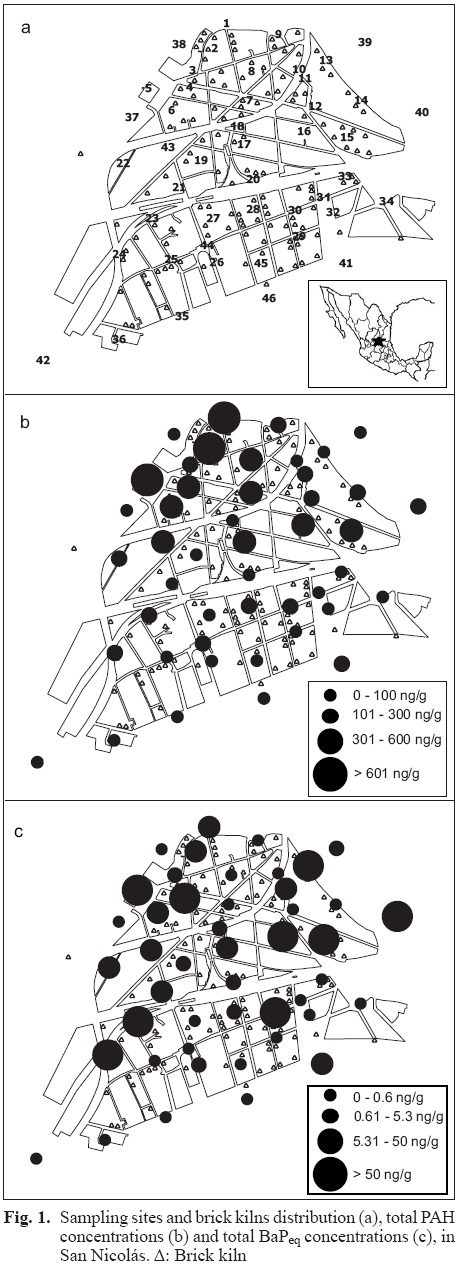
<body><![CDATA[<p align="justify"><font face="verdana" size="2">&nbsp;</font></p>  	    <p align="justify"><font face="verdana" size="2"><b>MATERIALS AND METHODS</b></font></p>  	    <p align="justify"><font face="verdana" size="2"><b>Sampling</b></font></p>  	    <p align="justify"><font face="verdana" size="2">San Nicol&aacute;s is located in Central Mexico at latitude 20&deg;31' N and longitude 99&deg;54' W at an altitude of 1890 m above sea level. A total of 46 homogeneously distributed soil samples in San Nicol&aacute;s and surrogated areas were collected. Sampling sites are depicted in <b><a href="#f1">figure 1a</a>.</b> The samples were taken with a stainless spoon from up to a depth of 2 cm from the soil surface. These samples were transferred into polyethylene bags and preserved at 4 &deg;C in the dark for future analysis.</font></p>  	    <p align="center"><font face="verdana" size="2"><a name="f1"></a></font></p>  	    <p align="center"><font face="verdana" size="2"><img src="/img/revistas/rica/v28n4/a4f1.jpg"></font></p>  	    <p align="justify"><font face="verdana" size="2"><b>Chemicals</b></font></p>  	    <p align="justify"><font face="verdana" size="2">The 13 PAHs analyzed in this study were naph&#45;talene (Nap), acenaphthylene (Acl), fluorene (Fl), anthracene (Ant), phenanthrene, (Phe), benzo<i>&#91;</i>a&#93; anthracene (BaA), chrysene (Chr), fluoranthene (Flu), pyrene (Py), benzo&#91;b fluoranthene, (BbF), benzo&#91;<i>k</i>&#93;fluoranthene (BkF), benzo&#91;<i>a</i>&#93;pyrene (BaP) and dibenzo<i>&#91;a,h</i>&#93;anthracene (DahA). PAHs standards were from Supelco (USA) with 99 % purity. All solvents (n&#45;hexane, acetone and acetonitrile) used were of HPLC grade from Baker (USA). The water used was HPLC grade.</font></p>  	    <p align="justify"><font face="verdana" size="2"><b>Sample extraction</b></font></p>  	    <p align="justify"><font face="verdana" size="2">Sample extraction was performed essentially as established in USEPA (SW846) Method 3540c (Soxhlet extraction)(USEPA 1996): The samples were oven&#45;dried for 24 h at 110 &deg;C, smashed into small pieces, homogenized with a mixer, and later sieved through a 2 mm sieve. Subsamples of 15 g were made and extracted in a Soxhlet apparatus for 8 h with 100 mL acetone&#45;hexane 1:1. The extracts were concentrated to 1 mL by using a rotary evaporator, supplemented with 10 mL of acetonitrile and concentrate, again to 1 mL, to exchange solvent for acetonitrile.</font></p>  	    ]]></body>
<body><![CDATA[<p align="justify"><font face="verdana" size="2"><b>Analysis</b></font></p>  	    <p align="justify"><font face="verdana" size="2">The concentration and composition of PAHs were determined by means of high performance liquid chromatography essentially as recommended by USEPA (SW846) Method 8100 (Polynuclear Aromatic Hydrocarbons)(USEPA 1986). HPLC was equipped with a fluorescence detector (HPLC&#45;FLD) using a HP 1100 Series HPLC with HP&#45;5972 FLD with wavelength programming. A zorbax AAA column (150 mm x 4.6 mm and 4.1 pm particle size) for reverse&#45;phase HPLC was used. The PAHs were eluted using a water/acetonitrile gradient, starting with a 60 % acetonitrile, a linear gradient to 67 % acetonitrile in 20 min, 67 % acetonitrile held for 26 min and linear gradient from 67 % to 100 % acetoni&#45;trile for 6 minutes. The column temperature was fixed at 25 &deg;C. The FLD was set to vary the excitation and emission wavelengths throughout the period of the analysis in order to fix the conditions for each PAH. Quantitative analysis of PAHs was made using the external calibration method with calibration curves with five points for each individual component. PAHs identification was performed by comparing the retention time with those of the set of standards. As example, a chromatogram of the PAH standard used for calibration is shown in <b><a href="/img/revistas/rica/v28n4/a4f2.jpg" target="_blank">figure 2</a>.</b></font></p>  	    <p align="justify"><font face="verdana" size="2"><b>Quality control</b></font></p>  	    <p align="justify"><font face="verdana" size="2">Procedural blanks, spiked blanks and duplicated samples were routinely analyzed together with field samples. No interference was detected. Limit of detection (LOD) was calculated as tree times the noise of the chromatogram in a blank sample. Limit of quantification (LOQ) was calculated as 10 times the standard deviation of the blank. Both LOQ and LOD are shown in <b><a href="#t1">table I</a>.</b></font></p>  	    <p align="center"><font face="verdana" size="2"><a name="t1"></a></font></p>  	    <p align="center"><font face="verdana" size="2"><img src="/img/revistas/rica/v28n4/a4t1.jpg"></font></p>  	    <p align="justify"><font face="verdana" size="2">The procedure was checked for recovery efficiencies by analyzing uncontaminated soil spiked with PAH standards essentially as recommended by USEPA (SW846) Method 8100 (Polynuclear Aromatic Hydrocarbons) (USEPA 1986), as follows: Uncontaminated soil samples were divided in homogeneous subsamples of equal weight. Subsamples were spiked with a PAH concentration of 5 mg/L and were dried 110 &deg;C until a constant weight was achieved. The percentages of recovery were estimated comparing the difference of weight between the spiked and un&#45;spiked samples and the inicial amount (5 mg) of PAH added. The average recoveries (n=3) ranged from 87 to 90 %. The variation in duplicates was less than 10 %.</font></p>  	    <p align="justify"><font face="verdana" size="2"><b>Total carcinogenic potency estimation</b></font></p>  	    <p align="justify"><font face="verdana" size="2">The total BaPeq concentration is an estimation of the total carcinogenic potency of a mixture of PAHs related to that of BaP. Total BaPeq concentrations were calculated based on the toxic equivalency factors (TEFs) approach, also referred to as potency equivalence factors (PEFs) approach (Nisbet <i>et al.</i> 1992, USEPA 1993, WHO/IPCS 1998, CCME 2008). Based on this method, the BaPeq of each parental PAH is calculated by multiplying its concentration by its TEF. The TEF of a given compound is its toxicity factor relative to the BaP carcinogenic potency. The carcinogenic potency of a mixture could then be estimated from ZBaPeq of each individual component. Several TEFs (or PEFs) have been proposed for PAHs (Nisbet <i>et al.</i> 1992, USEPA 1993, Kalberlah <i>et al.</i> 1997, CCME 2008) for a review see (Bostrom <i>et al.</i> 2002). In the present research the TEFs suggested by the Canadian Soil Quality Guidelines (CCME 2008) were adopted. These Canadian TEFs are those of the World Health Organization (WHO/IPCS 1998) with minor changes based on the latest scientific information reported (CCME 2008).</font></p>  	    <p align="justify"><font face="verdana" size="2">&nbsp;</font></p>  	    ]]></body>
<body><![CDATA[<p align="justify"><font face="verdana" size="2"><b>RESULTS AND DISCUSSION</b></font></p>  	    <p align="justify"><font face="verdana" size="2">Total and individual PAHs concentrations in the 46 soil samples of San Nicol&aacute;s are shown in <b><a href="/img/revistas/rica/v28n4/a4t2.jpg" target="_blank">table II</a>.</b> Total PAHs concentrations ranged from 7 ng/g to 1384 ng/g with a mean concentration of 220 ng/g. Spatial distribution of total PAHs concentrations are shown in <b><a href="#f1">figure 1b</a>.</b> The highest total PAHs concentrations were found in sampling sites 1, 2, 4, 5, 6, 7, 8, 15, 16, 17 and 43, located northwest ofSan Nicol&aacute;s, an area of great brick kiln density. The lowest total PAHs concentrations corresponded to soil samples 25, 19, 33 and 36, located at the south of San Nicol&aacute;s which is an area with a minor prevalence ofbrick kilns. All 13 individual PAHs were detected in soil samples at least one time (<b><a href="/img/revistas/rica/v28n4/a4t2.jpg" target="_blank">Table II</a></b>)<b>.</b> The mean number of individual PAHs detected by sample was four PAHs and the maximum number was 10 PAHs. The concentration of individual PAHs varied considerably in soil samples, from non&#45;detectable levels to maximum concentrations of 664 ng/g for Chr, 374 ng/g for Nap, 343 ng/g for Fl, 256 ng/g for BaA, 181 ng/g for Ph, 161 ng/g for Flu, 143 ng/g for Py, 139 ng/g for Ace and DahA, 59.4 ng/g for BbF and less than 10 ng/g for Ant, BkF and 10 BaP (<b><a href="/img/revistas/rica/v28n4/a4t2.jpg" target="_blank">Table II</a></b>)<b>.</b> When comparing the PAHs levels detected in San Nicol&aacute;s with others previously reported, it was found that PAHs concentrations were higher than those reported in urban sites of the United States/ Mexico border region, but were similar or higher than those of these industrial sites (De La Torre&#45;Roche <i>et al.</i> 2009). On the other hand, levels of PAHs in San Nicol&aacute;s were lower than those reported from soils in big cities around the world such as New Orleans (Mielke <i>et al.</i> 1999), Shanghai (Jiang <i>et al.</i> 2009), Beijing (Tang <i>et al.</i> 2005), Harbin (Ma <i>et al.</i> 2009) or Delhi (Agarwal <i>et al.</i> 2009).</font></p>  	    <p align="justify"><font face="verdana" size="2">Occurrence (%) and contribution (%) of individual PAHs to the total sum of PAHs are shown in <b><a href="#t3">table III</a>.</b> The parental PAH with the highest abundance was Nap, present in 66 % of samples and accounting for 26 % of the ZPAHs followed by Fl, Chr, BaA and DahA which accumulated 55 % of the IPAHs and were present in 20 %, 35 %, 43 % and 26 % of samples, respectively. It is noteworthy the low abundance of Ph, Flu, BbF and Py which have been repeatedly reported as abundant PAHs in urban contaminated sites. Also the high abundance and distribution of Chr, BaA and DahA that are PAHs usually reported in high quantities from industrial areas (Nadal <i>et al.</i> 2007, De La Torre&#45;Roche <i>et al.</i> 2009, Lu <i>et al.</i> 2009, Ma <i>et al.</i> 2009).</font></p>  	    <p align="center"><font face="verdana" size="2"><a name="t3"></a></font></p>  	    <p align="center"><font face="verdana" size="2"><img src="/img/revistas/rica/v28n4/a4t3.jpg"></font></p>  	    <p align="justify"><font face="verdana" size="2">Low molecular weight (LMW) and high molecular weight (HMW) PAHs profiles in soil samples of San Nicol&aacute;s are shown in <b><a href="#f1">figure 1</a></b>. LMW PAHs such as Nap, Ace, Fl, Ph and Ant are considered general markers of petrogenic origin of PAH contamination in soils. HMW PAHs such as Flu, Pyr, BaA, Chr, BbF, BkF, BaP and DahA are considered typical markers of pyrogenic origin of PAH contamination (Zakaria <i>et al.</i> 2002, Vinas <i>et al.</i> 2009). As shown in <b><a href="/img/revistas/rica/v28n4/a4f3.jpg" target="_blank">figure 3</a>,</b> both LMW and HMW were present in the majority of samples of San Nicol&aacute;s with highly variable contents. LMW and HMW PAHs contributed similarly to the total PAHs concentration, 47 % and 43 %, respectively, indicating a mixed origin of PAHs (petrogenic and pyrogenic) in San Nicol&aacute;s. When some commonly used indexes, such as: BaA/(BaA + Chr) or Ant/(Ant + Phe) (Yunker <i>et al.</i> 2002, Agarwal <i>et al.</i> 2009, Ma <i>et al.</i> 2009) based on individual PAH concentration ratios were applied to identify possible sources of PAHs, values of BaA/(BaA + Chr) = 0.38, and Ant/(Ant + Phe) = 0.1 indicating a mixed origin of PAHs were found. &#91;BaA/(BaA +Chr) &lt; 0.35 suggests petrogenic origin; BaA/(BaA +Chr) &gt; 0.4 suggest pyrogenic origin; and values between these indicate a mixed origin. When applying Ant/(Ant + Phe) index, Ant/(Ant + Phe) &lt; 0.1 suggests petrogenic origin; Ant/(Ant + Phe) &gt; 0.1 suggests pyrogenic origin, and Ant/(Ant + Phe) = 0.1 indicates a mixed origin of PAHs. The mixed origin of PAHs, both petrogenic and pyrogenic, in the soils of San Nicol&aacute;s may be related to the poor operational conditions of the brick kilns and the density of these kilns, approximately 300 kilns in the area of the testing locations (<b><a href="#f1">Figure 1a</a></b>)<b>.</b> The fuels are hand supplied using tins to fill the fuel reservoirs ofthe kilns and also the direct disposal of fuels to the soils frequently occurred as a result of this method of refueling. Rain could spread the fuels in soils generating a general petrogenic background PAH contamination. In fact, Nap, the less non polar (semi&#45;polar) PAH, which may be easily spread by water, appeared to be the most ubiquitous in San Nicol&aacute;s. On the other hand, the principal components of the HMW fraction in San Nicol&aacute;s had been previously described as common markers of pyrolitic processes, i.e, BaA and Chr have been described as markers of both coal and diesel combustion (Simcik <i>et al.</i> 1999, Larsen <i>et al.</i> 2003) and DahA is considered as an ubiquitous product of incomplete combustion (Ray <i>et al.</i> 2008). Even Nap in some cases could indicate the presence of significant combustion products from low temperature pyrogenic processes (Jenkins <i>et al.</i> 1996). In fact, De La Torre&#45;Roche <i>et al.</i> (2009) found an ubiquitous Nap contamination in soil of the United States / Mexico border region, relating it to pyrolitic activities occurring in <i>maquiladoras</i> and brick kilns of Ciudad Juarez; this may suggest that part of the high quantities of Nap found in San Nicol&aacute;s could be also related to brick kiln pyrolitic activity.</font></p>  	    <p align="justify"><font face="verdana" size="2">In order to evaluate whether the PAH concentrations found in this study pose a potential risk for human health, the PAH levels found in San Nicol&aacute;s were compared with two environmental standards (criteria) for PAHs in soil: the Mexican official standards for PAHs in soils regulated by NOM&#45;138&#45;SEMARNAT/SS&#45;2003 (SEMARNAT 2003) and the Regional Screening Levels (RSLs) for Chemical Contaminants at Superfund Sites established by USEPA (USEPA 2009), as a more restrictive standard. Quality objectives for PAHs in residential soils established by NOM and USEPA criteria as well as soil samples exceeding these criteria are shown in <b><a href="/img/revistas/rica/v28n4/a4t2.jpg" target="_blank">Table II</a>.</b></font></p>  	    <p align="justify"><font face="verdana" size="2">M&eacute;xico established environmental and safety quality objectives in residential soils for six HMW PAHs: BaA, BbF, BkF, BaP, InP and DahA. Five ofthese PAHs were analyzed and it was found that 24 soil samples (52 %) had PAHs contents higher than those established in these legal limits for at least one PAH. Some samples accumulated legal exceedances for up to 3 or 4 different PAHs (<b><a href="/img/revistas/rica/v28n4/a4t2.jpg" target="_blank">Table II</a></b>)<b>.</b> The accumulated legal exceedance (%) for each individual PAHs is shown in <b><a href="#t3">table III</a>.</b> The maximum number of accumulated exceedances corresponded to B&#91;<i>a</i>&#93;A with 43 % of samples exceeding NOM criteria, followed by DahA and BbF with a 26 % and 15 % of samples exceeding these criteria. BaP was found to exceed legal criteria in only 3 samples and no exceedances were found for BkF. PAH concentrations exceeding those of the legal limits, with means from 1.4&#45;fold for BaP to 39 and 35&#45;fold for DahA and BaA, respectively, are shown in <b><a href="#t3">table III</a>.</b></font></p>  	    <p align="justify"><font face="verdana" size="2">When comparing the PAH levels found in the soil samples from San Nicol&aacute;s with the the Regional Screening Levels (RSLs) for Chemical Contaminants at Superfund Sites established by USEPA (2009) it was found that 30 soil samples (63 %) had PAH contents higher than those stipulated by these criteria for residential use of soils for at least one PAH. Some samples had PAH contents higher than those established by these criteria for up to five different PAHs (<b><a href="/img/revistas/rica/v28n4/a4t2.jpg" target="_blank">Table II</a></b>)<b>.</b> The accumulated legal exceed&#45;ance (%) for each individual PAH is shown in <b><a href="#t3">table III</a>.</b> The maximum accumulated exceedeance corresponded to BaA with 43 % of samples above that legal criteria, followed by BaP, Chr and DahA, with a 34, 28 and 26 % of samples exceeding these criteria, respectively. BkF, BbF and Nap also exceeded their legal criteria in 15, 15 and 19 % of samples, respectively. When analyzing the magnitude of the mean exceedance of the legal limits of the PAH concentrations in samples, (<b><a href="#t3">Table III</a></b>)<b>,</b> it was found a very high exceedance for DahA, BaA, BbF and BaP with mean concentrations exceeding 5219&#45;fold, 469&#45;fold, 121&#45;fold and 104&#45;folds those concentrations established by USEPA criteria, respectively. A high exceedance but not to the same extent was also found for Chr with a mean concentration exceeding 10&#45;fold its criteria (<b><a href="#t3">Table III</a></b>)<b>.</b> Finally it was found a low exceedance for BkF and Nap with mean concentrations exceeding the criteria 1.91&#45;fold and 1.33&#45;fold, respectively. No exceedances were found for Ace, Fl, Ant, Flu and Py.</font></p>  	    <p align="justify"><font face="verdana" size="2">Based on these regulations, it was found that 52 % of soils in San Nicol&aacute;s had PAH levels higher than those considered as healthy or not dangerous for residential use within NOM regulations and this percentage increased up to 76 % of soils under USA regulations. Moreover, some PAHs were found in concentrations of up to 39 and 5219&#45;fold higher than those established in NOM and USA criteria, respectively. These two factors could imply a generalized PAH contamination in San Nicol&aacute;s which may be considered as very large in some areas (see <b><a href="#f1">Fig. 1b</a>).</b></font></p>  	    ]]></body>
<body><![CDATA[<p align="justify"><font face="verdana" size="2">Total carcinogenic PAH (Nap, BaA, Chr, BbF, BkF, BaP and DahA) concentrations in soil samples of San Nicol&aacute;s are shown in <b><a href="#t4">table IV</a>.</b> Total carcinogenic PAH concentrations ranged from 0 ng/g to 955 ng/g, with an average value of 105 ng/g with a mean contribution to the SPAHs of 42 %. Total benzo(a)pyrene equivalent (BaPeq) concentrations are also shown in <b><a href="#t4">table IV</a>.</b> Total BaPeq concentrations in soil samples of San Nicol&aacute;s ranged from 0 ng/g to 140 ng/g, with a mean concentration of 24.89 ng/g. Spatial distribution of total BaPeq in San Nicol&aacute;s is shown in <b><a href="#f1">Fig. 1c</a>.</b> The distribution of total BaPeq concentrations was more heterogeneous than that of the total PAH concentration, see <b><a href="#f1">Fig. 1b</a>,</b> finding the highest total BaPeq for sampling sites 4, 5, 16, 23, 24, 30 and 40 which are spread out all over San Nicol&aacute;s, but seems to be linked with the high density of brick kilns of the northern area (samples 4, 5, 16 and 40, and) as well as with the major traffic point in San Nicol&aacute;s (samples 23, 24, and 30). This phenomena can be explained by the lower capacity of the heavier PAHs to be spread far away from their emission points accounting near of their source (De La Torre&#45;Roche <i>et al.</i> 2009).</font></p>  	    <p align="center"><font face="verdana" size="2"><a name="t4"></a></font></p>  	    <p align="center"><font face="verdana" size="2"><img src="/img/revistas/rica/v28n4/a4t4.jpg"></font></p>  	    <p align="justify"><font face="verdana" size="2">The Canadian Soil Quality Guidelines (CCME, 2008) established maximum acceptable concentrations (MACs) for carcinogenic chemicals in soils based on an incremental risk of cancer from soil exposure (ILCR) of10<sup>&#45;6</sup> or 10<sup>&#45;5</sup>, i.e., an incremental risk of 1 in 1 million or 1 in 100 000, respectively. This regulation was established for all land use with the following values: a MAC of 0.6 ng/g of BaPeq for an ILCR of 10<sup>&#45;6</sup> and a MAC of 5.3 ng/g of BaPeq for an ILCR of 10<sup>&#45;5</sup>. When comparing total BaPeq in soil samples of San Nicol&aacute;s with these MACs, it was found that 41 % and 60 % of soil samples of San Nicol&aacute;s had total BaPeq levels higher than those established as MACs for ILCRs of 10&#45;5 and 10<sup>&#45;6</sup>, respectively. The magnitude of the mean exceedace of these MACs was of 41&#45;fold and 4&#45;fold the MACs for both 10<sup>&#45;6</sup> and 10<sup>&#45;5</sup> ILCRs, respectively. Moreover, some samples (4, 5, 13, 16, 23, 24, 30 and 40), had BaPeq concentrations higher than 100&#45;fold of those established as MAC for an ILCR of 10<sup>&#45;5</sup>. These high levels of total BaPeq concentrations implied a generalized carcinogenic risk for the exposed population in San Nicol&aacute;s, which may be considered very high in some areas. When discussing carcinogenic PAHs, of special concern is the high presence of BaP (detected in 34 % of samples) which has been classified as carcinogen for humans (Group 1 of IARC) (2010). The case of DahA was also remarcable: it was detected in 26 % of samples with a mean contribution to the total BaPeq concentrations of 90 % in those samples with the higher total BaPeq: samples 4, 5, 11, 13, 15, 16, 17, 23, 24, 30, 40 and 41 (<b><a href="#t4">Table IV</a></b> and <b><a href="#f1">Figure 1a&#45;c</a></b>)<b>.</b> DahA have been classified as probable human carcinogen, and included in the group 2A of IARC (IARC 2010). The high abundance of, chrysene and benzofluoranthenes was also remarkable: despite the low TEFs values generally assigned to them based on laboratory rodent data, recent studies using other biomarkers of carcinogenic potency such as bacterial mutagenicity tests or enzymatic activity tests suggest that chrysene and benzofluoranthenes can be more carcinogenic than BaP (Bosveld <i>et al.</i> 2002). In the same line, Nap can be also a source of carcinogenic risk since it has been recently included in the group 2 of the IARC list of possible carcinogenic substances for humans (IARC 2010). Taking in to account the high abundance and distribution of this PAH, the carcinogenic risk for population can be even higher.</font></p>  	    <p align="justify"><font face="verdana" size="2">The nature of the homemade brick&#45;kiln activity in San Nicol&aacute;s implies that all members of the family contribute to that economical activity. In fact, the majority of the kilns are located in the back yards of the houses. Children play near the kilns. Children have been recognized as being the most sensitive to environmental contaminants having specific pathways of exposure to contaminants, such as: inges&#45;tion through hand to mouth activities (Calabrese <i>et al.</i> 1997, Lu <i>et al.</i> 2009) or ingestion through breast milk (Hooper 1999, Rodas&#45;Ortiz <i>et al.</i> 2008). They may be exposed at certain stages of development that may lead to health issues that will appear later in life (IPCS 2006). Mart&iacute;nez&#45;Salinas <i>et al.</i> (2009) when analyzing urinary 1&#45;hydroxypyrene (1&#45;OHP) in children of different communities in Mexico as biomarker of exposure to PAH contamination, found that children living in communities with brick kiln industry were at risk of PAH genotoxic exposure levels. Trejo&#45;Acevedo <i>et al.</i> (2009), when analyzing blood and urine of the children of San Nicol&aacute;s found levels of HBCs (metabolites of PCBs) and lead at concentrations higher than those reported to cause neurotoxic damage as well as high levels of lindane, arsenic and DDE (main metabolite of DDT). They concluded that San Nicol&aacute;s is a hot spot of special concern in Mexico due to the high health risk for population caused by the exposure to persistent organic pollutants (POP's) and other contaminants (Trejo&#45;Acevedo <i>et al.</i> 2009). We suggest the need of cancer risk assessment analyses and ongoing monitoring in San Nicol&aacute;s and other brick manufacturing communities in Mexico in order to determine the extent of the risk to human health, especially for children related to this economic activity. In this way, corrective and preventive strategies to reduce the exposed population and hopefully reduce the risk of this exposure could be estabilished.</font></p>  	    <p align="justify"><font face="verdana" size="2">&nbsp;</font></p>  	    <p align="justify"><font face="verdana" size="2"><b>CONCLUSIONS</b></font></p>  	    <p align="justify"><font face="verdana" size="2">Results of this study showed that residential soils in San Nicol&aacute;s are polluted by PAHs. Nap, Fl, Chr, BaA and DahA are the most abundant PAHs. By applying several approximations to assess the origin of PAHs, a mixed origin of PAHs both petrogenic and pyrogenic could be derived. When comparing PAHs levels in soil with Mexican and USA regulations, it was found that approximately 52 % and 76 % of soils of San Nicol&aacute;s had PAHs levels higher than those considered as healthy or not dangerous for residential use under those two aforementioned regulations. Moreover, total BaPeq concentrations in the soils of San Nicol&aacute;s were higher than the maximum acceptable concentrations established by Canada for an ILCR of 10<sup>&#45;6</sup> in 60 % of soils and for an ILCR of 10<sup>&#45;5</sup> in 40 % of soils. Of special concern was the high presence of BaP, a known human carcinogen, as well as DahA, a PAH with a high carcinogenic potential. All these factors could imply a generalized carcinogenic risk for the exposed population. We suggest the need for cancer risk assessment analyses and ongoing monitoring in San Nicol&aacute;s and other brick&#45;manufacturing communities in Mexico in order to determine the extent of the risk for human health. This is especially important for the children linked to this economic activity. We also propose the perform of civil engineering studies in order to establish the possibility of ongoing strategies to reduce the emission of PAHs, as well as decontamination strategies to reduce the continued exposure for the population and the health risks thereof.</font></p>  	    <p align="justify"><font face="verdana" size="2">&nbsp;</font></p>  	    <p align="justify"><font face="verdana" size="2"><b>ACKNOWLEDGEMENTS</b></font></p>  	    ]]></body>
<body><![CDATA[<p align="justify"><font face="verdana" size="2">This study was supported by grant QRO&#45;2004&#45;C01&#45;26 Fondo Mixto CONACyT, Quer&eacute;taro State Government (Mexico). The authors would like to thank Dr. Francisca Fernandez Pinas for her suggestions and acknowledge Silvia C. Stroet for editing the English content of this document.</font></p>  	    <p align="justify"><font face="verdana" size="2">&nbsp;</font></p>  	    <p align="justify"><font face="verdana" size="2"><b>REFERENCES</b></font></p>  	    <!-- ref --><p align="justify"><font face="verdana" size="2">Agarwal T., Khillare P.S., Shridhar V. and Ray S. (2009). Pattern, sources and toxic potential of PAHs in the agricultural soils of Delhi, India. J Hazard Mater. 163, 1033&#45;1039.    &nbsp;&nbsp;&nbsp;&nbsp;&nbsp;&nbsp;&nbsp;&nbsp;[&#160;<a href="javascript:void(0);" onclick="javascript: window.open('/scielo.php?script=sci_nlinks&ref=7265192&pid=S0188-4999201200040000400001&lng=','','width=640,height=500,resizable=yes,scrollbars=1,menubar=yes,');">Links</a>&#160;]<!-- end-ref --></font></p>  	    <!-- ref --><p align="justify"><font face="verdana" size="2">Audebert M., Zeman F., Beaudoin R., P&eacute;ry A. and Cravedi J.P. (2012). Comparative potency approach based on H2AX assay for estimating the genotoxicity of polycyclic aromatic hydrocarbons. Toxicol.App. Pharm. 260, 58&#45;64.    &nbsp;&nbsp;&nbsp;&nbsp;&nbsp;&nbsp;&nbsp;&nbsp;[&#160;<a href="javascript:void(0);" onclick="javascript: window.open('/scielo.php?script=sci_nlinks&ref=7265194&pid=S0188-4999201200040000400002&lng=','','width=640,height=500,resizable=yes,scrollbars=1,menubar=yes,');">Links</a>&#160;]<!-- end-ref --></font></p>  	    <!-- ref --><p align="justify"><font face="verdana" size="2">Bostrom C.E., Gerde P., Hanberg A., Jernstrom B., Johansson C., Kyrklund T., Ranng A., Tornquist M., Victorin K. and Westerholm R. (2002). Cancer risk assessment, indicators, and guidelines for polycyclic aromatic hydrocarbons in the ambient air. Environ Health Perspect. 110 Suppl 3, 451&#45;488.    &nbsp;&nbsp;&nbsp;&nbsp;&nbsp;&nbsp;&nbsp;&nbsp;[&#160;<a href="javascript:void(0);" onclick="javascript: window.open('/scielo.php?script=sci_nlinks&ref=7265196&pid=S0188-4999201200040000400003&lng=','','width=640,height=500,resizable=yes,scrollbars=1,menubar=yes,');">Links</a>&#160;]<!-- end-ref --></font></p>  	    <!-- ref --><p align="justify"><font face="verdana" size="2">Bosveld A.T., de Bie P.A., van den Brink N.W., Jongepier H. and Klomp A.V. (2002). In vitro EROD induction equivalency factors for the 10 PAHs generally monitored in risk assessment studies in The Netherlands. Chemosphere 49, 75&#45;83.    &nbsp;&nbsp;&nbsp;&nbsp;&nbsp;&nbsp;&nbsp;&nbsp;[&#160;<a href="javascript:void(0);" onclick="javascript: window.open('/scielo.php?script=sci_nlinks&ref=7265198&pid=S0188-4999201200040000400004&lng=','','width=640,height=500,resizable=yes,scrollbars=1,menubar=yes,');">Links</a>&#160;]<!-- end-ref --></font></p>  	    <!-- ref --><p align="justify"><font face="verdana" size="2">Boumard P., Budzinski H., Michon Q., Garrigues P., Burgeot T. and Bellock J. (1998). Origin and bioavailability of PAHs in the Mediterranean sea from Mussel and Sediment records. Estuar. Coas. Shelf Sci. 47, 77&#45;90.    &nbsp;&nbsp;&nbsp;&nbsp;&nbsp;&nbsp;&nbsp;&nbsp;[&#160;<a href="javascript:void(0);" onclick="javascript: window.open('/scielo.php?script=sci_nlinks&ref=7265200&pid=S0188-4999201200040000400005&lng=','','width=640,height=500,resizable=yes,scrollbars=1,menubar=yes,');">Links</a>&#160;]<!-- end-ref --></font></p>  	    <!-- ref --><p align="justify"><font face="verdana" size="2">Calabrese E.J., Stanek E.J., James R.C. and Roberts S.M. (1997). Soil ingestion: a concern for acute toxicity in children. Environ. Health Perspect. 105, 1354&#45;1358.    &nbsp;&nbsp;&nbsp;&nbsp;&nbsp;&nbsp;&nbsp;&nbsp;[&#160;<a href="javascript:void(0);" onclick="javascript: window.open('/scielo.php?script=sci_nlinks&ref=7265202&pid=S0188-4999201200040000400006&lng=','','width=640,height=500,resizable=yes,scrollbars=1,menubar=yes,');">Links</a>&#160;]<!-- end-ref --></font></p>  	    <!-- ref --><p align="justify"><font face="verdana" size="2">CCME (2008). Carcinogenic and other Polycyclic Aromatic Hydrocarbons (PAHs). Canadian Council of Ministers of the Environment. Scientific Supporting Document ISBN 978&#45;1&#45;896997&#45;79&#45;7.    &nbsp;&nbsp;&nbsp;&nbsp;&nbsp;&nbsp;&nbsp;&nbsp;[&#160;<a href="javascript:void(0);" onclick="javascript: window.open('/scielo.php?script=sci_nlinks&ref=7265204&pid=S0188-4999201200040000400007&lng=','','width=640,height=500,resizable=yes,scrollbars=1,menubar=yes,');">Links</a>&#160;]<!-- end-ref --></font></p>  	    <!-- ref --><p align="justify"><font face="verdana" size="2">de La Torre&#45;Roche R.J., Lee W.Y. and Campos&#45;D&iacute;az S.I. (2009). Soil&#45;borne polycyclic aromatic hydrocarbons in El Paso, Texas: analysis of a potential problem in the United States/Mexico border region. J. Hazard Mater. 163, 946&#45;958.    &nbsp;&nbsp;&nbsp;&nbsp;&nbsp;&nbsp;&nbsp;&nbsp;[&#160;<a href="javascript:void(0);" onclick="javascript: window.open('/scielo.php?script=sci_nlinks&ref=7265206&pid=S0188-4999201200040000400008&lng=','','width=640,height=500,resizable=yes,scrollbars=1,menubar=yes,');">Links</a>&#160;]<!-- end-ref --></font></p>  	    <!-- ref --><p align="justify"><font face="verdana" size="2">Hooper K. (1999). Breast milk monitoring programs (BMMPs): world&#45;wide early warning system for polyhalogenated POPs and for targeting studies in children's environmental health. Environ. Health Perspect. 107, 429&#45;430.    &nbsp;&nbsp;&nbsp;&nbsp;&nbsp;&nbsp;&nbsp;&nbsp;[&#160;<a href="javascript:void(0);" onclick="javascript: window.open('/scielo.php?script=sci_nlinks&ref=7265208&pid=S0188-4999201200040000400009&lng=','','width=640,height=500,resizable=yes,scrollbars=1,menubar=yes,');">Links</a>&#160;]<!-- end-ref --></font></p>  	    <!-- ref --><p align="justify"><font face="verdana" size="2">IARC (2010). Some non&#45;heterocyclic polycyclic aromatic hydrocarbons and some related exposures. IARC Monographs on the Evaluation of Carcinogenic Risks to Humans, 92.    &nbsp;&nbsp;&nbsp;&nbsp;&nbsp;&nbsp;&nbsp;&nbsp;[&#160;<a href="javascript:void(0);" onclick="javascript: window.open('/scielo.php?script=sci_nlinks&ref=7265210&pid=S0188-4999201200040000400010&lng=','','width=640,height=500,resizable=yes,scrollbars=1,menubar=yes,');">Links</a>&#160;]<!-- end-ref --></font></p>  	    <!-- ref --><p align="justify"><font face="verdana" size="2">IPCS (2006). Principles for evaluating health risk in children associated with expossure to chemical. Environ. Health Crit. 273.    &nbsp;&nbsp;&nbsp;&nbsp;&nbsp;&nbsp;&nbsp;&nbsp;[&#160;<a href="javascript:void(0);" onclick="javascript: window.open('/scielo.php?script=sci_nlinks&ref=7265212&pid=S0188-4999201200040000400011&lng=','','width=640,height=500,resizable=yes,scrollbars=1,menubar=yes,');">Links</a>&#160;]<!-- end-ref --></font></p>  	    <!-- ref --><p align="justify"><font face="verdana" size="2">Jenkins B.M., Jones A.D., Turn S.Q. and Williams R.B. (1996). Emission Factors for Polycyclic Aromatic Hydrocarbons from Biomass Burning. Environ. Sci. Technol. 30, 2462&#45;2469.    &nbsp;&nbsp;&nbsp;&nbsp;&nbsp;&nbsp;&nbsp;&nbsp;[&#160;<a href="javascript:void(0);" onclick="javascript: window.open('/scielo.php?script=sci_nlinks&ref=7265214&pid=S0188-4999201200040000400012&lng=','','width=640,height=500,resizable=yes,scrollbars=1,menubar=yes,');">Links</a>&#160;]<!-- end-ref --></font></p>  	    <!-- ref --><p align="justify"><font face="verdana" size="2">Jiang YF., Wang X.T., Wang F., Jia Y, Wu M.H., Sheng G.Y. and Fu J.M. (2009). Levels, composition profiles and sources of polycyclic aromatic hydrocarbons in urban soil of Shanghai, China. Chemosphere 75, 1112&#45;1118.    &nbsp;&nbsp;&nbsp;&nbsp;&nbsp;&nbsp;&nbsp;&nbsp;[&#160;<a href="javascript:void(0);" onclick="javascript: window.open('/scielo.php?script=sci_nlinks&ref=7265216&pid=S0188-4999201200040000400013&lng=','','width=640,height=500,resizable=yes,scrollbars=1,menubar=yes,');">Links</a>&#160;]<!-- end-ref --></font></p>  	    <!-- ref --><p align="justify"><font face="verdana" size="2">Kalberlah F., Hassauer M., Frijus&#45;Plessen N. and Schneider K. (1997). Toxicological Risk Assessment of Soil Contaminants. Int. J. Toxicol. 16, 495&#45;508.    &nbsp;&nbsp;&nbsp;&nbsp;&nbsp;&nbsp;&nbsp;&nbsp;[&#160;<a href="javascript:void(0);" onclick="javascript: window.open('/scielo.php?script=sci_nlinks&ref=7265218&pid=S0188-4999201200040000400014&lng=','','width=640,height=500,resizable=yes,scrollbars=1,menubar=yes,');">Links</a>&#160;]<!-- end-ref --></font></p>  	    <!-- ref --><p align="justify"><font face="verdana" size="2">Larsen R.K. and Baker J.E. (2003). Source apportionment of polycyclic aromatic hydrocarbons in the urban atmosphere: a comparison of three methods. Environ. Sci. Technol. 37, 1873&#45;1881.    &nbsp;&nbsp;&nbsp;&nbsp;&nbsp;&nbsp;&nbsp;&nbsp;[&#160;<a href="javascript:void(0);" onclick="javascript: window.open('/scielo.php?script=sci_nlinks&ref=7265220&pid=S0188-4999201200040000400015&lng=','','width=640,height=500,resizable=yes,scrollbars=1,menubar=yes,');">Links</a>&#160;]<!-- end-ref --></font></p>  	    <!-- ref --><p align="justify"><font face="verdana" size="2">Liu Y., Zhu L. and Shen X. (2001). Polycyclic aromatic hydrocarbons (PAHs) in indoor and outdoor air of Hangzhou, China. Environ. Sci. Technol. 35, 840-844.    &nbsp;&nbsp;&nbsp;&nbsp;&nbsp;&nbsp;&nbsp;&nbsp;[&#160;<a href="javascript:void(0);" onclick="javascript: window.open('/scielo.php?script=sci_nlinks&ref=7265222&pid=S0188-4999201200040000400016&lng=','','width=640,height=500,resizable=yes,scrollbars=1,menubar=yes,');">Links</a>&#160;]<!-- end-ref --></font></p>  	    <!-- ref --><p align="justify"><font face="verdana" size="2">Lu M., Yuan D., Lin Q. and Ouyang T. (2009). Assessment of the bioaccessibility of polycyclic aromatic hydrocarbons in topsoils from different urban functional areas using an in vitro gastrointestinal test. Environ. Monit. Assess.    &nbsp;&nbsp;&nbsp;&nbsp;&nbsp;&nbsp;&nbsp;&nbsp;[&#160;<a href="javascript:void(0);" onclick="javascript: window.open('/scielo.php?script=sci_nlinks&ref=7265224&pid=S0188-4999201200040000400017&lng=','','width=640,height=500,resizable=yes,scrollbars=1,menubar=yes,');">Links</a>&#160;]<!-- end-ref --></font></p>  	    <!-- ref --><p align="justify"><font face="verdana" size="2">Ma W.L., Li Y.F., Sun D.Z. and Qi H. (2009). Polycyclic aromatic hydrocarbons and polychlorinated biphenyls in topsoils of Harbin, China. Arch. Environ. Contam. Toxicol. 57, 670&#45;678.    &nbsp;&nbsp;&nbsp;&nbsp;&nbsp;&nbsp;&nbsp;&nbsp;[&#160;<a href="javascript:void(0);" onclick="javascript: window.open('/scielo.php?script=sci_nlinks&ref=7265226&pid=S0188-4999201200040000400018&lng=','','width=640,height=500,resizable=yes,scrollbars=1,menubar=yes,');">Links</a>&#160;]<!-- end-ref --></font></p>  	    <!-- ref --><p align="justify"><font face="verdana" size="2">Mart&iacute;nez&#45;Salinas R.I., Elena Leal M., Batres&#45;Esquivel L.E., Dom&iacute;nguez&#45;Cortinas G., Calder&oacute;n J., D&iacute;az&#45;Barriga F. and P&eacute;rez&#45;Maldonado I.N. (2009). Exposure of children to polycyclic aromatic hydrocarbons in Mexico: assessment of multiple sources. Int. Arch. Occup. Environ. Health 83, 617&#45;623.    &nbsp;&nbsp;&nbsp;&nbsp;&nbsp;&nbsp;&nbsp;&nbsp;[&#160;<a href="javascript:void(0);" onclick="javascript: window.open('/scielo.php?script=sci_nlinks&ref=7265228&pid=S0188-4999201200040000400019&lng=','','width=640,height=500,resizable=yes,scrollbars=1,menubar=yes,');">Links</a>&#160;]<!-- end-ref --></font></p>  	    <!-- ref --><p align="justify"><font face="verdana" size="2">Miege C., Dugay J. and Hennion M.C. (2003). Optimization, validation and comparison of various extraction techniques for the trace determination of polycyclic aromatic hydrocarbons in sewage sludges by liquid chromatography coupled to diode&#45;array and fluorescence detection. J. Chromatogr. A 995, 87&#45;97.    &nbsp;&nbsp;&nbsp;&nbsp;&nbsp;&nbsp;&nbsp;&nbsp;[&#160;<a href="javascript:void(0);" onclick="javascript: window.open('/scielo.php?script=sci_nlinks&ref=7265230&pid=S0188-4999201200040000400020&lng=','','width=640,height=500,resizable=yes,scrollbars=1,menubar=yes,');">Links</a>&#160;]<!-- end-ref --></font></p>  	    <!-- ref --><p align="justify"><font face="verdana" size="2">Mielke H.W., Gonzales C.R., Smith M.K. and Mielke P.W. (1999). The urban environment and children's health: soils as an integrator of lead, zinc, and cadmium in New Orleans, Louisiana, U.S.A. Environ. Res. 81, 117&#45;129.    &nbsp;&nbsp;&nbsp;&nbsp;&nbsp;&nbsp;&nbsp;&nbsp;[&#160;<a href="javascript:void(0);" onclick="javascript: window.open('/scielo.php?script=sci_nlinks&ref=7265232&pid=S0188-4999201200040000400021&lng=','','width=640,height=500,resizable=yes,scrollbars=1,menubar=yes,');">Links</a>&#160;]<!-- end-ref --></font></p>  	    <!-- ref --><p align="justify"><font face="verdana" size="2">Nadal M., Schuhmacher M. and Domingo J.L. (2007). Levels of metals, PCBs, PCNs and PAHs in soils of a highly industrialized chemical/petrochemical area: temporal trend. Chemosphere 66, 267&#45;276.    &nbsp;&nbsp;&nbsp;&nbsp;&nbsp;&nbsp;&nbsp;&nbsp;[&#160;<a href="javascript:void(0);" onclick="javascript: window.open('/scielo.php?script=sci_nlinks&ref=7265234&pid=S0188-4999201200040000400022&lng=','','width=640,height=500,resizable=yes,scrollbars=1,menubar=yes,');">Links</a>&#160;]<!-- end-ref --></font></p>  	    <!-- ref --><p align="justify"><font face="verdana" size="2">Nisbet I.C. and LaGoy P.K. (1992). Toxic equivalency factors (TEFs) for polycyclic aromatic hydrocarbons (PAHs). Regul Toxicol Pharmacol 16, 290&#45;300.    &nbsp;&nbsp;&nbsp;&nbsp;&nbsp;&nbsp;&nbsp;&nbsp;[&#160;<a href="javascript:void(0);" onclick="javascript: window.open('/scielo.php?script=sci_nlinks&ref=7265236&pid=S0188-4999201200040000400023&lng=','','width=640,height=500,resizable=yes,scrollbars=1,menubar=yes,');">Links</a>&#160;]<!-- end-ref --></font></p>  	    <!-- ref --><p align="justify"><font face="verdana" size="2">Ray S., Khillare P.S., Agarwal T. and Shridhar V. (2008). Assessment of PAHs in soil around the International Airport in Delhi, India. J Hazard Mater 156, 9&#45;16.    &nbsp;&nbsp;&nbsp;&nbsp;&nbsp;&nbsp;&nbsp;&nbsp;[&#160;<a href="javascript:void(0);" onclick="javascript: window.open('/scielo.php?script=sci_nlinks&ref=7265238&pid=S0188-4999201200040000400024&lng=','','width=640,height=500,resizable=yes,scrollbars=1,menubar=yes,');">Links</a>&#160;]<!-- end-ref --></font></p>  	    <!-- ref --><p align="justify"><font face="verdana" size="2">Rodas&#45;Ortiz J.P., Ceja&#45;Moreno V, Gonzalez&#45;Navarrete R.L., Alvarado&#45;Mej&iacute;a J., Rodriguez&#45;Hernandez M.E. and Gold&#45;Bouchot G. (2008). Organochlorine pesticides and polychlorinated biphenyls levels in human milk from Chelem, Yucatan, Mexico. Bull Environ Contam Toxicol 80, 255&#45;259.    &nbsp;&nbsp;&nbsp;&nbsp;&nbsp;&nbsp;&nbsp;&nbsp;[&#160;<a href="javascript:void(0);" onclick="javascript: window.open('/scielo.php?script=sci_nlinks&ref=7265240&pid=S0188-4999201200040000400025&lng=','','width=640,height=500,resizable=yes,scrollbars=1,menubar=yes,');">Links</a>&#160;]<!-- end-ref --></font></p>  	    <!-- ref --><p align="justify"><font face="verdana" size="2">SEMARNAT (2003). NOM&#45;138&#45;SEMARNAT/SS&#45;2003. Secretaria de Medio Ambiente y Recursos Naturales, M&eacute;xico.    &nbsp;&nbsp;&nbsp;&nbsp;&nbsp;&nbsp;&nbsp;&nbsp;[&#160;<a href="javascript:void(0);" onclick="javascript: window.open('/scielo.php?script=sci_nlinks&ref=7265242&pid=S0188-4999201200040000400026&lng=','','width=640,height=500,resizable=yes,scrollbars=1,menubar=yes,');">Links</a>&#160;]<!-- end-ref --></font></p>  	    <!-- ref --><p align="justify"><font face="verdana" size="2">Simcik M.F., Eisenreich S.J. and Lioy P. J. (1999). Source apportionment and source/sink relationships of PAHs in the coastal atmosphere of Chicago and Lake Michigan. Atmospheric Environment 33, 5071&#45;5079.    &nbsp;&nbsp;&nbsp;&nbsp;&nbsp;&nbsp;&nbsp;&nbsp;[&#160;<a href="javascript:void(0);" onclick="javascript: window.open('/scielo.php?script=sci_nlinks&ref=7265244&pid=S0188-4999201200040000400027&lng=','','width=640,height=500,resizable=yes,scrollbars=1,menubar=yes,');">Links</a>&#160;]<!-- end-ref --></font></p>  	    <!-- ref --><p align="justify"><font face="verdana" size="2">Tang L., Tang X.Y., Zhu Y.G., Zheng M.H. and Miao Q.L. (2005). Contamination of polycyclic aromatic hydrocarbons (PAHs) in urban soils in Beijing, China. Environ Int 31, 822&#45;828.    &nbsp;&nbsp;&nbsp;&nbsp;&nbsp;&nbsp;&nbsp;&nbsp;[&#160;<a href="javascript:void(0);" onclick="javascript: window.open('/scielo.php?script=sci_nlinks&ref=7265246&pid=S0188-4999201200040000400028&lng=','','width=640,height=500,resizable=yes,scrollbars=1,menubar=yes,');">Links</a>&#160;]<!-- end-ref --></font></p>  	    <!-- ref --><p align="justify"><font face="verdana" size="2">Trejo&#45;Acevedo A., D&iacute;az&#45;Barriga F., Carrizales L., Dominguez G., Costilla R., Ize&#45;Lema I., Yarto&#45;Ramirez M., Gavilan&#45;Garcia A., Jesus Mej&iacute;a &#45;Saavedra J. and P&eacute;rez&#45;Maldonado I.N. (2009). Exposure assessment of persistent organic pollutants and metals in Mexican children. Chemosphere 74, 974&#45;980.    &nbsp;&nbsp;&nbsp;&nbsp;&nbsp;&nbsp;&nbsp;&nbsp;[&#160;<a href="javascript:void(0);" onclick="javascript: window.open('/scielo.php?script=sci_nlinks&ref=7265248&pid=S0188-4999201200040000400029&lng=','','width=640,height=500,resizable=yes,scrollbars=1,menubar=yes,');">Links</a>&#160;]<!-- end-ref --></font></p>  	    <!-- ref --><p align="justify"><font face="verdana" size="2">USEPA (1986). Method 8310: Polynuclear Aromatic Hydrocarbons. EPA&#45;SW846. United States Environmental Protection Agency.    &nbsp;&nbsp;&nbsp;&nbsp;&nbsp;&nbsp;&nbsp;&nbsp;[&#160;<a href="javascript:void(0);" onclick="javascript: window.open('/scielo.php?script=sci_nlinks&ref=7265250&pid=S0188-4999201200040000400030&lng=','','width=640,height=500,resizable=yes,scrollbars=1,menubar=yes,');">Links</a>&#160;]<!-- end-ref --></font></p>  	    <!-- ref --><p align="justify"><font face="verdana" size="2">USEPA (1996). Method 3540C: Soxhlet extraction. EPA SW&#45;846. United States Environmental Protection Agency.    &nbsp;&nbsp;&nbsp;&nbsp;&nbsp;&nbsp;&nbsp;&nbsp;[&#160;<a href="javascript:void(0);" onclick="javascript: window.open('/scielo.php?script=sci_nlinks&ref=7265252&pid=S0188-4999201200040000400031&lng=','','width=640,height=500,resizable=yes,scrollbars=1,menubar=yes,');">Links</a>&#160;]<!-- end-ref --></font></p>  	    <!-- ref --><p align="justify"><font face="verdana" size="2">USEPA (1993). Provisional Guidance for the Quantitative Risk Assessment of Polycyclic Aromatic Hydrocarbons. EPA/600/R 93/089. United States Environmental Protection Agency.    &nbsp;&nbsp;&nbsp;&nbsp;&nbsp;&nbsp;&nbsp;&nbsp;[&#160;<a href="javascript:void(0);" onclick="javascript: window.open('/scielo.php?script=sci_nlinks&ref=7265254&pid=S0188-4999201200040000400032&lng=','','width=640,height=500,resizable=yes,scrollbars=1,menubar=yes,');">Links</a>&#160;]<!-- end-ref --></font></p>  	    <!-- ref --><p align="justify"><font face="verdana" size="2">USEPA (2009). Regional Screening Levels (RSL) for Chemical Contaminants at Superfund Sites. <a href="http://www.epa.gov/region09/superfund/prg/" target="_blank">http://www.epa.gov/region09/superfund/prg/</a>.    &nbsp;&nbsp;&nbsp;&nbsp;&nbsp;&nbsp;&nbsp;&nbsp;[&#160;<a href="javascript:void(0);" onclick="javascript: window.open('/scielo.php?script=sci_nlinks&ref=7265256&pid=S0188-4999201200040000400033&lng=','','width=640,height=500,resizable=yes,scrollbars=1,menubar=yes,');">Links</a>&#160;]<!-- end-ref --></font></p>  	    <!-- ref --><p align="justify"><font face="verdana" size="2">Vinas L., Franco M.A. and Gonz&aacute;lez J.J. (2009). Polycyclic aromatic hydrocarbon composition of sediments in the Ria de Vigo (NW Spain). Arch. Environ. Contam. Toxicol. 57, 42&#45;49.    &nbsp;&nbsp;&nbsp;&nbsp;&nbsp;&nbsp;&nbsp;&nbsp;[&#160;<a href="javascript:void(0);" onclick="javascript: window.open('/scielo.php?script=sci_nlinks&ref=7265258&pid=S0188-4999201200040000400034&lng=','','width=640,height=500,resizable=yes,scrollbars=1,menubar=yes,');">Links</a>&#160;]<!-- end-ref --></font></p>  	    <!-- ref --><p align="justify"><font face="verdana" size="2">Wang Y.C., Qiao M., Liu Y.X., Arp H.P.H. and Zhu Y.G. (2011). Comparison of polycyclic aromatic hydrocarbon uptake pathways and risk assessment of vegetables from waste&#45;water irrigated areas in northern China. J. Environ. Monitor. 13, 433&#45;439.    &nbsp;&nbsp;&nbsp;&nbsp;&nbsp;&nbsp;&nbsp;&nbsp;[&#160;<a href="javascript:void(0);" onclick="javascript: window.open('/scielo.php?script=sci_nlinks&ref=7265260&pid=S0188-4999201200040000400035&lng=','','width=640,height=500,resizable=yes,scrollbars=1,menubar=yes,');">Links</a>&#160;]<!-- end-ref --></font></p>  	    <!-- ref --><p align="justify"><font face="verdana" size="2">WHO/IPCS (1998). Environmental Health Criteria 202: Selected non&#45;heterocyclic polycyclic aromatic hydrocarbon. International Program on Chemical Safety, United Nations Environmental Program, World Health Organization. Geneva.    &nbsp;&nbsp;&nbsp;&nbsp;&nbsp;&nbsp;&nbsp;&nbsp;[&#160;<a href="javascript:void(0);" onclick="javascript: window.open('/scielo.php?script=sci_nlinks&ref=7265262&pid=S0188-4999201200040000400036&lng=','','width=640,height=500,resizable=yes,scrollbars=1,menubar=yes,');">Links</a>&#160;]<!-- end-ref --></font></p>  	    <!-- ref --><p align="justify"><font face="verdana" size="2">Yunker M.B., Mackdonald R.W., Vingarzan R., Mitchell R.H., Goyette D. and Sylvestre S. (2002). PAHs in the Fraser River basin: a critical appraisal of PAH ratios as indicators of PAH source and composition. Org. Geochem. 33, 489&#45;515.    &nbsp;&nbsp;&nbsp;&nbsp;&nbsp;&nbsp;&nbsp;&nbsp;[&#160;<a href="javascript:void(0);" onclick="javascript: window.open('/scielo.php?script=sci_nlinks&ref=7265264&pid=S0188-4999201200040000400037&lng=','','width=640,height=500,resizable=yes,scrollbars=1,menubar=yes,');">Links</a>&#160;]<!-- end-ref --></font></p>  	    <!-- ref --><p align="justify"><font face="verdana" size="2">Zakaria M.P., Takada H., Tsutsumi S., Ohno K., Yamada J., Kouno E. and Kumata H. (2002). Distribution of polycyclic aromatic hydrocarbons (PAHs) in rivers and estuaries in Malaysia: a widespread input of petrogenic PAHs. Environ. Sci. Technol. 36, 1907&#45;1918.    &nbsp;&nbsp;&nbsp;&nbsp;&nbsp;&nbsp;&nbsp;&nbsp;[&#160;<a href="javascript:void(0);" onclick="javascript: window.open('/scielo.php?script=sci_nlinks&ref=7265266&pid=S0188-4999201200040000400038&lng=','','width=640,height=500,resizable=yes,scrollbars=1,menubar=yes,');">Links</a>&#160;]<!-- end-ref --></font></p>      ]]></body><back>
<ref-list>
<ref id="B1">
<nlm-citation citation-type="journal">
<person-group person-group-type="author">
<name>
<surname><![CDATA[Agarwal]]></surname>
<given-names><![CDATA[T.]]></given-names>
</name>
<name>
<surname><![CDATA[Khillare]]></surname>
<given-names><![CDATA[P.S.]]></given-names>
</name>
<name>
<surname><![CDATA[Shridhar]]></surname>
<given-names><![CDATA[V.]]></given-names>
</name>
<name>
<surname><![CDATA[Ray]]></surname>
<given-names><![CDATA[S.]]></given-names>
</name>
</person-group>
<article-title xml:lang="en"><![CDATA[Pattern, sources and toxic potential of PAHs in the agricultural soils of Delhi, India]]></article-title>
<source><![CDATA[J Hazard Mater]]></source>
<year>2009</year>
<volume>163</volume>
<page-range>1033-1039</page-range></nlm-citation>
</ref>
<ref id="B2">
<nlm-citation citation-type="journal">
<person-group person-group-type="author">
<name>
<surname><![CDATA[Audebert]]></surname>
<given-names><![CDATA[M.]]></given-names>
</name>
<name>
<surname><![CDATA[Zeman]]></surname>
<given-names><![CDATA[F.]]></given-names>
</name>
<name>
<surname><![CDATA[Beaudoin]]></surname>
<given-names><![CDATA[R.]]></given-names>
</name>
<name>
<surname><![CDATA[Péry]]></surname>
<given-names><![CDATA[A.]]></given-names>
</name>
<name>
<surname><![CDATA[Cravedi]]></surname>
<given-names><![CDATA[J.P.]]></given-names>
</name>
</person-group>
<article-title xml:lang="en"><![CDATA[Comparative potency approach based on H2AX assay for estimating the genotoxicity of polycyclic aromatic hydrocarbons]]></article-title>
<source><![CDATA[Toxicol.App. Pharm]]></source>
<year>2012</year>
<volume>260</volume>
<page-range>58-64</page-range></nlm-citation>
</ref>
<ref id="B3">
<nlm-citation citation-type="journal">
<person-group person-group-type="author">
<name>
<surname><![CDATA[Bostrom]]></surname>
<given-names><![CDATA[C.E.]]></given-names>
</name>
<name>
<surname><![CDATA[Gerde]]></surname>
<given-names><![CDATA[P.]]></given-names>
</name>
<name>
<surname><![CDATA[Hanberg]]></surname>
<given-names><![CDATA[A.]]></given-names>
</name>
<name>
<surname><![CDATA[Jernstrom]]></surname>
<given-names><![CDATA[B.]]></given-names>
</name>
<name>
<surname><![CDATA[Johansson]]></surname>
<given-names><![CDATA[C.]]></given-names>
</name>
<name>
<surname><![CDATA[Kyrklund]]></surname>
<given-names><![CDATA[T.]]></given-names>
</name>
<name>
<surname><![CDATA[Ranng]]></surname>
<given-names><![CDATA[A.]]></given-names>
</name>
<name>
<surname><![CDATA[Tornquist]]></surname>
<given-names><![CDATA[M.]]></given-names>
</name>
<name>
<surname><![CDATA[Victorin]]></surname>
<given-names><![CDATA[K.]]></given-names>
</name>
<name>
<surname><![CDATA[Westerholm]]></surname>
<given-names><![CDATA[R.]]></given-names>
</name>
</person-group>
<article-title xml:lang="en"><![CDATA[Cancer risk assessment, indicators, and guidelines for polycyclic aromatic hydrocarbons in the ambient air]]></article-title>
<source><![CDATA[Environ Health Perspect]]></source>
<year>2002</year>
<volume>110</volume>
<numero>^s3</numero>
<issue>^s3</issue>
<supplement>3</supplement>
<page-range>451-488</page-range></nlm-citation>
</ref>
<ref id="B4">
<nlm-citation citation-type="journal">
<person-group person-group-type="author">
<name>
<surname><![CDATA[Bosveld]]></surname>
<given-names><![CDATA[A.T.]]></given-names>
</name>
<name>
<surname><![CDATA[de Bie]]></surname>
<given-names><![CDATA[P.A.]]></given-names>
</name>
<name>
<surname><![CDATA[van den Brink]]></surname>
<given-names><![CDATA[N.W.]]></given-names>
</name>
<name>
<surname><![CDATA[Jongepier]]></surname>
<given-names><![CDATA[H.]]></given-names>
</name>
<name>
<surname><![CDATA[Klomp]]></surname>
<given-names><![CDATA[A.V.]]></given-names>
</name>
</person-group>
<article-title xml:lang="en"><![CDATA[In vitro EROD induction equivalency factors for the 10 PAHs generally monitored in risk assessment studies in The Netherlands]]></article-title>
<source><![CDATA[Chemosphere]]></source>
<year>2002</year>
<volume>49</volume>
<page-range>75-83</page-range></nlm-citation>
</ref>
<ref id="B5">
<nlm-citation citation-type="journal">
<person-group person-group-type="author">
<name>
<surname><![CDATA[Boumard]]></surname>
<given-names><![CDATA[P.]]></given-names>
</name>
<name>
<surname><![CDATA[Budzinski]]></surname>
<given-names><![CDATA[H.]]></given-names>
</name>
<name>
<surname><![CDATA[Michon]]></surname>
<given-names><![CDATA[Q.]]></given-names>
</name>
<name>
<surname><![CDATA[Garrigues]]></surname>
<given-names><![CDATA[P.]]></given-names>
</name>
<name>
<surname><![CDATA[Burgeot]]></surname>
<given-names><![CDATA[T.]]></given-names>
</name>
<name>
<surname><![CDATA[Bellock]]></surname>
<given-names><![CDATA[J.]]></given-names>
</name>
</person-group>
<article-title xml:lang="en"><![CDATA[Origin and bioavailability of PAHs in the Mediterranean sea from Mussel and Sediment records]]></article-title>
<source><![CDATA[Estuar. Coas. Shelf Sci]]></source>
<year>1998</year>
<volume>47</volume>
<page-range>77-90</page-range></nlm-citation>
</ref>
<ref id="B6">
<nlm-citation citation-type="journal">
<person-group person-group-type="author">
<name>
<surname><![CDATA[Calabrese]]></surname>
<given-names><![CDATA[E.J.]]></given-names>
</name>
<name>
<surname><![CDATA[Stanek]]></surname>
<given-names><![CDATA[E.J.]]></given-names>
</name>
<name>
<surname><![CDATA[James]]></surname>
<given-names><![CDATA[R.C.]]></given-names>
</name>
<name>
<surname><![CDATA[Roberts]]></surname>
<given-names><![CDATA[S.M.]]></given-names>
</name>
</person-group>
<article-title xml:lang="en"><![CDATA[Soil ingestion: a concern for acute toxicity in children]]></article-title>
<source><![CDATA[Environ. Health Perspect]]></source>
<year>1997</year>
<volume>105</volume>
<page-range>1354-1358</page-range></nlm-citation>
</ref>
<ref id="B7">
<nlm-citation citation-type="book">
<collab>CCME</collab>
<source><![CDATA[Carcinogenic and other Polycyclic Aromatic Hydrocarbons (PAHs)]]></source>
<year>2008</year>
<publisher-name><![CDATA[Canadian Council of Ministers of the Environment]]></publisher-name>
</nlm-citation>
</ref>
<ref id="B8">
<nlm-citation citation-type="journal">
<person-group person-group-type="author">
<name>
<surname><![CDATA[de La Torre-Roche]]></surname>
<given-names><![CDATA[R.J.]]></given-names>
</name>
<name>
<surname><![CDATA[Lee]]></surname>
<given-names><![CDATA[W.Y.]]></given-names>
</name>
<name>
<surname><![CDATA[Campos-Díaz]]></surname>
<given-names><![CDATA[S.I.]]></given-names>
</name>
</person-group>
<article-title xml:lang="en"><![CDATA[Soil-borne polycyclic aromatic hydrocarbons in El Paso, Texas: analysis of a potential problem in the United States/Mexico border region]]></article-title>
<source><![CDATA[J. Hazard Mater]]></source>
<year>2009</year>
<volume>163</volume>
<page-range>946-958</page-range></nlm-citation>
</ref>
<ref id="B9">
<nlm-citation citation-type="journal">
<person-group person-group-type="author">
<name>
<surname><![CDATA[Hooper]]></surname>
<given-names><![CDATA[K.]]></given-names>
</name>
</person-group>
<article-title xml:lang="en"><![CDATA[Breast milk monitoring programs (BMMPs): world-wide early warning system for polyhalogenated POPs and for targeting studies in children's environmental health]]></article-title>
<source><![CDATA[Environ. Health Perspect]]></source>
<year>1999</year>
<volume>107</volume>
<page-range>429-430</page-range></nlm-citation>
</ref>
<ref id="B10">
<nlm-citation citation-type="book">
<collab>IARC</collab>
<source><![CDATA[Some non-heterocyclic polycyclic aromatic hydrocarbons and some related exposures]]></source>
<year>2010</year>
<publisher-name><![CDATA[IARC]]></publisher-name>
</nlm-citation>
</ref>
<ref id="B11">
<nlm-citation citation-type="journal">
<collab>IPCS</collab>
<article-title xml:lang="en"><![CDATA[Principles for evaluating health risk in children associated with expossure to chemical]]></article-title>
<source><![CDATA[Environ. Health Crit.]]></source>
<year>2006</year>
<volume>273</volume>
</nlm-citation>
</ref>
<ref id="B12">
<nlm-citation citation-type="journal">
<person-group person-group-type="author">
<name>
<surname><![CDATA[Jenkins]]></surname>
<given-names><![CDATA[B.M.]]></given-names>
</name>
<name>
<surname><![CDATA[Jones]]></surname>
<given-names><![CDATA[A.D.]]></given-names>
</name>
<name>
<surname><![CDATA[Turn]]></surname>
<given-names><![CDATA[S.Q.]]></given-names>
</name>
<name>
<surname><![CDATA[Williams]]></surname>
<given-names><![CDATA[R.B.]]></given-names>
</name>
</person-group>
<article-title xml:lang="en"><![CDATA[Emission Factors for Polycyclic Aromatic Hydrocarbons from Biomass Burning]]></article-title>
<source><![CDATA[Environ. Sci. Technol]]></source>
<year>1996</year>
<volume>30</volume>
<page-range>2462-2469</page-range></nlm-citation>
</ref>
<ref id="B13">
<nlm-citation citation-type="journal">
<person-group person-group-type="author">
<name>
<surname><![CDATA[Jiang]]></surname>
<given-names><![CDATA[YF.]]></given-names>
</name>
<name>
<surname><![CDATA[Wang]]></surname>
<given-names><![CDATA[X.T.]]></given-names>
</name>
<name>
<surname><![CDATA[Wang]]></surname>
<given-names><![CDATA[F.]]></given-names>
</name>
<name>
<surname><![CDATA[Jia]]></surname>
<given-names><![CDATA[Y]]></given-names>
</name>
<name>
<surname><![CDATA[Wu]]></surname>
<given-names><![CDATA[M.H.]]></given-names>
</name>
<name>
<surname><![CDATA[Sheng]]></surname>
<given-names><![CDATA[G.Y.]]></given-names>
</name>
<name>
<surname><![CDATA[Fu]]></surname>
<given-names><![CDATA[J.M.]]></given-names>
</name>
</person-group>
<article-title xml:lang="en"><![CDATA[Levels, composition profiles and sources of polycyclic aromatic hydrocarbons in urban soil of Shanghai, China]]></article-title>
<source><![CDATA[Chemosphere]]></source>
<year>2009</year>
<volume>75</volume>
<page-range>1112-1118</page-range></nlm-citation>
</ref>
<ref id="B14">
<nlm-citation citation-type="journal">
<person-group person-group-type="author">
<name>
<surname><![CDATA[Kalberlah]]></surname>
<given-names><![CDATA[F.]]></given-names>
</name>
<name>
<surname><![CDATA[Hassauer]]></surname>
<given-names><![CDATA[M.]]></given-names>
</name>
<name>
<surname><![CDATA[Frijus-Plessen]]></surname>
<given-names><![CDATA[N.]]></given-names>
</name>
<name>
<surname><![CDATA[Schneider]]></surname>
<given-names><![CDATA[K.]]></given-names>
</name>
</person-group>
<article-title xml:lang="en"><![CDATA[Toxicological Risk Assessment of Soil Contaminants]]></article-title>
<source><![CDATA[Int. J. Toxicol]]></source>
<year>1997</year>
<volume>16</volume>
<page-range>495-508</page-range></nlm-citation>
</ref>
<ref id="B15">
<nlm-citation citation-type="journal">
<person-group person-group-type="author">
<name>
<surname><![CDATA[Larsen]]></surname>
<given-names><![CDATA[R.K.]]></given-names>
</name>
<name>
<surname><![CDATA[Baker]]></surname>
<given-names><![CDATA[J.E.]]></given-names>
</name>
</person-group>
<article-title xml:lang="en"><![CDATA[Source apportionment of polycyclic aromatic hydrocarbons in the urban atmosphere: a comparison of three methods]]></article-title>
<source><![CDATA[Environ. Sci. Technol]]></source>
<year>2003</year>
<volume>37</volume>
<page-range>1873-1881</page-range></nlm-citation>
</ref>
<ref id="B16">
<nlm-citation citation-type="journal">
<person-group person-group-type="author">
<name>
<surname><![CDATA[Liu]]></surname>
<given-names><![CDATA[Y.]]></given-names>
</name>
<name>
<surname><![CDATA[Zhu]]></surname>
<given-names><![CDATA[L.]]></given-names>
</name>
<name>
<surname><![CDATA[Shen]]></surname>
<given-names><![CDATA[X.]]></given-names>
</name>
</person-group>
<article-title xml:lang="en"><![CDATA[Polycyclic aromatic hydrocarbons (PAHs) in indoor and outdoor air of Hangzhou, China]]></article-title>
<source><![CDATA[Environ. Sci. Technol.]]></source>
<year>2001</year>
<volume>35</volume>
<page-range>840-844</page-range></nlm-citation>
</ref>
<ref id="B17">
<nlm-citation citation-type="journal">
<person-group person-group-type="author">
<name>
<surname><![CDATA[Lu]]></surname>
<given-names><![CDATA[M.]]></given-names>
</name>
<name>
<surname><![CDATA[Yuan]]></surname>
<given-names><![CDATA[D.]]></given-names>
</name>
<name>
<surname><![CDATA[Lin]]></surname>
<given-names><![CDATA[Q.]]></given-names>
</name>
<name>
<surname><![CDATA[Ouyang]]></surname>
<given-names><![CDATA[T.]]></given-names>
</name>
</person-group>
<article-title xml:lang="en"><![CDATA[Assessment of the bioaccessibility of polycyclic aromatic hydrocarbons in topsoils from different urban functional areas using an in vitro gastrointestinal test]]></article-title>
<source><![CDATA[Environ. Monit. Assess.]]></source>
<year>2009</year>
</nlm-citation>
</ref>
<ref id="B18">
<nlm-citation citation-type="journal">
<person-group person-group-type="author">
<name>
<surname><![CDATA[Ma]]></surname>
<given-names><![CDATA[W.L.]]></given-names>
</name>
<name>
<surname><![CDATA[Li]]></surname>
<given-names><![CDATA[Y.F.]]></given-names>
</name>
<name>
<surname><![CDATA[Sun]]></surname>
<given-names><![CDATA[D.Z.]]></given-names>
</name>
<name>
<surname><![CDATA[Qi]]></surname>
<given-names><![CDATA[H.]]></given-names>
</name>
</person-group>
<article-title xml:lang="en"><![CDATA[Polycyclic aromatic hydrocarbons and polychlorinated biphenyls in topsoils of Harbin, China]]></article-title>
<source><![CDATA[Arch. Environ. Contam. Toxicol]]></source>
<year>2009</year>
<volume>57</volume>
<page-range>670-678</page-range></nlm-citation>
</ref>
<ref id="B19">
<nlm-citation citation-type="journal">
<person-group person-group-type="author">
<name>
<surname><![CDATA[Martínez-Salinas]]></surname>
<given-names><![CDATA[R.I.]]></given-names>
</name>
<name>
<surname><![CDATA[Elena Leal]]></surname>
<given-names><![CDATA[M.]]></given-names>
</name>
<name>
<surname><![CDATA[Batres-Esquivel]]></surname>
<given-names><![CDATA[L.E.]]></given-names>
</name>
<name>
<surname><![CDATA[Domínguez-Cortinas]]></surname>
<given-names><![CDATA[G.]]></given-names>
</name>
<name>
<surname><![CDATA[Calderón]]></surname>
<given-names><![CDATA[J.]]></given-names>
</name>
<name>
<surname><![CDATA[Díaz-Barriga]]></surname>
<given-names><![CDATA[F.]]></given-names>
</name>
<name>
<surname><![CDATA[Pérez-Maldonado]]></surname>
<given-names><![CDATA[I.N.]]></given-names>
</name>
</person-group>
<article-title xml:lang="en"><![CDATA[Exposure of children to polycyclic aromatic hydrocarbons in Mexico: assessment of multiple sources]]></article-title>
<source><![CDATA[Int. Arch. Occup. Environ. Health]]></source>
<year>2009</year>
<volume>83</volume>
<page-range>617-623</page-range></nlm-citation>
</ref>
<ref id="B20">
<nlm-citation citation-type="journal">
<person-group person-group-type="author">
<name>
<surname><![CDATA[Miege]]></surname>
<given-names><![CDATA[C.]]></given-names>
</name>
<name>
<surname><![CDATA[Dugay]]></surname>
<given-names><![CDATA[J.]]></given-names>
</name>
<name>
<surname><![CDATA[Hennion]]></surname>
<given-names><![CDATA[M.C.]]></given-names>
</name>
</person-group>
<article-title xml:lang="en"><![CDATA[Optimization, validation and comparison of various extraction techniques for the trace determination of polycyclic aromatic hydrocarbons in sewage sludges by liquid chromatography coupled to diode-array and fluorescence detection]]></article-title>
<source><![CDATA[J. Chromatogr. A]]></source>
<year>2003</year>
<volume>995</volume>
<page-range>87-97</page-range></nlm-citation>
</ref>
<ref id="B21">
<nlm-citation citation-type="journal">
<person-group person-group-type="author">
<name>
<surname><![CDATA[Mielke]]></surname>
<given-names><![CDATA[H.W.]]></given-names>
</name>
<name>
<surname><![CDATA[Gonzales]]></surname>
<given-names><![CDATA[C.R.]]></given-names>
</name>
<name>
<surname><![CDATA[Smith]]></surname>
<given-names><![CDATA[M.K.]]></given-names>
</name>
<name>
<surname><![CDATA[Mielke]]></surname>
<given-names><![CDATA[P.W.]]></given-names>
</name>
</person-group>
<article-title xml:lang="en"><![CDATA[The urban environment and children's health: soils as an integrator of lead, zinc, and cadmium in New Orleans, Louisiana, U.S.A]]></article-title>
<source><![CDATA[Environ. Res]]></source>
<year>1999</year>
<volume>81</volume>
<page-range>117-129</page-range></nlm-citation>
</ref>
<ref id="B22">
<nlm-citation citation-type="journal">
<person-group person-group-type="author">
<name>
<surname><![CDATA[Nadal]]></surname>
<given-names><![CDATA[M.]]></given-names>
</name>
<name>
<surname><![CDATA[Schuhmacher]]></surname>
<given-names><![CDATA[M.]]></given-names>
</name>
<name>
<surname><![CDATA[Domingo]]></surname>
<given-names><![CDATA[J.L.]]></given-names>
</name>
</person-group>
<article-title xml:lang="en"><![CDATA[Levels of metals, PCBs, PCNs and PAHs in soils of a highly industrialized chemical/petrochemical area: temporal trend]]></article-title>
<source><![CDATA[Chemosphere]]></source>
<year>2007</year>
<volume>66</volume>
<page-range>267-276</page-range></nlm-citation>
</ref>
<ref id="B23">
<nlm-citation citation-type="journal">
<person-group person-group-type="author">
<name>
<surname><![CDATA[Nisbet]]></surname>
<given-names><![CDATA[I.C.]]></given-names>
</name>
<name>
<surname><![CDATA[LaGoy]]></surname>
<given-names><![CDATA[P.K.]]></given-names>
</name>
</person-group>
<article-title xml:lang="en"><![CDATA[Toxic equivalency factors (TEFs) for polycyclic aromatic hydrocarbons (PAHs)]]></article-title>
<source><![CDATA[Regul Toxicol Pharmacol]]></source>
<year>1992</year>
<volume>16</volume>
<page-range>290-300</page-range></nlm-citation>
</ref>
<ref id="B24">
<nlm-citation citation-type="journal">
<person-group person-group-type="author">
<name>
<surname><![CDATA[Ray]]></surname>
<given-names><![CDATA[S.]]></given-names>
</name>
<name>
<surname><![CDATA[Khillare]]></surname>
<given-names><![CDATA[P.S.]]></given-names>
</name>
<name>
<surname><![CDATA[Agarwal]]></surname>
<given-names><![CDATA[T.]]></given-names>
</name>
<name>
<surname><![CDATA[Shridhar]]></surname>
<given-names><![CDATA[V.]]></given-names>
</name>
</person-group>
<article-title xml:lang="en"><![CDATA[Assessment of PAHs in soil around the International Airport in Delhi, India]]></article-title>
<source><![CDATA[J Hazard Mater]]></source>
<year>2008</year>
<volume>156</volume>
<page-range>9-16</page-range></nlm-citation>
</ref>
<ref id="B25">
<nlm-citation citation-type="journal">
<person-group person-group-type="author">
<name>
<surname><![CDATA[Rodas-Ortiz]]></surname>
<given-names><![CDATA[J.P.]]></given-names>
</name>
<name>
<surname><![CDATA[Ceja-Moreno]]></surname>
<given-names><![CDATA[V]]></given-names>
</name>
<name>
<surname><![CDATA[Gonzalez-Navarrete]]></surname>
<given-names><![CDATA[R.L.]]></given-names>
</name>
<name>
<surname><![CDATA[Alvarado-Mejía]]></surname>
<given-names><![CDATA[J.]]></given-names>
</name>
<name>
<surname><![CDATA[Rodriguez-Hernandez]]></surname>
<given-names><![CDATA[M.E.]]></given-names>
</name>
<name>
<surname><![CDATA[Gold-Bouchot]]></surname>
<given-names><![CDATA[G.]]></given-names>
</name>
</person-group>
<article-title xml:lang="en"><![CDATA[Organochlorine pesticides and polychlorinated biphenyls levels in human milk from Chelem, Yucatan, Mexico]]></article-title>
<source><![CDATA[Bull Environ Contam Toxicol]]></source>
<year>2008</year>
<volume>80</volume>
<page-range>255-259</page-range></nlm-citation>
</ref>
<ref id="B26">
<nlm-citation citation-type="book">
<collab>SEMARNAT</collab>
<source><![CDATA[NOM-138-SEMARNAT/SS-2003]]></source>
<year>2003</year>
<publisher-loc><![CDATA[México ]]></publisher-loc>
<publisher-name><![CDATA[Secretaria de Medio Ambiente y Recursos Naturales]]></publisher-name>
</nlm-citation>
</ref>
<ref id="B27">
<nlm-citation citation-type="journal">
<person-group person-group-type="author">
<name>
<surname><![CDATA[Simcik]]></surname>
<given-names><![CDATA[M.F.]]></given-names>
</name>
<name>
<surname><![CDATA[Eisenreich]]></surname>
<given-names><![CDATA[S.J.]]></given-names>
</name>
<name>
<surname><![CDATA[Lioy]]></surname>
<given-names><![CDATA[P. J.]]></given-names>
</name>
</person-group>
<article-title xml:lang="en"><![CDATA[Source apportionment and source/sink relationships of PAHs in the coastal atmosphere of Chicago and Lake Michigan]]></article-title>
<source><![CDATA[Atmospheric Environment]]></source>
<year>1999</year>
<volume>33</volume>
<page-range>5071-5079</page-range></nlm-citation>
</ref>
<ref id="B28">
<nlm-citation citation-type="journal">
<person-group person-group-type="author">
<name>
<surname><![CDATA[Tang]]></surname>
<given-names><![CDATA[L.]]></given-names>
</name>
<name>
<surname><![CDATA[Tang]]></surname>
<given-names><![CDATA[X.Y.]]></given-names>
</name>
<name>
<surname><![CDATA[Zhu]]></surname>
<given-names><![CDATA[Y.G.]]></given-names>
</name>
<name>
<surname><![CDATA[Zheng]]></surname>
<given-names><![CDATA[M.H.]]></given-names>
</name>
<name>
<surname><![CDATA[Miao]]></surname>
<given-names><![CDATA[Q.L.]]></given-names>
</name>
</person-group>
<article-title xml:lang="en"><![CDATA[Contamination of polycyclic aromatic hydrocarbons (PAHs) in urban soils in Beijing, China]]></article-title>
<source><![CDATA[Environ Int]]></source>
<year>2005</year>
<volume>31</volume>
<page-range>822-828</page-range></nlm-citation>
</ref>
<ref id="B29">
<nlm-citation citation-type="journal">
<person-group person-group-type="author">
<name>
<surname><![CDATA[Trejo-Acevedo]]></surname>
<given-names><![CDATA[A.]]></given-names>
</name>
<name>
<surname><![CDATA[Díaz-Barriga]]></surname>
<given-names><![CDATA[F.]]></given-names>
</name>
<name>
<surname><![CDATA[Carrizales]]></surname>
<given-names><![CDATA[L.]]></given-names>
</name>
<name>
<surname><![CDATA[Dominguez]]></surname>
<given-names><![CDATA[G.]]></given-names>
</name>
<name>
<surname><![CDATA[Costilla]]></surname>
<given-names><![CDATA[R.]]></given-names>
</name>
<name>
<surname><![CDATA[Ize-Lema]]></surname>
<given-names><![CDATA[I.]]></given-names>
</name>
<name>
<surname><![CDATA[Yarto-Ramirez]]></surname>
<given-names><![CDATA[M.]]></given-names>
</name>
<name>
<surname><![CDATA[Gavilan-Garcia]]></surname>
<given-names><![CDATA[A.]]></given-names>
</name>
<name>
<surname><![CDATA[Jesus Mejía -Saavedra]]></surname>
<given-names><![CDATA[J.]]></given-names>
</name>
<name>
<surname><![CDATA[Pérez-Maldonado]]></surname>
<given-names><![CDATA[I.N.]]></given-names>
</name>
</person-group>
<article-title xml:lang="en"><![CDATA[Exposure assessment of persistent organic pollutants and metals in Mexican children]]></article-title>
<source><![CDATA[Chemosphere]]></source>
<year>2009</year>
<volume>74</volume>
<page-range>974-980</page-range></nlm-citation>
</ref>
<ref id="B30">
<nlm-citation citation-type="book">
<collab>USEPA</collab>
<source><![CDATA[Method 8310: Polynuclear Aromatic Hydrocarbons. EPA-SW846]]></source>
<year>1986</year>
<publisher-name><![CDATA[United States Environmental Protection Agency]]></publisher-name>
</nlm-citation>
</ref>
<ref id="B31">
<nlm-citation citation-type="book">
<collab>USEPA</collab>
<source><![CDATA[Method 3540C: Soxhlet extraction. EPA SW-846]]></source>
<year>1996</year>
<publisher-name><![CDATA[United States Environmental Protection Agency]]></publisher-name>
</nlm-citation>
</ref>
<ref id="B32">
<nlm-citation citation-type="book">
<collab>USEPA</collab>
<source><![CDATA[Provisional Guidance for the Quantitative Risk Assessment of Polycyclic Aromatic Hydrocarbons. EPA/600/R 93/089]]></source>
<year>1993</year>
<publisher-name><![CDATA[United States Environmental Protection Agency]]></publisher-name>
</nlm-citation>
</ref>
<ref id="B33">
<nlm-citation citation-type="">
<collab>USEPA</collab>
<source><![CDATA[Regional Screening Levels (RSL) for Chemical Contaminants at Superfund Sites]]></source>
<year>2009</year>
</nlm-citation>
</ref>
<ref id="B34">
<nlm-citation citation-type="journal">
<person-group person-group-type="author">
<name>
<surname><![CDATA[Vinas]]></surname>
<given-names><![CDATA[L.]]></given-names>
</name>
<name>
<surname><![CDATA[Franco]]></surname>
<given-names><![CDATA[M.A.]]></given-names>
</name>
<name>
<surname><![CDATA[González]]></surname>
<given-names><![CDATA[J.J.]]></given-names>
</name>
</person-group>
<article-title xml:lang="en"><![CDATA[Polycyclic aromatic hydrocarbon composition of sediments in the Ria de Vigo (NW Spain)]]></article-title>
<source><![CDATA[Arch. Environ. Contam. Toxicol]]></source>
<year>2009</year>
<volume>57</volume>
<page-range>42-49</page-range></nlm-citation>
</ref>
<ref id="B35">
<nlm-citation citation-type="journal">
<person-group person-group-type="author">
<name>
<surname><![CDATA[Wang]]></surname>
<given-names><![CDATA[Y.C.]]></given-names>
</name>
<name>
<surname><![CDATA[Qiao]]></surname>
<given-names><![CDATA[M.]]></given-names>
</name>
<name>
<surname><![CDATA[Liu]]></surname>
<given-names><![CDATA[Y.X.]]></given-names>
</name>
<name>
<surname><![CDATA[Arp]]></surname>
<given-names><![CDATA[H.P.H.]]></given-names>
</name>
<name>
<surname><![CDATA[Zhu]]></surname>
<given-names><![CDATA[Y.G.]]></given-names>
</name>
</person-group>
<article-title xml:lang="en"><![CDATA[Comparison of polycyclic aromatic hydrocarbon uptake pathways and risk assessment of vegetables from waste-water irrigated areas in northern China]]></article-title>
<source><![CDATA[J. Environ. Monitor.]]></source>
<year>2011</year>
<volume>13</volume>
<page-range>433-439</page-range></nlm-citation>
</ref>
<ref id="B36">
<nlm-citation citation-type="book">
<collab>WHO</collab>
<collab>IPCS</collab>
<source><![CDATA[Environmental Health Criteria 202: Selected non-heterocyclic polycyclic aromatic hydrocarbon]]></source>
<year>1998</year>
<publisher-loc><![CDATA[Geneva ]]></publisher-loc>
<publisher-name><![CDATA[International Program on Chemical SafetyUnited Nations Environmental ProgramWorld Health Organization]]></publisher-name>
</nlm-citation>
</ref>
<ref id="B37">
<nlm-citation citation-type="journal">
<person-group person-group-type="author">
<name>
<surname><![CDATA[Yunker]]></surname>
<given-names><![CDATA[M.B.]]></given-names>
</name>
<name>
<surname><![CDATA[Mackdonald]]></surname>
<given-names><![CDATA[R.W.]]></given-names>
</name>
<name>
<surname><![CDATA[Vingarzan]]></surname>
<given-names><![CDATA[R.]]></given-names>
</name>
<name>
<surname><![CDATA[Mitchell]]></surname>
<given-names><![CDATA[R.H.]]></given-names>
</name>
<name>
<surname><![CDATA[Goyette]]></surname>
<given-names><![CDATA[D.]]></given-names>
</name>
<name>
<surname><![CDATA[Sylvestre]]></surname>
<given-names><![CDATA[S.]]></given-names>
</name>
</person-group>
<article-title xml:lang="en"><![CDATA[PAHs in the Fraser River basin: a critical appraisal of PAH ratios as indicators of PAH source and composition]]></article-title>
<source><![CDATA[Org. Geochem.]]></source>
<year>2002</year>
<volume>33</volume>
<page-range>489-515</page-range></nlm-citation>
</ref>
<ref id="B38">
<nlm-citation citation-type="journal">
<person-group person-group-type="author">
<name>
<surname><![CDATA[Zakaria]]></surname>
<given-names><![CDATA[M.P.]]></given-names>
</name>
<name>
<surname><![CDATA[Takada]]></surname>
<given-names><![CDATA[H.]]></given-names>
</name>
<name>
<surname><![CDATA[Tsutsumi]]></surname>
<given-names><![CDATA[S.]]></given-names>
</name>
<name>
<surname><![CDATA[Ohno]]></surname>
<given-names><![CDATA[K.]]></given-names>
</name>
<name>
<surname><![CDATA[Yamada]]></surname>
<given-names><![CDATA[J.]]></given-names>
</name>
<name>
<surname><![CDATA[Kouno]]></surname>
<given-names><![CDATA[E.]]></given-names>
</name>
<name>
<surname><![CDATA[Kumata]]></surname>
<given-names><![CDATA[H.]]></given-names>
</name>
</person-group>
<article-title xml:lang="en"><![CDATA[Distribution of polycyclic aromatic hydrocarbons (PAHs) in rivers and estuaries in Malaysia: a widespread input of petrogenic PAHs]]></article-title>
<source><![CDATA[Environ. Sci. Technol.]]></source>
<year>2002</year>
<volume>36</volume>
<page-range>1907-1918</page-range></nlm-citation>
</ref>
</ref-list>
</back>
</article>
