<?xml version="1.0" encoding="ISO-8859-1"?><article xmlns:mml="http://www.w3.org/1998/Math/MathML" xmlns:xlink="http://www.w3.org/1999/xlink" xmlns:xsi="http://www.w3.org/2001/XMLSchema-instance">
<front>
<journal-meta>
<journal-id>0188-4999</journal-id>
<journal-title><![CDATA[Revista internacional de contaminación ambiental]]></journal-title>
<abbrev-journal-title><![CDATA[Rev. Int. Contam. Ambient]]></abbrev-journal-title>
<issn>0188-4999</issn>
<publisher>
<publisher-name><![CDATA[Universidad Nacional Autónoma de México, Instituto de Ciencias de la Atmósfera y Cambio Climático]]></publisher-name>
</publisher>
</journal-meta>
<article-meta>
<article-id>S0188-49992011000300006</article-id>
<title-group>
<article-title xml:lang="en"><![CDATA[Numerical simulation of 226Ra migration and decay in a saturated porous medium]]></article-title>
<article-title xml:lang="es"><![CDATA[Simulación numérica de la migración y decaimiento de 226Ra en un medio poroso saturado]]></article-title>
</title-group>
<contrib-group>
<contrib contrib-type="author">
<name>
<surname><![CDATA[DE LA CRUZ]]></surname>
<given-names><![CDATA[Eduardo]]></given-names>
</name>
<xref ref-type="aff" rid="A01"/>
</contrib>
<contrib contrib-type="author">
<name>
<surname><![CDATA[GONZALEZ]]></surname>
<given-names><![CDATA[Roberto]]></given-names>
</name>
<xref ref-type="aff" rid="A02"/>
</contrib>
<contrib contrib-type="author">
<name>
<surname><![CDATA[KLAPP]]></surname>
<given-names><![CDATA[Jaime]]></given-names>
</name>
<xref ref-type="aff" rid="A01"/>
</contrib>
<contrib contrib-type="author">
<name>
<surname><![CDATA[LONGORIA]]></surname>
<given-names><![CDATA[Luis Carlos]]></given-names>
</name>
<xref ref-type="aff" rid="A01"/>
</contrib>
<contrib contrib-type="author">
<name>
<surname><![CDATA[MAYORAL]]></surname>
<given-names><![CDATA[Estela]]></given-names>
</name>
<xref ref-type="aff" rid="A01"/>
</contrib>
<contrib contrib-type="author">
<name>
<surname><![CDATA[DUARTE]]></surname>
<given-names><![CDATA[Ricardo]]></given-names>
</name>
<xref ref-type="aff" rid="A01"/>
</contrib>
</contrib-group>
<aff id="A01">
<institution><![CDATA[,Instituto Nacional de Investigaciones Nucleares  ]]></institution>
<addr-line><![CDATA[ Estado de México]]></addr-line>
<country>México</country>
</aff>
<aff id="A02">
<institution><![CDATA[,Universidad Autónoma del Estado de México Facultad de Ciencias ]]></institution>
<addr-line><![CDATA[ Estado de México]]></addr-line>
<country>México</country>
</aff>
<pub-date pub-type="pub">
<day>00</day>
<month>08</month>
<year>2011</year>
</pub-date>
<pub-date pub-type="epub">
<day>00</day>
<month>08</month>
<year>2011</year>
</pub-date>
<volume>27</volume>
<numero>3</numero>
<fpage>215</fpage>
<lpage>221</lpage>
<copyright-statement/>
<copyright-year/>
<self-uri xlink:href="http://www.scielo.org.mx/scielo.php?script=sci_arttext&amp;pid=S0188-49992011000300006&amp;lng=en&amp;nrm=iso"></self-uri><self-uri xlink:href="http://www.scielo.org.mx/scielo.php?script=sci_abstract&amp;pid=S0188-49992011000300006&amp;lng=en&amp;nrm=iso"></self-uri><self-uri xlink:href="http://www.scielo.org.mx/scielo.php?script=sci_pdf&amp;pid=S0188-49992011000300006&amp;lng=en&amp;nrm=iso"></self-uri><abstract abstract-type="short" xml:lang="en"><p><![CDATA[Numerical simulation of transport and radioactive decay of 226Ra as a constant product of 238U decay from a simulated storage facility containing uranium tailings is presented in this work. The simulation domain consists of six subsoil layers through which one of the uranium daughters 226Ra is migrating as well as decaying. The methodology consists in first calculating the 226Ra velocity field through the computational domain by solving the momentum and mass conservation equation using Darcy´s Law. The transport equation is then solved to obtain the extent of the contaminant´s migration. The solution is obtained with the finite-element method. Results showed that the estimated 226Ra migration time through 200 meters of soil was about five hundred years.]]></p></abstract>
<abstract abstract-type="short" xml:lang="es"><p><![CDATA[En este trabajo se presenta una simulación numérica de la migración y del decaimiento de 226Ra como un producto constante del decaimiento del 238U a través del subsuelo de un almacén modelado que contiene jales de uranio. El dominio de simulación para modelar el transporte de 226Ra consiste en seis diferentes capas de tierra a través de las cuales los productos del 226Ra van migrando y decayendo. La metodología calcula el campo de velocidades por medio de la ecuación de momento y de conservación de masa usando la ley de Darcy. Posteriormente se utiliza este resultado para resolver la ecuación de transporte. La solución es obtenida con el método de elementos finitos. Los resultados muestran que el tiempo estimado de migración del 226Ra a lo largo de 200 metros de tierra fue de alrededor de 500 años.]]></p></abstract>
<kwd-group>
<kwd lng="en"><![CDATA[Simulation]]></kwd>
<kwd lng="en"><![CDATA[soil pollution]]></kwd>
<kwd lng="en"><![CDATA[transport]]></kwd>
<kwd lng="en"><![CDATA[porous medium]]></kwd>
<kwd lng="es"><![CDATA[simulación]]></kwd>
<kwd lng="es"><![CDATA[contaminación de suelo]]></kwd>
<kwd lng="es"><![CDATA[transporte]]></kwd>
<kwd lng="es"><![CDATA[medio poroso]]></kwd>
</kwd-group>
</article-meta>
</front><body><![CDATA[ <p align="justify"><font face="verdana" size="4">Art&iacute;culos</font></p>     <p align="center"><font face="verdana" size="2">&nbsp;</font></p>     <p align="center"><font face="verdana" size="4"><b>Numerical simulation of <sup>226</sup>Ra migration and decay in a saturated porous medium</b></font></p>     <p align="center"><font face="verdana" size="2">&nbsp;</font></p>     <p align="center"><font face="verdana" size="3"><b>Simulaci&oacute;n num&eacute;rica de la migraci&oacute;n y decaimiento de <sup>226</sup>Ra en un medio poroso saturado</b></font></p>     <p align="center"><font face="verdana" size="2">&nbsp;</font></p>     <p align="center"><font face="verdana" size="2"><b>Eduardo DE LA CRUZ<sup>1</sup>, Roberto GONZALEZ<sup>1,2</sup>, Jaime KLAPP<sup>1</sup>,      Luis Carlos LONGORIA<sup>1</sup>, Estela MAYORAL<sup>1</sup> and Ricardo DUARTE</b></font></p>     <p align="center"><font face="verdana" size="2">&nbsp;</font></p>     <p align="justify"><font face="verdana" size="2"><sup><i>1</i></sup><i> Instituto Nacional de Investigaciones Nucleares, Carretera M&eacute;xico&#150;Toluca s/n, La Marquesa, Ocoyoacac 52750, Estado de M&eacute;xico, M&eacute;xico. Correo electr&oacute;nico:</i> <a href="mailto:eduardo.delacruz@inin.gob.mx">eduardo.delacruz@inin.gob.mx</a></font></p>     <p align="justify"><font face="verdana" size="2"><sup><i>2</i></sup><i> Facultad de Ciencias, Universidad Aut&oacute;noma del Estado de M&eacute;xico, El Cerrillo Piedras Blancas 50200, Estado de M&eacute;xico, M&eacute;xico.</i></font></p>  	    ]]></body>
<body><![CDATA[<p align="justify"><font face="verdana" size="2">&nbsp;</font></p> 	    <p align="justify"><font face="verdana" size="2">Recibido junio 2010    <br>     Aceptado mayo 2011</font></p> 	    <p align="justify"><font face="verdana" size="2">&nbsp;</font></p> 	    <p align="justify"><font face="verdana" size="2"><b>ABSTRACT</b></font></p> 	    <p align="justify"><font face="verdana" size="2">Numerical simulation of transport and radioactive decay of <sup>226</sup>Ra as a constant product of <sup>238</sup>U decay from a simulated storage facility containing uranium tailings is presented in this work. The simulation domain consists of six subsoil layers through which one of the uranium daughters <sup>226</sup>Ra is migrating as well as decaying. The methodology consists in first calculating the <sup>226</sup>Ra velocity field through the computational domain by solving the momentum and mass conservation equation using Darcy&acute;s Law. The transport equation is then solved to obtain the extent of the contaminant&acute;s migration. The solution is obtained with the finite&#150;element method. Results showed that the estimated <sup>226</sup>Ra migration time through 200 meters of soil was about five hundred years.</font></p> 	    <p align="justify"><font face="verdana" size="2"><b>Key words:</b> Simulation, soil pollution, transport, porous medium.</font></p> 	    <p align="justify"><font face="verdana" size="2">&nbsp;</font></p> 	    <p align="justify"><font face="verdana" size="2"><b>RESUMEN</b></font></p> 	    <p align="justify"><font face="verdana" size="2">En este trabajo se presenta una simulaci&oacute;n num&eacute;rica de la migraci&oacute;n y del decaimiento de <sup>226</sup>Ra como un producto constante del decaimiento del <sup>238</sup>U a trav&eacute;s del subsuelo de un almac&eacute;n modelado que contiene jales de uranio. El dominio de simulaci&oacute;n para modelar el transporte de <sup>226</sup>Ra consiste en seis diferentes capas de tierra a trav&eacute;s de las cuales los productos del <sup>226</sup>Ra van migrando y decayendo. La metodolog&iacute;a calcula el campo de velocidades por medio de la ecuaci&oacute;n de momento y de conservaci&oacute;n de masa usando la ley de Darcy. Posteriormente se utiliza este resultado para resolver la ecuaci&oacute;n de transporte. La soluci&oacute;n es obtenida con el m&eacute;todo de elementos finitos. Los resultados muestran que el tiempo estimado de migraci&oacute;n del <sup>226</sup>Ra a lo largo de 200 metros de tierra fue de alrededor de 500 a&ntilde;os.</font></p> 	    ]]></body>
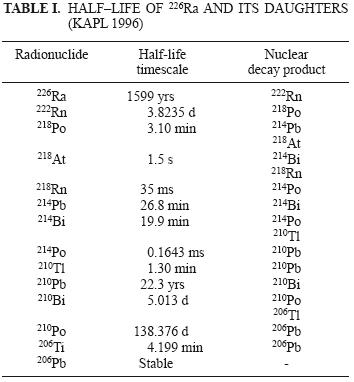
<body><![CDATA[<p align="justify"><font face="verdana" size="2"><b>Palabras clave:</b> simulaci&oacute;n, contaminaci&oacute;n de suelo, transporte, medio poroso.</font></p> 	    <p align="justify"><font face="verdana" size="2">&nbsp;</font></p> 	    <p align="justify"><font face="verdana" size="2"><b>INTRODUCTION</b></font></p> 	    <p align="justify"><font face="verdana" size="2">Soil contamination due to natural and anthropogenic pollutants is a global problem.</font></p> 	    <p align="justify"><font face="verdana" size="2">Soil pollution produces physical, chemical and biological imbalances affecting living beings.</font></p>     <p align="justify"><font face="verdana" size="2">Radioactive contaminants receive special attention due to their radiotoxicity and decay time. The decay of a radioactive element is a physical constant which is generally defined as the half life, which is the time it takes for the mass fraction of a given radionuclide to be reduced by a half.</font></p> 	    <p align="justify"><font face="verdana" size="2"><a href="#t1"><b>Table I</b></a> shows the <sup>226</sup>Ra radioactive decay chain and the half life of the various radionuclides involved.</font></p> 	    <p align="center"><font face="verdana" size="2"><a name="t1"></a></font></p> 	    <p align="center"><font face="verdana" size="2"><img src="/img/revistas/rica/v27n3/a6t1.jpg"></font></p> 	    <p align="justify"><font face="verdana" size="2">This work is focused on the <sup>226</sup>Ra radionuclide as a product of <sup>228</sup>U decay. The <sup>226</sup>Ra isotope is the most important uranium daughter in soil migration studies because it is the longest lived element and therefore is the most common nuclide in uranium tailings.</font></p> 	    ]]></body>
<body><![CDATA[<p align="justify"><font face="verdana" size="2">One of the greatest risks of soil contamination is that solid pollutants reach underground water. As an example, it is known that one Curie of <sup>90</sup>Sr dissolved in water could affect about 1000 liters of water making it unacceptable for public drinking (Stanley 1966).</font></p> 	    <p align="justify"><font face="verdana" size="2">Numerical simulation is a very powerful tool to understand the solute migration phenomena as it is necessary to predict processes for hundreds of years. This work is concerned with the modeling of a contaminant migration and decay through a porous saturated stratum. The hydrogeological conditions considered for the modeling correspond to those typically found in the north of M&eacute;xico.</font></p> 	    <p align="justify"><font face="verdana" size="2">A differential equation system representing this problem taking into consideration the boundaries and initial conditions was established. The equations of the system were solved using the finite element method. The software used for this purpose was COMSOL.</font></p> 	    <p align="justify"><font face="verdana" size="2">Results show that the evolution of a <sup>226</sup>Ra radioactive plume exhibits a bell shape when a source of contaminant is released in a finite time. A similar behavior could be found in the literature for a chemical agent dispersed in a porous media (Goltz 1986).</font></p> 	    <p align="justify"><font face="verdana" size="2">&nbsp;</font></p> 	    <p align="justify"><font face="verdana" size="2"><b>METHODOLOGY</b></font></p> 	    <p align="justify"><font face="verdana" size="2">Two approaches for simulating the solute migration are considered; the first one defines the solid matrix of the underground soil layers and then the laws of hydrodynamics are applied. In this case the simulated area is very small but large enough to consider pores as channels. In this case, it is difficult to represent both, the variation of hydrodynamic properties of the media space, and the definition of the same solid matrix of the porous media.</font></p> 	    <p align="justify"><font face="verdana" size="2">The second approach, also called Darcy&acute;s law, introduces a macroscopic concept that takes into account hydrodynamic properties that depends on the morphology and constitution of the medium. The flow of the fluid is considered to be a continuous process introducing an average value of the physical properties that characterize the porous media. These soil properties are considered into the Darcy&acute;s equation and other flow equations giving a very good estimate of the phenomenon over small and large dimensions.</font></p> 	    <p align="justify"><font face="verdana" size="2">The simulated diffusion of the contaminant dissolved in water flowing through the underground is based on the velocity field as the fluid migrates through the stratum.</font></p> 	    <p align="justify"><font face="verdana" size="2">Transport and diffusion of the contaminant in the subsoil is a three step process: 1) Molecular diffusion and hydrodynamic scattering are considered together as a hydrodynamic dispersion. Molecular diffusion is determined by the contaminant concentration gradients and considers longitudinal and transverse flows (Sudicky 1989), 2) Transport due to "drag" of contaminant particles in underground water, and 3) Radioactive decay.</font></p> 	    ]]></body>
<body><![CDATA[<p align="justify"><font face="verdana" size="2">The groundwater flow and solute transport equations are coupled to Darcy&acute;s diffusion formalism which assumes that the diffusion velocity is <i>u</i>= &#150;<i>k<img src="/img/revistas/rica/v27n3/a6s1.jpg">H</i>, where <i>k</i> is the permeability and H the hydraulic head. The velocity u is the fluid flow velocity from an infinitesimal surface that represents both the solid and the pore spaces. We first calculate the Darcy velocity field <i>u</i>=(<i>u,w</i>), where u and w are the velocities in the &times; and z directions, respectively. Then, assuming that the contaminant follows the previously obtained velocity field, the contaminant transport equation coupled to the nuclear isotope decay equation for the <sup>226</sup>Ra chain is solved.</font></p> 	    <p align="justify"><font face="verdana" size="2">According to Darcy, the fluid specific discharge rate through a porous material is proportional to the hydraulic head loss and is given by the equation (Fetter 1994):</font></p> 	    <p align="center"><font face="verdana" size="2"><img src="/img/revistas/rica/v27n3/a6e1.jpg"></font></p> 	    <p align="justify"><font face="verdana" size="2">where R is the water flow rate &#91;m/s&#93;.</font></p> 	    <p align="justify"><font face="verdana" size="2">Solute transport typically is a time&#150;dependent equation, and is described by the equation</font></p> 	    <p align="center"><font face="verdana" size="2"><img src="/img/revistas/rica/v27n3/a6e2.jpg"></font></p> 	    <p align="justify"><font face="verdana" size="2">where &#952;<sub>S</sub> is the porosity, <i>D<sub>L</sub></i> the hydrodynamic dispersion tensor &#91;m&sup2;/s&#93;, <i>C</i> the dissolved concentration &#91;kg/m&sup3;&#93;, <i>u</i> the Darcy&acute;s speed &#91;m/d&#93;, <i>t</i> the time &#91;s&#93;, and &#955; the radioactive decay rate &#91;s<sup>&#150;1</sup>&#93;.</font></p> 	    <p align="justify"><font face="verdana" size="2">The dispersion represents the solute spreading by mechanical mixing and molecular diffusion. The equations for the tensor entries are (Zheng and Wang 1998)</font></p> 	    <p align="center"><font face="verdana" size="2"><img src="/img/revistas/rica/v27n3/a6e3.jpg"></font></p> 	    <p align="justify"><font face="verdana" size="2">where &#952;<i>D<sub>ii</sub></i> are the principal components of the dispersion tensor based on the Darcy&acute;s velocity, &#952;<i>D<sub>ij</sub></i> and &#952;<i>D<sub>ji</sub></i> are the cross terms of the dispersion tensor, the subscript "L" denotes longitudinal dispersivity, "T" the transverse dispersivity, u = (<i>u<sub>i</sub><sup>2</sup>+u<sub>j</sub><sup>2</sup></i>)<sup>1/2</sup> is the magnitude of the Darcy&acute;s velocity vector, and <i>D<sub>m</sub></i> represents the effective molecular diffusion in a saturated porous media.</font></p> 	    ]]></body>
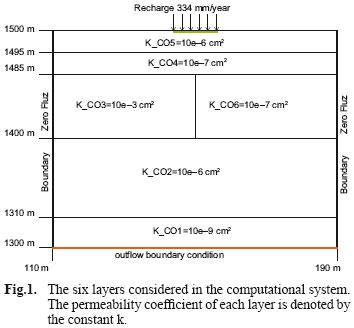
<body><![CDATA[<p align="justify"><font face="verdana" size="2">The <sup>226</sup>Ra decay chain is shown in <b><a href="#t1">Table I</a></b>. The disintegration rate is proportional to the number of nuclei present in the sample:</font></p> 	    <p align="center"><font face="verdana" size="2"><img src="/img/revistas/rica/v27n3/a6e4.jpg"></font></p> 	    <p align="justify"><font face="verdana" size="2">where N is the number of nuclei of the radioactive species present at time <i>t</i>, and, &#955;<sub>226</sub> = ln2/1599 (yrs<sup>&#150;1</sup>) for the <sup>226</sup>Ra <img src="/img/revistas/rica/v27n3/a6s2.jpg"> <sup>222</sup>Rn decay.</font></p> 	    <p align="justify"><font face="verdana" size="2">In this work is assumed that <sup>226</sup>Ra decays directly to the stable isotope <sup>206</sup>Pb, because all half&#150;life timescales from <sup>222</sup>Rn to <sup>206</sup>Ti are much shorter than for <sup>226</sup>Ra (see <b><a href="#t1">Table I</a></b>).</font></p> 	    <p align="justify"><font face="verdana" size="2">&nbsp;</font></p> 	    <p align="justify"><font face="verdana" size="2"><b>THE INPUT MODEL</b></font></p> 	    <p align="justify"><font face="verdana" size="2"><a href="#f1"><b>Figure 1</b></a> shows the configuration of the simulated system having hydrogeological conditions similar to those found in the north of M&eacute;xico. The dimensions of the simulated domain are 80 m wide and a depth of 200 m.</font></p> 	    <p align="center"><font face="verdana" size="2"><a name="f1"></a></font></p> 	    <p align="center"><font face="verdana" size="2"><img src="/img/revistas/rica/v27n3/a6f1.jpg"></font></p> 	    <p align="justify"><font face="verdana" size="2">The domain is constituted of six horizontal layers with different characteristics. The top layer is denoted as K_CO5 which corresponds to the surface soil layer. This is the layer where the <sup>226</sup>Ra is entering into the system and then filters to groundwater layers. The inflow velocity of 334.4 mm/year represents the rainfall per unit time in this site.</font></p> 	    ]]></body>

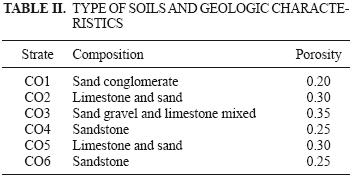
<body><![CDATA[<p align="justify"><font face="verdana" size="2">For the present simulation a saturated medium is considered; the fluid is a combination of water and dissolved contaminant, assumed not reactive and homogeneous.</font></p> 	    <p align="justify"><font face="verdana" size="2">The lithology of the system was characterized by different porosities for each layer within a range of 0.20 to 0.35, permeability between 10<sup>&#150;9</sup> to 10<sup>&#150;6</sup> cm<sup>2</sup>, a molecular diffusion coefficient of 1.34 &times; 10&#150;9 m<sup>2</sup>/s, a transverse dispersivity of 5 mm and a longitudinal dispersivity equal to 0.5 m as shown in <b><a href="#f1">Fig. 1</a></b> and <b><a href="#t2">table II</a></b>.</font></p> 	    <p align="center"><font face="verdana" size="2"><a name="t2"></a></font></p> 	    <p align="center"><font face="verdana" size="2"><img src="/img/revistas/rica/v27n3/a6t2.jpg"></font></p> 	    <p align="justify"><font face="verdana" size="2">The left and right boundaries along the z&#150;direction are located at x=110 m and x=190 m, respectively, where we impose the following Neumann zero flow condition:</font></p> 	    <p align="center"><font face="verdana" size="2"><img src="/img/revistas/rica/v27n3/a6e5.jpg"></font></p> 	    <p align="justify"><font face="verdana" size="2">where <i>n</i> is a unit vector normal to the boundary. This boundary condition implies that at the boundary the velocity is parallel to the boundary and that the x&#150;component of the velocity is zero, i.e. there is no fluid flow across the left and right boundaries.</font></p> 	    <p align="justify"><font face="verdana" size="2">From the top boundary (z=1500 m) water flows into the system at a rate of 334 mm/year; an inflow boundary condition that satisfies the Neumann condition is assumed and is written in the form</font></p> 	    <p align="center"><font face="verdana" size="2"><img src="/img/revistas/rica/v27n3/a6e6.jpg"></font></p> 	    <p align="justify"><font face="verdana" size="2">The top boundary condition for the hydraulic head corresponds to the Dirichlet condition</font></p> 	    ]]></body>
<body><![CDATA[<p align="center"><font face="verdana" size="2"><img src="/img/revistas/rica/v27n3/a6e7.jpg"></font></p> 	    <p align="justify"><font face="verdana" size="2">where <i>H</i><sub>0</sub> is the barometric hydraulic head.</font></p> 	    <p align="justify"><font face="verdana" size="2">In the bottom boundary (z=1300 m), an outflow boundary condition was imposed, assuming the derivatives of the variables that characterize the fluid are zero at the boundary.</font></p> 	    <p align="justify"><font face="verdana" size="2">For the transport equation, the initial and boundary conditions are given by Eqs. (8) to (11). In this work it is also assumed that the contaminant source is continuous over a period of fifty years and zero after this time. The solute transport condition for the top boundary is</font></p> 	    <p align="center"><font face="verdana" size="2"><img src="/img/revistas/rica/v27n3/a6e8.jpg"></font></p> 	    <p align="justify"><font face="verdana" size="2">where <i>C</i><sub>0</sub> is the concentration of <sup>226</sup>Ra that enters the system and has two values along of simulation: a) <i>C</i><sub>0</sub> = 1 &times; 10<sup>&#150;6</sup> kg/m<sup>3</sup> for 0 &lt; <i>t</i> &lt; 50 years and <i>C</i><sub>0</sub> = 0 for <i>t</i> &gt; 50 years. <i>C</i><sub>0</sub> indicates that a small amount of fluid (water + radionuclide) is injected to the system with a hydraulic recharge rate of 334.4 mm/year (product rain) from the time t=0 to t= 50 years, i.e. the injection of <sup>226</sup>Ra only occurs during the first fifty years, and afterwards the source is removed.</font></p> 	    <p align="justify"><font face="verdana" size="2">Equation (8) is applied only in the border segment 140 &lt; &times; &lt; 160 meters (see <b><a href="#f1">Fig. 1</a></b>); for the rest of the border the Neumann condition C(x,h,t) = 0 is applied.</font></p> 	    <p align="justify"><font face="verdana" size="2">The Dirichlet condition on the right and left boundaries is</font></p> 	    <p align="center"><font face="verdana" size="2"><img src="/img/revistas/rica/v27n3/a6e9.jpg"></font></p> 	    <p align="justify"><font face="verdana" size="2">The Neumann condition defines the zero flow boundaries:</font></p> 	    ]]></body>
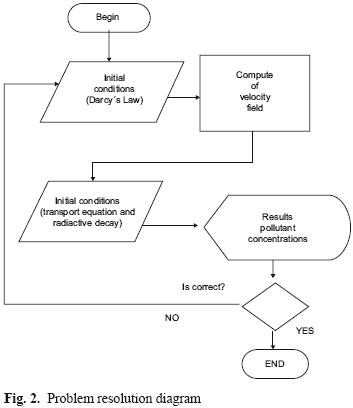
<body><![CDATA[<p align="center"><font face="verdana" size="2"><img src="/img/revistas/rica/v27n3/a6e10.jpg"></font></p> 	    <p align="justify"><font face="verdana" size="2">Finally, the initial condition indicating that the subsoil on the site is free of contaminants at the beginning of the simulation is</font></p> 	    <p align="center"><font face="verdana" size="2"><img src="/img/revistas/rica/v27n3/a6e11.jpg"></font></p> 	    <p align="justify"><font face="verdana" size="2">The initial concentration is zero elsewhere.</font></p> 	    <p align="justify"><font face="verdana" size="2">&nbsp;</font></p> 	    <p align="justify"><font face="verdana" size="2"><b>RESULTS AND DISCUSSION</b></font></p> 	    <p align="justify"><font face="verdana" size="2">Diffusion simulations of a contaminant dissolved in water flowing through the underground implies at least two types of physical analysis. For this case the hydro geological context is first solved, then using the velocity field, the behavior of the fluid through the stratum is simulated.</font></p> 	    <p align="justify"><font face="verdana" size="2">The methodology consists in first calculating the <sup>226</sup>Ra velocity field through the computational domain by solving the momentum and mass conservation equation using Darcy&acute;s Law. Then we solve the contaminant transport equation by the procedure shown in <b><a href="#f2">figure 2</a></b>, see below.</font></p> 	    <p align="center"><font face="verdana" size="2"><a name="f2"></a></font></p> 	    <p align="center"><font face="verdana" size="2"><img src="/img/revistas/rica/v27n3/a6f2.jpg"></font></p> 	    ]]></body>
<body><![CDATA[<p align="justify"><font face="verdana" size="2"><a href="/img/revistas/rica/v27n3/a6f3.jpg" target="_blank"><b>Figure 3</b></a> shows the pressure distribution and the velocity field in the system at two simulation times. Pressures are given in &#91;Pa&#93; showing its variations by a color table. Red corresponds to the maximum pressure. For the bottom panel of <b><a href="/img/revistas/rica/v27n3/a6f3.jpg" target="_blank">figure 3</a></b> the pressure reaches 6.651 &#91;Pa&#93;. The vectors represent the flow velocity field due to the pressure field. The magnitude is proportional to the length of the vector; the direction and sense are clearly indicated by the vector orientation.</font></p> 	    <p align="justify"><font face="verdana" size="2">It was also found that pressure and velocity achieves a steady state after a lapse of about two thousand years.</font></p> 	    <p align="justify"><font face="verdana" size="2">The top and bottom panels of <b><a href="/img/revistas/rica/v27n3/a6f3.jpg" target="_blank">figure 3</a></b> show a similar pattern for the velocity and pressure distributions at two different times. It can be seen that the fluid lines follows a pattern due to the pressure distribution and that the pressure depends on the hydrogeological characteristics of each layer; for example, the fluid velocity is faster in the K_CO3 layer due to the hydraulic high permeability assigned to this layer. This causes the pressure to increase on the right side of the system, specifically in the K_CO6 stratum.</font></p> 	    <p align="justify"><font face="verdana" size="2"><b><a href="/img/revistas/rica/v27n3/a6f4.jpg" target="_blank">Figure 4</a></b> shows the evolution of the <sup>226</sup>Ra plume as a function of time. The contaminant (<sup>226</sup>Ra) enters through a segment of the upper boundary of stratum K_CO5 for 140 &lt; &times; &lt; 160 meters, and <i>t</i>=0 to <i>t</i>=50 years. It can be seen that the <sup>226</sup>Ra is seeping through underground layers.</font></p>     <p align="justify"><font face="verdana" size="2">In the same <b><a href="/img/revistas/rica/v27n3/a6f4.jpg" target="_blank">figure 4</a></b> we show the amount of contaminant concentration in each point. Colors indicate the <sup>226</sup>Ra concentration degree. Red indicates a more intense concentration.</font></p> 	    <p align="justify"><font face="verdana" size="2">The concentration varies due to advection, diffusion, and additionally, suffers the effects of radioactive decay along its path.</font></p> 	    <p align="justify"><font face="verdana" size="2"><b><a href="/img/revistas/rica/v27n3/a6f4.jpg" target="_blank">Figure 4</a></b> (from top to bottom) shows that the flow is going towards the left boundary, but it is reversed as a result of the velocity boundary condition which requires that the x&#150;component of the velocity at the boundary be zero.</font></p> 	    <p align="justify"><font face="verdana" size="2">The remaining evolution of the contaminant is shown in the lower panels of <b><a href="/img/revistas/rica/v27n3/a6f4.jpg" target="_blank">figure 4</a></b>; the fluid "follows" jagged lines and widens in the x&#150;direction.</font></p> 	    <p align="justify"><font face="verdana" size="2"><a href="/img/revistas/rica/v27n3/a6f5.jpg" target="_blank"><b>Figure 5</b></a> shows the evolution of the contaminant concentration versus time at x=165, z=1300, which is located in the lower boundary of the system. It can be seen that the concentration of the contaminant at this point increases gradually with time until reaching a maximum at approximately 2.3 &times; 10<sup>10</sup> seconds (729 years) and then decreases exponentially. The enlargement of the plot (bottom panel of <b><a href="/img/revistas/rica/v27n3/a6f5.jpg" target="_blank">Fig. 5</a></b>), allows us to obtain a particular time estimated when the contaminant concentration reaches a significant value in the lower boundary of the system. The estimated value is 1.6 &times; 10<sup>10</sup> seconds, which is equivalent to 507 years.</font></p> 	    <p align="justify"><font face="verdana" size="2">For the first fifty years the <sup>226</sup>Ra concentration keeps increasing because this time is much shorter that the <sup>226</sup>Ra half&#150;life timescale. After this time the <sup>226</sup>Ra composition decays to zero. As mentioned before, all half&#150;life timescales from <sup>222</sup>Rn to <sup>206</sup>Ti are much shorter than for <sup>226</sup>Ra (see <b><a href="#t1">Table I</a></b>), and thus in the timescale of <b><a href="/img/revistas/rica/v27n3/a6f5.jpg" target="_blank">figure 5</a></b>, the final product is the stable isotope <sup>206</sup>Pb.</font></p> 	    ]]></body>
<body><![CDATA[<p align="justify"><font face="verdana" size="2">&nbsp;</font></p> 	    <p align="justify"><font face="verdana" size="2"><b>CONCLUSIONS</b></font></p> 	    <p align="justify"><font face="verdana" size="2">The migration and decay of a contaminant in soil of the type found in the North of M&eacute;xico has been simulated, allowing a better understanding of its underground behavior. The time required by the contaminant to reach the bottom of the lower stratum was estimated to be about five hundred years.</font></p> 	    <p align="justify"><font face="verdana" size="2">The particular flow obtained in the numerical simulation is due to the soil characteristics of the layers and the pressure distribution in the system.</font></p> 	    <p align="justify"><font face="verdana" size="2">Hydrogeological computer simulation studies will enable to assess not only the long time behavior of the contaminants, usually impossible to recreate by experiment, but also to evaluate the migration routes of radionuclides dissolved in water through the underground.</font></p> 	    <p align="justify"><font face="verdana" size="2">The model allows the estimation of the transport time, the dissolved contaminants concentration and their eventual arrival in aquifers with consequent contamination. Furthermore, the <sup>226</sup>Ra concentration curves follow a pattern similar to that reported in a field&#150;scale experiment of the migration of contaminants through a porous medium.</font></p> 	    <p align="justify"><font face="verdana" size="2">The numerical simulation presented in this work has captured the basic physical mechanism of the migration and decay of a contaminant as it moves through an underground porous medium. It is feasible to apply similar studies to assess the suitability of places for containment of contaminants as well as to identify factors that determine the amount of runoff water that could carry the contaminant, and characterize the hydraulic operation of water tanks or fluids.</font></p> 	    <p align="justify"><font face="verdana" size="2">&nbsp;</font></p> 	    <p align="justify"><font face="verdana" size="2"><b>REFERENCES</b></font></p> 	    <!-- ref --><p align="justify"><font face="verdana" size="2">Fetter C.W. (1994). <i>Applied Hydro&#150;geology</i>. Prentice&#150;Hall.    &nbsp;&nbsp;&nbsp;&nbsp;&nbsp;&nbsp;&nbsp;&nbsp;[&#160;<a href="javascript:void(0);" onclick="javascript: window.open('/scielo.php?script=sci_nlinks&ref=7206350&pid=S0188-4999201100030000600001&lng=','','width=640,height=500,resizable=yes,scrollbars=1,menubar=yes,');">Links</a>&#160;]<!-- end-ref --></font></p> 	    <!-- ref --><p align="justify"><font face="verdana" size="2">Goltz M.N. and Roberts P.V. (1986). Interpreting organic solute transport data from a field experiment using physical nonequilibrium models. J. Contam. Hydrol. 1, 77&#150;93.    &nbsp;&nbsp;&nbsp;&nbsp;&nbsp;&nbsp;&nbsp;&nbsp;[&#160;<a href="javascript:void(0);" onclick="javascript: window.open('/scielo.php?script=sci_nlinks&ref=7206352&pid=S0188-4999201100030000600002&lng=','','width=640,height=500,resizable=yes,scrollbars=1,menubar=yes,');">Links</a>&#160;]<!-- end-ref --></font></p> 	    <!-- ref --><p align="justify"><font face="verdana" size="2">KAPL (1996). <i>Chart of the Nuclides</i>, Fifteenth edition. Knolls Atomic Power Laboratory and Lockheed Martin Company.    &nbsp;&nbsp;&nbsp;&nbsp;&nbsp;&nbsp;&nbsp;&nbsp;[&#160;<a href="javascript:void(0);" onclick="javascript: window.open('/scielo.php?script=sci_nlinks&ref=7206354&pid=S0188-4999201100030000600003&lng=','','width=640,height=500,resizable=yes,scrollbars=1,menubar=yes,');">Links</a>&#160;]<!-- end-ref --></font></p> 	    <!-- ref --><p align="justify"><font face="verdana" size="2">Stanley N.D. (1966) Hydrogeology. Wiley, New York, 464 pp.    &nbsp;&nbsp;&nbsp;&nbsp;&nbsp;&nbsp;&nbsp;&nbsp;[&#160;<a href="javascript:void(0);" onclick="javascript: window.open('/scielo.php?script=sci_nlinks&ref=7206356&pid=S0188-4999201100030000600004&lng=','','width=640,height=500,resizable=yes,scrollbars=1,menubar=yes,');">Links</a>&#160;]<!-- end-ref --></font></p> 	    <!-- ref --><p align="justify"><font face="verdana" size="2">Sudicky E. A. (1989). The Laplace transform Galerkin technique: application to mass transport in groundwater. Water Resour. Res. 25, 1833&#150;1846.    &nbsp;&nbsp;&nbsp;&nbsp;&nbsp;&nbsp;&nbsp;&nbsp;[&#160;<a href="javascript:void(0);" onclick="javascript: window.open('/scielo.php?script=sci_nlinks&ref=7206358&pid=S0188-4999201100030000600005&lng=','','width=640,height=500,resizable=yes,scrollbars=1,menubar=yes,');">Links</a>&#160;]<!-- end-ref --></font></p> 	    <!-- ref --><p align="justify"><font face="verdana" size="2">Zheng C. and Wang P. (1998). MT3DMS: A modular three&#150;dimensional multispecies transport model for simulation of advection, dispersion and chemical reactions of contaminants in groundwater systems. University of Alabama, 239 p.    &nbsp;&nbsp;&nbsp;&nbsp;&nbsp;&nbsp;&nbsp;&nbsp;[&#160;<a href="javascript:void(0);" onclick="javascript: window.open('/scielo.php?script=sci_nlinks&ref=7206360&pid=S0188-4999201100030000600006&lng=','','width=640,height=500,resizable=yes,scrollbars=1,menubar=yes,');">Links</a>&#160;]<!-- end-ref --></font></p>      ]]></body><back>
<ref-list>
<ref id="B1">
<nlm-citation citation-type="book">
<person-group person-group-type="author">
<name>
<surname><![CDATA[Fetter]]></surname>
<given-names><![CDATA[C.W.]]></given-names>
</name>
</person-group>
<source><![CDATA[Applied Hydro-geology]]></source>
<year>1994</year>
<publisher-name><![CDATA[Prentice-Hall]]></publisher-name>
</nlm-citation>
</ref>
<ref id="B2">
<nlm-citation citation-type="journal">
<person-group person-group-type="author">
<name>
<surname><![CDATA[Goltz]]></surname>
<given-names><![CDATA[M.N]]></given-names>
</name>
<name>
<surname><![CDATA[Roberts]]></surname>
<given-names><![CDATA[P.V]]></given-names>
</name>
</person-group>
<article-title xml:lang="en"><![CDATA[Interpreting organic solute transport data from a field experiment using physical nonequilibrium models]]></article-title>
<source><![CDATA[J. Contam. Hydrol]]></source>
<year>1986</year>
<volume>1</volume>
<page-range>77-93</page-range></nlm-citation>
</ref>
<ref id="B3">
<nlm-citation citation-type="book">
<collab>KAPL</collab>
<source><![CDATA[Chart of the Nuclides]]></source>
<year>1996</year>
<edition>Fifteenth</edition>
<publisher-name><![CDATA[Knolls Atomic Power Laboratory and Lockheed Martin Company]]></publisher-name>
</nlm-citation>
</ref>
<ref id="B4">
<nlm-citation citation-type="book">
<person-group person-group-type="author">
<name>
<surname><![CDATA[Stanley]]></surname>
<given-names><![CDATA[N.D.]]></given-names>
</name>
</person-group>
<source><![CDATA[Hydrogeology]]></source>
<year>1966</year>
<page-range>464</page-range><publisher-loc><![CDATA[New York ]]></publisher-loc>
<publisher-name><![CDATA[Wiley]]></publisher-name>
</nlm-citation>
</ref>
<ref id="B5">
<nlm-citation citation-type="journal">
<person-group person-group-type="author">
<name>
<surname><![CDATA[Sudicky]]></surname>
<given-names><![CDATA[E. A]]></given-names>
</name>
</person-group>
<article-title xml:lang="en"><![CDATA[The Laplace transform Galerkin technique: application to mass transport in groundwater]]></article-title>
<source><![CDATA[Water Resour. Res]]></source>
<year>1989</year>
<volume>25</volume>
<page-range>1833-1846</page-range></nlm-citation>
</ref>
<ref id="B6">
<nlm-citation citation-type="book">
<person-group person-group-type="author">
<name>
<surname><![CDATA[Zheng]]></surname>
<given-names><![CDATA[C.]]></given-names>
</name>
<name>
<surname><![CDATA[Wang]]></surname>
<given-names><![CDATA[P.]]></given-names>
</name>
</person-group>
<source><![CDATA[MT3DMS: A modular three-dimensional multispecies transport model for simulation of advection, dispersion and chemical reactions of contaminants in groundwater systems]]></source>
<year>1998</year>
<page-range>239</page-range><publisher-name><![CDATA[University of Alabama]]></publisher-name>
</nlm-citation>
</ref>
</ref-list>
</back>
</article>