<?xml version="1.0" encoding="ISO-8859-1"?><article xmlns:mml="http://www.w3.org/1998/Math/MathML" xmlns:xlink="http://www.w3.org/1999/xlink" xmlns:xsi="http://www.w3.org/2001/XMLSchema-instance">
<front>
<journal-meta>
<journal-id>0188-4611</journal-id>
<journal-title><![CDATA[Investigaciones geográficas]]></journal-title>
<abbrev-journal-title><![CDATA[Invest. Geog]]></abbrev-journal-title>
<issn>0188-4611</issn>
<publisher>
<publisher-name><![CDATA[Universidad Nacional Autónoma de México, Instituto de Geografía]]></publisher-name>
</publisher>
</journal-meta>
<article-meta>
<article-id>S0188-46112015000100002</article-id>
<article-id pub-id-type="doi">10.14350/rig.42003</article-id>
<title-group>
<article-title xml:lang="es"><![CDATA[Red dendrocronológica del pino de altura (Pinus hartwegii Lindl.) para estudios dendroclimáticos en el noreste y centro de México]]></article-title>
<article-title xml:lang="en"><![CDATA[Dendrochronological Network of Mountain Pine (Pinus hartwegii Lindl.) for dendroclimatic studies in Northeastern and Central Mexico]]></article-title>
</title-group>
<contrib-group>
<contrib contrib-type="author">
<name>
<surname><![CDATA[Villanueva Díaz]]></surname>
<given-names><![CDATA[José]]></given-names>
</name>
<xref ref-type="aff" rid="A01"/>
</contrib>
<contrib contrib-type="author">
<name>
<surname><![CDATA[Cerano Paredes]]></surname>
<given-names><![CDATA[Julián]]></given-names>
</name>
<xref ref-type="aff" rid="A01"/>
</contrib>
<contrib contrib-type="author">
<name>
<surname><![CDATA[Vázquez Selem]]></surname>
<given-names><![CDATA[Lorenzo]]></given-names>
</name>
<xref ref-type="aff" rid="A02"/>
</contrib>
<contrib contrib-type="author">
<name>
<surname><![CDATA[Stahle]]></surname>
<given-names><![CDATA[David W.]]></given-names>
</name>
<xref ref-type="aff" rid="A03"/>
</contrib>
<contrib contrib-type="author">
<name>
<surname><![CDATA[Fulé]]></surname>
<given-names><![CDATA[Peter Z.]]></given-names>
</name>
<xref ref-type="aff" rid="A05"/>
</contrib>
<contrib contrib-type="author">
<name>
<surname><![CDATA[Yocom]]></surname>
<given-names><![CDATA[Larissa L.]]></given-names>
</name>
<xref ref-type="aff" rid="A05"/>
</contrib>
<contrib contrib-type="author">
<name>
<surname><![CDATA[Franco Ramos]]></surname>
<given-names><![CDATA[Osvaldo]]></given-names>
</name>
<xref ref-type="aff" rid="A02"/>
</contrib>
<contrib contrib-type="author">
<name>
<surname><![CDATA[Ruiz Corral]]></surname>
<given-names><![CDATA[José Ariel]]></given-names>
</name>
<xref ref-type="aff" rid="A04"/>
</contrib>
</contrib-group>
<aff id="A01">
<institution><![CDATA[,Instituto Nacional de Investigaciones Forestales Agrícolas y Pecuarias Centro Nacional de Investigación Disciplinaria en Relación Agua, Suelo, Planta, Atmósfera ]]></institution>
<addr-line><![CDATA[Gómez Palacio Durango]]></addr-line>
<country>México</country>
</aff>
<aff id="A02">
<institution><![CDATA[,Universidad Nacional Autónoma de México Instituto de Geografía Departamento de Geografía Física]]></institution>
<addr-line><![CDATA[México Distrito Federal]]></addr-line>
<country>México</country>
</aff>
<aff id="A03">
<institution><![CDATA[,University of Arkansas Department of Geosciences Tree-Ring Laboratory]]></institution>
<addr-line><![CDATA[Fayetteville Arkansas]]></addr-line>
<country>Estados Unidos de América</country>
</aff>
<aff id="A04">
<institution><![CDATA[,Instituto Nacional de Investigaciones Forestales, Agrícolas y Pecuarias  ]]></institution>
<addr-line><![CDATA[Tepatitlán Jalisco]]></addr-line>
<country>México</country>
</aff>
<aff id="A05">
<institution><![CDATA[,Northern Arizona University School of Forestry ]]></institution>
<addr-line><![CDATA[Flagstaff Arizona]]></addr-line>
<country>Estados Unidos de América</country>
</aff>
<pub-date pub-type="pub">
<day>00</day>
<month>00</month>
<year>2015</year>
</pub-date>
<pub-date pub-type="epub">
<day>00</day>
<month>00</month>
<year>2015</year>
</pub-date>
<numero>86</numero>
<fpage>5</fpage>
<lpage>14</lpage>
<copyright-statement/>
<copyright-year/>
<self-uri xlink:href="http://www.scielo.org.mx/scielo.php?script=sci_arttext&amp;pid=S0188-46112015000100002&amp;lng=en&amp;nrm=iso"></self-uri><self-uri xlink:href="http://www.scielo.org.mx/scielo.php?script=sci_abstract&amp;pid=S0188-46112015000100002&amp;lng=en&amp;nrm=iso"></self-uri><self-uri xlink:href="http://www.scielo.org.mx/scielo.php?script=sci_pdf&amp;pid=S0188-46112015000100002&amp;lng=en&amp;nrm=iso"></self-uri><abstract abstract-type="short" xml:lang="es"><p><![CDATA[El bosque de Pinus hartwegii constituye el límite superior arbóreo en las montañas de México. En este estudio se desarrolló una red de cronologías de esta especie, localizadas en volcanes del Eje Neovolcánico Transversal, en el centro del país, y picos elevados de la Sierra Madre Oriental, en el noreste. El Análisis de Componentes Principales integró las cronologías en dos grupos, uno para el centro y otro para el noreste, con los que se desarrollaron dos cronologías regionales de 320 años (1690-2009) y 590 años (1420- 2009), respectivamente. El fenómeno de El Niño Oscilación del Sur (ENSO) en su fase cálida (El Niño) y fría (La Niña), mostró un impacto significativo en el comportamiento de la variabilidad hidroclimática descrita por ambas series. La Niña produjo condiciones climáticas contrastantes, es decir, secas en el noreste y húmedas en el centro, mientras que la fase de El Niño originó sequías en ambas regiones, pero solo durante eventos intensos de ENSO.]]></p></abstract>
<abstract abstract-type="short" xml:lang="en"><p><![CDATA[Pinus hartwegii is a high elevation species forming the upper treeline in Mexico- from volcanoes of the Transmexican Volcanic Belt in central Mexico and from high elevation peaks of the Sierra Madre Oriental in northeastern Mexico. Pure stands of hartwegii pine have been severely logged in the past affecting the proper functioning of the ecosystem, impacting water yield, biodiversity, and other ecosystem services in detriment of the wellbeing of dense human settlements in the Valley of Mexico. In addition to land-use changes, climate warming may threat this ecosystem by altering their health, favoring the recruitment over the treeline where is not adapted, and affecting its dynamics, growth rates, and ecological relationships with associated species. Given the dendrochronological potential of hartwegii pine to produce centuries-long time series useful to analyze high and low frequency climate variability, and influence of atmospheric circulatory patterns, the objective of this study was to develop a network of treering chronologies for central and northeastern Mexico, analyze its potential for dendroclimatic reconstructions and to determine the potential impact and teleconnections of atmospheric circulatory patterns. Nine ring-width series of hartwegii pine were developed for the upper conifer forest of some of the main volcanic peaks in the Valley of Mexico and two more series were produced from trees located at the highest peaks in the Sierra Madre Oriental. A Principal Component Analysis of the chronologies defined two eigenvectors with the highest climate variability, the first component integrated several chronologies from central Mexico, e.g., Nevado de Colima, Pico de Orizaba, Iztaccihuatl, and la Malinche, and the second component from northeastern Mexico included Cerro Potosí, N.L. and Cerro La Viga, Coahuila. The chronologies with a common climate response were integrated into representative regional ring-width series, one of them was the chronology for the Transmexican Volcanic Belt with 320 years length (1690- 2009), whereas the one for the northeastern region covered the last 590 years (1420-2009). The regional chronology for central Mexico indicated below normal growth (<1.0) as related to droughts for the periods 1698-1702, 1716- 1720, 1746-1760, 1806-1813, 1841-1859, 1890-1894, 1935-1940, 1970-1979, and 2000-2004. Similarly, below normal growth for the northeastern ring-width series took place in periods 1450-1460, 1508-1538, 1565-1576, 1661- 1673, 1696-1705, 1757-1765, 1784-1790, 1804-1808, 1844-1849, 1866-1894, 1915-1933, and 1998-2003. Wet episodes (&gt;1.0) were common in both representative series for the periods 1726 to 1728, 1753 to 1755, 1791 to 1797, 1831 to 1837, 1895 to 1914, 1923 to 1926, 1940 to 1941, 1957 to 1958, 1965 to 1969, 1985 to 1987, and 2001 to 2005. Verification of some of the detected droughts was done by comparisons with historical records of grain yields, colonial rogation ceremony records, dendroclimatic reconstructions, instrumental climate data, and climatic indices (Palmer Drought Severity Index, Southern Oscillation Index, Tropical Rainfall Index). Contrasting the regional ring-width indices for the common period (1690-2009) did not show a significant association (r= 0.087, p<0.05), however, both regional dendrochronological series responded to dry and wet episodes for particular years and showed opposite conditions (dipole) for some other years (i.e., wet in the center, dry in the north, and vice versa). This finding indicates that the chronologies responded mostly to local or regional climatic conditions but in certain periods may have been impacted by circulatory patterns affecting larger areas in northern and central Mexico. ENSO is the most important phenomena determining climatic differences between regions. In this study, the Niña conditions (cold phase) was characterized by producing dry conditions in the north and wet conditions in central Mexico (periods 1869 to 1874, 1886 to 1887, 1915 to 1917, 1955 to 1956, 1970 to 1975, and 1988 to 1999); however, other Niña events produced droughts in both regions as in years 1892, 1893, 1922, 1942, and 1998; but others did not have any significant impact such, i.e., 1903, 1908-1910, 1924, 1949, 1954, 1964, and 2007. On the other hand, the El Niño (warm phase) produced dry conditions in both regions, but only during intense ENSO events, that is 1880, 1888, 1899, 1905, 1913, 1918, 1929-1930, 1940, 1963, 1970, 1972, 1976, 1983, 1991, and 1997. A comparison between the ring-with indices of the regional chronology representative of the Transmexican Volcanic Belt and a seasonal (January- September) mean precipitation for the region indicated a significant association (r= 0.8, p<0.000) between both variables. It was not found a significant association with temperature. Even though temperature at high elevations may limit physiological processes for the species, precipitation seems to be the most limiting factor for growth. The wide distribution range of hartwegii pine from Mexico to Guatemala provides an excellent opportunity to expand the current network of treeline chronologies to better understand climate variability and impacts of climate change.]]></p></abstract>
<kwd-group>
<kwd lng="es"><![CDATA[Dendrocronología]]></kwd>
<kwd lng="es"><![CDATA[Pinus hartwegii]]></kwd>
<kwd lng="es"><![CDATA[El Niño]]></kwd>
<kwd lng="es"><![CDATA[La Niña]]></kwd>
<kwd lng="es"><![CDATA[sequía]]></kwd>
<kwd lng="en"><![CDATA[Dendrochronology]]></kwd>
<kwd lng="en"><![CDATA[Pinus hartwegii]]></kwd>
<kwd lng="en"><![CDATA[El Niño]]></kwd>
<kwd lng="en"><![CDATA[La Niña]]></kwd>
<kwd lng="en"><![CDATA[drought]]></kwd>
</kwd-group>
</article-meta>
</front><body><![CDATA[  	    <p align="justify"><font face="verdana" size="4">Geograf&iacute;a f&iacute;sica</font></p>  	    <p>&nbsp;</p>  	    <p align="center"><font face="verdana" size="4"><b>Red dendrocronol&oacute;gica del pino de altura (<i>Pinus hartwegii</i> Lindl.) para estudios dendroclim&aacute;ticos en el noreste y centro de M&eacute;xico</b></font></p>  	    <p>&nbsp;</p>  	    <p align="center"><font face="verdana" size="3"><b>Dendrochronological Network of Mountain Pine (<i>Pinus hartwegii</i> Lindl.) for dendroclimatic studies in Northeastern and Central Mexico</b></font></p>  	    <p>&nbsp;</p>  	    <p align="center"><font face="verdana" size="2"><b>Jos&eacute; Villanueva D&iacute;az* Juli&aacute;n Cerano Paredes* Lorenzo V&aacute;zquez Selem** David W. Stahle*** Peter Z. Ful&eacute;++ Larissa L. Yocom++    <br> 	Osvaldo Franco Ramos** Jos&eacute; Ariel Ruiz Corral+</b></font></p>  	    <p>&nbsp;</p>  	    ]]></body>
<body><![CDATA[<p align="justify"><font face="verdana" size="2"><i>* INIFAP CENID RASPA, Km 6.5 Margen Derecha del Canal Sacramento, G&oacute;mez Palacio, Durango. E&#45;mail: <a href="mailto:villanueva.jose@inifap.gob.mx">villanueva.jose@inifap.gob.mx</a>; <a href="mailto:cerano.julian@inifap.gob.mx">cerano.julian@inifap.gob.mx</a></i></font></p>  	    <p align="justify"><font face="verdana" size="2"><i>** Departamento de Geograf&iacute;a F&iacute;sica, Instituto de Geograf&iacute;a, Universidad Nacional Aut&oacute;noma de M&eacute;xico, Circuito de la Investigaci&oacute;n Cient&iacute;fica, Ciudad Universitaria, Coyoac&aacute;n, 04510, M&eacute;xico, D. F. E&#45;mail: <a href="mailto:lselem@igg.unam.mx">lselem@igg.unam.mx</a>; </i><a href="mailto:froarc@yahoo.com.mx"><i>froarc@yahoo.com.mx</i></a></font></p>  	    <p align="justify"><font face="verdana" size="2"><i>*** Tree&#45;Ring Laboratory, Department of Geosciences, University of Arkansas, Fayetteville, AR 72701, EUA. E&#45;mail: <a href="mailto:dstahle@uark.edu">dstahle@uark.edu</a></i></font></p>  	    <p align="justify"><font face="verdana" size="2"><i>+ INIFAP, C.E. "Altos de Jalisco" CIRPAC, Km. 8, Carretera Libre Tepatitl&aacute;n&#45;Lagos de Moreno, Tepatitl&aacute;n de Morelos, Jalisco, M&eacute;xico. E&#45;mail: <a href="mailto:ruiz.ariel@inifap.gob.mx">ruiz.ariel@inifap.gob.mx</a></i></font></p>  	    <p align="justify"><font face="verdana" size="2"><i>++ School of Forestry, Northern Arizona University, Flagstaff, AZ 86011, EUA. E&#45;mail: <a href="mailto:pete.fule@nau.edu">pete.fule@nau.edu</a>; <a href="mailto:Larissa.yocom@nau.edu">Larissa.yocom@nau.edu</a></i></font></p>  	    <p>&nbsp;</p>  	    <p align="justify"><font face="verdana" size="2">Recibido: 18 de septiembre de 2013.    <br> 	Aceptado en versi&oacute;n final: 20 de diciembre de 2013.</font></p>  	    <p>&nbsp;</p>  	    <p align="justify"><font face="verdana" size="2"><b>Resumen</b></font></p>  	    ]]></body>
<body><![CDATA[<p align="justify"><font face="verdana" size="2">El bosque de <i>Pinus hartwegii</i> constituye el l&iacute;mite superior arb&oacute;reo en las monta&ntilde;as de M&eacute;xico. En este estudio se desarroll&oacute; una red de cronolog&iacute;as de esta especie, localizadas en volcanes del Eje Neovolc&aacute;nico Transversal, en el centro del pa&iacute;s, y picos elevados de la Sierra Madre Oriental, en el noreste. El An&aacute;lisis de Componentes Principales integr&oacute; las cronolog&iacute;as en dos grupos, uno para el centro y otro para el noreste, con los que se desarrollaron dos cronolog&iacute;as regionales de 320 a&ntilde;os (1690&#45;2009) y 590 a&ntilde;os (1420&#45; 2009), respectivamente. El fen&oacute;meno de El Ni&ntilde;o Oscilaci&oacute;n del Sur (ENSO) en su fase c&aacute;lida (El Ni&ntilde;o) y fr&iacute;a (La Ni&ntilde;a), mostr&oacute; un impacto significativo en el comportamiento de la variabilidad hidroclim&aacute;tica descrita por ambas series. La Ni&ntilde;a produjo condiciones clim&aacute;ticas contrastantes, es decir, secas en el noreste y h&uacute;medas en el centro, mientras que la fase de El Ni&ntilde;o origin&oacute; sequ&iacute;as en ambas regiones, pero solo durante eventos intensos de ENSO.</font></p>  	    <p align="justify"><font face="verdana" size="2"><b>Palabras clave:</b> Dendrocronolog&iacute;a, <i>Pinus hartwegii</i>, El Ni&ntilde;o, La Ni&ntilde;a, sequ&iacute;a.</font></p>  	    <p align="justify">&nbsp;</p> 	    <p align="justify"><font face="verdana" size="2"><b>Abstract</b></font></p>  	    <p align="justify"><font face="verdana" size="2"><i>Pinus hartwegii</i> is a high elevation species forming the upper treeline in Mexico&#45; from volcanoes of the Transmexican Volcanic Belt in central Mexico and from high elevation peaks of the Sierra Madre Oriental in northeastern Mexico. Pure stands of hartwegii pine have been severely logged in the past affecting the proper functioning of the ecosystem, impacting water yield, biodiversity, and other ecosystem services in detriment of the wellbeing of dense human settlements in the Valley of Mexico. In addition to land&#45;use changes, climate warming may threat this ecosystem by altering their health, favoring the recruitment over the treeline where is not adapted, and affecting its dynamics, growth rates, and ecological relationships with associated species. Given the dendrochronological potential of hartwegii pine to produce centuries&#45;long time series useful to analyze high and low frequency climate variability, and influence of atmospheric circulatory patterns, the objective of this study was to develop a network of treering chronologies for central and northeastern Mexico, analyze its potential for dendroclimatic reconstructions and to determine the potential impact and teleconnections of atmospheric circulatory patterns. Nine ring&#45;width series of hartwegii pine were developed for the upper conifer forest of some of the main volcanic peaks in the Valley of Mexico and two more series were produced from trees located at the highest peaks in the Sierra Madre Oriental. A Principal Component Analysis of the chronologies defined two eigenvectors with the highest climate variability, the first component integrated several chronologies from central Mexico, e.g., Nevado de Colima, Pico de Orizaba, Iztaccihuatl, and la Malinche, and the second component from northeastern Mexico included Cerro Potos&iacute;, N.L. and Cerro La Viga, Coahuila. The chronologies with a common climate response were integrated into representative regional ring&#45;width series, one of them was the chronology for the Transmexican Volcanic Belt with 320 years length (1690&#45; 2009), whereas the one for the northeastern region covered the last 590 years (1420&#45;2009). The regional chronology for central Mexico indicated below normal growth (&lt;1.0) as related to droughts for the periods 1698&#45;1702, 1716&#45; 1720, 1746&#45;1760, 1806&#45;1813, 1841&#45;1859, 1890&#45;1894, 1935&#45;1940, 1970&#45;1979, and 2000&#45;2004. Similarly, below normal growth for the northeastern ring&#45;width series took place in periods 1450&#45;1460, 1508&#45;1538, 1565&#45;1576, 1661&#45; 1673, 1696&#45;1705, 1757&#45;1765, 1784&#45;1790, 1804&#45;1808, 1844&#45;1849, 1866&#45;1894, 1915&#45;1933, and 1998&#45;2003. Wet episodes (&gt;1.0) were common in both representative series for the periods 1726 to 1728, 1753 to 1755, 1791 to 1797, 1831 to 1837, 1895 to 1914, 1923 to 1926, 1940 to 1941, 1957 to 1958, 1965 to 1969, 1985 to 1987, and 2001 to 2005. Verification of some of the detected droughts was done by comparisons with historical records of grain yields, colonial rogation ceremony records, dendroclimatic reconstructions, instrumental climate data, and climatic indices (Palmer Drought Severity Index, Southern Oscillation Index, Tropical Rainfall Index). Contrasting the regional ring&#45;width indices for the common period (1690&#45;2009) did not show a significant association (r= 0.087, p&lt;0.05), however, both regional dendrochronological series responded to dry and wet episodes for particular years and showed opposite conditions (dipole) for some other years (i.e., wet in the center, dry in the north, and vice versa). This finding indicates that the chronologies responded mostly to local or regional climatic conditions but in certain periods may have been impacted by circulatory patterns affecting larger areas in northern and central Mexico. ENSO is the most important phenomena determining climatic differences between regions. In this study, the Ni&ntilde;a conditions (cold phase) was characterized by producing dry conditions in the north and wet conditions in central Mexico (periods 1869 to 1874, 1886 to 1887, 1915 to 1917, 1955 to 1956, 1970 to 1975, and 1988 to 1999); however, other Ni&ntilde;a events produced droughts in both regions as in years 1892, 1893, 1922, 1942, and 1998; but others did not have any significant impact such, i.e., 1903, 1908&#45;1910, 1924, 1949, 1954, 1964, and 2007. On the other hand, the El Ni&ntilde;o (warm phase) produced dry conditions in both regions, but only during intense ENSO events, that is 1880, 1888, 1899, 1905, 1913, 1918, 1929&#45;1930, 1940, 1963, 1970, 1972, 1976, 1983, 1991, and 1997. A comparison between the ring&#45;with indices of the regional chronology representative of the Transmexican Volcanic Belt and a seasonal (January&#45; September) mean precipitation for the region indicated a significant association (r= 0.8, p&lt;0.000) between both variables. It was not found a significant association with temperature. Even though temperature at high elevations may limit physiological processes for the species, precipitation seems to be the most limiting factor for growth. The wide distribution range of hartwegii pine from Mexico to Guatemala provides an excellent opportunity to expand the current network of treeline chronologies to better understand climate variability and impacts of climate change.</font></p>  	    <p align="justify"><font face="verdana" size="2"><b>Key words:</b> Dendrochronology, <i>Pinus hartwegii</i>, El Ni&ntilde;o, La Ni&ntilde;a, drought.</font></p>  	    <p>&nbsp;</p>  	    <p align="justify"><font face="verdana" size="2"><b>Introducci&oacute;n</b></font></p>  	    <p align="justify"><font face="verdana" size="2">Los estudios dendrocronol&oacute;gicos son cada vez m&aacute;s comunes en M&eacute;xico, particularmente en bosques de con&iacute;feras del g&eacute;nero <i>Pinus</i>, debido a la capacidad de sus especies para producir anillos de crecimiento anual bien definidos (Stahle <i>et al.</i>, 2000). Una de las especies de pino que se desarrolla en las partes altas de las monta&ntilde;as de M&eacute;xico y Guatemala es el pino de altura (<i>Pinus hartwegii</i> Lindl, sin&oacute;nimo con <i>Pinus rudis</i>), que constituye el l&iacute;mite superior arb&oacute;reo (<i>treeline</i>), a elevaciones de 2 300 a 4 300 m (Beaman, 1962; Lauer, 1978; Matos, 1995; Farj&oacute;n <i>et al.</i>, 1997) y temperaturas medias anuales de 6 a 7&ordm; C (K&ouml;rner y Paulsen, 2004).</font></p>  	    <p align="justify"><font face="verdana" size="2">El inter&eacute;s de conservar estas masas forestales no solo se relaciona con la producci&oacute;n de biomasa comercial, sino tambi&eacute;n con los servicios ambientales hidrol&oacute;gicos y de captura de carbono, de los cuales se benefician los grandes asentamientos humanos del centro de M&eacute;xico y sin los cuales ser&iacute;a dif&iacute;cil asegurar su permanencia (V&aacute;zquez, 2010).</font></p>  	    ]]></body>
<body><![CDATA[<p align="justify"><font face="verdana" size="2">La importancia de desarrollar una red dendrocronol&oacute;gica de <i>Pinus hartwegii</i> en M&eacute;xico ha sido reconocida por diversos investigadores (Biondi, 2001; Biondi <i>et al.</i>, 2009; Villanueva <i>et al.</i>, 2010a; Yocom <i>et al.</i>, 2010), debido a su potencial dendroclim&aacute;tico y de reconstrucci&oacute;n de incendios, as&iacute; como por el posible impacto del calentamiento global en el reclutamiento de espec&iacute;menes arriba de su l&iacute;mite arb&oacute;reo. Los modelos del Panel Intergubernamental sobre el Cambio Clim&aacute;tico (IPCC, por sus siglas en ingl&eacute;s) para diversos escenarios clim&aacute;ticos, sugieren un incremento en la temperatura y una reducci&oacute;n en la precipitaci&oacute;n para el norte y centro de M&eacute;xico (Seager <i>et al.</i>, 2009; Stahle <i>et al.</i>, 2012), situaci&oacute;n que impactar&iacute;a en primera instancia a especies en su l&iacute;mite de distribuci&oacute;n altitudinal, como es el caso de <i>P. hartwegii</i> (Ricker <i>et al.</i>, 2007). Por lo anterior, los objetivos de este estudio son contrastar los resultados derivados de la red dendrocronol&oacute;gica desarrollada con esta especie en diversas monta&ntilde;as del centro y del noreste de M&eacute;xico, analizar su potencial para reconstrucciones dendroclim&aacute;ticas, y explorar las causas de la variabilidad hidroclim&aacute;tica hist&oacute;rica de esta regi&oacute;n, en particular, la influencia del fen&oacute;meno El Ni&ntilde;o&ntilde;Oscilaci&oacute;n del Sur (ENSO, por sus siglas en ingl&eacute;s).</font></p>  	    <p>&nbsp;</p>  	    <p align="justify"><font face="verdana" size="2"><b>Materiales y M&eacute;todos</b></font></p>  	    <p align="justify"><font face="verdana" size="2">La ubicaci&oacute;n de rodales de <i>Pinus hartwegii</i> con fines dendrocronol&oacute;gicos se fundament&oacute; en estudios descriptivos de la distribuci&oacute;n de la especie (Farjon <i>et al.</i>, 1997), comunicaci&oacute;n directa y retroalimentaci&oacute;n con prestadores de servicios t&eacute;cnicos forestales, peque&ntilde;os propietarios y en exploraciones directas en campo (<a href="#figura1">Figura 1</a>).</font></p> 	    <p align="center"><a name="figura1" id="figura1"></a></p> 	    <p align="center"><font face="verdana" size="2"><img src="/img/revistas/igeo/n86/a2f1.jpg"></font></p>  	    <p align="justify"><font face="verdana" size="2">En cada sitio se seleccionaron &aacute;rboles longevos de <i>P. hartwegii</i> y se obtuvieron tres y cuatro incrementos o n&uacute;cleos de crecimiento por &aacute;rbol, con un taladro de Pressler de 0.5 mm de di&aacute;metro interno y longitudes de 35 a 50 cm; adicionalmente, se colectaron secciones trasversales de &aacute;rboles muertos para facilitar el fechado y lograr extender las cronolog&iacute;as en el tiempo (<a href="#figura2">Figura 2</a>).</font></p> 	    <p align="center"><a name="figura2"></a></p> 	    <p align="center"><font face="verdana" size="2"><img src="/img/revistas/igeo/n86/a2f2.jpg"></font></p>  	    <p align="justify"><font face="verdana" size="2">Las muestras se fecharon mediante t&eacute;cnicas dendrocronol&oacute;gicas convencionales (Stokes y Smiley, 1968; Fritts, 1976). Cada crecimiento individual (anillo anual) se midi&oacute; con un sistema de medici&oacute;n VELMEX (Robinson y Evans, 1980). El cofechado, calidad de la respuesta clim&aacute;tica y exactitud de la medici&oacute;n de cada anillo, se verific&oacute; con el programa COFECHA (Holmes, 1983; Grissino&#45;Mayer, 2001).</font></p>  	    ]]></body>
<body><![CDATA[<p align="justify"><font face="verdana" size="2">Las tendencias biol&oacute;gicas no relacionadas con clima se removieron con el programa ARSTAN (Cook y Holmes, 1986), al insertar una curva exponencial negativa o l&iacute;nea recta a la serie de medici&oacute;n y luego al dividir cada valor anual de medici&oacute;n entre el valor obtenido de la curva. Con ello se genera un &iacute;ndice de Ancho de Anillo (IAA), es decir, un &iacute;ndice de crecimiento anual estandarizado de cada anillo, para cada muestra. Al promediar los valores estandarizados de crecimiento de todas las muestras de un mismo sitio, se obtiene una cronolog&iacute;a estandarizada para dicha localidad (Fritts, 1976). Los IAA generados se graficaron y se les insert&oacute; una l&iacute;nea flexible suavizada ("spline") a nivel de d&eacute;cada, para resaltar eventos de baja frecuencia (Cook y Peters, 1981).</font></p>  	    <p align="justify"><font face="verdana" size="2">Para analizar la respuesta clim&aacute;tica com&uacute;n entre cronolog&iacute;as, se realizaron correlaciones simples y se corri&oacute; un an&aacute;lisis de componentes principales (PCA, por sus siglas en ingl&eacute;s). Los n&uacute;cleos de crecimiento de cronolog&iacute;as con una respuesta clim&aacute;tica com&uacute;n, se integraron en una sola base de datos de medici&oacute;n, para generar una cronolog&iacute;a regional mediante el proceso de estandarizaci&oacute;n con ARSTAN. Con las series de tiempo regionales, se determinaron similitudes o discrepancias en la variabilidad clim&aacute;tica (periodos h&uacute;medos o secos) y el impacto de fen&oacute;menos de circulaci&oacute;n general, como ENSO.</font></p>  	    <p>&nbsp;</p>  	    <p align="justify"><font face="verdana" size="2"><b>Resultados y Discusi&oacute;n</b></font></p>  	    <p align="justify"><font face="verdana" size="2"><b>a. Generaci&oacute;n de cronolog&iacute;as regionales</b></font></p>  	    <p align="justify"><font face="verdana" size="2">La red dendrocronol&oacute;gica desarrollada estuvo integrada por once cronolog&iacute;as de anillo total, que se generaron en picos elevados de Eje Neovolc&aacute;nico Transversal (centro de M&eacute;xico) y de la Sierra Madre Oriental (noreste de M&eacute;xico) en los estados de Nuevo Le&oacute;n y Coahuila (<a href="/img/revistas/igeo/n86/html/a2t1.html" target="_blank">Tabla 1</a>).</font></p>  	    <p align="justify"><font face="verdana" size="2">El an&aacute;lisis de correlaci&oacute;n entre cronolog&iacute;as, determin&oacute; la existencia de asociaciones significativas entre ellas, particularmente las del noreste de M&eacute;xico; algunas ubicadas en el Eje Neovolc&aacute;nico, como las del Pico de Orizaba y Nevado de Toluca, tuvieron correlaciones positivas y significativas con la mayor&iacute;a de las cronolog&iacute;as comparadas (<a href="/img/revistas/igeo/n86/html/a2t2.html" target="_blank">Tabla 2</a>).</font></p>  	    <p align="justify"><font face="verdana" size="2">El PCA determin&oacute; la dominancia de dos grupos bien diferenciados, donde el componente "I" integr&oacute; a las cronolog&iacute;as Nevado de Colima, Jalisco (NEC), NW Pico de Orizaba, Veracruz (PIC), Iztacc&iacute;huatl II, Estado de M&eacute;xico (VIZ) y La Malinche, Tlaxcala (MZI), todas del Eje Neovolc&aacute;nico; mientras que el componente II incluy&oacute; a las cronolog&iacute;as Cerro Potos&iacute;, Nuevo Le&oacute;n (CPO) y Cerro La Viga, Coahuila (VPR), ambas en la Sierra Madre Oriental (<a href="#figura3">Figura 3</a>).</font></p> 	    <p align="center"><a name="figura3"></a></p>  	    <p align="center"><font face="verdana" size="2"><img src="/img/revistas/igeo/n86/a2f3.jpg"></font></p>  	    ]]></body>
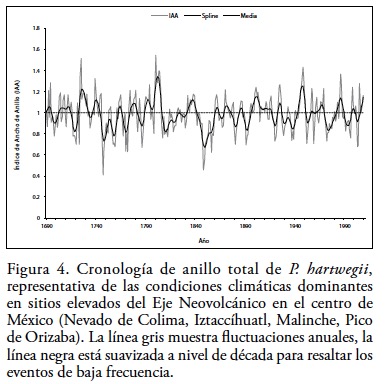
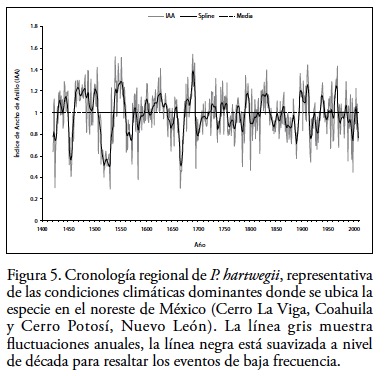
<body><![CDATA[<p align="justify"><font face="verdana" size="2">La variabilidad clim&aacute;tica com&uacute;n determinada en las series regionales de <i>P. hartwegii</i>, como por ejemplo en el noreste de M&eacute;xico, se atribuye a que los picos elevados de la Sierra Madre Oriental, posiblemente por su cercan&iacute;a entre ellos, sean impactados por un mismo fen&oacute;meno clim&aacute;tico (Villanueva <i>et al.</i>, 2007). En contraste, en el Eje Neovolc&aacute;nico, se observa una variaci&oacute;n mayor entre los picos volc&aacute;nicos, atribuida a diferencias clim&aacute;ticas probablemente provocadas por la orientaci&oacute;n de cada sitio, as&iacute; como por el impacto de fen&oacute;menos clim&aacute;ticos distintos en funci&oacute;n de su ubicaci&oacute;n con respecto a las fuentes de humedad del Golfo de M&eacute;xico y del Pac&iacute;fico (Granados y Reyna, 2012). Con base en lo anterior, se generaron dos cronolog&iacute;as regionales, una para el noreste (Sierra Madre Oriental) y otra para el centro de M&eacute;xico (Eje Neovolc&aacute;nico).</font></p>  	    <p align="justify"><font face="verdana" size="2">Las cronolog&iacute;as regionales (<a href="#figura4">Figura 4</a> y <a href="#figura5">5</a>) se expresan en valores estandarizados de ancho de anillo, donde valores por encima o por debajo de la media de 1.0 indican, respectivamente, un crecimiento anual superior o inferior al promedio de toda la serie. La cronolog&iacute;a regional del Eje Neovolc&aacute;nico se extiende de 1690 a 2010 (311 a&ntilde;os), donde se observan periodos muy marcados con valores por abajo de la media (1.0), los cuales se relacionan con sequ&iacute;as, sobresaliendo los periodos de 1698 a 1702, 1716 a 1720, 1746 a 1760, 1806 a 1813, 1841 a 1859, 1890 a 1894, 1935 a 1940, 1970 a 1979 y 2000 a 2004. Periodos h&uacute;medos (aqu&eacute;llos con valores superiores a la media), se presentaron de 1724 a 1731, 1800 a 1805, 1945 a 1951 y 1985 a 1987 (<a href="#figura4">Figura 4</a>).</font></p> 	    <p align="center"><a name="figura4"></a></p> 	    <p align="center"><font face="verdana" size="2"><img src="/img/revistas/igeo/n86/a2f4.jpg"></font></p>     <p align="center"><a name="figura5"></a></p>  	    <p align="center"><font face="verdana" size="2"><img src="/img/revistas/igeo/n86/a2f5.jpg"></font></p>  	    <p align="justify"><font face="verdana" size="2">La cronolog&iacute;a regional del noreste se extiende de 1420 a 2009 (590 a&ntilde;os), donde se observan periodos de sequ&iacute;a intensos, como los ocurridos en los periodos de 1450 a 1460, 1508 a 1538, 1565 a 1576, 1661 a 1673, 1696 a 1705, 1757 a 1765, 1784 a 1790, 1804 a 1808, 1844 a 1849, 1866 a 1894, 1915 a 1933 y 1998 a 2003; mientras que los periodos h&uacute;medos se presentaron de 1463 a 1489, 1500 a 1507, 1539 a 1560, 1610 a 1640, 1674 a 1694, 1751 a 1756, 1821 a 1837, 1895 a 1914, 1934 a 1941 y de 1963 a 1969 (<a href="#figura5">Figura 5</a>).</font></p>  	    <p align="justify"><font face="verdana" size="2">La verificaci&oacute;n de varias de estas sequ&iacute;as hist&oacute;ricas ha sido documentada con reconstrucciones dendroclim&aacute;ticas (Therrell <i>et al.</i>, 2006; Stahle <i>et al.</i>, 2012), rogativas (Garza, 2002) y producci&oacute;n de granos b&aacute;sicos (Florescano, 1969).</font></p>  	    <p align="justify"><font face="verdana" size="2"><b>b. An&aacute;lisis entre series regionales</b></font></p>  	    <p align="justify"><font face="verdana" size="2">La comparaci&oacute;n de los &iacute;ndices anuales para el periodo com&uacute;n (1690&#45;2009) entre las cronolog&iacute;as regionales, indic&oacute; una correlaci&oacute;n no significativa (r =0.087, p&gt;0.05). No obstante, para ciertos a&ntilde;os o periodos, las condiciones clim&aacute;ticas fueron similares, situaci&oacute;n influenciada por fen&oacute;menos clim&aacute;ticos de amplio impacto (<a href="#figura6">Figura 6</a>, <a href="/img/revistas/igeo/n86/html/a2t3.html" target="_blank">Tabla 3</a>).</font></p> 	    ]]></body>
<body><![CDATA[<p align="center"><a name="figura6"></a></p>  	    <p align="center"><font face="verdana" size="2"><img src="/img/revistas/igeo/n86/a2f6.jpg"></font></p>  	    <p align="justify"><font face="verdana" size="2">El an&aacute;lisis de los eventos de baja frecuencia para ambas regiones (<a href="#figura7">Figura 7</a>), muestra tendencias similares en ciertos periodos, pero diferentes en otros, lo cual indica que el comportamiento de las cronolog&iacute;as en t&eacute;rminos clim&aacute;ticos depende de condiciones espec&iacute;ficas locales, pero en ciertos periodos patrones atmosf&eacute;ricos de circulaci&oacute;n general parecieran impactar ambas regiones en forma diferente, con mayor precipitaci&oacute;n en una regi&oacute;n y sequ&iacute;a en la otra (Maga&ntilde;a <i>et al.</i>, 1999; Stahle <i>et al.</i>, 2012).</font></p> 	    <p align="center"><a name="figura7"></a></p>  	    <p align="center"><font face="verdana" size="2"><img src="/img/revistas/igeo/n86/a2f7.jpg"></font></p>  	    <p align="justify"><font face="verdana" size="2">El fen&oacute;meno de ENSO en su fase fr&iacute;a (La Ni&ntilde;a), que se caracteriza por un decremento igual o mayor de &#45;0.5&ordm; C en la temperatura media del mar en el Pac&iacute;fico Tropical, en general corresponde con un incremento de la precipitaci&oacute;n en el Eje Neovolc&aacute;nico, en comparaci&oacute;n con la regi&oacute;n noreste, donde se presentan condiciones de sequ&iacute;a, como ocurri&oacute; en los a&ntilde;os de fase fr&iacute;a (La Ni&ntilde;a) para los periodos 1869 a 1974, 1886 a 1887, 1915 a 1917, 1955 a 1956, 1970 a 1975 y 1998 a 1999 (<a href="/img/revistas/igeo/n86/html/a2t3.html" target="_blank">Tabla 3</a>); no obstante, en otros eventos de fase fr&iacute;a se presentaron sequ&iacute;as en ambas regiones, como en 1892, 1893, 1922, 1942 y 1988; y en algunos otros casos (1903, 1908&#45;1910, 1924, 1949, 1954, 1964, 2007) esta condici&oacute;n no tuvo impacto aparente (<a href="/img/revistas/igeo/n86/html/a2t3.html" target="_blank">Tabla 3</a>).</font></p>  	    <p align="justify"><font face="verdana" size="2">En relaci&oacute;n con la fase c&aacute;lida (El Ni&ntilde;o), caracterizada por aumentos de 0.5&ordm; C o m&aacute;s de la temperatura media del mar en la regi&oacute;n del Pac&iacute;fico Tropical, su efecto es producir condiciones de sequ&iacute;a en el centro y sur de M&eacute;xico, debido a un movimiento de la Zona Intertropical de Convergencia hacia el Ecuador (Waliser y Gautier, 1993). Los eventos ENSO durante la fase El Ni&ntilde;o fueron muy variables en el Eje Neovolc&aacute;nico Transversal. As&iacute;, durante el periodo 1868 a 2010 se produjeron sequ&iacute;as en los a&ntilde;os 1880, 1888, 1899, 1905, 1913, 1918, 1929&#45;1930, 1940, 1963, 1970, 1972, 1976, 1983, 1991 y 1997 (McPhaden <i>et al.</i>, 2006, Yocom y Ful&eacute;, 2012).</font></p>  	    <p align="justify"><font face="verdana" size="2"><b>c. Asociaci&oacute;n entre la cronolog&iacute;a regional y la precipitaci&oacute;n reconstruida</b></font></p>  	    <p align="justify"><font face="verdana" size="2">Una comparaci&oacute;n de la cronolog&iacute;a del Eje Neovolc&aacute;nico con una reconstrucci&oacute;n de precipitaci&oacute;n estacional enero&ntilde;septiembre realizada para la regi&oacute;n de La Malinche con espec&iacute;menes de <i>P. hartwegii</i> ubicados en un rango altitudinal de 3 600 a 3 800 m (Villanueva <i>et al.</i>, 2010b), mostr&oacute; una correlaci&oacute;n altamente significativa (r = 0.82, p&lt;0.001, n = 119, 1890&#45;2008), situaci&oacute;n que indica que esta cronolog&iacute;a tiene alto potencial para explicar la precipitaci&oacute;n acumulada invierno&#45;primavera&ntilde;verano, que representa m&aacute;s del 85% de la precipitaci&oacute;n anual en esta regi&oacute;n (<a href="#figura8">Figura 8</a>).</font></p> 	    <p align="center"><a name="figura8"></a></p>  	    ]]></body>
<body><![CDATA[<p align="center"><font face="verdana" size="2"><img src="/img/revistas/igeo/n86/a2f8.jpg"></font></p>  	    <p align="justify"><font face="verdana" size="2">Este resultado confirma el potencial que tiene <i>P. hartwegii</i> para desarrollar reconstrucciones de la precipitaci&oacute;n pluvial de siglos anteriores al XIX en esta regi&oacute;n de M&eacute;xico.</font></p>  	    <p>&nbsp;</p>  	    <p align="justify"><font face="verdana" size="2"><b>Conclusiones</b></font></p>  	    <p align="justify"><font face="verdana" size="2">En este estudio se gener&oacute; una red dendrocronol&oacute;gica de once series de <i>Pinus hartwegii</i> y, con base en un an&aacute;lisis de PCA, se seleccionaron aquellas series de tiempo con una respuesta clim&aacute;tica com&uacute;n, por lo que se desarrollaron dos series regionales de &iacute;ndices de anillo total, una de 311 y otra de 590 a&ntilde;os, representativas de las condiciones clim&aacute;ticas del Eje Neovolc&aacute;nico y del noreste de M&eacute;xico, respectivamente. Estos archivos clim&aacute;ticos permiten comparar sobre una base com&uacute;n la variabilidad del clima, en particular la precipitaci&oacute;n, entre el noreste y el centro de M&eacute;xico a lo largo de varios siglos; es decir, m&aacute;s all&aacute; del periodo de los registros meteorol&oacute;gicos instrumentales.</font></p>  	    <p align="justify"><font face="verdana" size="2">La comparaci&oacute;n de las dos cronolog&iacute;as muestra que ENSO en su fase fr&iacute;a "La Ni&ntilde;a" provoca condiciones h&uacute;medas en el centro de M&eacute;xico y condiciones secas en el noreste del pa&iacute;s (Stahle <i>et al.</i>, 2012), como ha sucedido en los &uacute;ltimos a&ntilde;os (2010&#45;2011), donde una sequ&iacute;a ha dominado la parte norte y condiciones h&uacute;medas en parte del centro y sur de M&eacute;xico (Monitor de la Sequ&iacute;a Am&eacute;rica del Norte, 2013). La fase c&aacute;lida de ENSO "El Ni&ntilde;o" tuvo un efecto menos definido y provoc&oacute; sequ&iacute;as en ambas regiones, pero solo cuando se presentaron eventos catalogados de alta intensidad.</font></p>  	    <p align="justify"><font face="verdana" size="2">El desarrollo de estas cronolog&iacute;as regionales es fundamental para mejorar el entendimiento de las relaciones clim&aacute;ticas de fen&oacute;menos circulatorios que impactan el norte y centro de M&eacute;xico. Por otro lado, el calentamiento global probablemente constituye una amenaza para la permanencia de <i>Pinus hartwegii</i> (Ricker <i>et al.</i>, 2007). El entendimiento de este fen&oacute;meno permitir&aacute; implementar estrategias con miras a la conservaci&oacute;n de estos ecosistemas, de importancia en la generaci&oacute;n de servicios ambientales hidrol&oacute;gicos, captura de carbono, recreaci&oacute;n, calidad del paisaje y belleza esc&eacute;nica de los ecosistemas forestales de alta monta&ntilde;a de M&eacute;xico, entre otros bienes y servicios, que son esenciales para la supervivencia de una megal&oacute;polis como la ciudad de M&eacute;xico y otras zonas densamente pobladas del centro de M&eacute;xico.</font></p>  	    <p>&nbsp;</p>  	    <p align="justify"><font face="verdana" size="2"><b>Agradecimientos</b></font></p>  	    <p align="justify"><font face="verdana" size="2">Este trabajo fue apoyado con fondos del Instituto Interamericano para Investigaci&oacute;n del Cambio Clim&aacute;tico (IAI), proyecto CRN # 2047, a su vez financiado por el US/Nacional Science Foundation (Grant GEO&#45;0452325); as&iacute; mismo se cont&oacute; con apoyo del proyecto con fondos fiscales INIFAP "Cambio clim&aacute;tico y su impacto sobre el potencial productivo agr&iacute;cola, forrajero y forestal en M&eacute;xico"; y del proyecto PAPIIT&#45;UNAM clave IN105213.</font></p>  	    ]]></body>
<body><![CDATA[<p>&nbsp;</p>  	    <p align="justify"><font face="verdana" size="2"><b>Referencias</b></font></p>  	    <!-- ref --><p align="justify"><font face="verdana" size="2">Beaman, J. H. (1962), "The timberlines of Iztacc&iacute;huatl and Popocat&eacute;petl, Mexico". <i>Ecology</i>, vol. 43, no. 3, pp. 337&#45;385.    &nbsp;&nbsp;&nbsp;&nbsp;&nbsp;&nbsp;&nbsp;&nbsp;[&#160;<a href="javascript:void(0);" onclick="javascript: window.open('/scielo.php?script=sci_nlinks&ref=4726812&pid=S0188-4611201500010000200001&lng=','','width=640,height=500,resizable=yes,scrollbars=1,menubar=yes,');">Links</a>&#160;]<!-- end-ref --></font></p>  	    <!-- ref --><p align="justify"><font face="verdana" size="2">Biondi, F. (2001), "A 400&#45;year tree&#45;ring chronology from the tropical treeline of North America", <i>Ambio</i>, vol. 30, no. 2, pp. 162&#45;166.    &nbsp;&nbsp;&nbsp;&nbsp;&nbsp;&nbsp;&nbsp;&nbsp;[&#160;<a href="javascript:void(0);" onclick="javascript: window.open('/scielo.php?script=sci_nlinks&ref=4726814&pid=S0188-4611201500010000200002&lng=','','width=640,height=500,resizable=yes,scrollbars=1,menubar=yes,');">Links</a>&#160;]<!-- end-ref --></font></p>  	    <!-- ref --><p align="justify"><font face="verdana" size="2">Biondi, F., P. Hartsough and I. G. Galindo Estrada (2009), "Recent warming at the tropical treeline of North America", <i>Frontiers in Ecology and the Environment</i>, vol. 7, no. 9, pp. 463&#45;464.    &nbsp;&nbsp;&nbsp;&nbsp;&nbsp;&nbsp;&nbsp;&nbsp;[&#160;<a href="javascript:void(0);" onclick="javascript: window.open('/scielo.php?script=sci_nlinks&ref=4726816&pid=S0188-4611201500010000200003&lng=','','width=640,height=500,resizable=yes,scrollbars=1,menubar=yes,');">Links</a>&#160;]<!-- end-ref --></font></p>  	    <!-- ref --><p align="justify"><font face="verdana" size="2">Cook, E. R. and R. H. Holmes (1986), <i>Guide for computer program ARSTAN, </i>Laboratory of Tree Ring Research, The University of Arizona, Tucson, AZ.    &nbsp;&nbsp;&nbsp;&nbsp;&nbsp;&nbsp;&nbsp;&nbsp;[&#160;<a href="javascript:void(0);" onclick="javascript: window.open('/scielo.php?script=sci_nlinks&ref=4726818&pid=S0188-4611201500010000200004&lng=','','width=640,height=500,resizable=yes,scrollbars=1,menubar=yes,');">Links</a>&#160;]<!-- end-ref --></font></p>  	    ]]></body>
<body><![CDATA[<!-- ref --><p align="justify"><font face="verdana" size="2">Cook, E. R. and K. Peters (1981), "The smoothing spline: a new approach to standardizing forest interior tree&#45;ring width series for dendroclimatic studies", <i>Tree&#45;Ring Bulletin</i>, vol. 47, pp. 37&#45;59.    &nbsp;&nbsp;&nbsp;&nbsp;&nbsp;&nbsp;&nbsp;&nbsp;[&#160;<a href="javascript:void(0);" onclick="javascript: window.open('/scielo.php?script=sci_nlinks&ref=4726820&pid=S0188-4611201500010000200005&lng=','','width=640,height=500,resizable=yes,scrollbars=1,menubar=yes,');">Links</a>&#160;]<!-- end-ref --></font></p>  	    <!-- ref --><p align="justify"><font face="verdana" size="2">Farjon, A., J. A. P&eacute;rez de la Rosa and B. T. Styles (1997), <i>A field guide to the pines of Mexico and Central America</i>, Kew Publishing, Royal Botanical Garden, Oxford.    &nbsp;&nbsp;&nbsp;&nbsp;&nbsp;&nbsp;&nbsp;&nbsp;[&#160;<a href="javascript:void(0);" onclick="javascript: window.open('/scielo.php?script=sci_nlinks&ref=4726822&pid=S0188-4611201500010000200006&lng=','','width=640,height=500,resizable=yes,scrollbars=1,menubar=yes,');">Links</a>&#160;]<!-- end-ref --></font></p>  	    <!-- ref --><p align="justify"><font face="verdana" size="2">Florescano, E. (1969), <i>Precios del ma&iacute;z y crisis agr&iacute;colas en M&eacute;xico</i>, El Colegio de M&eacute;xico, M&eacute;xico.    &nbsp;&nbsp;&nbsp;&nbsp;&nbsp;&nbsp;&nbsp;&nbsp;[&#160;<a href="javascript:void(0);" onclick="javascript: window.open('/scielo.php?script=sci_nlinks&ref=4726824&pid=S0188-4611201500010000200007&lng=','','width=640,height=500,resizable=yes,scrollbars=1,menubar=yes,');">Links</a>&#160;]<!-- end-ref --></font></p>  	    <!-- ref --><p align="justify"><font face="verdana" size="2">Fritts, H. C. (1976), <i>Tree rings and climate</i>. Academic Press, New York.    &nbsp;&nbsp;&nbsp;&nbsp;&nbsp;&nbsp;&nbsp;&nbsp;[&#160;<a href="javascript:void(0);" onclick="javascript: window.open('/scielo.php?script=sci_nlinks&ref=4726826&pid=S0188-4611201500010000200008&lng=','','width=640,height=500,resizable=yes,scrollbars=1,menubar=yes,');">Links</a>&#160;]<!-- end-ref --></font></p>  	    <!-- ref --><p align="justify"><font face="verdana" size="2">Garza Merodio, G. G. (2002), "Frecuencia y duraci&oacute;n de sequ&iacute;as en la Cuenca de M&eacute;xico de fines del siglo XVI a mediados del XIX", <i>Investigaciones Geogr&aacute;ficas, Bolet&iacute;n</i>, n&uacute;m. 48, Instituto de Geograf&iacute;a, UNAM, M&eacute;xico, pp.106&#45;115.    &nbsp;&nbsp;&nbsp;&nbsp;&nbsp;&nbsp;&nbsp;&nbsp;[&#160;<a href="javascript:void(0);" onclick="javascript: window.open('/scielo.php?script=sci_nlinks&ref=4726828&pid=S0188-4611201500010000200009&lng=','','width=640,height=500,resizable=yes,scrollbars=1,menubar=yes,');">Links</a>&#160;]<!-- end-ref --></font></p>  	    ]]></body>
<body><![CDATA[<!-- ref --><p align="justify"><font face="verdana" size="2">Granados, R. y T. Reyna (2012), <i>Centro&#45;Occidente de M&eacute;xico: variaci&oacute;n clim&aacute;tica e impactos en la producci&oacute;n agr&iacute;cola</i>, Geograf&iacute;a para el siglo XXI, Serie Libtos de investigaci&oacute;n, n&uacute;m. 9, Instituto de Geograf&iacute;a, UNAM, M&eacute;xico.    &nbsp;&nbsp;&nbsp;&nbsp;&nbsp;&nbsp;&nbsp;&nbsp;[&#160;<a href="javascript:void(0);" onclick="javascript: window.open('/scielo.php?script=sci_nlinks&ref=4726830&pid=S0188-4611201500010000200010&lng=','','width=640,height=500,resizable=yes,scrollbars=1,menubar=yes,');">Links</a>&#160;]<!-- end-ref --></font></p>  	    <!-- ref --><p align="justify"><font face="verdana" size="2">Grissino&#45;Mayer, H. D. (2001), "Evaluating crossdating accuracy: a manual and tutorial for the computer program COFECHA", <i>Tree&#45;Ring Research</i>, vol. 57, no. 2, pp. 205&#45;221.    &nbsp;&nbsp;&nbsp;&nbsp;&nbsp;&nbsp;&nbsp;&nbsp;[&#160;<a href="javascript:void(0);" onclick="javascript: window.open('/scielo.php?script=sci_nlinks&ref=4726832&pid=S0188-4611201500010000200011&lng=','','width=640,height=500,resizable=yes,scrollbars=1,menubar=yes,');">Links</a>&#160;]<!-- end-ref --></font></p>  	    <!-- ref --><p align="justify"><font face="verdana" size="2">Holmes, R. L. (1983), "Computer&#45;assisted quality control in tree&#45;ring dating and measurement", <i>Tree&#45;Ring Bulletin</i>, vol. 43, pp. 69&#45;78.    &nbsp;&nbsp;&nbsp;&nbsp;&nbsp;&nbsp;&nbsp;&nbsp;[&#160;<a href="javascript:void(0);" onclick="javascript: window.open('/scielo.php?script=sci_nlinks&ref=4726834&pid=S0188-4611201500010000200012&lng=','','width=640,height=500,resizable=yes,scrollbars=1,menubar=yes,');">Links</a>&#160;]<!-- end-ref --></font></p>  	    <!-- ref --><p align="justify"><font face="verdana" size="2">K&ouml;rner, C. and J. Paulsen (2004), "A world&#45;wide study of high altitude treeline temperatures", <i>Journal of Biogeography</i>, vol. 31, pp. 713&#45;732.    &nbsp;&nbsp;&nbsp;&nbsp;&nbsp;&nbsp;&nbsp;&nbsp;[&#160;<a href="javascript:void(0);" onclick="javascript: window.open('/scielo.php?script=sci_nlinks&ref=4726836&pid=S0188-4611201500010000200013&lng=','','width=640,height=500,resizable=yes,scrollbars=1,menubar=yes,');">Links</a>&#160;]<!-- end-ref --></font></p>  	    <!-- ref --><p align="justify"><font face="verdana" size="2">Lauer, W. (1978), "Timberline studies in Central Mexico", <i>Artic and Alpine Research</i>, vol. 10, no. 2, pp. 383&#45;396.    &nbsp;&nbsp;&nbsp;&nbsp;&nbsp;&nbsp;&nbsp;&nbsp;[&#160;<a href="javascript:void(0);" onclick="javascript: window.open('/scielo.php?script=sci_nlinks&ref=4726838&pid=S0188-4611201500010000200014&lng=','','width=640,height=500,resizable=yes,scrollbars=1,menubar=yes,');">Links</a>&#160;]<!-- end-ref --></font></p>  	    ]]></body>
<body><![CDATA[<!-- ref --><p align="justify"><font face="verdana" size="2">Maga&ntilde;a, V., J. L. P&eacute;rez, L. L. V&aacute;zquez, E. Carrizosa y J. P&eacute;rez (1999), "El Ni&ntilde;o y el clima", en Maga&ntilde;a, V. (ed.), <i>Los impactos del Ni&ntilde;o en M&eacute;xico</i>, SEP&#45;CONACYT, M&eacute;xico, pp. 23&#45;68.    &nbsp;&nbsp;&nbsp;&nbsp;&nbsp;&nbsp;&nbsp;&nbsp;[&#160;<a href="javascript:void(0);" onclick="javascript: window.open('/scielo.php?script=sci_nlinks&ref=4726840&pid=S0188-4611201500010000200015&lng=','','width=640,height=500,resizable=yes,scrollbars=1,menubar=yes,');">Links</a>&#160;]<!-- end-ref --></font></p>      <!-- ref --><p align="justify"><font face="verdana" size="2">Matos, J. A. (1995), "<i>Pinus hartwegii</i> and <i>P. rudis</i>: A critical assessment", <i>Systematic Botany</i>, vol. 20, pp. 6&#45;21.    &nbsp;&nbsp;&nbsp;&nbsp;&nbsp;&nbsp;&nbsp;&nbsp;[&#160;<a href="javascript:void(0);" onclick="javascript: window.open('/scielo.php?script=sci_nlinks&ref=4726842&pid=S0188-4611201500010000200016&lng=','','width=640,height=500,resizable=yes,scrollbars=1,menubar=yes,');">Links</a>&#160;]<!-- end-ref --></font></p>  	    <!-- ref --><p align="justify"><font face="verdana" size="2">McPhaden, M. J., S. E. Zebiak and M. H. Glantz (2006), "ENSO as integrating concept in Earth science", <i>Science</i>, vol 314, no. 5806, pp. 1740&#45;1745.    &nbsp;&nbsp;&nbsp;&nbsp;&nbsp;&nbsp;&nbsp;&nbsp;[&#160;<a href="javascript:void(0);" onclick="javascript: window.open('/scielo.php?script=sci_nlinks&ref=4726844&pid=S0188-4611201500010000200017&lng=','','width=640,height=500,resizable=yes,scrollbars=1,menubar=yes,');">Links</a>&#160;]<!-- end-ref --></font></p>  	    <!-- ref --><p align="justify"><font face="verdana" size="2">Monitor de la Sequ&iacute;a de Am&eacute;rica del Norte (2013), "Animaci&oacute;n de mapas", CONAGUA, M&eacute;xico.    &nbsp;&nbsp;&nbsp;&nbsp;&nbsp;&nbsp;&nbsp;&nbsp;[&#160;<a href="javascript:void(0);" onclick="javascript: window.open('/scielo.php?script=sci_nlinks&ref=4726846&pid=S0188-4611201500010000200018&lng=','','width=640,height=500,resizable=yes,scrollbars=1,menubar=yes,');">Links</a>&#160;]<!-- end-ref --></font></p>  	    <!-- ref --><p align="justify"><font face="verdana" size="2">Ricker, M., G. Guti&eacute;rrez Garc&iacute;a and D. C. Daly (2007), "Modeling long&#45;term tree growth curves in response to warming climate: test cases from a subtropical mountain forest and a tropical rainforest in Mexico", <i>Canadian Journal of Forest Research</i>, vol. 37, pp. 977&#45;989.    &nbsp;&nbsp;&nbsp;&nbsp;&nbsp;&nbsp;&nbsp;&nbsp;[&#160;<a href="javascript:void(0);" onclick="javascript: window.open('/scielo.php?script=sci_nlinks&ref=4726848&pid=S0188-4611201500010000200019&lng=','','width=640,height=500,resizable=yes,scrollbars=1,menubar=yes,');">Links</a>&#160;]<!-- end-ref --></font></p>  	    ]]></body>
<body><![CDATA[<!-- ref --><p align="justify"><font face="verdana" size="2">Robinson, W. J. and R. Evans (1980), "A microcomputerbased tree&#45;ring measuring system", <i>Tree&#45;Ring Bulletin</i>, vol. 40, pp. 59&#45;64.    &nbsp;&nbsp;&nbsp;&nbsp;&nbsp;&nbsp;&nbsp;&nbsp;[&#160;<a href="javascript:void(0);" onclick="javascript: window.open('/scielo.php?script=sci_nlinks&ref=4726850&pid=S0188-4611201500010000200020&lng=','','width=640,height=500,resizable=yes,scrollbars=1,menubar=yes,');">Links</a>&#160;]<!-- end-ref --></font></p>  	    <!-- ref --><p align="justify"><font face="verdana" size="2">Seager, R., M. Ting, M. Davis, M. Cane, N. Nike, J. Nakumara, C. Lie, E. Cook and D. Stahle (2009), "Mexican drought: an observational modeling and tree ring study of variability and climate change", <i>Atm&oacute;sfera</i>, vol. 22, no. 1, pp. 1&#45;31.    &nbsp;&nbsp;&nbsp;&nbsp;&nbsp;&nbsp;&nbsp;&nbsp;[&#160;<a href="javascript:void(0);" onclick="javascript: window.open('/scielo.php?script=sci_nlinks&ref=4726852&pid=S0188-4611201500010000200021&lng=','','width=640,height=500,resizable=yes,scrollbars=1,menubar=yes,');">Links</a>&#160;]<!-- end-ref --></font></p>  	    <!-- ref --><p align="justify"><font face="verdana" size="2">Stahle, D. W., J. Villanueva D&iacute;az, M. K. Cleaveland, M. D. Therrell, G. J. Paull, B. T. Burns, W. Salinas, H. Suzan and P. Z. Ful&eacute; (2000), "Recent tree&#45;ring research in Mexico", in Roig, F. A. (comp.), <i>Dendrocronolog&iacute;a en Am&eacute;rica Latina</i>, Editorial de la Universidad Nacional del Cuyo (EDIUNC), Mendoza, Argentina, pp. 285&#45;306.    &nbsp;&nbsp;&nbsp;&nbsp;&nbsp;&nbsp;&nbsp;&nbsp;[&#160;<a href="javascript:void(0);" onclick="javascript: window.open('/scielo.php?script=sci_nlinks&ref=4726854&pid=S0188-4611201500010000200022&lng=','','width=640,height=500,resizable=yes,scrollbars=1,menubar=yes,');">Links</a>&#160;]<!-- end-ref --></font></p>  	    <!-- ref --><p align="justify"><font face="verdana" size="2">Stahle, D. W., D. J. Burnette, J. Villanueva D&iacute;az, R. R. Heim Jr, F. K. Fye, J. Cerano Paredes, R. Acu&ntilde;a Soto and M. K. Cleaveland (2012), "Pacific and Atlantic influences in Mesoamerican over the past millennium", <i>Climate Dynamics</i>, vol. 39, no. 6, pp. 1431&#45;1446.    &nbsp;&nbsp;&nbsp;&nbsp;&nbsp;&nbsp;&nbsp;&nbsp;[&#160;<a href="javascript:void(0);" onclick="javascript: window.open('/scielo.php?script=sci_nlinks&ref=4726856&pid=S0188-4611201500010000200023&lng=','','width=640,height=500,resizable=yes,scrollbars=1,menubar=yes,');">Links</a>&#160;]<!-- end-ref --></font></p>      <!-- ref --><p align="justify"><font face="verdana" size="2">Stokes, M. A. and T. L. Smiley (1968), <i>An introduction to tree&#45;ring dating</i>, The University of Chicago, Chicago.    &nbsp;&nbsp;&nbsp;&nbsp;&nbsp;&nbsp;&nbsp;&nbsp;[&#160;<a href="javascript:void(0);" onclick="javascript: window.open('/scielo.php?script=sci_nlinks&ref=4726858&pid=S0188-4611201500010000200024&lng=','','width=640,height=500,resizable=yes,scrollbars=1,menubar=yes,');">Links</a>&#160;]<!-- end-ref --></font></p>  	    ]]></body>
<body><![CDATA[<!-- ref --><p align="justify"><font face="verdana" size="2">Therrell, M. D., D. W. Stahle, J. Villanueva D&iacute;az, E. Cornejo Oviedo and M. K. Cleaveland (2006), "Tree&#45;ring reconstructed maize yield in central Mexico: 1474&#45;2001", <i>Climatic Change</i>, vol. 74, no. 4, pp. 493&#45;504.    &nbsp;&nbsp;&nbsp;&nbsp;&nbsp;&nbsp;&nbsp;&nbsp;[&#160;<a href="javascript:void(0);" onclick="javascript: window.open('/scielo.php?script=sci_nlinks&ref=4726860&pid=S0188-4611201500010000200025&lng=','','width=640,height=500,resizable=yes,scrollbars=1,menubar=yes,');">Links</a>&#160;]<!-- end-ref --></font></p>  	    <!-- ref --><p align="justify"><font face="verdana" size="2">V&aacute;zquez Medrano, G. (2010), <i>Estudio de la factibilidad para un mercado local de servicios ambientales hidrol&oacute;gicos en la cuenca Valle de Bravo&#45;Amanalco</i>, tesis de Licenciatura en Ciencias Ambientales, Facultad de Planeaci&oacute;n Urbana y Regional, Universidad Aut&oacute;noma del Estado de M&eacute;xico, Toluca.    &nbsp;&nbsp;&nbsp;&nbsp;&nbsp;&nbsp;&nbsp;&nbsp;[&#160;<a href="javascript:void(0);" onclick="javascript: window.open('/scielo.php?script=sci_nlinks&ref=4726862&pid=S0188-4611201500010000200026&lng=','','width=640,height=500,resizable=yes,scrollbars=1,menubar=yes,');">Links</a>&#160;]<!-- end-ref --></font></p>  	    <!-- ref --><p align="justify"><font face="verdana" size="2">Villanueva D&iacute;az, J., D. W. Stahle, B. H. Luckman, J. Cerano Paredes, M. D. Therrell and M. K. Cleaveland (2007), "Winter&#45;spring precipitation reconstructions from tree rings for northeast Mexico", <i>Climatic Change</i>, no. 83, pp. 117&#45;131.    &nbsp;&nbsp;&nbsp;&nbsp;&nbsp;&nbsp;&nbsp;&nbsp;[&#160;<a href="javascript:void(0);" onclick="javascript: window.open('/scielo.php?script=sci_nlinks&ref=4726864&pid=S0188-4611201500010000200027&lng=','','width=640,height=500,resizable=yes,scrollbars=1,menubar=yes,');">Links</a>&#160;]<!-- end-ref --></font></p>  	    <!-- ref --><p align="justify"><font face="verdana" size="2">Villanueva D&iacute;az, J., J. Cerano Paredes, D. W. Stahle, V. Constante Garc&iacute;a, L. V&aacute;zquez Selem, J. Estrada &aacute;valos y J. D. Benavides Solorio (2010a), "&Aacute;rboles longevos de M&eacute;xico", <i>Revista Mexicana de Ciencias Forestales</i>, vol. 1, n&uacute;m. 2, pp. 1&#45;23.    &nbsp;&nbsp;&nbsp;&nbsp;&nbsp;&nbsp;&nbsp;&nbsp;[&#160;<a href="javascript:void(0);" onclick="javascript: window.open('/scielo.php?script=sci_nlinks&ref=4726866&pid=S0188-4611201500010000200028&lng=','','width=640,height=500,resizable=yes,scrollbars=1,menubar=yes,');">Links</a>&#160;]<!-- end-ref --></font></p>  	    <!-- ref --><p align="justify"><font face="verdana" size="2">Villanueva D&iacute;az, J., J. Cerano Paredes, J. Estrada &aacute;valos, V. Guerra De La Cruz, D. W. Stahle, V. Constante Garc&iacute;a, P. Ruiz, G. Cardoza Mart&iacute;nez y O. Palacios Villa (2010b), "An&aacute;lisis de la variabilidad hidroclim&aacute;tica en el estado de Tlaxcala", en Estrada &aacute;valos, J., R. Trucios C., J. Villanueva D., M. Rivera G. y L. F. Flores Lui (eds.), <i>Manejo sustentable de los recursos naturales en el R&iacute;o Zahuapan, Tlaxcala, M&eacute;xico</i>, INIFAP CENID RASPA, G&oacute;mez Palacio, Durango, M&eacute;xico, pp. 137&#45;156.    &nbsp;&nbsp;&nbsp;&nbsp;&nbsp;&nbsp;&nbsp;&nbsp;[&#160;<a href="javascript:void(0);" onclick="javascript: window.open('/scielo.php?script=sci_nlinks&ref=4726868&pid=S0188-4611201500010000200029&lng=','','width=640,height=500,resizable=yes,scrollbars=1,menubar=yes,');">Links</a>&#160;]<!-- end-ref --></font></p>  	    ]]></body>
<body><![CDATA[<!-- ref --><p align="justify"><font face="verdana" size="2">Waliser, D. E. and C. Gautier (1993), "A satellite&#45;derived climatology of the ITCZ", <i>Journal of Climate</i>, vol. 6, no. 11, pp. 2162&#45;2174.    &nbsp;&nbsp;&nbsp;&nbsp;&nbsp;&nbsp;&nbsp;&nbsp;[&#160;<a href="javascript:void(0);" onclick="javascript: window.open('/scielo.php?script=sci_nlinks&ref=4726870&pid=S0188-4611201500010000200030&lng=','','width=640,height=500,resizable=yes,scrollbars=1,menubar=yes,');">Links</a>&#160;]<!-- end-ref --></font></p>  	    <!-- ref --><p align="justify"><font face="verdana" size="2">Yocom, L. L., P. Z. Ful&eacute;, P. M. Brown, J. Cerano Paredes, J. Villanueva D&iacute;az, D. A. Falk and E. Cornejo Oviedo (2010), "El Ni&ntilde;o Southern Oscillation effect on fire regime in northeastern Mexico has changed over time", <i>Ecology</i>, vol. 9, no. 16, pp. 660&#45;1671.    &nbsp;&nbsp;&nbsp;&nbsp;&nbsp;&nbsp;&nbsp;&nbsp;[&#160;<a href="javascript:void(0);" onclick="javascript: window.open('/scielo.php?script=sci_nlinks&ref=4726872&pid=S0188-4611201500010000200031&lng=','','width=640,height=500,resizable=yes,scrollbars=1,menubar=yes,');">Links</a>&#160;]<!-- end-ref --></font></p>  	    <!-- ref --><p align="justify"><font face="verdana" size="2">Yocom, L. L. and P. Z. Ful&eacute; (2012), "Human and climate influence on frequent fires in a high&#45;elevation tropical forest", <i>Journal of Applied Ecology</i>, vol. 49, no. 6, pp. 1356&#45;1364.    &nbsp;&nbsp;&nbsp;&nbsp;&nbsp;&nbsp;&nbsp;&nbsp;[&#160;<a href="javascript:void(0);" onclick="javascript: window.open('/scielo.php?script=sci_nlinks&ref=4726874&pid=S0188-4611201500010000200032&lng=','','width=640,height=500,resizable=yes,scrollbars=1,menubar=yes,');">Links</a>&#160;]<!-- end-ref --></font></p>      ]]></body><back>
<ref-list>
<ref id="B1">
<nlm-citation citation-type="journal">
<person-group person-group-type="author">
<name>
<surname><![CDATA[Beaman]]></surname>
<given-names><![CDATA[J. H.]]></given-names>
</name>
</person-group>
<article-title xml:lang="en"><![CDATA[The timberlines of Iztaccíhuatl and Popocatépetl, Mexico]]></article-title>
<source><![CDATA[Ecology]]></source>
<year>1962</year>
<volume>43</volume>
<numero>3</numero>
<issue>3</issue>
<page-range>337-385</page-range></nlm-citation>
</ref>
<ref id="B2">
<nlm-citation citation-type="journal">
<person-group person-group-type="author">
<name>
<surname><![CDATA[Biondi]]></surname>
<given-names><![CDATA[F.]]></given-names>
</name>
</person-group>
<article-title xml:lang="en"><![CDATA[A 400-year tree-ring chronology from the tropical treeline of North America]]></article-title>
<source><![CDATA[Ambio]]></source>
<year>2001</year>
<volume>30</volume>
<numero>2</numero>
<issue>2</issue>
<page-range>162-166</page-range></nlm-citation>
</ref>
<ref id="B3">
<nlm-citation citation-type="journal">
<person-group person-group-type="author">
<name>
<surname><![CDATA[Biondi]]></surname>
<given-names><![CDATA[F.]]></given-names>
</name>
<name>
<surname><![CDATA[Hartsough]]></surname>
<given-names><![CDATA[P.]]></given-names>
</name>
<name>
<surname><![CDATA[Galindo Estrada]]></surname>
<given-names><![CDATA[I. G.]]></given-names>
</name>
</person-group>
<article-title xml:lang="en"><![CDATA[Recent warming at the tropical treeline of North America]]></article-title>
<source><![CDATA[Frontiers in Ecology and the Environment]]></source>
<year>2009</year>
<volume>7</volume>
<numero>9</numero>
<issue>9</issue>
<page-range>463-464</page-range></nlm-citation>
</ref>
<ref id="B4">
<nlm-citation citation-type="book">
<person-group person-group-type="author">
<name>
<surname><![CDATA[Cook]]></surname>
<given-names><![CDATA[E. R.]]></given-names>
</name>
<name>
<surname><![CDATA[Holmes]]></surname>
<given-names><![CDATA[R. H.]]></given-names>
</name>
</person-group>
<source><![CDATA[Guide for computer program ARSTAN]]></source>
<year>1986</year>
<publisher-loc><![CDATA[Tucson^eAZ AZ]]></publisher-loc>
<publisher-name><![CDATA[Laboratory of Tree Ring Research, The University of Arizona]]></publisher-name>
</nlm-citation>
</ref>
<ref id="B5">
<nlm-citation citation-type="journal">
<person-group person-group-type="author">
<name>
<surname><![CDATA[Cook]]></surname>
<given-names><![CDATA[E. R.]]></given-names>
</name>
<name>
<surname><![CDATA[Peters]]></surname>
<given-names><![CDATA[K.]]></given-names>
</name>
</person-group>
<article-title xml:lang="en"><![CDATA[The smoothing spline: a new approach to standardizing forest interior tree-ring width series for dendroclimatic studies]]></article-title>
<source><![CDATA[Tree-Ring Bulletin]]></source>
<year>1981</year>
<volume>47</volume>
<page-range>37-59</page-range></nlm-citation>
</ref>
<ref id="B6">
<nlm-citation citation-type="book">
<person-group person-group-type="author">
<name>
<surname><![CDATA[Farjon]]></surname>
<given-names><![CDATA[A.]]></given-names>
</name>
<name>
<surname><![CDATA[Pérez de la Rosa]]></surname>
<given-names><![CDATA[J. A.]]></given-names>
</name>
<name>
<surname><![CDATA[Styles]]></surname>
<given-names><![CDATA[B. T.]]></given-names>
</name>
</person-group>
<source><![CDATA[A field guide to the pines of Mexico and Central America]]></source>
<year>1997</year>
<publisher-loc><![CDATA[Oxford ]]></publisher-loc>
<publisher-name><![CDATA[Kew Publishing, Royal Botanical Garden]]></publisher-name>
</nlm-citation>
</ref>
<ref id="B7">
<nlm-citation citation-type="book">
<person-group person-group-type="author">
<name>
<surname><![CDATA[Florescano]]></surname>
<given-names><![CDATA[E.]]></given-names>
</name>
</person-group>
<source><![CDATA[Precios del maíz y crisis agrícolas en México]]></source>
<year>1969</year>
<publisher-loc><![CDATA[México ]]></publisher-loc>
<publisher-name><![CDATA[El Colegio de México]]></publisher-name>
</nlm-citation>
</ref>
<ref id="B8">
<nlm-citation citation-type="book">
<person-group person-group-type="author">
<name>
<surname><![CDATA[Fritts]]></surname>
<given-names><![CDATA[H. C.]]></given-names>
</name>
</person-group>
<source><![CDATA[Tree rings and climate]]></source>
<year>1976</year>
<publisher-loc><![CDATA[New York ]]></publisher-loc>
<publisher-name><![CDATA[Academic Press]]></publisher-name>
</nlm-citation>
</ref>
<ref id="B9">
<nlm-citation citation-type="journal">
<person-group person-group-type="author">
<name>
<surname><![CDATA[Garza Merodio]]></surname>
<given-names><![CDATA[G. G.]]></given-names>
</name>
</person-group>
<article-title xml:lang="es"><![CDATA[Frecuencia y duración de sequías en la Cuenca de México de fines del siglo XVI a mediados del XIX]]></article-title>
<source><![CDATA[Investigaciones Geográficas]]></source>
<year>2002</year>
<numero>48</numero>
<issue>48</issue>
<page-range>106-115</page-range><publisher-loc><![CDATA[México ]]></publisher-loc>
<publisher-name><![CDATA[Instituto de Geografía, UNAM]]></publisher-name>
</nlm-citation>
</ref>
<ref id="B10">
<nlm-citation citation-type="book">
<person-group person-group-type="author">
<name>
<surname><![CDATA[Granados]]></surname>
<given-names><![CDATA[R.]]></given-names>
</name>
<name>
<surname><![CDATA[Reyna]]></surname>
<given-names><![CDATA[T.]]></given-names>
</name>
</person-group>
<source><![CDATA[Centro-Occidente de México: variación climática e impactos en la producción agrícola]]></source>
<year>2012</year>
<publisher-loc><![CDATA[México ]]></publisher-loc>
<publisher-name><![CDATA[Instituto de Geografía, UNAM]]></publisher-name>
</nlm-citation>
</ref>
<ref id="B11">
<nlm-citation citation-type="journal">
<person-group person-group-type="author">
<name>
<surname><![CDATA[Grissino-Mayer]]></surname>
<given-names><![CDATA[H. D.]]></given-names>
</name>
</person-group>
<article-title xml:lang="en"><![CDATA[Evaluating crossdating accuracy: a manual and tutorial for the computer program COFECHA]]></article-title>
<source><![CDATA[Tree-Ring Research]]></source>
<year>2001</year>
<volume>57</volume>
<numero>2</numero>
<issue>2</issue>
<page-range>205-221</page-range></nlm-citation>
</ref>
<ref id="B12">
<nlm-citation citation-type="journal">
<person-group person-group-type="author">
<name>
<surname><![CDATA[Holmes]]></surname>
<given-names><![CDATA[R. L.]]></given-names>
</name>
</person-group>
<article-title xml:lang="en"><![CDATA[Computer-assisted quality control in tree-ring dating and measurement]]></article-title>
<source><![CDATA[Tree-Ring Bulletin]]></source>
<year>1983</year>
<volume>43</volume>
<page-range>69-78</page-range></nlm-citation>
</ref>
<ref id="B13">
<nlm-citation citation-type="journal">
<person-group person-group-type="author">
<name>
<surname><![CDATA[Körner]]></surname>
<given-names><![CDATA[C.]]></given-names>
</name>
<name>
<surname><![CDATA[Paulsen]]></surname>
<given-names><![CDATA[J.]]></given-names>
</name>
</person-group>
<article-title xml:lang="en"><![CDATA[A world-wide study of high altitude treeline temperatures]]></article-title>
<source><![CDATA[Journal of Biogeography]]></source>
<year>2004</year>
<volume>31</volume>
<page-range>713-732</page-range></nlm-citation>
</ref>
<ref id="B14">
<nlm-citation citation-type="journal">
<person-group person-group-type="author">
<name>
<surname><![CDATA[Lauer]]></surname>
<given-names><![CDATA[W.]]></given-names>
</name>
</person-group>
<article-title xml:lang="en"><![CDATA[Timberline studies in Central Mexico]]></article-title>
<source><![CDATA[Artic and Alpine Research]]></source>
<year>1978</year>
<volume>10</volume>
<numero>2</numero>
<issue>2</issue>
<page-range>383-396</page-range></nlm-citation>
</ref>
<ref id="B15">
<nlm-citation citation-type="book">
<person-group person-group-type="author">
<name>
<surname><![CDATA[Magaña]]></surname>
<given-names><![CDATA[V.]]></given-names>
</name>
<name>
<surname><![CDATA[Pérez]]></surname>
<given-names><![CDATA[J. L.]]></given-names>
</name>
<name>
<surname><![CDATA[Vázquez]]></surname>
<given-names><![CDATA[L. L.]]></given-names>
</name>
<name>
<surname><![CDATA[Carrizosa]]></surname>
<given-names><![CDATA[E.]]></given-names>
</name>
<name>
<surname><![CDATA[Pérez]]></surname>
<given-names><![CDATA[J.]]></given-names>
</name>
</person-group>
<article-title xml:lang="es"><![CDATA[El Niño y el clima]]></article-title>
<person-group person-group-type="editor">
<name>
<surname><![CDATA[Magaña]]></surname>
<given-names><![CDATA[V.]]></given-names>
</name>
</person-group>
<source><![CDATA[Los impactos del Niño en México]]></source>
<year>1999</year>
<page-range>23-68</page-range><publisher-loc><![CDATA[México ]]></publisher-loc>
<publisher-name><![CDATA[SEPCONACYT]]></publisher-name>
</nlm-citation>
</ref>
<ref id="B16">
<nlm-citation citation-type="journal">
<person-group person-group-type="author">
<name>
<surname><![CDATA[Matos]]></surname>
<given-names><![CDATA[J. A.]]></given-names>
</name>
</person-group>
<article-title xml:lang="en"><![CDATA[Pinus hartwegii and P. rudis: A critical assessment]]></article-title>
<source><![CDATA[Systematic Botany]]></source>
<year>1995</year>
<volume>20</volume>
<page-range>6-21</page-range></nlm-citation>
</ref>
<ref id="B17">
<nlm-citation citation-type="journal">
<person-group person-group-type="author">
<name>
<surname><![CDATA[McPhaden]]></surname>
<given-names><![CDATA[M. J.]]></given-names>
</name>
<name>
<surname><![CDATA[Zebiak]]></surname>
<given-names><![CDATA[S. E.]]></given-names>
</name>
<name>
<surname><![CDATA[Glantz]]></surname>
<given-names><![CDATA[M. H.]]></given-names>
</name>
</person-group>
<article-title xml:lang="en"><![CDATA[ENSO as integrating concept in Earth science]]></article-title>
<source><![CDATA[Science]]></source>
<year>2006</year>
<volume>314</volume>
<numero>5806</numero>
<issue>5806</issue>
<page-range>1740-1745</page-range></nlm-citation>
</ref>
<ref id="B18">
<nlm-citation citation-type="book">
<collab>Monitor de la Sequía de América del Norte</collab>
<source><![CDATA[Animación de mapas]]></source>
<year>2013</year>
<publisher-loc><![CDATA[México ]]></publisher-loc>
<publisher-name><![CDATA[CONAGUA]]></publisher-name>
</nlm-citation>
</ref>
<ref id="B19">
<nlm-citation citation-type="journal">
<person-group person-group-type="author">
<name>
<surname><![CDATA[Ricker]]></surname>
<given-names><![CDATA[M.]]></given-names>
</name>
<name>
<surname><![CDATA[Gutiérrez García]]></surname>
<given-names><![CDATA[G.]]></given-names>
</name>
<name>
<surname><![CDATA[Daly]]></surname>
<given-names><![CDATA[D. C.]]></given-names>
</name>
</person-group>
<article-title xml:lang="en"><![CDATA[Modeling long-term tree growth curves in response to warming climate: test cases from a subtropical mountain forest and a tropical rainforest in Mexico]]></article-title>
<source><![CDATA[Canadian Journal of Forest Research]]></source>
<year>2007</year>
<volume>37</volume>
<page-range>977-989</page-range></nlm-citation>
</ref>
<ref id="B20">
<nlm-citation citation-type="journal">
<person-group person-group-type="author">
<name>
<surname><![CDATA[Robinson]]></surname>
<given-names><![CDATA[W. J.]]></given-names>
</name>
<name>
<surname><![CDATA[Evans]]></surname>
<given-names><![CDATA[R.]]></given-names>
</name>
</person-group>
<article-title xml:lang="en"><![CDATA[A microcomputerbased tree-ring measuring system]]></article-title>
<source><![CDATA[Tree-Ring Bulletin]]></source>
<year>1980</year>
<volume>40</volume>
<page-range>59-64</page-range></nlm-citation>
</ref>
<ref id="B21">
<nlm-citation citation-type="journal">
<person-group person-group-type="author">
<name>
<surname><![CDATA[Seager]]></surname>
<given-names><![CDATA[R.]]></given-names>
</name>
<name>
<surname><![CDATA[Ting]]></surname>
<given-names><![CDATA[M.]]></given-names>
</name>
<name>
<surname><![CDATA[Davis]]></surname>
<given-names><![CDATA[M.]]></given-names>
</name>
<name>
<surname><![CDATA[Cane]]></surname>
<given-names><![CDATA[M.]]></given-names>
</name>
<name>
<surname><![CDATA[Nike]]></surname>
<given-names><![CDATA[N.]]></given-names>
</name>
<name>
<surname><![CDATA[Nakumara]]></surname>
<given-names><![CDATA[J.]]></given-names>
</name>
<name>
<surname><![CDATA[Lie]]></surname>
<given-names><![CDATA[C.]]></given-names>
</name>
<name>
<surname><![CDATA[Cook]]></surname>
<given-names><![CDATA[E.]]></given-names>
</name>
<name>
<surname><![CDATA[Stahle]]></surname>
<given-names><![CDATA[D.]]></given-names>
</name>
</person-group>
<article-title xml:lang="en"><![CDATA[Mexican drought: an observational modeling and tree ring study of variability and climate change]]></article-title>
<source><![CDATA[Atmósfera]]></source>
<year>2009</year>
<volume>22</volume>
<numero>1</numero>
<issue>1</issue>
<page-range>1-31</page-range></nlm-citation>
</ref>
<ref id="B22">
<nlm-citation citation-type="book">
<person-group person-group-type="author">
<name>
<surname><![CDATA[Stahle]]></surname>
<given-names><![CDATA[D. W.]]></given-names>
</name>
<name>
<surname><![CDATA[Villanueva Díaz]]></surname>
<given-names><![CDATA[J.]]></given-names>
</name>
<name>
<surname><![CDATA[Cleaveland]]></surname>
<given-names><![CDATA[M. K.]]></given-names>
</name>
<name>
<surname><![CDATA[Therrell]]></surname>
<given-names><![CDATA[M. D.]]></given-names>
</name>
<name>
<surname><![CDATA[Paull]]></surname>
<given-names><![CDATA[G. J.]]></given-names>
</name>
<name>
<surname><![CDATA[Burns]]></surname>
<given-names><![CDATA[B. T.]]></given-names>
</name>
<name>
<surname><![CDATA[Salinas]]></surname>
<given-names><![CDATA[W.]]></given-names>
</name>
<name>
<surname><![CDATA[Suzan]]></surname>
<given-names><![CDATA[H.]]></given-names>
</name>
<name>
<surname><![CDATA[Fulé]]></surname>
<given-names><![CDATA[P. Z.]]></given-names>
</name>
</person-group>
<article-title xml:lang="en"><![CDATA[Recent tree-ring research in Mexico]]></article-title>
<person-group person-group-type="editor">
<name>
<surname><![CDATA[Roig]]></surname>
<given-names><![CDATA[F. A.]]></given-names>
</name>
</person-group>
<source><![CDATA[Dendrocronología en América Latina]]></source>
<year>2000</year>
<page-range>285-306</page-range><publisher-loc><![CDATA[Mendoza ]]></publisher-loc>
<publisher-name><![CDATA[Editorial de la Universidad Nacional del Cuyo]]></publisher-name>
</nlm-citation>
</ref>
<ref id="B23">
<nlm-citation citation-type="journal">
<person-group person-group-type="author">
<name>
<surname><![CDATA[Stahle]]></surname>
<given-names><![CDATA[D. W.]]></given-names>
</name>
<name>
<surname><![CDATA[Burnette]]></surname>
<given-names><![CDATA[D. J.]]></given-names>
</name>
<name>
<surname><![CDATA[Villanueva Díaz]]></surname>
<given-names><![CDATA[J.]]></given-names>
</name>
<name>
<surname><![CDATA[Heim Jr]]></surname>
<given-names><![CDATA[R. R.]]></given-names>
</name>
<name>
<surname><![CDATA[Fye]]></surname>
<given-names><![CDATA[F. K.]]></given-names>
</name>
<name>
<surname><![CDATA[Cerano Paredes]]></surname>
<given-names><![CDATA[J.]]></given-names>
</name>
<name>
<surname><![CDATA[Acuña Soto]]></surname>
<given-names><![CDATA[R.]]></given-names>
</name>
<name>
<surname><![CDATA[Cleaveland]]></surname>
<given-names><![CDATA[M. K.]]></given-names>
</name>
</person-group>
<article-title xml:lang="en"><![CDATA[Pacific and Atlantic influences in Mesoamerican over the past millennium]]></article-title>
<source><![CDATA[Climate Dynamics]]></source>
<year>2012</year>
<volume>39</volume>
<numero>6</numero>
<issue>6</issue>
<page-range>1431-1446</page-range></nlm-citation>
</ref>
<ref id="B24">
<nlm-citation citation-type="book">
<person-group person-group-type="author">
<name>
<surname><![CDATA[Stokes]]></surname>
<given-names><![CDATA[M. A.]]></given-names>
</name>
<name>
<surname><![CDATA[Smiley]]></surname>
<given-names><![CDATA[T. L.]]></given-names>
</name>
</person-group>
<source><![CDATA[An introduction to tree-ring dating]]></source>
<year>1968</year>
<publisher-loc><![CDATA[Chicago ]]></publisher-loc>
<publisher-name><![CDATA[The University of Chicago]]></publisher-name>
</nlm-citation>
</ref>
<ref id="B25">
<nlm-citation citation-type="journal">
<person-group person-group-type="author">
<name>
<surname><![CDATA[Therrell]]></surname>
<given-names><![CDATA[M. D.]]></given-names>
</name>
<name>
<surname><![CDATA[Stahle]]></surname>
<given-names><![CDATA[D. W.]]></given-names>
</name>
<name>
<surname><![CDATA[Villanueva Díaz]]></surname>
<given-names><![CDATA[J.]]></given-names>
</name>
<name>
<surname><![CDATA[Cornejo Oviedo]]></surname>
<given-names><![CDATA[E.]]></given-names>
</name>
<name>
<surname><![CDATA[Cleaveland]]></surname>
<given-names><![CDATA[M. K.]]></given-names>
</name>
</person-group>
<article-title xml:lang="en"><![CDATA[Tree-ring reconstructed maize yield in central Mexico: 1474-2001]]></article-title>
<source><![CDATA[Climatic Change]]></source>
<year>2006</year>
<volume>74</volume>
<numero>4</numero>
<issue>4</issue>
<page-range>493-504</page-range></nlm-citation>
</ref>
<ref id="B26">
<nlm-citation citation-type="">
<person-group person-group-type="author">
<name>
<surname><![CDATA[Vázquez Medrano]]></surname>
<given-names><![CDATA[G.]]></given-names>
</name>
</person-group>
<source><![CDATA[Estudio de la factibilidad para un mercado local de servicios ambientales hidrológicos en la cuenca Valle de Bravo-Amanalco]]></source>
<year>2010</year>
</nlm-citation>
</ref>
<ref id="B27">
<nlm-citation citation-type="journal">
<person-group person-group-type="author">
<name>
<surname><![CDATA[Villanueva Díaz]]></surname>
<given-names><![CDATA[J.]]></given-names>
</name>
<name>
<surname><![CDATA[Stahle]]></surname>
<given-names><![CDATA[D. W.]]></given-names>
</name>
<name>
<surname><![CDATA[Luckman]]></surname>
<given-names><![CDATA[B. H.]]></given-names>
</name>
<name>
<surname><![CDATA[Cerano Paredes]]></surname>
<given-names><![CDATA[J.]]></given-names>
</name>
<name>
<surname><![CDATA[Therrell]]></surname>
<given-names><![CDATA[M. D.]]></given-names>
</name>
<name>
<surname><![CDATA[Cleaveland]]></surname>
<given-names><![CDATA[M. K.]]></given-names>
</name>
</person-group>
<article-title xml:lang="en"><![CDATA[Winter-spring precipitation reconstructions from tree rings for northeast Mexico]]></article-title>
<source><![CDATA[Climatic Change]]></source>
<year>2007</year>
<numero>83</numero>
<issue>83</issue>
<page-range>117-131</page-range></nlm-citation>
</ref>
<ref id="B28">
<nlm-citation citation-type="journal">
<person-group person-group-type="author">
<name>
<surname><![CDATA[Villanueva Díaz]]></surname>
<given-names><![CDATA[J.]]></given-names>
</name>
<name>
<surname><![CDATA[Cerano Paredes]]></surname>
<given-names><![CDATA[J.]]></given-names>
</name>
<name>
<surname><![CDATA[Stahle]]></surname>
<given-names><![CDATA[D. W.]]></given-names>
</name>
<name>
<surname><![CDATA[Constante García]]></surname>
<given-names><![CDATA[V.]]></given-names>
</name>
<name>
<surname><![CDATA[Vázquez Selem]]></surname>
<given-names><![CDATA[L.]]></given-names>
</name>
<name>
<surname><![CDATA[Estrada ávalos]]></surname>
<given-names><![CDATA[J.]]></given-names>
</name>
<name>
<surname><![CDATA[Benavides Solorio]]></surname>
<given-names><![CDATA[J. D.]]></given-names>
</name>
</person-group>
<article-title xml:lang="es"><![CDATA[Árboles longevos de México]]></article-title>
<source><![CDATA[Revista Mexicana de Ciencias Forestales]]></source>
<year>2010</year>
<month>a</month>
<volume>1</volume>
<numero>2</numero>
<issue>2</issue>
<page-range>1-23</page-range></nlm-citation>
</ref>
<ref id="B29">
<nlm-citation citation-type="book">
<person-group person-group-type="author">
<name>
<surname><![CDATA[Villanueva Díaz]]></surname>
<given-names><![CDATA[J.]]></given-names>
</name>
<name>
<surname><![CDATA[Cerano Paredes]]></surname>
<given-names><![CDATA[J.]]></given-names>
</name>
<name>
<surname><![CDATA[Estrada ávalos]]></surname>
<given-names><![CDATA[J.]]></given-names>
</name>
<name>
<surname><![CDATA[Guerra De La Cruz]]></surname>
<given-names><![CDATA[V.]]></given-names>
</name>
<name>
<surname><![CDATA[Stahle]]></surname>
<given-names><![CDATA[D. W.]]></given-names>
</name>
<name>
<surname><![CDATA[Constante García]]></surname>
<given-names><![CDATA[V.]]></given-names>
</name>
<name>
<surname><![CDATA[Ruiz]]></surname>
<given-names><![CDATA[P.]]></given-names>
</name>
<name>
<surname><![CDATA[Cardoza Martínez]]></surname>
<given-names><![CDATA[G.]]></given-names>
</name>
<name>
<surname><![CDATA[Palacios Villa]]></surname>
<given-names><![CDATA[O.]]></given-names>
</name>
</person-group>
<article-title xml:lang="es"><![CDATA[Análisis de la variabilidad hidroclimática en el estado de Tlaxcala]]></article-title>
<person-group person-group-type="editor">
<name>
<surname><![CDATA[Estrada ávalos]]></surname>
<given-names><![CDATA[J.]]></given-names>
</name>
<name>
<surname><![CDATA[Trucios C.]]></surname>
<given-names><![CDATA[R.]]></given-names>
</name>
<name>
<surname><![CDATA[Villanueva D.]]></surname>
<given-names><![CDATA[J.]]></given-names>
</name>
<name>
<surname><![CDATA[Rivera G.]]></surname>
<given-names><![CDATA[M.]]></given-names>
</name>
<name>
<surname><![CDATA[Flores Lui]]></surname>
<given-names><![CDATA[L. F.]]></given-names>
</name>
</person-group>
<source><![CDATA[Manejo sustentable de los recursos naturales en el Río Zahuapan, Tlaxcala, México]]></source>
<year>2010</year>
<month>b</month>
<page-range>137-156</page-range><publisher-loc><![CDATA[Gómez Palacio^eDurango Durango]]></publisher-loc>
<publisher-name><![CDATA[INIFAP CENID RASPA]]></publisher-name>
</nlm-citation>
</ref>
<ref id="B30">
<nlm-citation citation-type="journal">
<person-group person-group-type="author">
<name>
<surname><![CDATA[Waliser]]></surname>
<given-names><![CDATA[D. E.]]></given-names>
</name>
<name>
<surname><![CDATA[Gautier]]></surname>
<given-names><![CDATA[C.]]></given-names>
</name>
</person-group>
<article-title xml:lang="en"><![CDATA[A satellite-derived climatology of the ITCZ]]></article-title>
<source><![CDATA[Journal of Climate]]></source>
<year>1993</year>
<volume>6</volume>
<numero>11</numero>
<issue>11</issue>
<page-range>2162-2174</page-range></nlm-citation>
</ref>
<ref id="B31">
<nlm-citation citation-type="journal">
<person-group person-group-type="author">
<name>
<surname><![CDATA[Yocom]]></surname>
<given-names><![CDATA[L. L.]]></given-names>
</name>
<name>
<surname><![CDATA[Fulé]]></surname>
<given-names><![CDATA[P. Z.]]></given-names>
</name>
<name>
<surname><![CDATA[Brown]]></surname>
<given-names><![CDATA[P. M.]]></given-names>
</name>
<name>
<surname><![CDATA[Cerano Paredes]]></surname>
<given-names><![CDATA[J.]]></given-names>
</name>
<name>
<surname><![CDATA[Villanueva Díaz]]></surname>
<given-names><![CDATA[J.]]></given-names>
</name>
<name>
<surname><![CDATA[Falk]]></surname>
<given-names><![CDATA[D. A.]]></given-names>
</name>
<name>
<surname><![CDATA[Cornejo Oviedo]]></surname>
<given-names><![CDATA[E.]]></given-names>
</name>
</person-group>
<article-title xml:lang="en"><![CDATA[El Niño Southern Oscillation effect on fire regime in northeastern Mexico has changed over time]]></article-title>
<source><![CDATA[Ecology]]></source>
<year>2010</year>
<volume>9</volume>
<numero>16</numero>
<issue>16</issue>
<page-range>660-1671</page-range></nlm-citation>
</ref>
<ref id="B32">
<nlm-citation citation-type="journal">
<person-group person-group-type="author">
<name>
<surname><![CDATA[Yocom]]></surname>
<given-names><![CDATA[L. L.]]></given-names>
</name>
<name>
<surname><![CDATA[Fulé]]></surname>
<given-names><![CDATA[P. Z.]]></given-names>
</name>
</person-group>
<article-title xml:lang="en"><![CDATA[Human and climate influence on frequent fires in a high-elevation tropical forest]]></article-title>
<source><![CDATA[Journal of Applied Ecology]]></source>
<year>2012</year>
<volume>49</volume>
<numero>6</numero>
<issue>6</issue>
<page-range>1356-1364</page-range></nlm-citation>
</ref>
</ref-list>
</back>
</article>