<?xml version="1.0" encoding="ISO-8859-1"?><article xmlns:mml="http://www.w3.org/1998/Math/MathML" xmlns:xlink="http://www.w3.org/1999/xlink" xmlns:xsi="http://www.w3.org/2001/XMLSchema-instance">
<front>
<journal-meta>
<journal-id>0188-4611</journal-id>
<journal-title><![CDATA[Investigaciones geográficas]]></journal-title>
<abbrev-journal-title><![CDATA[Invest. Geog]]></abbrev-journal-title>
<issn>0188-4611</issn>
<publisher>
<publisher-name><![CDATA[Universidad Nacional Autónoma de México, Instituto de Geografía]]></publisher-name>
</publisher>
</journal-meta>
<article-meta>
<article-id>S0188-46112014000300009</article-id>
<article-id pub-id-type="doi">10.14350/rig.40002</article-id>
<title-group>
<article-title xml:lang="en"><![CDATA[Global production chains in the fast fashion sector, transports and logistics: the case of the Spanish retailer Inditex]]></article-title>
<article-title xml:lang="es"><![CDATA[Los transportes y la logística en las cadenas globales de producción del sector de la moda rápida: el caso de la empresa española Inditex]]></article-title>
</title-group>
<contrib-group>
<contrib contrib-type="author">
<name>
<surname><![CDATA[Escalona Orcao]]></surname>
<given-names><![CDATA[Ana Isabel]]></given-names>
</name>
<xref ref-type="aff" rid="A01"/>
</contrib>
<contrib contrib-type="author">
<name>
<surname><![CDATA[Ramos Pérez]]></surname>
<given-names><![CDATA[David]]></given-names>
</name>
<xref ref-type="aff" rid="A02"/>
</contrib>
</contrib-group>
<aff id="A01">
<institution><![CDATA[,Universidad de Zaragoza  ]]></institution>
<addr-line><![CDATA[Zaragoza ]]></addr-line>
<country>España</country>
</aff>
<aff id="A02">
<institution><![CDATA[,Universidad de Salamanca  ]]></institution>
<addr-line><![CDATA[Salamanca ]]></addr-line>
<country>España</country>
</aff>
<pub-date pub-type="pub">
<day>00</day>
<month>00</month>
<year>2014</year>
</pub-date>
<pub-date pub-type="epub">
<day>00</day>
<month>00</month>
<year>2014</year>
</pub-date>
<numero>85</numero>
<fpage>113</fpage>
<lpage>127</lpage>
<copyright-statement/>
<copyright-year/>
<self-uri xlink:href="http://www.scielo.org.mx/scielo.php?script=sci_arttext&amp;pid=S0188-46112014000300009&amp;lng=en&amp;nrm=iso"></self-uri><self-uri xlink:href="http://www.scielo.org.mx/scielo.php?script=sci_abstract&amp;pid=S0188-46112014000300009&amp;lng=en&amp;nrm=iso"></self-uri><self-uri xlink:href="http://www.scielo.org.mx/scielo.php?script=sci_pdf&amp;pid=S0188-46112014000300009&amp;lng=en&amp;nrm=iso"></self-uri><abstract abstract-type="short" xml:lang="en"><p><![CDATA[The concept of the global production network expressively covers the spatial interrelationships characteristic of the economy due to the existence of worldwide flows of information, raw materials, components, and finished products. Recent geographical analyses of global production networks in different economic sectors demonstrate that little attention has been paid to the logistical and transport systems through which networks are fully integrated. Nevertheless efficient logistics and transport services are essential to an understanding of their organisational and geographical structure. The supply chains of big fashion retailers provide a good example because the choice of global or local supply depends on whether suppliers rely on efficient transport and logistics systems that let them compensate for higher relative costs compared with developing countries -in the case of local supply- or the costs deriving from their greater distance to the market -in the case of global supply. In addition the challenges presented by the functional and geographical integration of fashion production networks can only be overcome if global retailers manage their logistics efficiently and leverage the differentiated advantages of the modes of transport in relation to time. This paper on Inditex, a Spanish leading group in the fashion sector, analyses how transport and logistics fit into the production network and provide the firm with one of its most notable competitive advantages. We first discuss the dilemmas that fashion retailers face when organising the supply chain and the contribution of logistics and transport to its functional and geographical integration. We then open the study of Inditex by describing the network of shops and manufacturing, presenting the principles of the logistical model, and providing details of the procedures applied for the functional and geographical integration of the chain of production of Zara, the best known of the company's 11 brands. The analysis, based on recent and previously unpublished data on the brand's logistics hub in Zaragoza (northeast Spain), sheds light on the modus operandi of the group and confirms the crucial importance of logistics in all facets of the production model. First, efficient logistics and sufficiently fast transport, allow the company to enjoy short lead times and be present in economically and geographically very disparate markets. Second, the productive structure, combining nearby and distant manufacturing, and both dispersion and concentration spatially and in production, also relies on the effectiveness of the logistical model. On the one hand, better internal and external communication and greater productivity compensate for the company's higher costs of manufacturing in nearby areas. On the other, the vigour of the four clusters of suppliers in Asia (China, Pakistan, Bangladesh, and India) rests on the availability of efficient logistics and transport services, including air transport, which ameliorate the costs of their distance to the company's distribution centres in Spain and other markets. Finally, we offer details of how the Inditex group completely centralises the distribution of its products to shops. The data for the Zara logistics hub in Zaragoza (North East of Spain) illustrate the value given to time in the company's activities and how this consideration influences the organisation of the flows in and out of the hub. Air transport is used to send garments to distant markets and also for the reception of high-fashion-content garments from the Asian clusters and for their quick delivery to various markets despite the distance. The results provide evidence for considering logistics and transport as key facilitators for the Inditex expansion, but we understand that the effects described in the paper can extend to the fast fashion sector as a whole in that the geographical configuration of global networks increasingly depends on the organisational and logistical strategies that the firms adopt in order to meet the needs of time-sensitive customers. At the conclusion we remind that a heavy dependence on energy and the likelihood of fuel price increases threaten the future viability of a logistic model based on the present unrealistic cheapness of fast transport. As establishing the scope and reach of these aspects would require complementary analysis, we finish the paper whith tuh hope of having stimulate interest for a better understanding of the logistical and transport systems within the global production networks in a possible new economic and environmental context.]]></p></abstract>
<abstract abstract-type="short" xml:lang="es"><p><![CDATA[El análisis geográfico de las cadenas globales de producción en diferentes sectores económicos ha prestado poca atención a los sistemas logísticos y de transporte que permiten la integración espacial completa de dichas cadenas. Este artículo sobre Inditex, empresa líder en el sector de la moda rápida, sale al paso de dicha carencia, analizando cómo el encaje del transporte y la logística en sus redes de producción otorgan a dicha compañía una de sus principales ventajas competitivas. El texto describe la red de tiendas y fábricas, presenta los principios del modelo logístico y ofrece algunos detalles sobre los procedimientos aplicados para lograr la integración geográfica y funcional de la cadena de producción de Zara, la más conocida de las once marcas de la compañía. Entre otros aspectos, se resalta el creciente uso del transporte aéreo en las cadenas de suministro de productos con alto contenido en moda fabricados en países distantes, así como en la distribución de prendas a los mercados más alejados. También queda patente la importancia de la variable tiempo en la configuración geográfica de las redes globales de este sector rápida. Por ello el artículo concluye señalando la necesidad de prestar una mayor atención a las estrategias organizativas y logísticas que adoptan las empresas para mantener y aumentar su competitividad global en este ámbito.]]></p></abstract>
<kwd-group>
<kwd lng="en"><![CDATA[Global production networks]]></kwd>
<kwd lng="en"><![CDATA[fashion retailing]]></kwd>
<kwd lng="en"><![CDATA[transport flows]]></kwd>
<kwd lng="en"><![CDATA[Inditex]]></kwd>
<kwd lng="en"><![CDATA[Zaragoza]]></kwd>
<kwd lng="es"><![CDATA[Redes globales de producción]]></kwd>
<kwd lng="es"><![CDATA[distribución de moda]]></kwd>
<kwd lng="es"><![CDATA[flujos de transporte]]></kwd>
<kwd lng="es"><![CDATA[Inditex]]></kwd>
<kwd lng="es"><![CDATA[Zaragoza]]></kwd>
</kwd-group>
</article-meta>
</front><body><![CDATA[ <p align="justify"><font face="verdana" size="4">Geograf&iacute;a humana</font></p>     <p align="center">&nbsp;</p>     <p align="center"><font face="verdana" size="4"><b>Global production chains in the fast fashion sector, transports    and logistics: the case of the Spanish retailer <i>Inditex</i></b></font></p>     <p align="center">&nbsp;</p>     <p align="center"><b><font face="verdana" size="3">Los transportes y la log&iacute;stica en las cadenas globales de producci&oacute;n    del sector de la moda r&aacute;pida: el caso de la empresa espa&ntilde;ola <i>Inditex</i>  </font></b></p>     <p align="justify">&nbsp;</p>     <p align="center"><b><font face="verdana" size="2">Ana Isabel Escalona Orcao* y David Ramos P&eacute;rez**  </font></b></p>     <p align="center">&nbsp;</p>     <p align="justify"><font face="verdana" size="2"><i>* Departamento de Geograf&iacute;a y Ordenaci&oacute;n del Territorio, Facultad de Filosof&iacute;a y Letras, Instituto de Investigaci&oacute;n    en Ciencias Ambientales (IUCA), Universidad de Zaragoza, C/Pedro Cerbuna, 12, 50009, Zaragoza, Espa&ntilde;a. E-mail:  <a href="mailto:aescalon@unizar.es ">aescalon@unizar.es </a></i></font></p>     <p align="justify"><i><font face="verdana" size="2">** Departamento de Geograf&iacute;a, Facultad de Geograf&iacute;a e Historia, Universidad de Salamanca, C/Cervantes s/n, 37002,    Salamanca, Espa&ntilde;a. E-mail:<a href="mailto:a13004@usal.es">a13004@usal.es</a> </font></i></p>     ]]></body>
<body><![CDATA[<p align="justify">&nbsp;</p>     <p align="justify"><font face="verdana" size="2">Received: 17 June 2013.     <br> Final version accepted: 30 November 2013. </font></p>     <p align="justify">&nbsp;</p>     <p align="justify"><font face="verdana" size="2"><b>Abstract</b></font></p>     <p align="justify"><font face="verdana" size="2">The concept of the global production network    expressively covers the spatial interrelationships characteristic    of the economy due to the existence of worldwide flows    of information, raw materials, components, and finished    products. Recent geographical analyses of global production    networks in different economic sectors demonstrate that    little attention has been paid to the logistical and transport    systems through which networks are fully integrated. Nevertheless    efficient logistics and transport services are essential    to an understanding of their organisational and geographical    structure. The supply chains of big fashion retailers provide    a good example because the choice of global or local supply    depends on whether suppliers rely on efficient transport and    logistics systems that let them compensate for higher relative    costs compared with developing countries &#150;in the case of    local supply&#150; or the costs deriving from their greater distance    to the market &#150;in the case of global supply. In addition the    challenges presented by the functional and geographical    integration of fashion production networks can only be    overcome if global retailers manage their logistics efficiently    and leverage the differentiated advantages of the modes of    transport in relation to time. </font></p>     <p align="justify"><font face="verdana" size="2">This paper on <i><i>Inditex</i></i>, a <i>Spanish</i> leading group in the    fashion sector, analyses how transport and logistics fit into    the production network and provide the firm with one of    its most notable competitive advantages. We first discuss    the dilemmas that fashion retailers face when organising the    supply chain and the contribution of logistics and transport    to its functional and geographical integration. We then open    the study of <i>Inditex</i> by describing the network of shops and    manufacturing, presenting the principles of the logistical    model, and providing details of the procedures applied for    the functional and geographical integration of the chain    of production of <i><i>Zara</i></i>, the best known of the company's    11 brands. The analysis, based on recent and previously    unpublished data on the brand's logistics hub in Zaragoza    (northeast Spain), sheds light on the <i>modus operandi</i> of the    group and confirms the crucial importance of logistics in all    facets of the production model. First, efficient logistics and    sufficiently fast transport, allow the company to enjoy short    lead times and be present in economically and geographically    very disparate markets. Second, the productive structure,    combining nearby and distant manufacturing, and both    dispersion and concentration spatially and in production,    also relies on the effectiveness of the logistical model. On    the one hand, better internal and external communication    and greater productivity compensate for the company's    higher costs of manufacturing in nearby areas. On the other, the vigour of the four clusters of suppliers in Asia (China,    Pakistan, Bangladesh, and India) rests on the availability    of efficient logistics and transport services, including air    transport, which ameliorate the costs of their distance to the    company's distribution centres in Spain and other markets.    Finally, we offer details of how the <i>Inditex</i> group completely    centralises the distribution of its products to shops. The data    for the <i>Zara</i> logistics hub in Zaragoza (North East of Spain)    illustrate the value given to time in the company's activities    and how this consideration influences the organisation of    the flows in and out of the hub. Air transport is used to    send garments to distant markets and also for the reception    of high-fashion-content garments from the Asian clusters    and for their quick delivery to various markets despite the    distance.    </font></p>     <p align="justify"><font face="verdana" size="2">The results provide evidence for considering logistics and    transport as key facilitators for the <i>Inditex</i> expansion, but we    understand that the effects described in the paper can extend    to the fast fashion sector as a whole in that the geographical    configuration of global networks increasingly depends on the    organisational and logistical strategies that the firms adopt in    order to meet the needs of time-sensitive customers. At the    conclusion we remind that a heavy dependence on energy    and the likelihood of fuel price increases threaten the future    viability of a logistic model based on the present unrealistic    cheapness of fast transport. As establishing the scope and    reach of these aspects would require complementary analysis,    we finish the paper whith tuh hope of having stimulate interest    for a better understanding of the logistical and transport    systems within the global production networks in a possible    new economic and environmental context.  </font></p>     <p align="justify"><font face="verdana" size="2"><b>Key words: </b>Global production networks, fashion retailing,  transport flows, <i>Inditex</i>, Zaragoza. </font></p>     <p align="justify">&nbsp;</p>     ]]></body>
<body><![CDATA[<p align="justify"><font face="verdana" size="2"><b>Resumen</b></font></p>     <p align="justify"><font face="verdana" size="2">El an&aacute;lisis geogr&aacute;fico de las cadenas globales de    producci&oacute;n en diferentes sectores econ&oacute;micos ha prestado    poca atenci&oacute;n a los sistemas log&iacute;sticos y de transporte que    permiten la integraci&oacute;n espacial completa de dichas cadenas.    Este art&iacute;culo sobre <i>Inditex</i>, empresa l&iacute;der en el sector de la    moda r&aacute;pida, sale al paso de dicha carencia, analizando    c&oacute;mo el encaje del transporte y la log&iacute;stica en sus redes de    producci&oacute;n otorgan a dicha compa&ntilde;&iacute;a una de sus principales    ventajas competitivas. El texto describe la red de tiendas y    f&aacute;bricas, presenta los principios del modelo log&iacute;stico y ofrece    algunos detalles sobre los procedimientos aplicados para    lograr la integraci&oacute;n geogr&aacute;fica y funcional de la cadena de    producci&oacute;n de <i>Zara</i>, la m&aacute;s conocida de las once marcas de la    compa&ntilde;&iacute;a. Entre otros aspectos, se resalta el creciente uso del    transporte a&eacute;reo en las cadenas de suministro de productos    con alto contenido en moda fabricados en pa&iacute;ses distantes,    as&iacute; como en la distribuci&oacute;n de prendas a los mercados    m&aacute;s alejados. Tambi&eacute;n queda patente la importancia de la    variable <i>tiempo</i> en la configuraci&oacute;n geogr&aacute;fica de las redes    globales de este sector r&aacute;pida. Por ello el art&iacute;culo concluye    se&ntilde;alando la necesidad de prestar una mayor atenci&oacute;n a las    estrategias organizativas y log&iacute;sticas que adoptan las empresas    para mantener y aumentar su competitividad global  en este &aacute;mbito. </font></p>     <p align="justify"><font face="verdana" size="2"><b>Palabras clave: </b>Redes globales de producci&oacute;n, distribuci&oacute;n  de moda, flujos de transporte, <i>Inditex</i>, Zaragoza.</font></p>     <p align="justify">&nbsp;</p>     <p align="justify"><font face="verdana" size="2"><b>INTRODUCTION  </b></font></p>     <p align="justify"><font face="verdana" size="2">One of the most characteristic features of the global    economy and its geography is the configuration of    complex and extensive trans-national networks,    through which information, raw materials, components,    and finished products flow from production    to consumption centres. This phenomenon is the    basis of the global production network concept,    understood as the network whose "interconnected    functions, operations, and transactions &#150;through    which a specific product or service is produced,    distributed, and consumed&#150; extend spatially across    national boundaries" (Coe <i>et al.</i>, 2008:274). The    heuristic advantages of the concept have led to its    application in different sectors and contexts and to    greater understanding of how global sourcing and    offshore manufacturing have altered the economic    landscape (Hess and Yeung, 2006; Christopher <i>et al.</i>, 2006). However, recent reviews of the state of    the subject note that very little attention has been    paid to the logistical and transport systems through    which production chains are geographically and    functionally integrated that enable firms to respond  to the market appropriately (Rodrigue, 2006). </font></p>     <p align="justify"><font face="verdana" size="2">With this paper on the Spanish group <i>Inditex</i>,    a world leader in the fast fashion sector, we aim to    illustrate how transport and logistics procedures    fit into the firm's global production network and    provide the company its recognised competitiveness.    We first discuss the dilemmas that fashion  retailers face when organising the supply chain and the contribution of logistics and transport to its  functional and geographical integration. We then  open the study of <i>Inditex</i> by describing the network  of shops and manufacturing. Next, we present  the principles of the logistical model and describe  details of the procedures applied for the functional  and geographical integration of the chain  of production of <i>Zara</i>, the best known of the  company's 11 brands. This section offers previously  unpublished data on the brand's logistics hub in  Zaragoza (northeast Spain).  </font></p>     <p align="justify"><font face="verdana" size="2">The results provide evidence for considering    logistics and transport as key facilitators for the    group global expansion, but we understand that    the effects described in the paper can extend to    the fast fashion sector as a whole. The article    concludes with a reflection on the theoretical and    methodological implications of the results and their    contributions to a better understanding and analysis    of the global production networks.  </font></p>     <p align="justify">&nbsp;</p>     <p align="justify"><font face="verdana" size="2"><b>SPATIAL ORGANISATION AND    INTEGRATION WITHIN THE GLOBAL    FASHION PRODUCTION NETWORKS:    SOME ISSUES  </b></font></p>     ]]></body>
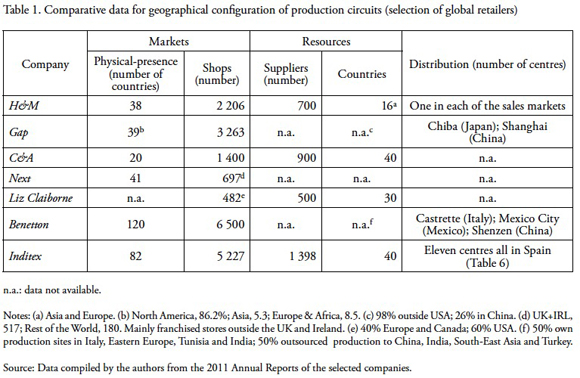
<body><![CDATA[<p align="justify"><b><font face="verdana" size="2">Factors and elements of the production    chains of global fast fashion distributors    </font></b></p>     <p align="justify"><font face="verdana" size="2">The contemporary evolution of traditional industrial    sectors, such as clothes manufacturing, can be    viewed as a pioneering case of the technical and    spatial fragmentation of the production process    and the appearance of global production and distribution    networks. The production is divided into    specialised activities, and each activity is located    where it can contribute most to the value of the    end product. When the location decision of each    activity is being made, costs, quality, reliability of    delivery, access to quality inputs, and transport and    transaction costs are important variables (Nord&aring;s,    2004). The data gathered in <a href="#table1">Table 1</a> present the resulting    geographical dispersion typical of the production    chains of leading companies.</font></p> <a name="table1"></a>    <p align="center"><font size="2" face="verdana"><img src="/img/revistas/igeo/n85/a9t1.jpg"></font></p>     <p align="justify"><font face="verdana" size="2">Such companies as the American <i>Gap</i>, <i>Banana    Republic</i>, and <i>Liz Claiborne</i>, the British <i>Next</i>,    the Swedish <i>H&amp;M</i>, the Italian <i>Benetton</i>, and the    Spanish <i>Inditex</i> group do not manufacture their    goods; instead, they manufacture only a part of the    products they sell and thus have large networks of    external suppliers. The spread of lean and agile production    systems has led to changes in companies'    sourcing strategies as they find themselves facing a    dilemma between the global supply chain, which    lets them benefit from the economic advantages    of different suppliers anywhere in the world, and    a local supply chain consisting of suppliers near    the markets, facilitating a fast response to the    same markets but at a higher cost (Guercini and    Runfola, 2004).<a href="#1"><sup>1</sup></a><a name="1a"></a>  </font></p>     <p align="justify"><font face="verdana" size="2">When the manufactured products are basic or    predictable and restocked only once a season, the    production chain spreads more or less around    the world, with China, India, and Bangladesh serving    as the main suppliers due to their advantage    in the quality/price ratio. For product categories of    unpredictable demand, such as those with a high    fashion content, the need for quick replenishment    enabling quicker responses to the market, makes    it more profitable for buyers to source their products    from countries with close proximities, even    if the products cost more initially (Guercini and    Runfola, 2004; Bruce <i>et al.</i>, 2004; Evans and Harrigan,    2004; Abernathy <i>et al.</i>, 2006; Christopher <i>et al.</i>, 2006). In these cases, the place of manufacture    is not determined by cost but by opportunity,    punctuality, and the quality of the service provided.    "Transport time", a location factor other than the    "transport cost" factor traditionally considered in    Economic Geography models, allows for comparative    advantages to be reassigned in favour of    countries in Eastern Europe, Turkey, Mexico, and    the Dominican Republic, among others, due to a    common border with importers from the European    and North American markets or the quality of    their logistics and transport services. In addition, those countries are likely to remain important    exporters because of preferential access to the    aforementioned markets through regional trade    agreements (Evans and Harrigan 2005; Guercini    and Runfola 2004; Nord&aring;s, 2004; Nord&aring;s <i>et al.</i>,    2006).  </font></p>     <p align="justify"><font face="verdana" size="2">Shop network is other essential element of    a global fashion retailer's strategy that is clearly    focused on ensuring the growth of the companies    by increasing their sales (Dawson, 2007:383).    Emerging countries in East and South Asia, Latin    America, and Eastern Europe have been the    preferred destinations in recent years, creating    new challenges for companies to provide a rapid    response to the demands of their markets, especially    the most distant ones (<a href="#table1">Table 1</a>).</font></p>     <p align="justify"><font face="verdana" size="2"><b>Logistics and transport in the framework    of global production chains in the fast    fashion sector  </b></font></p>     <p align="justify"><font face="verdana" size="2">According to Rodrigue (2006), the organisational    and spatial model described in the previous section    appears paradoxical if we consider the risks underlying    this dispersion, including uncertainty and    delayed deliveries. Christopher <i>et al.</i> even predict    that "low-cost off-shore sourcing strategies can end    up as high-cost supply chain outcomes" (2006:    278). For those reasons, a suitable integration,    both functional and geographical, of all elements    of the chain of production is required. Functional    integration is achieved when the delivery cost, dimension,    and time of the goods supplied by each    productive establishment &#150;external workshop or    manufacturer, supplier, distribution centre, and    shops&#150; meet the requirements of the destination    establishment. Functional integration has been    favoured by the generalised adoption of lean retailing    systems, electronic data interchange (EDI)    between establishments, or computerised systems    for recording sales.  </font></p>     <p align="justify"><font face="verdana" size="2">Global fashion distributors tend to concentrate    diverse operations and activities in logistics platforms    and distribution centres with the intention    of optimising product deliveries in different parts    of the world. Their spatial requirements include    a good location between the respective clusters of suppliers and clients to minimise the distance    covered by transport, especially lorries. Most global    fashion retailers prefer centres to support stores in    their geographic vicinity (see <a href="#table1">Table 1</a>) and locate    them in their different sales markets (e.g., Europe,    East Asia). However, in other cases, the companies    keep some or all of their distribution centres in    their country of origin.  </font></p>     <p align="justify"><font face="verdana" size="2">Geographical integration within the production    chain is achieved when the goods sent from    each establishment arrive at the destination establishment    quickly. Geographical integration has    been favoured by improvements in global goods    transport systems, although such improvements    has occurred at the expense of substantially    higher energy consumption, reinforced by the    fact that energy costs are still relatively very low    (Rodrigue, 2006). Elsewhere, air transport has been    experiencing an increased market share. The price    reduction, especially of the <i>ad valorem</i> rates, is a    key factor, as it means that speed and shorter lead    and travel times become less expensive, especially    for products with a higher value-to-weight ratio,    where the ability to respond quickly to market    demands is an important advantage for companies.    In these cases, air transport provides real    coverage against the volatility and uncertainty of    the market (Hummels, 2007) while avoiding other    delays not directly caused by distance, such as    border crossings. </font></p>     ]]></body>
<body><![CDATA[<p align="justify"><font face="verdana" size="2">Indeed, as discussed above, using air transport    improves the competitive position of semi-peripheral    and peripheral territories, as it permits exporting    higher-value garments to distant markets. Exports    from Bulgaria to the East Coast of the United    States (Nord&aring;s <i>et al.</i>, 2006) and the flows with    clothing for the Spanish group <i>Inditex</i> from China    or Korea are only two of many possible examples.    If, in addition, firms have centralised distribution    systems, air transport is increasingly important    for delivering garments to distant markets. Once    again, the group <i>Inditex</i> is a good example because    it transports much of the clothing sold in shops    outside Europe by plane, as we discuss in the    next section.  </font></p>     <p align="justify">&nbsp;</p>     <p align="justify"><font face="verdana" size="2"><b>GLOBAL PRODUCTION NETWORKS,    LOGISTICS, AND TRANSPORT: THE        <i>Inditex</i> GROUP  </b></font></p>     <p align="justify"><font face="verdana" size="2"><i>Inditex</i> (acronym for Industria de Dise&ntilde;o Textil, S.    A.) is a group of companies whose main activity    is the distribution of fashion articles, including    clothes, footwear, accessories, and household textile    products. Its activity takes place through different    commercial formats, including <i>Zara</i>, <i>Pull &amp; Bear</i>,    <i>Massimo Dutti</i>, <i>Bershka</i>, <i>Stradivarius</i>, <i>Oysho</i>, <i>Zara    Home</i>, and <i>Uterq&uuml;e</i>, and its trajectory has attracted    attention since 1975, the year the first <i>Zara</i> shop    opened in the Galician city of La Coru&ntilde;a, Northwest    Spain. Significant recent figures include    sales, which grew by 10% in 2011 and 17% in    2012, reaching 11 362 million euros; 6 000 shops    in 86 markets; 116 110 employees in October    2012; and the 12% increase in net profits between    2010 and 2011 despite the complicated economic    situation (<i>Inditex</i>, 2012), among other data.  </font></p>     <p align="justify"><font face="verdana" size="2"><i>Inditex</i> meets all of the requirements of the    leading companies in the fashion sector (Tokatli,    2008; Rohwedder and Johnson, 2008; Tokatly and    Kizilg&uuml;n, 2010) with interesting peculiarities, such    as the control and integration of all operations in    the production chain, a renewal of supply in shops    more frequent that its competitors, a reduced    design-to-retail cycle, a location in the vicinity    of many business functions, or the complete centralisation    of distribution. Many studies suggest    that <i>Inditex</i> is mainly a design-led company and    assert the importance of market research as a key    facilitator of the success of the firm (Dutta, 2002    and 2004). Our aim is not to challenge that view    but to provide empirical evidence of how logistics    enable the international expansion of the firm to    demonstrate that it is also a logistics-led company.  </font></p>     <p align="justify"><font face="verdana" size="2"><b>Globalising trends of the commercial function  </b></font></p>     <p align="justify"><font face="verdana" size="2">The growing number of shops indicates how the    group reaches the markets with an increasing    "convergent middle class",<a href="#2"><sup>2</sup></a><a name="2a"></a> such as Eastern Europe markets, where 50 and 49 new shops opened in  Russia and Poland, respectively, in 2011 (<a href="#table2">Table 2</a>).</font></p> <a name="table2"></a>    <p align="center"><font size="2" face="verdana"><img src="/img/revistas/igeo/n85/a9t2.jpg"></font></p>     <p align="justify"><font face="verdana" size="2">A presence in Asia was also consolidated with    the 2010 opening of the first <i>Zara</i> shop in India.    The opening of 75 shops in China in 2010 and    132 shops in 2011 confirms the trend to expand    in that country, where the group expected to have    a presence in 40 cities at the end of 2011. In 2011,    <i>Inditex</i> entered the Australian and South African    markets, thus expanding the area for which <i>Inditex</i>    designs specific collections due to the different    seasons. Data from <a href="#table2">Table 2</a> indicate an increase    in the number of American markets and shops    (16 and 395, respectively, in 2011), with growth    clearly concentrated in Mexico (<i>Inditex</i>, 2011 and    2012).  </font></p>     <p align="justify"><font face="verdana" size="2">Shops in old and new markets receive goods    twice a week. Each delivery includes new items    adapted to local demand in terms of models, sizes,    seasons, and other requirements. If we consider    that lean retailers in the United States typically    replenish their stores on a weekly basis (Nord&aring;s,    2004), the <i>Inditex</i> replenishment rhythm doubles    that of competitors. Delivery include garments    manufactured in the previous 30 days and moved    from the distribution centre to shops in Europe in    an average of 24 hours and to shops in the Americas    or Asia in 48 hours (<i>Inditex</i> 2012). Maintaining    both short lead times and short transport times    presents complex challenges for the logistical system,    which must ensure a constant renewal of the    offerings in the stores and maintain a competitive    advantage in markets that differ commercially and    geographically. As short lead times are related to    the supply chain strategy, we develop that aspect    in the following chapter.  </font></p>     ]]></body>
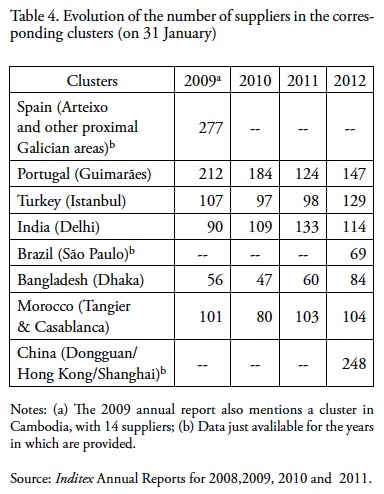
<body><![CDATA[<p align="justify"><font face="verdana" size="2"><b>Aspects of design and manufacturing:    location and function within the firm's    global network    </b></font></p>     <p align="justify"><font face="verdana" size="2">Design and manufacturing demonstrate the    <i>Inditex</i> group's commitment to the vertical integration    model in its operations. It is well known    that the more capital-intensive and value-added    intensive stages of group production (purchasing    raw materials, designing, cutting, dyeing, quality    control, ironing, packaging, labelling, distribution,    logistics) are performed internally and that sewing    and more labour-intensive and less value-added    intensive tasks are outsourced (Alonso, 2000;    Mart&iacute;nez, 2008; Mart&iacute;nez-Senra <i>et al.</i>, 2012). To    appreciate how logistical and transport challenges    are overcome, it is necessary to know where the    different stages of production are performed. Approximately    1 000 people based at the La Coru&ntilde;a    company headquarters and in Barcelona carry out    the design and development tasks (<i>Inditex</i>, 2011).    They receive constant information from the stores,    allowing the firm to react very quickly to changes    in demand and to design many more models than    the competitors. Their specifications can quickly    be put into practice because the <i>Inditex</i> facilities,    where manufacturing begins, are located in the    same or another very proximal industrial park.    The facilities consist of 11 small establishments,    with all but one having less than 100 employees.    They are equipped with the latest equipment for    fabric dyeing and processing, cutting, and garment    finishing (Dutta, 2002; Mart&iacute;nez <i>et al.</i>, 2012).  </font></p>     <p align="justify"><font face="verdana" size="2">Labour-intensive tasks, such as sewing, are    subcontracted to firms in a wide-ranging supply    chain, currently present in 60 countries (<i>Inditex</i>, 2012).<a href="#3"><sup>3</sup></a><a name="3a"></a> The nearest supplier companies are situated    along the La Coru&ntilde;a-Vigo axis and the North of    Portugal, where a very strong sector of dressmaking    manufacturing has developed competitive    production capabilities by means of cooperatives    and non-cooperative workshops and by contracting    to domestic producers (Revilla, 2002). The spatial    distribution and evolution of all suppliers forming    the first line of the production chains appear in    <a href="#table3">Table 3</a>.<a href="#4"><sup>4</sup></a><a name="4a"></a>  </font></p> <a name="table3"></a>    <p align="center"><img src="/img/revistas/igeo/n85/a9t3.jpg"></p>     <p align="justify"><font face="verdana" size="2">Alongside the geographical diversification of the    supply chain, <i>Inditex</i> maintains a clear strategy of    concentrating the production because more than    87% is obtained in the seven countries where the    group has established clusters of suppliers from    2006 on (<a href="#table4">Table 4</a>). The data provided in <a href="#table3">Table 3</a>    and <a href="#table4">4</a> illustrate the absolute and relative increase in    the number of non-European suppliers, especially    the Asian suppliers. Nevertheless, corporative information    indicates that proximity is still a hallmark    of the group because 50% of production is manufactured    in areas much closer than Asia, such as the    rest of Galicia, the North of Portugal, Morocco,    or even some non-EU European countries, such    as Turkey (<i>Ibid.</i>:9). Furthermore, the proximity    trend could even recover in the near future due to    the recent transfer of some of the group's current    production in China to Turkey, Morocco, or Portugal    (G&oacute;mez, 2012). Our data do not allow us to    confirm the first part of that statement, but we can    confirm the second part because of the increasing    number of suppliers in Turkey, Portugal, and even  Morocco.</font></p> <a name="table4"></a>    <p align="center"><font size="2" face="verdana"><img src="/img/revistas/igeo/n85/a9t4.jpg"></font></p>     <p align="justify"><font face="verdana" size="2">Clusters of suppliers are important for the    goods-in and goods-out flows through the logistics system and for understanding the production    process. With the cluster strategy, the firm selected    a smaller number of productive scenarios    to stimulate collaboration among the different    agents involved, increase the productivity of local    manufacturers, and share technology with them as    a source of competitive advantage (<i>Inditex</i>, 2007).    Stable commercial relationships allow the companies    to increase the level of integration of their    own processes with the group dynamic. Thus, the    conditions are in place to get a garment to market    very quickly. Sometimes, this rapid time to market    is achieved because undyed fabrics and trims are    already at the firm's warehouses in Arteixo after    been sourced from East Spain, India, or Morocco    and because the pieces cut at the neighbouring    group facilities are distributed for assembly to the    Galicia and North of Portugal suppliers.  </font></p>     <p align="justify"><font face="verdana" size="2">On other occasions, local suppliers merely    personalise or provide a "basic product", previously    manufactured by a low-cost supplier, a different    finish according with the market tendencies. Customisation    or after-treatment makes it possible to    create 10 "new" final products from one "basic" one    (Mart&iacute;nez <i>et al.</i>, 2012). Although manufacturing in    Spain and Portugal is two and a half times more expensive    than in Eastern Europe due to higher salary    costs, the group has maintained its competitiveness    because it compensates for this increased cost with    higher productivity, better quality products, and    faster access to its markets (Gavidia and Mart&iacute;nez,    2007; Tokatli, 2008).  </font></p>     <p align="justify"><font face="verdana" size="2">In addition to the <i>local supply</i> strategy, <i>Inditex</i>    has an overseas or <i>global supply</i> chain. In four of    the global supplier countries &#150;China, Pakistan,    Bangladesh, and India&#150; there are clusters of    suppliers, from which we may conclude that, as    explained above, their contribution to production,    which could represent over 30% of the total,    includes products with a high fashion content.    It can also be inferred that in addition to the    advantageous quality/price ratio typical of these    countries, we can add the availability of efficient    logistics and transport services, including air    transport, which would attenuate the costs of their    distance to the Spanish distribution centres, as we  explain below.</font></p>     <p align="justify"><font face="verdana" size="2"><b>Geographical integration of the supply chain:    logistics and transport  </b></font></p>     ]]></body>
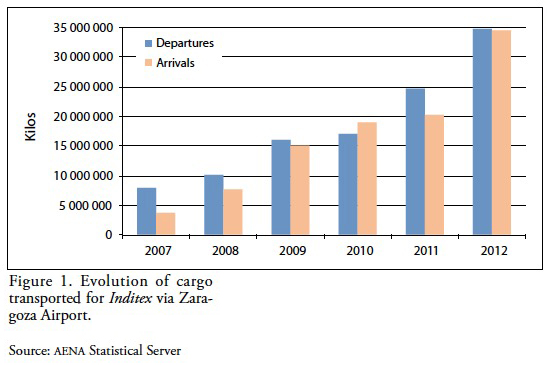
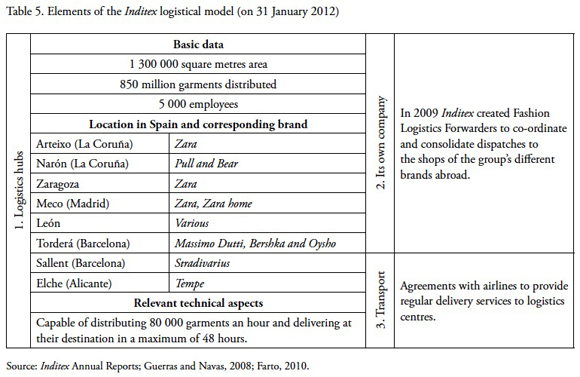
<body><![CDATA[<p align="justify"><font face="verdana" size="2">The basic characteristics of the <i>Inditex</i> transport    and logistics system are summarised in <a href="#table5">Table 5</a>.    Efficiency is achieved due to economies of scale,    simplified communications, and the coordination    of production in establishments on all five    continents (Gavidia and Mart&iacute;nez, 2007). The    activity of the group's own company, <i>Fashion Logistics    Forwarders</i>, focuses on improving its brands'    deliveries to destinations where they do not have    a large presence, as the containers carrying the    garments of these brands were often not full, and    occasionally, two brands would send half-empty    containers to the same destinations (Farto, 2008).    The company optimises the transport methods    and redefines the routes established by the logistics    departments of each of the group's brands to make    distribution costs for the goods as inexpensive  as possible.</font></p> <a name="table5"></a>    <p align="center"><font size="2" face="verdana"><img src="/img/revistas/igeo/n85/a9t5.jpg"></font></p>     <p align="justify"><font face="verdana" size="2">The data in <a href="#table6">Table 6</a> summarise the activity of the    <i>Zara</i> logistics hub in Zaragoza (Northeast Spain),    opened in 2003, in addition to the existing <i>Zara</i>    hub in Arteixo (Galicia). The centre is in the city's    logistics platform and enjoys a high accessibility    and potential for intermodality due to the presence    at the site itself or nearby of railway, roads, and an    airport and of good road connections to the Mediterranean    ports of Valencia and Barcelona and the    port of Pasajes on the Bay of Biscay (Cambra and    Ruiz, 2009; Sheffi, 2012). This facility can store 34    million garments, distribute 360 million garments,    and have more than 900 people operating at a time.  The data in the table illustrate what has already been discussed regarding how logistics hubs work  as part of global chains of production. The inflows  come from supplier factories everywhere and from  other distribution centres in Spain, whereas outflows  are exclusively towards the <i>Zara</i> shops. As  remarked above, the radius of action of the hub  has increased, and the destination shops are now  on every continent except Australia. However, European  shops are the destination of more than half  the garments, followed by shops in Asia. Although  our source did not provide information about the  geographical origin of inflows, the fact that 50%  are road flows indicates that the origin is European.  Fifteen percent of inflows arrive by air from Asia,  confirming the use of air transport to compensate  for the disadvantage of some manufacturers due to  their distance and thus make it possible to maintain  the manufacture of high-fashion garments in these  territories. Nevertheless, most of the goods from  the Asian continent use sea transport until the Barcelona  port. The explained intermodal distribution  of the goods coming in has been stable for several  years (Escalona and Ramos, 2010).</font></p> <a name="table6"></a>    <p align="center"><font size="2" face="verdana"><img src="/img/revistas/igeo/n85/a9t6.jpg"></font></p>     <p align="justify"><font face="verdana" size="2">Concerning the outflows, the intermodal distribution    is related to the achievement of delivering to    shops in Europe in an average of 24 hours and    to the Americas and Asia in 48 hours. Air transport    is used for 36% of the outflows, a figure that is 20%    higher than in 2010 and appears to be an effect of    the growing importance of non-European markets,    which are served only (Asia and America) or mostly    (Africa) by plane. A local effect of the greater use    of air transport for logistics flows is the increased    use of the neighbouring airport of Zaragoza (see    <a href="#figura1">Figure 1</a>). For that reason, the airport ranks third of    all of the Spanish airports for freight transport, just    after Madrid and Barcelona, and freight for <i>Inditex</i>    represents more than 80% of the total freight.</font></p> <a name="figura1"></a>    <p align="center"><font size="2" face="verdana"><img src="/img/revistas/igeo/n85/a9f1.jpg"></font></p>     <p align="justify"><font face="verdana" size="2">Due to the increase in air inflows and outflows,    the relative importance of Zaragoza Airport for the    company's operations in the platform has grown,    accounting for 10% of all air inflows and 22% of    all air outflows. <a href="/img/revistas/igeo/n85/html/a9t7.html" target="_blank">Table 7</a> and <a href="/img/revistas/igeo/n85/html/a9f2.html" target="_blank">Figures 2</a> and <a href="/img/revistas/igeo/n85/html/a9f3.html" target="_blank">3</a> present    aspects of the recent activity.  </font></p>     <p align="justify"><font face="verdana" size="2">Cargo flights for <i>Inditex</i> arrive at Zaragoza    Airport from Asia and the Middle East carrying garments made in the Asian supplier clusters and    factories. The use of air transport indicates that    these can be high-fashion-content products and    that air transport facilitates bringing them to the    market quickly (<a href="/img/revistas/igeo/n85/html/a9f2.html" target="_blank">Figure 2</a>).  </font></p>     <p align="justify"><font face="verdana" size="2">Outgoing flights take the finished garments    to the shops in the Asian and Middle Eastern    markets. Additionally, in August 2012, a regular    service to Mexico began to deliver to the Central    and North American markets. Mexico is one of    the countries that has leveraged its proximity to the    North American market to develop competitive    advantages in transport and logistics services. All of    the routes developed go to highly dynamic markets    in emerging countries (<a href="/img/revistas/igeo/n85/html/a9f3.html" target="_blank">Figure 3</a>).  </font></p>     <p align="justify">&nbsp;</p>     ]]></body>
<body><![CDATA[<p align="justify"><font face="verdana" size="2"><b>CONCLUSION  </b></font></p>     <p align="justify"><font face="verdana" size="2">The concept of the global production network    expressively covers the spatial interrelationships    characteristic of the economy due to the existence of worldwide flows of information, raw materials,    components, and finished products. The starting    point of this article is that efficient logistics and    transport services are what make production chains    truly global and are essential to an understanding    of their organisational and geographical structure.    The configuration of the supply chain of global    retailers is a good example because the choice of    global or local supply depends on whether suppliers    rely on efficient transport and logistics systems    that let them compensate for higher relative costs    compared with developing countries &#150;in the case    of local supply&#150; or the costs deriving from their    greater distance to the market &#150;in the case of global    supply&#150; (Tokatli, 2008; Tokatli and Kizilg&uuml;n,    2010; Christopher <i>et al.</i>, 2006).  </font></p>     <p align="justify"><font face="verdana" size="2">Meanwhile, a review of the theory also demonstrates    that the challenges presented by the    functional and geographical integration of fashion    production networks can only be overcome if    global retailers manage their logistics efficiently    and leverage the differentiated advantages of the    modes of transport in relation to time, the value    of which is confirmed as a new key variable for    understanding the geography of the major global    fast fashion industry and similar companies (Evans    and Harrigan 2004).    </font></p>     <p align="justify"><font face="verdana" size="2">The Spanish group <i>Inditex</i>, a world leader in fashion    distribution, provides a clear example of how    the logistics system forms part of the organisation    of production, giving it a global reach and, in this    case, a notable competitiveness. The analysis, based    on recent data that are not often discussed and in    some cases are previously unpublished, sheds light    on the <i>modus operandi</i> of the group global network    and confirms the crucial importance of logistics in    all facets of the production model. First, without    efficient logistics and sufficiently fast transport, the    company could not enjoy such short lead times    and be present in economically and geographically    very disparate markets, continuously renewing    the offerings available in its shops, in less than 48    hours when necessary. The organisational structure,    combining nearby and distant manufacturing, and    both dispersion and concentration spatially and in    production, also relies on the effectiveness of the    logistical model. We know that better internal and    external communication and greater productivity    has compensated for the company's higher costs of    manufacturing in nearby areas. However, in this    article, we demonstrate how the vigour of the four    clusters of suppliers in Asia (China, Pakistan, Bangladesh,    and India) and the advantageous quality/    price ratio typical of these countries rests on the    availability of efficient logistics and transport services,    including air transport, which ameliorate the    costs of their distance to the company's distribution  centres in Spain and other markets. </font></p>     <p align="justify"><font face="verdana" size="2">Finally, we have provided details of how the <i>Inditex</i>    group completely centralises the distribution    of its products to shops. The data for the <i>Zara</i> logistics    hub in Zaragoza illustrate and highlight the    value given to time in the company's activities and    how this consideration influences the organisation    of the flows in and out of the hub. Air transport is    used to send garments to distant markets and also    for the reception of high-fashion-content garments    from the Asian clusters and for their quick delivery    to various markets despite the distance.  </font></p>     <p align="justify"><font face="verdana" size="2">We understand the <i>Inditex</i> case, despite its    uniqueness, to be sufficiently representative and    the conclusions of the analysis to be valuable    because they refer to aspects of global production    networks that should be considered more often to    provide a more accurate account of the situation.    Nevertheless, we agree with Rodrigue (2006) that    a heavy dependence on energy and the likelihood    of fuel price increases threaten the future viability    of the logistics models described here. <i>Inditex</i>,    the company which is the focus of this study, has    been adopting different energy saving measures    as part of its sustainability programmes, notably    including measures to reduce greenhouse gas    emissions (GGEs) in its logistics activity by 20%    until 2020, taking 2005 as a reference (<i>Inditex</i>    2012). However, the overall economic impact of    a scenario of high energy costs on the organisation    and functioning of global production chains whose    rapid response to the market is based on the present    unrealistic cheapness of fast transport is still    unclear. Establishing the scope and reach of these    aspects will require complementary analysis. However,    we are confident that we have contributed to    stimulating interest in a better understanding of the relationship between logistical and transport    systems and global production networks whose    future formulation and configuration in a possible    new economic and environmental context    will undoubtedly pose an interesting challenge    to research.  </font></p>     <p align="justify">&nbsp;</p>     <p align="justify"><font face="verdana" size="2"><b>References  </b></font></p>     <!-- ref --><p align="justify"><font face="verdana" size="2">Abernathy, F. H., A. Volpe A. and D. Weil (2006),    "The future of the apparel and textile industries:    prospects and choices for public and private actors",    <i>Environment and Planning A</i>, vol. 38, issue 12,  pp. 2207-2232.    &nbsp;&nbsp;&nbsp;&nbsp;&nbsp;&nbsp;&nbsp;&nbsp;[&#160;<a href="javascript:void(0);" onclick="javascript: window.open('/scielo.php?script=sci_nlinks&ref=4726538&pid=S0188-4611201400030000900001&lng=','','width=640,height=500,resizable=yes,scrollbars=1,menubar=yes,');">Links</a>&#160;]<!-- end-ref --> </font></p>     ]]></body>
<body><![CDATA[<!-- ref --><p align="justify"><font face="verdana" size="2">Alonso &Aacute;lvarez, L. (2000), "Vistiendo a tres continentes.    La ventaja competitiva del grupo <i>Inditex</i>-<i>Zara</i>,    1963-1999", <i>Revista de Historia Industrial</i>, issue 18,  pp. 157-184.    &nbsp;&nbsp;&nbsp;&nbsp;&nbsp;&nbsp;&nbsp;&nbsp;[&#160;<a href="javascript:void(0);" onclick="javascript: window.open('/scielo.php?script=sci_nlinks&ref=4726540&pid=S0188-4611201400030000900002&lng=','','width=640,height=500,resizable=yes,scrollbars=1,menubar=yes,');">Links</a>&#160;]<!-- end-ref --> </font></p>     <!-- ref --><p align="justify"><font face="verdana" size="2">Bruce, M., L. Daly and N. Towers (2004), "Lean or    agile: A solution for supply chain management in    the textiles and clothing industry?", <i>International    Journal of Operations &amp; Production Management</i>,  vol. 24, issue 2, pp.151-170.    &nbsp;&nbsp;&nbsp;&nbsp;&nbsp;&nbsp;&nbsp;&nbsp;[&#160;<a href="javascript:void(0);" onclick="javascript: window.open('/scielo.php?script=sci_nlinks&ref=4726542&pid=S0188-4611201400030000900003&lng=','','width=640,height=500,resizable=yes,scrollbars=1,menubar=yes,');">Links</a>&#160;]<!-- end-ref --> </font></p>     <!-- ref --><p align="justify"><font face="verdana" size="2">Cambra-Fierro, J. and R. Ruiz Ben&iacute;tez (2009), "Advantages    of intermodal logistics platforms: Insights from    a Spanish Platform", <i>Supply Chain Management: An  international Journal</i>, vol. 14, issue 6, pp. 418-421.    &nbsp;&nbsp;&nbsp;&nbsp;&nbsp;&nbsp;&nbsp;&nbsp;[&#160;<a href="javascript:void(0);" onclick="javascript: window.open('/scielo.php?script=sci_nlinks&ref=4726544&pid=S0188-4611201400030000900004&lng=','','width=640,height=500,resizable=yes,scrollbars=1,menubar=yes,');">Links</a>&#160;]<!-- end-ref --> </font></p>     <!-- ref --><p align="justify"><font face="verdana" size="2">Christopher, M., H. Peck and D. Towill (2006), "A taxonomy    for selecting global supply chains strategies",    <i>The International Journal of Logistics Management</i>,  vol. 17, issue 2, pp. 277-287.    &nbsp;&nbsp;&nbsp;&nbsp;&nbsp;&nbsp;&nbsp;&nbsp;[&#160;<a href="javascript:void(0);" onclick="javascript: window.open('/scielo.php?script=sci_nlinks&ref=4726546&pid=S0188-4611201400030000900005&lng=','','width=640,height=500,resizable=yes,scrollbars=1,menubar=yes,');">Links</a>&#160;]<!-- end-ref --> </font></p>     <!-- ref --><p align="justify"><font face="verdana" size="2">Coe, N. M. and M. Hess (2005), "The internationalization    of retailing: implications for supply network restructuring    in East Asia and Eastern Europe", <i>Journal  of Ecomomic Geography</i>, vol. 5, issue 4, pp. 449-473.    &nbsp;&nbsp;&nbsp;&nbsp;&nbsp;&nbsp;&nbsp;&nbsp;[&#160;<a href="javascript:void(0);" onclick="javascript: window.open('/scielo.php?script=sci_nlinks&ref=4726548&pid=S0188-4611201400030000900006&lng=','','width=640,height=500,resizable=yes,scrollbars=1,menubar=yes,');">Links</a>&#160;]<!-- end-ref --> </font></p>     ]]></body>
<body><![CDATA[<!-- ref --><p align="justify"><font face="verdana" size="2">Coe, N., P. Dicken and M. Hess (2008), "Global production    networks realizing potential", <i>Journal of  Economic Geography</i>, vol. 8, issue 3, pp. 271-295.    &nbsp;&nbsp;&nbsp;&nbsp;&nbsp;&nbsp;&nbsp;&nbsp;[&#160;<a href="javascript:void(0);" onclick="javascript: window.open('/scielo.php?script=sci_nlinks&ref=4726550&pid=S0188-4611201400030000900007&lng=','','width=640,height=500,resizable=yes,scrollbars=1,menubar=yes,');">Links</a>&#160;]<!-- end-ref --> </font></p>     <!-- ref --><p align="justify"><font face="verdana" size="2">Dawson, J. A. (2007), "Scoping and conceptualising    retailer internationalization", <i>Journal of Economic  Geography</i>, vol. 7, issue 4, pp. 373-397.    &nbsp;&nbsp;&nbsp;&nbsp;&nbsp;&nbsp;&nbsp;&nbsp;[&#160;<a href="javascript:void(0);" onclick="javascript: window.open('/scielo.php?script=sci_nlinks&ref=4726552&pid=S0188-4611201400030000900008&lng=','','width=640,height=500,resizable=yes,scrollbars=1,menubar=yes,');">Links</a>&#160;]<!-- end-ref --> </font></p>     <!-- ref --><p align="justify"><font face="verdana" size="2">Dutta, D. (2002),<i> Retail @ the speed of fashion. The Third  Eyesight</i> &#91;<a href="http://thirdeyesight.in/articles/ImagesFashion_Zara_Part_I.pdf" target="_blank">http://thirdeyesight.in/articles/ImagesFashion_Zara_Part_I.pdf</a>: April 30th 2013&#93;    &nbsp;&nbsp;&nbsp;&nbsp;&nbsp;&nbsp;&nbsp;&nbsp;[&#160;<a href="javascript:void(0);" onclick="javascript: window.open('/scielo.php?script=sci_nlinks&ref=4726554&pid=S0188-4611201400030000900009&lng=','','width=640,height=500,resizable=yes,scrollbars=1,menubar=yes,');">Links</a>&#160;]<!-- end-ref -->. </font></p>     <!-- ref --><p align="justify"><font face="verdana" size="2">Dutta, D. (2004), <i>Retail @ the speed of fashion. The Third  Eyesight</i> &#91;<a href="http://thirdeyesight.in/articles/ImagesFashion_ Zara_Part_II.pdf" target="_blank">http://thirdeyesight.in/articles/ImagesFashion_ Zara_Part_II.pdf</a>: April 30th 2013&#93;    &nbsp;&nbsp;&nbsp;&nbsp;&nbsp;&nbsp;&nbsp;&nbsp;[&#160;<a href="javascript:void(0);" onclick="javascript: window.open('/scielo.php?script=sci_nlinks&ref=4726556&pid=S0188-4611201400030000900010&lng=','','width=640,height=500,resizable=yes,scrollbars=1,menubar=yes,');">Links</a>&#160;]<!-- end-ref --> . </font></p>     <!-- ref --><p align="justify"><font face="verdana" size="2">Escalona Orcao, A. I., A. G&aacute;mir Orueta, E. Larrod&eacute; Pellicer,    J. Sama&uacute; Villaroya and D. Ramos P&eacute;rez (2008), <i>El    aeropuerto de Zaragoza. Una visi&oacute;n espacial, econ&oacute;mica    y funcional</i>. Zaragoza (Working Paper 50/2008),  Fundaci&oacute;n Econom&iacute;a Aragonesa, Zaragoza.    &nbsp;&nbsp;&nbsp;&nbsp;&nbsp;&nbsp;&nbsp;&nbsp;[&#160;<a href="javascript:void(0);" onclick="javascript: window.open('/scielo.php?script=sci_nlinks&ref=4726558&pid=S0188-4611201400030000900011&lng=','','width=640,height=500,resizable=yes,scrollbars=1,menubar=yes,');">Links</a>&#160;]<!-- end-ref --> </font></p>     ]]></body>
<body><![CDATA[<!-- ref --><p align="justify"><font face="verdana" size="2">Escalona Orcao, A. I. and D. Ramos P&eacute;rez (2010),    "Geograf&iacute;a productiva y flujos internacionales de    transporte: el crecimiento de la carga a&eacute;rea en el aeropuerto    de Zaragoza", <i>Anales de Geograf&iacute;a</i>, vol. 30,  issue 2, pp. 59-80.    &nbsp;&nbsp;&nbsp;&nbsp;&nbsp;&nbsp;&nbsp;&nbsp;[&#160;<a href="javascript:void(0);" onclick="javascript: window.open('/scielo.php?script=sci_nlinks&ref=4726560&pid=S0188-4611201400030000900012&lng=','','width=640,height=500,resizable=yes,scrollbars=1,menubar=yes,');">Links</a>&#160;]<!-- end-ref --> </font></p>     <!-- ref --><p align="justify"><font face="verdana" size="2">Evans, C. and J. Harrigan (2004), <i>Tight Clothing. How    the MFA Affects Asian Apparel Exports</i> (NBER Working    Paper No. 10.250), National Bureau of Economic    Research, Cambridge (MA).    &nbsp;&nbsp;&nbsp;&nbsp;&nbsp;&nbsp;&nbsp;&nbsp;[&#160;<a href="javascript:void(0);" onclick="javascript: window.open('/scielo.php?script=sci_nlinks&ref=4726562&pid=S0188-4611201400030000900013&lng=','','width=640,height=500,resizable=yes,scrollbars=1,menubar=yes,');">Links</a>&#160;]<!-- end-ref --> </font></p>     <!-- ref --><p align="justify"><font face="verdana" size="2">Farto Mu&ntilde;oz, A. (2008), "<i>Inditex</i> crea su propia log&iacute;stica",    <i>Casos de Direcci&oacute;n Estrat&eacute;gica de la Empresa</i> (4th ed.),  Thomson-Civitas, Madrid.    &nbsp;&nbsp;&nbsp;&nbsp;&nbsp;&nbsp;&nbsp;&nbsp;[&#160;<a href="javascript:void(0);" onclick="javascript: window.open('/scielo.php?script=sci_nlinks&ref=4726564&pid=S0188-4611201400030000900014&lng=','','width=640,height=500,resizable=yes,scrollbars=1,menubar=yes,');">Links</a>&#160;]<!-- end-ref --> </font></p>     <!-- ref --><p align="justify"><font face="verdana" size="2">Gavidia, J. V. and J. L. Mart&iacute;nez (2007), "Dos alternativas    de organizaci&oacute;n de la cadena de suministros con una    orientaci&oacute;n al mercado: Benetton frente a <i>Inditex</i>",  <i>Revista de Empresa</i>, issue 19, pp. 48-57.    &nbsp;&nbsp;&nbsp;&nbsp;&nbsp;&nbsp;&nbsp;&nbsp;[&#160;<a href="javascript:void(0);" onclick="javascript: window.open('/scielo.php?script=sci_nlinks&ref=4726566&pid=S0188-4611201400030000900015&lng=','','width=640,height=500,resizable=yes,scrollbars=1,menubar=yes,');">Links</a>&#160;]<!-- end-ref --> </font></p>     <p align="justify"><font face="verdana" size="2">G&oacute;mez, L. (2012), "El &eacute;xito del sastre global", <i>El Pa&iacute;s</i>,  12 August, pp. 2-4 (Domingo section). </font></p>     <!-- ref --><p align="justify"><font face="verdana" size="2">Guercini, S. and A. Runfola (2004), "Sourcing strategies    in clothing retail firms: product complexity versus    overseas supply chain", <i>Journal of Costumer Behaviour</i>,  vol. 3, issue 3, pp. 305-334.    &nbsp;&nbsp;&nbsp;&nbsp;&nbsp;&nbsp;&nbsp;&nbsp;[&#160;<a href="javascript:void(0);" onclick="javascript: window.open('/scielo.php?script=sci_nlinks&ref=4726569&pid=S0188-4611201400030000900016&lng=','','width=640,height=500,resizable=yes,scrollbars=1,menubar=yes,');">Links</a>&#160;]<!-- end-ref --> </font></p>     <!-- ref --><p align="justify"><font face="verdana" size="2">Hess, M. and H. W.-C. Yeung (2006), "Whither global    production networks in economic geography? Past,    present, and future", <i>Environment and Planning A</i>,  vol. 38, issue 7, pp. 1193-1204.    &nbsp;&nbsp;&nbsp;&nbsp;&nbsp;&nbsp;&nbsp;&nbsp;[&#160;<a href="javascript:void(0);" onclick="javascript: window.open('/scielo.php?script=sci_nlinks&ref=4726571&pid=S0188-4611201400030000900017&lng=','','width=640,height=500,resizable=yes,scrollbars=1,menubar=yes,');">Links</a>&#160;]<!-- end-ref --> </font></p>     <!-- ref --><p align="justify"><font face="verdana" size="2">Hummels, D. L. (2007), "Transportation costs and international    trade in the second era of globalization",<i> Journal  of Economic Perspectives</i>, vol. 21, issue 3, pp. 131-154.    &nbsp;&nbsp;&nbsp;&nbsp;&nbsp;&nbsp;&nbsp;&nbsp;[&#160;<a href="javascript:void(0);" onclick="javascript: window.open('/scielo.php?script=sci_nlinks&ref=4726573&pid=S0188-4611201400030000900018&lng=','','width=640,height=500,resizable=yes,scrollbars=1,menubar=yes,');">Links</a>&#160;]<!-- end-ref --> </font></p>     <!-- ref --><p align="justify"><font face="verdana" size="2"><i>Inditex</i> (2007), <i>Annual Report 2006</i>, Industria de Dise&ntilde;o  Textil, A Coru&ntilde;a.    &nbsp;&nbsp;&nbsp;&nbsp;&nbsp;&nbsp;&nbsp;&nbsp;[&#160;<a href="javascript:void(0);" onclick="javascript: window.open('/scielo.php?script=sci_nlinks&ref=4726575&pid=S0188-4611201400030000900019&lng=','','width=640,height=500,resizable=yes,scrollbars=1,menubar=yes,');">Links</a>&#160;]<!-- end-ref --> </font></p>     <!-- ref --><p align="justify"><font face="verdana" size="2"><i>Inditex</i> (2011), <i>Annual Report 2010</i>, Industria de Dise&ntilde;o  Textil, A Coru&ntilde;a.    &nbsp;&nbsp;&nbsp;&nbsp;&nbsp;&nbsp;&nbsp;&nbsp;[&#160;<a href="javascript:void(0);" onclick="javascript: window.open('/scielo.php?script=sci_nlinks&ref=4726577&pid=S0188-4611201400030000900020&lng=','','width=640,height=500,resizable=yes,scrollbars=1,menubar=yes,');">Links</a>&#160;]<!-- end-ref --> </font></p>     <!-- ref --><p align="justify"><font face="verdana" size="2"><i>Inditex</i> (2012), <i>Annual Report 2011</i>, Industria de Dise&ntilde;o  Textil, A Coru&ntilde;a.    &nbsp;&nbsp;&nbsp;&nbsp;&nbsp;&nbsp;&nbsp;&nbsp;[&#160;<a href="javascript:void(0);" onclick="javascript: window.open('/scielo.php?script=sci_nlinks&ref=4726579&pid=S0188-4611201400030000900021&lng=','','width=640,height=500,resizable=yes,scrollbars=1,menubar=yes,');">Links</a>&#160;]<!-- end-ref --> </font></p>     <!-- ref --><p align="justify"><font face="verdana" size="2">Mart&iacute;nez-Senra, A. I., A. Sartal and X. H. V&aacute;zquez    (2012), "Tintorer&iacute;as de posguerra e innovaci&oacute;n organizativa    en <i>Inditex</i>: una perspectiva contractual de    la gesti&oacute;n lean de la cadena de suministro", <i>Universia    Business Review</i>, Second semester, pp. 36-51 &#91;<a href="http://ubr.universia.net/pdfs_web/UBR34_Web/02.pdf" target="_blank">http://ubr.universia.net/pdfs_web/UBR34_Web/02.pdf</a>:  April 30th 2013&#93;    &nbsp;&nbsp;&nbsp;&nbsp;&nbsp;&nbsp;&nbsp;&nbsp;[&#160;<a href="javascript:void(0);" onclick="javascript: window.open('/scielo.php?script=sci_nlinks&ref=4726581&pid=S0188-4611201400030000900022&lng=','','width=640,height=500,resizable=yes,scrollbars=1,menubar=yes,');">Links</a>&#160;]<!-- end-ref -->. </font></p>     <!-- ref --><p align="justify"><font face="verdana" size="2">Noguer&iacute;a, R. (2013), "Galaxia <i>Inditex</i>", <i>El Pa&iacute;s Semanal</i>,  7 April &#91;<a href="http://elpais.com/elpais/2013/04/04/eps/1365075665_193245.html" target="_blank">http://elpais.com/elpais/2013/04/04/eps/1365075665_193245.html</a> : April 30th 2013&#93;    &nbsp;&nbsp;&nbsp;&nbsp;&nbsp;&nbsp;&nbsp;&nbsp;[&#160;<a href="javascript:void(0);" onclick="javascript: window.open('/scielo.php?script=sci_nlinks&ref=4726583&pid=S0188-4611201400030000900023&lng=','','width=640,height=500,resizable=yes,scrollbars=1,menubar=yes,');">Links</a>&#160;]<!-- end-ref -->. </font></p>     <!-- ref --><p align="justify"><font face="verdana" size="2">Nord&aring;s, H. K. (2004), <i>The global textile and clothing    industry post the agreement on textiles and clothing</i> (Discussion  Paper 5), World Trade Organization, Geneva.    &nbsp;&nbsp;&nbsp;&nbsp;&nbsp;&nbsp;&nbsp;&nbsp;[&#160;<a href="javascript:void(0);" onclick="javascript: window.open('/scielo.php?script=sci_nlinks&ref=4726585&pid=S0188-4611201400030000900024&lng=','','width=640,height=500,resizable=yes,scrollbars=1,menubar=yes,');">Links</a>&#160;]<!-- end-ref --> </font></p>     <!-- ref --><p align="justify"><font face="verdana" size="2">Nord&aring;s, H. K., E. Pinali and M. G. Grosso (2006), <i>Logistics    and time as a trade barrier</i> (OECD Trade Policy  Papers, No 35), OECD, Paris.    &nbsp;&nbsp;&nbsp;&nbsp;&nbsp;&nbsp;&nbsp;&nbsp;[&#160;<a href="javascript:void(0);" onclick="javascript: window.open('/scielo.php?script=sci_nlinks&ref=4726587&pid=S0188-4611201400030000900025&lng=','','width=640,height=500,resizable=yes,scrollbars=1,menubar=yes,');">Links</a>&#160;]<!-- end-ref --> </font></p>     <!-- ref --><p align="justify"><font face="verdana" size="2">Raworth, K. and T. Kidder (2009), "Mimicking "lean"    in global value chains: it's the workers who get    leaned on", in Bair, J. (ed.), <i>Frontiers of commodity chain research</i>, Stanford University Press, Stanford,  pp. 165-189.    &nbsp;&nbsp;&nbsp;&nbsp;&nbsp;&nbsp;&nbsp;&nbsp;[&#160;<a href="javascript:void(0);" onclick="javascript: window.open('/scielo.php?script=sci_nlinks&ref=4726589&pid=S0188-4611201400030000900026&lng=','','width=640,height=500,resizable=yes,scrollbars=1,menubar=yes,');">Links</a>&#160;]<!-- end-ref --> </font></p>     <!-- ref --><p align="justify"><font face="verdana" size="2">Rodrigue, J. P. (2006), "Transportation and the geographical    and functional integration of Global Production    Networks", <i>Growth and Change</i>, vol. 37, issue 4,  pp. 510-525.    &nbsp;&nbsp;&nbsp;&nbsp;&nbsp;&nbsp;&nbsp;&nbsp;[&#160;<a href="javascript:void(0);" onclick="javascript: window.open('/scielo.php?script=sci_nlinks&ref=4726591&pid=S0188-4611201400030000900027&lng=','','width=640,height=500,resizable=yes,scrollbars=1,menubar=yes,');">Links</a>&#160;]<!-- end-ref --> </font></p>     <p align="justify"><font face="verdana" size="2">Rohwedder, C. and K. Johnson (2008), "Pace-Setting    <i>Zara</i> Seeks More Speed To Fight Its Rising Cheap-  Chic Rivals", <i>The Wall Street Journal</i>, 20 February. </font></p>     <!-- ref --><p align="justify"><font face="verdana" size="2">Sheffi, Y. (2012), <i>Logistics clusters: delivering value and driving    growth</i>, MIT Press, Cambridge, Massachusetts.    &nbsp;&nbsp;&nbsp;&nbsp;&nbsp;&nbsp;&nbsp;&nbsp;[&#160;<a href="javascript:void(0);" onclick="javascript: window.open('/scielo.php?script=sci_nlinks&ref=4726594&pid=S0188-4611201400030000900028&lng=','','width=640,height=500,resizable=yes,scrollbars=1,menubar=yes,');">Links</a>&#160;]<!-- end-ref --> </font></p>     <!-- ref --><p align="justify"><font face="verdana" size="2">Tokatli, N. (2008), "Global sourcing: insights from the    global clothing industry &#150;the case of <i>Zara</i>, a fast fashion    retailer", <i>Journal of Economic Geography</i>, vol. 8,  issue 1, pp. 21-38.    &nbsp;&nbsp;&nbsp;&nbsp;&nbsp;&nbsp;&nbsp;&nbsp;[&#160;<a href="javascript:void(0);" onclick="javascript: window.open('/scielo.php?script=sci_nlinks&ref=4726596&pid=S0188-4611201400030000900029&lng=','','width=640,height=500,resizable=yes,scrollbars=1,menubar=yes,');">Links</a>&#160;]<!-- end-ref --> </font></p>     <!-- ref --><p align="justify"><font face="verdana" size="2">Tokatli, N. and &Ouml;. Kizilg&uuml;n (2010), "Coping with the    changing rules of the game in the global textiles    and apparel industries: evidence from Turkey and    Morocco", <i>Journal of Economic Geography</i>, vol. 10,  issue 2, pp. 209-229.    &nbsp;&nbsp;&nbsp;&nbsp;&nbsp;&nbsp;&nbsp;&nbsp;[&#160;<a href="javascript:void(0);" onclick="javascript: window.open('/scielo.php?script=sci_nlinks&ref=4726598&pid=S0188-4611201400030000900030&lng=','','width=640,height=500,resizable=yes,scrollbars=1,menubar=yes,');">Links</a>&#160;]<!-- end-ref --></font></p>     ]]></body>
<body><![CDATA[<p align="justify"><font face="verdana" size="2">&nbsp;</font></p>     <p align="justify"><font face="verdana" size="2"><b>Notes</b></font></p>     <p align="justify"><font face="verdana" size="2"> <a href="#1a"><sup>1</sup></a><a name="1"></a> The impact of lean production systems on the labour    conditions of workers in supplier companies and countries    has been criticised. Although various large distributors, including    <i>Inditex</i>, have established systems to protect workers'    rights in the subcontracted companies, ensuring they are    complied with is very difficult; furthermore, their purchasing    policies undermine the labour principles they are trying to  protect (Raworth and Kidder, 2009).</font></p>     <p align="justify"><font face="verdana" size="2"><a href="#2a"><sup>2</sup></a><a name="2"></a> According to its creator, professor Jos&eacute; Luis Nueno, the    convergent middle class concept refers to the set of Europeans,    Americans, and Asians that have the same purchasing  power (Noguer&iacute;a, 2013).</font></p>     <p align="justify"><font face="verdana" size="2"><a href="#3a"><sup>3</sup></a><a name="3"></a> Leading the Asian and African suppliers are those from  Morocco, Egypt, Tunisia, China, India, Bangladesh, Syria,  Indonesia, Malaysia, Pakistan, Taiwan, and Thailand; among  the Europeans, we can mention, aside from the Spanish  suppliers, those in Portugal, Italy, Bulgaria, Romania, Albania,  Serbia, Moldavia, and Turkey. Finally, in the Americas,  companies in Argentina, Brazil, Mexico, and Uruguay  manufacture goods for <i>Inditex</i> (<i>Inditex</i>, 2011 and 2012;  Tokatli, 2008 and 2010; Rohwedder and Johnson, 2008).  </font></p>     <p align="justify"><font face="verdana" size="2"><a href="#4a"><sup>4</sup></a><a name="4"></a> In the second line of the production chain are the manufacturers    or outside workshops that supply the suppliers.    They may double or even triple the numbers of suppliers    in some countries, such as China.  </font></p>     <p align="justify">&nbsp;</p> <hr>     <p><font face="verdana" size="2"><b>C&oacute;mo citar:</b> Escalona Orcao, A. I. y D. Ramos P&eacute;rez (2014), "Global production chains in the fast fashion sector, transports and    logistics: the case of the Spanish retailer <i>Inditex</i>", <i>Investigaciones Geogr&aacute;ficas, Bolet&iacute;n</i>, n&uacute;m. 85, Instituto de Geograf&iacute;a,  UNAM, M&eacute;xico, pp. 113-127, dx.doi.org/10.14350/rig.40002 </font></p>      ]]></body><back>
<ref-list>
<ref id="B1">
<nlm-citation citation-type="journal">
<person-group person-group-type="author">
<name>
<surname><![CDATA[Abernathy]]></surname>
<given-names><![CDATA[F. H.]]></given-names>
</name>
<name>
<surname><![CDATA[Volpe]]></surname>
<given-names><![CDATA[A.]]></given-names>
</name>
<name>
<surname><![CDATA[Weil]]></surname>
<given-names><![CDATA[D.]]></given-names>
</name>
</person-group>
<article-title xml:lang="en"><![CDATA[The future of the apparel and textile industries: prospects and choices for public and private actors]]></article-title>
<source><![CDATA[Environment and Planning A]]></source>
<year>2006</year>
<volume>38</volume>
<numero>12</numero>
<issue>12</issue>
<page-range>2207-2232</page-range></nlm-citation>
</ref>
<ref id="B2">
<nlm-citation citation-type="journal">
<person-group person-group-type="author">
<name>
<surname><![CDATA[Alonso Álvarez]]></surname>
<given-names><![CDATA[L.]]></given-names>
</name>
</person-group>
<article-title xml:lang="es"><![CDATA[Vistiendo a tres continentes. La ventaja competitiva del grupo Inditex-Zara, 1963-1999]]></article-title>
<source><![CDATA[Revista de Historia Industrial]]></source>
<year>2000</year>
<numero>18</numero>
<issue>18</issue>
<page-range>157-184</page-range></nlm-citation>
</ref>
<ref id="B3">
<nlm-citation citation-type="journal">
<person-group person-group-type="author">
<name>
<surname><![CDATA[Bruce]]></surname>
<given-names><![CDATA[M.]]></given-names>
</name>
<name>
<surname><![CDATA[Daly]]></surname>
<given-names><![CDATA[L.]]></given-names>
</name>
<name>
<surname><![CDATA[Towers]]></surname>
<given-names><![CDATA[N.]]></given-names>
</name>
</person-group>
<article-title xml:lang="en"><![CDATA[Lean or agile: A solution for supply chain management in the textiles and clothing industry?]]></article-title>
<source><![CDATA[International Journal of Operations & Production Management]]></source>
<year>2004</year>
<volume>24</volume>
<numero>2</numero>
<issue>2</issue>
<page-range>151-170</page-range></nlm-citation>
</ref>
<ref id="B4">
<nlm-citation citation-type="journal">
<person-group person-group-type="author">
<name>
<surname><![CDATA[Cambra-Fierro]]></surname>
<given-names><![CDATA[J.]]></given-names>
</name>
<name>
<surname><![CDATA[Ruiz Benítez]]></surname>
<given-names><![CDATA[R.]]></given-names>
</name>
</person-group>
<article-title xml:lang="en"><![CDATA[Advantages of intermodal logistics platforms: Insights from a Spanish Platform]]></article-title>
<source><![CDATA[Supply Chain Management: An international Journal]]></source>
<year>2009</year>
<volume>14</volume>
<numero>6</numero>
<issue>6</issue>
<page-range>418-421</page-range></nlm-citation>
</ref>
<ref id="B5">
<nlm-citation citation-type="journal">
<person-group person-group-type="author">
<name>
<surname><![CDATA[Christopher]]></surname>
<given-names><![CDATA[M.]]></given-names>
</name>
<name>
<surname><![CDATA[Peck]]></surname>
<given-names><![CDATA[H.]]></given-names>
</name>
<name>
<surname><![CDATA[Towill]]></surname>
<given-names><![CDATA[D.]]></given-names>
</name>
</person-group>
<article-title xml:lang="en"><![CDATA[A taxonomy for selecting global supply chains strategies]]></article-title>
<source><![CDATA[The International Journal of Logistics Management]]></source>
<year>2006</year>
<volume>17</volume>
<numero>2</numero>
<issue>2</issue>
<page-range>277-287</page-range></nlm-citation>
</ref>
<ref id="B6">
<nlm-citation citation-type="journal">
<person-group person-group-type="author">
<name>
<surname><![CDATA[Coe]]></surname>
<given-names><![CDATA[N. M.]]></given-names>
</name>
<name>
<surname><![CDATA[Hess]]></surname>
<given-names><![CDATA[M.]]></given-names>
</name>
</person-group>
<article-title xml:lang="en"><![CDATA[The internationalization of retailing: implications for supply network restructuring in East Asia and Eastern Europe]]></article-title>
<source><![CDATA[Journal of Ecomomic Geography]]></source>
<year>2005</year>
<volume>5</volume>
<numero>4</numero>
<issue>4</issue>
<page-range>449-473</page-range></nlm-citation>
</ref>
<ref id="B7">
<nlm-citation citation-type="journal">
<person-group person-group-type="author">
<name>
<surname><![CDATA[Coe]]></surname>
<given-names><![CDATA[N.]]></given-names>
</name>
<name>
<surname><![CDATA[Dicken]]></surname>
<given-names><![CDATA[P.]]></given-names>
</name>
<name>
<surname><![CDATA[Hess]]></surname>
<given-names><![CDATA[M.]]></given-names>
</name>
</person-group>
<article-title xml:lang="en"><![CDATA[Global production networks realizing potential]]></article-title>
<source><![CDATA[Journal of Economic Geography]]></source>
<year>2008</year>
<volume>8</volume>
<numero>3</numero>
<issue>3</issue>
<page-range>271-295</page-range></nlm-citation>
</ref>
<ref id="B8">
<nlm-citation citation-type="journal">
<person-group person-group-type="author">
<name>
<surname><![CDATA[Dawson]]></surname>
<given-names><![CDATA[J. A.]]></given-names>
</name>
</person-group>
<article-title xml:lang="en"><![CDATA[Scoping and conceptualising retailer internationalization]]></article-title>
<source><![CDATA[Journal of Economic Geography]]></source>
<year>2007</year>
<volume>7</volume>
<numero>4</numero>
<issue>4</issue>
<page-range>373-397</page-range></nlm-citation>
</ref>
<ref id="B9">
<nlm-citation citation-type="">
<person-group person-group-type="author">
<name>
<surname><![CDATA[Dutta]]></surname>
<given-names><![CDATA[D.]]></given-names>
</name>
</person-group>
<source><![CDATA[Retail @ the speed of fashion. The Third Eyesight]]></source>
<year>2002</year>
</nlm-citation>
</ref>
<ref id="B10">
<nlm-citation citation-type="">
<person-group person-group-type="author">
<name>
<surname><![CDATA[Dutta]]></surname>
<given-names><![CDATA[D.]]></given-names>
</name>
</person-group>
<source><![CDATA[Retail @ the speed of fashion. The Third Eyesight]]></source>
<year>2004</year>
</nlm-citation>
</ref>
<ref id="B11">
<nlm-citation citation-type="book">
<person-group person-group-type="author">
<name>
<surname><![CDATA[Escalona Orcao]]></surname>
<given-names><![CDATA[A. I.]]></given-names>
</name>
<name>
<surname><![CDATA[Gámir Orueta]]></surname>
<given-names><![CDATA[A.]]></given-names>
</name>
<name>
<surname><![CDATA[Larrodé Pellicer]]></surname>
<given-names><![CDATA[E.]]></given-names>
</name>
<name>
<surname><![CDATA[Samaú Villaroya]]></surname>
<given-names><![CDATA[J.]]></given-names>
</name>
<name>
<surname><![CDATA[Ramos Pérez]]></surname>
<given-names><![CDATA[D.]]></given-names>
</name>
</person-group>
<source><![CDATA[El aeropuerto de Zaragoza. Una visión espacial, económica y funcional]]></source>
<year>2008</year>
<publisher-loc><![CDATA[Zaragoza ]]></publisher-loc>
<publisher-name><![CDATA[Fundación Economía Aragonesa]]></publisher-name>
</nlm-citation>
</ref>
<ref id="B12">
<nlm-citation citation-type="journal">
<person-group person-group-type="author">
<name>
<surname><![CDATA[Escalona Orcao]]></surname>
<given-names><![CDATA[A. I.]]></given-names>
</name>
<name>
<surname><![CDATA[Ramos Pérez]]></surname>
<given-names><![CDATA[D.]]></given-names>
</name>
</person-group>
<article-title xml:lang="es"><![CDATA[Geografía productiva y flujos internacionales de transporte: el crecimiento de la carga aérea en el aeropuerto de Zaragoza]]></article-title>
<source><![CDATA[Anales de Geografía]]></source>
<year>2010</year>
<volume>30</volume>
<numero>2</numero>
<issue>2</issue>
<page-range>59-80</page-range></nlm-citation>
</ref>
<ref id="B13">
<nlm-citation citation-type="book">
<person-group person-group-type="author">
<name>
<surname><![CDATA[Evans]]></surname>
<given-names><![CDATA[C.]]></given-names>
</name>
<name>
<surname><![CDATA[Harrigan]]></surname>
<given-names><![CDATA[J.]]></given-names>
</name>
</person-group>
<source><![CDATA[Tight Clothing. How the MFA Affects Asian Apparel Exports]]></source>
<year>2004</year>
<publisher-loc><![CDATA[Cambridge^eMA MA]]></publisher-loc>
<publisher-name><![CDATA[National Bureau of Economic Research]]></publisher-name>
</nlm-citation>
</ref>
<ref id="B14">
<nlm-citation citation-type="book">
<person-group person-group-type="author">
<name>
<surname><![CDATA[Farto Muñoz]]></surname>
<given-names><![CDATA[A.]]></given-names>
</name>
</person-group>
<article-title xml:lang="es"><![CDATA[Inditex crea su propia logística]]></article-title>
<source><![CDATA[Casos de Dirección Estratégica de la Empresa]]></source>
<year>2008</year>
<edition>4</edition>
<publisher-loc><![CDATA[Madrid ]]></publisher-loc>
<publisher-name><![CDATA[Thomson-Civitas]]></publisher-name>
</nlm-citation>
</ref>
<ref id="B15">
<nlm-citation citation-type="journal">
<person-group person-group-type="author">
<name>
<surname><![CDATA[Gavidia]]></surname>
<given-names><![CDATA[J. V.]]></given-names>
</name>
<name>
<surname><![CDATA[Martínez]]></surname>
<given-names><![CDATA[J. L.]]></given-names>
</name>
</person-group>
<article-title xml:lang="es"><![CDATA[Dos alternativas de organización de la cadena de suministros con una orientación al mercado: Benetton frente a Inditex]]></article-title>
<source><![CDATA[Revista de Empresa]]></source>
<year>2007</year>
<numero>19</numero>
<issue>19</issue>
<page-range>48-57</page-range></nlm-citation>
</ref>
<ref id="B16">
<nlm-citation citation-type="journal">
<person-group person-group-type="author">
<name>
<surname><![CDATA[Guercini]]></surname>
<given-names><![CDATA[S.]]></given-names>
</name>
<name>
<surname><![CDATA[Runfola]]></surname>
<given-names><![CDATA[A.]]></given-names>
</name>
</person-group>
<article-title xml:lang="en"><![CDATA[Sourcing strategies in clothing retail firms: product complexity versus overseas supply chain]]></article-title>
<source><![CDATA[Journal of Costumer Behaviour]]></source>
<year>2004</year>
<volume>3</volume>
<numero>3</numero>
<issue>3</issue>
<page-range>305-334</page-range></nlm-citation>
</ref>
<ref id="B17">
<nlm-citation citation-type="journal">
<person-group person-group-type="author">
<name>
<surname><![CDATA[Hess]]></surname>
<given-names><![CDATA[M.]]></given-names>
</name>
<name>
<surname><![CDATA[Yeung]]></surname>
<given-names><![CDATA[H. W.-C.]]></given-names>
</name>
</person-group>
<article-title xml:lang="en"><![CDATA[Whither global production networks in economic geography? Past, present, and future]]></article-title>
<source><![CDATA[Environment and Planning A]]></source>
<year>2006</year>
<volume>38</volume>
<numero>7</numero>
<issue>7</issue>
<page-range>1193-1204</page-range></nlm-citation>
</ref>
<ref id="B18">
<nlm-citation citation-type="journal">
<person-group person-group-type="author">
<name>
<surname><![CDATA[Hummels]]></surname>
<given-names><![CDATA[D. L.]]></given-names>
</name>
</person-group>
<article-title xml:lang="en"><![CDATA[Transportation costs and international trade in the second era of globalization]]></article-title>
<source><![CDATA[Journal of Economic Perspectives]]></source>
<year>2007</year>
<volume>21</volume>
<numero>3</numero>
<issue>3</issue>
<page-range>131-154</page-range></nlm-citation>
</ref>
<ref id="B19">
<nlm-citation citation-type="book">
<collab>Inditex</collab>
<source><![CDATA[Annual Report 2006]]></source>
<year>2007</year>
<publisher-loc><![CDATA[A Coruña ]]></publisher-loc>
<publisher-name><![CDATA[Industria de Diseño Textil]]></publisher-name>
</nlm-citation>
</ref>
<ref id="B20">
<nlm-citation citation-type="book">
<collab>Inditex</collab>
<source><![CDATA[Annual Report 2010]]></source>
<year>2011</year>
<publisher-loc><![CDATA[A Coruña ]]></publisher-loc>
<publisher-name><![CDATA[Industria de Diseño Textil]]></publisher-name>
</nlm-citation>
</ref>
<ref id="B21">
<nlm-citation citation-type="book">
<collab>Inditex</collab>
<source><![CDATA[Annual Report 2011]]></source>
<year>2012</year>
<publisher-loc><![CDATA[A Coruña ]]></publisher-loc>
<publisher-name><![CDATA[Industria de Diseño Textil]]></publisher-name>
</nlm-citation>
</ref>
<ref id="B22">
<nlm-citation citation-type="journal">
<person-group person-group-type="author">
<name>
<surname><![CDATA[Martínez-Senra]]></surname>
<given-names><![CDATA[A. I.]]></given-names>
</name>
<name>
<surname><![CDATA[Sartal]]></surname>
<given-names><![CDATA[A.]]></given-names>
</name>
<name>
<surname><![CDATA[Vázquez]]></surname>
<given-names><![CDATA[X. H.]]></given-names>
</name>
</person-group>
<article-title xml:lang="es"><![CDATA[Tintorerías de posguerra e innovación organizativa en Inditex: una perspectiva contractual de la gestión lean de la cadena de suministro]]></article-title>
<source><![CDATA[Universia Business Review]]></source>
<year>2012</year>
<page-range>36-51</page-range></nlm-citation>
</ref>
<ref id="B23">
<nlm-citation citation-type="journal">
<person-group person-group-type="author">
<name>
<surname><![CDATA[Noguería]]></surname>
<given-names><![CDATA[R.]]></given-names>
</name>
</person-group>
<article-title xml:lang="es"><![CDATA[Galaxia Inditex]]></article-title>
<source><![CDATA[El País]]></source>
<year>2013</year>
</nlm-citation>
</ref>
<ref id="B24">
<nlm-citation citation-type="book">
<person-group person-group-type="author">
<name>
<surname><![CDATA[Nordås]]></surname>
<given-names><![CDATA[H. K.]]></given-names>
</name>
</person-group>
<source><![CDATA[The global textile and clothing industry post the agreement on textiles and clothing]]></source>
<year>2004</year>
<publisher-loc><![CDATA[Geneva ]]></publisher-loc>
<publisher-name><![CDATA[World Trade Organization]]></publisher-name>
</nlm-citation>
</ref>
<ref id="B25">
<nlm-citation citation-type="book">
<person-group person-group-type="author">
<name>
<surname><![CDATA[Nordås]]></surname>
<given-names><![CDATA[H. K.]]></given-names>
</name>
<name>
<surname><![CDATA[Pinali]]></surname>
<given-names><![CDATA[E.]]></given-names>
</name>
<name>
<surname><![CDATA[Grosso]]></surname>
<given-names><![CDATA[M. G.]]></given-names>
</name>
</person-group>
<source><![CDATA[Logistics and time as a trade barrier]]></source>
<year>2006</year>
<publisher-loc><![CDATA[Paris ]]></publisher-loc>
<publisher-name><![CDATA[OECD]]></publisher-name>
</nlm-citation>
</ref>
<ref id="B26">
<nlm-citation citation-type="book">
<person-group person-group-type="author">
<name>
<surname><![CDATA[Raworth]]></surname>
<given-names><![CDATA[K.]]></given-names>
</name>
<name>
<surname><![CDATA[Kidder]]></surname>
<given-names><![CDATA[T.]]></given-names>
</name>
</person-group>
<article-title xml:lang="en"><![CDATA[Mimicking "lean" in global value chains: it's the workers who get leaned on]]></article-title>
<person-group person-group-type="editor">
<name>
<surname><![CDATA[Bair]]></surname>
<given-names><![CDATA[J.]]></given-names>
</name>
</person-group>
<source><![CDATA[Frontiers of commodity chain research]]></source>
<year>2009</year>
<page-range>165-189</page-range><publisher-loc><![CDATA[Stanford ]]></publisher-loc>
<publisher-name><![CDATA[Stanford University Press]]></publisher-name>
</nlm-citation>
</ref>
<ref id="B27">
<nlm-citation citation-type="journal">
<person-group person-group-type="author">
<name>
<surname><![CDATA[Rodrigue]]></surname>
<given-names><![CDATA[J. P.]]></given-names>
</name>
</person-group>
<article-title xml:lang="en"><![CDATA[Transportation and the geographical and functional integration of Global Production Networks]]></article-title>
<source><![CDATA[Growth and Change]]></source>
<year>2006</year>
<volume>37</volume>
<numero>4</numero>
<issue>4</issue>
<page-range>510-525</page-range></nlm-citation>
</ref>
<ref id="B28">
<nlm-citation citation-type="book">
<person-group person-group-type="author">
<name>
<surname><![CDATA[Sheffi]]></surname>
<given-names><![CDATA[Y.]]></given-names>
</name>
</person-group>
<source><![CDATA[Logistics clusters: delivering value and driving growth]]></source>
<year>2012</year>
<publisher-loc><![CDATA[Cambridge^eMassachusetts Massachusetts]]></publisher-loc>
<publisher-name><![CDATA[MIT Press]]></publisher-name>
</nlm-citation>
</ref>
<ref id="B29">
<nlm-citation citation-type="journal">
<person-group person-group-type="author">
<name>
<surname><![CDATA[Tokatli]]></surname>
<given-names><![CDATA[N.]]></given-names>
</name>
</person-group>
<article-title xml:lang="en"><![CDATA[Global sourcing: insights from the global clothing industry -the case of Zara, a fast fashion retailer]]></article-title>
<source><![CDATA[Journal of Economic Geography]]></source>
<year>2008</year>
<volume>8</volume>
<numero>1</numero>
<issue>1</issue>
<page-range>21-38</page-range></nlm-citation>
</ref>
<ref id="B30">
<nlm-citation citation-type="journal">
<person-group person-group-type="author">
<name>
<surname><![CDATA[Tokatli]]></surname>
<given-names><![CDATA[N.]]></given-names>
</name>
<name>
<surname><![CDATA[Kizilgün]]></surname>
<given-names><![CDATA[Ö.]]></given-names>
</name>
</person-group>
<article-title xml:lang="en"><![CDATA[Coping with the changing rules of the game in the global textiles and apparel industries: evidence from Turkey and Morocco]]></article-title>
<source><![CDATA[Journal of Economic Geography]]></source>
<year>2010</year>
<volume>10</volume>
<numero>2</numero>
<issue>2</issue>
<page-range>209-229</page-range></nlm-citation>
</ref>
</ref-list>
</back>
</article>