<?xml version="1.0" encoding="ISO-8859-1"?><article xmlns:mml="http://www.w3.org/1998/Math/MathML" xmlns:xlink="http://www.w3.org/1999/xlink" xmlns:xsi="http://www.w3.org/2001/XMLSchema-instance">
<front>
<journal-meta>
<journal-id>0188-4611</journal-id>
<journal-title><![CDATA[Investigaciones geográficas]]></journal-title>
<abbrev-journal-title><![CDATA[Invest. Geog]]></abbrev-journal-title>
<issn>0188-4611</issn>
<publisher>
<publisher-name><![CDATA[Universidad Nacional Autónoma de México, Instituto de Geografía]]></publisher-name>
</publisher>
</journal-meta>
<article-meta>
<article-id>S0188-46112011000300004</article-id>
<title-group>
<article-title xml:lang="en"><![CDATA[Three approaches to the assessment of spatio-temporal distribution of the water balance: the case of the Cuitzeo basin, Michoacán, Mexico]]></article-title>
<article-title xml:lang="es"><![CDATA[Tres aproximaciones para estimación y distribución espacio-temporal del balance hídrico: el caso de la cuenca de Cuitzeo, Michoacán, México]]></article-title>
</title-group>
<contrib-group>
<contrib contrib-type="author">
<name>
<surname><![CDATA[Amador García]]></surname>
<given-names><![CDATA[Alfredo]]></given-names>
</name>
<xref ref-type="aff" rid="A01"/>
</contrib>
<contrib contrib-type="author">
<name>
<surname><![CDATA[Granados López]]></surname>
<given-names><![CDATA[Erna]]></given-names>
</name>
<xref ref-type="aff" rid="A02"/>
</contrib>
<contrib contrib-type="author">
<name>
<surname><![CDATA[Mendoza]]></surname>
<given-names><![CDATA[Manuel E.]]></given-names>
</name>
<xref ref-type="aff" rid="A03"/>
</contrib>
</contrib-group>
<aff id="A01">
<institution><![CDATA[,Universidad Michoacana de San Nicolás de Hidalgo Facultad de Biología ]]></institution>
<addr-line><![CDATA[Morelia Michoacán]]></addr-line>
<country>Mexico</country>
</aff>
<aff id="A02">
<institution><![CDATA[,Universidad Michoacana de San Nicolás de Hidalgo Instituto de Investigaciones Metalúrgicas Departamento de Geología y Mineralogía]]></institution>
<addr-line><![CDATA[Morelia Michoacán]]></addr-line>
<country>México</country>
</aff>
<aff id="A03">
<institution><![CDATA[,Universidad Nacional Autónoma de México Centro de Investigaciones en Geografía Ambiental (CIGA) ]]></institution>
<addr-line><![CDATA[Morelia Michoacán]]></addr-line>
<country>Mexico</country>
</aff>
<pub-date pub-type="pub">
<day>00</day>
<month>12</month>
<year>2011</year>
</pub-date>
<pub-date pub-type="epub">
<day>00</day>
<month>12</month>
<year>2011</year>
</pub-date>
<numero>76</numero>
<fpage>34</fpage>
<lpage>55</lpage>
<copyright-statement/>
<copyright-year/>
<self-uri xlink:href="http://www.scielo.org.mx/scielo.php?script=sci_arttext&amp;pid=S0188-46112011000300004&amp;lng=en&amp;nrm=iso"></self-uri><self-uri xlink:href="http://www.scielo.org.mx/scielo.php?script=sci_abstract&amp;pid=S0188-46112011000300004&amp;lng=en&amp;nrm=iso"></self-uri><self-uri xlink:href="http://www.scielo.org.mx/scielo.php?script=sci_pdf&amp;pid=S0188-46112011000300004&amp;lng=en&amp;nrm=iso"></self-uri><abstract abstract-type="short" xml:lang="en"><p><![CDATA[Spatial distribution of the energy and flows of the hydrologic cycle in the form of evapotranspiration, runoff and infiltration within a region is a function of the climate (precipitation, temperature and evaporation) and landscape (relief, soil, land cover) of the area, and constitutes the hydrological cycle. The general model evaluating each of these sections and flows is the water balance. Methods for calculating the water balance in a region are based on either mass transference or energy transference. The aim of the present work was to calculate the spatially distributed regional water balance in a poorly gauged basin by each of three methods, and to evaluate these methods by comparing the results. Spatial modelling of the hydrometeorological variables used the ArcView 3.2 geographic information system; hydrological modelling made using HEC system version 3.1.0. The first approach was based on analysis of the information recorded at the available meteorological stations, point estimation of the monthly water balance according to the Thornthwaite and Mather method, and the use of Thiessen polygons. The second approach was based on the calculation and distribution of the parameters for the Thornthwaite and Mather method. The third approach used the FAO-Penman equation. The models were applied to the Lake Cuitzeo basin. The result obtained by the third method indicated a mean annual volume of runoff of 229.05 hm³. This volume is only 8.5 hm³ less than that estimated as necessary for maintaining a depth of 1 m throughout the Lake Cuitzeo water body. This difference represents a possible fluctuation of 2 cm in the mean level of the surface of the lake. The HEC model represents an alternative for modelling the basin since it requires relatively few inputs, of which the main ones (temperature, precipitation, potential evapotranspiration, evapotranspiration) are obtainable or deducible by means of one or other of the approaches presented here.]]></p></abstract>
<abstract abstract-type="short" xml:lang="es"><p><![CDATA[La distribución espacial de la energía y los flujos de ciclo hidrológico en forma de vapor (evapotranspiración), escurrimiento e infiltración en una región, son una función de las características climáticas (precipitación, temperatura y evaporación) y del paisaje (relieve, suelo y cobertura) de un área y constituyen el llamado ciclo hidrológico. El modelo general de evaluación de cada uno de los compartimentos y flujos es el balance hídrico. Los métodos desarrollados para calcular el balance hídrico de una región toman como base el enfoque de transferencia de masa o el de transferencia de energía. Este trabajo se planteó como objetivo calcular, comparar y evaluar tres aproximaciones en la estimación del balance hídrico regional espacialmente distribuido en cuencas sin datos de aforos. El modelamiento espacial de las variables hidrometeorológicas se efectuó en el sistema de información geográfica ArcView 3.2, y el modelamiento de los del escurrimiento se realizó con el sistema HEC versión 3.1.0. La primera aproximación está basada en el análisis de la información registrada en las estaciones meteorológicas disponibles, estimación puntual del balance hídrico mensual conforme al método de Thornthwaite y Mather y de polígonos de Thiessen; la segunda, en el cálculo y distribución de los parámetros para la aplicación del Método de Thornthwaite y Mather; finalmente la tercera aproximación se basó en el uso de la ecuación de FAO - Penman. Se escogió a la cuenca del lago de Cuitzeo como área de aplicación de los modelos. Destaca que mediante el resultado de la 3ª aproximación el volumen anual promedio de escurrimientos corresponde a 229.05 hm³. Dicho volumen es apenas 8.5 hm³ inferior al estimado como necesario para mantener 1 m de profundidad en la extensión del cuerpo de agua del lago de Cuitzeo. Esta diferencia representa en esa misma extensión una eventual fluctuación de 3 cm en el nivel medio del espejo del lago. El modelo HEC representa una alternativa para el modelamiento de la cuenca ya que demanda relativamente de pocos insumos, los principales (T, PP, PET, ET) obtenibles o espacializables mediante alguna de las aproximaciones presentadas aquí.]]></p></abstract>
<kwd-group>
<kwd lng="en"><![CDATA[Spatial modelling]]></kwd>
<kwd lng="en"><![CDATA[water balance]]></kwd>
<kwd lng="en"><![CDATA[poorly gauged basins]]></kwd>
<kwd lng="en"><![CDATA[watershed management]]></kwd>
<kwd lng="es"><![CDATA[Modelamiento espacial]]></kwd>
<kwd lng="es"><![CDATA[balance hídrico]]></kwd>
<kwd lng="es"><![CDATA[cuencas sin aforo]]></kwd>
<kwd lng="es"><![CDATA[manejo de recursos hídricos]]></kwd>
</kwd-group>
</article-meta>
</front><body><![CDATA[  	    <p align="justify"><font face="verdana" size="4">Geograf&iacute;a f&iacute;sica</font></p> 	    <p align="center"><font face="verdana" size="2">&nbsp;</font></p> 	    <p align="center"><font face="verdana" size="4"><b>Three approaches to the assessment of spatio&#150;temporal distribution of the water balance: the case of the Cuitzeo basin, Michoac&aacute;n, Mexico</b></font></p> 	    <p align="center"><font face="verdana" size="2">&nbsp;</font></p> 	    <p align="center"><font face="verdana" size="3"><b>Tres aproximaciones para estimaci&oacute;n y distribuci&oacute;n espacio&#150;temporal del balance h&iacute;drico: el caso de la cuenca de Cuitzeo, Michoac&aacute;n, M&eacute;xico</b></font></p> 	    <p align="center"><font face="verdana" size="2">&nbsp;</font></p> 	    <p align="center"><font face="verdana" size="2"><b>Alfredo Amador Garc&iacute;a*, Erna Granados L&oacute;pez**, Manuel E. Mendoza***</b></font></p> 	    <p align="justify"><font face="verdana" size="2">&nbsp;</font></p> 	    <p align="justify"><font face="verdana" size="2"><i>* Facultad de Biolog&iacute;a, Universidad Michoacana de San Nicol&aacute;s de Hidalgo, Ciudad Universitaria, Edif. R, 58030, Morelia, Michoac&aacute;n, Mexico. E&#150;mail:</i> <a href="mailto:aamador@umich.mx">aamador@umich.mx</a></font></p> 	    ]]></body>
<body><![CDATA[<p align="justify"><font face="verdana" size="2"><i>* Departamento de Geolog&iacute;a y Mineralog&iacute;a, Instituto de Investigaciones Metal&uacute;rgicas, Universidad Michoacana de San Nicol&aacute;s de Hidalgo, Ciudad Universitaria, Edif. U, 58030, Morelia, Michoac&aacute;n, M&eacute;xico. E&#150;mail:</i> <a href="mailto:ernalopez2004@yahoo.com.mx">ernalopez2004@yahoo.com.mx</a></font></p> 	    <p align="justify"><font face="verdana" size="2"><i>*** Centro de Investigaciones en Geograf&iacute;a Ambiental (CIGA), Universidad Nacional Aut&oacute;noma de M&eacute;xico, Antigua Carretera a P&aacute;tzcuaro No. 8701, Col. Ex Hacienda de San Jos&eacute; de la Huerta, 58190, Morelia, Michoac&aacute;n, Mexico. E&#150;mail:</i> <a href="mailto:mmendoza@ciga.unam.mx">mmendoza@ciga.unam.mx</a></font></p> 	    <p align="justify"><font face="verdana" size="2">&nbsp;</font></p> 	    <p align="justify"><font face="verdana" size="2">Received: 20 September 2010    <br>     Final version accepted: 23 March 2011</font></p> 	    <p align="justify"><font face="verdana" size="2">&nbsp;</font></p> 	    <p align="justify"><font face="verdana" size="2"><b>Abstract</b></font></p> 	    <p align="justify"><font face="verdana" size="2">Spatial distribution of the energy and flows of the hydrologic cycle in the form of evapotranspiration, runoff and infiltration within a region is a function of the climate (precipitation, temperature and evaporation) and landscape (relief, soil, land cover) of the area, and constitutes the hydrological cycle. The general model evaluating each of these sections and flows is the water balance. Methods for calculating the water balance in a region are based on either mass transference or energy transference. The aim of the present work was to calculate the spatially distributed regional water balance in a poorly gauged basin by each of three methods, and to evaluate these methods by comparing the results. Spatial modelling of the hydrometeorological variables used the ArcView 3.2 geographic information system; hydrological modelling made using HEC system version 3.1.0. The first approach was based on analysis of the information recorded at the available meteorological stations, point estimation of the monthly water balance according to the Thornthwaite and Mather method, and the use of Thiessen polygons. The second approach was based on the calculation and distribution of the parameters for the Thornthwaite and Mather method. The third approach used the FAO&#150;Penman equation. The models were applied to the Lake Cuitzeo basin. The result obtained by the third method indicated a mean annual volume of runoff of 229.05 hm<sup>3</sup>. This volume is only 8.5 hm<sup>3</sup> less than that estimated as necessary for maintaining a depth of 1 m throughout the Lake Cuitzeo water body. This difference represents a possible fluctuation of 2 cm in the mean level of the surface of the lake. The HEC model represents an alternative for modelling the basin since it requires relatively few inputs, of which the main ones (temperature, precipitation, potential evapotranspiration, evapotranspiration) are obtainable or deducible by means of one or other of the approaches presented here.</font></p> 	    <p align="justify"><font face="verdana" size="2"><b>Keywords</b>: Spatial modelling, water balance, poorly gauged basins, watershed management.</font></p> 	    <p align="justify"><font face="verdana" size="2">&nbsp;</font></p> 	    ]]></body>
<body><![CDATA[<p align="justify"><font face="verdana" size="2"><b>Resumen</b></font></p> 	    <p align="justify"><font face="verdana" size="2">La distribuci&oacute;n espacial de la energ&iacute;a y los flujos de ciclo hidrol&oacute;gico en forma de vapor (evapotranspiraci&oacute;n), escurrimiento e infiltraci&oacute;n en una regi&oacute;n, son una funci&oacute;n de las caracter&iacute;sticas clim&aacute;ticas (precipitaci&oacute;n, temperatura y evaporaci&oacute;n) y del paisaje (relieve, suelo y cobertura) de un &aacute;rea y constituyen el llamado ciclo hidrol&oacute;gico. El modelo general de evaluaci&oacute;n de cada uno de los compartimentos y flujos es el balance h&iacute;drico. Los m&eacute;todos desarrollados para calcular el balance h&iacute;drico de una regi&oacute;n toman como base el enfoque de transferencia de masa o el de transferencia de energ&iacute;a. Este trabajo se plante&oacute; como objetivo calcular, comparar y evaluar tres aproximaciones en la estimaci&oacute;n del balance h&iacute;drico regional espacialmente distribuido en cuencas sin datos de aforos. El modelamiento espacial de las variables hidrometeorol&oacute;gicas se efectu&oacute; en el sistema de informaci&oacute;n geogr&aacute;fica ArcView 3.2, y el modelamiento de los del escurrimiento se realiz&oacute; con el sistema HEC versi&oacute;n 3.1.0. La primera aproximaci&oacute;n est&aacute; basada en el an&aacute;lisis de la informaci&oacute;n registrada en las estaciones meteorol&oacute;gicas disponibles, estimaci&oacute;n puntual del balance h&iacute;drico mensual conforme al m&eacute;todo de Thornthwaite y Mather y de pol&iacute;gonos de Thiessen; la segunda, en el c&aacute;lculo y distribuci&oacute;n de los par&aacute;metros para la aplicaci&oacute;n del M&eacute;todo de Thornthwaite y Mather; finalmente la tercera aproximaci&oacute;n se bas&oacute; en el uso de la ecuaci&oacute;n de FAO &#150; Penman. Se escogi&oacute; a la cuenca del lago de Cuitzeo como &aacute;rea de aplicaci&oacute;n de los modelos. Destaca que mediante el resultado de la 3&ordf; aproximaci&oacute;n el volumen anual promedio de escurrimientos corresponde a 229.05 hm<sup>3</sup>. Dicho volumen es apenas 8.5 hm<sup>3 </sup>inferior al estimado como necesario para mantener 1 m de profundidad en la extensi&oacute;n del cuerpo de agua del lago de Cuitzeo. Esta diferencia representa en esa misma extensi&oacute;n una eventual fluctuaci&oacute;n de 3 cm en el nivel medio del espejo del lago. El modelo HEC representa una alternativa para el modelamiento de la cuenca ya que demanda relativamente de pocos insumos, los principales (T, PP, PET, ET) obtenibles o espacializables mediante alguna de las aproximaciones presentadas aqu&iacute;.</font></p> 	    <p align="justify"><font face="verdana" size="2"><b>Palabras clave:</b> Modelamiento espacial, balance h&iacute;drico, cuencas sin aforo, manejo de recursos h&iacute;dricos.</font></p> 	    <p align="justify"><font face="verdana" size="2">&nbsp;</font></p> 	    <p align="justify"><font face="verdana" size="2"><b>INTRODUCTION</b></font></p> 	    <p align="justify"><font face="verdana" size="2">The spatial distribution of the energy and the flows of the hydrologic cycle in the form of vapour (evapotranspiration), runoff and infiltration in a region are a function of its climate (precipitation, temperature and evaporation) and landscape (relief, soil and land cover) (He <i>et al.</i>, 2000; Mendoza <i>et al.</i>, 2002). Measurement, estimation and modelling of changes in the values of these flows can reveal critical areas of a basin and can influence decisions appropriate for water management. One of the key components of the water balance is evapotranspiration. This is a concept coined in 1948 by C.W. Thornthwaite, who was the first to devise a method for the regional estimation of this parameter (Hewlett, 1982). According to Ward and Trimble (2003), evapotranspiration is so important that it can represent a magnitude and proportion equivalent to the quantity of water that occurs in the form of runoff or infiltration at the global level and in the balance of many basins.</font></p> 	    <p align="justify"><font face="verdana" size="2">In general, it is considered that evapotranspiration under more or less natural conditions shows less annual variation than parameters such as precipitation or runoff. However, thinning of vegetation and change in land use can significantly reduce this parameter, so that consideration of the water balance has revealed consequent increases of up to 70% in the annual runoff (Hewlett, 1982).</font></p> 	    <p align="justify"><font face="verdana" size="2">The combination of methods for determining evapotranspiration (ET) and the execution of a spatially distributed hydrologic model based on evaluation of morphometric, climatic and bio&#150;physics characteristics of the study area represents an opportunity to model the runoff (Q). In its turn, this allows evaluation of the optimal scenarios for ET, and hence is a useful method in supporting decision&#150;making in water management for the basin. This is because it can group spatio&#150;temporal units of hydrologic response (SCS, 1972; Hay <i>et al.</i>, 1993; Neitsch <i>et al.</i>, 2001) that can be incorporated into simulations of runoff and periods of retention of moisture in the basin, either under present conditions or in projections of possible trends or best&#150;case projections of land&#150;use change in the basin.</font></p> 	    <p align="justify"><font face="verdana" size="2">With regard to the Cuitzeo basin in Michoac&aacute;n, Mexico, some studies have focused on a review of environmental characteristics of the water body and the sources of its contamination (Alvarado <i>et al.</i>, 1994), while another branch of study has focused on description and analysis of the land cover and its changes (L&oacute;pez <i>et al.</i>, 2001 and 2006).</font></p> 	    <p align="justify"><font face="verdana" size="2">Studies specific to the hydrology of this basin include those by Mendoza <i>et al.</i> (2010) and Carl&oacute;n <i>et al.</i> (2009). The former records the water balance across the study area and involves application of the Thornthwaite and Mather (1957) method, checking the precipitation and runoff in the types of cover prevailing in contrasting periods (the years 1975 and 2000). The results are assigned to ranks or classes (very low, low, moderate, high and very high) that group the separate annual estimations of the components of the water balance such as soil moisture deficit (SMD), soil moisture surplus (SMS), and actual evapotranspiration (AET).</font></p> 	    ]]></body>
<body><![CDATA[<p align="justify"><font face="verdana" size="2">Carl&oacute;n <i>et al.</i> (2009), based on geographic information as well as the application of cluster analysis and principle components analysis; it proposes a subdivision of 59 sub&#150;basins that it then groups into ten assemblages of relative similarity.</font></p> 	    <p align="justify"><font face="verdana" size="2">The evaluation of the water supply in basins with little or no gauging is important at both national and international levels (Osman, 1996; Elkaduwa and Sakthivadivel, 1998; Mendoza <i>et al.</i>, 2002; Fuentes <i>et al.</i>, 2004; Ziegler <i>et al.</i>, 2005; Mendoza <i>et al.</i>, 2010). The aim of the present study was to calculate and compare three approaches to the estimation of the water balance at the regional level and spatially distributed in poorly gauged basins. This objective involves the following:</font></p> 	    <blockquote> 	      <p align="justify"><font face="verdana" size="2">&bull; to estimate and assign potential evapotranspiration (PET), AET and Q according to the Thornthwaite and Mather (1957) method;</font></p> 	      <p align="justify"><font face="verdana" size="2">&bull; to estimate and assign Evapotransporation of Reference (ET<sub>0</sub>), Evapotranspiraction from crops or land cover (ET<sub>c</sub>) and Q according to the FAO&#150;Penman (1990) method;</font></p> 	      <p align="justify"><font face="verdana" size="2">&bull; to subdivide the basin in hydrological terms; and</font></p> 	      <p align="justify"><font face="verdana" size="2">&bull; to estimate Q according to the US Soil Conservation Service guidelines, supplementing and implementing the HEC model with the two previous approximate estimates, in a reference sub&#150;basin.</font></p> </blockquote> 	    <p align="justify"><font face="verdana" size="2">&nbsp;</font></p> 	    <p align="justify"><font face="verdana" size="2"><b>STUDY AREA</b></font></p> 	    <p align="justify"><font face="verdana" size="2">The closed basin of Lake Cuitzeo is a hydrologic unit belonging to the Lerma region and lying in the Transverse Volcanic System, at 19&deg;30'&#150;20&deg;05' N and 100&deg;35'&#150;101&deg;30' W (<a href="/img/revistas/igeo/n76/a4f1.jpg" target="_blank">Figure 1</a>). Of its 3873.82 km<sup>2</sup> area, the greater part lies in Michoac&aacute;n State, and a small part in Guanajuato State. Mean annual precipitation in the basin is calculated as 847 mm and the annual mean temperature ranges between 16&deg; and 18&deg;C over most of the area (Mendoza <i>et al.</i>, 2006), with the exception of the high country where temperatures are 14&#150;16&deg;C. On the basis of the criteria established by Garc&iacute;a (2004), three climatic types were recognized for the stations for this study: semi&#150;warm, temperate and semi&#150;arid. Mendoza <i>et al.</i> (2006) describe the existence of six geomorphological landscapes (<i>sensu</i> Zinck, 1988): plains, piedmonts, hills, low hills and mountains. There are in the basin eleven principal units of soil according to the FAO (1990) classificatory system: the greater part of the basin is covered by Vertisols, Luvisols and Acrisols, characterized as soils with predominantly fine textures (Mendoza <i>et al.</i>, 2001). The dominant classes of plant cover and land use are as follows: scrubland with 24.2% (958.4 km<sup>2</sup>) of the total area, followed by woodland with 20% (793 km<sup>2</sup>), then rainfed crops 19.9% (782.2 km<sup>2</sup>) and irrigated crops with 13.31% (526.6 km<sup>2</sup>); the rest is accounted for by water bodies, grazing land and human settlements (L&oacute;pez <i>et al.</i>, 2006)</font></p> 	    ]]></body>
<body><![CDATA[<p align="justify"><font face="verdana" size="2">&nbsp;</font></p> 	    <p align="justify"><font face="verdana" size="2"><b>MATERIALS AND METHODS</b></font></p> 	    <p align="justify"><font face="verdana" size="2">Methods for evaluating the water balance in a region may be based on mass transference or on energy transference. Briefly, the former establishes that, of the total gross precipitation (PG) in a given area, an important fraction is evapotranspired (ET, which is evaporated from the soil, from water surfaces and from the plant canopy, as well as that which is transpired by the plants themselves), another fraction is runoff (Q) and another is the fraction that infiltrates (&#916;L) or is stored as soil moisture (&#916;S), as shown in Equation (1):</font></p> 	    <p align="center"><font face="verdana" size="2"><img src="/img/revistas/igeo/n76/a4e1.jpg"></font></p> 	    <p align="justify"><font face="verdana" size="2">Diverse methods for estimating ET use a combination of the approaches of mass transference and of energy transference, and at present the approaches most used on the global scale are those of Penman (1948), Makkink (1957), Turc (1961), Penman&#150;Monteith (Monteith, 1965), Blaney&#150;Criddle (SCS, 1967), Priestley&#150;Taylor (1972), Jensen&#150;Haise (1963), Doorenbos and Pruitt (1977), Hargreaves (1983), and FAO (1990).</font></p> 	    <p align="justify"><font face="verdana" size="2">According to FAO (1990), concepts such as those adopted by Thornthwaite and Mather (1957) with regard to Potential Evapotranspiration (PTP) and Real Evapotranspiration (AET) are confused and imprecise, and so it is preferable to employ balance approaches that adopt and evaluate the Reference Evapotranspiration (ET<sub>0</sub>,) and Crop Evapotranspiration (ET<sub>c</sub>). However, the assumptions of Turc (1961), Blaney&#150;Criddle (1967) and Hargreaves (1983) are the same as those of Thornthwaite and Mather (1957). In fact, most of the methods developed for measuring ET estimate PET or an equivalent parameter as a function of the climatic attributes of the region.</font></p> 	    <p align="justify"><font face="verdana" size="2">Including the methods of Penman and Penman&#150;Monteith, which incorporate wind speed as well as relative humidity and fluctuations in atmospheric pressure, they achieve the estimation of PET by incorporating the estimation of Net Incident Radiation (Rn) under the same regional approach as that of Thornthwaite (1948), i.e. as a function of the latitude (of the hours of sunshine per day).</font></p> 	    <p align="justify"><font face="verdana" size="2">As shown in Equation (1), estimations of ET, whether based on the proposal of Thornthwaite or on that of FAO&#150;Penman, represent alternatives for determining the water balance from the mass transference approach. Specifically for the estimation of runoff (Q).</font></p> 	    <p align="justify"><font face="verdana" size="2">In theory, Q can be derived from Equation (1) if the other components are known, although generally it is a measured parameter; however, it is often modelled and evaluated from an empirical point of view, above all if there are no gauge data. One of the methods most widely used to estimate Q is the numerical curve method designed by the US Soil Conservation Service (SCS, 1972). A hydrologic modelling approach allows estimation of some of the parameters of the conceptual model of the water balance.</font></p> 	    <p align="justify"><font face="verdana" size="2">The model HEC&#150;HMS (Hydrologic Modeling System 3.0.1) requires three components for its calibration: a meteorological model that can be structured with information of a diverse temporal nature (annual, monthly, weekly or even every minute); a model of the physical and hydrological characteristics of the basins (for which HEC has developed a module as a means of extension of GIS ArcView, which derives those characteristics from the analysis of a Digital Terrain Model (DTM); and a so&#150;called 'manager of the control specifications' which fundamentally organizes the periods of simulation over which the model is implemented.</font></p> 	    ]]></body>
<body><![CDATA[<p align="justify"><font face="verdana" size="2">The sources of the data with which the model is calibrated are also variables and include data grouped in time series (PG, Q and ET), 'paired' data, i.e. derived from storms and/or basins with similar characteristics, and data derived from information in raster format. In addition, HEC incorporates numerous routines that allow simulation of the Hydrologic Response (HR) in accordance with diverse criteria, most notably the method of non&#150;dimensional unitary hydrogram and the SCS model.</font></p> 	    <p align="justify"><font face="verdana" size="2">Also, HEC has two additional modules of considerable use: one generates the layers in raster form (HEC&#150;GeoHMS) for incorporation in the spatialization of scenarios in the HMS module; and the other is a 'trials manager' that tests the efficiency of the simulations and suggests the parameters that can optimize the outcome of the model.</font></p> 	    <p align="justify"><font face="verdana" size="2">The first part of the process requires the structuring of a geometric model of subunits of the study area, i.e. the model of the basin with the group of sub&#150;basins, which is performed by means of the GEO&#150;HMS extension of the HEC model in the ArcView system.</font></p> 	    <p align="justify"><font face="verdana" size="2">This process consists fundamentally of the delineation and physical and hydrological characterization of subunits by the DTM using the following sequence: (<i>a</i>) 'filled with grids', which represents physically the hydrological correction of the elevations in order to perform the simulations of runoff; (<i>b</i>) the definition of the direction of runoff; (<i>c</i>) the definition of spatial concentration of runoff; and (<i>d</i>) the establishing of a dimension of grid that allows average values of parameters supplying the model to be obtained (chiefly the numeric curve and ET).</font></p> 	    <p align="justify"><font face="verdana" size="2">These partial products are then vectorized and associated with a database that the GEO&#150;HMS extension exports to the specific module for modelling (HMS); this extension constitutes, with its distinct components (sub&#150;basins, channels, junctions and outflow), the model of the basin with the linking of subunits that is required for simulations at the level of the entire study area.</font></p> 	    <p align="justify"><font face="verdana" size="2">This study required the use of point climatological data; these were extracted from three climate databases: SICLIM (IMTA, 2000a), ERIC II (IMTA, 2000b) and Garc&iacute;a (2004). The first two contain registers of daily temperatures, precipitation and evapotranspiration; the third contains the mean monthly values, as well as the classification of climate for each station (<a href="/img/revistas/igeo/n76/a4t1.jpg" target="_blank">Table 1</a>). In all, 38 stations were considered, both within and beyond the basin.</font></p> 	    <p align="justify"><font face="verdana" size="2">The spatially distributed data consisted of the database of contour lines at 20 m intervals at a 1:50 000 scale (INEGI, 1999), the database of land cover and land use in 2000 at a 1:50 000 scale (L&oacute;pez and Bocco, 2001), and the soil distribution database at a 1:50 000 scale (INEGI, 1979, 1982, 1983).</font></p> 	    <p align="justify"><font face="verdana" size="2">Spatial modelling used the geographic information system ArcView 3.2 (ESRI, 1999). The hydrologic modelling used HEC version 3.1.0 (HEC, 2000).</font></p> 	    <p align="justify"><font face="verdana" size="2"><b>1. First approach</b></font></p> 	    <p align="justify"><font face="verdana" size="2">This approach is based on the analysis of information registered at the meteorological stations, point estimation of the monthly water balance according to the method of Thornthwaite and Mather (1957), and the spatialization of this via Thiessen polygons.</font></p> 	    ]]></body>
<body><![CDATA[<p align="justify"><font face="verdana" size="2">The information on the geographic whereabouts of the stations registered in those sources shows considerable errors. To rectify this, locations were revised when their position corresponds with the name of the municipality located by ERIC II and the place names in that municipality. In some cases the localization of the stations on the 1:50 000 topographic map was adjusted by means of field verification. Initially, 45 stations in the study area and its surrounding areas were considered; however, seven stations were excluded because their records had been compiled for less than ten years. Each of the 38 remaining stations had data on daily mean temperature (&deg;C) and precipitation (mm) for a period of more than ten years. In some cases, ERIC II and Garc&iacute;a (2004) supply the data for daily evaporation. Daily records of tank evaporation recorded by the ERIC II system were considered for 32 stations. The definition of climate type and climatic formula follows the K&ouml;ppen system modified by Garc&iacute;a (2004). Lastly, Thiessen polygons were generated for the distribution of climates, and the value of the balance calculated was assigned to each polygon.</font></p> 	    <p align="justify"><font face="verdana" size="2"><b>2. Second approach</b></font></p> 	    <p align="justify"><font face="verdana" size="2">This was based on calculation and distribution of the parameters of the Thornthwaite and Mather (1957) method. The inputs for evaluation of the monthly water balance are corrected PET, precipitation and field capacity.</font></p> 	    <p align="justify"><font face="verdana" size="2">Initially, the corrected PET was calculated according to Thornthwaite and Mather (1957). The values for mean monthly temperature at the 38 stations were distributed in the study area and its surroundings on the basis of linear regression models of the monthly variation in temperature according to the altitude represented in a Digital Terrain Model with 20 m per pixel resolution. Algebraic treatment of maps in the ArcView system yielded the monthly heat index (<i>i</i>), annual heat index (<i>I</i>) and the dimensionless constant a.</font></p> 	    <p align="justify"><font face="verdana" size="2">The correction of the number of hours of sunshine depending on the month and the latitude (N) was obtained by considering the study area between 18&deg; and 22&deg; N and the respective days of each month of a non&#150;leap year (<a href="/img/revistas/igeo/n76/a4t2.jpg" target="_blank">Table 2</a>).</font></p> 	    <p align="justify"><font face="verdana" size="2">Of the various models of monthly precipitation tested, the one finally adopted for use in this study was the one obtained by simple interpolation considering the inverse of the squared distance of the monthly values of the meteorological stations. The other two models tested were simple interpolation by Thiessen polygons and the method described by Touazi <i>et al.</i> (2004).</font></p> 	    <p align="justify"><font face="verdana" size="2">The spatial distribution of field capacity (<i>fc</i>) was obtained from the zoning of the basin by categories of depth of soil, soil type and land use, according to the tables presented in Dunne and Leopold (1978). In total, 200 samples were available, corresponding to 40 surveys and determination of the field capacity for each of five plant covers and land uses predominating in the study area: pine forest, grazing land, gullies, rain&#150;fed agriculture and tree plantations (G&oacute;mez, 2008).</font></p> 	    <p align="justify"><font face="verdana" size="2">Calculation of the parameters of the balance considers the estimation of:</font></p> 	    <blockquote> 	      <p align="justify"><font face="verdana" size="2">&bull; The difference between the monthly precipitation and the corrected potential evapotranspiration (PG&#150;ETPcorr).</font></p> 	      ]]></body>
<body><![CDATA[<p align="justify"><font face="verdana" size="2">&bull; The accumulated potential water loss (L) represented by the negative values accumulated month by month. The value 0 is assigned to the first month in which the PG is greater than the PETcorr at the end of the rainy season; a value equal to the field capacity is assigned to the first month in which the PG is greater than the PETcorr at the beginning of the rainy season.</font></p> 	      <p align="justify"><font face="verdana" size="2">&bull; The moisture retained in the soil (SM). Of the various ways by which this parameter can be evaluated (Dunne and Leopold, 1978), empirically Campos (1992) shows that it can be estimated by means of the formula:</font></p> </blockquote> 	    <p align="center"><font face="verdana" size="2"><img src="/img/revistas/igeo/n76/a4e2.jpg"></font></p> 	    <p align="justify"><font face="verdana" size="2">where SM is the soil moisture, <i>fc</i> the field capacity, e is 2.7182 and L the loss of water potentially accumulated.</font></p> 	    <p align="justify"><font face="verdana" size="2">The change in soil moisture (&#916;SM) resumes in the last month in which the PETcorr is less than the PG, and this month is assigned the value 0. The later months are calculated as the difference between SM of the present month and SM of the preceding month. For months in which PG&gt;PETcorr, &#916;SM equals the difference between PG and PETcorr.</font></p> 	    <p align="justify"><font face="verdana" size="2">To complete and obtain the principal products of the balance the following parameters are obtained:</font></p> 	    <blockquote> 	      <p align="justify"><font face="verdana" size="2">&bull; Actual evapotranspiration (AET). This equals the difference between PG and &#916;SM, except for those months in which ETPcorr is less than PG, and in those cases ETR equals ETPcorr.</font></p> 	      <p align="justify"><font face="verdana" size="2">&bull; Soil Moisture Deficit (SMD). Although conceptually this corresponds to the water that a crop would require during those months for its maintenance, in practical terms it corresponds to the difference between ETPcorr and ETR.</font></p> 	      <p align="justify"><font face="verdana" size="2">&bull; Water Surplus (WS). This parameter represents the amount of water that can run off or perhaps infiltrate, and is calculated by</font></p> </blockquote> 	    ]]></body>
<body><![CDATA[<p align="center"><font face="verdana" size="2"><img src="/img/revistas/igeo/n76/a4e3.jpg"></font></p> 	    <p align="justify"><font face="verdana" size="2">Dunne and Leopold (1978) state that for large basins approximately 50% of the surplus water is available for runoff in any month. This assumption was applied in the present study.</font></p> 	    <p align="justify"><font face="verdana" size="2"><b>3. Third approach</b></font></p> 	    <p align="justify"><font face="verdana" size="2">The inputs for this approach comprise the records from evaporation tanks available in 35 of the 38 stations, as well as the database for the land cover and land use (LCLU) for the year 2000 and the monthly maps of distribution of precipitation.</font></p> 	    <p align="justify"><font face="verdana" size="2">The daily values of tank evaporation were interpolated in the study area and converted to ET<sub>0</sub> values by multiplication by the factor 0.65 as specified by FAO (1990). The daily maps were added together monthly to provide an estimate of the monthly reference evapotranspiration.</font></p> 	    <p align="justify"><font face="verdana" size="2">The monthly ET<sub>0</sub> values are obtained from the multiplication of the monthly ET<sub>0</sub> map and the specific coefficient of the crop, or in this case of the plant cover (k<sub>c</sub>). Since the available map of land use and land cover specifies the various modalities of crops, plantations and types of vegetation, the next step was to rate these categories according to the FAO (1990) rationale. The distributed values according to the 42 categories of LCU recognized in 2000 by Mendoza <i>et al.</i> (2001) are shown in <a href="/img/revistas/igeo/n76/a4t3.jpg" target="_blank">Table 3</a>.</font></p> 	    <p align="justify"><font face="verdana" size="2">FAO (1990) proposed a method for estimating the mean runoff. However, with a focus on balance, the monthly values of ET<sub>0</sub> and ET<sub>c</sub> must far exceed the values of PET and AET estimated by the method of Thornthwaite and Mather (1957), since a total comes from the ET<sub>c</sub> accumulated in the months of June to September (during which PG&gt;ET). To this last is added the potential soil moisture retention shown in the map of field capacity (<i>fc</i>) and the positive values of the difference of this sum from the PG accumulated for these same months; these values are regarded as water surplus that possibly runs off in its entirety. In this way, consideration of retention of moisture in the soil is incorporated into defining the specific coefficient of the crop and into the sum with the ET<sub>c</sub> values, so that it is assumed that at the end of the rainy period it will reach field capacity.</font></p> 	    <p align="justify"><font face="verdana" size="2"><b>4. Supplying the ET (ETR) values and execution of the HEC model</b></font></p> 	    <p align="justify"><font face="verdana" size="2">The inputs for this other focus of the water balance in the basin are as follows: the spatial distribution of the ET values calculated by the two first approaches; the categorization of the values of the LCLU database reclassified as a function of the Numeric Curve values (<a href="#t4">Table 4</a>); and a time series of precipitation for 2004, compiled by means of an automated mechanism of data storage at five&#150;minute intervals, deployed at the drainage divide of the basin (San Jos&eacute; de la Cumbre, Michoac&aacute;n). This precipitation series was used because of the lack of series with this temporal detail in the ERIC II database. These inputs are fed into the HEC model and the simulation of storms and potential runoffs can proceed.</font></p> 	    <p align="center"><font size="2" face="verdana"><a name="t4"></a></font></p> 	    ]]></body>
<body><![CDATA[<p align="center"><font size="2" face="verdana"><img src="/img/revistas/igeo/n76/a4t4.jpg"></font></p> 	    <p align="justify"><font face="verdana" size="2">The three approaches to the water balance of the basin take for reference the area of the main water body, Lake Cuitzeo, defined by INEGI at a 1:50 000 scale. If there is no available gauging station in the basin and consequently there are no records of flows, the surface of the lake is considered as a proxy for data from hydrologic gauges. A mean depth of 1 m is assumed, in accordance with the records of Mendoza <i>et al.</i> (2006) and Vekerdy and Mendoza (2010), and a surface area of 30 760 ha, so that the volume contained in the lake is estimated at 307.60 hm<sup>3</sup>. Previous studies have tested a relationship between the lake surface and climatic variables, particularly the previous precipitation (Mendoza <i>et al.</i>, 2006).</font></p> 	    <p align="justify"><font face="verdana" size="2">&nbsp;</font></p> 	    <p align="justify"><font face="verdana" size="2"><b>RESULTS</b></font></p> 	    <p align="justify"><font face="verdana" size="2"><b>1. First approach</b></font></p> 	    <p align="justify"><font face="verdana" size="2">The most common climate in the study area is type Cb (temperate with a long fresh summer), which occupies some 90% of the study area (<a href="/img/revistas/igeo/n76/a4f2.jpg" target="_blank">Figure 2</a>). This is followed by the semi&#150;warm types (A)C and A(C) with a total of 6% of the area. Type Cc (semi&#150;cold with cool summer) accounts for some 2% of the area, this being derived from analysis of the Los Azufres station to the east of the drainage divide within the study area. Finally, the arid type BS1 (the least arid of the BS types) accounts for a further 2% and derives from analysis of the &Aacute;lvaro Obreg&oacute;n station in the central part of the study area (<a href="/img/revistas/igeo/n76/a4f2.jpg" target="_blank">Figure 2</a>).</font></p> 	    <p align="justify"><font face="verdana" size="2">Derivation of the water balance with the point data from the meteorological stations is achieved according to the method of Thornthwaite and Mather (1957), taking into account the variability in edaphic characteristics and relief of the basin (<a href="/img/revistas/igeo/n76/a4f3.jpg" target="_blank">Figure 3</a>). Information on mean temperature and monthly precipitation at each station is processed automatically with the WATBAL program.</font></p> 	    <p align="justify"><font face="verdana" size="2">A summary of the results of this approach associated with climatic information entered in tabular form in the ERIC II system is presented in <a href="/img/revistas/igeo/n76/a4t5.jpg" target="_blank">Table 5</a>.</font></p> 	    <p align="justify"><font face="verdana" size="2">With this first approach, the basin shows an annual mean temperature of 16.64&deg; C, a mean total annual precipitation of 851.22 mm, an annual ETR of 670.98 mm, a mean annual moisture deficit estimated at 117.41 mm and a mean annual moisture excess of 180.24 mm. Considering that only half of this amount of water surplus actually runs off, this constitutes a total volume of 349.1 hm<sup>3</sup>, which would be 41.5 hm<sup>3</sup> more than the volume estimated for the water body (307.6 hm<sup>3</sup>), and hence an increase of 0.13 m in its level (considering the area of the lake to be 30 760 ha and its mean depth to be 1 m).</font></p> 	    <p align="justify"><font face="verdana" size="2"><b>2. Second approach</b></font></p> 	    ]]></body>
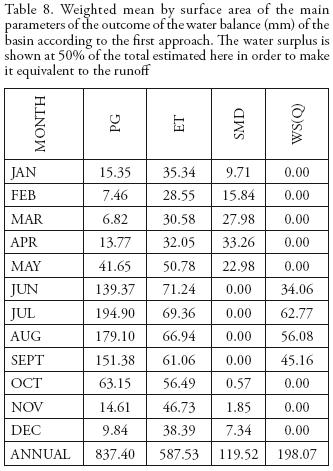
<body><![CDATA[<p align="justify"><font face="verdana" size="2">This approach, based on the Thornthwaite and Mather (1957) model, requires the spatialization of the monthly precipitation data and the monthly average temperature data. The temperature is interpolated from 12 linear regression models, one for each month, with various different adjustments (coefficient R<sup>2</sup>) for distributing the value of the monthly mean temperature from the DTM (<a href="#t6">Table 6</a>).</font></p> 	    <p align="center"><font size="2" face="verdana"><a name="t6"></a></font></p> 	    <p align="center"><font size="2" face="verdana"><img src="/img/revistas/igeo/n76/a4t6.jpg"></font></p> 	    <p align="justify"><font face="verdana" size="2">The values of the R<sup>2</sup> coefficient of linear regression denote a moderate adjustment, varying from 0.4 in the autumn and winter months to 0.7 in the spring and summer months. The magnitudes of the R<sup>2</sup> coefficient have been considered acceptable for an interpolation of values in the territory (Leal <i>et al.</i>, 2010). The weighted mean of monthly mean temperature thus obtained is shown in <a href="#t7">Table 7</a>. There is a difference of some two degrees between this annual value and the value obtained by the first approach as described above. However, because of the method followed in the second approach this was attributable to the proximity of the information source, the difference between the altitude supplied by the regression model and the altitudes contained in the DTM. Lastly, it was extended to the resultant map with a minimum mapping area of 1 ha in order to facilitate display and the obtaining of spatial statistics.</font></p> 	    <p align="center"><font size="2" face="verdana"><a name="t7"></a></font></p> 	    <p align="center"><font size="2" face="verdana"><img src="/img/revistas/igeo/n76/a4t7.jpg"></font></p> 	    <p align="justify"><font face="verdana" size="2">The monthly means of the variable precipitation, AET, SMD and WS obtained by the method followed in this approach were derived as in the case of the monthly mean temperature. The map of field capacity (L is shown in <a href="/img/revistas/igeo/n76/a4f3.jpg" target="_blank">Figure 3</a>. The synthetic results for monthly balance for the whole of the basin are shown in <a href="#t8">Table 8</a>.</font></p> 	    <p align="center"><font size="2" face="verdana"><a name="t8"></a></font></p> 	    <p align="center"><font size="2" face="verdana"><img src="/img/revistas/igeo/n76/a4t8.jpg"></font></p> 	    <p align="justify"><font face="verdana" size="2">With the second approach, the basin shows an annual mean temperature of 14.88&deg; C, a mean total annual precipitation of 837.4 mm, an annual ETR of 587.53 mm, an annual mean moisture deficit estimated at 119.52 mm and an annual mean excess of moisture of 249.87 mm. Considering 50% of this last value as annual mean runoff, as cited by Dunne and Leopold (1978), 50% of the value of WS obtained by the Thornthwaite and Mather is distributed on an area of 387,382 Ha corresponding to a volume of 767.2 Mm<sup>3</sup>. As previously stated, a lake surface of approximately 30,760 Ha and 1 m in depth contains a volume of 307.6 Mm<sup>3</sup>.</font></p> 	    ]]></body>
<body><![CDATA[<p align="justify"><font face="verdana" size="2"><b>3. Third approach</b></font></p> 	    <p align="justify"><font face="verdana" size="2">The principal product of this approach was achieved thanks to the detailed map of land use cover (Mendoza <i>et al.</i>, 2001). The various categories of this layer accounted for areas within the basin in the year 2000 as shown in <a href="/img/revistas/igeo/n76/a4t9.jpg" target="_blank">Table 9</a>.</font></p> 	    <p align="justify"><font face="verdana" size="2">Among the parameters required for the FAO&#150;Penman equation (FAO 1990), some are difficult to find monitored in the conventional meteorological stations administrated by the Comisi&oacute;n Nacional del Agua (CNA). However, a variant of the method recommended by FAO itself allows the equation to be fulfilled either by approximation by the method of Hargreaves (1983) or from the coefficient of tank evaporation. In the former case, Hargreaves (1983) requires estimations of minimum temperature, maximum temperature and extraterrestrial radiation. Extraterrestrial radiation is not difficult to estimate; however, although the linear regression models showed the possibility of a relationship with the values of altitude in the basin for the maximum temperature this was not the case for the minimum temperature (<a href="/img/revistas/igeo/n76/a4t10.jpg" target="_blank">Table 10</a>).</font></p> 	    <p align="justify"><font face="verdana" size="2">Following from the above, the FAO&#150;Penman method (FAO 1990) was followed as stipulated in the FAO manual, calculating the value of the reference evapotranspiration (ET<sub>0</sub>) with the data observed in the evaporation tank, as outlined in the Methods section above. The interpolation of these ET<sub>0</sub> values multiplied by the crop coefficient (in this case also the coefficient of cover) allowed the monthly ET<sub>c</sub> values to be obtained and distributed.</font></p> 	    <p align="justify"><font face="verdana" size="2">Unlike the method used in the second approach, these maps (<a href="/img/revistas/igeo/n76/a4f4.jpg" target="_blank">Figures 4</a> and <a href="/img/revistas/igeo/n76/a4f5.jpg" target="_blank">5</a>) did not consider the retention and use of soil moisture by the crop or the type of cover during the months in which the ET<sub>c</sub> is less than PG.</font></p> 	    <p align="justify"><font face="verdana" size="2">The ET<sub>c</sub> values obtained are much higher than those corresponding to PET and AET. Since this is a method for estimating evapotranspiration and not the water balance itself, an amount of potential loss of water is not considered for the months in which ET<sub>c</sub> is greater than PG.</font></p> 	    <p align="justify"><font face="verdana" size="2">ET<sub>c</sub> is greater than PG in the months without precipitation, and the weighted means by area of ET<sub>c</sub> are less in the rainy months than in the months preceding them (<a href="#t11">Table 11</a>). Hence, it is not possible to use the maps of these evaluated parameters to obtain a direct algebraic estimate of the water surplus.</font></p> 	    <p align="center"><font size="2" face="verdana"><a name="t11"></a></font></p> 	    <p align="center"><font size="2" face="verdana"><img src="/img/revistas/igeo/n76/a4t11.jpg"></font></p> 	    <p align="justify"><font face="verdana" size="2">The rainy months (June, July, August and September) were grouped in order to obtain the accumulated amount for PG and to subtract it in its turn from the ET<sub>c</sub> accumulated for these same months from the map of field capacity. The above was based on the assumption that it would reach the field capacity at the end of the rainy period (<a href="/img/revistas/igeo/n76/a4f6.jpg" target="_blank">Figure 6</a>).</font></p> 	    ]]></body>
<body><![CDATA[<p align="justify"><font face="verdana" size="2">The water surplus in the basin that is not retained by the field capacity increases cumulatively during the rainy months to a total weighted by surface average of 77.2 mm. The frequency histogram corresponding to the values in the distribution map of water surplus estimated by this aggregation is shown in <a href="#f7">Figure 7</a>. It is noteworthy that the FAO&#150;Penman approach results in a weighted by surface average water flow volume of 229.05 Mm<sup>3</sup>. Such volume is only 8.5 Mm<sup>3</sup> less than the estimated flow needed for maintaining a depth of 1 m in lake Cuitzeo, a difference that would represent an eventual fluctuation of 2 cm in the average lake's surface level.</font></p> 	    <p align="center"><font face="verdana" size="2"><a name="f7"></a></font></p> 	    <p align="center"><font face="verdana" size="2"><img src="/img/revistas/igeo/n76/a4f7.jpg"></font></p> 	    <p align="justify"><font face="verdana" size="2">&nbsp;</font></p> 	    <p align="justify"><font face="verdana" size="2"><b>DISCUSSION</b></font></p> 	    <p align="justify"><font face="verdana" size="2">The weighted mean of tessellated surface of the parameters of water balance yields a first scenario of the annual means around which the climatic characteristics and the water balance of the basin fluctuate. A 50% retention of the water surplus in the basin would represent an annual increase of only 13.5 cm in the mean level of water (<a href="#t12">Table 12</a>). The evident disadvantage of this approach lies in the impossibility of the identification of critical areas with moisture deficit throughout the year, since tessellation only distributes geometrically with the crossing of perpendicular bisectors uniform values that do not take into account functions of proximity nor of altitudinal variation of the parameters involved.</font></p> 	    <p align="center"><font size="2" face="verdana"><a name="t12"></a></font></p> 	    <p align="center"><font size="2" face="verdana"><img src="/img/revistas/igeo/n76/a4t12.jpg"></font></p> 	    <p align="justify"><font face="verdana" size="2">With the approach based on the Thornthwaite method, consideration of only half the water surplus involves an increment of up to 0.57 m in the mean level of the lake (<a href="#t12">Table 12</a>); this is completely unacceptable given the field observations of the level of this body of water annually or in recent years in which, far from such a marked rise in level, there have been years during which the lake has dried up (Alvarado <i>et al.</i>, 1994; Mendoza <i>et al.</i>, 2006).</font></p> 	    <p align="justify"><font face="verdana" size="2">Despite the above, the strength of the second approach lies in the identification of areas with relatively high AET in the months without rain and therefore the zones in which the deficit of moisture represents a limitation for the various activities that require water.</font></p> 	    ]]></body>
<body><![CDATA[<p align="justify"><font face="verdana" size="2">Accepting in a preliminary way the appropriateness of the third approach in terms of mass balance would explain the maintenance of a highly fragmented and diversified LCLU in the basin; despite the reduction in plant mass and despite conditions that decrease the ET and consequently increase Q, this does not increase sedimentation or raise excessively from year to year the mean level of the lake surface. In consequence, it is the mass of native vegetation of the basin and their less fragmented condition in the high parts of the basin, principally in the southern sector, that is favouring the retention of water in the soil in the rainy months and gradually discharging to the superficial and underground drainage network the volumes that maintain the level of water in the lake.</font></p> 	    <p align="justify"><font face="verdana" size="2">These three methods model the superficial water balance on the basis of the approach proposed by Thornthwaite and Mather (1957), particularly owing to the paucity of robust geohydrological information in the zone; consequently, it is necessary to increase knowledge of this subject, in order to model the underground water flows reliably and so that these can be incorporated in a model of water balance, increasing the precision of the results obtained thus far.</font></p> 	    <p align="justify"><font face="verdana" size="2">&nbsp;</font></p> 	    <p align="justify"><font face="verdana" size="2"><b>CONCLUSIONS</b></font></p> 	    <p align="justify"><font face="verdana" size="2">The first approach shows the general structure of the principal hydroclimatic aspects that affect the basin and that determine the aspects of balance in any of its possible evaluations. Nevertheless, it will be important to obtain systematic, automated and well distributed records of the water levels of the lake.</font></p> 	    <p align="justify"><font face="verdana" size="2">The second approach apparently underestimates the monthly mean values of evapotranspiration and adjusts them according to the water availability, whether this is through precipitation or through possible soil water retention. Calculation of ETR for the months without rain is precisely the result of a balance based on the potentially evapotranspired water depth accumulated during the previous months (L). The model of field capacity can be improved by means of this approach, but there are still the deficiencies in inputs that have previously been established. Despite the above, this approach is useful for identifying in time (months) and space the predicted soil moisture deficit.</font></p> 	    <p align="justify"><font face="verdana" size="2">The third approach does not derive directly from an estimation of the soil water surplus and is particularly useful in agriculture in terms of the magnitude of the monthly requirements of a given crop or type of land use or land cover (<a href="/img/revistas/igeo/n76/a4f4.jpg" target="_blank">Figures 4</a> and <a href="/img/revistas/igeo/n76/a4f5.jpg" target="_blank">5</a>). Because of this, assuming that this evapotranspiration occurs during the rainy months, an excess of moisture accumulates in the high regions in the south and east of the study area; these gradually discharge into the lake over the course of the months without precipitation, either superficially or sub&#150;superficially, owing to the geomorphological and hydrogeological conditions of the basin that favour the movement from south to north of the flows, especially underground; these flows explain the present level of this water body (Mendoza and Bocco, 2010; Gardu&ntilde;o <i>et al.</i>, 2011).</font></p> 	    <p align="justify"><font face="verdana" size="2">The most appropriate approach for estimating ET is the third, which considers measured values of evaporation, and their transformation to values of ET<sub>0</sub> and later to ET<sub>c</sub> according to the FAO&#150;Penman (1990) modification. It is necessary to implement and improve the measurements of these and other parameters that are absent from the records of the meteorological stations (for example, wind speed) with the aim of a better determination and spatio&#150;temporal distribution of the ET<sub>c</sub> values. However, the final approach (the simulation) could be improved if there were hydrometeorological parameters that allowed calibration of the HEC model and the other spatially distributed hydrologic model.</font></p> 	    <p align="justify"><font face="verdana" size="2">The ET values obtained by any of these three approaches must be evaluated on the basis of values of runoff measured via a system of hydrometric monitoring of the basin (at least 73 possible sites of gauging were identified); here would be recorded data that would allow initial assessment of the causes and effects of the spatio&#150;temporal modifications of the various parameters of water balance.</font></p> 	    <p align="justify"><font face="verdana" size="2">Of the three models used to simulate flows and estimate heights of the lake, the HEC model represents a viable alternative to the hydrological modelling of the basin, since it yielded the best estimates when the mean height of the lake (1 m) was compared with the result of calculation from modelling the flows of water by the three methods. In essence, the three models used here require the same quantity of data, the only ones available in the greater part of the national territory or in developing countries, with closed basins and lakes in their low&#150;lying regions that allow the results of the modelling to be compared; this favours their reproducibility and their use in decision making.</font></p> 	    ]]></body>
<body><![CDATA[<p align="justify"><font face="verdana" size="2">&nbsp;</font></p> 	    <p align="justify"><font face="verdana" size="2"><b>ACKNOWLEDGMENTS</b></font></p> 	    <p align="justify"><font face="verdana" size="2">The authors acknowledge the support of the project <i>Evaluaci&oacute;n espacial y multitemporal de los cambios de cobertura y uso del terreno en la cuenca del lago de Cuitzeo: implicaciones para la sucesi&oacute;n forestal y el mantenimiento de la diversidad vegetal</i> (DGAPA&#150;PAPIIT, UNAM). We also acknowledge the constructive comments of the two anonymous reviewers; finally, we thank Teodoro Carl&oacute;n, Antonio Navarrete and Hugo Zavala for technical assistance.</font></p> 	    <p align="justify"><font face="verdana" size="2">&nbsp;</font></p> 	    <p align="justify"><font face="verdana" size="2"><b>REFERENCES</b></font></p> 	    <!-- ref --><p align="justify"><font face="verdana" size="2">Alvarado D&iacute;az, J., T. Zubieta Rojas, R. Ortega Murillo, A. Chac&oacute;n Torres and R. Espinoza G&oacute;mez (1994), <i>Hipertroficaci&oacute;n en un lago tropical somero (lago de Cuitzeo, Michoac&aacute;n, M&eacute;xico)</i>, en Comisi&oacute;n de Ecolog&iacute;a del H. Congreso de Michoac&aacute;n LXVI Legislatura, El deterioro ambiental, de la cuenca del lago de Cuitzeo, H. Congreso del Estado de Michoac&aacute;n, M&eacute;xico.    &nbsp;&nbsp;&nbsp;&nbsp;&nbsp;&nbsp;&nbsp;&nbsp;[&#160;<a href="javascript:void(0);" onclick="javascript: window.open('/scielo.php?script=sci_nlinks&ref=4704761&pid=S0188-4611201100030000400001&lng=','','width=640,height=500,resizable=yes,scrollbars=1,menubar=yes,');">Links</a>&#160;]<!-- end-ref --></font></p> 	    <!-- ref --><p align="justify"><font face="verdana" size="2">Campos Aranda, D. F. (1992), <i>Procesos del Ciclo Hidrol&oacute;gico</i>, Editorial Universitaria Potosina, San Luis Potos&iacute;, San Luis Potos&iacute;    &nbsp;&nbsp;&nbsp;&nbsp;&nbsp;&nbsp;&nbsp;&nbsp;[&#160;<a href="javascript:void(0);" onclick="javascript: window.open('/scielo.php?script=sci_nlinks&ref=4704763&pid=S0188-4611201100030000400002&lng=','','width=640,height=500,resizable=yes,scrollbars=1,menubar=yes,');">Links</a>&#160;]<!-- end-ref -->.</font></p> 	    <!-- ref --><p align="justify"><font face="verdana" size="2">Carl&oacute;n Allende, T., M. E. Mendoza, E. L&oacute;pez Granados and L. M. Morales Manilla (2009), "Hydrogeographical regionalisation: an approach for evaluating the effect of land cover change in watersheds. A case study in Cuitzeo Lake watershed, Mexico", <i>Water Resources Management</i>, vol. 23, no. 12, pp. 2587&#150;2603.    &nbsp;&nbsp;&nbsp;&nbsp;&nbsp;&nbsp;&nbsp;&nbsp;[&#160;<a href="javascript:void(0);" onclick="javascript: window.open('/scielo.php?script=sci_nlinks&ref=4704765&pid=S0188-4611201100030000400003&lng=','','width=640,height=500,resizable=yes,scrollbars=1,menubar=yes,');">Links</a>&#160;]<!-- end-ref --></font></p> 	    <!-- ref --><p align="justify"><font face="verdana" size="2">Chow, V. T., D. R. Maidment and L. W. Mays (1994), <i>Hidrolog&iacute;a Aplicada</i>, McGrawHill, M&eacute;xico.    &nbsp;&nbsp;&nbsp;&nbsp;&nbsp;&nbsp;&nbsp;&nbsp;[&#160;<a href="javascript:void(0);" onclick="javascript: window.open('/scielo.php?script=sci_nlinks&ref=4704767&pid=S0188-4611201100030000400004&lng=','','width=640,height=500,resizable=yes,scrollbars=1,menubar=yes,');">Links</a>&#160;]<!-- end-ref --></font></p> 	    <!-- ref --><p align="justify"><font face="verdana" size="2">Doorenbos, J. and W. O. Pruitt (1977), <i>Crop water requirements</i>, FAO Estudio de Riego y Drenaje, no.24, (rev.), FAO, Roma.    &nbsp;&nbsp;&nbsp;&nbsp;&nbsp;&nbsp;&nbsp;&nbsp;[&#160;<a href="javascript:void(0);" onclick="javascript: window.open('/scielo.php?script=sci_nlinks&ref=4704769&pid=S0188-4611201100030000400005&lng=','','width=640,height=500,resizable=yes,scrollbars=1,menubar=yes,');">Links</a>&#160;]<!-- end-ref --></font></p> 	    <!-- ref --><p align="justify"><font face="verdana" size="2">Dunne, T. and L. B. Leopold (1978), <i>Water in environmental planning</i>, W. H. Freeman and Co., San Francisco.    &nbsp;&nbsp;&nbsp;&nbsp;&nbsp;&nbsp;&nbsp;&nbsp;[&#160;<a href="javascript:void(0);" onclick="javascript: window.open('/scielo.php?script=sci_nlinks&ref=4704771&pid=S0188-4611201100030000400006&lng=','','width=640,height=500,resizable=yes,scrollbars=1,menubar=yes,');">Links</a>&#160;]<!-- end-ref --></font></p> 	    <!-- ref --><p align="justify"><font face="verdana" size="2">Elkaduwa, W. K. B and R. Sakthivadivel (1998), <i>Use of historical data as a decision support tool in watershed management: a case study of the Upper Nilwala basin in Sri Lanka</i>, Report 26, International Water Management Institute, Colombo, Sri Lanka.    &nbsp;&nbsp;&nbsp;&nbsp;&nbsp;&nbsp;&nbsp;&nbsp;[&#160;<a href="javascript:void(0);" onclick="javascript: window.open('/scielo.php?script=sci_nlinks&ref=4704773&pid=S0188-4611201100030000400007&lng=','','width=640,height=500,resizable=yes,scrollbars=1,menubar=yes,');">Links</a>&#160;]<!-- end-ref --></font></p> 	    <!-- ref --><p align="justify"><font face="verdana" size="2">ESRI (1999), <i>ArcView 3.2</i>, GIS, Environmental Systems Research Institute, Inc., New York.    &nbsp;&nbsp;&nbsp;&nbsp;&nbsp;&nbsp;&nbsp;&nbsp;[&#160;<a href="javascript:void(0);" onclick="javascript: window.open('/scielo.php?script=sci_nlinks&ref=4704775&pid=S0188-4611201100030000400008&lng=','','width=640,height=500,resizable=yes,scrollbars=1,menubar=yes,');">Links</a>&#160;]<!-- end-ref --></font></p> 	    <!-- ref --><p align="justify"><font face="verdana" size="2">FAO (1990), <i>Evapotranspiraci&oacute;n del cultivo: gu&iacute;as para la determinaci&oacute;n de los requerimientos de agua de los cultivos</i>, Estudio FAO Riego y Drenaje, no. 56.    &nbsp;&nbsp;&nbsp;&nbsp;&nbsp;&nbsp;&nbsp;&nbsp;[&#160;<a href="javascript:void(0);" onclick="javascript: window.open('/scielo.php?script=sci_nlinks&ref=4704777&pid=S0188-4611201100030000400009&lng=','','width=640,height=500,resizable=yes,scrollbars=1,menubar=yes,');">Links</a>&#160;]<!-- end-ref --></font></p> 	    <!-- ref --><p align="justify"><font face="verdana" size="2">Fuentes, J. J., M. Bravo and G. Bocco (2004), "Water balance and landscape degradation of an ungauged mountain watershed: case study of the Pico de Tanc&iacute;taro National Park, Michoac&aacute;n, Mexico", <i>Journal of Environmental Hydrology</i> 12 5, Electronic Journal of the International Association for Environmental Hydrology (<a href="http://www.hydroweb.com" target="_blank">http://www.hydroweb.com</a>).    &nbsp;&nbsp;&nbsp;&nbsp;&nbsp;&nbsp;&nbsp;&nbsp;[&#160;<a href="javascript:void(0);" onclick="javascript: window.open('/scielo.php?script=sci_nlinks&ref=4704779&pid=S0188-4611201100030000400010&lng=','','width=640,height=500,resizable=yes,scrollbars=1,menubar=yes,');">Links</a>&#160;]<!-- end-ref --></font></p> 	    <!-- ref --><p align="justify"><font face="verdana" size="2">Garc&iacute;a, E. (2004), <i>Modificaciones al Sistema de Clasificaci&oacute;n Clim&aacute;tica de K&ouml;ppen</i>, Serie Libros, n&uacute;m. 6, Instituto de Geograf&iacute;a, UNAM, M&eacute;xico.    &nbsp;&nbsp;&nbsp;&nbsp;&nbsp;&nbsp;&nbsp;&nbsp;[&#160;<a href="javascript:void(0);" onclick="javascript: window.open('/scielo.php?script=sci_nlinks&ref=4704781&pid=S0188-4611201100030000400011&lng=','','width=640,height=500,resizable=yes,scrollbars=1,menubar=yes,');">Links</a>&#160;]<!-- end-ref --></font></p> 	    <!-- ref --><p align="justify"><font face="verdana" size="2">Gardu&ntilde;o Monroy, V. H., V. H. Medina Vega, I. Israde Alc&aacute;ntara, V. M. Hern&aacute;ndez Madrigal and J. A. &Aacute;vila Olivera (2011), "Unidades Geohidrol&oacute;gicas de la Regi&oacute;n de Morelia&#150;Cuitzeo", in Cram, S., L. Galicia and I. Israde Alc&aacute;ntara (comps.), <i>Atlas de la Cuenca del Lago de Cuitzeo: un an&aacute;lisis de la geograf&iacute;a del lago y su entorno socioambiental</i>, Instituto de Geograf&iacute;a&#150;UNAM, Universidad Michoacana de San Nicol&aacute;s de Hidalgo, M&eacute;xico.    &nbsp;&nbsp;&nbsp;&nbsp;&nbsp;&nbsp;&nbsp;&nbsp;[&#160;<a href="javascript:void(0);" onclick="javascript: window.open('/scielo.php?script=sci_nlinks&ref=4704783&pid=S0188-4611201100030000400012&lng=','','width=640,height=500,resizable=yes,scrollbars=1,menubar=yes,');">Links</a>&#160;]<!-- end-ref --></font></p> 	    <!-- ref --><p align="justify"><font face="verdana" size="2">G&oacute;mez Tagle, Ch. A. (2008), <i>Variabilidad de las propiedades ed&aacute;ficas relacionadas con la infiltraci&oacute;n y la conductividad hidr&aacute;ulica superficial en la cuenca de Cuitzeo</i>, tesis Doctoral, UMSNH, M&eacute;xico.    &nbsp;&nbsp;&nbsp;&nbsp;&nbsp;&nbsp;&nbsp;&nbsp;[&#160;<a href="javascript:void(0);" onclick="javascript: window.open('/scielo.php?script=sci_nlinks&ref=4704785&pid=S0188-4611201100030000400013&lng=','','width=640,height=500,resizable=yes,scrollbars=1,menubar=yes,');">Links</a>&#160;]<!-- end-ref --></font></p> 	    <!-- ref --><p align="justify"><font face="verdana" size="2">Hargreaves, G. H. (1983), "Discussion of 'Application of Penman wind function' by Cuenca, R. H. and Nicholson, M.J. <i>J. Irrig. and Drain. Engrg.</i>, ASCE 10, no. 2, pp. 277&#150;278.    &nbsp;&nbsp;&nbsp;&nbsp;&nbsp;&nbsp;&nbsp;&nbsp;[&#160;<a href="javascript:void(0);" onclick="javascript: window.open('/scielo.php?script=sci_nlinks&ref=4704787&pid=S0188-4611201100030000400014&lng=','','width=640,height=500,resizable=yes,scrollbars=1,menubar=yes,');">Links</a>&#160;]<!-- end-ref --></font></p> 	    <!-- ref --><p align="justify"><font face="verdana" size="2">Hay, L. E., W. A. Battaglin and G. H. Leavesley (1993), "Modeling the effects of climate change on water resources in the Gunnison river basin, Colorado", in Goodchild, M. F., B. O. Parks and L. T. Steyaert (eds.), <i>Environmental modelling with GIS</i>, pp. 172&#150;181.    &nbsp;&nbsp;&nbsp;&nbsp;&nbsp;&nbsp;&nbsp;&nbsp;[&#160;<a href="javascript:void(0);" onclick="javascript: window.open('/scielo.php?script=sci_nlinks&ref=4704789&pid=S0188-4611201100030000400015&lng=','','width=640,height=500,resizable=yes,scrollbars=1,menubar=yes,');">Links</a>&#160;]<!-- end-ref --></font></p> 	    <!-- ref --><p align="justify"><font face="verdana" size="2">He, C., S. B. Macolm, K. A. Dahlberg and B. A. Fu (2000), "Conceptual framework for integrating hydrological and biological indicators into watershed management", <i>Landscape and Urban Planning</i>, no. 49, pp. 25&#150;34.    &nbsp;&nbsp;&nbsp;&nbsp;&nbsp;&nbsp;&nbsp;&nbsp;[&#160;<a href="javascript:void(0);" onclick="javascript: window.open('/scielo.php?script=sci_nlinks&ref=4704791&pid=S0188-4611201100030000400016&lng=','','width=640,height=500,resizable=yes,scrollbars=1,menubar=yes,');">Links</a>&#160;]<!-- end-ref --></font></p> 	    <!-- ref --><p align="justify"><font face="verdana" size="2">HEC (2000), <i>Geospatial Hydrologic Modeling Extension</i>, HEC&#150;GEO&#150;HMS, US Army Corps of Engineers, Hydrologic Engineering Center, User's Manual.    &nbsp;&nbsp;&nbsp;&nbsp;&nbsp;&nbsp;&nbsp;&nbsp;[&#160;<a href="javascript:void(0);" onclick="javascript: window.open('/scielo.php?script=sci_nlinks&ref=4704793&pid=S0188-4611201100030000400017&lng=','','width=640,height=500,resizable=yes,scrollbars=1,menubar=yes,');">Links</a>&#160;]<!-- end-ref --></font></p> 	    <!-- ref --><p align="justify"><font face="verdana" size="2">Hewlett, J. D. (1982), <i>Principles of forest hydrology</i>, University of Georgia Press, Athens, Georgia.    &nbsp;&nbsp;&nbsp;&nbsp;&nbsp;&nbsp;&nbsp;&nbsp;[&#160;<a href="javascript:void(0);" onclick="javascript: window.open('/scielo.php?script=sci_nlinks&ref=4704795&pid=S0188-4611201100030000400018&lng=','','width=640,height=500,resizable=yes,scrollbars=1,menubar=yes,');">Links</a>&#160;]<!-- end-ref --></font></p> 	    <!-- ref --><p align="justify"><font face="verdana" size="2">IMTA (2000a), <i>Sistema de Informaci&oacute;n Climatol&oacute;gica (SICLIM)</i>. 5319 Estaciones. Periodo 1921&#150; 1990, Base de datos (CD_ROM computer file), Morelos, M&eacute;xico.    &nbsp;&nbsp;&nbsp;&nbsp;&nbsp;&nbsp;&nbsp;&nbsp;[&#160;<a href="javascript:void(0);" onclick="javascript: window.open('/scielo.php?script=sci_nlinks&ref=4704797&pid=S0188-4611201100030000400019&lng=','','width=640,height=500,resizable=yes,scrollbars=1,menubar=yes,');">Links</a>&#160;]<!-- end-ref --></font></p> 	    <!-- ref --><p align="justify"><font face="verdana" size="2">IMTA (2000b), <i>Programa extractor r&aacute;pido de informaci&oacute;n clim&aacute;tica, ERIC versi&oacute;n 2.0</i>, Instituto Mexicano de Tecnolog&iacute;a del Agua, Base de datos (CD_ROM computer file), Morelos, M&eacute;xico.    &nbsp;&nbsp;&nbsp;&nbsp;&nbsp;&nbsp;&nbsp;&nbsp;[&#160;<a href="javascript:void(0);" onclick="javascript: window.open('/scielo.php?script=sci_nlinks&ref=4704799&pid=S0188-4611201100030000400020&lng=','','width=640,height=500,resizable=yes,scrollbars=1,menubar=yes,');">Links</a>&#160;]<!-- end-ref --></font></p> 	    <!-- ref --><p align="justify"><font face="verdana" size="2">INEGI (1999), Conjunto de datos vectoriales, Instituto Nacional de Estad&iacute;stica, Geograf&iacute;a e Historia, M&eacute;xico.    &nbsp;&nbsp;&nbsp;&nbsp;&nbsp;&nbsp;&nbsp;&nbsp;[&#160;<a href="javascript:void(0);" onclick="javascript: window.open('/scielo.php?script=sci_nlinks&ref=4704801&pid=S0188-4611201100030000400021&lng=','','width=640,height=500,resizable=yes,scrollbars=1,menubar=yes,');">Links</a>&#160;]<!-- end-ref --></font></p> 	    <!-- ref --><p align="justify"><font face="verdana" size="2">INEGI (1979, 1982, 1983), Mapas edafol&oacute;gicos, Instituto Nacional de Estad&iacute;stica, Geograf&iacute;a e Historia, M&eacute;xico.    &nbsp;&nbsp;&nbsp;&nbsp;&nbsp;&nbsp;&nbsp;&nbsp;[&#160;<a href="javascript:void(0);" onclick="javascript: window.open('/scielo.php?script=sci_nlinks&ref=4704803&pid=S0188-4611201100030000400022&lng=','','width=640,height=500,resizable=yes,scrollbars=1,menubar=yes,');">Links</a>&#160;]<!-- end-ref --></font></p> 	    <!-- ref --><p align="justify"><font face="verdana" size="2">Jensen, M. E. and H. R. Haise (1963), "Estimating evapotranspiration from solar radiation", <i>J. Irrig. and Drain</i>., Div., ASCE, no. 89, pp. 15&#150;41.    &nbsp;&nbsp;&nbsp;&nbsp;&nbsp;&nbsp;&nbsp;&nbsp;[&#160;<a href="javascript:void(0);" onclick="javascript: window.open('/scielo.php?script=sci_nlinks&ref=4704805&pid=S0188-4611201100030000400023&lng=','','width=640,height=500,resizable=yes,scrollbars=1,menubar=yes,');">Links</a>&#160;]<!-- end-ref --></font></p> 	    <!-- ref --><p align="justify"><font face="verdana" size="2">L&oacute;pez Granados, E., G. Bocco, M. E. Mendoza, A. Vel&aacute;zquez and R. Aguirre (2006), "Peasant emigration and land&#150;use change at the watershed level. A GIS&#150;based approach in Central Mexico", Agricultural Systems, vol. 90, no. 1&#150;3, pp. 62&#150;78.    &nbsp;&nbsp;&nbsp;&nbsp;&nbsp;&nbsp;&nbsp;&nbsp;[&#160;<a href="javascript:void(0);" onclick="javascript: window.open('/scielo.php?script=sci_nlinks&ref=4704807&pid=S0188-4611201100030000400024&lng=','','width=640,height=500,resizable=yes,scrollbars=1,menubar=yes,');">Links</a>&#160;]<!-- end-ref --></font></p> 	    <!-- ref --><p align="justify"><font face="verdana" size="2">L&oacute;pez Granados, E., G. Bocco, M. E. Mendoza and E. Duhau (2001), "Predicting land&#150;cover and land use change in the urban fringe. A case in Morelia city, Mexico", <i>Landscape and Urban Planning</i>, vol. 55, no. 4, pp. 271&#150;285.    &nbsp;&nbsp;&nbsp;&nbsp;&nbsp;&nbsp;&nbsp;&nbsp;[&#160;<a href="javascript:void(0);" onclick="javascript: window.open('/scielo.php?script=sci_nlinks&ref=4704809&pid=S0188-4611201100030000400025&lng=','','width=640,height=500,resizable=yes,scrollbars=1,menubar=yes,');">Links</a>&#160;]<!-- end-ref --></font></p> 	    <!-- ref --><p align="justify"><font face="verdana" size="2">Makkink, G. F. (1957), "Testing the Penman formula by means of lysimeters", <i>J. Inst. Water Engng.</i>, vol. 11, no. 3, pp. 277&#150;288.    &nbsp;&nbsp;&nbsp;&nbsp;&nbsp;&nbsp;&nbsp;&nbsp;[&#160;<a href="javascript:void(0);" onclick="javascript: window.open('/scielo.php?script=sci_nlinks&ref=4704811&pid=S0188-4611201100030000400026&lng=','','width=640,height=500,resizable=yes,scrollbars=1,menubar=yes,');">Links</a>&#160;]<!-- end-ref --></font></p> 	    <!-- ref --><p align="justify"><font face="verdana" size="2">Mendoza, M. E. and G. Bocco (2010), "Geomorfolog&iacute;a", in Cram, S., L. Galicia and I. Israde Alc&aacute;ntara (comps.), <i>Atlas de la Cuenca del Lago de Cuitzeo: un an&aacute;lisis de la geograf&iacute;a del lago y su entorno socioambiental</i>, Instituto de Geograf&iacute;a&#150;UNAM, Universidad Michoacana de San Nicol&aacute;s de Hidalgo, M&eacute;xico.    &nbsp;&nbsp;&nbsp;&nbsp;&nbsp;&nbsp;&nbsp;&nbsp;[&#160;<a href="javascript:void(0);" onclick="javascript: window.open('/scielo.php?script=sci_nlinks&ref=4704813&pid=S0188-4611201100030000400027&lng=','','width=640,height=500,resizable=yes,scrollbars=1,menubar=yes,');">Links</a>&#160;]<!-- end-ref --></font></p> 	    <!-- ref --><p align="justify"><font face="verdana" size="2">Mendoza, M. E., G. Bocco and M. Bravo (2002), "Spatial prediction in hydrology: status and implications in the estimation of hydrological processes for applied research", <i>Progress in Physical Geography</i>, vol. 26, no. 3, pp. 319&#150;338.    &nbsp;&nbsp;&nbsp;&nbsp;&nbsp;&nbsp;&nbsp;&nbsp;[&#160;<a href="javascript:void(0);" onclick="javascript: window.open('/scielo.php?script=sci_nlinks&ref=4704815&pid=S0188-4611201100030000400028&lng=','','width=640,height=500,resizable=yes,scrollbars=1,menubar=yes,');">Links</a>&#160;]<!-- end-ref --></font></p> 	    <!-- ref --><p align="justify"><font face="verdana" size="2">Mendoza, M. E., G. Bocco, E. L&oacute;pez Granados and M. Bravo (2010), "Hydrological implications of land&#150;cover and land&#150;use change: spatial analytical approach at regional scale in the closed basin of the Cuitzeo Lake, Michoac&aacute;n, Mexico", <i>Singapore Tropical Geography</i>, vol. 31, no. 2, pp.    &nbsp;&nbsp;&nbsp;&nbsp;&nbsp;&nbsp;&nbsp;&nbsp;[&#160;<a href="javascript:void(0);" onclick="javascript: window.open('/scielo.php?script=sci_nlinks&ref=4704817&pid=S0188-4611201100030000400029&lng=','','width=640,height=500,resizable=yes,scrollbars=1,menubar=yes,');">Links</a>&#160;]<!-- end-ref -->??</font></p> 	    <!-- ref --><p align="justify"><font face="verdana" size="2">Mendoza, M. E., G. Bocco, M. Bravo, E. L&oacute;pez Granados and W. R. Osterkamp (2006), "Predicting water surface fluctuation of continental lakes. A GIS and RS based approach in Central Mexico", <i>Water Resources Management</i>, vol. 20, no. 2, pp. 291&#150;311.    &nbsp;&nbsp;&nbsp;&nbsp;&nbsp;&nbsp;&nbsp;&nbsp;[&#160;<a href="javascript:void(0);" onclick="javascript: window.open('/scielo.php?script=sci_nlinks&ref=4704819&pid=S0188-4611201100030000400030&lng=','','width=640,height=500,resizable=yes,scrollbars=1,menubar=yes,');">Links</a>&#160;]<!-- end-ref --></font></p> 	    <!-- ref --><p align="justify"><font face="verdana" size="2">Mendoza, M. E., E. L&oacute;pez Granados and G. Bocco (2001), <i>Regionalizaci&oacute;n ecol&oacute;gica, conservaci&oacute;n de recursos y ordenamiento territorial</i>, Informe Final presentado al Programa SIMORELOS&#150;CONACyT, Departamento de Ecolog&iacute;a de los Recursos Naturales, Instituto de Ecolog&iacute;a, UNAM, M&eacute;xico.    &nbsp;&nbsp;&nbsp;&nbsp;&nbsp;&nbsp;&nbsp;&nbsp;[&#160;<a href="javascript:void(0);" onclick="javascript: window.open('/scielo.php?script=sci_nlinks&ref=4704821&pid=S0188-4611201100030000400031&lng=','','width=640,height=500,resizable=yes,scrollbars=1,menubar=yes,');">Links</a>&#160;]<!-- end-ref --></font></p> 	    <!-- ref --><p align="justify"><font face="verdana" size="2">Monteith, J. L. (1965), "Evaporation and environment", 19th <i>Symposium of the Society for Experimental Biology</i>, University Press, Cambridge, no. 19, pp. 205&#150;234.    &nbsp;&nbsp;&nbsp;&nbsp;&nbsp;&nbsp;&nbsp;&nbsp;[&#160;<a href="javascript:void(0);" onclick="javascript: window.open('/scielo.php?script=sci_nlinks&ref=4704823&pid=S0188-4611201100030000400032&lng=','','width=640,height=500,resizable=yes,scrollbars=1,menubar=yes,');">Links</a>&#160;]<!-- end-ref --></font></p> 	    <!-- ref --><p align="justify"><font face="verdana" size="2">Neitsch, S. L., J. G. Arnold, J. R. Kiniry and J. R. Williams (2001), <i>Soil and water assessment tool, theoretical documentation</i>, Texas Agricultural Experiment Station, Texas, USA.    &nbsp;&nbsp;&nbsp;&nbsp;&nbsp;&nbsp;&nbsp;&nbsp;[&#160;<a href="javascript:void(0);" onclick="javascript: window.open('/scielo.php?script=sci_nlinks&ref=4704825&pid=S0188-4611201100030000400033&lng=','','width=640,height=500,resizable=yes,scrollbars=1,menubar=yes,');">Links</a>&#160;]<!-- end-ref --></font></p> 	    <!-- ref --><p align="justify"><font face="verdana" size="2">Osman, B. E. T. (1996), <i>GIS&#150;hydrological modelling in arid lands: a geographical synthesis of surface waters for the African Dead Sea region in the Sudan</i>, Doctoral thesis, Lund University, Sweden.    &nbsp;&nbsp;&nbsp;&nbsp;&nbsp;&nbsp;&nbsp;&nbsp;[&#160;<a href="javascript:void(0);" onclick="javascript: window.open('/scielo.php?script=sci_nlinks&ref=4704827&pid=S0188-4611201100030000400034&lng=','','width=640,height=500,resizable=yes,scrollbars=1,menubar=yes,');">Links</a>&#160;]<!-- end-ref --></font></p> 	    <!-- ref --><p align="justify"><font face="verdana" size="2">Penman, H. L. (1948), "Natural evaporation from open water, bare soil and grass", <i>Proc. Royal Society London</i>, Ser. A, no. 193, pp. 120&#150;148.    &nbsp;&nbsp;&nbsp;&nbsp;&nbsp;&nbsp;&nbsp;&nbsp;[&#160;<a href="javascript:void(0);" onclick="javascript: window.open('/scielo.php?script=sci_nlinks&ref=4704829&pid=S0188-4611201100030000400035&lng=','','width=640,height=500,resizable=yes,scrollbars=1,menubar=yes,');">Links</a>&#160;]<!-- end-ref --></font></p> 	    <!-- ref --><p align="justify"><font face="verdana" size="2">Priestley, C. H. B. and R. J. Taylor (1972), "On the assessment of surface heat flux and evaporation using large scale parameters", <i>Mon. Weath. Rev.</i>, no. 100, pp. 81&#150;92.    &nbsp;&nbsp;&nbsp;&nbsp;&nbsp;&nbsp;&nbsp;&nbsp;[&#160;<a href="javascript:void(0);" onclick="javascript: window.open('/scielo.php?script=sci_nlinks&ref=4704831&pid=S0188-4611201100030000400036&lng=','','width=640,height=500,resizable=yes,scrollbars=1,menubar=yes,');">Links</a>&#160;]<!-- end-ref --></font></p> 	    <!-- ref --><p align="justify"><font face="verdana" size="2">SCS (1967), <i>Soil Conservation Service, Irrigation Water Requirements, Technical Release </i>No. 21, U. S. Dept. Agric., Engineering Div.    &nbsp;&nbsp;&nbsp;&nbsp;&nbsp;&nbsp;&nbsp;&nbsp;[&#160;<a href="javascript:void(0);" onclick="javascript: window.open('/scielo.php?script=sci_nlinks&ref=4704833&pid=S0188-4611201100030000400037&lng=','','width=640,height=500,resizable=yes,scrollbars=1,menubar=yes,');">Links</a>&#160;]<!-- end-ref --></font></p> 	    <!-- ref --><p align="justify"><font face="verdana" size="2">SCS (1972), <i>Soil Conservation Service National Engineering Handbook</i>, Section on Hydrology, Soil Conservation Service, U.S. Dept. of Agriculture, Washington, D.C.    &nbsp;&nbsp;&nbsp;&nbsp;&nbsp;&nbsp;&nbsp;&nbsp;[&#160;<a href="javascript:void(0);" onclick="javascript: window.open('/scielo.php?script=sci_nlinks&ref=4704835&pid=S0188-4611201100030000400038&lng=','','width=640,height=500,resizable=yes,scrollbars=1,menubar=yes,');">Links</a>&#160;]<!-- end-ref --></font></p> 	    <!-- ref --><p align="justify"><font face="verdana" size="2">Thornthwaite, C. W. (1948), "An approach toward a rational classification of climate", <i>Geographic Review</i>, no. 38, pp. 55&#150;94.    &nbsp;&nbsp;&nbsp;&nbsp;&nbsp;&nbsp;&nbsp;&nbsp;[&#160;<a href="javascript:void(0);" onclick="javascript: window.open('/scielo.php?script=sci_nlinks&ref=4704837&pid=S0188-4611201100030000400039&lng=','','width=640,height=500,resizable=yes,scrollbars=1,menubar=yes,');">Links</a>&#160;]<!-- end-ref --></font></p> 	    <!-- ref --><p align="justify"><font face="verdana" size="2">Thornthwaite, C. W. and J. R. Mather (1957), <i>Instructions and Tables for Computing Potential Evapotranspiration and Water balance</i>, Publications in Climatology 10(3), Drexel Institute for Technology, Laboratory of Climatology, Centerton, New Jersey.    &nbsp;&nbsp;&nbsp;&nbsp;&nbsp;&nbsp;&nbsp;&nbsp;[&#160;<a href="javascript:void(0);" onclick="javascript: window.open('/scielo.php?script=sci_nlinks&ref=4704839&pid=S0188-4611201100030000400040&lng=','','width=640,height=500,resizable=yes,scrollbars=1,menubar=yes,');">Links</a>&#160;]<!-- end-ref --></font></p> 	    <!-- ref --><p align="justify"><font face="verdana" size="2">Touazi, M., J. P. Laborde and N. Bhiry (2004), "Modelling rainfall&#150;discharge at a mean inter&#150;yearly scale in northern Algeria", <i>Journal of Hydrology</i>, no. 296, pp. 179&#150;191.    &nbsp;&nbsp;&nbsp;&nbsp;&nbsp;&nbsp;&nbsp;&nbsp;[&#160;<a href="javascript:void(0);" onclick="javascript: window.open('/scielo.php?script=sci_nlinks&ref=4704841&pid=S0188-4611201100030000400041&lng=','','width=640,height=500,resizable=yes,scrollbars=1,menubar=yes,');">Links</a>&#160;]<!-- end-ref --></font></p> 	    <!-- ref --><p align="justify"><font face="verdana" size="2">Turc, L. (1961), "Evaluation des besoins en eau d'irrigation, &eacute;vapotranspiration potentielle, formule climatique simplifi&eacute;e et mise a jour", <i>Ann. Agron</i>., no. 12, pp. 13&#150;49.    &nbsp;&nbsp;&nbsp;&nbsp;&nbsp;&nbsp;&nbsp;&nbsp;[&#160;<a href="javascript:void(0);" onclick="javascript: window.open('/scielo.php?script=sci_nlinks&ref=4704843&pid=S0188-4611201100030000400042&lng=','','width=640,height=500,resizable=yes,scrollbars=1,menubar=yes,');">Links</a>&#160;]<!-- end-ref --></font></p> 	    <!-- ref --><p align="justify"><font face="verdana" size="2">Verkerdy, Z. and M. E. Mendoza (2010), "Batimetr&iacute;a. Din&aacute;mica del Lago de Cuitzeo", in Cram, S., L. Galicia and I. Israde Alc&aacute;ntara (comps.), <i>Atlas de la Cuenca del Lago de Cuitzeo: un an&aacute;lisis de la geograf&iacute;a del lago y su entorno socioambiental</i>, Instituto de Geograf&iacute;a&#150;UNAM, Universidad Michoacana de San Nicol&aacute;s de Hidalgo, M&eacute;xico.    &nbsp;&nbsp;&nbsp;&nbsp;&nbsp;&nbsp;&nbsp;&nbsp;[&#160;<a href="javascript:void(0);" onclick="javascript: window.open('/scielo.php?script=sci_nlinks&ref=4704845&pid=S0188-4611201100030000400043&lng=','','width=640,height=500,resizable=yes,scrollbars=1,menubar=yes,');">Links</a>&#160;]<!-- end-ref --></font></p> 	    <!-- ref --><p align="justify"><font face="verdana" size="2">Ward, A. and A. Trimble (2003), <i>Environmental hydrology</i>, CRC Press, Boca Rat&oacute;n.    &nbsp;&nbsp;&nbsp;&nbsp;&nbsp;&nbsp;&nbsp;&nbsp;[&#160;<a href="javascript:void(0);" onclick="javascript: window.open('/scielo.php?script=sci_nlinks&ref=4704847&pid=S0188-4611201100030000400044&lng=','','width=640,height=500,resizable=yes,scrollbars=1,menubar=yes,');">Links</a>&#160;]<!-- end-ref --></font></p> 	    <!-- ref --><p align="justify"><font face="verdana" size="2">Ziegler A. D., T. W. Giambelluca, D. Plondke, S. Leisz, L. T. Tran, J. Fox, M. A. Nullet, J. B. Vogler, D. M. Troung and T. Vien (2004), "Hydrological consequences of landscape fragmentation in mountainous northern Vietnam: evidence of accelerated overland flow generation", <i>Journal of Hydrology</i>, no. 287, pp. 124&#150;146.    &nbsp;&nbsp;&nbsp;&nbsp;&nbsp;&nbsp;&nbsp;&nbsp;[&#160;<a href="javascript:void(0);" onclick="javascript: window.open('/scielo.php?script=sci_nlinks&ref=4704849&pid=S0188-4611201100030000400045&lng=','','width=640,height=500,resizable=yes,scrollbars=1,menubar=yes,');">Links</a>&#160;]<!-- end-ref --></font></p> 	    <!-- ref --><p align="justify"><font face="verdana" size="2">Zinck, J. A. (1988), <i>Physiography and Soils</i>, Soil Survey Course, ITC, Enschede, The Netherlands.    &nbsp;&nbsp;&nbsp;&nbsp;&nbsp;&nbsp;&nbsp;&nbsp;[&#160;<a href="javascript:void(0);" onclick="javascript: window.open('/scielo.php?script=sci_nlinks&ref=4704851&pid=S0188-4611201100030000400046&lng=','','width=640,height=500,resizable=yes,scrollbars=1,menubar=yes,');">Links</a>&#160;]<!-- end-ref --></font></p>      ]]></body><back>
<ref-list>
<ref id="B1">
<nlm-citation citation-type="book">
<person-group person-group-type="author">
<name>
<surname><![CDATA[Alvarado Díaz]]></surname>
<given-names><![CDATA[J.]]></given-names>
</name>
<name>
<surname><![CDATA[Zubieta Rojas]]></surname>
<given-names><![CDATA[T.]]></given-names>
</name>
<name>
<surname><![CDATA[Ortega Murillo]]></surname>
<given-names><![CDATA[R.]]></given-names>
</name>
<name>
<surname><![CDATA[Chacón Torres]]></surname>
<given-names><![CDATA[A.]]></given-names>
</name>
<name>
<surname><![CDATA[Espinoza Gómez]]></surname>
<given-names><![CDATA[R.]]></given-names>
</name>
</person-group>
<article-title xml:lang="es"><![CDATA[Hipertroficación en un lago tropical somero (lago de Cuitzeo, Michoacán, México)]]></article-title>
<collab>H. Congreso de Michoacán^dComisión de Ecología</collab>
<source><![CDATA[El deterioro ambiental, de la cuenca del lago de Cuitzeo]]></source>
<year>1994</year>
<publisher-name><![CDATA[H. Congreso del Estado de Michoacán]]></publisher-name>
</nlm-citation>
</ref>
<ref id="B2">
<nlm-citation citation-type="book">
<person-group person-group-type="author">
<name>
<surname><![CDATA[Campos Aranda]]></surname>
<given-names><![CDATA[D. F]]></given-names>
</name>
</person-group>
<source><![CDATA[Procesos del Ciclo Hidrológico]]></source>
<year>1992</year>
<publisher-loc><![CDATA[San Luis Potosí^eSan Luis Potosí San Luis Potosí]]></publisher-loc>
<publisher-name><![CDATA[Editorial Universitaria Potosina]]></publisher-name>
</nlm-citation>
</ref>
<ref id="B3">
<nlm-citation citation-type="journal">
<person-group person-group-type="author">
<name>
<surname><![CDATA[Carlón Allende]]></surname>
<given-names><![CDATA[T.]]></given-names>
</name>
<name>
<surname><![CDATA[Mendoza]]></surname>
<given-names><![CDATA[M. E.]]></given-names>
</name>
<name>
<surname><![CDATA[López Granados]]></surname>
<given-names><![CDATA[E.]]></given-names>
</name>
<name>
<surname><![CDATA[Morales Manilla]]></surname>
<given-names><![CDATA[L. M.]]></given-names>
</name>
</person-group>
<article-title xml:lang="en"><![CDATA[Hydrogeographical regionalisation: an approach for evaluating the effect of land cover change in watersheds. A case study in Cuitzeo Lake watershed, Mexico]]></article-title>
<source><![CDATA[Water Resources Management]]></source>
<year>2009</year>
<volume>23</volume>
<numero>12</numero>
<issue>12</issue>
<page-range>2587-2603</page-range></nlm-citation>
</ref>
<ref id="B4">
<nlm-citation citation-type="book">
<person-group person-group-type="author">
<name>
<surname><![CDATA[Chow]]></surname>
<given-names><![CDATA[V. T.]]></given-names>
</name>
<name>
<surname><![CDATA[Maidment]]></surname>
<given-names><![CDATA[D. R.]]></given-names>
</name>
<name>
<surname><![CDATA[Mays]]></surname>
<given-names><![CDATA[L. W.]]></given-names>
</name>
</person-group>
<source><![CDATA[Hidrología Aplicada]]></source>
<year>1994</year>
<publisher-name><![CDATA[McGrawHill]]></publisher-name>
</nlm-citation>
</ref>
<ref id="B5">
<nlm-citation citation-type="book">
<person-group person-group-type="author">
<name>
<surname><![CDATA[Doorenbos]]></surname>
<given-names><![CDATA[J.]]></given-names>
</name>
<name>
<surname><![CDATA[Pruitt]]></surname>
<given-names><![CDATA[W. O.]]></given-names>
</name>
</person-group>
<source><![CDATA[Crop water requirements]]></source>
<year>1977</year>
<publisher-loc><![CDATA[Roma ]]></publisher-loc>
<publisher-name><![CDATA[FAO]]></publisher-name>
</nlm-citation>
</ref>
<ref id="B6">
<nlm-citation citation-type="book">
<person-group person-group-type="author">
<name>
<surname><![CDATA[Dunne]]></surname>
<given-names><![CDATA[T.]]></given-names>
</name>
<name>
<surname><![CDATA[Leopold]]></surname>
<given-names><![CDATA[L. B.]]></given-names>
</name>
</person-group>
<source><![CDATA[Water in environmental planning]]></source>
<year>1978</year>
<publisher-loc><![CDATA[San Francisco ]]></publisher-loc>
<publisher-name><![CDATA[W. H. Freeman and Co]]></publisher-name>
</nlm-citation>
</ref>
<ref id="B7">
<nlm-citation citation-type="book">
<person-group person-group-type="author">
<name>
<surname><![CDATA[Elkaduwa]]></surname>
<given-names><![CDATA[W. K. B]]></given-names>
</name>
<name>
<surname><![CDATA[Sakthivadivel]]></surname>
<given-names><![CDATA[R.]]></given-names>
</name>
</person-group>
<source><![CDATA[Use of historical data as a decision support tool in watershed management: a case study of the Upper Nilwala basin in Sri Lanka]]></source>
<year>1998</year>
<publisher-loc><![CDATA[Colombo ]]></publisher-loc>
<publisher-name><![CDATA[International Water Management Institute]]></publisher-name>
</nlm-citation>
</ref>
<ref id="B8">
<nlm-citation citation-type="book">
<collab>ESRI</collab>
<source><![CDATA[ArcView 3.2]]></source>
<year>1999</year>
<publisher-loc><![CDATA[New York ]]></publisher-loc>
<publisher-name><![CDATA[GISEnvironmental Systems Research Institute, Inc]]></publisher-name>
</nlm-citation>
</ref>
<ref id="B9">
<nlm-citation citation-type="">
<collab>FAO</collab>
<source><![CDATA[Evapotranspiración del cultivo: guías para la determinación de los requerimientos de agua de los cultivos]]></source>
<year>1990</year>
</nlm-citation>
</ref>
<ref id="B10">
<nlm-citation citation-type="journal">
<person-group person-group-type="author">
<name>
<surname><![CDATA[Fuentes]]></surname>
<given-names><![CDATA[J. J.]]></given-names>
</name>
<name>
<surname><![CDATA[Bravo]]></surname>
<given-names><![CDATA[M.]]></given-names>
</name>
<name>
<surname><![CDATA[Bocco]]></surname>
<given-names><![CDATA[G.]]></given-names>
</name>
</person-group>
<article-title xml:lang="en"><![CDATA[Water balance and landscape degradation of an ungauged mountain watershed: case study of the Pico de Tancítaro National Park, Michoacán, Mexico]]></article-title>
<source><![CDATA[Journal of Environmental Hydrology]]></source>
<year>2004</year>
<publisher-name><![CDATA[Electronic Journal of the International Association for Environmental Hydrology]]></publisher-name>
</nlm-citation>
</ref>
<ref id="B11">
<nlm-citation citation-type="book">
<person-group person-group-type="author">
<name>
<surname><![CDATA[García]]></surname>
<given-names><![CDATA[E.]]></given-names>
</name>
</person-group>
<source><![CDATA[Modificaciones al Sistema de Clasificación Climática de Köppen]]></source>
<year>2004</year>
<publisher-name><![CDATA[Instituto de Geografía, UNAM]]></publisher-name>
</nlm-citation>
</ref>
<ref id="B12">
<nlm-citation citation-type="book">
<person-group person-group-type="author">
<name>
<surname><![CDATA[Garduño Monroy]]></surname>
<given-names><![CDATA[V. H.]]></given-names>
</name>
<name>
<surname><![CDATA[Medina Vega]]></surname>
<given-names><![CDATA[V. H.]]></given-names>
</name>
<name>
<surname><![CDATA[Israde Alcántara]]></surname>
<given-names><![CDATA[I.]]></given-names>
</name>
<name>
<surname><![CDATA[Hernández Madrigal]]></surname>
<given-names><![CDATA[V. M.]]></given-names>
</name>
<name>
<surname><![CDATA[Ávila Olivera]]></surname>
<given-names><![CDATA[J. A.]]></given-names>
</name>
</person-group>
<article-title xml:lang="es"><![CDATA[Unidades Geohidrológicas de la Región de Morelia-Cuitzeo]]></article-title>
<person-group person-group-type="editor">
<name>
<surname><![CDATA[Cram]]></surname>
<given-names><![CDATA[S.]]></given-names>
</name>
<name>
<surname><![CDATA[Galicia]]></surname>
<given-names><![CDATA[L.]]></given-names>
</name>
<name>
<surname><![CDATA[Israde Alcántara]]></surname>
<given-names><![CDATA[I.]]></given-names>
</name>
</person-group>
<source><![CDATA[Atlas de la Cuenca del Lago de Cuitzeo: un análisis de la geografía del lago y su entorno socioambiental]]></source>
<year>2011</year>
<publisher-name><![CDATA[Instituto de Geografía-UNAMUniversidad Michoacana de San Nicolás de Hidalgo]]></publisher-name>
</nlm-citation>
</ref>
<ref id="B13">
<nlm-citation citation-type="">
<person-group person-group-type="author">
<name>
<surname><![CDATA[Gómez Tagle]]></surname>
<given-names><![CDATA[Ch. A.]]></given-names>
</name>
</person-group>
<source><![CDATA[Variabilidad de las propiedades edáficas relacionadas con la infiltración y la conductividad hidráulica superficial en la cuenca de Cuitzeo]]></source>
<year>2008</year>
</nlm-citation>
</ref>
<ref id="B14">
<nlm-citation citation-type="journal">
<person-group person-group-type="author">
<name>
<surname><![CDATA[Hargreaves]]></surname>
<given-names><![CDATA[G. H.]]></given-names>
</name>
</person-group>
<article-title xml:lang="en"><![CDATA[Discussion of 'Application of Penman wind function' by Cuenca, R. H. and Nicholson, M.J]]></article-title>
<source><![CDATA[J. Irrig. and Drain. Engrg.]]></source>
<year>1983</year>
<volume>10</volume>
<numero>2</numero>
<issue>2</issue>
<page-range>277-278</page-range></nlm-citation>
</ref>
<ref id="B15">
<nlm-citation citation-type="book">
<person-group person-group-type="author">
<name>
<surname><![CDATA[Hay]]></surname>
<given-names><![CDATA[L. E.]]></given-names>
</name>
<name>
<surname><![CDATA[Battaglin]]></surname>
<given-names><![CDATA[W. A.]]></given-names>
</name>
<name>
<surname><![CDATA[Leavesley]]></surname>
<given-names><![CDATA[G. H.]]></given-names>
</name>
</person-group>
<article-title xml:lang="en"><![CDATA[Modeling the effects of climate change on water resources in the Gunnison river basin, Colorado]]></article-title>
<person-group person-group-type="editor">
<name>
<surname><![CDATA[Goodchild]]></surname>
<given-names><![CDATA[M. F.]]></given-names>
</name>
<name>
<surname><![CDATA[Parks]]></surname>
<given-names><![CDATA[B. O.]]></given-names>
</name>
<name>
<surname><![CDATA[Steyaert]]></surname>
<given-names><![CDATA[L. T.]]></given-names>
</name>
</person-group>
<source><![CDATA[]]></source>
<year>1993</year>
<page-range>172-181</page-range><publisher-name><![CDATA[Environmental modelling with GIS]]></publisher-name>
</nlm-citation>
</ref>
<ref id="B16">
<nlm-citation citation-type="journal">
<person-group person-group-type="author">
<name>
<surname><![CDATA[He]]></surname>
<given-names><![CDATA[C.]]></given-names>
</name>
<name>
<surname><![CDATA[Macolm]]></surname>
<given-names><![CDATA[S. B.]]></given-names>
</name>
<name>
<surname><![CDATA[Dahlberg]]></surname>
<given-names><![CDATA[K. A.]]></given-names>
</name>
<name>
<surname><![CDATA[Fu]]></surname>
<given-names><![CDATA[B. A.]]></given-names>
</name>
</person-group>
<article-title xml:lang="en"><![CDATA[Conceptual framework for integrating hydrological and biological indicators into watershed management]]></article-title>
<source><![CDATA[Landscape and Urban Planning]]></source>
<year>2000</year>
<numero>49</numero>
<issue>49</issue>
<page-range>25-34</page-range></nlm-citation>
</ref>
<ref id="B17">
<nlm-citation citation-type="book">
<collab>HEC</collab>
<source><![CDATA[Geospatial Hydrologic Modeling Extension]]></source>
<year>2000</year>
<publisher-name><![CDATA[US Army Corps of EngineersHydrologic Engineering Center]]></publisher-name>
</nlm-citation>
</ref>
<ref id="B18">
<nlm-citation citation-type="book">
<person-group person-group-type="author">
<name>
<surname><![CDATA[Hewlett]]></surname>
<given-names><![CDATA[J. D.]]></given-names>
</name>
</person-group>
<source><![CDATA[Principles of forest hydrology]]></source>
<year>1982</year>
<publisher-loc><![CDATA[Athens ]]></publisher-loc>
<publisher-name><![CDATA[University of Georgia Press]]></publisher-name>
</nlm-citation>
</ref>
<ref id="B19">
<nlm-citation citation-type="">
<collab>IMTA</collab>
<source><![CDATA[Sistema de Información Climatológica (SICLIM). 5319 Estaciones. Periodo 1921- 1990]]></source>
<year>2000</year>
<publisher-loc><![CDATA[Morelos ]]></publisher-loc>
</nlm-citation>
</ref>
<ref id="B20">
<nlm-citation citation-type="book">
<collab>IMTA</collab>
<source><![CDATA[Programa extractor rápido de información climática, ERIC versión 2.0]]></source>
<year>2000</year>
<publisher-loc><![CDATA[Morelos ]]></publisher-loc>
<publisher-name><![CDATA[Instituto Mexicano de Tecnología del Agua]]></publisher-name>
</nlm-citation>
</ref>
<ref id="B21">
<nlm-citation citation-type="book">
<collab>INEGI</collab>
<source><![CDATA[Conjunto de datos vectoriales]]></source>
<year>1999</year>
<publisher-name><![CDATA[Instituto Nacional de Estadística, Geografía e Historia]]></publisher-name>
</nlm-citation>
</ref>
<ref id="B22">
<nlm-citation citation-type="book">
<collab>INEGI</collab>
<source><![CDATA[Mapas edafológicos]]></source>
<year>1979</year>
<publisher-name><![CDATA[Instituto Nacional de Estadística, Geografía e Historia]]></publisher-name>
</nlm-citation>
</ref>
<ref id="B23">
<nlm-citation citation-type="journal">
<person-group person-group-type="author">
<name>
<surname><![CDATA[Jensen]]></surname>
<given-names><![CDATA[M. E.]]></given-names>
</name>
<name>
<surname><![CDATA[Haise]]></surname>
<given-names><![CDATA[H. R.]]></given-names>
</name>
</person-group>
<article-title xml:lang="en"><![CDATA[Estimating evapotranspiration from solar radiation]]></article-title>
<source><![CDATA[J. Irrig. and Drain]]></source>
<year>1963</year>
<numero>89</numero>
<issue>89</issue>
<page-range>15-41</page-range></nlm-citation>
</ref>
<ref id="B24">
<nlm-citation citation-type="journal">
<person-group person-group-type="author">
<name>
<surname><![CDATA[López Granados]]></surname>
<given-names><![CDATA[E.]]></given-names>
</name>
<name>
<surname><![CDATA[Bocco]]></surname>
<given-names><![CDATA[G.]]></given-names>
</name>
<name>
<surname><![CDATA[Mendoza]]></surname>
<given-names><![CDATA[M. E.]]></given-names>
</name>
<name>
<surname><![CDATA[Velázquez]]></surname>
<given-names><![CDATA[A.]]></given-names>
</name>
<name>
<surname><![CDATA[Aguirre]]></surname>
<given-names><![CDATA[R.]]></given-names>
</name>
</person-group>
<article-title xml:lang="en"><![CDATA[Peasant emigration and land-use change at the watershed level. A GIS-based approach in Central Mexico]]></article-title>
<source><![CDATA[Agricultural Systems]]></source>
<year>2006</year>
<volume>90</volume>
<numero>1-3</numero>
<issue>1-3</issue>
<page-range>62-78</page-range></nlm-citation>
</ref>
<ref id="B25">
<nlm-citation citation-type="journal">
<person-group person-group-type="author">
<name>
<surname><![CDATA[López Granados]]></surname>
<given-names><![CDATA[E.]]></given-names>
</name>
<name>
<surname><![CDATA[Bocco]]></surname>
<given-names><![CDATA[G.]]></given-names>
</name>
<name>
<surname><![CDATA[Mendoza]]></surname>
<given-names><![CDATA[M. E.]]></given-names>
</name>
<name>
<surname><![CDATA[Duhau]]></surname>
<given-names><![CDATA[E.]]></given-names>
</name>
</person-group>
<article-title xml:lang="en"><![CDATA[Predicting land-cover and land use change in the urban fringe. A case in Morelia city, Mexico]]></article-title>
<source><![CDATA[Landscape and Urban Planning]]></source>
<year>2001</year>
<volume>55</volume>
<numero>4</numero>
<issue>4</issue>
<page-range>271-285</page-range></nlm-citation>
</ref>
<ref id="B26">
<nlm-citation citation-type="journal">
<person-group person-group-type="author">
<name>
<surname><![CDATA[Makkink]]></surname>
<given-names><![CDATA[G. F.]]></given-names>
</name>
</person-group>
<article-title xml:lang="en"><![CDATA[Testing the Penman formula by means of lysimeters]]></article-title>
<source><![CDATA[J. Inst. Water Engng]]></source>
<year>1957</year>
<volume>11</volume>
<numero>3</numero>
<issue>3</issue>
<page-range>277-288</page-range></nlm-citation>
</ref>
<ref id="B27">
<nlm-citation citation-type="book">
<person-group person-group-type="author">
<name>
<surname><![CDATA[Mendoza]]></surname>
<given-names><![CDATA[M. E.]]></given-names>
</name>
<name>
<surname><![CDATA[Bocco]]></surname>
<given-names><![CDATA[G.]]></given-names>
</name>
</person-group>
<article-title xml:lang="es"><![CDATA[Geomorfología]]></article-title>
<person-group person-group-type="editor">
<name>
<surname><![CDATA[Cram]]></surname>
<given-names><![CDATA[S.]]></given-names>
</name>
<name>
<surname><![CDATA[Galicia]]></surname>
<given-names><![CDATA[L.]]></given-names>
</name>
<name>
<surname><![CDATA[Israde Alcántara]]></surname>
<given-names><![CDATA[I.]]></given-names>
</name>
</person-group>
<source><![CDATA[Atlas de la Cuenca del Lago de Cuitzeo: un análisis de la geografía del lago y su entorno socioambiental]]></source>
<year>2010</year>
<publisher-name><![CDATA[Instituto de Geografía-UNAMUniversidad Michoacana de San Nicolás de Hidalgo]]></publisher-name>
</nlm-citation>
</ref>
<ref id="B28">
<nlm-citation citation-type="journal">
<person-group person-group-type="author">
<name>
<surname><![CDATA[Mendoza]]></surname>
<given-names><![CDATA[M. E.]]></given-names>
</name>
<name>
<surname><![CDATA[Bocco]]></surname>
<given-names><![CDATA[G.]]></given-names>
</name>
<name>
<surname><![CDATA[Bravo]]></surname>
<given-names><![CDATA[M.]]></given-names>
</name>
</person-group>
<article-title xml:lang="en"><![CDATA[Spatial prediction in hydrology: status and implications in the estimation of hydrological processes for applied research]]></article-title>
<source><![CDATA[Progress in Physical Geography]]></source>
<year>2002</year>
<volume>26</volume>
<numero>3</numero>
<issue>3</issue>
<page-range>319-338</page-range></nlm-citation>
</ref>
<ref id="B29">
<nlm-citation citation-type="journal">
<person-group person-group-type="author">
<name>
<surname><![CDATA[Mendoza]]></surname>
<given-names><![CDATA[M. E.]]></given-names>
</name>
<name>
<surname><![CDATA[Bocco]]></surname>
<given-names><![CDATA[G.]]></given-names>
</name>
<name>
<surname><![CDATA[López Granados]]></surname>
<given-names><![CDATA[E.]]></given-names>
</name>
<name>
<surname><![CDATA[Bravo]]></surname>
<given-names><![CDATA[M.]]></given-names>
</name>
</person-group>
<article-title xml:lang="en"><![CDATA[Hydrological implications of land-cover and land-use change: spatial analytical approach at regional scale in the closed basin of the Cuitzeo Lake, Michoacán, Mexico]]></article-title>
<source><![CDATA[Singapore Tropical Geography]]></source>
<year>2010</year>
<volume>31</volume>
<numero>2</numero>
<issue>2</issue>
</nlm-citation>
</ref>
<ref id="B30">
<nlm-citation citation-type="journal">
<person-group person-group-type="author">
<name>
<surname><![CDATA[Mendoza]]></surname>
<given-names><![CDATA[M. E.]]></given-names>
</name>
<name>
<surname><![CDATA[Bocco]]></surname>
<given-names><![CDATA[G.]]></given-names>
</name>
<name>
<surname><![CDATA[Bravo]]></surname>
<given-names><![CDATA[M.]]></given-names>
</name>
<name>
<surname><![CDATA[López Granados]]></surname>
<given-names><![CDATA[E.]]></given-names>
</name>
<name>
<surname><![CDATA[Osterkamp]]></surname>
<given-names><![CDATA[W. R.]]></given-names>
</name>
</person-group>
<article-title xml:lang="en"><![CDATA[Predicting water surface fluctuation of continental lakes. A GIS and RS based approach in Central Mexico]]></article-title>
<source><![CDATA[Water Resources Management]]></source>
<year>2006</year>
<volume>20</volume>
<numero>2</numero>
<issue>2</issue>
<page-range>291-311</page-range></nlm-citation>
</ref>
<ref id="B31">
<nlm-citation citation-type="book">
<person-group person-group-type="author">
<name>
<surname><![CDATA[Mendoza]]></surname>
<given-names><![CDATA[M. E.]]></given-names>
</name>
<name>
<surname><![CDATA[López Granados]]></surname>
<given-names><![CDATA[E.]]></given-names>
</name>
<name>
<surname><![CDATA[Bocco]]></surname>
<given-names><![CDATA[G.]]></given-names>
</name>
</person-group>
<source><![CDATA[Regionalización ecológica, conservación de recursos y ordenamiento territorial]]></source>
<year>2001</year>
<publisher-name><![CDATA[CONACyTDepartamento de Ecología de los Recursos NaturalesInstituto de Ecología, UNAM]]></publisher-name>
</nlm-citation>
</ref>
<ref id="B32">
<nlm-citation citation-type="confpro">
<person-group person-group-type="author">
<name>
<surname><![CDATA[Monteith]]></surname>
<given-names><![CDATA[J. L.]]></given-names>
</name>
</person-group>
<source><![CDATA[Evaporation and environment]]></source>
<year>1965</year>
<conf-name><![CDATA[19 Symposium of the Society for Experimental Biology]]></conf-name>
<conf-loc> </conf-loc>
<page-range>205-234</page-range><publisher-loc><![CDATA[Cambridge ]]></publisher-loc>
<publisher-name><![CDATA[University Press]]></publisher-name>
</nlm-citation>
</ref>
<ref id="B33">
<nlm-citation citation-type="book">
<person-group person-group-type="author">
<name>
<surname><![CDATA[Neitsch]]></surname>
<given-names><![CDATA[S. L.]]></given-names>
</name>
<name>
<surname><![CDATA[Arnold]]></surname>
<given-names><![CDATA[J. G.]]></given-names>
</name>
<name>
<surname><![CDATA[Kiniry]]></surname>
<given-names><![CDATA[J. R.]]></given-names>
</name>
<name>
<surname><![CDATA[Williams]]></surname>
<given-names><![CDATA[J. R.]]></given-names>
</name>
</person-group>
<source><![CDATA[Soil and water assessment tool, theoretical documentation]]></source>
<year>2001</year>
<publisher-loc><![CDATA[Texas ]]></publisher-loc>
<publisher-name><![CDATA[Texas Agricultural Experiment Station]]></publisher-name>
</nlm-citation>
</ref>
<ref id="B34">
<nlm-citation citation-type="">
<person-group person-group-type="author">
<name>
<surname><![CDATA[Osman]]></surname>
<given-names><![CDATA[B. E. T.]]></given-names>
</name>
</person-group>
<source><![CDATA[GIS-hydrological modelling in arid lands: a geographical synthesis of surface waters for the African Dead Sea region in the Sudan]]></source>
<year>1996</year>
</nlm-citation>
</ref>
<ref id="B35">
<nlm-citation citation-type="journal">
<person-group person-group-type="author">
<name>
<surname><![CDATA[Penman]]></surname>
<given-names><![CDATA[H. L.]]></given-names>
</name>
</person-group>
<article-title xml:lang="en"><![CDATA[Natural evaporation from open water, bare soil and grass]]></article-title>
<source><![CDATA[Proc. Royal Society London, Ser. A]]></source>
<year>1948</year>
<numero>193</numero>
<issue>193</issue>
<page-range>120-148</page-range></nlm-citation>
</ref>
<ref id="B36">
<nlm-citation citation-type="journal">
<person-group person-group-type="author">
<name>
<surname><![CDATA[Priestley]]></surname>
<given-names><![CDATA[C. H. B.]]></given-names>
</name>
<name>
<surname><![CDATA[Taylor]]></surname>
<given-names><![CDATA[R. J.]]></given-names>
</name>
</person-group>
<article-title xml:lang="en"><![CDATA[On the assessment of surface heat flux and evaporation using large scale parameters]]></article-title>
<source><![CDATA[Mon. Weath. Rev]]></source>
<year>1972</year>
<numero>100</numero>
<issue>100</issue>
<page-range>81-92</page-range></nlm-citation>
</ref>
<ref id="B37">
<nlm-citation citation-type="book">
<collab>SCS</collab>
<source><![CDATA[Soil Conservation Service, Irrigation Water Requirements]]></source>
<year>1967</year>
<publisher-name><![CDATA[U. S. Dept. Agric., Engineering Div]]></publisher-name>
</nlm-citation>
</ref>
<ref id="B38">
<nlm-citation citation-type="book">
<collab>SCS</collab>
<source><![CDATA[Soil Conservation Service National Engineering Handbook]]></source>
<year>1972</year>
<publisher-loc><![CDATA[Washington^eD.C D.C]]></publisher-loc>
<publisher-name><![CDATA[Section on Hydrology, Soil Conservation Service, U.S. Dept. of Agriculture]]></publisher-name>
</nlm-citation>
</ref>
<ref id="B39">
<nlm-citation citation-type="journal">
<person-group person-group-type="author">
<name>
<surname><![CDATA[Thornthwaite]]></surname>
<given-names><![CDATA[C. W.]]></given-names>
</name>
</person-group>
<article-title xml:lang="en"><![CDATA[An approach toward a rational classification of climate]]></article-title>
<source><![CDATA[Geographic Review]]></source>
<year>1948</year>
<numero>38</numero>
<issue>38</issue>
<page-range>55-94</page-range></nlm-citation>
</ref>
<ref id="B40">
<nlm-citation citation-type="journal">
<person-group person-group-type="author">
<name>
<surname><![CDATA[Thornthwaite]]></surname>
<given-names><![CDATA[C. W.]]></given-names>
</name>
<name>
<surname><![CDATA[Mather]]></surname>
<given-names><![CDATA[J. R.]]></given-names>
</name>
</person-group>
<article-title xml:lang="en"><![CDATA[Instructions and Tables for Computing Potential Evapotranspiration and Water balance]]></article-title>
<source><![CDATA[Publications in Climatology]]></source>
<year>1957</year>
<volume>10</volume>
<numero>3</numero>
<issue>3</issue>
<publisher-loc><![CDATA[Centerton ]]></publisher-loc>
<publisher-name><![CDATA[Drexel Institute for Technology, Laboratory of Climatology]]></publisher-name>
</nlm-citation>
</ref>
<ref id="B41">
<nlm-citation citation-type="journal">
<person-group person-group-type="author">
<name>
<surname><![CDATA[Touazi]]></surname>
<given-names><![CDATA[M.]]></given-names>
</name>
<name>
<surname><![CDATA[Laborde]]></surname>
<given-names><![CDATA[J. P.]]></given-names>
</name>
<name>
<surname><![CDATA[Bhiry]]></surname>
<given-names><![CDATA[N.]]></given-names>
</name>
</person-group>
<article-title xml:lang="en"><![CDATA[Modelling rainfall-discharge at a mean inter-yearly scale in northern Algeria]]></article-title>
<source><![CDATA[Journal of Hydrology]]></source>
<year>2004</year>
<numero>296</numero>
<issue>296</issue>
<page-range>179-191</page-range></nlm-citation>
</ref>
<ref id="B42">
<nlm-citation citation-type="journal">
<person-group person-group-type="author">
<name>
<surname><![CDATA[Turc]]></surname>
<given-names><![CDATA[L.]]></given-names>
</name>
</person-group>
<article-title xml:lang="en"><![CDATA[Evaluation des besoins en eau d'irrigation, évapotranspiration potentielle, formule climatique simplifiée et mise a jour]]></article-title>
<source><![CDATA[Ann. Agron]]></source>
<year>1961</year>
<numero>12</numero>
<issue>12</issue>
<page-range>13-49</page-range></nlm-citation>
</ref>
<ref id="B43">
<nlm-citation citation-type="book">
<person-group person-group-type="author">
<name>
<surname><![CDATA[Verkerdy]]></surname>
<given-names><![CDATA[Z.]]></given-names>
</name>
<name>
<surname><![CDATA[Mendoza]]></surname>
<given-names><![CDATA[M. E.]]></given-names>
</name>
</person-group>
<article-title xml:lang="es"><![CDATA[Batimetría. Dinámica del Lago de Cuitzeo]]></article-title>
<person-group person-group-type="editor">
<name>
<surname><![CDATA[Cram]]></surname>
<given-names><![CDATA[S.]]></given-names>
</name>
<name>
<surname><![CDATA[Galicia]]></surname>
<given-names><![CDATA[L.]]></given-names>
</name>
<name>
<surname><![CDATA[Israde Alcántara]]></surname>
<given-names><![CDATA[I.]]></given-names>
</name>
</person-group>
<source><![CDATA[Atlas de la Cuenca del Lago de Cuitzeo: un análisis de la geografía del lago y su entorno socioambiental]]></source>
<year>2010</year>
<publisher-name><![CDATA[Instituto de Geografía-UNAMUniversidad Michoacana de San Nicolás de Hidalgo]]></publisher-name>
</nlm-citation>
</ref>
<ref id="B44">
<nlm-citation citation-type="book">
<person-group person-group-type="author">
<name>
<surname><![CDATA[Ward]]></surname>
<given-names><![CDATA[A.]]></given-names>
</name>
<name>
<surname><![CDATA[Trimble]]></surname>
<given-names><![CDATA[A.]]></given-names>
</name>
</person-group>
<source><![CDATA[Environmental hydrology]]></source>
<year>2003</year>
<publisher-loc><![CDATA[Boca Ratón ]]></publisher-loc>
<publisher-name><![CDATA[CRC Press]]></publisher-name>
</nlm-citation>
</ref>
<ref id="B45">
<nlm-citation citation-type="journal">
<person-group person-group-type="author">
<name>
<surname><![CDATA[Ziegler]]></surname>
<given-names><![CDATA[A. D]]></given-names>
</name>
<name>
<surname><![CDATA[Giambelluca]]></surname>
<given-names><![CDATA[T. W.]]></given-names>
</name>
<name>
<surname><![CDATA[Plondke]]></surname>
<given-names><![CDATA[D.]]></given-names>
</name>
<name>
<surname><![CDATA[Leisz]]></surname>
<given-names><![CDATA[S.]]></given-names>
</name>
<name>
<surname><![CDATA[Tran]]></surname>
<given-names><![CDATA[L. T.]]></given-names>
</name>
<name>
<surname><![CDATA[Fox]]></surname>
<given-names><![CDATA[J.]]></given-names>
</name>
<name>
<surname><![CDATA[Nullet]]></surname>
<given-names><![CDATA[M. A.]]></given-names>
</name>
<name>
<surname><![CDATA[Vogler]]></surname>
<given-names><![CDATA[J. B.]]></given-names>
</name>
<name>
<surname><![CDATA[Troung]]></surname>
<given-names><![CDATA[D. M.]]></given-names>
</name>
<name>
<surname><![CDATA[Vien]]></surname>
<given-names><![CDATA[T.]]></given-names>
</name>
</person-group>
<article-title xml:lang="en"><![CDATA[Hydrological consequences of landscape fragmentation in mountainous northern Vietnam: evidence of accelerated overland flow generation]]></article-title>
<source><![CDATA[Journal of Hydrology]]></source>
<year>2004</year>
<numero>287</numero>
<issue>287</issue>
<page-range>124-146</page-range></nlm-citation>
</ref>
<ref id="B46">
<nlm-citation citation-type="book">
<person-group person-group-type="author">
<name>
<surname><![CDATA[Zinck]]></surname>
<given-names><![CDATA[J. A.]]></given-names>
</name>
</person-group>
<source><![CDATA[Physiography and Soils]]></source>
<year>1988</year>
<publisher-loc><![CDATA[Enschede ]]></publisher-loc>
<publisher-name><![CDATA[ITC]]></publisher-name>
</nlm-citation>
</ref>
</ref-list>
</back>
</article>