<?xml version="1.0" encoding="ISO-8859-1"?><article xmlns:mml="http://www.w3.org/1998/Math/MathML" xmlns:xlink="http://www.w3.org/1999/xlink" xmlns:xsi="http://www.w3.org/2001/XMLSchema-instance">
<front>
<journal-meta>
<journal-id>0188-3380</journal-id>
<journal-title><![CDATA[Economía: teoría y práctica]]></journal-title>
<abbrev-journal-title><![CDATA[Econ: teor. práct]]></abbrev-journal-title>
<issn>0188-3380</issn>
<publisher>
<publisher-name><![CDATA[Universidad Autónoma Metropolitana, a través de la Unidad Iztapalapa, la Unidad Azcapotzalco y la Unidad Xochimilco, División de Ciencias Sociales]]></publisher-name>
</publisher>
</journal-meta>
<article-meta>
<article-id>S0188-33802013000200002</article-id>
<title-group>
<article-title xml:lang="en"><![CDATA[The technological paradigm of Nanosciences and Technologies: a study of science-technology time and space relations]]></article-title>
</title-group>
<contrib-group>
<contrib contrib-type="author">
<name>
<surname><![CDATA[Finardi]]></surname>
<given-names><![CDATA[Ugo]]></given-names>
</name>
<xref ref-type="aff" rid="A01"/>
<xref ref-type="aff" rid="A02"/>
</contrib>
</contrib-group>
<aff id="A01">
<institution><![CDATA[,National Research Council Institute of Economic Research on Firms and Growth ]]></institution>
<addr-line><![CDATA[ ]]></addr-line>
</aff>
<aff id="A02">
<institution><![CDATA[,Università degli Studi di Torino Dipartimento di Chimica ]]></institution>
<addr-line><![CDATA[ ]]></addr-line>
</aff>
<pub-date pub-type="pub">
<day>00</day>
<month>12</month>
<year>2013</year>
</pub-date>
<pub-date pub-type="epub">
<day>00</day>
<month>12</month>
<year>2013</year>
</pub-date>
<numero>39</numero>
<fpage>11</fpage>
<lpage>29</lpage>
<copyright-statement/>
<copyright-year/>
<self-uri xlink:href="http://www.scielo.org.mx/scielo.php?script=sci_arttext&amp;pid=S0188-33802013000200002&amp;lng=en&amp;nrm=iso"></self-uri><self-uri xlink:href="http://www.scielo.org.mx/scielo.php?script=sci_abstract&amp;pid=S0188-33802013000200002&amp;lng=en&amp;nrm=iso"></self-uri><self-uri xlink:href="http://www.scielo.org.mx/scielo.php?script=sci_pdf&amp;pid=S0188-33802013000200002&amp;lng=en&amp;nrm=iso"></self-uri><abstract abstract-type="short" xml:lang="en"><p><![CDATA[One of the most relevant theoretical insights into the characteristics of technological change is Dosi's technological paradigm. Dosi aims to overcome technology-push and demand-pull theories into a framework closer to facts. The present contribution is set in this framework, aiming to find some evidence, starting from an empirical analysis, of the characteristics of technological paradigms. The context is the ex ante and pre-industrialization phase of a highly knowledge-intensive paradigm, that of nanotechnologies and nanosciences. The present work exploits an empirical analysis related to patent citations, with particular regard to citations of scientific journal articles. Both the time and the space dimensions are explored. Results - strict time and space relations between patenting and previous scientific production - confirm some characteristics of technological paradigms envisaged both by the original work and by subsequent literature.]]></p></abstract>
<abstract abstract-type="short" xml:lang="es"><p><![CDATA[Una de las nociones teóricas más relevantes respecto a los cambios tecnológicos es la de "paradigma tecnológico", de Dosi. Éste intenta superar las teorías de la oferta y la demanda alrededor de la tecnología y apegarse a un marco más cercano a los hechos concretos. Esta contribución se inserta en dicho marco e intenta encontrar alguna evidencia sobre las características de los paradigmas tecnológicos, a partir de un análisis empírico. El contexto es la fase ex ante previa a la industrialización de un paradigma de conocimiento intensivo altamente especializado: el de las nanotecnologías y las nanociencias. El presente trabajo explota un análisis empírico relacionado con las citas de patentes, en especial con las citas en artículos de revistas científicas, en el cual se exploran tanto la dimensión temporal como la espacial. El resultado confirma - a través de las estrictas relaciones de tiempo y espacio entre las patentes y la producción científica anterior - algunas características de los paradigmas tecnológicos previstas tanto en su planteamiento original como en la literatura subsecuente]]></p></abstract>
<kwd-group>
<kwd lng="en"><![CDATA[technological paradigms]]></kwd>
<kwd lng="en"><![CDATA[pre-innovative phase]]></kwd>
<kwd lng="en"><![CDATA[time and space relations]]></kwd>
<kwd lng="en"><![CDATA[nanotechnologies]]></kwd>
<kwd lng="en"><![CDATA[nanosciences]]></kwd>
<kwd lng="en"><![CDATA[patent citations]]></kwd>
<kwd lng="es"><![CDATA[paradigmas tecnológicos]]></kwd>
<kwd lng="es"><![CDATA[fase previa a la innovación]]></kwd>
<kwd lng="es"><![CDATA[relaciones de tiempo y espacio]]></kwd>
<kwd lng="es"><![CDATA[nanotecnologías]]></kwd>
<kwd lng="es"><![CDATA[nanociencias]]></kwd>
<kwd lng="es"><![CDATA[citas de patentes]]></kwd>
</kwd-group>
</article-meta>
</front><body><![CDATA[  	    <p align="center"><font face="verdana" size="4"><b>The technological paradigm of Nanosciences and Technologies: a study of science&#45;technology time and space relations<a href="#nota">*</a></b></font></p>  	    <p align="center"><font face="verdana" size="2">&nbsp;</font></p>  	    <p align="center"><font face="verdana" size="2"><b>Ugo Finardi**</b></font></p>  	    <p align="justify"><font face="verdana" size="2">&nbsp;</font></p>  	    <p align="justify"><font face="verdana" size="2"><i>** National Research Council of Italy, Institute of Economic Research on Firms and Growth. Tel: +39.011.6824923.</i> Email: <a href="mailto:u.finardi@ceris.cnr.it">u.finardi@ceris.cnr.it</a> <i>Universit&agrave; degli Studi di Torino, Dipartimento di Chimica.</i> E&#45;mail: <a href="mailto:ugo.finardi@unito.it">ugo.finardi@unito.it</a>.</font></p>  	    <p align="justify"><font face="verdana" size="2">&nbsp;</font></p>  	    <p align="justify"><font face="verdana" size="2">Fecha de recepci&oacute;n:&#160;08/11/2011.    <br> 	Fecha de aprobaci&oacute;n: 19/06/2013.</font></p>  	    <p align="justify"><font face="verdana" size="2">&nbsp;</font></p>  	    ]]></body>
<body><![CDATA[<p align="justify"><font face="verdana" size="2"><b>Abstract</b></font></p>  	    <p align="justify"><font face="verdana" size="2">One of the most relevant theoretical insights into the characteristics of technological change is Dosi's technological paradigm. Dosi aims to overcome technology&#45;push and demand&#45;pull theories into a framework closer to facts. The present contribution is set in this framework, aiming to find some evidence, starting from an empirical analysis, of the characteristics of technological paradigms. The context is the <i><i>ex ante</i></i> and pre&#45;industrialization phase of a highly knowledge&#45;intensive paradigm, that of nanotechnologies and nanosciences. The present work exploits an empirical analysis related to patent citations, with particular regard to citations of scientific journal articles. Both the time and the space dimensions are explored. Results &#150; strict time and space relations between patenting and previous scientific production &#150; confirm some characteristics of technological paradigms envisaged both by the original work and by subsequent literature.</font></p>  	    <p align="justify"><font face="verdana" size="2"><b>Keywords</b>: technological paradigms, pre&#45;innovative phase, time and space relations, nanotechnologies, nanosciences, patent citations.</font></p>  	    <p align="justify"><font face="verdana" size="2"><b>JEL classification:</b> O14; O31; O33.</font></p>  	    <p align="justify"><font face="verdana" size="2">&nbsp;</font></p>  	    <p align="justify"><font face="verdana" size="2"><b>Resumen</b></font></p>  	    <p align="justify"><font face="verdana" size="2">Una de las nociones te&oacute;ricas m&aacute;s relevantes respecto a los cambios tecnol&oacute;gicos es la de "paradigma tecnol&oacute;gico", de Dosi. &Eacute;ste intenta superar las teor&iacute;as de la oferta y la demanda alrededor de la tecnolog&iacute;a y apegarse a un marco m&aacute;s cercano a los hechos concretos. Esta contribuci&oacute;n se inserta en dicho marco e intenta encontrar alguna evidencia sobre las caracter&iacute;sticas de los paradigmas tecnol&oacute;gicos, a partir de un an&aacute;lisis emp&iacute;rico. El contexto es la fase <i>ex ante</i> previa a la industrializaci&oacute;n de un paradigma de conocimiento intensivo altamente especializado: el de las nanotecnolog&iacute;as y las nanociencias. El presente trabajo explota un an&aacute;lisis emp&iacute;rico relacionado con las citas de patentes, en especial con las citas en art&iacute;culos de revistas cient&iacute;ficas, en el cual se exploran tanto la dimensi&oacute;n temporal como la espacial. El resultado confirma &#150; a trav&eacute;s de las estrictas relaciones de tiempo y espacio entre las patentes y la producci&oacute;n cient&iacute;fica anterior &#150; algunas caracter&iacute;sticas de los paradigmas tecnol&oacute;gicos previstas tanto en su planteamiento original como en la literatura subsecuente.</font></p>  	    <p align="justify"><font face="verdana" size="2"><b>Palabras clave</b>: paradigmas tecnol&oacute;gicos, fase previa a la innovaci&oacute;n, relaciones de tiempo y espacio, nanotecnolog&iacute;as, nanociencias, citas de patentes.</font></p>  	    <p align="justify"><font face="verdana" size="2"><b>Clasificaci&oacute;n JEL:</b> O14; O31; O33.</font></p>  	    <p align="justify"><font face="verdana" size="2">&nbsp;</font></p>  	    ]]></body>
<body><![CDATA[<p align="justify"><font face="verdana" size="2"><b>Introduction and theoretical framing</b></font></p>  	    <p align="justify"><font face="verdana" size="2">Social sciences studies have witnessed, since the end of the 20th century, the growth of economic relevance of knowledge&#45;generated externalities (Dasgupta and David, 1994). This has, in turn, originated a growth in the number of studies targeted to deepen the relations between knowledge production, protection of intellectual property and its exploitation in the production of goods.</font></p>  	    <p align="justify"><font face="verdana" size="2">Among the works, deemed fundamental, that study the characteristics of the value chain going from research to its application, the approach of Dosi (1982) is particularly relevant. Dosi in fact has probably been the first to overcome the stylized models of "technology&#45;push" and "demand&#45;pull". His "technological paradigm" describes in a more realistic way the evolution paths from knowledge to innovation.</font></p>  	    <p align="justify"><font face="verdana" size="2">In doing so he first established aspects of the innovative process. Among them, the most relevant ones in the context of this work are "the increasing role &#91;...&#93; of scientific input in the innovative process &#91;...&#93; A significant correlation between R&amp;D efforts &#91;...&#93; and innovative output (as measured by patent activity) in several industries" (Dosi, 1982, p. 151). Moreover, he states that "there is a complex structure of feed&#45;backs between the economic environment and the directions of technological change. A tentative theory of technical change should define &#91;...&#93; the nature of these inter&#45;active mechanisms" (Dosi, 1982, p. 151). The present works aims to contribute to this definition in an empirical way.</font></p>  	    <p align="justify"><font face="verdana" size="2">Dosi defines technological paradigms "as 'model' and a 'pattern' of solution of selected technological problems, based on selected principles derived from natural sciences and on selected material technologies &#91;...&#93; (it would perhaps be better to talk of 'cluster of technologies')" (Dosi, 1982, p. 152, original emphasis). Finally, the stress posed by the article on "the general weakness of market mechanisms in the <i>ex ante</i> selection of technological directions especially at the initial stage of the history of an industry" (Dosi, 1982, p. 155), has to be remarked.</font></p>  	    <p align="justify"><font face="verdana" size="2">The present work aims to contribute to the elucidation of this <i>ex ante</i> stage, taking into account a specific ("<i>selected</i>") set of technologies, that is, "in the phase of economic <i>trial and error</i>" (Dosi, 1982, p. 157, original emphasis). It can offer some empirical evidence of the <i>ex ante</i> stage and of this phase, focusing on the study of how patenting and scientific production are related in time and space in a highly knowledge&#45;intensive technological paradigm.</font></p>  	    <p align="justify"><font face="verdana" size="2">From the operational point of view, this work seeks to answer two research questions. The first is related to time: how much time does it take for scientific knowledge to be exploited in a patent? The second research question is related to space: how endogenous is the technology exploited in patents to the incorporated science in terms of institution (university, firm, etc) producing science and technology?</font></p>  	    <p align="justify"><font face="verdana" size="2">An answer to these questions can help scholars to better understand how science and its technological application are interrelated. Patents and scientific articles proxy technological and scientific activity, as defined by Dosi (1982, p. 151). The presence of the "prior art" constraint must obviously be considered. Patents can't cite an artifact that is in some way described in cited literature. Thus the patent&#45;article relation should not be considered in terms of content overlapping, but rather in terms of "technological continuity" between the two documents and the knowledge contained therein.</font></p>  	    <p align="justify"><font face="verdana" size="2">The specific technological and scientific "paradigm" exploited to perform this study is that of nanosciences and nanotechnologies (NST from now on). NST are a highly knowledge&#45;intensive scientific&#45;technological field. Thus, they were chosen as the main object of the analysis of this work, being a new and emerging scientific&#45;technological sector in growth in all the trajectory going from basic research to innovation.</font></p>  	    <p align="justify"><font face="verdana" size="2">In order to answer the two research questions mentioned above (and to contribute elucidating science&#45;technology relation in the NST technological paradigm) an experimental activity is performed. Through an apt methodology, it calculates two magnitudes. The first one is the existing time distance between the publication of a scientific article and the registration of a patent citing the article. The second is the measure of the endogeneity between the production of cited knowledge and of citing technology in terms of knowledge/technology&#45;producing institution. Part of the data and of the methodology used in the analysis has been exploited in Finardi (2011).</font></p>  	    ]]></body>
<body><![CDATA[<p align="justify"><font face="verdana" size="2">The considered paradigm belongs to those "more general" paradigms (Dosi, 1982, p. 154). Nevertheless, as will be shown in the experimental sections of the work, the analysis is performed via the use of keywords related to specific NST topics. The methodology collects data on specific "subparadigms", chosen for being deeply representative of the whole and describing its more general trajectory.</font></p>  	    <p align="justify"><font face="verdana" size="2">The present article is structured as follows. section I contains a review of past literature, divided into four subsections: technological paradigms, definition and history of NST, patent citation analysis, and studies on NST. The second section describes the empirical analysis: methodology and results for the two studies. The last section contains the discussion and the conclusions.</font></p>  	    <p align="justify"><font face="verdana" size="2">&nbsp;</font></p>  	    <p align="justify"><font face="verdana" size="2"><b>I. Literature review</b></font></p>  	    <p align="justify"><font face="verdana" size="2"><i><b>1. Technological paradigms</b></i></font></p>  	    <p align="justify"><font face="verdana" size="2">Several authors have discussed Dosi's technological paradigms in the recent past. This section reviews some relevant recent contributions to frame the context of this article.</font></p>  	    <p align="justify"><font face="verdana" size="2">Cimoli and Dosi (1995) present a theory of innovation and production, setting their effort into evolutionary microeconomics. To do so, they use the notion of technological paradigm, discussing its implications.</font></p>  	    <p align="justify"><font face="verdana" size="2">The historical impact of Dosi's work is stated by Von Tunzelmann, Malerba, Nightingale, and Metcalfe (2008). In the authors' opinion, what Dosi did was show that "science&#45;push and market&#45;pull theories of innovation did not exhaust all the alternatives. Moreover, it showed that another, more sophisticated, way of thinking about innovation was possible" (Von Tunzelmann, Malerba, Nightingale, and Metcalfe, 2008, p. 472).</font></p>  	    <p align="justify"><font face="verdana" size="2">This vision is confirmed by Teece (2008), who asserts that "his paper combined demand&#45;pull and supply push explanations of technological innovation with ideas about how science evolves in waves driven by changing scientific paradigms" (Teece, 2008, p. 508). He also affirms that "technological paradigms impose behavioural structures associated with 'normal' problem&#45;solving activities" (Teece, 2008, p. 509).</font></p>  	    <p align="justify"><font face="verdana" size="2">Nelson (2008) stresses the science&#45;technology relations in the framework of technological paradigms. He writes, in fact, that Dosi "argued that both understanding closely tied to practice &#91;...&#93; and deeper &#91;...&#93; understanding of principles bearing on practice, were part of a paradigm, thus recognizing a rough distinction between technological and scientific knowledge and pointing to how they were connected" (Nelson, 2008, p. 485). Moreover, he also highlights the possibility that "scientific knowledge that points to something that can be productively used in a practice &#91;...&#93; can provide very useful information to designers. &#91;...&#93; advances in basic scientific understanding can sharpen up and provide new insights to the application oriented sciences that draw from them. &#91;...&#93; that knowledge &#91;...&#93; provides insights into how artifacts might be made to work" (Nelson, 2008, p. 494, <i>passim</i>).</font></p>  	    ]]></body>
<body><![CDATA[<p align="justify"><font face="verdana" size="2">These basic concepts on technological paradigms will be recalled in the discussion.</font></p>  	    <p align="justify"><font face="verdana" size="2"><i><b>2. NST: history and relevant characters</b></i></font></p>  	    <p align="justify"><font face="verdana" size="2">NST are defined in this way by American National Nanotechnology Initiative: "<i>Nanoscience involves research to discover new behaviours and properties of materials with dimensions at the nanoscale</i> which ranges roughly from 1 to 100 nanometres (nm). Nanotechnology is the way discoveries made at the nanoscale are put to work. &#91;...&#93; Nanotechnology is more than throwing together a batch of nanoscale materials &#151; it requires the ability to manipulate and control those materials in a useful way" (NNI, n.d.).</font></p>  	    <p align="justify"><font face="verdana" size="2">Balzani (2005) describes the two main different NST approaches ("top&#45;down", typical of physicists and engineers, and "bottom&#45;up", typical of chemists) and their three main areas (nanomaterials, nanoelectronics, bio&#45;nanotech). NST have a strong interdisciplinary and transdisciplinary character, and are set at the convergence point of several scientific and technological fields (Bozeman, Laredo, and Mangematin, 2007; Leydesdorff and Zhou 2007; Avenel, Favier, Ma, Mangematin, and Rieu, 2007). Though they should rather be considered as a set of techniques, NST have gained autonomy as a peculiar scientific&#45;technological trajectory. This is assessed, for instance, by Coccia, Finardi, and Margon (2011); Islam and Miyazaki (2009; 2010) and Huang, Notten, and Rasters (2011).</font></p>  	    <p align="justify"><font face="verdana" size="2">Nobel Prize Laureate Richard P. Feynman has been the first to advocate the idea of the opportunities offered by intervention at the nanoscale. In December 1959 he pronounced that "There is plenty of room at the bottom". His aim was to describe the possibilities offered by the expansion of science and technology towards the scale of nanometres (Feynman, 1960). Key points of the evolution of NST have been: the invention of Scanning Tunnelling Microscopy (STM) at IBM laboratories in Zurich by G. K. Binnig and H. Rohrer (1986 Nobel Prize for Physics) (Binnig and Rohrer, 1986); the discovery of Buckminsterfullerene in 1985 by H. Kroto, R. Curl and R. Smalley (1996 Nobel Prize for Chemistry) (Kroto, Heath, O'Brien, Curl, and Smalley, 1985); and the discovery of Carbon nanotubes in 1991 by S. Iijima at NEC Corporation (Iijima, 1991).</font></p>  	    <p align="justify"><font face="verdana" size="2">NST are now considered fundamental for the future evolution of science, technology, and industrial innovation.</font></p>  	    <p align="justify"><font face="verdana" size="2"><i><b>3. Patent citation analysis</b></i></font></p>  	    <p align="justify"><font face="verdana" size="2">This section aims to frame the empirical activity reported in this article. Criscuolo and Verspagen (2008) study patent citations as reliable indicators of potential knowledge spillovers. To this purpose, they investigate the United States Patent and Trademark Office (USPTO) and the European Patent Office&#160;(EPO) patent citations. Authors remark the differences between the two systems of citations.</font></p>  	    <p align="justify"><font face="verdana" size="2">They state that "EPO citations &#91;...&#93; can be assumed they have been scrutinized by the patent examiner" and that "in European search reports, cited documents are classified by the patent examiner within a particular citation category according to their relevance" (Criscuolo and Verspagen, 2008, p. 1895, <i>passim</i>). Moreover, "the European patent database allows identification of whether citations are added by the applicant/inventor (inventor citations) or the patent examiner" (Criscuolo and Verspagen, 2008, p. 1907). Thus, on the basis of the EPO database, "we found evidence that geographical distance has a negative impact" (<i>ibidem</i>).</font></p>  	    <p align="justify"><font face="verdana" size="2">Mechanisms of knowledge diffusion by Universities and Public Research institutions in Europe are described by Bacchiocchi and Montobbio (2009). They select patents registered between 1978 and 1998 in several countries and technological areas. Results show that knowledge "incorporated" in patents coming from Public Research Organizations is more cited than that present in corporate patents. This fact is more accurate for the United States of America (USA) in some sectors (Chemical, Drugs &amp; Medical and Mechanics) and less accurate for European Union (EU) countries.</font></p>  	    ]]></body>
<body><![CDATA[<p align="justify"><font face="verdana" size="2">The existing links between science and technology have been traced by Breschi and Catalini (2010) using citations of journal articles in patents. Their empirical analysis draws on names of researchers/inventors, analyzing their presence in both networks of scientists and technologists/inventors. Results show interconnections between the two communities, with an important role of individuals (Breschi and Catalini, 2010, p. 24).</font></p>  	    <p align="justify"><font face="verdana" size="2">Schmoch (1993) performs an analysis of non&#45;patent citations in patents, quantitatively describing the relations between science and technology. He distinguishes different types of citations in EPO procedures. Results assess two characteristics of this relation: there are many kinds of links between citations and patents; non&#45;patent citations may be caused by different factors. Moreover, he states that "there exists only plausible support for the hypothesis that a high number of non&#45;patent citations can be considered as an indicator for a strong science interface" (Schmoch, 1993, p. 210).</font></p>  	    <p align="justify"><font face="verdana" size="2">Meyer (2000a) describes the role of citations and their different types exploiting the methodology assessed by Schmoch (1993). He performs a case study analysis assessing science links, knowledge flow directions, and national differences.</font></p>  	    <p align="justify"><font face="verdana" size="2">Peculiar characteristics of patent citations with respect to scientific citations are assessed by Meyer. The reality of patent citations is complex and multifaceted and it depends on the examining practices (Meyer, 2000b, p. 111 and hereafter). Differences between procedures from USA and EU are pointed out in their outcome.</font></p>  	    <p align="justify"><font face="verdana" size="2">The study of patent citations allows Sternitzke (2010) to assess the innovation characteristics of pharmaceutical industry. In particular, the assessment is performed on the existing differences between radical and incremental innovation, and between technological and market breakthroughs. No time analysis is performed in this study.</font></p>  	    <p align="justify"><font face="verdana" size="2"><i><b>4. Bibliometric studies on NST: an historical perspective</b></i></font></p>  	    <p align="justify"><font face="verdana" size="2">This section reviews a selection of literature regarding bibliometric studies on NST, paying particular attention to those discussing patents. Given the short historical path of this technological trajectory it seems meaningful to sort the cited works chronologically, to follow the evolution of the topic.</font></p>  	    <p align="justify"><font face="verdana" size="2">Meyer (2001) studies citations of journal articles in nanoscience and nanotechnology patents. The database is relatively small, as it encompasses patents issued from 1976 to 1999 and journal articles published between 1991 and 1996; in those years, NST were at a very early stage. Results support the idea that, at that point of the historical path of NST, science and technology were mostly separate activities, with a much mediated relation, in a sort of a two&#45;branched structure (Meyer, 2001, p. 181). A further analysis has been done by Hulmann and Meyer (2003); findings show, again, limited interactions between nanoscience and nanotechnology.</font></p>  	    <p align="justify"><font face="verdana" size="2">Gl&auml;nzel and Meyer (2003) retrieve citations of USPTO patents in journal articles indexed in the Science Citation Index in 1996&#45;2000. Results show a much higher quantity of patent citations in chemistry journals than in other scientific areas.</font></p>  	    <p align="justify"><font face="verdana" size="2">Li, Chen, Huang, and Roco (2007) perform a network analysis on a sample of USPTO patents retrieved with a "full text" query to study NST patents' citations networks. Findings show that the most citations are of USA patents; in general, citation networks show a very large core component encompassing the bulk of the nodes; different national networks have different knowledge transfer efficiencies and tend to form local citation clusters.</font></p>  	    ]]></body>
<body><![CDATA[<p align="justify"><font face="verdana" size="2">In another work Li, Lin, Chen, and Roco (2007) compare USPTO patents with EPO and Japan Patent Office (JPO) patents. Their findings show that NST patents grow quasi&#45;exponentially. Similarities and differences between inventors' countries and NST fields are studied.</font></p>  	    <p align="justify"><font face="verdana" size="2">Hu, Chen, Huang, and Roco (2007) perform a longitudinal study of NST patent citations to academic literature. The study identifies two main fields of scientific research: chemical/pharmaceutical and material/semiconductor. The majority of citations are relative to a small number of journals. The information provided by journal article citations present in patents can be exploited to assess the impact of academic research on innovation; this is particularly accurate for an emerging area such as NST.</font></p>  	    <p align="justify"><font face="verdana" size="2">Leydesdorff and Zhou (2007) study patents from the (then) new USPTO class 977. The database is composed of 336 class 977 patents classified by USPTO in 2005.</font></p>  	    <p align="justify"><font face="verdana" size="2">From these patents, non&#45;patent literature references are extracted and studied. According to their conclusions, "references to the scientific knowledge base of the patents are not specific enough for the delineation of a core set of nanojournals" (Leydesdorff and Zhou, 2007, p. 708).</font></p>  	    <p align="justify"><font face="verdana" size="2">Leydesdorff (2007) studies instead EPO Y01N class patents (nanosciences and nanotechnologies), together with a further analysis of journals. From this, analysis using the new patent tag in order to retrieve data on NST is assessed.</font></p>  	    <p align="justify"><font face="verdana" size="2">Bonaccorsi and Thoma (2007) touch upon the topic of patenting in NST, focusing on USPTO patents from 1971 onwards, and investigate science&#45;technology relations. Their results show that knowledge production in the field is faster than the average, that there is turbulence in the growth pattern and a "tremendous" (Bonaccorsi and Thoma, 2007, p. 829) impact of scientists on patenting.</font></p>  	    <p align="justify"><font face="verdana" size="2">Wang and Guan (2010) study the role of NST patenting among researchers and its effects towards scientific production. Their study, performed through the use of a Poisson model, shows the positive impact of patenting towards publications.</font></p>  	    <p align="justify"><font face="verdana" size="2">&nbsp;</font></p>  	    <p align="justify"><font face="verdana" size="2"><b>II. Experimental section</b></font></p>  	    <p align="justify"><font face="verdana" size="2"><b><i>1. Methodological framework</i></b></font></p>  	    ]]></body>
<body><![CDATA[<p align="justify"><font face="verdana" size="2">In order to provide evidence of some of the existing mechanisms in technological paradigms, the present work performs an experimental activity. This activity measures two magnitudes. The first one is the time lag existing between the filing of a patent and the scientific literature it cites. The second one is the fraction of cited scientific literature endogenous to the group of institutions producing citing patents.</font></p>  	    <p align="justify"><font face="verdana" size="2">In the analysis of NST technological trajectory, the amounts of journal articles and patents respectively proxy the production of knowledge and its pre&#45;applicative use. It is not possible to say that patents proxy innovation. In fact, no information on the exploitation of patents is used, and thus no conjectures on technology application can be made. It must also be noted that patent citations can be added either by patentees or by patent examiners, but the studied dataset does not allow to distinguish between the two types of citations.</font></p>  	    <p align="justify"><font face="verdana" size="2">The two magnitudes are measured to answer to the two questions mentioned in Introduction about the time it takes for scientific knowledge to be exploited in patents and its endogeneity. In this manner, it is possible to shed some light on the existing mechanisms in specific highly knowledge&#45;intensive technological paradigms in their pre&#45;applicative phase.</font></p>  	    <p align="justify"><font face="verdana" size="2">Methodology is based on the number of citations of scientific journal articles in patents. Data mining has been performed on the SciFinder Scholar database (described in <a href="/img/revistas/etp/n39/html/a2anexo1.html" target="_blank">Appendix 1</a>). This database was chosen because of its completeness and restriction to the sole fields of interest of this work. The data mining procedure retrieved data on the year of publication of cited scientific articles and citing patents, and on the affiliation of applicants and authors.</font></p>  	    <p align="justify"><font face="verdana" size="2">The study has been performed taking in account several specific NST relevant topics. These ones belong, in turn, to several typologies. This was done to describe NST under a wider perspective, through the analysis of several "sub&#45;paradigms" as is described above.</font></p>  	    <p align="justify"><font face="verdana" size="2">The studied topics are as follows: three classes of nanostructured materials of main importance (Fullerene, Nanoparticle, and Nanotube); a technologically relevant material in one of its nanostructured forms (Mesoporous for Mesoporous Silica); NST&#45;related study and analysis techniques (AFM&#45; Atomic Force Microscopy, STM &#45; Scanning tunnelling microscopy); the nano&#45;pertinent term Biosensor (Porter, Youtie, Shapira, and Schoeneck, 2008).</font></p>  	    <p align="justify"><font face="verdana" size="2">The data mining procedure has been performed using sets of search terms for each studied item, to obtain a precise and complete dataset. <a href="#t1">Table 1</a> lists the sets of search terms for each NST topic. <a href="/img/revistas/etp/n39/html/a2anexo2.html" target="_blank">Appendix 2</a> contains the detailed description of data mining procedure.</font></p>  	    <p align="center"><font face="verdana" size="2"><a name="t1" id="t1"></a></font></p>  	    <p align="center"><font face="verdana" size="2"><img src="/img/revistas/etp/n39/a2t1.jpg"></font></p>  	    <p align="justify"><font face="verdana" size="2"><b><i>2. Time analysis: methodology and results</i></b></font></p>  	    ]]></body>
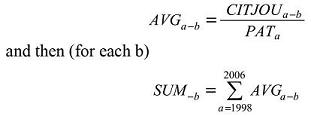
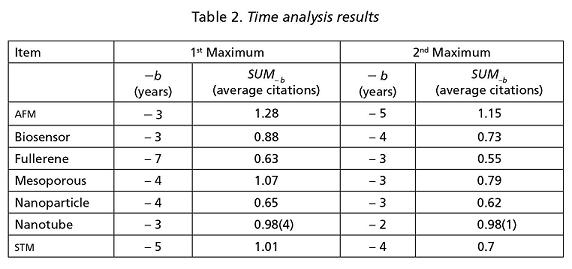
<body><![CDATA[<p align="justify"><font face="verdana" size="2">For this analysis, two sets of data have been retrieved for each group of key&#45;words. These are the number of patents per year and the number of cited scientific articles per each patenting year, subdivided according to the year of publication of cited articles. Data have been analysed in two steps.</font></p>  	    <p align="justify"><font face="verdana" size="2">In the first step, the average number of citations per patent was calculated for each year. Then, the averages were summed according to the time distance in years between patenting and publication of the cited journal.</font></p>  	    <p align="justify"><font face="verdana" size="2">In the second step, time lag series were calculated. The year of patenting was considered year "0" for each year taken into account (from 1998 to 2006). Averages obtained in the first step were, thus, summed up according <i>not</i> to the year of publication, <i>but</i> to the time lag existing from publication to being cited. This was done starting from this point (that is to say, cited articles published in the same year of patent) and going back to year &#45;20 (that is, patents citing articles published 20 years before being issued).</font></p>  	    <p align="justify"><font face="verdana" size="2">Analytically, given (for each item) <i>a</i> = 1998 to 2006, then <i>PAT<sub>a</sub></i> = number of patents issued in year <i>a</i>. Given <i>b</i> = 0 to 20, then <i>CITJOU<sub>a&#45;b</sub></i>= number of journal articles cited in <i>PAT<sub>a</sub> </i>and published in year <i>a</i> &#45; <i>b</i>.</font></p>      <p align="justify"><font face="verdana" size="2">From these definitions, we derive the equations used in the calculation:</font></p>  	    <p align="center"><font face="verdana" size="2">&#160;<img src="/img/revistas/etp/n39/a2fo1.jpg"></font></p>  	    <p align="justify"><font face="verdana" size="2">The values of <i>SUM<sub>&#45;b</sub></i> for each <i>&#150;b</i> year are the final result of this analysis. Years (<i>&#45;b</i>) presenting the two highest values of <i>SUM<sub>&#45;b</sub></i> are considered the most relevant time lags between cited articles and citing patents (that is, between codification of knowledge for scientific purposes &#150; article publication &#150; and its codification for technological purposes &#150; filing of patent). Results are reported in <a href="#t2">Table 2</a> for each topic: time lags (<i>&#45;b</i> in years) and <i>SUM<sub>&#45;b</sub></i> (average citations of articles). The shorter the lag, the higher the speed of inclusion of related scientific knowledge in the patented technological output.</font></p>  	    <p align="center"><font face="verdana" size="2"><a name="t2" id="t2"></a></font></p>  	    <p align="center"><font face="verdana" size="2"><img src="/img/revistas/etp/n39/a2t2.jpg"></font></p>  	    <p align="justify"><font face="verdana" size="2">For six out of seven topics the most representative time lag is &#45;3 or &#45;4 years previous to the patent. For the other value of average citations the same time lag is present in five out of seven cases. The remaining values are &#45;2 in one case, &#45;5 in two cases and &#45;7 in one case. Thus the most representative time lag between publication of cited articles and patenting of citing patents lies in the 3&#45;4 years range. It must also be taken in account that this encompasses the procedure of preparation and evaluation of citing patents.</font></p>  	    ]]></body>
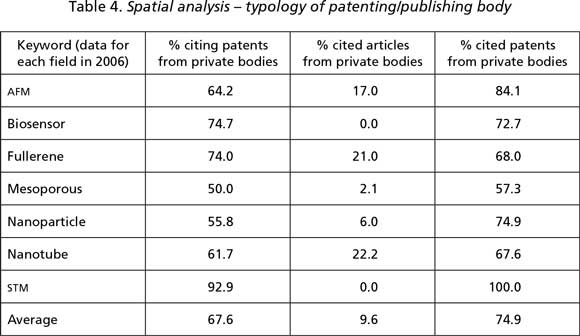
<body><![CDATA[<p align="justify"><font face="verdana" size="2"><i><b>3. Spatial analysis: methodology and results</b></i></font></p>  	    <p align="justify"><font face="verdana" size="2">The study of endogeneity of cited documents was realized on patents registered in year 2006 (the last studied year) for each NST search term. Data about applicant institution of citing and cited patents, and about author affiliation of cited journal articles, were retrieved. Affiliations were preferred to names in order to bypass homonymy problems. For each applicant of citing patent, applicants and affiliations of cited documents were retrieved.</font></p>  	    <p align="justify"><font face="verdana" size="2">Two measures were calculated from the obtained data: percentages of endogenous documents (fraction of cited documents generated from affiliations, which also generated citing patents); percentages of applicants/affiliations producing endogenous documents. Results are reported in <a href="#t3">Table 3</a>.</font></p>  	    <p align="center"><font face="verdana" size="2"><a name="t3" id="t3"></a></font></p>  	    <p align="center"><font face="verdana" size="2"><img src="/img/revistas/etp/n39/a2t3.jpg"></font></p>  	    <p align="justify"><font face="verdana" size="2">Percentages of endogenous cited articles are equal or over 30% in three cases, below 20% in two cases, and below 10% in two cases. Data for endogenous cited patents go from 12.7% to 71.2%, and the average is much higher than that of journals (31.2% vs. 20.9%). Percentages of affiliations producing endogenous cited documents show their concentration.</font></p>  	    <p align="justify"><font face="verdana" size="2">Data also show that endogenous patents are more cited than endogenous scientific products. The rather high endogeneity of cited documents is notable: in average, 20% of cited scientific products and 30% of cited patents are derived from patenting institutions.</font></p>  	    <p align="justify"><font face="verdana" size="2">In order to deepen this analysis, public (state) owned research bodies and companies/private research institutes were considered independently. Citing patents were divided according to this determinant, as well as cited documents (patents and articles). <a href="#t4">Table 4</a> reports the results for private bodies; the other group sums up to 100%.</font></p>  	    <p align="center"><font face="verdana" size="2"><a name="t4" id="t4"></a></font></p>  	    <p align="center"><font face="verdana" size="2"><img src="/img/revistas/etp/n39/a2t4.jpg"></font></p>  	    ]]></body>
<body><![CDATA[<p align="justify"><font face="verdana" size="2">Results show that companies/private research organization produce the most part of citing patents and cited patent. Public research bodies, instead, produce more cited articles and patents citing articles.</font></p>  	    <p align="justify"><font face="verdana" size="2">&nbsp;</font></p>  	    <p align="justify"><font face="verdana" size="2"><b>III. Discussion and conclusions</b></font></p>  	    <p align="justify"><font face="verdana" size="2">The main target of the present work was adding evidence to the existing mechanisms in the <i>ex ante</i> selection of technological directions in a highly knowledge&#45;intensive specific technological paradigm, that of Nanosciences and Nanotechnologies. To this end, it seeks an answer to research questions about the time and space distance between the production of science and its incorporation into a patented invention. To seek this answer, it describes an empirical activity based on patent citations of scientific articles relative to several relevant items representative of NST.</font></p>  	    <p align="justify"><font face="verdana" size="2">The empirical activity was performed measuring two quantities. The first one is the existing time lag between publication year of patents citing scientific publications and of the cited documents.</font></p>  	    <p align="justify"><font face="verdana" size="2">This lag proxies the time lag existing between the production of the results of scientific activities and their incorporation in a technological outcome. The second one is the fraction of cited documents endogenous to the institutions (firm, company, research centre, university, etc) producing the citing patent. This measure is intended to proxy how much of the knowledge incorporated in the patents is derived from the same source.</font></p>  	    <p align="justify"><font face="verdana" size="2">Experimental results show that the most relevant time lag between scientific publication and patenting is around 3&#45;4 years. This time lag is quite short, especially if we consider the technical timing of publishing and patenting. All studied items present a similar behaviour: this allows us to think that this behaviour is generalized for NST.</font></p>  	    <p align="justify"><font face="verdana" size="2">Endogeneity of documents cited in patents is rather high: around 20% of cited scientific products and 30% of cited patents are produced by patent applicants. The analysis of disaggregated data shows that most citing patents (67%) have been produced by companies or private research centres, while only the remaining 33% by state/public research centres/Universities. At the same time, the first group of patentees cite their own patents (an average of almost 75%) more than their own scientific products (less than 10%). The opposite is true for the patents of the second group.</font></p>  	    <p align="justify"><font face="verdana" size="2">A first interpretation of these facts is the following: scientists tend to patent the discoveries made during their basic scientific research activities. The short time lag supports the idea that scientists also tend to develop technological application of research as soon as a new discovery is made. Once a technical application of a scientific discovery is envisaged, scientists might be able to proceed along two pipelines, also avoiding possible problems for patenting due to the creation of a prior art.</font></p>  	    <p align="justify"><font face="verdana" size="2">These facts might be particularly accurate for scientific institutions that tend to privilege basic scientific research rather than applied fields. This idea is supported by the fact that more than 90% of endogenous (deriving from patenting institutions) scientific products have been originated in patenting (public) scientific institutions. Conversely, companies cite more their own technological productions (patents).</font></p>  	    ]]></body>
<body><![CDATA[<p align="justify"><font face="verdana" size="2">Some caveats must, indeed, be taken into account. Regarding time analysis, it must be noted that some patent offices accord a "grace period" to patentees (<i>e.g.</i>, one year for USPTO, 6 months for JPO). The presence of this grace period might have effects on the temporal evolution of patent citations.</font></p>  	    <p align="justify"><font face="verdana" size="2">Regarding the space analysis, it must be taken into consideration that names of corporations might, in some cases, be ambiguous (though due care has been taken in controlling data). Also, the presence of subsidiaries entrusted with intellectual property might cause problems. Nevertheless, subsidiaries whose name is related to that of the owning institution have been grouped with it (<i>e.g.</i>, foundations or the trustees of a University).</font></p>  	    <p align="justify"><font face="verdana" size="2">It must also be taken in account that patent citations can be added either by patentees or by patent examiners. When citations are added by authors we can assume that institutions/authors producing patents tend to cite their own scientific/technological knowledge.</font></p>  	    <p align="justify"><font face="verdana" size="2">In this case, calculated percentages give us a measure of the origin of cited knowledge: the highest the percentage, the highest the quantity of endogenous knowledge cited. In the other case (citations added by a patent office), the relation is less direct. Our dataset does not allow distinguishing between the two kinds of citations.</font></p>  	    <p align="justify"><font face="verdana" size="2">Finally, to respond to the main target of this article, results are interpreted in the framework of technological paradigms. Findings support Dosi's statements on technological paradigms, and the concepts reported from literature in section i.1. Strong temporal and spatial interrelations presume the presence of    <br> 	a set of cognitive and functional relations inside organizations. This might be strictly connected to normal problem solving activities (see Teece, 2008). This might also be associated with the production of scientific knowledge useful for designers of technologies, as pointed out by Nelson (2008).</font></p>  	    <p align="justify"><font face="verdana" size="2">Experimental results also confirm the correlation between R&amp;D and innovative output (proxied by patenting) stressed by Dosi (1982) as one of the basic facts underlying his theory. In a growing and highly active field such as NST, overlapping of R&amp;D and innovative output might be one of the driving forces of the selection processes put into action in the economic <i>trial and error</i> phase (see Dosi, 1982, p. 157). This result should be coupled with the differences existing between firms ("previous technology" vs. "new technology" overlap) and research centres ("science" vs. "new technology" overlap). These might be the "economic criteria" (Dosi, 1982, p. 153) acting as selectors of a new technological paradigm.</font></p>  	    <p align="justify"><font face="verdana" size="2">&nbsp;</font></p>  	    <p align="justify"><font face="verdana" size="2"><b>References</b></font></p>  	    <!-- ref --><p align="justify"><font face="verdana" size="2">Avenel, E., Favier, A. V., Ma, S., Mangematin, V. and Rieu, C. (2007). Diversification and hybridization in firm knowledge bases in nanotechnologies. <i>Research Policy</i>, 36(6), pp. 864&#45;870.    &nbsp;&nbsp;&nbsp;&nbsp;&nbsp;&nbsp;&nbsp;&nbsp;[&#160;<a href="javascript:void(0);" onclick="javascript: window.open('/scielo.php?script=sci_nlinks&ref=2935847&pid=S0188-3380201300020000200001&lng=','','width=640,height=500,resizable=yes,scrollbars=1,menubar=yes,');">Links</a>&#160;]<!-- end-ref --></font></p>  	    <!-- ref --><p align="justify"><font face="verdana" size="2">Bacchiocchi, E. and Montobbio, F. (2009). Knowledge diffusion from university and public research. A comparison between US, Japan and Europe using patent citations. <i>The Journal of Technology Transfer</i>, 34(2), pp. 169&#45;181.    &nbsp;&nbsp;&nbsp;&nbsp;&nbsp;&nbsp;&nbsp;&nbsp;[&#160;<a href="javascript:void(0);" onclick="javascript: window.open('/scielo.php?script=sci_nlinks&ref=2935849&pid=S0188-3380201300020000200002&lng=','','width=640,height=500,resizable=yes,scrollbars=1,menubar=yes,');">Links</a>&#160;]<!-- end-ref --></font></p>  	    <!-- ref --><p align="justify"><font face="verdana" size="2">Balzani, V. (2005). Nanoscience and Nanotechnology: A personal View of a Chemist. <i>Small</i> 1(3), pp. 278&#45;283.    &nbsp;&nbsp;&nbsp;&nbsp;&nbsp;&nbsp;&nbsp;&nbsp;[&#160;<a href="javascript:void(0);" onclick="javascript: window.open('/scielo.php?script=sci_nlinks&ref=2935851&pid=S0188-3380201300020000200003&lng=','','width=640,height=500,resizable=yes,scrollbars=1,menubar=yes,');">Links</a>&#160;]<!-- end-ref --></font></p>  	    <!-- ref --><p align="justify"><font face="verdana" size="2">Binnig, G. and Rohrer, H. (1986). Scanning tunnelling microscopy. <i>IBM Journal of Research and Development</i>, 30(4), pp. 355&#45;369.    &nbsp;&nbsp;&nbsp;&nbsp;&nbsp;&nbsp;&nbsp;&nbsp;[&#160;<a href="javascript:void(0);" onclick="javascript: window.open('/scielo.php?script=sci_nlinks&ref=2935853&pid=S0188-3380201300020000200004&lng=','','width=640,height=500,resizable=yes,scrollbars=1,menubar=yes,');">Links</a>&#160;]<!-- end-ref --></font></p>  	    <!-- ref --><p align="justify"><font face="verdana" size="2">Bonaccorsi, A. and Thoma, G. (2007). Diversification and hybridization in firm knowledge bases in nanotechnologies. <i>Research Policy</i>. 36(6), pp. 864&#45;870.    &nbsp;&nbsp;&nbsp;&nbsp;&nbsp;&nbsp;&nbsp;&nbsp;[&#160;<a href="javascript:void(0);" onclick="javascript: window.open('/scielo.php?script=sci_nlinks&ref=2935855&pid=S0188-3380201300020000200005&lng=','','width=640,height=500,resizable=yes,scrollbars=1,menubar=yes,');">Links</a>&#160;]<!-- end-ref --></font></p>  	    <!-- ref --><p align="justify"><font face="verdana" size="2">Bozeman, B., Laredo, P. and Mangematin, V. (2007). Understanding the emergence and deployment of "nano" S&amp;T. <i>Research Policy</i>, 36(6), pp. 807&#45;812.    &nbsp;&nbsp;&nbsp;&nbsp;&nbsp;&nbsp;&nbsp;&nbsp;[&#160;<a href="javascript:void(0);" onclick="javascript: window.open('/scielo.php?script=sci_nlinks&ref=2935857&pid=S0188-3380201300020000200006&lng=','','width=640,height=500,resizable=yes,scrollbars=1,menubar=yes,');">Links</a>&#160;]<!-- end-ref --></font></p>  	    <!-- ref --><p align="justify"><font face="verdana" size="2">Breschi, S. and Catalini, C. (2010). Tracing the links between science and technology: An exploratory analysis of scientists' and inventors' networks. <i>Research Policy</i>, 39(1), pp. 14&#45;26.    &nbsp;&nbsp;&nbsp;&nbsp;&nbsp;&nbsp;&nbsp;&nbsp;[&#160;<a href="javascript:void(0);" onclick="javascript: window.open('/scielo.php?script=sci_nlinks&ref=2935859&pid=S0188-3380201300020000200007&lng=','','width=640,height=500,resizable=yes,scrollbars=1,menubar=yes,');">Links</a>&#160;]<!-- end-ref --></font></p>  	    <!-- ref --><p align="justify"><font face="verdana" size="2">Cimoli, M. and Dosi, G. (1995). Technological paradigms, patterns of learning and development: an introductory roadmap, <i>Journal of Evolutionary Economics</i>, 5(3), 243&#45;268.    &nbsp;&nbsp;&nbsp;&nbsp;&nbsp;&nbsp;&nbsp;&nbsp;[&#160;<a href="javascript:void(0);" onclick="javascript: window.open('/scielo.php?script=sci_nlinks&ref=2935861&pid=S0188-3380201300020000200008&lng=','','width=640,height=500,resizable=yes,scrollbars=1,menubar=yes,');">Links</a>&#160;]<!-- end-ref --></font></p>  	    <!-- ref --><p align="justify"><font face="verdana" size="2">Coccia, M., Finardi, U. and Margon, D. (2011). Current trends in nanotechnology research across worldwide geo&#45;economic players. <i>Journal of Technology Transfer</i>, 37(5), pp. 777&#45;787.    &nbsp;&nbsp;&nbsp;&nbsp;&nbsp;&nbsp;&nbsp;&nbsp;[&#160;<a href="javascript:void(0);" onclick="javascript: window.open('/scielo.php?script=sci_nlinks&ref=2935863&pid=S0188-3380201300020000200009&lng=','','width=640,height=500,resizable=yes,scrollbars=1,menubar=yes,');">Links</a>&#160;]<!-- end-ref --></font></p>  	    <!-- ref --><p align="justify"><font face="verdana" size="2">Criscuolo, P. and Verspagen, B. (2008). Does it matter where patent citations come from? Inventor vs. examiner citations in European patents.<i> Research Policy</i>, 37(10), pp. 1892&#45;1908.    &nbsp;&nbsp;&nbsp;&nbsp;&nbsp;&nbsp;&nbsp;&nbsp;[&#160;<a href="javascript:void(0);" onclick="javascript: window.open('/scielo.php?script=sci_nlinks&ref=2935865&pid=S0188-3380201300020000200010&lng=','','width=640,height=500,resizable=yes,scrollbars=1,menubar=yes,');">Links</a>&#160;]<!-- end-ref --></font></p>  	    <!-- ref --><p align="justify"><font face="verdana" size="2">Dasgupta, P. and David, Paul A. (1994). Toward a new economics of science. <i>Research Policy</i> 23(5), pp. 487&#45;521.    &nbsp;&nbsp;&nbsp;&nbsp;&nbsp;&nbsp;&nbsp;&nbsp;[&#160;<a href="javascript:void(0);" onclick="javascript: window.open('/scielo.php?script=sci_nlinks&ref=2935867&pid=S0188-3380201300020000200011&lng=','','width=640,height=500,resizable=yes,scrollbars=1,menubar=yes,');">Links</a>&#160;]<!-- end-ref --></font></p>  	    <!-- ref --><p align="justify"><font face="verdana" size="2">Dosi, G. (1982). Technological paradigms and technological trajectories. A suggested interpretation of the determinants and directions of technical change. <i>Research Policy </i>11(3), pp. 147&#45;162</font><font face="verdana" size="2">.    &nbsp;&nbsp;&nbsp;&nbsp;&nbsp;&nbsp;&nbsp;&nbsp;[&#160;<a href="javascript:void(0);" onclick="javascript: window.open('/scielo.php?script=sci_nlinks&ref=2935869&pid=S0188-3380201300020000200012&lng=','','width=640,height=500,resizable=yes,scrollbars=1,menubar=yes,');">Links</a>&#160;]<!-- end-ref --></font></p>      <!-- ref --><p align="justify"><font face="verdana" size="2">Feynman, R. P. (1960). There's plenty of room at the bottom.<i> Engineering and Science</i> 23(Feb.), pp. 22&#45;36.    &nbsp;&nbsp;&nbsp;&nbsp;&nbsp;&nbsp;&nbsp;&nbsp;[&#160;<a href="javascript:void(0);" onclick="javascript: window.open('/scielo.php?script=sci_nlinks&ref=2935871&pid=S0188-3380201300020000200013&lng=','','width=640,height=500,resizable=yes,scrollbars=1,menubar=yes,');">Links</a>&#160;]<!-- end-ref --></font></p>  	    <!-- ref --><p align="justify"><font face="verdana" size="2">Finardi, U. (2011). Time relations between scientific production and patenting of knowledge: the case of nanotechnologies. <i>Scientometrics</i> 89(1), pp. 37&#45;50.    &nbsp;&nbsp;&nbsp;&nbsp;&nbsp;&nbsp;&nbsp;&nbsp;[&#160;<a href="javascript:void(0);" onclick="javascript: window.open('/scielo.php?script=sci_nlinks&ref=2935873&pid=S0188-3380201300020000200014&lng=','','width=640,height=500,resizable=yes,scrollbars=1,menubar=yes,');">Links</a>&#160;]<!-- end-ref --></font></p>  	    <!-- ref --><p align="justify"><font face="verdana" size="2">Gl&auml;nzel, W. and Meyer, Martin (2003). Patents cited in the scientific literature: An exploratory study of "reverse" citation relations. <i>Scientometrics</i> 58(2), pp. 415&#45;428.    &nbsp;&nbsp;&nbsp;&nbsp;&nbsp;&nbsp;&nbsp;&nbsp;[&#160;<a href="javascript:void(0);" onclick="javascript: window.open('/scielo.php?script=sci_nlinks&ref=2935875&pid=S0188-3380201300020000200015&lng=','','width=640,height=500,resizable=yes,scrollbars=1,menubar=yes,');">Links</a>&#160;]<!-- end-ref --></font></p>  	    <!-- ref --><p align="justify"><font face="verdana" size="2">Hu, D., Chen, H., Huang, Z. and Roco, M. C. (2007). Longitudinal study on patent citations to academic research articles in nanotechnology (1976&#45;2004). <i>Journal of Nanoparticle Research</i> 9(4), pp. 529&#45;542.    &nbsp;&nbsp;&nbsp;&nbsp;&nbsp;&nbsp;&nbsp;&nbsp;[&#160;<a href="javascript:void(0);" onclick="javascript: window.open('/scielo.php?script=sci_nlinks&ref=2935877&pid=S0188-3380201300020000200016&lng=','','width=640,height=500,resizable=yes,scrollbars=1,menubar=yes,');">Links</a>&#160;]<!-- end-ref --></font></p>  	    <!-- ref --><p align="justify"><font face="verdana" size="2">Huang, C., Notten, A. and Rasters, N. (2011). Nanoscience and technology publications and patents: a review of social science studies and search strategies. <i>Journal of Technology Transfer</i>, 36(2), pp. 145&#45;172.    &nbsp;&nbsp;&nbsp;&nbsp;&nbsp;&nbsp;&nbsp;&nbsp;[&#160;<a href="javascript:void(0);" onclick="javascript: window.open('/scielo.php?script=sci_nlinks&ref=2935879&pid=S0188-3380201300020000200017&lng=','','width=640,height=500,resizable=yes,scrollbars=1,menubar=yes,');">Links</a>&#160;]<!-- end-ref --></font></p>  	    <!-- ref --><p align="justify"><font face="verdana" size="2">Hulmann, A. and Meyer, M. (2003). Publications and patents in nanotechnology. An overview of previous studies and the state of the art. <i>Scientometrics</i>, 58(3), pp. 507&#45;527.    &nbsp;&nbsp;&nbsp;&nbsp;&nbsp;&nbsp;&nbsp;&nbsp;[&#160;<a href="javascript:void(0);" onclick="javascript: window.open('/scielo.php?script=sci_nlinks&ref=2935881&pid=S0188-3380201300020000200018&lng=','','width=640,height=500,resizable=yes,scrollbars=1,menubar=yes,');">Links</a>&#160;]<!-- end-ref --></font></p>  	    <!-- ref --><p align="justify"><font face="verdana" size="2">Iijima, S. (1991). Helical microtubules of graphitic carbon. <i>Nature</i> 354(6348), pp. 56&#45;58.    &nbsp;&nbsp;&nbsp;&nbsp;&nbsp;&nbsp;&nbsp;&nbsp;[&#160;<a href="javascript:void(0);" onclick="javascript: window.open('/scielo.php?script=sci_nlinks&ref=2935883&pid=S0188-3380201300020000200019&lng=','','width=640,height=500,resizable=yes,scrollbars=1,menubar=yes,');">Links</a>&#160;]<!-- end-ref --></font></p>  	    <!-- ref --><p align="justify"><font face="verdana" size="2">Islam, N. and Miyazaki, K. (2009). Nanotechnology innovation system: Understanding hidden dynamics of nanoscience fusion trajectory. <i>Technological Forecasting &amp; Social Change</i>, 76(1), pp. 128&#45;140.    &nbsp;&nbsp;&nbsp;&nbsp;&nbsp;&nbsp;&nbsp;&nbsp;[&#160;<a href="javascript:void(0);" onclick="javascript: window.open('/scielo.php?script=sci_nlinks&ref=2935885&pid=S0188-3380201300020000200020&lng=','','width=640,height=500,resizable=yes,scrollbars=1,menubar=yes,');">Links</a>&#160;]<!-- end-ref --></font></p>  	    <!-- ref --><p align="justify"><font face="verdana" size="2">&#45;&#45;&#45;&#45;&#45;&#45;&#45;&#45;&#45;&#45; (2010). An empirical analysis of nanotechnology research domains. <i>Technovation</i>, 30(4), pp. 229&#45;237.    &nbsp;&nbsp;&nbsp;&nbsp;&nbsp;&nbsp;&nbsp;&nbsp;[&#160;<a href="javascript:void(0);" onclick="javascript: window.open('/scielo.php?script=sci_nlinks&ref=2935887&pid=S0188-3380201300020000200021&lng=','','width=640,height=500,resizable=yes,scrollbars=1,menubar=yes,');">Links</a>&#160;]<!-- end-ref --></font></p>  	    <!-- ref --><p align="justify"><font face="verdana" size="2">Kroto, H. W., Heath, J. R., O'Brien, S. C., Curl, R. F. and Smalley, R. E. (1985). C60: Buckminsterfullerene. <i>Nature</i>, 318(6042), pp. 162&#45;163.    &nbsp;&nbsp;&nbsp;&nbsp;&nbsp;&nbsp;&nbsp;&nbsp;[&#160;<a href="javascript:void(0);" onclick="javascript: window.open('/scielo.php?script=sci_nlinks&ref=2935889&pid=S0188-3380201300020000200022&lng=','','width=640,height=500,resizable=yes,scrollbars=1,menubar=yes,');">Links</a>&#160;]<!-- end-ref --></font></p>  	    <!-- ref --><p align="justify"><font face="verdana" size="2">Leydesdorff, L. (2007). The delineation of nanoscience and nanotechnology in terms of journals and patents: A most recent update. <i>Scientometrics</i>, 76(1), pp. 159&#45;167.    &nbsp;&nbsp;&nbsp;&nbsp;&nbsp;&nbsp;&nbsp;&nbsp;[&#160;<a href="javascript:void(0);" onclick="javascript: window.open('/scielo.php?script=sci_nlinks&ref=2935891&pid=S0188-3380201300020000200023&lng=','','width=640,height=500,resizable=yes,scrollbars=1,menubar=yes,');">Links</a>&#160;]<!-- end-ref --></font></p>  	    <!-- ref --><p align="justify"><font face="verdana" size="2">Leydesdorff, L. and Zhou, P. (2007). Nanotechnology as a field of science: Its delineation in terms of journals and patents. <i>Scientometrics</i>, 70(3), pp. 693&#45;713.    &nbsp;&nbsp;&nbsp;&nbsp;&nbsp;&nbsp;&nbsp;&nbsp;[&#160;<a href="javascript:void(0);" onclick="javascript: window.open('/scielo.php?script=sci_nlinks&ref=2935893&pid=S0188-3380201300020000200024&lng=','','width=640,height=500,resizable=yes,scrollbars=1,menubar=yes,');">Links</a>&#160;]<!-- end-ref --></font></p>  	    <!-- ref --><p align="justify"><font face="verdana" size="2">Li, X., Chen, H., Huang, Z. and Roco, M. C. (2007). Patent citation network in nanotechnology (1976&#45;2004). <i>Journal of Nanoparticle Research</i>, 9(3), pp. 337&#45;352.    &nbsp;&nbsp;&nbsp;&nbsp;&nbsp;&nbsp;&nbsp;&nbsp;[&#160;<a href="javascript:void(0);" onclick="javascript: window.open('/scielo.php?script=sci_nlinks&ref=2935895&pid=S0188-3380201300020000200025&lng=','','width=640,height=500,resizable=yes,scrollbars=1,menubar=yes,');">Links</a>&#160;]<!-- end-ref --></font></p>  	    <!-- ref --><p align="justify"><font face="verdana" size="2">Li, X., Lin, Y., Chen H. and Roco, M. C. (2007). Worldwide nanotechnology development: a comparative study of USPTO, EPO, and JPO patents (1976&#45;2004). <i>Journal of Nanoparticle Research</i>, 9(6), pp. 977&#45;1002.    &nbsp;&nbsp;&nbsp;&nbsp;&nbsp;&nbsp;&nbsp;&nbsp;[&#160;<a href="javascript:void(0);" onclick="javascript: window.open('/scielo.php?script=sci_nlinks&ref=2935897&pid=S0188-3380201300020000200026&lng=','','width=640,height=500,resizable=yes,scrollbars=1,menubar=yes,');">Links</a>&#160;]<!-- end-ref --></font></p>  	    <!-- ref --><p align="justify"><font face="verdana" size="2">Meyer, M. (2000 a). Does science push technology? Patents citing scientific literature. <i>Research Policy</i>, 29(3), pp. 409&#45;434.    &nbsp;&nbsp;&nbsp;&nbsp;&nbsp;&nbsp;&nbsp;&nbsp;[&#160;<a href="javascript:void(0);" onclick="javascript: window.open('/scielo.php?script=sci_nlinks&ref=2935899&pid=S0188-3380201300020000200027&lng=','','width=640,height=500,resizable=yes,scrollbars=1,menubar=yes,');">Links</a>&#160;]<!-- end-ref --></font></p>  	    <!-- ref --><p align="justify"><font face="verdana" size="2">&#45;&#45;&#45;&#45;&#45;&#45;&#45;&#45;&#45;&#45; (2000 b). What is special about patent citations? Differences between scientific and patent citations. <i>Scientometrics</i>, 49(1), pp. 93&#45;123.    &nbsp;&nbsp;&nbsp;&nbsp;&nbsp;&nbsp;&nbsp;&nbsp;[&#160;<a href="javascript:void(0);" onclick="javascript: window.open('/scielo.php?script=sci_nlinks&ref=2935901&pid=S0188-3380201300020000200028&lng=','','width=640,height=500,resizable=yes,scrollbars=1,menubar=yes,');">Links</a>&#160;]<!-- end-ref --></font></p>  	    <!-- ref --><p align="justify"><font face="verdana" size="2">&#45;&#45;&#45;&#45;&#45;&#45;&#45;&#45;&#45;&#45; (2001). Patent citation analysis in a novel field of technology: An exploration of nano&#45;science and nano&#45;technology. <i>Scientometrics</i>, 51(1), pp. 163&#45;183.    &nbsp;&nbsp;&nbsp;&nbsp;&nbsp;&nbsp;&nbsp;&nbsp;[&#160;<a href="javascript:void(0);" onclick="javascript: window.open('/scielo.php?script=sci_nlinks&ref=2935903&pid=S0188-3380201300020000200029&lng=','','width=640,height=500,resizable=yes,scrollbars=1,menubar=yes,');">Links</a>&#160;]<!-- end-ref --></font></p>  	    <!-- ref --><p align="justify"><font face="verdana" size="2">Nelson, R. R. (2008). Factors affecting the power of technological paradigms. <i>Industrial and Corporate Change</i>, 17 (3), 485&#45;497.    &nbsp;&nbsp;&nbsp;&nbsp;&nbsp;&nbsp;&nbsp;&nbsp;[&#160;<a href="javascript:void(0);" onclick="javascript: window.open('/scielo.php?script=sci_nlinks&ref=2935905&pid=S0188-3380201300020000200030&lng=','','width=640,height=500,resizable=yes,scrollbars=1,menubar=yes,');">Links</a>&#160;]<!-- end-ref --></font></p>  	    <!-- ref --><p align="justify"><font face="verdana" size="2">NNI (n.d.). <i>Nanotechnology</i>. &#91;pdf&#93; Avalaible at: <a href="http://www.nano.gov/sites/default/files/pub_resource/nanotechnology_bigthingsfromatinyworld-print.pdf" target="_blank">www.nano.gov/sites/default/files/pub_resource/nanotechnology_bigthingsfromatinyworld&#45;print.pdf</a>. Accessed May 2013.    &nbsp;&nbsp;&nbsp;&nbsp;&nbsp;&nbsp;&nbsp;&nbsp;[&#160;<a href="javascript:void(0);" onclick="javascript: window.open('/scielo.php?script=sci_nlinks&ref=2935907&pid=S0188-3380201300020000200031&lng=','','width=640,height=500,resizable=yes,scrollbars=1,menubar=yes,');">Links</a>&#160;]<!-- end-ref --></font></p>  	    <!-- ref --><p align="justify"><font face="verdana" size="2">Porter, A. L., Youtie, J., Shapira, P. and Schoeneck, D. J. (2008). Refining search terms for nanotechnology. <i>Journal of Nanoparticle Research</i>, 10(5), pp. 715&#45;728.    &nbsp;&nbsp;&nbsp;&nbsp;&nbsp;&nbsp;&nbsp;&nbsp;[&#160;<a href="javascript:void(0);" onclick="javascript: window.open('/scielo.php?script=sci_nlinks&ref=2935909&pid=S0188-3380201300020000200032&lng=','','width=640,height=500,resizable=yes,scrollbars=1,menubar=yes,');">Links</a>&#160;]<!-- end-ref --></font></p>  	    <!-- ref --><p align="justify"><font face="verdana" size="2">Schmoch, U. (1993). Tracing the Knowledge Transfer from science to technology as reflected in patent indicators. <i>Scientometrics</i>, 26(1), pp 193&#45;211.    &nbsp;&nbsp;&nbsp;&nbsp;&nbsp;&nbsp;&nbsp;&nbsp;[&#160;<a href="javascript:void(0);" onclick="javascript: window.open('/scielo.php?script=sci_nlinks&ref=2935911&pid=S0188-3380201300020000200033&lng=','','width=640,height=500,resizable=yes,scrollbars=1,menubar=yes,');">Links</a>&#160;]<!-- end-ref --></font></p>  	    <!-- ref --><p align="justify"><font face="verdana" size="2">Sternitzke, C. (2010). Knowledge sources, patent protection, and commercialization of pharmaceutical innovations. <i>Research Policy</i>, 39(6), pp. 810&#150;821.    &nbsp;&nbsp;&nbsp;&nbsp;&nbsp;&nbsp;&nbsp;&nbsp;[&#160;<a href="javascript:void(0);" onclick="javascript: window.open('/scielo.php?script=sci_nlinks&ref=2935913&pid=S0188-3380201300020000200034&lng=','','width=640,height=500,resizable=yes,scrollbars=1,menubar=yes,');">Links</a>&#160;]<!-- end-ref --></font></p>  	    <!-- ref --><p align="justify"><font face="verdana" size="2">Teece, D. J. (2008). Dosi's technological paradigms and trajectories: insights for economics and management. <i>Industrial and Corporate Change</i>, 17 (3), 507&#45;512.    &nbsp;&nbsp;&nbsp;&nbsp;&nbsp;&nbsp;&nbsp;&nbsp;[&#160;<a href="javascript:void(0);" onclick="javascript: window.open('/scielo.php?script=sci_nlinks&ref=2935915&pid=S0188-3380201300020000200035&lng=','','width=640,height=500,resizable=yes,scrollbars=1,menubar=yes,');">Links</a>&#160;]<!-- end-ref --></font></p>  	    <!-- ref --><p align="justify"><font face="verdana" size="2">Von Tunzelmann, N., Malerba, F., Nightingale, P. and Metcalfe, S. (2008). Technological paradigms: past, present and future.<i> Industrial and Corporate Change</i>, 17(3), 467&#45;484.    &nbsp;&nbsp;&nbsp;&nbsp;&nbsp;&nbsp;&nbsp;&nbsp;[&#160;<a href="javascript:void(0);" onclick="javascript: window.open('/scielo.php?script=sci_nlinks&ref=2935917&pid=S0188-3380201300020000200036&lng=','','width=640,height=500,resizable=yes,scrollbars=1,menubar=yes,');">Links</a>&#160;]<!-- end-ref --></font></p>  	    <!-- ref --><p align="justify"><font face="verdana" size="2">Wang, G. and Guan, J. (2010). The role of patenting activity for scientific research: A study of academic inventions from China's nanotechnology. <i>Journal of Informetrics</i>, 4(3), pp. 338&#150;350.    &nbsp;&nbsp;&nbsp;&nbsp;&nbsp;&nbsp;&nbsp;&nbsp;[&#160;<a href="javascript:void(0);" onclick="javascript: window.open('/scielo.php?script=sci_nlinks&ref=2935919&pid=S0188-3380201300020000200037&lng=','','width=640,height=500,resizable=yes,scrollbars=1,menubar=yes,');">Links</a>&#160;]<!-- end-ref --></font></p>  	    <p align="justify"><font face="verdana" size="2">&nbsp;</font></p>  	    <p align="justify"><font face="verdana" size="2"><a name="nota" id="nota"></a><b>Note</b></font></p>  	    <p align="justify"><font face="verdana" size="2">* A very preliminary version of this work has been presented at the 6th Annual Conference of the EPIP &#150; European Policy for Intellectual Property Association "Fine&#45;Tuning IPR debates", Universit&eacute; libre de Bruxelles, Brussels, Belgium, september 8th&#45;9th, 2011. The participants to the Conferenceare acknowledged, as well as the chairperson of the session Prof. Alenka Guzm&aacute;n Ch&aacute;vez, who is also acknowledged for encouraging submission to <i>Econom&iacute;a: Teor&iacute;a y Pr&aacute;ctica</i>. The anonymous referees, who performed a twofold revision of the article, are acknowledged for important suggestions and comments. Prof. F. Malerba (CESPRI&#45;KITES &#150; Universit&agrave; Bocconi, Milano, Italy) is acknowledged for seminal ideas and revision of preliminary material. Acknowledgements go to: Prof. S. Rolfo (CNR&#45;CERIS) for supporting this research field, as well as for scientific collaboration; Prof. S. Coluccia and Prof. L. Battezzati (University of Torino, Italy) for supporting this research field in the recent past; the colleagues of CNR&#45;CERIS for scientific collaboration. Usual disclaimer applies.</font></p>      ]]></body><back>
<ref-list>
<ref id="B1">
<nlm-citation citation-type="journal">
<person-group person-group-type="author">
<name>
<surname><![CDATA[Avenel]]></surname>
<given-names><![CDATA[E.]]></given-names>
</name>
<name>
<surname><![CDATA[Favier]]></surname>
<given-names><![CDATA[A. V.]]></given-names>
</name>
<name>
<surname><![CDATA[Ma]]></surname>
<given-names><![CDATA[S.]]></given-names>
</name>
<name>
<surname><![CDATA[Mangematin]]></surname>
<given-names><![CDATA[V.]]></given-names>
</name>
<name>
<surname><![CDATA[Rieu]]></surname>
<given-names><![CDATA[C.]]></given-names>
</name>
</person-group>
<article-title xml:lang="en"><![CDATA[Diversification and hybridization in firm knowledge bases in nanotechnologies]]></article-title>
<source><![CDATA[Research Policy]]></source>
<year>2007</year>
<volume>36</volume>
<numero>6</numero>
<issue>6</issue>
<page-range>864-870</page-range></nlm-citation>
</ref>
<ref id="B2">
<nlm-citation citation-type="journal">
<person-group person-group-type="author">
<name>
<surname><![CDATA[Bacchiocchi]]></surname>
<given-names><![CDATA[E.]]></given-names>
</name>
<name>
<surname><![CDATA[Montobbio]]></surname>
<given-names><![CDATA[F.]]></given-names>
</name>
</person-group>
<article-title xml:lang="en"><![CDATA[Knowledge diffusion from university and public research. A comparison between US, Japan and Europe using patent citations]]></article-title>
<source><![CDATA[The Journal of Technology Transfer]]></source>
<year>2009</year>
<volume>34</volume>
<numero>2</numero>
<issue>2</issue>
<page-range>169-181</page-range></nlm-citation>
</ref>
<ref id="B3">
<nlm-citation citation-type="journal">
<person-group person-group-type="author">
<name>
<surname><![CDATA[Balzani]]></surname>
<given-names><![CDATA[V.]]></given-names>
</name>
</person-group>
<article-title xml:lang="en"><![CDATA[Nanoscience and Nanotechnology: A personal View of a Chemist]]></article-title>
<source><![CDATA[Small]]></source>
<year>2005</year>
<volume>1</volume>
<numero>3</numero>
<issue>3</issue>
<page-range>278-283</page-range></nlm-citation>
</ref>
<ref id="B4">
<nlm-citation citation-type="journal">
<person-group person-group-type="author">
<name>
<surname><![CDATA[Binnig]]></surname>
<given-names><![CDATA[G.]]></given-names>
</name>
<name>
<surname><![CDATA[Rohrer]]></surname>
<given-names><![CDATA[H.]]></given-names>
</name>
</person-group>
<article-title xml:lang="en"><![CDATA[Scanning tunnelling microscopy]]></article-title>
<source><![CDATA[IBM Journal of Research and Development]]></source>
<year>1986</year>
<volume>30</volume>
<numero>4</numero>
<issue>4</issue>
<page-range>355-369</page-range></nlm-citation>
</ref>
<ref id="B5">
<nlm-citation citation-type="journal">
<person-group person-group-type="author">
<name>
<surname><![CDATA[Bonaccorsi]]></surname>
<given-names><![CDATA[A.]]></given-names>
</name>
<name>
<surname><![CDATA[Thoma]]></surname>
<given-names><![CDATA[G.]]></given-names>
</name>
</person-group>
<article-title xml:lang="en"><![CDATA[Diversification and hybridization in firm knowledge bases in nanotechnologies]]></article-title>
<source><![CDATA[Research Policy]]></source>
<year>2007</year>
<volume>36</volume>
<numero>6</numero>
<issue>6</issue>
<page-range>864-870</page-range></nlm-citation>
</ref>
<ref id="B6">
<nlm-citation citation-type="journal">
<person-group person-group-type="author">
<name>
<surname><![CDATA[Bozeman]]></surname>
<given-names><![CDATA[B.]]></given-names>
</name>
<name>
<surname><![CDATA[Laredo]]></surname>
<given-names><![CDATA[P.]]></given-names>
</name>
<name>
<surname><![CDATA[Mangematin]]></surname>
<given-names><![CDATA[V.]]></given-names>
</name>
</person-group>
<article-title xml:lang="en"><![CDATA[Understanding the emergence and deployment of "nano" S&T]]></article-title>
<source><![CDATA[Research Policy]]></source>
<year>2007</year>
<volume>36</volume>
<numero>6</numero>
<issue>6</issue>
<page-range>807-812</page-range></nlm-citation>
</ref>
<ref id="B7">
<nlm-citation citation-type="journal">
<person-group person-group-type="author">
<name>
<surname><![CDATA[Breschi]]></surname>
<given-names><![CDATA[S.]]></given-names>
</name>
<name>
<surname><![CDATA[Catalini]]></surname>
<given-names><![CDATA[C.]]></given-names>
</name>
</person-group>
<article-title xml:lang="en"><![CDATA[Tracing the links between science and technology: An exploratory analysis of scientists' and inventors' networks]]></article-title>
<source><![CDATA[Research Policy]]></source>
<year>2010</year>
<volume>39</volume>
<numero>1</numero>
<issue>1</issue>
<page-range>14-26</page-range></nlm-citation>
</ref>
<ref id="B8">
<nlm-citation citation-type="journal">
<person-group person-group-type="author">
<name>
<surname><![CDATA[Cimoli]]></surname>
<given-names><![CDATA[M.]]></given-names>
</name>
<name>
<surname><![CDATA[Dosi]]></surname>
<given-names><![CDATA[G.]]></given-names>
</name>
</person-group>
<article-title xml:lang="en"><![CDATA[Technological paradigms, patterns of learning and development: an introductory roadmap]]></article-title>
<source><![CDATA[Journal of Evolutionary Economics]]></source>
<year>1995</year>
<volume>5</volume>
<numero>3</numero>
<issue>3</issue>
<page-range>243-268</page-range></nlm-citation>
</ref>
<ref id="B9">
<nlm-citation citation-type="journal">
<person-group person-group-type="author">
<name>
<surname><![CDATA[Coccia]]></surname>
<given-names><![CDATA[M.]]></given-names>
</name>
<name>
<surname><![CDATA[Finardi]]></surname>
<given-names><![CDATA[U.]]></given-names>
</name>
<name>
<surname><![CDATA[Margon]]></surname>
<given-names><![CDATA[D.]]></given-names>
</name>
</person-group>
<article-title xml:lang="en"><![CDATA[Current trends in nanotechnology research across worldwide geo-economic players]]></article-title>
<source><![CDATA[Journal of Technology Transfer]]></source>
<year>2011</year>
<volume>37</volume>
<numero>5</numero>
<issue>5</issue>
<page-range>777-787</page-range></nlm-citation>
</ref>
<ref id="B10">
<nlm-citation citation-type="journal">
<person-group person-group-type="author">
<name>
<surname><![CDATA[Criscuolo]]></surname>
<given-names><![CDATA[P.]]></given-names>
</name>
<name>
<surname><![CDATA[Verspagen]]></surname>
<given-names><![CDATA[B.]]></given-names>
</name>
</person-group>
<article-title xml:lang="en"><![CDATA[Does it matter where patent citations come from? Inventor vs. examiner citations in European patents]]></article-title>
<source><![CDATA[Research Policy]]></source>
<year>2008</year>
<volume>37</volume>
<numero>10</numero>
<issue>10</issue>
<page-range>1892-1908</page-range></nlm-citation>
</ref>
<ref id="B11">
<nlm-citation citation-type="journal">
<person-group person-group-type="author">
<name>
<surname><![CDATA[Dasgupta]]></surname>
<given-names><![CDATA[P.]]></given-names>
</name>
<name>
<surname><![CDATA[David]]></surname>
<given-names><![CDATA[Paul A.]]></given-names>
</name>
</person-group>
<article-title xml:lang="en"><![CDATA[Toward a new economics of science]]></article-title>
<source><![CDATA[Research Policy]]></source>
<year>1994</year>
<volume>23</volume>
<numero>5</numero>
<issue>5</issue>
<page-range>487-521</page-range></nlm-citation>
</ref>
<ref id="B12">
<nlm-citation citation-type="journal">
<person-group person-group-type="author">
<name>
<surname><![CDATA[Dosi]]></surname>
<given-names><![CDATA[G.]]></given-names>
</name>
</person-group>
<article-title xml:lang="en"><![CDATA[Technological paradigms and technological trajectories. A suggested interpretation of the determinants and directions of technical change]]></article-title>
<source><![CDATA[Research Policy]]></source>
<year>1982</year>
<volume>11</volume>
<numero>3</numero>
<issue>3</issue>
<page-range>147-162</page-range></nlm-citation>
</ref>
<ref id="B13">
<nlm-citation citation-type="journal">
<person-group person-group-type="author">
<name>
<surname><![CDATA[Feynman]]></surname>
<given-names><![CDATA[R. P.]]></given-names>
</name>
</person-group>
<article-title xml:lang="en"><![CDATA[There's plenty of room at the bottom]]></article-title>
<source><![CDATA[Engineering and Science]]></source>
<year>1960</year>
<page-range>22-36</page-range></nlm-citation>
</ref>
<ref id="B14">
<nlm-citation citation-type="journal">
<person-group person-group-type="author">
<name>
<surname><![CDATA[Finardi]]></surname>
<given-names><![CDATA[U.]]></given-names>
</name>
</person-group>
<article-title xml:lang="en"><![CDATA[Time relations between scientific production and patenting of knowledge: the case of nanotechnologies]]></article-title>
<source><![CDATA[Scientometrics]]></source>
<year>2011</year>
<volume>89</volume>
<numero>1</numero>
<issue>1</issue>
<page-range>37-50</page-range></nlm-citation>
</ref>
<ref id="B15">
<nlm-citation citation-type="journal">
<person-group person-group-type="author">
<name>
<surname><![CDATA[Glänzel]]></surname>
<given-names><![CDATA[W.]]></given-names>
</name>
<name>
<surname><![CDATA[Meyer]]></surname>
<given-names><![CDATA[Martin]]></given-names>
</name>
</person-group>
<article-title xml:lang="en"><![CDATA[Patents cited in the scientific literature: An exploratory study of "reverse" citation relations]]></article-title>
<source><![CDATA[Scientometrics]]></source>
<year>2003</year>
<volume>58</volume>
<numero>2</numero>
<issue>2</issue>
<page-range>415-428</page-range></nlm-citation>
</ref>
<ref id="B16">
<nlm-citation citation-type="journal">
<person-group person-group-type="author">
<name>
<surname><![CDATA[Hu]]></surname>
<given-names><![CDATA[D.]]></given-names>
</name>
<name>
<surname><![CDATA[Chen]]></surname>
<given-names><![CDATA[H.]]></given-names>
</name>
<name>
<surname><![CDATA[Huang]]></surname>
<given-names><![CDATA[Z.]]></given-names>
</name>
<name>
<surname><![CDATA[Roco]]></surname>
<given-names><![CDATA[M. C.]]></given-names>
</name>
</person-group>
<article-title xml:lang="en"><![CDATA[Longitudinal study on patent citations to academic research articles in nanotechnology (1976-2004)]]></article-title>
<source><![CDATA[Journal of Nanoparticle Research]]></source>
<year>2007</year>
<volume>9</volume>
<numero>4</numero>
<issue>4</issue>
<page-range>529-542</page-range></nlm-citation>
</ref>
<ref id="B17">
<nlm-citation citation-type="journal">
<person-group person-group-type="author">
<name>
<surname><![CDATA[Huang]]></surname>
<given-names><![CDATA[C.]]></given-names>
</name>
<name>
<surname><![CDATA[Notten]]></surname>
<given-names><![CDATA[A.]]></given-names>
</name>
<name>
<surname><![CDATA[Rasters]]></surname>
<given-names><![CDATA[N.]]></given-names>
</name>
</person-group>
<article-title xml:lang="en"><![CDATA[Nanoscience and technology publications and patents: a review of social science studies and search strategies]]></article-title>
<source><![CDATA[Journal of Technology Transfer]]></source>
<year>2011</year>
<volume>36</volume>
<numero>2</numero>
<issue>2</issue>
<page-range>145-172</page-range></nlm-citation>
</ref>
<ref id="B18">
<nlm-citation citation-type="journal">
<person-group person-group-type="author">
<name>
<surname><![CDATA[Hulmann]]></surname>
<given-names><![CDATA[A.]]></given-names>
</name>
<name>
<surname><![CDATA[Meyer]]></surname>
<given-names><![CDATA[M.]]></given-names>
</name>
</person-group>
<article-title xml:lang="en"><![CDATA[Publications and patents in nanotechnology. An overview of previous studies and the state of the art]]></article-title>
<source><![CDATA[Scientometrics]]></source>
<year>2003</year>
<volume>58</volume>
<numero>3</numero>
<issue>3</issue>
<page-range>507-527</page-range></nlm-citation>
</ref>
<ref id="B19">
<nlm-citation citation-type="journal">
<person-group person-group-type="author">
<name>
<surname><![CDATA[Iijima]]></surname>
<given-names><![CDATA[S.]]></given-names>
</name>
</person-group>
<article-title xml:lang="en"><![CDATA[Helical microtubules of graphitic carbon]]></article-title>
<source><![CDATA[Nature]]></source>
<year>1991</year>
<volume>354</volume>
<numero>6348</numero>
<issue>6348</issue>
<page-range>56-58</page-range></nlm-citation>
</ref>
<ref id="B20">
<nlm-citation citation-type="journal">
<person-group person-group-type="author">
<name>
<surname><![CDATA[Islam]]></surname>
<given-names><![CDATA[N.]]></given-names>
</name>
<name>
<surname><![CDATA[Miyazaki]]></surname>
<given-names><![CDATA[K.]]></given-names>
</name>
</person-group>
<article-title xml:lang="en"><![CDATA[Nanotechnology innovation system: Understanding hidden dynamics of nanoscience fusion trajectory]]></article-title>
<source><![CDATA[Technological Forecasting & Social Change]]></source>
<year>2009</year>
<volume>76</volume>
<numero>1</numero>
<issue>1</issue>
<page-range>128-140</page-range></nlm-citation>
</ref>
<ref id="B21">
<nlm-citation citation-type="journal">
<person-group person-group-type="author">
<name>
<surname><![CDATA[Islam]]></surname>
<given-names><![CDATA[N.]]></given-names>
</name>
</person-group>
<article-title xml:lang="en"><![CDATA[An empirical analysis of nanotechnology research domains]]></article-title>
<source><![CDATA[Technovation]]></source>
<year>2010</year>
<volume>30</volume>
<numero>4</numero>
<issue>4</issue>
<page-range>229-237</page-range></nlm-citation>
</ref>
<ref id="B22">
<nlm-citation citation-type="journal">
<person-group person-group-type="author">
<name>
<surname><![CDATA[Kroto]]></surname>
<given-names><![CDATA[H. W.]]></given-names>
</name>
<name>
<surname><![CDATA[Heath]]></surname>
<given-names><![CDATA[J. R.]]></given-names>
</name>
<name>
<surname><![CDATA[O'Brien]]></surname>
<given-names><![CDATA[S. C.]]></given-names>
</name>
<name>
<surname><![CDATA[Curl]]></surname>
<given-names><![CDATA[R. F.]]></given-names>
</name>
<name>
<surname><![CDATA[Smalley]]></surname>
<given-names><![CDATA[R. E.]]></given-names>
</name>
</person-group>
<article-title xml:lang="en"><![CDATA[C60: Buckminsterfullerene]]></article-title>
<source><![CDATA[Nature]]></source>
<year>1985</year>
<volume>318</volume>
<numero>6042</numero>
<issue>6042</issue>
<page-range>162-163</page-range></nlm-citation>
</ref>
<ref id="B23">
<nlm-citation citation-type="journal">
<person-group person-group-type="author">
<name>
<surname><![CDATA[Leydesdorff]]></surname>
<given-names><![CDATA[L.]]></given-names>
</name>
</person-group>
<article-title xml:lang="en"><![CDATA[The delineation of nanoscience and nanotechnology in terms of journals and patents: A most recent update]]></article-title>
<source><![CDATA[Scientometrics]]></source>
<year>2007</year>
<volume>76</volume>
<numero>1</numero>
<issue>1</issue>
<page-range>159-167</page-range></nlm-citation>
</ref>
<ref id="B24">
<nlm-citation citation-type="journal">
<person-group person-group-type="author">
<name>
<surname><![CDATA[Leydesdorff]]></surname>
<given-names><![CDATA[L.]]></given-names>
</name>
<name>
<surname><![CDATA[Zhou]]></surname>
<given-names><![CDATA[P.]]></given-names>
</name>
</person-group>
<article-title xml:lang="en"><![CDATA[Nanotechnology as a field of science: Its delineation in terms of journals and patents]]></article-title>
<source><![CDATA[Scientometrics]]></source>
<year>2007</year>
<volume>70</volume>
<numero>3</numero>
<issue>3</issue>
<page-range>693-713</page-range></nlm-citation>
</ref>
<ref id="B25">
<nlm-citation citation-type="journal">
<person-group person-group-type="author">
<name>
<surname><![CDATA[Li]]></surname>
<given-names><![CDATA[X.]]></given-names>
</name>
<name>
<surname><![CDATA[Chen]]></surname>
<given-names><![CDATA[H.]]></given-names>
</name>
<name>
<surname><![CDATA[Huang]]></surname>
<given-names><![CDATA[Z.]]></given-names>
</name>
<name>
<surname><![CDATA[Roco]]></surname>
<given-names><![CDATA[M. C.]]></given-names>
</name>
</person-group>
<article-title xml:lang="en"><![CDATA[Patent citation network in nanotechnology (1976-2004)]]></article-title>
<source><![CDATA[Journal of Nanoparticle Research]]></source>
<year>2007</year>
<volume>9</volume>
<numero>3</numero>
<issue>3</issue>
<page-range>337-352</page-range></nlm-citation>
</ref>
<ref id="B26">
<nlm-citation citation-type="journal">
<person-group person-group-type="author">
<name>
<surname><![CDATA[Li]]></surname>
<given-names><![CDATA[X.]]></given-names>
</name>
<name>
<surname><![CDATA[Lin]]></surname>
<given-names><![CDATA[Y.]]></given-names>
</name>
<name>
<surname><![CDATA[Chen]]></surname>
<given-names><![CDATA[H.]]></given-names>
</name>
<name>
<surname><![CDATA[Roco]]></surname>
<given-names><![CDATA[M. C.]]></given-names>
</name>
</person-group>
<article-title xml:lang="en"><![CDATA[Worldwide nanotechnology development: a comparative study of USPTO, EPO, and JPO patents (1976-2004)]]></article-title>
<source><![CDATA[Journal of Nanoparticle Research]]></source>
<year>2007</year>
<volume>9</volume>
<numero>6</numero>
<issue>6</issue>
<page-range>977-1002</page-range></nlm-citation>
</ref>
<ref id="B27">
<nlm-citation citation-type="journal">
<person-group person-group-type="author">
<name>
<surname><![CDATA[Meyer]]></surname>
<given-names><![CDATA[M.]]></given-names>
</name>
</person-group>
<article-title xml:lang="en"><![CDATA[Does science push technology? Patents citing scientific literature]]></article-title>
<source><![CDATA[Research Policy]]></source>
<year>2000</year>
<volume>29</volume>
<numero>3</numero>
<issue>3</issue>
<page-range>409-434</page-range></nlm-citation>
</ref>
<ref id="B28">
<nlm-citation citation-type="journal">
<person-group person-group-type="author">
<name>
<surname><![CDATA[Meyer]]></surname>
<given-names><![CDATA[M.]]></given-names>
</name>
</person-group>
<article-title xml:lang="en"><![CDATA[What is special about patent citations? Differences between scientific and patent citations]]></article-title>
<source><![CDATA[Scientometrics]]></source>
<year>2000</year>
<volume>49</volume>
<numero>1</numero>
<issue>1</issue>
<page-range>93-123</page-range></nlm-citation>
</ref>
<ref id="B29">
<nlm-citation citation-type="journal">
<person-group person-group-type="author">
<name>
<surname><![CDATA[Meyer]]></surname>
<given-names><![CDATA[M.]]></given-names>
</name>
</person-group>
<article-title xml:lang="en"><![CDATA[Patent citation analysis in a novel field of technology: An exploration of nano-science and nano-technology]]></article-title>
<source><![CDATA[Scientometrics]]></source>
<year>2001</year>
<volume>51</volume>
<numero>1</numero>
<issue>1</issue>
<page-range>163-183</page-range></nlm-citation>
</ref>
<ref id="B30">
<nlm-citation citation-type="journal">
<person-group person-group-type="author">
<name>
<surname><![CDATA[Nelson]]></surname>
<given-names><![CDATA[R. R.]]></given-names>
</name>
</person-group>
<article-title xml:lang="en"><![CDATA[Factors affecting the power of technological paradigms]]></article-title>
<source><![CDATA[Industrial and Corporate Change]]></source>
<year>2008</year>
<volume>17</volume>
<numero>3</numero>
<issue>3</issue>
<page-range>485-497</page-range></nlm-citation>
</ref>
<ref id="B31">
<nlm-citation citation-type="">
<collab>NNI</collab>
<source><![CDATA[Nanotechnology]]></source>
<year></year>
</nlm-citation>
</ref>
<ref id="B32">
<nlm-citation citation-type="journal">
<person-group person-group-type="author">
<name>
<surname><![CDATA[Porter]]></surname>
<given-names><![CDATA[A. L.]]></given-names>
</name>
<name>
<surname><![CDATA[Youtie]]></surname>
<given-names><![CDATA[J.]]></given-names>
</name>
<name>
<surname><![CDATA[Shapira]]></surname>
<given-names><![CDATA[P.]]></given-names>
</name>
<name>
<surname><![CDATA[Schoeneck]]></surname>
<given-names><![CDATA[D. J.]]></given-names>
</name>
</person-group>
<article-title xml:lang="en"><![CDATA[Refining search terms for nanotechnology]]></article-title>
<source><![CDATA[Journal of Nanoparticle Research]]></source>
<year>2008</year>
<volume>10</volume>
<numero>5</numero>
<issue>5</issue>
<page-range>715-728</page-range></nlm-citation>
</ref>
<ref id="B33">
<nlm-citation citation-type="journal">
<person-group person-group-type="author">
<name>
<surname><![CDATA[Schmoch]]></surname>
<given-names><![CDATA[U.]]></given-names>
</name>
</person-group>
<article-title xml:lang="en"><![CDATA[Tracing the Knowledge Transfer from science to technology as reflected in patent indicators]]></article-title>
<source><![CDATA[Scientometrics]]></source>
<year>1993</year>
<volume>26</volume>
<numero>1</numero>
<issue>1</issue>
<page-range>193-211</page-range></nlm-citation>
</ref>
<ref id="B34">
<nlm-citation citation-type="journal">
<person-group person-group-type="author">
<name>
<surname><![CDATA[Sternitzke]]></surname>
<given-names><![CDATA[C.]]></given-names>
</name>
</person-group>
<article-title xml:lang="en"><![CDATA[Knowledge sources, patent protection, and commercialization of pharmaceutical innovations]]></article-title>
<source><![CDATA[Research Policy]]></source>
<year>2010</year>
<volume>39</volume>
<numero>6</numero>
<issue>6</issue>
<page-range>810-821</page-range></nlm-citation>
</ref>
<ref id="B35">
<nlm-citation citation-type="journal">
<person-group person-group-type="author">
<name>
<surname><![CDATA[Teece]]></surname>
<given-names><![CDATA[D. J.]]></given-names>
</name>
</person-group>
<article-title xml:lang="en"><![CDATA[Dosi's technological paradigms and trajectories: insights for economics and management]]></article-title>
<source><![CDATA[Industrial and Corporate Change]]></source>
<year>2008</year>
<volume>17</volume>
<numero>3</numero>
<issue>3</issue>
<page-range>507-512</page-range></nlm-citation>
</ref>
<ref id="B36">
<nlm-citation citation-type="journal">
<person-group person-group-type="author">
<name>
<surname><![CDATA[Von Tunzelmann]]></surname>
<given-names><![CDATA[N.]]></given-names>
</name>
<name>
<surname><![CDATA[Malerba]]></surname>
<given-names><![CDATA[F.]]></given-names>
</name>
<name>
<surname><![CDATA[Nightingale]]></surname>
<given-names><![CDATA[P.]]></given-names>
</name>
<name>
<surname><![CDATA[Metcalfe]]></surname>
<given-names><![CDATA[S.]]></given-names>
</name>
</person-group>
<article-title xml:lang="en"><![CDATA[Technological paradigms: past, present and future.]]></article-title>
<source><![CDATA[Industrial and Corporate Change]]></source>
<year>2008</year>
<volume>17</volume>
<numero>3</numero>
<issue>3</issue>
<page-range>467-484</page-range></nlm-citation>
</ref>
<ref id="B37">
<nlm-citation citation-type="journal">
<person-group person-group-type="author">
<name>
<surname><![CDATA[Wang]]></surname>
<given-names><![CDATA[G.]]></given-names>
</name>
<name>
<surname><![CDATA[Guan]]></surname>
<given-names><![CDATA[J.]]></given-names>
</name>
</person-group>
<article-title xml:lang="en"><![CDATA[The role of patenting activity for scientific research: A study of academic inventions from China's nanotechnology]]></article-title>
<source><![CDATA[Journal of Informetrics]]></source>
<year>2010</year>
<volume>4</volume>
<numero>3</numero>
<issue>3</issue>
<page-range>338-350</page-range></nlm-citation>
</ref>
</ref-list>
</back>
</article>