<?xml version="1.0" encoding="ISO-8859-1"?><article xmlns:mml="http://www.w3.org/1998/Math/MathML" xmlns:xlink="http://www.w3.org/1999/xlink" xmlns:xsi="http://www.w3.org/2001/XMLSchema-instance">
<front>
<journal-meta>
<journal-id>0188-3380</journal-id>
<journal-title><![CDATA[Economía: teoría y práctica]]></journal-title>
<abbrev-journal-title><![CDATA[Econ: teor. práct]]></abbrev-journal-title>
<issn>0188-3380</issn>
<publisher>
<publisher-name><![CDATA[Universidad Autónoma Metropolitana, a través de la Unidad Iztapalapa, la Unidad Azcapotzalco y la Unidad Xochimilco, División de Ciencias Sociales]]></publisher-name>
</publisher>
</journal-meta>
<article-meta>
<article-id>S0188-33802012000200002</article-id>
<title-group>
<article-title xml:lang="en"><![CDATA[Upper and Lower Bounds for Capital and Wages]]></article-title>
</title-group>
<contrib-group>
<contrib contrib-type="author">
<name>
<surname><![CDATA[Benítez Sánchez]]></surname>
<given-names><![CDATA[Alberto]]></given-names>
</name>
<xref ref-type="aff" rid="A01"/>
</contrib>
<contrib contrib-type="author">
<name>
<surname><![CDATA[Benítez Sánchez]]></surname>
<given-names><![CDATA[Alejandro]]></given-names>
</name>
<xref ref-type="aff" rid="A02"/>
</contrib>
</contrib-group>
<aff id="A01">
<institution><![CDATA[,Universidad Autónoma Metropolitana-Iztapalapa Departamento de Economía ]]></institution>
<addr-line><![CDATA[ ]]></addr-line>
</aff>
<aff id="A02">
<institution><![CDATA[,Instituto Tecnológico de Tijuana Departamento de Ingeniería Industrial ]]></institution>
<addr-line><![CDATA[ ]]></addr-line>
</aff>
<pub-date pub-type="pub">
<day>00</day>
<month>12</month>
<year>2012</year>
</pub-date>
<pub-date pub-type="epub">
<day>00</day>
<month>12</month>
<year>2012</year>
</pub-date>
<numero>37</numero>
<fpage>11</fpage>
<lpage>32</lpage>
<copyright-statement/>
<copyright-year/>
<self-uri xlink:href="http://www.scielo.org.mx/scielo.php?script=sci_arttext&amp;pid=S0188-33802012000200002&amp;lng=en&amp;nrm=iso"></self-uri><self-uri xlink:href="http://www.scielo.org.mx/scielo.php?script=sci_abstract&amp;pid=S0188-33802012000200002&amp;lng=en&amp;nrm=iso"></self-uri><self-uri xlink:href="http://www.scielo.org.mx/scielo.php?script=sci_pdf&amp;pid=S0188-33802012000200002&amp;lng=en&amp;nrm=iso"></self-uri><abstract abstract-type="short" xml:lang="es"><p><![CDATA[El artículo estudia la división de un sistema de producción en los departamentos I y II e introduce una división posterior del departamento I en un sector homotético y otro complementario. Muestra la existencia de cotas superiores e inferiores no triviales para el acervo de capital y para el salario que dependen de esta división, con lo cual contribuye, entre otros resultados, a explicar la casi linealidad de la curva salarios-ganancia encontrada en algunos estudios empíricos.]]></p></abstract>
<abstract abstract-type="short" xml:lang="en"><p><![CDATA[The paper considers the division of a production system into departments I and II introducing a further division of department I into a homothetic and a complementary sector. It shows the existence of nontrivial upper and lower bounds for the capital stock and the wages that depend on this division contributing, among other results, to explain the quasilinearity of the wage-profit curve found in some empirical researches.]]></p></abstract>
<kwd-group>
<kwd lng="es"><![CDATA[teoría del capital]]></kwd>
<kwd lng="es"><![CDATA[distribución del ingreso]]></kwd>
<kwd lng="es"><![CDATA[Marx]]></kwd>
<kwd lng="es"><![CDATA[Sraffa]]></kwd>
<kwd lng="es"><![CDATA[curva salarios-ganancia]]></kwd>
<kwd lng="en"><![CDATA[capital theory]]></kwd>
<kwd lng="en"><![CDATA[income distribution]]></kwd>
<kwd lng="en"><![CDATA[Marx]]></kwd>
<kwd lng="en"><![CDATA[Sraffa]]></kwd>
<kwd lng="en"><![CDATA[wage-profit curve]]></kwd>
</kwd-group>
</article-meta>
</front><body><![CDATA[  	    <p align="center"><font face="verdana" size="4"><b>Upper and Lower Bounds for Capital and Wages*</b></font></p>     <p align="center"><font face="verdana" size="2">&nbsp;</font></p>      <p align="center"><font face="verdana" size="2"><b>Alberto Ben&iacute;tez S&aacute;nchez ** Alejandro Ben&iacute;tez S&aacute;nchez ***</b></font></p>     <p align="center"><font face="verdana" size="2">&nbsp;</font></p>     <p align="justify"><font face="verdana" size="2"><i>** Departamento de Econom&iacute;a, UAM&#150;Iztapalapa.</i> E&#150;mail: <a href="mailto:abaxayacatl3@gmail.com">abaxayacatl3@gmail.com</a>. View my research on my SSRN Author page: <a href="http://ssrn,com/author=1717472" target="_blank">http://ssrn,com/author=1717472</a>.</font></p>     <p align="justify"><font face="verdana" size="2"><i>*** Departamento de Ingenier&iacute;a Industrial, Instituto Tecnol&oacute;gico de Tijuana.</i> E&#150;mail: <a href="mailto:thesphinx423@hotmail.com">thesphinx423@hotmail.com</a></font></p>     <p align="center"><font face="verdana" size="2">&nbsp;</font></p>     <p align="justify"><font face="verdana" size="2">*Fecha de recepci&oacute;n: 11/07/2011.     <br> Fecha de aprobaci&oacute;n final: 17/05/2012.</font></p>     ]]></body>
<body><![CDATA[<p align="center"><font face="verdana" size="2">&nbsp;</font></p>     <p align="justify"><font face="verdana" size="2"><b>RESUMEN</b></font></p>     <p align="justify"><font face="verdana" size="2">El art&iacute;culo estudia la divisi&oacute;n de un sistema de producci&oacute;n en los departamentos I y II e introduce una divisi&oacute;n posterior del departamento I en un sector homot&eacute;tico y otro complementario. Muestra la existencia de cotas superiores e inferiores no triviales para el acervo de capital y para el salario que dependen de esta divisi&oacute;n, con lo cual contribuye, entre otros resultados, a explicar la casi linealidad de la curva salarios&#150;ganancia encontrada en algunos estudios emp&iacute;ricos.</font></p>     <p align="justify"><font face="verdana" size="2"><b>Palabras clave:</b> teor&iacute;a del capital, distribuci&oacute;n del ingreso, Marx, Sraffa, curva salarios&#150;ganancia.</font></p>     <p align="justify"><font face="verdana" size="2"><b>Clasificaci&oacute;n JEL</b>: B2, B5, P1.</font></p>     <p align="center"><font face="verdana" size="2">&nbsp;</font></p>      <p align="justify"><font face="verdana" size="2"><b>ABSTRACT</b></font></p>  	    <p align="justify"><font face="verdana" size="2">The paper considers the division of a production system into departments I and II introducing a further division of department I into a homothetic and a complementary sector. It shows the existence of nontrivial upper and lower bounds for the capital stock and the wages that depend on this division contributing, among other results, to explain the quasilinearity of the wage&#150;profit curve found in some empirical researches.</font></p>  	    <p align="justify"><font face="verdana" size="2"><b>Keywords:</b> capital theory, income distribution, Marx, Sraffa, wage&#150;profit curve.</font></p> 	    <p align="justify"><font face="verdana" size="2"><b>JEL classification:</b> B2, B5, P1.</font></p>  	    ]]></body>
<body><![CDATA[<p align="justify"><font face="verdana" size="2">&nbsp;</font></p>     <p align="justify"><font face="verdana" size="2">The division of a production system according to the final use given to the products of each enterprise, either as means of production or consumption goods, was originally introduced by Smith (1981: 288) and reformulated by Marx (1992: 471) who, like his predecessor, employed this division mainly to study the reproduction of the economic system. On the other hand, von Neuman (1945) built a homothetic production system to study economic growth in a general equilibrium model and, from a perspective inspired in Ricardo (2004), Sraffa (1960) built another system of this type to study the relations between prices and income distribution. The important analytical tools introduced by these authors have been incorporated in numerous publications but, to our knowledge, they have been employed separately despite the proximity of the themes treated in many of the researches.<sup><a href="#nota">1</a></sup></font></p>     <p align="justify"><font face="verdana" size="2">In this paper, we define the aggregates of production processes just mentioned within a model of single&#150;product industries with no fixed capital in such a way that they result complementary. With this purpose, we first divide this system into departments i and ii introducing a further division of department i into a homothetic sector and the rest of this department, to which we refer to as the complementary sector. A division of production into three parts is thus established with a corresponding division of labor into three quantities, represented synthetically by means of a vector <i>l =(l<sub>h</sub>, l<sub>c</sub>,l <sub>II</sub>)</i>, whose coordinates are the quantities of labor occupied in the homothetic sector, the complementary sector and department ii, respectively. The vector, under certain election criterion specified in third section, is unique for each production system and constitutes a useful tool to study the capital stock and the wage measured with the net product, respectively <i>KS</i> and w, as functions of the profit rate (r).<sup><a href="#nota">2</a></sup> This conclusion is based on the results that are presented along the paper in the order indicated.</font></p>  	    <p align="justify"><font face="verdana" size="2">In the first section, we expose a model originally published in Ben&iacute;tez (2009) whose most peculiar trait is to include all possible distributions of wage's payment between the start and the end of production.<sup><a href="#nota">3</a></sup> In second section, we establish the division into departments and prove that, given <i>l</i> and the maximum rate of profit (R), <i>KS</i> depends only on the proportion capital/(total product) in department I <i>(c<sub>I</sub></i>). In third section, we accomplish the further division of department I and prove that, given <i>l</i> and R, c<i><sub>I</sub></i> depends only on the proportion capital/(total product) in the complementary sector (c<sub>c</sub>), a result that, together with the one just indicated implies that the same is valid for <i>KS.</i></font></p>     <p align="justify"><font face="verdana" size="2">Moreover, in fourth section it is shown that, for each <i>R,</i> the possible values of <i>KS</i> are contained in the space limited by the curve 1/r, the vertical straight line of abscise <i>R</i> and the two axes, in relation to which two important results are presented. According to the first one for each <i>r  </i>&isin; &#91;0, R&#93; and for each number pertaining to the interval &#91;0, 1/r&#93; there is at least one production system for which KS(r) is equal to that number. Consequently, as shown in sixth section, for each number pertaining to the interval &#91;0, 1&#93; there is at least one production system where profits (KS (r) r) are equal to that number for any <i>r </i>&isin; &#91;0, R&#93;. Therefore, the graphics of the functions <i>KS</i> (r) and those of the wage&#150;profit curves not only belong respectively to the space just indicated and to the rectangle of diagonal <i>S</i> (R) = &#91;(0, 1), (R, 0)&#93;, something already known, but also cover these surfaces entirely, a conclusion not previously published to our knowledge. This situation gives relevance to the second result: each vector <i>l</i> determines a nontrivial lower bound for the capital stock valid for the set <i>C</i> (R), integrated by all the production systems sharing the same R. On its turn, this bound implies an upper bound for the wage <i>(w)</i> that is presented in sixth section.</font></p>      <p align="justify"><font face="verdana" size="2">Given the last result, one may expect that <i>l</i> also determined an upper bound for <i>KS</i> valid for <i>C</i>(R), but in fifth section, we prove that this is not the case. For this reason, in the same section we consider a family of subsets <i>C<sub>m</sub>(R)</i>  	&sup;  C(R) defined in such a manner that, for each <i>m &gt;</i> 0, C<sub>m</sub>(R) contains all the elements of <i>C(R)</i> except a part of those where the following takes place: for some <i>r* </i>&isin; &#91;0, <i>R&#93;,</i> when <i>r</i> changes from <i>r*</i> to <i>R,</i> the capital stock of the complementary sector diminishes in an amount greater than or equal to <i>m</i> times the simultaneous increase in its profits. The definition is helpful in the study of those production systems where, for empirical or theoretical reasons, the possibility of such a reduction in the capital stock may be excluded. In this regard, the case <i>m =</i> 1 is particularly interesting, as argued in sixth section Also in this section, we prove that for each <i>m, l</i> determines an upper bound for the capital stock valid for <i>C<sub>m</sub> (R)</i> which, together with the lower bound already mentioned, permits one to establish an estimation of <i>KS(r)</i> whose precision may be great for certain values of <i>r.</i></font></p>     <p align="justify"><font face="verdana" size="2">On the basis of the last result, in seventh section, a lower bound for the wage is determined for each set <i>C<sub>m</sub> (R)</i> which, together with the upper bound already mentioned, permits one to estimate <i>w(r)</i> with an accuracy that may be high for certain levels of <i>m, l</i> and <i>r.</i> Finally, despite the fact that no empirical applications are included in this paper, in the final remarks section it is argued that the results presented here may have empirical relevance. We shall add that the roman character appearing in some statements indicates the section of the "<a href="/img/revistas/etp/n37/html/n37a2apen.html" target="_blank"><b>Appendix</b></a> where the reader may find the corresponding proof.</font></p>     <p align="justify"><font face="verdana" size="2">&nbsp;</font></p>      <p align="justify"><font face="verdana" size="2"><b>1.&nbsp;THE MODEL</b></font></p>  	    <p align="justify"><font face="verdana" size="2">The model represents a productive system integrated by <i>n</i> industrial branches, each producing a particular type of good labeled by an index <i>i</i> or j, so that <i>i, j =</i> 1, 2,&nbsp;&hellip;, <i>n.</i> I will refer to a set { <i>j1, j2,</i>&hellip;, <i>jd,</i>&hellip;, <i>jD}</i> as a <i>D</i> set if it contains <i>D</i> different goods. To simplify, I will also refer to the indexes as goods. All the production processes are simultaneous and of equal duration, the quantities of each good are measured with the amount produced of the corresponding good, and the quantities of salaries with the amount of salaries paid.<sup><a href="#nota">4</a></sup> For each pair <i>(i, j)</i> of indexes, <i>a<sub>ij</sub></i> and <i>l<sub>j</sub></i> represent respectively the quantities of <i>i</i> and of salaries consumed in the <i>j</i> industry during the period considered to produce one unit of j; for each <i>j</i> they verify <i>l<sub>j</sub></i> &gt;0, <i>a<sub>ij</sub> &ge;</i> 0 &forall; <i>i</i> and <i>a<sub>ij</sub> &gt;</i> 0 at least for one i. If the assumption is made that each quantity of salaries pays an equal quantity of labor, <i>l<sub>j</sub></i> may also be interpreted as the quantity of labor consumed in the <i>j</i> th industry; however, this is not required for the purposes of this paper. For each <i>j</i>, the price of good <i>j</i> in units of salary is <i>p<sub>j</sub></i> and <i>r</i> is the rate of profit of the period. A fraction <i>t</i> of the wages is paid at the beginning of production in every industry and the rest at the end, the cost of labor in each branch <i>j</i> is then equal to <i>l<sub>j</sub> t</i> (1 + r) + <i>l<sub>j</sub></i>(l&#150; t) =<i>l<sub>j</sub></i>(1+ tr). In these conditions, if the rate of profit is the same in every branch, the prices and costs of production are related by the following equation system:</font></p>      ]]></body>
<body><![CDATA[<p align="center"><img src="/img/revistas/etp/n37/a2f1.jpg"></p>     <p align="justify"><font face="verdana" size="2">We will say that (1) is viable if in every <i>D</i> set the sum of the quantities of each good belonging to <i>D</i> that are consumed directly in the production of the goods of <i>D</i> is not greater than 1 and is less than 1 for at least one of the goods. Consequently, every <i>D</i> set verifies that <i>&Sigma;<sub>d</sub>a<sub>ijd</sub>&le;</i> 1 for each <i>i &isin; D</i> and <i>&Sigma;<sub>d</sub>a<sub>ijd</sub> &lt;</i> 1 for at least one <i>i</i><i>&isin;</i><i> D.</i> I assume that every economy considered in this work is viable, which, together with the other assumptions already made permit us to verify the following propositions for every <i>t.</i></font></p>      <p align="justify"><font face="verdana" size="2"><b>Theorem 1.I</b> There is an interval &#91;0, R&#93; such that: a) <i>R</i> is independent of <i>t</i> and 0 &lt; <i>R &lt; +</i> &infin;, b) for each <i>r &isin;</i> &#91;0, R&#93;, the solution of (1) is unique and strictly positive, c) <i>p<sub>j</sub> (r)</i> is a monotonous increasing function for every <i>j,</i> d) at least one price tends to infinity when <i>r</i> tends to R, e) for each <i>r &isin;</i> &#91;0, R&#93;, the quotient <i>p<sub>i</sub> (r)lp</i><i><sub>j</sub></i>(r) is independent of <i>t </i>&forall; (i, j).</font></p>      <p align="justify"><font face="verdana" size="2">For each i, <i>c<sub>i</sub> =</i> 1 &#150; <i>&Sigma;<sub>j</sub>a<sub>ij</sub></i> represents the quantity of good <i>i</i> produced as surplus over the amount of the same good consumed as a means of production, as (1) is viable c<i><sub>i</sub></i> <i>&ge;</i> 0 &forall; <i>i</i> and <i>c<sub>i</sub> &gt;</i> 0 for at least one i. Summing up the <i>n</i> equations of (1), we obtain <i>&Sigma;<sub>j</sub></i><i>&Sigma;<sub>i</sub>a<sub>ij</sub>p<sub>i</sub></i> (1 +r) + <i>&Sigma;<sub>j</sub> l<sub>j</sub></i> (1 + tr) = <i>&Sigma;<sub>j</sub>p<sub>j</sub>.</i> Substituting <i>&Sigma;<sub>j</sub> l<sub>j</sub></i> and <i>&Sigma;<sub>j</sub>p<sub>j</sub></i> with their respective equivalents 1 and <i>&Sigma;<sub>j</sub>&Sigma;<sub>i</sub>a<sub>ij</sub>p<sub>i</sub> + &Sigma;<sub>j</sub>c<sub>j</sub>p<sub>j</sub></i> in the previous equation yields <i>&Sigma;<sub>j</sub>&Sigma;<sub>i</sub>a<sub>ij</sub>p<sub>i</sub></i>(1 + <i>r) +</i> (1 + <i>tr) = &Sigma;<sub>j</sub>&Sigma;<sub>i</sub>a<sub>ij</sub>p<sub>i</sub></i><i>+ &Sigma;<sub>j</sub>c<sub>j</sub>p<sub>j</sub></i> and consequently:</font></p>     <p align="center"><img src="/img/revistas/etp/n37/a2f2.jpg"></p>      <p align="justify"><font face="verdana" size="2">The first term on the left&#150;hand side of this equation is the amount of profits obtained with the means of production and the second one that of wages together with the profits corresponding to the wages advanced. As the value of the collection of goods on the right&#150;hand side is equal to the net income of the society, we will refer to this collection as the real income.<sup><a href="#nota">5</a></sup> Let</font></p>  	    <p align="center"><img src="/img/revistas/etp/n37/a2f3.jpg"></p>      <p align="justify"><font face="verdana" size="2">The first function represents the capital stock (equal to the cost of the means of production), the second one the wage and the third one the capital (equal to the amount invested), each variable being measured with the real income. Using this notation we can write (2) in the following forms:</font></p>     <p align="center"><img src="/img/revistas/etp/n37/a2f4.jpg"></p>      <p align="justify"><font face="verdana" size="2">Dividing every term on the right&#150;hand side of (3.a) by a price <i>p<sub>b</sub></i> arbitrarily chosen yields <i>KS=&Sigma;<sub>j</sub>&Sigma;<sub>i</sub>a<sub>ij</sub>(p<sub>i</sub>/p<sub>b</sub>)/&Sigma;<sub>j</sub>c<sub>j</sub>(p<sub>j</sub>/p<sub>b</sub></i>). This expression and e) from Theorem 1 imply that <i>KS</i> is independent of t. To simplify, I will assume in the next four sections that <i>t =</i> 0 and its other possible values will be considered only in seventh section. Under this assumption, the real income is equal to net product and for this reason, we will talk only about the last one in the corresponding sections.</font></p>     ]]></body>
<body><![CDATA[<p align="justify"><font face="verdana" size="2">&nbsp;</font></p>      <p align="justify"><font face="verdana" size="2"><b>II. DEPARTMENTS I AND II</b></font></p>  	    <p align="justify"><font face="verdana" size="2">Each industry <i>i</i> produces a certain quantity <i>c<sub>i</sub> </i>of consumption goods and another quantity 1 <i>&#150; c<sub>i</sub></i> of means of production. Therefore, we can represent its activity by means of two equations, one for each part of it, establishing the following equation systems:</font></p>  	    <p align="center"><img src="/img/revistas/etp/n37/a2e1.jpg"></p>     <p align="justify"><font face="verdana" size="2">The first system represents the production of capital goods and the second one that of consumption goods, named by Marx (1992:47) respectively dpartments I and II of production. If no industry belongs to the two departments either <i>c<sub>i</sub> =</i> 0 or <i>c<sub>i</sub> =</i> 1 for each <i>i,</i> naturally in this cases <i>c<sub>i</sub> =</i> 0 for at least one <i>i</i> and <i>n &gt;</i> 1. Adding up the equations in each system yields, respectively, the following equations<i> &Sigma;<sub>j</sub>&Sigma;<sub>i</sub></i>(1 &#150; <i>c<sub>i</sub></i>)<i>a<sub>ij</sub>p<sub>i</sub></i>(1 + r) +<i>&Sigma;<sub>j</sub></i> (1 &#150;<i>c<sub>i</sub></i><i>) l</i><i><sub>J</sub></i><i>= &Sigma;<sub>j</sub></i> (1 &#150; <i>c<sub>i</sub>)p<sub>j</sub></i> and <i>&Sigma;<sub>j</sub>&Sigma;<sub>i</sub>c<sub>l</sub>a<sub>lJ</sub>p<sub>l</sub></i> (1 + r) + <i>&Sigma;<sub>j</sub></i><i>c<sub>i</sub>l</i><i><sub>J</sub></i><i>= &Sigma;<sub>j</sub></i><i>c<sub>t</sub>p<sub>i</sub></i><i>.</i> To simplify, I will introduce the variables p<sub>I</sub> = <i>&Sigma;<sub>j</sub></i> (1 &#150; <i>c<sub>i</sub></i>)p<sub>j</sub>, <i>c<sub>I</sub> = &Sigma;<sub>j</sub></i><i>&Sigma;<sub>i</sub></i>(1 &#150; <i>c<sub>i</sub>) a<sub>lJ</sub>p<sub>i</sub></i>/<i>p<sub>I</sub></i> <i>, l<sub>I</sub> = </i><i>&Sigma;<sub>j</sub></i>(1 &#150; <i>c<sub>i</sub>)l<sub>J</sub>,</i> <i>P<sub>II</sub><sub></sub></i> = <i>&Sigma;<sub>j</sub></i><i>c<sub>i</sub></i><i>p<sub>j</sub> </i>and <i>l<sub>II</sub></i>= 1 &#150; <i>l<sub>I</sub></i>. The quotient <i>c<sub>I</sub></i> indicates the fraction of the production of department I consumed in the same department, as the rest of its production is consumed in department II and the total labor is employed in the two departments, we can write the preceding equations sum under the following forms:</font></p>     <p align="center"><img src="/img/revistas/etp/n37/a2f5.jpg"></p>     <p align="center"><img src="/img/revistas/etp/n37/a2f6.jpg"></p>      <p align="justify"><font face="verdana" size="2">Using this notation, the capital stock may be represented by means of the quotient <i>p<sub>I</sub></i>/<i>p<sub>II</sub></i>. Substituting the denominator in this fraction on the left&#150;hand side of (6) gives <i>p<sub>I</sub></i> /[(1&#150; c<sub>I</sub>)p<sub>I</sub> (1 + r) + 1 &#150;<i>l<sub>I</sub></i><sub></sub><i>&#93;</i> =1/[(1 &#150; c<i><sub>I</sub></i>)(1+ r) + (1 &#150; <i>l<sub>I</sub></i>)/<i>p<sub>I</sub></i>&#93;. On the other hand, solving (5) yields <i>p<sub>I</sub> = l<sub>I</sub></i>/&#91;1 &#150; c<sub>I</sub>(1 + r)&#93; and substituting <i>p<sub>I</sub></i> according to this result on the right&#150;hand side of the preceding equation, we get 1/{(1&#150; c<sub>I</sub>)(1 +r) + (1&#150;<i>l<sub>I</sub></i>)[1&#150; c<sub>I</sub> (1 + r)&#93;/<i>l<sub>I</sub></i>}=<i>l<sub>I</sub></i>/{<i>l<sub>I</sub></i>(1&#150;c<sub>I</sub>)(1 + r) + (1 &#150; <i>l<sub>I</sub></i>)&#91;1&#150;c<sub>I</sub>(1 + r)&#93;}= <i>l<sub>I</sub></i> /{<i>l<sub>I</sub></i> + <i>l<sub>I</sub></i><i>r</i> &#150; c<sub>I</sub><i>l<sub>I</sub></i> (1 + r) + 1 &#150;c<sub>I</sub>(1 + r) &#150;  <i>l<sub>I</sub></i> + <i>l<sub>I</sub></i>c<sub>I</sub>(1 + r)&#93;}. Simplifying the last expression, we obtain:</font></p>      <p align="center"><img src="/img/revistas/etp/n37/a2f7.jpg"></p>      <p align="justify"><font face="verdana" size="2">This formula shows that, given <i>r</i> and <i>l<sub>I</sub></i>, the capital stock depends only on c<sub>I</sub>. For this reason, in the next section we will study in more detail how this variable is determined.</font></p>     ]]></body>
<body><![CDATA[<p align="justify"><font face="verdana" size="2">&nbsp;</font></p>      <p align="justify"><font face="verdana" size="2"><b>III. THE HOMOTHETIC AND COMPLEMENTARY SECTORS</b></font></p>  	    <p align="justify"><font face="verdana" size="2">Let <i>A</i> = &#91;<i>a<sub>ij</sub></i>&#93;, <i>A*</i> = &#91;<i>a<sub>ji</sub></i>&#93; and <i>&lambda;<sub>A</sub></i> represent the Frobenius root of <i>A.</i> From the assumptions adopted, it follows that 0 &lt;<i> &lambda;</i><i><sub>A</sub></i> &lt; 1, as shown in Ben&iacute;tez (2009). Therefore, according to Theorem 7 in Chapter 13 of Gantmatcher (1966), there is at least one vector <i>q</i> <i>&ge;</i> 0, <i>q</i> <i>&ne; 0</i> such that <i>A*q</i> = <i>&lambda;</i><i><sub>A</sub></i><i>q.</i> As the magnitude of <i>q</i> may be fixed arbitrarily, we will assume, for reasons indicated below, that a <i>q</i> has been chosen satisfying the following conditions: a) the magnitude of <i>q</i> is such that min{1 <i>&#150;c<sub>i</sub>&#150;q<sub>i</sub></i>= 0 |<i>i</i> = 1, <i>2,&hellip;, N</i>} and b) <i>q</i> is one of the vectors maximizing the sum <i>&Sigma;<sub>j</sub>q</i><sub>j</sub><i>l<sub>j</sub>.</i> After <i>q</i> has been determined, multiplying each equation <i>j</i> of (1) by the corresponding factor <i>q</i><sub>I</sub>results in the following system:</font></p>      <p align="center"><img src="/img/revistas/etp/n37/a2f8.jpg"></p>      <p align="justify"><font face="verdana" size="2">This system is homothetic, a condition characterized by the fact that the proportion between the quantity of each good used as a means of production and the quantity produced of the same good is the same for all the goods, implying that <i>KS</i> is constant. Indeed, in (8) this proportion is equal to <i>&Sigma;<sub>j</sub>&Sigma;<sub>i</sub>q</i><i><sub>j</sub>a<sub>ij</sub></i> <i>p<sub>i</sub></i>/<i>&Sigma;<sub>j</sub></i><i>q</i><i><sub>j</sub></i><i>p</i><i><sub>j</sub></i> permuting the indexes <i>i</i> and j<i> </i>in the numerator, we can express the function as <i>&Sigma;<sub>i</sub>&Sigma;<sub>j</sub>q</i><i><sub>i</sub>a<sub>ji</sub></i><i>p<sub>j</sub>/</i><i>&Sigma;<sub>j</sub>q</i><i><sub>j</sub></i>p<i><sub>j</sub></i><i>=</i><i> &Sigma;<sub>j</sub>&Sigma;<sub>i</sub>q</i><i><sub>i</sub>a<sub>ji</sub></i><i>p<sub>j</sub></i></font>/<font face="verdana" size="2"><i>&Sigma;<sub>j</sub>q</i><i><sub>j</sub></i>p<i><sub>j</sub></i>. Because <i>A*q</i> <i>=</i> <i>&lambda;<sub>A</sub>q,</i> for each <i>j</i>, we have <i>&Sigma;<sub>i</sub>q<sub>i</sub>a<sub>ji</sub>=</i>  <i>&lambda;</i><i><sub>A</sub></i><i>q</i><i><sub>j</sub></i> and substituting in the preceding quotient, we get <i>&Sigma;<sub>i</sub>&Sigma;<sub>j</sub>q</i><i><sub>i</sub>a<sub>ji</sub></i>p<i><sub>j</sub>/</i><i>&Sigma;<sub>j</sub>q</i><i><sub>j</sub></i>p<i><sub>j</sub></i><i>= &Sigma;<sub>j</sub></i><i>&lambda;</i><i><sub>A</sub></i><i>q<sub>j</sub>p<sub>j</sub> </i>Therefore:</font></p>      <p align="center"><img src="/img/revistas/etp/n37/a2f9.jpg"></p>      <p align="justify"><font face="verdana" size="2">On the other hand, the condition a) assumed to define <i>q</i> implies that system (8) is embedded in department I and, together with b) assures that, with regard to the quantity of labor employed, (8) is the greater homothetic system in this situation. As shown by Ben&iacute;tez (1986), there may be other homothetic systems, but for the purposes of this paper it is enough with the one satisfying conditions a) and b), to which I will refer as the homothetic sector.</font></p>  	    <p align="justify"><font face="verdana" size="2">According to the preceding definitions, for each <i>j</i> the part of the production of the <i>j</i>th industry included in department I may be divided into two fractions: the one integrating the homothetic sector, equal to <i>q<sub>i</sub>,</i> and the rest equal to 1 &#150; <i>c<sub>i</sub> &#150; q</i><i><sub>i</sub></i><i>.</i> A corresponding representation of department I by means of two equation systems can be formulated, (8) and the following system, to which I will refer as the complementary sector:</font></p>  	    <p align="center"><img src="/img/revistas/etp/n37/a2f10.jpg"></p>      <p align="justify"><font face="verdana" size="2">Therefore, this system is the complement of the homothetic system in department I. Despite the fact of being a residual determined by the two other systems just mentioned above, the complementary sector is relevant to our study, as will be shown. Summing up the equations of systems (8) and (10) result, respectively, in<i> &Sigma;<sub>j</sub>&Sigma;<sub>i</sub>q</i><i><sub>i</sub>a<sub>ij</sub></i><i>p<sub>i</sub></i>(1 + r) +<i>&Sigma;<sub>j</sub></i><i>q</i><i><sub>i</sub></i><i>l<sub>j</sub></i><i>=&Sigma;<sub>j</sub>q</i><i><sub>i</sub></i><i>p<sub>j</sub></i> and <i>&Sigma;<sub>j</sub>&Sigma;<sub>i</sub></i> (1 &#150;c<i><sub>i</sub></i>,&#150;q<i><sub>i</sub>)</i><i>a<sub>ij</sub></i><i>p<sub>i</sub></i>(1 + r)+<i>&Sigma;<sub>j</sub></i>(1 &#150;c<i><sub>i</sub></i>,&#150;q<i><sub>i</sub>)l<sub>j</sub></i><i>=</i><i>&Sigma;<sub>j</sub></i>(1 &#150;c,&#150;q<i><sub>i</sub>)p<sub>j</sub></i>. To simplify, I will introduce the variables <i>p<sub>h</sub></i> <i>= &Sigma;<sub>j</sub>q</i><i><sub>i</sub></i><i>p<sub>j</sub>, l<sub>h</sub></i><i>=&Sigma;<sub>j</sub>q</i><i><sub>j</sub></i><i>l<sub>j,</sub>p<sub>c</sub></i>=<i>&Sigma;<sub>j</sub></i> (1 &#150;c<i><sub>i</sub></i>,&#150;q<i><sub>i</sub>)</i>p<i><sub>j</sub></i>and c<i><sub>c</sub> = &Sigma;<sub>j</sub>&Sigma;<sub>i</sub></i>(1 &#150;c<i><sub>i</sub></i>,&#150;q<i><sub>i</sub>)</i><i>a<sub>ij</sub></i><i>p<sub>i</sub></i>/<i>p<sub>c</sub></i>. As the quantity of labor employed in (10) is <i>l<sub>I</sub> &#150; l<sub>h</sub>, </i> using this notation and (9), department I may be represented by means of the following system:</font></p>  	    ]]></body>
<body><![CDATA[<p align="center"><img src="/img/revistas/etp/n37/a2f11.jpg"></p>     <p align="justify"><font face="verdana" size="2">Solving each of these equations for the corresponding price yields <i>p<sub>h</sub> = l<sub>h</sub></i> / &#91;1 &#150; <i>&lambda;</i><i><sub>A</sub></i>(1 + r)&#93; and <i>p<sub>c</sub> =</i> (<i>l<sub>I</sub></i> &#150; <i>l<sub>h</sub></i>)/&#91;1 &#150; <i>c<sub>c</sub></i> (1 + r)&#93;. On the other hand, it follows from system (11) that c<sub>I</sub> = (<i>&lambda;<sub>A</sub>p<sub>h</sub> + c<sub>c</sub> p<sub>c</sub>)</i> / (<i>p<sub>h</sub> + p<sub>c</sub></i> ). Substituting prices in this equation for their equivalence, we get <i>c</i><sub>I</sub> = {<i>l<sub>h</sub>&lambda;<sub>A</sub></i>/&#91;1 &#150;<i>&lambda;<sub>A</sub></i>(1 + r)&#93; + <i>(l<sub>I</sub> &#150; l<sub>h</sub> )c<sub>c</sub></i> /&#91;1 &#150; <i>c<sub>c</sub></i> (1 + r)&#93;}/{<i>l<sub>h</sub>/</i>&#91;1 &#150;<i>&lambda;<sub>A</sub> </i>(1 + r)&#93; + (l<sub>I</sub> &#150; l<sub>h</sub>)/&#91;1 &#150; c<sub>c</sub>(1 + r)&#93;} and multiplying both the numerator and the denominator in this formula by &#91;1 &#150; <i>&lambda;<sub>A</sub></i>(1 + r)&#93;&#91;1 &#150; c<sub>c</sub>(1 + r)&#93; yields:</font></p>     <p align="center"><img src="/img/revistas/etp/n37/a2f12.jpg"></p>     <p align="justify"><font face="verdana" size="2">This formula permits one to observe that c<sub>I</sub><i>&isin;</i> &#91; <i>&lambda;<sub>A</sub></i>, c<sub>c</sub>&#93; whenever<i> &lambda;<sub>A</sub></i>&ne; <i>c<sub>c</sub></i> and also that given <i>r</i>, <i>&lambda;<sub>A</sub>, l<sub>h</sub></i> and <i>l<sub>I</sub>, c<sub>I</sub></i> depends only on <i>c<sub>c</sub></i>, a variable that will be studied with more detail in the next sections. On the other hand, the preceding divisions permit one to define the vector <i>l = (l<sub>h</sub>, l<sub>c</sub>,</i> <i>l<sub>II</sub></i>), which is unique for each system of type (1). The values of <i>l</i> are contained in the set <i>S</i>( <i>l</i>) = {l <i>&isin;</i> <i>R</i><sup>3</sup> | (<i>l<sub>h</sub>, l<sub>c</sub>,</i> <i>l<sub>II</sub></i>) &ge; 0 and <i>l<sub>h</sub> + l<sub>c</sub> +</i> <i>l<sub>II</sub></i> = 1} and may vary widely. Notwithstanding, if (1) is homothetic, then<i> l<sub>I</sub></i> = <i>R</i> /(1 + <i>R</i> ), <i>l<sub>II</sub></i> = 1/ (1 + <i>R</i> ) and, as in this case department I is also homothetic, the distribution of labor is given by:</font></p>      <p align="center"><img src="/img/revistas/etp/n37/a2f13.jpg"></p>     <p align="justify"><font face="verdana" size="2">&nbsp;</font></p>     <p align="justify"><font face="verdana" size="2"><b>IV. A LOWER BOUND FOR THE CAPITAL STOCK</b></font></p>      <p align="justify"><font face="verdana" size="2">To study the capital stock, the following proposition will be useful.</font></p>  	    <p align="justify"><font face="verdana" size="2"><b>Lemma 1.II</b> Let <i>KS<sub>c</sub></i> be the proportion capitalI(net product) in the complementary sector, KS(R) and <i>KS<sub>c</sub>(R),</i> respectively, the limits of <i>KS(r)</i> and <i>KS<sub>c</sub>(r)</i> when <i>r</i> tends to <i>R</i> from below. Then:</font></p>      <p align="center"><img src="/img/revistas/etp/n37/a2f14.jpg"></p>     ]]></body>
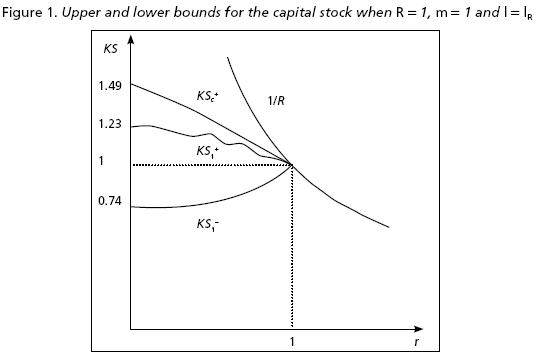
<body><![CDATA[<p align="justify"><font face="verdana" size="2">The graph of <i>KS(R)</i> as a function of <i>R</i> is the hyperbole equilateral shown in <a href="#g1">Figure 1</a>.</font></p>     <p align="center"><a name="g1"></a></p>     <p align="center"><img src="/img/revistas/etp/n37/a2g1.jpg"></p>     <p align="justify"><font face="verdana" size="2">Let <i>G<sub>KS</sub>(R) = {(r, KS) &#124; 0</i> <i>&le; r &lt; R</i> and 0 &lt; <i>KS &lt;</i> 1/r}&cup;{(R,1/R)}, according to (14.a) and (14.b) this set contains the graphs of <i>KS(r)</i> of all the systems (1) that share the same <i>R</i>. A natural question investigating the upper and lower bounds for <i>KS</i> is to ask if, given <i>R,</i> there are some other limits for <i>KS</i> apart from the hyperbole just mentioned and the horizontal axis, a question answered negatively in the following proposition.</font></p>     <p align="justify"><font face="verdana" size="2"><b>Theorem 2.III</b> Given R, &forall;(r, <i>T</i> ) &isin; <i>G<sub>KS</sub>(R),</i> there is at least one system of type (1) for which <i>KS(r) = T</i>.</font></p>      <p align="justify"><font face="verdana" size="2">Accordingly, the ordinate of each point of G<sub>KS</sub>(<i>R</i>) is equal to the capital stock of at least one system of type (1) for the corresponding <i>r</i>. Therefore, given any <i>R</i> the magnitude of capital may be as close to zero as desired &forall; <i>r </i>&isin; &#91;0, R&#93;. Nevertheless, as it will be shown in this section, the distribution of labor among the departments and sectors of production determines a nonzero lower bound for the systems of type (1) sharing a given <i>R.</i> To show this, the following proposition will be useful, valid if<i> l<sub>I</sub> &#150; l<sub>h</sub></i><i><sub></sub> &gt;</i> 0.</font></p>      <p align="justify"><font face="verdana" size="2"><b>Lemma 2.IV</b> <i>c<sub>I</sub></i> is a monotonous increasing function of <i>c<sub>c</sub>.</i></font></p>  	    <p align="justify"><font face="verdana" size="2">It follows from this result that, given <i>R</i> and <i>l,</i> the smallest capital corresponds to the system of type (1) where <i>c<sub>c</sub></i> is the smallest. Because in each industry at least one produced good is employed, this quantity is always greater than zero, but I will make it equal to zero in (12) to calculate the limit (<i>c<sub>I</sub></i><sup>&#150;</sup>) of the proportion <i>c<sub>I</sub></i> when <i>c<sub>c</sub></i> tends to zero. After simplifying, one gets <i>c<sub>I</sub></i><sup>&#150;</sup> = <i>&lambda;<sub>A</sub></i> /{1 + (<i>l<sub>I</sub></i> /<i>l<sub>h</sub></i> &#150; 1) &#91;1 &#150; <i>&lambda;<sub>A</sub></i> (1 + r)&#93;}. On the other hand, the first equation of (11) may be written in the form <i>&lambda;<sub>A</sub></i> (1 + r) + <i>l<sub>h</sub> /p<sub>h</sub> =</i> 1. The second term, on the left&#150;hand side tends to zero when <i>r</i> tends to <i>R</i> (see A.II in "<a href="/img/revistas/etp/n37/html/n37a2apen.html" target="_blank"><b>Appendix</b></a>") so that we have <i>&lambda;<sub>A</sub></i> (1 + R) = 1 and:</font></p>     <p align="center"><img src="/img/revistas/etp/n37/a2f15.jpg"></p>      <p align="justify"><font face="verdana" size="2">Substituting in the previous expression gives <i>c<sub>I</sub><sup>&#150;</sup></i> = 1/(1 + R) /{1 + (<i>l<sub>I</sub> /l<sub>h</sub></i> <i>&#150;</i> 1) &#91;1 &#150; (1 + <i>r)</i> /(1 + <i>R)&#93;}</i> and multiplying everything by (1 + <i>R),</i> we obtain after simplifying:</font></p>  	    ]]></body>
<body><![CDATA[<p align="center"><img src="/img/revistas/etp/n37/a2f16.jpg"></p>      <p align="justify"><font face="verdana" size="2">According to (7), <i>KS</i> is a monotonous increasing function of <i>c<sub>I</sub></i>. For this reason, to obtain a lower bound for the capital stock <i>(KS</i> <sup>&#150;</sup>), it is enough to substitute this value of <i>c<sub>I</sub></i><sub></sub> in (7) resulting in:</font></p>  	    <p align="center"><img src="/img/revistas/etp/n37/a2f17.jpg"></p>      <p align="justify"><font face="verdana" size="2">We may add that &forall; &isin; &#91;0, R&#93;, this formula determines the greater lower bound for <i>KS</i> given <i>R</i> and <i>l</i>. This is because for every <i>T</i> &gt; <i>KS</i> <sup>&#150;</sup> it is possible to choose <i>c<sub>c</sub></i> small enough for the resulting system to verify <i>KS</i> &lt; <i>T.</i> <a href="#g1">Figure 1</a> presents an example of a lower bound for <i>KS</i>.</font></p>     <p align="justify"><font face="verdana" size="2">&nbsp;</font></p>      <p align="justify"><font face="verdana" size="2"><b>V. A FAMILY OF SUBSETS</b></font></p>  	    <p align="justify"><font face="verdana" size="2">For each <i>R</i>, let C(<i>R</i>) be the set of all the systems of type (1) that share the same <i>R</i> value. An important property of this set is presented next.</font></p>  	    <p align="justify"><font face="verdana" size="2"><b>Proposition 1.V</b> Given <i>R</i> and l, &forall; (r, <i>T) </i>&isin;<i> G<sub>KS</sub>(R),</i> there is at least one system of type (1) for which <i>KS(r)</i> &gt; <i>T.</i></font></p>  	    <p align="justify"><font face="verdana" size="2">This proposition implies that, given <i>R,</i> the vector <i>l</i> does not impose any upper limit on the capital stock. For this reason, in this section we are going to define a family of subsets of C(R), whose complement in C(R) may be reduced as much as desired and such that in each one of them a given vector <i>l</i> determines a nontrivial upper bound for the capital stock, as will be shown in the next section.</font></p>     <p align="justify"><font face="verdana" size="2">According to (15) (12) and (7), given <i>l</i> and <i>R</i> the capital stock depends only on <i>c<sub>c</sub>,</i> so that we will pay particular attention to this sector. It is convenient to observe that, if the capital stock is constant, <i>KS<sub>c</sub>(r) &le;</i> 1/R &forall; <i>r </i>&isin; &#91;0, R&#93; according to (14.d). Then, if <i>KS<sub>c</sub>(r*) &gt;</i> <i>1</i><i>/R</i> for a certain r* &isin; &#91;0, R&#93;, necessarily <i>KS<sub>c</sub></i> diminishes when <i>r</i> changes from r* to <i>R</i>. From equation (A.1) (see "<a href="/img/revistas/etp/n37/html/n37a2apen.html" target="_blank"><b>Appendix</b></a>"), it follows that when <i>r =</i> r*, the wage in the complementary sector, measured with the net product of the sector, is equal to &#91;1 &#150; <i>KS<sub>c</sub>(r*)</i>r*&#93;. Let <i>m</i> be the reduction of the capital stock taking place when <i>r</i> changes from <i>r*</i> to <i>R</i> measured with the wage in r*, then <i>m =</i> &#91;<i>KS</i><sub>c</sub>(r*) &#150; 1/<i>R</i>&#93;/&#91;1 &#150; KS<sub>c</sub>(r*) r*&#93;. Therefore, if for every <i>r </i>&isin; &#91;0, <i>R</i>&#93;, the capital stock diminishes in an amount equivalent to <i>m</i> times the wage in <i>r</i> when the rate of profit changes from <i>r</i> to R, we have KS<sub>c</sub>(r) = m&#91;1 &#150; KS<sub>c</sub>(r)r&#93; + 1/<i>R</i> and so:</font></p>      ]]></body>
<body><![CDATA[<p align="center"><img src="/img/revistas/etp/n37/a2f18.jpg"></p>      <p align="justify"><font face="verdana" size="2">For each couple (m, R) where <i>R &gt;</i> 0 and <i>m</i> &ge; 0, let <i>C<sub>m</sub></i>(<i>R</i>) be the set of all the systems of type (1) for which <i>KS<sub>c</sub></i> (<i>r</i>) is less than the value determined by (18) &forall; <i>r </i>&isin; &#91;0, R&#93;. We may ask if for every <i>m</i> &ge; 0 the amount of capital determined by (18) corresponds to at least one system of type (1) and also if for every system of type (1) there is an <i>m</i> &ge; 0 such that the capital stock is less than the value determined by (18) for every <i>r </i>&isin; &#91;0, R&#93;. Both questions receive an affirmative answer based on the following proposition.</font></p>  	    <p align="justify"><font face="verdana" size="2"><b>Lemma 3.VI</b> The family of functions (18) possesses the following properties: a) &forall; <i>T </i>&isin; &#91;1/R,1/r &#91; and &forall; <i>r </i>&isin; &#91;0, R&#93; there is an <i>m</i> such that <i>KS(r</i>) = <i>T</i>, b) for every <i>m</i> &gt; 0 the graph of (18) is below the hyperbole 1/<i>R</i> and c) for every <i>r </i>&isin; &#91;0, R&#93;, <i>KS(r</i>) is a monotonous increasing function of <i>m.</i></font></p>      <p align="justify"><font face="verdana" size="2">It is convenient to observe that according to (14.d) for every <i>r*</i> &isin; &#91;0, R&#93;, when <i>r</i> changes from <i>r*</i> to <i>R,</i> the wage is reduced to a quantity equal to or greater than zero implying that the simultaneous increase in profits is smaller than or equal to the wage in r*. Consequently, in the systems verifying (18), the capital stock in the complementary sector diminishes with this change an amount equivalent to at least <i>m</i> times the increase in proits. For this reason, <i>C<sub>m</sub>(R)</i> may be described as the set integrated by all the elements of <i>C(R)</i> except a part of those that, for some <i>r*</i> &isin; &#91;0, R&#93;, when <i>r</i> changes from r* to <i>R,</i> the capital stock in the complementary sector diminishes in an amount equal to at least <i>m</i> times the simultaneous increase in profits. It follows from Lemma 3 that when <i>m</i> increases starting from zero the set <i>C<sub>m</sub></i>(<i>R</i>) &cap; C(<i>R</i>) grows continually from <i>C<sub>0</sub></i> (<i>R</i>), a set that includes only those systems where capital always grows when <i>r</i> changes from an <i>r*</i> &isin; &#91;0, <i>R</i>&#93; to <i>R</i>, and tend to be equal to <i>C<sub>m</sub>(<i>R</i>)</i> when <i>m</i> tends to infinity. Finally, it is worth noting that a system of type (1) pertaining to a set <i>C<sub>m</sub>(R)</i> satisfies a restriction regarding the relative price of the particular sets of goods integrated by the capital stock and the net product of the complementary sector but there is no other restriction on relative prices.</font></p>     <p align="justify"><font face="verdana" size="2">&nbsp;</font></p>     <p align="justify"><font face="verdana" size="2"><b>VI. AN UPPER BOUND FOR THE CAPITAL STOCK</b></font></p>  	    <p align="justify"><font face="verdana" size="2">For each <i>m</i> and for each <i>r &lt; R,</i> (18) permits one to establish an upper bound <i>c<sub>c</sub></i><sup>+</sup>(r) for <i>c<sub>c</sub></i>(r) valid for all the production systems pertaining to <i>C<sub>m</sub></i>(<i>R</i>). Indeed, <i>KS<sub>c</sub>(r) = c<sub>c</sub></i> (r)/&#91;1 &#150; <i>c<sub>c</sub>(r</i>)&#93;; it follows from this equation and (18) that an upper bound for <i>c<sub>c</sub></i> (<i>r</i>) verifies <i>c<sub>c</sub><sup>+</sup>(r</i>)/&#91;1 &#150; <i>c<sub>c</sub></i><sup>+</sup>(r)&#93; = (1/R + <i>m</i>)/(1 + <i>mr</i>) implying that <i>c<sub>c</sub></i><sup>+</sup>(1 + <i>mr</i>) = (1 &#150; <i>c<sub>c</sub><sup>+</sup></i>) (1/R + <i>m)</i>, hence <i>c<sub>c</sub></i><sup>+</sup>&#91;(1 + <i>mr</i>) + (1/<i>R + m</i>)&#93; = (m + 1/<i>R</i>) and:</font></p>  	    <p align="center"><img src="/img/revistas/etp/n37/a2f19.jpg"></p>      <p align="justify"><font face="verdana" size="2">On its turn, this result permits one to establish the following upper bound for the capital stock:</font></p>  	    <p align="center"><img src="/img/revistas/etp/n37/a2f20.jpg"></p>      ]]></body>
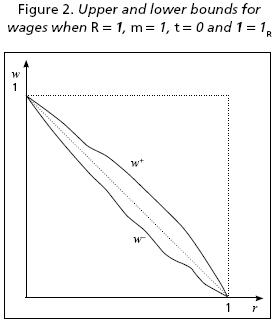
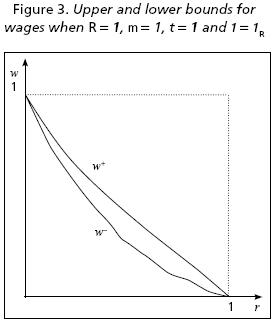
<body><![CDATA[<p align="justify"><font face="verdana" size="2">obtained by substituting first <i>c<sub>c</sub></i><sub></sub> for <i>c<sub>c</sub><sup>+</sup> </i>in (12) and the result (<i>c<sub>i</sub></i>(<i>c<sub>c</sub></i><sub></sub><sup>+</sup>)) substitutes <i>c<sub>i</sub></i> in (7).</font></p>      <p align="justify"><font face="verdana" size="2">To employ this formula, which calculates an upper bound for the capital stock of a particular system of type (1), an assumption is made about the smallest set <i>C<sub>m</sub>(R)</i> containing the system, something that may depend on empirical or theore&#150; tical considerations. In this regard, the set C<sub>1</sub>(<i>R</i>) has a special interest for the following reasons: a) it includes all the production systems where <i>KS<sub>c</sub></i>(<i>r</i>) is a constant or a monotonous increasing function, b) it includes a part of those systems where <i>KS<sub>c</sub>(r)</i> is monotonously decreasing or not a monotonous function and c) it excludes only a part of those systems where for some <i>r*</i> &isin; &#91;<i>0, R</i>&#93;, when <i>r</i> changes from <i>r*</i> to <i>R, KS<sub>c</sub>(r</i>) diminishes an amount at least equal to the corresponding increase in profits. It is to remark that in such cases the sum of capital plus profits, measured with the net product, either keeps constant or decreases. Formulas (17) and (20) permit one to estimate the capital stock as the average of the values determined by both, to which it corresponds a maximum error equal to one half of the difference between them. After simplifying, the following formula is established:</font></p>     <p align="center"><img src="/img/revistas/etp/n37/a2f21.jpg"></p>      <p align="justify"><font face="verdana" size="2">The value determined by (12) for <i>(c<sub>I</sub>(c<sub>c</sub>+))</i> is always equal to <i>1/R</i> when <i>r = R.</i> For this reason, the error in (21) is equal to zero in this case, a result indicating that it may be as small as desired for values of <i>r</i> sufficiently near to R. On the other hand, normally the error will be greater when <i>r</i> approaches zero. <a href="#g1">Figure 1</a> presents the graphs corresponding to (19) and (20) when <i>m =</i> 1, <i>R =</i> 1 and <i>l</i> = (1/4, 1/4, 1/2) is determined by (13).</font></p>     <p align="justify"><font face="verdana" size="2">&nbsp;</font></p>      <p align="justify"><font face="verdana" size="2"><b>VII. UPPER AND LOWER BOUNDS FOR WAGES</b></font></p>  	    <p align="justify"><font face="verdana" size="2">Let G<sub>w</sub>(<i>R</i>) = {(r, w) | 0 &lt; <i>r &lt; R</i> and 0 &lt; <i>w &lt;</i> 1}&cup;{(0, 1), (<i>R</i>, 0)} this set contains all the possible graphs of <i>w</i>(<i>r</i>) and is equal to the interior points of a rectangle as those shown in <a href="#g2">Figures 2</a> and <a href="#g3">3</a> plus the extreme points of <i>S</i>(<i>R</i>). We may ask if every point of this set pertains to the wage&#150;profit curve of at least one system of type (1), an affirmative answer is given by the next proposition.</font></p> 	    <p align="center"><a name="g2"></a></p> 	    <p align="center"><img src="/img/revistas/etp/n37/a2g2.jpg"></p> 	    <p align="center"><a name="g3"></a></p> 	    ]]></body>
<body><![CDATA[<p align="center"><img src="/img/revistas/etp/n37/a2g3.jpg"></p>      <p align="justify"><font face="verdana" size="2"><b>Theorem 3.VII</b> Given R, &forall; <i>r</i> &isin; &#91;0, <i>R</i>&#93; and for every <i>F</i> such that 0 &lt; <i>F &lt;</i> 1, there is at least one system of type (1) for which <i>w(r) = F.</i></font></p>     <p align="justify"><font face="verdana" size="2">Then, given <i>R</i> and <i>r</i> such that 0 &lt; <i>r</i> &lt; <i>R, w (r)</i> may have any value comprised between 0 and 1. This result together with the fact that the wage&#150;profit curve is monotonously decreasing imply that the curve adopts rather curious forms for certain systems of type (1). For instance, choosing <i>(r, w(r))</i> close enough to (0, 0), the theorem guaranties that there is a system whose wage&#150;profit curve will look like the square formed by the two axis while choosing (<i>r w(r</i>)) sufficiently close to (<i>R</i>, 1) the corresponding curve will look like the square formed by two lines parallel to the axis intersecting in this point. Nevertheless, a given vector <i>l</i> permits one to limit this diversity establishing an upper bound <i>w</i>(<i>r</i>)<sup><i>+</i></sup> and, for each <i>m</i>, a lower bound <i>w</i>(<i>r)</i><sub><i>m</i></sub><i><sup>&#150;</sup></i>, by substituting respectively <i>KS</i> <sup>&#150;</sup> and <i>KS<sub>m</sub><sup>+</sup></i> in (4.a). In this manner, we obtain after solving for <i>w</i>(<i>r</i>):</font></p>      <p align="center"><img src="/img/revistas/etp/n37/a2f22.jpg"></p>     <p align="justify"><font face="verdana" size="2">On their turn, these bounds permit one to estimate the wage as their average value with a maximum error equal to one half of the difference between them. After simplifying, we arrive at the following formula:</font></p>  	    <p align="center"><img src="/img/revistas/etp/n37/a2f23.jpg" height="72"></p>     <p align="justify"><font face="verdana" size="2">It is convenient to note that the error is zero when <i>r</i> = 0 or <i>r</i> = <i>R.</i> Therefore, it may be as small as desired if the levels of <i>r</i> being considered are close enough to any of these values. Moreover, the error diminishes as <i>t</i> increases. <a href="#g2">Figures 2</a> and <a href="#g3">3</a> show the graphs of the last three formulas, respectively, when <i>t</i> = 0 and <i>t =</i> 1, with <i>R =</i> 1 and vector <i>l =</i> (&frac14;, &frac14;, &frac12;) is determined according to (13).</font></p>     <p align="justify"><font face="verdana" size="2">&nbsp;</font></p>      <p align="justify"><font face="verdana" size="2"><b>FINAL REMARKS</b></font></p>  	    <p align="justify"><font face="verdana" size="2">Assuming that <i>t =</i> 0, it follows from equation (4.a) that when the capital stock is constant, <i>w</i> is a linear function of <i>r</i> and its graph is the straight segment <i>S(R).</i></font></p>  	    ]]></body>
<body><![CDATA[<p align="justify"><font face="verdana" size="2">Loosely speaking, we may refer to the fact that <i>w</i> is a continuous function of <i>KS</i> saying that the wage&#150;profit curve keeps close to a straight line if the capital stock maintains close to a constant value. In the economic literature, two sufficient conditions have been pointed out for the value of capital to be constant: a) the equality between relative prices and relative values and b) the homothetic condition of the production system. In this paper, we arrived at the definition of pairs of conditions such that given any one of them the other one is sufficient for the proximity between <i>w</i>(<i>r</i>) and <i>S</i>(<i>R</i>). Indeed, if given a couple (<i>m</i>*, <i>l</i>*) a <i>w</i>(<i>r</i>) function either contained in or near to the interval determined by (22) is considered to be close to <i>S(R),</i> we can establish the following conclusion:</font></p>     <p align="justify"><font face="verdana" size="2"><b>Proposition 2.</b> In a system of type (1), in order for the wage&#150;profit curve to be close to <i>S(R),</i> it is not required for the proportion between quantities produced and consumed to be near 1 + R, neither that relative prices be close to the corresponding value proportions. Any of the following two conditions is sufficient if the other one is satisfied: <i>&alpha;</i>) that the system belongs to a set C<sub><i>m</i></sub>(R) such that <i>m</i> is either close to or less than <i>m*</i> and <i>&beta;</i>) that the vector <i>l </i>of the system is close to <i>l*</i>.</font></p>  	    <p align="justify"><font face="verdana" size="2">In relation to the value of m, the empirical relevance of the set <i>C<sub>1</sub></i><sub></sub><i>(R)</i> for which some arguments were offered in sixth section may be confirmed by the quasilinearity of the wage&#150;profit curves reported by several empirical researches, as those by Ochoa (1989), Michl (1991), Shaikh (1997), and Tsoulfidis and Rieu (2006). Indeed, if &#150;as argued in some of these works&#150; the studied economies satisfy either condition a) or b) indicated above, then they belong to <i>C<sub>1</sub></i>(<i>R</i>). On the other hand, as may be appreciated in <a href="#g2">Figures 2</a> and <a href="#g3">3</a>, if a production system belongs to <i>C<sub>1</sub></i>(<i>R</i>) the wage&#150;profit curve is close to <i>S</i>(<i>R</i>) if vector <i>l</i> is close enough to <i>l<sub>R</sub></i>. Nevertheless, to verify that this last condition is satisfied in the cases just cited, empirical considerations must be developed requiring another article.</font></p>      <p align="justify"><font face="verdana" size="2">We have chosen <i>l<sub>R</sub></i> to calculate the numerical examples because of its peculiar properties, particularly the relation to segment <i>S</i>(<i>R</i>) that has just been mentioned, but in order to illustrate the existence of the upper and lower bounds studied here any <i>l</i> &isin; <i>S (l)</i> could have been chosen. It also permitted to illustrate the fact that these bounds can be very close to each other, suggesting that the corresponding estimation of the functions may be used eventually in empirical researches. For instance, the estimation of <i>w</i> by means of (22) in the case of the example presented on seventh section yields an error smaller than 6.1% and 6.13% for any <i>r &lt;</i> 20%, considering respectively <i>t =</i> 0 and <i>t =</i> 1, and the error decreases tending to zero as <i>r</i> tends to zero.</font></p>     <p align="justify"><font face="verdana" size="2">Finally, we may add that the approach followed here to study functions <i>KS(r)</i> and <i>w(r),</i> largely based on the contributions of the authors mentioned in the introduction, is justified by the results established. Naturally, our research covered only a few properties of these functions and in order to reach further advances, for instance concerning the degree in which changes in <i>l</i> affect the upper and lower bounds of the functions, more studies based either on this or in other perspectives are required.</font></p>     <p align="justify"><font face="verdana" size="2">&nbsp;</font><font face="verdana" size="2">&nbsp;</font></p>     <p align="justify"><font face="verdana" size="2"><b>REFERENCES</b></font></p>  	    <!-- ref --><p align="justify"><font face="verdana" size="2">Ben&iacute;tez, Alberto (1986), "L'&eacute;talon dans la theorie de P. Sraffa", <i>Cahiers d'&eacute;conomiepolitique,</i> 12:131&#150;146.    &nbsp;&nbsp;&nbsp;&nbsp;&nbsp;&nbsp;&nbsp;&nbsp;[&#160;<a href="javascript:void(0);" onclick="javascript: window.open('/scielo.php?script=sci_nlinks&ref=2932119&pid=S0188-3380201200020000200001&lng=','','width=640,height=500,resizable=yes,scrollbars=1,menubar=yes,');">Links</a>&#160;]<!-- end-ref --><!-- ref --> &#91;(1990), "La mercanc&iacute;a patr&oacute;n en la teor&iacute;a de Piero Sraffa", <i>Lecturas de Econom&iacute;a,</i> 32&#150;33: 45&#150;68&#93;    &nbsp;&nbsp;&nbsp;&nbsp;&nbsp;&nbsp;&nbsp;&nbsp;[&#160;<a href="javascript:void(0);" onclick="javascript: window.open('/scielo.php?script=sci_nlinks&ref=2932120&pid=S0188-3380201200020000200002&lng=','','width=640,height=500,resizable=yes,scrollbars=1,menubar=yes,');">Links</a>&#160;]<!-- end-ref -->.</font></p>     ]]></body>
<body><![CDATA[<!-- ref --><p align="justify"><font face="verdana" size="2">Ben&iacute;tez, Alberto (1995), <i>Desequilibrio y precios de producci&oacute;n,</i> M&eacute;xico, UAM&#150;Siglo XXI Editores.    &nbsp;&nbsp;&nbsp;&nbsp;&nbsp;&nbsp;&nbsp;&nbsp;[&#160;<a href="javascript:void(0);" onclick="javascript: window.open('/scielo.php?script=sci_nlinks&ref=2932122&pid=S0188-3380201200020000200003&lng=','','width=640,height=500,resizable=yes,scrollbars=1,menubar=yes,');">Links</a>&#160;]<!-- end-ref --></font></p>  	    <!-- ref --><p align="justify"><font face="verdana" size="2">Ben&iacute;tez, Alberto (2009), "El pago del salario", <i>Investigaci&oacute;n Econ&oacute;mica,</i> 270: 69&#150;96.    &nbsp;&nbsp;&nbsp;&nbsp;&nbsp;&nbsp;&nbsp;&nbsp;[&#160;<a href="javascript:void(0);" onclick="javascript: window.open('/scielo.php?script=sci_nlinks&ref=2932124&pid=S0188-3380201200020000200004&lng=','','width=640,height=500,resizable=yes,scrollbars=1,menubar=yes,');">Links</a>&#160;]<!-- end-ref --><!-- ref --> &#91;(2010) "The payment of wages", <i>Denarius,</i> 20: 193&#150;219&#93;    &nbsp;&nbsp;&nbsp;&nbsp;&nbsp;&nbsp;&nbsp;&nbsp;[&#160;<a href="javascript:void(0);" onclick="javascript: window.open('/scielo.php?script=sci_nlinks&ref=2932125&pid=S0188-3380201200020000200005&lng=','','width=640,height=500,resizable=yes,scrollbars=1,menubar=yes,');">Links</a>&#160;]<!-- end-ref -->.</font></p>     <!-- ref --><p align="justify"><font face="verdana" size="2">Bidard, Christian (2004), <i>Prices, Reproduction, Scarcity,</i> Cambridge, Cambridge University Press.    &nbsp;&nbsp;&nbsp;&nbsp;&nbsp;&nbsp;&nbsp;&nbsp;[&#160;<a href="javascript:void(0);" onclick="javascript: window.open('/scielo.php?script=sci_nlinks&ref=2932127&pid=S0188-3380201200020000200006&lng=','','width=640,height=500,resizable=yes,scrollbars=1,menubar=yes,');">Links</a>&#160;]<!-- end-ref --></font></p>  	    <!-- ref --><p align="justify"><font face="verdana" size="2">Gantmatcher, Felix (1966), <i>Matrix Theory,</i> New York, Chelsea Publishing.    &nbsp;&nbsp;&nbsp;&nbsp;&nbsp;&nbsp;&nbsp;&nbsp;[&#160;<a href="javascript:void(0);" onclick="javascript: window.open('/scielo.php?script=sci_nlinks&ref=2932129&pid=S0188-3380201200020000200007&lng=','','width=640,height=500,resizable=yes,scrollbars=1,menubar=yes,');">Links</a>&#160;]<!-- end-ref --> </font></p> 	    <!-- ref --><p align="justify"><font face="verdana" size="2">Marx, Karl (1990), <i>Capital,</i> Volume I, New York, Penguin Books.    &nbsp;&nbsp;&nbsp;&nbsp;&nbsp;&nbsp;&nbsp;&nbsp;[&#160;<a href="javascript:void(0);" onclick="javascript: window.open('/scielo.php?script=sci_nlinks&ref=2932131&pid=S0188-3380201200020000200008&lng=','','width=640,height=500,resizable=yes,scrollbars=1,menubar=yes,');">Links</a>&#160;]<!-- end-ref --> </font></p>     <!-- ref --><p align="justify"><font face="verdana" size="2">&#150;&#150;&#150;&#150;&#150;&#150;&#150;&#150;&#150;&#150; (1992), <i>Capital,</i> Volume II, New York, Penguin Books.    &nbsp;&nbsp;&nbsp;&nbsp;&nbsp;&nbsp;&nbsp;&nbsp;[&#160;<a href="javascript:void(0);" onclick="javascript: window.open('/scielo.php?script=sci_nlinks&ref=2932133&pid=S0188-3380201200020000200009&lng=','','width=640,height=500,resizable=yes,scrollbars=1,menubar=yes,');">Links</a>&#160;]<!-- end-ref --></font></p>      <!-- ref --><p align="justify"><font face="verdana" size="2">Michl, Thomas (1991), "Wage&#150;profit curves in US manufactures", <i>Cambridge Journal of Economics,</i> 15: 271&#150;286.    &nbsp;&nbsp;&nbsp;&nbsp;&nbsp;&nbsp;&nbsp;&nbsp;[&#160;<a href="javascript:void(0);" onclick="javascript: window.open('/scielo.php?script=sci_nlinks&ref=2932135&pid=S0188-3380201200020000200010&lng=','','width=640,height=500,resizable=yes,scrollbars=1,menubar=yes,');">Links</a>&#160;]<!-- end-ref --> </font></p>     <!-- ref --><p align="justify"><font face="verdana" size="2">Morishima, Mischio (1973), <i>Marx's Economics,</i> Cambridge, Cambridge University Press.    &nbsp;&nbsp;&nbsp;&nbsp;&nbsp;&nbsp;&nbsp;&nbsp;[&#160;<a href="javascript:void(0);" onclick="javascript: window.open('/scielo.php?script=sci_nlinks&ref=2932137&pid=S0188-3380201200020000200011&lng=','','width=640,height=500,resizable=yes,scrollbars=1,menubar=yes,');">Links</a>&#160;]<!-- end-ref --></font></p>  	    <!-- ref --><p align="justify"><font face="verdana" size="2">Neuman, Joseph von (1945), "A Model of General Economic Equilibrium", <i>Review of Economic Studies,</i> 13: 135&#150;145.    &nbsp;&nbsp;&nbsp;&nbsp;&nbsp;&nbsp;&nbsp;&nbsp;[&#160;<a href="javascript:void(0);" onclick="javascript: window.open('/scielo.php?script=sci_nlinks&ref=2932139&pid=S0188-3380201200020000200012&lng=','','width=640,height=500,resizable=yes,scrollbars=1,menubar=yes,');">Links</a>&#160;]<!-- end-ref --></font></p>  	    <!-- ref --><p align="justify"><font face="verdana" size="2">Ochoa, Eduardo (1989), "Values, prices and wage&#150;profit curves in the us economy" <i>Cambridge Journal of Economics,</i> 13: 413&#150;429.    &nbsp;&nbsp;&nbsp;&nbsp;&nbsp;&nbsp;&nbsp;&nbsp;[&#160;<a href="javascript:void(0);" onclick="javascript: window.open('/scielo.php?script=sci_nlinks&ref=2932141&pid=S0188-3380201200020000200013&lng=','','width=640,height=500,resizable=yes,scrollbars=1,menubar=yes,');">Links</a>&#160;]<!-- end-ref --></font></p>  	    <!-- ref --><p align="justify"><font face="verdana" size="2">Pasinetti, Luigi (1977), <i>Lectures in the theory of production,</i> New York, Columbia University Press.    &nbsp;&nbsp;&nbsp;&nbsp;&nbsp;&nbsp;&nbsp;&nbsp;[&#160;<a href="javascript:void(0);" onclick="javascript: window.open('/scielo.php?script=sci_nlinks&ref=2932143&pid=S0188-3380201200020000200014&lng=','','width=640,height=500,resizable=yes,scrollbars=1,menubar=yes,');">Links</a>&#160;]<!-- end-ref --></font></p>  	    <!-- ref --><p align="justify"><font face="verdana" size="2">Ricardo, David (2004), <i>The works and correspondence of David Ricardo,</i> lndianapolis, Liberty Found, lnc.    &nbsp;&nbsp;&nbsp;&nbsp;&nbsp;&nbsp;&nbsp;&nbsp;[&#160;<a href="javascript:void(0);" onclick="javascript: window.open('/scielo.php?script=sci_nlinks&ref=2932145&pid=S0188-3380201200020000200015&lng=','','width=640,height=500,resizable=yes,scrollbars=1,menubar=yes,');">Links</a>&#160;]<!-- end-ref --></font></p>  	    <!-- ref --><p align="justify"><font face="verdana" size="2">Shaikh, Anwar (1997), "The Empirical Strength of the Labor Theory of Value", in Bellofiori, Ricardo (ed), <i>Marxian Economics: A Reappraisal,</i> Vol. 2, New York, St. Martin's Press.    &nbsp;&nbsp;&nbsp;&nbsp;&nbsp;&nbsp;&nbsp;&nbsp;[&#160;<a href="javascript:void(0);" onclick="javascript: window.open('/scielo.php?script=sci_nlinks&ref=2932147&pid=S0188-3380201200020000200016&lng=','','width=640,height=500,resizable=yes,scrollbars=1,menubar=yes,');">Links</a>&#160;]<!-- end-ref --></font></p>  	    <!-- ref --><p align="justify"><font face="verdana" size="2">Smith, Adam (1981), <i>An inquiry into the nature and causes of the wealth of nations,</i> Vol. i, lndianapolis, Liberty Found, lnc.    &nbsp;&nbsp;&nbsp;&nbsp;&nbsp;&nbsp;&nbsp;&nbsp;[&#160;<a href="javascript:void(0);" onclick="javascript: window.open('/scielo.php?script=sci_nlinks&ref=2932149&pid=S0188-3380201200020000200017&lng=','','width=640,height=500,resizable=yes,scrollbars=1,menubar=yes,');">Links</a>&#160;]<!-- end-ref --></font></p>  	    <!-- ref --><p align="justify"><font face="verdana" size="2">Sraffa, Piero (1960), <i>Production of commodities by means of commodities,</i> Cambridge, Cambridge University Press.    &nbsp;&nbsp;&nbsp;&nbsp;&nbsp;&nbsp;&nbsp;&nbsp;[&#160;<a href="javascript:void(0);" onclick="javascript: window.open('/scielo.php?script=sci_nlinks&ref=2932151&pid=S0188-3380201200020000200018&lng=','','width=640,height=500,resizable=yes,scrollbars=1,menubar=yes,');">Links</a>&#160;]<!-- end-ref --></font></p>  	    <!-- ref --><p align="justify"><font face="verdana" size="2">Steedman, lan (1977), <i>Marx after Sraffa,</i> London, New Left Books.    &nbsp;&nbsp;&nbsp;&nbsp;&nbsp;&nbsp;&nbsp;&nbsp;[&#160;<a href="javascript:void(0);" onclick="javascript: window.open('/scielo.php?script=sci_nlinks&ref=2932153&pid=S0188-3380201200020000200019&lng=','','width=640,height=500,resizable=yes,scrollbars=1,menubar=yes,');">Links</a>&#160;]<!-- end-ref --></font></p>  	    <!-- ref --><p align="justify"><font face="verdana" size="2">Tsoulfidis, Lefteris, and Rieu, Dong Ming (2006), "Labor Values, Prices of Production, and Wage&#150;Profit Rate Frontiers of the Korean Economy", <i>Seoul Journal of Economics,</i> 3: 275&#150;295.    &nbsp;&nbsp;&nbsp;&nbsp;&nbsp;&nbsp;&nbsp;&nbsp;[&#160;<a href="javascript:void(0);" onclick="javascript: window.open('/scielo.php?script=sci_nlinks&ref=2932155&pid=S0188-3380201200020000200020&lng=','','width=640,height=500,resizable=yes,scrollbars=1,menubar=yes,');">Links</a>&#160;]<!-- end-ref --></font></p> 	    <p align="justify"><font face="verdana" size="2">&nbsp;</font></p>     <p align="justify"><font face="verdana" size="2"><a name="nota"></a><b>Notas</b></font></p>     <p align="justify"><font face="verdana" size="2"><sup>1</sup>&nbsp;There is a large literature on these matters, Morishima (1973) studies the division in departments I and II and presents a bibliography on the subject. Bidard (2004) compares some aspect of the models by von Neuman and Sraffa and discusses the corresponding literature. In the last work, as well as in Pasinetti (1977) the interested reader may also find an introduction to the subject.</font></p>     <p align="justify"><font face="verdana" size="2"><sup>2</sup>&nbsp;Although there is no fixed capital in the model, we use the term "capital stock" in reference to the value of the physical capital in order to distinguish it from the total amount of capital, which includes the wages advanced.</font></p>         <p align="justify"><font face="verdana" size="2"><sup>3</sup>&nbsp;Apart from establishing some properties of the wage&#150;profit curve that paper discusses the antecedents of the model. For this reason, we will only mention here that the importance of the payment date for income distribution is pointed out in Chapter 6 of Marx (1990: 278) and also that Sraffa (1960: 10) considers the two payment dates schedule as the most appropriate way to treat wages, although in contraposition Steedman (1977:21) affirms that this date has no importance at all.</font></p>         ]]></body>
<body><![CDATA[<p align="justify"><font face="verdana" size="2"><sup>4</sup> Following Marx (1990) and Sraffa (1960) we take as given the quantities produced as well as those that are used as means of production in the different industries. In Ben&iacute;tez (1995) a model is presented where: a) prices are constant, b) the profit rate is the same in all industries and c) the quantities produced and consumed are determined endogenously, taking demand into account.</font></p>         <p align="justify"><font face="verdana" size="2"><sup>5</sup> Pasinetti (1977: 134) points out that when wages are paid at the beginning of production they are not included in the classical notion of net product. Nevertheless, independently of the schedule for the payment of wages, the value of the real income is equal to the net income.</font></p>     <p align="justify"><font face="verdana" size="2">&nbsp;</font></p>         <p align="justify"><font face="verdana" size="2"><b>Informaci&oacute;n sobre los autores:</b></font></p>         <p align="justify"><font face="verdana" size="2"><b>Alberto Ben&iacute;tez S&aacute;nchez.</b> Profesor&#150;investigador de la Universidad Aut&oacute;noma Metropolitana&#150;Iztapalapa. Obtuvo los grados de maestro en Sociolog&iacute;a y doctor en Econom&iacute;a por la Universit&eacute; Paris x&#150;Nanterre (Francia). Sus investigaciones se desarrollan principalmente en el campo de la teor&iacute;a econ&oacute;mica y tienen como referencia central los sistemas de ecuaciones lineales de producci&oacute;n. Por medio de ellos, estudia temas como las relaciones entre los precios y la distribuci&oacute;n del ingreso, adem&aacute;s de evaluar algunas tesis de las teor&iacute;as cl&aacute;sicas y marxistas. El criterio que adopta es l&oacute;gico&#150;formal y tiene como objetivo relevante destacar los aspectos acumulativos del trabajo cient&iacute;fico, lo que le condujo a proponer en su libro Desequilibrio y precios de producci&oacute;n una s&iacute;ntesis de las teor&iacute;as mencionadas con algunos desarrollos de las teor&iacute;as no walrasianas. Ha publicado cerca de treinta textos en revistas y libros colectivos.</font></p>     <p align="justify"><font face="verdana" size="2"><b>Alejandro Ben&iacute;tez S&aacute;nchez.</b> Se gradu&oacute; de ingeniero electromec&aacute;nico en el Instituto Tecnol&oacute;gico de Tijuana y se especializ&oacute; en Matem&aacute;ticas en esa misma instituci&oacute;n. Realiz&oacute; una maestr&iacute;a en Educaci&oacute;n en la San Diego State University y un doctorado en Educaci&oacute;n en la Claremont Grad&uacute;ate University, ambos con el patrocinio de una beca Fulbright. Ha sido catedr&aacute;tico de Matem&aacute;ticas en diversas instituciones de educaci&oacute;n superior mexicanas y estadunidenses. Actualmente es coordinador de la Maestr&iacute;a en Ingenier&iacute;a Industrial en el ITT. Sus variados intereses incluyen la filosof&iacute;a de la ciencia y las matem&aacute;ticas aplicadas. En los &uacute;ltimos a&ntilde;os se ha concentrado en el &aacute;rea de probabilidad y estad&iacute;stica, desarrollando varias distribuciones de probabilidad y trabajando en modelos lineales aplicados a la econom&iacute;a.</font></p>      ]]></body><back>
<ref-list>
<ref id="B1">
<nlm-citation citation-type="journal">
<person-group person-group-type="author">
<name>
<surname><![CDATA[Benítez]]></surname>
<given-names><![CDATA[Alberto]]></given-names>
</name>
</person-group>
<article-title xml:lang="fr"><![CDATA[L'étalon dans la theorie de P. Sraffa]]></article-title>
<source><![CDATA[Cahiers d'économiepolitique]]></source>
<year>1986</year>
<volume>12</volume>
<page-range>131-146</page-range></nlm-citation>
</ref>
<ref id="B2">
<nlm-citation citation-type="journal">
<article-title xml:lang="es"><![CDATA[La mercancía patrón en la teoría de Piero Sraffa]]></article-title>
<source><![CDATA[Lecturas de Economía]]></source>
<year>1990</year>
<volume>32-33</volume>
<page-range>45-68</page-range></nlm-citation>
</ref>
<ref id="B3">
<nlm-citation citation-type="book">
<person-group person-group-type="author">
<name>
<surname><![CDATA[Benítez]]></surname>
<given-names><![CDATA[Alberto]]></given-names>
</name>
</person-group>
<source><![CDATA[Desequilibrio y precios de producción]]></source>
<year>1995</year>
<publisher-loc><![CDATA[México ]]></publisher-loc>
<publisher-name><![CDATA[UAMSiglo XXI Editores]]></publisher-name>
</nlm-citation>
</ref>
<ref id="B4">
<nlm-citation citation-type="journal">
<person-group person-group-type="author">
<name>
<surname><![CDATA[Benítez]]></surname>
<given-names><![CDATA[Alberto]]></given-names>
</name>
</person-group>
<article-title xml:lang="es"><![CDATA[El pago del salario]]></article-title>
<source><![CDATA[Investigación Económica]]></source>
<year>2009</year>
<volume>270</volume>
<page-range>69-96</page-range></nlm-citation>
</ref>
<ref id="B5">
<nlm-citation citation-type="journal">
<article-title xml:lang="en"><![CDATA[The payment of wages]]></article-title>
<source><![CDATA[Denarius]]></source>
<year>2010</year>
<volume>20</volume>
<page-range>193-219</page-range></nlm-citation>
</ref>
<ref id="B6">
<nlm-citation citation-type="book">
<person-group person-group-type="author">
<name>
<surname><![CDATA[Bidard]]></surname>
<given-names><![CDATA[Christian]]></given-names>
</name>
</person-group>
<source><![CDATA[Prices, Reproduction, Scarcity]]></source>
<year>2004</year>
<publisher-loc><![CDATA[Cambridge ]]></publisher-loc>
<publisher-name><![CDATA[Cambridge University Press]]></publisher-name>
</nlm-citation>
</ref>
<ref id="B7">
<nlm-citation citation-type="book">
<person-group person-group-type="author">
<name>
<surname><![CDATA[Gantmatcher]]></surname>
<given-names><![CDATA[Felix]]></given-names>
</name>
</person-group>
<source><![CDATA[Matrix Theory]]></source>
<year>1966</year>
<publisher-loc><![CDATA[New York ]]></publisher-loc>
<publisher-name><![CDATA[Chelsea Publishing]]></publisher-name>
</nlm-citation>
</ref>
<ref id="B8">
<nlm-citation citation-type="book">
<person-group person-group-type="author">
<name>
<surname><![CDATA[Marx]]></surname>
<given-names><![CDATA[Karl]]></given-names>
</name>
</person-group>
<source><![CDATA[Capital]]></source>
<year>1990</year>
<volume>I</volume>
<publisher-loc><![CDATA[New York ]]></publisher-loc>
<publisher-name><![CDATA[Penguin Books]]></publisher-name>
</nlm-citation>
</ref>
<ref id="B9">
<nlm-citation citation-type="book">
<person-group person-group-type="author">
<name>
<surname><![CDATA[Marx]]></surname>
<given-names><![CDATA[Karl]]></given-names>
</name>
</person-group>
<person-group person-group-type="editor">
<name>
</name>
</person-group>
<source><![CDATA[Capital]]></source>
<year>1992</year>
<volume>II</volume>
<publisher-loc><![CDATA[New York ]]></publisher-loc>
<publisher-name><![CDATA[Penguin Books]]></publisher-name>
</nlm-citation>
</ref>
<ref id="B10">
<nlm-citation citation-type="journal">
<person-group person-group-type="author">
<name>
<surname><![CDATA[Thomas]]></surname>
<given-names><![CDATA[Michl]]></given-names>
</name>
</person-group>
<article-title xml:lang="en"><![CDATA[Wage-profit curves in US manufactures]]></article-title>
<source><![CDATA[Cambridge Journal of Economics]]></source>
<year>1991</year>
<volume>15</volume>
<page-range>271-286</page-range></nlm-citation>
</ref>
<ref id="B11">
<nlm-citation citation-type="book">
<person-group person-group-type="author">
<name>
<surname><![CDATA[Morishima]]></surname>
<given-names><![CDATA[Mischio]]></given-names>
</name>
</person-group>
<source><![CDATA[Marx's Economics]]></source>
<year>1973</year>
<publisher-loc><![CDATA[Cambridge ]]></publisher-loc>
<publisher-name><![CDATA[Cambridge University Press]]></publisher-name>
</nlm-citation>
</ref>
<ref id="B12">
<nlm-citation citation-type="journal">
<person-group person-group-type="author">
<name>
<surname><![CDATA[Neuman]]></surname>
<given-names><![CDATA[Joseph von]]></given-names>
</name>
</person-group>
<article-title xml:lang="en"><![CDATA[A Model of General Economic Equilibrium]]></article-title>
<source><![CDATA[Review of Economic Studies]]></source>
<year>1945</year>
<volume>13</volume>
<page-range>135-145</page-range></nlm-citation>
</ref>
<ref id="B13">
<nlm-citation citation-type="journal">
<person-group person-group-type="author">
<name>
<surname><![CDATA[Ochoa]]></surname>
<given-names><![CDATA[Eduardo]]></given-names>
</name>
</person-group>
<article-title xml:lang="en"><![CDATA[Values, prices and wage-profit curves in the us economy]]></article-title>
<source><![CDATA[Cambridge Journal of Economics]]></source>
<year>1989</year>
<volume>13</volume>
<page-range>413-429</page-range></nlm-citation>
</ref>
<ref id="B14">
<nlm-citation citation-type="book">
<person-group person-group-type="author">
<name>
<surname><![CDATA[Pasinetti]]></surname>
<given-names><![CDATA[Luigi]]></given-names>
</name>
</person-group>
<source><![CDATA[Lectures in the theory of production]]></source>
<year>1977</year>
<publisher-loc><![CDATA[New York ]]></publisher-loc>
<publisher-name><![CDATA[Columbia University Press]]></publisher-name>
</nlm-citation>
</ref>
<ref id="B15">
<nlm-citation citation-type="book">
<person-group person-group-type="author">
<name>
<surname><![CDATA[Ricardo]]></surname>
<given-names><![CDATA[David]]></given-names>
</name>
</person-group>
<source><![CDATA[The works and correspondence of David Ricardo]]></source>
<year>2004</year>
<publisher-loc><![CDATA[lndianapolis ]]></publisher-loc>
<publisher-name><![CDATA[Liberty Found]]></publisher-name>
</nlm-citation>
</ref>
<ref id="B16">
<nlm-citation citation-type="book">
<person-group person-group-type="author">
<name>
<surname><![CDATA[Shaikh]]></surname>
<given-names><![CDATA[Anwar]]></given-names>
</name>
</person-group>
<article-title xml:lang="en"><![CDATA[The Empirical Strength of the Labor Theory of Value]]></article-title>
<person-group person-group-type="editor">
<name>
<surname><![CDATA[Bellofiori]]></surname>
<given-names><![CDATA[Ricardo]]></given-names>
</name>
</person-group>
<source><![CDATA[Marxian Economics: A Reappraisal]]></source>
<year>1997</year>
<volume>2</volume>
<publisher-loc><![CDATA[New York ]]></publisher-loc>
<publisher-name><![CDATA[St. Martin's Press]]></publisher-name>
</nlm-citation>
</ref>
<ref id="B17">
<nlm-citation citation-type="book">
<person-group person-group-type="author">
<name>
<surname><![CDATA[Smith]]></surname>
<given-names><![CDATA[Adam]]></given-names>
</name>
</person-group>
<source><![CDATA[An inquiry into the nature and causes of the wealth of nations]]></source>
<year>1981</year>
<volume>i</volume>
<publisher-loc><![CDATA[lndianapolis ]]></publisher-loc>
<publisher-name><![CDATA[Liberty Found]]></publisher-name>
</nlm-citation>
</ref>
<ref id="B18">
<nlm-citation citation-type="book">
<person-group person-group-type="author">
<name>
<surname><![CDATA[Sraffa]]></surname>
<given-names><![CDATA[Piero]]></given-names>
</name>
</person-group>
<source><![CDATA[Production of commodities by means of commodities]]></source>
<year>1960</year>
<publisher-loc><![CDATA[Cambridge ]]></publisher-loc>
<publisher-name><![CDATA[Cambridge University Press]]></publisher-name>
</nlm-citation>
</ref>
<ref id="B19">
<nlm-citation citation-type="book">
<person-group person-group-type="author">
<name>
<surname><![CDATA[Steedman]]></surname>
<given-names><![CDATA[lan]]></given-names>
</name>
</person-group>
<source><![CDATA[Marx after Sraffa]]></source>
<year>1977</year>
<publisher-loc><![CDATA[London ]]></publisher-loc>
<publisher-name><![CDATA[New Left Books]]></publisher-name>
</nlm-citation>
</ref>
<ref id="B20">
<nlm-citation citation-type="journal">
<person-group person-group-type="author">
<name>
<surname><![CDATA[Tsoulfidis]]></surname>
<given-names><![CDATA[Lefteris]]></given-names>
</name>
<name>
<surname><![CDATA[Rieu]]></surname>
<given-names><![CDATA[Dong Ming]]></given-names>
</name>
</person-group>
<article-title xml:lang="en"><![CDATA[Labor Values, Prices of Production, and Wage-Profit Rate Frontiers of the Korean Economy]]></article-title>
<source><![CDATA[Seoul Journal of Economics]]></source>
<year>2006</year>
<volume>3</volume>
<page-range>275-295</page-range></nlm-citation>
</ref>
</ref-list>
</back>
</article>