<?xml version="1.0" encoding="ISO-8859-1"?><article xmlns:mml="http://www.w3.org/1998/Math/MathML" xmlns:xlink="http://www.w3.org/1999/xlink" xmlns:xsi="http://www.w3.org/2001/XMLSchema-instance">
<front>
<journal-meta>
<journal-id>0188-3380</journal-id>
<journal-title><![CDATA[Economía: teoría y práctica]]></journal-title>
<abbrev-journal-title><![CDATA[Econ: teor. práct]]></abbrev-journal-title>
<issn>0188-3380</issn>
<publisher>
<publisher-name><![CDATA[Universidad Autónoma Metropolitana, a través de la Unidad Iztapalapa, la Unidad Azcapotzalco y la Unidad Xochimilco, División de Ciencias Sociales]]></publisher-name>
</publisher>
</journal-meta>
<article-meta>
<article-id>S0188-33802011000200006</article-id>
<title-group>
<article-title xml:lang="en"><![CDATA[Inflation Volatility and Growth in a Stochastic Small Open Economy: A Mixed Jump-Diffusion Approach]]></article-title>
</title-group>
<contrib-group>
<contrib contrib-type="author">
<name>
<surname><![CDATA[Téllez-León]]></surname>
<given-names><![CDATA[Isela Elizabeth]]></given-names>
</name>
<xref ref-type="aff" rid="A01"/>
</contrib>
<contrib contrib-type="author">
<name>
<surname><![CDATA[Venegas-Martínez]]></surname>
<given-names><![CDATA[Francisco]]></given-names>
</name>
<xref ref-type="aff" rid="A02"/>
</contrib>
<contrib contrib-type="author">
<name>
<surname><![CDATA[Rodríguez-Nava]]></surname>
<given-names><![CDATA[Abigail]]></given-names>
</name>
<xref ref-type="aff" rid="A03"/>
</contrib>
</contrib-group>
<aff id="A01">
<institution><![CDATA[,Instituto Politécnico Nacional Escuela Superior de Economía ]]></institution>
<addr-line><![CDATA[ ]]></addr-line>
</aff>
<aff id="A02">
<institution><![CDATA[,Instituto Politécnico Nacional Escuela Superior de Economía ]]></institution>
<addr-line><![CDATA[ ]]></addr-line>
</aff>
<aff id="A03">
<institution><![CDATA[,Universidad Autónoma Metropolitana Xochimilco Departamento de Producción Económica ]]></institution>
<addr-line><![CDATA[ ]]></addr-line>
</aff>
<pub-date pub-type="pub">
<day>00</day>
<month>12</month>
<year>2011</year>
</pub-date>
<pub-date pub-type="epub">
<day>00</day>
<month>12</month>
<year>2011</year>
</pub-date>
<numero>35</numero>
<fpage>131</fpage>
<lpage>156</lpage>
<copyright-statement/>
<copyright-year/>
<self-uri xlink:href="http://www.scielo.org.mx/scielo.php?script=sci_arttext&amp;pid=S0188-33802011000200006&amp;lng=en&amp;nrm=iso"></self-uri><self-uri xlink:href="http://www.scielo.org.mx/scielo.php?script=sci_abstract&amp;pid=S0188-33802011000200006&amp;lng=en&amp;nrm=iso"></self-uri><self-uri xlink:href="http://www.scielo.org.mx/scielo.php?script=sci_pdf&amp;pid=S0188-33802011000200006&amp;lng=en&amp;nrm=iso"></self-uri><abstract abstract-type="short" xml:lang="en"><p><![CDATA[The aim of this paper is to examine how inflation volatility affects economic growth in a small open economy. To reach this goal, a stochastic macroeconomic model with a financial sector and incomplete financial markets (due to the inclusion of jumps) is developed. It is assumed that the general price level is driven by mixed diffusion-jump process, that is, a Brownian motion governs inflation and a Poisson process guides unexpected and sudden jumps in the price index. The economic growth rate is endogenously determined, in the equilibrium, as a function of parameters of the inflation process.]]></p></abstract>
<abstract abstract-type="short" xml:lang="es"><p><![CDATA[El objetivo de esta investigación es examinar cómo la volatilidad en la inflación afecta el crecimiento económico en una economía pequeña y abierta. Para alcanzar este objetivo, se desarrolla un modelo macroeconómico estocástico con un sector financiero y con mercados financieros incompletos (debido a la inclusión de saltos). Se supone que el nivel general de precios es conducido por un proceso estocástico que combina difusiones con saltos, es decir, la inflación es gobernada por un movimiento browniano y los saltos bruscos e inesperados en el índice de precios se rigen por un proceso de Poisson. La tasa de crecimiento económico se determina endógenamente, en el equilibrio, en función de los parámetros del proceso que conduce a la inflación.]]></p></abstract>
<kwd-group>
<kwd lng="en"><![CDATA[inflation]]></kwd>
<kwd lng="en"><![CDATA[growth]]></kwd>
<kwd lng="en"><![CDATA[stochastic models]]></kwd>
<kwd lng="es"><![CDATA[inflación]]></kwd>
<kwd lng="es"><![CDATA[crecimiento]]></kwd>
<kwd lng="es"><![CDATA[modelos estocásticos]]></kwd>
</kwd-group>
</article-meta>
</front><body><![CDATA[  	    <p align="center"><font face="verdana" size="4"><b>Inflation Volatility and Growth in a Stochastic Small Open Economy: A Mixed Jump&#150;Diffusion Approach<sup><a href="#notas">*</a></sup></b></font></p> 	    <p align="center"><font face="verdana" size="2">&nbsp;</font></p> 	    <p align="center"><font face="verdana" size="2"><b>Isela Elizabeth T&eacute;llez&#150;Le&oacute;n<sup>**</sup>, Francisco Venegas&#150;Mart&iacute;nez<sup>***</sup> y Abigail Rodr&iacute;guez&#150;Nava<sup>****</sup></b></font></p> 	    <p align="justify"><font face="verdana" size="2">&nbsp;</font></p> 	    <p align="justify"><font face="verdana" size="2"><i>** Escuela Superior de Econom&iacute;a, Instituto Polit&eacute;cnico Nacional. Correo electr&oacute;nico:</i> <a href="mailto:tlie_2009@yahoo.com.mx">tlie_2009@yahoo.com.mx</a>.</font></p> 	    <p align="justify"><font face="verdana" size="2"><i>*** Escuela Superior de Econom&iacute;a, Instituto Polit&eacute;cnico Nacional. Correo electr&oacute;nico:</i> <a href="mailto:fvenegas1111@yahoo.com.mx">fvenegas1111@yahoo.com.mx</a>.</font></p> 	    <p align="justify"><font face="verdana" size="2"><i>**** Departamento de Producci&oacute;n Econ&oacute;mica, Universidad Aut&oacute;noma Metropolitana&#150;Xochimilco. Correo elecr&oacute;nico:</i> <a href="mailto:arnava@correo.xoc.uam.mx">arnava@correo.xoc.uam.mx</a>.</font></p> 	    <p align="justify"><font face="verdana" size="2">&nbsp;</font></p> 	    <p align="justify"><font face="verdana" size="2">*Fecha de recepci&oacute;n: 20/03/2011    ]]></body>
<body><![CDATA[<br> Fecha de aceptaci&oacute;n: 18/09/2011</font></p> 	    <p align="justify"><font face="verdana" size="2">&nbsp;</font></p> 	    <p align="justify"><font face="verdana" size="2"><b>ABSTRACT</b></font></p> 	    <p align="justify"><font face="verdana" size="2">The aim of this paper is to examine how inflation volatility affects economic growth in a small open economy. To reach this goal, a stochastic macroeconomic model with a financial sector and incomplete financial markets (due to the inclusion of jumps) is developed. It is assumed that the general price level is driven by mixed diffusion&#150;jump process, that is, a Brownian motion governs inflation and a Poisson process guides unexpected and sudden jumps in the price index. The economic growth rate is endogenously determined, in the equilibrium, as a function of parameters of the inflation process.</font></p> 	    <p align="justify"><font face="verdana" size="2"><b>Keywords:</b> inflation, growth, stochastic models.</font></p> 	    <p align="justify"><font face="verdana" size="2"><b>Classification</b> <b>JEL:</b> E3, 04, C6.</font></p> 	    <p align="justify"><font face="verdana" size="2">&nbsp;</font></p> 	    <p align="justify"><font face="verdana" size="2"><b>RESUMEN</b></font></p> 	    <p align="justify"><font face="verdana" size="2">El objetivo de esta investigaci&oacute;n es examinar c&oacute;mo la volatilidad en la inflaci&oacute;n afecta el crecimiento econ&oacute;mico en una econom&iacute;a peque&ntilde;a y abierta. Para alcanzar este objetivo, se desarrolla un modelo macroecon&oacute;mico estoc&aacute;stico con un sector financiero y con mercados financieros incompletos (debido a la inclusi&oacute;n de saltos). Se supone que el nivel general de precios es conducido por un proceso estoc&aacute;stico que combina difusiones con saltos, es decir, la inflaci&oacute;n es gobernada por un movimiento browniano y los saltos bruscos e inesperados en el &iacute;ndice de precios se rigen por un proceso de Poisson. La tasa de crecimiento econ&oacute;mico se determina end&oacute;genamente, en el equilibrio, en funci&oacute;n de los par&aacute;metros del proceso que conduce a la inflaci&oacute;n.</font></p> 	    <p align="justify"><font face="verdana" size="2"><b>Palabras clave:</b> inflaci&oacute;n, crecimiento, modelos estoc&aacute;sticos.</font></p> 	    ]]></body>
<body><![CDATA[<p align="justify"><font face="verdana" size="2"><b>Clasificaci&oacute;n</b> <b>JEL:</b> E3, 04, C6.</font></p> 	    <p align="justify"><font face="verdana" size="2">&nbsp;</font></p> 	    <p align="justify"><font size="2" face="verdana"><b>INTRODUCTION</b></font></p> 	    <p align="justify"><font size="2" face="verdana">Volatility in the rate of inflation has been one of the distinguishing macroeconomic characteristics, for decades, of many Middle East, Asian, and Latin American economies. While economic literature has provided considerable theoretical advancement in the understanding of the relationship between inflation and growth in the deterministic framework; see, for instance: Hill (2001), Houthakker (1979), Sidrauski (1976), Dornbusch and Frenkel (1973), Phillips (1962), Black (1959), Kaldor (1959), and more recently Loayza y Hnatkovska (2004) y Gon&ccedil;alves y Salles (2008), it is still missing a stochastic setting that allows modeling properly inflation volatility in order to provide a coherent explanation of the relationship between inflation and growth. We develop a stochastic small open economy model with a financial sector under the assumption of incomplete financial markets. The general price level, which will be endogenously determined, evolves according to a geometric Brownian motion combined with a Poisson process.<sup><a href="#notas">1</a></sup> In this case, the Brownian motion models small diffusion movements of the inflation rate and the Poisson process models jumps in the price level. The proposed model considers explicitly the exposure to distinct risks of all the agents. The setting provides tractable closed&#150;forms solutions that make much easier the understanding of the key issues in to explain growth.</font></p> 	    <p align="justify"><font face="verdana" size="2">In financial and economic literature, the assumption that data follows a log&#150;normal distribution is very common. In particular, it is customary to assume that data follows a geometric Brownian motion. However, there exists strong empirical evidence that most of financial and economic variables of high frequency badly fit a log&#150;normal distribution. One of the main characteristics of these variables is that from time to time they present unexpected jumps, which occur more frequently than it would be expected in a log&#150;normal distribution, even if it a moderate volatility rate is assumed. In macroeconomic data analysis, when a standardized empirical distribution of a variable is compared with a standard normal distribution, it is common to observe that the peak of the empirical distribution is higher than that of the normal case. Since both distributions have the same standard deviation, and hence the same inflection points, the tails of the empirical distribution have to be necessarily fatter in order to compensate its area that must be equal to unity. Thus, a higher peak leads to larger probabilities of small movements and the fatter tails to larger probabilities of extreme values. This distinguishing characteristic is observed in many financial variables, including inflation rates. Mixed diffusion&#150;jump processes provide an alternative to mo&#150;del heavy tails in a richer environment to rationalize price dynamics that cannot be generated by using only the Brownian motion. This fact is not just a sophistication to be included in a macroeconomic equilibrium framework but an important issue to be considered in explaining the relationship between inflation volatility and growth.</font></p> 	    <p align="justify"><font face="verdana" size="2">This research will develop a general equilibrium stochastic macroeconomic model useful to explain how inflation volatility affects economic growth in a small open economy with a financial sector. Under the assumption of incomplete financial markets, the prices of all available assets (real monetary balance, real bonds and real equity) in the economy will be driven by mixed diffusion&#150;jump processes. Moreover, mixed diffusion&#150;jump stochastic processes will also guide taxes. Finally, we suppose that a Brownian motion governs inflation and a Poisson process guides unexpected and sudden jumps in the price index. The economic growth rate will be endogenously determined in the equilibrium.</font></p> 	    <p align="justify"><font face="verdana" size="2">This paper extends the basic framework stated in Venegas&#150;Mart&iacute;nez (2009) to assess the impact of the inflation&#150;rate volatility on economic growth. The distinguished characteristics of the current proposal are: 1) the economy is now open; 2) perfect capital mobility; 3) there is a foreign (nominal) bond available in the economy; 4) the representative consumer considers a basket of heterogeneous goods; 5) the probability that the consumes remains alive at time <i>t</i> is driven by the exponential distribution; 6) the mean expected growth is explained in terms of the inflation&#150;rate volatility; 7) and, finally, the mean expected sizes of possible jumps and the intensity parameters of relevant economic variables appear in the mean expected growth rate.</font></p> 	    <p align="justify"><font face="verdana" size="2">This paper is organized as follows. In the next section, we define the stochastic dynamic of prices and assets. Throughout section III, we state and solve the consumer's decision problem. In section IV, we deal with the firm's decision problem. In section V, we close the model by introducing the government behavior. Through section VI, we determine the stochastic macroeconomic equilibrium. In section VII, we determined, endogenously, the expected growth rate of output. Finally, we present conclusions, acknowledge limitations, and make suggestions for further research. One <a href="/img/revistas/etp/n35/html/a6apendice.htm" target="_blank">appendix</a> contains a useful theoretical result for the development of the proposed model.</font></p> 	    <p align="justify"><font face="verdana" size="2">&nbsp;</font></p> 	    <p align="justify"><font face="verdana" size="2"><b>I. EMPIRICAL STYLIZED FACTS</b></font></p> 	    ]]></body>
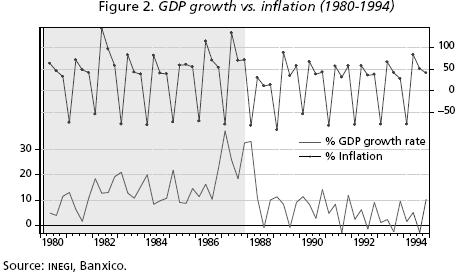
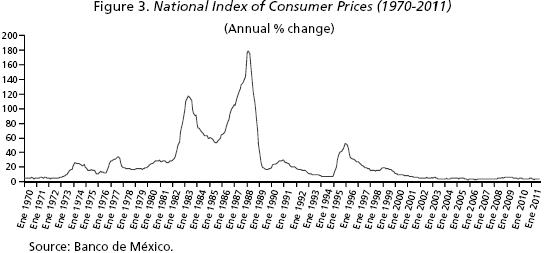
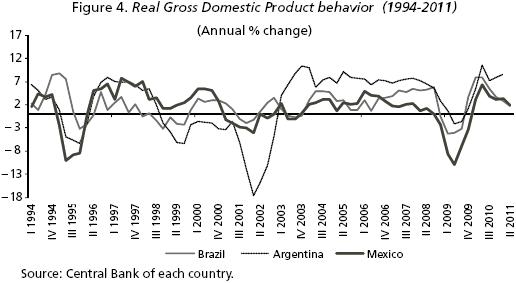
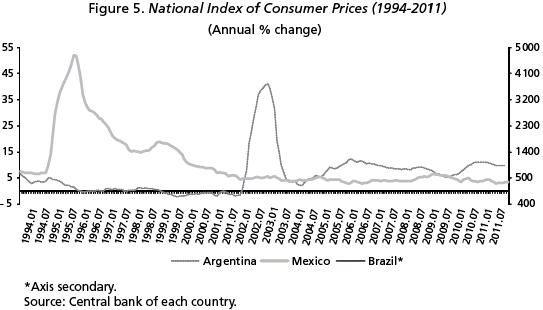
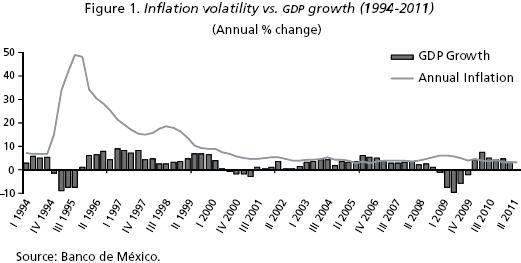
<body><![CDATA[<p align="justify"><font face="verdana" size="2">In this section, we revise some stylized facts. The major episodes of inflation volatility observed in Mexico are: mid&#150;1995, 1999, 2001 and 2009, which lead to a reduction in the growth rate of GDP. It is important to point out that in some periods there was even a decrease of output, as seen during some years between 1980 and 1994; see <a href="#f1">Figures 1</a> and <a href="#f2">2</a>.</font></p> 	    <p align="center"><font face="verdana" size="2"><a name="f1"></a></font></p> 	    <p align="center"><font face="verdana" size="2"><img src="/img/revistas/etp/n35/a6f1.jpg"></font></p> 	    <p align="center"><font face="verdana" size="2"><a name="f2"></a></font></p> 	    <p align="center"><font face="verdana" size="2"><img src="/img/revistas/etp/n35/a6f2.jpg"></font></p> 	    <p align="justify"><font face="verdana" size="2">The volatility of inflation may be due to the existence of sharp fluctuations in supply and demand in raw materials and agricultural products or fuels, which are fundamental to many aspects of daily economic activities. Moreover, the unstable behavior of prices could have negative effects in saving and investment, creating inefficiencies in the market. Notice the volatile behavior of the National Index of Consumer Prices in Mexico during some periods in 19702011, as shown in <a href="#f3">Figure 3</a>.</font></p> 	    <p align="center"><font face="verdana" size="2"><a name="f3"></a></font></p> 	    <p align="center"><font face="verdana" size="2"><img src="/img/revistas/etp/n35/a6f3.jpg"></font></p> 	    <p align="justify"><font face="verdana" size="2">The stylized fact sated above, namely that high volatility of inflation leading to lower growth is not only observed in Mexico, but also in other small open economies in Latin American (for instance, Mexico, Brazil, and Argentina). The higher fluctuations in inflation have negative effects forbusinesses and consumers, which could result in reducing growth rates, as it can be see in <a href="#f4">Figure 4</a>.</font></p> 	    <p align="center"><font face="verdana" size="2"><a name="f4"></a></font></p> 	    ]]></body>
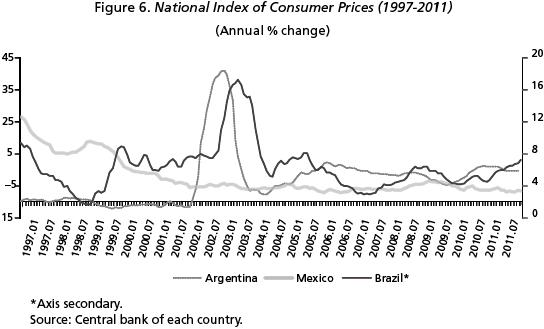
<body><![CDATA[<p align="center"><font face="verdana" size="2"><img src="/img/revistas/etp/n35/a6f4.jpg"></font></p> 	    <p align="justify"><font face="verdana" size="2">When the inflation rate is volatile, prices are unpredictable for consumer and businesses to plan consumption and production, respectively, in the long term. Finally, in <a href="#f5">Figures 5</a> and <a href="#f6">6</a> it is shown the dynamics of National Index of Consumer Prices for some small open economies during different periods of time.</font></p> 	    <p align="center"><font face="verdana" size="2"><a name="f5"></a></font></p> 	    <p align="center"><font face="verdana" size="2"><img src="/img/revistas/etp/n35/a6f5.jpg"></font></p> 	    <p align="center"><font face="verdana" size="2"><a name="f6"></a></font></p> 	    <p align="center"><font face="verdana" size="2"><img src="/img/revistas/etp/n35/a6f6.jpg"></font></p> 	    <p align="justify"><font face="verdana" size="2">&nbsp;</font></p> 	    <p align="justify"><font face="verdana" size="2"><b>II. PRICES AND REAL SECURITIES</b></font></p> 	    <p align="justify"><font face="verdana" size="2">Let us consider a small open economy with a single (representative) infinitely lived consumer in a world with a single perishable consumption good. We also contemplate in this economy a single (representative) firm that uses available capital to produce domestic output. And in this section, we establish the dynamics of asset prices to treat the consumer's problem.</font></p> 	    <p align="justify"><font face="verdana" size="2">We assume that the good is freely traded, and its domestic price level, <i>P<sub>t</sub></i>, is determined by the purchasing power parity condition, namely <i>P<sub>t</sub> =P<sub>t</sub>*E<sub>t</sub></i> where <i>P<sub>t</sub>*</i> is the foreign&#150;currency price of the good in the rest of world, and <i>E<sub>t</sub></i> is the nominal exchange rate. Since the consumer is price taker in all of his trading activities with the rest of the world, we may suppose, for the sake of simplicity that <i>P<sub>t</sub>*</i> remains constant over time. We also assume that the price level, <i>P<sub>t</sub></i>, and consequently the exchange rate, <i>E<sub>t</sub>,</i> is driven by a mixed diffusion&#150;jump process according to:</font></p> 	    ]]></body>
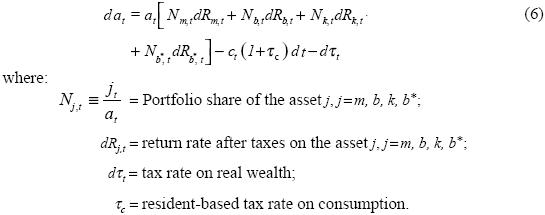
<body><![CDATA[<p align="center"><font face="verdana" size="2"><img src="/img/revistas/etp/n35/a6e1.jpg"></font></p> 	    <p align="justify"><font size="2" face="verdana">Where the drift (or physical trend) <i>&#960;</i> is the mean expected rate of inflation (or mean expected rate of depreciation) conditional on no jumps, <i>&#963;<sub>P</sub></i> is the instantaneous standard deviation or volatility of expected inflation, and 1 + <i>v<sub>P</sub></i> is the mean expected size of possible jumps in the general price level. Here, <i>W<sub>P,</sub><sub>t</sub></i> stands for a standardized Wiener process, that is, <i>W<sub>P,</sub><sub>t</sub></i> is a temporally independent normally distributed random variable with <i>E</i> &#91;<i>dW<sub>P,</sub><sub>t</sub></i>&#93; = 0 y Var&#91;<i>dW<sub>P,t</sub></i>J = dt. The initial price level <i>P<sub>0</sub>= E<sub>0</sub></i> is supposed to be known, positive, and deterministic. We also assume that jumps in the price level follows a Poisson process, <i>Q<sub>P,t </sub>,</i> with intensity parameter <i>&#955;<sub>P </sub>,</i> in such way that:</font></p> 	    <p align="center"><font face="verdana" size="2"><img src="/img/revistas/etp/n35/a6e2.jpg"></font></p> 	    <p align="justify"><font size="2" face="verdana">whereas<sup><a href="#notas">2</a></sup>:</font></p> 	    <p align="center"><font face="verdana" size="2"><img src="/img/revistas/etp/n35/a6e51.jpg"></font></p> 	    <p align="justify"><font size="2" face="verdana">Henee, <i>E </i>&#91;<i>dQ<sub>p,t</sub></i>&#93;=Var&#91;d <i>Q<sub>p, t</sub></i>&#93;<i> = &#955;<sub>p</sub> dt.</i> The initial number of jumps is supposed to be zero, that is, Q<sub>P,0</sub>= 0. Throughout the paper, we will assume that <i>W<sub>p,t</sub></i> and <i>Q<sub>P,t</sub></i> are uneorrelated processes. The trend <i>&#960;,</i> the volatility <i>&#963;<sub>P</sub></i>, the mean jump amplitude <i>v<sub>p</sub>,</i> and the probability of a jump in the price level <i>Pr</i>{<i>dQ<sub>P,t</sub><b>=</b>1</i>} are to be all endogenously determined.</font></p> 	    <p align="justify"><font face="verdana" size="2">The representative consumer possesses four different assets: domestie (nominal) money, M<sub>t</sub>; domestic (nominal) government bonds, <i>B<sub>t</sub></i>; equity claims, <i>k<sub>t</sub></i>; and foreign (nominal) bonds, B<sub>t</sub>*. Therefore, the individual's real wealth, <i>a<sub>t</sub>,</i> in terms of the consumption good as <i>numeraire</i> is given by:</font></p> 	    <p align="center"><font face="verdana" size="2"><img src="/img/revistas/etp/n35/a6e3.jpg"></font></p> 	    <p align="justify"><font size="2" face="verdana">where <i>m<sub>t</sub>= M<sub>t</sub>lP<sub>t</sub></i> stands for real monetary balances, <i>b<sub>t</sub>= B<sub>t</sub> P<sub>t</sub></i> represents the holding of domestic bond in real terms, and:</font></p> 	    <p align="center"><font face="verdana" size="2"><img src="/img/revistas/etp/n35/a6e4.jpg"></font></p> 	    ]]></body>
<body><![CDATA[<p align="justify"><font face="verdana" size="2">defines the holding of foreign bonds in real terms. In order to keep as simple as possible the structure of the economy, we suppose that domestic bonds are not traded internationally, otherwise transitional dynamic paths and analytical solutions become extremely complicated. The accumulation of real wealth evolves according to the stochastic differential equation:</font></p> 	    <p align="center"><font face="verdana" size="2"><img src="/img/revistas/etp/n35/a6e5.jpg"></font></p> 	    <p align="justify"><font face="verdana" size="2">We next determine the asset returns. We suppose that the nominal rate of return on money and bonds are zero and <i>i,</i> respectively. The stochastic rate of return of holding real monetary balances at time t, <i>dR<sub>m,</sub></i><sub>t</sub>, is simply the percentage change of the price of money in terms of goods. A straightforward application of It&oacute;'s lemma to the percentage change of real balances, taking (1) as the underlying process, leads to (see <a href="/img/revistas/etp/n35/html/a6apendice.htm" target="_blank">Appendix</a>):</font></p> 	    <p align="center"><font face="verdana" size="2"><img src="/img/revistas/etp/n35/a6e6.jpg"></font></p> 	    <p align="justify"><font size="2" face="verdana">where <i>r<sub>m</sub></i> <b><i>=</i></b> <i>&#150; &#960; + &#963;<sup>2</sup><sub>P</sub></i>. The stochastic return of holding bonds is similarly obtained</font></p> 	    <p align="center"><font face="verdana" size="2"><img src="/img/revistas/etp/n35/a6e7.jpg"></font></p> 	    <p align="justify"><font size="2" face="verdana">where <i>r<sub>b</sub> = i</i>(l &#150; <i>&#964;<sub>y</sub></i>)<i> &#150;  &#960; + &#963;<sup>2</sup><sub>P</sub></i>, and <i>&#964;<sub>y </sub></i>is the tax rate on interest income. It is worth&#150;while to observe that both the stochastic rate of return on domestic money and bonds are affected by the volatility and jumps in the general price level. The stochastic rate of return on equities after taxes will be denoted, for the time being, as:</font></p> 	    <p align="center"><font face="verdana" size="2"><img src="/img/revistas/etp/n35/a6e8.jpg"></font></p> 	    <p align="justify"><font size="2" face="verdana">where <i>W<sub>k,</sub></i><sub>t</sub> is a Wiener process and <i>Q<sub>k,</sub></i><sub>t</sub> is a Poisson process with intensity parameter <i>&#955;<sub>k</sub>.</i> The process <i>dR<sub>k,</sub></i><sub>t</sub> will be endogenously determined in the macroeconomic equilibrium. Finally, the stochastic rate of return on foreign bonds is deterministic and given by:</font></p> 	    <p align="center"><font face="verdana" size="2"><i>db*<sub>t</sub> = b<sup>*</sup><sub>t</sub>dR<sub>b*, t</sub>  = b<sub>t</sub>*r<sub>b</sub>, dt.</i></font></p> 	    ]]></body>
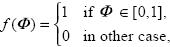
<body><![CDATA[<p align="justify"><font face="verdana" size="2">The only remaining issue is how taxes are paid, we suppose that the consumer pays a tax on wealth as follows:</font></p> 	    <p align="center"><font face="verdana" size="2"><img src="/img/revistas/etp/n35/a6e9.jpg"></font></p> 	    <p align="justify"><font face="verdana" size="2">where <img src="/img/revistas/etp/n35/a6s2.jpg"> is the mean  expected tax rate on real wealth. As before, <i>W<sub>t</sub></i>and <i>Q<sub>&#964;, t </sub></i>are a Wiener and a Poisson processes, respectively. The trend <img src="/img/revistas/etp/n35/a6s2.jpg"><i>,</i> as well as the diffusion and jump components <i>&#963;<sub>&#964;</sub>dW<sub>&#964;</sub><sub>,t</sub></i> y <i>v<sub>&#964;, t</sub> dQ<sub>&#964;, t</sub></i> are to be endogenously determined. All of the processes <i>Q<sub>p,</sub></i><sub>t</sub>, <i>Q<sub>k,t </sub></i>and <i>Q<sub>&#964;, t</sub></i> are supposed to be mutually uncorrelated.</font></p> 	    <p align="justify"><font face="verdana" size="2">&nbsp;</font></p> 	    <p align="justify"><font size="2" face="verdana"><b>III. CONSUMER'S DECISION PROBLEM</b></font></p> 	    <p align="justify"><font size="2" face="verdana">Consider a small open economy populated by agents with identical preferences Suppose that the representative consumer derives utility from a generic consumption good and from the liquidity services of real balances. It is also assumed the the consumption of heterogeneous goods, <i>c<sub>t</sub> (</i><b><i>&#934;</i></b><i>),</i> indexed by <b><i>&#934;</i></b> <img src="/img/revistas/etp/n35/a6s3.jpg"> &#91;0,1&#93;, have a uniform density in &#91;0,1&#93;, that is:</font></p> 	    <p align="center"><font face="verdana" size="2"><img src="/img/revistas/etp/n35/a6e10.jpg"></font></p> 	    <p align="justify"><font size="2" face="verdana">in such way the consumption of the aggregate basket is given by:</font></p> 	    <p align="center"><font face="verdana" size="2"><img src="/img/revistas/etp/n35/a6e11.jpg"></font></p> 	    <p align="justify"><font size="2" face="verdana">It is also assumed that the density function that consumes remains alive at time <i>t</i> is exponential with parameter &#958; that is:</font></p> 	    ]]></body>

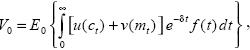
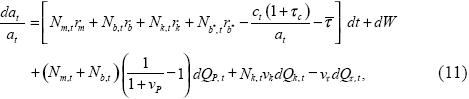
<body><![CDATA[<p align="center"><font face="verdana" size="2"><img src="/img/revistas/etp/n35/a6e12.jpg"></font></p> 	    <p align="justify"><font face="verdana" size="2">We assume that the expected utility is of the Von Neumann&#150;Morgenstern type. Specifically, the total discounted expected utility at time <i>t =</i> 0, <i>V<sub>0</sub>,</i> of the competitive consumer has the following separable form:</font></p> 	    <p align="center"><font face="verdana" size="2"><img src="/img/revistas/etp/n35/a6e13.jpg"></font></p> 	    <p align="justify"><font size="2" face="verdana">where <i>E<sub>0</sub></i> is the conditional expectation upon all available information at time <i>t =</i> 0, and <i>&#948;</i> is the agent's subjective discount rate. In particular, we choose <i>u(c<sub>t</sub></i>) <i>= &#952;</i>log<i>(c<sub>t</sub></i>), and <i>v(m<sub>t</sub></i>) = (1 <b><i>&#150;</i></b><i> &#952;)</i> <i>log(m<sub>t</sub></i>), 0 <i>&lt; &#952; &lt;</i> 1, in order to generate closed&#150;form solutions that makes the analysis tractable. Under this utility index the consumer becomes a risk&#150;averse agent. Thus, the objective of the consumer is to choose, at each instant, the portfolio shares and the consumption amount that maximize his utility index. Moreover, it is important to point out that the main results or conclusions may not be valid under other specifications of the utility fimction. If more general functional forms are considered, it is possible than closeform solutions are not obtained, and in some cases even only numerical approximate solutions can be found. However, we may anticipate that results do vary when using other utility functions; for instance, when using the negative exponential utility function or the hyperbolic utility index, which is out of the reach of objectives' paper.</font></p> 	    <p align="justify"><font size="2" face="verdana">After substituting expressions (7) &#150; (10) in the stochastic equation of wealth accumulation (6), we get:</font></p> 	    <p align="center"><font face="verdana" size="2"><img src="/img/revistas/etp/n35/a6e14.jpg"></font></p> 	    <p align="justify"><font size="2" face="verdana">where the diffusion component satisfies:</font></p> 	    <p align="center"><font face="verdana" size="2"><img src="/img/revistas/etp/n35/a6e15.jpg"></font></p> 	    <p align="justify"><font size="2" face="verdana">The necessary conditions for an interior solution of maximizing <i>V<sub>0</sub></i> subject to (11) and to the normalizing constraint:</font></p> 	    <p align="center"><font face="verdana" size="2"><img src="/img/revistas/etp/n35/a6e16.jpg"></font></p> 	    ]]></body>
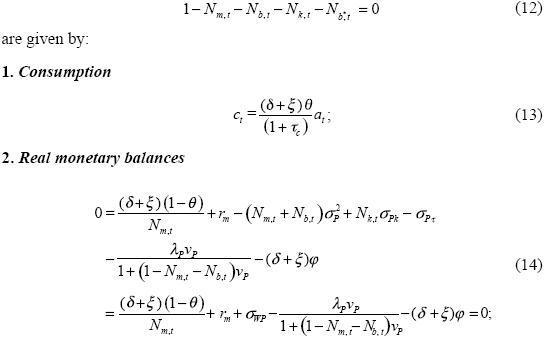
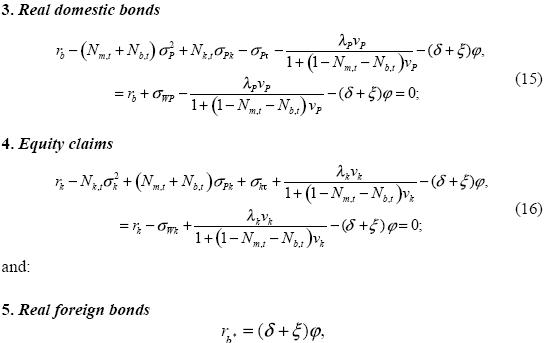
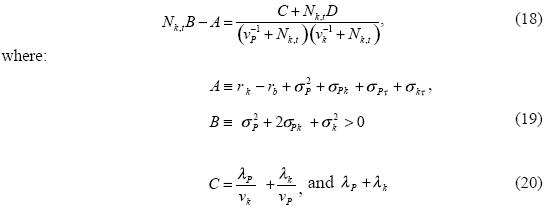
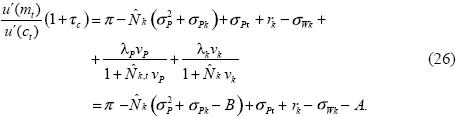
<body><![CDATA[<p align="center"><font face="verdana" size="2"><img src="/img/revistas/etp/n35/a6e17.jpg"></font></p> 	    <p align="justify"><font size="2" face="verdana">where <i>&#966;</i> is the Lagrange multiplier associated with the constraint (12), Cov (<i>dW,&#963;<sub>P </sub>W<sub>P,t</sub></i>)<i> = &#963;<sub>WP</sub>dt</i>, and Cov (<i>dW, &#963;<sub>k </sub>W<sub>k,t</sub></i>)<i> = &#963;<sub>Wk</sub>dt</i>. Equation (13) simply expresses that consumption is proportional to real wealth. After subtracting (14) from (15), we readily find that the optimal portfolio share on real monetary balances is given by:</font></p> 	    <p align="center"><font face="verdana" size="2"><img src="/img/revistas/etp/n35/a6e18.jpg"></font></p> 	    <p align="justify"><font size="2" face="verdana">Hence, the portfolio share of real money balances varies inversely with the after&#150;tax nominal interest rate. Moreover, after subtracting (15) from (16), we get:</font></p> 	    <p align="center"><font face="verdana" size="2"><img src="/img/revistas/etp/n35/a6e19.jpg"></font></p> 	    <p align="justify"><font size="2" face="verdana">Clearly, equation (18) is cubic with real coefficients, and hence it has at least one real solution,<sup><a href="#notas">3</a></sup> which will be denoted by <i>&Ntilde;<sub>k,t</sub></i>. Observe that we have not imposed constraints on the portfolio shares to be strictly positive and less than unity, and hence short sales are permitted at any time. In particular, if we assume that <i>&#955;<sub>P</sub></i> and <i>&#955;<sub>k</sub></i> are zero, then <i>C = D =</i> 0, and there is a unique solution <i>(cf. </i>Turnovsky, 1993):</font></p> 	    <p align="center"><font face="verdana" size="2"><img src="/img/revistas/etp/n35/a6e20.jpg"></font></p> 	    <p align="justify"><font face="verdana" size="2">Observe now that from (16), we can obtain the value of the Lagrange multiplier:</font></p> 	    <p align="center"><font face="verdana" size="2"><img src="/img/revistas/etp/n35/a6e21.jpg"></font></p> 	    <p align="justify"><font face="verdana" size="2">Finally, the optimal portfolio is completely determined with <img src="/img/revistas/etp/n35/a6s4.jpg"><i><sub>b,</sub></i><sub>t</sub>, which is residually obtained from (l2) as:</font></p> 	    ]]></body>
<body><![CDATA[<p align="center"><font face="verdana" size="2"><img src="/img/revistas/etp/n35/a6e22.jpg"></font></p> 	    <p align="justify"><font face="verdana" size="2">Since optimal portfolio shares remain constant over time, in what follows we will leave out the time sub index, and we will simply write: <img src="/img/revistas/etp/n35/a6s4.jpg"><i><sub>m</sub>,</i> <img src="/img/revistas/etp/n35/a6s4.jpg"><i><sub>b</sub>,</i> and <img src="/img/revistas/etp/n35/a6s4.jpg"><i><sub>k</sub></i>. Finally, notice that the first&#150;order conditions can be rewritten in terms of marginal utility as:</font></p> 	    <p align="center"><font face="verdana" size="2"><img src="/img/revistas/etp/n35/a6e23.jpg"></font></p> 	    <p align="justify"><font size="2" face="verdana">Moreover, in virtue of (14), (23) and (18), we may re write (25) as follows:</font></p> 	    <p align="center"><font face="verdana" size="2"><img src="/img/revistas/etp/n35/a6e24.jpg"></font></p> 	    <p align="justify"><font size="2" face="verdana">The above equation equals the marginal utility of holding real balances, standardized by the marginal utility marginal of consumption, with the marginal cost of holding real balances. This condition shows explicitly how the opportunity cost of money is affected by uncertainty, <i>i.e.,</i> by small diffusive changes in inflation and by chronic extreme movements in the price level. Finally, observe that logarithmic utility implies that the optimal values of <i><img src="/img/revistas/etp/n35/a6s4.jpg"><sub>j</sub> , j = m, b, k,</i> depend only on in the parameters that determine preferences and stochastic characteristics of the economy. In other words, the consumer's attitude to risk is independent of the real wealth level, i.e., the resultant real wealth level at any instant has no effects on the portfolio decisions.</font></p> 	    <p align="justify"><font face="verdana" size="2">&nbsp;</font></p> 	    <p align="justify"><font size="2" face="verdana"><b>IV. FIRM'S DECISION PROBLEM</b></font></p> 	    <p align="justify"><font face="verdana" size="2">In microeconomic theory is common to assume that firms conduct research and development in search of technological change. Due to the constant search for greater profits, companies try to get maximum benefit in the technologies adopted. One such advantage is access to more efficient production conditions and distribution, via the technological change. It is here the main motivation for a firm to invest resources in research and technological development. In this context, consider a firm whose production, <i>y,</i> depends on a capital asset, <i>k<sub>t</sub></i>. It is assumed that small changes in technology that are seen every day are driven by a diffusion process (Brownian motion or Wiener process), and technological innovations (technological leaps) that occasionally occur are modeled with a Poisson process. The technology used by the firm can be owned or acquired from other companies, private or public.</font></p> 	    <p align="justify"><font face="verdana" size="2">Suppose that in the domestic economy there is only one firm that uses all available capital to produce domestic output. Available capital is the domestically produced output that is not consumed, purchased by the government, or exported. The rate of return on equity will be determined in terms of the production level and the dividends policy. We assume that production is driven by the following stochastic technology:</font></p> 	    ]]></body>
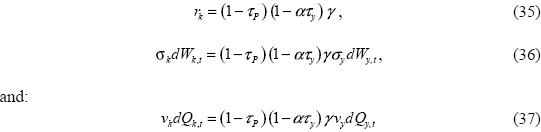
<body><![CDATA[<p align="center"><font face="verdana" size="2"><img src="/img/revistas/etp/n35/a6e25.jpg"></font></p> 	    <p align="justify"><font face="verdana" size="2">where <i>&#947;</i> represents the mean expected marginal product of capital. Here, as in the consumer case, <i>W<sub>y,t</sub></i> is a Wiener process and <i>Q<sub>y,t</sub></i> is a Poisson process with the standard characteristics. Processes <i>&#963;<sub>y,t</sub>dW<sub>y,t</sub></i> and <i>v<sub>y</sub>dQ<sub>y,t</sub></i> are supposed to be exoge&#150;nous. In general terms, the return on equity can be defined as:</font></p> 	    <p align="center"><font face="verdana" size="2"><img src="/img/revistas/etp/n35/a6e26.jpg"></font></p> 	    <p align="justify"><font size="2" face="verdana">where <i>v<sub>t</sub></i> is flow of dividend payments and <i>u<sub>t</sub></i> is the equity price on real terms. We suppose that capital gains are no taxed.<sup><a href="#notas">4</a></sup> Notice that the return on capital has two components: the dividends paid by each share and the gains or losses of capital as a result of the difference in prices. Let us examine each component separately. In order to determine the percentage change of <i>u<sub>t</sub>, du<sub>t</sub> / u<sub>t</sub>,</i> it is necessary to analyze all the variables determining possible capital gains: number of shares, production and investment. For the sake of simplicity, we will assume that number of shares, at any time, t, remains constant, say equals to N, then it follows that <i>Nu<sub>t</sub>=</i>k<sub>t</sub>. Therefore:</font></p> 	    <p align="center"><font face="verdana" size="2"><img src="/img/revistas/etp/n35/a6e27.jpg"></font></p> 	    <p align="justify"><font face="verdana" size="2">On the other hand, production after corporate income tax can be used either to pay out dividends, <i>dv<sub>t</sub>,</i> or to finance investment, <i>dk<sub>t</sub>, i.e.,</i> acquisition of new capital. Hence, the change in output after taxes is given by:</font></p> 	    <p align="center"><font face="verdana" size="2"><img src="/img/revistas/etp/n35/a6e28.jpg"></font></p> 	    <p align="justify"><font face="verdana" size="2">where <i>&#964;<sub>P</sub></i> is the tax on corporative income. By combining equations (29) and (30), we get:</font></p> 	    <p align="center"><font face="verdana" size="2"><img src="/img/revistas/etp/n35/a6e29.jpg"></font></p> 	    <p align="justify"><font face="verdana" size="2">Substituting the above expression in (28), we get:</font></p> 	    ]]></body>
<body><![CDATA[<p align="center"><font face="verdana" size="2"><img src="/img/revistas/etp/n35/a6e30.jpg"></font></p> 	    <p align="justify"><font face="verdana" size="2">On the other hand, the dividend policy of a firm is a plan for the distribution of payments of dividends to shareholders. The dividend policy should take into account two basic aspects: maximize the benefit of the owners of the company and provide sufficient funding for the company, including research and development. A cash dividend per share of the company indicates the percentage per dollar distributed to shareholders. One of the drawbacks of this policy is that if company profits decline, or if a loss occurs in a given period, dividends may be low or even zero, pushing the plan previously established. A regular dividend policy is based on paying a fixed dividend in each period. This policy gives share&#150;holders confidence, indicating that the company performs well, thus reducing uncertainty. There is also the possibility of payment of stock dividends, a stock dividend is the payment of dividends in shares to existing owners and the companies often resort to such dividend as a form of replacement or addition of dividends. The proposed modeling assumes that the firm pays dividends at a constant fraction aof the after&#150;tax corporate income. That is, dividends have the following form:</font></p> 	    <p align="center"><font face="verdana" size="2"><img src="/img/revistas/etp/n35/a6e31.jpg"></font></p> 	    <p align="justify"><font face="verdana" size="2">After substituting this expression in (32), we obtain the stochastic process governing the return on capital in terms of the technology process as:</font></p> 	    <p align="center"><font face="verdana" size="2"><img src="/img/revistas/etp/n35/a6e32.jpg"></font></p> 	    <p align="justify"><font face="verdana" size="2">It is important to point out that in the above equation its stochastic behavior is due to <i>dy<sub>t</sub> /k<sub>t</sub>,</i> since the rest of the variables in (34) are deterministic. Finally, equation (9) is fully determined by:</font></p> 	    <p align="center"><font face="verdana" size="2"><img src="/img/revistas/etp/n35/a6e33.jpg"></font></p> 	    <p align="justify"><font face="verdana" size="2">Thus, the rate of return on equity depends upon the marginal product of capital. Similarly, the stochastic components <i>dR<sub>k,t</sub></i> depends on the productivity shocks from changes in <i>y</i> an from the exogenous behavior of <i>dW<sub>y,t</sub></i> and <i>dQ<sub>y,t</sub>.</i></font></p> 	    <p align="justify"><font face="verdana" size="2">&nbsp;</font></p> 	    <p align="justify"><font face="verdana" size="2"><b>V. GOVERNMENT BEHAVIOR</b></font></p> 	    ]]></body>
<body><![CDATA[<p align="justify"><font face="verdana" size="2">In order to close the model, we describe the government actions as well as the public policy. The public sector generates no utility for the consumer, has the monopoly of printing money, and issues debt to finance public expenditures. The government budget constraint in real terms has the form:</font></p> 	    <p align="center"><font face="verdana" size="2"><img src="/img/revistas/etp/n35/a6e34.jpg"></font></p> 	    <p align="justify"><font face="verdana" size="2">where <i>dg<sub>t</sub></i> is the change of public expenditures; <i>d&#964;<sub>1, t</sub></i> is the change in taxes paid by the consumer; <i>d&#964;<sub>2, t</sub></i> is the change of taxes paid by the firm. We next summarize the government policy variables, namely: public expenditures, money supply, and public debt.</font></p> 	    <p align="justify"><font face="verdana" size="2">In our proposed framework, government expenditure is driven by the following stochastic process:</font></p> 	    <p align="center"><font face="verdana" size="2"><img src="/img/revistas/etp/n35/a6e35.jpg"></font></p> 	    <p align="justify"><font face="verdana" size="2">where <img src="/img/revistas/etp/n35/a6s5.jpg"> is the mean expected rate of fiscal expenditure. As before, <i>W<sub>g,t</sub></i> is a Wiener process and <i>Q<sub>g,t</sub></i> is a Poisson process. Notice that government expenditures are defined as a fraction of production. Money supply is a driven by a mixed diffusion&#150;jump process as follows:</font></p> 	    <p align="center"><font face="verdana" size="2"><img src="/img/revistas/etp/n35/a6e36.jpg"></font></p> 	    <p align="justify"><font size="2" face="verdana">where <i>&micro;</i> is mean expected rate of monetary expansion, <i>dW<sub>M,t</sub></i> is the diffusion component, and <i>dQ<sub>M,t</sub></i> is the jump component. Public debt is issued in such a way that the bond&#150;money ratio remains constant over time, that is:</font></p> 	    <p align="center"><font face="verdana" size="2"><img src="/img/revistas/etp/n35/a6e37.jpg"></font></p> 	    <p align="justify"><font face="verdana" size="2">where &#954; is a known constant. Hence, it follows, immediately, that:</font></p> 	    ]]></body>

<body><![CDATA[<p align="center"><font face="verdana" size="2"><img src="/img/revistas/etp/n35/a6e38.jpg"></font></p> 	    <p align="justify"><font size="2" face="verdana">Therefore, in open market operations, the percentage change of issued debt is equal to the percentage change of shorts in money supply, or equivalently, the percentage change in money supply is equal to the percentage change of the debt liquidation.</font></p> 	    <p align="justify"><font size="2" face="verdana">The changes of total taxes in real terms, d<i>&#964;<sub>1,t</sub></i> and d<i>&#964;</i><sub>2,t</sub>, paid by the consumers and firms, respectively, are now described. Recall that the remaining taxes <i>&#964;<sub>y</sub></i>, <i>&#964;<sub>P</sub></i> and <i>&#964;<sub>c</sub>,</i> are exogenous in our model. Hence, the total tax collected by the government from consumers is given by:</font></p> 	    <p align="center"><font face="verdana" size="2"><img src="/img/revistas/etp/n35/a6e39.jpg"></font></p> 	    <p align="justify"><font size="2" face="verdana">In the firm's case, there is only a tax on corporate income, that is:</font></p> 	    <p align="center"><font face="verdana" size="2"><img src="/img/revistas/etp/n35/a6e40.jpg"></font></p> 	    <p align="justify"><font face="verdana" size="2">&nbsp;</font></p> 	    <p align="justify"><font size="2" face="verdana"><b>VI. EQUILIBRIUM CONDITIONS</b></font></p> 	    <p align="justify"><font size="2" face="verdana">In this section, we find the macroeconomic equilibrium and the stochastic rate of capital accumulation in the economy, <i>dk<sub>t</sub>/k<sub>t</sub>,</i> we use the national income identity:</font></p> 	    <p align="center"><font face="verdana" size="2"><img src="/img/revistas/etp/n35/a6e41.jpg"></font></p> 	    ]]></body>
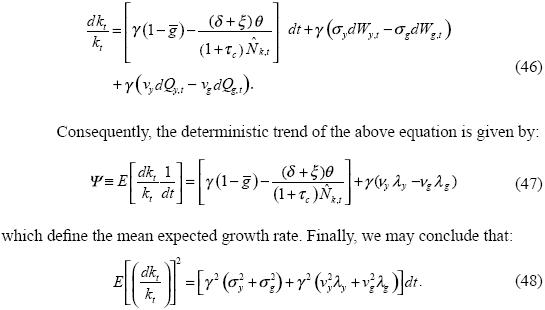
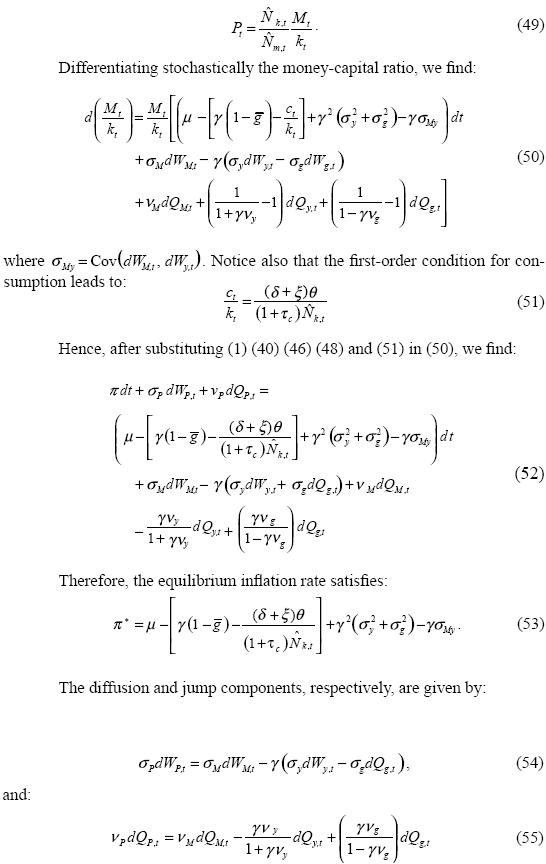
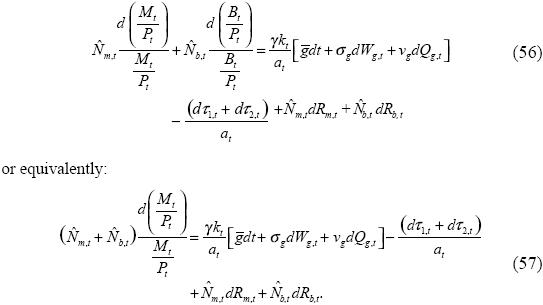
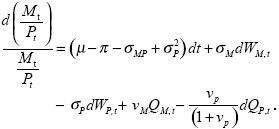
<body><![CDATA[<p align="justify"><font size="2" face="verdana">After substituting in (45), equations (13) (27) and (39), corresponding to the optimal consumption path, the production dynamics, and the public expenditure policy, we get:</font></p> 	    <p align="center"><font face="verdana" size="2"><img src="/img/revistas/etp/n35/a6e42.jpg"></font></p> 	    <p align="justify"><font size="2" face="verdana">In other words, the variance of capital accumulations depends upon the variances of both the diffusion and jump components. This result will be used to determine the overall macroeconomic equilibrium. Once we have determined the agent's optimal decisions, the firm behavior, the government actions, and the policy variables, it remains to obtain the macroeconomic equilibrium. By using the fact that real balances and government bonds in real terms are linked with movements in the price level, we may determine endogenously the inflation rate. Notice now that we can rewrite the price level as:</font></p> 	    <p align="center"><font face="verdana" size="2"><img src="/img/revistas/etp/n35/a6e43.jpg"></font></p> 	    <p align="justify"><font size="2" face="verdana">Equations (53)&#150;(55) determine endogenously the rate of inflation consistent with constant optimal portfolio shares. We observe in (53) that the equilibrium inflation is positively affected by the rate of monetary expansion, negatively affected by the mean expected growth rate of capital, and positively affected by the variances of fiscal and production diffusion and jumps shocks. On the other hand, equations (54) and (55) determining endogenously the diffusion and jump stochastic components of the equilibrium inflation rate. It is important to point out that these components are functions that depends upon the exogenous stochastic behavior of the rate of money supply, production technology and government expenditures.</font></p> 	    <p align="justify"><font face="verdana" size="2">In order to determine the endogenous adjustment in fiscal policy, we use the fact that the government budget constraint must be satisfied. First, by substituting the equations of government expenditures (39), money supply (40), and debt policy (41), in (38) we find:</font></p> 	    <p align="center"><font face="verdana" size="2"><img src="/img/revistas/etp/n35/a6e44.jpg"></font></p> 	    <p align="justify"><font face="verdana" size="2">On the other hand, by applying It&oacute;'s lemma to obtain the stochastic differential <i>d</i> (M<sub>t</sub> <i>/ P</i><sub>t</sub><i>)</i> with (1) and (40) as the underlying stochastic processes, we get:</font></p> 	    <p align="center"><font face="verdana" size="2"><img src="/img/revistas/etp/n35/a6e45.jpg"></font></p> 	    <p align="justify"><font size="2" face="verdana">After substituting the above expression along with those for the taxes <i>d&#964;<sub>1,t</sub></i> and <i>d&#964;<sub>2,t</sub></i> in (57), we have that the deterministic and stochastic components of the equilibrium tax adjustment are given by:</font></p> 	    ]]></body>
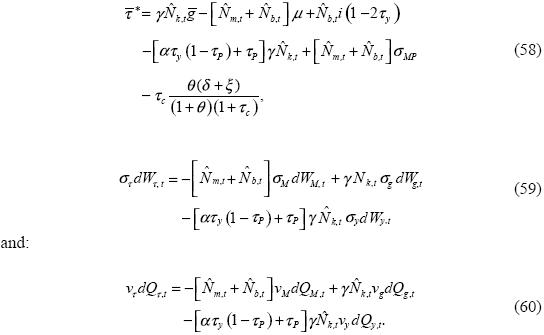
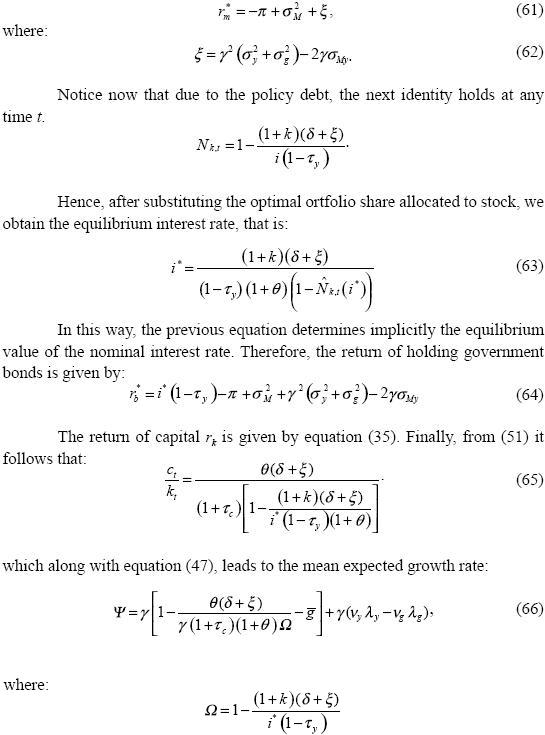
<body><![CDATA[<p align="center"><font face="verdana" size="2"><img src="/img/revistas/etp/n35/a6e46.jpg"></font></p> 	    <p align="justify"><font size="2" face="verdana">Equation (58) describes the endogenous adjustment in the deterministic component, while equation (59) summarizes the diffusion part as a functions of random fluctuations in the rate of monetary expansion, <i>&#963;<sub>M </sub>dW<sub>M,t </sub>,</i> government expenditures, <i>&#963;<sub>g</sub>dW<sub>g,t</sub></i>, and the real sector, <i>&#963;<sub>y</sub>dW<sub>y,t</sub></i>. The jump component given by (60) is a function of the stochastic jump components of the rate of monetary expansion, the production technology and the public expenditures.</font></p> 	    <p align="justify"><font face="verdana" size="2">&nbsp;</font></p> 	    <p align="justify"><font size="2" face="verdana"><b>VII. MEAN EXPECTED GROWTH RATE</b></font></p> 	    <p align="justify"><font size="2" face="verdana">Finally, to determine the equilibrium rates of return of the real balances and bonds in real terms, we substitute the above expressions in (7) y (8), respectively, so the rate of return of holding money is given by:</font></p> 	    <p align="center"><font face="verdana" size="2"><img src="/img/revistas/etp/n35/a6e47.jpg"></font></p> 	    <p align="justify"><font face="verdana" size="2">Notice that economic growth is primarily driven by improvements in the growth rate of capital, which involves producing more goods maintaining without change the other inputs. Observe now that in virtue of <i>r<sub>b</sub><sup>*</sup> = i</i><sup>*</sup> (1 <b><i>&#150;</i></b><i>&#964;<sub>y</sub></i>) <b><i>&#150;</i></b><i> &#960;</i><sup>*</sup> + <i>&#963;</i><sup>2</sup><sub>P</sub>, we get:</font></p> 	    <p align="center"><font face="verdana" size="2"><img src="/img/revistas/etp/n35/a6e48.jpg"></font></p> 	    <p align="justify"><font size="2" face="verdana">Equations (66) and (67) offer an explicit relationship between inflation volatility and output growth. In such a relationship, clearly, an increase in inflation volatility,<i> &#963;</i><sub>P</sub>, in (67), leads to a reduction in the economic growth rate &#936;, in (66). Indeed, an increase in<i> &#963;</i><sub>P </sub>decreases <i>i</i>*, which in turn reduces &#937;, which appears in the denominator of first term of (66). Hence, the total effect of the whole first term is negative. Thus, the proposed model provides a negative correlation between volatility in the general price level and the growth rate of output in a small open economy with a financial sector. In this way, our approach has acquainted with an endogenous growth model consistent with stylized facts that highlight the relationship between nominal volatility and growth.</font></p> 	    <p align="justify"><font face="verdana" size="2">&nbsp;</font></p> 	    ]]></body>
<body><![CDATA[<p align="justify"><font size="2" face="verdana"><b>CONCLUSIONS</b></font></p> 	    <p align="justify"><font face="verdana" size="2">Monetary authorities often motivate their concerns about inflation by claiming that price level stability contributes to economic growth. Consistently, our theoretical approach has shown that in the long run countries having experienced high inflation volatility also tend to feature dismal growth performances. We have developed a macroeconomic equilibrium model in a richer stochastic environment is useful to examine how inflation volatility affects economic growth. The exogenous variables include the economic policy parameters: rate of monetary expansion, <i>&micro;</i>; public expenditures, <img src="/img/revistas/etp/n35/a6s5.jpg">; debt policy, <i>k</i>; and the tax rates <i>&#964;<sub>y</sub></i>, <i>&#964;<sub>c</sub></i> and <i>&#964;<sub>P</sub>.</i> Similarly, the exogenous stochastic processes are: money growth rate, <i>dW<sub>M,t</sub></i>, public expenditures, <i>dW<sub>g,t</sub></i>, and production, <i>dW<sub>y,t</sub></i>. The rest of the stochastic processes are endogenous and can be expressed as functions of exogenous shocks. The economic growth rate was endogenously determined in the equilibrium, as a function of parameters of the process driving inflation, which have an important role in the design of economic policy.</font></p> 	    <p align="justify"><font face="verdana" size="2">It is also important to point out that in the proposed theoretical framework, as in the second term in equation (66), the mean expected marginal product of capital,<i> &#947; </i>the expected size of a technological jump affect, <i>v<sub>y</sub></i>, and the probability that such a jumps occurs, <i>&#955;<sub>y</sub>,</i> all of them impact positively the growth rate <i>&#936;,</i> since economic growth is primarily driven by improvements in capital productivity, which leads to producing more goods and services with the same inputs of labor, energy and materials.</font></p> 	    <p align="justify"><font face="verdana" size="2">Needless to say, more research is required to assess the effects on economic welfare and indirect utility. An important question is if countries featuring high inflation volatility tend to have underdeveloped financial markets and dismal growth performances, of course this issue will be treated in future investigations. It is also important to point out that the main results may not be valid under other specifications of the utility function, and future research will be devoted to more general functional forms of the satisfaction index.</font></p> 	    <p align="justify"><font face="verdana" size="2">&nbsp;</font></p> 	    <p align="center"><font face="verdana" size="2"><b><a href="/img/revistas/etp/n35/html/a6apendice.htm" target="_blank">APPENDIX: IT&Ocirc;'S LEMMA ON THE RATIO OF TWO PROCESSES</a></b></font></p> 	    <p align="justify"><font face="verdana" size="2">&nbsp;</font></p> 	    <p align="justify"><font size="2" face="verdana"><b>REFERENCES</b></font></p> 	    <!-- ref --><p align="justify"><font size="2" face="verdana">Black, John (1959), "Inflation and Long&#150;Run Growth", <i>Econ&oacute;mica,</i> Vol. 26, No. 102, pp. 145&#150;153.    &nbsp;&nbsp;&nbsp;&nbsp;&nbsp;&nbsp;&nbsp;&nbsp;[&#160;<a href="javascript:void(0);" onclick="javascript: window.open('/scielo.php?script=sci_nlinks&ref=2941589&pid=S0188-3380201100020000600001&lng=','','width=640,height=500,resizable=yes,scrollbars=1,menubar=yes,');">Links</a>&#160;]<!-- end-ref --></font></p> 	    ]]></body>
<body><![CDATA[<!-- ref --><p align="justify"><font face="verdana" size="2">Dornbusch, Rudinger and Jacob. A. Frenkel (1973), "Inflation and Growth: Alternative Approaches", <i>Journal of Money, Credit and Banking,</i> Vol. 5, No. 1, pp. 141&#150;156.    &nbsp;&nbsp;&nbsp;&nbsp;&nbsp;&nbsp;&nbsp;&nbsp;[&#160;<a href="javascript:void(0);" onclick="javascript: window.open('/scielo.php?script=sci_nlinks&ref=2941591&pid=S0188-3380201100020000600002&lng=','','width=640,height=500,resizable=yes,scrollbars=1,menubar=yes,');">Links</a>&#160;]<!-- end-ref --></font></p> 	    <!-- ref --><p align="justify"><font face="verdana" size="2">Gihman, Iosif Ilich and Anatoli&iacute; Vladimirovich Skorohod (1972), <i>Stochastic Differential Equations,</i> Springer&#150;Verlag, Berlin.    &nbsp;&nbsp;&nbsp;&nbsp;&nbsp;&nbsp;&nbsp;&nbsp;[&#160;<a href="javascript:void(0);" onclick="javascript: window.open('/scielo.php?script=sci_nlinks&ref=2941593&pid=S0188-3380201100020000600003&lng=','','width=640,height=500,resizable=yes,scrollbars=1,menubar=yes,');">Links</a>&#160;]<!-- end-ref --></font></p> 	    <!-- ref --><p align="justify"><font face="verdana" size="2">Giuliano, Paola and Stephen. J. Turnovsky (2003), "Intertemporal Substitution, Risk Aversion, and Economic Performance in a Stochastically Growing Open Economy", <i>Journal of International Money and Finance,</i> Vol. 22, No. 4, pp. 529&#150;556.    &nbsp;&nbsp;&nbsp;&nbsp;&nbsp;&nbsp;&nbsp;&nbsp;[&#160;<a href="javascript:void(0);" onclick="javascript: window.open('/scielo.php?script=sci_nlinks&ref=2941595&pid=S0188-3380201100020000600004&lng=','','width=640,height=500,resizable=yes,scrollbars=1,menubar=yes,');">Links</a>&#160;]<!-- end-ref --></font></p> 	    <!-- ref --><p align="justify"><font face="verdana" size="2">Gon&ccedil;alves, Eduardo S. and Jo&atilde;o M. Salles (2008), "Inflation Targeting in Emerging Economies: What Do the Data Say?", <i>Journal of DevelopmentEconomics,</i> Vol. 85, No. 1&#150;2, pp. 312&#150;318.    &nbsp;&nbsp;&nbsp;&nbsp;&nbsp;&nbsp;&nbsp;&nbsp;[&#160;<a href="javascript:void(0);" onclick="javascript: window.open('/scielo.php?script=sci_nlinks&ref=2941597&pid=S0188-3380201100020000600005&lng=','','width=640,height=500,resizable=yes,scrollbars=1,menubar=yes,');">Links</a>&#160;]<!-- end-ref --></font></p> 	    <!-- ref --><p align="justify"><font face="verdana" size="2">Grinols, Earl L., and Stephen S. Turnovsky (1993), "Risk, the Financial Market, and Macroeconomic Equilibrium", <i>Journal of Economic Dynamics and Control,</i> Vol. 17, No. 1&#150;2, pp. 1&#150;36.    &nbsp;&nbsp;&nbsp;&nbsp;&nbsp;&nbsp;&nbsp;&nbsp;[&#160;<a href="javascript:void(0);" onclick="javascript: window.open('/scielo.php?script=sci_nlinks&ref=2941599&pid=S0188-3380201100020000600006&lng=','','width=640,height=500,resizable=yes,scrollbars=1,menubar=yes,');">Links</a>&#160;]<!-- end-ref --></font></p> 	    ]]></body>
<body><![CDATA[<!-- ref --><p align="justify"><font face="verdana" size="2">Hill, Robert J. (2001), "Measuring Inflation and Growth Using Spanning Trees", <i>International Economic Review,</i> Vol. 42, No. 1, pp. 167&#150;185.    &nbsp;&nbsp;&nbsp;&nbsp;&nbsp;&nbsp;&nbsp;&nbsp;[&#160;<a href="javascript:void(0);" onclick="javascript: window.open('/scielo.php?script=sci_nlinks&ref=2941601&pid=S0188-3380201100020000600007&lng=','','width=640,height=500,resizable=yes,scrollbars=1,menubar=yes,');">Links</a>&#160;]<!-- end-ref --></font></p> 	    <!-- ref --><p align="justify"><font face="verdana" size="2">Houthakker, Hendrik S. (1979), "Growth and Inflation: Analysis by Industry", <i>Brookings Papers on Economic Activity,</i> Vol. 1979, No. 1, pp. 241&#150;256.    &nbsp;&nbsp;&nbsp;&nbsp;&nbsp;&nbsp;&nbsp;&nbsp;[&#160;<a href="javascript:void(0);" onclick="javascript: window.open('/scielo.php?script=sci_nlinks&ref=2941603&pid=S0188-3380201100020000600008&lng=','','width=640,height=500,resizable=yes,scrollbars=1,menubar=yes,');">Links</a>&#160;]<!-- end-ref --></font></p> 	    <!-- ref --><p align="justify"><font face="verdana" size="2">Kaldor, Nicholas (1959), "Economic Growth and the Problem of Inflation", <i>Economica, </i>Vol. 26, No. 104, pp. 287&#150;298.    &nbsp;&nbsp;&nbsp;&nbsp;&nbsp;&nbsp;&nbsp;&nbsp;[&#160;<a href="javascript:void(0);" onclick="javascript: window.open('/scielo.php?script=sci_nlinks&ref=2941605&pid=S0188-3380201100020000600009&lng=','','width=640,height=500,resizable=yes,scrollbars=1,menubar=yes,');">Links</a>&#160;]<!-- end-ref --></font></p> 	    <!-- ref --><p align="justify"><font face="verdana" size="2">Loayza, Norman and Viktoria V. Hnatkovska (2004), <i>Volatility and Growth. World Bank Policy Research,</i> Working Paper, No. 3184</font>&nbsp;&nbsp;&nbsp;&nbsp;&nbsp;&nbsp;&nbsp;&nbsp;[&#160;<a href="javascript:void(0);" onclick="javascript: window.open('/scielo.php?script=sci_nlinks&ref=2941607&pid=S0188-3380201100020000600010&lng=','','width=640,height=500,resizable=yes,scrollbars=1,menubar=yes,');">Links</a>&#160;]<!-- end-ref --><!-- ref --><p align="justify"><font face="verdana" size="2">Phillips, Alban William Housego (1962), "Employment, Inflation and Growth", <i>Economica,</i> Vol. 29, No. 113, pp. 1&#150;16.    &nbsp;&nbsp;&nbsp;&nbsp;&nbsp;&nbsp;&nbsp;&nbsp;[&#160;<a href="javascript:void(0);" onclick="javascript: window.open('/scielo.php?script=sci_nlinks&ref=2941608&pid=S0188-3380201100020000600011&lng=','','width=640,height=500,resizable=yes,scrollbars=1,menubar=yes,');">Links</a>&#160;]<!-- end-ref --></font></p> 	    <!-- ref --><p align="justify"><font face="verdana" size="2">Sidrauski, Miguel (1976), "Inflation and Economic Growth", <i>The Journal of Political Economy,</i> Vol. 75, No. 6, pp. 796&#150;810.    &nbsp;&nbsp;&nbsp;&nbsp;&nbsp;&nbsp;&nbsp;&nbsp;[&#160;<a href="javascript:void(0);" onclick="javascript: window.open('/scielo.php?script=sci_nlinks&ref=2941610&pid=S0188-3380201100020000600012&lng=','','width=640,height=500,resizable=yes,scrollbars=1,menubar=yes,');">Links</a>&#160;]<!-- end-ref --></font></p> 	    <!-- ref --><p align="justify"><font face="verdana" size="2">Turnovsky, Stephen J. (1993), "Macroeconomic Policies, Growth, and Welfare in a Stochastic Economy", <i>Journal of Economic Dynamics and Control,</i> Vol. 34, No. 4, pp. 953&#150;981.    &nbsp;&nbsp;&nbsp;&nbsp;&nbsp;&nbsp;&nbsp;&nbsp;[&#160;<a href="javascript:void(0);" onclick="javascript: window.open('/scielo.php?script=sci_nlinks&ref=2941612&pid=S0188-3380201100020000600013&lng=','','width=640,height=500,resizable=yes,scrollbars=1,menubar=yes,');">Links</a>&#160;]<!-- end-ref --></font></p> 	    <!-- ref --><p align="justify"><font face="verdana" size="2">Turnovsky, Stephen J.(1999), "On the Role of Government in a Stochastically Growing Open Economy", <i>Journal of Economic Dynamics and Control,</i> Vol. 23, No. 5, pp. 873&#150;908.    &nbsp;&nbsp;&nbsp;&nbsp;&nbsp;&nbsp;&nbsp;&nbsp;[&#160;<a href="javascript:void(0);" onclick="javascript: window.open('/scielo.php?script=sci_nlinks&ref=2941614&pid=S0188-3380201100020000600014&lng=','','width=640,height=500,resizable=yes,scrollbars=1,menubar=yes,');">Links</a>&#160;]<!-- end-ref --></font></p> 	    <!-- ref --><p align="justify"><font face="verdana" size="2">Venegas&#150;Mart&iacute;nez, Francisco (2009), "Un modelo estoc&aacute;stico de equilibrio macroecon&oacute;mico: acumulaci&oacute;n de capital, inflaci&oacute;n y pol&iacute;tica fiscal", <i>Investigaci&oacute;n Econ&oacute;mica,</i> Vol. 68, No. 268, pp. 69&#150;114.    &nbsp;&nbsp;&nbsp;&nbsp;&nbsp;&nbsp;&nbsp;&nbsp;[&#160;<a href="javascript:void(0);" onclick="javascript: window.open('/scielo.php?script=sci_nlinks&ref=2941616&pid=S0188-3380201100020000600015&lng=','','width=640,height=500,resizable=yes,scrollbars=1,menubar=yes,');">Links</a>&#160;]<!-- end-ref --></font></p> 	    <p align="justify"><font face="verdana" size="2">&nbsp;</font></p> 	    <p align="justify"><font size="2" face="verdana"><b><a name="notas"></a>NOTAS</b></font></p> 	    <p align="justify"><font size="2" face="verdana"><sup>* </sup>The authors wish to acknowledge the valuable and helpful comments and suggestions from anonymous referees, which had greater repercussions in improving this research.</font></p> 	    ]]></body>
<body><![CDATA[<p align="justify"><font size="2" face="verdana"><sup>1</sup> There are many works in the economic literature that use diffusion or mixed jump&#150;diffusion proces, we mention, for instance: Grinols and Turnovsky (1993), Turnovsky (1993), and Giuliano and Turnovsky (2003).</font></p> 	    <p align="justify"><font face="verdana" size="2"><sup> 2</sup> As customary, <i>o(h)</i> means that <i>o(h)/ h<img src="/img/revistas/etp/n35/a6s1.jpg"></i>0 as <i>h<img src="/img/revistas/etp/n35/a6s1.jpg">0</i>.</font></p> 	    <p align="justify"><font face="verdana" size="2"><sup>3</sup> Indeed, non real roots occur in conjugate pairs.</font></p> 	    <p align="justify"><font face="verdana" size="2"><sup>4</sup> We assume, as in the Mexican case, that there is not a tax on capital gains.</font></p> 	    <p align="justify"><font face="verdana" size="2"><sup>5 </sup>For the proofs, we refer the reader to Gihman and Skorohod (1972).</font></p>      ]]></body><back>
<ref-list>
<ref id="B1">
<nlm-citation citation-type="journal">
<person-group person-group-type="author">
<name>
<surname><![CDATA[Black]]></surname>
<given-names><![CDATA[John]]></given-names>
</name>
</person-group>
<article-title xml:lang="en"><![CDATA[Inflation and Long-Run Growth]]></article-title>
<source><![CDATA[Económica]]></source>
<year>1959</year>
<volume>26</volume>
<numero>102</numero>
<issue>102</issue>
<page-range>145-153</page-range></nlm-citation>
</ref>
<ref id="B2">
<nlm-citation citation-type="journal">
<person-group person-group-type="author">
<name>
<surname><![CDATA[Dornbusch]]></surname>
<given-names><![CDATA[Rudinger]]></given-names>
</name>
<name>
<surname><![CDATA[Frenkel]]></surname>
<given-names><![CDATA[Jacob. A.]]></given-names>
</name>
</person-group>
<article-title xml:lang="en"><![CDATA[Inflation and Growth: Alternative Approaches]]></article-title>
<source><![CDATA[Journal of Money, Credit and Banking]]></source>
<year>1973</year>
<volume>5</volume>
<numero>1</numero>
<issue>1</issue>
<page-range>141-156</page-range></nlm-citation>
</ref>
<ref id="B3">
<nlm-citation citation-type="book">
<person-group person-group-type="author">
<name>
<surname><![CDATA[Gihman]]></surname>
<given-names><![CDATA[Iosif Ilich]]></given-names>
</name>
<name>
<surname><![CDATA[Vladimirovich Skorohod]]></surname>
<given-names><![CDATA[Anatolií]]></given-names>
</name>
</person-group>
<source><![CDATA[Stochastic Differential Equations]]></source>
<year>1972</year>
<publisher-loc><![CDATA[Berlin ]]></publisher-loc>
<publisher-name><![CDATA[Springer-Verlag]]></publisher-name>
</nlm-citation>
</ref>
<ref id="B4">
<nlm-citation citation-type="journal">
<person-group person-group-type="author">
<name>
<surname><![CDATA[Giuliano]]></surname>
<given-names><![CDATA[Paola]]></given-names>
</name>
<name>
<surname><![CDATA[Turnovsky]]></surname>
<given-names><![CDATA[Stephen. J.]]></given-names>
</name>
</person-group>
<article-title xml:lang="en"><![CDATA[Intertemporal Substitution, Risk Aversion, and Economic Performance in a Stochastically Growing Open Economy]]></article-title>
<source><![CDATA[Journal of International Money and Finance]]></source>
<year>2003</year>
<volume>22</volume>
<numero>4</numero>
<issue>4</issue>
<page-range>529-556</page-range></nlm-citation>
</ref>
<ref id="B5">
<nlm-citation citation-type="journal">
<person-group person-group-type="author">
<name>
<surname><![CDATA[Gonçalves]]></surname>
<given-names><![CDATA[Eduardo S.]]></given-names>
</name>
<name>
<surname><![CDATA[Salles]]></surname>
<given-names><![CDATA[João M.]]></given-names>
</name>
</person-group>
<article-title xml:lang="en"><![CDATA[Inflation Targeting in Emerging Economies: What Do the Data Say?]]></article-title>
<source><![CDATA[Journal of DevelopmentEconomics]]></source>
<year>2008</year>
<volume>85</volume>
<numero>1</numero><numero>2</numero>
<issue>1</issue><issue>2</issue>
<page-range>312-318</page-range></nlm-citation>
</ref>
<ref id="B6">
<nlm-citation citation-type="journal">
<person-group person-group-type="author">
<name>
<surname><![CDATA[Grinols]]></surname>
<given-names><![CDATA[Earl L.]]></given-names>
</name>
<name>
<surname><![CDATA[Turnovsky]]></surname>
<given-names><![CDATA[Stephen S.]]></given-names>
</name>
</person-group>
<article-title xml:lang="en"><![CDATA[Risk, the Financial Market, and Macroeconomic Equilibrium]]></article-title>
<source><![CDATA[Journal of Economic Dynamics and Control]]></source>
<year>1993</year>
<volume>17</volume>
<numero>1</numero><numero>2</numero>
<issue>1</issue><issue>2</issue>
<page-range>1-36</page-range></nlm-citation>
</ref>
<ref id="B7">
<nlm-citation citation-type="journal">
<person-group person-group-type="author">
<name>
<surname><![CDATA[Hill]]></surname>
<given-names><![CDATA[Robert J.]]></given-names>
</name>
</person-group>
<article-title xml:lang="en"><![CDATA[Measuring Inflation and Growth Using Spanning Trees]]></article-title>
<source><![CDATA[International Economic Review]]></source>
<year>2001</year>
<volume>42</volume>
<numero>1</numero>
<issue>1</issue>
<page-range>167-185</page-range></nlm-citation>
</ref>
<ref id="B8">
<nlm-citation citation-type="journal">
<person-group person-group-type="author">
<name>
<surname><![CDATA[Houthakker]]></surname>
<given-names><![CDATA[Hendrik S.]]></given-names>
</name>
</person-group>
<article-title xml:lang="en"><![CDATA[Growth and Inflation: Analysis by Industry]]></article-title>
<source><![CDATA[Brookings Papers on Economic Activity]]></source>
<year>1979</year>
<volume>1979</volume>
<numero>1</numero>
<issue>1</issue>
<page-range>241-256</page-range></nlm-citation>
</ref>
<ref id="B9">
<nlm-citation citation-type="journal">
<person-group person-group-type="author">
<name>
<surname><![CDATA[Kaldor]]></surname>
<given-names><![CDATA[Nicholas]]></given-names>
</name>
</person-group>
<article-title xml:lang="en"><![CDATA[Economic Growth and the Problem of Inflation]]></article-title>
<source><![CDATA[Economica]]></source>
<year>1959</year>
<volume>26</volume>
<numero>104</numero>
<issue>104</issue>
<page-range>287-298</page-range></nlm-citation>
</ref>
<ref id="B10">
<nlm-citation citation-type="">
<person-group person-group-type="author">
<name>
<surname><![CDATA[Loayza]]></surname>
<given-names><![CDATA[Norman]]></given-names>
</name>
<name>
<surname><![CDATA[Hnatkovska]]></surname>
<given-names><![CDATA[Viktoria V.]]></given-names>
</name>
</person-group>
<source><![CDATA[Volatility and Growth. World Bank Policy Research]]></source>
<year>2004</year>
</nlm-citation>
</ref>
<ref id="B11">
<nlm-citation citation-type="journal">
<person-group person-group-type="author">
<name>
<surname><![CDATA[Phillips]]></surname>
<given-names><![CDATA[Alban William Housego]]></given-names>
</name>
</person-group>
<article-title xml:lang="en"><![CDATA[Employment, Inflation and Growth]]></article-title>
<source><![CDATA[Economica]]></source>
<year>1962</year>
<volume>29</volume>
<numero>113</numero>
<issue>113</issue>
<page-range>1-16</page-range></nlm-citation>
</ref>
<ref id="B12">
<nlm-citation citation-type="journal">
<person-group person-group-type="author">
<name>
<surname><![CDATA[Sidrauski]]></surname>
<given-names><![CDATA[Miguel]]></given-names>
</name>
</person-group>
<article-title xml:lang="en"><![CDATA[Inflation and Economic Growth]]></article-title>
<source><![CDATA[The Journal of Political Economy]]></source>
<year>1976</year>
<volume>75</volume>
<numero>6</numero>
<issue>6</issue>
<page-range>796-810</page-range></nlm-citation>
</ref>
<ref id="B13">
<nlm-citation citation-type="journal">
<person-group person-group-type="author">
<name>
<surname><![CDATA[Turnovsky]]></surname>
<given-names><![CDATA[Stephen J.]]></given-names>
</name>
</person-group>
<article-title xml:lang="en"><![CDATA[Macroeconomic Policies, Growth, and Welfare in a Stochastic Economy]]></article-title>
<source><![CDATA[Journal of Economic Dynamics and Control]]></source>
<year>1993</year>
<volume>34</volume>
<numero>4</numero>
<issue>4</issue>
<page-range>953-981</page-range></nlm-citation>
</ref>
<ref id="B14">
<nlm-citation citation-type="journal">
<person-group person-group-type="author">
<name>
<surname><![CDATA[Turnovsky]]></surname>
<given-names><![CDATA[Stephen J.]]></given-names>
</name>
</person-group>
<article-title xml:lang="en"><![CDATA[On the Role of Government in a Stochastically Growing Open Economy]]></article-title>
<source><![CDATA[Journal of Economic Dynamics and Control]]></source>
<year>1999</year>
<volume>23</volume>
<numero>5</numero>
<issue>5</issue>
<page-range>873-908</page-range></nlm-citation>
</ref>
<ref id="B15">
<nlm-citation citation-type="journal">
<person-group person-group-type="author">
<name>
<surname><![CDATA[Venegas-Martínez]]></surname>
<given-names><![CDATA[Francisco]]></given-names>
</name>
</person-group>
<article-title xml:lang="es"><![CDATA[Un modelo estocástico de equilibrio macroeconómico: acumulación de capital, inflación y política fiscal]]></article-title>
<source><![CDATA[Investigación Económica]]></source>
<year>2009</year>
<volume>68</volume>
<numero>268</numero>
<issue>268</issue>
<page-range>69-114</page-range></nlm-citation>
</ref>
</ref-list>
</back>
</article>