<?xml version="1.0" encoding="ISO-8859-1"?><article xmlns:mml="http://www.w3.org/1998/Math/MathML" xmlns:xlink="http://www.w3.org/1999/xlink" xmlns:xsi="http://www.w3.org/2001/XMLSchema-instance">
<front>
<journal-meta>
<journal-id>0187-893X</journal-id>
<journal-title><![CDATA[Educación química]]></journal-title>
<abbrev-journal-title><![CDATA[Educ. quím]]></abbrev-journal-title>
<issn>0187-893X</issn>
<publisher>
<publisher-name><![CDATA[Universidad Nacional Autónoma de México, Facultad de Química]]></publisher-name>
</publisher>
</journal-meta>
<article-meta>
<article-id>S0187-893X2013000200005</article-id>
<title-group>
<article-title xml:lang="en"><![CDATA[Science, Technology, Environment, Society (STES) Literacy for Sustainability: What Should it Take in Chem/Science Education?]]></article-title>
<article-title xml:lang="es"><![CDATA[Alfabetización Ciencia, Tecnología, Ambiente y Sociedad -CTAS- para la sustentabilidad: ¿Qué deberíamos tomar para la educación en ciencias/química?]]></article-title>
</title-group>
<contrib-group>
<contrib contrib-type="author">
<name>
<surname><![CDATA[Zoller]]></surname>
<given-names><![CDATA[Uri]]></given-names>
</name>
<xref ref-type="aff" rid="A01"/>
</contrib>
</contrib-group>
<aff id="A01">
<institution><![CDATA[,Haifa University. Faculty of Natural Sciences. ]]></institution>
<addr-line><![CDATA[ ]]></addr-line>
<country>Israel</country>
</aff>
<pub-date pub-type="pub">
<day>00</day>
<month>04</month>
<year>2013</year>
</pub-date>
<pub-date pub-type="epub">
<day>00</day>
<month>04</month>
<year>2013</year>
</pub-date>
<volume>24</volume>
<numero>2</numero>
<fpage>207</fpage>
<lpage>214</lpage>
<copyright-statement/>
<copyright-year/>
<self-uri xlink:href="http://www.scielo.org.mx/scielo.php?script=sci_arttext&amp;pid=S0187-893X2013000200005&amp;lng=en&amp;nrm=iso"></self-uri><self-uri xlink:href="http://www.scielo.org.mx/scielo.php?script=sci_abstract&amp;pid=S0187-893X2013000200005&amp;lng=en&amp;nrm=iso"></self-uri><self-uri xlink:href="http://www.scielo.org.mx/scielo.php?script=sci_pdf&amp;pid=S0187-893X2013000200005&amp;lng=en&amp;nrm=iso"></self-uri><abstract abstract-type="short" xml:lang="en"><p><![CDATA[Ensuring sustainability requires a paradigm shift in conceptualization, thinking, research and Science education, particularly concerning the science-technology-environment-society (STES) interfaces. Consequently, STES literacy requires the development of students' capabilities via higher-order cognitive skills (HOCS)-promoting teaching, assessment and learning strategies. Striving for sustainability and the consequent paradigms shift, from unlimited growth to sustainable development, makes the corresponding paradigms shift in science, environmental and technology engineering education, from algorithmic teaching to HOCS learning, to become unavoidable. The identified paradigms shift reflect the ever-increasing social pressure towards more accountable, socially- and environmentally-responsible sustainable action. Concomitantly, this pressure constitutes the driving force for STES education for sustainability. This requires HOCS for responsibly dealing with multi-dimensional, socio-economical-technological-environmental systems. Our research findings and educational practice suggest, that, although the road to STES literacy for sustainability is rocky, it is educationally feasible and, therefore, attainable.]]></p></abstract>
<abstract abstract-type="short" xml:lang="es"><p><![CDATA[La garantía de la sustentabilidad requiere un cambio de paradigma en la conceptualización, pensamiento, investigación de la educación científica, de forma particular lo que se refiere a las fronteras de ciencia-tecnología-ambiente-sociedad (CTAS, en inglés STES). Consecuentemente, la alfabetización CTAS requiere que los estudiantes desarrollen capacidades cognitivas de alto orden (HOCS en inglés) gracias a una enseñanza, evaluación y aprendizaje que las promueva. Esforzarse hacia la sustentabilidad hace que el paradigma cambie del crecimiento no limitado al desarrollo sustentable y hace que los paradigmas correspondientes en educación en ciencia, ambiental e ingeniería se desplacen inevitablemente de la enseñanza algorítmica al aprendizaje de habilidades cognitivas de alto orden. El cambio de paradigma es un reflejo de la presión social hacia una acción sustentable más social y ambientalmente responsable. Concomitantemente, esta presión constituye la fuerza directora de la educación CTAS para la sustentabilidad. Ello requiere el aprendizaje de habilidades cognitivas de alto orden para vérselas con sistemas multidimensionales, de carácter socio-económico-tecnológico. Nuestros hallazgos de investigación y nuestra práctica educativa nos sugieren que, aunque el camino hacia la alfabetización CTAS es rocoso, resulta factible y, por lo tanto, alcanzable.]]></p></abstract>
<kwd-group>
<kwd lng="en"><![CDATA[Science-Technology-Environment-Society (STES)]]></kwd>
<kwd lng="en"><![CDATA[education/literacy]]></kwd>
<kwd lng="en"><![CDATA[Higher-Order Cognitive Skills (HOCS)]]></kwd>
<kwd lng="en"><![CDATA[sustainability]]></kwd>
<kwd lng="es"><![CDATA[Ciencia-Tecnología-Ambiente-Sociedad (CTAS)]]></kwd>
<kwd lng="es"><![CDATA[educación/alfabetización]]></kwd>
<kwd lng="es"><![CDATA[habilidades cognitivas de alto orden]]></kwd>
<kwd lng="es"><![CDATA[sustentabilidad]]></kwd>
</kwd-group>
</article-meta>
</front><body><![CDATA[  	    <p align="justify"><font face="verdana" size="4">Emergent topics on chemistry education &#91;chemistry education and sustainability&#93;</font></p>  	    <p align="justify"><font face="verdana" size="2">&nbsp;</font></p>  	    <p align="center"><font face="verdana" size="4"><b>Science, Technology, Environment, Society (STES) Literacy for Sustainability: What Should it Take in Chem/Science Education?</b></font></p>  	    <p align="center"><font face="verdana" size="2">&nbsp;</font></p>  	    <p align="center"><font face="verdana" size="3"><b>Alfabetizaci&oacute;n Ciencia, Tecnolog&iacute;a, Ambiente y Sociedad</b> <b>&#150;CTAS&#150;</b> <b>para la sustentabilidad: &iquest;Qu&eacute; deber&iacute;amos tomar para la educaci&oacute;n en ciencias/qu&iacute;mica?</b></font></p>  	    <p align="center"><font face="verdana" size="2">&nbsp;</font></p>  	    <p align="center"><font face="verdana" size="2"><b>Uri Zoller*</b></font></p>  	    <p align="center"><font face="verdana" size="2">&nbsp;</font></p>  	    <p align="justify"><font face="verdana" size="2"><i>* Faculty of Natural Sciences, Haifa University&#150;Oranim, Kiryat Tivon 36006, Israel.</i> E&#150;mail: <a href="mailto:uriz@research.haifa.ac.il">uriz@research.haifa.ac.il</a></font></p>  	    ]]></body>
<body><![CDATA[<p align="justify"><font face="verdana" size="2">&nbsp;</font></p>  	    <p align="justify"><font face="verdana" size="2"><b>Abstract</b></font></p>  	    <p align="justify"><font face="verdana" size="2">Ensuring sustainability requires a paradigm shift in conceptualization, thinking, research and Science education, particularly concerning the science&#150;technology&#150;environment&#150;society (STES) interfaces. Consequently, STES literacy requires the development of students' capabilities via higher&#150;order cognitive skills (HOCS)&#150;promoting teaching, assessment and learning strategies. Striving for sustainability and the consequent paradigms shift, from unlimited growth to sustainable development, makes the corresponding paradigms shift in science, environmental and technology engineering education, from algorithmic teaching to HOCS learning, to become unavoidable. The identified paradigms shift reflect the ever&#150;increasing social pressure towards more accountable, socially&#150; and environmentally&#150;responsible sustainable action. Concomitantly, this pressure constitutes the driving force for STES education for sustainability. This requires HOCS for responsibly dealing with multi&#150;dimensional, socio&#150;economical&#150;technological&#150;environmental systems. Our research findings and educational practice suggest, that, although the road to STES literacy for sustainability is rocky, it is educationally feasible and, therefore, attainable.</font></p>  	    <p align="justify"><font face="verdana" size="2"><b>Keywords:</b> Science&#150;Technology&#150;Environment&#150;Society (STES), education/literacy, Higher&#150;Order Cognitive Skills (HOCS), sustainability.</font></p>      <p align="justify"><font face="verdana" size="2">&nbsp;</font></p>  	    <p align="justify"><font face="verdana" size="2"><b>Resumen</b></font></p>  	    <p align="justify"><font face="verdana" size="2">La garant&iacute;a de la sustentabilidad requiere un cambio de paradigma en la conceptualizaci&oacute;n, pensamiento, investigaci&oacute;n de la educaci&oacute;n cient&iacute;fica, de forma particular lo que se refiere a las fronteras de ciencia&#150;tecnolog&iacute;a&#150;ambiente&#150;sociedad (CTAS, en ingl&eacute;s STES). Consecuentemente, la alfabetizaci&oacute;n CTAS requiere que los estudiantes desarrollen capacidades cognitivas de alto orden (HOCS en ingl&eacute;s) gracias a una ense&ntilde;anza, evaluaci&oacute;n y aprendizaje que las promueva. Esforzarse hacia la sustentabilidad hace que el paradigma cambie del crecimiento no limitado al desarrollo sustentable y hace que los paradigmas correspondientes en educaci&oacute;n en ciencia, ambiental e ingenier&iacute;a se desplacen inevitablemente de la ense&ntilde;anza algor&iacute;tmica al aprendizaje de habilidades cognitivas de alto orden. El cambio de paradigma es un reflejo de la presi&oacute;n social hacia una acci&oacute;n sustentable m&aacute;s social y ambientalmente responsable. Concomitantemente, esta presi&oacute;n constituye la fuerza directora de la educaci&oacute;n CTAS para la sustentabilidad. Ello requiere el aprendizaje de habilidades cognitivas de alto orden para v&eacute;rselas con sistemas multidimensionales, de car&aacute;cter socio&#150;econ&oacute;mico&#150;tecnol&oacute;gico. Nuestros hallazgos de investigaci&oacute;n y nuestra pr&aacute;ctica educativa nos sugieren que, aunque el camino hacia la alfabetizaci&oacute;n CTAS es rocoso, resulta factible y, por lo tanto, alcanzable.</font></p>  	    <p align="justify"><font face="verdana" size="2"><b>Palabras clave:</b> Ciencia&#150;Tecnolog&iacute;a&#150;Ambiente&#150;Sociedad (CTAS), educaci&oacute;n/alfabetizaci&oacute;n, habilidades cognitivas de alto orden, sustentabilidad.</font></p>  	    <p align="justify"><font face="verdana" size="2">&nbsp;</font></p>  	    <p align="justify"><font face="verdana" size="2"><b>THE CUIDING RATIONALE AND PURPOSE</b></font></p>  	    ]]></body>
<body><![CDATA[<p align="justify"><font face="verdana" size="2">All sciences, particularly the environmental sciences, engineering and technology, are emerging as new multidimensional, cross&#150;, inter&#150; and transdisciplinary disciplines (Mi&#150;helcic, <i>et al.,</i> 2003). They draw on all the basic sciences to explain the workings of the complex and dynamic ever changing earth and people&#150;generated systems as a result of natural causes and anthropogenic impact (Glaze, 2002). Thus, the sciences, technology and engineering are undergoing a process of distancing themselves from specialized, compartmentalized, sub&#150;disciplinary, un&#150;dimensional enterprises focusing, instead, upon multidimensional, cross&#150;boundary endeavors in the context of the science&#150;technology&#150;environment&#150;society (STES) interfaces (Zoller, 2000ab, 2001; Gibbons <i>et al.,</i> 2001). This process poses new challenges with respect to science, technology, engineering and the related STES literacies, as well as to organizations, societies, economies and (what goes without saying) politics. Inevitably, the consequenting paradigms shift in science &#151; <u>Chemistry</u>, biology, physics, geography,...&#151; STES&#150;, STEM&#150;, engineering&#150;, environmental Education follow suit. From the perspective of sustainability, any relevant generated or acquired knowledge that is put into action in the STES context, should be guided by the idea&#91;l&#93;s of social responsibility (Zoller, 2012). Although sustainability is associated with a plethora of different meanings dependent on the specific STES context (Marshal &amp; Toffel, 2005; Zoller, 2012), it ultimately requires that all involved parties operate within an open&#150;ended, ideas&#150;oriented culture (Negroponte, 2003), characterized by an ongoing inquiry (Laws <i>et al.,</i> 2004). This, in turn, requires a corresponding new type of STES education targeted, purposely, to an agreed upon STES oriented literacy (Zoller, 2012).</font></p>  	    <p align="justify"><font face="verdana" size="2">The objective of this STES literacy for sustainability pedagogy, is to promote, in science, technology and environmental education, the development/enhancement of evaluative critical system thinking, decision making, problem solving and transfer (Barak <i>et al.,</i> 2007; Ben&#150;Zvi, Assaraf &amp; Orion, 2005; Kurtam, 2013; Levy Nahum <i>et al.,</i> 2010; Zoller, 1993, 1999, 2001, 2005, 2012; Zoller &amp; Levy Nahum, 2012). Such learning objectives are, therefore, distinct from traditional basic learning, in which the emphasis is on <i>knowledge</i> gain rather than the development of the students' transferable Higher&#150;order cognitive skills (HOCS) capabilities (Zoller, 2012).</font></p>  	    <p align="justify"><font face="verdana" size="2">Our 'global village&#150;"free market", people&#150;made world' requires a <i>new type of flexible, contextually relevant, adaptive knowledge,</i> that permits one to cope with the complexity and fragility of multidimensional global socio&#150;economic&#150;technological&#150;environmental systems (Gibbons <i>et al.,</i> 1994; Zoller, 1993). This need has served as an impetus for the emergence of both inter&#150; and transdisciplinarity in environmental, natural/physical science research and in science, technology chemistry and STES education (Gibbons <i>et al.,</i> 2001; Scholz, 2000; Thompson <i>et al.,</i> 2001; Zoller, 2001, 2012; Zoller &amp; Scholz, 2004), as well as for adequate strategies of technology assessment and sustainable action (Laws <i>et al.,</i> 2004).</font></p>  	    <p align="justify"><font face="verdana" size="2">There is an ever&#150;increasing gap between the reality of the 21<sup>st</sup> society, which is based on science, technology, economy, and advanced, sophisticated networked systems and capabilities and the response of the diverse, multi&#150;sectorial educational systems, worldwide, to this reality. The latter are perceived by students, teachers, parents, society, economical, political and ...educational systems, as an instructional framework, the objective of which is to advance pupils/students up the classes' ladder, based on their high scored passing of disciplinary, mainly algorithmic, <i>knowledge&#150;centered exams and/or "standardized" tests.</i> Thus, pupils'/students' learning is assessed and ranked according to their "grade achievement" and/or scores on related examinations as the exclusive criteria.</font></p>  	    <p align="justify"><font face="verdana" size="2">Given the current striving for sustainability and the corresponding paradigms shift in science, technology, R&amp;D, environment perception, economy and policies; <i>e.g.,</i> from unlimited growth&#150;to&#150;sustainable development, correction&#150;to&#150;prevention and <u>passive</u>, unlimited consumption of "goods", culture and education &#151; to <u>active</u> participation and involvement, primarily in STES, economy&#150;policy (S&#150;T&#150;E&#150;S&#150;E&#150;P) contexts, the corresponding paradigms shift, at all levels of education is unavoidable (Zoller, 1990, 1993, 1999, 2000a, 2011a). This requires a shift in conceptualization, thinking, research and practice in science/STEM (Science, Technology, Engineering, Mathematics) education, particularly in the context of the STESEP interfaces, HOCS&#150;promoting teaching, assessment and learning strategies (Zoller, 2000b, 2001, 2005, 2011b, 2012; Zoller &amp; Scholz, 2004). This means a shift, in the diverse multi&#150;sectorial and cultural global societies, from the currently dominating lower&#150;order cognitive skills (LOCS) algorithmic teaching to know, to HOCS&#150;promoting learning to think, for <u>transfer</u> (Zoller, 1990, 1993, 1999, 2000a,b).</font></p>  	    <p align="justify"><font face="verdana" size="2">Consistent with, and building upon, these visionary trends, the development of HOCS has been persistently invoked, purposing at the substitution of the conventional algorithmic teaching of science and technology (Zoller, 1999, 2001; Zoller &amp; Pushkin, 2007; Zoller &amp; Tsaparlis, 1997). Thus, the "battle cry" for sustainable development, worldwide, turned the latter into a major driving force in the rethinking and redesigning processes of STES&#150;oriented science, technology, environmental education and environmental engineering courses, teaching strategies, assessment methodologies, learning styles and programs (Zoller, 2012; Zoller &amp; Levy Nahum, 2012; Zoller &amp; Scholz, 2004).</font></p>  	    <p align="justify"><font face="verdana" size="2">This means that the "translation" of science and technology to socially&#150; and technologically&#150; responsible action is contingent on the "HOCS capability" of those involved and, in turn, should be shaped by responsive and relevant applied science education (Zoller, 1993, 1999, 2001; Zoller &amp; Scholz, 2004).</font></p>  	    <p align="justify"><font face="verdana" size="2">Science and technology are useful in establishing what we <i>can</i> do, as well as in providing us with the ability to generate new options. However, neither singly nor in combination can they tell us what we <i>should</i> do. What 'should be done' requires the application of <i>evaluative thinking</i> and <i>value judgment</i> by socially responsible, reflective, and active participants, in relevant societal discourses (Zoller, 1999, 2001; Glaze, 2002; Schnoor, 2003). Therefore, the preparation of students for reasoned, intelligent, defensible, and responsible <i>active</i> participation in the mutual <u>learning</u> occurring amongst all parties involved in the democratic decision&#150;making process, which is based on their HOCS thinking capability &#151; an over&#150;arching goal of sound education at all levels (Zoller, 1993, 1999, 2001, 2005, 2012).</font></p>  	    <p align="justify"><font face="verdana" size="2">In the context of STES literacy for sustainability, this would require (a) identification/categorization of the contemporary paradigms shift in STES&#150;related science and technology research and education <u>for sustainability</u>; (b) integration of the 'environment' into science and technology education, by making it a core pillar of the STES approach (Yager, 1993; Zoller 2005). By doing so, the STES conceptual framework (Zoller, 1993, 1999, 2001, 2012) will become better geared for perpetuating sustainability in the STES context; and (c) promotion of a shift from 'increasing knowledge capacity' per se, to 'enhancing thinking capability' via in accord educational reform. This should be the basis for sustainability&#150;oriented action in the STES&#150;interfaces context (Zoller &amp; Levy Nahum, 2012; Zoller, 2012).</font></p>  	    <p align="justify"><font face="verdana" size="2">Undoubtedly, the promotion of STES&#150;focused education for sustainability in science education, at all levels, raises the issue of education versus indoctrination. In this context, science teachers' job is not to tell the students <u>what</u> to think, but rather to develop their own thinking (Qablan <i>et al.,</i> 2011). Significantly, in a research related to the education&#150;indoctrination issue, conducted in BC Canada, it was found that the students' beliefs and views post an sts curriculum, were different from those of their teachers, meaning <i>education</i> not indoctrination (Zoller <i>et al.,</i> 1991a). The need for "STES teachers" who strive to understand what science means to students in their world/context", is apparent (Kamen, 2011).</font></p>  	    ]]></body>
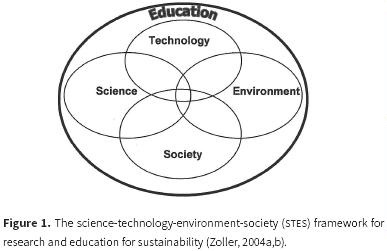
<body><![CDATA[<p align="justify"><font face="verdana" size="2">&nbsp;</font></p>  	    <p align="justify"><font face="verdana" size="2"><b>THE STES RELATED CONCEPTUAL MODEL</b></font></p>  	    <p align="justify"><font face="verdana" size="2">Our conceptual framework is presented in <a href="#f1">Figure 1</a>. The main domains of STES and their (inter&#150;) relationships form the core of the framework into which the related multidimensional educational domain is inserted. Other pertinent domains (not shown for simplicity) are operating within this framework.</font></p>  	    <p align="center"><font face="verdana" size="2"><a name="f1"></a></font></p>  	    <p align="center"><font face="verdana" size="2"><img src="/img/revistas/eq/v24n2/a5f1.jpg"></font></p>  	    <p align="justify"><font face="verdana" size="2"><a href="#f1">Figure 1</a> represents a simplified, qualitative systemic conceptualization of the so far dealt&#150;with,&#150; the interfacing four STES components. It conveys the integration of the environment as a core pillar in the science&#150;technology&#150;society (STS) approach (Yager, 1993) in science education and expanding it into STES&#150;related educational frameworks, which are indispensable in the promotion of sustainability (Zoller, 1993, 1999, 2001; Rob&eacute;rt &amp; Anderson, 2002). Yet, the relative importance of the components in different contexts should, <i>a priori,</i> be considered as differing quantitatively and qualitatively, what is to be expected in sustainability&#150;oriented research and education in the STES context.</font></p>  	    <p align="justify"><font face="verdana" size="2">Given the current striving for sustainability and the consequent paradigms shift, such as from unlimited growth to sustainable development, correction to prevention and from options selections to options generation, the corresponding paradigms shift in science and technology education, such as from algorithmic teaching to HOCS promoting learning, is unavoidable.</font></p>  	    <p align="justify"><font face="verdana" size="2">Such a shift from the traditional locs science teaching to 'HOCS learning', is to be encouraged by science educators, national education policy makers, curriculum developers, teachers, STES/stem <u>educators</u> and the public at large. The above reflects the worldwide ever&#150;increasing social pressure towards more accountable socially, environmentally, economically and politically responsible science, environmental and engineering education, essential for ensuring sustainable development (Zoller, 1993, 1999, 2000a, 2001, 2011b). Furthermore, science/STEM/STES educators, researchers, economists, cognitive psychologists and sociologists consider HOCS (<a href="#f2">Figure 2</a>) to be important domains for students' learning, for ensuring their capability to exercise a responsible citizenry in the context of Literacy for sustainable development (<a href="/img/revistas/eq/v24n2/a5t1.jpg" target="_blank">Table 1</a>) (Zoller &amp; Scholz, 2004).</font></p>  	    <p align="center"><font face="verdana" size="2"><a name="f2"></a></font></p>  	    <p align="center"><font face="verdana" size="2"><img src="/img/revistas/eq/v24n2/a5f2.jpg"></font></p>  	    ]]></body>
<body><![CDATA[<p align="justify"><font face="verdana" size="2">This is of particular importance in the context of the on going "battle cry" for sustainability and, in accord, responsibility of the 21<sup>st</sup> science and chemical education at large in our diverse global community.</font></p>  	    <p align="justify"><font face="verdana" size="2">HOCS are conceptualized as a non&#150;algorithmic complex multi&#150;component conceptual framework of reflective, critical, system and evaluative thinking, focusing on <i>deciding</i> what to believe and do, or not to do, in confronting (with) an issue or a problem to be solved, to be followed by a responsible action, accordingly (Zoller, 1990). Thus, <i>e.g.,</i> the HOCS, critical thinking (CT), question asking (QA), decision making (DM) and problem solving (PS), constitute major components in the HOCS conceptual model (<a href="#f2">Figure 2</a>) (Zoller &amp; Levy Nahum, 2012; Zoller, 2012). This model refers to the interrelated <i><u>generic</u>&#150;</i> non content, but <u>contextually</u> bound cognitive capabilities there contained. Thus, the development of the learners' HOCS is being the leading goal embedded in this conceptual model.</font></p>  	    <p align="justify"><font face="verdana" size="2"><a href="/img/revistas/eq/v24n2/a5t1.jpg" target="_blank">Table 1</a> summarizes the essence of the paradigms shift directions in environmental/STES research and education for sustainability within the framework conceptualized in <a href="#f1">Figure 1</a>.</font></p>  	    <p align="justify"><font face="verdana" size="2">It is based on (a) previous disciplinary and interdisciplinary fundamental, theoretical and applied empirical research (Zoller &amp; Levy Nahum, 2012; Zoller, 2012); (b) developed methodologies relevant to these various forms of research (e.g., Scholz &amp; Tietje, 2002; (c) environmental&#150; and STES&#150;related research in science and chemical education (e.g., Zoller, 1993, 1999, 2001; Zoller &amp; Pushkin, 2007; Zoller, 2012; Leou <i>et al.,</i> 2006); (d) outcomes and conclusions of national and international conferences, symposia and workshops concerning environmental issues, problems, education, and policy (Zoller, 2004a); and (e) the development and implementation of large&#150;scale interdisciplinary, STES&#150;type curriculum projects (see <i>e.g.,</i> Levy Nahum <i>et al.,</i> 2010, Tal <i>et al.,</i> 2001; Zoller &amp; Rochell, 1991b; Zoller &amp; Scholz, 2004).</font></p>  	    <p align="justify"><font face="verdana" size="2">The above identified paradigms shift (<a href="/img/revistas/eq/v24n2/a5t1.jpg" target="_blank">Table 1</a>) reflects the worldwide phenomenon of ever&#150;increasing social pressure towards more accountable, socially&#150; and environmentally&#150;responsible sustainable development. Concomitantly, this pressure constitutes a driving force for, and a consequence of, the paradigms shift in the STES education for sustain&#150;ability context. Understandably, all of the above requires new types of flexible, contextually&#150;bound relevant, adaptive knowledge and, even more so, HOCS capabilities of critical evaluative system thinking, decision making and creative thinking for problem solving &#151; for effectively and responsibly dealing/coping with the complexity and fragility of multi&#150;dimensional economical, technological, environmental social and political systems &#91;STESEP&#93;. This implies the importance of consonant <u>interdisciplinary</u> methodologies, strategies, assessment and sustainable action and, in accord, "HOCS learning" in STES&#150;oriented science and tech&#150;nology/STES/STEM education. In conceptualizing the essence of the current reform in science/technology education, worldwide, as a purposed effort to develop <u>all students' STES</u> literacy, the implementation of appropriate research/evidence&#150;based, HOCS&#150;promoting teaching, assessment and learning strategies is proposed as the educational methodology of choice for effective science and technology teaching and learning, targeting at STES literacy for sustainability (Zoller, 2012).</font></p>  	    <p align="justify"><font face="verdana" size="2">Selected research&#150;based illustrative 'exemplaries' of "how to do it", i.e., promoting/developing of critical thinking, decision making and problem solving (in contrast to 'exercise' solving), in different contexts, at different levels, follow.</font></p>  	    <p align="justify"><font face="verdana" size="2">&nbsp;</font></p>  	    <p align="justify"><font face="verdana" size="2"><b>PURPOSELY TEACHING FOR ADVANCIG STUDENTS' HOCS</b></font></p>  	    <p align="justify"><font face="verdana" size="2"><b>The case of critical thinking</b></font></p>  	    <p align="justify"><font face="verdana" size="2">This longitudinal case study (Barak, Ben&#150;Chaim &amp; Zoller, 2007), aimed at examining whether purposely teaching aimed at the promotion of HOCS, enhances science students' critical thinking (CT), conceptualized by us as &#151; results&#150;oriented rational, logical and reflective evaluative thinking , in terms of what to accept (or reject) and what to believe in, followed by a decision what to do (or not to do); then, to act accordingly and, concurrently, taking responsibility of both &#151; the decisions made and their consequences (Zoller, 1993, 1999). Within a pre&#150;, post&#150;, and post&#150;post experimental design, high school students were divided into three research groups. The experimental group (N = 57) consisted of science students who were exposed to HOCS&#150;promoting teaching. Two other groups, science (N = 41) and non&#150;science majors (N = 79), were traditionally taught, thus constituted the control. By using critical thinking assessment instruments (Facione, 1990; Facione &amp; Facione, 1992), we have found that the experimental group showed a statistically significant improvement on critical thinking skills components and disposition towards CT subscales, such as: truth&#150;seeking, open&#150;mindedness, self&#150;confidence, and maturity, compared to the control groups. Our findings suggest, that if teachers purposely and persistently practice HOCS&#150;promoting teaching' <i>e.g.,</i> dealing in class with real&#150;world problems, encouraging open&#150;ended class discussions, and fostering inquiry&#150;oriented experiments, there is a good chance for a consequent development of CT capabilities.</font></p>  	    ]]></body>
<body><![CDATA[<p align="justify"><font face="verdana" size="2">&nbsp;</font></p>  	    <p align="justify"><font face="verdana" size="2"><b>HOCS&#150;PROMOTING ASSESSMENT</b></font></p>  	    <p align="justify"><font face="verdana" size="2">1. The HOCS Evaluation Questionnaire (heq) (Zoller &amp; Scholz, 2004; Levy Nahum <i>et al.,</i> 2010)</font></p>  	    <p align="justify"><font face="verdana" size="2"><i>Assessing Question Asking:</i></font></p>  	    <blockquote> 		    <p align="justify"><font face="verdana" size="2">1.1&nbsp;Read the following paragraph. Formulate three questions that you would like to, or think, are important to ask concerning the subjects dealt with in the paragraph.</font></p>  		    <p align="justify"><font face="verdana" size="2"><i>"Resources and energy: What are the future options and alternatives?</i></font></p>  		    <p align="justify"><font face="verdana" size="2"><i>Almost every aspect of the Western world is based on the consumption of energy and products derived from thefinite crude oil and natural gas resources. There are sufficient reserves of coal that could lead to the production of enough synthetic fuel and gas for the present time. However, energy alternatives (e.g., solar, wind, tide, and waves) should be developed to satisfy the need for the production of electricity. This would involve the substitution of diminishing resources by available non&#150;finite resources. Nuclear energy is another possibility. Future alternatives concerning resource exploitation and energy supply require an in&#150;depth analysis and intelligent decision ...and the sooner the better."</i></font></p> 	</blockquote>  	    <p align="justify"><font face="verdana" size="2">1.2&nbsp;Assessing decision making:</font></p>  	    <blockquote> 	      ]]></body>
<body><![CDATA[<p align="justify"><font face="verdana" size="2">1.&nbsp;In your estimation, is the subject dealt with in the paragraph relevant to you? Explain your answer.</font></p> 	      <p align="justify"><font face="verdana" size="2">2.&nbsp;Can you, based on the given paragraph (and the information it provides), decide on the desirable alternatives of energy supply in your country? Explain your answer.</font></p> 	      <p align="justify"><font face="verdana" size="2">3.&nbsp;In case you think that you need more information in order to decide intelligently on the desirable alternative, formulate two questions that you would ask for answers before making the decision.</font></p> 	      <p align="justify"><font face="verdana" size="2">4.&nbsp;Formulate two criteria that guides you (or will guide you) in your decision concerning the most desirable alternative.</font></p> 	      <p align="justify"><font face="verdana" size="2">5.&nbsp;Briefly explain the pros and cons of the alternative(s) that you have chosen with regard to future implications. Compare your alternative(s) with any other alternatives that you did not choose.</font></p> 	      <p align="justify"><font face="verdana" size="2">6.&nbsp;In your estimation, are (1) societal and/or (2) values and/or (3) political (distinguished from the scientific&#150;technological&#150;environmental considerations) involved in your decision/choice of the desirable alternative? Relate to 1, 2 &amp; 3 in your answer and <u>explain</u>!</font></p> </blockquote>      <p align="justify"><font face="verdana" size="2">Our main research&#150;based conclusion is related to the promotion/development of question asking (QA) and decision making (DM) HOCS in the STES context is, that both require a longitudinal, persistent HOCS&#150;oriented "STES"&#150;(oriented) teaching education, the latter longer than the former (Leou <i>et al.,</i> 2006; Levi Nahum <i>et al.,</i> 2010).</font></p>  	    <p align="justify"><font face="verdana" size="2">&nbsp;</font></p>  	    <p align="justify"><font face="verdana" size="2">2. College Students' Problem Solving Capability in the Context of Chemistry Teaching</font></p>  	    <p align="justify"><font face="verdana" size="2">This research focused on 'problems' that require HOCS for their solution, <u>in contrast</u> to 'exercises' that require just the application of algorithms and/or lower&#150;order cognitive skills (LOCS), &#91;to end up with only one "correct" answer&#93;. We have studied science majors freshmen's (N = 47) pre&#150;post problem solving capabilities within 'traditional' college chemistry teaching which occasionally integrated environment&#150;related, interdisciplinary <i>problems.</i> Our findings indicated, that although most students felt that it is within their capability to solve HOCS&#150;level questions (problems!), 'traditional' chemistry teaching does not contribute much to the enhancement of their <i>problem solving</i> capability. However, students who performed well on the HOCS&#150;type questions were found to: (a) successfully made connections between chemistry&#150;related concepts and STES&#150;oriented issues; (b) expressed their ideas using multiple representations: textually, qualitatively and quantitatively; (c) presented systemic reasoning, where applicable; and (d) evaluated and presented several alternative resolutions. These findings imply that a LOCS&#150;to&#150;HOCS shift from exercise, &#150;to&#150; problem solving capability, in science chemistry education, would require a shift from algorithmic&#150;to HOCS&#150;promoting teaching and assessment.</font></p>  	    ]]></body>
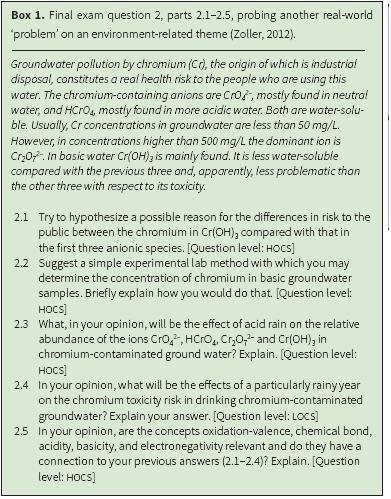
<body><![CDATA[<p align="justify"><font face="verdana" size="2">For an example of a mixed HOCS/locs chemistry exam questions for university freshmen see <a href="#b1">Box 1</a>.</font></p>  	    <p align="center"><font face="verdana" size="2"><a name="b1"></a></font></p>  	    <p align="center"><font face="verdana" size="2"><img src="/img/revistas/eq/v24n2/a5b1.jpg"></font></p>  	    <p align="center"><font face="verdana" size="2">&nbsp;</font></p>  	    <p align="justify"><font face="verdana" size="2"><b>SUMMARY, CONCLUSIONS AND IMPLICATIONS</b></font></p>  	    <p align="justify"><font face="verdana" size="2">'HOCS&#150;learning' targeted at the development and enhancement of STES literacy for sustainability requires, neither the coverage of more advanced, domain&#150;specific material, nor "increasing" students' repertoire of disciplinary&#150;bound algorithms. Rather, education for sustainability should take, among others, the following practice:</font></p>  	    <blockquote> 	      <p align="justify"><font face="verdana" size="2">1.&nbsp;"Translating" the new goals, agreed upon by all parties involved &#150; stakeholders, policy makers and, mainly, STES, Science, Environmental and STEM educators into effective systemic sustainability&#150;oriented educational programs, curricula, courses, teaching, learning and assessment strategies (Zoller, 1993, 1999, 2001, 2004, 2011a, 2011b, 2012; Zoller &amp; Scholz, 2004).</font></p> 	      <p align="justify"><font face="verdana" size="2">2.&nbsp;Ensuring that such system&#150; and sustainability&#150;oriented educational courses and curricula become an integral part of the curricula of formal science, technology and engineering education, which will ensure their recognized (respectable) status, in science and chemical education.</font></p> 	      <p align="justify"><font face="verdana" size="2">3.&nbsp;Developing and implementing HOCS&#150;promoting assessment strategies as alternatives to the currently dominant (LOCS&#150;oriented) assessment practice in traditional, disciplinary science, technology, the environmental education (Zoller, 1993, 1994, 1999, 2012; Zoller &amp; Scholz, 2004).</font></p> </blockquote>      ]]></body>
<body><![CDATA[<p align="justify"><font face="verdana" size="2">The challenge of STES literacy for sustainability will require:</font></p>  	    <blockquote> 	      <p align="justify"><font face="verdana" size="2">1. The restructuring of education at all levels (including teacher professional development programs) towards this new type of <i>learning,</i> for <i>all</i> students, via the implementation of effective research&#150;based HOCS&#150;promoting teaching, assessment and learning strategies (Zoller, 1993, 1999; 2011b; Zoller &amp; Levi Nahum, 2011). 2. The teaching of how to systemically deal with complex, large systems using the case study methodology (e.g., large scale case studies (Scholz &amp; Tietje, 2002), vis&#150;&agrave;&#150;vis ensuring the students' <i>Learning conceptalisation</i> of fundamental trasdisciplinary concepts (Levi Nahum <i>et al.,</i> 2010; Zoller &amp; Levy Nahum, 2012).</font></p> 	      <p align="justify"><font face="verdana" size="2">3.&nbsp;Extending interdisciplinary studies, research and "SITES" teaching, in such a way, so that both students and relevant community "stakeholders" will become capable STES&#150;literate <i>active participants.</i></font></p> 	      <p align="justify"><font face="verdana" size="2">4.&nbsp;Developing and promoting effective, easily accessible communication and interaction among participants of studies in the STES domains. This is necessary for building a new type of culture that enables a collaborative societal process of sustainability assurance, thinking&#150;based learning.</font></p> </blockquote>      <p align="justify"><font face="verdana" size="2">Our accompanying longitudinal research application of this educational practice suggest that, although the road to STES literacy for sustainability is rocky, it is nevertheless, educationally feasible.</font></p>  	    <p align="justify"><font face="verdana" size="2">&nbsp;</font></p>  	    <p align="justify"><font face="verdana" size="2"><b>REFERENCES</b></font></p>  	    <!-- ref --><p align="justify"><font face="verdana" size="2">Barak, M., Ben Chaim, D., &amp; Zoller, U., Purposely Teaching for the promotion of higher&#150;order cognitive skills: A case of critical thinking, <i>Res in Sci Educ.,</i> 2007.    &nbsp;&nbsp;&nbsp;&nbsp;&nbsp;&nbsp;&nbsp;&nbsp;[&#160;<a href="javascript:void(0);" onclick="javascript: window.open('/scielo.php?script=sci_nlinks&ref=3137072&pid=S0187-893X201300020000500001&lng=','','width=640,height=500,resizable=yes,scrollbars=1,menubar=yes,');">Links</a>&#160;]<!-- end-ref --></font></p>  	    ]]></body>
<body><![CDATA[<!-- ref --><p align="justify"><font face="verdana" size="2">Ben&#150;Zvi, O. &amp; Orion, N., Development of system thinking skills in the context of earth system education, <i>Journal of Research Science Teaching,</i> <b>42</b>(5), 518&#150;560, 2005.    &nbsp;&nbsp;&nbsp;&nbsp;&nbsp;&nbsp;&nbsp;&nbsp;[&#160;<a href="javascript:void(0);" onclick="javascript: window.open('/scielo.php?script=sci_nlinks&ref=3137074&pid=S0187-893X201300020000500002&lng=','','width=640,height=500,resizable=yes,scrollbars=1,menubar=yes,');">Links</a>&#160;]<!-- end-ref --></font></p>  	    <!-- ref --><p align="justify"><font face="verdana" size="2">Facione, P. A., <i>The California critical Thinking Skills Test (CCTST) Forms A and</i> B; and the <i>CCTST test manual,</i> CA: California Academic Press, 1990.    &nbsp;&nbsp;&nbsp;&nbsp;&nbsp;&nbsp;&nbsp;&nbsp;[&#160;<a href="javascript:void(0);" onclick="javascript: window.open('/scielo.php?script=sci_nlinks&ref=3137076&pid=S0187-893X201300020000500003&lng=','','width=640,height=500,resizable=yes,scrollbars=1,menubar=yes,');">Links</a>&#160;]<!-- end-ref --></font></p>  	    <!-- ref --><p align="justify"><font face="verdana" size="2">Facione, P. A. &amp; Facione, N. C. <i>The California Critical Thinking Disposition inventory</i> <i>(CCTDI).</i> Millbrae, CA: The California Academic Press, 1992.    &nbsp;&nbsp;&nbsp;&nbsp;&nbsp;&nbsp;&nbsp;&nbsp;[&#160;<a href="javascript:void(0);" onclick="javascript: window.open('/scielo.php?script=sci_nlinks&ref=3137078&pid=S0187-893X201300020000500004&lng=','','width=640,height=500,resizable=yes,scrollbars=1,menubar=yes,');">Links</a>&#160;]<!-- end-ref --></font></p>  	    <!-- ref --><p align="justify"><font face="verdana" size="2">Gibbons, M., Limoges, C., Nowotny, H., Schwartzmann, S., Scott, P. &amp; Trow, M., <i>The new production of knowledge: The dynamics of science and research in contemporary societies.</i> London: Sage, 1994.    &nbsp;&nbsp;&nbsp;&nbsp;&nbsp;&nbsp;&nbsp;&nbsp;[&#160;<a href="javascript:void(0);" onclick="javascript: window.open('/scielo.php?script=sci_nlinks&ref=3137080&pid=S0187-893X201300020000500005&lng=','','width=640,height=500,resizable=yes,scrollbars=1,menubar=yes,');">Links</a>&#160;]<!-- end-ref --></font></p>  	    <!-- ref --><p align="justify"><font face="verdana" size="2">Gibbons, M. &amp; Nowotny, H. J. T. In: J. Thompson Klein, W. Grossenbacher&#150;Mansuy, R. H&atilde;berli, A. Bill, Scholz, R. M., &amp; M. Welti (eds.), <i>Transdisciplinarity: Joint problem solving among science, technology, and society. An effective way for managing complexity,</i> pp. 67&#150;80, Basel: Birkh&atilde;user, 2001.    &nbsp;&nbsp;&nbsp;&nbsp;&nbsp;&nbsp;&nbsp;&nbsp;[&#160;<a href="javascript:void(0);" onclick="javascript: window.open('/scielo.php?script=sci_nlinks&ref=3137082&pid=S0187-893X201300020000500006&lng=','','width=640,height=500,resizable=yes,scrollbars=1,menubar=yes,');">Links</a>&#160;]<!-- end-ref --></font></p>  	    ]]></body>
<body><![CDATA[<!-- ref --><p align="justify"><font face="verdana" size="2">Glaze, W. H., Environmental studies: Staking out the territory, <i>Environmental Science and Technology,</i> <b>36</b>(23), 438A&#150;439A, 2002.    &nbsp;&nbsp;&nbsp;&nbsp;&nbsp;&nbsp;&nbsp;&nbsp;[&#160;<a href="javascript:void(0);" onclick="javascript: window.open('/scielo.php?script=sci_nlinks&ref=3137084&pid=S0187-893X201300020000500007&lng=','','width=640,height=500,resizable=yes,scrollbars=1,menubar=yes,');">Links</a>&#160;]<!-- end-ref --></font></p>  	    <!-- ref --><p align="justify"><font face="verdana" size="2">Kamen, M. Editorial: Do we need more science education research?, <i>Electronic Journal of Science Education,</i> <b>15,</b> 2, 2011.    &nbsp;&nbsp;&nbsp;&nbsp;&nbsp;&nbsp;&nbsp;&nbsp;[&#160;<a href="javascript:void(0);" onclick="javascript: window.open('/scielo.php?script=sci_nlinks&ref=3137086&pid=S0187-893X201300020000500008&lng=','','width=640,height=500,resizable=yes,scrollbars=1,menubar=yes,');">Links</a>&#160;]<!-- end-ref --></font></p>  	    <!-- ref --><p align="justify"><font face="verdana" size="2">Kurtam, N., Doctoral Thesis, The University of Haifa, Haifa, Israel, 2013.    &nbsp;&nbsp;&nbsp;&nbsp;&nbsp;&nbsp;&nbsp;&nbsp;[&#160;<a href="javascript:void(0);" onclick="javascript: window.open('/scielo.php?script=sci_nlinks&ref=3137088&pid=S0187-893X201300020000500009&lng=','','width=640,height=500,resizable=yes,scrollbars=1,menubar=yes,');">Links</a>&#160;]<!-- end-ref --></font></p>  	    <!-- ref --><p align="justify"><font face="verdana" size="2">Laws, D., Scholz, R., Shiroyama, H., Susskind, L., Suzuki, T. &amp; Weber O., Expert Views on Sustainability and Technology Implementation, <i>International Journal of Sustainable Development in World Ecology,</i> <b>11</b>(3), 247&#150;261, 2004.    &nbsp;&nbsp;&nbsp;&nbsp;&nbsp;&nbsp;&nbsp;&nbsp;[&#160;<a href="javascript:void(0);" onclick="javascript: window.open('/scielo.php?script=sci_nlinks&ref=3137090&pid=S0187-893X201300020000500010&lng=','','width=640,height=500,resizable=yes,scrollbars=1,menubar=yes,');">Links</a>&#160;]<!-- end-ref --></font></p>  	    <!-- ref --><p align="justify"><font face="verdana" size="2">Levy Nahum, T., Azaiza, I., Kortam, N., Ben&#150;Chaim, D., Hers&#150;covitz, O. &amp; Zoller, U., "Does STES&#150;Oriented Science Education Promote 10th&#150;Grade Students' Decision Capability?", <i>International Journal of Science Education,</i> <b>32</b>(10), 1315&#150;1336, 2010.    &nbsp;&nbsp;&nbsp;&nbsp;&nbsp;&nbsp;&nbsp;&nbsp;[&#160;<a href="javascript:void(0);" onclick="javascript: window.open('/scielo.php?script=sci_nlinks&ref=3137092&pid=S0187-893X201300020000500011&lng=','','width=640,height=500,resizable=yes,scrollbars=1,menubar=yes,');">Links</a>&#160;]<!-- end-ref --></font></p>  	    ]]></body>
<body><![CDATA[<!-- ref --><p align="justify"><font face="verdana" size="2">Leou, M., Abder, P., Riordan, M. &amp; Zoller, U., Using 'HOCS Learning' as a pathway to promote science teachers' metacognitive development, <i>Research in Science Education,</i> <b>36</b>(1&#150;2), 69&#150;84, 2006.    &nbsp;&nbsp;&nbsp;&nbsp;&nbsp;&nbsp;&nbsp;&nbsp;[&#160;<a href="javascript:void(0);" onclick="javascript: window.open('/scielo.php?script=sci_nlinks&ref=3137094&pid=S0187-893X201300020000500012&lng=','','width=640,height=500,resizable=yes,scrollbars=1,menubar=yes,');">Links</a>&#160;]<!-- end-ref --></font></p>  	    <!-- ref --><p align="justify"><font face="verdana" size="2">Marshall, J. D. &amp; Toffel, M. W., Framing the elusive concept of sustainability: A sustainability hierarchy, <i>Environmental Science and Technology,</i> <b>39</b>(3), 673&#150;682, 2005.    &nbsp;&nbsp;&nbsp;&nbsp;&nbsp;&nbsp;&nbsp;&nbsp;[&#160;<a href="javascript:void(0);" onclick="javascript: window.open('/scielo.php?script=sci_nlinks&ref=3137096&pid=S0187-893X201300020000500013&lng=','','width=640,height=500,resizable=yes,scrollbars=1,menubar=yes,');">Links</a>&#160;]<!-- end-ref --></font></p>  	    <!-- ref --><p align="justify"><font face="verdana" size="2">Mihelcic, J. R., Crittenden, J. C., Small, M. J., Shonnard, D. R., Hokanson, D. R., Zhang, Q., Chen, H., Sorby, S. A., James, V. V., Sutherland, J. W. &amp; Schnoor, J. L., Sustainability science and engineering: The emergence of a new metadiscipline, <i>Environmental Science and Technology,</i> <b>37,</b> 5314-5324, 2003.    &nbsp;&nbsp;&nbsp;&nbsp;&nbsp;&nbsp;&nbsp;&nbsp;[&#160;<a href="javascript:void(0);" onclick="javascript: window.open('/scielo.php?script=sci_nlinks&ref=3137098&pid=S0187-893X201300020000500014&lng=','','width=640,height=500,resizable=yes,scrollbars=1,menubar=yes,');">Links</a>&#160;]<!-- end-ref --></font></p>  	    <!-- ref --><p align="justify"><font face="verdana" size="2">Negroponte, N., Creating a culture of ideas, <i>Tech. Rev.,</i> <b>106</b>(1), 33&#150;35, 2003.    &nbsp;&nbsp;&nbsp;&nbsp;&nbsp;&nbsp;&nbsp;&nbsp;[&#160;<a href="javascript:void(0);" onclick="javascript: window.open('/scielo.php?script=sci_nlinks&ref=3137100&pid=S0187-893X201300020000500015&lng=','','width=640,height=500,resizable=yes,scrollbars=1,menubar=yes,');">Links</a>&#160;]<!-- end-ref --></font></p>  	    <!-- ref --><p align="justify"><font face="verdana" size="2">Qablan, A., Southerland, S. A., Saka, Y., "My Job isn't to tell them what to think": The fear of Indoctrination and how it shapes Education for sustainable development, <i>EJSE,</i><b>15,</b> 2, 2011.    &nbsp;&nbsp;&nbsp;&nbsp;&nbsp;&nbsp;&nbsp;&nbsp;[&#160;<a href="javascript:void(0);" onclick="javascript: window.open('/scielo.php?script=sci_nlinks&ref=3137102&pid=S0187-893X201300020000500016&lng=','','width=640,height=500,resizable=yes,scrollbars=1,menubar=yes,');">Links</a>&#160;]<!-- end-ref --></font></p>  	    ]]></body>
<body><![CDATA[<!-- ref --><p align="justify"><font face="verdana" size="2">Rob&eacute;rt, K.&#150;H. &amp; Anderson, R., <i>The Natural Step Story: Seeding a Quiet Revolution.</i> Philadelphia, PA: New Society Pub., 2002.    &nbsp;&nbsp;&nbsp;&nbsp;&nbsp;&nbsp;&nbsp;&nbsp;[&#160;<a href="javascript:void(0);" onclick="javascript: window.open('/scielo.php?script=sci_nlinks&ref=3137104&pid=S0187-893X201300020000500017&lng=','','width=640,height=500,resizable=yes,scrollbars=1,menubar=yes,');">Links</a>&#160;]<!-- end-ref --></font></p>  	    <!-- ref --><p align="justify"><font face="verdana" size="2">Schnoor, J. L. An environmental challenge, <i>Environmental Science and Technology,</i> <b>37</b>(7), 119A, 2003.    &nbsp;&nbsp;&nbsp;&nbsp;&nbsp;&nbsp;&nbsp;&nbsp;[&#160;<a href="javascript:void(0);" onclick="javascript: window.open('/scielo.php?script=sci_nlinks&ref=3137106&pid=S0187-893X201300020000500018&lng=','','width=640,height=500,resizable=yes,scrollbars=1,menubar=yes,');">Links</a>&#160;]<!-- end-ref --></font></p>  	    <!-- ref --><p align="justify"><font face="verdana" size="2">Scholz, R. M. In: Scholz, R. M., R. H&atilde;berli, A. Bill, &amp; M. Welti (eds.), Transdisciplinarity: Joint Problem Solving among Science, Technology, and Society. <i>Workbook II: Mutual Learning Sessions,</i> Zurich: Haffmans Sachbuch, 2000.    &nbsp;&nbsp;&nbsp;&nbsp;&nbsp;&nbsp;&nbsp;&nbsp;[&#160;<a href="javascript:void(0);" onclick="javascript: window.open('/scielo.php?script=sci_nlinks&ref=3137108&pid=S0187-893X201300020000500019&lng=','','width=640,height=500,resizable=yes,scrollbars=1,menubar=yes,');">Links</a>&#160;]<!-- end-ref --></font></p>  	    <!-- ref --><p align="justify"><font face="verdana" size="2">Scholz, R. M. &amp; Tietje, O. <i>Embedded case study methods: Integrating quantitative and qualitative knowledge.</i> Thousand Oaks: Sage, 2002.    &nbsp;&nbsp;&nbsp;&nbsp;&nbsp;&nbsp;&nbsp;&nbsp;[&#160;<a href="javascript:void(0);" onclick="javascript: window.open('/scielo.php?script=sci_nlinks&ref=3137110&pid=S0187-893X201300020000500020&lng=','','width=640,height=500,resizable=yes,scrollbars=1,menubar=yes,');">Links</a>&#160;]<!-- end-ref --></font></p>  	    <!-- ref --><p align="justify"><font face="verdana" size="2">Tal, T., Dori, Y. J., Keiny, S., &amp; Zoller, U., Assessing conceptual change of teachers involved in STES education and curriculum development, The STEMS Project approach, <i>International Journal of Science Education,</i> <b>23</b>(3), 247&#150;262, 2001.    &nbsp;&nbsp;&nbsp;&nbsp;&nbsp;&nbsp;&nbsp;&nbsp;[&#160;<a href="javascript:void(0);" onclick="javascript: window.open('/scielo.php?script=sci_nlinks&ref=3137112&pid=S0187-893X201300020000500021&lng=','','width=640,height=500,resizable=yes,scrollbars=1,menubar=yes,');">Links</a>&#160;]<!-- end-ref --></font></p>  	    ]]></body>
<body><![CDATA[<!-- ref --><p align="justify"><font face="verdana" size="2">Thompson Klein, J., Grossenbacher&#150;Mansuy, W., H&atilde;berli, R., Bill, A., Scholz, R. M. &amp; Welti, M. (eds.), Transdisciplinarity: <i>Joint problem solving among science, technology, and society. An effective way for managing complexity.</i> Basel: Birkh&atilde;user, 2001.    &nbsp;&nbsp;&nbsp;&nbsp;&nbsp;&nbsp;&nbsp;&nbsp;[&#160;<a href="javascript:void(0);" onclick="javascript: window.open('/scielo.php?script=sci_nlinks&ref=3137114&pid=S0187-893X201300020000500022&lng=','','width=640,height=500,resizable=yes,scrollbars=1,menubar=yes,');">Links</a>&#160;]<!-- end-ref --></font></p>  	    <!-- ref --><p align="justify"><font face="verdana" size="2">Yager, R. E. (ed.) <i>The Science, Technology, Society Movement.</i> Washington: National Science Teacher Association, 1993.    &nbsp;&nbsp;&nbsp;&nbsp;&nbsp;&nbsp;&nbsp;&nbsp;[&#160;<a href="javascript:void(0);" onclick="javascript: window.open('/scielo.php?script=sci_nlinks&ref=3137116&pid=S0187-893X201300020000500023&lng=','','width=640,height=500,resizable=yes,scrollbars=1,menubar=yes,');">Links</a>&#160;]<!-- end-ref --></font></p>  	    <!-- ref --><p align="justify"><font face="verdana" size="2">Zoller, U., "Environmental Education and the University: The 'Problem Solving&#150;Decision Making Act' Within a Critical System&#150;Thinking Framework", <i>Higher Education in Europe,</i> <b>15</b>(4), 5&#150;14, 1990.    &nbsp;&nbsp;&nbsp;&nbsp;&nbsp;&nbsp;&nbsp;&nbsp;[&#160;<a href="javascript:void(0);" onclick="javascript: window.open('/scielo.php?script=sci_nlinks&ref=3137118&pid=S0187-893X201300020000500024&lng=','','width=640,height=500,resizable=yes,scrollbars=1,menubar=yes,');">Links</a>&#160;]<!-- end-ref --></font></p>  	    <!-- ref --><p align="justify"><font face="verdana" size="2">Zoller, U., Donn, S., Wild, R. and Beckett, P., "Students' Versus Their Teachers' Beliefs and Positions on Science/Teaching/Society (S/T/S)&#150; Oriented Issues", <i>International Journal of Science Education,</i> <b>13</b>(1), 25&#150;36, 1991a.    &nbsp;&nbsp;&nbsp;&nbsp;&nbsp;&nbsp;&nbsp;&nbsp;[&#160;<a href="javascript:void(0);" onclick="javascript: window.open('/scielo.php?script=sci_nlinks&ref=3137120&pid=S0187-893X201300020000500025&lng=','','width=640,height=500,resizable=yes,scrollbars=1,menubar=yes,');">Links</a>&#160;]<!-- end-ref --></font></p>  	    <!-- ref --><p align="justify"><font face="verdana" size="2">Zoller, U. and Rochell, Y. "Man and The Sea" &#150; An STS Conceptually&#150;Based Comprehensive Curriculum Model for 8th&#150;12th Grade Non&#150;Science Majors", <i>Bulletin of Science, Technology &amp; Society,</i> <b>11</b>(2), 233&#150;238, 1991b.    &nbsp;&nbsp;&nbsp;&nbsp;&nbsp;&nbsp;&nbsp;&nbsp;[&#160;<a href="javascript:void(0);" onclick="javascript: window.open('/scielo.php?script=sci_nlinks&ref=3137122&pid=S0187-893X201300020000500026&lng=','','width=640,height=500,resizable=yes,scrollbars=1,menubar=yes,');">Links</a>&#160;]<!-- end-ref --></font></p>  	    ]]></body>
<body><![CDATA[<!-- ref --><p align="justify"><font face="verdana" size="2">Zoller, U., Lecture and learning: Are they compatible? Maybe for LOCS; unlikely for HOCS, <i>Journal of Chemical Education,</i> <b>70</b>(3), 195&#150;197, 1993.    &nbsp;&nbsp;&nbsp;&nbsp;&nbsp;&nbsp;&nbsp;&nbsp;[&#160;<a href="javascript:void(0);" onclick="javascript: window.open('/scielo.php?script=sci_nlinks&ref=3137124&pid=S0187-893X201300020000500027&lng=','','width=640,height=500,resizable=yes,scrollbars=1,menubar=yes,');">Links</a>&#160;]<!-- end-ref --></font></p>  	    <!-- ref --><p align="justify"><font face="verdana" size="2">Zoller, U., The Examination Where the Student Asks the Questions, <i>School Science and Mathematics,</i> <b>94</b>(7), 347-349, 1994.    &nbsp;&nbsp;&nbsp;&nbsp;&nbsp;&nbsp;&nbsp;&nbsp;[&#160;<a href="javascript:void(0);" onclick="javascript: window.open('/scielo.php?script=sci_nlinks&ref=3137126&pid=S0187-893X201300020000500028&lng=','','width=640,height=500,resizable=yes,scrollbars=1,menubar=yes,');">Links</a>&#160;]<!-- end-ref --></font></p>  	    <!-- ref --><p align="justify"><font face="verdana" size="2">Zoller, U., Teaching tomorrow's college science courses &#150; Are we getting it right?, <i>Journal of College Science Teach</i>ing, <b>29</b>(6), 490&#150;414, 1999.    &nbsp;&nbsp;&nbsp;&nbsp;&nbsp;&nbsp;&nbsp;&nbsp;[&#160;<a href="javascript:void(0);" onclick="javascript: window.open('/scielo.php?script=sci_nlinks&ref=3137128&pid=S0187-893X201300020000500029&lng=','','width=640,height=500,resizable=yes,scrollbars=1,menubar=yes,');">Links</a>&#160;]<!-- end-ref --></font></p>  	    <!-- ref --><p align="justify"><font face="verdana" size="2">Zoller, U., Interdisciplinary Systemic HOCS Development &#150;The Key for Meaningful STES Oriented Chemical Education, <i>Chemistry Education: Research and Practice in Europe,</i> <b>1</b>(2), 189&#150;200, 2000a.    &nbsp;&nbsp;&nbsp;&nbsp;&nbsp;&nbsp;&nbsp;&nbsp;[&#160;<a href="javascript:void(0);" onclick="javascript: window.open('/scielo.php?script=sci_nlinks&ref=3137130&pid=S0187-893X201300020000500030&lng=','','width=640,height=500,resizable=yes,scrollbars=1,menubar=yes,');">Links</a>&#160;]<!-- end-ref --></font></p>  	    <!-- ref --><p align="justify"><font face="verdana" size="2">Zoller, U., Innovative STES Teaching Towards Scientific and Technological Literacy for All in the New Millenium, <i>Proceedings of the 3rd Inter. Org. for Science and Technology Education</i> <i>(IOSTE)</i> <i>Symposium for Central &amp; East European Countries,</i> pp. 14&#150;20. Prague, Czeck Republic, June. Press Publishers, 2000b.    &nbsp;&nbsp;&nbsp;&nbsp;&nbsp;&nbsp;&nbsp;&nbsp;[&#160;<a href="javascript:void(0);" onclick="javascript: window.open('/scielo.php?script=sci_nlinks&ref=3137132&pid=S0187-893X201300020000500031&lng=','','width=640,height=500,resizable=yes,scrollbars=1,menubar=yes,');">Links</a>&#160;]<!-- end-ref --></font></p>  	    ]]></body>
<body><![CDATA[<!-- ref --><p align="justify"><font face="verdana" size="2">Zoller, U., The challenge for environmental chemistry educators, <i>Environmental Science and Pollution Research,</i> <b>8</b>(1), 1&#150;4, 2001.    &nbsp;&nbsp;&nbsp;&nbsp;&nbsp;&nbsp;&nbsp;&nbsp;[&#160;<a href="javascript:void(0);" onclick="javascript: window.open('/scielo.php?script=sci_nlinks&ref=3137134&pid=S0187-893X201300020000500032&lng=','','width=640,height=500,resizable=yes,scrollbars=1,menubar=yes,');">Links</a>&#160;]<!-- end-ref --></font></p>  	    <!-- ref --><p align="justify"><font face="verdana" size="2">Zoller, U., Dori, Y. and Lubezky, A., Algorithmic, LOCS and HOCS (Chemistry) Exam Questions: Performance and Attitudes of College Students, <i>International Journal of Science Education,</i> <b>24</b>(2), 185&#150;203, 2002.    &nbsp;&nbsp;&nbsp;&nbsp;&nbsp;&nbsp;&nbsp;&nbsp;[&#160;<a href="javascript:void(0);" onclick="javascript: window.open('/scielo.php?script=sci_nlinks&ref=3137136&pid=S0187-893X201300020000500033&lng=','','width=640,height=500,resizable=yes,scrollbars=1,menubar=yes,');">Links</a>&#160;]<!-- end-ref --></font></p>  	    <!-- ref --><p align="justify"><font face="verdana" size="2">Zoller, U., Chemistry and Environmental Education, <i>Chemistry Education: Research and Practice,</i> <b>5</b>(2), 95&#150;97, 2004a (<a href="http://www.uoi.gr/cerp" target="_blank">http://www.uoi.gr/cerp</a>).    &nbsp;&nbsp;&nbsp;&nbsp;&nbsp;&nbsp;&nbsp;&nbsp;[&#160;<a href="javascript:void(0);" onclick="javascript: window.open('/scielo.php?script=sci_nlinks&ref=3137138&pid=S0187-893X201300020000500034&lng=','','width=640,height=500,resizable=yes,scrollbars=1,menubar=yes,');">Links</a>&#160;]<!-- end-ref --></font></p>  	    <!-- ref --><p align="justify"><font face="verdana" size="2">Zoller, U., Chemistry/Science Literacy for Sustainability. What Should It Take? In: Glazar, S. A. &amp; Krnel, D. (eds.), Teaching, Learning and Assessment Strategies, <i>Proceedings of 7th ECRICE,</i> Ljubljana, Slovenia, August 24&#150;28, University of Lubljana, Faculty of Education, pp. 30&#150;36, 2004b.    &nbsp;&nbsp;&nbsp;&nbsp;&nbsp;&nbsp;&nbsp;&nbsp;[&#160;<a href="javascript:void(0);" onclick="javascript: window.open('/scielo.php?script=sci_nlinks&ref=3137140&pid=S0187-893X201300020000500035&lng=','','width=640,height=500,resizable=yes,scrollbars=1,menubar=yes,');">Links</a>&#160;]<!-- end-ref --></font></p>  	    <!-- ref --><p align="justify"><font face="verdana" size="2">Zoller, U., Education in environmental chemistry: Setting the agenda and recommending action. A workshop report summary,    &nbsp;&nbsp;&nbsp;&nbsp;&nbsp;&nbsp;&nbsp;&nbsp;[&#160;<a href="javascript:void(0);" onclick="javascript: window.open('/scielo.php?script=sci_nlinks&ref=3137142&pid=S0187-893X201300020000500036&lng=','','width=640,height=500,resizable=yes,scrollbars=1,menubar=yes,');">Links</a>&#160;]<!-- end-ref --><!-- ref --> <i>Journal of Chemical Education,</i> <b>82</b>(8), 1237-1240, 2005.    &nbsp;&nbsp;&nbsp;&nbsp;&nbsp;&nbsp;&nbsp;&nbsp;[&#160;<a href="javascript:void(0);" onclick="javascript: window.open('/scielo.php?script=sci_nlinks&ref=3137143&pid=S0187-893X201300020000500037&lng=','','width=640,height=500,resizable=yes,scrollbars=1,menubar=yes,');">Links</a>&#160;]<!-- end-ref --></font></p>  	    <!-- ref --><p align="justify"><font face="verdana" size="2">Zoller, U., Science and Technology Education in the STES Context in Primary Schools: What Should it Take?, <i>Journal of Science Education and Technology,</i> <b>20</b>(5), 444&#150;453, 2011a.    &nbsp;&nbsp;&nbsp;&nbsp;&nbsp;&nbsp;&nbsp;&nbsp;[&#160;<a href="javascript:void(0);" onclick="javascript: window.open('/scielo.php?script=sci_nlinks&ref=3137145&pid=S0187-893X201300020000500038&lng=','','width=640,height=500,resizable=yes,scrollbars=1,menubar=yes,');">Links</a>&#160;]<!-- end-ref --></font></p>  	    <!-- ref --><p align="justify"><font face="verdana" size="2">Zoller, U., From Teaching to 'Know' &#150; to Learning to 'Think' for Sustainability: What Should it Take? ...and How to Do it?, <i>Journal of Modern Education Review,</i> <b>1</b>(1), 34&#150;40, 2011b.    &nbsp;&nbsp;&nbsp;&nbsp;&nbsp;&nbsp;&nbsp;&nbsp;[&#160;<a href="javascript:void(0);" onclick="javascript: window.open('/scielo.php?script=sci_nlinks&ref=3137147&pid=S0187-893X201300020000500039&lng=','','width=640,height=500,resizable=yes,scrollbars=1,menubar=yes,');">Links</a>&#160;]<!-- end-ref --></font></p>  	    <!-- ref --><p align="justify"><font face="verdana" size="2">Zoller, U., Science Education for Global Sustainability: What is necessary for Teaching, Learning and Assessment Strategies?, <i>Journal of Chemical Education,</i> <b>89,</b> 297&#150;300, 2012.    &nbsp;&nbsp;&nbsp;&nbsp;&nbsp;&nbsp;&nbsp;&nbsp;[&#160;<a href="javascript:void(0);" onclick="javascript: window.open('/scielo.php?script=sci_nlinks&ref=3137149&pid=S0187-893X201300020000500040&lng=','','width=640,height=500,resizable=yes,scrollbars=1,menubar=yes,');">Links</a>&#160;]<!-- end-ref --></font></p>  	    <!-- ref --><p align="justify"><font face="verdana" size="2">Zoller, U., &amp; Levy Nahum, T., From Teaching to 'Know'&#150;to Learning to 'Think' in Science Education. In: Fraser, B., Tobin, K., McRobbie, C. (eds.), <i>2nd International Handbook of Science Education,</i> 2nd Ed., <b>1</b>(16), 209&#150;330. Springer International Handbooks of Education, 2012.    &nbsp;&nbsp;&nbsp;&nbsp;&nbsp;&nbsp;&nbsp;&nbsp;[&#160;<a href="javascript:void(0);" onclick="javascript: window.open('/scielo.php?script=sci_nlinks&ref=3137151&pid=S0187-893X201300020000500041&lng=','','width=640,height=500,resizable=yes,scrollbars=1,menubar=yes,');">Links</a>&#160;]<!-- end-ref --></font></p>  	    <!-- ref --><p align="justify"><font face="verdana" size="2">Zoller, U. &amp; Pushkin, D., Matching Higher&#150;Order Cognitive Skills (HOCS)&#150;Promoting Goal with Problem&#150;Based Laboratory Practice in Freshman Organic Chemisry Course, <i>Chemical Education Research and Practice,</i> <b>8</b> (2), 153&#150;171, 2007.    &nbsp;&nbsp;&nbsp;&nbsp;&nbsp;&nbsp;&nbsp;&nbsp;[&#160;<a href="javascript:void(0);" onclick="javascript: window.open('/scielo.php?script=sci_nlinks&ref=3137153&pid=S0187-893X201300020000500042&lng=','','width=640,height=500,resizable=yes,scrollbars=1,menubar=yes,');">Links</a>&#160;]<!-- end-ref --></font></p>  	    <!-- ref --><p align="justify"><font face="verdana" size="2">Zoller, U. &amp; Scholz, R.M. The HOCS paradigm shift from disciplinary knowledge (LOCSs) to Interdisciplinary evaluative, system thinking (HOCS): What should it take in science&#150;technology&#150;environment&#150;society&#150;orientedcourses, curricula and assessment?, <i>Water Science and Technology,</i> <b>49</b>(8), 27&#150;36, 2004.    &nbsp;&nbsp;&nbsp;&nbsp;&nbsp;&nbsp;&nbsp;&nbsp;[&#160;<a href="javascript:void(0);" onclick="javascript: window.open('/scielo.php?script=sci_nlinks&ref=3137155&pid=S0187-893X201300020000500043&lng=','','width=640,height=500,resizable=yes,scrollbars=1,menubar=yes,');">Links</a>&#160;]<!-- end-ref --></font></p>  	    <!-- ref --><p align="justify"><font face="verdana" size="2">Zoller, U., &amp; Tsaparlis, G., Higher&#150;Order Cognitive Skills and Lower&#150;Order Cognitive Skills: The Case of Chemistry, <i>Research in Science Education,</i> <b>27</b>(1), 117&#150;130, 1997.    &nbsp;&nbsp;&nbsp;&nbsp;&nbsp;&nbsp;&nbsp;&nbsp;[&#160;<a href="javascript:void(0);" onclick="javascript: window.open('/scielo.php?script=sci_nlinks&ref=3137157&pid=S0187-893X201300020000500044&lng=','','width=640,height=500,resizable=yes,scrollbars=1,menubar=yes,');">Links</a>&#160;]<!-- end-ref --></font></p>      ]]></body><back>
<ref-list>
<ref id="B1">
<nlm-citation citation-type="journal">
<person-group person-group-type="author">
<name>
<surname><![CDATA[Barak]]></surname>
<given-names><![CDATA[M.]]></given-names>
</name>
<name>
<surname><![CDATA[Ben Chaim]]></surname>
<given-names><![CDATA[D.]]></given-names>
</name>
<name>
<surname><![CDATA[Zoller]]></surname>
<given-names><![CDATA[U.]]></given-names>
</name>
</person-group>
<article-title xml:lang="en"><![CDATA[Purposely Teaching for the promotion of higher-order cognitive skills: A case of critical thinking]]></article-title>
<source><![CDATA[Res in Sci Educ.]]></source>
<year>2007</year>
</nlm-citation>
</ref>
<ref id="B2">
<nlm-citation citation-type="journal">
<person-group person-group-type="author">
<name>
<surname><![CDATA[Ben-Zvi]]></surname>
<given-names><![CDATA[O.]]></given-names>
</name>
<name>
<surname><![CDATA[Orion]]></surname>
<given-names><![CDATA[N.]]></given-names>
</name>
</person-group>
<article-title xml:lang="en"><![CDATA[Development of system thinking skills in the context of earth system education]]></article-title>
<source><![CDATA[Journal of Research Science Teaching]]></source>
<year>2005</year>
<volume>42</volume>
<numero>5</numero>
<issue>5</issue>
<page-range>518-560</page-range></nlm-citation>
</ref>
<ref id="B3">
<nlm-citation citation-type="book">
<person-group person-group-type="author">
<name>
<surname><![CDATA[Facione]]></surname>
<given-names><![CDATA[P. A.]]></given-names>
</name>
</person-group>
<source><![CDATA[The California critical Thinking Skills Test (CCTST) Forms A and B; and the CCTST test manual]]></source>
<year>1990</year>
<publisher-loc><![CDATA[^eCA CA]]></publisher-loc>
<publisher-name><![CDATA[California Academic Press]]></publisher-name>
</nlm-citation>
</ref>
<ref id="B4">
<nlm-citation citation-type="book">
<person-group person-group-type="author">
<name>
<surname><![CDATA[Facione]]></surname>
<given-names><![CDATA[P. A.]]></given-names>
</name>
<name>
<surname><![CDATA[Facione]]></surname>
<given-names><![CDATA[N. C.]]></given-names>
</name>
</person-group>
<source><![CDATA[The California Critical Thinking Disposition inventory (CCTDI)]]></source>
<year>1992</year>
<publisher-loc><![CDATA[Millbrae^eCA CA]]></publisher-loc>
<publisher-name><![CDATA[The California Academic Press]]></publisher-name>
</nlm-citation>
</ref>
<ref id="B5">
<nlm-citation citation-type="book">
<person-group person-group-type="author">
<name>
<surname><![CDATA[Gibbons]]></surname>
<given-names><![CDATA[M.]]></given-names>
</name>
<name>
<surname><![CDATA[Limoges]]></surname>
<given-names><![CDATA[C.]]></given-names>
</name>
<name>
<surname><![CDATA[Nowotny]]></surname>
<given-names><![CDATA[H.]]></given-names>
</name>
<name>
<surname><![CDATA[Schwartzmann]]></surname>
<given-names><![CDATA[S.]]></given-names>
</name>
<name>
<surname><![CDATA[Scott]]></surname>
<given-names><![CDATA[P.]]></given-names>
</name>
<name>
<surname><![CDATA[Trow]]></surname>
<given-names><![CDATA[M.]]></given-names>
</name>
</person-group>
<source><![CDATA[The new production of knowledge: The dynamics of science and research in contemporary societies]]></source>
<year>1994</year>
<publisher-loc><![CDATA[London ]]></publisher-loc>
<publisher-name><![CDATA[Sage]]></publisher-name>
</nlm-citation>
</ref>
<ref id="B6">
<nlm-citation citation-type="book">
<person-group person-group-type="author">
<name>
<surname><![CDATA[Gibbons]]></surname>
<given-names><![CDATA[M.]]></given-names>
</name>
<name>
<surname><![CDATA[Nowotny]]></surname>
<given-names><![CDATA[H. J. T.]]></given-names>
</name>
</person-group>
<person-group person-group-type="editor">
<name>
<surname><![CDATA[Thompson Klein]]></surname>
<given-names><![CDATA[J.]]></given-names>
</name>
<name>
<surname><![CDATA[Grossenbacher-Mansuy]]></surname>
<given-names><![CDATA[W.]]></given-names>
</name>
<name>
<surname><![CDATA[Hãberli]]></surname>
<given-names><![CDATA[R.]]></given-names>
</name>
<name>
<surname><![CDATA[Bill]]></surname>
<given-names><![CDATA[A.]]></given-names>
</name>
<name>
<surname><![CDATA[Scholz]]></surname>
<given-names><![CDATA[R. M.]]></given-names>
</name>
<name>
<surname><![CDATA[Welti]]></surname>
<given-names><![CDATA[M.]]></given-names>
</name>
</person-group>
<source><![CDATA[Transdisciplinarity: Joint problem solving among science, technology, and society. An effective way for managing complexity]]></source>
<year>2001</year>
<page-range>67-80</page-range><publisher-name><![CDATA[Basel: Birkhãuser]]></publisher-name>
</nlm-citation>
</ref>
<ref id="B7">
<nlm-citation citation-type="journal">
<person-group person-group-type="author">
<name>
<surname><![CDATA[Glaze]]></surname>
<given-names><![CDATA[W. H.]]></given-names>
</name>
</person-group>
<article-title xml:lang="en"><![CDATA[Environmental studies: Staking out the territory]]></article-title>
<source><![CDATA[Environmental Science and Technology]]></source>
<year>2002</year>
<volume>36</volume>
<numero>23</numero>
<issue>23</issue>
<page-range>438A-439A</page-range></nlm-citation>
</ref>
<ref id="B8">
<nlm-citation citation-type="journal">
<person-group person-group-type="author">
<name>
<surname><![CDATA[Kamen]]></surname>
<given-names><![CDATA[M.]]></given-names>
</name>
</person-group>
<article-title xml:lang="en"><![CDATA[Editorial: Do we need more science education research?]]></article-title>
<source><![CDATA[Electronic Journal of Science Education]]></source>
<year>2011</year>
<volume>15</volume>
<numero>2</numero>
<issue>2</issue>
</nlm-citation>
</ref>
<ref id="B9">
<nlm-citation citation-type="">
<person-group person-group-type="author">
<name>
<surname><![CDATA[Kurtam]]></surname>
<given-names><![CDATA[N.]]></given-names>
</name>
</person-group>
<source><![CDATA[]]></source>
<year></year>
</nlm-citation>
</ref>
<ref id="B10">
<nlm-citation citation-type="journal">
<person-group person-group-type="author">
<name>
<surname><![CDATA[Laws]]></surname>
<given-names><![CDATA[D.]]></given-names>
</name>
<name>
<surname><![CDATA[Scholz]]></surname>
<given-names><![CDATA[R.]]></given-names>
</name>
<name>
<surname><![CDATA[Shiroyama]]></surname>
<given-names><![CDATA[H.]]></given-names>
</name>
<name>
<surname><![CDATA[Susskind]]></surname>
<given-names><![CDATA[L.]]></given-names>
</name>
<name>
<surname><![CDATA[Suzuki]]></surname>
<given-names><![CDATA[T.]]></given-names>
</name>
<name>
<surname><![CDATA[Weber]]></surname>
<given-names><![CDATA[O.]]></given-names>
</name>
</person-group>
<article-title xml:lang="en"><![CDATA[Expert Views on Sustainability and Technology Implementation]]></article-title>
<source><![CDATA[International Journal of Sustainable Development in World Ecology]]></source>
<year>2004</year>
<volume>11</volume>
<numero>3</numero>
<issue>3</issue>
<page-range>247-261</page-range></nlm-citation>
</ref>
<ref id="B11">
<nlm-citation citation-type="journal">
<person-group person-group-type="author">
<name>
<surname><![CDATA[Levy Nahum]]></surname>
<given-names><![CDATA[T.]]></given-names>
</name>
<name>
<surname><![CDATA[Azaiza]]></surname>
<given-names><![CDATA[I.]]></given-names>
</name>
<name>
<surname><![CDATA[Kortam]]></surname>
<given-names><![CDATA[N.]]></given-names>
</name>
<name>
<surname><![CDATA[Ben-Chaim]]></surname>
<given-names><![CDATA[D.]]></given-names>
</name>
<name>
<surname><![CDATA[Hers-covitz]]></surname>
<given-names><![CDATA[O.]]></given-names>
</name>
<name>
<surname><![CDATA[Zoller]]></surname>
<given-names><![CDATA[U.]]></given-names>
</name>
</person-group>
<article-title xml:lang="en"><![CDATA[Does STES-Oriented Science Education Promote 10th-Grade Students' Decision Capability?]]></article-title>
<source><![CDATA[International Journal of Science Education]]></source>
<year>2010</year>
<volume>32</volume>
<numero>10</numero>
<issue>10</issue>
<page-range>1315-1336</page-range></nlm-citation>
</ref>
<ref id="B12">
<nlm-citation citation-type="journal">
<person-group person-group-type="author">
<name>
<surname><![CDATA[Leou]]></surname>
<given-names><![CDATA[M.]]></given-names>
</name>
<name>
<surname><![CDATA[Abder]]></surname>
<given-names><![CDATA[P.]]></given-names>
</name>
<name>
<surname><![CDATA[Riordan]]></surname>
<given-names><![CDATA[M.]]></given-names>
</name>
<name>
<surname><![CDATA[Zoller]]></surname>
<given-names><![CDATA[U.]]></given-names>
</name>
</person-group>
<article-title xml:lang="en"><![CDATA[Using 'HOCS Learning' as a pathway to promote science teachers' metacognitive development]]></article-title>
<source><![CDATA[Research in Science Education]]></source>
<year>2006</year>
<volume>36</volume>
<numero>1-2</numero>
<issue>1-2</issue>
<page-range>69-84</page-range></nlm-citation>
</ref>
<ref id="B13">
<nlm-citation citation-type="journal">
<person-group person-group-type="author">
<name>
<surname><![CDATA[Marshall]]></surname>
<given-names><![CDATA[J. D.]]></given-names>
</name>
<name>
<surname><![CDATA[Toffel]]></surname>
<given-names><![CDATA[M. W.]]></given-names>
</name>
</person-group>
<article-title xml:lang="en"><![CDATA[Framing the elusive concept of sustainability: A sustainability hierarchy]]></article-title>
<source><![CDATA[Environmental Science and Technology]]></source>
<year>2005</year>
<volume>39</volume>
<numero>3</numero>
<issue>3</issue>
<page-range>673-682</page-range></nlm-citation>
</ref>
<ref id="B14">
<nlm-citation citation-type="journal">
<person-group person-group-type="author">
<name>
<surname><![CDATA[Mihelcic]]></surname>
<given-names><![CDATA[J. R.]]></given-names>
</name>
<name>
<surname><![CDATA[Crittenden]]></surname>
<given-names><![CDATA[J. C.]]></given-names>
</name>
<name>
<surname><![CDATA[Small]]></surname>
<given-names><![CDATA[M. J.]]></given-names>
</name>
<name>
<surname><![CDATA[Shonnard]]></surname>
<given-names><![CDATA[D. R.]]></given-names>
</name>
<name>
<surname><![CDATA[Hokanson]]></surname>
<given-names><![CDATA[D. R.]]></given-names>
</name>
<name>
<surname><![CDATA[Zhang]]></surname>
<given-names><![CDATA[Q.]]></given-names>
</name>
<name>
<surname><![CDATA[Chen]]></surname>
<given-names><![CDATA[H.]]></given-names>
</name>
<name>
<surname><![CDATA[Sorby]]></surname>
<given-names><![CDATA[S. A.]]></given-names>
</name>
<name>
<surname><![CDATA[James]]></surname>
<given-names><![CDATA[V. V.]]></given-names>
</name>
<name>
<surname><![CDATA[Sutherland]]></surname>
<given-names><![CDATA[J. W.]]></given-names>
</name>
<name>
<surname><![CDATA[Schnoor]]></surname>
<given-names><![CDATA[J. L.]]></given-names>
</name>
</person-group>
<article-title xml:lang="en"><![CDATA[Sustainability science and engineering: The emergence of a new metadiscipline]]></article-title>
<source><![CDATA[Environmental Science and Technology]]></source>
<year></year>
<volume>37</volume>
</nlm-citation>
</ref>
<ref id="B15">
<nlm-citation citation-type="journal">
<person-group person-group-type="author">
<name>
<surname><![CDATA[Negroponte]]></surname>
<given-names><![CDATA[N.]]></given-names>
</name>
</person-group>
<article-title xml:lang="en"><![CDATA[Creating a culture of ideas]]></article-title>
<source><![CDATA[Tech. Rev.]]></source>
<year>2003</year>
<volume>106</volume>
<numero>1</numero>
<issue>1</issue>
<page-range>33-35</page-range></nlm-citation>
</ref>
<ref id="B16">
<nlm-citation citation-type="journal">
<person-group person-group-type="author">
<name>
<surname><![CDATA[Qablan]]></surname>
<given-names><![CDATA[A.]]></given-names>
</name>
<name>
<surname><![CDATA[Southerland]]></surname>
<given-names><![CDATA[S. A.]]></given-names>
</name>
<name>
<surname><![CDATA[Saka]]></surname>
<given-names><![CDATA[Y.]]></given-names>
</name>
</person-group>
<article-title xml:lang="en"><![CDATA["My Job isn't to tell them what to think": The fear of Indoctrination and how it shapes Education for sustainable development]]></article-title>
<source><![CDATA[EJSE]]></source>
<year>2011</year>
<volume>15</volume>
<numero>2</numero>
<issue>2</issue>
</nlm-citation>
</ref>
<ref id="B17">
<nlm-citation citation-type="book">
<person-group person-group-type="author">
<name>
<surname><![CDATA[Robért]]></surname>
<given-names><![CDATA[K.-H.]]></given-names>
</name>
<name>
<surname><![CDATA[Anderson]]></surname>
<given-names><![CDATA[R.]]></given-names>
</name>
</person-group>
<source><![CDATA[The Natural Step Story: Seeding a Quiet Revolution]]></source>
<year>2002</year>
<publisher-loc><![CDATA[Philadelphia^ePA PA]]></publisher-loc>
<publisher-name><![CDATA[New Society Pub.]]></publisher-name>
</nlm-citation>
</ref>
<ref id="B18">
<nlm-citation citation-type="journal">
<person-group person-group-type="author">
<name>
<surname><![CDATA[Schnoor]]></surname>
<given-names><![CDATA[J. L.]]></given-names>
</name>
</person-group>
<article-title xml:lang="en"><![CDATA[An environmental challenge]]></article-title>
<source><![CDATA[Environmental Science and Technology]]></source>
<year>2003</year>
<volume>37</volume>
<numero>7</numero>
<issue>7</issue>
<page-range>119A</page-range></nlm-citation>
</ref>
<ref id="B19">
<nlm-citation citation-type="book">
<person-group person-group-type="author">
<name>
<surname><![CDATA[Scholz]]></surname>
<given-names><![CDATA[R. M.]]></given-names>
</name>
</person-group>
<person-group person-group-type="editor">
<name>
<surname><![CDATA[Scholz]]></surname>
<given-names><![CDATA[R. M.]]></given-names>
</name>
<name>
<surname><![CDATA[Hãberli]]></surname>
<given-names><![CDATA[R.]]></given-names>
</name>
<name>
<surname><![CDATA[Bill]]></surname>
<given-names><![CDATA[A.]]></given-names>
</name>
<name>
<surname><![CDATA[Welti]]></surname>
<given-names><![CDATA[M.]]></given-names>
</name>
</person-group>
<source><![CDATA[Transdisciplinarity: Joint Problem Solving among Science, Technology, and Society]]></source>
<year>2000</year>
<publisher-loc><![CDATA[Zurich ]]></publisher-loc>
<publisher-name><![CDATA[Haffmans Sachbuch]]></publisher-name>
</nlm-citation>
</ref>
<ref id="B20">
<nlm-citation citation-type="book">
<person-group person-group-type="author">
<name>
<surname><![CDATA[Scholz]]></surname>
<given-names><![CDATA[R. M.]]></given-names>
</name>
<name>
<surname><![CDATA[Tietje]]></surname>
<given-names><![CDATA[O.]]></given-names>
</name>
</person-group>
<source><![CDATA[Embedded case study methods: Integrating quantitative and qualitative knowledge]]></source>
<year>2002</year>
<publisher-loc><![CDATA[Thousand Oaks ]]></publisher-loc>
<publisher-name><![CDATA[Sage]]></publisher-name>
</nlm-citation>
</ref>
<ref id="B21">
<nlm-citation citation-type="journal">
<person-group person-group-type="author">
<name>
<surname><![CDATA[Tal]]></surname>
<given-names><![CDATA[T.]]></given-names>
</name>
<name>
<surname><![CDATA[Dori]]></surname>
<given-names><![CDATA[Y. J.]]></given-names>
</name>
<name>
<surname><![CDATA[Keiny]]></surname>
<given-names><![CDATA[S.]]></given-names>
</name>
<name>
<surname><![CDATA[Zoller]]></surname>
<given-names><![CDATA[U.]]></given-names>
</name>
</person-group>
<article-title xml:lang="en"><![CDATA[Assessing conceptual change of teachers involved in STES education and curriculum development, The STEMS Project approach]]></article-title>
<source><![CDATA[International Journal of Science Education]]></source>
<year>2001</year>
<volume>23</volume>
<numero>3</numero>
<issue>3</issue>
<page-range>247-262</page-range></nlm-citation>
</ref>
<ref id="B22">
<nlm-citation citation-type="book">
<person-group person-group-type="author">
<name>
<surname><![CDATA[Thompson Klein]]></surname>
<given-names><![CDATA[J.]]></given-names>
</name>
<name>
<surname><![CDATA[Grossenbacher-Mansuy]]></surname>
<given-names><![CDATA[W.]]></given-names>
</name>
<name>
<surname><![CDATA[Hãberli]]></surname>
<given-names><![CDATA[R.]]></given-names>
</name>
<name>
<surname><![CDATA[Bill]]></surname>
<given-names><![CDATA[A.]]></given-names>
</name>
<name>
<surname><![CDATA[Scholz]]></surname>
<given-names><![CDATA[R. M.]]></given-names>
</name>
<name>
<surname><![CDATA[Welti]]></surname>
<given-names><![CDATA[M.]]></given-names>
</name>
</person-group>
<source><![CDATA[Transdisciplinarity: Joint problem solving among science, technology, and society. An effective way for managing complexity]]></source>
<year>2001</year>
<publisher-name><![CDATA[Basel: Birkhãuser]]></publisher-name>
</nlm-citation>
</ref>
<ref id="B23">
<nlm-citation citation-type="book">
<person-group person-group-type="author">
<name>
<surname><![CDATA[Yager]]></surname>
<given-names><![CDATA[R. E.]]></given-names>
</name>
</person-group>
<source><![CDATA[The Science, Technology, Society Movement]]></source>
<year>1993</year>
<publisher-loc><![CDATA[Washington ]]></publisher-loc>
<publisher-name><![CDATA[National Science Teacher Association]]></publisher-name>
</nlm-citation>
</ref>
<ref id="B24">
<nlm-citation citation-type="journal">
<person-group person-group-type="author">
<name>
<surname><![CDATA[Zoller]]></surname>
<given-names><![CDATA[U.]]></given-names>
</name>
</person-group>
<article-title xml:lang="en"><![CDATA[Environmental Education and the University: The 'Problem Solving-Decision Making Act' Within a Critical System-Thinking Framework]]></article-title>
<source><![CDATA[Higher Education in Europe]]></source>
<year>1990</year>
<volume>15</volume>
<numero>4</numero>
<issue>4</issue>
<page-range>5-14</page-range></nlm-citation>
</ref>
<ref id="B25">
<nlm-citation citation-type="journal">
<person-group person-group-type="author">
<name>
<surname><![CDATA[Zoller]]></surname>
<given-names><![CDATA[U.]]></given-names>
</name>
<name>
<surname><![CDATA[Donn]]></surname>
<given-names><![CDATA[S.]]></given-names>
</name>
<name>
<surname><![CDATA[Wild]]></surname>
<given-names><![CDATA[R.]]></given-names>
</name>
<name>
<surname><![CDATA[Beckett]]></surname>
<given-names><![CDATA[P.]]></given-names>
</name>
</person-group>
<article-title xml:lang="en"><![CDATA[Students' Versus Their Teachers' Beliefs and Positions on Science/Teaching/Society (S/T/S)- Oriented Issues]]></article-title>
<source><![CDATA[International Journal of Science Education]]></source>
<year>1991</year>
<volume>13</volume>
<numero>1</numero>
<issue>1</issue>
<page-range>25-36</page-range></nlm-citation>
</ref>
<ref id="B26">
<nlm-citation citation-type="journal">
<person-group person-group-type="author">
<name>
<surname><![CDATA[Zoller]]></surname>
<given-names><![CDATA[U.]]></given-names>
</name>
<name>
<surname><![CDATA[Rochell]]></surname>
<given-names><![CDATA[Y.]]></given-names>
</name>
</person-group>
<article-title xml:lang="en"><![CDATA["Man and The Sea" - An STS Conceptually-Based Comprehensive Curriculum Model for 8th-12th Grade Non-Science Majors"]]></article-title>
<source><![CDATA[Bulletin of Science, Technology & Society]]></source>
<year>1991</year>
<volume>11</volume>
<numero>2</numero>
<issue>2</issue>
<page-range>233-238</page-range></nlm-citation>
</ref>
<ref id="B27">
<nlm-citation citation-type="journal">
<person-group person-group-type="author">
<name>
<surname><![CDATA[Zoller]]></surname>
<given-names><![CDATA[U.]]></given-names>
</name>
</person-group>
<article-title xml:lang="en"><![CDATA[Lecture and learning: Are they compatible? Maybe for LOCS; unlikely for HOCS]]></article-title>
<source><![CDATA[Journal of Chemical Education]]></source>
<year>1993</year>
<volume>70</volume>
<numero>3</numero>
<issue>3</issue>
<page-range>195-197</page-range></nlm-citation>
</ref>
<ref id="B28">
<nlm-citation citation-type="journal">
<person-group person-group-type="author">
<name>
<surname><![CDATA[Zoller]]></surname>
<given-names><![CDATA[U.]]></given-names>
</name>
</person-group>
<article-title xml:lang="en"><![CDATA[The Examination Where the Student Asks the Questions]]></article-title>
<source><![CDATA[School Science and Mathematics]]></source>
<year>1994</year>
<volume>94</volume>
<numero>7</numero>
<issue>7</issue>
<page-range>347-349</page-range></nlm-citation>
</ref>
<ref id="B29">
<nlm-citation citation-type="journal">
<person-group person-group-type="author">
<name>
<surname><![CDATA[Zoller]]></surname>
<given-names><![CDATA[U.]]></given-names>
</name>
</person-group>
<article-title xml:lang="en"><![CDATA[Teaching tomorrow's college science courses - Are we getting it right?]]></article-title>
<source><![CDATA[Journal of College Science Teaching]]></source>
<year>1999</year>
<volume>29</volume>
<numero>6</numero>
<issue>6</issue>
<page-range>490-414</page-range></nlm-citation>
</ref>
<ref id="B30">
<nlm-citation citation-type="journal">
<person-group person-group-type="author">
<name>
<surname><![CDATA[Zoller]]></surname>
<given-names><![CDATA[U.]]></given-names>
</name>
</person-group>
<article-title xml:lang="en"><![CDATA[Interdisciplinary Systemic HOCS Development -The Key for Meaningful STES Oriented Chemical Education]]></article-title>
<source><![CDATA[Chemistry Education: Research and Practice in Europe]]></source>
<year>2000</year>
<volume>1</volume>
<numero>2</numero>
<issue>2</issue>
<page-range>189-200</page-range></nlm-citation>
</ref>
<ref id="B31">
<nlm-citation citation-type="book">
<person-group person-group-type="author">
<name>
<surname><![CDATA[Zoller]]></surname>
<given-names><![CDATA[U.]]></given-names>
</name>
</person-group>
<article-title xml:lang="en"><![CDATA[Innovative STES Teaching Towards Scientific and Technological Literacy for All in the New Millenium]]></article-title>
<source><![CDATA[Proceedings of the 3rd Inter. Org. for Science and Technology Education (IOSTE) Symposium for Central & East European Countries]]></source>
<year>2000</year>
<page-range>14-20</page-range><publisher-loc><![CDATA[Prague ]]></publisher-loc>
<publisher-name><![CDATA[Press Publishers]]></publisher-name>
</nlm-citation>
</ref>
<ref id="B32">
<nlm-citation citation-type="journal">
<person-group person-group-type="author">
<name>
<surname><![CDATA[Zoller]]></surname>
<given-names><![CDATA[U.]]></given-names>
</name>
</person-group>
<article-title xml:lang="en"><![CDATA[The challenge for environmental chemistry educators]]></article-title>
<source><![CDATA[Environmental Science and Pollution Research]]></source>
<year>2001</year>
<volume>8</volume>
<numero>1</numero>
<issue>1</issue>
<page-range>1-4</page-range></nlm-citation>
</ref>
<ref id="B33">
<nlm-citation citation-type="journal">
<person-group person-group-type="author">
<name>
<surname><![CDATA[Zoller]]></surname>
<given-names><![CDATA[U.]]></given-names>
</name>
<name>
<surname><![CDATA[Dori]]></surname>
<given-names><![CDATA[Y.]]></given-names>
</name>
<name>
<surname><![CDATA[Lubezky]]></surname>
<given-names><![CDATA[A.]]></given-names>
</name>
</person-group>
<article-title xml:lang="en"><![CDATA[Algorithmic, LOCS and HOCS (Chemistry) Exam Questions: Performance and Attitudes of College Students]]></article-title>
<source><![CDATA[International Journal of Science Education]]></source>
<year>2002</year>
<volume>24</volume>
<numero>2</numero>
<issue>2</issue>
<page-range>185-203</page-range></nlm-citation>
</ref>
<ref id="B34">
<nlm-citation citation-type="journal">
<person-group person-group-type="author">
<name>
<surname><![CDATA[Zoller]]></surname>
<given-names><![CDATA[U.]]></given-names>
</name>
</person-group>
<article-title xml:lang="en"><![CDATA[Chemistry and Environmental Education]]></article-title>
<source><![CDATA[Chemistry Education: Research and Practice]]></source>
<year>2004</year>
<volume>5</volume>
<numero>2</numero>
<issue>2</issue>
<page-range>95-97</page-range></nlm-citation>
</ref>
<ref id="B35">
<nlm-citation citation-type="book">
<person-group person-group-type="author">
<name>
<surname><![CDATA[Zoller]]></surname>
<given-names><![CDATA[U.]]></given-names>
</name>
</person-group>
<article-title xml:lang="en"><![CDATA[Chemistry/Science Literacy for Sustainability. What Should It Take?]]></article-title>
<person-group person-group-type="editor">
<name>
<surname><![CDATA[Glazar]]></surname>
<given-names><![CDATA[S. A.]]></given-names>
</name>
<name>
<surname><![CDATA[Krnel]]></surname>
<given-names><![CDATA[D.]]></given-names>
</name>
</person-group>
<source><![CDATA[Teaching, Learning and Assessment Strategies, Proceedings of 7th ECRICE]]></source>
<year>2004</year>
<page-range>30-36</page-range><publisher-loc><![CDATA[Ljubljana ]]></publisher-loc>
<publisher-name><![CDATA[University of Lubljana, Faculty of Education]]></publisher-name>
</nlm-citation>
</ref>
<ref id="B36">
<nlm-citation citation-type="">
<person-group person-group-type="author">
<name>
<surname><![CDATA[Zoller]]></surname>
<given-names><![CDATA[U.]]></given-names>
</name>
</person-group>
<source><![CDATA[Education in environmental chemistry: Setting the agenda and recommending action]]></source>
<year></year>
</nlm-citation>
</ref>
<ref id="B37">
<nlm-citation citation-type="journal">
<source><![CDATA[Journal of Chemical Education]]></source>
<year>2005</year>
<volume>82</volume>
<numero>8</numero>
<issue>8</issue>
<page-range>1237-1240</page-range></nlm-citation>
</ref>
<ref id="B38">
<nlm-citation citation-type="journal">
<person-group person-group-type="author">
<name>
<surname><![CDATA[Zoller]]></surname>
<given-names><![CDATA[U.]]></given-names>
</name>
</person-group>
<article-title xml:lang="en"><![CDATA[Science and Technology Education in the STES Context in Primary Schools: What Should it Take?]]></article-title>
<source><![CDATA[Journal of Science Education and Technology]]></source>
<year>2011</year>
<volume>20</volume>
<numero>5</numero>
<issue>5</issue>
<page-range>444-453</page-range></nlm-citation>
</ref>
<ref id="B39">
<nlm-citation citation-type="journal">
<person-group person-group-type="author">
<name>
<surname><![CDATA[Zoller]]></surname>
<given-names><![CDATA[U.]]></given-names>
</name>
</person-group>
<article-title xml:lang="en"><![CDATA[From Teaching to 'Know' - to Learning to 'Think' for Sustainability: What Should it Take? ...and How to Do it?]]></article-title>
<source><![CDATA[Journal of Modern Education Review]]></source>
<year>2011</year>
<volume>1</volume>
<numero>1</numero>
<issue>1</issue>
<page-range>34-40</page-range></nlm-citation>
</ref>
<ref id="B40">
<nlm-citation citation-type="journal">
<person-group person-group-type="author">
<name>
<surname><![CDATA[Zoller]]></surname>
<given-names><![CDATA[U.]]></given-names>
</name>
</person-group>
<article-title xml:lang="en"><![CDATA[Science Education for Global Sustainability: What is necessary for Teaching, Learning and Assessment Strategies?]]></article-title>
<source><![CDATA[Journal of Chemical Education]]></source>
<year>2012</year>
<volume>89</volume>
<page-range>297-300</page-range></nlm-citation>
</ref>
<ref id="B41">
<nlm-citation citation-type="">
<person-group person-group-type="author">
<name>
<surname><![CDATA[Zoller]]></surname>
<given-names><![CDATA[U.]]></given-names>
</name>
<name>
<surname><![CDATA[Levy Nahum]]></surname>
<given-names><![CDATA[T.]]></given-names>
</name>
</person-group>
<article-title xml:lang="en"><![CDATA[From Teaching to 'Know'-to Learning to 'Think' in Science Education]]></article-title>
<person-group person-group-type="editor">
<name>
<surname><![CDATA[Fraser]]></surname>
<given-names><![CDATA[B.]]></given-names>
</name>
<name>
<surname><![CDATA[Tobin]]></surname>
<given-names><![CDATA[K.]]></given-names>
</name>
<name>
<surname><![CDATA[McRobbie]]></surname>
<given-names><![CDATA[C.]]></given-names>
</name>
</person-group>
<source><![CDATA[2nd International Handbook of Science Education]]></source>
<year>2012</year>
<volume>1</volume>
<edition>2</edition>
<page-range>209-330</page-range></nlm-citation>
</ref>
<ref id="B42">
<nlm-citation citation-type="journal">
<person-group person-group-type="author">
<name>
<surname><![CDATA[Zoller]]></surname>
<given-names><![CDATA[U.]]></given-names>
</name>
<name>
<surname><![CDATA[Pushkin]]></surname>
<given-names><![CDATA[D.]]></given-names>
</name>
</person-group>
<article-title xml:lang="en"><![CDATA[Matching Higher-Order Cognitive Skills (HOCS)-Promoting Goal with Problem-Based Laboratory Practice in Freshman Organic Chemisry Course]]></article-title>
<source><![CDATA[Chemical Education Research and Practice]]></source>
<year>2007</year>
<volume>8</volume>
<numero>2</numero>
<issue>2</issue>
<page-range>153-171</page-range></nlm-citation>
</ref>
<ref id="B43">
<nlm-citation citation-type="journal">
<person-group person-group-type="author">
<name>
<surname><![CDATA[Zoller]]></surname>
<given-names><![CDATA[U.]]></given-names>
</name>
<name>
<surname><![CDATA[Scholz]]></surname>
<given-names><![CDATA[R.M.]]></given-names>
</name>
</person-group>
<article-title xml:lang="en"><![CDATA[The HOCS paradigm shift from disciplinary knowledge (LOCSs) to Interdisciplinary evaluative, system thinking (HOCS): What should it take in science-technology-environment-society-orientedcourses, curricula and assessment?]]></article-title>
<source><![CDATA[Water Science and Technology]]></source>
<year>2004</year>
<volume>49</volume>
<numero>8</numero>
<issue>8</issue>
<page-range>27-36</page-range></nlm-citation>
</ref>
<ref id="B44">
<nlm-citation citation-type="journal">
<person-group person-group-type="author">
<name>
<surname><![CDATA[Zoller]]></surname>
<given-names><![CDATA[U.]]></given-names>
</name>
<name>
<surname><![CDATA[Tsaparlis]]></surname>
<given-names><![CDATA[G.]]></given-names>
</name>
</person-group>
<article-title xml:lang="en"><![CDATA[Higher-Order Cognitive Skills and Lower-Order Cognitive Skills: The Case of Chemistry]]></article-title>
<source><![CDATA[Research in Science Education]]></source>
<year>1997</year>
<volume>27</volume>
<numero>1</numero>
<issue>1</issue>
<page-range>117-130</page-range></nlm-citation>
</ref>
</ref-list>
</back>
</article>