<?xml version="1.0" encoding="ISO-8859-1"?><article xmlns:mml="http://www.w3.org/1998/Math/MathML" xmlns:xlink="http://www.w3.org/1999/xlink" xmlns:xsi="http://www.w3.org/2001/XMLSchema-instance">
<front>
<journal-meta>
<journal-id>0187-893X</journal-id>
<journal-title><![CDATA[Educación química]]></journal-title>
<abbrev-journal-title><![CDATA[Educ. quím]]></abbrev-journal-title>
<issn>0187-893X</issn>
<publisher>
<publisher-name><![CDATA[Universidad Nacional Autónoma de México, Facultad de Química]]></publisher-name>
</publisher>
</journal-meta>
<article-meta>
<article-id>S0187-893X2013000100007</article-id>
<title-group>
<article-title xml:lang="en"><![CDATA[Inquiry, Chemistry Understanding Levels, and Bilingual Learning]]></article-title>
<article-title xml:lang="es"><![CDATA[Indagación, niveles de comprensión de la química y el aprendizaje bilingüe]]></article-title>
</title-group>
<contrib-group>
<contrib contrib-type="author">
<name>
<surname><![CDATA[Abed]]></surname>
<given-names><![CDATA[Abir]]></given-names>
</name>
<xref ref-type="aff" rid="A01"/>
</contrib>
<contrib contrib-type="author">
<name>
<surname><![CDATA[Dori]]></surname>
<given-names><![CDATA[Yehudit Judy]]></given-names>
</name>
<xref ref-type="aff" rid="A03"/>
</contrib>
</contrib-group>
<aff id="A01">
<institution><![CDATA[,Al-Qasemi Academic College of Education.  ]]></institution>
<addr-line><![CDATA[ ]]></addr-line>
<country>Israel</country>
</aff>
<aff id="A03">
<institution><![CDATA[,Technion. Israel Institute of Technology. Division of Continuing Education and External Studies.]]></institution>
<addr-line><![CDATA[Haifa ]]></addr-line>
<country>Israel</country>
</aff>
<pub-date pub-type="pub">
<day>00</day>
<month>01</month>
<year>2013</year>
</pub-date>
<pub-date pub-type="epub">
<day>00</day>
<month>01</month>
<year>2013</year>
</pub-date>
<volume>24</volume>
<numero>1</numero>
<fpage>37</fpage>
<lpage>43</lpage>
<copyright-statement/>
<copyright-year/>
<self-uri xlink:href="http://www.scielo.org.mx/scielo.php?script=sci_arttext&amp;pid=S0187-893X2013000100007&amp;lng=en&amp;nrm=iso"></self-uri><self-uri xlink:href="http://www.scielo.org.mx/scielo.php?script=sci_abstract&amp;pid=S0187-893X2013000100007&amp;lng=en&amp;nrm=iso"></self-uri><self-uri xlink:href="http://www.scielo.org.mx/scielo.php?script=sci_pdf&amp;pid=S0187-893X2013000100007&amp;lng=en&amp;nrm=iso"></self-uri><abstract abstract-type="short" xml:lang="en"><p><![CDATA[This research followed the teaching and learning processes of the case-based computerized laboratory (CCL) module in bilingual setting - BCCL and unilingual setting - UCCL. The goal of the research was to examine the effect of the CCL module in bilingual setting (Hebrew and Arabic) on developing higher order thinking skills among high school Arab students. The research participants included about 270 12th grade honors chemistry students from thirteen high schools. Research tools included an 'unseen'- a narrative, real-life case study in pre and post questionnaires. These questionnaires served for assessing question posing and inquiry skills. Research results showed that both BCCL and UCCL students improved their question posing and inquiry skills from the pre- to the post questionnaires. In addition, the BCCL students improved their inquiry skills significantly better than their UCCL peers. The research findings have shown that exposure to second language (SL) via gradual translation of scientific learning materials is effective in promoting students" inquiry skills. In the practical domain, the research significance is exemplified in the contribution to chemistry teachers by providing them with tools for overcoming the obstacles while teaching science in second language, and may assist their students in smooth integration into higher education.]]></p></abstract>
<abstract abstract-type="short" xml:lang="es"><p><![CDATA[Esta investigación sigue el proceso de enseñanza y aprendizaje del laboratorio computarizado basado en casos (CCL por sus siglas en inglés) módulo bilingüe (BCCL) y unilingüe (UCCL). El objetivo de la investigación fue examinar el efecto del BCCL (en hebreo y árabe) sobre el desarrollo de habilidades de razonamiento de alto nivel entre estudiantes árabes del bachillerato. Los participantes de la investigación fueron 270 estudiantes de química de grado duodécimo de trece escuelas. La herramienta de la investigación incluyó unos cuestionarios pre y post sobre una narración de un caso real. Los resultados mostraron que tanto los estudiantes BCCL como los UCCL mejoraron su capacidad de hacer preguntas y sus habilidades de indagación de la aplicación previa a la posterior, aunque los BCCL mejoraron sus habilidades significativamente más que sus pares UCCL. Los hallazgos de esta investigación han demostrado que la exposición a una segunda lengua (SL) vía la traducción gradual de los materiales científicos es efectiva para promover las habilidades de indagación de los estudiantes. En el dominio práctico lo significativo de la investigación queda ejemplificado en la contribución de los profesores de química al darles las herramientas para superar obstáculos mientras enseñan ciencia en una segunda lengua y auxilian a sus estudiantes a su integración gradual hacia la educación superior.]]></p></abstract>
<kwd-group>
<kwd lng="en"><![CDATA[case-based computerized laboratory]]></kwd>
<kwd lng="en"><![CDATA[question posing]]></kwd>
<kwd lng="en"><![CDATA[inquiry]]></kwd>
<kwd lng="en"><![CDATA[second language]]></kwd>
<kwd lng="en"><![CDATA[bilingual learning]]></kwd>
<kwd lng="es"><![CDATA[laboratorio computarizado basado en casos]]></kwd>
<kwd lng="es"><![CDATA[planteamiento de preguntas]]></kwd>
<kwd lng="es"><![CDATA[indagación]]></kwd>
<kwd lng="es"><![CDATA[segunda lengua]]></kwd>
<kwd lng="es"><![CDATA[aprendizaje bilingüe]]></kwd>
</kwd-group>
</article-meta>
</front><body><![CDATA[ <p align="justify"><font face="verdana" size="4">Emergent topics on chemistry education &#91;inquiry and problem solving&#93;</font></p>     <p align="justify">&nbsp;</p>  	    <p align="center"><font face="verdana" size="4"><b>Inquiry, Chemistry Understanding Levels, and Bilingual Learning</b></font></p> 	    <p align="center">&nbsp;</p> 	    <p align="center"><font face="verdana" size="3"><b>Indagaci&oacute;n, niveles de comprensi&oacute;n de la qu&iacute;mica y el aprendizaje biling&uuml;e</b></font></p>     <p align="center">&nbsp;</p>  	    <p align="center"><font face="verdana" size="2"><b>Abed Abir<sup>1,2</sup> and Yehudit Judy Dori<sup>3</sup></b><sup></sup> </font></p>     <p align="center">&nbsp;</p>     <p align="justify"><font face="verdana" size="2"><sup><i>1</i></sup><i>&nbsp;Al&#150;Qasemi Academic College of Education, Baqa&#150;El&#150;Garbia, 30100, Israel.</i></font></p>     <p align="justify"><i><font face="verdana" size="2"><sup>2</sup>&nbsp;Al&#150;Galil High School, Nazareth, 16000, Israel.</font></i></p>     ]]></body>
<body><![CDATA[<p align="justify"><i><font face="verdana" size="2"><sup>3</sup>&nbsp;Division of Continuing Education and External Studies and Department of Education in Technology and Science. Technion, Israel Institute of Technology, Haifa 32000, Israel.</font></i><font face="verdana" size="2"> E&#150;mail: <a href="mailto:yidori@technion.ac.il">yidori@technion.ac.il</a></font></p>     <p align="center">&nbsp;</p> 	    <p align="justify"><font face="verdana" size="2"><b>Abstract</b></font></p>      <p align="justify"><font face="verdana" size="2">This research followed the teaching and learning processes of the case&#150;based computerized laboratory (CCL) module in bilingual setting &#151; BCCL and unilingual setting &#151; UCCL. The goal of the research was to examine the effect of the CCL module in bilingual setting (Hebrew and Arabic) on developing higher order thinking skills among high school Arab students. The research participants included about 270 12th grade honors chemistry students from thirteen high schools. Research tools included an 'unseen'&#151; a narrative, real&#150;life case study in pre and post questionnaires. These questionnaires served for assessing question posing and inquiry skills. Research results showed that both BCCL and UCCL students improved their question posing and inquiry skills from the pre&#150; to the post questionnaires. In addition, the BCCL students improved their inquiry skills significantly better than their UCCL peers. The research findings have shown that exposure to second language (SL) via gradual translation of scientific learning materials is effective in promoting students" inquiry skills. In the practical domain, the research significance is exemplified in the contribution to chemistry teachers by providing them with tools for overcoming the obstacles while teaching science in second language, and may assist their students in smooth integration into higher education.</font></p>  	    <p align="justify"><font face="verdana" size="2"><b>Keywords:</b> case&#150;based computerized laboratory, question posing, inquiry, second language, bilingual learning.</font></p>     <p align="justify">&nbsp;</p>      <p align="justify"><font face="verdana" size="2"><b>Resumen</b></font></p>  	    <p align="justify"><font face="verdana" size="2">Esta investigaci&oacute;n sigue el proceso de ense&ntilde;anza y aprendizaje del laboratorio computarizado basado en casos (CCL por sus siglas en ingl&eacute;s) m&oacute;dulo biling&uuml;e (BCCL) y uniling&uuml;e (UCCL). El objetivo de la investigaci&oacute;n fue examinar el efecto del BCCL (en hebreo y &aacute;rabe) sobre el desarrollo de habilidades de razonamiento de alto nivel entre estudiantes &aacute;rabes del bachillerato. Los participantes de la investigaci&oacute;n fueron 270 estudiantes de qu&iacute;mica de grado duod&eacute;cimo de trece escuelas. La herramienta de la investigaci&oacute;n incluy&oacute; unos cuestionarios pre y post sobre una narraci&oacute;n de un caso real. Los resultados mostraron que tanto los estudiantes BCCL como los UCCL mejoraron su capacidad de hacer preguntas y sus habilidades de indagaci&oacute;n de la aplicaci&oacute;n previa a la posterior, aunque los BCCL mejoraron sus habilidades significativamente m&aacute;s que sus pares UCCL. Los hallazgos de esta investigaci&oacute;n han demostrado que la exposici&oacute;n a una segunda lengua (SL) v&iacute;a la traducci&oacute;n gradual de los materiales cient&iacute;ficos es efectiva para promover las habilidades de indagaci&oacute;n de los estudiantes. En el dominio pr&aacute;ctico lo significativo de la investigaci&oacute;n queda ejemplificado en la contribuci&oacute;n de los profesores de qu&iacute;mica al darles las herramientas para superar obst&aacute;culos mientras ense&ntilde;an ciencia en una segunda lengua y auxilian a sus estudiantes a su integraci&oacute;n gradual hacia la educaci&oacute;n superior.</font></p>     <p align="justify"><font face="verdana" size="2"><b>Palabras clave:</b> laboratorio computarizado basado en casos, planteamiento de preguntas, indagaci&oacute;n, segunda lengua, aprendizaje biling&uuml;e.</font></p>     <p align="justify">&nbsp;</p>      ]]></body>
<body><![CDATA[<p align="justify"><font face="verdana" size="2"><b>INTRODUCTION</b></font></p>  	    <p align="justify"><font face="verdana" size="2">Towards the end of the twentieth century, many researchers reported that the curriculum in sciences is based on memorizing facts and definitions, without enough emphasis on applying knowledge in everyday settings and on higher order thinking skills (Tobin &amp; Gallagher, 1987; Zohar &amp; Dori, 2003). Textbooks were the main tool for learning, and most of them required low order thinking skills and studying and summarizing scientific facts.</font></p>  	    <p align="justify"><font face="verdana" size="2">One of the main goals of the reform in science teaching is development of higher order thinking skills in general and inquiry in particular (Resnick, 1987; Dori, 2003; Kaberman &amp; Dori, 2009).</font></p>  	    <p align="justify"><font face="verdana" size="2">Since the 60s Schwab and Brandwein (1962) and Sund and Trowbridge (1967) discussed the importance of teaching science as <i>enquiry</i> or as we call it today &#151; <i>inquiry.</i> In the last decade in Israel, the content and the pedagogy of the chemistry curriculum in high schools have gone through a dramatic change that included emphasis on inquiry&#150;type laboratory activities as a central part of the matriculation examination (final examinations set by the government). These laboratory activities provided students with opportunities to develop their learning and inquiry skills (Barnea, Dori &amp; Hofstein, 2010).</font></p>  	    <p align="justify"><font face="verdana" size="2">In addition, while learning the Israeli curriculum, students are required to develop their chemistry understandings levels: macroscopic, microscopic, symbolic, and process (Dori &amp; Hameiri, 1998, 2003; Dori &amp; Kaberman, 2012; Gabel, 1993, 1998; Johnston, 1991).</font></p>  	    <p align="justify"><font face="verdana" size="2">In this paper, we describe a study of learning via inquiry in computerized environments where high school students and their chemistry understanding levels will be presented. The learning environment of this study (Dori &amp; Sasson, 2008), combined computerized and inquiry&#150;based laboratories (Kaberman &amp; Dori, 2009) with cased&#150;based approach (Herried, 1994; 1997) and will be abbreviated as CCL &#151; cased study and computerized&#150;based Laboratory module.</font></p>  	    <p align="justify"><font face="verdana" size="2">Students have difficulties in understanding particulate nature of matter, structures of variety of compound, and interpretation of chemical symbols (Chandrasegaran, Treagust, &amp; Mocerino, 2007). Most of the students find it difficult to create the required connection between the elements' and compounds' symbols, their structures and chemical processes. This difficulty stands from the abstract obstacle when students attempt to solve problems in various subjects (Dori &amp; Barak, 2001). Chemists and chemistry teachers usually use both virtual and tangible models in attempt to create a connection between the symbols and the microscopic and macroscopic nature of matter. The study will provide a teaching, learning, and assessment approach in which the CCL learning environment can serve for either a bilingual teaching approach of Arab chemistry students (who studied chemistry in a gradual translation from Arabic to Hebrew) or a unilingual approach &#151; Arabic only (Abed &amp; Dori, 2007). The term 'bilingual learning' in this paper means, the use of Arab students' home language, and culture, along with Hebrew, the language in which the majority speaks. The CCL in the bilingual setting will be referred to as BCCL while the unilingual approach will be referred to as UCCL.</font></p>  	    <p align="justify"><font face="verdana" size="2">The two approaches were implemented and their benefit in improving students' understanding and fostering their posing question and inquiry thinking skills was investigated. Students improved their ability to ask questions and solve inquiry problems, which required transition between the four levels of understanding &#151; macroscopic, microscopic, symbol and process. In addition, it was found that the BCCL approach that was characterized by faded scaffoldings over time, in both learning materials and language of instruction, allowed students greater responsibility over their own learning, and encouraged students who studied chemistry in a gradual translation from Arabic to Hebrew to perform better than their peers who studied in the UCCL environment.</font></p>     <p align="justify">&nbsp;</p>      <p align="justify"><font face="verdana" size="2"><b>THEORETICAL BACKGROUND</b></font></p>  	    ]]></body>
<body><![CDATA[<p align="justify"><font face="verdana" size="2">In this paper, the research background includes a short discussion on case studies as a tool for developing higher order thinking skills such as question posing and inquiry. Following, we will describe the four levels of chemistry understanding and the need to combine means of demonstration such as computerized inquiry laboratories in chemistry teaching, to assist students in making transitions between the levels of understanding.</font></p>  	    <p align="justify"><font face="verdana" size="2">Following, we will describe a learning environment for minority students in Israel, whose mother tongue language is Arabic while most of the textbooks are written in Hebrew.</font></p>  	    <p align="justify"><font face="verdana" size="2">Computerized laboratories have developed in Israel in the last few years since the decreasing use of chemical laboratories due to safety and health risks associated with some of the experiments, as well as the experiments being of high costs and time consuming. Integrating information technology in laboratories as well as the development of appropriate curriculum enabled conduction of experimental studies in which the computer serves as a tool for collecting, processing and displaying real&#150;time data. Throughout the experiment, students formulate inquiry questions, speculate, take part in the actual experiment, collect data retrieved by sensors which is graphically displayed on computer screens, explain the experiments' results and come to conclusions.</font></p>  	    <p align="justify"><font face="verdana" size="2">Inquiry concerns authentic ways in which learners can investigate the natural world, propose ideas, ask questions, and sense the spirit of conducting scientific experiments in the laboratory (Hofstein &amp; Lunetta, 1982, 2004; Lazarowitz and Tamir, 1994).</font></p>  	    <p align="justify"><font face="verdana" size="2">Researchers have found that student&#150;centered inquiry laboratories provide excellent language and content learning for students learning in second language medium (Thomas &amp; Collier, 1995; Nieto, 2000). Participating in inquiry&#150;based science activities may benefit students by better understanding of science concepts and developing higher order thinking skills.</font></p>  	    <p align="justify"><font face="verdana" size="2">According to Resnick (1987), it is difficult to define higher order thinking skills, but it is possible to identify them when they occur. Resnick claimed that higher order thinking is not algorithmic and that thinking patterns are unclear and may not be predicted in advance. Thinking patterns often result with multiple solutions, each with pros and cons, but there is no single definite solution. Higher order thinking skills include, among others, posing questions, inquiry, drawing conclusions following experiment, graphing skills, solving problems, critical thinking, reasoning, modeling, decision making and taking a stand (Bodner, Hunter, &amp; Lamba, 1998; Dori &amp; Herscovitz, 1999; Dori &amp; Kaberman, 2012; Dori &amp; Sasson, 2008; Dori &amp; Tal, 2000; Zohar &amp; Dori, 2003; Zohar &amp; Nemet, 2002; Zoller, 1987).</font></p>  	    <p align="justify"><font face="verdana" size="2">Various approaches aimed at encouraging development of higher level thinking skills exist. This paper focuses on case studies and computerized laboratory as approaches, which enable development of a couple of these skills in a bilingual learning environment.</font></p>     <p align="justify"><font face="verdana" size="2">Lee (2004) asserted that although science inquiry is a challenge for most students, it may present additional challenges in cultures that do not encourage students to engage in the practice of science inquiry by asking questions, designing and implementing investigations, and finding answers on their own. Certain cultural values and practices may dispose students to accept teachers' authority without any critics, rather than exploring or seeking alternative solutions. Validity of knowledge may be evaluated according to the authority of the source, rather than the validity of the content. To the degree that teachers and other adults are respected as authoritative sources of knowledge, students may be reluctant to raise questions or challenge the knowledge claims or reasoning of adults if their culture considers this to be a sign of disrespect. As a result, some students may not practice questioning and inquiry at home or at school.</font></p>  	    <p align="justify"><font face="verdana" size="2">Case studies serve in our study, as a tool for learning and assessment (Dori, 2003; Dori &amp; Herscovitz, 1999; Tobin, Kahle, &amp; Fraser, 1990). This tool has descriptive story&#150;like characteristics and deals with real&#150;life situations, which have real consequences on the learners' everyday life. Lynch (2001) asserted that despite the best intentions to promote equity and to close achievement gaps, the science education reform movement has failed to respond adequately to the diversity of the student population. Students acquire content knowledge and develop their thinking skills when the medium of instruction is familiar. For the sake of developing content knowledge besides acquiring SL proficiency, Tucher (1999) has recommended to integrate first language into the instruction process. Acquiring the second language (SL) in an additive context, in which the first language is not lost but promoted, leads to uninterrupted cognitive development and thus increased academic achievements (Genesee, 1999).</font></p>     <p align="justify">&nbsp;</p>      ]]></body>
<body><![CDATA[<p align="justify"><font face="verdana" size="2"><b>RESEARCH SETTINGS</b></font></p>  	    <p align="justify"><font face="verdana" size="2">The CCL module is a student&#150;centered learning environment, which incorporates hands&#150;on activities based on authentic real&#150;life natural phenomena introduced in a case studies which make science concepts more accessible to students with limited science experience. Besides, it supports collaborative work. Thus, provides structured opportunities for developing SL proficiency in the context of authentic communication about science knowledge.</font></p>  	    <p align="justify"><font face="verdana" size="2">Science phenomena become more clear and meaningful to Arab students with supplementary materials such as graphs, models, hands&#150;on tasks, visual aids and small group activities. Studies in our research group showed that integrating small group discussions or emphasizing posing questions and inquiry instead of lecturing about chemistry, may encourage both teachers and students to discuss the meaning of the concepts involved in the chemistry subject matter and by doing so, to build and deepen the students' chemistry understanding (Avargil, Herscovitz,&amp; Dori, 2012; Kaberman &amp; Dori, 2009).</font></p>  	    <p align="justify"><font face="verdana" size="2">Integrating CCL into the Arab sector in Israel was somewhat problematic, as it requires Arab students to read and comprehend Hebrew, which for them it is a SL (Abed, 2008; Barnea, Dori, Hofstein, 2010). When dealing with the educational system in Israel, one has to distinguish between curriculum in science subject matter and school system. With respect to chemistry, the subject matter involved in this research, the same curriculum is available for both Arabs and Jews students. Same workshops are provided for professional development of chemistry teachers from both sectors. The matriculation examination that aim to evaluate the learning outcomes is identical, it takes place at the same date and time and it is evaluted on the basis of the same rubric. The solely difference is the school system, i.e Arabs are taught by Arab teachers in the medium of Arabic language in Arabic schools. This means that instruction is conducted by teachers who share the same mother tounge as well as the culture background of their students. Similarily, Jews students are taught by Jewish teachers in schools of their own.</font></p>  	    <p align="justify"><font face="verdana" size="2">However, since some of the chemistry learning materials for the advanced and honor chemistry students are only available in Hebrew, Arab teachers are supposed to deal with translating these learning materials into Arabic. Some of them summarize or translate the main topics to Arabic in order to help their students to better understand the subject matter. The alternative model suggested in this research was adapting SL model via gradual translation from Arabic into Hebrew. The model which was proposed for instruction included bilingual learning in the CCL environment or in short BCCL (Abed, 2008; Abed &amp; Dori, 2007). This may be perceived as faded scaffolding. Other researches (McNeill, Lizotte, Kra&#150;jcik, &amp; Marx, 2006) suggested decreasing or 'fading' the support and scaffolds. We implemented this essential characteristic of scaffolds for preparing these Arab chemistry students to become bilingual. The assumption was that being a bilingual learner may assist students to integrate smoothly and effectively into Israeli universities where Hebrew is the language of instruction.</font></p>  	    <p align="justify"><font face="verdana" size="2">The SL model via gradual translation into Arabic adapted in this study used the SL for at least 10% and up to 50% during instruction time, which lasted 4&#150;5 months.</font></p>  	    <p align="justify"><font face="verdana" size="2">While Arabic continued to be the language for social interaction among students, as time went by, the use of Hebrew during class sessions for interaction between the teacher and the students increased to about half of the class time. Difficult concepts and activities were fully explained by the teacher, who switched freely between the two languages. The language load at varying levels of Hebrew proficiency became increasingly more demanding as the students progressed from the first part (out of six) to the third one of the CCL module.</font></p>  	    <p align="justify"><font face="verdana" size="2">Key science terms in Arabic and Hebrew were written on the board, highlighted, and repeated to support communication and comprehension. The extent of using gradual translation in the teaching and learning depended on the teacher's style and pedagogical decisions.</font></p>     <p align="justify"><font face="verdana" size="2">The ultimate goal of teaching the BCCL module was to create a learning environment in which students feel secure while engaging in learning the new inquiry method along with case studies. In order to promote both students' SL and students' science inquiry practices. We take the alternative view that the integration of inquiry and language acquisition enhances both domains. As Stoddart, Pinal and Canaday (2002) reported that scientific inquiry is a valuable skill and important setting for the integration of academic content and language development for English learners. It links between investigation, language activities, and written, oral, gestural, and graphic forms of communication (Lee, 2005).</font></p>     <p align="justify">&nbsp;</p>      ]]></body>
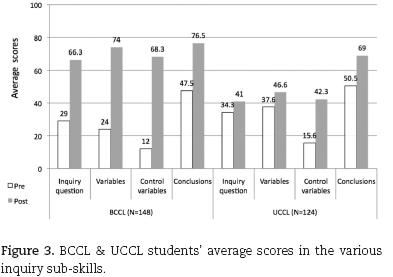
<body><![CDATA[<p align="justify"><font face="verdana" size="2"><b>FINDINGS</b></font></p>  	    <p align="justify"><font face="verdana" size="2">Thinking skills can vary from knowledge and understanding (lower order thinking skills&#150;LOCS) till higher order thinking skills (HOCS) such as: applying, analyzing, and evaluating (Zoller, 1999). The score in this criteria range from 0 to 2. <a href="#f1">Figure 1</a> illustrates the distribution of BCCL &amp; UCCL students' questions sorted by thinking levels.</font></p>  	    <p align="justify"><font face="verdana" size="2"><a href="#f1">Figure 1</a> shows that students posed more questions characterized by HOCS in the post questionnaire with respect to the pre questionnaire in both BCCL and UCCL groups. The percentage of questions which were related to knowledge and understanding were higher in the UCCL group in both pre and post questionnaires. While the percentage of questions which were related to HOCS were higher in the BCCL group in both pre and post questionnaires.</font></p> 	    <p align="center"><a name="f1"></a></p> 	    <p align="center"><img src="/img/revistas/eq/v24n1/a7f1.jpg"></p>      <p align="justify"><font face="verdana" size="2">The range of the chemistry understanding levels varied from 0 to 3. Student scored zero when he/she posed a question, which was not chemistry&#150;oriented. The maximum score was achieved when the question calls for a response that requires the invocation of three understanding levels of chemistry. <a href="#f2">Figure 2</a> illustrates the frequency and combination of levels of understanding in chemistry among BCCL &amp; UCCL students. In the pre questionnaire, about half of the students in both BCCL and UCCL posed questions related to the macro level. Also, there was an increase in the percentage of students who posed questions related to the process level as well as relating to at least two different levels in the post questionnaire in comparison to the pre.</font></p>     <p align="center"><a name="f2"></a></p>     <p align="center"><img src="/img/revistas/eq/v24n1/a7f2.jpg"></p>     <p align="justify"><font face="verdana" size="2">Examining inquiry sub&#150;skills included: (a) generation of an inquiry question after reading the case study; (b) identification of the dependent and independent variables; (c) identification of control variables, and (d) drawing conclusions from a given graph. <a href="#f3">Figure 3</a> presents the BCCL and UCCL students' average scores in the various inquiry sub&#150;skills.</font></p>  	    <p align="justify"><font face="verdana" size="2"><a href="#f3">Figure 3</a> shows an increase in average scores of all inquiry sub&#150;skills in both BCCL and UCCL groups. The increase in the total net gain as well as in each separate sub&#150;inquiry skill was higher in the BCCL group than their peer group. A clear improvement in UCCL group was found in control variable and drawing conclusions. While the clear improvement in BCCL group was in both defining the variables and control variables.</font></p> 	    ]]></body>
<body><![CDATA[<p align="center"><a name="f3"></a></p> 	    <p align="center"><img src="/img/revistas/eq/v24n1/a7f3.jpg"></p>      <p align="justify"><font face="verdana" size="2"><a href="#f4">Figure 4</a> shows BCCL and UCCL students' total net gain sorted by thinking level. The total net gain scores as well as the net gain scores in both investigated skills: posing questions and inquiry of the BCCL group students were higher than those of their comparison peers. The difference was significant solely in inquiry skill.</font></p>     <p align="center"><a name="f4"></a></p>     <p align="center"><img src="/img/revistas/eq/v24n1/a7f4.jpg"></p>     <p align="justify"><font face="verdana" size="2">The CCL approach addresses the recommended instructional strategies for second language learners as described by (Lee, 2006; Lewis, Maerten&#150;Rivera, Adamson, &amp; Lee, 2011; Echevarria, Vogt &amp; Short, 2004; Franco, 2005; Baker, 1997; Stoddart, Pinal &amp; Canaday, 2002).</font></p>     <p align="justify">&nbsp;</p>      <p align="justify"><font face="verdana" size="2"><b>DISCUSSION</b></font></p>  	    <p align="justify"><font face="verdana" size="2">It has become quite obvious to many scholars and educators that providing language and cultural support to minority students is critical to their ability to perform successfully in the science classes (Lee, 2006; Lee &amp; Fradd, 1998).</font></p>  	    <p align="justify"><font face="verdana" size="2">Teaching the inquiry approach particularly opposes Arab norms and culture. In Arab sector in Israel fully guided experiments (like 'cook&#150;book') were part of the curriculum for a long time and students were given, one by one, the simple steps to conducting an experiment. Furthermore, according to Arab culture one must respect the wisdom of elders. That means students do not often doubt the information presented by teachers. Thus, the number of questions asked in class time is limited. As a result, students did not demonstrate higher order thinking skills such as posing questions and inquiry skills. Implementing the CCL module hold three main obstacles for both Arab teachers and students: (a) teaching and learning in SL; (b) developing higher order thinking skills, especially constructing the inquiry skills which are not typical of the school culture nor for the society culture; and (c) Arab high schools are characterized by large class sizes and average high school students limited proficiency in Hebrew.</font></p>  	    ]]></body>
<body><![CDATA[<p align="justify"><font face="verdana" size="2">Learning environments that articulate the relation of science disciplines with students' cultural and linguistic practices enable students to capitalize on their experiences as intellectual resources for learning scientific content and finding comprehension in activities that relate science to their social, cultural, and linguistic identities (Lee, 2005).</font></p>  	    <p align="justify"><font face="verdana" size="2">Arab students benefit greatly from hands&#150;on and inquiry&#150;based science instruction since this kind of activities are less dependent on formal mastery of the language of instruction and, thus, reduce the linguistic burden.</font></p>  	    <p align="justify"><font face="verdana" size="2">The module focused on promoting students' science inquiry that is initially teacher directed but gradually moves towards students, initiated their own research questions. Inquiry skills included four sub skills: posing research question, defining the dependent and independent variables as well as the control variables and drawing conclusions.</font></p>  	    <p align="justify"><font face="verdana" size="2">In our study, the number of questions students posed in the post case&#150;based questionnaire and their complexity were higher than in the pre questionnaire. BCCL students also improved their inquiry skills. Our results are in agreement with other researchers who claimed that when instruction through the first language is provided to language minority students in addition to balanced SL support, these students attain higher levels of academic achievement than if they had been taught in the SL only (Genesee, 1999; Lee, 2002). With the help of scaffolds, learners can complete more advanced activities and engage in more advanced thinking (Bransford, Brown &amp; Cocking, 2000).</font></p>  	    <p align="justify"><font face="verdana" size="2">There is also a contribution to the minority science education community, by showing that the exposure of chemistry majors, who are minority students &#151; Arab students in this study &#151; to inquiry&#150;based learning environment, they may overcome the cultural difficulties to question the authority.</font></p>  	    <p align="justify"><font face="verdana" size="2">In the practical domain, the research significance is exemplified in the contribution to chemistry teachers by providing them with tools for overcoming the obstacles while teaching science in second language, and may assist their students in smooth integration into higher education.</font></p>  	    <p align="justify"><font face="verdana" size="2">Last but not least, the integration of three elements is unique. These elements are: (a) case studies and analysis of students' questions and answers using the four chemistry understanding levels; (b) inquiry&#150;based and computerized experiments, and (c) bilingual teaching and learning. Investigating learning processes, which occur, as students are involved in the BCCL vs. UCCL environments, may contribute to the body of knowledge related to learning science in inquiry setting and gradual exposure to second language in teaching and learning chemistry.</font></p>     <p align="justify">&nbsp;</p>      <p align="justify"><font face="verdana" size="2"><b>Acknowledgment</b></font></p>  	    <p align="justify"><font face="verdana" size="2">This study was partially funded by the Israeli Ministry of Education, Center for Science Teaching.</font></p>     ]]></body>
<body><![CDATA[<p align="justify">&nbsp;</p>      <p align="justify"><font face="verdana" size="2"><b>REFERENCES</b></font></p>  	    <!-- ref --><p align="justify"><font face="verdana" size="2">Abed, A., Ph.D. Dissertation, <i>Bilingual learning culture in computerized chemistry learning environment,</i> Technion, Department of Education in Technology and Science (In Hebrew with Abstract in English), 2008.    &nbsp;&nbsp;&nbsp;&nbsp;&nbsp;&nbsp;&nbsp;&nbsp;[&#160;<a href="javascript:void(0);" onclick="javascript: window.open('/scielo.php?script=sci_nlinks&ref=3148335&pid=S0187-893X201300010000700001&lng=','','width=640,height=500,resizable=yes,scrollbars=1,menubar=yes,');">Links</a>&#160;]<!-- end-ref --></font></p>  	    <!-- ref --><p align="justify"><font face="verdana" size="2">Abed, A. &amp; Dori, Y. J., Fostering question posing and inquiry skills of high school Israeli Arab students in a bilingual chemistry learning environment, <i>Proceedings of the Annual Meeting of the National Association for Research in Science Teaching</i> (NARST CD). New Orleans, LA, USA, 2007.    &nbsp;&nbsp;&nbsp;&nbsp;&nbsp;&nbsp;&nbsp;&nbsp;[&#160;<a href="javascript:void(0);" onclick="javascript: window.open('/scielo.php?script=sci_nlinks&ref=3148337&pid=S0187-893X201300010000700002&lng=','','width=640,height=500,resizable=yes,scrollbars=1,menubar=yes,');">Links</a>&#160;]<!-- end-ref --></font></p>  	    <!-- ref --><p align="justify"><font face="verdana" size="2">Avargil, S., Herscovitz, O., &amp; Dori, Y. J. Teaching thinking skills in context&#150;based learning: teachers' challenges and assessment knowledge, <i>Journal of Science Education and Technology,</i> <b>21</b>(2), 207&#150;225, 2012.    &nbsp;&nbsp;&nbsp;&nbsp;&nbsp;&nbsp;&nbsp;&nbsp;[&#160;<a href="javascript:void(0);" onclick="javascript: window.open('/scielo.php?script=sci_nlinks&ref=3148339&pid=S0187-893X201300010000700003&lng=','','width=640,height=500,resizable=yes,scrollbars=1,menubar=yes,');">Links</a>&#160;]<!-- end-ref --></font></p>     <!-- ref --><p align="justify"><font face="verdana" size="2">Bransford, J., Brown, A., &amp; Cocking, R. (eds.)., <i>How people learn: Brain, mind, experience and school.</i> Washington D.C.: National Academy Press, 2000.    &nbsp;&nbsp;&nbsp;&nbsp;&nbsp;&nbsp;&nbsp;&nbsp;[&#160;<a href="javascript:void(0);" onclick="javascript: window.open('/scielo.php?script=sci_nlinks&ref=3148341&pid=S0187-893X201300010000700004&lng=','','width=640,height=500,resizable=yes,scrollbars=1,menubar=yes,');">Links</a>&#160;]<!-- end-ref --></font></p>  	    ]]></body>
<body><![CDATA[<!-- ref --><p align="justify"><font face="verdana" size="2">Baker, C., <i>Foundations of bilingual education and bilingualism.</i> Avon, England: Multilingual Matters Ltd., 1997.    &nbsp;&nbsp;&nbsp;&nbsp;&nbsp;&nbsp;&nbsp;&nbsp;[&#160;<a href="javascript:void(0);" onclick="javascript: window.open('/scielo.php?script=sci_nlinks&ref=3148343&pid=S0187-893X201300010000700005&lng=','','width=640,height=500,resizable=yes,scrollbars=1,menubar=yes,');">Links</a>&#160;]<!-- end-ref --></font></p>  	    <!-- ref --><p align="justify"><font face="verdana" size="2">Barnea, N., Dori, Y. J. &amp; Hofstein, A., Development and implementation of inquiry&#150;based and computerized&#150;based laboratories: reforming high school chemistry in Israel, <i>Chemistry Education Research and Practice,</i> <b>11</b> , 218&#150;228, 2010.    &nbsp;&nbsp;&nbsp;&nbsp;&nbsp;&nbsp;&nbsp;&nbsp;[&#160;<a href="javascript:void(0);" onclick="javascript: window.open('/scielo.php?script=sci_nlinks&ref=3148345&pid=S0187-893X201300010000700006&lng=','','width=640,height=500,resizable=yes,scrollbars=1,menubar=yes,');">Links</a>&#160;]<!-- end-ref --></font></p>  	    <!-- ref --><p align="justify"><font face="verdana" size="2">Bloom, B. S., <i>Taxonomy of educational objectives: Handbook 1 the cognitive domain.</i> New York: Mckay, 1956.    &nbsp;&nbsp;&nbsp;&nbsp;&nbsp;&nbsp;&nbsp;&nbsp;[&#160;<a href="javascript:void(0);" onclick="javascript: window.open('/scielo.php?script=sci_nlinks&ref=3148347&pid=S0187-893X201300010000700007&lng=','','width=640,height=500,resizable=yes,scrollbars=1,menubar=yes,');">Links</a>&#160;]<!-- end-ref --></font></p>  	    <!-- ref --><p align="justify"><font face="verdana" size="2">Bodner, G. M., Hunter, W., &amp; Lamba, R. S., What happens when discovery labs are integrated into the curriculum at a large research university?, <i>The Chemical Educator,</i> <b>3,</b> 1430&#150;4171, 1998.    &nbsp;&nbsp;&nbsp;&nbsp;&nbsp;&nbsp;&nbsp;&nbsp;[&#160;<a href="javascript:void(0);" onclick="javascript: window.open('/scielo.php?script=sci_nlinks&ref=3148349&pid=S0187-893X201300010000700008&lng=','','width=640,height=500,resizable=yes,scrollbars=1,menubar=yes,');">Links</a>&#160;]<!-- end-ref --></font></p>  	    <!-- ref --><p align="justify"><font face="verdana" size="2">Carrasquillo, A. L. &amp; Rodrigues, V., <i>Language minority students in the mainstream classroom.</i> Philadelphia: Multilingual Matters Ltd., 1996.    &nbsp;&nbsp;&nbsp;&nbsp;&nbsp;&nbsp;&nbsp;&nbsp;[&#160;<a href="javascript:void(0);" onclick="javascript: window.open('/scielo.php?script=sci_nlinks&ref=3148351&pid=S0187-893X201300010000700009&lng=','','width=640,height=500,resizable=yes,scrollbars=1,menubar=yes,');">Links</a>&#160;]<!-- end-ref --></font></p>  	    ]]></body>
<body><![CDATA[<!-- ref --><p align="justify"><font face="verdana" size="2">Chandrasegaran, A. L., Treagust, D. F. &amp; Mocerino, M., An evaluation of a teaching intervention to promote students' ability to use multilple levels of representation when describing and explaining chemical reactions, <i>Research in Science Education,</i> 2007. On line first.    &nbsp;&nbsp;&nbsp;&nbsp;&nbsp;&nbsp;&nbsp;&nbsp;[&#160;<a href="javascript:void(0);" onclick="javascript: window.open('/scielo.php?script=sci_nlinks&ref=3148353&pid=S0187-893X201300010000700010&lng=','','width=640,height=500,resizable=yes,scrollbars=1,menubar=yes,');">Links</a>&#160;]<!-- end-ref --></font></p>  	    <!-- ref --><p align="justify"><font face="verdana" size="2">Dori, Y. J., From nationwide standardized testing to school&#150;based alternative embedded assessment in Israel: Students' performance in the "Matriculation 2000" project, <i>Journal of Research in Science Teaching,</i> <b>40,</b> 34&#150;52, 2003.    &nbsp;&nbsp;&nbsp;&nbsp;&nbsp;&nbsp;&nbsp;&nbsp;[&#160;<a href="javascript:void(0);" onclick="javascript: window.open('/scielo.php?script=sci_nlinks&ref=3148355&pid=S0187-893X201300010000700011&lng=','','width=640,height=500,resizable=yes,scrollbars=1,menubar=yes,');">Links</a>&#160;]<!-- end-ref --></font></p>  	    <!-- ref --><p align="justify"><font face="verdana" size="2">Dori, Y. J., &amp; Barak, M., Virtual and physical molecular modeling: Fostering model perception and spatial understanding, <i>Educational Technology &amp; Society,</i> <b>4,</b> 61&#150;74, 2001.    &nbsp;&nbsp;&nbsp;&nbsp;&nbsp;&nbsp;&nbsp;&nbsp;[&#160;<a href="javascript:void(0);" onclick="javascript: window.open('/scielo.php?script=sci_nlinks&ref=3148357&pid=S0187-893X201300010000700012&lng=','','width=640,height=500,resizable=yes,scrollbars=1,menubar=yes,');">Links</a>&#160;]<!-- end-ref --></font></p>  	    <!-- ref --><p align="justify"><font face="verdana" size="2">Dori, Y. J., &amp; Hameiri, M., The "mole environment" study&#150;ware: Applying multidimensional analysis to quantitative chemistry problems, <i>International Journal of Science Education,</i> <b>20,</b> 317&#150;333, 1998.    &nbsp;&nbsp;&nbsp;&nbsp;&nbsp;&nbsp;&nbsp;&nbsp;[&#160;<a href="javascript:void(0);" onclick="javascript: window.open('/scielo.php?script=sci_nlinks&ref=3148359&pid=S0187-893X201300010000700013&lng=','','width=640,height=500,resizable=yes,scrollbars=1,menubar=yes,');">Links</a>&#160;]<!-- end-ref --></font></p>  	    <!-- ref --><p align="justify"><font face="verdana" size="2">Dori, Y. J., &amp; Hameiri, M., Multidimensional analysis system for quantitative chemistry problems &#151; Symbol, macro, micro and process aspects, <i>Journal of Research in Science Teaching,</i> <b>40,</b> 278&#150;302, 2003.    &nbsp;&nbsp;&nbsp;&nbsp;&nbsp;&nbsp;&nbsp;&nbsp;[&#160;<a href="javascript:void(0);" onclick="javascript: window.open('/scielo.php?script=sci_nlinks&ref=3148361&pid=S0187-893X201300010000700014&lng=','','width=640,height=500,resizable=yes,scrollbars=1,menubar=yes,');">Links</a>&#160;]<!-- end-ref --></font></p>  	    ]]></body>
<body><![CDATA[<!-- ref --><p align="justify"><font face="verdana" size="2">Dori, Y. J., &amp; Kaberman, Z., Assessing high school chemistry students' modeling sub&#150;skills in a computerized molecular modeling learning environment, <i>Instructional Science,</i> <b>40,</b> 69&#150;91, 2012.    &nbsp;&nbsp;&nbsp;&nbsp;&nbsp;&nbsp;&nbsp;&nbsp;[&#160;<a href="javascript:void(0);" onclick="javascript: window.open('/scielo.php?script=sci_nlinks&ref=3148363&pid=S0187-893X201300010000700015&lng=','','width=640,height=500,resizable=yes,scrollbars=1,menubar=yes,');">Links</a>&#160;]<!-- end-ref --></font></p>  	    <!-- ref --><p align="justify"><font face="verdana" size="2">Dori, Y. J., &amp; Herscovitz, O., Question posing capability as an alternative evaluation method: Analysis of an enviroment case study, <i>Journal of Research in Science Teaching,</i> <b>36,</b> 411-430, 1999.    &nbsp;&nbsp;&nbsp;&nbsp;&nbsp;&nbsp;&nbsp;&nbsp;[&#160;<a href="javascript:void(0);" onclick="javascript: window.open('/scielo.php?script=sci_nlinks&ref=3148365&pid=S0187-893X201300010000700016&lng=','','width=640,height=500,resizable=yes,scrollbars=1,menubar=yes,');">Links</a>&#160;]<!-- end-ref --></font></p>  	    <!-- ref --><p align="justify"><font face="verdana" size="2">Dori, Y. J., &amp; Tal, R. T., Formal and informal collaborative projects: Engaging in industry with environmental awareness, <i>Science Education,</i> <b>84,</b> 95&#150;113, 2000.    &nbsp;&nbsp;&nbsp;&nbsp;&nbsp;&nbsp;&nbsp;&nbsp;[&#160;<a href="javascript:void(0);" onclick="javascript: window.open('/scielo.php?script=sci_nlinks&ref=3148367&pid=S0187-893X201300010000700017&lng=','','width=640,height=500,resizable=yes,scrollbars=1,menubar=yes,');">Links</a>&#160;]<!-- end-ref --></font></p>  	    <!-- ref --><p align="justify"><font face="verdana" size="2">Dori, Y. J., Tal, R. T., &amp; Tsaushu, M., Teaching biotechnology through case studies &#151; Can we improve higher order thinking skills of non&#150;science majors?, <i>Science Education,</i><b>87,</b> 767&#150;793, 2003.    &nbsp;&nbsp;&nbsp;&nbsp;&nbsp;&nbsp;&nbsp;&nbsp;[&#160;<a href="javascript:void(0);" onclick="javascript: window.open('/scielo.php?script=sci_nlinks&ref=3148369&pid=S0187-893X201300010000700018&lng=','','width=640,height=500,resizable=yes,scrollbars=1,menubar=yes,');">Links</a>&#160;]<!-- end-ref --></font></p>     <!-- ref --><p align="justify"><font face="verdana" size="2">Dori, Y. J., Sasson, I., Chemical understanding and graphing skills in an honors case&#150;based computerized chemistry laboratory environment: The value of bidirectional visual and textual representations, <i>Journal of Research in Science Teaching,</i> <b>45</b>(2), 219&#150;250, 2008.    &nbsp;&nbsp;&nbsp;&nbsp;&nbsp;&nbsp;&nbsp;&nbsp;[&#160;<a href="javascript:void(0);" onclick="javascript: window.open('/scielo.php?script=sci_nlinks&ref=3148371&pid=S0187-893X201300010000700019&lng=','','width=640,height=500,resizable=yes,scrollbars=1,menubar=yes,');">Links</a>&#160;]<!-- end-ref --></font></p>  	    ]]></body>
<body><![CDATA[<!-- ref --><p align="justify"><font face="verdana" size="2">Echevarria, J., Vogt, M. and Short, D., <i>Making content comprehensible for English Language Learners: The SIOP Model.</i> Boston: Allyn and Bacon, 2004.    &nbsp;&nbsp;&nbsp;&nbsp;&nbsp;&nbsp;&nbsp;&nbsp;[&#160;<a href="javascript:void(0);" onclick="javascript: window.open('/scielo.php?script=sci_nlinks&ref=3148373&pid=S0187-893X201300010000700020&lng=','','width=640,height=500,resizable=yes,scrollbars=1,menubar=yes,');">Links</a>&#160;]<!-- end-ref --></font></p>  	    <!-- ref --><p align="justify"><font face="verdana" size="2">Franco, L., <i>What's different about developing literacy for limited English learners?</i> Tampa Bay, FL: Ole Education, 2005.    &nbsp;&nbsp;&nbsp;&nbsp;&nbsp;&nbsp;&nbsp;&nbsp;[&#160;<a href="javascript:void(0);" onclick="javascript: window.open('/scielo.php?script=sci_nlinks&ref=3148375&pid=S0187-893X201300010000700021&lng=','','width=640,height=500,resizable=yes,scrollbars=1,menubar=yes,');">Links</a>&#160;]<!-- end-ref --></font></p>  	    <!-- ref --><p align="justify"><font face="verdana" size="2">Gabel, D. L., Use of particle nature of matter in developing conceptual understanding, <i>Journal of Chemical Education,</i> <b>70,</b> 193&#150;194, 1993.    &nbsp;&nbsp;&nbsp;&nbsp;&nbsp;&nbsp;&nbsp;&nbsp;[&#160;<a href="javascript:void(0);" onclick="javascript: window.open('/scielo.php?script=sci_nlinks&ref=3148377&pid=S0187-893X201300010000700022&lng=','','width=640,height=500,resizable=yes,scrollbars=1,menubar=yes,');">Links</a>&#160;]<!-- end-ref --></font></p>  	    <!-- ref --><p align="justify"><font face="verdana" size="2">Gabel, D. L., The complexity of chemistry and implications for teaching. In: B. J. Fraser &amp; K. G. Tobin (eds.), <i>International Handbook of Science Education</i> (pp. 233&#150;248). Great Britain: Kluwer Academic Publishers, 1998.    &nbsp;&nbsp;&nbsp;&nbsp;&nbsp;&nbsp;&nbsp;&nbsp;[&#160;<a href="javascript:void(0);" onclick="javascript: window.open('/scielo.php?script=sci_nlinks&ref=3148379&pid=S0187-893X201300010000700023&lng=','','width=640,height=500,resizable=yes,scrollbars=1,menubar=yes,');">Links</a>&#160;]<!-- end-ref --></font></p>  	    <!-- ref --><p align="justify"><font face="verdana" size="2">Genesee, F., <i>Program alternatives for linguistically diverse students.</i> Santa Cruz, CA and Washington, DC: CREDE 1999.    &nbsp;&nbsp;&nbsp;&nbsp;&nbsp;&nbsp;&nbsp;&nbsp;[&#160;<a href="javascript:void(0);" onclick="javascript: window.open('/scielo.php?script=sci_nlinks&ref=3148381&pid=S0187-893X201300010000700024&lng=','','width=640,height=500,resizable=yes,scrollbars=1,menubar=yes,');">Links</a>&#160;]<!-- end-ref --></font></p>  	    ]]></body>
<body><![CDATA[<!-- ref --><p align="justify"><font face="verdana" size="2">Herried, C. F., Case studies in science &#151; A novel method of science education, <i>Journal of College Science Teaching,</i> <b>23,</b> 221&#150;229, 1994.    &nbsp;&nbsp;&nbsp;&nbsp;&nbsp;&nbsp;&nbsp;&nbsp;[&#160;<a href="javascript:void(0);" onclick="javascript: window.open('/scielo.php?script=sci_nlinks&ref=3148383&pid=S0187-893X201300010000700025&lng=','','width=640,height=500,resizable=yes,scrollbars=1,menubar=yes,');">Links</a>&#160;]<!-- end-ref --></font></p>  	    <!-- ref --><p align="justify"><font face="verdana" size="2">Herried, C. F.,What is a case? Bringing to science education the established tool of law and medicine, <i>Journal of College Science Teaching,</i> <b>27,</b> 92&#150;95, 1997.    &nbsp;&nbsp;&nbsp;&nbsp;&nbsp;&nbsp;&nbsp;&nbsp;[&#160;<a href="javascript:void(0);" onclick="javascript: window.open('/scielo.php?script=sci_nlinks&ref=3148385&pid=S0187-893X201300010000700026&lng=','','width=640,height=500,resizable=yes,scrollbars=1,menubar=yes,');">Links</a>&#160;]<!-- end-ref --></font></p>  	    <!-- ref --><p align="justify"><font face="verdana" size="2">Hofstein, A., &amp; Lunetta, V., The role of the laboratory in science teaching: Neglected aspects of research, <i>Review of Educational Research,</i> <b>52,</b> 201&#150;217, 1982.    &nbsp;&nbsp;&nbsp;&nbsp;&nbsp;&nbsp;&nbsp;&nbsp;[&#160;<a href="javascript:void(0);" onclick="javascript: window.open('/scielo.php?script=sci_nlinks&ref=3148387&pid=S0187-893X201300010000700027&lng=','','width=640,height=500,resizable=yes,scrollbars=1,menubar=yes,');">Links</a>&#160;]<!-- end-ref --></font></p>  	    <!-- ref --><p align="justify"><font face="verdana" size="2">Hofstein, A., &amp; Lunetta, V., The laboratory in science education: Foundations for the twenty&#150;first century, <i>Science Education,</i> <b>88,</b> 28&#150;54, 2004.    &nbsp;&nbsp;&nbsp;&nbsp;&nbsp;&nbsp;&nbsp;&nbsp;[&#160;<a href="javascript:void(0);" onclick="javascript: window.open('/scielo.php?script=sci_nlinks&ref=3148389&pid=S0187-893X201300010000700028&lng=','','width=640,height=500,resizable=yes,scrollbars=1,menubar=yes,');">Links</a>&#160;]<!-- end-ref --></font></p>  	    <!-- ref --><p align="justify"><font face="verdana" size="2">Johnstone, A. H., Why is science difficult to learn? Things are seldom what they seem, <i>Journal of Computer Assisted Learning,</i> <b>7,</b> 7&#150;83, 1991.    &nbsp;&nbsp;&nbsp;&nbsp;&nbsp;&nbsp;&nbsp;&nbsp;[&#160;<a href="javascript:void(0);" onclick="javascript: window.open('/scielo.php?script=sci_nlinks&ref=3148391&pid=S0187-893X201300010000700029&lng=','','width=640,height=500,resizable=yes,scrollbars=1,menubar=yes,');">Links</a>&#160;]<!-- end-ref --></font></p>  	    ]]></body>
<body><![CDATA[<!-- ref --><p align="justify"><font face="verdana" size="2">Kaberman, Z., &amp; Dori, Y. J., Question posing, inquiry, and modeling skills of high school chemistry students in the case&#150;based computerized laboratory environment, <i>International Journal of Science and Mathematics Education,</i> <b>7,</b> 597&#150;625, 2009.    &nbsp;&nbsp;&nbsp;&nbsp;&nbsp;&nbsp;&nbsp;&nbsp;[&#160;<a href="javascript:void(0);" onclick="javascript: window.open('/scielo.php?script=sci_nlinks&ref=3148393&pid=S0187-893X201300010000700030&lng=','','width=640,height=500,resizable=yes,scrollbars=1,menubar=yes,');">Links</a>&#160;]<!-- end-ref --></font></p>  	    <!-- ref --><p align="justify"><font face="verdana" size="2">Lazarowitz, R., &amp; Tamir, P., Research on using laboratory instruction in science. In: D. L. Gabel (ed.), <i>Handbook of Research on Science Teaching and Learning</i> (pp. 94&#150;128). New York: Macmillan Publishing Company, 1994.    &nbsp;&nbsp;&nbsp;&nbsp;&nbsp;&nbsp;&nbsp;&nbsp;[&#160;<a href="javascript:void(0);" onclick="javascript: window.open('/scielo.php?script=sci_nlinks&ref=3148395&pid=S0187-893X201300010000700031&lng=','','width=640,height=500,resizable=yes,scrollbars=1,menubar=yes,');">Links</a>&#160;]<!-- end-ref --></font></p>  	    <!-- ref --><p align="justify"><font face="verdana" size="2">Lee, S. K., The significance of language and cultural education on secondary achievement: A survey of Chinese American and Korean American students, <i>Bilingual Research Journal,</i><b>26</b>(2), 327&#150;340, 2002.    &nbsp;&nbsp;&nbsp;&nbsp;&nbsp;&nbsp;&nbsp;&nbsp;[&#160;<a href="javascript:void(0);" onclick="javascript: window.open('/scielo.php?script=sci_nlinks&ref=3148397&pid=S0187-893X201300010000700032&lng=','','width=640,height=500,resizable=yes,scrollbars=1,menubar=yes,');">Links</a>&#160;]<!-- end-ref --></font></p>  	    <!-- ref --><p align="justify"><font face="verdana" size="2">Lee, O., Teacher change in beliefs and practices in science and literacy instruction with English language learners, <i>Journal of Research in Science Teaching,</i> <b>41</b>(1), 65&#150;93, 2004.    &nbsp;&nbsp;&nbsp;&nbsp;&nbsp;&nbsp;&nbsp;&nbsp;[&#160;<a href="javascript:void(0);" onclick="javascript: window.open('/scielo.php?script=sci_nlinks&ref=3148399&pid=S0187-893X201300010000700033&lng=','','width=640,height=500,resizable=yes,scrollbars=1,menubar=yes,');">Links</a>&#160;]<!-- end-ref --></font></p>  	    <!-- ref --><p align="justify"><font face="verdana" size="2">Lee, O., Science education and student diversity: Summary of synthesis and research agenda, <i>Journal of Education for Students Placed At Risk,</i> <b>10</b>(4), 433&#150;443, 2005.    &nbsp;&nbsp;&nbsp;&nbsp;&nbsp;&nbsp;&nbsp;&nbsp;[&#160;<a href="javascript:void(0);" onclick="javascript: window.open('/scielo.php?script=sci_nlinks&ref=3148401&pid=S0187-893X201300010000700034&lng=','','width=640,height=500,resizable=yes,scrollbars=1,menubar=yes,');">Links</a>&#160;]<!-- end-ref --></font></p>  	    ]]></body>
<body><![CDATA[<!-- ref --><p align="justify"><font face="verdana" size="2">Lee, S. K., The Latino students' attitudes perceptions, and views on bilingual education, <i>Bilingual Research Journal,</i> <b>30</b>(1), 107&#150;122, 2006.    &nbsp;&nbsp;&nbsp;&nbsp;&nbsp;&nbsp;&nbsp;&nbsp;[&#160;<a href="javascript:void(0);" onclick="javascript: window.open('/scielo.php?script=sci_nlinks&ref=3148403&pid=S0187-893X201300010000700035&lng=','','width=640,height=500,resizable=yes,scrollbars=1,menubar=yes,');">Links</a>&#160;]<!-- end-ref --></font></p>     <!-- ref --><p align="justify"><font face="verdana" size="2">Lee, O. &amp; Fradd, S. H., Science for all, including students from non&#150;English language backgrounds, <i>Educational Research</i>er, <b>27,</b> 12&#150;21, 1998.    &nbsp;&nbsp;&nbsp;&nbsp;&nbsp;&nbsp;&nbsp;&nbsp;[&#160;<a href="javascript:void(0);" onclick="javascript: window.open('/scielo.php?script=sci_nlinks&ref=3148405&pid=S0187-893X201300010000700036&lng=','','width=640,height=500,resizable=yes,scrollbars=1,menubar=yes,');">Links</a>&#160;]<!-- end-ref --></font></p>  	    <!-- ref --><p align="justify"><font face="verdana" size="2">Lewis, S., Lee, O., Santau, A., &amp; Cone, N., Student initiatives in urban elementary science classrooms, <i>School Science and Mathematics,</i> <b>110</b>(3), 160&#150;172, 2010.    &nbsp;&nbsp;&nbsp;&nbsp;&nbsp;&nbsp;&nbsp;&nbsp;[&#160;<a href="javascript:void(0);" onclick="javascript: window.open('/scielo.php?script=sci_nlinks&ref=3148407&pid=S0187-893X201300010000700037&lng=','','width=640,height=500,resizable=yes,scrollbars=1,menubar=yes,');">Links</a>&#160;]<!-- end-ref --></font></p>  	    <!-- ref --><p align="justify"><font face="verdana" size="2">Lewis, S., Maerten&#150;Rivera, J., Adamson, K., &amp; Lee, O. Urban third grade teachers' practices and perceptions in science instruction with English language learners, <i>School Science and Mathematics,</i> <b>111</b> (4), 156&#150;163, 2011.    &nbsp;&nbsp;&nbsp;&nbsp;&nbsp;&nbsp;&nbsp;&nbsp;[&#160;<a href="javascript:void(0);" onclick="javascript: window.open('/scielo.php?script=sci_nlinks&ref=3148409&pid=S0187-893X201300010000700038&lng=','','width=640,height=500,resizable=yes,scrollbars=1,menubar=yes,');">Links</a>&#160;]<!-- end-ref --></font></p>  	    <!-- ref --><p align="justify"><font face="verdana" size="2">Lynch, S., "Science for all" is not equal to "one size fits all": Linguistic and culture diversity and science education reform, <i>Journal of Research in Science Education,</i> <b>38,</b> 622&#150;627, 2001.    &nbsp;&nbsp;&nbsp;&nbsp;&nbsp;&nbsp;&nbsp;&nbsp;[&#160;<a href="javascript:void(0);" onclick="javascript: window.open('/scielo.php?script=sci_nlinks&ref=3148411&pid=S0187-893X201300010000700039&lng=','','width=640,height=500,resizable=yes,scrollbars=1,menubar=yes,');">Links</a>&#160;]<!-- end-ref --></font></p>  	    ]]></body>
<body><![CDATA[<!-- ref --><p align="justify"><font face="verdana" size="2">McNeill, K. L., Lizotte, D. J., Krajcik, J. &amp; Marx, R.W., Supporting students' construction of scientific explanations by fading scaffolds in instructional materials, <i>Journal of the Learning Sciences,</i> <b>15</b>(2), 153&#150;191, 2006.    &nbsp;&nbsp;&nbsp;&nbsp;&nbsp;&nbsp;&nbsp;&nbsp;[&#160;<a href="javascript:void(0);" onclick="javascript: window.open('/scielo.php?script=sci_nlinks&ref=3148413&pid=S0187-893X201300010000700040&lng=','','width=640,height=500,resizable=yes,scrollbars=1,menubar=yes,');">Links</a>&#160;]<!-- end-ref --></font></p>  	    <!-- ref --><p align="justify"><font face="verdana" size="2">Nieto, S., <i>Affirming diversity: The sociopolitical context of multicultural education.</i> New York: Addison Wesley Longman, Inc., 2000.    &nbsp;&nbsp;&nbsp;&nbsp;&nbsp;&nbsp;&nbsp;&nbsp;[&#160;<a href="javascript:void(0);" onclick="javascript: window.open('/scielo.php?script=sci_nlinks&ref=3148415&pid=S0187-893X201300010000700041&lng=','','width=640,height=500,resizable=yes,scrollbars=1,menubar=yes,');">Links</a>&#160;]<!-- end-ref --></font></p>  	    <!-- ref --><p align="justify"><font face="verdana" size="2">Resnick, L. B., <i>Education and Learning to Think.</i> Washington, DC: National Academy Press, 1987.    &nbsp;&nbsp;&nbsp;&nbsp;&nbsp;&nbsp;&nbsp;&nbsp;[&#160;<a href="javascript:void(0);" onclick="javascript: window.open('/scielo.php?script=sci_nlinks&ref=3148417&pid=S0187-893X201300010000700042&lng=','','width=640,height=500,resizable=yes,scrollbars=1,menubar=yes,');">Links</a>&#160;]<!-- end-ref --></font></p>  	    <!-- ref --><p align="justify"><font face="verdana" size="2">Schwab, J. J., &amp; Brandwein, P. F., <i>The teaching of science as enquiry.</i> Cambridge, MA: Harvard University Press, 1962.    &nbsp;&nbsp;&nbsp;&nbsp;&nbsp;&nbsp;&nbsp;&nbsp;[&#160;<a href="javascript:void(0);" onclick="javascript: window.open('/scielo.php?script=sci_nlinks&ref=3148419&pid=S0187-893X201300010000700043&lng=','','width=640,height=500,resizable=yes,scrollbars=1,menubar=yes,');">Links</a>&#160;]<!-- end-ref --></font></p>  	    <!-- ref --><p align="justify"><font face="verdana" size="2">Stoddart. T., Pinal. M., and Canaday, D., Integrating inquiry science and language development for English language learners, <i>Journal of Research in Science Teaching,</i> <b>39</b>(8),664&#150; 687, 2002.    &nbsp;&nbsp;&nbsp;&nbsp;&nbsp;&nbsp;&nbsp;&nbsp;[&#160;<a href="javascript:void(0);" onclick="javascript: window.open('/scielo.php?script=sci_nlinks&ref=3148421&pid=S0187-893X201300010000700044&lng=','','width=640,height=500,resizable=yes,scrollbars=1,menubar=yes,');">Links</a>&#160;]<!-- end-ref --></font></p>  	    ]]></body>
<body><![CDATA[<!-- ref --><p align="justify"><font face="verdana" size="2">Sund, R. B., &amp; Trowbridge, L. W., <i>Teaching science by inquiry in the secondary school.</i> Ohio: Charles E. Merill Books, 1967.    &nbsp;&nbsp;&nbsp;&nbsp;&nbsp;&nbsp;&nbsp;&nbsp;[&#160;<a href="javascript:void(0);" onclick="javascript: window.open('/scielo.php?script=sci_nlinks&ref=3148423&pid=S0187-893X201300010000700045&lng=','','width=640,height=500,resizable=yes,scrollbars=1,menubar=yes,');">Links</a>&#160;]<!-- end-ref --></font></p>  	    <!-- ref --><p align="justify"><font face="verdana" size="2">Thomas, W., &amp; Collier, V., Language minority student achievement and program effectiveness, <i>California Association for Bilingual Education Newsletter,</i> <b>17</b>(5), 19&#150;24, 1995.    &nbsp;&nbsp;&nbsp;&nbsp;&nbsp;&nbsp;&nbsp;&nbsp;[&#160;<a href="javascript:void(0);" onclick="javascript: window.open('/scielo.php?script=sci_nlinks&ref=3148425&pid=S0187-893X201300010000700046&lng=','','width=640,height=500,resizable=yes,scrollbars=1,menubar=yes,');">Links</a>&#160;]<!-- end-ref --></font></p>  	    <!-- ref --><p align="justify"><font face="verdana" size="2">Tobin, K., &amp; Gallagher, J. J., What happens in high school science classrooms, <i>Journal of Curriculum Studies,</i> <b>19,</b> 549-560, 1987.    &nbsp;&nbsp;&nbsp;&nbsp;&nbsp;&nbsp;&nbsp;&nbsp;[&#160;<a href="javascript:void(0);" onclick="javascript: window.open('/scielo.php?script=sci_nlinks&ref=3148427&pid=S0187-893X201300010000700047&lng=','','width=640,height=500,resizable=yes,scrollbars=1,menubar=yes,');">Links</a>&#160;]<!-- end-ref --></font></p>  	    <!-- ref --><p align="justify"><font face="verdana" size="2">Tobin, K., Kahle, J. B.,&amp; Fraser, B. J., Learning science with understanding: In search of the Holy Grail. In: K. Tobin, J. B. Kahle, &amp; B. J. Fraser (eds.), <i>Windows into Science Classrooms</i> (pp. 1&#150;13). London, New York, Philadelphia: The Flamer Press, 1990.    &nbsp;&nbsp;&nbsp;&nbsp;&nbsp;&nbsp;&nbsp;&nbsp;[&#160;<a href="javascript:void(0);" onclick="javascript: window.open('/scielo.php?script=sci_nlinks&ref=3148429&pid=S0187-893X201300010000700048&lng=','','width=640,height=500,resizable=yes,scrollbars=1,menubar=yes,');">Links</a>&#160;]<!-- end-ref --></font></p>  	    <!-- ref --><p align="justify"><font face="verdana" size="2">Tucher, G. R., <i>A global perspective on bilingualism and bilingual education.</i> Eric Clearinghouse on Language and Linguistics Washington, DC, 1999.    &nbsp;&nbsp;&nbsp;&nbsp;&nbsp;&nbsp;&nbsp;&nbsp;[&#160;<a href="javascript:void(0);" onclick="javascript: window.open('/scielo.php?script=sci_nlinks&ref=3148431&pid=S0187-893X201300010000700049&lng=','','width=640,height=500,resizable=yes,scrollbars=1,menubar=yes,');">Links</a>&#160;]<!-- end-ref --></font></p>  	    ]]></body>
<body><![CDATA[<!-- ref --><p align="justify"><font face="verdana" size="2">Zohar, A., &amp; Dori, Y. J., Higher order thinking skills and low achieving students &#151; Are they mutually exclusive, <i>Journal of the Learning Sciences,</i> <b>12,</b> 145&#150;182, 2003.    &nbsp;&nbsp;&nbsp;&nbsp;&nbsp;&nbsp;&nbsp;&nbsp;[&#160;<a href="javascript:void(0);" onclick="javascript: window.open('/scielo.php?script=sci_nlinks&ref=3148433&pid=S0187-893X201300010000700050&lng=','','width=640,height=500,resizable=yes,scrollbars=1,menubar=yes,');">Links</a>&#160;]<!-- end-ref --></font></p>  	    <!-- ref --><p align="justify"><font face="verdana" size="2">Zohar, A., &amp; Namet, F., Fostering students' knowledge and argumentation skills through dilemmas in human genetics, <i>Journal of Research in Science Teaching,</i> <b>39,</b> 35&#150;62, 2002.    &nbsp;&nbsp;&nbsp;&nbsp;&nbsp;&nbsp;&nbsp;&nbsp;[&#160;<a href="javascript:void(0);" onclick="javascript: window.open('/scielo.php?script=sci_nlinks&ref=3148435&pid=S0187-893X201300010000700051&lng=','','width=640,height=500,resizable=yes,scrollbars=1,menubar=yes,');">Links</a>&#160;]<!-- end-ref --></font></p>  	    <!-- ref --><p align="justify"><font face="verdana" size="2">Zoller, U., The fostering of question&#150;asking capability, <i>Journal of Chemical Education,</i> <b>64,</b> 510&#150;512, 1987.    &nbsp;&nbsp;&nbsp;&nbsp;&nbsp;&nbsp;&nbsp;&nbsp;[&#160;<a href="javascript:void(0);" onclick="javascript: window.open('/scielo.php?script=sci_nlinks&ref=3148437&pid=S0187-893X201300010000700052&lng=','','width=640,height=500,resizable=yes,scrollbars=1,menubar=yes,');">Links</a>&#160;]<!-- end-ref --></font></p>  	    <!-- ref --><p align="justify"><font face="verdana" size="2">Zoller, U., Scaling up of higher&#150;order cognitive skills&#150;oriented college chemistry teaching: An action&#150;oriented research, <i>Journal of Research in Science Teaching,</i> <b>36,</b> 583-596, 1999.    &nbsp;&nbsp;&nbsp;&nbsp;&nbsp;&nbsp;&nbsp;&nbsp;[&#160;<a href="javascript:void(0);" onclick="javascript: window.open('/scielo.php?script=sci_nlinks&ref=3148439&pid=S0187-893X201300010000700053&lng=','','width=640,height=500,resizable=yes,scrollbars=1,menubar=yes,');">Links</a>&#160;]<!-- end-ref --></font></p>      ]]></body><back>
<ref-list>
<ref id="B1">
<nlm-citation citation-type="">
<person-group person-group-type="author">
<name>
<surname><![CDATA[Abed]]></surname>
<given-names><![CDATA[A.]]></given-names>
</name>
</person-group>
<source><![CDATA[]]></source>
<year></year>
</nlm-citation>
</ref>
<ref id="B2">
<nlm-citation citation-type="">
<person-group person-group-type="author">
<name>
<surname><![CDATA[Abed]]></surname>
<given-names><![CDATA[A.]]></given-names>
</name>
<name>
<surname><![CDATA[Dori]]></surname>
<given-names><![CDATA[Y. J.]]></given-names>
</name>
</person-group>
<article-title xml:lang="en"><![CDATA[Fostering question posing and inquiry skills of high school Israeli Arab students in a bilingual chemistry learning environment]]></article-title>
<source><![CDATA[Proceedings of the Annual Meeting of the National Association for Research in Science Teaching (NARST CD)]]></source>
<year>2007</year>
<publisher-loc><![CDATA[New Orleans^eLA LA]]></publisher-loc>
</nlm-citation>
</ref>
<ref id="B3">
<nlm-citation citation-type="journal">
<person-group person-group-type="author">
<name>
<surname><![CDATA[Avargil]]></surname>
<given-names><![CDATA[S.]]></given-names>
</name>
<name>
<surname><![CDATA[Herscovitz]]></surname>
<given-names><![CDATA[O.]]></given-names>
</name>
<name>
<surname><![CDATA[Dori]]></surname>
<given-names><![CDATA[Y. J.]]></given-names>
</name>
</person-group>
<article-title xml:lang="en"><![CDATA[Teaching thinking skills in context-based learning: teachers' challenges and assessment knowledge]]></article-title>
<source><![CDATA[Journal of Science Education and Technology]]></source>
<year>2012</year>
<volume>21</volume>
<numero>2</numero>
<issue>2</issue>
<page-range>207-225</page-range></nlm-citation>
</ref>
<ref id="B4">
<nlm-citation citation-type="book">
<person-group person-group-type="author">
<name>
<surname><![CDATA[Bransford]]></surname>
<given-names><![CDATA[J.]]></given-names>
</name>
<name>
<surname><![CDATA[Brown]]></surname>
<given-names><![CDATA[A.]]></given-names>
</name>
<name>
<surname><![CDATA[Cocking]]></surname>
<given-names><![CDATA[R.]]></given-names>
</name>
</person-group>
<source><![CDATA[How people learn: Brain, mind, experience and school]]></source>
<year>2000</year>
<publisher-loc><![CDATA[Washington^eD.C. D.C.]]></publisher-loc>
<publisher-name><![CDATA[National Academy Press]]></publisher-name>
</nlm-citation>
</ref>
<ref id="B5">
<nlm-citation citation-type="book">
<person-group person-group-type="author">
<name>
<surname><![CDATA[Baker]]></surname>
<given-names><![CDATA[C.]]></given-names>
</name>
</person-group>
<source><![CDATA[Foundations of bilingual education and bilingualism]]></source>
<year>1997</year>
<publisher-name><![CDATA[Multilingual Matters Ltd.]]></publisher-name>
</nlm-citation>
</ref>
<ref id="B6">
<nlm-citation citation-type="journal">
<person-group person-group-type="author">
<name>
<surname><![CDATA[Barnea]]></surname>
<given-names><![CDATA[N.]]></given-names>
</name>
<name>
<surname><![CDATA[Dori]]></surname>
<given-names><![CDATA[Y. J.]]></given-names>
</name>
<name>
<surname><![CDATA[Hofstein]]></surname>
<given-names><![CDATA[A.]]></given-names>
</name>
</person-group>
<article-title xml:lang="en"><![CDATA[Development and implementation of inquiry-based and computerized-based laboratories: reforming high school chemistry in Israel]]></article-title>
<source><![CDATA[Chemistry Education Research and Practice]]></source>
<year>2010</year>
<volume>11</volume>
<page-range>218-228</page-range></nlm-citation>
</ref>
<ref id="B7">
<nlm-citation citation-type="book">
<person-group person-group-type="author">
<name>
<surname><![CDATA[Bloom]]></surname>
<given-names><![CDATA[B. S.]]></given-names>
</name>
</person-group>
<source><![CDATA[Taxonomy of educational objectives: Handbook 1 the cognitive domain]]></source>
<year>1956</year>
<publisher-loc><![CDATA[New York ]]></publisher-loc>
<publisher-name><![CDATA[Mckay]]></publisher-name>
</nlm-citation>
</ref>
<ref id="B8">
<nlm-citation citation-type="journal">
<person-group person-group-type="author">
<name>
<surname><![CDATA[Bodner]]></surname>
<given-names><![CDATA[G. M.]]></given-names>
</name>
<name>
<surname><![CDATA[Hunter]]></surname>
<given-names><![CDATA[W.]]></given-names>
</name>
<name>
<surname><![CDATA[Lamba]]></surname>
<given-names><![CDATA[R. S.]]></given-names>
</name>
</person-group>
<article-title xml:lang="en"><![CDATA[What happens when discovery labs are integrated into the curriculum at a large research university?]]></article-title>
<source><![CDATA[The Chemical Educator]]></source>
<year>1998</year>
<volume>3</volume>
<page-range>1430-4171</page-range></nlm-citation>
</ref>
<ref id="B9">
<nlm-citation citation-type="book">
<person-group person-group-type="author">
<name>
<surname><![CDATA[Carrasquillo]]></surname>
<given-names><![CDATA[A. L.]]></given-names>
</name>
<name>
<surname><![CDATA[Rodrigues]]></surname>
<given-names><![CDATA[V.]]></given-names>
</name>
</person-group>
<source><![CDATA[Language minority students in the mainstream classroom]]></source>
<year>1996</year>
<publisher-loc><![CDATA[Philadelphia ]]></publisher-loc>
<publisher-name><![CDATA[Multilingual Matters Ltd.]]></publisher-name>
</nlm-citation>
</ref>
<ref id="B10">
<nlm-citation citation-type="journal">
<person-group person-group-type="author">
<name>
<surname><![CDATA[Chandrasegaran]]></surname>
<given-names><![CDATA[A. L.]]></given-names>
</name>
<name>
<surname><![CDATA[Treagust]]></surname>
<given-names><![CDATA[D. F.]]></given-names>
</name>
<name>
<surname><![CDATA[Mocerino]]></surname>
<given-names><![CDATA[M.]]></given-names>
</name>
</person-group>
<article-title xml:lang="en"><![CDATA[An evaluation of a teaching intervention to promote students' ability to use multilple levels of representation when describing and explaining chemical reactions]]></article-title>
<source><![CDATA[Research in Science Education]]></source>
<year>2007</year>
</nlm-citation>
</ref>
<ref id="B11">
<nlm-citation citation-type="journal">
<person-group person-group-type="author">
<name>
<surname><![CDATA[Dori]]></surname>
<given-names><![CDATA[Y. J.]]></given-names>
</name>
</person-group>
<article-title xml:lang="en"><![CDATA[From nationwide standardized testing to school-based alternative embedded assessment in Israel: Students' performance in the "Matriculation 2000" project]]></article-title>
<source><![CDATA[Journal of Research in Science Teaching]]></source>
<year>2003</year>
<volume>40</volume>
<page-range>34-52</page-range></nlm-citation>
</ref>
<ref id="B12">
<nlm-citation citation-type="journal">
<person-group person-group-type="author">
<name>
<surname><![CDATA[Dori]]></surname>
<given-names><![CDATA[Y. J.]]></given-names>
</name>
<name>
<surname><![CDATA[Barak]]></surname>
<given-names><![CDATA[M.]]></given-names>
</name>
</person-group>
<article-title xml:lang="en"><![CDATA[Virtual and physical molecular modeling: Fostering model perception and spatial understanding]]></article-title>
<source><![CDATA[Educational Technology & Society]]></source>
<year>2001</year>
<volume>4</volume>
<page-range>61-74</page-range></nlm-citation>
</ref>
<ref id="B13">
<nlm-citation citation-type="journal">
<person-group person-group-type="author">
<name>
<surname><![CDATA[Dori]]></surname>
<given-names><![CDATA[Y. J.]]></given-names>
</name>
<name>
<surname><![CDATA[Hameiri]]></surname>
<given-names><![CDATA[M.]]></given-names>
</name>
</person-group>
<article-title xml:lang="en"><![CDATA[The "mole environment" study-ware: Applying multidimensional analysis to quantitative chemistry problems]]></article-title>
<source><![CDATA[International Journal of Science Education]]></source>
<year>1998</year>
<volume>20</volume>
<page-range>317-333</page-range></nlm-citation>
</ref>
<ref id="B14">
<nlm-citation citation-type="journal">
<person-group person-group-type="author">
<name>
<surname><![CDATA[Dori]]></surname>
<given-names><![CDATA[Y. J.]]></given-names>
</name>
<name>
<surname><![CDATA[Hameiri]]></surname>
<given-names><![CDATA[M.]]></given-names>
</name>
</person-group>
<article-title xml:lang="en"><![CDATA[Multidimensional analysis system for quantitative chemistry problems - Symbol, macro, micro and process aspects]]></article-title>
<source><![CDATA[Journal of Research in Science Teaching]]></source>
<year>2003</year>
<volume>40</volume>
<page-range>278-302</page-range></nlm-citation>
</ref>
<ref id="B15">
<nlm-citation citation-type="journal">
<person-group person-group-type="author">
<name>
<surname><![CDATA[Dori]]></surname>
<given-names><![CDATA[Y. J.]]></given-names>
</name>
<name>
<surname><![CDATA[Kaberman]]></surname>
<given-names><![CDATA[Z.]]></given-names>
</name>
</person-group>
<article-title xml:lang="en"><![CDATA[Assessing high school chemistry students' modeling sub-skills in a computerized molecular modeling learning environment]]></article-title>
<source><![CDATA[Instructional Science]]></source>
<year>2012</year>
<volume>40</volume>
<page-range>69-91</page-range></nlm-citation>
</ref>
<ref id="B16">
<nlm-citation citation-type="journal">
<person-group person-group-type="author">
<name>
<surname><![CDATA[Dori]]></surname>
<given-names><![CDATA[Y. J.]]></given-names>
</name>
<name>
<surname><![CDATA[Herscovitz]]></surname>
<given-names><![CDATA[O.]]></given-names>
</name>
</person-group>
<article-title xml:lang="en"><![CDATA[Question posing capability as an alternative evaluation method: Analysis of an enviroment case study]]></article-title>
<source><![CDATA[Journal of Research in Science Teaching]]></source>
<year>1999</year>
<volume>36</volume>
<page-range>411-430</page-range></nlm-citation>
</ref>
<ref id="B17">
<nlm-citation citation-type="journal">
<person-group person-group-type="author">
<name>
<surname><![CDATA[Dori]]></surname>
<given-names><![CDATA[Y. J.]]></given-names>
</name>
<name>
<surname><![CDATA[Tal]]></surname>
<given-names><![CDATA[R. T.]]></given-names>
</name>
</person-group>
<article-title xml:lang="en"><![CDATA[Formal and informal collaborative projects: Engaging in industry with environmental awareness]]></article-title>
<source><![CDATA[Science Education]]></source>
<year>2000</year>
<volume>84</volume>
<page-range>95-113</page-range></nlm-citation>
</ref>
<ref id="B18">
<nlm-citation citation-type="journal">
<person-group person-group-type="author">
<name>
<surname><![CDATA[Dori]]></surname>
<given-names><![CDATA[Y. J.]]></given-names>
</name>
<name>
<surname><![CDATA[Tal]]></surname>
<given-names><![CDATA[R. T.]]></given-names>
</name>
<name>
<surname><![CDATA[Tsaushu]]></surname>
<given-names><![CDATA[M.]]></given-names>
</name>
</person-group>
<article-title xml:lang="en"><![CDATA[Teaching biotechnology through case studies - Can we improve higher order thinking skills of non-science majors?]]></article-title>
<source><![CDATA[Science Education]]></source>
<year>2003</year>
<volume>87</volume>
<page-range>767-793</page-range></nlm-citation>
</ref>
<ref id="B19">
<nlm-citation citation-type="journal">
<person-group person-group-type="author">
<name>
<surname><![CDATA[Dori]]></surname>
<given-names><![CDATA[Y. J.]]></given-names>
</name>
<name>
<surname><![CDATA[Sasson]]></surname>
<given-names><![CDATA[I.]]></given-names>
</name>
</person-group>
<article-title xml:lang="en"><![CDATA[Chemical understanding and graphing skills in an honors case-based computerized chemistry laboratory environment: The value of bidirectional visual and textual representations]]></article-title>
<source><![CDATA[Journal of Research in Science Teaching]]></source>
<year>2008</year>
<volume>45</volume>
<numero>2</numero>
<issue>2</issue>
<page-range>219-250</page-range></nlm-citation>
</ref>
<ref id="B20">
<nlm-citation citation-type="book">
<person-group person-group-type="author">
<name>
<surname><![CDATA[Echevarria]]></surname>
<given-names><![CDATA[J.]]></given-names>
</name>
<name>
<surname><![CDATA[Vogt]]></surname>
<given-names><![CDATA[M.]]></given-names>
</name>
<name>
<surname><![CDATA[Short]]></surname>
<given-names><![CDATA[D.]]></given-names>
</name>
</person-group>
<source><![CDATA[Making content comprehensible for English Language Learners: The SIOP Model]]></source>
<year>2004</year>
<publisher-loc><![CDATA[Boston ]]></publisher-loc>
<publisher-name><![CDATA[Allyn and Bacon]]></publisher-name>
</nlm-citation>
</ref>
<ref id="B21">
<nlm-citation citation-type="book">
<person-group person-group-type="author">
<name>
<surname><![CDATA[Franco]]></surname>
<given-names><![CDATA[L.]]></given-names>
</name>
</person-group>
<source><![CDATA[What's different about developing literacy for limited English learners?]]></source>
<year>2005</year>
<publisher-loc><![CDATA[Tampa Bay^eFL FL]]></publisher-loc>
<publisher-name><![CDATA[Ole Education]]></publisher-name>
</nlm-citation>
</ref>
<ref id="B22">
<nlm-citation citation-type="journal">
<person-group person-group-type="author">
<name>
<surname><![CDATA[Gabel]]></surname>
<given-names><![CDATA[D. L.]]></given-names>
</name>
</person-group>
<article-title xml:lang="en"><![CDATA[Use of particle nature of matter in developing conceptual understanding]]></article-title>
<source><![CDATA[Journal of Chemical Education]]></source>
<year>1993</year>
<volume>70</volume>
<page-range>193-194</page-range></nlm-citation>
</ref>
<ref id="B23">
<nlm-citation citation-type="book">
<person-group person-group-type="author">
<name>
<surname><![CDATA[Gabel]]></surname>
<given-names><![CDATA[D. L.]]></given-names>
</name>
</person-group>
<article-title xml:lang="en"><![CDATA[The complexity of chemistry and implications for teaching]]></article-title>
<person-group person-group-type="editor">
<name>
<surname><![CDATA[Fraser]]></surname>
<given-names><![CDATA[B. J.]]></given-names>
</name>
<name>
<surname><![CDATA[Tobin]]></surname>
<given-names><![CDATA[K. G.]]></given-names>
</name>
</person-group>
<source><![CDATA[International Handbook of Science Education]]></source>
<year>1998</year>
<page-range>233-248</page-range><publisher-name><![CDATA[Kluwer Academic Publishers]]></publisher-name>
</nlm-citation>
</ref>
<ref id="B24">
<nlm-citation citation-type="book">
<person-group person-group-type="author">
<name>
<surname><![CDATA[Genesee]]></surname>
<given-names><![CDATA[F.]]></given-names>
</name>
</person-group>
<source><![CDATA[Program alternatives for linguistically diverse students]]></source>
<year>1999</year>
<publisher-loc><![CDATA[Santa Cruz^eCAWashington^eDC CADC]]></publisher-loc>
<publisher-name><![CDATA[CREDE]]></publisher-name>
</nlm-citation>
</ref>
<ref id="B25">
<nlm-citation citation-type="journal">
<person-group person-group-type="author">
<name>
<surname><![CDATA[Herried]]></surname>
<given-names><![CDATA[C. F.]]></given-names>
</name>
</person-group>
<article-title xml:lang="en"><![CDATA[Case studies in science - A novel method of science education]]></article-title>
<source><![CDATA[Journal of College Science Teaching]]></source>
<year>1994</year>
<volume>23</volume>
<page-range>221-229</page-range></nlm-citation>
</ref>
<ref id="B26">
<nlm-citation citation-type="journal">
<person-group person-group-type="author">
<name>
<surname><![CDATA[Herried]]></surname>
<given-names><![CDATA[C. F.]]></given-names>
</name>
</person-group>
<article-title xml:lang="en"><![CDATA[What is a case? Bringing to science education the established tool of law and medicine]]></article-title>
<source><![CDATA[Journal of College Science Teaching]]></source>
<year>1997</year>
<volume>27</volume>
<page-range>92-95</page-range></nlm-citation>
</ref>
<ref id="B27">
<nlm-citation citation-type="journal">
<person-group person-group-type="author">
<name>
<surname><![CDATA[Hofstein]]></surname>
<given-names><![CDATA[A.]]></given-names>
</name>
<name>
<surname><![CDATA[Lunetta]]></surname>
<given-names><![CDATA[V.]]></given-names>
</name>
</person-group>
<article-title xml:lang="en"><![CDATA[The role of the laboratory in science teaching: Neglected aspects of research]]></article-title>
<source><![CDATA[Review of Educational Research]]></source>
<year>1982</year>
<volume>52</volume>
<page-range>201-217</page-range></nlm-citation>
</ref>
<ref id="B28">
<nlm-citation citation-type="journal">
<person-group person-group-type="author">
<name>
<surname><![CDATA[Hofstein]]></surname>
<given-names><![CDATA[A.]]></given-names>
</name>
<name>
<surname><![CDATA[Lunetta]]></surname>
<given-names><![CDATA[V.]]></given-names>
</name>
</person-group>
<article-title xml:lang="en"><![CDATA[The laboratory in science education: Foundations for the twenty-first century]]></article-title>
<source><![CDATA[Science Education]]></source>
<year>2004</year>
<volume>88</volume>
<page-range>28-54</page-range></nlm-citation>
</ref>
<ref id="B29">
<nlm-citation citation-type="journal">
<person-group person-group-type="author">
<name>
<surname><![CDATA[Johnstone]]></surname>
<given-names><![CDATA[A. H.]]></given-names>
</name>
</person-group>
<article-title xml:lang="en"><![CDATA[Why is science difficult to learn? Things are seldom what they seem]]></article-title>
<source><![CDATA[Journal of Computer Assisted Learning]]></source>
<year>1991</year>
<volume>7</volume>
<page-range>7-83</page-range></nlm-citation>
</ref>
<ref id="B30">
<nlm-citation citation-type="journal">
<person-group person-group-type="author">
<name>
<surname><![CDATA[Kaberman]]></surname>
<given-names><![CDATA[Z.]]></given-names>
</name>
<name>
<surname><![CDATA[Dori]]></surname>
<given-names><![CDATA[Y. J.]]></given-names>
</name>
</person-group>
<article-title xml:lang="en"><![CDATA[Question posing, inquiry, and modeling skills of high school chemistry students in the case-based computerized laboratory environment]]></article-title>
<source><![CDATA[International Journal of Science and Mathematics Education]]></source>
<year>2009</year>
<volume>7</volume>
<page-range>597-625</page-range></nlm-citation>
</ref>
<ref id="B31">
<nlm-citation citation-type="book">
<person-group person-group-type="author">
<name>
<surname><![CDATA[Lazarowitz]]></surname>
<given-names><![CDATA[R.]]></given-names>
</name>
<name>
<surname><![CDATA[Tamir]]></surname>
<given-names><![CDATA[P.]]></given-names>
</name>
</person-group>
<article-title xml:lang="en"><![CDATA[Research on using laboratory instruction in science]]></article-title>
<person-group person-group-type="editor">
<name>
<surname><![CDATA[Gabel]]></surname>
<given-names><![CDATA[D. L.]]></given-names>
</name>
</person-group>
<source><![CDATA[Handbook of Research on Science Teaching and Learning]]></source>
<year>1994</year>
<page-range>94-128</page-range><publisher-loc><![CDATA[New York ]]></publisher-loc>
<publisher-name><![CDATA[Macmillan Publishing Company]]></publisher-name>
</nlm-citation>
</ref>
<ref id="B32">
<nlm-citation citation-type="journal">
<person-group person-group-type="author">
<name>
<surname><![CDATA[Lee]]></surname>
<given-names><![CDATA[S. K.]]></given-names>
</name>
</person-group>
<article-title xml:lang="en"><![CDATA[The significance of language and cultural education on secondary achievement: A survey of Chinese American and Korean American students]]></article-title>
<source><![CDATA[Bilingual Research Journal]]></source>
<year>2002</year>
<volume>26</volume>
<numero>2</numero>
<issue>2</issue>
<page-range>327-340</page-range></nlm-citation>
</ref>
<ref id="B33">
<nlm-citation citation-type="journal">
<person-group person-group-type="author">
<name>
<surname><![CDATA[Lee]]></surname>
<given-names><![CDATA[O.]]></given-names>
</name>
</person-group>
<article-title xml:lang="en"><![CDATA[Teacher change in beliefs and practices in science and literacy instruction with English language learners]]></article-title>
<source><![CDATA[Journal of Research in Science Teaching]]></source>
<year>2004</year>
<volume>41</volume>
<numero>1</numero>
<issue>1</issue>
<page-range>65-93</page-range></nlm-citation>
</ref>
<ref id="B34">
<nlm-citation citation-type="journal">
<person-group person-group-type="author">
<name>
<surname><![CDATA[Lee]]></surname>
<given-names><![CDATA[O.]]></given-names>
</name>
</person-group>
<article-title xml:lang="en"><![CDATA[Science education and student diversity: Summary of synthesis and research agenda]]></article-title>
<source><![CDATA[Journal of Education for Students Placed At Risk]]></source>
<year>2005</year>
<volume>10</volume>
<numero>4</numero>
<issue>4</issue>
<page-range>433-443</page-range></nlm-citation>
</ref>
<ref id="B35">
<nlm-citation citation-type="journal">
<person-group person-group-type="author">
<name>
<surname><![CDATA[Lee]]></surname>
<given-names><![CDATA[S. K.]]></given-names>
</name>
</person-group>
<article-title xml:lang="en"><![CDATA[The Latino students' attitudes perceptions, and views on bilingual education]]></article-title>
<source><![CDATA[Bilingual Research Journal]]></source>
<year>2006</year>
<volume>30</volume>
<numero>1</numero>
<issue>1</issue>
<page-range>107-122</page-range></nlm-citation>
</ref>
<ref id="B36">
<nlm-citation citation-type="journal">
<person-group person-group-type="author">
<name>
<surname><![CDATA[Lee]]></surname>
<given-names><![CDATA[O.]]></given-names>
</name>
<name>
<surname><![CDATA[Fradd]]></surname>
<given-names><![CDATA[S. H.]]></given-names>
</name>
</person-group>
<article-title xml:lang="en"><![CDATA[Science for all, including students from non-English language backgrounds]]></article-title>
<source><![CDATA[Educational Researcher]]></source>
<year>1998</year>
<volume>27</volume>
<page-range>12-21</page-range></nlm-citation>
</ref>
<ref id="B37">
<nlm-citation citation-type="journal">
<person-group person-group-type="author">
<name>
<surname><![CDATA[Lewis]]></surname>
<given-names><![CDATA[S.]]></given-names>
</name>
<name>
<surname><![CDATA[Lee]]></surname>
<given-names><![CDATA[O.]]></given-names>
</name>
<name>
<surname><![CDATA[Santau]]></surname>
<given-names><![CDATA[A.]]></given-names>
</name>
<name>
<surname><![CDATA[Cone]]></surname>
<given-names><![CDATA[N.]]></given-names>
</name>
</person-group>
<article-title xml:lang="en"><![CDATA[Student initiatives in urban elementary science classrooms]]></article-title>
<source><![CDATA[School Science and Mathematics]]></source>
<year>2010</year>
<volume>110</volume>
<numero>3</numero>
<issue>3</issue>
<page-range>160-172</page-range></nlm-citation>
</ref>
<ref id="B38">
<nlm-citation citation-type="journal">
<person-group person-group-type="author">
<name>
<surname><![CDATA[Lewis]]></surname>
<given-names><![CDATA[S.]]></given-names>
</name>
<name>
<surname><![CDATA[Maerten-Rivera]]></surname>
<given-names><![CDATA[J.]]></given-names>
</name>
<name>
<surname><![CDATA[Adamson]]></surname>
<given-names><![CDATA[K.]]></given-names>
</name>
<name>
<surname><![CDATA[Lee]]></surname>
<given-names><![CDATA[O.]]></given-names>
</name>
</person-group>
<article-title xml:lang="en"><![CDATA[Urban third grade teachers' practices and perceptions in science instruction with English language learners]]></article-title>
<source><![CDATA[School Science and Mathematics]]></source>
<year>2011</year>
<volume>111</volume>
<numero>4</numero>
<issue>4</issue>
<page-range>156-163</page-range></nlm-citation>
</ref>
<ref id="B39">
<nlm-citation citation-type="journal">
<person-group person-group-type="author">
<name>
<surname><![CDATA[Lynch]]></surname>
<given-names><![CDATA[S.]]></given-names>
</name>
</person-group>
<article-title xml:lang="en"><![CDATA["Science for all" is not equal to "one size fits all": Linguistic and culture diversity and science education reform]]></article-title>
<source><![CDATA[Journal of Research in Science Education]]></source>
<year>2001</year>
<volume>38</volume>
<page-range>622-627</page-range></nlm-citation>
</ref>
<ref id="B40">
<nlm-citation citation-type="journal">
<person-group person-group-type="author">
<name>
<surname><![CDATA[McNeill]]></surname>
<given-names><![CDATA[K. L.]]></given-names>
</name>
<name>
<surname><![CDATA[Lizotte]]></surname>
<given-names><![CDATA[D. J.]]></given-names>
</name>
<name>
<surname><![CDATA[Krajcik]]></surname>
<given-names><![CDATA[J.]]></given-names>
</name>
<name>
<surname><![CDATA[Marx]]></surname>
<given-names><![CDATA[R.W.]]></given-names>
</name>
</person-group>
<article-title xml:lang="en"><![CDATA[Supporting students' construction of scientific explanations by fading scaffolds in instructional materials]]></article-title>
<source><![CDATA[Journal of the Learning Sciences]]></source>
<year>2006</year>
<volume>15</volume>
<numero>2</numero>
<issue>2</issue>
<page-range>153-191</page-range></nlm-citation>
</ref>
<ref id="B41">
<nlm-citation citation-type="book">
<person-group person-group-type="author">
<name>
<surname><![CDATA[Nieto]]></surname>
<given-names><![CDATA[S.]]></given-names>
</name>
</person-group>
<source><![CDATA[Affirming diversity: The sociopolitical context of multicultural education]]></source>
<year>2000</year>
<publisher-loc><![CDATA[New York ]]></publisher-loc>
<publisher-name><![CDATA[Addison Wesley Longman, Inc.]]></publisher-name>
</nlm-citation>
</ref>
<ref id="B42">
<nlm-citation citation-type="book">
<person-group person-group-type="author">
<name>
<surname><![CDATA[Resnick]]></surname>
<given-names><![CDATA[L. B.]]></given-names>
</name>
</person-group>
<source><![CDATA[Education and Learning to Think]]></source>
<year>1987</year>
<publisher-loc><![CDATA[Washington^eDC DC]]></publisher-loc>
<publisher-name><![CDATA[National Academy Press]]></publisher-name>
</nlm-citation>
</ref>
<ref id="B43">
<nlm-citation citation-type="book">
<person-group person-group-type="author">
<name>
<surname><![CDATA[Schwab]]></surname>
<given-names><![CDATA[J. J.]]></given-names>
</name>
<name>
<surname><![CDATA[Brandwein]]></surname>
<given-names><![CDATA[P. F.]]></given-names>
</name>
</person-group>
<source><![CDATA[The teaching of science as enquiry]]></source>
<year>1962</year>
<publisher-loc><![CDATA[Cambridge^eMA MA]]></publisher-loc>
<publisher-name><![CDATA[Harvard University Press]]></publisher-name>
</nlm-citation>
</ref>
<ref id="B44">
<nlm-citation citation-type="journal">
<person-group person-group-type="author">
<name>
<surname><![CDATA[Stoddart]]></surname>
<given-names><![CDATA[T.]]></given-names>
</name>
<name>
<surname><![CDATA[Pinal]]></surname>
<given-names><![CDATA[M.]]></given-names>
</name>
<name>
<surname><![CDATA[Canaday]]></surname>
<given-names><![CDATA[D.]]></given-names>
</name>
</person-group>
<article-title xml:lang="en"><![CDATA[Integrating inquiry science and language development for English language learners]]></article-title>
<source><![CDATA[Journal of Research in Science Teaching]]></source>
<year>2002</year>
<volume>39</volume>
<numero>8</numero>
<issue>8</issue>
<page-range>664- 687</page-range></nlm-citation>
</ref>
<ref id="B45">
<nlm-citation citation-type="book">
<person-group person-group-type="author">
<name>
<surname><![CDATA[Sund]]></surname>
<given-names><![CDATA[R. B.]]></given-names>
</name>
<name>
<surname><![CDATA[Trowbridge]]></surname>
<given-names><![CDATA[L. W.]]></given-names>
</name>
</person-group>
<source><![CDATA[Teaching science by inquiry in the secondary school]]></source>
<year>1967</year>
<publisher-loc><![CDATA[^eOhio Ohio]]></publisher-loc>
<publisher-name><![CDATA[Charles E. Merill Books]]></publisher-name>
</nlm-citation>
</ref>
<ref id="B46">
<nlm-citation citation-type="journal">
<person-group person-group-type="author">
<name>
<surname><![CDATA[Thomas]]></surname>
<given-names><![CDATA[W.]]></given-names>
</name>
<name>
<surname><![CDATA[Collier]]></surname>
<given-names><![CDATA[V.]]></given-names>
</name>
</person-group>
<article-title xml:lang="en"><![CDATA[Language minority student achievement and program effectiveness]]></article-title>
<source><![CDATA[California Association for Bilingual Education Newsletter]]></source>
<year>1995</year>
<volume>17</volume>
<numero>5</numero>
<issue>5</issue>
<page-range>19-24</page-range></nlm-citation>
</ref>
<ref id="B47">
<nlm-citation citation-type="journal">
<person-group person-group-type="author">
<name>
<surname><![CDATA[Tobin]]></surname>
<given-names><![CDATA[K.]]></given-names>
</name>
<name>
<surname><![CDATA[Gallagher]]></surname>
<given-names><![CDATA[J. J.]]></given-names>
</name>
</person-group>
<article-title xml:lang="en"><![CDATA[What happens in high school science classrooms]]></article-title>
<source><![CDATA[Journal of Curriculum Studies]]></source>
<year>1987</year>
<volume>19</volume>
<page-range>549-560</page-range></nlm-citation>
</ref>
<ref id="B48">
<nlm-citation citation-type="book">
<person-group person-group-type="author">
<name>
<surname><![CDATA[Tobin]]></surname>
<given-names><![CDATA[K.]]></given-names>
</name>
<name>
<surname><![CDATA[Kahle]]></surname>
<given-names><![CDATA[J. B.]]></given-names>
</name>
<name>
<surname><![CDATA[Fraser]]></surname>
<given-names><![CDATA[B. J.]]></given-names>
</name>
</person-group>
<article-title xml:lang="en"><![CDATA[Learning science with understanding: In search of the Holy Grail]]></article-title>
<person-group person-group-type="editor">
<name>
<surname><![CDATA[Tobin]]></surname>
<given-names><![CDATA[K.]]></given-names>
</name>
<name>
<surname><![CDATA[Kahle]]></surname>
<given-names><![CDATA[J. B.]]></given-names>
</name>
<name>
<surname><![CDATA[Fraser]]></surname>
<given-names><![CDATA[B. J.]]></given-names>
</name>
</person-group>
<source><![CDATA[Windows into Science Classrooms]]></source>
<year>1990</year>
<page-range>1-13</page-range><publisher-loc><![CDATA[LondonNew YorkPhiladelphia ]]></publisher-loc>
<publisher-name><![CDATA[The Flamer Press]]></publisher-name>
</nlm-citation>
</ref>
<ref id="B49">
<nlm-citation citation-type="book">
<person-group person-group-type="author">
<name>
<surname><![CDATA[Tucher]]></surname>
<given-names><![CDATA[G. R.]]></given-names>
</name>
</person-group>
<source><![CDATA[A global perspective on bilingualism and bilingual education]]></source>
<year>1999</year>
<publisher-loc><![CDATA[Washington^eDC DC]]></publisher-loc>
<publisher-name><![CDATA[Eric Clearinghouse on Language and Linguistics]]></publisher-name>
</nlm-citation>
</ref>
<ref id="B50">
<nlm-citation citation-type="journal">
<person-group person-group-type="author">
<name>
<surname><![CDATA[Zohar]]></surname>
<given-names><![CDATA[A.]]></given-names>
</name>
<name>
<surname><![CDATA[Dori]]></surname>
<given-names><![CDATA[Y. J.]]></given-names>
</name>
</person-group>
<article-title xml:lang="en"><![CDATA[Higher order thinking skills and low achieving students - Are they mutually exclusive]]></article-title>
<source><![CDATA[Journal of the Learning Sciences]]></source>
<year>2003</year>
<volume>12</volume>
<page-range>145-182</page-range></nlm-citation>
</ref>
<ref id="B51">
<nlm-citation citation-type="journal">
<person-group person-group-type="author">
<name>
<surname><![CDATA[Zohar]]></surname>
<given-names><![CDATA[A.]]></given-names>
</name>
<name>
<surname><![CDATA[Namet]]></surname>
<given-names><![CDATA[F.]]></given-names>
</name>
</person-group>
<article-title xml:lang="en"><![CDATA[Fostering students' knowledge and argumentation skills through dilemmas in human genetics]]></article-title>
<source><![CDATA[Journal of Research in Science Teaching]]></source>
<year>2002</year>
<volume>39</volume>
<page-range>35-62</page-range></nlm-citation>
</ref>
<ref id="B52">
<nlm-citation citation-type="journal">
<person-group person-group-type="author">
<name>
<surname><![CDATA[Zoller]]></surname>
<given-names><![CDATA[U.]]></given-names>
</name>
</person-group>
<article-title xml:lang="en"><![CDATA[The fostering of question-asking capability]]></article-title>
<source><![CDATA[Journal of Chemical Education]]></source>
<year>1987</year>
<volume>64</volume>
<page-range>510-512</page-range></nlm-citation>
</ref>
<ref id="B53">
<nlm-citation citation-type="journal">
<person-group person-group-type="author">
<name>
<surname><![CDATA[Zoller]]></surname>
<given-names><![CDATA[U.]]></given-names>
</name>
</person-group>
<article-title xml:lang="en"><![CDATA[Scaling up of higher-order cognitive skills-oriented college chemistry teaching: An action-oriented research]]></article-title>
<source><![CDATA[Journal of Research in Science Teaching]]></source>
<year>1999</year>
<volume>36</volume>
<page-range>583-596</page-range></nlm-citation>
</ref>
</ref-list>
</back>
</article>