<?xml version="1.0" encoding="ISO-8859-1"?><article xmlns:mml="http://www.w3.org/1998/Math/MathML" xmlns:xlink="http://www.w3.org/1999/xlink" xmlns:xsi="http://www.w3.org/2001/XMLSchema-instance">
<front>
<journal-meta>
<journal-id>0187-893X</journal-id>
<journal-title><![CDATA[Educación química]]></journal-title>
<abbrev-journal-title><![CDATA[Educ. quím]]></abbrev-journal-title>
<issn>0187-893X</issn>
<publisher>
<publisher-name><![CDATA[Universidad Nacional Autónoma de México, Facultad de Química]]></publisher-name>
</publisher>
</journal-meta>
<article-meta>
<article-id>S0187-893X2009000100006</article-id>
<title-group>
<article-title xml:lang="en"><![CDATA[Eugène Melchior Peligot]]></article-title>
</title-group>
<contrib-group>
<contrib contrib-type="author">
<name>
<surname><![CDATA[Wisniak]]></surname>
<given-names><![CDATA[Jaime]]></given-names>
</name>
<xref ref-type="aff" rid="A01"/>
</contrib>
</contrib-group>
<aff id="A01">
<institution><![CDATA[,Ben-Gurion University of the Negev Department of Chemical Engineering ]]></institution>
<addr-line><![CDATA[Beer-Sheva ]]></addr-line>
<country>Israel</country>
</aff>
<pub-date pub-type="pub">
<day>00</day>
<month>00</month>
<year>2009</year>
</pub-date>
<pub-date pub-type="epub">
<day>00</day>
<month>00</month>
<year>2009</year>
</pub-date>
<volume>20</volume>
<numero>1</numero>
<fpage>61</fpage>
<lpage>69</lpage>
<copyright-statement/>
<copyright-year/>
<self-uri xlink:href="http://www.scielo.org.mx/scielo.php?script=sci_arttext&amp;pid=S0187-893X2009000100006&amp;lng=en&amp;nrm=iso"></self-uri><self-uri xlink:href="http://www.scielo.org.mx/scielo.php?script=sci_abstract&amp;pid=S0187-893X2009000100006&amp;lng=en&amp;nrm=iso"></self-uri><self-uri xlink:href="http://www.scielo.org.mx/scielo.php?script=sci_pdf&amp;pid=S0187-893X2009000100006&amp;lng=en&amp;nrm=iso"></self-uri><abstract abstract-type="short" xml:lang="en"><p><![CDATA[Eugène Melchior Peligot (1811-1890) did research in a wide range of subjects, among them sugars and their reactions, chromium, uranium, iron, and their salts, the composition and structure of glass, the silkworm, fertilizers, and drinking water. He was the first to prepare uranium, study its properties and determine its atomic mass. Together with Dumas isolated methyl alcohol from wood spirit, studied its reactions, and introduced the term methylene in chemistry. He discovered potassium trioxochloro chromate (Peligot's salt) and its especial properties. He showed that glass must be composed of a mixture of silicates in indefinite proportions to avoid its crystallization. He obtained dichroic glass by addition of uranium oxide.]]></p></abstract>
<abstract abstract-type="short" xml:lang="es"><p><![CDATA[Eugène Melchior Peligot (1811-1890) realizó investigaciones en una variedad de temas, entre ellos, azúcares y sus reacciones, cromo, uranio y sus sales, la composición y estructura del vidrio, el gusano de la seda, fertilizantes y agua potable. Fue el primero en preparar uranio puro, estudiar sus propiedades y determinar su masa atómica. Descubrió el trioxoclorocromato de potasio (sal de Peligot) y sus propiedades singulares. Junto con Dumas aisló el alcohol metílico del espíritu de madera, estudio sus reacciones, e introdujo el término metileno en la química. Demostró que el vidrio debe estar compuesto de una mezcla de silicatos en proporciones no definidas para evitar su cristalización. Obtuvo vidrio dicroico por la adición de óxido de uranio.]]></p></abstract>
<kwd-group>
<kwd lng="en"><![CDATA[Glass]]></kwd>
<kwd lng="en"><![CDATA[methanol]]></kwd>
<kwd lng="en"><![CDATA[Peligot's salt]]></kwd>
<kwd lng="en"><![CDATA[sugar]]></kwd>
<kwd lng="en"><![CDATA[uranium]]></kwd>
<kwd lng="en"><![CDATA[water]]></kwd>
</kwd-group>
</article-meta>
</front><body><![CDATA[  	    <p align="justify"><font face="verdana" size="4">Para quitarle el polvo</font></p>  	    <p>&nbsp;</p>  	    <p align="center"><font face="verdana" size="4"><b>Eug&egrave;ne Melchior Peligot</b></font></p>  	    <p>&nbsp;</p>  	    <p align="center"><font face="verdana" size="2"><b>Jaime Wisniak*</b></font></p>  	    <p>&nbsp;</p>  	    <p align="justify"><font face="verdana" size="2"><i>* Department of Chemical Engineering, Ben&#45;Gurion University</i> <i>of the Negev, Beer&#45;Sheva, Israel 84105.</i> Correo electr&oacute;nico: <a href="mailto:wisniak@bgumail.bgu.ac.il">wisniak@bgumail.bgu.ac.il</a></font></p>  	    <p>&nbsp;</p>  	    <p align="justify"><font face="verdana" size="2">Recibido: 29 de julio de 2008;    ]]></body>
<body><![CDATA[<br> 	aceptado: 30 de septiembre de 2008.</font></p>  	    <p>&nbsp;</p>  	    <p align="justify"><font face="verdana" size="2"><b>Abstract</b></font></p>  	    <p align="justify"><font face="verdana" size="2">Eug&egrave;ne Melchior Peligot (1811&#45;1890) did research in a wide range of subjects, among them sugars and their reactions, chromium, uranium, iron, and their salts, the composition and structure of glass, the silkworm, fertilizers, and drinking water. He was the first to prepare uranium, study its properties and determine its atomic mass. Together with Dumas isolated methyl alcohol from wood spirit, studied its reactions, and introduced the term methylene in chemistry. He discovered potassium trioxochloro chromate (Peligot's salt) and its especial properties. He showed that glass must be composed of a mixture of silicates in indefinite proportions to avoid its crystallization. He obtained dichroic glass by addition of uranium oxide.</font></p>  	    <p align="justify"><font face="verdana" size="2"><b>Keywords:</b> Glass, methanol, Peligot's salt, sugar, uranium, water.</font></p>  	    <p>&nbsp;</p>  	    <p align="justify"><font face="verdana" size="2"><b>Resumen</b></font></p>  	    <p align="justify"><font face="verdana" size="2">Eug&egrave;ne Melchior Peligot (1811&#45;1890) realiz&oacute; investigaciones en una variedad de temas, entre ellos, az&uacute;cares y sus reacciones, cromo, uranio y sus sales, la composici&oacute;n y estructura del vidrio, el gusano de la seda, fertilizantes y agua potable. Fue el primero en preparar uranio puro, estudiar sus propiedades y determinar su masa at&oacute;mica. Descubri&oacute; el trioxoclorocromato de potasio (sal de Peligot) y sus propiedades singulares. Junto con Dumas aisl&oacute; el alcohol met&iacute;lico del esp&iacute;ritu de madera, estudio sus reacciones, e introdujo el t&eacute;rmino metileno en la qu&iacute;mica. Demostr&oacute; que el vidrio debe estar compuesto de una mezcla de silicatos en proporciones no definidas para evitar su cristalizaci&oacute;n. Obtuvo vidrio dicroico por la adici&oacute;n de &oacute;xido de uranio.</font></p>  	    <p>&nbsp;</p>  	    <p align="justify"><font face="verdana" size="2"><b>Life and career</b></font></p>  	    ]]></body>
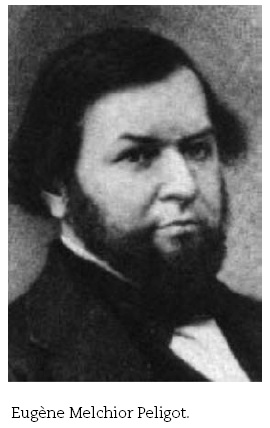
<body><![CDATA[<p align="justify"><font face="verdana" size="2">Eug&egrave;ne Melchior Peligot (Figure 1) was born in Paris on February 24, 1811 and passed away in Paris on April 15, 1890. His father, Jean&#45;Baptiste Peligot, had moved from the country to Paris and at the beginning of the Restauration (1814) was chief administrator of the hospitals and hospices of the city of Paris. He was a man of initiative and left his important position to try to commercialize the sulfurous waters of Enghien (11 km north of Paris), which had been discovered by Abbot Louis Cotte, a priest from the Oratory of Montmorency (Cotte, 1774). The first thermal spa was built in 1820. Jean&#45;Baptiste Peligot purchased the spa and redesigned the pond, which became a lake. The town adopted the motto: "Dant robur virtutem que fonts" (These springs which give strength and courage). The July Revolution of 1830, during which King Charles X was deposed and replaced by King LouisPhilippe, resulted in the village of Enghien being abandoned and, as a consequence, Peligot lost all his fortune and had to turn the property over to the bank that had loaned him part of the investment. Jean&#45;Baptiste could not resist the tragedy and passed away shortly.</font></p>  	    <p align="center"><font face="verdana" size="2"><img src="/img/revistas/eq/v20n1/a6f.jpg"></font></p>  	    <p align="justify"><font face="verdana" size="2">Eug&egrave;ne Peligot studied at the coll&egrave;ge Henri IV and after graduation in 1829 he entered the &Eacute;cole Centrale des Arts et Manufactures (a new school of engineering which had just been created) as elev&egrave; ing&eacute;nieur. While at the &Eacute;cole he attended the chemistry classes given by Jean&#45;Baptiste Andr&eacute; Dumas (1800&#45;1884), where he found his vocation. The events related to the Revolution of 1830 and the death of his father, with the corresponding loss of economical support, did not allow him to complete his studies. He requested the help of Dumas, who promptly admitted him to the private laboratory he had just founded. A year later, 1833, at the age of 22, Peligot presented his first work to the Acad&eacute;mie des Sciences and in 1834, he reincorporated to the &Eacute;cole, this time as r&eacute;p&eacute;titeur of the chemistry course given by Dumas. Two years later, on the basis of his outstanding teaching abilities, he was appointed titular to the chair that Dumas had just vacated. He was then 25 years old. During the same period, he was also appointed r&eacute;p&eacute;titeur de chimie at the &Eacute;cole Polytechnique. His scientific discoveries and the success of his teaching, led to his appointment, for a few months, as substitute of Charles&#45;Bernard D&eacute;sormes (1777&#45;1862) at the Conservatoire des Arts et M&eacute;tiers. In 1841, at the age of 30, he became titular of the chair in Chimie G&eacute;n&eacute;rale Appliqu&eacute;e aux Arts, a position he retained for 48 years (Jungfleish, 1891).</font></p>      <p align="justify"><font face="verdana" size="2">In 1843 the teaching of chemistry at the &Eacute;cole Centrale had expanded substantially and the chemistry chair occupied by Peligot was split into two. Peligot assumed the one of analytical chemistry, a subject to which he would later dedicate much effort. In 1875 he was appointed member of the Conseil de Perfectionnement de l'&Eacute;cole Centrale, a position he kept until 1887. His research activities covered theoretical chemistry, industrial chemistry, and agricultural chemistry. The last field was probably a consequence of being elected to the section of rural chemistry of the Acad&eacute;mie des Sciences in 1852 replacing Saint&#45;Sylvestre. When the Institut National Agronomique was founded in 1848 Peligot became its professor of analytical chemistry applied to agriculture. His many activities did not prevent him from accepting, in 1846, a position of analyst at the Mint. In 1848 he was promoted to inspector of assays, later administrator, and finally, director of the assay service. After his retirement (1887) he was appointed honorary director of assays and member of the Commission du Contr&ocirc;le de la Circulation Mon&eacute;taire. During the last year of his life (1889) he was Charg&eacute; du Contr&ocirc;le des Essais in France (Jungfleish, 1891).</font></p>  	    <p align="justify"><font face="verdana" size="2">In 1862, after the death of Charles Louis Felix Cadet de Gassicourt (1789&#45;1861), Peligot was appointed to the Conseil d'Hygi&egrave;ne Publique et de Salubrit&eacute;. In this position he played an important role in problems related to the quality of drinking water in Paris (Peligot, 1850). In 1835 he became a member of the administrative council of the Soci&eacute;t&eacute; d'Encouragement pour l'industrie Nationale, its adjunct secretary in 1847, and permanent secretary in 1874. In 1870 he became member of the Soci&eacute;t&eacute; Nationale de Agriculture. In 1876, he replaced Antoine&#45;Jer&ocirc;me Balard (1802&#45;1876) as President of the Soci&eacute;t&eacute; Fran&ccedil;aise de Photographie.</font></p>  	    <p align="justify"><font face="verdana" size="2">In 1854 he was made Chevalier de la L&eacute;gion de Honneur, and promoted to Officier in 1857, Commandeur in 1878, and Grand Officier in 1885. In 1873 Peligot felt that his health was failing and gradually retired from active work (Rossi, 1890).</font></p>  	    <p>&nbsp;</p>  	    <p align="justify"><font face="verdana" size="2"><b>Scientific contribution</b></font></p>  	    <p align="justify"><font face="verdana" size="2">Peligot did research in a wide range of subjects, among them sugars and their reactions, chromium, uranium, iron, and their salts; the composition and structure of glass, the silkworm, and drinking water. The results were published in about 80 papers and seven books (Peligot, 1838b, 1844f, 1850, 1853, 1862, 1877, 1883). In 1840 Peligot also published a short description of his many research achievements (Peligot, 1840b).</font></p>  	    <p>&nbsp;</p>  	    ]]></body>
<body><![CDATA[<p align="justify"><font face="verdana" size="2">Chromium</font></p>  	    <p align="justify"><font face="verdana" size="2">The first scientific publication of Peligot, (Peligot, 1833a) described the preparation and properties of a new chromium compound resulting from the combination of a saturated salt, such as KCl, with chromic acid, or by treating potassium di&#45;chromate with an excess of HCl. This dichromate of potassium chloride or trioxochlorochromate, K&#91;CrO<sub>3</sub>Cl&#93; (Peligot's salt), presents itself as long orange&#45;red crystals and is a salt of chlorochromic acid in which one of the HO groups of chromic acid has been replaced by chlorine and thus it is intermediate between chromic acid and chromyl chloride.</font></p>  	    <p align="justify"><font face="verdana" size="2">This singular compound presents some unusual properties and reactions. It is very stable in air but is hydrolyzed by water. Pure water, in small amounts, releases the chromic acid and leaves a white residue of potassium chloride; in larger amount it results in total dissolution. Evaporation of the liquor regenerates potassium dichromate. In the presence of HCl, water has no effect on the salt. Thus, the presence or absence of HCl determines the formation or destruction of the dichromate of potassium chloride. This is a good example of reactions, little studied at Peligot's time, that change in direction with the presence of certain reagents. Treatment of the salt with concentrated sulfuric acid results in the evolution of copious red fumes of chromyl chloride, apparently a result of a disproportionation reaction in which part of the chromium is further chlorinated:</font></p>  	    <p align="center"><font face="verdana" size="2">2KCrO<sub>3</sub>Cl + 2H<sub>2</sub>SO<sub>4</sub> &#151; CrO<sub>3</sub> + CrO<sub>2</sub>Cl<sub>2</sub> + 2KHSO<sub>4</sub> + H<sub>2</sub>O</font></p>  	    <p align="justify"><font face="verdana" size="2">When heated, Peligot's salt releases all of its chlorine, and on further heating yields chromic oxide, Cr<sub>2</sub>O<sub>3</sub>. The salt itself possesses a sharp odor of chlorine.</font></p>  	    <p align="justify"><font face="verdana" size="2">The work on uranium (see below) led Peligot to study the simultaneous action of chlorine and carbon on a number of highly stable oxides, which were not reduced by the simultaneous action of both chlorine and carbon. The first one to be studied was the green sesquioxide of chromium, Cr<sub>2</sub>O<sub>3</sub> (Peligot, 1844ce, 1845ab, 1868b). Passing a stream of chlorine over a mixture of the oxide and carbon generated a chloride that sublimed as purple scales. This compound corresponded with chromium sesquioxide, Cr<sub>2</sub>O<sub>3</sub> by having the formula Cr<sub>2</sub>Cl<sub>3</sub>. But as Peligot discovered, the sesquichloride was not the only product of the reaction; it was preceded by another chloride that had not been noted before. This chloride appeared as very fine white and silky crystals, usually mixed with carbon and chromium oxide. Analysis of the same indicated that its formula was CrCl and corresponded to an unknown degree of oxidation of chromium. The compound was also obtained by passing a stream of hydrogen over violet chromium chloride (CrCl<sub>3</sub>) heated to dark red. Peligot found that this new chloride had some unusual properties. Its crystals became green on contact with air and then transformed into a green liquid due to the simultaneous absorption of oxygen and water from the air. It dissolved immediately in water and the solution became blue in the absence of air, and green in the presence of it. The green solution was able to dissolve a considerable amount of violet chromium chloride, a substance known to be totally insoluble in cold or hot water and in boiling sulfuric acid and aqua regia. The process was highly exothermic and the resulting green solution presented all the chemical characters of hydrated chromium sesquichloride. The oxychloride had some remarkable properties: Its solution was a powerful reductant, added to a tin salt it precipitated tin, it reduced the gold in gold salts and was equally active with organic materials, it dissolved alizarin yielding a colorless solution, susceptible of regenerating alizarin by oxidation, and transformed blue indigo into white indigo, that atmospheric air transformed back into blue indigo. These properties became important in the dyeing industry.</font></p>  	    <p align="justify"><font face="verdana" size="2">The amount of heat released and the facility of solution seemed to indicate the production of a particular combination of the two chlorides, promoted by the presence of water. Peligot also found that a very small amount of the protochloride was enough to dissolve a very large amount of the violet chloride, so that its action was not a chemical phenomenon but, more probably, a physical one, involving a molecular change in the sesquichloride. The dissolution did not take place with a solution of the protochloride that had absorbed oxygen from the air. Solution of the protochloride prepared by the reduction of the sesquioxide with hydrogen resulted in the release of a large amount of hydrogen, originating from the decomposition of water. An interesting point is that Peligot assumed that the actual mechanism was similar to other inorganic and organic reactions, which were accelerated by the presence of a small amount of another substance. He was implying that the reaction was catalytic, way before the concept was accepted. Very careful analysis of protochloride led him to recognize that the atomic weight of chromium, determined by J&ouml;ns Jacob Berzelius (1779&#45;1848) as 351.8 relative to oxygen (Berzelius, 1827) was in considerable error. Peligot proved that the correct figure was 328 (Peligot, 1844e), a value that was later confirmed by several scientists.</font></p>  	    <p align="justify"><font face="verdana" size="2">Peligot found that addition of chromium protochloride to a solution of potassium hydroxide resulted in the formation of a brown precipitate, which with time changed to a reddish color. The original precipitate was certainly an hydrated chromium protochloride. This oxide was highly unstable, at room temperature it decomposed water and transformed into an oxide intermediate between the protoxide and the sesquioxide, corresponding to its composition to magnetic iron oxide (Fe<sub>3</sub>O<sub>4</sub>); for this reason Peligot decided to name it magnetic oxide. Analysis of the magnetic oxide gave the composition Cr<sub>3</sub>O<sub>4</sub> &middot; H<sub>2</sub>O.</font></p>  	    <p align="justify"><font face="verdana" size="2">Peligot concluded his paper stating that the discovery of chromium protoxide established a straight and close relation between iron and chromium, which led to assume that chromium formed five combinations with oxygen: (1) The protoxide, CrO, probably isomorphic with iron protoxide, and similar to it, presenting such a an affinity for water that in the hydrated state it decomposed water with generation of hydrogen, (2) the deutoxide, Cr<sub>3</sub>O<sub>4</sub> isomorphic with magnetic oxide of iron, and originating under the same circumstances, (3) the dioxide, CrO<sub>2</sub>, which may be considered as chromate of the sesquioxide (CrO<sub>3</sub>, Cr<sub>2</sub>O<sub>3</sub>), (4) the sesquioxide Cr<sub>2</sub>O<sub>3</sub>, isomorphic with ferric acid, and (5) chromic acid, probably isomorphic with ferric oxide, and which would be recognized as such once the properties of the latter became better known.</font></p>  	    <p>&nbsp;</p>  	    ]]></body>
<body><![CDATA[<p align="justify"><font face="verdana" size="2">Uranium</font></p>  	    <p align="justify"><font face="verdana" size="2">Another metal that led Peligot to substantial discoveries is uranium (Peligot, 1841bc, 1844a, 1846a, 1856, 1868a). In 1789 Martin&#45;Heinrich Klaproth (1743&#45;1817) recognized that pechblende, a mineral assumed to be based on iron and zinc and having the appearance of pitch, was actually formed by the yellow oxide of a new metal, which he named uranium, after the new planet that William Herschel (1738&#45;1822) had discovered in 1781 (actually Herschel named the planet <i>Georgium Sidus</i>, George's star, in honor of King George III of England). By reducing the oxide with charcoal at a high temperature, Klaproth obtained a black powder with a metallic luster, which he took to be metallic uranium. Subsequently this new body was found in many other minerals and continued to be considered a metal, to which the name uranium was now given.</font></p>  	    <p align="justify"><font face="verdana" size="2">In his first publication on the subject, entitled "On the atomic weight of urane", (Peligot, 1841b) Peligot wrote that although <i>urane</i> (the name given originally to uranyl oxide) was known for over half a century, its properties were ill defined, in spite of the fact that it presented several particularities of chemical interest. He had obtained a large amount of uranite from Autun, having a very simple composition (a double phosphate of uranium and calcium), which allowed an easy separation of the metal. In this work, he was interested in studying the principal compounds, which could be prepared. According to the results of Johan August Arfvedson (1792&#45;1841) and Berzelius, it was assumed that the atomic weight of uranium was 2711.3. According to Berzelius, uranium presented two oxides in which the multiples of oxygen were 2 and 3. These were considered to be U + O and 2U + 3O. Since others had determined the atomic weight without analyzing any of the uranium salts, Peligot thought it necessary to start his research by determining the composition of several salts of uranium. For this purpose he selected uranium peroxide acetate because it crystallized in small isolated transparent prisms, easy to separate from the mother liquor, and little soluble in water; physical characteristics that did not leave any doubt regarding its homogeneity. Elemental analysis of the salt yielded C<sub>8</sub> 11.26%, H<sub>10</sub>O<sub>4</sub> 21.09%, and uranium oxide 67.65%, corresponding to an atomic weight of uranium of 1700 (Peligot, 1841b).</font></p>  	    <p align="justify"><font face="verdana" size="2">In a following memoir (Peligot, 1841c), reported that what others had considered to be pure uranium, was actually not a simple body but a substance containing a large percentage of oxygen; that the properties of uranyl radical, the true metal he had obtained in the free state, were quite different from those reported previously, and that the binary compound considered by others to be metallic uranium, was actually a well defined body, playing in most of its combinations the role of a simple body, of an ordinary metal. In other words, if his results were correct, then urane was then a <i>composite</i> metal. In his experiments he passed a stream of dry chlorine over the substance heated red and observed the formation of a yellow compound, very fusible, very soluble in water, and yielding a solution that presented all the well&#45;known reactions of the yellow salts produced from urane peroxide. Interesting enough, the action of chlorine was never complete; there always remained a certain amount of the original material unattacked. In order to try to bring the reaction to completion, he first mixed the raw ground material with charcoal and was surprised to find that this time, instead of the yellow chloride, he obtained a volatile compound, which by sublimation crystallized in beautiful deep green regular octahedrons, having a metallic luster. This chloride was highly soluble in water, producing a deep green solution presenting all the different reactions ascribed to the salts of urane protoxide. Addition of ammonia in excess produced a brown precipitate, which could be considered a form of hydrated urane protoxide. The hydrate was easily converted into the oxide by treatment with nitric acid, followed by calcination. Reduction of the oxide with hydrogen allowed calculating the atomic weight of urane according to the oxygen loss. Initial calculations gave an impossible result, which justified the assumption that water, in contact with green urane chloride, decomposed in such a manner that it gave up to the metallic radical a certain amount of oxygen which reducing agents such as hydrogen and carbon, were unable to eliminate. The conclusion was very clear: oxygen was present in the actual urane obtained. In order to confirm his findings, Peligot repeated the experiment as follows: First, very pure urane nitrate was calcinated strongly. The resulting protoxide was mixed with lampblack, heated to a high temperature, and then treated with a stream of hydrogen; no water was formed because charcoal had eliminated the oxygen. Treatment with a stream of dry chlorine resulted in the formation of an abundant and complete sublimation of the green chloride, accompanied by carbon dioxide and CO. The oxygen of the gas had to come from urane, previously considered to be a simple body. Consequently, metallic urane contained oxygen, it had to be an oxide of the same nature as the oxides of aluminum, magnesium, etc, which were not reduced by hydrogen, chlorine, and carbon alone. The <i>simultaneous</i> action of carbon and chlorine separated the metallic radical, which joined the chlorine, while the oxygen combined with the carbon. According to Peligot, all the properties of urane corresponded to those of a true metal: its metallic luster, formation of many salts having the characteristics of ordinary metallic salts, no metal displaced it from its solutions, its specific heat fitted its atomic weight; in contact with other metals it did not form alloys, etc.</font></p>  	    <p align="justify"><font face="verdana" size="2">But urane considered as an oxide, differed from all other known oxides in that it combined completely with many metalloids, as simple bodies did. It combined with oxygen producing an oxide that functioned as a base and formed the corresponding salts. For this reason Peligot suggested keeping the name <i>urane</i> for the composite radical and naming <i>uranium</i> the true simple body. He then succeeded in preparing uranium by slightly heating a mixture of uranium chloride with potassium in a platinum crucible. The resulting reaction was highly exothermic; the crucible became incandescent and part of the products volatilized. Treatment of the residue with water dissolved the remaining chloride and left uranium as a black powder. Peligot reported many of the properties of the metal: uranium was highly combustible, when dry it burnt in contact with air with a live brilliancy, it dissolved in diluted acids with release of hydrogen; the corresponding solutions were green and had the properties attributed to the salts of urane protoxide. Assuming that the green chloride was formed by of two atoms or two equivalents of chlorine and one atom of uranium, then its atomic weight was 750. From this result Peligot calculated that the weight of urane (uranyl oxide) was 1700 (two atoms of uranium and two of oxygen, 2&times;750 + 2&times;100). Urane was found to combine with oxygen in many proportions; Peligot believed that there were at least five such combinations. He concluded his paper with the statement that urane should be ranged within the class of composite radicals, such as cyanogen, ammonium, and nitrogen dioxide, and that it offered the first example of a metal oxide playing the role of a radical.</font></p>  	    <p align="justify"><font face="verdana" size="2">In a following work (Peligot, 1844a) repeated that in his previous publication he had demonstrated that urane, which was considered then as a simple body, was actually a metallic oxide, from which he had separated uranium, a new metal. The anomalous properties of this oxide could be interpreted by assigning to it to different roles; as a strong base it combined with acids and gave place to green salts of uranium protoxide; acting as a simple or composite radical, it combined with chlorine, sulfur and other metalloids producing ternary compounds having all the properties o chloride, sulfides, and other binary bodies formed by the union of metals with metalloids. To this radical he had given the name <i>uranyl</i>. He had arrived at these results when considering the properties of uranium peroxide, U<sub>2</sub>O<sub>2</sub>. This oxide is the basis of the yellow uranic salts that contain the oxide united in the ratio 1:1 equivalents; consequently, they are tribasic. However, they offer in an uncontestable manner, the set of physical and chemical properties of neutral salts. This anomaly forces to dismiss the value and generalities of the laws relative to the composition of salts or to attribute to uranium peroxide a special constitution. According to Peligot, the latter alternative seemed moresound: to consider the oxide as the equivalent of an oxide with one atom of oxygen. Under this hypothesis it becomes (U<sub>2</sub>O<sub>2</sub>)O corresponding to the chloride (U<sub>2</sub>O<sub>2</sub>)Cl. The two oxygen atoms of uranyl did not contribute to its saturation capacity; they formed neutral salts and united with one equivalent of acid.</font></p>  	    <p align="justify"><font face="verdana" size="2">Peligot's discovery changed the history of uranium derivatives and led to recognize that the element formed two classes of salts, uraneous salts, derived from a <i>protoxide,</i> and characterized by their green color, and uranic salts, derived from a <i>peroxide</i> or sesquioxide, and characterized by their yellow color. A remarkable fact was that the latter salts did not follow the general composition laws of sesquioxide salts; they became saturated with only one acid equivalent. Uranium sesquioxide behaved as a monoacid base. In addition, the sesquioxide combined with bases to form salts, the uranates. These anomalies led Peligot to conceive the uranic salts as combinations of a special order, formed by the oxide (U<sub>2</sub>O<sub>2</sub>)O of the particular radical uranyl, U<sub>2</sub>O<sub>2</sub>. This theory, which at that time originated much controversy, is the one accepted today (Jungfleish, 1891).</font></p>  	    <p align="justify"><font face="verdana" size="2">Peligot added that although the result of his researches about uranium had been accepted by the majority of scientists, this was not the case of Berzelius. In his Annual Review for 1862 Berzelius wrote a severe criticism of Peligot's work, in these words: "The new French school of chemistry is today given to extraordinary theories based on uncertain and hardly tested ideas, in contrast with the old school, which was circumspect and sound". Berzelius put in doubt the value 750 for the atomic weight, contested the role of radical that Peligot had attributed to uranium protoxide, and rejected the idea of uranic oxide possessing any exceptional property. According to Berzelius, urane imitated iron in its combinations, and the same as the peroxide of the latter, it gave place to basic salts, soluble in water. Berzelius estimate of the atomic weight of uranium was in clear disaccord with the figures 742.8, calculated by Jacques Joseph Ebelmen (1814&#45;1852), 750, assumed by the mineralogist Karl Friedrich August Rammelsberg (1813&#45;1899), and 746.36, estimated by J. Wertheim.</font></p>  	    <p align="justify"><font face="verdana" size="2">In later memoir, Peligot improved the method for preparing uranium metal by replacing the potassium he had used originally by sodium, which could now be prepared easily by the procedure developed by Henry Sainte&#45;Claire Deville (1818&#45;1881) (Peligot, 1856; Deville, 1855). He also found that the density of the metal was 18.4, making it as dense as the precious metals gold and platinum (Peligot, 1868a).</font></p>  	    <p align="justify"><font face="verdana" size="2">Peligot determined the exact composition of many derivatives of uranium, some of them of practical application. One of this is the production of uranium glass, (a pale yellow or yellow&#45;green glass made by the inclusion of uranium oxide). Uranium glass typically contains about 0.1% to 1.3% wt. uranium obtained previously at the Baccarat glassworks using a rather primitive fashion, by introducing in the fused vitreous mass the uranium mineral autunite (first discovered near Autun, France, in 1852). This uranium glass has a very special green color and presents dichroism &#91;causes visible light to be split up into distinct beams of different wavelengths (colors)&#93; and fluorescence. These properties make it particularly useful for the fabrication of Geisler tubes. Another application was the fabrication of a beautiful yellow material, corresponding to one of the commercial uranium yellows (yellow oxide), ammonium uranate &#91;(NH<sub>4</sub>)<sub>2</sub>U<sub>2</sub>O<sub>7</sub>&#93;, from the double carbonate of uranyl and ammonia. Another uranium yellow, a sodium salt with formula Na<sub>2</sub>U<sub>2</sub>O/ 6H<sub>2</sub>O is used for yellow and greenish glazing enamels and to impart an opalescent yellow to glass, which is green in reflected light (Jungfleish, 1891).</font></p>  	    ]]></body>
<body><![CDATA[<p align="justify"><font face="verdana" size="2">The anomalies presented by uranium sesquioxide repeated themselves, in a certain manner, with antimony sesquioxide, which salts were also studied by Peligot (Peligot, 1846d). The sesquioxides of antimony and uranium had a characteristic saturation capacity, which differed from that of other sesquioxides, such as those of aluminum, iron, and bismuth. Peligot realized that there was a straight analogy between these two metals and that the hypothesis of the existence of a radical antimonyl, Sb<sub>2</sub>O<sub>2</sub>, behaving as a metal was advantageous when trying to account for the combinations of antimony ses&#45;quioxide with acids, and to justify the Berzelius laws regarding the composition of the salts. It allowed explaining how antimonyl protoxide, (Sb<sub>2</sub>O<sub>2</sub>)O, or antimony sesquioxide, behaved as a monoacid base.</font></p>  	    <p>&nbsp;</p>  	    <p align="justify"><font face="verdana" size="2">Iron and other metals</font></p>  	    <p align="justify"><font face="verdana" size="2">In 1844 Peligot reported on a new method for the preparation of certain metals in a very pure state (Peligot, 1844d). The procedure was based on the reduction of the protochloride by dry pure hydrogen and thus yielded the metal free of the carbon traces usually present in samples prepared by other methods. Thus, the fusibility of the chlorides offered a method of preparing the metals as crystalline and homogeneous masses, but was only applicable to metals like iron, cobalt, and nickel, which were simultaneously easily oxidable and little fusible. Pure iron prepared by this method presented itself as a mixture of very brilliant octahedric crystals and flexible and malleable plates. Peligot found that manganese protochloride was not reduced by hydrogen, so that the resulting iron was also free of manganese.</font></p>  	    <p align="justify"><font face="verdana" size="2">In the beginning of his career Peligot had made some interesting observations on the salts of iron (Peligot, 1833b). He had found that solutions of ferrous salts absorbed nitrogen dioxide (NO<sub>2</sub>) and took a brown color. Joseph Priestley (1733&#45;1804) believed that the change in color corresponded to an oxidation of the iron from the ferrous to the ferric state. Peligot results discarded this possibility because simple boiling regenerated the ferrous solutions and released nitrogen dioxide; the actual process was a 1:1 molecular combination between the salt and the gas. Another rectification of the results published by others was related to the composition of the salts resulting from the action of lead on lead nitrate, salts which had already been studied by Michel Eug&egrave;ne Chevreul (1786&#45;1889). Chevreul had described two different salts resulting from the action of different amounts of lead on lead nitrate. Peligot's experiments proved that there were actually three different combinations formed by the action of lead on lead nitrate, two of them did not contain nitrous acid but hyponitric acid, they were hyponitrates, or as named afterwards, nitrosonitrates (Peligot, 1840a).</font></p>  	    <p align="justify"><font face="verdana" size="2">The study of the action of air on copper in the presence of ammonia, allowed Peligot to recognize that the resulting liquor contained nitrous acid, originating from the oxidation of ammonia by atmospheric air (Peligot, 1861). This solution was particularly interesting because it had the property of dissolving large amounts of cellulose, a property that had been reported by Eduard Mathias Schweitzer, (1818&#45;1860) as belonging exclusively to copper hyposulfate or to cupric sulfate dissolved in an excess of ammonia (Schweitzer's reagent or cuprammonium) (Schweitzer, 1857). It had also been established that the cupric oxide in ammonia was the agent that dissolved cellulose, and that the presence of foreign salts diminished substantially this particular activity. Peligot found that that the hydrate of blue turquoise copper oxide (blue cinder) that precipitated when adding enough water to the reagent, could be redissolved in ammonia yielding an even better solvent for cellulose, silk, and other organic substances that resisted the action of common solvents. This solution contained a copper salt, which Peligot believed to be a nitrate. Later work showed that the nascent acid was nitrous acid because addition of silver nitrate precipitated silver nitrite.</font></p>  	    <p align="justify"><font face="verdana" size="2">Another research area was related to metallic alloys (Peligot, 1864a, 1873, 1889). Due to his activities in the Mint, Peligot studied in particular the alloys used in the manufacture of coins, the details of their production, and the proper analytical procedures. After a detailed examination of the properties of zinc and silver and of zinc and gold, loaded or not with copper, he declared himself in favor of the addition of zinc to coin alloys. The discovery of the gold mines in California and Australia resulted in the partial disappearance of silver coins and forced the French Mint to lower their titer from 0.900 pure silver to 0.835. The difference of 65/1000, representing about 7% of the precious metal, was thought to compensate partially the ratio between the nominal and intrinsic values of the coins. Peligot's studies on coin alloys containing silver, copper and zinc indicated that they had a beautiful white color; with a content of 835 they were as white as those with a content of 900. Their fusibility was substantially higher; they were very sonorous and elastic. Peligot concluded that the best composition was 835 parts of silver, 93 of copper, and 72 of zinc. He suggested melting the old coins and adding zinc to achieve this composition, would result in a significant economy to the government. Peligot proved that his alloy was also more appropriate for the fabrication of jewelry and objects of art because they blackened less in contact with hydrogen sulfide. Sulfur had a lower affinity for zinc and the resulting sulfide was colorless. The action of acetic acid, producing a green color because of copper, was also reduced and zinc acetate was substantially less poisonous that cupric acetate (Peligot, 1864a).</font></p>  	    <p align="justify"><font face="verdana" size="2">In a following paper he discussed the alloys employed for the fabrication of gold coins, which were particularly suited for international trade (Peligot, 1873). While the French standard for silver coins reflected in coins of 5 francs containing 900 parts of pure silver, the gold coin standard led to a gold piece of 20 francs weighing 6.541 grams; obviously such an absurd relation could not be expected to serve as an international standard for coins. The gold content had been fixed by the weight of gold required to give its value to the coin, and nothing more. This was not only a French problem; none of the foreign gold standards fitted the decimal system. According to Peligot three factors were important in a coin, the weight, the titer, and the value. It seemed extremely difficult to develop a coin, which would satisfy the triple condition of being decimal in weight, titer and value; it was necessary to sacrifice one of the three restraints. The discovery of the gold mines in California and Australia had made gold to become the exchange medium and probably the best candidate for monetary uniformity. Once again, Peligot advocated, without success, to add zinc to the gold alloy in order to put it on a decimal base.</font></p>  	    <p>&nbsp;</p>  	    <p align="justify"><font face="verdana" size="2">Sugars</font></p>  	    ]]></body>
<body><![CDATA[<p align="justify"><font face="verdana" size="2">As a result of the discoveries of Dumas and Felix Polydore Boullay (1806&#45;1835) (Boullay and Dumas, 1828) about esters, Dumas expressed a very original hypothesis about the nature of sugar that pretty soon took hold. The acid ester ethylcarbonic decomposed by hydration into alcohol and carbonic acid; sugar under the action of brewer's yeast became hydrated and decomposed into alcohol and carbonic acid. Was ethyl carbonic acid identical to sugar? This was the supposition that Peligot and Dumas were intent in proving experimentally. In this manner they discovered and made known the esters of carbonic acid and recognized them as completely different from sugars (Dumas and Peligot, 1837ac, 1838, 1840; Jungfleish, 1891).</font></p>  	    <p align="justify"><font face="verdana" size="2">Peligot continued alone the study of sugars between 1836 and the time of his death, work that resulted in a large number of publications (Peligot, 1837ab, 1838ab, 1839ab, 1840a, 1851ab, 1864b, 1879, 1880ab, 1890). This was also the subject of the thesis he presented to the Facult&eacute; de Science de Paris, for obtaining the degree Docteur &egrave;s Sciences. After establishing the composition of several sugar materials and showing the inexactitude of many current ideas about them, he studied the compounds that they formed with metal oxides, particularly the sucrates of barium, calcium, and lead. He discovered the many possible reactions of a sugar with the same base and described the properties of the derivatives. These provided the diverse treatment methods to extract from molasses the considerable amount of crystallizable sugar they contain. In addition to sugar, Peligot also studied its components, glucose and levulose (Peligot, 1838a, 1879, 1880a). He established definitely that glucose is the sweet material contained in the urine of diabetics. He made known the transient material formed by glucose and levulose with alkalis, and also the organic acids generated by the rapid destruction of these alkaline compounds (Jungfleish, 1891).</font></p>  	    <p align="justify"><font face="verdana" size="2">In his first paper about sugars (Peligot, 1837b) stated that there were two varieties of sugar, very different themselves. One corresponded to common sugar (sucrose), extracted from beets and cane sugar; the other (glucose) was present in raisins and in the urine of diabetics, and was produced when starch, lignin, or milk sugar were contacted with diluted sulfuric acid. In was known that common sugar, under diverse influences, transformed into starch sugar. The most important difference between the two varieties was the influence of alkaline bases upon them. Ordinary sugar, in contact with potash, calcium hydroxide, or limewater, played the role of a true acid. Boiling up a solution of sugar and limewater yielded a crystalline combination of both compounds. Analysis of barium saccharate proved that when sugar combined with bases it did not become modified, sugar was recovered with its original properties. With starch sugar the behavior was completely different; the sugar experimented a profound alteration. In contact with say limewater, even cold, the base lost its alkaline characteristics and after some time the solution became saturated with a new very energetic acid, which reacted with base forming a neutral salt. The acid could be obtained very easily by contacting dry starch sugar, melted at 100&deg;C, with crystalline barium hydroxide hydrate. The acid could then be precipitated with lead sub acetate. In addition to the acid, another non&#45;volatile compound was produced, characterized by its ability to reduce instantly mercury and silver salts.</font></p>  	    <p align="justify"><font face="verdana" size="2">In a following memoir, Peligot gave a detailed description of his results on the nature and chemical properties of sugars (Peligot, 1838a); this memoir was enthusiastically reviewed by Dumas, Louis&#45;Jacques Th&eacute;nard (1777&#45;1857), Joseph&#45;Louis Gay&#45;Lussac (1778&#45;1850), and Jean&#45;Baptiste Biot (17741862), who thought that it was of a such high quality that the Acad&eacute;mie should consider publishing in its Recueil des Sa&#45;vans &Eacute;trangers (Dumas et al., 1838). An interesting point in the report is the suggestion that since the sugar contained in raisins, starch, honey, and urine of diabetics, has the same composition and properties, it be named glucose (from the Greek &#947;&#955;&#949;&#965;&#950;&#959;&#963;, must, sweet wine).</font></p>  	    <p align="justify"><font face="verdana" size="2">As a result of his research on sugars, Peligot proposed a new procedure for their quantification (Peligot, 1846b) based on the different action that limewater exert on sucrose and glucose; the former combined with bases yielded compounds in definite proportions, from which sucrose could be separated without alteration. Glucose and levulose, on the other hand, also combined with bases but the product decomposed rapidly into acids, which reacted with bases forming neutral salts.</font></p>  	    <p align="justify"><font face="verdana" size="2">It was known that under the action of acids, ordinary sugar splits into an equimolar mixture of a dextro sugar (glucose) and a levo sugar (fructose,levulose). The two substances were then separated by converting them into their calcium salts; the levulosate was insoluble in cold water while the glucosate was soluble. Peligot studied this operation in detail and reported the properties of calcium levulosate (Peligot, 1880a). The latter was destroyed by calcium oxide producing the calcium salts of glucic and melassic acids and a third substance crystallizing neatly, which Peligot named saccharine (Peligot, 1880b). He studied the properties and reactions of this new product and reported that it was dextrogyre and had the same elemental composition as cellulose and starch. Peligot's saccharine was totally unrelated to the sweetener of the same name used today, corresponding to benzoic sulfinide (Peligot, 1890).</font></p>  	    <p>&nbsp;</p>  	    <p align="justify"><font face="verdana" size="2">Miscellaneous</font></p>  	    <p align="justify"><font face="verdana" size="2">Another important area of Peligot's interest was that of glass (Peligot, 1846c, 1862, 1867, 1874, 1876, 1877). By the middle of the 19<sup>th</sup> century, the superiority of the Bohemian glasses was uncontestable. Certain varieties, although strenuously researched, had resisted imitation. Peligot participated in the efforts and proved, for example, that certain glass agate, were simply a potassium silicate enriched in silica, and hence hardly fusible and inattackable by water. He also made known the composition of the glass used in Boheme for the manufacture of mirror glass by blowing (Peligot, 1846c). Old glass provided him with a series of variables capable of clarifying the glasses of today; he was the first to report that old glasses did not contain calcium carbonate, a fact that explained why they altered so easily (Peligot, 1876). Peligot also studied the reasons of many of the fabrication problems affecting the quality of the final product (Peligot, 1867, 1874). He summarized all his findings in a set of class notes for a course on the subject, and a book, <i>Le Verre</i> (Peligot, 1862, 1877; Jungfleish, 1891).</font></p>  	    <p align="justify"><font face="verdana" size="2">His achievements on the oxygenated compounds of nitrogen were very significant (Peligot, 1841a). First of all, he corrected the history of hyponitric acid. Pierre&#45;Louis Dulong (1785&#45;1838) had described this acid as a non&#45;crystallizable liquid, boiling at 28&deg;C; he had been unable to completely eliminate water, with the corresponding alteration of his product (Dulong, 1816). By using a better operating procedure, Peligot produced the hyponitrate by means of extremely dry nitrogen dioxide and oxygen. Thus he obtained the pure compound, boiling at about 22&deg;C and solidifying at &#45;90&deg;C. He recognized that the hyponitrate treated with cold water decomposed into nitric and nitrous acids; the latter colored the liquid blue. These information led Peligot to develop a detailed theory of the reactions that took place during the manufacture of sulfuric acid (Peligot, 1844b): First, sulfur dioxide reacted with nitric acid yielding sulfur trioxide and hyponitric acid; the latter was converted by water into nitric and nitrous acids. Nitrous acid, in the presence of large amounts of water, produced nitric acid and nitrogen dioxide, which atmospheric air reconverted then into hyponitric acid. The important fact was that sulfur dioxide acted unceasing and exclusively on the nitric acid regenerated by the different stages of the reaction.</font></p>  	    ]]></body>
<body><![CDATA[<p align="justify"><font face="verdana" size="2">Peligot's first researches in organic chemistry were on the distillation of calcium benzoate and its reactions (Peligot, 1834, 1836) and was published at the same time that Eilard Mitscherlich (1794&#45;1863) published his results on the subject (Mitscherlich, 1833). The dry distillation of the salt produced three compounds, which Peligot was able to isolate: benzophenone, naphthalene, and benzene. Both hydrocarbons had already been obtained, but by means of very complex reactions, scarcely understood. With Peligot's method, it was neatly seen that benzene derived from benzoic acid by elimination of the elements of carbon dioxide. In collaboration with Dumas, he determined the composition of a large number of substances, such as the essence of cinnamon, hippuric acid, sebacic acid, the hydrate of camphor, tea, etc. (Dumas and Peligot, 1834ab, 1837b). The study of the essence of cinnamon was particularly fertile; it described the aldehydic properties of the essence and its oxidation to cinnamic acid, and a variety of derivatives of both compounds. During these researches Dumas and Peligot dealt with a volatile compound that in 1812 Taylor had isolated from the liquid products obtained by distilling wood, and given the name wood spirit (methanol today) (Dumas and Peligot, 1835, 1836a, 1837ac). Analysis of the compound indicated that wood spirit differed from common alcohol, (spirit de vin), in having less carbon and hydrogen, nevertheless, it was very similar to ordinary alcohol, not only in its physical properties, but particularly in its chemical properties Dumas and Peligot reported many of its reactions, including formation of esters and dehydration with concentrated sulfuric acid (Dumas and Peligot, 1834c, 1836b). In fact, all the derivatives of alcohol corresponded to analogue derivatives from wood spirit, oxidation of the alcohol yielded acetic acid; oxidation of wood spirit also gave an acid, with less carbon and hydrogen (formic acid). Dumas and Dumas concluded that wood spirit was an alcohol, which they named methylic alcohol. Dumas and Peligot introduced the word methylene to organic chemistry (from the Greek <i>methy</i> = wine and <i>h&circ;yl&ecirc;</i> = wood). The existence of two alcohols led to the hypothesis that there must be a larger number of them. Dumas and Peligot tried to identify them among compounds previously studied, based on an analogy of properties. Thus, a long time before Michel Eug&egrave;ne Chevreul (1786&#45;1889) had separated from the hydrolysis products of spermaceti, a principle that he had named <i>&eacute;thal</i> (Chevreul, 1823). Dumas and Peligot recognized that &eacute;thal contained a third body (cetyl alcohol) capable of giving the same reactions, and performing the same reactions as ordinary alcohol and methanol (Dumas and Peligot,1836c). The alcohol could be dehydrated with phosphorus pentoxide yielding a new hydrocarbon that Dumas and Peligot named cetene, C16H32. From this moment on, the discovery of a new alcohol was considered as presenting in organic chemistry the same importance as the discovery of a new metal in mineral chemistry (Jungfleish, 1891).</font></p>  	    <p>&nbsp;</p>  	    <p align="justify"><font face="verdana" size="2"><b>References</b></font></p>  	    <!-- ref --><p align="justify"><font face="verdana" size="2">Berzelius, J. J., Tafel der Atomengewichte der Einfachen K&ouml;rper und der Oxyde, <i>Poggen. Ann.</i>, <b>10</b>, 339&#45;34, 1827.    &nbsp;&nbsp;&nbsp;&nbsp;&nbsp;&nbsp;&nbsp;&nbsp;[&#160;<a href="javascript:void(0);" onclick="javascript: window.open('/scielo.php?script=sci_nlinks&ref=3092030&pid=S0187-893X200900010000600001&lng=','','width=640,height=500,resizable=yes,scrollbars=1,menubar=yes,');">Links</a>&#160;]<!-- end-ref --></font></p>  	    <!-- ref --><p align="justify"><font face="verdana" size="2">Boullay, P. Dumas, J.&#45;B., M&eacute;moire dur la Formation de l'&Eacute;ther Sulfurique, <i>Ann. Chim. Phys.</i>, <b>36</b>, 1&#45;16, 1828.    &nbsp;&nbsp;&nbsp;&nbsp;&nbsp;&nbsp;&nbsp;&nbsp;[&#160;<a href="javascript:void(0);" onclick="javascript: window.open('/scielo.php?script=sci_nlinks&ref=3092032&pid=S0187-893X200900010000600002&lng=','','width=640,height=500,resizable=yes,scrollbars=1,menubar=yes,');">Links</a>&#160;]<!-- end-ref --></font></p>  	    <!-- ref --><p align="justify"><font face="verdana" size="2">Chevreul, M. E. <i>Recherches Chimiques sur les Corps Gras</i> <i>d'Origine Animale</i>; Paris, 1823.    &nbsp;&nbsp;&nbsp;&nbsp;&nbsp;&nbsp;&nbsp;&nbsp;[&#160;<a href="javascript:void(0);" onclick="javascript: window.open('/scielo.php?script=sci_nlinks&ref=3092034&pid=S0187-893X200900010000600003&lng=','','width=640,height=500,resizable=yes,scrollbars=1,menubar=yes,');">Links</a>&#160;]<!-- end-ref --></font></p>  	    <!-- ref --><p align="justify"><font face="verdana" size="2">Cotte, L., M&eacute;moire sur un Nouvelle Eau Min&eacute;rale Sulfureuse D&eacute;couverte dans la Vall&eacute;e de Montmorenci pr&egrave;s Paris, <i>Compt. Rendus</i>, <b>6</b>, 135&#45;145, 1774.    &nbsp;&nbsp;&nbsp;&nbsp;&nbsp;&nbsp;&nbsp;&nbsp;[&#160;<a href="javascript:void(0);" onclick="javascript: window.open('/scielo.php?script=sci_nlinks&ref=3092036&pid=S0187-893X200900010000600004&lng=','','width=640,height=500,resizable=yes,scrollbars=1,menubar=yes,');">Links</a>&#160;]<!-- end-ref --></font></p>  	    <!-- ref --><p align="justify"><font face="verdana" size="2">Deville, H. S. C., Note sur Deux Proc&eacute;d&eacute;s de Pr&eacute;paration de l'Aluminum et Sur Une Nouvelle Forme du Silicium, <i>Compt. Rendus</i>, <b>39</b>, 321&#45;326, 1854.    &nbsp;&nbsp;&nbsp;&nbsp;&nbsp;&nbsp;&nbsp;&nbsp;[&#160;<a href="javascript:void(0);" onclick="javascript: window.open('/scielo.php?script=sci_nlinks&ref=3092038&pid=S0187-893X200900010000600005&lng=','','width=640,height=500,resizable=yes,scrollbars=1,menubar=yes,');">Links</a>&#160;]<!-- end-ref --></font></p>  	    <!-- ref --><p align="justify"><font face="verdana" size="2">Dulong, P. L., Observations sur Quelques Combinaisons de l'Azote avec l'Oxyg&egrave;ne, <i>Ann. Chim. Phys</i>., <b>2</b>, 317&#45;326, 1816.    &nbsp;&nbsp;&nbsp;&nbsp;&nbsp;&nbsp;&nbsp;&nbsp;[&#160;<a href="javascript:void(0);" onclick="javascript: window.open('/scielo.php?script=sci_nlinks&ref=3092040&pid=S0187-893X200900010000600006&lng=','','width=640,height=500,resizable=yes,scrollbars=1,menubar=yes,');">Links</a>&#160;]<!-- end-ref --></font></p>  	    <!-- ref --><p align="justify"><font face="verdana" size="2">Dumas, J.&#45;B., Peligot, E., Sur l'Huile de Cannelle, l'Acide Hippurique, et l'Acide S&eacute;bacique, <i>Ann. Chim. Phys</i>., <b>57</b>&#91;<b>2</b>&#93;, 305&#45;334, 1834a.    &nbsp;&nbsp;&nbsp;&nbsp;&nbsp;&nbsp;&nbsp;&nbsp;[&#160;<a href="javascript:void(0);" onclick="javascript: window.open('/scielo.php?script=sci_nlinks&ref=3092042&pid=S0187-893X200900010000600007&lng=','','width=640,height=500,resizable=yes,scrollbars=1,menubar=yes,');">Links</a>&#160;]<!-- end-ref --></font></p>  	    <!-- ref --><p align="justify"><font face="verdana" size="2">Dumas, J.&#45;B., Peligot, E., Sur un Hydrate d'Essence de T&eacute;r&eacute;benthine, <i>Ann. Chim. Phys.,</i> <b>57</b>&#91;2&#93;, 334&#45;355, 1834b.    &nbsp;&nbsp;&nbsp;&nbsp;&nbsp;&nbsp;&nbsp;&nbsp;[&#160;<a href="javascript:void(0);" onclick="javascript: window.open('/scielo.php?script=sci_nlinks&ref=3092044&pid=S0187-893X200900010000600008&lng=','','width=640,height=500,resizable=yes,scrollbars=1,menubar=yes,');">Links</a>&#160;]<!-- end-ref --></font></p>  	    <!-- ref --><p align="justify"><font face="verdana" size="2">Dumas, J.&#45;B., Peligot, E., Sur un Nouvelle Alcool et ses D&eacute;riv&eacute;s, <i>J. Pharm.</i>, <b>20</b>, 548&#45;549, 1834c.    &nbsp;&nbsp;&nbsp;&nbsp;&nbsp;&nbsp;&nbsp;&nbsp;[&#160;<a href="javascript:void(0);" onclick="javascript: window.open('/scielo.php?script=sci_nlinks&ref=3092046&pid=S0187-893X200900010000600009&lng=','','width=640,height=500,resizable=yes,scrollbars=1,menubar=yes,');">Links</a>&#160;]<!-- end-ref --></font></p>  	    <!-- ref --><p align="justify"><font face="verdana" size="2">Dumas, J.&#45;B., Peligot, E., M&eacute;moire sur l'Esprit&#45;de&#45;Bois et les Divers Compos&eacute;s &Eacute;th&eacute;res qui en Proviennent, <i>Ann. Chim. Phys.,</i> <b>58</b>&#91;2&#93;, 5&#45;74, 1835.    &nbsp;&nbsp;&nbsp;&nbsp;&nbsp;&nbsp;&nbsp;&nbsp;[&#160;<a href="javascript:void(0);" onclick="javascript: window.open('/scielo.php?script=sci_nlinks&ref=3092048&pid=S0187-893X200900010000600010&lng=','','width=640,height=500,resizable=yes,scrollbars=1,menubar=yes,');">Links</a>&#160;]<!-- end-ref --></font></p>  	    <!-- ref --><p align="justify"><font face="verdana" size="2">Dumas, J.&#45;B., Peligot, E., Hydrates de M&eacute;thyl&egrave;ne, <i>Ann. Chim. Phys.,</i> <b>61</b>&#91;2&#93;, 193&#45;201, 1836a.    &nbsp;&nbsp;&nbsp;&nbsp;&nbsp;&nbsp;&nbsp;&nbsp;[&#160;<a href="javascript:void(0);" onclick="javascript: window.open('/scielo.php?script=sci_nlinks&ref=3092050&pid=S0187-893X200900010000600011&lng=','','width=640,height=500,resizable=yes,scrollbars=1,menubar=yes,');">Links</a>&#160;]<!-- end-ref --></font></p>  	    <!-- ref --><p align="justify"><font face="verdana" size="2">Dumas, J.&#45;B., Peligot, E., Nouvelles Combinaisons du M&eacute;thyl&egrave;ne, <i>Ann. Chim. Phys.,</i> <b>61</b>&#91;2&#93;, 193&#45;201, 1836b.    &nbsp;&nbsp;&nbsp;&nbsp;&nbsp;&nbsp;&nbsp;&nbsp;[&#160;<a href="javascript:void(0);" onclick="javascript: window.open('/scielo.php?script=sci_nlinks&ref=3092052&pid=S0187-893X200900010000600012&lng=','','width=640,height=500,resizable=yes,scrollbars=1,menubar=yes,');">Links</a>&#160;]<!-- end-ref --></font></p>  	    <!-- ref --><p align="justify"><font face="verdana" size="2">Dumas, J.&#45;B., Peligot, E., Recherches sur la Nature de l'&Eacute;thal, tendant a Prouver que c'est un Corps Analogue &agrave; l'Alcool, <i>Ann. Chim. Phys.,</i> <b>62</b>&#91;2&#93;, 5&#45;22, 1836c.    &nbsp;&nbsp;&nbsp;&nbsp;&nbsp;&nbsp;&nbsp;&nbsp;[&#160;<a href="javascript:void(0);" onclick="javascript: window.open('/scielo.php?script=sci_nlinks&ref=3092054&pid=S0187-893X200900010000600013&lng=','','width=640,height=500,resizable=yes,scrollbars=1,menubar=yes,');">Links</a>&#160;]<!-- end-ref --></font></p>  	    <!-- ref --><p align="justify"><font face="verdana" size="2">Dumas, J.&#45;B., Peligot, E., Note sur le Carbom&eacute;thylate de Baryte, <i>Compt. Rendus</i>, <b>2</b>, 433&#45;434, 1837a.    &nbsp;&nbsp;&nbsp;&nbsp;&nbsp;&nbsp;&nbsp;&nbsp;[&#160;<a href="javascript:void(0);" onclick="javascript: window.open('/scielo.php?script=sci_nlinks&ref=3092056&pid=S0187-893X200900010000600014&lng=','','width=640,height=500,resizable=yes,scrollbars=1,menubar=yes,');">Links</a>&#160;]<!-- end-ref --></font></p>  	    <!-- ref --><p align="justify"><font face="verdana" size="2">Dumas, J.&#45;B., Peligot, E., Sur la Nature du Camphre Ordinaire, <i>Compt. Rendus</i>, <b>4</b>, 496, 1837b.    &nbsp;&nbsp;&nbsp;&nbsp;&nbsp;&nbsp;&nbsp;&nbsp;[&#160;<a href="javascript:void(0);" onclick="javascript: window.open('/scielo.php?script=sci_nlinks&ref=3092058&pid=S0187-893X200900010000600015&lng=','','width=640,height=500,resizable=yes,scrollbars=1,menubar=yes,');">Links</a>&#160;]<!-- end-ref --></font></p>  	    <!-- ref --><p align="justify"><font face="verdana" size="2">Dumas, J.&#45;B., Peligot, E., Sur le Carbovinate de Potasse, <i>Compt. Rendus</i>, <b>4</b>, 563&#45;565, 1837c.    &nbsp;&nbsp;&nbsp;&nbsp;&nbsp;&nbsp;&nbsp;&nbsp;[&#160;<a href="javascript:void(0);" onclick="javascript: window.open('/scielo.php?script=sci_nlinks&ref=3092060&pid=S0187-893X200900010000600016&lng=','','width=640,height=500,resizable=yes,scrollbars=1,menubar=yes,');">Links</a>&#160;]<!-- end-ref --></font></p>  	    <!-- ref --><p align="justify"><font face="verdana" size="2">Dumas, J.&#45;B., Peligot, E., Sur les Carbovinates, les Carbom&eacute;thylates, et la V&eacute;ritable Constitution du Sucre de Canne, <i>Compt. Rendus</i>, <b>6</b>, 217&#45;225, 1838.    &nbsp;&nbsp;&nbsp;&nbsp;&nbsp;&nbsp;&nbsp;&nbsp;[&#160;<a href="javascript:void(0);" onclick="javascript: window.open('/scielo.php?script=sci_nlinks&ref=3092062&pid=S0187-893X200900010000600017&lng=','','width=640,height=500,resizable=yes,scrollbars=1,menubar=yes,');">Links</a>&#160;]<!-- end-ref --></font></p>  	    <!-- ref --><p align="justify"><font face="verdana" size="2">Dumas, J.&#45;B., Peligot, E., Troisi&egrave;me M&eacute;moire sur les Types Chimiques, <i>Ann. Chim. Phys.</i>, <b>74</b>, 5&#45;17, 1840.    &nbsp;&nbsp;&nbsp;&nbsp;&nbsp;&nbsp;&nbsp;&nbsp;[&#160;<a href="javascript:void(0);" onclick="javascript: window.open('/scielo.php?script=sci_nlinks&ref=3092064&pid=S0187-893X200900010000600018&lng=','','width=640,height=500,resizable=yes,scrollbars=1,menubar=yes,');">Links</a>&#160;]<!-- end-ref --></font></p>  	    <!-- ref --><p align="justify"><font face="verdana" size="2">Dumas, J.&#45;B, Thenard, L. J., Gay&#45;Lussac, J. L., Biot, J. B., Rapport sur un M&eacute;moire de M. Peligot, Intitul&eacute;: Recherches sur la Nature et les Propri&eacute;t&eacute;s Chimiques des Sucre, <i>Compt. Rendus</i>, <b>7</b>, 106&#45;113, 1838.    &nbsp;&nbsp;&nbsp;&nbsp;&nbsp;&nbsp;&nbsp;&nbsp;[&#160;<a href="javascript:void(0);" onclick="javascript: window.open('/scielo.php?script=sci_nlinks&ref=3092066&pid=S0187-893X200900010000600019&lng=','','width=640,height=500,resizable=yes,scrollbars=1,menubar=yes,');">Links</a>&#160;]<!-- end-ref --></font></p>  	    <!-- ref --><p align="justify"><font face="verdana" size="2">Jungfleish, M. E., Notice sur la Vie et les Travaux &#45;Eug&egrave;ne Melchior Peligot, <i>Ann. Conservatoire Arts, M&eacute;tiers</i>, <b>2</b>, 85&#45;102, 1890;    &nbsp;&nbsp;&nbsp;&nbsp;&nbsp;&nbsp;&nbsp;&nbsp;[&#160;<a href="javascript:void(0);" onclick="javascript: window.open('/scielo.php?script=sci_nlinks&ref=3092068&pid=S0187-893X200900010000600020&lng=','','width=640,height=500,resizable=yes,scrollbars=1,menubar=yes,');">Links</a>&#160;]<!-- end-ref --><!-- ref --> <i>Bull Soc. Chim</i>., <b>5</b>, xxi&#45;xlvii, 1891.    &nbsp;&nbsp;&nbsp;&nbsp;&nbsp;&nbsp;&nbsp;&nbsp;[&#160;<a href="javascript:void(0);" onclick="javascript: window.open('/scielo.php?script=sci_nlinks&ref=3092069&pid=S0187-893X200900010000600021&lng=','','width=640,height=500,resizable=yes,scrollbars=1,menubar=yes,');">Links</a>&#160;]<!-- end-ref --></font></p>  	    <!-- ref --><p align="justify"><font face="verdana" size="2">Mitscherlich, E., &Uuml;ber das Benzin und die Sa&uuml;ren der Oel und Talgarten, <i>Poggen. Annal.</i>, <b>29</b>, 231&#45;238, 1833.    &nbsp;&nbsp;&nbsp;&nbsp;&nbsp;&nbsp;&nbsp;&nbsp;[&#160;<a href="javascript:void(0);" onclick="javascript: window.open('/scielo.php?script=sci_nlinks&ref=3092071&pid=S0187-893X200900010000600022&lng=','','width=640,height=500,resizable=yes,scrollbars=1,menubar=yes,');">Links</a>&#160;]<!-- end-ref --></font></p>  	    <!-- ref --><p align="justify"><font face="verdana" size="2">Peligot, E. M., M&eacute;moire sur les Combinaisons de l'Acide Chr&ocirc;mique avec les Chlorures M&eacute;talliques, <i>Ann. Chim. Phys.,</i> <b>52</b>&#91;2&#93;, 267&#45;275, 1833a.    &nbsp;&nbsp;&nbsp;&nbsp;&nbsp;&nbsp;&nbsp;&nbsp;[&#160;<a href="javascript:void(0);" onclick="javascript: window.open('/scielo.php?script=sci_nlinks&ref=3092073&pid=S0187-893X200900010000600023&lng=','','width=640,height=500,resizable=yes,scrollbars=1,menubar=yes,');">Links</a>&#160;]<!-- end-ref --></font></p>  	    <!-- ref --><p align="justify"><font face="verdana" size="2">Peligot, E. M., De l'Action du Deutoxide d'Azote sur les Sels de Protoxide de Fer, <i>Ann. Chim. Phys.</i> &#91;2&#93;, <b>54</b>, 17&#45;25, 1833b.    &nbsp;&nbsp;&nbsp;&nbsp;&nbsp;&nbsp;&nbsp;&nbsp;[&#160;<a href="javascript:void(0);" onclick="javascript: window.open('/scielo.php?script=sci_nlinks&ref=3092075&pid=S0187-893X200900010000600024&lng=','','width=640,height=500,resizable=yes,scrollbars=1,menubar=yes,');">Links</a>&#160;]<!-- end-ref --></font></p>  	    ]]></body>
<body><![CDATA[<!-- ref --><p align="justify"><font face="verdana" size="2">Peligot, E., Sur la Distillation du Benzoate de Chaux, <i>Ann. Chim. Phys.,</i> <b>56</b>&#91;2&#93;, 59&#45;72, 1834.    &nbsp;&nbsp;&nbsp;&nbsp;&nbsp;&nbsp;&nbsp;&nbsp;[&#160;<a href="javascript:void(0);" onclick="javascript: window.open('/scielo.php?script=sci_nlinks&ref=3092077&pid=S0187-893X200900010000600025&lng=','','width=640,height=500,resizable=yes,scrollbars=1,menubar=yes,');">Links</a>&#160;]<!-- end-ref --></font></p>  	    <!-- ref --><p align="justify"><font face="verdana" size="2">Peligot, E., L'Action du Chlore, de l'Iode et du Br&ocirc;me sur les Sels Form&eacute;s par les Acides Organiques et Certains Oxides M&eacute;talliques, <i>Compt. Rendus</i>, <b>2</b>, 158&#45;159, 1836.    &nbsp;&nbsp;&nbsp;&nbsp;&nbsp;&nbsp;&nbsp;&nbsp;[&#160;<a href="javascript:void(0);" onclick="javascript: window.open('/scielo.php?script=sci_nlinks&ref=3092079&pid=S0187-893X200900010000600026&lng=','','width=640,height=500,resizable=yes,scrollbars=1,menubar=yes,');">Links</a>&#160;]<!-- end-ref --></font></p>  	    <!-- ref --><p align="justify"><font face="verdana" size="2">Peligot, E., M&eacute;moire sur un Acide R&eacute;sultant de l'Action du Br&ocirc;me sur le Benzoate d'Argent, <i>Compt. Rendus</i>, <b>3</b>, 9&#45;12, 1836; 4, 453&#45;456, 1837a.    &nbsp;&nbsp;&nbsp;&nbsp;&nbsp;&nbsp;&nbsp;&nbsp;[&#160;<a href="javascript:void(0);" onclick="javascript: window.open('/scielo.php?script=sci_nlinks&ref=3092081&pid=S0187-893X200900010000600027&lng=','','width=640,height=500,resizable=yes,scrollbars=1,menubar=yes,');">Links</a>&#160;]<!-- end-ref --></font></p>  	    <!-- ref --><p align="justify"><font face="verdana" size="2">Peligot, E., Observations sur le Sucre de Cannes et sur un Nouvel Acid Provenant de l'Action des Alcalis sur le Sucre d'Almidon, <i>Compt. Rendus</i>, <b>5</b>, 26&#45;27, 1837b.    &nbsp;&nbsp;&nbsp;&nbsp;&nbsp;&nbsp;&nbsp;&nbsp;[&#160;<a href="javascript:void(0);" onclick="javascript: window.open('/scielo.php?script=sci_nlinks&ref=3092083&pid=S0187-893X200900010000600028&lng=','','width=640,height=500,resizable=yes,scrollbars=1,menubar=yes,');">Links</a>&#160;]<!-- end-ref --></font></p>  	    <!-- ref --><p align="justify"><font face="verdana" size="2">Peligot, E., Recherches sur la Nature et la Propri&eacute;t&eacute;s Chimiques des Sucres, <i>Compt. Rendus</i>, <b>6</b>, 232&#45;236, 1838a.    &nbsp;&nbsp;&nbsp;&nbsp;&nbsp;&nbsp;&nbsp;&nbsp;[&#160;<a href="javascript:void(0);" onclick="javascript: window.open('/scielo.php?script=sci_nlinks&ref=3092085&pid=S0187-893X200900010000600029&lng=','','width=640,height=500,resizable=yes,scrollbars=1,menubar=yes,');">Links</a>&#160;]<!-- end-ref --></font></p>  	    ]]></body>
<body><![CDATA[<!-- ref --><p align="justify"><font face="verdana" size="2">Peligot, E., Recherches sur la Nature et les Propri&eacute;t&eacute;s Chimiques des Sucres, Paris, 1838b.    &nbsp;&nbsp;&nbsp;&nbsp;&nbsp;&nbsp;&nbsp;&nbsp;[&#160;<a href="javascript:void(0);" onclick="javascript: window.open('/scielo.php?script=sci_nlinks&ref=3092087&pid=S0187-893X200900010000600030&lng=','','width=640,height=500,resizable=yes,scrollbars=1,menubar=yes,');">Links</a>&#160;]<!-- end-ref --></font></p>  	    <!-- ref --><p align="justify"><font face="verdana" size="2">Peligot, E., Sur la Composition du Saccharate de Plomb, <i>Compt. Rendus</i><b>, 8</b>, 530&#45;533, 1839a.    &nbsp;&nbsp;&nbsp;&nbsp;&nbsp;&nbsp;&nbsp;&nbsp;[&#160;<a href="javascript:void(0);" onclick="javascript: window.open('/scielo.php?script=sci_nlinks&ref=3092089&pid=S0187-893X200900010000600031&lng=','','width=640,height=500,resizable=yes,scrollbars=1,menubar=yes,');">Links</a>&#160;]<!-- end-ref --></font></p>  	    <!-- ref --><p align="justify"><font face="verdana" size="2">Peligot, E., Sur la Composition de la Canne &agrave; Sucre, <i>Compt. Rendus</i>, <b>9</b>, 349&#45;352, 1839b.    &nbsp;&nbsp;&nbsp;&nbsp;&nbsp;&nbsp;&nbsp;&nbsp;[&#160;<a href="javascript:void(0);" onclick="javascript: window.open('/scielo.php?script=sci_nlinks&ref=3092091&pid=S0187-893X200900010000600032&lng=','','width=640,height=500,resizable=yes,scrollbars=1,menubar=yes,');">Links</a>&#160;]<!-- end-ref --></font></p>  	    <!-- ref --><p align="justify"><font face="verdana" size="2">Peligot, E., Recherches sur les sels de Plomb Form&eacute;s par l'Acide Hyponitrique et par l'Acide Nitreux, <i>Compt. Rendus</i>, <b>11</b>, 860&#45;863, 1840a.    &nbsp;&nbsp;&nbsp;&nbsp;&nbsp;&nbsp;&nbsp;&nbsp;[&#160;<a href="javascript:void(0);" onclick="javascript: window.open('/scielo.php?script=sci_nlinks&ref=3092093&pid=S0187-893X200900010000600033&lng=','','width=640,height=500,resizable=yes,scrollbars=1,menubar=yes,');">Links</a>&#160;]<!-- end-ref --></font></p>  	    <!-- ref --><p align="justify"><font face="verdana" size="2">Peligot, E., <i>Notice sur les Travaux de Eug&egrave;ne Peligot</i>, Bouchard&#45;Huzard, Paris, 1840b.    &nbsp;&nbsp;&nbsp;&nbsp;&nbsp;&nbsp;&nbsp;&nbsp;[&#160;<a href="javascript:void(0);" onclick="javascript: window.open('/scielo.php?script=sci_nlinks&ref=3092095&pid=S0187-893X200900010000600034&lng=','','width=640,height=500,resizable=yes,scrollbars=1,menubar=yes,');">Links</a>&#160;]<!-- end-ref --></font></p>  	    ]]></body>
<body><![CDATA[<!-- ref --><p align="justify"><font face="verdana" size="2">Peligot, E., Recherches sur l'Acide Hypoazotique et l'Acide Azoteaux, <i>Compt. Rendus</i>, <b>12</b>, 603&#45;608, 1841a.    &nbsp;&nbsp;&nbsp;&nbsp;&nbsp;&nbsp;&nbsp;&nbsp;[&#160;<a href="javascript:void(0);" onclick="javascript: window.open('/scielo.php?script=sci_nlinks&ref=3092097&pid=S0187-893X200900010000600035&lng=','','width=640,height=500,resizable=yes,scrollbars=1,menubar=yes,');">Links</a>&#160;]<!-- end-ref --></font></p>  	    <!-- ref --><p align="justify"><font face="verdana" size="2">Peligot, E., Sur le Poids Atomique de l'Urane, <i>Compt. Rendus</i>, <b>12</b>, 735&#45;736, 1841b.    &nbsp;&nbsp;&nbsp;&nbsp;&nbsp;&nbsp;&nbsp;&nbsp;[&#160;<a href="javascript:void(0);" onclick="javascript: window.open('/scielo.php?script=sci_nlinks&ref=3092099&pid=S0187-893X200900010000600036&lng=','','width=640,height=500,resizable=yes,scrollbars=1,menubar=yes,');">Links</a>&#160;]<!-- end-ref --></font></p>  	    <!-- ref --><p align="justify"><font face="verdana" size="2">Peligot, E. M., Recherches sur l'Urane, <i>Compt. Rendus</i>, <b>13</b>, 417&#45;426, 1841c.    &nbsp;&nbsp;&nbsp;&nbsp;&nbsp;&nbsp;&nbsp;&nbsp;[&#160;<a href="javascript:void(0);" onclick="javascript: window.open('/scielo.php?script=sci_nlinks&ref=3092101&pid=S0187-893X200900010000600037&lng=','','width=640,height=500,resizable=yes,scrollbars=1,menubar=yes,');">Links</a>&#160;]<!-- end-ref --></font></p>  	    <!-- ref --><p align="justify"><font face="verdana" size="2">Peligot, E. M., Recherches sur l'Uranium, <i>Compt. Rendus</i>, <b>18</b>, 682&#45;687, 1844a.    &nbsp;&nbsp;&nbsp;&nbsp;&nbsp;&nbsp;&nbsp;&nbsp;[&#160;<a href="javascript:void(0);" onclick="javascript: window.open('/scielo.php?script=sci_nlinks&ref=3092103&pid=S0187-893X200900010000600038&lng=','','width=640,height=500,resizable=yes,scrollbars=1,menubar=yes,');">Links</a>&#160;]<!-- end-ref --></font></p>  	    <!-- ref --><p align="justify"><font face="verdana" size="2">Peligot, E., Sur la Th&eacute;orie de la Fabrication de l'Acide Sulfurique, <i>Compt. Rendus</i>, <b>19</b>, 420&#45;426, 1844b.    &nbsp;&nbsp;&nbsp;&nbsp;&nbsp;&nbsp;&nbsp;&nbsp;[&#160;<a href="javascript:void(0);" onclick="javascript: window.open('/scielo.php?script=sci_nlinks&ref=3092105&pid=S0187-893X200900010000600039&lng=','','width=640,height=500,resizable=yes,scrollbars=1,menubar=yes,');">Links</a>&#160;]<!-- end-ref --></font></p>  	    ]]></body>
<body><![CDATA[<!-- ref --><p align="justify"><font face="verdana" size="2">Peligot, E., Sur un Nouvel Oxyde de Chrome, <i>Compt. Rendus</i>, <b>19</b>, 609&#45;611, 1844c.    &nbsp;&nbsp;&nbsp;&nbsp;&nbsp;&nbsp;&nbsp;&nbsp;[&#160;<a href="javascript:void(0);" onclick="javascript: window.open('/scielo.php?script=sci_nlinks&ref=3092107&pid=S0187-893X200900010000600040&lng=','','width=640,height=500,resizable=yes,scrollbars=1,menubar=yes,');">Links</a>&#160;]<!-- end-ref --></font></p>  	    <!-- ref --><p align="justify"><font face="verdana" size="2">Peligot, E., Sur un Moyen d'Obtenir Certain M&eacute;taux Parfaitement Purs, <i>Compt. Rendus</i>, <b>19</b>, 670&#45;671, 1844d.    &nbsp;&nbsp;&nbsp;&nbsp;&nbsp;&nbsp;&nbsp;&nbsp;[&#160;<a href="javascript:void(0);" onclick="javascript: window.open('/scielo.php?script=sci_nlinks&ref=3092109&pid=S0187-893X200900010000600041&lng=','','width=640,height=500,resizable=yes,scrollbars=1,menubar=yes,');">Links</a>&#160;]<!-- end-ref --></font></p>  	    <!-- ref --><p align="justify"><font face="verdana" size="2">Peligot, E., Recherches sur le Chrome, <i>Compt. Rendus</i>, <b>19</b>, 734&#45;742, 1844e.    &nbsp;&nbsp;&nbsp;&nbsp;&nbsp;&nbsp;&nbsp;&nbsp;[&#160;<a href="javascript:void(0);" onclick="javascript: window.open('/scielo.php?script=sci_nlinks&ref=3092111&pid=S0187-893X200900010000600042&lng=','','width=640,height=500,resizable=yes,scrollbars=1,menubar=yes,');">Links</a>&#160;]<!-- end-ref --></font></p>  	    <!-- ref --><p align="justify"><font face="verdana" size="2">Peligot, E., <i>Recherches sur la Composition Chimique du Th&eacute;</i>, Paris, 1844f.    &nbsp;&nbsp;&nbsp;&nbsp;&nbsp;&nbsp;&nbsp;&nbsp;[&#160;<a href="javascript:void(0);" onclick="javascript: window.open('/scielo.php?script=sci_nlinks&ref=3092113&pid=S0187-893X200900010000600043&lng=','','width=640,height=500,resizable=yes,scrollbars=1,menubar=yes,');">Links</a>&#160;]<!-- end-ref --></font></p>  	    <!-- ref --><p align="justify"><font face="verdana" size="2">Peligot, E., Sur la Composition du Sesquichlorure de Chrome, <i>Compt. Rendus</i>, <b>20</b>, 1187&#45;1191, 1845a.    &nbsp;&nbsp;&nbsp;&nbsp;&nbsp;&nbsp;&nbsp;&nbsp;[&#160;<a href="javascript:void(0);" onclick="javascript: window.open('/scielo.php?script=sci_nlinks&ref=3092115&pid=S0187-893X200900010000600044&lng=','','width=640,height=500,resizable=yes,scrollbars=1,menubar=yes,');">Links</a>&#160;]<!-- end-ref --></font></p>  	    ]]></body>
<body><![CDATA[<!-- ref --><p align="justify"><font face="verdana" size="2">Peligot, E., Sur les Chlorures de Chrome, <i>Compt. Rendus</i>, <b>21</b>, 74&#45;81, 1845b.    &nbsp;&nbsp;&nbsp;&nbsp;&nbsp;&nbsp;&nbsp;&nbsp;[&#160;<a href="javascript:void(0);" onclick="javascript: window.open('/scielo.php?script=sci_nlinks&ref=3092117&pid=S0187-893X200900010000600045&lng=','','width=640,height=500,resizable=yes,scrollbars=1,menubar=yes,');">Links</a>&#160;]<!-- end-ref --></font></p>  	    <!-- ref --><p align="justify"><font face="verdana" size="2">Peligot, E. M., Sur le Poids Atomique de l'Uranium, <i>Compt. Rendus</i>, <b>22</b>, 487&#45;494, 1846a.    &nbsp;&nbsp;&nbsp;&nbsp;&nbsp;&nbsp;&nbsp;&nbsp;[&#160;<a href="javascript:void(0);" onclick="javascript: window.open('/scielo.php?script=sci_nlinks&ref=3092119&pid=S0187-893X200900010000600046&lng=','','width=640,height=500,resizable=yes,scrollbars=1,menubar=yes,');">Links</a>&#160;]<!-- end-ref --></font></p>  	    <!-- ref --><p align="justify"><font face="verdana" size="2">Peligot, E., Sur un Nouveau Proc&eacute;d&eacute; Saccharim&eacute;trique, <i>Compt. Rendus</i>, <b>22</b>, 936&#45;940, 1846b.    &nbsp;&nbsp;&nbsp;&nbsp;&nbsp;&nbsp;&nbsp;&nbsp;[&#160;<a href="javascript:void(0);" onclick="javascript: window.open('/scielo.php?script=sci_nlinks&ref=3092121&pid=S0187-893X200900010000600047&lng=','','width=640,height=500,resizable=yes,scrollbars=1,menubar=yes,');">Links</a>&#160;]<!-- end-ref --></font></p>  	    <!-- ref --><p align="justify"><font face="verdana" size="2">Peligot, E., Sur la Composition de Quelques Verres Fabriqu&eacute;s en Boh&ecirc;me, <i>Compt. Rendus</i>, <b>22</b>, 547&#45;550, 1846c.    &nbsp;&nbsp;&nbsp;&nbsp;&nbsp;&nbsp;&nbsp;&nbsp;[&#160;<a href="javascript:void(0);" onclick="javascript: window.open('/scielo.php?script=sci_nlinks&ref=3092123&pid=S0187-893X200900010000600048&lng=','','width=640,height=500,resizable=yes,scrollbars=1,menubar=yes,');">Links</a>&#160;]<!-- end-ref --></font></p>  	    <!-- ref --><p align="justify"><font face="verdana" size="2">Peligot, E., Sur la Composition des Sels d'Antimoine, <i>Compt. Rendus</i>, <b>23</b>, 709&#45;713, 1846d.    &nbsp;&nbsp;&nbsp;&nbsp;&nbsp;&nbsp;&nbsp;&nbsp;[&#160;<a href="javascript:void(0);" onclick="javascript: window.open('/scielo.php?script=sci_nlinks&ref=3092125&pid=S0187-893X200900010000600049&lng=','','width=640,height=500,resizable=yes,scrollbars=1,menubar=yes,');">Links</a>&#160;]<!-- end-ref --></font></p>  	    ]]></body>
<body><![CDATA[<!-- ref --><p align="justify"><font face="verdana" size="2">Peligot, E., <i>&Eacute;tudes sur la Composition des Eaux</i>, Mallet&#45;Bachelier, Paris, 1850.    &nbsp;&nbsp;&nbsp;&nbsp;&nbsp;&nbsp;&nbsp;&nbsp;[&#160;<a href="javascript:void(0);" onclick="javascript: window.open('/scielo.php?script=sci_nlinks&ref=3092127&pid=S0187-893X200900010000600050&lng=','','width=640,height=500,resizable=yes,scrollbars=1,menubar=yes,');">Links</a>&#160;]<!-- end-ref --></font></p>  	    <!-- ref --><p align="justify"><font face="verdana" size="2">Peligot, E., Sur les Combinaisons du Sucre Avec le Chaux, <i>Compt. Rendus</i>, <b>32</b>, 333&#45;337, 1851a.    &nbsp;&nbsp;&nbsp;&nbsp;&nbsp;&nbsp;&nbsp;&nbsp;[&#160;<a href="javascript:void(0);" onclick="javascript: window.open('/scielo.php?script=sci_nlinks&ref=3092129&pid=S0187-893X200900010000600051&lng=','','width=640,height=500,resizable=yes,scrollbars=1,menubar=yes,');">Links</a>&#160;]<!-- end-ref --></font></p>  	    <!-- ref --><p align="justify"><font face="verdana" size="2">Peligot, E., Sur la Composition des Sucres Bruts, <i>Compt. Ren</i><i>dus</i>, <b>32</b>, 421&#45;426, 1851b.    &nbsp;&nbsp;&nbsp;&nbsp;&nbsp;&nbsp;&nbsp;&nbsp;[&#160;<a href="javascript:void(0);" onclick="javascript: window.open('/scielo.php?script=sci_nlinks&ref=3092131&pid=S0187-893X200900010000600052&lng=','','width=640,height=500,resizable=yes,scrollbars=1,menubar=yes,');">Links</a>&#160;]<!-- end-ref --></font></p>  	    <!-- ref --><p align="justify"><font face="verdana" size="2">Peligot, E., <i>Etudes Chimiques et Physiologiques sur les Vers &agrave; Soie</i>, Bouchard&#45;Huzard, Paris, 1853.    &nbsp;&nbsp;&nbsp;&nbsp;&nbsp;&nbsp;&nbsp;&nbsp;[&#160;<a href="javascript:void(0);" onclick="javascript: window.open('/scielo.php?script=sci_nlinks&ref=3092133&pid=S0187-893X200900010000600053&lng=','','width=640,height=500,resizable=yes,scrollbars=1,menubar=yes,');">Links</a>&#160;]<!-- end-ref --></font></p>  	    <!-- ref --><p align="justify"><font face="verdana" size="2">Peligot, E. M., Note sur la Pr&eacute;paration de l'Uranium, <i>Compt. Rendus</i>, <b>42</b>, 73&#45;74, 1856.    &nbsp;&nbsp;&nbsp;&nbsp;&nbsp;&nbsp;&nbsp;&nbsp;[&#160;<a href="javascript:void(0);" onclick="javascript: window.open('/scielo.php?script=sci_nlinks&ref=3092135&pid=S0187-893X200900010000600054&lng=','','width=640,height=500,resizable=yes,scrollbars=1,menubar=yes,');">Links</a>&#160;]<!-- end-ref --></font></p>  	    ]]></body>
<body><![CDATA[<!-- ref --><p align="justify"><font face="verdana" size="2">Peligot, E., Sur les Produits qui R&eacute;sultent de l'Action Simultan&eacute;e de l'Air et de l'Ammoniaque sur le Cuivre, <i>Compt. Rendus</i>, <b>53</b>, 209&#45;214, 1861.    &nbsp;&nbsp;&nbsp;&nbsp;&nbsp;&nbsp;&nbsp;&nbsp;[&#160;<a href="javascript:void(0);" onclick="javascript: window.open('/scielo.php?script=sci_nlinks&ref=3092137&pid=S0187-893X200900010000600055&lng=','','width=640,height=500,resizable=yes,scrollbars=1,menubar=yes,');">Links</a>&#160;]<!-- end-ref --></font></p>  	    <!-- ref --><p align="justify"><font face="verdana" size="2">Peligot, E., <i>Douze Le&ccedil;ons sur l'Art de la Verrerie</i>, P.&#45;A. Bourdier, Paris, 1862.    &nbsp;&nbsp;&nbsp;&nbsp;&nbsp;&nbsp;&nbsp;&nbsp;[&#160;<a href="javascript:void(0);" onclick="javascript: window.open('/scielo.php?script=sci_nlinks&ref=3092139&pid=S0187-893X200900010000600056&lng=','','width=640,height=500,resizable=yes,scrollbars=1,menubar=yes,');">Links</a>&#160;]<!-- end-ref --></font></p>  	    <!-- ref --><p align="justify"><font face="verdana" size="2">Peligot, E., Sur les Alliages d'Argent et de Zinc, <i>Compt. Rendus</i>, <b>58</b>, 645&#45;651, 1864a.    &nbsp;&nbsp;&nbsp;&nbsp;&nbsp;&nbsp;&nbsp;&nbsp;[&#160;<a href="javascript:void(0);" onclick="javascript: window.open('/scielo.php?script=sci_nlinks&ref=3092141&pid=S0187-893X200900010000600057&lng=','','width=640,height=500,resizable=yes,scrollbars=1,menubar=yes,');">Links</a>&#160;]<!-- end-ref --></font></p>  	    <!-- ref --><p align="justify"><font face="verdana" size="2">Peligot, E., Note sur le Sucrate de Chaux, <i>Compt. Rendus</i>, <b>59</b>, 930&#45;931, 1864b.    &nbsp;&nbsp;&nbsp;&nbsp;&nbsp;&nbsp;&nbsp;&nbsp;[&#160;<a href="javascript:void(0);" onclick="javascript: window.open('/scielo.php?script=sci_nlinks&ref=3092143&pid=S0187-893X200900010000600058&lng=','','width=640,height=500,resizable=yes,scrollbars=1,menubar=yes,');">Links</a>&#160;]<!-- end-ref --></font></p>  	    <!-- ref --><p align="justify"><font face="verdana" size="2">Peligot, E., Sur de Nouveaux Proc&eacute;d&eacute;s de Gravure du Verre par l'Acide Fluorhydrique, <i>Bull. Soc. Encouragement,</i> <b>14</b>&#91;2&#93;, 607&#45;610, 1867.    &nbsp;&nbsp;&nbsp;&nbsp;&nbsp;&nbsp;&nbsp;&nbsp;[&#160;<a href="javascript:void(0);" onclick="javascript: window.open('/scielo.php?script=sci_nlinks&ref=3092145&pid=S0187-893X200900010000600059&lng=','','width=640,height=500,resizable=yes,scrollbars=1,menubar=yes,');">Links</a>&#160;]<!-- end-ref --></font></p>  	    ]]></body>
<body><![CDATA[<!-- ref --><p align="justify"><font face="verdana" size="2">Peligot, E. M., Sur la Pr&eacute;paration de l'Uranium, <i>Compt. Rendus</i>, <b>67</b>, 507&#45;508, 1868a.    &nbsp;&nbsp;&nbsp;&nbsp;&nbsp;&nbsp;&nbsp;&nbsp;[&#160;<a href="javascript:void(0);" onclick="javascript: window.open('/scielo.php?script=sci_nlinks&ref=3092147&pid=S0187-893X200900010000600060&lng=','','width=640,height=500,resizable=yes,scrollbars=1,menubar=yes,');">Links</a>&#160;]<!-- end-ref --></font></p>  	    <!-- ref --><p align="justify"><font face="verdana" size="2">Peligot, E., Note sur la Composition des Fers Chrom&eacute;s, <i>Compt. Rendus</i>, <b>67</b>, 871&#45;872, 1868b.    &nbsp;&nbsp;&nbsp;&nbsp;&nbsp;&nbsp;&nbsp;&nbsp;[&#160;<a href="javascript:void(0);" onclick="javascript: window.open('/scielo.php?script=sci_nlinks&ref=3092149&pid=S0187-893X200900010000600061&lng=','','width=640,height=500,resizable=yes,scrollbars=1,menubar=yes,');">Links</a>&#160;]<!-- end-ref --></font></p>  	    <!-- ref --><p align="justify"><font face="verdana" size="2">Peligot, E., Sur les Alliages Employ&eacute;s pour la Fabrication de Monnaies d'Or, <i>Compt. Rendus</i>, <b>76</b>, 1441&#45;1452, 1873.    &nbsp;&nbsp;&nbsp;&nbsp;&nbsp;&nbsp;&nbsp;&nbsp;[&#160;<a href="javascript:void(0);" onclick="javascript: window.open('/scielo.php?script=sci_nlinks&ref=3092151&pid=S0187-893X200900010000600062&lng=','','width=640,height=500,resizable=yes,scrollbars=1,menubar=yes,');">Links</a>&#160;]<!-- end-ref --></font></p>  	    <!-- ref --><p align="justify"><font face="verdana" size="2">Peligot, E., Sur la Cristallisation du Verre, <i>Compt. Rendus</i>, <b>78</b>, 386&#45;392, 1874.    &nbsp;&nbsp;&nbsp;&nbsp;&nbsp;&nbsp;&nbsp;&nbsp;[&#160;<a href="javascript:void(0);" onclick="javascript: window.open('/scielo.php?script=sci_nlinks&ref=3092153&pid=S0187-893X200900010000600063&lng=','','width=640,height=500,resizable=yes,scrollbars=1,menubar=yes,');">Links</a>&#160;]<!-- end-ref --></font></p>  	    <!-- ref --><p align="justify"><font face="verdana" size="2">Peligot, E., De la Composition du Verre et du Cristal Chez les Anciens, <i>Compt. Rendus</i>, <b>83</b>, 1129&#45;1135, 1876.    &nbsp;&nbsp;&nbsp;&nbsp;&nbsp;&nbsp;&nbsp;&nbsp;[&#160;<a href="javascript:void(0);" onclick="javascript: window.open('/scielo.php?script=sci_nlinks&ref=3092155&pid=S0187-893X200900010000600064&lng=','','width=640,height=500,resizable=yes,scrollbars=1,menubar=yes,');">Links</a>&#160;]<!-- end-ref --></font></p>  	    ]]></body>
<body><![CDATA[<!-- ref --><p align="justify"><font face="verdana" size="2">Peligot, E., <i>Le Verre, son Histoire, sa Fabrication</i>, G. Masson, Paris, 1877.    &nbsp;&nbsp;&nbsp;&nbsp;&nbsp;&nbsp;&nbsp;&nbsp;[&#160;<a href="javascript:void(0);" onclick="javascript: window.open('/scielo.php?script=sci_nlinks&ref=3092157&pid=S0187-893X200900010000600065&lng=','','width=640,height=500,resizable=yes,scrollbars=1,menubar=yes,');">Links</a>&#160;]<!-- end-ref --></font></p>  	    <!-- ref --><p align="justify"><font face="verdana" size="2">Peligot, E., Sur Quelques Propri&eacute;t&eacute;s des Glucoses, <i>Compt. Rendus</i>, <b>89</b>, 918&#45;922, 1879.    &nbsp;&nbsp;&nbsp;&nbsp;&nbsp;&nbsp;&nbsp;&nbsp;[&#160;<a href="javascript:void(0);" onclick="javascript: window.open('/scielo.php?script=sci_nlinks&ref=3092159&pid=S0187-893X200900010000600066&lng=','','width=640,height=500,resizable=yes,scrollbars=1,menubar=yes,');">Links</a>&#160;]<!-- end-ref --></font></p>  	    <!-- ref --><p align="justify"><font face="verdana" size="2">Peligot, E., Sur le Levulose de Chaux, <i>Compt. Rendus</i>, <b>90</b>, 153&#45;156, 1880a.    &nbsp;&nbsp;&nbsp;&nbsp;&nbsp;&nbsp;&nbsp;&nbsp;[&#160;<a href="javascript:void(0);" onclick="javascript: window.open('/scielo.php?script=sci_nlinks&ref=3092161&pid=S0187-893X200900010000600067&lng=','','width=640,height=500,resizable=yes,scrollbars=1,menubar=yes,');">Links</a>&#160;]<!-- end-ref --></font></p>  	    <!-- ref --><p align="justify"><font face="verdana" size="2">Peligot, E., Sur la Saccharine, <i>Compt. Rendus</i>, <b>90</b>, 1141&#45;1143, 1880b.    &nbsp;&nbsp;&nbsp;&nbsp;&nbsp;&nbsp;&nbsp;&nbsp;[&#160;<a href="javascript:void(0);" onclick="javascript: window.open('/scielo.php?script=sci_nlinks&ref=3092163&pid=S0187-893X200900010000600068&lng=','','width=640,height=500,resizable=yes,scrollbars=1,menubar=yes,');">Links</a>&#160;]<!-- end-ref --></font></p>  	    <!-- ref --><p align="justify"><font face="verdana" size="2">Peligot, E., <i>Trait&eacute; de Chimie Analytique Appliqu&eacute;e &agrave; l'Agriculture</i>, G. Masson, Paris, 1883.    &nbsp;&nbsp;&nbsp;&nbsp;&nbsp;&nbsp;&nbsp;&nbsp;[&#160;<a href="javascript:void(0);" onclick="javascript: window.open('/scielo.php?script=sci_nlinks&ref=3092165&pid=S0187-893X200900010000600069&lng=','','width=640,height=500,resizable=yes,scrollbars=1,menubar=yes,');">Links</a>&#160;]<!-- end-ref --></font></p>  	    ]]></body>
<body><![CDATA[<!-- ref --><p align="justify"><font face="verdana" size="2">Peligot, E., Sur la Composition des Alliages Mon&eacute;taires, <i>Ann. Conservatoire Arts M&eacute;tiers</i>, <b>1</b>, 1&#45;7, 1889.    &nbsp;&nbsp;&nbsp;&nbsp;&nbsp;&nbsp;&nbsp;&nbsp;[&#160;<a href="javascript:void(0);" onclick="javascript: window.open('/scielo.php?script=sci_nlinks&ref=3092167&pid=S0187-893X200900010000600070&lng=','','width=640,height=500,resizable=yes,scrollbars=1,menubar=yes,');">Links</a>&#160;]<!-- end-ref --></font></p>  	    <!-- ref --><p align="justify"><font face="verdana" size="2">Peligot, R. Sur la Saccharine, <i>Ann. Chim. Phys.,</i> <b>21</b>&#91;6&#93;, 429&#45;432, 1890.    &nbsp;&nbsp;&nbsp;&nbsp;&nbsp;&nbsp;&nbsp;&nbsp;[&#160;<a href="javascript:void(0);" onclick="javascript: window.open('/scielo.php?script=sci_nlinks&ref=3092169&pid=S0187-893X200900010000600071&lng=','','width=640,height=500,resizable=yes,scrollbars=1,menubar=yes,');">Links</a>&#160;]<!-- end-ref --></font></p>  	    <!-- ref --><p align="justify"><font face="verdana" size="2">Rossi, A. J., Eug&eacute;ne Melchior Peligot, <i>J. Am. Chem. Soc.</i>, <b>12,</b> 128&#45;130, 1890.    &nbsp;&nbsp;&nbsp;&nbsp;&nbsp;&nbsp;&nbsp;&nbsp;[&#160;<a href="javascript:void(0);" onclick="javascript: window.open('/scielo.php?script=sci_nlinks&ref=3092171&pid=S0187-893X200900010000600072&lng=','','width=640,height=500,resizable=yes,scrollbars=1,menubar=yes,');">Links</a>&#160;]<!-- end-ref --></font></p>  	    <!-- ref --><p align="justify"><font face="verdana" size="2">Schweitzer, E., Das Kupferoxyd&#45;Ammoniak ein Aufl&ouml;sungsmittel f&uuml;r die Pflanzenfaser, <i>Erdm. J. Prak. Chem.</i>, <b>72</b>, 109&#45;11, 1857.    &nbsp;&nbsp;&nbsp;&nbsp;&nbsp;&nbsp;&nbsp;&nbsp;[&#160;<a href="javascript:void(0);" onclick="javascript: window.open('/scielo.php?script=sci_nlinks&ref=3092173&pid=S0187-893X200900010000600073&lng=','','width=640,height=500,resizable=yes,scrollbars=1,menubar=yes,');">Links</a>&#160;]<!-- end-ref --></font></p>      ]]></body><back>
<ref-list>
<ref id="B1">
<nlm-citation citation-type="journal">
<person-group person-group-type="author">
<name>
<surname><![CDATA[Berzelius]]></surname>
<given-names><![CDATA[J. J.]]></given-names>
</name>
</person-group>
<article-title xml:lang="de"><![CDATA[Tafel der Atomengewichte der Einfachen Körper und der Oxyde]]></article-title>
<source><![CDATA[Poggen. Ann.]]></source>
<year>1827</year>
<volume>10</volume>
<page-range>339-34</page-range></nlm-citation>
</ref>
<ref id="B2">
<nlm-citation citation-type="journal">
<person-group person-group-type="author">
<name>
<surname><![CDATA[Boullay]]></surname>
<given-names><![CDATA[P.]]></given-names>
</name>
<name>
<surname><![CDATA[Dumas]]></surname>
<given-names><![CDATA[J.-B.]]></given-names>
</name>
</person-group>
<article-title xml:lang="fr"><![CDATA[Mémoire dur la Formation de l'Éther Sulfurique]]></article-title>
<source><![CDATA[Ann. Chim. Phys.]]></source>
<year>1828</year>
<volume>36</volume>
<page-range>1-16</page-range></nlm-citation>
</ref>
<ref id="B3">
<nlm-citation citation-type="">
<person-group person-group-type="author">
<name>
<surname><![CDATA[Chevreul]]></surname>
<given-names><![CDATA[M. E.]]></given-names>
</name>
</person-group>
<source><![CDATA[Recherches Chimiques sur les Corps Gras d'Origine Animale]]></source>
<year>1823</year>
<publisher-loc><![CDATA[Paris ]]></publisher-loc>
</nlm-citation>
</ref>
<ref id="B4">
<nlm-citation citation-type="journal">
<person-group person-group-type="author">
<name>
<surname><![CDATA[Cotte]]></surname>
<given-names><![CDATA[L.]]></given-names>
</name>
</person-group>
<article-title xml:lang="fr"><![CDATA[Mémoire sur un Nouvelle Eau Minérale Sulfureuse Découverte dans la Vallée de Montmorenci près Paris]]></article-title>
<source><![CDATA[Compt. Rendus]]></source>
<year>1774</year>
<volume>6</volume>
<page-range>135-145</page-range></nlm-citation>
</ref>
<ref id="B5">
<nlm-citation citation-type="journal">
<person-group person-group-type="author">
<name>
<surname><![CDATA[Deville]]></surname>
<given-names><![CDATA[H. S. C.]]></given-names>
</name>
</person-group>
<article-title xml:lang="fr"><![CDATA[Note sur Deux Procédés de Préparation de l'Aluminum et Sur Une Nouvelle Forme du Silicium]]></article-title>
<source><![CDATA[Compt. Rendus]]></source>
<year>1854</year>
<volume>39</volume>
<page-range>321-326</page-range></nlm-citation>
</ref>
<ref id="B6">
<nlm-citation citation-type="journal">
<person-group person-group-type="author">
<name>
<surname><![CDATA[Dulong]]></surname>
<given-names><![CDATA[P. L.]]></given-names>
</name>
</person-group>
<article-title xml:lang="fr"><![CDATA[Observations sur Quelques Combinaisons de l'Azote avec l'Oxygène]]></article-title>
<source><![CDATA[Ann. Chim. Phys.]]></source>
<year>1816</year>
<volume>2</volume>
<page-range>317-326</page-range></nlm-citation>
</ref>
<ref id="B7">
<nlm-citation citation-type="journal">
<person-group person-group-type="author">
<name>
<surname><![CDATA[Dumas]]></surname>
<given-names><![CDATA[J.-B.]]></given-names>
</name>
<name>
<surname><![CDATA[Peligot]]></surname>
<given-names><![CDATA[E.]]></given-names>
</name>
</person-group>
<article-title xml:lang="fr"><![CDATA[Sur l'Huile de Cannelle, l'Acide Hippurique, et l'Acide Sébacique]]></article-title>
<source><![CDATA[Ann. Chim. Phys.]]></source>
<year>1834</year>
<volume>57</volume>
<numero>2</numero>
<issue>2</issue>
<page-range>305-334</page-range></nlm-citation>
</ref>
<ref id="B8">
<nlm-citation citation-type="journal">
<person-group person-group-type="author">
<name>
<surname><![CDATA[Dumas]]></surname>
<given-names><![CDATA[J.-B.]]></given-names>
</name>
<name>
<surname><![CDATA[Peligot]]></surname>
<given-names><![CDATA[E.]]></given-names>
</name>
</person-group>
<article-title xml:lang="fr"><![CDATA[Sur un Hydrate d'Essence de Térébenthine]]></article-title>
<source><![CDATA[Ann. Chim. Phys.]]></source>
<year>1834</year>
<volume>57</volume>
<numero>2</numero>
<issue>2</issue>
<page-range>334-355</page-range></nlm-citation>
</ref>
<ref id="B9">
<nlm-citation citation-type="journal">
<person-group person-group-type="author">
<name>
<surname><![CDATA[Dumas]]></surname>
<given-names><![CDATA[J.-B.]]></given-names>
</name>
<name>
<surname><![CDATA[Peligot]]></surname>
<given-names><![CDATA[E.]]></given-names>
</name>
</person-group>
<article-title xml:lang="fr"><![CDATA[Sur un Nouvelle Alcool et ses Dérivés]]></article-title>
<source><![CDATA[J. Pharm.]]></source>
<year>1834</year>
<volume>20</volume>
<page-range>548-549</page-range></nlm-citation>
</ref>
<ref id="B10">
<nlm-citation citation-type="journal">
<person-group person-group-type="author">
<name>
<surname><![CDATA[Dumas]]></surname>
<given-names><![CDATA[J.-B.]]></given-names>
</name>
<name>
<surname><![CDATA[Peligot]]></surname>
<given-names><![CDATA[E.]]></given-names>
</name>
</person-group>
<article-title xml:lang="fr"><![CDATA[Mémoire sur l'Esprit-de-Bois et les Divers Composés Éthéres qui en Proviennent]]></article-title>
<source><![CDATA[Ann. Chim. Phys.]]></source>
<year>1835</year>
<volume>58</volume>
<numero>2</numero>
<issue>2</issue>
<page-range>5-74</page-range></nlm-citation>
</ref>
<ref id="B11">
<nlm-citation citation-type="journal">
<person-group person-group-type="author">
<name>
<surname><![CDATA[Dumas]]></surname>
<given-names><![CDATA[J.-B.]]></given-names>
</name>
<name>
<surname><![CDATA[Peligot]]></surname>
<given-names><![CDATA[E.]]></given-names>
</name>
</person-group>
<article-title xml:lang="fr"><![CDATA[Hydrates de Méthylène]]></article-title>
<source><![CDATA[Ann. Chim. Phys.]]></source>
<year>1836</year>
<volume>61</volume>
<numero>2</numero>
<issue>2</issue>
<page-range>193-201</page-range></nlm-citation>
</ref>
<ref id="B12">
<nlm-citation citation-type="journal">
<person-group person-group-type="author">
<name>
<surname><![CDATA[Dumas]]></surname>
<given-names><![CDATA[J.-B.]]></given-names>
</name>
<name>
<surname><![CDATA[Peligot]]></surname>
<given-names><![CDATA[E.]]></given-names>
</name>
</person-group>
<article-title xml:lang="fr"><![CDATA[Nouvelles Combinaisons du Méthylène]]></article-title>
<source><![CDATA[Ann. Chim. Phys.]]></source>
<year>1836</year>
<volume>61</volume>
<numero>2</numero>
<issue>2</issue>
<page-range>193-201</page-range></nlm-citation>
</ref>
<ref id="B13">
<nlm-citation citation-type="journal">
<person-group person-group-type="author">
<name>
<surname><![CDATA[Dumas]]></surname>
<given-names><![CDATA[J.-B.]]></given-names>
</name>
<name>
<surname><![CDATA[Peligot]]></surname>
<given-names><![CDATA[E.]]></given-names>
</name>
</person-group>
<article-title xml:lang="fr"><![CDATA[Recherches sur la Nature de l'Éthal, tendant a Prouver que c'est un Corps Analogue à l'Alcool]]></article-title>
<source><![CDATA[Ann. Chim. Phys.]]></source>
<year>1836</year>
<volume>62</volume>
<numero>2</numero>
<issue>2</issue>
<page-range>5-22</page-range></nlm-citation>
</ref>
<ref id="B14">
<nlm-citation citation-type="journal">
<person-group person-group-type="author">
<name>
<surname><![CDATA[Dumas]]></surname>
<given-names><![CDATA[J.-B.]]></given-names>
</name>
<name>
<surname><![CDATA[Peligot]]></surname>
<given-names><![CDATA[E.]]></given-names>
</name>
</person-group>
<article-title xml:lang="fr"><![CDATA[Note sur le Carbométhylate de Baryte]]></article-title>
<source><![CDATA[Compt. Rendus]]></source>
<year>1837</year>
<volume>2</volume>
<page-range>433-434</page-range></nlm-citation>
</ref>
<ref id="B15">
<nlm-citation citation-type="journal">
<person-group person-group-type="author">
<name>
<surname><![CDATA[Dumas]]></surname>
<given-names><![CDATA[J.-B.]]></given-names>
</name>
<name>
<surname><![CDATA[Peligot]]></surname>
<given-names><![CDATA[E.]]></given-names>
</name>
</person-group>
<article-title xml:lang="fr"><![CDATA[Sur la Nature du Camphre Ordinaire]]></article-title>
<source><![CDATA[Compt. Rendus]]></source>
<year>1837</year>
<volume>4</volume>
<page-range>496</page-range></nlm-citation>
</ref>
<ref id="B16">
<nlm-citation citation-type="journal">
<person-group person-group-type="author">
<name>
<surname><![CDATA[Dumas]]></surname>
<given-names><![CDATA[J.-B.]]></given-names>
</name>
<name>
<surname><![CDATA[Peligot]]></surname>
<given-names><![CDATA[E.]]></given-names>
</name>
</person-group>
<article-title xml:lang="fr"><![CDATA[Sur le Carbovinate de Potasse]]></article-title>
<source><![CDATA[Compt. Rendus]]></source>
<year>1837</year>
<volume>4</volume>
<page-range>563-565</page-range></nlm-citation>
</ref>
<ref id="B17">
<nlm-citation citation-type="journal">
<person-group person-group-type="author">
<name>
<surname><![CDATA[Dumas]]></surname>
<given-names><![CDATA[J.-B.]]></given-names>
</name>
<name>
<surname><![CDATA[Peligot]]></surname>
<given-names><![CDATA[E.]]></given-names>
</name>
</person-group>
<article-title xml:lang="fr"><![CDATA[Sur les Carbovinates, les Carbométhylates, et la Véritable Constitution du Sucre de Canne]]></article-title>
<source><![CDATA[Compt. Rendus]]></source>
<year>1838</year>
<volume>6</volume>
<page-range>217-225</page-range></nlm-citation>
</ref>
<ref id="B18">
<nlm-citation citation-type="journal">
<person-group person-group-type="author">
<name>
<surname><![CDATA[Dumas]]></surname>
<given-names><![CDATA[J.-B.]]></given-names>
</name>
<name>
<surname><![CDATA[Peligot]]></surname>
<given-names><![CDATA[E.]]></given-names>
</name>
</person-group>
<article-title xml:lang="fr"><![CDATA[Troisième Mémoire sur les Types Chimiques]]></article-title>
<source><![CDATA[Ann. Chim. Phys.]]></source>
<year>1840</year>
<volume>74</volume>
<page-range>5-17</page-range></nlm-citation>
</ref>
<ref id="B19">
<nlm-citation citation-type="journal">
<person-group person-group-type="author">
<name>
<surname><![CDATA[Dumas]]></surname>
<given-names><![CDATA[J.-B]]></given-names>
</name>
<name>
<surname><![CDATA[Thenard]]></surname>
<given-names><![CDATA[L. J.]]></given-names>
</name>
<name>
<surname><![CDATA[Gay-Lussac]]></surname>
<given-names><![CDATA[J. L.]]></given-names>
</name>
<name>
<surname><![CDATA[Biot]]></surname>
<given-names><![CDATA[J. B.]]></given-names>
</name>
</person-group>
<article-title xml:lang="fr"><![CDATA[Rapport sur un Mémoire de M. Peligot, Intitulé: Recherches sur la Nature et les Propriétés Chimiques des Sucre]]></article-title>
<source><![CDATA[Compt. Rendus]]></source>
<year>1838</year>
<volume>7</volume>
<page-range>106-113</page-range></nlm-citation>
</ref>
<ref id="B20">
<nlm-citation citation-type="journal">
<person-group person-group-type="author">
<name>
<surname><![CDATA[Jungfleish]]></surname>
<given-names><![CDATA[M. E.]]></given-names>
</name>
</person-group>
<article-title xml:lang="fr"><![CDATA[Notice sur la Vie et les Travaux -Eugène Melchior Peligot]]></article-title>
<source><![CDATA[Ann. Conservatoire Arts, Métiers]]></source>
<year>1890</year>
<volume>2</volume>
<page-range>85-102</page-range></nlm-citation>
</ref>
<ref id="B21">
<nlm-citation citation-type="journal">
<source><![CDATA[Bull Soc. Chim.]]></source>
<year>1891</year>
<volume>5</volume>
<page-range>xxi-xlvii</page-range></nlm-citation>
</ref>
<ref id="B22">
<nlm-citation citation-type="journal">
<person-group person-group-type="author">
<name>
<surname><![CDATA[Mitscherlich]]></surname>
<given-names><![CDATA[E.]]></given-names>
</name>
</person-group>
<article-title xml:lang="de"><![CDATA[Über das Benzin und die Saüren der Oel und Talgarten]]></article-title>
<source><![CDATA[Poggen. Annal.]]></source>
<year>1833</year>
<volume>29</volume>
<page-range>231-238</page-range></nlm-citation>
</ref>
<ref id="B23">
<nlm-citation citation-type="journal">
<person-group person-group-type="author">
<name>
<surname><![CDATA[Peligot]]></surname>
<given-names><![CDATA[E. M.]]></given-names>
</name>
</person-group>
<article-title xml:lang="fr"><![CDATA[Mémoire sur les Combinaisons de l'Acide Chrômique avec les Chlorures Métalliques]]></article-title>
<source><![CDATA[Ann. Chim. Phys.]]></source>
<year>1833</year>
<volume>52</volume>
<numero>2</numero>
<issue>2</issue>
<page-range>267-275</page-range></nlm-citation>
</ref>
<ref id="B24">
<nlm-citation citation-type="journal">
<person-group person-group-type="author">
<name>
<surname><![CDATA[Peligot]]></surname>
<given-names><![CDATA[E. M.]]></given-names>
</name>
</person-group>
<article-title xml:lang="fr"><![CDATA[De l'Action du Deutoxide d'Azote sur les Sels de Protoxide de Fer]]></article-title>
<source><![CDATA[Ann. Chim. Phys.]]></source>
<year>1833</year>
<volume>54</volume>
<numero>2</numero>
<issue>2</issue>
<page-range>17-25</page-range></nlm-citation>
</ref>
<ref id="B25">
<nlm-citation citation-type="journal">
<person-group person-group-type="author">
<name>
<surname><![CDATA[Peligot]]></surname>
<given-names><![CDATA[E.]]></given-names>
</name>
</person-group>
<article-title xml:lang="fr"><![CDATA[Sur la Distillation du Benzoate de Chaux]]></article-title>
<source><![CDATA[Ann. Chim. Phys.]]></source>
<year>1834</year>
<volume>56</volume>
<numero>2</numero>
<issue>2</issue>
<page-range>59-72</page-range></nlm-citation>
</ref>
<ref id="B26">
<nlm-citation citation-type="journal">
<person-group person-group-type="author">
<name>
<surname><![CDATA[Peligot]]></surname>
<given-names><![CDATA[E.]]></given-names>
</name>
</person-group>
<article-title xml:lang="fr"><![CDATA[L'Action du Chlore, de l'Iode et du Brôme sur les Sels Formés par les Acides Organiques et Certains Oxides Métalliques]]></article-title>
<source><![CDATA[Compt. Rendus]]></source>
<year>1836</year>
<volume>2</volume>
<page-range>158-159</page-range></nlm-citation>
</ref>
<ref id="B27">
<nlm-citation citation-type="journal">
<person-group person-group-type="author">
<name>
<surname><![CDATA[Peligot]]></surname>
<given-names><![CDATA[E.]]></given-names>
</name>
</person-group>
<article-title xml:lang="fr"><![CDATA[Mémoire sur un Acide Résultant de l'Action du Brôme sur le Benzoate d'Argent]]></article-title>
<source><![CDATA[Compt. Rendus]]></source>
<year>1836</year>
<volume>3</volume>
<page-range>9-12</page-range></nlm-citation>
</ref>
<ref id="B28">
<nlm-citation citation-type="journal">
<person-group person-group-type="author">
<name>
<surname><![CDATA[Peligot]]></surname>
<given-names><![CDATA[E.]]></given-names>
</name>
</person-group>
<article-title xml:lang="fr"><![CDATA[Observations sur le Sucre de Cannes et sur un Nouvel Acid Provenant de l'Action des Alcalis sur le Sucre d'Almidon]]></article-title>
<source><![CDATA[Compt. Rendus]]></source>
<year>1837</year>
<volume>5</volume>
<page-range>26-27</page-range></nlm-citation>
</ref>
<ref id="B29">
<nlm-citation citation-type="journal">
<person-group person-group-type="author">
<name>
<surname><![CDATA[Peligot]]></surname>
<given-names><![CDATA[E.]]></given-names>
</name>
</person-group>
<article-title xml:lang="fr"><![CDATA[Recherches sur la Nature et la Propriétés Chimiques des Sucres]]></article-title>
<source><![CDATA[Compt. Rendus]]></source>
<year>1838</year>
<volume>6</volume>
<page-range>232-236</page-range></nlm-citation>
</ref>
<ref id="B30">
<nlm-citation citation-type="">
<person-group person-group-type="author">
<name>
<surname><![CDATA[Peligot]]></surname>
<given-names><![CDATA[E.]]></given-names>
</name>
</person-group>
<source><![CDATA[Recherches sur la Nature et les Propriétés Chimiques des Sucres]]></source>
<year>1838</year>
<publisher-loc><![CDATA[Paris ]]></publisher-loc>
</nlm-citation>
</ref>
<ref id="B31">
<nlm-citation citation-type="journal">
<person-group person-group-type="author">
<name>
<surname><![CDATA[Peligot]]></surname>
<given-names><![CDATA[E.]]></given-names>
</name>
</person-group>
<article-title xml:lang="fr"><![CDATA[Sur la Composition du Saccharate de Plomb]]></article-title>
<source><![CDATA[Compt. Rendus]]></source>
<year>1839</year>
<volume>8</volume>
<page-range>530-533</page-range></nlm-citation>
</ref>
<ref id="B32">
<nlm-citation citation-type="journal">
<person-group person-group-type="author">
<name>
<surname><![CDATA[Peligot]]></surname>
<given-names><![CDATA[E.]]></given-names>
</name>
</person-group>
<article-title xml:lang="fr"><![CDATA[Sur la Composition de la Canne à Sucre]]></article-title>
<source><![CDATA[Compt. Rendus]]></source>
<year>1839</year>
<volume>9</volume>
<page-range>349-352</page-range></nlm-citation>
</ref>
<ref id="B33">
<nlm-citation citation-type="journal">
<person-group person-group-type="author">
<name>
<surname><![CDATA[Peligot]]></surname>
<given-names><![CDATA[E.]]></given-names>
</name>
</person-group>
<article-title xml:lang="fr"><![CDATA[Recherches sur les sels de Plomb Formés par l'Acide Hyponitrique et par l'Acide Nitreux]]></article-title>
<source><![CDATA[Compt. Rendus]]></source>
<year>1840</year>
<volume>11</volume>
<page-range>860-863</page-range></nlm-citation>
</ref>
<ref id="B34">
<nlm-citation citation-type="book">
<person-group person-group-type="author">
<name>
<surname><![CDATA[Peligot]]></surname>
<given-names><![CDATA[E.]]></given-names>
</name>
</person-group>
<source><![CDATA[Notice sur les Travaux de Eugène Peligot]]></source>
<year>1840</year>
<publisher-loc><![CDATA[Paris ]]></publisher-loc>
<publisher-name><![CDATA[Bouchard-Huzard]]></publisher-name>
</nlm-citation>
</ref>
<ref id="B35">
<nlm-citation citation-type="journal">
<person-group person-group-type="author">
<name>
<surname><![CDATA[Peligot]]></surname>
<given-names><![CDATA[E.]]></given-names>
</name>
</person-group>
<article-title xml:lang="fr"><![CDATA[Recherches sur l'Acide Hypoazotique et l'Acide Azoteaux]]></article-title>
<source><![CDATA[Compt. Rendus]]></source>
<year>1841</year>
<volume>12</volume>
<page-range>603-608</page-range></nlm-citation>
</ref>
<ref id="B36">
<nlm-citation citation-type="journal">
<person-group person-group-type="author">
<name>
<surname><![CDATA[Peligot]]></surname>
<given-names><![CDATA[E.]]></given-names>
</name>
</person-group>
<article-title xml:lang="fr"><![CDATA[Sur le Poids Atomique de l'Urane]]></article-title>
<source><![CDATA[Compt. Rendus]]></source>
<year>1841</year>
<volume>12</volume>
<page-range>735-736</page-range></nlm-citation>
</ref>
<ref id="B37">
<nlm-citation citation-type="journal">
<person-group person-group-type="author">
<name>
<surname><![CDATA[Peligot]]></surname>
<given-names><![CDATA[E. M.]]></given-names>
</name>
</person-group>
<article-title xml:lang="fr"><![CDATA[Recherches sur l'Urane]]></article-title>
<source><![CDATA[Compt. Rendus]]></source>
<year>1841</year>
<volume>13</volume>
<page-range>417-426</page-range></nlm-citation>
</ref>
<ref id="B38">
<nlm-citation citation-type="journal">
<person-group person-group-type="author">
<name>
<surname><![CDATA[Peligot]]></surname>
<given-names><![CDATA[E. M.]]></given-names>
</name>
</person-group>
<article-title xml:lang="fr"><![CDATA[Recherches sur l'Uranium]]></article-title>
<source><![CDATA[Compt. Rendus]]></source>
<year>1844</year>
<volume>18</volume>
<page-range>682-687</page-range></nlm-citation>
</ref>
<ref id="B39">
<nlm-citation citation-type="journal">
<person-group person-group-type="author">
<name>
<surname><![CDATA[Peligot]]></surname>
<given-names><![CDATA[E.]]></given-names>
</name>
</person-group>
<article-title xml:lang="fr"><![CDATA[Sur la Théorie de la Fabrication de l'Acide Sulfurique]]></article-title>
<source><![CDATA[Compt. Rendus]]></source>
<year>1844</year>
<volume>19</volume>
<page-range>420-426</page-range></nlm-citation>
</ref>
<ref id="B40">
<nlm-citation citation-type="journal">
<person-group person-group-type="author">
<name>
<surname><![CDATA[Peligot]]></surname>
<given-names><![CDATA[E.]]></given-names>
</name>
</person-group>
<article-title xml:lang="fr"><![CDATA[Sur un Nouvel Oxyde de Chrome]]></article-title>
<source><![CDATA[Compt. Rendus]]></source>
<year>1844</year>
<volume>19</volume>
<page-range>609-611</page-range></nlm-citation>
</ref>
<ref id="B41">
<nlm-citation citation-type="journal">
<person-group person-group-type="author">
<name>
<surname><![CDATA[Peligot]]></surname>
<given-names><![CDATA[E.]]></given-names>
</name>
</person-group>
<article-title xml:lang="fr"><![CDATA[Sur un Moyen d'Obtenir Certain Métaux Parfaitement Pu]]></article-title>
<source><![CDATA[Compt. Rendus]]></source>
<year>1844</year>
<volume>19</volume>
<page-range>670-671</page-range></nlm-citation>
</ref>
<ref id="B42">
<nlm-citation citation-type="journal">
<person-group person-group-type="author">
<name>
<surname><![CDATA[Peligot]]></surname>
<given-names><![CDATA[E.]]></given-names>
</name>
</person-group>
<article-title xml:lang="fr"><![CDATA[Recherches sur le Chrome]]></article-title>
<source><![CDATA[Compt. Rendus]]></source>
<year>1844</year>
<volume>19</volume>
<page-range>734-742</page-range></nlm-citation>
</ref>
<ref id="B43">
<nlm-citation citation-type="">
<person-group person-group-type="author">
<name>
<surname><![CDATA[Peligot]]></surname>
<given-names><![CDATA[E.]]></given-names>
</name>
</person-group>
<source><![CDATA[Recherches sur la Composition Chimique du Thé]]></source>
<year>1844</year>
<publisher-loc><![CDATA[Paris ]]></publisher-loc>
</nlm-citation>
</ref>
<ref id="B44">
<nlm-citation citation-type="journal">
<person-group person-group-type="author">
<name>
<surname><![CDATA[Peligot]]></surname>
<given-names><![CDATA[E.]]></given-names>
</name>
</person-group>
<article-title xml:lang="fr"><![CDATA[Sur la Composition du Sesquichlorure de Chrome]]></article-title>
<source><![CDATA[Compt. Rendus]]></source>
<year>1845</year>
<month>a</month>
<volume>20</volume>
<page-range>1187-1191</page-range></nlm-citation>
</ref>
<ref id="B45">
<nlm-citation citation-type="journal">
<person-group person-group-type="author">
<name>
<surname><![CDATA[Peligot]]></surname>
<given-names><![CDATA[E.]]></given-names>
</name>
</person-group>
<article-title xml:lang="fr"><![CDATA[Sur les Chlorures de Chrome]]></article-title>
<source><![CDATA[Compt. Rendus]]></source>
<year>1845</year>
<volume>21</volume>
<page-range>74-81</page-range></nlm-citation>
</ref>
<ref id="B46">
<nlm-citation citation-type="journal">
<person-group person-group-type="author">
<name>
<surname><![CDATA[Peligot]]></surname>
<given-names><![CDATA[E. M.]]></given-names>
</name>
</person-group>
<article-title xml:lang="fr"><![CDATA[Sur le Poids Atomique de l'Uranium]]></article-title>
<source><![CDATA[Compt. Rendus]]></source>
<year>1846</year>
<volume>22</volume>
<page-range>487-494</page-range></nlm-citation>
</ref>
<ref id="B47">
<nlm-citation citation-type="journal">
<person-group person-group-type="author">
<name>
<surname><![CDATA[Peligot]]></surname>
<given-names><![CDATA[E.]]></given-names>
</name>
</person-group>
<article-title xml:lang="fr"><![CDATA[Sur un Nouveau Procédé Saccharimétrique]]></article-title>
<source><![CDATA[Compt. Rendus]]></source>
<year>1846</year>
<volume>22</volume>
<page-range>936-940</page-range></nlm-citation>
</ref>
<ref id="B48">
<nlm-citation citation-type="journal">
<person-group person-group-type="author">
<name>
<surname><![CDATA[Peligot]]></surname>
<given-names><![CDATA[E.]]></given-names>
</name>
</person-group>
<article-title xml:lang="fr"><![CDATA[Sur la Composition de Quelques Verres Fabriqués en Bohême]]></article-title>
<source><![CDATA[Compt. Rendus]]></source>
<year>1846</year>
<volume>22</volume>
<page-range>547-550</page-range></nlm-citation>
</ref>
<ref id="B49">
<nlm-citation citation-type="journal">
<person-group person-group-type="author">
<name>
<surname><![CDATA[Peligot]]></surname>
<given-names><![CDATA[E.]]></given-names>
</name>
</person-group>
<article-title xml:lang="fr"><![CDATA[Sur la Composition des Sels d'Antimoine]]></article-title>
<source><![CDATA[Compt. Rendus]]></source>
<year>1846</year>
<month>d</month>
<volume>23</volume>
<page-range>709-713</page-range></nlm-citation>
</ref>
<ref id="B50">
<nlm-citation citation-type="book">
<person-group person-group-type="author">
<name>
<surname><![CDATA[Peligot]]></surname>
<given-names><![CDATA[E.]]></given-names>
</name>
</person-group>
<source><![CDATA[Études sur la Composition des Eaux]]></source>
<year>1850</year>
<publisher-loc><![CDATA[Paris ]]></publisher-loc>
<publisher-name><![CDATA[Mallet-Bachelier]]></publisher-name>
</nlm-citation>
</ref>
<ref id="B51">
<nlm-citation citation-type="journal">
<person-group person-group-type="author">
<name>
<surname><![CDATA[Peligot]]></surname>
<given-names><![CDATA[E.]]></given-names>
</name>
</person-group>
<article-title xml:lang="fr"><![CDATA[Sur les Combinaisons du Sucre Avec le Chaux]]></article-title>
<source><![CDATA[Compt. Rendus]]></source>
<year>1851</year>
<volume>32</volume>
<page-range>333-337</page-range></nlm-citation>
</ref>
<ref id="B52">
<nlm-citation citation-type="journal">
<person-group person-group-type="author">
<name>
<surname><![CDATA[Peligot]]></surname>
<given-names><![CDATA[E.]]></given-names>
</name>
</person-group>
<article-title xml:lang="fr"><![CDATA[Sur la Composition des Sucres Bruts]]></article-title>
<source><![CDATA[Compt. Rendus]]></source>
<year>1851</year>
<volume>32</volume>
<page-range>421-426</page-range></nlm-citation>
</ref>
<ref id="B53">
<nlm-citation citation-type="book">
<person-group person-group-type="author">
<name>
<surname><![CDATA[Peligot]]></surname>
<given-names><![CDATA[E.]]></given-names>
</name>
</person-group>
<source><![CDATA[Etudes Chimiques et Physiologiques sur les Vers à Soie]]></source>
<year>1853</year>
<publisher-loc><![CDATA[Paris ]]></publisher-loc>
<publisher-name><![CDATA[Bouchard-Huzard]]></publisher-name>
</nlm-citation>
</ref>
<ref id="B54">
<nlm-citation citation-type="journal">
<person-group person-group-type="author">
<name>
<surname><![CDATA[Peligot]]></surname>
<given-names><![CDATA[E. M.]]></given-names>
</name>
</person-group>
<article-title xml:lang="fr"><![CDATA[Note sur la Préparation de l'Uranium]]></article-title>
<source><![CDATA[Compt. Rendus]]></source>
<year>1856</year>
<volume>42</volume>
<page-range>73-74</page-range></nlm-citation>
</ref>
<ref id="B55">
<nlm-citation citation-type="journal">
<person-group person-group-type="author">
<name>
<surname><![CDATA[Peligot]]></surname>
<given-names><![CDATA[E.]]></given-names>
</name>
</person-group>
<source><![CDATA[Compt. Rendus]]></source>
<year>1861</year>
<volume>53</volume>
<page-range>209-214</page-range></nlm-citation>
</ref>
<ref id="B56">
<nlm-citation citation-type="book">
<person-group person-group-type="author">
<name>
<surname><![CDATA[Peligot]]></surname>
<given-names><![CDATA[E.]]></given-names>
</name>
</person-group>
<source><![CDATA[Douze Leçons sur l'Art de la Verrerie]]></source>
<year>1862</year>
<publisher-loc><![CDATA[Paris ]]></publisher-loc>
<publisher-name><![CDATA[P.-A. Bourdier]]></publisher-name>
</nlm-citation>
</ref>
<ref id="B57">
<nlm-citation citation-type="journal">
<person-group person-group-type="author">
<name>
<surname><![CDATA[Peligot]]></surname>
<given-names><![CDATA[E.]]></given-names>
</name>
</person-group>
<article-title xml:lang="fr"><![CDATA[Sur les Alliages d'Argent et de Zinc]]></article-title>
<source><![CDATA[Compt. Rendus]]></source>
<year>1864</year>
<volume>58</volume>
<page-range>645-651</page-range></nlm-citation>
</ref>
<ref id="B58">
<nlm-citation citation-type="journal">
<person-group person-group-type="author">
<name>
<surname><![CDATA[Peligot]]></surname>
<given-names><![CDATA[E.]]></given-names>
</name>
</person-group>
<article-title xml:lang="fr"><![CDATA[Note sur le Sucrate de Chaux]]></article-title>
<source><![CDATA[Compt. Rendus]]></source>
<year>1864</year>
<volume>59</volume>
<page-range>930-931</page-range></nlm-citation>
</ref>
<ref id="B59">
<nlm-citation citation-type="journal">
<person-group person-group-type="author">
<name>
<surname><![CDATA[Peligot]]></surname>
<given-names><![CDATA[E.]]></given-names>
</name>
</person-group>
<article-title xml:lang="fr"><![CDATA[Sur de Nouveaux Procédés de Gravure du Verre par l'Acide Fluorhydrique]]></article-title>
<source><![CDATA[Bull. Soc. Encouragement]]></source>
<year>1867</year>
<volume>14</volume>
<numero>2</numero>
<issue>2</issue>
<page-range>607-610</page-range></nlm-citation>
</ref>
<ref id="B60">
<nlm-citation citation-type="journal">
<person-group person-group-type="author">
<name>
<surname><![CDATA[Peligot]]></surname>
<given-names><![CDATA[E. M.]]></given-names>
</name>
</person-group>
<article-title xml:lang="fr"><![CDATA[Sur la Préparation de l'Uranium]]></article-title>
<source><![CDATA[Compt. Rendus]]></source>
<year>1868</year>
<volume>67</volume>
<page-range>507-508</page-range></nlm-citation>
</ref>
<ref id="B61">
<nlm-citation citation-type="journal">
<person-group person-group-type="author">
<name>
<surname><![CDATA[Peligot]]></surname>
<given-names><![CDATA[E.]]></given-names>
</name>
</person-group>
<article-title xml:lang="fr"><![CDATA[Note sur la Composition des Fers Chromés]]></article-title>
<source><![CDATA[Compt. Rendus]]></source>
<year>1868</year>
<volume>67</volume>
<page-range>871-872</page-range></nlm-citation>
</ref>
<ref id="B62">
<nlm-citation citation-type="journal">
<person-group person-group-type="author">
<name>
<surname><![CDATA[Peligot]]></surname>
<given-names><![CDATA[E.]]></given-names>
</name>
</person-group>
<article-title xml:lang="fr"><![CDATA[Sur les Alliages Employés pour la Fabrication de Monnaies d'Or]]></article-title>
<source><![CDATA[Compt. Rendus]]></source>
<year>1873</year>
<volume>76</volume>
<page-range>1441-1452</page-range></nlm-citation>
</ref>
<ref id="B63">
<nlm-citation citation-type="journal">
<person-group person-group-type="author">
<name>
<surname><![CDATA[Peligot]]></surname>
<given-names><![CDATA[E.]]></given-names>
</name>
</person-group>
<article-title xml:lang="fr"><![CDATA[Sur la Cristallisation du Verre]]></article-title>
<source><![CDATA[Compt. Rendus]]></source>
<year>1874</year>
<volume>78</volume>
<page-range>386-392</page-range></nlm-citation>
</ref>
<ref id="B64">
<nlm-citation citation-type="journal">
<person-group person-group-type="author">
<name>
<surname><![CDATA[Peligot]]></surname>
<given-names><![CDATA[E.]]></given-names>
</name>
</person-group>
<article-title xml:lang="fr"><![CDATA[De la Composition du Verre et du Cristal Chez les Anciens]]></article-title>
<source><![CDATA[Compt. Rendus]]></source>
<year>1876</year>
<volume>83</volume>
<page-range>1129-1135</page-range></nlm-citation>
</ref>
<ref id="B65">
<nlm-citation citation-type="book">
<person-group person-group-type="author">
<name>
<surname><![CDATA[Peligot]]></surname>
<given-names><![CDATA[E.]]></given-names>
</name>
</person-group>
<source><![CDATA[Le Verre, son Histoire, sa Fabrication]]></source>
<year>1877</year>
<publisher-loc><![CDATA[Paris ]]></publisher-loc>
<publisher-name><![CDATA[G. Masson]]></publisher-name>
</nlm-citation>
</ref>
<ref id="B66">
<nlm-citation citation-type="journal">
<person-group person-group-type="author">
<name>
<surname><![CDATA[Peligot]]></surname>
<given-names><![CDATA[E.]]></given-names>
</name>
</person-group>
<article-title xml:lang="fr"><![CDATA[Sur Quelques Propriétés des Glucoses]]></article-title>
<source><![CDATA[Compt. Rendus]]></source>
<year>1879</year>
<volume>89</volume>
<page-range>918-922</page-range></nlm-citation>
</ref>
<ref id="B67">
<nlm-citation citation-type="journal">
<person-group person-group-type="author">
<name>
<surname><![CDATA[Peligot]]></surname>
<given-names><![CDATA[E.]]></given-names>
</name>
</person-group>
<article-title xml:lang="fr"><![CDATA[Sur le Levulose de Chaux]]></article-title>
<source><![CDATA[Compt. Rendus]]></source>
<year>1880</year>
<volume>90</volume>
<page-range>153-156</page-range></nlm-citation>
</ref>
<ref id="B68">
<nlm-citation citation-type="journal">
<person-group person-group-type="author">
<name>
<surname><![CDATA[Peligot]]></surname>
<given-names><![CDATA[E.]]></given-names>
</name>
</person-group>
<article-title xml:lang="fr"><![CDATA[Sur la Saccharine]]></article-title>
<source><![CDATA[Compt. Rendus]]></source>
<year>1880</year>
<volume>90</volume>
<page-range>1141-1143</page-range></nlm-citation>
</ref>
<ref id="B69">
<nlm-citation citation-type="book">
<person-group person-group-type="author">
<name>
<surname><![CDATA[Peligot]]></surname>
<given-names><![CDATA[E.]]></given-names>
</name>
</person-group>
<source><![CDATA[Traité de Chimie Analytique Appliquée à l'Agriculture]]></source>
<year>1883</year>
<publisher-loc><![CDATA[Paris ]]></publisher-loc>
<publisher-name><![CDATA[G. Masson]]></publisher-name>
</nlm-citation>
</ref>
<ref id="B70">
<nlm-citation citation-type="journal">
<person-group person-group-type="author">
<name>
<surname><![CDATA[Peligot]]></surname>
<given-names><![CDATA[E.]]></given-names>
</name>
</person-group>
<article-title xml:lang="fr"><![CDATA[Sur la Composition des Alliages Monétaires]]></article-title>
<source><![CDATA[Ann. Conservatoire Arts Métiers]]></source>
<year>1889</year>
<volume>1</volume>
<page-range>1-7</page-range></nlm-citation>
</ref>
<ref id="B71">
<nlm-citation citation-type="journal">
<person-group person-group-type="author">
<name>
<surname><![CDATA[Peligot]]></surname>
<given-names><![CDATA[R.]]></given-names>
</name>
</person-group>
<article-title xml:lang="fr"><![CDATA[Sur la Saccharine]]></article-title>
<source><![CDATA[Ann. Chim. Phys.]]></source>
<year>1890</year>
<volume>21</volume>
<numero>6</numero>
<issue>6</issue>
<page-range>429-432</page-range></nlm-citation>
</ref>
<ref id="B72">
<nlm-citation citation-type="journal">
<person-group person-group-type="author">
<name>
<surname><![CDATA[Rossi]]></surname>
<given-names><![CDATA[A. J.]]></given-names>
</name>
</person-group>
<article-title xml:lang="fr"><![CDATA[Eugéne Melchior Peligot]]></article-title>
<source><![CDATA[J. Am. Chem. Soc.]]></source>
<year>1890</year>
<volume>12</volume>
<page-range>128-130</page-range></nlm-citation>
</ref>
<ref id="B73">
<nlm-citation citation-type="journal">
<person-group person-group-type="author">
<name>
<surname><![CDATA[Schweitzer]]></surname>
<given-names><![CDATA[E.]]></given-names>
</name>
</person-group>
<article-title xml:lang="de"><![CDATA[Das Kupferoxyd-Ammoniak ein Auflösungsmittel für die Pflanzenfaser]]></article-title>
<source><![CDATA[Erdm. J. Prak. Chem.]]></source>
<year>1857</year>
<volume>72</volume>
<page-range>109-11</page-range></nlm-citation>
</ref>
</ref-list>
</back>
</article>
