<?xml version="1.0" encoding="ISO-8859-1"?><article xmlns:mml="http://www.w3.org/1998/Math/MathML" xmlns:xlink="http://www.w3.org/1999/xlink" xmlns:xsi="http://www.w3.org/2001/XMLSchema-instance">
<front>
<journal-meta>
<journal-id>0187-893X</journal-id>
<journal-title><![CDATA[Educación química]]></journal-title>
<abbrev-journal-title><![CDATA[Educ. quím]]></abbrev-journal-title>
<issn>0187-893X</issn>
<publisher>
<publisher-name><![CDATA[Universidad Nacional Autónoma de México, Facultad de Química]]></publisher-name>
</publisher>
</journal-meta>
<article-meta>
<article-id>S0187-893X2009000100003</article-id>
<title-group>
<article-title xml:lang="en"><![CDATA[Learning how to model in science classroom: key teacher's role in supporting the development of students' modelling skills]]></article-title>
</title-group>
<contrib-group>
<contrib contrib-type="author">
<name>
<surname><![CDATA[Justi]]></surname>
<given-names><![CDATA[Rosária]]></given-names>
</name>
<xref ref-type="aff" rid="A01"/>
</contrib>
</contrib-group>
<aff id="A01">
<institution><![CDATA[,Universidade Federal de Minas Gerais Department of Chemistry Education Post-Graduation Programme]]></institution>
<addr-line><![CDATA[Belo Horizonte Minas Gerais]]></addr-line>
<country>Brasil</country>
</aff>
<pub-date pub-type="pub">
<day>00</day>
<month>00</month>
<year>2009</year>
</pub-date>
<pub-date pub-type="epub">
<day>00</day>
<month>00</month>
<year>2009</year>
</pub-date>
<volume>20</volume>
<numero>1</numero>
<fpage>32</fpage>
<lpage>40</lpage>
<copyright-statement/>
<copyright-year/>
<self-uri xlink:href="http://www.scielo.org.mx/scielo.php?script=sci_arttext&amp;pid=S0187-893X2009000100003&amp;lng=en&amp;nrm=iso"></self-uri><self-uri xlink:href="http://www.scielo.org.mx/scielo.php?script=sci_abstract&amp;pid=S0187-893X2009000100003&amp;lng=en&amp;nrm=iso"></self-uri><self-uri xlink:href="http://www.scielo.org.mx/scielo.php?script=sci_pdf&amp;pid=S0187-893X2009000100003&amp;lng=en&amp;nrm=iso"></self-uri><abstract abstract-type="short" xml:lang="en"><p><![CDATA[Modelling is a key process in the development of scientific knowledge. In order to conduct a more authentic science education, i.e., to make the processes it entails successively approximate to those of science per se, it is advocated that it should be conducted from a modelling-based perspective. From an analysis of how modelling is generally conducted in science, a scheme to represent such a process was previously proposed: the 'Model of Modelling' diagram. It has been used as a framework for the development and use of teaching strategies for some abstract concepts in chemistry. In this paper, a modelling-based teaching of chemical bonding occurred in a regular classroom in Brazil is analysed. In particular, the following research question is discussed: What must teachers do to support the development of modelling skills by students in lessons based on the 'Model of Modelling'? From such a discussion, relevant implications and recommendations for science teachers interested in based their practice in a modelling approach are also presented.]]></p></abstract>
<kwd-group>
<kwd lng="en"><![CDATA[modelling-based teaching]]></kwd>
<kwd lng="en"><![CDATA[teacher's role]]></kwd>
<kwd lng="en"><![CDATA[students' modeling skills]]></kwd>
</kwd-group>
</article-meta>
</front><body><![CDATA[  	    <p align="justify"><font face="verdana" size="4">De aniversario</font></p>  	    <p>&nbsp;</p>  	    <p align="center"><font face="verdana" size="4"><b>Learning how to model in science classroom: key teacher's role in</b> <b>supporting the development of students' modelling skills</b></font></p>  	    <p align="center"><font face="verdana" size="2"><b>Ros&aacute;ria Justi*</b></font></p>  	    <p>&nbsp;</p>  	    <p align="justify"><font face="verdana" size="2"><i>* Department of Chemistry &amp; Education Post&#45;Graduation Programme Federal University of Minas Gerais, Brazil.</i> E&#45;mail: <a href="mailto:rjusti@ufmg.br">rjusti@ufmg.br</a></font></p>  	    <p>&nbsp;</p>  	    <p align="justify"><font face="verdana" size="2"><b>Abstract</b></font></p>  	    <p align="justify"><font face="verdana" size="2">Modelling is a key process in the development of scientific knowledge. In order to conduct a more authentic science education, i.e., to make the processes it entails successively approximate to those of science per se, it is advocated that it should be conducted from a modelling&#45;based perspective. From an analysis of how modelling is generally conducted in science, a scheme to represent such a process was previously proposed: the 'Model of Modelling' diagram. It has been used as a framework for the development and use of teaching strategies for some abstract concepts in chemistry. In this paper, a modelling&#45;based teaching of chemical bonding occurred in a regular classroom in Brazil is analysed. In particular, the following research question is discussed: What must teachers do to support the development of modelling skills by students in lessons based on the 'Model of Modelling'? From such a discussion, relevant implications and recommendations for science teachers interested in based their practice in a modelling approach are also presented.</font></p>  	    ]]></body>
<body><![CDATA[<p align="justify"><font face="verdana" size="2"><b>Keywords:</b> modelling&#45;based teaching; teacher's role; students' modeling skills.</font></p>  	    <p>&nbsp;</p>  	    <p align="justify"><font face="verdana" size="2"><b>Introduction</b></font></p>  	    <p align="justify"><font face="verdana" size="2">Documents about science education published all over the world (for instance, American Association for the Advanced of Science &#45; AAAS, 1990; Millar and Osborne, 1998; Teaching and Learning Research Programme, 2006) have been presenting guidelines for the teaching in this area that point out the need of engaging students in their learning process, defending the need of the development of skills, mainly those associated with the process of scientific investigation. This aims at contributing to the development of a wider vision of science and knowledge as it is built and used. The ultimate outcome would be science education becoming a significant part of the 21st century citizens' education.</font></p>  	    <p align="justify"><font face="verdana" size="2">Modelling is one of the essential processes in producing, validating, and disseminating scientific knowledge (Gilbert, Boulter, and Elmer, 2000). Therefore, from the science education view expressed previously, some researchers (e.g., Boulter and Gilbert, 2000; Clement and Rea&#45;Ramirez, 2008; Erduran, 2001; Halloun, 2004) have emphasised the importance of model&#45;based teaching and learning as a way to stimulate scientific understanding. That is because the constructive modelling process requires that students (i) sort out and build explanations of scientific phenomena, rather than merely memorising facts and definitions; (ii) define and revise problems over time; (iii) search for information and data sources.</font></p>  	    <p align="justify"><font face="verdana" size="2">Moreover, the process of establishing relationships between data to build a model can give students a reason to determine the quality of different information sources. Therefore, model building can provide a context for students to build scientific arguments, to state a position and then justify the claim, or position, with evidence. It can also provide students a context to think about the purpose of science, and the purpose of tools of science (like models and theories), thus becoming a powerful activity for engaging students in doing and thinking about science (Maia and Justi, in print). From such a perspective, we advocate that the involvement of students in modelling&#45;based activities contributes to the development of a series of skills that are meaningful to all citizens' general education. Such a view can be justified by assuming that, although scientific knowledge is provisional, the scientific skills and process are not, that is, they can be transferred to other contexts (American Association for the Advanced of Science &#45; AAAS, 1990).</font></p>  	    <p align="justify"><font face="verdana" size="2">In an attempt to synthesise the main stages that comprise the modelling process, Justi and Gilbert (2002a), from an analysis of how models are produced in science, proposed the 'Model of Modelling' diagram (<a href="/img/revistas/eq/v20n1/a3f1.jpg" target="_blank">Figure 1</a>). It represents modelling as a non&#45;linear creative process comprised of multiple and complexes stages mainly concerning with: acquiring information about the entity that is being modelled (from empirical observations and/or from previous knowledge), producing a mental model of it, expressing that model in an adequate mode of representation, testing it (through mental and empirical experimentation) and evaluating its scope and limitations.</font></p>  	    <p>&nbsp;</p>  	    <p align="justify"><font face="verdana" size="2">In the last years, teaching strategies for some chemical concepts based on the view expressed in the 'Model of Modelling' diagram have been developed in our research group and used in medium level classes (15&#45;18 years old students). For further information about the principles that guide the use of the diagram in the elaboration of the teaching activities, see Justi (2006). For information about teaching strategies produced for specific chemical themes, see, for instance, Maia and Justi (in print) and Mendon&ccedil;a and Justi (in print&#45;a, in print&#45;b). In all studies, we investigated how the modelling activities contributed to students' chemical theme learning in regular teaching situations. In general, our results showed that most of the students developed a comprehensive understanding not only about the themes (chemical equilibrium and ionic bond, respectively), but also about the nature of models and their role in the elaboration of scientific knowledge.</font></p>  	    <p align="justify"><font face="verdana" size="2">Part of the teaching strategies success in contributing to students' learning was credited to the structure of the strategies themselves. However, another significant part was identified as resulting from the way the teachers conducted the activities &#45; which is a consequence of their knowledge on models and modelling. Previous attempts to characterise such knowledge (Harrison, 2001; Justi and Gilbert, 2002a, 2002b; van Driel and Verloop, 1999) showed that, in general, (i) teachers were not competent in this area, (ii) their practices rarely included modelling activities.</font></p>  	    ]]></body>
<body><![CDATA[<p align="justify"><font face="verdana" size="2">Teachers' knowledge is one of the most investigated themes in education. In his classical paper, Shulman (1987) proposed seven categories that would describe teachers' basic knowledge. From this classical paper, other researchers (e.g., Magnusson, Krajcik, and Borko, 1999) discussed a more specific view of teachers' knowledge for science teachers. Analysing such works, we assume that two types of knowledge are of pivotal importance for science teachers using models and modelling: the content knowledge, and the pedagogical content knowledge (PCK). According to Shulman (1987), <i>content knowledge</i> is the understanding of the subject matter per se. In model and modelling context, it includes the understanding of the scientific models to be taught, as well as a comprehensive view about models (what a model is, the use to which it can be put, the entities of which it consists, its stability over time), and about the modelling process (the steps to be followed in the process and factors on which it depends) (Justi and Gilbert, 2002a; Justi and van Driel, 2005).</font></p>  	    <p align="justify"><font face="verdana" size="2">Shulman also proposed that teachers' <i>PCK</i> includes two core elements: "the way of representing and formulating the subject that make it comprehensible to others" and "the understanding of what makes the learning of specific topics easy or difficult" (Shulman, 1986, p. 9). This means that PCK is an integration of knowledge from several domains and it is focused explicitly on specific knowledge and skills that are unique to the teaching profession.</font></p>  	    <p align="justify"><font face="verdana" size="2">From these ideas, science teachers' PCK on models and modelling was previously identified as comprised of teachers' ability to conduct modelling activities in their classes, as well as their understanding of both how their students elaborate their own mental models and how the resulting expressed models should be dealt with in classes (Gilbert, Boulter, and Rutherford, 1998). Like the general definition of PCK, this specific one is also very comprehensive and complex. In order to help teachers interested in working from the modelling perspective, it is necessary to better characterise each of these general elements.</font></p>  	    <p align="justify"><font face="verdana" size="2">In a current research project, we are investigating which modelling skills students develop when they are participating in such teaching activities. This research project was proposed exactly because, during the previous studies focused on students' content learning, we realised that they learnt more than the chemical theme. Moreover, we realised that the teacher's role is essential in order (i) to turn the classes into inquiry environments, (ii) to help students to perform the stages of the modelling diagram, and (iii) to help students to develop relevant modelling skills &#45; elements that could be included in their PCK concerning with the conduction of modelling activities in classes. In our view, in order to really contribute to students' learning, the teacher has not only to understand the theoretical framework of the teaching activities and know the chemical theme, but also be able to play his/her role in the way briefly described above. This means that the teachers' roles in conducting modelling&#45;based activities are different from those they play in ordinary traditional teaching situations. Therefore, in order to support teachers' education from this perspective, we decided to deeply investigate teacher's PCK concerning with the conduction of modelling&#45;based activities.</font></p>  	    <p align="justify"><font face="verdana" size="2">In this paper, part of the results of this investigation is discussed. In particularly, it focuses on the following research question: What must teachers do to support the development of modelling skills by students in lessons based on the 'Model of Modelling'?</font></p>  	    <p>&nbsp;</p>  	    <p align="justify"><font face="verdana" size="2"><b>Context</b></font></p>  	    <p align="justify"><font face="verdana" size="2">This study was conducted in one 15&#45;16 year old students' Brazilian public school class. The teacher had good previous experiences with modelling&#45;based teaching. The students were learning chemical bonding for the first time, but had studied electrostatic forces in their physics classes. They worked in fixed friendship groups of 4&#45;6 students. The teacher tried to support their discussion with the proposition of <i>generative questions</i>, those that "cannot be answered on the basis of stored information but require the genuine solution of a new problem" (Vosniadou, 2002, p. 358). Sometimes, after they had discussed the questions in their groups, the teacher promoted a class discussion in order to help students reach a consensus about a specific aspect that would be important for the next activity.</font></p>  	    <p align="justify"><font face="verdana" size="2">In elaborating the teaching activities that are briefly presented next, the principles of the modelling&#45;based teaching, from the perspective described in the last section, were taken into account. Therefore, when doing the activities, students should create models &#45; from the interrelationship between their previous knowledge concerning with Bohr's atomic model and new information presented in the teaching activities &#151; to explain how bonds between atoms are established, thus forming a substance. Moreover, they should be able to express and test their models from the discussions between them and with the teacher. Next, students' models should be used to solve new problem&#45;situations in which some macroscopic properties of ionic compounds could be explained. So, they could realise the explanation power of their models, as well as their limitations. The test and discussion stages did not intended to make all students express the same ideas/models. Rather, their main aim was to support students in changing their own models in a way to provide explanations which they judge adequate. At this stage, if it were necessary, the teacher should introduce some of the elements of the curricular model that might not have been proposed by students in their models, and establish a relationship between such elements and the consensus model in discussion, making clear which aspects of the problem&#45;situation each element of the model can explain. <a href="/img/revistas/eq/v20n1/a3t1.jpg" target="_blank">Table 1</a> presents a brief description of each activity of the modelling&#45;based teaching, as well as its relationships with the 'Model of Modelling' framework.</font></p>  	    <p align="justify"><font face="verdana" size="2">In all activities in which students produced or changed their models, they had to present and justify them to the whole class. Such moments were very important because they favoured students' own idea organisation and communication. Therefore, they always resulted in great discussions among the students, each one trying to justify his/her ideas and to understand the difference between his/her ideas and their colleagues' ones.</font></p>  	    ]]></body>
<body><![CDATA[<p align="justify"><font face="verdana" size="2">After Activity 6, the teacher helped the students to reach a consensus about the nature of the ionic bonding electrostatic model. She also presented concrete models representing lattice structures of several ionic compounds and gave students some pieces of information about the scientific model (for instance, that in the NaCl lattice, each ion has six others of opposite charge at the same distance). However, even without this kind of information, the students were able to explain all the properties of the ionic compounds, and to calculate the lattice energy for the NaCl by using their own models.</font></p>  	    <p>&nbsp;</p>  	    <p align="justify"><font face="verdana" size="2"><b>Methodology</b></font></p>  	    <p align="justify"><font face="verdana" size="2">After the approval of the Ethical Research Committee of the university where this study had been conducted, all the lessons were video&#45;recorded. The videos focused on the discussion between the students in their original groups and those between the students and the teacher, as well as the moments when students presented and justified their models to their fellow students. All the moments when the teacher interacted with students (from a given group or the whole class) were transcribed verbatim.</font></p>  	    <p align="justify"><font face="verdana" size="2">As this investigation was conducted simultaneously with the one about students' development of modelling skills, the initial task in analysing the data was the identification of modelling skills. In order to do so, we analysed papers concerning with the development of students' skills in inquiry&#45;based learning environments (for instance, Kuhn, Amsel, and O'Loughlin, 1988; Wu and Hsieb, 2006), as well as documents about international tests that aims at assessing the development of students' skills (for instance, Programme for International Students Assessment, 2006). This helped us in producing a long list of skills involved in inquiry processes. Following, from both our knowledge about modelling and our experience with modelling&#45;based teaching, we selected from this list, those skills that we viewed as necessary for the performance of each of the steps of the modelling process (as presented in the 'Model of Modelling' diagram). We are aware that this is a tentative outcome, and that the skills we had related to each of the modelling steps do not cover the whole range of possibilities. On the other hand, our final list was validated by some experienced science educational researchers who agreed about its plausibility. Therefore, we assumed such skills as being some of the core ones required for modelling. <a href="/img/revistas/eq/v20n1/a3t2.jpg" target="_blank">Table 2</a> presents the modelling steps and the skills associated with each of them.</font></p>  	    <p align="justify"><font face="verdana" size="2">The next stage in analysing the video data was focused on teachers' actions and speech during her interaction with students in distinct moments of the activities that we could link to students showing each of the core skills previously identified. All relevant speeches and dialogues were identified.</font></p>  	    <p align="justify"><font face="verdana" size="2">Finally, from a molecular analysis of such data, the basic teacher's roles in supporting students' development of modelling skills were proposed and the research question was discussed.</font></p>  	    <p>&nbsp;</p>  	    <p align="justify"><font face="verdana" size="2"><b>Results</b></font></p>  	    <p align="justify"><font face="verdana" size="2">By analysing the moments of the activities when students showed one of the main modelling skills, several examples of dialogues between the teacher and her students were selected. From the context in which they had occurred, it was possible to realise that the way the teacher behaved contributed to make students use or develop a particular skill. In order to keep this paper in a reasonable size, we do not present evidence of all such dialogues. Rather, we opted to present one evidence related to each of the main stages of the modelling process (according to the 'Model of Modelling' diagram). In all dialogues, 'T' identifies the teacher, 'Sn', where 'n' is a number, identifies a given student, and 'Ss' means that more than one student answered at the same time.</font></p>  	    ]]></body>
<body><![CDATA[<p>&nbsp;</p>  	    <p align="justify"><font face="verdana" size="2">Stage 1: Production of the mental model</font></p>  	    <p align="justify"><font face="verdana" size="2">This stage is composed by the interrelationship between four elements: 'decide on purpose', 'have experience', 'select source for model', and 'produce mental model'. In the teaching situation, the purpose of a given model is always presented in the teaching activities and the main role of the teacher is to assure that students understood it. Then, due to their nature, all other elements exert influence on each other.</font></p>  	    <p align="justify"><font face="verdana" size="2">In Activity 2, when students were discussing the values of ionisation energy and electronic affinity in order to propose a model for the ions originated from sodium and chlorine, the following dialogue occurred between the teacher and the students from group 1:</font></p>  	    <blockquote> 		    <p align="justify"><font face="verdana" size="2">T: What did you realise concerning with the values for a given atom? For instance, how are the values for sodium?</font></p>  		    <p align="justify"><font face="verdana" size="2">S1: Both values are small.</font></p>  		    <p align="justify"><font face="verdana" size="2">T: What does it mean?</font></p>  		    <p align="justify"><font face="verdana" size="2">S3: It is easy to lose an electron.</font></p>  		    <p align="justify"><font face="verdana" size="2">S4: The atom has a tendency to lose an electron.</font></p>  		    ]]></body>
<body><![CDATA[<p align="justify"><font face="verdana" size="2">T: So, it is necessary to give it a small energy in order to form a positive ion. And what does it mean the electronic affinity also has a small value?</font></p>  		    <p align="justify"><font face="verdana" size="2">S3: It does not have a tendency to form a negative ion.</font></p>  		    <p align="justify"><font face="verdana" size="2">T: Is this coherent?</font></p>  		    <p align="justify"><font face="verdana" size="2">Ss: Yes.</font></p>  		    <p align="justify"><font face="verdana" size="2">T: And what do you notice when analysing the values for fluorine?</font></p>  		    <p align="justify"><font face="verdana" size="2">S1: The ionization energy is high and the electronic affinity, too.</font></p>  		    <p align="justify"><font face="verdana" size="2">T: What does it mean the ionization energy be high? S2: It is easy to remove an electron from the atom. T: And what does it mean the electronic affinity be high? S4: It releases a lot of energy when it becomes a positive ion.</font></p>  		    <p align="justify"><font face="verdana" size="2">T: So, every time you have to think about the formation of ions, you should establish a relationship between the values of these properties.</font></p> 	</blockquote>  	    <p align="justify"><font face="verdana" size="2">The understanding of the meaning of ionization energy and electronic affinity &#151; concepts that these students had already studied &#151; was essential in supporting them to analyse the data adequately and propose a coherent model. The dialogue shows us how the teacher was able to engage students in thinking about the data and to favour them remind their previous knowledge in a way to support the establishment of relationships between such knowledge and the available data.</font></p>  	    <p>&nbsp;</p>  	    ]]></body>
<body><![CDATA[<p align="justify"><font face="verdana" size="2">Stage 2: Expression of the model</font></p>  	    <p align="justify"><font face="verdana" size="2">The dynamic and creative process of interaction between the elements from stage 1 resulted in the elaboration of a mental model that must be expressed in an adequate mode of representation. However, as indicated by a double arrow in the 'Model of Modelling' diagram (<a href="/img/revistas/eq/v20n1/a3f1.jpg" target="_blank">figure 1</a>), during the expression of the model (i.e., the selection of the adequate mode of representation and/or the building and the communication of the model), it can also be changed.</font></p>  	    <p align="justify"><font face="verdana" size="2">In order to favour both the development of students' skills concerning with the expression of their model and the occurrence of discussions that could result in changing the initial model, the teacher gave students several materials like colour pens, play&#45;dough, different size polystyrene balls, sticks etc. Then, they had to analyse the adequacy of each of them for coherently expressing their models.</font></p>  	    <p align="justify"><font face="verdana" size="2">During the activities, rich learning moments were related to the occurrence of this process. The main evidence were discussions between the students in their original groups and between them and the teachers, as exemplified next:</font></p>  	    <blockquote> 		    <p align="justify"><font face="verdana" size="2">T: Why have you represented it in this way?</font></p>  		    <p align="center"><font face="verdana" size="2"><img src="/img/revistas/eq/v20n1/a3way.jpg"></font></p>  		    <p align="justify"><font face="verdana" size="2">S7: First we made a lot of molecules.</font></p>  		    <p align="justify"><font face="verdana" size="2">S7: First we made a lot of molecules.</font></p>  		    <p align="justify"><font face="verdana" size="2">T: What are you naming a molecule?</font></p>  		    ]]></body>
<body><![CDATA[<p align="justify"><font face="verdana" size="2">S8: Each of these pairs. When one Na+ attracts one Cl<sup>&#45;</sup>, they form a molecule, they stay very close to each other.</font></p>  		    <p align="justify"><font face="verdana" size="2">S7: Then we thought that a salt grain could not be composed by a unique molecule. So, we joined several molecules. And we did that in this way (showing the organization of the structure) because we thought that the salt was solid and that in the solid materials there was not a lot of movement. So, it had to be more organised.</font></p>  		    <p align="justify"><font face="verdana" size="2">T: And why have you used sticks?</font></p>  		    <p align="justify"><font face="verdana" size="2">S8: Because we thought the interaction between one molecule and another was weaker than the interaction between one ion and another. We still don't know which kind of interaction is this, but we think it is weaker. That is why we represented the molecules a little bit separated from each other.</font></p> 	</blockquote>  	    <p align="justify"><font face="verdana" size="2">The main aim of teachers' questions was to favour students' clear communication of their models. She did this by questioning all the elements involved in this communication: the modes of representation, and the ideas represented in the model &#151; that, from the teachers' question, had not only to be expressed, but also to be justified.</font></p>  	    <p>&nbsp;</p>  	    <p align="justify"><font face="verdana" size="2">Stage 3: Testing of the model</font></p>  	    <p align="justify"><font face="verdana" size="2">Due to the abstractness of the theme &#151; ionic bonding &#151; all tests conducted by students in this teaching strategy occurred through thought experiments. They took place in two distinct moments: each group's discussions and the whole class discussions (when not only the teacher asked questions, but also students from other groups questioned their colleagues). The following dialogue was between the teacher and students from group 1 during Activity 4:</font></p>  	    <blockquote> 		    <p align="justify"><font face="verdana" size="2">S2: I think our model explains the melting temperature.</font></p>  		    ]]></body>
<body><![CDATA[<p align="justify"><font face="verdana" size="2">T: Why?</font></p>  		    <p align="justify"><font face="verdana" size="2">S2: Because we got them all together. As there is a bond between these two and between these two as well, it will be necessary a huge force to separate all these molecules, to form ions.</font></p>  		    <p align="justify"><font face="verdana" size="2">T: And how does the system become when they are separated?</font></p>  		    <p align="justify"><font face="verdana" size="2">S2: How do you mean?</font></p>  		    <p align="justify"><font face="verdana" size="2">T: You said the molecules will separate. Will the system look like this (1) or that one (2)? (The teacher used the 'molecule' models produced by students to produce the two options representing separation of molecules and separation of ions.)</font></p>  		    <p align="center"><font face="verdana" size="2"><img src="/img/revistas/eq/v20n1/a3ion.jpg"></font></p>  		    <p align="justify"><font face="verdana" size="2">S2: I think it is going to be like this (2).</font></p>  		    <p align="justify"><font face="verdana" size="2">T: So, is the energy going to be used to separate bonds and interactions? S2: It will separate everything.</font></p>  		    <p align="justify"><font face="verdana" size="2">T: But previously this group thought there were bonds and interactions...</font></p>  		    <p align="justify"><font face="verdana" size="2">S2: Yes, but we changed our mind after the presentation of the models from the other groups. We concluded that all the forces were bonds.</font></p>  		    ]]></body>
<body><![CDATA[<p align="justify"><font face="verdana" size="2">T: So, you have already changed your model...</font></p>  		    <p align="justify"><font face="verdana" size="2">S2: Yes. All are bonds. And when we give energy, all of them will be broken and the molecules will be separated.</font></p>  		    <p align="justify"><font face="verdana" size="2">T: But, if all of them are bonds, are there molecules?</font></p>  		    <p align="justify"><font face="verdana" size="2">S2: Well teacher... theoretically... it should be... but we don't know.</font></p>  		    <p align="justify"><font face="verdana" size="2">T: If there would be interactions between the molecules, how would be the needed energy to separate them?</font></p>  		    <p align="justify"><font face="verdana" size="2">S3: A low one, because the interaction would be weaker.</font></p>  		    <p align="justify"><font face="verdana" size="2">S1: Thus, there is not going to be molecules. There will be only bonds between ions that need a lot of energy to be broken because they are strong.</font></p> 	</blockquote>  	    <p align="justify"><font face="verdana" size="2">Although S2 asserted that they believed there were only bonds between the ions, the dialogue clearly shows that, at the beginning, they were not sure about that. It seems they interpreted the data (the NaCl high melting point) as an evidence of the existence of only strong bonds, but they were not able to abandon their 'molecule' model. The teacher's questions were the ones that helped them in both conducting thought experiments and analysing the outcomes of such experiments.</font></p>  	    <p>&nbsp;</p>  	    <p align="justify"><font face="verdana" size="2">Stage 4: Consideration of scope and limitations of the model</font></p>  	    ]]></body>
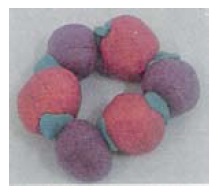
<body><![CDATA[<p align="justify"><font face="verdana" size="2">This last stage of the process is essential for students' learning. After the conclusion that their model reached the aims previously defined, they attempted to persuade their colleagues and/or the teacher of its value. During this process of advocacy, the scope and limitations of their models could have become apparent, leading to a reconsideration of earliest elements of the modelling process.</font></p>  	    <p align="justify"><font face="verdana" size="2">During the teaching strategy, such a stage happened mainly in two distinct situations: at the end of Activities 4 and 5 (when students had tested their models and believed they fulfilled their purposes), and at the end of Activity 6 (when they had performed the last test and a class consensus model was produced in the final discussion). In both cases, the teacher played an important role, as exemplified by her discussion with group 5 at the end of activity 4:</font></p>  	    <blockquote> 		    <p align="justify"><font face="verdana" size="2">S18: The cycle is the outcome of the joining of the molecules. It is as if it were a special structure. But we had no idea about how the NaCl structure is like. We built it as a cycle just to show that all of them interact with each other.</font></p>  		    <p align="center"><font face="verdana" size="2"><img src="/img/revistas/eq/v20n1/a3oth.jpg"></font></p>  		    <p align="justify"><font face="verdana" size="2">T: Do you think this model explains the melting point?</font></p>  		    <p align="justify"><font face="verdana" size="2">S19: Yes. It has to make facts evident.</font></p>  		    <p align="justify"><font face="verdana" size="2">T: But are you sure this model explains?</font></p>  		    <p align="justify"><font face="verdana" size="2">S18: It is explaining the fundamental aspect: that the mol ecules interact with each other.</font></p>  		    <p align="justify"><font face="verdana" size="2">T: And how do you know it really explains?</font></p>  		    ]]></body>
<body><![CDATA[<p align="justify"><font face="verdana" size="2">S18: We think it explains. But to be sure, we need to have other models to compare with. How could I know if my model is true, if I have no other one to compare with it?</font></p>  		    <p align="justify"><font face="verdana" size="2">T: What about having other data?</font></p>  		    <p align="justify"><font face="verdana" size="2">S19: I don't know...</font></p>  		    <p align="justify"><font face="verdana" size="2">S18: If you gave us the bond energy and the energy of the interaction it would be possible to improve the model.</font></p>  		    <p align="justify"><font face="verdana" size="2">T: Why?</font></p>  		    <p align="justify"><font face="verdana" size="2">S18: Because these data would support our thinking about how the structure is.</font></p>  		    <p align="justify"><font face="verdana" size="2">T: So, wait until the next activity.</font></p> 	</blockquote>  	    <p align="justify"><font face="verdana" size="2">Here, she fostered students to analyse their model deeply and to establish relationships between their model and a new context. This had been done by asking questions that help students to realise possible incoherence between their model and properties of the system under study (by questioning students' certainty that their model explained the NaCl high melting point) and by fostering them to think about a different test for the model (by vaguely suggesting the possibility of analysing other data).</font></p>  	    <p>&nbsp;</p>  	    <p align="justify"><font face="verdana" size="2"><b>Conclusion</b></font></p>  	    ]]></body>
<body><![CDATA[<p align="justify"><font face="verdana" size="2">Our current analysis showed that teacher's PCK concerning with the conduction of modelling&#45;based activities includes a series of actions that can support students' development of modelling skills. From the data we discussed in this paper, we can summarise such actions as presented in <a href="/img/revistas/eq/v20n1/a3t3.jpg" target="_blank">Table 3</a>.</font></p>  	    <p align="justify"><font face="verdana" size="2">Therefore, teachers who wish to conduct modelling&#45;based teaching should try to make them part of their practices. However, they are far from straightforward actions, which implies that their implementation in teachers' practice will not follow their simple identification. Teachers' education programmes that aimed at contributing to teachers' skill development which could support such actions should present the following general characteristics:</font></p>  	    <blockquote> 		    <p align="justify"><font face="verdana" size="2">&bull;&nbsp;Initially, be focused not only on the development of teachers' knowledge about models, but also on the development of a comprehensive understanding about modelling and its use in science teaching. This is because without such understanding, teachers will not even realise the relevance of modelling&#45;based teaching in promoting a more authentic science education.</font></p>  		    <p align="justify"><font face="verdana" size="2">&bull;&nbsp;Have a strong emphasis on the development of teachers' PCK on modelling. This would include teachers' understanding about: (i) production of modelling&#45;based teaching strategies, i.e., which aspects could favour students' meaningful learning and which relationships should exist between them in order to reach this purpose; (ii) conduction of modelling&#45;based activities, i.e., what roles teachers should play in discussions with students, how teachers could provide the needed conditions for students to perform the modelling activities, which steps of the modelling process would be more difficult to a given class of students and how to make them easier for students, which skills students would have to use in performing a modelling activity and how teachers could help them.</font></p> 	</blockquote>  	    <p align="justify"><font face="verdana" size="2">In order to present such characteristics, we advocate that teachers' education programmes should be based on contemporary views of teachers' knowledge development like, for instance, the 'model of pedagogical reasoning' proposed by Wilson, Shulman and Richert (1987). According to them, teachers' knowledge grows through their professional experience in a process that begins with <i>comprehension</i> of a given proposal, followed by <i>transformation</i> (through <i>critical interpretation</i> of curricular material with respect to the teachers' understanding of the subject matter, <i>representation</i> &#45; by using metaphors, analogies, illustrations, examples etc. &#45; of the content in ways that favouring students' understanding, <i>adaptation</i> of such representations to students in general, and <i>tailoring</i>, the adapting of representations to specific students); <i>instruction</i> in regular classrooms; <i>evaluation</i> of students' understandings and misunderstandings; <i>reflection</i> on the previous elements; thus resulting in <i>new comprehension.</i></font></p>  	    <p align="justify"><font face="verdana" size="2">In a just recently finished research project that analysed the development of chemistry teachers' knowledge when participating of a collaborative action&#45;research group in which the elements of this cycle model were fostered (Figueir&ecirc;do, 2008), we showed the model has a great potential for explaining teachers' knowledge development. In particular, we identified that the ways some elements of the model of pedagogical reasoning were fostered &#45; mainly, teachers having opportunities and being given support and time to perform each of the elements, as well as working collaboratively on the planning, production, implementation, and evaluation of the modelling&#45;based activities &#45; were fundamental for the educational programme success. This is certainly not the unique way to improve teachers' role in supporting the development of students' modelling skills (and knowledge), but it is an option that may be considered by those who are interested in providing conditions for the dissemination of modelling&#45;based teaching.</font></p>  	    <p>&nbsp;</p>  	    <p align="justify"><font face="verdana" size="2"><b>Acknowledgements</b></font></p>  	    <p align="justify"><font face="verdana" size="2">The author would like to acknowledge CNPq for her personal research grant.</font></p>  	    ]]></body>
<body><![CDATA[<p>&nbsp;</p>  	    <p align="justify"><font face="verdana" size="2"><b>References</b></font></p>  	    <!-- ref --><p align="justify"><font face="verdana" size="2">American Association for the Advanced of Science &#45; AAAS. <i>Science for All Americans &#45; Project 2061</i>. New York and Oxford: Oxford University Press, 1990.    &nbsp;&nbsp;&nbsp;&nbsp;&nbsp;&nbsp;&nbsp;&nbsp;[&#160;<a href="javascript:void(0);" onclick="javascript: window.open('/scielo.php?script=sci_nlinks&ref=3091293&pid=S0187-893X200900010000300001&lng=','','width=640,height=500,resizable=yes,scrollbars=1,menubar=yes,');">Links</a>&#160;]<!-- end-ref --></font></p>  	    <!-- ref --><p align="justify"><font face="verdana" size="2">Boulter, C.J., and Gilbert, J.K. Challenges and Opportunities of Developing Models in Science Education. In: J.K. Gilbert and C. J. Boulter (eds.), <i>Developing Models in Science Education.</i> Dordrecht: Kluwer, 2000, pp. 343&#45;362.    &nbsp;&nbsp;&nbsp;&nbsp;&nbsp;&nbsp;&nbsp;&nbsp;[&#160;<a href="javascript:void(0);" onclick="javascript: window.open('/scielo.php?script=sci_nlinks&ref=3091295&pid=S0187-893X200900010000300002&lng=','','width=640,height=500,resizable=yes,scrollbars=1,menubar=yes,');">Links</a>&#160;]<!-- end-ref --></font></p>  	    <!-- ref --><p align="justify"><font face="verdana" size="2">Clement, J.J., and Rea&#45;Ramirez, M.A. <i>Model Based Learning and Instruction in Science</i>. Dordrecht: Springer, 2008.    &nbsp;&nbsp;&nbsp;&nbsp;&nbsp;&nbsp;&nbsp;&nbsp;[&#160;<a href="javascript:void(0);" onclick="javascript: window.open('/scielo.php?script=sci_nlinks&ref=3091297&pid=S0187-893X200900010000300003&lng=','','width=640,height=500,resizable=yes,scrollbars=1,menubar=yes,');">Links</a>&#160;]<!-- end-ref --></font></p>  	    <!-- ref --><p align="justify"><font face="verdana" size="2">Erduran, S., Philosophy of Chemistry: An emerging field with implications for chemistry education, <i>Science and Education</i>, <b>10</b>(6), 581&#45;593, 2001.    &nbsp;&nbsp;&nbsp;&nbsp;&nbsp;&nbsp;&nbsp;&nbsp;[&#160;<a href="javascript:void(0);" onclick="javascript: window.open('/scielo.php?script=sci_nlinks&ref=3091299&pid=S0187-893X200900010000300004&lng=','','width=640,height=500,resizable=yes,scrollbars=1,menubar=yes,');">Links</a>&#160;]<!-- end-ref --></font></p>  	    ]]></body>
<body><![CDATA[<!-- ref --><p align="justify"><font face="verdana" size="2">Figueir&ecirc;do, K.L. <i>Forma&ccedil;&atilde;o Continuada de Professores de Qu&iacute;mica Buscando Inova&ccedil;&atilde;o, Autonomia e Colabora&ccedil;&atilde;o &#91;Chemistry Teachers Education Programme Aiming at Innovation, Autonomy and Collaboration&#93;</i>. Unpublished Master Disserttion, Faculdade de Educa&ccedil;&atilde;o da Universidade Federal de Minas Gerais, Belo Horizonte, 2008.    &nbsp;&nbsp;&nbsp;&nbsp;&nbsp;&nbsp;&nbsp;&nbsp;[&#160;<a href="javascript:void(0);" onclick="javascript: window.open('/scielo.php?script=sci_nlinks&ref=3091301&pid=S0187-893X200900010000300005&lng=','','width=640,height=500,resizable=yes,scrollbars=1,menubar=yes,');">Links</a>&#160;]<!-- end-ref --></font></p>  	    <!-- ref --><p align="justify"><font face="verdana" size="2">Gilbert, J. K., Boulter, C.J., and Elmer, R. Positioning Models in Science Education and in Design and Technology Education. In: J.K. Gilbert and C.J. Boulter (eds.), <i>Developing Models in Science Education.</i> Dordrecht: Kluwer, 2000, pp. 3&#45;17.    &nbsp;&nbsp;&nbsp;&nbsp;&nbsp;&nbsp;&nbsp;&nbsp;[&#160;<a href="javascript:void(0);" onclick="javascript: window.open('/scielo.php?script=sci_nlinks&ref=3091303&pid=S0187-893X200900010000300006&lng=','','width=640,height=500,resizable=yes,scrollbars=1,menubar=yes,');">Links</a>&#160;]<!-- end-ref --></font></p>  	    <!-- ref --><p align="justify"><font face="verdana" size="2">Gilbert, J.K., Boulter, C.J., and Rutherford, M. Models in explanations, Part I: Horses for courses?, <i>International Journal of Science Education</i>, <b>20</b>(1), 83&#45;97, 1998.    &nbsp;&nbsp;&nbsp;&nbsp;&nbsp;&nbsp;&nbsp;&nbsp;[&#160;<a href="javascript:void(0);" onclick="javascript: window.open('/scielo.php?script=sci_nlinks&ref=3091305&pid=S0187-893X200900010000300007&lng=','','width=640,height=500,resizable=yes,scrollbars=1,menubar=yes,');">Links</a>&#160;]<!-- end-ref --></font></p>  	    <!-- ref --><p align="justify"><font face="verdana" size="2">Halloun, I.A. <i>Modeling Theory in Science Education</i>. Dordrecht: Kluwer, 2004.    &nbsp;&nbsp;&nbsp;&nbsp;&nbsp;&nbsp;&nbsp;&nbsp;[&#160;<a href="javascript:void(0);" onclick="javascript: window.open('/scielo.php?script=sci_nlinks&ref=3091307&pid=S0187-893X200900010000300008&lng=','','width=640,height=500,resizable=yes,scrollbars=1,menubar=yes,');">Links</a>&#160;]<!-- end-ref --></font></p>  	    <!-- ref --><p align="justify"><font face="verdana" size="2">Harrison, A.G. <i>Models and PCK: Their relevance for practicing&#45; and pre&#45;service teachers.</i> Paper presented at the Annual Meeting of the National Association for Research in Science Teaching, St. Louis, 25&#45;28 March, 2001.    &nbsp;&nbsp;&nbsp;&nbsp;&nbsp;&nbsp;&nbsp;&nbsp;[&#160;<a href="javascript:void(0);" onclick="javascript: window.open('/scielo.php?script=sci_nlinks&ref=3091309&pid=S0187-893X200900010000300009&lng=','','width=640,height=500,resizable=yes,scrollbars=1,menubar=yes,');">Links</a>&#160;]<!-- end-ref --></font></p>  	    ]]></body>
<body><![CDATA[<!-- ref --><p align="justify"><font face="verdana" size="2">Justi, R. La Ense&ntilde;anza de Ciencias Basada en la Elaboraci&oacute;n de Modelos, <i>Ense&ntilde;anza de las Ciencias</i>, <b>24</b>(2), 173&#45;184, 2006.    &nbsp;&nbsp;&nbsp;&nbsp;&nbsp;&nbsp;&nbsp;&nbsp;[&#160;<a href="javascript:void(0);" onclick="javascript: window.open('/scielo.php?script=sci_nlinks&ref=3091311&pid=S0187-893X200900010000300010&lng=','','width=640,height=500,resizable=yes,scrollbars=1,menubar=yes,');">Links</a>&#160;]<!-- end-ref --></font></p>  	    <!-- ref --><p align="justify"><font face="verdana" size="2">Justi, R. and Gilbert, J.K. Modelling, teachers' views on the nature of modelling, implications for the education of modellers, <i>International Journal of Science Education</i>, <b>24</b>(4), 369&#45;387, 2002a.    &nbsp;&nbsp;&nbsp;&nbsp;&nbsp;&nbsp;&nbsp;&nbsp;[&#160;<a href="javascript:void(0);" onclick="javascript: window.open('/scielo.php?script=sci_nlinks&ref=3091313&pid=S0187-893X200900010000300011&lng=','','width=640,height=500,resizable=yes,scrollbars=1,menubar=yes,');">Links</a>&#160;]<!-- end-ref --></font></p>  	    <!-- ref --><p align="justify"><font face="verdana" size="2">Justi, R. and Gilbert, J.K. Science teachers' knowledge about and attitudes towards the use of models and modelling in learning science, <i>International Journal of Science Education</i>, <b>24</b>(12), 1273&#45;1292, 2002b.    &nbsp;&nbsp;&nbsp;&nbsp;&nbsp;&nbsp;&nbsp;&nbsp;[&#160;<a href="javascript:void(0);" onclick="javascript: window.open('/scielo.php?script=sci_nlinks&ref=3091315&pid=S0187-893X200900010000300012&lng=','','width=640,height=500,resizable=yes,scrollbars=1,menubar=yes,');">Links</a>&#160;]<!-- end-ref --></font></p>  	    <!-- ref --><p align="justify"><font face="verdana" size="2">Justi, R., and van Driel, J. The development of science teachers' knowledge on models and modelling: promoting, characterizing and understanding the process, <i>International Journal of Science Education</i>, <b>27</b>(5), 549&#45;573, 2005.    &nbsp;&nbsp;&nbsp;&nbsp;&nbsp;&nbsp;&nbsp;&nbsp;[&#160;<a href="javascript:void(0);" onclick="javascript: window.open('/scielo.php?script=sci_nlinks&ref=3091317&pid=S0187-893X200900010000300013&lng=','','width=640,height=500,resizable=yes,scrollbars=1,menubar=yes,');">Links</a>&#160;]<!-- end-ref --></font></p>  	    <!-- ref --><p align="justify"><font face="verdana" size="2">Kuhn, D., Amsel, E. and O'Loughlin, M. <i>The Development of Scientific Thinking Skills</i>. San Diego: Academic Press, 1988.    &nbsp;&nbsp;&nbsp;&nbsp;&nbsp;&nbsp;&nbsp;&nbsp;[&#160;<a href="javascript:void(0);" onclick="javascript: window.open('/scielo.php?script=sci_nlinks&ref=3091319&pid=S0187-893X200900010000300014&lng=','','width=640,height=500,resizable=yes,scrollbars=1,menubar=yes,');">Links</a>&#160;]<!-- end-ref --></font></p>  	    ]]></body>
<body><![CDATA[<!-- ref --><p align="justify"><font face="verdana" size="2">Magnusson, S., Krajcik, J., and Borko, H. Nature, Sources and Development of Pedagogical Content Knowledge for Science Teaching. In: J. Gess&#45;Newsome and N. G. Lederman (Eds.), <i>Examining Pedagogical Content Knowledge &#45; The Construct and its Implications for Science Education</i>. Dordrecht: Kluwer, 1999, pp. 95&#45;132.    &nbsp;&nbsp;&nbsp;&nbsp;&nbsp;&nbsp;&nbsp;&nbsp;[&#160;<a href="javascript:void(0);" onclick="javascript: window.open('/scielo.php?script=sci_nlinks&ref=3091321&pid=S0187-893X200900010000300015&lng=','','width=640,height=500,resizable=yes,scrollbars=1,menubar=yes,');">Links</a>&#160;]<!-- end-ref --></font></p>  	    <!-- ref --><p align="justify"><font face="verdana" size="2">Maia, P. F., and Justi, R., Learning of chemical equilibrium through a modelling&#45;based teaching, <i>International Journal of Science Education</i>, in print.    &nbsp;&nbsp;&nbsp;&nbsp;&nbsp;&nbsp;&nbsp;&nbsp;[&#160;<a href="javascript:void(0);" onclick="javascript: window.open('/scielo.php?script=sci_nlinks&ref=3091323&pid=S0187-893X200900010000300016&lng=','','width=640,height=500,resizable=yes,scrollbars=1,menubar=yes,');">Links</a>&#160;]<!-- end-ref --></font></p>  	    <!-- ref --><p align="justify"><font face="verdana" size="2">Mendon&ccedil;a, P.C.C. and Justi, R. Favorecendo o aprendizado do modelo eletrost&aacute;tico: An&aacute;lise de um processo de ensino de liga&ccedil;&atilde;o i&ocirc;nica fundamentado em modelagem &#45; Parte 1 &#91;Fostering the learning of the electrostatic model: Analysis of an ionic bond modelling&#45;based teaching process &#45; Part 1&#93;, <i>Educ. qu&iacute;m</i>., in print&#45;a.    &nbsp;&nbsp;&nbsp;&nbsp;&nbsp;&nbsp;&nbsp;&nbsp;[&#160;<a href="javascript:void(0);" onclick="javascript: window.open('/scielo.php?script=sci_nlinks&ref=3091325&pid=S0187-893X200900010000300017&lng=','','width=640,height=500,resizable=yes,scrollbars=1,menubar=yes,');">Links</a>&#160;]<!-- end-ref --></font></p>  	    <!-- ref --><p align="justify"><font face="verdana" size="2">Mendon&ccedil;a, P.C.C., and Justi, R. Favorecendo o aprendizado do modelo eletrost&aacute;tico: An&aacute;lise de um processo de ensino de liga&ccedil;&atilde;o i&ocirc;nica fundamentado em modelagem &#45; Parte 2 &#91;Fostering the learning of the electrostatic model: Analysis of an ionic bond modelling&#45;based teaching process &#45; Part 2&#93;, <i>Educ. qu&iacute;m</i>., in print&#45;b.    &nbsp;&nbsp;&nbsp;&nbsp;&nbsp;&nbsp;&nbsp;&nbsp;[&#160;<a href="javascript:void(0);" onclick="javascript: window.open('/scielo.php?script=sci_nlinks&ref=3091327&pid=S0187-893X200900010000300018&lng=','','width=640,height=500,resizable=yes,scrollbars=1,menubar=yes,');">Links</a>&#160;]<!-- end-ref --></font></p>  	    <!-- ref --><p align="justify"><font face="verdana" size="2">Millar, R. and Osborne, J. <i>Beyond 2000: Science education for the future.</i> London: King's College, London School of Education, 1998.    &nbsp;&nbsp;&nbsp;&nbsp;&nbsp;&nbsp;&nbsp;&nbsp;[&#160;<a href="javascript:void(0);" onclick="javascript: window.open('/scielo.php?script=sci_nlinks&ref=3091329&pid=S0187-893X200900010000300019&lng=','','width=640,height=500,resizable=yes,scrollbars=1,menubar=yes,');">Links</a>&#160;]<!-- end-ref --></font></p>  	    ]]></body>
<body><![CDATA[<!-- ref --><p align="justify"><font face="verdana" size="2">Programme for International Students Assessment, <i>Assessing Scientific, Reading, and Mathematical Literacy</i> &#45; <i>A Framework for PISA 2006</i>, 2006. Retrieved 03 February 2008, from <a href="http://www.pisa.oecd.org/dataoecd/63/35/%2037464175.pdf" target="_blank">http://www.pisa.oecd.org/dataoecd/63/35/ 37464175.pdf</a></font>&nbsp;&nbsp;&nbsp;&nbsp;&nbsp;&nbsp;&nbsp;&nbsp;[&#160;<a href="javascript:void(0);" onclick="javascript: window.open('/scielo.php?script=sci_nlinks&ref=3091331&pid=S0187-893X200900010000300020&lng=','','width=640,height=500,resizable=yes,scrollbars=1,menubar=yes,');">Links</a>&#160;]<!-- end-ref --><!-- ref --><p align="justify"><font face="verdana" size="2">Shulman, L.S. Those Who Understand: Knowledge Growth in Teaching, <i>Educational Researcher</i>, 15, 4&#45;14, 1986.    &nbsp;&nbsp;&nbsp;&nbsp;&nbsp;&nbsp;&nbsp;&nbsp;[&#160;<a href="javascript:void(0);" onclick="javascript: window.open('/scielo.php?script=sci_nlinks&ref=3091332&pid=S0187-893X200900010000300021&lng=','','width=640,height=500,resizable=yes,scrollbars=1,menubar=yes,');">Links</a>&#160;]<!-- end-ref --></font></p>  	    <!-- ref --><p align="justify"><font face="verdana" size="2">Shulman, L.S. Knowledge and teaching: Foundations of the new reform, <i>Harvard Educational Review</i>, <b>51</b>(1), 1&#45;22, 1987.    &nbsp;&nbsp;&nbsp;&nbsp;&nbsp;&nbsp;&nbsp;&nbsp;[&#160;<a href="javascript:void(0);" onclick="javascript: window.open('/scielo.php?script=sci_nlinks&ref=3091334&pid=S0187-893X200900010000300022&lng=','','width=640,height=500,resizable=yes,scrollbars=1,menubar=yes,');">Links</a>&#160;]<!-- end-ref --></font></p>  	    <!-- ref --><p align="justify"><font face="verdana" size="2">Teaching and Learning Research Programme, <i>Science education in schools &#45; Issues, evidence and proposals</i>. London: The Association for Science Education, 2006.    &nbsp;&nbsp;&nbsp;&nbsp;&nbsp;&nbsp;&nbsp;&nbsp;[&#160;<a href="javascript:void(0);" onclick="javascript: window.open('/scielo.php?script=sci_nlinks&ref=3091336&pid=S0187-893X200900010000300023&lng=','','width=640,height=500,resizable=yes,scrollbars=1,menubar=yes,');">Links</a>&#160;]<!-- end-ref --></font></p>  	    <!-- ref --><p align="justify"><font face="verdana" size="2">van Driel, J. and Verloop, N. Teachers' knowledge of model and modelling in science<i>. International Journal of Science Education</i>, <b>21</b>(11), 1141&#45;1154, 1999.    &nbsp;&nbsp;&nbsp;&nbsp;&nbsp;&nbsp;&nbsp;&nbsp;[&#160;<a href="javascript:void(0);" onclick="javascript: window.open('/scielo.php?script=sci_nlinks&ref=3091338&pid=S0187-893X200900010000300024&lng=','','width=640,height=500,resizable=yes,scrollbars=1,menubar=yes,');">Links</a>&#160;]<!-- end-ref --></font></p>  	    <!-- ref --><p align="justify"><font face="verdana" size="2">Vosniadou, S. Mental Models in Conceptual Development. In L. Magnani and N. J. Nersessian (eds.), <i>Model&#45;Based Reasoning: Science, Technology, Values.</i> New York: Kluwer Academic and Plenum Publishers, 2002, pp. 353&#45;368.    &nbsp;&nbsp;&nbsp;&nbsp;&nbsp;&nbsp;&nbsp;&nbsp;[&#160;<a href="javascript:void(0);" onclick="javascript: window.open('/scielo.php?script=sci_nlinks&ref=3091340&pid=S0187-893X200900010000300025&lng=','','width=640,height=500,resizable=yes,scrollbars=1,menubar=yes,');">Links</a>&#160;]<!-- end-ref --></font></p>  	    <!-- ref --><p align="justify"><font face="verdana" size="2">Wilson, S., Shulman, L.S. and Richert, A. "150 different ways" of knowing: Representations of knowledge in teaching. In:</font> <font face="verdana" size="2">J. Calderhead (Ed.), <i>Exploring teachers' thinking.</i> London: Cassell,1987, pp. 104&#45;124.    &nbsp;&nbsp;&nbsp;&nbsp;&nbsp;&nbsp;&nbsp;&nbsp;[&#160;<a href="javascript:void(0);" onclick="javascript: window.open('/scielo.php?script=sci_nlinks&ref=3091342&pid=S0187-893X200900010000300026&lng=','','width=640,height=500,resizable=yes,scrollbars=1,menubar=yes,');">Links</a>&#160;]<!-- end-ref --></font></p>     <!-- ref --><p align="justify"><font face="verdana" size="2">Wu, H.&#45;K. and Hsieb, C.&#45;E. Developing Sixty Graders' Inquiry Skills to Construct Explanations in Inquiry&#45;based Learning Environments, <i>International Journal of Science Education</i>, <b>28</b>, 1289&#45;1313, 2006.    &nbsp;&nbsp;&nbsp;&nbsp;&nbsp;&nbsp;&nbsp;&nbsp;[&#160;<a href="javascript:void(0);" onclick="javascript: window.open('/scielo.php?script=sci_nlinks&ref=3091344&pid=S0187-893X200900010000300027&lng=','','width=640,height=500,resizable=yes,scrollbars=1,menubar=yes,');">Links</a>&#160;]<!-- end-ref --></font></p>      ]]></body><back>
<ref-list>
<ref id="B1">
<nlm-citation citation-type="book">
<collab>American Association for the Advanced of Science</collab>
<source><![CDATA[Science for All Americans - Project 2061]]></source>
<year>1990</year>
<publisher-loc><![CDATA[New YorkOxford ]]></publisher-loc>
<publisher-name><![CDATA[Oxford University Press]]></publisher-name>
</nlm-citation>
</ref>
<ref id="B2">
<nlm-citation citation-type="book">
<person-group person-group-type="author">
<name>
<surname><![CDATA[Boulter]]></surname>
<given-names><![CDATA[C.J.]]></given-names>
</name>
<name>
<surname><![CDATA[Gilbert]]></surname>
<given-names><![CDATA[J.K.]]></given-names>
</name>
</person-group>
<article-title xml:lang="en"><![CDATA[Challenges and Opportunities of Developing Models in Science Education]]></article-title>
<person-group person-group-type="editor">
<name>
<surname><![CDATA[Gilbert]]></surname>
<given-names><![CDATA[J.K.]]></given-names>
</name>
<name>
<surname><![CDATA[Boulter]]></surname>
<given-names><![CDATA[C. J.]]></given-names>
</name>
</person-group>
<source><![CDATA[Developing Models in Science Education]]></source>
<year>2000</year>
<page-range>343-362</page-range><publisher-loc><![CDATA[Dordrecht ]]></publisher-loc>
<publisher-name><![CDATA[Kluwer]]></publisher-name>
</nlm-citation>
</ref>
<ref id="B3">
<nlm-citation citation-type="book">
<person-group person-group-type="author">
<name>
<surname><![CDATA[Clement]]></surname>
<given-names><![CDATA[J.J.]]></given-names>
</name>
<name>
<surname><![CDATA[Rea-Ramirez]]></surname>
<given-names><![CDATA[M.A.]]></given-names>
</name>
</person-group>
<source><![CDATA[Model Based Learning and Instruction in Science]]></source>
<year>2008</year>
<publisher-loc><![CDATA[Dordrecht ]]></publisher-loc>
<publisher-name><![CDATA[Springer]]></publisher-name>
</nlm-citation>
</ref>
<ref id="B4">
<nlm-citation citation-type="journal">
<person-group person-group-type="author">
<name>
<surname><![CDATA[Erduran]]></surname>
<given-names><![CDATA[S.]]></given-names>
</name>
</person-group>
<article-title xml:lang="en"><![CDATA[Philosophy of Chemistry: An emerging field with implications for chemistry education]]></article-title>
<source><![CDATA[Science and Education]]></source>
<year>2001</year>
<volume>10</volume>
<numero>6</numero>
<issue>6</issue>
<page-range>581-593</page-range></nlm-citation>
</ref>
<ref id="B5">
<nlm-citation citation-type="">
<person-group person-group-type="author">
<name>
<surname><![CDATA[Figueirêdo]]></surname>
<given-names><![CDATA[K.L.]]></given-names>
</name>
</person-group>
<source><![CDATA[Formação Continuada de Professores de Química Buscando Inovação, Autonomia e Colaboração [Chemistry Teachers Education Programme Aiming at Innovation, Autonomy and Collaboration]]]></source>
<year></year>
</nlm-citation>
</ref>
<ref id="B6">
<nlm-citation citation-type="book">
<person-group person-group-type="author">
<name>
<surname><![CDATA[Gilbert]]></surname>
<given-names><![CDATA[J. K.]]></given-names>
</name>
<name>
<surname><![CDATA[Boulter]]></surname>
<given-names><![CDATA[C.J.]]></given-names>
</name>
<name>
<surname><![CDATA[Elmer]]></surname>
<given-names><![CDATA[R.]]></given-names>
</name>
</person-group>
<article-title xml:lang="en"><![CDATA[Positioning Models in Science Education and in Design and Technology Education]]></article-title>
<person-group person-group-type="editor">
<name>
<surname><![CDATA[Gilbert]]></surname>
<given-names><![CDATA[J.K.]]></given-names>
</name>
<name>
<surname><![CDATA[Boulter]]></surname>
<given-names><![CDATA[C.J.]]></given-names>
</name>
</person-group>
<source><![CDATA[Developing Models in Science Education]]></source>
<year>2000</year>
<page-range>3-17</page-range><publisher-loc><![CDATA[Dordrecht ]]></publisher-loc>
<publisher-name><![CDATA[Kluwer]]></publisher-name>
</nlm-citation>
</ref>
<ref id="B7">
<nlm-citation citation-type="journal">
<person-group person-group-type="author">
<name>
<surname><![CDATA[Gilbert]]></surname>
<given-names><![CDATA[J.K.]]></given-names>
</name>
<name>
<surname><![CDATA[Boulter]]></surname>
<given-names><![CDATA[C.J.]]></given-names>
</name>
<name>
<surname><![CDATA[Rutherford]]></surname>
<given-names><![CDATA[M.]]></given-names>
</name>
</person-group>
<article-title xml:lang="en"><![CDATA[Models in explanations, Part I: Horses for courses?]]></article-title>
<source><![CDATA[International Journal of Science Education]]></source>
<year>1998</year>
<volume>20</volume>
<numero>1</numero>
<issue>1</issue>
<page-range>83-97</page-range></nlm-citation>
</ref>
<ref id="B8">
<nlm-citation citation-type="">
<person-group person-group-type="author">
<name>
<surname><![CDATA[Halloun]]></surname>
<given-names><![CDATA[I.A.]]></given-names>
</name>
</person-group>
<source><![CDATA[Modeling Theory in Science Education]]></source>
<year>2004</year>
<publisher-loc><![CDATA[Dordrecht ]]></publisher-loc>
</nlm-citation>
</ref>
<ref id="B9">
<nlm-citation citation-type="">
<person-group person-group-type="author">
<name>
<surname><![CDATA[Harrison]]></surname>
<given-names><![CDATA[A.G.]]></given-names>
</name>
</person-group>
<article-title xml:lang="en"><![CDATA[Models and PCK: Their relevance for practicing- and pre-service teachers]]></article-title>
<source><![CDATA[Annual Meeting of the National Association for Research in Science Teaching]]></source>
<year>25-2</year>
<month>8 </month>
<day>Ma</day>
<publisher-loc><![CDATA[St. Louis ]]></publisher-loc>
</nlm-citation>
</ref>
<ref id="B10">
<nlm-citation citation-type="journal">
<person-group person-group-type="author">
<name>
<surname><![CDATA[Justi]]></surname>
<given-names><![CDATA[R.]]></given-names>
</name>
</person-group>
<article-title xml:lang="es"><![CDATA[La Enseñanza de Ciencias Basada en la Elaboración de Modelos]]></article-title>
<source><![CDATA[Enseñanza de las Ciencias]]></source>
<year>2006</year>
<volume>24</volume>
<numero>2</numero>
<issue>2</issue>
<page-range>173-184</page-range></nlm-citation>
</ref>
<ref id="B11">
<nlm-citation citation-type="journal">
<person-group person-group-type="author">
<name>
<surname><![CDATA[Justi]]></surname>
<given-names><![CDATA[R.]]></given-names>
</name>
<name>
<surname><![CDATA[Gilbert]]></surname>
<given-names><![CDATA[J.K.]]></given-names>
</name>
</person-group>
<article-title xml:lang="en"><![CDATA[Modelling, teachers' views on the nature of modelling, implications for the education of modellers]]></article-title>
<source><![CDATA[International Journal of Science Education]]></source>
<year>2002</year>
<volume>24</volume>
<numero>4</numero>
<issue>4</issue>
<page-range>369-387</page-range></nlm-citation>
</ref>
<ref id="B12">
<nlm-citation citation-type="journal">
<person-group person-group-type="author">
<name>
<surname><![CDATA[Justi]]></surname>
<given-names><![CDATA[R.]]></given-names>
</name>
<name>
<surname><![CDATA[Gilbert]]></surname>
<given-names><![CDATA[J.K.]]></given-names>
</name>
</person-group>
<article-title xml:lang="en"><![CDATA[Science teachers' knowledge about and attitudes towards the use of models and modelling in learning science]]></article-title>
<source><![CDATA[International Journal of Science Education]]></source>
<year>2002</year>
<volume>24</volume>
<numero>12</numero>
<issue>12</issue>
<page-range>1273-1292</page-range></nlm-citation>
</ref>
<ref id="B13">
<nlm-citation citation-type="journal">
<person-group person-group-type="author">
<name>
<surname><![CDATA[Justi]]></surname>
<given-names><![CDATA[R.]]></given-names>
</name>
<name>
<surname><![CDATA[van Driel]]></surname>
<given-names><![CDATA[J.]]></given-names>
</name>
</person-group>
<article-title xml:lang="en"><![CDATA[The development of science teachers' knowledge on models and modelling: promoting, characterizing and understanding the process]]></article-title>
<source><![CDATA[International Journal of Science Education]]></source>
<year>2005</year>
<volume>27</volume>
<numero>5</numero>
<issue>5</issue>
<page-range>549-573</page-range></nlm-citation>
</ref>
<ref id="B14">
<nlm-citation citation-type="book">
<person-group person-group-type="author">
<name>
<surname><![CDATA[Kuhn]]></surname>
<given-names><![CDATA[D.]]></given-names>
</name>
<name>
<surname><![CDATA[Amsel]]></surname>
<given-names><![CDATA[E.]]></given-names>
</name>
<name>
<surname><![CDATA[O'Loughlin]]></surname>
<given-names><![CDATA[M.]]></given-names>
</name>
</person-group>
<source><![CDATA[The Development of Scientific Thinking Skills]]></source>
<year>1988</year>
<publisher-loc><![CDATA[San Diego ]]></publisher-loc>
<publisher-name><![CDATA[Academic Press]]></publisher-name>
</nlm-citation>
</ref>
<ref id="B15">
<nlm-citation citation-type="book">
<person-group person-group-type="author">
<name>
<surname><![CDATA[Magnusson]]></surname>
<given-names><![CDATA[S.]]></given-names>
</name>
<name>
<surname><![CDATA[Krajcik]]></surname>
<given-names><![CDATA[J.]]></given-names>
</name>
<name>
<surname><![CDATA[Borko]]></surname>
<given-names><![CDATA[H.]]></given-names>
</name>
</person-group>
<article-title xml:lang="en"><![CDATA[Nature, Sources and Development of Pedagogical Content Knowledge for Science Teaching]]></article-title>
<person-group person-group-type="editor">
<name>
<surname><![CDATA[Gess-Newsome]]></surname>
<given-names><![CDATA[J.]]></given-names>
</name>
<name>
<surname><![CDATA[Lederman]]></surname>
<given-names><![CDATA[N. G.]]></given-names>
</name>
</person-group>
<source><![CDATA[Examining Pedagogical Content Knowledge - The Construct and its Implications for Science Education]]></source>
<year>1999</year>
<page-range>95-132</page-range><publisher-loc><![CDATA[Dordrecht ]]></publisher-loc>
<publisher-name><![CDATA[Kluwer]]></publisher-name>
</nlm-citation>
</ref>
<ref id="B16">
<nlm-citation citation-type="journal">
<person-group person-group-type="author">
<name>
<surname><![CDATA[Maia]]></surname>
<given-names><![CDATA[P. F.]]></given-names>
</name>
<name>
<surname><![CDATA[Justi]]></surname>
<given-names><![CDATA[R.]]></given-names>
</name>
</person-group>
<article-title xml:lang="en"><![CDATA[Learning of chemical equilibrium through a modelling-based teaching]]></article-title>
<source><![CDATA[International Journal of Science Education]]></source>
<year></year>
</nlm-citation>
</ref>
<ref id="B17">
<nlm-citation citation-type="journal">
<person-group person-group-type="author">
<name>
<surname><![CDATA[Mendonça]]></surname>
<given-names><![CDATA[P.C.C.]]></given-names>
</name>
<name>
<surname><![CDATA[Justi]]></surname>
<given-names><![CDATA[R.]]></given-names>
</name>
</person-group>
<article-title xml:lang="pt"><![CDATA[Favorecendo o aprendizado do modelo eletrostático: Análise de um processo de ensino de ligação iônica fundamentado em modelagem - Parte 1 [Fostering the learning of the electrostatic model: Analysis of an ionic bond modelling-based teaching process - Part 1]]]></article-title>
<source><![CDATA[Educ. quím.]]></source>
<year></year>
</nlm-citation>
</ref>
<ref id="B18">
<nlm-citation citation-type="journal">
<person-group person-group-type="author">
<name>
<surname><![CDATA[Mendonça]]></surname>
<given-names><![CDATA[P.C.C.]]></given-names>
</name>
<name>
<surname><![CDATA[Justi]]></surname>
<given-names><![CDATA[R.]]></given-names>
</name>
</person-group>
<article-title xml:lang="pt"><![CDATA[Favorecendo o aprendizado do modelo eletrostático: Análise de um processo de ensino de ligação iônica fundamentado em modelagem - Parte 2 [Fostering the learning of the electrostatic model: Analysis of an ionic bond modelling-based teaching process - Part 2]]]></article-title>
<source><![CDATA[Educ. quím.]]></source>
<year></year>
</nlm-citation>
</ref>
<ref id="B19">
<nlm-citation citation-type="book">
<person-group person-group-type="author">
<name>
<surname><![CDATA[Millar]]></surname>
<given-names><![CDATA[R.]]></given-names>
</name>
<name>
<surname><![CDATA[Osborne]]></surname>
<given-names><![CDATA[J.]]></given-names>
</name>
</person-group>
<source><![CDATA[Beyond 2000: Science education for the future]]></source>
<year>1998</year>
<publisher-loc><![CDATA[London ]]></publisher-loc>
<publisher-name><![CDATA[King's College, London School of Education]]></publisher-name>
</nlm-citation>
</ref>
<ref id="B20">
<nlm-citation citation-type="">
<collab>Programme for International Students Assessment</collab>
<source><![CDATA[Assessing Scientific, Reading, and Mathematical Literacy - A Framework for PISA 2006]]></source>
<year>2006</year>
</nlm-citation>
</ref>
<ref id="B21">
<nlm-citation citation-type="journal">
<person-group person-group-type="author">
<name>
<surname><![CDATA[Shulman]]></surname>
<given-names><![CDATA[L.S.]]></given-names>
</name>
</person-group>
<article-title xml:lang="en"><![CDATA[Those Who Understand: Knowledge Growth in Teaching]]></article-title>
<source><![CDATA[Educational Researcher]]></source>
<year>1986</year>
<numero>15</numero>
<issue>15</issue>
<page-range>4-14</page-range></nlm-citation>
</ref>
<ref id="B22">
<nlm-citation citation-type="journal">
<person-group person-group-type="author">
<name>
<surname><![CDATA[Shulman]]></surname>
<given-names><![CDATA[L.S.]]></given-names>
</name>
</person-group>
<article-title xml:lang="en"><![CDATA[Knowledge and teaching: Foundations of the new reform]]></article-title>
<source><![CDATA[Harvard Educational Review]]></source>
<year>1987</year>
<volume>51</volume>
<numero>1</numero>
<issue>1</issue>
<page-range>1-22</page-range></nlm-citation>
</ref>
<ref id="B23">
<nlm-citation citation-type="book">
<collab>Teaching and Learning Research Programme</collab>
<source><![CDATA[Science education in schools - Issues, evidence and proposals]]></source>
<year>2006</year>
<publisher-loc><![CDATA[London ]]></publisher-loc>
<publisher-name><![CDATA[The Association for Science Education]]></publisher-name>
</nlm-citation>
</ref>
<ref id="B24">
<nlm-citation citation-type="journal">
<person-group person-group-type="author">
<name>
<surname><![CDATA[van Driel]]></surname>
<given-names><![CDATA[J.]]></given-names>
</name>
<name>
<surname><![CDATA[Verloop]]></surname>
<given-names><![CDATA[N.]]></given-names>
</name>
</person-group>
<article-title xml:lang="en"><![CDATA[Teachers' knowledge of model and modelling in science]]></article-title>
<source><![CDATA[International Journal of Science Education]]></source>
<year>1999</year>
<volume>21</volume>
<numero>11</numero>
<issue>11</issue>
<page-range>1141-1154</page-range></nlm-citation>
</ref>
<ref id="B25">
<nlm-citation citation-type="book">
<person-group person-group-type="author">
<name>
<surname><![CDATA[Vosniadou]]></surname>
<given-names><![CDATA[S.]]></given-names>
</name>
</person-group>
<article-title xml:lang="en"><![CDATA[Mental Models in Conceptual Development]]></article-title>
<person-group person-group-type="editor">
<name>
<surname><![CDATA[Magnani]]></surname>
<given-names><![CDATA[L.]]></given-names>
</name>
<name>
<surname><![CDATA[Nersessian]]></surname>
<given-names><![CDATA[N. J.]]></given-names>
</name>
</person-group>
<source><![CDATA[Model-Based Reasoning: Science, Technology, Values]]></source>
<year>2002</year>
<page-range>353-368</page-range><publisher-loc><![CDATA[New York ]]></publisher-loc>
<publisher-name><![CDATA[Kluwer AcademicPlenum Publishers]]></publisher-name>
</nlm-citation>
</ref>
<ref id="B26">
<nlm-citation citation-type="book">
<person-group person-group-type="author">
<name>
<surname><![CDATA[Wilson]]></surname>
<given-names><![CDATA[S.]]></given-names>
</name>
<name>
<surname><![CDATA[Shulman]]></surname>
<given-names><![CDATA[L.S.]]></given-names>
</name>
<name>
<surname><![CDATA[Richert]]></surname>
<given-names><![CDATA[A.]]></given-names>
</name>
</person-group>
<article-title xml:lang="en"><![CDATA["150 different ways" of knowing: Representations of knowledge in teaching]]></article-title>
<person-group person-group-type="editor">
<name>
<surname><![CDATA[Calderhead]]></surname>
<given-names><![CDATA[J.]]></given-names>
</name>
</person-group>
<source><![CDATA[Exploring teachers' thinking]]></source>
<year>1987</year>
<page-range>104-124</page-range><publisher-loc><![CDATA[London ]]></publisher-loc>
<publisher-name><![CDATA[Cassell]]></publisher-name>
</nlm-citation>
</ref>
<ref id="B27">
<nlm-citation citation-type="journal">
<person-group person-group-type="author">
<name>
<surname><![CDATA[Wu]]></surname>
<given-names><![CDATA[H.-K.]]></given-names>
</name>
<name>
<surname><![CDATA[Hsieb]]></surname>
<given-names><![CDATA[C.-E.]]></given-names>
</name>
</person-group>
<article-title xml:lang="en"><![CDATA[Developing Sixty Graders' Inquiry Skills to Construct Explanations in Inquiry-based Learning Environments]]></article-title>
<source><![CDATA[International Journal of Science Education]]></source>
<year>2006</year>
<volume>28</volume>
<page-range>1289-1313</page-range></nlm-citation>
</ref>
</ref-list>
</back>
</article>