<?xml version="1.0" encoding="ISO-8859-1"?><article xmlns:mml="http://www.w3.org/1998/Math/MathML" xmlns:xlink="http://www.w3.org/1999/xlink" xmlns:xsi="http://www.w3.org/2001/XMLSchema-instance">
<front>
<journal-meta>
<journal-id>0187-7380</journal-id>
<journal-title><![CDATA[Revista fitotecnia mexicana]]></journal-title>
<abbrev-journal-title><![CDATA[Rev. fitotec. mex]]></abbrev-journal-title>
<issn>0187-7380</issn>
<publisher>
<publisher-name><![CDATA[Sociedad Mexicana de Fitogenética A.C.]]></publisher-name>
</publisher>
</journal-meta>
<article-meta>
<article-id>S0187-73802016000100004</article-id>
<title-group>
<article-title xml:lang="en"><![CDATA[Diversity of drought-responsive genes in central and peripheral populations of Trifolium purpureum Loisel]]></article-title>
<article-title xml:lang="es"><![CDATA[Diversidad de genes de respuesta a sequía en poblaciones centrales y periféricas de Trifolium purpureum Loisel]]></article-title>
</title-group>
<contrib-group>
<contrib contrib-type="author">
<name>
<surname><![CDATA[Trejo-Calzada]]></surname>
<given-names><![CDATA[Ricardo]]></given-names>
</name>
<xref ref-type="aff" rid="A01"/>
</contrib>
<contrib contrib-type="author">
<name>
<surname><![CDATA[O'Connell]]></surname>
<given-names><![CDATA[Mary A.]]></given-names>
</name>
<xref ref-type="aff" rid="A02"/>
</contrib>
<contrib contrib-type="author">
<name>
<surname><![CDATA[Pedroza-Sandoval]]></surname>
<given-names><![CDATA[Aurelio]]></given-names>
</name>
<xref ref-type="aff" rid="A01"/>
</contrib>
<contrib contrib-type="author">
<name>
<surname><![CDATA[Arreola-Ávila]]></surname>
<given-names><![CDATA[Jesus G.]]></given-names>
</name>
<xref ref-type="aff" rid="A01"/>
</contrib>
<contrib contrib-type="author">
<name>
<surname><![CDATA[Reveles-Hernández]]></surname>
<given-names><![CDATA[Manuel]]></given-names>
</name>
<xref ref-type="aff" rid="A03"/>
</contrib>
</contrib-group>
<aff id="A01">
<institution><![CDATA[,Universidad Autónoma Chapingo Unidad Regional Universitaria de Zonas Áridas ]]></institution>
<addr-line><![CDATA[Durango ]]></addr-line>
<country>México</country>
</aff>
<aff id="A02">
<institution><![CDATA[,New Mexico State University College of Agricultural, Consumer and Environmental Sciences ]]></institution>
<addr-line><![CDATA[Las Cruces Nuevo México]]></addr-line>
<country>Estados Unidos de América</country>
</aff>
<aff id="A03">
<institution><![CDATA[,Instituto Nacional de Investigaciones Forestales, Agrícolas y Pecuarias Campo Experimental Zacatecas ]]></institution>
<addr-line><![CDATA[Calera Zacatecas]]></addr-line>
<country>México</country>
</aff>
<pub-date pub-type="pub">
<day>00</day>
<month>03</month>
<year>2016</year>
</pub-date>
<pub-date pub-type="epub">
<day>00</day>
<month>03</month>
<year>2016</year>
</pub-date>
<volume>39</volume>
<numero>1</numero>
<fpage>9</fpage>
<lpage>15</lpage>
<copyright-statement/>
<copyright-year/>
<self-uri xlink:href="http://www.scielo.org.mx/scielo.php?script=sci_arttext&amp;pid=S0187-73802016000100004&amp;lng=en&amp;nrm=iso"></self-uri><self-uri xlink:href="http://www.scielo.org.mx/scielo.php?script=sci_abstract&amp;pid=S0187-73802016000100004&amp;lng=en&amp;nrm=iso"></self-uri><self-uri xlink:href="http://www.scielo.org.mx/scielo.php?script=sci_pdf&amp;pid=S0187-73802016000100004&amp;lng=en&amp;nrm=iso"></self-uri><abstract abstract-type="short" xml:lang="en"><p><![CDATA[Drought-responsive genes may differ in structure and complexity in native populations of a species established in different ecosystems. Peripheral populations may be a source of genetic variability for breeding cultivated plants for abiotic stresses tolerance and the target for core collections in germplasm preservation programs. Genetic studies including both peripheral and central populations are still limited. This research evaluated genetic diversity of drought-responsive genes in peripheral and central populations of Trifolium purpureum Loisel. Genomic DNA isolated from leaves of three northern and three southern populations of Israel was digested with restriction enzymes and hybridized with four drought-induced and four drought-repressed gene fragments. RFLPs were analyzed for gene diversity, molecular variation and fixation indexes (F ST). Gene diversity of drought-induced genes ranged from 0.1 to 0.42 but differences of individual or pooled genes between central and peripheral populations were nonsignificant. Gene diversity for drought-repressed genes ranged from 0.08 to 0.348. Even though there were no differences for individual genes, a joint analysis showed a significantly larger (P &#8804; 0.05) gene diversity in peripheral populations of T. Purpureum than in central ones. Variation within populations for both drought-induced and drought-repressed genes was the main component of molecular variance. Fixation index (F ST) for drought-induced genes was between 0.029 and 0.214 while for drought repressed genes it was between 0.04 and 0.33. Results of this study show that peripheral population might be a reservoir for drought-responsive genes.]]></p></abstract>
<abstract abstract-type="short" xml:lang="es"><p><![CDATA[Los genes de respuesta a sequía pueden diferir en estructura y complejidad en poblaciones nativas de una especie establecidas en diferentes ecosistemas. Las poblaciones periféricas pueden constituir una fuente de variabilidad para el mejoramiento de plantas cultivadas para tolerancia a estreses abióticos, y también pueden ser el objetivo para colecciones núcleo en programas de conservación de germoplasma. Al respecto, estudios genéticos que incluyan tanto poblaciones periféricas como centrales son escasos. El objetivo de este estudio fue evaluar la diversidad genética de genes de respuesta a sequía en poblaciones centrales y periféricas de Trifolium purpureum Loisel. El ADN genómico aislado de hojas de tres poblaciones del norte y tres poblaciones del sur de Israel fue digerido con enzimas de restricción e hibridados con cuatro fragmentos de genes inducidos y cuatro de genes reprimidos por sequía. Los polimorfismos de longitud de fragmentos de restricción (RFLP) fueron analizados para diversidad genética, variación molecular e índices de fijación (F ST). La diversidad génica de los genes inducidos por sequía varió de 0.1 a 0.42 pero no hubo diferencias significativas para los genes individuales o para los grupos de genes entre las poblaciones periféricas y centrales. La diversidad génica para genes reprimidos por sequía tuvo valores entre 0.08 y 0.348. Aun cuando no hubo diferencias para genes individuales, un análisis conjunto mostró una diversidad genética significativamente mayor (P &#8804; 0.05) en poblaciones periféricas que en poblaciones centrales de T. purpureum. La variación dentro de poblaciones fue el principal componente de variación molecular tanto para genes inducidos como reprimidos por sequía. El índice de fijación (F ST) para genes inducidos por sequía varió entre 0.029 y 0.214, en tanto que para genes reprimidos por sequía estuvo entre 0.04 y 0.33. Los resultados de este estudio muestran que las poblaciones periféricas pueden ser un reservorio de genes de respuesta a sequía.]]></p></abstract>
<kwd-group>
<kwd lng="en"><![CDATA[Trifolium purpureum]]></kwd>
<kwd lng="en"><![CDATA[abiotic stress]]></kwd>
<kwd lng="en"><![CDATA[adaptation]]></kwd>
<kwd lng="en"><![CDATA[arid lands]]></kwd>
<kwd lng="en"><![CDATA[gene flow]]></kwd>
<kwd lng="en"><![CDATA[molecular variation]]></kwd>
<kwd lng="es"><![CDATA[Trifolium purpureum]]></kwd>
<kwd lng="es"><![CDATA[adaptación]]></kwd>
<kwd lng="es"><![CDATA[estrés abiótico]]></kwd>
<kwd lng="es"><![CDATA[flujo de genes]]></kwd>
<kwd lng="es"><![CDATA[variación molecular]]></kwd>
<kwd lng="es"><![CDATA[zonas áridas]]></kwd>
</kwd-group>
</article-meta>
</front><body><![CDATA[  	    <p align="justify"><font face="verdana" size="4">Art&iacute;culo cient&iacute;fico</font></p>  	    <p align="justify">&nbsp;</p>     <p align="center"><font face="verdana" size="4"><b>Diversity of drought&#45;responsive genes in central and peripheral populations of  <i>Trifolium purpureum</i> Loisel</b></font></p>     <p align="center">&nbsp;</p>  	    <p align="center"><font face="verdana" size="3"><b>Diversidad de genes de respuesta a sequ&iacute;a en poblaciones centrales y perif&eacute;ricas de <i>Trifolium purpureum</i> Loisel</b></font></p>     <p align="center">&nbsp;</p>  	    <p align="center"><font face="verdana" size="2"><b>Ricardo Trejo&#45;Calzada<sup>1</sup>*, Mary A. O'Connell<sup>2</sup>, Aurelio Pedroza&#45;Sandoval<sup>1</sup>, Jesus G. Arreola&#45;&Aacute;vila<sup>1</sup> y Manuel Reveles&#45;Hern&aacute;ndez<sup>3</sup></b></font></p>     <p align="center">&nbsp;</p>      <p align="justify"><font face="verdana" size="2"><sup><i>1</i></sup> <i>Unidad Regional Universitaria de Zonas &Aacute;ridas, Universidad Aut&oacute;noma Chapingo. 35230, Apartado Postal No. 8, Bermejillo, Durango, M&eacute;xico. </i>* Autor de correspondencia (<a href="mailto:rtrejo@chapingo.uruza.edu.mx">rtrejo@chapingo.uruza.edu.mx</a>)</font></p>     ]]></body>
<body><![CDATA[<p align="justify"><font face="verdana" size="2"><sup><i>2</i></sup><i> College of Agricultural, Consumer and Environmental Sciences, New Mexico State University. 179 Gerald Thomas Hall. Las Cruces, New Mexico, USA.</i></font></p>     <p align="justify"><font face="verdana" size="2"><sup><i>3 </i></sup><i>Campo Experimental Zacatecas, Instituto Nacional de Investigaciones Forestales, Agr&iacute;colas y Pecuarias. km 24.5 carr. Zacatecas&#45;Fresnillo. 98001, Apartado Postal 196, Calera, Zacatecas.</i></font></p>      <p align="justify">&nbsp;</p>     <p align="justify"><font face="verdana" size="2">Recibido: 24 de Febrero del 2015.    <br> Aceptado: 3 de Noviembre del 2015.</font></p>     <p align="justify">&nbsp;</p>  	    <p align="justify"><font face="verdana" size="2"><b>Abstract</b></font></p>     <p align="justify"><font face="verdana" size="2">Drought&#45;responsive genes may differ in structure and complexity in native populations of a species established in different ecosystems. Peripheral populations may be a source of genetic variability for breeding cultivated plants for abiotic stresses tolerance and the target for core collections in germplasm preservation programs. Genetic studies including both peripheral and central populations are still limited. This research evaluated genetic diversity of drought&#45;responsive genes in peripheral and central populations of <i>Trifolium purpureum</i> Loisel. Genomic DNA isolated from leaves of three northern and three southern populations of Israel was digested with restriction enzymes and hybridized with four drought&#45;induced and four drought&#45;repressed gene fragments. RFLPs were analyzed for gene diversity, molecular variation and fixation indexes (<i>F<sub>ST</sub></i>). Gene diversity of drought&#45;induced genes ranged from 0.1 to 0.42 but differences of individual or pooled genes between central and peripheral populations were nonsignificant. Gene diversity for drought&#45;repressed genes ranged from 0.08 to 0.348. Even though there were no differences for individual genes, a joint analysis showed a significantly larger (P &#8804; 0.05) gene diversity in peripheral populations of <i>T. Purpureum</i> than in central ones. Variation within populations for both drought&#45;induced and drought&#45;repressed genes was the main component of molecular variance. Fixation index (<i>F<sub>ST</sub></i>) for drought&#45;induced genes was between 0.029 and 0.214 while for drought repressed genes it was between 0.04 and 0.33. Results of this study show that peripheral population might be a reservoir for drought&#45;responsive genes.</font></p>  	    <p align="justify"><font face="verdana" size="2"><b>Key words:</b> <i>Trifolium purpureum,</i> abiotic stress, adaptation, arid lands, gene flow, molecular variation.</font></p> 	    <p align="justify">&nbsp;</p> 	    ]]></body>
<body><![CDATA[<p align="justify"><font face="verdana" size="2"><b>Resumen</b></font></p>         <p align="justify"><font face="verdana" size="2">Los genes de respuesta a sequ&iacute;a pueden diferir en estructura y complejidad en poblaciones nativas de una especie establecidas en diferentes ecosistemas. Las poblaciones perif&eacute;ricas pueden constituir una fuente de variabilidad para el mejoramiento de plantas cultivadas para tolerancia a estreses abi&oacute;ticos, y tambi&eacute;n pueden ser el objetivo para colecciones n&uacute;cleo en programas de conservaci&oacute;n de germoplasma. Al respecto, estudios gen&eacute;ticos que incluyan tanto poblaciones perif&eacute;ricas como centrales son escasos. El objetivo de este estudio fue evaluar la diversidad gen&eacute;tica de genes de respuesta a sequ&iacute;a en poblaciones centrales y perif&eacute;ricas de <i>Trifolium purpureum</i> Loisel. El ADN gen&oacute;mico aislado de hojas de tres poblaciones del norte y tres poblaciones del sur de Israel fue digerido con enzimas de restricci&oacute;n e hibridados con cuatro fragmentos de genes inducidos y cuatro de genes reprimidos por sequ&iacute;a. Los polimorfismos de longitud de fragmentos de restricci&oacute;n (RFLP) fueron analizados para diversidad gen&eacute;tica, variaci&oacute;n molecular e &iacute;ndices de fijaci&oacute;n (<i>F<sub>ST</sub></i>). La diversidad g&eacute;nica de los genes inducidos por sequ&iacute;a vari&oacute; de 0.1 a 0.42 pero no hubo diferencias significativas para los genes individuales o para los grupos de genes entre las poblaciones perif&eacute;ricas y centrales. La diversidad g&eacute;nica para genes reprimidos por sequ&iacute;a tuvo valores entre 0.08 y 0.348. Aun cuando no hubo diferencias para genes individuales, un an&aacute;lisis conjunto mostr&oacute; una diversidad gen&eacute;tica significativamente mayor (P &#8804; 0.05) en poblaciones perif&eacute;ricas que en poblaciones centrales de <i>T. purpureum.</i> La variaci&oacute;n dentro de poblaciones fue el principal componente de variaci&oacute;n molecular tanto para genes inducidos como reprimidos por sequ&iacute;a. El &iacute;ndice de fijaci&oacute;n (<i>F<sub>ST</sub></i>) para genes inducidos por sequ&iacute;a vari&oacute; entre 0.029 y 0.214, en tanto que para genes reprimidos por sequ&iacute;a estuvo entre 0.04 y 0.33. Los resultados de este estudio muestran que las poblaciones perif&eacute;ricas pueden ser un reservorio de genes de respuesta a sequ&iacute;a.</font></p>         <p align="justify"><font face="verdana" size="2"><b>Palabras clave:</b> <i>Trifolium purpureum,</i> adaptaci&oacute;n, estr&eacute;s abi&oacute;tico, flujo de genes, variaci&oacute;n molecular, zonas &aacute;ridas.</font></p>     <p align="justify">&nbsp;</p>      <p align="justify"><font face="verdana" size="2"><b>INTRODUCTION</b></font></p>  	    <p align="justify"><font face="verdana" size="2">Plant adaptation to the environment involves a wide range of development strategies, morphological features, biochemical mechanisms, and physiological traits under genetic control (Yamaguchi&#45;Shinozaki and Shinozaki, 2006). Genes involved in the responses of plants to short&#45;term and season&#45;long water deficit have been studied in great detail in many agronomic plants but in much less detail in wild species. Studies in some cultivated plants have shown that there is a number of genes and gene families expressed under drought stress (Wang <i>et al.,</i> 2011). These drought&#45;induced genes can be modeled to be involved in morphological, physiological and molecular features that make the plants able to deal with water deficit (Shinozaki and Yamaguchi&#45;Shinozaki, 2007).</font></p>  	    <p align="justify"><font face="verdana" size="2">Drought&#45;responsive gene families may differ in structure and complexity in native populations of a species established in different ecosystems. The central&#45;marginal model in evolutionary ecology proposes that populations near the center of the range (central) of a species are highly dense, and show high levels of phenotypic and genetic variation, while populations on the edge of the range (peripheral) are isolated, bare, and chromosomally monomorphic (Brussard, 1984).</font></p>  	    <p align="justify"><font face="verdana" size="2">The center of the range of a species will coincide with the geographic region that is the most ecologically favorable. The periphery of a range will usually correspond to an area of extreme marginality for the species (Vucetich and Waite, 2003). Thus, peripheral populations are expected to be genetically distinct from central populations since they may face different selection conditions. The differences between central and marginal populations will depend on the differences of the effective population size and the gene flow (Eckert <i>et al.,</i> 2008).</font></p>  	    <p align="justify"><font face="verdana" size="2">Peripheral populations may constitute a source of genetic variability for breeding cultivated plants for tolerance to abiotic stresses. They may also be the target for constructing core collections in germplasm preservation programs. However, genetic studies including both peripheral and central populations are still limited (Eckert <i>et al.,</i> 2008). Nowadays, peripheral populations are acquiring importance for gene conservation, because they may possess genotypes of future adaptive potential especially under climate change conditions (Pandey and Rajora, 2012a).</font></p>  	    <p align="justify"><font face="verdana" size="2">Purple clover (<i>Trifolium purpureum</i> Loisel) is a species native to Mediterranean regions of Europe. This species is now found as natural populations in regions with environments more hostile than those from where it was originated. Therefore, some <i>T. purpureum</i> populations can be called central populations, as they are located in favorable environments. Other populations may be called peripheral as they populate unfavorable environments. The presence of this species in grasslands of temperate and semiarid regions may involve differences in diversity of drought&#45;responsive genes among populations.</font></p>  	    ]]></body>
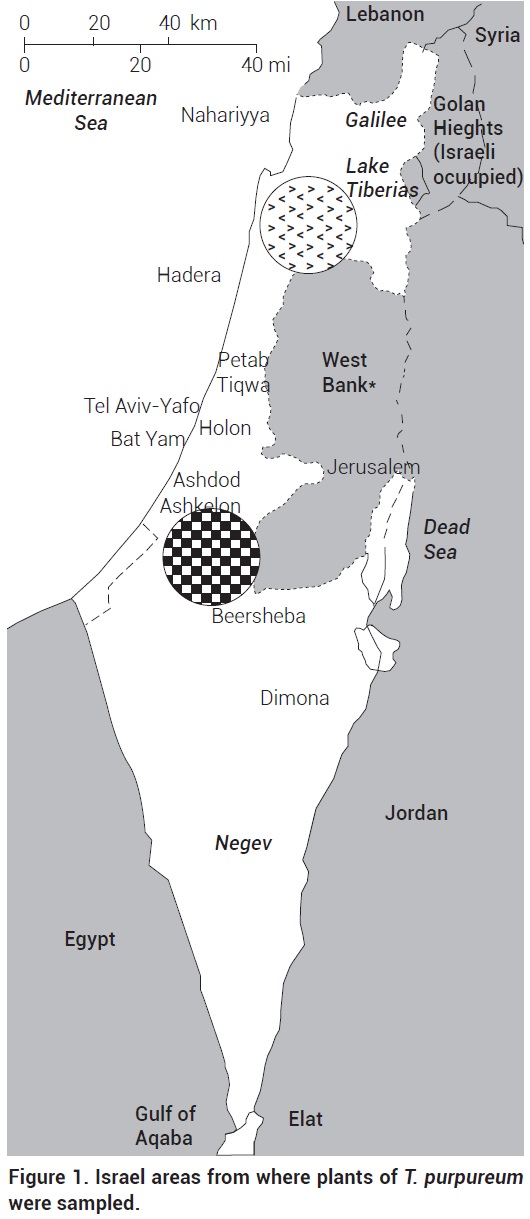
<body><![CDATA[<p align="justify"><font face="verdana" size="2">In this study, several drought&#45;responsive genes were used to perform RFLP analyses on central and peripheral populations of <i>T. purpureum</i> to evaluate genetic diversity of drought responsive genes.</font></p>     <p align="justify">&nbsp;</p>      <p align="justify"><font face="verdana" size="2"><b>MATERIALS AND METHODS</b></font></p>  	    <p align="justify"><font face="verdana" size="2"><i>T. purpureum</i> Loisel seeds from different locations of Northern &#91;(Givat&#45;Hamore (32&deg; 37' 41.05" N, 35&deg; 19' 56.12" E), Carmel (32&deg; 43' 44.39" N, 35&deg; 2' 45.07" E), Kefar&#45;Ha&#45;choresh (32&deg; 42' 12.08" N, 35&deg; 16' 20.27" E) and Gilboa (32&deg; 25' 56.76" N, 35&deg; 24' 54.27" E)&#93; and Southern &#91;(Pura (31&deg; 29' 47.47" N, 34&deg; 46' 28.52" E), Lalow, Sausana, Beeri (31&deg; 26' 17.31" N 34&deg; 29' 15.19" E), and Tel Gome (31&deg; 23' 5.22" N, 34&deg; 27' 7.98" E)&#93; Israel were collected (<a href="#f1">Figure 1</a>). The Northern region from where one group of the seeds was collected has a Mediterranean climate with annual winter rain of 450&#45;600 mm. The Southern region, from where the other seed group was collected, is located in the outer edge of the extreme Judean desert with ~300 mm of annual rain. Seeds were grouped as central (northern located) or peripheral (southern located) according to their origin. Those seeds were used to grow plants in a greenhouse at New Mexico State University, USA.</font></p> 	    <p align="center"><a name="f1"></a></p> 	    <p align="center"><img src="/img/revistas/rfm/v39n1/a4f1.jpg"></p>      <p align="justify"><font face="verdana" size="2">Drought&#45;responsive cDNA clones from <i>T. purpureum</i> were isolated from a cDNA library made from leaves of drought&#45;stressed plants. Drought&#45;induced and drought&#45;repressed cDNA clones were confirmed by Northern analysis and later sequenced. Eight drought&#45;responsive cDNAs were used as probes for the analysis of gene diversity of <i>T. purpureum</i> populations. Five out of the eight cDNA sequences were submitted to ESTs GenBank database.</font></p>  	    <p align="justify"><font face="verdana" size="2">A Puregene&copy; kit was used to isolate DNA from leaves. Samples of leaf tissue were taken from at least 20 plants from each of three northern and three southern populations (n = 120). A total of 10 &#956;g DNA was restricted with 2 &#956;l of <i>EcoRI</i> or 2 ul of <i>HindIII.</i> The digested samples were electrophoresed in a 0.8 % agarose (Type 1 low EEO) gel at 70 V (4 V/cm). A total of 20 DNA samples from each population were set in a single gel (<a href="/img/revistas/rfm/v39n1/a4f2.jpg" target="_blank">Figure 2A</a>). Four replica gels were made for each population. DNA was transferred onto Zetabind nylon membranes using alkaline solution (0.6 M NaCl and 0.4 M NaOH) and dried in a vacuum oven at 80 &deg;C for 1.5 to 2 h. The membranes were prehybridized overnight in 0.5 M Na<sub>2</sub>HPO<sub>4</sub>, 1 mM EDTA, 1 % BSA, 7 % SDS, and pH 7.2 solution. Those membranes were then hybridized overnight with &#91;<sup>32</sup>P&#93; dCTP labeled cDNA probes at 68 <sup>o</sup>C and shaking conditions. After hybridization, membranes were washed with 0.5 M Na<sub>2</sub>HPO<sub>4</sub>, 0.5 M EDTA, 10 % SDS, 3 % fish guts, and pH 7.2 solution. The membranes were exposed to x&#45;ray film Midwest Scientific at &#45;80 <sup>o</sup>C for varying periods of time (24 hours to 7 days) (<a href="/img/revistas/rfm/v39n1/a4f2.jpg" target="_blank">Figure 2B</a>).</font></p> 	      <p align="justify"><font face="verdana" size="2">The polymorphisms for each of the probes were identified on autoradiograms and scored as binary data (<a href="/img/revistas/rfm/v39n1/a4f2.jpg" target="_blank">Figure 2B</a>). The matrices generated were analyzed with Popgene, version 1.31software (Yeh and Boyle, 1997) to estimate gene diversity, genetic distance, and genetic differentiation (Nei and Kumar, 2000).</font></p>  	    <p align="justify"><font face="verdana" size="2">An analysis of molecular variance (AMOVA) was performed taking into account the frequencies of haplotypes generated by each probe. The AMOVA, F&#45;statistics and gene flow &#91;Nm = ((1&#45;F<sub>ST</sub>)&#45;1))/4&#93; were estimated using the software Arlequin, version 3.0 (Souza <i>et al.</i> 2002; Excoffier <i>et al.,</i> 2005).</font></p>  	    ]]></body>
<body><![CDATA[<p align="justify">&nbsp;</p>     <p align="justify"><font face="verdana" size="2"><b>RESULTS AND DISCUSSION</b></font></p>  	    <p align="justify"><font face="verdana" size="2">Drought&#45;induced genes showed great complexity as measured by the number of different fragments in the hybridized Southern blots of <i>T. purpureum.</i> Several polymorphic loci were identified by using drought&#45;induced cDNAs as probes. The number of polymorphic loci produced by the hybridization of southern blots containing genomic DNA of <i>T. purpureum</i> varied between 5 and 14 (<a href="/img/revistas/rfm/v39n1/a4t1.jpg" target="_blank">Table 1</a>).</font></p>      <p align="justify"><font face="verdana" size="2">Drought&#45;repressed genes showed similar results to drought&#45;induced genes regarding the number of loci and the complexity of the genes. Drought&#45;repressed genes produced 6 to 11 loci when used to hybridize Southern blots containing genomic DNA from <i>T. purpureum</i> plants (<a href="/img/revistas/rfm/v39n1/a4t1.jpg" target="_blank">Table 1</a>).</font></p>  	    <p align="justify"><font face="verdana" size="2">The number of polymorphic loci may vary depending on the species and markers used. Thus, Coulibaly <i>et al.</i> (2002) found 114 polymorphic loci into 106 accessions of <i>Vigna unguiculata</i> L. by AFLP markers, while Sebastian <i>et al.</i> (2010) using RAPD markers found 3 to14 polymorphic bands per primer in <i>Tylophora rotundifolia.</i></font></p>  	    <p align="justify"><font face="verdana" size="2">The amount of genetic variability of a population is a function of the genetic diversity originally available to the species and of the later influence of processes such as selection, gene flow, and the mating system (Despres <i>et al.,</i> 2002). In this study, the highest values of gene diversity for the dehydrin related protein gene and the probable transcription factor gene were observed in central populations with <i>H</i> = 0.2857 and <i>H</i> = 0.4407, respectively. However, the highest values of gene diversity for the LEA&#45;like protein gene and the arginine decarboxyla&#45;se gene were observed in peripheral populations with <i>H</i> = 0.3817 and <i>H</i> = 0.369, respectively.</font></p>  	    <p align="justify"><font face="verdana" size="2">The differences of average gene diversity between central and peripheral populations were not significant for any of the drought&#45;induced genes used as probes. Khanlou <i>et al.</i> (2011) using AFLP markers in three cultivars of <i>T. re&#45;pens</i> measured genetic diversity values of 0.319, 0.289 and 0.272 for different cultivars, which are similar to the ones found in this study.</font></p>  	    <p align="justify"><font face="verdana" size="2">The AMOVA showed that variation within populations was the main component of the variance for the drought&#45;induced genes. Around 88 % of the variation in drought&#45;induced genes was found within populations. In addition, variation among populations within groups was highly variable in the four drought&#45;induced genes. The difference of variance among populations within groups was significant for all the genes, except for the one that codes for arginine decarboxylase. In contrast, variation among groups of all drought&#45;induced genes was very low and not significant (<a href="/img/revistas/rfm/v39n1/a4t2.jpg" target="_blank">Table 2</a>).</font></p>      <p align="justify"><font face="verdana" size="2">The estimated values of gene flow for drought&#45;induced genes were high with a relatively wide range. Gene flow ranged from <i>Nm</i> = 0.91 for LEA&#45;like protein gene to <i>Nm</i> = 8.3 for dehydrin related protein gene. The average gene flow for the group of drought&#45;induced genes was 3.4. After using nuclear SSR and cpSSR markers Perderau <i>et al.</i> (2014) found high <i>Nm</i> values (2.29 and 2.76, respectively) of gene flow in populations of <i>Salix caprea.</i> Also, Welt <i>et al.</i> (2015) found high levels of gene flow (3.08 and 4.44) in <i>Brassica rapa</i> in two different years (1997 and 2004) by using microsatellite analysis. Fixation index (<i>F<sub>ST</sub></i>) showed that in three out of the four drought&#45;induced genes there were significant differences among populations, with values ranging from 0.029 to 0.214 (<a href="#t3">Table 3</a>).</font></p>     <p align="center"><a name="t3"></a></p>     ]]></body>
<body><![CDATA[<p align="center"><img src="/img/revistas/rfm/v39n1/a4t3.jpg"></p>      <p align="justify"><font face="verdana" size="2">The fixation index <i>F<sub>ST</sub></i> is a suitable measure of genetic differentiation among subpopulations (populations within groups). This index measures the overall reduction in average heterozygosity in subpopulations regarding the total heterozygosity, and is the most inclusive measure of population substructure. <i>F<sub>ST</sub></i> has a theoretical minimum of 0 (when there is not genetic divergence) and a maximum of 1 (when alternative alleles are fixed in different subpopulations). Thus, <i>F<sub>ST</sub></i> is used as a relative measure of population structure and a comparative estimation of gene flow (Miller <i>et al.,</i> 2008).</font></p>  	    <p align="justify"><font face="verdana" size="2">Gene diversity of drought&#45;induced genes in central and peripheral populations of <i>T. purpureum</i> was larger than that reported for <i>T. pratense</i> and other out crossing species. The expected heterozygosity of 12 allozymes in 9 populations of <i>T. pratense</i> from Southeastern United States was <i>H</i> = 0.250. Some widely distributed species have shown an average gene diversity of <i>H</i> = 0.202 (Hagen and Hamrick, 1998).</font></p>  	    <p align="justify"><font face="verdana" size="2">The relatively high gene diversity for drought&#45;induced genes observed in <i>T. purpureum</i> could be attributed to the cross pollination mating system, its annual growth habit, and the fast growth of populations. Cross pollinated species tend to have higher levels of variability within populations but a smaller degree of differentiation among populations than selfing species. Moreover, genetic differentiation is greater in annuals than in perennials (Fisher <i>et al.,</i> 2000). Studies in <i>Calystegia collina</i> showed high values of gene diversity, where more than 40 % of the genetic variation was due to variation among populations; this high gene diversity was attributed to self&#45;incompatibility, vegetative reproduction, and possible mutations in long&#45;lived clones (Wolf <i>et al.,</i> 2000).</font></p>  	    <p align="justify"><font face="verdana" size="2">Gene diversity for drought&#45;repressed genes ranged from 0.08 to 0.348. However, average gene diversity was not significantly different in central or peripheral populations for individual drought&#45;repressed genes. Gene differentiation among populations, measured as fixation index (<i>F<sub>ST</sub></i>), was significant for all drought&#45;repressed genes in <i>T. purpureum.</i> The highest differentiation was for the gene that codes for a nucleotide binding protein with <i>F<sub>ST</sub></i> ~0.33, while the lowest differentiation was produced by the gene coding for ATP synthase with <i>F<sub>ST</sub></i> value ~0.04. Also, the estimated gene flow was high for all four drought&#45;repressed genes (<a href="#t4">Table 4</a>).</font></p> 	    <p align="center"><a name="t4"></a></p> 	    <p align="center"><img src="/img/revistas/rfm/v39n1/a4t4.jpg"></p>      <p align="justify"><font face="verdana" size="2">The AMOVA identified that variation within populations of <i>T. purpureum</i> was the most important component of the total variation (~67 to ~96 %) of drought&#45;repressed genes. The average contribution of variability within populations to total genetic variability of drought&#45;repressed genes was ~85 %. Variation among populations was significant, and on the average it accounted for ~13.5 % of the total genetic variance. Variation among groups (central <i>vs.</i> peripheral) was low and not significant for individual drought&#45;repressed genes (<a href="/img/revistas/rfm/v39n1/a4t5.jpg" target="_blank">Table 5</a>).</font></p>     <p align="justify"><font face="verdana" size="2">A pooled analysis of the four drought&#45;repressed genes showed that genetic diversity for the group of genes was significantly larger (P &#8804; 0.05) in peripheral populations than in central populations of <i>T. purpureum.</i> Hagen and Hamrick (1998) found that populations of <i>T. pratense</i> from northern and southern USA were weakly differentiated by genetic diversity. The total genetic variation due to differences among regions and among populations was 0.013 and 0.049, respectively; most of this genetic diversity occurred within populations (93.8 %).</font></p>  	    <p align="justify"><font face="verdana" size="2">The main component of variation of drought&#45;responsive genes in central and peripheral populations of <i>T. purpu&#45;reum</i> was the variance within populations. The high variation within populations may be explained by the mating system of the species and their wide distribution. In general, genetic diversity for drought&#45;responsive genes in T <i>purpureum</i> was high. On the contrary, in some species a very low genetic diversity has been found. In populations of wild rice (<i>Oryza granulata</i>) the gene diversity was in the range of 0.0 to 0.029. The low gene diversity was attributed to geographically narrow distribution of the populations as a colonizing species (Gao <i>et al.,</i> 2000).</font></p>  	    ]]></body>
<body><![CDATA[<p align="justify"><font face="verdana" size="2">Some studies show a higher genetic differentiation in peripheral populations than in central populations, such as those on eastern white cedar <i>(Thuja occidentalis</i> L.) (Pandey and Rajora, 2012b). Findings by Cort&eacute;s <i>et al.</i> (2012) show that gene diversity for genes associated to drought may be significantly different in contrasting populations. ABA stress response genes <i>Asr1</i> and <i>Asr2</i> had different gene diversity in wild and cultivated populations of <i>Phaseolus vulgaris</i> L. Also, Trejo&#45;Calzada and O'Connell (2005) showed that populations of <i>Dactylis glomerata</i> from an arid region of Israel had a greater genetic diversity for drought&#45;responsive genes (0.388, repressed; 0.340, induced) than populations of plants collected in the northern Mediterranean region of Israel (0.308, repressed; 0.314, induced).</font></p>     <p align="justify">&nbsp;</p>      <p align="justify"><font face="verdana" size="2"><b>CONCLUSIONS</b></font></p>  	    <p align="justify"><font face="verdana" size="2">Genetic diversity for both drought&#45;induced and drought&#45;repressed genes was high; however, the differences in average gene diversity between central and peripheral populations were not significant for any of the drought&#45;responsive genes. Variation within populations was the main component of the variance of drought&#45;induced (88 %) and drought&#45;repressed genes (85 %). On the contrary, variation among groups for all individual drought&#45;induced and drought&#45;repressed genes was very low and not significant. Gene differentiation or fixation index (<i>F<sub>ST</sub></i>) was significant for all the genes used as probes in this study, except for the one that code for arginine decarboxylase. The estimated gene flow was relatively high for drought&#45;induced and drought&#45;repressed genes.</font></p>  	    <p align="justify">&nbsp;</p>     <p align="justify"><font face="verdana" size="2"><b>BIBLIOGRAPHY</b></font></p>  	    <!-- ref --><p align="justify"><font face="verdana" size="2">Brussard P. F. (1984) Geographic patterns and environmental gradients: The Central&#45;Marginal model in Drosophila revisited. <i>Annual Review of Ecology and Systematics</i> 15:25&#45;64.    &nbsp;&nbsp;&nbsp;&nbsp;&nbsp;&nbsp;&nbsp;&nbsp;[&#160;<a href="javascript:void(0);" onclick="javascript: window.open('/scielo.php?script=sci_nlinks&ref=7112704&pid=S0187-7380201600010000400001&lng=','','width=640,height=500,resizable=yes,scrollbars=1,menubar=yes,');">Links</a>&#160;]<!-- end-ref --></font></p>  	    <!-- ref --><p align="justify"><font face="verdana" size="2">Cort&eacute;s A. J., M. C. Chavarro, S. Madri&ntilde;&aacute;n, D. This and M. W. Blair (2012) Molecular ecology and selection in the drought&#45;related Asr gene polymorphisms in wild and cultivated common bean <i>(Phaseolus vulgaris</i> L.). <i>BMC Genetics</i> 13:58.    &nbsp;&nbsp;&nbsp;&nbsp;&nbsp;&nbsp;&nbsp;&nbsp;[&#160;<a href="javascript:void(0);" onclick="javascript: window.open('/scielo.php?script=sci_nlinks&ref=7112706&pid=S0187-7380201600010000400002&lng=','','width=640,height=500,resizable=yes,scrollbars=1,menubar=yes,');">Links</a>&#160;]<!-- end-ref --></font></p>  	    ]]></body>
<body><![CDATA[<!-- ref --><p align="justify"><font face="verdana" size="2">Coulibaly S., R. S. Pasquet, R. Papa and P. Gepts (2002) AFLP analysis of the phenetic organization and genetic diversity of <i>Vigna unguiculata</i> L. Walp. reveals extensive gene flow between wild and domesticated types. <i>Theoretical and Applied Genetics</i> 104:358&#45;366.    &nbsp;&nbsp;&nbsp;&nbsp;&nbsp;&nbsp;&nbsp;&nbsp;[&#160;<a href="javascript:void(0);" onclick="javascript: window.open('/scielo.php?script=sci_nlinks&ref=7112708&pid=S0187-7380201600010000400003&lng=','','width=640,height=500,resizable=yes,scrollbars=1,menubar=yes,');">Links</a>&#160;]<!-- end-ref --></font></p>      <!-- ref --><p align="justify"><font face="verdana" size="2">Despres, L., S. Loriot and M. Gaudeul (2002) Geographic pattern of genetic variation in the European globeflower <i>Trollius europaeus</i> L. (Ranunculaceae) inferred from amplified fragment length polymorphism markers. <i>Molecular Ecology</i> 11:2337&#45;2347.    &nbsp;&nbsp;&nbsp;&nbsp;&nbsp;&nbsp;&nbsp;&nbsp;[&#160;<a href="javascript:void(0);" onclick="javascript: window.open('/scielo.php?script=sci_nlinks&ref=7112710&pid=S0187-7380201600010000400004&lng=','','width=640,height=500,resizable=yes,scrollbars=1,menubar=yes,');">Links</a>&#160;]<!-- end-ref --></font></p>  	    <!-- ref --><p align="justify"><font face="verdana" size="2">Eckert C. G., K. E. Samis and S. C. Lougheed (2008) Genetic variation across species' geographical ranges: the central&#45;marginal hypothesis and beyond. <i>Molecular Ecology</i> 17:1170&#45;1188.    &nbsp;&nbsp;&nbsp;&nbsp;&nbsp;&nbsp;&nbsp;&nbsp;[&#160;<a href="javascript:void(0);" onclick="javascript: window.open('/scielo.php?script=sci_nlinks&ref=7112712&pid=S0187-7380201600010000400005&lng=','','width=640,height=500,resizable=yes,scrollbars=1,menubar=yes,');">Links</a>&#160;]<!-- end-ref --></font></p>  	    <!-- ref --><p align="justify"><font face="verdana" size="2">Excoffier L., G. Laval and S. Schneider (2005) Arlequin (version 3.0): n integrated software package for population genetics data analysis. <i>Evolutionary Bioinformatics Online</i> 1:47&#45;50.    &nbsp;&nbsp;&nbsp;&nbsp;&nbsp;&nbsp;&nbsp;&nbsp;[&#160;<a href="javascript:void(0);" onclick="javascript: window.open('/scielo.php?script=sci_nlinks&ref=7112714&pid=S0187-7380201600010000400006&lng=','','width=640,height=500,resizable=yes,scrollbars=1,menubar=yes,');">Links</a>&#160;]<!-- end-ref --></font></p>  	    <!-- ref --><p align="justify"><font face="verdana" size="2">Fisher M., R. Husi, D. Prati, M. Peintinger, M. van Kleunen and B. Schmid (2000) RAPD variation among and within small and large populations of the rare clonal plant <i>Ranunculus reptans</i> (Ranunculaceae). <i>American Journal of Botany 87:1128&#45;1137.    &nbsp;&nbsp;&nbsp;&nbsp;&nbsp;&nbsp;&nbsp;&nbsp;[&#160;<a href="javascript:void(0);" onclick="javascript: window.open('/scielo.php?script=sci_nlinks&ref=7112716&pid=S0187-7380201600010000400007&lng=','','width=640,height=500,resizable=yes,scrollbars=1,menubar=yes,');">Links</a>&#160;]<!-- end-ref --></i></font></p>  	    ]]></body>
<body><![CDATA[<!-- ref --><p align="justify"><font face="verdana" size="2">Gao L. Z., S. Ge and D. Y. Hong (2000) Low levels of genetic diversity within populations and high differentiation among populations of a wild rice, <i>Oryza granulata</i> Nees et Arn. ex Watt., from China. <i>International Journal of Plant Science</i> 161:691&#45;697.    &nbsp;&nbsp;&nbsp;&nbsp;&nbsp;&nbsp;&nbsp;&nbsp;[&#160;<a href="javascript:void(0);" onclick="javascript: window.open('/scielo.php?script=sci_nlinks&ref=7112718&pid=S0187-7380201600010000400008&lng=','','width=640,height=500,resizable=yes,scrollbars=1,menubar=yes,');">Links</a>&#160;]<!-- end-ref --></font></p>  	    <!-- ref --><p align="justify"><font face="verdana" size="2">Hagen M. J. and J. L. Hamrick (1998) Genetic variation and population genetic structure in <i>Trifolium pratense. Journal of Heredity</i> 89:178&#45;181.    &nbsp;&nbsp;&nbsp;&nbsp;&nbsp;&nbsp;&nbsp;&nbsp;[&#160;<a href="javascript:void(0);" onclick="javascript: window.open('/scielo.php?script=sci_nlinks&ref=7112720&pid=S0187-7380201600010000400009&lng=','','width=640,height=500,resizable=yes,scrollbars=1,menubar=yes,');">Links</a>&#160;]<!-- end-ref --></font></p>  	    <!-- ref --><p align="justify"><font face="verdana" size="2">Khanlou K. M., K. Vandepitte, L. Kheibarshekan and E. Van Bockstaele (2011) Towards an optimal sampling strategy for assessing genetic variation within and among white clover (<i>Trifolium repens</i> L.) cultivars using AFLP. <i>Genetics and Molecular Biology</i> 34:252&#45;258.    &nbsp;&nbsp;&nbsp;&nbsp;&nbsp;&nbsp;&nbsp;&nbsp;[&#160;<a href="javascript:void(0);" onclick="javascript: window.open('/scielo.php?script=sci_nlinks&ref=7112722&pid=S0187-7380201600010000400010&lng=','','width=640,height=500,resizable=yes,scrollbars=1,menubar=yes,');">Links</a>&#160;]<!-- end-ref --></font></p>     <!-- ref --><p align="justify"><font face="verdana" size="2">Miller J. R., B. P. Wood and M. B. Hamilton (2008) F<sub>ST</sub> and Q<sub>ST</sub> under neutrality. <i>Genetics</i> 180: 1023&#45;1037.    &nbsp;&nbsp;&nbsp;&nbsp;&nbsp;&nbsp;&nbsp;&nbsp;[&#160;<a href="javascript:void(0);" onclick="javascript: window.open('/scielo.php?script=sci_nlinks&ref=7112724&pid=S0187-7380201600010000400011&lng=','','width=640,height=500,resizable=yes,scrollbars=1,menubar=yes,');">Links</a>&#160;]<!-- end-ref --></font></p>  	    <!-- ref --><p align="justify"><font face="verdana" size="2">Nei M. and S. Kumar (2000) Molecular Evolution and Phylogenetics. Oxford University Press. New York, USA. 333 p.    &nbsp;&nbsp;&nbsp;&nbsp;&nbsp;&nbsp;&nbsp;&nbsp;[&#160;<a href="javascript:void(0);" onclick="javascript: window.open('/scielo.php?script=sci_nlinks&ref=7112726&pid=S0187-7380201600010000400012&lng=','','width=640,height=500,resizable=yes,scrollbars=1,menubar=yes,');">Links</a>&#160;]<!-- end-ref --></font></p>  	    ]]></body>
<body><![CDATA[<!-- ref --><p align="justify"><font face="verdana" size="2">Pandey M. and O. P. Rajora (2012a) Genetic diversity and differentiation of core vs. peripheral populations of eastern white cedar, <i>Thuja occidentalis</i> (Cupressaceae). <i>American Journal of Botany</i> 99:690&#45;699.    &nbsp;&nbsp;&nbsp;&nbsp;&nbsp;&nbsp;&nbsp;&nbsp;[&#160;<a href="javascript:void(0);" onclick="javascript: window.open('/scielo.php?script=sci_nlinks&ref=7112728&pid=S0187-7380201600010000400013&lng=','','width=640,height=500,resizable=yes,scrollbars=1,menubar=yes,');">Links</a>&#160;]<!-- end-ref --></font></p>  	    <!-- ref --><p align="justify"><font face="verdana" size="2">Pandey M. and O. P. Rajora (2012b) Higher fine&#45;scale genetic structure in peripheral than in core populations of a long&#45;lived and mixed&#45;mating conifer&#45;eastern white cedar (<i>Thuja occidentalis</i> L.). <i>BMC Evolutionary Biology</i> 12:48.    &nbsp;&nbsp;&nbsp;&nbsp;&nbsp;&nbsp;&nbsp;&nbsp;[&#160;<a href="javascript:void(0);" onclick="javascript: window.open('/scielo.php?script=sci_nlinks&ref=7112730&pid=S0187-7380201600010000400014&lng=','','width=640,height=500,resizable=yes,scrollbars=1,menubar=yes,');">Links</a>&#160;]<!-- end-ref --> </font></p> 	    <!-- ref --><p align="justify"><font face="verdana" size="2">Perderau A. C., C. T. Kelleher, G. C. Douglas and T. R. Hodkinson (2014) High levels of gene flow and genetic diversity in Irish populations of <i>Salix caprea</i> L. inferred from chloroplast and nuclear SSR markers. <i>BMC Plant Biology</i> 14:202.    &nbsp;&nbsp;&nbsp;&nbsp;&nbsp;&nbsp;&nbsp;&nbsp;[&#160;<a href="javascript:void(0);" onclick="javascript: window.open('/scielo.php?script=sci_nlinks&ref=7112732&pid=S0187-7380201600010000400015&lng=','','width=640,height=500,resizable=yes,scrollbars=1,menubar=yes,');">Links</a>&#160;]<!-- end-ref --> </font></p> 	    <!-- ref --><p align="justify"><font face="verdana" size="2">Sebastian V. A., L. D. Cruz, R. B. Subramanian and V. J. Braganza (2010) Assessment of genetic diversity within and among populations of <i>Tylophora rotundifolia</i> using RAPD markers. <i>Gene Conserve</i> 9:94&#45;117.    &nbsp;&nbsp;&nbsp;&nbsp;&nbsp;&nbsp;&nbsp;&nbsp;[&#160;<a href="javascript:void(0);" onclick="javascript: window.open('/scielo.php?script=sci_nlinks&ref=7112734&pid=S0187-7380201600010000400016&lng=','','width=640,height=500,resizable=yes,scrollbars=1,menubar=yes,');">Links</a>&#160;]<!-- end-ref --></font></p>      <!-- ref --><p align="justify"><font face="verdana" size="2">Shinozaki K. and K. Yamaguchi&#45;Shinozaki (2007) Gene networks involved in drought stress response and tolerance. <i>Journal of Experimental Botany</i> 58:221&#45;227.    &nbsp;&nbsp;&nbsp;&nbsp;&nbsp;&nbsp;&nbsp;&nbsp;[&#160;<a href="javascript:void(0);" onclick="javascript: window.open('/scielo.php?script=sci_nlinks&ref=7112736&pid=S0187-7380201600010000400017&lng=','','width=640,height=500,resizable=yes,scrollbars=1,menubar=yes,');">Links</a>&#160;]<!-- end-ref --> </font></p>     ]]></body>
<body><![CDATA[<!-- ref --><p align="justify"><font face="verdana" size="2">Souza F.L., A. F. Cunha, M. A. Oliveira, G. A. G. Pereira and S. F. dos Reis (2002) Estimating dispersal and gene flow in the neotropical freshwater turtle Hydromedusa maximiliani (Chelidae) by combining ecological and genetic methods. <i>Genetics and Molecular Biology</i> 25:151&#45;155.    &nbsp;&nbsp;&nbsp;&nbsp;&nbsp;&nbsp;&nbsp;&nbsp;[&#160;<a href="javascript:void(0);" onclick="javascript: window.open('/scielo.php?script=sci_nlinks&ref=7112738&pid=S0187-7380201600010000400018&lng=','','width=640,height=500,resizable=yes,scrollbars=1,menubar=yes,');">Links</a>&#160;]<!-- end-ref --></font></p>  	    <!-- ref --><p align="justify"><font face="verdana" size="2">Trejo&#45;Calzada R. and M. A. O'Connell (2005) Genetic diversity of drought&#45;responsive genes in populations of the desert forage <i>Dactylis glomerata. Plant Science</i> 168:1327&#45;1335.    &nbsp;&nbsp;&nbsp;&nbsp;&nbsp;&nbsp;&nbsp;&nbsp;[&#160;<a href="javascript:void(0);" onclick="javascript: window.open('/scielo.php?script=sci_nlinks&ref=7112740&pid=S0187-7380201600010000400019&lng=','','width=640,height=500,resizable=yes,scrollbars=1,menubar=yes,');">Links</a>&#160;]<!-- end-ref --></font></p>     <!-- ref --><p align="justify"><font face="verdana" size="2"> Vucetich J. A. and T. A. Waite (2003) Spatial patterns of demography and genetic processes across the species' range: null hypotheses for landscape conservation genetics. <i>Conservation Genetics</i> 4:639&#45;645.    &nbsp;&nbsp;&nbsp;&nbsp;&nbsp;&nbsp;&nbsp;&nbsp;[&#160;<a href="javascript:void(0);" onclick="javascript: window.open('/scielo.php?script=sci_nlinks&ref=7112742&pid=S0187-7380201600010000400020&lng=','','width=640,height=500,resizable=yes,scrollbars=1,menubar=yes,');">Links</a>&#160;]<!-- end-ref --></font></p>      <!-- ref --><p align="justify"><font face="verdana" size="2">Wang D., Y. Pan, X. Zhao, L. Zhu, B. Fu and Z. Li (2011) Genome&#45;wide temporal&#45;spatial gene expression profiling of drought responsiveness in rice. <i>BMC Genomics</i> 12:149.    &nbsp;&nbsp;&nbsp;&nbsp;&nbsp;&nbsp;&nbsp;&nbsp;[&#160;<a href="javascript:void(0);" onclick="javascript: window.open('/scielo.php?script=sci_nlinks&ref=7112744&pid=S0187-7380201600010000400021&lng=','','width=640,height=500,resizable=yes,scrollbars=1,menubar=yes,');">Links</a>&#160;]<!-- end-ref --> </font></p>     <!-- ref --><p align="justify"><font face="verdana" size="2">Welt R. S., A. Litt and S. J. Franks (2015) Analysis of population genetic structure and gene flow in an annual plant before and after a rapid evolutionary response to drought. <i>AoB PLANTS Advance Access.</i> <a href="http://aobpla.oxfordjournals.org/content/early/2015/03/27/aobpla.plv026.full.pdf+html DOI:10.1093/aobpla/plv026" target="_blank">http://aobpla.oxfordjournals.org/content/early/2015/03/27/aobpla.plv026.full.pdf+html DOI:10.1093/aobpla/plv026</a>.    &nbsp;&nbsp;&nbsp;&nbsp;&nbsp;&nbsp;&nbsp;&nbsp;[&#160;<a href="javascript:void(0);" onclick="javascript: window.open('/scielo.php?script=sci_nlinks&ref=7112746&pid=S0187-7380201600010000400022&lng=','','width=640,height=500,resizable=yes,scrollbars=1,menubar=yes,');">Links</a>&#160;]<!-- end-ref --></font></p>      ]]></body>
<body><![CDATA[<!-- ref --><p align="justify"><font face="verdana" size="2">Wolf A. T., R. H. Hower and J. L. Hamrick (2000) Genetic diversity and population structure of the serpentine endemic <i>Calystegia collina</i> (Convolvulaceae) in Northern California. <i>American Journal of Botany</i> 87:1138&#45;1146.    &nbsp;&nbsp;&nbsp;&nbsp;&nbsp;&nbsp;&nbsp;&nbsp;[&#160;<a href="javascript:void(0);" onclick="javascript: window.open('/scielo.php?script=sci_nlinks&ref=7112748&pid=S0187-7380201600010000400023&lng=','','width=640,height=500,resizable=yes,scrollbars=1,menubar=yes,');">Links</a>&#160;]<!-- end-ref --> </font></p>     <!-- ref --><p align="justify"><font face="verdana" size="2">Yamaguchi&#45;Shinozaki K. and K. Shinozaki (2006) Transcriptional regulatory networks in cellular responses and tolerance to dehydration and cold stresses. <i>Annual Review of Plant Biology</i> 57:781&#45;803.    &nbsp;&nbsp;&nbsp;&nbsp;&nbsp;&nbsp;&nbsp;&nbsp;[&#160;<a href="javascript:void(0);" onclick="javascript: window.open('/scielo.php?script=sci_nlinks&ref=7112750&pid=S0187-7380201600010000400024&lng=','','width=640,height=500,resizable=yes,scrollbars=1,menubar=yes,');">Links</a>&#160;]<!-- end-ref --></font></p>      <!-- ref --><p align="justify"><font face="verdana" size="2">Yeh F. C. and T. J. Boyle (1997) Population genetic analysis of co&#45;dominant and dominant markers and quantitative traits. <i>Belgian Journal of Botany</i> 129:157&#45;163.    &nbsp;&nbsp;&nbsp;&nbsp;&nbsp;&nbsp;&nbsp;&nbsp;[&#160;<a href="javascript:void(0);" onclick="javascript: window.open('/scielo.php?script=sci_nlinks&ref=7112752&pid=S0187-7380201600010000400025&lng=','','width=640,height=500,resizable=yes,scrollbars=1,menubar=yes,');">Links</a>&#160;]<!-- end-ref --></font></p>      ]]></body><back>
<ref-list>
<ref id="B1">
<nlm-citation citation-type="journal">
<person-group person-group-type="author">
<name>
<surname><![CDATA[Brussard]]></surname>
<given-names><![CDATA[P. F.]]></given-names>
</name>
</person-group>
<article-title xml:lang="en"><![CDATA[Geographic patterns and environmental gradients: The Central-Marginal model in Drosophila revisited]]></article-title>
<source><![CDATA[Annual Review of Ecology and Systematics]]></source>
<year>1984</year>
<volume>15</volume>
<page-range>25-64</page-range></nlm-citation>
</ref>
<ref id="B2">
<nlm-citation citation-type="journal">
<person-group person-group-type="author">
<name>
<surname><![CDATA[Cortés]]></surname>
<given-names><![CDATA[A. J.]]></given-names>
</name>
<name>
<surname><![CDATA[Chavarro]]></surname>
<given-names><![CDATA[M. C.]]></given-names>
</name>
<name>
<surname><![CDATA[Madriñán]]></surname>
<given-names><![CDATA[S.]]></given-names>
</name>
<name>
<surname><![CDATA[This]]></surname>
<given-names><![CDATA[D.]]></given-names>
</name>
<name>
<surname><![CDATA[Blair]]></surname>
<given-names><![CDATA[M. W.]]></given-names>
</name>
</person-group>
<article-title xml:lang="en"><![CDATA[Molecular ecology and selection in the drought-related Asr gene polymorphisms in wild and cultivated common bean (Phaseolus vulgaris L.)]]></article-title>
<source><![CDATA[BMC Genetics]]></source>
<year>2012</year>
<volume>13</volume>
<page-range>58</page-range></nlm-citation>
</ref>
<ref id="B3">
<nlm-citation citation-type="journal">
<person-group person-group-type="author">
<name>
<surname><![CDATA[Coulibaly]]></surname>
<given-names><![CDATA[S.]]></given-names>
</name>
<name>
<surname><![CDATA[Pasquet]]></surname>
<given-names><![CDATA[R. S.]]></given-names>
</name>
<name>
<surname><![CDATA[Papa]]></surname>
<given-names><![CDATA[R.]]></given-names>
</name>
<name>
<surname><![CDATA[Gepts]]></surname>
<given-names><![CDATA[P.]]></given-names>
</name>
</person-group>
<article-title xml:lang="en"><![CDATA[AFLP analysis of the phenetic organization and genetic diversity of Vigna unguiculata L. Walp. reveals extensive gene flow between wild and domesticated types]]></article-title>
<source><![CDATA[Theoretical and Applied Genetics]]></source>
<year>2002</year>
<volume>104</volume>
<page-range>358-366</page-range></nlm-citation>
</ref>
<ref id="B4">
<nlm-citation citation-type="journal">
<person-group person-group-type="author">
<name>
<surname><![CDATA[Despres]]></surname>
<given-names><![CDATA[L.]]></given-names>
</name>
<name>
<surname><![CDATA[Loriot]]></surname>
<given-names><![CDATA[S.]]></given-names>
</name>
<name>
<surname><![CDATA[Gaudeul]]></surname>
<given-names><![CDATA[M.]]></given-names>
</name>
</person-group>
<article-title xml:lang="en"><![CDATA[Geographic pattern of genetic variation in the European globeflower Trollius europaeus L. (Ranunculaceae) inferred from amplified fragment length polymorphism markers]]></article-title>
<source><![CDATA[Molecular Ecology]]></source>
<year>2002</year>
<volume>11</volume>
<page-range>2337-2347</page-range></nlm-citation>
</ref>
<ref id="B5">
<nlm-citation citation-type="journal">
<person-group person-group-type="author">
<name>
<surname><![CDATA[Eckert]]></surname>
<given-names><![CDATA[C. G.]]></given-names>
</name>
<name>
<surname><![CDATA[Samis]]></surname>
<given-names><![CDATA[K. E.]]></given-names>
</name>
<name>
<surname><![CDATA[Lougheed]]></surname>
<given-names><![CDATA[S. C.]]></given-names>
</name>
</person-group>
<article-title xml:lang="en"><![CDATA[Genetic variation across species' geographical ranges: the central-marginal hypothesis and beyond]]></article-title>
<source><![CDATA[Molecular Ecology]]></source>
<year>2008</year>
<volume>17</volume>
<page-range>1170-1188</page-range></nlm-citation>
</ref>
<ref id="B6">
<nlm-citation citation-type="journal">
<person-group person-group-type="author">
<name>
<surname><![CDATA[Excoffier]]></surname>
<given-names><![CDATA[L.]]></given-names>
</name>
<name>
<surname><![CDATA[Laval]]></surname>
<given-names><![CDATA[G.]]></given-names>
</name>
<name>
<surname><![CDATA[Schneider]]></surname>
<given-names><![CDATA[S.]]></given-names>
</name>
</person-group>
<article-title xml:lang="en"><![CDATA[Arlequin (version 3.0): n integrated software package for population genetics data analysis]]></article-title>
<source><![CDATA[Evolutionary Bioinformatics Online]]></source>
<year>2005</year>
<volume>1</volume>
<page-range>47-50</page-range></nlm-citation>
</ref>
<ref id="B7">
<nlm-citation citation-type="journal">
<person-group person-group-type="author">
<name>
<surname><![CDATA[Fisher]]></surname>
<given-names><![CDATA[M.]]></given-names>
</name>
<name>
<surname><![CDATA[Husi]]></surname>
<given-names><![CDATA[R.]]></given-names>
</name>
<name>
<surname><![CDATA[Prati]]></surname>
<given-names><![CDATA[D.]]></given-names>
</name>
<name>
<surname><![CDATA[Peintinger]]></surname>
<given-names><![CDATA[M.]]></given-names>
</name>
<name>
<surname><![CDATA[van Kleunen]]></surname>
<given-names><![CDATA[M.]]></given-names>
</name>
<name>
<surname><![CDATA[Schmid]]></surname>
<given-names><![CDATA[B.]]></given-names>
</name>
</person-group>
<article-title xml:lang="en"><![CDATA[RAPD variation among and within small and large populations of the rare clonal plant Ranunculus reptans (Ranunculaceae)]]></article-title>
<source><![CDATA[American Journal of Botany]]></source>
<year>2000</year>
<volume>87</volume>
<page-range>1128-1137</page-range></nlm-citation>
</ref>
<ref id="B8">
<nlm-citation citation-type="journal">
<person-group person-group-type="author">
<name>
<surname><![CDATA[Gao]]></surname>
<given-names><![CDATA[L. Z.]]></given-names>
</name>
<name>
<surname><![CDATA[Ge]]></surname>
<given-names><![CDATA[S.]]></given-names>
</name>
<name>
<surname><![CDATA[Hong]]></surname>
<given-names><![CDATA[D. Y.]]></given-names>
</name>
</person-group>
<article-title xml:lang="en"><![CDATA[Low levels of genetic diversity within populations and high differentiation among populations of a wild rice, Oryza granulata Nees et Arn. ex Watt., from China]]></article-title>
<source><![CDATA[International Journal of Plant Science]]></source>
<year>2000</year>
<volume>161</volume>
<page-range>691-697</page-range></nlm-citation>
</ref>
<ref id="B9">
<nlm-citation citation-type="journal">
<person-group person-group-type="author">
<name>
<surname><![CDATA[Hagen]]></surname>
<given-names><![CDATA[M. J.]]></given-names>
</name>
<name>
<surname><![CDATA[Hamrick]]></surname>
<given-names><![CDATA[J. L.]]></given-names>
</name>
</person-group>
<article-title xml:lang="en"><![CDATA[Genetic variation and population genetic structure in Trifolium pratense]]></article-title>
<source><![CDATA[Journal of Heredity]]></source>
<year>1998</year>
<volume>89</volume>
<page-range>178-181</page-range></nlm-citation>
</ref>
<ref id="B10">
<nlm-citation citation-type="journal">
<person-group person-group-type="author">
<name>
<surname><![CDATA[Khanlou]]></surname>
<given-names><![CDATA[K. M.]]></given-names>
</name>
<name>
<surname><![CDATA[Vandepitte]]></surname>
<given-names><![CDATA[K.]]></given-names>
</name>
<name>
<surname><![CDATA[Kheibarshekan]]></surname>
<given-names><![CDATA[L.]]></given-names>
</name>
<name>
<surname><![CDATA[Van Bockstaele]]></surname>
<given-names><![CDATA[E.]]></given-names>
</name>
</person-group>
<article-title xml:lang="en"><![CDATA[Towards an optimal sampling strategy for assessing genetic variation within and among white clover (Trifolium repens L.) cultivars using AFLP]]></article-title>
<source><![CDATA[Genetics and Molecular Biology]]></source>
<year>2011</year>
<volume>34</volume>
<page-range>252-258</page-range></nlm-citation>
</ref>
<ref id="B11">
<nlm-citation citation-type="journal">
<person-group person-group-type="author">
<name>
<surname><![CDATA[Miller]]></surname>
<given-names><![CDATA[J. R.]]></given-names>
</name>
<name>
<surname><![CDATA[Wood]]></surname>
<given-names><![CDATA[B. P.]]></given-names>
</name>
<name>
<surname><![CDATA[Hamilton]]></surname>
<given-names><![CDATA[M. B.]]></given-names>
</name>
</person-group>
<article-title xml:lang="en"><![CDATA[F ST and Q ST under neutrality]]></article-title>
<source><![CDATA[Genetics]]></source>
<year>2008</year>
<volume>180</volume>
<page-range>1023-1037</page-range></nlm-citation>
</ref>
<ref id="B12">
<nlm-citation citation-type="">
<person-group person-group-type="author">
<name>
<surname><![CDATA[Nei]]></surname>
<given-names><![CDATA[M.]]></given-names>
</name>
<name>
<surname><![CDATA[Kumar]]></surname>
<given-names><![CDATA[S.]]></given-names>
</name>
</person-group>
<source><![CDATA[Molecular Evolution and Phylogenetics. Oxford University Press]]></source>
<year>2000</year>
<page-range>333</page-range><publisher-loc><![CDATA[New York ]]></publisher-loc>
</nlm-citation>
</ref>
<ref id="B13">
<nlm-citation citation-type="journal">
<person-group person-group-type="author">
<name>
<surname><![CDATA[Pandey]]></surname>
<given-names><![CDATA[M.]]></given-names>
</name>
<name>
<surname><![CDATA[Rajora]]></surname>
<given-names><![CDATA[O. P.]]></given-names>
</name>
</person-group>
<article-title xml:lang="en"><![CDATA[Genetic diversity and differentiation of core vs. peripheral populations of eastern white cedar, Thuja occidentalis (Cupressaceae)]]></article-title>
<source><![CDATA[American Journal of Botany]]></source>
<year>2012</year>
<volume>99</volume>
<page-range>690-699</page-range></nlm-citation>
</ref>
<ref id="B14">
<nlm-citation citation-type="journal">
<person-group person-group-type="author">
<name>
<surname><![CDATA[Pandey]]></surname>
<given-names><![CDATA[M.]]></given-names>
</name>
<name>
<surname><![CDATA[Rajora]]></surname>
<given-names><![CDATA[O. P.]]></given-names>
</name>
</person-group>
<article-title xml:lang="en"><![CDATA[Higher fine-scale genetic structure in peripheral than in core populations of a long-lived and mixed-mating conifer-eastern white cedar (Thuja occidentalis L.)]]></article-title>
<source><![CDATA[BMC Evolutionary Biology]]></source>
<year>2012</year>
<volume>12</volume>
<page-range>48</page-range></nlm-citation>
</ref>
<ref id="B15">
<nlm-citation citation-type="journal">
<person-group person-group-type="author">
<name>
<surname><![CDATA[Perderau]]></surname>
<given-names><![CDATA[A. C.]]></given-names>
</name>
<name>
<surname><![CDATA[Kelleher]]></surname>
<given-names><![CDATA[C. T.]]></given-names>
</name>
<name>
<surname><![CDATA[Douglas]]></surname>
<given-names><![CDATA[G. C.]]></given-names>
</name>
<name>
<surname><![CDATA[Hodkinson]]></surname>
<given-names><![CDATA[T. R.]]></given-names>
</name>
</person-group>
<article-title xml:lang="en"><![CDATA[High levels of gene flow and genetic diversity in Irish populations of Salix caprea L. inferred from chloroplast and nuclear SSR markers]]></article-title>
<source><![CDATA[BMC Plant Biology]]></source>
<year>2014</year>
<volume>14</volume>
<page-range>202</page-range></nlm-citation>
</ref>
<ref id="B16">
<nlm-citation citation-type="journal">
<person-group person-group-type="author">
<name>
<surname><![CDATA[Sebastian]]></surname>
<given-names><![CDATA[V. A.]]></given-names>
</name>
<name>
<surname><![CDATA[Cruz]]></surname>
<given-names><![CDATA[L. D.]]></given-names>
</name>
<name>
<surname><![CDATA[Subramanian]]></surname>
<given-names><![CDATA[R. B.]]></given-names>
</name>
<name>
<surname><![CDATA[Braganza]]></surname>
<given-names><![CDATA[V. J.]]></given-names>
</name>
</person-group>
<article-title xml:lang="en"><![CDATA[Assessment of genetic diversity within and among populations of Tylophora rotundifolia using RAPD markers]]></article-title>
<source><![CDATA[Gene Conserve]]></source>
<year>2010</year>
<volume>9</volume>
<page-range>94-117</page-range></nlm-citation>
</ref>
<ref id="B17">
<nlm-citation citation-type="journal">
<person-group person-group-type="author">
<name>
<surname><![CDATA[Shinozaki]]></surname>
<given-names><![CDATA[K.]]></given-names>
</name>
<name>
<surname><![CDATA[Yamaguchi-Shinozaki]]></surname>
<given-names><![CDATA[K.]]></given-names>
</name>
</person-group>
<article-title xml:lang="en"><![CDATA[Gene networks involved in drought stress response and tolerance]]></article-title>
<source><![CDATA[Journal of Experimental Botany]]></source>
<year>2007</year>
<volume>58</volume>
<page-range>221-227</page-range></nlm-citation>
</ref>
<ref id="B18">
<nlm-citation citation-type="journal">
<person-group person-group-type="author">
<name>
<surname><![CDATA[Souza]]></surname>
<given-names><![CDATA[F.L.]]></given-names>
</name>
<name>
<surname><![CDATA[Cunha]]></surname>
<given-names><![CDATA[A. F.]]></given-names>
</name>
<name>
<surname><![CDATA[Oliveira]]></surname>
<given-names><![CDATA[M. A.]]></given-names>
</name>
<name>
<surname><![CDATA[Pereira]]></surname>
<given-names><![CDATA[G. A. G.]]></given-names>
</name>
<name>
<surname><![CDATA[dos Reis]]></surname>
<given-names><![CDATA[S. F.]]></given-names>
</name>
</person-group>
<article-title xml:lang="en"><![CDATA[Estimating dispersal and gene flow in the neotropical freshwater turtle Hydromedusa maximiliani (Chelidae) by combining ecological and genetic methods]]></article-title>
<source><![CDATA[Genetics and Molecular Biology]]></source>
<year>2002</year>
<volume>25</volume>
<page-range>151-155</page-range></nlm-citation>
</ref>
<ref id="B19">
<nlm-citation citation-type="journal">
<person-group person-group-type="author">
<name>
<surname><![CDATA[Trejo-Calzada]]></surname>
<given-names><![CDATA[R.]]></given-names>
</name>
<name>
<surname><![CDATA[O'Connell]]></surname>
<given-names><![CDATA[M. A.]]></given-names>
</name>
</person-group>
<article-title xml:lang="en"><![CDATA[Genetic diversity of drought-responsive genes in populations of the desert forage Dactylis glomerata]]></article-title>
<source><![CDATA[Plant Science]]></source>
<year>2005</year>
<volume>168</volume>
<page-range>1327-1335</page-range></nlm-citation>
</ref>
<ref id="B20">
<nlm-citation citation-type="journal">
<person-group person-group-type="author">
<name>
<surname><![CDATA[Vucetich]]></surname>
<given-names><![CDATA[J. A.]]></given-names>
</name>
<name>
<surname><![CDATA[Waite]]></surname>
<given-names><![CDATA[T. A.]]></given-names>
</name>
</person-group>
<article-title xml:lang="en"><![CDATA[Spatial patterns of demography and genetic processes across the species' range: null hypotheses for landscape conservation genetics]]></article-title>
<source><![CDATA[Conservation Genetics]]></source>
<year>2003</year>
<volume>4</volume>
<page-range>639-645</page-range></nlm-citation>
</ref>
<ref id="B21">
<nlm-citation citation-type="journal">
<person-group person-group-type="author">
<name>
<surname><![CDATA[Wang]]></surname>
<given-names><![CDATA[D.]]></given-names>
</name>
<name>
<surname><![CDATA[Pan]]></surname>
<given-names><![CDATA[Y.]]></given-names>
</name>
<name>
<surname><![CDATA[Zhao]]></surname>
<given-names><![CDATA[X.]]></given-names>
</name>
<name>
<surname><![CDATA[Zhu]]></surname>
<given-names><![CDATA[L.]]></given-names>
</name>
<name>
<surname><![CDATA[Fu]]></surname>
<given-names><![CDATA[B.]]></given-names>
</name>
<name>
<surname><![CDATA[Li]]></surname>
<given-names><![CDATA[Z.]]></given-names>
</name>
</person-group>
<article-title xml:lang="en"><![CDATA[Genome-wide temporal-spatial gene expression profiling of drought responsiveness in rice]]></article-title>
<source><![CDATA[BMC Genomics]]></source>
<year>2011</year>
<volume>12</volume>
<page-range>149</page-range></nlm-citation>
</ref>
<ref id="B22">
<nlm-citation citation-type="journal">
<person-group person-group-type="author">
<name>
<surname><![CDATA[Welt]]></surname>
<given-names><![CDATA[R. S.]]></given-names>
</name>
<name>
<surname><![CDATA[Litt]]></surname>
<given-names><![CDATA[A.]]></given-names>
</name>
<name>
<surname><![CDATA[Franks]]></surname>
<given-names><![CDATA[S. J.]]></given-names>
</name>
</person-group>
<article-title xml:lang="en"><![CDATA[Analysis of population genetic structure and gene flow in an annual plant before and after a rapid evolutionary response to drought]]></article-title>
<source><![CDATA[AoB PLANTS]]></source>
<year>2015</year>
</nlm-citation>
</ref>
<ref id="B23">
<nlm-citation citation-type="journal">
<person-group person-group-type="author">
<name>
<surname><![CDATA[Wolf]]></surname>
<given-names><![CDATA[A. T.]]></given-names>
</name>
<name>
<surname><![CDATA[Hower]]></surname>
<given-names><![CDATA[R. H.]]></given-names>
</name>
<name>
<surname><![CDATA[Hamrick]]></surname>
<given-names><![CDATA[J. L.]]></given-names>
</name>
</person-group>
<article-title xml:lang="en"><![CDATA[Genetic diversity and population structure of the serpentine endemic Calystegia collina (Convolvulaceae) in Northern California]]></article-title>
<source><![CDATA[American Journal of Botany]]></source>
<year>2000</year>
<volume>87</volume>
<page-range>1138-1146</page-range></nlm-citation>
</ref>
<ref id="B24">
<nlm-citation citation-type="journal">
<person-group person-group-type="author">
<name>
<surname><![CDATA[Yamaguchi-Shinozaki]]></surname>
<given-names><![CDATA[K.]]></given-names>
</name>
<name>
<surname><![CDATA[Shinozaki]]></surname>
<given-names><![CDATA[K.]]></given-names>
</name>
</person-group>
<article-title xml:lang="en"><![CDATA[Transcriptional regulatory networks in cellular responses and tolerance to dehydration and cold stresses]]></article-title>
<source><![CDATA[Annual Review of Plant Biology]]></source>
<year>2006</year>
<volume>57</volume>
<page-range>781-803</page-range></nlm-citation>
</ref>
<ref id="B25">
<nlm-citation citation-type="journal">
<person-group person-group-type="author">
<name>
<surname><![CDATA[Yeh]]></surname>
<given-names><![CDATA[F. C.]]></given-names>
</name>
<name>
<surname><![CDATA[Boyle]]></surname>
<given-names><![CDATA[T. J.]]></given-names>
</name>
</person-group>
<article-title xml:lang="en"><![CDATA[Population genetic analysis of co-dominant and dominant markers and quantitative traits]]></article-title>
<source><![CDATA[Belgian Journal of Botany]]></source>
<year>1997</year>
<volume>129</volume>
<page-range>157-163</page-range></nlm-citation>
</ref>
</ref-list>
</back>
</article>
