<?xml version="1.0" encoding="ISO-8859-1"?><article xmlns:mml="http://www.w3.org/1998/Math/MathML" xmlns:xlink="http://www.w3.org/1999/xlink" xmlns:xsi="http://www.w3.org/2001/XMLSchema-instance">
<front>
<journal-meta>
<journal-id>0187-7380</journal-id>
<journal-title><![CDATA[Revista fitotecnia mexicana]]></journal-title>
<abbrev-journal-title><![CDATA[Rev. fitotec. mex]]></abbrev-journal-title>
<issn>0187-7380</issn>
<publisher>
<publisher-name><![CDATA[Sociedad Mexicana de Fitogenética A.C.]]></publisher-name>
</publisher>
</journal-meta>
<article-meta>
<article-id>S0187-73802013000300003</article-id>
<title-group>
<article-title xml:lang="en"><![CDATA[IBFieldbook, an integrated breeding field book for plant breeding]]></article-title>
<article-title xml:lang="es"><![CDATA[IBFieldbook, un sistema integrado de libros de campo para mejoramiento de plantas]]></article-title>
</title-group>
<contrib-group>
<contrib contrib-type="author">
<name>
<surname><![CDATA[Lugo-Espinosa]]></surname>
<given-names><![CDATA[Oziel]]></given-names>
</name>
<xref ref-type="aff" rid="A01"/>
</contrib>
<contrib contrib-type="author">
<name>
<surname><![CDATA[Sánchez-Gutiérrez]]></surname>
<given-names><![CDATA[Tito M.]]></given-names>
</name>
<xref ref-type="aff" rid="A01"/>
</contrib>
<contrib contrib-type="author">
<name>
<surname><![CDATA[Camarena-Sagredo]]></surname>
<given-names><![CDATA[J. Gamaliel]]></given-names>
</name>
<xref ref-type="aff" rid="A01"/>
</contrib>
<contrib contrib-type="author">
<name>
<surname><![CDATA[Vargas]]></surname>
<given-names><![CDATA[Mateo]]></given-names>
</name>
<xref ref-type="aff" rid="A01"/>
</contrib>
<contrib contrib-type="author">
<name>
<surname><![CDATA[Alvarado]]></surname>
<given-names><![CDATA[Gregorio]]></given-names>
</name>
<xref ref-type="aff" rid="A01"/>
</contrib>
<contrib contrib-type="author">
<name>
<surname><![CDATA[Jarquin]]></surname>
<given-names><![CDATA[Diego]]></given-names>
</name>
<xref ref-type="aff" rid="A01"/>
</contrib>
<contrib contrib-type="author">
<name>
<surname><![CDATA[Burgueño]]></surname>
<given-names><![CDATA[Juan]]></given-names>
</name>
<xref ref-type="aff" rid="A01"/>
</contrib>
<contrib contrib-type="author">
<name>
<surname><![CDATA[Crossa]]></surname>
<given-names><![CDATA[Jose]]></given-names>
</name>
<xref ref-type="aff" rid="A01"/>
</contrib>
<contrib contrib-type="author">
<name>
<surname><![CDATA[Sánchez-Villeda]]></surname>
<given-names><![CDATA[Héctor]]></given-names>
</name>
<xref ref-type="aff" rid="A02"/>
</contrib>
</contrib-group>
<aff id="A01">
<institution><![CDATA[,Centro Internacional de Mejoramiento de Maíz y Trigo  ]]></institution>
<addr-line><![CDATA[Texcoco Edo. de México]]></addr-line>
</aff>
<aff id="A02">
<institution><![CDATA[,G2Apps IT Engineering  ]]></institution>
<addr-line><![CDATA[Querétaro Qro]]></addr-line>
</aff>
<pub-date pub-type="pub">
<day>00</day>
<month>09</month>
<year>2013</year>
</pub-date>
<pub-date pub-type="epub">
<day>00</day>
<month>09</month>
<year>2013</year>
</pub-date>
<volume>36</volume>
<numero>3</numero>
<fpage>201</fpage>
<lpage>208</lpage>
<copyright-statement/>
<copyright-year/>
<self-uri xlink:href="http://www.scielo.org.mx/scielo.php?script=sci_arttext&amp;pid=S0187-73802013000300003&amp;lng=en&amp;nrm=iso"></self-uri><self-uri xlink:href="http://www.scielo.org.mx/scielo.php?script=sci_abstract&amp;pid=S0187-73802013000300003&amp;lng=en&amp;nrm=iso"></self-uri><self-uri xlink:href="http://www.scielo.org.mx/scielo.php?script=sci_pdf&amp;pid=S0187-73802013000300003&amp;lng=en&amp;nrm=iso"></self-uri><abstract abstract-type="short" xml:lang="es"><p><![CDATA[El desarrollo de un sistema integrado de libros de campo para mejoramiento (IBFieldbook, por sus siglas en inglés) para diferentes cultivos incluye la generación, manejo y análisis de grandes volúmenes de datos. El manejo de integración de la información fenotípica, ambiente y pedigrí para análisis de datos requiere de un programa computacional ("software") apropiado y exitoso, que facilite a los mejoradores, técnicos e investigadores la administración de la información recolectada en el campo de manera fácil, eficiente e interactiva. Los usuarios del programa también necesitan métodos para intercambiar información con diferentes dispositivos usados para almacenar información en el campo. La información recolectada necesita además ser analizada adentro y afuera de la aplicación, y generar reportes para el mejoramiento del germoplasma.]]></p></abstract>
<abstract abstract-type="short" xml:lang="en"><p><![CDATA[The development of an integrated breeding field book (IBFieldbook) for different crops involves the generation, handling and analysis of large amounts of data. Managing the integration of environmental, pedigree, and phenotypic information for plant breeding data analyses requires appropriate and successful software that facilitates breeders, technicians, and researchers management of the vast collected field information in an easy, efficient and interactive way. Users may also need methods to exchange information with different devices used to record information in the field. Additionally, collected information needs to be analyzed inside or outside the application, and then generate reports for germplasm improvement.]]></p></abstract>
<kwd-group>
<kwd lng="es"><![CDATA[análisis de datos]]></kwd>
<kwd lng="es"><![CDATA[información recolectada]]></kwd>
<kwd lng="es"><![CDATA[grandes volúmenes de datos]]></kwd>
<kwd lng="es"><![CDATA[métodos para intercambiar información]]></kwd>
<kwd lng="es"><![CDATA[software exitoso]]></kwd>
<kwd lng="es"><![CDATA[libremente disponible]]></kwd>
<kwd lng="en"><![CDATA[data analysis]]></kwd>
<kwd lng="en"><![CDATA[information collected]]></kwd>
<kwd lng="en"><![CDATA[large amounts of data]]></kwd>
<kwd lng="en"><![CDATA[methods to exchange information]]></kwd>
<kwd lng="en"><![CDATA[successful software]]></kwd>
<kwd lng="en"><![CDATA[freely available]]></kwd>
</kwd-group>
</article-meta>
</front><body><![CDATA[  	    <p align="justify"><font face="verdana" size="4">Ensayo cient&iacute;fico</font></p>  	    <p align="justify"><font face="verdana" size="2">&nbsp;</font></p>  	    <p align="center"><font face="verdana" size="4"><b>IBFieldbook, an integrated breeding field book for plant breeding</b></font></p>  	    <p align="justify"><font face="verdana" size="2">&nbsp;</font></p>  	    <p align="center"><font face="verdana" size="3"><b>IBFieldbook, un sistema integrado de libros de campo para mejoramiento de plantas</b></font></p>  	    <p align="justify"><font face="verdana" size="2">&nbsp;</font></p>  	    <p align="center"><font face="verdana" size="2"><b>Oziel Lugo&#45;Espinosa<sup>1</sup>, Tito M. S&aacute;nchez&#45;Guti&eacute;rrez<sup>1</sup>, J. Gamaliel Camarena&#45;Sagredo<sup>1</sup>, Mateo Vargas<sup>1</sup>, Gregorio Alvarado<sup>1</sup>, Diego Jarquin<sup>1</sup>, Juan Burgue&ntilde;o<sup>1</sup>, Jose Crossa<sup>1</sup> and H&eacute;ctor S&aacute;nchez&#45;Villeda<sup>1,</sup> <sup>2</sup>*</b></font></p>  	    <p align="justify"><font face="verdana" size="2">&nbsp;</font></p>  	    <p align="justify"><font face="verdana" size="2"><sup><i>1</i></sup><i>Centro Internacional de Mejoramiento de Ma&iacute;z y Trigo. Km 45 carr. M&eacute;xico&#45;Veracruz. 56130, El Bat&aacute;n, Texcoco. Edo. de M&eacute;xico.</i></font></p>  	    ]]></body>
<body><![CDATA[<p align="justify"><font face="verdana" size="2"><i><sup>2</sup>G2Apps IT Engineering. Prolongaci&oacute;n Corregidora Norte 909 &#45; C. Villas del Parque. 76140, Quer&eacute;taro, Qro. *Autor para correspondencia </i>(<a href="mailto:hector.sanchez@g2Apps.net">hector.sanchez@g2Apps.net</a>)</font></p>      <p align="justify">&nbsp;</p>  	    <p align="justify"><font face="verdana" size="2">&nbsp;</font></p>  	    <p align="justify"><font face="verdana" size="2">Recibido: 23 de Noviembre del 2012.    <br> 	Aceptado: 2 de Julio del 2013.</font></p>  	    <p align="justify"><font face="verdana" size="2">&nbsp;</font></p>  	    <p align="justify"><font face="verdana" size="2"><b>Resumen</b></font></p>  	    <p align="justify"><font face="verdana" size="2">El desarrollo de un sistema integrado de libros de campo para mejoramiento (IBFieldbook, por sus siglas en ingl&eacute;s) para diferentes cultivos incluye la generaci&oacute;n, manejo y an&aacute;lisis de grandes vol&uacute;menes de datos. El manejo de integraci&oacute;n de la informaci&oacute;n fenot&iacute;pica, ambiente y pedigr&iacute; para an&aacute;lisis de datos requiere de un programa computacional ("software") apropiado y exitoso, que facilite a los mejoradores, t&eacute;cnicos e investigadores la administraci&oacute;n de la informaci&oacute;n recolectada en el campo de manera f&aacute;cil, eficiente e interactiva. Los usuarios del programa tambi&eacute;n necesitan m&eacute;todos para intercambiar informaci&oacute;n con diferentes dispositivos usados para almacenar informaci&oacute;n en el campo. La informaci&oacute;n recolectada necesita adem&aacute;s ser analizada adentro y afuera de la aplicaci&oacute;n, y generar reportes para el mejoramiento del germoplasma.</font></p>  	    <p align="justify"><font face="verdana" size="2"><b>Palabras clave:</b> an&aacute;lisis de datos, informaci&oacute;n recolectada, grandes vol&uacute;menes de datos, m&eacute;todos para intercambiar informaci&oacute;n, software exitoso, libremente disponible.</font></p>  	    <p align="justify"><font face="verdana" size="2">&nbsp;</font></p>  	    ]]></body>
<body><![CDATA[<p align="justify"><font face="verdana" size="2"><b>Abstract</b></font></p>  	    <p align="justify"><font face="verdana" size="2">The development of an integrated breeding field book (IBFieldbook) for different crops involves the generation, handling and analysis of large amounts of data. Managing the integration of environmental, pedigree, and phenotypic information for plant breeding data analyses requires appropriate and successful software that facilitates breeders, technicians, and researchers management of the vast collected field information in an easy, efficient and interactive way. Users may also need methods to exchange information with different devices used to record information in the field. Additionally, collected information needs to be analyzed inside or outside the application, and then generate reports for germplasm improvement.</font></p>  	    <p align="justify"><font face="verdana" size="2"><b>Key words:</b> data analysis, information collected, large amounts of data, methods to exchange information, successful software, freely available.</font></p>  	    <p align="justify"><font face="verdana" size="2">&nbsp;</font></p>  	    <p align="justify"><font face="verdana" size="2"><b>INTRODUCTION</b></font></p>  	    <p align="justify"><font face="verdana" size="2">Nowadays maize (Zea <i>mays</i> L.), wheat <i>(Triticum aestivum</i> L.), and rice <i>(Oryza sativa</i> L.) are the three crops that feed 95 % of the population worldwide (FAO, 2013). To help researchers to genetically improve these crops, it is necessary to provide them with the appropriate tools to </font><font face="verdana" size="2">manage, use and exploit their field information. The main objective of all breeders is to improve the germplasm to reduce the hunger in the world. To achieve this goal, it is important to have software tools that allow automatic information recollection in the field, either typed, bar code scanned or acquired through Bluetooth devices. Additionally, information must be shared and made it accessible for easy management and analysis. To achieve these goals, the integrated breeding field book (IBFieldbook) was developed to facilitate breeders creation of their field books with export and import capabilities to hand held devices and Excel&copy; spreadsheets and standard analyses with the collected information.</font></p>     <p align="justify"><font face="verdana" size="2">It is well known that breeders at different agricultural experiment stations have requirements that vary considerably depending on the objectives of their projects. It is possible to collect accurate phenotypic data with the information technology available today, which would make possible genomic selection and prediction of genetic values of germplasm. Precise phenotypic information is obtained from data collected in target environments by means of adequate experimental designs (Banziger <i>et al.,</i> 2000; Ortiz <i>et al.,</i> 2007).</font></p>  	    <p align="justify"><font face="verdana" size="2">Currently, many breeders and technicians at different experimental stations in the world use spreadsheets to manage their data, but in developing countries there is lack of information systems and analysis tools, along with a poor phenotyping infrastructure (McLaren <i>et al.,</i> 2005; Ribaut <i>et al.,</i> 2010). If breeders want to store and manage their data in an easy and efficient manner, they must either develop an information system, which can be cumbersome, time consuming and expensive, or they need to purchase a system. Therefore an open information system for managing breeding related data is needed.</font></p>  	    <p align="justify"><font face="verdana" size="2">This paper describes and discusses the integrated breeding field book (IBFieldbook) as one component of the molecular breeding platform (Delannay <i>et al.,</i> 2011) that was developed to aid breeders during the plant breeding process: (a) To generate nurseries for line advancement with and without randomization; (b) To generate trials for germplasm evaluation in different locations using different randomizations; (c) To allow data management with record keeping, reporting, and retrieving; (d) To ensure data quality and accessibility to the scientific community, and (e) To generate standard analysis for one and multiple locations.</font></p>  	    <p align="justify"><font face="verdana" size="2">&nbsp;</font></p>  	    ]]></body>
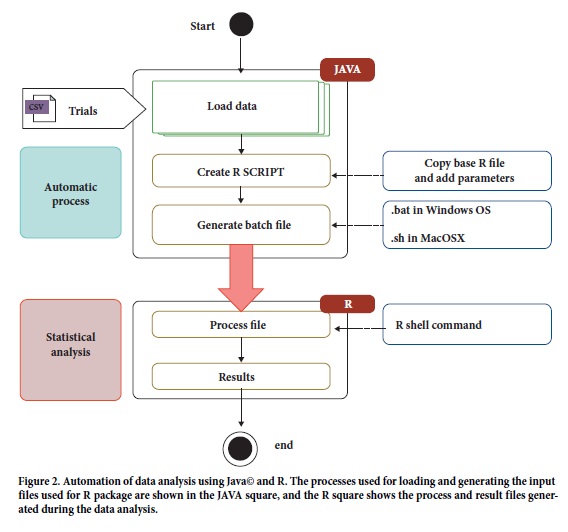
<body><![CDATA[<p align="justify"><font face="verdana" size="2"><b>MATERIALS, METHODS AND IMPLEMENTATION OF THE IBFieldbook</b></font></p>  	    <p align="justify"><font face="verdana" size="2">The integrated breeding fieldbook system described here is an example of an application of informatics to practical agronomic and plant breeding challenges. An overview of the IBFieldbook components and their functions is shown in <a href="/img/revistas/rfm/v36n3/a3t1.jpg" target="_blank">Table 1</a>.</font></p>     <p align="justify"><font face="verdana" size="2">Several open source software were used to develop the IBFieldbook system. The Java&copy; programming language used provides users with a modular and intuitive user interface (UI). The UI focuses on creating an easy to use system that facilitates information handling and analysis of information to help in breeding activities and improve the germplasm for different crops. The UI is a high&#45;performing, cross&#45;platform Java&copy; client application, which can be executed in Microsoft Windows&copy;, Mac OS X&copy; or any type of IX Operating System. The IBFIeldbook system uses MySQL&copy; for the backend, with a dual database (central and local) containing the same structure to keep track of public and private information. The client&#45;server architecture system permits many concurrent users to access the central database and also makes their private local information available. Java&copy; database connectivity (JDBC) provides interoperability with the databases and shells connectivity with R package. R software uses scripts developed to generate the standard analysis (See section of managing phenotypic data, below).</font></p>  	    <p align="justify"><font face="verdana" size="2">The programming language used to code the integrated breeding field book was Java 1. 6. 0&copy; using NetBeans 7.1.2&copy; as a developer platform. To collect the data, either Microsoft Access&copy; or MySQL versions 5.0&copy; were used as the backend; however, other relational databases can be used with little tuning. The application interfaces with R Statistical Package&copy; for field trial design and data analysis. IBFieldbook provides data management for the information collected in the field and generates either single or multi&#45;location trials for data analysis. It also manages catalogs using UI components for easy information management located in the presentation layer.</font></p>  	    <p align="justify"><font face="verdana" size="2">This system provides a middleware, which is composed of the service layer and data access layer using the Spring&copy; framework to send and receive objects from the service layer to the presentation layer, and it also uses Hibernate&copy; to communicate between the data access layer and service layer through entities. Spring provides a lightweight container which allows injecting required objects into others objects; this results in a design where the Java Class are not hard coded. A design based on independent classes/components increases re&#45;usability and software testability. The data access layer gets and receives information through records from the local and central databases using Microsoft Access&reg; or MySQL&copy; with Java&copy; database connectivity (JDBC) as shown in <a href="/img/revistas/rfm/v36n3/a3f1.jpg" target="_blank">Figure 1</a>.</font></p>  	    <p align="justify"><font face="verdana" size="2">&nbsp;</font></p>  	    <p align="justify"><font face="verdana" size="2"><b>Automation using Java&copy; and R software for data analysis</b></font></p>  	    <p align="justify"><font face="verdana" size="2">There are several steps used to generate single and multi&#45;location analyses that start after the information is collected in the field and stored into the database. First the information has to be exported to a coma separated values (csv) format file used by R software. The csv&#45;file is automatically uploaded, the standard R scripts and the needed parameters are copied, and a batch file generated for Windows&copy; or Mac OS X&copy; operating systems. This file is passed on to R and processed using a shell command in the R environment without user interaction. Finally the result files are returned after the analyses are done (<a href="#f2">Figure 2</a>).</font></p>  	    <p align="center"><font face="verdana" size="2"><a name="f2"></a></font></p>  	    <p align="center"><font face="verdana" size="2"><img src="/img/revistas/rfm/v36n3/a3f2.jpg"></font></p>  	    ]]></body>
<body><![CDATA[<p align="justify"><font face="verdana" size="2">&nbsp;</font></p>  	    <p align="justify"><font face="verdana" size="2"><b>Managing phenotypic data</b> <b>by the IBFieldbook</b></font></p>  	    <p align="justify"><font face="verdana" size="2">The IBFieldbook stores a set of interrelated tables in a relational database (ICISDB) that supports pedigree, phenotypic, and inventory information for the germplasm. This provides easy editing, querying, importing and exporting functions from trials and nurseries, shown in the entity relationship diagram &#91;Available at: <a href="http://www.revistafitotecniamexicana.org/documentos/36&#45;3/ICISdbschema.pdf" target="_blank">http://www.revistafitotecniamexicana.org/documentos/36-3/ICISdbschema.pdf</a>&#93;. All of this makes the system a user&#45;friendly field book generation tool, using Java&copy; interface components to facilitate data access (<a href="/img/revistas/rfm/v36n3/a3f3.jpg" target="_blank">Figure 3</a>).</font></p>      <p align="justify"><font face="verdana" size="2">IBFieldbook accepts comma separated values format used in hand held devices, as well as a pre&#45;established Microsoft Excel&reg; format. Once the information is imported into the system, it can be edited in an intuitive user&#45;friendly interface and also can be saved to the database to be exported to a specific R format for statistical analysis.</font></p>  	    <p align="justify"><font face="verdana" size="2">The steps to generate a trial or nursery for collecting information are as follows:</font></p>  	    <blockquote> 		    <p align="justify"><font face="verdana" size="2">&bull; Generate the germplasm list.</font></p>  		    <p align="justify"><font face="verdana" size="2">&bull; Generate a template or use one that come as example with the traits to measure</font></p>  		    <p align="justify"><font face="verdana" size="2">&bull; Generate a study; a set of trial and nurseries</font></p>  		    <p align="justify"><font face="verdana" size="2">&bull; Generate a trial or a nursery using the wizard or quick creation interfaces</font></p>  		    ]]></body>
<body><![CDATA[<p align="justify"><font face="verdana" size="2">&bull; Collect the phenotypic information in the system or export to hand held or Excel&copy; for collection</font></p> 	</blockquote>  	    <p align="justify"><font face="verdana" size="2">The best possible way to collect phenotypic information and avoid errors is by means of automating the data collection as much as possible.</font></p>  	    <p align="justify"><font face="verdana" size="2">&nbsp;</font></p>  	    <p align="justify"><font face="verdana" size="2"><b>Statistical models for single and multienvironment plant breeding trials</b></font></p>  	    <p align="justify"><font face="verdana" size="2">For the description of the mean response of genotypes over environments and for studying and interpreting genotype ' environment interaction (GE) in multi environment plant breeding trials (MET), the baseline conventional two&#45;way model used to explain the empirical mean response, &#563; , of the i<sub>th</sub> genotype (I = 1, 2, I) in the j<sub>th</sub> environment (j = 1, 2,..., J) with n replications in each of the I x J cells is expressed as (Eqn. 1)</font></p>     <p align="center"><font face="verdana" size="2"><img src="/img/revistas/rfm/v36n3/a3e1.jpg"></font></p>  	    <p align="justify"><font face="verdana" size="2">Where &micro; is the grand mean over all genotypes and environments, &#964;<sub>i</sub> is the additive effect of the i<sub>th</sub> genotype, &#948;. is the additive effect of the j<sub>th</sub> environment, (&#964;&#948;) is the non&#45;additivity interaction GE of the i<sub>th</sub> genotype in the j<sub>th</sub> environment, and <img src="/img/revistas/rfm/v36n3/a3s1.jpg"><sub>ij</sub> is the average error assumed to be NID (0, &#963;<sup>2</sup> /n)(where &#963;<sup>2</sup> is the within&#45;environment error variance, assumed to be constant). The model for a single environment is represented by &#563; = &micro; + &#964;<sub>i</sub> + <img src="/img/revistas/rfm/v36n3/a3s1.jpg"><sub>i</sub>.. The single and multi&#45;environment model can be used to analyze as many traits as it is required.</font></p>  	    <p align="justify"><font face="verdana" size="2">The simplest linear model for assessing GE was proposed by Yates and Cochran (1938), where the GE is expressed as the linear regression coefficient of the i<sub>th</sub> genotype value on the environmental mean. This approach was later used by Finlay and Wilkinson (1963) and modified by Eberhart and Russell (1966). Williams (1952) was the first author to link the fixed effects two&#45;way model (Eqn. 1) with principal components analysis by considering the model &#563;<sub>ij</sub> = &micro; + &#964;<sub>i</sub> + &#955;&#945;<sub>i</sub>&#947;<sub>j</sub> + <img src="/img/revistas/rfm/v36n3/a3s1.jpg"><sub>ij</sub>, where &#955; is the largest singular value of ZZ' and Z'Z (for Z = &#563;<sub>ij</sub> &#45; &#563;<sub>i</sub>) and &#945;<sub>i</sub> and &#947;<sub>j</sub> are the corresponding eigenvectors. An extension to Williiams work was done by considering the bilinear GEI term as&nbsp;(&#964;&#948;)<sub>ij</sub> =<img src="/img/revistas/rfm/v36n3/a3s2.jpg"></font></p>  	    <p align="justify"><font face="verdana" size="2">Thus, the general formulation of this linear&#45;bilinear model is</font></p>     <p align="center"><font face="verdana" size="2"><img src="/img/revistas/rfm/v36n3/a3e2.jpg"></font></p>  	    ]]></body>
<body><![CDATA[<p align="justify"><font face="verdana" size="2">Where the constant &#955;<sub>k</sub> is the singular value of the k<sub>ith</sub> multiplicative component that is ordered &#955;<sub>1</sub> &#8805;&#955;<sub>2</sub> &#8805; ...&#8805;&#955;<sub>t</sub>; the terms &#945;<sub>ik</sub> are elements of the k<sub>ith</sub> left singular vector of the ik ith true interaction and represents the genotypic sensitivity to hypothetical environmental factors represented by the k<sub>ith</sub> right singular vector with elements y<sub>jk</sub>. The &#945;<sub>ik</sub> and y<sub>jk</sub> satisfy the ortho&#45;normalization constraints &#931;<sub>i</sub> &#945;<sub>ik</sub> &#945;<sub>ik</sub>, = &#931;<sub>j</sub> Y<sub>jk</sub> Y<sub>jk</sub> = 0 for k &#8800; k' and &#931;<sub>i</sub> &#945;<sup>2</sup><sub>ik</sub> = &#931;<sub>j</sub> y<sup>2</sup>j<sub>k</sub> = 1. This model was called "additive main effects and multiplicative interaction (AMMI)" model by Zobel <i>et al.</i> (1988) and Gauch (1988).</font></p>      <p align="justify"><font face="verdana" size="2">A biplot is a simultaneous representation of the rows and columns of a two&#45;way array of data in terms of directions and projections Gabriel (1978). The biplot is designed to operate with one matrix (two&#45;mode), and the singular vector of the genotypes and environmental scores for the first two components are drawn from the origin to the end of the vector. Vectors of genotypes (or environments) that are related are parallel (or near parallel), whereas vectors with angles greater than 90 % represent negligible or negative relationship of genotypes (or environments). Furthermore, vectors of genotypes and environments pointing on the same direction denote positive GE between those genotypes and those environments, whereas vectors of genotypes and environments pointing in opposite directions denote negative GE.</font></p>  	    <p align="justify"><font face="verdana" size="2">&nbsp;</font></p>  	    <p align="justify"><font face="verdana" size="2"><b>DISCUSSION</b></font></p>  	    <p align="justify"><font face="verdana" size="2">There are several packages that can be used to generate field books for breeding germplasm, as well as to generate trials for evaluation, with exporting and importing functions, using several statistical packages to evaluate information recorded in the field or in the lab with different types of devices. However, these packages are very expensive, require a lot of training, and are not user friendly. Therefore we programmed a package that can handle several crops, is comprehensive and user friendly, at no cost for the final user (<a href="/img/revistas/rfm/v36n3/a3t2.jpg" target="_blank">Table 2</a>).</font>	</p> 	    <p align="justify"><font face="verdana" size="2">The IBFieldbook was designed to meet the challenges of collecting, managing, and analyzing phenotypic information for different crops, in different experimental stations around the world. This tool has been used in nine crops (beans, cassava, chickpeas, cowpea, groundnuts, maize, rice, sorghum, and wheat) handling more than 150 000 pedigrees; more than 11 000 different field trials in different locations worldwide for the Consultative Group on International Agricultural Research (CGIAR) centers. Related information can be downloaded at: <a href="https://www.inte&#45;ratedbreeding.net/ib&#45;tools/project&#45;planning&#45;and&#45;queries/crop&#45;databases&#45;ib&#45;workbench" target="_blank">https://www.inte&#45;ratedbreeding.net/ib&#45;tools/project&#45;planning&#45;and&#45;queries/crop&#45;databases&#45;ib&#45;workbench</a>.</font></p>      <p align="justify"><font face="verdana" size="2">The IBFieldbook is a complete system for breeding management, and the software is freely available to the public. The system includes the trait management for all the variables that are measured in the field, export and import functions to work with the information into hand held devices or Microsoft Excel&copy; software. The system also allows direct modification or addition of information using a programmed graphical user interface, and to run statistical analysis with the information collected interacting directly with R package. It has printing facilities and stores the information into a relational database management system.</font></p>  	    <p align="justify"><font face="verdana" size="2">&nbsp;</font></p>  	    <p align="justify"><font face="verdana" size="2"><b>CONCLUSION</b></font></p>  	    <p align="justify"><font face="verdana" size="2">The IBFieldBook is a freely available open source software tool that helps breeders, technicians, and molecular breeders to generate their field books, collect phenotypic information in the field, analyze their collected data for single&#45;environment and multi&#45;environment statistical analyses, store the data in a comprehensive database, and report their results, thus helping users improve their germplasm. It was successfully tested in Africa, Asia, and Latin America. Free downloadable copies of the application and examples of databases for the nine crops can be obtained by filling out the form at: <a href="http://www.g2apps.net/index.php?consulta=PRODUCTOS&amp;principal=IB&#45;FIELDBOOK" target="_blank">http://www.g2apps.net/index.php?consulta=PRODUCTOS&amp;principal=IB-FIELDBOOK</a>.</font></p>      ]]></body>
<body><![CDATA[<p align="justify"><font face="verdana" size="2">&nbsp;</font></p>  	    <p align="justify"><font face="verdana" size="2"><b>ACKNOWLEDMENTS</b></font></p>  	    <p align="justify"><font face="verdana" size="2">To the members of the Generation Challenge Program including Jean Marcel&#45;Ribaut, Graham McLaren, Arllet Portugal, and Clarissa Pimentel, for their full support to develop the IBFieldbook system. The International Maize and Wheat Improvement Center (CIMMYT) does not guarantee nor warrant the standard of the product. The use of the name implies no approval of the product to the exclusion of others that may also be suitable. This system was supported by the Generation Challenge Program (Grant ID OPP53402).</font></p>  	    <p align="justify"><font face="verdana" size="2">&nbsp;</font></p>  	    <p align="justify"><font face="verdana" size="2"><b>BIBLIOGRAPHY</b></font></p>  	    <!-- ref --><p align="justify"><font face="verdana" size="2"><b>AGROBASE</b> (2012) Generation II&reg; Plant and Crop Breeding Software. <a href="http://www.agronomix.com" target="_blank">http://www.agronomix.com</a>.    &nbsp;&nbsp;&nbsp;&nbsp;&nbsp;&nbsp;&nbsp;&nbsp;[&#160;<a href="javascript:void(0);" onclick="javascript: window.open('/scielo.php?script=sci_nlinks&ref=7091929&pid=S0187-7380201300030000300001&lng=','','width=640,height=500,resizable=yes,scrollbars=1,menubar=yes,');">Links</a>&#160;]<!-- end-ref --></font></p>  	    <!-- ref --><p align="justify"><font face="verdana" size="2"><b>Banziger M, G O Edmeades, D Beck, M Bellon (2000)</b> Breeding for drought and nitrogen stress tolerance in maize: from theory to practice. CIMMYT.    &nbsp;&nbsp;&nbsp;&nbsp;&nbsp;&nbsp;&nbsp;&nbsp;[&#160;<a href="javascript:void(0);" onclick="javascript: window.open('/scielo.php?script=sci_nlinks&ref=7091931&pid=S0187-7380201300030000300002&lng=','','width=640,height=500,resizable=yes,scrollbars=1,menubar=yes,');">Links</a>&#160;]<!-- end-ref --></font></p>  	    <!-- ref --><p align="justify"><font face="verdana" size="2"><b>Central Software Solutions, Inc. (2012)</b> PRISM&reg; <a href="http://www.teamcssi.com" target="_blank">http://www.teamcssi.com</a>.    &nbsp;&nbsp;&nbsp;&nbsp;&nbsp;&nbsp;&nbsp;&nbsp;[&#160;<a href="javascript:void(0);" onclick="javascript: window.open('/scielo.php?script=sci_nlinks&ref=7091933&pid=S0187-7380201300030000300003&lng=','','width=640,height=500,resizable=yes,scrollbars=1,menubar=yes,');">Links</a>&#160;]<!-- end-ref --></font></p>      <!-- ref --><p align="justify"><font face="verdana" size="2"><b>Delannay X, G McLaren, J M Ribaut (2011)</b> Fostering molecular breeding in developing countries. Mol. Breed. 29:857&#45;873.    &nbsp;&nbsp;&nbsp;&nbsp;&nbsp;&nbsp;&nbsp;&nbsp;[&#160;<a href="javascript:void(0);" onclick="javascript: window.open('/scielo.php?script=sci_nlinks&ref=7091935&pid=S0187-7380201300030000300004&lng=','','width=640,height=500,resizable=yes,scrollbars=1,menubar=yes,');">Links</a>&#160;]<!-- end-ref --></font></p>  	    <!-- ref --><p align="justify"><font face="verdana" size="2"><b>Eberhart S A, W A Russell (1966)</b> Stability parameters for comparing varieties. Crop Sci. 6:36&#45;40.    &nbsp;&nbsp;&nbsp;&nbsp;&nbsp;&nbsp;&nbsp;&nbsp;[&#160;<a href="javascript:void(0);" onclick="javascript: window.open('/scielo.php?script=sci_nlinks&ref=7091937&pid=S0187-7380201300030000300005&lng=','','width=640,height=500,resizable=yes,scrollbars=1,menubar=yes,');">Links</a>&#160;]<!-- end-ref --></font></p>  	    <!-- ref --><p align="justify"><font face="verdana" size="2"><b>FAO Statistical Yearbook (2013)</b> World food and agriculture. Food And Agriculture Organization Of The United Nations, Rome, Part 3, Feeding the world. <a href="http://www.fao.org/docrep/018/i3107e/i3107e00.htm" target="_blank">http://www.fao.org/docrep/018/i3107e/i3107e00.htm</a>.    &nbsp;&nbsp;&nbsp;&nbsp;&nbsp;&nbsp;&nbsp;&nbsp;[&#160;<a href="javascript:void(0);" onclick="javascript: window.open('/scielo.php?script=sci_nlinks&ref=7091939&pid=S0187-7380201300030000300006&lng=','','width=640,height=500,resizable=yes,scrollbars=1,menubar=yes,');">Links</a>&#160;]<!-- end-ref --></font></p>      <!-- ref --><p align="justify"><font face="verdana" size="2"><b>Finlay K W, A A Wilkinson (1963)</b> The analysis of adaptation in a plant breeding program. Austr. J. Agric. Res. 14:742&#45;754.    &nbsp;&nbsp;&nbsp;&nbsp;&nbsp;&nbsp;&nbsp;&nbsp;[&#160;<a href="javascript:void(0);" onclick="javascript: window.open('/scielo.php?script=sci_nlinks&ref=7091941&pid=S0187-7380201300030000300007&lng=','','width=640,height=500,resizable=yes,scrollbars=1,menubar=yes,');">Links</a>&#160;]<!-- end-ref --></font></p>  	    <!-- ref --><p align="justify"><font face="verdana" size="2"><b>Gabriel K R (1978)</b> Least Squares Approximation of Matrices by Additive and Multiplicative Models. J. Royal Stat. Soc., Series B 40:186196.    &nbsp;&nbsp;&nbsp;&nbsp;&nbsp;&nbsp;&nbsp;&nbsp;[&#160;<a href="javascript:void(0);" onclick="javascript: window.open('/scielo.php?script=sci_nlinks&ref=7091943&pid=S0187-7380201300030000300008&lng=','','width=640,height=500,resizable=yes,scrollbars=1,menubar=yes,');">Links</a>&#160;]<!-- end-ref --></font></p>  	    <!-- ref --><p align="justify"><font face="verdana" size="2"><b>Gauch H G (1988)</b> Model selection and validation for yield trials with interaction. Biometrics 44:705&#45;715.    &nbsp;&nbsp;&nbsp;&nbsp;&nbsp;&nbsp;&nbsp;&nbsp;[&#160;<a href="javascript:void(0);" onclick="javascript: window.open('/scielo.php?script=sci_nlinks&ref=7091945&pid=S0187-7380201300030000300009&lng=','','width=640,height=500,resizable=yes,scrollbars=1,menubar=yes,');">Links</a>&#160;]<!-- end-ref --></font></p>  	    <!-- ref --><p align="justify"><font face="verdana" size="2"><b>McLaren C G, R M Bruskiewich, A M Portugal, B Cosico (2005)</b> The international rice information system. A platform for meta&#45;analysis of rice crop data. Plant Physiol. 139:637&#45;642.    &nbsp;&nbsp;&nbsp;&nbsp;&nbsp;&nbsp;&nbsp;&nbsp;[&#160;<a href="javascript:void(0);" onclick="javascript: window.open('/scielo.php?script=sci_nlinks&ref=7091947&pid=S0187-7380201300030000300010&lng=','','width=640,height=500,resizable=yes,scrollbars=1,menubar=yes,');">Links</a>&#160;]<!-- end-ref --></font></p>  	    <!-- ref --><p align="justify"><font face="verdana" size="2"><b>Ortiz R, R Trethowan, G O Ferrara, M Iwanaga, J H Dodds, J H Crouch, J Crossa, H J Braun (2007)</b> High yield potential, shuttle breeding, genetic diversity, and a new international wheat improvement strategy. Euphytica 157:365&#45;384.    &nbsp;&nbsp;&nbsp;&nbsp;&nbsp;&nbsp;&nbsp;&nbsp;[&#160;<a href="javascript:void(0);" onclick="javascript: window.open('/scielo.php?script=sci_nlinks&ref=7091949&pid=S0187-7380201300030000300011&lng=','','width=640,height=500,resizable=yes,scrollbars=1,menubar=yes,');">Links</a>&#160;]<!-- end-ref --></font></p>  	    <!-- ref --><p align="justify"><font face="verdana" size="2"><b>Ribaut J M, de M C Vicente, X Delannay (2010)</b> Molecular breeding in developing countries: challenges and perspectives. Curr. Opin. Plant Biol. 13:1&#45;6.    &nbsp;&nbsp;&nbsp;&nbsp;&nbsp;&nbsp;&nbsp;&nbsp;[&#160;<a href="javascript:void(0);" onclick="javascript: window.open('/scielo.php?script=sci_nlinks&ref=7091951&pid=S0187-7380201300030000300012&lng=','','width=640,height=500,resizable=yes,scrollbars=1,menubar=yes,');">Links</a>&#160;]<!-- end-ref --></font></p>  	    <!-- ref --><p align="justify"><font face="verdana" size="2"><b>Williams E J (1952)</b> The interpretation of interactions in factorial experiments. Biometrika 39:65&#45;81.    &nbsp;&nbsp;&nbsp;&nbsp;&nbsp;&nbsp;&nbsp;&nbsp;[&#160;<a href="javascript:void(0);" onclick="javascript: window.open('/scielo.php?script=sci_nlinks&ref=7091953&pid=S0187-7380201300030000300013&lng=','','width=640,height=500,resizable=yes,scrollbars=1,menubar=yes,');">Links</a>&#160;]<!-- end-ref --> </font></p> 	    <!-- ref --><p align="justify"><font face="verdana" size="2"><b>Yates F, W G Cochran (1938)</b> The analysis of groups of experiments. J. Agric. Sci. 28:556&#45;580.    &nbsp;&nbsp;&nbsp;&nbsp;&nbsp;&nbsp;&nbsp;&nbsp;[&#160;<a href="javascript:void(0);" onclick="javascript: window.open('/scielo.php?script=sci_nlinks&ref=7091955&pid=S0187-7380201300030000300014&lng=','','width=640,height=500,resizable=yes,scrollbars=1,menubar=yes,');">Links</a>&#160;]<!-- end-ref --></font></p>  	    <!-- ref --><p align="justify"><font face="verdana" size="2"><b>Zobel R W, M J Wright, H G Gauch Jr</b> <b>(1988)</b>  Statistical analysis of a yield trial. Agron. J. 80:388&#45;393.    &nbsp;&nbsp;&nbsp;&nbsp;&nbsp;&nbsp;&nbsp;&nbsp;[&#160;<a href="javascript:void(0);" onclick="javascript: window.open('/scielo.php?script=sci_nlinks&ref=7091957&pid=S0187-7380201300030000300015&lng=','','width=640,height=500,resizable=yes,scrollbars=1,menubar=yes,');">Links</a>&#160;]<!-- end-ref --></font></p>      ]]></body><back>
<ref-list>
<ref id="B1">
<nlm-citation citation-type="">
<collab>AGROBASE</collab>
<source><![CDATA[Generation II® Plant and Crop Breeding Software]]></source>
<year>2012</year>
</nlm-citation>
</ref>
<ref id="B2">
<nlm-citation citation-type="book">
<person-group person-group-type="author">
<name>
<surname><![CDATA[Banziger]]></surname>
<given-names><![CDATA[M]]></given-names>
</name>
<name>
<surname><![CDATA[Edmeades]]></surname>
<given-names><![CDATA[G O]]></given-names>
</name>
<name>
<surname><![CDATA[Beck]]></surname>
<given-names><![CDATA[D]]></given-names>
</name>
<name>
<surname><![CDATA[Bellon]]></surname>
<given-names><![CDATA[M]]></given-names>
</name>
</person-group>
<source><![CDATA[Breeding for drought and nitrogen stress tolerance in maize: from theory to practice]]></source>
<year>2000</year>
<publisher-name><![CDATA[CIMMYT]]></publisher-name>
</nlm-citation>
</ref>
<ref id="B3">
<nlm-citation citation-type="book">
<collab>Central Software Solutions, Inc.</collab>
<source><![CDATA[]]></source>
<year>2012</year>
<publisher-name><![CDATA[PRISM®]]></publisher-name>
</nlm-citation>
</ref>
<ref id="B4">
<nlm-citation citation-type="journal">
<person-group person-group-type="author">
<name>
<surname><![CDATA[Delannay]]></surname>
<given-names><![CDATA[X]]></given-names>
</name>
<name>
<surname><![CDATA[McLaren]]></surname>
<given-names><![CDATA[G]]></given-names>
</name>
<name>
<surname><![CDATA[Ribaut]]></surname>
<given-names><![CDATA[J M]]></given-names>
</name>
</person-group>
<article-title xml:lang="en"><![CDATA[Fostering molecular breeding in developing countries]]></article-title>
<source><![CDATA[Mol. Breed.]]></source>
<year>2011</year>
<volume>29</volume>
<page-range>857-873</page-range></nlm-citation>
</ref>
<ref id="B5">
<nlm-citation citation-type="journal">
<person-group person-group-type="author">
<name>
<surname><![CDATA[Eberhart]]></surname>
<given-names><![CDATA[S A]]></given-names>
</name>
<name>
<surname><![CDATA[Russell]]></surname>
<given-names><![CDATA[W A]]></given-names>
</name>
</person-group>
<article-title xml:lang="en"><![CDATA[Stability parameters for comparing varieties]]></article-title>
<source><![CDATA[Crop Sci.]]></source>
<year>1966</year>
<volume>6</volume>
<page-range>36-40</page-range></nlm-citation>
</ref>
<ref id="B6">
<nlm-citation citation-type="book">
<collab>FAO^dStatistical Yearbook</collab>
<source><![CDATA[World food and agriculture]]></source>
<year>2013</year>
<publisher-loc><![CDATA[Rome ]]></publisher-loc>
<publisher-name><![CDATA[Food And Agriculture Organization Of The United Nations]]></publisher-name>
</nlm-citation>
</ref>
<ref id="B7">
<nlm-citation citation-type="journal">
<person-group person-group-type="author">
<name>
<surname><![CDATA[Finlay]]></surname>
<given-names><![CDATA[K W]]></given-names>
</name>
<name>
<surname><![CDATA[Wilkinson]]></surname>
<given-names><![CDATA[A A]]></given-names>
</name>
</person-group>
<article-title xml:lang="en"><![CDATA[The analysis of adaptation in a plant breeding program]]></article-title>
<source><![CDATA[Austr. J. Agric. Res.]]></source>
<year>1963</year>
<volume>14</volume>
<page-range>742-754</page-range></nlm-citation>
</ref>
<ref id="B8">
<nlm-citation citation-type="journal">
<person-group person-group-type="author">
<name>
<surname><![CDATA[Gabriel]]></surname>
<given-names><![CDATA[K R]]></given-names>
</name>
</person-group>
<article-title xml:lang="en"><![CDATA[Least Squares Approximation of Matrices by Additive and Multiplicative Models]]></article-title>
<source><![CDATA[J. Royal Stat. Soc., Series B]]></source>
<year>1978</year>
<volume>40</volume>
<page-range>186196</page-range></nlm-citation>
</ref>
<ref id="B9">
<nlm-citation citation-type="journal">
<person-group person-group-type="author">
<name>
<surname><![CDATA[Gauch]]></surname>
<given-names><![CDATA[H G]]></given-names>
</name>
</person-group>
<article-title xml:lang="en"><![CDATA[Model selection and validation for yield trials with interaction]]></article-title>
<source><![CDATA[Biometrics]]></source>
<year>1988</year>
<volume>44</volume>
<page-range>705-715</page-range></nlm-citation>
</ref>
<ref id="B10">
<nlm-citation citation-type="journal">
<person-group person-group-type="author">
<name>
<surname><![CDATA[McLaren]]></surname>
<given-names><![CDATA[C G]]></given-names>
</name>
<name>
<surname><![CDATA[Bruskiewich]]></surname>
<given-names><![CDATA[R M]]></given-names>
</name>
<name>
<surname><![CDATA[Portugal]]></surname>
<given-names><![CDATA[A M]]></given-names>
</name>
<name>
<surname><![CDATA[Cosico]]></surname>
<given-names><![CDATA[B]]></given-names>
</name>
</person-group>
<article-title xml:lang="en"><![CDATA[The international rice information system]]></article-title>
<source><![CDATA[A platform for meta-analysis of rice crop data. Plant Physiol.]]></source>
<year>2005</year>
<volume>139</volume>
<page-range>637-642</page-range></nlm-citation>
</ref>
<ref id="B11">
<nlm-citation citation-type="journal">
<person-group person-group-type="author">
<name>
<surname><![CDATA[Ortiz]]></surname>
<given-names><![CDATA[R]]></given-names>
</name>
<name>
<surname><![CDATA[Trethowan]]></surname>
<given-names><![CDATA[R]]></given-names>
</name>
<name>
<surname><![CDATA[Ferrara]]></surname>
<given-names><![CDATA[G O]]></given-names>
</name>
<name>
<surname><![CDATA[Iwanaga]]></surname>
<given-names><![CDATA[M]]></given-names>
</name>
<name>
<surname><![CDATA[Dodds]]></surname>
<given-names><![CDATA[J H]]></given-names>
</name>
<name>
<surname><![CDATA[Crouch]]></surname>
<given-names><![CDATA[J H]]></given-names>
</name>
<name>
<surname><![CDATA[Crossa]]></surname>
<given-names><![CDATA[J]]></given-names>
</name>
<name>
<surname><![CDATA[Braun]]></surname>
<given-names><![CDATA[H J]]></given-names>
</name>
</person-group>
<article-title xml:lang="en"><![CDATA[High yield potential, shuttle breeding, genetic diversity, and a new international wheat improvement strategy]]></article-title>
<source><![CDATA[Euphytica]]></source>
<year>2007</year>
<volume>157</volume>
<page-range>365-384</page-range></nlm-citation>
</ref>
<ref id="B12">
<nlm-citation citation-type="journal">
<person-group person-group-type="author">
<name>
<surname><![CDATA[Ribaut]]></surname>
<given-names><![CDATA[J M]]></given-names>
</name>
<name>
<surname><![CDATA[Vicente]]></surname>
<given-names><![CDATA[de M C]]></given-names>
</name>
<name>
<surname><![CDATA[Delannay]]></surname>
<given-names><![CDATA[X]]></given-names>
</name>
</person-group>
<article-title xml:lang="en"><![CDATA[Molecular breeding in developing countries: challenges and perspectives]]></article-title>
<source><![CDATA[Curr. Opin. Plant Biol.]]></source>
<year>2010</year>
<volume>13</volume>
<page-range>1-6</page-range></nlm-citation>
</ref>
<ref id="B13">
<nlm-citation citation-type="journal">
<person-group person-group-type="author">
<name>
<surname><![CDATA[Williams]]></surname>
<given-names><![CDATA[E J]]></given-names>
</name>
</person-group>
<article-title xml:lang="en"><![CDATA[The interpretation of interactions in factorial experiments]]></article-title>
<source><![CDATA[Biometrika]]></source>
<year>1952</year>
<numero>39</numero>
<issue>39</issue>
<page-range>65-81</page-range></nlm-citation>
</ref>
<ref id="B14">
<nlm-citation citation-type="journal">
<person-group person-group-type="author">
<name>
<surname><![CDATA[Yates]]></surname>
<given-names><![CDATA[F]]></given-names>
</name>
<name>
<surname><![CDATA[Cochran]]></surname>
<given-names><![CDATA[W G]]></given-names>
</name>
</person-group>
<article-title xml:lang="en"><![CDATA[The analysis of groups of experiments]]></article-title>
<source><![CDATA[J. Agric. Sci.]]></source>
<year>1938</year>
<numero>28</numero>
<issue>28</issue>
<page-range>556-580</page-range></nlm-citation>
</ref>
<ref id="B15">
<nlm-citation citation-type="journal">
<person-group person-group-type="author">
<name>
<surname><![CDATA[Zobel]]></surname>
<given-names><![CDATA[R W]]></given-names>
</name>
<name>
<surname><![CDATA[Wright]]></surname>
<given-names><![CDATA[M J]]></given-names>
</name>
<name>
<surname><![CDATA[Gauch Jr]]></surname>
<given-names><![CDATA[H G]]></given-names>
</name>
</person-group>
<article-title xml:lang="en"><![CDATA[Statistical analysis of a yield trial]]></article-title>
<source><![CDATA[Agron. J.]]></source>
<year>1988</year>
<volume>80</volume>
<page-range>388-393</page-range></nlm-citation>
</ref>
</ref-list>
</back>
</article>

