<?xml version="1.0" encoding="ISO-8859-1"?><article xmlns:mml="http://www.w3.org/1998/Math/MathML" xmlns:xlink="http://www.w3.org/1999/xlink" xmlns:xsi="http://www.w3.org/2001/XMLSchema-instance">
<front>
<journal-meta>
<journal-id>0187-7151</journal-id>
<journal-title><![CDATA[Acta botánica mexicana]]></journal-title>
<abbrev-journal-title><![CDATA[Act. Bot. Mex]]></abbrev-journal-title>
<issn>0187-7151</issn>
<publisher>
<publisher-name><![CDATA[Instituto de Ecología A.C., Centro Regional del Bajío]]></publisher-name>
</publisher>
</journal-meta>
<article-meta>
<article-id>S0187-71512015000300006</article-id>
<title-group>
<article-title xml:lang="en"><![CDATA[New records and data of Rhodocollybia popayanica (Agaricales: Omphalotaceae) from Mexico]]></article-title>
<article-title xml:lang="es"><![CDATA[Nuevo registro y datos de Rhodocollybia popayanica (Agaricales: Omphalotaceae) de México]]></article-title>
</title-group>
<contrib-group>
<contrib contrib-type="author">
<name>
<surname><![CDATA[Villarruel-Ordaz]]></surname>
<given-names><![CDATA[José Luis]]></given-names>
</name>
<xref ref-type="aff" rid="A01"/>
</contrib>
<contrib contrib-type="author">
<name>
<surname><![CDATA[Cifuentes]]></surname>
<given-names><![CDATA[Joaquín]]></given-names>
</name>
<xref ref-type="aff" rid="A02"/>
</contrib>
</contrib-group>
<aff id="A01">
<institution><![CDATA[,Universidad del Mar Instituto de Genética ]]></institution>
<addr-line><![CDATA[Puerto Escondido Oaxaca]]></addr-line>
<country>México</country>
</aff>
<aff id="A02">
<institution><![CDATA[,Universidad Nacional Autónoma de México Facultad de Ciencias Laboratorio de Taxonomía y Biodiversidad de Hongos]]></institution>
<addr-line><![CDATA[México Distrito Federal]]></addr-line>
<country>México</country>
</aff>
<pub-date pub-type="pub">
<day>00</day>
<month>00</month>
<year>2015</year>
</pub-date>
<pub-date pub-type="epub">
<day>00</day>
<month>00</month>
<year>2015</year>
</pub-date>
<numero>112</numero>
<fpage>67</fpage>
<lpage>72</lpage>
<copyright-statement/>
<copyright-year/>
<self-uri xlink:href="http://www.scielo.org.mx/scielo.php?script=sci_arttext&amp;pid=S0187-71512015000300006&amp;lng=en&amp;nrm=iso"></self-uri><self-uri xlink:href="http://www.scielo.org.mx/scielo.php?script=sci_abstract&amp;pid=S0187-71512015000300006&amp;lng=en&amp;nrm=iso"></self-uri><self-uri xlink:href="http://www.scielo.org.mx/scielo.php?script=sci_pdf&amp;pid=S0187-71512015000300006&amp;lng=en&amp;nrm=iso"></self-uri><abstract abstract-type="short" xml:lang="en"><p><![CDATA[Rhodocollybia popayanica is described as a new record for the Mexican mycobiota in the states of Chiapas, Hidalgo, México, Michoacán and Nayarit. The studied specimens are congruent with descriptions from Colombia and Costa Rica. With this record, Mexico becomes the northernmost limit for this neotropically distributed species.]]></p></abstract>
<abstract abstract-type="short" xml:lang="es"><p><![CDATA[Se describe a Rhodocollybia popayanica como nuevo registro de la micobiota mexicana en los estados de Chiapas, Hidalgo, México, Michoacán y Nayarit. Los especímenes estudiados concuerdan con las descripciones de Colombia y Costa Rica. Con este registro México llega a ser el límite septentrional de la distribución neotropical de esta especie.]]></p></abstract>
<kwd-group>
<kwd lng="en"><![CDATA[Mexican mycobiota]]></kwd>
<kwd lng="en"><![CDATA[neotropical]]></kwd>
<kwd lng="en"><![CDATA[new records]]></kwd>
<kwd lng="es"><![CDATA[micobiota mexicana]]></kwd>
<kwd lng="es"><![CDATA[nuevos registros]]></kwd>
<kwd lng="es"><![CDATA[neotropical]]></kwd>
</kwd-group>
</article-meta>
</front><body><![CDATA[ <p align="center"><font face="verdana" size="4"><b>New records and data of <i>Rhodocollybia popayanica</i> (Agaricales: Omphalotaceae) from Mexico</b></font></p>  	    <p>&nbsp;</p>  	    <p align="center"><font face="verdana" size="3"><b>Nuevo registro y datos de <i>Rhodocollybia popayanica</i> (Agaricales: Omphalotaceae) de M&eacute;xico</b></font></p>  	    <p>&nbsp;</p>  	    <p align="center"><font face="verdana" size="2"><b>Jos&eacute; Luis Villarruel&#45;Ordaz<sup>1,3</sup> and Joaqu&iacute;n Cifuentes<sup>2</sup></b></font></p>  	    <p>&nbsp;</p>  	    <p align="justify"><font face="verdana" size="2"><sup><i>1</i></sup> <i>Universidad del Mar, Instituto de Gen&eacute;tica, campus Puerto Escondido, km 1.5 road Puerto Escondido&#45;Sola de Vega, 71980 Puerto Escondido, Oaxaca, M&eacute;xico.</i></font></p>  	    <p align="justify"><font face="verdana" size="2"><i><sup>2</sup> Universidad Nacional Aut&oacute;noma de M&eacute;xico, Facultad de Ciencias, Laboratorio de Taxonom&iacute;a y Biodiversidad de Hongos, Apdo. postal 70&#45;181, 04510 Coyoac&aacute;n, M&eacute;xico, D.F., M&eacute;xico.</i></font></p>  	    <p align="justify"><font face="verdana" size="2"><i><sup>3</sup> Author for correspondence:</i> <a href="mailto:jlvo@zicatela.umar.mx">jlvo@zicatela.umar.mx</a></font></p>  	    <p>&nbsp;</p>  	    ]]></body>
<body><![CDATA[<p align="justify"><font face="verdana" size="2">Recibido en octubre de 2014.    <br> 	Aceptado en mayo de 2015.</font></p>  	    <p>&nbsp;</p>  	    <p align="justify"><font face="verdana" size="2"><b>ABSTRACT</b></font></p>  	    <p align="justify"><font face="verdana" size="2"><i>Rhodocollybia popayanica</i> is described as a new record for the Mexican mycobiota in the states of Chiapas, Hidalgo, M&eacute;xico, Michoac&aacute;n and Nayarit. The studied specimens are congruent with descriptions from Colombia and Costa Rica. With this record, Mexico becomes the northernmost limit for this neotropically distributed species.</font></p>  	    <p align="justify"><font face="verdana" size="2"><b>Key words:</b> Mexican mycobiota, neotropical, new records.</font></p>  	    <p>&nbsp;</p>  	    <p align="justify"><font face="verdana" size="2"><b>RESUMEN</b></font></p>  	    <p align="justify"><font face="verdana" size="2">Se describe a <i>Rhodocollybia popayanica</i> como nuevo registro de la micobiota mexicana en los estados de Chiapas, Hidalgo, M&eacute;xico, Michoac&aacute;n y Nayarit. Los espec&iacute;menes estudiados concuerdan con las descripciones de Colombia y Costa Rica. Con este registro M&eacute;xico llega a ser el l&iacute;mite septentrional de la distribuci&oacute;n neotropical de esta especie.</font></p>  	    <p align="justify"><font face="verdana" size="2"><b>Palabras clave:</b> micobiota mexicana, nuevos registros, neotropical.</font></p>  	    ]]></body>
<body><![CDATA[<p>&nbsp;</p>  	    <p align="justify"><font face="verdana" size="2"><b>INTRODUCTION</b></font></p>  	    <p align="justify"><font face="verdana" size="2">The genus <i>Rhodocollybia</i> was segregated from <i>Collybia</i> s.l. based on the presence of cyanophilic and dextrinoid spores and pinkish spore print (Lennox, 1979). Additionally, three other genera were segregated. <i>Connopus, Dendrocollybia</i> and <i>Gymnopus</i> are recognized based on macroscopic and microscopic characters as well as DNA data (Anton&iacute;n et al., 1997; Halling, 1997; Hughes et al., 2001; 2010; Mata et al., 2004a; 2004b; Wilson and Desjardin, 2005). So far, on a worldwide basis more than 20 species are known to belong to <i>Rhodocollybia</i> (Kirk et al., 2008; Anonymous, 2014; Roskov et al., 2014). In Mexico only six species (including three varieties) have been reported for the genus, being <i>Rhodocollybia butyracea</i> (Bull.) Lennox and <i>Rhodocollybia maculata</i> (Alb. &amp; Schwein.) Singer the most frequently cited (Guzm&aacute;n et al., 1992; Villarruel&#45;Ordaz et al., 1993).</font></p>  	    <p align="justify"><font face="verdana" size="2">As part of an ongoing review of collybioid agarics in Mexico, the authors found specimens fitting the diagnostic characters of <i>Rhodocollybia popayanica</i> (Halling) Halling, until now known only from Colombia and Costa Rica (Halling, 1989; Franco&#45;Molano et al., 2000; 2010; Mata, 2002).</font></p>  	    <p>&nbsp;</p>  	    <p align="justify"><font face="verdana" size="2"><b>MATERIALS AND METHODS</b></font></p>  	    <p align="justify"><font face="verdana" size="2">All specimens were annotated in the field and examined in the laboratory following standard techniques of macromorphology and macrochemicals reactions described by Cifuentes et al. (1986). Basidiomata colors were matched with Kornerup and Wanscher (1978).</font></p>  	    <p align="justify"><font face="verdana" size="2">Basidiomata micromorphology was examined using light microscopy. Sections of different tissues were mounted either with 3&#45;5% aqueous KOH solution, lactic acid or Melzer&#8217;s reagent; cotton blue or phloxine were used to stain cells when needed (Largent et al., 1977). The symbol &#8220;&#492;&#8221; represents the average of mean the length/width ratio of basidiospores. Most measurements and drawings were made using oil immersion objective at X 1250. A drawing tube was used to construct illustrations of microscopic features.</font></p>  	    <p align="justify"><font face="verdana" size="2">The following acronym appears below: FCME = Herbario, Facultad de Ciencias, Universidad Nacional Aut&oacute;noma de M&eacute;xico.</font></p>  	    <p>&nbsp;</p>  	    ]]></body>
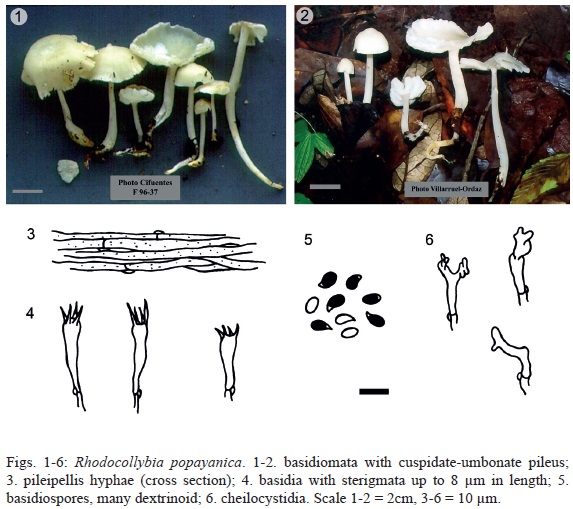
<body><![CDATA[<p align="justify"><font face="verdana" size="2"><b>RESULTS</b></font></p>  	    <p align="justify"><font face="verdana" size="2"><i>Rhodocollybia popayanica</i> (Halling) Halling. 1997. Mycotaxon 63: 365. <a href="#f1a6">Figs. 1&#45;6</a>.</font></p>  	    <p align="center"><font face="verdana" size="2"><a name="f1a6"></a></font></p>  	    <p align="center"><font face="verdana" size="2"><img src="/img/revistas/abm/n112/a6f1a6.jpg"></font></p>  	    <p align="justify"><font face="verdana" size="2">&#8801; <i>Collybia popayanica</i> Halling. 1989. Mycologia 81: 872.</font></p>  	    <p align="justify"><font face="verdana" size="2">Pileus 7&#45;60 mm in diameter, first convex, then campanulate&#45;umbonate, or sometimes plane&#45;convex, with center sharply papillate to cuspidate, margin straight to uplifted, sometimes eroded when mature; surface glabrous to finely appressed&#45;fibrillose, slightly striate by transparency, moist and hygrophanous; when young usually yellowish white (1&#45;4A2) to pale yellow (3A3), when mature irregularly staining more pale yellow (3A4&#45;4A3) or darker, at center becoming light brown (6D7) to brown (7E7); context thin, white to pale yellow (3&#45;4A3); taste slightly bitter; smell pleasant.</font></p>  	    <p align="justify"><font face="verdana" size="2">Lamellae subattached to almost free, crowded, very narrow, whitish cream (2A1) to yellowish white (2&#45;4A2); margin smooth, in age fimbriate to crenate. Stipe 22&#45;105 mm long, 2&#45;7 mm broad, cylindrical to compressed, twisted, attenuate toward apex and broader below; context fibrous&#45;cartilaginous; surface moist to dry, glabrous or slightly fibrillose to scantly villous toward the base, yellowish white (2&#45;4A2) or pale yellow (2&#45;3A3), developing light yellow (4A4&#45;5) stains toward the base with age. Basidiospores orange white (5A2) to grayish orange (5B3) in deposit, 6.3&#45;7.5 X 3.5&#45;4.2 mm (&#492; = 1.8), amygdaliform in side view, ellipsoid in dorsal view, smooth, thin&#45;walled, hyaline, many dextrinoid and cyanophilous. Basidia tetrasporic, 20&#45;27 X 6&#45;7 mm, clavate, sterigmata in some basidia measuring up to 8 mm in length. Pleurocystidia absent. Cheilocystidia 18&#45;22 X 6&#45;7mm, clavate to cylindrical, diverticulate with short projections. Pileipellis a cutis, with entangled cylindrical hyphae, radially oriented. Clamp connections abundant and present in all tissues.</font></p>  	    <p align="justify"><font face="verdana" size="2">Habitat and distribution: Humicolous or on very rotten wood; in mixed <i>Pinus</i>&#45;<i>Quercus</i>, and Mexican montane mesophytic forests, at 800&#45;2090 meters above sea level. It occurs during the months of July to September and its edibility is unknown.</font></p>  	    <p align="justify"><font face="verdana" size="2">Macrochemical tests: Pileus and stipe context, as wells as gills turn pale yellow (2&#45;3A3&#45;4) with KOH (10%), pileus and stipe context turn grayish red (9B2&#45;5) with Phenol (3%), pileus and stipe context, as well as gills turn very pale orange (5A1&#45;3) with formalin (40%).</font></p>  	    <p align="justify"><font face="verdana" size="2">Studied material. MEXICO. CHIAPAS: Municipality of Ocozocuautla, educational park &#8220;Laguna B&eacute;lgica&#8221;, km 18 road Ocozocuautla&#45;Malpaso, <i>Ocampo Genoveva 27</i> (FCME 10718); <i>Gallegos Cupil 11</i> (FCME 10728). ESTADO DE M&Eacute;XICO: Municipality of Valle de Bravo, km 21 road San Francisco Oxototilpa&#45;Valle de Bravo, <i>Pompa Gonz&aacute;lez 82</i> (FCME 2303, Photo Cifuentes 42&#45;68); km 4 circuit Manantiales&#45;Av&aacute;ndaro, <i>Hern&aacute;ndez&#45;Mu&ntilde;oz 32</i> (FCME 2205, Photo Cifuentes 42&#45;68). HIDALGO: Municipality of Jacala, km 192 road Pachuca&#45;Nuevo Laredo, <i>Villarruel&#45;Ordaz 902</i> (FCME 19634, Photo Villarruel&#45;Ordaz 2002&#45;2). MICHOACAN: Municipality of Charo, National park &#8220;Insurgente Jos&eacute; Ma. Morelos&#8221;, <i>Audelo Valona</i> 19&#45;august&#45;1983 (FCME 11471). NAYARIT: Municipality of Tepic, km 4.5 deviation to &#8220;El Cuarente&ntilde;o&#8221; hill San Juan, <i>Villarruel&#45;Ordaz 131</i> (FCME 1985); km 6 deviation to &#8220;El Cuarente&ntilde;o&#8221; hill San Juan, <i>Villarruel&#45;Ordaz 432</i> (FCME 18371, Photo Cifuentes 96&#45;37); km 11 deviation to &#8220;El Cuarente&ntilde;o&#8221; hill San Juan, <i>Cifuentes 2781</i> (FCME 2600, Photo Cifuentes 39&#45;92); &#8220;La Capillita&#8221; hill San Juan, <i>Villarruel&#45;Ordaz 106</i> (FCME 3913, Photo Hern&aacute;ndez&#45;Mu&ntilde;oz 1&#45;12); &#8220;La Capillita&#8221; hill San Juan, <i>Villarruel&#45;Ordaz 123</i> (FCME 4343, Photo Cifuentes 46&#45;83); &#8220;La Noria&#8221; hill San Juan, <i>Villarruel&#45;Ordaz 110</i> (FCME 4063).</font></p>  	    ]]></body>
<body><![CDATA[<p>&nbsp;</p>  	    <p align="justify"><font face="verdana" size="2"><b>DISCUSSION</b></font></p>  	    <p align="justify"><font face="verdana" size="2"><i>Rhodocollybia popayanica</i> is easily distinguished by its campanulate to plano&#45;convex pileus, which is clearly cuspidate to papillate at center. At first, basidiomata are almost white or very pale yellow but tend to develop yellow or brown stains when older. Previous descriptions (Halling, 1989; Franco&#45;Molano et al., 2000) have reported a more yellow to brown coloration (as brown as 6C4 and at center could be in age as reddish as 7&#45;8A3), as well as longer stipe dimensions (80 to 200 mm), but Mata (2002) found paler basidiomata with shorter stipe just like the Mexican specimens. Mata (2002) related such variations to different developmental stages and we concur with his opinion.</font></p>  	    <p align="justify"><font face="verdana" size="2"><i>Rhodocollybia popayanica</i> is similar to the <i>R. maculata</i> complex because of the yellowish basidiomata (Halling, 1989), but we regard its consistency as cartilaginous rather than fibrous, just like in <i>R. butyracea</i>. In addition, <i>R. maculata</i> has globose spores while <i>R. popayanica</i> are ellipsoid.</font></p>  	    <p align="justify"><font face="verdana" size="2"><i>Rhodocollybia popayanica</i> is now recorded from central, southwestern and southern Mexico (Chiapas, Estado de M&eacute;xico, Hidalgo, Michoac&aacute;n and Nayarit). It seems to be widely distributed in the Neotropics with Colombia and Mexico respectively as its southern and northern limits so far.</font></p>  	    <p>&nbsp;</p>  	    <p align="justify"><font face="verdana" size="2"><b>ACKNOWLEDGMENTS</b></font></p>  	    <p align="justify"><font face="verdana" size="2">Field trips and laboratory research were funded in part by projects PAPIIT IN&#45;208391, IN&#45;206901 and IN&#45;207311 from the Universidad Nacional Aut&oacute;noma de M&eacute;xico.</font></p>  	    <p>&nbsp;</p>  	    <p align="justify"><font face="verdana" size="2"><b>LITERATURE CITED</b></font></p>  	    ]]></body>
<body><![CDATA[<!-- ref --><p align="justify"><font face="verdana" size="2">Anton&iacute;n, V., R. E. Halling and M. E. Noordeloos. 1997. Generic concepts within the groups of <i>Marasmius</i> and <i>Collybia sensu lato</i>. Mycotaxon 63: 359&#45;368.    &nbsp;&nbsp;&nbsp;&nbsp;&nbsp;&nbsp;&nbsp;&nbsp;[&#160;<a href="javascript:void(0);" onclick="javascript: window.open('/scielo.php?script=sci_nlinks&ref=058128&pid=S0187-7151201500030000600001&lng=','','width=640,height=500,resizable=yes,scrollbars=1,menubar=yes,');">Links</a>&#160;]<!-- end-ref --></font></p>  	    <!-- ref --><p align="justify"><font face="verdana" size="2">Anonymous. 2014. Index fungorum. CABI Bioscience, CBS and Landcare Research. <a href="http://www.indexfungorum.org" target="_blank">www.indexfungorum.org</a>. Viewed on september of 2014.    &nbsp;&nbsp;&nbsp;&nbsp;&nbsp;&nbsp;&nbsp;&nbsp;[&#160;<a href="javascript:void(0);" onclick="javascript: window.open('/scielo.php?script=sci_nlinks&ref=058130&pid=S0187-7151201500030000600002&lng=','','width=640,height=500,resizable=yes,scrollbars=1,menubar=yes,');">Links</a>&#160;]<!-- end-ref --></font></p>  	    <!-- ref --><p align="justify"><font face="verdana" size="2">Cifuentes, J., M. Villegas and L. P&eacute;rez&#45;Ram&iacute;rez. 1986. Hongos. In: Lot, A. and F. Chiang (eds.). Manual de herbario. Consejo Nacional de la Flora de M&eacute;xico, A.C., M&eacute;xico, D.F., M&eacute;xico. pp. 55&#45;64.    &nbsp;&nbsp;&nbsp;&nbsp;&nbsp;&nbsp;&nbsp;&nbsp;[&#160;<a href="javascript:void(0);" onclick="javascript: window.open('/scielo.php?script=sci_nlinks&ref=058132&pid=S0187-7151201500030000600003&lng=','','width=640,height=500,resizable=yes,scrollbars=1,menubar=yes,');">Links</a>&#160;]<!-- end-ref --></font></p>  	    <!-- ref --><p align="justify"><font face="verdana" size="2">Franco&#45;Molano, A. E., R. Aldana&#45;G&oacute;mez and R. Halling. 2000. Setas de Colombia (Agaricales, Boletales y otros hongos). Gu&iacute;a de campo. COLCIENCIAS. Universidad de Antioqu&iacute;a. Medell&iacute;n, Colombia. 156 pp.    &nbsp;&nbsp;&nbsp;&nbsp;&nbsp;&nbsp;&nbsp;&nbsp;[&#160;<a href="javascript:void(0);" onclick="javascript: window.open('/scielo.php?script=sci_nlinks&ref=058134&pid=S0187-7151201500030000600004&lng=','','width=640,height=500,resizable=yes,scrollbars=1,menubar=yes,');">Links</a>&#160;]<!-- end-ref --></font></p>  	    <!-- ref --><p align="justify"><font face="verdana" size="2">Franco&#45;Molano, A. E., A. Corrales and A. M. Vasco&#45;Palacios. 2010. Macrohongos de Colombia II. Listado de especies de los &oacute;rdenes Agaricales, Boletales, Cantharellales y Russulales (Agaricomycetes, Basidiomycota). Actual Biol. 32(92): 89&#45;113.    &nbsp;&nbsp;&nbsp;&nbsp;&nbsp;&nbsp;&nbsp;&nbsp;[&#160;<a href="javascript:void(0);" onclick="javascript: window.open('/scielo.php?script=sci_nlinks&ref=058136&pid=S0187-7151201500030000600005&lng=','','width=640,height=500,resizable=yes,scrollbars=1,menubar=yes,');">Links</a>&#160;]<!-- end-ref --></font></p>  	    ]]></body>
<body><![CDATA[<!-- ref --><p align="justify"><font face="verdana" size="2">Guzm&aacute;n, G., V. M. Bandala and L. Montoya. 1992. Noteworthy species of <i>Collybia</i> from Mexico and a discussion of the known Mexican species. Mycotaxon 44: 391&#45;407.    &nbsp;&nbsp;&nbsp;&nbsp;&nbsp;&nbsp;&nbsp;&nbsp;[&#160;<a href="javascript:void(0);" onclick="javascript: window.open('/scielo.php?script=sci_nlinks&ref=058138&pid=S0187-7151201500030000600006&lng=','','width=640,height=500,resizable=yes,scrollbars=1,menubar=yes,');">Links</a>&#160;]<!-- end-ref --></font></p>  	    <!-- ref --><p align="justify"><font face="verdana" size="2">Halling, R. E. 1989. Notes on <i>Collybia</i> III. Three neotropical species of subg. <i>Rhodocollybia</i>. Mycologia 81: 870&#45;875.    &nbsp;&nbsp;&nbsp;&nbsp;&nbsp;&nbsp;&nbsp;&nbsp;[&#160;<a href="javascript:void(0);" onclick="javascript: window.open('/scielo.php?script=sci_nlinks&ref=058140&pid=S0187-7151201500030000600007&lng=','','width=640,height=500,resizable=yes,scrollbars=1,menubar=yes,');">Links</a>&#160;]<!-- end-ref --></font></p>  	    <!-- ref --><p align="justify"><font face="verdana" size="2">Halling, R. E. 1997. A revision of <i>Collybia</i> s.l. in the northeastern United States and adjacent Canada. <a href="http://www.nybg.org/bsci/res/col/colintro.html" target="_blank">http://www.nybg.org/bsci/res/col/colintro.html</a>. Viewed on august of 2014.    &nbsp;&nbsp;&nbsp;&nbsp;&nbsp;&nbsp;&nbsp;&nbsp;[&#160;<a href="javascript:void(0);" onclick="javascript: window.open('/scielo.php?script=sci_nlinks&ref=058142&pid=S0187-7151201500030000600008&lng=','','width=640,height=500,resizable=yes,scrollbars=1,menubar=yes,');">Links</a>&#160;]<!-- end-ref --></font></p>  	    <!-- ref --><p align="justify"><font face="verdana" size="2">Hughes, K. W., D. A. Mather and R. H. Petersen. 2010. A new genus to accommodate <i>Gymnopus acervatus</i> (Agaricales). Mycologia 102: 1463&#45;1478.    &nbsp;&nbsp;&nbsp;&nbsp;&nbsp;&nbsp;&nbsp;&nbsp;[&#160;<a href="javascript:void(0);" onclick="javascript: window.open('/scielo.php?script=sci_nlinks&ref=058144&pid=S0187-7151201500030000600009&lng=','','width=640,height=500,resizable=yes,scrollbars=1,menubar=yes,');">Links</a>&#160;]<!-- end-ref --></font></p>  	    <!-- ref --><p align="justify"><font face="verdana" size="2">Hughes, K. W., R. H. Petersen, J. E. Johnson, J. M. Monclavo, R. Vilgalys, S. A. Redhead, T. Thomas and L. McGhee. 2001. Infrageneric phylogeny of <i>Collybia</i> s.s<i>.</i> based on sequences of ribosomal ITS and LSU regions. Mycol. Res. 105: 164&#45;172.    &nbsp;&nbsp;&nbsp;&nbsp;&nbsp;&nbsp;&nbsp;&nbsp;[&#160;<a href="javascript:void(0);" onclick="javascript: window.open('/scielo.php?script=sci_nlinks&ref=058146&pid=S0187-7151201500030000600010&lng=','','width=640,height=500,resizable=yes,scrollbars=1,menubar=yes,');">Links</a>&#160;]<!-- end-ref --></font></p>  	    ]]></body>
<body><![CDATA[<!-- ref --><p align="justify"><font face="verdana" size="2">Kirk, P. M., P. F. Cannon, D. W. Minter and J. A. Stalpers. 2008. Dictionary of the Fungi. 10a. ed. CAB International. Wallingford, Great Britain. 771 pp.    &nbsp;&nbsp;&nbsp;&nbsp;&nbsp;&nbsp;&nbsp;&nbsp;[&#160;<a href="javascript:void(0);" onclick="javascript: window.open('/scielo.php?script=sci_nlinks&ref=058148&pid=S0187-7151201500030000600011&lng=','','width=640,height=500,resizable=yes,scrollbars=1,menubar=yes,');">Links</a>&#160;]<!-- end-ref --></font></p>  	    <!-- ref --><p align="justify"><font face="verdana" size="2">Kornerup, A. and J. H. Wanscher. 1978. Methuen Handbook of Colour. 3rd ed. Eyre Methuen. London, Great Britain. 224 pp.    &nbsp;&nbsp;&nbsp;&nbsp;&nbsp;&nbsp;&nbsp;&nbsp;[&#160;<a href="javascript:void(0);" onclick="javascript: window.open('/scielo.php?script=sci_nlinks&ref=058150&pid=S0187-7151201500030000600012&lng=','','width=640,height=500,resizable=yes,scrollbars=1,menubar=yes,');">Links</a>&#160;]<!-- end-ref --></font></p>  	    <!-- ref --><p align="justify"><font face="verdana" size="2">Largent, D. L., D. Johnson and R. Watling. 1977. How to identify mushrooms to genus III: Microscopic features. Mad River Press. Eureka, USA. 148 pp.    &nbsp;&nbsp;&nbsp;&nbsp;&nbsp;&nbsp;&nbsp;&nbsp;[&#160;<a href="javascript:void(0);" onclick="javascript: window.open('/scielo.php?script=sci_nlinks&ref=058152&pid=S0187-7151201500030000600013&lng=','','width=640,height=500,resizable=yes,scrollbars=1,menubar=yes,');">Links</a>&#160;]<!-- end-ref --></font></p>  	    <!-- ref --><p align="justify"><font face="verdana" size="2">Lennox, J. W. 1979. Collybioid genera in the Pacific Northwest. Mycotaxon 9: 117&#45;231.    &nbsp;&nbsp;&nbsp;&nbsp;&nbsp;&nbsp;&nbsp;&nbsp;[&#160;<a href="javascript:void(0);" onclick="javascript: window.open('/scielo.php?script=sci_nlinks&ref=058154&pid=S0187-7151201500030000600014&lng=','','width=640,height=500,resizable=yes,scrollbars=1,menubar=yes,');">Links</a>&#160;]<!-- end-ref --></font></p>  	    <!-- ref --><p align="justify"><font face="verdana" size="2">Mata, J. L. 2002. Taxonomy and systematics of <i>Lentinula</i>, <i>Gymnopus</i> and <i>Rhodocollybia</i> (Agaricales, Fungi), with emphasis on oak forests of southern Costa Rica. Ph.D. dissertation. University of Tennessee. Knoxville, USA. 263 pp.    &nbsp;&nbsp;&nbsp;&nbsp;&nbsp;&nbsp;&nbsp;&nbsp;[&#160;<a href="javascript:void(0);" onclick="javascript: window.open('/scielo.php?script=sci_nlinks&ref=058156&pid=S0187-7151201500030000600015&lng=','','width=640,height=500,resizable=yes,scrollbars=1,menubar=yes,');">Links</a>&#160;]<!-- end-ref --></font></p>  	    ]]></body>
<body><![CDATA[<!-- ref --><p align="justify"><font face="verdana" size="2">Mata, J. L., R. E. Halling and R. H. Petersen. 2004a. New species and mating system reports in <i>Gymnopus</i> (Agaricales) from Costa Rica. Fungal Divers. 16: 113&#45;129.    &nbsp;&nbsp;&nbsp;&nbsp;&nbsp;&nbsp;&nbsp;&nbsp;[&#160;<a href="javascript:void(0);" onclick="javascript: window.open('/scielo.php?script=sci_nlinks&ref=058158&pid=S0187-7151201500030000600016&lng=','','width=640,height=500,resizable=yes,scrollbars=1,menubar=yes,');">Links</a>&#160;]<!-- end-ref --></font></p>  	    <!-- ref --><p align="justify"><font face="verdana" size="2">Mata, J. L., R. E. Halling, K. H. Hughes and R. H. Petersen. 2004b. <i>Rhodocollybia</i> (Agaricales) in neotropical montane forests. Mycol. Prog. 3: 337&#45;351.    &nbsp;&nbsp;&nbsp;&nbsp;&nbsp;&nbsp;&nbsp;&nbsp;[&#160;<a href="javascript:void(0);" onclick="javascript: window.open('/scielo.php?script=sci_nlinks&ref=058160&pid=S0187-7151201500030000600017&lng=','','width=640,height=500,resizable=yes,scrollbars=1,menubar=yes,');">Links</a>&#160;]<!-- end-ref --></font></p>  	    <!-- ref --><p align="justify"><font face="verdana" size="2">Roskov, Y., T. Kunze, T. Orrell, L. Abucay, L. Paglinawan, A. Culham, N. Bailly, P. M. Kirk, T. Bourgoin, G. Baillargeon, W. Decock, A. De Wever and V. Did&#382;iulis (eds.). 2014. Species 2000 &amp; ITIS Catalogue of Life&#45;Annual Checklist 2014. <a href="http://www.catalogueoflife.org/annual&#45;checklist/2014" target="_blank">www.catalogueoflife.org/annual&#45;checklist/2014</a>. Viewed on september 2014.    &nbsp;&nbsp;&nbsp;&nbsp;&nbsp;&nbsp;&nbsp;&nbsp;[&#160;<a href="javascript:void(0);" onclick="javascript: window.open('/scielo.php?script=sci_nlinks&ref=058162&pid=S0187-7151201500030000600018&lng=','','width=640,height=500,resizable=yes,scrollbars=1,menubar=yes,');">Links</a>&#160;]<!-- end-ref --></font></p>  	    <!-- ref --><p align="justify"><font face="verdana" size="2">Villarruel&#45;Ordaz, J. L., L. P&eacute;rez&#45;Ram&iacute;rez and J. Cifuentes. 1993. Nuevos registros del g&eacute;nero <i>Collybia</i> (Tricholomataceae) y descripci&oacute;n de especies poco estudiadas en M&eacute;xico. Rev. Mex. Mic. 9: 139&#45;164.    &nbsp;&nbsp;&nbsp;&nbsp;&nbsp;&nbsp;&nbsp;&nbsp;[&#160;<a href="javascript:void(0);" onclick="javascript: window.open('/scielo.php?script=sci_nlinks&ref=058164&pid=S0187-7151201500030000600019&lng=','','width=640,height=500,resizable=yes,scrollbars=1,menubar=yes,');">Links</a>&#160;]<!-- end-ref --></font></p>  	    <!-- ref --><p align="justify"><font face="verdana" size="2">Wilson, A. W. and D. E. Desjardin. 2005. Phylogenetic relationships in the gymnopoid and marasmioid fungi (Basidiomycota, euagarics clade). Mycologia 97: 667&#45;679.    &nbsp;&nbsp;&nbsp;&nbsp;&nbsp;&nbsp;&nbsp;&nbsp;[&#160;<a href="javascript:void(0);" onclick="javascript: window.open('/scielo.php?script=sci_nlinks&ref=058166&pid=S0187-7151201500030000600020&lng=','','width=640,height=500,resizable=yes,scrollbars=1,menubar=yes,');">Links</a>&#160;]<!-- end-ref --></font></p>     ]]></body>
<body><![CDATA[ ]]></body><back>
<ref-list>
<ref id="B1">
<nlm-citation citation-type="journal">
<person-group person-group-type="author">
<name>
<surname><![CDATA[Antonín]]></surname>
<given-names><![CDATA[V.]]></given-names>
</name>
<name>
<surname><![CDATA[Halling]]></surname>
<given-names><![CDATA[R. E.]]></given-names>
</name>
<name>
<surname><![CDATA[Noordeloos]]></surname>
<given-names><![CDATA[M. E.]]></given-names>
</name>
</person-group>
<article-title xml:lang="en"><![CDATA[Generic concepts within the groups of Marasmius and Collybia sensu lato]]></article-title>
<source><![CDATA[Mycotaxon]]></source>
<year>1997</year>
<volume>63</volume>
<page-range>359-368</page-range></nlm-citation>
</ref>
<ref id="B2">
<nlm-citation citation-type="book">
<person-group person-group-type="author">
<name>
</name>
<name>
</name>
</person-group>
<source><![CDATA[Index fungorum]]></source>
<year>2014</year>
<publisher-name><![CDATA[CABI BioscienceCBSLandcare Research]]></publisher-name>
</nlm-citation>
</ref>
<ref id="B3">
<nlm-citation citation-type="book">
<person-group person-group-type="author">
<name>
<surname><![CDATA[Cifuentes]]></surname>
<given-names><![CDATA[J.]]></given-names>
</name>
<name>
<surname><![CDATA[Villegas]]></surname>
<given-names><![CDATA[M.]]></given-names>
</name>
<name>
<surname><![CDATA[Pérez-Ramírez]]></surname>
<given-names><![CDATA[L.]]></given-names>
</name>
</person-group>
<article-title xml:lang="es"><![CDATA[Hongos]]></article-title>
<person-group person-group-type="editor">
<name>
<surname><![CDATA[Lot]]></surname>
<given-names><![CDATA[A.]]></given-names>
</name>
<name>
<surname><![CDATA[Chiang]]></surname>
<given-names><![CDATA[F.]]></given-names>
</name>
</person-group>
<source><![CDATA[Manual de herbario]]></source>
<year>1986</year>
<page-range>55-64</page-range><publisher-loc><![CDATA[México^eD.F. D.F.]]></publisher-loc>
<publisher-name><![CDATA[Consejo Nacional de la Flora de México, A.C.]]></publisher-name>
</nlm-citation>
</ref>
<ref id="B4">
<nlm-citation citation-type="book">
<person-group person-group-type="author">
<name>
<surname><![CDATA[Franco-Molano]]></surname>
<given-names><![CDATA[A. E.]]></given-names>
</name>
<name>
<surname><![CDATA[Aldana-Gómez]]></surname>
<given-names><![CDATA[R.]]></given-names>
</name>
<name>
<surname><![CDATA[Halling]]></surname>
<given-names><![CDATA[R.]]></given-names>
</name>
</person-group>
<source><![CDATA[Setas de Colombia (Agaricales, Boletales y otros hongos). Guía de campo]]></source>
<year>2000</year>
<page-range>156</page-range><publisher-loc><![CDATA[Medellín ]]></publisher-loc>
<publisher-name><![CDATA[COLCIENCIASUniversidad de Antioquía]]></publisher-name>
</nlm-citation>
</ref>
<ref id="B5">
<nlm-citation citation-type="journal">
<person-group person-group-type="author">
<name>
<surname><![CDATA[Franco-Molano]]></surname>
<given-names><![CDATA[A. E.]]></given-names>
</name>
<name>
<surname><![CDATA[Corrales]]></surname>
<given-names><![CDATA[A.]]></given-names>
</name>
<name>
<surname><![CDATA[Vasco-Palacios]]></surname>
<given-names><![CDATA[A. M.]]></given-names>
</name>
</person-group>
<article-title xml:lang="es"><![CDATA[Macrohongos de Colombia II. Listado de especies de los órdenes Agaricales, Boletales, Cantharellales y Russulales (Agaricomycetes, Basidiomycota)]]></article-title>
<source><![CDATA[Actual Biol.]]></source>
<year>2010</year>
<volume>32</volume>
<numero>92</numero>
<issue>92</issue>
<page-range>89-113</page-range></nlm-citation>
</ref>
<ref id="B6">
<nlm-citation citation-type="journal">
<person-group person-group-type="author">
<name>
<surname><![CDATA[Guzmán]]></surname>
<given-names><![CDATA[G.]]></given-names>
</name>
<name>
<surname><![CDATA[Bandala]]></surname>
<given-names><![CDATA[V. M.]]></given-names>
</name>
<name>
<surname><![CDATA[Montoya]]></surname>
<given-names><![CDATA[L.]]></given-names>
</name>
</person-group>
<article-title xml:lang="en"><![CDATA[Noteworthy species of Collybia from Mexico and a discussion of the known Mexican species]]></article-title>
<source><![CDATA[Mycotaxon]]></source>
<year>1992</year>
<volume>44</volume>
<page-range>391-407</page-range></nlm-citation>
</ref>
<ref id="B7">
<nlm-citation citation-type="journal">
<person-group person-group-type="author">
<name>
<surname><![CDATA[Halling]]></surname>
<given-names><![CDATA[R. E]]></given-names>
</name>
</person-group>
<article-title xml:lang="en"><![CDATA[Notes on Collybia III. Three neotropical species of subg. Rhodocollybia]]></article-title>
<source><![CDATA[Mycologia]]></source>
<year>1989</year>
<volume>81</volume>
<page-range>870-875</page-range></nlm-citation>
</ref>
<ref id="B8">
<nlm-citation citation-type="">
<person-group person-group-type="author">
<name>
<surname><![CDATA[Halling]]></surname>
<given-names><![CDATA[R. E.]]></given-names>
</name>
</person-group>
<source><![CDATA[A revision of Collybia s.l. in the northeastern United States and adjacent]]></source>
<year>1997</year>
</nlm-citation>
</ref>
<ref id="B9">
<nlm-citation citation-type="journal">
<person-group person-group-type="author">
<name>
<surname><![CDATA[Hughes]]></surname>
<given-names><![CDATA[K. W.]]></given-names>
</name>
<name>
<surname><![CDATA[Mather]]></surname>
<given-names><![CDATA[D. A.]]></given-names>
</name>
<name>
<surname><![CDATA[Petersen]]></surname>
<given-names><![CDATA[R. H.]]></given-names>
</name>
</person-group>
<article-title xml:lang="en"><![CDATA[A new genus to accommodate Gymnopus acervatus (Agaricales)]]></article-title>
<source><![CDATA[Mycologia]]></source>
<year>2010</year>
<volume>102</volume>
<page-range>1463-1478</page-range></nlm-citation>
</ref>
<ref id="B10">
<nlm-citation citation-type="journal">
<person-group person-group-type="author">
<name>
<surname><![CDATA[Hughes]]></surname>
<given-names><![CDATA[K. W.]]></given-names>
</name>
<name>
<surname><![CDATA[Petersen]]></surname>
<given-names><![CDATA[R. H.]]></given-names>
</name>
<name>
<surname><![CDATA[Johnson]]></surname>
<given-names><![CDATA[J. E.]]></given-names>
</name>
<name>
<surname><![CDATA[Monclavo]]></surname>
<given-names><![CDATA[J. M.]]></given-names>
</name>
<name>
<surname><![CDATA[Vilgalys]]></surname>
<given-names><![CDATA[R.]]></given-names>
</name>
<name>
<surname><![CDATA[Redhead]]></surname>
<given-names><![CDATA[S. A.]]></given-names>
</name>
<name>
<surname><![CDATA[Thomas]]></surname>
<given-names><![CDATA[T.]]></given-names>
</name>
<name>
<surname><![CDATA[McGhee]]></surname>
<given-names><![CDATA[L.]]></given-names>
</name>
</person-group>
<article-title xml:lang="en"><![CDATA[Infrageneric phylogeny of Collybia s.s. based on sequences of ribosomal ITS and LSU regions]]></article-title>
<source><![CDATA[Mycol. Res.]]></source>
<year>2001</year>
<volume>105</volume>
<page-range>164-172</page-range></nlm-citation>
</ref>
<ref id="B11">
<nlm-citation citation-type="book">
<person-group person-group-type="author">
<name>
<surname><![CDATA[Kirk]]></surname>
<given-names><![CDATA[P. M.]]></given-names>
</name>
<name>
<surname><![CDATA[Cannon]]></surname>
<given-names><![CDATA[P. F.]]></given-names>
</name>
<name>
<surname><![CDATA[Minter]]></surname>
<given-names><![CDATA[D. W.]]></given-names>
</name>
<name>
<surname><![CDATA[Stalpers]]></surname>
<given-names><![CDATA[J. A.]]></given-names>
</name>
</person-group>
<source><![CDATA[Dictionary of the Fungi]]></source>
<year>2008</year>
<edition>10</edition>
<page-range>771</page-range><publisher-loc><![CDATA[Wallingford ]]></publisher-loc>
<publisher-name><![CDATA[CAB International]]></publisher-name>
</nlm-citation>
</ref>
<ref id="B12">
<nlm-citation citation-type="book">
<person-group person-group-type="author">
<name>
<surname><![CDATA[Kornerup]]></surname>
<given-names><![CDATA[A.]]></given-names>
</name>
<name>
<surname><![CDATA[Wanscher]]></surname>
<given-names><![CDATA[J. H.]]></given-names>
</name>
</person-group>
<source><![CDATA[Methuen Handbook of Colour]]></source>
<year>1978</year>
<edition>3</edition>
<page-range>224</page-range><publisher-loc><![CDATA[London ]]></publisher-loc>
<publisher-name><![CDATA[Eyre Methuen]]></publisher-name>
</nlm-citation>
</ref>
<ref id="B13">
<nlm-citation citation-type="book">
<person-group person-group-type="author">
<name>
<surname><![CDATA[Largent]]></surname>
<given-names><![CDATA[D. L.]]></given-names>
</name>
<name>
<surname><![CDATA[Johnson]]></surname>
<given-names><![CDATA[D.]]></given-names>
</name>
<name>
<surname><![CDATA[Watling]]></surname>
<given-names><![CDATA[R.]]></given-names>
</name>
</person-group>
<source><![CDATA[How to identify mushrooms to genus III: Microscopic features]]></source>
<year>1977</year>
<page-range>148</page-range><publisher-loc><![CDATA[Eureka ]]></publisher-loc>
<publisher-name><![CDATA[Mad River Press]]></publisher-name>
</nlm-citation>
</ref>
<ref id="B14">
<nlm-citation citation-type="journal">
<person-group person-group-type="author">
<name>
<surname><![CDATA[Lennox]]></surname>
<given-names><![CDATA[J. W]]></given-names>
</name>
</person-group>
<article-title xml:lang="en"><![CDATA[Collybioid genera in the Pacific Northwest]]></article-title>
<source><![CDATA[Mycotaxon]]></source>
<year>1979</year>
<volume>9</volume>
<page-range>117-231</page-range></nlm-citation>
</ref>
<ref id="B15">
<nlm-citation citation-type="">
<person-group person-group-type="author">
<name>
<surname><![CDATA[Mata]]></surname>
<given-names><![CDATA[J. L]]></given-names>
</name>
</person-group>
<source><![CDATA[Taxonomy and systematics of Lentinula, Gymnopus and Rhodocollybia (Agaricales, Fungi), with emphasis on oak forests of southern Costa Rica]]></source>
<year>2002</year>
<page-range>263</page-range></nlm-citation>
</ref>
<ref id="B16">
<nlm-citation citation-type="journal">
<person-group person-group-type="author">
<name>
<surname><![CDATA[Mata]]></surname>
<given-names><![CDATA[J. L.]]></given-names>
</name>
<name>
<surname><![CDATA[Halling]]></surname>
<given-names><![CDATA[R. E.]]></given-names>
</name>
<name>
<surname><![CDATA[Petersen]]></surname>
<given-names><![CDATA[R. H.]]></given-names>
</name>
</person-group>
<article-title xml:lang="en"><![CDATA[New species and mating system reports in Gymnopus (Agaricales) from Costa Rica]]></article-title>
<source><![CDATA[Fungal Divers.]]></source>
<year>2004</year>
<volume>16</volume>
<page-range>113-129</page-range></nlm-citation>
</ref>
<ref id="B17">
<nlm-citation citation-type="journal">
<person-group person-group-type="author">
<name>
<surname><![CDATA[Mata]]></surname>
<given-names><![CDATA[J. L.]]></given-names>
</name>
<name>
<surname><![CDATA[Halling]]></surname>
<given-names><![CDATA[R. E.]]></given-names>
</name>
<name>
<surname><![CDATA[Hughes]]></surname>
<given-names><![CDATA[K. H.]]></given-names>
</name>
<name>
<surname><![CDATA[Petersen]]></surname>
<given-names><![CDATA[R. H.]]></given-names>
</name>
</person-group>
<article-title xml:lang="en"><![CDATA[Rhodocollybia (Agaricales) in neotropical montane forests]]></article-title>
<source><![CDATA[Mycol. Prog.]]></source>
<year>2004</year>
<volume>3</volume>
<page-range>337-351</page-range></nlm-citation>
</ref>
<ref id="B18">
<nlm-citation citation-type="">
<person-group person-group-type="author">
<name>
<surname><![CDATA[Roskov]]></surname>
<given-names><![CDATA[Y.]]></given-names>
</name>
<name>
<surname><![CDATA[Kunze]]></surname>
<given-names><![CDATA[T.]]></given-names>
</name>
<name>
<surname><![CDATA[Orrell]]></surname>
<given-names><![CDATA[T.]]></given-names>
</name>
<name>
<surname><![CDATA[Abucay]]></surname>
<given-names><![CDATA[L.]]></given-names>
</name>
<name>
<surname><![CDATA[Paglinawan]]></surname>
<given-names><![CDATA[L.]]></given-names>
</name>
<name>
<surname><![CDATA[Culham]]></surname>
<given-names><![CDATA[A.]]></given-names>
</name>
<name>
<surname><![CDATA[Bailly]]></surname>
<given-names><![CDATA[N.]]></given-names>
</name>
<name>
<surname><![CDATA[Kirk]]></surname>
<given-names><![CDATA[P. M.]]></given-names>
</name>
<name>
<surname><![CDATA[Bourgoin]]></surname>
<given-names><![CDATA[T.]]></given-names>
</name>
<name>
<surname><![CDATA[Baillargeon]]></surname>
<given-names><![CDATA[G.]]></given-names>
</name>
<name>
<surname><![CDATA[Decock]]></surname>
<given-names><![CDATA[W.]]></given-names>
</name>
<name>
<surname><![CDATA[De Wever]]></surname>
<given-names><![CDATA[A.]]></given-names>
</name>
<name>
<surname><![CDATA[Did&#382;iulis]]></surname>
<given-names><![CDATA[V.]]></given-names>
</name>
</person-group>
<source><![CDATA[Species 2000 & ITIS Catalogue of Life-Annual Checklist 2014]]></source>
<year>2014</year>
</nlm-citation>
</ref>
<ref id="B19">
<nlm-citation citation-type="journal">
<person-group person-group-type="author">
<name>
<surname><![CDATA[Villarruel-Ordaz]]></surname>
<given-names><![CDATA[J. L.]]></given-names>
</name>
<name>
<surname><![CDATA[Pérez-Ramírez]]></surname>
<given-names><![CDATA[L.]]></given-names>
</name>
<name>
<surname><![CDATA[Cifuentes]]></surname>
<given-names><![CDATA[J.]]></given-names>
</name>
</person-group>
<article-title xml:lang="es"><![CDATA[Nuevos registros del género Collybia (Tricholomataceae) y descripción de especies poco estudiadas en México]]></article-title>
<source><![CDATA[Rev. Mex. Mic.]]></source>
<year>1993</year>
<volume>9</volume>
<page-range>139-164</page-range></nlm-citation>
</ref>
<ref id="B20">
<nlm-citation citation-type="journal">
<person-group person-group-type="author">
<name>
<surname><![CDATA[Wilson]]></surname>
<given-names><![CDATA[A. W.]]></given-names>
</name>
<name>
<surname><![CDATA[Desjardin]]></surname>
<given-names><![CDATA[D. E.]]></given-names>
</name>
</person-group>
<article-title xml:lang="en"><![CDATA[Phylogenetic relationships in the gymnopoid and marasmioid fungi (Basidiomycota, euagarics clade)]]></article-title>
<source><![CDATA[Mycologia]]></source>
<year>2005</year>
<volume>97</volume>
<page-range>667-679</page-range></nlm-citation>
</ref>
</ref-list>
</back>
</article>
