<?xml version="1.0" encoding="ISO-8859-1"?><article xmlns:mml="http://www.w3.org/1998/Math/MathML" xmlns:xlink="http://www.w3.org/1999/xlink" xmlns:xsi="http://www.w3.org/2001/XMLSchema-instance">
<front>
<journal-meta>
<journal-id>0187-7151</journal-id>
<journal-title><![CDATA[Acta botánica mexicana]]></journal-title>
<abbrev-journal-title><![CDATA[Act. Bot. Mex]]></abbrev-journal-title>
<issn>0187-7151</issn>
<publisher>
<publisher-name><![CDATA[Instituto de Ecología A.C., Centro Regional del Bajío]]></publisher-name>
</publisher>
</journal-meta>
<article-meta>
<article-id>S0187-71512015000300002</article-id>
<title-group>
<article-title xml:lang="en"><![CDATA[On the identity of Mimosa margaritae and M. tricephala in Baja California, Mexico]]></article-title>
<article-title xml:lang="es"><![CDATA[Sobre la identidad de Mimosa margaritae y M. tricephala en Baja California, México]]></article-title>
</title-group>
<contrib-group>
<contrib contrib-type="author">
<name>
<surname><![CDATA[León de la Luz]]></surname>
<given-names><![CDATA[José Luis]]></given-names>
</name>
<xref ref-type="aff" rid="A01"/>
</contrib>
<contrib contrib-type="author">
<name>
<surname><![CDATA[Grether]]></surname>
<given-names><![CDATA[Rosaura]]></given-names>
</name>
<xref ref-type="aff" rid="A02"/>
</contrib>
<contrib contrib-type="author">
<name>
<surname><![CDATA[Domínguez-Cadena]]></surname>
<given-names><![CDATA[Raymundo]]></given-names>
</name>
<xref ref-type="aff" rid="A01"/>
</contrib>
</contrib-group>
<aff id="A01">
<institution><![CDATA[,Centro de Investigaciones Biológicas del Noroeste S.C.  ]]></institution>
<addr-line><![CDATA[La Paz Baja California Sur]]></addr-line>
<country>México</country>
</aff>
<aff id="A02">
<institution><![CDATA[,Universidad Autónoma Metropolitana División de Ciencias Biológicas y de la Salud Departamento de Biología]]></institution>
<addr-line><![CDATA[Iztapalapa Distrito Federal]]></addr-line>
<country>México</country>
</aff>
<pub-date pub-type="pub">
<day>00</day>
<month>00</month>
<year>2015</year>
</pub-date>
<pub-date pub-type="epub">
<day>00</day>
<month>00</month>
<year>2015</year>
</pub-date>
<numero>112</numero>
<fpage>5</fpage>
<lpage>17</lpage>
<copyright-statement/>
<copyright-year/>
<self-uri xlink:href="http://www.scielo.org.mx/scielo.php?script=sci_arttext&amp;pid=S0187-71512015000300002&amp;lng=en&amp;nrm=iso"></self-uri><self-uri xlink:href="http://www.scielo.org.mx/scielo.php?script=sci_abstract&amp;pid=S0187-71512015000300002&amp;lng=en&amp;nrm=iso"></self-uri><self-uri xlink:href="http://www.scielo.org.mx/scielo.php?script=sci_pdf&amp;pid=S0187-71512015000300002&amp;lng=en&amp;nrm=iso"></self-uri><abstract abstract-type="short" xml:lang="en"><p><![CDATA[Since its initial discovery, Mimosa margaritae has been known only from the type, a non-reproductive specimen collected 125 years ago on Margarita Island, off the Pacific coast of Baja California Peninsula. Other specimens from the same Peninsula were mistakenly identified as M. margaritae, but are in fact Mimosa tricephala, one of the closest relatives of M. margaritae. During recent expeditions to the island, M. margaritae was rediscovered. Here, we provide the first description of the flowers and fruits of this species. The taxonomic status of the southern peninsular endemic M. lagunensis is also discussed; we conclude that it should be treated as a variety of M. tricephala, and provide a new combination, M. tricephala var. lagunensis.]]></p></abstract>
<abstract abstract-type="short" xml:lang="es"><p><![CDATA[Desde su descubrimiento, Mimosa margaritae había sido conocida solo del ejemplar tipo, un espécimen estéril, colectado hace 125 años en la isla Margarita, cercana a la costa Pacífica de la Península de Baja California. Otros ejemplares colectados en territorio peninsular habían sido determinados erróneamente como M. margaritae pero en realidad corresponden a M. tricephala, uno de los taxa más cercanos de M. margaritae. Durante exploraciones recientes a la isla, M. margaritae ha sido redescubierta. En este trabajo se describen por primera vez las flores y los frutos de esta especie. Adicionalmente, se discute el estatus taxonómico de M. lagunensis, endémica del sur peninsular, se concluye que debe ser tratada como una variedad de M. tricephala y aquí se presenta una combinación nueva, M. tricephala var. lagunensis.]]></p></abstract>
<kwd-group>
<kwd lng="en"><![CDATA[biodiversity]]></kwd>
<kwd lng="en"><![CDATA[island flora]]></kwd>
<kwd lng="en"><![CDATA[Leguminosae]]></kwd>
<kwd lng="en"><![CDATA[series Lactifluae]]></kwd>
<kwd lng="en"><![CDATA[taxonomy]]></kwd>
<kwd lng="es"><![CDATA[biodiversidad]]></kwd>
<kwd lng="es"><![CDATA[flora insular]]></kwd>
<kwd lng="es"><![CDATA[Leguminosae]]></kwd>
<kwd lng="es"><![CDATA[serie Lactifluae]]></kwd>
<kwd lng="es"><![CDATA[taxonomía]]></kwd>
</kwd-group>
</article-meta>
</front><body><![CDATA[  	    <p align="center"><font face="verdana" size="4"><b>On the identity of <i>Mimosa margaritae</i> and <i>M. tricephala</i> in Baja California, Mexico</b></font></p>  	    <p>&nbsp;</p>  	    <p align="center"><font face="verdana" size="3"><b>Sobre la identidad de <i>Mimosa margaritae</i> y <i>M. tricephala</i> en Baja California, M&eacute;xico</b></font></p>  	    <p>&nbsp;</p>  	    <p align="center"><font face="verdana" size="2"><b>Jos&eacute; Luis Le&oacute;n de la Luz<sup>1,3</sup>, Rosaura Grether<sup>2</sup> and Raymundo Dom&iacute;nguez&#45;Cadena<sup>1</sup></b></font></p>  	    <p>&nbsp;</p>  	    <p align="justify"><font face="verdana" size="2"><sup><i>1</i></sup> <i>Centro de Investigaciones Biol&oacute;gicas del Noroeste, S.C., Herbario, Apdo. postal 128, 23000 La Paz, Baja California Sur, M&eacute;xico.</i></font></p>  	    <p align="justify"><font face="verdana" size="2"><i><sup>2</sup> Universidad Aut&oacute;noma Metropolitana&#45;Iztapalapa, Divisi&oacute;n de Ciencias Biol&oacute;gicas y de la Salud, Departamento de Biolog&iacute;a, Apdo. postal 55&#45;535, 09340 M&eacute;xico, D.F., M&eacute;xico.</i></font></p>  	    <p align="justify"><font face="verdana" size="2"><sup><i>3</i></sup> <i>Autor para la correspondencia:</i> <a href="mailto:jlleon04@cibnor.mx">jlleon04@cibnor.mx</a></font></p>  	    ]]></body>
<body><![CDATA[<p>&nbsp;</p>  	    <p align="justify"><font face="verdana" size="2">Recibido en agosto de 2014.    <br> 	Aceptado en abril de 2015.</font></p>  	    <p>&nbsp;</p>  	    <p align="justify"><font face="verdana" size="2"><b>ABSTRACT</b></font></p>  	    <p align="justify"><font face="verdana" size="2">Since its initial discovery, <i>Mimosa margaritae</i> has been known only from the type, a non&#45;reproductive specimen collected 125 years ago on Margarita Island, off the Pacific coast of Baja California Peninsula. Other specimens from the same Peninsula were mistakenly identified as <i>M. margaritae</i>, but are in fact <i>Mimosa tricephala</i>, one of the closest relatives of <i>M. margaritae</i>. During recent expeditions to the island, <i>M. margaritae</i> was rediscovered. Here, we provide the first description of the flowers and fruits of this species. The taxonomic status of the southern peninsular endemic <i>M. lagunensis</i> is also discussed; we conclude that it should be treated as a variety of <i>M. tricephala,</i> and provide a new combination, <i>M. tricephala</i> var. <i>lagunensis</i>.</font></p>  	    <p align="justify"><font face="verdana" size="2"><b>Key words:</b> biodiversity, island flora, Leguminosae, series <i>Lactifluae</i>, taxonomy.</font></p>  	    <p>&nbsp;</p>  	    <p align="justify"><font face="verdana" size="2"><b>RESUMEN</b></font></p>  	    <p align="justify"><font face="verdana" size="2">Desde su descubrimiento, <i>Mimosa margaritae</i> hab&iacute;a sido conocida solo del ejemplar tipo, un esp&eacute;cimen est&eacute;ril, colectado hace 125 a&ntilde;os en la isla Margarita, cercana a la costa Pac&iacute;fica de la Pen&iacute;nsula de Baja California. Otros ejemplares colectados en territorio peninsular hab&iacute;an sido determinados err&oacute;neamente como <i>M. margaritae</i> pero en realidad corresponden a <i>M. tricephala</i>, uno de los taxa m&aacute;s cercanos de <i>M. margaritae</i>. Durante exploraciones recientes a la isla, <i>M. margaritae</i> ha sido redescubierta. En este trabajo se describen por primera vez las flores y los frutos de esta especie. Adicionalmente, se discute el estatus taxon&oacute;mico de <i>M. lagunensis</i>, end&eacute;mica del sur peninsular, se concluye que debe ser tratada como una variedad de <i>M. tricephala</i> y aqu&iacute; se presenta una combinaci&oacute;n nueva, <i>M. tricephala</i> var. <i>lagunensis</i>.</font></p>  	    ]]></body>
<body><![CDATA[<p align="justify"><font face="verdana" size="2"><b>Palabras clave:</b> biodiversidad, flora insular, Leguminosae, serie <i>Lactifluae</i>, taxonom&iacute;a.</font></p>  	    <p>&nbsp;</p>  	    <p align="justify"><font face="verdana" size="2">The Margarita and Magdalena islands are located off the Pacific coast of the Peninsula of Baja California and are considered to be a priority terrestrial region for Mexican biodiversity &#91;i.e., <i>Planicies de Bah&iacute;a Magdalena</i>; Arriaga et al., 2000&#93;. The mountains of both islands are composed largely of rocks dating from the Triassic to the Jurassic, making them some of the oldest in the Peninsula. According to Ortiz&#45;Hern&aacute;ndez et al. (2006), this area is one of 20 Mexican regions with serpentine rocks and magnesite deposits. The soil derived from these rocks is characterized as being limitative and selective for plant productivity (Brady et al., 2005).</font></p>  	    <p align="justify"><font face="verdana" size="2">The first botanical expedition to visit these islands and the neighboring peninsular region occurred in the fall of 1839, as part of the voyage of the English ship <i>H.M.S. Sulphur</i>. During this journey, the botanist George Barclay and the surgeon Richard Brinsly Hinds collected a great number of plants in the area of Cabo San Lucas and Bah&iacute;a Magdalena. New species were described by George Bentham (1844) from these collections, but curiously they did not collect any species of <i>Mimosa</i> in such areas.</font></p>  	    <p align="justify"><font face="verdana" size="2">Between 1889 and 1902, the Californian botanist Townshend Stith Brandegee made several trips to the southern part of the Baja Peninsula. During the course of the first trip, which occurred between January and April of 1889, he explored the Bah&iacute;a Magdalena region, and visited the Margarita and Magdalena islands (Moran, 1952), gathering collections of <i>ca</i>. 150 taxa, including a dozen of new species. In the checklist of the plants encountered during that trip, Brandegee (1889) listed a collection of an unknown species of <i>Mimosa</i>, with the annotation: &#8220;small bush neither in flower nor fruit, common in Santa Margarita Island&#8221;.</font></p>  	    <p align="justify"><font face="verdana" size="2">In their revision of North American Mimosaceae, Britton and Rose (1928) treated 116 species of <i>Mimosa</i>, the last of which was published as &#8220;<i>Mimosa</i> (?) <i>Margaritae</i> Rose, sp. nov.&#8221; based on the specimen collected by Brandegee, originally deposited at UC, with a fragment and a photo in NY and US. In his revision of <i>Mimosa</i>, Barneby (1991) maintained <i>M. margaritae</i>, describing it as &#8220;an obscure mimosa, resembling in foliage the 2&#45;jugate state of <i>M. caerulea</i> Rose, but remotely allopatric and the flower and pod as yet unknown.&#8221;</font></p>  	    <p align="justify"><font face="verdana" size="2">Despite many subsequent expeditions by botanists in Baja California, including the Bah&iacute;a Magdalena islands (Wiggins, 1964, 1980), the species was not, as far as we know, recollected until very recently. Wiggins&#8217; inclusion of <i>M. margaritae</i> in the key to the species of <i>Mimosa</i> in these floras was based on misidentified specimens gathered on the peninsular land &#91;<i>I. L. Wiggins 15333</i> (MEXU ex DS), <i>A. Carter &amp; R. S. Ferris 3327</i> (MEXU ex DS and UC), <i>R. Moran 18994</i> (MEXU ex SD), and <i>D. M. Porter 321</i> (MEXU ex DS)&#93;, which in fact correspond to <i>M. tricephala</i> Schltdl. &amp; Cham.</font></p>  	    <p align="justify"><font face="verdana" size="2">We re&#45;examined all of the existing material (digital images) of the original collection by Brandegee, comprising a sheet at UC (UC 0084040), and photo and fragment of that sheet at US (US 00000882) and NY (NY 00002571), which were probably taken from the original UC sheet (Barneby, 1991), which should be considered to be the holotype. This bears the annotation <i>Mimosa margaritae</i> n. sp. in Rose&#8217;s handwriting, whereas the NY material bears the annotation <i>Mimosa margaritae</i> B. &amp; R. &#91;Britton &amp; Rose&#93;, examined for North American Flora. The description of the photo and fragment at NY as the holotype in the (GPI) JSTOR website (Anonymous, 2013) was incorrect, since it is a secondary and partial representation of the UC sheet and the leaf fragment originates from US. In addition to Rose&#8217;s annotation, the UC sheet bears the following annotation from Benjamin Lincoln Robinson: &#8220;<i>I do not place this and am inclined to doubt the genus, B. L. R. If you ever get flowers or fruits, please send me some</i>.&#8221; Although it lacks reproductive structures, in the context of <i>Mimosa,</i> the Brandegee collection has a recognizable combination of branches with brachyblasts, straight to recurved prickles irregularly arranged along the internodes, and leaves with 1(2) pairs of pinnae and 5&#45;7 pairs of obliquely linear&#45;oblong leaflets.</font></p>  	    <p align="justify"><font face="verdana" size="2">In September 2012, under the auspices of the Comisi&oacute;n Nacional para el Conocimiento y Uso de la Biodiversidad (CONABIO), we found, in the northeastern part of Margarita Island, a pair of individuals of <i>Mimosa margaritae</i>, one of them still with flowers and the other with fruits. The two individuals were separated by 2 km distance along a trail, suggesting that the existing population is of low density. Here we provide an updated treatment of the species with the first description of the flowers and fruits.</font></p>  	    <p align="justify"><font face="verdana" size="2">Another geographically proximal and closely related taxon, <i>Mimosa lagunensis</i> M. E. Jones, inhabits the oak&#45;pine woodland of the Sierra de La Laguna in the heart of the Cape Region in the south of the Peninsula. Since the time of its initial publication (Jones, 1933), the validity of this taxon has been controversial, since it is close to <i>M. tricephala</i> Schltdl. &amp; Cham. var. <i>xanti</i> (A. Gray) Chehaibar &amp; R. Grether, this latter is widespread in the Baja California Cape Region, and in mainland Mexico.</font></p>  	    ]]></body>
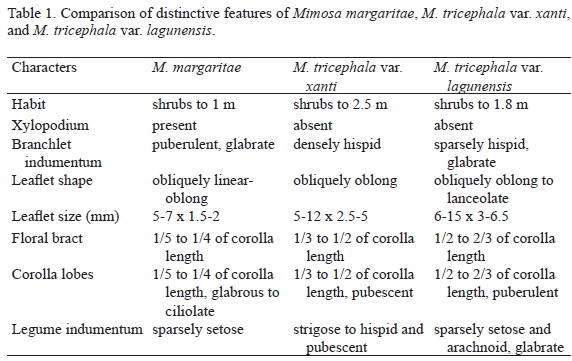
<body><![CDATA[<p align="justify"><font face="verdana" size="2">According to Morton (1945), the original description of <i>M. lagunensis</i> was based on mixed material comprising the type collection from the Sierra de La Laguna (<i>Jones 27270</i>, erroneously published as <i>27290</i> in the protologue) and another <i>Mimosa</i> from &#91;El&#93; Cayuca &#91;o&#93; Ranch, near Loreto, Baja California Sur (<i>Jones 27272</i>). For details of collection localities and dates, see Jones (1935), Blake (1945) and Morton (1945). The latter collection, although labeled as <i>M. lagunensis</i> was not cited in the protologue of <i>M. lagunensis</i> by Jones and actually is <i>M. distachya</i> Cav. var. <i>distachya</i>, a member of series <i>Distachyae</i> (Barneby, 1991).</font></p>  	    <p align="justify"><font face="verdana" size="2"><i>Mimosa lagunensis</i> differs from <i>M. distachya</i> var. <i>distachya</i> by the leaves with one &#91;versus 2&#45;4(5)&#93; pair of pinnae and (5&#45;)8&#45;12 (versus 3&#45;6(&#45;7)) pairs of obliquely oblong to lanceolate (versus obliquely oblong, obovate, elliptic or oblanceolate) leaflets, the flowers arranged in heads (versus spikes), and the pods with (1)2&#45;4 (versus 5&#45;8) articles, thus the two taxa are clearly distinct.</font></p>  	    <p align="justify"><font face="verdana" size="2">However, Morton (1945) considered <i>M. lagunensis</i> to be a synonym of <i>M. xanti</i> &#91;now treated as <i>M. tricephala</i> var. <i>xanti</i>&#93;, and he suggested that <i>M. margaritae</i> is also a form of <i>M. xanti</i>. Chehaibar (1988) examined specimens from the Baja California Peninsula and from the entire distribution range (Michoac&aacute;n to Chiapas, Morelos and Puebla in Mexico; Guatemala, and Honduras) of <i>M. tricephala</i> var. <i>xanti</i>, but not from Margarita Island. On these bases, she adopted Morton&#8217;s concept for these taxa, thus placing <i>M. margaritae</i> and <i>M. lagunensis</i> in the synonymy of <i>M. tricephala</i> var. <i>xanti</i>.</font></p>  	    <p align="justify"><font face="verdana" size="2">However, Barneby (1991) treated <i>M. xanti</i> as a species different from <i>M. tricephala</i>. He tentatively recognized taxa A, B, C, and D in a key to the members of the <i>Mimosa xanti</i> complex, including <i>M. lagunensis</i>, among others, and excluding <i>M. margaritae</i> as a distinct species.</font></p>  	    <p align="justify"><font face="verdana" size="2">Several members of this group have been recognized as varieties of <i>Mimosa tricephala</i> (Grether, 2000): <i>M. tricephala</i> var. <i>tricephala</i> occurring in Mexico (Veracruz, Puebla, and Morelos) and Costa Rica; <i>M. tricephala</i> var. <i>xanti</i> distributed in Mexico (Baja California Sur, Michoac&aacute;n, Guerrero, Oaxaca, and Chiapas), Guatemala, and Honduras; and two other taxa endemic to Mexico: <i>M. tricephala</i> var. <i>lignosa</i> (Micheli) Chehaibar &amp; R. Grether known from Michoac&aacute;n, and <i>M. tricephala</i> var. <i>nelsonii</i> (B. L. Robinson) Chehaibar &amp; R. Grether occurring in Michoac&aacute;n and Oaxaca, although the taxonomic status of <i>M. lagunensis</i> has not been established yet.</font></p>  	    <p align="justify"><font face="verdana" size="2">To test the taxonomic validity of the three taxa occurring in Baja California, we gathered a variety of morphological data from specimens of <i>M. lagunensis</i>, <i>M. tricephala</i> var. <i>xanti</i>, and <i>M. margaritae</i> deposited mainly at the herbaria HCIB and MEXU. The specimens were collected from the oak&#45;pine woodland and tropical deciduous forest of the Sierra de La Laguna, from the xerophyllous scrubland in the peninsular lowlands and coastal dunes, as well as from Margarita Island.</font></p>  	    <p align="justify"><font face="verdana" size="2">The main differences are presented in <a href="#t1">Table 1</a> and outlined in <a href="#f1">Fig. 1</a>. Based on these data, we conclude that: a) <i>M. margaritae</i> and <i>M. tricephala</i> are closely related but distinct species; b) <i>M</i>. <i>lagunensis</i> is conspecific with <i>M. tricephala;</i> and c) within <i>M. tricephala</i> there exist two varieties in the Baja California Peninsula, var. <i>lagunensis</i> and var. <i>xanti</i>.</font></p>  	    <p align="center"><font face="verdana" size="2"><a name="t1"></a></font></p>         <p align="center"><font face="verdana" size="2"><img src="/img/revistas/abm/n112/a2t1.jpg"></font></p>     <p align="center"><font face="verdana" size="2"><a name="f1"></a></font></p>  	    ]]></body>
<body><![CDATA[<p align="center"><font face="verdana" size="2"><img src="/img/revistas/abm/n112/a2f1.jpg"></font></p>  	    <p align="center">&nbsp;</p>     <p><font face="verdana" size="2"><b>TAXONOMIC TREATMENT</b></font></p>     <p align="justify"><font face="verdana" size="2"><b>Mimosa margaritae</b> Rose, North Amer. Fl. 23(3): 171. 1928. <a href="#f1">Fig.1</a> (Mm), <a href="#f2">Fig.2</a>.</font></p>  	    <p align="center"><font face="verdana" size="2"><a name="f2"></a></font></p>  	    <p align="center"><font face="verdana" size="2"><img src="/img/revistas/abm/n112/a2f2.jpg"></font></p>  	    <p align="justify"><font face="verdana" size="2">Shrubs 0.6&#45;1 m tall, up to 1.5 m<sup lang="en&#45;US">2</sup> in canopy cover; xylopodium present; old branches stout, striate, with brachyblasts, branchlets striate, puberulent, glabrate, armed with straight to recurved prickles, irregularly distributed along the internodes. Bipinnate leaves 3&#45;6(&#45;8) cm long, stipules subulate, 1&#45;2 mm long, glabrous, margin setose; petioles 1&#45;3 cm long, puberulent to sparsely setose, glabrescent; pinnae 1(2) pairs, 2&#45;3.5 cm long; leaflets (4&#45;)5&#45;9(&#45;10) pairs, 5&#45;7 mm long, 1.5&#45;2 mm wide, obliquely linear&#45;oblong, glabrous in both surfaces, glaucous, venation prominent on the abaxial surface, apex acute, mucronulate, margin setose, sensitive to touch. Inflorescences consisting of axillary capitula, solitary with (40&#45;)60&#45;120 flowers each, 1&#45;1.7 cm in diameter including the stamens, peduncles 2&#45;5 cm long, floral bracts 1/5&#45;1/4 of corolla length, pedicels 0.2&#45;0.3 mm long. Flowers mainly bisexual, some staminate; calyx 1/10&#45;1/6 of corolla length, campanulate; corolla 2&#45;2.5 mm long, pinkish, 4&#45;lobed, lobes 1/5&#45;1/4 of corolla length, glabrous to ciliolate; stamens 4, filaments free to base, pink, anthers 0.4&#45;0.7 mm long; ovary glabrous, stigma poriform. Pods subsessile, 2.5&#45;5 cm long, 7&#45;9 mm wide, oblong, straight to slightly curved, constricted between seeds, reddish&#45;brown, sparsely setose on valves and margin, with 2&#45;5 articles, apex acuminate to cuspidate; seeds 4&#45;5 mm long, 3&#45;4 mm wide, 1 mm thick, testa reddish&#45;brown, smooth, pleurogram 90%.</font></p>  	    <p align="justify"><font face="verdana" size="2">Type: MEXICO. Lower California, Santa Margarita Island, 28.II.1889, <i>T. S. Brandegee s.n.</i> (UC84040, photo and fragment NY00002571, US00000882).</font></p>  	    <p align="justify"><font face="verdana" size="2">Additional specimens examined: MEXICO. Baja California Sur, Bah&iacute;a Magdalena, Isla Margarita, 1 km al norte de El Blanquiscal, 24.512996&#176; N, 111.988027&#176; W, alt. 105 m, arroyo rocoso&#45;pedregoso, con matorral xer&oacute;filo, 20.IX.2012, <i>J. L. Le&oacute;n de la Luz 11471</i> (HCIB, MEXU, UAMIZ); Bah&iacute;a Magdalena, Isla Margarita, Punta norte, El Blanquiscal, 24.512996&#176; N, 111.988027&#176; W, alt. 99 m, arroyo pedregoso con matorral xer&oacute;filo, 8.XI.2013, <i>J. L. Le&oacute;n de la Luz 11854</i> (HCIB, MEXU, UAMIZ); Bah&iacute;a Magdalena, Isla Margarita, arroyo al norte de Puerto Alcatraz, 24.509545&#176; N, 111.896235&#176; W, alt. 91 m, matorral xer&oacute;filo, 18.III.2014, <i>J. L. Le&oacute;n de la Luz 12051</i>(HCIB, MEXU, UAMIZ).</font></p>  	    <p align="justify"><font face="verdana" size="2">Distribution and habitat: Few individuals are known growing along northeastern arroyos on sandy soils, at elevations between 10 m and 105 m.</font></p>  	    ]]></body>
<body><![CDATA[<p align="justify"><font face="verdana" size="2">Phenology: Flowering and fruiting from September to March.</font></p>  	    <p align="justify"><font face="verdana" size="2">Notes: <i>Mimosa margaritae</i> is placed in series <i>Lactifluae</i> (Barneby) R. Grether. It is similar to <i>M. caerulea</i> Rose, which occurs in central Mexico. Both have mainly leaves with 1(2) pairs of pinnae and glaucous leaflets. Moreover, in both species the shape of the basal branches suggests that they sprout from a xylopodium. <i>Mimosa margaritae</i> can be distinguished from <i>M. tricephala</i> by the xylopodium, the leaves with 1(2) &#91;versus always 1&#93; pairs of pinnae, the narrower and completely glabrous leaflets, the smaller, glabrous to marginally ciliolate corolla lobes, and the sparsely setose pods (<a href="#t1">Table 1</a>).</font></p>  	    <p align="justify"><font face="verdana" size="2"><b>Mimosa tricephala</b> Schltdl. &amp; Cham., Linnaea 5: 591. 1830.</font></p>  	    <p align="justify"><font face="verdana" size="2">A complete description of this species, including the four previously known varieties, is encountered in Mart&iacute;nez&#45;Bernal et al. (2008). Here, the two varieties of <i>Mimosa tricephala</i> occurring in Baja California Peninsula are treated.</font></p>  	    <p align="justify"><font face="verdana" size="2"><b>Mimosa tricephala</b> Schltdl. &amp; Cham. var. <b>lagunensis</b> (M. E. Jones) Le&oacute;n de la Luz et R. Grether, comb. et stat. nov. <i>Mimosa lagunensis</i> M. E. Jones, Contr. W. Bot. 18: 39. 1933.</font></p>  	    <p align="justify"><font face="verdana" size="2">Shrubs to 1.8 m tall, up to 3 m<sup lang="en&#45;US">2</sup> in canopy cover; xylopodium absent; old branches terete to striate, with brachyblasts, branchlets ribbed, sparsely hispid, glabrate, armed with straight to recurved prickles, irregularly distributed along the internodes. Bipinnate leaves 3&#45;6 cm long, stipules subulate, 1&#45;2 mm long, glabrous, margin setose; petioles 0.5&#45;1.5(&#45;2.5) cm long, puberulent and setose; pinnae 1 pair, 2&#45;4 cm long; leaflets (5&#45;)8&#45;12 pairs, 6&#45;15 mm long, 3&#45;6.5 mm wide, obliquely oblong to lanceolate, glabrous on both surfaces or sparsely setose and arachnoid abaxially, dark green on the adaxial surface, pale green abaxially, venation prominent on the abaxial surface, apex acute, mucronulate, margin setose, sensitive to touch. Inflorescences consisting of axillary capitula, solitary or in fascicles of 2, with (35&#45;)50&#45;110 flowers each, 1.6&#45;1.8 cm in diameter including stamens, peduncles 1&#45;3 cm long, floral bracts 1/2&#45;2/3 of corolla length. Flowers sessile, mainly bisexual, some staminate; calyx 1/5&#45;1/4 of corolla length, campanulate; corolla 2.4&#45;2.5 mm long, pinkish, 4&#45;lobed, lobes 1/2&#45;2/3 of corolla length, puberulent; stamens 4, filaments free to base, lilac, anthers 0.3 mm long, ovary glabrous, stigma poriform. Pods stipitate, the stipe 2&#45;5 mm long, 2&#45;4 cm long, 5&#45;7 mm wide, oblong, straight, constricted between seeds, reddish brown, with (1)2&#45;4 articles, sparsely setose and arachnoid, glabrate on valves and margin, apex apiculate to caudate, the beak 1.5&#45;3 mm long; seeds 4 mm long, 3.5 mm wide, 1.5 mm thick, testa light brown, smooth, pleurogram 95%.</font></p>  	    <p align="justify"><font face="verdana" size="2">Type: MEXICO. Lower California, on the laguna, Laguna mts., 22.IX.1930, <i>M. E. Jones 27270</i> (RSA0003550, isotypes A00065115, LA00000138, RSA0003549, US00000868).</font></p>  	    <p align="justify"><font face="verdana" size="2">Additional specimens examined. MEXICO. Baja California Sur, Sierra La Victoria, oak woodland, 26.VII.1996, <i>J. Delgadillo s.n.</i> (BCMEX 9019); Sierra de La Laguna, oak&#45;pine woodland, 27.XII.1947, <i>A. Carter et al. 2437</i> (MEXU 55088), 9.XII.1986, <i>J. L. Le&oacute;n de la Luz 2283</i> (HCIB 14540), 29.VIII.1989, <i>2829</i> (HCIB5103), 17.IX.1989, <i>4039</i> (HCIB 3718), 15.IX.1999, <i>9519</i> (HCIB 12563), 9.X.1986, <i>R. Dom&iacute;nguez Cadena 293</i> (HCIB 5832), 22.X.1977, <i>D. E. Breedlove</i> and <i>D. I. Axelrod 43323</i> (MEXU 281262), 21.X.1977, <i>43212</i> (MEXU 373158); 7.XI.1959, <i>I. L. Wiggins 15333</i> (MEXU 107830 ex DS), 18.X.1985, <i>P. Tenorio et al. 10579</i> (MEXU 533200).</font></p>  	    <p align="justify"><font face="verdana" size="2">Distribution and habitat: The taxon is endemic to the oak&#45;pine woodland of the Sierra de La Laguna, at elevations between 1400 m and 2100 m.</font></p>  	    <p align="justify"><font face="verdana" size="2">Phenology: Flowering and fruiting from May to September.</font></p>  	    ]]></body>
<body><![CDATA[<p align="justify"><font face="verdana" size="2">Notes: The characters that distinguish <i>M. tricephala</i> var. <i>lagunensis</i> from <i>M. tricephala</i> var. <i>xanti</i> are the glabrous (versus hispid) stipules, the larger leaflets of the former, the longer floral bracts, the puberulent (versus pubescent) and longer corolla lobes, and the sparsely setose, arachnoid, but glabrate (versus strigose to hispid and pubescent) legumes (<a href="#t1">Table 1</a>; <a href="#f1">Fig. 1</a>).</font></p>  	    <p align="justify"><font face="verdana" size="2"><b>Mimosa tricephala</b> Schltdl. &amp; Cham. var. <b>xanti</b> (A. Gray) Chehaibar et R. Grether, Novon 10: 32. 2000. <i>Mimosa xanti</i> A. Gray, Proc. Amer. Acad. Arts 5: 157. 1862. Type: MEXICO. Lower California, Cape San Lucas &amp; c., VIII.1859&#45;I.1860, <i>L. J. Xantus 29</i> (GH, isotypes K 000082461, NY, US).</font></p>  	    <p align="justify"><font face="verdana" size="2"><i>Mimosa zacapana</i> Standley &amp; Steyermark, Publ. Field Mus. Nat. Hist., Bot. Ser. 23: 57. 1944. Type: GUATEMALA. Zacapa, rocky slopes near Santa Rosal&iacute;a, 4.X.1939, <i>J. A. Steyermark 29018</i> (F).</font></p>  	    <p align="justify"><font face="verdana" size="2">Shrubs to 2.5 m tall, up to 2.5 m<sup lang="en&#45;US">2</sup> in canopy cover; xylopodium absent; old branches striate, with brachyblasts, branchlets striate, densely hispid, armed with straight to recurved prickles, irregularly distributed along internodes. Bipinnate leaves 2&#45;5 cm long, stipules subulate, 1&#45;2 mm long, hispid, margin setose; petioles 0.5&#45;1.5 cm long, hispid and pubescent, pinnae 1 pair, 1.5&#45;4 cm long, leaflets 5&#45;12(&#45;15) pairs, 5&#45;12 mm long, 2.5&#45;5 mm wide, obliquely oblong, dark green, puberulent to glabrous on the adaxial surface, pale green, setose and villous to arachnoid on the abaxial surface, venation prominent on the abaxial surface, apex acute, mucronulate, margin setose, sensitive to touch. Inflorescences consisting of axillary capitula, solitary or in fascicles of 2&#45;3, with (45&#45;)50&#45;115 flowers each, 1&#45;1.5 cm in diameter including stamens, peduncles 1&#45;3 cm long, floral bracts 1/3&#45;1/2 of corolla length. Flowers sessile, mainly bisexual, some staminate; calyx 1/5&#45;1/4 of corolla length, campanulate; corolla 2.7&#45;2.8 mm long, pinkish, 4&#45;lobed, lobes 1/3&#45;1/2 of corolla length, pubescent; stamens 4, filaments free to base, lilac, anthers 0.3 mm long, ovary pilose, stigma poriform. Pods sessile, 1.5&#45;3(&#45;5) cm long, 5&#45;7 mm wide, oblong, straight, constricted between seeds, reddish brown, with 2&#45;4(&#45;6) articles, strigose to hispid and pubescent on valves and margin, apex apiculate to caudate, the beak 2&#45;4 mm long; seeds 4 mm long, 4 mm wide, 1 mm thick, testa brown, smooth, pleurogram 95%.</font></p>  	    <p align="justify"><font face="verdana" size="2">Additional specimens examined. MEXICO. Baja California Sur, Sierra de La Laguna, tropical deciduous forest, 28.V.1988, <i>J. L. Le&oacute;n de la Luz 2462</i> (HCIB 5841; MEXU 493286), 21.VIII.1987, <i>2740</i> (HCIB 5831), 22.VIII.1987, <i>2780a</i> (HCIB 1793), 2.II.2008, <i>4233</i> (HCIB 24010), 23.VI.1988, <i>T. S. Elias et al. 10768</i> (MEXU 662329), 13.IX.1992, <i>P. Tenorio 18486</i> (MEXU 674806); from the xerophyllous scrubland of the peninsula, 8.VII.2011, <i>A. Medel Narv&aacute;ez 11&#45;090</i> (HCIB 26651), 27.IX.2011, <i>11&#45;143</i> (HCIB 27091); 27.II.1986, <i>J. L. Le&oacute;n de la Luz 1110</i> (HCIB 14207; MEXU 431279, 431333), 27.II.1986, <i>1120</i> (HCIB 1792), 22.X.1999, <i>9594</i> (HCIB 2481), 19.X.1996, <i>M. Dom&iacute;nguez Le&oacute;n 1736</i> (HCIB 9872; MEXU 1275067), 20.II.1960, <i>D. M. Porter 321</i> (MEXU ex DS), 13.VII.1972, <i>A. J. Gilmartin 1960</i> (MEXU 600711); from Sierra de la Giganta, ca. 24&#176;55&#180;N, 14.X.2000, <i>J. P. Rebman 6999</i> (HCIB 19866, UCR 149744), 7.XI.2001, <i>R. Dom&iacute;nguez Cadena 2571</i> (HCIB 17171), 22.IX.1974, <i>R. Moran 21346</i> (SD 88100); from pine&#45;oak forest, 1.XI.1985, <i>R. Dom&iacute;nguez Cadena 81</i> (HCIB 1794; MEXU 431757).</font></p>  	    <p align="justify"><font face="verdana" size="2">Distribution and habitat: Most of the populations of this taxon in Baja California can be found in the coastal and lowland zones of the Cape Region, from sea level to 1000 m elevation, although it also occurs sporadically in the eastern foothills of the Sierra de la Giganta. This taxon is also found in western, central, and southern Mexico, extending to Guatemala and Honduras.</font></p>  	    <p align="justify"><font face="verdana" size="2">Phenology: Flowering and fruiting from May to November.</font></p>  	    <p align="justify"><font face="verdana" size="2">Notes: <i>Mimosa tricephala</i> var. <i>xanti</i> is distinguished from <i>M. tricephala</i> var. <i>lagunensis</i> by the densely hispid branchlets, the hispid stipules, the shorter floral bracts and pubescent corolla lobes, as well as by the strigose to hispid and pubescent legumes (<a href="#t1">Table 1</a>; <a href="#f1">Fig. 1</a>).</font></p>  	    <p align="justify"><font face="verdana" size="2">The typical variety of <i>Mimosa tricephala</i> is distinguished from <i>M. tricephala</i> var. <i>lagunensis</i> and <i>M. tricephala</i> var. <i>xanti</i> mainly by the pubescent stipules and the legumes which are densely and largely hirsute, with setae of 2&#45;4 mm long, not rigid on valves and margin.</font></p>  	    <p align="justify"><font face="verdana" size="2">In the phylogenetic analyses of Simon et al. (2011), <i>Mimosa tricephala</i> represented by variety <i>nelsonii</i> (B.L. Robinson) Chehaibar &amp; R. Grether and other members of series <i>Lactifluae</i> (<i>M. lactiflua</i> Delile ex Benth., <i>M. sicyocarpa</i> B. L. Robinson, <i>M. deamii</i> B. L. Robinson, <i>M. psilocarpa</i> B. L. Robinson, and <i>M. goldmanii</i> B. L. Robinson) are grouped in the Mexican clade V. As a consequence, it is expected that the taxa treated here are also nested within this clade.</font></p>  	    ]]></body>
<body><![CDATA[<p>&nbsp;</p>  	    <p align="justify"><font face="verdana" size="2"><b>ACKNOWLEDGEMENTS</b></font></p>  	    <p align="justify"><font face="verdana" size="2">Expeditions to Bah&iacute;a Magdalena area were supported by grant HJ002 of the Comisi&oacute;n Nacional para el Conocimiento y Uso de la Biodiversidad (CONABIO) to the first author (2009&#45;20012). Alfonso Medel Narv&aacute;ez participated in the expeditions. The authors wish to express their appreciation to M. Sc. Teresa Chehaibar for her critical review of the manuscript, to Dr. Mare Nazaire, Herbarium RSA&#45;POM and Dr. Andrew Doran, Herbarium UC, for their assistance to access the images of type specimens. Danira Le&oacute;n Coria made the illustration. Special thanks to the anonymous referees for their critical reviews that greatly enhanced the former version of the manuscript.</font></p>  	    <p>&nbsp;</p>  	    <p align="justify"><font face="verdana" size="2"><b>LITERATURE CITED</b></font></p>  	    <!-- ref --><p align="justify"><font face="verdana" size="2">Anonymous. 2013. Collections: Herbarium specimens. JSTOR/Global Plants <a href="http://plants.jstor.org/specimen/ny00002571?s=t" target="_blank">http://plants.jstor.org/specimen/ny00002571?s=t</a>. Consulted Jan. 28<sup>th</sup> 2013.    &nbsp;&nbsp;&nbsp;&nbsp;&nbsp;&nbsp;&nbsp;&nbsp;[&#160;<a href="javascript:void(0);" onclick="javascript: window.open('/scielo.php?script=sci_nlinks&ref=057492&pid=S0187-7151201500030000200001&lng=','','width=640,height=500,resizable=yes,scrollbars=1,menubar=yes,');">Links</a>&#160;]<!-- end-ref --></font></p>  	    <!-- ref --><p align="justify"><font face="verdana" size="2">Arriaga, L., E. V&aacute;zquez&#45;Dom&iacute;nguez, J. Gonz&aacute;lez Cano, R. Jim&eacute;nez&#45;Rosenberg, E. Mu&ntilde;oz&#45;L&oacute;pez and V. Aguilar Sierra (coord.). 2000. Regiones terrestres prioritarias de M&eacute;xico. Comisi&oacute;n Nacional para el Conocimiento y Uso de la Biodiversidad. M&eacute;xico, D.F., M&eacute;xico. <a href="http://www.conabio.gob.mx/conocimiento/regionalizacion/doctos/Tlistado.html" target="_blank">http://www.conabio.gob.mx/conocimiento/regionalizaci&oacute;n/doctos/Tlistado.html</a>. Consulted Dic. 8<sup>th</sup> 2013.    &nbsp;&nbsp;&nbsp;&nbsp;&nbsp;&nbsp;&nbsp;&nbsp;[&#160;<a href="javascript:void(0);" onclick="javascript: window.open('/scielo.php?script=sci_nlinks&ref=057494&pid=S0187-7151201500030000200002&lng=','','width=640,height=500,resizable=yes,scrollbars=1,menubar=yes,');">Links</a>&#160;]<!-- end-ref --></font></p>  	    <!-- ref --><p align="justify"><font face="verdana" size="2">Barneby, R. C. 1991. Sensitivae censitae: A description of the genus <i>Mimosa</i> Linnaeus (Mimosaceae) in the New World. Mem. N.Y. Bot. Gard. 65: 1&#45;835.    &nbsp;&nbsp;&nbsp;&nbsp;&nbsp;&nbsp;&nbsp;&nbsp;[&#160;<a href="javascript:void(0);" onclick="javascript: window.open('/scielo.php?script=sci_nlinks&ref=057496&pid=S0187-7151201500030000200003&lng=','','width=640,height=500,resizable=yes,scrollbars=1,menubar=yes,');">Links</a>&#160;]<!-- end-ref --></font></p>  	    <!-- ref --><p align="justify"><font face="verdana" size="2">Bentham, G. 1844. The botany of the voyage of <i>H.M.S. Sulphur</i>, under the command of Captain Sir Edward Belcher, R. N., C. B., F. R. G. S., etc. during the years 1836&#45;1842. R. B. Hinds (ed.). Esq., Surgeon, R. N., attached to the Expedition. Publ. Smith, Elder and Co. London, UK. 195 pp., 60 pls.    &nbsp;&nbsp;&nbsp;&nbsp;&nbsp;&nbsp;&nbsp;&nbsp;[&#160;<a href="javascript:void(0);" onclick="javascript: window.open('/scielo.php?script=sci_nlinks&ref=057498&pid=S0187-7151201500030000200004&lng=','','width=640,height=500,resizable=yes,scrollbars=1,menubar=yes,');">Links</a>&#160;]<!-- end-ref --></font></p>  	    <!-- ref --><p align="justify"><font face="verdana" size="2">Blake, S. F. 1945. Asteraceae described from Mexico and the Southern United States by M. E. Jones, 1908&#45;1935. Contr. U.S. Natl. Herb. 29(2): 117&#45;124.    &nbsp;&nbsp;&nbsp;&nbsp;&nbsp;&nbsp;&nbsp;&nbsp;[&#160;<a href="javascript:void(0);" onclick="javascript: window.open('/scielo.php?script=sci_nlinks&ref=057500&pid=S0187-7151201500030000200005&lng=','','width=640,height=500,resizable=yes,scrollbars=1,menubar=yes,');">Links</a>&#160;]<!-- end-ref --></font></p>  	    <!-- ref --><p align="justify"><font face="verdana" size="2">Brady, K., A. Kruckeberg and H. Bradshaw. 2005. Evolutionary ecology of plant adaptation to serpentine soils. Ann. Rev. Ecol. Evol. Syst. 36: 243&#45;266.    &nbsp;&nbsp;&nbsp;&nbsp;&nbsp;&nbsp;&nbsp;&nbsp;[&#160;<a href="javascript:void(0);" onclick="javascript: window.open('/scielo.php?script=sci_nlinks&ref=057502&pid=S0187-7151201500030000200006&lng=','','width=640,height=500,resizable=yes,scrollbars=1,menubar=yes,');">Links</a>&#160;]<!-- end-ref --></font></p>  	    <!-- ref --><p align="justify"><font face="verdana" size="2">Brandegee, T. S. 1889. A collection of plants from Baja California. Proc. Calif. Acad. Sci., ser. 2, 2: 117&#45;216.    &nbsp;&nbsp;&nbsp;&nbsp;&nbsp;&nbsp;&nbsp;&nbsp;[&#160;<a href="javascript:void(0);" onclick="javascript: window.open('/scielo.php?script=sci_nlinks&ref=057504&pid=S0187-7151201500030000200007&lng=','','width=640,height=500,resizable=yes,scrollbars=1,menubar=yes,');">Links</a>&#160;]<!-- end-ref --></font></p>  	    <!-- ref --><p align="justify"><font face="verdana" size="2">Britton, N. L. and J. N. Rose. 1928. <i>Mimosa</i>. North Amer. Fl. 23(3): 144&#45;171.    &nbsp;&nbsp;&nbsp;&nbsp;&nbsp;&nbsp;&nbsp;&nbsp;[&#160;<a href="javascript:void(0);" onclick="javascript: window.open('/scielo.php?script=sci_nlinks&ref=057506&pid=S0187-7151201500030000200008&lng=','','width=640,height=500,resizable=yes,scrollbars=1,menubar=yes,');">Links</a>&#160;]<!-- end-ref --></font></p>  	    <!-- ref --><p align="justify"><font face="verdana" size="2">Chehaibar, M. T. 1988. Estudio taxon&oacute;mico de la serie <i>Xantiae</i> y especies afines del g&eacute;nero <i>Mimosa</i> (Leguminosae). Tesis de maestr&iacute;a en ciencias (Biolog&iacute;a). Facultad de Ciencias, Universidad Nacional Aut&oacute;noma de M&eacute;xico. M&eacute;xico, D.F., Mexico. 118 pp.    &nbsp;&nbsp;&nbsp;&nbsp;&nbsp;&nbsp;&nbsp;&nbsp;[&#160;<a href="javascript:void(0);" onclick="javascript: window.open('/scielo.php?script=sci_nlinks&ref=057508&pid=S0187-7151201500030000200009&lng=','','width=640,height=500,resizable=yes,scrollbars=1,menubar=yes,');">Links</a>&#160;]<!-- end-ref --></font></p>  	    <!-- ref --><p align="justify"><font face="verdana" size="2">Grether, R. 2000. Nomenclatural changes in the genus <i>Mimosa</i> (Fabaceae, Mimosoideae) in Southern Mexico and Central America. Novon 10: 29&#45;37.    &nbsp;&nbsp;&nbsp;&nbsp;&nbsp;&nbsp;&nbsp;&nbsp;[&#160;<a href="javascript:void(0);" onclick="javascript: window.open('/scielo.php?script=sci_nlinks&ref=057510&pid=S0187-7151201500030000200010&lng=','','width=640,height=500,resizable=yes,scrollbars=1,menubar=yes,');">Links</a>&#160;]<!-- end-ref --></font></p>  	    <!-- ref --><p align="justify"><font face="verdana" size="2">Jones, M. E. 1933. New species and notes. Contr. W. Bot. 18: 20&#45;40.    &nbsp;&nbsp;&nbsp;&nbsp;&nbsp;&nbsp;&nbsp;&nbsp;[&#160;<a href="javascript:void(0);" onclick="javascript: window.open('/scielo.php?script=sci_nlinks&ref=057512&pid=S0187-7151201500030000200011&lng=','','width=640,height=500,resizable=yes,scrollbars=1,menubar=yes,');">Links</a>&#160;]<!-- end-ref --></font></p>  	    <!-- ref --><p align="justify"><font face="verdana" size="2">Jones, M. E. 1935. Field notes of Mexican trip, 1930. Contr. W. Bot. 18: 86&#45;119.    &nbsp;&nbsp;&nbsp;&nbsp;&nbsp;&nbsp;&nbsp;&nbsp;[&#160;<a href="javascript:void(0);" onclick="javascript: window.open('/scielo.php?script=sci_nlinks&ref=057514&pid=S0187-7151201500030000200012&lng=','','width=640,height=500,resizable=yes,scrollbars=1,menubar=yes,');">Links</a>&#160;]<!-- end-ref --></font></p>  	    <!-- ref --><p align="justify"><font face="verdana" size="2">Mart&iacute;nez&#45;Bernal, A., R. Grether and R. M. Gonz&aacute;lez&#45;Amaro. 2008. <i>Mimosa</i>. Flora de Veracruz 147: 1&#45;127.    &nbsp;&nbsp;&nbsp;&nbsp;&nbsp;&nbsp;&nbsp;&nbsp;[&#160;<a href="javascript:void(0);" onclick="javascript: window.open('/scielo.php?script=sci_nlinks&ref=057516&pid=S0187-7151201500030000200013&lng=','','width=640,height=500,resizable=yes,scrollbars=1,menubar=yes,');">Links</a>&#160;]<!-- end-ref --></font></p>  	    <!-- ref --><p align="justify"><font face="verdana" size="2">Moran, R. V. 1952. The Mexican itineraries of T. S. Brandegee. Madro&ntilde;o 11(6): 253&#45;262.    &nbsp;&nbsp;&nbsp;&nbsp;&nbsp;&nbsp;&nbsp;&nbsp;[&#160;<a href="javascript:void(0);" onclick="javascript: window.open('/scielo.php?script=sci_nlinks&ref=057518&pid=S0187-7151201500030000200014&lng=','','width=640,height=500,resizable=yes,scrollbars=1,menubar=yes,');">Links</a>&#160;]<!-- end-ref --></font></p>  	    <!-- ref --><p align="justify"><font face="verdana" size="2">Morton, C. V. 1945. Mexican phanerogams described by M. E. Jones. Contr. U.S. Natl. Herb. 29(2): 87&#45;91.    &nbsp;&nbsp;&nbsp;&nbsp;&nbsp;&nbsp;&nbsp;&nbsp;[&#160;<a href="javascript:void(0);" onclick="javascript: window.open('/scielo.php?script=sci_nlinks&ref=057520&pid=S0187-7151201500030000200015&lng=','','width=640,height=500,resizable=yes,scrollbars=1,menubar=yes,');">Links</a>&#160;]<!-- end-ref --></font></p>  	    <!-- ref --><p align="justify"><font face="verdana" size="2">Ortiz&#45;Hern&aacute;ndez, L. E., J. C. Escamilla&#45;Casas, K. Flores&#45;Castro, M. Ram&iacute;rez&#45;Cardona and O. Acevedo&#45;Sandoval. 2006. Caracter&iacute;sticas geol&oacute;gicas y potencial metalogen&eacute;tico de los principales complejos ultram&aacute;ficos&#45;m&aacute;ficos de M&eacute;xico. Bol. Soc. Geol. Mex. 4: 161&#45;181.    &nbsp;&nbsp;&nbsp;&nbsp;&nbsp;&nbsp;&nbsp;&nbsp;[&#160;<a href="javascript:void(0);" onclick="javascript: window.open('/scielo.php?script=sci_nlinks&ref=057522&pid=S0187-7151201500030000200016&lng=','','width=640,height=500,resizable=yes,scrollbars=1,menubar=yes,');">Links</a>&#160;]<!-- end-ref --></font></p>  	    <!-- ref --><p align="justify"><font face="verdana" size="2">Simon, M. F., R. Grether, L. P. de Queiroz, T. E. S&auml;rkinen, V. F. Dutra and C. E. Hughes. 2011. The evolutionary history of <i>Mimosa</i> (Leguminosae): toward a phylogeny of the sensitive plants. Am. J. Bot. 98(7): 1201&#45;1221.    &nbsp;&nbsp;&nbsp;&nbsp;&nbsp;&nbsp;&nbsp;&nbsp;[&#160;<a href="javascript:void(0);" onclick="javascript: window.open('/scielo.php?script=sci_nlinks&ref=057524&pid=S0187-7151201500030000200017&lng=','','width=640,height=500,resizable=yes,scrollbars=1,menubar=yes,');">Links</a>&#160;]<!-- end-ref --></font></p>  	    <!-- ref --><p align="justify"><font face="verdana" size="2">Wiggins, I. L. 1964. Flora of the Sonoran Desert. In: Shreve, F. and I. L. Wiggins. Vegetation and flora of the Sonoran Desert Vol. 1(2). Stanford University Press. Stanford, USA. pp. 189&#45;609.    &nbsp;&nbsp;&nbsp;&nbsp;&nbsp;&nbsp;&nbsp;&nbsp;[&#160;<a href="javascript:void(0);" onclick="javascript: window.open('/scielo.php?script=sci_nlinks&ref=057526&pid=S0187-7151201500030000200018&lng=','','width=640,height=500,resizable=yes,scrollbars=1,menubar=yes,');">Links</a>&#160;]<!-- end-ref --></font></p>  	    <!-- ref --><p align="justify"><font face="verdana" size="2">Wiggins, I. L. 1980. Flora of Baja California. Stanford University Press. Stanford, USA. pp. 1&#45;708.    &nbsp;&nbsp;&nbsp;&nbsp;&nbsp;&nbsp;&nbsp;&nbsp;[&#160;<a href="javascript:void(0);" onclick="javascript: window.open('/scielo.php?script=sci_nlinks&ref=057528&pid=S0187-7151201500030000200019&lng=','','width=640,height=500,resizable=yes,scrollbars=1,menubar=yes,');">Links</a>&#160;]<!-- end-ref --></font></p>      ]]></body><back>
<ref-list>
<ref id="B1">
<nlm-citation citation-type="book">
<person-group person-group-type="author">
<name>
</name>
<name>
</name>
</person-group>
<source><![CDATA[Collections: Herbarium specimens]]></source>
<year>2013</year>
<publisher-name><![CDATA[JSTORGlobal Plants]]></publisher-name>
</nlm-citation>
</ref>
<ref id="B2">
<nlm-citation citation-type="book">
<person-group person-group-type="author">
<name>
<surname><![CDATA[Arriaga]]></surname>
<given-names><![CDATA[L.]]></given-names>
</name>
<name>
<surname><![CDATA[Vázquez-Domínguez]]></surname>
<given-names><![CDATA[E.]]></given-names>
</name>
<name>
<surname><![CDATA[González Cano]]></surname>
<given-names><![CDATA[J.]]></given-names>
</name>
<name>
<surname><![CDATA[Jiménez-Rosenberg]]></surname>
<given-names><![CDATA[R.]]></given-names>
</name>
<name>
<surname><![CDATA[Muñoz-López]]></surname>
<given-names><![CDATA[E.]]></given-names>
</name>
<name>
<surname><![CDATA[Aguilar Sierra]]></surname>
<given-names><![CDATA[V.]]></given-names>
</name>
</person-group>
<source><![CDATA[Regiones terrestres prioritarias de México]]></source>
<year>2000</year>
<publisher-loc><![CDATA[México^eD.F. D.F.]]></publisher-loc>
<publisher-name><![CDATA[Comisión Nacional para el Conocimiento y Uso de la Biodiversidad]]></publisher-name>
</nlm-citation>
</ref>
<ref id="B3">
<nlm-citation citation-type="journal">
<person-group person-group-type="author">
<name>
<surname><![CDATA[Barneby]]></surname>
<given-names><![CDATA[R. C]]></given-names>
</name>
</person-group>
<article-title xml:lang="en"><![CDATA[Sensitivae censitae: A description of the genus Mimosa Linnaeus (Mimosaceae) in the New World]]></article-title>
<source><![CDATA[Mem. N.Y. Bot. Gard.]]></source>
<year>1991</year>
<volume>65</volume>
<page-range>1-835</page-range></nlm-citation>
</ref>
<ref id="B4">
<nlm-citation citation-type="book">
<person-group person-group-type="author">
<name>
<surname><![CDATA[Bentham]]></surname>
<given-names><![CDATA[G.]]></given-names>
</name>
</person-group>
<article-title xml:lang="en"><![CDATA[The botany of the voyage of H.M.S. Sulphur, under the command of Captain Sir Edward Belcher, R. N., C. B., F. R. G. S., etc. during the years 1836-1842]]></article-title>
<person-group person-group-type="editor">
<name>
<surname><![CDATA[Hinds]]></surname>
<given-names><![CDATA[R. B.]]></given-names>
</name>
</person-group>
<source><![CDATA[Esq., Surgeon, R. N., attached to the Expedition]]></source>
<year>1844</year>
<page-range>195</page-range><publisher-loc><![CDATA[London ]]></publisher-loc>
<publisher-name><![CDATA[Publ. Smith, Elder and Co]]></publisher-name>
</nlm-citation>
</ref>
<ref id="B5">
<nlm-citation citation-type="journal">
<person-group person-group-type="author">
<name>
<surname><![CDATA[Blake]]></surname>
<given-names><![CDATA[S. F]]></given-names>
</name>
</person-group>
<article-title xml:lang="en"><![CDATA[Asteraceae described from Mexico and the Southern United States by M. E. Jones, 1908-1935]]></article-title>
<source><![CDATA[Contr. U.S. Natl. Herb.]]></source>
<year>1945</year>
<volume>29</volume>
<numero>2</numero>
<issue>2</issue>
<page-range>117-124</page-range></nlm-citation>
</ref>
<ref id="B6">
<nlm-citation citation-type="journal">
<person-group person-group-type="author">
<name>
<surname><![CDATA[Brady]]></surname>
<given-names><![CDATA[K.]]></given-names>
</name>
<name>
<surname><![CDATA[Kruckeberg]]></surname>
<given-names><![CDATA[A.]]></given-names>
</name>
<name>
<surname><![CDATA[Bradshaw]]></surname>
<given-names><![CDATA[H.]]></given-names>
</name>
</person-group>
<article-title xml:lang="en"><![CDATA[Evolutionary ecology of plant adaptation to serpentine soils]]></article-title>
<source><![CDATA[Ann. Rev. Ecol. Evol. Syst.]]></source>
<year>2005</year>
<volume>36</volume>
<page-range>243-266</page-range></nlm-citation>
</ref>
<ref id="B7">
<nlm-citation citation-type="journal">
<person-group person-group-type="author">
<name>
<surname><![CDATA[Brandegee]]></surname>
<given-names><![CDATA[T. S]]></given-names>
</name>
</person-group>
<article-title xml:lang="en"><![CDATA[A collection of plants from Baja California]]></article-title>
<source><![CDATA[Proc. Calif. Acad. Sci., ser. 2]]></source>
<year>1889</year>
<volume>2</volume>
<page-range>117-216</page-range></nlm-citation>
</ref>
<ref id="B8">
<nlm-citation citation-type="journal">
<person-group person-group-type="author">
<name>
<surname><![CDATA[Britton]]></surname>
<given-names><![CDATA[N. L.]]></given-names>
</name>
<name>
<surname><![CDATA[Rose]]></surname>
<given-names><![CDATA[J. N.]]></given-names>
</name>
</person-group>
<article-title xml:lang="en"><![CDATA[Mimosa]]></article-title>
<source><![CDATA[North Amer. Fl.]]></source>
<year>1928</year>
<volume>23</volume>
<numero>3</numero>
<issue>3</issue>
<page-range>144-171</page-range></nlm-citation>
</ref>
<ref id="B9">
<nlm-citation citation-type="">
<person-group person-group-type="author">
<name>
<surname><![CDATA[Chehaibar]]></surname>
<given-names><![CDATA[M. T]]></given-names>
</name>
</person-group>
<source><![CDATA[Estudio taxonómico de la serie Xantiae y especies afines del género Mimosa (Leguminosae)]]></source>
<year>1988</year>
<page-range>118</page-range></nlm-citation>
</ref>
<ref id="B10">
<nlm-citation citation-type="journal">
<person-group person-group-type="author">
<name>
<surname><![CDATA[Grether]]></surname>
<given-names><![CDATA[R]]></given-names>
</name>
</person-group>
<article-title xml:lang="en"><![CDATA[Nomenclatural changes in the genus Mimosa (Fabaceae, Mimosoideae) in Southern Mexico and Central America]]></article-title>
<source><![CDATA[Novon]]></source>
<year>2000</year>
<volume>10</volume>
<page-range>29-37</page-range></nlm-citation>
</ref>
<ref id="B11">
<nlm-citation citation-type="journal">
<person-group person-group-type="author">
<name>
<surname><![CDATA[Jones]]></surname>
<given-names><![CDATA[M. E]]></given-names>
</name>
</person-group>
<article-title xml:lang="en"><![CDATA[New species and notes]]></article-title>
<source><![CDATA[Contr. W. Bot.]]></source>
<year>1933</year>
<volume>18</volume>
<page-range>20-40</page-range></nlm-citation>
</ref>
<ref id="B12">
<nlm-citation citation-type="journal">
<person-group person-group-type="author">
<name>
<surname><![CDATA[Jones]]></surname>
<given-names><![CDATA[M. E]]></given-names>
</name>
</person-group>
<article-title xml:lang="en"><![CDATA[Field notes of Mexican trip, 1930]]></article-title>
<source><![CDATA[Contr. W. Bot.]]></source>
<year>1935</year>
<volume>18</volume>
<page-range>86-119</page-range></nlm-citation>
</ref>
<ref id="B13">
<nlm-citation citation-type="journal">
<person-group person-group-type="author">
<name>
<surname><![CDATA[Martínez-Bernal]]></surname>
<given-names><![CDATA[A.]]></given-names>
</name>
<name>
<surname><![CDATA[Grether]]></surname>
<given-names><![CDATA[R.]]></given-names>
</name>
<name>
<surname><![CDATA[González-Amaro]]></surname>
<given-names><![CDATA[R. M.]]></given-names>
</name>
</person-group>
<article-title xml:lang="es"><![CDATA[Mimosa]]></article-title>
<source><![CDATA[Flora de Veracruz]]></source>
<year>2008</year>
<volume>147</volume>
<page-range>1-127</page-range></nlm-citation>
</ref>
<ref id="B14">
<nlm-citation citation-type="journal">
<person-group person-group-type="author">
<name>
<surname><![CDATA[Moran]]></surname>
<given-names><![CDATA[R. V]]></given-names>
</name>
</person-group>
<article-title xml:lang="en"><![CDATA[The Mexican itineraries of T. S. Brandegee]]></article-title>
<source><![CDATA[Madroño]]></source>
<year>1952</year>
<volume>11</volume>
<numero>6</numero>
<issue>6</issue>
<page-range>253-262</page-range></nlm-citation>
</ref>
<ref id="B15">
<nlm-citation citation-type="journal">
<person-group person-group-type="author">
<name>
<surname><![CDATA[Morton]]></surname>
<given-names><![CDATA[C. V]]></given-names>
</name>
</person-group>
<article-title xml:lang="en"><![CDATA[Mexican phanerogams described by M. E. Jones]]></article-title>
<source><![CDATA[Contr. U.S. Natl. Herb.]]></source>
<year>1945</year>
<volume>29</volume>
<numero>2</numero>
<issue>2</issue>
<page-range>87-91</page-range></nlm-citation>
</ref>
<ref id="B16">
<nlm-citation citation-type="journal">
<person-group person-group-type="author">
<name>
<surname><![CDATA[Ortiz-Hernández]]></surname>
<given-names><![CDATA[L. E.]]></given-names>
</name>
<name>
<surname><![CDATA[Escamilla-Casas]]></surname>
<given-names><![CDATA[J. C.]]></given-names>
</name>
<name>
<surname><![CDATA[Flores-Castro]]></surname>
<given-names><![CDATA[K.]]></given-names>
</name>
<name>
<surname><![CDATA[Ramírez-Cardona]]></surname>
<given-names><![CDATA[M.]]></given-names>
</name>
<name>
<surname><![CDATA[Acevedo-Sandoval]]></surname>
<given-names><![CDATA[O.]]></given-names>
</name>
</person-group>
<article-title xml:lang="es"><![CDATA[Características geológicas y potencial metalogenético de los principales complejos ultramáficos-máficos de México]]></article-title>
<source><![CDATA[Bol. Soc. Geol. Mex.]]></source>
<year>2006</year>
<volume>4</volume>
<page-range>161-181</page-range></nlm-citation>
</ref>
<ref id="B17">
<nlm-citation citation-type="journal">
<person-group person-group-type="author">
<name>
<surname><![CDATA[Simon]]></surname>
<given-names><![CDATA[M. F.]]></given-names>
</name>
<name>
<surname><![CDATA[Grether]]></surname>
<given-names><![CDATA[R.]]></given-names>
</name>
<name>
<surname><![CDATA[de Queiroz]]></surname>
<given-names><![CDATA[L. P.]]></given-names>
</name>
<name>
<surname><![CDATA[Särkinen]]></surname>
<given-names><![CDATA[T. E.]]></given-names>
</name>
<name>
<surname><![CDATA[Dutra]]></surname>
<given-names><![CDATA[V. F.]]></given-names>
</name>
<name>
<surname><![CDATA[Hughes]]></surname>
<given-names><![CDATA[C. E.]]></given-names>
</name>
</person-group>
<article-title xml:lang="en"><![CDATA[The evolutionary history of Mimosa (Leguminosae): toward a phylogeny of the sensitive plants]]></article-title>
<source><![CDATA[Am. J. Bot.]]></source>
<year>2011</year>
<volume>98</volume>
<numero>7</numero>
<issue>7</issue>
<page-range>1201-1221</page-range></nlm-citation>
</ref>
<ref id="B18">
<nlm-citation citation-type="book">
<person-group person-group-type="author">
<name>
<surname><![CDATA[Wiggins]]></surname>
<given-names><![CDATA[I. L]]></given-names>
</name>
</person-group>
<article-title xml:lang="en"><![CDATA[Flora of the Sonoran Desert]]></article-title>
<person-group person-group-type="editor">
<name>
<surname><![CDATA[Shreve]]></surname>
<given-names><![CDATA[F.]]></given-names>
</name>
<name>
<surname><![CDATA[Wiggins]]></surname>
<given-names><![CDATA[I. L.]]></given-names>
</name>
</person-group>
<source><![CDATA[Vegetation and flora of the Sonoran Desert Vol. 1(2)]]></source>
<year>1964</year>
<page-range>189-609</page-range><publisher-loc><![CDATA[Stanford ]]></publisher-loc>
<publisher-name><![CDATA[Stanford University Press]]></publisher-name>
</nlm-citation>
</ref>
<ref id="B19">
<nlm-citation citation-type="book">
<person-group person-group-type="author">
<name>
<surname><![CDATA[Wiggins]]></surname>
<given-names><![CDATA[I. L]]></given-names>
</name>
</person-group>
<source><![CDATA[Flora of Baja California]]></source>
<year>1980</year>
<page-range>1-708</page-range><publisher-loc><![CDATA[Stanford ]]></publisher-loc>
<publisher-name><![CDATA[Stanford University Press]]></publisher-name>
</nlm-citation>
</ref>
</ref-list>
</back>
</article>
