<?xml version="1.0" encoding="ISO-8859-1"?><article xmlns:mml="http://www.w3.org/1998/Math/MathML" xmlns:xlink="http://www.w3.org/1999/xlink" xmlns:xsi="http://www.w3.org/2001/XMLSchema-instance">
<front>
<journal-meta>
<journal-id>0187-7151</journal-id>
<journal-title><![CDATA[Acta botánica mexicana]]></journal-title>
<abbrev-journal-title><![CDATA[Act. Bot. Mex]]></abbrev-journal-title>
<issn>0187-7151</issn>
<publisher>
<publisher-name><![CDATA[Instituto de Ecología A.C., Centro Regional del Bajío]]></publisher-name>
</publisher>
</journal-meta>
<article-meta>
<article-id>S0187-71512014000100006</article-id>
<title-group>
<article-title xml:lang="en"><![CDATA[Tamarix hohenackeri Bunge, a new record for the flora of Mexico]]></article-title>
<article-title xml:lang="es"><![CDATA[Tamarix hohenackeri Bunge, un nuevo registro para la flora de México]]></article-title>
</title-group>
<contrib-group>
<contrib contrib-type="author">
<name>
<surname><![CDATA[Villar]]></surname>
<given-names><![CDATA[José Luis]]></given-names>
</name>
<xref ref-type="aff" rid="A01"/>
</contrib>
<contrib contrib-type="author">
<name>
<surname><![CDATA[Juan]]></surname>
<given-names><![CDATA[Ana]]></given-names>
</name>
<xref ref-type="aff" rid="A01"/>
</contrib>
<contrib contrib-type="author">
<name>
<surname><![CDATA[Alonso]]></surname>
<given-names><![CDATA[María Ángeles]]></given-names>
</name>
<xref ref-type="aff" rid="A01"/>
</contrib>
</contrib-group>
<aff id="A01">
<institution><![CDATA[,Universidad de Alicante Instituto de la Biodiversidad Centro Iberoamericano de la Biodiversidad]]></institution>
<addr-line><![CDATA[Alicante ]]></addr-line>
<country>Spain</country>
</aff>
<pub-date pub-type="pub">
<day>00</day>
<month>01</month>
<year>2014</year>
</pub-date>
<pub-date pub-type="epub">
<day>00</day>
<month>01</month>
<year>2014</year>
</pub-date>
<numero>106</numero>
<fpage>117</fpage>
<lpage>128</lpage>
<copyright-statement/>
<copyright-year/>
<self-uri xlink:href="http://www.scielo.org.mx/scielo.php?script=sci_arttext&amp;pid=S0187-71512014000100006&amp;lng=en&amp;nrm=iso"></self-uri><self-uri xlink:href="http://www.scielo.org.mx/scielo.php?script=sci_abstract&amp;pid=S0187-71512014000100006&amp;lng=en&amp;nrm=iso"></self-uri><self-uri xlink:href="http://www.scielo.org.mx/scielo.php?script=sci_pdf&amp;pid=S0187-71512014000100006&amp;lng=en&amp;nrm=iso"></self-uri><abstract abstract-type="short" xml:lang="en"><p><![CDATA[Tamarix hohenackeri Bunge is reported here for the first time for the flora of Mexico. It also represents the first record for the American continent. This species, native from Asia, was collected along riversides of the river San Salvador (Ensenada, Baja California). A detailed morphological description of the newly reported taxon is provided, and the taxonomic treatment of T. hohenackeri is also discussed. As a result of this study, the presence of six species of the genus Tamarix is confirmed for Mexico, and a dichotomous key for the Tamarix species in Mexico is presented.]]></p></abstract>
<abstract abstract-type="short" xml:lang="es"><p><![CDATA[Se documenta por primera vez la presencia de Tamarix hohenackeri Bunge para la flora de México. Se trata, a su vez, de la primera cita para el continente americano. Esta especie, nativa de Asia, ha sido recolectada en los márgenes del río San Salvador (Ensenada, Baja California). Se aporta una descripción morfológica detallada del nuevo taxon citado y se discute, también, su estatus taxonómico. Como resultado del estudio, se indica la presencia de seis especies del género Tamarix y además se aporta una clave para la identificación de los representantes de Tamarix en México.]]></p></abstract>
<kwd-group>
<kwd lng="en"><![CDATA[invasive flora]]></kwd>
<kwd lng="en"><![CDATA[Mexico]]></kwd>
<kwd lng="en"><![CDATA[Tamaricaceae]]></kwd>
<kwd lng="en"><![CDATA[Tamarix]]></kwd>
<kwd lng="en"><![CDATA[taxonomy]]></kwd>
<kwd lng="es"><![CDATA[flora invasora]]></kwd>
<kwd lng="es"><![CDATA[México]]></kwd>
<kwd lng="es"><![CDATA[Tamaricaceae]]></kwd>
<kwd lng="es"><![CDATA[Tamarix]]></kwd>
<kwd lng="es"><![CDATA[taxonomía]]></kwd>
</kwd-group>
</article-meta>
</front><body><![CDATA[  	    <p align="center"><font face="verdana" size="4"><b><i>Tamarix hohenackeri</i> Bunge, a new record for the flora of Mexico</b></font></p>  	    <p>&nbsp;</p>  	    <p align="center"><font face="verdana" size="3"><b><i>Tamarix hohenackeri</i> Bunge, un nuevo registro para la flora de M&eacute;xico</b></font></p>  	    <p>&nbsp;</p>  	    <p align="center"><font face="verdana" size="2"><b>Jos&eacute; Luis Villar<sup>1,2</sup>, Ana Juan<sup>1</sup> and Mar&iacute;a &Aacute;ngeles Alonso<sup>1</sup></b></font></p>  	    <p>&nbsp;</p>  	    <p align="justify"><font face="verdana" size="2"><sup><i>1</i></sup> <i>Universidad de Alicante, Instituto de la Biodiversidad&#45;CIBIO, P.O. Box 99, E&#45;03080, Alicante, Spain.</i></font></p>  	    <p align="justify"><font face="verdana" size="2"><i><sup>2</sup> Author for correspondence:</i> <a href="mailto:jose.villar@ua.es">jose.villar@ua.es</a>.</font></p>  	    <p>&nbsp;</p>  	    ]]></body>
<body><![CDATA[<p align="justify"><font face="verdana" size="2">Recibido en diciembre de 2012.    <br> 	Aceptado en junio de 2013.</font></p>  	    <p>&nbsp;</p>  	    <p align="justify"><font face="verdana" size="2"><b>ABSTRACT</b></font></p>  	    <p align="justify"><font face="verdana" size="2"><i>Tamarix hohenackeri</i> Bunge is reported here for the first time for the flora of Mexico. It also represents the first record for the American continent. This species, native from Asia, was collected along riversides of the river San Salvador (Ensenada, Baja California). A detailed morphological description of the newly reported taxon is provided, and the taxonomic treatment of <i>T. hohenackeri</i> is also discussed. As a result of this study, the presence of six species of the genus <i>Tamarix</i> is confirmed for Mexico, and a dichotomous key for the <i>Tamarix</i> species in Mexico is presented.</font></p>  	    <p align="justify"><font face="verdana" size="2"><b>Key words:</b> invasive flora, Mexico, Tamaricaceae, <i>Tamarix</i>, taxonomy<i>.</i></font></p>  	    <p>&nbsp;</p>  	    <p align="justify"><font face="verdana" size="2"><b>RESUMEN</b></font></p>  	    <p align="justify"><font face="verdana" size="2">Se documenta por primera vez la presencia de <i>Tamarix hohenackeri</i> Bunge para la flora de M&eacute;xico. Se trata, a su vez, de la primera cita para el continente americano. Esta especie, nativa de Asia, ha sido recolectada en los m&aacute;rgenes del r&iacute;o San Salvador (Ensenada, Baja California). Se aporta una descripci&oacute;n morfol&oacute;gica detallada del nuevo taxon citado y se discute, tambi&eacute;n, su estatus taxon&oacute;mico. Como resultado del estudio, se indica la presencia de seis especies del g&eacute;nero <i>Tamarix</i> y adem&aacute;s se aporta una clave para la identificaci&oacute;n de los representantes de <i>Tamarix</i> en M&eacute;xico.</font></p>  	    <p align="justify"><font face="verdana" size="2"><b>Palabras clave:</b> flora invasora, M&eacute;xico, Tamaricaceae, <i>Tamarix</i>, taxonom&iacute;a<i>.</i></font></p>  	    ]]></body>
<body><![CDATA[<p>&nbsp;</p>  	    <p align="justify"><font face="verdana" size="2"><b>INTRODUCTION</b></font></p>  	    <p align="justify"><font face="verdana" size="2"><i>Tamarix</i> (Tamaricaceae) is mainly found in Asia, where two main centres of speciation and diversification have been reported (Baum, 1978). The first one would correspond to the Indo&#45;Turanian area, where the oldest species, such as <i>Tamarix ericoides</i> Rottl., are mainly located. The second centre is basically placed around the Middle East, extending to the Eastern Mediterranean and Turkey. From both geographical areas, the genus migrated in a southerly and westerly direction towards Africa and Europe, and also in a northerly and easterly direction towards the cold deserts and the Pacific coast of Asia (Baum, 1978).</font></p>  	    <p align="justify"><font face="verdana" size="2">Most of the vegetative and reproductive morphological characters widely used for the taxonomical identification of the <i>Tamarix</i> taxa are rather variable among populations and even within a single individual. This heterogeneity has led to the recognition of a large number of taxa, increasing the taxonomic complexity of this genus. In fact, about 200 taxa have been described since Linnaeus (1753). There is no general consensus on the number of species or on their taxonomic treatment, and consequently between 54 and 90 species are currently recognized (Baum, 1978; Yang and Gaskin, 2007).</font></p>  	    <p align="justify"><font face="verdana" size="2">The genus <i>Tamarix</i> includes trees or shrubs 2&#45;10 m high, branched and mainly glabrous, with a deep root system. Branches are green, reddish brown, dark brown or black. Leaves are alternate, sessile, scale&#45;like, entire, sometimes decurrent, from slightly auriculate to amplexicaul or even vaginate, glabrous, mostly with salt&#45;secreting glands. The inflorescences are racemose, simple or compound, often paniculately branched; and growing on branches of the previous or current year. Flowers are small, tetra or pentamerous and white to pink or purple. Bracts are entire, 1&#45;8 mm length, from sessile to amplexicaul. Sepals vary from triangular&#45;lanceolate to widely ovate; and their lobes are entire or slightly denticulate to dentate. Petals are deciduous or sometimes persistent after anthesis; ovate, elliptic or obovate, and sometimes with an ungiculate or cuneate base. The stamens are 4&#45;15, with filaments inserted on the nectariferous disc. The ovary is mostly conic and with 3&#45;4 styles. Numerous seeds are characterized by an apical sessile hairy pappus.</font></p>  	    <p align="justify"><font face="verdana" size="2">From an ecological point of view, <i>Tamarix</i> species are phreatophytes, which form dense groves growing in ravines, river banks and also in saline soils, mostly located in arid and semi&#45;arid zones. The species have a remarkably high growth rate, reaching their habitual height in a short period of time (Velasco, 2008). Their salt and drought tolerance plus their fast growth, combined with very attractive blooms, have played a key role for the ornamental use of certain <i>Tamarix</i> species. Thus, they have also been cultivated to reduce desertification, as wind curtains, or also to stabilize soil in sand dunes (Melgarejo, 2000; Gaskin and Schaal, 2003; Natale et al., 2008).</font></p>  	    <p align="justify"><font face="verdana" size="2">By the 19th century, some <i>Tamarix</i> species were introduced to America and Oceania (Baum, 1967; Di Tomaso, 1998; Stromberg, 1998; Csurhes, 2008; Natale et al., 2008). In the United States, <i>Tamarix</i> species have been available in ornamental plant catalogues from the first half of the 19th century, and plant nurseries early offered shipment from the Atlantic coast to any state (Prince and Sons, 1837; Warner Harper, 1903). Since then, some <i>Tamarix</i> species have spread to North America and these plants are currently considered as the second worst plant invasion in the United States (Gaskin and Schaal, 2003). As a consequence, much effort has been expended to eradicate the <i>Tamarix</i> populations in the United States through national programmes (Anonymous, 2005). Both chemical and mechanical methods have been widely used (Sisneros, 1990), recently complemented by biological control programs (Milbrath et al., 2003).</font></p>  	    <p align="justify"><font face="verdana" size="2">The taxonomic and morphological complexity of this genus makes the correct identification of the invasive species remarkably difficult. In America, the morphological differentiation among closely similar species, such as <i>Tamarix ramosissima</i> Ledeb. and <i>Tamarix chinensis</i> Lour., has become notably problematic, due to their resemblance and also because of the frequent presence of hybrid forms, not previously reported in their native areas (Baum, 1967; Gaskin and Schaal, 2003; Gaskin and Kazmer, 2009).</font></p>  	    <p align="justify"><font face="verdana" size="2">In Mexico, <i>Tamarix</i> species were introduced through the United States and also due to commercial plantations (Glenn and Nagler, 2005). However, there are scarce publications focused on the genus <i>Tamarix</i> in Mexico. For the time being, five different species have been reported: <i>Tamarix ramosissima</i> Ledeb. (<i>Tamarix pentandra</i> Pall.), <i>Tamarix chinensis</i> Lour<i>.</i>, <i>Tamarix parviflora</i> DC.<i>, Tamarix gallica</i> L. and <i>Tamarix aphylla</i> (L.) Karst. (Villase&ntilde;or et al., 2002; Chambers and Hawkins, 2004; Rebman, 2007). <i>T. ramosissima</i> and <i>T. chinensis</i> are widely distributed in the western United States, with populations in all of the bordering states with Mexico. In the Mexican territory, these species are abundant in the Lower Colorado, Sonora and Chihuahua deserts, reaching Guaymas (Sonora) and the southern part of the Baja California peninsula (Zamora&#45;Arroyo et al., 2001; Chambers and Hawkins, 2004; Glenn and Nagler, 2005; Rebman, 2007). In the case of <i>Tamarix parviflora,</i> it has been reported from California of the United States (Gaskin and Schaal, 2003), and some Mexican locations of Baja California and Baja California Sur (Anonymous, 2011). Populations of <i>T. gallica</i> have been mainly stated along the United States coast of the Gulf of Mexico (Gaskin and Schaal, 2003). There are some records of <i>T. gallica</i> for Mexico (Villase&ntilde;or et al., 2002), whose reference vouchers could not be reviewed for this study. Finally, <i>T. aphylla</i> shows a similar distribution to those of <i>T. ramosissima</i> and <i>T. chinensis</i> (Glenn and Nagler, 2005). Nevertheless, the distribution of this species in Mexico may be larger since other populations have been also identified in Baja California (pers. obs.) and in other southern locations such as "El Tule", near Oaxaca.</font></p>  	    <p align="justify"><font face="verdana" size="2">Field investigations and herbarium revisions carried out in Mexico identified samples that do not correspond to any of the formerly mentioned <i>Tamarix</i> taxa. Hence, a new record for the Mexican flora is given here.</font></p>  	    ]]></body>
<body><![CDATA[<p>&nbsp;</p>  	    <p align="justify"><font face="verdana" size="2"><b>MATERIALS AND METHODS</b></font></p>  	    <p align="justify"><font face="verdana" size="2">Plant material was collected in Baja California during the spring of 2010, and it is conserved at the herbarium ABH (University of Alicante, Spain). For the species identification and morphological characterization, different monographs of the genus <i>Tamarix</i> were consulted (Baum, 1978; Zohary, 1987; Yang and Gaskin, 2007). In addition, herbarium vouchers from BCMEX, G, K, MA, MO, PRC, PR, VAL and W (Thiers, 2011) were also examined. The abbreviations of author names follow those proposed by Brummitt and Powell (1992), amended by the IPNI (2012). Plant images were taken using Pentax K200D reflex digital camera with Pentax D FA Macro 100mm F2.8 WR.</font></p>  	    <p>&nbsp;</p>  	    <p align="justify"><font face="verdana" size="2"><b>RESULTS AND DISCUSSION</b></font></p>  	    <p align="justify"><font face="verdana" size="2">The species <i>Tamarix hohenackeri</i> is reported from Mexico for the first time, on the basis of plant material collected beside the San Salvador river (Ensenada, Baja California) (<a href="#f1">Fig. 1</a>, <a href="/img/revistas/abm/n106/html/a6an.html" target="_blank">Annex</a>). This <i>Tamarix</i> population grows along both sides of the river, forming a long belt. Besides, herbaria reference works allowed us to find a voucher from Colorado (United States) in the Missouri herbarium (MO04808092), which also corresponds to <i>T</i>. <i>hohenackeri</i> (<a href="/img/revistas/abm/n106/html/a6an.html" target="_blank">Annex</a>). Therefore, this voucher, originally identified as <i>T. parviflora</i>, may represent the first record of the species for the American continent.</font></p>  	    <p align="center"><font face="verdana" size="2"><a name="f1"></a></font></p>  	    <p align="center"><font face="verdana" size="2"><img src="/img/revistas/abm/n106/a6f1.jpg"></font></p>  	    <p align="justify"><font face="verdana" size="2">The following description of <i>Tamarix hohenackeri</i> is based on the observations of the herbarium material observed.</font></p>  	    <p>&nbsp;</p>  	    ]]></body>
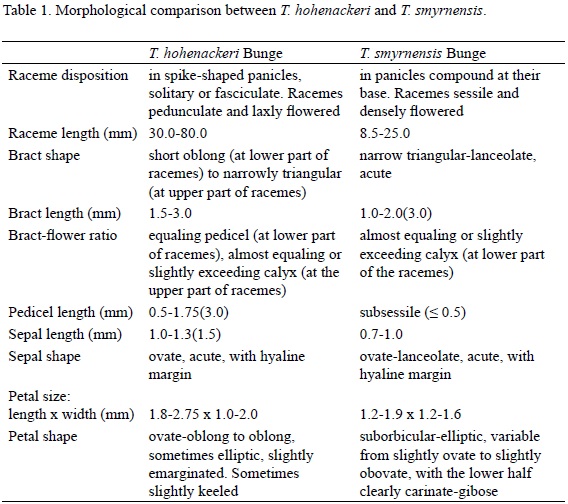
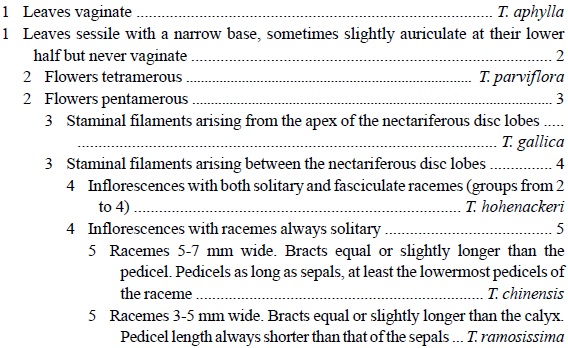
<body><![CDATA[<p align="justify"><font face="verdana" size="2"><i>Tamarix hohenackeri</i> Bunge, Tentamen, p. 44 (1852).</font></p>  	    <p align="justify"><font face="verdana" size="2">Tree, up to 5 m tall, entirely glabrous. Leaves ovate&#45;triangular to lanceolate, acute, with a decurrent narrow base, sometimes slightly auriculate, 1.5&#45;3.0 mm long. Inflorescences composed mostly of fasciculate arranged racemes, placed in spike&#45;like panicles (not branched). Racemes 3.0&#45;8.0(11.0) cm long, (5.0)5.5&#45;6.0 mm wide, on short peduncles (3.0&#45;10.0 mm long), naked or with a few bracts; rachis glabrous. Bracts of the racemes 1.5&#45;3.0 mm long; lowermost bracts oblong and obtuse, wider and shorter than the narrowly triangular and acute uppermost bracts; bract length sub&#45;equaling pedicel length at the lower part of the racemes to sub&#45;equaling or slightly exceeding calyx length at the apex of the inflorescences. Pedicels 0.5&#45;1.75(3.0) mm long, usually longer in the lower part of the racemes, occasionally with 1&#45;3 small secondary bracts. Sepals 5 (rarely 4), ovate, usually acute, with narrow hyaline margin, 1.0&#45;1.3(1.5) mm long, 0.6&#45;0.8 mm wide. Petals 5, white or yellowish to pink, persistent, ovate&#45;oblong to oblong, or widely elliptic, slightly emarginated, sometimes slightly keeled, 1.8&#45;2.75 mm long, 1.0&#45;2.0 mm wide. Stamens 5 (rarely 6), inserted between the lobes of the nectariferous disc; additional filaments inserted on the lobes. Anthers mostly not apiculate. Ovary always with 3 styles. Fruit 3&#45;4 mm long.</font></p>  	    <p align="justify"><font face="verdana" size="2">The taxonomic placement of <i>T. hohenackeri</i> is not totally resolved, because this species was considered by Baum (1978) as a synonym of <i>T. smyrnensis</i> Bunge. This taxonomical treatment is especially relevant, since his monograph is a worldwide reference for the genus <i>Tamarix</i>. However, both taxa were originally described as two independent species (Bunge, 1852). Other authors as Yang and Gaskin (2007) and certain Asian botanists (e.g. N. Lachashvili, in sched. (W2008&#45;21042); Belolipov and Haydarov, in sched. (MO6047301)&#93; have also recognized <i>T. hohenackeri</i> as a species independent from <i>T. smyrnensis</i>. According to our data, there are enough morphological differences supporting the idea that the synonymization of <i>T. hohenackeri</i> into <i>T. smyrnensis</i> might not be fully appropriate. These morphological differences have not been only based on bibliographical data (Bunge, 1852; Yang and Gaskin, 2007), but also on the detailed study of herbarium vouchers of <i>T. hohenackeri</i> and <i>T. smyrnensis</i>, including the type material of both species (see <a href="/img/revistas/abm/n106/html/a6an.html" target="_blank">Annex</a>). The main vegetative and reproductive morphological differences between <i>T. hohenackeri</i> and <i>T. smyrnensis</i> are shown in <a href="#t1">Table 1</a>. The most useful character to discriminate among these species corresponds to the fasciculate placement of racemes and their size, although the size and shape of bracts, sepals and petals are also essential for their accurate identification.</font></p>  	    <p align="center"><font face="verdana" size="2"><a name="t1"></a></font></p>  	    <p align="center"><font face="verdana" size="2"><img src="/img/revistas/abm/n106/a6t1.jpg"></font></p>  	    <p align="justify"><font face="verdana" size="2">The native distribution area of <i>Tamarix hohenackeri</i> extends, at least, from the eastern Black Sea to Mongolia, central Asia and south&#45;western Asia (Yang and Gaskin, 2007). There it is in contact with two closely related species, <i>T. ramosissima</i> and <i>T. austromongolica</i> Nakai<i>.</i> It is highly probable that <i>T. hohenackeri</i> was introduced in North America by the 19th or early 20th century for ornamental purposes, but was confused or intermixed with other similar ornamental species such as <i>T. ramosissima.</i> The distribution area of <i>T. hohenackeri</i> in North America could be wider than expected, since some additional vouchers of <i>T. hohenackeri</i> from the United States and Mexico could be misidentified as other species, such as <i>T. chinensis</i>, <i>T. ramosissima</i> and even <i>T. parviflora</i>.</font></p>  	    <p align="justify"><font face="verdana" size="2">With this new record, and including the previously available data (Zamora&#45;Arroyo et al., 2001; Villase&ntilde;or et al., 2002; Glenn and Nagler, 2005), six <i>Tamarix</i> species are part of the aloctonous flora of Mexico: <i>Tamarix aphylla, T. gallica, T. parviflora, T. hohenackeri, T. ramosissima</i> and <i>T. chinensis,</i> as well as the hybrids between the two latter species. Among them, <i>T. aphylla</i>, <i>T. hohenackeri</i>, <i>T. ramosissima</i> and <i>T. chinensis</i> were newly collected during the fieldwork conducted in April 2010, from different locations of Baja California (see <a href="/img/revistas/abm/n106/html/a6an.html" target="_blank">Annex</a>).</font></p>  	    <p align="justify"><font face="verdana" size="2">Below, a dichotomous key is presented for the six species of <i>Tamarix</i> reported for Mexico. The main morphological features are focused on leaf shape and insertion, raceme length and its disposition, bract shape, relative bract length, number, shape and size of the perianth sections and the site of insertion of the staminal filaments on the nectariferous disc.</font></p>  	    <p align="center"><font face="verdana" size="2">Dichotomous key for the identification of <i>Tamarix</i>species in Mexico</font></p>  	    <p align="center"><font face="verdana" size="2"><img src="/img/revistas/abm/n106/a6r1.jpg"></font></p>  	    ]]></body>
<body><![CDATA[<p>&nbsp;</p>  	    <p align="justify"><font face="verdana" size="2"><b>ACKNOWLEDGEMENTS</b></font></p>  	    <p align="justify"><font face="verdana" size="2">We are grateful to Dr. Jos&eacute; Delgadillo (University of Baja California, Mexico), for providing all the material and help to carry out our research in Mexico. We thank the curators of the herbaria mentioned in the text, especially to J. Solomon, E. Vitek, N. Fumeau and J. Stepanek who kindly helped us in the herbaria of Missouri, Vienna, Geneva and Prague, respectively. Mags Flaherty kindly revised the manuscript for the language corrections. This work has been supported by the BEST/2010/005 grant (Generalitat Valenciana, Spain), the projects CGL2008&#45;05056 (Ministerio de Educaci&oacute;n y Ciencia, Spain), ACIE10&#45;01 and ACIE 11&#45;01 (University of Alicante, Spain) and the FPU grant programme (Ministerio de Educaci&oacute;n, Spain).</font></p>  	    <p>&nbsp;</p>  	    <p align="justify"><font face="verdana" size="2"><b>LITERATURE CITED</b></font></p>  	    <!-- ref --><p align="justify"><font face="verdana" size="2">Anonymous. 2005. Program for biological control of saltcedar (<i>Tamarix</i> spp.) in thirteen States. Environmental Assessment. Animal and Plant Health Inspection Service, United States Department of Agriculture, Western Region. Fort Collins, USA. 56 pp.    &nbsp;&nbsp;&nbsp;&nbsp;&nbsp;&nbsp;&nbsp;&nbsp;[&#160;<a href="javascript:void(0);" onclick="javascript: window.open('/scielo.php?script=sci_nlinks&ref=050488&pid=S0187-7151201400010000600001&lng=','','width=640,height=500,resizable=yes,scrollbars=1,menubar=yes,');">Links</a>&#160;]<!-- end-ref --></font></p>  	    <!-- ref --><p align="justify"><font face="verdana" size="2">Anonymous. 2011. <i>Tamarix</i> <i>parviflora</i>, IEB 116120, 2 registers, CIBNOR&#45;HCIB 11988, 2 registers. Unidad de Coordinaci&oacute;n de Global Biodiversity Information Facility. Madrid, Spain. <a href="http://data.gbif.org/species/2874706/" target="_blank">http://data.gbif.org/species/2874706/</a> accessed on 13&#45;6&#45;2011.    &nbsp;&nbsp;&nbsp;&nbsp;&nbsp;&nbsp;&nbsp;&nbsp;[&#160;<a href="javascript:void(0);" onclick="javascript: window.open('/scielo.php?script=sci_nlinks&ref=050490&pid=S0187-7151201400010000600002&lng=','','width=640,height=500,resizable=yes,scrollbars=1,menubar=yes,');">Links</a>&#160;]<!-- end-ref --></font></p>  	    <!-- ref --><p align="justify"><font face="verdana" size="2">Baum, B. 1967. Introduced and naturalized tamarisks in the United States and Canada. Baileya 15: 19&#45;25.    &nbsp;&nbsp;&nbsp;&nbsp;&nbsp;&nbsp;&nbsp;&nbsp;[&#160;<a href="javascript:void(0);" onclick="javascript: window.open('/scielo.php?script=sci_nlinks&ref=050492&pid=S0187-7151201400010000600003&lng=','','width=640,height=500,resizable=yes,scrollbars=1,menubar=yes,');">Links</a>&#160;]<!-- end-ref --></font></p>  	    <!-- ref --><p align="justify"><font face="verdana" size="2">Baum, B. 1978. The genus <i>Tamarix</i>. Israel Academy of Sciences and Humanities. Jerusalem, Israel. 209 pp.    &nbsp;&nbsp;&nbsp;&nbsp;&nbsp;&nbsp;&nbsp;&nbsp;[&#160;<a href="javascript:void(0);" onclick="javascript: window.open('/scielo.php?script=sci_nlinks&ref=050494&pid=S0187-7151201400010000600004&lng=','','width=640,height=500,resizable=yes,scrollbars=1,menubar=yes,');">Links</a>&#160;]<!-- end-ref --></font></p>  	    <!-- ref --><p align="justify"><font face="verdana" size="2">Brummitt, R. K. and C. E. Powell. 1992. Authors of plant names. Royal Botanic Gardens. Kew, UK. 732 pp.    &nbsp;&nbsp;&nbsp;&nbsp;&nbsp;&nbsp;&nbsp;&nbsp;[&#160;<a href="javascript:void(0);" onclick="javascript: window.open('/scielo.php?script=sci_nlinks&ref=050496&pid=S0187-7151201400010000600005&lng=','','width=640,height=500,resizable=yes,scrollbars=1,menubar=yes,');">Links</a>&#160;]<!-- end-ref --></font></p>  	    <!-- ref --><p align="justify"><font face="verdana" size="2">Bunge, A. 1852. Tentamen generis <i>Tamaricum</i> species accuratius definiendi. Dorpati, Estonia. 83 pp.    &nbsp;&nbsp;&nbsp;&nbsp;&nbsp;&nbsp;&nbsp;&nbsp;[&#160;<a href="javascript:void(0);" onclick="javascript: window.open('/scielo.php?script=sci_nlinks&ref=050498&pid=S0187-7151201400010000600006&lng=','','width=640,height=500,resizable=yes,scrollbars=1,menubar=yes,');">Links</a>&#160;]<!-- end-ref --></font></p>  	    <!-- ref --><p align="justify"><font face="verdana" size="2">Chambers, N. and T. O. Hawkins. 2004. Plantas invasoras del desierto sonorense: una gu&iacute;a de campo. Sonoran Institute, Environmental Education Exchange y National Birds and Wildlife Foundation. Tucson, USA. 60 pp.    &nbsp;&nbsp;&nbsp;&nbsp;&nbsp;&nbsp;&nbsp;&nbsp;[&#160;<a href="javascript:void(0);" onclick="javascript: window.open('/scielo.php?script=sci_nlinks&ref=050500&pid=S0187-7151201400010000600007&lng=','','width=640,height=500,resizable=yes,scrollbars=1,menubar=yes,');">Links</a>&#160;]<!-- end-ref --></font></p>  	    <!-- ref --><p align="justify"><font face="verdana" size="2">Csurhes, S. 2008. Pest plant risk assessment: Athel pine <i>Tamarix</i> spp. The State of Queensland, Department of Primary Industries and Fisheries. Brisbane, Australia. 10 pp.    &nbsp;&nbsp;&nbsp;&nbsp;&nbsp;&nbsp;&nbsp;&nbsp;[&#160;<a href="javascript:void(0);" onclick="javascript: window.open('/scielo.php?script=sci_nlinks&ref=050502&pid=S0187-7151201400010000600008&lng=','','width=640,height=500,resizable=yes,scrollbars=1,menubar=yes,');">Links</a>&#160;]<!-- end-ref --></font></p>  	    <!-- ref --><p align="justify"><font face="verdana" size="2">Di Tomaso, J. 1998. Impact, biology and ecology of saltcedar (<i>Tamarix</i> sp.) in southwestern United States. Weed Technol. 12: 326&#45;336.    &nbsp;&nbsp;&nbsp;&nbsp;&nbsp;&nbsp;&nbsp;&nbsp;[&#160;<a href="javascript:void(0);" onclick="javascript: window.open('/scielo.php?script=sci_nlinks&ref=050504&pid=S0187-7151201400010000600009&lng=','','width=640,height=500,resizable=yes,scrollbars=1,menubar=yes,');">Links</a>&#160;]<!-- end-ref --></font></p>  	    <!-- ref --><p align="justify"><font face="verdana" size="2">Gaskin, J. F. and D. J. Kazmer. 2009. Introgression between invasive saltcedars (<i>Tamarix chinensis</i> and <i>T. ramosissima</i>) in USA. Biol. Invasions 11: 1121&#45;1130.    &nbsp;&nbsp;&nbsp;&nbsp;&nbsp;&nbsp;&nbsp;&nbsp;[&#160;<a href="javascript:void(0);" onclick="javascript: window.open('/scielo.php?script=sci_nlinks&ref=050506&pid=S0187-7151201400010000600010&lng=','','width=640,height=500,resizable=yes,scrollbars=1,menubar=yes,');">Links</a>&#160;]<!-- end-ref --></font></p>  	    <!-- ref --><p align="justify"><font face="verdana" size="2">Gaskin, J. F. and B. Schaal. 2003. Molecular phylogenetic investigation of U.S. invasive <i>Tamarix</i>. Syst. Bot. 28(1): 86&#45;95.    &nbsp;&nbsp;&nbsp;&nbsp;&nbsp;&nbsp;&nbsp;&nbsp;[&#160;<a href="javascript:void(0);" onclick="javascript: window.open('/scielo.php?script=sci_nlinks&ref=050508&pid=S0187-7151201400010000600011&lng=','','width=640,height=500,resizable=yes,scrollbars=1,menubar=yes,');">Links</a>&#160;]<!-- end-ref --></font></p>  	    <!-- ref --><p align="justify"><font face="verdana" size="2">Glenn, E. P. and P. L. Nagler. 2005. Comparative ecophysiology of <i>Tamarix</i> <i>ramosissima</i> and native trees in western U.S. riparian zones. J. Arid Environ. 61: 419&#45;446.    &nbsp;&nbsp;&nbsp;&nbsp;&nbsp;&nbsp;&nbsp;&nbsp;[&#160;<a href="javascript:void(0);" onclick="javascript: window.open('/scielo.php?script=sci_nlinks&ref=050510&pid=S0187-7151201400010000600012&lng=','','width=640,height=500,resizable=yes,scrollbars=1,menubar=yes,');">Links</a>&#160;]<!-- end-ref --></font></p>  	    <!-- ref --><p align="justify"><font face="verdana" size="2">Linnaeus, C. 1753. Species plantarum, exhibentes plantas rite cognitas, ad genera relatas, cum differentiis specificis, nominibus trivialibus, synonymis selectis, locis natalibus, secundum sistema sexuale digestas. Vol. I. Holmiae Impensis Laurentii. Salvii. Stockholm, Sweden. 560 pp.    &nbsp;&nbsp;&nbsp;&nbsp;&nbsp;&nbsp;&nbsp;&nbsp;[&#160;<a href="javascript:void(0);" onclick="javascript: window.open('/scielo.php?script=sci_nlinks&ref=050512&pid=S0187-7151201400010000600013&lng=','','width=640,height=500,resizable=yes,scrollbars=1,menubar=yes,');">Links</a>&#160;]<!-- end-ref --></font></p>  	    <!-- ref --><p align="justify"><font face="verdana" size="2">Melgarejo, P. 2000. Tratado de fruticultura para zonas &aacute;ridas y semi&aacute;ridas. Vol. 1. Ed. Mundi&#45;Prensa. Madrid, Spain. 382 pp.    &nbsp;&nbsp;&nbsp;&nbsp;&nbsp;&nbsp;&nbsp;&nbsp;[&#160;<a href="javascript:void(0);" onclick="javascript: window.open('/scielo.php?script=sci_nlinks&ref=050514&pid=S0187-7151201400010000600014&lng=','','width=640,height=500,resizable=yes,scrollbars=1,menubar=yes,');">Links</a>&#160;]<!-- end-ref --></font></p>  	    <!-- ref --><p align="justify"><font face="verdana" size="2">Milbrath, L. R., C. J. DeLoach and A. E. Knutson. 2003. Initial results of biological control of saltcedar (<i>Tamarix</i> spp.) in the United States. Proceedings of the Symposium, Saltcedar and Water Resources in the West. Texas Cooperative Extension. San Angelo, USA. 135&#45;141.    &nbsp;&nbsp;&nbsp;&nbsp;&nbsp;&nbsp;&nbsp;&nbsp;[&#160;<a href="javascript:void(0);" onclick="javascript: window.open('/scielo.php?script=sci_nlinks&ref=050516&pid=S0187-7151201400010000600015&lng=','','width=640,height=500,resizable=yes,scrollbars=1,menubar=yes,');">Links</a>&#160;]<!-- end-ref --></font></p>  	    <!-- ref --><p align="justify"><font face="verdana" size="2">Natale, E. S., J. F. Gaskin, S. M. Zalba, M. Ceballos and H. E. Reinoso. 2008. Especies del g&eacute;nero <i>Tamarix</i> (Tamaricaceae) invadiendo ambientes naturales en Argentina. Bol. Soc. Arg. Bot. 43(1&#45;2): 137&#45;145.    &nbsp;&nbsp;&nbsp;&nbsp;&nbsp;&nbsp;&nbsp;&nbsp;[&#160;<a href="javascript:void(0);" onclick="javascript: window.open('/scielo.php?script=sci_nlinks&ref=050518&pid=S0187-7151201400010000600016&lng=','','width=640,height=500,resizable=yes,scrollbars=1,menubar=yes,');">Links</a>&#160;]<!-- end-ref --></font></p>  	    <!-- ref --><p align="justify"><font face="verdana" size="2">Prince, W. and Sons. 1837. Annual catalogue of trees and plants cultivated at the Linnean Botanic Garden and Nurseries. New York, USA. pp. 2&#45;4, 50.    &nbsp;&nbsp;&nbsp;&nbsp;&nbsp;&nbsp;&nbsp;&nbsp;[&#160;<a href="javascript:void(0);" onclick="javascript: window.open('/scielo.php?script=sci_nlinks&ref=050520&pid=S0187-7151201400010000600017&lng=','','width=640,height=500,resizable=yes,scrollbars=1,menubar=yes,');">Links</a>&#160;]<!-- end-ref --></font></p>  	    <!-- ref --><p align="justify"><font face="verdana" size="2">Rebman, J. P. (comp.). 2007. The flora of Cedros Island, Mexico. San Diego Natural History Museum, Biodiversity Research Center of the Californias Botany. San Diego, USA. <a href="http://www.bajaflora.org/Floras/CedrosIsland.htm" target="_blank">www.bajaflora.org/Floras/CedrosIsland.htm</a> (accessed 10&#45;6&#45;2011).    &nbsp;&nbsp;&nbsp;&nbsp;&nbsp;&nbsp;&nbsp;&nbsp;[&#160;<a href="javascript:void(0);" onclick="javascript: window.open('/scielo.php?script=sci_nlinks&ref=050522&pid=S0187-7151201400010000600018&lng=','','width=640,height=500,resizable=yes,scrollbars=1,menubar=yes,');">Links</a>&#160;]<!-- end-ref --></font></p>      <!-- ref --><p align="justify"><font face="verdana" size="2">Sisneros, D. 1990. Vegetation management study: Lower Colorado River. Appendix II: Herbicide Analysis. USDI Bureau of Reclamation, Report. Denver, USA. 56 pp.    &nbsp;&nbsp;&nbsp;&nbsp;&nbsp;&nbsp;&nbsp;&nbsp;[&#160;<a href="javascript:void(0);" onclick="javascript: window.open('/scielo.php?script=sci_nlinks&ref=050524&pid=S0187-7151201400010000600019&lng=','','width=640,height=500,resizable=yes,scrollbars=1,menubar=yes,');">Links</a>&#160;]<!-- end-ref --></font></p>  	    <!-- ref --><p align="justify"><font face="verdana" size="2">Stromberg, J. 1998. Dynamics of Fremont cottonwood (<i>Populus fremontii</i>) and saltcedar (<i>Tamarix chinensis</i>) populations along the San Pedro River, Arizona. J. Arid Environ. 40: 133&#45;155.    &nbsp;&nbsp;&nbsp;&nbsp;&nbsp;&nbsp;&nbsp;&nbsp;[&#160;<a href="javascript:void(0);" onclick="javascript: window.open('/scielo.php?script=sci_nlinks&ref=050526&pid=S0187-7151201400010000600020&lng=','','width=640,height=500,resizable=yes,scrollbars=1,menubar=yes,');">Links</a>&#160;]<!-- end-ref --></font></p>  	    <!-- ref --><p align="justify"><font face="verdana" size="2">The International Plant Names Index. 2012. Published on the Internet <a href="http://www.ipni.org" target="_blank">http://www.ipni.org</a> (accessed 3&#45;XII&#45;2012).    &nbsp;&nbsp;&nbsp;&nbsp;&nbsp;&nbsp;&nbsp;&nbsp;[&#160;<a href="javascript:void(0);" onclick="javascript: window.open('/scielo.php?script=sci_nlinks&ref=050528&pid=S0187-7151201400010000600021&lng=','','width=640,height=500,resizable=yes,scrollbars=1,menubar=yes,');">Links</a>&#160;]<!-- end-ref --></font></p>  	    <!-- ref --><p align="justify"><font face="verdana" size="2">Thiers, B. 2011. continuously updated. Index Herbariorum: A global directory of public herbaria and associated staff. New York Botanical Garden's Virtual Herbarium. <a href="http://sweetgum.nybg.org/ih/" target="_blank">http://sweetgum.nybg.org/ih/</a></font>&nbsp;&nbsp;&nbsp;&nbsp;&nbsp;&nbsp;&nbsp;&nbsp;[&#160;<a href="javascript:void(0);" onclick="javascript: window.open('/scielo.php?script=sci_nlinks&ref=050530&pid=S0187-7151201400010000600022&lng=','','width=640,height=500,resizable=yes,scrollbars=1,menubar=yes,');">Links</a>&#160;]<!-- end-ref --><!-- ref --><p align="justify"><font face="verdana" size="2">Velasco, J. 2008. Manual para la restauraci&oacute;n de riberas en la cuenca del r&iacute;o Segura. Confederaci&oacute;n Hidrogr&aacute;fica del Segura. San Vicente del Raspeig, Spain. 227 pp.    &nbsp;&nbsp;&nbsp;&nbsp;&nbsp;&nbsp;&nbsp;&nbsp;[&#160;<a href="javascript:void(0);" onclick="javascript: window.open('/scielo.php?script=sci_nlinks&ref=050531&pid=S0187-7151201400010000600023&lng=','','width=640,height=500,resizable=yes,scrollbars=1,menubar=yes,');">Links</a>&#160;]<!-- end-ref --></font></p>  	    ]]></body>
<body><![CDATA[<!-- ref --><p align="justify"><font face="verdana" size="2">Villase&ntilde;or, J. L., J. Rzedowski and F. J. Espinosa. 2002. In<i>:</i> Espinosa, F. J. Malezas introducidas en M&eacute;xico. Universidad Nacional Aut&oacute;noma de M&eacute;xico, Centro de Investigaciones en Ecosistemas. Informe final SNIB&#45;CONABIO proyecto No. U024. Morelia, M&eacute;xico. 25 pp. <a href="http://www.conabio.gob.mx/institucion/proyectos/resultados/InfU024.pdf">http://www.conabio.gob.mx/institucion/proyectos/resultados/InfU024.pdf</a> (accessed 3&#45;XII&#45;2012).    &nbsp;&nbsp;&nbsp;&nbsp;&nbsp;&nbsp;&nbsp;&nbsp;[&#160;<a href="javascript:void(0);" onclick="javascript: window.open('/scielo.php?script=sci_nlinks&ref=050533&pid=S0187-7151201400010000600024&lng=','','width=640,height=500,resizable=yes,scrollbars=1,menubar=yes,');">Links</a>&#160;]<!-- end-ref --></font></p>  	    <!-- ref --><p align="justify"><font face="verdana" size="2">Warner Harper, W. 1903. Andorra hand&#45;book of trees and shrubs. Andorra Nurseries. Philadelphia, USA. pp. 5, 98.    &nbsp;&nbsp;&nbsp;&nbsp;&nbsp;&nbsp;&nbsp;&nbsp;[&#160;<a href="javascript:void(0);" onclick="javascript: window.open('/scielo.php?script=sci_nlinks&ref=050535&pid=S0187-7151201400010000600025&lng=','','width=640,height=500,resizable=yes,scrollbars=1,menubar=yes,');">Links</a>&#160;]<!-- end-ref --></font></p>  	    <!-- ref --><p align="justify"><font face="verdana" size="2">Yang, Q. and J. Gaskin. 2007. <i>Tamarix.</i> In: Zhengyi, W. and P. H. Raven (eds.). Flora of China 13: Science Press, Beijing and Missouri Botanical Garden Press. St. Louis, USA. pp. 59&#45;65.    &nbsp;&nbsp;&nbsp;&nbsp;&nbsp;&nbsp;&nbsp;&nbsp;[&#160;<a href="javascript:void(0);" onclick="javascript: window.open('/scielo.php?script=sci_nlinks&ref=050537&pid=S0187-7151201400010000600026&lng=','','width=640,height=500,resizable=yes,scrollbars=1,menubar=yes,');">Links</a>&#160;]<!-- end-ref --></font></p>  	    <!-- ref --><p align="justify"><font face="verdana" size="2">Zamora&#45;Arroyo, F., P. L. Nagler, M. Briggs, D. Radtke, H. Rodriguez, J. Garc&iacute;a, C. Vald&eacute;s, A. Huete and E. P. Glenn. 2001. Regeneration of native trees in response to flood releases from the United States into the delta of the Colorado River, Mexico. J. Arid Environ. 49(1): 49&#45;64.    &nbsp;&nbsp;&nbsp;&nbsp;&nbsp;&nbsp;&nbsp;&nbsp;[&#160;<a href="javascript:void(0);" onclick="javascript: window.open('/scielo.php?script=sci_nlinks&ref=050539&pid=S0187-7151201400010000600027&lng=','','width=640,height=500,resizable=yes,scrollbars=1,menubar=yes,');">Links</a>&#160;]<!-- end-ref --></font></p>  	    <!-- ref --><p align="justify"><font face="verdana" size="2">Zohary, M. 1987. <i>Tamarix</i> L. Flora Palestina 2: 350&#45;362.    &nbsp;&nbsp;&nbsp;&nbsp;&nbsp;&nbsp;&nbsp;&nbsp;[&#160;<a href="javascript:void(0);" onclick="javascript: window.open('/scielo.php?script=sci_nlinks&ref=050541&pid=S0187-7151201400010000600028&lng=','','width=640,height=500,resizable=yes,scrollbars=1,menubar=yes,');">Links</a>&#160;]<!-- end-ref --></font></p>     ]]></body>
<body><![CDATA[ ]]></body><back>
<ref-list>
<ref id="B1">
<nlm-citation citation-type="book">
<person-group person-group-type="author">
<name>
</name>
<name>
</name>
</person-group>
<source><![CDATA[Program for biological control of saltcedar (Tamarix spp.) in thirteen States. Environmental Assessment]]></source>
<year>2005</year>
<page-range>56</page-range><publisher-loc><![CDATA[Fort Collins ]]></publisher-loc>
<publisher-name><![CDATA[Animal and Plant Health Inspection Service, United States Department of Agriculture, Western Region]]></publisher-name>
</nlm-citation>
</ref>
<ref id="B2">
<nlm-citation citation-type="book">
<person-group person-group-type="author">
<name>
</name>
<name>
</name>
</person-group>
<source><![CDATA[Tamarix parviflora]]></source>
<year>2011</year>
<publisher-loc><![CDATA[Madrid ]]></publisher-loc>
<publisher-name><![CDATA[Unidad de Coordinación de Global Biodiversity]]></publisher-name>
</nlm-citation>
</ref>
<ref id="B3">
<nlm-citation citation-type="journal">
<person-group person-group-type="author">
<name>
<surname><![CDATA[Baum]]></surname>
<given-names><![CDATA[B.]]></given-names>
</name>
</person-group>
<article-title xml:lang="en"><![CDATA[Introduced and naturalized tamarisks in the United States and Canada]]></article-title>
<source><![CDATA[Baileya]]></source>
<year>1967</year>
<volume>15</volume>
<page-range>19-25</page-range></nlm-citation>
</ref>
<ref id="B4">
<nlm-citation citation-type="">
<person-group person-group-type="author">
<name>
<surname><![CDATA[Baum]]></surname>
<given-names><![CDATA[B.]]></given-names>
</name>
</person-group>
<source><![CDATA[The genus Tamarix. Israel Academy of Sciences and Humanities]]></source>
<year>1978</year>
<page-range>209</page-range><publisher-loc><![CDATA[Jerusalem ]]></publisher-loc>
</nlm-citation>
</ref>
<ref id="B5">
<nlm-citation citation-type="book">
<person-group person-group-type="author">
<name>
<surname><![CDATA[Brummitt]]></surname>
<given-names><![CDATA[R. K.]]></given-names>
</name>
<name>
<surname><![CDATA[Powell]]></surname>
<given-names><![CDATA[C. E.]]></given-names>
</name>
</person-group>
<source><![CDATA[Authors of plant names]]></source>
<year>1992</year>
<page-range>732</page-range><publisher-loc><![CDATA[Kew ]]></publisher-loc>
<publisher-name><![CDATA[Royal Botanic Gardens]]></publisher-name>
</nlm-citation>
</ref>
<ref id="B6">
<nlm-citation citation-type="book">
<person-group person-group-type="author">
<name>
<surname><![CDATA[Bunge]]></surname>
<given-names><![CDATA[A.]]></given-names>
</name>
</person-group>
<source><![CDATA[Tentamen generis Tamaricum species accuratius definiendi]]></source>
<year>1852</year>
<page-range>83</page-range><publisher-name><![CDATA[Dorpati]]></publisher-name>
</nlm-citation>
</ref>
<ref id="B7">
<nlm-citation citation-type="book">
<person-group person-group-type="author">
<name>
<surname><![CDATA[Chambers]]></surname>
<given-names><![CDATA[N.]]></given-names>
</name>
<name>
<surname><![CDATA[Hawkins]]></surname>
<given-names><![CDATA[T. O.]]></given-names>
</name>
</person-group>
<source><![CDATA[Plantas invasoras del desierto sonorense: una guía de campo]]></source>
<year>2004</year>
<page-range>60</page-range><publisher-loc><![CDATA[Tucson ]]></publisher-loc>
<publisher-name><![CDATA[Sonoran Institute, Environmental Education ExchangeNational Birds and Wildlife Foundation]]></publisher-name>
</nlm-citation>
</ref>
<ref id="B8">
<nlm-citation citation-type="book">
<person-group person-group-type="author">
<name>
<surname><![CDATA[Csurhes]]></surname>
<given-names><![CDATA[S.]]></given-names>
</name>
</person-group>
<source><![CDATA[Pest plant risk assessment: Athel pine Tamarix spp.]]></source>
<year>2008</year>
<page-range>10</page-range><publisher-loc><![CDATA[Brisbane^eQueensland Queensland]]></publisher-loc>
<publisher-name><![CDATA[Department of Primary Industries and Fisheries]]></publisher-name>
</nlm-citation>
</ref>
<ref id="B9">
<nlm-citation citation-type="journal">
<person-group person-group-type="author">
<name>
<surname><![CDATA[Di Tomaso]]></surname>
<given-names><![CDATA[J.]]></given-names>
</name>
</person-group>
<article-title xml:lang="en"><![CDATA[Impact, biology and ecology of saltcedar (Tamarix sp.) in southwestern United States]]></article-title>
<source><![CDATA[Weed Technol]]></source>
<year>1998</year>
<volume>12</volume>
<page-range>326-336</page-range></nlm-citation>
</ref>
<ref id="B10">
<nlm-citation citation-type="journal">
<person-group person-group-type="author">
<name>
<surname><![CDATA[Gaskin]]></surname>
<given-names><![CDATA[J. F.]]></given-names>
</name>
<name>
<surname><![CDATA[Kazmer]]></surname>
<given-names><![CDATA[D. J.]]></given-names>
</name>
</person-group>
<article-title xml:lang="en"><![CDATA[Introgression between invasive saltcedars (Tamarix chinensis and T. ramosissima) in USA]]></article-title>
<source><![CDATA[Biol. Invasions]]></source>
<year>2009</year>
<volume>11</volume>
<page-range>1121-1130</page-range></nlm-citation>
</ref>
<ref id="B11">
<nlm-citation citation-type="journal">
<person-group person-group-type="author">
<name>
<surname><![CDATA[Gaskin]]></surname>
<given-names><![CDATA[J. F.]]></given-names>
</name>
<name>
<surname><![CDATA[Schaal]]></surname>
<given-names><![CDATA[B.]]></given-names>
</name>
</person-group>
<article-title xml:lang="en"><![CDATA[Molecular phylogenetic investigation of U.S. invasive Tamarix]]></article-title>
<source><![CDATA[Syst. Bot.]]></source>
<year>2003</year>
<volume>28</volume>
<numero>1</numero>
<issue>1</issue>
<page-range>86-95</page-range></nlm-citation>
</ref>
<ref id="B12">
<nlm-citation citation-type="journal">
<person-group person-group-type="author">
<name>
<surname><![CDATA[Glenn]]></surname>
<given-names><![CDATA[E. P.]]></given-names>
</name>
<name>
<surname><![CDATA[Nagler]]></surname>
<given-names><![CDATA[P. L.]]></given-names>
</name>
</person-group>
<article-title xml:lang="en"><![CDATA[Comparative ecophysiology of Tamarix ramosissima and native trees in western U.S. riparian zones]]></article-title>
<source><![CDATA[J. Arid Environ.]]></source>
<year>2005</year>
<volume>61</volume>
<page-range>419-446</page-range></nlm-citation>
</ref>
<ref id="B13">
<nlm-citation citation-type="">
<person-group person-group-type="author">
<name>
<surname><![CDATA[Linnaeus]]></surname>
<given-names><![CDATA[C.]]></given-names>
</name>
</person-group>
<source><![CDATA[Species plantarum, exhibentes plantas rite cognitas, ad genera relatas, cum differentiis specificis, nominibus trivialibus, synonymis selectis, locis natalibus, secundum sistema sexuale digestas. Vol. I. Holmiae Impensis Laurentii. Salvii.]]></source>
<year>1753</year>
<page-range>560</page-range><publisher-loc><![CDATA[Stockholm ]]></publisher-loc>
</nlm-citation>
</ref>
<ref id="B14">
<nlm-citation citation-type="book">
<person-group person-group-type="author">
<name>
<surname><![CDATA[Melgarejo]]></surname>
<given-names><![CDATA[P.]]></given-names>
</name>
</person-group>
<source><![CDATA[Tratado de fruticultura para zonas áridas y semiáridas]]></source>
<year>2000</year>
<volume>1</volume>
<page-range>382</page-range><publisher-loc><![CDATA[Madrid ]]></publisher-loc>
<publisher-name><![CDATA[Mundi-Prensa]]></publisher-name>
</nlm-citation>
</ref>
<ref id="B15">
<nlm-citation citation-type="book">
<person-group person-group-type="author">
<name>
<surname><![CDATA[Milbrath]]></surname>
<given-names><![CDATA[L. R.]]></given-names>
</name>
<name>
<surname><![CDATA[DeLoach]]></surname>
<given-names><![CDATA[C. J.]]></given-names>
</name>
<name>
<surname><![CDATA[Knutson]]></surname>
<given-names><![CDATA[A. E.]]></given-names>
</name>
</person-group>
<article-title xml:lang="en"><![CDATA[Initial results of biological control of saltcedar (Tamarix spp.) in the United States]]></article-title>
<source><![CDATA[Proceedings of the Symposium, Saltcedar and Water Resources in the West]]></source>
<year>2003</year>
<page-range>135-141</page-range><publisher-loc><![CDATA[San Angelo ]]></publisher-loc>
<publisher-name><![CDATA[Texas Cooperative Extension]]></publisher-name>
</nlm-citation>
</ref>
<ref id="B16">
<nlm-citation citation-type="journal">
<person-group person-group-type="author">
<name>
<surname><![CDATA[Natale]]></surname>
<given-names><![CDATA[E. S.]]></given-names>
</name>
<name>
<surname><![CDATA[Gaskin]]></surname>
<given-names><![CDATA[J. F.]]></given-names>
</name>
<name>
<surname><![CDATA[Zalba]]></surname>
<given-names><![CDATA[S. M.]]></given-names>
</name>
<name>
<surname><![CDATA[Ceballos]]></surname>
<given-names><![CDATA[M.]]></given-names>
</name>
<name>
<surname><![CDATA[Reinoso]]></surname>
<given-names><![CDATA[H. E.]]></given-names>
</name>
</person-group>
<article-title xml:lang="es"><![CDATA[species del género Tamarix (Tamaricaceae) invadiendo ambientes naturales en Argentina]]></article-title>
<source><![CDATA[Bol. Soc. Arg. Bot.]]></source>
<year>2008</year>
<volume>43</volume>
<numero>1</numero><numero>2</numero>
<issue>1</issue><issue>2</issue>
<page-range>137-145</page-range></nlm-citation>
</ref>
<ref id="B17">
<nlm-citation citation-type="">
<person-group person-group-type="author">
<name>
<surname><![CDATA[Prince]]></surname>
<given-names><![CDATA[W.]]></given-names>
</name>
</person-group>
<source><![CDATA[Annual catalogue of trees and plants cultivated at the Linnean Botanic Garden and Nurseries]]></source>
<year>1837</year>
<page-range>2-4</page-range><publisher-loc><![CDATA[New York ]]></publisher-loc>
</nlm-citation>
</ref>
<ref id="B18">
<nlm-citation citation-type="book">
<person-group person-group-type="author">
<name>
<surname><![CDATA[Rebman]]></surname>
<given-names><![CDATA[J. P.]]></given-names>
</name>
</person-group>
<source><![CDATA[The flora of Cedros Island, Mexico]]></source>
<year>2007</year>
<publisher-loc><![CDATA[San Diego ]]></publisher-loc>
<publisher-name><![CDATA[San Diego Natural History Museum, Biodiversity Research Center of the Californias Botany]]></publisher-name>
</nlm-citation>
</ref>
<ref id="B19">
<nlm-citation citation-type="">
<person-group person-group-type="author">
<name>
<surname><![CDATA[Sisneros]]></surname>
<given-names><![CDATA[D.]]></given-names>
</name>
</person-group>
<source><![CDATA[Vegetation management study: Lower Colorado River. Appendix II: Herbicide Analysis. USDI Bureau of Reclamation, Report]]></source>
<year>1990</year>
<page-range>56</page-range><publisher-loc><![CDATA[Denver ]]></publisher-loc>
</nlm-citation>
</ref>
<ref id="B20">
<nlm-citation citation-type="journal">
<person-group person-group-type="author">
<name>
<surname><![CDATA[Stromberg]]></surname>
<given-names><![CDATA[J.]]></given-names>
</name>
</person-group>
<article-title xml:lang="en"><![CDATA[Dynamics of Fremont cottonwood (Populus fremontii) and saltcedar (Tamarix chinensis) populations along the San Pedro River, Arizona]]></article-title>
<source><![CDATA[J. Arid Environ.]]></source>
<year>1998</year>
<volume>40</volume>
<page-range>133-155</page-range></nlm-citation>
</ref>
<ref id="B21">
<nlm-citation citation-type="">
<source><![CDATA[The International Plant Names Index]]></source>
<year>2012</year>
</nlm-citation>
</ref>
<ref id="B22">
<nlm-citation citation-type="book">
<person-group person-group-type="author">
<name>
<surname><![CDATA[Thiers]]></surname>
<given-names><![CDATA[B.]]></given-names>
</name>
</person-group>
<source><![CDATA[Index Herbariorum: A global directory of public herbaria and associated staff]]></source>
<year>2011</year>
<publisher-name><![CDATA[New York Botanical Garden's Virtual Herbarium]]></publisher-name>
</nlm-citation>
</ref>
<ref id="B23">
<nlm-citation citation-type="book">
<person-group person-group-type="author">
<name>
<surname><![CDATA[Velasco]]></surname>
<given-names><![CDATA[J.]]></given-names>
</name>
</person-group>
<source><![CDATA[Manual para la restauración de riberas en la cuenca del río Segura]]></source>
<year>2008</year>
<page-range>227</page-range><publisher-loc><![CDATA[San Vicente del Raspeig ]]></publisher-loc>
<publisher-name><![CDATA[Confederación Hidrográfica del Segura]]></publisher-name>
</nlm-citation>
</ref>
<ref id="B24">
<nlm-citation citation-type="book">
<person-group person-group-type="author">
<name>
<surname><![CDATA[Villaseñor]]></surname>
<given-names><![CDATA[J. L.]]></given-names>
</name>
<name>
<surname><![CDATA[Rzedowski]]></surname>
<given-names><![CDATA[J.]]></given-names>
</name>
<name>
<surname><![CDATA[Espinosa]]></surname>
<given-names><![CDATA[F. J.]]></given-names>
</name>
</person-group>
<person-group person-group-type="editor">
<name>
<surname><![CDATA[Espinosa]]></surname>
<given-names><![CDATA[F. J.]]></given-names>
</name>
</person-group>
<source><![CDATA[Malezas introducidas en México]]></source>
<year>2002</year>
<page-range>25</page-range><publisher-loc><![CDATA[Morelia ]]></publisher-loc>
<publisher-name><![CDATA[Universidad Nacional Autónoma de México, Centro de Investigaciones en Ecosistemas]]></publisher-name>
</nlm-citation>
</ref>
<ref id="B25">
<nlm-citation citation-type="">
<person-group person-group-type="author">
<name>
<surname><![CDATA[Warner Harper]]></surname>
<given-names><![CDATA[W.]]></given-names>
</name>
</person-group>
<article-title xml:lang="en"><![CDATA[Andorra hand-book of trees and shrubs]]></article-title>
<source><![CDATA[Andorra Nurseries]]></source>
<year>1903</year>
<page-range>5</page-range><publisher-loc><![CDATA[Philadelphia ]]></publisher-loc>
</nlm-citation>
</ref>
<ref id="B26">
<nlm-citation citation-type="book">
<person-group person-group-type="author">
<name>
<surname><![CDATA[Yang]]></surname>
<given-names><![CDATA[Q.]]></given-names>
</name>
<name>
<surname><![CDATA[Gaskin]]></surname>
<given-names><![CDATA[J.]]></given-names>
</name>
</person-group>
<article-title xml:lang="en"><![CDATA[Tamarix]]></article-title>
<person-group person-group-type="editor">
<name>
<surname><![CDATA[Zhengyi]]></surname>
<given-names><![CDATA[W.]]></given-names>
</name>
<name>
<surname><![CDATA[Raven]]></surname>
<given-names><![CDATA[P. H.]]></given-names>
</name>
</person-group>
<source><![CDATA[Flora of China 13: Science Press]]></source>
<year>2007</year>
<page-range>59-65</page-range><publisher-loc><![CDATA[St. Louis ]]></publisher-loc>
<publisher-name><![CDATA[Beijing and Missouri Botanical Garden Press]]></publisher-name>
</nlm-citation>
</ref>
<ref id="B27">
<nlm-citation citation-type="journal">
<person-group person-group-type="author">
<name>
<surname><![CDATA[Zamora-Arroyo]]></surname>
<given-names><![CDATA[F.]]></given-names>
</name>
<name>
<surname><![CDATA[Nagler]]></surname>
<given-names><![CDATA[P. L.]]></given-names>
</name>
<name>
<surname><![CDATA[Briggs]]></surname>
<given-names><![CDATA[M.]]></given-names>
</name>
<name>
<surname><![CDATA[Radtke]]></surname>
<given-names><![CDATA[D.]]></given-names>
</name>
<name>
<surname><![CDATA[Rodriguez]]></surname>
<given-names><![CDATA[H.]]></given-names>
</name>
<name>
<surname><![CDATA[García]]></surname>
<given-names><![CDATA[J.]]></given-names>
</name>
<name>
<surname><![CDATA[Valdés]]></surname>
<given-names><![CDATA[C.]]></given-names>
</name>
<name>
<surname><![CDATA[Huete]]></surname>
<given-names><![CDATA[A.]]></given-names>
</name>
<name>
<surname><![CDATA[Glenn]]></surname>
<given-names><![CDATA[E. P.]]></given-names>
</name>
</person-group>
<article-title xml:lang="en"><![CDATA[Regeneration of native trees in response to flood releases from the United States into the delta of the Colorado River, Mexico]]></article-title>
<source><![CDATA[J. Arid Environ.]]></source>
<year>2001</year>
<volume>49</volume>
<numero>1</numero>
<issue>1</issue>
<page-range>49-64</page-range></nlm-citation>
</ref>
<ref id="B28">
<nlm-citation citation-type="journal">
<person-group person-group-type="author">
<name>
<surname><![CDATA[Zohary]]></surname>
<given-names><![CDATA[M.]]></given-names>
</name>
</person-group>
<article-title xml:lang="en"><![CDATA[Tamarix]]></article-title>
<source><![CDATA[L. Flora Palestina]]></source>
<year>1987</year>
<volume>2</volume>
<page-range>350-362</page-range></nlm-citation>
</ref>
</ref-list>
</back>
</article>