<?xml version="1.0" encoding="ISO-8859-1"?><article xmlns:mml="http://www.w3.org/1998/Math/MathML" xmlns:xlink="http://www.w3.org/1999/xlink" xmlns:xsi="http://www.w3.org/2001/XMLSchema-instance">
<front>
<journal-meta>
<journal-id>0187-7151</journal-id>
<journal-title><![CDATA[Acta botánica mexicana]]></journal-title>
<abbrev-journal-title><![CDATA[Act. Bot. Mex]]></abbrev-journal-title>
<issn>0187-7151</issn>
<publisher>
<publisher-name><![CDATA[Instituto de Ecología A.C., Centro Regional del Bajío]]></publisher-name>
</publisher>
</journal-meta>
<article-meta>
<article-id>S0187-71512014000100002</article-id>
<title-group>
<article-title xml:lang="en"><![CDATA[Dinophysiales (Dinophyceae) of the National Park Sistema Arrecifal Veracruzano, Gulf of Mexico, with a key for indentification]]></article-title>
<article-title xml:lang="es"><![CDATA[Dinophysiales (Dinophyceae) del Parque Nacional Sistema Arrecifal Veracruzano, Golfo de México, con clave para identificación]]></article-title>
</title-group>
<contrib-group>
<contrib contrib-type="author">
<name>
<surname><![CDATA[Okolodkov]]></surname>
<given-names><![CDATA[Yuri B.]]></given-names>
</name>
<xref ref-type="aff" rid="A01"/>
</contrib>
</contrib-group>
<aff id="A01">
<institution><![CDATA[,Universidad Veracruzana Instituto de Ciencias Marinas y Pesquerías Laboratorio de Botánica Marina y Planctología]]></institution>
<addr-line><![CDATA[Boca del Río Veracruz]]></addr-line>
<country>México</country>
</aff>
<pub-date pub-type="pub">
<day>00</day>
<month>01</month>
<year>2014</year>
</pub-date>
<pub-date pub-type="epub">
<day>00</day>
<month>01</month>
<year>2014</year>
</pub-date>
<numero>106</numero>
<fpage>9</fpage>
<lpage>71</lpage>
<copyright-statement/>
<copyright-year/>
<self-uri xlink:href="http://www.scielo.org.mx/scielo.php?script=sci_arttext&amp;pid=S0187-71512014000100002&amp;lng=en&amp;nrm=iso"></self-uri><self-uri xlink:href="http://www.scielo.org.mx/scielo.php?script=sci_abstract&amp;pid=S0187-71512014000100002&amp;lng=en&amp;nrm=iso"></self-uri><self-uri xlink:href="http://www.scielo.org.mx/scielo.php?script=sci_pdf&amp;pid=S0187-71512014000100002&amp;lng=en&amp;nrm=iso"></self-uri><abstract abstract-type="short" xml:lang="en"><p><![CDATA[The morphology of 38 species from eight genera of the order Dinophysiales was studied based on about seven hundred 20 &#956;m phytoplankton net samples taken from May 2005 through April 2008 at 27 sampling stations in the National Park Sistema Arrecifal Veracruzano, southwestern Gulf of Mexico. Short descriptions and synonyms are given for each species. Cell size variation with the mean and the standard deviation are given for most species. Twenty-three species are provided with affinities and morphological, taxonomic and nomenclatural comments. Dichotomous keys for identification of the genera and species of Amphisolenia (4 species), Dinophysis (7), Heteroschisma (1), Histioneis (6), Ornithocercus (7), Phalacroma (9), Pseudophalacroma (1) and Sinophysis (3) are presented, and species are illustrated with light and scanning electron microscope photographs and line drawings. Phalacroma equalanti (Balech) Okolodkov comb. nov. is established. Thirteen species are new records for the State of Veracruz, and Histioneis isseli and Pseudophalacroma nasutum are new for the Gulf of Mexico.]]></p></abstract>
<abstract abstract-type="short" xml:lang="es"><p><![CDATA[Se estudió la morfología de 38 especies de ocho géneros del orden Dinophysiales con base en aproximadamente 700 muestras de red fitoplanctónica (20 &#956;m) tomadas de mayo de 2005 a abril de 2008 en 27 estaciones de muestreo en el Parque Nacional Sistema Arrecifal Veracruzano, la parte suroeste del Golfo de México. Para cada especie se dan descripciones cortas, así como la sinonimia. La variación del tama-o de las células, el promedio y la desviación estándar se presentan para la mayoría de especies. Para 23 se proporcionan notas sobre sus afinidades, al igual que comentarios morfológicos, taxonómicos y nomenclaturales. Se presentan claves dicotómicas para la identificación de los géneros y especies de Amphisolenia (4 especies), Dinophysis (7), Heteroschisma (1), Histioneis (6), Ornithocercus (7), Phalacroma (9), Pseudophalacroma (1) y Sinophysis (3), así como las fotografías en microscopio fotónico y microscopio electrónico de barrido e ilustraciones de todas las entidades encontradas. Se establece Phalacroma equalanti (Balech) Okolodkov comb. nov. Trece especies son nuevos registros para el Estado de Veracruz, e Histioneis isseli y Pseudophalacroma nasutum lo son para el Golfo de México.]]></p></abstract>
<kwd-group>
<kwd lng="en"><![CDATA[dinoflagellates]]></kwd>
<kwd lng="en"><![CDATA[Dinophysiales]]></kwd>
<kwd lng="en"><![CDATA[Gulf of Mexico]]></kwd>
<kwd lng="en"><![CDATA[key for identification]]></kwd>
<kwd lng="en"><![CDATA[morphology]]></kwd>
<kwd lng="en"><![CDATA[taxonomy]]></kwd>
<kwd lng="es"><![CDATA[clave para identificación]]></kwd>
<kwd lng="es"><![CDATA[dinoflagelados]]></kwd>
<kwd lng="es"><![CDATA[Dinophysiales]]></kwd>
<kwd lng="es"><![CDATA[Golfo de México]]></kwd>
<kwd lng="es"><![CDATA[morfología]]></kwd>
<kwd lng="es"><![CDATA[taxonomía]]></kwd>
</kwd-group>
</article-meta>
</front><body><![CDATA[  	    <p align="center"><font face="verdana" size="4"><b>Dinophysiales (Dinophyceae) of the National Park Sistema Arrecifal Veracruzano, Gulf of Mexico, with a key for indentification</b></font></p>  	    <p>&nbsp;</p>  	    <p align="center"><font face="verdana" size="3"><b>Dinophysiales (Dinophyceae) del Parque Nacional Sistema Arrecifal Veracruzano, Golfo de M&eacute;xico, con clave para identificaci&oacute;n</b></font></p>  	    <p>&nbsp;</p>  	    <p align="center"><font face="verdana" size="2"><b>Yuri B. Okolodkov</b></font></p>  	    <p>&nbsp;</p>  	    <p align="justify"><font face="verdana" size="2"><i>* Universidad Veracruzana, Instituto de Ciencias Marinas y Pesquer&iacute;as, Laboratorio de Bot&aacute;nica Marina y Planctolog&iacute;a, Calle Hidalgo 617, Colonia R&iacute;o Jamapa, 94290 Boca del R&iacute;o, Veracruz, M&eacute;xico.</i> <a href="mailto:yuriokolodkov@yahoo.com">yuriokolodkov@yahoo.com</a>.</font></p>  	    <p>&nbsp;</p>  	    <p align="justify"><font face="verdana" size="2">Recibido en octubre de 2012.    ]]></body>
<body><![CDATA[<br> 	Aceptado en mayo de 2013.</font></p>  	    <p>&nbsp;</p>  	    <p align="justify"><font face="verdana" size="2"><b>ABSTRACT</b></font></p>  	    <p align="justify"><font face="verdana" size="2">The morphology of 38 species from eight genera of the order Dinophysiales was studied based on about seven hundred 20 &#956;m phytoplankton net samples taken from May 2005 through April 2008 at 27 sampling stations in the National Park Sistema Arrecifal Veracruzano, southwestern Gulf of Mexico. Short descriptions and synonyms are given for each species. Cell size variation with the mean and the standard deviation are given for most species. Twenty&#45;three species are provided with affinities and morphological, taxonomic and nomenclatural comments. Dichotomous keys for identification of the genera and species of <i>Amphisolenia</i> (4 species)<i>, Dinophysis</i> (7)<i>, Heteroschisma</i> (1)<i>, Histioneis</i> (6)<i>, Ornithocercus</i> (7)<i>, Phalacroma</i> (9)<i>, Pseudophalacroma</i> (1) and <i>Sinophysis</i> (3) are presented, and species are illustrated with light and scanning electron microscope photographs and line drawings. <i>Phalacroma</i> <i>equalanti</i> (Balech) Okolodkov comb. nov. is established. Thirteen species are new records for the State of Veracruz, and <i>Histioneis isseli</i> and <i>Pseudophalacroma nasutum</i> are new for the Gulf of Mexico.</font></p>  	    <p align="justify"><font face="verdana" size="2"><b>Key words:</b> dinoflagellates, Dinophysiales, Gulf of Mexico, key for identification, morphology, taxonomy.</font></p>  	    <p>&nbsp;</p>  	    <p align="justify"><font face="verdana" size="2"><b>RESUMEN</b></font></p>  	    <p align="justify"><font face="verdana" size="2">Se estudi&oacute; la morfolog&iacute;a de 38 especies de ocho g&eacute;neros del orden Dinophysiales con base en aproximadamente 700 muestras de red fitoplanct&oacute;nica (20 &#956;m) tomadas de mayo de 2005 a abril de 2008 en 27 estaciones de muestreo en el Parque Nacional Sistema Arrecifal Veracruzano, la parte suroeste del Golfo de M&eacute;xico. Para cada especie se dan descripciones cortas, as&iacute; como la sinonimia. La variaci&oacute;n del tama&#150;o de las c&eacute;lulas, el promedio y la desviaci&oacute;n est&aacute;ndar se presentan para la mayor&iacute;a de especies. Para 23 se proporcionan notas sobre sus afinidades, al igual que comentarios morfol&oacute;gicos, taxon&oacute;micos y nomenclaturales. Se presentan claves dicot&oacute;micas para la identificaci&oacute;n de los g&eacute;neros y especies de <i>Amphisolenia</i> (4 especies)<i>, Dinophysis</i> (7)<i>, Heteroschisma</i> (1)<i>, Histioneis</i> (6)<i>, Ornithocercus</i> (7)<i>, Phalacroma</i> (9)<i>, Pseudophalacroma</i> (1) y <i>Sinophysis</i> (3), as&iacute; como las fotograf&iacute;as en microscopio fot&oacute;nico y microscopio electr&oacute;nico de barrido e ilustraciones de todas las entidades encontradas. Se establece <i>Phalacroma</i> <i>equalanti</i> (Balech) Okolodkov comb. nov. Trece especies son nuevos registros para el Estado de Veracruz, e <i>Histioneis isseli</i> y <i>Pseudophalacroma nasutum</i> lo son para el Golfo de M&eacute;xico.</font></p>  	    <p align="justify"><font face="verdana" size="2"><b>Palabras clave:</b> clave para identificaci&oacute;n, dinoflagelados, Dinophysiales, Golfo de M&eacute;xico, morfolog&iacute;a, taxonom&iacute;a.</font></p>  	    <p>&nbsp;</p>  	    ]]></body>
<body><![CDATA[<p align="justify"><font face="verdana" size="2"><b>INTRODUCTION</b></font></p>  	    <p align="justify"><font face="verdana" size="2">The order Dinophysiales with about 280 species (G&oacute;mez et al., 2011a) is monophyletic (Saldarriaga et al., 2004) and morphologically well distinguished by a sagittal suture encircling the entire cell. The order is represented by only three families, Dinophysiaceae F. Stein, Amphisoleniaceae Lindemann and Oxyphysiaceae Sournia, which comprise 13&#45;14, 2 and 1 recent genera, respectively (Fensome et al., 1993). Most genera and species are marine planktonic; however, a typically benthic/epiphytic <i>Sinophysis</i> Nie et Wang is also known from the sea. Some genera such as <i>Citharistes</i> F. Stein and <i>Histioneis</i> F. Stein<i>,</i> and possibly <i>Ornithocercus</i> F. Stein, <i>Amphisolenia</i> F. Stein and <i>Triposolenia</i> Kof., prefer oceanic waters (Okolodkov, 2011). The highest generic and species diversities are found in tropical seas. <i>Dinophysis</i> Ehrenberg sensu lato is the most common genus, distributed throughout all the oceans including both polar regions, with the largest number of species. Recently described small cells in about a dozen <i>Dinophysis</i> species, responsible for infraspecific morphological variability (dimorphism), are believed to be gametes in a three&#45;looped life&#45;history pattern, which consists of sexual, small/intermediate cell and vegetative cell cycles (Hansen, 1993; Reguera et al., 1995, 2007, 2012; Reguera &amp; Gonz&aacute;lez&#45;Gil, 2001; Reguera, 2002). Pellicle cysts, more frequently and misleadingly called temporary cysts in the literature, are not known for any of the Dinophysiales genera (Bravo et al., 2009). Resting (hypnozygotic) cysts are reliably known for <i>Dinophysis acuta</i> Ehrenb. and <i>D. tripos</i> Gourret (Cannon, 1993; Moita &amp; Sampayo, 1993; Head, 1996).</font></p>  	    <p align="justify"><font face="verdana" size="2">Most Dinophysiales are heterotrophic and are known to feed by myzocytosis with a peduncle (Elbr&auml;chter, 1991). Plastids of photosynthetic species have predominantly a cryptophyte origin (Lucas &amp; Vesk, 1990). The genera <i>Ornithocercus, Citharistes, Histioneis, Amphisolenia</i> and <i>Triposolenia</i> may have cyanobacteria symbionts, extracellular (the former three genera) or intracellular (the latter two), belonging to the genera <i>Synechococcus</i> N&auml;geli and <i>Synechocystis</i> Sauvageau<i>,</i> sometimes called phaeosomes (Norris, 1967; Taylor, 1982; Hallegraeff &amp; Jeffrey, 1984; Lucas, 1991; Fensome et al., 1993; Gordon et al., 1994; Carpenter, 2002; Handy et al., 2009).</font></p>  	    <p align="justify"><font face="verdana" size="2">Twelve <i>Dinophysis</i> species are known to be causative agents of diarrheic shellfish poisoning due to accumulation of toxins (okadaic acid, dinophysistoxin&#45;1 and &#45;2, and pectenotoxin&#45;2). In 2008, a bloom caused by <i>Dinophysis</i> species, primarily by <i>D.</i> <i>ovum</i> (also reported as <i>D.</i> cf. <i>ovum</i> or the <i>Dinophysis acuminata</i> complex), was detected in Texas coastal waters, the western Gulf of Mexico, along with the presence of okadaic acid (Campbell et al., 2010; Swanson et al., 2010; Fux et al., 2011). This was the first record of toxicity caused by <i>Dinophysis</i> species in North American shellfish; it had been previously recorded in some areas in Europe and Asia (Hess &amp; Nicolau, 2010). Recent advances in the understanding of the physiology (including toxicity), ecology and evolution of the Dinophysiales species are and will be related to the success in culturing <i>Dinophysis</i> species in a three&#45;stage system involving (1) cultivation of cryptophytes, (2) feeding them to ciliate prey <i>Myrionecta rubra</i> (Lohmann) Jankowski, and (3) feeding of the latter to the <i>Dinophysis</i> cells (Park et al., 2006; Nishitani et al., 2008; Tong et al., 2010).</font></p>  	    <p align="justify"><font face="verdana" size="2">Molecular studies (rRNA gene sequences) of the species of the family Dinophysiaceae showed separation between the genera <i>Dinophysis</i> sensu stricto and <i>Phalacroma</i> F. Stein and a closer affinity of the former to <i>Ornithocercus</i> and <i>Histioneis</i> than to <i>Phalacroma</i> (Handy et al., 2009; Jensen &amp; Daugbjerg, 2009; G&oacute;mez et al., 2011b). Chlorophyll&#45;containing <i>Dinophysis</i> species form a separate clade, and the species hitherto ascribed to the genus <i>Phalacroma</i> belong to different clades (G&oacute;mez et al., 2011a). In addition, the only benthic dinophysioid genus, <i>Sinophysis</i>, and a planktonic genus, <i>Pseudophalacroma</i> J&ouml;rg. ex Lebour, were supposedly divergent with respect to the typical dinophysioid dinoflagellates (Dinophysiales sensu stricto), suggesting that dinophysioid dinoflagellates as a whole might not form a monophyletic group (G&oacute;mez et al., 2012). However, this requires more molecular evidence.</font></p>  	    <p align="justify"><font face="verdana" size="2">In the most recent checklist of dinoflagellates of the Gulf of Mexico, Steidinger et al. (2009) mentioned 136 species distributed between the families Dinophysiaceae (111, including two <i>Citharistes</i> species), Amphisoleniaceae (24) and Oxyphysiaceae (1). Unlike these authors, who considered the family Oxytoxaceae belonging to the Dinophysiales, I follow the classification of Fensome et al. (1993), who ascribe this family to the order Gonyaulacales. Similarly, Citharistaceae is not separated here as a family. Norris (1969) documented nine <i>Histioneis</i> and seven <i>Ornithocercus</i> species from the southeastern Gulf of Mexico with line drawings. Licea et al. (2004) gave the names of 42 species of Dinophysiaceae (including two <i>Citharistes</i> species), eight Amphisoleniaceae and one Oxyphysiaceae species for the southern Gulf of Mexico. Parra&#45;Toriz et al. (2011) mentioned 44 species from the order Dinophysiales found in the southwestern Gulf of Mexico without giving the species names.</font></p>  	    <p align="justify"><font face="verdana" size="2">In the State of Veracruz, 39 Dinophysiales species have been found previously (Avenda&#150;o&#45;S&aacute;nchez &amp; Sotomayor&#45;Navarro, 1982; Hern&aacute;ndez&#45;Mendiola, 1988; Suchil&#45;Vilchis, 1990; Zamudio&#45;Resendiz, 1998; Aquino&#45;Cruz, 2002; Garc&iacute;a&#45;Res&eacute;ndiz, 2003; Legar&iacute;a&#45;Moreno, 2003; Estradas&#45;Romero, 2004; Okolodkov et al., 2007, 2011; Parra&#45;Toriz et al., 2011). Zamudio&#45;Resendiz (1998) mentioned 20 Dinophysiales species names; however, she did not give separate species lists for the State of Tamaulipas and the State of Veracruz. Nevertheless, her data are considered in the present article as they all were for Veracruz. In contrast, the article by Licea et al. (2004) was omitted because their records are related to the southern Gulf of Mexico as a whole. For the National Park Sistema Arrecifal Veracruzano (NPSAV), in total, 22 planktonic Dinophysiales species have been reported (Okolodkov et al., 2011; Parra&#45;Toriz et al., 2011); however, only six of them were documented by photographs. In addition, three epiphytic <i>Sinophysis</i> species were encountered and photographed (Okolodkov et al., 2007). In general, the species richness of the Dinophysiales in the NPSAV was considered to be very low (Parra&#45;Toriz et al., 2011).</font></p>  	    <p align="justify"><font face="verdana" size="2">To fill this gap and to document the Dinophysiales species, both planktonic and benthic (epiphytic), found in the NPSAV, and to provide a key for their identification were the goals of the present study.</font></p>  	    <p>&nbsp;</p>      <p align="justify"><font face="verdana" size="2"><b>MATERIAL AND METHODS</b></font></p>  	    ]]></body>
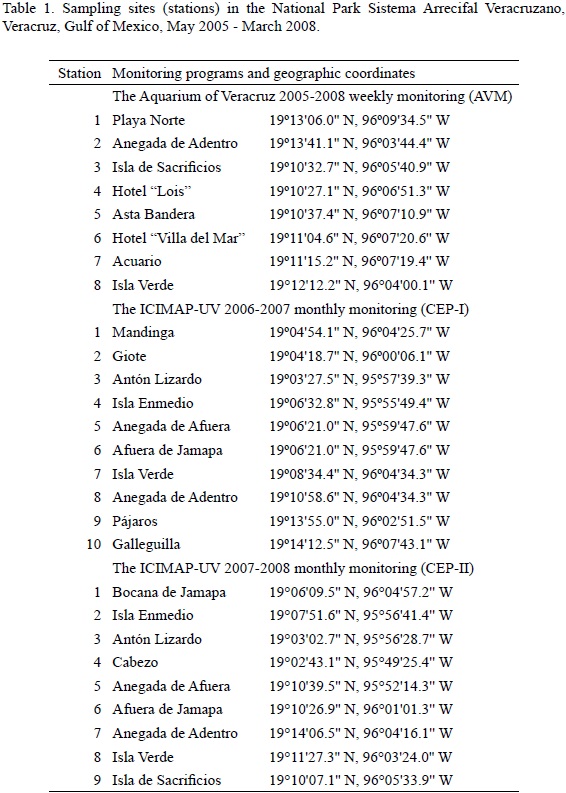
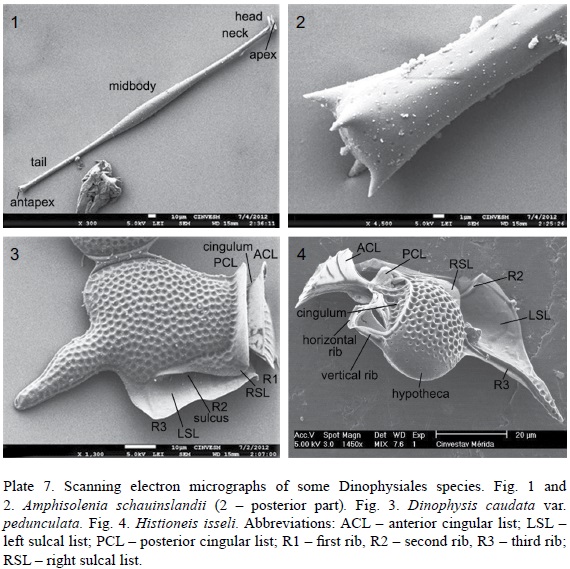
<body><![CDATA[<p align="justify"><font face="verdana" size="2">Phytoplankton samples were taken weekly with a hand net, 20 &#956;m mesh and 30 cm mouth diameter, from 27 sites (stations) throughout the National Park Sistema Arrecifal Veracruzano, southwestern Gulf of Mexico. Collections were made almost every week during the period from May 2005 through April 2008 as part of the monitoring program of the Aquarium of Veracruz (AVM), and two monthly monitoring programs were performed by ICIMAP&#45;UV, from September 2006 through September 2007 (CEP&#45;I), and from April 2007 through May 2008 (CEP&#45;II; <a href="#f1">Fig. 1</a>, <a href="#t1">Table 1</a>). Site depths ranged from 1.5 m to 34 m. At each station the net was towed horizontally for 5 min. at the velocity of the boat of ca. 2.5 knots to sample a superficial 30&#45;cm layer. The samples were fixed with a stock formaldehyde solution to a final concentration of 4% and stored in 100&#45;ml dark plastic bottles. To contrast the cells for an easier search and better photographs, a 0.2% Trypan Blue water solution was added to water mounts (Lebour, 1925; Taylor, 1978). About 700 samples were analyzed using a Nikon TS100 and an Olympus CKX41 inverted microscope for a Sedgwick&#45;Rafter 1&#45;ml chamber and an Olympus BX51 compound microscope for water mounts. The information about sampling and the laboratory analysis of benthic/epiphytic dinoflagellates was published earlier in detail (Okolodkov et al., 2007). For this study, only <i>Sinophysis</i> species were included, and they were sampled from both seaweeds and seagrasses growing on the sea bottom at St. 3 and 5, and at St. 2 from seaweeds attached to a plastic anchored buoy and its line, in the Aquarium of Veracruz monitoring. The cells were photographed mainly with an Olympus C7070 digital camera (<a href="#p1">Pl. 1</a>&#150;<a href="#p6">6</a>). Some samples were examined in a JEOL JSM&#45;7600F scanning electron microscope (SEM) at a working distance of 15 to 21 mm and a voltage of 1.2 to 5.0 kV after a preliminary wash in distilled water, followed by dehydration in a series of ethanol solutions of increasing concentration (30, 50, 70, 90 and 100%), air drying on 0.5" aluminium mounts and sputter coating with gold&#45;palladium using a Polaron SC7640 High Resolution Sputter Coater (Quorum Technologies, Newhaven, East Sussex, U. K.); some micrographs were obtained using a Philips XL&#45;30 environmental SEM (<a href="#p7">Pl. 7</a> and <a href="#p8">8</a>). Line drawings were made from digital images (<a href="#p10">Pl. 10</a>&#150;<a href="#p13">13</a>).</font></p> 	    <p align="center"><font face="verdana" size="2"><a name="f1"></a></font></p>         <p align="center"><font face="verdana" size="2"><img src="/img/revistas/abm/n106/a2f1.jpg"></font></p>         <p align="center"><font face="verdana" size="2"><a name="t1"></a></font></p>         <p align="center"><font face="verdana" size="2"><img src="/img/revistas/abm/n106/a2t1.jpg"></font></p>         <p align="justify">&nbsp;</p>  	    <p align="center"><font face="verdana" size="2"><a name="p1"></a></font></p>  	    <p align="center"><font face="verdana" size="2"><img src="/img/revistas/abm/n106/a2p1.jpg"></font></p>  	    <p align="center"><font face="verdana" size="2"><a name="p2"></a></font></p>  	    <p align="center"><font face="verdana" size="2"><img src="/img/revistas/abm/n106/a2p2.jpg"></font></p>  	    ]]></body>
<body><![CDATA[<p align="center"><font face="verdana" size="2"><a name="p3" id="p3"></a></font></p>  	    <p align="center"><font face="verdana" size="2"><img src="/img/revistas/abm/n106/a2p3.jpg"></font></p>  	    <p align="center"><font face="verdana" size="2"><a name="p4" id="p4"></a></font></p>  	    <p align="center"><font face="verdana" size="2"><img src="/img/revistas/abm/n106/a2p4.jpg"></font></p>  	    <p align="center"><font face="verdana" size="2"><a name="p5" id="p5"></a></font></p>  	    <p align="center"><font face="verdana" size="2"><img src="/img/revistas/abm/n106/a2p5.jpg"></font></p>  	    <p align="center"><font face="verdana" size="2"><a name="p6" id="p6"></a></font></p>  	    <p align="center"><font face="verdana" size="2"><img src="/img/revistas/abm/n106/a2p6.jpg"></font></p>  	    <p align="center"><font face="verdana" size="2"><a name="p7"></a></font></p>  	    <p align="center"><font face="verdana" size="2"><img src="/img/revistas/abm/n106/a2p7.jpg"></font></p>  	    ]]></body>
<body><![CDATA[<p align="center"><font face="verdana" size="2"><a name="p8" id="p8"></a></font></p>  	    <p align="center"><font face="verdana" size="2"><img src="/img/revistas/abm/n106/a2p8.jpg"></font></p>          <p align="center"><font face="verdana" size="2"><a name="p9" id="p9"></a></font></p>      <p align="center"><font face="verdana" size="2"><img src="/img/revistas/abm/n106/a2p9.jpg"></font></p>     <p align="center"><font face="verdana" size="2"><a name="p10" id="p10"></a></font></p>      <p align="center"><font face="verdana" size="2"><img src="/img/revistas/abm/n106/a2p10.jpg"></font></p>     <p align="center"><font face="verdana" size="2"><a name="p11" id="p11"></a></font></p>  	    <p align="center"><font face="verdana" size="2"><img src="/img/revistas/abm/n106/a2p11.jpg"></font></p>  	    <p align="center"><font face="verdana" size="2"><a name="p12" id="p12"></a></font></p>  	    <p align="center"><font face="verdana" size="2"><img src="/img/revistas/abm/n106/a2p12.jpg"></font></p>      ]]></body>
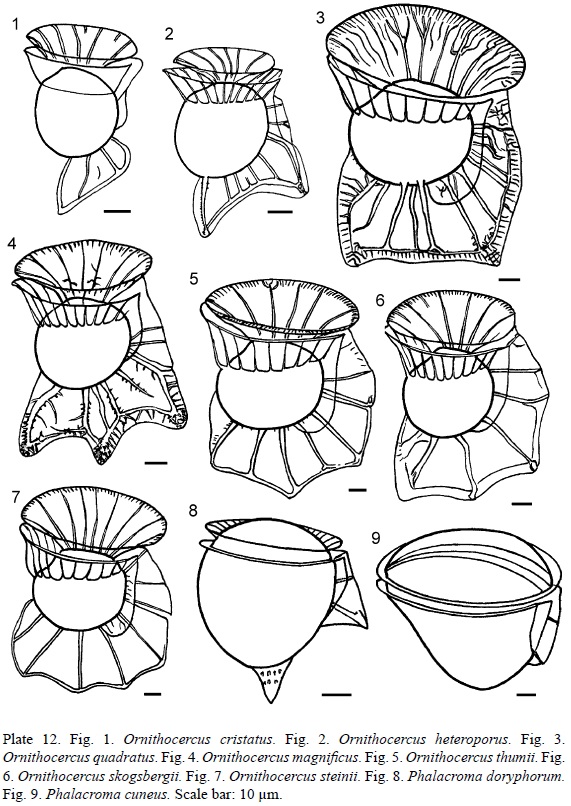
<body><![CDATA[<p align="center"><font face="verdana" size="2"><a name="p13" id="p13"></a></font></p>      <p align="center"><font face="verdana" size="2"><img src="/img/revistas/abm/n106/a2p13.jpg"></font></p>     <p align="justify"><font face="verdana" size="2">About 90 publications, abstracts and theses on the phytoplankton and dinoflagellates of the Gulf of Mexico were examined, with special emphasis on the state of Veracruz. Extensive old and new literature containing illustrations was analyzed and cited. The works where the species are illustrated are marked with asterisks: an asterisk (*) indicates line drawings, two asterisks (**) indicate light micrographs, and three asterisks (***) indicate scanning electron micrographs. Relative abundance was given according to the following criteria: extremely rare &#150; found in &lt;1% of the analyzed samples only occasionally (less than 25 cells were found in total), rare &#150; encountered in 1 to 10% of the samples as rare cells, common &#150; seen in 11 to 50% of the samples (normally as dozens of cells in a Sedgwick&#45;Rafter chamber), and very common &#150; found in &gt;50% of the samples (dozens or hundreds of cells per chamber). Abbreviations of authors of scientific names are used according to Brummitt &amp; Powell (1992), unless they are not listed in the book.</font></p>  	    <p align="justify"><font face="verdana" size="2">The abbreviations for cell measurements are as follows: Lb &#150; body length measured from the furthest part of the epitheca to the antapex of the hypotheca, not considering appendages or processes (lists or spines); Lt &#150; total length measured from the furthest part of the epitheca or the anterior cingular list to the furthest part of the posterior or posterior&#45;lateral processes or lists; Db &#150; maximum cell body depth measured in its widest part in lateral view, not considering the sulcal or cingular lists; Dt &#150; total depth, considering the sulcal and/or cingular lists. Sometimes the cell body width (W) was measured in ventral or dorsal view. All the measurements were performed using the 40x objective to maximize accuracy. To facilitate identification, the terminology is given (<a href="#p7">Pl. 7</a> and <a href="#p8">8</a>). Other abbreviations are: ACL &#150; anterior cingular list; LSL &#150; left sulcal list; PCL &#150; posterior cingular list; R1 &#150; first rib, R2 &#150; second rib, R3 &#150; third rib; RSL &#150; right sulcal list.</font></p>  	    <p>&nbsp;</p>  	    <p align="justify"><font face="verdana" size="2"><b>RESULTS</b></font></p>  	    <p align="justify"><font face="verdana" size="2">Below, the keys for identification of eight genera and 38 Dinophysiales species are presented, along with descriptions, light and scanning electron microscope photographs and line drawings.</font></p>  	    <p align="center"><font face="verdana" size="2">Key for identification of the genera of Dinophysiales</font></p>  	    <p align="center"><font face="verdana" size="2"><img src="/img/revistas/abm/n106/a2r1.jpg"></font></p>  	    <p align="justify"><font face="verdana" size="2">I. Genus <i>Amphisolenia</i> F. Stein</font></p>  	    ]]></body>
<body><![CDATA[<p align="justify"><font face="verdana" size="2">Key for identification of <i>Amphisolenia</i>species</font></p>  	    <p align="center"><font face="verdana" size="2"><img src="/img/revistas/abm/n106/a2r2.jpg"></font></p>  	    <p align="justify"><font face="verdana" size="2">1. <b><i>Amphisolenia</i></b> <i><b>bifurcata</b></i> <b>G. Murray et Whitting, 1899</b> (<a href="#p1">Pl. 1</a>, Fig. 1 and 2; <a href="#p10">Pl. 10</a>, Fig. 1 and 2).</font></p>  	    <p align="justify"><font face="verdana" size="2">Cells very long and thin, with a thin "neck", in lateral view slightly inflated in the anterior third (midbody), continuously tapering into a long "tail" (also called caudal appendix or caudal pedunculum; see Balech, 1988: 69), bifurcating at the distal third part of the cell into two asymmetric branch&#45;like processes that form an angle of ca. 45<sup>o</sup> between their proximal parts and are parallel or almost parallel between their distal portions directed straight back. These caudal processes are subequal in size, widest and most curved in their middle parts; however, the lower one is slightly longer and thicker. Both processes are slightly swollen in the middle, bearing a subterminal spinule at elbow and terminated with three spinules, positioned on slightly widened tips. The terminal portions of the caudal appendices are slightly thickened toward the end. The anterior half of the cell, in general, is similar to that in <i>A. bidentata</i>; however, the midbody is wider. Lt 975&#45;995 &#181;m (981.4&#177;6.3 &#181;m), W 35&#45;45 &#181;m (42.0&#177;4.7 &#181;m), the caudal appendices span 97&#45;110 &#181;m (103.4&#177;5.0 &#181;m); n=7.</font></p>  	    <p align="justify"><font face="verdana" size="2">Records in the State of Veracruz: Zamudio&#45;Resendiz, 1998; Okolodkov et al., 2011. Extremely rare in NPSAV; the species was found only on 1 March 2008 at St. 4 and 6 (CEP&#45;II).</font></p>  	    <p align="justify"><font face="verdana" size="2">References: Murray &amp; Whitting, 1899*: 331, pl. 31, fig. 1a&#45;d; Kofoid &amp; Skogsberg, 1928*: 432, fig. 56(6), pl. 12, fig. 1, 3, 5; Schiller, 1933*: 182, fig. 174 (after Kofoid &amp; Skogsberg, 1928); Balech, 1962*: 134, pl. 18, fig. 276; Steidinger &amp; Williams, 1970**: pl. 2, fig. 6; Tester &amp; Steidinger, 1979**: 27, fig. 55.</font></p>  	    <p align="justify"><font face="verdana" size="2">2. <b><i>Amphisolenia</i></b> <i><b>bidentata</b></i> <b>Schr&ouml;d., 1900</b> (<a href="#p1">Pl. 1</a>, Fig. 3&#45;5; <a href="#p10">Pl. 10</a>, Fig. 3 and 4).</font></p>  	    <p align="justify"><font face="verdana" size="2">Cells very long and thin, slightly sigmoid, with a thin "neck", in lateral view slightly inflated in the anterior quarter (midbody), continuously tapering into a long "tail", which is slightly curved upward and terminated with three spinules, one of which (subterminal, located at elbow) faces downward and the other two (terminal, located symmetrically on both sides of the "tail") upward; distal part of the "tail" is slightly widened, truncate and dorsoventrally compressed. The "head" is small, consisting of the epitheca and the cingulum, is positioned obliquely in relation to the longitudinal axis of the cell, looking anteriorly&#45;upward. The epitheca is slightly convex, separated from the cingulum by a rather wide list supported by several ribs. PCL continues into the sulcal lists along both sides of the "neck", reaching the "mid&#45;body", where it is widest. Lt 800&#45;870 &#181;m (851.2&#177;15.6 &#181;m), W 15&#45;24 &#181;m (19.1&#177;2.4 &#181;m); n=39.</font></p>  	    <p align="justify"><font face="verdana" size="2">Morphological note. A specimen 640 &#181;m long and 20 &#181;m wide, with a gradually tapering hypotheca ending with a thin theca with an acute end without spines, presumably belonging to <i>A. bidentata</i> (<a href="#p1">Pl. 1</a>, Fig. 5), was found at St. 4 on 1 March 2008 (CEP&#45;II).</font></p>  	    <p align="justify"><font face="verdana" size="2">Records in the State of Veracruz: Zamudio&#45;Resendiz, 1998; Figueroa&#45;Torres &amp; Weiss&#45;Mart&iacute;nez, 1999; Aquino&#45;Cruz, 2002**; Okolodkov et al., 2011. Rare in NPSAV (Feb., March, May, July, Dec.); the most common species of the genus <i>Amphisolenia</i> in the study area.</font></p>  	    ]]></body>
<body><![CDATA[<p align="justify"><font face="verdana" size="2">References: Schr&ouml;der, 1900*: 20, 35, pl. 1, fig. 16a, c; Kofoid &amp; Skogsberg, 1928*: 409, fig. 54(1&#45;4), 55, 56(1); Schiller, 1933*: 178, fig. 169a&#45;e (after Kofoid &amp; Skogsberg, 1928); Rampi, 1940*: 24, fig. 44; Silva, 1955*: 124, pl. 2, fig. 1&#45;4; Yamaji, 1966*: 72, pl. 33, fig. 11; Halim, 1967**: 704, pl. 1, fig. 2, pl. 2, fig. 15; Steidinger et al., 1967*: pl. 2, fig. a; Wood, 1968*: 18, fig. 19; Steidinger &amp; Tangen, 1996*: 426, pl. 10; Steidinger &amp; Williams, 1970**: pl. 2, fig. 5; Taylor, 1976*: 28, pl. 2, fig. 21, 22, pl. 3, fig. 21b, 22b; Balech, 1977*: 26, fig. 1&#45;14, 1988*: 69, pl. 17, fig. 2, 3, 13; Pesantes&#45;Santana, 1978*: 6, pl. 1, fig. 4&#45;7; Tester &amp; Steidinger, 1979**: 27, fig. 54; Hern&aacute;ndez&#45;Becerril, 1988a**: 188, pl. 1, fig. 1&#45;3; 1988b**: 10, fig. 52, 53; Licea et al., 1995* ***: 17, pl. 1, fig. 2a&#45;c, pl. 17, fig. 3; Hern&aacute;ndez&#45;Becerril et al., 2008**: 10, fig. 52, 53; Esqueda&#45;Lara &amp; Hern&aacute;ndez&#45;Becerril, 2010**: 170, fig. 163a&#45;d.</font></p>  	    <p align="justify"><font face="verdana" size="2">3. <b><i>Amphisolenia</i></b> <i><b>schauinslandii</b> </i><b>Lemmermann, 1899</b> (<a href="#p1">Pl. 1</a>, Fig. 6 and 7; <a href="#p7">Pl. 7</a>, Fig. 1 and 2; <a href="#p10">Pl. 10</a>, Fig. 5 and 6).</font></p>  	    <p align="justify"><font face="verdana" size="2">Cells long and thin, fusiform, with a thin "neck" and a straight hypotheca, in lateral view inflated in its middle part (midbody), gradually diminishing backward and only slightly widening at the truncate posterior end and bearing four spinules, directed posteriorly and almost equally distanced. Lt 415&#45;440 &#181;m (427.5&#177;17.7 &#181;m), W 20&#45;25 &#181;m (22.5&#177;3.5 &#181;m); n=2.</font></p>  	    <p align="justify"><font face="verdana" size="2">Records in the State of Veracruz: Okolodkov et al., 2011. Extremely rare in NPSAV; two cells were found on 1 March 2008 at St. 4 and 6 (CEP&#45;II). This is the first documented record of this species, not considering <i>A.</i> cf. <i>schauinslandi</i> mentioned by Zamudio&#45;Resendiz (1998).</font></p>  	    <p align="justify"><font face="verdana" size="2">References: Lemmermann, 1899*: 350, pl. 1, fig. 18, 19; Kofoid &amp; Skogsberg, 1928*: 374, fig. 49(4), pl. 7, fig. 1&#45;8; Schiller, 1933*: 169, fig. 155; Wood, 1968*: 21, fig. 31; Balech, 1988*: 71, pl. 17, fig. 9&#45;11.</font></p>  	    <p align="justify"><font face="verdana" size="2">4. <b><i>Amphisolenia</i></b> <i><b>schroederi</b></i> <b>Kof., 1907</b> (<a href="#p1">Pl. 1</a>, Fig. 8 and 9; <a href="#p10">Pl. 10</a>, Fig. 7 and 8).</font></p>  	    <p align="justify"><font face="verdana" size="2">Cells long and thin, fusiform, with a thin "neck" and slightly sigmoid posterior part of the hypotheca, in lateral view inflated in its middle part (midbody), gradually diminishing backward, bearing two terminal spinules at the antapex, directed posteriorly. Lt 312 &#181;m, W 19 &#181;m; n=1.</font></p>  	    <p align="justify"><font face="verdana" size="2">Morphological note. The specimen from Veracruz is also similar to <i>A. curvata</i> Kof., 1907 by the swelling in the middle of the cell, the presence of two terminal spinules, and curved posterior end of the cell. However, in <i>A. curvata</i> the "tail" is gradually curved to the dorsal side of the cell, and in <i>A. schroederi</i> the curvature is sigmoid and not so pronounced. Unlike the figures by Kofoid (1907) and Taylor (1976), who pictured the cells with a less clearly differentiated midbody, our specimen has a midbody much more differentiated from the rest of the cell. Our cell is quite different in a number of features from the specimen of <i>A. schroederi</i> illustrated and described by Balech (1962).</font></p>  	    <p align="justify"><font face="verdana" size="2">The first reliable record for the State of Veracruz. Extremely rare in NPSAV; the only cell was found on 26 October 2006 at St. 3 (AVM). It is the second record of this species in the Gulf of Mexico. Previously it was observed only at one (unknown) sampling site in the southern Gulf of Mexico (Licea et al., 2004) and also by Balech (1967b).</font></p>  	    <p align="justify"><font face="verdana" size="2">References: Kofoid, 1907*: 201, pl. 13, fig. 81; Kofoid &amp; Skogsberg, 1928*: 400, fig. 49(15), pl. 10, fig. 2&#45;4; Schiller, 1933*: 176, fig. 165; Balech, 1962*: 132, pl. 18, fig. 271.</font></p>  	    ]]></body>
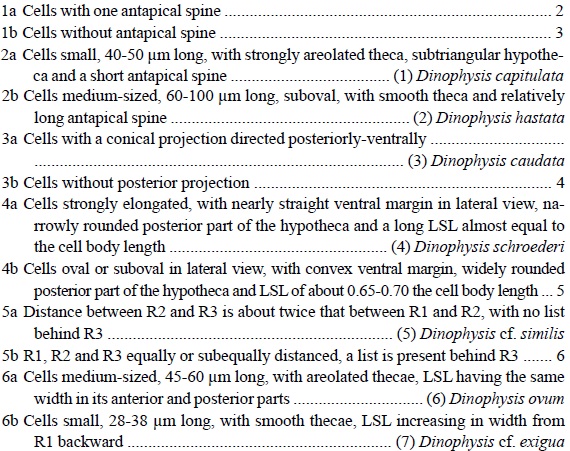
<body><![CDATA[<p>&nbsp;</p>  	    <p align="justify"><font face="verdana" size="2">II. Genus <i>Dinophysis</i> Ehrenberg</font></p>  	    <p align="justify"><font face="verdana" size="2">Key for identification of <i>Dinophysis</i>species</font></p>  	    <p align="center"><font face="verdana" size="2"><img src="/img/revistas/abm/n106/a2r3.jpg"></font></p>  	    <p align="justify"><font face="verdana" size="2"><b>1. <i>Dinophysis capitulata</i> Balech, 1967</b> (<a href="#p2">Pl. 2</a>, Fig. 1; <a href="#p10">Pl. 10</a>, Fig. 9).</font></p>  	    <p align="justify"><font face="verdana" size="2">Cells subtriangular, strawberry&#45;shaped, usually with a posteriorly attenuated hypotheca, terminating with a coarse triangular or subtriangular spine. In apical view, cells are almost circular. The theca is coarsely areolated. The cell is widest at the level of PCL. The cingulum is noticeably concave. The cingular lists are directed more laterally than anteriorly, supported by numerous coarse ribs that reach only the mid&#45;width of the lists. The sulcal lists are moderately wide. The distance between R2 and R3 is slightly longer than between R1 and R2. R3 is the thickest, straight or somewhat curved, slightly longer than R2. RSL continues well behind the base of R2 but does not reach R3. Lb 37.5&#45;42.5 &#181;m (40.0&#177;1.8 &#181;m), Lt 42.5&#45;50 &#181;m (44.5&#177;2.5 &#181;m), Db 33.5&#45;41.5 &#181;m (36.7&#177;2.1 &#181;m), Dt 40&#45;47.5 &#181;m (42.7&#177;2.3 &#181;m); n=14.</font></p>  	    <p align="justify"><font face="verdana" size="2">A new record for the southern Gulf of Mexico and the second known record for the entire Gulf (see Steidinger et al., 2009). Rare in NPSAV (Apr., Oct.).</font></p>  	    <p align="justify"><font face="verdana" size="2">References: Balech, 1967a*: 90, pl. 2, fig. 25&#45;31; 1988*: 56, pl. 14, fig. 1&#45;3.</font></p>  	    <p align="justify"><font face="verdana" size="2">2. <b><i>Dinophysis</i></b> <i><b>hastata</b></i> <b>F. Stein, 1883</b> (<a href="#p2">Pl. 2</a>, Fig. 2 and 3; <a href="#p10">Pl. 10</a>, Fig. 10). Syn.: <i>D. odiosa</i> (Pavill.) L. S. Tai et Skogsb., 1934: 448; (?) <i>Phalacroma hastatum</i> Pavill., 1909: 283, fig. 4.</font></p>  	    <p align="justify"><font face="verdana" size="2">Cells are irregularly ovoid or sometimes regularly ovoid, with a subtruncate anterior end and broadly or narrowly rounded posterior end, terminated with a strong triangular antapical spine directed posteriorly&#45;ventrally or in rare cases backward, often supported by a thick central rib. The cell is widest at the level of R3. Epitheca is very short, flat or slightly convex. The hypotheca is slightly asymmetrical in relation to the longitudinal axis of the cell, more narrowly rounded than the epitheca. The cingulum is slightly convex. The cingular lists are wide, directed laterally&#45;anteriorly; ACL is supported by numerous ribs. R1, R2 and R3 are equally spaced or with the longer distance between R2 and R3 (up to 1.5 times the distance between R1 and R2). R3 is the longest and the thickest, almost straight or slightly curved backward, almost reaching the level of the antapex. LSL is wide, often finely reticulate, RSL terminates at R3. Lb 45&#45;67.5 &#181;m (52.6&#177;9.8 &#181;m), Lt 60&#45;100 &#181;m (71.0&#177;14.0 &#181;m), Db 36.5&#45;57.5 &#181;m (44.4&#177;8.4 &#181;m), Dt 47.5&#45;82.5 &#181;m (59.0&#177;13.4 &#181;m); n=18.</font></p>  	    ]]></body>
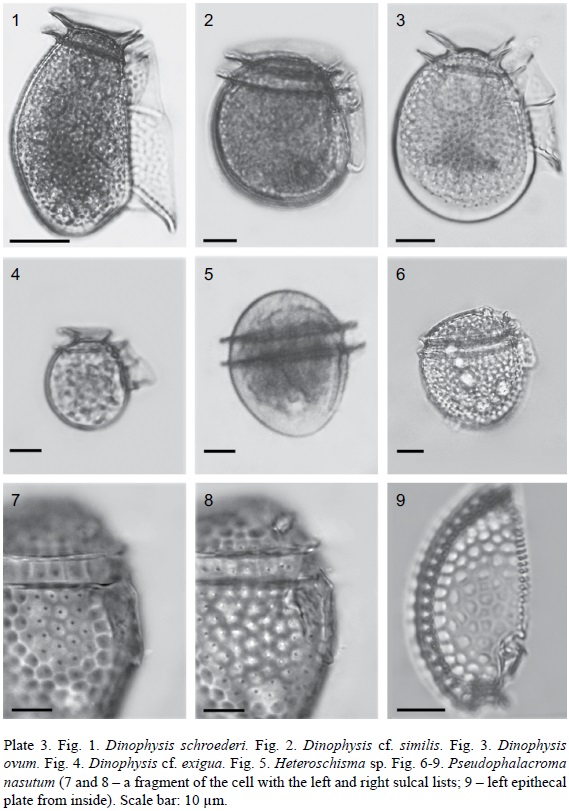
<body><![CDATA[<p align="justify"><font face="verdana" size="2">Taxonomic note. Judging from the wide morphological variation and the recently published data on molecular biology, it is a collective species, or the <i>Dinophysis hastata</i> group (also called the "hastata" group), hiding a number of cryptic species (Kofoid &amp; Skogsberg, 1928: 266; Ab&eacute;, 1967a: 77; Balech, 1967a: 282; Norris &amp; Berner Jr., 1970: 169; G&oacute;mez et al., 2011a: 404); the "hastata" group includes at least 21 species (Norris &amp; Berner Jr., 1970: 146). Based on the material from the NPSAV, variation is most visible in cell shape, the position and shape of the antapical spine, length and direction of R3, the distance between R2 and R3 and the longitudinal expansion of LSL. Halim (1967: 726, pl. 4, fig. 47) presented <i>D. hastata</i> under the name of <i>D. monacantha</i> Kof. et Skogsb., which I consider a misidentification. The diagnosis of the latter includes the statement about the cell shape: "body rounded trapeziform in lateral outline, deepest in or just behind the middle" (Kofoid &amp; Skogsberg, 1928: 283, 37(2, 3); that does not correspond to the specimen illustrated by Halim (1967), which is suboval and almost symmetrical in relation to the longitudinal axis of the cell.</font></p>  	    <p align="justify"><font face="verdana" size="2">Records in the State of Veracruz: Avenda&#150;o&#45;S&aacute;nchez &amp; Sotomayor&#45;Navarro, 1982; Zamudio&#45;Resendiz, 1998; Okolodkov et al., 2011. Extremely rare in NPSAV; the species was found only on 26 October 2006 at St. 3 (AVM).</font></p>  	    <p align="justify"><font face="verdana" size="2">References: Stein, 1883*: pl. 19, fig. 12; Paulsen, 1908*: 13, fig. 9 (after Stein, 1883); Lebour, 1925*: 83, fig. 21e (after Stein, 1883); Kofoid &amp; Skogsberg, 1928*: 261, fig. 32(1&#45;17), 33(1&#45;3); Schiller, 1933*: 138, fig. 131a&#45;f; B&ouml;hm, 1936*: 18, fig. 6a&#45;h; Rampi, 1940*: 22, fig. 40; Silva, 1956*: 17, pl. 1, fig. 26, 27 (as <i>D. diegensis</i>); Yamaji, 1966*: 71, pl. 32, fig. 17; Ab&eacute;, 1967a*: 76, fig. 25; Halim, 1967**: 726 (misidentified as <i>D. monacantha</i>); Norris &amp; Berner Jr., 1970*: 165, fig. 46&#45;59; Steidinger &amp; Williams, 1970**: pl. 17, fig. 48; Taylor, 1976*: 37, pl. 5, fig. 52&#45;55; Dodge, 1982* ***: 49, fig. 4C, pl. 2, fig. g; 1985***: 21; Balech, 1988*: 54, pl. 13, fig. 1&#45;3; Hallegraeff &amp; Lucas, 1988***: fig. 11, 15, 16, 26b; Steidinger &amp; Tangen, 1996*: 433, pl. 12; Hansen et al., 2001**: 29, pl. 2, fig. A; Larsen &amp; Nguyen, 2004**: 67, pl. 2, fig. 1&#45;2; Hern&aacute;ndez&#45;Becerril et al., 2008**: 6, fig. 15; Esqueda&#45;Lara &amp; Hern&aacute;ndez&#45;Becerril, 2010**: 151, fig. 144a&#45;c.</font></p>  	    <p align="justify"><font face="verdana" size="2">3a. <b><i>Dinophysis</i></b> <i><b>caudata</b></i> <b>Saville&#45;Kent, 1881</b> <b>var.</b> <b>pedunculata</b> <b>(Schmidt) Schr&ouml;d., 1906</b> (<a href="#p2">Pl. 2</a>, Fig. 4; <a href="#p7">Pl. 7</a>, Fig. 3; <a href="#p10">Pl. 10</a>, Fig. 11). Syn.: <i>D. homunculus</i> F. Stein, 1883, pro parte: 24, pl. 21, fig. 8; <i>Dinophysis diegensis</i> Kof., 1907 (Univ. Calif. Publ. Zool. 3, 13): 313, pl. 33, fig. 57&#45;61; <i>Dinophysis diegensis</i> f. <i>contracta</i> J. Schill., 1933: 152, fig. 144d.</font></p>  	    <p align="justify"><font face="verdana" size="2">Cells are irregularly trapezoidal, angulated, with a well separated hypothecal pointed conical projection directed posteriorly&#45;ventrally, up to 0.4 of the body length, which can bear 1 to 3 knob&#45;like spinules. The dorsal contour is straight or slightly concave along the anterior part of the hypotheca and convex along its middle part. The ventral contour is straight in general, slightly undulate. The cell is widest at the base of R3, distinctly tapering anteriorly. The theca is coarsely areolated. The cingulum is noticeably concave. The cingular lists are directed laterally&#45;anteriorly and supported by ribs. The sulcal lists are wide, often reticulate. The LSL is wide and relatively long, supported by three long, slightly curved ribs spaced equally apart; R3 is the longest. The distal margins of the LSL form almost a right angle. The RSL is wedge&#45;shaped, terminating at R3 and being very narrow between R2 and R3. Paired cells resulting from binary fission (asexual reproduction) are common. Lb 77.5&#45;90 &#181;m (86.8&#177;3.3 &#181;m), Lt 85&#45;101 &#181;m (96.9&#177;4.0 &#181;m), Db 42.5&#45;48.5 &#181;m (46.2&#177;1.6 &#181;m), Dt 52.5&#45;68.5 &#181;m&#160;63.1&#177;3.8 &#181;m); n=31.</font></p>  	    <p align="justify"><font face="verdana" size="2">Morphological note. Three gametes, previously known as <i>Dinophysis diegensis</i> Kof., were observed: small cells, Lb 55&#45;62.5 &#181;m (57.8&#177;4.1 &#181;m), Lt 62.5&#45;71 &#181;m (65.3&#177;4.9 &#181;m), Db 26&#45;30 &#181;m (27.8&#177;2.0 &#181;m), Dt 35.7&#177;2.9 (<a href="#p2">Pl. 2</a>, Fig. 7 and 8). Earlier it was hypothesized (Moita &amp; Sampayo, 1993; Reguera et al., 1995; Reguera &amp; Gonz&aacute;lez&#45;Gil, 2001) and experimentally shown (Reguera et al., 2007) that <i>D. diegensis</i> and <i>D. caudata</i> are synonymous. Gametes had slightly tapering anterior sides, pointed posteriorly, without a hypothecal projection or with a well marked tubular process of up to 0.25 of the cell body length, with the longest R1 and narrower sulcal lists. <i>Dinophysis caudata</i> is a rather variable species, which resulted in the description of a number of forms and varieties. I follow Balech's (1951) opinion, distinguishing only var. <i>pedunculata</i> and var. <i>abbreviata</i> within <i>D. caudata</i>.</font></p>  	    <p align="justify"><font face="verdana" size="2">Records in the State of Veracruz: Avenda&#150;o&#45;S&aacute;nchez &amp; Sotomayor&#45;Navarro, 1982 (as <i>D. homunculus</i>); Suchil&#45;Vilchis, 1990*; Zamudio&#45;Resendiz, 1998 (also, as <i>D. diegensis</i> Kof.); Figueroa&#45;Torres &amp; Weiss&#45;Mart&iacute;nez, 1999; Aquino&#45;Cruz, 2002* **; Estradas&#45;Romero, 2004; Tejeda&#45;Hern&aacute;ndez, 2005**; Hern&aacute;ndez&#45;Becerril et al., 2008; Okolodkov et al., 2011. In NPSAV it is the most common species of the genus <i>Dinophysis</i>. It was observed throughout the year.</font></p>  	    <p align="justify"><font face="verdana" size="2">References: Stein, 1883*: pl. 21, fig. 1, 2, 5, non 3, 4, 6&#45;8 (as <i>D. homunculus</i>); Paulsen, 1908*: 19, fig. 20 (left, not right; after Stein, 1883; as <i>D. homunculus</i>); 1931*: 34, fig. 19; Pavillard, 1916*: 56, fig. 15A (as <i>D. homunculus</i> type), 57, pl. 3, fig. 2 (as <i>D. diegensis</i> Kof. var. <i>caudata</i> nov. var.); Lebour, 1925*: 82, fig. 21c; Martin, 1929*: 21, pl. 4, fig. 14; Tai &amp; Skogsberg, 1934*: 453, fig. 9A&#45;K, 10D&#45;F; Curl, 1959*: 305, fig. 110 (erroneously written as 100 on p. 320); B&ouml;hm, 1935*: 277, fig. 4a&#45;i; 1936*: 20, fig. 7a&#45;c; Rampi, 1940*: 23, fig. 41; Balech, 1951*: 6, pl. 1, fig. 1, 10, pl. 3, fig. 45&#45;68, pl. 4, fig. 73&#45;76; Yamaji, 1966*: 70, pl. 32, fig. 13 and 14 (as <i>D. homunculus</i> and <i>D. homunculus</i> f. <i>pedunculatus</i> Schmidt; also, as <i>D. diegens</i> Kofoid and <i>D. diegens</i> Kofoid var. <i>caudata</i> Pavillard, both misspelled); Halim, 1967**: 726, pl. 4, fig. 48; Taylor, 1976*: 34, pl. 6, fig. 59; Tester &amp; Steidinger, 1979**: 30, fig. 74; Dodge, 1985***: 18 (fig. below, not above where <i>D. tripos</i> is illustrated); Hern&aacute;ndez&#45;Becerril, 1988a**: 192, pl. 5, fig. 34, 35 (a gamete; as <i>Dinophysis</i> sp.); Fukuyo et al., 1990** ***: 36, fig. A&#45;E; Delgado &amp; Fortu&#150;o, 1991*: fig. 4E; Licea et al., 1995**: 19, pl. 6, fig. 4; Steidinger &amp; Tangen, 1996*: 431, pl. 12; Hansen et al., 2001**: 28, pl. 2, fig. E; Faust &amp; Gulledge, 2002* ** ***: 26, pl. 13, fig. 1&#45;6; Larsen &amp; Nguyen, 2004**: 65, pl. 1, fig. 1&#45;5; Alonso&#45;Rodr&iacute;guez et al., 2008**: 133; Hern&aacute;ndez&#45;Becerril et al., 2008** ***: 3, fig. 6, 7, 9, 10 (also as <i>D. diegensis</i>); Al&#45;Kandari et al., 2009**: 151, pl. 3, fig. E&#45;H (p. 300); Esqueda&#45;Lara &amp; Hern&aacute;ndez&#45;Becerril, 2010** ***: 145, fig. 138a&#45;c.</font></p>  	    <p align="justify"><font face="verdana" size="2">3b. <b><i>Dinophysis</i></b> <i><b>caudata</b></i> <b>var.</b> <b>abbreviata</b> <b>J&ouml;rg., 1923</b> (<a href="#p2">Pl. 2</a>, Fig. 5 and 6; <a href="#p11">Pl. 11</a>, Fig. 1 and 2). Syn.: <i>Dinophysis homunculus</i> f. <i>ventricosa</i> Pavill., 1916: 56, fig. 15B; <i>D.</i> <i>caudata</i> f. <i>acutiformis</i> Kof. et Skogsb., 1928: 231.</font></p>  	    <p align="justify"><font face="verdana" size="2">Cells are irregularly ovoid, with rounded angles and a poorly separated hypothecal conical projection directed posteriorly&#45;ventrally, which can bear 1 to 3 knob&#45;like spinules. The dorsal contour is straight in the proximal part of the hypotheca. The cell is widest at the level of R3, tapering anteriorly. R1, R2 and R3 are almost equal in length. The LSL is wide but narrower than in var. <i>pedunculatum</i>. The RSL is wedge&#45;shaped, terminating at R3 and being very narrow between R2 and R3. The distal margin of the LSL is broadly rounded. Lb 60&#45;90 &#181;m (73.0&#177;5.9 &#181;m), Lt 70&#45;97.5 &#181;m (81.6&#177;6.2 &#181;m), Db 27.5&#45;47.5 &#181;m (40.0&#177;3.9 &#181;m), Dt 35&#45;67.5 &#181;m (50.4&#177;5.8 &#181;m); n=31.</font></p>  	    ]]></body>
<body><![CDATA[<p align="justify"><font face="verdana" size="2">Taxonomic note. Although Kofoid &amp; Skogsberg (1928: 227) believe that <i>D. caudata</i> f. <i>acutiformis</i> has &#171;a rather uncertain systematic status&#187;, I consider it synonymous to var. <i>abbreviata</i>.</font></p>  	    <p align="justify"><font face="verdana" size="2">Records in the State of Veracruz: Legar&iacute;a&#45;Moreno, 2003 (as <i>D. caudata</i> var. <i>ventricosa</i> Pavillard). Rather common in NPSAV, most frequent in July.</font></p>  	    <p align="justify"><font face="verdana" size="2">References: Rampi, 1940*: 24, fig. 42 (as <i>D. caudata</i> f. <i>acutiformis</i> Kof. et Skogsb.); Yamaji, 1966*: 70, pl. 32, fig. 15 (as <i>D. homunculus</i> f. <i>ventricosa</i> Pavillard); Steidinger et al., 1967*: pl. 2, fig. b (as <i>D. caudata</i> var. B); Pesantes&#45;Santana, 1978*: 20, pl. 14, fig. 4&#45;6.</font></p>  	    <p align="justify"><font face="verdana" size="2">4. <b><i>Dinophysis</i></b> <i><b>schroederi</b></i> <b>Pavill., 1909</b> (<a href="#p3">Pl. 3</a>, Fig. 1; <a href="#p11">Pl. 11</a>, Fig. 3).</font></p>  	    <p align="justify"><font face="verdana" size="2">Cells are asymmetrically subovoid, elongated, about 1.8 times longer than they are wide, with narrowly rounded epitheca and the posterior part of the hypotheca without antapical processes. The theca is coarsely areolated. The cell is widest at the level of the mid&#45;distance between R2 and R3. The epitheca is very short and small, slightly convex. The hypotheca is asymmetrical in relation to the longitudinal axis of the cell, with a narrowly rounded posterior part. Its dorsal margin is well rounded at the level beween R2 and R3 and slightly convex toward both ends, and its ventral margin is straight or almost straight between R1 and R3. The cingulum is slightly convex or flat. The cingular lists are relatively wide, directed laterally&#45;anteriorly. LSL is long and broad. RSL is subtrapezoidal, terminating just behind the base of R2. Both sulcal lists can be faintly or coarsely reticulate. The distance between R2 and R3 is about 1.5 times the distance between R1 and R2. R3 is the thickest and the longest, curved backward at its distal part, directed laterally&#45;posteriorly in general, about 1.8 times longer than R2, almost reaching the level of the antapex. Lb 67.5 &#181;m, Lt 70 &#181;m, Db 41.5 &#181;m, Dt 56.5 &#181;m; n=1.</font></p>  	    <p align="justify"><font face="verdana" size="2">A new record for the State of Veracruz. Extremely rare in NPSAV; the species was found only on 10 May 2005 at St. 2 (AVM).</font></p>  	    <p align="justify"><font face="verdana" size="2">References: Pavillard, 1909*: 284, fig. 5; 1916*: 58, pl. 3, fig. 5; Kofoid &amp; Skogsberg, 1928*: 257, fig. 31(6); Schiller, 1928*: 73, fig. 33; 1933*: 133, fig. 125; Rampi, 1940*: 21, fig. 28; Yamaji, 1966*: 70, pl. 32, fig. 6; Balech, 1971a*: 53, fig. 47&#45;53; Delgado &amp; Fortu&#150;o, 1991*: fig. 4C.</font></p>  	    <p align="justify"><font face="verdana" size="2">5. <b><i>Dinophysis</i></b> <i><b>cf.</b> <b>similis</b></i> <b>Kof. et Skogsb., 1928</b> (<a href="#p3">Pl. 3</a>, Fig. 2; <a href="#p11">Pl. 11</a>, Fig. 4).</font></p>  	    <p align="justify"><font face="verdana" size="2">Cells are of moderate size, suboval, markedly asymmetrical in relation to the longitudinal axis of the cell, convex dorsally and posteriorly and almost straight between the cingulum and R3 in lateral view, with strongly areolated theca. Epitheca is low, widely rounded. Hypotheca is very broadly rounded. LSL is long, terminating in about 3/4 the cell length, located closer to the antapex, with a rounded posterior margin and no list behind R3. Both R2 and R3 are curved anteriorly in their distal parts. The distance between R2 and R3 is about twice that between R1 and R2. RSL is rather small, with a rounded margin, ending in mid&#45;distance between R2 and R3. Lb 60 &#181;m, Db 53.5 &#181;m, Dt 61 &#181;m; n=1.</font></p>  	    <p align="justify"><font face="verdana" size="2">Morphological note. In the original description of <i>D. similis</i>, Kofoid &amp; Skogsberg (1928: 247) stated that R3 was "absent or rudimentary (very short)". Our specimen fits rather well the illustrations of two cells in lateral view by Balech (1988); however, our specimen differs by (1) the wider anterior part of the cell, (2) a more rounded RSL, (3) a noticeably areolated theca, (4) the presence of R3, and probably (4) by the absence of strong ribs supporting ACL.</font></p>  	    ]]></body>
<body><![CDATA[<p align="justify"><font face="verdana" size="2">A new record for the State of Veracruz. Extremely rare in NPSAV; the species was found only on 26 October 2006 at St. 3 (AVM).</font></p>  	    <p align="justify"><font face="verdana" size="2">References for <i>Dinophysis similis</i>: Kofoid et Skogsberg, 1928*: 247, fig. 31(1, 2); Balech, 1962*: 122, pl. 17, fig. 248&#45;250 (as <i>D. simplex</i> n. sp.; non <i>D. simplex</i> B&ouml;hm, 1933: 15, fig. 1a, b); 1988*: 42, pl. 6, fig. 1&#45;4.</font></p>  	    <p align="justify"><font face="verdana" size="2">6. <b><i>Dinophysis</i></b> <i><b>ovum</b></i> <b>F. Sch&uuml;tt, 1895</b> (<a href="#p3">Pl. 3</a>, Fig. 3; <a href="#p11">Pl. 11</a>, Fig. 5).</font></p>  	    <p align="justify"><font face="verdana" size="2">Cells are asymmetrically ovoid or subovoid, with a narrowly rounded epitheca and a broadly rounded hypotheca, without antapical processes. The theca is coarsely areolated. The cell is widest at the level of R3. The epitheca is very short and small, slightly convex. The hypotheca is asymmetrical in relation to the longitudinal axis of the cell, with the antapex slightly shifted ventrally. The cingulum is slightly convex or flat. The cingular lists are relatively wide, directed laterally&#45;anteriorly. LSL is moderately broad. RSL is subtriangular, terminating at the base of R2 or just behind it. Both sulcal lists can be faintly or coarsely reticulate. The distance between R2 and R3 is usually slighly longer, sometimes about 1.5 times the distance between R1 and R2. R3 is the thickest and the longest, straight or somewhat curved, directed laterally&#45;posteriorly or laterally, slightly longer than R2. Lb 42.5&#45;52.5 &#181;m (46.8&#177;2.8 &#181;m), Lt 47.5&#45;52.5 &#181;m (52.1&#177;3.1 &#181;m), Db 34&#45;42 &#181;m (36.8&#177;2.1 &#181;m), Dt 41.5&#45;52 &#181;m (45.8&#177;2.6 &#181;m); n=32.</font></p>  	    <p align="justify"><font face="verdana" size="2">Affinities. The species is very similar to the toxic <i>D. fortii</i>; however, in general, the cells are shorter, less asymmetrical in relation to the longitudinal axis of the cell, and the base of R3 is usually located further from the antapex, at the distance of 3/5&#45;2/3 of the cell length, while in <i>D. fortii</i> at about 2/3 (for comparison, see <i>D. fortii</i> in Tai &amp; Skogsberg, 1934: 439, fig. 5A&#45;D; Ab&eacute;, 1967a: 54, fig. 13; Balech, 1988: 43, pl. 6, fig. 19; Hallegraeff &amp; Lucas, 1988: fig. 29b; Fukuyo et al., 1990: 38, fig. A&#45;F; Larsen &amp; Moestrup, 1992: 6, fig. 4a&#45;c).</font></p>  	    <p align="justify"><font face="verdana" size="2">Records in the State of Veracruz: Avenda&#150;o&#45;S&aacute;nchez &amp; Sotomayor&#45;Navarro, 1982; Zamudio&#45;Resendiz, 1998. Rare in NPSAV (May, June, Aug.).</font></p>  	    <p align="justify"><font face="verdana" size="2">References: Sch&uuml;tt, 1895*: pl. 1, fig. 6; Paulsen, 1908*: 17, fig. 16 (after Sch&uuml;tt, 1895); Pavillard, 1916*: 58, pl. 3, fig. 3; Lebour, 1925*: 81, pl. 12, fig. 3; Schiller, 1928*: 73, fig. 33; 1933*: 116, fig. 109 (after Lebour, 1925); Martin, 1929*: 21, pl. 2, fig. 10; Rampi, 1940*: 20, fig. 33; Balech, 1962*: 125, pl. 16, fig. 205&#45;213; Yamaji, 1966*: 69, pl. 32, fig. 1; Ab&eacute;, 1967a*: 50, fig. 10a&#45;p; Steidinger &amp; Williams, 1970**: pl. 17, fig. 49; Pesantes&#45;Santana, 1978*: 20, pl. 14, fig. 8; Dodge, 1982*: 53, fig. 3J; Licea et al., 1995*: 20, pl. 20, fig. 14; Hern&aacute;ndez&#45;Becerril et al., 2008**: 6, fig. 20.</font></p>  	    <p align="justify"><font face="verdana" size="2">7. <b><i>Dinophysis</i></b> <i><b>cf.</b> <b>exig</b></i><b>ua</b> <b>Kof. et Skogsb., 1928</b> (<a href="#p3">Pl. 3</a>, Fig. 4; <a href="#p11">Pl. 11</a>, Fig. 6).</font></p>  	    <p align="justify"><font face="verdana" size="2">Cells are small, subglobal, somewhat asymmetrical in relation to the longitudinal axis of the cell, slightly ventrally compressed along LSL in lateral view. Thecal ornamentation is not distinguishable. The epitheca is very small, widely rounded. The cingulum is relatively narrow, slightly concave dorsally. The hypotheca is very broadly rounded posteriorly. LSL is relatively short, terminating about 0.6 of the cell length, continuously widening from R1 through R3. R1, R2 and R3 are equally distanced, R2 being longer than R1 but shorter than R3. RSL is as long as LSL but narrower, terminating at the base of R3. Lb 30&#45;40 &#181;m (35.0&#177;7.1 &#181;m), Db 27.5&#45;35 &#181;m (31.3&#177;6.0 &#181;m), Dt 36.5&#45;45 &#181;m (40.1&#177;6.0 &#181;m); n=2.</font></p>  	    <p align="justify"><font face="verdana" size="2">Morphological note. The species was originally described from the eastern tropical Pacific. The main difference between our cell and the cells described and illustrated by both Kofoid &amp; Skogsberg (1928) and Balech (1967a) is that the former has the LSL ribs equally distanced, and the latter has the distance between R2 and R3 about twice that between R1 and R2. Furthermore, these authors did not observe RSL, and in our specimen it was distinguishable, although faint. Another difference is that R3 is directed laterally in our cell and laterally&#45;posteriorly in the specimens pictured by the other authors.</font></p>  	    ]]></body>
<body><![CDATA[<p align="justify"><font face="verdana" size="2">A new record for the State of Veracruz. Rare in NPSAV; the species was found only on 26 October 2006 at St. 3 (AVM), 29 May and 7 October 2007 at St. 7 (CEP&#45;II).</font></p>  	    <p align="justify"><font face="verdana" size="2">References for <i>Dinophysis exigua</i>: Kofoid &amp; Skogsberg, 1928*: 239, fig. 30; Balech, 1967a*: 86, pl. 1, fig. 4&#45;12.</font></p>  	    <p>&nbsp;</p>  	    <p align="justify"><font face="verdana" size="2">III. Genus <i>Heteroschisma</i> Kof. et Skogsb. ex J. Schill.</font></p>  	    <p align="justify"><font face="verdana" size="2"><b><i>Heteroschisma</i></b> <b>sp.</b> (<a href="#p3">Pl. 3</a>, Fig. 5; <a href="#p11">Pl. 11</a>, Fig. 7).</font></p>  	    <p align="justify"><font face="verdana" size="2">Cell almost regularly oval, broadly rounded anteriorly and more narrowly rounded posteriorly, without any antapical processes. The theca is covered by numerous small poroids. Epitheca is rather long, about half the length of the hypotheca. Hypotheca is slightly compressed in the sulcal area. Cingulum is rather wide, about 1/7 of the cell length, slightly convex. Cingular lists are laterally directed. Sulcal lists are narrow. LSL is rather long, supported by a thin, straight R3, situated rather close to the antapex; R2 is undistinguishable. RSL seems to be short, subtriangular. Lb 37.5 &#181;m, Db 31.5 &#181;m, Dt 35 &#181;m; n=1.</font></p>  	    <p align="justify"><font face="verdana" size="2">Morphological note. Our cell is similar to that illustrated by Balech (1988: 38, pl. 5, fig. 1, 2), who failed to identify it to the species level, although he was almost sure that it was yet undescribed. Unlike Balech's specimen, our cell has the posterior margin of LSL not rounded and has a longer RSL.</font></p>  	    <p align="justify"><font face="verdana" size="2">A new record of a <i>Heteroschisma</i> species for the State of Veracruz. Extremely rare in NPSAV. The only cell was found on 26 October 2006 at St. 3 (AVM).</font></p>  	    <p>&nbsp;</p>  	    <p align="justify"><font face="verdana" size="2">IV. Genus <i>Pseudophalacroma</i> J&ouml;rg.</font></p>  	    ]]></body>
<body><![CDATA[<p align="justify"><font face="verdana" size="2"><b><i>Pseudophalacroma</i></b> <i><b>nasutum</b></i> <b>(F. Stein) J&ouml;rg., 1923</b> (<a href="#p3">Pl. 3</a>, Fig. 6&#45;9; <a href="#p11">Pl. 11</a>, Fig. 8). Bas.: <i>Phalacroma nasutum</i> F. Stein, 1883: pl. 18, fig. 1&#45;6. Syn.: <i>Prodinophysis nasuta</i> (F. Stein) A. R. Loebl., 1965: 16; <i>Dinophysis nasuta</i> (F. Stein) Parke et Dixon, 1968: 797.</font></p>  	    <p align="justify"><font face="verdana" size="2">Cell almost regularly oval, broadly rounded anteriorly and more narrowly rounded posteriorly, without any antapical processes. Theca is coarsely areolated. Epitheca is rather high, about 0.2 of the hypotheca. A large pore is located near the suture between two epithecal plates, on left side, at about 0.25 of the length of the left epithecal plate measured along the suture. Cingulum is rather narrow, deeply excavated, with one row of pores. Cingular lists are laterally directed. LSL is short (about half the length of the hypotheca) and narrow, ear&#45;shaped, supported by a curved R3, thickened at the base. RSL is barely visible in lateral view, trapezoidal, about 0.6 of the LSL length. Lb 50 &#181;m, Db 45 &#181;m, Dt 49 &#181;m, W 32 &#181;m; n=1.</font></p>  	    <p align="justify"><font face="verdana" size="2">Taxonomical note. A specimen from Veracruz shares the most of common features with <i>Pseudophalacroma</i> <i>nasutum</i> in Tai &amp; Skogsberg (1934): (1) one row of pores in the middle of the cingulum; (2) the apical pore rather far from the cingulum; (3) short, fairly narrow LSL rounded posteriorly, without marked ribs R1 and R2; (4) shape and length of RSL; and (5) coarsely areolated theca. Stein (1883) illustrated his specimen with more than one row of cingular pores and a widely rounded hypotheca. Tai &amp; Skogsberg (1934) gave a detailed description of both the genus <i>Pseudophalacroma</i> and the species <i>P. nasutum</i>, and our specimen corresponds rather well to the cells pictured in their work. However, our cell has the maximum depth just below the cingulum, while in Tai &amp; Skogsberg it is located in the middle part of the hypotheca. Abe (1967b: 104) considers that the species illustrated under the name of <i>Pseudophalacroma</i> <i>nasutum</i> cannot be assigned to the genus <i>Pseudophalacroma</i> and that most likely it is <i>Metaphalacroma</i>. The specimen from Veracruz is also similar to the type species <i>Heteroschisma inaequale</i> Kof. et Skogsb.; however, I cannot assign it either to the genus <i>Heteroschisma</i> Kof. et Skogsb. or to the genus <i>Metaphalacroma</i> Tai et Skogsb. because it has only one row of cingular pores (in both aforementioned genera there are two rows, judging from <i>H. inaequale</i> in Kofoid &amp; Skogsberg (1928: pl. 1, fig. 7, 8) and Tai &amp; Skogsberg (1934: 457, fig. 11).</font></p>  	    <p align="justify"><font face="verdana" size="2">A new record for the Gulf of Mexico, for which it has not yet been reported (see Steidinger et al., 2009: 149&#45;152). The only cell was found on 19 September 2007 at St. 2 (CEP&#45;II).</font></p>  	    <p align="justify"><font face="verdana" size="2">References: Tai &amp; Skogsberg, 1934*: 469, fig. 13A&#45;K.</font></p>  	    <p>&nbsp;</p>  	    <p align="justify"><font face="verdana" size="2">V. Genus <i>Histioneis</i> Stein</font></p>  	    <p align="justify"><font face="verdana" size="2">Key for identification of <i>Histioneis</i> species</font></p>  	    <p align="center"><font face="verdana" size="2"><img src="/img/revistas/abm/n106/a2r4.jpg"></font></p>  	    <p align="justify"><font face="verdana" size="2">1. <b><i>Histioneis paraformis</i></b> <b>(Kof. et Skogsb.) Balech, 1971</b> (<a href="#p4">Pl. 4</a>, Fig. 1; <a href="#p11">Pl. 11</a>, Fig. 9). Bas.: <i>Parahistioneis paraformis</i> Kof. et Skogsb., 1928: 598, fig. 93(4), pl. 19, fig. 3, 6. Syn.: <i>Histioneis para</i> G. Murray et Whitting, 1899, partim: 333, fig. 4c (non fig. 4a, b); <i>Parahistioneis acuta</i> B&ouml;hm, 1931 in J. Schill., 1933: 216, fig. 206; <i>Histioneis acuta</i> in Balech, 1971 (Publ. Serv. Hidrogr. Naval B. Aires H 654): pl. 3, fig. 50.</font></p>  	    ]]></body>
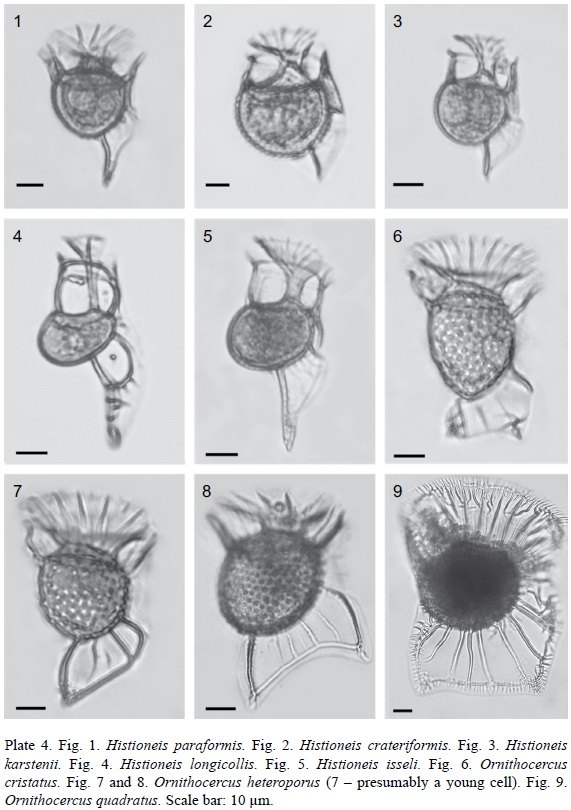
<body><![CDATA[<p align="justify"><font face="verdana" size="2">Cell bodies are suboval, symmetrical in relation to their longitudinal and latitudinal axes, with narrowly rounded antapex. The epitheca is small, centrally positioned. ACL is relatively wide, funnel&#45;shaped. PCL is moderately wide, about 0.5 of the cell body depth, supported with vertical divergent ribs directed anteriorly&#45;laterally. LSL is moderately developed, finely reticulate. R3 is about 1.5 times shorter than the cell body length, emerging ventrally&#45;posteriorly. Lb 27&#45;32.5 &#181;m (29.3&#177;2.5 &#181;m), Lt 55&#45;67.5 &#181;m (62.5&#177;6.1 &#181;m), Db 24&#45;30 &#181;m (26.9&#177;2.8 &#181;m), Dt 29&#45;42.5 &#181;m (37.3&#177;5.9 &#181;m); n=4.</font></p>  	    <p align="justify"><font face="verdana" size="2">Affinities. Our specimen corresponds more to <i>Histioneis acuta</i> in Balech (1971b: pl. 3, fig. 50), which is considered here, following Balech, a synonym to <i>H. paraformis</i>. A new combination, <i>Histioneis acuta</i>, appearing in Balech, 1971b (p. 15: as <i>H. acuta</i>; in figure legend to pl. 3, fig. 50 as <i>H. acuta</i>?) is invalid because no reference to the basionym was given. <i>Histioneis paraformis</i> is morphologically similar to <i>H. para</i> (see Murray &amp; Whitting, 1899*: pl. 32, fig. 4; Schiller, 1933*: 215, fig. 205a, b; Balech, 1962*: 137, pl. 17, fig. 254; 1988*: 65, pl. 15, fig. 4; Taylor, 1976* ***: 53, pl. 9, fig. 87, 88, pl. 41, fig. 490; Hern&aacute;ndez&#45;Becerril, 1988a**: 193, pl. 5, fig. 31, 32; Hern&aacute;ndez&#45;Becerril et al., 2008**: 7, fig. 65; Esqueda&#45;Lara &amp; Hern&aacute;ndez&#45;Becerril, 2010**: 159, fig. 150a&#45;c). However, the latter is different in having (1) a narrower rounded posterior end of the cell body, (2) a posterior rib (R3) emerging from the antapex, (3) the absence of ribs other than R3, and (4) a strongly reticulated LSL.</font></p>  	    <p align="justify"><font face="verdana" size="2">A new record for the State of Veracruz. Extremely rare in NPSAV; the species was found only on 26 October 2005 at St. 3 (AVM).</font></p>  	    <p align="justify"><font face="verdana" size="2">References: Murray &amp; Whitting, 1899*: 333, pl. 32, fig. 4c; Yamaji, 1966*: 71, pl. 32, fig. 19; Balech, 1971b*: 14, pl. 3, fig. 47&#45;49.</font></p>  	    <p align="justify"><font face="verdana" size="2">2. <b><i>Histioneis</i></b> <i><b>crateriformis</b></i> <b>F. Stein, 1883</b> (<a href="#p4">Pl. 4</a>, Fig. 2; <a href="#p11">Pl. 11</a>, Fig. 10). Syn.: <i>Parahistioneis crateriformis</i> F. Stein, 1883: pl. 22, fig. 5, 6; <i>P. acutiformis</i> Rampi, 1947: 5, fig. 4.</font></p>  	    <p align="justify"><font face="verdana" size="2">Cell bodies are kidney&#45;shaped, with the hypotheca symmetrical or slightly asymmetrical in relation to its longitudinal axis. The epitheca is minute. The dorsal edge of the cingulum is markedly concave and it is about twice as large as the ventral edge. ACL is about 0.36 of the cell body length, widely tubular, funnel&#45;shaped. PCL is short, about 0.33&#45;0.50 of the cell&#45;body length, slightly narrower than the maximum cell body depth, supported by somewhat curved vertical ribs. LSL is moderately developed, reticulate mostly in its anterior part (between R1 and R2). R3 is about 0.38&#45;0.46 of the cell body length, emerging ventrally&#45;posteriorly. Lb 30&#45;37.5 &#181;m (34.7&#177;4.1 &#181;m), Lt 50&#45;65 &#181;m (58.7&#177;7.8 &#181;m), Db 32.5&#45;35 &#181;m (33.8&#177;1.3 &#181;m), Dt 37.5&#45;42 &#181;m (39.8&#177;2.3 &#181;m); n=3.</font></p>  	    <p align="justify"><font face="verdana" size="2">Morphological note. All three examined cells demonstrated variation in the number of morphological characteristics, so that they can be ascribed either to <i>H. crateriformis</i> or <i>H. reticulata</i> Kof. et Skogsb. In the original illustration of <i>H. crateriformis</i> by Stein (1883), the ACL is as long as about 0.60 of the cell&#45;body length, which is the main distinguishing feature between Stein's specimens and our cells. On the other hand, in their original drawing Kofoid et Skogsberg (1928: pl. 19, fig. 7, 10) describe <i>H. reticulata</i> with a relatively robust cell body, a shorter R3 (0.25 of the cell&#45;body length) and finely reticulated LSL and PCL, which principally distinguishes this species from the the cells from Veracruz (a poorly visible reticulation was defined in three cells, but it did not occupy the whole LSL). Although I follow Balech's (1971b) opinion about the synonymy of <i>H. acutiformis</i> to <i>H. crateriformis</i>, one should consider that R3 in the former is much longer, and its position is different (more ventral), although the species was described on the basis of only one cell.</font></p>  	    <p align="justify"><font face="verdana" size="2">Records in the State of Veracruz: Zamudio&#45;Resendiz, 1998. Extremely rare in NPSAV; the species was found only on 26 October 2005 at St. 3 (AVM).</font></p>  	    <p align="justify"><font face="verdana" size="2">References: Stein, 1883*: 25, pl. 22, fig. 5, 6; Balech, 1971b*: 15, pl. 3, fig. 40&#45;46; 1988*: 68, pl. 15, fig. 8; Hern&aacute;ndez&#45;Becerril et al., 2008**: 6, fig. 63; Esqueda&#45;Lara &amp; Hern&aacute;ndez&#45;Becerril, 2010**: 157, fig. 151a, b.</font></p>  	    <p align="justify"><font face="verdana" size="2">3. <b><i>Histioneis</i></b> <i><b>karstenii</b></i> <b>Kof. et J. R. Michener, 1911</b> (<a href="#p4">Pl. 4</a>, Fig. 3; <a href="#p11">Pl. 11</a>, Fig. 11). Syn.: <i>Parahistioneis karstenii</i> (Kof. et J. R. Michener) Kof. et Skogsb., 1928: 603, fig. 93(2), pl. 19, fig. 2.</font></p>  	    ]]></body>
<body><![CDATA[<p align="justify"><font face="verdana" size="2">Cell bodies are suboval, slightly asymmetrical in relation to their longitudinal and latitudinal axes, with a larger dorsal half. The epitheca is minute, positioned slightly closer to the ventral side. ACL is about 0.5 of the cell body length, widely tubular, funnel&#45;shaped. PCL is short, less than 0.5 of the cell body depth, and as wide as the cell body depth, supported by somewhat curved vertical and horizontal ribs; the vertical ribs are parallel to each other in general. LSL is moderately developed, somewhat reticulate. R3 is about half of the cell body length, emerging ventrally&#45;posteriorly. Lb 25 &#181;m, Lt 50 &#181;m, Db 25 &#181;m, Dt 31.5 &#181;m; n=1.</font></p>  	    <p align="justify"><font face="verdana" size="2">Morphological note. Our specimen corresponds rather well with those in Kofoid &amp; Skogsberg (1928) and Rampi (1939, 1947). Unlike those authors, who pictured the cells with a list behind R3 clearly extended to the dorsal part of cell, the cell from Veracruz has a narrower list that does not reach the antapex. It is also somewhat similar to the cell of <i>H. oxypteris</i> J. Schill. illustrated by Schiller (1928: 82, pl. 3, fig. 6; non fig. 7, <i>lapsus clavis</i>); however, the latter has no R2 and lacks a list behind R3. On the contrary, our specimen looks very similar to the picture of the cell of <i>H. oxypteris</i> in Balech (1971b: 17, pl. 3, fig. 35&#45;36).</font></p>  	    <p align="justify"><font face="verdana" size="2">A new record for the State of Veracruz. Extremely rare in NPSAV; the species was found only on 26 October 2005 at St. 3 (AVM).</font></p>  	    <p align="justify"><font face="verdana" size="2">References: Kofoid &amp; Skogsberg, 1928*: 603, fig. 93(2), pl. 19, fig. 2; Schiller, 1933*: 217, fig. 207 (after Kofoid &amp; Skogsberg, 1928); Rampi, 1939*: 460, fig. 4; 1947*: 5, fig. 2.</font></p>  	    <p align="justify"><font face="verdana" size="2">4. <b><i>Histioneis</i></b> <i><b>longicollis</b></i> <b>Kof., 1907</b> (<a href="#p4">Pl. 4</a>, Fig. 4; <a href="#p11">Pl. 11</a>, Fig. 12).</font></p>  	    <p align="justify"><font face="verdana" size="2">Cell bodies are bean&#45;shaped or kidney&#45;shaped, concave anteriorly and convex posteriorly, asymmetrical in relation to their longitudinal and latitudinal axes, with a larger dorsal half. The epitheca is minute. The dorsal edge of the cingulum is slightly or moderately concave, and it is about 2&#45;3 times larger than the ventral edge, which is almost straight or somewhat convex. ACL is about 1.5 larger than the cell body length, narrowly tubular, funnel&#45;shaped, with the dorsal margin more extended than the ventral one. PCL is large, slightly narrower than the cell body depth, and it is as long as the cell body or even longer, supported by straight or sigmoid vertical (including 2 dorsal ribs) and horizontal ribs, forming a sort of subquadrangular chamber; horizontal ribs support PCL near its anterior margin. LSL is well developed, somewhat reticulate, posteriorly extending far beyond the cell body (up to 2.0&#45;2.8 times its length), supported ventrally&#45;posteriorly, along the inner side of LSL, mainly by 2 (or 3?) ribs that fuse, forming a suboval frame (window), continuing as the only rib directed backward. Lb 19&#45;24.5 &#181;m (20.8&#177;1.6 &#181;m), Lt 65&#45;81 &#181;m (69.5&#177;4.9 &#181;m), Db 24&#45;32.5 &#181;m (30.0&#177;2.5 &#181;m), Dt 35&#45;41 &#181;m (37.7&#177;1.6 &#181;m); n=11.</font></p>  	    <p align="justify"><font face="verdana" size="2">Affinities. Our cells show a morphology intermediate between that of <i>H. hyalina</i> Kof. et J. R. Michener (Kofoid &amp; Skogsberg, 1928*: 679, fig. 95(5), pl. 20, fig. 4) and <i>H. longicollis</i> (see Kofoid, 1907*: 204, pl. 16, fig. 100; Kofoid &amp; Skogsberg, 1928*: 677, fig. 95(7), pl. 20, fig. 5, pl. 21, fig. 5). I ascribe it to <i>H. longicollis</i> due to the longer cells and less anterior&#45;posterior compression of the cell body. Furthermore, it is similar to <i>H. joergensenii</i> J. Schill.; however, the latter has a slightly lower PCL, a markedly longer LSL, and a less anteriorily&#45;posteriorly compressed cell body (Schiller, 1928: 83, fig. 42). Additionally, some similarities occur between <i>H. longicollis</i> and <i>H. cymbalaria</i> F. Stein (= <i>H. depressa</i> J. Schill.), but the latter has a much more symmetrical and more anteriorily&#45;posteriorly compressed, shoe&#45;like cell body (see Stein, 1883*: 25, pl. 22, fig. 7&#45;10; Schiller, 1928*: 84, fig. 43; 1933*: 237, 240, fig. 230, 236; Rampi, 1941*: 119, fig. 1; 1947*: 12, fig. 14; Wood, 1963*: 6, fig. 13; 1968*: 77, fig. 212; Balech, 1971a*: 81, fig. 18&#45;19; 1971b*: 21, pl. 1, fig. 14&#45;17, pl. 2, fig. 18; Taylor, 1976*: 44, pl. 10, fig. 94; Esqueda&#45;Lara &amp; Hern&aacute;ndez&#45;Becerril, 2010**: 158, fig. 149a&#45;c). Even more species have a loop formed by the fission rib (R2) and the posterior rib (R3): <i>H. gubernans</i> F. Sch&uuml;tt, <i>H. pavillardii</i> Rampi, <i>H. detonii</i> Rampi (Rampi, 1939: 460, 461; 1940: 28, fig. 48; 1947: 11, 13), <i>H. pacifica</i> Kof. et Skogsb. (Kofoid &amp; Skogsberg, 1928: 681, fig. 95(12), pl. 20, fig. 8; Balech, 1971b: 17, pl. 2, fig. 22, 25, 27, 28), <i>H. mitchellana</i> G. Murray et Whitting (Murray &amp; Whitting, 1899: 335, pl. 33, fig. 3), and <i>H. voukii</i> J. Schill. (Schiller, 1928: 82, fig. 41). The problem of as yet unknown infraspecific variation significantly hinders the correct identification at the species level; for example, many <i>Histioneis</i> (more than 50% of known species) and <i>Dinophysis</i> species were described based on a single specimen (Balech, 1971b: 14; Hallegraeff &amp; Lucas, 1988: 25).</font></p>  	    <p align="justify"><font face="verdana" size="2">A new record for the State of Veracruz. Extremely rare in NPSAV; the species was found only on 26 October 2005 at St. 3 (AVM).</font></p>  	    <p align="justify"><font face="verdana" size="2">References: Kofoid et Skogsberg, 1928*: 679, fig. 95(5), pl. 20, fig. 4; Schiller, 1928*: 81, pl. 3, fig. 6; 1933*: 238, fig. 231a; Rampi, 1940*: 29, fig. 47; Balech, 1971b*: 19, pl. 2, fig. 26, 29, 31.</font></p>  	    <p align="justify"><font face="verdana" size="2">5. <b><i>Histioneis</i></b> <i><b>isseli</b></i> <b>Forti, 1932</b> (<a href="#p4">Pl. 4</a>, Fig. 5; <a href="#p7">Pl. 7</a>, Fig. 4; <a href="#p11">Pl. 11</a>, Fig. 13).</font></p>  	    ]]></body>
<body><![CDATA[<p align="justify"><font face="verdana" size="2">Cell bodies are kidney&#45; or bean&#45;shaped, asymmetrical in relation to their longitudinal and latitudinal axes, with a larger dorsal half. The epitheca is minute. ACL is about as long as the cell body length, widely tubular, funnel&#45;shaped. PCL is moderately developed, as wide as the cell body depth, and it is as long as the cell body, supported by slightly curved vertical and horizontal ribs. LSL is moderately developed, somewhat reticulate, markedly pitted before R2. R2 is small, curved, directed posteriorly&#45;laterally. R3 is slightly longer than the cell body, almost straight or somewhat curved, emerging from the antapical end of the body. Lb 25&#45;27.5 &#181;m (26.7&#177;1.4 &#181;m), Lt 72.5&#45;80 &#181;m (77.5&#177;4.3 &#181;m), Db 30&#45;37.5 &#181;m (34.2&#177;3.8 &#181;m), Dt 35&#45;45 &#181;m (40.0&#177;5.0 &#181;m); n=3.</font></p>  	    <p align="justify"><font face="verdana" size="2">Affinities. Our specimens have some features in common with <i>H. subcarinata</i> Rampi (Rampi, 1940*: 30, fig. 46 (as <i>H. carinata</i> Kof.); 1947*: 13, fig. 8; Balech, 1971b*: 20, pl. 2, fig. 19, 20). Unlike the latter, they have (1) less curved R3, (2) R2 directed posteriorly&#45;laterally, and (3) LSL of a different shape, especially in its posterior part. <i>Histioneis isseli</i> is also morphologically similar to <i>H. carinata</i> Kof. (Kofoid, 1907: 203, pl. 16, fig. 98); however, the latter has (1) a larger and wider, more anteriorly&#45;posteriorly compressed cell body, dorsally diminishing in size, (2) a much more curved R3, and (3) a LSL of a different shape, especially in its posterior part.</font></p>  	    <p align="justify"><font face="verdana" size="2">A new record for the Gulf of Mexico. Extremely rare in NPSAV; the species was found only on 26 October 2005 at St. 3 (AVM).</font></p>  	    <p align="justify"><font face="verdana" size="2">References: Forti, 1932*: 539, fig. 1; Hern&aacute;ndez&#45;Becerril, 1988a**: 192, pl. 2, fig. 8; 1988b**: pl. 1, fig. 8.</font></p>  	    <p>&nbsp;</p>  	    <p align="justify"><font face="verdana" size="2">VI. Genus <i>Ornithocercus</i> F. Stein</font></p>  	    <p align="justify"><font face="verdana" size="2">Key for identification of <i>Ornithocercus</i> species</font></p>  	    <p align="center"><font face="verdana" size="2"><img src="/img/revistas/abm/n106/a2r5.jpg"></font></p>  	    <p align="justify"><font face="verdana" size="2">1. <b><i>Ornithocercus</i></b> <i><b>cristatus</b></i> <b>Matzen., 1933</b> (<a href="#p4">Pl. 4</a>, Fig. 6; <a href="#p12">Pl. 12</a>, Fig. 1).</font></p>  	    <p align="justify"><font face="verdana" size="2">Cell body is small, suboval, elongated, slightly asymmetrical. Cingulum is not excavated. LSL extends to the antapex, with a more or less direct ventral margin and a sigmoid posterior margin, forming almost a right angle; behind the sulcus the LSL is supported with one thick and a number of thin ribs. Lb 30&#45;37 &#181;m (33.2&#177;3.5 &#181;m), Lt 65&#45;77 &#181;m (71.3&#177;6.0 &#181;m), Db 27.5&#45;32.5 &#181;m (30&#177;2.5 &#181;m), Dt 32.5&#45;54 &#181;m (45.5&#177;11.4 &#181;m); n=3.</font></p>  	    ]]></body>
<body><![CDATA[<p align="justify"><font face="verdana" size="2">Morphological note. All three cells were found in the same sample together with <i>O. heteroporus</i>, so their belonging to the latter should not be excluded (in this case, it may be a young cell, sometimes called schizont; see Norris, 1969). However, the examined cells are in accordance with the original line drawing by Matzenauer (1933) by (1) their elongated, almost symmetrical cell body (although our cells have a narrower rounded antapex), (2) the posterior margin of LSL parallel to the sulcus, (3) the absence of 2 or 3 thick main radial ribs, and (4) the cingulum not excavated. In Matzenauer's figure, LSL has a continuously convex margin.</font></p>  	    <p align="justify"><font face="verdana" size="2">A new record for the State of Veracruz. Extremely rare in NPSAV; the species was found only on 26 October 2005 at St. 3 (AVM).</font></p>  	    <p align="justify"><font face="verdana" size="2">References: Matzenauer, 1933*: 447, fig. 11; Balech, 1967a*: 93, pl. 2, fig. 38&#45;46; Hern&aacute;ndez&#45;Becerril et al., 2008**: 9, fig. 33.</font></p>  	    <p align="justify"><font face="verdana" size="2">2. <b><i>Ornithocercus</i></b> <i><b>heteroporus</b></i> <b>Kof., 1907</b> (<a href="#p4">Pl. 4</a>, Fig. 7 and 8; <a href="#p12">Pl. 12</a>, Fig. 2). Syn.: <i>Ornithocercus biclavatus</i> Wood, 1954: 211, fig. 66.</font></p>  	    <p align="justify"><font face="verdana" size="2">Cell bodies are small, oval, slightly elongated obliquely along the longitudinal axis (from its posterior dorsal end to anterior ventral end). Cingulum is slightly or not excavated. LSL extends to the antapex, with more or less direct or slightly convex ventral margin and concave posterior&#45;ventral margin; behind the sulcus it is supported by two thick main ribs as long as the cell depth, divergent in their proximal parts and parallel or slightly convergent in their distal parts, and 4&#45;5 additional thinner ribs. Lb 32.5&#45;35 &#181;m (33.8&#177;1.1 &#181;m), Lt 65&#45;80 &#181;m (72.9&#177;6.2 &#181;m), Db 30&#45;36.5 &#181;m (32.6&#177;3.6 &#181;m), Dt 45&#45;55 &#181;m (49.7&#177;3.4 &#181;m); n=5.</font></p>  	    <p align="justify"><font face="verdana" size="2">Records in the State of Veracruz: Okolodkov et al., 2011. Extremely rare in NPSAV; the species was found only on 26 October 2005 at St. 3 (AVM).</font></p>  	    <p align="justify"><font face="verdana" size="2">References: Kofoid, 1907*: 206, pl. 12, fig. 70; Kofoid &amp; Skogsberg, 1928*: 517, fig. 75, 76, pl. 18, fig. 1, 3; Schiller, 1933*: 195, fig. 187a&#45;d (after Kofoid &amp; Skogsberg, 1928); Rampi, 1940*: 25, fig. 53; Yamaji, 1966*: 72, pl. 33, fig. 9; Ab&eacute;, 1967b*: 81, fig. 28a, b; Taylor, 1976*: 48, pl. 8, fig. 83; Balech, 1988*: 59, pl. 14, fig. 4; Delgado &amp; Fortu&#150;o, 1991* ***: fig. 4M, pl. 32, fig. c; Licea et al., 1995*: 23, pl. 21, fig. 11; Steidinger &amp; Tangen, 1996*: 436, pl. 13; Hern&aacute;ndez&#45;Rosas et al., 2007**: 266, fig. 3c, 4(b1&#45;b5); Hern&aacute;ndez&#45;Becerril et al., 2008**: 9, fig. 32; Esqueda&#45;Lara &amp; Hern&aacute;ndez&#45;Becerril, 2010**: 162, fig. 155a&#45;c.</font></p>  	    <p align="justify"><font face="verdana" size="2">3. <b><i>Ornithocercus</i></b> <i><b>quadratus</b></i> <b>F. Sch&uuml;tt, 1900</b> (<a href="#p4">Pl. 4</a>, Fig. 9; <a href="#p12">Pl. 12</a>, Fig. 3). Syn.: <i>Histioneis quadrata</i> Lemmerm., 1901: 376; <i>Ornithocercus similis</i> J&ouml;rg., 1923: 37, fig. 51.</font></p>  	    <p align="justify"><font face="verdana" size="2">Cells bodies are large, suboval, slightly deeper than long, with the epitheca markedly displaced to the ventral side. Cingulum is dorsally excavated and distinctly wider than ventrally. LSL extends to one&#45;third (posterior&#45;dorsal) of the dorsal side of the cell, forming a more or less rectangular outline behind the cell body. Behind the sulcus it is supported by 8&#45;9 main ribs directed posteriorly&#45;laterally or posteriorly. Both ventral and dorsal margins of LSL are slightly convex, and the posterior margin is undulating, almost straight. Three posterior ribs (B, C and D; for rib designation, see Sch&uuml;tt, 1900: 254, Fig. 1&#45;10) are of equal or subequal length, located closer to each other. RSL is rather broad, extending almost to the antapex, terminating near the group of three posterior ribs. Small ribs originating from the surrounding rib are common along the margin of LSL from the sulcus to the dorsal side. Some cells with exosymbiotic cyanobacteria were observed. Lb 55&#45;66.5 &#181;m (59.5&#177;3.2 &#181;m), Lt 122&#45;142.5 &#181;m (130.5&#177;11.8 &#181;m), Db 63&#45;72.5 &#181;m (70.3&#177;5.0 &#181;m), Dt 91&#45;117.5 &#181;m (107.6&#177;13.2 &#181;m); n=10.</font></p>  	    <p align="justify"><font face="verdana" size="2">Morphological note. Our cells correspond to the observation by Ab&eacute; (1967b: 89) who described rib C as "lying somewhat slantwise as its basal end is deflected toward the right" and who was the first to illustrate this peculiarity, although it is not thinner than the neighboring ribs B and D.</font></p>  	    ]]></body>
<body><![CDATA[<p align="justify"><font face="verdana" size="2">Records in the State of Veracruz: Zamudio&#45;Resendiz, 1998; Aquino&#45;Cruz, 2002* ** (misidentification; referred to as <i>O. steinii</i>); Okolodkov et al., 2011. Very rare in NPSAV; the species was observed only on 13 October 2006 at St. 9 (CEP&#45;I) and on 26 October 2006 at St. 3 (AVM).</font></p>  	    <p align="justify"><font face="verdana" size="2">References: Sch&uuml;tt, 1900*: 5, fig. 1&#45;4, 12, 13; Kofoid &amp; Skogsberg, 1928*: 561, fig. 85(5), 86&#45;88, pl. 17, fig. 2, 8; Schiller, 1933*: 204, fig. 194a&#45;f, 195a&#45;d (after Kofoid &amp; Skogsberg, 1928); Rampi, 1939: 459, fig. 11; 1940*: 25, fig. 55; Ab&eacute;, 1967b*: 89, fig. 33a, b; Norris, 1969*: fig. 20; Taylor, 1976* ***: 50, pl. 8, fig. 77&#45;82, pl. 42, fig. 499&#45;501; Pesantes&#45;Santana, 1978*: 25, pl. 16, fig. 11; Dodge, 1985***: 29; Balech, 1988*: 60, pl. 14, fig. 10; Steidinger &amp; Tangen, 1996*: 436, pl. 13; Hern&aacute;ndez&#45;Rosas et al., 2007** ***: 267, fig. 2a&#45;f, 3f (mistakenly, in the legend to fig. 3 it is referred to fig. 3e), 4(d1&#45;d5), 11d; Esqueda&#45;Lara &amp; Hern&aacute;ndez&#45;Becerril, 2010**: 165, fig. 158a&#45;c (var. <i>assimilis</i> (J&ouml;rg.) Taylor), 166, fig. 159 (var. <i>simplex</i> Kof. et Skogsb.).</font></p>  	    <p align="justify"><font face="verdana" size="2">4. <b><i>Ornithocercus</i></b> <i><b>magnificus</b></i> <b>F. Stein, 1883</b> (<a href="#p5">Pl. 5</a>, Fig. 1&#45;3; <a href="#p8">Pl. 8</a>, Fig. 1 and 2; <a href="#p12">Pl. 12</a>, Fig. 4).</font></p>  	    <p align="justify"><font face="verdana" size="2">Cell bodies are relatively small, subcircular in lateral view, slightly asymmetrical in relation to the longitudinal axis, directed from the posterior dorsal end to anterior ventral end. Cingulum is slightly excavated. LSL extends to one&#45;third (posterior&#45;dorsal) of the dorsal side of the cell. Behind the sulcus it is supported by 5 main ribs directed posteriorly, of which 3 ribs (B, C and D) positioned antapically are located closer to each other, and the central rib of these three is situated out of the plane of the other two (which is clearly seen in ventral or dorsal view; <a href="#p7">Pl. 7</a>, Fig. 5 and 6). The posterior margin of LSL is clearly three&#45;lobed, forming two concavities asymmetrically located on both sides of the group of three posterior main ribs, the central rib being the longest. Sometimes the main ribs form anastomoses between them; the main ribs also do the same where they connect with the posterior marginal rib, forming nodes. RSL is narrow, terminating behind the main rib located closer to the sulcus. Some cells with exosymbiotic cyanobacteria were observed. Lb 40&#45;47 &#181;m (43.4&#177;2.1 &#181;m), Lt 92.5&#45;115 &#181;m (105.7&#177;7.1 &#181;m), Db 41&#45;46.5 &#181;m (43.3&#177;1.4 &#181;m), Dt 75&#45;93 &#181;m (83.4&#177;5.0 &#181;m); n=29.</font></p>  	    <p align="justify"><font face="verdana" size="2">Records in the State of Veracruz: Avenda&#150;o&#45;S&aacute;nchez &amp; Sotomayor&#45;Navarro, 1982; Zamudio&#45;Resendiz, 1998; Okolodkov et al., 2011. The most common species in the genus <i>Ornithocercus</i> in the study area (Jan., Aug., Oct. Nov., Dec.).</font></p>  	    <p align="justify"><font face="verdana" size="2">References: Stein, 1883*, pro parte: pl. 23, fig. 1, 2 (<i>non</i> fig. 3&#45;6); Sch&uuml;tt, 1895*: pl. 5, fig. 21; 1899*: 690, fig. 12; 1900*: 262, fig. 8&#45;10; Kofoid &amp; Skogsberg, 1928*: 529, fig. 79, 80, pl. 16, fig. 3; Schiller, 1933*: 198, fig. 190a, b (after Kofoid &amp; Skogsberg, 1928); Rampi, 1940*: 25, fig. 54; Silva, 1955*: 131, pl. 3, fig. 5; Yamaji, 1966*: 72, pl. 33, fig. 5; Ab&eacute;, 1967b*: 88, fig. 32a&#45;d; Norris, 1969*: 178, fig. 2&#45;15, 17(?); Steidinger &amp; Williams, 1970**: pl. 25, fig. 79; Taylor, 1976* ***: 49, pl. 7, fig. 67&#45;69, pl. 42, fig. 505a, b; Pesantes&#45;Santana, 1978*: 25, pl. 16, fig. 12; Tester &amp; Steidinger, 1979**: 30, fig. 75; Dodge, 1985***: 28; Balech, 1988*: 61, pl. 14, fig. 7, 8; Hern&aacute;ndez&#45;Becerril, 1988a**: 193, pl. 2, fig. 9, 10; Delgado &amp; Fortu&#150;o, 1991* ***: 5, fig. 4L, pl. 32, fig. d; Licea et al., 1995* ***: 23, pl. 8, fig. 3, pl. 21, fig. 12; Steidinger &amp; Tangen, 1996*: 436, pl. 13; Hern&aacute;ndez&#45;Rosas et al., 2007** ***: 266, fig. 3d, 4(c1&#45;c5), 11a, b; Alonso&#45;Rodr&iacute;guez et al., 2008**: 138; Hern&aacute;ndez&#45;Becerril et al., 2008**: 9, fig. 28; Al&#45;Kandari et al., 2009**: 153, pl. 5, fig. C (p. 302); Esqueda&#45;Lara &amp; Hern&aacute;ndez&#45;Becerril, 2010**: 163, fig. 156a&#45;c.</font></p>  	    <p align="justify"><font face="verdana" size="2">5. <b><i>Ornithocercus</i></b> <i><b>thumii</b></i> <b>(Schmidt) Kof. et Skogsb., 1928</b> (<a href="#p5">Pl. 5</a>, Fig. 4; <a href="#p12">Pl. 12</a>, Fig. 5). Bas.: <i>Parelion thumii</i> Schmidt, 1888: pl. 144(59&#45;61).</font></p>  	    <p align="justify"><font face="verdana" size="2">Cells bodies are large, suboval, slightly deeper than long, with the epitheca markedly displaced to the ventral side. The cingulum is dorsally excavated and distinctly wider than ventrally. LSL extends to one&#45;half of the dorsal side of the cell. Six main ribs behind the sulcus are spaced almost equally. The posterior margin of LSL is supported by 5 main ribs and forms two concavities between them; in the center of each of them the shorter ribs B and D are located. RSL is narrow, expanding continuously posteriorly, terminating about half&#45;way from the sulcus to the antapex. Some cells with exosymbiotic cyanobacteria were observed. Lb 50&#45;60 &#181;m (56.2&#177;2.8 &#181;m), Lt 112.5&#45;140 &#181;m (127.0&#177;9.5 &#181;m), Db 60&#45;67.5 &#181;m (62.5&#177;1.9 &#181;m), Dt 92.5&#45;120 &#181;m (101.9&#177;7.7 &#181;m); n=24.</font></p>  	    <p align="justify"><font face="verdana" size="2">Records in the State of Veracruz: Zamudio&#45;Resendiz, 1998; Okolodkov et al., 2011. Rare in NPSAV; the species was found only on 26 October 2005 at St. 3 (AVM).</font></p>  	    <p align="justify"><font face="verdana" size="2">References: Stein, 1883*: pl. 23, fig. 4, 5 (misidentification, reported as <i>O. magnificus</i>; <i>non</i> fig. 1&#45;3, 6); Sch&uuml;tt, 1900*: fig. 7 (misidentification, reported as <i>O. Steinii</i>); Kofoid &amp; Skogsberg, 1928*: 540 (mistakenly spelled as <i>O. thurni</i>), fig. 81, 82, pl. 18(4&#45;6); Schiller, 1933*: 201 (mistakenly spelled as <i>O. Thurnii</i>), fig. 191a&#45;h (after Murray &amp; Whitting, 1899; Kofoid &amp; Skogsberg, 1928); Yamaji, 1966*: 72, pl. 33, fig. 6 (misidentification, reported as <i>O. steinii</i>); Ab&eacute;, 1967b*: 90, fig. 34a&#45;i (mistakenly spelled as <i>O. thurnii</i>); Wood, 1968*: 87, fig. 244 (misidentification; reported as <i>O. steini</i>), fig. 245; Norris, 1969*: fig. 23 (mistakenly spelled as <i>O. thurni</i>); Steidinger &amp; Williams, 1970**: pl. 25, fig. 81; Taylor, 1976*: 53, pl. 7, fig. 71, 72, 74; Steidinger &amp; Tangen, 1996*: 437, pl. 13; Hern&aacute;ndez&#45;Rosas et al., 2007** ***: 269 (mistakenly, <i>O. magnificus</i> is indicated as a synonym to <i>O. thumii</i>), fig. 3i, 4(f1&#45;f5), 10a, 11f; Hern&aacute;ndez&#45;Becerril et al., 2008** ***: fig. 36, 37 (misidentification; referred to as <i>O. steinii</i>); Esqueda&#45;Lara &amp; Hern&aacute;ndez&#45;Becerril, 2010**: 168, fig. 161a&#45;c (misidentification; referred to as <i>O. steinii</i>), 169, fig. 162.</font></p>  	    ]]></body>
<body><![CDATA[<p align="justify"><font face="verdana" size="2">6.<i> <b>Ornithocercus</b> <b>skogsbergii</b></i> <b>T. H. Ab&eacute;, 1967</b> (<a href="#p5">Pl. 5</a>, Fig. 5; <a href="#p12">Pl. 12</a>, Fig. 6).</font></p>  	    <p align="justify"><font face="verdana" size="2">Cells bodies are relatively small, suboval, slightly deeper than long, with the epitheca markedly displaced to the ventral side. The cingulum is dorsally excavated and distinctly wider than ventrally. LSL extends to one&#45;half of the dorsal side of the cell. Five thick main ribs behind the sulcus are spaced almost equally. The posterior margin of LSL is supported by 3 main ribs and forms two concavities between them. RSL is narrow, expanding continuously posteriorly, terminating rather far from the antapex. One cell with exosymbiotic <i>Synechococcus</i> was observed. Lb 47 &#181;m, Lt 100 &#181;m, Db 50 &#181;m, Dt 80 &#181;m; n=1.</font></p>  	    <p align="justify"><font face="verdana" size="2">A new record for the State of Veracruz. Extremely rare in NPSAV; the species was found only on 10 May 2005 at St. 4 (AVM).</font></p>  	    <p align="justify"><font face="verdana" size="2">References: Ab&eacute;, 1967b*: 85, fig. 31a&#45;k; Taylor, 1976*: 51, pl. 7, fig. 70.</font></p>  	    <p align="justify"><font face="verdana" size="2">7. <b><i>Ornithocercus</i></b> <i><b>steinii</b></i> <b>F. Sch&uuml;tt, 1900</b> (<a href="#p5">Pl. 5</a>, Fig. 6; <a href="#p8">Pl. 8</a>, Fig. 3 and 4; <a href="#p12">Pl. 12</a>, Fig. 7). Syn.: <i>Ornithocercus serratus</i> Kof., 1907 (Bull. Mus. Compar. Zool. Harvard Coll. 50, 6): 206, pl. 15, fig. 93.</font></p>  	    <p align="justify"><font face="verdana" size="2">Cells bodies are large, suboval, slightly deeper than long, with the epitheca markedly displaced to the ventral side. The cingulum is dorsally excavated and distinctly wider than ventrally. LSL extends to nearly one&#45;half of the dorsal side of the cell. Six main ribs behind the sulcus are spaced almost equally. The posterior margin of LSL is supported by 4 main ribs and forms three concavities between them. RSL is narrow, expanding continuously posteriorly, terminating about half&#45;way from the sulcus to the antapex. Some cells with exosymbiotic cyanobacteria were observed. Lb 52&#45;62.5 &#181;m (58.8&#177;2.4 &#181;m), Lt 134&#45;162.5 &#181;m (141.3&#177;10.2 &#181;m), Db 62.5&#45;72.5 &#181;m (68.0&#177;2.6 &#181;m), Dt 90&#45;125 &#181;m (113.6&#177;6.7 &#181;m); n=35.</font></p>  	    <p align="justify"><font face="verdana" size="2">Records in the State of Veracruz: Avenda&#150;o&#45;S&aacute;nchez &amp; Sotomayor&#45;Navarro, 1982 (as <i>O. serratus</i>); Okolodkov et al., 2011. Rare in NPSAV (March, May, Oct.).</font></p>  	    <p align="justify"><font face="verdana" size="2">References: Sch&uuml;tt, 1900*, pro parte: fig. 5, 6 (<i>non</i> fig. 7); Silva, 1955*: 131, pl. 3, fig. 6 (?); Yamaji, 1966*: 72, pl. 33, fig. 7 (as <i>O. serratus</i>); Halim, 1967**: 731, pl. 5, fig. 65; Norris, 1969*: fig. 22; Steidinger &amp; Williams, 1970**: pl. 25, fig. 80; Taylor, 1976*: 52, pl. 7, fig. 72, 73; Pesantes&#45;Santana, 1978*: 25, pl. 17, fig. 1&#45;3 (mistakenly spelled as <i>O. Stein&uuml;</i>); Balech, 1988*: 61, pl. 15, fig. 1; Delgado &amp; Fortu&#150;o, 1991*: 5, fig. 4O; Licea et al., 1995***: 24, pl. 21, fig. 13; Steidinger &amp; Tangen, 1996*: 437, pl. 13; Hern&aacute;ndez&#45;Rosas et al., 2007** ***: 267, fig. 3h (mistakenly, in the legend to fig. 3 it is referred to fig. 3f), 4(e1&#45;e5), 10b, 11e.</font></p>  	    <p>&nbsp;</p>  	    <p align="justify"><font face="verdana" size="2">VII. Genus <i>Phalacroma</i> F. Stein</font></p>  	    ]]></body>
<body><![CDATA[<p align="justify"><font face="verdana" size="2">Key for identification of <i>Phalacroma</i> species</font></p>  	    <p align="center"><font face="verdana" size="2"><img src="/img/revistas/abm/n106/a2r6.jpg"></font></p>  	    <p align="justify"><font face="verdana" size="2">1. <b><i>Phalacroma</i></b> <i><b>doryphorum</b></i> <b>F. Stein, 1883</b> (<a href="#p5">Pl. 5</a>, Fig. 7; <a href="#p12">Pl. 12</a>, Fig. 8). Syn.: <i>Phalacroma doryphoroides</i> P. A. Dang., 1927 (Ann. l'Inst. Oc&eacute;anogr. Nouv. S&eacute;r. 4, 8): 380, fig. 44b, c; <i>Dinophysis doryphora</i> (F. Stein) T. H. Ab&eacute;, 1967 (Publ. Seto Mar. Biol. Lab. 15, 1): 77, fig. 26.</font></p>  	    <p align="justify"><font face="verdana" size="2">Cells are subovate, egg&#45;shaped, sometimes almost triangular, with a broadly rounded epitheca and narrowly tapered hypotheca terminating with a strong triangular spine, somewhat deflected ventrally. The cell is widest at the level of R2 or somewhat behind it. The epitheca is short, slightly convex. The hypotheca is slightly asymmetrical in relation to the longitudinal axis of the cell; its posterior part is more rounded dorsally and almost straight ventrally. The cingulum is slightly convex. The cingular lists are narrow, directed laterally&#45;anteriorly. LSL is wide, can be finely reticulate as also the antapical spine. The distance between R2 and R3 is aproximately 1.5 greater than between R1 and R2. R3 is the longest and the thickest, straight or slightly curved, directed laterally&#45;posteriorly, about 2.0&#45;2.5 times longer than R2, reaching the anterior two&#45;thirds of the length of the cell body. RSL terminates just behind R3. Lb 45&#45;72.5 (56.0&#177;6.5 &#181;m), Lt 61&#45;86 (66.2&#177;6.1 &#181;m), Db 37.5&#45;65 (50.3&#177;5.5 &#181;m), Dt 47.5&#45;80 (62.6&#177;6.4 &#181;m); n=16.</font></p>  	    <p align="justify"><font face="verdana" size="2">Records in the State of Veracruz: Avenda&#150;o&#45;S&aacute;nchez &amp; Sotomayor&#45;Navarro, 1982; Okolodkov et al., 2011. Rare in NPSAV; the species was found only on 26 October 2005 at St. 3 (AVM).</font></p>  	    <p align="justify"><font face="verdana" size="2">References: Stein, 1883*: 23, pl. 19, fig. 1&#45;4; Sch&uuml;tt, 1895*: 56, pl. 4, fig. 19; 1899*: 42, pl. 6, fig. 17; Kofoid &amp; Skogsberg, 1928*: 175, fig. 23(1&#45;5), 24; Schiller, 1933*: 99, fig. 91a, b (after Kofoid &amp; Skogsberg, 1928); Rampi, 1940*: 17, fig. 27; Yamaji, 1966*: 68, pl. 31, fig. 20; Ab&eacute;, 1967a*: 77, fig. 26; Norris &amp; Berner Jr., 1970*: 161, fig. 23&#45;45; Taylor, 1976*: 35, pl. 4, fig. 41, 42; Pesantes&#45;Santana, 1978*: 28, pl. 18, fig. 1; Hallegraeff &amp; Lucas, 1988***: fig. 8; Delgado &amp; Fortu&#150;o, 1991* ***: 4, fig. 4F, pl. 36, fig. d (as <i>D. doriphora</i>); Licea et al., 1995* ***: 19, pl. 6, fig. 5, pl. 20, fig. 12; Steidinger &amp; Tangen, 1996*: 439, pl. 17; Hansen et al., 2001**: 28, pl. 2, fig. B (as <i>D. doryphorum</i>); Hern&aacute;ndez&#45;Becerril et al., 2008**: 3, fig. 11; Esqueda&#45;Lara &amp; Hern&aacute;ndez&#45;Becerril, 2010**: 147, fig. 140.</font></p>  	    <p align="justify"><font face="verdana" size="2">2. <b><i>Phalacroma</i></b> <i><b>cuneus</b></i> <b>F.</b> <b>Sch&uuml;tt, 1895</b> (<a href="#p5">Pl. 5</a>, Fig. 8; <a href="#p12">Pl. 12</a>, Fig. 9). Syn.: <i>Phalacroma blackmanii</i> G. Murray et Whitting, 1899: 330, pl. 31, fig. 4a, b; <i>Dinophysis cuneus</i> (Sch&uuml;tt) T. H. Ab&eacute;, 1967 (Publ. Seto Mar. Biol. Lab. 15, 1): 68, fig. 21a&#45;h.</font></p>  	    <p align="justify"><font face="verdana" size="2">Cells are large, cuneate, with low, broadly rounded epitheca, much narrower rounded posterior portion of the hypotheca, and nearly straight or slightly convex (sometimes slightly concave) sides of the hypotheca, with coarsely reticulate theca. LSL is of moderate length and narrow, with three short supporting ribs of subequal size. The distance between R2 and R3 is aproximately twice that between R1 and R2. RSL is very narrow, barely visible. Lb 92.5&#45;97.5 &#181;m (95.0&#177;3.5 &#181;m), Db 97&#45;100 &#181;m (98.5&#177;2.1 &#181;m), Dt 107&#45;110 &#181;m (108.5&#177;2.1 &#181;m); n=2.</font></p>  	    <p align="justify"><font face="verdana" size="2">Morphological note. The cell outline and the measurements strongly depend on the tilting of the specimens under examination due to the cuneate shape of the cell in dorsal/ventral view. The species is morphologically similar to <i>P. giganteum</i> Kof. et J. R. Michener known from the eastern tropical Pacific, the length of which is 148 &#181;m (Kofoid &amp; Skogsberg, 1928: 136, pl. 2, fig. 2, 4, pl. 3, fig. 2, fig. 14(1).</font></p>  	    <p align="justify"><font face="verdana" size="2">Records in the State of Veracruz: Avenda&#150;o&#45;S&aacute;nchez &amp; Sotomayor&#45;Navarro, 1982 (misspelled: <i>P. cuncus</i>); Zamudio&#45;Resendiz, 1998. Extremely rare in NPSAV; the species was found only on 26 October 2005 at St. 3 (AVM).</font></p>  	    ]]></body>
<body><![CDATA[<p align="justify"><font face="verdana" size="2">References: Sch&uuml;tt, 1895*: 148, pl. 3, fig. 14; 1896*: 27, fig. 38B; Kofoid &amp; Skogsberg, 1928*: 124, fig. 12, 13; Schiller, 1933*: 89, fig. 76a&#45;d (after Murray &amp; Whitting, 1899; Kofoid &amp; Skogsberg, 1928); Rampi, 1940*: 16, fig. 22; Balech, 1962*: 129, pl. 17, fig. 238&#45;242, 247 (some thecal plates); Yamaji, 1966*: 67, pl. 31, fig. 16; Halim, 1967**: 749, pl. 7, fig. 92, 93; Taylor, 1976*: 35, pl. 5, fig. 46, 47; Dodge, 1985***: 19; Hallegraeff &amp; Lucas, 1988***: fig. 18, 23b; Delgado &amp; Fortu&#150;o, 1991***: 4, pl. 37, fig. c, d; Steidinger &amp; Tangen, 1996*: 439, pl. 14; Hern&aacute;ndez&#45;Becerril et al., 2008**: 3, fig. 8; Esqueda&#45;Lara &amp; Hern&aacute;ndez&#45;Becerril, 2010**: 146, fig. 139a&#45;d.</font></p>  	    <p align="justify"><font face="verdana" size="2">3. <b><i>Phalacroma</i></b> <i><b>apicatum</b></i> <b>Kof. et Skogsb., 1928</b> (<a href="#p5">Pl. 5</a>, Fig. 9; <a href="#p13">Pl. 13</a>, Fig. 1). Syn.: <i>Dinophysis apicata</i> (Kof. et Skogsb.) T. H. Ab&eacute;, 1967 (Publ. Seto Mar. Biol. Lab. 15, 1).</font></p>  	    <p align="justify"><font face="verdana" size="2">Cells are large, suboval, slightly asymmetrical in relation to the longitudinal axis of the cell, with a steeper posterior&#45;ventral margin compared to the posterior&#45;dorsal one, with coarsely reticulate theca. The epitheca is high and narrowly rounded at the apex. LSL is long and narrow, ending relatively close to the antapex, with barely visible supporting ribs. RSL is about half the length of LSL, forming an inferior concavity bordered with a thickened crest. Lb 95&#45;102 &#181;m (98&#177;2.7 &#181;m), Db 75&#45;82.5 &#181;m (78.5&#177;2.2 &#181;m), Dt 82.5&#45;92 (87.6&#177;2.7 &#181;m); n=7.</font></p>  	    <p align="justify"><font face="verdana" size="2">Affinities. The species is morphologically similar to <i>P. argus</i>, distinguished from the latter by (1) its narrower rounded epitheca at the apex, (2) larger cell size, (3) higher L:D ratio, and (4) longer LSL.</font></p>  	    <p align="justify"><font face="verdana" size="2">A new record for the State of Veracruz. Extremely rare in NPSAV; the species was found only on 26 October 2005 at St. 3 (AVM).</font></p>  	    <p align="justify"><font face="verdana" size="2">References: Kofoid &amp; Skogsberg, 1928*: 111, fig. 10; Schiller, 1933*: 76, fig. 68a&#45;c (after Kofoid &amp; Skogsberg, 1928); Pesantes&#45;Santana, 1978*: 29, pl. 18, fig. 2; Taylor, 1976*: 33, pl. 4, fig. 36; Hern&aacute;ndez&#45;Becerril et al., 2008**: 3, fig. 4; Esqueda&#45;Lara &amp; Hern&aacute;ndez&#45;Becerril, 2010**: 143, fig. 136.</font></p>  	    <p align="justify"><font face="verdana" size="2">4. <b><i>Phalacroma argus</i></b> <b>F. Stein, 1883</b> (<a href="#p6">Pl. 6</a>, Fig. 1; <a href="#p13">Pl. 13</a>, Fig. 2). Syn.: <i>Dinophysis argus</i> (F. Stein) T. H. Ab&eacute;, 1967 (Publ. Seto Mar. Biol. Lab. 15, 1), pro parte: 71, non fig. 23a, b.</font></p>  	    <p align="justify"><font face="verdana" size="2">Cells are large, oval, symmetrical in relation to the longitudinal axis of the cell, with coarsely reticulate theca. The epitheca is high and broadly rounded. LSL is of moderate length and narrow, with barely visible supporting ribs. RSL is about two&#45;thirds of LSL in length, forming an inferior concavity bordered with a thickened crest. Lb 80&#45;82.5 &#181;m (81.3&#177;1.8 &#181;m), Db 70&#45;71.5 &#181;m (70.8&#177;1.1 &#181;m), Dt 76.5&#45;80 &#181;m (78.3&#177;2.5 &#181;m); n=2.</font></p>  	    <p align="justify"><font face="verdana" size="2">Morphological note. Unlike Stein (1883: pl. 18, fig. 16), Sch&uuml;tt (1895: pl. 3, fig. 15), Balech (1988: pl. 11, fig. 9, 10) and Taylor (1976: pl. 4, fig. 35) illustrate the cells of this species with a slightly asymmetrical cell shape in lateral view, with a steeper posterior&#45;ventral margin. The species illustrated by Licea et al. (1995: 18, pl. 1, fig. 1) as <i>D. argus</i> is a misidentification. Most likely, it was confused with <i>Phalacroma rotundata</i>.</font></p>  	    <p align="justify"><font face="verdana" size="2">Records in the State of Veracruz: Okolodkov et al., 2011. Extremely rare in NPSAV; the species was found only on 26 October 2005 at St. 3 (AVM).</font></p>  	    ]]></body>
<body><![CDATA[<p align="justify"><font face="verdana" size="2">References: Stein, 1883*: pl. 18, fig. 15&#45;17; Kofoid &amp; Skogsberg, 1928*: 104, fig. 8(1, 2), 9; Schiller, 1933*: 74, fig. 67a (after Kofoid &amp; Skogsberg, 1928); Rampi, 1940*: 15, fig. 17; Taylor, 1976*: 33, pl. 4, fig. 35 (as <i>D. argus</i>); Pesantes&#45;Santana, 1978*: 29, pl. 18, fig. 3; Steidinger &amp; Tangen, 1996*: 437, pl. 14; Hern&aacute;ndez&#45;Becerril et al., 2008**: 3, fig. 5; Esqueda&#45;Lara &amp; Hern&aacute;ndez&#45;Becerril, 2010**: 144, fig. 137a&#45;c.</font></p>  	    <p align="justify"><font face="verdana" size="2">5. <b><i>Phalacroma</i></b> <i><b>hindmarchii</b></i> <b>G. Murray et Whitting, 1899</b> (<a href="#p6">Pl. 6</a>, Fig. 2; <a href="#p13">Pl. 13</a>, Fig. 3). Syn.: <i>Dinophysis hindmarchii</i> (G. Murray et Whitting) Balech, 1967 (Rev. Mus. Argent. Cienc. Natur. "B. Rivadavia" Hidrobiol. 2, 3): 83.</font></p>  	    <p align="justify"><font face="verdana" size="2">Cells of moderate size, inverted fig&#45;shaped, almost symmetrical in relation to the longitudinal axis of the cell, with the theca bearing numerous scattered pores. Epitheca is high, very broadly rounded. Hypotheca is mostly with convex sides, with well&#45;separated antapical bulb directed posteriorly. LSL is moderately wide. R3 is club&#45;shaped, the longest and the thickest among three supporting ribs. The distance between R2 and R3 is aproximately 1.5 times greater than that between R1 and R2. RSL is narrow, terminating just behind R3. Lb 85&#45;90 &#181;m (86.7&#177;1.9 &#181;m), Db 70&#45;97.5 &#181;m (75.1&#177;9.9 &#181;m), Dt 77.5&#45;106.5 &#181;m (83.8&#177;10.2 &#181;m); n=7.</font></p>  	    <p align="justify"><font face="verdana" size="2">Records in the State of Veracruz: Zamudio&#45;Resendiz, 1998 (as <i>D.</i> cf. <i>hindmarchii</i>). Extremely rare in NPSAV; the species was found only on 26 October 2005 at St. 3 (AVM).</font></p>  	    <p align="justify"><font face="verdana" size="2">References: Murray &amp; Whitting, 1899*: 330, pl. 31, fig. 5; Kofoid &amp; Skogsberg, 1928*: 150, fig. 18, 19; Schiller, 1933*: 92, fig. 84a&#45;c; Balech, 1962*: 130, pl. 17, fig. 243&#45;246; Hern&aacute;ndez&#45;Becerril et al., 2008**: 6, fig. 14.</font></p>  	    <p align="justify"><font face="verdana" size="2">6. <b><i>Phalacroma</i></b> <i><b>rapa</b></i> <b>F. Stein, 1883</b> (<a href="#p6">Pl. 6</a>, Fig. 3; <a href="#p9">Pl. 9</a>, Fig. 1; <a href="#p13">Pl. 13</a>, Fig. 4). Syn.: <i>Dinophysis rapa</i> (F. Stein) T. H. Ab&eacute;, 1967 (Publ. Seto Mar. Biol. Lab. 15, 1): 66, fig. 19.</font></p>     <p align="justify"><font face="verdana" size="2">Cells are large, strongly asymmetrical in relation to the longitudinal axis of the cell, with coarsely areolated theca. Epitheca is broadly rounded. Hypotheca is cuneate in its posterior portion, with a markedly attenuated antapex tilted toward the ventral part of the cell, dorsally convex, narrowly rounded at the antapex, and strongly concave between the antapex and LSL. LSL is wide, ending far from the antapex. The distance between R2 and R3 is equal to the distance between R1 and R2 or slightly longer. R3 is about twice as long as R1 and about 1.5 times longer than R2. RSL is rather wide, ending just behind R3. Lb 65&#45;82.5 &#181;m (78.0&#177;3.9 &#181;m), Db 50&#45;67.5 &#181;m (61.1&#177;3.8 &#181;m), Dt 64&#45;82.5 &#181;m (73.9&#177;4.8 &#181;m); n=31.</font></p>  	    <p align="justify"><font face="verdana" size="2">Affinities. The species is similar to <i>P. mitra</i>, distinguished from the latter mainly by its size and more pronouncedly emerging posterior portion of the hypotheca.</font></p>  	    <p align="justify"><font face="verdana" size="2">Records in the State of Veracruz: Okolodkov et al., 2011; Parra&#45;Toriz et al., 2011**. Rare in NPSAV (Oct., Nov., Dec.).</font></p>  	    <p align="justify"><font face="verdana" size="2">References: Stein, 1883*: pl. 19, fig. 5&#45;8; Pavillard, 1916*: 55, fig. 13A; Kofoid &amp; Skogsberg, 1928*: 139, fig. 16; Schiller, 1933*: 88, fig. 80a&#45;d (after Kofoid &amp; Skogsberg, 1928); Rampi, 1940*: 16, fig. 23; Silva, 1956*: 355, pl. 3, fig. 4; Taylor, 1976* ***: 40, pl. 5, fig. 48a, b, pl. 41, fig. 488; Pesantes&#45;Santana, 1978*: 29, pl. 18, fig. 5, 6; Hallegraeff &amp; Lucas, 1988***: fig. 6, 19; Delgado &amp; Fortu&#150;o, 1991***: 5, pl. 35, fig. a, b; Licea et al., 1995**: 21, pl. 6, fig. 6; Steidinger &amp; Tangen, 1996*: 439, pl. 14; Hansen et al., 2001**: 31, pl. 2, fig. G; Hern&aacute;ndez&#45;Becerril et al., 2008**: 6, fig. 23, 24; Esqueda&#45;Lara &amp; Hern&aacute;ndez&#45;Becerril, 2010**: 153, fig. 146a&#45;c.</font></p>  	    ]]></body>
<body><![CDATA[<p align="justify"><font face="verdana" size="2">7. <b><i>Phalacroma</i></b> <i><b>mitra</b></i> <b>F. Sch&uuml;tt, 1895</b> (<a href="#p6">Pl. 6</a>, Fig. 4; <a href="#p13">Pl. 13</a>, Fig. 5). Syn.: <i>Dinophysis mitra</i> (F. Sch&uuml;tt) T. H. Ab&eacute;, 1967 (Publ. Seto Mar. Biol. Lab. 15, 1): 63, fig. 18(1, 2).</font></p>  	    <p align="justify"><font face="verdana" size="2">Cells are small, wedge&#45;shaped, strongly asymmetrical in relation to the longitudinal axis of the cell, with coarsely areolated theca. Epitheca is broadly rounded. Hypotheca is cuneate in its posterior portion, dorsally convex, narrowly rounded at the antapex, and slightly concave between the antapex and LSL. LSL is wide, ending far from the antapex. The distance between R2 and R3 is equal to the distance between R1 and R2 or slightly longer. R3 is about twice as long as R1 and about 1.5 times longer than R2. RSL is rather wide, ending just behind R3. Lb 47.5&#45;50 &#181;m (48.3&#177;1.5 &#181;m), Db 39&#45;45 &#181;m (40.9&#177;1.7 &#181;m), Dt 50&#45;55 &#181;m (52.5&#177;1.8 &#181;m); n=11.</font></p>  	    <p align="justify"><font face="verdana" size="2">Records in the State of Veracruz: Okolodkov et al., 2011. Rare in NPSAV (Feb., Oct., Dec.).</font></p>  	    <p align="justify"><font face="verdana" size="2">References: Sch&uuml;tt, 1895: pl. 4, fig. 18(1, 4); Murray &amp; Whitting, 1899*: 330, pl. 31, fig. 7; Pavillard, 1916*: 53, fig. 13B, 14, pl. 3, fig. 9; Ab&eacute;, 1927*: 385, fig. 3A&#45;E; Schiller, 1933*: 90, fig. 82a&#45;c (after Murray &amp; Whitting, 1899); Rampi, 1940*: 17, fig. 25; Yamaji, 1966*: 67, pl. 31, fig. 19; Taylor, 1976*: 39, pl. 5, fig. 49; Delgado &amp; Fortu&#150;o, 1991* ***: fig. 4G, pl. 35, fig. c, d; Steidinger &amp; Tangen, 1996*: 439, pl. 14; Faust &amp; Gulledge, 2002* ** ***: 29, pl. 15, fig. 1&#45;6; Larsen &amp; Nguyen, 2004**: 70, pl. 4, fig. 1&#45;4; Hern&aacute;ndez&#45;Becerril et al., 2008** ***: 6, fig. 18, 19; Al&#45;Kandari et al., 2009**: 152, pl. 4, fig. A&#45;G (p. 301).</font></p>  	    <p align="justify"><font face="verdana" size="2">8. <b><i>Phalacroma</i></b> <i><b>equalanti</b></i> <b>(Balech) Okolodkov comb. nov.</b> (<a href="#p6">Pl. 6</a>, Fig. 5; <a href="#p9">Pl. 9</a>, Fig. 2&#45;4; <a href="#p13">Pl. 13</a>, Fig. 6). Bas.: <i>Dinophysis equalanti</i> Balech, 1971 (Publ. Serv. Hidrogr. Naval B. Aires H 654): 9, pl. 4, fig. 51&#45;63.</font></p>  	    <p align="justify"><font face="verdana" size="2">Cells are small, suboval, markedly asymmetrical in relation to the longitudinal axis of the cell, with a convex dorsal side and a compressed ventral side, with a rather high, broadly rounded epitheca and narrower rounded antapex. Epitheca is about one&#45;quarter (0.22&#45;0.25) of the cell length. LSL is wide, ending far from the antapex. The distance between R2 and R3 is about half the distance between R1 and R2, which distinguishes this species from many others. RSL is rather wide, ending about half&#45;way between R3 and the posterior end of LSL. Lb 31.5&#45;48.5 &#181;m (42.0&#177;3.1 &#181;m), Db 27.5&#45;42.5 &#181;m (35.6&#177;2.4 &#181;m), Dt 34&#45;52.5 &#181;m (42.4&#177;2.7 &#181;m); n=43.</font></p>  	    <p align="justify"><font face="verdana" size="2">Morphological note. Our specimens correspond well to the original description and figures by Balech (1971b), based on the specimens from the western equatorial Atlantic; however, the former are distinguished by RSL extending further backward, almost to the point where LSL ends. As Balech stresses, the position of R2 closer to R3 rather than to R1 is a constant feature, which distinguishes <i>P. equalanti</i> from the morphologically similar <i>P. operculoides</i> F. Sch&uuml;tt and <i>P. parvulum</i> (F. Sch&uuml;tt) J&ouml;rg., and <i>P. equalanti</i> is much more frequent than it appears in species lists. The species is also very similar to <i>P. scrobiculata</i> (Balech) D&iacute;az&#45;Ramos et Estrella in D&iacute;az&#45;Ramos (Balech, 1988: 46, pl. 9, fig. 5, 6) that inhabits subantarctic waters in the cell shape and size and the proximity of R2 to R3. However, the latter has a weaker curvature of the posterior portion of the dorsal margin of the hypotheca in lateral view.</font></p>  	    <p align="justify"><font face="verdana" size="2">Nomenclatural note. A new combination, <i>Phalacroma</i> <i>equalanti</i> (Balech) Okolodkov comb. nov., is proposed here, on the basis of a relatively high epitheca and subhorizontal cingular lists characteristic of the genus <i>Phalacroma</i>, which distinguishes it from <i>Dinophysis</i>.</font></p>  	    <p align="justify"><font face="verdana" size="2">Records in the State of Veracruz: Parra&#45;Toriz et al., 2011** ***: 510, fig. 14&#45;16 (mistakenly reported as <i>P. rotundata</i>). Rare to common in NPSAV (Feb., Apr., May, Oct., Nov., Dec.), easily overlooked in the samples. Along with <i>P. rotundatum</i>, one of the most common species of the genus <i>Phalacroma</i> in the study area.</font></p>  	    <p align="justify"><font face="verdana" size="2">References: Balech, 1971b*: 9, pl. 4, fig. 51&#45;63 (as <i>D. equalantii</i> n. sp.); Pesantes&#45;Santana, 1978*: 28, pl. 18, fig. 7(?) (possibly a misidentification; referred to as <i>P. ovum</i>).</font></p>  	    ]]></body>
<body><![CDATA[<p align="justify"><font face="verdana" size="2">9. <b><i>Phalacroma</i></b> <i><b>rotundatum</b></i> <b>(Clap. et J. Lachm.) Kof. et J. R. Michener, 1911</b> (<a href="#p6">Pl. 6</a>, Fig. 6; <a href="#p13">Pl. 13</a>, Fig. 7). Bas.: <i>Dinophysis rotundata</i> Clap. et J. Lachm., 1859: 6, pl. 20, fig. 16. Syn.: <i>Prodinophysis rotundata</i> (Clap. et J. Lachm.) Balech, 1944: 429.</font></p>  	    <p align="justify"><font face="verdana" size="2">Cells are of moderate size, oval, symmetrical in relation to the longitudinal axis of the cell, with smooth poroid theca. Both epitheca and hypotheca are broadly rounded. LSL is rather narrow, ending far from the antapex. The distance between R2 and R3 is about 1.5 the distance between R1 and R2. R3 is about twice as long as R1 and about 1.5 times longer than R2. All the ribs of LSL are about equal in length. RSL is narrow, ending close to R3. Lb 37.5&#45;42.5 &#181;m (40.0&#177;3.5 &#181;m), Db 35.0, Dt 37.5&#45;40 &#181;m (38.8&#177;1.7 &#181;m); n=2.</font></p>  	    <p align="justify"><font face="verdana" size="2">Morphological note. The species illustrated by Licea et al. (1995: 21, pl. 6, fig. 7) under the name of <i>Dinophysis rotundata</i> seems to be a misidentification. Judging from the well&#45;developed right sulcal list with a rather long third rib and the small size of the cell (about 30 &#181;m), the species can be <i>P. parvulum</i> (Sch&uuml;tt) J&ouml;rg. (see Balech, 1988: 49, pl. 10, fig. 4).</font></p>  	    <p align="justify"><font face="verdana" size="2">Records in the State of Veracruz: Garc&iacute;a&#45;Res&eacute;ndiz, 2003 (as <i>Dinophysis rotundata</i> ?); Estradas&#45;Romero, 2004; Tejeda&#45;Hern&aacute;ndez, 2005**; Hern&aacute;ndez&#45;Becerril et al., 2008; Okolodkov et al., 2011. Rare to common in NPSAV (Apr., May, July, Aug., Oct., Dec.).</font></p>  	    <p align="justify"><font face="verdana" size="2">References: Stein, 1883*: pl. 19, fig. 9&#45;11, pl. 20, fig. 1, 2; Paulsen, 1908*: 17, fig. 18 (after Stein, 1883); Meunier, 1910*: 59, pl. 3, fig. 43&#45;46; Pavillard, 1916*: 58, pl. 3, fig. 5; Lebour, 1925*: 78, pl. 11, fig. 3a&#45;c; Ab&eacute;, 1927*: 385, fig. 2; 1967: 57, fig. 15a&#45;h; Kofoid &amp; Skogsberg, 1928*: Paulsen, 1931*: 32, fig. 17; Schiller, 1933*: 63, fig. 60a&#45;c (after Lebour, 1925), d; Tai &amp; Skogsberg, 1934*: 426, fig. 2A&#45;L; B&ouml;hm, 1936*: 15, fig. 5a; Rampi, 1940*: 14, fig. 16; Balech, 1962*: 124, pl. 16, fig. 204; Yamaji, 1966*: 68, pl. 31, fig. 21; Hermosilla, 1973*: 9, pl. 1, fig. 16&#45;18; Drebes, 1974**: 116, fig. 94d; Dodge, 1982* ***: 55, fig. 4I, pl. 2, fig. f; 1985***: 27; Larsen &amp; Moestrup, 1989**: 22, fig. 7a&#45;c; Delgado &amp; Fortu&#150;o, 1991***: 5, pl. 37, fig. b; Steidinger &amp; Tangen, 1996*: 439, pl. 14; B&eacute;rard&#45;Therriault et al., 1999** ***: 147, pl. 64, fig. c, f; Faust &amp; Gulledge, 2002* ** ***: 32, pl. 17, fig. 1&#45;5; Hern&aacute;ndez&#45;Becerril et al., 2008**: 6, fig. 25; Al&#45;Kandari et al., 2009**: 153, pl. 4, fig. I (p. 301); Hoppenrath et al., 2009** ***: 194, fig. 77l&#45;o.</font></p>  	    <p>&nbsp;</p>  	    <p align="justify"><font face="verdana" size="2">VIII. Genus <i>Sinophysis</i> Nie et Wang</font></p>  	    <p align="justify"><font face="verdana" size="2">Key for identification of <i>Sinophysis</i> species</font></p>  	    <p align="center"><font face="verdana" size="2"><img src="/img/revistas/abm/n106/a2r7.jpg"></font></p>  	    <p align="justify"><font face="verdana" size="2">1. <b><i>Sinophysis</i></b> <i><b>microcephala</b></i> <b>Nie et Wang, 1944</b> (<a href="#p6">Pl. 6</a>, Fig. 7; <a href="#p13">Pl. 13</a>, Fig. 8).</font></p>  	    ]]></body>
<body><![CDATA[<p align="justify"><font face="verdana" size="2">Cells are suboval, slightly longer than wide, almost symmetrical in relation to the longitudinal axis of the cell, with coarsely areolated theca. The epitheca is small, not inclined dorsally. ACL is narrow, lower than the epitheca, not emerging from the epitheca anteriorly. Hypotheca is convex dorsally and ventrally in lateral view, very widely rounded posteriorly. LSL is well distinguished in right&#45;side view, expanding significantly onto the right side of the cell, undulated, S&#45;shaped. The sulcus length is about 2/3&#45;3/4 the cell length. Lb 42 &#181;m, Db 33; n=1.</font></p>  	    <p align="justify"><font face="verdana" size="2">Morphological note. The species is similar to <i>S. canaliculata</i> in lateral view; however, it lacks the short cut of the theca in the middle portion of the left hypothecal plate clearly visible under the light microscope in <i>S. canaliculata</i> (Quod et al., 1999: fig. 3; Hansen et al., 2001: pl. 1, fig. E; Mohammad&#45;Noor et al., 2007: fig. 24c; Escalera et al., 2011: fig. 1C). Although epifluorescence microscopy was not applied in our study, all the examined cells (several dozens) of <i>S. microcephala</i> from Veracruz seemed to contain cyanobacterial symbionts, similar to those found in <i>S. canaliculata</i> (Escalera et al., 2011).</font></p>  	    <p align="justify"><font face="verdana" size="2">Records in the State of Veracruz: Okolodkov et al., 2007**. Rare species in NPSAV (May, July, Aug., Nov.), the most common species of the genus <i>Sinophysis</i> in the study area.</font></p>  	    <p align="justify"><font face="verdana" size="2">References: Nie &amp; Wang, 1944*: 148, fig. 1&#45;8; Faust, 1993** ***: 356, fig. 1&#45;11; Steidinger &amp; Tangen, 1996*: 442, pl. 17; Quod et al., 1999* ** ***: 87, fig. 1&#45;16; Hoppenrath, 2000*: 163, fig. 42; Mohammad&#45;Noor et al., 2007** ***: 660, fig. 25a&#45;h; Al&#45;Yamani &amp; Saburova, 2010* **: 50, pl. 11, fig. a&#45;k; Escalera et al., 2011** ***: 306, fig. 1, 3.</font></p>  	    <p align="justify"><font face="verdana" size="2">2. <b><i>Sinophysis</i></b> <i><b>ebriola</b></i> <b>(Herdman) Balech, 1956</b> (<a href="#p6">Pl. 6</a>, Fig. 8; <a href="#p13">Pl. 13</a>, Fig. 9). Bas.: <i>Phalacroma ebriola</i> Herdman, 1924: 79, fig. 24. Syn.: <i>Thecadinium ebriolum</i> Kof. et Skogsb., 1928: 32.</font></p>  	    <p align="justify"><font face="verdana" size="2">Cells are suboval, markedly longer than wide, asymmetrical in relation to the longitudinal axis of the cell, with a thin smooth theca. The epitheca is very small, tilted toward the dorsal part of the cell. ACL is relatively wide, higher than the epitheca. Hypotheca is straight or nearly straight dorsally and convex ventrally in lateral view, widely rounded posteriorly. LSL is poorly distinguished in right&#45;side view, and it is more than half the hypotheca length. Lb 25&#45;33 &#181;m (28.9&#177;3.0 &#181;m), Db 20&#45;22.5 &#181;m (21.0&#177;1.2 &#181;m); n=7.</font></p>  	    <p align="justify"><font face="verdana" size="2">Records in the State of Veracruz: Okolodkov et al., 2007**. Extremely rare in NPSAV (Jan., May, Dec.).</font></p>  	    <p align="justify"><font face="verdana" size="2">References: Lebour, 1925*: 77, text&#45;fig. 20c (as <i>Phalacroma ebriolum,</i> after Herdman, 1924); Schiller, 1933*: 51, fig. 50 (as <i>Thecadinium ebriolum</i>); Balech, 1956*: 21, fig. 9&#45;22; Dodge, 1982*: 56, fig. 3D; Saunders &amp; Dodge, 1984** ***: 273, fig. 2, 8&#45;11; Hoppenrath, 2000* ** ***: 154, fig. 1&#45;3, 10&#45;23; Selina &amp; Hoppenrath, 2004** ***: 152, fig. 18&#45;27, 56a; Al&#45;Yamani &amp; Saburova, 2010* **: 46, pl. 9, fig. a&#45;k.</font></p>  	    <p align="justify"><font face="verdana" size="2">3. <b><i>Sinophysis</i></b> <i><b>stenosoma</b></i> <b>Hoppenrath, 2000</b> (<a href="#p6">Pl. 6</a>, Fig. 9; <a href="#p13">Pl. 13</a>, Fig. 10).</font></p>  	    <p align="justify"><font face="verdana" size="2">Cells are suboval, significantly elongated, asymmetrical in relation to the longitudinal axis of the cell, with a thin smooth theca. The epitheca is very small, tilted toward the dorsal part of the cell. ACL is relatively wide, higher than the epitheca. Hypotheca is straight dorsally and convex ventrally in lateral view, narrowly rounded posteriorly. LSL is poorly distinguished in right&#45;side view, and it is about half the hypotheca length. Lb 44&#45;50 &#181;m (47&#177;4.2 &#181;m), Db 25&#45;27.5 &#181;m (26.3&#177;1.7 &#181;m); n=2.</font></p>  	    ]]></body>
<body><![CDATA[<p align="justify"><font face="verdana" size="2">Affinities. The species is morphologically similar to <i>S. ebriolum</i>; however, it is usually more elongated. Hoppenrath (2000) reports a length/width ratio of 1.43&#45;1.89 for <i>S. stenosoma</i> from the North Sea, and 1.2&#45;1.5 for <i>S. ebriolum</i>, both from the North Sea. Selina &amp; Hoppenrath (2004) present ranges of 1.45&#45;1.8 and 1.09&#45;1.66, respectively, for the cells from the Sea of Japan.</font></p>  	    <p align="justify"><font face="verdana" size="2">Records in the State of Veracruz: Okolodkov et al., 2007**. Extremely rare in NPSAV (Jan., Aug., Dec.).</font></p>  	    <p align="justify"><font face="verdana" size="2">References: Hoppenrath, 2000* ** ***: 159, fig. 4&#45;6, 24&#45;33; Selina &amp; Hoppenrath, 2004** ***: 152, fig. 42&#45;54, 56c; Al&#45;Yamani &amp; Saburova, 2010* **: 52, pl. 12, fig. a&#45;k.</font></p>  	    <p>&nbsp;</p>  	    <p align="justify"><font face="verdana" size="2"><b>DISCUSSION</b></font></p>  	    <p align="justify"><font face="verdana" size="2">In addition to the species illustrated in the present study, Zamudio&#45;Resendiz (1998) reported <i>Amphisolenia globifera</i> F. Stein, <i>Citharistes</i> sp., <i>Dinophysis pusilla</i> J&#248;rg., <i>D. schuettii</i> G. Murray et Whitting, <i>H. joergensenii</i> J. Schill., <i>H. rotundata</i> Kof. et J. R. Michener and <i>H. striata</i> Kof. et J. R. Michener from the northern Veracruz and southern Tamaulipas shelf waters (in total, 19 species of the order Dinophysiales). Figueroa&#45;Torres &amp; Weiss&#45;Mart&iacute;nez (1999) mentioned three Dinophysiales species including <i>Oxyphysis oxytoxoides</i> Kof. Avenda&#150;o&#45;S&aacute;nchez &amp; Sotomayor&#45;Navarro (1982) gave eight species names, among which <i>Dinophysis monacantha</i> Kof. et Skogsb. is the only record of this species for the State of Veracruz. Estradas&#45;Romero (2004) mentioned <i>Amphisolenia lemmermannii</i> Kof. and <i>Oxyphysis oxytoxoides</i> Kof. (misspelled as <i>O.</i> <i>oxytoides</i>). Suchil&#45;Vilchis (1990) reported <i>Dinophysis tripos</i> from Laguna del Osti&oacute;n, Veracruz. Garc&iacute;a&#45;Res&eacute;ndiz (2003) reported <i>Ornithocercus splendidus</i> F. Sch&uuml;tt from the westernmost area of the State of Tabasco, adjacent to the State of Veracruz. I observed a single cell of this species only once in the NPSAV, but due to the absence of photographic records, it is not presented in this article. Finally, Okolodkov et al. (2011) reported 21 Dinophysiales species from the NPSAV, including <i>Dinophysis amandula</i> Sournia<i>, D. favus</i> (Kof. et J. R. Michener) T. H. Ab&eacute;<i>, D. fortii, D. schuettii</i> G. Murray et Whitting and <i>Ornithocercus heteroporoides</i> T. H. Ab&eacute;. None of the species mentioned above was documented with illustrations.</font></p>  	    <p align="justify"><font face="verdana" size="2">Thirteen species are new records for the NPSAV; <i>Histioneis isseli</i> and <i>Pseudophalacroma nasutum</i> are new records for the Gulf of Mexico. Out of 38 illustrated species, 14 species (including all observed <i>Histioneis</i> species) were found only on 26 October 2006 at St. 3 (AVM), which can be explained by an anomolous intrusion of oceanic waters. In the autumn, the current pattern in the NPSAV is influenced by the northerlies more strongly than during other seasons, and it is ruled by both the wind and the meso&#45;scale cyclonic eddy of the Campeche Bay (Salas&#45;P&eacute;rez et al., 2012). Apart from this, the species composition of the Dinophysiales in the NPSAV remained rather stable. Taking into account all the records of dinophysioid dinoflagellates in the State of Veracruz, 54 species have been reported. New records of the dinophysioid species in the study area should be expected, primarily due to the occasional intrusion of oceanic waters rich in <i>Amphisolenia, Citharistes, Histioneis, Ornithocercus</i> and <i>Triposolenia</i> species, overlooked small <i>Phalacroma</i> species, and closely related and morphologically similar <i>Dinophysis</i> species, such as those belonging to the <i>Dinophysis hastata</i> and <i>Dinophysis acuminata</i> complexes.</font></p>  	    <p>&nbsp;</p>  	    <p align="justify"><font face="verdana" size="2"><b>ACKNOWLEDGMENTS</b></font></p>  	    <p align="justify"><font face="verdana" size="2">Guadalupe Campos&#45;Bautista, responsible for the red&#45;tide project at the Acuario de Veracruz, A.C., is thanked for providing samples, and the Acuario de Veracruz is thanked for logistic support. Eduardo Morteo&#45;Ortiz (the project financed by the "Programa para el Mejoramiento del Profesorado" (PROMEP) in 2006&#45;2007) and Horacio Perez&#45;Espa&#150;a (the project "Fuentes org&aacute;nicas de carbon y nitr&oacute;geno y su function sobre la estructura tr&oacute;fica en el Sistema Arrecifal Veracruzano" financed by the program Fondos Mixtos, Consejo Nacional de Ciencia y Tecnolog&iacute;a (FOMIX CONACYT) &#45;Veracruz in 2007&#45;2010) from the Instituto de Ciencias Marinas y Pesquer&iacute;as (ICIMAP), Universidad Veracruzana, are also thanked for providing financial and logistic support. The help of Dora A. Huerta Quintanilla and Ana R. Crist&oacute;bal&#45;Ramos from the Centro de Investigaci&oacute;n y de Estudios Avanzados (CINVESTAV) (Merida, Yucatan, Mexico) with the scanning electron microscopes is very much appreciated. I am thankful to Marcia M. Gowing from the University of California at Santa Cruz, California, who kindly improved the writing style, and to Natalia Okolodkova who prepared illustrations for publication. Fany del Carmen Merino&#45;Virgilio and Ana C. Aguilar&#45;Trujillo of CINVESTAV are thanked for technical support. Mona Hoppenrath from the German Center for Marine Biodiversity Research, Wilhelmshaven, Germany, Ismael G&aacute;rate&#45;Liz&aacute;rraga from the Centro Interdisciplinario de Ciencias Marinas (CICIMAR), La Paz, Baja California Sur, Mexico, and David Salas&#45;Monreal from ICIMAP are thanked for their help in obtaining some valuable literature. Critical comments of the two anonymous reviewers improved the quality of the manuscript. The financial support of Direcci&oacute;n General de Investigaciones de la Universidad Veracruzana, Mexico (the project "Algas de la zona arrecifal Veracruzana, Golfo de M&eacute;xico, con &eacute;nfasis en las algas rojas, diatomeas y dinoflagelados" in 2007&#45;2009) is also appreciated. SEM observations in this study were supported by FOMIX&#45;Yucat&aacute;n No. 108160 and CONACYT LAB&#45;2009&#45;01 No. 123913 projects led by Patricia Quintana&#45;Owen of CINVESTAV.</font></p>  	    ]]></body>
<body><![CDATA[<p>&nbsp;</p>  	    <p align="justify"><font face="verdana" size="2"><b>LITERATURE CITED</b></font></p>  	    <!-- ref --><p align="justify"><font face="verdana" size="2">Ab&eacute;, T. H. 1927. Report of the biological survey of Mutsu Bay. 3. Notes on the protozoan fauna of Mutsu Bay. I. Peridiniales. Sci. Rep. T&ocirc;hoku Imper. Univ., Sendai, Japan, Ser. 4, 2(4): 383&#45;438.    &nbsp;&nbsp;&nbsp;&nbsp;&nbsp;&nbsp;&nbsp;&nbsp;[&#160;<a href="javascript:void(0);" onclick="javascript: window.open('/scielo.php?script=sci_nlinks&ref=049574&pid=S0187-7151201400010000200001&lng=','','width=640,height=500,resizable=yes,scrollbars=1,menubar=yes,');">Links</a>&#160;]<!-- end-ref --></font></p>  	    <!-- ref --><p align="justify"><font face="verdana" size="2">Ab&eacute;, T. H. 1967a. The armoured Dinoflagellata: II. Prorocentridae and Dinophysidae (B) &#150; <i>Dinophysis</i> and its allied genera. Publ. Seto Mar. Lab. 15(1): 37&#45;78.    &nbsp;&nbsp;&nbsp;&nbsp;&nbsp;&nbsp;&nbsp;&nbsp;[&#160;<a href="javascript:void(0);" onclick="javascript: window.open('/scielo.php?script=sci_nlinks&ref=049576&pid=S0187-7151201400010000200002&lng=','','width=640,height=500,resizable=yes,scrollbars=1,menubar=yes,');">Links</a>&#160;]<!-- end-ref --></font></p>  	    <!-- ref --><p align="justify"><font face="verdana" size="2">Ab&eacute;, T. H. 1967b. The armoured Dinoflagellata: II. Prorocentridae and Dinophysidae (C) &#150; <i>Ornithocercus, Histioneis, Amphisolenia</i> and others. Publ. Seto Mar. Lab. 15(2): 79&#45;116.    &nbsp;&nbsp;&nbsp;&nbsp;&nbsp;&nbsp;&nbsp;&nbsp;[&#160;<a href="javascript:void(0);" onclick="javascript: window.open('/scielo.php?script=sci_nlinks&ref=049578&pid=S0187-7151201400010000200003&lng=','','width=640,height=500,resizable=yes,scrollbars=1,menubar=yes,');">Links</a>&#160;]<!-- end-ref --></font></p>  	    <!-- ref --><p align="justify"><font face="verdana" size="2">Al&#45;Kandari, M., F. Al&#45;Yamani &amp; K. Al&#45;Rifaie. 2009. Marine phytoplankton atlas of Kuwait's waters. Kuwait Institute for Scientific Research. Safat, Kuwait. 350 pp.    &nbsp;&nbsp;&nbsp;&nbsp;&nbsp;&nbsp;&nbsp;&nbsp;[&#160;<a href="javascript:void(0);" onclick="javascript: window.open('/scielo.php?script=sci_nlinks&ref=049580&pid=S0187-7151201400010000200004&lng=','','width=640,height=500,resizable=yes,scrollbars=1,menubar=yes,');">Links</a>&#160;]<!-- end-ref --></font></p>  	    ]]></body>
<body><![CDATA[<!-- ref --><p align="justify"><font face="verdana" size="2">Alonso&#45;Rodr&iacute;guez, R., D. U. Hern&aacute;ndez&#45;Becerril &amp; I. G&aacute;rate&#45;Liz&aacute;rraga. 2008. Cat&aacute;logo de microalgas de las lagunas costeras de Sinaloa. Serie Lagunas Costeras de Sinaloa 4. Universidad Nacional Aut&oacute;noma de Mexico. M&eacute;xico, D.F., M&eacute;xico. 198 pp.    &nbsp;&nbsp;&nbsp;&nbsp;&nbsp;&nbsp;&nbsp;&nbsp;[&#160;<a href="javascript:void(0);" onclick="javascript: window.open('/scielo.php?script=sci_nlinks&ref=049582&pid=S0187-7151201400010000200005&lng=','','width=640,height=500,resizable=yes,scrollbars=1,menubar=yes,');">Links</a>&#160;]<!-- end-ref --></font></p>  	    <!-- ref --><p align="justify"><font face="verdana" size="2">Al&#45;Yamani, F. &amp; M. A. Saburova. 2010. Illustrated guide on the flagellates of Kuwait's intertidal soft sediments. Kuwait Institute for Scientific Research. Safat, Kuwait. iv + 197 pp.    &nbsp;&nbsp;&nbsp;&nbsp;&nbsp;&nbsp;&nbsp;&nbsp;[&#160;<a href="javascript:void(0);" onclick="javascript: window.open('/scielo.php?script=sci_nlinks&ref=049584&pid=S0187-7151201400010000200006&lng=','','width=640,height=500,resizable=yes,scrollbars=1,menubar=yes,');">Links</a>&#160;]<!-- end-ref --></font></p>  	    <!-- ref --><p align="justify"><font face="verdana" size="2">Aquino&#45;Cruz, A. 2002. Presencia de dinoflagelados (Pyrrhophyta), con &eacute;nfasis en productoras potenciales de marea roja, en Playa Para&iacute;so, Ver. Tesis Profesional. Facultad de Biolog&iacute;a, Universidad Veracruzana. Xalapa, Veracruz, M&eacute;xico. 72 pp.    &nbsp;&nbsp;&nbsp;&nbsp;&nbsp;&nbsp;&nbsp;&nbsp;[&#160;<a href="javascript:void(0);" onclick="javascript: window.open('/scielo.php?script=sci_nlinks&ref=049586&pid=S0187-7151201400010000200007&lng=','','width=640,height=500,resizable=yes,scrollbars=1,menubar=yes,');">Links</a>&#160;]<!-- end-ref --></font></p>  	    <!-- ref --><p align="justify"><font face="verdana" size="2">Avenda&#241;o&#45;S&aacute;nchez, H. &amp; O. Sotomayor&#45;Navarro. 1982. Estructura y distribuci&oacute;n de las comunidades fitoplanct&oacute;nicas de la zona sureste del Golfo de M&eacute;xico, verano de 1980.Vol. 1. Investigaciones Oceanogr&aacute;ficas. Secretar&iacute;a de Marina, Direcci&oacute;n General de Oceanograf&iacute;a, Biolog&iacute;a Marina, M&eacute;xico, D.F., M&eacute;xico. pp. 79&#45;96.    &nbsp;&nbsp;&nbsp;&nbsp;&nbsp;&nbsp;&nbsp;&nbsp;[&#160;<a href="javascript:void(0);" onclick="javascript: window.open('/scielo.php?script=sci_nlinks&ref=049588&pid=S0187-7151201400010000200008&lng=','','width=640,height=500,resizable=yes,scrollbars=1,menubar=yes,');">Links</a>&#160;]<!-- end-ref --></font></p>  	    <!-- ref --><p align="justify"><font face="verdana" size="2">Balech, E. 1951. Sobre dos variedades de <i>Dinophysis caudata</i> Kent. Com. Zool. Mus. Hist. Natur. Montevideo 3(60): 1&#45;9, pl. 1&#45;4.    &nbsp;&nbsp;&nbsp;&nbsp;&nbsp;&nbsp;&nbsp;&nbsp;[&#160;<a href="javascript:void(0);" onclick="javascript: window.open('/scielo.php?script=sci_nlinks&ref=049590&pid=S0187-7151201400010000200009&lng=','','width=640,height=500,resizable=yes,scrollbars=1,menubar=yes,');">Links</a>&#160;]<!-- end-ref --></font></p>  	    ]]></body>
<body><![CDATA[<!-- ref --><p align="justify"><font face="verdana" size="2">Balech, E. 1956. &Eacute;tude des dinoflagell&eacute;s du sable de Roscoff. Rev. Algol. 2: 29&#45;52.    &nbsp;&nbsp;&nbsp;&nbsp;&nbsp;&nbsp;&nbsp;&nbsp;[&#160;<a href="javascript:void(0);" onclick="javascript: window.open('/scielo.php?script=sci_nlinks&ref=049592&pid=S0187-7151201400010000200010&lng=','','width=640,height=500,resizable=yes,scrollbars=1,menubar=yes,');">Links</a>&#160;]<!-- end-ref --></font></p>  	    <!-- ref --><p align="justify"><font face="verdana" size="2">Balech, E. 1962. Plancton de las campa&#241;as oceanogr&aacute;ficas Drake I y II. Servicio de Hidrograf&iacute;a Naval (Armada Argentina) Publ. H. 627. Buenos Aires, Argentina. 57 pp.    &nbsp;&nbsp;&nbsp;&nbsp;&nbsp;&nbsp;&nbsp;&nbsp;[&#160;<a href="javascript:void(0);" onclick="javascript: window.open('/scielo.php?script=sci_nlinks&ref=049594&pid=S0187-7151201400010000200011&lng=','','width=640,height=500,resizable=yes,scrollbars=1,menubar=yes,');">Links</a>&#160;]<!-- end-ref --></font></p>  	    <!-- ref --><p align="justify"><font face="verdana" size="2">Balech, E. 1967a. Dinoflagelados nuevos o interesantes del Golfo de M&eacute;xico y Caribe. Rev. Mus. Argent. Cienc. Natur. "B. Rivadavia" Inst. Nac. Invest. Cienc. Natur., Hidrobiol. 2(3): 77&#45;126, pl. 1&#45;9.    &nbsp;&nbsp;&nbsp;&nbsp;&nbsp;&nbsp;&nbsp;&nbsp;[&#160;<a href="javascript:void(0);" onclick="javascript: window.open('/scielo.php?script=sci_nlinks&ref=049596&pid=S0187-7151201400010000200012&lng=','','width=640,height=500,resizable=yes,scrollbars=1,menubar=yes,');">Links</a>&#160;]<!-- end-ref --></font></p>  	    <!-- ref --><p align="justify"><font face="verdana" size="2">Balech, E. 1967b. Microplancton of the Gulf of Mexico and the Caribbean Sea. A &amp; M Project 382, National Institutes of Health Grants No. ES 00042&#45;01 &amp; 02. Department of Oceanography, Texas A &amp; M University. College Station, USA. 144 pp.    &nbsp;&nbsp;&nbsp;&nbsp;&nbsp;&nbsp;&nbsp;&nbsp;[&#160;<a href="javascript:void(0);" onclick="javascript: window.open('/scielo.php?script=sci_nlinks&ref=049598&pid=S0187-7151201400010000200013&lng=','','width=640,height=500,resizable=yes,scrollbars=1,menubar=yes,');">Links</a>&#160;]<!-- end-ref --></font></p>  	    <!-- ref --><p align="justify"><font face="verdana" size="2">Balech, E. 1971a. Microplancton de la campa&#241;a oceanogr&aacute;fica Productividad III. Rev. Mus. Argent. Cienc. Natur. "B. Rivadavia" Inst. Nac. Invest. Cienc. Natur., Hidrobiol. 3(1): 1&#45;202, pl. 1&#45;39.    &nbsp;&nbsp;&nbsp;&nbsp;&nbsp;&nbsp;&nbsp;&nbsp;[&#160;<a href="javascript:void(0);" onclick="javascript: window.open('/scielo.php?script=sci_nlinks&ref=049600&pid=S0187-7151201400010000200014&lng=','','width=640,height=500,resizable=yes,scrollbars=1,menubar=yes,');">Links</a>&#160;]<!-- end-ref --></font></p>  	    ]]></body>
<body><![CDATA[<!-- ref --><p align="justify"><font face="verdana" size="2">Balech, E. 1971b. Microplancton del Atl&aacute;ntico ecuatorial oeste (Equalant I). Servicio de Hidrograf&iacute;a Naval (Armada Argentina) Publ. H. 654. Buenos Aires, Argentina. 103 pp., pl. 1&#45;12.    &nbsp;&nbsp;&nbsp;&nbsp;&nbsp;&nbsp;&nbsp;&nbsp;[&#160;<a href="javascript:void(0);" onclick="javascript: window.open('/scielo.php?script=sci_nlinks&ref=049602&pid=S0187-7151201400010000200015&lng=','','width=640,height=500,resizable=yes,scrollbars=1,menubar=yes,');">Links</a>&#160;]<!-- end-ref --></font></p>  	    <!-- ref --><p align="justify"><font face="verdana" size="2">Balech, E. 1977. Estructura de <i>Amphisolenia bidentata</i> Schr&ouml;der (Dinoflagellata). Physis (Buenos Aires), Secc. A 37(93): 25&#45;32.    &nbsp;&nbsp;&nbsp;&nbsp;&nbsp;&nbsp;&nbsp;&nbsp;[&#160;<a href="javascript:void(0);" onclick="javascript: window.open('/scielo.php?script=sci_nlinks&ref=049604&pid=S0187-7151201400010000200016&lng=','','width=640,height=500,resizable=yes,scrollbars=1,menubar=yes,');">Links</a>&#160;]<!-- end-ref --></font></p>  	    <!-- ref --><p align="justify"><font face="verdana" size="2">Balech, E. 1988. Los dinoflagelados del Atlantico Sudoccidental. Ministerio de Agricultura Pesca y Alimentaci&oacute;n &#45; Instituto Espa&#241;ol de Oceanograf&iacute;a. Madrid, Espa&#241;a. 310 pp.    &nbsp;&nbsp;&nbsp;&nbsp;&nbsp;&nbsp;&nbsp;&nbsp;[&#160;<a href="javascript:void(0);" onclick="javascript: window.open('/scielo.php?script=sci_nlinks&ref=049606&pid=S0187-7151201400010000200017&lng=','','width=640,height=500,resizable=yes,scrollbars=1,menubar=yes,');">Links</a>&#160;]<!-- end-ref --></font></p>  	    <!-- ref --><p align="justify"><font face="verdana" size="2">B&eacute;rard&#45;Therriault, L., M. Polulin &amp; L. Bosse. 1999. Guide d'identification du phytoplancton marin de l'estuaire et du golfe du Saint&#45;Laurent incluant &eacute;galement certains protozoaires. Les Presses Scientifiques de CNRC. Ottawa, Canada. 387 pp.    &nbsp;&nbsp;&nbsp;&nbsp;&nbsp;&nbsp;&nbsp;&nbsp;[&#160;<a href="javascript:void(0);" onclick="javascript: window.open('/scielo.php?script=sci_nlinks&ref=049608&pid=S0187-7151201400010000200018&lng=','','width=640,height=500,resizable=yes,scrollbars=1,menubar=yes,');">Links</a>&#160;]<!-- end-ref --></font></p>  	    <!-- ref --><p align="justify"><font face="verdana" size="2">B&ouml;hm, A. 1933. Zur Kenntnis der antarktischen Dinophysiaceae. Int. Rev. Hydrobiol. 29: 15&#45;16.    &nbsp;&nbsp;&nbsp;&nbsp;&nbsp;&nbsp;&nbsp;&nbsp;[&#160;<a href="javascript:void(0);" onclick="javascript: window.open('/scielo.php?script=sci_nlinks&ref=049610&pid=S0187-7151201400010000200019&lng=','','width=640,height=500,resizable=yes,scrollbars=1,menubar=yes,');">Links</a>&#160;]<!-- end-ref --></font></p>  	    ]]></body>
<body><![CDATA[<!-- ref --><p align="justify"><font face="verdana" size="2">B&ouml;hm, A. 1935. Zur Variationsproblem der Peridineen. &Ouml;st. Bot. Z. 84: 271&#45;281.    &nbsp;&nbsp;&nbsp;&nbsp;&nbsp;&nbsp;&nbsp;&nbsp;[&#160;<a href="javascript:void(0);" onclick="javascript: window.open('/scielo.php?script=sci_nlinks&ref=049612&pid=S0187-7151201400010000200020&lng=','','width=640,height=500,resizable=yes,scrollbars=1,menubar=yes,');">Links</a>&#160;]<!-- end-ref --></font></p>  	    <!-- ref --><p align="justify"><font face="verdana" size="2">B&ouml;hm, A. 1936. Dinoflagellates of the coastal waters of the western Pacific. Bull. Bernice P. Bishop Mus. Bull. 137: 1&#45;54.    &nbsp;&nbsp;&nbsp;&nbsp;&nbsp;&nbsp;&nbsp;&nbsp;[&#160;<a href="javascript:void(0);" onclick="javascript: window.open('/scielo.php?script=sci_nlinks&ref=049614&pid=S0187-7151201400010000200021&lng=','','width=640,height=500,resizable=yes,scrollbars=1,menubar=yes,');">Links</a>&#160;]<!-- end-ref --></font></p>  	    <!-- ref --><p align="justify"><font face="verdana" size="2">Bravo, I., R. I. Figueroa, E. Garc&eacute;s, S. Fraga &amp; A. Massanet. 2009. The intricacies of dinoflagellate pellicle cysts: The example of <i>Alexandrium minutum</i> cysts from a bloom&#45;recurrent area (Bay of Baiona, NW Spain). Deep&#45;Sea Res. II 57: 166&#45;174.    &nbsp;&nbsp;&nbsp;&nbsp;&nbsp;&nbsp;&nbsp;&nbsp;[&#160;<a href="javascript:void(0);" onclick="javascript: window.open('/scielo.php?script=sci_nlinks&ref=049616&pid=S0187-7151201400010000200022&lng=','','width=640,height=500,resizable=yes,scrollbars=1,menubar=yes,');">Links</a>&#160;]<!-- end-ref --></font></p>  	    <!-- ref --><p align="justify"><font face="verdana" size="2">Brummitt, R. K. &amp; C. E. Powell (eds.). 1992. Authors of plant names. A list of authors of scientific names of plants with recommended standard forms of their names, including abbreviations. Royal Botanic Gardens, Kew. Kew, UK. 732 pp.    &nbsp;&nbsp;&nbsp;&nbsp;&nbsp;&nbsp;&nbsp;&nbsp;[&#160;<a href="javascript:void(0);" onclick="javascript: window.open('/scielo.php?script=sci_nlinks&ref=049618&pid=S0187-7151201400010000200023&lng=','','width=640,height=500,resizable=yes,scrollbars=1,menubar=yes,');">Links</a>&#160;]<!-- end-ref --></font></p>  	    <!-- ref --><p align="justify"><font face="verdana" size="2">Campbell, L., R. J. Olson, H. M. Sosik, A. Abraham, D. W. Henricks, C. J. Hyatt &amp; E. J. Buskey. 2010. First harmful <i>Dinophysis</i> (Dinophyceae, Dinophysiales) bloom in the U.S. is revealed by automated imaging flow cytometry. J. Phycol. 46: 66&#45;75.    &nbsp;&nbsp;&nbsp;&nbsp;&nbsp;&nbsp;&nbsp;&nbsp;[&#160;<a href="javascript:void(0);" onclick="javascript: window.open('/scielo.php?script=sci_nlinks&ref=049620&pid=S0187-7151201400010000200024&lng=','','width=640,height=500,resizable=yes,scrollbars=1,menubar=yes,');">Links</a>&#160;]<!-- end-ref --></font></p>  	    ]]></body>
<body><![CDATA[<!-- ref --><p align="justify"><font face="verdana" size="2">Cannon, J. A. 1993. Germination of the toxic dinoflagellate, <i>Alexandrium minutum</i>, from sediments in the Port River, South Australia. In: Smayda, T. J. &amp; Y. Shimizu (eds.). Toxic phytoplankton blooms in the sea. Elsevier. Amsterdam, The Netherlands. pp. 103&#45;107.    &nbsp;&nbsp;&nbsp;&nbsp;&nbsp;&nbsp;&nbsp;&nbsp;[&#160;<a href="javascript:void(0);" onclick="javascript: window.open('/scielo.php?script=sci_nlinks&ref=049622&pid=S0187-7151201400010000200025&lng=','','width=640,height=500,resizable=yes,scrollbars=1,menubar=yes,');">Links</a>&#160;]<!-- end-ref --></font></p>  	    <!-- ref --><p align="justify"><font face="verdana" size="2">Carpenter, E. J. 2002. Marine cyanobacterial symbioses. Biol. Environ. 102B: 15&#45;18.    &nbsp;&nbsp;&nbsp;&nbsp;&nbsp;&nbsp;&nbsp;&nbsp;[&#160;<a href="javascript:void(0);" onclick="javascript: window.open('/scielo.php?script=sci_nlinks&ref=049624&pid=S0187-7151201400010000200026&lng=','','width=640,height=500,resizable=yes,scrollbars=1,menubar=yes,');">Links</a>&#160;]<!-- end-ref --></font></p>  	    <!-- ref --><p align="justify"><font face="verdana" size="2">Curl, H., Jr. 1959. The phytoplankton of Apalachee Bay and the Northeastern Gulf of Mexico. Publications of the Institute of Marine Science. The University of Texas. Port Aransas, USA. 6: 277&#45;320.    &nbsp;&nbsp;&nbsp;&nbsp;&nbsp;&nbsp;&nbsp;&nbsp;[&#160;<a href="javascript:void(0);" onclick="javascript: window.open('/scielo.php?script=sci_nlinks&ref=049626&pid=S0187-7151201400010000200027&lng=','','width=640,height=500,resizable=yes,scrollbars=1,menubar=yes,');">Links</a>&#160;]<!-- end-ref --></font></p>  	    <!-- ref --><p align="justify"><font face="verdana" size="2">Delgado, M. &amp; J.&#45;M. Fortu&#241;o. 1991. Atlas de fitoplancton del Mar Mediterraneo. Sci. Mar. 55 (Supl. 1): 1&#45;133.    &nbsp;&nbsp;&nbsp;&nbsp;&nbsp;&nbsp;&nbsp;&nbsp;[&#160;<a href="javascript:void(0);" onclick="javascript: window.open('/scielo.php?script=sci_nlinks&ref=049628&pid=S0187-7151201400010000200028&lng=','','width=640,height=500,resizable=yes,scrollbars=1,menubar=yes,');">Links</a>&#160;]<!-- end-ref --></font></p>  	    <!-- ref --><p align="justify"><font face="verdana" size="2">Dodge, J. D. 1982. Marine dinoflagellates of the British Isles. Her Majesty's Stationary Office. London, UK. vi + 303 pp.    &nbsp;&nbsp;&nbsp;&nbsp;&nbsp;&nbsp;&nbsp;&nbsp;[&#160;<a href="javascript:void(0);" onclick="javascript: window.open('/scielo.php?script=sci_nlinks&ref=049630&pid=S0187-7151201400010000200029&lng=','','width=640,height=500,resizable=yes,scrollbars=1,menubar=yes,');">Links</a>&#160;]<!-- end-ref --></font></p>  	    ]]></body>
<body><![CDATA[<!-- ref --><p align="justify"><font face="verdana" size="2">Dodge, J. D. 1985. Atlas of dinoflagellates. Farrand Press. London, UK. 119 pp.    &nbsp;&nbsp;&nbsp;&nbsp;&nbsp;&nbsp;&nbsp;&nbsp;[&#160;<a href="javascript:void(0);" onclick="javascript: window.open('/scielo.php?script=sci_nlinks&ref=049632&pid=S0187-7151201400010000200030&lng=','','width=640,height=500,resizable=yes,scrollbars=1,menubar=yes,');">Links</a>&#160;]<!-- end-ref --></font></p>  	    <!-- ref --><p align="justify"><font face="verdana" size="2">Drebes, G. 1974. Marines Phytoplankton. Eine Auswahl der Helgolander Planktonalgen (Diatomeen, Peridineen). G. Thieme Verlag. Stuttgart, Germany. 186 pp.    &nbsp;&nbsp;&nbsp;&nbsp;&nbsp;&nbsp;&nbsp;&nbsp;[&#160;<a href="javascript:void(0);" onclick="javascript: window.open('/scielo.php?script=sci_nlinks&ref=049634&pid=S0187-7151201400010000200031&lng=','','width=640,height=500,resizable=yes,scrollbars=1,menubar=yes,');">Links</a>&#160;]<!-- end-ref --></font></p>  	    <!-- ref --><p align="justify"><font face="verdana" size="2">Elbr&auml;chter, M. 1991. Food uptake mechanisms in phagotrophic dinoflagellates and classification. In: Patterson, D. J. &amp; J. Larsen (eds.). The biology of free&#45;living heterotrophic flagellates. Systematics Association Special Volume 45. Clarendon Press. Oxford, UK. pp. 303&#45;312.    &nbsp;&nbsp;&nbsp;&nbsp;&nbsp;&nbsp;&nbsp;&nbsp;[&#160;<a href="javascript:void(0);" onclick="javascript: window.open('/scielo.php?script=sci_nlinks&ref=049636&pid=S0187-7151201400010000200032&lng=','','width=640,height=500,resizable=yes,scrollbars=1,menubar=yes,');">Links</a>&#160;]<!-- end-ref --></font></p>  	    <!-- ref --><p align="justify"><font face="verdana" size="2">Escalera, L., B. Reguera, K. Takishita, S. Yoshimatsu, K. Koike &amp; K. Koike. 2011. Cyanobacterial endosymbionts in the benthic dinoflagellate <i>Sinophysis canaliculata</i> (Dinophysiales, Dinophyceae). Protist 162: 304&#45;314.    &nbsp;&nbsp;&nbsp;&nbsp;&nbsp;&nbsp;&nbsp;&nbsp;[&#160;<a href="javascript:void(0);" onclick="javascript: window.open('/scielo.php?script=sci_nlinks&ref=049638&pid=S0187-7151201400010000200033&lng=','','width=640,height=500,resizable=yes,scrollbars=1,menubar=yes,');">Links</a>&#160;]<!-- end-ref --></font></p>  	    <!-- ref --><p align="justify"><font face="verdana" size="2">Esqueda&#45;Lara, K. &amp; D. U. Hern&aacute;ndez&#45;Becerril. 2010. Dinoflagelados microplanct&oacute;nicos marinos del Pac&iacute;fico central de M&eacute;xico (Isla Isabel, Nayarit y costas de Jalisco y Colima). Instituto de Ciencias del Mar y Limnolog&iacute;a, Universidad Nacional Aut&oacute;noma de M&eacute;xico. M&eacute;xico, D.F., M&eacute;xico. x + 206 pp.    &nbsp;&nbsp;&nbsp;&nbsp;&nbsp;&nbsp;&nbsp;&nbsp;[&#160;<a href="javascript:void(0);" onclick="javascript: window.open('/scielo.php?script=sci_nlinks&ref=049640&pid=S0187-7151201400010000200034&lng=','','width=640,height=500,resizable=yes,scrollbars=1,menubar=yes,');">Links</a>&#160;]<!-- end-ref --></font></p>  	    ]]></body>
<body><![CDATA[<!-- ref --><p align="justify"><font face="verdana" size="2">Estradas&#45;Romero, A. 2004. Abundancia y distribuci&oacute;n del fitoplancton en dos transectos, uno frente al R&iacute;o Coatzacoalcos y otro frente al sistema Grijalva&#45;Usumasinta (Marzo 2000). Tesis de Maestr&iacute;a. Posgrado en Ciencias del Mar y Limnolog&iacute;a, Universidad Nacional Aut&oacute;noma de M&eacute;xico. M&eacute;xico, D.F., M&eacute;xico. 70 pp.    &nbsp;&nbsp;&nbsp;&nbsp;&nbsp;&nbsp;&nbsp;&nbsp;[&#160;<a href="javascript:void(0);" onclick="javascript: window.open('/scielo.php?script=sci_nlinks&ref=049642&pid=S0187-7151201400010000200035&lng=','','width=640,height=500,resizable=yes,scrollbars=1,menubar=yes,');">Links</a>&#160;]<!-- end-ref --></font></p>  	    <!-- ref --><p align="justify"><font face="verdana" size="2">Faust, M. A. 1993. Surface morphology of the marine dinoflagellate <i>Sinophysis microcephalus</i> (Dinophyceae) from a mangrove island, Twin Cays, Belize. J. Phycol. 29: 355&#45;363.    &nbsp;&nbsp;&nbsp;&nbsp;&nbsp;&nbsp;&nbsp;&nbsp;[&#160;<a href="javascript:void(0);" onclick="javascript: window.open('/scielo.php?script=sci_nlinks&ref=049644&pid=S0187-7151201400010000200036&lng=','','width=640,height=500,resizable=yes,scrollbars=1,menubar=yes,');">Links</a>&#160;]<!-- end-ref --></font></p>  	    <!-- ref --><p align="justify"><font face="verdana" size="2">Faust, M. A. &amp; R. A. Gulledge. 2002. Identifying harmful marine dinoflagellates. Contr. U.S. Natl. Herbarium 42: 1&#45;144.    &nbsp;&nbsp;&nbsp;&nbsp;&nbsp;&nbsp;&nbsp;&nbsp;[&#160;<a href="javascript:void(0);" onclick="javascript: window.open('/scielo.php?script=sci_nlinks&ref=049646&pid=S0187-7151201400010000200037&lng=','','width=640,height=500,resizable=yes,scrollbars=1,menubar=yes,');">Links</a>&#160;]<!-- end-ref --></font></p>  	    <!-- ref --><p align="justify"><font face="verdana" size="2">Fensome, R. A., F. J. R. Taylor, G. Norris, W. A. S. Sarjeant, D. I. Wharton &amp; G. L. Williams. 1993. A classification of living and fossil dinoflagellates. Sheridan Press. Hanover, USA. 351 pp.    &nbsp;&nbsp;&nbsp;&nbsp;&nbsp;&nbsp;&nbsp;&nbsp;[&#160;<a href="javascript:void(0);" onclick="javascript: window.open('/scielo.php?script=sci_nlinks&ref=049648&pid=S0187-7151201400010000200038&lng=','','width=640,height=500,resizable=yes,scrollbars=1,menubar=yes,');">Links</a>&#160;]<!-- end-ref --></font></p>  	    <!-- ref --><p align="justify"><font face="verdana" size="2">Figueroa&#45;Torres, M. G. &amp; I. Weiss&#45;Mart&iacute;nez. 1999. Dinoflagelados (Dinophyceae) de la laguna de Tamiahua, Veracruz, M&eacute;xico. Rev. Biol. Trop. 47(Supl. 1): 43&#45;46.    &nbsp;&nbsp;&nbsp;&nbsp;&nbsp;&nbsp;&nbsp;&nbsp;[&#160;<a href="javascript:void(0);" onclick="javascript: window.open('/scielo.php?script=sci_nlinks&ref=049650&pid=S0187-7151201400010000200039&lng=','','width=640,height=500,resizable=yes,scrollbars=1,menubar=yes,');">Links</a>&#160;]<!-- end-ref --></font></p>  	    ]]></body>
<body><![CDATA[<!-- ref --><p align="justify"><font face="verdana" size="2">Forti, A. 1932. Una rara Dinofisea del Mediterraneo per la prima volta descritta. Arch. Protistenk. 77: 538&#45;542.    &nbsp;&nbsp;&nbsp;&nbsp;&nbsp;&nbsp;&nbsp;&nbsp;[&#160;<a href="javascript:void(0);" onclick="javascript: window.open('/scielo.php?script=sci_nlinks&ref=049652&pid=S0187-7151201400010000200040&lng=','','width=640,height=500,resizable=yes,scrollbars=1,menubar=yes,');">Links</a>&#160;]<!-- end-ref --></font></p>  	    <!-- ref --><p align="justify"><font face="verdana" size="2">Fukuyo, Y., H. Takano, M. Chihara &amp; K. Matsuoka (eds.). 1990. Red tide organisms in Japan. An illustrated taxonomic guide. Uchida Rokakuho, Co., Ltd. Tokyo, Japan. 407 pp.    &nbsp;&nbsp;&nbsp;&nbsp;&nbsp;&nbsp;&nbsp;&nbsp;[&#160;<a href="javascript:void(0);" onclick="javascript: window.open('/scielo.php?script=sci_nlinks&ref=049654&pid=S0187-7151201400010000200041&lng=','','width=640,height=500,resizable=yes,scrollbars=1,menubar=yes,');">Links</a>&#160;]<!-- end-ref --></font></p>  	    <!-- ref --><p align="justify"><font face="verdana" size="2">Fux, E., J. L. Smith, M. Tong, L. Guzm&aacute;n &amp; D. M. Anderson. 2011. Toxin profiles of five geographical isolates of <i>Dinophysis</i> spp. from North and South America. Toxicon 57: 275&#45;287.    &nbsp;&nbsp;&nbsp;&nbsp;&nbsp;&nbsp;&nbsp;&nbsp;[&#160;<a href="javascript:void(0);" onclick="javascript: window.open('/scielo.php?script=sci_nlinks&ref=049656&pid=S0187-7151201400010000200042&lng=','','width=640,height=500,resizable=yes,scrollbars=1,menubar=yes,');">Links</a>&#160;]<!-- end-ref --></font></p>  	    <!-- ref --><p align="justify"><font face="verdana" size="2">Garc&iacute;a&#45;Res&eacute;ndiz, J. A. 2003. Estructura del fitoplancton y su relaci&oacute;n con las condiciones oceanogr&aacute;ficas en el sureste del Golfo de M&eacute;xico (abril 2000). Tesis Profesional. Facultad de Biolog&iacute;a, Universidad Veracruzana. Xalapa, M&eacute;xico. 46 pp.    &nbsp;&nbsp;&nbsp;&nbsp;&nbsp;&nbsp;&nbsp;&nbsp;[&#160;<a href="javascript:void(0);" onclick="javascript: window.open('/scielo.php?script=sci_nlinks&ref=049658&pid=S0187-7151201400010000200043&lng=','','width=640,height=500,resizable=yes,scrollbars=1,menubar=yes,');">Links</a>&#160;]<!-- end-ref --></font></p>  	    <!-- ref --><p align="justify"><font face="verdana" size="2">G&oacute;mez, F., P. L&oacute;pez&#45;Garc&iacute;a &amp; D. Moreira. 2011a. Molecular phylogeny of dinophysoid dinoflagellates: the systematic position of <i>Oxyphysis oxytoxoides</i> and the <i>Dinophysis hastata</i> group (Dinophysales, Dinophyceae). J. Phycol. 47: 393&#45;406.    &nbsp;&nbsp;&nbsp;&nbsp;&nbsp;&nbsp;&nbsp;&nbsp;[&#160;<a href="javascript:void(0);" onclick="javascript: window.open('/scielo.php?script=sci_nlinks&ref=049660&pid=S0187-7151201400010000200044&lng=','','width=640,height=500,resizable=yes,scrollbars=1,menubar=yes,');">Links</a>&#160;]<!-- end-ref --></font></p>  	    ]]></body>
<body><![CDATA[<!-- ref --><p align="justify"><font face="verdana" size="2">G&oacute;mez, F., D. Moreira &amp; P. L&oacute;pez&#45;Garc&iacute;a. 2011b. Avances en el estudio de los dinoflagelados (Dinophyceae) con la filogenia molecular. Hidrobiol&oacute;gica 21(3): 343&#45;364.    &nbsp;&nbsp;&nbsp;&nbsp;&nbsp;&nbsp;&nbsp;&nbsp;[&#160;<a href="javascript:void(0);" onclick="javascript: window.open('/scielo.php?script=sci_nlinks&ref=049662&pid=S0187-7151201400010000200045&lng=','','width=640,height=500,resizable=yes,scrollbars=1,menubar=yes,');">Links</a>&#160;]<!-- end-ref --></font></p>  	    <!-- ref --><p align="justify"><font face="verdana" size="2">G&oacute;mez, F., D. Moreira &amp; P. L&oacute;pez&#45;Garc&iacute;a. 2012. <i>Sinophysis</i> and <i>Pseudophalacroma</i> are distantly related to typical dinophysoid dinoflagellates (Dinophysales, Dinophyceae). J. Euk. Microbiol.: 59(2): 188&#45;190 doi: 10.1111/j.1550&#45;7408.2011.00598.x</font>&nbsp;&nbsp;&nbsp;&nbsp;&nbsp;&nbsp;&nbsp;&nbsp;[&#160;<a href="javascript:void(0);" onclick="javascript: window.open('/scielo.php?script=sci_nlinks&ref=049664&pid=S0187-7151201400010000200046&lng=','','width=640,height=500,resizable=yes,scrollbars=1,menubar=yes,');">Links</a>&#160;]<!-- end-ref --><!-- ref --><p align="justify"><font face="verdana" size="2">Gordon, N., D. L. Angel, A. Neori, N. Kress &amp; B. Kimor. 1994. Heterotrophic dinoflagellates with symbiotic cyanobacteria and nitrogen limitation in the Gulf of Agaba. Mar. Ecol. Prog. Ser. 107: 83&#45;88.    &nbsp;&nbsp;&nbsp;&nbsp;&nbsp;&nbsp;&nbsp;&nbsp;[&#160;<a href="javascript:void(0);" onclick="javascript: window.open('/scielo.php?script=sci_nlinks&ref=049665&pid=S0187-7151201400010000200047&lng=','','width=640,height=500,resizable=yes,scrollbars=1,menubar=yes,');">Links</a>&#160;]<!-- end-ref --></font></p>  	    <!-- ref --><p align="justify"><font face="verdana" size="2">Halim, Y. 1967. Dinoflagellates of the South&#45;East Caribbean Sea (East&#45;Venezuela). Int. Revue Ges. Hydrobiol. 52(5): 701&#45;755.    &nbsp;&nbsp;&nbsp;&nbsp;&nbsp;&nbsp;&nbsp;&nbsp;[&#160;<a href="javascript:void(0);" onclick="javascript: window.open('/scielo.php?script=sci_nlinks&ref=049667&pid=S0187-7151201400010000200048&lng=','','width=640,height=500,resizable=yes,scrollbars=1,menubar=yes,');">Links</a>&#160;]<!-- end-ref --></font></p>  	    <!-- ref --><p align="justify"><font face="verdana" size="2">Hallegraeff, G. M. &amp; S. W. Jeffrey. 1984. Tropical phytoplankton species and pigments of continental shelf waters of North and North&#45;West Australia. Mar. Ecol. Prog. Ser. 20: 59&#45;74.    &nbsp;&nbsp;&nbsp;&nbsp;&nbsp;&nbsp;&nbsp;&nbsp;[&#160;<a href="javascript:void(0);" onclick="javascript: window.open('/scielo.php?script=sci_nlinks&ref=049669&pid=S0187-7151201400010000200049&lng=','','width=640,height=500,resizable=yes,scrollbars=1,menubar=yes,');">Links</a>&#160;]<!-- end-ref --></font></p>  	    <!-- ref --><p align="justify"><font face="verdana" size="2">Hallegraeff, G. &amp; I. A. N. Lucas. 1988. The marine dinoflagellate genus <i>Dinophysis</i> (Dinophyceae): photosynthetic, neritic and non&#45;photosynthetic, oceanic species. Phycologia 27(1): 25&#45;42.    &nbsp;&nbsp;&nbsp;&nbsp;&nbsp;&nbsp;&nbsp;&nbsp;[&#160;<a href="javascript:void(0);" onclick="javascript: window.open('/scielo.php?script=sci_nlinks&ref=049671&pid=S0187-7151201400010000200050&lng=','','width=640,height=500,resizable=yes,scrollbars=1,menubar=yes,');">Links</a>&#160;]<!-- end-ref --></font></p>  	    <!-- ref --><p align="justify"><font face="verdana" size="2">Handy, S. M., T. R. Bachvaroff, R. E. Timme, D. W. Coats, S. Kim &amp; C. F. Delwiche. 2009. Phylogeny of four dinophysiacean genera (Dinophyceae, Dinophysiales) based on rDNA sequences from single cells and environmental samples. J. Phycol. 45: 1163&#45;1174.    &nbsp;&nbsp;&nbsp;&nbsp;&nbsp;&nbsp;&nbsp;&nbsp;[&#160;<a href="javascript:void(0);" onclick="javascript: window.open('/scielo.php?script=sci_nlinks&ref=049673&pid=S0187-7151201400010000200051&lng=','','width=640,height=500,resizable=yes,scrollbars=1,menubar=yes,');">Links</a>&#160;]<!-- end-ref --></font></p>  	    <!-- ref --><p align="justify"><font face="verdana" size="2">Hansen, G. 1993. Dimorphic individuals of <i>Dinophysis acuta</i> and <i>D. norvegica</i> (Dinophyceae) from Danish waters. Phycologia 32(1): 73&#45;75.    &nbsp;&nbsp;&nbsp;&nbsp;&nbsp;&nbsp;&nbsp;&nbsp;[&#160;<a href="javascript:void(0);" onclick="javascript: window.open('/scielo.php?script=sci_nlinks&ref=049675&pid=S0187-7151201400010000200052&lng=','','width=640,height=500,resizable=yes,scrollbars=1,menubar=yes,');">Links</a>&#160;]<!-- end-ref --></font></p>  	    <!-- ref --><p align="justify"><font face="verdana" size="2">Hansen, G., J. Turquet, J. P. Quod, L.Ten&#45;Hage, C. Lugomela, M. Kyewalyanga, M. Hurbungs, P. Wawiye, B. Ogongo, S. Tunje &amp; H. Rakotoarinjanahary. 2001. Potentially harmful microalgae of the Western Indian Ocean &#150; a guide based on a preliminary survey. Intergovernmental Oceanographic Commission, Manuals and Guides 41. UNESCO. Paris, France. 105 pp.    &nbsp;&nbsp;&nbsp;&nbsp;&nbsp;&nbsp;&nbsp;&nbsp;[&#160;<a href="javascript:void(0);" onclick="javascript: window.open('/scielo.php?script=sci_nlinks&ref=049677&pid=S0187-7151201400010000200053&lng=','','width=640,height=500,resizable=yes,scrollbars=1,menubar=yes,');">Links</a>&#160;]<!-- end-ref --></font></p>  	    <!-- ref --><p align="justify"><font face="verdana" size="2">Head, M. J. 1996. Modern dinoflagellate cysts and their biological affinities. In: Jansonius, J. &amp; D. C. McGregor (eds.). Palynology: principles and applications. Vol. 3 American Association of Stratigraphic Palynologists Foundation. Dallas, USA. pp. 1197&#45;1248.    &nbsp;&nbsp;&nbsp;&nbsp;&nbsp;&nbsp;&nbsp;&nbsp;[&#160;<a href="javascript:void(0);" onclick="javascript: window.open('/scielo.php?script=sci_nlinks&ref=049679&pid=S0187-7151201400010000200054&lng=','','width=640,height=500,resizable=yes,scrollbars=1,menubar=yes,');">Links</a>&#160;]<!-- end-ref --></font></p>  	    <!-- ref --><p align="justify"><font face="verdana" size="2">Herdman, E. C. 1924. Notes on dinoflagellates and other organisms causing discolouration of the sand at Port Erin. IV. Proc. Trans. Liverpool Biol. Soc. 38: 75&#45;84.    &nbsp;&nbsp;&nbsp;&nbsp;&nbsp;&nbsp;&nbsp;&nbsp;[&#160;<a href="javascript:void(0);" onclick="javascript: window.open('/scielo.php?script=sci_nlinks&ref=049681&pid=S0187-7151201400010000200055&lng=','','width=640,height=500,resizable=yes,scrollbars=1,menubar=yes,');">Links</a>&#160;]<!-- end-ref --></font></p>  	    <!-- ref --><p align="justify"><font face="verdana" size="2">Hermosilla, J. G. 1973. Contribuci&oacute;n al conocimiento sistem&aacute;tico de los dinoflagelados de la Bah&iacute;a de Concepci&oacute;n, Chile. Gayana, Zool. 24: 1&#45;149.    &nbsp;&nbsp;&nbsp;&nbsp;&nbsp;&nbsp;&nbsp;&nbsp;[&#160;<a href="javascript:void(0);" onclick="javascript: window.open('/scielo.php?script=sci_nlinks&ref=049683&pid=S0187-7151201400010000200056&lng=','','width=640,height=500,resizable=yes,scrollbars=1,menubar=yes,');">Links</a>&#160;]<!-- end-ref --></font></p>  	    <!-- ref --><p align="justify"><font face="verdana" size="2">Hern&aacute;ndez&#45;Becerril, D. U. 1988a. Especies de fitoplancton tropical del Pac&iacute;fico mexicano. II. Dinoflagelados y cianobacterias. Rev. Lat.&#45;Amer. Microbiol. 30: 187&#45;196.    &nbsp;&nbsp;&nbsp;&nbsp;&nbsp;&nbsp;&nbsp;&nbsp;[&#160;<a href="javascript:void(0);" onclick="javascript: window.open('/scielo.php?script=sci_nlinks&ref=049685&pid=S0187-7151201400010000200057&lng=','','width=640,height=500,resizable=yes,scrollbars=1,menubar=yes,');">Links</a>&#160;]<!-- end-ref --></font></p>  	    <!-- ref --><p align="justify"><font face="verdana" size="2">Hern&aacute;ndez&#45;Becerril, D. U. 1988b. Planktonic dinoflagellates (except <i>Ceratium</i> and <i>Protoperidinium</i>) from the Gulf of California and off the coasts of Baja California. Bot. Mar. 31: 423&#45;435.    &nbsp;&nbsp;&nbsp;&nbsp;&nbsp;&nbsp;&nbsp;&nbsp;[&#160;<a href="javascript:void(0);" onclick="javascript: window.open('/scielo.php?script=sci_nlinks&ref=049687&pid=S0187-7151201400010000200058&lng=','','width=640,height=500,resizable=yes,scrollbars=1,menubar=yes,');">Links</a>&#160;]<!-- end-ref --></font></p>  	    <!-- ref --><p align="justify"><font face="verdana" size="2">Hern&aacute;ndez&#45;Becerril, D. U., J. A. Garc&iacute;a&#45;Res&eacute;ndiz, D. A. Salas de Le&oacute;n, M. A. Monreal&#45;G&oacute;mez, M. Signoret&#45;Poillon &amp; J. Aldeco&#45;Ram&iacute;rez. 2008. Fracci&oacute;n de nanoplancton en la estructura del fitoplancton en el sur del Golfo de M&eacute;xico (abril de 2000). Cienc. Mar. 34(1): 77&#45;90.    &nbsp;&nbsp;&nbsp;&nbsp;&nbsp;&nbsp;&nbsp;&nbsp;[&#160;<a href="javascript:void(0);" onclick="javascript: window.open('/scielo.php?script=sci_nlinks&ref=049689&pid=S0187-7151201400010000200059&lng=','','width=640,height=500,resizable=yes,scrollbars=1,menubar=yes,');">Links</a>&#160;]<!-- end-ref --></font></p>  	    <!-- ref --><p align="justify"><font face="verdana" size="2">Hern&aacute;ndez&#45;Mendiola, M. 1988. Fluctuaciones espacio&#45;temporales en la estructura de la comunidad fitoplanct&oacute;nica, en la zona estuarina del r&iacute;o La Antigua, Veracruz, M&eacute;xico. Tesis Profesional. Facultad de Biolog&iacute;a, Universidad Veracruzana. Xalapa, M&eacute;xico. 88 pp.    &nbsp;&nbsp;&nbsp;&nbsp;&nbsp;&nbsp;&nbsp;&nbsp;[&#160;<a href="javascript:void(0);" onclick="javascript: window.open('/scielo.php?script=sci_nlinks&ref=049691&pid=S0187-7151201400010000200060&lng=','','width=640,height=500,resizable=yes,scrollbars=1,menubar=yes,');">Links</a>&#160;]<!-- end-ref --></font></p>  	    <!-- ref --><p align="justify"><font face="verdana" size="2">Hern&aacute;ndez&#45;Rosas, A., M. E. Meave del Castillo, M. E. Zamudio&#45;Resendiz &amp; M. Castillo&#45;Rivera. 2007. Morfometr&iacute;a y distribuci&oacute;n de especies del g&eacute;nero <i>Ornithocercus</i> (Dinophysiales: Dinophyta) del Pac&iacute;fico Mexicano. Hidrobiol&oacute;gica 17(3): 257&#45;272.    &nbsp;&nbsp;&nbsp;&nbsp;&nbsp;&nbsp;&nbsp;&nbsp;[&#160;<a href="javascript:void(0);" onclick="javascript: window.open('/scielo.php?script=sci_nlinks&ref=049693&pid=S0187-7151201400010000200061&lng=','','width=640,height=500,resizable=yes,scrollbars=1,menubar=yes,');">Links</a>&#160;]<!-- end-ref --></font></p>  	    <!-- ref --><p align="justify"><font face="verdana" size="2">Hess, P. &amp; E. Nicolau. 2010. Recent developments in the detection of phycotoxins. In: Barbier, J., E. Benoit, P. Marchot, C. Mattei &amp; D. Servent (eds.). Advances and new technologies in toxinology, 18th Meeting on Toxinology, December 13 and 14, 2010. Soci&eacute;t&eacute; Fran&#231;aise pour l'&Eacute;tude des Toxines Ed. Paris, France. pp. 35&#45;41.    &nbsp;&nbsp;&nbsp;&nbsp;&nbsp;&nbsp;&nbsp;&nbsp;[&#160;<a href="javascript:void(0);" onclick="javascript: window.open('/scielo.php?script=sci_nlinks&ref=049695&pid=S0187-7151201400010000200062&lng=','','width=640,height=500,resizable=yes,scrollbars=1,menubar=yes,');">Links</a>&#160;]<!-- end-ref --></font></p>  	    <!-- ref --><p align="justify"><font face="verdana" size="2">Hoppenrath, M. 2000. Morphology and taxonomy of <i>Sinophysis</i> (Dinophyceae, Dinophysiales) including two new marine sand&#45;dwelling species from the North German Wadden Sea. Eur. J. Phycol. 35: 153&#45;162.    &nbsp;&nbsp;&nbsp;&nbsp;&nbsp;&nbsp;&nbsp;&nbsp;[&#160;<a href="javascript:void(0);" onclick="javascript: window.open('/scielo.php?script=sci_nlinks&ref=049697&pid=S0187-7151201400010000200063&lng=','','width=640,height=500,resizable=yes,scrollbars=1,menubar=yes,');">Links</a>&#160;]<!-- end-ref --></font></p>  	    <!-- ref --><p align="justify"><font face="verdana" size="2">Hoppenrath, M., M. Elbr&auml;chter &amp; G. Drebes. 2009. Marine phytoplankton. Selected microphytoplankton species from the North Sea around Helgoland and Sylt. E. Schweizerbart'sche Verlagsbuchhandlung (N&auml;gele u. Oberm&uuml;ller), Stuttgart, Germany. 264 pp.    &nbsp;&nbsp;&nbsp;&nbsp;&nbsp;&nbsp;&nbsp;&nbsp;[&#160;<a href="javascript:void(0);" onclick="javascript: window.open('/scielo.php?script=sci_nlinks&ref=049699&pid=S0187-7151201400010000200064&lng=','','width=640,height=500,resizable=yes,scrollbars=1,menubar=yes,');">Links</a>&#160;]<!-- end-ref --></font></p>  	    <!-- ref --><p align="justify"><font face="verdana" size="2">Jensen, H. M. &amp; N. Daugbjerg. 2009. Molecular phylogeny of the order Dinophysiales (Dinophyceae) &#150; testing the hypothesis of a dinophysioid radiation. J. Phycol. 45(5): 1136&#45;1152.    &nbsp;&nbsp;&nbsp;&nbsp;&nbsp;&nbsp;&nbsp;&nbsp;[&#160;<a href="javascript:void(0);" onclick="javascript: window.open('/scielo.php?script=sci_nlinks&ref=049701&pid=S0187-7151201400010000200065&lng=','','width=640,height=500,resizable=yes,scrollbars=1,menubar=yes,');">Links</a>&#160;]<!-- end-ref --></font></p>  	    <!-- ref --><p align="justify"><font face="verdana" size="2">Kofoid, C. A. 1907. New species of dinoflagellates. IX. Reports of the Scientific Results of the Expedition to the Eastern Tropical Pacific, in charge of Alexander Agassiz, by the U.S. Fish Commission Steamer "Albatross", from October, 1904, to March, 1905, Lieut. Commander L. M. Garrett, U.S.N., commanding. Bull. Mus. Compar. Zool. Harvard Coll. 50(6): 163&#45;207, 17 pl.    &nbsp;&nbsp;&nbsp;&nbsp;&nbsp;&nbsp;&nbsp;&nbsp;[&#160;<a href="javascript:void(0);" onclick="javascript: window.open('/scielo.php?script=sci_nlinks&ref=049703&pid=S0187-7151201400010000200066&lng=','','width=640,height=500,resizable=yes,scrollbars=1,menubar=yes,');">Links</a>&#160;]<!-- end-ref --></font></p>  	    <!-- ref --><p align="justify"><font face="verdana" size="2">Kofoid, C. A. &amp; T. Skogsberg. 1928. The Dinoflagellata: the Dinophysoidae. Mem. Mus. Compar. Zool. Harvard Coll. 51: 1&#45;706, pl. 1&#45;31.    &nbsp;&nbsp;&nbsp;&nbsp;&nbsp;&nbsp;&nbsp;&nbsp;[&#160;<a href="javascript:void(0);" onclick="javascript: window.open('/scielo.php?script=sci_nlinks&ref=049705&pid=S0187-7151201400010000200067&lng=','','width=640,height=500,resizable=yes,scrollbars=1,menubar=yes,');">Links</a>&#160;]<!-- end-ref --></font></p>  	    <!-- ref --><p align="justify"><font face="verdana" size="2">Larsen, J. &amp; &#216;. Moestrup. 1989. Guide to toxic and potentially toxic marine algae. The Fish Inspection Service, Ministry of Fisheries. Copenhagen, Denmark. 61 pp.    &nbsp;&nbsp;&nbsp;&nbsp;&nbsp;&nbsp;&nbsp;&nbsp;[&#160;<a href="javascript:void(0);" onclick="javascript: window.open('/scielo.php?script=sci_nlinks&ref=049707&pid=S0187-7151201400010000200068&lng=','','width=640,height=500,resizable=yes,scrollbars=1,menubar=yes,');">Links</a>&#160;]<!-- end-ref --></font></p>  	    <!-- ref --><p align="justify"><font face="verdana" size="2">Larsen, J. &amp; &#216;. Moestrup. 1992. Leaflet No. 180. Potentially toxic phytoplankton. 2. Genus <i>Dinophysis</i> (Dinophyceae). In: Lindley, J. A. (ed.). ICES Identification Leaflets for Plankton. International Council for the Exploration of the Sea. Copenhagen, Denmark. 12 pp.    &nbsp;&nbsp;&nbsp;&nbsp;&nbsp;&nbsp;&nbsp;&nbsp;[&#160;<a href="javascript:void(0);" onclick="javascript: window.open('/scielo.php?script=sci_nlinks&ref=049709&pid=S0187-7151201400010000200069&lng=','','width=640,height=500,resizable=yes,scrollbars=1,menubar=yes,');">Links</a>&#160;]<!-- end-ref --></font></p>  	    <!-- ref --><p align="justify"><font face="verdana" size="2">Larsen, J. &amp; N. L. Nguyen. 2004. Dinophysiales. In: Larsen, J. &amp; N. L. Nguyen. (eds.). Potentially toxic microalgae of Vietnamese waters. Opera Bot. 140: 63&#45;73.    &nbsp;&nbsp;&nbsp;&nbsp;&nbsp;&nbsp;&nbsp;&nbsp;[&#160;<a href="javascript:void(0);" onclick="javascript: window.open('/scielo.php?script=sci_nlinks&ref=049711&pid=S0187-7151201400010000200070&lng=','','width=640,height=500,resizable=yes,scrollbars=1,menubar=yes,');">Links</a>&#160;]<!-- end-ref --></font></p>  	    <!-- ref --><p align="justify"><font face="verdana" size="2">Lebour, M. V. 1925. The dinoflagellates of northern seas. The Marine Biological Association of the United Kingdom, Plymouth, UK. 250 pp.    &nbsp;&nbsp;&nbsp;&nbsp;&nbsp;&nbsp;&nbsp;&nbsp;[&#160;<a href="javascript:void(0);" onclick="javascript: window.open('/scielo.php?script=sci_nlinks&ref=049713&pid=S0187-7151201400010000200071&lng=','','width=640,height=500,resizable=yes,scrollbars=1,menubar=yes,');">Links</a>&#160;]<!-- end-ref --></font></p>  	    <!-- ref --><p align="justify"><font face="verdana" size="2">Legar&iacute;a&#45;Moreno, L. 2003. Din&aacute;mica del fitoplancton y su relaci&oacute;n con variables f&iacute;sico&#45;qu&iacute;micos en la laguna costera La Mancha, Ver., M&eacute;x. Tesis Profesional. Facultad de Biolog&iacute;a, Universidad Veracruzana. Xalapa, Veracruz, M&eacute;xico. 138 pp.    &nbsp;&nbsp;&nbsp;&nbsp;&nbsp;&nbsp;&nbsp;&nbsp;[&#160;<a href="javascript:void(0);" onclick="javascript: window.open('/scielo.php?script=sci_nlinks&ref=049715&pid=S0187-7151201400010000200072&lng=','','width=640,height=500,resizable=yes,scrollbars=1,menubar=yes,');">Links</a>&#160;]<!-- end-ref --></font></p>  	    <!-- ref --><p align="justify"><font face="verdana" size="2">Lemmermann, E. 1899. Planktonalgen. Ergebnisse einer Reise nach dem Pazifik (H. Schauisland 1896/97). Abhandl. Naturwiss. Ver. Bremen 16(2): 313&#45;398, pl. 1&#45;3.    &nbsp;&nbsp;&nbsp;&nbsp;&nbsp;&nbsp;&nbsp;&nbsp;[&#160;<a href="javascript:void(0);" onclick="javascript: window.open('/scielo.php?script=sci_nlinks&ref=049717&pid=S0187-7151201400010000200073&lng=','','width=640,height=500,resizable=yes,scrollbars=1,menubar=yes,');">Links</a>&#160;]<!-- end-ref --></font></p>  	    <!-- ref --><p align="justify"><font face="verdana" size="2">Licea, S., J. L. Moreno, H. Santoyo &amp; G. Figueroa. 1995. Dinoflageladas del Golfo de California. Universidad Aut&oacute;noma de Baja California Sur, Secretar&iacute;a de Educaci&oacute;n P&uacute;blica &#150; Fondo para la Modernizaci&oacute;n de la Educaci&oacute;n Superior, Programa Interdisciplinario e Interinstitucional Mar de Cort&eacute;s. La Paz, M&eacute;xico. xii + 165 pp.    &nbsp;&nbsp;&nbsp;&nbsp;&nbsp;&nbsp;&nbsp;&nbsp;[&#160;<a href="javascript:void(0);" onclick="javascript: window.open('/scielo.php?script=sci_nlinks&ref=049719&pid=S0187-7151201400010000200074&lng=','','width=640,height=500,resizable=yes,scrollbars=1,menubar=yes,');">Links</a>&#160;]<!-- end-ref --></font></p>  	    <!-- ref --><p align="justify"><font face="verdana" size="2">Licea, S., M. E. Zamudio, R. Luna &amp; J. Soto. 2004. Free&#45;living dinoflagellates in the southern Gulf of Mexico: report of data (1979&#45;2002). Phycol. Res. 52: 419&#45;428.    &nbsp;&nbsp;&nbsp;&nbsp;&nbsp;&nbsp;&nbsp;&nbsp;[&#160;<a href="javascript:void(0);" onclick="javascript: window.open('/scielo.php?script=sci_nlinks&ref=049721&pid=S0187-7151201400010000200075&lng=','','width=640,height=500,resizable=yes,scrollbars=1,menubar=yes,');">Links</a>&#160;]<!-- end-ref --></font></p>  	    <!-- ref --><p align="justify"><font face="verdana" size="2">Lucas, I. A. N. 1991. Symbionts of the tropical Dinophysiales (Dinophyceae). Ophelia 33: 213&#45;224.    &nbsp;&nbsp;&nbsp;&nbsp;&nbsp;&nbsp;&nbsp;&nbsp;[&#160;<a href="javascript:void(0);" onclick="javascript: window.open('/scielo.php?script=sci_nlinks&ref=049723&pid=S0187-7151201400010000200076&lng=','','width=640,height=500,resizable=yes,scrollbars=1,menubar=yes,');">Links</a>&#160;]<!-- end-ref --></font></p>  	    <!-- ref --><p align="justify"><font face="verdana" size="2">Lucas, I. &amp; M. Vesk. 1990. The fine&#45;structure of two photosynthetic species of <i>Dinophysis</i> (Dinophysiales, Dinophyceae). J. Phycol. 26: 345&#45;357.    &nbsp;&nbsp;&nbsp;&nbsp;&nbsp;&nbsp;&nbsp;&nbsp;[&#160;<a href="javascript:void(0);" onclick="javascript: window.open('/scielo.php?script=sci_nlinks&ref=049725&pid=S0187-7151201400010000200077&lng=','','width=640,height=500,resizable=yes,scrollbars=1,menubar=yes,');">Links</a>&#160;]<!-- end-ref --></font></p>  	    <!-- ref --><p align="justify"><font face="verdana" size="2">Martin, G. W. 1929. Dinoflagellates from marine and brackish waters of New Jersey. Univ. Iowa Stud. Nat. Hist. 12(9): 1&#45;32, pl. 1&#45;8.    &nbsp;&nbsp;&nbsp;&nbsp;&nbsp;&nbsp;&nbsp;&nbsp;[&#160;<a href="javascript:void(0);" onclick="javascript: window.open('/scielo.php?script=sci_nlinks&ref=049727&pid=S0187-7151201400010000200078&lng=','','width=640,height=500,resizable=yes,scrollbars=1,menubar=yes,');">Links</a>&#160;]<!-- end-ref --></font></p>  	    <!-- ref --><p align="justify"><font face="verdana" size="2">Matzenauer, L. 1933. Die Dinoflagellaten des Indischen Ozeans. Bot. Arch. 35: 437&#45;510.    &nbsp;&nbsp;&nbsp;&nbsp;&nbsp;&nbsp;&nbsp;&nbsp;[&#160;<a href="javascript:void(0);" onclick="javascript: window.open('/scielo.php?script=sci_nlinks&ref=049729&pid=S0187-7151201400010000200079&lng=','','width=640,height=500,resizable=yes,scrollbars=1,menubar=yes,');">Links</a>&#160;]<!-- end-ref --></font></p>  	    <!-- ref --><p align="justify"><font face="verdana" size="2">Meunier, A. 1910. Microplankton des mers de Barents et de Kara. Duc d'Orleans Campagne Arctique de 1907. Ch. Bulens, Bruxelles. xviii + 355 pp., 37 pl.    &nbsp;&nbsp;&nbsp;&nbsp;&nbsp;&nbsp;&nbsp;&nbsp;[&#160;<a href="javascript:void(0);" onclick="javascript: window.open('/scielo.php?script=sci_nlinks&ref=049731&pid=S0187-7151201400010000200080&lng=','','width=640,height=500,resizable=yes,scrollbars=1,menubar=yes,');">Links</a>&#160;]<!-- end-ref --></font></p>  	    <!-- ref --><p align="justify"><font face="verdana" size="2">Mohammad&#45;Noor, N., N. Daugbjerg, &#216;. Moestrup &amp; A. Anton. 2007. Marine epiphytic dinoflagellates from Malaysia &#8212; a study of live cultures and preserved samples based on light and scanning electron microscopy. Nordic J. Bot. 24: 629&#45;690.    &nbsp;&nbsp;&nbsp;&nbsp;&nbsp;&nbsp;&nbsp;&nbsp;[&#160;<a href="javascript:void(0);" onclick="javascript: window.open('/scielo.php?script=sci_nlinks&ref=049733&pid=S0187-7151201400010000200081&lng=','','width=640,height=500,resizable=yes,scrollbars=1,menubar=yes,');">Links</a>&#160;]<!-- end-ref --></font></p>  	    <!-- ref --><p align="justify"><font face="verdana" size="2">Moita, M. T. &amp; M. A. de M. Sampayo. 1993. Are there cysts in the genus <i>Dinophysis</i>? In: Smayda, T. J. &amp; Y. Shimizu (eds.) Toxic phytoplankton blooms in the sea. Elsevier, Amsterdam. pp. 153&#45;158.    &nbsp;&nbsp;&nbsp;&nbsp;&nbsp;&nbsp;&nbsp;&nbsp;[&#160;<a href="javascript:void(0);" onclick="javascript: window.open('/scielo.php?script=sci_nlinks&ref=049735&pid=S0187-7151201400010000200082&lng=','','width=640,height=500,resizable=yes,scrollbars=1,menubar=yes,');">Links</a>&#160;]<!-- end-ref --></font></p>  	    <!-- ref --><p align="justify"><font face="verdana" size="2">Murray, G. &amp; F. G. Whitting. 1899. New Peridiniaceae from the Atlantic. Trans. Linn. Soc. London, Bot. 5(9): 321&#45;342, pl. 27&#45;33, tables 1&#45;9.    &nbsp;&nbsp;&nbsp;&nbsp;&nbsp;&nbsp;&nbsp;&nbsp;[&#160;<a href="javascript:void(0);" onclick="javascript: window.open('/scielo.php?script=sci_nlinks&ref=049737&pid=S0187-7151201400010000200083&lng=','','width=640,height=500,resizable=yes,scrollbars=1,menubar=yes,');">Links</a>&#160;]<!-- end-ref --></font></p>  	    <!-- ref --><p align="justify"><font face="verdana" size="2">Nie, D. &amp; C.&#45;C. Wang. 1944. Dinoflagellata of the Hainan region, VIII. On <i>Sinophysis microcephalus</i>, a new genus and species of Dinophysidae. Sinensia 15: 145&#45;151.    &nbsp;&nbsp;&nbsp;&nbsp;&nbsp;&nbsp;&nbsp;&nbsp;[&#160;<a href="javascript:void(0);" onclick="javascript: window.open('/scielo.php?script=sci_nlinks&ref=049739&pid=S0187-7151201400010000200084&lng=','','width=640,height=500,resizable=yes,scrollbars=1,menubar=yes,');">Links</a>&#160;]<!-- end-ref --></font></p>  	    <!-- ref --><p align="justify"><font face="verdana" size="2">Nishitani, G., S. Nagai, S. Sakiyama &amp; T. Kamiyama. 2008. Successful cultivation of the toxic dinoflagellate <i>Dinophysis caudata</i> (Dinophyceae). Plankton Benthos Res. 3(2): 78&#45;85.    &nbsp;&nbsp;&nbsp;&nbsp;&nbsp;&nbsp;&nbsp;&nbsp;[&#160;<a href="javascript:void(0);" onclick="javascript: window.open('/scielo.php?script=sci_nlinks&ref=049741&pid=S0187-7151201400010000200085&lng=','','width=640,height=500,resizable=yes,scrollbars=1,menubar=yes,');">Links</a>&#160;]<!-- end-ref --></font></p>  	    <!-- ref --><p align="justify"><font face="verdana" size="2">Norris, D. R. 1967. Algal consortisms in marine plankton. In: Krishnamurthy, V. (ed.). Proceedings of a Seminar on Sea, Salts and Plants, 1965. Central Salt and Marine Chemical Research Institute. Bhavnagar, India. pp. 178&#45;189.    &nbsp;&nbsp;&nbsp;&nbsp;&nbsp;&nbsp;&nbsp;&nbsp;[&#160;<a href="javascript:void(0);" onclick="javascript: window.open('/scielo.php?script=sci_nlinks&ref=049743&pid=S0187-7151201400010000200086&lng=','','width=640,height=500,resizable=yes,scrollbars=1,menubar=yes,');">Links</a>&#160;]<!-- end-ref --></font></p>  	    <!-- ref --><p align="justify"><font face="verdana" size="2">Norris, D. R. 1969. Thecal morphology of <i>Ornithocercus magnificus</i> (Dinoflagellata) with notes on related species. Bull. Mar. Sci. 19(1): 175&#45;197.    &nbsp;&nbsp;&nbsp;&nbsp;&nbsp;&nbsp;&nbsp;&nbsp;[&#160;<a href="javascript:void(0);" onclick="javascript: window.open('/scielo.php?script=sci_nlinks&ref=049745&pid=S0187-7151201400010000200087&lng=','','width=640,height=500,resizable=yes,scrollbars=1,menubar=yes,');">Links</a>&#160;]<!-- end-ref --></font></p>  	    <!-- ref --><p align="justify"><font face="verdana" size="2">Norris, D. R. &amp; L. D. Berner, Jr. 1970. Thecal morphology of selected species of <i>Dinophysis</i> (Dinoflagellata) from the Gulf of Mexico. Contr. Mar. Sci. Univ. Texas 15: 145&#45;192.    &nbsp;&nbsp;&nbsp;&nbsp;&nbsp;&nbsp;&nbsp;&nbsp;[&#160;<a href="javascript:void(0);" onclick="javascript: window.open('/scielo.php?script=sci_nlinks&ref=049747&pid=S0187-7151201400010000200088&lng=','','width=640,height=500,resizable=yes,scrollbars=1,menubar=yes,');">Links</a>&#160;]<!-- end-ref --></font></p>  	    <!-- ref --><p align="justify"><font face="verdana" size="2">Okolodkov, Y. B., G. Campos&#45;Bautista, I. G&aacute;rate&#45;Liz&aacute;rraga, J. A. G. Gonz&aacute;lez&#45;Gonz&aacute;lez, M. Hoppenrath &amp; V. Arenas. 2007. Seasonal changes of benthic and epiphytic dinoflagellates in the Veracruz reef zone, Gulf of Mexico. Aquat. Microb. Ecol. 47(3): 223&#45;237.    &nbsp;&nbsp;&nbsp;&nbsp;&nbsp;&nbsp;&nbsp;&nbsp;[&#160;<a href="javascript:void(0);" onclick="javascript: window.open('/scielo.php?script=sci_nlinks&ref=049749&pid=S0187-7151201400010000200089&lng=','','width=640,height=500,resizable=yes,scrollbars=1,menubar=yes,');">Links</a>&#160;]<!-- end-ref --></font></p>  	    <!-- ref --><p align="justify"><font face="verdana" size="2">Okolodkov, Y. B., J. A. Ak&eacute;&#45;Castillo, M. G. Guti&eacute;rrez&#45;Quevedo, H. P&eacute;rez&#45;Espa&#241;a &amp; D. Salas&#45;Monreal. 2011. Annual cycle of the plankton biomass in the National Park Sistema Arrecifal Veracruzano, southwestern Gulf of Mexico. In: Kattel, G. (ed.). Zooplankton and phytoplankton: Types, characteristics and ecology. Nova Science Publishers, Inc. New York, USA. pp. 63&#45;88.    &nbsp;&nbsp;&nbsp;&nbsp;&nbsp;&nbsp;&nbsp;&nbsp;[&#160;<a href="javascript:void(0);" onclick="javascript: window.open('/scielo.php?script=sci_nlinks&ref=049751&pid=S0187-7151201400010000200090&lng=','','width=640,height=500,resizable=yes,scrollbars=1,menubar=yes,');">Links</a>&#160;]<!-- end-ref --></font></p>  	    <!-- ref --><p align="justify"><font face="verdana" size="2">Park, M. G., S. Kim, H. S. Kim, G. Myung, Y. G. Kang &amp; W Yih. 2006. First successful culture of the marine dinoflagellate <i>Dinophysis acuminata</i>. Aquat. Microb. Ecol. 45: 101&#45;106.    &nbsp;&nbsp;&nbsp;&nbsp;&nbsp;&nbsp;&nbsp;&nbsp;[&#160;<a href="javascript:void(0);" onclick="javascript: window.open('/scielo.php?script=sci_nlinks&ref=049753&pid=S0187-7151201400010000200091&lng=','','width=640,height=500,resizable=yes,scrollbars=1,menubar=yes,');">Links</a>&#160;]<!-- end-ref --></font></p>  	    <!-- ref --><p align="justify"><font face="verdana" size="2">Parra&#45;Toriz, D., M. de L. A. Ram&iacute;rez&#45;Rodr&iacute;guez &amp; D. U. Hern&aacute;ndez&#45;Becerril. 2011. Dinoflagelados planct&oacute;nicos del orden Dinophysiales (Dinophyta) del suroeste del Golfo de M&eacute;xico. Bol. Soc. Argent. Bot. 46, supl. 2: 203&#45;204.    &nbsp;&nbsp;&nbsp;&nbsp;&nbsp;&nbsp;&nbsp;&nbsp;[&#160;<a href="javascript:void(0);" onclick="javascript: window.open('/scielo.php?script=sci_nlinks&ref=049755&pid=S0187-7151201400010000200092&lng=','','width=640,height=500,resizable=yes,scrollbars=1,menubar=yes,');">Links</a>&#160;]<!-- end-ref --></font></p>  	    <!-- ref --><p align="justify"><font face="verdana" size="2">Paulsen, O. 1908. Peridiniales. Nordisches Plankton. Botanischer Teil. Verlag von Lipsius &amp; Tischer. Kiel, Leipzig, Germany. 124 pp.    &nbsp;&nbsp;&nbsp;&nbsp;&nbsp;&nbsp;&nbsp;&nbsp;[&#160;<a href="javascript:void(0);" onclick="javascript: window.open('/scielo.php?script=sci_nlinks&ref=049757&pid=S0187-7151201400010000200093&lng=','','width=640,height=500,resizable=yes,scrollbars=1,menubar=yes,');">Links</a>&#160;]<!-- end-ref --></font></p>  	    <!-- ref --><p align="justify"><font face="verdana" size="2">Paulsen, O. 1931. &Eacute;tudes sur le microplancton de la mer d'Alboran. Trab. Inst. Esp. Oceanogr. 4: 1&#45;108.    &nbsp;&nbsp;&nbsp;&nbsp;&nbsp;&nbsp;&nbsp;&nbsp;[&#160;<a href="javascript:void(0);" onclick="javascript: window.open('/scielo.php?script=sci_nlinks&ref=049759&pid=S0187-7151201400010000200094&lng=','','width=640,height=500,resizable=yes,scrollbars=1,menubar=yes,');">Links</a>&#160;]<!-- end-ref --></font></p>  	    <!-- ref --><p align="justify"><font face="verdana" size="2">Pavillard, J. 1909. Sur les p&eacute;ridiniens du Golfe du Lion. Bull. Soc. Bot. Fr., S&eacute;r. 4, 9: 277&#45;284.    &nbsp;&nbsp;&nbsp;&nbsp;&nbsp;&nbsp;&nbsp;&nbsp;[&#160;<a href="javascript:void(0);" onclick="javascript: window.open('/scielo.php?script=sci_nlinks&ref=049761&pid=S0187-7151201400010000200095&lng=','','width=640,height=500,resizable=yes,scrollbars=1,menubar=yes,');">Links</a>&#160;]<!-- end-ref --></font></p>  	    <!-- ref --><p align="justify"><font face="verdana" size="2">Pavillard, J. 1916. Recherches sur les p&eacute;ridiniens du Golfe du Lion. Trav. Inst. Bot., Univ. Montpellier, S&eacute;r. Mixte, Mem. 4: 9&#45;70, pl. 1&#45;3.    &nbsp;&nbsp;&nbsp;&nbsp;&nbsp;&nbsp;&nbsp;&nbsp;[&#160;<a href="javascript:void(0);" onclick="javascript: window.open('/scielo.php?script=sci_nlinks&ref=049763&pid=S0187-7151201400010000200096&lng=','','width=640,height=500,resizable=yes,scrollbars=1,menubar=yes,');">Links</a>&#160;]<!-- end-ref --></font></p>  	    <!-- ref --><p align="justify"><font face="verdana" size="2">Pesantes&#45;Santana, F. 1978. Dinoflagelados del fitoplancton del Golfo de Guayaquil. Publ. Instituto Oceanogr&aacute;fico, Armada del Ecuador, Guayaquil, Ecuador 2(2): 1&#45;98.    &nbsp;&nbsp;&nbsp;&nbsp;&nbsp;&nbsp;&nbsp;&nbsp;[&#160;<a href="javascript:void(0);" onclick="javascript: window.open('/scielo.php?script=sci_nlinks&ref=049765&pid=S0187-7151201400010000200097&lng=','','width=640,height=500,resizable=yes,scrollbars=1,menubar=yes,');">Links</a>&#160;]<!-- end-ref --></font></p>  	    <!-- ref --><p align="justify"><font face="verdana" size="2">Quod, J.&#45;P., L. Ten&#45;Hage, J. Turquet, G. Mascarell &amp; A. Cout&eacute;. 1999. <i>Sinophysis canaliculata</i> sp. nov. (Dinophyceae), a new benthic dinoflagellate from western Indian Ocean. Phycologia 38: 87&#45;91.    &nbsp;&nbsp;&nbsp;&nbsp;&nbsp;&nbsp;&nbsp;&nbsp;[&#160;<a href="javascript:void(0);" onclick="javascript: window.open('/scielo.php?script=sci_nlinks&ref=049767&pid=S0187-7151201400010000200098&lng=','','width=640,height=500,resizable=yes,scrollbars=1,menubar=yes,');">Links</a>&#160;]<!-- end-ref --></font></p>  	    <!-- ref --><p align="justify"><font face="verdana" size="2">Rampi, L. 1939. Su qualche Peridinea rara, nuova o curiosa nel fitoplancton del mare Ligure. Nuovo Giorn. Bot. Ital. n s. 46(3): 456&#45;469.    &nbsp;&nbsp;&nbsp;&nbsp;&nbsp;&nbsp;&nbsp;&nbsp;[&#160;<a href="javascript:void(0);" onclick="javascript: window.open('/scielo.php?script=sci_nlinks&ref=049769&pid=S0187-7151201400010000200099&lng=','','width=640,height=500,resizable=yes,scrollbars=1,menubar=yes,');">Links</a>&#160;]<!-- end-ref --></font></p>  	    <!-- ref --><p align="justify"><font face="verdana" size="2">Rampi, L. 1940. Richerche sul fitoplancton del mare Ligure. Boll. Pesca Piscic. Idrobiol. 2: 1&#45;34.    &nbsp;&nbsp;&nbsp;&nbsp;&nbsp;&nbsp;&nbsp;&nbsp;[&#160;<a href="javascript:void(0);" onclick="javascript: window.open('/scielo.php?script=sci_nlinks&ref=049771&pid=S0187-7151201400010000200100&lng=','','width=640,height=500,resizable=yes,scrollbars=1,menubar=yes,');">Links</a>&#160;]<!-- end-ref --></font></p>  	    <!-- ref --><p align="justify"><font face="verdana" size="2">Rampi, L. 1941. I generi <i>Histioneis</i> Stein e <i>Parahistioneis</i> Kof. a. Skogsb. nel bacino Mediterraneo. Riv. Sci. Natur. 32: 118&#45;122.    &nbsp;&nbsp;&nbsp;&nbsp;&nbsp;&nbsp;&nbsp;&nbsp;[&#160;<a href="javascript:void(0);" onclick="javascript: window.open('/scielo.php?script=sci_nlinks&ref=049773&pid=S0187-7151201400010000200101&lng=','','width=640,height=500,resizable=yes,scrollbars=1,menubar=yes,');">Links</a>&#160;]<!-- end-ref --></font></p>  	    <!-- ref --><p align="justify"><font face="verdana" size="2">Rampi, L. 1947. Osservazioni sulle <i>Histioneis</i> (Peridinee) raccolte nel mare Ligure presso Sanremo. Bull. l'Inst. Oc&eacute;anogr. Monaco 920: 1&#45;14.    &nbsp;&nbsp;&nbsp;&nbsp;&nbsp;&nbsp;&nbsp;&nbsp;[&#160;<a href="javascript:void(0);" onclick="javascript: window.open('/scielo.php?script=sci_nlinks&ref=049775&pid=S0187-7151201400010000200102&lng=','','width=640,height=500,resizable=yes,scrollbars=1,menubar=yes,');">Links</a>&#160;]<!-- end-ref --></font></p>  	    <!-- ref --><p align="justify"><font face="verdana" size="2">Reguera, B. 2002. Small cells in <i>Dinophysis</i> spp: a life cycle strategy for phytoplankters with a holoplanktonic way of living? In: Garc&eacute;s, E., A. Zingone, M. Montresor, B. Reguera &amp; B. Dale (eds.). Report of the Workshop on: LIFEHAB: Life histories of microalgal species causing harmful blooms. Research in Enclosed Seas Series 12. European Commission Brussels. Brussels, Belgium. pp. 60&#45;63.    &nbsp;&nbsp;&nbsp;&nbsp;&nbsp;&nbsp;&nbsp;&nbsp;[&#160;<a href="javascript:void(0);" onclick="javascript: window.open('/scielo.php?script=sci_nlinks&ref=049777&pid=S0187-7151201400010000200103&lng=','','width=640,height=500,resizable=yes,scrollbars=1,menubar=yes,');">Links</a>&#160;]<!-- end-ref --></font></p>  	    <!-- ref --><p align="justify"><font face="verdana" size="2">Reguera, B., I. Bravo &amp; S. Fraga. 1995. Autecology and some life history stages of <i>Dinophysis acuta</i> Ehrenberg. J. Plankton Res. 17(5): 999&#45;1015.    &nbsp;&nbsp;&nbsp;&nbsp;&nbsp;&nbsp;&nbsp;&nbsp;[&#160;<a href="javascript:void(0);" onclick="javascript: window.open('/scielo.php?script=sci_nlinks&ref=049779&pid=S0187-7151201400010000200104&lng=','','width=640,height=500,resizable=yes,scrollbars=1,menubar=yes,');">Links</a>&#160;]<!-- end-ref --></font></p>  	    <!-- ref --><p align="justify"><font face="verdana" size="2">Reguera, B. &amp; S. Gonz&aacute;lez&#45;Gil. 2001. Small cell and intermediate cell formation in species of <i>Dinophysis</i> (Dinophyceae, Dinophysiales). J. Phycol. 37: 318&#45;333.    &nbsp;&nbsp;&nbsp;&nbsp;&nbsp;&nbsp;&nbsp;&nbsp;[&#160;<a href="javascript:void(0);" onclick="javascript: window.open('/scielo.php?script=sci_nlinks&ref=049781&pid=S0187-7151201400010000200105&lng=','','width=640,height=500,resizable=yes,scrollbars=1,menubar=yes,');">Links</a>&#160;]<!-- end-ref --></font></p>  	    <!-- ref --><p align="justify"><font face="verdana" size="2">Reguera, B., S. Gonz&aacute;lez&#45;Gil &amp; M. Delgado. 2007. <i>Dinophysis diegensis</i> is a life history stage of <i>Dinophysis caudata</i> (Dinophyceae, Dinophysiales). J. Phycol. 43: 1083&#45;1093.    &nbsp;&nbsp;&nbsp;&nbsp;&nbsp;&nbsp;&nbsp;&nbsp;[&#160;<a href="javascript:void(0);" onclick="javascript: window.open('/scielo.php?script=sci_nlinks&ref=049783&pid=S0187-7151201400010000200106&lng=','','width=640,height=500,resizable=yes,scrollbars=1,menubar=yes,');">Links</a>&#160;]<!-- end-ref --></font></p>  	    <!-- ref --><p align="justify"><font face="verdana" size="2">Reguera, B., L. Velo&#45;Su&aacute;rez, R. Raine &amp; M. G. Park. 2012. Harmful <i>Dinophysis</i> species: A review. Harmful Algae 14: 87&#45;106.    &nbsp;&nbsp;&nbsp;&nbsp;&nbsp;&nbsp;&nbsp;&nbsp;[&#160;<a href="javascript:void(0);" onclick="javascript: window.open('/scielo.php?script=sci_nlinks&ref=049785&pid=S0187-7151201400010000200107&lng=','','width=640,height=500,resizable=yes,scrollbars=1,menubar=yes,');">Links</a>&#160;]<!-- end-ref --></font></p>  	    <!-- ref --><p align="justify"><font face="verdana" size="2">Salas&#45;P&eacute;rez, J. de J., D. Salas&#45;Moreal, M. A. Monreal&#45;G&oacute;mez, M. L. Riveron&#45;Enzastinga &amp; C. Llasat. 2012. Seasonal absolute acoustic intensity, atmospheric forcing and currents in a tropical coral reef system. Estuar. Coast. Shelf Sci. 100: 102&#45;112.    &nbsp;&nbsp;&nbsp;&nbsp;&nbsp;&nbsp;&nbsp;&nbsp;[&#160;<a href="javascript:void(0);" onclick="javascript: window.open('/scielo.php?script=sci_nlinks&ref=049787&pid=S0187-7151201400010000200108&lng=','','width=640,height=500,resizable=yes,scrollbars=1,menubar=yes,');">Links</a>&#160;]<!-- end-ref --></font></p>  	    <!-- ref --><p align="justify"><font face="verdana" size="2">Saldarriaga, J. F., F. J. R. Taylor, T. Cavalier&#45;Smith, S. Menden&#45;Deuer &amp; P. J. Keeling. 2004. Molecular data and the evolutionary history of dinoflagellates. Europ. J. Protistol. 40: 85&#45;111.    &nbsp;&nbsp;&nbsp;&nbsp;&nbsp;&nbsp;&nbsp;&nbsp;[&#160;<a href="javascript:void(0);" onclick="javascript: window.open('/scielo.php?script=sci_nlinks&ref=049789&pid=S0187-7151201400010000200109&lng=','','width=640,height=500,resizable=yes,scrollbars=1,menubar=yes,');">Links</a>&#160;]<!-- end-ref --></font></p>  	    <!-- ref --><p align="justify"><font face="verdana" size="2">Saunders, R. D. &amp; J. D. Dodge. 1984. A SEM study and taxonomic revision of some armoured sand&#45;dwelling marine dinoflagellates. Protistologica 20: 271&#45;283.    &nbsp;&nbsp;&nbsp;&nbsp;&nbsp;&nbsp;&nbsp;&nbsp;[&#160;<a href="javascript:void(0);" onclick="javascript: window.open('/scielo.php?script=sci_nlinks&ref=049791&pid=S0187-7151201400010000200110&lng=','','width=640,height=500,resizable=yes,scrollbars=1,menubar=yes,');">Links</a>&#160;]<!-- end-ref --></font></p>  	    <!-- ref --><p align="justify"><font face="verdana" size="2">Schiller, J. 1928. Die planktischen Vegetationen des adriatischen Meeres. C. Dinoflagellata. 1 Teil. Adiniferida, Dinophysidaceae. Systematischer Teil. Arch. Protistenk. 61(1): 45&#45;91, pl. 3.    &nbsp;&nbsp;&nbsp;&nbsp;&nbsp;&nbsp;&nbsp;&nbsp;[&#160;<a href="javascript:void(0);" onclick="javascript: window.open('/scielo.php?script=sci_nlinks&ref=049793&pid=S0187-7151201400010000200111&lng=','','width=640,height=500,resizable=yes,scrollbars=1,menubar=yes,');">Links</a>&#160;]<!-- end-ref --></font></p>  	    <!-- ref --><p align="justify"><font face="verdana" size="2">Schiller, J. 1933. Dinoflagellatae (Peridineae). Teil 1. Akademische Verlagsgesellschaft M.B.H. Leipzig, Germany. 617 pp.    &nbsp;&nbsp;&nbsp;&nbsp;&nbsp;&nbsp;&nbsp;&nbsp;[&#160;<a href="javascript:void(0);" onclick="javascript: window.open('/scielo.php?script=sci_nlinks&ref=049795&pid=S0187-7151201400010000200112&lng=','','width=640,height=500,resizable=yes,scrollbars=1,menubar=yes,');">Links</a>&#160;]<!-- end-ref --></font></p>  	    <!-- ref --><p align="justify"><font face="verdana" size="2">Schr&ouml;der, B. 1900. Phytoplankton des Golfes von Neapel. Mitt. Zool. Stat. Neapel 14: 1&#45;38, 1 pl.    &nbsp;&nbsp;&nbsp;&nbsp;&nbsp;&nbsp;&nbsp;&nbsp;[&#160;<a href="javascript:void(0);" onclick="javascript: window.open('/scielo.php?script=sci_nlinks&ref=049797&pid=S0187-7151201400010000200113&lng=','','width=640,height=500,resizable=yes,scrollbars=1,menubar=yes,');">Links</a>&#160;]<!-- end-ref --></font></p>  	    <!-- ref --><p align="justify"><font face="verdana" size="2">Sch&uuml;tt, F. 1895. Die Peridineen der Plankton Expedition. Ergebnisse der Plankton&#45;Expedition der Humboldt Stiftung 4: 1&#45;170, pl. 1&#45;27.    &nbsp;&nbsp;&nbsp;&nbsp;&nbsp;&nbsp;&nbsp;&nbsp;[&#160;<a href="javascript:void(0);" onclick="javascript: window.open('/scielo.php?script=sci_nlinks&ref=049799&pid=S0187-7151201400010000200114&lng=','','width=640,height=500,resizable=yes,scrollbars=1,menubar=yes,');">Links</a>&#160;]<!-- end-ref --></font></p>  	    <!-- ref --><p align="justify"><font face="verdana" size="2">Sch&uuml;tt, F. 1896. Peridiniales. In: Engler, A. &amp; K. Prantl (eds.). Die nat&uuml;rlichen Pflanzenfamilien 1B: 1&#45;30.    &nbsp;&nbsp;&nbsp;&nbsp;&nbsp;&nbsp;&nbsp;&nbsp;[&#160;<a href="javascript:void(0);" onclick="javascript: window.open('/scielo.php?script=sci_nlinks&ref=049801&pid=S0187-7151201400010000200115&lng=','','width=640,height=500,resizable=yes,scrollbars=1,menubar=yes,');">Links</a>&#160;]<!-- end-ref --></font></p>  	    <!-- ref --><p align="justify"><font face="verdana" size="2">Sch&uuml;tt, F. 1899. Centrifugales Dickenwachstum der Membran und extramembran&ouml;ses Plasma. Jahrb. Wiss. Bot. 33: 594&#45;690, pl. 6&#45;8.    &nbsp;&nbsp;&nbsp;&nbsp;&nbsp;&nbsp;&nbsp;&nbsp;[&#160;<a href="javascript:void(0);" onclick="javascript: window.open('/scielo.php?script=sci_nlinks&ref=049803&pid=S0187-7151201400010000200116&lng=','','width=640,height=500,resizable=yes,scrollbars=1,menubar=yes,');">Links</a>&#160;]<!-- end-ref --></font></p>  	    <!-- ref --><p align="justify"><font face="verdana" size="2">Sch&uuml;tt, F. 1900. Die Erkl&auml;rung des centrifugalen Dickenwachsthums der Membran. Bot. Zeit. 58: 245&#45;273, 1 pl.    &nbsp;&nbsp;&nbsp;&nbsp;&nbsp;&nbsp;&nbsp;&nbsp;[&#160;<a href="javascript:void(0);" onclick="javascript: window.open('/scielo.php?script=sci_nlinks&ref=049805&pid=S0187-7151201400010000200117&lng=','','width=640,height=500,resizable=yes,scrollbars=1,menubar=yes,');">Links</a>&#160;]<!-- end-ref --></font></p>  	    <!-- ref --><p align="justify"><font face="verdana" size="2">Selina, M. &amp; M. Hoppenrath. 2004. Morphology of <i>Sinophysis minima</i> sp. nov. and three <i>Sinophysis</i> species (Dinophyceae, Dinophysiales) from the Sea of Japan. Phycol. Res. 52: 149&#45;159.    &nbsp;&nbsp;&nbsp;&nbsp;&nbsp;&nbsp;&nbsp;&nbsp;[&#160;<a href="javascript:void(0);" onclick="javascript: window.open('/scielo.php?script=sci_nlinks&ref=049807&pid=S0187-7151201400010000200118&lng=','','width=640,height=500,resizable=yes,scrollbars=1,menubar=yes,');">Links</a>&#160;]<!-- end-ref --></font></p>  	    <!-- ref --><p align="justify"><font face="verdana" size="2">Silva, E. S. 1955. Dinoflagelados do plankton marinho de Angola. An. Junta Invest. Ultramar 10(2): 109&#45;191.    &nbsp;&nbsp;&nbsp;&nbsp;&nbsp;&nbsp;&nbsp;&nbsp;[&#160;<a href="javascript:void(0);" onclick="javascript: window.open('/scielo.php?script=sci_nlinks&ref=049809&pid=S0187-7151201400010000200119&lng=','','width=640,height=500,resizable=yes,scrollbars=1,menubar=yes,');">Links</a>&#160;]<!-- end-ref --></font></p>  	    <!-- ref --><p align="justify"><font face="verdana" size="2">Silva, E. S. 1956. Contribution &agrave; l'&eacute;tude du microplancton de Dakar et des r&eacute;gions maritimes voisines. Bull. Fran&#231;. Afr. Noire, s&eacute;r. A, 18(2): 335&#45;371.    &nbsp;&nbsp;&nbsp;&nbsp;&nbsp;&nbsp;&nbsp;&nbsp;[&#160;<a href="javascript:void(0);" onclick="javascript: window.open('/scielo.php?script=sci_nlinks&ref=049811&pid=S0187-7151201400010000200120&lng=','','width=640,height=500,resizable=yes,scrollbars=1,menubar=yes,');">Links</a>&#160;]<!-- end-ref --></font></p>  	    <!-- ref --><p align="justify"><font face="verdana" size="2">Steidinger, K. A., J. T. Davis &amp; J. Williams. 1967. A key to the marine dinoflagellate genera of the west coast of Florida. Florida Board of Conservation Marine Laboratory. St. Petersburg, USA. vi + 45 pp., pl. I&#45;IX.    &nbsp;&nbsp;&nbsp;&nbsp;&nbsp;&nbsp;&nbsp;&nbsp;[&#160;<a href="javascript:void(0);" onclick="javascript: window.open('/scielo.php?script=sci_nlinks&ref=049813&pid=S0187-7151201400010000200121&lng=','','width=640,height=500,resizable=yes,scrollbars=1,menubar=yes,');">Links</a>&#160;]<!-- end-ref --></font></p>  	    <!-- ref --><p align="justify"><font face="verdana" size="2">Steidinger, K. A., A. M. Faust &amp; D. U. Hern&aacute;ndez&#45;Becerril. 2009. Dinoflagellates (Dinoflagellata) of the Gulf of Mexico. In: Tunnel, J. W. Jr., D. L. Felder &amp; S. A. Earl (eds.). Gulf of Mexico origin, waters, and biota. Vol. 1. Biodiversity. Harte Research Institute for Gulf of Mexico Studies Series. Texas A&amp;M University Press. Corpus Christi, USA. pp. 131&#45;154.    &nbsp;&nbsp;&nbsp;&nbsp;&nbsp;&nbsp;&nbsp;&nbsp;[&#160;<a href="javascript:void(0);" onclick="javascript: window.open('/scielo.php?script=sci_nlinks&ref=049815&pid=S0187-7151201400010000200122&lng=','','width=640,height=500,resizable=yes,scrollbars=1,menubar=yes,');">Links</a>&#160;]<!-- end-ref --></font></p>  	    <!-- ref --><p align="justify"><font face="verdana" size="2">Steidinger, K. A. &amp; K. Tangen. 1996. Dinoflagellates. Chapter 3. In: Tomas, C. R. (ed.). Identifying marine diatoms and dinoflagellates. Academic Press, Inc. San Diego, USA. pp. 387&#45;584.    &nbsp;&nbsp;&nbsp;&nbsp;&nbsp;&nbsp;&nbsp;&nbsp;[&#160;<a href="javascript:void(0);" onclick="javascript: window.open('/scielo.php?script=sci_nlinks&ref=049817&pid=S0187-7151201400010000200123&lng=','','width=640,height=500,resizable=yes,scrollbars=1,menubar=yes,');">Links</a>&#160;]<!-- end-ref --></font></p>  	    <!-- ref --><p align="justify"><font face="verdana" size="2">Steidinger, K. A. &amp; J. Williams. 1970. Dinoflagellates. Memoirs of the Hourglass Cruises 2. Marine Research Laboratory, Florida Department of Natural Resources. St. Petersburg, USA. 251 pp., pl. 1&#45;45.    &nbsp;&nbsp;&nbsp;&nbsp;&nbsp;&nbsp;&nbsp;&nbsp;[&#160;<a href="javascript:void(0);" onclick="javascript: window.open('/scielo.php?script=sci_nlinks&ref=049819&pid=S0187-7151201400010000200124&lng=','','width=640,height=500,resizable=yes,scrollbars=1,menubar=yes,');">Links</a>&#160;]<!-- end-ref --></font></p>  	    <!-- ref --><p align="justify"><font face="verdana" size="2">Stein, F. R. 1883. Der Organismus der Infusionsthiere nach eigenen Forschungen in systematischer Reihenfolge bearbeitet. III Abteilung. II. H&auml;lfte. Die Naturgeschichte der arthrodelen Flagellaten. Leipzig, Germany. 30 pp., 25 pl.    &nbsp;&nbsp;&nbsp;&nbsp;&nbsp;&nbsp;&nbsp;&nbsp;[&#160;<a href="javascript:void(0);" onclick="javascript: window.open('/scielo.php?script=sci_nlinks&ref=049821&pid=S0187-7151201400010000200125&lng=','','width=640,height=500,resizable=yes,scrollbars=1,menubar=yes,');">Links</a>&#160;]<!-- end-ref --></font></p>  	    <!-- ref --><p align="justify"><font face="verdana" size="2">Suchil&#45;Vilchis, M. A. 1990. Determinaci&oacute;n de la variaci&oacute;n estacional del fitoplancton, y su relaci&oacute;n con los par&aacute;metros f&iacute;sicos y qu&iacute;micos de las lagunas de: Sontecomapan y del Osti&oacute;n/ Ver. para el a&#150;o de 1985. Tesis Profesional. Escuela Nacional de Estudios Profesionales&#45;Zaragoza, Universidad Nacional Aut&oacute;noma de M&eacute;xico. M&eacute;xico, D.F., M&eacute;xico. 117 pp.    &nbsp;&nbsp;&nbsp;&nbsp;&nbsp;&nbsp;&nbsp;&nbsp;[&#160;<a href="javascript:void(0);" onclick="javascript: window.open('/scielo.php?script=sci_nlinks&ref=049823&pid=S0187-7151201400010000200126&lng=','','width=640,height=500,resizable=yes,scrollbars=1,menubar=yes,');">Links</a>&#160;]<!-- end-ref --></font></p>  	    <!-- ref --><p align="justify"><font face="verdana" size="2">Swanson, K. M., L. J. Flewelling, M. Byrd, A. Nunez &amp; T. A. Villareal. 2010. The 2008 Texas <i>Dinophysis ovum</i> bloom: Distribution and toxicity. Harmful Algae 9: 190&#45;199.    &nbsp;&nbsp;&nbsp;&nbsp;&nbsp;&nbsp;&nbsp;&nbsp;[&#160;<a href="javascript:void(0);" onclick="javascript: window.open('/scielo.php?script=sci_nlinks&ref=049825&pid=S0187-7151201400010000200127&lng=','','width=640,height=500,resizable=yes,scrollbars=1,menubar=yes,');">Links</a>&#160;]<!-- end-ref --></font></p>  	    <!-- ref --><p align="justify"><font face="verdana" size="2">Tai, L.&#45;S. &amp; T. Skogsberg. 1934. Studies on the Dinophysoidae, marine armored dinoflagellates, of Monterey Bay, California. Arch. Protistenk. 82(3): 380&#45;482, pl. 11&#45;12.    &nbsp;&nbsp;&nbsp;&nbsp;&nbsp;&nbsp;&nbsp;&nbsp;[&#160;<a href="javascript:void(0);" onclick="javascript: window.open('/scielo.php?script=sci_nlinks&ref=049827&pid=S0187-7151201400010000200128&lng=','','width=640,height=500,resizable=yes,scrollbars=1,menubar=yes,');">Links</a>&#160;]<!-- end-ref --></font></p>  	    <!-- ref --><p align="justify"><font face="verdana" size="2">Taylor, F. J. R. 1976. Dinoflagellates from the International Indian Ocean Expedition. A report on material collected by the R. V. &#171;Anton Bruun&#187; 1963&#45;1964. Bibliotheca Bot. 132: 1&#45; 234 pp. 1&#45;46.    &nbsp;&nbsp;&nbsp;&nbsp;&nbsp;&nbsp;&nbsp;&nbsp;[&#160;<a href="javascript:void(0);" onclick="javascript: window.open('/scielo.php?script=sci_nlinks&ref=049829&pid=S0187-7151201400010000200129&lng=','','width=640,height=500,resizable=yes,scrollbars=1,menubar=yes,');">Links</a>&#160;]<!-- end-ref --></font></p>  	    <!-- ref --><p align="justify"><font face="verdana" size="2">Taylor, F. J. R. 1978. Dinoflagellates (Chapter 6. Identification problems. Some specific preparations). In: Sournia, A. (ed.). Phytoplankton manual. Monographs on Oceanographic Methodology 6. UNESCO. Paris, France. pp. 143&#45;147.    &nbsp;&nbsp;&nbsp;&nbsp;&nbsp;&nbsp;&nbsp;&nbsp;[&#160;<a href="javascript:void(0);" onclick="javascript: window.open('/scielo.php?script=sci_nlinks&ref=049831&pid=S0187-7151201400010000200130&lng=','','width=640,height=500,resizable=yes,scrollbars=1,menubar=yes,');">Links</a>&#160;]<!-- end-ref --></font></p>  	    <!-- ref --><p align="justify"><font face="verdana" size="2">Taylor, F. J. R. 1982. Symbiosis in marine microplankton. Ann. Inst. Oceanogr. Paris (Nouv. Ser.) 58(Suppl.): 61&#45;90.    &nbsp;&nbsp;&nbsp;&nbsp;&nbsp;&nbsp;&nbsp;&nbsp;[&#160;<a href="javascript:void(0);" onclick="javascript: window.open('/scielo.php?script=sci_nlinks&ref=049833&pid=S0187-7151201400010000200131&lng=','','width=640,height=500,resizable=yes,scrollbars=1,menubar=yes,');">Links</a>&#160;]<!-- end-ref --></font></p>  	    <!-- ref --><p align="justify"><font face="verdana" size="2">Tejeda&#45;Hern&aacute;ndez, I. E. 2005. Identificaci&oacute;n y cuantificaci&oacute;n de microalgas productoras de marea roja, en las costas de Veracruz, Boca del R&iacute;o y Ant&oacute;n Lizardo durante la primavera y verano del 2003. Tesis Profesional. Instituto Tecnol&oacute;gico del Mar. Boca del R&iacute;o, Veracruz, M&eacute;xico. 84 pp.    &nbsp;&nbsp;&nbsp;&nbsp;&nbsp;&nbsp;&nbsp;&nbsp;[&#160;<a href="javascript:void(0);" onclick="javascript: window.open('/scielo.php?script=sci_nlinks&ref=049835&pid=S0187-7151201400010000200132&lng=','','width=640,height=500,resizable=yes,scrollbars=1,menubar=yes,');">Links</a>&#160;]<!-- end-ref --></font></p>  	    <!-- ref --><p align="justify"><font face="verdana" size="2">Tester, L. A. &amp; K. A. Steidinger. 1979. Phytoplankton, 1971&#45;1973. Florida Mar. Res. Publ. 34: 16&#45;61.    &nbsp;&nbsp;&nbsp;&nbsp;&nbsp;&nbsp;&nbsp;&nbsp;[&#160;<a href="javascript:void(0);" onclick="javascript: window.open('/scielo.php?script=sci_nlinks&ref=049837&pid=S0187-7151201400010000200133&lng=','','width=640,height=500,resizable=yes,scrollbars=1,menubar=yes,');">Links</a>&#160;]<!-- end-ref --></font></p>  	    <!-- ref --><p align="justify"><font face="verdana" size="2">Tong, M., Q. Zhou, M. D. Kulis, T. Jiang, Y. Qi &amp; M. D. Anderson. 2010. Culture techniques and growth characteristics of <i>Dinophysis acuminata</i> and its prey. Chin. J. Oceanol. Limnol. 28(6): 1230&#45;1239.    &nbsp;&nbsp;&nbsp;&nbsp;&nbsp;&nbsp;&nbsp;&nbsp;[&#160;<a href="javascript:void(0);" onclick="javascript: window.open('/scielo.php?script=sci_nlinks&ref=049839&pid=S0187-7151201400010000200134&lng=','','width=640,height=500,resizable=yes,scrollbars=1,menubar=yes,');">Links</a>&#160;]<!-- end-ref --></font></p>  	    <!-- ref --><p align="justify"><font face="verdana" size="2">Wood, E. J. F. 1963. Dinoflagellates in the Australian Region. III. Further collections. Div. Fisher. Oceanogr. Tech. Paper 17, Commonwealth Scientific and Industrial Research Organization. Melbourne, Australia. 20 pp.    &nbsp;&nbsp;&nbsp;&nbsp;&nbsp;&nbsp;&nbsp;&nbsp;[&#160;<a href="javascript:void(0);" onclick="javascript: window.open('/scielo.php?script=sci_nlinks&ref=049841&pid=S0187-7151201400010000200135&lng=','','width=640,height=500,resizable=yes,scrollbars=1,menubar=yes,');">Links</a>&#160;]<!-- end-ref --></font></p>  	    <!-- ref --><p align="justify"><font face="verdana" size="2">Wood, E. J. F. 1968. Dinoflagellates of the Caribbean Sea and adjacent areas. University of Miami Press. Coral Gables, USA. 142 pp.    &nbsp;&nbsp;&nbsp;&nbsp;&nbsp;&nbsp;&nbsp;&nbsp;[&#160;<a href="javascript:void(0);" onclick="javascript: window.open('/scielo.php?script=sci_nlinks&ref=049843&pid=S0187-7151201400010000200136&lng=','','width=640,height=500,resizable=yes,scrollbars=1,menubar=yes,');">Links</a>&#160;]<!-- end-ref --></font></p>  	    <!-- ref --><p align="justify"><font face="verdana" size="2">Yamaji, I. 1966. Illustrations of the marine plankton of Japan. Hoikusha Publishing Co., Ltd. Osaka, Japan. 372 pp.    &nbsp;&nbsp;&nbsp;&nbsp;&nbsp;&nbsp;&nbsp;&nbsp;[&#160;<a href="javascript:void(0);" onclick="javascript: window.open('/scielo.php?script=sci_nlinks&ref=049845&pid=S0187-7151201400010000200137&lng=','','width=640,height=500,resizable=yes,scrollbars=1,menubar=yes,');">Links</a>&#160;]<!-- end-ref --></font></p>  	    <!-- ref --><p align="justify"><font face="verdana" size="2">Zamudio&#45;Resendiz, M. E. 1998. Hidrolog&iacute;a y fitoplancton en una regi&oacute;n costera al oeste del Golfo de M&eacute;xico. Tesis de Maestr&iacute;a. Instituto de Ciencias del Mar y Limnolog&iacute;a, Colegio de Ciencias y Humanidades, Universidad Nacional Aut&oacute;noma de M&eacute;xico. M&eacute;xico, D.F., M&eacute;xico. 66 pp.    &nbsp;&nbsp;&nbsp;&nbsp;&nbsp;&nbsp;&nbsp;&nbsp;[&#160;<a href="javascript:void(0);" onclick="javascript: window.open('/scielo.php?script=sci_nlinks&ref=049847&pid=S0187-7151201400010000200138&lng=','','width=640,height=500,resizable=yes,scrollbars=1,menubar=yes,');">Links</a>&#160;]<!-- end-ref --></font></p>      ]]></body><back>
<ref-list>
<ref id="B1">
<nlm-citation citation-type="journal">
<person-group person-group-type="author">
<name>
<surname><![CDATA[Abé]]></surname>
<given-names><![CDATA[T. H.]]></given-names>
</name>
</person-group>
<article-title xml:lang="en"><![CDATA[Report of the biological survey of Mutsu Bay. 3. Notes on the protozoan fauna of Mutsu Bay. I. Peridiniales]]></article-title>
<source><![CDATA[Sci. Rep. Tôhoku Imper. Univ., Sendai, Japan, Ser. 4]]></source>
<year>1927</year>
<volume>2</volume>
<numero>4</numero>
<issue>4</issue>
<page-range>383-438</page-range></nlm-citation>
</ref>
<ref id="B2">
<nlm-citation citation-type="journal">
<person-group person-group-type="author">
<name>
<surname><![CDATA[Abé]]></surname>
<given-names><![CDATA[T. H.]]></given-names>
</name>
</person-group>
<article-title xml:lang="en"><![CDATA[The armoured Dinoflagellata: II. Prorocentridae and Dinophysidae (B) - Dinophysis and its allied genera]]></article-title>
<source><![CDATA[Publ. Seto Mar. Lab.]]></source>
<year>1967</year>
<volume>15</volume>
<numero>1</numero>
<issue>1</issue>
<page-range>37-78</page-range></nlm-citation>
</ref>
<ref id="B3">
<nlm-citation citation-type="journal">
<person-group person-group-type="author">
<name>
<surname><![CDATA[Abé]]></surname>
<given-names><![CDATA[T. H.]]></given-names>
</name>
</person-group>
<article-title xml:lang="en"><![CDATA[The armoured Dinoflagellata: II. Prorocentridae and Dinophysidae (C) - Ornithocercus, Histioneis, Amphisolenia and others]]></article-title>
<source><![CDATA[Publ. Seto Mar. Lab.]]></source>
<year>1967</year>
<volume>15</volume>
<numero>2</numero>
<issue>2</issue>
<page-range>79-116</page-range></nlm-citation>
</ref>
<ref id="B4">
<nlm-citation citation-type="book">
<person-group person-group-type="author">
<name>
<surname><![CDATA[Al-Kandari]]></surname>
<given-names><![CDATA[M.]]></given-names>
</name>
<name>
<surname><![CDATA[Al-Yamani]]></surname>
<given-names><![CDATA[F.]]></given-names>
</name>
<name>
<surname><![CDATA[Al-Rifaie]]></surname>
<given-names><![CDATA[K.]]></given-names>
</name>
</person-group>
<source><![CDATA[Marine phytoplankton atlas of Kuwait's waters]]></source>
<year>2009</year>
<page-range>350</page-range><publisher-loc><![CDATA[Safat ]]></publisher-loc>
<publisher-name><![CDATA[Kuwait Institute for Scientific Research]]></publisher-name>
</nlm-citation>
</ref>
<ref id="B5">
<nlm-citation citation-type="book">
<person-group person-group-type="author">
<name>
<surname><![CDATA[Alonso-Rodríguez]]></surname>
<given-names><![CDATA[R.]]></given-names>
</name>
<name>
<surname><![CDATA[Hernández-Becerril]]></surname>
<given-names><![CDATA[D. U.]]></given-names>
</name>
<name>
<surname><![CDATA[Gárate-Lizárraga]]></surname>
<given-names><![CDATA[I.]]></given-names>
</name>
</person-group>
<source><![CDATA[Catálogo de microalgas de las lagunas costeras de Sinaloa]]></source>
<year>2008</year>
<page-range>198</page-range><publisher-loc><![CDATA[México^eD.F. D.F.]]></publisher-loc>
<publisher-name><![CDATA[Universidad Nacional Autónoma de Mexico]]></publisher-name>
</nlm-citation>
</ref>
<ref id="B6">
<nlm-citation citation-type="book">
<person-group person-group-type="author">
<name>
<surname><![CDATA[Al-Yamani]]></surname>
<given-names><![CDATA[F.]]></given-names>
</name>
<name>
<surname><![CDATA[Saburova]]></surname>
<given-names><![CDATA[M. A.]]></given-names>
</name>
</person-group>
<source><![CDATA[Illustrated guide on the flagellates of Kuwait's intertidal soft sediments]]></source>
<year>2010</year>
<page-range>iv + 197</page-range><publisher-loc><![CDATA[Safat ]]></publisher-loc>
<publisher-name><![CDATA[Kuwait Institute for Scientific Research]]></publisher-name>
</nlm-citation>
</ref>
<ref id="B7">
<nlm-citation citation-type="">
<person-group person-group-type="author">
<name>
<surname><![CDATA[Aquino-Cruz]]></surname>
<given-names><![CDATA[A.]]></given-names>
</name>
</person-group>
<source><![CDATA[Presencia de dinoflagelados (Pyrrhophyta), con énfasis en productoras potenciales de marea roja, en Playa Paraíso, Ver.]]></source>
<year>2002</year>
<page-range>72</page-range></nlm-citation>
</ref>
<ref id="B8">
<nlm-citation citation-type="book">
<person-group person-group-type="author">
<name>
<surname><![CDATA[Avendaño-Sánchez]]></surname>
<given-names><![CDATA[H.]]></given-names>
</name>
<name>
<surname><![CDATA[Sotomayor-Navarro]]></surname>
<given-names><![CDATA[O.]]></given-names>
</name>
</person-group>
<source><![CDATA[Estructura y distribución de las comunidades fitoplanctónicas de la zona sureste del Golfo de México, verano de 1980]]></source>
<year>1982</year>
<volume>1</volume>
<publisher-loc><![CDATA[México^eD.F. D.F.]]></publisher-loc>
<publisher-name><![CDATA[Secretaría de Marina, Dirección General de Oceanografía, Biología Marina79-96]]></publisher-name>
</nlm-citation>
</ref>
<ref id="B9">
<nlm-citation citation-type="journal">
<person-group person-group-type="author">
<name>
<surname><![CDATA[Balech]]></surname>
<given-names><![CDATA[E.]]></given-names>
</name>
</person-group>
<article-title xml:lang="es"><![CDATA[Sobre dos variedades de Dinophysis caudata Kent]]></article-title>
<source><![CDATA[Com. Zool. Mus. Hist. Natur. Montevideo]]></source>
<year>1951</year>
<volume>3</volume>
<numero>60</numero>
<issue>60</issue>
<page-range>1-9</page-range></nlm-citation>
</ref>
<ref id="B10">
<nlm-citation citation-type="journal">
<person-group person-group-type="author">
<name>
<surname><![CDATA[Balech]]></surname>
<given-names><![CDATA[E.]]></given-names>
</name>
</person-group>
<article-title xml:lang="fr"><![CDATA[Étude des dinoflagellés du sable de Roscoff]]></article-title>
<source><![CDATA[Rev. Algol.]]></source>
<year>1956</year>
<volume>2</volume>
<page-range>29-52</page-range></nlm-citation>
</ref>
<ref id="B11">
<nlm-citation citation-type="book">
<person-group person-group-type="author">
<name>
<surname><![CDATA[Balech]]></surname>
<given-names><![CDATA[E.]]></given-names>
</name>
</person-group>
<source><![CDATA[Plancton de las campa-as oceanográficas Drake I y II]]></source>
<year>1962</year>
<page-range>57</page-range><publisher-loc><![CDATA[Buenos Aires ]]></publisher-loc>
<publisher-name><![CDATA[Servicio de Hidrografía Naval]]></publisher-name>
</nlm-citation>
</ref>
<ref id="B12">
<nlm-citation citation-type="journal">
<person-group person-group-type="author">
<name>
<surname><![CDATA[Balech]]></surname>
<given-names><![CDATA[E.]]></given-names>
</name>
</person-group>
<article-title xml:lang="es"><![CDATA[Dinoflagelados nuevos o interesantes del Golfo de México y Caribe]]></article-title>
<source><![CDATA[Rev. Mus. Argent. Cienc. Natur.]]></source>
<year>1967</year>
<volume>2</volume>
<numero>3</numero>
<issue>3</issue>
<page-range>77-126</page-range><publisher-name><![CDATA["B. Rivadavia" Inst. Nac. Invest. Cienc. Natur., Hidrobiol.]]></publisher-name>
</nlm-citation>
</ref>
<ref id="B13">
<nlm-citation citation-type="book">
<person-group person-group-type="author">
<name>
<surname><![CDATA[Balech]]></surname>
<given-names><![CDATA[E.]]></given-names>
</name>
</person-group>
<source><![CDATA[Microplancton of the Gulf of Mexico and the Caribbean Sea]]></source>
<year>1967</year>
<page-range>144</page-range><publisher-name><![CDATA[Department of Oceanography, Texas A & M University. College Station]]></publisher-name>
</nlm-citation>
</ref>
<ref id="B14">
<nlm-citation citation-type="journal">
<person-group person-group-type="author">
<name>
<surname><![CDATA[Balech]]></surname>
<given-names><![CDATA[E.]]></given-names>
</name>
</person-group>
<article-title xml:lang="es"><![CDATA[Microplancton de la campaña oceanográfica Productividad III]]></article-title>
<source><![CDATA[Rev. Mus. Argent. Cienc. Natur.]]></source>
<year>1971</year>
<volume>3</volume>
<numero>1</numero>
<issue>1</issue>
<page-range>1-202</page-range><publisher-name><![CDATA["B. Rivadavia" Inst. Nac. Invest. Cienc. Natur., Hidrobiol.]]></publisher-name>
</nlm-citation>
</ref>
<ref id="B15">
<nlm-citation citation-type="book">
<person-group person-group-type="author">
<name>
<surname><![CDATA[Balech]]></surname>
<given-names><![CDATA[E.]]></given-names>
</name>
</person-group>
<source><![CDATA[Microplancton del Atlántico ecuatorial oeste (Equalant I)]]></source>
<year>1971</year>
<page-range>103</page-range><publisher-loc><![CDATA[Buenos Aires ]]></publisher-loc>
<publisher-name><![CDATA[Servicio de Hidrografía Naval]]></publisher-name>
</nlm-citation>
</ref>
<ref id="B16">
<nlm-citation citation-type="journal">
<person-group person-group-type="author">
<name>
<surname><![CDATA[Balech]]></surname>
<given-names><![CDATA[E.]]></given-names>
</name>
</person-group>
<article-title xml:lang="es"><![CDATA[Estructura de Amphisolenia bidentata Schröder (Dinoflagellata)]]></article-title>
<source><![CDATA[Physis]]></source>
<year>1977</year>
<volume>37</volume>
<numero>93</numero>
<issue>93</issue>
<page-range>25-32</page-range><publisher-loc><![CDATA[Buenos Aires ]]></publisher-loc>
</nlm-citation>
</ref>
<ref id="B17">
<nlm-citation citation-type="book">
<person-group person-group-type="author">
<name>
<surname><![CDATA[Balech]]></surname>
<given-names><![CDATA[E.]]></given-names>
</name>
</person-group>
<source><![CDATA[Los dinoflagelados del Atlantico Sudoccidental]]></source>
<year>1988</year>
<page-range>310</page-range><publisher-loc><![CDATA[Madrid ]]></publisher-loc>
<publisher-name><![CDATA[Ministerio de Agricultura Pesca y AlimentaciónInstituto Español de Oceanografía]]></publisher-name>
</nlm-citation>
</ref>
<ref id="B18">
<nlm-citation citation-type="book">
<person-group person-group-type="author">
<name>
<surname><![CDATA[Bérard-Therriault]]></surname>
<given-names><![CDATA[L.]]></given-names>
</name>
<name>
<surname><![CDATA[Polulin]]></surname>
<given-names><![CDATA[M.]]></given-names>
</name>
<name>
<surname><![CDATA[Bosse]]></surname>
<given-names><![CDATA[L.]]></given-names>
</name>
</person-group>
<source><![CDATA[Guide d'identification du phytoplancton marin de l'estuaire et du golfe du Saint-Laurent incluant également certains protozoaires]]></source>
<year>1999</year>
<page-range>387</page-range><publisher-loc><![CDATA[Ottawa ]]></publisher-loc>
<publisher-name><![CDATA[Les Presses Scientifiques de CNRC]]></publisher-name>
</nlm-citation>
</ref>
<ref id="B19">
<nlm-citation citation-type="journal">
<person-group person-group-type="author">
<name>
<surname><![CDATA[Böhm]]></surname>
<given-names><![CDATA[A.]]></given-names>
</name>
</person-group>
<article-title xml:lang="de"><![CDATA[Zur Kenntnis der antarktischen Dinophysiaceae]]></article-title>
<source><![CDATA[Int. Rev. Hydrobiol.]]></source>
<year>1933</year>
<volume>29</volume>
<page-range>15-16</page-range></nlm-citation>
</ref>
<ref id="B20">
<nlm-citation citation-type="journal">
<person-group person-group-type="author">
<name>
<surname><![CDATA[Böhm]]></surname>
<given-names><![CDATA[A.]]></given-names>
</name>
</person-group>
<article-title xml:lang="de"><![CDATA[Zur Variationsproblem der Peridineen]]></article-title>
<source><![CDATA[Öst. Bot. Z.]]></source>
<year>1935</year>
<volume>84</volume>
<page-range>271-281</page-range></nlm-citation>
</ref>
<ref id="B21">
<nlm-citation citation-type="journal">
<person-group person-group-type="author">
<name>
<surname><![CDATA[Böhm]]></surname>
<given-names><![CDATA[A.]]></given-names>
</name>
</person-group>
<article-title xml:lang="en"><![CDATA[Dinoflagellates of the coastal waters of the western Pacific]]></article-title>
<source><![CDATA[Bull. Bernice P. Bishop Mus. Bull.]]></source>
<year>1936</year>
<volume>137</volume>
<page-range>1-54</page-range></nlm-citation>
</ref>
<ref id="B22">
<nlm-citation citation-type="journal">
<person-group person-group-type="author">
<name>
<surname><![CDATA[Bravo]]></surname>
<given-names><![CDATA[I.]]></given-names>
</name>
<name>
<surname><![CDATA[Figueroa]]></surname>
<given-names><![CDATA[R. I.]]></given-names>
</name>
<name>
<surname><![CDATA[Garcés]]></surname>
<given-names><![CDATA[E.]]></given-names>
</name>
<name>
<surname><![CDATA[Fraga]]></surname>
<given-names><![CDATA[S.]]></given-names>
</name>
<name>
<surname><![CDATA[Massanet]]></surname>
<given-names><![CDATA[A.]]></given-names>
</name>
</person-group>
<article-title xml:lang="en"><![CDATA[The intricacies of dinoflagellate pellicle cysts: The example of Alexandrium minutum cysts from a bloom-recurrent area (Bay of Baiona, NW Spain)]]></article-title>
<source><![CDATA[Deep-Sea Res. II]]></source>
<year>2009</year>
<volume>57</volume>
<page-range>166-174</page-range></nlm-citation>
</ref>
<ref id="B23">
<nlm-citation citation-type="book">
<person-group person-group-type="author">
<name>
<surname><![CDATA[Brummitt]]></surname>
<given-names><![CDATA[R. K.]]></given-names>
</name>
<name>
<surname><![CDATA[Powell]]></surname>
<given-names><![CDATA[C. E.]]></given-names>
</name>
</person-group>
<source><![CDATA[Authors of plant names. A list of authors of scientific names of plants with recommended standard forms of their names, including abbreviations]]></source>
<year>1992</year>
<page-range>732</page-range><publisher-loc><![CDATA[Kew ]]></publisher-loc>
<publisher-name><![CDATA[Royal Botanic Gardens, Kew]]></publisher-name>
</nlm-citation>
</ref>
<ref id="B24">
<nlm-citation citation-type="journal">
<person-group person-group-type="author">
<name>
<surname><![CDATA[Campbell]]></surname>
<given-names><![CDATA[L.]]></given-names>
</name>
<name>
<surname><![CDATA[Olson]]></surname>
<given-names><![CDATA[R. J.]]></given-names>
</name>
<name>
<surname><![CDATA[Sosik]]></surname>
<given-names><![CDATA[H. M.]]></given-names>
</name>
<name>
<surname><![CDATA[Abraham]]></surname>
<given-names><![CDATA[A.]]></given-names>
</name>
<name>
<surname><![CDATA[Henricks]]></surname>
<given-names><![CDATA[D. W.]]></given-names>
</name>
<name>
<surname><![CDATA[Hyatt]]></surname>
<given-names><![CDATA[C. J.]]></given-names>
</name>
<name>
<surname><![CDATA[Buskey]]></surname>
<given-names><![CDATA[E. J.]]></given-names>
</name>
</person-group>
<article-title xml:lang="en"><![CDATA[First harmful Dinophysis (Dinophyceae, Dinophysiales) bloom in the U.S. is revealed by automated imaging flow cytometry]]></article-title>
<source><![CDATA[J. Phycol.]]></source>
<year>2010</year>
<volume>46</volume>
<page-range>66-75</page-range></nlm-citation>
</ref>
<ref id="B25">
<nlm-citation citation-type="book">
<person-group person-group-type="author">
<name>
<surname><![CDATA[Cannon]]></surname>
<given-names><![CDATA[J. A.]]></given-names>
</name>
</person-group>
<article-title xml:lang="en"><![CDATA[Germination of the toxic dinoflagellate, Alexandrium minutum, from sediments in the Port River, South Australia]]></article-title>
<person-group person-group-type="editor">
<name>
<surname><![CDATA[Smayda]]></surname>
<given-names><![CDATA[T. J.]]></given-names>
</name>
<name>
<surname><![CDATA[Shimizu]]></surname>
<given-names><![CDATA[Y.]]></given-names>
</name>
</person-group>
<source><![CDATA[Toxic phytoplankton blooms in the sea]]></source>
<year>1993</year>
<page-range>103-107</page-range><publisher-loc><![CDATA[Amsterdam ]]></publisher-loc>
<publisher-name><![CDATA[Elsevier]]></publisher-name>
</nlm-citation>
</ref>
<ref id="B26">
<nlm-citation citation-type="journal">
<person-group person-group-type="author">
<name>
<surname><![CDATA[Carpenter]]></surname>
<given-names><![CDATA[E. J.]]></given-names>
</name>
</person-group>
<article-title xml:lang="en"><![CDATA[Marine cyanobacterial symbioses]]></article-title>
<source><![CDATA[Biol. Environ.]]></source>
<year>2002</year>
<volume>102</volume>
<page-range>15-18</page-range></nlm-citation>
</ref>
<ref id="B27">
<nlm-citation citation-type="book">
<person-group person-group-type="author">
<name>
<surname><![CDATA[Curl]]></surname>
<given-names><![CDATA[H., Jr.]]></given-names>
</name>
</person-group>
<source><![CDATA[The phytoplankton of Apalachee Bay and the Northeastern Gulf of Mexico]]></source>
<year>1959</year>
<volume>6</volume>
<page-range>277-320</page-range><publisher-loc><![CDATA[Port Aransas ]]></publisher-loc>
<publisher-name><![CDATA[Publications of the Institute of Marine Science. The University of Texas]]></publisher-name>
</nlm-citation>
</ref>
<ref id="B28">
<nlm-citation citation-type="journal">
<person-group person-group-type="author">
<name>
<surname><![CDATA[Delgado]]></surname>
<given-names><![CDATA[M.]]></given-names>
</name>
<name>
<surname><![CDATA[Fortuño]]></surname>
<given-names><![CDATA[J.-M]]></given-names>
</name>
</person-group>
<article-title xml:lang="es"><![CDATA[Atlas de fitoplancton del Mar Mediterraneo]]></article-title>
<source><![CDATA[Sci. Mar.]]></source>
<year>1991</year>
<volume>55</volume>
<numero>^s1</numero>
<issue>^s1</issue>
<supplement>1</supplement>
<page-range>1-133</page-range></nlm-citation>
</ref>
<ref id="B29">
<nlm-citation citation-type="book">
<person-group person-group-type="author">
<name>
<surname><![CDATA[Dodge]]></surname>
<given-names><![CDATA[J. D.]]></given-names>
</name>
</person-group>
<source><![CDATA[Marine dinoflagellates of the British Isles]]></source>
<year>1982</year>
<page-range>vi + 303</page-range><publisher-loc><![CDATA[London ]]></publisher-loc>
<publisher-name><![CDATA[Her Majesty's Stationary Office]]></publisher-name>
</nlm-citation>
</ref>
<ref id="B30">
<nlm-citation citation-type="book">
<person-group person-group-type="author">
<name>
<surname><![CDATA[Dodge]]></surname>
<given-names><![CDATA[J. D.]]></given-names>
</name>
</person-group>
<source><![CDATA[Atlas of dinoflagellates]]></source>
<year>1985</year>
<page-range>119</page-range><publisher-loc><![CDATA[London ]]></publisher-loc>
<publisher-name><![CDATA[Farrand Press]]></publisher-name>
</nlm-citation>
</ref>
<ref id="B31">
<nlm-citation citation-type="book">
<person-group person-group-type="author">
<name>
<surname><![CDATA[Drebes]]></surname>
<given-names><![CDATA[G.]]></given-names>
</name>
</person-group>
<source><![CDATA[Marines Phytoplankton. Eine Auswahl der Helgolander Planktonalgen (Diatomeen, Peridineen)]]></source>
<year>1974</year>
<page-range>186</page-range><publisher-loc><![CDATA[Stuttgart ]]></publisher-loc>
<publisher-name><![CDATA[G. Thieme Verlag]]></publisher-name>
</nlm-citation>
</ref>
<ref id="B32">
<nlm-citation citation-type="book">
<person-group person-group-type="author">
<name>
<surname><![CDATA[Elbrächter]]></surname>
<given-names><![CDATA[M.]]></given-names>
</name>
</person-group>
<article-title xml:lang="en"><![CDATA[Food uptake mechanisms in phagotrophic dinoflagellates and classification]]></article-title>
<person-group person-group-type="editor">
<name>
<surname><![CDATA[Patterson]]></surname>
<given-names><![CDATA[D. J.]]></given-names>
</name>
<name>
<surname><![CDATA[Larsen]]></surname>
<given-names><![CDATA[J.]]></given-names>
</name>
</person-group>
<source><![CDATA[The biology of free-living heterotrophic flagellates]]></source>
<year>1991</year>
<volume>45</volume>
<page-range>303-312</page-range><publisher-loc><![CDATA[Oxford ]]></publisher-loc>
<publisher-name><![CDATA[Clarendon Press]]></publisher-name>
</nlm-citation>
</ref>
<ref id="B33">
<nlm-citation citation-type="journal">
<person-group person-group-type="author">
<name>
<surname><![CDATA[Escalera]]></surname>
<given-names><![CDATA[L.]]></given-names>
</name>
<name>
<surname><![CDATA[Reguera]]></surname>
<given-names><![CDATA[B.]]></given-names>
</name>
<name>
<surname><![CDATA[Takishita]]></surname>
<given-names><![CDATA[K.]]></given-names>
</name>
<name>
<surname><![CDATA[Yoshimatsu]]></surname>
<given-names><![CDATA[S.]]></given-names>
</name>
<name>
<surname><![CDATA[Koike]]></surname>
<given-names><![CDATA[K.]]></given-names>
</name>
<name>
<surname><![CDATA[Koike]]></surname>
<given-names><![CDATA[K.]]></given-names>
</name>
</person-group>
<article-title xml:lang="en"><![CDATA[Cyanobacterial endosymbionts in the benthic dinoflagellate Sinophysis canaliculata (Dinophysiales, Dinophyceae)]]></article-title>
<source><![CDATA[Protist]]></source>
<year>2011</year>
<volume>162</volume>
<page-range>304-314</page-range></nlm-citation>
</ref>
<ref id="B34">
<nlm-citation citation-type="book">
<person-group person-group-type="author">
<name>
<surname><![CDATA[Esqueda-Lara]]></surname>
<given-names><![CDATA[K.]]></given-names>
</name>
<name>
<surname><![CDATA[Hernández-Becerril]]></surname>
<given-names><![CDATA[D. U.]]></given-names>
</name>
</person-group>
<source><![CDATA[Dinoflagelados microplanctónicos marinos del Pacífico central de México (Isla Isabel, Nayarit y costas de Jalisco y Colima)]]></source>
<year>2010</year>
<page-range>x + 206</page-range><publisher-loc><![CDATA[México^eD.F. D.F.]]></publisher-loc>
<publisher-name><![CDATA[Instituto de Ciencias del Mar y Limnología, Universidad Nacional Autónoma de México]]></publisher-name>
</nlm-citation>
</ref>
<ref id="B35">
<nlm-citation citation-type="">
<person-group person-group-type="author">
<name>
<surname><![CDATA[Estradas-Romero]]></surname>
<given-names><![CDATA[A.]]></given-names>
</name>
</person-group>
<source><![CDATA[Abundancia y distribución del fitoplancton en dos transectos, uno frente al Río Coatzacoalcos y otro frente al sistema Grijalva-Usumasinta (Marzo 2000)]]></source>
<year>2004</year>
<page-range>70</page-range></nlm-citation>
</ref>
<ref id="B36">
<nlm-citation citation-type="journal">
<person-group person-group-type="author">
<name>
<surname><![CDATA[Faust]]></surname>
<given-names><![CDATA[M. A.]]></given-names>
</name>
</person-group>
<article-title xml:lang="en"><![CDATA[Surface morphology of the marine dinoflagellate Sinophysis microcephalus (Dinophyceae) from a mangrove island, Twin Cays, Belize]]></article-title>
<source><![CDATA[J. Phycol.]]></source>
<year>1993</year>
<volume>29</volume>
<page-range>355-363</page-range></nlm-citation>
</ref>
<ref id="B37">
<nlm-citation citation-type="journal">
<person-group person-group-type="author">
<name>
<surname><![CDATA[Faust]]></surname>
<given-names><![CDATA[M. A.]]></given-names>
</name>
<name>
<surname><![CDATA[Gulledge]]></surname>
<given-names><![CDATA[R. A.]]></given-names>
</name>
</person-group>
<article-title xml:lang="en"><![CDATA[Identifying harmful marine dinoflagellates]]></article-title>
<source><![CDATA[Contr. U.S. Natl. Herbarium]]></source>
<year>2002</year>
<volume>42</volume>
<page-range>1-144</page-range></nlm-citation>
</ref>
<ref id="B38">
<nlm-citation citation-type="book">
<person-group person-group-type="author">
<name>
<surname><![CDATA[Fensome]]></surname>
<given-names><![CDATA[R. A.]]></given-names>
</name>
<name>
<surname><![CDATA[Taylor]]></surname>
<given-names><![CDATA[F. J. R.]]></given-names>
</name>
<name>
<surname><![CDATA[Norris]]></surname>
<given-names><![CDATA[G.]]></given-names>
</name>
<name>
<surname><![CDATA[Sarjeant]]></surname>
<given-names><![CDATA[W. A. S.]]></given-names>
</name>
<name>
<surname><![CDATA[Wharton]]></surname>
<given-names><![CDATA[D. I.]]></given-names>
</name>
<name>
<surname><![CDATA[Williams]]></surname>
<given-names><![CDATA[G. L.]]></given-names>
</name>
</person-group>
<source><![CDATA[A classification of living and fossil dinoflagellates]]></source>
<year>1993</year>
<page-range>351</page-range><publisher-loc><![CDATA[Hanover ]]></publisher-loc>
<publisher-name><![CDATA[Sheridan Press]]></publisher-name>
</nlm-citation>
</ref>
<ref id="B39">
<nlm-citation citation-type="journal">
<person-group person-group-type="author">
<name>
<surname><![CDATA[Figueroa-Torres]]></surname>
<given-names><![CDATA[M. G.]]></given-names>
</name>
<name>
<surname><![CDATA[Weiss-Martínez]]></surname>
<given-names><![CDATA[I.]]></given-names>
</name>
</person-group>
<article-title xml:lang="es"><![CDATA[Dinoflagelados (Dinophyceae) de la laguna de Tamiahua, Veracruz, México]]></article-title>
<source><![CDATA[Rev. Biol. Trop.]]></source>
<year>1999</year>
<volume>47</volume>
<numero>1</numero>
<issue>1</issue>
<page-range>43-46</page-range></nlm-citation>
</ref>
<ref id="B40">
<nlm-citation citation-type="journal">
<person-group person-group-type="author">
<name>
<surname><![CDATA[Forti]]></surname>
<given-names><![CDATA[A.]]></given-names>
</name>
</person-group>
<article-title xml:lang="it"><![CDATA[Una rara Dinofisea del Mediterraneo per la prima volta descritta]]></article-title>
<source><![CDATA[Arch. Protistenk.]]></source>
<year>1932</year>
<volume>77</volume>
<page-range>538-542</page-range></nlm-citation>
</ref>
<ref id="B41">
<nlm-citation citation-type="book">
<person-group person-group-type="author">
<name>
<surname><![CDATA[Fukuyo]]></surname>
<given-names><![CDATA[Y.]]></given-names>
</name>
<name>
<surname><![CDATA[Takano]]></surname>
<given-names><![CDATA[H.]]></given-names>
</name>
<name>
<surname><![CDATA[Chihara]]></surname>
<given-names><![CDATA[M.]]></given-names>
</name>
<name>
<surname><![CDATA[Matsuoka]]></surname>
<given-names><![CDATA[K.]]></given-names>
</name>
</person-group>
<source><![CDATA[Red tide organisms in Japan. An illustrated taxonomic guide]]></source>
<year>1990</year>
<page-range>407</page-range><publisher-loc><![CDATA[Tokyo ]]></publisher-loc>
<publisher-name><![CDATA[Uchida Rokakuho, Co., Ltd.]]></publisher-name>
</nlm-citation>
</ref>
<ref id="B42">
<nlm-citation citation-type="journal">
<person-group person-group-type="author">
<name>
<surname><![CDATA[Fux]]></surname>
<given-names><![CDATA[E.]]></given-names>
</name>
<name>
<surname><![CDATA[Smith]]></surname>
<given-names><![CDATA[J. L.]]></given-names>
</name>
<name>
<surname><![CDATA[Tong]]></surname>
<given-names><![CDATA[M.]]></given-names>
</name>
<name>
<surname><![CDATA[Guzmán]]></surname>
<given-names><![CDATA[L.]]></given-names>
</name>
<name>
<surname><![CDATA[Anderson]]></surname>
<given-names><![CDATA[D. M.]]></given-names>
</name>
</person-group>
<article-title xml:lang="en"><![CDATA[Toxin profiles of five geographical isolates of Dinophysis spp. from North and South America]]></article-title>
<source><![CDATA[Toxicon]]></source>
<year>2011</year>
<volume>57</volume>
<page-range>275-287</page-range></nlm-citation>
</ref>
<ref id="B43">
<nlm-citation citation-type="">
<person-group person-group-type="author">
<name>
<surname><![CDATA[García-Reséndiz]]></surname>
<given-names><![CDATA[J. A.]]></given-names>
</name>
</person-group>
<source><![CDATA[Estructura del fitoplancton y su relación con las condiciones oceanográficas en el sureste del Golfo de México (abril 2000)]]></source>
<year>2003</year>
<page-range>46</page-range></nlm-citation>
</ref>
<ref id="B44">
<nlm-citation citation-type="journal">
<person-group person-group-type="author">
<name>
<surname><![CDATA[Gómez]]></surname>
<given-names><![CDATA[F.]]></given-names>
</name>
<name>
<surname><![CDATA[López-García]]></surname>
<given-names><![CDATA[P.]]></given-names>
</name>
<name>
<surname><![CDATA[Moreira]]></surname>
<given-names><![CDATA[D.]]></given-names>
</name>
</person-group>
<article-title xml:lang="en"><![CDATA[Molecular phylogeny of dinophysoid dinoflagellates: the systematic position of Oxyphysis oxytoxoides and the Dinophysis hastata group (Dinophysales, Dinophyceae)]]></article-title>
<source><![CDATA[J. Phycol.]]></source>
<year>2011</year>
<volume>47</volume>
<page-range>393-406</page-range></nlm-citation>
</ref>
<ref id="B45">
<nlm-citation citation-type="journal">
<person-group person-group-type="author">
<name>
<surname><![CDATA[Gómez]]></surname>
<given-names><![CDATA[F.]]></given-names>
</name>
<name>
<surname><![CDATA[Moreira]]></surname>
<given-names><![CDATA[D.]]></given-names>
</name>
<name>
<surname><![CDATA[López-García]]></surname>
<given-names><![CDATA[P.]]></given-names>
</name>
</person-group>
<article-title xml:lang="es"><![CDATA[Avances en el estudio de los dinoflagelados (Dinophyceae) con la filogenia molecular]]></article-title>
<source><![CDATA[Hidrobiológica]]></source>
<year>2011</year>
<volume>21</volume>
<numero>3</numero>
<issue>3</issue>
<page-range>343-364</page-range></nlm-citation>
</ref>
<ref id="B46">
<nlm-citation citation-type="journal">
<person-group person-group-type="author">
<name>
<surname><![CDATA[Gómez]]></surname>
<given-names><![CDATA[F.]]></given-names>
</name>
<name>
<surname><![CDATA[Moreira]]></surname>
<given-names><![CDATA[D.]]></given-names>
</name>
<name>
<surname><![CDATA[López-García]]></surname>
<given-names><![CDATA[P.]]></given-names>
</name>
</person-group>
<article-title xml:lang="en"><![CDATA[Sinophysis and Pseudophalacroma are distantly related to typical dinophysoid dinoflagellates (Dinophysales, Dinophyceae)]]></article-title>
<source><![CDATA[J. Euk. Microbiol.]]></source>
<year>2012</year>
<volume>59</volume>
<numero>2</numero>
<issue>2</issue>
<page-range>188-190</page-range></nlm-citation>
</ref>
<ref id="B47">
<nlm-citation citation-type="journal">
<person-group person-group-type="author">
<name>
<surname><![CDATA[Gordon]]></surname>
<given-names><![CDATA[N.]]></given-names>
</name>
<name>
<surname><![CDATA[Angel]]></surname>
<given-names><![CDATA[D. L.]]></given-names>
</name>
<name>
<surname><![CDATA[Neori]]></surname>
<given-names><![CDATA[A.]]></given-names>
</name>
<name>
<surname><![CDATA[Kress]]></surname>
<given-names><![CDATA[N.]]></given-names>
</name>
<name>
<surname><![CDATA[Kimor]]></surname>
<given-names><![CDATA[B.]]></given-names>
</name>
</person-group>
<article-title xml:lang="en"><![CDATA[Heterotrophic dinoflagellates with symbiotic cyanobacteria and nitrogen limitation in the Gulf of Agaba]]></article-title>
<source><![CDATA[Mar. Ecol. Prog. Ser.]]></source>
<year>1994</year>
<volume>107</volume>
<page-range>83-88</page-range></nlm-citation>
</ref>
<ref id="B48">
<nlm-citation citation-type="journal">
<person-group person-group-type="author">
<name>
<surname><![CDATA[Halim]]></surname>
<given-names><![CDATA[Y.]]></given-names>
</name>
</person-group>
<article-title xml:lang="en"><![CDATA[Dinoflagellates of the South-East Caribbean Sea (East-Venezuela)]]></article-title>
<source><![CDATA[Int. Revue Ges. Hydrobiol.]]></source>
<year>1967</year>
<volume>52</volume>
<numero>5</numero>
<issue>5</issue>
<page-range>701-755</page-range></nlm-citation>
</ref>
<ref id="B49">
<nlm-citation citation-type="journal">
<person-group person-group-type="author">
<name>
<surname><![CDATA[Hallegraeff]]></surname>
<given-names><![CDATA[G. M.]]></given-names>
</name>
<name>
<surname><![CDATA[Jeffrey]]></surname>
<given-names><![CDATA[S. W.]]></given-names>
</name>
</person-group>
<article-title xml:lang="en"><![CDATA[Tropical phytoplankton species and pigments of continental shelf waters of North and North-West Australia]]></article-title>
<source><![CDATA[Mar. Ecol. Prog. Ser.]]></source>
<year>1984</year>
<volume>20</volume>
<page-range>59-74</page-range></nlm-citation>
</ref>
<ref id="B50">
<nlm-citation citation-type="journal">
<person-group person-group-type="author">
<name>
<surname><![CDATA[Hallegraeff]]></surname>
<given-names><![CDATA[G.]]></given-names>
</name>
<name>
<surname><![CDATA[Lucas]]></surname>
<given-names><![CDATA[I. A. N.]]></given-names>
</name>
</person-group>
<article-title xml:lang="en"><![CDATA[The marine dinoflagellate genus Dinophysis (Dinophyceae): photosynthetic, neritic and non-photosynthetic, oceanic species]]></article-title>
<source><![CDATA[Phycologia]]></source>
<year>1988</year>
<volume>27</volume>
<numero>1</numero>
<issue>1</issue>
<page-range>25-42</page-range></nlm-citation>
</ref>
<ref id="B51">
<nlm-citation citation-type="journal">
<person-group person-group-type="author">
<name>
<surname><![CDATA[Handy]]></surname>
<given-names><![CDATA[S. M.]]></given-names>
</name>
<name>
<surname><![CDATA[Bachvaroff]]></surname>
<given-names><![CDATA[T. R.]]></given-names>
</name>
<name>
<surname><![CDATA[Timme]]></surname>
<given-names><![CDATA[R. E.]]></given-names>
</name>
<name>
<surname><![CDATA[Coats]]></surname>
<given-names><![CDATA[D. W.]]></given-names>
</name>
<name>
<surname><![CDATA[Kim]]></surname>
<given-names><![CDATA[S.]]></given-names>
</name>
<name>
<surname><![CDATA[Delwiche]]></surname>
<given-names><![CDATA[C. F.]]></given-names>
</name>
</person-group>
<article-title xml:lang="en"><![CDATA[Phylogeny of four dinophysiacean genera (Dinophyceae, Dinophysiales) based on rDNA sequences from single cells and environmental samples]]></article-title>
<source><![CDATA[J. Phycol.]]></source>
<year>2009</year>
<volume>45</volume>
<page-range>1163-1174</page-range></nlm-citation>
</ref>
<ref id="B52">
<nlm-citation citation-type="journal">
<person-group person-group-type="author">
<name>
<surname><![CDATA[Hansen]]></surname>
<given-names><![CDATA[G.]]></given-names>
</name>
</person-group>
<article-title xml:lang="en"><![CDATA[Dimorphic individuals of Dinophysis acuta and D. norvegica (Dinophyceae) from Danish waters]]></article-title>
<source><![CDATA[Phycologia]]></source>
<year>1993</year>
<volume>32</volume>
<numero>1</numero>
<issue>1</issue>
<page-range>73-75</page-range></nlm-citation>
</ref>
<ref id="B53">
<nlm-citation citation-type="book">
<person-group person-group-type="author">
<name>
<surname><![CDATA[Hansen]]></surname>
<given-names><![CDATA[G.]]></given-names>
</name>
<name>
<surname><![CDATA[Turquet]]></surname>
<given-names><![CDATA[J.]]></given-names>
</name>
<name>
<surname><![CDATA[Quod]]></surname>
<given-names><![CDATA[J. P.]]></given-names>
</name>
<name>
<surname><![CDATA[Ten-Hage]]></surname>
<given-names><![CDATA[L.]]></given-names>
</name>
<name>
<surname><![CDATA[Lugomela]]></surname>
<given-names><![CDATA[C.]]></given-names>
</name>
<name>
<surname><![CDATA[Kyewalyanga]]></surname>
<given-names><![CDATA[M.]]></given-names>
</name>
<name>
<surname><![CDATA[Hurbungs]]></surname>
<given-names><![CDATA[M.]]></given-names>
</name>
<name>
<surname><![CDATA[Wawiye]]></surname>
<given-names><![CDATA[P.]]></given-names>
</name>
<name>
<surname><![CDATA[Ogongo]]></surname>
<given-names><![CDATA[B.]]></given-names>
</name>
<name>
<surname><![CDATA[Tunje]]></surname>
<given-names><![CDATA[S.]]></given-names>
</name>
<name>
<surname><![CDATA[Rakotoarinjanahary]]></surname>
<given-names><![CDATA[H.]]></given-names>
</name>
</person-group>
<source><![CDATA[Potentially harmful microalgae of the Western Indian Ocean - a guide based on a preliminary survey]]></source>
<year>2001</year>
<page-range>105</page-range><publisher-loc><![CDATA[Paris ]]></publisher-loc>
<publisher-name><![CDATA[Intergovernmental Oceanographic CommissionUNESCO]]></publisher-name>
</nlm-citation>
</ref>
<ref id="B54">
<nlm-citation citation-type="book">
<person-group person-group-type="author">
<name>
<surname><![CDATA[Head]]></surname>
<given-names><![CDATA[M. J.]]></given-names>
</name>
</person-group>
<article-title xml:lang="en"><![CDATA[Modern dinoflagellate cysts and their biological affinities]]></article-title>
<person-group person-group-type="editor">
<name>
<surname><![CDATA[Jansonius]]></surname>
<given-names><![CDATA[J.]]></given-names>
</name>
<name>
<surname><![CDATA[McGregor]]></surname>
<given-names><![CDATA[D. C.]]></given-names>
</name>
</person-group>
<source><![CDATA[Palynology: principles and applications]]></source>
<year>1996</year>
<volume>3</volume>
<page-range>1197-1248</page-range><publisher-loc><![CDATA[Dallas ]]></publisher-loc>
<publisher-name><![CDATA[American Association of Stratigraphic Palynologists Foundation]]></publisher-name>
</nlm-citation>
</ref>
<ref id="B55">
<nlm-citation citation-type="journal">
<person-group person-group-type="author">
<name>
<surname><![CDATA[Herdman]]></surname>
<given-names><![CDATA[E. C.]]></given-names>
</name>
</person-group>
<article-title xml:lang="en"><![CDATA[Notes on dinoflagellates and other organisms causing discolouration of the sand at Port Erin. IV]]></article-title>
<source><![CDATA[Proc. Trans. Liverpool Biol. Soc.]]></source>
<year>1924</year>
<volume>38</volume>
<page-range>75-84</page-range></nlm-citation>
</ref>
<ref id="B56">
<nlm-citation citation-type="journal">
<person-group person-group-type="author">
<name>
<surname><![CDATA[Hermosilla]]></surname>
<given-names><![CDATA[J. G.]]></given-names>
</name>
</person-group>
<article-title xml:lang="es"><![CDATA[Contribución al conocimiento sistemático de los dinoflagelados de la Bahía de Concepción, Chile]]></article-title>
<source><![CDATA[Gayana, Zool.]]></source>
<year>1973</year>
<volume>24</volume>
<page-range>1-149</page-range></nlm-citation>
</ref>
<ref id="B57">
<nlm-citation citation-type="journal">
<person-group person-group-type="author">
<name>
<surname><![CDATA[Hernández-Becerril]]></surname>
<given-names><![CDATA[D. U.]]></given-names>
</name>
</person-group>
<article-title xml:lang="es"><![CDATA[Especies de fitoplancton tropical del Pacífico mexicano. II. Dinoflagelados y cianobacterias]]></article-title>
<source><![CDATA[Rev. Lat.-Amer. Microbiol.]]></source>
<year>1988</year>
<volume>30</volume>
<page-range>187-196</page-range></nlm-citation>
</ref>
<ref id="B58">
<nlm-citation citation-type="journal">
<person-group person-group-type="author">
<name>
<surname><![CDATA[Hernández-Becerril]]></surname>
<given-names><![CDATA[D. U.]]></given-names>
</name>
</person-group>
<article-title xml:lang="en"><![CDATA[Planktonic dinoflagellates (except Ceratium and Protoperidinium) from the Gulf of California and off the coasts of Baja California]]></article-title>
<source><![CDATA[Bot. Mar.]]></source>
<year>1988</year>
<volume>31</volume>
<page-range>423-435</page-range></nlm-citation>
</ref>
<ref id="B59">
<nlm-citation citation-type="journal">
<person-group person-group-type="author">
<name>
<surname><![CDATA[Hernández-Becerril]]></surname>
<given-names><![CDATA[D. U.]]></given-names>
</name>
<name>
<surname><![CDATA[García-Reséndiz]]></surname>
<given-names><![CDATA[J. A.]]></given-names>
</name>
<name>
<surname><![CDATA[Salas de León]]></surname>
<given-names><![CDATA[D. A.]]></given-names>
</name>
<name>
<surname><![CDATA[Monreal-Gómez]]></surname>
<given-names><![CDATA[M. A.]]></given-names>
</name>
<name>
<surname><![CDATA[Signoret-Poillon]]></surname>
<given-names><![CDATA[M.]]></given-names>
</name>
<name>
<surname><![CDATA[Aldeco-Ramírez]]></surname>
<given-names><![CDATA[J.]]></given-names>
</name>
</person-group>
<article-title xml:lang="es"><![CDATA[Fracción de nanoplancton en la estructura del fitoplancton en el sur del Golfo de México (abril de 2000)]]></article-title>
<source><![CDATA[Cienc. Mar.]]></source>
<year>2008</year>
<volume>34</volume>
<numero>1</numero>
<issue>1</issue>
<page-range>77-90</page-range></nlm-citation>
</ref>
<ref id="B60">
<nlm-citation citation-type="">
<person-group person-group-type="author">
<name>
<surname><![CDATA[Hernández-Mendiola]]></surname>
<given-names><![CDATA[M.]]></given-names>
</name>
</person-group>
<source><![CDATA[Fluctuaciones espacio-temporales en la estructura de la comunidad fitoplanctónica, en la zona estuarina del río La Antigua, Veracruz, México]]></source>
<year>1988</year>
<page-range>88</page-range></nlm-citation>
</ref>
<ref id="B61">
<nlm-citation citation-type="journal">
<person-group person-group-type="author">
<name>
<surname><![CDATA[Hernández-Rosas]]></surname>
<given-names><![CDATA[A.]]></given-names>
</name>
<name>
<surname><![CDATA[Meave del Castillo]]></surname>
<given-names><![CDATA[M. E.]]></given-names>
</name>
<name>
<surname><![CDATA[Zamudio-Resendiz]]></surname>
<given-names><![CDATA[M. E.]]></given-names>
</name>
<name>
<surname><![CDATA[Castillo-Rivera]]></surname>
<given-names><![CDATA[M.]]></given-names>
</name>
</person-group>
<article-title xml:lang="es"><![CDATA[Morfometría y distribución de especies del género Ornithocercus (Dinophysiales: Dinophyta) del Pacífico Mexicano]]></article-title>
<source><![CDATA[Hidrobiológica]]></source>
<year>2007</year>
<volume>17</volume>
<numero>3</numero>
<issue>3</issue>
<page-range>257-272</page-range></nlm-citation>
</ref>
<ref id="B62">
<nlm-citation citation-type="book">
<person-group person-group-type="author">
<name>
<surname><![CDATA[Hess]]></surname>
<given-names><![CDATA[P.]]></given-names>
</name>
<name>
<surname><![CDATA[Nicolau]]></surname>
<given-names><![CDATA[E.]]></given-names>
</name>
</person-group>
<article-title xml:lang="en"><![CDATA[Recent developments in the detection of phycotoxins]]></article-title>
<person-group person-group-type="editor">
<name>
<surname><![CDATA[Barbier]]></surname>
<given-names><![CDATA[J.]]></given-names>
</name>
<name>
<surname><![CDATA[Benoit]]></surname>
<given-names><![CDATA[E.]]></given-names>
</name>
<name>
<surname><![CDATA[Marchot]]></surname>
<given-names><![CDATA[P.]]></given-names>
</name>
<name>
<surname><![CDATA[Mattei]]></surname>
<given-names><![CDATA[C.]]></given-names>
</name>
<name>
<surname><![CDATA[Servent]]></surname>
<given-names><![CDATA[D.]]></given-names>
</name>
</person-group>
<source><![CDATA[Advances and new technologies in toxinology, 18th Meeting on Toxinology, December 13 and 14, 2010]]></source>
<year>2010</year>
<page-range>35-41</page-range><publisher-loc><![CDATA[Paris ]]></publisher-loc>
<publisher-name><![CDATA[Société Française pour l'Étude des Toxines]]></publisher-name>
</nlm-citation>
</ref>
<ref id="B63">
<nlm-citation citation-type="journal">
<person-group person-group-type="author">
<name>
<surname><![CDATA[Hoppenrath]]></surname>
<given-names><![CDATA[M.]]></given-names>
</name>
</person-group>
<article-title xml:lang="en"><![CDATA[Morphology and taxonomy of Sinophysis (Dinophyceae, Dinophysiales) including two new marine sand-dwelling species from the North German Wadden Sea]]></article-title>
<source><![CDATA[Eur. J. Phycol.]]></source>
<year>2000</year>
<volume>35</volume>
<page-range>153-162</page-range></nlm-citation>
</ref>
<ref id="B64">
<nlm-citation citation-type="">
<person-group person-group-type="author">
<name>
<surname><![CDATA[Hoppenrath]]></surname>
<given-names><![CDATA[M.]]></given-names>
</name>
<name>
<surname><![CDATA[Elbrächter]]></surname>
<given-names><![CDATA[M.]]></given-names>
</name>
<name>
<surname><![CDATA[Drebes]]></surname>
<given-names><![CDATA[G.]]></given-names>
</name>
</person-group>
<source><![CDATA[Marine phytoplankton. Selected microphytoplankton species from the North Sea around Helgoland and Sylt. E. Schweizerbart'sche Verlagsbuchhandlung (Nägele u. Obermüller)]]></source>
<year>2009</year>
<page-range>264</page-range><publisher-loc><![CDATA[Stuttgart ]]></publisher-loc>
</nlm-citation>
</ref>
<ref id="B65">
<nlm-citation citation-type="journal">
<person-group person-group-type="author">
<name>
<surname><![CDATA[Jensen]]></surname>
<given-names><![CDATA[H. M.]]></given-names>
</name>
<name>
<surname><![CDATA[Daugbjerg]]></surname>
<given-names><![CDATA[N.]]></given-names>
</name>
</person-group>
<article-title xml:lang="en"><![CDATA[Molecular phylogeny of the order Dinophysiales (Dinophyceae) - testing the hypothesis of a dinophysioid radiation]]></article-title>
<source><![CDATA[J. Phycol.]]></source>
<year>2009</year>
<volume>45</volume>
<numero>5</numero>
<issue>5</issue>
<page-range>1136-1152</page-range></nlm-citation>
</ref>
<ref id="B66">
<nlm-citation citation-type="journal">
<person-group person-group-type="author">
<name>
<surname><![CDATA[Kofoid]]></surname>
<given-names><![CDATA[C. A.]]></given-names>
</name>
</person-group>
<article-title xml:lang="en"><![CDATA[New species of dinoflagellates. IX. Reports of the Scientific Results of the Expedition to the Eastern Tropical Pacific, in charge of Alexander Agassiz, by the U.S. Fish Commission Steamer "Albatross", from October, 1904, to March, 1905, Lieut. Commander L. M. Garrett, U.S.N., commanding]]></article-title>
<source><![CDATA[Bull. Mus. Compar. Zool. Harvard Coll.]]></source>
<year>1907</year>
<volume>50</volume>
<numero>6</numero>
<issue>6</issue>
<page-range>163-207</page-range></nlm-citation>
</ref>
<ref id="B67">
<nlm-citation citation-type="journal">
<person-group person-group-type="author">
<name>
<surname><![CDATA[Kofoid]]></surname>
<given-names><![CDATA[C. A.]]></given-names>
</name>
<name>
<surname><![CDATA[Skogsberg]]></surname>
<given-names><![CDATA[T.]]></given-names>
</name>
</person-group>
<article-title xml:lang="en"><![CDATA[The Dinoflagellata: the Dinophysoidae]]></article-title>
<source><![CDATA[Mem. Mus. Compar. Zool. Harvard Coll.]]></source>
<year>1928</year>
<volume>51</volume>
<page-range>1-706</page-range></nlm-citation>
</ref>
<ref id="B68">
<nlm-citation citation-type="book">
<person-group person-group-type="author">
<name>
<surname><![CDATA[Larsen]]></surname>
<given-names><![CDATA[J.]]></given-names>
</name>
<name>
<surname><![CDATA[Moestrup]]></surname>
<given-names><![CDATA[Ø.]]></given-names>
</name>
</person-group>
<source><![CDATA[Guide to toxic and potentially toxic marine algae. The Fish Inspection Service]]></source>
<year>1989</year>
<page-range>61</page-range><publisher-loc><![CDATA[Copenhagen ]]></publisher-loc>
<publisher-name><![CDATA[Ministry of Fisheries]]></publisher-name>
</nlm-citation>
</ref>
<ref id="B69">
<nlm-citation citation-type="book">
<person-group person-group-type="author">
<name>
<surname><![CDATA[Larsen]]></surname>
<given-names><![CDATA[J.]]></given-names>
</name>
<name>
<surname><![CDATA[Moestrup]]></surname>
<given-names><![CDATA[Ø.]]></given-names>
</name>
</person-group>
<article-title xml:lang="en"><![CDATA[Leaflet No. 180. Potentially toxic phytoplankton. 2. Genus Dinophysis (Dinophyceae)]]></article-title>
<person-group person-group-type="editor">
<name>
<surname><![CDATA[Lindley]]></surname>
<given-names><![CDATA[J. A.]]></given-names>
</name>
</person-group>
<source><![CDATA[ICES Identification Leaflets for Plankton]]></source>
<year>1992</year>
<page-range>12</page-range><publisher-loc><![CDATA[Copenhagen ]]></publisher-loc>
<publisher-name><![CDATA[International Council for the Exploration of the Sea]]></publisher-name>
</nlm-citation>
</ref>
<ref id="B70">
<nlm-citation citation-type="">
<person-group person-group-type="author">
<name>
<surname><![CDATA[Larsen]]></surname>
<given-names><![CDATA[J.]]></given-names>
</name>
<name>
<surname><![CDATA[Nguyen]]></surname>
<given-names><![CDATA[N. L.]]></given-names>
</name>
</person-group>
<article-title xml:lang="en"><![CDATA[Dinophysiales]]></article-title>
<person-group person-group-type="editor">
<name>
<surname><![CDATA[Larsen]]></surname>
<given-names><![CDATA[J.]]></given-names>
</name>
<name>
<surname><![CDATA[Nguyen]]></surname>
<given-names><![CDATA[N. L.]]></given-names>
</name>
</person-group>
<source><![CDATA[Potentially toxic microalgae of Vietnamese waters]]></source>
<year>2004</year>
<page-range>63-73</page-range></nlm-citation>
</ref>
<ref id="B71">
<nlm-citation citation-type="book">
<person-group person-group-type="author">
<name>
<surname><![CDATA[Lebour]]></surname>
<given-names><![CDATA[M. V.]]></given-names>
</name>
</person-group>
<source><![CDATA[The dinoflagellates of northern seas]]></source>
<year>1925</year>
<page-range>250</page-range><publisher-loc><![CDATA[Plymouth ]]></publisher-loc>
<publisher-name><![CDATA[The Marine Biological Association of the United Kingdom]]></publisher-name>
</nlm-citation>
</ref>
<ref id="B72">
<nlm-citation citation-type="">
<person-group person-group-type="author">
<name>
<surname><![CDATA[Legaría-Moreno]]></surname>
<given-names><![CDATA[L.]]></given-names>
</name>
</person-group>
<source><![CDATA[Dinámica del fitoplancton y su relación con variables físico-químicos en la laguna costera La Mancha, Ver., Méx.]]></source>
<year>2003</year>
<page-range>138</page-range></nlm-citation>
</ref>
<ref id="B73">
<nlm-citation citation-type="journal">
<person-group person-group-type="author">
<name>
<surname><![CDATA[Lemmermann]]></surname>
<given-names><![CDATA[E.]]></given-names>
</name>
</person-group>
<article-title xml:lang="de"><![CDATA[Planktonalgen. Ergebnisse einer Reise nach dem Pazifik (H. Schauisland 1896/97)]]></article-title>
<source><![CDATA[Abhandl. Naturwiss. Ver. Bremen]]></source>
<year>1899</year>
<volume>16</volume>
<numero>2</numero>
<issue>2</issue>
<page-range>313-398</page-range></nlm-citation>
</ref>
<ref id="B74">
<nlm-citation citation-type="book">
<person-group person-group-type="author">
<name>
<surname><![CDATA[Licea]]></surname>
<given-names><![CDATA[S.]]></given-names>
</name>
<name>
<surname><![CDATA[Moreno]]></surname>
<given-names><![CDATA[J. L.]]></given-names>
</name>
<name>
<surname><![CDATA[Santoyo]]></surname>
<given-names><![CDATA[H.]]></given-names>
</name>
<name>
<surname><![CDATA[Figueroa]]></surname>
<given-names><![CDATA[G.]]></given-names>
</name>
</person-group>
<source><![CDATA[Dinoflageladas del Golfo de California]]></source>
<year>1995</year>
<page-range>xii + 165</page-range><publisher-loc><![CDATA[La Paz ]]></publisher-loc>
<publisher-name><![CDATA[Universidad Autónoma de Baja California SurSecretaría de Educación PúblicaFondo para la Modernización de la Educación SuperiorPrograma Interdisciplinario e Interinstitucional Mar de Cortés]]></publisher-name>
</nlm-citation>
</ref>
<ref id="B75">
<nlm-citation citation-type="journal">
<person-group person-group-type="author">
<name>
<surname><![CDATA[Licea]]></surname>
<given-names><![CDATA[S.]]></given-names>
</name>
<name>
<surname><![CDATA[Zamudio]]></surname>
<given-names><![CDATA[M. E.]]></given-names>
</name>
<name>
<surname><![CDATA[Luna]]></surname>
<given-names><![CDATA[R.]]></given-names>
</name>
<name>
<surname><![CDATA[Soto]]></surname>
<given-names><![CDATA[J.]]></given-names>
</name>
</person-group>
<article-title xml:lang="en"><![CDATA[Free-living dinoflagellates in the southern Gulf of Mexico: report of data (1979-2002)]]></article-title>
<source><![CDATA[Phycol. Res.]]></source>
<year>2004</year>
<volume>52</volume>
<page-range>419-428</page-range></nlm-citation>
</ref>
<ref id="B76">
<nlm-citation citation-type="journal">
<person-group person-group-type="author">
<name>
<surname><![CDATA[Lucas]]></surname>
<given-names><![CDATA[I. A. N.]]></given-names>
</name>
</person-group>
<article-title xml:lang="en"><![CDATA[Symbionts of the tropical Dinophysiales (Dinophyceae)]]></article-title>
<source><![CDATA[Ophelia]]></source>
<year>1991</year>
<volume>33</volume>
<page-range>213-224</page-range></nlm-citation>
</ref>
<ref id="B77">
<nlm-citation citation-type="journal">
<person-group person-group-type="author">
<name>
<surname><![CDATA[Lucas]]></surname>
<given-names><![CDATA[I.]]></given-names>
</name>
<name>
<surname><![CDATA[Vesk]]></surname>
<given-names><![CDATA[M.]]></given-names>
</name>
</person-group>
<article-title xml:lang="en"><![CDATA[The fine-structure of two photosynthetic species of Dinophysis (Dinophysiales, Dinophyceae)]]></article-title>
<source><![CDATA[J. Phycol.]]></source>
<year>1990</year>
<volume>26</volume>
<page-range>345-357</page-range></nlm-citation>
</ref>
<ref id="B78">
<nlm-citation citation-type="journal">
<person-group person-group-type="author">
<name>
<surname><![CDATA[Martin]]></surname>
<given-names><![CDATA[G. W.]]></given-names>
</name>
</person-group>
<article-title xml:lang="en"><![CDATA[Dinoflagellates from marine and brackish waters of New Jersey]]></article-title>
<source><![CDATA[Univ. Iowa Stud. Nat. Hist.]]></source>
<year>1929</year>
<volume>12</volume>
<numero>9</numero>
<issue>9</issue>
<page-range>1-32</page-range></nlm-citation>
</ref>
<ref id="B79">
<nlm-citation citation-type="journal">
<person-group person-group-type="author">
<name>
<surname><![CDATA[Matzenauer]]></surname>
<given-names><![CDATA[L.]]></given-names>
</name>
</person-group>
<article-title xml:lang="en"><![CDATA[Die Dinoflagellaten des Indischen Ozeans]]></article-title>
<source><![CDATA[Bot. Arch.]]></source>
<year>1933</year>
<volume>35</volume>
<page-range>437-510</page-range></nlm-citation>
</ref>
<ref id="B80">
<nlm-citation citation-type="book">
<person-group person-group-type="author">
<name>
<surname><![CDATA[Meunier]]></surname>
<given-names><![CDATA[A.]]></given-names>
</name>
</person-group>
<source><![CDATA[Microplankton des mers de Barents et de Kara. Duc d'Orleans Campagne Arctique de 1907]]></source>
<year>1910</year>
<page-range>xviii + 355</page-range><publisher-loc><![CDATA[Bruxelles ]]></publisher-loc>
<publisher-name><![CDATA[Ch. Bulens]]></publisher-name>
</nlm-citation>
</ref>
<ref id="B81">
<nlm-citation citation-type="journal">
<person-group person-group-type="author">
<name>
<surname><![CDATA[Mohammad-Noor]]></surname>
<given-names><![CDATA[N.]]></given-names>
</name>
<name>
<surname><![CDATA[Daugbjerg]]></surname>
<given-names><![CDATA[N.]]></given-names>
</name>
<name>
<surname><![CDATA[Moestrup]]></surname>
<given-names><![CDATA[Ø.]]></given-names>
</name>
<name>
<surname><![CDATA[Anton]]></surname>
<given-names><![CDATA[A.]]></given-names>
</name>
</person-group>
<article-title xml:lang="en"><![CDATA[Marine epiphytic dinoflagellates from Malaysia - a study of live cultures and preserved samples based on light and scanning electron microscopy]]></article-title>
<source><![CDATA[Nordic J. Bot.]]></source>
<year>2007</year>
<volume>24</volume>
<page-range>629-690</page-range></nlm-citation>
</ref>
<ref id="B82">
<nlm-citation citation-type="book">
<person-group person-group-type="author">
<name>
<surname><![CDATA[Moita]]></surname>
<given-names><![CDATA[M. T.]]></given-names>
</name>
<name>
<surname><![CDATA[Sampayo]]></surname>
<given-names><![CDATA[M. A. de M.]]></given-names>
</name>
</person-group>
<article-title xml:lang="en"><![CDATA[Are there cysts in the genus Dinophysis?]]></article-title>
<person-group person-group-type="editor">
<name>
<surname><![CDATA[Smayda]]></surname>
<given-names><![CDATA[T. J.]]></given-names>
</name>
<name>
<surname><![CDATA[Shimizu]]></surname>
<given-names><![CDATA[Y.]]></given-names>
</name>
</person-group>
<source><![CDATA[Toxic phytoplankton blooms in the sea]]></source>
<year>1993</year>
<page-range>153-158</page-range><publisher-loc><![CDATA[Amsterdam ]]></publisher-loc>
<publisher-name><![CDATA[Elsevier]]></publisher-name>
</nlm-citation>
</ref>
<ref id="B83">
<nlm-citation citation-type="journal">
<person-group person-group-type="author">
<name>
<surname><![CDATA[Murray]]></surname>
<given-names><![CDATA[G.]]></given-names>
</name>
<name>
<surname><![CDATA[Whitting]]></surname>
<given-names><![CDATA[F. G.]]></given-names>
</name>
</person-group>
<article-title xml:lang="en"><![CDATA[New Peridiniaceae from the Atlantic]]></article-title>
<source><![CDATA[Trans. Linn. Soc. London, Bot.]]></source>
<year>1899</year>
<volume>5</volume>
<numero>9</numero>
<issue>9</issue>
<page-range>321-342</page-range></nlm-citation>
</ref>
<ref id="B84">
<nlm-citation citation-type="journal">
<person-group person-group-type="author">
<name>
<surname><![CDATA[Nie]]></surname>
<given-names><![CDATA[D.]]></given-names>
</name>
<name>
<surname><![CDATA[Wang]]></surname>
<given-names><![CDATA[C.-C.]]></given-names>
</name>
</person-group>
<article-title xml:lang="en"><![CDATA[Dinoflagellata of the Hainan region, VIII. On Sinophysis microcephalus, a new genus and species of Dinophysidae]]></article-title>
<source><![CDATA[Sinensia]]></source>
<year>1944</year>
<volume>15</volume>
<page-range>145-151</page-range></nlm-citation>
</ref>
<ref id="B85">
<nlm-citation citation-type="journal">
<person-group person-group-type="author">
<name>
<surname><![CDATA[Nishitani]]></surname>
<given-names><![CDATA[G.]]></given-names>
</name>
<name>
<surname><![CDATA[Nagai]]></surname>
<given-names><![CDATA[S.]]></given-names>
</name>
<name>
<surname><![CDATA[Sakiyama]]></surname>
<given-names><![CDATA[S.]]></given-names>
</name>
<name>
<surname><![CDATA[Kamiyama]]></surname>
<given-names><![CDATA[T.]]></given-names>
</name>
</person-group>
<article-title xml:lang="en"><![CDATA[Successful cultivation of the toxic dinoflagellate Dinophysis caudata (Dinophyceae)]]></article-title>
<source><![CDATA[Plankton Benthos Res.]]></source>
<year>2008</year>
<volume>3</volume>
<numero>2</numero>
<issue>2</issue>
<page-range>78-85</page-range></nlm-citation>
</ref>
<ref id="B86">
<nlm-citation citation-type="book">
<person-group person-group-type="author">
<name>
<surname><![CDATA[Norris]]></surname>
<given-names><![CDATA[D. R.]]></given-names>
</name>
</person-group>
<article-title xml:lang="en"><![CDATA[Algal consortisms in marine plankton]]></article-title>
<person-group person-group-type="editor">
<name>
<surname><![CDATA[Krishnamurthy]]></surname>
<given-names><![CDATA[V.]]></given-names>
</name>
</person-group>
<source><![CDATA[Proceedings of a Seminar on Sea, Salts and Plants, 1965]]></source>
<year>1967</year>
<page-range>178-189</page-range><publisher-loc><![CDATA[Bhavnagar ]]></publisher-loc>
<publisher-name><![CDATA[Central Salt and Marine Chemical Research Institute]]></publisher-name>
</nlm-citation>
</ref>
<ref id="B87">
<nlm-citation citation-type="journal">
<person-group person-group-type="author">
<name>
<surname><![CDATA[Norris]]></surname>
<given-names><![CDATA[D. R.]]></given-names>
</name>
</person-group>
<article-title xml:lang="en"><![CDATA[Thecal morphology of Ornithocercus magnificus (Dinoflagellata) with notes on related species]]></article-title>
<source><![CDATA[Bull. Mar. Sci.]]></source>
<year>1969</year>
<volume>19</volume>
<numero>1</numero>
<issue>1</issue>
<page-range>175-197</page-range></nlm-citation>
</ref>
<ref id="B88">
<nlm-citation citation-type="journal">
<person-group person-group-type="author">
<name>
<surname><![CDATA[Norris]]></surname>
<given-names><![CDATA[D. R.]]></given-names>
</name>
<name>
<surname><![CDATA[Berner, Jr.]]></surname>
<given-names><![CDATA[L. D.]]></given-names>
</name>
</person-group>
<article-title xml:lang="en"><![CDATA[Thecal morphology of selected species of Dinophysis (Dinoflagellata) from the Gulf of Mexico]]></article-title>
<source><![CDATA[Contr. Mar. Sci. Univ. Texas]]></source>
<year>1970</year>
<numero>15</numero>
<issue>15</issue>
<page-range>145-192</page-range></nlm-citation>
</ref>
<ref id="B89">
<nlm-citation citation-type="journal">
<person-group person-group-type="author">
<name>
<surname><![CDATA[Okolodkov]]></surname>
<given-names><![CDATA[Y. B.]]></given-names>
</name>
<name>
<surname><![CDATA[Campos-Bautista]]></surname>
<given-names><![CDATA[G.]]></given-names>
</name>
<name>
<surname><![CDATA[Gárate-Lizárraga]]></surname>
<given-names><![CDATA[I.]]></given-names>
</name>
<name>
<surname><![CDATA[González-Gonzále]]></surname>
<given-names><![CDATA[J. A. G.]]></given-names>
</name>
<name>
<surname><![CDATA[Hoppenrath]]></surname>
<given-names><![CDATA[M.]]></given-names>
</name>
<name>
<surname><![CDATA[Arenas]]></surname>
<given-names><![CDATA[V.]]></given-names>
</name>
</person-group>
<article-title xml:lang="en"><![CDATA[Seasonal changes of benthic and epiphytic dinoflagellates in the Veracruz reef zone, Gulf of Mexico]]></article-title>
<source><![CDATA[Aquat. Microb. Ecol.]]></source>
<year>2007</year>
<volume>47</volume>
<numero>3</numero>
<issue>3</issue>
<page-range>223-237</page-range></nlm-citation>
</ref>
<ref id="B90">
<nlm-citation citation-type="book">
<person-group person-group-type="author">
<name>
<surname><![CDATA[Okolodkov]]></surname>
<given-names><![CDATA[Y. B.]]></given-names>
</name>
<name>
<surname><![CDATA[Aké-Castillo]]></surname>
<given-names><![CDATA[J. A.]]></given-names>
</name>
<name>
<surname><![CDATA[Gutiérrez-Quevedo]]></surname>
<given-names><![CDATA[M. G.]]></given-names>
</name>
<name>
<surname><![CDATA[Pérez-España]]></surname>
<given-names><![CDATA[H.]]></given-names>
</name>
<name>
<surname><![CDATA[Salas-Monreal]]></surname>
<given-names><![CDATA[D.]]></given-names>
</name>
</person-group>
<article-title xml:lang="en"><![CDATA[Annual cycle of the plankton biomass in the National Park Sistema Arrecifal Veracruzano, southwestern Gulf of Mexico]]></article-title>
<person-group person-group-type="editor">
<name>
<surname><![CDATA[Kattel]]></surname>
<given-names><![CDATA[G.]]></given-names>
</name>
</person-group>
<source><![CDATA[Zooplankton and phytoplankton: Types, characteristics and ecology]]></source>
<year>2011</year>
<page-range>63-88</page-range><publisher-loc><![CDATA[New York ]]></publisher-loc>
<publisher-name><![CDATA[Nova Science Publishers, Inc.]]></publisher-name>
</nlm-citation>
</ref>
<ref id="B91">
<nlm-citation citation-type="journal">
<person-group person-group-type="author">
<name>
<surname><![CDATA[Park]]></surname>
<given-names><![CDATA[M. G.]]></given-names>
</name>
<name>
<surname><![CDATA[Kim]]></surname>
<given-names><![CDATA[S.]]></given-names>
</name>
<name>
<surname><![CDATA[Kim]]></surname>
<given-names><![CDATA[H. S.]]></given-names>
</name>
<name>
<surname><![CDATA[Myung]]></surname>
<given-names><![CDATA[G.]]></given-names>
</name>
<name>
<surname><![CDATA[Kang]]></surname>
<given-names><![CDATA[Y. G.]]></given-names>
</name>
<name>
<surname><![CDATA[Yih]]></surname>
<given-names><![CDATA[W]]></given-names>
</name>
</person-group>
<article-title xml:lang="en"><![CDATA[First successful culture of the marine dinoflagellate Dinophysis acuminata]]></article-title>
<source><![CDATA[Aquat. Microb. Ecol.]]></source>
<year>2006</year>
<volume>45</volume>
<page-range>101-106</page-range></nlm-citation>
</ref>
<ref id="B92">
<nlm-citation citation-type="journal">
<person-group person-group-type="author">
<name>
<surname><![CDATA[Parra-Toriz]]></surname>
<given-names><![CDATA[D.]]></given-names>
</name>
<name>
<surname><![CDATA[Ramírez-Rodríguez]]></surname>
<given-names><![CDATA[M. de L. A.]]></given-names>
</name>
<name>
<surname><![CDATA[Hernández-Becerril]]></surname>
<given-names><![CDATA[D. U.]]></given-names>
</name>
</person-group>
<article-title xml:lang="en"><![CDATA[Dinoflagelados planctónicos del orden Dinophysiales (Dinophyta) del suroeste del Golfo de México]]></article-title>
<source><![CDATA[Bol. Soc. Argent. Bot.]]></source>
<year>2011</year>
<volume>46</volume>
<numero>^s2</numero>
<issue>^s2</issue>
<supplement>2</supplement>
<page-range>203-204</page-range></nlm-citation>
</ref>
<ref id="B93">
<nlm-citation citation-type="book">
<person-group person-group-type="author">
<name>
<surname><![CDATA[Paulsen]]></surname>
<given-names><![CDATA[O.]]></given-names>
</name>
</person-group>
<source><![CDATA[Peridiniales. Nordisches Plankton. Botanischer Teil]]></source>
<year>1908</year>
<page-range>124</page-range><publisher-loc><![CDATA[KielLeipzig ]]></publisher-loc>
<publisher-name><![CDATA[Verlag von Lipsius & TischerGermany]]></publisher-name>
</nlm-citation>
</ref>
<ref id="B94">
<nlm-citation citation-type="journal">
<person-group person-group-type="author">
<name>
<surname><![CDATA[Paulsen]]></surname>
<given-names><![CDATA[O.]]></given-names>
</name>
</person-group>
<article-title xml:lang="fr"><![CDATA[Études sur le microplancton de la mer d'Alboran]]></article-title>
<source><![CDATA[Trab. Inst. Esp. Oceanogr.]]></source>
<year>1931</year>
<volume>4</volume>
<page-range>1-108</page-range></nlm-citation>
</ref>
<ref id="B95">
<nlm-citation citation-type="journal">
<person-group person-group-type="author">
<name>
<surname><![CDATA[Pavillard]]></surname>
<given-names><![CDATA[J.]]></given-names>
</name>
</person-group>
<article-title xml:lang="fr"><![CDATA[Sur les péridiniens du Golfe du Lion]]></article-title>
<source><![CDATA[Bull. Soc. Bot. Fr.]]></source>
<year>1909</year>
<volume>4</volume>
<numero>9</numero>
<issue>9</issue>
<page-range>277-284</page-range></nlm-citation>
</ref>
<ref id="B96">
<nlm-citation citation-type="journal">
<person-group person-group-type="author">
<name>
<surname><![CDATA[Pavillard]]></surname>
<given-names><![CDATA[J.]]></given-names>
</name>
</person-group>
<article-title xml:lang="fr"><![CDATA[Recherches sur les péridiniens du Golfe du Lion]]></article-title>
<source><![CDATA[Trav. Inst. Bot., Univ. Montpellier]]></source>
<year>1916</year>
<volume>4</volume>
<page-range>9-70</page-range></nlm-citation>
</ref>
<ref id="B97">
<nlm-citation citation-type="journal">
<person-group person-group-type="author">
<name>
<surname><![CDATA[Pesantes-Santana]]></surname>
<given-names><![CDATA[F.]]></given-names>
</name>
</person-group>
<article-title xml:lang="es"><![CDATA[Dinoflagelados del fitoplancton del Golfo de Guayaquil]]></article-title>
<source><![CDATA[Publ. Instituto Oceanográfico]]></source>
<year>1978</year>
<volume>2</volume>
<numero>2</numero>
<issue>2</issue>
<page-range>1-98</page-range><publisher-loc><![CDATA[Guayaquil ]]></publisher-loc>
<publisher-name><![CDATA[Armada del Ecuador]]></publisher-name>
</nlm-citation>
</ref>
<ref id="B98">
<nlm-citation citation-type="journal">
<person-group person-group-type="author">
<name>
<surname><![CDATA[Quod]]></surname>
<given-names><![CDATA[J.-P.]]></given-names>
</name>
<name>
<surname><![CDATA[Ten-Hage]]></surname>
<given-names><![CDATA[L.]]></given-names>
</name>
<name>
<surname><![CDATA[Turquet]]></surname>
<given-names><![CDATA[J.]]></given-names>
</name>
<name>
<surname><![CDATA[Mascarell]]></surname>
<given-names><![CDATA[G.]]></given-names>
</name>
<name>
<surname><![CDATA[Couté]]></surname>
<given-names><![CDATA[A.]]></given-names>
</name>
</person-group>
<article-title xml:lang="en"><![CDATA[Sinophysis canaliculata sp. nov. (Dinophyceae), a new benthic dinoflagellate from western Indian Ocean]]></article-title>
<source><![CDATA[Phycologia]]></source>
<year>1999</year>
<volume>38</volume>
<page-range>87-91</page-range></nlm-citation>
</ref>
<ref id="B99">
<nlm-citation citation-type="journal">
<person-group person-group-type="author">
<name>
<surname><![CDATA[Rampi]]></surname>
<given-names><![CDATA[L.]]></given-names>
</name>
</person-group>
<article-title xml:lang="it"><![CDATA[Su qualche Peridinea rara, nuova o curiosa nel fitoplancton del mare Ligure. Nuovo Giorn]]></article-title>
<source><![CDATA[Bot. Ital.]]></source>
<year>1939</year>
<volume>46</volume>
<numero>3</numero>
<issue>3</issue>
<page-range>456-469</page-range></nlm-citation>
</ref>
<ref id="B100">
<nlm-citation citation-type="journal">
<person-group person-group-type="author">
<name>
<surname><![CDATA[Rampi]]></surname>
<given-names><![CDATA[L.]]></given-names>
</name>
</person-group>
<article-title xml:lang="it"><![CDATA[Richerche sul fitoplancton del mare Ligure]]></article-title>
<source><![CDATA[Boll. Pesca Piscic. Idrobiol.]]></source>
<year>1940</year>
<volume>2</volume>
<page-range>1-34</page-range></nlm-citation>
</ref>
<ref id="B101">
<nlm-citation citation-type="journal">
<person-group person-group-type="author">
<name>
<surname><![CDATA[Rampi]]></surname>
<given-names><![CDATA[L.]]></given-names>
</name>
</person-group>
<article-title xml:lang="da"><![CDATA[I generi Histioneis Stein e Parahistioneis Kof. a. Skogsb. nel bacino Mediterraneo]]></article-title>
<source><![CDATA[Riv. Sci. Natur.]]></source>
<year>1941</year>
<volume>32</volume>
<page-range>118-122</page-range></nlm-citation>
</ref>
<ref id="B102">
<nlm-citation citation-type="journal">
<person-group person-group-type="author">
<name>
<surname><![CDATA[Rampi]]></surname>
<given-names><![CDATA[L.]]></given-names>
</name>
</person-group>
<article-title xml:lang="it"><![CDATA[Osservazioni sulle Histioneis (Peridinee) raccolte nel mare Ligure presso Sanremo]]></article-title>
<source><![CDATA[Bull. l'Inst. Océanogr.]]></source>
<year>1947</year>
<volume>920</volume>
<page-range>1-14</page-range></nlm-citation>
</ref>
<ref id="B103">
<nlm-citation citation-type="book">
<person-group person-group-type="author">
<name>
<surname><![CDATA[Reguera]]></surname>
<given-names><![CDATA[B.]]></given-names>
</name>
</person-group>
<article-title xml:lang="en"><![CDATA[Small cells in Dinophysis spp: a life cycle strategy for phytoplankters with a holoplanktonic way of living?]]></article-title>
<person-group person-group-type="editor">
<name>
<surname><![CDATA[Garcés]]></surname>
<given-names><![CDATA[E.]]></given-names>
</name>
<name>
<surname><![CDATA[Zingone]]></surname>
<given-names><![CDATA[A.]]></given-names>
</name>
<name>
<surname><![CDATA[Montresor]]></surname>
<given-names><![CDATA[M.]]></given-names>
</name>
<name>
<surname><![CDATA[Reguera]]></surname>
<given-names><![CDATA[B.]]></given-names>
</name>
<name>
<surname><![CDATA[Dale]]></surname>
<given-names><![CDATA[B.]]></given-names>
</name>
</person-group>
<source><![CDATA[Report of the Workshop on: LIFEHAB: Life histories of microalgal species causing harmful blooms]]></source>
<year>2002</year>
<page-range>60-63</page-range><publisher-loc><![CDATA[Brussels ]]></publisher-loc>
<publisher-name><![CDATA[European Commission Brussels]]></publisher-name>
</nlm-citation>
</ref>
<ref id="B104">
<nlm-citation citation-type="journal">
<person-group person-group-type="author">
<name>
<surname><![CDATA[Reguera]]></surname>
<given-names><![CDATA[B.]]></given-names>
</name>
<name>
<surname><![CDATA[Bravo]]></surname>
<given-names><![CDATA[I.]]></given-names>
</name>
<name>
<surname><![CDATA[Fraga]]></surname>
<given-names><![CDATA[S.]]></given-names>
</name>
</person-group>
<article-title xml:lang="en"><![CDATA[Autecology and some life history stages of Dinophysis acuta Ehrenberg]]></article-title>
<source><![CDATA[J. Plankton Res.]]></source>
<year>1995</year>
<volume>17</volume>
<numero>5</numero>
<issue>5</issue>
<page-range>999-1015</page-range></nlm-citation>
</ref>
<ref id="B105">
<nlm-citation citation-type="journal">
<person-group person-group-type="author">
<name>
<surname><![CDATA[Reguera]]></surname>
<given-names><![CDATA[B.]]></given-names>
</name>
<name>
<surname><![CDATA[González-Gil]]></surname>
<given-names><![CDATA[S.]]></given-names>
</name>
</person-group>
<article-title xml:lang="en"><![CDATA[Small cell and intermediate cell formation in species of Dinophysis (Dinophyceae, Dinophysiales)]]></article-title>
<source><![CDATA[J. Phycol.]]></source>
<year>2001</year>
<volume>37</volume>
<page-range>318-333</page-range></nlm-citation>
</ref>
<ref id="B106">
<nlm-citation citation-type="journal">
<person-group person-group-type="author">
<name>
<surname><![CDATA[Reguera]]></surname>
<given-names><![CDATA[B.]]></given-names>
</name>
<name>
<surname><![CDATA[González-Gil]]></surname>
<given-names><![CDATA[S.]]></given-names>
</name>
<name>
<surname><![CDATA[Delgado]]></surname>
<given-names><![CDATA[M.]]></given-names>
</name>
</person-group>
<article-title xml:lang="en"><![CDATA[Dinophysis diegensis is a life history stage of Dinophysis caudata (Dinophyceae, Dinophysiales)]]></article-title>
<source><![CDATA[J. Phycol.]]></source>
<year>2007</year>
<volume>43</volume>
<page-range>1083-1093</page-range></nlm-citation>
</ref>
<ref id="B107">
<nlm-citation citation-type="journal">
<person-group person-group-type="author">
<name>
<surname><![CDATA[Reguera]]></surname>
<given-names><![CDATA[B.]]></given-names>
</name>
<name>
<surname><![CDATA[Velo-Suárez]]></surname>
<given-names><![CDATA[L.]]></given-names>
</name>
<name>
<surname><![CDATA[Raine]]></surname>
<given-names><![CDATA[R.]]></given-names>
</name>
<name>
<surname><![CDATA[Park]]></surname>
<given-names><![CDATA[M. G.]]></given-names>
</name>
</person-group>
<article-title xml:lang="en"><![CDATA[Harmful Dinophysis species: A review]]></article-title>
<source><![CDATA[Harmful Algae]]></source>
<year>2012</year>
<volume>14</volume>
<page-range>87-106</page-range></nlm-citation>
</ref>
<ref id="B108">
<nlm-citation citation-type="journal">
<person-group person-group-type="author">
<name>
<surname><![CDATA[Salas-Pérez]]></surname>
<given-names><![CDATA[J. de J.]]></given-names>
</name>
<name>
<surname><![CDATA[Salas-Moreal]]></surname>
<given-names><![CDATA[D.]]></given-names>
</name>
<name>
<surname><![CDATA[Monreal-Gómez]]></surname>
<given-names><![CDATA[M. A.]]></given-names>
</name>
<name>
<surname><![CDATA[Riveron-Enzastinga]]></surname>
<given-names><![CDATA[M. L.]]></given-names>
</name>
<name>
<surname><![CDATA[Llasat]]></surname>
<given-names><![CDATA[C.]]></given-names>
</name>
</person-group>
<article-title xml:lang="en"><![CDATA[Seasonal absolute acoustic intensity, atmospheric forcing and currents in a tropical coral reef system]]></article-title>
<source><![CDATA[Estuar. Coast. Shelf Sci.]]></source>
<year>2012</year>
<volume>100</volume>
<page-range>102-112</page-range></nlm-citation>
</ref>
<ref id="B109">
<nlm-citation citation-type="journal">
<person-group person-group-type="author">
<name>
<surname><![CDATA[Saldarriaga]]></surname>
<given-names><![CDATA[J. F.]]></given-names>
</name>
<name>
<surname><![CDATA[Taylor]]></surname>
<given-names><![CDATA[F. J. R.]]></given-names>
</name>
<name>
<surname><![CDATA[Cavalier-Smith]]></surname>
<given-names><![CDATA[T.]]></given-names>
</name>
<name>
<surname><![CDATA[Menden-Deuer]]></surname>
<given-names><![CDATA[S.]]></given-names>
</name>
<name>
<surname><![CDATA[Keeling]]></surname>
<given-names><![CDATA[P. J.]]></given-names>
</name>
</person-group>
<article-title xml:lang="en"><![CDATA[Molecular data and the evolutionary history of dinoflagellates]]></article-title>
<source><![CDATA[Europ. J. Protistol.]]></source>
<year>2004</year>
<volume>40</volume>
<page-range>85-111</page-range></nlm-citation>
</ref>
<ref id="B110">
<nlm-citation citation-type="journal">
<person-group person-group-type="author">
<name>
<surname><![CDATA[Saunders]]></surname>
<given-names><![CDATA[R. D.]]></given-names>
</name>
<name>
<surname><![CDATA[Dodge]]></surname>
<given-names><![CDATA[J. D.]]></given-names>
</name>
</person-group>
<article-title xml:lang="en"><![CDATA[A SEM study and taxonomic revision of some armoured sand-dwelling marine dinoflagellates]]></article-title>
<source><![CDATA[Protistologica]]></source>
<year>1984</year>
<volume>20</volume>
<page-range>271-283</page-range></nlm-citation>
</ref>
<ref id="B111">
<nlm-citation citation-type="journal">
<person-group person-group-type="author">
<name>
<surname><![CDATA[Schiller]]></surname>
<given-names><![CDATA[J.]]></given-names>
</name>
</person-group>
<article-title xml:lang="de"><![CDATA[Die planktischen Vegetationen des adriatischen Meeres. C. Dinoflagellata. 1 Teil. Adiniferida, Dinophysidaceae. Systematischer Teil]]></article-title>
<source><![CDATA[Arch. Protistenk.]]></source>
<year>1928</year>
<volume>61</volume>
<numero>1</numero>
<issue>1</issue>
<page-range>45-91</page-range></nlm-citation>
</ref>
<ref id="B112">
<nlm-citation citation-type="book">
<person-group person-group-type="author">
<name>
<surname><![CDATA[Schiller]]></surname>
<given-names><![CDATA[J.]]></given-names>
</name>
</person-group>
<source><![CDATA[Dinoflagellatae (Peridineae)]]></source>
<year>1933</year>
<page-range>617</page-range><publisher-loc><![CDATA[Leipzig ]]></publisher-loc>
<publisher-name><![CDATA[Akademische Verlagsgesellschaft M.B.H.]]></publisher-name>
</nlm-citation>
</ref>
<ref id="B113">
<nlm-citation citation-type="journal">
<person-group person-group-type="author">
<name>
<surname><![CDATA[Schröder]]></surname>
<given-names><![CDATA[B.]]></given-names>
</name>
</person-group>
<article-title xml:lang="de"><![CDATA[Phytoplankton des Golfes von Neapel]]></article-title>
<source><![CDATA[Mitt. Zool. Stat. Neapel]]></source>
<year>1900</year>
<volume>14</volume>
<page-range>1-38</page-range></nlm-citation>
</ref>
<ref id="B114">
<nlm-citation citation-type="">
<person-group person-group-type="author">
<name>
<surname><![CDATA[Schütt]]></surname>
<given-names><![CDATA[F.]]></given-names>
</name>
</person-group>
<source><![CDATA[Die Peridineen der Plankton Expedition]]></source>
<year>1895</year>
<page-range>1-170</page-range></nlm-citation>
</ref>
<ref id="B115">
<nlm-citation citation-type="">
<person-group person-group-type="author">
<name>
<surname><![CDATA[Schütt]]></surname>
<given-names><![CDATA[F.]]></given-names>
</name>
</person-group>
<article-title xml:lang="de"><![CDATA[Peridiniales]]></article-title>
<person-group person-group-type="editor">
<name>
<surname><![CDATA[Engler]]></surname>
<given-names><![CDATA[A.]]></given-names>
</name>
<name>
<surname><![CDATA[Prantl]]></surname>
<given-names><![CDATA[K.]]></given-names>
</name>
</person-group>
<source><![CDATA[Die natürlichen Pflanzenfamilien 1B]]></source>
<year>1896</year>
<page-range>1-30</page-range></nlm-citation>
</ref>
<ref id="B116">
<nlm-citation citation-type="journal">
<person-group person-group-type="author">
<name>
<surname><![CDATA[Schütt]]></surname>
<given-names><![CDATA[F.]]></given-names>
</name>
</person-group>
<article-title xml:lang="de"><![CDATA[Centrifugales Dickenwachstum der Membran und extramembranöses Plasma]]></article-title>
<source><![CDATA[Jahrb. Wiss. Bot.]]></source>
<year>1899</year>
<volume>33</volume>
<page-range>594-690</page-range></nlm-citation>
</ref>
<ref id="B117">
<nlm-citation citation-type="journal">
<person-group person-group-type="author">
<name>
<surname><![CDATA[Schütt]]></surname>
<given-names><![CDATA[F.]]></given-names>
</name>
</person-group>
<article-title xml:lang="de"><![CDATA[Die Erklärung des centrifugalen Dickenwachsthums der Membran]]></article-title>
<source><![CDATA[Bot. Zeit.]]></source>
<year>1900</year>
<volume>58</volume>
<page-range>245-273</page-range></nlm-citation>
</ref>
<ref id="B118">
<nlm-citation citation-type="journal">
<person-group person-group-type="author">
<name>
<surname><![CDATA[Selina]]></surname>
<given-names><![CDATA[M.]]></given-names>
</name>
<name>
<surname><![CDATA[Hoppenrath]]></surname>
<given-names><![CDATA[M.]]></given-names>
</name>
</person-group>
<article-title xml:lang="en"><![CDATA[Morphology of Sinophysis minima sp. nov. and three Sinophysis species (Dinophyceae, Dinophysiales) from the Sea of Japan]]></article-title>
<source><![CDATA[Phycol. Res.]]></source>
<year>2004</year>
<volume>52</volume>
<page-range>149-159</page-range></nlm-citation>
</ref>
<ref id="B119">
<nlm-citation citation-type="journal">
<person-group person-group-type="author">
<name>
<surname><![CDATA[Silva]]></surname>
<given-names><![CDATA[E. S.]]></given-names>
</name>
</person-group>
<article-title xml:lang="pt"><![CDATA[Dinoflagelados do plankton marinho de Angola]]></article-title>
<source><![CDATA[An. Junta Invest. Ultramar]]></source>
<year>1955</year>
<volume>10</volume>
<numero>2</numero>
<issue>2</issue>
<page-range>109-191</page-range></nlm-citation>
</ref>
<ref id="B120">
<nlm-citation citation-type="journal">
<person-group person-group-type="author">
<name>
<surname><![CDATA[Silva]]></surname>
<given-names><![CDATA[E. S.]]></given-names>
</name>
</person-group>
<article-title xml:lang="fr"><![CDATA[Contribution à l'étude du microplancton de Dakar et des régions maritimes voisines]]></article-title>
<source><![CDATA[Bull. Franç. Afr. Noire, sér. A]]></source>
<year>1956</year>
<volume>18</volume>
<numero>2</numero>
<issue>2</issue>
<page-range>335-371</page-range></nlm-citation>
</ref>
<ref id="B121">
<nlm-citation citation-type="book">
<person-group person-group-type="author">
<name>
<surname><![CDATA[Steidinger]]></surname>
<given-names><![CDATA[K. A.]]></given-names>
</name>
<name>
<surname><![CDATA[Davis]]></surname>
<given-names><![CDATA[J. T.]]></given-names>
</name>
<name>
<surname><![CDATA[Williams]]></surname>
<given-names><![CDATA[J.]]></given-names>
</name>
</person-group>
<source><![CDATA[A key to the marine dinoflagellate genera of the west coast of Florida]]></source>
<year>1967</year>
<page-range>vi + 45</page-range><publisher-loc><![CDATA[St. Petersburg ]]></publisher-loc>
<publisher-name><![CDATA[Florida Board of Conservation Marine Laboratory]]></publisher-name>
</nlm-citation>
</ref>
<ref id="B122">
<nlm-citation citation-type="book">
<person-group person-group-type="author">
<name>
<surname><![CDATA[Steidinger]]></surname>
<given-names><![CDATA[K. A.]]></given-names>
</name>
<name>
<surname><![CDATA[Faust]]></surname>
<given-names><![CDATA[A. M.]]></given-names>
</name>
<name>
<surname><![CDATA[Hernández-Becerril]]></surname>
<given-names><![CDATA[D. U.]]></given-names>
</name>
</person-group>
<article-title xml:lang="en"><![CDATA[Dinoflagellates (Dinoflagellata) of the Gulf of Mexico]]></article-title>
<person-group person-group-type="editor">
<name>
<surname><![CDATA[Tunnel]]></surname>
<given-names><![CDATA[J. W. Jr.]]></given-names>
</name>
<name>
<surname><![CDATA[Felder]]></surname>
<given-names><![CDATA[D. L.]]></given-names>
</name>
<name>
<surname><![CDATA[Earl]]></surname>
<given-names><![CDATA[S. A.]]></given-names>
</name>
</person-group>
<source><![CDATA[Gulf of Mexico origin, waters, and biota. Vol. 1. Biodiversity]]></source>
<year>2009</year>
<page-range>131-154</page-range><publisher-loc><![CDATA[Corpus Christi ]]></publisher-loc>
<publisher-name><![CDATA[Harte Research Institute for Gulf of Mexico Studies Series. Texas A & M University Press]]></publisher-name>
</nlm-citation>
</ref>
<ref id="B123">
<nlm-citation citation-type="book">
<person-group person-group-type="author">
<name>
<surname><![CDATA[Steidinger]]></surname>
<given-names><![CDATA[K. A.]]></given-names>
</name>
<name>
<surname><![CDATA[Tangen]]></surname>
<given-names><![CDATA[K.]]></given-names>
</name>
</person-group>
<article-title xml:lang="en"><![CDATA[Dinoflagellates]]></article-title>
<person-group person-group-type="editor">
<name>
<surname><![CDATA[Tomas]]></surname>
<given-names><![CDATA[C. R.]]></given-names>
</name>
</person-group>
<source><![CDATA[Identifying marine diatoms and dinoflagellates]]></source>
<year>1996</year>
<page-range>387-584</page-range><publisher-loc><![CDATA[San Diego ]]></publisher-loc>
<publisher-name><![CDATA[Academic Press, Inc]]></publisher-name>
</nlm-citation>
</ref>
<ref id="B124">
<nlm-citation citation-type="book">
<person-group person-group-type="author">
<name>
<surname><![CDATA[Steidinger]]></surname>
<given-names><![CDATA[K. A.]]></given-names>
</name>
<name>
<surname><![CDATA[Williams]]></surname>
<given-names><![CDATA[J.]]></given-names>
</name>
</person-group>
<source><![CDATA[Dinoflagellates. Memoirs of the Hourglass Cruises]]></source>
<year>1970</year>
<volume>2</volume>
<page-range>251</page-range><publisher-loc><![CDATA[St. Petersburg ]]></publisher-loc>
<publisher-name><![CDATA[Marine Research Laboratory, Florida Department of Natural Resources]]></publisher-name>
</nlm-citation>
</ref>
<ref id="B125">
<nlm-citation citation-type="">
<person-group person-group-type="author">
<name>
<surname><![CDATA[Stein]]></surname>
<given-names><![CDATA[F. R.]]></given-names>
</name>
</person-group>
<source><![CDATA[Der Organismus der Infusionsthiere nach eigenen Forschungen in systematischer Reihenfolge bearbeitet. III Abteilung. II. Hälfte. Die Naturgeschichte der arthrodelen Flagellaten]]></source>
<year>1883</year>
<page-range>30</page-range><publisher-loc><![CDATA[Leipzig ]]></publisher-loc>
</nlm-citation>
</ref>
<ref id="B126">
<nlm-citation citation-type="">
<person-group person-group-type="author">
<name>
<surname><![CDATA[Suchil-Vilchis]]></surname>
<given-names><![CDATA[M. A.]]></given-names>
</name>
</person-group>
<source><![CDATA[Determinación de la variación estacional del fitoplancton, y su relación con los parámetros físicos y químicos de las lagunas de: Sontecomapan y del Ostión/ Ver. para el a-o de 1985]]></source>
<year>1990</year>
<page-range>117</page-range></nlm-citation>
</ref>
<ref id="B127">
<nlm-citation citation-type="journal">
<person-group person-group-type="author">
<name>
<surname><![CDATA[Swanson]]></surname>
<given-names><![CDATA[K. M.]]></given-names>
</name>
<name>
<surname><![CDATA[Flewelling]]></surname>
<given-names><![CDATA[L. J.]]></given-names>
</name>
<name>
<surname><![CDATA[Byrd]]></surname>
<given-names><![CDATA[M.]]></given-names>
</name>
<name>
<surname><![CDATA[Nunez]]></surname>
<given-names><![CDATA[A.]]></given-names>
</name>
<name>
<surname><![CDATA[Villareal]]></surname>
<given-names><![CDATA[T. A.]]></given-names>
</name>
</person-group>
<article-title xml:lang="en"><![CDATA[The 2008 Texas Dinophysis ovum bloom: Distribution and toxicity]]></article-title>
<source><![CDATA[Harmful Algae]]></source>
<year>2010</year>
<volume>9</volume>
<page-range>190-199</page-range></nlm-citation>
</ref>
<ref id="B128">
<nlm-citation citation-type="journal">
<person-group person-group-type="author">
<name>
<surname><![CDATA[Tai]]></surname>
<given-names><![CDATA[L.-S.]]></given-names>
</name>
<name>
<surname><![CDATA[Skogsberg]]></surname>
<given-names><![CDATA[T.]]></given-names>
</name>
</person-group>
<article-title xml:lang="en"><![CDATA[Studies on the Dinophysoidae, marine armored dinoflagellates, of Monterey Bay, California]]></article-title>
<source><![CDATA[Arch. Protistenk.]]></source>
<year>1934</year>
<volume>82</volume>
<numero>3</numero>
<issue>3</issue>
<page-range>380-482</page-range></nlm-citation>
</ref>
<ref id="B129">
<nlm-citation citation-type="journal">
<person-group person-group-type="author">
<name>
<surname><![CDATA[Taylor]]></surname>
<given-names><![CDATA[F. J. R.]]></given-names>
</name>
</person-group>
<article-title xml:lang="en"><![CDATA[Dinoflagellates from the International Indian Ocean Expedition. A report on material collected by the R. V. «Anton Bruun» 1963-1964]]></article-title>
<source><![CDATA[Bibliotheca Bot.]]></source>
<year>1976</year>
<volume>132</volume>
<page-range>1- 234</page-range></nlm-citation>
</ref>
<ref id="B130">
<nlm-citation citation-type="book">
<person-group person-group-type="author">
<name>
<surname><![CDATA[Taylor]]></surname>
<given-names><![CDATA[F. J. R.]]></given-names>
</name>
</person-group>
<article-title xml:lang="en"><![CDATA[Dinoflagellates]]></article-title>
<person-group person-group-type="editor">
<name>
<surname><![CDATA[Sournia]]></surname>
<given-names><![CDATA[A.]]></given-names>
</name>
</person-group>
<source><![CDATA[Phytoplankton manual]]></source>
<year>1978</year>
<page-range>143-147</page-range><publisher-loc><![CDATA[Paris ]]></publisher-loc>
<publisher-name><![CDATA[UNESCO]]></publisher-name>
</nlm-citation>
</ref>
<ref id="B131">
<nlm-citation citation-type="journal">
<person-group person-group-type="author">
<name>
<surname><![CDATA[Taylor]]></surname>
<given-names><![CDATA[F. J. R.]]></given-names>
</name>
</person-group>
<article-title xml:lang="en"><![CDATA[Symbiosis in marine microplankton]]></article-title>
<source><![CDATA[Ann. Inst. Oceanogr.]]></source>
<year>1982</year>
<volume>Nouv</volume>
<numero>^s58</numero>
<issue>^s58</issue>
<supplement>58</supplement>
<page-range>61-90</page-range><publisher-loc><![CDATA[Paris ]]></publisher-loc>
</nlm-citation>
</ref>
<ref id="B132">
<nlm-citation citation-type="">
<person-group person-group-type="author">
<name>
<surname><![CDATA[Tejeda-Hernández]]></surname>
<given-names><![CDATA[I. E.]]></given-names>
</name>
</person-group>
<source><![CDATA[Identificación y cuantificación de microalgas productoras de marea roja, en las costas de Veracruz, Boca del Río y Antón Lizardo durante la primavera y verano del 2003]]></source>
<year>2005</year>
<page-range>84</page-range></nlm-citation>
</ref>
<ref id="B133">
<nlm-citation citation-type="journal">
<person-group person-group-type="author">
<name>
<surname><![CDATA[Tester]]></surname>
<given-names><![CDATA[L. A.]]></given-names>
</name>
<name>
<surname><![CDATA[Steidinger]]></surname>
<given-names><![CDATA[K. A.]]></given-names>
</name>
</person-group>
<article-title xml:lang="en"><![CDATA[Phytoplankton, 1971-197]]></article-title>
<source><![CDATA[Florida Mar. Res. Publ.]]></source>
<year>1979</year>
<volume>34</volume>
<page-range>16-61</page-range></nlm-citation>
</ref>
<ref id="B134">
<nlm-citation citation-type="journal">
<person-group person-group-type="author">
<name>
<surname><![CDATA[Tong]]></surname>
<given-names><![CDATA[M.]]></given-names>
</name>
<name>
<surname><![CDATA[Zhou]]></surname>
<given-names><![CDATA[Q.]]></given-names>
</name>
<name>
<surname><![CDATA[Kulis]]></surname>
<given-names><![CDATA[M. D.]]></given-names>
</name>
<name>
<surname><![CDATA[Jiang]]></surname>
<given-names><![CDATA[T.]]></given-names>
</name>
<name>
<surname><![CDATA[Qi]]></surname>
<given-names><![CDATA[Y.]]></given-names>
</name>
<name>
<surname><![CDATA[Anderson]]></surname>
<given-names><![CDATA[M. D.]]></given-names>
</name>
</person-group>
<article-title xml:lang="en"><![CDATA[Culture techniques and growth characteristics of Dinophysis acuminata and its prey]]></article-title>
<source><![CDATA[Chin. J. Oceanol. Limnol.]]></source>
<year>2010</year>
<volume>28</volume>
<numero>6</numero>
<issue>6</issue>
<page-range>1230-1239</page-range></nlm-citation>
</ref>
<ref id="B135">
<nlm-citation citation-type="book">
<person-group person-group-type="author">
<name>
<surname><![CDATA[Wood]]></surname>
<given-names><![CDATA[E. J. F.]]></given-names>
</name>
</person-group>
<source><![CDATA[Dinoflagellates in the Australian Region. III. Further collections]]></source>
<year>1963</year>
<page-range>20</page-range><publisher-loc><![CDATA[Melbourne ]]></publisher-loc>
<publisher-name><![CDATA[Commonwealth Scientific and Industrial Research Organization]]></publisher-name>
</nlm-citation>
</ref>
<ref id="B136">
<nlm-citation citation-type="book">
<person-group person-group-type="author">
<name>
<surname><![CDATA[Wood]]></surname>
<given-names><![CDATA[E. J. F.]]></given-names>
</name>
</person-group>
<source><![CDATA[Dinoflagellates of the Caribbean Sea and adjacent areas]]></source>
<year>1968</year>
<page-range>142</page-range><publisher-loc><![CDATA[Coral Gables ]]></publisher-loc>
<publisher-name><![CDATA[University of Miami Press]]></publisher-name>
</nlm-citation>
</ref>
<ref id="B137">
<nlm-citation citation-type="book">
<person-group person-group-type="author">
<name>
<surname><![CDATA[Yamaji]]></surname>
<given-names><![CDATA[I.]]></given-names>
</name>
</person-group>
<source><![CDATA[Illustrations of the marine plankton of Japan]]></source>
<year>1966</year>
<page-range>372</page-range><publisher-loc><![CDATA[Osaka ]]></publisher-loc>
<publisher-name><![CDATA[Hoikusha Publishing Co., Ltd.]]></publisher-name>
</nlm-citation>
</ref>
<ref id="B138">
<nlm-citation citation-type="">
<person-group person-group-type="author">
<name>
<surname><![CDATA[Zamudio-Resendiz]]></surname>
<given-names><![CDATA[M. E.]]></given-names>
</name>
</person-group>
<source><![CDATA[Hidrología y fitoplancton en una región costera al oeste del Golfo de México]]></source>
<year>1998</year>
<page-range>66</page-range></nlm-citation>
</ref>
</ref-list>
</back>
</article>