<?xml version="1.0" encoding="ISO-8859-1"?><article xmlns:mml="http://www.w3.org/1998/Math/MathML" xmlns:xlink="http://www.w3.org/1999/xlink" xmlns:xsi="http://www.w3.org/2001/XMLSchema-instance">
<front>
<journal-meta>
<journal-id>0187-7151</journal-id>
<journal-title><![CDATA[Acta botánica mexicana]]></journal-title>
<abbrev-journal-title><![CDATA[Act. Bot. Mex]]></abbrev-journal-title>
<issn>0187-7151</issn>
<publisher>
<publisher-name><![CDATA[Instituto de Ecología A.C., Centro Regional del Bajío]]></publisher-name>
</publisher>
</journal-meta>
<article-meta>
<article-id>S0187-71512013000200006</article-id>
<title-group>
<article-title xml:lang="en"><![CDATA[A new species of Bidens (Asteraceae: Coreopsidae) from baja California Sur, Mexico]]></article-title>
<article-title xml:lang="es"><![CDATA[Una nueva especie de Bidens (Asteraceae: Coreopsidae) de Baja California Sur, México]]></article-title>
</title-group>
<contrib-group>
<contrib contrib-type="author">
<name>
<surname><![CDATA[León de la Luz]]></surname>
<given-names><![CDATA[José Luis]]></given-names>
</name>
<xref ref-type="aff" rid="A01"/>
</contrib>
<contrib contrib-type="author">
<name>
<surname><![CDATA[Medel-Narváez]]></surname>
<given-names><![CDATA[Alfonso]]></given-names>
</name>
<xref ref-type="aff" rid="A01"/>
</contrib>
</contrib-group>
<aff id="A01">
<institution><![CDATA[,Centro de Investigaciones Biológicas del Noroeste  ]]></institution>
<addr-line><![CDATA[La Paz Baja California Sur]]></addr-line>
<country>México</country>
</aff>
<pub-date pub-type="pub">
<day>00</day>
<month>04</month>
<year>2013</year>
</pub-date>
<pub-date pub-type="epub">
<day>00</day>
<month>04</month>
<year>2013</year>
</pub-date>
<numero>103</numero>
<fpage>119</fpage>
<lpage>126</lpage>
<copyright-statement/>
<copyright-year/>
<self-uri xlink:href="http://www.scielo.org.mx/scielo.php?script=sci_arttext&amp;pid=S0187-71512013000200006&amp;lng=en&amp;nrm=iso"></self-uri><self-uri xlink:href="http://www.scielo.org.mx/scielo.php?script=sci_abstract&amp;pid=S0187-71512013000200006&amp;lng=en&amp;nrm=iso"></self-uri><self-uri xlink:href="http://www.scielo.org.mx/scielo.php?script=sci_pdf&amp;pid=S0187-71512013000200006&amp;lng=en&amp;nrm=iso"></self-uri><abstract abstract-type="short" xml:lang="en"><p><![CDATA[A new taxon of Asteraceae, Bidens cabopulmensis, from the Cape Region of Baja California Sur, is described and illustrated. It occurs on coastal sand dunes. The novelty is not especially close to the other eight known species of Bidens from the geographical area and differs by its habitat, life form, and details of the heads. It shares some characteristics with the mainland species, B. cronquistii, B. hintonii, and B. triplinervia. A key to identify the nine known species of Bidens native in the Cape Region is provided.]]></p></abstract>
<abstract abstract-type="short" xml:lang="es"><p><![CDATA[Se presenta e ilustra un nuevo taxon de asteráceas en la región de Los Cabos de Baja California Sur, Bidens cabopulmensis, el cual habita en dunas costeras. Esta especie contrasta con el resto de las ocho especies de Bidens del área geográfica correspondiente por su hábitat, forma de crecimiento y particularidades de frutos, pero comparte algunas características con B. cronquistii, B. hintonii y B. triplinerviarvia del interior del país. Se provee una clave para identificar las actuales nueve especies de Bidens nativas de la Región de Los Cabos.]]></p></abstract>
<kwd-group>
<kwd lng="en"><![CDATA[Bidens]]></kwd>
<kwd lng="en"><![CDATA[Cabo Pulmo]]></kwd>
<kwd lng="en"><![CDATA[coastal dune flora]]></kwd>
<kwd lng="en"><![CDATA[Mexico]]></kwd>
<kwd lng="en"><![CDATA[micro-endemics]]></kwd>
<kwd lng="es"><![CDATA[Bidens]]></kwd>
<kwd lng="es"><![CDATA[Cabo Pulmo]]></kwd>
<kwd lng="es"><![CDATA[flora de dunas costeras]]></kwd>
<kwd lng="es"><![CDATA[México]]></kwd>
<kwd lng="es"><![CDATA[microendemismo]]></kwd>
</kwd-group>
</article-meta>
</front><body><![CDATA[ <p align="center"><font face="verdana" size="4"><b>A new species of <i>Bidens </i>(Asteraceae: Coreopsidae) from baja California Sur, Mexico</b></font></p>     <p align="center"><font face="verdana" size="2">&nbsp;</font></p>     <p align="center"><font face="verdana" size="3"><b>Una nueva especie de <i>Bidens</i> (Asteraceae: Coreopsidae) de Baja California Sur, M&eacute;xico</b></font></p>     <p align="center"><font face="verdana" size="2">&nbsp;</font></p>     <p align="center"><font face="verdana" size="2"><b>Jos&eacute; Luis Le&oacute;n de la Luz<sup>1</sup> y Alfonso Medel&#150;Narv&aacute;ez</b></font></p>     <p align="justify"><font face="verdana" size="2">&nbsp;</font></p>     <p align="justify"><font face="verdana" size="2"><i>Centro de Investigaciones Biol&oacute;gicas del Noroeste, Herbario HCIB, Apdo. postal 128, 23000 La Paz, Baja California Sur, M&eacute;xico. <sup>1</sup>Autor para la correspondencia:</i> <a href="mailto:jlleon04@cibnor.mx">jlleon04@cibnor.mx</a>.</font></p>     <p align="justify"><font face="verdana" size="2">&nbsp;</font></p>     <p align="justify"><font face="verdana" size="2">Recibido en junio de 2012.    <br> Aceptado en enero de 2013.</font></p>     ]]></body>
<body><![CDATA[<p align="justify"><font face="verdana" size="2">&nbsp;</font></p>     <p align="justify"><font face="verdana" size="2"><b>ABSTRACT</b></font></p>     <p align="justify"><font face="verdana" size="2">A new taxon of Asteraceae, <i>Bidens cabopulmensis, </i>from the Cape Region of Baja California Sur, is described and illustrated. It occurs on coastal sand dunes. The novelty is not especially close to the other eight known species of <i>Bidens </i>from the geographical area and differs by its habitat, life form, and details of the heads. It shares some characteristics with the mainland species, <i>B. cronquistii, B. hintonii, </i>and <i>B. triplinervia. </i>A key to identify the nine known species of <i>Bidens </i>native in the Cape Region is provided.</font></p>     <p align="justify"><font face="verdana" size="2"><b>Key words:</b> <i>Bidens, </i>Cabo Pulmo, coastal dune flora, Mexico, micro&#150;endemics.</font></p>     <p align="justify"><font face="verdana" size="2">&nbsp;</font></p>     <p align="justify"><font face="verdana" size="2"><b>RESUMEN</b></font></p>     <p align="justify"><font face="verdana" size="2">Se presenta e ilustra un nuevo taxon de aster&aacute;ceas en la regi&oacute;n de Los Cabos de Baja California Sur, <i>Bidens cabopulmensis, </i>el cual habita en dunas costeras. Esta especie contrasta con el resto de las ocho especies de <i>Bidens </i>del &aacute;rea geogr&aacute;fica correspondiente por su h&aacute;bitat, forma de crecimiento y particularidades de frutos, pero comparte algunas caracter&iacute;sticas con <i>B. cronquistii, B. hintonii </i>y <i>B. triplinerviarvia </i>del interior del pa&iacute;s. Se provee una clave para identificar las actuales nueve especies de <i>Bidens </i>nativas de la Regi&oacute;n de Los Cabos.</font></p>     <p align="justify"><font face="verdana" size="2"><b>Palabras clave:</b> <i>Bidens, </i>Cabo Pulmo, flora de dunas costeras, M&eacute;xico, microendemismo.</font></p>     <p align="justify"><font face="verdana" size="2">&nbsp;</font></p>     <p align="justify"><font face="verdana" size="2">The Baja California Peninsula in northwestern Mexico and its adjacent islands (both Gulf and Pacific) constitute a natural region that has been the interest of numerous naturalists and biologists since the mid&#150;nineteenth century. It is one of the largest peninsulas in the world (1400 km long, 40 to 200 km wide), extending southeast&#150;northwest and having almost 4000 km of coastal environments, where geographical isolation from the mainland has been an important factor contributing to its current biotic composition.</font></p>     ]]></body>
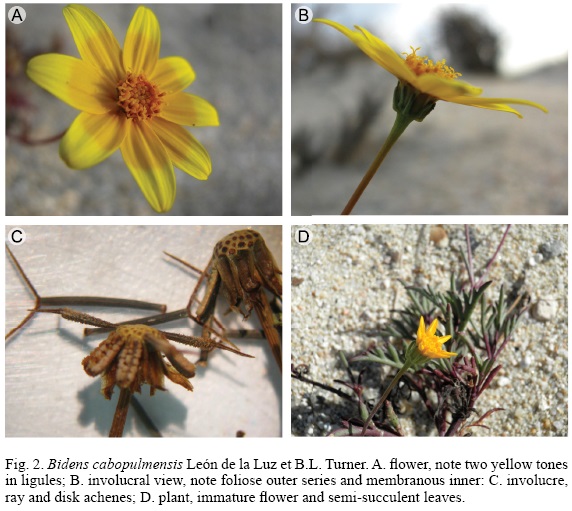
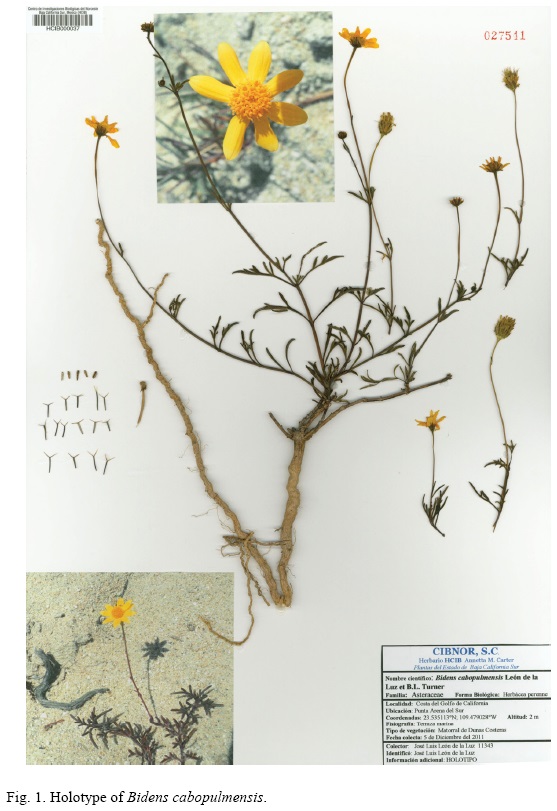
<body><![CDATA[<p align="justify"><font face="verdana" size="2">The flora of the Baja California Peninsula has been compiled in two monumental treatments: Shreve and Wiggins' Vegetation and Flora of the Sonoran Desert (1964) and Wiggins' Flora of Baja California (1980). In the latter, 2958 taxa of vascular plants (including 686 endemics) are recognized. Rebman (2001) estimated the current plant biodiversity likely consists of approximately 4000 plant species, 30% of which are endemics. Furthermore, there remain poorly collected areas, where surveys are certain to yield many additional novelties, as in the present contribution.</font></p>     <p align="justify"><font face="verdana" size="2">In 2010, the Comisi&oacute;n Nacional para el Conocimiento y Uso de la Biodiversidad (CONABIO) provided us funding for a project to explore coastal environments of the state of Baja California Sur. During our explorations in the east Cape Region, we collected two interesting specimens from the same geographic area, one of them belonging to the genus <i>Bidens, </i>that led to this paper.</font></p>     <p align="justify"><font face="verdana" size="2">First, using the Shreve and Wiggins' (1964) flora, this specimen was compared with <i>B. ferulifolia </i>(Jacq.) DC. and the Baja California Cape Region endemic <i>B. xanti </i>(A. Gray) B.L. Turner because of the general characteristics of the flowers. However, both taxa were quickly rejected because they inhabit inland environments, such as the oak&#150;pine woodlands of mainland Mexico and the scrublands of the Cape Region, respectively, and are of annual habit.</font></p>     <p align="justify"><font face="verdana" size="2">After collecting and analyzing mature fruits, we concluded that this specimen represents a new species of <i>Bidens, </i>based on characteristics such as dimorphic achenes, the peripheral one being incurved and the inner ones being clavate and graded in size. These features are coupled with a perennial habit and the fact that the known population only grows on stabilized coastal dunes, which seems to be its exclusive niche. We consider the population as a new micro&#150;endemic species in the Cape Region.</font></p>     <p align="justify"><font face="verdana" size="2"><b><i>Bidens cabopulmensis </i></b>Le&oacute;n de la Luz et B.L. Turner, sp. nov. (<a href="#f1">Figs. 1</a>, <a href="#f2">2</a>)</font></p>     <p align="center"><font face="verdana" size="2"><a name="f1"></a></font></p>     <p align="center"><font face="verdana" size="2"><img src="/img/revistas/abm/n103/a6f1.jpg"></font></p>     <p align="center"><font face="verdana" size="2"><a name="f2"></a></font></p>     <p align="center"><font face="verdana" size="2"><img src="/img/revistas/abm/n103/a6f2.jpg"></font></p>     <p align="justify"><font face="verdana" size="2">Herba perennis, ramis quadrangularibus, radicibus carnosis striatis. Folia aliquantum succulenta, integra vel in segmentis linearibus divisa. Inflorescentia terminalis, in capitulo unico longe pedunculato. Ligulae duobus coloribus flavi variantes. Achenia dimorpha.</font></p>     ]]></body>
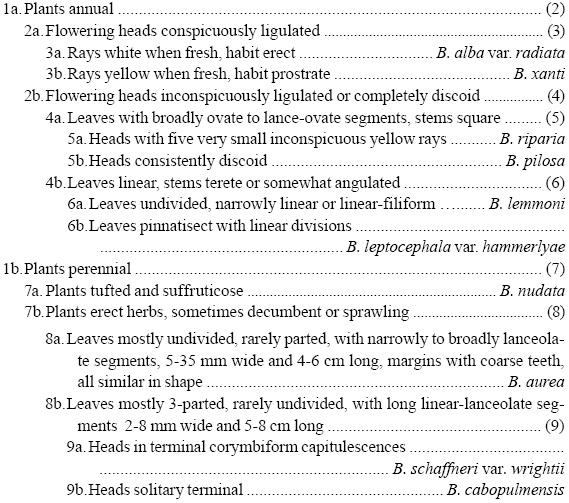
<body><![CDATA[<p align="justify"><font face="verdana" size="2">Prostrate or sprawling perennial herbs 20&#150;40 cm high; roots striate, semi&#150;succulent, more or less nodose; mid&#150;stems striate, more or less 4&#150;sided, glabrous to sparingly pubescent (mainly in the leaf axils); mature leaves more or less succulent, opposite below, alternate above, undivided to 3&#150;5 pinnately&#150;dissected, sessile, somewhat clasping, basal leaves occasionally linear&#150;lanceolate, the uppermost leaves linear, 3&#150;5 cm long, 2&#150;3(4) mm wide, glabrous or nearly so; capitulescence in a terminal arrangement of solitary heads on ultimate peduncles mostly 5&#150;7 cm long; heads 2.5&#150;3.0 cm across the extended rays; involucres 2&#150;seriate, glabrous; outer series of 8 lanceolate, membranous bracts, semi&#150;succulent, 4&#150;5 mm long; inner series of 8 lanceolate, sub&#150;membranous bracts, sub&#150;connate basally, hyaline toward the margins, 5&#150;6 mm long, ca. 1.5 mm wide. Receptacle flat; ray florets 8, pistillate, fertile; ligules bright yellow, less so at the base, 1.0&#150;1.2 cm long, 1.52.0 mm wide; disk florets 20&#150;30(50); the corollas dark yellow, glabrous, 4&#150;5 mm long, the tube ca. 3 mm long, the throat ca. 1.5 mm long, the lobes 5, acute, ca. 1 mm long; anthers brown, ca. 2 mm long, the appendages ovate; style branches ca 1 mm long, the apices subulate; achenes dimorphic; those from the ray flowers obovate, ca. 5 mm long, 1&#150;2 mm wide, somewhat incurved, having marginal, often incurved, corky wings up to 0.5 mm wide, their awns much reduced or absent; those from the disk flowers, graded in size, linear, the outermost less so, black to grayish, 4&#150;6 mm long, ca. 1 mm wide, pappus of 2(3) divergent awns 1&#150;2 mm long, antrorsely setulose, some (mostly the outer) with corky small protuberances along the posterior side.</font></p>     <p align="justify"><font face="verdana" size="2">Type: Mexico. Baja California Sur, Mpio. de los Cabos, dunas de Punta Arena del Sur, entre La Ribera y Cabo Pulmo, matorral de dunas costeras estabilizadas, 23.535113&deg; N, 109. 479028&deg; W, 2 m, 5 Dec. 2011, <i>J. L. Le&oacute;n de la Luz 11343 </i>(holotype: HCIB&#150;027541; isotypes: ENCB, IEB, LL&#150;TEX, MEXU, RSA&#150;POM). Paratype: same locality, <i>A. Medel Narv&aacute;ez 11&#150;085, </i>HCIB&#150;027495).</font></p>     <p align="justify"><font face="verdana" size="2">Additional paratype: Mexico, Baja California Sur, beach near Punta Colorada Hotel, 23.570812&deg; N, &#150;109.515739&deg; W, 2 m, 27.III.1998, <i>J. J. P&eacute;rez 949 </i>(HCIB).</font></p>     <p align="justify"><font face="verdana" size="2"><i>Bidens cabopulmensis </i>is distinct from the previously known <i>Bidens </i>species in the Cape Region and even in the Baja California Peninsula, and is not accounted for by previous workers in the area. The achenes of the ray florets, which possess markedly incurved corky margins (<a href="#f2">Fig. 2c</a>), are especially noteworthy. They are superficially similar to those found in the genus <i>Coreocarpus. </i>In Melchert's treatment (2010) of <i>Bidens </i>in Mexico this taxon will key to either <i>B. cronquistii </i>(<i>Coreocarpus c. </i>Sherff), <i>B. hintonii </i>(<i>Coreocarpus h. </i>Sherff) and <i>B. triplinervia </i>Kunth (B. <i>canescens </i>Bertol.), due to the dimorphic achenes where at least one type has corky wings, although the semi&#150;succulent roots, growth habit, glabrescent character, and fine characters of the fruiting head are some particularities of <i>B. cabopulmensis.</i></font></p>     <p align="justify"><font face="verdana" size="2">Another Mexican species that inhabits coastal dunes and nearby inland areas (1&#150;10 m) along the Gulf of Mexico states is <i>B. alba </i>(L.) DC. var. <i>alba, </i>but is easily distinguishable by its prostrate robust habit, white rays, thick, and ample and undivided glabrous leaves (Ballard, 1986).</font></p>     <p align="justify"><font face="verdana" size="2">As circumscribed by Crawford et al. (2009), <i>Bidens </i>is a cosmopolitan genus of the tribe Coreopsidae represented by approximately 340 species and subspecific categories, of which about 56 occur in Mexico. Formerly and according to Villase&ntilde;or (1991), <i>Bidens </i>belongs to the tribe Heliantheae, one of the more diversified taxa of Asteraceae in Mexico, where approximately 65% are endemics. Also, the account of Mexican species of Heliantheae and its endemism show that the Baja California Peninsula is the natural region with the highest level. Additionally, plotting geographical distribution of the endemic peninsular Heliantheae, a clear tendency toward the southern tip is manifested.</font></p>     <p align="justify"><font face="verdana" size="2">Following Melchert's (2010) treatment of Mexican <i>Bidens, </i>the Cape Region of Baja California contains eight species: <i>Bidens pilosa </i>L. (=B. <i>alba </i>(L.) DC. var. <i>radiata </i>(Sch.&#150;Bip.) Melchert), <i>B. aurea </i>(Ait.) Sherff, <i>B. nudata </i>Brandegee, <i>B. lemmonii </i>A. Gray, <i>B. leptocephala </i>Sherff (=B. <i>l. </i>var. <i>hammerlyae </i>Sherff), <i>B. riparia </i>Kunth, <i>B. shaffneri </i>(A. Gray) Sherff var. <i>wrightii </i>(Sherff) Melchert, and <i>B. xanti </i>(A. Gray) B.L. Turner. Of these, only <i>B. nudata </i>and <i>B. leptocephala </i>var. <i>hammerlyae </i>are recognized as endemics to Baja California Peninsula, both inhabiting the southern sector in Sierra de La Laguna, in the oak&#150;pine woodland and dry tropical forest communities, respectively.</font></p>     <p align="justify"><font face="verdana" size="2">A dichotomous key is provided below to differentiate <i>B. cabopulmensis </i>from the other eight taxa of <i>Bidens </i>previously recognized in the Cape Region, this largely abstracted from Melchert (2010) as follows:</font></p>     <p align="center"><font face="verdana" size="2"><img src="/img/revistas/abm/n103/a6s1.jpg"></font></p>     <p align="justify"><font face="verdana" size="2">Distribution and ecology. The novelty occurs on stable dunes in the vicinity of Punta Arena del Sur or "El Faro de Punta Colorada", in a relatively small area between 23.563373&deg; and 23.517585&deg; N and &#150;109.487397&deg; and &#150;109.469452&deg; W, and occasionally in the proximities, occupying a total surface area of approximately 200 hectares. Plant density is estimated at one individual per 100&#150;200 m<sup>2</sup>.</font></p>     ]]></body>
<body><![CDATA[<p align="justify"><font face="verdana" size="2">Phenology. Flowering usually extends from July through December.</font></p>     <p align="justify"><font face="verdana" size="2">Etymology. The taxon is named for the village of Cabo Pulmo, an eco&#150;touristic settlement near one of the few coral reefs along the American Pacific coast and now seriously menaced by touristic developments along the east Cape Region.</font></p>     <p align="justify"><font face="verdana" size="2">&nbsp;</font></p>     <p align="justify"><font face="verdana" size="2"><b>ACKNOWLEDGEMENTS</b></font></p>     <p align="justify"><font face="verdana" size="2">We thank Thomas Melchert and Billie L. Turner for reviewing the article and providing helpful comments, as well as Reymundo Dom&iacute;nguez and Miguel Dom&iacute;nguez for assisting with fieldwork. Ira Fogel of Centro de Investigaciones Biol&oacute;gicas del Noroeste (CIBNOR) provided editorial services. Dr. Fernando Chiang helped us with the latin diagnosis. Also, two anonymous reviewers of this journal improved the original manuscript. This work was made possible with funds from Comisi&oacute;n Nacional para el Conocimiento y Uso de la Biodiversidad (grant HJ&#150;007 to Ileana Espejel), for which we are grateful.</font></p>     <p align="justify"><font face="verdana" size="2">&nbsp;</font></p>     <p align="justify"><font face="verdana" size="2"><b>LITERATURE CITED</b></font></p>     <!-- ref --><p align="justify"><font face="verdana" size="2">Ballard, R. 1986. <i>Bidens pilosa </i>complex (Asteraceae) in North and Central America. Amer. J. Bot. 73(10): 1452&#150;1465.    &nbsp;&nbsp;&nbsp;&nbsp;&nbsp;&nbsp;&nbsp;&nbsp;[&#160;<a href="javascript:void(0);" onclick="javascript: window.open('/scielo.php?script=sci_nlinks&ref=046836&pid=S0187-7151201300020000600001&lng=','','width=640,height=500,resizable=yes,scrollbars=1,menubar=yes,');">Links</a>&#160;]<!-- end-ref --> </font></p>     <!-- ref --><p align="justify"><font face="verdana" size="2">Crawford, D. J., M. Tadesse, M. E. Mort, R. T. Kimball and C. P. Randle. 2009. Coreopsideae. In: Funk, V. A., A. Susanna, T. F. Stuessy and R. J. Bayer (eds.). Systematics, evolution, and biogeography of Compositae. International Association of Plant Taxonomy, Sheridan Press. Ann Arbor, U.S.A. pp. 713&#150;730.    &nbsp;&nbsp;&nbsp;&nbsp;&nbsp;&nbsp;&nbsp;&nbsp;[&#160;<a href="javascript:void(0);" onclick="javascript: window.open('/scielo.php?script=sci_nlinks&ref=046838&pid=S0187-7151201300020000600002&lng=','','width=640,height=500,resizable=yes,scrollbars=1,menubar=yes,');">Links</a>&#160;]<!-- end-ref --> </font></p>     <!-- ref --><p align="justify"><font face="verdana" size="2">Melchert, T. E. 2010. <i>Bidens. </i>In: Turner, B. L. (ed.). The comps of Mexico: a systematic account of the family Asteraceae. Chapter 10. Subfamily Coreopsideae. Phytol. Mem. 15(10): 3&#150;56.    &nbsp;&nbsp;&nbsp;&nbsp;&nbsp;&nbsp;&nbsp;&nbsp;[&#160;<a href="javascript:void(0);" onclick="javascript: window.open('/scielo.php?script=sci_nlinks&ref=046840&pid=S0187-7151201300020000600003&lng=','','width=640,height=500,resizable=yes,scrollbars=1,menubar=yes,');">Links</a>&#160;]<!-- end-ref --></font></p>     <!-- ref --><p align="justify"><font face="verdana" size="2">Rebman, J. 2001. Succulent diversity in Lower California, Mexico. Cact. Succ. J.(U.S.) 73: 131&#150;138.    &nbsp;&nbsp;&nbsp;&nbsp;&nbsp;&nbsp;&nbsp;&nbsp;[&#160;<a href="javascript:void(0);" onclick="javascript: window.open('/scielo.php?script=sci_nlinks&ref=046842&pid=S0187-7151201300020000600004&lng=','','width=640,height=500,resizable=yes,scrollbars=1,menubar=yes,');">Links</a>&#160;]<!-- end-ref --></font></p>     <!-- ref --><p align="justify"><font face="verdana" size="2">Shreve, F. and I. L. Wiggins. 1964. Vegetation and Flora of the Sonoran Desert, 2 vols. Stanford University Press. Stanford, USA. 1740 pp.    &nbsp;&nbsp;&nbsp;&nbsp;&nbsp;&nbsp;&nbsp;&nbsp;[&#160;<a href="javascript:void(0);" onclick="javascript: window.open('/scielo.php?script=sci_nlinks&ref=046844&pid=S0187-7151201300020000600005&lng=','','width=640,height=500,resizable=yes,scrollbars=1,menubar=yes,');">Links</a>&#160;]<!-- end-ref --> </font></p>     <!-- ref --><p align="justify"><font face="verdana" size="2">Villase&ntilde;or, J. L. 1991. Las Heliantheae end&eacute;micas a M&eacute;xico: una gu&iacute;a hacia la conservaci&oacute;n. Acta Bot. Mex. 15: 29&#150;46.    &nbsp;&nbsp;&nbsp;&nbsp;&nbsp;&nbsp;&nbsp;&nbsp;[&#160;<a href="javascript:void(0);" onclick="javascript: window.open('/scielo.php?script=sci_nlinks&ref=046846&pid=S0187-7151201300020000600006&lng=','','width=640,height=500,resizable=yes,scrollbars=1,menubar=yes,');">Links</a>&#160;]<!-- end-ref --> </font></p>     <!-- ref --><p align="justify"><font face="verdana" size="2">Wiggins, I. L. 1980. Flora of Baja California. Stanford University Press. Stanford, USA. 1025 pp.    &nbsp;&nbsp;&nbsp;&nbsp;&nbsp;&nbsp;&nbsp;&nbsp;[&#160;<a href="javascript:void(0);" onclick="javascript: window.open('/scielo.php?script=sci_nlinks&ref=046848&pid=S0187-7151201300020000600007&lng=','','width=640,height=500,resizable=yes,scrollbars=1,menubar=yes,');">Links</a>&#160;]<!-- end-ref --></font></p>      ]]></body><back>
<ref-list>
<ref id="B1">
<nlm-citation citation-type="journal">
<person-group person-group-type="author">
<name>
<surname><![CDATA[Ballard]]></surname>
<given-names><![CDATA[R.]]></given-names>
</name>
</person-group>
<article-title xml:lang="en"><![CDATA[Bidens pilosa complex (Asteraceae) in North and Central America.]]></article-title>
<source><![CDATA[Amer. J. Bot.]]></source>
<year>1986</year>
<volume>73</volume>
<numero>10</numero>
<issue>10</issue>
<page-range>1452-1465</page-range></nlm-citation>
</ref>
<ref id="B2">
<nlm-citation citation-type="book">
<person-group person-group-type="author">
<name>
<surname><![CDATA[Crawford]]></surname>
<given-names><![CDATA[D. J.]]></given-names>
</name>
<name>
<surname><![CDATA[Tadesse]]></surname>
<given-names><![CDATA[M.]]></given-names>
</name>
<name>
<surname><![CDATA[Mort]]></surname>
<given-names><![CDATA[M. E.]]></given-names>
</name>
<name>
<surname><![CDATA[Kimball]]></surname>
<given-names><![CDATA[R. T.]]></given-names>
</name>
<name>
<surname><![CDATA[Randle]]></surname>
<given-names><![CDATA[C. P.]]></given-names>
</name>
</person-group>
<article-title xml:lang="en"><![CDATA[Coreopsideae]]></article-title>
<person-group person-group-type="editor">
<name>
<surname><![CDATA[Funk]]></surname>
<given-names><![CDATA[V. A.]]></given-names>
</name>
<name>
<surname><![CDATA[Susanna]]></surname>
<given-names><![CDATA[A.]]></given-names>
</name>
<name>
<surname><![CDATA[Stuessy]]></surname>
<given-names><![CDATA[T. F.]]></given-names>
</name>
<name>
<surname><![CDATA[Bayer]]></surname>
<given-names><![CDATA[R. J.]]></given-names>
</name>
</person-group>
<source><![CDATA[Systematics, evolution, and biogeography of Compositae]]></source>
<year>2009</year>
<page-range>713-730</page-range><publisher-loc><![CDATA[Ann Arbor ]]></publisher-loc>
<publisher-name><![CDATA[International Association of Plant TaxonomySheridan Press]]></publisher-name>
</nlm-citation>
</ref>
<ref id="B3">
<nlm-citation citation-type="journal">
<person-group person-group-type="author">
<name>
<surname><![CDATA[Melchert]]></surname>
<given-names><![CDATA[T. E.]]></given-names>
</name>
</person-group>
<article-title xml:lang="en"><![CDATA[Bidens]]></article-title>
<person-group person-group-type="editor">
<name>
<surname><![CDATA[Turner]]></surname>
<given-names><![CDATA[B. L.]]></given-names>
</name>
</person-group>
<source><![CDATA[Phytol. Mem.The comps of Mexico: a systematic account of the family Asteraceae]]></source>
<year>2010</year>
<volume>15</volume>
<numero>10</numero>
<issue>10</issue>
<page-range>3-56</page-range></nlm-citation>
</ref>
<ref id="B4">
<nlm-citation citation-type="journal">
<person-group person-group-type="author">
<name>
<surname><![CDATA[Rebman]]></surname>
<given-names><![CDATA[J.]]></given-names>
</name>
</person-group>
<article-title xml:lang="en"><![CDATA[Succulent diversity in Lower California, Mexico]]></article-title>
<source><![CDATA[Cact. Succ. J.]]></source>
<year>2001</year>
<volume>73</volume>
<page-range>131-138</page-range></nlm-citation>
</ref>
<ref id="B5">
<nlm-citation citation-type="book">
<person-group person-group-type="author">
<name>
<surname><![CDATA[Shreve]]></surname>
<given-names><![CDATA[F.]]></given-names>
</name>
<name>
<surname><![CDATA[Wiggins]]></surname>
<given-names><![CDATA[I. L.]]></given-names>
</name>
</person-group>
<source><![CDATA[Vegetation and Flora of the Sonoran Desert]]></source>
<year>1964</year>
<volume>2</volume>
<page-range>1740</page-range><publisher-loc><![CDATA[Stanford ]]></publisher-loc>
<publisher-name><![CDATA[Stanford University Press]]></publisher-name>
</nlm-citation>
</ref>
<ref id="B6">
<nlm-citation citation-type="journal">
<person-group person-group-type="author">
<name>
<surname><![CDATA[Villaseñor]]></surname>
<given-names><![CDATA[J. L.]]></given-names>
</name>
</person-group>
<article-title xml:lang="es"><![CDATA[Las Heliantheae endémicas a México: una guía hacia la conservación]]></article-title>
<source><![CDATA[Acta Bot. Mex.]]></source>
<year>1991</year>
<volume>15</volume>
<page-range>29-46</page-range></nlm-citation>
</ref>
<ref id="B7">
<nlm-citation citation-type="book">
<person-group person-group-type="author">
<name>
<surname><![CDATA[Wiggins]]></surname>
<given-names><![CDATA[I. L.]]></given-names>
</name>
</person-group>
<source><![CDATA[Flora of Baja California]]></source>
<year>1980</year>
<page-range>1025</page-range><publisher-loc><![CDATA[Stanford ]]></publisher-loc>
<publisher-name><![CDATA[Stanford University Press]]></publisher-name>
</nlm-citation>
</ref>
</ref-list>
</back>
</article>