<?xml version="1.0" encoding="ISO-8859-1"?><article xmlns:mml="http://www.w3.org/1998/Math/MathML" xmlns:xlink="http://www.w3.org/1999/xlink" xmlns:xsi="http://www.w3.org/2001/XMLSchema-instance">
<front>
<journal-meta>
<journal-id>0187-7151</journal-id>
<journal-title><![CDATA[Acta botánica mexicana]]></journal-title>
<abbrev-journal-title><![CDATA[Act. Bot. Mex]]></abbrev-journal-title>
<issn>0187-7151</issn>
<publisher>
<publisher-name><![CDATA[Instituto de Ecología A.C., Centro Regional del Bajío]]></publisher-name>
</publisher>
</journal-meta>
<article-meta>
<article-id>S0187-71512013000100004</article-id>
<title-group>
<article-title xml:lang="en"><![CDATA[New records of red algae (Rhodophyta) for Cabezo Reef, National Park Sistema Arrecifal Veracruzano, Gulf of Mexico]]></article-title>
<article-title xml:lang="es"><![CDATA[Nuevos registros de algas rojas (Rhodophyta) para el arrecife Cabezo, del Parque Nacional Sistema Arrecifal Veracruzano, Golfo de México]]></article-title>
</title-group>
<contrib-group>
<contrib contrib-type="author">
<name>
<surname><![CDATA[Galicia-García]]></surname>
<given-names><![CDATA[Citlalli]]></given-names>
</name>
<xref ref-type="aff" rid="A01"/>
</contrib>
<contrib contrib-type="author">
<name>
<surname><![CDATA[Robinson]]></surname>
<given-names><![CDATA[Néstor M.]]></given-names>
</name>
<xref ref-type="aff" rid="A01"/>
</contrib>
<contrib contrib-type="author">
<name>
<surname><![CDATA[Okolodkov]]></surname>
<given-names><![CDATA[Yuri B.]]></given-names>
</name>
<xref ref-type="aff" rid="A02"/>
</contrib>
</contrib-group>
<aff id="A01">
<institution><![CDATA[,Instituto Tecnológico de Boca del Río Laboratorio de Biología ]]></institution>
<addr-line><![CDATA[Boca del Río Veracruz]]></addr-line>
<country>México</country>
</aff>
<aff id="A02">
<institution><![CDATA[,Universidad Veracruzana Instituto de Ciencias Marinas y Pesquerías Laboratorio de Botánica Marina y Planctología]]></institution>
<addr-line><![CDATA[Boca del Río Veracruz]]></addr-line>
<country>México</country>
</aff>
<pub-date pub-type="pub">
<day>00</day>
<month>01</month>
<year>2013</year>
</pub-date>
<pub-date pub-type="epub">
<day>00</day>
<month>01</month>
<year>2013</year>
</pub-date>
<numero>102</numero>
<fpage>39</fpage>
<lpage>76</lpage>
<copyright-statement/>
<copyright-year/>
<self-uri xlink:href="http://www.scielo.org.mx/scielo.php?script=sci_arttext&amp;pid=S0187-71512013000100004&amp;lng=en&amp;nrm=iso"></self-uri><self-uri xlink:href="http://www.scielo.org.mx/scielo.php?script=sci_abstract&amp;pid=S0187-71512013000100004&amp;lng=en&amp;nrm=iso"></self-uri><self-uri xlink:href="http://www.scielo.org.mx/scielo.php?script=sci_pdf&amp;pid=S0187-71512013000100004&amp;lng=en&amp;nrm=iso"></self-uri><abstract abstract-type="short" xml:lang="en"><p><![CDATA[Descriptions of 21 red algal species collected in March and November 2008 and June 2010 are given. They are considered new records for Cabezo reef in the southeastern part of the National Park Sistema Arrecifal Veracruzano (NPSAV), southwestern Gulf of Mexico. The new records belong to the genera Amphiroa, Bryothamnion, Ceramium, Ceratodictyon, Colaconema, Galaxaura, Hypnea, Jania, Laurencia, Liagora, Neosiphonia, Pneophyllum, Polysiphonia, Porolithon, Stylonema, Titanophycus and Yuzurua. The families Rhodomelaceae and Corallinaceae contain the largest number of species (6 and 5, respectively). Descriptions include morphometric and biological data and are accompanied by photographs and line drawings for each species. Geographic distribution of these algae in the State of Veracruz, park and the Gulf of Mexico are also provided. Polysiphonia pseudovillum is a new record for the Gulf of Mexico, while Colaconema hallandicum and Ceratodictyon planicaule are new records for the park. Nine species have been found as epiphytes mainly on green and red algae. Tetrasporangia were the dominant reproductive structures found in the studied species during both rainy and dry seasons. Vegetative and reproductive thalli of 10 species from the NPSAV were usually smaller compared to those of the same species found in the Caribbean.]]></p></abstract>
<abstract abstract-type="short" xml:lang="es"><p><![CDATA[Se presentan las descripciones de 21 especies de algas rojas colectadas en marzo y noviembre de 2008 y junio de 2010. Estas se consideran nuevos registros para el arrecife Cabezo ubicado en la parte sureste del Parque Nacional Sistema Arrecifal Veracruzano (PNSAV) en el suroeste del Golfo de México, y pertenecen a los géneros Amphiroa, Bryothamnion, Ceramium, Ceratodictyon, Colaconema, Galaxaura, Hypnea, Jania, Laurencia, Liagora, Neosiphonia, Pneophyllum, Polysiphonia, Porolithon, Stylonema, Titanophycus y Yuzurua. Las familias Rhodomelaceae y Corallinaceae son las mejor representadas en cuanto al número de especies (6 y 5, respectivamente). Las descripciones incluyen datos morfométricos y biológicos y están acompañadas con fotografías y dibujos a línea para cada especie. Se presenta la distribución geográfica de estas algas en el estado de Veracruz, el parque y el Golfo de México. Polysiphonia pseudovillum es nuevo registro para el Golfo de México, mientras que Colaconema hallandicum y Ceratodictyon planicaule lo son para el parque. Nueve especies se encontraron como epífitas principalmente de algas verdes y rojas. Las estructuras reproductoras que predominaron en las algas estudiadas tanto en la época de lluvias como en la de secas fueron los tetrasporangios. Los talos vegetativos y reproductivos de 10 especies del PNSAV fueron usualmente más pequeños comparados con los de los mismos taxa encontrados en el Caribe.]]></p></abstract>
<kwd-group>
<kwd lng="en"><![CDATA[anatomy]]></kwd>
<kwd lng="en"><![CDATA[Gulf of Mexico]]></kwd>
<kwd lng="en"><![CDATA[new records]]></kwd>
<kwd lng="en"><![CDATA[red algae]]></kwd>
<kwd lng="en"><![CDATA[taxonomy]]></kwd>
<kwd lng="es"><![CDATA[algas rojas]]></kwd>
<kwd lng="es"><![CDATA[anatomía]]></kwd>
<kwd lng="es"><![CDATA[Golfo de México]]></kwd>
<kwd lng="es"><![CDATA[nuevos registros]]></kwd>
<kwd lng="es"><![CDATA[taxonomía]]></kwd>
</kwd-group>
</article-meta>
</front><body><![CDATA[  	    <p align="center"><font face="verdana" size="4"><b>New records of red algae (Rhodophyta) for Cabezo Reef, National Park Sistema Arrecifal Veracruzano, Gulf of Mexico</b></font></p> 	    <p align="center"><font face="verdana" size="2">&nbsp;</font></p> 	    <p align="center"><font face="verdana" size="3"><b>Nuevos registros de algas rojas (Rhodophyta) para el arrecife Cabezo, del Parque Nacional Sistema Arrecifal Veracruzano, Golfo de M&eacute;xico</b></font></p>     <p align="center"><font face="verdana" size="2">&nbsp;</font></p>      <p align="center"><font face="verdana" size="2"><b>Citlalli Galicia&#45;Garc&iacute;a<sup>1</sup>, N&eacute;stor M. Robinson<sup>1</sup> and Yuri B. Okolodkov<sup>2,3</sup></b><sup></sup></font></p>     <p align="justify"><font face="verdana" size="2">&nbsp;</font></p>      <p align="justify"><font face="verdana" size="2"><sup><i>1</i></sup> <i>Instituto Tecnol&oacute;gico de Boca del R&iacute;o, Laboratorio de Biolog&iacute;a, km 12 Carretera Veracruz&#45;C&oacute;rdoba, 94290 Boca del R&iacute;o, Veracruz, M&eacute;xico.</i></font></p>  	    <p align="justify"><font face="verdana" size="2"><sup><i>2</i></sup> <i>Universidad Veracruzana, Instituto de Ciencias Marinas y Pesquer&iacute;as, Laboratorio de Bot&aacute;nica Marina y Planctolog&iacute;a, Calle Hidalgo 617, Colonia R&iacute;o Jamapa, 94290 Boca del R&iacute;o, Veracruz, M&eacute;xico.</i></font></p>  	    <p align="justify"><font face="verdana" size="2"><sup><i>3</i></sup> <i>Author for correspondence:</i> <a href="mailto:yuriokolodkov@yahoo.com">yuriokolodkov@yahoo.com</a></font></p> 	    ]]></body>
<body><![CDATA[<p align="justify"><font face="verdana" size="2">&nbsp;</font></p>     <p align="justify"><font face="verdana" size="2">Recibido en abril de 2011.    <br> Aceptado en septiembre de 2012.</font></p>     <p align="justify"><font face="verdana" size="2">&nbsp;</font></p>      <p align="justify"><font face="verdana" size="2"><b>ABSTRACT</b></font></p>  	    <p align="justify"><font face="verdana" size="2">Descriptions of 21 red algal species collected in March and November 2008 and June 2010 are given. They are considered new records for Cabezo reef in the southeastern part of the National Park Sistema Arrecifal Veracruzano (NPSAV), southwestern Gulf of Mexico. The new records belong to the genera <i>Amphiroa</i>, <i>Bryothamnion</i>, <i>Ceramium</i>, <i>Ceratodictyon</i>, <i>Colaconema</i>, <i>Galaxaura</i>, <i>Hypnea</i>, <i>Jania</i>, <i>Laurencia</i>, <i>Liagora</i>, <i>Neosiphonia</i>, <i>Pneophyllum</i>, <i>Polysiphonia</i>, <i>Porolithon</i>, <i>Stylonema</i>, <i>Titanophycus</i> and <i>Yuzurua</i>. The families Rhodomelaceae and Corallinaceae contain the largest number of species (6 and 5, respectively). Descriptions include morphometric and biological data and are accompanied by photographs and line drawings for each species. Geographic distribution of these algae in the State of Veracruz, park and the Gulf of Mexico are also provided. <i>Polysiphonia pseudovillum</i> is a new record for the Gulf of Mexico, while <i>Colaconema hallandicum</i> and <i>Ceratodictyon planicaule</i> are new records for the park. Nine species have been found as epiphytes mainly on green and red algae. Tetrasporangia were the dominant reproductive structures found in the studied species during both rainy and dry seasons. Vegetative and reproductive thalli of 10 species from the NPSAV were usually smaller compared to those of the same species found in the Caribbean.</font></p>  	    <p align="justify"><font face="verdana" size="2"><b>Key words:</b> anatomy, Gulf of Mexico, new records, red algae, taxonomy.</font></p>     <p align="justify"><font face="verdana" size="2">&nbsp;</font></p>      <p align="justify"><font face="verdana" size="2"><b>RESUMEN</b></font></p>  	    <p align="justify"><font face="verdana" size="2">Se presentan las descripciones de 21 especies de algas rojas colectadas en marzo y noviembre de 2008 y junio de 2010. Estas se consideran nuevos registros para el arrecife Cabezo ubicado en la parte sureste del Parque Nacional Sistema Arrecifal Veracruzano (PNSAV) en el suroeste del Golfo de M&eacute;xico, y pertenecen a los g&eacute;neros <i>Amphiroa</i>, <i>Bryothamnion</i>, <i>Ceramium</i>, <i>Ceratodictyon</i>, <i>Colaconema</i>, <i>Galaxaura</i>, <i>Hypnea</i>, <i>Jania</i>, <i>Laurencia</i>, <i>Liagora</i>, <i>Neosiphonia</i>, <i>Pneophyllum</i>, <i>Polysiphonia</i>, <i>Porolithon</i>, <i>Stylonema</i>, <i>Titanophycus</i> y <i>Yuzurua</i>. Las familias Rhodomelaceae y Corallinaceae son las mejor representadas en cuanto al n&uacute;mero de especies (6 y 5, respectivamente). Las descripciones incluyen datos morfom&eacute;tricos y biol&oacute;gicos y est&aacute;n acompa&ntilde;adas con fotograf&iacute;as y dibujos a l&iacute;nea para cada especie. Se presenta la distribuci&oacute;n geogr&aacute;fica de estas algas en el estado de Veracruz, el parque y el Golfo de M&eacute;xico. <i>Polysiphonia pseudovillum</i> es nuevo registro para el Golfo de M&eacute;xico, mientras que <i>Colaconema hallandicum</i> y <i>Ceratodictyon planicaule</i> lo son para el parque. Nueve especies se encontraron como ep&iacute;fitas principalmente de algas verdes y rojas. Las estructuras reproductoras que predominaron en las algas estudiadas tanto en la &eacute;poca de lluvias como en la de secas fueron los tetrasporangios. Los talos vegetativos y reproductivos de 10 especies del PNSAV fueron usualmente m&aacute;s peque&ntilde;os comparados con los de los mismos taxa encontrados en el Caribe.</font></p>  	    ]]></body>
<body><![CDATA[<p align="justify"><font face="verdana" size="2"><b>Palabras clave:</b> algas rojas, anatom&iacute;a, Golfo de M&eacute;xico, nuevos registros, taxonom&iacute;a.</font></p>     <p align="justify"><font face="verdana" size="2">&nbsp;</font></p>      <p align="justify"><font face="verdana" size="2"><b>INTRODUCTION</b></font></p>  	    <p align="justify"><font face="verdana" size="2">Mexico has 11,593 km of coastline with various physiographic characteristics and climate types (Contreras&#45;Espinosa, 1993). Both morphological and ecological diversity of macroalgae of the littoral zone are high; however, our knowledge, especially regarding management of this diversity, is still poor (Galicia&#45;Garc&iacute;a &amp; Morales&#45;Garc&iacute;a, 2007). Mexico in general is no longer at the initial stage of marine phycological exploration (Pedroche &amp; Sent&iacute;es&#45;Granados, 2003); however, that is not the case for macroalgal flora of the National Park Sistema Arrecifal Veracruzano (NPSAV). The NPSAV is a marine protected area with an elevated marine biodiversity, including macroalgae. Taking into account all floristic, ecological and taxonomic studies on macroalgae performed in the NPSAV until 2011, nine reefs out of 25, including Cabezo reef, have not been considered at all, although floristic studies prevail among others (Huerta, 1960; Humm &amp; Hildebrand, 1962; De la Campa&#45;Guzm&aacute;n, 1965; Mendoza&#45;Gonz&aacute;lez &amp; Mateo&#45;Cid, 1985; Lehman &amp; Tunnell, 1992; Lehman, 1993; Mateo&#45;Cid et al., 1996; Morales&#45;Garc&iacute;a et al., 1997; Dreckmann, 1998; Ortega et al., 2001; Ordu&ntilde;a&#45;Medrano, 2004; Mateo&#45;Cid, 2006). All these studies contributed to the knowledge of the species and their local distribution, their seasonality or other ecological aspects; however, only few works documented the algal morphology with photographs or line drawings, and most of previous studies were done in shallow water.</font></p>  	    <p align="justify"><font face="verdana" size="2">In the State of Veracruz, a total of 210 red algae species were found, and in the NPSAV in particular, 157 species (Galicia&#45;Garc&iacute;a &amp; Morales&#45;Garc&iacute;a, 2007). The largest number of species was encountered in Isla de Enmedio, Isla Verde, Isla Sacrificios and Hornos reefs. This number is directly proportional to the number of studies carried out in these sites, followed by La Blanquilla, Santiaguillo, La Gallega, Punta Gorda, Giote, Ingenieros and Blanca reefs.</font></p>  	    <p align="justify"><font face="verdana" size="2">The main purposes of the present study were to contribute to our knowledge of the red algae of the NPSAV on the basis of the morphology of the species found in Cabezo reef and to document their records.</font></p>     <p align="justify"><font face="verdana" size="2">&nbsp;</font></p>      <p align="justify"><font face="verdana" size="2"><b>MATERIAL AND METHODS</b></font></p>  	    <p align="justify"><font face="verdana" size="2">In the southwestern Gulf of Mexico, in the coastal waters of the State of Veracruz, there are 31 coral reefs located on the continental shelf. Information on the general climate can be found in Anonymous (1987). The diurnal tidal range reaches 95 to 105 cm (Salas&#45;P&eacute;rez et al., 2008; Gonz&aacute;lez et al., 2009). Average water temperature is 26.6 <sup>o</sup>C and usually fluctuates between 22.9 <sup>o</sup>C and 32 <sup>o</sup>C. The salinity offshore is about 36 to 38 psu (Carrillo et al., 2007; Okolodkov et al., 2007; Salas&#45;Monreal et al., 2009). Cabezo reef is 6.2 km long and 2.5 km wide. It lies 15 km from the coastline at 19&ordm;04'26" N and 95&ordm;50'43" W (<a href="/img/revistas/abm/n102/a4f1.jpg" target="_blank">Fig. 1.</a>). It is composed almost exclusively of coral fragments and lacking terrestrial vegetation.</font></p>  	    <p align="justify"><font face="verdana" size="2">During <i>Cepia</i> boat trips within the NPSAV, specimens of red algae were collected manually or with a knife on Cabezo reef while snorkeling at 0.5 to 1.5 m depth on 1 and 11 March 2008, 12 November 2008 and 3 June 2010. Algal specimens were placed into a 500&#45;ml plastic bottle or a Ziplock plastic bag filled with seawater from the sampling site. Immediately after sampling, a stock 37% formaldehyde solution was added to the samples to a final concentration of 4%. The samples were incorporated into the collection of liquid samples and the herbarium of macroalgae of the ICIMAP&#45;UV. In the laboratory, morphological features were observed using a stereomicroscope Carl Zeiss Stemi 2000C. When necessary, cross&#45;sections of algal thalli were made with a razor blade and photographed using an Olympus BX51 microscope equipped with phase&#45;contrast objectives and an Olympus C7070 Wide Zoom 7.1&#45;megapixel digital camera. Specimens were identified with the use of specialized literature (Taylor, 1960; Joly, 1967; Schneider, 1983; Schneider &amp; Searles, 1991; Littler &amp; Littler, 2000; Fujii et al., 2001; Sent&iacute;es&#45;Granados &amp; Fujii, 2002; Dawes &amp; Mathieson, 2008; Mateo&#45;Cid &amp; Mendoza&#45;Gonz&aacute;lez, 2009). The status of the current names for each species was checked using AlgaeBase (Guiry &amp; Guiry, 2012) and Wynne (2011). Basionyms and synonyms were taken from the sources mentioned above.</font></p>  	    ]]></body>
<body><![CDATA[<p align="justify"><font face="verdana" size="2">Abbreviations used: bas. &#150; basionym; diam. &#150; diameter; GOM &#150; Gulf of Mexico; ICIMAP&#45;UV&#45;AL &#150; herbarium of macroalgae at the Institute for Marine Sciences and Fisheries of the University of Veracruz; LS &#150; liquid sample; Mpio. &#150; municipality; syn. &#45; synonym.</font></p>     <p align="justify"><font face="verdana" size="2">&nbsp;</font></p>      <p align="justify"><font face="verdana" size="2"><b>RESULTS</b></font></p>  	    <p align="justify"><font face="verdana" size="2">Twenty&#45;one species from 17 genera of red algae were identified from Cabezo reef. The families Rhodomelaceae and Corallinaceae contained the largest number of species (6 and 5, respectively). The descriptions include morphometric and biological data and are accompanied with photographs and line drawings for each species. Basionyms, synonyms and the data on the distribution in the State of Veracruz, NPSAV and the Gulf of Mexico are also given. The taxa are given in the order following Fredericq et al. (2009).	</font></p> 	    <p align="justify"><font face="verdana" size="2">&nbsp;</font></p> 	    <p align="justify"><font face="verdana" size="2">Division Rhodophyta</font></p> 	    <p align="justify"><font face="verdana" size="2">Class Stylonematophyceae</font></p>     <p align="justify"><font face="verdana" size="2">Family Stylonemataceae</font></p> 	    <p align="justify"><font face="verdana" size="2">&nbsp;</font></p>     <p align="justify"><font face="verdana" size="2">1. <b><i>Stylonema alsidii</i> (Zanardini) Drew, 1956</b> (<a href="#f1">Pl. 1, Fig. 1&#45;3</a>; <a href="/img/revistas/abm/n102/a4f9.jpg" target="_blank">Pl. 8, Fig. 1&#45;3</a>)</font></p>     ]]></body>
<body><![CDATA[<p align="center"><font face="verdana" size="2"><a name="f1"></a></font></p>     <p align="center"><font face="verdana" size="2"><img src="/img/revistas/abm/n102/a4f2.jpg"></font></p>     <p align="center"><font face="verdana" size="2"><a name="f2"></a></font></p>     <p align="center"><font face="verdana" size="2"><img src="/img/revistas/abm/n102/a4f3.jpg"></font></p>     <p align="justify"><font face="verdana" size="2">Bas.: <i>Bangia alsidii Zanardini</i>, 1840: 136.</font></p>     <p align="justify"><font face="verdana" size="2">Syn.: <i>Goniotrichum alsidii</i> (Zanardini) M.A. Howe, 1914: 75; <i><i>Stylonema</i> elegans</i> (Chauvin) V. May, 1965: 352, 354. </font></p>     <p align="justify"><font face="verdana" size="2">Thallus filamentous, 100&#45;800 &#956;m high and 12&#45;25 &#956;m in diam. Filaments uniseriate at the base and branched in the upper parts, fixed to the host by one minute discoid cell. Cells of the filaments 5&#45;12.5 &micro;m long and 5&#45;10 &micro;m in diam. Monospores globose, 7&#45;10 &#956;m in diam. Epiphyte on <i>Ceratodictyon intricatum</i> (Rhodophyta).</font></p>  	    <p align="justify"><font face="verdana" size="2">Examined specimens: LS&#45;11 (1 March 2008).</font></p>  	    <p align="justify"><font face="verdana" size="2">NPSAV: Isla Sacrificios, Isla Verde (Ortega et al., 2001; Galicia&#45;Garc&iacute;a &amp; Morales&#45;Garc&iacute;a, 2007).</font></p>  	    <p align="justify"><font face="verdana" size="2">Elsewhere in Veracruz: Mpio. Actopan: Villa Rica (Punta Villa Rica); Mpio. Alto Lucero: Boca Andrea, Laguna Verde, Playa el Morro (Punta el Morro); Mpio. Pueblo Viejo: Laguna de Pueblo Viejo (Ortega et al., 2001).</font></p>  	    ]]></body>
<body><![CDATA[<p align="justify"><font face="verdana" size="2">GOM: throughout the Gulf (Fredericq et al., 2009).</font></p>  	    <p align="justify"><font face="verdana" size="2">References: Taylor, 1960: 288; Schneider &amp; Searles, 1991: 178, fig. 211; Dawes &amp; Mathieson, 2008: 169, pl. 22, fig. 3, 4.</font></p>  	    <p align="justify">&nbsp;</p> 	    <p align="justify"><font face="verdana" size="2">Class Florideophyceae</font></p>  	    <p align="justify"><font face="verdana" size="2">Family Colaconemataceae</font></p>     <p align="justify">&nbsp;</p>     <p align="justify"><font face="verdana" size="2">2. <b><i>Colaconema hallandicum</i> (Kylin) Afonso&#45;Carillo, Sanson, Sangil et Diaz&#45;Villa</b>,<b> 2007 </b>(<a href="#f1">Pl. 1, Fig. 4</a> and <a href="#f1">5</a>; <a href="/img/revistas/abm/n102/a4f9.jpg" target="_blank">Pl. 8, Fig. 4</a> and <a href="/img/revistas/abm/n102/a4f9.jpg" target="_blank">5</a>)</font></p>  	    <p align="justify"><font face="verdana" size="2">Bas.: <i>Chantransia hallandica</i> Kylin, 1906: 123, fig. 8.</font></p>     <p align="justify"><font face="verdana" size="2">Syn.: <i>Achrochaetium hallandicum</i> (Kylin) Hamel, 1927: 20, fig. 19&#45;21; <i>Audouinella hallandica</i> (Kylin) Woelkerling, 1973: 82, fig. 1&#45;4.</font></p>  	    <p align="justify"><font face="verdana" size="2">Thallus filamentous, erect, 1 mm high, growing into one or two filaments from each basal cell. Branching subdichotomous or alternate. Basal cell subglobose or ellipsoidal, 15&#45;20 &#956;m in diam. and 7.5&#45;25 &#956;m long, not penetrating into the host plant. Cells of the erect axes rectangular, 45&#45;50 &#956;m long and 7.5&#45;10 &#956;m wide. Apices fusiform. Monosporangia lateral, solitary, sessile or with one basal cell 7.5&#45;10 &#956;m long. Monospores ovoid or subglobose, 12.5&#45;13 &#956;m in diam. Epiphytic on <i>Laurencia obtusa</i> (Hudson) J.V. Lamouroux (Rhodophyta) and <em>Dictyota menstrualis</em> (Hoyt) Schnetter, H&ouml;rning et Weber&#45;Peukert (Phaeophyta).</font></p>  	    ]]></body>
<body><![CDATA[<p align="justify"><font face="verdana" size="2">Examined specimens: LS&#45;1 (3 June 2010).</font></p>  	    <p align="justify"><font face="verdana" size="2">A new record for the NPSAV.</font></p>  	    <p align="justify"><font face="verdana" size="2">Elsewhere in Veracruz: Mpio. Actopan: Playa Para&iacute;so (Laguna La Mancha), Villa Rica (Punta Villa Rica); Mpio. Alto Lucero: Boca Andrea, Laguna Verde, Playa el Morro (Punta del Morro); Mpio. San Andr&eacute;s Tuxtla: Montep&iacute;o (Punta Morrillos) (Ortega et al., 2001).</font></p>  	    <p align="justify"><font face="verdana" size="2">GOM: throughout the Gulf (Fredericq et al., 2009).</font></p>  	    <p align="justify"><font face="verdana" size="2">References: Schneider, 1983: 9; Schneider &amp; Searles, 1991: 202, fig. 238; Dawes &amp; Mathieson, 2008: 178, pl. 23, fig. 3, 4.</font></p> 	    <p align="justify"><font face="verdana" size="2">&nbsp;</font></p>      <p align="justify"><font face="verdana" size="2">Family Galaxauraceae</font></p>  	    <p align="justify"><font face="verdana" size="2">3. <b><i>Galaxaura</i> <em>rugosa</em> (J. Ellis et Sol.) J.V. Lamouroux, 1816</b> (<a href="#f1">Pl. 1, Fig. 6&#45;10</a>; <a href="/img/revistas/abm/n102/a4f9.jpg" target="_blank">Pl. 8, Fig. 6&#45;10</a>)</font></p>  	    <p align="justify"><font face="verdana" size="2">Bas.: <i>Corallina </i><em>rugosa</em> J. Ellis et Sol., 1786: 115, pl. 22, fig. 3.</font></p>  	    <p align="justify"><font face="verdana" size="2">Syn.: <i>Dichotomaria lapidescens</i> (J. Ellis et Sol.) Lam., 1816: 146; <i>Galaxaura lapidescens</i> (J. Ellis et Sol.) J.V. Lamouroux, 1816: 264; <i><i>Galaxaura</i> annulata</i> J.V. Lamouroux, 1816: 263; <em>Hololnema liebmannii</em> Areschoug, 1854: 357; <i>Microthoe lapidescens</i> (J. Ellis et Sol.) Harvey, 1855: 553; <i>Galaxaura tomentosa</i> K&uuml;tz., 1858: 18, pl. 38, fig. 2; <i>Galaxaura elongata</i> J. Agardh, 1876: 529; <i>Galaxaura lapidescens</i> var. <em>annuligera</em> Piccone et Grunow in Piccone, 1884: 312.</font></p>  	    ]]></body>
<body><![CDATA[<p align="justify">&nbsp;</p> 	    <p align="justify"><font face="verdana" size="2">Tetrasporophyte stage. Thallus erect, pseudoparenchymatous, rigid, moderately calcified, 9 cm high, forming dense mats, loses color rapidly after being exposed to light. Branching alternate, irregular, with extreme dichotomous branches. Branches cylindrical, 0.5&#45;1 cm long and 0.1&#45;0.2 cm in diam., covered with hairlike filaments. Basal cells of the filaments usually bulbous, 25&#45;40 &#956;m in diam., sometimes absent. Surface filaments 300&#45;400 &#956;m long and 15&#45;20 &#956;m wide.</font></p>     <p align="justify"><font face="verdana" size="2">Gametophyte stage. Thallus erect, pseudoparenchymatous, rigid, moderately calcified, 5&#45;7 cm high, forming dense mats, loses color rapidly after being exposed to light. Branching irregularly dichotomous. Branches cylindrical, 0.1&#45;0.2 cm in diam. Medullar filaments scarce and immersed in dense mucilage, 10&#45;25 &micro;m in diam. Cortex formed by 3&#45;4 rows of cells. Its surface smooth or with rare hairs. Surface cells rounded, pigmented, 15&#45;25 &micro;m in diam., polyhedric in surface view. Subsurface cells globose, not pigmented, sometimes fused (unlike in the genus <i>Tricleocarpa</i>). Spermatangia located in cavities of 200&#45;350 &micro;m. Spermatia 6&#45;9 &micro;m in diam.</font></p>  	    <p align="justify"><font face="verdana" size="2">Examined specimens: ICIMAP&#45;UV&#45;AL 19, 19R, 23, 23R; LS&#45;7, 20 (11 March 2008), 15, 25 (12 November 2008).</font></p>  	    <p align="justify"><font face="verdana" size="2">NPSAV: Blanquilla, Enmedio and Hornos reefs, Isla Sacrificios, Isla Santiaguillo, Isla Verde (Ortega et al., 2001; Galicia&#45;Garc&iacute;a &amp; Morales&#45;Garc&iacute;a, 2007).</font></p>  	    <p align="justify"><font face="verdana" size="2">Elsewhere in Veracruz: Mpio. Tuxpan: Isla de Lobos (Ortega et al., 2001).</font></p>  	    <p align="justify"><font face="verdana" size="2">GOM: SW and SE (Fredericq et al., 2009).</font></p>  	    <p align="justify"><font face="verdana" size="2">References: Taylor, 1960: 337; Littler &amp; Littler, 2000: 60, 61 (fig.); Dawes &amp; Mathieson, 2008: 209, pl. 27, fig. 13&#45;16.</font></p> 	    <p align="justify"><font face="verdana" size="2">&nbsp;</font></p>      <p align="justify"><font face="verdana" size="2">Family Liagoraceae</font></p>  	    ]]></body>
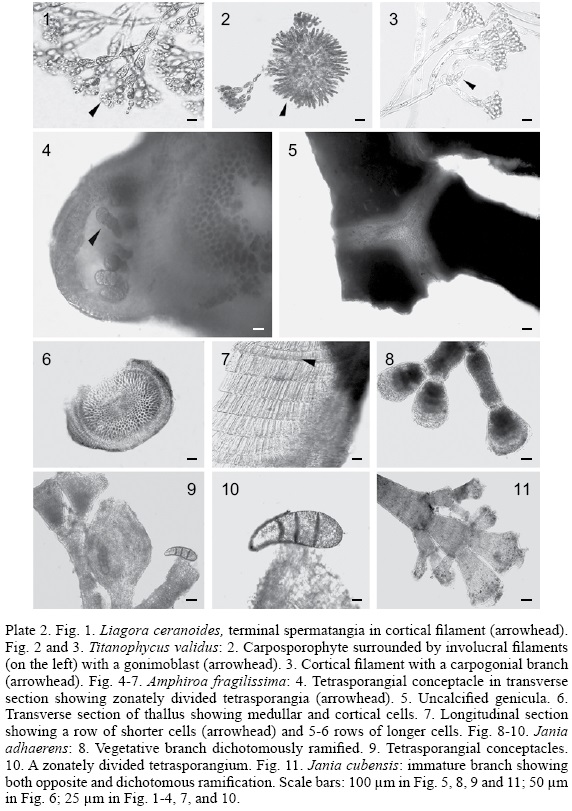
<body><![CDATA[<p align="justify"><font face="verdana" size="2">4. <b><em>Liagora ceranoides</em> J.V. Lamouroux, 1816</b> (<a href="#f1">Pl. 1, Fig. 11</a>; <a href="#f2">Pl. 2, Fig. 1</a>; <a href="/img/revistas/abm/n102/a4f9.jpg" target="_blank">Pl. 8, Fig. 11&#45;13</a>; <a href="/img/revistas/abm/n102/a4f10.jpg" target="_blank">Pl. 9, Fig. 1</a>)</font></p>     <p align="justify"><font face="verdana" size="2">Syn.: <i>Liagora patens</i> P.L. Crouan et H.M. Crouan in Schramm et Maz&eacute;, 1865: 14; <i>Liagora prolifera</i> P.L. Crouan et H.M. Crouan in Maz&eacute; et Schramm, 1878: 185; <i>Liagora viscida</i> f. <em>ceranoides</em> (J.V. Lamouroux) Hauck in Rabenhorst, 1882: 65; <i>Liagora opposita</i> J. Agardh, 1896: 101; <i>Liagora pilgeriana</i> Zeh, 1912: 272.</font></p>  	    <p align="justify"><font face="verdana" size="2">Thallus pseudoparenchymatous, 6&#45;10 cm high, forming compact tufts. Axes multiseriate, smooth and soft, moderately calcified. Rose or white, loses color rapidly after being exposed to light. Branching loose, branches 0.1&#45;0.2 cm in diam., diminishing in size toward the apices. Medullar filaments 20&#45;30 cm in diam., with cells slightly swollen, bead&#45;shaped. Cortical filaments radially extending inside the calcified mucilage, with the apical cells 5&#45;10 &#956;m in diam. Spermatia 1&#45;3 &#956;m in diam., located at branch extremes. Carpogonial branches formed of 3&#45;4 cells, 12&#45;20 &#956;m in diam. Holdfast discoid, 0.2&#45;0.3 cm in diam.</font></p>  	    <p align="justify"><font face="verdana" size="2">Examined specimens: ICIMAP&#45;UV&#45;AL 66, 66R, 21, 21R; LS&#45;16 (11 March 2008), 25 (12 November 2008), 30 (1 March 2008).</font></p>  	    <p align="justify"><font face="verdana" size="2">NPSAV: Blanquilla reef, Isla de Enmedio, Isla Sacrificios, Isla Santiaguillo, Isla Verde (Ortega et al., 2001; Galicia&#45;Garc&iacute;a &amp; Morales&#45;Garc&iacute;a, 2007).</font></p>  	    <p align="justify"><font face="verdana" size="2">Elsewhere in Veracruz: Mpio. San Andr&eacute;s Tuxtla: Montep&iacute;o (Ortega et al., 2001).</font></p>  	    <p align="justify"><font face="verdana" size="2">GOM: SW and SE (Fredericq et al., 2009).</font></p>  	    <p align="justify"><font face="verdana" size="2">References: Taylor, 1960: 326; Littler &amp; Littler, 2000: 50, 51 (fig.); Dawes &amp; Mathieson, 2008: 205, pl. 27, fig. 1, 2.</font></p>  	    <p align="justify">&nbsp;</p> 	    <p align="justify"><font face="verdana" size="2">5. <b><i>Titanophycus</i> <em>validus</em> (Harvey) Huisman, G.W. Saunders et A.R. Sherwood, 2006</b> (<a href="#f2">Pl. 2, Fig. 2</a> and <a href="#f2">3</a>; <a href="/img/revistas/abm/n102/a4f10.jpg" target="_blank">Pl. 9, Fig. 2&#45;4</a>)</font></p>     ]]></body>
<body><![CDATA[<p align="justify"><font face="verdana" size="2">Bas.: <i>Liagora valida</i> Harvey, 1853: 138, pl. 31A, fig. 1&#45;5.</font></p>  	    <p align="justify"><font face="verdana" size="2">Syn.: <i>Liagora annulata</i> J. Agardh, 1876: 518; <i>Liagora tenuis</i> J. Agardh, 1896: 101; <i>Liagora rosacea</i> Zeh, 1912: 271; <i>Liagora pseudorobusta</i> K.C. Fan in K.C. Fan et Yung C. Wang, 1974: 489.</font></p>  	    <p align="justify">&nbsp;</p> 	    <p align="justify"><font face="verdana" size="2">Thallus pseudoparenchymatous, 8 cm high, forming compact erect tufts, with multiseriate axes. Thallus rigid in the inferior and middle portions, with the terminal branchlets mucilagineous and delicate. Calcification is strong in the inferior part of the thallus and moderate in the middle portion. Loses color rapidly after being exposed to light. Branching clearly dichotomous along the thallus. Main axes 700&#45;1000 &#956;m in diam., middle branches 550&#45;750 &#956;m in diam., and apices down to 400&#45;600 &#956;m. Medullar filaments 162&#45;255 &#956;m long and 17.5&#45;25.0 &#956;m wide. Cortical filaments radial, cylindrical to fusiform, 10 &#956;m in diam., ramified 4 to 5 times. Apical cells pyriform, 7.5&#45;9.0 &#956;m in diam. Carpogonial branches formed of 4&#45;5 cells, 11&#45;13 &#956;m in diam., slightly curved, located below the first branching of the cortical filaments. Carposporophytes hemispherical, 180&#45;200 &#956;m in diam., terminal on cortical filaments.</font></p>      <p align="justify"><font face="verdana" size="2">Examined specimens: ICIMAP&#45;UV&#45;AL 67, 67R; LS&#45;16 (11 March 2008), 23 (12 November 2008), 30 (1 March 2008).</font></p>  	    <p align="justify"><font face="verdana" size="2">NPSAV: Isla de Enmedio, Isla Sacrificios, Isla Santiaguillo (Ortega et al., 2001; Galicia&#45;Garc&iacute;a &amp; Morales&#45;Garc&iacute;a, 2007).</font></p>  	    <p align="justify"><font face="verdana" size="2">Veracruz: Mpio. San Andr&eacute;s Tuxtla: Montep&iacute;o (Ortega et al., 2001).</font></p>  	    <p align="justify"><font face="verdana" size="2">GOM: SE (Fredericq et al., 2009).</font></p>  	    <p align="justify"><font face="verdana" size="2">References: Taylor, 1960: 327; Littler &amp; Littler, 2000: 54, 55 (fig.); Dawes &amp; Mathieson, 2008: 205, pl. 27, fig. 3.</font></p> 	    <p align="justify"><font face="verdana" size="2">&nbsp;</font></p>      ]]></body>
<body><![CDATA[<p align="justify"><font face="verdana" size="2">Family Corallinaceae</font></p>  	    <p align="justify"><font face="verdana" size="2">6. <b><i>Amphiroa fragilissima</i> (L.) J.V. Lamouroux, 1816</b> (<a href="#f2">Pl. 2, Fig. 4&#45;7</a>; <a href="/img/revistas/abm/n102/a4f10.jpg" target="_blank">Pl. 9, Fig. 5&#45;7</a>)</font></p>  	    <p align="justify"><font face="verdana" size="2">Bas.: <i>Corallina fragilissima</i> Linnaeus, 1758: 806; 1759: 1305.</font></p>  	    <p align="justify"><font face="verdana" size="2">Thallus fragile, strongly calcified, 2&#45;3 cm high, forming compact tangled tufts. Pale pink, white after being exposed to light. Branching dichotomous, segments 340&#45;350 &#956;m long and 370&#45;400 &#956;m wide, separated by a layer of shorter cells of 15&#45;20 &#956;m long. Intergenicula formed with 6 rows of cells per segment. Cortex formed by several layers of cells. Tetrasporangial conceptacles are lateral, hemispherical, 200&#45;340 &#956;m in diam., with one pore. Holdfast is small, crusty, barely visible. Epiphyte on <i>Halimeda opuntia</i> (L.) J.V. Lamouroux (Chlorophyta), a very common species in NPSAV.</font></p>  	    <p align="justify"><font face="verdana" size="2">Examined specimens: LS&#45;1 (3 June 2010), 7 (11 March 2008).</font></p>  	    <p align="justify"><font face="verdana" size="2">NPSAV: Blanquilla and Hornos reefs (including breakwaters), Isla de Enmedio, Isla Santiaguillo, Isla Verde, Isla Sacrificios (Ortega et al., 2001; Galicia&#45;Garc&iacute;a &amp; Morales&#45;Garc&iacute;a, 2007).</font></p>  	    <p align="justify"><font face="verdana" size="2">Elsewhere in Veracruz: Mpio. Tuxpan: Isla de Lobos; Mpio. Alto Lucero: Laguna Verde, Playa el Morro (Punta del Morro); Mpio. Catemaco: Playa Balzapote; Mpio. San Andr&eacute;s Tuxtla: Montep&iacute;o (Punta Morrillos) (Ortega et al., 2001).</font></p>  	    <p align="justify"><font face="verdana" size="2">GOM: NE, SW and SE (Fredericq et al., 2009).</font></p>  	    <p align="justify"><font face="verdana" size="2">References: Taylor, 1960: 403, pl. 47, fig. 1, 2; Littler &amp; Littler, 2000: 22, 23 (fig.); Moura &amp; Beauclair, 2005: 32 fig. 50&#45;59; Dawes &amp; Mathieson, 2008: 197, pl. 25, fig. 24&#45;26.</font></p>  	    <p align="justify">&nbsp;</p> 	    ]]></body>
<body><![CDATA[<p align="justify"><font face="verdana" size="2">7. <b><i>Jania adhaerens</i> J.V. Lamouroux, 1816</b> (<a href="#f2">Pl. 2, Fig. 8&#45;10</a>; <a href="/img/revistas/abm/n102/a4f10.jpg" target="_blank">Pl. 9, Fig. 8&#45;10</a>)</font></p>      <p align="justify"><font face="verdana" size="2">Syn.: <i>Corallina adhaerens</i> (J.V. Lamouroux) K&uuml;tz., 1858: 40, pl. 83, figs. 2a&#45;f; <i>Jania comosa</i> P.L. Crouan et H.M. Crouan in Maz&eacute; et Schramm, 1865: 18.</font></p>  	    <p align="justify"><font face="verdana" size="2">Thallus pseudoparenchymatous, fragile, strongly calcified, 2&#45;4 cm high, forming small tangled tufts. Loses color rapidly after being exposed to light. Branching completely dichotomous. Segments cylindrical, 0.5&#45;1 mm long and 80&#45;170 &#956;m in diam. Axes dichotomously branched usually in one plane, with rounded apices. Nodes not calcified in regular intervals between bifurcations. Initially fixed to substratum with a crusty holdfast and secondarily with calcareous pads. Medullar cells elongated, 75&#45;90 &#956;m long and 8&#45;13 &#956;m wide, groups in parallel rows. Cortex is absent. Tetraspores zonately divided, 100&#45;200 &#956;m long and 40&#45;60 &#956;m in diam. Tetrasporangial conceptacles with one pore, urn&#45;shaped, 400 &#956;m long and 310 &#956;m in diam., located in terminal branches. Bifurcations with the branches forming an angle of 35&deg;&#45;55&deg;.</font></p>  	    <p align="justify"><font face="verdana" size="2">Examined specimens: ICIMAP&#45;UV&#45;AL 20; LS&#45;2 (12 November 2008), 11 (11 March 2008), 25 (12 November 2008), 28 (1 March 2008).</font></p>  	    <p align="justify"><font face="verdana" size="2">NPSAV: Isla de Enmedio, Isla Santiaguillo, Isla Verde, Isla Sacrificios, Hornos reef (Ortega et al., 2001; Galicia&#45;Garc&iacute;a &amp; Morales&#45;Garc&iacute;a, 2007).</font></p>  	    <p align="justify"><font face="verdana" size="2">Elsewhere in Veracruz. Mpio. Actopan: Playa Para&iacute;so (Laguna La Mancha); Mpio. Catemaco: Laguna de Sontecomapan (Ortega et al., 2001).</font></p>  	    <p align="justify"><font face="verdana" size="2">GOM: throughout the Gulf (Fredericq et al., 2009).</font></p>  	    <p align="justify"><font face="verdana" size="2">References: Taylor, 1960: 413; Schneider &amp; Searles, 1991: 231; Littler &amp; Littler, 2000: 30, 31 (fig.); Dawes &amp; Mathieson, 2008: 194, Pl. 25, fig. 14.</font></p>  	    <p align="justify">&nbsp;</p> 	    <p align="justify"><font face="verdana" size="2">8. <b><i>Jania cubensis</i> Montagne ex K&uuml;tz., 1849</b> (<a href="#f2">Pl. 2, Fig. 11</a>; <a href="/img/revistas/abm/n102/a4f11.jpg" target="_blank">Pl. 10, Fig. 1</a> and <a href="/img/revistas/abm/n102/a4f11.jpg" target="_blank">2</a>)</font></p>      ]]></body>
<body><![CDATA[<p align="justify"><font face="verdana" size="2">Syn.: <i>Corallina cubensis</i> (Montagne ex K&uuml;tz.) K&uuml;tz., 1858: 37, pl. 77, fig. 2; <i>Haliptilon cubense</i> (Montagne ex K&uuml;tz.) Garbary et H.W. Johansen, 1982: 218.</font></p>  	    <p align="justify"><font face="verdana" size="2">Thallus pseudoparenchymatous, erect or prostrate, 0.7&#45;1.2 cm high, forming densely branched tufts, delicate but strongly calcified. Pinkish white to pinkish red. Axes cylindrical, tapering to the apices, irregularly branched, dichotomous or pinnate, in multiple planes. Segments in the inferior part 200&#45;350 &#956;m long and 100&#45;250 &#956;m wide, and in the middle portion 400&#45;600 &#956;m long and 150&#45;250 &#956;m wide. Medulla composed of rows of cells, 30&#45;40 &#956;m in diam. Cortical cells elongated in surface view, 20&#45;40 &#956;m long and 7&#45;12 &#956;m wide. Apices bluntly pointed. Articulations flexible, not calcified, composed of only one row of cells; can attach to a solid substrate with branch extremes. Holdfast crusty. Reproductive stages were not observed. Epiphyte on <i>Bryothamnion triquetrum</i> (Rhodophyta).</font></p>  	    <p align="justify"><font face="verdana" size="2">Examined specimens: LS&#45;11 (11 March 2008).</font></p>  	    <p align="justify"><font face="verdana" size="2">NPSAV: Isla de Enmedio, Isla Sacrificios, Isla Verde (Ortega et al., 2001; Galicia&#45;Garc&iacute;a &amp; Morales&#45;Garc&iacute;a, 2007).</font></p>  	    <p align="justify"><font face="verdana" size="2">Elsewhere in Veracruz: Mpio. San Andr&eacute;s Tuxtla: Montep&iacute;o; Mpio. Tuxpan: Tuxpan (Ortega et al., 2001).</font></p>  	    <p align="justify"><font face="verdana" size="2">GOM: throughout the Gulf (Fredericq et al., 2009).</font></p>  	    <p align="justify"><font face="verdana" size="2">References: Taylor, 1960: 409, pl. 50, figs. 3, 4; Schneider &amp; Searles, 1991: 229, fig. 263&#45;265; Littler &amp; Littler, 2000: 26, 27 (fig.); Dawes &amp; Mathieson, 2008: 193, pl. 25, fig. 10&#45;12.</font></p>  	    <p align="justify">&nbsp;</p> 	    <p align="justify"><font face="verdana" size="2">9. <b><i>Pneophyllum fragile</i> K&uuml;tz., 1843</b> (<a href="/img/revistas/abm/n102/a4f4.jpg" target="_blank">Pl. 3, Fig. 1</a> and <a href="/img/revistas/abm/n102/a4f4.jpg" target="_blank">2</a>; <a href="/img/revistas/abm/n102/a4f11.jpg" target="_blank">Pl. 10, Fig. 3</a> and <a href="/img/revistas/abm/n102/a4f11.jpg" target="_blank">4</a>)</font></p>      <p align="justify"><font face="verdana" size="2">Syn.: <i>Heteroderma lejolisii</i> (Rosanoff) Foslie, 1909: 56; <em>Fosliella lejolisii</em> (Rosanoff) M.A. Howe, 1920: 588; <i>Pneophyllum</i> <em>lejolisii</em> (Rosanoff) Chamberlain, 1983: 359, fig. 28&#45;32.</font></p>  	    ]]></body>
<body><![CDATA[<p align="justify"><font face="verdana" size="2">Thallus prostrate, crusts 0.5&#45;1.0 mm in diam. and 25&#45;45 &#956;m thick, white. Cells quadrate to quadrangular in surface view, 10&#45;17 &#956;m long and 5&#45;8 &#956;m wide, not interfused, located in radial pattern starting from an initial group of 8 cells. Young crusts formed with one cell, older ones composed of up to 4 layers of cells. Cap cells are wider than long, 4&#45;7.5 &#956;m wide. Hypothallus is formed with one layer of cells oriented parallel to the surface of thallus, 7.5&#45;10 &#956;m long and 6&#45;8 &#956;m wide. Epithallus monostromatic, composed of cells 3&#45;7 &micro;m high and 4&#45;7 &micro;m in diam. Trichocytes intercalary, rare, 10&#45;12.5 &micro;m long. Tetrasporangial conceptacles hemispherical, 50 &micro;m in diam., with a central pore. Tetrasporangia zonately divided, 37.5 &micro;m long and 18 &micro;m in diam. Epiphyte on <i>Bryothamnion triquetrum</i>, almost entirely covering its thallus.</font></p>  	    <p align="justify"><font face="verdana" size="2">Examined specimens: LS&#45;8 (1 March 2008).</font></p>  	    <p align="justify"><font face="verdana" size="2">NPSAV: Blanquilla reef, Isla de Enmedio, Isla Sacrificios, Isla Verde (Ortega et al., 2001; Galicia&#45;Garc&iacute;a &amp; Morales&#45;Garc&iacute;a, 2007).</font></p>  	    <p align="justify"><font face="verdana" size="2">Elsewhere in Veracruz: Mpio. Tuxpan: Isla de Lobos; Mpio. Actopan: Playa Para&iacute;so (Laguna La Mancha), Villa Rica (Punta Villa Rica); Mpio. Alto Lucero: Boca Andrea, Laguna Verde, Playa el Morro (Punta del Morro) (Ortega et al., 2001).</font></p>  	    <p align="justify"><font face="verdana" size="2">GOM: throughout the Gulf (Fredericq et al., 2009).</font></p>  	    <p align="justify"><font face="verdana" size="2">References: Taylor 1960: 387; Schneider &amp; Searles, 1991: 244; Littler &amp; Littler, 2000: 38, 39 (fig.); Mateo&#45;Cid, 2006; Dawes &amp; Mathieson, 2008: 191, pl. 25, fig. 4, 5; Mateo&#45;Cid &amp; Mendoza&#45;Gonz&aacute;lez, 2009: 610, fig. 13&#45;16.</font></p>  	    <p align="justify">&nbsp;</p> 	    <p align="justify"><font face="verdana" size="2">10. <b><i>Porolithon pachydermum</i> (Foslie) Foslie, 1909</b> (<a href="/img/revistas/abm/n102/a4f4.jpg" target="_blank">Pl. 3, Fig. 3&#45;5</a>; <a href="/img/revistas/abm/n102/a4f11.jpg" target="_blank">Pl. 10, Fig. 5</a> and <a href="/img/revistas/abm/n102/a4f11.jpg" target="_blank">6</a>)</font></p>      <p align="justify"><font face="verdana" size="2">Bas.: <i>Lithophyllum onkodes</i> f. <i>pachydermum</i> Foslie, 1904: 4.</font></p>  	    <p align="justify"><font face="verdana" size="2">Syn.: <i>Hydrolithon pachydermum</i> (Foslie) J.C. Bailey, J.E. Gabel et D.W. Freshwater, 2004: 8.</font></p>  	    ]]></body>
<body><![CDATA[<p align="justify"><font face="verdana" size="2">Thallus crusty, usually up to 100 &#956;m, sometimes up to 1 mm wide, strongly calcified, frequently forming thick layers extending indefinitely. Surface chalky, pinkish grey. Cells of surface layers densely arranged, 8&#45;14 &#956;m long and 6&#45;9 &#956;m wide; layers frequently fused. Cell layers of the inferior surface part are horizontally oriented, parallel to substrate. Trichocytes are common, horizontally grouped, 17&#45;29 &#956;m high and 8&#45;16 &#956;m in diam. Tetrasporangial conceptacles 150&#45;250 &#956;m in diam., with a central apical pore. Tetraspores 60&#45;70 &#956;m long and 30&#45;40 &#956;m in diam., zonately divided, being formed in the periphery of a conceptacle.</font></p>  	    <p align="justify"><font face="verdana" size="2">Taxonomic note: Kato et al. (2011: 669) resurrected the genus <i>Porolithon</i> (Foslie) Foslie, 1909, on the basis of molecular data that confirmed its original separation from <em>Hydrolithon</em> based on the arrangement of trichocytes.</font></p>  	    <p align="justify"><font face="verdana" size="2">Examined specimens: LS&#45;18 (11 March 2008).</font></p>  	    <p align="justify"><font face="verdana" size="2">NPSAV: Isla Santiaguillo (Ortega et al., 2001; Galicia&#45;Garc&iacute;a &amp; Morales&#45;Garc&iacute;a, 2007).</font></p>  	    <p align="justify"><font face="verdana" size="2">GOM: SW (Fredericq et al., 2009).</font></p>  	    <p align="justify"><font face="verdana" size="2">References: Taylor, 1960: 401; Littler &amp; Littler, 2000: 38, 39 (fig.); Dawes &amp; Mathieson, 2008: 191, pl. 25, fig. 6&#45;8; Mendoza&#45;Gonz&aacute;lez et al., 2009: 229.</font></p> 	    <p align="justify"><font face="verdana" size="2">&nbsp;</font></p>      <p align="justify"><font face="verdana" size="2">Family Lomentariaceae</font></p>  	    <p align="justify"><font face="verdana" size="2">11. <b><i>Ceratodictyon intricatum</i> (C. Agardh) R.E. Norris, 1987</b> (<a href="/img/revistas/abm/n102/a4f4.jpg" target="_blank">Pl. 3, Fig. 6&#45;8</a>; <a href="/img/revistas/abm/n102/a4f11.jpg" target="_blank">Pl. 10, Fig. 7&#45;9</a>)</font></p>  	    <p align="justify"><font face="verdana" size="2">Bas.: <i>Sphaerococcus </i><em>intricatus</em> C. Agardh, 1822 (1822&#45;1823): 333&#45;334.</font></p>  	    ]]></body>
<body><![CDATA[<p align="justify"><font face="verdana" size="2">Syn.: <i>Gelidium intricatum</i> (C. Agardh) K&uuml;tz., 1849: 767; <i>Gelidiopsis intricata</i> (C. Agardh) Vickers, 1905: 61; <i>Acrocarpus intricatus</i> (C. Agardh) K&uuml;tz., 1868: 12, pl. 35: figs. d, e.</font></p>  	    <p align="justify"><font face="verdana" size="2">Thallus pseudoparenchymatous, rigid, rugged, tangled, 1&#45;3 cm high, with erect or prostrate axes. Loses color rapidly after being exposed to light. Branching irregular, spaced, somewhat alternate. Main axes cylindrical, 400&#45;500 &#956;m in diam., sometimes fused. Apices slightly acute, multicellular, composed of 5 to 6 layers of cells. Medullar cells ovoid or spherical, 80&#45;120 &#956;m in diam., continuously diminishing in size toward cortex. Surface cells spherical to ovoid, 15&#45;30 &#956;m long in the principal axes. Cortex formed by one layer of spherical, strongly pigmented cells 20&#45;25 &#956;m in diam. Reproductive stages were not observed.</font></p>  	    <p align="justify"><font face="verdana" size="2">Examined specimens: LS&#45;11 (11 March 2008).</font></p>  	    <p align="justify"><font face="verdana" size="2">NPSAV: Isla Blanquilla, Isla Verde, Isla de Enmedio (Ortega et al., 2001; Galicia&#45;Garc&iacute;a &amp; Morales&#45;Garc&iacute;a, 2007).</font></p>  	    <p align="justify"><font face="verdana" size="2">GOM: SW and SE (Fredericq et al., 2009).</font></p>  	    <p align="justify"><font face="verdana" size="2">References: Taylor, 1960: 353; Littler &amp; Littler, 2000: 124, 125 (fig.); Dawes &amp; Mathieson, 2008: 378, pl. 51, fig. 3&#45;5.</font></p>  	    <p align="justify">&nbsp;</p> 	    <p align="justify"><font face="verdana" size="2">12. <b><i>Ceratodictyon planicaule</i> (W.R. Taylor) M.J. Wynne, 2011</b> (<a href="/img/revistas/abm/n102/a4f4.jpg" target="_blank">Pl. 3, Fig. 9</a> and <a href="/img/revistas/abm/n102/a4f4.jpg" target="_blank">10</a>; <a href="/img/revistas/abm/n102/a4f5.jpg" target="_blank">Pl. 4, Fig. 1</a>; <a href="/img/revistas/abm/n102/a4f11.jpg" target="_blank">Pl. 10, Fig. 10&#45;13</a>)</font></p>  	    <p align="justify"><font face="verdana" size="2">Bas.: <i>Wurdemannia miniata</i> (Sprengel) J. Feldmann et Hamel var. <em>planicaulis</em> W.R. Taylor, 1943: 158.</font></p>  	    <p align="justify"><font face="verdana" size="2">Syn.: <i>Gelidiopsis planicaulis</i> (W.R. Taylor) W.R. Taylor, 1960: 353.</font></p>  	    ]]></body>
<body><![CDATA[<p align="justify"><font face="verdana" size="2">Thallus pseudoparenchymatous, rigid, prostrate, 2&#45;3 cm high, forming small tangled mats. Loses color rapidly after being exposed to light. Branching irregularly alternate, somewhat dichotomous, spaced, branches growing by several apical cells. Axes flattened in the middle part. Surface cells spherical to ovoid, 10&#45;20 &#956;m in transverse section. Medullar cells spherical, 15&#45;30 &#956;m in diam., diminishing in size toward cortex. Medulla is formed by 5&#45;7 layers of cells. Branches compressed, 400&#45;500 &#956;m wide and 150&#45;200 &#956;m high. Cortex is formed by 1&#45;2 layers of spherical cells 10&#45;15 &#956;m in diam. Apices slightly rounded. Reproductive stages were not observed.</font></p>  	    <p align="justify"><font face="verdana" size="2">Examined specimens: LS&#45;11 (11 March 2008).</font></p>  	    <p align="justify"><font face="verdana" size="2">A new record for the NPSAV.</font></p>  	    <p align="justify"><font face="verdana" size="2">Elsewhere in Veracruz: Mpio. Actopan: Villa Rica (Punta Villa Rica); Mpio. Alto Lucero: Playa el Morro (Punta del Morro); Mpio. Tuxpan: Isla de Lobos (Ortega et al., 2001).</font></p>  	    <p align="justify"><font face="verdana" size="2">GOM: SW and SE (Fredericq et al., 2009).</font></p>  	    <p align="justify"><font face="verdana" size="2">References: Taylor, 1960: 353; Littler &amp; Littler, 2000: 124, 125 (fig.); Dawes &amp; Mathieson, 2008: 379, pl. 51, fig. 6, 7.</font></p> 	    <p align="justify"><font face="verdana" size="2">&nbsp;</font></p>      <p align="justify"><font face="verdana" size="2">Family Ceramiaceae</font></p>  	    <p align="justify"><font face="verdana" size="2">13. <b><i>Ceramium luetzelburgii</i> O.C. Schmidt, 1924</b> (<a href="/img/revistas/abm/n102/a4f5.jpg" target="_blank">Pl. 4, Fig. 2&#45;4</a>; <a href="/img/revistas/abm/n102/a4f12.jpg" target="_blank">Pl. 11, Fig. 1&#45;4</a>)</font></p>  	    <p align="justify"><font face="verdana" size="2">Thallus filamentous, delicate, mainly prostrate, 15&#45;18 mm high. Branches ascending, sparse or dichotomous, unilateral&#45;alternate. Apices erect, forcipate. Rhizoids numerous, originating from the prostrate part of thallus. Axes uniseriate, with relatively large cells. Internodes 70&#45;400 &micro;m long, 30&#45;50 &micro;m wide and 20&#45;50 &micro;m in diam. Cells of the nodes strongly pigmented, arranged in three bands: superior cells rounded and small, cells in the middle part are larger and somewhat triangular, and inferior cells elongated and smaller than in the middle portion. Usually one, rarely two, tetrasporangium per node, tetrahedrally divided, 30&#45;45 &#956;m in diam.</font></p>  	    ]]></body>
<body><![CDATA[<p align="justify"><font face="verdana" size="2">Examined specimens: ICIMAP&#45;UV&#45;AL 30; LS&#45;8 (1 March 2008).</font></p>  	    <p align="justify"><font face="verdana" size="2">NPSAV: Isla Verde (Ortega et al., 2001).</font></p>  	    <p align="justify"><font face="verdana" size="2">Elsewhere in Veracruz: Mpio. Actopan: Playa Para&iacute;so (Laguna La Mancha), Villa Rica (Punta Villa Rica); Mpio. Alto Lucero: Boca Andrea, Laguna Verde, Playa el Morro (Punta el Morro) (Ortega et al., 2001).</font></p>  	    <p align="justify"><font face="verdana" size="2">GOM: SW (Fredericq et al., 2009).</font></p>  	    <p align="justify"><font face="verdana" size="2">References: Taylor, 1960: 529.</font></p>  	    <p align="justify">&nbsp;</p> 	    <p align="justify"><font face="verdana" size="2">14. <b><i>Ceramium nitens</i> (C. Agardh) J. Agardh, 1851</b> (<a href="/img/revistas/abm/n102/a4f5.jpg" target="_blank">Pl. 4, Fig. 5&#45;9</a>; <a href="/img/revistas/abm/n102/a4f12.jpg" target="_blank">Pl. 11, Fig. 5&#45;9</a>)</font></p>      <p align="justify"><font face="verdana" size="2">Bas.: <i>Ceramium rubrum</i> var. <em>nitens</em> C. Agardh, 1824: 136.</font></p>  	    <p align="justify"><font face="verdana" size="2">Thallus filamentous, firm, 3&#45;5 cm high, forming compact tufts. Filaments erect, red&#45;orange, in some parts pink. Branching dichotomous&#45;alternated, widely spreading, branchlets curved, not forcipate, in the middle part 300&#45;380 &micro;m in diam., terminally pointed. Central filament 180&#45;190 &micro;m in diam. Cortical cells strongly pigmented, completely encircling the central filament. Periaxial cells are formed from the cortical cells. Each periaxial cell divided into four cells: two acropetal and two basipetal ones. Carposporangia hemispherical, lateral in superior branches, 90&#45;125 &micro;m in diam. Carpospores 25 &micro;m in diam. Epiphytic on <i>Halimeda</i> sp. (Chlorophyta); also grows on dead coral fragments.</font></p>  	    <p align="justify"><font face="verdana" size="2">Examined specimens: LS&#45;13 (12 November 2008), 21 (1 March 2008).</font></p>  	    ]]></body>
<body><![CDATA[<p align="justify"><font face="verdana" size="2">NPSAV: Isla de Enmedio, Isla Sacrificios, Isla Santiaguillo, Isla Verde (Ortega et al., 2001; Galicia&#45;Garc&iacute;a &amp; Morales&#45;Garc&iacute;a, 2007).</font></p>  	    <p align="justify"><font face="verdana" size="2">GOM: NE, SW and SE (Fredericq et al., 2009).</font></p>  	    <p align="justify"><font face="verdana" size="2">References: Taylor, 1960: 535, pl. 66, fig. 14; Littler &amp; Littler, 2000: 150, 151 (fig.); Fujii et al., 2001: 360; Dawes &amp; Mathieson, 2008: 233, pl. 30, fig. 19, 20.</font></p> 	    <p align="justify"><font face="verdana" size="2">&nbsp;</font></p>      <p align="justify"><font face="verdana" size="2">Family Rhodomelaceae</font></p>  	    <p align="justify"><font face="verdana" size="2">15. <b><i>Bryothamnion triquetrum</i> (S.G. Gmelin) M.A. Howe, 1915</b> (<a href="/img/revistas/abm/n102/a4f5.jpg" target="_blank">Pl. 4, Fig. 10</a> and <a href="/img/revistas/abm/n102/a4f5.jpg" target="_blank">11</a>; <a href="/img/revistas/abm/n102/a4f6.jpg" target="_blank">Pl. 5, Fig. 1</a>; <a href="/img/revistas/abm/n102/a4f12.jpg" target="_blank">Pl. 11, Fig. 10</a> and <a href="/img/revistas/abm/n102/a4f12.jpg" target="_blank">11</a>; <a href="/img/revistas/abm/n102/a4f13.jpg" target="_blank">Pl. 12, Fig. 1</a>)</font></p>  	    <p align="justify"><font face="verdana" size="2">Bas.: <em>Fucus triqueter</em> S.G. Gmelin, 1768: 122, pl. 8, fig. 4.</font></p>  	    <p align="justify"><font face="verdana" size="2">Thallus pseudoparenchymatous, erect, up to 14 cm high, forming compact, rigid mats. Red to dark&#45;brown, loses color rapidly after being exposed to light. Branching alternate or irregular. Axes erect, covered with short, spine&#45;like branchlets. Main axes of 6&#45;9 pericentral globose cells of 200&#45;300 &#956;m, heavily corticated; cortical cells rectangular, 25&#45;50 &#956;m wide, strongly pigmented. Secondary axes polysiphonous, with 7&#45;9 pericentral globose cells 150&#45;220 &#956;m in diam, completely corticated; cortical cells rounded, 25&#45;50 &#956;m in diam., strongly pigmented. Branchlets usually in three rows spirally twisted, 1&#45;2 mm long, with simple branching inferiorly and trichotomous superiorly. Apices pointed, slightly curved, grouped distally. Fixed to substrate by a fleshy base with several erect, cylindrical axes, 2 cm in diam. Reproductive stages were not observed.</font></p>  	    <p align="justify"><font face="verdana" size="2">Examined specimens: LS&#45;8 (1 March 2008).</font></p>  	    <p align="justify"><font face="verdana" size="2">NPSAV: Punta Gorda, Hornos and Ingeniero reefs, Isla de Enmedio, Isla Sacrificios (Ortega et al., 2001; Galicia&#45;Garc&iacute;a &amp; Morales&#45;Garc&iacute;a, 2007).</font></p>  	    ]]></body>
<body><![CDATA[<p align="justify"><font face="verdana" size="2">Elsewhere in Veracruz: Mpio. Actopan: Villa Rica (Punta Villa Rica); Mpio. Alto Lucero: Laguna Verde, Playa el Morro (Punta del Morro); Mpio. Alvarado: Punta Ant&oacute;n Lizardo; Mpio. San Andr&eacute;s Tuxtla: Montep&iacute;o; Mpio. Tuxpan: Tuxpan; Mpio. Veracruz: Playa Hotel Pensiones, Playa Mocambo (Ortega et al., 2001).</font></p>  	    <p align="justify"><font face="verdana" size="2">GOM: SW and SE (Fredericq et al., 2009).</font></p>  	    <p align="justify"><font face="verdana" size="2">References: Taylor, 1960: 587, pl. 72, fig. 6, pl. 73, fig. 4; Littler &amp; Littler, 2000: 196, 197 (fig.); Dawes &amp; Mathieson, 2008: 280, pl. 37, fig. 16, 17.</font></p>  	    <p align="justify">&nbsp;</p> 	    <p align="justify"><font face="verdana" size="2">16. <b><i>Laurencia intricata</i> J.V. Lamouroux, 1813</b> (<a href="/img/revistas/abm/n102/a4f6.jpg" target="_blank">Pl. 5, Fig. 2&#45;5</a>; <a href="/img/revistas/abm/n102/a4f13.jpg" target="_blank">Pl. 12, Fig. 2&#45;6</a>)</font></p>      <p align="justify"><font face="verdana" size="2">Syn.: <i>Laurencia</i> implicata J. Agardh, 1852: 745.</font></p>  	    <p align="justify"><font face="verdana" size="2">Thallus pseudoparenchymatous, flexible, forming loose mats. Axes erect, 3&#45;4 cm high. Loses color rapidly after being exposed to light. Branching irregular, spaced, branches are positioned with a wide angle between them, almost at right angles. The main axis is not distinguished. Middle branches 660&#45;900 &#956;m in diam. Branchlets cylindrical, 60&#45;90 &#956;m in diam. at the apices, some apices slightly curved. Surface cells polyhedral, 36&#45;54 &#956;m in their widest part. Pericentral cells (five) 90&#45;140 &#956;m in diam., larger than the medullar ones. Cortical cells periclinally arranged, 20&#45;35 &#956;m in diam. Reproductive stages were not observed.</font></p>  	    <p align="justify"><font face="verdana" size="2">Examined specimens: LS&#45;11 (11 March 2008).</font></p>  	    <p align="justify"><font face="verdana" size="2">NPSAV: Giote reef, Isla Sacrificios (Ortega et al., 2001, Galicia&#45;Garc&iacute;a &amp; Morales&#45;Garc&iacute;a, 2007).</font></p>  	    <p align="justify"><font face="verdana" size="2">GOM: NW, SW and SE (Fredericq et al., 2009).</font></p>  	    ]]></body>
<body><![CDATA[<p align="justify"><font face="verdana" size="2">References: Taylor, 1960: 626; Littler &amp; Littler, 2000: 214, 215 (fig.); Sent&iacute;es&#45;Granados &amp; Fujii, 2002: 142, fig. 22&#45;31; Dawes &amp; Mathieson, 2008: 294, pl. 39, fig. 21, 22.</font></p>  	    <p align="justify">&nbsp;</p> 	    <p align="justify"><font face="verdana" size="2">17.<b> <i>Laurencia obtusa</i> (Hudson) J.V. Lamouroux, 1813</b> (<a href="/img/revistas/abm/n102/a4f6.jpg" target="_blank">Pl. 5, Fig. 6&#45;10</a>; <a href="/img/revistas/abm/n102/a4f13.jpg" target="_blank">Pl. 12, Fig. 7&#45;11</a>)</font></p>  	    <p align="justify"><font face="verdana" size="2">Bas.: <i>Fucus obtusus</i> Hudson, 1778: 586.</font></p>  	    <p align="justify"><font face="verdana" size="2">Syn.: <i>Chondria obtusa</i> (Hudson) C. Agardh, 1817: pl. 18, fig. 35; Sphaerococcus obtusus (Hudson) Wahlenberg, 1826: 897.</font></p>  	    <p align="justify"><font face="verdana" size="2">Thallus pseudoparenchymatous, with erect axes 3&#45;4 cm high, usually grouped. Pale pink, loses color rapidly after being exposed to light. Branching alternate, rarely opposite. Vegetative branches cylindrical, 630&#45;700 &micro;m in diam., 4&#45;6 pericentral cells. Medullar cells ovoid, not pigmented, smaller than pericentral ones, 100&#45;150 &micro;m in diam. Cortical cells arranged in one or two layers, spherical, strongly pigmented, 50&#45;60 &micro;m in diam. Surface cells 25 &micro;m in diam. in surface view, intercellular connections are barely visible. Lenticular thickenings in medullar cells absent; <i>corps en cerise</i> present. Cystocarps oval, 1 mm long and 0.8 mm in diam. Tetrasporocysts tetrahedrally or cruciately divided, 50&#45;100 &micro;m in diam., located on terminal branches. Epiphytic on <i>Halimeda</i> spp. (Chlorophyta).</font></p>  	    <p align="justify"><font face="verdana" size="2">Examined specimens: LS&#45;1 (3 June 2010).</font></p>  	    <p align="justify"><font face="verdana" size="2">NPSAV: Blanquilla, Giote and Hornos reefs, Isla de Enmedio, Isla Sacrificios, Isla Verde, Isla Santiaguillo (Ortega et al., 2001; Galicia&#45;Garc&iacute;a &amp; Morales&#45;Garc&iacute;a, 2007).</font></p>  	    <p align="justify"><font face="verdana" size="2">Elsewhere in Veracruz: Mpio. Tuxpan: Isla de Lobos; Mpio. Actopan: Playa Para&iacute;so (Laguna La Mancha), Villa Rica (Punta Villa Rica); Mpio. Alto Lucero: Boca Andrea, Laguna Verde, Playa el Morro (Punta del Morro); Mpio. Catemaco: Laguna de Sontecomapan; Mpio. San Andr&eacute;s Tuxtla: Montep&iacute;o; Mpio. Veracruz: Playa Hotel Pensiones; Mpios. Pueblo Viejo, Tampico Alto, Ozuluama, Tamal&iacute;n and Tamiahua: Laguna de Tamiahua (Ortega et al., 2001).</font></p>  	    <p align="justify"><font face="verdana" size="2">GOM: throughout the Gulf (Fredericq et al., 2009).</font></p>  	    ]]></body>
<body><![CDATA[<p align="justify"><font face="verdana" size="2">References: Taylor, 1960: 626. Littler &amp; Littler, 2000: 216, 217 (fig.); Sent&iacute;es&#45;Granados &amp; Fujii, 2002: 149, fig. 41&#45;52; Dawes &amp; Mathieson, 2008: 295, pl. 39, fig. 24, 25.</font></p>  	    <p align="justify">&nbsp;</p> 	    <p align="justify"><font face="verdana" size="2">18. <b><i>Neosiphonia gorgoniae</i> (Harvey) S.M. Guimar&atilde;es et M.T. Fujii in S.M. Guimar&atilde;es, M.T. Fuji, M.T. Pupo et N.S. Yokova, 2004</b> (<a href="/img/revistas/abm/n102/a4f6.jpg" target="_blank">Pl. 5, Fig. 11</a>; <a href="/img/revistas/abm/n102/a4f7.jpg" target="_blank">Pl. 6, Fig. 1&#45;3</a>; <a href="/img/revistas/abm/n102/a4f14.jpg" target="_blank">Pl. 13, Fig. 1&#45;3</a>)</font></p>      <p align="justify"><font face="verdana" size="2">Bas.: <i>Polysiphonia gorgoniae</i> Harvey, 1853: 39.</font></p>  	    <p align="justify"><font face="verdana" size="2">Thallus filamentous, soft, 2 mm high, forming small mats. Brown to grey, loses color rapidly after being exposed to light. Axes usually erect, with four pericentral cells. Branching more or less dichotomous, spaced. Both gametophytes and sporophytes were observed.</font></p>  	    <p align="justify"><font face="verdana" size="2">Female gametophyte. Principal branches 100&#45;115 &#956;m in diam., with segments 90&#45;110 &#956;m long. Cystocarps 200 &#956;m long and 175 &#956;m in diam.</font></p>  	    <p align="justify"><font face="verdana" size="2">Male gametophyte. Principal branches 70&#45;80 &#956;m in diam., with cells 90 &#956;m long. Spermatangial stichidia 190&#45;240 &#956;m long and 60&#45;80 &#956;m in diam. Branchlets that bear stichidia 50 &#956;m in diam.</font></p>  	    <p align="justify"><font face="verdana" size="2">Tetrasporophyte. Thallus 0.9&#45;2.0 mm high. Principal branches 50&#45;90 &#956;m in diam., with segments 65&#45;115 &#956;m long, fixed to substratum by a unicellular rhizoid 50 &#956;m in diam. Tetrasporangia 65&#45;95 &#956;m wide and 75 &#956;m high. Branches substituting trichoblasts. Trichoblasts helicoidally arranged, with one basal cell 90&#45;100 &#956;m long and 15&#45;20 &#956;m in diam. Epiphyte on <i>Bryothamnion triquetrum</i>.</font></p>  	    <p align="justify"><font face="verdana" size="2">Examined specimens: LS&#45;8 (1 March 2008).</font></p>  	    <p align="justify"><font face="verdana" size="2">NPSAV: Hornos and Blanquilla reefs, Isla de Enmedio, Isla Sacrificios, Isla Verde (Ortega et al., 2001; Galicia&#45;Garc&iacute;a &amp; Morales&#45;Garc&iacute;a, 2007).</font></p>  	    ]]></body>
<body><![CDATA[<p align="justify"><font face="verdana" size="2">GOM: throughout the Gulf (Fredericq et al., 2009).</font></p>  	    <p align="justify"><font face="verdana" size="2">References: Taylor, 1960: 576; Aguilar&#45;Rosas &amp; Aguilar&#45;Rosas, 1988: 80, fig. 3&#45;5; Schneider &amp; Searles, 1991: 467; Littler &amp; Littler, 2000: 228, 229 (fig.).</font></p>  	    <p align="justify">&nbsp;</p> 	    <p align="justify"><font face="verdana" size="2">19. <b><i>Polysiphonia pseudovillum</i> Hollenberg, 1968</b> (<a href="/img/revistas/abm/n102/a4f7.jpg" target="_blank">Pl. 6, Fig. 4&#45;7</a>; <a href="/img/revistas/abm/n102/a4f14.jpg" target="_blank">Pl. 13, Fig. 4&#45;7</a>)</font></p>      <p align="justify"><font face="verdana" size="2">Thallus filamentous, delicate, 1&#45;2 cm high, forming small tufts. Loses color rapidly after being exposed to light. Branching dichotomous, spaced. Prostrate axes 51&#45;57 &#956;m in diam., with segments of 75&#45;90 &#956;m long, scars from trichocytes common. Erect axes 40&#45;45 &#956;m in diam., slightly attenuated at the base, with four pericentral cells, not corticated. Segments one to two diameters long. Apical filaments deciduous, branching 2&#45;3 times. Rhizoids unicellular, emerging proximally from pericentral cells, separated by the wall of the parent cell. Tetrasporangia spherical, 66&#45;69 &#956;m in diam., tetrahedrally divided, one per segment, in spiral series on superior branchlets. Cystocarps urn&#45;shaped or globose, 160&#45;170 &#956;m in diam. Epiphyte on <i>Bryothamnion triquetrum</i>.</font></p>  	    <p align="justify"><font face="verdana" size="2">Morphological note. Tetrasporangia and cystocarps in our specimens were larger than those in Littler &amp; Littler (2000): 40&#45;50 &#956;m and up to 150 &#956;m, respectively.</font></p>  	    <p align="justify"><font face="verdana" size="2">Examined specimens: LS&#45;8 (1 March 2008).</font></p>  	    <p align="justify"><font face="verdana" size="2">A new record for the Gulf of Mexico.</font></p>  	    <p align="justify"><font face="verdana" size="2">References: Schneider &amp; Searles, 1991: 472; Littler &amp; Littler, 2000: 230, 231 (fig.); Mamoozadeh &amp; Freshwater, 2012: 338, Fig. 58&#45;72.</font></p>  	    <p align="justify">&nbsp;</p> 	    ]]></body>
<body><![CDATA[<p align="justify"><font face="verdana" size="2">20. <b><i>Yuzurua poiteaui</i> (J.V. Lamouroux) Martin&#45;Lescanne, 2010</b> (<a href="/img/revistas/abm/n102/a4f7.jpg" target="_blank">Pl. 6, Fig. 8</a>; <a href="/img/revistas/abm/n102/a4f8.jpg" target="_blank">Pl. 7, Fig. 1&#45;3</a>; <a href="/img/revistas/abm/n102/a4f14.jpg" target="_blank">Pl. 13, Fig. 8</a> and <a href="/img/revistas/abm/n102/a4f14.jpg" target="_blank">9</a>; <a href="/img/revistas/abm/n102/a4f15.jpg" target="_blank">Pl. 14, Fig. 1&#45;3</a>)</font></p>  	    <p align="justify"><font face="verdana" size="2">Bas.: <i>Fucus poiteaui</i> J.V. Lamouroux, 1805: 63, pl. 31, fig. 2, 3.</font></p>  	    <p align="justify"><font face="verdana" size="2">Syn.: <i>Chondrophycus poiteaui</i> (J.V. Lamouroux) K.W. Nam, 1999: 463; <i>Laurencia</i> poiteaui (J.V. Lamouroux) M.A. Howe, 1905: 583, 1918: 518; Palisada poiteaui (J.V. Lamouroux) K.W. Nam, 2006: 69.</font></p>  	    <p align="justify"><font face="verdana" size="2">Thallus pseudoparenchymatous, compact, cartilaginous, 1.5&#45;4.0 cm high. Loses color rapidly after being exposed to light. Branching alternate, irregular, branchlets helicoidally arranged. Main branches cylindrical or slightly compressed, 1.0&#45;1.2 mm in diam. Secondary branches 960 &#956;m in diam. Branchlets numerous, cylindrical, 1.3&#45;1.5 mm long and 0.4&#45;1.0 mm in diam. Apices covered with fine tufts of trichomes, dichotomously branched filaments extending beyond the border of the depression. Surface cells of irregular shape, rounded to oblong, 24&#45;34 &#956;m long and 18&#45;24 &#956;m in diam. Secondary connections present. Medullar cells 105&#45;150 &#956;m long and 69&#45;156 &#956;m in diam. Cortical cells 24&#45;39 &#956;m long and 18&#45;24 &#956;m in diam. Surface cells 45&#45;54 &#956;m in diam. Tetrasporangia oval, tetrahedrally divided, 90&#45;105 &#956;m long and 60&#45;63 &#956;m in diam.</font></p>  	    <p align="justify"><font face="verdana" size="2">Examined specimens: LS&#45;11 (1 March 2008).</font></p>  	    <p align="justify"><font face="verdana" size="2">NPSAV: Hornos reef, Isla de Enmedio, Isla Sacrificios, Isla Verde (Ortega et al., 2001).</font></p>  	    <p align="justify"><font face="verdana" size="2">GOM: NE, NW and SE (Fredericq et al., 2009).</font></p>  	    <p align="justify"><font face="verdana" size="2">References: Taylor, 1960: 625; Schneider &amp; Searles, 1991: 454, fig. 537; Littler &amp; Littler, 2000: 218, 219 (fig.); Sent&iacute;es&#45;Granados &amp; Fujii, 2002: 170, fig. 103&#45;113; Dawes &amp; Mathieson, 2008: 304, pl. 38, fig. 21, 22.</font></p> 	    <p align="justify"><font face="verdana" size="2">&nbsp;</font></p>      <p align="justify"><font face="verdana" size="2">Family Cystocloniaceae</font></p>  	    ]]></body>
<body><![CDATA[<p align="justify"><font face="verdana" size="2">21. <b><i>Hypnea spinella</i> (C. Agardh) K&uuml;tz., 1847</b> (<a href="/img/revistas/abm/n102/a4f8.jpg" target="_blank">Pl. 7, Fig. 4&#45;8</a>; <a href="/img/revistas/abm/n102/a4f15.jpg" target="_blank">Pl. 14, Fig. 4&#45;6</a>)</font></p>  	    <p align="justify"><font face="verdana" size="2">Bas.: <i>Sphaerococcus spinellus</i> C. Agardh, 1822: 323.</font></p>  	    <p align="justify"><font face="verdana" size="2">Syn.: <i>Hypnea</i> <em>cervicornis</em> J. Agardh, 1851: 451.</font></p>  	    <p align="justify"><font face="verdana" size="2">Thallus subpseudoparenchymatous, wiry, forming entangled and decumbent mats, up to 3 cm high. Brown&#45;red. Growing in all directions starting from the apical meristem. Branches cylindrical, 400&#45;1000 &#956;m in diam. Branchlets spine&#45;like, numerous, 2.5 mm long, apices pointed, tapering distally. Medullar cells with thick walls, irregular shaped to oval, 100&#45;350 &#956;m in diam., encircling the central filament 70&#45;80 &#956;m in diam. with a thickened wall. Cortex consisting of one or two layers of cells, rounded to irregular&#45;shaped, 7.5&#45;25 &#956;m in diam., strongly pigmented. Tetrasporangia oval, 25&#45;30 &#956;m long and 10&#45;20 &#956;m in diam., zonately divided, in swollen sori (nemathecia) as a fringe in the middle parts of the lateral branchlets. Holdfast discoid.</font></p>  	    <p align="justify"><font face="verdana" size="2">Examined specimens: LS&#45;11, 24 (1 March 2008).</font></p>  	    <p align="justify"><font face="verdana" size="2">NPSAV: Hornos, Gallega and Ingenieros reefs, Isla Blanquilla, Isla de Enmedio, Isla Sacrificios, Isla Verde (Ortega et al., 2001; Galicia&#45;Garc&iacute;a &amp; Morales&#45;Garc&iacute;a, 2007).</font></p>  	    <p align="justify"><font face="verdana" size="2">Elsewhere in Veracruz: Mpio. Actopan: Playa Para&iacute;so (Laguna La Mancha); Mpio. San Andr&eacute;s Tuxtla: Montep&iacute;o; Mpio. Tuxpan: Barra de Tuxpan, Tuxpan, Isla de Lobos; Mpio. Veracruz: Playa Hotel Pensiones, Playa Mocambo; Mpios. Pueblo Viejo, Tampico Alto, Ozuluama, Tamal&iacute;n and Tamiahua: Laguna de Tamiahua (Ortega et al., 2001).</font></p>  	    <p align="justify"><font face="verdana" size="2">GOM: NE, SW and SE (Fredericq et al., 2009).</font></p>  	    <p align="justify"><font face="verdana" size="2">References: Taylor, 1960: 465, 466 , pl. 73, fig. 2; Schneider &amp; Searles, 1991: 306, fig. 356; Littler &amp; Littler, 2000: 78, 79 (fig.); Dawes &amp; Mathieson, 2008: 320, pl. 42, fig. 26, 27.</font></p>     <p align="justify"><font face="verdana" size="2">&nbsp;</font></p>      ]]></body>
<body><![CDATA[<p align="justify"><font face="verdana" size="2"><b>DISCUSSION</b></font></p>  	    <p align="justify"><font face="verdana" size="2">Out of 21 species present in this work, <i>Polysiphonia pseudovillum</i> is a new record for the Gulf of Mexico, and <i>Colaconema hallandicum</i> and <i>Ceratodictyon planicaule</i> are new records for NPSAV. The genus <i>Polysiphonia</i> Grev. is one of the genera of red algae widely distributed throughout the world, with 993 species and infraspecific names at present, of which 192 have been accepted taxonomically (Guiry &amp; Guiry, 2012). <i>Ceratodictyon planicaule</i> is a rare species known from the Caribbean, Brazil, the Canary Islands and West African waters (Dawes &amp; Mathieson, 2008). In Puerto Rico, its vertical distribution is rather wide, from the littoral to the sublittoral, associated with two other red algae, <em>Gelidium pusillum</em> (Stackhouse) Le Jolis and G. <em>crinale</em> (Hare ex Turner) Gaillon. Additionally, it has been reported from the Greater and the Lesser Antilles, Barbados, Belize, Costa Rica, Cuba, Dominican Republic, French Guyana, Jamaica, Martinica, Trinidad and Tobago, and Venezuela, including Aves Island (Cabrera et al., 2004). <i>Ceratodictyon intricatum</i> is another species with an exclusively island distribution.</font></p>  	    <p align="justify"><font face="verdana" size="2"><i>Colaconema hallandicum</i> is an inconspicuous species due to its small size. It is usually found attached to macroalgae or seagrasses. It is known from North Carolina (USA), throughout the Caribbean, Sargasso Sea, Brazil and from Uruguay. Furthermore, it has been reported from the NE and tropical Atlantic and the tropical Pacific (Dawes &amp; Mathieson, 2008). In the State of Veracruz, this species has been previously reported only from rocky&#45;shore localities (Ortega et al., 2001).</font></p>  	    <p align="justify"><font face="verdana" size="2"><i>Porolithon pachydermum</i> was found earlier only on Santiaguillo reef (Ortega, et al. 2001). <i>Ceramium luetzelburgii</i> was collected on rocky shores and within the NPSAV only on Isla Verde reef. In the State of Veracruz, <i>Ceramium nitens</i> and <i>Laurencia intricata</i> have been known exclusively from island localities, whereas <i>Neosiphonia gorgoniae</i> and <i>Yuzurua poiteaui</i> have been found only on reefs (Ortega et al., 2001; Galicia&#45;Garc&iacute;a &amp; Morales&#45;Garc&iacute;a, 2007).</font></p>  	    <p align="justify"><font face="verdana" size="2">Often the morphological characteristics of the species reported in the present article did not correspond exactly to those presented by others. For example, the thalli of 10 species from the NPSAV and their reproductive structures were usually smaller compared to the same species from the Caribbean (Taylor, 1960; Littler &amp; Littler, 2000).</font></p>  	    <p align="justify"><font face="verdana" size="2">On Cabezo reef, red algae dominate the macroalgal community, and the families Rhodomelaceae and Corallinaceae are the best represented in terms of number of species (6 and 5 species, respectively). Out of 21 species given in the present study, nine of them (42%) were epiphytes. On Isla Verde reef, Mateo&#45;Cid et al. (1996) observed 36 red algal species, including 13 (36%) epiphytic ones. These findings are evidence that red algal epiphytism is very common in reef environments. Six species, <i>Stylonema alsidii</i>, <i>Colaconema hallandicum</i>, <i>Jania cubensis</i>, <i>Pneophyllum fragile</i>, <i>Neosiphonia gorgoniae</i> and <i>Polysiphonia pseudovillum</i>, have been found exclusively as epiphytes on other algae. Our new record of <em>P. pseudovillum</em> for the Gulf of Mexico suggests that red algae, primarily the small&#45;sized epiphytes, are a source of yet undocumented diversity.</font></p>  	    <p align="justify"><font face="verdana" size="2">Comparing the red algal flora between Cabezo reef and the adjacent and most studied reefs (Isla de Enmedio y Santiaguillo), Cabezo reef shares 14 and 8 species, respectively.</font></p>  	    <p align="justify"><font face="verdana" size="2">In the studied specimens, reproductive structures were infrequently observed. However, it should be noted that reproductive specimens with tetrasporangia predominated during the rainy (June) and dry seasons (March and November). The mode of reproduction by means of tetrasporangia has the advantage of rapid dissemination without wasting much energy, thus allowing the species a more efficient dispersal (Santelices, 1977).</font></p>  	    <p align="justify"><font face="verdana" size="2">Most of the analyzed species are distributed in tropical seas. It was previously shown that the macroalgal flora of Isla Verde is of tropical character (Zizumbo&#45;Alamilla, 1995). That is also true for Cabezo reef. Most examined species have been found earlier in the NPSAV, except for <i>Laurencia intricata</i> and the following new records for the park: <i>Polysiphonia pseudovillum</i>, <i>Ceratodictyon planicaule</i>, and <i>Colaconema hallandicum</i>. This implies the necessity for further taxonomic work, especially on unstudied reefs of the region.</font></p>     <p align="justify"><font face="verdana" size="2">&nbsp;</font></p>      ]]></body>
<body><![CDATA[<p align="justify"><font face="verdana" size="2"><b>ACKNOWLEDGMENTS</b></font></p>  	    <p align="justify"><font face="verdana" size="2">Our thanks to the captain Cipriano Anaya&#45;Cruz for logistic support, Luz Elena Mateo&#45;Cid and A. Catalina Mendoza&#45;Gonz&aacute;lez for their hospitality in the Laboratory of Phycology at Escuela Nacional de Ciencias Biol&oacute;gicas del Instituto Polit&eacute;cnico Nacional in Mexico City, Horacio P&eacute;rez&#45;Espa&ntilde;a from ICIMAP&#45;UV for both logistic and financial support with the boat trip in 2010. Marcia M. Gowing from the University of California at Santa Cruz, California, USA, and the two anonymous referees kindly improved the writing style and made some useful suggestions. We thank Michael Wynne from the University of Michigan Herbarium, USA, for helping with the literature. The present study was a part of the project of Direcci&oacute;n General de Investigaciones de la Universidad Veracruzana "Algas de la zona arrecifal Veracruzana, Golfo de M&eacute;xico, con &eacute;nfasis en las algas rojas, diatomeas y dinoflagelados" (2007&#45;2009) given to YBO. Financial support of PROMEP to the project "Patrones de distribuci&oacute;n de la diversidad y biomasa de grupos funcionales clave para el Sistema Arrecifal Veracruzano" (2011&#45;2012) is also appreciated.</font></p>     <p align="justify"><font face="verdana" size="2">&nbsp;</font></p>      <p align="justify"><font face="verdana" size="2"><b>LITERATURE CITED</b></font></p>  	    <!-- ref --><p align="justify"><font face="verdana" size="2">Aguilar&#45;Rosas, M. A. &amp; L. E. Aguilar&#45;Rosas. 1988. Anomal&iacute;as reproductivas en <em>Heterosiphonia gibbesii</em> (Harvey) Falkenberg y <i>Polysiphonia gorgoniae</i> Harvey (Rhodophyta, Ceramiales). Caribb. J. Sci. 24: 78&#45;81.    &nbsp;&nbsp;&nbsp;&nbsp;&nbsp;&nbsp;&nbsp;&nbsp;[&#160;<a href="javascript:void(0);" onclick="javascript: window.open('/scielo.php?script=sci_nlinks&ref=045312&pid=S0187-7151201300010000400001&lng=','','width=640,height=500,resizable=yes,scrollbars=1,menubar=yes,');">Links</a>&#160;]<!-- end-ref --></font></p>  	    <!-- ref --><p align="justify"><font face="verdana" size="2">Anonymous. 1987. Atlas/memoria del levantamiento geof&iacute;sico de la zona econ&oacute;mica exclusiva y margen continental oeste de M&eacute;xico SMPO8710. Secretar&iacute;a de Marina. M&eacute;xico, D.F., Mexico.    &nbsp;&nbsp;&nbsp;&nbsp;&nbsp;&nbsp;&nbsp;&nbsp;[&#160;<a href="javascript:void(0);" onclick="javascript: window.open('/scielo.php?script=sci_nlinks&ref=045314&pid=S0187-7151201300010000400002&lng=','','width=640,height=500,resizable=yes,scrollbars=1,menubar=yes,');">Links</a>&#160;]<!-- end-ref --></font></p>  	    <!-- ref --><p align="justify"><font face="verdana" size="2">Cabrera, R., B. Mart&iacute;nez&#45;Daranas, A. M. Su&aacute;rez &amp; A. Moreira. 2004. Adiciones a las rodof&iacute;ceas marinas de Cuba. Rev. Invest. Mar. 25(2): 163&#45;166.    &nbsp;&nbsp;&nbsp;&nbsp;&nbsp;&nbsp;&nbsp;&nbsp;[&#160;<a href="javascript:void(0);" onclick="javascript: window.open('/scielo.php?script=sci_nlinks&ref=045316&pid=S0187-7151201300010000400003&lng=','','width=640,height=500,resizable=yes,scrollbars=1,menubar=yes,');">Links</a>&#160;]<!-- end-ref --></font></p>  	    ]]></body>
<body><![CDATA[<!-- ref --><p align="justify"><font face="verdana" size="2">Carrillo, L., G. Horta&#45;Puga &amp; J. P. Carricart&#45;Ganivet. 2007. Climate and oceanography. In: Tunnell, J. W. Jr., E. A. Ch&aacute;vez &amp; K. Withers (eds.). Coral reefs of the southern Gulf of Mexico. Texas A &amp; M University Press. Corpus Christi, USA. pp. 34&#45;40.    &nbsp;&nbsp;&nbsp;&nbsp;&nbsp;&nbsp;&nbsp;&nbsp;[&#160;<a href="javascript:void(0);" onclick="javascript: window.open('/scielo.php?script=sci_nlinks&ref=045318&pid=S0187-7151201300010000400004&lng=','','width=640,height=500,resizable=yes,scrollbars=1,menubar=yes,');">Links</a>&#160;]<!-- end-ref --></font></p>  	    <!-- ref --><p align="justify"><font face="verdana" size="2">Contreras&#45;Espinosa, F. 1993. Ecosistemas costeros mexicanos. Comisi&oacute;n Nacional para el Conocimiento y Uso de la Biodiversidad. Universidad Aut&oacute;noma Metropolitana Unidad Iztapalapa. M&eacute;xico, D.F. Mexico. 415 pp.    &nbsp;&nbsp;&nbsp;&nbsp;&nbsp;&nbsp;&nbsp;&nbsp;[&#160;<a href="javascript:void(0);" onclick="javascript: window.open('/scielo.php?script=sci_nlinks&ref=045320&pid=S0187-7151201300010000400005&lng=','','width=640,height=500,resizable=yes,scrollbars=1,menubar=yes,');">Links</a>&#160;]<!-- end-ref --></font></p>  	    <!-- ref --><p align="justify"><font face="verdana" size="2">Dawes, C. J. &amp; A. C. Mathieson. 2008. The seaweeds of Florida. University Press of Florida. Gainesville, USA. viii + 591 pp., 51 pl.    &nbsp;&nbsp;&nbsp;&nbsp;&nbsp;&nbsp;&nbsp;&nbsp;[&#160;<a href="javascript:void(0);" onclick="javascript: window.open('/scielo.php?script=sci_nlinks&ref=045322&pid=S0187-7151201300010000400006&lng=','','width=640,height=500,resizable=yes,scrollbars=1,menubar=yes,');">Links</a>&#160;]<!-- end-ref --></font></p>  	    <!-- ref --><p align="justify"><font face="verdana" size="2">De la Campa&#45;Guzm&aacute;n, S. 1965. Notas preliminares sobre un reconocimiento de la flora marina del estado de Veracruz. An. Inst. Nac. Invest. Biol.&#45;Pesq. 1: 9&#45;49.    &nbsp;&nbsp;&nbsp;&nbsp;&nbsp;&nbsp;&nbsp;&nbsp;[&#160;<a href="javascript:void(0);" onclick="javascript: window.open('/scielo.php?script=sci_nlinks&ref=045324&pid=S0187-7151201300010000400007&lng=','','width=640,height=500,resizable=yes,scrollbars=1,menubar=yes,');">Links</a>&#160;]<!-- end-ref --></font></p>  	    <!-- ref --><p align="justify"><font face="verdana" size="2">Dreckmann, K. M. 1998. Clasificaci&oacute;n y nomenclatura de las macroalgas marinas bent&oacute;nicas del Atl&aacute;ntico mexicano. Comisi&oacute;n Nacional para el Conocimiento y Uso de la Biodiversidad. M&eacute;xico, D.F., Mexico. 140 pp.    &nbsp;&nbsp;&nbsp;&nbsp;&nbsp;&nbsp;&nbsp;&nbsp;[&#160;<a href="javascript:void(0);" onclick="javascript: window.open('/scielo.php?script=sci_nlinks&ref=045326&pid=S0187-7151201300010000400008&lng=','','width=640,height=500,resizable=yes,scrollbars=1,menubar=yes,');">Links</a>&#160;]<!-- end-ref --></font></p>  	    ]]></body>
<body><![CDATA[<!-- ref --><p align="justify"><font face="verdana" size="2">Fredericq, S., T. O. Cho, S. A. Earle, C. G. Frederico, D. M. Krayesky, L. E. Mateo&#45;Cid, A. C. Mendoza&#45;Gonz&aacute;lez, J. N. Norris &amp; A. M. Su&aacute;rez. 2009. Seaweeds of the Gulf of Mexico. In: Tunnell, J. W. Jr., D. L. Felder &amp; S. A. Earle (eds.). Gulf of Mexico origin, waters and biota. Vol. 1. Biodiversity. Harte Research Institute for Gulf of Mexico Studies Series, Texas A &amp; M University Press. Corpus Christi, USA. pp. 187&#45;259.    &nbsp;&nbsp;&nbsp;&nbsp;&nbsp;&nbsp;&nbsp;&nbsp;[&#160;<a href="javascript:void(0);" onclick="javascript: window.open('/scielo.php?script=sci_nlinks&ref=045328&pid=S0187-7151201300010000400009&lng=','','width=640,height=500,resizable=yes,scrollbars=1,menubar=yes,');">Links</a>&#160;]<!-- end-ref --></font></p>  	    <!-- ref --><p align="justify"><font face="verdana" size="2">Fujii, M. T., A. L. M. Cocentino &amp; S. M. B. Pereira. 2001. <i>Ceramium nitens</i> (Ceramiaceae, Rhodophyta), an uncommon species from Brazil. Rev. Brasil. Bot. 24(3): 359&#45;363.    &nbsp;&nbsp;&nbsp;&nbsp;&nbsp;&nbsp;&nbsp;&nbsp;[&#160;<a href="javascript:void(0);" onclick="javascript: window.open('/scielo.php?script=sci_nlinks&ref=045330&pid=S0187-7151201300010000400010&lng=','','width=640,height=500,resizable=yes,scrollbars=1,menubar=yes,');">Links</a>&#160;]<!-- end-ref --></font></p>  	    <!-- ref --><p align="justify"><font face="verdana" size="2">Galicia&#45;Garc&iacute;a, C. &amp; A. Morales&#45;Garc&iacute;a. 2007. Investigaciones sobre macroalgas realizadas en el Sistema Arrecifal Veracruzano. In: Granados&#45;Barba, A., L. Abarca&#45;Arenas &amp; J. M. Vargas&#45;Hern&aacute;ndez (eds.). Investigaciones Cient&iacute;ficas en el Sistema Arrecifal Veracruzano. Universidad Aut&oacute;noma de Campeche. Campeche, M&eacute;xico. pp. 141&#45;160.    &nbsp;&nbsp;&nbsp;&nbsp;&nbsp;&nbsp;&nbsp;&nbsp;[&#160;<a href="javascript:void(0);" onclick="javascript: window.open('/scielo.php?script=sci_nlinks&ref=045332&pid=S0187-7151201300010000400011&lng=','','width=640,height=500,resizable=yes,scrollbars=1,menubar=yes,');">Links</a>&#160;]<!-- end-ref --></font></p>  	    <!-- ref --><p align="justify"><font face="verdana" size="2">Gonz&aacute;lez, J. I., R. Soto &amp; J. Ochoa. 2009. Predicci&oacute;n de mareas en M&eacute;xico. Oceanograf&iacute;a F&iacute;sica, Centro de Investigaci&oacute;n Cient&iacute;fica y de Educaci&oacute;n Superior de Ensenada (CICESE). Ensenada, M&eacute;xico. predmar.cicese.mx en l&iacute;nea. Consulted on april 15, 2011.    &nbsp;&nbsp;&nbsp;&nbsp;&nbsp;&nbsp;&nbsp;&nbsp;[&#160;<a href="javascript:void(0);" onclick="javascript: window.open('/scielo.php?script=sci_nlinks&ref=045334&pid=S0187-7151201300010000400012&lng=','','width=640,height=500,resizable=yes,scrollbars=1,menubar=yes,');">Links</a>&#160;]<!-- end-ref --></font></p>  	    <!-- ref --><p align="justify"><font face="verdana" size="2">Guiry, M. D. &amp; G. M. Guiry. 2012. AlgaeBase. World&#45;wide electronic publication. National University of Ireland, Galway. <a href="http://www.algaebase.org" target="_blank">http://www.algaebase.org</a>; searched on 27 January 2012.    &nbsp;&nbsp;&nbsp;&nbsp;&nbsp;&nbsp;&nbsp;&nbsp;[&#160;<a href="javascript:void(0);" onclick="javascript: window.open('/scielo.php?script=sci_nlinks&ref=045336&pid=S0187-7151201300010000400013&lng=','','width=640,height=500,resizable=yes,scrollbars=1,menubar=yes,');">Links</a>&#160;]<!-- end-ref --></font></p>  	    ]]></body>
<body><![CDATA[<!-- ref --><p align="justify"><font face="verdana" size="2">Huerta, L. 1960. Lista preliminar de las algas marinas del litoral del estado de Veracruz. Bol. Soc. Bot. M&eacute;x. 25: 39&#45;45.    &nbsp;&nbsp;&nbsp;&nbsp;&nbsp;&nbsp;&nbsp;&nbsp;[&#160;<a href="javascript:void(0);" onclick="javascript: window.open('/scielo.php?script=sci_nlinks&ref=045338&pid=S0187-7151201300010000400014&lng=','','width=640,height=500,resizable=yes,scrollbars=1,menubar=yes,');">Links</a>&#160;]<!-- end-ref --></font></p>  	    <!-- ref --><p align="justify"><font face="verdana" size="2">Humm, H. J. &amp; H. H. Hildebrand. 1962. Marine algae from the gulf coast of Texas and Mexico. Publ. Inst. Mar. Sci. Univ. Tex. 8: 227&#45;268.    &nbsp;&nbsp;&nbsp;&nbsp;&nbsp;&nbsp;&nbsp;&nbsp;[&#160;<a href="javascript:void(0);" onclick="javascript: window.open('/scielo.php?script=sci_nlinks&ref=045340&pid=S0187-7151201300010000400015&lng=','','width=640,height=500,resizable=yes,scrollbars=1,menubar=yes,');">Links</a>&#160;]<!-- end-ref --></font></p>  	    <!-- ref --><p align="justify"><font face="verdana" size="2">Joly, A. B. 1967. G&ecirc;neros de algas marinhas da costa atl&acirc;ntica latino&#45;americana. Ed. Universidad de S&atilde;o Paulo. S&atilde;o Paulo, Brasil. 461 pp.    &nbsp;&nbsp;&nbsp;&nbsp;&nbsp;&nbsp;&nbsp;&nbsp;[&#160;<a href="javascript:void(0);" onclick="javascript: window.open('/scielo.php?script=sci_nlinks&ref=045342&pid=S0187-7151201300010000400016&lng=','','width=640,height=500,resizable=yes,scrollbars=1,menubar=yes,');">Links</a>&#160;]<!-- end-ref --></font></p>  	    <!-- ref --><p align="justify"><font face="verdana" size="2">Kato, A., M. Baba &amp; S. Suda. 2011. Revision of the Mastophoroideae (Corallinales, Rhodophyta) and polyphyly in nongeniculate species widely distributed on Pacific coral reefs. J. Phycol. 47: 662&#45;672.    &nbsp;&nbsp;&nbsp;&nbsp;&nbsp;&nbsp;&nbsp;&nbsp;[&#160;<a href="javascript:void(0);" onclick="javascript: window.open('/scielo.php?script=sci_nlinks&ref=045344&pid=S0187-7151201300010000400017&lng=','','width=640,height=500,resizable=yes,scrollbars=1,menubar=yes,');">Links</a>&#160;]<!-- end-ref --></font></p>  	    <!-- ref --><p align="justify"><font face="verdana" size="2">Lehman, R. L. 1993. Field and laboratory investigations of the macroalgae of Enmedio coral reef, with specific taxonomic reference to the genus <i>Caulerpa</i>. Dissertation. Texas A &amp; M University. Texas, USA. 161 pp.    &nbsp;&nbsp;&nbsp;&nbsp;&nbsp;&nbsp;&nbsp;&nbsp;[&#160;<a href="javascript:void(0);" onclick="javascript: window.open('/scielo.php?script=sci_nlinks&ref=045346&pid=S0187-7151201300010000400018&lng=','','width=640,height=500,resizable=yes,scrollbars=1,menubar=yes,');">Links</a>&#160;]<!-- end-ref --></font></p>  	    ]]></body>
<body><![CDATA[<!-- ref --><p align="justify"><font face="verdana" size="2">Lehman, R. L. &amp; J. W. Tunnell Jr. 1992. Species composition and ecology of the macroalgae of Enmedio Reef, Veracruz, Mexico. Texas J. Sci. 44(4): 445&#45;457.    &nbsp;&nbsp;&nbsp;&nbsp;&nbsp;&nbsp;&nbsp;&nbsp;[&#160;<a href="javascript:void(0);" onclick="javascript: window.open('/scielo.php?script=sci_nlinks&ref=045348&pid=S0187-7151201300010000400019&lng=','','width=640,height=500,resizable=yes,scrollbars=1,menubar=yes,');">Links</a>&#160;]<!-- end-ref --></font></p>  	    <!-- ref --><p align="justify"><font face="verdana" size="2">Littler, D. S. &amp; M. M. Littler. 2000. Caribbean reef plants. An identification guide to the reef plants of the Caribbean, Bahamas, Florida and Gulf of Mexico. Offshore Graphics, Inc. Washington, D.C., USA. 542 pp.    &nbsp;&nbsp;&nbsp;&nbsp;&nbsp;&nbsp;&nbsp;&nbsp;[&#160;<a href="javascript:void(0);" onclick="javascript: window.open('/scielo.php?script=sci_nlinks&ref=045350&pid=S0187-7151201300010000400020&lng=','','width=640,height=500,resizable=yes,scrollbars=1,menubar=yes,');">Links</a>&#160;]<!-- end-ref --></font></p>  	    <!-- ref --><p align="justify"><font face="verdana" size="2">Mamoozadeh, N. R. &amp; D. W. Freshwater. 2012. <i>Polysiphoniasensu </i><em>lato</em> (Ceramiales, Florideophyceae) species of Caribbean Panama including <i>Polysiphonia lobophoralis</i> sp. nov. and <i>Polysiphonia</i> <em>nuda</em> sp. nov. Bot. Mar. 55: 317&#45;342.    &nbsp;&nbsp;&nbsp;&nbsp;&nbsp;&nbsp;&nbsp;&nbsp;[&#160;<a href="javascript:void(0);" onclick="javascript: window.open('/scielo.php?script=sci_nlinks&ref=045352&pid=S0187-7151201300010000400021&lng=','','width=640,height=500,resizable=yes,scrollbars=1,menubar=yes,');">Links</a>&#160;]<!-- end-ref --></font></p>  	    <!-- ref --><p align="justify"><font face="verdana" size="2">Mateo&#45;Cid, L. E. 2006. Estudio taxon&oacute;mico de los g&eacute;neros <i>Neogoniolithon</i>, <i>Spongites</i> y <i>Pneophyllum</i> (Corallinales, Rhodophyta) en la costa del Atl&aacute;ntico de M&eacute;xico. Tesis de Doctorado. Universidad Aut&oacute;noma Metropolitana. M&eacute;xico, D.F., Mexico. 161 pp.    &nbsp;&nbsp;&nbsp;&nbsp;&nbsp;&nbsp;&nbsp;&nbsp;[&#160;<a href="javascript:void(0);" onclick="javascript: window.open('/scielo.php?script=sci_nlinks&ref=045354&pid=S0187-7151201300010000400022&lng=','','width=640,height=500,resizable=yes,scrollbars=1,menubar=yes,');">Links</a>&#160;]<!-- end-ref --></font></p>  	    <!-- ref --><p align="justify"><font face="verdana" size="2">Mateo&#45;Cid, L. E. &amp; A. C. Mendoza&#45;Gonz&aacute;lez. 2009. Revisi&oacute;n de las especies mexicanas de <i>Pneophyllum</i> K&uuml;tzing (Corallinales, Rhodophyta). Rev. Biol. Mar. Oceanogr. 44(3): 603&#45;618.    &nbsp;&nbsp;&nbsp;&nbsp;&nbsp;&nbsp;&nbsp;&nbsp;[&#160;<a href="javascript:void(0);" onclick="javascript: window.open('/scielo.php?script=sci_nlinks&ref=045356&pid=S0187-7151201300010000400023&lng=','','width=640,height=500,resizable=yes,scrollbars=1,menubar=yes,');">Links</a>&#160;]<!-- end-ref --></font></p>  	    ]]></body>
<body><![CDATA[<!-- ref --><p align="justify"><font face="verdana" size="2">Mateo&#45;Cid, L. E., A. C. Mendoza&#45;Gonz&aacute;lez &amp; C. Galicia&#45;Garc&iacute;a. 1996. Algas marinas de Isla Verde, Veracruz, M&eacute;xico. Acta Bot. Mex. 36: 59&#45;75.    &nbsp;&nbsp;&nbsp;&nbsp;&nbsp;&nbsp;&nbsp;&nbsp;[&#160;<a href="javascript:void(0);" onclick="javascript: window.open('/scielo.php?script=sci_nlinks&ref=045358&pid=S0187-7151201300010000400024&lng=','','width=640,height=500,resizable=yes,scrollbars=1,menubar=yes,');">Links</a>&#160;]<!-- end-ref --></font></p>  	    <!-- ref --><p align="justify"><font face="verdana" size="2">Mendoza&#45;Gonz&aacute;lez, A. C. &amp; L. E. Mateo&#45;Cid. 1985. Contribuci&oacute;n al conocimiento de la flora marina bent&oacute;nica de las islas Sacrificios y Santiaguillo, Veracruz, M&eacute;xico. Phytologia 59(1): 9&#45;16.    &nbsp;&nbsp;&nbsp;&nbsp;&nbsp;&nbsp;&nbsp;&nbsp;[&#160;<a href="javascript:void(0);" onclick="javascript: window.open('/scielo.php?script=sci_nlinks&ref=045360&pid=S0187-7151201300010000400025&lng=','','width=640,height=500,resizable=yes,scrollbars=1,menubar=yes,');">Links</a>&#160;]<!-- end-ref --></font></p>  	    <!-- ref --><p align="justify"><font face="verdana" size="2">Mendoza&#45;Gonz&aacute;lez, A. C., F. F. Pedroche &amp; L. E. Mateo&#45;Cid. 2009. The genus <em>Hydrolithon</em> Foslie (Corallinales, Rhodophyta) along the Atlantic and Caribbean coasts of Mexico. Gayana Bot. 66(2): 218&#45;238.    &nbsp;&nbsp;&nbsp;&nbsp;&nbsp;&nbsp;&nbsp;&nbsp;[&#160;<a href="javascript:void(0);" onclick="javascript: window.open('/scielo.php?script=sci_nlinks&ref=045362&pid=S0187-7151201300010000400026&lng=','','width=640,height=500,resizable=yes,scrollbars=1,menubar=yes,');">Links</a>&#160;]<!-- end-ref --></font></p>  	    <!-- ref --><p align="justify"><font face="verdana" size="2">Morales&#45;Garc&iacute;a, A., M. K. Rom&aacute;n&#45;Maga&ntilde;a &amp; L. Mart&iacute;nez&#45;C&aacute;rdenas. 1997. Algas del Sistema Arrecifal Veracruzano. Oceanolog&iacute;a 3(15): 25&#45;34.    &nbsp;&nbsp;&nbsp;&nbsp;&nbsp;&nbsp;&nbsp;&nbsp;[&#160;<a href="javascript:void(0);" onclick="javascript: window.open('/scielo.php?script=sci_nlinks&ref=045364&pid=S0187-7151201300010000400027&lng=','','width=640,height=500,resizable=yes,scrollbars=1,menubar=yes,');">Links</a>&#160;]<!-- end-ref --></font></p>  	    <!-- ref --><p align="justify"><font face="verdana" size="2">Moura, C.W. do N. &amp; S. M. P. Beauclair. 2005. O g&ecirc;nero <i>Amphiroa</i> (Lithophylloideae, Rhodophyta) no litoral do Brasil. Monograf&iacute;as Ficol&oacute;gicas 2: 3&#45;65.    &nbsp;&nbsp;&nbsp;&nbsp;&nbsp;&nbsp;&nbsp;&nbsp;[&#160;<a href="javascript:void(0);" onclick="javascript: window.open('/scielo.php?script=sci_nlinks&ref=045366&pid=S0187-7151201300010000400028&lng=','','width=640,height=500,resizable=yes,scrollbars=1,menubar=yes,');">Links</a>&#160;]<!-- end-ref --></font></p>  	    ]]></body>
<body><![CDATA[<!-- ref --><p align="justify"><font face="verdana" size="2">Okolodkov, Y. B., G. Campos&#45;Bautista, I. G&aacute;rate&#45;Liz&aacute;rraga, J. A. G. Gonz&aacute;lez&#45;Gonz&aacute;lez, M. Hoppenrath &amp; V. Arenas. 2007. Seasonal changes of benthic and epiphytic dinoflagellates in the Veracruz reef zone, Gulf of Mexico. Aquat. Microb. Ecol. 47(3): 223&#45;237.    &nbsp;&nbsp;&nbsp;&nbsp;&nbsp;&nbsp;&nbsp;&nbsp;[&#160;<a href="javascript:void(0);" onclick="javascript: window.open('/scielo.php?script=sci_nlinks&ref=045368&pid=S0187-7151201300010000400029&lng=','','width=640,height=500,resizable=yes,scrollbars=1,menubar=yes,');">Links</a>&#160;]<!-- end-ref --></font></p>  	    <!-- ref --><p align="justify"><font face="verdana" size="2">Ordu&ntilde;a&#45;Medrano, R. E. 2004. Distribuci&oacute;n y abundancia de la ficoflora en la llanura arrecifal Isla Sacrificios, Veracruz, M&eacute;xico (verano 2002 e invierno 2003). Tesis profesional. Facultad de Biolog&iacute;a, Universidad Veracruzana. Xalapa, Veracruz, Mexico. 124 pp.    &nbsp;&nbsp;&nbsp;&nbsp;&nbsp;&nbsp;&nbsp;&nbsp;[&#160;<a href="javascript:void(0);" onclick="javascript: window.open('/scielo.php?script=sci_nlinks&ref=045370&pid=S0187-7151201300010000400030&lng=','','width=640,height=500,resizable=yes,scrollbars=1,menubar=yes,');">Links</a>&#160;]<!-- end-ref --></font></p>  	    <!-- ref --><p align="justify"><font face="verdana" size="2">Ortega, M. M., J. L. God&iacute;nez &amp; G. Gardu&ntilde;o&#45;Sol&oacute;rzano. 2001. Cat&aacute;logo de algas b&eacute;nticas de las costas mexicanas del Golfo de M&eacute;xico y mar Caribe. Universidad Nacional Aut&oacute;noma de M&eacute;xico. M&eacute;xico, D.F., Mexico. 594 pp.    &nbsp;&nbsp;&nbsp;&nbsp;&nbsp;&nbsp;&nbsp;&nbsp;[&#160;<a href="javascript:void(0);" onclick="javascript: window.open('/scielo.php?script=sci_nlinks&ref=045372&pid=S0187-7151201300010000400031&lng=','','width=640,height=500,resizable=yes,scrollbars=1,menubar=yes,');">Links</a>&#160;]<!-- end-ref --></font></p>  	    <!-- ref --><p align="justify"><font face="verdana" size="2">Pedroche, F. F. &amp; A. Sent&iacute;es&#45;Granados. 2003. Ficolog&iacute;a marina mexicana. Diversidad y problem&aacute;tica actual. Hidrobiol&oacute;gica 13(1): 23&#45;32.    &nbsp;&nbsp;&nbsp;&nbsp;&nbsp;&nbsp;&nbsp;&nbsp;[&#160;<a href="javascript:void(0);" onclick="javascript: window.open('/scielo.php?script=sci_nlinks&ref=045374&pid=S0187-7151201300010000400032&lng=','','width=640,height=500,resizable=yes,scrollbars=1,menubar=yes,');">Links</a>&#160;]<!-- end-ref --></font></p>  	    <!-- ref --><p align="justify"><font face="verdana" size="2">Salas&#45;Monreal, D., D. A. Salas&#45;de&#45;Le&oacute;n, M. A. Monreal&#45;G&oacute;mez &amp; M. L. River&oacute;n&#45;Enz&aacute;stiga. 2009. Current rectification in a tropical coral reef system. Coral Reefs 28: 871&#45;879.    &nbsp;&nbsp;&nbsp;&nbsp;&nbsp;&nbsp;&nbsp;&nbsp;[&#160;<a href="javascript:void(0);" onclick="javascript: window.open('/scielo.php?script=sci_nlinks&ref=045376&pid=S0187-7151201300010000400033&lng=','','width=640,height=500,resizable=yes,scrollbars=1,menubar=yes,');">Links</a>&#160;]<!-- end-ref --></font></p>  	    ]]></body>
<body><![CDATA[<!-- ref --><p align="justify"><font face="verdana" size="2">Salas&#45;P&eacute;rez, J. J., D. Salas&#45;Monreal, V. E. Arenas&#45;Fuentes, D. A. Salas&#45;de&#45;Le&oacute;n &amp; M. L. River&oacute;n&#45;Enz&aacute;stiga. 2008. Tidal characteristics in a coral reef system from the western Gulf of Mexico. Cienc. Mar. 34: 467&#45;478.    &nbsp;&nbsp;&nbsp;&nbsp;&nbsp;&nbsp;&nbsp;&nbsp;[&#160;<a href="javascript:void(0);" onclick="javascript: window.open('/scielo.php?script=sci_nlinks&ref=045378&pid=S0187-7151201300010000400034&lng=','','width=640,height=500,resizable=yes,scrollbars=1,menubar=yes,');">Links</a>&#160;]<!-- end-ref --></font></p>  	    <!-- ref --><p align="justify"><font face="verdana" size="2">Santelices, B. 1977. Ecolog&iacute;a de algas marinas bent&oacute;nicas. Documento de la Direcci&oacute;n General de Investigaciones. Universidad Cat&oacute;lica de Chile. Santiago de Chile, Chile. 488 pp.    &nbsp;&nbsp;&nbsp;&nbsp;&nbsp;&nbsp;&nbsp;&nbsp;[&#160;<a href="javascript:void(0);" onclick="javascript: window.open('/scielo.php?script=sci_nlinks&ref=045380&pid=S0187-7151201300010000400035&lng=','','width=640,height=500,resizable=yes,scrollbars=1,menubar=yes,');">Links</a>&#160;]<!-- end-ref --></font></p>  	    <!-- ref --><p align="justify"><font face="verdana" size="2">Schneider, C. W. 1983. The red algal genus <i>Audouinella </i>Bory (Nemaliales: Acrochaetiaceae) from North Carolina. Smith. Cont. Mar. Sci. 22: 1&#45;20.    &nbsp;&nbsp;&nbsp;&nbsp;&nbsp;&nbsp;&nbsp;&nbsp;[&#160;<a href="javascript:void(0);" onclick="javascript: window.open('/scielo.php?script=sci_nlinks&ref=045382&pid=S0187-7151201300010000400036&lng=','','width=640,height=500,resizable=yes,scrollbars=1,menubar=yes,');">Links</a>&#160;]<!-- end-ref --></font></p>  	    <!-- ref --><p align="justify"><font face="verdana" size="2">Schneider, C. W. &amp; R. B. Searles. 1991. Seaweeds of the southeastern United States: Cape Hatteras to Cape Canaveral. Duke University Press. Durham, N.C., USA xiv+553.    &nbsp;&nbsp;&nbsp;&nbsp;&nbsp;&nbsp;&nbsp;&nbsp;[&#160;<a href="javascript:void(0);" onclick="javascript: window.open('/scielo.php?script=sci_nlinks&ref=045384&pid=S0187-7151201300010000400037&lng=','','width=640,height=500,resizable=yes,scrollbars=1,menubar=yes,');">Links</a>&#160;]<!-- end-ref --></font></p>  	    <!-- ref --><p align="justify"><font face="verdana" size="2">Sent&iacute;es&#45;Granados, A. &amp; M. T. Fujii. 2002. El complejo <i>Laurencia</i> (Rhodomelaceae, Rhodophyta) en el Caribe mexicano. Monograf&iacute;as Ficol&oacute;gicas 1: 77&#45;112.    &nbsp;&nbsp;&nbsp;&nbsp;&nbsp;&nbsp;&nbsp;&nbsp;[&#160;<a href="javascript:void(0);" onclick="javascript: window.open('/scielo.php?script=sci_nlinks&ref=045386&pid=S0187-7151201300010000400038&lng=','','width=640,height=500,resizable=yes,scrollbars=1,menubar=yes,');">Links</a>&#160;]<!-- end-ref --></font></p>  	    ]]></body>
<body><![CDATA[<!-- ref --><p align="justify"><font face="verdana" size="2">Silva, S., L. Brito &amp; A. Lemus. 2003. Nuevas adiciones de algas marinas para el Parque Nacional Mochima, Sucre, Venezuela. Rev. Biol. Trop. 51: 159&#45;165.    &nbsp;&nbsp;&nbsp;&nbsp;&nbsp;&nbsp;&nbsp;&nbsp;[&#160;<a href="javascript:void(0);" onclick="javascript: window.open('/scielo.php?script=sci_nlinks&ref=045388&pid=S0187-7151201300010000400039&lng=','','width=640,height=500,resizable=yes,scrollbars=1,menubar=yes,');">Links</a>&#160;]<!-- end-ref --></font></p>  	    <!-- ref --><p align="justify"><font face="verdana" size="2">Taylor, W. R. 1960. Marine algae of the eastern tropical and subtropical coasts of the Americas. University of Michigan. Ann Arbor, USA. xi + 870 pp.    &nbsp;&nbsp;&nbsp;&nbsp;&nbsp;&nbsp;&nbsp;&nbsp;[&#160;<a href="javascript:void(0);" onclick="javascript: window.open('/scielo.php?script=sci_nlinks&ref=045390&pid=S0187-7151201300010000400040&lng=','','width=640,height=500,resizable=yes,scrollbars=1,menubar=yes,');">Links</a>&#160;]<!-- end-ref --></font></p>  	    <!-- ref --><p align="justify"><font face="verdana" size="2">Wynne, M. J. 2011. A checklist of benthic marine algae of the tropical and subtropical Western Atlantic: third revision. Nova Hedw., Beih. 140: 1&#45;166.    &nbsp;&nbsp;&nbsp;&nbsp;&nbsp;&nbsp;&nbsp;&nbsp;[&#160;<a href="javascript:void(0);" onclick="javascript: window.open('/scielo.php?script=sci_nlinks&ref=045392&pid=S0187-7151201300010000400041&lng=','','width=640,height=500,resizable=yes,scrollbars=1,menubar=yes,');">Links</a>&#160;]<!-- end-ref --></font></p>  	    <!-- ref --><p align="justify"><font face="verdana" size="2">Zizumbo&#45;Alamilla, L. E. 1995. Estudio ficoflor&iacute;stico de las macroalgas b&eacute;nticas del arrecife coralino Isla Verde, Veracruz, M&eacute;xico. Tesis Profesional. Escuela Nacional de Estudios Profesionales&#45;Iztacala, Universidad Nacional Aut&oacute;noma de M&eacute;xico. M&eacute;xico, D.F., Mexico. 107 pp.    &nbsp;&nbsp;&nbsp;&nbsp;&nbsp;&nbsp;&nbsp;&nbsp;[&#160;<a href="javascript:void(0);" onclick="javascript: window.open('/scielo.php?script=sci_nlinks&ref=045394&pid=S0187-7151201300010000400042&lng=','','width=640,height=500,resizable=yes,scrollbars=1,menubar=yes,');">Links</a>&#160;]<!-- end-ref --></font></p>      ]]></body><back>
<ref-list>
<ref id="B1">
<nlm-citation citation-type="journal">
<person-group person-group-type="author">
<name>
<surname><![CDATA[Aguilar-Rosas]]></surname>
<given-names><![CDATA[M. A.]]></given-names>
</name>
<name>
<surname><![CDATA[Aguilar-Rosas]]></surname>
<given-names><![CDATA[L. E.]]></given-names>
</name>
</person-group>
<article-title xml:lang="es"><![CDATA[Anomalías reproductivas en Heterosiphonia gibbesii (Harvey) Falkenberg y Polysiphonia gorgoniae Harvey (Rhodophyta, Ceramiales)]]></article-title>
<source><![CDATA[Caribb. J. Sci.]]></source>
<year>1988</year>
<volume>24</volume>
<page-range>78-81</page-range></nlm-citation>
</ref>
<ref id="B2">
<nlm-citation citation-type="book">
<person-group person-group-type="author">
<name>
</name>
<name>
</name>
</person-group>
<source><![CDATA[Atlas/memoria del levantamiento geofísico de la zona económica exclusiva y margen continental oeste de México SMPO8710]]></source>
<year>1987</year>
<publisher-loc><![CDATA[México^eD.F. D.F.]]></publisher-loc>
<publisher-name><![CDATA[Secretaría de Marina]]></publisher-name>
</nlm-citation>
</ref>
<ref id="B3">
<nlm-citation citation-type="journal">
<person-group person-group-type="author">
<name>
<surname><![CDATA[Cabrera]]></surname>
<given-names><![CDATA[R.]]></given-names>
</name>
<name>
<surname><![CDATA[Martínez-Daranas]]></surname>
<given-names><![CDATA[B.]]></given-names>
</name>
<name>
<surname><![CDATA[Suárez]]></surname>
<given-names><![CDATA[A. M.]]></given-names>
</name>
<name>
<surname><![CDATA[Moreira]]></surname>
<given-names><![CDATA[A.]]></given-names>
</name>
</person-group>
<article-title xml:lang="es"><![CDATA[Adiciones a las rodofíceas marinas de Cuba]]></article-title>
<source><![CDATA[Rev. Invest. Mar.]]></source>
<year>2004</year>
<volume>25</volume>
<numero>2</numero>
<issue>2</issue>
<page-range>163-166</page-range></nlm-citation>
</ref>
<ref id="B4">
<nlm-citation citation-type="book">
<person-group person-group-type="author">
<name>
<surname><![CDATA[Carrillo]]></surname>
<given-names><![CDATA[L.]]></given-names>
</name>
<name>
<surname><![CDATA[Horta-Puga]]></surname>
<given-names><![CDATA[G.]]></given-names>
</name>
<name>
<surname><![CDATA[Carricart-Ganivet]]></surname>
<given-names><![CDATA[J. P.]]></given-names>
</name>
</person-group>
<article-title xml:lang="en"><![CDATA[Climate and oceanography]]></article-title>
<person-group person-group-type="editor">
<name>
<surname><![CDATA[Tunnell]]></surname>
<given-names><![CDATA[J. W. Jr.]]></given-names>
</name>
<name>
<surname><![CDATA[Chávez]]></surname>
<given-names><![CDATA[E. A.]]></given-names>
</name>
<name>
<surname><![CDATA[Withers]]></surname>
<given-names><![CDATA[K.]]></given-names>
</name>
</person-group>
<source><![CDATA[Coral reefs of the southern Gulf of Mexico]]></source>
<year>2007</year>
<page-range>34-40</page-range><publisher-loc><![CDATA[Corpus Christi ]]></publisher-loc>
<publisher-name><![CDATA[Texas A & M University Press]]></publisher-name>
</nlm-citation>
</ref>
<ref id="B5">
<nlm-citation citation-type="book">
<person-group person-group-type="author">
<name>
<surname><![CDATA[Contreras-Espinosa]]></surname>
<given-names><![CDATA[F.]]></given-names>
</name>
</person-group>
<source><![CDATA[Ecosistemas costeros mexicanos]]></source>
<year>1993</year>
<page-range>415</page-range><publisher-loc><![CDATA[México^eD.F. D.F.]]></publisher-loc>
<publisher-name><![CDATA[Comisión Nacional para el Conocimiento y Uso de la BiodiversidadUniversidad Autónoma Metropolitana Unidad Iztapalapa]]></publisher-name>
</nlm-citation>
</ref>
<ref id="B6">
<nlm-citation citation-type="book">
<person-group person-group-type="author">
<name>
<surname><![CDATA[Dawes]]></surname>
<given-names><![CDATA[C. J.]]></given-names>
</name>
<name>
<surname><![CDATA[Mathieson]]></surname>
<given-names><![CDATA[A. C.]]></given-names>
</name>
</person-group>
<source><![CDATA[The seaweeds of Florida]]></source>
<year>2008</year>
<publisher-loc><![CDATA[Gainesville ]]></publisher-loc>
<publisher-name><![CDATA[University Press of Florida]]></publisher-name>
</nlm-citation>
</ref>
<ref id="B7">
<nlm-citation citation-type="journal">
<person-group person-group-type="author">
<name>
<surname><![CDATA[De la Campa-Guzmán]]></surname>
<given-names><![CDATA[S.]]></given-names>
</name>
</person-group>
<article-title xml:lang="es"><![CDATA[Notas preliminares sobre un reconocimiento de la flora marina del estado de Veracruz]]></article-title>
<source><![CDATA[An. Inst. Nac. Invest. Biol.-Pesq.]]></source>
<year>1965</year>
<volume>1</volume>
<page-range>9-49</page-range></nlm-citation>
</ref>
<ref id="B8">
<nlm-citation citation-type="book">
<person-group person-group-type="author">
<name>
<surname><![CDATA[Dreckmann]]></surname>
<given-names><![CDATA[K. M]]></given-names>
</name>
</person-group>
<source><![CDATA[Clasificación y nomenclatura de las macroalgas marinas bentónicas del Atlántico mexicano]]></source>
<year>1998</year>
<page-range>140</page-range><publisher-loc><![CDATA[México^eD.F. D.F.]]></publisher-loc>
<publisher-name><![CDATA[Comisión Nacional para el Conocimiento y Uso de la Biodiversidad]]></publisher-name>
</nlm-citation>
</ref>
<ref id="B9">
<nlm-citation citation-type="book">
<person-group person-group-type="author">
<name>
<surname><![CDATA[Fredericq]]></surname>
<given-names><![CDATA[S.]]></given-names>
</name>
<name>
<surname><![CDATA[Cho]]></surname>
<given-names><![CDATA[T. O.]]></given-names>
</name>
<name>
<surname><![CDATA[Earle]]></surname>
<given-names><![CDATA[S. A.]]></given-names>
</name>
<name>
<surname><![CDATA[Frederico]]></surname>
<given-names><![CDATA[C. G.]]></given-names>
</name>
<name>
<surname><![CDATA[Krayesky]]></surname>
<given-names><![CDATA[D. M.]]></given-names>
</name>
<name>
<surname><![CDATA[Mateo-Cid]]></surname>
<given-names><![CDATA[L. E.]]></given-names>
</name>
<name>
<surname><![CDATA[Mendoza-González]]></surname>
<given-names><![CDATA[A. C.]]></given-names>
</name>
<name>
<surname><![CDATA[Norris]]></surname>
<given-names><![CDATA[J. N.]]></given-names>
</name>
<name>
<surname><![CDATA[Suárez]]></surname>
<given-names><![CDATA[A. M.]]></given-names>
</name>
</person-group>
<article-title xml:lang="en"><![CDATA[Seaweeds of the Gulf of Mexico]]></article-title>
<person-group person-group-type="editor">
<name>
<surname><![CDATA[Tunnell]]></surname>
<given-names><![CDATA[J. W. Jr.]]></given-names>
</name>
<name>
<surname><![CDATA[Felder]]></surname>
<given-names><![CDATA[D. L.]]></given-names>
</name>
<name>
<surname><![CDATA[Earle]]></surname>
<given-names><![CDATA[S. A.]]></given-names>
</name>
</person-group>
<source><![CDATA[Gulf of Mexico origin, waters and biota. Vol. 1. Biodiversity]]></source>
<year>2009</year>
<page-range>187-259</page-range><publisher-loc><![CDATA[Corpus Christi ]]></publisher-loc>
<publisher-name><![CDATA[Texas A & M University Press]]></publisher-name>
</nlm-citation>
</ref>
<ref id="B10">
<nlm-citation citation-type="journal">
<person-group person-group-type="author">
<name>
<surname><![CDATA[Fujii]]></surname>
<given-names><![CDATA[M. T.]]></given-names>
</name>
<name>
<surname><![CDATA[Cocentino]]></surname>
<given-names><![CDATA[A. L. M.]]></given-names>
</name>
<name>
<surname><![CDATA[Pereira]]></surname>
<given-names><![CDATA[S. M. B.]]></given-names>
</name>
</person-group>
<article-title xml:lang="en"><![CDATA[Ceramium nitens (Ceramiaceae, Rhodophyta), an uncommon species from Brazil]]></article-title>
<source><![CDATA[Rev. Brasil. Bot.]]></source>
<year>2001</year>
<volume>24</volume>
<numero>3</numero>
<issue>3</issue>
<page-range>359-363</page-range></nlm-citation>
</ref>
<ref id="B11">
<nlm-citation citation-type="book">
<person-group person-group-type="author">
<name>
<surname><![CDATA[Galicia-García]]></surname>
<given-names><![CDATA[C.]]></given-names>
</name>
<name>
<surname><![CDATA[Morales-García]]></surname>
<given-names><![CDATA[A.]]></given-names>
</name>
</person-group>
<article-title xml:lang="es"><![CDATA[Investigaciones sobre macroalgas realizadas en el Sistema Arrecifal Veracruzano]]></article-title>
<person-group person-group-type="editor">
<name>
<surname><![CDATA[Granados-Barba]]></surname>
<given-names><![CDATA[A.]]></given-names>
</name>
<name>
<surname><![CDATA[Abarca-Arenas]]></surname>
<given-names><![CDATA[L.]]></given-names>
</name>
<name>
<surname><![CDATA[Vargas-Hernández]]></surname>
<given-names><![CDATA[J. M.]]></given-names>
</name>
</person-group>
<source><![CDATA[Investigaciones Científicas en el Sistema Arrecifal Veracruzano]]></source>
<year>2007</year>
<page-range>141-160</page-range><publisher-loc><![CDATA[^eCampeche Campeche]]></publisher-loc>
<publisher-name><![CDATA[Universidad Autónoma de Campeche]]></publisher-name>
</nlm-citation>
</ref>
<ref id="B12">
<nlm-citation citation-type="book">
<person-group person-group-type="author">
<name>
<surname><![CDATA[González]]></surname>
<given-names><![CDATA[J. I.]]></given-names>
</name>
<name>
<surname><![CDATA[Soto]]></surname>
<given-names><![CDATA[R.]]></given-names>
</name>
<name>
<surname><![CDATA[Ochoa]]></surname>
<given-names><![CDATA[J.]]></given-names>
</name>
</person-group>
<source><![CDATA[Predicción de mareas en México]]></source>
<year>2009</year>
<publisher-loc><![CDATA[Ensenada ]]></publisher-loc>
<publisher-name><![CDATA[Oceanografía Física, Centro de Investigación Científica y de Educación Superior de Ensenada (CICESE)]]></publisher-name>
</nlm-citation>
</ref>
<ref id="B13">
<nlm-citation citation-type="book">
<person-group person-group-type="author">
<name>
<surname><![CDATA[Guiry]]></surname>
<given-names><![CDATA[M. D.]]></given-names>
</name>
<name>
<surname><![CDATA[Guiry]]></surname>
<given-names><![CDATA[G. M.]]></given-names>
</name>
</person-group>
<source><![CDATA[AlgaeBase]]></source>
<year>2012</year>
<publisher-loc><![CDATA[Galway ]]></publisher-loc>
<publisher-name><![CDATA[National University of Ireland]]></publisher-name>
</nlm-citation>
</ref>
<ref id="B14">
<nlm-citation citation-type="journal">
<person-group person-group-type="author">
<name>
<surname><![CDATA[Huerta]]></surname>
<given-names><![CDATA[L.]]></given-names>
</name>
</person-group>
<article-title xml:lang="es"><![CDATA[Lista preliminar de las algas marinas del litoral del estado de Veracruz]]></article-title>
<source><![CDATA[Bol. Soc. Bot. Méx.]]></source>
<year>1960</year>
<volume>25</volume>
<page-range>39-45</page-range></nlm-citation>
</ref>
<ref id="B15">
<nlm-citation citation-type="journal">
<person-group person-group-type="author">
<name>
<surname><![CDATA[Humm]]></surname>
<given-names><![CDATA[H. J.]]></given-names>
</name>
<name>
<surname><![CDATA[Hildebrand]]></surname>
<given-names><![CDATA[H. H.]]></given-names>
</name>
</person-group>
<article-title xml:lang="en"><![CDATA[Marine algae from the gulf coast of Texas and Mexico]]></article-title>
<source><![CDATA[Publ. Inst. Mar. Sci. Univ. Tex.]]></source>
<year>1962</year>
<volume>8</volume>
<page-range>227-268</page-range></nlm-citation>
</ref>
<ref id="B16">
<nlm-citation citation-type="book">
<person-group person-group-type="author">
<name>
<surname><![CDATA[Joly]]></surname>
<given-names><![CDATA[A. B]]></given-names>
</name>
</person-group>
<source><![CDATA[Gêneros de algas marinhas da costa atlântica latino-americana]]></source>
<year>1967</year>
<page-range>461</page-range><publisher-loc><![CDATA[São Paulo ]]></publisher-loc>
<publisher-name><![CDATA[Ed. Universidad de São Paulo]]></publisher-name>
</nlm-citation>
</ref>
<ref id="B17">
<nlm-citation citation-type="journal">
<person-group person-group-type="author">
<name>
<surname><![CDATA[Kato]]></surname>
<given-names><![CDATA[A.]]></given-names>
</name>
<name>
<surname><![CDATA[Baba]]></surname>
<given-names><![CDATA[M.]]></given-names>
</name>
<name>
<surname><![CDATA[Suda]]></surname>
<given-names><![CDATA[S.]]></given-names>
</name>
</person-group>
<article-title xml:lang="en"><![CDATA[Revision of the Mastophoroideae (Corallinales, Rhodophyta) and polyphyly in nongeniculate species widely distributed on Pacific coral reefs]]></article-title>
<source><![CDATA[J. Phycol.]]></source>
<year>2011</year>
<volume>47</volume>
<page-range>662-672</page-range></nlm-citation>
</ref>
<ref id="B18">
<nlm-citation citation-type="">
<person-group person-group-type="author">
<name>
<surname><![CDATA[Lehman]]></surname>
<given-names><![CDATA[R. L]]></given-names>
</name>
</person-group>
<source><![CDATA[Field and laboratory investigations of the macroalgae of Enmedio coral reef, with specific taxonomic reference to the genus Caulerpa]]></source>
<year>1993</year>
<page-range>161</page-range></nlm-citation>
</ref>
<ref id="B19">
<nlm-citation citation-type="journal">
<person-group person-group-type="author">
<name>
<surname><![CDATA[Lehman]]></surname>
<given-names><![CDATA[R. L.]]></given-names>
</name>
<name>
<surname><![CDATA[Tunnell Jr.]]></surname>
<given-names><![CDATA[J. W.]]></given-names>
</name>
</person-group>
<article-title xml:lang="en"><![CDATA[Species composition and ecology of the macroalgae of Enmedio Reef, Veracruz, Mexico]]></article-title>
<source><![CDATA[Texas J. Sci.]]></source>
<year>1992</year>
<volume>44</volume>
<numero>4</numero>
<issue>4</issue>
<page-range>445-457</page-range></nlm-citation>
</ref>
<ref id="B20">
<nlm-citation citation-type="book">
<person-group person-group-type="author">
<name>
<surname><![CDATA[Littler]]></surname>
<given-names><![CDATA[D. S.]]></given-names>
</name>
<name>
<surname><![CDATA[Littler]]></surname>
<given-names><![CDATA[M. M.]]></given-names>
</name>
</person-group>
<source><![CDATA[Caribbean reef plants. An identification guide to the reef plants of the Caribbean, Bahamas, Florida and Gulf of Mexico]]></source>
<year>2000</year>
<page-range>542</page-range><publisher-loc><![CDATA[Washington^eD.C. D.C.]]></publisher-loc>
<publisher-name><![CDATA[Offshore Graphics, Inc.]]></publisher-name>
</nlm-citation>
</ref>
<ref id="B21">
<nlm-citation citation-type="journal">
<person-group person-group-type="author">
<name>
<surname><![CDATA[Mamoozadeh]]></surname>
<given-names><![CDATA[N. R.]]></given-names>
</name>
<name>
<surname><![CDATA[Freshwater]]></surname>
<given-names><![CDATA[D. W.]]></given-names>
</name>
</person-group>
<article-title xml:lang="en"><![CDATA[Polysiphoniasensu lato (Ceramiales, Florideophyceae) species of Caribbean Panama including Polysiphonia lobophoralis sp. nov. and Polysiphonia nuda sp. nov.]]></article-title>
<source><![CDATA[Bot. Mar.]]></source>
<year>2012</year>
<volume>55</volume>
<page-range>317-342</page-range></nlm-citation>
</ref>
<ref id="B22">
<nlm-citation citation-type="">
<person-group person-group-type="author">
<name>
<surname><![CDATA[Mateo-Cid]]></surname>
<given-names><![CDATA[L. E]]></given-names>
</name>
</person-group>
<source><![CDATA[Estudio taxonómico de los géneros Neogoniolithon, Spongites y Pneophyllum (Corallinales, Rhodophyta) en la costa del Atlántico de México]]></source>
<year>2006</year>
<page-range>161</page-range></nlm-citation>
</ref>
<ref id="B23">
<nlm-citation citation-type="journal">
<person-group person-group-type="author">
<name>
<surname><![CDATA[Mateo-Cid]]></surname>
<given-names><![CDATA[L. E.]]></given-names>
</name>
<name>
<surname><![CDATA[Mendoza-González]]></surname>
<given-names><![CDATA[A. C.]]></given-names>
</name>
</person-group>
<article-title xml:lang="es"><![CDATA[Revisión de las especies mexicanas de Pneophyllum Kützing (Corallinales, Rhodophyta)]]></article-title>
<source><![CDATA[Rev. Biol. Mar. Oceanogr.]]></source>
<year>2009</year>
<volume>44</volume>
<numero>3</numero>
<issue>3</issue>
<page-range>603-618</page-range></nlm-citation>
</ref>
<ref id="B24">
<nlm-citation citation-type="journal">
<person-group person-group-type="author">
<name>
<surname><![CDATA[Mateo-Cid]]></surname>
<given-names><![CDATA[L. E.]]></given-names>
</name>
<name>
<surname><![CDATA[Mendoza-González]]></surname>
<given-names><![CDATA[A. C.]]></given-names>
</name>
<name>
<surname><![CDATA[Galicia-García]]></surname>
<given-names><![CDATA[C.]]></given-names>
</name>
</person-group>
<article-title xml:lang="es"><![CDATA[Algas marinas de Isla Verde, Veracruz, México]]></article-title>
<source><![CDATA[Acta Bot. Mex.]]></source>
<year>1996</year>
<volume>36</volume>
<page-range>59-75</page-range></nlm-citation>
</ref>
<ref id="B25">
<nlm-citation citation-type="journal">
<person-group person-group-type="author">
<name>
<surname><![CDATA[Mendoza-González]]></surname>
<given-names><![CDATA[A. C.]]></given-names>
</name>
<name>
<surname><![CDATA[Mateo-Cid]]></surname>
<given-names><![CDATA[L. E.]]></given-names>
</name>
</person-group>
<article-title xml:lang="es"><![CDATA[Contribución al conocimiento de la flora marina bentónica de las islas Sacrificios y Santiaguillo, Veracruz, México]]></article-title>
<source><![CDATA[Phytologia]]></source>
<year>1985</year>
<volume>59</volume>
<numero>1</numero>
<issue>1</issue>
<page-range>9-16</page-range></nlm-citation>
</ref>
<ref id="B26">
<nlm-citation citation-type="journal">
<person-group person-group-type="author">
<name>
<surname><![CDATA[Mendoza-González]]></surname>
<given-names><![CDATA[A. C.]]></given-names>
</name>
<name>
<surname><![CDATA[Pedroche]]></surname>
<given-names><![CDATA[F. F.]]></given-names>
</name>
<name>
<surname><![CDATA[Mateo-Cid]]></surname>
<given-names><![CDATA[L. E.]]></given-names>
</name>
</person-group>
<article-title xml:lang="en"><![CDATA[The genus Hydrolithon Foslie (Corallinales, Rhodophyta) along the Atlantic and Caribbean coasts of Mexico]]></article-title>
<source><![CDATA[Gayana Bot.]]></source>
<year>2009</year>
<volume>66</volume>
<numero>2</numero>
<issue>2</issue>
<page-range>218-238</page-range></nlm-citation>
</ref>
<ref id="B27">
<nlm-citation citation-type="journal">
<person-group person-group-type="author">
<name>
<surname><![CDATA[Morales-García]]></surname>
<given-names><![CDATA[A.]]></given-names>
</name>
<name>
<surname><![CDATA[Román-Magaña]]></surname>
<given-names><![CDATA[M. K.]]></given-names>
</name>
<name>
<surname><![CDATA[Martínez-Cárdenas]]></surname>
<given-names><![CDATA[L.]]></given-names>
</name>
</person-group>
<article-title xml:lang="en"><![CDATA[Algas del Sistema Arrecifal Veracruzano]]></article-title>
<source><![CDATA[Oceanología]]></source>
<year>1997</year>
<volume>3</volume>
<numero>15</numero>
<issue>15</issue>
<page-range>25-34</page-range></nlm-citation>
</ref>
<ref id="B28">
<nlm-citation citation-type="">
<person-group person-group-type="author">
<name>
<surname><![CDATA[Moura]]></surname>
<given-names><![CDATA[C.W. do N.]]></given-names>
</name>
<name>
<surname><![CDATA[Beauclair]]></surname>
<given-names><![CDATA[S. M. P.]]></given-names>
</name>
</person-group>
<article-title xml:lang="pt"><![CDATA[O gênero Amphiroa (Lithophylloideae, Rhodophyta) no litoral do Brasil]]></article-title>
<source><![CDATA[Monografías Ficológicas]]></source>
<year>2005</year>
<volume>2</volume>
<page-range>3-65</page-range></nlm-citation>
</ref>
<ref id="B29">
<nlm-citation citation-type="journal">
<person-group person-group-type="author">
<name>
<surname><![CDATA[Okolodkov]]></surname>
<given-names><![CDATA[Y. B.]]></given-names>
</name>
<name>
<surname><![CDATA[Campos-Bautista]]></surname>
<given-names><![CDATA[G.]]></given-names>
</name>
<name>
<surname><![CDATA[Gárate-Lizárraga]]></surname>
<given-names><![CDATA[I.]]></given-names>
</name>
<name>
<surname><![CDATA[González-González]]></surname>
<given-names><![CDATA[J. A. G.]]></given-names>
</name>
<name>
<surname><![CDATA[Hoppenrath]]></surname>
<given-names><![CDATA[M.]]></given-names>
</name>
<name>
<surname><![CDATA[Arenas]]></surname>
<given-names><![CDATA[V.]]></given-names>
</name>
</person-group>
<article-title xml:lang="en"><![CDATA[Seasonal changes of benthic and epiphytic dinoflagellates in the Veracruz reef zone, Gulf of Mexico]]></article-title>
<source><![CDATA[Aquat. Microb. Ecol.]]></source>
<year>2007</year>
<volume>47</volume>
<numero>3</numero>
<issue>3</issue>
<page-range>223-237</page-range></nlm-citation>
</ref>
<ref id="B30">
<nlm-citation citation-type="">
<person-group person-group-type="author">
<name>
<surname><![CDATA[Orduña-Medrano]]></surname>
<given-names><![CDATA[R. E]]></given-names>
</name>
</person-group>
<source><![CDATA[Distribución y abundancia de la ficoflora en la llanura arrecifal Isla Sacrificios, Veracruz, México (verano 2002 e invierno 2003)]]></source>
<year>2004</year>
<page-range>124</page-range></nlm-citation>
</ref>
<ref id="B31">
<nlm-citation citation-type="book">
<person-group person-group-type="author">
<name>
<surname><![CDATA[Ortega]]></surname>
<given-names><![CDATA[M. M.]]></given-names>
</name>
<name>
<surname><![CDATA[Godínez]]></surname>
<given-names><![CDATA[J. L.]]></given-names>
</name>
<name>
<surname><![CDATA[Garduño-Solórzano]]></surname>
<given-names><![CDATA[G.]]></given-names>
</name>
</person-group>
<source><![CDATA[Catálogo de algas bénticas de las costas mexicanas del Golfo de México y mar Caribe]]></source>
<year>2001</year>
<page-range>594</page-range><publisher-loc><![CDATA[México^eD.F. D.F.]]></publisher-loc>
<publisher-name><![CDATA[Universidad Nacional Autónoma de México]]></publisher-name>
</nlm-citation>
</ref>
<ref id="B32">
<nlm-citation citation-type="journal">
<person-group person-group-type="author">
<name>
<surname><![CDATA[Pedroche]]></surname>
<given-names><![CDATA[F. F.]]></given-names>
</name>
<name>
<surname><![CDATA[Sentíes-Granados]]></surname>
<given-names><![CDATA[A.]]></given-names>
</name>
</person-group>
<article-title xml:lang="es"><![CDATA[Ficología marina mexicana. Diversidad y problemática actual]]></article-title>
<source><![CDATA[Hidrobiológica]]></source>
<year>2003</year>
<volume>13</volume>
<numero>1</numero>
<issue>1</issue>
<page-range>23-32</page-range></nlm-citation>
</ref>
<ref id="B33">
<nlm-citation citation-type="journal">
<person-group person-group-type="author">
<name>
<surname><![CDATA[Salas-Monreal]]></surname>
<given-names><![CDATA[D.]]></given-names>
</name>
<name>
<surname><![CDATA[Salas-de-León]]></surname>
<given-names><![CDATA[D. A.]]></given-names>
</name>
<name>
<surname><![CDATA[Monreal-Gómez]]></surname>
<given-names><![CDATA[M. A.]]></given-names>
</name>
<name>
<surname><![CDATA[Riverón-Enzástiga]]></surname>
<given-names><![CDATA[M. L.]]></given-names>
</name>
</person-group>
<article-title xml:lang="en"><![CDATA[Current rectification in a tropical coral reef system]]></article-title>
<source><![CDATA[Coral Reefs]]></source>
<year>2009</year>
<volume>28</volume>
<page-range>871-879</page-range></nlm-citation>
</ref>
<ref id="B34">
<nlm-citation citation-type="journal">
<person-group person-group-type="author">
<name>
<surname><![CDATA[Salas-Pérez]]></surname>
<given-names><![CDATA[J. J.]]></given-names>
</name>
<name>
<surname><![CDATA[Salas-Monreal]]></surname>
<given-names><![CDATA[D.]]></given-names>
</name>
<name>
<surname><![CDATA[Arenas-Fuentes]]></surname>
<given-names><![CDATA[V. E.]]></given-names>
</name>
<name>
<surname><![CDATA[Salas-de-León]]></surname>
<given-names><![CDATA[D. A.]]></given-names>
</name>
<name>
<surname><![CDATA[Riverón-Enzástiga]]></surname>
<given-names><![CDATA[M. L.]]></given-names>
</name>
</person-group>
<article-title xml:lang="en"><![CDATA[Tidal characteristics in a coral reef system from the western Gulf of Mexico]]></article-title>
<source><![CDATA[Cienc. Mar.]]></source>
<year>2008</year>
<volume>34</volume>
<page-range>467-478</page-range></nlm-citation>
</ref>
<ref id="B35">
<nlm-citation citation-type="book">
<person-group person-group-type="author">
<name>
<surname><![CDATA[Santelices]]></surname>
<given-names><![CDATA[B.]]></given-names>
</name>
</person-group>
<source><![CDATA[Ecología de algas marinas bentónicas]]></source>
<year>1977</year>
<page-range>488</page-range><publisher-loc><![CDATA[Santiago de Chile ]]></publisher-loc>
<publisher-name><![CDATA[Universidad Católica de Chile]]></publisher-name>
</nlm-citation>
</ref>
<ref id="B36">
<nlm-citation citation-type="journal">
<person-group person-group-type="author">
<name>
<surname><![CDATA[Schneider]]></surname>
<given-names><![CDATA[C. W]]></given-names>
</name>
</person-group>
<article-title xml:lang="en"><![CDATA[The red algal genus Audouinella Bory (Nemaliales: Acrochaetiaceae) from North Carolina]]></article-title>
<source><![CDATA[Smith. Cont. Mar. Sci.]]></source>
<year>1983</year>
<volume>22</volume>
<page-range>1-20</page-range></nlm-citation>
</ref>
<ref id="B37">
<nlm-citation citation-type="book">
<person-group person-group-type="author">
<name>
<surname><![CDATA[Schneider]]></surname>
<given-names><![CDATA[C. W.]]></given-names>
</name>
<name>
<surname><![CDATA[Searles]]></surname>
<given-names><![CDATA[R. B.]]></given-names>
</name>
</person-group>
<source><![CDATA[Seaweeds of the southeastern United States: Cape Hatteras to Cape Canaveral]]></source>
<year>1991</year>
<publisher-loc><![CDATA[Durham^eN.C. N.C.]]></publisher-loc>
<publisher-name><![CDATA[Duke University Press]]></publisher-name>
</nlm-citation>
</ref>
<ref id="B38">
<nlm-citation citation-type="">
<person-group person-group-type="author">
<name>
<surname><![CDATA[Sentíes-Granados]]></surname>
<given-names><![CDATA[A.]]></given-names>
</name>
<name>
<surname><![CDATA[Fujii]]></surname>
<given-names><![CDATA[M. T.]]></given-names>
</name>
</person-group>
<article-title xml:lang="es"><![CDATA[El complejo Laurencia (Rhodomelaceae, Rhodophyta) en el Caribe mexicano]]></article-title>
<source><![CDATA[Monografías Ficológicas]]></source>
<year>2002</year>
<volume>1</volume>
<page-range>77-112</page-range></nlm-citation>
</ref>
<ref id="B39">
<nlm-citation citation-type="journal">
<person-group person-group-type="author">
<name>
<surname><![CDATA[Silva]]></surname>
<given-names><![CDATA[S.]]></given-names>
</name>
<name>
<surname><![CDATA[Brito]]></surname>
<given-names><![CDATA[L.]]></given-names>
</name>
<name>
<surname><![CDATA[Lemus]]></surname>
<given-names><![CDATA[A.]]></given-names>
</name>
</person-group>
<article-title xml:lang="es"><![CDATA[Nuevas adiciones de algas marinas para el Parque Nacional Mochima, Sucre, Venezuela]]></article-title>
<source><![CDATA[Rev. Biol. Trop.]]></source>
<year>2003</year>
<volume>51</volume>
<page-range>159-165</page-range></nlm-citation>
</ref>
<ref id="B40">
<nlm-citation citation-type="book">
<person-group person-group-type="author">
<name>
<surname><![CDATA[Taylor]]></surname>
<given-names><![CDATA[W. R]]></given-names>
</name>
</person-group>
<source><![CDATA[Marine algae of the eastern tropical and subtropical coasts of the Americas]]></source>
<year>1960</year>
<page-range>870</page-range><publisher-loc><![CDATA[Ann Arbor ]]></publisher-loc>
<publisher-name><![CDATA[University of Michigan]]></publisher-name>
</nlm-citation>
</ref>
<ref id="B41">
<nlm-citation citation-type="journal">
<person-group person-group-type="author">
<name>
<surname><![CDATA[Wynne]]></surname>
<given-names><![CDATA[M. J]]></given-names>
</name>
</person-group>
<article-title xml:lang="en"><![CDATA[A checklist of benthic marine algae of the tropical and subtropical Western Atlantic: third revision]]></article-title>
<source><![CDATA[Nova Hedw., Beih.]]></source>
<year>2011</year>
<volume>140</volume>
<page-range>1-166</page-range></nlm-citation>
</ref>
<ref id="B42">
<nlm-citation citation-type="">
<person-group person-group-type="author">
<name>
<surname><![CDATA[Zizumbo-Alamilla]]></surname>
<given-names><![CDATA[L. E]]></given-names>
</name>
</person-group>
<source><![CDATA[Estudio ficoflorístico de las macroalgas bénticas del arrecife coralino Isla Verde, Veracruz, México]]></source>
<year>1995</year>
<page-range>107</page-range></nlm-citation>
</ref>
</ref-list>
</back>
</article>