<?xml version="1.0" encoding="ISO-8859-1"?><article xmlns:mml="http://www.w3.org/1998/Math/MathML" xmlns:xlink="http://www.w3.org/1999/xlink" xmlns:xsi="http://www.w3.org/2001/XMLSchema-instance">
<front>
<journal-meta>
<journal-id>0187-7151</journal-id>
<journal-title><![CDATA[Acta botánica mexicana]]></journal-title>
<abbrev-journal-title><![CDATA[Act. Bot. Mex]]></abbrev-journal-title>
<issn>0187-7151</issn>
<publisher>
<publisher-name><![CDATA[Instituto de Ecología A.C., Centro Regional del Bajío]]></publisher-name>
</publisher>
</journal-meta>
<article-meta>
<article-id>S0187-71512012000200002</article-id>
<title-group>
<article-title xml:lang="en"><![CDATA[A new species of Otatea (Poaceae: Bambusoideae: Bambuseae) from Querétaro, Mexico]]></article-title>
<article-title xml:lang="es"><![CDATA[Una nueva especie de Otatea (Poaceae: Bambusoideae: Bambuseae) de Querétaro México]]></article-title>
</title-group>
<contrib-group>
<contrib contrib-type="author">
<name>
<surname><![CDATA[Ruiz-Sánchez]]></surname>
<given-names><![CDATA[Eduardo]]></given-names>
</name>
<xref ref-type="aff" rid="A01"/>
</contrib>
</contrib-group>
<aff id="A01">
<institution><![CDATA[,Instituto de Ecología, A.C. Centro Regional de Bajío ]]></institution>
<addr-line><![CDATA[Pátzcuaro Michoacán]]></addr-line>
<country>México</country>
</aff>
<pub-date pub-type="pub">
<day>00</day>
<month>04</month>
<year>2012</year>
</pub-date>
<pub-date pub-type="epub">
<day>00</day>
<month>04</month>
<year>2012</year>
</pub-date>
<numero>99</numero>
<fpage>21</fpage>
<lpage>29</lpage>
<copyright-statement/>
<copyright-year/>
<self-uri xlink:href="http://www.scielo.org.mx/scielo.php?script=sci_arttext&amp;pid=S0187-71512012000200002&amp;lng=en&amp;nrm=iso"></self-uri><self-uri xlink:href="http://www.scielo.org.mx/scielo.php?script=sci_abstract&amp;pid=S0187-71512012000200002&amp;lng=en&amp;nrm=iso"></self-uri><self-uri xlink:href="http://www.scielo.org.mx/scielo.php?script=sci_pdf&amp;pid=S0187-71512012000200002&amp;lng=en&amp;nrm=iso"></self-uri><abstract abstract-type="short" xml:lang="en"><p><![CDATA[Based on recent systematic studies of the genus Otatea, that included an extensive taxonomic investigation of herbaria specimens, and recent fieldwork in the Mexican state of Querétaro, a new Otatea species, O. ramirezii, is here described and illustrated. The new species is endemic to the Sierra Gorda in Querétaro, Mexico. It is compared with Otatea acuminata, O. carrilloi and O. glauca, from which it can be separated by the presence of only one (rarely two) branches per node, erect culm leaf blades, and the absence of oral setae both in culm and foliage leaves.]]></p></abstract>
<abstract abstract-type="short" xml:lang="es"><p><![CDATA[Basado en un estudio previo sobre sistemática del género Otatea, el cual incluye una amplia revisión de ejemplares de herbario y también en recientes colecciones botánicas realizadas en el estado de Querétaro, se describe e ilustra una nueva especie de Otatea, O. ramirezii. El nuevo taxon es endémico de la sierra Gorda en Querétaro. Se compara con Otatea acuminata, O. carrilloi y O. glauca, de las cuales se diferencia por desarrollar una sola rama por nudo (rara vez dos), láminas de las hoja caulinar erectas y ausencia de setas orales en hojas caulinares y hojas foliares.]]></p></abstract>
<kwd-group>
<kwd lng="en"><![CDATA[endemic Guaduinae]]></kwd>
<kwd lng="en"><![CDATA[Mexico]]></kwd>
<kwd lng="en"><![CDATA[Otatea]]></kwd>
<kwd lng="en"><![CDATA[Poaceae]]></kwd>
<kwd lng="en"><![CDATA[Querétaro]]></kwd>
<kwd lng="en"><![CDATA[Sierra Gorda]]></kwd>
<kwd lng="en"><![CDATA[woody bamboo]]></kwd>
<kwd lng="es"><![CDATA[bambú leñoso]]></kwd>
<kwd lng="es"><![CDATA[Guaduinae endémica]]></kwd>
<kwd lng="es"><![CDATA[México]]></kwd>
<kwd lng="es"><![CDATA[Otatea]]></kwd>
<kwd lng="es"><![CDATA[Poaceae]]></kwd>
<kwd lng="es"><![CDATA[Querétaro]]></kwd>
<kwd lng="es"><![CDATA[Sierra Gorda]]></kwd>
</kwd-group>
</article-meta>
</front><body><![CDATA[ <p align="center"><font face="verdana" size="4"><b>A new species of <i>Otatea</i> (Poaceae: Bambusoideae: Bambuseae) from Quer&eacute;taro, Mexico</b></font></p>     <p align="center"><font face="verdana" size="2">&nbsp;</font></p>     <p align="center"><font face="verdana" size="3"><b>Una nueva especie de <i>Otatea</i> (Poaceae: Bambusoideae: Bambuseae) de Quer&eacute;taro M&eacute;xico</b></font></p>     <p align="center"><font face="verdana" size="2">&nbsp;</font></p>     <p align="center"><font face="verdana" size="2"><b>Eduardo Ruiz&#150;S&aacute;nchez<sup>1, 2</sup></b></font></p>     <p align="justify"><font face="verdana" size="2">&nbsp;</font></p>     <p align="justify"><font face="verdana" size="2"><i>University of California, Berkeley, Plant and Microbial Biology, 431 Koshland Hall, Berkeley, CA. 94270, USA.</i></font></p>     <p align="justify"><font face="verdana" size="2"><i><sup>1</sup>Adscripci&oacute;n actual: Instituto de Ecolog&iacute;a, A.C., Centro Regional de Baj&iacute;o, Red de Biodiversidad y Sistem&aacute;tica, Av. L&aacute;zaro C&aacute;rdenas 253, 61600, P&aacute;tzcuaro, Michoac&aacute;n, M&eacute;xico.</i></font></p>     <p align="justify"><font face="verdana" size="2"><sup><i>2 </i></sup><i>Autor para la correspondencia: </i><a href="MAILTO:eduardo.ruiz@inecol.edu.mx">eduardo.ruiz@inecol.edu.mx</a></font></p>     <p align="justify"><font face="verdana" size="2">&nbsp;</font></p>     ]]></body>
<body><![CDATA[<p align="justify"><font face="verdana" size="2">Recibido en julio de 2011.    <br>   Aceptado en enero de 2012.</font></p>     <p align="justify"><font face="verdana" size="2">&nbsp;</font></p>     <p align="justify"><font face="verdana" size="2"><b>ABSTRACT</b></font></p>     <p align="justify"><font face="verdana" size="2">Based on recent systematic studies of the genus <i>Otatea</i>, that included an extensive taxonomic investigation of herbaria specimens, and recent fieldwork in the Mexican state of Quer&eacute;taro, a new <i>Otatea</i> species, <i>O. ramirezii</i>, is here described and illustrated. The new species is endemic to the Sierra Gorda in Quer&eacute;taro, Mexico. It is compared with <i>Otatea</i> acuminata, <i>O. carrilloi</i> and <i>O. glauca</i>, from which it can be separated by the presence of only one (rarely two) branches per node, erect culm leaf blades, and the absence of oral setae both in culm and foliage leaves.</font></p>     <p align="justify"><font face="verdana" size="2"><b>Key words:</b> endemic Guaduinae, Mexico, <i>Otatea</i>, Poaceae, Quer&eacute;taro, Sierra Gorda, woody bamboo.</font></p>     <p align="justify"><font face="verdana" size="2">&nbsp;</font></p>     <p align="justify"><font size="2" face="verdana"><b>RESUMEN</b></font></p>     <p align="justify"><font face="verdana" size="2">Basado en un estudio previo sobre sistem&aacute;tica del g&eacute;nero <i>Otatea</i>, el cual incluye una amplia revisi&oacute;n de ejemplares de herbario y tambi&eacute;n en recientes colecciones bot&aacute;nicas realizadas en el estado de Quer&eacute;taro, se describe e ilustra una nueva especie de <i>Otatea</i>, <i>O. ramirezii</i>. El nuevo taxon es end&eacute;mico de la sierra Gorda en Quer&eacute;taro. Se compara con <i>Otatea</i> acuminata, <i>O. carrilloi</i> y <i>O. glauca</i>, de las cuales se diferencia por desarrollar una sola rama por nudo (rara vez dos), l&aacute;minas de las hoja caulinar erectas y ausencia de setas orales en hojas caulinares y hojas foliares.</font></p>     <p align="justify"><font face="verdana" size="2"><b>palabras clave:</b> bamb&uacute; le&ntilde;oso, Guaduinae end&eacute;mica, M&eacute;xico, <i>Otatea</i>, Poaceae, Quer&eacute;taro, Sierra Gorda.</font></p>     ]]></body>
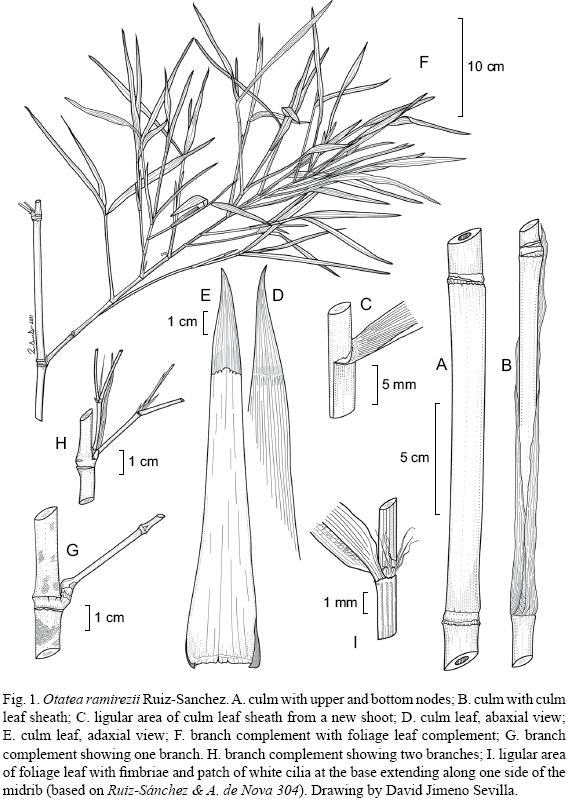
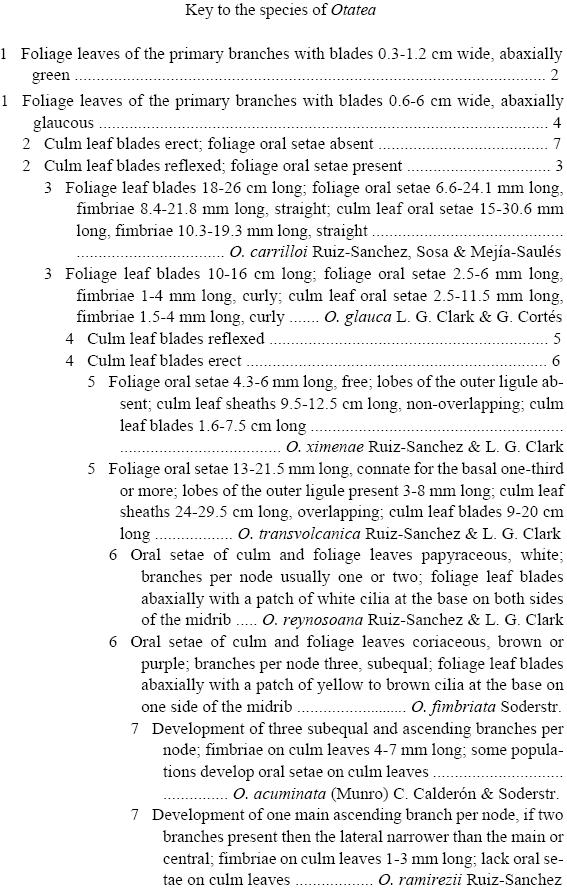
<body><![CDATA[<p align="justify"><font face="verdana" size="2">&nbsp;</font></p>     <p align="justify"><font size="2" face="verdana"><i>Otatea</i> (McClure &amp; E. W. Sm) C. Calder&oacute;n &amp; Soderstr., an American woody bamboo genus of the subtribe Guaduinae, comprises seven species with a geographical distributions restricted to Mexico, El Salvador, Honduras and Colombia and with six species endemic to Mexico (Guzm&aacute;n et al., 1984; Judziewicz et al., 1999; Londo&ntilde;o and Clark, 1998; Ruiz&#150;Sanchez  et al., 2008; Ruiz&#150;Sanchez  and Sosa, 2010; Ruiz&#150;Sanchez  et al., 2011a).</font></p>     <p align="justify"><font face="verdana" size="2">Previous phylogenetic studies based on morphological and molecular data support the monophyly of <i>Otatea</i> and its sister relationship with the Mesoamerican bamboo genus <i>Olmeca</i> (Ruiz&#150;Sanchez  et al., 2008; Ruiz&#150;Sanchez  et al., 2011b). Two morphological synapomorphies have been identified for <i>Otatea</i>: 1) branch complements with three subequal and ascending branches and 2) spikelets with pubescent lemmas (Ruiz&#150;Sanchez  et al., 2008). However, two recently described species of <i>Otatea</i> (<i>O. reynosoana and O. transvolcanica</i>) mostly have only one or two branches per node. Sometimes three branches occur with the second and third branches smaller in diameter than the central or primary branch (Ruiz&#150;Sanchez  et al., 2011a). Like most bamboos, <i>Otatea</i> is monocarpic with mass flowering in cycles that, according to herbarium records, occur in 8&#150;30 year cycles (Guzm&aacute;n et al., 1984; Judziewicz et al., 1999; Ruiz&#150;Sanchez  et al., 2011a); populations usually flower for two or three years consecutively and die (Ruiz&#150;Sanchez  et al., 2011a). due to the long intervals between flowering times, a few species have been described based only on vegetative features, including <i>O. carrilloi</i> and <i>O. transvolcanica</i> (Ruiz&#150;Sanchez  et al., 2011a).</font></p>     <p align="justify"><font face="verdana" size="2">A new <i>Otatea</i> species from Sierra Gorda of Quer&eacute;taro with only one (rarely two) branches per node, erect culm leaf blades, and the absence of oral setae both in culm and foliage leaves is described and illustrated in this paper. Also, a key to the eight species of <i>Otatea</i> is presented.</font></p>     <p align="center"><font face="verdana" size="2"><img src="/img/revistas/abm/n99/a2k1.jpg"></font></p>     <p align="justify"><font size="2" face="verdana"><b>Otatea ramirezii</b> Ruiz&#150;Sanchez  sp. nov. <a href="#f1">fig. 1</a>.</font></p>     <p align="center"><font face="verdana" size="2"><a name="f1"></a></font></p>     <p align="center"><font size="2" face="verdana"><img src="/img/revistas/abm/n99/a2f1.jpg"></font></p>     <p align="justify"><font face="verdana" size="2">Culmi 2 &#150;3 m alti, 0.8&#150;1&#150;7 cm diam, erecti. Folia culmorum 12&#150;17 cm longa; vaginae 10&#150;12 cm longae, laminae 1.8&#150;4.5 cm longae, erectae, triangulares, abaxialiter glabrescentes. Vaginarum caulinarium setae orales desunt. ramus unus raro duo per nodum. secundarius et tertiarius nodus unum ramum ferens. primarius ramus 33&#150;48 cm longus. Folia ramorum 3&#150;7 per complementum, vaginae glabrae; laminae 6.5&#150;12.5 cm longae, 0.4&#150;1.2 cm latae, lineares vel lineari&#150;lanceolatae. ad 30 mm longae, foliorum frondosarum setae orales desunt.</font></p>     <p align="justify"><font face="verdana" size="2">Rhizomes with necks 5&#150;15 cm long. Culms 2&#150;3 m tall, 0.8&#150;1.7 cm in basal diameter, erect; internodes 12&#150;16 cm long, terete, glabrous, green when young and brown&#150;yellow when old, hollow, the walls 3&#150;5 mm thick, the lacuna occupying &lt;50% of the total diameter. culm leaves 12&#150;17 cm long, non&#150;overlapping, deciduous; sheaths 10&#150;12 cm long, 3.5&#150;5 cm wide at the base, the leaf blades 1.8&#150;4.5 cm long, triangular, abaxially and adaxially glabrous, the margins ciliate when young, glabrous when old; inner ligule a coriaceous rim 0.5&#150;1 mm long, irregular, ciliate; oral setae absent; fimbriae at the apex of the sheath on both sides of the blade, 1&#150;3 mm long, ca. 0.05 mm wide, terete, free, curly; blades 1.8&#150;4.5 cm long, triangular, erect, persistent, shorter than the sheaths, glabrous on both sides, margin glabrous, apex attenuate&#150;subulate. Branching intravaginal; one main branch per node, if two then the central 3&#150;4 times wider than the lateral, sometimes both branches are subequal and these are diverging from each other and rebranching, 33&#150;48 cm long, diverging from the main culm at 45&#150;60&deg;, with only one branch in the second and third order of branching; supranodal ridge pronounced; nodal line horizontal. Foliage leaves 3&#150;5(&#150;7) per complement, when young 5&#150;7 per complement; sheaths glabrous, rounded on the back; oral setae absent; fimbriate at shoulders sheath summit, the fimbriae 1&#150;2 mm long, ca. 0.05 mm in diameter, terete, free, curly; outer ligule an irregular glabrous rim up to 0.1 mm long; inner ligule 0.3&#150;0.5 mm long, truncate, ciliate; pseudopetioles ca. 1 mm long, brownish, pulvinate at the base; blades (6.5)811(12.5) cm long, 0.4&#150;0.8(1.2) cm wide, linear to linear&#150;lanceolate, green adaxially and glabrous abaxially, with a patch of white cilia at the base extending along one side of the midrib for 2&#150;3 mm, the base attenuate, the apex attenuate&#150;subulate, the margins weakly serrulate. Synflorescences not seen.</font></p>     ]]></body>
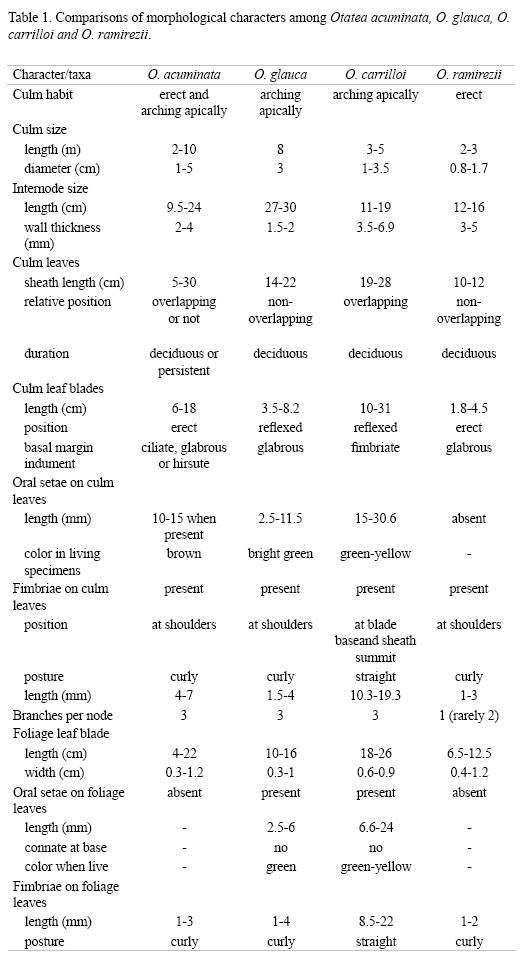
<body><![CDATA[<p align="justify"><font face="verdana" size="2">TYPE: M&eacute;xico, <b>Quer&eacute;taro</b>, 500 m antes de llegar a San Juan Tetla desde El Apartadero, municipio de San Joaqu&iacute;n, 20&deg;58'40.8" N, 99&deg;29'47" W, bosque tropical caducifolio, suelos calizos, alt. 1223 m, 10 Jul. 2010, <i>E. Ruiz&#150;S&aacute;nchez &amp; A. de Nova 304</i> (holotype: IBUG; isotypes: IEB, MEXU, XAL).</font></p>     <p align="justify"><font face="verdana" size="2">Habitat and distribution. Apparently, <i>Otatea ramirezii</i> represents a narrow endemic of the southernmost part of the Sierra Gorda in Quer&eacute;taro, where it forms large populations inhabiting tropical dry forests and their ecotone with oak forests on hillsides composed of calcareous rocks at elevations between 1200 and 1600 m.</font></p>     <p align="justify"><font face="verdana" size="2">On the basis of morphology, <i>Otatea</i> ramirezii morphologically resembles  <i>O. acuminata</i>, <i>O. carrilloi</i> and <i>O. glauca</i>. All four are similar in habit with culms that are erect or arching apically and their foliage leaves that are similar in size and form. However, the latter three species develop three subequal ascending branches per node, whereas <i>O. ramirezii</i> develops mostly only one branch per node (<a href="#t1">Table 1</a>). In some cases, two branches per node are present, but the second one is noticeably narrower than the main branch and it develops later. Additionally, <i>O. ramirezii</i> lacks oral setae in culm and foliage leaves and has erect culm leaf blades. <i>Otatea carrilloi</i> and <i>O. glauca</i> have oral setae in both culm and foliage leaves and their culm leaf blades are reflexed. Alternatively most of the populations in <i>Otatea acuminata</i> have oral setae in the culm leaves but they are absent in the foliage leaves and its culm leaf blades are erect (<a href="#t1">table 1</a>). <i>Otatea</i> carrilloi and <i>O. glauca</i> are known from a single population each. Both are endemic to chiapas. <i>Otatea</i> acuminata has the widest geographical distribution in Mexico, including two populations near <i>O. ramirezii</i>, one in Quer&eacute;taro only 22 km to northwest of <i>O. ramirezii</i> on the other side of the sierra Gorda and another one 53 km to the southeast of <i>O. ramirezii</i> in the Barranca of tolantongo, Hidalgo. the populations of <i>Otatea</i> acuminata in Quer&eacute;taro and Hidalgo grow in calcareous soils and plants from both of these populations develop three subequal ascending branches per node.</font></p>     <p align="center"><font size="2" face="verdana"><a name="t1"></a></font></p>     <p align="center"><font size="2" face="verdana"><img src="/img/revistas/abm/n99/a2t1.jpg"></font></p>     <p align="justify"><font face="verdana" size="2">Etymology. The specific epithet honors the memory of Raymundo Ram&iacute;rez Delgadillo (1968&#150;2011), professor from the Universidad de Guadalajara, Mexico, whom I most owe my interest in systematic botany.</font></p>     <p align="justify"><font face="verdana" size="2">&nbsp;</font></p>     <p align="justify"><font size="2" face="verdana"><b>ACKNOELEDGMENTS</b></font></p>     <p align="justify"><font face="verdana" size="2">The author is particularly grateful to Arturo de nova for his invitation to collect <i>Fouqueria</i> species in the locality where the new <i>Otatea</i> species grows. Special thanks are given to Pablo Carrillo Reyes and Heather driscoll for improving the manuscript with their comments and to Flor Rodr&iacute;guez G&oacute;mez for all her support. I also thank three anonymous reviewers whose suggestions greatly improved the manuscript. The illustration is done by David Jimeno Sevilla. Special memory thanks go to Raymundo Ram&iacute;rez, a great botanist person.</font></p>     <p align="justify"><font face="verdana" size="2">&nbsp;</font></p>     ]]></body>
<body><![CDATA[<p align="justify"><font size="2" face="verdana"><b>LITERATUTE CITED</b></font></p>     <!-- ref --><p align="justify"><font face="verdana" size="2">Guzm&aacute;n, R., M. C. Anaya &amp; M. Santana. 1984. El g&eacute;nero <i>Otatea</i> (Bambusoideae), en M&eacute;xico y Centroam&eacute;rica. Bol. Inst. Bot. Univ. Guadalajara 5: 2&#150;20.    &nbsp;&nbsp;&nbsp;&nbsp;&nbsp;&nbsp;&nbsp;&nbsp;[&#160;<a href="javascript:void(0);" onclick="javascript: window.open('/scielo.php?script=sci_nlinks&ref=037646&pid=S0187-7151201200020000200001&lng=','','width=640,height=500,resizable=yes,scrollbars=1,menubar=yes,');">Links</a>&#160;]<!-- end-ref --></font></p>     <!-- ref --><p align="justify"><font face="verdana" size="2">Judziewicz, E. J., L. G. Clark, X. Londo&ntilde;o &amp; M. J. Stern. 1999. American bamboos. Smithsonian Institution Press. Washington D.C., USA. 392 pp.    &nbsp;&nbsp;&nbsp;&nbsp;&nbsp;&nbsp;&nbsp;&nbsp;[&#160;<a href="javascript:void(0);" onclick="javascript: window.open('/scielo.php?script=sci_nlinks&ref=037648&pid=S0187-7151201200020000200002&lng=','','width=640,height=500,resizable=yes,scrollbars=1,menubar=yes,');">Links</a>&#160;]<!-- end-ref --></font></p>     <!-- ref --><p align="justify"><font face="verdana" size="2">Londo&ntilde;o, X. &amp; L. G. Clark. 1998. Eight new taxa and two new reports of Bambuseae (Poaceae: Bambuseae) from Colombia. Novon 8: 408&#150;428.    &nbsp;&nbsp;&nbsp;&nbsp;&nbsp;&nbsp;&nbsp;&nbsp;[&#160;<a href="javascript:void(0);" onclick="javascript: window.open('/scielo.php?script=sci_nlinks&ref=037650&pid=S0187-7151201200020000200003&lng=','','width=640,height=500,resizable=yes,scrollbars=1,menubar=yes,');">Links</a>&#160;]<!-- end-ref --></font></p>     <!-- ref --><p align="justify"><font face="verdana" size="2">Ruiz&#150;Sanchez , E. &amp; V. Sosa. 2010. Delimiting species boundaries within the Neotropical bamboo <i>Otatea</i> (poaceae: Bambusoideae) using molecular, morphological and ecological data. Molec. Phylog. Evol. 54: 344&#150;356.    &nbsp;&nbsp;&nbsp;&nbsp;&nbsp;&nbsp;&nbsp;&nbsp;[&#160;<a href="javascript:void(0);" onclick="javascript: window.open('/scielo.php?script=sci_nlinks&ref=037652&pid=S0187-7151201200020000200004&lng=','','width=640,height=500,resizable=yes,scrollbars=1,menubar=yes,');">Links</a>&#160;]<!-- end-ref --></font></p>     <!-- ref --><p align="justify"><font face="verdana" size="2">Ruiz&#150;Sanchez , E., V. Sosa &amp; M. T. Mej&iacute;a&#150;Saul&eacute;s. 2008. Phylogenetics of <i>Otatea</i> inferred from morphology and chloroplast DNA sequence data and recircumscription of Guaduinae (Poaceae: Bambusoideae). Syst. Bot. 33: 277&#150;283.    &nbsp;&nbsp;&nbsp;&nbsp;&nbsp;&nbsp;&nbsp;&nbsp;[&#160;<a href="javascript:void(0);" onclick="javascript: window.open('/scielo.php?script=sci_nlinks&ref=037654&pid=S0187-7151201200020000200005&lng=','','width=640,height=500,resizable=yes,scrollbars=1,menubar=yes,');">Links</a>&#160;]<!-- end-ref --></font></p>     <!-- ref --><p align="justify"><font face="verdana" size="2">Ruiz&#150;Sanchez , E., V. Sosa, M. T. Mej&iacute;a&#150;Saul&eacute;s, X. Londo&ntilde;o &amp; L. G. Clark. 2011a. A taxonomic revision of <i>Otatea</i> (poaceae: Bambusoideae: Bambuseae) including four new species. Syst. Bot. 36: 314&#150;336.    &nbsp;&nbsp;&nbsp;&nbsp;&nbsp;&nbsp;&nbsp;&nbsp;[&#160;<a href="javascript:void(0);" onclick="javascript: window.open('/scielo.php?script=sci_nlinks&ref=037656&pid=S0187-7151201200020000200006&lng=','','width=640,height=500,resizable=yes,scrollbars=1,menubar=yes,');">Links</a>&#160;]<!-- end-ref --></font></p>     <!-- ref --><p align="justify"><font face="verdana" size="2">Ruiz&#150;Sanchez , E., V. Sosa &amp; M. T. Mej&iacute;a&#150;Saul&eacute;s. 2011b. Molecular phylogenetics of the Mesoamerican bamboo <i>Olmeca</i> (Poaceae: Bambuseae): Implications for taxonomy. Taxon 60: 89&#150;98.    &nbsp;&nbsp;&nbsp;&nbsp;&nbsp;&nbsp;&nbsp;&nbsp;[&#160;<a href="javascript:void(0);" onclick="javascript: window.open('/scielo.php?script=sci_nlinks&ref=037658&pid=S0187-7151201200020000200007&lng=','','width=640,height=500,resizable=yes,scrollbars=1,menubar=yes,');">Links</a>&#160;]<!-- end-ref --></font></p>      ]]></body><back>
<ref-list>
<ref id="B1">
<nlm-citation citation-type="journal">
<person-group person-group-type="author">
<name>
<surname><![CDATA[Guzmán]]></surname>
<given-names><![CDATA[R.]]></given-names>
</name>
<name>
<surname><![CDATA[Anaya]]></surname>
<given-names><![CDATA[M. C.]]></given-names>
</name>
<name>
<surname><![CDATA[Santana]]></surname>
<given-names><![CDATA[M.]]></given-names>
</name>
</person-group>
<article-title xml:lang="es"><![CDATA[El género Otatea (Bambusoideae), en México y Centroamérica]]></article-title>
<source><![CDATA[Bol. Inst. Bot. Univ. Guadalajara]]></source>
<year>1984</year>
<volume>5</volume>
<page-range>2-20</page-range></nlm-citation>
</ref>
<ref id="B2">
<nlm-citation citation-type="book">
<person-group person-group-type="author">
<name>
<surname><![CDATA[Judziewicz]]></surname>
<given-names><![CDATA[E. J.]]></given-names>
</name>
<name>
<surname><![CDATA[Clark]]></surname>
<given-names><![CDATA[L. G.]]></given-names>
</name>
<name>
<surname><![CDATA[Londoño]]></surname>
<given-names><![CDATA[X.]]></given-names>
</name>
<name>
<surname><![CDATA[Stern]]></surname>
<given-names><![CDATA[M. J.]]></given-names>
</name>
</person-group>
<source><![CDATA[American bamboos]]></source>
<year>1999</year>
<page-range>392</page-range><publisher-loc><![CDATA[Washington^eD.C. D.C.]]></publisher-loc>
<publisher-name><![CDATA[Smithsonian Institution Press]]></publisher-name>
</nlm-citation>
</ref>
<ref id="B3">
<nlm-citation citation-type="journal">
<person-group person-group-type="author">
<name>
<surname><![CDATA[Londoño]]></surname>
<given-names><![CDATA[X.]]></given-names>
</name>
<name>
<surname><![CDATA[Clark]]></surname>
<given-names><![CDATA[L. G.]]></given-names>
</name>
</person-group>
<article-title xml:lang="en"><![CDATA[Eight new taxa and two new reports of Bambuseae (Poaceae: Bambuseae) from Colombia]]></article-title>
<source><![CDATA[Novon]]></source>
<year>1998</year>
<volume>8</volume>
<page-range>408-428</page-range></nlm-citation>
</ref>
<ref id="B4">
<nlm-citation citation-type="journal">
<person-group person-group-type="author">
<name>
<surname><![CDATA[Ruiz-Sanchez]]></surname>
<given-names><![CDATA[E.]]></given-names>
</name>
<name>
<surname><![CDATA[Sosa]]></surname>
<given-names><![CDATA[V.]]></given-names>
</name>
</person-group>
<article-title xml:lang="en"><![CDATA[Delimiting species boundaries within the Neotropical bamboo Otatea (poaceae: Bambusoideae) using molecular, morphological and ecological data]]></article-title>
<source><![CDATA[Molec. Phylog. Evol.]]></source>
<year>2010</year>
<volume>54</volume>
<page-range>344-356</page-range></nlm-citation>
</ref>
<ref id="B5">
<nlm-citation citation-type="journal">
<person-group person-group-type="author">
<name>
<surname><![CDATA[Ruiz-Sanchez]]></surname>
<given-names><![CDATA[E.]]></given-names>
</name>
<name>
<surname><![CDATA[Sosa]]></surname>
<given-names><![CDATA[V.]]></given-names>
</name>
<name>
<surname><![CDATA[Mejía-Saulés]]></surname>
<given-names><![CDATA[M. T.]]></given-names>
</name>
</person-group>
<article-title xml:lang="en"><![CDATA[Phylogenetics of Otatea inferred from morphology and chloroplast DNA sequence data and recircumscription of Guaduinae (Poaceae: Bambusoideae)]]></article-title>
<source><![CDATA[Syst. Bot.]]></source>
<year>2008</year>
<volume>33</volume>
<page-range>277-283</page-range></nlm-citation>
</ref>
<ref id="B6">
<nlm-citation citation-type="journal">
<person-group person-group-type="author">
<name>
<surname><![CDATA[Ruiz-Sanchez]]></surname>
<given-names><![CDATA[E.]]></given-names>
</name>
<name>
<surname><![CDATA[Sosa]]></surname>
<given-names><![CDATA[V.]]></given-names>
</name>
<name>
<surname><![CDATA[Mejía-Saulés]]></surname>
<given-names><![CDATA[M. T.]]></given-names>
</name>
<name>
<surname><![CDATA[Londoño]]></surname>
<given-names><![CDATA[X.]]></given-names>
</name>
<name>
<surname><![CDATA[Clark]]></surname>
<given-names><![CDATA[L. G.]]></given-names>
</name>
</person-group>
<article-title xml:lang="en"><![CDATA[A taxonomic revision of Otatea (poaceae: Bambusoideae: Bambuseae) including four new species]]></article-title>
<source><![CDATA[Syst. Bot.]]></source>
<year>2011</year>
<volume>36</volume>
<page-range>314-336</page-range></nlm-citation>
</ref>
<ref id="B7">
<nlm-citation citation-type="journal">
<person-group person-group-type="author">
<name>
<surname><![CDATA[Ruiz-Sanchez]]></surname>
<given-names><![CDATA[E.]]></given-names>
</name>
<name>
<surname><![CDATA[Sosa]]></surname>
<given-names><![CDATA[V.]]></given-names>
</name>
<name>
<surname><![CDATA[Mejía-Saulés]]></surname>
<given-names><![CDATA[M. T.]]></given-names>
</name>
</person-group>
<article-title xml:lang="en"><![CDATA[Molecular phylogenetics of the Mesoamerican bamboo Olmeca (Poaceae: Bambuseae): Implications for taxonomy]]></article-title>
<source><![CDATA[Taxon]]></source>
<year>2011</year>
<volume>60</volume>
<page-range>89-98</page-range></nlm-citation>
</ref>
</ref-list>
</back>
</article>