<?xml version="1.0" encoding="ISO-8859-1"?><article xmlns:mml="http://www.w3.org/1998/Math/MathML" xmlns:xlink="http://www.w3.org/1999/xlink" xmlns:xsi="http://www.w3.org/2001/XMLSchema-instance">
<front>
<journal-meta>
<journal-id>0187-7151</journal-id>
<journal-title><![CDATA[Acta botánica mexicana]]></journal-title>
<abbrev-journal-title><![CDATA[Act. Bot. Mex]]></abbrev-journal-title>
<issn>0187-7151</issn>
<publisher>
<publisher-name><![CDATA[Instituto de Ecología A.C., Centro Regional del Bajío]]></publisher-name>
</publisher>
</journal-meta>
<article-meta>
<article-id>S0187-71512012000100004</article-id>
<title-group>
<article-title xml:lang="en"><![CDATA[Diversity and morphology of the species of Pseudo-nitzschia (Bacillariophyta) of the national park Sistema Arrecifal Veracruzano, SW Gulf of Mexico]]></article-title>
<article-title xml:lang="es"><![CDATA[Diversidad y morfología de las especies de Pseudo-nitzschia (Bacillariophyta) del parque nacional Sistema Arrecifal Veracruzano, suroeste del Golfo de México]]></article-title>
</title-group>
<contrib-group>
<contrib contrib-type="author">
<name>
<surname><![CDATA[Parsons]]></surname>
<given-names><![CDATA[Michael L.]]></given-names>
</name>
<xref ref-type="aff" rid="A01"/>
</contrib>
<contrib contrib-type="author">
<name>
<surname><![CDATA[Okolodkov]]></surname>
<given-names><![CDATA[Yuri B.]]></given-names>
</name>
<xref ref-type="aff" rid="A02"/>
</contrib>
<contrib contrib-type="author">
<name>
<surname><![CDATA[Aké-Castillo]]></surname>
<given-names><![CDATA[José A.]]></given-names>
</name>
<xref ref-type="aff" rid="A02"/>
</contrib>
</contrib-group>
<aff id="A01">
<institution><![CDATA[,Florida Gulf Coast University Coastal Watershed Institute Department of Marine and Ecological Sciences]]></institution>
<addr-line><![CDATA[Fort Myers FL]]></addr-line>
<country>USA</country>
</aff>
<aff id="A02">
<institution><![CDATA[,Universidad Veracruzana Instituto de Ciencias Marinas y Pesquerías Laboratorio de Botánica Marina y Planctología]]></institution>
<addr-line><![CDATA[Boca del Río Veracruz]]></addr-line>
<country>México</country>
</aff>
<pub-date pub-type="pub">
<day>00</day>
<month>01</month>
<year>2012</year>
</pub-date>
<pub-date pub-type="epub">
<day>00</day>
<month>01</month>
<year>2012</year>
</pub-date>
<numero>98</numero>
<fpage>51</fpage>
<lpage>72</lpage>
<copyright-statement/>
<copyright-year/>
<self-uri xlink:href="http://www.scielo.org.mx/scielo.php?script=sci_arttext&amp;pid=S0187-71512012000100004&amp;lng=en&amp;nrm=iso"></self-uri><self-uri xlink:href="http://www.scielo.org.mx/scielo.php?script=sci_abstract&amp;pid=S0187-71512012000100004&amp;lng=en&amp;nrm=iso"></self-uri><self-uri xlink:href="http://www.scielo.org.mx/scielo.php?script=sci_pdf&amp;pid=S0187-71512012000100004&amp;lng=en&amp;nrm=iso"></self-uri><abstract abstract-type="short" xml:lang="en"><p><![CDATA[In order to evaluate the risk for marine ecosystem and human health, the diversity and morphology of diatoms of the genus Pseudo-nitzschia were studied. Weekly sampling was performed at seven geo-referenced sites in the National Park Sistema Arrecifal Veracruzano, SW Gulf of Mexico, during the annual cycle from May 2005 to May 2006. Samples were taken in the 30-cm surface layer of the water column with a phytoplankton net of 20-&#956;m mesh size. With the use of light, transmission and scanning electron microscopy, seven Pseudo-nitzschia species were identified: non-toxic P. cf. subcurvata (examined only by light microscopy) and P. brasiliana, and potentially toxic, causative agents of amnesic shellfish poisoning (ASP) due to domoic acid: P. calliantha, P. cuspidata, P. delicatissima, P. pseudodelicatissima and P. pungens. It is concluded that there is a potential risk of ASP in the study area. P. brasiliana and P. calliantha are new records for the SW Gulf of Mexico. Comparisons with studies conducted in the northern Gulf of Mexico indicate that the diversity of Pseudo-nitzschia in the Gulf of Mexico may be greater than currently documented and that some species (e.g., P. multiseries) may have biogeographic limitations (e.g., temperatures below 27 ºC).]]></p></abstract>
<abstract abstract-type="short" xml:lang="es"><p><![CDATA[Con el fin de evaluar el riesgo para el ecosistema marino y la salud humana, se estudió la diversidad y la morfología de las diatomeas del género Pseudo-nitzschia del Parque Nacional Sistema Arrecifal Veracruzano, en el suroeste del Golfo de México. Se realizaron muestreos semanalmente en siete sitios georeferenciados durante un ciclo anual de mayo de 2005 a mayo de 2006. Las muestras se tomaron de la capa superficial de 30 cm de la columna de agua con una red fitoplanctónica de 20 &#956;m de tamaño de malla. Con ayuda de los microscopios fotónico, electrónico de transmisión y electrónico de barrido se identificaron siete especies de Pseudo-nitzschia: las no tóxicas P. cf. subcurvata (estudiada solamente en el microscopio fotónico) y P. brasiliana, y las potencialmente venenosas, causantes de la intoxicación amnésica por consumo de mariscos (ASP) debido al ácido domoico: P. calliantha, P. cuspidata, P. delicatissima, P. pseudodelicatissima y P. pungens. Se concluye que existe riesgo potencial de ASP en el área de estudio. P. brasiliana y P. calliantha son nuevos registros para el suroeste del Golfo de México. Las comparaciones con los estudios en el norte del mismo cuerpo marino indican que la diversidad de Pseudo-nitzschia en el Golfo de México puede ser más alta que la documentada en el presente, y que algunas especies (e.g., P. multiseries) pueden tener limitaciones ecológicas y biogeográficas (e.g., temperaturas menores de 27 ºC).]]></p></abstract>
<kwd-group>
<kwd lng="en"><![CDATA[amnesic shellfish poisoning]]></kwd>
<kwd lng="en"><![CDATA[diatoms]]></kwd>
<kwd lng="en"><![CDATA[Gulf of Mexico]]></kwd>
<kwd lng="en"><![CDATA[morphology]]></kwd>
<kwd lng="en"><![CDATA[new records]]></kwd>
<kwd lng="en"><![CDATA[Pseudo-nitzschia]]></kwd>
<kwd lng="en"><![CDATA[taxonomy]]></kwd>
<kwd lng="en"><![CDATA[Veracruz]]></kwd>
<kwd lng="es"><![CDATA[diatomeas]]></kwd>
<kwd lng="es"><![CDATA[Golfo de México]]></kwd>
<kwd lng="es"><![CDATA[intoxicación amnésica por consumo de mariscos]]></kwd>
<kwd lng="es"><![CDATA[morfología]]></kwd>
<kwd lng="es"><![CDATA[nuevos registros]]></kwd>
<kwd lng="es"><![CDATA[Pseudo-nitzschia]]></kwd>
<kwd lng="es"><![CDATA[taxonomía]]></kwd>
<kwd lng="es"><![CDATA[Veracruz]]></kwd>
</kwd-group>
</article-meta>
</front><body><![CDATA[ <p align="center"><font face="verdana" size="4"><b>Diversity and morphology of the species of <i>Pseudo&#150;nitzschia</i> (Bacillariophyta) of the national park Sistema Arrecifal Veracruzano, SW Gulf of Mexico</b></font></p>     <p align="center"><font face="verdana" size="2">&nbsp;</font></p>     <p align="center"><font face="verdana" size="3"><b>Diversidad y morfolog&iacute;a de las especies de <i>Pseudo&#150;nitzschia</i> (Bacillariophyta) del parque nacional Sistema Arrecifal Veracruzano, suroeste del Golfo de M&eacute;xico</b></font></p>     <p align="center"><font face="verdana" size="2">&nbsp;</font></p>     <p align="center"><font face="verdana" size="2"><b>Michael L. Parsons<sup>1</sup>, Yuri B. Okolodkov<sup>2</sup> &amp; Jos&eacute; A. Ak&eacute;&#150;Castillo<sup>2</sup></b></font></p>     <p align="justify"><font face="verdana" size="2">&nbsp;</font></p>     <p align="justify"><font face="verdana" size="2"><i><sup>1</sup> Florida Gulf Coast University, Coastal Watershed Institute, Department of Marine and Ecological Sciences, 10501 FGCU Blvd South, Fort Myers, FL 33965&#150;6565, USA. </i></font></p>     <p align="justify"><font face="verdana" size="2"><i><sup>2</sup> Universidad Veracruzana, Instituto de Ciencias Marinas y Pesquer&iacute;as, Laboratorio de Bot&aacute;nica Marina y Planctolog&iacute;a, calle Hidalgo 617, Colonia R&iacute;o Jamapa, 94290 Boca del R&iacute;o, Veracruz, M&eacute;xico. Autor para la corrrespondencia:</i> <a href="mailto:yuriokolodkov@yahoo.com">yuriokolodkov@yahoo.com</a></font></p>     <p align="justify"><font face="verdana" size="2">&nbsp;</font></p>     <p align="justify"><font face="verdana" size="2">Recibido en mayo de 2011.     ]]></body>
<body><![CDATA[<br> Aceptado en octubre de 2011.</font></p>     <p align="justify"><font face="verdana" size="2">&nbsp;</font></p>     <p align="justify"><font face="verdana" size="2"><b>ABSTRACT</b></font></p>     <p align="justify"><font face="verdana" size="2">In order to evaluate the risk for marine ecosystem and human health, the diversity and morphology of diatoms of the genus <i>Pseudo&#150;nitzschia </i>were studied. Weekly sampling was performed at seven geo&#150;referenced sites in the National Park Sistema Arrecifal Veracruzano, SW Gulf of Mexico, during the annual cycle from May 2005 to May 2006. Samples were taken in the 30&#150;cm surface layer of the water column with a phytoplankton net of 20&#150;&#956;m mesh size. With the use of light, transmission and scanning electron microscopy, seven <i>Pseudo&#150;nitzschia </i>species were identified: non&#150;toxic <i>P. </i>cf. <i>subcurvata </i>(examined only by light microscopy) and <i>P. brasiliana, </i>and potentially toxic, causative agents of amnesic shellfish poisoning (ASP) due to domoic acid: <i>P. calliantha, P. cuspidata, P. delicatissima, P. pseudodelicatissima </i>and <i>P. pungens. </i>It is concluded that there is a potential risk of ASP in the study area. <i>P. brasiliana </i>and <i>P. calliantha </i>are new records for the SW Gulf of Mexico. Comparisons with studies conducted in the northern Gulf of Mexico indicate that the diversity of <i>Pseudo&#150;nitzschia </i>in the Gulf of Mexico may be greater than currently documented and that some species (e.g., <i>P. multiseries) </i>may have biogeographic limitations (e.g., temperatures below 27 &ordm;C).</font></p>     <p align="justify"><font face="verdana" size="2"><b>Key words:</b> amnesic shellfish poisoning, diatoms, Gulf of Mexico, morphology, new records, <i>Pseudo&#150;nitzschia, </i>taxonomy, Veracruz.</font></p>     <p align="justify"><font face="verdana" size="2">&nbsp;</font></p>     <p align="justify"><font face="verdana" size="2"><b>RESUMEN</b></font></p>     <p align="justify"><font face="verdana" size="2">Con el fin de evaluar el riesgo para el ecosistema marino y la salud humana, se estudi&oacute; la diversidad y la morfolog&iacute;a de las diatomeas del g&eacute;nero <i>Pseudo&#150;nitzschia </i>del Parque Nacional Sistema Arrecifal Veracruzano, en el suroeste del Golfo de M&eacute;xico. Se realizaron muestreos semanalmente en siete sitios georeferenciados durante un ciclo anual de mayo de 2005 a mayo de 2006. Las muestras se tomaron de la capa superficial de 30 cm de la columna de agua con una red fitoplanct&oacute;nica de 20 &#956;m de tama&ntilde;o de malla. Con ayuda de los microscopios fot&oacute;nico, electr&oacute;nico de transmisi&oacute;n y electr&oacute;nico de barrido se identificaron siete especies de <i>Pseudo&#150;nitzschia: </i>las no t&oacute;xicas <i>P. </i>cf. <i>subcurvata </i>(estudiada solamente en el microscopio fot&oacute;nico) y <i>P. brasiliana, </i>y las potencialmente venenosas, causantes de la intoxicaci&oacute;n amn&eacute;sica por consumo de mariscos (ASP) debido al &aacute;cido domoico: <i>P. calliantha, P. cuspidata, P. delicatissima, P. pseudodelicatissima </i>y <i>P. pungens. </i>Se concluye que existe riesgo potencial de ASP en el &aacute;rea de estudio. <i>P. brasiliana </i>y <i>P. calliantha </i>son nuevos registros para el suroeste del Golfo de M&eacute;xico. Las comparaciones con los estudios en el norte del mismo cuerpo marino indican que la diversidad de <i>Pseudo&#150;nitzschia </i>en el Golfo de M&eacute;xico puede ser m&aacute;s alta que la documentada en el presente, y que algunas especies (e.g., <i>P. multiseries) </i>pueden tener limitaciones ecol&oacute;gicas y biogeogr&aacute;ficas (e.g., temperaturas menores de 27 &ordm;C).</font></p>     <p align="justify"><font face="verdana" size="2"><b>Palabras clave:</b> diatomeas, Golfo de M&eacute;xico, intoxicaci&oacute;n amn&eacute;sica por consumo de mariscos, morfolog&iacute;a, nuevos registros, <i>Pseudo&#150;nitzschia, </i>taxonom&iacute;a, Veracruz.</font></p>     <p align="justify"><font face="verdana" size="2">&nbsp;</font></p>     ]]></body>
<body><![CDATA[<p align="justify"><font face="verdana" size="2"><b>INTRODUCTION</b></font></p>     <p align="justify"><font face="verdana" size="2"><i>Pseudo&#150;nitzschia </i>H. Peragallo is a widely distributed marine genus (Hasle &amp; Syvertsen, 1996; Hasle, 2002), with 38 currently described species (Guiry, 2011). Interest in the genus increased when, in 1987, severe intoxications and at least three human mortalities were reported in those who consumed blue mussels <i>(Mytilus edulis </i>L.) containing the neurotoxin domoic acid (DA) (Wright et al., 1989). Further research determined that the DA was produced by the planktonic diatom <i>Pseudo&#150;nitzschia multiseries </i>(Bates et al., 1989). The resultant shellfish poisoning was termed amnesic shellfish poisoning (ASP), as one of the distinguishing symptoms of acute exposure to DA is short&#150;term memory loss (Perl et al., 1990). Later, marine fish, bird and mammal mortalities occurred, caused by their consumption of DA&#150;contaminated <i>Pseudo&#150;nitzschia </i>species or vectors, causing DA poisoning (DAP); thus, toxigenic <i>Pseudo&#150;nitzschia </i>species also became a threat to marine animal health (Trainer et al., 2008).</font></p>     <p align="justify"><font face="verdana" size="2">At present, the following <i>Pseudo&#150;nitzschia </i>species are known as DA producers: <i>P. pseudodelicatissima </i>(Hasle) Hasle, <i>P. pungens </i>(Grunow ex Cleve) Hasle, <i>P. multiseries </i>(Hasle) Hasle, <i>P. seriata </i>(Cleve) H. Peragallo, <i>P. australis </i>Frenguelli, <i>P. calliantha </i>Lundholm, Moestrup et Hasle, <i>P. cuspidata </i>(Hasle) Hasle, <i>P. fraudulenta </i>(Cleve) Hasle, <i>P. multistriata </i>(Takano) Takano, <i>P. delicatissima </i>(Cleve) Heiden, <i>P. turgidula </i>(Hustedt) Hasle and <i>P. galaxiae </i>Lundholm et Moestrup (Bates &amp; Trainer, 2006; Trainer et al., 2008, 2009).</font></p>     <p align="justify"><font face="verdana" size="2">Economic losses caused by DA&#150;associated <i>Pseudo&#150;nitzschia </i>blooms have been reported from various countries around the world: Canada, USA, Mexico, Costa Rica, Argentina, Denmark, Scotland, Ireland, France, Spain, Italy, Tunisia, Morocco, Korea and Vietnam (Skov et al., 1997; Akallal &amp; Mouradi, 2000; Bates &amp; Richard, 2000; Kotaki et al., 2000; Sarno &amp; Dahlmann, 2000; Cho et al., 2002; Fehling et al., 2004; Vargas&#150;Montero &amp; Freer, 2004; Lundholm et al., 2005; Badylak et al., 2006; Nezan et al., 2006; Almandoz et al., 2007; Bogan et al., 2007; Cort&eacute;s&#150;Altamirano &amp; Sierra&#150;Beltr&aacute;n, 2008; Quijano&#150;Scheggia et al., 2009; Sarahraoui et al., 2009).</font></p>     <p align="justify"><font face="verdana" size="2">At least six of the 12 <i>Pseudo&#150;nitzschia </i>species known to produce DA <i>(P. australis, P. delicatissima, P. pseudodelicatissima, P. multiseries, P. pungens </i>and <i>P. seriata) </i>have caused blooms or intoxications in the Mexican Pacific and the coastal waters of the Gulf of California (Ochoa et al., 1996; Meave del Castillo &amp; Hern&aacute;ndez&#150;Becerril, 1998; Licea et al., 2000; Moreno&#150;Ruiz et al., 2004; Sierra&#150;Beltr&aacute;n et al., 2005; Cort&eacute;s&#150;Altamirano &amp; Sierra&#150;Beltr&aacute;n, 2008). <i>Pseudo&#150;nitzschia </i>species have also been observed in both the southern (Meave del Castillo et al., 2000; G&oacute;mez&#150;Aguirre et al., 2004; Licea et al., 2004) and northern Gulf of Mexico (Fryxell et al., 1990, 1991; Dortch et al., 1997; Parsons et al., 1998, 2002; Liefer et al., 2009; Del Rio et al., 2010; MacIntyre et al., 2011). The following <i>Pseudo&#150;nitzschia </i>species have been documented in the northern Gulf of Mexico: <i>P. brasiliana </i>Lundholm, Hasle et G. A. Fryxell, <i>P. decipiens </i>Lundholm et Moestrup, <i>P. delicatissima, P. prolongatoides </i>(Hasle) Hasle, <i>P. pseudodelicatissima, P. pungens, P. multiseries, P. subfraudulenta </i>(Hasle) Hasle, <i>P. subpacifica </i>(Hasle) Hasle, and <i>P. galaxiae </i>Lundholm et Moestrup (Conger et al., 1972; Licea, 1992; Parsons et al., 1998; Lundholm &amp; Moestrup, 2002; Lundholm et al., 2002; Krayevsky et al., 2009). <i>Pseudo&#150;nitzschia </i>species regularly bloom in Louisiana coastal waters (Dortch et al., 1997; Del Rio et al., 2010), likely stimulated by intensifying eutrophication over the past 50 years in response to higher nutrient loads from the Mississippi River (Parsons et al., 2002). The concern that these <i>Pseudo&#150;nitzschia </i>blooms could result in a DA event was manifested when DA was detected in gulf menhaden (Clupeidae: <i>Brevoortia patronus </i>Goode; Del Rio et al., 2010) and in bottlenose dolphins <i>(Tursiops truncatus </i>(Montagu); Schwacke et al., 2010), demonstrating that DA is moving up into higher trophic levels in the Gulf of Mexico.</font></p>     <p align="justify"><font face="verdana" size="2">As DA produced by <i>Pseudo&#150;nitzschia </i>has affected higher trophic levels in the northern Gulf of Mexico, further assessment of the potential threat of DA to ecosystem health was deemed necessary for the SW Gulf of Mexico. The main purpose of this study, therefore, was to document the diversity and morphology of <i>Pseudo&#150;nitzschia </i>species of the National Park Sistema Arrecifal Veracruzano (NPSAV), Gulf of Mexico, to evaluate the risk for the marine ecosystem and human health.</font></p>     <p align="justify"><font face="verdana" size="2">&nbsp;</font></p>     <p align="justify"><font face="verdana" size="2"><b>MATERIAL AND METHODS</b></font></p>     <p align="justify"><font face="verdana" size="2">Samples were taken from May 2005 to May 2006, at seven oceanographic stations during a weekly monitoring of red tides of the Aquarium of Veracruz (<a href="/img/revistas/abm/n98/a4f1.jpg" target="_blank">Fig. 1</a>; for geographic coordinates, see Okolodkov, 2008), in the 30&#150;cm surface layer, using a phytoplankton net of 20&#150;um mesh and 28 cm in diameter. Preliminary identifications of <i>Pseudo&#150;nitzschia </i>species were made using a Nikon Eclipse T100 inverted microscope. Diatom frustules were cleaned by removing the organic matter by oxidation (Lundholm et al., 2002). Two milliliters of saturated KMnO<sub>4</sub> solution with 30% H<sub>2</sub>SO<sub>4</sub> were added to a 10&#150;ml aliquot of the sample. After 24 h, the sample was bleached by adding 10 ml of saturated oxalic acid solution, and then it was repeatedly washed with distilled water.</font></p>     <p align="justify"><font face="verdana" size="2">Thirteen samples from the seven stations taken in 2005 were selected, on the basis of their high abundance of <i>Pseudo&#150;nitzschia </i>species, for further analysis using differential interference contrast (DIC) microscopy and electron microscopy (EM) to identify the various <i>Pseudo&#150;nitzschia </i>species present: May 17 (st. 3, 5 and 7), May 24 (st. 3 and 5), May 31 (st. 2 and 3), June 7 (st. 1 and 6), July 13 (st. 3), August 24 (st. 3), and September 13 (st. 2). High total abundances of <i>Pseudo&#150;nitzschia </i>species were found in May&#150;July 2005 (up to 4.6 x 10<sup>5</sup> cells/l), August (up to 1.6 x 10<sup>6</sup> cells/l), September (up to 8.8 x 10<sup>5</sup> cells/l) and October (up to 7.1 x 10<sup>5</sup> cells/l) (Y.B. Okolodkov, unpubl. data). Starting from late October, the abundance drastically diminished, usually varying between 1.0 x 10<sup>3</sup> and 5.0 x 10<sup>3</sup> cells/l, and only once showed a high number of cells (8.9 x 10<sup>4</sup> cells/l at st. 1, on November 15, the highest abundance observed during the period from early October through mid&#150;February).</font></p>     ]]></body>
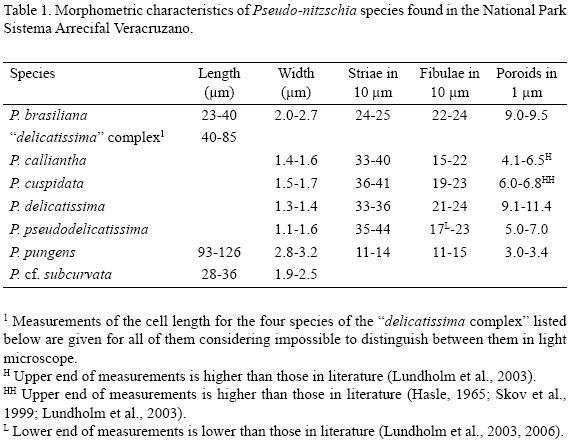
<body><![CDATA[<p align="justify"><font face="verdana" size="2">DIC microscopy was used to determine the general groups of <i>Pseudo&#150;nitzschia </i>present (e.g., <i>P. multiseries/pungens, P. delicatissima </i>complex, <i>P. brasiliana/linea, </i>and <i>P. subfraudulenta/fraudulenta), </i>which also facilitated EM analysis by providing some level of diversity to be expected. Valve lengths were also recorded during DIC examination. Cell length measurements made via DIC microscopy could not always be coupled with EM observations due to the inability to identify many species (i.e., the above groups) during light microscopy observation. For this reason, the data on the variability of the cell length for four species out of seven are absent. While scanning electron microscopy (SEM) was adequate for identifying most of the <i>Pseudo&#150;nitzschia </i>species encountered, transmission electron microscopy (TEM) was needed to distinguish among the various species within the <i>"pseudodelicatissima/cuspidata </i>complex" where examination of the poroid hymen structure (Lundholm et al., 2003) was required.</font></p>     <p align="justify"><font face="verdana" size="2">Frustule samples for microscope analysis were processed according to Parsons et al. (1999). Samples were boiled in concentrated HNO<sub>3</sub> for 20 min, and then washed six times with distilled water. The frustules were then resuspended in 1 ml of deionized, distilled water and transferred to a coverslip (DIC), stub (SEM) or grid (TEM) for examination. For DIC microscopic analysis, 0.2 ml of suspension was transferred to a 25 mm, No. 1 square coverslip (Fisher Scientific, 12&#150;548C, Pittsburgh, PA, USA), dried on a hot plate (Fisher Scientific Isotemp, Pittsburgh, PA, USA) at low setting, and permanently mounted in Naphrax (Northern Biological Supplies, Ipswich, UK). These prepared slides were then examined on an Olympus BX51 microscope fitted with DIC optics at 600x and 1000x magnification.</font></p>     <p align="justify"><font face="verdana" size="2">For SEM, 0.1 ml of the suspension was transferred to a 15 mm, round coverslip (Ted Pella, Inc., Prod. No. 26024, Redding, CA, USA), which was then affixed to a pin&#150;style, 0.5" aluminum mount (Ted Pella, Inc., Prod. No. 16084&#150;1, Redding, CA, USA) with PELCO 12 mm conductive, adhesive pads (Ted Pella, Inc., Prod. No. 16111, Redding, CA, USA). Stubs were air dried overnight and then sputter&#150;coated using a Fullam EMS&#150;76 prior to examination on a Hitachi 3400SN SEM at a working distance of 10 mm and a voltage of 25 kV. For TEM, &#126;0.025 ml of the suspension was transferred to a copper grid, size 300, and covered with carbon (Electron Microscopy Sciences, Hatfield, PA, USA) for observation in a JEOL JEM1400 TEM. All EM work was conducted at the Florida Fish and Wildlife Research Institute, St. Petersburg, Florida, USA.</font></p>     <p align="justify"><font face="verdana" size="2">The following morphometric measurements were made to assist in taxonomic determination (<a href="#t1">Table 1</a>): cell length (DIC); valve width (SEM and TEM); number of fibulae and striae per 10 &#956;m, number of rows of poroids in each stria (SEM and TEM); poroid number per 1 &#956;m (TEM); and the pattern of perforations in the hymen of each poroid (TEM). Additionally, the valve shape and the shape of its extremities (DIC and SEM) were considered.</font></p>     <p align="center"><font face="verdana" size="2"><a name="t1"></a></font></p>     <p align="center"><font face="verdana" size="2"><img src="/img/revistas/abm/n98/a4t1.jpg"></font></p>     <p align="justify"><font face="verdana" size="2">&nbsp;</font></p>     <p align="justify"><font face="verdana" size="2"><b>RESULTS</b></font></p>     <p align="justify"><font face="verdana" size="2">Description of the genus</font></p>     <p align="justify"><font face="verdana" size="2"><b><i>Pseudo&#150;nitzschia </i>H. Peragallo in H. et M. Peragallo, 1900</b></font></p>     ]]></body>
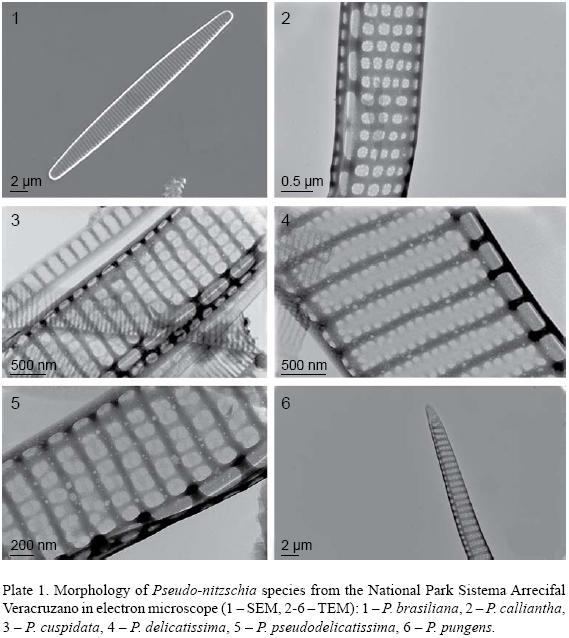
<body><![CDATA[<p align="justify"><font face="verdana" size="2">Type (lectotype): <i>Pseudo&#150;nitzschia seriata </i>(Cleve) H. Peragallo in H. et M. Peragallo, 1900.</font></p>     <p align="justify"><font face="verdana" size="2">The following description is based on the diagnosis by Hasle (1993).</font></p>     <p align="justify"><font face="verdana" size="2">Species of <i>Pseudo&#150;nitzschia </i>form chain colonies characterized by overlapped cells. Each cell contains two chloroplasts, each located closer to the extremities, and a central nucleus. Individual cells and colonies can move, gliding in the longitudinal direction. The cingulum consists of a series of linear bands. For identification, the cells should be examined in valve view. The frustules are usually linear or lanceolate in both valve and girdle view, but some species are asymmetric along the apical axis in valve view. The number of interstriae is equal or approximately double compared to the number of fibulae, and one or more rows of poroids between the striae are present. The raphe is eccentric and not elevated above the valvar surface, and the raphe wall lacks poroids. Two raphes of two adjacent cells are located one against other. Some species have a central nodule (= central interspace). Using the light microscope, it can be observed as a larger space between the central fibulae.</font></p>     <p align="justify"><font face="verdana" size="2">Hasle (1965) and Hasle &amp; Syvertsen (1996) divided <i>Pseudo&#150;nitzschia </i>into two groups: the <i>"seriata </i>complex" (valve width &gt;3 (&#956;m) and the <i>"delicatissima </i>complex" (&lt;3 (&#956;m). Lundholm et al. (2002, 2003) further clarified two more groups (the <i>"americana </i>complex" and the <i>"pseudodelicatissima/cuspidata </i>complex"); the former is distinguished via light microscopy by its valves with rounded ends and shorter lengths (&lt;65 &#956;m). The <i>"pseudodelicatissima/cuspidata </i>complex" is distinguished morphologically primarily by differences in the structure of the poroid hymens and girdle bands (Lundholm et al., 2003).</font></p>     <p align="justify"><font face="verdana" size="2">Description of species</font></p>     <p align="justify"><font face="verdana" size="2"><b>1. <i>Pseudo&#150;nitzschia brasiliana </i>Lundholm, Hasle et G. A. Fryxell, 2002 </b>(<a href="#p1">Pl. 1, Fig. 1</a>; <a href="#p2">Pl. 2, Fig. 1</a>)</font></p>     <p align="center"><font face="verdana" size="2"><a name="p1"></a></font></p>     <p align="center"><font face="verdana" size="2"><img src="/img/revistas/abm/n98/a4p1.jpg"></font></p>     <p align="center"><font face="verdana" size="2"><a name="p2"></a></font></p>     <p align="center"><font face="verdana" size="2"><img src="/img/revistas/abm/n98/a4p2.jpg"></font></p>     ]]></body>
<body><![CDATA[<p align="justify"><font face="verdana" size="2">Cells are narrow, linear, with widely rounded extremities, 23&#150;40 &#956;m long, 2.0&#150;2.7 &#956;m wide, overlapped 1/8&#150;1/11 of the cell length. 22&#150;24 striae in 10 &#956;m and 24&#150;25 fibulae in 10 &#956;m (<a href="#t1">Table 1</a>). Two rows of poroids more or less circular, 9.0&#150;9.5 in 1 &#956;m, tending to form the third row near the valve margins. Central interspace is absent.</font></p>     <p align="justify"><font face="verdana" size="2">Taxonomic note. This species belongs to the <i>"americana </i>complex". Unlike the <i>"seriata </i>complex", the species of the <i>"americana </i>complex" have rounded valvar poles, slightly shorter cells, and weaker silicification. Unlike the <i>"delicatissima </i>complex", the valves are wider and more robust. The number of fibulae and striae in the specimens from NPSAV is within that reported by other authors (1928 fibulae and striae in 10 (im in Lundholm et al., 2002, and Quijano&#150;Scheggia et al., 2008, 2011).</font></p>     <p align="justify"><font face="verdana" size="2">A new record for the SW Gulf of Mexico.</font></p>     <p align="justify"><font face="verdana" size="2">Toxicity. The species has not yet been reported to be toxic (Lundholm et al., 2002).</font></p>     <p align="justify"><font face="verdana" size="2"><b>2. <i>Pseudo&#150;nitzschia calliantha </i>Lundholm, Moestrup et Hasle, 2003 </b>(<a href="#p1">Pl. 1, Fig. 2</a>)</font></p>     <p align="justify"><font face="verdana" size="2">Cells are very narrow, linear, 40&#150;85 &#956;m long, 1.4&#150;1.6 &#956;m wide. The degree of overlap between cells in colonies is unknown (it is not given in the original description by Lundholm et al., 2003). 33&#150;40 striae in 10 &#956;m and 15&#150;22 fibulae in 10 &#956;m. One row of relatively large circular poroids, 4.1&#150;6.5 in 1 &#956;m. The hymen is dis&#150;continuously perforated, consisting of 4&#150;9 peripheral sectors and a central area; the poroids having the lower number of sectors are always closer to the valve opposite to that with smaller fibulae and poroids. Central interspace is present.</font></p>     <p align="justify"><font face="verdana" size="2">Taxonomic note. This species belongs to the <i>"delicatissima </i>complex" (Hasle &amp; Syvertsen, 1996) and the <i>"pseudodelicatissima/cuspidata </i>complex" (Lundholm et al., 2003). The numbers of fibulae and striae in the specimens from NPSAV are within those reported by others (19&#150;20 and 39&#150;40 in 10 &#956;m, respectively, in Bargu et al., 2004; 15&#150;22 and 34&#150;39 in 10 &#956;m in Lundholm et al., 2003; 15&#150;26 and 30&#150;40 in 10 &#956;m in Quijano&#150;Scheggia et al., 2008).</font></p>     <p align="justify"><font face="verdana" size="2">A new record for the SW Gulf of Mexico. It was identified for the first time in the Gulf of Mexico in Florida (Lundholm et al., 2003). Recently, it was reported in Louisiana waters, where it was dominant among other <i>Pseudo&#150;nitzschia </i>species (Del Rio et al., 2010).</font></p>     <p align="justify"><font face="verdana" size="2">Toxicity. Some strains of this species are toxic (Lundholm et al., 1997, 2003; Bates &amp; Trainer, 2006). However, Orlova et al. (2008) did not detect any toxicity in a strain of <i>P. calliantha </i>from the Sea of Japan, and strains from the southern Gulf of St. Lawrence, Canada, were also below the limit of detection for DA (S. Bates, pers. comm.).</font></p>     <p align="justify"><font face="verdana" size="2"><b>3. <i>Pseudo&#150;nitzschia cuspidata </i>(Hasle) Hasle, 1974 emend. Lundholm, Moestrup et Hasle, 2003 </b>(<a href="#p1">Pl. 1</a>, Fig. 3)</font></p>     ]]></body>
<body><![CDATA[<p align="justify"><font face="verdana" size="2">Bas.: <i>Nitzschia cuspidata </i>Hasle, 1965.</font></p>     <p align="justify"><font face="verdana" size="2">Cells are very narrow, linear or lanceolate, with acute extremities, 1.5&#150;1.7 &#956;m wide, overlapped 1/5&#150;1/6 of the cell length. 36&#150;41 striae in 10 &#956;m and 19&#150;23 fibulae in 10 &#956;m. One row of relatively large poroids, 6.0&#150;6.8 in 1 &#956;m. The hymen is usually perforated by four sectors (each partially divided), so that the perforation is not continuous. Central interspace is present.</font></p>     <p align="justify"><font face="verdana" size="2">Taxonomic note. This species belongs to the <i>"delicatissima </i>complex" (Hasle &amp; Syvertsen, 1996) and the <i>"pseudodelicatissima/cuspidata </i>complex" (<a href="#p2">Pl. 2</a>, Fig. 2&#150;4; Lundholm et al., 2003). The number of fibulae and striae in the specimens from NPSAV are within those reported by others, however, the poroids are somewhat denser (14&#150;22 and 29&#150;39 in 10 &#956;m and 4&#150;6 poroids in 1 um, respectively, in Hasle, 1965, and Skov et al., 1999; 19&#150;25 and 35&#150;44 in 10 &#956;m and 4&#150;6 poroids in 1 um in Lundholm et al., 2003). The hymen in <i>P. cuspidata </i>and <i>P. pseudodelicatissima </i>is very similar, so that it is not always possible to distinguish between these two species even in TEM; principally, they are distinguished by the shape of the valves (tapering from the middle part of the valve towards the extremities in <i>P. cuspidata </i>and tapering only near the extremities in <i>P. pseudodelicatissima) </i>and by the cell width (relatively thinner in <i>P. pseudodelicatissima) </i>(Lundholm et al., 2003).</font></p>     <p align="justify"><font face="verdana" size="2">In the SW Gulf of Mexico, the species has been previously reported from Tuxpan, Veracruz, M&eacute;xico (Lundholm et al., 2003).</font></p>     <p align="justify"><font face="verdana" size="2">Toxicity. Reports prior to 2003 about the toxicity of <i>P. cuspidata </i>are not reliable due to confusion of this species with <i>P. pseudodelicatissima </i>(Lundholm et al., 2003). However, more recent studies have confirmed the toxicity of <i>P. cuspidata </i>(Trainer et al., 2009).</font></p>     <p align="justify"><font face="verdana" size="2"><b>4. <i>Pseudo&#150;nitzschia delicatissima </i>(Cleve) Heiden, 1928 </b>(<a href="#p1">Pl. 1</a>, Fig. 4)</font></p>     <p align="justify"><font face="verdana" size="2">Bas.: <i>Nitzschia delicatissima </i>Cleve, 1897. Syn.: <i>Nitzschia actydrophila </i>Hasle, 1965.</font></p>     <p align="justify"><font face="verdana" size="2">Cells are very narrow, linear or lanceolate, 40&#150;85 &#956;m long, 1.3&#150;1.4 &#956;m wide, overlapped 1/7&#150;1/10 of the cell length. 33&#150;36 striae in 10 &#956;im and 21&#150;24 fibulae in 10 &#956;m. Two rows of small poroids. The hymen has a continuously perforated area, 9.111.4 poroids in 1 &#956;m. Central interspace is present.</font></p>     <p align="justify"><font face="verdana" size="2">Taxonomic note. This species belongs to the <i>"delicatissima </i>complex" (Hasle &amp; Syvertsen, 1996). The number of fibulae in the specimens from NPSAV is within that reported by Hasle (1965), i.e., 19&#150;25 in 10 um.</font></p>     <p align="justify"><font face="verdana" size="2">Toxicity. This species has never caused any natural toxic event (Skov et al., 1999). However, the presence of the DA was registered in cultures (Smith et al., 1991; Rhodes et al., 1998). DA is reported as undetectable in most culture studies on <i>P. delicatissima </i>(Villac et al., 1993; Lundholm et al., 1994; Fehling et al., 2005).</font></p>     ]]></body>
<body><![CDATA[<p align="justify"><font face="verdana" size="2"><b>5. <i>Pseudo&#150;nitzschia pseudodelicatissima </i>(Hasle) Hasle, 1993 emend. Lundholm, Moestrup et Hasle, 2003 </b>(<a href="#p1">Pl. 1</a>, Fig. 5)</font></p>     <p align="justify"><font face="verdana" size="2">Bas.: <i>Nitzschia pseudodelicatissima </i>Hasle, 1976. </font></p>     <p align="justify"><font face="verdana" size="2">Syn.: <i>Nitzschia delicatula </i>Hasle, 1965.</font></p>     <p align="justify"><font face="verdana" size="2">Cells are very narrow, linear, 40&#150;85 &#956;m long, 1.1&#150;1.6 &#956;m wide, symmetric in relation to the apical axis, with more or less acute extremities, overlapped 1/5&#150;1/6 of the cell length. 35&#150;44 striae in 10 &#956;m and 17&#150;23 fibulae in 10 &#956;m. One row of small, circular, ovoid or more or less quadrate poroids with rounded angles, 5.0&#150;7.0 in 1 &#956;m. The hymen has 1 to 4 perforated areas (partially divided), so that the perforation is not continuous. Central interspace is present.</font></p>     <p align="justify"><font face="verdana" size="2">Taxonomic note. This species belongs to the <i>"delicatissima </i>complex". The number of poroids in the specimens from NPSAV is slightly higher compared to those reported by others (4&#150;6 in 1 &#956;m in Hasle, 1965; 5&#150;6 in Takano &amp; Kuroki, 1977, and Rivera, 1985; 4.8&#150;5.5 in Lundholm et al., 2003). Also, the number of striae and fibulae are higher (29&#150;33 and 16&#150;19 in 10 &#956;m, respectively, in Licea, 1992).</font></p>     <p align="justify"><font face="verdana" size="2">Toxicity. Certain strains of this species are toxic (Pan et al., 2001 &#91;now known to be <i>P. pseudodelicatissima </i>instead of <i>P. </i>sp. cf. <i>pseudodelicatissima, </i>M. Parsons pers. obs.&#93;; Bates &amp; Trainer, 2006; Moschandreou et al., 2010), although more often non&#150;toxic strains have been reported (see references in Moschandreou et al., 2010).</font></p>     <p align="justify"><font face="verdana" size="2"><b>6. <i>Pseudo&#150;nitzschiapungens </i>(Grunow ex Cleve) Hasle, 1993 </b>(<a href="#p1">Pl. 1</a>, Fig. 6) Bas.: <i>Nitzschia pungens </i>Grunow ex Cleve, 1897.</font></p>     <p align="justify"><font face="verdana" size="2">Cells linear or lanceolate, symmetrical in relation to the apical axis, 93&#150;126 &#956;m long, 2.8&#150;3.2 um wide, overlapped 1/3&#150;1/4 of the cell length. 11&#150;14 striae in 10 &#956;m and 11&#150;15 fibulae in 10 &#956;m. Two rows of large, circular poroids, 3.0&#150;3.4 in 1 &#956;m.</font></p>     <p align="justify"><font face="verdana" size="2">Taxonomic note. This species belongs to the <i>"seriata </i>complex" (Hasle &amp; Syvertsen, 1996). The number of poroids in the specimens from NPSAV is higher than that reported in Quijano&#150;Scheggia et al. (2008) (2.5&#150;3.0 in 1 um), but is within the range reported by others (3&#150;4 in 1 &#956;m in Hasle, 1965; Takano &amp; Kuroki, 1977; Rivera, 1985). The literature sometimes indicates one or three rows of poroids in 1 um (Hasle, 1965; Rivera, 1985), whereas only two rows were observed in the cells from NPSAV.</font></p>     <p align="justify"><font face="verdana" size="2">Toxicity. The species is most often characterized as being non&#150;toxic; however, some strains do produce low amounts of DA (Bates &amp; Trainer, 2006). DA was detected in strains isolated from Washington State, USA (Trainer et al., 1998; Baugh et al., 2006) and New Zealand (Rhodes et al., 1998).</font></p>     ]]></body>
<body><![CDATA[<p align="justify"><font face="verdana" size="2"><b>7. <i>Pseudo&#150;nitzschia </i>cf. <i>subcurvata </i>(Hasle) G. A. Fryxell, 1993 </b>(<a href="#p2">Pl. 2</a>, Fig. 6 and 7) </font></p>     <p align="justify"><font face="verdana" size="2">Bas.: <i>Nitzschia subcurvata </i>Hasle, 1964.</font></p>     <p align="justify"><font face="verdana" size="2">Cells are lanceolate, curved in relation to the apical axis: in valve view, convex from one side and concave from another, 28&#150;36 &#956;m long, 1.9&#150;2.5 &#956;m wide, overlapped 1/7&#150;1/8 of the cell length. Striae and fibulae were not distinguished in the light microscope. Cells are solitary or form colonies of 3 to 6 cells.</font></p>     <p align="justify"><font face="verdana" size="2">Taxonomic note. This species belongs to the <i>"delicatissima </i>complex". The cells previously observed by others are 47&#150;113 &#956;m long, 1.5&#150;2.5 &#956;m wide, have 44&#150;49 striae and 12&#150;18 fibulae in 10 &#956;m (Hasle, 1964; Hasle &amp; Syvertsen, 1996).</font></p>     <p align="justify"><font face="verdana" size="2">Biogeographic note. <i>Pseudo&#150;nitzschia subcurvata </i>is abundant in the Antarctic (Hasle, 1964; Hasle &amp; Syvertsen, 1996; Scott &amp; Thomas, 2005; Almandoz et al., 2008). The species has been also encountered in the Arctic, Subarctic Pacific and near the eastern Australia (Taylor &amp; Waters, 1982; Crosbie &amp; Furnas, 2001; Flint et al., 2001; Ik&aacute;valko, 2003). The species was first reported for the Gulf of Mexico by Ak&eacute;&#150;Castillo &amp; Okolodkov (2009).</font></p>     <p align="justify"><font face="verdana" size="2">Toxicity. There are no reports about the toxicity of this species.</font></p>     <p align="justify"><font face="verdana" size="2">&nbsp;</font></p>     <p align="justify"><font face="verdana" size="2"><b>DISCUSSION</b></font></p>     <p align="justify"><font face="verdana" size="2">Out of seven species presented in this work, <i>Pseudo&#150;nitzschia brasiliana </i>and <i>P. calliantha </i>are new records for the SW Gulf of Mexico. <i>Pseudo&#150;nitzschia multiseries, P. pungens, P. subfraudulenta </i>and <i>P. subpacifica </i>have been previously reported from the Strait of Yucatan (Licea, 1992), and <i>P. delicatissima </i>from Veracruz (Santoyo &amp; Signoret, 1988). A similar diversity of <i>Pseudo&#150;nitzschia </i>was noted by Parsons et al. (1998), who reported on the presence of six species <i>of Pseudo&#150;nitzschia </i>in the northern Gulf of Mexico: <i>P. </i>cf. <i>americana </i>(now known to be <i>P. brasiliana), P. delicatissima, P. pseudodelicatissima </i>(now known to also include <i>P. calliantha </i>and <i>P. cuspidata), P. multiseries, P. pungens </i>and <i>P. subfraudulenta. P. multistriata </i>has also been observed in the northern Gulf of Mexico (M. Parsons, pers. obs.). Three of the species found in the northern Gulf of Mexico were not observed in this study: <i>P. multiseries, P. multistriata </i>and <i>P. subfraudulenta, </i>suggesting that there may be a greater diversity of <i>Pseudo&#150;nitzschia </i>present in the NPSAV than captured in this study, or that biogeographic limits of these species may be present. Similarly, <i>P. subcurvata </i>was not observed in the northern Gulf of Mexico, possibly due to similar reasons. Wolny &amp; Heil (2005, unpubl. data) reported on the presence of nine species of <i>Pseudo&#150;nitzschia </i>in coastal waters of west Florida <i>(P. calliantha, P. cuspidata, P. delicatissima, P. granii, P. heimii, P. multiseries, P. pseudodelicatissima, P. pungens </i>and <i>P. turgidula), </i>again demonstrating the presence of additional species <i>(P. granii, P. heimii </i>and <i>P. turgidula) </i>and the absence of others <i>(P. multistriata, P. subcurvata </i>and <i>P. subfraudulenta). </i>It is therefore likely that a higher diversity of <i>Pseudo&#150;nitzschia </i>is present in the Gulf of Mexico than has been documented to date, and/or that biogeographic limitations may be present for some species in some localities; e.g., <i>P. multiseries </i>was absent in samples &gt;27 &ordm;C in coastal Louisiana (M. Parsons, unpubl. data).</font></p>     <p align="justify"><font face="verdana" size="2">The analysis of our samples showed the frequent dominance of <i>Pseudo&#150;nitzschia </i>species in net plankton. <i>Pseudo&#150;nitzschia delicatissima </i>was one of the three most conspicuous diatoms in the annual cycle of 1975&#150;1976 at Punta Lim&oacute;n, in the central part of coast of the State of Veracruz (Santoyo &amp; Signoret, 1988). <i>Pseudo&#150;nitzschia </i>species continued to be a dominant member of the phytoplankton community, dominating the phytoplankton community in NPSAV from May into November 2005, reaching bloom concentrations (1.5 x 10<sup>6</sup> cells/l) in August 2005 (Okolodkov et al., 2009). This time period was characterized by higher temperature (up to 32 &ordm;C) and high precipitation (Okolodkov et al., 2009), suggesting possible nutrient enrichment related to local riverine inputs from the rivers Jamapa (discharging into the NPSAV), La Antigua (to the north&#150;west), and Papaloapan (to the south&#150;east). Just as other studies have demonstrated that <i>Pseudo&#150;nitzschia </i>can proliferate in eutrophic conditions (e.g., Dortch et al., 1997; Parsons et al., 2002), continued nutrient enrichment and subsequent eutrophication of the coastal urban zone of Veracruz&#150;Boca del R&iacute;o&#150;Ant&oacute;n Lizardo from these riverine inputs could result in larger and more frequent <i>Pseudo&#150;nitzschia </i>blooms. This study demonstrates that potentially toxic <i>Pseudo&#150;nitzschia </i>species are present in NPSAV; thus their increased abundances could lead to an increased risk of ASP in the study area. The vectors of DA in the NPSAV are still unknown, however, and will require further study. Seasonality of individual <i>Pseudo&#150;nitzschia </i>species and their relationships with physical&#150;chemical variables in the context of the entire planktonic phytocoenosis must be one of the future priorities to allow evaluation of the potential risk of ASP in the study area.</font></p>     ]]></body>
<body><![CDATA[<p align="justify"><font face="verdana" size="2">&nbsp;</font></p>     <p align="justify"><font face="verdana" size="2"><b>ACKNOWLEDGMENTS</b></font></p>     <p align="justify"><font face="verdana" size="2">We thank the Aquarium of Veracruz, Guadalupe Campos&#150;Bautista (responsible for the project "Monitoreo de florecimientos algales nocivos en el &aacute;rea del Acuario de Veracruz en mayo del 2005&#150;mayo del 2006") for logistics during sampling, and the Direcci&oacute;n General de Investigaciones, Universidad Veracruzana, for financial support for the project "Algas de la zona arrecifal Veracruzana, Golfo de M&eacute;xico, con &eacute;nfasis en las algas rojas, diatomeas y dinoflagelados" (2007&#150;2009), awarded to YBO. We also thank Cindy Heil for her permission to use the electron microscopes at the Florida Fish and Wildlife Research Institute (FWRI) in St. Petersburg, Florida, USA, and Paula Scott (FWRI) for her assistance in sample preparation and examination on the microscopes. Stephen Bates (Fisheries and Oceans Canada, Moncton, New Brunswick, Canada) reviewed the manuscript and offered valuable suggestions. N&eacute;stor M. Ru&iacute;z&#150;Robinson and Natalia Okolodkova are thanked for technical assistance in constructing the photographic plates, and Marcia M. Gowing for help with revising the manuscript.</font></p>     <p align="justify"><font face="verdana" size="2">&nbsp;</font></p>     <p align="justify"><font face="verdana" size="2"><b>LITERATURE CITED</b></font></p>     <!-- ref --><p align="justify"><font face="verdana" size="2">Akallal, R. &amp; A. Mouradi. 2000. <i>Pseudo&#150;nitzschia pseudodelicatissima </i>bloom in Atlantic Moroccan waters 1999. Harmful Algae News 20: 14.    &nbsp;&nbsp;&nbsp;&nbsp;&nbsp;&nbsp;&nbsp;&nbsp;[&#160;<a href="javascript:void(0);" onclick="javascript: window.open('/scielo.php?script=sci_nlinks&ref=036233&pid=S0187-7151201200010000400001&lng=','','width=640,height=500,resizable=yes,scrollbars=1,menubar=yes,');">Links</a>&#160;]<!-- end-ref --></font></p>     <!-- ref --><p align="justify"><font face="verdana" size="2">Ak&eacute;&#150;Castillo, J. A. &amp; Y. B. Okolodkov. 2009. <i>Pseudo&#150;nitzschia subcurvata </i>(Bacillariophyceae) in the Gulf of Mexico? Harmful Algae News 40: 6&#150;7.    &nbsp;&nbsp;&nbsp;&nbsp;&nbsp;&nbsp;&nbsp;&nbsp;[&#160;<a href="javascript:void(0);" onclick="javascript: window.open('/scielo.php?script=sci_nlinks&ref=036235&pid=S0187-7151201200010000400002&lng=','','width=640,height=500,resizable=yes,scrollbars=1,menubar=yes,');">Links</a>&#160;]<!-- end-ref --></font></p>     <!-- ref --><p align="justify"><font face="verdana" size="2">Almandoz, G. O., M. E. Ferrario, G. A. Ferreyra, I. R. Schloss, J. L. Esteves &amp; F. E. Paparazzo. 2007. The genus <i>Pseudo&#150;nitzschia </i>(Bacillariophyceae) in continental shelf waters of Argentina (Southwestern Atlantic Ocean, 38&#150;55&ordm;S). Harmful Algae 6: 93&#150;103.    &nbsp;&nbsp;&nbsp;&nbsp;&nbsp;&nbsp;&nbsp;&nbsp;[&#160;<a href="javascript:void(0);" onclick="javascript: window.open('/scielo.php?script=sci_nlinks&ref=036237&pid=S0187-7151201200010000400003&lng=','','width=640,height=500,resizable=yes,scrollbars=1,menubar=yes,');">Links</a>&#160;]<!-- end-ref --></font></p>     <!-- ref --><p align="justify"><font face="verdana" size="2">Almandoz, G., G. A. Ferreyra, I. R. Schloss, A. I. Dogliotti, V. Rupolo, F. E. Paparazzo, J. L. Esteves &amp; M. E. Ferrario. 2008. Distribution and ecology of <i>Pseudo&#150;nitzschia </i>species (Bacillariophyceae) in surface waters of the Weddell Sea (Antarctica). Polar Biol. 6: 429&#150;442.    &nbsp;&nbsp;&nbsp;&nbsp;&nbsp;&nbsp;&nbsp;&nbsp;[&#160;<a href="javascript:void(0);" onclick="javascript: window.open('/scielo.php?script=sci_nlinks&ref=036239&pid=S0187-7151201200010000400004&lng=','','width=640,height=500,resizable=yes,scrollbars=1,menubar=yes,');">Links</a>&#160;]<!-- end-ref --></font></p>     <!-- ref --><p align="justify"><font face="verdana" size="2">Badylak, S., E. Phlips &amp; K. Kelley. 2006. <i>Pseudo&#150;nitzschia calliantha </i>(Bacillariophyceae) from the Indian River Lagoon, Florida. Diatom Res. 21(2): 263&#150;267.    &nbsp;&nbsp;&nbsp;&nbsp;&nbsp;&nbsp;&nbsp;&nbsp;[&#160;<a href="javascript:void(0);" onclick="javascript: window.open('/scielo.php?script=sci_nlinks&ref=036241&pid=S0187-7151201200010000400005&lng=','','width=640,height=500,resizable=yes,scrollbars=1,menubar=yes,');">Links</a>&#160;]<!-- end-ref --> </font></p>     <!-- ref --><p align="justify"><font face="verdana" size="2">Bargu, S., T. Koray &amp; N. Lundholm. 2004. First report of <i>Pseudo&#150;nitzschia calliantha </i>Lundholm, Moestrup &amp; Hasle 2003, a new potentially toxic species from Turkish coasts. E. U. J. Fish. Aquat. Sci. 19(3&#150;4): 479&#150;483.    &nbsp;&nbsp;&nbsp;&nbsp;&nbsp;&nbsp;&nbsp;&nbsp;[&#160;<a href="javascript:void(0);" onclick="javascript: window.open('/scielo.php?script=sci_nlinks&ref=036243&pid=S0187-7151201200010000400006&lng=','','width=640,height=500,resizable=yes,scrollbars=1,menubar=yes,');">Links</a>&#160;]<!-- end-ref --> </font></p>     <!-- ref --><p align="justify"><font face="verdana" size="2">Bates, S. S., C. J. Bird, A. S. W. de Freitas, R. Foxall, M. Gilgan, L. A. Hanic, G. R. Johnson, A. W. McCulloch, P. Odense, R. Pocklington, M. A. Quilliam, P. G. Sim &amp; J. C. Smith. 1989. Pennate diatom <i>Nitzschia pungens </i>as the primary source of domoic acid, a toxin in shellfish from eastern Prince Edward Island, Canada. Can. J. Fish. Aquat. Sci. 46: 1203&#150;1215.    &nbsp;&nbsp;&nbsp;&nbsp;&nbsp;&nbsp;&nbsp;&nbsp;[&#160;<a href="javascript:void(0);" onclick="javascript: window.open('/scielo.php?script=sci_nlinks&ref=036245&pid=S0187-7151201200010000400007&lng=','','width=640,height=500,resizable=yes,scrollbars=1,menubar=yes,');">Links</a>&#160;]<!-- end-ref --></font></p>     <!-- ref --><p align="justify"><font face="verdana" size="2">Bates, S. S. &amp; D. J. A. Richard. 2000. Shellfish harvest area closure due to domoic acid &#150; Mill River, Prince Edward Island. Harmful Algae News 21: 6&#150;7.    &nbsp;&nbsp;&nbsp;&nbsp;&nbsp;&nbsp;&nbsp;&nbsp;[&#160;<a href="javascript:void(0);" onclick="javascript: window.open('/scielo.php?script=sci_nlinks&ref=036247&pid=S0187-7151201200010000400008&lng=','','width=640,height=500,resizable=yes,scrollbars=1,menubar=yes,');">Links</a>&#160;]<!-- end-ref --> </font></p>     <!-- ref --><p align="justify"><font face="verdana" size="2">Bates, S. S. &amp; V. L. Trainer. 2006. The ecology of harmful diatoms. In: Gran&eacute;li, E. &amp; J. T. Turner (eds.). Ecology of harmful algae. Ecological Studies 189. Springer&#150;Verlag. Berlin. pp. 81&#150;93.    &nbsp;&nbsp;&nbsp;&nbsp;&nbsp;&nbsp;&nbsp;&nbsp;[&#160;<a href="javascript:void(0);" onclick="javascript: window.open('/scielo.php?script=sci_nlinks&ref=036249&pid=S0187-7151201200010000400009&lng=','','width=640,height=500,resizable=yes,scrollbars=1,menubar=yes,');">Links</a>&#160;]<!-- end-ref --></font></p>     <!-- ref --><p align="justify"><font face="verdana" size="2">Baugh, K. A., J. M. Bush, B. D. Bill, K. A. Lefebvre &amp; V. L. Trainer. 2006. Estimates of specific toxicity in several <i>Pseudo&#150;nitzschia </i>species from the Washington coast, based on culture and field studies. Afr. J. Mar. Sci. 28: 393&#150;397.    &nbsp;&nbsp;&nbsp;&nbsp;&nbsp;&nbsp;&nbsp;&nbsp;[&#160;<a href="javascript:void(0);" onclick="javascript: window.open('/scielo.php?script=sci_nlinks&ref=036251&pid=S0187-7151201200010000400010&lng=','','width=640,height=500,resizable=yes,scrollbars=1,menubar=yes,');">Links</a>&#160;]<!-- end-ref --></font></p>     <!-- ref --><p align="justify"><font face="verdana" size="2">Bogan, Y. M., K. Bender, A. Hervas, D. J. Kennedy, J. W. Slater &amp; P. Hess. 2007. Spatial variability of domoic acid concentration in king scallops <i>Pecten maximus </i>off the southeast coast of Ireland. Harmful Algae 6: 1&#150;14.    &nbsp;&nbsp;&nbsp;&nbsp;&nbsp;&nbsp;&nbsp;&nbsp;[&#160;<a href="javascript:void(0);" onclick="javascript: window.open('/scielo.php?script=sci_nlinks&ref=036253&pid=S0187-7151201200010000400011&lng=','','width=640,height=500,resizable=yes,scrollbars=1,menubar=yes,');">Links</a>&#160;]<!-- end-ref --></font></p>     <!-- ref --><p align="justify"><font face="verdana" size="2">Cho, E. S., H. G. Hur, H. S. Byun, S. G. Lee, L. L. Rhodes, C. S. Jeong &amp; J. G. Park. 2002. Monthly monitoring of domoic acid producer <i>Pseudo&#150;nitzschia multiseries </i>(Hasle) Hasle using species&#150;specific DNA probes and WGA lectins and abundances of <i>Pseudo&#150;nitzschia </i>species (Bacillariophyceae) from Chinhae Bay, Korea. Bot. Mar. 45: 364&#150;372.    &nbsp;&nbsp;&nbsp;&nbsp;&nbsp;&nbsp;&nbsp;&nbsp;[&#160;<a href="javascript:void(0);" onclick="javascript: window.open('/scielo.php?script=sci_nlinks&ref=036255&pid=S0187-7151201200010000400012&lng=','','width=640,height=500,resizable=yes,scrollbars=1,menubar=yes,');">Links</a>&#160;]<!-- end-ref --></font></p>     <!-- ref --><p align="justify"><font face="verdana" size="2">Conger, P. S., G. A. Fryxell &amp; S. Z. El&#150;Sayed. 1972. Diatom species reported from the Gulf of Mexico. In: El&#150;Sayed, S. Z., W. M. Sackett, L. M. Jeffrey, A. D. Fredericks, R. P. Saunders, P. S. Conger, G. A. Fryxell, K. A. Steidinger &amp; S. A. Earle (eds.). Chemistry, primary productivity, and benthic algae of the Gulf of Mexico. Folio of the Serial Atlas of the Marine Environment. Office of Naval Research, Texas A &amp; M Research Foundation, College of Geosciences, Texas A &amp; M University. College Station, Texas. pp. 18&#150;23.    &nbsp;&nbsp;&nbsp;&nbsp;&nbsp;&nbsp;&nbsp;&nbsp;[&#160;<a href="javascript:void(0);" onclick="javascript: window.open('/scielo.php?script=sci_nlinks&ref=036257&pid=S0187-7151201200010000400013&lng=','','width=640,height=500,resizable=yes,scrollbars=1,menubar=yes,');">Links</a>&#160;]<!-- end-ref --> </font></p>     <!-- ref --><p align="justify"><font face="verdana" size="2">Cort&eacute;s&#150;Altamirano, R. &amp; A. P. Sierra&#150;Beltr&aacute;n. 2008. Biotoxins from freshwater and marine harmful algal blooms occurring in Mexico. Toxin Rev. 27: 27&#150;77.    &nbsp;&nbsp;&nbsp;&nbsp;&nbsp;&nbsp;&nbsp;&nbsp;[&#160;<a href="javascript:void(0);" onclick="javascript: window.open('/scielo.php?script=sci_nlinks&ref=036259&pid=S0187-7151201200010000400014&lng=','','width=640,height=500,resizable=yes,scrollbars=1,menubar=yes,');">Links</a>&#160;]<!-- end-ref --> </font></p>     <!-- ref --><p align="justify"><font face="verdana" size="2">Crosbie, N. D. &amp; M. J. Furnas. 2001. Net growth rates of picocyanobacteria and nano&#150;/ microphytoplankton inhabiting shelf waters of the central (17&ordm;S) and southern (20&ordm;S) Great Barrier Reef. Aquat. Microb. Ecol. 24: 209&#150;224.    &nbsp;&nbsp;&nbsp;&nbsp;&nbsp;&nbsp;&nbsp;&nbsp;[&#160;<a href="javascript:void(0);" onclick="javascript: window.open('/scielo.php?script=sci_nlinks&ref=036261&pid=S0187-7151201200010000400015&lng=','','width=640,height=500,resizable=yes,scrollbars=1,menubar=yes,');">Links</a>&#160;]<!-- end-ref --> </font></p>     <!-- ref --><p align="justify"><font face="verdana" size="2">Del Rio, R., S. Bargu, D. Baltz, S. Fire, G. Peterson &amp; Z. Wang. 2010. Gulf menhaden <i>(Brevoortia patronus): </i>a potential vector of domoic acid in coastal Louisiana food webs. Harmful Algae 10: 19&#150;29.    &nbsp;&nbsp;&nbsp;&nbsp;&nbsp;&nbsp;&nbsp;&nbsp;[&#160;<a href="javascript:void(0);" onclick="javascript: window.open('/scielo.php?script=sci_nlinks&ref=036263&pid=S0187-7151201200010000400016&lng=','','width=640,height=500,resizable=yes,scrollbars=1,menubar=yes,');">Links</a>&#160;]<!-- end-ref --> </font></p>     <!-- ref --><p align="justify"><font face="verdana" size="2">Dortch, Q., R. Robichaux, S. Pool, D. Milsted, G. Mire, N. N. Rabalais, T. M. Soniat, G. A. Fryxell, R. E. Turner &amp; M. L. Parsons. 1997. Abundance and vertical flux of <i>Pseudo&#150;nitzschia </i>in the northern Gulf of Mexico. Mar. Ecol. Prog. Ser. 146: 249&#150;264.    &nbsp;&nbsp;&nbsp;&nbsp;&nbsp;&nbsp;&nbsp;&nbsp;[&#160;<a href="javascript:void(0);" onclick="javascript: window.open('/scielo.php?script=sci_nlinks&ref=036265&pid=S0187-7151201200010000400017&lng=','','width=640,height=500,resizable=yes,scrollbars=1,menubar=yes,');">Links</a>&#160;]<!-- end-ref --></font></p>     <!-- ref --><p align="justify"><font face="verdana" size="2">Fehling, J., D. H. Green, K. Davidson, C. J. Bolch &amp; S. S. Bates. 2004. Domoic acid production by <i>Pseudo&#150;nitzschia seriata </i>(Bacillariophyceae) in Scottish waters. J. Phycol. 40: 622&#150;630.    &nbsp;&nbsp;&nbsp;&nbsp;&nbsp;&nbsp;&nbsp;&nbsp;[&#160;<a href="javascript:void(0);" onclick="javascript: window.open('/scielo.php?script=sci_nlinks&ref=036267&pid=S0187-7151201200010000400018&lng=','','width=640,height=500,resizable=yes,scrollbars=1,menubar=yes,');">Links</a>&#160;]<!-- end-ref --></font></p>     <!-- ref --><p align="justify"><font face="verdana" size="2">Fehling, J., K. Davidson &amp; S. S. Bates. 2005. Growth dynamics of non&#150;toxic <i>Pseudo&#150;nitzschia delicatissima </i>and toxic <i>P. seriata </i>(Bacillariophyceae) under simulated spring and summer photoperiods. Harmful Algae 4: 763&#150;769.    &nbsp;&nbsp;&nbsp;&nbsp;&nbsp;&nbsp;&nbsp;&nbsp;[&#160;<a href="javascript:void(0);" onclick="javascript: window.open('/scielo.php?script=sci_nlinks&ref=036269&pid=S0187-7151201200010000400019&lng=','','width=640,height=500,resizable=yes,scrollbars=1,menubar=yes,');">Links</a>&#160;]<!-- end-ref --></font></p>     <!-- ref --><p align="justify"><font face="verdana" size="2">Flint, M. V., I. N. Sukhanova, A. I. Kopylov, S. G. Poyarkov &amp; T. E. Whitledge. 2001. Plankton distributions associated with frontal zones in the vicinity of the Pribylof Islands. Deep&#150;Sea Res. II 49: 6069&#150;6093.    &nbsp;&nbsp;&nbsp;&nbsp;&nbsp;&nbsp;&nbsp;&nbsp;[&#160;<a href="javascript:void(0);" onclick="javascript: window.open('/scielo.php?script=sci_nlinks&ref=036271&pid=S0187-7151201200010000400020&lng=','','width=640,height=500,resizable=yes,scrollbars=1,menubar=yes,');">Links</a>&#160;]<!-- end-ref --></font></p>     <!-- ref --><p align="justify"><font face="verdana" size="2">Fryxell, G. A., M. E. Reap &amp; D. L. Valencic. 1990. <i>Nitzschia pungens </i>Grunow f. <i>multiseries </i>Hasle: observations of a known neurotoxic diatom. Beih. Nova Hedw. 100: 171&#150;188.    &nbsp;&nbsp;&nbsp;&nbsp;&nbsp;&nbsp;&nbsp;&nbsp;[&#160;<a href="javascript:void(0);" onclick="javascript: window.open('/scielo.php?script=sci_nlinks&ref=036273&pid=S0187-7151201200010000400021&lng=','','width=640,height=500,resizable=yes,scrollbars=1,menubar=yes,');">Links</a>&#160;]<!-- end-ref --></font></p>     <!-- ref --><p align="justify"><font face="verdana" size="2">Fryxell, G. A., M. E. Reap, D. L. Roelke, L. A. Cifuentes &amp; D. L. Valencic. 1991. Confirmed presence of neurotoxin&#150;producing diatom around Galveston, Texas. In: Shipley, F. S. &amp; R. W. Kiesling (eds.). Proceedings of the Galveston Bay Characterization Workshop, February 21&#150;23, 1991. The Galveston Bay National Estuary Program. Publication GBNEP&#150;6. Webster, Texas. pp. 153&#150;154.    &nbsp;&nbsp;&nbsp;&nbsp;&nbsp;&nbsp;&nbsp;&nbsp;[&#160;<a href="javascript:void(0);" onclick="javascript: window.open('/scielo.php?script=sci_nlinks&ref=036275&pid=S0187-7151201200010000400022&lng=','','width=640,height=500,resizable=yes,scrollbars=1,menubar=yes,');">Links</a>&#160;]<!-- end-ref --></font></p>     <!-- ref --><p align="justify"><font face="verdana" size="2">G&oacute;mez&#150;Aguirre, S., S. Licea &amp; S. G&oacute;mez. 2004. Proliferaciones de <i>Pseudo&#150;nitzschia </i>spp. (Bacillariophyceae) y otras especies del microplancton en la Bah&iacute;a de Mazatl&aacute;n, M&eacute;xico. In: Sierra&#150;Beltr&aacute;n, A. P., R. Cort&eacute;s&#150;Altamirano, A. La Barbera Mart&iacute;nez &amp; F. Gavidia&#150;Medina (eds.). Harmful algal blooms in the Caribbean. Rev. Biol. Trop. 52(1): 69&#150;76.    &nbsp;&nbsp;&nbsp;&nbsp;&nbsp;&nbsp;&nbsp;&nbsp;[&#160;<a href="javascript:void(0);" onclick="javascript: window.open('/scielo.php?script=sci_nlinks&ref=036277&pid=S0187-7151201200010000400023&lng=','','width=640,height=500,resizable=yes,scrollbars=1,menubar=yes,');">Links</a>&#160;]<!-- end-ref --></font></p>     <!-- ref --><p align="justify"><font face="verdana" size="2">Guiry, M. D. 2011. AlgaeBase. World&#150;wide electronic publication. National University of Ireland, Galway. <a href="http://www.algaebase.org/" target="_blank">http://www.algaebase.org</a>; searched on 05 May 2011.    &nbsp;&nbsp;&nbsp;&nbsp;&nbsp;&nbsp;&nbsp;&nbsp;[&#160;<a href="javascript:void(0);" onclick="javascript: window.open('/scielo.php?script=sci_nlinks&ref=036279&pid=S0187-7151201200010000400024&lng=','','width=640,height=500,resizable=yes,scrollbars=1,menubar=yes,');">Links</a>&#160;]<!-- end-ref --></font></p>     <!-- ref --><p align="justify"><font face="verdana" size="2">Hasle, G. R. 1964. <i>Nitzschia </i>and <i>Fragilariopsis </i>species studied in the light and electron microscopes. I. Some marine species of the groups <i>Nitzschiella </i>and <i>Lanceolatae. </i>Skrift. Norske Vidensk. Akad. 16: 1&#150;48.    &nbsp;&nbsp;&nbsp;&nbsp;&nbsp;&nbsp;&nbsp;&nbsp;[&#160;<a href="javascript:void(0);" onclick="javascript: window.open('/scielo.php?script=sci_nlinks&ref=036281&pid=S0187-7151201200010000400025&lng=','','width=640,height=500,resizable=yes,scrollbars=1,menubar=yes,');">Links</a>&#160;]<!-- end-ref --></font></p>     <!-- ref --><p align="justify"><font face="verdana" size="2">Hasle, G. R. 1965. <i>Nitzschia </i>and <i>Fragilariopsis </i>species studied in the light and electron microscopes. II. The group <i>Pseudo&#150;nitzschia. </i>Det Norske Videnskaps&#150;Akademi i Oslo, I. Mat. Naturv. Klasse, Ny Serie. 18: 1&#150;45.    &nbsp;&nbsp;&nbsp;&nbsp;&nbsp;&nbsp;&nbsp;&nbsp;[&#160;<a href="javascript:void(0);" onclick="javascript: window.open('/scielo.php?script=sci_nlinks&ref=036283&pid=S0187-7151201200010000400026&lng=','','width=640,height=500,resizable=yes,scrollbars=1,menubar=yes,');">Links</a>&#160;]<!-- end-ref --> </font></p>     <!-- ref --><p align="justify"><font face="verdana" size="2">Hasle, G. R. 1993. Nomenclatural notes on marine planktonic diatoms. The family Bacillariaceae. Beih. Nova Hedw. 106: 315&#150;321.    &nbsp;&nbsp;&nbsp;&nbsp;&nbsp;&nbsp;&nbsp;&nbsp;[&#160;<a href="javascript:void(0);" onclick="javascript: window.open('/scielo.php?script=sci_nlinks&ref=036285&pid=S0187-7151201200010000400027&lng=','','width=640,height=500,resizable=yes,scrollbars=1,menubar=yes,');">Links</a>&#160;]<!-- end-ref --> </font></p>     <!-- ref --><p align="justify"><font face="verdana" size="2">Hasle, G. R. 2002. Are most of the domoic acid producing species of the diatom genus <i>Pseudo&#150;nitzschia </i>cosmopolites? Harmful Algae 1: 137&#150;147.    &nbsp;&nbsp;&nbsp;&nbsp;&nbsp;&nbsp;&nbsp;&nbsp;[&#160;<a href="javascript:void(0);" onclick="javascript: window.open('/scielo.php?script=sci_nlinks&ref=036287&pid=S0187-7151201200010000400028&lng=','','width=640,height=500,resizable=yes,scrollbars=1,menubar=yes,');">Links</a>&#160;]<!-- end-ref --> </font></p>     <!-- ref --><p align="justify"><font face="verdana" size="2">Hasle, G. R. &amp; E. E. Syvertsen. 1996. Marine diatoms. In: Tomas, C. R. (ed.). Identifying marine phytoplankton. Academic Press. San Diego, California. pp. 5&#150;385.    &nbsp;&nbsp;&nbsp;&nbsp;&nbsp;&nbsp;&nbsp;&nbsp;[&#160;<a href="javascript:void(0);" onclick="javascript: window.open('/scielo.php?script=sci_nlinks&ref=036289&pid=S0187-7151201200010000400029&lng=','','width=640,height=500,resizable=yes,scrollbars=1,menubar=yes,');">Links</a>&#160;]<!-- end-ref --> </font></p>     <!-- ref --><p align="justify"><font face="verdana" size="2">Ik&auml;valko, I. 2003. Report on sea ice communities (D 4.2.3.1). GROWTH Project GRD2&#150;2000&#150;30112 "ARCOP". Finish Institute of Marine Research (Helsinki), Finland. 42 pp. (not paginated).    &nbsp;&nbsp;&nbsp;&nbsp;&nbsp;&nbsp;&nbsp;&nbsp;[&#160;<a href="javascript:void(0);" onclick="javascript: window.open('/scielo.php?script=sci_nlinks&ref=036291&pid=S0187-7151201200010000400030&lng=','','width=640,height=500,resizable=yes,scrollbars=1,menubar=yes,');">Links</a>&#160;]<!-- end-ref --></font></p>     <!-- ref --><p align="justify"><font face="verdana" size="2">Kotaki, Y. K. Koike, M. Yoshida, C. Van Thuoc, N. T. Minh, N. C. Hoi, Y. Fukuyo &amp; M. Kodama. 2000. Domoic acid production in <i>Nitzschia </i>sp. (Bacillariophyceae) isolated from a shrimp culture pond in Do Son, Vietnam. J. Phycol. 36: 1057&#150;1060.    &nbsp;&nbsp;&nbsp;&nbsp;&nbsp;&nbsp;&nbsp;&nbsp;[&#160;<a href="javascript:void(0);" onclick="javascript: window.open('/scielo.php?script=sci_nlinks&ref=036293&pid=S0187-7151201200010000400031&lng=','','width=640,height=500,resizable=yes,scrollbars=1,menubar=yes,');">Links</a>&#160;]<!-- end-ref --> </font></p>     <!-- ref --><p align="justify"><font face="verdana" size="2">Krayevsky, D. M., E. Meave del Castillo, E. Zamudio, J. N. Norris &amp; S. Frederique. 2009. Diatoms (Bacillariophyta) of the Gulf of Mexico. In: Felder, D. L. &amp; D. K. Camp. Gulf of Mexico origin, waters, and biota. Vol. 1, Biodiversity. Texas A &amp; M University Press. College Station, Texas. pp. 155&#150;186.    &nbsp;&nbsp;&nbsp;&nbsp;&nbsp;&nbsp;&nbsp;&nbsp;[&#160;<a href="javascript:void(0);" onclick="javascript: window.open('/scielo.php?script=sci_nlinks&ref=036295&pid=S0187-7151201200010000400032&lng=','','width=640,height=500,resizable=yes,scrollbars=1,menubar=yes,');">Links</a>&#160;]<!-- end-ref --></font></p>     <!-- ref --><p align="justify"><font face="verdana" size="2">Licea, S. 1992. Especies de diatomeas seleccionadas del sur del Golfo de M&eacute;xico, estudiadas en microscopio de luz y electr&oacute;nico. Tesis de doctorado. Instituto de Ciencias del Mar y Limnolog&iacute;a, Colegio de Ciencias y Humanidades, Universidad Nacional Aut&oacute;noma de M&eacute;xico. M&eacute;xico, D.F. 66 pp., 30 l&aacute;m.    &nbsp;&nbsp;&nbsp;&nbsp;&nbsp;&nbsp;&nbsp;&nbsp;[&#160;<a href="javascript:void(0);" onclick="javascript: window.open('/scielo.php?script=sci_nlinks&ref=036297&pid=S0187-7151201200010000400033&lng=','','width=640,height=500,resizable=yes,scrollbars=1,menubar=yes,');">Links</a>&#160;]<!-- end-ref --> </font></p>     <!-- ref --><p align="justify"><font face="verdana" size="2">Licea, S., G&oacute;mez&#150;Aguirre, S. &amp; J. L. Moreno. 2000. The occurrence of the diatom genus <i>Pseudo&#150;nitzschia </i>Peragallo in Mexican coastal waters, 1979&#150;2000. In: Economou&#150;Ammilli, A. (ed.). Proceedings of the 16th International Diatoms Symposium, Athens &amp; Aegean Islands. 25 August &#150; 1 September, 2000. Amvrosiou Press, University of Athens. Athens, Greece. p. 78.    &nbsp;&nbsp;&nbsp;&nbsp;&nbsp;&nbsp;&nbsp;&nbsp;[&#160;<a href="javascript:void(0);" onclick="javascript: window.open('/scielo.php?script=sci_nlinks&ref=036299&pid=S0187-7151201200010000400034&lng=','','width=640,height=500,resizable=yes,scrollbars=1,menubar=yes,');">Links</a>&#160;]<!-- end-ref --> </font></p>     <!-- ref --><p align="justify"><font face="verdana" size="2">Licea, S., M. Ferrario &amp; S. G&oacute;mez&#150;Aguirre. 2004. The occurrence and abundance of the diatom genus <i>Pseudo&#150;nitzschia </i>Peragallo in the Mexican Waters (1979&#150;2004). In: Pitcher, G. (ed.). Book of abstracts, XI International Conference on Harmful Algal Blooms. Cape Town, South Africa. 14&#150;19 November. p. 169.    &nbsp;&nbsp;&nbsp;&nbsp;&nbsp;&nbsp;&nbsp;&nbsp;[&#160;<a href="javascript:void(0);" onclick="javascript: window.open('/scielo.php?script=sci_nlinks&ref=036301&pid=S0187-7151201200010000400035&lng=','','width=640,height=500,resizable=yes,scrollbars=1,menubar=yes,');">Links</a>&#160;]<!-- end-ref --> </font></p>     <!-- ref --><p align="justify"><font face="verdana" size="2">Liefer, J. D., H. L. MacIntyre, L. Novoveska, W. L. Smith &amp; C. P. Dorsey. 2009. Temporal and spatial variability in <i>Pseudo&#150;nitzschia </i>spp. in Alabama coastal waters: A "hot spot" linked to submarine groundwater discharge? Harmful Algae 8: 706&#150;714.    &nbsp;&nbsp;&nbsp;&nbsp;&nbsp;&nbsp;&nbsp;&nbsp;[&#160;<a href="javascript:void(0);" onclick="javascript: window.open('/scielo.php?script=sci_nlinks&ref=036303&pid=S0187-7151201200010000400036&lng=','','width=640,height=500,resizable=yes,scrollbars=1,menubar=yes,');">Links</a>&#160;]<!-- end-ref --> </font></p>     <!-- ref --><p align="justify"><font face="verdana" size="2">Lundholm, N. &amp; &Oslash;. Moestrup. 2002. The marine diatom <i>Pseudo&#150;nitzschia galaxiae </i>sp. nov. (Bacillariophyceae): morphology and phylogenetic relationships. Phycologia 41: 594&#150;605.    &nbsp;&nbsp;&nbsp;&nbsp;&nbsp;&nbsp;&nbsp;&nbsp;[&#160;<a href="javascript:void(0);" onclick="javascript: window.open('/scielo.php?script=sci_nlinks&ref=036305&pid=S0187-7151201200010000400037&lng=','','width=640,height=500,resizable=yes,scrollbars=1,menubar=yes,');">Links</a>&#160;]<!-- end-ref --></font></p>     <!-- ref --><p align="justify"><font face="verdana" size="2">Lundholm, N., J. Skov, R. Pocklington &amp; O. Moestrup 1994. Domoic acid, the toxic amino acid and responsible for amnesic shellfish poisoning, now in <i>Pseudonitzschia seriata </i>(Bacillariophyceae) in Europe. Phycologia 33: 457&#150;478.    &nbsp;&nbsp;&nbsp;&nbsp;&nbsp;&nbsp;&nbsp;&nbsp;[&#160;<a href="javascript:void(0);" onclick="javascript: window.open('/scielo.php?script=sci_nlinks&ref=036307&pid=S0187-7151201200010000400038&lng=','','width=640,height=500,resizable=yes,scrollbars=1,menubar=yes,');">Links</a>&#160;]<!-- end-ref --> </font></p>     <!-- ref --><p align="justify"><font face="verdana" size="2">Lundholm, N., J. Skov, R. Pocklington &amp; O. Moestrup 1997. Studies of the marine planktonic diatom <i>Pseudo&#150;nitzschia. </i>2. Autecology of <i>P. pseudodelicatissima </i>based on isolates from Danish coastal waters. Phycologia 36: 381&#150;388.    &nbsp;&nbsp;&nbsp;&nbsp;&nbsp;&nbsp;&nbsp;&nbsp;[&#160;<a href="javascript:void(0);" onclick="javascript: window.open('/scielo.php?script=sci_nlinks&ref=036309&pid=S0187-7151201200010000400039&lng=','','width=640,height=500,resizable=yes,scrollbars=1,menubar=yes,');">Links</a>&#160;]<!-- end-ref --></font></p>     <!-- ref --><p align="justify"><font face="verdana" size="2"> Lundholm, N., G. R. Hasle, G. A. Fryxell &amp; P. E. Hargraves. 2002. Morphology, phylogeny and taxonomy of species within the <i>Pseudo&#150;nitzschia americana </i>complex (Bacillariophyceae) with descriptions of two new species <i>Pseudo&#150;nitzschia brasiliana </i>and <i>Pseudo&#150;nitzschia linea. </i>Phycologia 41(5): 480&#150;497.    &nbsp;&nbsp;&nbsp;&nbsp;&nbsp;&nbsp;&nbsp;&nbsp;[&#160;<a href="javascript:void(0);" onclick="javascript: window.open('/scielo.php?script=sci_nlinks&ref=036311&pid=S0187-7151201200010000400040&lng=','','width=640,height=500,resizable=yes,scrollbars=1,menubar=yes,');">Links</a>&#160;]<!-- end-ref --> </font></p>     <!-- ref --><p align="justify"><font face="verdana" size="2">Lundholm, N., &Oslash;. Moestrup, G. R. Hasle &amp; K. Hoef&#150;Emden. 2003. A study of the <i>Pseudo&#150;nitzschia pseudodelicatissima/cuspidata </i>complex (Bacillariophyceae): what is <i>P. pseudodelicatissima? </i>J. Phycol. 39: 797&#150;813.    &nbsp;&nbsp;&nbsp;&nbsp;&nbsp;&nbsp;&nbsp;&nbsp;[&#160;<a href="javascript:void(0);" onclick="javascript: window.open('/scielo.php?script=sci_nlinks&ref=036313&pid=S0187-7151201200010000400041&lng=','','width=640,height=500,resizable=yes,scrollbars=1,menubar=yes,');">Links</a>&#160;]<!-- end-ref --> </font></p>     <!-- ref --><p align="justify"><font face="verdana" size="2">Lundholm, N., P. Andersen, K. Jergensen, B. Ring Thorbjernsen, A. Cembella &amp; B. Krock. 2005. Domoic acid in Danish blue mussels due to a bloom of <i>Pseudo&#150;nitzschia seriata. </i>Harmful Algae News 29: 8&#150;10.    &nbsp;&nbsp;&nbsp;&nbsp;&nbsp;&nbsp;&nbsp;&nbsp;[&#160;<a href="javascript:void(0);" onclick="javascript: window.open('/scielo.php?script=sci_nlinks&ref=036315&pid=S0187-7151201200010000400042&lng=','','width=640,height=500,resizable=yes,scrollbars=1,menubar=yes,');">Links</a>&#160;]<!-- end-ref --> </font></p>     <!-- ref --><p align="justify"><font face="verdana" size="2">Lundholm, N., &Oslash;. Moestrup, Y. Kotaki, K. Hoef&#150;Emden, C. Scholin &amp; P. Miller. 2006. Inter&#150; and intraspecific variation of the <i>Pseudo&#150;nitzschia delicatissima </i>complex (Bacillariophyceae) illustrated by rRNA probes, morphological data and phylogenetic analyses. J. Phycol. 42: 464&#150;481.    &nbsp;&nbsp;&nbsp;&nbsp;&nbsp;&nbsp;&nbsp;&nbsp;[&#160;<a href="javascript:void(0);" onclick="javascript: window.open('/scielo.php?script=sci_nlinks&ref=036317&pid=S0187-7151201200010000400043&lng=','','width=640,height=500,resizable=yes,scrollbars=1,menubar=yes,');">Links</a>&#160;]<!-- end-ref --> </font></p>     <!-- ref --><p align="justify"><font face="verdana" size="2">MacIntyre, H. L., A. L. Stutes, W. L. Smith, C. P. Dorsey, A. Abraham &amp; R.W. Dickey. 2011. Environmental correlates of community composition and toxicity during a bloom of <i>Pseudo&#150;nitzschia </i>spp. in the northern Gulf of Mexico. J. Plankton Res. 33: 273&#150;295.    &nbsp;&nbsp;&nbsp;&nbsp;&nbsp;&nbsp;&nbsp;&nbsp;[&#160;<a href="javascript:void(0);" onclick="javascript: window.open('/scielo.php?script=sci_nlinks&ref=036319&pid=S0187-7151201200010000400044&lng=','','width=640,height=500,resizable=yes,scrollbars=1,menubar=yes,');">Links</a>&#160;]<!-- end-ref --></font></p>     <!-- ref --><p align="justify"><font face="verdana" size="2">Meave del Castillo, M. E., J. A. Ak&eacute;&#150;Castillo &amp; S. L. Guerra&#150;Mart&iacute;nez. 2000. Dominancia de las diatomeas del g&eacute;nero <i>Pseudo&#150;nitzschia </i>H. Peragallo en las costas de Baja California (Marzo 1999). In: Book of abstracts, XII National Congress of Oceanography (22&#150;26 May). Huatulco, Oaxaca, M&eacute;xico. p. 145.    &nbsp;&nbsp;&nbsp;&nbsp;&nbsp;&nbsp;&nbsp;&nbsp;[&#160;<a href="javascript:void(0);" onclick="javascript: window.open('/scielo.php?script=sci_nlinks&ref=036321&pid=S0187-7151201200010000400045&lng=','','width=640,height=500,resizable=yes,scrollbars=1,menubar=yes,');">Links</a>&#160;]<!-- end-ref --></font></p>     <!-- ref --><p align="justify"><font face="verdana" size="2">Meave del Castillo, M. E. &amp; D. U. Hern&aacute;ndez&#150;Becerril. 1998. Fitoplancton. In: Tapia&#150;Garc&iacute;a, M. (ed.). El Golfo de Tehuantepec: el ecosistema y sus recursos. Universidad Aut&oacute;noma Metropolitana&#150;Iztapalapa. M&eacute;xico, D.F. pp. 59&#150;74.    &nbsp;&nbsp;&nbsp;&nbsp;&nbsp;&nbsp;&nbsp;&nbsp;[&#160;<a href="javascript:void(0);" onclick="javascript: window.open('/scielo.php?script=sci_nlinks&ref=036323&pid=S0187-7151201200010000400046&lng=','','width=640,height=500,resizable=yes,scrollbars=1,menubar=yes,');">Links</a>&#160;]<!-- end-ref --></font></p>     <!-- ref --><p align="justify"><font face="verdana" size="2">Moreno&#150;Ruiz, J. L., S. Licea, M. Tapia&#150;Garc&iacute;a, C. Gonz&aacute;lez&#150;Macias, J. M. Fern&aacute;ndez&#150;Gonz&aacute;&ntilde;ez &amp; G. Figueroa&#150;Torres. 2004. Some harmful and toxic diatom blooms in the southern Mexican Pacific (May 1990&#150;Dec. 2001). In: Steidinger, K. A., J. H. Landsberg, C. R. Tomas &amp; G. A. Vargo (eds.). Harmful Algae 2002. Book of abstracts of the Xth International Conference on Harmful Algae, October 21&#150;25, 2002. St. Pete Beach, Florida, USA. Florida Fish and Wildlife Conservation Commission, Florida Institute of Oceanography and Intergovernmental Oceanographic Commission of UNESCO. St. Petersburg, Florida. p. 205.    &nbsp;&nbsp;&nbsp;&nbsp;&nbsp;&nbsp;&nbsp;&nbsp;[&#160;<a href="javascript:void(0);" onclick="javascript: window.open('/scielo.php?script=sci_nlinks&ref=036325&pid=S0187-7151201200010000400047&lng=','','width=640,height=500,resizable=yes,scrollbars=1,menubar=yes,');">Links</a>&#160;]<!-- end-ref --></font></p>     <!-- ref --><p align="justify"><font face="verdana" size="2">Moschandreou, K. K., D. Papaefthimiou, P. Katikou, E. Kalopesa, A. Panou &amp; G. Nikolaidis. 2010. Morphology, phylogeny and toxin analysis of <i>Pseudo&#150;nitzschia pseudodelicatissima </i>(Bacillariophyceae) isolated from the Thermaikos Gulf, Greece. Phycologia 49(3): 260&#150;273.    &nbsp;&nbsp;&nbsp;&nbsp;&nbsp;&nbsp;&nbsp;&nbsp;[&#160;<a href="javascript:void(0);" onclick="javascript: window.open('/scielo.php?script=sci_nlinks&ref=036327&pid=S0187-7151201200010000400048&lng=','','width=640,height=500,resizable=yes,scrollbars=1,menubar=yes,');">Links</a>&#160;]<!-- end-ref --></font></p>     <!-- ref --><p align="justify"><font face="verdana" size="2">Nezan, E., E. Antoine, L. Fiant, Z. Amzil &amp; C. Billard. 2006. Identification of <i>Pseudo&#150;nitzschia australis </i>and <i>P. multiseries </i>in the Bay of Seine. Harmful Algae News 31: 1&#150;3.    &nbsp;&nbsp;&nbsp;&nbsp;&nbsp;&nbsp;&nbsp;&nbsp;[&#160;<a href="javascript:void(0);" onclick="javascript: window.open('/scielo.php?script=sci_nlinks&ref=036329&pid=S0187-7151201200010000400049&lng=','','width=640,height=500,resizable=yes,scrollbars=1,menubar=yes,');">Links</a>&#160;]<!-- end-ref --></font></p>     <!-- ref --><p align="justify"><font face="verdana" size="2">Ochoa, J. L., A. Sierra&#150;Beltran, A. Cruz&#150;Villacorta &amp; E. N&uacute;&ntilde;ez. 1996. Domoic acid in Mexico. In: Penney, R.W. (ed.). Proceedings of the Fifth Canadian Workshop on Harmful Marine Algae. Department of Fisheries and Oceans. St. John's, Newfoundland, Canada. pp. 82&#150;90.    &nbsp;&nbsp;&nbsp;&nbsp;&nbsp;&nbsp;&nbsp;&nbsp;[&#160;<a href="javascript:void(0);" onclick="javascript: window.open('/scielo.php?script=sci_nlinks&ref=036331&pid=S0187-7151201200010000400050&lng=','','width=640,height=500,resizable=yes,scrollbars=1,menubar=yes,');">Links</a>&#160;]<!-- end-ref --></font></p>     <!-- ref --><p align="justify"><font face="verdana" size="2">Okolodkov, Y. B. 2008. <i>Protoperidinium </i>Bergh (Dinophyceae) of the National Park Sistema Arrecifal Veracruzano, Gulf of Mexico, with a key for identification. Acta Bot. Mex. 84: 93&#150;149.    &nbsp;&nbsp;&nbsp;&nbsp;&nbsp;&nbsp;&nbsp;&nbsp;[&#160;<a href="javascript:void(0);" onclick="javascript: window.open('/scielo.php?script=sci_nlinks&ref=036333&pid=S0187-7151201200010000400051&lng=','','width=640,height=500,resizable=yes,scrollbars=1,menubar=yes,');">Links</a>&#160;]<!-- end-ref --></font></p>     <!-- ref --><p align="justify"><font face="verdana" size="2">Okolodkov, Y. B., G. Campos&#150;Bautista, M. L. Parsons, R. Torres&#150;Salgado &amp; J. A. Ak&eacute;&#150;Castillo. 2009. El g&eacute;nero <i>Pseudo&#150;nitzschia </i>(Bacillariophycae) en el Parque Nacional Sistema Arrecifal Veracruzano, Golfo de M&eacute;xico: taxonom&iacute;a y din&aacute;mica estacional. In: Res&uacute;menes del Taller sobre Florecimientos Algales Nocivos (FAN): Integraci&oacute;n del Conocimiento sobre Eventos de FAN en M&eacute;xico, 9&#150;11 de noviembre de 2009, Acapulco, Guerrero. p. 42.    &nbsp;&nbsp;&nbsp;&nbsp;&nbsp;&nbsp;&nbsp;&nbsp;[&#160;<a href="javascript:void(0);" onclick="javascript: window.open('/scielo.php?script=sci_nlinks&ref=036335&pid=S0187-7151201200010000400052&lng=','','width=640,height=500,resizable=yes,scrollbars=1,menubar=yes,');">Links</a>&#160;]<!-- end-ref --></font></p>     <!-- ref --><p align="justify"><font face="verdana" size="2">Orlova, T., I. Stonik, N. Aizdaicher, S. Bates, C. L&eacute;ger &amp; J. Fehling. 2008. Toxicity, morphology and distribution of <i>Pseudo&#150;nitzschia calliantha, P. multistriata </i>and <i>P. multiseries </i>(Bacillariophyta) from the northwestern Sea of Japan. Bot. Mar. 51: 297&#150;306.    &nbsp;&nbsp;&nbsp;&nbsp;&nbsp;&nbsp;&nbsp;&nbsp;[&#160;<a href="javascript:void(0);" onclick="javascript: window.open('/scielo.php?script=sci_nlinks&ref=036337&pid=S0187-7151201200010000400053&lng=','','width=640,height=500,resizable=yes,scrollbars=1,menubar=yes,');">Links</a>&#160;]<!-- end-ref --></font></p>     <!-- ref --><p align="justify"><font face="verdana" size="2">Pan, Y., M. L. Parsons, M. Busman, P. Moeller, Q. Dortch, C. L. Powell, G. A. Fryxell &amp; G. J. Doucette. 2001. <i>Pseudo&#150;nitzschia pseudodelicatissima </i>&#150; a confirmed producer of domoic acid from the northern Gulf of Mexico. Mar. Ecol. Prog. Ser. 220: 83&#150;92.    &nbsp;&nbsp;&nbsp;&nbsp;&nbsp;&nbsp;&nbsp;&nbsp;[&#160;<a href="javascript:void(0);" onclick="javascript: window.open('/scielo.php?script=sci_nlinks&ref=036339&pid=S0187-7151201200010000400054&lng=','','width=640,height=500,resizable=yes,scrollbars=1,menubar=yes,');">Links</a>&#160;]<!-- end-ref --></font></p>     <!-- ref --><p align="justify"><font face="verdana" size="2">Parsons, M. L., Q. Dortch &amp; G. A. Fryxell. 1998. A multi&#150;year study of the presence of potential domoic acid&#150;producing <i>Pseudo&#150;nitzschia </i>species in the coastal and estuarine waters of Louisiana, USA. In: Reguera, B., J. Blanco, M. L. Fern&aacute;ndez, &amp; T. Wyatt (eds.). Harmful algae. Proceedings of the VIII International Conference on Harmful Algae. 25&#150;28 June 1997. Vigo, Spain. pp. 184&#150;187.    &nbsp;&nbsp;&nbsp;&nbsp;&nbsp;&nbsp;&nbsp;&nbsp;[&#160;<a href="javascript:void(0);" onclick="javascript: window.open('/scielo.php?script=sci_nlinks&ref=036341&pid=S0187-7151201200010000400055&lng=','','width=640,height=500,resizable=yes,scrollbars=1,menubar=yes,');">Links</a>&#160;]<!-- end-ref --> </font></p>     <!-- ref --><p align="justify"><font face="verdana" size="2">Parsons, M. L., C. A. Scholin, P. E. Miller, G. J. Doucette, C. L. Powell, G. A. Fryxell, Q. Dortch &amp; T. M. Soniat. 1999. <i>Pseudo&#150;nitzschia </i>species (Bacillariophyceae) in Louisiana coastal waters: molecular probe field trials, genetic variability and domoic acid analyses. J. Phycol. 35: 1368&#150;1378.    &nbsp;&nbsp;&nbsp;&nbsp;&nbsp;&nbsp;&nbsp;&nbsp;[&#160;<a href="javascript:void(0);" onclick="javascript: window.open('/scielo.php?script=sci_nlinks&ref=036343&pid=S0187-7151201200010000400056&lng=','','width=640,height=500,resizable=yes,scrollbars=1,menubar=yes,');">Links</a>&#160;]<!-- end-ref --></font></p>     <!-- ref --><p align="justify"><font face="verdana" size="2">Parsons, M. L., Q. Dortch &amp; R. E. Turner. 2002. Sedimentological evidence of an increase in <i>Pseudo&#150;nitzschia </i>(Bacillariophyceae) abundance in response to coastal eutrophication. Limnol. Oceanogr. 47(2): 551&#150;558.    &nbsp;&nbsp;&nbsp;&nbsp;&nbsp;&nbsp;&nbsp;&nbsp;[&#160;<a href="javascript:void(0);" onclick="javascript: window.open('/scielo.php?script=sci_nlinks&ref=036345&pid=S0187-7151201200010000400057&lng=','','width=640,height=500,resizable=yes,scrollbars=1,menubar=yes,');">Links</a>&#160;]<!-- end-ref --></font></p>     <!-- ref --><p align="justify"><font face="verdana" size="2">Perl, T. M., L. Bedard, T. Kosatsky, J. C. Hockin, E. C. D. Todd &amp; R. S. Remis. 1990. An outbreak of toxic encephalopathy caused by eating mussels contaminated with domoic acid. New England J. Med. 322: 1775&#150;1780.    &nbsp;&nbsp;&nbsp;&nbsp;&nbsp;&nbsp;&nbsp;&nbsp;[&#160;<a href="javascript:void(0);" onclick="javascript: window.open('/scielo.php?script=sci_nlinks&ref=036347&pid=S0187-7151201200010000400058&lng=','','width=640,height=500,resizable=yes,scrollbars=1,menubar=yes,');">Links</a>&#160;]<!-- end-ref --></font></p>     <!-- ref --><p align="justify"><font face="verdana" size="2">Quijano&#150;Scheggia, S., E. Garc&eacute;s, N. Sampedro, K. Lenning, E. Flo, K. Andree, J. M. Fortu&ntilde;o &amp; J. Camp. 2008. Identification and characterization of the dominant <i>Pseudo&#150;nitzschia </i>species (Bacillariophyceae) along the NE Spanish coast (Catalonia, NW Mediterranean). Scientia Mar. 72(2): 343&#150;359.    &nbsp;&nbsp;&nbsp;&nbsp;&nbsp;&nbsp;&nbsp;&nbsp;[&#160;<a href="javascript:void(0);" onclick="javascript: window.open('/scielo.php?script=sci_nlinks&ref=036349&pid=S0187-7151201200010000400059&lng=','','width=640,height=500,resizable=yes,scrollbars=1,menubar=yes,');">Links</a>&#160;]<!-- end-ref --> </font></p>     <!-- ref --><p align="justify"><font face="verdana" size="2">Quijano&#150;Scheggia, S., E. Garc&eacute;s, K. Andree, J. M. Fortu&ntilde;o &amp; J. Camp. 2009. Homothallic auxosporulation in <i>Pseudo&#150;nitzschia brasiliana </i>(Bacillariophyta). J. Phycol. 45: 100107.    &nbsp;&nbsp;&nbsp;&nbsp;&nbsp;&nbsp;&nbsp;&nbsp;[&#160;<a href="javascript:void(0);" onclick="javascript: window.open('/scielo.php?script=sci_nlinks&ref=036351&pid=S0187-7151201200010000400060&lng=','','width=640,height=500,resizable=yes,scrollbars=1,menubar=yes,');">Links</a>&#160;]<!-- end-ref --></font></p>     <!-- ref --><p align="justify"><font face="verdana" size="2">Quijano&#150;Scheggia, S., A. Olivos&#150;Ortiz, J. H. Gavi&ntilde;o&#150;Rodr&iacute;quez, F. Castro&#150;Ochoa, M. Rivera&#150;Vilarelle, M. Galicia&#150;P&eacute;rez &amp; M. Pati&ntilde;o&#150;Barragan. 2011. First report of <i>Pseudo&#150;nitzschia brasiliana </i>and <i>P. micropora </i>(Bacillariophyceae) found in Cuyutlan Lagoon, Mexico. Rev. Biol. Mar. Oceanogr. 46(2): 189&#150;197.    &nbsp;&nbsp;&nbsp;&nbsp;&nbsp;&nbsp;&nbsp;&nbsp;[&#160;<a href="javascript:void(0);" onclick="javascript: window.open('/scielo.php?script=sci_nlinks&ref=036353&pid=S0187-7151201200010000400061&lng=','','width=640,height=500,resizable=yes,scrollbars=1,menubar=yes,');">Links</a>&#160;]<!-- end-ref --> </font></p>     <!-- ref --><p align="justify"><font face="verdana" size="2">Rhodes, L., C. A. Scholin, I. Garthwaite, A. Haywood &amp; A. Thomas. 1998. Domoic acid producing <i>Pseudo&#150;nitzschia </i>species educed by whole cell DNA probe&#150;based and immunochemical assays. In: Reguera, B., J. Blanco, M. L. Fern&aacute;ndez &amp; T. Wyatt (eds.). Harmful algae. Proceedings of the VIII International Conference on Harmful Algae. 25&#150;28 June 1997. Vigo, Spain. pp. 274&#150;277.    &nbsp;&nbsp;&nbsp;&nbsp;&nbsp;&nbsp;&nbsp;&nbsp;[&#160;<a href="javascript:void(0);" onclick="javascript: window.open('/scielo.php?script=sci_nlinks&ref=036355&pid=S0187-7151201200010000400062&lng=','','width=640,height=500,resizable=yes,scrollbars=1,menubar=yes,');">Links</a>&#160;]<!-- end-ref --></font></p>     <!-- ref --><p align="justify"><font face="verdana" size="2">Rivera, P. 1985. Las especies del g&eacute;nero <i>Nitzschia </i>Hassall, secci&oacute;n <i>Pseudonitzschia </i>(Bacillariophyceae), en las aguas marinas chilenas. Gayana Bot. 42(3&#150;4): 9&#150;38.    &nbsp;&nbsp;&nbsp;&nbsp;&nbsp;&nbsp;&nbsp;&nbsp;[&#160;<a href="javascript:void(0);" onclick="javascript: window.open('/scielo.php?script=sci_nlinks&ref=036357&pid=S0187-7151201200010000400063&lng=','','width=640,height=500,resizable=yes,scrollbars=1,menubar=yes,');">Links</a>&#160;]<!-- end-ref --> </font></p>     <!-- ref --><p align="justify"><font face="verdana" size="2">Sahraoui, I., A. Sakka Hlaili, H. Hadj Mabrouk, C. L&eacute;ger &amp; S. S. Bates. 2009. Blooms of the genus <i>Pseudo&#150;nitzschia </i>H. Peragallo in Bizerte Lagoon (Tunisia, SW Mediterranean). Diatom Res. 24: 175&#150;190.    &nbsp;&nbsp;&nbsp;&nbsp;&nbsp;&nbsp;&nbsp;&nbsp;[&#160;<a href="javascript:void(0);" onclick="javascript: window.open('/scielo.php?script=sci_nlinks&ref=036359&pid=S0187-7151201200010000400064&lng=','','width=640,height=500,resizable=yes,scrollbars=1,menubar=yes,');">Links</a>&#160;]<!-- end-ref --></font></p>     <!-- ref --><p align="justify"><font face="verdana" size="2">Santoyo, R. H. &amp; M. Signoret. 1988. Algunas caracter&iacute;sticas del fitoplancton de la regi&oacute;n marina adyacente de Punta Lim&oacute;n, Veracruz. Anales Esc. Nac. de Cienc. Biol. M&eacute;x. 32(1&#150;4): 177&#150;212.    &nbsp;&nbsp;&nbsp;&nbsp;&nbsp;&nbsp;&nbsp;&nbsp;[&#160;<a href="javascript:void(0);" onclick="javascript: window.open('/scielo.php?script=sci_nlinks&ref=036361&pid=S0187-7151201200010000400065&lng=','','width=640,height=500,resizable=yes,scrollbars=1,menubar=yes,');">Links</a>&#160;]<!-- end-ref --></font></p>     <!-- ref --><p align="justify"><font face="verdana" size="2">Sarno, D. &amp; J. Dahlmann. 2000. Production of domoic acid in another species of <i>Pseudo&#150;nitzschia: P. multistriata </i>in the Gulf of Naples (Mediterranean Sea). Harmful Algae News 21: 5.    &nbsp;&nbsp;&nbsp;&nbsp;&nbsp;&nbsp;&nbsp;&nbsp;[&#160;<a href="javascript:void(0);" onclick="javascript: window.open('/scielo.php?script=sci_nlinks&ref=036363&pid=S0187-7151201200010000400066&lng=','','width=640,height=500,resizable=yes,scrollbars=1,menubar=yes,');">Links</a>&#160;]<!-- end-ref --></font></p>     <!-- ref --><p align="justify"><font face="verdana" size="2">Schwacke, L. H., M. J. Twiner, S. De Guise, B. C. Balmer, R. S. Wells, F. I. Townsend, D. C. Rotstein, R. A. Varela, L. J. Hansen, E. S. Zolman, T. R. Spradin, M. Levin, H. Leibrecht, Z. Wang &amp; T. K. Rowles. 2010. Eosinophilia and biotoxin exposure in bottlenose dolphins <i>(Tursiops truncatus) </i>from a coastal area impacted by repeated mortality events. Environ. Res. 110: 548&#150;555.    &nbsp;&nbsp;&nbsp;&nbsp;&nbsp;&nbsp;&nbsp;&nbsp;[&#160;<a href="javascript:void(0);" onclick="javascript: window.open('/scielo.php?script=sci_nlinks&ref=036365&pid=S0187-7151201200010000400067&lng=','','width=640,height=500,resizable=yes,scrollbars=1,menubar=yes,');">Links</a>&#160;]<!-- end-ref --> </font></p>     <!-- ref --><p align="justify"><font face="verdana" size="2">Scott, F. J. &amp; D. P. Thomas. 2005. Diatoms. In: Scott, F. J. &amp; H. J. Marchant (eds.). Antarctic marine protists. Australian Biological Resources Study, Australian Antarctic Division Canberra &amp; Hobart. pp. 13&#150;201.    &nbsp;&nbsp;&nbsp;&nbsp;&nbsp;&nbsp;&nbsp;&nbsp;[&#160;<a href="javascript:void(0);" onclick="javascript: window.open('/scielo.php?script=sci_nlinks&ref=036367&pid=S0187-7151201200010000400068&lng=','','width=640,height=500,resizable=yes,scrollbars=1,menubar=yes,');">Links</a>&#160;]<!-- end-ref --></font></p>     <!-- ref --><p align="justify"><font face="verdana" size="2">Sierra&#150;Beltr&aacute;n, A. P., R. Cort&eacute;s&#150;Altamirano, J. P. Gallo&#150;Reynoso, S. Licea&#150;Duran &amp; J. &Eacute;gido&#150;Villareal. 2005. Is <i>Pseudo&#150;nitzschia pseudodelicatissima </i>toxin the principal cause of sardines, dolphins, sea lions and pelicans mortality in 2004 in Mexico? Harmful Algae News 29: 6&#150;8.    &nbsp;&nbsp;&nbsp;&nbsp;&nbsp;&nbsp;&nbsp;&nbsp;[&#160;<a href="javascript:void(0);" onclick="javascript: window.open('/scielo.php?script=sci_nlinks&ref=036369&pid=S0187-7151201200010000400069&lng=','','width=640,height=500,resizable=yes,scrollbars=1,menubar=yes,');">Links</a>&#160;]<!-- end-ref --></font></p>     <!-- ref --><p align="justify"><font face="verdana" size="2">Skov, J., N. Lundholm, R. Pocklington, S. Rosendahl &amp; &Oslash;. Moestrup. 1997. Studies on the marine planktonic diatom <i>Pseudo&#150;nitzschia </i>1. Isozyme variation among isolates of <i>P. pseudodelicatissima </i>during a bloom in Danish coastal waters. Phycologia 36(5): 374&#150;380.    &nbsp;&nbsp;&nbsp;&nbsp;&nbsp;&nbsp;&nbsp;&nbsp;[&#160;<a href="javascript:void(0);" onclick="javascript: window.open('/scielo.php?script=sci_nlinks&ref=036371&pid=S0187-7151201200010000400070&lng=','','width=640,height=500,resizable=yes,scrollbars=1,menubar=yes,');">Links</a>&#160;]<!-- end-ref --></font></p>     <!-- ref --><p align="justify"><font face="verdana" size="2">Skov, J., N. Lundholm, 0. Moestrup &amp; J. Larsen. 1999. Potentially toxic phytoplankton 4. The diatom genus <i>Pseudo&#150;nitzschia </i>(Diatomophyceae/Bacillariophyceae). In: Lindley, J. A. (ed.). International Council for the Exploration of the Sea. Identification Leaflets for Plankton. No. 185. Copenhagen. 23 pp.    &nbsp;&nbsp;&nbsp;&nbsp;&nbsp;&nbsp;&nbsp;&nbsp;[&#160;<a href="javascript:void(0);" onclick="javascript: window.open('/scielo.php?script=sci_nlinks&ref=036373&pid=S0187-7151201200010000400071&lng=','','width=640,height=500,resizable=yes,scrollbars=1,menubar=yes,');">Links</a>&#160;]<!-- end-ref --></font></p>     <!-- ref --><p align="justify"><font face="verdana" size="2">Smith, J. C., K. Pauley, P. Cormier, R. Angus, P. Odense, D. O'Neil, M. A. Quilliam &amp; J. Worms. 1991. Population dynamics and toxicity of various species of <i>Dinophysis </i>and <i>Nitzschia </i>from the southern Gulf of St. Lawrence. In: Gordon, D. C. Jr. (ed.). Proceedings of the Second Canadian Workshop on Harmful Marine Algae. Bedford Institute of Oceanography. Dartmouth, NS, 2&#150;4 October, 1990. Can. Tech. Rep. Fish. Aquat. Sci. 1799. p. 25.    &nbsp;&nbsp;&nbsp;&nbsp;&nbsp;&nbsp;&nbsp;&nbsp;[&#160;<a href="javascript:void(0);" onclick="javascript: window.open('/scielo.php?script=sci_nlinks&ref=036375&pid=S0187-7151201200010000400072&lng=','','width=640,height=500,resizable=yes,scrollbars=1,menubar=yes,');">Links</a>&#160;]<!-- end-ref --></font></p>     <!-- ref --><p align="justify"><font face="verdana" size="2">Takano, H. &amp; K. Kuroki. 1977. Some diatoms in the section <i>Pseudo&#150;nitzschia </i>found in coastal waters of Japan. Bull. Tokai Reg. Fish. Res. Lab. 91: 41&#150;51.    &nbsp;&nbsp;&nbsp;&nbsp;&nbsp;&nbsp;&nbsp;&nbsp;[&#160;<a href="javascript:void(0);" onclick="javascript: window.open('/scielo.php?script=sci_nlinks&ref=036377&pid=S0187-7151201200010000400073&lng=','','width=640,height=500,resizable=yes,scrollbars=1,menubar=yes,');">Links</a>&#160;]<!-- end-ref --> </font></p>     <!-- ref --><p align="justify"><font face="verdana" size="2">Taylor, F. J. R. &amp; R. E. Waters. 1982. Spring phytoplankton in the subarctic North Pacific Ocean. Mar. Biol. 67: 323&#150;335.    &nbsp;&nbsp;&nbsp;&nbsp;&nbsp;&nbsp;&nbsp;&nbsp;[&#160;<a href="javascript:void(0);" onclick="javascript: window.open('/scielo.php?script=sci_nlinks&ref=036379&pid=S0187-7151201200010000400074&lng=','','width=640,height=500,resizable=yes,scrollbars=1,menubar=yes,');">Links</a>&#160;]<!-- end-ref --></font></p>     <!-- ref --><p align="justify"><font face="verdana" size="2">Trainer, V. L., J. C. Wekell, R. A. Horner, C. L. Hatfield &amp; J. E. Stein. 1998. Domoic acid production by <i>Pseudo&#150;nitzschia pungens. </i>In: Reguera, B., J. Blanco, M. L. Fern&aacute;ndez &amp; T. Wyatt (eds.). Harmful algae. Xunta de Galicia and the Intergovernmental Oceanographic Comission of UNESCO. Paris. pp. 337&#150;340.    &nbsp;&nbsp;&nbsp;&nbsp;&nbsp;&nbsp;&nbsp;&nbsp;[&#160;<a href="javascript:void(0);" onclick="javascript: window.open('/scielo.php?script=sci_nlinks&ref=036381&pid=S0187-7151201200010000400075&lng=','','width=640,height=500,resizable=yes,scrollbars=1,menubar=yes,');">Links</a>&#160;]<!-- end-ref --></font></p>     <!-- ref --><p align="justify"><font face="verdana" size="2">Trainer, V. L., B. M. Hickey &amp; S. S. Bates. 2008. Toxic diatoms. In: Walsh, P. J., S.L. Smith, L. E. Fleming, H. M. Solo&#150;Gabriele &amp; W. H. Gerwick (eds.). Oceans and human health: risks and remedies from the seas. Elsevier Science Publishers. New York. pp. 219&#150;237.    &nbsp;&nbsp;&nbsp;&nbsp;&nbsp;&nbsp;&nbsp;&nbsp;[&#160;<a href="javascript:void(0);" onclick="javascript: window.open('/scielo.php?script=sci_nlinks&ref=036383&pid=S0187-7151201200010000400076&lng=','','width=640,height=500,resizable=yes,scrollbars=1,menubar=yes,');">Links</a>&#160;]<!-- end-ref --></font></p>     <!-- ref --><p align="justify"><font face="verdana" size="2">Trainer, V. L., M. L. Wells, W. P. Cochlan, C. G. Trick, B. D. Bill, K. A. Baugh, B. F. Beall, J. Herndon &amp; N. Lundholm. 2009. An ecological study of a massive bloom of toxigenic <i>Pseudo&#150;nitzschia cuspidata </i>off the Washington State coast. Limnol. Oceanogr. 54: 1461&#150;1474.    &nbsp;&nbsp;&nbsp;&nbsp;&nbsp;&nbsp;&nbsp;&nbsp;[&#160;<a href="javascript:void(0);" onclick="javascript: window.open('/scielo.php?script=sci_nlinks&ref=036385&pid=S0187-7151201200010000400077&lng=','','width=640,height=500,resizable=yes,scrollbars=1,menubar=yes,');">Links</a>&#160;]<!-- end-ref --></font></p>     <!-- ref --><p align="justify"><font face="verdana" size="2">Vargas&#150;Montero, M. &amp; E. Freer. 2004. Proliferaciones algales de la diatomea toxig&eacute;nica <i>Pseudo&#150;nitzschia </i>(Bacillariophyceae) en el Golfo de Nicoya, Costa Rica. Rev. Biol. Trop. 52(1): 127&#150;132.    &nbsp;&nbsp;&nbsp;&nbsp;&nbsp;&nbsp;&nbsp;&nbsp;[&#160;<a href="javascript:void(0);" onclick="javascript: window.open('/scielo.php?script=sci_nlinks&ref=036387&pid=S0187-7151201200010000400078&lng=','','width=640,height=500,resizable=yes,scrollbars=1,menubar=yes,');">Links</a>&#160;]<!-- end-ref --></font></p>     <!-- ref --><p align="justify"><font face="verdana" size="2">Villac, M. C., D. L. Roelke, E. P. Chavez, L. A. Cifuentes &amp; G. A. Fryxell. 1993. <i>Pseudo&#150;nitzschia australis </i>Frenguelli and related species from the west coast of the U.S.A.: occurrence and domoic acid production. J. Shellfish Res. 12: 457&#150;465.    &nbsp;&nbsp;&nbsp;&nbsp;&nbsp;&nbsp;&nbsp;&nbsp;[&#160;<a href="javascript:void(0);" onclick="javascript: window.open('/scielo.php?script=sci_nlinks&ref=036389&pid=S0187-7151201200010000400079&lng=','','width=640,height=500,resizable=yes,scrollbars=1,menubar=yes,');">Links</a>&#160;]<!-- end-ref --> </font></p>     <!-- ref --><p align="justify"><font face="verdana" size="2">Wolny, J. L. &amp; C. A. Heil. 2005. <i>Pseudo&#150;nitzschia </i>species in Florida coastal waters. Poster presentation at the 3rd Symposium on Harmful Algae in the U.S. October 2&#150;7, 2005. Pacific Grove, California.    &nbsp;&nbsp;&nbsp;&nbsp;&nbsp;&nbsp;&nbsp;&nbsp;[&#160;<a href="javascript:void(0);" onclick="javascript: window.open('/scielo.php?script=sci_nlinks&ref=036391&pid=S0187-7151201200010000400080&lng=','','width=640,height=500,resizable=yes,scrollbars=1,menubar=yes,');">Links</a>&#160;]<!-- end-ref --></font></p>     <!-- ref --><p align="justify"><font face="verdana" size="2">Wright, J. L. C., R. K. Boyd, A. S. W. de Freitas, M. Falk, R. A. Foxall, W. D. Jamieson, M. V. Laycock, A. W. McCulloch, A. G. McInnes, P. Odense, V. P. Pathak, M. A. Quilliam, M. A. Ragan, P. G. Sim, P. Thibault, J. A. Walter, M. Gilgan, D. J. A. Richard &amp; D. Dewar. 1989. Identification of domoic acid, a neurotoxic amino acid, in toxic mussels from eastern Prince Edward Island. Can. J. Chem. 67: 481&#150;490.    &nbsp;&nbsp;&nbsp;&nbsp;&nbsp;&nbsp;&nbsp;&nbsp;[&#160;<a href="javascript:void(0);" onclick="javascript: window.open('/scielo.php?script=sci_nlinks&ref=036393&pid=S0187-7151201200010000400081&lng=','','width=640,height=500,resizable=yes,scrollbars=1,menubar=yes,');">Links</a>&#160;]<!-- end-ref --></font></p>      ]]></body><back>
<ref-list>
<ref id="B1">
<nlm-citation citation-type="journal">
<person-group person-group-type="author">
<name>
<surname><![CDATA[Akallal]]></surname>
<given-names><![CDATA[R.]]></given-names>
</name>
<name>
<surname><![CDATA[Mouradi]]></surname>
<given-names><![CDATA[A.]]></given-names>
</name>
</person-group>
<article-title xml:lang="en"><![CDATA[Pseudo-nitzschia pseudodelicatissima bloom in Atlantic Moroccan waters 1999]]></article-title>
<source><![CDATA[Harmful Algae News]]></source>
<year>2000</year>
<volume>20</volume>
<page-range>14</page-range></nlm-citation>
</ref>
<ref id="B2">
<nlm-citation citation-type="journal">
<person-group person-group-type="author">
<name>
<surname><![CDATA[Aké-Castillo]]></surname>
<given-names><![CDATA[J. A.]]></given-names>
</name>
<name>
<surname><![CDATA[Okolodkov]]></surname>
<given-names><![CDATA[Y. B.]]></given-names>
</name>
</person-group>
<article-title xml:lang="en"><![CDATA[Pseudo-nitzschia subcurvata (Bacillariophyceae) in the Gulf of Mexico?]]></article-title>
<source><![CDATA[Harmful Algae News]]></source>
<year>2009</year>
<volume>40</volume>
<page-range>6-7</page-range></nlm-citation>
</ref>
<ref id="B3">
<nlm-citation citation-type="journal">
<person-group person-group-type="author">
<name>
<surname><![CDATA[Almandoz]]></surname>
<given-names><![CDATA[G. O.]]></given-names>
</name>
<name>
<surname><![CDATA[Ferrario]]></surname>
<given-names><![CDATA[M. E.]]></given-names>
</name>
<name>
<surname><![CDATA[Ferreyra]]></surname>
<given-names><![CDATA[G. A.]]></given-names>
</name>
<name>
<surname><![CDATA[Schloss]]></surname>
<given-names><![CDATA[I. R.]]></given-names>
</name>
<name>
<surname><![CDATA[Esteves]]></surname>
<given-names><![CDATA[J. L.]]></given-names>
</name>
<name>
<surname><![CDATA[Paparazzo]]></surname>
<given-names><![CDATA[F. E.]]></given-names>
</name>
</person-group>
<article-title xml:lang="en"><![CDATA[The genus Pseudo-nitzschia (Bacillariophyceae) in continental shelf waters of Argentina (Southwestern Atlantic Ocean, 38-55ºS)]]></article-title>
<source><![CDATA[Harmful Algae]]></source>
<year>2007</year>
<volume>6</volume>
<page-range>93-103</page-range></nlm-citation>
</ref>
<ref id="B4">
<nlm-citation citation-type="journal">
<person-group person-group-type="author">
<name>
<surname><![CDATA[Almandoz]]></surname>
<given-names><![CDATA[G.]]></given-names>
</name>
<name>
<surname><![CDATA[Ferreyra]]></surname>
<given-names><![CDATA[G. A.]]></given-names>
</name>
<name>
<surname><![CDATA[Schloss]]></surname>
<given-names><![CDATA[I. R.]]></given-names>
</name>
<name>
<surname><![CDATA[Dogliotti]]></surname>
<given-names><![CDATA[A. I.]]></given-names>
</name>
<name>
<surname><![CDATA[Rupolo]]></surname>
<given-names><![CDATA[V.]]></given-names>
</name>
<name>
<surname><![CDATA[Paparazzo]]></surname>
<given-names><![CDATA[F. E.]]></given-names>
</name>
<name>
<surname><![CDATA[Esteves]]></surname>
<given-names><![CDATA[J. L.]]></given-names>
</name>
<name>
<surname><![CDATA[Ferrario]]></surname>
<given-names><![CDATA[M. E.]]></given-names>
</name>
</person-group>
<article-title xml:lang="en"><![CDATA[Distribution and ecology of Pseudo-nitzschia species (Bacillariophyceae) in surface waters of the Weddell Sea (Antarctica)]]></article-title>
<source><![CDATA[Polar Biol.]]></source>
<year>2008</year>
<volume>6</volume>
<page-range>429-442</page-range></nlm-citation>
</ref>
<ref id="B5">
<nlm-citation citation-type="journal">
<person-group person-group-type="author">
<name>
<surname><![CDATA[Badylak]]></surname>
<given-names><![CDATA[S.]]></given-names>
</name>
<name>
<surname><![CDATA[Phlips]]></surname>
<given-names><![CDATA[E.]]></given-names>
</name>
<name>
<surname><![CDATA[Kelley]]></surname>
<given-names><![CDATA[K.]]></given-names>
</name>
</person-group>
<article-title xml:lang="en"><![CDATA[Pseudo-nitzschia calliantha (Bacillariophyceae) from the Indian River Lagoon, Florida]]></article-title>
<source><![CDATA[Diatom Res.]]></source>
<year>2006</year>
<volume>21</volume>
<numero>2</numero>
<issue>2</issue>
<page-range>263-267</page-range></nlm-citation>
</ref>
<ref id="B6">
<nlm-citation citation-type="journal">
<person-group person-group-type="author">
<name>
<surname><![CDATA[Bargu]]></surname>
<given-names><![CDATA[S.]]></given-names>
</name>
<name>
<surname><![CDATA[Koray]]></surname>
<given-names><![CDATA[T.]]></given-names>
</name>
<name>
<surname><![CDATA[Lundholm]]></surname>
<given-names><![CDATA[N.]]></given-names>
</name>
</person-group>
<article-title xml:lang="en"><![CDATA[First report of Pseudo-nitzschia calliantha Lundholm, Moestrup & Hasle 2003, a new potentially toxic species from Turkish coasts. E. U.]]></article-title>
<source><![CDATA[J. Fish. Aquat. Sci.]]></source>
<year>2004</year>
<volume>19</volume>
<numero>3-4</numero>
<issue>3-4</issue>
<page-range>479-483</page-range></nlm-citation>
</ref>
<ref id="B7">
<nlm-citation citation-type="journal">
<person-group person-group-type="author">
<name>
<surname><![CDATA[Bates]]></surname>
<given-names><![CDATA[S. S.]]></given-names>
</name>
<name>
<surname><![CDATA[Bird]]></surname>
<given-names><![CDATA[C. J.]]></given-names>
</name>
<name>
<surname><![CDATA[de Freitas]]></surname>
<given-names><![CDATA[A. S. W.]]></given-names>
</name>
<name>
<surname><![CDATA[Foxall]]></surname>
<given-names><![CDATA[R.]]></given-names>
</name>
<name>
<surname><![CDATA[Gilgan]]></surname>
<given-names><![CDATA[M.]]></given-names>
</name>
<name>
<surname><![CDATA[Hanic]]></surname>
<given-names><![CDATA[L. A.]]></given-names>
</name>
<name>
<surname><![CDATA[Johnson]]></surname>
<given-names><![CDATA[G. R.]]></given-names>
</name>
<name>
<surname><![CDATA[McCulloch]]></surname>
<given-names><![CDATA[A. W.]]></given-names>
</name>
<name>
<surname><![CDATA[Odense]]></surname>
<given-names><![CDATA[P.]]></given-names>
</name>
<name>
<surname><![CDATA[Pocklington]]></surname>
<given-names><![CDATA[R.]]></given-names>
</name>
<name>
<surname><![CDATA[Quilliam]]></surname>
<given-names><![CDATA[M. A.]]></given-names>
</name>
<name>
<surname><![CDATA[Sim]]></surname>
<given-names><![CDATA[P. G.]]></given-names>
</name>
<name>
<surname><![CDATA[Smith]]></surname>
<given-names><![CDATA[J. C.]]></given-names>
</name>
</person-group>
<article-title xml:lang="en"><![CDATA[Pennate diatom Nitzschia pungens as the primary source of domoic acid, a toxin in shellfish from eastern Prince Edward Island, Canada]]></article-title>
<source><![CDATA[Can. J. Fish. Aquat. Sci.]]></source>
<year>1989</year>
<volume>46</volume>
<page-range>1203-1215</page-range></nlm-citation>
</ref>
<ref id="B8">
<nlm-citation citation-type="journal">
<person-group person-group-type="author">
<name>
<surname><![CDATA[Bates]]></surname>
<given-names><![CDATA[S. S.]]></given-names>
</name>
<name>
<surname><![CDATA[Richard]]></surname>
<given-names><![CDATA[D. J. A.]]></given-names>
</name>
</person-group>
<article-title xml:lang="en"><![CDATA[Shellfish harvest area closure due to domoic acid - Mill River, Prince Edward Island]]></article-title>
<source><![CDATA[Harmful Algae News]]></source>
<year>2000</year>
<volume>21</volume>
<page-range>6-7</page-range></nlm-citation>
</ref>
<ref id="B9">
<nlm-citation citation-type="book">
<person-group person-group-type="author">
<name>
<surname><![CDATA[Bates]]></surname>
<given-names><![CDATA[S. S.]]></given-names>
</name>
<name>
<surname><![CDATA[Trainer]]></surname>
<given-names><![CDATA[V. L.]]></given-names>
</name>
</person-group>
<article-title xml:lang="en"><![CDATA[The ecology of harmful diatoms]]></article-title>
<person-group person-group-type="editor">
<name>
<surname><![CDATA[Granéli]]></surname>
<given-names><![CDATA[E.]]></given-names>
</name>
<name>
<surname><![CDATA[Turner]]></surname>
<given-names><![CDATA[J. T.]]></given-names>
</name>
</person-group>
<source><![CDATA[Ecology of harmful algae]]></source>
<year>2006</year>
<page-range>81-93</page-range><publisher-loc><![CDATA[Berlin ]]></publisher-loc>
<publisher-name><![CDATA[Springer-Verlag]]></publisher-name>
</nlm-citation>
</ref>
<ref id="B10">
<nlm-citation citation-type="journal">
<person-group person-group-type="author">
<name>
<surname><![CDATA[Baugh]]></surname>
<given-names><![CDATA[K. A.]]></given-names>
</name>
<name>
<surname><![CDATA[Bush]]></surname>
<given-names><![CDATA[J. M.]]></given-names>
</name>
<name>
<surname><![CDATA[Bill]]></surname>
<given-names><![CDATA[B. D.]]></given-names>
</name>
<name>
<surname><![CDATA[Lefebvre]]></surname>
<given-names><![CDATA[K. A.]]></given-names>
</name>
<name>
<surname><![CDATA[Trainer]]></surname>
<given-names><![CDATA[V. L.]]></given-names>
</name>
</person-group>
<article-title xml:lang="en"><![CDATA[Estimates of specific toxicity in several Pseudo-nitzschia species from the Washington coast, based on culture and field studies]]></article-title>
<source><![CDATA[Afr. J. Mar. Sci.]]></source>
<year>2006</year>
<volume>28</volume>
<page-range>393-397</page-range></nlm-citation>
</ref>
<ref id="B11">
<nlm-citation citation-type="journal">
<person-group person-group-type="author">
<name>
<surname><![CDATA[Bogan]]></surname>
<given-names><![CDATA[Y. M.]]></given-names>
</name>
<name>
<surname><![CDATA[Bender]]></surname>
<given-names><![CDATA[K.]]></given-names>
</name>
<name>
<surname><![CDATA[Hervas]]></surname>
<given-names><![CDATA[A.]]></given-names>
</name>
<name>
<surname><![CDATA[Kennedy]]></surname>
<given-names><![CDATA[D. J.]]></given-names>
</name>
<name>
<surname><![CDATA[Slater]]></surname>
<given-names><![CDATA[J. W.]]></given-names>
</name>
<name>
<surname><![CDATA[Hess]]></surname>
<given-names><![CDATA[P.]]></given-names>
</name>
</person-group>
<article-title xml:lang="en"><![CDATA[Spatial variability of domoic acid concentration in king scallops Pecten maximus off the southeast coast of Ireland]]></article-title>
<source><![CDATA[Harmful Algae]]></source>
<year>2007</year>
<volume>6</volume>
<page-range>1-14</page-range></nlm-citation>
</ref>
<ref id="B12">
<nlm-citation citation-type="journal">
<person-group person-group-type="author">
<name>
<surname><![CDATA[Cho]]></surname>
<given-names><![CDATA[E. S.]]></given-names>
</name>
<name>
<surname><![CDATA[Hur]]></surname>
<given-names><![CDATA[H. G.]]></given-names>
</name>
<name>
<surname><![CDATA[Byun]]></surname>
<given-names><![CDATA[H. S.]]></given-names>
</name>
<name>
<surname><![CDATA[Lee]]></surname>
<given-names><![CDATA[S. G.]]></given-names>
</name>
<name>
<surname><![CDATA[Rhodes]]></surname>
<given-names><![CDATA[L. L.]]></given-names>
</name>
<name>
<surname><![CDATA[Jeong]]></surname>
<given-names><![CDATA[C. S.]]></given-names>
</name>
<name>
<surname><![CDATA[Park]]></surname>
<given-names><![CDATA[J. G.]]></given-names>
</name>
</person-group>
<article-title xml:lang="en"><![CDATA[Monthly monitoring of domoic acid producer Pseudo-nitzschia multiseries (Hasle) Hasle using species-specific DNA probes and WGA lectins and abundances of Pseudo-nitzschia species (Bacillariophyceae) from Chinhae Bay, Korea]]></article-title>
<source><![CDATA[Bot. Mar.]]></source>
<year>2002</year>
<volume>45</volume>
<page-range>364-372</page-range></nlm-citation>
</ref>
<ref id="B13">
<nlm-citation citation-type="book">
<person-group person-group-type="author">
<name>
<surname><![CDATA[Conger]]></surname>
<given-names><![CDATA[P. S.]]></given-names>
</name>
<name>
<surname><![CDATA[Fryxell]]></surname>
<given-names><![CDATA[G. A.]]></given-names>
</name>
<name>
<surname><![CDATA[El-Sayed]]></surname>
<given-names><![CDATA[S. Z.]]></given-names>
</name>
</person-group>
<article-title xml:lang="en"><![CDATA[Diatom species reported from the Gulf of Mexico]]></article-title>
<person-group person-group-type="editor">
<name>
<surname><![CDATA[El-Sayed]]></surname>
<given-names><![CDATA[S. Z.]]></given-names>
</name>
<name>
<surname><![CDATA[Sackett]]></surname>
<given-names><![CDATA[W. M.]]></given-names>
</name>
<name>
<surname><![CDATA[Jeffrey]]></surname>
<given-names><![CDATA[L. M.]]></given-names>
</name>
<name>
<surname><![CDATA[Fredericks]]></surname>
<given-names><![CDATA[A. D.]]></given-names>
</name>
<name>
<surname><![CDATA[Saunders]]></surname>
<given-names><![CDATA[R. P.]]></given-names>
</name>
<name>
<surname><![CDATA[Conger]]></surname>
<given-names><![CDATA[P. S.]]></given-names>
</name>
<name>
<surname><![CDATA[Fryxell]]></surname>
<given-names><![CDATA[G. A.]]></given-names>
</name>
<name>
<surname><![CDATA[Steidinger]]></surname>
<given-names><![CDATA[K. A.]]></given-names>
</name>
<name>
<surname><![CDATA[Earle]]></surname>
<given-names><![CDATA[S. A.]]></given-names>
</name>
</person-group>
<source><![CDATA[Chemistry, primary productivity, and benthic algae of the Gulf of Mexico. Folio of the Serial Atlas of the Marine Environment]]></source>
<year>1972</year>
<page-range>18-23</page-range><publisher-loc><![CDATA[Texas ]]></publisher-loc>
<publisher-name><![CDATA[Office of Naval ResearchTexas A & M Research FoundationCollege of GeosciencesA & M UniversityCollege Station]]></publisher-name>
</nlm-citation>
</ref>
<ref id="B14">
<nlm-citation citation-type="journal">
<person-group person-group-type="author">
<name>
<surname><![CDATA[Cortés-Altamirano]]></surname>
<given-names><![CDATA[R.]]></given-names>
</name>
<name>
<surname><![CDATA[Sierra-Beltrán]]></surname>
<given-names><![CDATA[A. P.]]></given-names>
</name>
</person-group>
<article-title xml:lang="en"><![CDATA[Biotoxins from freshwater and marine harmful algal blooms occurring in Mexico]]></article-title>
<source><![CDATA[Toxin Rev.]]></source>
<year>2008</year>
<volume>27</volume>
<page-range>27-77</page-range></nlm-citation>
</ref>
<ref id="B15">
<nlm-citation citation-type="journal">
<person-group person-group-type="author">
<name>
<surname><![CDATA[Crosbie]]></surname>
<given-names><![CDATA[N. D.]]></given-names>
</name>
<name>
<surname><![CDATA[Furnas]]></surname>
<given-names><![CDATA[M. J.]]></given-names>
</name>
</person-group>
<article-title xml:lang="en"><![CDATA[Net growth rates of picocyanobacteria and nano-/ microphytoplankton inhabiting shelf waters of the central (17ºS) and southern (20ºS) Great Barrier Reef]]></article-title>
<source><![CDATA[Aquat. Microb. Ecol.]]></source>
<year>2001</year>
<volume>24</volume>
<page-range>209-224</page-range></nlm-citation>
</ref>
<ref id="B16">
<nlm-citation citation-type="journal">
<person-group person-group-type="author">
<name>
<surname><![CDATA[Del Rio]]></surname>
<given-names><![CDATA[R.]]></given-names>
</name>
<name>
<surname><![CDATA[Bargu]]></surname>
<given-names><![CDATA[S.]]></given-names>
</name>
<name>
<surname><![CDATA[Baltz]]></surname>
<given-names><![CDATA[D.]]></given-names>
</name>
<name>
<surname><![CDATA[Fire]]></surname>
<given-names><![CDATA[S.]]></given-names>
</name>
<name>
<surname><![CDATA[Peterson]]></surname>
<given-names><![CDATA[G.]]></given-names>
</name>
<name>
<surname><![CDATA[Wang]]></surname>
<given-names><![CDATA[Z.]]></given-names>
</name>
</person-group>
<article-title xml:lang="en"><![CDATA[Gulf menhaden (Brevoortia patronus): a potential vector of domoic acid in coastal Louisiana food webs]]></article-title>
<source><![CDATA[Harmful Algae]]></source>
<year>2010</year>
<volume>10</volume>
<page-range>19-29</page-range></nlm-citation>
</ref>
<ref id="B17">
<nlm-citation citation-type="journal">
<person-group person-group-type="author">
<name>
<surname><![CDATA[Dortch]]></surname>
<given-names><![CDATA[Q.]]></given-names>
</name>
<name>
<surname><![CDATA[Robichaux]]></surname>
<given-names><![CDATA[R.]]></given-names>
</name>
<name>
<surname><![CDATA[Pool]]></surname>
<given-names><![CDATA[S.]]></given-names>
</name>
<name>
<surname><![CDATA[Milsted]]></surname>
<given-names><![CDATA[D.]]></given-names>
</name>
<name>
<surname><![CDATA[Mire]]></surname>
<given-names><![CDATA[G.]]></given-names>
</name>
<name>
<surname><![CDATA[Rabalais]]></surname>
<given-names><![CDATA[N. N.]]></given-names>
</name>
<name>
<surname><![CDATA[Soniat]]></surname>
<given-names><![CDATA[T. M.]]></given-names>
</name>
<name>
<surname><![CDATA[Fryxell]]></surname>
<given-names><![CDATA[G. A.]]></given-names>
</name>
<name>
<surname><![CDATA[Turner]]></surname>
<given-names><![CDATA[R. E.]]></given-names>
</name>
<name>
<surname><![CDATA[Parsons]]></surname>
<given-names><![CDATA[M. L.]]></given-names>
</name>
</person-group>
<article-title xml:lang="en"><![CDATA[Abundance and vertical flux of Pseudo-nitzschia in the northern Gulf of Mexico]]></article-title>
<source><![CDATA[Mar. Ecol. Prog. Ser.]]></source>
<year>1997</year>
<volume>146</volume>
<page-range>249-264</page-range></nlm-citation>
</ref>
<ref id="B18">
<nlm-citation citation-type="journal">
<person-group person-group-type="author">
<name>
<surname><![CDATA[Fehling]]></surname>
<given-names><![CDATA[J.]]></given-names>
</name>
<name>
<surname><![CDATA[Green]]></surname>
<given-names><![CDATA[D. H.]]></given-names>
</name>
<name>
<surname><![CDATA[Davidson]]></surname>
<given-names><![CDATA[K.]]></given-names>
</name>
<name>
<surname><![CDATA[Bolch]]></surname>
<given-names><![CDATA[C. J.]]></given-names>
</name>
<name>
<surname><![CDATA[Bates]]></surname>
<given-names><![CDATA[S. S.]]></given-names>
</name>
</person-group>
<article-title xml:lang="en"><![CDATA[Domoic acid production by Pseudo-nitzschia seriata (Bacillariophyceae) in Scottish waters]]></article-title>
<source><![CDATA[J. Phycol.]]></source>
<year>2004</year>
<volume>40</volume>
<page-range>622-630</page-range></nlm-citation>
</ref>
<ref id="B19">
<nlm-citation citation-type="journal">
<person-group person-group-type="author">
<name>
<surname><![CDATA[Fehling]]></surname>
<given-names><![CDATA[J.]]></given-names>
</name>
<name>
<surname><![CDATA[Davidson]]></surname>
<given-names><![CDATA[K.]]></given-names>
</name>
<name>
<surname><![CDATA[Bates]]></surname>
<given-names><![CDATA[S. S.]]></given-names>
</name>
</person-group>
<article-title xml:lang="en"><![CDATA[Growth dynamics of non-toxic Pseudo-nitzschia delicatissima and toxic P. seriata (Bacillariophyceae) under simulated spring and summer photoperiods.]]></article-title>
<source><![CDATA[Harmful Algae]]></source>
<year>2005</year>
<volume>4</volume>
<page-range>763-769</page-range></nlm-citation>
</ref>
<ref id="B20">
<nlm-citation citation-type="journal">
<person-group person-group-type="author">
<name>
<surname><![CDATA[Flint]]></surname>
<given-names><![CDATA[M. V.]]></given-names>
</name>
<name>
<surname><![CDATA[Sukhanova]]></surname>
<given-names><![CDATA[I. N.]]></given-names>
</name>
<name>
<surname><![CDATA[Kopylov]]></surname>
<given-names><![CDATA[A. I.]]></given-names>
</name>
<name>
<surname><![CDATA[Poyarkov]]></surname>
<given-names><![CDATA[S. G.]]></given-names>
</name>
<name>
<surname><![CDATA[Whitledge]]></surname>
<given-names><![CDATA[T. E.]]></given-names>
</name>
</person-group>
<article-title xml:lang="en"><![CDATA[Plankton distributions associated with frontal zones in the vicinity of the Pribylof Islands]]></article-title>
<source><![CDATA[Deep-Sea Res. II]]></source>
<year>2001</year>
<volume>49</volume>
<page-range>6069-6093</page-range></nlm-citation>
</ref>
<ref id="B21">
<nlm-citation citation-type="journal">
<person-group person-group-type="author">
<name>
<surname><![CDATA[Fryxell]]></surname>
<given-names><![CDATA[G. A.]]></given-names>
</name>
<name>
<surname><![CDATA[Reap]]></surname>
<given-names><![CDATA[M. E.]]></given-names>
</name>
<name>
<surname><![CDATA[Valencic]]></surname>
<given-names><![CDATA[D. L.]]></given-names>
</name>
</person-group>
<article-title xml:lang="en"><![CDATA[Nitzschia pungens Grunow f. multiseries Hasle: observations of a known neurotoxic diatom]]></article-title>
<source><![CDATA[Beih. Nova Hedw.]]></source>
<year>1990</year>
<volume>100</volume>
<page-range>171-188</page-range></nlm-citation>
</ref>
<ref id="B22">
<nlm-citation citation-type="confpro">
<person-group person-group-type="author">
<name>
<surname><![CDATA[Fryxell]]></surname>
<given-names><![CDATA[G. A.]]></given-names>
</name>
<name>
<surname><![CDATA[Reap]]></surname>
<given-names><![CDATA[M. E.]]></given-names>
</name>
<name>
<surname><![CDATA[Roelke]]></surname>
<given-names><![CDATA[D. L.]]></given-names>
</name>
<name>
<surname><![CDATA[Cifuentes]]></surname>
<given-names><![CDATA[L. A.]]></given-names>
</name>
<name>
<surname><![CDATA[Valencic]]></surname>
<given-names><![CDATA[D. L.]]></given-names>
</name>
</person-group>
<article-title xml:lang="en"><![CDATA[Confirmed presence of neurotoxin-producing diatom around Galveston, Texas]]></article-title>
<person-group person-group-type="editor">
<name>
<surname><![CDATA[Shipley]]></surname>
<given-names><![CDATA[F. S.]]></given-names>
</name>
<name>
<surname><![CDATA[Kiesling]]></surname>
<given-names><![CDATA[R. W.]]></given-names>
</name>
</person-group>
<source><![CDATA[]]></source>
<year>1991</year>
<conf-name><![CDATA[ Proceedings of the Galveston Bay Characterization Workshop]]></conf-name>
<conf-date>February 21-23, 1991</conf-date>
<conf-loc> </conf-loc>
<page-range>153-154</page-range><publisher-loc><![CDATA[Webster^eTexas Texas]]></publisher-loc>
<publisher-name><![CDATA[Publication GBNEP-6]]></publisher-name>
</nlm-citation>
</ref>
<ref id="B23">
<nlm-citation citation-type="journal">
<person-group person-group-type="author">
<name>
<surname><![CDATA[Gómez-Aguirre]]></surname>
<given-names><![CDATA[S.]]></given-names>
</name>
<name>
<surname><![CDATA[Licea]]></surname>
<given-names><![CDATA[S.]]></given-names>
</name>
<name>
<surname><![CDATA[Gómez]]></surname>
<given-names><![CDATA[S.]]></given-names>
</name>
</person-group>
<article-title xml:lang="es"><![CDATA[Proliferaciones de Pseudo-nitzschia spp. (Bacillariophyceae) y otras especies del microplancton en la Bahía de Mazatlán, México]]></article-title>
<person-group person-group-type="editor">
<name>
<surname><![CDATA[Sierra-Beltrán]]></surname>
<given-names><![CDATA[A. P.]]></given-names>
</name>
<name>
<surname><![CDATA[Cortés-Altamirano]]></surname>
<given-names><![CDATA[R.]]></given-names>
</name>
<name>
<surname><![CDATA[La Barbera Martínez]]></surname>
<given-names><![CDATA[A.]]></given-names>
</name>
<name>
<surname><![CDATA[Gavidia-Medina]]></surname>
<given-names><![CDATA[F.]]></given-names>
</name>
</person-group>
<source><![CDATA[Rev. Biol. TropHarmful algal blooms in the Caribbean]]></source>
<year>2004</year>
<volume>52</volume>
<numero>1</numero>
<issue>1</issue>
<page-range>69-76</page-range></nlm-citation>
</ref>
<ref id="B24">
<nlm-citation citation-type="book">
<person-group person-group-type="author">
<name>
<surname><![CDATA[Guiry]]></surname>
<given-names><![CDATA[M. D]]></given-names>
</name>
</person-group>
<source><![CDATA[AlgaeBase]]></source>
<year>2011</year>
<publisher-loc><![CDATA[Galway ]]></publisher-loc>
<publisher-name><![CDATA[National University of Ireland]]></publisher-name>
</nlm-citation>
</ref>
<ref id="B25">
<nlm-citation citation-type="journal">
<person-group person-group-type="author">
<name>
<surname><![CDATA[Hasle]]></surname>
<given-names><![CDATA[G. R]]></given-names>
</name>
</person-group>
<article-title xml:lang="en"><![CDATA[Nitzschia and Fragilariopsis species studied in the light and electron microscopes. I. Some marine species of the groups Nitzschiella and Lanceolatae. Skrift]]></article-title>
<source><![CDATA[Norske Vidensk. Akad.]]></source>
<year>1964</year>
<volume>16</volume>
<page-range>1-48</page-range></nlm-citation>
</ref>
<ref id="B26">
<nlm-citation citation-type="journal">
<person-group person-group-type="author">
<name>
<surname><![CDATA[Hasle]]></surname>
<given-names><![CDATA[G. R]]></given-names>
</name>
</person-group>
<article-title xml:lang="en"><![CDATA[Nitzschia and Fragilariopsis species studied in the light and electron microscopes. II. The group Pseudo-nitzschia]]></article-title>
<source><![CDATA[Mat. Naturv. Klasse, Ny Serie.]]></source>
<year>1965</year>
<volume>18</volume>
<page-range>1-45</page-range></nlm-citation>
</ref>
<ref id="B27">
<nlm-citation citation-type="journal">
<person-group person-group-type="author">
<name>
<surname><![CDATA[Hasle]]></surname>
<given-names><![CDATA[G. R]]></given-names>
</name>
</person-group>
<article-title xml:lang="en"><![CDATA[Nomenclatural notes on marine planktonic diatoms. The family Bacillariaceae]]></article-title>
<source><![CDATA[Beih. Nova Hedw.]]></source>
<year>1993</year>
<volume>106</volume>
<page-range>315-321</page-range></nlm-citation>
</ref>
<ref id="B28">
<nlm-citation citation-type="journal">
<person-group person-group-type="author">
<name>
<surname><![CDATA[Hasle]]></surname>
<given-names><![CDATA[G. R.]]></given-names>
</name>
</person-group>
<article-title xml:lang="en"><![CDATA[Are most of the domoic acid producing species of the diatom genus Pseudo-nitzschia cosmopolites?]]></article-title>
<source><![CDATA[Harmful Algae]]></source>
<year>2002</year>
<volume>1</volume>
<page-range>137-147</page-range></nlm-citation>
</ref>
<ref id="B29">
<nlm-citation citation-type="book">
<person-group person-group-type="author">
<name>
<surname><![CDATA[Hasle]]></surname>
<given-names><![CDATA[G. R.]]></given-names>
</name>
<name>
<surname><![CDATA[Syvertsen]]></surname>
<given-names><![CDATA[E. E.]]></given-names>
</name>
</person-group>
<article-title xml:lang="en"><![CDATA[Marine diatoms]]></article-title>
<person-group person-group-type="editor">
<name>
<surname><![CDATA[Tomas]]></surname>
<given-names><![CDATA[C. R]]></given-names>
</name>
</person-group>
<source><![CDATA[Identifying marine phytoplankton]]></source>
<year>1996</year>
<page-range>5-385</page-range><publisher-loc><![CDATA[San Diego^eCalifornia California]]></publisher-loc>
<publisher-name><![CDATA[Academic Press]]></publisher-name>
</nlm-citation>
</ref>
<ref id="B30">
<nlm-citation citation-type="book">
<person-group person-group-type="author">
<name>
<surname><![CDATA[Ikävalko]]></surname>
<given-names><![CDATA[I]]></given-names>
</name>
</person-group>
<source><![CDATA[Report on sea ice communities (D 4.2.3.1)]]></source>
<year>2003</year>
<page-range>42</page-range><publisher-name><![CDATA[Finish Institute of Marine Research]]></publisher-name>
</nlm-citation>
</ref>
<ref id="B31">
<nlm-citation citation-type="journal">
<person-group person-group-type="author">
<name>
<surname><![CDATA[Kotaki]]></surname>
<given-names><![CDATA[Y.]]></given-names>
</name>
<name>
<surname><![CDATA[Koike]]></surname>
<given-names><![CDATA[K.]]></given-names>
</name>
<name>
<surname><![CDATA[Yoshida]]></surname>
<given-names><![CDATA[M.]]></given-names>
</name>
<name>
<surname><![CDATA[Van Thuoc]]></surname>
<given-names><![CDATA[C.]]></given-names>
</name>
<name>
<surname><![CDATA[Minh]]></surname>
<given-names><![CDATA[N. T.]]></given-names>
</name>
<name>
<surname><![CDATA[Hoi]]></surname>
<given-names><![CDATA[N. C.]]></given-names>
</name>
<name>
<surname><![CDATA[Fukuyo]]></surname>
<given-names><![CDATA[Y.]]></given-names>
</name>
<name>
<surname><![CDATA[Kodama]]></surname>
<given-names><![CDATA[M.]]></given-names>
</name>
</person-group>
<article-title xml:lang="en"><![CDATA[Domoic acid production in Nitzschia sp. (Bacillariophyceae) isolated from a shrimp culture pond in Do Son, Vietnam]]></article-title>
<source><![CDATA[J. Phycol.]]></source>
<year>2000</year>
<volume>36</volume>
<page-range>1057-1060</page-range></nlm-citation>
</ref>
<ref id="B32">
<nlm-citation citation-type="book">
<person-group person-group-type="author">
<name>
<surname><![CDATA[Krayevsky]]></surname>
<given-names><![CDATA[D. M.]]></given-names>
</name>
<name>
<surname><![CDATA[Meave del Castillo]]></surname>
<given-names><![CDATA[E.]]></given-names>
</name>
<name>
<surname><![CDATA[Zamudio]]></surname>
<given-names><![CDATA[E.]]></given-names>
</name>
<name>
<surname><![CDATA[Norris]]></surname>
<given-names><![CDATA[J. N.]]></given-names>
</name>
<name>
<surname><![CDATA[Frederique]]></surname>
<given-names><![CDATA[S.]]></given-names>
</name>
</person-group>
<article-title xml:lang="en"><![CDATA[Diatoms (Bacillariophyta) of the Gulf of Mexico]]></article-title>
<person-group person-group-type="editor">
<name>
<surname><![CDATA[Felder]]></surname>
<given-names><![CDATA[D. L.]]></given-names>
</name>
<name>
<surname><![CDATA[Camp]]></surname>
<given-names><![CDATA[D. K.]]></given-names>
</name>
</person-group>
<source><![CDATA[Gulf of Mexico origin, waters, and biota. Vol. 1, Biodiversity]]></source>
<year>2009</year>
<page-range>155-186</page-range><publisher-loc><![CDATA[Texas ]]></publisher-loc>
<publisher-name><![CDATA[Texas A & M University Press. College Station]]></publisher-name>
</nlm-citation>
</ref>
<ref id="B33">
<nlm-citation citation-type="">
<person-group person-group-type="author">
<name>
<surname><![CDATA[Licea]]></surname>
<given-names><![CDATA[S]]></given-names>
</name>
</person-group>
<source><![CDATA[Especies de diatomeas seleccionadas del sur del Golfo de México, estudiadas en microscopio de luz y electrónico]]></source>
<year>1992</year>
<page-range>66</page-range></nlm-citation>
</ref>
<ref id="B34">
<nlm-citation citation-type="confpro">
<person-group person-group-type="author">
<name>
<surname><![CDATA[Licea]]></surname>
<given-names><![CDATA[S.]]></given-names>
</name>
<name>
<surname><![CDATA[Gómez-Aguirre]]></surname>
<given-names><![CDATA[S.]]></given-names>
</name>
<name>
<surname><![CDATA[Moreno]]></surname>
<given-names><![CDATA[J. L.]]></given-names>
</name>
</person-group>
<article-title xml:lang="en"><![CDATA[The occurrence of the diatom genus Pseudo-nitzschia Peragallo in Mexican coastal waters, 1979-2000]]></article-title>
<person-group person-group-type="editor">
<name>
<surname><![CDATA[Economou-Ammilli]]></surname>
<given-names><![CDATA[A]]></given-names>
</name>
</person-group>
<source><![CDATA[]]></source>
<year>2000</year>
<conf-name><![CDATA[16th International Diatoms Symposium, Athens & Aegean Islands]]></conf-name>
<conf-date>25 August - 1 September, 2000</conf-date>
<conf-loc>Athens </conf-loc>
<page-range>78</page-range></nlm-citation>
</ref>
<ref id="B35">
<nlm-citation citation-type="confpro">
<person-group person-group-type="author">
<name>
<surname><![CDATA[Licea]]></surname>
<given-names><![CDATA[S.]]></given-names>
</name>
<name>
<surname><![CDATA[Ferrario]]></surname>
<given-names><![CDATA[M.]]></given-names>
</name>
<name>
<surname><![CDATA[Gómez-Aguirre]]></surname>
<given-names><![CDATA[S.]]></given-names>
</name>
</person-group>
<article-title xml:lang="en"><![CDATA[The occurrence and abundance of the diatom genus Pseudo-nitzschia Peragallo in the Mexican Waters (1979-2004)]]></article-title>
<person-group person-group-type="editor">
<name>
<surname><![CDATA[Pitcher]]></surname>
<given-names><![CDATA[G]]></given-names>
</name>
</person-group>
<source><![CDATA[]]></source>
<year>2004</year>
<conf-name><![CDATA[XI International Conference on Harmful Algal Blooms]]></conf-name>
<conf-loc>Cape Town </conf-loc>
<page-range>169</page-range></nlm-citation>
</ref>
<ref id="B36">
<nlm-citation citation-type="journal">
<person-group person-group-type="author">
<name>
<surname><![CDATA[Liefer]]></surname>
<given-names><![CDATA[J. D.]]></given-names>
</name>
<name>
<surname><![CDATA[MacIntyre]]></surname>
<given-names><![CDATA[H. L.]]></given-names>
</name>
<name>
<surname><![CDATA[Novoveska]]></surname>
<given-names><![CDATA[L.]]></given-names>
</name>
<name>
<surname><![CDATA[Smith]]></surname>
<given-names><![CDATA[W. L.]]></given-names>
</name>
<name>
<surname><![CDATA[Dorsey]]></surname>
<given-names><![CDATA[C. P.]]></given-names>
</name>
</person-group>
<article-title xml:lang="en"><![CDATA[Temporal and spatial variability in Pseudo-nitzschia spp. in Alabama coastal waters: A "hot spot" linked to submarine groundwater discharge?]]></article-title>
<source><![CDATA[Harmful Algae]]></source>
<year>2009</year>
<volume>8</volume>
<page-range>706-714</page-range></nlm-citation>
</ref>
<ref id="B37">
<nlm-citation citation-type="journal">
<person-group person-group-type="author">
<name>
<surname><![CDATA[Lundholm]]></surname>
<given-names><![CDATA[N.]]></given-names>
</name>
<name>
<surname><![CDATA[Moestrup]]></surname>
<given-names><![CDATA[Ø.]]></given-names>
</name>
</person-group>
<article-title xml:lang="en"><![CDATA[The marine diatom Pseudo-nitzschia galaxiae sp. nov. (Bacillariophyceae): morphology and phylogenetic relationships]]></article-title>
<source><![CDATA[Phycologia]]></source>
<year>2002</year>
<volume>41</volume>
<page-range>594-605</page-range></nlm-citation>
</ref>
<ref id="B38">
<nlm-citation citation-type="journal">
<person-group person-group-type="author">
<name>
<surname><![CDATA[Lundholm]]></surname>
<given-names><![CDATA[N.]]></given-names>
</name>
<name>
<surname><![CDATA[Skov]]></surname>
<given-names><![CDATA[J.]]></given-names>
</name>
<name>
<surname><![CDATA[Pocklington]]></surname>
<given-names><![CDATA[R.]]></given-names>
</name>
<name>
<surname><![CDATA[Moestrup]]></surname>
<given-names><![CDATA[O.]]></given-names>
</name>
</person-group>
<article-title xml:lang="en"><![CDATA[Domoic acid, the toxic amino acid and responsible for amnesic shellfish poisoning, now in Pseudonitzschia seriata (Bacillariophyceae) in Europe]]></article-title>
<source><![CDATA[Phycologia]]></source>
<year>1994</year>
<volume>33</volume>
<page-range>457-478</page-range></nlm-citation>
</ref>
<ref id="B39">
<nlm-citation citation-type="journal">
<person-group person-group-type="author">
<name>
<surname><![CDATA[Lundholm]]></surname>
<given-names><![CDATA[N.]]></given-names>
</name>
<name>
<surname><![CDATA[Skov]]></surname>
<given-names><![CDATA[J.]]></given-names>
</name>
<name>
<surname><![CDATA[Pocklington]]></surname>
<given-names><![CDATA[R.]]></given-names>
</name>
<name>
<surname><![CDATA[Moestrup]]></surname>
<given-names><![CDATA[O.]]></given-names>
</name>
</person-group>
<article-title xml:lang="en"><![CDATA[Studies of the marine planktonic diatom Pseudo-nitzschia. 2. Autecology of P. pseudodelicatissima based on isolates from Danish coastal waters]]></article-title>
<source><![CDATA[Phycologia]]></source>
<year>1997</year>
<volume>36</volume>
<page-range>381-388</page-range></nlm-citation>
</ref>
<ref id="B40">
<nlm-citation citation-type="journal">
<person-group person-group-type="author">
<name>
<surname><![CDATA[Lundholm]]></surname>
<given-names><![CDATA[N.]]></given-names>
</name>
<name>
<surname><![CDATA[Hasle]]></surname>
<given-names><![CDATA[G. R.]]></given-names>
</name>
<name>
<surname><![CDATA[Fryxell]]></surname>
<given-names><![CDATA[G. A.]]></given-names>
</name>
<name>
<surname><![CDATA[Hargraves]]></surname>
<given-names><![CDATA[P. E.]]></given-names>
</name>
</person-group>
<article-title xml:lang="en"><![CDATA[Morphology, phylogeny and taxonomy of species within the Pseudo-nitzschia americana complex (Bacillariophyceae) with descriptions of two new species Pseudo-nitzschia brasiliana and Pseudo-nitzschia linea]]></article-title>
<source><![CDATA[Phycologia]]></source>
<year>2002</year>
<volume>41</volume>
<numero>5</numero>
<issue>5</issue>
<page-range>480-497</page-range></nlm-citation>
</ref>
<ref id="B41">
<nlm-citation citation-type="journal">
<person-group person-group-type="author">
<name>
<surname><![CDATA[Lundholm]]></surname>
<given-names><![CDATA[N.]]></given-names>
</name>
<name>
<surname><![CDATA[Moestrup]]></surname>
<given-names><![CDATA[Ø.]]></given-names>
</name>
<name>
<surname><![CDATA[Hasle]]></surname>
<given-names><![CDATA[G. R.]]></given-names>
</name>
<name>
<surname><![CDATA[Hoef-Emden]]></surname>
<given-names><![CDATA[K.]]></given-names>
</name>
</person-group>
<article-title xml:lang="en"><![CDATA[A study of the Pseudo-nitzschia pseudodelicatissima/cuspidata complex (Bacillariophyceae): what is P. pseudodelicatissima?]]></article-title>
<source><![CDATA[J. Phycol.]]></source>
<year>2003</year>
<volume>39</volume>
<page-range>797-813</page-range></nlm-citation>
</ref>
<ref id="B42">
<nlm-citation citation-type="journal">
<person-group person-group-type="author">
<name>
<surname><![CDATA[Lundholm]]></surname>
<given-names><![CDATA[N.]]></given-names>
</name>
<name>
<surname><![CDATA[Andersen]]></surname>
<given-names><![CDATA[P.]]></given-names>
</name>
<name>
<surname><![CDATA[Jergensen]]></surname>
<given-names><![CDATA[K.]]></given-names>
</name>
<name>
<surname><![CDATA[Ring Thorbjernsen]]></surname>
<given-names><![CDATA[B.]]></given-names>
</name>
<name>
<surname><![CDATA[Cembella]]></surname>
<given-names><![CDATA[A.]]></given-names>
</name>
<name>
<surname><![CDATA[Krock]]></surname>
<given-names><![CDATA[B.]]></given-names>
</name>
</person-group>
<article-title xml:lang="en"><![CDATA[Domoic acid in Danish blue mussels due to a bloom of Pseudo-nitzschia seriata]]></article-title>
<source><![CDATA[Harmful Algae News]]></source>
<year>2005</year>
<volume>29</volume>
<page-range>8-10</page-range></nlm-citation>
</ref>
<ref id="B43">
<nlm-citation citation-type="journal">
<person-group person-group-type="author">
<name>
<surname><![CDATA[Lundholm]]></surname>
<given-names><![CDATA[N.]]></given-names>
</name>
<name>
<surname><![CDATA[Moestrup]]></surname>
<given-names><![CDATA[Ø.]]></given-names>
</name>
<name>
<surname><![CDATA[Kotaki]]></surname>
<given-names><![CDATA[Y.]]></given-names>
</name>
<name>
<surname><![CDATA[Hoef-Emden]]></surname>
<given-names><![CDATA[K.]]></given-names>
</name>
<name>
<surname><![CDATA[Scholin]]></surname>
<given-names><![CDATA[C.]]></given-names>
</name>
<name>
<surname><![CDATA[Miller]]></surname>
<given-names><![CDATA[P.]]></given-names>
</name>
</person-group>
<article-title xml:lang="en"><![CDATA[Inter- and intraspecific variation of the Pseudo-nitzschia delicatissima complex (Bacillariophyceae) illustrated by rRNA probes, morphological data and phylogenetic analyses]]></article-title>
<source><![CDATA[J. Phycol.]]></source>
<year>2006</year>
<volume>42</volume>
<page-range>464-481</page-range></nlm-citation>
</ref>
<ref id="B44">
<nlm-citation citation-type="journal">
<person-group person-group-type="author">
<name>
<surname><![CDATA[MacIntyre]]></surname>
<given-names><![CDATA[H. L.]]></given-names>
</name>
<name>
<surname><![CDATA[Stutes]]></surname>
<given-names><![CDATA[A. L.]]></given-names>
</name>
<name>
<surname><![CDATA[Smith]]></surname>
<given-names><![CDATA[W. L.]]></given-names>
</name>
<name>
<surname><![CDATA[Dorsey]]></surname>
<given-names><![CDATA[C. P.]]></given-names>
</name>
<name>
<surname><![CDATA[Abraham]]></surname>
<given-names><![CDATA[A.]]></given-names>
</name>
<name>
<surname><![CDATA[Dickey]]></surname>
<given-names><![CDATA[R.W.]]></given-names>
</name>
</person-group>
<article-title xml:lang="en"><![CDATA[Environmental correlates of community composition and toxicity during a bloom of Pseudo-nitzschia spp. in the northern Gulf of Mexico]]></article-title>
<source><![CDATA[J. Plankton Res.]]></source>
<year>2011</year>
<volume>33</volume>
<page-range>273-295</page-range></nlm-citation>
</ref>
<ref id="B45">
<nlm-citation citation-type="confpro">
<person-group person-group-type="author">
<name>
<surname><![CDATA[Meave del Castillo]]></surname>
<given-names><![CDATA[M. E.]]></given-names>
</name>
<name>
<surname><![CDATA[Aké-Castillo]]></surname>
<given-names><![CDATA[J. A.]]></given-names>
</name>
<name>
<surname><![CDATA[Guerra-Martínez]]></surname>
<given-names><![CDATA[S. L.]]></given-names>
</name>
</person-group>
<article-title xml:lang="es"><![CDATA[Dominancia de las diatomeas del género Pseudo-nitzschia H. Peragallo en las costas de Baja California (Marzo 1999)]]></article-title>
<source><![CDATA[]]></source>
<year>2000</year>
<conf-name><![CDATA[XII National Congress of Oceanography]]></conf-name>
<conf-loc>Huatulco Oaxaca</conf-loc>
<page-range>145</page-range></nlm-citation>
</ref>
<ref id="B46">
<nlm-citation citation-type="book">
<person-group person-group-type="author">
<name>
<surname><![CDATA[Meave del Castillo]]></surname>
<given-names><![CDATA[M. E.]]></given-names>
</name>
<name>
<surname><![CDATA[Hernández-Becerril]]></surname>
<given-names><![CDATA[D. U.]]></given-names>
</name>
</person-group>
<article-title xml:lang="es"><![CDATA[Fitoplancton]]></article-title>
<person-group person-group-type="editor">
<name>
<surname><![CDATA[Tapia-García]]></surname>
<given-names><![CDATA[M]]></given-names>
</name>
</person-group>
<source><![CDATA[El Golfo de Tehuantepec: el ecosistema y sus recursos]]></source>
<year>1998</year>
<page-range>59-74</page-range><publisher-loc><![CDATA[México^eD.F. D.F.]]></publisher-loc>
<publisher-name><![CDATA[Universidad Autónoma Metropolitana-Iztapalapa]]></publisher-name>
</nlm-citation>
</ref>
<ref id="B47">
<nlm-citation citation-type="confpro">
<person-group person-group-type="author">
<name>
<surname><![CDATA[Moreno-Ruiz]]></surname>
<given-names><![CDATA[J. L.]]></given-names>
</name>
<name>
<surname><![CDATA[Licea]]></surname>
<given-names><![CDATA[S.]]></given-names>
</name>
<name>
<surname><![CDATA[Tapia-García]]></surname>
<given-names><![CDATA[M.]]></given-names>
</name>
<name>
<surname><![CDATA[González-Macias]]></surname>
<given-names><![CDATA[C.]]></given-names>
</name>
<name>
<surname><![CDATA[Fernández-Gonzáñez]]></surname>
<given-names><![CDATA[J. M.]]></given-names>
</name>
<name>
<surname><![CDATA[Figueroa-Torres]]></surname>
<given-names><![CDATA[G.]]></given-names>
</name>
</person-group>
<article-title xml:lang="en"><![CDATA[Some harmful and toxic diatom blooms in the southern Mexican Pacific (May 1990-Dec. 2001)]]></article-title>
<person-group person-group-type="editor">
<name>
<surname><![CDATA[Steidinger]]></surname>
<given-names><![CDATA[K. A.]]></given-names>
</name>
<name>
<surname><![CDATA[Landsberg]]></surname>
<given-names><![CDATA[J. H.]]></given-names>
</name>
<name>
<surname><![CDATA[Tomas]]></surname>
<given-names><![CDATA[C. R.]]></given-names>
</name>
<name>
<surname><![CDATA[Vargo]]></surname>
<given-names><![CDATA[G. A.]]></given-names>
</name>
</person-group>
<source><![CDATA[Harmful Algae 2002]]></source>
<year>2004</year>
<conf-name><![CDATA[Xth International Conference on Harmful Algae]]></conf-name>
<conf-date>October 21-25, 2002</conf-date>
<conf-loc>St. Pete BeachSt. Petersburg FloridaFlorida</conf-loc>
<page-range>205</page-range></nlm-citation>
</ref>
<ref id="B48">
<nlm-citation citation-type="journal">
<person-group person-group-type="author">
<name>
<surname><![CDATA[Moschandreou]]></surname>
<given-names><![CDATA[K. K.]]></given-names>
</name>
<name>
<surname><![CDATA[Papaefthimiou]]></surname>
<given-names><![CDATA[D.]]></given-names>
</name>
<name>
<surname><![CDATA[Katikou]]></surname>
<given-names><![CDATA[P.]]></given-names>
</name>
<name>
<surname><![CDATA[Kalopesa]]></surname>
<given-names><![CDATA[E.]]></given-names>
</name>
<name>
<surname><![CDATA[Panou]]></surname>
<given-names><![CDATA[A.]]></given-names>
</name>
<name>
<surname><![CDATA[Nikolaidis]]></surname>
<given-names><![CDATA[G.]]></given-names>
</name>
</person-group>
<article-title xml:lang="en"><![CDATA[Morphology, phylogeny and toxin analysis of Pseudo-nitzschia pseudodelicatissima (Bacillariophyceae) isolated from the Thermaikos Gulf, Greece]]></article-title>
<source><![CDATA[Phycologia]]></source>
<year>2010</year>
<volume>49</volume>
<numero>3</numero>
<issue>3</issue>
<page-range>260-273</page-range></nlm-citation>
</ref>
<ref id="B49">
<nlm-citation citation-type="journal">
<person-group person-group-type="author">
<name>
<surname><![CDATA[Nezan]]></surname>
<given-names><![CDATA[E.]]></given-names>
</name>
<name>
<surname><![CDATA[Antoine]]></surname>
<given-names><![CDATA[E.]]></given-names>
</name>
<name>
<surname><![CDATA[Fiant]]></surname>
<given-names><![CDATA[L.]]></given-names>
</name>
<name>
<surname><![CDATA[Amzil]]></surname>
<given-names><![CDATA[Z.]]></given-names>
</name>
<name>
<surname><![CDATA[Billard]]></surname>
<given-names><![CDATA[C.]]></given-names>
</name>
</person-group>
<article-title xml:lang="en"><![CDATA[Identification of Pseudo-nitzschia australis and P. multiseries in the Bay of Seine]]></article-title>
<source><![CDATA[Harmful Algae News]]></source>
<year>2006</year>
<volume>31</volume>
<page-range>1-3</page-range></nlm-citation>
</ref>
<ref id="B50">
<nlm-citation citation-type="confpro">
<person-group person-group-type="author">
<name>
<surname><![CDATA[Ochoa]]></surname>
<given-names><![CDATA[J. L.]]></given-names>
</name>
<name>
<surname><![CDATA[Sierra-Beltran]]></surname>
<given-names><![CDATA[A.]]></given-names>
</name>
<name>
<surname><![CDATA[Cruz-Villacorta]]></surname>
<given-names><![CDATA[A.]]></given-names>
</name>
<name>
<surname><![CDATA[Núñez]]></surname>
<given-names><![CDATA[E.]]></given-names>
</name>
</person-group>
<article-title xml:lang="en"><![CDATA[Domoic acid in Mexico]]></article-title>
<person-group person-group-type="editor">
<name>
<surname><![CDATA[Penney]]></surname>
<given-names><![CDATA[R.W]]></given-names>
</name>
</person-group>
<source><![CDATA[]]></source>
<year>1996</year>
<conf-name><![CDATA[Fifth Canadian Workshop on Harmful Marine Algae]]></conf-name>
<conf-loc>St. John's Newfoundland</conf-loc>
<page-range>82-90</page-range></nlm-citation>
</ref>
<ref id="B51">
<nlm-citation citation-type="journal">
<person-group person-group-type="author">
<name>
<surname><![CDATA[Okolodkov]]></surname>
<given-names><![CDATA[Y. B]]></given-names>
</name>
</person-group>
<article-title xml:lang="en"><![CDATA[Protoperidinium Bergh (Dinophyceae) of the National Park Sistema Arrecifal Veracruzano, Gulf of Mexico, with a key for identification]]></article-title>
<source><![CDATA[Acta Bot. Mex.]]></source>
<year>2008</year>
<volume>84</volume>
<page-range>93-149</page-range></nlm-citation>
</ref>
<ref id="B52">
<nlm-citation citation-type="confpro">
<person-group person-group-type="author">
<name>
<surname><![CDATA[Okolodkov]]></surname>
<given-names><![CDATA[Y. B.]]></given-names>
</name>
<name>
<surname><![CDATA[Campos-Bautista]]></surname>
<given-names><![CDATA[G.]]></given-names>
</name>
<name>
<surname><![CDATA[Parsons]]></surname>
<given-names><![CDATA[M. L.]]></given-names>
</name>
<name>
<surname><![CDATA[Torres-Salgado]]></surname>
<given-names><![CDATA[R.]]></given-names>
</name>
<name>
<surname><![CDATA[Aké-Castillo]]></surname>
<given-names><![CDATA[J. A.]]></given-names>
</name>
</person-group>
<article-title xml:lang="es"><![CDATA[El género Pseudo-nitzschia (Bacillariophycae) en el Parque Nacional Sistema Arrecifal Veracruzano, Golfo de México: taxonomía y dinámica estacional]]></article-title>
<source><![CDATA[]]></source>
<year>2009</year>
<conf-name><![CDATA[ Taller sobre Florecimientos Algales Nocivos (FAN): Integración del Conocimiento sobre Eventos de FAN en México]]></conf-name>
<conf-date>9-11 de noviembre de 2009</conf-date>
<conf-loc>Acapulco Guerrero</conf-loc>
<page-range>42</page-range></nlm-citation>
</ref>
<ref id="B53">
<nlm-citation citation-type="journal">
<person-group person-group-type="author">
<name>
<surname><![CDATA[Orlova]]></surname>
<given-names><![CDATA[T.]]></given-names>
</name>
<name>
<surname><![CDATA[Stonik]]></surname>
<given-names><![CDATA[I.]]></given-names>
</name>
<name>
<surname><![CDATA[Aizdaicher]]></surname>
<given-names><![CDATA[N.]]></given-names>
</name>
<name>
<surname><![CDATA[Bates]]></surname>
<given-names><![CDATA[S.]]></given-names>
</name>
<name>
<surname><![CDATA[Léger]]></surname>
<given-names><![CDATA[C.]]></given-names>
</name>
<name>
<surname><![CDATA[Fehling]]></surname>
<given-names><![CDATA[J.]]></given-names>
</name>
</person-group>
<article-title xml:lang="en"><![CDATA[Toxicity, morphology and distribution of Pseudo-nitzschia calliantha, P. multistriata and P. multiseries (Bacillariophyta) from the northwestern Sea of Japan]]></article-title>
<source><![CDATA[Bot. Mar.]]></source>
<year>2008</year>
<volume>51</volume>
<page-range>297-306</page-range></nlm-citation>
</ref>
<ref id="B54">
<nlm-citation citation-type="journal">
<person-group person-group-type="author">
<name>
<surname><![CDATA[Pan]]></surname>
<given-names><![CDATA[Y.]]></given-names>
</name>
<name>
<surname><![CDATA[Parsons]]></surname>
<given-names><![CDATA[M. L.]]></given-names>
</name>
<name>
<surname><![CDATA[Busman]]></surname>
<given-names><![CDATA[M.]]></given-names>
</name>
<name>
<surname><![CDATA[Moeller]]></surname>
<given-names><![CDATA[P.]]></given-names>
</name>
<name>
<surname><![CDATA[Dortch]]></surname>
<given-names><![CDATA[Q.]]></given-names>
</name>
<name>
<surname><![CDATA[Powell]]></surname>
<given-names><![CDATA[C. L.]]></given-names>
</name>
<name>
<surname><![CDATA[Fryxell]]></surname>
<given-names><![CDATA[G. A.]]></given-names>
</name>
<name>
<surname><![CDATA[Doucette]]></surname>
<given-names><![CDATA[G. J.]]></given-names>
</name>
</person-group>
<article-title xml:lang="en"><![CDATA[Pseudo-nitzschia pseudodelicatissima - a confirmed producer of domoic acid from the northern Gulf of Mexico]]></article-title>
<source><![CDATA[Mar. Ecol. Prog. Ser.]]></source>
<year>2001</year>
<volume>220</volume>
<page-range>83-92</page-range></nlm-citation>
</ref>
<ref id="B55">
<nlm-citation citation-type="confpro">
<person-group person-group-type="author">
<name>
<surname><![CDATA[Parsons]]></surname>
<given-names><![CDATA[M. L.]]></given-names>
</name>
<name>
<surname><![CDATA[Dortch]]></surname>
<given-names><![CDATA[Q.]]></given-names>
</name>
<name>
<surname><![CDATA[Fryxell]]></surname>
<given-names><![CDATA[G. A.]]></given-names>
</name>
</person-group>
<article-title xml:lang="en"><![CDATA[A multi-year study of the presence of potential domoic acid-producing Pseudo-nitzschia species in the coastal and estuarine waters of Louisiana, USA]]></article-title>
<person-group person-group-type="editor">
<name>
<surname><![CDATA[Reguera]]></surname>
<given-names><![CDATA[B.]]></given-names>
</name>
<name>
<surname><![CDATA[Blanco]]></surname>
<given-names><![CDATA[J.]]></given-names>
</name>
<name>
<surname><![CDATA[Fernández]]></surname>
<given-names><![CDATA[M. L.]]></given-names>
</name>
<name>
<surname><![CDATA[Wyatt]]></surname>
<given-names><![CDATA[T.]]></given-names>
</name>
</person-group>
<source><![CDATA[Harmful algae]]></source>
<year>1998</year>
<conf-name><![CDATA[VIII International Conference on Harmful Algae]]></conf-name>
<conf-date>25-28 June 1997</conf-date>
<conf-loc>Vigo </conf-loc>
<page-range>184-187</page-range></nlm-citation>
</ref>
<ref id="B56">
<nlm-citation citation-type="journal">
<person-group person-group-type="author">
<name>
<surname><![CDATA[Parsons]]></surname>
<given-names><![CDATA[M. L.]]></given-names>
</name>
<name>
<surname><![CDATA[Scholin]]></surname>
<given-names><![CDATA[C. A.]]></given-names>
</name>
<name>
<surname><![CDATA[Miller]]></surname>
<given-names><![CDATA[P. E.]]></given-names>
</name>
<name>
<surname><![CDATA[Doucette]]></surname>
<given-names><![CDATA[G. J.]]></given-names>
</name>
<name>
<surname><![CDATA[Powell]]></surname>
<given-names><![CDATA[C. L.]]></given-names>
</name>
<name>
<surname><![CDATA[Fryxell]]></surname>
<given-names><![CDATA[G. A.]]></given-names>
</name>
<name>
<surname><![CDATA[Dortch]]></surname>
<given-names><![CDATA[Q.]]></given-names>
</name>
<name>
<surname><![CDATA[Soniat]]></surname>
<given-names><![CDATA[T. M.]]></given-names>
</name>
</person-group>
<article-title xml:lang="en"><![CDATA[Pseudo-nitzschia species (Bacillariophyceae) in Louisiana coastal waters: molecular probe field trials, genetic variability and domoic acid analyses]]></article-title>
<source><![CDATA[J. Phycol.]]></source>
<year>1999</year>
<volume>35</volume>
<page-range>1368-1378</page-range></nlm-citation>
</ref>
<ref id="B57">
<nlm-citation citation-type="journal">
<person-group person-group-type="author">
<name>
<surname><![CDATA[Parsons]]></surname>
<given-names><![CDATA[M. L.]]></given-names>
</name>
<name>
<surname><![CDATA[Dortch]]></surname>
<given-names><![CDATA[Q.]]></given-names>
</name>
<name>
<surname><![CDATA[Turner]]></surname>
<given-names><![CDATA[R. E.]]></given-names>
</name>
</person-group>
<article-title xml:lang="en"><![CDATA[Sedimentological evidence of an increase in Pseudo-nitzschia (Bacillariophyceae) abundance in response to coastal eutrophication]]></article-title>
<source><![CDATA[Limnol. Oceanogr.]]></source>
<year>2002</year>
<volume>47</volume>
<numero>2</numero>
<issue>2</issue>
<page-range>551-558</page-range></nlm-citation>
</ref>
<ref id="B58">
<nlm-citation citation-type="journal">
<person-group person-group-type="author">
<name>
<surname><![CDATA[Perl]]></surname>
<given-names><![CDATA[T. M.]]></given-names>
</name>
<name>
<surname><![CDATA[Bedard]]></surname>
<given-names><![CDATA[L.]]></given-names>
</name>
<name>
<surname><![CDATA[Kosatsky]]></surname>
<given-names><![CDATA[T.]]></given-names>
</name>
<name>
<surname><![CDATA[Hockin]]></surname>
<given-names><![CDATA[J. C.]]></given-names>
</name>
<name>
<surname><![CDATA[Todd]]></surname>
<given-names><![CDATA[E. C. D.]]></given-names>
</name>
<name>
<surname><![CDATA[Remis]]></surname>
<given-names><![CDATA[R. S.]]></given-names>
</name>
</person-group>
<article-title xml:lang="en"><![CDATA[An outbreak of toxic encephalopathy caused by eating mussels contaminated with domoic acid]]></article-title>
<source><![CDATA[New England J. Med.]]></source>
<year>1990</year>
<volume>322</volume>
<page-range>1775-1780</page-range></nlm-citation>
</ref>
<ref id="B59">
<nlm-citation citation-type="journal">
<person-group person-group-type="author">
<name>
<surname><![CDATA[Quijano-Scheggia]]></surname>
<given-names><![CDATA[S.]]></given-names>
</name>
<name>
<surname><![CDATA[Garcés]]></surname>
<given-names><![CDATA[E.]]></given-names>
</name>
<name>
<surname><![CDATA[Sampedro]]></surname>
<given-names><![CDATA[N.]]></given-names>
</name>
<name>
<surname><![CDATA[Lenning]]></surname>
<given-names><![CDATA[K.]]></given-names>
</name>
<name>
<surname><![CDATA[Flo]]></surname>
<given-names><![CDATA[E.]]></given-names>
</name>
<name>
<surname><![CDATA[Andree]]></surname>
<given-names><![CDATA[K.]]></given-names>
</name>
<name>
<surname><![CDATA[Fortuño]]></surname>
<given-names><![CDATA[J. M.]]></given-names>
</name>
<name>
<surname><![CDATA[Camp]]></surname>
<given-names><![CDATA[J.]]></given-names>
</name>
</person-group>
<article-title xml:lang="en"><![CDATA[Identification and characterization of the dominant Pseudo-nitzschia species (Bacillariophyceae) along the NE Spanish coast (Catalonia, NW Mediterranean)]]></article-title>
<source><![CDATA[Scientia Mar.]]></source>
<year>2008</year>
<volume>72</volume>
<numero>2</numero>
<issue>2</issue>
<page-range>343-359</page-range></nlm-citation>
</ref>
<ref id="B60">
<nlm-citation citation-type="journal">
<person-group person-group-type="author">
<name>
<surname><![CDATA[Quijano-Scheggia]]></surname>
<given-names><![CDATA[S.]]></given-names>
</name>
<name>
<surname><![CDATA[Garcés]]></surname>
<given-names><![CDATA[E.]]></given-names>
</name>
<name>
<surname><![CDATA[Andree]]></surname>
<given-names><![CDATA[K.]]></given-names>
</name>
<name>
<surname><![CDATA[Fortuño]]></surname>
<given-names><![CDATA[J. M.]]></given-names>
</name>
<name>
<surname><![CDATA[Camp]]></surname>
<given-names><![CDATA[J.]]></given-names>
</name>
</person-group>
<article-title xml:lang="en"><![CDATA[Homothallic auxosporulation in Pseudo-nitzschia brasiliana (Bacillariophyta)]]></article-title>
<source><![CDATA[J. Phycol.]]></source>
<year>2009</year>
<volume>45</volume>
<page-range>100107</page-range></nlm-citation>
</ref>
<ref id="B61">
<nlm-citation citation-type="journal">
<person-group person-group-type="author">
<name>
<surname><![CDATA[Quijano-Scheggia]]></surname>
<given-names><![CDATA[S.]]></given-names>
</name>
<name>
<surname><![CDATA[Olivos-Ortiz]]></surname>
<given-names><![CDATA[A.]]></given-names>
</name>
<name>
<surname><![CDATA[Gaviño-Rodríquez]]></surname>
<given-names><![CDATA[J. H.]]></given-names>
</name>
<name>
<surname><![CDATA[Castro-Ochoa]]></surname>
<given-names><![CDATA[F.]]></given-names>
</name>
<name>
<surname><![CDATA[Rivera-Vilarelle]]></surname>
<given-names><![CDATA[M.]]></given-names>
</name>
<name>
<surname><![CDATA[Galicia-Pérez]]></surname>
<given-names><![CDATA[M.]]></given-names>
</name>
<name>
<surname><![CDATA[Patiño-Barragan]]></surname>
<given-names><![CDATA[M.]]></given-names>
</name>
</person-group>
<article-title xml:lang="en"><![CDATA[First report of Pseudo-nitzschia brasiliana and P. micropora (Bacillariophyceae) found in Cuyutlan Lagoon, Mexico.]]></article-title>
<source><![CDATA[Rev. Biol. Mar. Oceanogr.]]></source>
<year>2011</year>
<volume>46</volume>
<numero>2</numero>
<issue>2</issue>
<page-range>189-197</page-range></nlm-citation>
</ref>
<ref id="B62">
<nlm-citation citation-type="confpro">
<person-group person-group-type="author">
<name>
<surname><![CDATA[Rhodes]]></surname>
<given-names><![CDATA[L.]]></given-names>
</name>
<name>
<surname><![CDATA[Scholin]]></surname>
<given-names><![CDATA[C. A.]]></given-names>
</name>
<name>
<surname><![CDATA[Garthwaite]]></surname>
<given-names><![CDATA[I.]]></given-names>
</name>
<name>
<surname><![CDATA[Haywood]]></surname>
<given-names><![CDATA[A.]]></given-names>
</name>
<name>
<surname><![CDATA[Thomas]]></surname>
<given-names><![CDATA[A.]]></given-names>
</name>
</person-group>
<article-title xml:lang="en"><![CDATA[Domoic acid producing Pseudo-nitzschia species educed by whole cell DNA probe-based and immunochemical assays]]></article-title>
<person-group person-group-type="editor">
<name>
<surname><![CDATA[Reguera]]></surname>
<given-names><![CDATA[B.]]></given-names>
</name>
<name>
<surname><![CDATA[Blanco]]></surname>
<given-names><![CDATA[J.]]></given-names>
</name>
<name>
<surname><![CDATA[Fernández]]></surname>
<given-names><![CDATA[M. L.]]></given-names>
</name>
<name>
<surname><![CDATA[Wyatt]]></surname>
<given-names><![CDATA[T.]]></given-names>
</name>
</person-group>
<source><![CDATA[Harmful algae]]></source>
<year>1998</year>
<conf-name><![CDATA[VIII International Conference on Harmful Algae]]></conf-name>
<conf-date>25-28 June 1997</conf-date>
<conf-loc>Vigo </conf-loc>
<page-range>274-277</page-range></nlm-citation>
</ref>
<ref id="B63">
<nlm-citation citation-type="journal">
<person-group person-group-type="author">
<name>
<surname><![CDATA[Rivera]]></surname>
<given-names><![CDATA[P]]></given-names>
</name>
</person-group>
<article-title xml:lang="es"><![CDATA[Las especies del género Nitzschia Hassall, sección Pseudonitzschia (Bacillariophyceae), en las aguas marinas chilenas]]></article-title>
<source><![CDATA[Gayana Bot.]]></source>
<year>1985</year>
<volume>42</volume>
<numero>3-4</numero>
<issue>3-4</issue>
<page-range>9-38</page-range></nlm-citation>
</ref>
<ref id="B64">
<nlm-citation citation-type="journal">
<person-group person-group-type="author">
<name>
<surname><![CDATA[Sahraoui]]></surname>
<given-names><![CDATA[I.]]></given-names>
</name>
<name>
<surname><![CDATA[Sakka Hlaili]]></surname>
<given-names><![CDATA[A.]]></given-names>
</name>
<name>
<surname><![CDATA[Hadj Mabrouk]]></surname>
<given-names><![CDATA[H.]]></given-names>
</name>
<name>
<surname><![CDATA[Léger]]></surname>
<given-names><![CDATA[C.]]></given-names>
</name>
<name>
<surname><![CDATA[Bates]]></surname>
<given-names><![CDATA[S. S.]]></given-names>
</name>
</person-group>
<article-title xml:lang="en"><![CDATA[Blooms of the genus Pseudo-nitzschia H. Peragallo in Bizerte Lagoon (Tunisia, SW Mediterranean).]]></article-title>
<source><![CDATA[Diatom Res.]]></source>
<year>2009</year>
<volume>24</volume>
<page-range>175-190</page-range></nlm-citation>
</ref>
<ref id="B65">
<nlm-citation citation-type="journal">
<person-group person-group-type="author">
<name>
<surname><![CDATA[Santoyo]]></surname>
<given-names><![CDATA[R. H.]]></given-names>
</name>
<name>
<surname><![CDATA[Signoret]]></surname>
<given-names><![CDATA[M.]]></given-names>
</name>
</person-group>
<article-title xml:lang="es"><![CDATA[Algunas características del fitoplancton de la región marina adyacente de Punta Limón, Veracruz]]></article-title>
<source><![CDATA[Anales Esc. Nac. de Cienc. Biol. Méx.]]></source>
<year>1988</year>
<volume>32</volume>
<numero>1-4</numero>
<issue>1-4</issue>
<page-range>177-212</page-range></nlm-citation>
</ref>
<ref id="B66">
<nlm-citation citation-type="journal">
<person-group person-group-type="author">
<name>
<surname><![CDATA[Sarno]]></surname>
<given-names><![CDATA[D.]]></given-names>
</name>
<name>
<surname><![CDATA[Dahlmann]]></surname>
<given-names><![CDATA[J.]]></given-names>
</name>
</person-group>
<article-title xml:lang="en"><![CDATA[Production of domoic acid in another species of Pseudo-nitzschia: P. multistriata in the Gulf of Naples (Mediterranean Sea).]]></article-title>
<source><![CDATA[Harmful Algae News]]></source>
<year>2000</year>
<volume>21</volume>
<page-range>5</page-range></nlm-citation>
</ref>
<ref id="B67">
<nlm-citation citation-type="journal">
<person-group person-group-type="author">
<name>
<surname><![CDATA[Schwacke]]></surname>
<given-names><![CDATA[L. H.]]></given-names>
</name>
<name>
<surname><![CDATA[Twiner]]></surname>
<given-names><![CDATA[M. J.]]></given-names>
</name>
<name>
<surname><![CDATA[De Guise]]></surname>
<given-names><![CDATA[S.]]></given-names>
</name>
<name>
<surname><![CDATA[Balmer]]></surname>
<given-names><![CDATA[B. C.]]></given-names>
</name>
<name>
<surname><![CDATA[Wells]]></surname>
<given-names><![CDATA[R. S.]]></given-names>
</name>
<name>
<surname><![CDATA[Townsend]]></surname>
<given-names><![CDATA[F. I.]]></given-names>
</name>
<name>
<surname><![CDATA[Rotstein]]></surname>
<given-names><![CDATA[D. C.]]></given-names>
</name>
<name>
<surname><![CDATA[Varela]]></surname>
<given-names><![CDATA[R. A.]]></given-names>
</name>
<name>
<surname><![CDATA[Hansen]]></surname>
<given-names><![CDATA[L. J.]]></given-names>
</name>
<name>
<surname><![CDATA[Zolman]]></surname>
<given-names><![CDATA[E. S.]]></given-names>
</name>
<name>
<surname><![CDATA[Spradin]]></surname>
<given-names><![CDATA[T. R.]]></given-names>
</name>
<name>
<surname><![CDATA[Levin]]></surname>
<given-names><![CDATA[M.]]></given-names>
</name>
<name>
<surname><![CDATA[Leibrecht]]></surname>
<given-names><![CDATA[H.]]></given-names>
</name>
<name>
<surname><![CDATA[Wang]]></surname>
<given-names><![CDATA[Z.]]></given-names>
</name>
<name>
<surname><![CDATA[Rowles]]></surname>
<given-names><![CDATA[T. K.]]></given-names>
</name>
</person-group>
<article-title xml:lang="en"><![CDATA[Eosinophilia and biotoxin exposure in bottlenose dolphins (Tursiops truncatus) from a coastal area impacted by repeated mortality events]]></article-title>
<source><![CDATA[Environ. Res.]]></source>
<year>2010</year>
<volume>110</volume>
<page-range>548-555</page-range></nlm-citation>
</ref>
<ref id="B68">
<nlm-citation citation-type="book">
<person-group person-group-type="author">
<name>
<surname><![CDATA[Scott]]></surname>
<given-names><![CDATA[F. J.]]></given-names>
</name>
<name>
<surname><![CDATA[Thomas]]></surname>
<given-names><![CDATA[D. P.]]></given-names>
</name>
</person-group>
<article-title xml:lang="en"><![CDATA[Diatoms]]></article-title>
<person-group person-group-type="editor">
<name>
<surname><![CDATA[Scott]]></surname>
<given-names><![CDATA[F. J.]]></given-names>
</name>
<name>
<surname><![CDATA[Marchant]]></surname>
<given-names><![CDATA[H. J.]]></given-names>
</name>
</person-group>
<source><![CDATA[Antarctic marine protists. Australian Biological Resources Study]]></source>
<year>2005</year>
<page-range>13-201</page-range><publisher-name><![CDATA[Australian Antarctic Division Canberra & Hobart]]></publisher-name>
</nlm-citation>
</ref>
<ref id="B69">
<nlm-citation citation-type="journal">
<person-group person-group-type="author">
<name>
<surname><![CDATA[Sierra-Beltrán]]></surname>
<given-names><![CDATA[A. P.]]></given-names>
</name>
<name>
<surname><![CDATA[Cortés-Altamirano]]></surname>
<given-names><![CDATA[R.]]></given-names>
</name>
<name>
<surname><![CDATA[Gallo-Reynoso]]></surname>
<given-names><![CDATA[J. P.]]></given-names>
</name>
<name>
<surname><![CDATA[Licea-Duran]]></surname>
<given-names><![CDATA[S.]]></given-names>
</name>
<name>
<surname><![CDATA[Égido-Villareal]]></surname>
<given-names><![CDATA[J.]]></given-names>
</name>
</person-group>
<article-title xml:lang="en"><![CDATA[Is Pseudo-nitzschia pseudodelicatissima toxin the principal cause of sardines, dolphins, sea lions and pelicans mortality in 2004 in Mexico?]]></article-title>
<source><![CDATA[Harmful Algae News]]></source>
<year>2005</year>
<volume>29</volume>
<page-range>6-8</page-range></nlm-citation>
</ref>
<ref id="B70">
<nlm-citation citation-type="journal">
<person-group person-group-type="author">
<name>
<surname><![CDATA[Skov]]></surname>
<given-names><![CDATA[J.]]></given-names>
</name>
<name>
<surname><![CDATA[Lundholm]]></surname>
<given-names><![CDATA[N.]]></given-names>
</name>
<name>
<surname><![CDATA[Pocklington]]></surname>
<given-names><![CDATA[R.]]></given-names>
</name>
<name>
<surname><![CDATA[Rosendahl]]></surname>
<given-names><![CDATA[S.]]></given-names>
</name>
<name>
<surname><![CDATA[Moestrup]]></surname>
<given-names><![CDATA[Ø.]]></given-names>
</name>
</person-group>
<article-title xml:lang="en"><![CDATA[Studies on the marine planktonic diatom Pseudo-nitzschia 1. Isozyme variation among isolates of P. pseudodelicatissima during a bloom in Danish coastal waters.]]></article-title>
<source><![CDATA[Phycologia]]></source>
<year>1997</year>
<volume>36</volume>
<numero>5</numero>
<issue>5</issue>
<page-range>374-380</page-range></nlm-citation>
</ref>
<ref id="B71">
<nlm-citation citation-type="">
<person-group person-group-type="author">
<name>
<surname><![CDATA[Skov]]></surname>
<given-names><![CDATA[J.]]></given-names>
</name>
<name>
<surname><![CDATA[Lundholm]]></surname>
<given-names><![CDATA[N.]]></given-names>
</name>
<name>
<surname><![CDATA[Moestrup]]></surname>
<given-names><![CDATA[0.]]></given-names>
</name>
<name>
<surname><![CDATA[Larsen]]></surname>
<given-names><![CDATA[J.]]></given-names>
</name>
</person-group>
<article-title xml:lang="en"><![CDATA[Potentially toxic phytoplankton 4. The diatom genus Pseudo-nitzschia (Diatomophyceae/Bacillariophyceae)]]></article-title>
<person-group person-group-type="editor">
<name>
<surname><![CDATA[Lindley]]></surname>
<given-names><![CDATA[J. A.]]></given-names>
</name>
</person-group>
<source><![CDATA[International Council for the Exploration of the Sea]]></source>
<year>1999</year>
<page-range>23</page-range><publisher-loc><![CDATA[Copenhagen ]]></publisher-loc>
</nlm-citation>
</ref>
<ref id="B72">
<nlm-citation citation-type="confpro">
<person-group person-group-type="author">
<name>
<surname><![CDATA[Smith]]></surname>
<given-names><![CDATA[J. C.]]></given-names>
</name>
<name>
<surname><![CDATA[Pauley]]></surname>
<given-names><![CDATA[K.]]></given-names>
</name>
<name>
<surname><![CDATA[Cormier]]></surname>
<given-names><![CDATA[P.]]></given-names>
</name>
<name>
<surname><![CDATA[Angus]]></surname>
<given-names><![CDATA[R.]]></given-names>
</name>
<name>
<surname><![CDATA[Odense]]></surname>
<given-names><![CDATA[P.]]></given-names>
</name>
<name>
<surname><![CDATA[O'Neil]]></surname>
<given-names><![CDATA[D.]]></given-names>
</name>
<name>
<surname><![CDATA[Quilliam]]></surname>
<given-names><![CDATA[M. A.]]></given-names>
</name>
<name>
<surname><![CDATA[Worms]]></surname>
<given-names><![CDATA[J.]]></given-names>
</name>
</person-group>
<article-title xml:lang="en"><![CDATA[Population dynamics and toxicity of various species of Dinophysis and Nitzschia from the southern Gulf of St. Lawrence]]></article-title>
<person-group person-group-type="editor">
<name>
<surname><![CDATA[Gordon]]></surname>
<given-names><![CDATA[D. C.]]></given-names>
</name>
</person-group>
<source><![CDATA[]]></source>
<year>1991</year>
<conf-name><![CDATA[Second Canadian Workshop on Harmful Marine Algae]]></conf-name>
<conf-date>2-4 October, 1990</conf-date>
<conf-loc> </conf-loc>
<page-range>25</page-range></nlm-citation>
</ref>
<ref id="B73">
<nlm-citation citation-type="journal">
<person-group person-group-type="author">
<name>
<surname><![CDATA[Takano]]></surname>
<given-names><![CDATA[H.]]></given-names>
</name>
<name>
<surname><![CDATA[Kuroki]]></surname>
<given-names><![CDATA[K.]]></given-names>
</name>
</person-group>
<article-title xml:lang="en"><![CDATA[Some diatoms in the section Pseudo-nitzschia found in coastal waters of Japan]]></article-title>
<source><![CDATA[Bull. Tokai Reg. Fish. Res. Lab.]]></source>
<year>1977</year>
<volume>91</volume>
<page-range>41-51</page-range></nlm-citation>
</ref>
<ref id="B74">
<nlm-citation citation-type="journal">
<person-group person-group-type="author">
<name>
<surname><![CDATA[Taylor]]></surname>
<given-names><![CDATA[F. J. R.]]></given-names>
</name>
<name>
<surname><![CDATA[Waters]]></surname>
<given-names><![CDATA[R. E.]]></given-names>
</name>
</person-group>
<article-title xml:lang="en"><![CDATA[Spring phytoplankton in the subarctic North Pacific Ocean]]></article-title>
<source><![CDATA[Mar. Biol.]]></source>
<year>1982</year>
<volume>67</volume>
<page-range>323-335</page-range></nlm-citation>
</ref>
<ref id="B75">
<nlm-citation citation-type="book">
<person-group person-group-type="author">
<name>
<surname><![CDATA[Trainer]]></surname>
<given-names><![CDATA[V. L.]]></given-names>
</name>
<name>
<surname><![CDATA[Wekell]]></surname>
<given-names><![CDATA[J. C.]]></given-names>
</name>
<name>
<surname><![CDATA[Horner]]></surname>
<given-names><![CDATA[R. A.]]></given-names>
</name>
<name>
<surname><![CDATA[Hatfield]]></surname>
<given-names><![CDATA[C. L.]]></given-names>
</name>
<name>
<surname><![CDATA[Stein]]></surname>
<given-names><![CDATA[J. E.]]></given-names>
</name>
</person-group>
<article-title xml:lang="en"><![CDATA[Domoic acid production by Pseudo-nitzschia pungens]]></article-title>
<person-group person-group-type="editor">
<name>
<surname><![CDATA[Reguera]]></surname>
<given-names><![CDATA[B.]]></given-names>
</name>
<name>
<surname><![CDATA[Blanco]]></surname>
<given-names><![CDATA[J.]]></given-names>
</name>
<name>
<surname><![CDATA[Fernández]]></surname>
<given-names><![CDATA[M. L.]]></given-names>
</name>
<name>
<surname><![CDATA[Wyatt]]></surname>
<given-names><![CDATA[T.]]></given-names>
</name>
</person-group>
<source><![CDATA[Harmful algae]]></source>
<year>1998</year>
<page-range>337-340</page-range><publisher-loc><![CDATA[Paris ]]></publisher-loc>
<publisher-name><![CDATA[Xunta de Galicia and the Intergovernmental Oceanographic Comission of UNESCO]]></publisher-name>
</nlm-citation>
</ref>
<ref id="B76">
<nlm-citation citation-type="book">
<person-group person-group-type="author">
<name>
<surname><![CDATA[Trainer]]></surname>
<given-names><![CDATA[V. L.]]></given-names>
</name>
<name>
<surname><![CDATA[Hickey]]></surname>
<given-names><![CDATA[B. M.]]></given-names>
</name>
<name>
<surname><![CDATA[Bates]]></surname>
<given-names><![CDATA[S. S.]]></given-names>
</name>
</person-group>
<article-title xml:lang="en"><![CDATA[Toxic diatoms]]></article-title>
<person-group person-group-type="editor">
<name>
<surname><![CDATA[Walsh]]></surname>
<given-names><![CDATA[P. J.]]></given-names>
</name>
<name>
<surname><![CDATA[Smith]]></surname>
<given-names><![CDATA[S.L.]]></given-names>
</name>
<name>
<surname><![CDATA[Fleming]]></surname>
<given-names><![CDATA[L. E.]]></given-names>
</name>
<name>
<surname><![CDATA[Solo-Gabriele]]></surname>
<given-names><![CDATA[H. M.]]></given-names>
</name>
<name>
<surname><![CDATA[Gerwick]]></surname>
<given-names><![CDATA[W. H.]]></given-names>
</name>
</person-group>
<source><![CDATA[Oceans and human health: risks and remedies from the seas]]></source>
<year>2008</year>
<page-range>219-237</page-range><publisher-loc><![CDATA[New York ]]></publisher-loc>
<publisher-name><![CDATA[Elsevier Science Publishers]]></publisher-name>
</nlm-citation>
</ref>
<ref id="B77">
<nlm-citation citation-type="journal">
<person-group person-group-type="author">
<name>
<surname><![CDATA[Trainer]]></surname>
<given-names><![CDATA[V. L.]]></given-names>
</name>
<name>
<surname><![CDATA[Wells]]></surname>
<given-names><![CDATA[M. L.]]></given-names>
</name>
<name>
<surname><![CDATA[Cochlan]]></surname>
<given-names><![CDATA[W. P.]]></given-names>
</name>
<name>
<surname><![CDATA[Trick]]></surname>
<given-names><![CDATA[C. G.]]></given-names>
</name>
<name>
<surname><![CDATA[Bill]]></surname>
<given-names><![CDATA[B. D.]]></given-names>
</name>
<name>
<surname><![CDATA[Baugh]]></surname>
<given-names><![CDATA[K. A.]]></given-names>
</name>
<name>
<surname><![CDATA[Beall]]></surname>
<given-names><![CDATA[B. F.]]></given-names>
</name>
<name>
<surname><![CDATA[Herndon]]></surname>
<given-names><![CDATA[J.]]></given-names>
</name>
<name>
<surname><![CDATA[Lundholm]]></surname>
<given-names><![CDATA[N.]]></given-names>
</name>
</person-group>
<article-title xml:lang="en"><![CDATA[An ecological study of a massive bloom of toxigenic Pseudo-nitzschia cuspidata off the Washington State coast]]></article-title>
<source><![CDATA[Limnol. Oceanogr.]]></source>
<year>2009</year>
<volume>54</volume>
<page-range>1461-1474</page-range></nlm-citation>
</ref>
<ref id="B78">
<nlm-citation citation-type="journal">
<person-group person-group-type="author">
<name>
<surname><![CDATA[Vargas-Montero]]></surname>
<given-names><![CDATA[M.]]></given-names>
</name>
<name>
<surname><![CDATA[Freer]]></surname>
<given-names><![CDATA[E.]]></given-names>
</name>
</person-group>
<article-title xml:lang="es"><![CDATA[Proliferaciones algales de la diatomea toxigénica Pseudo-nitzschia (Bacillariophyceae) en el Golfo de Nicoya, Costa Rica]]></article-title>
<source><![CDATA[Rev. Biol. Trop.]]></source>
<year>2004</year>
<volume>52</volume>
<numero>1</numero>
<issue>1</issue>
<page-range>127-132</page-range></nlm-citation>
</ref>
<ref id="B79">
<nlm-citation citation-type="journal">
<person-group person-group-type="author">
<name>
<surname><![CDATA[Villac]]></surname>
<given-names><![CDATA[M. C.]]></given-names>
</name>
<name>
<surname><![CDATA[Roelke]]></surname>
<given-names><![CDATA[D. L.]]></given-names>
</name>
<name>
<surname><![CDATA[Chavez]]></surname>
<given-names><![CDATA[E. P.]]></given-names>
</name>
<name>
<surname><![CDATA[Cifuentes]]></surname>
<given-names><![CDATA[L. A.]]></given-names>
</name>
<name>
<surname><![CDATA[Fryxell]]></surname>
<given-names><![CDATA[G. A.]]></given-names>
</name>
</person-group>
<article-title xml:lang="en"><![CDATA[Pseudo-nitzschia australis Frenguelli and related species from the west coast of the U.S.A.: occurrence and domoic acid production]]></article-title>
<source><![CDATA[J. Shellfish Res.]]></source>
<year>1993</year>
<volume>12</volume>
<page-range>457-465</page-range></nlm-citation>
</ref>
<ref id="B80">
<nlm-citation citation-type="confpro">
<person-group person-group-type="author">
<name>
<surname><![CDATA[Wolny]]></surname>
<given-names><![CDATA[J. L.]]></given-names>
</name>
<name>
<surname><![CDATA[Heil]]></surname>
<given-names><![CDATA[C. A.]]></given-names>
</name>
</person-group>
<source><![CDATA[Pseudo-nitzschia species in Florida coastal waters]]></source>
<year>2005</year>
<conf-name><![CDATA[3rd Symposium on Harmful Algae in the U.S.]]></conf-name>
<conf-date>October 2-7, 2005</conf-date>
<conf-loc>Pacific Grove California</conf-loc>
</nlm-citation>
</ref>
<ref id="B81">
<nlm-citation citation-type="journal">
<person-group person-group-type="author">
<name>
<surname><![CDATA[Wright]]></surname>
<given-names><![CDATA[J. L. C.]]></given-names>
</name>
<name>
<surname><![CDATA[Boyd]]></surname>
<given-names><![CDATA[R. K.]]></given-names>
</name>
<name>
<surname><![CDATA[de Freitas]]></surname>
<given-names><![CDATA[A. S. W.]]></given-names>
</name>
<name>
<surname><![CDATA[Falk]]></surname>
<given-names><![CDATA[M.]]></given-names>
</name>
<name>
<surname><![CDATA[Foxall]]></surname>
<given-names><![CDATA[R. A.]]></given-names>
</name>
<name>
<surname><![CDATA[Jamieson]]></surname>
<given-names><![CDATA[W. D.]]></given-names>
</name>
<name>
<surname><![CDATA[Laycock]]></surname>
<given-names><![CDATA[M. V.]]></given-names>
</name>
<name>
<surname><![CDATA[McCulloch]]></surname>
<given-names><![CDATA[A. W.]]></given-names>
</name>
<name>
<surname><![CDATA[McInnes]]></surname>
<given-names><![CDATA[A. G.]]></given-names>
</name>
<name>
<surname><![CDATA[Odense]]></surname>
<given-names><![CDATA[P.]]></given-names>
</name>
<name>
<surname><![CDATA[Pathak]]></surname>
<given-names><![CDATA[V. P.]]></given-names>
</name>
<name>
<surname><![CDATA[Quilliam]]></surname>
<given-names><![CDATA[M. A.]]></given-names>
</name>
<name>
<surname><![CDATA[Ragan]]></surname>
<given-names><![CDATA[M. A.]]></given-names>
</name>
<name>
<surname><![CDATA[Sim]]></surname>
<given-names><![CDATA[P. G.]]></given-names>
</name>
<name>
<surname><![CDATA[Thibault]]></surname>
<given-names><![CDATA[P.]]></given-names>
</name>
<name>
<surname><![CDATA[Walter]]></surname>
<given-names><![CDATA[J. A.]]></given-names>
</name>
<name>
<surname><![CDATA[Gilgan]]></surname>
<given-names><![CDATA[M.]]></given-names>
</name>
<name>
<surname><![CDATA[Richard]]></surname>
<given-names><![CDATA[D. J. A.]]></given-names>
</name>
<name>
<surname><![CDATA[Dewar]]></surname>
<given-names><![CDATA[D.]]></given-names>
</name>
</person-group>
<article-title xml:lang="en"><![CDATA[Identification of domoic acid, a neurotoxic amino acid, in toxic mussels from eastern Prince Edward Island]]></article-title>
<source><![CDATA[Can. J. Chem.]]></source>
<year>1989</year>
<volume>67</volume>
<page-range>481-490</page-range></nlm-citation>
</ref>
</ref-list>
</back>
</article>