<?xml version="1.0" encoding="ISO-8859-1"?><article xmlns:mml="http://www.w3.org/1998/Math/MathML" xmlns:xlink="http://www.w3.org/1999/xlink" xmlns:xsi="http://www.w3.org/2001/XMLSchema-instance">
<front>
<journal-meta>
<journal-id>0187-7151</journal-id>
<journal-title><![CDATA[Acta botánica mexicana]]></journal-title>
<abbrev-journal-title><![CDATA[Act. Bot. Mex]]></abbrev-journal-title>
<issn>0187-7151</issn>
<publisher>
<publisher-name><![CDATA[Instituto de Ecología A.C., Centro Regional del Bajío]]></publisher-name>
</publisher>
</journal-meta>
<article-meta>
<article-id>S0187-71512010000400002</article-id>
<title-group>
<article-title xml:lang="en"><![CDATA[Ceratium Schrank (Dinophyceae) of the National Park Sistema Arrecifal Veracruzano, Gulf of Mexico , with a key for identification]]></article-title>
<article-title xml:lang="es"><![CDATA[Ceratium Schrank (Dinophyceae) del parque nacional Sistema Arrecifal Veracruzano, Golfo de México, con clave para identificación]]></article-title>
</title-group>
<contrib-group>
<contrib contrib-type="author">
<name>
<surname><![CDATA[Okolodkov]]></surname>
<given-names><![CDATA[Yuri B.]]></given-names>
</name>
<xref ref-type="aff" rid="A01"/>
</contrib>
</contrib-group>
<aff id="A01">
<institution><![CDATA[,Universidad Veracruzana Instituto de Ciencias Marinas y Pesquerías ]]></institution>
<addr-line><![CDATA[Boca del Río Veracruz]]></addr-line>
<country>México</country>
</aff>
<pub-date pub-type="pub">
<day>00</day>
<month>10</month>
<year>2010</year>
</pub-date>
<pub-date pub-type="epub">
<day>00</day>
<month>10</month>
<year>2010</year>
</pub-date>
<numero>93</numero>
<fpage>41</fpage>
<lpage>101</lpage>
<copyright-statement/>
<copyright-year/>
<self-uri xlink:href="http://www.scielo.org.mx/scielo.php?script=sci_arttext&amp;pid=S0187-71512010000400002&amp;lng=en&amp;nrm=iso"></self-uri><self-uri xlink:href="http://www.scielo.org.mx/scielo.php?script=sci_abstract&amp;pid=S0187-71512010000400002&amp;lng=en&amp;nrm=iso"></self-uri><self-uri xlink:href="http://www.scielo.org.mx/scielo.php?script=sci_pdf&amp;pid=S0187-71512010000400002&amp;lng=en&amp;nrm=iso"></self-uri><abstract abstract-type="short" xml:lang="en"><p><![CDATA[The morphology of 33 species of Ceratium (38 including infraspecific taxa) was studied based on about 600 phytoplankton net samples taken from May 2005 through March 2008 at eight sampling stations in the northwestern part of the National Park Sistema Arrecifal Veracruzano, southern Gulf of Mexico. Short descriptions and synonyms are given for each species. Cell size variation with the mean and the standard deviation are given for most species. Twenty-three species are provided with affinities and taxonomic, nomenclatural or biogeographic comments. A dichotomous key for identification of all the species found is presented, and species are illustrated with light microscope photographs and line drawings. Ceratium dens, C. bigelowii, C. limulus, C. tripos f. tripodoides and C. declinatum var. angusticornum are new records for the Mexican waters of the Gulf of Mexico.]]></p></abstract>
<abstract abstract-type="short" xml:lang="es"><p><![CDATA[Se estudió la morfología de 33 especies de Ceratium (38 incluso los taxa infraespecíficos) con base en aproximadamente 600 muestras de red (20 µm) tomadas de mayo de 2005 a marzo de 2008 en ocho estaciones de muestreo en el sector noroeste del Parque Nacional Sistema Arrecifal Veracruzano, la parte sur del Golfo de México. Para cada especie se dan descripciones cortas, así como la sinonimia. La variación de tamaño de las células, el promedio y la desviación estándar se presentan para la mayoría de las especies. Para 23 taxa se proporcionan notas sobre sus afinidades, al igual que comentarios taxonómicos, nomenclaturales y biogeográficos. Se incluye una clave dicotómica para la identificación, así como las fotografías en microscopio fotónico y dibujos a línea de todas las especies encontradas. Ceratium dens, C. bigelowii, C. limulus, C. tripos f. tripodoides y C. declinatum var. angusticornum son nuevos registros para la parte mexicana del Golfo de México.]]></p></abstract>
<kwd-group>
<kwd lng="en"><![CDATA[Ceratium]]></kwd>
<kwd lng="en"><![CDATA[dinoflagellates]]></kwd>
<kwd lng="en"><![CDATA[Gulf of Mexico]]></kwd>
<kwd lng="en"><![CDATA[key for identification]]></kwd>
<kwd lng="en"><![CDATA[taxonomy]]></kwd>
<kwd lng="es"><![CDATA[Ceratium]]></kwd>
<kwd lng="es"><![CDATA[clave para identificación]]></kwd>
<kwd lng="es"><![CDATA[dinoflagelados]]></kwd>
<kwd lng="es"><![CDATA[Golfo de México]]></kwd>
<kwd lng="es"><![CDATA[taxonomía]]></kwd>
</kwd-group>
</article-meta>
</front><body><![CDATA[ <p align="center"><font face="verdana" size="4"><b><i>Ceratium </i>Schrank (Dinophyceae) of the National Park Sistema Arrecifal Veracruzano, Gulf of Mexico , with a key for identification</b></font></p>     <p align="center"><font face="verdana" size="2">&nbsp;</font></p>     <p align="center"><font face="verdana" size="3"><b><i>Ceratium </i>Schrank (Dinophyceae) del parque nacional Sistema Arrecifal Veracruzano, Golfo de M&eacute;xico, con clave para identificaci&oacute;n</b></font></p>     <p align="center"><font face="verdana" size="2">&nbsp;</font></p>     <p align="center"><font face="verdana" size="2"><b>Yuri B. Okolodkov</b></font></p>     <p align="justify"><font face="verdana" size="2">&nbsp;</font></p>     <p align="justify"><font face="verdana" size="2"><i>Universidad Veracruzana, Instituto de Ciencias Marinas y Pesquer&iacute;as, Calle Hidalgo n&uacute;m. 617, Colonia R&iacute;o Jamapa, Boca del R&iacute;o, 94290 Veracruz, M&eacute;xico. </i><a href="mailto:yuriokolodkov@yahoo.com">yuriokolodkov@yahoo.com</a>.</font></p>     <p align="justify"><font face="verdana" size="2">&nbsp;</font></p>     <p align="justify"><font face="verdana" size="2">Recibido en enero de 2010    <br>   Aceptado en mayo de 2010</font></p>     ]]></body>
<body><![CDATA[<p align="justify"><font face="verdana" size="2">&nbsp;</font></p>     <p align="justify"><font face="verdana" size="2"><b>ABSTRACT</b></font></p>     <p align="justify"><font face="verdana" size="2">The morphology of 33 species of <i>Ceratium </i>(38 including infraspecific taxa) was studied based on about 600 phytoplankton net samples taken from May 2005 through March 2008 at eight sampling stations in the northwestern part of the National Park Sistema Arrecifal Veracruzano, southern Gulf of Mexico. Short descriptions and synonyms are given for each species. Cell size variation with the mean and the standard deviation are given for most species. Twenty&#150;three species are provided with affinities and taxonomic, nomenclatural or biogeographic comments. A dichotomous key for identification of all the species found is presented, and species are illustrated with light microscope photographs and line drawings. <i>Ceratium dens, C. bigelowii, C. limulus, C. tripos </i>f. <i>tripodoides </i>and <i>C. declinatum </i>var. <i>angusticornum </i>are new records for the Mexican waters of the Gulf of Mexico.</font></p>     <p align="justify"><font face="verdana" size="2"><b>Key words:</b> <i>Ceratium, </i>dinoflagellates, Gulf of Mexico, key for identification, taxonomy.</font></p>     <p align="justify"><font face="verdana" size="2">&nbsp;</font></p>     <p align="justify"><font face="verdana" size="2"><b>RESUMEN</b></font></p>     <p align="justify"><font face="verdana" size="2">Se estudi&oacute; la morfolog&iacute;a de 33 especies de <i>Ceratium </i>(38 incluso los taxa infraespec&iacute;ficos) con base en aproximadamente 600 muestras de red (20 &micro;m) tomadas de mayo de 2005 a marzo de 2008 en ocho estaciones de muestreo en el sector noroeste del Parque Nacional Sistema Arrecifal Veracruzano, la parte sur del Golfo de M&eacute;xico. Para cada especie se dan descripciones cortas, as&iacute; como la sinonimia. La variaci&oacute;n de tama&ntilde;o de las c&eacute;lulas, el promedio y la desviaci&oacute;n est&aacute;ndar se presentan para la mayor&iacute;a de las especies. Para 23 taxa se proporcionan notas sobre sus afinidades, al igual que comentarios taxon&oacute;micos, nomenclaturales y biogeogr&aacute;ficos. Se incluye una clave dicot&oacute;mica para la identificaci&oacute;n, as&iacute; como las fotograf&iacute;as en microscopio fot&oacute;nico y dibujos a l&iacute;nea de todas las especies encontradas. <i>Ceratium dens, C. bigelowii, C. limulus, C. tripos </i>f. <i>tripodoides </i>y <i>C. declinatum </i>var. <i>angusticornum </i>son nuevos registros para la parte mexicana del Golfo de M&eacute;xico.</font></p>     <p align="justify"><font face="verdana" size="2"><b>Palabras clave:</b> <i>Ceratium, </i>clave para identificaci&oacute;n, dinoflagelados, Golfo de M&eacute;xico, taxonom&iacute;a.</font></p>     <p align="justify"><font face="verdana" size="2">&nbsp;</font></p>     <p align="justify"><font face="verdana" size="2"><b>INTRODUCTION</b></font></p>     ]]></body>
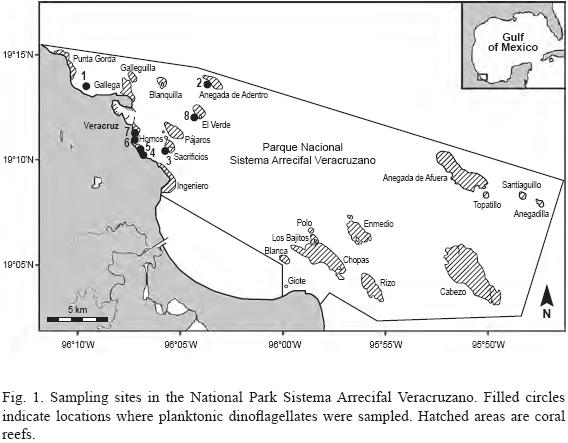
<body><![CDATA[<p align="justify"><font face="verdana" size="2">The genus <i>Ceratium </i>is one of the most common and widespread in marine phytoplankton, along with the genus <i>Protoperidinium </i>Bergh. In the southern Gulf of Mexico, 13 of the 28 most common dinoflagellate species belong to the genus <i>Ceratium </i>(Licea et al., 2004). Similarly, in the northern Gulf of Mexico, 13 <i>Ceratium </i>species were among the 30 most common (Balech, 1967). Due to the larger cell size of <i>Ceratium </i>species and their relatively well&#150;known latitudinal geographic distributions, in many cases rather well delimited (Dodge, 1993; Dodge &amp; Marshall, 1994), they have been used as biological indicators of water masses and currents (Frost &amp; Wilson, 1938; Graham, 1941; Okolodkov, 1996). <i>Ceratium </i>has been suggested as an excellent, if not the best, dinoflagellate genus to use for biogeographic study and as a tool for defining ocean currents and temperature ranges and may be valuable in studies of global change (Dodge &amp; Marshall, 1994). In the Gulf of Mexico, 70 <i>Ceratium </i>species (97 together with infraspecific taxa) have been recorded (Steidinger et al., 2009).</font></p>     <p align="justify"><font face="verdana" size="2">The taxonomy of <i>Ceratium </i>has remained extraordinarily stable since the end of the 19th century in spite of many important contributions to the morphology and systematics of this genus. Most <i>Ceratium </i>species have three horns; some have two. Recently a species with only one horn, the apical one, was described from a lake (Temponeras et al., 2000). Sournia (1986) clearly indicated the difference between freshwater and marine species based on the number of cingular plates. However, using genetic molecular analysis the genus was split into two, and a new genus designated as <i>Neoceratium </i>F. G&oacute;mez, D. Moreira et P. L&oacute;pez&#150;Garc&iacute;a for all known marine species (G&oacute;mez et al., 2010) was proposed. Traditionally, identification of species and infraspecific taxa within this genus is based on the shape of the cell and its parts (mainly antapical horns) in ventral or dorsal view and some other features of the theca usually shared by a group of species. This is the approach followed here in describing species belonging to the genus <i>Ceratium </i>according to Sournia (1986).</font></p>     <p align="justify"><font face="verdana" size="2">In the State of Veracruz some <i>Ceratium </i>species have been reported (Ochoa&#150;Figueroa, 1978; Avenda&ntilde;o&#150;S&aacute;nchez &amp; Sotomayor Navarro, 1982; Echeverr&iacute;a&#150;Valencia, 1983; Hern&aacute;ndez&#150;Mendiola, 1988; Suchil&#150;Vilchis, 1990; Guerra&#150;Mart&iacute;nez &amp; Lara&#150;Villa, 1996; Zamudio&#150;Resendiz, 1998; Aquino&#150;Cruz, 2002; Garc&iacute;a&#150;Res&eacute;ndiz, 2003; Legar&iacute;a&#150;Moreno, 2003; Estradas&#150;Romero, 2004; Tejeda&#150;Hern&aacute;ndez, 2005). Zamudio&#150;Resendiz (1998) mentioned 22 <i>Ceratium </i>species; however, she did not give separate species lists for the State of Tamaulipas and the State of Veracruz. Nevertheless, her data are considered in the present article as all them were for Veracruz. The only study (an MSc thesis) focused on the genus <i>Ceratium </i>in both Veracruz waters and the southern Gulf of Mexico was by Figueroa&#150;Torres (1990). It includes numerous line drawings and photographs of 35 <i>Ceratium </i>species and infraspecific taxa found during three oceanographic cruises encompassing a month in general (18&deg;15'&#150;19&deg;49' N, 93&deg;39'&#150;95&deg;48' W).</font></p>     <p align="justify"><font face="verdana" size="2">To document <i>Ceratium </i>species found in the National Park Sistema Arrecifal Veracruzano (NPSAV) and to provide a key for their identification were the goals of the present study.</font></p>     <p align="justify"><font face="verdana" size="2">&nbsp;</font></p>     <p align="justify"><font face="verdana" size="2"><b>MATERIAL AND METHODS</b></font></p>     <p align="justify"><font face="verdana" size="2">Phytoplankton samples were taken weekly with a hand net, 20 &micro;m mesh and 30 cm mouth, from eight sites (stations) around the Aquarium of Veracruz in the northwestern part of the National Park Sistema Arrecifal Veracruzano. Collections were made during the period from May 2005 through March 2008 as part of the monitoring program of the Aquarium of Veracruz (<a href="#f1">Fig. 1</a>, <a href="#t1">Table 1</a>). Some material was taken and examined from two additional stations sampled in November&#150;December 2007 and in March 2008 (19&deg;02'48.1" N, 95&deg;49'25.4" W; 19&deg;10'26.9" N, 96&deg;01'1.3" W). At each station the net was towed horizontally for 5 min. at the velocity of the boat of ca. 2.5 knots to sample a superficial 30&#150;cm layer. The samples were fixed with a stock formaldehyde solution to a final concentration of 4% and stored in 100&#150;ml dark plastic bottles. To contrast the cells for an easier search and better photographs, a 0.2% Trypan Blue water solution was added to water mounts (Lebour, 1925; Taylor, 1978). About 600 samples were analyzed using a Nikon TS100 and an Olympus CKX41 inverted microscope for a Sedgwick&#150;Rafter 1&#150;ml chamber and an Olympus BX51 compound microscope for water mounts. The cells were photographed mainly with an Olympus C7070 digital camera. Line drawings were made from digital images.</font></p>     <p align="center"><font face="verdana" size="2"><a name="f1"></a></font></p>     <p align="center"><font face="verdana" size="2"><img src="/img/revistas/abm/n93/a2f1.jpg"></font></p>     <p align="center"><font face="verdana" size="2">&nbsp;</font></p>     ]]></body>
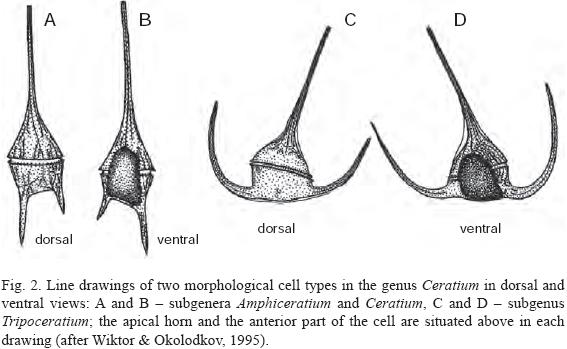
<body><![CDATA[<p align="center"><font face="verdana" size="2"><a name="t1"></a></font></p>     <p align="center"><font face="verdana" size="2"><img src="/img/revistas/abm/n93/a2t1.jpg"></font></p>     <p align="justify"><font face="verdana" size="2">About 90 publications, abstracts and theses on the phytoplankton and dinoflagellates of the Gulf of Mexico were examined, with special emphasis on the state of Veracruz. Extensive old and new literature containing illustrations were analyzed and cited. The works where the species are illustrated are marked with asterisks: an asterisk (*) indicates line drawings, two asterisks (**) indicate light micrographs, and three asterisks (***) indicate scanning electron micrographs. The cited literature is referred to a species in general, not to a given infraspecific taxon. Relative abundance was given according to the following criteria: extremely rare &#150; found in &lt;1% of the analyzed samples only occasionally (less than 25 cells were found in total), rare &#150; encountered in 1 to 10% of the samples as rare cells, common &#150; seen in 11 to 50% of the samples (normally as dozens of cells in a Sedgwick&#150;Rafter chamber), and very common &#150; found in &gt;50% of the samples (dozens or hundreds of cells per chamber).</font></p>     <p align="justify"><font face="verdana" size="2">The abbreviations for cell measurements are as follows: L &#150; total length measured from the furthest part of the hypotheca including the antapical horns; Wb &#150; cell body width measured in ventral or dorsal view just in front of or behind the cingulum, not considering the precingular or postcingular membranes (the only measured width in the species with straight or slightly curved antapical horns directed backward; always measured using the 40x objective to avoid a large error); Wt &#150; total width, considering the distance between external sides of the antapical horns directed laterally, forward or laterally&#150;forward. Cells were measured in dorsal (DV) or ventral view (VV); to facilitate identification, drawings of two morphological cell types in both views are given in <a href="#f2">Fig. 2</a>. Recently divided cells with undeveloped horns (<a href="/img/revistas/abm/n93/html/a2p.htm#p8" target="_blank">Pl. 8, Fig. 1&#150;8</a>), teratologic forms (<a href="/img/revistas/abm/n93/html/a2p.htm#p7" target="_blank">Pl. 7, Fig. 2</a>) and microgametes (<a href="/img/revistas/abm/n93/html/a2p.htm#p7" target="_blank">Pl. 7, Fig. 3</a>) were avoided during measurements.</font></p>     <p align="center"><font face="verdana" size="2"><a name="f2"></a></font></p>     <p align="center"><font face="verdana" size="2"><img src="/img/revistas/abm/n93/a2f2.jpg"></font></p>     <p align="justify"><font face="verdana" size="2">&nbsp;</font></p>     <p align="center"><font face="verdana" size="2"><img src="/img/revistas/abm/n93/a2r1.jpg"></font></p>     <p align="justify"><font face="verdana" size="2"><b>TAXONOMIC DESCRIPTIONS</b></font></p>     <p align="justify"><font face="verdana" size="2">Subgenus <i>Amphiceratium </i>Vanh&ouml;ffen</font></p>     ]]></body>
<body><![CDATA[<p align="justify"><font face="verdana" size="2">1. <b><i>Ceratium extension </i>(Gourret) Cleve, 1900 </b>(<a href="/img/revistas/abm/n93/html/a2p.htm#p1" target="_blank">Pl. 1, Fig. 1 and 2</a>; <a href="/img/revistas/abm/n93/html/a2p.htm#p10" target="_blank">Pl. 10, Fig. 1</a>).    <br> Bas.: <i>Ceratium fusus </i>var. <i>extensum </i>Gourret, 1883: 52, pl. 4, fig. 56.    <br> Syn.: <i>Ceratium biceps </i>Clapar&eacute;de et Lachmann, 1859: 400, pl. 19, fig. 8.</font></p>     <p align="justify"><font face="verdana" size="2">Cells spindle&#150;shaped, long. Epitheca tapers into a long apical horn and hypotheca tapers into a long left antapical horn. Left antapical horn markedly (about 1.5 times or more) longer than apical one, both straight or nearly straight. A reduced right antapical horn may be present. Widest point adjacent to the cingulum. L 8151720 &micro;m (1253.1&plusmn;215.3 &micro;m), Wb 25&#150;35 &micro;m (29.2&plusmn;2.7 &micro;m); n=21.</font></p>     <p align="justify"><font face="verdana" size="2">Affinities: <i>C. fusus, C. inflatum, C. longirostrum.</i></font></p>     <p align="justify"><font face="verdana" size="2">Records in the State of Veracruz: Figueroa&#150;Torres, 1990* **; Suchil&#150;Vilchis, 1990; Zamudio&#150;Res&eacute;ndiz, 1998. Rare to common in NPSAV (Feb., March, May, July, Aug., Nov., Dec.).</font></p>     <p align="justify"><font face="verdana" size="2">References: J&ouml;rgensen, 1911*: 28, fig. 50a; 1920*: 43, fig. 31; Lebour, 1925*: 146, fig. 463; Steemann Nielsen, 1934*: 14, fig. 24; Schiller, 1937*: 380, fig. 419a, b; Rampi, 1939*: 304, fig. 11; Graham &amp; Bronikovsky, 1944*: 24, fig. 11BB&#150;DD; Kiselev, 1950*: 244, fig. 412; Silva, 1956*: 56, pl. 7, fig. 8 (f. <i>strictum); </i>Kato, 1957*: 14, pl. 4, fig. 10a&#150;c; L&oacute;pez, 1966*: fig. 12; Subrahmanyan, 1968*: 32, fig. 56, 57; Wood, 1968*: 28, fig. 54; Steidinger &amp; Williams, 1970**: 45, pl. 7, fig. 19; Hassan &amp; Saifullah, 1974*: 85, fig. 10; Taylor, 1976*: 64, pl. 13, fig. 127, 128 (as <i>C. biceps </i>Clapar&eacute;de et Lachmann, 1859); Pesantes&#150;Santana, 1978*: 10. pl. 6, fig. 9; Tester &amp; Steidinger, 1979**: 28, pl. 10, fig. 61; Dowidar, 1983*: 12, pl. 2, fig. 5; Balech, 1988*: 133, pl. 55, fig. 1, 2; Konovalova et al., 1989*: 132, fig. 49(3); Licea et al., 1995*: 35, pl. 18, fig. 4; Konovalova, 1998*: 140, fig. 29(4).</font></p>     <p align="justify"><font face="verdana" size="2">2. <b><i>Ceratium geniculatum </i>(Lemmermann) Cleve, 1901 </b>(<a href="/img/revistas/abm/n93/html/a2p.htm#p1" target="_blank">Pl. 1, Fig. 3</a>; <a href="/img/revistas/abm/n93/html/a2p.htm#p10" target="_blank">Pl. 10, Fig. 2</a>)    <br> Bas.: <i>Ceratium fusus </i>var. <i>geniculatum </i>Lemmermann, 1899: 349, pl. 1, fig. 17.</font></p>     <p align="justify"><font face="verdana" size="2">Cells spindle&#150;shaped, relatively long. The cell body is long, clearly constricted in the middle. Epitheca is inflated, in its distal part suddenly drawn into an apical horn and hypotheca tapers into a long left antapical horn, slightly curved. Apical horn positioned closer to the left side of the cell, notably deflected to the left at its base. A reduced right antapical horn is present. Widest point adjacent to the cingulum and also in front of the constriction in the middle of the cell body. L 310 &micro;m, Wb 30 &micro;m; n=1.</font></p>     ]]></body>
<body><![CDATA[<p align="justify"><font face="verdana" size="2">A new record for the State of Veracruz. Extremely rare in NPSAV (the only specimen observed was collected on 25 December 2005 relatively far from the shore at st. 2).</font></p>     <p align="justify"><font face="verdana" size="2">References: Karsten, 1907*: pl. 50, fig. 3a, b; J&ouml;rgensen, 1911*: 24, fig. 42, 43; 1920*: 34, fig. 24; B&ouml;hm, 1931b*: 43, fig. 37c, d; Steemann Nielsen, 1934*: 13, fig. 17; Schiller, 1937*: 375, fig. 414a; Graham &amp; Bronikovsky, 1944*: 22, fig. 11J; Wood, 1954*: 279, fig. 197; 1968*: 30, fig. 60; Sournia, 1968*: 407, fig. 30, 31; Subrahmanyan, 1968*: 28, fig. 43&#150;45; Konovalova, 1998*: 137, fig. 28(9).</font></p>     <p align="justify"><font face="verdana" size="2">3. <b><i>Ceratium bigelowii </i>Kof., 1907 </b>(<a href="/img/revistas/abm/n93/html/a2p.htm#p1" target="_blank">Pl. 1, Fig. 4 and 5</a>; <a href="/img/revistas/abm/n93/html/a2p.htm#p10" target="_blank">Pl. 10, Fig. 3</a>)</font></p>     <p align="justify"><font face="verdana" size="2">Cells spindle&#150;shaped, long. Cell body is well distinguished, inflated, suboval. Epitheca tapers into a long apical horn and hypotheca tapers into a long left antapical horn. Apical and left antapical horns equal or subequal in length; apical horn slightly curved and the left antapical horn notably continuously curved. A reduced right antapical horn may be present. Widest point adjacent to the cingulum. L 375 &micro;m, Wb 30 &micro;m; n=1.</font></p>     <p align="justify"><font face="verdana" size="2">Affinities: <i>C. fusus. </i>Unlike in <i>C. fusus, </i>in <i>C. bigelowii </i>the cell is markedly inflated in the middle, and therefore the cell body is well separated from the horns.</font></p>     <p align="justify"><font face="verdana" size="2">A new record for the State of Veracruz. Extremely rare in NPSAV (the only specimen observed was collected on 1 March 2008 relatively far from the shore: 10&deg;02'43.1" N, 95&deg;49'25.4" W).</font></p>     <p align="justify"><font face="verdana" size="2">References: Kofoid, 1907a*: 170, pl. 3, fig. 22; J&ouml;rgensen, 1911*: 25, fig. 44; B&ouml;hm, 1931b*: 43, fig. 37b; Steemann Nielsen, 1934*: 13, fig. 18; Schiller, 1937*: 376, fig. 414b; Graham &amp; Bronikovsky, 1944*: 22, fig. K&#150;M; Wood, 1963*: 39, fig. 143; Subrahmanyan, 1968*: 28, fig. 46, 47; Steidinger &amp; Williams, 1970**: 44, pl. 4, fig. 11; Konovalova, 1998*: 141, fig. 29(3).</font></p>     <p align="justify"><font face="verdana" size="2">4. <b><i>Ceratium fusus </i>(Ehrenb.) Dujard., 1841 </b>(<a href="/img/revistas/abm/n93/html/a2p.htm#p1" target="_blank">Pl. 1, Fig. 6 and 7</a>; <a href="/img/revistas/abm/n93/html/a2p.htm#p10" target="_blank">Pl. 10, Fig. 4</a>)    <br> Bas.: <i>Peridinium fusus </i>Ehrenb., 1834: 271, 1835.    <br> Syn: <i>C. seta </i>(Ehrenb.) Kofoid, 1908: 387.</font></p>     ]]></body>
<body><![CDATA[<p align="justify"><font face="verdana" size="2">Cells spindle&#150;shaped, long. Epitheca tapers continuously into a long apical horn and hypotheca tapers into a long left antapical horn. Apical and left antapical horns equal or subequal in length and slightly curved. A reduced right antapical horn may be present. Widest point adjacent to the cingulum. L 243&#150;580 &micro;m (422.4&plusmn;80.9 &micro;m), Wb 15&#150;25 &micro;m (20.4&plusmn;4.0 &micro;m); n=22.</font></p>     <p align="justify"><font face="verdana" size="2">Affinities: <i>C. extensum, C. inflatum, C. longirostrum, C. bigelowii. </i>I preferred not to distinguish the two forms of <i>C. fusus </i>given in Steidinger et al. (2009) for the Gulf of Mexico.</font></p>     <p align="justify"><font face="verdana" size="2">Records in the State of Veracruz: Ochoa&#150;Figueroa, 1978; Avenda&ntilde;o&#150;S&aacute;nchez &amp; Sotomayor&#150;Navarro, 1982; Echeverr&iacute;a&#150;Valencia, 1983; Figueroa&#150;Torres, 1990* **; Suchil&#150;Vilchis, 1990*; Zamudio&#150;Resendiz, 1998; Aquino&#150;Cruz, 2002* **; Legar&iacute;a&#150;Moreno, 2003; Estradas&#150;Romero, 2004. Very common in NPSAV throughout the year.</font></p>     <p align="justify"><font face="verdana" size="2">References: Ostenfeld, 1903*: 587, fig. 145, 146; Paulsen, 1908*: 90, fig. 123; J&ouml;rgensen, 1911*: 29, fig. 51&#150;53; 1920*: 41, fig. 30; Lebour, 1925*: 146, pl. 31, fig. 1; Wailes, 1928*: 5, pl. 1, fig. 5, 6, pl. 12, fig. 21, 22 (a teratologic form); B&ouml;hm, 1931b*: 14, fig. 10c&#150;f; Steemann Nielsen, 1934*: 14, fig. 25, 26; Schiller, 1937*: 378, fig. 418a, b; Rampi, 1939*: 303, fig. 12, 13; Graham &amp; Bronikovsky, 1944*: 25, fig. 11EE, 13A&#150;D; Kiselev, 1950*: 245, fig. 419; Wood, 1954*: 282, fig. 202; 1968*: 29, fig. 58; Kato, 1957*: 13, pl. 3, fig. 5a&#150;c, 6a, b <i>(C. fusus </i>and <i>C. fusus </i>var. seta); Curl, 1959*: 306, fig. 116; Margalef, 1961a*: 81, fig. 26e&#150;g: L&oacute;pez, 1966*: fig. 11; Sournia, 1968*: 408, 32, 33, 34(?) (three varieties are illustrated); Subrahmanyan, 1968*: 31, fig. 55, pl. 1, fig. 3&#150;6; Steidinger &amp; Williams, 1970**: 45, pl. 8, fig. 21a, b; Drebes, 1974**: 145, fig. 128a; Hassan &amp; Saifullah, 1974*: 85, fig. 9 (C. <i>fusus </i>var. seta); Taylor, 1976*: 66, pl. 13, fig. 129, 130, 136, 137; Pesantes&#150;Santana, 1978*: 12, pl. 6, fig. 3&#150;7; Tr&eacute;gouboff, 1978*: 115, pl. 25, fig. 13A&#150;D; Tester &amp; Steidinger, 1979**: 28, pl. 11, fig. 63; Burns &amp; Mitchell, 1980***: 150, fig. 3; Dodge, 1982*: 231, fig. 29C; Dowidar, 1983*: 11, pl. 1, fig. 8; Balech, 1988*: 132, pl. 54, fig. 5, 6, 8; Konovalova et al., 1989* **: 132, fig. 49(5&#150;7), pl. 15, fig. 7 (three varieties are illustrated); Delgado &amp; Fortu&ntilde;o, 1991***: 6, pl. 8, fig. c, d; Licea et al., 1995**: 37, pl. 3, fig. 2; 2004**: fig. 3, 12 (var. <i>fusus </i>and var. seta); Wiktor &amp; Okolodkov, 1995*: 36, fig. 10a&#150;c; Steidinger &amp; Tangen, 1997*: 472, pl. 25; Konovalova, 1998* ***: fig. 29(5, 6, 15), pl. 13, fig. 9 (three varieties are illustrated); B&eacute;rard&#150;Therriault et al., 1999**: 164, pl. 83a; Avancini et al., 2006* **: 289, fig. A&#150;D (var. seta); Hoppenrath et al., 2009**: 173, fig. 70b, c; Yongshui, 2009**: pl. 2, fig. 8.</font></p>     <p align="justify"><font face="verdana" size="2">5. <b><i>Ceratium inflatum </i>(Kof.) J&ouml;rg., 1920 </b>(<a href="/img/revistas/abm/n93/html/a2p.htm#p1" target="_blank">Pl. 1, Fig. 8</a>; <a href="/img/revistas/abm/n93/html/a2p.htm#p10" target="_blank">Pl. 10, Fig. 5</a>)    <br> Bas.: <i>Ceratium pennatum </i>f. <i>inflatum </i>Kofoid, 1907 (Bull. Mus. Comp. Zool. Harv. Coll. 50, 6): 172, pl. 2, fig. 13.</font></p>     <p align="justify"><font face="verdana" size="2">Cells spindle&#150;shaped, long. Epitheca tapers into a long apical horn and hypotheca tapers into a long left antapical horn; however, the cell body is distinguished, inflated. Apical and left antapical horns equal or subequal in length; apical horn straight or slightly curved and the left antapical horn more curved continuously or rather abruptly at its distal third. A reduced right antapical horn may be present. Widest point adjacent to the cingulum. L 595&#150;690 &micro;m (634&plusmn;39.3 &micro;m), Wb 22.5&#150;32.5 &micro;m (27.4&plusmn;3.3 &micro;m); n=8. Rare in NPSAV (March, Oct.).</font></p>     <p align="justify"><font face="verdana" size="2">Affinities: <i>C. fusus, C. longirostrum, C. extensum, C. bigelowii. </i>The species is distinguished from the former three species by its more inflated cell body.</font></p>     <p align="justify"><font face="verdana" size="2">References: J&ouml;rgensen, 1911*: 25, fig. 45, 46, 48a; 1920*: 35, fig. 25; B&ouml;hm, 1931a*: 353, fig. 3, 4; 1931b*: 14, fig. 10a, b; Schiller, 1937*: 376, fig. 415a, b; Graham &amp; Bronikovsky, 1944*: 23, fig. 11O&#150;S; Kiselev, 1950*: 245, fig. 462; Wood, 1954*: 281, fig. 198; Silva, 1956*: 56, pl. 7, fig. 9; Kato, 1957*: 14, pl. 3, fig. 7; L&oacute;pez, 1966*: fig. 10; Sournia, 1968*: 412, fig. 36; Subrahmanyan, 1968*: 29, fig. 48, 49; Steidinger &amp; Williams, 1970**: 46, pl. 10, fig. 25; Tr&eacute;gouboff, 1978*: 115, pl. 25, fig. 10; Dodge, 1982*: 231, fig. 29B; Steidinger &amp; Tangen, 1997*: 474, pl. 25; Konovalova, 1998*: 140, fig. 29(2); Yongshui, 2009**: pl. 2, fig. 9.</font></p>     <p align="justify"><font face="verdana" size="2">6. <b><i>Ceratium belone </i>Cleve, 1900 </b>(<a href="/img/revistas/abm/n93/html/a2p.htm#p2" target="_blank">Pl. 2, Fig. 1 and 2</a>; <a href="/img/revistas/abm/n93/html/a2p.htm#p10" target="_blank">Pl. 10, Fig. 6</a>)</font></p>     ]]></body>
<body><![CDATA[<p align="justify"><font face="verdana" size="2">Cells spindle&#150;shaped, long. Epitheca continuously tapers into a long apical horn. Hypotheca with two well developed antapical horns, parallel to each other. Left antapical horn about twice as long as right one. Widest region adjacent to the cingulum and occupies nearly all the proximal part of hypotheca. L 680&#150;880 &micro;m (729.5&plusmn;100.7 &micro;m), Wb 27.5&#150;31 &micro;m (29.6&plusmn;1.5 &micro;m); n=4.</font></p>     <p align="justify"><font face="verdana" size="2">Records in the State of Veracruz: Zamudio&#150;Resendiz, 1998. Extremely rare in NPSAV; four specimens were found on 11 December 2007 at st. 2 and on 1 March 2008 at st. 4.</font></p>     <p align="justify"><font face="verdana" size="2">References: J&ouml;rgensen, 1911*: 19, fig. 28a, b; 1920*: 22, fig. 14; Steemann Nielsen, 1934*: 10, fig. 10; Schiller, 1937*: 369, fig. 407a; Rampi, 1942*: 222, fig. 2; Graham &amp; Bronikovsky, 1944*: 19, fig. 8; Sournia, 1968*: 399, fig. 22; Subrahmanyan, 1968*: 20, fig. 30; Wood, 1968*: 24, fig. 40; Steidinger &amp; Williams, 1970**: 44, pl. 4, fig. 10; Taylor, 1976*: 58, pl. 12, fig. 119; Tr&eacute;gouboff, 1978*: 114, pl. 25, fig. 6; Tester &amp; Steidinger, 1979**: 27, pl. 10, fig. 57; Dowidar, 1983*: 10, pl. 2, fig. 4; Balech, 1988*: 132, pl. 56, fig. 1; Delgado &amp; Fortu&ntilde;o, 1991*: fig. 6B; Licea et al., 1995: 30, pl. 17, fig. 6 (also, referred by mistake to pl. 1, fig. 5, in which <i>C. candelabrum </i>is given); Yongshui, 2009* **: 8, fig. 8, pl. 1, fig. 5.</font></p>     <p align="justify"><font face="verdana" size="2">7. <b><i>Ceratium longirostrum </i></b>Gourret, 1883 (<a href="/img/revistas/abm/n93/html/a2p.htm#p2" target="_blank">Pl. 2, Fig. 3 and 4</a>; <a href="/img/revistas/abm/n93/html/a2p.htm#p10" target="_blank">Pl. 10, Fig. 7</a>)</font></p>     <p align="justify"><font face="verdana" size="2">Cells needle&#150;shaped, very long. Epitheca tapers into a long apical horn and hypotheca tapers into a long left antapical horn. Apical and left antapical horn equal or subequal in length, apical horn being slightly curved and left antapical horn notably curved. A reduced right antapical horn may be present. Widest point adjacent to the cingulum. L 268&#150;690 &micro;m (621.8&plusmn;78.6 &micro;m), Wb 17.5&#150;32.5 &micro;m (27.9&plusmn;3.9 &micro;m); n=29. Affinities: <i>C. fusus, C. extensum, C. inflatum.</i></font></p>     <p align="justify"><font face="verdana" size="2">Records in the State of Veracruz: Figueroa&#150;Torres, 1990* **. Rare in NPSAV (Jan. to March, May, Aug. to Dec.).</font></p>     <p align="justify"><font face="verdana" size="2">References: J&ouml;rgensen, 1920*: 37, fig. 26, 27; B&ouml;hm, 1931a*: 354, fig. 5; Steemann Nielsen, 1934*: 13, fig. 21; Schiller, 1937*: 376, fig. 416a, b; Rampi, 1939*: 303, fig. 9; Graham &amp; Bronikovsky, 1944*: 24, fig. 11T&#150;V; Wood, 1954*: 281, fig. 199; 1968*: 35, fig. 75; Silva, 1956*: 57, pl. 7, fig. 10; L&oacute;pez, 1966*: fig. 15; Sournia, 1968*: 413, fig. 37; Subrahmanyan, 1968*: 30, fig. 50&#150;52; Steidinger &amp; Williams, 1970**: 46, pl. 10, fig. 27; Hassan &amp; Saifullah, 1974*: 85, fig. 8; Taylor, 1976*: 67, pl. 13, fig. 131a, b; Pesantes&#150;Santana, 1978*: 14, pl. 7, fig. 4; Tr&eacute;gouboff, 1978*: 115, pl. 25, fig. 11; Dowidar, 1983*: 12, pl. 2, fig. 8; Balech, 1988*: 134, pl. 55, fig. 10, 11; Delgado &amp; Fortu&ntilde;o, 1991*: fig. 6C; Licea et al., 1995**: 41, pl. 3, fig. 9.</font></p>     <p align="justify"><font face="verdana" size="2">Subgenus <i>Ceratium </i>(= <i>Biceratium </i>(Vanh&ouml;ffen) Ostenf.)</font></p>     <p align="justify"><font face="verdana" size="2">8. <b><i>Ceratium candelabrum </i>(Enrenb.) Stein, 1883 </b>(<a href="/img/revistas/abm/n93/html/a2p.htm#p2" target="_blank">Pl. 2, Fig. 5</a>; <a href="/img/revistas/abm/n93/html/a2p.htm#p9" target="_blank">Pl. 9, Fig. 1</a>; <a href="/img/revistas/abm/n93/html/a2p.htm#p10" target="_blank">Pl. 10, Fig. 8</a>)    <br> Bas.: <i>Peridinium candelabrum </i>Ehrenb., 1860: 792, pl. 1, fig. 2, 3.</font></p>     ]]></body>
<body><![CDATA[<p align="justify"><font face="verdana" size="2">Cells with two robust or stout antapical horns, slightly divergent, left one slightly longer and sometimes thicker. Cell body is about twice as broad as it is high. Epitheca in the form of low cone, with well separated apical horn inserted eccentrically. Hypotheca between the antapical horns markedly inclined towards the cingulum. Widest point adjacent to the cingulum. L 145&#150;345 &micro;m (243.0&plusmn;52.2 &micro;m), Wb 68&#150;94 &micro;m (78.0&plusmn;7.0 &micro;m); n=20. Chains of 2 cells were observed.</font></p>     <p align="justify"><font face="verdana" size="2">Note: Steidinger et al. (2009) reported two forms of this species for the Gulf of Mexico. The name of <i>Ceratium depressum </i>ascribed to Gourret (the only author, whose name appears in parentheses) given by Suchil&#150;Vilchis (1990) for Veracruz should be considered a nomen nudum.</font></p>     <p align="justify"><font face="verdana" size="2">Records in the State of Veracruz: Avenda&ntilde;o&#150;S&aacute;nchez &amp; Sotomayor&#150;Navarro, 1982; Figueroa&#150;Torres, 1990*; Zamudio&#150;Resendiz, 1998. Rare to common in NPS&#150;AV (Jan. to March, May, July, Aug., Nov., Dec.).</font></p>     <p align="justify"><font face="verdana" size="2">References: Paulsen, 1908*: 88, fig. 120; J&ouml;rgensen, 1920*: 11, fig. 5, 6; Lebour, 1925*: 143, fig. 45b, c, pl. 30, fig. 2; B&ouml;hm, 1931a*: 351, fig. 1, 2 (C. <i>candelabrum </i>f. <i>eucandelabrum </i>n. f. and f. <i>hiemale </i>n. f.), 24 (a teratologic form); 1931b*: 8, fig. 3a&#150;d; Steemann Nielsen, 1934*: 8, fig. 6, 7; Schiller, 1937*: 364, fig. 401; Rampi, 1939*: 302, fig. 4, 5, 7 (three infraspecific taxa are illustrated); 1951*: 6, fig. 7 (a teratologic specimen); Graham &amp; Bronikovsky, 1944*: 17, fig. 6; Kiselev, 1950*: 242, fig. 408; Kato, 1957*: 12, pl. 3, fig. 2 (C. <i>candelabrum </i>and <i>C. candelabrum </i>var. <i>depressum); </i>L&oacute;pez, 1966* **: 362, fig. 3, 4, 52, 56&#150;58, 88, 89, photo 1(1, 2) (three infraspecific taxa are illustrated); Sournia, 1968*: 390, fig. 14&#150;17 (two varieties are illustrated; a new combination <i>C. candelabrum </i>f. <i>subrotundum </i>(Ostenf.) Sournia is proposed); Subrahmanyan, 1968*: 17, fig. 16&#150;20; Wood, 1968*: 25, fig. 44; Hassan &amp; Saifullah, 1974*: 84, fig. 1; Taylor, 1976*: 59, pl. 12, fig. 124&#150;126; Pesantes&#150;Santana, 1978*: 7, pl. 2, fig. 1&#150;3; Tr&eacute;gouboff, 1978*: 114, pl. 25, fig. 4A, B; Burns &amp; Mitchell, 1980***: 149, fig. 1, 2; Dodge, 1982*: 227, fig. 28A, pl. 7, fig. d; 1985***: 94; Dowidar, 1983*: 9, pl. 2, fig. 2; Balech, 1988*: 128, pl. 56, fig. 17, 18, pl. 57, fig. 4, 5; Delgado &amp; Fortu&ntilde;o, 1991* ***: fig. 6I; 5, pl. 5, fig. b; Licea et al., 1995* ***: 31, pl. 1, fig. 5, pl. 17, fig. 8 (also, referred by mistake to pl. 17, fig. 9, in which <i>C. pentagonum </i>is given); Steidinger &amp; Tangen, 1997*: 471, pl. 27; Konovalova, 1998*: 133, fig. 28(14); Avancini et al., 2006* **: 281, fig. A&#150;H; Yongshui, 2009* ** ***: 9, fig. 10, 11, pl. 1, fig. 7, 8, pl. 9, fig. 1A, B (var. <i>candelabrum </i>and var. <i>depressum</i>).</font></p>     <p align="justify"><font face="verdana" size="2">9a. <b><i>Ceratium furca </i>(Ehrenb.) Clap. et J. Lachm., 1859 var. <i>furca </i></b>(<a href="/img/revistas/abm/n93/html/a2p.htm#p2" target="_blank">Pl. 2, Fig. 6</a>; <a href="/img/revistas/abm/n93/html/a2p.htm#p9" target="_blank">Pl. 9, Fig. 2</a>; <a href="/img/revistas/abm/n93/html/a2p.htm#p10" target="_blank">Pl. 10, Fig. 9</a>)    <br> Bas.: <i>Peridinium furca </i>Ehrenb., 1835: 574, pl. 2(2).    <br> Syn.: <i>Ceratiumfurca </i>var. <i>berghii </i>Lemmermann, 1899: 366; <i>C. furca </i>var. <i>eugrammum </i>(Ehrenb.) J. Schill., 1937: 368, fig. 405a, b.</font></p>     <p align="justify"><font face="verdana" size="2">Cells with two robust antapical horns, parallel to each other or slightly divergent, parallel or slightly convergent, left one being about twice as long. Epitheca tapers into a rather long apical horn. Hypotheca between the antapical horns markedly inclined towards the cingulum. Widest point adjacent to the cingulum. L 155&#150;260 &micro;m (214.0&plusmn;28.6 &micro;m), Wb 30&#150;42.5 &micro;m (35.9&plusmn;4.3 &micro;m); n=20. Chains of 2 cells were observed.</font></p>     <p align="justify"><font face="verdana" size="2">Records in the State of Veracruz: Avenda&ntilde;o&#150;S&aacute;nchez &amp; Sotomayor&#150;Navarro, 1982; Echeverr&iacute;a&#150;Valencia, 1983*; Hern&aacute;ndez&#150;Mendiola, 1988; Figueroa&#150;Torres, 1990* **; Suchil&#150;Vilchis, 1990; Zamudio&#150;Resendiz, 1998; Aquino&#150;Cruz, 2002* **; Garc&iacute;a&#150;Res&eacute;ndiz, 2003; Legar&iacute;a&#150;Moreno, 2003; Estradas&#150;Romero, 2004; Tejeda&#150;Hern&aacute;ndez, 2005**. Very common in NPSAV throughout the year.</font></p>     <p align="justify"><font face="verdana" size="2">References: Paulsen, 1908*: 90, fig. 122; 1931*: 76, fig. 46; J&ouml;rgensen, 1920*: 17, fig. 7&#150;12; Lebour, 1925*: 145, pl. 30, fig. 3; Wailes, 1928*: 5, pl. 1, fig. 8, pl. 2, fig. 10; B&ouml;hm, 1931b*: 8, fig. 4&#150;8; Steemann Nielsen, 1934* **: 9, fig. 8, 9, photo 1(5, 6); Schiller, 1937*: 367, fig. 404&#150;405; Rampi, 1939*: 302, fig. 8; Graham &amp; Bronikovsky, 1944*: 18, fig. 7; Kiselev, 1950*: 243, fig. 415, 416, 427; Wood, 1954*: 274, fig. 189a&#150;c; 1968*: 29, fig. 57; Kato, 1957*: 12, pl. 3, fig. 4a, b; Curl, 1959*: 305, fig. 115; L&oacute;pez, 1966* **: 371, fig. 6, 7, 68, 72, 92, 93 (C. <i>furca eugrammun </i>and <i>C. furca Berghii), </i>photo 1(5, 6); Sournia, 1968*: 395, fig. 18&#150;20 (var. <i>furca </i>and var. <i>eugrammun); </i>Steidinger et al., 1967**: pl. 5, fig. e; Subrahmanyan, 1968*: 20, fig. 21&#150;29, pl. 2, fig. 7&#150;12; Steidinger &amp; Williams, 1970**: 45, pl. 7, fig. 20a, b; Hermosilla, 1973*: 62, pl. 33, fig. 1, 2, 7, 8; Drebes, 1974**: 145, fig. 128b; Hassan &amp; Saifullah, 1974*: 84, fig. 2, 3 (var. <i>furca </i>and var. <i>eugrammun); </i>Taylor, 1976*: 60, pl. 12, fig. 109; Tr&eacute;gouboff, 1978*: 114, pl. 25, fig. 5A, B; Burns &amp; Mitchell, 1980***: 150, fig. 4&#150;10; Dodge, 1982*: 228, fig. 28C, pl. 8, fig. e; 1985***: 96, right fig.; Pesantes&#150;Santana, 1978* (other varieties than var. <i>furca): </i>11, pl. 8, fig. 1&#150;3 <i>(Ceratium furca </i>var. <i>berghii </i>f. <i>bergii </i>L&oacute;pez, 1966; with an orthographic error in the name of the form), pl. 4, 5 <i>(C. furca </i>var. <i>eugrammun </i>(Ehrenb.) J. Schill., 1937; with an orthographic error in the name of the variety); Dowidar, 1983*: 9, pl. 2, fig. 3; Balech, 1988*: 131, pl. 56, fig. 4&#150;6; Konovalova et al., 1989*: 132, fig. 49(4); Delgado &amp; Fortu&ntilde;o, 1991* ***: fig. 6D, E; 5, pl. 3, fig. a, b; Licea et al., 1995***: 36, pl. 2, fig. 7; 2004**: fig. 2, 8 (also as <i>C. furca </i>var. <i>eugrammun); </i>Wiktor &amp; Okolodkov, 1995*: 34, fig. 9a, b; Steidinger &amp; Tangen, 1997*: 472, pl. 25; Konovalova, 1998*: 136, fig. 28(7); Avancini et al., 2006* **: 286, fig. A, B; Alonso&#150;Rodr&iacute;guez et al., 2008**: 127; Hoppenrath et al., 2009**: 173, fig. 70d&#150;g; Yongshui, 2009* ** ***: 12, fig. 13, 14, pl. 1, fig. 9, 10, pl. 9, fig. 2A, B (var. <i>furca </i>and var. <i>eugrammun</i>).</font></p>     ]]></body>
<body><![CDATA[<p align="justify"><font face="verdana" size="2">9b. <b><i>Ceratium furca </i>var. <i>hircus </i>(Schr&ouml;d.) Margalef, 1961 ex Sournia, 1973 </b>(<a href="/img/revistas/abm/n93/html/a2p.htm#p2" target="_blank">Pl. 2, Fig. 7</a>; <a href="/img/revistas/abm/n93/html/a2p.htm#p3" target="_blank">Pl. 3, Fig. 1</a>; <a href="/img/revistas/abm/n93/html/a2p.htm#p9" target="_blank">Pl. 9, Fig. 3</a>; <a href="/img/revistas/abm/n93/html/a2p.htm#p10" target="_blank">Pl. 10, Fig. 10</a>)    <br> Bas.: <i>Ceratium hircus </i>Schr&ouml;der, 1909: 213, fig. 2.</font></p>     <p align="justify"><font face="verdana" size="2">Cells with two robust, slightly divergent antapical horns, equal or subequal in length. Epitheca tapers into a rather long apical horn. Hypotheca between the antapical horns markedly inclined towards the cingulum. Widest point adjacent to the cingulum. L 137&#150;220 &micro;m (166.7&plusmn;11.3 &micro;m), Wb 31&#150;53 &micro;m (36.8&plusmn;4.3 &micro;m); n=28. Chains of 2 cells were observed.</font></p>     <p align="justify"><font face="verdana" size="2">Records in the State of Veracruz: Figueroa&#150;Torres, 1990* **; Guerra&#150;Mart&iacute;nez &amp; Lara&#150;Villa, 1996**; Zamudio&#150;Resendiz, 1998; Aquino&#150;Cruz, 2002* **; Legar&iacute;a&#150;Moreno, 2003; Tejeda&#150;Hern&aacute;ndez, 2005**. Common in NPSAV throughout the year.</font></p>     <p align="justify"><font face="verdana" size="2">References: Schiller, 1937*: 369, fig. 406; Margalef, 1961a*: 81, fig. 26c, d; Steidinger &amp; Williams, 1970**: 45, pl. 9, fig. 24a, b; Tester &amp; Steidinger, 1979**: 28, pl. 11, fig. 65; L&oacute;pez&#150;Baluja, 1980*: 5, fig. 2; Balech, 1988*: 196, pl. 69, fig. 6; Licea et al., 1995** ***: 37, pl. 2, fig. 9, pl. 3, fig. 1; Yongshui, 2009*: 13, fig. 15, 16 (var. <i>hircus </i>and var. <i>sinicum </i>Nie).</font></p>     <p align="justify"><font face="verdana" size="2">10. <b><i>Ceratium pentagonum </i>Gourret, 1883 var. <i>tenerum </i>J&ouml;rg., 1920 </b>(<a href="/img/revistas/abm/n93/html/a2p.htm#p3" target="_blank">Pl. 3, Fig. 2 and 3</a>; <a href="/img/revistas/abm/n93/html/a2p.htm#p8" target="_blank">Pl. 8, Fig. 1</a>; <a href="/img/revistas/abm/n93/html/a2p.htm#p10" target="_blank">Pl. 10, Fig. 11</a>)</font></p>     <p align="justify"><font face="verdana" size="2">Cells pentagonal with two slightly diverging antapical horns. Antapical horns short, left one about 1.5 times longer. Epitheca in the form of low cone, with well separated apical horn inserted centrically. Hypotheca between the antapical horns markedly inclined towards the cingulum. Widest point adjacent to the cingulum. L 120&#150;210 &micro;m (156.2&plusmn;23.4 &micro;m), Wb 46&#150;55 &micro;m (51.3&plusmn;3.8 &micro;m); n=21.</font></p>     <p align="justify"><font face="verdana" size="2">Records in the State of Veracruz: Ochoa&#150;Figueroa, 1978; Avenda&ntilde;o&#150;S&aacute;nchez &amp; Sotomayor&#150;Navarro, 1982; Echeverr&iacute;a&#150;Valencia, 1983*: pl. 8, fig. 19B(?), non 19A (the cell illustrated in fig. 19A is likely <i>C. minutum); </i>Figueroa&#150;Torres, 1990* **; Suchil&#150;Vilchis, 1990; Zamudio&#150;Resendiz, 1998; Aquino&#150;Cruz, 2002* **; Estradas&#150;Romero, 2004; Tejeda&#150;Hern&aacute;ndez, 2005**. Very common in NPSAV throughout the year.</font></p>     <p align="justify"><font face="verdana" size="2">References: J&ouml;rgensen, 1911*: 20, fig. 31, 32; 1920*: 24, fig. 15&#150;17; B&ouml;hm, 1931b*: 12, fig. 9b; Steemann Nielsen, 1934*: 11, fig. 12; Rampi, 1939*: 302, fig. 16, 17, 20 (two forms are illustrated); Graham &amp; Bronikovsky, 1944*: 20, fig. 10C, D, H&#150;N; Kiselev, 1950*: 243, fig. 417, 418; Silva, 1952a*: 39, pl. 3, fig. 15; 1956*: 51, pl. 7, fig. 3, 4 (subsp. <i>robustum, </i>subsp. <i>tenerum </i>and var. <i>turgidum); </i>Gaarder, 1954*: 15, fig. 14 (as <i>C. pentagonum </i>f. <i>tenerum </i>(J&ouml;rgensen); Kato, 1957*: 13, pl. 4, fig. 9; Curl, 1959*: 306, fig. 120; Margalef, 1961a*: 81, pl. 6; L&oacute;pez, 1966* **: 367, fig. 5, 59, 63, 90, photo 1(3, 4); Sournia, 1968*: 400, fig. 23, 24; Subrahmanyan, 1968*: 23, fig. 32, 33; Wood, 1968*: 37, fig. 82, 39; Steidinger &amp; Williams, 1970**: 47, pl. 12, fig. 31; Hermosilla, 1973*: 62, pl. 32, fig. 4&#150;6, 8 (as <i>C. pentagonum </i>var. <i>robustum </i>(Cleve) J&ouml;rg.); Hassan &amp; Saifullah, 1974*: 84, fig. 5 (var. <i>robustum); </i>Balech, 1976*: 90, fig. 12 (C. <i>pentagonum </i>ssp. <i>grande </i>Mangin, 1926); 1988*: 128, pl. 56, fig. 14&#150;16, pl. 57, fig. 1&#150;3; Taylor, 1976*: 62, pl. 12, fig. 111&#150;113 (three varieties are illustrated); Tr&eacute;gouboff, 1978*: 114, pl. 25, fig. 7; Tester &amp; Steidinger, 1979**: 29, pl. 11, fig. 70; Dowidar, 1983*: 10, pl. 3, fig. 1; Dodge, 1985***: 96, left fig.; Pesantes&#150;Santana, 1978*: 15, 16, pl. 8, fig. 6, 7; Konovalova et al., 1989*: 136, fig. 50(4); Delgado &amp; Fortu&ntilde;o, 1991* ***: fig. 6N; 6, pl. 9, fig. c; Licea et al., 1995* **: 44, pl. 1, fig. 6, pl. 4, fig. 5, pl. 19, fig. 7&#150;9; 2004*: fig. 6; Steidinger &amp; Tangen, 1997*: 477, pl. 26; Konovalova, 1998* ***: 134, fig. 28(11, 12), pl. 12, fig. 6 (var.<i>pentagonum </i>and var. <i>turgidum </i>J&ouml;rg.); Avancini et al., 2006* **: 293, fig. A&#150;D.</font></p>     <p align="justify"><font face="verdana" size="2">11. <b><i>Ceratium teres </i>Kof., 1907 </b>(<a href="/img/revistas/abm/n93/html/a2p.htm#p3" target="_blank">Pl. 3, Fig. 4</a>; <a href="/img/revistas/abm/n93/html/a2p.htm#p10" target="_blank">Pl. 10, Fig. 12</a>)</font></p>     ]]></body>
<body><![CDATA[<p align="justify"><font face="verdana" size="2">Cells with a body with straight or slightly convex sides and slender, delicate horns. Epitheca triangular, with well separated apical horn. Antapical horns short, left one about twice as long. Widest point adjacent to the cingulum. Theca not sculptured or only weakly sculptured. L 100&#150;153 &micro;m (129.7&plusmn;15.8 &micro;m), Wb 35&#150;41 &micro;m (38.4&plusmn;2.4 &micro;m); n=23.</font></p>     <p align="justify"><font face="verdana" size="2">Affinities: <i>C. kofoidii, C. lineatum. C. teres </i>is distinguished from <i>C. kofoidii </i>by its longer cells, usually with slightly convex sides of the cell body and poorly marked cingulum.</font></p>     <p align="justify"><font face="verdana" size="2">Records in the State of Veracruz: Figueroa&#150;Torres, 1990* **; Zamudio&#150;Resendiz, 1998. Very common in NPSAV throughout the year.</font></p>     <p align="justify"><font face="verdana" size="2">References: Kofoid, 1907b*: 308, fig. 34&#150;36; J&ouml;rgensen, 1911*: 21, pl. 2, fig. 34, 35; B&ouml;hm, 1931b*: 12, fig. 9d; Steemann Nielsen, 1934*: 11, fig. 14; Schiller, 1937*: 372, fig. 409a, b; Rampi, 1939*: 303, fig. 6; Graham &amp; Bronikovsky, 1944*: 21, fig. 11B&#150;D; L&oacute;pez, 1966* **: 371, fig. 8, 64, 91, photo 1(7); Sournia, 1968*: 405, fig. 28; Subrahmanyan, 1968*: 24, fig. 34, 35; Wood, 1968*: 40, fig. 90; Steidinger &amp; Williams, 1970**: 47, pl. 13, fig. 35a, b; Taylor, 1976* **: 63, pl. 12, fig. 110, pl. 40, fig. 484; Pesantes&#150;Santana, 1978*: 17, fig. 9; Tr&eacute;gouboff, 1978*: 115, pl. 25, fig. 8; Burns &amp; Mitchell, 1980***: 150, fig. 15; Dowidar, 1983*: 11, pl. 1, fig. 3; Balech, 1988*: 131, pl. 56, fig. 7; Licea et al., 1995**: 47, pl. 5, fig. 3; 2004**: fig. 5; Steidinger &amp; Tangen, 1997*: 478, pl. 26; Konovalova, 1998*: 135, fig. 28(13); Yongshui, 2009* ** ***: 18, fig. 22, pl. 2, fig. 4, pl. 10, fig. 2.</font></p>     <p align="justify"><font face="verdana" size="2">12. <b><i>Ceratium kofoidii </i>J&ouml;rg., 1911 </b>(<a href="/img/revistas/abm/n93/html/a2p.htm#p3" target="_blank">Pl. 3, Fig. 5</a>; <a href="/img/revistas/abm/n93/html/a2p.htm#p10" target="_blank">Pl. 10, Fig. 13</a>)</font></p>     <p align="justify"><font face="verdana" size="2">Cells with a body with straight sides and slender, delicate horns. Epitheca triangular, with well separated apical horn. Antapical horns short, the left being slightly longer. Widest point adjacent to the cingulum. Theca not sculptured or only weakly sculptured. L 110&#150;210 &micro;m (141.6&plusmn;26.8 &micro;m), Wb 20&#150;28 &micro;m (24.4&plusmn;1.6 &micro;m); n=20.</font></p>     <p align="justify"><font face="verdana" size="2">Affinities: <i>C. lineatum, C. teres. C kofoidii </i>is distinguished from <i>C. teres </i>by its smaller size, straight sides of the cell body and a well marked cingulum.</font></p>     <p align="justify"><font face="verdana" size="2">Records in the State of Veracruz: Suchil&#150;Vilchis, 1990; Zamudio&#150;Resendiz, 1998; Estradas&#150;Romero, 2004. Very common in NPSAV throughout the year.</font></p>     <p align="justify"><font face="verdana" size="2">References: J&ouml;rgensen, 1911*: 23, fig. 38, 39; 1920*: 33, fig. 20; B&ouml;hm, 1931b*: 12, fig. 9c, e&#150;g; Steemann Nielsen, 1934*: 11, fig. 15; Schiller, 1937*: 373, fig. 412a, b; Rampi, 1942*: 223, fig. 5; Graham &amp; Bronikovsky, 1944*: 21, fig. 11H; Kiselev, 1950*: 244, fig. 409; Silva, 1956*: 55, pl. 7, fig. 7; Sournia, 1968*: 406, fig. 29; Subrahmanyan, 1968*: 26, fig. 41, 42; Wood, 1968*: 33, fig. 69; Steidinger &amp; Williams, 1970**: 46, pl. 10, fig. 26; Hassan &amp; Saifullah, 1974*: 84, fig. 6; Dowidar, 1983*: 11, pl. 1, fig. 4; Licea et al., 1995*: 41, pl. 19, fig. 2; 2004**: fig. 7; Steidinger &amp; Tangen, 1997*: 475, pl. 25; Konovalova, 1998* ***: 137, fig. 29(8), pl. 13, fig. 5&#150;8; Alonso&#150;Rodr&iacute;guez et al., 2008**: 128.</font></p>     <p align="justify"><font face="verdana" size="2">Subgenus <i>Tripoceratium </i>Kofoid</font></p>     ]]></body>
<body><![CDATA[<p align="justify"><font face="verdana" size="2">13. <b><i>Ceratium hexacanthum </i>Gourret, 1883 </b>(<a href="/img/revistas/abm/n93/html/a2p.htm#p3" target="_blank">Pl. 3, Fig. 6 and 7</a>; <a href="/img/revistas/abm/n93/html/a2p.htm#p9" target="_blank">Pl. 9, Fig. 4</a>; <a href="/img/revistas/abm/n93/html/a2p.htm#p11" target="_blank">Pl. 11, Fig. 1</a>)    <br> Syn.: <i>Ceratium tripos </i>var. <i>reticulata </i>Pouchet, 1883: 423, fig. 3; <i>C. reticulatum </i>(Pouchet) Cleve, 1903: 342.</font></p>     <p align="justify"><font face="verdana" size="2">Cell body covered with coarse reticulations in the form of ridges. Epitheca convex, cell body well differentiated from the apical horn. Right antapical horn arises immediately behind the cingulum and bends laterally&#150;anteriorly. Left antapical horn bends around toward the dorsal side of the cell so that its distal part is directed ventrally&#150;right. Widest point adjacent to the antapical horns. L 85&#150;735 &micro;m (422&plusmn;223.1 &micro;m), Wb 70&#150;87.5 &micro;m (81.3&plusmn;4.7 &micro;m), Wt 250&#150;440 &micro;m 333.6&plusmn;73.2 &micro;m); n=7. Chains of 2 cells were observed.</font></p>     <p align="justify"><font face="verdana" size="2">Note: Although Licea et al. (2004) consider this dinoflagellate species one of the 30 most common in the southern Gulf of Mexico, it is extremely rare in Veracruz waters, including NPSAV (March, May, July, Aug., Oct. to Dec.).</font></p>     <p align="justify"><font face="verdana" size="2">Records in the State of Veracruz: Figueroa&#150;Torres, 1990*.</font></p>     <p align="justify"><font face="verdana" size="2">References: Karsten, 1907*: pl. 50, fig. 4, 5 (as <i>C. tripos reticulatum </i>Pouchet var. <i>contorta </i>Gourret); Pavillard, 1916*: 19, fig. 1; J&ouml;rgensen, 1920*: 101, fig. 94; B&ouml;hm, 1931a*: 366, fig. 22 (as <i>C. hexacanthum </i>f. <i>contortum </i>(Lemmermann), 23; Steemann Nielsen, 1934*: 29, fig. 73; Schiller, 1937*: 421, fig. 462a&#150;c; Rampi, 1939*: 308, fig. 44; 1942*: 227, fig. 710&#150;712 (two forms are illustrated); Graham &amp; Bronikovsky, 1944*: 44, fig. 27F, G; Kiselev, 1950*: 254, fig. 438; Wood, 1954*: 306, fig. 462a, b; 1968*: 31, fig. 63; L&oacute;pez, 1966*: fig. 38; Sournia, 1968*: 484, fig. 98 (six infreaspecific taxa are proposed, including a new combination <i>C. hexacanthum </i>f. <i>pavillardii </i>(Rampi) Sournia); Subrahmanyan, 1968*: 72, fig. 140, 141; Steidinger &amp; Williams, 1970**: 45, pl. 9, fig. 23a&#150;c; Hassan, 1976*: 291, fig. 17a, b; Taylor, 1976*: 70, pl. 22, fig. 214, 215, 219; Pesantes&#150;Santana, 1978*: 13, pl. 10, fig. 4, 5; Tr&eacute;gouboff, 1978*: 116, pl. 26, fig. 13, 14A, B; Tester &amp; Steidinger, 1979**: 28, pl. 11, fig. 64; Dodge, 1982*: 236, fig. 30H, pl. 7, fig. e; Dowidar, 1983*: 20, pl. 5, fig. 6; Balech, 1988*: 152, pl. 69, fig. 1, 2; Konovalova et al., 1989*: 134, fig. 49(8); Delgado &amp; Fortu&ntilde;o, 1991***: 6, pl. 7, fig. a&#150;d; Licea et al., 1995*: 39, pl. 18, fig. 10a, b (as <i>C. hexacanthum </i>var. <i>contortum </i>Lemmermann); Steidinger &amp; Tangen, 1997*: 474, pl. 27; Konovalova, 1998*: 164, fig. 36(1); Yongshui, 2009** ***: pl. 2, fig. 12, 13, pl. 12, fig. 1A&#150;C, 2 (var. <i>hexacanthum </i>f. <i>spirale </i>and var. <i>contortum).</i></font></p>     <p align="justify"><font face="verdana" size="2">14. <b><i>Ceratium dens </i>Ostenf. et J. Schmidt, 1901 </b>(<a href="/img/revistas/abm/n93/html/a2p.htm#p3" target="_blank">Pl. 3, Fig. 8</a>; <a href="/img/revistas/abm/n93/html/a2p.htm#p9" target="_blank">Pl. 9, Fig. 5 and 6</a>; <a href="/img/revistas/abm/n93/html/a2p.htm#p11" target="_blank">Pl. 11, Fig. 2</a>)</font></p>     <p align="justify"><font face="verdana" size="2">Cell body almost triangular, with slightly convex sides of the epitheca. Right antapical horn about 3 to 4 times longer than left one, arises immediately behind the cingulum and bends laterally&#150;anteriorly. Left antapical horn very short and bends laterally. Widest point adjacent to the antapical horns. L 152&#150;290 &micro;m (238.8&plusmn;36.5 &micro;m), Wb 64&#150;83 &micro;m (74.4&plusmn;4.4 &micro;m), Wt 190&#150;265 &micro;m (232.0&plusmn;19.5 &micro;m); n=20. Chains of 2 to 6 cells were observed.</font></p>     <p align="justify"><font face="verdana" size="2">Note: <i>C. dens </i>has been previously reported for the Gulf of Mexico only for West Florida waters (Steidinger et al., 2009), and thus it is a new record for the Mexican part of the Gulf. <i>C. dens </i>was also found in samples taken in 2009 near the northern coast of the Yucatan Peninsula (Okolodkov, unpubl.; F. del C. Merino&#150;Virgilio, pers. comm.). The taxon presented by Balech (1988) for the SW Atlantic and by Licea et al. (1995) for the Mexican Pacific under the name of <i>Ceratium dens </i>is another species described later, <i>Ceratium balechii </i>Meave, Zamudio et Okolodkov (Meave del Castillo et al., 2003). The latter is conspecific with the taxon found in Ecuadorian waters under the name of <i>C. tripos </i>var. <i>poncticum </i>J&ouml;rg. (Pesantes&#150;Santana, 1978: 19, pl. 13, fig. 3, 4) and in the Sea of Japan under the name of <i>C. dens </i>(Konovalova, 1998: 151, fig. 29(11).</font></p>     <p align="justify"><font face="verdana" size="2">Records in the State of Veracruz: A new record for the State of Veracruz. Rare in NPSAV (Feb., March, Sep., Nov., Dec.).</font></p>     ]]></body>
<body><![CDATA[<p align="justify"><font face="verdana" size="2">References: Karsten, 1907*: pl. 48, fig. 8a, b; J&ouml;rgensen, 1911*: 31, fig. 58, B&ouml;hm, 1931b*: 15, fig. 11a&#150;e; Steemann Nielsen, 1934*: 15, fig. 27; Schiller, 1937*: 381, fig. 420a, b; Wood, 1954*: 284, fig. 204; Sournia, 1968*: 457, fig. 80; Subrahmanyan, 1968*: 34, fig. 58, pl. 3, fig. 16; Hassan, 1976*: 287, fig. 1; Taylor, 1976*: 68, pl. 17, fig. 172; Dowidar, 1983*: 17, pl. 6, fig. 3; G&aacute;rate&#150;Liz&aacute;rraga, 2009** ***: 167, fig. 1&#150;11, 13&#150;17; Yongshui, 2009** ***: pl. 2, fig. 10, pl. 11, fig. 1A, B.</font></p>     <p align="justify"><font face="verdana" size="2">15. <b><i>Ceratium ranipes </i>Cleve, 1900 </b>(<a href="/img/revistas/abm/n93/html/a2p.htm#p4" target="_blank">Pl. 4, Fig. 1 and 2</a>; <a href="/img/revistas/abm/n93/html/a2p.htm#p11" target="_blank">Pl. 11, Fig. 3</a>)</font></p>     <p align="justify"><font face="verdana" size="2">Cell body subtrapezoidal, with convex epitheca. Posterior membrane supported with strong spines. Right antapical horn arises immediately behind the cingulum. Antapical horns are directed anteriorly and are terminated with finger&#150;shaped appendages. Widest point adjacent to the antapical horns. L 270 &micro;m, Wb 55 &micro;m, Wt 128 &micro;m; n=1.</font></p>     <p align="justify"><font face="verdana" size="2">Records in the State of Veracruz: Figueroa&#150;Torres, 1990*. Extremely rare in NPSAV (the only specimen observed was collected on 14 February 2006 at st. 4).</font></p>     <p align="justify"><font face="verdana" size="2">References: Karsten, 1907*: pl. 50, fig. 6, 7 (as <i>C. palmatum </i>Br. Schr&ouml;der); J&ouml;rgensen, 1920*: 82, fig. 76; B&ouml;hm, 1931b*: 31, fig. 28&#150;31; Paulsen, 1931*: 86, fig. 53A&#150;C; Steemann Nielsen, 1934*: 24, fig. 58; Schiller, 1937*; 409, fig. 451a; Rampi, 1939*: 307, fig. 2 (C. <i>ranipes </i>Cleve f. <i>palmatum </i>(Schr&ouml;der) J&ouml;rgensen); Graham &amp; Bronikovsky, 1944*: 37, fig. 19I&#150;K, 20, 21A; Wood, 1954*: 299, fig. 227; 1968*: 38, fig. 84; L&oacute;pez, 1966*: fig. 19, 20, Sournia, 1968*: 459, fig. 81, 82; Subrahmanyan, 1968*: 60, fig. 110; Steidinger &amp; Williams, 1970**: 47, pl. 13, fig. 33; Taylor, 1976*: 77, pl. 19, fig. 189&#150;192; Tr&eacute;gouboff, 1978*: 115, pl. 26, fig. 10; Tester &amp; Steidinger, 1979**: 29, pl. 12, fig. 71 (C. <i>ranipes </i>var. <i>palmatum </i>(Schr&ouml;der) Cleve); Dowidar, 1983*: 17, pl. 5, fig. 5; Balech, 1988*: 142, pl. 60, fig. 8, 9, pl. 61, fig. 1; Delgado &amp; Fortu&ntilde;o, 1991*: fig. 7H; Licea et al., 1995*: 46, pl. 20, fig. 1; Konovalova, 1998*: 148, fig. 30(12); Avancini et al., 2006* **: 297, fig. A&#150;D; Yongshui, 2009* ** ***: 53, fig. 61&#150;63, pl. 4, fig. 2, 3A, B, pl. 14, fig. 2, 3 (three infraspecific taxa are illustrated).</font></p>     <p align="justify"><font face="verdana" size="2">16. <b><i>Ceratium limulus </i>Gourret, 1883 </b>(<a href="/img/revistas/abm/n93/html/a2p.htm#p4" target="_blank">Pl. 4, Fig. 3</a>; <a href="/img/revistas/abm/n93/html/a2p.htm#p11" target="_blank">Pl. 11, Fig. 4</a>)</font></p>     <p align="justify"><font face="verdana" size="2">Cell body very robust, subquadrangular, with characteristic "shoulders", squared margins in the anterior part of the cell body, just near the base of the apical horn. Posterior margin of the cell is very convex. Apical horn very short and straight, well separated from the cell body, positioned centrally. Proximal parts of the antapical horns, which are also short, are directed laterally&#150;forward; distally they bend, and both horns are situated very close to the cell body (the right antapical horn is attached to it) and are directed forward, finally becoming convergent. Widest point adjacent to the cingulum. L 95&#150;112.5 &micro;m (103.8&plusmn;12.4 &micro;m), Wb 55&#150;57.5 &micro;m (56.3&plusmn;1.8 &micro;m), Wt 84&#150;85 &micro;m (84.5&plusmn;0.7 &micro;m); n=2.</font></p>     <p align="justify"><font face="verdana" size="2">Records in the State of Veracruz: Figueroa&#150;Torres, 1990*. Extremely rare in NPSAV (the only two specimens observed were collected on 27 December 2005 and on 29 January 2008 relatively far from the shore, at sts. 2 and 8).</font></p>     <p align="justify"><font face="verdana" size="2">References: J&ouml;rgensen, 1911*: 57, fig. 122; 1920*: 77, fig. 72; B&ouml;hm, 1931a*: 361, fig. 13, 14; 1931b*: 31, fig. 27b; Steemann Nielsen, 1934*: 24, fig. 45; Schiller, 1937*: 407, fig. 448a&#150;c; Rampi, 1939*: 307, fig. 19; Graham &amp; Bronikovsky, 1944*: 35, fig. 19A; Kato, 1957*: 17, pl. 5, fig. 15; Sournia, 1968**: 458, pl. 1, fig. 5; Subrahmanyan, 1968*: 56, fig. 103&#150;105; Wood, 1968*: 34, fig. 71; Tr&eacute;gouboff, 1978*: 115, pl. 26, fig. 7; Delgado &amp; Fortu&ntilde;o, 1991***: 6, pl. 6, fig. c, d; Licea et al., 1995**: 41, pl. 3, fig. 7; Steidinger &amp; Tangen, 1997*: 475, pl. 28; Konovalova, 1998*: 141, fig. 34(1); Avancini et al., 2006* **: 291, fig. A&#150;F; Yongshui, 2009* ** ***: 71, fig. 82, pl. 6, fig. 6, pl. 17, fig. 3.</font></p>     <p align="justify"><font face="verdana" size="2">17. <b><i>Ceratium gibberum </i>Gourret, 1883 var. <i>dispar </i>(Pouchet) Sournia, 1966 </b>(<a href="/img/revistas/abm/n93/html/a2p.htm#p4" target="_blank">Pl. 4, Fig. 4</a>; <a href="/img/revistas/abm/n93/html/a2p.htm#p11" target="_blank">Pl. 11, Fig. 5</a>)    ]]></body>
<body><![CDATA[<br> Syn.: <i>Ceratium tripos </i>var. <i>megaceras </i>Pouchet, 1883: 421, fig. C.</font></p>     <p align="justify"><font face="verdana" size="2">Cell body very robust, subpentagonal. Posterior margin of the cell is very convex. Epitheca is low. Apical horn moderately long and straight, strongly shifted to the left. Proximal part of the left antapical horn is directed laterally&#150;forward and that of the right antapical horn is directed much more forward than laterally and then perpendicularly to the apical horn, just in front of the epitheca. Widest point adjacent to the cingulum. L 132&#150;270 &micro;m (201.0&plusmn;97.6 &micro;m), Wb 85&#150;92 &micro;m (88.5&plusmn;4.9 &micro;m), Wt 142&#150;148 &micro;m (145.0&plusmn;4.2 &micro;m); n=2.</font></p>     <p align="justify"><font face="verdana" size="2">Records in the State of Veracruz: Figueroa&#150;Torres, 1990*; Garc&iacute;a&#150;Res&eacute;ndiz, 2003. Extremely rare in NPSAV (only two specimens were observed, those collected on 7 June 2005 and on 11 December 2007 at sts. 2 and 3).</font></p>     <p align="justify"><font face="verdana" size="2">References: Paulsen, 1908*: 75, fig. 98; J&ouml;rgensen, 1911*: 49, fig. 106, 107, 109; 1920*: 70, fig. 67, 68; Lebour, 1925*: 152, fig. 49; Steemann Nielsen, 1934*: 22, fig. 48; Schiller, 1937*: 397, fig. 436a, b; Rampi, 1939*: 306, fig. 24; Graham &amp; Bronikovsky, 1944*: 33, fig. 17D&#150;G; Kiselev, 1950*: 250, fig. 437; Wood, 1954*: 290, fig. 214a, b; ); 1968*: 30, fig. 61; Kato, 1957*: 16, pl. 5, fig. 17; Curl, 1959*: 306, fig. 117 (C. <i>gibberum); </i>L&oacute;pez, 1966*: fig. 23 (C. <i>gibberum); </i>Sournia, 1968*: 446, fig. 73, 74 (two varieties are illustrated); Subrahmanyan, 1968*: 46, fig. 76&#150;78; Steidinger &amp; Williams, 1970**: 45, pl. 8, fig. 22; Hassan, 1976*: 289, fig. 7; Taylor, 1976*: 84, pl. 19, fig. 187; Pesantes&#150;Santana, 1978*: 12, pl. 9, fig. 1; Dodge, 1982*: 235, fig. 30F (C. <i>giberrum); </i>Delgado &amp; Fortu&ntilde;o, 1991***: 6, pl. 6, fig. a, b; Licea et al., 1995*: 38, pl. 18, fig. 7; Steidinger &amp; Tangen, 1997*: 472, pl. 27 (C. <i>gibberum); </i>Yongshui, 2009* ** ***: 69, fig. 80, pl. 6, fig. 5, pl. 17, fig. 1.</font></p>     <p align="justify"><font face="verdana" size="2">18. <b><i>Ceratium vultur </i>Cleve, 1900 f. <i>vultur </i></b>(<a href="/img/revistas/abm/n93/html/a2p.htm#p4" target="_blank">Pl. 4, Fig. 5 and 6</a>; <a href="/img/revistas/abm/n93/html/a2p.htm#p8" target="_blank">Pl. 8, Fig. 7</a>; <a href="/img/revistas/abm/n93/html/a2p.htm#p9" target="_blank">Pl. 9, Fig. 7</a>; <a href="/img/revistas/abm/n93/html/a2p.htm#p11" target="_blank">Pl. 11, Fig. 6</a>)    <br> Syn.: <i>Ceratium sumatranum </i>(G. Karst.) J&ouml;rg., 1911 (incl. f. <i>angulatum </i>J&ouml;rg.): 73, fig. 154, 155, non 153.</font></p>     <p align="justify"><font face="verdana" size="2">Cell body very robust, somewhat trapezoidal. Theca strongly sculptured, with posterior membrane and membranes on the horns. Apical horn in the anterior cell of the colony thicker and longer than those in other cells. Right antapical horn bends laterally&#150;anteriorly, arising immediately behind the cingulum. Widest point adjacent to the antapical horns. L 110&#150;400 &micro;m (182&plusmn;116.3 &micro;m), Wb 57.5&#150;62.5 &micro;m (59.3&plusmn;1.9 &micro;m), Wt 160&#150;410 &micro;m (280&plusmn;56.9 &micro;m); n=22. Chains of 2 to 5 cells were observed.</font></p>     <p align="justify"><font face="verdana" size="2">Note: Three infraspecific taxa have been found for the Gulf of Mexico (Steidinger et al., 2009).</font></p>     <p align="justify"><font face="verdana" size="2">Records in the State of Veracruz: Avenda&ntilde;o&#150;S&aacute;nchez &amp; Sotomayor&#150;Navarro, 1982; Figueroa&#150;Torres, 1990* **; Zamudio&#150;Resendiz, 1998 (two forms were distinguished without their identification); Aquino&#150;Cruz, 2002** (the cell illustrated in fig. 10 as <i>Ceratium </i>sp. is most likely <i>C. vultur, </i>judging from the proximal parts of the antapical horns). Extremely rare in NPSAV (March, Dec.).</font></p>     <p align="justify"><font face="verdana" size="2">References: Ostenfeld &amp; Schmidt, 1901*: 167, fig. 20; Karsten, 1907*: pl. 48, fig. 13&#150;15 (also as <i>C. tripos robustum </i>Ostf. u. Schm.); Dangeard, 1927*: 378, fig. 42b, c (as <i>C. vultur </i>Cleve and <i>C. sumatranum </i>Karsten); B&ouml;hm, 1931b*: 38, fig. 35b, c, pl. 1 (C. <i>vultur </i>and <i>C. sumatranum); </i>Steemann Nielsen, 1934*: 27, fig. 65, non 66; Schiller, 1937*: 418, fig. 459a, b; Graham &amp; Bronikovsky, 1944*: 41, fig. 23A&#150;H; Wood, 1954*: 304, fig. 233a; 1968*: 41, fig. 94; Kato, 1957*: 19, pl. 7, fig. 24 (C. <i>sumatranum </i>f. <i>angulatum); </i>Sournia, 1968*: 480, fig. 96, 97 (four forms are given); Subrahmanyan, 1968*: 68, fig. 131; Steidinger &amp; Williams, 1970**: 47, pl. 15, fig. 39 (C. <i>vultur </i>var. <i>sumatranum); </i>Hassan, 1976*: 291, fig. 15a, b (C. <i>vultur </i>var. <i>sumatranum); </i>Taylor, 1976* ***: 76, pl. 22, fig. 220&#150;224, pl. 43, fig. 511 (five infraspecific taxa are illustrated); Pesantes&#150;Santana, 1978*: 19, pl. 10, fig. 1, 2 <i>(Ceratium vultur </i>var. <i>sumatranum </i>(Karsten) Steemann Nielsen); Tester &amp; Steidinger, 1979**: 28, pl. 11, fig. 73a, b; Dowidar, 1983*: 20, pl. 6, fig. 5; Steidinger &amp; Tangen, 1997*: 482, pl. 6, 28; Balech, 1988*: 151, pl. 67, fig. 1&#150;4; Licea et al., 1995*: pl. 5, fig. 8 (f. <i>sumatranum), </i>pl. 20, fig. 5 (var. <i>vultur); </i>Konovalova, 1998*: 163, fig. 34(3&#150;5) (three infraspecific taxa are illustrated); Yongshui, 2009* ** ***: 49, fig. 57&#150;60, pl. 4, fig. 1A, B, pl. 13, fig. 3, 4, pl. 14, fig. 1A, B (four infraspecific taxa are illustrated).</font></p>     ]]></body>
<body><![CDATA[<p align="justify"><font face="verdana" size="2">19. <b><i>Ceratium lunula </i>(Schimper <i>ex </i>G. Karst.) J&ouml;rg., 1911 </b>(<a href="/img/revistas/abm/n93/html/a2p.htm#p4" target="_blank">Pl. 4, Fig. 7</a>; <a href="/img/revistas/abm/n93/html/a2p.htm#p11" target="_blank">Pl. 11, Fig. 7</a>) Bas.: <i>Ceratium tripos lunula </i>Schimper ex G. Karst., 1906 (Wiss. Ergebn. der Deuts&#150;chen Tiefsee&#150;Expedition auf dem Valdivia 1898&#150;1899 2, 2, 2): 142, pl. 20, fig. 12, non al.</font></p>     <p align="justify"><font face="verdana" size="2">Cell body very robust, almost triangular, lacking a notch between the antapical horns. Posterior margin of the cell slightly flat. Apical horn straight, from short to long, positioned centrally, slightly inclined to the right. Antapical horns are long, directed laterally at their bases and then bent anteriorly so that in general they are parallel to each other or slightly convergent. Widest point adjacent to the antapical horns. L 350&#150;470 &micro;m (425.0&plusmn;65.4 &micro;m), Wb 82.5&#150;85 &micro;m (84.2&plusmn;1.4 &micro;m), Wt 320&#150;330 &micro;m (323&plusmn;5.8 &micro;m); n=3.</font></p>     <p align="justify"><font face="verdana" size="2">Records in the State of Veracruz: Figueroa&#150;Torres, 1990* **. Extremely rare in NPSAV (Nov., Dec.).</font></p>     <p align="justify"><font face="verdana" size="2">References: J&ouml;rgensen, 1911*: 51, fig. 112&#150;115; 1920*: 74, fig. 70; B&ouml;hm, 1931b*: 30, fig. 26; Steemann Nielsen, 1934*: 23, fig. 50; Schiller, 1937*: 399, fig. 439a, b; Graham &amp; Bronikovsky, 1944*: 33, fig. 17J&#150;N; Wood, 1954*: 291, fig. 215a, b; 1968*: 35, fig. 76; Silva, 1956*: 61, pl. 8, fig. 3&#150;5; Sournia, 1968*: 450, fig. 75, 76; Subrahmanyan, 1968*: 49, fig. 82&#150;87, pl. 3, fig. 19, pl. 7, fig. 33; Steidinger &amp; Williams, 1970**: 46, pl. 10, fig. 28; Hassan, 1976*: 289, fig. 8; Taylor, 1976*: 85, pl. 16, fig. 171, pl. 18, fig. 183 (two varieties are illustrated); Pesantes&#150;Santana, 1978*: 14, pl. 10, fig. 3; Delgado &amp; Fortu&ntilde;o, 1991*: fig. 6M; Licea et al., 1995*: 42, pl. 19, fig. 5, non pl. 3, fig. 10 (the illustrated specimen is a misidentification; most likely it is <i>C. tripos </i>var. <i>breve); </i>Steidinger &amp; Tangen, 1997*: 475, pl. 29; 150, fig. 29(10); Yongshui, 2009* **: 73, fig. 85, pl. 6, fig. 8.</font></p>     <p align="justify"><font face="verdana" size="2">20. <b><i>Ceratium contortum </i>(Gourret) Cleve, 1900 </b>(<a href="/img/revistas/abm/n93/html/a2p.htm#p4" target="_blank">Pl. 4, Fig. 8</a>; <a href="/img/revistas/abm/n93/html/a2p.htm#p5" target="_blank">Pl. 5, Fig. 1</a>; <a href="/img/revistas/abm/n93/html/a2p.htm#p8" target="_blank">Pl. 8, Fig. 6</a>; <a href="/img/revistas/abm/n93/html/a2p.htm#p11" target="_blank">Pl. 11, Fig. 8</a>; <a href="/img/revistas/abm/n93/html/a2p.htm#p12" target="_blank">Pl. 12, Fig. 1</a>)    <br> Bas.: <i>Ceratium giberrum </i>var. <i>contortum </i>Gourret, 1883: 35, pl. 2(33).    <br> Syn.: <i>Ceratium longinum </i>(G. Karst.) J&ouml;rg., 1911 (Intern. Rev. d. ges. Hydrob. u. Hydrog. 4, Suppl.&#150;Heft, 1): 54, fig. 119a, b.</font></p>     <p align="justify"><font face="verdana" size="2">Cell body subtriangular, with slightly convex posterior margin, lacking a notch between the antapical horns. Apical horn very long, emerges from the left half of the cell body, is directed anteriorly at its base and then bends to the right. Right horn twisted, with its distal part directed to the left in var. <i>saltans </i>(<a href="/img/revistas/abm/n93/html/a2p.htm#p5" target="_blank">Pl. 5, Fig. 1</a>; <a href="/img/revistas/abm/n93/html/a2p.htm#p12" target="_blank">Pl. 12, Fig. 1</a>) or it is S&#150;shaped and directed anteriorly in var. <i>contortum </i>(<a href="/img/revistas/abm/n93/html/a2p.htm#p4" target="_blank">Pl. 4, Fig. 8</a>; <a href="/img/revistas/abm/n93/html/a2p.htm#p11" target="_blank">Pl. 11, Fig. 8</a>). Widest point adjacent to the antapical horns. L 232&#150;740 &micro;m (417.6&plusmn;112.7 &micro;m), Wb 52&#150;85 &micro;m (72.7&plusmn;5.8 &micro;m), Wt 182&#150;250 &micro;m (210.4&plusmn;16.1 &micro;m); n=25.</font></p>     <p align="justify"><font face="verdana" size="2">Note: Four varieties and one form of this species have been reported for the Gulf of Mexico (Steidinger et al., 2009).</font></p>     <p align="justify"><font face="verdana" size="2">Records in the State of Veracruz: Avenda&ntilde;o&#150;S&aacute;nchez &amp; Sotomayor&#150;Navarro, 1982 (also as <i>C. longinum); </i>Figueroa&#150;Torres, 1990* **; Zamudio&#150;Resendiz, 1998; Garc&iacute;a&#150;Res&eacute;ndiz, 2003. Common in NPSAV (March to Dec.).</font></p>     ]]></body>
<body><![CDATA[<p align="justify"><font face="verdana" size="2">References: J&ouml;rgensen, 1911*: 55, fig. 120; B&ouml;hm, 1931b*: 23, fig. 20a&#150;c (C. <i>contortum </i>var. <i>saltans); </i>Steemann Nielsen, 1934*: 23, fig. 52, 53; Schiller, 1937*: 395, fig. 433; Graham &amp; Bronikovsky, 1944*: 34, fig. 18D&#150;N; Silva, 1952b*: 604, pl. 6, fig. 10; 1956*: 61, pl. 8, fig. 2; Sournia, 1968* **: 441, fig. 67&#150;70 (non 71, 72), pl. 2, fig. 9; Subrahmanyan, 1968*: 44, fig. 69&#150;71; Wood, 1968*: 23, fig. 39 (the specimen illustrated as <i>Ceratium azoricum </i>is a misidentification and appears to be <i>C. contortum), </i>26, fig. 48; Steidinger &amp; Williams, 1970**: 44, pl. 6, fig. 16a, b; Taylor, 1976*: 81, pl. 18, fig. 179&#150;181 (three infraspecific taxa are illustrated), non 184; Tr&eacute;gouboff, 1978*: 115, pl. 26, fig. 2; Tester &amp; Steidinger, 1979**: 28, pl. 10, fig. 60; Balech, 1988*: 145, pl. 62, fig. 4, pl. 63, fig. 2; Hern&aacute;ndez&#150;Becerril, 1988**: 190, pl. 1, fig. 5 (C. <i>contortum </i>var. <i>subcontortum </i>(Schr&ouml;der) Taylor, 1976); Licea et al., 1995**: 33, pl. 2, fig. 1; 2004**: fig. 19; Steidinger &amp; Tangen, 1997*: 472, pl. 27; Konovalova, 1998*: 152, fig. 32(2, 6) (also as <i>C. longinum </i>Karst.); Yongshui, 2009* ** ***: 64, fig. 73, 75, 76, pl. 6, fig. 1A, B, 2, pl. 16, fig. 2, 3A, B (three infraspecific taxa are illustrated), 72, fig. 84 (as <i>C. longinum).</i></font></p>     <p align="justify"><font face="verdana" size="2">21. <b><i>Ceratium karstenii </i>Pavillard, 1907 </b>(<a href="/img/revistas/abm/n93/html/a2p.htm#p5" target="_blank">Pl. 5, Fig. 2</a>; <a href="/img/revistas/abm/n93/html/a2p.htm#p12" target="_blank">Pl. 12, Fig. 2</a>)    <br> Syn.: <i>Ceratium arcuatum </i>Cleve, 1900: 13, pl. 7, fig. 11; <i>Ceratium contortum </i>var. <i>karstenii </i>(Pavillard) Sournia, 1966: 1981.</font></p>     <p align="justify"><font face="verdana" size="2">Cell body robust, subtriangular, with slightly convex posterior margin, lacking a notch between the antapical horns, longer than wide. Apical horn very long, somewhat curved at its base. Antapical horns are directed anteriorly. Widest point adjacent to the antapical horns. L 410&#150;723 &micro;m (508.5&plusmn;89.7 &micro;m), Wb 75&#150;93.5 &micro;m (85.6&plusmn;4.8 &micro;m), Wt 220&#150;460 &micro;m (284&plusmn;47.9 &micro;m); n=25.</font></p>     <p align="justify"><font face="verdana" size="2">Affinities: The species is similar to <i>C. contortum, </i>and some authors consider them conspecific. According to Balech (1988), <i>C. karstenii </i>is distinguished from the latter by a more robust and wider cell body and the absence of torsion in the right antapical horn.</font></p>     <p align="justify"><font face="verdana" size="2">Note: Licea et al. (2004) consider this dinoflagellate species one of the 30 most common in the Gulf of Mexico; however, it is rare in Veracruz waters, including NPSAV (Feb., March, Apr., June, July, Nov., Dec.).</font></p>     <p align="justify"><font face="verdana" size="2">References: Karsten, 1907*: pl. 48, fig. 4, 6a&#150;c (as <i>C. arcuatum </i>Gourret, <i>C. arcatum </i>var. <i>robusta </i>n. var. and <i>C. tripos Schrankii </i>Kofoid); J&ouml;rgensen, 1911*: 53, fig. 116, 117; 1920*: 75, fig. 71; B&ouml;hm, 1931b*: 26, fig. 23&#150;25 (C. <i>arcatum </i>var. <i>robustum); </i>Paulsen, 1931*: 84, fig. 52A&#150;C; Steemann Nielsen, 1934*: 23, fig. 51; Schiller, 1937*: 393, fig. 431a, b; Rampi, 1939*: 306, fig. 18; Kiselev, 1950*: 249, fig. 463, 512; Wood, 1954*: 289, fig. 211a, b; 1968*: 33, fig. 68; Silva, 1956*: 56, pl. 7, fig. 9; Sournia, 1968* **: 442, fig. 71, 72, pl. 3, fig. 10 (as <i>C. contortum </i>var. <i>robustum </i>and <i>C. contortum </i>var. <i>Karstenii); </i>Subrahmanyan, 1968*: 42, fig. 67, 68; Steidinger &amp; Williams, 1970**: 45, pl. 6, fig. 17a, pl. 7, fig. 17b; Hassan, 1976*: 289, fig. 6 (as <i>C. contortum </i>var. <i>karstenii); </i>Taylor, 1976*: 82, pl. 18, fig. 184; Pesantes&#150;Santana, 1978*: 8, pl. 5, fig. 3, 4 (as <i>C. contortum </i>var. <i>karsten&uuml;; </i>with an orthographic error in the name of the variety); Tr&eacute;gouboff, 1978*: 116, pl. 25, fig. 16; Dowidar, 1983*: 16, pl. 4, fig. 6; Balech, 1988*: 144, pl. 62, fig. 3, pl. 63, fig. 1, 6; Delgado &amp; Fortu&ntilde;o, 1991*: fig. 7F; Licea et al., 1995**: 33, pl. 2, fig. 2 (as <i>C. contortum </i>var. <i>karstenii); </i>Konovalova, 1998*: 151, fig. 29 (f. <i>karstenii </i>and f. <i>robustum </i>(Karst.) J&ouml;rg.); Yongshui, 2009* **: 65, fig. 74, pl. 5, fig. 7.</font></p>     <p align="justify"><font face="verdana" size="2">22. <b><i>Ceratium euarcatum </i>J&ouml;rg., 1920 </b>(<a href="/img/revistas/abm/n93/html/a2p.htm#p5" target="_blank">Pl. 5, Fig. 3</a>; <a href="/img/revistas/abm/n93/html/a2p.htm#p12" target="_blank">Pl. 12, Fig. 3</a>)</font></p>     <p align="justify"><font face="verdana" size="2">Cell body delicate, subtriangular, longer than it is wide. Posterior margin of the cell is convex, very oblique in relation to the apical horn. Apical horn rather long, slightly curved, positioned centrally. Proximal part of left antapical horn is directed laterally, and that of the right horn is directed laterally&#150;forward; distally they bend continuously and are directed anteriorly, being slightly convergent. Widest point adjacent to the cingulum or to the antapical horns. L 180&#150;285 &micro;m (226.6&plusmn;28.8 &micro;m), Wb 47.5&#150;56.5 &micro;m (52.8&plusmn;3.0 &micro;m), Wt 113&#150;250 (153.2&plusmn;27.1 &micro;m); n=28.</font></p>     <p align="justify"><font face="verdana" size="2">Affinities: The species is distinguished from <i>C. symetricum </i>by the very oblique posterior margin of the cell.</font></p>     ]]></body>
<body><![CDATA[<p align="justify"><font face="verdana" size="2">Records in the State of Veracruz: Figueroa&#150;Torres, 1990* **. Rare in NPSAV (March to Aug., Dec.)</font></p>     <p align="justify"><font face="verdana" size="2">References: J&ouml;rgensen, 1920*: 56, fig. 54; Steemann Nielsen, 1934*: 18, fig. 38; Schiller, 1937*: 402, fig. 443; Rampi, 1939*: 306, fig. 30; Graham &amp; Bronikovsky, 1944*: 28, fig. 15M, N; Wood, 1954*: 294, fig. 220; 1968*: 28, fig. 53; Margalef, 1961b*: 140, fig. 3/7; L&oacute;pez, 1966*: fig. 31; Sournia, 1968*: 436, fig. 64, 65; Subrahmanyan, 1968*: 53, fig. 94; Taylor, 1976*: 83, pl. 15, fig. 155, 157, 159; Pesantes&#150;Santana, 1978*: 9, pl. 5, fig. 1, 2; Licea et al., 1995**: 35, pl. 2, fig. 5; Yongshui, 2009* **: 69, fig. 79, pl. 6, fig. 4.</font></p>     <p align="justify"><font face="verdana" size="2">23. <b><i>Ceratium tripos </i>(O. F. M&uuml;ll.) Nitzsch, 1817 </b>(<a href="/img/revistas/abm/n93/html/a2p.htm#p5" target="_blank">Pl. 5, Fig. 4&#150;6</a>; <a href="/img/revistas/abm/n93/html/a2p.htm#p7" target="_blank">Pl. 7, Fig. 3</a>; <a href="/img/revistas/abm/n93/html/a2p.htm#p8" target="_blank">Pl. 8, Fig. 3 and 8</a>; <a href="/img/revistas/abm/n93/html/a2p.htm#p9" target="_blank">Pl. 9, Fig. 8</a>; <a href="/img/revistas/abm/n93/html/a2p.htm#p12" target="_blank">Pl. 12, Fig. 4&#150;6</a>)    <br> Bas.: <i>Cercaria tripos </i>O. F. M&uuml;ller, 1777: 206; 1786: 136, pl. 19(22).</font></p>     <p align="justify"><font face="verdana" size="2">Cell body subtriangular, its length is equal to or slightly exceeds its width, lacking a notch between the antapical horns. Posterior margin of the cell slightly convex. Apical horn straight, from short to long, positioned subcentrally, slightly inclined to the right. Antapical horns rather short, directed laterally at their bases and then bent anteriorly. Widest point adjacent to the antapical horns. Chains of 2 to 3 cells were observed.</font></p>     <p align="justify"><font face="verdana" size="2">Note: Five varieties and one form have been reported for the Gulf of Mexico (Steidinger et al., 2009). Microgametes 72&#150;77 &micro;m long and 37&#150;40 &micro;m wide, formed by depauperating divisions (sometimes called degenerate forms in the old literature), presumably belonging to <i>C. tripos </i>(see Hoppenrath et al., 2009: fig. 71f&#150;h), were observed twice (<a href="/img/revistas/abm/n93/html/a2p.htm#p7" target="_blank">Pl. 7, Fig. 3</a>). A teratologic cell with a peculiar apical horn was found.</font></p>     <p align="justify"><font face="verdana" size="2">Records in the State of Veracruz: Avenda&ntilde;o&#150;S&aacute;nchez &amp; Sotomayor&#150;Navarro, 1982; Figueroa&#150;Torres, 1990* **; Estradas&#150;Romero, 2004 (as <i>C. pentagonum </i>var. <i>atlanticus); </i>Tejeda&#150;Hern&aacute;ndez, 2005** (as <i>C. tripos tripodioides; </i>the specimen in the photograph does not correspond to var. <i>tripodoides). </i>Very common in NPSAV, throughout the year.</font></p>     <p align="justify"><font face="verdana" size="2">References: Ostenfeld, 1903*: 583, fig. 132&#150;134 (two forms are illustrated); Paulsen, 1907*: 21, fig. 30, 31 (two forms are illustrated); 1908*: 77, fig. 102&#150;107; 1931*: 78, fig. 47A&#150;F; J&ouml;rgensen, 1911*: 35, fig. 1, 2, 65&#150;79; 1920*: 46, fig. 33&#150;39 (C. <i>tripos), </i>40&#150;53 (C. <i>pulchellum); </i>Lebour, 1925*: 148, fig. 32, 33; Wailes, 1928*: 5, pl. 1, fig. 4, pl. 3, fig. 1 (as <i>C. tripos </i>var. <i>atlantica); </i>B&ouml;hm, 1931a*: 356, fig. 7&#150;10, 33&#150;35 (six taxa are illustrated including three new forms); 1931b*: 15, fig. 12&#150;16 (C. <i>tripos </i>and <i>C. pulchellum), </i>38 (C. <i>pulchellum </i>var. <i>indicum </i>n. var.); Steemann Nielsen, 1934*: 17, fig. 32, 33; Schiller, 1937*: 382, fig. 383, 385; Schiller, 1937*: 401, fig. 441a&#150;d; Graham &amp; Bronikovsky, 1944*: 25, fig. 13E&#150;N, 14B&#150;F; Kiselev, 1950*: 246, fig. 428, 431, 432, 440, 442; Kato, 1957*: 15, pl. 4, fig. 12a, b, 13a, b (C. <i>tripos </i>and <i>C. tripos </i>f. <i>neglecta </i>(Ostenfeld) Paulsen); Curl, 1959*: 306, fig. 121, 123 (C. <i>tripos </i>var. <i>atlanticum </i>Ostenfeld and <i>C. pulchellum </i>Schroeder); Margalef, 1961a*: 81, fig. 26j, pl. 6, 7; L&oacute;pez, 1966* **: fig. 33&#150;36, photo 2(1&#150;3) (four infraspecific taxa are illustrated); Subrahmanyan, 1968*: 35, fig. 59, pl. 3, fig. 17, 18; Wood, 1968*: 41, fig. 92, 93 (also as <i>C. tripos </i>var.<i>pulchellum </i>(Schr&ouml;der) nov. comb.); Hermosilla, 1973*: 65, pl. 33, fig. 5; Drebes, 1974**: 148, fig. 130; Hassan, 1976*: 287, fig. 2 (C. <i>tripos </i>var. <i>atlanticum); </i>Taylor, 1976*: 88, pl. 14, fig. 147, 149&#150;151, pl. 16, fig. 168&#150;170; Tr&eacute;gouboff, 1978*: 116, pl. 25, fig. 14A, B; Burns &amp; Mitchell, 1982***: 64, fig. 17&#150;22 (three infraspecific taxa are figured); Dodge, 1982*: 234, fig. 30A&#150;D; Dowidar, 1983*: 13, pl. 2, fig. 9; Balech, 1988*: 138, pl. 58, fig. 1&#150;7, pl. 59, fig. 1&#150;6, pl. 60, fig. 1, 2; Konovalova et al., 1989* ***: 136, fig. 51(1), pl. 23, fig. 6&#150;8 (var. <i>balticum </i>Sch&uuml;tt); Steidinger &amp; Williams, 1970**: 47, pl. 15, fig. 40 (?) (as <i>Ceratium </i>sp.); Delgado &amp; Fortu&ntilde;o, 1991* ***: fig. 7C; 6, pl. 3, fig. c, d; Licea et al., 1995* **: 48, pl. 5, fig. 5a, b, 7, pl. 20, fig. 4 (the taxon given as <i>C. tripos </i>var.<i>ponticum </i>J&ouml;rgensen in pl. 5, fig. 6a&#150;c, is <i>C. balechii; </i>see the note to <i>C. dens); </i>2004**: fig. 22; Wiktor &amp; Okolodkov, 1995*: 44, fig. 14a, b; Steidinger &amp; Tangen, 1997*: 478, pl. 26; Konovalova, 1998* ***: 142, fig. 30(2, 4&#150;6, 8), 31(5), pl. 13, fig. 3, 4 (five infraspecific taxa are illustrated); B&eacute;rard&#150;Therriault et al., 1999**: 165, pl. 82b (C. <i>tripos </i>var. <i>atlanticum </i>Ostenfeld, 1903); Avancini et al., 2006* **: 303, fig. A, B; 295, fig. A, B (C. <i>pulchellum); </i>Hoppenrath et al., 2009** ***: 175, fig. 71a&#150;l; Yongshui, 2009* ** ***: 77, fig. 89&#150;92, pl. 7, fig. 3&#150;6, pl. 18, fig. 1&#150;3 (four infraspecific taxa are illustrated).</font></p>     <p align="justify"><font face="verdana" size="2"><b>var. <i>tripos </i></b>(<a href="/img/revistas/abm/n93/html/a2p.htm#p5" target="_blank">Pl. 5, Fig. 4</a>; <a href="/img/revistas/abm/n93/html/a2p.htm#p8" target="_blank">Pl. 8, Fig. 8</a>; <a href="/img/revistas/abm/n93/html/a2p.htm#p12" target="_blank">Pl. 12, Fig. 4</a>)</font></p>     <p align="justify"><font face="verdana" size="2">Cell body is as long as wide, without a depression between the posterior margin of the cell body and the right antapical horn. L 120&#150;248 &micro;m (192.5&plusmn;42.7 &micro;m), Wb 66&#150;83 &micro;m (74.2&plusmn;5.0 &micro;m), Wt 150&#150;200 &micro;m (168.6&plusmn;13.0 &micro;m); n=25.</font></p>     ]]></body>
<body><![CDATA[<p align="justify"><font face="verdana" size="2">Records in the State of Veracruz: Ochoa&#150;Figueroa, 1978 (as <i>Ceratium tripos); </i>Hern&aacute;ndez&#150;Mendiola, 1988 (as <i>C. tripos); </i>Suchil&#150;Vilchis, 1990* (as <i>C. tripos); </i>Zamudio&#150;Resendiz, 1998 (var. <i>tripos </i>and var. <i>pulchellum).</i></font></p>     <p align="justify"><font face="verdana" size="2">References: Balech, 1988*: 139, fig. 1&#150;6; Yongshui, 2009* **: 77, fig. 89, pl. 7, fig. 3.</font></p>     <p align="justify"><font face="verdana" size="2"><b>var. <i>breve </i>Ostenf. et J. Schmidt, 1901 </b>(<a href="/img/revistas/abm/n93/html/a2p.htm#p5" target="_blank">Pl. 5, Fig. 5</a>; <a href="/img/revistas/abm/n93/html/a2p.htm#p12" target="_blank">Pl. 12, Fig. 5</a>)    <br> Syn.: <i>Ceratium breve </i>(Ostenf. et J. Schmidt) Schr&ouml;der, 1906: 358.</font></p>     <p align="justify"><font face="verdana" size="2">Cell body is as long as wide, larger than in other varieties, without a depression between the posterior margin of the cell body and the right antapical horn. L 125 &micro;m, Wb 83&#150;88 &micro;m (85.3&plusmn;3.2 &micro;m), Wt 145&#150;175 &micro;m (160&plusmn;21.2 &micro;m); n=2.</font></p>     <p align="justify"><font face="verdana" size="2">Records in the State of Veracruz: Avenda&ntilde;o&#150;S&aacute;nchez &amp; Sotomayor&#150;Navarro, 1982; Figueroa&#150;Torres, 1990* **; Zamudio&#150;Resendiz, 1998; Aquino&#150;Cruz, 2002**: fig. 2, non pl.1, fig. 2 (a very schematic line drawing in pl. 1 is more similar to <i>C. symetricum </i>var. <i>symetricum </i>than to <i>C. tripos </i>var. <i>breve); </i>Tejeda&#150;Hern&aacute;ndez, 2005**.</font></p>     <p align="justify"><font face="verdana" size="2">References: J&ouml;rgensen, 1911*: 40, fig. 84; B&ouml;hm, 1931b*: 18, fig. 17, 18; Steemann Nielsen, 1934*: 18, fig. 35, 36; Schiller, 1937*: 391, fig. 429a, b; Graham &amp; Bronikovsky, 1944*: 27, fig. 14G&#150;P; Wood, 1954*: 288, fig. 209a, b; 1968*: 24, fig. 42; Schiller, 1937*: 401, fig. 441a&#150;d; Sournia, 1968* **: 416, fig. 40&#150;45, pl. 2, fig. 7 (seven infraspecific taxa are indicated); Subrahmanyan, 1968*: 40, fig. 62, 63, pl. 3, fig. 13&#150;15; Steidinger &amp; Williams, 1970**: 47, pl. 14, fig. 37a, pl. 15, fig. 38a, b (var. <i>atlanticum </i>and var. <i>ponticum); </i>Hassan, 1976*: 287, fig. 3, 4 (C. <i>breve </i>var. <i>parallelum); </i>Taylor, 1976*: 80, pl. 14, fig. 141, 142, 146; Pesantes&#150;Santana, 1978*: 7, pl. 3, fig. 3, 4; Burns &amp; Mitchell, 1982***: 60, fig. 6&#150;10; Dowidar, 1983*: 13, pl. 2, fig. 10, pl. 3, fig. 12; Balech, 1988*: 140, pl. 60, fig. 1, 2; Hern&aacute;ndez&#150;Becerril, 1988**: 188, pl. 1, fig. 6; Konovalova, 1998*: 146, fig. 30(5); Licea et al., 2004***: fig. 9; Yongshui, 2009* ** ***: 61, fig. 69, pl. 5, fig. 4, pl. 15, fig. 3 (as <i>C. breve </i>var. <i>breve</i>).</font></p>     <p align="justify"><font face="verdana" size="2"><b>f. <i>tripodoides </i>J&ouml;rg., 1920 emend. Paulsen, 1931 </b>(<a href="/img/revistas/abm/n93/html/a2p.htm#p5" target="_blank">Pl. 5, Fig. 6</a>; <a href="/img/revistas/abm/n93/html/a2p.htm#p8" target="_blank">Pl. 8, Fig. 3</a>; <a href="/img/revistas/abm/n93/html/a2p.htm#p12" target="_blank">Pl. 12, Fig. 6</a>)    <br> Syn.: <i>Ceratium tripodoides </i>(J&ouml;rg.) Ostenf. et J. Schmidt, 1901: 15, fig. 28; <i>Ceratium pulchellum </i>f. <i>tripodoides </i>J&ouml;rg., 1920: 50, fig. 41, 42, 45; <i>Ceratium tripos var. tripodoides </i>(J&ouml;rg.) Paulsen, 1931: 78, fig. 47.</font></p>     <p align="justify"><font face="verdana" size="2">Cell body slightly longer than wide, with a shallow depression between the posterior margin of the cell body and the right antapical horn. L 138&#150;346 &micro;m (276.1&plusmn;40.3 &micro;m), Wb 60&#150;71 &micro;m (65.5&plusmn;4.5 &micro;m), Wt 145&#150;203 &micro;m (172.9&plusmn;15.0 &micro;m); n=21.</font></p>     ]]></body>
<body><![CDATA[<p align="justify"><font face="verdana" size="2">Note: This variety is reported here for the first time for the Gulf of Mexico. Var. <i>tripodoides </i>and var. <i>atlanticum </i>(Ostenf.) Paulsen are very similar (Sournia, 1968: 419), and are likely to be synonyms.</font></p>     <p align="justify"><font face="verdana" size="2">References: Paulsen, 1931*: 78, fig. 47A&#150;F; L&oacute;pez, 1966*: fig. 34; Pesantes&#150;Santana, 1978*: 18, fig. pl. 12, fig. 5 (as <i>Ceratium tripos </i>var. <i>tripoides); </i>Konovalova, 1998*: 144, fig. 30(4); Yongshui, 2009* ***: 81, fig. 93, pl. 18, fig. 3 (as <i>C. tripodioides</i>).</font></p>     <p align="justify"><font face="verdana" size="2">24. <b><i>Ceratium azoricum </i>Cleve, 1900 </b>(<a href="/img/revistas/abm/n93/html/a2p.htm#p5" target="_blank">Pl. 5, Fig. 7</a>; <a href="/img/revistas/abm/n93/html/a2p.htm#p12" target="_blank">Pl. 12, Fig. 7</a>)</font></p>     <p align="justify"><font face="verdana" size="2">Cell body subglobular, with convex posterior margin, lacking a notch between the antapical horns. Apical horn very short, positioned centrally. Antapical horns relatively short, continuously curved and directed anteriorly. Right antapical horn is positioned very close to the cell body. Widest point adjacent to the antapical horns. L 90&#150;115 &micro;m (100.7&plusmn;7.1 &micro;m), Wb 42.5&#150;50 (45.1&plusmn;2.3 &micro;m), Wt 56&#150;92.5 &micro;m (77.0&plusmn;9.4 &micro;m); n=21.</font></p>     <p align="justify"><font face="verdana" size="2">Records in the State of Veracruz: Figueroa&#150;Torres, 1990*. Rare to common in NPSAV (Feb., March, July, Aug., Nov., Dec.).</font></p>     <p align="justify"><font face="verdana" size="2">References: Karsten, 1907*: pl. 48, fig. 1a, b; Paulsen, 1908*: 76, fig. 99; J&ouml;rgensen, 1911*: 47, fig. 97, 98; 1920*: 69, fig. 66; Lebour, 1925*: 151, fig. 48; Wailes, 1928*: 5, pl. 1, fig. 3; Steemann Nielsen, 1934*: 20. fig. 43; Schiller, 1937*: 406, fig. 447; Rampi, 1939*: 307, fig. 25; Graham &amp; Bronikovsky, 1944*: 30, fig. 16M&#150;P; Kiselev, 1950*: 252, fig. 413; Wood, 1954*: 295, fig. 222a, b; L&oacute;pez, 1966*: fig. 26; Sournia, 1968*: 435, fig. 58; Subrahmanyan, 1968*: 56, fig. 102; Hermosilla, 1973*: 67, pl. 36, fig. 1&#150;4; Hassan, 1976*: 289, fig. 5; Taylor, 1976*: 79, pl. 15, fig. 160; Pesantes&#150;Santana, 1978*: 7, pl. 2, fig. 4, 5; Tr&eacute;gouboff, 1978*: 115, pl. 26, fig. 6; Burns &amp; Mitchell, 1982***: 57, fig. 5 (the specimens illustrated in fig. 2 and 3 as <i>C. arietinum </i>most likely belong to <i>C. azoricum); </i>Dodge, 1982*: 232, fig. 29F; Dowidar, 1983*: 14, pl. 4, fig. 7; Balech, 1988*: 137, pl. 57, fig. 6; Licea et al., 1995**: 30, pl. 1, fig. 4; Konovalova, 1998*: 142, fig. 29(13); Yongshui, 2009* **: 60, fig. 68, pl. 5, fig. 3.</font></p>     <p align="justify"><font face="verdana" size="2">25. <b><i>Ceratium arietinum </i>Cleve, 19 00 var. <i>gracilentum </i>(J&ouml;rg.) Sournia, 1966 </b>(<a href="/img/revistas/abm/n93/html/a2p.htm#p5" target="_blank">Pl. 5, Fig. 8</a>; <a href="/img/revistas/abm/n93/html/a2p.htm#p12" target="_blank">Pl. 12, Fig. 8</a>)</font></p>     <p align="justify"><font face="verdana" size="2">Cell body rather delicate, with notably convex posterior margin, lacking a notch between the antapical horns. Apical horn short or moderately long, slightly curved at its base and distally straight, emerging from the left half of the cell body. Antapical horns are positioned at subequal distance from the cell body. Their proximal parts are directed laterally, distally they bend continuously, forming a semicircle. The distal part of the right antapical horn is perpendicular to the apical horn. Widest region adjacent to the antapical horns, also occupying the distal half of the cell body on the left side. L 140&#150;243 &micro;m (182.2&plusmn;45.2 &micro;m), Wb 52.5&#150;55 &micro;m (54.2&plusmn;1.3 &micro;m), Wt 140&#150;163 &micro;m (152&plusmn;9.5 &micro;m); n=6.</font></p>     <p align="justify"><font face="verdana" size="2">Affinities: <i>C. declinatum </i>(see the notes to <i>C. declinatum).</i></font></p>     <p align="justify"><font face="verdana" size="2">Note: The species has been repeatedly reported for the Gulf of Mexico (Steidinger et al., 2009).</font></p>     ]]></body>
<body><![CDATA[<p align="justify"><font face="verdana" size="2">Records in the State of Veracruz: Figueroa&#150;Torres, 1990* **; Zamudio&#150;Resendiz, 1998. Extremely rare in NPSAV (Jan., March, May, July, Aug., Dec.).</font></p>     <p align="justify"><font face="verdana" size="2">References: Karsten, 1907*: pl. 48, fig. 3; J&ouml;rgensen, 1911*: 48, fig. 102&#150;105; 1920*: 62, fig. 60&#150;62; Steemann Nielsen, 1934*: 21, fig. 45; Schiller, 1937*: 403, fig. 414; Rampi, 1939*: 307, fig. 28; Graham &amp; Bronikovsky, 1944*: 31, fig. 16A&#150;K; Kiselev, 1950*: 252, fig. 420; Wood, 1954*: 294, fig. 221a; 1968*: 23, fig. 37; Kato, 1957*: 16, pl. 6, fig. 21, 22 (including <i>C. bucephalum </i>var. <i>heterocamptum </i>J&ouml;rgensen); L&oacute;pez, 1966*: fig. 27; Sournia, 1968*: 429, fig. 51, 52, 54 (three varieties are illustrated); Subrahmanyan, 1968*: 54, fig. 95&#150;97; Taylor, 1976*: 78, pl. 16, fig. 162, 165; Tr&eacute;gouboff, 1978*: 115, pl. 26, fig. 4; Burns &amp; Mitchell, 1982***: 57, fig. 4, non 2, 3 (the specimens illustrated in fig. 2 and 3 are likely misidentifications, and they correspond well to <i>C. azoricum); </i>Dowidar, 1983*: 14, pl. 3, fig. 10; Dodge, 1985***: 93; Balech, 1988*: 143, pl. 61, fig. 4&#150;6; Delgado &amp; Fortu&ntilde;o, 1991***: fig. 6L; 5, pl. 8, fig. a, b, pl. 9, fig. d; Licea et al., 1995* **: pl. 1, fig. 3, pl. 17, fig. 5; Wiktor &amp; Okolodkov, 1995*: 32, fig. 8a, b; Steidinger &amp; Tangen, 1997*: 471, pl. 27; Konovalova, 1998*: 149, fig. 30(10, 11) (f. <i>arietinum </i>and f. <i>gracilentum </i>J&ouml;rg.); Hoppenrath et al., 2009** ***: 175, fig. 71m&#150;p; Yongshui, 2009* **: 59, 64, fig. 66, 72 (including <i>C. bucephalum </i>var. <i>heterocamptum), </i>pl. 5, fig. 2.</font></p>     <p align="justify"><font face="verdana" size="2">26. <b><i>Ceratium symetricum </i>Pavillard, 1905 </b>(<a href="/img/revistas/abm/n93/html/a2p.htm#p5" target="_blank">Pl. 5, Fig. 9</a>; <a href="/img/revistas/abm/n93/html/a2p.htm#p12" target="_blank">Pl. 12, Fig. 9</a>)    <br> Syn.: <i>Ceratium gracile </i>(Gourret) J&ouml;rg., 1911: 44, pl. 5, fig. 92&#150;95.</font></p>     <p align="justify"><font face="verdana" size="2">Cell body with convex sides, sometimes slightly inflated on the left side, with notably convex posterior margin, lacking a notch between the antapical horns, slightly longer than wide. Apical horn rather short and slightly curved, positioned centrally. Antapical horns relatively long, continuously curved and directed anteriorly, positioned at about equal distance from the cell body. Widest point adjacent to the cingulum and the antapical horns. L 140&#150;200 &micro;m (169.2&plusmn;13.3 &micro;m), Wb 42.5&#150;56 &micro;m (51.0&plusmn;4.8 &micro;m), Wt 125&#150;160 &micro;m (138.2&plusmn;13.2 &micro;m); n=13.</font></p>     <p align="justify"><font face="verdana" size="2">Note: Two varieties of this species have been reported for the Gulf of Mexico (Steidinger et al., 2009).</font></p>     <p align="justify"><font face="verdana" size="2">Records in the State of Veracruz: Avenda&ntilde;o&#150;S&aacute;nchez &amp; Sotomayor&#150;Navarro, 1982; Figueroa&#150;Torres, 1990* *<b>* </b>(var. <i>coarctatum </i>(Pavillard) Graham et Bronikovsky); Zamudio&#150;Resendiz, 1998. Extremely rare in NPSAV (Feb., March, May to Aug., Dec.).</font></p>     <p align="justify"><font face="verdana" size="2">References: Karsten, 1907*: pl. 48, fig. 7a, b (as <i>C. tripos coarctatum </i>Pavillard); B&ouml;hm, 1931a*: 358, fig. 11 (as <i>C. gracile); </i>Paulsen, 1931*: 82, fig. 49; Steemann Nielsen, 1934*: 19, fig. 40, 41; Schiller, 1937*: 401, fig. 441a&#150;d; Rampi, 1939*: 306, fig. 27; 1951*: 6, fig. 6 (a teratologic specimen); Graham &amp; Bronikovsky, 1944*: 29, fig. 15H&#150;L; L&oacute;pez, 1966*: fig. 29, 30 (C. <i>symmetricum </i>and <i>C. symmetricum coarctatum); </i>Sournia, 1968*: 432, fig. 55&#150;57 (three varieties are illustrated); Subrahmanyan, 1968*: 51, fig. 89&#150;92; Wood, 1968*: 40, fig. 89; Steidinger &amp; Williams, 1970**: 47, pl. 13, fig. 34 (var. <i>coarctatum); </i>Taylor, 1976*: 87, pl. 15, fig. 152&#150;154, 156 (three varieties are illustrated); Tr&eacute;gouboff, 1978*: 115, pl. 26, fig. 3; Dowidar, 1983*: 14, pl. 4, fig. 5, pl. 6, fig. 1; Balech, 1988*: 143, pl. 61, fig. 7, 9; Delgado &amp; Fortu&ntilde;o, 1991* ***: fig. 7A, G; 6, pl. 5, fig. a; Licea et al., 1995* **: 47, pl. 5, fig. 1, 2, pl. 20, fig. 3; Steidinger &amp; Tangen, 1997*: 478, pl. 28; Konovalova, 1998*: 150, fig. 30(1); Avancini et al., 2006* **: 299, fig. A&#150;C; Yongshui, 2009* ** ***: 75, fig. 87, 88, pl. 7, fig. 1, 2, pl. 17, fig. 4 (var. <i>coarctatum </i>and var. <i>orthoceras).</i></font></p>     <p align="justify"><font face="verdana" size="2">27a. <b><i>Ceratium declinatum </i>(G. Karst.) J&ouml;rg. var. <i>angusticornum </i>(Peters) F. J. R. Taylor, 1976 </b>(<a href="/img/revistas/abm/n93/html/a2p.htm#p6" target="_blank">Pl. 6, Fig. 1</a>; <a href="/img/revistas/abm/n93/html/a2p.htm#p10" target="_blank">Pl. 12, Fig. 10</a>)    <br> Syn.: <i>Ceratium declinatum </i>subsp. <i>angusticornum </i>Peters, 1934: 43, pl. 4, fig. 23b (invalid, see Sournia, 1973); <i>Ceratium declinatum </i>subsp. <i>angusticornum </i>(Peters) Graham et Bronikovsky, 1944: 32, fig. 17A&#150;C (invalid, see Sournia, 1973).</font></p>     ]]></body>
<body><![CDATA[<p align="justify"><font face="verdana" size="2">This variety is distinguished from f. <i>normale </i>by the direction of the right antapical horn, the distal part of which forms an angle of about 90&deg; with its proximal part, so that the distal parts of both antapical horns are slightly convergent. L 148&#150;183 &micro;m (161.6&plusmn;13.7 &micro;m), Wb 37.5&#150;41.5 &micro;m (39.1&plusmn;1.7 &micro;m), Wt 70&#150;89 &micro;m (82.0&plusmn;7.4 &micro;m); n=5.</font></p>     <p align="justify"><font face="verdana" size="2">A new record for the state of Veracruz. Extremely rare in NPSAV (Feb., March, Dec.).</font></p>     <p align="justify"><font face="verdana" size="2">Affinities: The species is morphologically similar to <i>C. arietinum; </i>however, the former has a subpentagonal cell body (the latter has a subtriangular cell body) and a more curved right antapical horn, especially in its distal part.</font></p>     <p align="justify"><font face="verdana" size="2">References: Taylor, 1976*: 83, pl. 16, fig. 164, 167; Yongshui, 2009*: 68, fig.</font></p>     <p align="justify"><font face="verdana" size="2">27b. <b><i>Ceratium declinatum </i>(G. Karst.) J&ouml;rg., 1911 f. <i>normale </i>J&ouml;rg., 1911 </b>(<a href="/img/revistas/abm/n93/html/a2p.htm#p6" target="_blank">Pl. 6, Fig. 2</a>; <a href="/img/revistas/abm/n93/html/a2p.htm#p13" target="_blank">Pl. 13, Fig. 1</a>)    <br> Bas.: <i>Ceratium tripos declinatum </i>G. Karst., 1907: 406, pl. 48, fig. 2.</font></p>     <p align="justify"><font face="verdana" size="2">Cell body delicate, subtriangular, longer than it is wide. Posterior margin of the cell is generally convex, almost flat near the right antapical horn. Epitheca is asymmetrically convex, much more on the right side than near the left one. Apical horn moderately long, slightly curved at its base and distally it is straight, strongly shifted to the left. Proximal parts of the antapical horns are directed laterally; distally they bend continuously and are directed anteriorly, being slightly divergent. Widest point adjacent to the cingulum or to the antapical horns. L 158&#150;290 &micro;m (177.7&plusmn;27.0 &micro;m), Wb 30&#150;45 &micro;m (39.4&plusmn;3.1 &micro;m), Wt 60&#150;138 &micro;m (111.5&plusmn;20.0 &micro;m); n=24.</font></p>     <p align="justify"><font face="verdana" size="2">Affinities: The taxon is very similar in shape to <i>C. tripos </i>var. <i>tripodoides, </i>but it is considerably smaller. The apical horn in <i>C. declinatum </i>is positioned markedly closer to the right side of the epitheca, whereas in <i>C. tripos </i>var. <i>tripodoides </i>it is centrally inserted. Also, it is similar to <i>C. arietinum; </i>however, <i>C. declinatum </i>has a more convex right side of the cell body.</font></p>     <p align="justify"><font face="verdana" size="2">Records in the State of Veracruz: Legar&iacute;a&#150;Moreno, 2003. Rare in NPSAV (Feb., March, May, June, Dec.).</font></p>     <p align="justify"><font face="verdana" size="2">References: Karsten, 1907*: pl. 48, fig. 2a, b; J&ouml;rgensen, 1911*: 42, fig. 87&#150;89; 1920*: 66, fig. 63&#150;65; Paulsen, 1931*: 83, fig. 50 (as <i>C. declinatum </i>Karsten var. <i>majus </i>J&ouml;rgensen); Steemann Nielsen, 1934*: 22, fig. 46, 47; Schiller, 1937*: 404, fig. 445; Rampi, 1939*: 307, fig. 26; 1951*: 6, fig. 6 (a teratologic specimen); Graham &amp; Bronikovsky, 1944*: 32, fig. 16Q&#150;T, 17A&#150;C; Kiselev, 1950*: 249, fig. 425; L&oacute;pez, 1966*: fig. 32; Wood, 1954*: 293, fig. 218a&#150;c; 1968*: 27, fig. 50; Sournia, 1968* **: 438, fig. 66, pl. 2, fig. 8 (six infraspecific taxa are distinguished); Steidinger et al., 1967**: pl. 6, fig. b (as <i>C. declinatum); </i>Subrahmanyan, 1968*: 54, fig. 98&#150;101, pl. 4, fig. 20; Steidinger &amp; Williams, 1970**: 45, pl. 7, fig. 18; Hermosilla, 1973*: 66, pl. 34, fig. 1&#150;3; Taylor, 1976*: 82, pl. 16, fig. 163, 164, 166, 167; Pesantes&#150;Santana, 1978*: 9, pl. 4, fig. 4, 5; Tr&eacute;gouboff, 1978*: 115, pl. 26, fig. 5; Licea et al., 1995***: 34, non fig. 3 (judging from the centrally positioned apical horn, most likely <i>C. tripos </i>var. <i>tripodoides </i>is illustrated); Steidinger &amp; Tangen, 1997*: 472, pl. 26; Konovalova, 1998*: 149, fig. 30(9); Avancini et al., 2006* **: 285, fig. A&#150;C.</font></p>     ]]></body>
<body><![CDATA[<p align="justify"><font face="verdana" size="2">28. <b><i>Ceratium carriense </i>Gourret, 1883 </b>(<a href="/img/revistas/abm/n93/html/a2p.htm#p6" target="_blank">Pl. 6, Fig. 3</a>; <a href="/img/revistas/abm/n93/html/a2p.htm#p13" target="_blank">Pl. 13, Fig. 2</a>)</font></p>     <p align="justify"><font face="verdana" size="2">Cell body robust, subtrapezoidal. Posterior margin of the cell is flat and oblique, with a noticeable membrane near the left antapical horn. Epitheca is asymmetrically convex. Apical horn very long, straight or almost straight, centrally positioned. Antapical horns are very long. Proximal parts of the antapical horns are directed laterally&#150;backward; distally they bend rather abruptly and are directed anteriorly&#150;laterally or almost laterally, being strongly divergent. Widest point adjacent to the antapical horns. L 420&#150;770 &micro;m (613.4&plusmn;116.4 &micro;m), Wb 62&#150;75 &micro;m (69.7&plusmn;3.5 &micro;m), Wt 890&#150;1415 &micro;m (1129&plusmn;150.6 &micro;m); n=20.</font></p>     <p align="justify"><font face="verdana" size="2">Records in the State of Veracruz: Figueroa&#150;Torres, 1990* **. Rare in NPSAV (March, May, June).</font></p>     <p align="justify"><font face="verdana" size="2">References: Karsten, 1907*: pl. 49, fig. 17, 18 (as <i>C. tripos volans </i>var. <i>tenuissima </i>Kofoid and var. <i>elegans </i>Br. Schr&ouml;der); J&ouml;rgensen, 1911*: 68, fig. 147a, b; 1920*: 89, fig. 81, 82; Pavillard, 1916*: 17, pl. 1, fig. 4 (C. <i>carriense </i>var. <i>volans); </i>Paulsen, 1931*: 90, fig. 57A&#150;D; Steemann Nielsen, 1934*: 26, fig. 64; Schiller, 1937*: 425, fig. 464&#150;466; Rampi, 1939*: 310, fig. 35, 37 (two forms are illustrated); Graham &amp; Bronikovsky, 1944*: 39, fig. 22A; Wood, 1954*: 308, fig. 236a, b; 1968*: 25, fig. 46; Silva, 1956*: 66, pl. 9, fig. 5&#150;8; Curl, 1959*: 306, fig. 122 (mistakingly identified as <i>C. trichoceros, </i>judging from the antapical horns); L&oacute;pez, 1966*: fig. 47&#150;49 (C. <i>carriense </i>and <i>C. carriense volans); </i>Subrahmanyan, 1968*: 77, fig. 143, 144, pl. 7, fig. 36; Steidinger &amp; Williams, 1970**: 44, pl. 5, fig. 14a, b, 15a, b (C. <i>carriense </i>and <i>C. carriense </i>var. <i>volans); </i>Hassan, 1976*: 291, fig. 18a, b (var. <i>carriense); </i>Taylor, 1976*: 69, pl. 20, fig. 200; Pesantes&#150;Santana, 1978*: 8, pl. 3, fig. 5; Tr&eacute;gouboff, 1978*: 116, pl. 26, fig. 16; Dodge, 1982*: 236, fig. 31G; Hern&aacute;ndez&#150;Becerril, 1988**: 189, l'am. 1, fig. 4; Licea et al., 1995**: 32, pl. 1, fig. 9; Steidinger &amp; Tangen, 1997*: 471, pl. 29; Konovalova, 1998*: 156, fig. 31(6, 7) (var. <i>carriense </i>and var. <i>volans </i>(Cl.) J&ouml;rg).</font></p>     <p align="justify"><font face="verdana" size="2">29. <b><i>Ceratium macroceros </i>(Ehrenb.) Vanhoffen, 1897 var. <i>gallicum </i>(Kof.) Sournia, 1966 </b>(<a href="/img/revistas/abm/n93/html/a2p.htm#p6" target="_blank">Pl. 6, Fig. 4</a>; <a href="/img/revistas/abm/n93/html/a2p.htm#p8" target="_blank">Pl. 8, Fig. 4</a>; <a href="/img/revistas/abm/n93/html/a2p.htm#p13" target="_blank">Pl. 13, Fig. 3</a>)    <br> Bas.: <i>Peridinium macroceros </i>Ehrenb., 1840: 201.    <br> Syn.: <i>Ceratium gallicum </i>Kofoid, 1907 (Univ. Calif. Publ. Zool. 3): 302, pl. 24, fig. 10&#150;12.</font></p>     <p align="justify"><font face="verdana" size="2">Cell body rather delicate, subquadrangular, with nearly flat posterior margin. Apical horn very long, straight or almost straight, sometimes slightly curved in its proximal part. Proximal parts of the antapical horns are directed posteriorly, forming a deep notch between them; distally they bend rather abruptly and are directed anteriorly but generally diverge notably. Posterior membrane is well developed. Widest point adjacent to the antapical horns. L 260&#150;470 &micro;m (392&plusmn;70.5 &micro;m), Wb 47.5&#150;55 &micro;m (50.4&plusmn;2.9 &micro;m), Wt 220&#150;400 &micro;m (329.9&plusmn;45.7 &micro;m); n=21.</font></p>     <p align="justify"><font face="verdana" size="2">Note: Two varieties of this species have been reported for the Gulf of Mexico (Steidinger et al., 2009).</font></p>     <p align="justify"><font face="verdana" size="2">Records in the State of Veracruz: Ochoa&#150;Figueroa, 1978; Avenda&ntilde;o&#150;S&aacute;n&#150;chez &amp; Sotomayor&#150;Navarro, 1982; Figueroa&#150;Torres, 1990*; Suchil&#150;Vilchis, 1990; Zamudio&#150;Resendiz, 1998; Estradas&#150;Romero, 2004. Common in NPSAV, probably, throughout the year.</font></p>     ]]></body>
<body><![CDATA[<p align="justify"><font face="verdana" size="2">References: Ostenfeld &amp; Schmidt, 1901: 167, fig. 19; Karsten, 1907*: pl. 49, fig. 26&#150;28; Paulsen, 1908*: 81, fig. 109; 1931*: 87, fig. 54A&#150;C (as <i>C. macroceros </i>subsp. <i>gallicum </i>(Kofoid) J&ouml;rgensen); J&ouml;rgensen, 1911*: 63, fig. 132a, b, 133; 1920*: 83, fig. 77; Wailes, 1928*: 5, pl. 11, fig. 17, 18, non 16 (the specimens illustrated in fig. 17 and 18 are likely misidentifications, and they correspond well to <i>C. horridum); </i>B&ouml;hm, 1931b*: 38, fig. 35a; Steemann Nielsen, 1934*: 25, fig. 59; Schiller, 1937*: 428, fig. 468; Rampi, 1939*: 310, fig. 42; Graham &amp; Bronikovsky, 1944*: 37, fig. 21B&#150;F; Kiselev, 1950*: 254, fig. 422; Kato, 1957*: 18, pl. 7, fig. 23; Margalef, 1961a*: 81, pl. 7 (as C. <i>massiliense </i>var. <i>gallicum </i>(Kof.) J&ouml;rg.); L&oacute;pez, 1966*: fig. 16; Sournia, 1968*: 460, fig. 83&#150;85 (var. <i>macroceros </i>and var. <i>gallicum); </i>Subrahmanyan, 1968*: 79, fig. 149, 150, pl. 4, fig. 24, pl. 5, fig. 25, 26, pl. 6, fig. 29, 30; Wood, 1968*: 30, fig. 59 (as <i>Ceratium gallicum </i>Kofoid); 36, fig. 77; Steidinger &amp; Williams, 1970**: 46, pl. 11, fig. 29a, b; Drebes, 1974**: 149, fig. 132; Taylor, 1976*: 72, pl. 20, fig. 198, 199, pl. 22, fig. 218; Pesantes&#150;Santana, 1978*: 15, pl. 11, fig. 3; Tr&eacute;gouboff, 1978*: 116, pl. 26, fig. 17; Tester &amp; Steidinger, 1979**: 29, pl. 11, fig. 68; Dodge, 1982*: 235, fig. 31A; Dowidar, 1983*: 17, pl. 7, fig. 5; Balech, 1988*: 146, pl. 64, fig. 1, 4; Konovalova et al., 1989* **: 135, pl. 23, fig. 3; Licea et al., 1995**: 42, pl. 4, fig. 1, 2; 2004**: fig. 14; Wiktor &amp; Okolodkov, 1995*: 42, fig. 13a, b; Konovalova, 1998* **: 153, fig. 32(4, 5) (var. <i>macroceros </i>and var. <i>gallicum </i>(Kof.) J&ouml;rg.); Alonso&#150;Rodr&iacute;guez et al., 2008**: 129; Hoppenrath et al., 2009**: 178, fig. 72i, j; Yongshui, 2009*: 41, fig. 47.</font></p>     <p align="justify"><font face="verdana" size="2">30. <b><i>Ceratium horridum </i>(Cleve) Gran, 1902 </b>(<a href="/img/revistas/abm/n93/html/a2p.htm#p6" target="_blank">Pl. 6, Fig. 5&#150;7</a>; <a href="/img/revistas/abm/n93/html/a2p.htm#p13" target="_blank">Pl. 13, Fig. 4 and 5</a>)    <br>   Bas.: <i>Ceratium tripos </i>var. <i>horridum </i>Cleve, 1897: 302, fig. 2.    <br> Syn.: <i>Ceratium tenue </i>(Ostenf. et J. Schmidt) J&ouml;rg., 1911 (Intern. Rev. d. ges. Hydrob. u. Hydrog. 4, Suppl.&#150;Heft, 1): 77, fig. 163; <i>C. intermedium </i>(J&ouml;rg.) J&ouml;rg., 1911 (Intern. Rev. d. ges. Hydrob. u. Hydrog. 4, Suppl.&#150;Heft, 1): 83, fig. 174&#150;176; <i>C. claviger </i>Kof., 1907 (Bull. Mus. Comp. Zool. Harv. Coll. 50, 6): 170, pl. 4, fig. 27.</font></p>     <p align="justify"><font face="verdana" size="2">Cell body relatively robust. Posterior margin of the cell oblique. Apical horn rather long, almost straight, positioned centrally. Proximal parts of the antapical horns are directed laterally, lacking a notch between them; distally they bend continuously and are directed anteriorly, being slightly parallel to each other. Widest point adjacent to the antapical horns.</font></p>     <p align="justify"><font face="verdana" size="2">Note: Three varieties have been reported for the Gulf of Mexico (Steidinger et al., 2009). The taxonomy of the species is extremely complicated. Numerous infraspecific taxa of <i>C. horridum </i>are known. Furthermore, there is no agreement as to whether <i>C. tenue </i>is synonymous to <i>C. horridum </i>or a different species.</font></p>     <p align="justify"><font face="verdana" size="2">Records in the State of Veracruz: Avenda&ntilde;o&#150;S&aacute;nchez &amp; Sotomayor&#150;Navarro, 1982; Figueroa&#150;Torres, 1990* **; Estradas&#150;Romero, 2004. Rare to common in NPS&#150;AV (March, Oct., Dec.).</font></p>     <p align="justify"><font face="verdana" size="2">References: Ostenfeld, 1903*: 584, fig. 136&#150;139; Karsten, 1907*: pl. 48, fig. 16 (as <i>C. tripos buceros </i>O. Zacharias), pl. 49, fig. 19&#150;21 (as <i>C. tripos inclinatum </i>Kofoid and <i>C. tripos inclinatum </i>var. <i>aequatorialis </i>Br. Schr&ouml;der); Pavillard, 1916*: 18, pl. 1, fig. 5, 6; J&ouml;rgensen, 1920*: 96, fig. 86&#150;92; Lebour, 1925*: 155, pl. 34, fig. 2; Wailes, 1928*: 5, pl. 1, fig. 1; B&ouml;hm, 1931a*: 365, fig. 20 (as <i>C. horridum </i>var. <i>tenue); </i>1931b*: 41, fig. 36a&#150;g; Schiller, 1937*: 413, fig. 455a&#150;c, 456; Graham &amp; Bronikovsky, 1944*: 42, fig. 23I&#150;L; Kiselev, 1950*: 253, fig. 430; Wood, 1954*: 300, fig. 230a, b, 231a&#150;i; 1968*: 32, fig. 65; Kato, 1957*: 17, pl. 5, fig. 14; Curl, 1959*: 306, fig. 118 (the specimen given as <i>C. macroceros </i>is likely a misidentification, and the figure satisfactorily corresponds to <i>C. horridum); </i>L&oacute;pez, 1966*: fig. 42, 43; Sournia, 1968* **: 474, fig. 91&#150;95 pl. 3, fig. 12 (three infraspecific taxa are distinguished); Subrahmanyan, 1968*: 63, fig. 113&#150;128; Drebes, 1974**: 145, fig. 129a; Hassan, 1976*: 291, fig. 14 (C. <i>horridum </i>var. <i>molle); </i>Taylor, 1976*: 71, pl. 20, fig. 202, pl. 21, fig. 203&#150;208, 211, 212; Pesantes&#150;Santana, 1978*: 13, pl. 11, fig. 4; Burns &amp; Mitchell, 1982***: 60, fig. 11; Dowidar, 1983*: 19, pl. 6, fig. 6, pl. 7, fig. 2; Balech, 1988*: 148, pl. 65, fig. 3&#150;9; Delgado &amp; Fortu&ntilde;o, 1991***: 6, pl. 1, fig. c, d; Wiktor &amp; Okolodkov, 1995*: 38, fig. 11a, b; Licea et al., 1995* **: 39, pl. 3, fig. 3a, b, 4, pl. 18, fig. 11; Steidinger &amp; Tangen, 1997*: 474, pl. 28; Konovalova, 1998*: 158, fig. 31(2&#150;4) (three infraspecific taxa are illustrated); B&eacute;rard&#150;Therriault et al., 1999**: 164, pl. 83d; Hoppenrath et al., 2009**: 178, fig. 72a&#150;g; Yongshui, 2009**: pl. 3, fig. 1&#150;4.</font></p>     <p align="justify"><font face="verdana" size="2"><b>var. <i>buceros </i>(Zacharias) Sournia, 1966 </b>(<a href="/img/revistas/abm/n93/html/a2p.htm#p6" target="_blank">Pl. 6, Fig. 5</a>; <a href="/img/revistas/abm/n93/html/a2p.htm#p13" target="_blank">Pl. 13, Fig. 5</a>)</font></p>     <p align="justify"><font face="verdana" size="2">Cells with slender, usually delicate and thin, markedly divergent antapical horns. Antapical horns are much shorter than the apical one (3/5 &#150;2/3 of the apical horn length). The posterior margin of the cell is not dentate. L 160&#150;270 &micro;m (211.9&plusmn;30.1 &micro;m), Wb 34&#150;40 &micro;m (37.8&plusmn;1.8 &micro;m), 130&#150;240 &micro;m (158.6&plusmn;24.8 &micro;m); n=21.</font></p>     ]]></body>
<body><![CDATA[<p align="justify"><font face="verdana" size="2">Records in the State of Veracruz: Figueroa&#150;Torres, 1990* ** (as <i>C. buceros </i>var. <i>tenue</i>).</font></p>     <p align="justify"><font face="verdana" size="2">References: Karsten, 1907*: pl. 48, fig. 16 (as <i>C. tripos buceros </i>O. Zacharias); Rampi, 1942*: 226, fig. 9; Steidinger &amp; Williams, 1970**: 44, pl. 4, fig. 12 (as <i>C. buceros </i>f. <i>tenue); </i>Tr&eacute;gouboff, 1978*: 116, pl. 26, fig. 20 (as <i>C. buceros </i>f. <i>tenue </i>(Ost. et Schm.) Schill.).</font></p>     <p align="justify"><font face="verdana" size="2"><b>var. <i>molle </i>(Kof.) J&ouml;rg., 1911 </b>(<a href="/img/revistas/abm/n93/html/a2p.htm#p6" target="_blank">Pl. 6, Fig. 6 and 7</a>; <a href="/img/revistas/abm/n93/html/a2p.htm#p13" target="_blank">Pl. 13, Fig. 4</a>)</font></p>     <p align="justify"><font face="verdana" size="2">Cell with coarse parallel, slightly divergent or slightly convergent antapical horns. All horns are subequal in length (at least in our samples). The posterior margin of the cell is often markedly dentate.</font></p>     <p align="justify"><font face="verdana" size="2">L 157&#150;470 &micro;m (241.9&plusmn;67.9 &micro;m), Wb 30&#150;48 &micro;m (43.2&plusmn;3.6 &micro;m), Wt 120&#150;200 &micro;m (163.7&plusmn;18.4 &micro;m); n=24.</font></p>     <p align="justify"><font face="verdana" size="2">References: J&ouml;rgensen, 1920*: 96, fig. 87; Rampi, 1942*: 226, fig. 17; Graham &amp; Bronikovsky, 1944*: 42, fig. 23I, K, 25D; Hassan, 1976*: 291, fig. 14; Taylor, 1976*: 71, pl. 21, fig. 208; Balech, 1988*: 149, pl. 65, fig. 8, 9; Konovalova, 1998*: 158, fig. 31, fig. 4; Yongshui, 2009**: pl. 3, fig. 2.</font></p>     <p align="justify"><font face="verdana" size="2">31. <b><i>Ceratium massiliense </i>(Gourret) J&ouml;rg., 1911 var. <i>armatum </i>(G. Karst.) J&ouml;rg., 1911 </b>(<a href="/img/revistas/abm/n93/html/a2p.htm#p6" target="_blank">Pl. 6, Fig. 8</a>; <a href="/img/revistas/abm/n93/html/a2p.htm#p7" target="_blank">Pl. 7, Fig. 2</a>; <a href="/img/revistas/abm/n93/html/a2p.htm#p8" target="_blank">Pl. 8, Fig. 5</a>; <a href="/img/revistas/abm/n93/html/a2p.htm#p9" target="_blank">Pl. 9, Fig. 9</a>; <a href="/img/revistas/abm/n93/html/a2p.htm#p13" target="_blank">Pl. 13, Fig. 6</a>)    <br> Bas.: <i>Ceratium tripos </i>var. <i>massiliense </i>Gourret, 1883: 27, pl. 1, fig. 2.</font></p>     <p align="justify"><font face="verdana" size="2">Cell body robust, subtriangular, with nearly flat posterior margin. Apical horn very long, straight. The proximal part of the left antapical horn is directed posteriorly and that of the right horn laterally&#150;posteriorly. A notch between the antapical horns is notable only near the right horn. Posterior membrane is well developed. Widest point adjacent to the antapical horns. L 285&#150;650 &micro;m (464.8&plusmn;105.4 &micro;m), Wb 67.5&#150;78 &micro;m (71.6&plusmn;3.3 &micro;m), Wt 280&#150;540 &micro;m (411.9&plusmn;76.1 &micro;m); n=21. Chains of 2 cells were observed.</font></p>     <p align="justify"><font face="verdana" size="2">Note: This species has repeatedly been reported for the Gulf of Mexico although without distinguishing infraspecific forms (Steidinger et al., 2009). A teratologic specimen, with the left antapical horn twisted and directed backward, was observed (<a href="/img/revistas/abm/n93/html/a2p.htm#p7" target="_blank">Pl. 7, Fig. 2</a>). It corresponds well to <i>C. recurvatum </i>Schr&ouml;der figured by Taylor (1976: 74, pl. 21, fig. 209) who commented that "perhaps this taxon is a conglomerate of several species exhibiting a particular type of horn aberration". Also, it is similar to <i>C. recurvatum </i>in Yongshui (2009: 47, fig. 55, pl. 3, fig. 6) and to <i>C. deflexum </i>(Kof.) J&ouml;rg. in Schiller (1937: 428, fig. 467b).</font></p>     ]]></body>
<body><![CDATA[<p align="justify"><font face="verdana" size="2">Records in the State of Veracruz: Ochoa&#150;Figueroa, 1978; Avenda&ntilde;o&#150;S&aacute;nchez &amp; Sotomayor&#150;Navarro, 1982; Figueroa&#150;Torres, 1990* **. Common in NPSAV throughout the year.</font></p>     <p align="justify"><font face="verdana" size="2">References: J&ouml;rgensen, 1911*: 66, fig. 140&#150;142; 1920*: 85, fig. 78&#150;80; B&ouml;hm, 1931a*: 362, fig. 16 (C. <i>massiliense </i>f. <i>protuberans </i>(Karsten), <i>C. massilense </i>f. <i>ellipticum </i>n. f. and <i>C. massiliense amacroceroides); </i>1931b*: 35, fig. 32a&#150;d; Paulsen, 1931*: 89, fig. 55A&#150;F; Steemann Nielsen, 1934*: 25, fig. 60&#150;62; Schiller, 1937*: 422, fig. 463a&#150;d; Rampi, 1939*: 308, fig. 32, 33, 40 (C. <i>massiliense </i>(Gourret) J&ouml;rg. f. <i>armatum </i>(Karsten) J&ouml;rg., f. <i>macroceroides </i>(Karsten) J&ouml;rg. and f. <i>protuberans </i>(Karsten) J&ouml;rg.); Graham &amp; Bronikovsky, 1944*: 38, fig. 22E&#150;L; Wood, 1954*: 306, fig. 235a&#150;c; 1968*: 36, fig. 78; Kato, 1957*: pl. 6, fig. 18, 20 (C. <i>massiliense </i>and <i>C. massiliense </i>var.<i>protuberans </i>(Karsten) J&ouml;rgensen); Curl, 1959*: 306, fig. 119; Margalef, 1961a*: 81, fig. 26h, pl. 6, 7, 10; L&oacute;pez, 1966*: fig. 51; Sournia, 1968*: 465, fig. 87, 88 (three infraspecific taxa are distinguished); Subrahmanyan, 1968*: 74, pl. 4, fig. 23, pl. 7, fig. 34, 35; Steidinger &amp; Williams, 1970**: 46, pl. 11, fig. 30a, b, pl. 12, fig. 30c&#150;e; Hermosilla, 1973*: 64, pl. 33, fig. 3, 4; Hassan, 1976*: 290, fig. 9&#150;11 (var. <i>massiliense </i>and var. <i>protuberans); </i>Taylor, 1976*: 73, pl. 20, fig. 193&#150;196; Pesantes&#150;Santana, 1978*: 15, pl. 3, fig. 1, 2; Tr&eacute;gouboff, 1978*: 116, pl. 26, fig. 15; Tester &amp; Steidinger, 1979**: 29, pl. 11, fig. 69; Burns &amp; Mitchell, 1982***: 62, fig. 11&#150;13 (the specimen illustrated in fig. 11 corresponds rather well to <i>C. contrarium; </i>see Sournia, 1968; Balech, 1988); Dowidar, 1983*: 18, pl. 2, fig. 11, pl. 8, fig. 1; Balech, 1988*: 147, pl. 64, fig. 6; Delgado &amp; Fortu&ntilde;o, 1991***: 6, pl. 9, fig. a, c, pl. 10, fig. a; Licea et al., 1995* **: pl. 4, fig. 3 (f. <i>armatum), </i>pl. 19, fig. 6 (var. <i>massiliense); </i>2004**: fig. 10; Steidinger &amp; Tangen, 1997*: 477, pl. 33; Konovalova, 1998*: 154, fig. 33(1, 2) (var. <i>massiliense </i>and var. <i>armatum); </i>Alonso&#150;Rodr&iacute;guez et al., 2008**: 130; Yongshui, 2009* ** ***: 45, fig. 52, pl. 3, fig. 5, pl. 13, fig. 1.</font></p>     <p align="justify"><font face="verdana" size="2">32. <b><i>Ceratium contrarium </i>(Gourret) Pavillard, 1905 </b>(<a href="/img/revistas/abm/n93/html/a2p.htm#p6" target="_blank">Pl. 6, Fig. 9</a>; <a href="/img/revistas/abm/n93/html/a2p.htm#p13" target="_blank">Pl. 13, Fig. 7</a>)    <br> Bas.: <i>Ceratium tripos </i>var. <i>contrarium </i>Gourret, 1883: pl. 3, fig. 51.    <br> Syn.: <i>Ceratium trichoceros </i>(Ehrenb.) Kof. var. <i>contrarium </i>(Gourret) J. Schill., 1937: 431, fig. 471.</font></p>     <p align="justify"><font face="verdana" size="2">Cell body rather delicate, subtrapezoidal, with nearly flat, notably oblique posterior margin. Apical horn very long, straight. Proximal parts of the antapical horns are directed laterally&#150;posteriorly, forming a shallow notch between them; distally they bend continuously and are directed anteriorly, being in general slightly divergent or parallel to each other. Antapical horns are often undulating. Posterior membrane is poorly developed. Widest point adjacent to the antapical horns. L 353640 &micro;m (443.1&plusmn;89.7 &micro;m), Wb 50&#150;65 &micro;m (56.8&plusmn;4.2 &micro;m), Wt 297&#150;420 &micro;m (354.4&plusmn;35.8 &micro;m); n=25.</font></p>     <p align="justify"><font face="verdana" size="2">Affinities: <i>C. trichoceros. </i>In comparison, <i>C. contrarium </i>has a larger cell body and a shallower notch between the proximal parts of the antapical horns. Furthermore, the epitheca is usually slightly lower.</font></p>     <p align="justify"><font face="verdana" size="2">Records in the State of Veracruz: Zamudio&#150;Resendiz, 1998 (as <i>C. </i>cf. <i>contrarium); </i>Estradas&#150;Romero, 2004. Rare to common in NPSAV, throughout the year.</font></p>     <p align="justify"><font face="verdana" size="2">References: Graham &amp; Bronikovsky, 1944*: 40, fig. 22E, 24A, B; L&oacute;pez, 1966*: fig. 46; Sournia, 1968*: 473, fig. 90; Subrahmanyan, 1968*: 82, fig. 148; Wood, 1968*: 26, fig. 49; Hassan, 1976*: 290, fig. 13; Taylor, 1976*: 69, pl. 21, fig. 213; Tr&eacute;gouboff, 1978*: 116, pl. 26, fig. 18; Burns &amp; Mitchell, 1982***: 62, non fig. 15 (as indicated on p. 62); Licea et al., 1995*: 33, pl. 17, fig. 12; Konovalova, 1998*: 162, fig. 33(8); Yongshui, 2009*: pl. 2, fig. 11.</font></p>     <p align="justify"><font face="verdana" size="2">33. <b><i>Ceratium trichoceros </i>(Ehrenb.) Kof., 1908 </b>(<a href="/img/revistas/abm/n93/html/a2p.htm#p7" target="_blank">Pl. 7, Fig. 1</a>; <a href="/img/revistas/abm/n93/html/a2p.htm#p13" target="_blank">Pl. 13, Fig. 8</a>)    ]]></body>
<body><![CDATA[<br> Bas.: <i>Peridinium trichoceros </i>Ehrenb., 1859: 791; 1873: 3, pl. 1(1).</font></p>     <p align="justify"><font face="verdana" size="2">Cell body very delicate, subtrapezoidal, with nearly flat, notably oblique posterior margin. Apical horn very long, straight. Proximal parts of the antapical horns are directed laterally&#150;posteriorly, forming a shallow notch between them; distally they bend continuously and are directed anteriorly, being in general slightly divergent or parallel to each other. Antapical horns are often undulating. Posterior membrane is poorly developed. Widest point adjacent to the antapical horns. L 182&#150;380 &micro;m (318.8&plusmn;48.0 &micro;m), Wb 30&#150;45 &micro;m (39.3&plusmn;3.1 &micro;m), Wt 230&#150;340 &micro;m (286.7&plusmn;29.7 &micro;m); n=23.</font></p>     <p align="justify"><font face="verdana" size="2">Affinities: <i>C. contrarium. </i>In comparison, <i>C. trichoceros </i>has a smaller cell body and a deeper notch between the proximal parts of the antapical horns. Additionally, the epitheca is usually slightly higher.</font></p>     <p align="justify"><font face="verdana" size="2">Records in the State of Veracruz: Figueroa&#150;Torres, 1990* **; Zamudio&#150;Resendiz, 1998; Aquino&#150;Cruz, 2002* **; Tejeda&#150;Hern&aacute;ndez, 2005**. Very common in NPSAV, probably, throughout the year.</font></p>     <p align="justify"><font face="verdana" size="2">References: J&ouml;rgensen, 1911*: 75, fig. 159a, b; 1920*: 95, fig. 85; Steemann Nielsen, 1934*: 27, fig. 68; Schiller, 1937*: 430, fig. 470; Rampi, 1939*: 310, fig. 39; Graham &amp; Bronikovsky, 1944*: 40, fig. 22B; Kato, 1957*: 19, pl. 6, fig. 19a, b; Margalef, 1961a*: 81, fig. 26i, pl. 6, 8, 10; L&oacute;pez, 1966*: fig. 44, 45; Sournia, 1968*: 472, fig. 89; Steidinger et al., 1967**: pl. 6, fig. c; Subrahmanyan, 1968*: 81, fig. 147, pl. 7, fig. 37; Wood, 1968*: 40, fig. 91; Steidinger &amp; Williams, 1970**: 47, pl. 14, fig. 36a&#150;c; Hassan, 1976*: 290, fig. 12; Taylor, 1976*: 75, pl. 12, fig. 117, pl. 21, fig. 210; Pesantes&#150;Santana, 1978*: 18, pl. 13, fig. 1, 2; Tester &amp; Steidinger, 1979**: 29, pl. 12, fig. 72; Burns &amp; Mitchell, 1982***: fig. 16; Dowidar, 1983*: 18, pl. 4, fig. 2; Balech, 1988*: 150, pl. 66, fig. 4; Licea et al., 1995**: 47, pl. 5, fig. 4; 2004**: fig. 4; Steidinger &amp; Tangen, 1997*: 478, pl. 29; Konovalova, 1998***: 162, pl. 14(1&#150;4); Avancini et al., 2006* **: 301, fig. A, B; Alonso&#150;Rodr&iacute;guez et al., 2008**: 131; Yongshui, 2009* ** ***: 48, fig. 56, pl. 3, fig. 7, pl. 13, fig. 2.</font></p>     <p align="justify"><font face="verdana" size="2">&nbsp;</font></p>     <p align="justify"><font face="verdana" size="2"><b>DISCUSSION</b></font></p>     <p align="justify"><font face="verdana" size="2">The total absence of any species of the subgenus <i>Archaeoceratium </i>J&ouml;rgensen <i>(Ceratium cephalotum </i>(Lemmerm.) J&ouml;rg., <i>C. praelongum </i>(Lemmerm.) Kof. and <i>C. gravidum </i>Gourret) in the present samples can be explained by their preference for oceanic waters. Furthermore, they are umbriphilic (shade&#150;loving, or shade species), preferring depths below 50&#150;100 m (Steemann Nielsen, 1934, Graham &amp; Bronikowsky, 1944; Taylor, 1976). Steidinger et al. (2009) report these species from the Gulf of Mexico. The first two species have been reported from offshore waters of the State of Veracruz (Figueroa&#150;Torres, 1990).</font></p>     <p align="justify"><font face="verdana" size="2">Only a small amount of information about the species composition of <i>Ceratium </i>in Veracruz waters exists in a dozen BSc and MSc theses and one article in a periodical of very limited distribution. Three of the theses include very schematic line drawings or photographs of several species (Suchil&#150;Vilchis, 1990; Aquino&#150;Cruz, 2002; Tejeda&#150;Hern&aacute;ndez, 2005). Work on a <i>Ceratium furca </i>var. <i>hircus </i>bloom includes photos of this species (Guerra&#150;Mart&iacute;nez &amp; Lara&#150;Villa, 1996). Thus, a robust critical review of existing records of the species of <i>Ceratium </i>in Veracruz water is impossible. Moreover, there are species never observed in our samples that have been reported by other authors from Veracruz&#150;southern Tamaulipas waters: <i>C. concilians </i>J&ouml;rg., <i>C. deflexum </i>(Kof.) J&ouml;rg., <i>C. lineatum </i>(Ehrenb.) Cleve, <i>C. longinum </i>G. Karst., <i>C. longipes </i>(Bailey) Gran, <i>C. minutum </i>J&ouml;rg. and <i>C. paradoxides </i>Cleve (Avenda&ntilde;o&#150;S&aacute;nchez &amp; Sotomayor&#150;Navarro, 1982; Figueroa&#150;Torres, 1990; Suchil&#150;Vilchis, 1990; Zamudio&#150;Resendiz, 1998; Aquino&#150;Cruz, 2002; Estradas&#150;Romero, 2004). <i>C. concilians </i>can be easily confused with <i>C. gibberum (e.g., </i>see B&ouml;hm, 1931a: 379, fig. 36A&#150;F), although Balech (1988) distinguishes them by a number of features. <i>C. deflexum </i>is morphologically similar to <i>C. macroceros, </i>and therefore some authors have probably confused them, according to Pavillard (1931) and Sournia (1968); others considered it a subspecies of <i>C. macroceros </i>(J&ouml;rgensen, 1911) or a form of <i>C. massiliense </i>(Peters, 1934). Identifications of <i>C. lineatum </i>and <i>C. minutum </i>are likely to be misidentifications, at least in some cases: confusion between them and <i>C. kofoidii, C. teres </i>and even with specimens of <i>C. pentagonum </i>with a short apical horn (all three species are very common in the NPSAV) are quite possible. <i>C. lineatum </i>is widely distributed, and it has an Antarctic&#150;tropical&#150;boreal range (Okolodkov, 1996). <i>C. longinum </i>is mentioned in the present paper as a synonym to <i>C. contortum, </i>in accordance with Graham &amp; Bronikovsky (1944) and Taylor (1976). Wood (1968) treats it separately and also indicates the similarity between <i>C. longinum </i>and <i>C. karstenii. </i>As for <i>C. longipes, </i>it is a cold&#150;water species and may be confused with <i>C. horridum </i>(Wood, 1968; Steidinger &amp; Tangen, 1997; Konovalova, 1998), which is rather common in the tropical zone, making a misidentification possible. Its distribution seems to be limited by the temperate (boreal) zone in the Northern Hemisphere; it is characteristically absent in the classic monographs by Sournia (1968), Taylor (1976) and Balech (1976, 1988), and in the checklist of dinoflagellates of the Mexican Pacific (Okolodkov &amp; G&aacute;rate&#150;Liz&aacute;rraga, 2006). <i>C. paradoxides </i>is a rare umbriphilic oceanic species (Balech, 1988) morphologically similar to <i>C. limulus.</i></font></p>     <p align="justify"><font face="verdana" size="2">New records <i>(Ceratium dens, C. bigelowii, C. limulus, C. tripos </i>f. <i>tripodoides </i>and <i>C. declinatum </i>var. <i>angusticornum) </i>for the Mexican part of the Gulf of Mexico were mainly from an oceanographic station situated further from the coastline. In some samples <i>C. dens </i>was rather frequent. Although a recent extension of its original geographic range in the Pacific Ocean might occur (G&aacute;rate&#150;Liz&aacute;rraga, 2009), it is hard to say if it is true for the Gulf of Mexico. Because the so&#150;called grey literature (in particular, theses) was considered in the present study, the percentage of new records is relatively low. On the other hand, the data presented here are generally in agreement with those taken from the revised theses.</font></p>     ]]></body>
<body><![CDATA[<p align="justify"><font face="verdana" size="2">One of the varieties of <i>Ceratium tripos, </i>var. <i>pulchellum </i>(Schr&ouml;der) L&oacute;pez ex Sournia (= <i>C. pulchellum </i>Schr&ouml;der), reported by Figueroa&#150;Torres (1990) and Zamudio&#150;Resendiz (1998) was not observed in the samples from the NPSAV. This species was one of the most abundant, and it was difficult to distinguish between var. <i>tripos </i>and var. <i>breve. </i>The specimens of <i>C. tripos </i>var. <i>tripodoides, </i>easily distinguishable from others, were usually rare and occasionally were more frequent than the other two.</font></p>     <p align="justify"><font face="verdana" size="2">On the whole, the species composition of <i>Ceratium </i>in the NPSAV is very similar to that in any well&#150;studied tropical or subtropical region (Sournia, 1968; Subrahmanyan, 1968; Wood, 1968; Steidinger &amp; Williams, 1970; Taylor, 1976) and in particular to that previously reported (Figueroa&#150;Torres, 1990) in Veracruz waters. It consists of about 67% of the number of <i>Ceratium </i>species reported by Licea et al. (2004) for the southern Gulf of Mexico (based on 11 oceanographic cruises and 608 sampling sites between 1979 and 2002) and approximately 47% of the total number of <i>Ceratium </i>species known for the entire Gulf of Mexico (Steidinger et al., 2009).</font></p>     <p align="justify"><font face="verdana" size="2">&nbsp;</font></p>     <p align="justify"><font face="verdana" size="2"><b>ACKNOWLEDGMENTS</b></font></p>     <p align="justify"><font face="verdana" size="2">The generosity of Guadalupe Campos&#150;Bautista, responsible for the red&#150;tide project at the Acuario de Veracruz, A.C., in providing samples is very much appreciated. The Acuario de Veracruz is thanked for logistic support. I am thankful to Marcia M. Gowing from the University of California at Santa Cruz, California, who kindly improved the writing style, and to Natalia Okolodkova and Boris Okolodkov who prepared illustrations for publication. Fany del Carmen Merino&#150;Virgilio of CINVESTAV (Merida, Yucatan, Mexico) is thanked for technical support. I also thank two anonymous referees. The financial support of Direcci&oacute;n General de Investigaciones de la Universidad Veracruzana, Mexico (the project "Algas de la zona arrecifal Veracruzana, Golfo de M&eacute;xico, con &eacute;nfasis en las algas rojas, diatomeas y dinoflagelados"), in 2007&#150;2009 is also appreciated.</font></p>     <p align="justify"><font face="verdana" size="2">&nbsp;</font></p>     <p align="justify"><font face="verdana" size="2"><b>LITERATURE CITED</b></font></p>     <!-- ref --><p align="justify"><font face="verdana" size="2">Alonso&#150;Rodr&iacute;guez, R., D. Hern&aacute;ndez&#150;Becerril &amp; I. G&aacute;rate&#150;Liz&aacute;rraga. 2008. Cat&aacute;logo de microalgas de las lagunas costeras de Sinaloa. In: P&aacute;ez&#150;Osuna, F. (ed.). Lagunas Costeras de Sinaloa. Universidad Nacional Aut&oacute;noma de M&eacute;xico, Instituto de Ciencias del Mar y Limnolog&iacute;a (Estaci&oacute;n Mazatl&aacute;n), Colegio de Sinaloa, Comit&eacute; Estatal de Sanidad Acu&iacute;cola de Sinaloa, Secretar&iacute;a de Medio Ambiente y Recursos Naturales, y Consejo Nacional de Ciencia y Tecnolog&iacute;a. Culiac&aacute;n. 198 pp.    &nbsp;&nbsp;&nbsp;&nbsp;&nbsp;&nbsp;&nbsp;&nbsp;[&#160;<a href="javascript:void(0);" onclick="javascript: window.open('/scielo.php?script=sci_nlinks&ref=031003&pid=S0187-7151201000040000200001&lng=','','width=640,height=500,resizable=yes,scrollbars=1,menubar=yes,');">Links</a>&#160;]<!-- end-ref --></font></p>     <!-- ref --><p align="justify"><font face="verdana" size="2">Aquino&#150;Cruz, A. 2002. Presencia de dinoflagelados (Pyrrhophyta), con &eacute;nfasis en productoras potenciales de marea roja, en Playa Para&iacute;so, Ver. Tesis profesional. Facultad de Biolog&iacute;a, Universidad Veracruzana. Xalapa, Veracruz. 72 pp.    &nbsp;&nbsp;&nbsp;&nbsp;&nbsp;&nbsp;&nbsp;&nbsp;[&#160;<a href="javascript:void(0);" onclick="javascript: window.open('/scielo.php?script=sci_nlinks&ref=031005&pid=S0187-7151201000040000200002&lng=','','width=640,height=500,resizable=yes,scrollbars=1,menubar=yes,');">Links</a>&#160;]<!-- end-ref --></font></p>     <!-- ref --><p align="justify"><font face="verdana" size="2">Avancini, M., A. M. Cicero, I. Di Girolamo, M. Innamorati, E. Magaletti &amp; T. Sertorio Zunini. 2006. Guida al riconoscimento del plancton dei mari italiani. Vol. I. Fitoplancton. Ministero dell'Ambiente della Tutela del Territorio e del Mare &#150; DPN, Instituto Centrale per la Ricerca Scientifica e Tecnologica Applicata al Mare. Roma. 505 pp.    &nbsp;&nbsp;&nbsp;&nbsp;&nbsp;&nbsp;&nbsp;&nbsp;[&#160;<a href="javascript:void(0);" onclick="javascript: window.open('/scielo.php?script=sci_nlinks&ref=031007&pid=S0187-7151201000040000200003&lng=','','width=640,height=500,resizable=yes,scrollbars=1,menubar=yes,');">Links</a>&#160;]<!-- end-ref --></font></p>     <!-- ref --><p align="justify"><font face="verdana" size="2">Avenda&ntilde;o&#150;S&aacute;nchez, H. &amp; O. Sotomayor&#150;Navarro. 1982. Estructura y distribuci&oacute;n de las comunidades fitoplanct&oacute;nicas de la zona sureste del Golfo de M&eacute;xico, verano de 1980. Investigaciones Oceanogr&aacute;ficas. Secretar&iacute;a de Marina, Direcci&oacute;n General de Oceanograf&iacute;a, Biolog&iacute;a Marina, M&eacute;xico, D.F. 1(3): 79&#150;96.    &nbsp;&nbsp;&nbsp;&nbsp;&nbsp;&nbsp;&nbsp;&nbsp;[&#160;<a href="javascript:void(0);" onclick="javascript: window.open('/scielo.php?script=sci_nlinks&ref=031009&pid=S0187-7151201000040000200004&lng=','','width=640,height=500,resizable=yes,scrollbars=1,menubar=yes,');">Links</a>&#160;]<!-- end-ref --></font></p>     <!-- ref --><p align="justify"><font face="verdana" size="2">Balech, E. 1967. Microplankton of the Gulf of Mexico and Caribbean Sea. Texas A &amp; M Research Foundation 67&#150;I0&#150;T: 1&#150;144.    &nbsp;&nbsp;&nbsp;&nbsp;&nbsp;&nbsp;&nbsp;&nbsp;[&#160;<a href="javascript:void(0);" onclick="javascript: window.open('/scielo.php?script=sci_nlinks&ref=031011&pid=S0187-7151201000040000200005&lng=','','width=640,height=500,resizable=yes,scrollbars=1,menubar=yes,');">Links</a>&#160;]<!-- end-ref --></font></p>     <!-- ref --><p align="justify"><font face="verdana" size="2">Balech, E. 1976. Clave ilustrada de dinoflagelados ant&aacute;rticos. Publ. Instituto Ant&aacute;rtico Argentino 11. Buenos Aires. 99 pp.    &nbsp;&nbsp;&nbsp;&nbsp;&nbsp;&nbsp;&nbsp;&nbsp;[&#160;<a href="javascript:void(0);" onclick="javascript: window.open('/scielo.php?script=sci_nlinks&ref=031013&pid=S0187-7151201000040000200006&lng=','','width=640,height=500,resizable=yes,scrollbars=1,menubar=yes,');">Links</a>&#160;]<!-- end-ref --></font></p>     <!-- ref --><p align="justify"><font face="verdana" size="2">Balech, E. 1988. Los dinoflagelados del Atl&aacute;ntico Sudoccidental. Ministerio de Agricultura Pesca y Alimentaci&oacute;n, Publ. Espec. Inst. Esp. Oceanogr. N&uacute;m. 1. Madrid. 310 pp.    &nbsp;&nbsp;&nbsp;&nbsp;&nbsp;&nbsp;&nbsp;&nbsp;[&#160;<a href="javascript:void(0);" onclick="javascript: window.open('/scielo.php?script=sci_nlinks&ref=031015&pid=S0187-7151201000040000200007&lng=','','width=640,height=500,resizable=yes,scrollbars=1,menubar=yes,');">Links</a>&#160;]<!-- end-ref --></font></p>     <!-- ref --><p align="justify"><font face="verdana" size="2">B&eacute;rard&#150;Therriault, L., M. Poulin &amp; L. Boss&eacute;. 1999. Guide d'identification du phytoplancton marin de l'estuaire et du golfe du Saint&#150;Laurent: incluant &eacute;galement certains protozoaires. Les Presses Scientifiques du Conseil National de Recherches du Canada. Ottawa. 387 pp.    &nbsp;&nbsp;&nbsp;&nbsp;&nbsp;&nbsp;&nbsp;&nbsp;[&#160;<a href="javascript:void(0);" onclick="javascript: window.open('/scielo.php?script=sci_nlinks&ref=031017&pid=S0187-7151201000040000200008&lng=','','width=640,height=500,resizable=yes,scrollbars=1,menubar=yes,');">Links</a>&#160;]<!-- end-ref --></font></p>     <!-- ref --><p align="justify"><font face="verdana" size="2">B&ouml;hm, A. 1931a. Die Adriatischen Ceratien. Bot. Arch. 31: 349&#150;385.    &nbsp;&nbsp;&nbsp;&nbsp;&nbsp;&nbsp;&nbsp;&nbsp;[&#160;<a href="javascript:void(0);" onclick="javascript: window.open('/scielo.php?script=sci_nlinks&ref=031019&pid=S0187-7151201000040000200009&lng=','','width=640,height=500,resizable=yes,scrollbars=1,menubar=yes,');">Links</a>&#160;]<!-- end-ref --></font></p>     <!-- ref --><p align="justify"><font face="verdana" size="2">B&ouml;hm, A. 1931b. Distribution and variability of <i>Ceratium </i>in the northern and western Pacific. Bernice P. Bishop Museum (Honolulu, Hawaii) 87: 1&#150;47.    &nbsp;&nbsp;&nbsp;&nbsp;&nbsp;&nbsp;&nbsp;&nbsp;[&#160;<a href="javascript:void(0);" onclick="javascript: window.open('/scielo.php?script=sci_nlinks&ref=031021&pid=S0187-7151201000040000200010&lng=','','width=640,height=500,resizable=yes,scrollbars=1,menubar=yes,');">Links</a>&#160;]<!-- end-ref --></font></p>     <!-- ref --><p align="justify"><font face="verdana" size="2">Burns, D. A. &amp; J. S. Mitchell. 1980. Some dinoflagellates of the genus <i>Ceratium </i>from around New Zealand. N. Z. J. Mar. Freshw. Res. 14(2): 149&#150;153.    &nbsp;&nbsp;&nbsp;&nbsp;&nbsp;&nbsp;&nbsp;&nbsp;[&#160;<a href="javascript:void(0);" onclick="javascript: window.open('/scielo.php?script=sci_nlinks&ref=031023&pid=S0187-7151201000040000200011&lng=','','width=640,height=500,resizable=yes,scrollbars=1,menubar=yes,');">Links</a>&#160;]<!-- end-ref --></font></p>     <!-- ref --><p align="justify"><font face="verdana" size="2">Burns, D. A. &amp; J. S. Mitchell. 1982. Further examples of the dinoflagellate genus <i>Ceratium </i>from New Zealand coastal waters. N. Z. J. Mar. Freshw. Res. 16: 57&#150;67.    &nbsp;&nbsp;&nbsp;&nbsp;&nbsp;&nbsp;&nbsp;&nbsp;[&#160;<a href="javascript:void(0);" onclick="javascript: window.open('/scielo.php?script=sci_nlinks&ref=031025&pid=S0187-7151201000040000200012&lng=','','width=640,height=500,resizable=yes,scrollbars=1,menubar=yes,');">Links</a>&#160;]<!-- end-ref --></font></p>     <!-- ref --><p align="justify"><font face="verdana" size="2">Curl, H., Jr. 1959. The phytoplankton of Apalachee Bay and the Northeastern Gulf of Mexico. Publications of the Institute of Marine Science, The University of Texas. Port Aransas, Texas 6: 277&#150;320.    &nbsp;&nbsp;&nbsp;&nbsp;&nbsp;&nbsp;&nbsp;&nbsp;[&#160;<a href="javascript:void(0);" onclick="javascript: window.open('/scielo.php?script=sci_nlinks&ref=031027&pid=S0187-7151201000040000200013&lng=','','width=640,height=500,resizable=yes,scrollbars=1,menubar=yes,');">Links</a>&#160;]<!-- end-ref --></font></p>     <!-- ref --><p align="justify"><font face="verdana" size="2">Dangeard, P. 1927. Phytoplancton de la croisi&egrave;re du Sylvana (Fevrier&#150;Juin 1913). Ann. Inst. Oc&eacute;anogr. Monaco 4(8): 285&#150;407.    &nbsp;&nbsp;&nbsp;&nbsp;&nbsp;&nbsp;&nbsp;&nbsp;[&#160;<a href="javascript:void(0);" onclick="javascript: window.open('/scielo.php?script=sci_nlinks&ref=031029&pid=S0187-7151201000040000200014&lng=','','width=640,height=500,resizable=yes,scrollbars=1,menubar=yes,');">Links</a>&#160;]<!-- end-ref --></font></p>     <!-- ref --><p align="justify"><font face="verdana" size="2">Delgado, M. &amp; J.&#150;M. Fortu&ntilde;o. 1991. Atlas de fitoplancton del Mar Mediterr&aacute;neo. Sci. Mar. 55(Suppl. 1): 1&#150;133.    &nbsp;&nbsp;&nbsp;&nbsp;&nbsp;&nbsp;&nbsp;&nbsp;[&#160;<a href="javascript:void(0);" onclick="javascript: window.open('/scielo.php?script=sci_nlinks&ref=031031&pid=S0187-7151201000040000200015&lng=','','width=640,height=500,resizable=yes,scrollbars=1,menubar=yes,');">Links</a>&#160;]<!-- end-ref --></font></p>     <!-- ref --><p align="justify"><font face="verdana" size="2">Dodge, J. D. 1982. Marine dinoflagellates of the British Isles. HM Stat. Office. London. 303 pp.    &nbsp;&nbsp;&nbsp;&nbsp;&nbsp;&nbsp;&nbsp;&nbsp;[&#160;<a href="javascript:void(0);" onclick="javascript: window.open('/scielo.php?script=sci_nlinks&ref=031033&pid=S0187-7151201000040000200016&lng=','','width=640,height=500,resizable=yes,scrollbars=1,menubar=yes,');">Links</a>&#160;]<!-- end-ref --></font></p>     <!-- ref --><p align="justify"><font face="verdana" size="2">Dodge, J. D. 1985. Atlas of dinoflagellates: a scanning electron microscope survey. Farrand Press. London. 119 pp.    &nbsp;&nbsp;&nbsp;&nbsp;&nbsp;&nbsp;&nbsp;&nbsp;[&#160;<a href="javascript:void(0);" onclick="javascript: window.open('/scielo.php?script=sci_nlinks&ref=031035&pid=S0187-7151201000040000200017&lng=','','width=640,height=500,resizable=yes,scrollbars=1,menubar=yes,');">Links</a>&#160;]<!-- end-ref --></font></p>     <!-- ref --><p align="justify"><font face="verdana" size="2">Dodge, J. D. 1993. Biogeography of the planktonic dinoflagellate <i>Ceratium </i>in the Western Pacific. Korean J. Phycol. 8(2): 109&#150;119.    &nbsp;&nbsp;&nbsp;&nbsp;&nbsp;&nbsp;&nbsp;&nbsp;[&#160;<a href="javascript:void(0);" onclick="javascript: window.open('/scielo.php?script=sci_nlinks&ref=031037&pid=S0187-7151201000040000200018&lng=','','width=640,height=500,resizable=yes,scrollbars=1,menubar=yes,');">Links</a>&#160;]<!-- end-ref --></font></p>     <!-- ref --><p align="justify"><font face="verdana" size="2">Dodge, J. D. &amp; H. G. Marshall. 1994. Biogeographic analysis of the armored planktonic dinoflagellate <i>Ceratium </i>in the North Atlantic and adjacent seas. J. Phycol. 30: 905922.    &nbsp;&nbsp;&nbsp;&nbsp;&nbsp;&nbsp;&nbsp;&nbsp;[&#160;<a href="javascript:void(0);" onclick="javascript: window.open('/scielo.php?script=sci_nlinks&ref=031039&pid=S0187-7151201000040000200019&lng=','','width=640,height=500,resizable=yes,scrollbars=1,menubar=yes,');">Links</a>&#160;]<!-- end-ref --></font></p>     <!-- ref --><p align="justify"><font face="verdana" size="2">Dowidar, N. M. 1983. The genus <i>Ceratium </i>from the Red Sea. J. Fac. Mar. Sci. (Egypt) 3: 5&#150;37.    &nbsp;&nbsp;&nbsp;&nbsp;&nbsp;&nbsp;&nbsp;&nbsp;[&#160;<a href="javascript:void(0);" onclick="javascript: window.open('/scielo.php?script=sci_nlinks&ref=031041&pid=S0187-7151201000040000200020&lng=','','width=640,height=500,resizable=yes,scrollbars=1,menubar=yes,');">Links</a>&#160;]<!-- end-ref --></font></p>     <!-- ref --><p align="justify"><font face="verdana" size="2">Drebes, G. 1974. Marines Phytoplankton. Eine Auswahl der Helgol&aacute;nder Planktonalgen (Diatomeen, Peridineen). Georg Thieme Verlag. Stuttgart. 186 pp.    &nbsp;&nbsp;&nbsp;&nbsp;&nbsp;&nbsp;&nbsp;&nbsp;[&#160;<a href="javascript:void(0);" onclick="javascript: window.open('/scielo.php?script=sci_nlinks&ref=031043&pid=S0187-7151201000040000200021&lng=','','width=640,height=500,resizable=yes,scrollbars=1,menubar=yes,');">Links</a>&#160;]<!-- end-ref --></font></p>     <!-- ref --><p align="justify"><font face="verdana" size="2">Echeverr&iacute;a&#150;Valencia, M. E. 1983. Variaci&oacute;n estacional de los dinoflagelados (Protozoa, Phytomastigophorea) de la laguna de Mandinga, Veracruz. Tesis profesional. Facultad de Ciencias, Universidad Nacional Aut&oacute;noma de M&eacute;xico. M&eacute;xico, D.F. 62 pp., 8 l&aacute;m.    &nbsp;&nbsp;&nbsp;&nbsp;&nbsp;&nbsp;&nbsp;&nbsp;[&#160;<a href="javascript:void(0);" onclick="javascript: window.open('/scielo.php?script=sci_nlinks&ref=031045&pid=S0187-7151201000040000200022&lng=','','width=640,height=500,resizable=yes,scrollbars=1,menubar=yes,');">Links</a>&#160;]<!-- end-ref --></font></p>     <!-- ref --><p align="justify"><font face="verdana" size="2">Estradas&#150;Romero, A. 2004. Abundancia y distribuci&oacute;n del fitoplancton en dos transectos, uno frente al R&iacute;o Coatzacoalcos y otro frente al sistema Grijalva&#150;Usumasinta (Marzo 2000). Tesis de maestr&iacute;a. Posgrado en Ciencias del Mar y Limnolog&iacute;a, Universidad Nacional Aut&oacute;noma de M&eacute;xico. M&eacute;xico, D.F. 70 pp.    &nbsp;&nbsp;&nbsp;&nbsp;&nbsp;&nbsp;&nbsp;&nbsp;[&#160;<a href="javascript:void(0);" onclick="javascript: window.open('/scielo.php?script=sci_nlinks&ref=031047&pid=S0187-7151201000040000200023&lng=','','width=640,height=500,resizable=yes,scrollbars=1,menubar=yes,');">Links</a>&#160;]<!-- end-ref --></font></p>     <!-- ref --><p align="justify"><font face="verdana" size="2">Figueroa&#150;Torres, M. G. 1990. Sistem&aacute;tica y distribuci&oacute;n del g&eacute;nero <i>Ceratium </i>Schrank 1793, en el sur del Golfo de M&eacute;xico (feb.&#150;dic. 1987). Tesis de maestr&iacute;a. Facultad de Ciencias, Universidad Nacional Aut&oacute;noma de M&eacute;xico. M&eacute;xico, D.F. 51 pp., 6 tablas, 7 l&aacute;m.    &nbsp;&nbsp;&nbsp;&nbsp;&nbsp;&nbsp;&nbsp;&nbsp;[&#160;<a href="javascript:void(0);" onclick="javascript: window.open('/scielo.php?script=sci_nlinks&ref=031049&pid=S0187-7151201000040000200024&lng=','','width=640,height=500,resizable=yes,scrollbars=1,menubar=yes,');">Links</a>&#160;]<!-- end-ref --></font></p>     <!-- ref --><p align="justify"><font face="verdana" size="2">Frost, N. &amp; A. M. Wilson. 1938. The genus <i>Ceratium </i>and its use as an indicator of hydrographic conditions in the Newfoundland waters. Newfoundland Res. Bull. 5: 1&#150;15.    &nbsp;&nbsp;&nbsp;&nbsp;&nbsp;&nbsp;&nbsp;&nbsp;[&#160;<a href="javascript:void(0);" onclick="javascript: window.open('/scielo.php?script=sci_nlinks&ref=031051&pid=S0187-7151201000040000200025&lng=','','width=640,height=500,resizable=yes,scrollbars=1,menubar=yes,');">Links</a>&#160;]<!-- end-ref --></font></p>     <!-- ref --><p align="justify"><font face="verdana" size="2">Gaarder, K. R. 1954. Dinoflagellatae from the "Michael Sars" North Atlantic Deep&#150;Sea Expedition 1910. Rep. Sci. Res. "M. Sars" North Atlant. Deep&#150;Sea Exped. 1910 2(3): 1&#150;62.    &nbsp;&nbsp;&nbsp;&nbsp;&nbsp;&nbsp;&nbsp;&nbsp;[&#160;<a href="javascript:void(0);" onclick="javascript: window.open('/scielo.php?script=sci_nlinks&ref=031053&pid=S0187-7151201000040000200026&lng=','','width=640,height=500,resizable=yes,scrollbars=1,menubar=yes,');">Links</a>&#160;]<!-- end-ref --></font></p>     <!-- ref --><p align="justify"><font face="verdana" size="2">G&aacute;rate&#150;Liz&aacute;rraga, I. 2009. First record of <i>Ceratium dens </i>(Dinophyceae) in the Gulf of California. CICIMAR Oce&aacute;nides 24(2): 167&#150;173.    &nbsp;&nbsp;&nbsp;&nbsp;&nbsp;&nbsp;&nbsp;&nbsp;[&#160;<a href="javascript:void(0);" onclick="javascript: window.open('/scielo.php?script=sci_nlinks&ref=031055&pid=S0187-7151201000040000200027&lng=','','width=640,height=500,resizable=yes,scrollbars=1,menubar=yes,');">Links</a>&#160;]<!-- end-ref --></font></p>     <!-- ref --><p align="justify"><font face="verdana" size="2">Garc&iacute;a&#150;Res&eacute;ndiz, J. A. 2003. Estructura del fitoplancton y su relaci&oacute;n con las condiciones oceanogr&aacute;ficas en el sureste del Golfo de M&eacute;xico (abril 2000). Tesis de licenciatura. Facultad de Biolog&iacute;a, Universidad Veracruzana. Xalapa, Veracruz. 46 pp.    &nbsp;&nbsp;&nbsp;&nbsp;&nbsp;&nbsp;&nbsp;&nbsp;[&#160;<a href="javascript:void(0);" onclick="javascript: window.open('/scielo.php?script=sci_nlinks&ref=031057&pid=S0187-7151201000040000200028&lng=','','width=640,height=500,resizable=yes,scrollbars=1,menubar=yes,');">Links</a>&#160;]<!-- end-ref --></font></p>     <!-- ref --><p align="justify"><font face="verdana" size="2">G&oacute;mez, F., D. Moreira, &amp; P. L&oacute;pez&#150;Garc&iacute;a. 2010. <i>Neoceratium </i>gen. nov., a new genus for all marine species currently assigned to <i>Ceratium </i>(Dinophyceae). Protist 161: 35&#150;54.    &nbsp;&nbsp;&nbsp;&nbsp;&nbsp;&nbsp;&nbsp;&nbsp;[&#160;<a href="javascript:void(0);" onclick="javascript: window.open('/scielo.php?script=sci_nlinks&ref=031059&pid=S0187-7151201000040000200029&lng=','','width=640,height=500,resizable=yes,scrollbars=1,menubar=yes,');">Links</a>&#160;]<!-- end-ref --></font></p>     <!-- ref --><p align="justify"><font face="verdana" size="2">Graham, H. W. 1941. An oceanographic consideration of the dinoflagellate genus <i>Ceratium. </i>Ecol. Monogr. 11(1): 101&#150;115.    &nbsp;&nbsp;&nbsp;&nbsp;&nbsp;&nbsp;&nbsp;&nbsp;[&#160;<a href="javascript:void(0);" onclick="javascript: window.open('/scielo.php?script=sci_nlinks&ref=031061&pid=S0187-7151201000040000200030&lng=','','width=640,height=500,resizable=yes,scrollbars=1,menubar=yes,');">Links</a>&#160;]<!-- end-ref --></font></p>     <!-- ref --><p align="justify"><font face="verdana" size="2">Graham, H. W. &amp; N. Bronikovsky. 1944. The genus <i>Ceratium </i>in the Pacific and North Atlantic oceans. Scientific results of cruise VII of the Carnegie during 1928&#150;1929 under command of Captain J.P. Ault. Carnegie Institution of Washington Publication 565, Washington, D.C. vii+209 pp.    &nbsp;&nbsp;&nbsp;&nbsp;&nbsp;&nbsp;&nbsp;&nbsp;[&#160;<a href="javascript:void(0);" onclick="javascript: window.open('/scielo.php?script=sci_nlinks&ref=031063&pid=S0187-7151201000040000200031&lng=','','width=640,height=500,resizable=yes,scrollbars=1,menubar=yes,');">Links</a>&#160;]<!-- end-ref --></font></p>     <!-- ref --><p align="justify"><font face="verdana" size="2">Guerra&#150;Mart&iacute;nez, S. L. &amp; M. A. Lara&#150;Villa. 1996. "Florecimiento" de <i>Ceratium furca </i>(Peridiniales: Ceratiaceae) en un ambiente salobre: Laguna de Sontecomapan, M&eacute;xico. Rev. Biol. Trop. 44(1): 23&#150;30.    &nbsp;&nbsp;&nbsp;&nbsp;&nbsp;&nbsp;&nbsp;&nbsp;[&#160;<a href="javascript:void(0);" onclick="javascript: window.open('/scielo.php?script=sci_nlinks&ref=031065&pid=S0187-7151201000040000200032&lng=','','width=640,height=500,resizable=yes,scrollbars=1,menubar=yes,');">Links</a>&#160;]<!-- end-ref --></font></p>     <!-- ref --><p align="justify"><font face="verdana" size="2">Hassan, D. 1976. The genus <i>Ceratium </i>Schrank from coastal waters of Karachi. Part II. The subgenus <i>Euceratium. </i>Bot. Mar. 19: 287&#150;293.    &nbsp;&nbsp;&nbsp;&nbsp;&nbsp;&nbsp;&nbsp;&nbsp;[&#160;<a href="javascript:void(0);" onclick="javascript: window.open('/scielo.php?script=sci_nlinks&ref=031067&pid=S0187-7151201000040000200033&lng=','','width=640,height=500,resizable=yes,scrollbars=1,menubar=yes,');">Links</a>&#160;]<!-- end-ref --></font></p>     <!-- ref --><p align="justify"><font face="verdana" size="2">Hassan, D. &amp; S. M. Saifullah. 1974. The genus <i>Ceratium </i>Schrank from coastal waters of Karachi. Part I. The sub&#150;genera <i>Amphiceratium </i>and <i>Biceratium. </i>Bot. Mar. 17: 82&#150;87.    &nbsp;&nbsp;&nbsp;&nbsp;&nbsp;&nbsp;&nbsp;&nbsp;[&#160;<a href="javascript:void(0);" onclick="javascript: window.open('/scielo.php?script=sci_nlinks&ref=031069&pid=S0187-7151201000040000200034&lng=','','width=640,height=500,resizable=yes,scrollbars=1,menubar=yes,');">Links</a>&#160;]<!-- end-ref --> </font></p>     <!-- ref --><p align="justify"><font face="verdana" size="2">Hermosilla, J. G. 1973. Contribuci&oacute;n al conocimiento sistem&aacute;tico de los dinoflagelados de la Bah&iacute;a de Concepci&oacute;n, Chile. Gayana, Zool. 24: 1&#150;149.    &nbsp;&nbsp;&nbsp;&nbsp;&nbsp;&nbsp;&nbsp;&nbsp;[&#160;<a href="javascript:void(0);" onclick="javascript: window.open('/scielo.php?script=sci_nlinks&ref=031071&pid=S0187-7151201000040000200035&lng=','','width=640,height=500,resizable=yes,scrollbars=1,menubar=yes,');">Links</a>&#160;]<!-- end-ref --></font></p>     <!-- ref --><p align="justify"><font face="verdana" size="2">Hern&aacute;ndez&#150;Becerril, D. U. 1988. Especies de fitoplancton tropical del Pac&iacute;fico mexicano. II. Dinoflagelados y cianobacterias. Rev. Lat. Amer. Microbiol. 30: 187&#150;196.    &nbsp;&nbsp;&nbsp;&nbsp;&nbsp;&nbsp;&nbsp;&nbsp;[&#160;<a href="javascript:void(0);" onclick="javascript: window.open('/scielo.php?script=sci_nlinks&ref=031073&pid=S0187-7151201000040000200036&lng=','','width=640,height=500,resizable=yes,scrollbars=1,menubar=yes,');">Links</a>&#160;]<!-- end-ref --></font></p>     <!-- ref --><p align="justify"><font face="verdana" size="2">Hern&aacute;ndez&#150;Mendiola, M. 1988. Fluctuaciones espacio&#150;temporales en la estructura de la comunidad fitoplanct&oacute;nica, en la zona estuarina del r&iacute;o La Antigua, Veracruz, M&eacute;xico. Tesis de licenciatura. Facultad de Biolog&iacute;a, Universidad Veracruzana. Xalapa, Veracruz. 88 pp.    &nbsp;&nbsp;&nbsp;&nbsp;&nbsp;&nbsp;&nbsp;&nbsp;[&#160;<a href="javascript:void(0);" onclick="javascript: window.open('/scielo.php?script=sci_nlinks&ref=031075&pid=S0187-7151201000040000200037&lng=','','width=640,height=500,resizable=yes,scrollbars=1,menubar=yes,');">Links</a>&#160;]<!-- end-ref --></font></p>     <!-- ref --><p align="justify"><font face="verdana" size="2">Hoppenrath, M., M. Elbr&auml;chter &amp; G. Drebes. 2009. Marine phytoplankton. Selected microphytoplankton species from the North Sea around Helgoland and Sylt. E. Schweizerbart'sche Verlagsbuchhandlung (N&aacute;gele u. Obermiller). Stuttgart. 264 pp.    &nbsp;&nbsp;&nbsp;&nbsp;&nbsp;&nbsp;&nbsp;&nbsp;[&#160;<a href="javascript:void(0);" onclick="javascript: window.open('/scielo.php?script=sci_nlinks&ref=031077&pid=S0187-7151201000040000200038&lng=','','width=640,height=500,resizable=yes,scrollbars=1,menubar=yes,');">Links</a>&#160;]<!-- end-ref --></font></p>     <!-- ref --><p align="justify"><font face="verdana" size="2">J&ouml;rgensen, E. 1911. Die Ceratien. Eine kurze Monographie der Gattung <i>Ceratium </i>Schrank. Intern. Rev. d. ges. Hydrobiol. u. Hydrogr. 4, Suppl. Heft, Pt. 1: 1&#150;124, 10 pl.    &nbsp;&nbsp;&nbsp;&nbsp;&nbsp;&nbsp;&nbsp;&nbsp;[&#160;<a href="javascript:void(0);" onclick="javascript: window.open('/scielo.php?script=sci_nlinks&ref=031079&pid=S0187-7151201000040000200039&lng=','','width=640,height=500,resizable=yes,scrollbars=1,menubar=yes,');">Links</a>&#160;]<!-- end-ref --></font></p>     <!-- ref --><p align="justify"><font face="verdana" size="2">J&ouml;rgensen, E. 1920. Mediterranean Ceratia. Report on the Danish Oceanographical Expeditions 1908&#150;10 to the Mediterranean and adjacent seas. Vol. 2. Biology, J. 1: 1&#150;110.    &nbsp;&nbsp;&nbsp;&nbsp;&nbsp;&nbsp;&nbsp;&nbsp;[&#160;<a href="javascript:void(0);" onclick="javascript: window.open('/scielo.php?script=sci_nlinks&ref=031081&pid=S0187-7151201000040000200040&lng=','','width=640,height=500,resizable=yes,scrollbars=1,menubar=yes,');">Links</a>&#160;]<!-- end-ref --></font></p>     <!-- ref --><p align="justify"><font face="verdana" size="2">Karsten, G. 1907. Das Indische Phytoplankton nach dem Material der Deutschen Tiefsee&#150;Expedition 1898&#150;1899. Wiss. Ergebn. der Deutschen Tiefsee&#150;Expedition auf dem Dampfer "Valdivia" 1898&#150;1899 2(2, 3): 221&#150;548.    &nbsp;&nbsp;&nbsp;&nbsp;&nbsp;&nbsp;&nbsp;&nbsp;[&#160;<a href="javascript:void(0);" onclick="javascript: window.open('/scielo.php?script=sci_nlinks&ref=031083&pid=S0187-7151201000040000200041&lng=','','width=640,height=500,resizable=yes,scrollbars=1,menubar=yes,');">Links</a>&#160;]<!-- end-ref --></font></p>     <!-- ref --><p align="justify"><font face="verdana" size="2">Kato, N. 1957. On the species of <i>"Ceratium" </i>(Dinoflagellata) from Manazuru and its vicinity. I. Sci. Rep. Yokohama Natl. Univ., Sect. 2, 6: 11&#150;20, 5 pl.    &nbsp;&nbsp;&nbsp;&nbsp;&nbsp;&nbsp;&nbsp;&nbsp;[&#160;<a href="javascript:void(0);" onclick="javascript: window.open('/scielo.php?script=sci_nlinks&ref=031085&pid=S0187-7151201000040000200042&lng=','','width=640,height=500,resizable=yes,scrollbars=1,menubar=yes,');">Links</a>&#160;]<!-- end-ref --></font></p>     <!-- ref --><p align="justify"><font face="verdana" size="2">Kiselev, I. A. 1950. Thecate flagellates (Dinoflagellata) of the seas and freshwater reservoirs of the USSR. Izdatelstvo AN SSSR (USSR Academy of Sciences Publishing House). Moscow, Leningrad. 280 pp.    &nbsp;&nbsp;&nbsp;&nbsp;&nbsp;&nbsp;&nbsp;&nbsp;[&#160;<a href="javascript:void(0);" onclick="javascript: window.open('/scielo.php?script=sci_nlinks&ref=031087&pid=S0187-7151201000040000200043&lng=','','width=640,height=500,resizable=yes,scrollbars=1,menubar=yes,');">Links</a>&#160;]<!-- end-ref --></font></p>     <!-- ref --><p align="justify"><font face="verdana" size="2">Kofoid, C. A. 1907a. New species of dinoflagellates. Bull. Mus. Comp. Zool. Harv. Coll. 50(6): 163&#150;207, pl. 1&#150;18.    &nbsp;&nbsp;&nbsp;&nbsp;&nbsp;&nbsp;&nbsp;&nbsp;[&#160;<a href="javascript:void(0);" onclick="javascript: window.open('/scielo.php?script=sci_nlinks&ref=031089&pid=S0187-7151201000040000200044&lng=','','width=640,height=500,resizable=yes,scrollbars=1,menubar=yes,');">Links</a>&#160;]<!-- end-ref --></font></p>     <!-- ref --><p align="justify"><font face="verdana" size="2">Kofoid, C. A. 1907b. Dinoflagellata of the San Diego region. III. Description of new species. Univ. Calif. Publ. Zool. 3: 299&#150;340.    &nbsp;&nbsp;&nbsp;&nbsp;&nbsp;&nbsp;&nbsp;&nbsp;[&#160;<a href="javascript:void(0);" onclick="javascript: window.open('/scielo.php?script=sci_nlinks&ref=031091&pid=S0187-7151201000040000200045&lng=','','width=640,height=500,resizable=yes,scrollbars=1,menubar=yes,');">Links</a>&#160;]<!-- end-ref --></font></p>     <!-- ref --><p align="justify"><font face="verdana" size="2">Konovalova, G. V. 1998. Dinoflagellatae (Dinophyta) of the Far Eastern seas of Russia and adjacent waters of the Pacific Ocean. Dalnauka. Vladivostok. 300 pp.    &nbsp;&nbsp;&nbsp;&nbsp;&nbsp;&nbsp;&nbsp;&nbsp;[&#160;<a href="javascript:void(0);" onclick="javascript: window.open('/scielo.php?script=sci_nlinks&ref=031093&pid=S0187-7151201000040000200046&lng=','','width=640,height=500,resizable=yes,scrollbars=1,menubar=yes,');">Links</a>&#160;]<!-- end-ref --></font></p>     <!-- ref --><p align="justify"><font face="verdana" size="2">Konovalova, G. V., T. Y. Orlova, &amp; L. A. Pautova. 1989. Atlas of phytoplankton of Japan Sea. Nauka. Leningrad. 160 pp.    &nbsp;&nbsp;&nbsp;&nbsp;&nbsp;&nbsp;&nbsp;&nbsp;[&#160;<a href="javascript:void(0);" onclick="javascript: window.open('/scielo.php?script=sci_nlinks&ref=031095&pid=S0187-7151201000040000200047&lng=','','width=640,height=500,resizable=yes,scrollbars=1,menubar=yes,');">Links</a>&#160;]<!-- end-ref --></font></p>     <!-- ref --><p align="justify"><font face="verdana" size="2">Lebour, M. V. 1925. The dinoflagellates of northern seas. Mar. Biol. Ass. UK, Plymouth. 250 pp.    &nbsp;&nbsp;&nbsp;&nbsp;&nbsp;&nbsp;&nbsp;&nbsp;[&#160;<a href="javascript:void(0);" onclick="javascript: window.open('/scielo.php?script=sci_nlinks&ref=031097&pid=S0187-7151201000040000200048&lng=','','width=640,height=500,resizable=yes,scrollbars=1,menubar=yes,');">Links</a>&#160;]<!-- end-ref --></font></p>     <!-- ref --><p align="justify"><font face="verdana" size="2">Legar&iacute;a&#150;Moreno, L. 2003. Din&aacute;mica del fitoplancton y su relaci&oacute;n con variables f&iacute;sico&#150;qu&iacute;micos en la laguna costera La Mancha, Ver., M&eacute;x. Tesis de licenciatura. Facultad de Biolog&iacute;a, Universidad Veracruzana. Xalapa, Veracruz. 138 pp.    &nbsp;&nbsp;&nbsp;&nbsp;&nbsp;&nbsp;&nbsp;&nbsp;[&#160;<a href="javascript:void(0);" onclick="javascript: window.open('/scielo.php?script=sci_nlinks&ref=031099&pid=S0187-7151201000040000200049&lng=','','width=640,height=500,resizable=yes,scrollbars=1,menubar=yes,');">Links</a>&#160;]<!-- end-ref --></font></p>     <!-- ref --><p align="justify"><font face="verdana" size="2">Licea, S., J. L. Moreno, H. Santoyo &amp; G. Figueroa. 1995. Dinoflageladas del Golfo de California. Universidad Aut&oacute;noma de Baja California Sur, Secretar&iacute;a de Educaci&oacute;n P&uacute;blica &#150;Fondo para la Modernizaci&oacute;n de la Educaci&oacute;n Superior, Programa Interdisciplinario e Interinstitucional Mar de Cort&eacute;s. La Paz, Baja California Sur. xii+165 pp.    &nbsp;&nbsp;&nbsp;&nbsp;&nbsp;&nbsp;&nbsp;&nbsp;[&#160;<a href="javascript:void(0);" onclick="javascript: window.open('/scielo.php?script=sci_nlinks&ref=031101&pid=S0187-7151201000040000200050&lng=','','width=640,height=500,resizable=yes,scrollbars=1,menubar=yes,');">Links</a>&#160;]<!-- end-ref --></font></p>     <!-- ref --><p align="justify"><font face="verdana" size="2">Licea, S., M. E. Zamudio, R. Luna &amp; J. Soto. 2004. Free&#150;living dinoflagellates in the southern Gulf of Mexico: report of data (1979&#150;2002). Phycol. Res. 52: 419&#150;428.    &nbsp;&nbsp;&nbsp;&nbsp;&nbsp;&nbsp;&nbsp;&nbsp;[&#160;<a href="javascript:void(0);" onclick="javascript: window.open('/scielo.php?script=sci_nlinks&ref=031103&pid=S0187-7151201000040000200051&lng=','','width=640,height=500,resizable=yes,scrollbars=1,menubar=yes,');">Links</a>&#160;]<!-- end-ref --></font></p>     <!-- ref --><p align="justify"><font face="verdana" size="2">L&oacute;pez, J. 1966. Variaci&oacute;n y regulaci&oacute;n de la forma en el g&eacute;nero <i>Ceratium. </i>Inv. Pesq. 30: 325&#150;427.    &nbsp;&nbsp;&nbsp;&nbsp;&nbsp;&nbsp;&nbsp;&nbsp;[&#160;<a href="javascript:void(0);" onclick="javascript: window.open('/scielo.php?script=sci_nlinks&ref=031105&pid=S0187-7151201000040000200052&lng=','','width=640,height=500,resizable=yes,scrollbars=1,menubar=yes,');">Links</a>&#160;]<!-- end-ref --></font></p>     <!-- ref --><p align="justify"><font face="verdana" size="2">L&oacute;pez&#150;Baluja, L. 1980. Distribuci&oacute;n fitogeogr&aacute;fica de <i>Ceratium furca </i>(Ehrenberg) Claparade y Lachmann var. <i>hircus </i>(Schr&ouml;der) Margalef (Dinoflagellatae Peridinidae). Informe Cient&iacute;fico&#150;T&eacute;cnico 121/Octubre de 1980, Editora de la Academia de Ciencias de Cuba, La Habana. 9 pp.    &nbsp;&nbsp;&nbsp;&nbsp;&nbsp;&nbsp;&nbsp;&nbsp;[&#160;<a href="javascript:void(0);" onclick="javascript: window.open('/scielo.php?script=sci_nlinks&ref=031107&pid=S0187-7151201000040000200053&lng=','','width=640,height=500,resizable=yes,scrollbars=1,menubar=yes,');">Links</a>&#160;]<!-- end-ref --></font></p>     <!-- ref --><p align="justify"><font face="verdana" size="2">Margalef, R. 1961a. Hidrograf&iacute;a y fitoplancton de un &aacute;rea marina de la costa meridional de Puerto Rico. Invest. Pesq. 18: 33&#150;96.    &nbsp;&nbsp;&nbsp;&nbsp;&nbsp;&nbsp;&nbsp;&nbsp;[&#160;<a href="javascript:void(0);" onclick="javascript: window.open('/scielo.php?script=sci_nlinks&ref=031109&pid=S0187-7151201000040000200054&lng=','','width=640,height=500,resizable=yes,scrollbars=1,menubar=yes,');">Links</a>&#160;]<!-- end-ref --></font></p>     <!-- ref --><p align="justify"><font face="verdana" size="2">Margalef, R. 1961b. Fitoplancton atl&aacute;ntico de las costas de Mauritania y Senegal. Invest. Pesq. 20: 131&#150;143.    &nbsp;&nbsp;&nbsp;&nbsp;&nbsp;&nbsp;&nbsp;&nbsp;[&#160;<a href="javascript:void(0);" onclick="javascript: window.open('/scielo.php?script=sci_nlinks&ref=031111&pid=S0187-7151201000040000200055&lng=','','width=640,height=500,resizable=yes,scrollbars=1,menubar=yes,');">Links</a>&#160;]<!-- end-ref --></font></p>     <!-- ref --><p align="justify"><font face="verdana" size="2">Meave del Castillo, M. E., M. E. Zamudio&#150;Resendiz, Y. B. Okolodkov, I. Salgado &amp; S. Guerra&#150;Mart&iacute;nez. 2003. <i>Ceratium balechii </i>sp. nov. (Dinophyceae: Gonyalacales) del Pac&iacute;fico Mexicano. Hidrobiol&oacute;gica 13(1): 75&#150;90.    &nbsp;&nbsp;&nbsp;&nbsp;&nbsp;&nbsp;&nbsp;&nbsp;[&#160;<a href="javascript:void(0);" onclick="javascript: window.open('/scielo.php?script=sci_nlinks&ref=031113&pid=S0187-7151201000040000200056&lng=','','width=640,height=500,resizable=yes,scrollbars=1,menubar=yes,');">Links</a>&#160;]<!-- end-ref --></font></p>     <!-- ref --><p align="justify"><font face="verdana" size="2">Ochoa&#150;Figueroa, E. 1978. Estudio de la distribuci&oacute;n de algunos dinoflagelados y su relaci&oacute;n con factores f&iacute;sico&#150;qu&iacute;micos en la laguna de Tamiahua, Veracruz, M&eacute;xico. Tesis de licenciatura. Facultad de Biolog&iacute;a, Universidad Veracruzana. Xalapa, Veracruz. 31 pp.    &nbsp;&nbsp;&nbsp;&nbsp;&nbsp;&nbsp;&nbsp;&nbsp;[&#160;<a href="javascript:void(0);" onclick="javascript: window.open('/scielo.php?script=sci_nlinks&ref=031115&pid=S0187-7151201000040000200057&lng=','','width=640,height=500,resizable=yes,scrollbars=1,menubar=yes,');">Links</a>&#160;]<!-- end-ref --></font></p>     <!-- ref --><p align="justify"><font face="verdana" size="2">Okolodkov, Y. B. 1996. Net phytoplankton from the Barents Sea and Svalbard waters collected on the cruise of the R/V "Geolog Fersman" in July&#150;September 1992, with emphasis on the <i>Ceratium </i>species as biological indicators of the Atlantic waters. Bot. J. Russ. Acad. Sci. 81 (10) : 1&#150;9.    &nbsp;&nbsp;&nbsp;&nbsp;&nbsp;&nbsp;&nbsp;&nbsp;[&#160;<a href="javascript:void(0);" onclick="javascript: window.open('/scielo.php?script=sci_nlinks&ref=031117&pid=S0187-7151201000040000200058&lng=','','width=640,height=500,resizable=yes,scrollbars=1,menubar=yes,');">Links</a>&#160;]<!-- end-ref --></font></p>     <!-- ref --><p align="justify"><font face="verdana" size="2">Okolodkov, Y. B. &amp; I. G&aacute;rate&#150;Liz&aacute;rraga. 2006. An annotated checklist of dinoflagellates (Dinophyceae) from the Mexican Pacific. Acta Bot. Mex. 72: 1&#150;154.    &nbsp;&nbsp;&nbsp;&nbsp;&nbsp;&nbsp;&nbsp;&nbsp;[&#160;<a href="javascript:void(0);" onclick="javascript: window.open('/scielo.php?script=sci_nlinks&ref=031119&pid=S0187-7151201000040000200059&lng=','','width=640,height=500,resizable=yes,scrollbars=1,menubar=yes,');">Links</a>&#160;]<!-- end-ref --></font></p>     <!-- ref --><p align="justify"><font face="verdana" size="2">Ostenfeld, C. H. 1903. Phytoplankton from the sea around the Faer&ouml;es. Botany of the Faer&ouml;es 2: 558&#150;612.    &nbsp;&nbsp;&nbsp;&nbsp;&nbsp;&nbsp;&nbsp;&nbsp;[&#160;<a href="javascript:void(0);" onclick="javascript: window.open('/scielo.php?script=sci_nlinks&ref=031121&pid=S0187-7151201000040000200060&lng=','','width=640,height=500,resizable=yes,scrollbars=1,menubar=yes,');">Links</a>&#160;]<!-- end-ref --></font></p>     <!-- ref --><p align="justify"><font face="verdana" size="2">Ostenfeld, C. H. &amp; J. Schmidt. 1901. Plankton fra det Rode Hav og Abenbugten (Plankton from the Red Sea and the Gulf of Aden). Vidensk. Medd. Dansk. Naturh. Foren. 25: 161&#150;182.    &nbsp;&nbsp;&nbsp;&nbsp;&nbsp;&nbsp;&nbsp;&nbsp;[&#160;<a href="javascript:void(0);" onclick="javascript: window.open('/scielo.php?script=sci_nlinks&ref=031123&pid=S0187-7151201000040000200061&lng=','','width=640,height=500,resizable=yes,scrollbars=1,menubar=yes,');">Links</a>&#160;]<!-- end-ref --></font></p>     <!-- ref --><p align="justify"><font face="verdana" size="2">Paulsen, O. 1907. The Peridiniales of the Danish waters. Medd. Komm. for Havunders. Ser. Plankton 1(5): 1&#150;26.    &nbsp;&nbsp;&nbsp;&nbsp;&nbsp;&nbsp;&nbsp;&nbsp;[&#160;<a href="javascript:void(0);" onclick="javascript: window.open('/scielo.php?script=sci_nlinks&ref=031125&pid=S0187-7151201000040000200062&lng=','','width=640,height=500,resizable=yes,scrollbars=1,menubar=yes,');">Links</a>&#160;]<!-- end-ref --></font></p>     <!-- ref --><p align="justify"><font face="verdana" size="2">Paulsen, O. 1908. Peridiniales. Nordisches Plankton. Botanischer Teil. Verlag von Lipsius &amp; Tischer. Kiel, Leipzig. 124 pp.    &nbsp;&nbsp;&nbsp;&nbsp;&nbsp;&nbsp;&nbsp;&nbsp;[&#160;<a href="javascript:void(0);" onclick="javascript: window.open('/scielo.php?script=sci_nlinks&ref=031127&pid=S0187-7151201000040000200063&lng=','','width=640,height=500,resizable=yes,scrollbars=1,menubar=yes,');">Links</a>&#160;]<!-- end-ref --></font></p>     <!-- ref --><p align="justify"><font face="verdana" size="2">Paulsen, O. 1931. &Eacute;tudes sur le microplancton de la mer d'Alboran. Trab. Inst. Esp. Oceanogr. 4: 1&#150;108.    &nbsp;&nbsp;&nbsp;&nbsp;&nbsp;&nbsp;&nbsp;&nbsp;[&#160;<a href="javascript:void(0);" onclick="javascript: window.open('/scielo.php?script=sci_nlinks&ref=031129&pid=S0187-7151201000040000200064&lng=','','width=640,height=500,resizable=yes,scrollbars=1,menubar=yes,');">Links</a>&#160;]<!-- end-ref --></font></p>     <!-- ref --><p align="justify"><font face="verdana" size="2">Pavillard, J. 1916. Recherches sur les p&eacute;ridiniens de golfe du Lion. Trav. Inst., Bot. Univ. Montpellier, S&eacute;r. Mixte, Mem. 4: 9&#150;70, pl. 1&#150;3.    &nbsp;&nbsp;&nbsp;&nbsp;&nbsp;&nbsp;&nbsp;&nbsp;[&#160;<a href="javascript:void(0);" onclick="javascript: window.open('/scielo.php?script=sci_nlinks&ref=031131&pid=S0187-7151201000040000200065&lng=','','width=640,height=500,resizable=yes,scrollbars=1,menubar=yes,');">Links</a>&#160;]<!-- end-ref --> </font></p>     <!-- ref --><p align="justify"><font face="verdana" size="2">Pavillard, J. 1931. Phytoplankton (Diatom&eacute;es, P&eacute;ridiniens) provenant des campagnes scientifiques du Prince Albert de Monaco. R&eacute;s. Camp. Scient. 82: 1&#150;200, 3 pl.    &nbsp;&nbsp;&nbsp;&nbsp;&nbsp;&nbsp;&nbsp;&nbsp;[&#160;<a href="javascript:void(0);" onclick="javascript: window.open('/scielo.php?script=sci_nlinks&ref=031133&pid=S0187-7151201000040000200066&lng=','','width=640,height=500,resizable=yes,scrollbars=1,menubar=yes,');">Links</a>&#160;]<!-- end-ref --></font></p>     <!-- ref --><p align="justify"><font face="verdana" size="2">Pesantes&#150;Santana, F. 1978. Dinoflagelados del fitoplancton del Golfo de Guayaquil. Publ. Instituto Oceanogr&aacute;fico, Armada del Ecuador, Guayaquil, Ecuador 2(2): 1&#150;98.    &nbsp;&nbsp;&nbsp;&nbsp;&nbsp;&nbsp;&nbsp;&nbsp;[&#160;<a href="javascript:void(0);" onclick="javascript: window.open('/scielo.php?script=sci_nlinks&ref=031135&pid=S0187-7151201000040000200067&lng=','','width=640,height=500,resizable=yes,scrollbars=1,menubar=yes,');">Links</a>&#160;]<!-- end-ref --></font></p>     <!-- ref --><p align="justify"><font face="verdana" size="2">Peters, N. 1934. Die Bev&ouml;lkerung des sudatlantischen Ozeans mit Ceratien. Wiss. Ergebn. Dt. Atlant. Exped. Meteor 12(1): 1&#150;69.    &nbsp;&nbsp;&nbsp;&nbsp;&nbsp;&nbsp;&nbsp;&nbsp;[&#160;<a href="javascript:void(0);" onclick="javascript: window.open('/scielo.php?script=sci_nlinks&ref=031137&pid=S0187-7151201000040000200068&lng=','','width=640,height=500,resizable=yes,scrollbars=1,menubar=yes,');">Links</a>&#160;]<!-- end-ref --></font></p>     <!-- ref --><p align="justify"><font face="verdana" size="2">Rampi, L. 1939. Ricerche sul fitoplancton del mare Ligure. 1. &#150; I <i>Ceratium </i>delle acque di Sanremo. N. Giorn. Bot. Ital., N. S. 46(2): 299&#150;312.    &nbsp;&nbsp;&nbsp;&nbsp;&nbsp;&nbsp;&nbsp;&nbsp;[&#160;<a href="javascript:void(0);" onclick="javascript: window.open('/scielo.php?script=sci_nlinks&ref=031139&pid=S0187-7151201000040000200069&lng=','','width=640,height=500,resizable=yes,scrollbars=1,menubar=yes,');">Links</a>&#160;]<!-- end-ref --></font></p>     <!-- ref --><p align="justify"><font face="verdana" size="2">Rampi, L. 1942. Ricerche sul fitoplancton del mare Ligure. 4. &#150; I <i>Ceratium </i>delle acque di Sanremo. Part II. N. Giorn. Bot. Ital., N. S. 49(2): 221&#150;236.    &nbsp;&nbsp;&nbsp;&nbsp;&nbsp;&nbsp;&nbsp;&nbsp;[&#160;<a href="javascript:void(0);" onclick="javascript: window.open('/scielo.php?script=sci_nlinks&ref=031141&pid=S0187-7151201000040000200070&lng=','','width=640,height=500,resizable=yes,scrollbars=1,menubar=yes,');">Links</a>&#160;]<!-- end-ref --></font></p>     <!-- ref --><p align="justify"><font face="verdana" size="2">Rampi, L. 1951. Osservazioni su qualche Peridinea del mare Ligure. Centro Talassografico Tirreno, Pubbl. 10. Genova. 8 pp.    &nbsp;&nbsp;&nbsp;&nbsp;&nbsp;&nbsp;&nbsp;&nbsp;[&#160;<a href="javascript:void(0);" onclick="javascript: window.open('/scielo.php?script=sci_nlinks&ref=031143&pid=S0187-7151201000040000200071&lng=','','width=640,height=500,resizable=yes,scrollbars=1,menubar=yes,');">Links</a>&#160;]<!-- end-ref --></font></p>     <!-- ref --><p align="justify"><font face="verdana" size="2">Schiller, J. 1937. Dinoflagellatae (Peridineae). Teil 2. Akademische Verlagsgesellschaft M.B.H., Leipzig. 590 pp.    &nbsp;&nbsp;&nbsp;&nbsp;&nbsp;&nbsp;&nbsp;&nbsp;[&#160;<a href="javascript:void(0);" onclick="javascript: window.open('/scielo.php?script=sci_nlinks&ref=031145&pid=S0187-7151201000040000200072&lng=','','width=640,height=500,resizable=yes,scrollbars=1,menubar=yes,');">Links</a>&#160;]<!-- end-ref --></font></p>     <!-- ref --><p align="justify"><font face="verdana" size="2">Silva, E. S. 1952a. Est&uacute;dios de pl&acirc;ncton na Lagoa de &Oacute;bidos. I. Diatom&aacute;ceas e dinoflagelados. Ver. Fac. Ci&eacute;nc. Lisboa, s&eacute;r. 2, 2(1): 5&#150;44.    &nbsp;&nbsp;&nbsp;&nbsp;&nbsp;&nbsp;&nbsp;&nbsp;[&#160;<a href="javascript:void(0);" onclick="javascript: window.open('/scielo.php?script=sci_nlinks&ref=031147&pid=S0187-7151201000040000200073&lng=','','width=640,height=500,resizable=yes,scrollbars=1,menubar=yes,');">Links</a>&#160;]<!-- end-ref --></font></p>     <!-- ref --><p align="justify"><font face="verdana" size="2">Silva, E. S. 1952b. Diatom&aacute;ceas e dinoflagelados das &aacute;guas litorais da Guin&eacute; Portuguesa. Bol. Cultur. Guin&eacute; Portug. 27: 585&#150;606.    &nbsp;&nbsp;&nbsp;&nbsp;&nbsp;&nbsp;&nbsp;&nbsp;[&#160;<a href="javascript:void(0);" onclick="javascript: window.open('/scielo.php?script=sci_nlinks&ref=031149&pid=S0187-7151201000040000200074&lng=','','width=640,height=500,resizable=yes,scrollbars=1,menubar=yes,');">Links</a>&#160;]<!-- end-ref --></font></p>     <!-- ref --><p align="justify"><font face="verdana" size="2">Silva, E. S. 1956. Contribution &aacute; l'&eacute;tude du microplancton de Dakar et des r&eacute;gions maritimes voisines. Bull. l'I.F.A.N. 18, s&eacute;r. A, 2: 22&#150;80.    &nbsp;&nbsp;&nbsp;&nbsp;&nbsp;&nbsp;&nbsp;&nbsp;[&#160;<a href="javascript:void(0);" onclick="javascript: window.open('/scielo.php?script=sci_nlinks&ref=031151&pid=S0187-7151201000040000200075&lng=','','width=640,height=500,resizable=yes,scrollbars=1,menubar=yes,');">Links</a>&#160;]<!-- end-ref --></font></p>     <!-- ref --><p align="justify"><font face="verdana" size="2">Sournia, A. 1968. Le genre <i>Ceratium </i>(p&eacute;ridinien planctonique) dans le canal de Mozambique. Contribution &aacute; une r&eacute;vision mondiale. Vie et Milieu 18(2&#150;3A): 375&#150;499.    &nbsp;&nbsp;&nbsp;&nbsp;&nbsp;&nbsp;&nbsp;&nbsp;[&#160;<a href="javascript:void(0);" onclick="javascript: window.open('/scielo.php?script=sci_nlinks&ref=031153&pid=S0187-7151201000040000200076&lng=','','width=640,height=500,resizable=yes,scrollbars=1,menubar=yes,');">Links</a>&#160;]<!-- end-ref --></font></p>     <!-- ref --><p align="justify"><font face="verdana" size="2">Sournia, A. 1973. Catalogue des esp&eacute;ces et taxons infrasp&eacute;cifiques de Dinoflagell&eacute;s marins actuels publi&eacute;s depuis la r&eacute;vision de J. Schiller. I. Dinoflagell&eacute;s libres. Beih. Nova Hedw. 48. i&#150;xii + 1&#150;92.    &nbsp;&nbsp;&nbsp;&nbsp;&nbsp;&nbsp;&nbsp;&nbsp;[&#160;<a href="javascript:void(0);" onclick="javascript: window.open('/scielo.php?script=sci_nlinks&ref=031155&pid=S0187-7151201000040000200077&lng=','','width=640,height=500,resizable=yes,scrollbars=1,menubar=yes,');">Links</a>&#160;]<!-- end-ref --></font></p>     <!-- ref --><p align="justify"><font face="verdana" size="2">Sournia, A. 1986. Atlas du phytoplankton marin. Vol. 1: Introduccion, Cyanophyc&eacute;es, Dictyochophyc&eacute;es, Dinophyc&eacute;es et Raphidophyc&eacute;es. &Eacute;ditiones du CNRS. Paris. 219 pp.    &nbsp;&nbsp;&nbsp;&nbsp;&nbsp;&nbsp;&nbsp;&nbsp;[&#160;<a href="javascript:void(0);" onclick="javascript: window.open('/scielo.php?script=sci_nlinks&ref=031157&pid=S0187-7151201000040000200078&lng=','','width=640,height=500,resizable=yes,scrollbars=1,menubar=yes,');">Links</a>&#160;]<!-- end-ref --></font></p>     <!-- ref --><p align="justify"><font face="verdana" size="2">Steemann Nielsen, E. 1934. Untersuchungen &uuml;ber die Verbreitung, Biologie und Variation der Ceratien im s&uuml;dlichen Stillen Ozean. Dana Rep. 1(4): 1&#150;68.    &nbsp;&nbsp;&nbsp;&nbsp;&nbsp;&nbsp;&nbsp;&nbsp;[&#160;<a href="javascript:void(0);" onclick="javascript: window.open('/scielo.php?script=sci_nlinks&ref=031159&pid=S0187-7151201000040000200079&lng=','','width=640,height=500,resizable=yes,scrollbars=1,menubar=yes,');">Links</a>&#160;]<!-- end-ref --></font></p>     <!-- ref --><p align="justify"><font face="verdana" size="2">Steidinger, K. A., J. T. Davis &amp; J. Williams. 1967. A key to the marine dinoflagellate genera of the west coast of Florida. State of Florida Board of Conservation Technical Series 52. vii+45 pp.    &nbsp;&nbsp;&nbsp;&nbsp;&nbsp;&nbsp;&nbsp;&nbsp;[&#160;<a href="javascript:void(0);" onclick="javascript: window.open('/scielo.php?script=sci_nlinks&ref=031161&pid=S0187-7151201000040000200080&lng=','','width=640,height=500,resizable=yes,scrollbars=1,menubar=yes,');">Links</a>&#160;]<!-- end-ref --></font></p>     <!-- ref --><p align="justify"><font face="verdana" size="2">Steidinger, K. A. &amp; J. Williams. 1970. Dinoflagellates. Memoirs of the Hourglass Cruises 2. Marine Research Laboratory, Florida Department of Natural Resources, St. Petersburg, Florida. 251 pp., pl. 1&#150;45.    &nbsp;&nbsp;&nbsp;&nbsp;&nbsp;&nbsp;&nbsp;&nbsp;[&#160;<a href="javascript:void(0);" onclick="javascript: window.open('/scielo.php?script=sci_nlinks&ref=031163&pid=S0187-7151201000040000200081&lng=','','width=640,height=500,resizable=yes,scrollbars=1,menubar=yes,');">Links</a>&#160;]<!-- end-ref --></font></p>     <!-- ref --><p align="justify"><font face="verdana" size="2">Steidinger, K. A. &amp; K. Tangen. 1997. Dinoflagellates. In: Tomas, C. R. (ed.). Identifying marine phytoplankton. Academic Press, Inc. San Diego, California, USA. pp. 387589.    &nbsp;&nbsp;&nbsp;&nbsp;&nbsp;&nbsp;&nbsp;&nbsp;[&#160;<a href="javascript:void(0);" onclick="javascript: window.open('/scielo.php?script=sci_nlinks&ref=031165&pid=S0187-7151201000040000200082&lng=','','width=640,height=500,resizable=yes,scrollbars=1,menubar=yes,');">Links</a>&#160;]<!-- end-ref --></font></p>     <!-- ref --><p align="justify"><font face="verdana" size="2">Steidinger, K. A., A. M. Faust &amp; D. U. Hern&aacute;ndez&#150;Becerril. 2009. Dinoflagellates (Dinoflagellata) of the Gulf of Mexico. In: Tunnel, J. W. Jr., D. L. Felder &amp; S. A. Earl (eds.). Gulf of Mexico origin, waters, and biota. Vol. 1. Biodiversity. Harte Research Institute for Gulf of Mexico Studies Series, Texas A&amp; M University Press. Corpus Christi, USA. pp. 131&#150;154.    &nbsp;&nbsp;&nbsp;&nbsp;&nbsp;&nbsp;&nbsp;&nbsp;[&#160;<a href="javascript:void(0);" onclick="javascript: window.open('/scielo.php?script=sci_nlinks&ref=031167&pid=S0187-7151201000040000200083&lng=','','width=640,height=500,resizable=yes,scrollbars=1,menubar=yes,');">Links</a>&#160;]<!-- end-ref --></font></p>     <!-- ref --><p align="justify"><font face="verdana" size="2">Subrahmanyan, R. 1968. The Dinophyceae of the Indian seas. Part I. Genus <i>Ceratium. </i>Mar. Biol. Assoc. India, Mar. Fisher. P. O. Mandapam Camp. iv+129 pp.    &nbsp;&nbsp;&nbsp;&nbsp;&nbsp;&nbsp;&nbsp;&nbsp;[&#160;<a href="javascript:void(0);" onclick="javascript: window.open('/scielo.php?script=sci_nlinks&ref=031169&pid=S0187-7151201000040000200084&lng=','','width=640,height=500,resizable=yes,scrollbars=1,menubar=yes,');">Links</a>&#160;]<!-- end-ref --></font></p>     <!-- ref --><p align="justify"><font face="verdana" size="2">Suchil&#150;Vilchis, M. A. 1990. Determinaci&oacute;n de la variaci&oacute;n estacional del fitoplancton, y su relaci&oacute;n con los par&aacute;metros f&iacute;sicos y qu&iacute;micos de las lagunas de: Sontecomapan y del Osti&oacute;n/ Ver. para el a&ntilde;o de 1985. Tesis profesional. Escuela Nacional de Estudios Profesionales&#150;Zaragoza, Universidad Nacional Aut&oacute;noma de M&eacute;xico. M&eacute;xico, D.F. 117 pp.    &nbsp;&nbsp;&nbsp;&nbsp;&nbsp;&nbsp;&nbsp;&nbsp;[&#160;<a href="javascript:void(0);" onclick="javascript: window.open('/scielo.php?script=sci_nlinks&ref=031171&pid=S0187-7151201000040000200085&lng=','','width=640,height=500,resizable=yes,scrollbars=1,menubar=yes,');">Links</a>&#160;]<!-- end-ref --></font></p>     <!-- ref --><p align="justify"><font face="verdana" size="2">Taylor, F. J. R. 1976. Dinoflagellates from the International Indian Ocean Expedition. A report on material collected by the R. V. "Anton Bruun" 1963&#150;1964 // Bibliotheca Botanica. Hf. 132. 234 pp., 46 pl.    &nbsp;&nbsp;&nbsp;&nbsp;&nbsp;&nbsp;&nbsp;&nbsp;[&#160;<a href="javascript:void(0);" onclick="javascript: window.open('/scielo.php?script=sci_nlinks&ref=031173&pid=S0187-7151201000040000200086&lng=','','width=640,height=500,resizable=yes,scrollbars=1,menubar=yes,');">Links</a>&#160;]<!-- end-ref --></font></p>     <!-- ref --><p align="justify"><font face="verdana" size="2">Taylor, F. J. R. 1978. Dinoflagellates (Chapter 6. Identification problems. Some specific preparations). In: Sournia, A. (ed.). Phytoplankton manual. Monographs on oceanographic methodology 6. UNESCO. Paris. pp. 143&#150;147.    &nbsp;&nbsp;&nbsp;&nbsp;&nbsp;&nbsp;&nbsp;&nbsp;[&#160;<a href="javascript:void(0);" onclick="javascript: window.open('/scielo.php?script=sci_nlinks&ref=031175&pid=S0187-7151201000040000200087&lng=','','width=640,height=500,resizable=yes,scrollbars=1,menubar=yes,');">Links</a>&#160;]<!-- end-ref --></font></p>     <!-- ref --><p align="justify"><font face="verdana" size="2">Tejeda&#150;Hern&aacute;ndez, I. E. 2005. Identificaci&oacute;n y cuantificaci&oacute;n de microalgas productoras de marea roja, en las costas de Veracruz, Boca del R&iacute;o y Ant&oacute;n Lizardo durante la primavera y verano del 2003. Tesis profesional. Instituto Tecnol&oacute;gico del Mar. Boca del R&iacute;o, Ver. 84 pp.    &nbsp;&nbsp;&nbsp;&nbsp;&nbsp;&nbsp;&nbsp;&nbsp;[&#160;<a href="javascript:void(0);" onclick="javascript: window.open('/scielo.php?script=sci_nlinks&ref=031177&pid=S0187-7151201000040000200088&lng=','','width=640,height=500,resizable=yes,scrollbars=1,menubar=yes,');">Links</a>&#160;]<!-- end-ref --></font></p>     <!-- ref --><p align="justify"><font face="verdana" size="2">Temponeras, M., J. Kristiansen, &amp; M. Moustaka&#150;Gouni. 2000. A new <i>Ceratium </i>species (Dinophyceae) from Lake Do&iuml;rani, Macedonia, Greece. Hydrobiologia 424: 101&#150;108.    &nbsp;&nbsp;&nbsp;&nbsp;&nbsp;&nbsp;&nbsp;&nbsp;[&#160;<a href="javascript:void(0);" onclick="javascript: window.open('/scielo.php?script=sci_nlinks&ref=031179&pid=S0187-7151201000040000200089&lng=','','width=640,height=500,resizable=yes,scrollbars=1,menubar=yes,');">Links</a>&#160;]<!-- end-ref --></font></p>     <!-- ref --><p align="justify"><font face="verdana" size="2">Tester, L. A. &amp; K. A. Steidinger. 1979. Phytoplankton, 1971&#150;1973. Florida Marine Research Publications 34: 16&#150;61.    &nbsp;&nbsp;&nbsp;&nbsp;&nbsp;&nbsp;&nbsp;&nbsp;[&#160;<a href="javascript:void(0);" onclick="javascript: window.open('/scielo.php?script=sci_nlinks&ref=031181&pid=S0187-7151201000040000200090&lng=','','width=640,height=500,resizable=yes,scrollbars=1,menubar=yes,');">Links</a>&#160;]<!-- end-ref --></font></p>     <!-- ref --><p align="justify"><font face="verdana" size="2">Tr&eacute;gouboff, G. 1978. Dinoflagellata (Peridinineae). In: Tr&eacute;gouboff, G. &amp; M. Rose. Manuel de planctologie m&eacute;diterran&eacute;enne. &Eacute;ditions du Centre National de la Recherche Scientifique, Paris. T. I. Texte. 587 pp. T. II. Illustrations. 207 pp.    &nbsp;&nbsp;&nbsp;&nbsp;&nbsp;&nbsp;&nbsp;&nbsp;[&#160;<a href="javascript:void(0);" onclick="javascript: window.open('/scielo.php?script=sci_nlinks&ref=031183&pid=S0187-7151201000040000200091&lng=','','width=640,height=500,resizable=yes,scrollbars=1,menubar=yes,');">Links</a>&#160;]<!-- end-ref --></font></p>     <!-- ref --><p align="justify"><font face="verdana" size="2">Wailes, G. H. 1928. Dinoflagellates from British Columbia with descriptions of new species. Study from the stations of the Biological Board of Canada. Vancouver Museum Notes 3: 1&#150;8, 12 pl.    &nbsp;&nbsp;&nbsp;&nbsp;&nbsp;&nbsp;&nbsp;&nbsp;[&#160;<a href="javascript:void(0);" onclick="javascript: window.open('/scielo.php?script=sci_nlinks&ref=031185&pid=S0187-7151201000040000200092&lng=','','width=640,height=500,resizable=yes,scrollbars=1,menubar=yes,');">Links</a>&#160;]<!-- end-ref --></font></p>     <!-- ref --><p align="justify"><font face="verdana" size="2">Wiktor, J. &amp; Y. B. Okolodkov. 1995. Phytoplankton. In: Klekowski; R. Z. &amp; J. M. Weslawski (eds.). Atlas of the marine flora of Southern Spitsbergen. Institute of Oceanology, Polish Academy of Sciences. Gdansk. pp. 1&#150;295.    &nbsp;&nbsp;&nbsp;&nbsp;&nbsp;&nbsp;&nbsp;&nbsp;[&#160;<a href="javascript:void(0);" onclick="javascript: window.open('/scielo.php?script=sci_nlinks&ref=031187&pid=S0187-7151201000040000200093&lng=','','width=640,height=500,resizable=yes,scrollbars=1,menubar=yes,');">Links</a>&#160;]<!-- end-ref --></font></p>     <!-- ref --><p align="justify"><font face="verdana" size="2">Wood, E. J. F. 1954. Dinoflagellates in the Australian region. Austr. J. Mar. Freshw. Res. 5(2): 171&#150;351.    &nbsp;&nbsp;&nbsp;&nbsp;&nbsp;&nbsp;&nbsp;&nbsp;[&#160;<a href="javascript:void(0);" onclick="javascript: window.open('/scielo.php?script=sci_nlinks&ref=031189&pid=S0187-7151201000040000200094&lng=','','width=640,height=500,resizable=yes,scrollbars=1,menubar=yes,');">Links</a>&#160;]<!-- end-ref --></font></p>     <!-- ref --><p align="justify"><font face="verdana" size="2">Wood, E. J. F. 1963. Check&#150;list of dinoflagellates recorded from the Indian Ocean. Rep. Div. Fish. Oceanogr. C.S.I.R.O. Aust. 28: 1&#150;55.    &nbsp;&nbsp;&nbsp;&nbsp;&nbsp;&nbsp;&nbsp;&nbsp;[&#160;<a href="javascript:void(0);" onclick="javascript: window.open('/scielo.php?script=sci_nlinks&ref=031191&pid=S0187-7151201000040000200095&lng=','','width=640,height=500,resizable=yes,scrollbars=1,menubar=yes,');">Links</a>&#160;]<!-- end-ref --></font></p>     <!-- ref --><p align="justify"><font face="verdana" size="2">Wood, E. J. F. 1968. Dinoflagellates of the Caribbean Sea and adjacent areas. University of Miami Press. Coral Gables, Florida. 142 pp.    &nbsp;&nbsp;&nbsp;&nbsp;&nbsp;&nbsp;&nbsp;&nbsp;[&#160;<a href="javascript:void(0);" onclick="javascript: window.open('/scielo.php?script=sci_nlinks&ref=031193&pid=S0187-7151201000040000200096&lng=','','width=640,height=500,resizable=yes,scrollbars=1,menubar=yes,');">Links</a>&#160;]<!-- end-ref --></font></p>     <!-- ref --><p align="justify"><font face="verdana" size="2">Yongshui, L. 2009. Flora algarum marinarum sinicarum. T. 6. Pyrrophyta. No. 1. Dinophyceae Ceratiaceae. Science Press. Beijing. 93 pp., 18 pl.    &nbsp;&nbsp;&nbsp;&nbsp;&nbsp;&nbsp;&nbsp;&nbsp;[&#160;<a href="javascript:void(0);" onclick="javascript: window.open('/scielo.php?script=sci_nlinks&ref=031195&pid=S0187-7151201000040000200097&lng=','','width=640,height=500,resizable=yes,scrollbars=1,menubar=yes,');">Links</a>&#160;]<!-- end-ref --></font></p>     <!-- ref --><p align="justify"><font face="verdana" size="2">Zamudio&#150;Res&eacute;ndiz, M. E. 1998. Hidrolog&iacute;a y fitoplancton en una regi&oacute;n costera al oeste del Golfo de M&eacute;xico. Tesis de maestr&iacute;a. Instituto de Ciencias del Mar y Limnolog&iacute;a, Colegio de Ciencias y Humanidades, Universidad Nacional Aut&oacute;noma de M&eacute;xico. M&eacute;xico, D.F. 66 pp.    &nbsp;&nbsp;&nbsp;&nbsp;&nbsp;&nbsp;&nbsp;&nbsp;[&#160;<a href="javascript:void(0);" onclick="javascript: window.open('/scielo.php?script=sci_nlinks&ref=031197&pid=S0187-7151201000040000200098&lng=','','width=640,height=500,resizable=yes,scrollbars=1,menubar=yes,');">Links</a>&#160;]<!-- end-ref --></font></p>      ]]></body><back>
<ref-list>
<ref id="B1">
<nlm-citation citation-type="book">
<person-group person-group-type="author">
<name>
<surname><![CDATA[Alonso-Rodríguez]]></surname>
<given-names><![CDATA[R.]]></given-names>
</name>
<name>
<surname><![CDATA[Hernández-Becerril]]></surname>
<given-names><![CDATA[D.]]></given-names>
</name>
<name>
<surname><![CDATA[Gárate-Lizárraga]]></surname>
<given-names><![CDATA[I.]]></given-names>
</name>
</person-group>
<article-title xml:lang="es"><![CDATA[Catálogo de microalgas de las lagunas costeras de Sinaloa]]></article-title>
<person-group person-group-type="editor">
<name>
<surname><![CDATA[Páez-Osuna]]></surname>
<given-names><![CDATA[F.]]></given-names>
</name>
</person-group>
<source><![CDATA[Lagunas Costeras de Sinaloa]]></source>
<year>2008</year>
<page-range>198</page-range><publisher-loc><![CDATA[Culiacán ]]></publisher-loc>
<publisher-name><![CDATA[Universidad Nacional Autónoma de México, Instituto de Ciencias del Mar y Limnología (Estación Mazatlán)Colegio de Sinaloa, Comité Estatal de Sanidad Acuícola de SinaloaSecretaría de Medio Ambiente y Recursos NaturalesConsejo Nacional de Ciencia y Tecnología]]></publisher-name>
</nlm-citation>
</ref>
<ref id="B2">
<nlm-citation citation-type="">
<person-group person-group-type="author">
<name>
<surname><![CDATA[Aquino-Cruz]]></surname>
<given-names><![CDATA[A.]]></given-names>
</name>
</person-group>
<source><![CDATA[Presencia de dinoflagelados (Pyrrhophyta), con énfasis en productoras potenciales de marea roja, en Playa Paraíso, Ver.]]></source>
<year>2002</year>
<page-range>72</page-range></nlm-citation>
</ref>
<ref id="B3">
<nlm-citation citation-type="book">
<person-group person-group-type="author">
<name>
<surname><![CDATA[Avancini]]></surname>
<given-names><![CDATA[M.]]></given-names>
</name>
<name>
<surname><![CDATA[Cicero]]></surname>
<given-names><![CDATA[A. M.]]></given-names>
</name>
<name>
<surname><![CDATA[Di Girolamo]]></surname>
<given-names><![CDATA[I.]]></given-names>
</name>
<name>
<surname><![CDATA[Innamorati]]></surname>
<given-names><![CDATA[M.]]></given-names>
</name>
<name>
<surname><![CDATA[Magaletti]]></surname>
<given-names><![CDATA[E.]]></given-names>
</name>
<name>
<surname><![CDATA[Sertorio Zunini]]></surname>
<given-names><![CDATA[T.]]></given-names>
</name>
</person-group>
<source><![CDATA[Guida al riconoscimento del plancton dei mari italiani: Vol. I. Fitoplancton]]></source>
<year>2006</year>
<page-range>505</page-range><publisher-loc><![CDATA[Roma ]]></publisher-loc>
<publisher-name><![CDATA[Ministero dell'Ambiente della Tutela del Territorio e del MareDPN, Instituto Centrale per la Ricerca Scientifica e Tecnologica Applicata al Mare]]></publisher-name>
</nlm-citation>
</ref>
<ref id="B4">
<nlm-citation citation-type="book">
<person-group person-group-type="author">
<name>
<surname><![CDATA[Avendaño-Sánchez]]></surname>
<given-names><![CDATA[H.]]></given-names>
</name>
<name>
<surname><![CDATA[Sotomayor-Navarro]]></surname>
<given-names><![CDATA[O.]]></given-names>
</name>
</person-group>
<source><![CDATA[Estructura y distribución de las comunidades fitoplanctónicas de la zona sureste del Golfo de México, verano de 1980]]></source>
<year>1982</year>
<volume>1</volume>
<page-range>79-96</page-range><publisher-loc><![CDATA[México^eD.F. D.F.]]></publisher-loc>
<publisher-name><![CDATA[Investigaciones Oceanográficas. Secretaría de Marina, Dirección General de Oceanografía, Biología Marina]]></publisher-name>
</nlm-citation>
</ref>
<ref id="B5">
<nlm-citation citation-type="book">
<person-group person-group-type="author">
<name>
<surname><![CDATA[Balech]]></surname>
<given-names><![CDATA[E.]]></given-names>
</name>
</person-group>
<source><![CDATA[Microplankton of the Gulf of Mexico and Caribbean Sea]]></source>
<year>1967</year>
<volume>67-I0-T</volume>
<page-range>1-144</page-range><publisher-name><![CDATA[Texas A & M Research Foundation]]></publisher-name>
</nlm-citation>
</ref>
<ref id="B6">
<nlm-citation citation-type="book">
<person-group person-group-type="author">
<name>
<surname><![CDATA[Balech]]></surname>
<given-names><![CDATA[E.]]></given-names>
</name>
</person-group>
<source><![CDATA[Clave ilustrada de dinoflagelados antárticos]]></source>
<year>1976</year>
<page-range>99</page-range><publisher-loc><![CDATA[Buenos Aires ]]></publisher-loc>
<publisher-name><![CDATA[Publ. Instituto Antártico Argentino 11]]></publisher-name>
</nlm-citation>
</ref>
<ref id="B7">
<nlm-citation citation-type="book">
<person-group person-group-type="author">
<name>
<surname><![CDATA[Balech]]></surname>
<given-names><![CDATA[E.]]></given-names>
</name>
</person-group>
<source><![CDATA[Los dinoflagelados del Atlántico Sudoccidental]]></source>
<year>1988</year>
<page-range>310</page-range><publisher-loc><![CDATA[Madrid ]]></publisher-loc>
<publisher-name><![CDATA[Ministerio de Agricultura Pesca y Alimentación]]></publisher-name>
</nlm-citation>
</ref>
<ref id="B8">
<nlm-citation citation-type="book">
<person-group person-group-type="author">
<name>
<surname><![CDATA[Bérard-Therriault]]></surname>
<given-names><![CDATA[L.]]></given-names>
</name>
<name>
<surname><![CDATA[Poulin]]></surname>
<given-names><![CDATA[M.]]></given-names>
</name>
<name>
<surname><![CDATA[Bossé]]></surname>
<given-names><![CDATA[L.]]></given-names>
</name>
</person-group>
<source><![CDATA[Guide d'identification du phytoplancton marin de l'estuaire et du golfe du Saint-Laurent: incluant également certains protozoaires]]></source>
<year>1999</year>
<page-range>387</page-range><publisher-loc><![CDATA[Ottawa ]]></publisher-loc>
<publisher-name><![CDATA[Les Presses Scientifiques du Conseil National de Recherches du Canada]]></publisher-name>
</nlm-citation>
</ref>
<ref id="B9">
<nlm-citation citation-type="journal">
<person-group person-group-type="author">
<name>
<surname><![CDATA[Böhm]]></surname>
<given-names><![CDATA[A.]]></given-names>
</name>
</person-group>
<article-title xml:lang="de"><![CDATA[Die Adriatischen Ceratien]]></article-title>
<source><![CDATA[Bot. Arch.]]></source>
<year>1931</year>
<month>a</month>
<volume>31</volume>
<page-range>349-385</page-range></nlm-citation>
</ref>
<ref id="B10">
<nlm-citation citation-type="journal">
<person-group person-group-type="author">
<name>
<surname><![CDATA[Böhm]]></surname>
<given-names><![CDATA[A.]]></given-names>
</name>
</person-group>
<article-title xml:lang="en"><![CDATA[Distribution and variability of Ceratium in the northern and western Pacific]]></article-title>
<source><![CDATA[Bernice P. Bishop Museum]]></source>
<year>1931</year>
<month>b</month>
<volume>87</volume>
<page-range>1-47</page-range><publisher-loc><![CDATA[Honolulu ]]></publisher-loc>
</nlm-citation>
</ref>
<ref id="B11">
<nlm-citation citation-type="journal">
<person-group person-group-type="author">
<name>
<surname><![CDATA[Burns]]></surname>
<given-names><![CDATA[D. A.]]></given-names>
</name>
<name>
<surname><![CDATA[Mitchell]]></surname>
<given-names><![CDATA[J. S.]]></given-names>
</name>
</person-group>
<article-title xml:lang="en"><![CDATA[Some dinoflagellates of the genus Ceratium from around New Zealand]]></article-title>
<source><![CDATA[N. Z. J. Mar. Freshw. Res.]]></source>
<year>1980</year>
<volume>14</volume>
<numero>2</numero>
<issue>2</issue>
<page-range>149-153</page-range></nlm-citation>
</ref>
<ref id="B12">
<nlm-citation citation-type="journal">
<person-group person-group-type="author">
<name>
<surname><![CDATA[Burns]]></surname>
<given-names><![CDATA[D. A.]]></given-names>
</name>
<name>
<surname><![CDATA[Mitchell]]></surname>
<given-names><![CDATA[J. S.]]></given-names>
</name>
</person-group>
<article-title xml:lang="en"><![CDATA[Further examples of the dinoflagellate genus Ceratium from New Zealand coastal waters]]></article-title>
<source><![CDATA[N. Z. J. Mar. Freshw. Res.]]></source>
<year>1982</year>
<volume>16</volume>
<page-range>57-67</page-range></nlm-citation>
</ref>
<ref id="B13">
<nlm-citation citation-type="book">
<person-group person-group-type="author">
<name>
<surname><![CDATA[Curl]]></surname>
<given-names><![CDATA[H.]]></given-names>
</name>
</person-group>
<source><![CDATA[The phytoplankton of Apalachee Bay and the Northeastern Gulf of Mexico]]></source>
<year>1959</year>
<volume>6</volume>
<page-range>277-320</page-range><publisher-loc><![CDATA[Port Aransas^eTexas Texas]]></publisher-loc>
<publisher-name><![CDATA[Institute of Marine Science, The University of Texas]]></publisher-name>
</nlm-citation>
</ref>
<ref id="B14">
<nlm-citation citation-type="journal">
<person-group person-group-type="author">
<name>
<surname><![CDATA[Dangeard]]></surname>
<given-names><![CDATA[P.]]></given-names>
</name>
</person-group>
<article-title xml:lang="fr"><![CDATA[Phytoplancton de la croisière du Sylvana (Fevrier-Juin 1913).]]></article-title>
<source><![CDATA[Ann. Inst. Océanogr. Monaco]]></source>
<year>1927</year>
<volume>4</volume>
<numero>8</numero>
<issue>8</issue>
<page-range>285-407</page-range></nlm-citation>
</ref>
<ref id="B15">
<nlm-citation citation-type="journal">
<person-group person-group-type="author">
<name>
<surname><![CDATA[Delgado]]></surname>
<given-names><![CDATA[M.]]></given-names>
</name>
<name>
<surname><![CDATA[Fortuño]]></surname>
<given-names><![CDATA[J.-M.]]></given-names>
</name>
</person-group>
<article-title xml:lang="es"><![CDATA[Atlas de fitoplancton del Mar Mediterráneo]]></article-title>
<source><![CDATA[Sci. Mar.]]></source>
<year>1991</year>
<volume>55</volume>
<numero>^sSuppl. 1</numero>
<issue>^sSuppl. 1</issue>
<supplement>Suppl. 1</supplement>
<page-range>1-133</page-range></nlm-citation>
</ref>
<ref id="B16">
<nlm-citation citation-type="book">
<person-group person-group-type="author">
<name>
<surname><![CDATA[Dodge]]></surname>
<given-names><![CDATA[J. D.]]></given-names>
</name>
</person-group>
<source><![CDATA[Marine dinoflagellates of the British Isles]]></source>
<year>1982</year>
<page-range>303</page-range><publisher-loc><![CDATA[London ]]></publisher-loc>
<publisher-name><![CDATA[HM Stat. Office]]></publisher-name>
</nlm-citation>
</ref>
<ref id="B17">
<nlm-citation citation-type="book">
<person-group person-group-type="author">
<name>
<surname><![CDATA[Dodge]]></surname>
<given-names><![CDATA[J. D.]]></given-names>
</name>
</person-group>
<source><![CDATA[Atlas of dinoflagellates: a scanning electron microscope survey]]></source>
<year>1985</year>
<page-range>119</page-range><publisher-loc><![CDATA[London ]]></publisher-loc>
<publisher-name><![CDATA[Farrand Press]]></publisher-name>
</nlm-citation>
</ref>
<ref id="B18">
<nlm-citation citation-type="journal">
<person-group person-group-type="author">
<name>
<surname><![CDATA[Dodge]]></surname>
<given-names><![CDATA[J. D.]]></given-names>
</name>
</person-group>
<article-title xml:lang="en"><![CDATA[Biogeography of the planktonic dinoflagellate Ceratium in the Western Pacific]]></article-title>
<source><![CDATA[Korean J. Phycol.]]></source>
<year>1993</year>
<volume>8</volume>
<numero>2</numero>
<issue>2</issue>
<page-range>109-119</page-range></nlm-citation>
</ref>
<ref id="B19">
<nlm-citation citation-type="journal">
<person-group person-group-type="author">
<name>
<surname><![CDATA[Dodge]]></surname>
<given-names><![CDATA[J. D.]]></given-names>
</name>
<name>
<surname><![CDATA[Marshall]]></surname>
<given-names><![CDATA[H. G.]]></given-names>
</name>
</person-group>
<article-title xml:lang="en"><![CDATA[Biogeographic analysis of the armored planktonic dinoflagellate Ceratium in the North Atlantic and adjacent seas]]></article-title>
<source><![CDATA[J. Phycol.]]></source>
<year>1994</year>
<volume>30</volume>
<page-range>905922</page-range></nlm-citation>
</ref>
<ref id="B20">
<nlm-citation citation-type="journal">
<person-group person-group-type="author">
<name>
<surname><![CDATA[Dowidar]]></surname>
<given-names><![CDATA[N. M.]]></given-names>
</name>
</person-group>
<article-title xml:lang="en"><![CDATA[The genus Ceratium from the Red Sea]]></article-title>
<source><![CDATA[J. Fac. Mar. Sci. (Egypt)]]></source>
<year>1983</year>
<volume>3</volume>
<page-range>5-37</page-range></nlm-citation>
</ref>
<ref id="B21">
<nlm-citation citation-type="book">
<person-group person-group-type="author">
<name>
<surname><![CDATA[Drebes]]></surname>
<given-names><![CDATA[G.]]></given-names>
</name>
</person-group>
<source><![CDATA[Marines Phytoplankton: Eine Auswahl der Helgolánder Planktonalgen (Diatomeen, Peridineen)]]></source>
<year>1974</year>
<page-range>186</page-range><publisher-loc><![CDATA[Stuttgart ]]></publisher-loc>
<publisher-name><![CDATA[Georg Thieme Verlag]]></publisher-name>
</nlm-citation>
</ref>
<ref id="B22">
<nlm-citation citation-type="">
<person-group person-group-type="author">
<name>
<surname><![CDATA[Echeverría-Valencia]]></surname>
<given-names><![CDATA[M. E.]]></given-names>
</name>
</person-group>
<source><![CDATA[Variación estacional de los dinoflagelados (Protozoa, Phytomastigophorea) de la laguna de Mandinga, Veracruz]]></source>
<year>1983</year>
<page-range>62</page-range></nlm-citation>
</ref>
<ref id="B23">
<nlm-citation citation-type="">
<person-group person-group-type="author">
<name>
<surname><![CDATA[Estradas-Romero]]></surname>
<given-names><![CDATA[A.]]></given-names>
</name>
</person-group>
<source><![CDATA[Abundancia y distribución del fitoplancton en dos transectos, uno frente al Río Coatzacoalcos y otro frente al sistema Grijalva-Usumasinta (Marzo 2000)]]></source>
<year>2004</year>
<page-range>70</page-range></nlm-citation>
</ref>
<ref id="B24">
<nlm-citation citation-type="">
<person-group person-group-type="author">
<name>
<surname><![CDATA[Figueroa-Torres]]></surname>
<given-names><![CDATA[M. G.]]></given-names>
</name>
</person-group>
<source><![CDATA[Sistemática y distribución del género Ceratium Schrank 1793, en el sur del Golfo de México (feb.-dic. 1987)]]></source>
<year>1990</year>
<page-range>51</page-range></nlm-citation>
</ref>
<ref id="B25">
<nlm-citation citation-type="journal">
<person-group person-group-type="author">
<name>
<surname><![CDATA[Frost]]></surname>
<given-names><![CDATA[N.]]></given-names>
</name>
<name>
<surname><![CDATA[Wilson]]></surname>
<given-names><![CDATA[A. M.]]></given-names>
</name>
</person-group>
<article-title xml:lang="en"><![CDATA[The genus Ceratium and its use as an indicator of hydrographic conditions in the Newfoundland waters]]></article-title>
<source><![CDATA[Newfoundland Res. Bull.]]></source>
<year>1938</year>
<volume>5</volume>
<page-range>1-15</page-range></nlm-citation>
</ref>
<ref id="B26">
<nlm-citation citation-type="journal">
<person-group person-group-type="author">
<name>
<surname><![CDATA[Gaarder]]></surname>
<given-names><![CDATA[K. R.]]></given-names>
</name>
</person-group>
<article-title xml:lang="en"><![CDATA[Dinoflagellatae from the "Michael Sars" North Atlantic Deep-Sea Expedition 1910]]></article-title>
<source><![CDATA[Rep. Sci. Res. "M. Sars" North Atlant.]]></source>
<year>1954</year>
<volume>2</volume>
<numero>3</numero>
<issue>3</issue>
<page-range>1-62</page-range></nlm-citation>
</ref>
<ref id="B27">
<nlm-citation citation-type="journal">
<person-group person-group-type="author">
<name>
<surname><![CDATA[Gárate-Lizárraga]]></surname>
<given-names><![CDATA[I.]]></given-names>
</name>
</person-group>
<article-title xml:lang="en"><![CDATA[First record of Ceratium dens (Dinophyceae) in the Gulf of California]]></article-title>
<source><![CDATA[CICIMAR Oceánides]]></source>
<year>2009</year>
<volume>24</volume>
<numero>2</numero>
<issue>2</issue>
<page-range>167-173</page-range></nlm-citation>
</ref>
<ref id="B28">
<nlm-citation citation-type="">
<person-group person-group-type="author">
<name>
<surname><![CDATA[García-Reséndiz]]></surname>
<given-names><![CDATA[J. A.]]></given-names>
</name>
</person-group>
<source><![CDATA[Estructura del fitoplancton y su relación con las condiciones oceanográficas en el sureste del Golfo de México (abril 2000)]]></source>
<year>2003</year>
<page-range>46</page-range></nlm-citation>
</ref>
<ref id="B29">
<nlm-citation citation-type="journal">
<person-group person-group-type="author">
<name>
<surname><![CDATA[Gómez]]></surname>
<given-names><![CDATA[F.]]></given-names>
</name>
<name>
<surname><![CDATA[Moreira]]></surname>
<given-names><![CDATA[D.]]></given-names>
</name>
<name>
<surname><![CDATA[López-García]]></surname>
<given-names><![CDATA[P.]]></given-names>
</name>
</person-group>
<article-title xml:lang="en"><![CDATA[Neoceratium gen. nov., a new genus for all marine species currently assigned to Ceratium (Dinophyceae).]]></article-title>
<source><![CDATA[Protist]]></source>
<year>2010</year>
<volume>161</volume>
<page-range>35-54</page-range></nlm-citation>
</ref>
<ref id="B30">
<nlm-citation citation-type="journal">
<person-group person-group-type="author">
<name>
<surname><![CDATA[Graham]]></surname>
<given-names><![CDATA[H. W.]]></given-names>
</name>
</person-group>
<article-title xml:lang="en"><![CDATA[An oceanographic consideration of the dinoflagellate genus Ceratium]]></article-title>
<source><![CDATA[Ecol. Monogr.]]></source>
<year>1941</year>
<volume>11</volume>
<numero>1</numero>
<issue>1</issue>
<page-range>101-115</page-range></nlm-citation>
</ref>
<ref id="B31">
<nlm-citation citation-type="book">
<person-group person-group-type="author">
<name>
<surname><![CDATA[Graham]]></surname>
<given-names><![CDATA[H. W.]]></given-names>
</name>
<name>
<surname><![CDATA[Bronikovsky]]></surname>
<given-names><![CDATA[N.]]></given-names>
</name>
</person-group>
<source><![CDATA[The genus Ceratium in the Pacific and North Atlantic oceans. Scientific results of cruise VII of the Carnegie during 1928-1929 under command of Captain J.P. Ault.]]></source>
<year>1944</year>
<page-range>vii+209</page-range><publisher-loc><![CDATA[Washington^eD.C. D.C.]]></publisher-loc>
<publisher-name><![CDATA[Carnegie Institution of Washington Publication]]></publisher-name>
</nlm-citation>
</ref>
<ref id="B32">
<nlm-citation citation-type="journal">
<person-group person-group-type="author">
<name>
<surname><![CDATA[Guerra-Martínez]]></surname>
<given-names><![CDATA[S. L.]]></given-names>
</name>
<name>
<surname><![CDATA[Lara-Villa]]></surname>
<given-names><![CDATA[M. A.]]></given-names>
</name>
</person-group>
<article-title xml:lang="es"><![CDATA[Florecimiento" de Ceratium furca (Peridiniales: Ceratiaceae) en un ambiente salobre: Laguna de Sontecomapan, México]]></article-title>
<source><![CDATA[Rev. Biol. Trop.]]></source>
<year>1996</year>
<volume>44</volume>
<numero>1</numero>
<issue>1</issue>
<page-range>23-30</page-range></nlm-citation>
</ref>
<ref id="B33">
<nlm-citation citation-type="journal">
<person-group person-group-type="author">
<name>
<surname><![CDATA[Hassan]]></surname>
<given-names><![CDATA[D.]]></given-names>
</name>
</person-group>
<article-title xml:lang="en"><![CDATA[The genus Ceratium Schrank from coastal waters of Karachi. Part II: The subgenus Euceratium]]></article-title>
<source><![CDATA[Bot. Mar.]]></source>
<year>1976</year>
<volume>19</volume>
<page-range>287-293</page-range></nlm-citation>
</ref>
<ref id="B34">
<nlm-citation citation-type="journal">
<person-group person-group-type="author">
<name>
<surname><![CDATA[Hassan]]></surname>
<given-names><![CDATA[D.]]></given-names>
</name>
<name>
<surname><![CDATA[Saifullah]]></surname>
<given-names><![CDATA[S. M.]]></given-names>
</name>
</person-group>
<article-title xml:lang="en"><![CDATA[The genus Ceratium Schrank from coastal waters of Karachi. Part I: The sub-genera Amphiceratium and Biceratium]]></article-title>
<source><![CDATA[Bot. Mar.]]></source>
<year>1974</year>
<volume>17</volume>
<page-range>82-87</page-range></nlm-citation>
</ref>
<ref id="B35">
<nlm-citation citation-type="journal">
<person-group person-group-type="author">
<name>
<surname><![CDATA[Hermosilla]]></surname>
<given-names><![CDATA[J. G.]]></given-names>
</name>
</person-group>
<article-title xml:lang="es"><![CDATA[Contribución al conocimiento sistemático de los dinoflagelados de la Bahía de Concepción, Chile]]></article-title>
<source><![CDATA[Gayana, Zool.]]></source>
<year>1973</year>
<volume>24</volume>
<page-range>1-149</page-range></nlm-citation>
</ref>
<ref id="B36">
<nlm-citation citation-type="journal">
<person-group person-group-type="author">
<name>
<surname><![CDATA[Hernández-Becerril]]></surname>
<given-names><![CDATA[D. U.]]></given-names>
</name>
</person-group>
<article-title xml:lang="es"><![CDATA[Especies de fitoplancton tropical del Pacífico mexicano: II. Dinoflagelados y cianobacterias]]></article-title>
<source><![CDATA[Rev. Lat. Amer. Microbiol.]]></source>
<year>1988</year>
<volume>30</volume>
<page-range>187-196</page-range></nlm-citation>
</ref>
<ref id="B37">
<nlm-citation citation-type="">
<person-group person-group-type="author">
<name>
<surname><![CDATA[Hernández-Mendiola]]></surname>
<given-names><![CDATA[M.]]></given-names>
</name>
</person-group>
<source><![CDATA[Fluctuaciones espacio-temporales en la estructura de la comunidad fitoplanctónica, en la zona estuarina del río La Antigua, Veracruz, México]]></source>
<year>1988</year>
<page-range>88</page-range></nlm-citation>
</ref>
<ref id="B38">
<nlm-citation citation-type="book">
<person-group person-group-type="author">
<name>
<surname><![CDATA[Hoppenrath]]></surname>
<given-names><![CDATA[M.]]></given-names>
</name>
<name>
<surname><![CDATA[Elbrächter]]></surname>
<given-names><![CDATA[M.]]></given-names>
</name>
<name>
<surname><![CDATA[Drebes]]></surname>
<given-names><![CDATA[G.]]></given-names>
</name>
</person-group>
<source><![CDATA[Marine phytoplankton: Selected microphytoplankton species from the North Sea around Helgoland and Sylt]]></source>
<year>2009</year>
<page-range>264</page-range><publisher-loc><![CDATA[Stuttgart ]]></publisher-loc>
<publisher-name><![CDATA[E. Schweizerbart'sche Verlagsbuchhandlung]]></publisher-name>
</nlm-citation>
</ref>
<ref id="B39">
<nlm-citation citation-type="journal">
<person-group person-group-type="author">
<name>
<surname><![CDATA[Jörgensen]]></surname>
<given-names><![CDATA[E.]]></given-names>
</name>
</person-group>
<article-title xml:lang="de"><![CDATA[Die Ceratien: Eine kurze Monographie der Gattung Ceratium Schrank]]></article-title>
<source><![CDATA[Intern. Rev. d. ges. Hydrobiol. u. Hydrogr.]]></source>
<year>1911</year>
<volume>4</volume>
<numero>^sSuppl. Heft</numero>
<issue>^sSuppl. Heft</issue>
<supplement>Suppl. Heft</supplement>
<page-range>1-124</page-range></nlm-citation>
</ref>
<ref id="B40">
<nlm-citation citation-type="">
<person-group person-group-type="author">
<name>
<surname><![CDATA[Jörgensen]]></surname>
<given-names><![CDATA[E.]]></given-names>
</name>
</person-group>
<source><![CDATA[Mediterranean Ceratia: Report on the Danish Oceanographical Expeditions 1908-10 to the Mediterranean and adjacent seas]]></source>
<year>1920</year>
<volume>2</volume>
<page-range>1-110</page-range></nlm-citation>
</ref>
<ref id="B41">
<nlm-citation citation-type="journal">
<person-group person-group-type="author">
<name>
<surname><![CDATA[Karsten]]></surname>
<given-names><![CDATA[G.]]></given-names>
</name>
</person-group>
<article-title xml:lang="de"><![CDATA[Das Indische Phytoplankton nach dem Material der Deutschen Tiefsee-Expedition 1898-1899]]></article-title>
<source><![CDATA[Wiss. Ergebn. der Deutschen Tiefsee-Expedition auf dem Dampfer "Valdivia" 1898-1899]]></source>
<year>1907</year>
<volume>2</volume>
<numero>2, 3</numero>
<issue>2, 3</issue>
<page-range>221-548</page-range></nlm-citation>
</ref>
<ref id="B42">
<nlm-citation citation-type="journal">
<person-group person-group-type="author">
<name>
<surname><![CDATA[Kato]]></surname>
<given-names><![CDATA[N.]]></given-names>
</name>
</person-group>
<article-title xml:lang="en"><![CDATA[On the species of "Ceratium" (Dinoflagellata) from Manazuru and its vicinity]]></article-title>
<source><![CDATA[I. Sci. Rep. Yokohama Natl. Univ.]]></source>
<year>1957</year>
<volume>6</volume>
<page-range>11-20</page-range></nlm-citation>
</ref>
<ref id="B43">
<nlm-citation citation-type="book">
<person-group person-group-type="author">
<name>
<surname><![CDATA[Kiselev]]></surname>
<given-names><![CDATA[I. A.]]></given-names>
</name>
</person-group>
<source><![CDATA[Thecate flagellates (Dinoflagellata) of the seas and freshwater reservoirs of the USSR]]></source>
<year>1950</year>
<page-range>280</page-range><publisher-loc><![CDATA[MoscowLeningrad ]]></publisher-loc>
<publisher-name><![CDATA[Izdatelstvo AN SSSR (USSR Academy of Sciences Publishing House)]]></publisher-name>
</nlm-citation>
</ref>
<ref id="B44">
<nlm-citation citation-type="journal">
<person-group person-group-type="author">
<name>
<surname><![CDATA[Kofoid]]></surname>
<given-names><![CDATA[C. A.]]></given-names>
</name>
</person-group>
<article-title xml:lang="en"><![CDATA[New species of dinoflagellates]]></article-title>
<source><![CDATA[Bull. Mus. Comp. Zool. Harv. Coll.]]></source>
<year>1907</year>
<month>a</month>
<volume>50</volume>
<numero>6</numero>
<issue>6</issue>
<page-range>163-207</page-range></nlm-citation>
</ref>
<ref id="B45">
<nlm-citation citation-type="journal">
<person-group person-group-type="author">
<name>
<surname><![CDATA[Kofoid]]></surname>
<given-names><![CDATA[C. A.]]></given-names>
</name>
</person-group>
<article-title xml:lang="en"><![CDATA[Dinoflagellata of the San Diego region. III: Description of new species]]></article-title>
<source><![CDATA[Univ. Calif. Publ. Zool.]]></source>
<year>1907</year>
<month>b</month>
<volume>3</volume>
<page-range>299-340</page-range></nlm-citation>
</ref>
<ref id="B46">
<nlm-citation citation-type="book">
<person-group person-group-type="author">
<name>
<surname><![CDATA[Konovalova]]></surname>
<given-names><![CDATA[G. V.]]></given-names>
</name>
</person-group>
<source><![CDATA[Dinoflagellatae (Dinophyta) of the Far Eastern seas of Russia and adjacent waters of the Pacific Ocean]]></source>
<year>1998</year>
<page-range>300</page-range><publisher-loc><![CDATA[Vladivostok ]]></publisher-loc>
<publisher-name><![CDATA[Dalnauka]]></publisher-name>
</nlm-citation>
</ref>
<ref id="B47">
<nlm-citation citation-type="book">
<person-group person-group-type="author">
<name>
<surname><![CDATA[Konovalova]]></surname>
<given-names><![CDATA[G. V.]]></given-names>
</name>
<name>
<surname><![CDATA[Orlova]]></surname>
<given-names><![CDATA[T. Y.]]></given-names>
</name>
<name>
<surname><![CDATA[Pautova]]></surname>
<given-names><![CDATA[L. A.]]></given-names>
</name>
</person-group>
<source><![CDATA[Atlas of phytoplankton of Japan Sea]]></source>
<year>1989</year>
<page-range>160</page-range><publisher-loc><![CDATA[Leningrad ]]></publisher-loc>
<publisher-name><![CDATA[Nauka]]></publisher-name>
</nlm-citation>
</ref>
<ref id="B48">
<nlm-citation citation-type="">
<person-group person-group-type="author">
<name>
<surname><![CDATA[Lebour]]></surname>
<given-names><![CDATA[M. V.]]></given-names>
</name>
</person-group>
<source><![CDATA[The dinoflagellates of northern seas]]></source>
<year>1925</year>
<page-range>250</page-range><publisher-loc><![CDATA[Plymouth ]]></publisher-loc>
</nlm-citation>
</ref>
<ref id="B49">
<nlm-citation citation-type="">
<person-group person-group-type="author">
<name>
<surname><![CDATA[Legaría-Moreno]]></surname>
<given-names><![CDATA[L.]]></given-names>
</name>
</person-group>
<source><![CDATA[Dinámica del fitoplancton y su relación con variables físico-químicos en la laguna costera La Mancha, Ver., Méx.]]></source>
<year>2003</year>
<page-range>138</page-range></nlm-citation>
</ref>
<ref id="B50">
<nlm-citation citation-type="book">
<person-group person-group-type="author">
<name>
<surname><![CDATA[Licea]]></surname>
<given-names><![CDATA[S.]]></given-names>
</name>
<name>
<surname><![CDATA[Moreno]]></surname>
<given-names><![CDATA[J. L.]]></given-names>
</name>
<name>
<surname><![CDATA[Santoyo]]></surname>
<given-names><![CDATA[H.]]></given-names>
</name>
<name>
<surname><![CDATA[Figueroa]]></surname>
<given-names><![CDATA[G.]]></given-names>
</name>
</person-group>
<source><![CDATA[Dinoflageladas del Golfo de California]]></source>
<year>1995</year>
<page-range>xii+165</page-range><publisher-loc><![CDATA[La Paz^eBaja California Sur Baja California Sur]]></publisher-loc>
<publisher-name><![CDATA[Universidad Autónoma de Baja California SurSecretaría de Educación Pública -Fondo para la Modernización de la Educación SuperiorPrograma Interdisciplinario e Interinstitucional Mar de Cortés]]></publisher-name>
</nlm-citation>
</ref>
<ref id="B51">
<nlm-citation citation-type="journal">
<person-group person-group-type="author">
<name>
<surname><![CDATA[Licea]]></surname>
<given-names><![CDATA[S.]]></given-names>
</name>
<name>
<surname><![CDATA[Zamudio]]></surname>
<given-names><![CDATA[M. E.]]></given-names>
</name>
<name>
<surname><![CDATA[Luna]]></surname>
<given-names><![CDATA[R.]]></given-names>
</name>
<name>
<surname><![CDATA[Soto]]></surname>
<given-names><![CDATA[J.]]></given-names>
</name>
</person-group>
<article-title xml:lang="en"><![CDATA[Free-living dinoflagellates in the southern Gulf of Mexico: report of data (1979-2002)]]></article-title>
<source><![CDATA[Phycol. Res.]]></source>
<year>2004</year>
<volume>52</volume>
<page-range>419-428</page-range></nlm-citation>
</ref>
<ref id="B52">
<nlm-citation citation-type="journal">
<person-group person-group-type="author">
<name>
<surname><![CDATA[López]]></surname>
<given-names><![CDATA[J.]]></given-names>
</name>
</person-group>
<article-title xml:lang="es"><![CDATA[Variación y regulación de la forma en el género Ceratium]]></article-title>
<source><![CDATA[Inv. Pesq.]]></source>
<year>1966</year>
<volume>30</volume>
<page-range>325-427</page-range></nlm-citation>
</ref>
<ref id="B53">
<nlm-citation citation-type="book">
<person-group person-group-type="author">
<name>
<surname><![CDATA[López-Baluja]]></surname>
<given-names><![CDATA[L.]]></given-names>
</name>
</person-group>
<source><![CDATA[Distribución fitogeográfica de Ceratium furca (Ehrenberg) Claparade y Lachmann var. hircus (Schröder) Margalef (Dinoflagellatae Peridinidae)]]></source>
<year>1980</year>
<page-range>9</page-range><publisher-loc><![CDATA[La Habana ]]></publisher-loc>
<publisher-name><![CDATA[Editora de la Academia de Ciencias de Cuba]]></publisher-name>
</nlm-citation>
</ref>
<ref id="B54">
<nlm-citation citation-type="journal">
<person-group person-group-type="author">
<name>
<surname><![CDATA[Margalef]]></surname>
<given-names><![CDATA[R.]]></given-names>
</name>
</person-group>
<article-title xml:lang="es"><![CDATA[Hidrografía y fitoplancton de un área marina de la costa meridional de Puerto Rico]]></article-title>
<source><![CDATA[Invest. Pesq.]]></source>
<year>1961</year>
<month>a</month>
<volume>18</volume>
<page-range>33-96</page-range></nlm-citation>
</ref>
<ref id="B55">
<nlm-citation citation-type="journal">
<person-group person-group-type="author">
<name>
<surname><![CDATA[Margalef]]></surname>
<given-names><![CDATA[R.]]></given-names>
</name>
</person-group>
<article-title xml:lang="es"><![CDATA[Fitoplancton atlántico de las costas de Mauritania y Senegal]]></article-title>
<source><![CDATA[Invest. Pesq.]]></source>
<year>1961</year>
<month>b</month>
<volume>20</volume>
<page-range>131-143</page-range></nlm-citation>
</ref>
<ref id="B56">
<nlm-citation citation-type="journal">
<person-group person-group-type="author">
<name>
<surname><![CDATA[Meave del Castillo]]></surname>
<given-names><![CDATA[M. E.]]></given-names>
</name>
<name>
<surname><![CDATA[Zamudio-Resendiz]]></surname>
<given-names><![CDATA[M. E.]]></given-names>
</name>
<name>
<surname><![CDATA[Okolodkov]]></surname>
<given-names><![CDATA[Y. B.]]></given-names>
</name>
<name>
<surname><![CDATA[Salgado]]></surname>
<given-names><![CDATA[I.]]></given-names>
</name>
<name>
<surname><![CDATA[Guerra-Martínez]]></surname>
<given-names><![CDATA[S.]]></given-names>
</name>
</person-group>
<article-title xml:lang="es"><![CDATA[Ceratium balechii sp. nov. (Dinophyceae: Gonyalacales) del Pacífico Mexicano]]></article-title>
<source><![CDATA[Hidrobiológica]]></source>
<year>2003</year>
<volume>13</volume>
<numero>1</numero>
<issue>1</issue>
<page-range>75-90</page-range></nlm-citation>
</ref>
<ref id="B57">
<nlm-citation citation-type="">
<person-group person-group-type="author">
<name>
<surname><![CDATA[Ochoa-Figueroa]]></surname>
<given-names><![CDATA[E.]]></given-names>
</name>
</person-group>
<source><![CDATA[Estudio de la distribución de algunos dinoflagelados y su relación con factores físico-químicos en la laguna de Tamiahua, Veracruz, México]]></source>
<year>1978</year>
<page-range>31</page-range></nlm-citation>
</ref>
<ref id="B58">
<nlm-citation citation-type="journal">
<person-group person-group-type="author">
<name>
<surname><![CDATA[Okolodkov]]></surname>
<given-names><![CDATA[Y. B.]]></given-names>
</name>
</person-group>
<article-title xml:lang="en"><![CDATA[Net phytoplankton from the Barents Sea and Svalbard waters collected on the cruise of the R/V "Geolog Fersman" in July-September 1992, with emphasis on the Ceratium species as biological indicators of the Atlantic waters]]></article-title>
<source><![CDATA[Bot. J. Russ. Acad. Sci.]]></source>
<year>1996</year>
<volume>81</volume>
<numero>10</numero>
<issue>10</issue>
<page-range>1-9</page-range></nlm-citation>
</ref>
<ref id="B59">
<nlm-citation citation-type="journal">
<person-group person-group-type="author">
<name>
<surname><![CDATA[Okolodkov]]></surname>
<given-names><![CDATA[Y. B.]]></given-names>
</name>
<name>
<surname><![CDATA[Gárate-Lizárraga]]></surname>
<given-names><![CDATA[I.]]></given-names>
</name>
</person-group>
<article-title xml:lang="en"><![CDATA[An annotated checklist of dinoflagellates (Dinophyceae) from the Mexican Pacific]]></article-title>
<source><![CDATA[Acta Bot. Mex.]]></source>
<year>2006</year>
<volume>72</volume>
<page-range>1-154</page-range></nlm-citation>
</ref>
<ref id="B60">
<nlm-citation citation-type="journal">
<person-group person-group-type="author">
<name>
<surname><![CDATA[Ostenfeld]]></surname>
<given-names><![CDATA[C. H.]]></given-names>
</name>
</person-group>
<article-title xml:lang="en"><![CDATA[Phytoplankton from the sea around the Faeröe]]></article-title>
<source><![CDATA[Botany of the Faeröes]]></source>
<year>1903</year>
<volume>2</volume>
<page-range>558-612</page-range></nlm-citation>
</ref>
<ref id="B61">
<nlm-citation citation-type="journal">
<person-group person-group-type="author">
<name>
<surname><![CDATA[Ostenfeld]]></surname>
<given-names><![CDATA[C. H.]]></given-names>
</name>
<name>
<surname><![CDATA[Schmidt]]></surname>
<given-names><![CDATA[J.]]></given-names>
</name>
</person-group>
<article-title xml:lang="da"><![CDATA[Plankton fra det Rode Hav og Abenbugten (Plankton from the Red Sea and the Gulf of Aden)]]></article-title>
<source><![CDATA[Vidensk. Medd. Dansk. Naturh. Foren.]]></source>
<year>1901</year>
<volume>25</volume>
<page-range>161-182</page-range></nlm-citation>
</ref>
<ref id="B62">
<nlm-citation citation-type="journal">
<person-group person-group-type="author">
<name>
<surname><![CDATA[Paulsen]]></surname>
<given-names><![CDATA[O.]]></given-names>
</name>
</person-group>
<article-title xml:lang="en"><![CDATA[The Peridiniales of the Danish waters]]></article-title>
<source><![CDATA[Medd. Komm. for Havunders. Ser. Plankton]]></source>
<year>1907</year>
<volume>1</volume>
<numero>5</numero>
<issue>5</issue>
<page-range>1-26</page-range></nlm-citation>
</ref>
<ref id="B63">
<nlm-citation citation-type="book">
<person-group person-group-type="author">
<name>
<surname><![CDATA[Paulsen]]></surname>
<given-names><![CDATA[O.]]></given-names>
</name>
</person-group>
<source><![CDATA[Peridiniales. Nordisches Plankton. Botanischer Teil.]]></source>
<year>1908</year>
<page-range>124</page-range><publisher-loc><![CDATA[Leipzig ]]></publisher-loc>
<publisher-name><![CDATA[Verlag von Lipsius & Tischer]]></publisher-name>
</nlm-citation>
</ref>
<ref id="B64">
<nlm-citation citation-type="journal">
<person-group person-group-type="author">
<name>
<surname><![CDATA[Paulsen]]></surname>
<given-names><![CDATA[O.]]></given-names>
</name>
</person-group>
<article-title xml:lang="fr"><![CDATA[Études sur le microplancton de la mer d'Alboran]]></article-title>
<source><![CDATA[Trab. Inst. Esp. Oceanogr.]]></source>
<year>1931</year>
<volume>4</volume>
<page-range>1-108</page-range></nlm-citation>
</ref>
<ref id="B65">
<nlm-citation citation-type="journal">
<person-group person-group-type="author">
<name>
<surname><![CDATA[Pavillard]]></surname>
<given-names><![CDATA[J.]]></given-names>
</name>
</person-group>
<article-title xml:lang="fr"><![CDATA[Recherches sur les péridiniens de golfe du Lion]]></article-title>
<source><![CDATA[Trav. Inst., Bot. Univ. Montpellier, Sér. Mixte]]></source>
<year>1916</year>
<volume>4</volume>
<page-range>9-70</page-range></nlm-citation>
</ref>
<ref id="B66">
<nlm-citation citation-type="journal">
<person-group person-group-type="author">
<name>
<surname><![CDATA[Pavillard]]></surname>
<given-names><![CDATA[J.]]></given-names>
</name>
</person-group>
<article-title xml:lang="fr"><![CDATA[Phytoplankton (Diatomées, Péridiniens) provenant des campagnes scientifiques du Prince Albert de Monaco]]></article-title>
<source><![CDATA[Rés. Camp. Scient.]]></source>
<year>1931</year>
<volume>82</volume>
<page-range>1-200</page-range></nlm-citation>
</ref>
<ref id="B67">
<nlm-citation citation-type="book">
<person-group person-group-type="author">
<name>
<surname><![CDATA[Pesantes-Santana]]></surname>
<given-names><![CDATA[F.]]></given-names>
</name>
</person-group>
<article-title xml:lang="es"><![CDATA[Dinoflagelados del fitoplancton del Golfo de Guayaquil]]></article-title>
<source><![CDATA[]]></source>
<year>1978</year>
<volume>2</volume>
<numero>2</numero>
<issue>2</issue>
<page-range>1-98</page-range><publisher-loc><![CDATA[Guayaquil ]]></publisher-loc>
<publisher-name><![CDATA[Publ. Instituto Oceanográfico, Armada del Ecuador]]></publisher-name>
</nlm-citation>
</ref>
<ref id="B68">
<nlm-citation citation-type="journal">
<person-group person-group-type="author">
<name>
<surname><![CDATA[Peters]]></surname>
<given-names><![CDATA[N.]]></given-names>
</name>
</person-group>
<article-title xml:lang="de"><![CDATA[Die Bevölkerung des sudatlantischen Ozeans mit Ceratien]]></article-title>
<source><![CDATA[Wiss. Ergebn. Dt. Atlant. Exped. Meteor]]></source>
<year>1934</year>
<volume>12</volume>
<numero>1</numero>
<issue>1</issue>
<page-range>1-69</page-range></nlm-citation>
</ref>
<ref id="B69">
<nlm-citation citation-type="journal">
<person-group person-group-type="author">
<name>
<surname><![CDATA[Rampi]]></surname>
<given-names><![CDATA[L.]]></given-names>
</name>
</person-group>
<article-title xml:lang="it"><![CDATA[Ricerche sul fitoplancton del mare Ligure. 1. - I Ceratium delle acque di Sanremo]]></article-title>
<source><![CDATA[N. Giorn. Bot. Ital.]]></source>
<year>1939</year>
<volume>46</volume>
<numero>2</numero>
<issue>2</issue>
<page-range>299-312</page-range></nlm-citation>
</ref>
<ref id="B70">
<nlm-citation citation-type="journal">
<person-group person-group-type="author">
<name>
<surname><![CDATA[Rampi]]></surname>
<given-names><![CDATA[L.]]></given-names>
</name>
</person-group>
<source><![CDATA[N. Giorn. Bot. Ital.]]></source>
<year>1942</year>
<volume>49</volume>
<numero>2</numero>
<issue>2</issue>
<page-range>221-236</page-range></nlm-citation>
</ref>
<ref id="B71">
<nlm-citation citation-type="book">
<person-group person-group-type="author">
<name>
<surname><![CDATA[Rampi]]></surname>
<given-names><![CDATA[L.]]></given-names>
</name>
</person-group>
<source><![CDATA[Osservazioni su qualche Peridinea del mare Ligure]]></source>
<year>1951</year>
<volume>10</volume>
<page-range>8</page-range><publisher-loc><![CDATA[Genova ]]></publisher-loc>
<publisher-name><![CDATA[Centro Talassografico Tirreno]]></publisher-name>
</nlm-citation>
</ref>
<ref id="B72">
<nlm-citation citation-type="book">
<person-group person-group-type="author">
<name>
<surname><![CDATA[Schiller]]></surname>
<given-names><![CDATA[J.]]></given-names>
</name>
</person-group>
<source><![CDATA[Dinoflagellatae (Peridineae). Teil 2]]></source>
<year>1937</year>
<page-range>590</page-range><publisher-loc><![CDATA[Leipzig ]]></publisher-loc>
<publisher-name><![CDATA[Akademische Verlagsgesellschaft M.B.H.]]></publisher-name>
</nlm-citation>
</ref>
<ref id="B73">
<nlm-citation citation-type="journal">
<person-group person-group-type="author">
<name>
<surname><![CDATA[Silva]]></surname>
<given-names><![CDATA[E. S.]]></given-names>
</name>
</person-group>
<article-title xml:lang="pt"><![CDATA[Estúdios de plâncton na Lagoa de Óbidos: I. Diatomáceas e dinoflagelados]]></article-title>
<source><![CDATA[Ver. Fac. Ciénc. Lisboa, sér. 2]]></source>
<year>1952</year>
<month>a</month>
<volume>2</volume>
<numero>1</numero>
<issue>1</issue>
<page-range>5-44</page-range></nlm-citation>
</ref>
<ref id="B74">
<nlm-citation citation-type="journal">
<person-group person-group-type="author">
<name>
<surname><![CDATA[Silva]]></surname>
<given-names><![CDATA[E. S.]]></given-names>
</name>
</person-group>
<source><![CDATA[Bol. Cultur. Guiné Portug.]]></source>
<year>1952</year>
<month>b</month>
<volume>27</volume>
<page-range>585-606</page-range></nlm-citation>
</ref>
<ref id="B75">
<nlm-citation citation-type="journal">
<person-group person-group-type="author">
<name>
<surname><![CDATA[Silva]]></surname>
<given-names><![CDATA[E. S.]]></given-names>
</name>
</person-group>
<article-title xml:lang="fr"><![CDATA[Contribution á l'étude du microplancton de Dakar et des régions maritimes voisines]]></article-title>
<source><![CDATA[Bull. l'I.F.A.N. 18, sér. A]]></source>
<year>1956</year>
<volume>2</volume>
<page-range>22-80</page-range></nlm-citation>
</ref>
<ref id="B76">
<nlm-citation citation-type="journal">
<person-group person-group-type="author">
<name>
<surname><![CDATA[Sournia]]></surname>
<given-names><![CDATA[A.]]></given-names>
</name>
</person-group>
<article-title xml:lang="fr"><![CDATA[Le genre Ceratium (péridinien planctonique) dans le canal de Mozambique. Contribution á une révision mondiale]]></article-title>
<source><![CDATA[Vie et Milieu]]></source>
<year>1968</year>
<volume>18</volume>
<numero>2-3A</numero>
<issue>2-3A</issue>
<page-range>375-499</page-range></nlm-citation>
</ref>
<ref id="B77">
<nlm-citation citation-type="journal">
<person-group person-group-type="author">
<name>
<surname><![CDATA[Sournia]]></surname>
<given-names><![CDATA[A.]]></given-names>
</name>
</person-group>
<article-title xml:lang="fr"><![CDATA[Catalogue des espéces et taxons infraspécifiques de Dinoflagellés marins actuels publiés depuis la révision de J. Schiller. I. Dinoflagellés libres]]></article-title>
<source><![CDATA[Beih. Nova Hedw.]]></source>
<year>1973</year>
<volume>48</volume>
<page-range>1-92</page-range></nlm-citation>
</ref>
<ref id="B78">
<nlm-citation citation-type="book">
<person-group person-group-type="author">
<name>
<surname><![CDATA[Sournia]]></surname>
<given-names><![CDATA[A.]]></given-names>
</name>
</person-group>
<source><![CDATA[Atlas du phytoplankton marin: Vol. 1: Introduccion, Cyanophycées, Dictyochophycées, Dinophycées et Raphidophycées]]></source>
<year>1986</year>
<page-range>219</page-range><publisher-loc><![CDATA[Paris ]]></publisher-loc>
<publisher-name><![CDATA[Éditiones du CNRS]]></publisher-name>
</nlm-citation>
</ref>
<ref id="B79">
<nlm-citation citation-type="journal">
<person-group person-group-type="author">
<name>
<surname><![CDATA[Steemann Nielsen]]></surname>
<given-names><![CDATA[E.]]></given-names>
</name>
</person-group>
<article-title xml:lang="de"><![CDATA[Untersuchungen über die Verbreitung, Biologie und Variation der Ceratien im südlichen Stillen Ozean]]></article-title>
<source><![CDATA[Dana Rep.]]></source>
<year>1934</year>
<volume>1</volume>
<numero>4</numero>
<issue>4</issue>
<page-range>1-68</page-range></nlm-citation>
</ref>
<ref id="B80">
<nlm-citation citation-type="book">
<person-group person-group-type="author">
<name>
<surname><![CDATA[Steidinger]]></surname>
<given-names><![CDATA[K. A.]]></given-names>
</name>
<name>
<surname><![CDATA[Davis]]></surname>
<given-names><![CDATA[J. T.]]></given-names>
</name>
<name>
<surname><![CDATA[Williams]]></surname>
<given-names><![CDATA[J.]]></given-names>
</name>
</person-group>
<source><![CDATA[A key to the marine dinoflagellate genera of the west coast of Florida]]></source>
<year>1967</year>
<volume>52</volume>
<page-range>vii+45</page-range><publisher-name><![CDATA[State of Florida Board of Conservation]]></publisher-name>
</nlm-citation>
</ref>
<ref id="B81">
<nlm-citation citation-type="book">
<person-group person-group-type="author">
<name>
<surname><![CDATA[Steidinger]]></surname>
<given-names><![CDATA[K. A.]]></given-names>
</name>
<name>
<surname><![CDATA[Williams]]></surname>
<given-names><![CDATA[J.]]></given-names>
</name>
</person-group>
<source><![CDATA[Dinoflagellates: Memoirs of the Hourglass Cruises 2]]></source>
<year>1970</year>
<page-range>251</page-range><publisher-loc><![CDATA[St. Petersburg^eFlorida Florida]]></publisher-loc>
<publisher-name><![CDATA[Marine Research Laboratory, Florida Department of Natural Resources]]></publisher-name>
</nlm-citation>
</ref>
<ref id="B82">
<nlm-citation citation-type="book">
<person-group person-group-type="author">
<name>
<surname><![CDATA[Steidinger]]></surname>
<given-names><![CDATA[K. A.]]></given-names>
</name>
<name>
<surname><![CDATA[Tangen]]></surname>
<given-names><![CDATA[K.]]></given-names>
</name>
</person-group>
<article-title xml:lang="en"><![CDATA[Dinoflagellates]]></article-title>
<person-group person-group-type="editor">
<name>
<surname><![CDATA[Tomas]]></surname>
<given-names><![CDATA[C. R.]]></given-names>
</name>
</person-group>
<source><![CDATA[Identifying marine phytoplankton]]></source>
<year>1997</year>
<page-range>387589</page-range><publisher-loc><![CDATA[San Diego^eCalifornia California]]></publisher-loc>
<publisher-name><![CDATA[Academic Press, Inc.]]></publisher-name>
</nlm-citation>
</ref>
<ref id="B83">
<nlm-citation citation-type="book">
<person-group person-group-type="author">
<name>
<surname><![CDATA[Steidinger]]></surname>
<given-names><![CDATA[K. A.]]></given-names>
</name>
<name>
<surname><![CDATA[Faust]]></surname>
<given-names><![CDATA[A. M.]]></given-names>
</name>
<name>
<surname><![CDATA[Hernández-Becerril]]></surname>
<given-names><![CDATA[D. U.]]></given-names>
</name>
</person-group>
<article-title xml:lang="en"><![CDATA[Dinoflagellates (Dinoflagellata) of the Gulf of Mexico]]></article-title>
<person-group person-group-type="editor">
<name>
<surname><![CDATA[Tunnel]]></surname>
<given-names><![CDATA[J. W.]]></given-names>
</name>
<name>
<surname><![CDATA[Felder]]></surname>
<given-names><![CDATA[D. L.]]></given-names>
</name>
<name>
<surname><![CDATA[Earl]]></surname>
<given-names><![CDATA[S. A.]]></given-names>
</name>
</person-group>
<source><![CDATA[Gulf of Mexico origin, waters, and biota: Vol. 1. Biodiversity. Harte Research Institute for Gulf of Mexico Studies Series]]></source>
<year>2009</year>
<page-range>131-154</page-range><publisher-loc><![CDATA[Corpus Christi ]]></publisher-loc>
<publisher-name><![CDATA[Texas A& M University Press]]></publisher-name>
</nlm-citation>
</ref>
<ref id="B84">
<nlm-citation citation-type="book">
<person-group person-group-type="author">
<name>
<surname><![CDATA[Subrahmanyan]]></surname>
<given-names><![CDATA[R.]]></given-names>
</name>
</person-group>
<source><![CDATA[The Dinophyceae of the Indian seas: Part I. Genus Ceratium]]></source>
<year>1968</year>
<page-range>129</page-range><publisher-loc><![CDATA[Mandapam ]]></publisher-loc>
<publisher-name><![CDATA[Mar. Biol. Assoc. India, Mar. Fisher. P. O.]]></publisher-name>
</nlm-citation>
</ref>
<ref id="B85">
<nlm-citation citation-type="">
<person-group person-group-type="author">
<name>
<surname><![CDATA[Suchil-Vilchis]]></surname>
<given-names><![CDATA[M. A.]]></given-names>
</name>
</person-group>
<source><![CDATA[Determinación de la variación estacional del fitoplancton, y su relación con los parámetros físicos y químicos de las lagunas de: Sontecomapan y del Ostión/ Ver. para el año de 1985]]></source>
<year>1990</year>
<page-range>117</page-range></nlm-citation>
</ref>
<ref id="B86">
<nlm-citation citation-type="book">
<person-group person-group-type="author">
<name>
<surname><![CDATA[Taylor]]></surname>
<given-names><![CDATA[F. J. R.]]></given-names>
</name>
</person-group>
<source><![CDATA[Dinoflagellates from the International Indian Ocean Expedition: A report on material collected by the R. V. "Anton Bruun" 1963-1964]]></source>
<year>1976</year>
<volume>132</volume>
<page-range>234</page-range><publisher-name><![CDATA[Bibliotheca Botanica]]></publisher-name>
</nlm-citation>
</ref>
<ref id="B87">
<nlm-citation citation-type="book">
<person-group person-group-type="author">
<name>
<surname><![CDATA[Taylor]]></surname>
<given-names><![CDATA[F. J. R.]]></given-names>
</name>
</person-group>
<article-title xml:lang="en"><![CDATA[Dinoflagellates (Chapter 6. Identification problems. Some specific preparations)]]></article-title>
<person-group person-group-type="editor">
<name>
<surname><![CDATA[Sournia]]></surname>
<given-names><![CDATA[A.]]></given-names>
</name>
</person-group>
<source><![CDATA[Phytoplankton manual: Monographs on oceanographic methodology 6]]></source>
<year>1978</year>
<page-range>143-147</page-range><publisher-loc><![CDATA[Paris ]]></publisher-loc>
<publisher-name><![CDATA[UNESCO]]></publisher-name>
</nlm-citation>
</ref>
<ref id="B88">
<nlm-citation citation-type="">
<person-group person-group-type="author">
<name>
<surname><![CDATA[Tejeda-Hernández]]></surname>
<given-names><![CDATA[I. E.]]></given-names>
</name>
</person-group>
<source><![CDATA[Identificación y cuantificación de microalgas productoras de marea roja, en las costas de Veracruz, Boca del Río y Antón Lizardo durante la primavera y verano del 2003]]></source>
<year>2005</year>
<page-range>84</page-range></nlm-citation>
</ref>
<ref id="B89">
<nlm-citation citation-type="journal">
<person-group person-group-type="author">
<name>
<surname><![CDATA[Temponeras]]></surname>
<given-names><![CDATA[M.]]></given-names>
</name>
<name>
<surname><![CDATA[Kristiansen]]></surname>
<given-names><![CDATA[J.]]></given-names>
</name>
<name>
<surname><![CDATA[Moustaka-Gouni]]></surname>
<given-names><![CDATA[M.]]></given-names>
</name>
</person-group>
<article-title xml:lang="en"><![CDATA[A new Ceratium species (Dinophyceae) from Lake Doïrani, Macedonia, Greece]]></article-title>
<source><![CDATA[Hydrobiologia]]></source>
<year>2000</year>
<volume>424</volume>
<page-range>101-108</page-range></nlm-citation>
</ref>
<ref id="B90">
<nlm-citation citation-type="">
<person-group person-group-type="author">
<name>
<surname><![CDATA[Tester]]></surname>
<given-names><![CDATA[L. A.]]></given-names>
</name>
<name>
<surname><![CDATA[Steidinger]]></surname>
<given-names><![CDATA[K. A.]]></given-names>
</name>
</person-group>
<source><![CDATA[Phytoplankton, 1971-1973]]></source>
<year>1979</year>
<volume>34</volume>
<page-range>16-61</page-range></nlm-citation>
</ref>
<ref id="B91">
<nlm-citation citation-type="book">
<person-group person-group-type="author">
<name>
<surname><![CDATA[Trégouboff]]></surname>
<given-names><![CDATA[G.]]></given-names>
</name>
</person-group>
<article-title xml:lang="en"><![CDATA[Dinoflagellata (Peridinineae)]]></article-title>
<person-group person-group-type="editor">
<name>
<surname><![CDATA[Trégouboff]]></surname>
<given-names><![CDATA[G.]]></given-names>
</name>
<name>
<surname><![CDATA[Rose]]></surname>
<given-names><![CDATA[M.]]></given-names>
</name>
</person-group>
<source><![CDATA[Manuel de planctologie méditerranéenne]]></source>
<year>1978</year>
<page-range>587</page-range><publisher-loc><![CDATA[Paris ]]></publisher-loc>
<publisher-name><![CDATA[Éditions du Centre National de la Recherche Scientifique]]></publisher-name>
</nlm-citation>
</ref>
<ref id="B92">
<nlm-citation citation-type="">
<person-group person-group-type="author">
<name>
<surname><![CDATA[Wailes]]></surname>
<given-names><![CDATA[G. H.]]></given-names>
</name>
</person-group>
<source><![CDATA[Dinoflagellates from British Columbia with descriptions of new species: Study from the stations of the Biological Board of Canada]]></source>
<year>1928</year>
<volume>3</volume>
<page-range>1-8</page-range></nlm-citation>
</ref>
<ref id="B93">
<nlm-citation citation-type="book">
<person-group person-group-type="author">
<name>
<surname><![CDATA[Wiktor]]></surname>
<given-names><![CDATA[J.]]></given-names>
</name>
<name>
<surname><![CDATA[Okolodkov]]></surname>
<given-names><![CDATA[Y. B.]]></given-names>
</name>
</person-group>
<person-group person-group-type="editor">
<name>
<surname><![CDATA[Klekowski]]></surname>
<given-names><![CDATA[R. Z.]]></given-names>
</name>
<name>
<surname><![CDATA[Weslawski]]></surname>
<given-names><![CDATA[J. M.]]></given-names>
</name>
</person-group>
<source><![CDATA[Atlas of the marine flora of Southern Spitsbergen]]></source>
<year>1995</year>
<page-range>1-295</page-range><publisher-loc><![CDATA[Gdansk ]]></publisher-loc>
<publisher-name><![CDATA[Institute of Oceanology, Polish Academy of Sciences]]></publisher-name>
</nlm-citation>
</ref>
<ref id="B94">
<nlm-citation citation-type="journal">
<person-group person-group-type="author">
<name>
<surname><![CDATA[Wood]]></surname>
<given-names><![CDATA[E. J. F.]]></given-names>
</name>
</person-group>
<article-title xml:lang="en"><![CDATA[Dinoflagellates in the Australian region]]></article-title>
<source><![CDATA[Austr. J. Mar. Freshw. Res.]]></source>
<year>1954</year>
<volume>5</volume>
<numero>2</numero>
<issue>2</issue>
<page-range>171-351</page-range></nlm-citation>
</ref>
<ref id="B95">
<nlm-citation citation-type="journal">
<person-group person-group-type="author">
<name>
<surname><![CDATA[Wood]]></surname>
<given-names><![CDATA[E. J. F.]]></given-names>
</name>
</person-group>
<article-title xml:lang="en"><![CDATA[Check-list of dinoflagellates recorded from the Indian Ocean]]></article-title>
<source><![CDATA[Rep. Div. Fish. Oceanogr. C.S.I.R.O.]]></source>
<year>1963</year>
<volume>28</volume>
<page-range>1-55</page-range></nlm-citation>
</ref>
<ref id="B96">
<nlm-citation citation-type="book">
<person-group person-group-type="author">
<name>
<surname><![CDATA[Wood]]></surname>
<given-names><![CDATA[E. J. F.]]></given-names>
</name>
</person-group>
<source><![CDATA[Dinoflagellates of the Caribbean Sea and adjacent areas]]></source>
<year>1968</year>
<page-range>142</page-range><publisher-loc><![CDATA[Coral Gables^eFlorida Florida]]></publisher-loc>
<publisher-name><![CDATA[University of Miami Press]]></publisher-name>
</nlm-citation>
</ref>
<ref id="B97">
<nlm-citation citation-type="book">
<person-group person-group-type="author">
<name>
<surname><![CDATA[Yongshui]]></surname>
<given-names><![CDATA[L.]]></given-names>
</name>
</person-group>
<source><![CDATA[Flora algarum marinarum sinicarum. T. 6. Pyrrophyta. No. 1. Dinophyceae Ceratiaceae]]></source>
<year>2009</year>
<page-range>93</page-range><publisher-loc><![CDATA[Beijing ]]></publisher-loc>
<publisher-name><![CDATA[Science Press]]></publisher-name>
</nlm-citation>
</ref>
<ref id="B98">
<nlm-citation citation-type="">
<person-group person-group-type="author">
<name>
<surname><![CDATA[Zamudio-Reséndiz]]></surname>
<given-names><![CDATA[M. E.]]></given-names>
</name>
</person-group>
<source><![CDATA[Hidrología y fitoplancton en una región costera al oeste del Golfo de México]]></source>
<year>1998</year>
<page-range>66</page-range></nlm-citation>
</ref>
</ref-list>
</back>
</article>