<?xml version="1.0" encoding="ISO-8859-1"?><article xmlns:mml="http://www.w3.org/1998/Math/MathML" xmlns:xlink="http://www.w3.org/1999/xlink" xmlns:xsi="http://www.w3.org/2001/XMLSchema-instance">
<front>
<journal-meta>
<journal-id>0187-7151</journal-id>
<journal-title><![CDATA[Acta botánica mexicana]]></journal-title>
<abbrev-journal-title><![CDATA[Act. Bot. Mex]]></abbrev-journal-title>
<issn>0187-7151</issn>
<publisher>
<publisher-name><![CDATA[Instituto de Ecología A.C., Centro Regional del Bajío]]></publisher-name>
</publisher>
</journal-meta>
<article-meta>
<article-id>S0187-71512010000200005</article-id>
<title-group>
<article-title xml:lang="en"><![CDATA[The Mexican roots of the Indian lavender tree]]></article-title>
<article-title xml:lang="es"><![CDATA[Las raíces mexicanas de la lavanda de la India]]></article-title>
</title-group>
<contrib-group>
<contrib contrib-type="author">
<name>
<surname><![CDATA[Becerra]]></surname>
<given-names><![CDATA[Judith X.]]></given-names>
</name>
<xref ref-type="aff" rid="A01"/>
</contrib>
<contrib contrib-type="author">
<name>
<surname><![CDATA[Noge]]></surname>
<given-names><![CDATA[Koji]]></given-names>
</name>
<xref ref-type="aff" rid="A02"/>
</contrib>
</contrib-group>
<aff id="A01">
<institution><![CDATA[,University of Arizona Department of Biosphere 2 ]]></institution>
<addr-line><![CDATA[Tucson AZ]]></addr-line>
<country>USA</country>
</aff>
<aff id="A02">
<institution><![CDATA[,Akita Prefectural University Department of Biological Production ]]></institution>
<addr-line><![CDATA[Akita ]]></addr-line>
<country>Japan</country>
</aff>
<pub-date pub-type="pub">
<day>00</day>
<month>04</month>
<year>2010</year>
</pub-date>
<pub-date pub-type="epub">
<day>00</day>
<month>04</month>
<year>2010</year>
</pub-date>
<numero>91</numero>
<fpage>27</fpage>
<lpage>36</lpage>
<copyright-statement/>
<copyright-year/>
<self-uri xlink:href="http://www.scielo.org.mx/scielo.php?script=sci_arttext&amp;pid=S0187-71512010000200005&amp;lng=en&amp;nrm=iso"></self-uri><self-uri xlink:href="http://www.scielo.org.mx/scielo.php?script=sci_abstract&amp;pid=S0187-71512010000200005&amp;lng=en&amp;nrm=iso"></self-uri><self-uri xlink:href="http://www.scielo.org.mx/scielo.php?script=sci_pdf&amp;pid=S0187-71512010000200005&amp;lng=en&amp;nrm=iso"></self-uri><abstract abstract-type="short" xml:lang="en"><p><![CDATA[The tree known as Indian lavender (Bursera delpechiana, Burseraceae) is a source of linalool. it was introduced to India from Mexico at the beginning of the 20th century for the exploitation of its essential oil. Its origin from Mexico was not well understood because the name B. delpechiana has been taxonomically obsolete for many years. We used molecular, phylogenetic, and chemical data to determine which currently recognized species it belongs to. This evidence regarding the Indian Lavender Tree's identity all points to the Mexican species, Bursera linanoe. Our chemical analysis also revealed that linalyl acetate is the primary constituent of Indian Lavender oil as well as of Mexican B. linanoe rather than linalool as previously believed.]]></p></abstract>
<abstract abstract-type="short" xml:lang="es"><p><![CDATA[El árbol conocido como Lavanda de la India (Indian lavender; Bursera delpechiana, Burseraceae) es una fuente de linalol. Esta planta fue introducida en India a principios del siglo XX para extraer el mencionado aceite esencial. Su origen hasta hace poco era incierto porque el nombre B. delpechiana fue declarado obsoleto desde hace muchos años. Usamos datos moleculares, filogenéticos y químicos para determinar a qué especie reconocida pertenecen estas plantas que se encuentran en India. Las evidencias señalan que la identidad de la lavanda de la India es la especie mexicana Bursera linanoe. Los análisis químicos revelan también que el constituyente químico principal de esta especie es el acetato de linalilo y no el linalol, como se había reportado.]]></p></abstract>
<kwd-group>
<kwd lng="en"><![CDATA[Bursera]]></kwd>
<kwd lng="en"><![CDATA[Burseraceae]]></kwd>
<kwd lng="en"><![CDATA[Indian lavender oil]]></kwd>
<kwd lng="en"><![CDATA[linalyl acetate]]></kwd>
<kwd lng="en"><![CDATA[linalool]]></kwd>
<kwd lng="en"><![CDATA[Mexico]]></kwd>
<kwd lng="es"><![CDATA[acetato de linalilo]]></kwd>
<kwd lng="es"><![CDATA[Bursera]]></kwd>
<kwd lng="es"><![CDATA[Burseraceae]]></kwd>
<kwd lng="es"><![CDATA[linalol]]></kwd>
<kwd lng="es"><![CDATA[México]]></kwd>
</kwd-group>
</article-meta>
</front><body><![CDATA[ <p align="justify"><font face="verdana" size="4">Art&iacute;culos</font></p>     <p align="center"><font face="verdana" size="2">&nbsp;</font></p>     <p align="center"><font face="verdana" size="4"><b>The Mexican roots of the Indian lavender tree</b></font></p>     <p align="center"><font face="verdana" size="2">&nbsp;</font></p>     <p align="center"><font face="verdana" size="3"><b>Las ra&iacute;ces mexicanas de la lavanda de la India</b></font></p>     <p align="center"><font face="verdana" size="2">&nbsp;</font></p>     <p align="center"><font face="verdana" size="2"><b>Judith X. Becerra<sup>1</sup> and Koji Noge<sup>2</sup></b></font></p>     <p align="justify"><font face="verdana" size="2">&nbsp;</font></p>     <p align="justify"><font face="verdana" size="2"><i><sup>1</sup> University of Arizona, Department of Biosphere 2, Tucson AZ 85721, USA.</i> <a href="mailto:jxb@email.arizona.edu">jxb@email.arizona.edu</a></font></p>     <p align="justify"><font face="verdana" size="2"><i><sup>2 </sup>Akita Prefectural University, Department of Biological Production, Akita 010&#150;0195, Japan.</i> <a href="mailto:noge@akita-pu.ac.jp">noge@akita&#150;pu.ac.jp</a></font></p>     ]]></body>
<body><![CDATA[<p align="justify"><font face="verdana" size="2">&nbsp;</font></p>     <p align="justify"><font face="verdana" size="2">Recibido en mayo de 2009    <br>   Aceptado en febrero de 2010</font></p>     <p align="justify"><font face="verdana" size="2">&nbsp;</font></p>     <p align="justify"><font face="verdana" size="2"><b>ABSTRACT</b></font></p>     <p align="justify"><font face="verdana" size="2">The tree known as Indian lavender <i>(Bursera delpechiana, </i>Burseraceae) is a source of linalool. it was introduced to India from Mexico at the beginning of the 20<sup>th</sup> century for the exploitation of its essential oil. Its origin from Mexico was not well understood because the name <i>B. delpechiana </i>has been taxonomically obsolete for many years. We used molecular, phylogenetic, and chemical data to determine which currently recognized species it belongs to. This evidence regarding the Indian Lavender Tree's identity all points to the Mexican species, <i>Bursera linanoe. </i>Our chemical analysis also revealed that linalyl acetate is the primary constituent of Indian Lavender oil as well as of Mexican <i>B. linanoe </i>rather than linalool as previously believed.</font></p>     <p align="justify"><font face="verdana" size="2"><b>Key words:</b> <i>Bursera, </i>Burseraceae, Indian lavender oil, linalyl acetate, linalool, Mexico.</font></p>     <p align="justify"><font face="verdana" size="2">&nbsp;</font></p>     <p align="justify"><font face="verdana" size="2"><b>RESUMEN</b></font></p>     <p align="justify"><font face="verdana" size="2">El &aacute;rbol conocido como Lavanda de la India (Indian lavender; <i>Bursera delpechiana, </i>Burseraceae) es una fuente de linalol. Esta planta fue introducida en India a principios del siglo XX para extraer el mencionado aceite esencial. Su origen hasta hace poco era incierto porque el nombre <i>B. delpechiana </i>fue declarado obsoleto desde hace muchos a&ntilde;os. Usamos datos moleculares, filogen&eacute;ticos y qu&iacute;micos para determinar a qu&eacute; especie reconocida pertenecen estas plantas que se encuentran en India. Las evidencias se&ntilde;alan que la identidad de la lavanda de la India es la especie mexicana <i>Bursera linanoe. </i>Los an&aacute;lisis qu&iacute;micos revelan tambi&eacute;n que el constituyente qu&iacute;mico principal de esta especie es el acetato de linalilo y no el linalol, como se hab&iacute;a reportado.</font></p>     ]]></body>
<body><![CDATA[<p align="justify"><font face="verdana" size="2"><b>Palabras clave:</b> acetato de linalilo, <i>Bursera, </i>Burseraceae, linalol, M&eacute;xico.</font></p>     <p align="justify"><font face="verdana" size="2">&nbsp;</font></p>     <p align="justify"><font face="verdana" size="2"><b>INTRODUCTION</b></font></p>     <p align="justify"><font face="verdana" size="2">A plant usually identified in Asia as <i>Bursera delpechiana </i>Poisson ex Engl., commonly known as Indian Lavender Tree or Indian Linaloe, inhabits parts of southern India. For more than a century it has been intensively used in the perfume and pharmaceutical industry as a source of essential oils, particularly linalool. The genus <i>Bursera </i>Jacq. ex L. is an abundant and diversified component of the tropical dry forests in Mexico and Central America (Becerra, 2003; Becerra, 2005). As the genus is otherwise restricted to America, <i>B. delpechiana </i>is the most widely cultivated <i>Bursera </i>species elsewhere.</font></p>     <p align="justify"><font face="verdana" size="2">Yet, <i>Bursera delpechiana </i>is not native to India. In 1912 this tree, along with other closely related species such as <i>B. glabrifolia </i>(Kunth) Engl., were introduced in India in the vicinities of Bangalore in Karnata State by Scottish entrepreneurs with the purpose of commercializing their oils (Burton, 1952). <i>Bursera delpechiana </i>did well in the Indian environment due to its drought resistance and its cultivation spread soon to Andhra Pradesh, Thailand, and other areas. The innovation of distilling the mature fruits instead of the wood, as it had been done in Mexico, proved to be a success, giving the Indian oil a superior odor and a longer persistence. The indian oil eventually took over the international markets and its industrial exploitation in Mexico collapsed.</font></p>     <p align="justify"><font face="verdana" size="2">As time passed and taxonomical studies of the genus were conducted, the name of <i>B. delpechiana </i>Poisson ex Engl. became obsolete in America as it was considered synonymous first to <i>B. penicillata </i>(Sess&eacute; &amp; Moc. ex DC.) Engl. (Bullock, 1936), then tentatively to <i>B. glabrifolia </i>(Kunth) Engl. (Mcvaugh and Rzedowski, 1965) and later to <i>B. linanoe </i>(La Llave) Rzed., Calder&oacute;n &amp; Medina (Rzedowski et al. 2005). However, because of confusion about its correspondence to the Mexican species, it has not been possible to establish which modern species the Indian plants belong to (Toledo, 1982). Some Indian authors have indicated that the Indian Lavender is <i>Bursera penicillata </i>(Mahmood Hussain et al., 1974; Somata &amp; Uppin, 1979), a species of wide distribution in the west of Mexico. Yet their morphological descriptions do not coincide fully with descriptions of this Mexican species. However, since some degree of morphological change can be expected from the species having been for years in another environment only a more rigorous analysis could conclusively confirm the true identity of the species. Here we present molecular and chemical evidence regarding the identity of Indian Lavender.</font></p>     <p align="justify"><font face="verdana" size="2">&nbsp;</font></p>     <p align="justify"><font face="verdana" size="2"><b>MATERIAL AND METHODS</b></font></p>     <p align="justify"><font face="verdana" size="2">A small branch of an individual of <i>B. delpechiana </i>was collected from one of the old original plantations located at the south of Bangalore, India. For prior phylogenetic studies we had collected samples of several individuals of <i>B. linanoe, B. penicillata </i>and <i>B. glabrifolia </i>(Kunth) Engl., as well as other closely related species such as <i>B. xochipalensis </i>Rzed., <i>B. heteresthes </i>Bullock and <i>B. tecomaca </i>(Sess&eacute; &amp; Moc. ex DC.) Standl. The geographic distribution of these species, as well as the localities of the samples taken can be found in Becerra &amp; Venable (1999).</font></p>     <p align="justify"><font face="verdana" size="2">A phylogenetic tree including all of these species was reconstructed using the DNA sequences of the internal transcribed spacers (ITS1 and ITS2), the 5.8s coding region and the 5S non&#150;transcribed region. Sequences of these regions had been already published for all species (Becerra, 2003; Becerra &amp; Venable, 1999) except <i>B. delpechiana </i>from India. For this last species total DNA was isolated using the DNeasy&reg; Plant Mini Kit (QIAGEN, Valencia, CA, USA) according to the manufacture's protocol. The partial fragments of the ITS region were amplified using the ITS1 (5'&#150;TCCGTAGGTGAACCTGCGG&#150;3') and 26SE (5'&#150;TAGA&#150;ATTCCCCGGTTCGCTCGCCGTTAC&#150;3') primers. PCR was performed in a 30 &micro;l volume containing 15 &micro;l of EconoTaq&reg; PLUS GREEN 2&times;Master Mix (Lucigen&reg; Corp.), 1 &micro;m of each primer and 1 &micro;l of template DNA. The PCR amplification was carried out as follows: an initial step of 2 min at 94 &deg;C, followed by 30 cycles with denaturation at 94 &deg;C for 30 s, annealing at 48 &deg;c for 30 s and extension at 72 &deg;C for 1 min. After the final cycle, the products were extended for 5 min at 72 &deg;C. The 5S&#150;NTS region was amplified using the primers 5SF (5'&#150;GAGAGTAG&#150;TACWWSGATGGG&#150;3') and 5SR (5'&#150;GGAGTTCTGAYGGGATCCGG&#150;3') described in cronn et al. (1996). We used the same reaction mixture as for the ITS reaction. The amplification program was: hold at 94 &deg;C for 2 min; 30 cycles of 94 &deg;C for 30 s, 50 &deg;C for 30 s, and 72 &deg;C for 10 s; extend at 72 &deg;C for 5 min. The amplified products were purified by QIAquick&reg; PCR Purification Kit (QIAGEN). The DNA sequences were analyzed with an ABI 3730<i>xl</i> DNA analyzer (Applied Biosystems Inc., Foster City, CA, USA) at the Genomic Analysis &amp; Technology Core, University of Arizona. Sequences were aligned with the computer program <i>Sequencher 4.4. </i>Phylogenies were inferred from the sequence matrix using parsimony analysis with <i>PAUP 4.0b10 </i>(Swofford, 2002). Heuristic searches were used with the same assumptions as in Becerra &amp; Venable (1999).</font></p>     ]]></body>
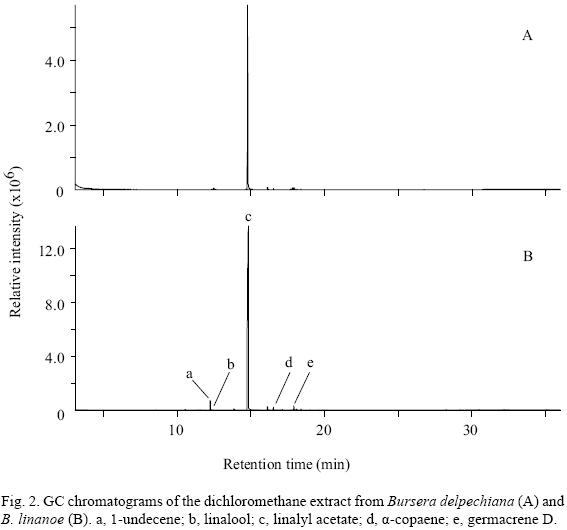
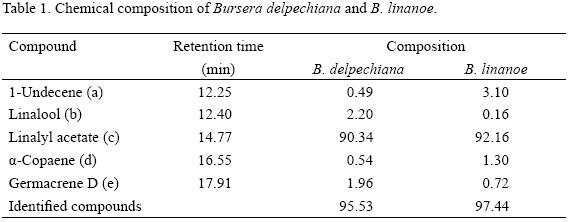
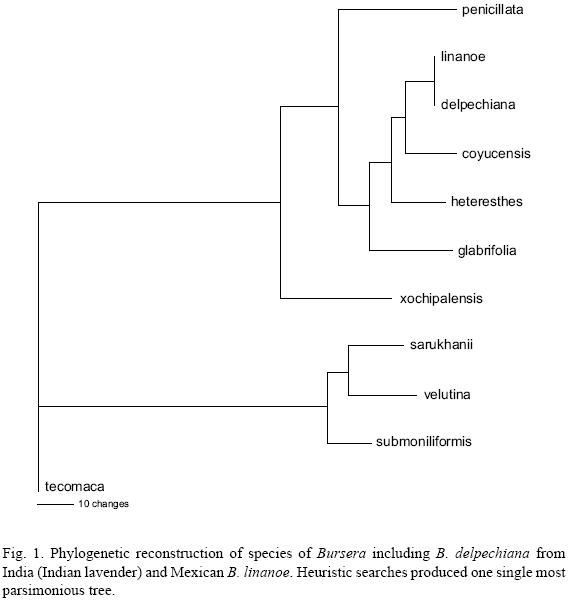
<body><![CDATA[<p align="justify"><font face="verdana" size="2">To confirm DNA and phylogenetic results concerning the closeness of the Indian <i>B. delpechiana </i>Poisson ex Engl. and <i>B. linanoe </i>(La Llave) Rzed., Calder&oacute;n &amp; Medina, we performed chemical analysis on these plants. A small piece of a branch with leaves of <i>B. linanoe, </i>and another piece of <i>B. delpechiana </i>were extracted in dichloromethane. Their volatile chemistry was analyzed using gas chromatography&#150;mass spectrometry (GC&#150;MS). GC&#150;MS analysis was carried out by an Agilent 6890N gas chromatograph linked to an Agilent 5975B mass spectrometer operated at 70 eV using a HP&#150;5MS capillary column (Agilent Technologies, 30 m x 0.25 mm i.d., 0.25 &micro;m in film thickness) with helium carrier gas at 1.2 ml/min in splitless mode. The oven temperature was programmed from 30 &deg;C to 300 &deg;C at 10 &deg;C/min with an initial 4 min hold, and then held at 300 &deg;C for 5 min. All compounds were identified by comparing their GC retention times and mass spectra with those of authentic standards.</font></p>     <p align="justify"><font face="verdana" size="2">&nbsp;</font></p>     <p align="justify"><font face="verdana" size="2"><b>RESULTS</b></font></p>     <p align="justify"><font face="verdana" size="2">DNA sequences of the indian <i>B. delpechiana </i>were all identical to those of <i>B. linanoe. </i>even the fast evolving 5S NTS region, which gives a good level of resolution at the species level in <i>Bursera </i>was identical for both species. Because of this, <i>B. delpechiana </i>and <i>B. linanoe </i>came together in the reconstructed phylogenetic tree (<a href="#f1">fig. 1</a>). all other species, including <i>B. penicillata </i>were relatively distant from them.</font></p>     <p align="center"><font face="verdana" size="2"><a name="f1"></a></font></p>     <p align="center"><font face="verdana" size="2"><img src="/img/revistas/abm/n91/a5f1.jpg"></font></p>     <p align="center"><font face="verdana" size="2">&nbsp;</font></p>     <p align="justify"><font face="verdana" size="2">Chemical components of <i>B. delpechiana </i>were also quite similar to those of <i>B. linanoe </i>(<a href="#f2">fig. 2</a>). In both, the compound with the highest relative abundance (more than 90%) was linalyl acetate (<a href="#t1">Table 1</a>). All the other minor compounds in <i>B. delpechiana </i>were present in <i>B. linanoe </i>at very similar abundances.</font></p>     <p align="center"><font face="verdana" size="2"><a name="f2"></a></font></p>     <p align="center"><font face="verdana" size="2"><img src="/img/revistas/abm/n91/a5f2.jpg"></font></p>     ]]></body>
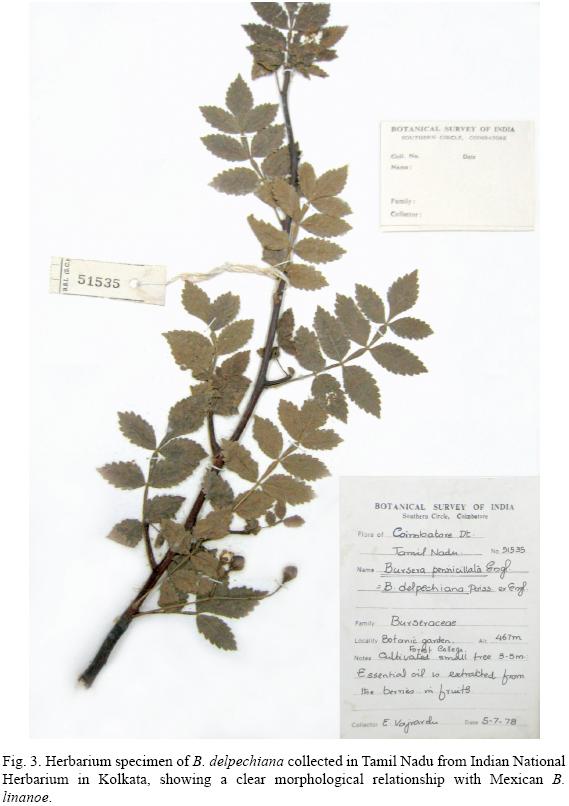
<body><![CDATA[<p align="center"><font face="verdana" size="2">&nbsp;</font></p>     <p align="center"><font face="verdana" size="2"><a name="t1"></a></font></p>     <p align="center"><font face="verdana" size="2"><img src="/img/revistas/abm/n91/a5t1.jpg"></font></p>     <p align="justify"><font face="verdana" size="2">&nbsp;</font></p>     <p align="justify"><font face="verdana" size="2"><b>DISCUSSION</b></font></p>     <p align="justify"><font face="verdana" size="2">Molecular, phylogenetic, and chemical results leave little doubt about <i>B. linanoe </i>being the Mexican species taken to India in 1912 and subsequently there known as <i>B. delpechiana </i>(<a href="#f3">fig. 3</a>). Not only are the examined molecular sequences of the DNA the same but these species also share the same chemical compounds.</font></p>     <p align="center"><font face="verdana" size="2"><a name="f3"></a></font></p>     <p align="center"><font face="verdana" size="2"><img src="/img/revistas/abm/n91/a5f3.jpg"></font></p>     <p align="center"><font face="verdana" size="2">&nbsp;</font></p>     <p align="justify"><font face="verdana" size="2">Previous chemical analyses using steam distillation have identified linalool as the major natural chemical component of the leaves and fruits of the Indian <i>B. delpechiana </i>(Nargaraja &amp; Farooqi, 1989; Mahmood Hussain et al., 1974; Somatta &amp; Uppin, 1979). Our analysis shows that it is actually linalyl acetate. Linalyl acetate is known to change into linalool by thermal hydrolysis during steam distillation (Reverchon &amp; Della Porta 1995; Noge et al., 2010). We extracted our samples in dichloromethane in cold conditions (4 &deg;C). This is probably the reason for the discrepancy between our results and the published data. Thus, we conclude that linalyl acetate is the natural component of <i>B. linanoe </i>(and <i>B. delpechiana</i>).</font></p>     ]]></body>
<body><![CDATA[<p align="justify"><font face="verdana" size="2">In previous studies, 65 of the 82 <i>Bursera </i>species from Mexico have been chemically analyzed, including species such as <i>B. penicillata </i>and <i>B. glabrifolia. </i>The major component of <i>B. penicillata </i>is &#946;&#150;phellandrene, while <i>B. glabrifolia </i>produces high amounts of germacrene D and &#945;&#150;pinene (Becerra, 2007; Becerra et al., 2009). Thus, these two species are chemically quite different from the indian lavender. Furthermore, none of the 65 <i>Bursera </i>species analyzed except <i>B. linanoe </i>seem to produce linalyl acetate. Given the high abundance of this compound, it could thus be considered a chemotaxonomic trait for this species.</font></p>     <p align="justify"><font face="verdana" size="2"><i>B. linanoe </i>is a narrow endemic to the tropical dry forest in the south of Mexico in the states of Puebla, Oaxaca, Guerrero and Morelos (Becerra &amp; Venable, 2008). The introduction of this species to India and its subsequent commercialization there has had important consequences for the status of this species in Mexico. First, exploitation of the plant for its oil diminished in Mexico because the quality of the Indian oil was higher. Essential oil is still extracted from the Mexican trees, along with other <i>Bursera </i>species, but only at an artisanal level (Toledo, 1982). Its wood is also used to make crafts. Yet, in contrast with Indian plantation cultivation, the Mexican oil has always been extracted from wild plants. This, as well as its exploitation for wood crafts have caused a decline in the abundance of this species, to the point of now being nearly extinct in some localities (Espinosa&#150;Organista, 2007). Successful commercialization and extraction of higher quality oil in India has relaxed commercial extraction in its native range, hence improving its conservation status in Mexico.</font></p>     <p align="justify"><font face="verdana" size="2">&nbsp;</font></p>     <p align="justify"><font face="verdana" size="2"><b>ACKNOWLEDEMENTS</b></font></p>     <p align="justify"><font face="verdana" size="2">We thank Leif Abrell, University of Arizona for the generous gift of chemicals, Boris Vrskovy for providing the Indian literature, Fredd D&uuml;rr for collection of the <i>B. delpechiana </i>sample, and Larry Venable for reading a prior manuscript and giving helpful suggestions. The Indian National Herbarium in Kolkata allowed us to take photographs of herbarium specimens of <i>B. delpechiana. </i>This work was supported by a National Science Foundation CAREER grant, a Young Investigator Award from the Beckman Foundation, and a grant from the Vice President for Research and the Colleges of Science and Agriculture of the University of Arizona to J.X.B.</font></p>     <p align="justify"><font face="verdana" size="2">&nbsp;</font></p>     <p align="justify"><font face="verdana" size="2"><b>LITERATURE CITED</b></font></p>     <!-- ref --><p align="justify"><font face="verdana" size="2">Becerra, J. X. 2003. Evolution of Mexican <i>Bursera </i>(Burseraceae) inferred from ITS, ETS and 5S nuclear ribosomal DNA sequences. Molec. Phylog. Evol. 26: 300&#150;309.</font>&nbsp;&nbsp;&nbsp;&nbsp;&nbsp;&nbsp;&nbsp;&nbsp;[&#160;<a href="javascript:void(0);" onclick="javascript: window.open('/scielo.php?script=sci_nlinks&ref=029491&pid=S0187-7151201000020000500001&lng=','','width=640,height=500,resizable=yes,scrollbars=1,menubar=yes,');">Links</a>&#160;]<!-- end-ref --><!-- ref --><p align="justify"><font face="verdana" size="2">Becerra, J. X. 2005. Timing the origin and expansion of the Mexican tropical dry forest. Proc. Natl. Acad. Sci. U.S.A. 102(31): 10919&#150;10923.</font>&nbsp;&nbsp;&nbsp;&nbsp;&nbsp;&nbsp;&nbsp;&nbsp;[&#160;<a href="javascript:void(0);" onclick="javascript: window.open('/scielo.php?script=sci_nlinks&ref=029492&pid=S0187-7151201000020000500002&lng=','','width=640,height=500,resizable=yes,scrollbars=1,menubar=yes,');">Links</a>&#160;]<!-- end-ref --><!-- ref --><p align="justify"><font face="verdana" size="2">Becerra, J. X. 2007. The impact of herbivore&#150;plant coevolution on plant community structure. Proc. Natl. Acad. Sci. U.S.A. 104(18): 7843&#150;7488.</font>&nbsp;&nbsp;&nbsp;&nbsp;&nbsp;&nbsp;&nbsp;&nbsp;[&#160;<a href="javascript:void(0);" onclick="javascript: window.open('/scielo.php?script=sci_nlinks&ref=029493&pid=S0187-7151201000020000500003&lng=','','width=640,height=500,resizable=yes,scrollbars=1,menubar=yes,');">Links</a>&#160;]<!-- end-ref --><!-- ref --><p align="justify"><font face="verdana" size="2">Becerra, J. X. and D. L. Venable. 2008. Sources and sinks of diversification and conservation priorities for the Mexican tropical dry forest. PLoS ONE 3(10): e3436.</font>&nbsp;&nbsp;&nbsp;&nbsp;&nbsp;&nbsp;&nbsp;&nbsp;[&#160;<a href="javascript:void(0);" onclick="javascript: window.open('/scielo.php?script=sci_nlinks&ref=029494&pid=S0187-7151201000020000500004&lng=','','width=640,height=500,resizable=yes,scrollbars=1,menubar=yes,');">Links</a>&#160;]<!-- end-ref --><!-- ref --><p align="justify"><font face="verdana" size="2">Becerra, J. X., K. Noge &amp; D. L. Venable. 2009. Macroevolutionary chemical escalation in an ancient plant&#150;insect arms race. Proc. Natl. Acad. Sci. U.S.A. 106(43): 18062&#150;18066.</font>&nbsp;&nbsp;&nbsp;&nbsp;&nbsp;&nbsp;&nbsp;&nbsp;[&#160;<a href="javascript:void(0);" onclick="javascript: window.open('/scielo.php?script=sci_nlinks&ref=029495&pid=S0187-7151201000020000500005&lng=','','width=640,height=500,resizable=yes,scrollbars=1,menubar=yes,');">Links</a>&#160;]<!-- end-ref --><!-- ref --><p align="justify"><font face="verdana" size="2">Becerra, J. X. &amp; D. L. Venable. 1999. Nuclear ribosomal, DNA phylogeny and its implications for evolutionary trends in Mexican <i>Bursera </i>(Burseraceae). Amer. Jour. Bot. 86: 1047&#150;1057.</font>&nbsp;&nbsp;&nbsp;&nbsp;&nbsp;&nbsp;&nbsp;&nbsp;[&#160;<a href="javascript:void(0);" onclick="javascript: window.open('/scielo.php?script=sci_nlinks&ref=029496&pid=S0187-7151201000020000500006&lng=','','width=640,height=500,resizable=yes,scrollbars=1,menubar=yes,');">Links</a>&#160;]<!-- end-ref --><!-- ref --><p align="justify"><font face="verdana" size="2">Bullock, A. A. 1936. Notes on the Mexican species of the genus <i>Bursera. </i>Bull. Misc. Inf. Kew 1936: 346&#150;387.</font>&nbsp;&nbsp;&nbsp;&nbsp;&nbsp;&nbsp;&nbsp;&nbsp;[&#160;<a href="javascript:void(0);" onclick="javascript: window.open('/scielo.php?script=sci_nlinks&ref=029497&pid=S0187-7151201000020000500007&lng=','','width=640,height=500,resizable=yes,scrollbars=1,menubar=yes,');">Links</a>&#160;]<!-- end-ref --><!-- ref --><p align="justify"><font face="verdana" size="2">Burton, R. W. 1952. The linaloe tree <i>(Bursera delpechiana </i>Poisson): An introduction into the flora of India. J. Bombay Nat. Hist. Soc. 52: 116&#150;120.</font>&nbsp;&nbsp;&nbsp;&nbsp;&nbsp;&nbsp;&nbsp;&nbsp;[&#160;<a href="javascript:void(0);" onclick="javascript: window.open('/scielo.php?script=sci_nlinks&ref=029498&pid=S0187-7151201000020000500008&lng=','','width=640,height=500,resizable=yes,scrollbars=1,menubar=yes,');">Links</a>&#160;]<!-- end-ref --><!-- ref --><p align="justify"><font face="verdana" size="2">Cronn, R. C., X. Zhao, A. H. Paterson &amp; J. F. Wendel. 1996. Polymorphism and concerted evolution in a tamdemly repeated gene family: 5S ribosomal DNA in diploid and allopolyploid cottons. J. Mol. Evol. 42: 685&#150;705.</font>&nbsp;&nbsp;&nbsp;&nbsp;&nbsp;&nbsp;&nbsp;&nbsp;[&#160;<a href="javascript:void(0);" onclick="javascript: window.open('/scielo.php?script=sci_nlinks&ref=029499&pid=S0187-7151201000020000500009&lng=','','width=640,height=500,resizable=yes,scrollbars=1,menubar=yes,');">Links</a>&#160;]<!-- end-ref --><!-- ref --><p align="justify"><font face="verdana" size="2">Mahmood Hussain, A. M., K. N. Subramanian &amp; J. Madhavan Nair. 1974. Some observations on <i>Bursera penicillata </i>(DC) Engl. <i>(B. delpechiana </i>Poisson ex Engl). Indian Forester 100: 315&#150;319. </font>&nbsp;&nbsp;&nbsp;&nbsp;&nbsp;&nbsp;&nbsp;&nbsp;[&#160;<a href="javascript:void(0);" onclick="javascript: window.open('/scielo.php?script=sci_nlinks&ref=029500&pid=S0187-7151201000020000500010&lng=','','width=640,height=500,resizable=yes,scrollbars=1,menubar=yes,');">Links</a>&#160;]<!-- end-ref --><!-- ref --><p align="justify"><font face="verdana" size="2">McVaugh, R. &amp; J. Rzedowski. 1965. Synopsis of the genus <i>Bursera </i>L. in western Mexico, with notes on the material of <i>Bursera </i>collected bye Sess&eacute; &amp; Moci&ntilde;o. Kew Bull. 18: 317&#150;382.</font>&nbsp;&nbsp;&nbsp;&nbsp;&nbsp;&nbsp;&nbsp;&nbsp;[&#160;<a href="javascript:void(0);" onclick="javascript: window.open('/scielo.php?script=sci_nlinks&ref=029501&pid=S0187-7151201000020000500011&lng=','','width=640,height=500,resizable=yes,scrollbars=1,menubar=yes,');">Links</a>&#160;]<!-- end-ref --><!-- ref --><p align="justify"><font face="verdana" size="2">Noge, K., N. Shimizu &amp; J. X. Becerra. 2010 (R)&#150;(&#150;)&#150;Linalyl acetate and (S)&#150;(&#150;)&#150;Germacrene D from the leaves of Mexican <i>Bursera linanoe. </i>Natural Product Communications. in Press.</font>&nbsp;&nbsp;&nbsp;&nbsp;&nbsp;&nbsp;&nbsp;&nbsp;[&#160;<a href="javascript:void(0);" onclick="javascript: window.open('/scielo.php?script=sci_nlinks&ref=029502&pid=S0187-7151201000020000500012&lng=','','width=640,height=500,resizable=yes,scrollbars=1,menubar=yes,');">Links</a>&#160;]<!-- end-ref --><!-- ref --><p align="justify"><font face="verdana" size="2">Nargaraja, C. &amp; A. A. Farooqi. 1989. Studies on the seed germination as influenced by various pre&#150;treatments in <i>Bursera. </i>Indian Perfumer 33(1): 48&#150;53.</font>&nbsp;&nbsp;&nbsp;&nbsp;&nbsp;&nbsp;&nbsp;&nbsp;[&#160;<a href="javascript:void(0);" onclick="javascript: window.open('/scielo.php?script=sci_nlinks&ref=029503&pid=S0187-7151201000020000500013&lng=','','width=640,height=500,resizable=yes,scrollbars=1,menubar=yes,');">Links</a>&#160;]<!-- end-ref --><!-- ref --><p align="justify"><font face="verdana" size="2">Espinosa&#150;Organista, D., G. Monta&ntilde;o &amp; F. Becerril. 2008. Qu&eacute; son y d&oacute;nde viven los copales?. Purata, S. E. (ed.). Uso y manejo de los copales arom&aacute;ticos: resinas y aceites. Comisi&oacute;n Nacional para el Conocimiento y Uso de la Biodiversidad/Red de Aprendizaje para el Intercambio y Sistematizaci&oacute;n de Experiencias hacia la Sustentabilidad. M&eacute;xico. D.F. 60 pp.</font>&nbsp;&nbsp;&nbsp;&nbsp;&nbsp;&nbsp;&nbsp;&nbsp;[&#160;<a href="javascript:void(0);" onclick="javascript: window.open('/scielo.php?script=sci_nlinks&ref=029504&pid=S0187-7151201000020000500014&lng=','','width=640,height=500,resizable=yes,scrollbars=1,menubar=yes,');">Links</a>&#160;]<!-- end-ref --><!-- ref --><p align="justify"><font face="verdana" size="2">Reverchon, E. &amp; G. Della Porta. 1995. Supercritical CO<sub>2</sub> extraction and fractionation of Lavender essential oil and waxes. J. Agric. Food Chem. 43: 1654&#150;1658.</font>&nbsp;&nbsp;&nbsp;&nbsp;&nbsp;&nbsp;&nbsp;&nbsp;[&#160;<a href="javascript:void(0);" onclick="javascript: window.open('/scielo.php?script=sci_nlinks&ref=029505&pid=S0187-7151201000020000500015&lng=','','width=640,height=500,resizable=yes,scrollbars=1,menubar=yes,');">Links</a>&#160;]<!-- end-ref --><!-- ref --><p align="justify"><font face="verdana" size="2">Rzedowski, J., R. Medina Lemos &amp; G. Calder&oacute;n de Rzedowski. 2005. Inventario del conocimiento taxon&oacute;mico, as&iacute; como de la diversidad y del endemismo regionales de las especies mexicanas de <i>Bursera </i>(Burseraceae). Acta Bot. Mex. 70: 85&#150;100.</font>&nbsp;&nbsp;&nbsp;&nbsp;&nbsp;&nbsp;&nbsp;&nbsp;[&#160;<a href="javascript:void(0);" onclick="javascript: window.open('/scielo.php?script=sci_nlinks&ref=029506&pid=S0187-7151201000020000500016&lng=','','width=640,height=500,resizable=yes,scrollbars=1,menubar=yes,');">Links</a>&#160;]<!-- end-ref --><!-- ref --><p align="justify"><font face="verdana" size="2">Somatta, K. &amp; S. F. Uppin. 1979. Indian Lavender (<i>Bursera penicillata </i>(D.C.) Engl. A review. Indian Forester 105: 859&#150;863.</font>&nbsp;&nbsp;&nbsp;&nbsp;&nbsp;&nbsp;&nbsp;&nbsp;[&#160;<a href="javascript:void(0);" onclick="javascript: window.open('/scielo.php?script=sci_nlinks&ref=029507&pid=S0187-7151201000020000500017&lng=','','width=640,height=500,resizable=yes,scrollbars=1,menubar=yes,');">Links</a>&#160;]<!-- end-ref --><!-- ref --><p align="justify"><font face="verdana" size="2">Swofford, D. L. 2002. PAUP* 4.0 beta version: phylogenetic analysis and using parsimony (and other methods). Sinauer Associates Inc., Sunderland, Massachusetts.</font>&nbsp;&nbsp;&nbsp;&nbsp;&nbsp;&nbsp;&nbsp;&nbsp;[&#160;<a href="javascript:void(0);" onclick="javascript: window.open('/scielo.php?script=sci_nlinks&ref=029508&pid=S0187-7151201000020000500018&lng=','','width=640,height=500,resizable=yes,scrollbars=1,menubar=yes,');">Links</a>&#160;]<!-- end-ref --><!-- ref --><p align="justify"><font face="verdana" size="2">Toledo, C. A. 1982. El g&eacute;nero <i>Bursera </i>en el estado de Guerrero. Tesis de licenciatura en Biolog&iacute;a. Facultad de Ciencias, Universidad Nacional Aut&oacute;noma de M&eacute;xico. M&eacute;xico, D.F. 182 pp.</font>&nbsp;&nbsp;&nbsp;&nbsp;&nbsp;&nbsp;&nbsp;&nbsp;[&#160;<a href="javascript:void(0);" onclick="javascript: window.open('/scielo.php?script=sci_nlinks&ref=029509&pid=S0187-7151201000020000500019&lng=','','width=640,height=500,resizable=yes,scrollbars=1,menubar=yes,');">Links</a>&#160;]<!-- end-ref --> ]]></body><back>
<ref-list>
<ref id="B1">
<nlm-citation citation-type="journal">
<person-group person-group-type="author">
<name>
<surname><![CDATA[Becerra]]></surname>
<given-names><![CDATA[J. X.]]></given-names>
</name>
</person-group>
<article-title xml:lang="en"><![CDATA[Evolution of Mexican Bursera (Burseraceae) inferred from ITS, ETS and 5S nuclear ribosomal DNA sequences]]></article-title>
<source><![CDATA[Molec. Phylog. Evol.]]></source>
<year>2003</year>
<volume>26</volume>
<page-range>300-309</page-range></nlm-citation>
</ref>
<ref id="B2">
<nlm-citation citation-type="journal">
<person-group person-group-type="author">
<name>
<surname><![CDATA[Becerra]]></surname>
<given-names><![CDATA[J. X.]]></given-names>
</name>
</person-group>
<article-title xml:lang="en"><![CDATA[Timing the origin and expansion of the Mexican tropical dry forest]]></article-title>
<source><![CDATA[Proc. Natl. Acad. Sci. U.S.A.]]></source>
<year>2005</year>
<volume>102</volume>
<numero>31</numero>
<issue>31</issue>
<page-range>10919-10923</page-range></nlm-citation>
</ref>
<ref id="B3">
<nlm-citation citation-type="journal">
<person-group person-group-type="author">
<name>
<surname><![CDATA[Becerra]]></surname>
<given-names><![CDATA[J. X.]]></given-names>
</name>
</person-group>
<article-title xml:lang="en"><![CDATA[The impact of herbivore-plant coevolution on plant community structure]]></article-title>
<source><![CDATA[Proc. Natl. Acad. Sci. U.S.A.]]></source>
<year>2007</year>
<volume>104</volume>
<numero>18</numero>
<issue>18</issue>
<page-range>7843-7488</page-range></nlm-citation>
</ref>
<ref id="B4">
<nlm-citation citation-type="journal">
<person-group person-group-type="author">
<name>
<surname><![CDATA[Becerra]]></surname>
<given-names><![CDATA[J. X.]]></given-names>
</name>
<name>
<surname><![CDATA[Venable]]></surname>
<given-names><![CDATA[D. L.]]></given-names>
</name>
</person-group>
<article-title xml:lang="en"><![CDATA[Sources and sinks of diversification and conservation priorities for the Mexican tropical dry forest]]></article-title>
<source><![CDATA[PLoS ONE]]></source>
<year>2008</year>
<volume>3</volume>
<numero>10</numero>
<issue>10</issue>
<page-range>e3436</page-range></nlm-citation>
</ref>
<ref id="B5">
<nlm-citation citation-type="journal">
<person-group person-group-type="author">
<name>
<surname><![CDATA[Becerra]]></surname>
<given-names><![CDATA[J. X.]]></given-names>
</name>
<name>
<surname><![CDATA[Noge]]></surname>
<given-names><![CDATA[K.]]></given-names>
</name>
<name>
<surname><![CDATA[Venable]]></surname>
<given-names><![CDATA[D. L.]]></given-names>
</name>
</person-group>
<article-title xml:lang="en"><![CDATA[Macroevolutionary chemical escalation in an ancient plant-insect arms race]]></article-title>
<source><![CDATA[Proc. Natl. Acad. Sci. U.S.A.]]></source>
<year>2009</year>
<volume>106</volume>
<numero>43</numero>
<issue>43</issue>
<page-range>18062-18066</page-range></nlm-citation>
</ref>
<ref id="B6">
<nlm-citation citation-type="journal">
<person-group person-group-type="author">
<name>
<surname><![CDATA[Becerra]]></surname>
<given-names><![CDATA[J. X.]]></given-names>
</name>
<name>
<surname><![CDATA[Venable]]></surname>
<given-names><![CDATA[D. L.]]></given-names>
</name>
</person-group>
<article-title xml:lang="en"><![CDATA[Nuclear ribosomal, DNA phylogeny and its implications for evolutionary trends in Mexican Bursera (Burseraceae)]]></article-title>
<source><![CDATA[Amer. Jour. Bot.]]></source>
<year>1999</year>
<volume>86</volume>
<page-range>1047-1057</page-range></nlm-citation>
</ref>
<ref id="B7">
<nlm-citation citation-type="journal">
<person-group person-group-type="author">
<name>
<surname><![CDATA[Bullock]]></surname>
<given-names><![CDATA[A. A.]]></given-names>
</name>
</person-group>
<article-title xml:lang="en"><![CDATA[Notes on the Mexican species of the genus Bursera]]></article-title>
<source><![CDATA[Bull. Misc. Inf. Kew]]></source>
<year>1936</year>
<volume>1936</volume>
<page-range>346-387</page-range></nlm-citation>
</ref>
<ref id="B8">
<nlm-citation citation-type="journal">
<person-group person-group-type="author">
<name>
<surname><![CDATA[Burton]]></surname>
<given-names><![CDATA[R. W.]]></given-names>
</name>
</person-group>
<article-title xml:lang="en"><![CDATA[The linaloe tree (Bursera delpechiana Poisson): An introduction into the flora of India]]></article-title>
<source><![CDATA[J. Bombay Nat. Hist. Soc.]]></source>
<year>1952</year>
<volume>52</volume>
<page-range>116-120</page-range></nlm-citation>
</ref>
<ref id="B9">
<nlm-citation citation-type="journal">
<person-group person-group-type="author">
<name>
<surname><![CDATA[Cronn]]></surname>
<given-names><![CDATA[R. C.]]></given-names>
</name>
<name>
<surname><![CDATA[Zhao]]></surname>
<given-names><![CDATA[X.]]></given-names>
</name>
<name>
<surname><![CDATA[Paterson]]></surname>
<given-names><![CDATA[A. H.]]></given-names>
</name>
<name>
<surname><![CDATA[Wendel]]></surname>
<given-names><![CDATA[J. F.]]></given-names>
</name>
</person-group>
<article-title xml:lang="en"><![CDATA[Polymorphism and concerted evolution in a tamdemly repeated gene family: 5S ribosomal DNA in diploid and allopolyploid cottons]]></article-title>
<source><![CDATA[J. Mol. Evol.]]></source>
<year>1996</year>
<volume>42</volume>
<page-range>685-705</page-range></nlm-citation>
</ref>
<ref id="B10">
<nlm-citation citation-type="journal">
<person-group person-group-type="author">
<name>
<surname><![CDATA[Mahmood Hussain]]></surname>
<given-names><![CDATA[A. M.]]></given-names>
</name>
<name>
<surname><![CDATA[Subramanian]]></surname>
<given-names><![CDATA[K. N.]]></given-names>
</name>
<name>
<surname><![CDATA[Madhavan Nair]]></surname>
<given-names><![CDATA[J.]]></given-names>
</name>
</person-group>
<article-title xml:lang="en"><![CDATA[Some observations on Bursera penicillata (DC) Engl. (B. delpechiana Poisson ex Engl)]]></article-title>
<source><![CDATA[Indian Forester]]></source>
<year>1974</year>
<volume>100</volume>
<page-range>315-319</page-range></nlm-citation>
</ref>
<ref id="B11">
<nlm-citation citation-type="journal">
<person-group person-group-type="author">
<name>
<surname><![CDATA[McVaugh]]></surname>
<given-names><![CDATA[R.]]></given-names>
</name>
<name>
<surname><![CDATA[Rzedowski]]></surname>
<given-names><![CDATA[J.]]></given-names>
</name>
</person-group>
<article-title xml:lang="en"><![CDATA[Synopsis of the genus Bursera L. in western Mexico, with notes on the material of Bursera collected bye Sessé & Mociño]]></article-title>
<source><![CDATA[Kew Bull.]]></source>
<year>1965</year>
<volume>18</volume>
<page-range>317-382</page-range></nlm-citation>
</ref>
<ref id="B12">
<nlm-citation citation-type="journal">
<person-group person-group-type="author">
<name>
<surname><![CDATA[Noge]]></surname>
<given-names><![CDATA[K.]]></given-names>
</name>
<name>
<surname><![CDATA[Shimizu]]></surname>
<given-names><![CDATA[N.]]></given-names>
</name>
<name>
<surname><![CDATA[Becerra]]></surname>
<given-names><![CDATA[J. X.]]></given-names>
</name>
</person-group>
<article-title xml:lang="en"><![CDATA[(R)-(-)-Linalyl acetate and (S)-(-)-Germacrene D from the leaves of Mexican Bursera linanoe]]></article-title>
<source><![CDATA[Natural Product Communications]]></source>
<year>2010</year>
</nlm-citation>
</ref>
<ref id="B13">
<nlm-citation citation-type="journal">
<person-group person-group-type="author">
<name>
<surname><![CDATA[Nargaraja]]></surname>
<given-names><![CDATA[C.]]></given-names>
</name>
<name>
<surname><![CDATA[Farooqi]]></surname>
<given-names><![CDATA[A. A.]]></given-names>
</name>
</person-group>
<article-title xml:lang="en"><![CDATA[Studies on the seed germination as influenced by various pre-treatments in Bursera]]></article-title>
<source><![CDATA[Indian Perfumer]]></source>
<year>1989</year>
<volume>33</volume>
<numero>1</numero>
<issue>1</issue>
<page-range>48-53</page-range></nlm-citation>
</ref>
<ref id="B14">
<nlm-citation citation-type="book">
<person-group person-group-type="author">
<name>
<surname><![CDATA[Espinosa-Organista]]></surname>
<given-names><![CDATA[D.]]></given-names>
</name>
<name>
<surname><![CDATA[Montaño]]></surname>
<given-names><![CDATA[G.]]></given-names>
</name>
<name>
<surname><![CDATA[Becerril]]></surname>
<given-names><![CDATA[F.]]></given-names>
</name>
</person-group>
<article-title xml:lang="es"><![CDATA[Qué son y dónde viven los copales?]]></article-title>
<person-group person-group-type="editor">
<name>
<surname><![CDATA[Purata]]></surname>
<given-names><![CDATA[S. E.]]></given-names>
</name>
</person-group>
<source><![CDATA[Uso y manejo de los copales aromáticos: resinas y aceites]]></source>
<year>2008</year>
<page-range>60</page-range><publisher-loc><![CDATA[México^eD.F. D.F.]]></publisher-loc>
<publisher-name><![CDATA[Comisión Nacional para el Conocimiento y Uso de la Biodiversidad/Red de Aprendizaje para el Intercambio y Sistematización de Experiencias hacia la Sustentabilidad]]></publisher-name>
</nlm-citation>
</ref>
<ref id="B15">
<nlm-citation citation-type="journal">
<person-group person-group-type="author">
<name>
<surname><![CDATA[Reverchon]]></surname>
<given-names><![CDATA[E.]]></given-names>
</name>
<name>
<surname><![CDATA[Della Porta]]></surname>
<given-names><![CDATA[G.]]></given-names>
</name>
</person-group>
<article-title xml:lang="en"><![CDATA[Supercritical CO2 extraction and fractionation of Lavender essential oil and waxes]]></article-title>
<source><![CDATA[J. Agric. Food Chem.]]></source>
<year>1995</year>
<volume>43</volume>
<page-range>1654-1658</page-range></nlm-citation>
</ref>
<ref id="B16">
<nlm-citation citation-type="journal">
<person-group person-group-type="author">
<name>
<surname><![CDATA[Rzedowski]]></surname>
<given-names><![CDATA[J.]]></given-names>
</name>
<name>
<surname><![CDATA[Medina Lemos]]></surname>
<given-names><![CDATA[R.]]></given-names>
</name>
<name>
<surname><![CDATA[Calderón de Rzedowski]]></surname>
<given-names><![CDATA[G.]]></given-names>
</name>
</person-group>
<article-title xml:lang="es"><![CDATA[Inventario del conocimiento taxonómico, así como de la diversidad y del endemismo regionales de las especies mexicanas de Bursera (Burseraceae)]]></article-title>
<source><![CDATA[Acta Bot. Mex.]]></source>
<year>2005</year>
<volume>70</volume>
<page-range>85-100</page-range></nlm-citation>
</ref>
<ref id="B17">
<nlm-citation citation-type="journal">
<person-group person-group-type="author">
<name>
<surname><![CDATA[Somatta]]></surname>
<given-names><![CDATA[K.]]></given-names>
</name>
<name>
<surname><![CDATA[Uppin]]></surname>
<given-names><![CDATA[S. F.]]></given-names>
</name>
</person-group>
<article-title xml:lang="en"><![CDATA[Indian Lavender (Bursera penicillata (D.C.) Engl. A review]]></article-title>
<source><![CDATA[Indian Forester]]></source>
<year>1979</year>
<volume>105</volume>
<page-range>859-863</page-range></nlm-citation>
</ref>
<ref id="B18">
<nlm-citation citation-type="book">
<person-group person-group-type="author">
<name>
<surname><![CDATA[Swofford]]></surname>
<given-names><![CDATA[D. L.]]></given-names>
</name>
</person-group>
<source><![CDATA[PAUP* 4.0 beta version: phylogenetic analysis and using parsimony (and other methods)]]></source>
<year>2002</year>
<publisher-loc><![CDATA[Sunderland^eMassachusetts Massachusetts]]></publisher-loc>
<publisher-name><![CDATA[Sinauer Associates Inc.]]></publisher-name>
</nlm-citation>
</ref>
<ref id="B19">
<nlm-citation citation-type="">
<person-group person-group-type="author">
<name>
<surname><![CDATA[Toledo]]></surname>
<given-names><![CDATA[C. A.]]></given-names>
</name>
</person-group>
<source><![CDATA[El género Bursera en el estado de Guerrero]]></source>
<year>1982</year>
<page-range>182</page-range></nlm-citation>
</ref>
</ref-list>
</back>
</article>