<?xml version="1.0" encoding="ISO-8859-1"?><article xmlns:mml="http://www.w3.org/1998/Math/MathML" xmlns:xlink="http://www.w3.org/1999/xlink" xmlns:xsi="http://www.w3.org/2001/XMLSchema-instance">
<front>
<journal-meta>
<journal-id>0187-7151</journal-id>
<journal-title><![CDATA[Acta botánica mexicana]]></journal-title>
<abbrev-journal-title><![CDATA[Act. Bot. Mex]]></abbrev-journal-title>
<issn>0187-7151</issn>
<publisher>
<publisher-name><![CDATA[Instituto de Ecología A.C., Centro Regional del Bajío]]></publisher-name>
</publisher>
</journal-meta>
<article-meta>
<article-id>S0187-71512009000300006</article-id>
<title-group>
<article-title xml:lang="en"><![CDATA[Lectotypification of Didymaea mexicana Hook. f (Rubiaceae, Rubieae) and the identity of D. alsinoides (Schltdl. & Cham.) Standl.]]></article-title>
<article-title xml:lang="es"><![CDATA[Lectotipificación de Didymaea mexicana Hook. f (Rubiaceae, Rubieae) y la identidad de D. alsinoides (Schltdl. & Cham.) Standl.]]></article-title>
</title-group>
<contrib-group>
<contrib contrib-type="author">
<name>
<surname><![CDATA[Lorence]]></surname>
<given-names><![CDATA[David]]></given-names>
</name>
<xref ref-type="aff" rid="A01"/>
</contrib>
</contrib-group>
<aff id="A01">
<institution><![CDATA[,National Tropical Botanical Garden  ]]></institution>
<addr-line><![CDATA[Kalaheo Hi]]></addr-line>
<country>USA</country>
</aff>
<pub-date pub-type="pub">
<day>00</day>
<month>07</month>
<year>2009</year>
</pub-date>
<pub-date pub-type="epub">
<day>00</day>
<month>07</month>
<year>2009</year>
</pub-date>
<numero>88</numero>
<fpage>73</fpage>
<lpage>79</lpage>
<copyright-statement/>
<copyright-year/>
<self-uri xlink:href="http://www.scielo.org.mx/scielo.php?script=sci_arttext&amp;pid=S0187-71512009000300006&amp;lng=en&amp;nrm=iso"></self-uri><self-uri xlink:href="http://www.scielo.org.mx/scielo.php?script=sci_abstract&amp;pid=S0187-71512009000300006&amp;lng=en&amp;nrm=iso"></self-uri><self-uri xlink:href="http://www.scielo.org.mx/scielo.php?script=sci_pdf&amp;pid=S0187-71512009000300006&amp;lng=en&amp;nrm=iso"></self-uri><abstract abstract-type="short" xml:lang="en"><p><![CDATA[The name Didymaea alsinoides (Schltdl. & Cham.) Standl. has been incorrectly applied to a common and wide-ranging Mexican and Central American species whose correct identity is Didymaea Mexicana Hook. f. In this paper a lectotype is selected and designated for D. Mexicana. The characters separating these two frequently confused species are discussed. Further systematic studies of the genus Didymaea are suggested.]]></p></abstract>
<abstract abstract-type="short" xml:lang="es"><p><![CDATA[El nombre Didymaea alsinoides (Schltdl. & Cham). Standl. ha sido aplicado incorrectamente a una especie común y de amplia distribución en Mexico y América Central, cuya identidad correcta es Didymaea Mexicana Hook. f. Se selecciona y designa un lectotipo para D. Mexicana. Se discuten los caracteres que separan estos dos taxa. Se sugieren estudios sistemáticos adicionales del género Didymaea.]]></p></abstract>
<kwd-group>
<kwd lng="en"><![CDATA[Central America]]></kwd>
<kwd lng="en"><![CDATA[Didymaea]]></kwd>
<kwd lng="en"><![CDATA[Mexico]]></kwd>
<kwd lng="en"><![CDATA[Rubiaceae]]></kwd>
<kwd lng="en"><![CDATA[typification]]></kwd>
<kwd lng="es"><![CDATA[América Central]]></kwd>
<kwd lng="es"><![CDATA[Didymaea]]></kwd>
<kwd lng="es"><![CDATA[México]]></kwd>
<kwd lng="es"><![CDATA[Rubiaceae]]></kwd>
<kwd lng="es"><![CDATA[tipificación]]></kwd>
</kwd-group>
</article-meta>
</front><body><![CDATA[ <p align="center"><font face="verdana" size="4"><b>Lectotypification of <i>Didymaea  mexicana </i>Hook. f (Rubiaceae, Rubieae) and the identity of <i>D. alsinoides </i>(Schltdl. &amp; Cham.) Standl.</b></font></p>     <p align="center"><font face="verdana" size="2">&nbsp;</font></p>     <p align="center"><font face="verdana" size="3"><b>Lectotipificaci&oacute;n de <i>Didymaea  mexicana</i> Hook. f (Rubiaceae, Rubieae) y la identidad de <i>D. alsinoides</i> (Schltdl. &amp; Cham.) Standl.</b></font></p>     <p align="center"><font face="verdana" size="2">&nbsp;</font></p>     <p align="center"><font face="verdana" size="2"><b>David Lorence</b></font></p>     <p align="justify"><font face="verdana" size="2">&nbsp;</font></p>     <p align="justify"><font face="verdana" size="2"><i>National Tropical Botanical Garden, 3530 Papalina Road, Kalaheo, Hi 96741 USA. E&#150;mail: <a href="mailto:lorence@ntbg.org">lorence@ntbg.org</a></i></font></p>     <p align="justify"><font face="verdana" size="2">&nbsp;</font></p>     <p align="justify"><font face="verdana" size="2">Recibido en mayo de 2008.    <br> Aceptado en mayo de 2009.</font></p>     ]]></body>
<body><![CDATA[<p align="justify"><font face="verdana" size="2">&nbsp;</font></p>     <p align="justify"><font face="verdana" size="2"><b>ABSTRACT</b></font></p>     <p align="justify"><font face="verdana" size="2">The name <i>Didymaea alsinoides </i>(Schltdl. &amp; Cham.) Standl. has been incorrectly applied to a common and wide&#150;ranging Mexican and Central American species whose correct identity is <i>Didymaea Mexicana </i>Hook. f. In this paper a lectotype is selected and designated for <i>D. Mexicana. </i>The characters separating these two frequently confused species are discussed. Further systematic studies of the genus <i>Didymaea </i>are suggested.</font></p>     <p align="justify"><font face="verdana" size="2"><b>Key words:</b> Central America, <i>Didymaea, </i>Mexico, Rubiaceae, typification.</font></p>     <p align="justify"><font face="verdana" size="2">&nbsp;</font></p>     <p align="justify"><font face="verdana" size="2"><b>RESUMEN</b></font></p>     <p align="justify"><font face="verdana" size="2">El nombre <i>Didymaea alsinoides </i>(Schltdl. &amp; Cham). Standl. ha sido aplicado incorrectamente a una especie com&uacute;n y de amplia distribuci&oacute;n en Mexico y Am&eacute;rica Central, cuya identidad correcta es <i>Didymaea Mexicana </i>Hook. f. Se selecciona y designa un lectotipo para <i>D. Mexicana. </i>Se discuten los caracteres que separan estos dos taxa. Se sugieren estudios sistem&aacute;ticos adicionales del g&eacute;nero <i>Didymaea.</i></font></p>     <p align="justify"><font face="verdana" size="2"><b>Palabras clave:</b> Am&eacute;rica Central, <i>Didymaea, </i>M&eacute;xico, Rubiaceae, tipificaci&oacute;n.</font></p>     <p align="justify"><font face="verdana" size="2">&nbsp;</font></p>     <p align="justify"><font face="verdana" size="2"><i>Didymaea </i>Hook. f. (Rubiaceae, Rubieae) is a small genus of low perennial herbs found at relatively high elevations, and ranging from Central Mexico to Panama in Central America (Burger &amp; Taylor, 1993). Recent molecular&#150;phylogenetic evidence places <i>Didymaea </i>in subfamily Rubioideae, tribe Rubieae, subtribe Rubiinae along with other genera having leaf&#150;like stipules and pluricolpate pollen, including <i>Galium </i>L. (Robbrecht &amp; Manen, 2006).</font></p>     ]]></body>
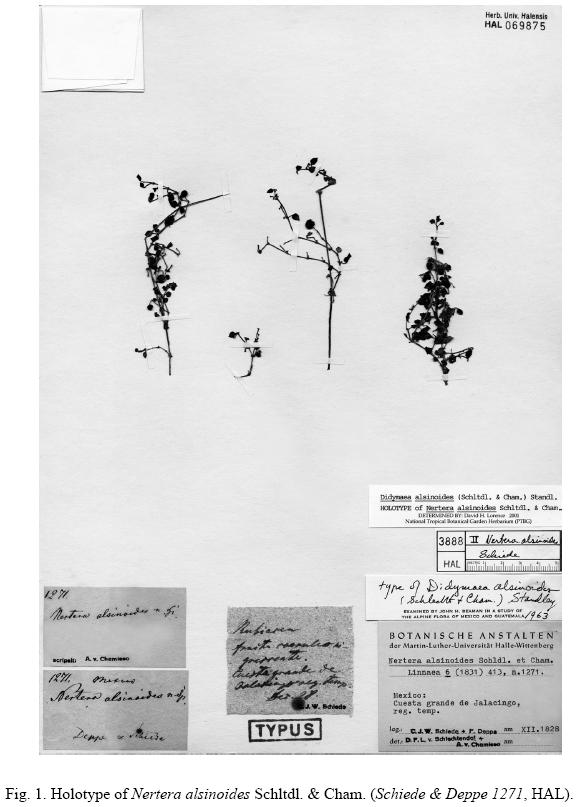
<body><![CDATA[<p align="justify"><font face="verdana" size="2">Species of <i>Didymaea </i>are characterized by their procumbent or climbing stems, opposite leaves with ovate, oblong&#150;ovate, lanceolate, elliptic, or rarely linear blades, small, shallowly to deeply bilobed or geminate interpetiolar stipules, axillary inflorescences with small, bisexual homostylous flowers with calyces reduced or absent, small, white to purple corollas with short tubes and 4&#150;valvate lobes, 4 stamens with dorsifixed anthers, 2&#150;locular ovaries with one axillary ovule per locule, and black, drupaceous fruits that are dimidiate and deeply bisulcate or sometimes subglobose.</font></p>     <p align="justify"><font face="verdana" size="2">Although names of 12 species and infraspecies <i>of Didymaea </i>have been published (Anonymous, 2005), the actual number is probably fewer (Burger &amp; Taylor, 1993). Lorence (1999) recognized seven species in his nomenclator of Mexican and Central American Rubiaceae. Various authors (e.g. Rzedowski, 1983; Standley &amp; Williams, 1975) have traditionally used characters such as stem length, habit (e.g., climbing versus procumbent), degree and type of pubescence, leaf texture, number of secondary leaf veins, degree of inflorescence branching, flower number, and the ratio of corolla lobe to corolla tube length to delineate species and infraspecific taxa in <i>Didymaea. </i>For example, in his treatment for flora of Guatemala Williams recognized four species, including three new ones, based largely on leaf shape, venation patterns, and pubescence (Standley &amp; Williams, 1975). In his treatment of Mexican Rubiaceae borhidi (2006) recognized six species. However, when a large number of collections are examined, these characters seem to vary independently or intergrade, making it difficult to delimit species. Comparable variation in habit, leaf size, shape, and pubescence, and inflorescence morphology occurs in various other herbaceous Rubiaceae genera such as <i>Houstonia </i>L., possibly in relation to habitat and microsite conditions and introgression (terrell, 2006).</font></p>     <p align="justify"><font face="verdana" size="2">During the course of preparing a treatment of <i>Didymaea </i>for the flora mesoamericana project the author studied Herbarium specimens from throughout the range of the genus, and types of all the described species were examined. this study shows that the name <i>Didymaea alsinoides </i>(Schltdl. &amp; Cham.) Standl. has been incorrectly applied to a common and wide&#150;ranging species, whose correct identity is <i>Didymaea Mexicana </i>Hook. f. consequently, the name <i>Didymaea alsinoides </i>correctly applies to a different species that is restricted to Central Mexico (Veracruz, Puebla, and Queretaro). the two species can be separated by the following key.</font></p>     <p align="center"><font face="verdana" size="2"><img src="/img/revistas/abm/n88/a6s1.jpg"></font></p>     <p align="center"><font face="verdana" size="2"><img src="/img/revistas/abm/n88/a6s2.jpg"></font></p>     <p align="justify"><font face="verdana" size="2"><b>Didymaea alsinoides </b>(Schltdl. &amp; Cham.) Standl., Publ. Field Mus. Nat. Hist., Bot. Ser. 18: 1291 (1938). Basionym: <i>Nertera alsinoides </i>Schltdl. &amp; Cham., Linnaea 6: 413 (1831). Type: Mexico. "Cuesta Grande de Jalacingo", <i>Schiede &amp; Deppe 1271 </i>(Holotype HAL!). <a href="#f1">Fig. 1</a>.</font></p>     <p align="center"><font face="verdana" size="2"><a name="f1"></a></font></p>     <p align="center"><font face="verdana" size="2"><img src="/img/revistas/abm/n88/a6f1.jpg"></font></p>     <p align="justify"><font face="verdana" size="2">The type <i>of Nertera alsinoides </i>was collected in Central Veracruz at cuesta Grande de Jalacingo near the border with Puebla. in their protologue Schlechtendal &amp; Chamisso state "drupa succosa globosa," a feature evident on the type (<a href="#f1">Fig. 1</a>). Examination of the type collection clearly shows the entire to shortly bifid stipules (divided less than halfway) and globose (non&#150;dimidiate) fruits, characters that differentiate this species from all other members of the genus. Additional collections examined from Central Veracruz, Puebla, and Quer&eacute;taro in Central Mexico (but occurring nowhere else) also possess these features. Most Herbarium collections annotated as <i>D. alsinoides </i>actually represent D. <i>Mexicana, </i>a widespread species ranging from Central Veracruz south to Panama.</font></p>     <p align="justify"><font face="verdana" size="2">In 1929 Standley described a second species <i>Didymaea linearis </i>Standl. characterized by pendant, vine&#150;like stems and linear leaves based on a collection from Jalisco, Mexico, while also recognizing <i>D. Mexicana </i>as a species ranging from south&#150;Central Mexico to Costa Rica (Standley, 1929). Subsequently he made the combination transferring <i>Nertera alsinoides </i>into <i>Didymaea, </i>and he placed <i>D. Mexicana </i>in synonymy under <i>D. alsinoides </i>(Standley, 1938: 1291). apparently he had not examined the type stating: "While I have seen no authentic material of <i>Nertera alsinoides, </i>the rather brief description seems to apply without any doubt to <i>Didymaea, </i>and I do not hesitate to make the transfer". unfortunately, Standley's broad species concept of <i>D. alsinoides </i>and synonymy of <i>D. Mexicana </i>have been widely adopted in the literature and have contributed to the confusion in this group. Lorence (1999) did recognize <i>D. alsinoides </i>and <i>D. Mexicana </i>as distinct species without discussing the differences.</font></p>     ]]></body>
<body><![CDATA[<p align="justify"><font face="verdana" size="2"><b>Didymaea Mexicana </b>Hook. f. in Benth. &amp; Hook. f., Gen. Pl. 2: 150 (1873). Lecto&#150;type: Mexico. "Mexique, &agrave; Izhuatlancillo, r&eacute;gion d'Orizaba, 12 Septemb. 1866, <i>E. Bourgeau 3050" </i>(K! right hand collection no. k000173295, here designated; isolec&#150;totype K! top collection, no. k000173298). <a href="/img/revistas/abm/n88/a6f2.jpg" target="_blank">Fig. 2</a>.</font></p>     <p align="justify"><font face="verdana" size="2">Hooker (1878) noted that <i>Didymaea Mexicana </i>is characterized by having geminate stipules (divided nearly to the base) and didymous fruits, features that clearly separate this species from <i>D. alsinoides </i>as noted above. Hooker's (1878) diagnostic illustration in icones plantarum (p. 55, plate 1271) clearly shows these features.</font></p>     <p align="justify"><font face="verdana" size="2">Hooker (1873) based his generic description <i>of Didymaea </i>in Genera plantarum on the species <i>D. Mexicana, </i>but cited no exsiccatae. Subsequently, in his description of <i>D. Mexicana </i>Hooker (1878) first typified the species citing seven collections from Veracruz, Mexico, all at kew. they are as follows: two collections mounted on same sheet, "pic d'Orizaba &agrave; 10000', Jun&#150;oct 1840, <i>H. Galeotti 4405" </i>(left hand collection k000173296) and "Mexique, &agrave; Izhuatlancillo, r&eacute;gion d'Orizaba, 12 Septemb. 1866, <i>E. Bourgeau 3050" </i>(right hand collection k000173295); two collections mounted on same sheet, "Pee. de Veracruz, Pic d'Orizaba, fl. en ao&ucirc;t, 1838, <i>J. linden 1403" </i>(top collection k000173293) and "pic Orizaba, 10000', <i>liebmann, </i>Pl. mexic. Liebm. Rubiaceae n. 255" (bottom collection, k000173294); two collections mounted on same sheet, "r&eacute;gion d'Orizaba, 12 septembre, 1865&#150;1866, <i>Bourgeau 3050" </i>(top collection k000173298) and "Mexico, <i>M. Bates s.n." </i>(bottom collection, k000173297); and "Veracruz to Orizaba, from Dr. Meisner, 1857, <i>Fred Muller 1519" </i>(k000173292). one cited collection, <i>Bourgeau 98, </i>was not located.</font></p>     <p align="justify"><font face="verdana" size="2">These collections must be regarded as syntypes and, according to the International code of botanical nomenclature, a lectotype should be selected from among them. the <i>Bourgeau 3050 </i>specimen collected in Veracruz with the label reading "Mexique, &agrave; izhuantlancillo, region d'orzaba, E. Bourgeau, 12 Septemb. 1866" (k000173295, mounted on the right&#150;hand side of the same sheet as <i>Galeotti 4405) </i>is here designated as the lectotype <i>of Didymaea Mexicana. </i>this specimen was selected because the collection is large, showing the plant's habit, and also is fertile with ample fruits and flower buds. Furthermore a duplicate (isolectotype) of <i> Bourgeau 3050 </i>also exists at kew (k000173298), mounted on the top half of the same sheet with an unnumbered <i>Bates </i>collection.</font></p>     <p align="justify"><font face="verdana" size="2">As here interpreted, <i>Didymaea Mexicana </i>is a widespread and morphologically variable species ranging from Central Veracruz to Panama. However, it is possible that additional taxa are represented in this complex. a detailed study of the genus using morphological and molecular techniques is needed to more accurately circumscribe species and understand evolutionary trends in <i>Didymaea. </i>mr. Jaime pacheco t. (Instituto de biolog&iacute;a, universidad Nacional aut&oacute;noma de M&eacute;xico) is currently studying the systematics <i>of Didymaea </i>focusing on morphology, anatomy, and palynology. this much needed work will undoubtedly increase our understanding of this fascinating genus.</font></p>     <p align="justify"><font face="verdana" size="2">&nbsp;</font></p>     <p align="justify"><font face="verdana" size="2"><b>ACKNOWLEDGMENTS</b></font></p>     <p align="justify"><font face="verdana" size="2">Thanks are extended to Charlotte M. Taylor for valuable discussions and comments on the manuscript. Prof. Uwe Braun (HAL) kindly provided a digital image of the type <i>of Nertera alsinoides. </i>The Board of Trustees of RbG Kew granted permission to publish the image of the type <i>of Didymaea mexicana. </i>I thank the curators of the following herbaria for loans or access to their collections: HAL, K, MEXU, MO, P, PTBG.</font></p>     <p align="justify"><font face="verdana" size="2">&nbsp;</font></p>     <p align="justify"><font face="verdana" size="2"><b>LITERATURE CITED</b></font></p>     ]]></body>
<body><![CDATA[<!-- ref --><p align="justify"><font face="verdana" size="2">Anonymous. 2005. International Plant Names Index. Published in internet: <a href="http://www.ipni.org/index.html" target="_blank">http://www.ipni.org/index.html</a> (accessed 12 april 2008).</font>&nbsp;&nbsp;&nbsp;&nbsp;&nbsp;&nbsp;&nbsp;&nbsp;[&#160;<a href="javascript:void(0);" onclick="javascript: window.open('/scielo.php?script=sci_nlinks&ref=027146&pid=S0187-7151200900030000600001&lng=','','width=640,height=500,resizable=yes,scrollbars=1,menubar=yes,');">Links</a>&#160;]<!-- end-ref --><!-- ref --><p align="justify"><font face="verdana" size="2">Borhidi, A. 2006. Rubi&aacute;ceas de M&eacute;xico. Akad&eacute;miai Kiad&oacute;. Budapest. 512 pp. </font>&nbsp;&nbsp;&nbsp;&nbsp;&nbsp;&nbsp;&nbsp;&nbsp;[&#160;<a href="javascript:void(0);" onclick="javascript: window.open('/scielo.php?script=sci_nlinks&ref=027147&pid=S0187-7151200900030000600002&lng=','','width=640,height=500,resizable=yes,scrollbars=1,menubar=yes,');">Links</a>&#160;]<!-- end-ref --><!-- ref --><p align="justify"><font face="verdana" size="2">Burger, W. C. &amp; C. M. Taylor. 1993. Rubiaceae. In: Flora Costaricensis. Fieldiana, Bot. n.s. 33: 1&#150;333.</font>&nbsp;&nbsp;&nbsp;&nbsp;&nbsp;&nbsp;&nbsp;&nbsp;[&#160;<a href="javascript:void(0);" onclick="javascript: window.open('/scielo.php?script=sci_nlinks&ref=027148&pid=S0187-7151200900030000600003&lng=','','width=640,height=500,resizable=yes,scrollbars=1,menubar=yes,');">Links</a>&#160;]<!-- end-ref --><!-- ref --><p align="justify"><font face="verdana" size="2">Hooker, J. D. 1873. <i>Didymaea. </i>In: Hooker, J. D. &amp; G. Bentham (eds.). Genera plantarum 2(1): 1&#150;554.</font>&nbsp;&nbsp;&nbsp;&nbsp;&nbsp;&nbsp;&nbsp;&nbsp;[&#160;<a href="javascript:void(0);" onclick="javascript: window.open('/scielo.php?script=sci_nlinks&ref=027149&pid=S0187-7151200900030000600004&lng=','','width=640,height=500,resizable=yes,scrollbars=1,menubar=yes,');">Links</a>&#160;]<!-- end-ref --><!-- ref --><p align="justify"><font face="verdana" size="2">Hooker, J. D. 1878. <i>Didymaea mexicana </i>Hook. f. Hooker's Icones Plantarum. p. 55, plate 1271.</font>&nbsp;&nbsp;&nbsp;&nbsp;&nbsp;&nbsp;&nbsp;&nbsp;[&#160;<a href="javascript:void(0);" onclick="javascript: window.open('/scielo.php?script=sci_nlinks&ref=027150&pid=S0187-7151200900030000600005&lng=','','width=640,height=500,resizable=yes,scrollbars=1,menubar=yes,');">Links</a>&#160;]<!-- end-ref --><!-- ref --><p align="justify"><font face="verdana" size="2">Lorence, D. H. 1999. A Nomenclator of Mexican and Central American Rubiaceae. Mo. Bot. Gard. Monogr. Ser. 73: 1&#150;177.</font>&nbsp;&nbsp;&nbsp;&nbsp;&nbsp;&nbsp;&nbsp;&nbsp;[&#160;<a href="javascript:void(0);" onclick="javascript: window.open('/scielo.php?script=sci_nlinks&ref=027151&pid=S0187-7151200900030000600006&lng=','','width=640,height=500,resizable=yes,scrollbars=1,menubar=yes,');">Links</a>&#160;]<!-- end-ref --><!-- ref --><p align="justify"><font face="verdana" size="2">Robbrecht, E. &amp; J.&#150;F. Manen. 2006. The major evolutionary lineages of the coffee family (Rubiaceae, angiosperms). Combined analysis (in DNA and cpDNA) to infer the position of <i>Coptosapelta </i>and <i>Luculia, </i>and supertree construction based on <i>rbcL, </i><i>rps16, trnl&#150;trnF </i>and <i>atpB&#150;rbcL </i>data. A new classification in two subfamilies, Cinchonoideae and Rubioideae. Syst. Geogr. Pl. 76: 85&#150;146.</font>&nbsp;&nbsp;&nbsp;&nbsp;&nbsp;&nbsp;&nbsp;&nbsp;[&#160;<a href="javascript:void(0);" onclick="javascript: window.open('/scielo.php?script=sci_nlinks&ref=027152&pid=S0187-7151200900030000600007&lng=','','width=640,height=500,resizable=yes,scrollbars=1,menubar=yes,');">Links</a>&#160;]<!-- end-ref --><!-- ref --><p align="justify"><font face="verdana" size="2">Rzedowski, J. 1983. Dos nuevas especies Mexicanas de la familia Rubiaceae. bol. Soc. Bot. M&eacute;x. 44: 73&#150;80.</font>&nbsp;&nbsp;&nbsp;&nbsp;&nbsp;&nbsp;&nbsp;&nbsp;[&#160;<a href="javascript:void(0);" onclick="javascript: window.open('/scielo.php?script=sci_nlinks&ref=027153&pid=S0187-7151200900030000600008&lng=','','width=640,height=500,resizable=yes,scrollbars=1,menubar=yes,');">Links</a>&#160;]<!-- end-ref --><!-- ref --><p align="justify"><font face="verdana" size="2">Standley, P. C. 1929. Studies on American plants (Rubiaceae). I. Publ. Field Mus. Nat. Hist.,Bot. Ser. 4: 264&#150;291. </font>&nbsp;&nbsp;&nbsp;&nbsp;&nbsp;&nbsp;&nbsp;&nbsp;[&#160;<a href="javascript:void(0);" onclick="javascript: window.open('/scielo.php?script=sci_nlinks&ref=027154&pid=S0187-7151200900030000600009&lng=','','width=640,height=500,resizable=yes,scrollbars=1,menubar=yes,');">Links</a>&#160;]<!-- end-ref --><!-- ref --><p align="justify"><font face="verdana" size="2">Standley, P. C. 1938. Rubiaceae. In: Flora of Costa Rica. Publ. Field Mus. Nat. Hist., Bot. Ser. 18: 1264&#150;1380. </font>&nbsp;&nbsp;&nbsp;&nbsp;&nbsp;&nbsp;&nbsp;&nbsp;[&#160;<a href="javascript:void(0);" onclick="javascript: window.open('/scielo.php?script=sci_nlinks&ref=027155&pid=S0187-7151200900030000600010&lng=','','width=640,height=500,resizable=yes,scrollbars=1,menubar=yes,');">Links</a>&#160;]<!-- end-ref --><!-- ref --><p align="justify"><font face="verdana" size="2">Standley, P. C. &amp; L. O. Williams. 1975. Rubiaceae. In: Flora of Guatemala. Fieldiana Bot. 24(11): 1&#150;274. </font>&nbsp;&nbsp;&nbsp;&nbsp;&nbsp;&nbsp;&nbsp;&nbsp;[&#160;<a href="javascript:void(0);" onclick="javascript: window.open('/scielo.php?script=sci_nlinks&ref=027156&pid=S0187-7151200900030000600011&lng=','','width=640,height=500,resizable=yes,scrollbars=1,menubar=yes,');">Links</a>&#160;]<!-- end-ref --><!-- ref --><p align="justify"><font face="verdana" size="2">Terrell, E. E. 2006. Revision of <i>Houstonia </i>(Rubiaceae&#150;Hedyotideae). Syst. Bot. Monogr. 48:1&#150;118.</font>&nbsp;&nbsp;&nbsp;&nbsp;&nbsp;&nbsp;&nbsp;&nbsp;[&#160;<a href="javascript:void(0);" onclick="javascript: window.open('/scielo.php?script=sci_nlinks&ref=027157&pid=S0187-7151200900030000600012&lng=','','width=640,height=500,resizable=yes,scrollbars=1,menubar=yes,');">Links</a>&#160;]<!-- end-ref --> ]]></body><back>
<ref-list>
<ref id="B1">
<nlm-citation citation-type="">
<person-group person-group-type="author">
<name>
</name>
<name>
</name>
</person-group>
<source><![CDATA[]]></source>
<year></year>
</nlm-citation>
</ref>
<ref id="B2">
<nlm-citation citation-type="book">
<person-group person-group-type="author">
<name>
<surname><![CDATA[Borhidi]]></surname>
<given-names><![CDATA[A]]></given-names>
</name>
</person-group>
<source><![CDATA[Rubiáceas de México.]]></source>
<year>2006</year>
<page-range>512</page-range><publisher-loc><![CDATA[Budapest ]]></publisher-loc>
<publisher-name><![CDATA[Akadémiai Kiadó]]></publisher-name>
</nlm-citation>
</ref>
<ref id="B3">
<nlm-citation citation-type="book">
<person-group person-group-type="author">
<name>
<surname><![CDATA[Burger]]></surname>
<given-names><![CDATA[W. C.]]></given-names>
</name>
<name>
<surname><![CDATA[Taylor]]></surname>
<given-names><![CDATA[C. M.]]></given-names>
</name>
</person-group>
<article-title xml:lang="en"><![CDATA[Rubiaceae.]]></article-title>
<source><![CDATA[Flora Costaricensis.]]></source>
<year>1993</year>
<volume>33</volume>
<page-range>1-333</page-range><publisher-name><![CDATA[Bot. n.s.]]></publisher-name>
</nlm-citation>
</ref>
<ref id="B4">
<nlm-citation citation-type="">
<person-group person-group-type="author">
<name>
<surname><![CDATA[Hooker]]></surname>
<given-names><![CDATA[J. D.]]></given-names>
</name>
</person-group>
<article-title xml:lang="en"><![CDATA[Didymaea]]></article-title>
<person-group person-group-type="editor">
<name>
<surname><![CDATA[Hooker]]></surname>
<given-names><![CDATA[J. D.]]></given-names>
</name>
<name>
<surname><![CDATA[Bentham]]></surname>
<given-names><![CDATA[G]]></given-names>
</name>
</person-group>
<source><![CDATA[Genera plantarum]]></source>
<year>1873</year>
<volume>2</volume>
<page-range>1-554</page-range></nlm-citation>
</ref>
<ref id="B5">
<nlm-citation citation-type="book">
<person-group person-group-type="author">
<name>
<surname><![CDATA[Hooker]]></surname>
<given-names><![CDATA[J. D.]]></given-names>
</name>
</person-group>
<source><![CDATA[Didymaea mexicana Hook. f.]]></source>
<year>1878</year>
<page-range>55</page-range><publisher-name><![CDATA[Hooker's Icones Plantarum]]></publisher-name>
</nlm-citation>
</ref>
<ref id="B6">
<nlm-citation citation-type="journal">
<person-group person-group-type="author">
<name>
<surname><![CDATA[Lorence]]></surname>
<given-names><![CDATA[D. H.]]></given-names>
</name>
</person-group>
<article-title xml:lang="en"><![CDATA[A Nomenclator of Mexican and Central American Rubiaceae.]]></article-title>
<source><![CDATA[Mo. Bot. Gard. Monogr. Ser.]]></source>
<year>1999</year>
<volume>73</volume>
<page-range>1-177</page-range></nlm-citation>
</ref>
<ref id="B7">
<nlm-citation citation-type="journal">
<person-group person-group-type="author">
<name>
<surname><![CDATA[Robbrecht]]></surname>
<given-names><![CDATA[E]]></given-names>
</name>
<name>
<surname><![CDATA[Manen]]></surname>
<given-names><![CDATA[J.-F.]]></given-names>
</name>
</person-group>
<article-title xml:lang="en"><![CDATA[The major evolutionary lineages of the coffee family (Rubiaceae, angiosperms). Combined analysis (in DNA and cpDNA) to infer the position of Coptosapelta and Luculia, and supertree construction based on rbcL, rps16, trnl-trnF and atpB-rbcL data. A new classification in two subfamilies, Cinchonoideae and Rubioideae.]]></article-title>
<source><![CDATA[Syst. Geogr. Pl.]]></source>
<year>2006</year>
<volume>76</volume>
<page-range>85-146</page-range></nlm-citation>
</ref>
<ref id="B8">
<nlm-citation citation-type="journal">
<person-group person-group-type="author">
<name>
<surname><![CDATA[Rzedowski]]></surname>
<given-names><![CDATA[J]]></given-names>
</name>
</person-group>
<article-title xml:lang="es"><![CDATA[Dos nuevas especies Mexicanas de la familia Rubiaceae.]]></article-title>
<source><![CDATA[Bol. Soc. Bot. Méx.]]></source>
<year>1983</year>
<volume>44</volume>
<page-range>73-80</page-range></nlm-citation>
</ref>
<ref id="B9">
<nlm-citation citation-type="journal">
<person-group person-group-type="author">
<name>
<surname><![CDATA[Standley]]></surname>
<given-names><![CDATA[P. C.]]></given-names>
</name>
</person-group>
<article-title xml:lang="es"><![CDATA[Studies on American plants (Rubiaceae). I.]]></article-title>
<source><![CDATA[Publ. Field Mus. Nat. Hist.,Bot. Ser.]]></source>
<year>1929</year>
<volume>4</volume>
<page-range>264-291</page-range></nlm-citation>
</ref>
<ref id="B10">
<nlm-citation citation-type="journal">
<person-group person-group-type="author">
<name>
<surname><![CDATA[Standley]]></surname>
<given-names><![CDATA[P. C.]]></given-names>
</name>
</person-group>
<source><![CDATA[Flora of Costa Rica.]]></source>
<year>1938</year>
<volume>18</volume>
<page-range>1264-1380</page-range></nlm-citation>
</ref>
<ref id="B11">
<nlm-citation citation-type="journal">
<person-group person-group-type="author">
<name>
<surname><![CDATA[Standley]]></surname>
<given-names><![CDATA[P. C.]]></given-names>
</name>
<name>
<surname><![CDATA[Williams]]></surname>
<given-names><![CDATA[L. O.]]></given-names>
</name>
</person-group>
<article-title xml:lang="en"><![CDATA[Rubiaceae.]]></article-title>
<source><![CDATA[Flora of Guatemala]]></source>
<year>1975</year>
<volume>24</volume>
<numero>11</numero>
<issue>11</issue>
<page-range>1-274</page-range></nlm-citation>
</ref>
<ref id="B12">
<nlm-citation citation-type="journal">
<person-group person-group-type="author">
<name>
<surname><![CDATA[Terrell]]></surname>
<given-names><![CDATA[E. E.]]></given-names>
</name>
</person-group>
<article-title xml:lang="en"><![CDATA[Revision of Houstonia (Rubiaceae-Hedyotideae).]]></article-title>
<source><![CDATA[Syst. Bot. Monogr.]]></source>
<year>2006</year>
<volume>48</volume>
<page-range>1-118</page-range></nlm-citation>
</ref>
</ref-list>
</back>
</article>